MAIN STREET OPERA HOUSE (Featuring Great Moments with Mr. Lincoln)

Today, Disneyland’s Main Street Opera House is known for its main attraction (and the last remaining Main Street U.S.A. exhibit from Disneyland’s “free exhibit era”) - Great Moments with Mr. Lincoln. But as far back as Disneyland’s developement & construction (and its “fabulous first decade”), the Main Street Opera House has served many other lesser-known (and forgotten) functions.
“Blue Sky for the Disneyland Pharmacy”
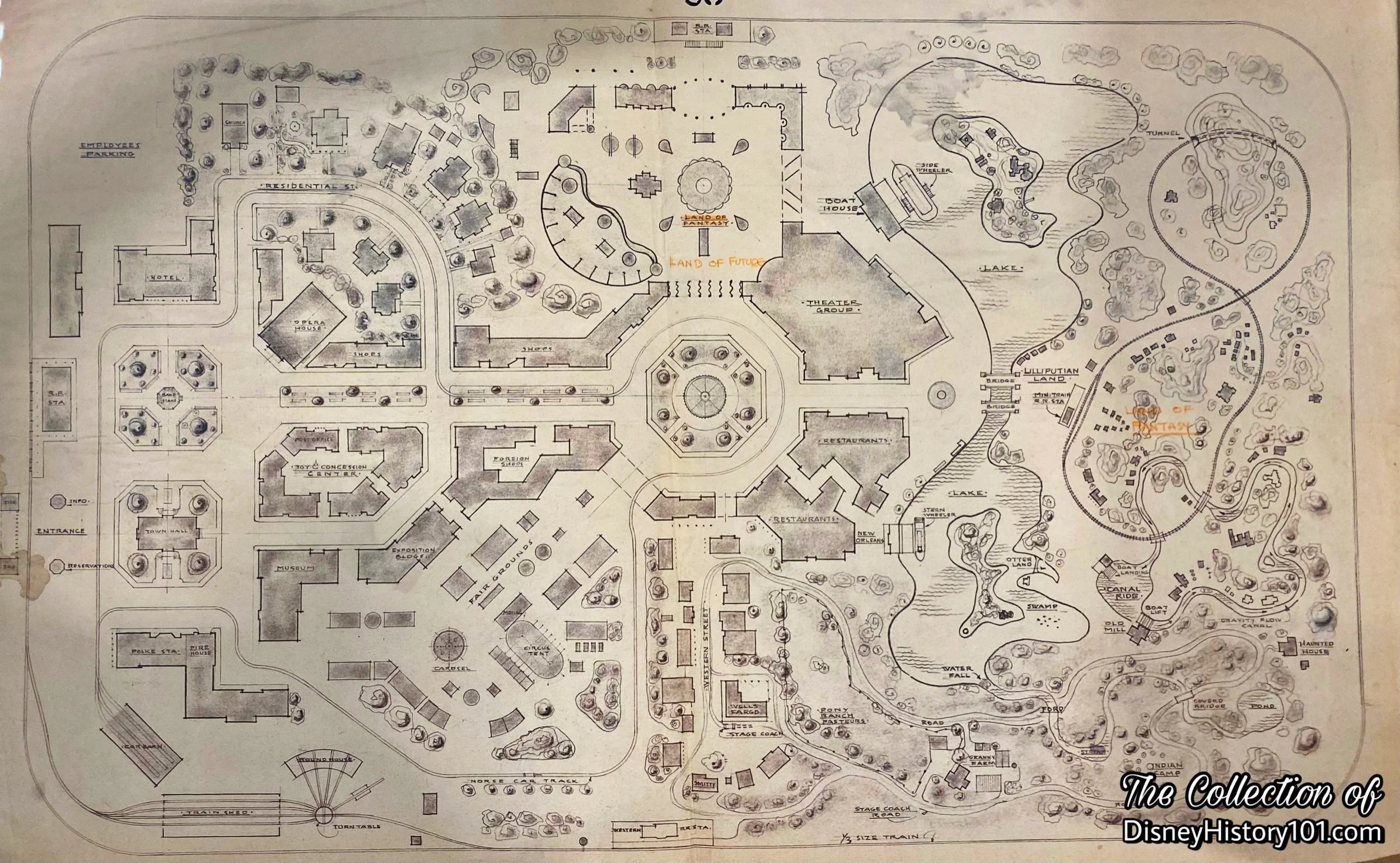
Back in 1948, Walt Disney visited the 1948 Chicago Railroad Fair with his friend animator Ward Kimball. On the way home, the two “railfans” also made a visit to Henry Ford's outdoor museum tribute to Americana called Greenfield Village, located in Dearborn, Michigan. It was Walt’s third visit to the history museum within his lifetime. Ward later recalled that Walt enjoyed the entire experience so much that it was all he talked about on the train back to Los Angeles. When Walt Disney returned home, he composed a memo which laid out in great detail some of his earliest ideas for a themed amusement center. In describing his earliest vision of a frontier town, Walt prominently mentioned an Opera House in addition to other attractions like a drugstore with a soda fountain, a toy store, horse cars, and a railroad station. This concept of a recreation of a frontier town would continue to develop over time.
On August 31, 1948, Walt was still dreaming about his Park (to be located across the street from the Studio in Burbank). A memo was circulated among artists of the Walt Disney Studios. Some thoughts in the “Mickey Mouse Park” prospectus made mention of an “Opera House.” [“The Spirit of Disneyland”]
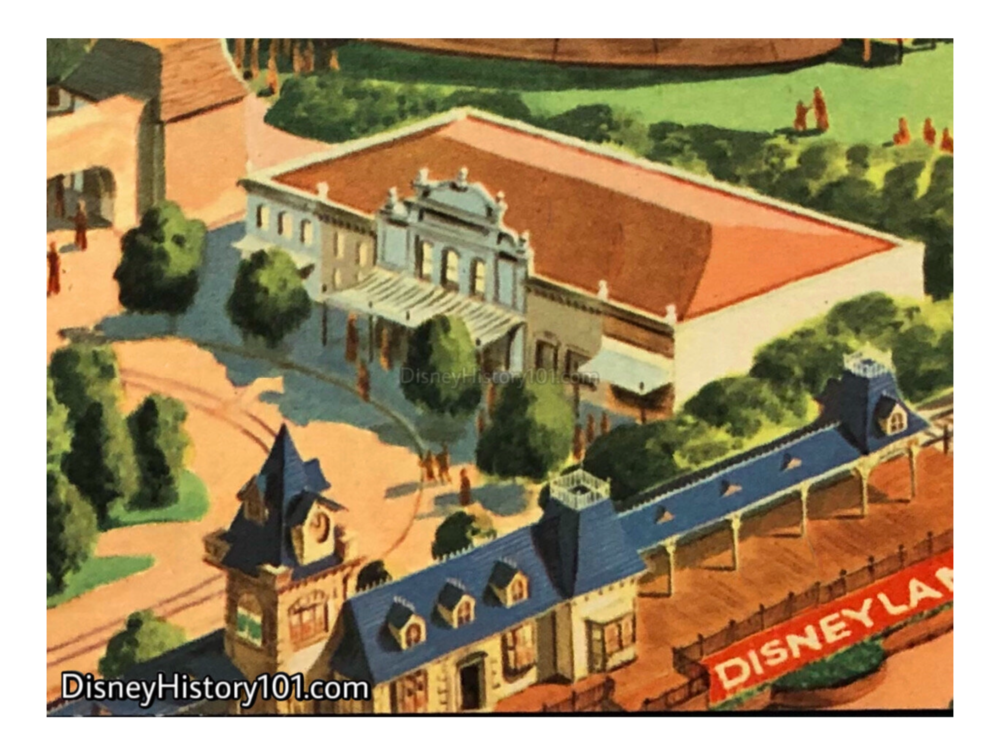
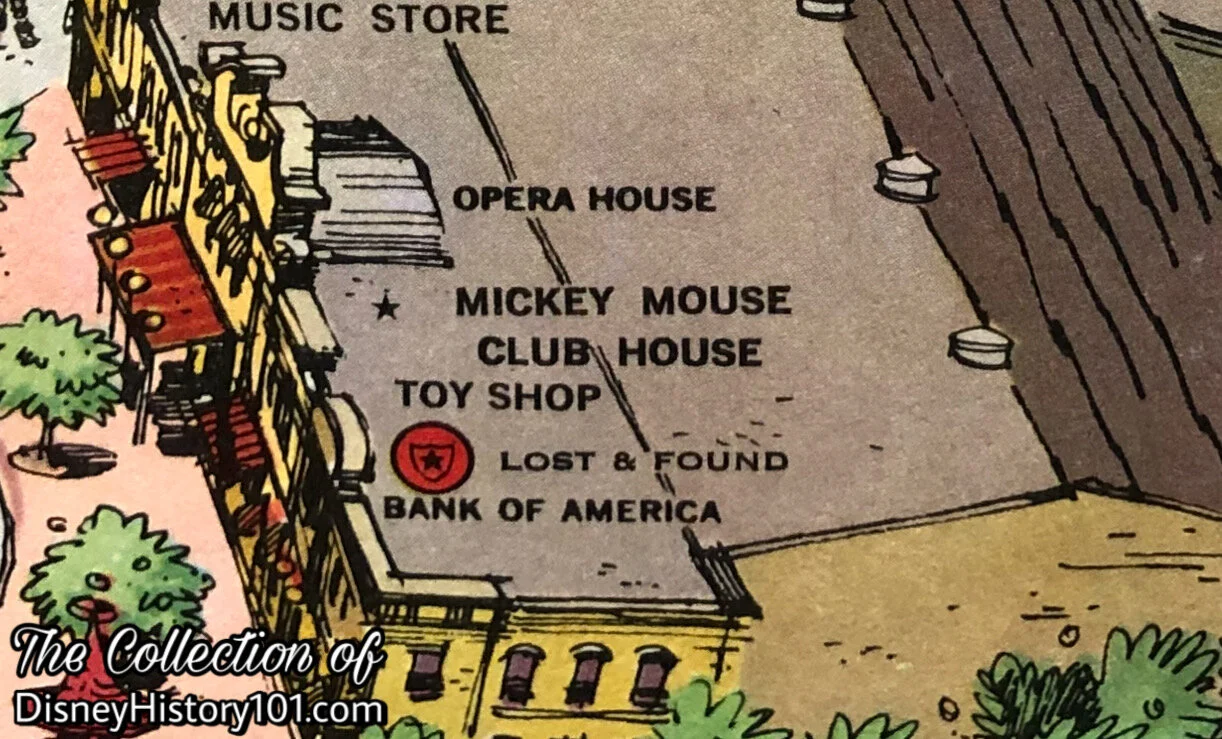
Pictured Above : Mattel “Disneyland Musical Map” Record Set Illustration, 1955. This illustration (produced for an early licensed Disneyland product), granted a glimpse of the Opera House located in the Town Square of Disneyland’s Main Street!
Eventually, Walt’s visions of a themed amusement center evolved into Disneyland, and by 1954, the first definitive piece of art was produced and included an Opera House. You may have heard of Herb Ryman’s iconic “Aerial Over Disneyland” concept drawing. This and a portfolio of colored sketches by Herb Ryman, Bruce Bushman, Harper Goff, and others was prepared for Dick Irvine and Nat Winecoff to take back East to sell the Disneyland concept to prospective licensees. A subsequent document entitled “The Disneyland Story” was produced (on September 3, 1954), in order to tell the story of what guests would experience upon entering Disneyland. The opening page states : “You find yourself in a Civic Center or Town Square at the turn-of-the-century, any time from 1890 to 1910. Here you will see…the OldOpera House.”
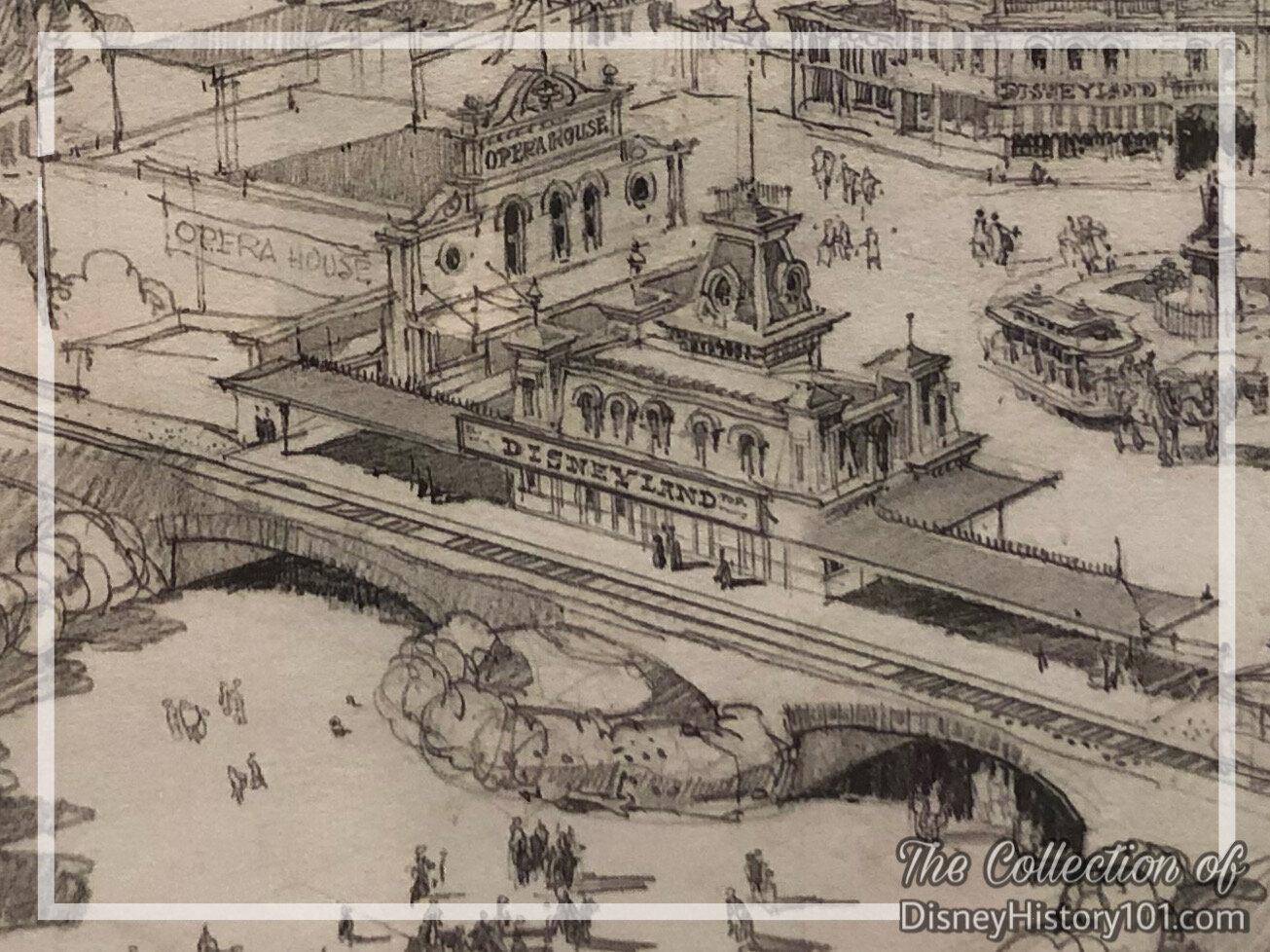
Early thumbnail sketches and other concept artwork seemed to be unencumbered by restrictions of budget, schedule or the laws of nature and physics. Though guided by Walt, his artists appeared to engage in “free-thinking,” as if implementing the modern “Blue Sky” Imagineering process. Like some advanced “High Concept,” final designs were quickly generated and approved. Some of these viable project Concepts (as above), were supported by a well-developed business case and built expectation.
Next, architectural drawings helped define all designs, production and construction strategies, costs, schedule, and resource requirements. “Disneyland is unique in that some of the world's foremost creative artists and architects control all design at Disneyland.“ Models explored the various dimensional relationships, site-lines, flow patterns, ergonomics, and visual appeal to convey the desired creative intent. Once the dimensional model was created, the Opera House was moved to the other side of Town Square.
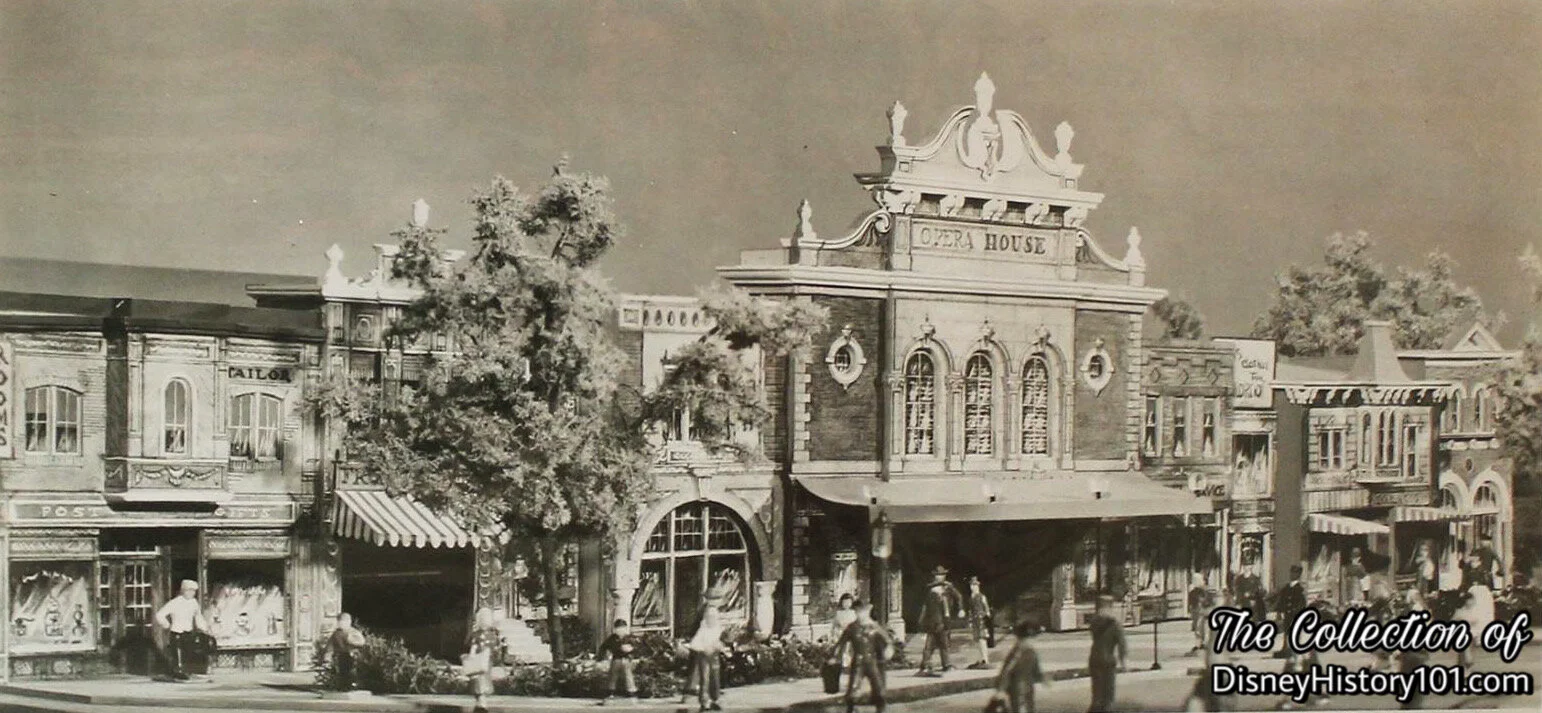
“Not Your ‘Run-Of-The-Mill’ Opera House”
As far back as Disneyland’s creation (and its “fabulous first decade”), the Main Street Opera House has served many other lesser-known (and forgotten) functions. This soon came after “the giant earth-moving undertaking was completed, the building crews took over. Soon, the rat-tat-tat of riveters was shattering the air, and sparks were flying from welders’ torches as the steel frameworks, capable of withstanding the ravages of time and the elements rose above the newly formed ground. While carpenters hammered and masons laid row upon row of brick and stone and mortar, the permanent buildings began to take shape and form,” according to “The Disneyland Story” published 1955.
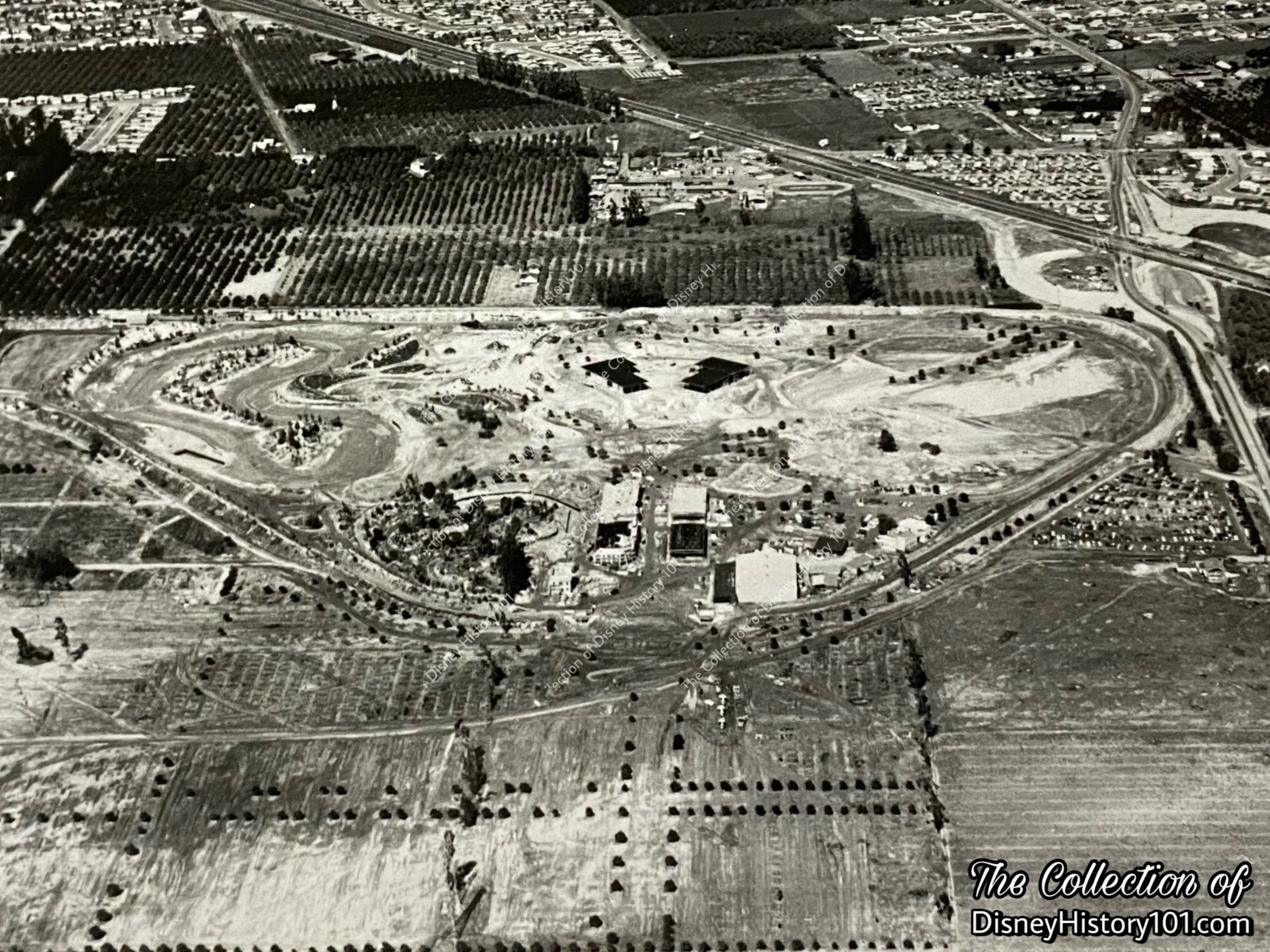
From groundbreaking until opening, the construction of Disneyland would start about July 17, 1954 and be completed by July 17, 1955. One of the first buildings to be constructed was the Main Street Opera House, which was first utilized as a Mill. However it took some time according to newspaper inserts published in July of 1955. “The construction department was following hard on the heels of planners… on December 18, an order came through to set up a lumber mill on the site… By January 3rd, about $50,000 worth of machinery had been installed, but power was not available until Jan. 17, and the mill went into production on that date.”
Scotty Cribbes read about Disneyland in the papers when he was living in Santa Ana (home of the grapefruit label), and put in an application. He started with the McNeil Construction Company as a carpenter and after a week he went to the Mill as a foreman.
George Mills recalled: “On January 3, 1955 I came to Disneyland and worked for McNeil Construction Company, raising steel and pouring concrete. For the most part, the Park was built in six months. Our mill was where the Opera House is now and the workers wore blue jeans and white T-shirts.”
First, a concrete foundation and slab floors were prepared. Earl Anderson recalled how his first job was helping to build the lumber storage building. “I would get down on my hands and knees in the rain and mud to work on the foundations.” The foundation was followed by wood frame construction (while store units would have a combination wood and rigid steel frame).
According to inserts published in area newspapers during July of 1955, Disney buildings were roofed by Pioneer Roof & Shingle Company (then located at 608 Mateo Street, Los Angeles, California; 7522 Westminster Avenue, Westminster, California). The roof covering was a variable, dependent on the architectural design.
The entire Main Street Building # 700 (including the Maintenance and Construction Mill) possessed complete fire sprinkling systems, as did each on Main Street U.S.A. By June 30, 1955, related Disneyland Site Work Fire Protection Utilities Plot Plans were prepared for Disneyland Inc., by J.E. Thomasson of WED Enterprises Inc.
Once complete, the 14,000 square foot Maintenance and Construction Mill generated the woodwork of Disneyland - from the functional to the aesthetic. The Mill temporarily included the Plaster Shop which created ornamental pieces for structures like Sleeping Beauty Castle. But most of all, approximately three and one-half million board feet of lumber went into the Park’s construction - much of it processed here by Lawrence G. and Bruce W. McNeil’s McNeil Construction (the Prime contractor), and fashioned into the surrounding structures of Main Street U.S.A.! Disneylander and “55er” Stan Gomez recalled carrying lumber on his back up and down Main Street and taking saws to be sharpened.
Sometime later, in a somewhat “tongue in cheek” manner, “The Disneyland Story” (prepared 1963) divulged that “The Mill is the Disneyland Carpenter Shop. With the tools and talents located in this section, one could request and receive anything from an ornamental toothpick to a boat or house.” There, “Cabinet-makers carved and painted the accurate reproductions that furnish the buildings.”
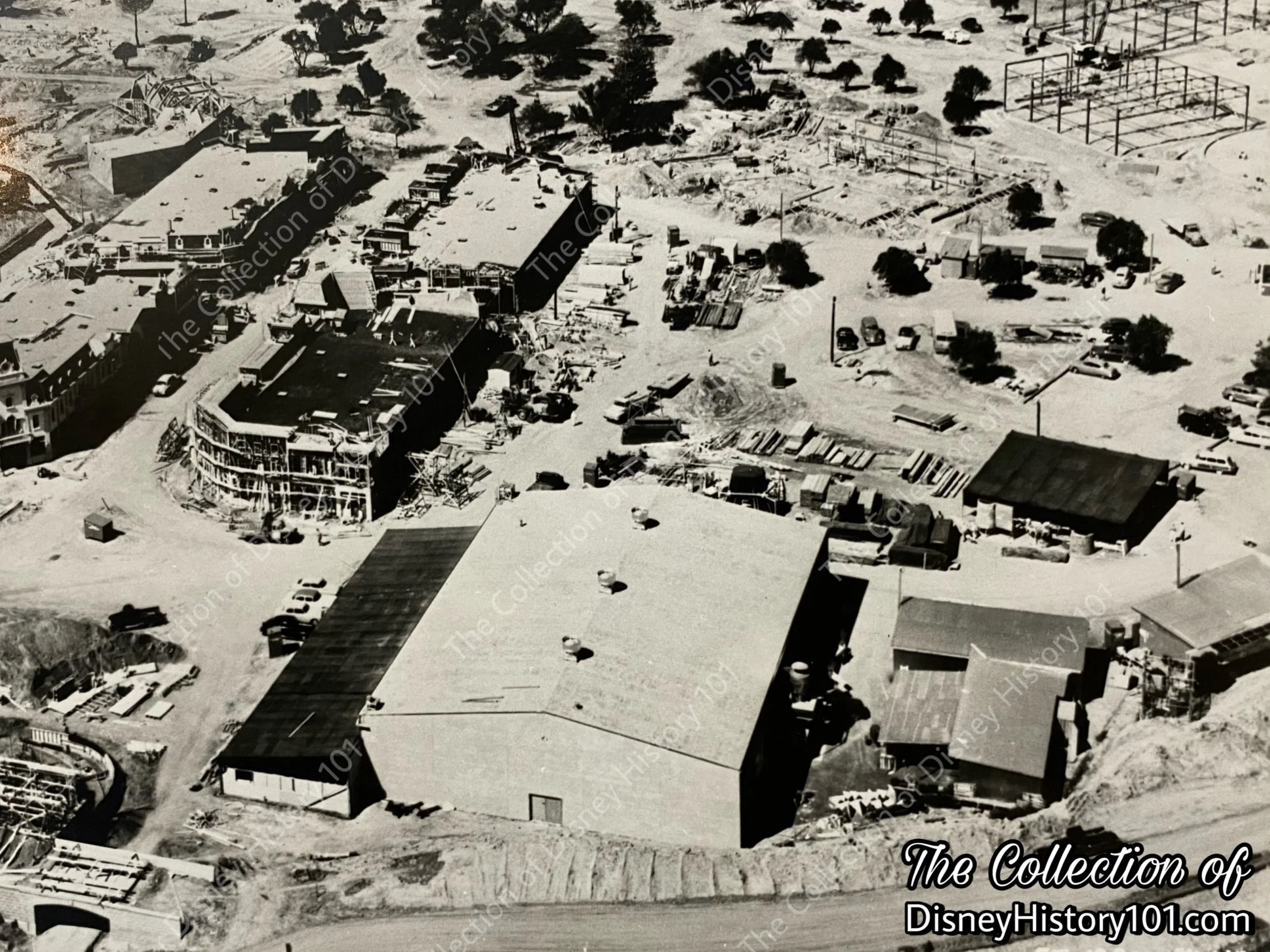
Some of Disneyland’s original carpenters (Cliff Carothers, Earl Anderson, George Williams, George Le Fevre, Scotty Scribbs, L.H. Anderson, John Yorber and a certain “Harry”) recollected fond memories of the original Mill’s role in Disneyland development to LINE Magazine : “when many complete buildings were built down by the Old Mill [not on Tom Sawyer Island]…but Main Street, and taken to the field. For example, the Railroad Tower at the entrance to Disneyland was built in the Mill and then set up, as was the Draw Bridge at the Castle.”
When Ed Winger came to the Park as a Hod Carrier, working for Herrick and Herrick, the only building on Main Street was the Opera House and the skeleton of the Train Station. Decorative elements were soon added to facade, as the posts which support the awning and marquee. These are actually lampposts, similar in origin to those which line Main Street. One authorized “Disneyland Information & Nomenclature List” (prepared by Bill Cottrell of Disneyland Inc., by May 25, 1955) listed “official and authorized nomenclature” of Disneyland, and distinguished the “Buildings in Civic Center” : “Disneyland Police Department, Disneyland City Hall, Disneyland Fire Department, Disneyland Opera House.”
By July 17, 1955, the structure was still not completed. A contributing writer with The Daily Oklahoman (on July 17, 1955), noted: “Everywbere there were the last minate rush. A painter put final touches on the marquee of the Disneyland Opera House.”
“Original Site Plans and Developments”
“Walt had always intended that television would play a major role in the Disneyland show, and this was especially true during the first decade. One of the requirements in the initial site survey was that a clear television signal could be beamed out of the Park. Plans were also made for the construction of sound stages and the implementation of regular telecasts,” according to Disneyland LINE (Vol. 12, No. 27 ; July 3, 1980).
In “WALT DISNEY PRODUCTIONS ANNUAL REPORT to Shareholders and Employees” published for the Fiscal Year Ended October 2, 1954, Walt Disney personally stated: “The Disneyland the park, which will be the physical base for the ABC telecasts, is now well under construction for opening this summer. Its various features of amusement, education and audience participation will also provide rich material for televiewers. Facilities to accommodate 40,000 visitors and 10,000 autos daily on the 160-acre site near Anaheim, California, indicate its entertainment potential and its reciprocal influence on our other interests.”
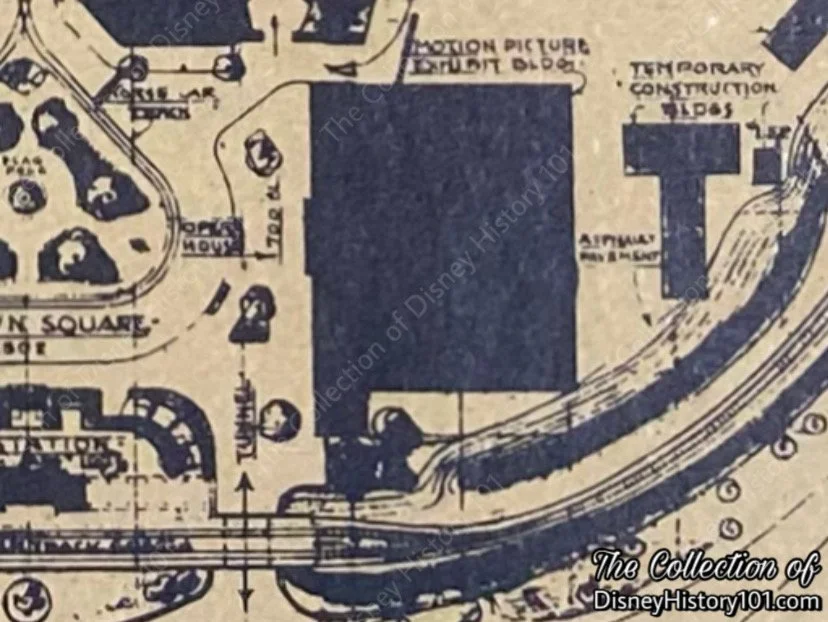
Some Site Plan (or Plot Plan) Drawings (produced during October of 1954) depicted or detailed a “museum”, “cartoon studio”, and 20,000 Leagues Under the Sea set pieces (including a walkthrough of a giant Nautilus, and a walk-through Salon with the terrifying Squid) planned for this space. The “cartoon studio” detail may have been one reason why a journalist for the Anaheim Bulletin (published Saturday, May 1, 1954) described Disneyland as a “fantasy-playground and television plant.”
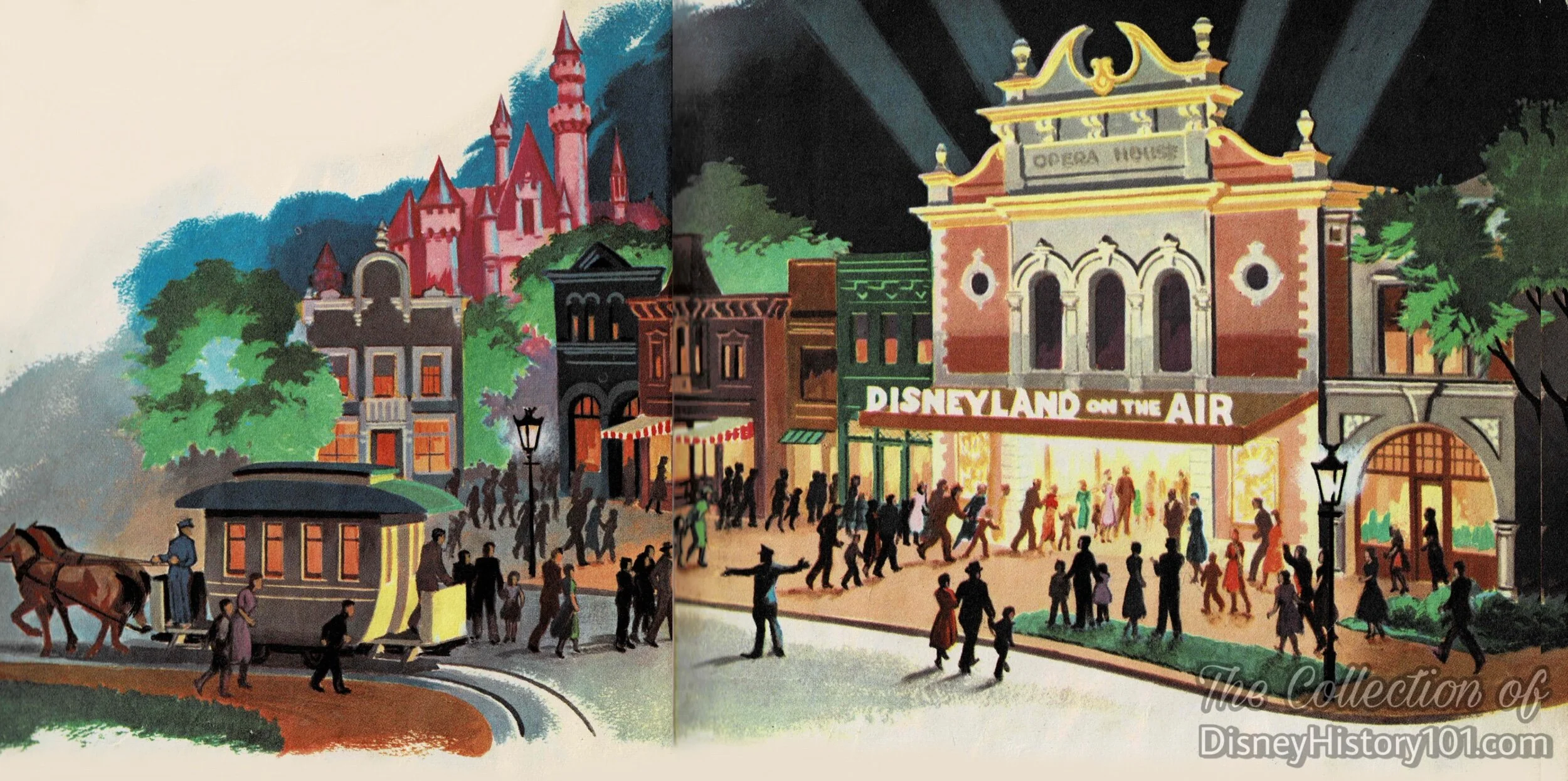
Back in October 1954, the Walt Disney Productions report for shareholders announced: “Disneyland the park, which will be the physical base for the ABC telecasts, is now well under construction for opening this summer. Its various features of amusement, education and audience participation will also provide rich material for televiewers. Facilities to accommodate 40,000 visitors and 10,000 autos daily on the 160-acre site near Anaheim, California, indicate its entertainment potential and its reciprocal influence on our other interests.” Early licensed merchandise even featured the Main Street Opera House being utilized as a television sound stage where a show was recorded and transmitted to the folks back at home watching from their televisions.
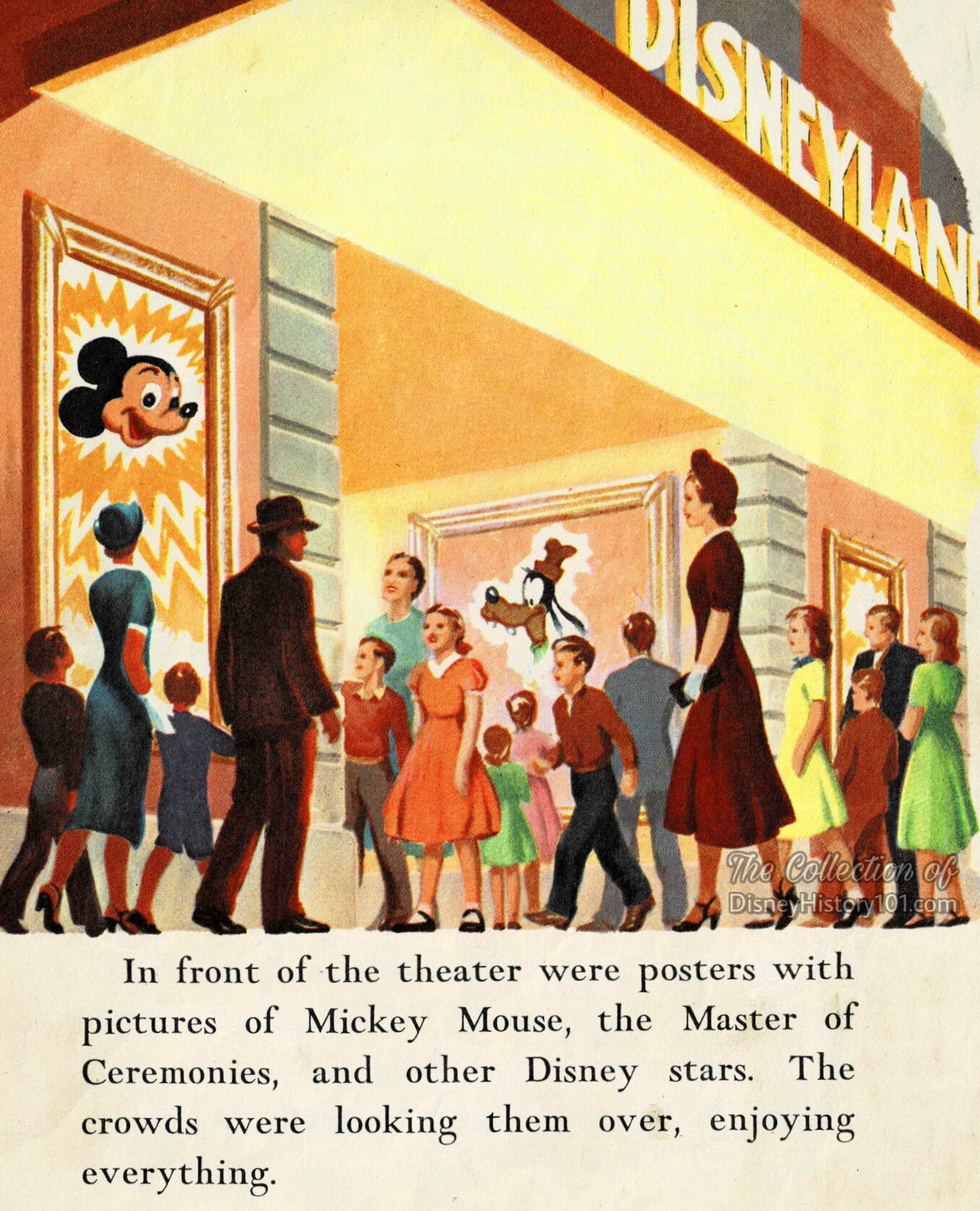
Though live television broadcasts would occur many times at Disneyland through the early years (i.e. on July 15th, 1955, July 14th, 1959, April of 1962, etc.), the Main Street Opera House was not utilized as a sound stage, and was ultimately first used for other necessary functions as early as May of 1955. During one Pre-Opening Day interview (with Bob Thomas of the Associated Press), Walt divulged that “we’re using it [the Opera House] for a mill now, but eventually I plan to make it a motion picture exhibit.”
“The Disneyland Public Address System”
While the 14,000 square foot Backstage portion (of most of the first floor) continued to be utilized as the Mill, the 3,354 square foot second floor came to efficiently house several necessary functions in a maximum utilization of space. First of all, the Park Public Address System was housed here, where announcements could be broadcast and heard throughout Disneyland. Announcements included Park opening and closing announcements, as well as event showtimes (e.g. those of the Mickey Mouse Club Circus). As a “sidelight,” Town Crier Bud Coulson would announce important events for the day, like Disneylander’s birthdays. If you visited Disneyland during the 1960’s you may have heard the voice of Ben Harris (Production Coordinator ; Wardrobe) making announcements over the system. All the while, the Disneyland Sound Department was responsible for maintaining the Park Public Address System.
The Main Street Music which helped establish the ambiance of the area, was also controlled from this location.
“The Disneyland ‘Private Branch Exchange’”
In 1954, the Disneyland telephone system had its beginning with a two-position, manual 555 Bell System Cord Board. The Main Street Opera House held a 560 square foot Disneyland Telephone Office known as the PBX (or, Private Branch Exchange) Offices of Disneyland Telephone Operators in mid-May of 1955. According to the Los Angeles Mirror (published June 10th, 1955), “the Disneyland telephone exchange, opened only three weeks ago… enlarged three times already, and still can’t get enough trunk lines… The switchboard girls, Pat Zimmerman,… Clarabelle Maxwell,… and Mona Harvey… are swamped with calls from people who want to know the opening date, prices and other data.” An insert published in area newspapers mentioned how: “The switchboard at Disneyland, according to telephone company, had an average of 900 incoming calls per hour during peak construction per riods. This amounted to 42,000 incoming calls a week, figured on an 8 hour day, 6 day week.”
A month after this article was published (and during Dateline Disneyland, which aired July 17, 1955), some of these very Disneyland PBX Operators can be seen waving from the second -floor windows (as some of the windows were ajar during the hot summer month)! The fact that the PBX Operators had a fantastic view of Town Square, is impressed by the following historic anecdote. “A few guests complained at City Hall that the clock on the Main Street Train Station was incorrect, and had caused them to miss their bus. A maintenance man was dispatched, and after checking the mechanism, he called the operator for the correct time. A few days later, guests complaints were still being received. Maintenance again dispatched a man, who checked the mechanism and called the operator. Guests complaints continued - the clock was wrong. In exasperation, the procedure was gone over, step-by-step it turned out that Maintenance was calling the Disneyland operator, who would look out from her switchboard above the Opera House, glance up at the clock tower, and read the time on the dial to the man inside,” according to Disneyland LINE (Vol 12, No. 29 ; July 17, 1980)
“Disneyland Cast Call Time”
In addition to inquiries by employees, the PBX office (and its first “555” telephone switchboard system) received many other types of phone calls. “According to the park’s chief operator, Mickey Mouse is one of the most frequently called Disneylanders. Explaining with obvious regret, she says, ‘Mickey’s personal appearance schedule prevents him from taking the many calls for him. We wish he could, especially when the young caller is phoning long-distance, which many do’”, according to Disney News (published Winter 1967-1968). Calls of this sort were just some of the 2,850,000 calls received during the 1967 year. Things had not changed a decade later, as guests still “requested to speak to Mickey Mouse”, according to Chief PBX Operator (c.1968-1976) Becky Morris.
By 1976, the Disneyland PBX Department held a staff of 12, with only 4 working the switchboard at a time. About this time you may recall hearing the voices of Betty, Connie, Dorothy, Jane, Janet, Judy, Reva, Ruth, and Virginia.
Soon the PBX Department held the Dimension System leased by AT&T for a number of years, and individual Cast Members suddenly had (not just Comm. lines, but) their own personal extensions. This came in handy when Disneyland received a brand new number for guests seeking hours and show information - (714)778-2552. Then (on April 27, 1979). On April 28, 1979, the implementation of the Dimension 2000 made the telephone system at Disneyland one of the finest and most innovative in Southern California.
With the addition of the Dimension 2000 came 25 incoming truck lines, 14 out-going local lines, 27 foreign-exchange lines, 20 tie lines, 920 extensions, and 1583 total instruments. The old “cord board” was done away with and Joe Berezny (Pacific Telephone’s Lead Installer) replaced the “cord board” with an SL1 System, which tied directly into Walt Disney Productions, WED, MAPO, and even Walt Disney World. By the time the department was known as “Communications Services” (around the late 1980’s), a brand new Northern Telecommunications Meridian System was installed. In addition, other bright ideas led to developments (like the installment of direct lines for convenience and speed). Unbeknownst to most guests, all of this was happening (for decades) from the upper floor of the Main Street Opera House!
“Other Disneyland Offices Back of House”
By the Press Preview Day of June 17th, 1955, the Lost and Found was located “above Opera House, Town Square” in those early days, according to “A Complete Guide To Disneyland” (published 1956). Over the next few years, other functions were based from the second floor of the Opera House. By January of 1958, the second floor of Main Street Building #700 housed a 165 square-foot Photo Lab, the 245 square foot Photographic Department Office, the 221 square foot Customer Relations & Public Opinion Office and Disneylander Office, the 1,582 square foot Merchandising Offices, in addition to 581 square feet of stairs and a hallway. By September 28, 1958, Bank of America appraised the Main Street Opera House Building (considered a Park Asset) and valued it at $258,398. In 1959, Allen Malmstem’s Food Services Office was added to this location. All of these were once situated on the entire oft-unseen second floor of the Opera House which totaled 3,354 square feet.
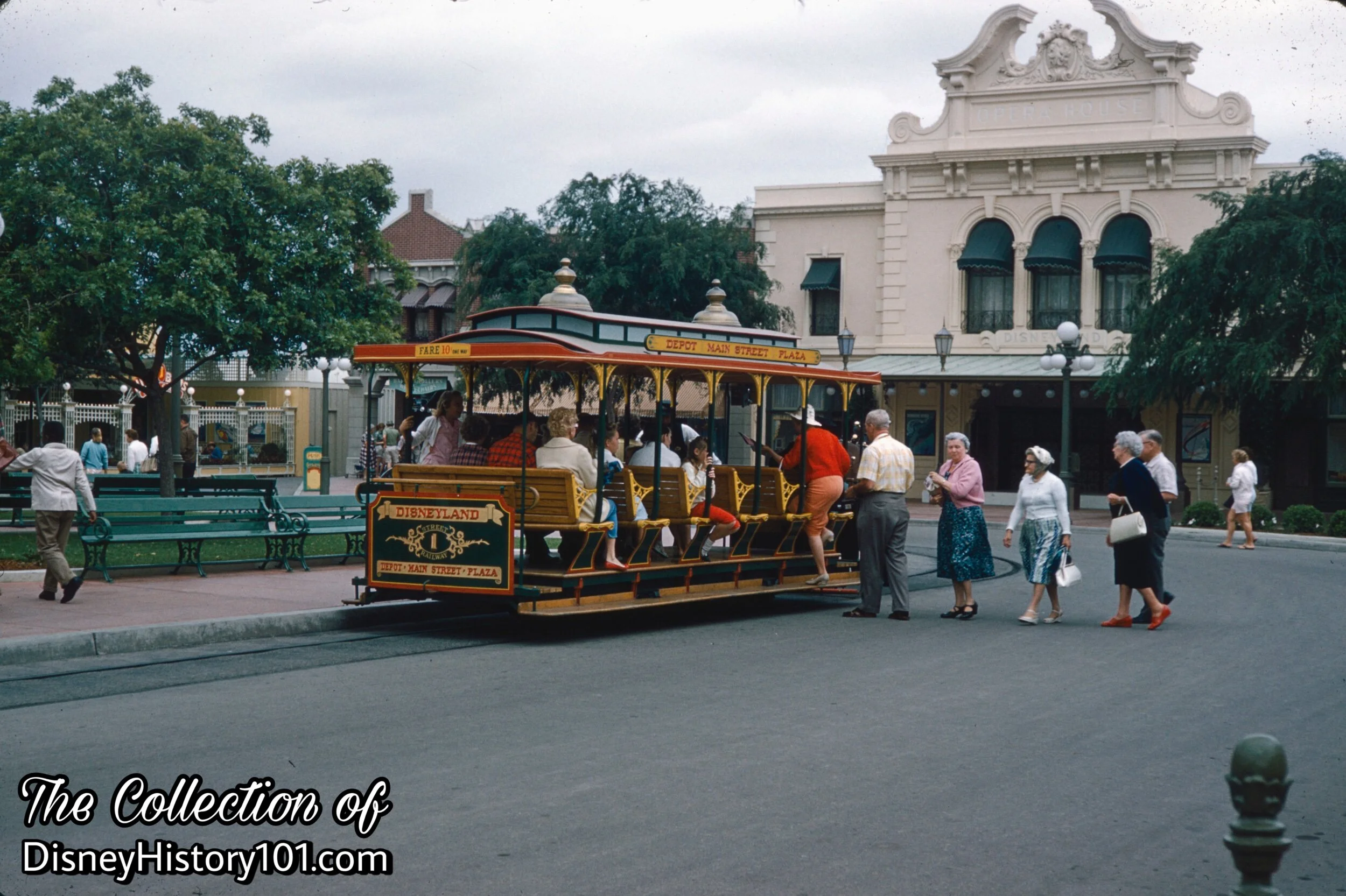
Guests prepare to board a Horse Drawn Streetcar and depart for a ride down Main Street U.S.A., not far from the Main Street Opera House in Town Square.
“Grand Opening”
As of June 2, 1955, C.V. Wood Jr. sent an Inter-Office Memorandum to Walt Disney regarding the best estimates that could be obtained at the time regarding the completion status of individual sections of the Park and Opening Day. C.V. wrote: “Electric Signs: All are in work - with the exception of the shoe store and the Bank of America, all will be completed.”
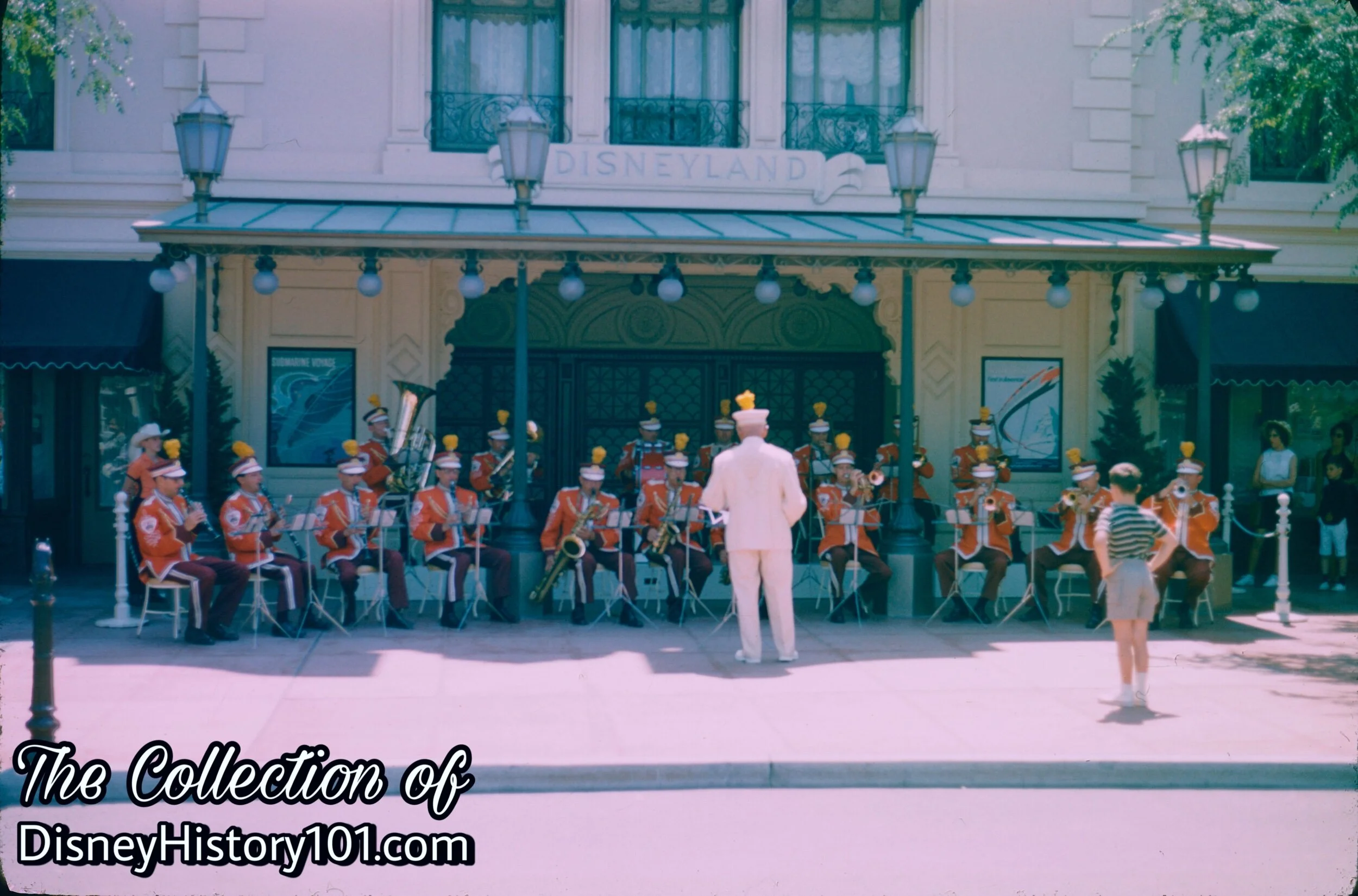
Art Linkletter (while hosting Dateline Disneyland, aired July 17, 1955) implied that the Grand Opera House was a location “where Jenny Lind [a Swedish Opera Singer] or a Chautauqua [adult educational] lecture might take place.” Though (during the first few years), the doors were usually closed to guests, music would still emanate from the Main Street Opera House. During the early years, it’s sidewalk area under the awning was prominently used by the Disneyland Marching Band for concerts. In fact, those Disneyland PBX operators (stationed upstairs) received a free concert every morning, as the Disneyland Marching Band played right in front of the Main Street Opera House doors! During the latter part of the “first fabulous decade,” the Shoeshine Boys often performed near the entrance. You probably couldn’t hear the sound of the Mill (which operated until about 1960). During later winter seasons, the Disneyland Christmas Carolers (under the direction of Dr. Charles C. Hirt and lead by Mr. Robert G. Hasty), also known to perform near the “Lincoln” theater during various times of the day, from December 16th, 1967 thru January 1st, 1968. [“Disneyland Holiday Talent Master Schedule,” prepared for the period of December 16, 1967 through January 1, 1968]
During the early 1960’s the 450 square foot Main Street Opera House Lobby was utilized as a “Sponsor’s Headquarters” for representatives of senior classes attending Grad Nite at Disneyland. It seems (during this time) that there were many ideas as to what purpose the Main Street Opera House Lobby (comprising some 450 square feet) could serve at Disneyland. Over time, The Main Street Opera House on the 600 block of Main Street in Town Square, came to house a number of popular displays (as originally intended). One of the first events held inside was a publicity event for Walt Disney’s Zorro television show. A few years later (during November of 1962), Milt Albright entertained the idea of dividing the Main Street Opera House into a “Birthday Village” comprised of six areas. The area would have been rented for a period of (approximately) 45 minutes, and the package would potentially include lemonade and birthday cake, an overall photograph with their guests, and perhaps a special hat. With the thoughts of lemonade in mind, we turn our attention to the Main Street Opera House’s first memorable (and “Mother Goose”-inspired) exhibit…
You may recollect Walt’s Pre-Opening Day interview (with Bob Thomas of the Associated Press), where he divulged that “eventually I plan to make it a motion picture exhibit.” More than six years after Walt spoke those words, one of the first special exhibits to be displayed inside the Main Street Opera House was the Babes in Toyland Exhibit, from December 17th, 1961 to September 30, 1963 (with a brief closure during the winter of 1962). This was a walk-through exhibit featuring giant-size motion picture sets recently used in the filming of Walt Disney’s 1961 theatrical musical Babes In Toyland.
Babes in Toyland was quite an achievement itself, as the Walt Disney Studios had first entered negotiations in with Merian C. Cooper in 1933, to produce an adaptation of Victor Herbert's 1903 operetta Babes in Toyland. By 1957, Walt Disney shared how “planning product for today's changeable theatrical market in the United States is not easy. Theatre goers have become very selective. But we are firm believers in the basic desire of people for good theatre fare-good stories, well told.” Still, Walt expressed much enthusiasm for the “important new project slated for production” at his Walt Disney Studios. In the 1957 Walt Disney Productions Annual Report to Shareholders and Employees, he described Babes in Toyland as “a live-action spectacular to be built around the classic Victor Herbert music.”
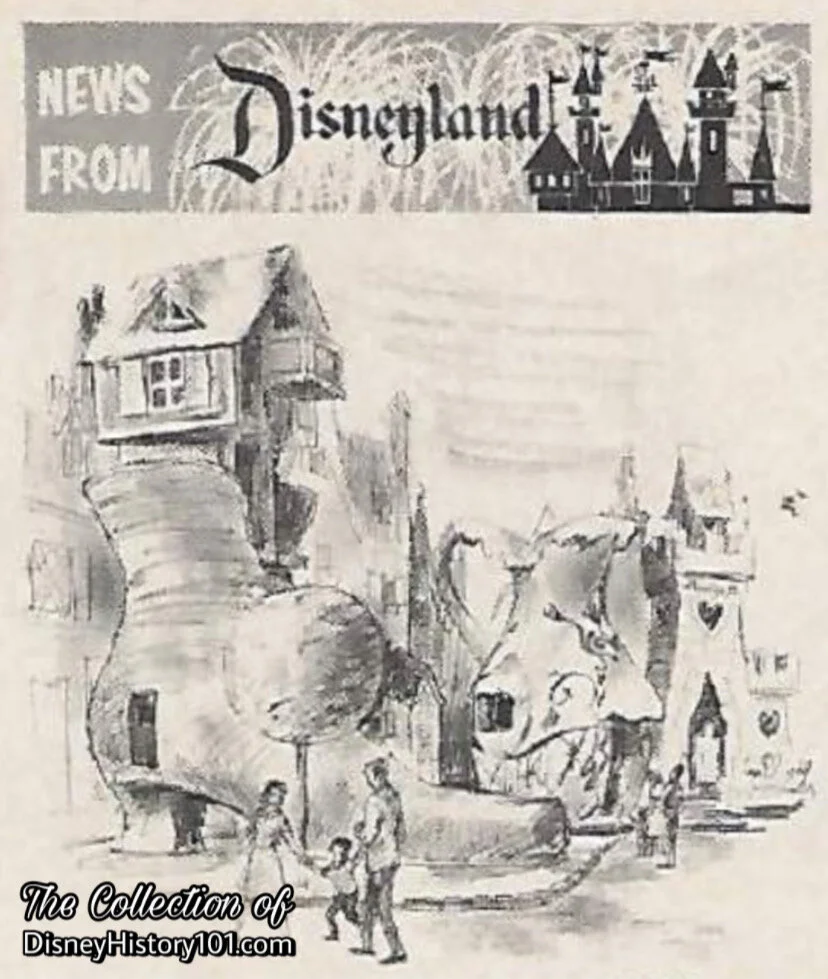
The set pieces for Babes in Toyland were created under the Artistic Direction of an established and renowned Hollywood Art Director Carroll Clark and Marvin Aubrey Davis (both of whom would go on to Direct the Art of many live-action Walt Disney Productions through the 1960s). The massive fantasy sets were also created under the Set Direction of Emile Kuri (the Academy Award Winning Set Director of Walt Disney’s 20,000 Leagues Under the Sea), and Hal Gausman (who had recently served as Set Director for Walt Disney’s Absent Minded Professor, and would later serve as Art Director for Walt Disney’s Mary Poppins)! Emile’s work had previously been a constant and popular feature of Tomorrowland!
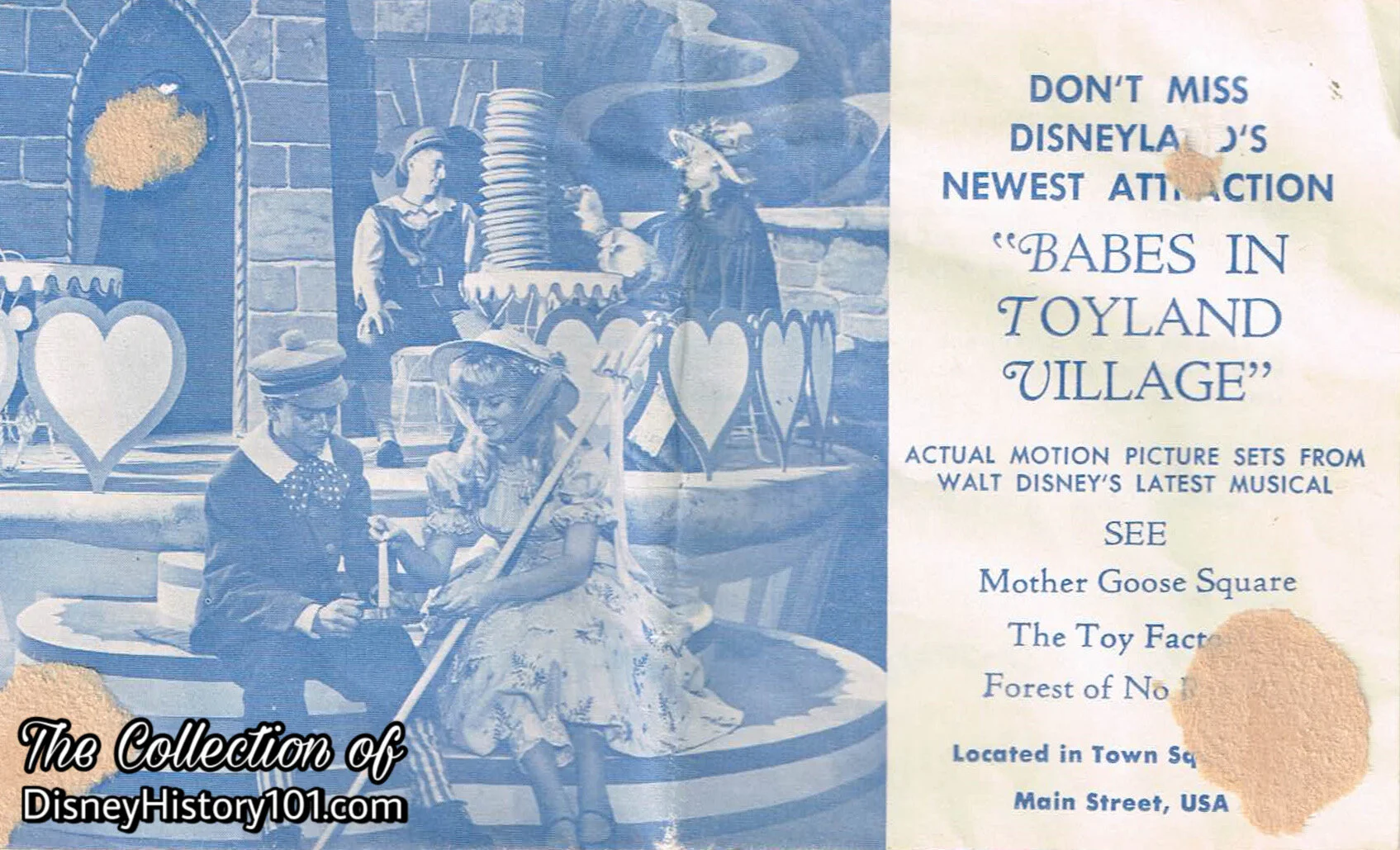
Once through the Forest of No Return, “all roads lead to the magical, merry” Mother Goose Village Square! Guests could see “the pumpkin house of Peter, Peter, Pumpkin Eater ; the Queen of Hearts Tart Shoppe, the Shoe in which the Old Woman lived ; … and the Toymaker’s Toy Shoppe”. In addition, there was “Mary’s Cottage and garden ; a storybook castle and a little greystone church”, and in the distance (far outside of town) the crooked house of the “crooked old man” Barnaby villainously looms at the top of the hill. One of the sections of this “3 Wonderful Ways to Experience Disneyland” leaflet advertises some of the explorable locations of the “Babes In Toyland Village”. “See Mother Goose Square, The Toy Factory, [and] The Forest of No Return.”
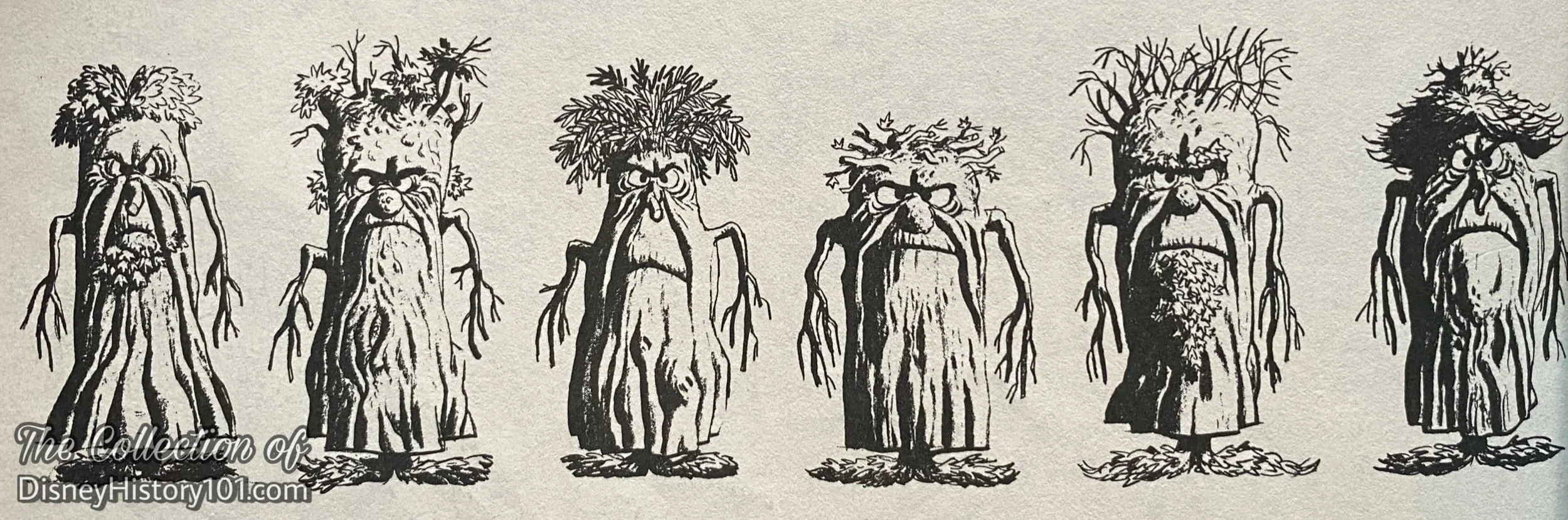
The Forest of No Return could be a little scary for younger guests. It’s been said that “those who stumble in, those who fumble in, never can get out.”
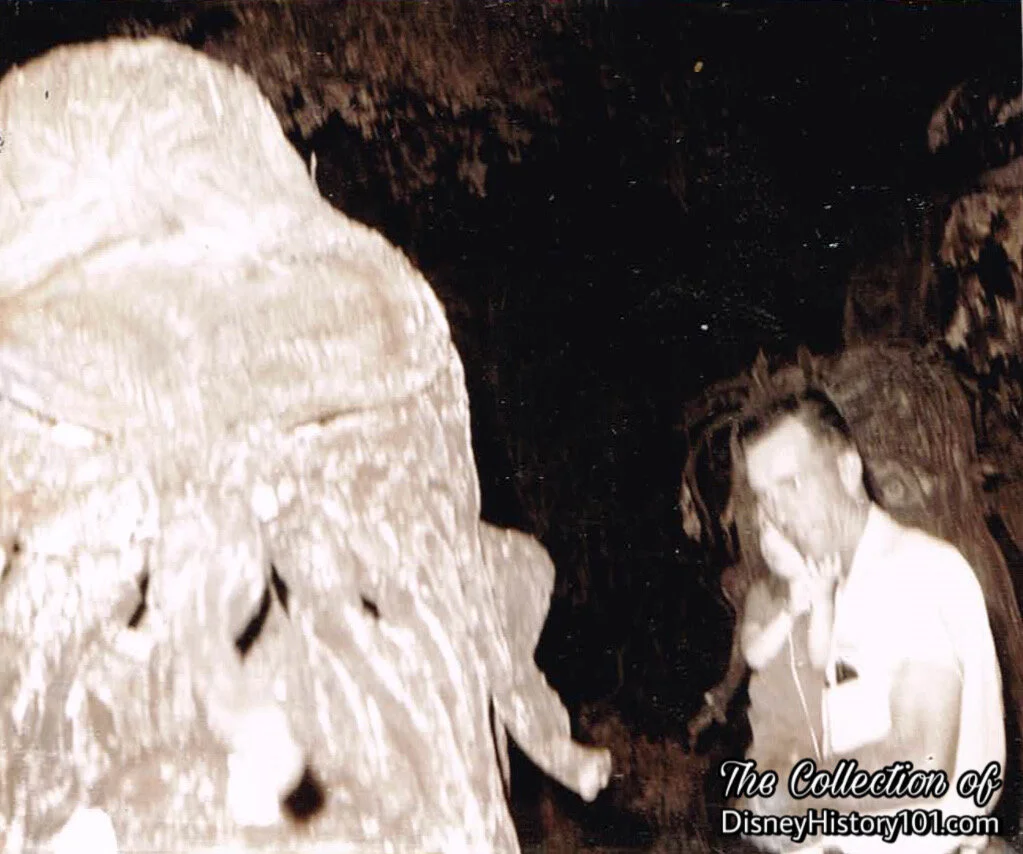
Here, a father holds his child as they ignore the signs reading “Go Away” and “Get Out”, and make their way through the encircling trees. Beware, as Barnaby’s cohorts (Gonzorgo and Roderigo) may be following closely behind!
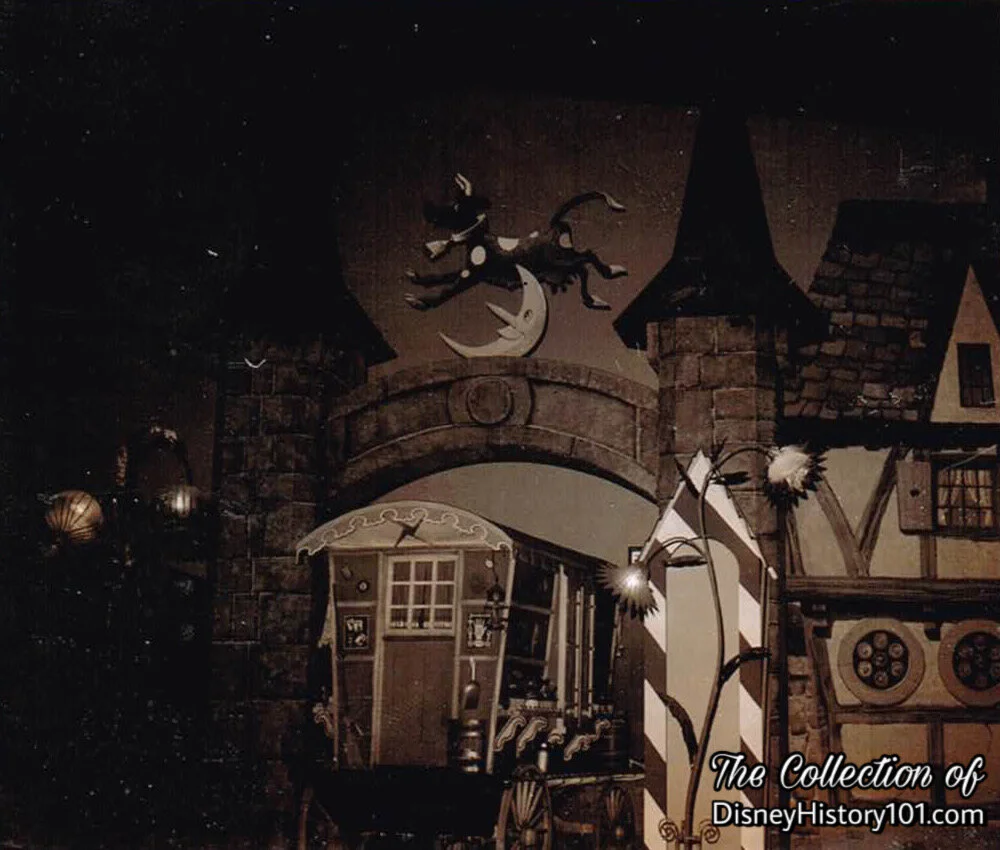
By the time we arrive at Mother Goose Village, it appears that a Gypsy caravan has also arrived!
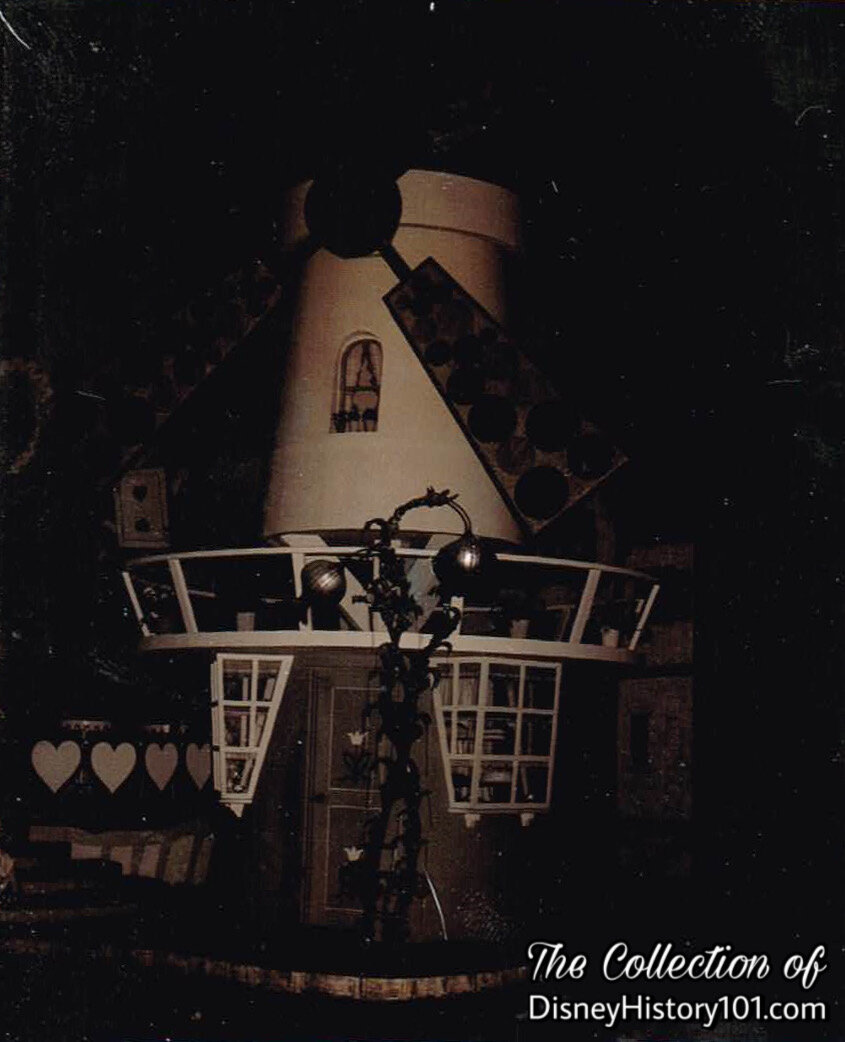
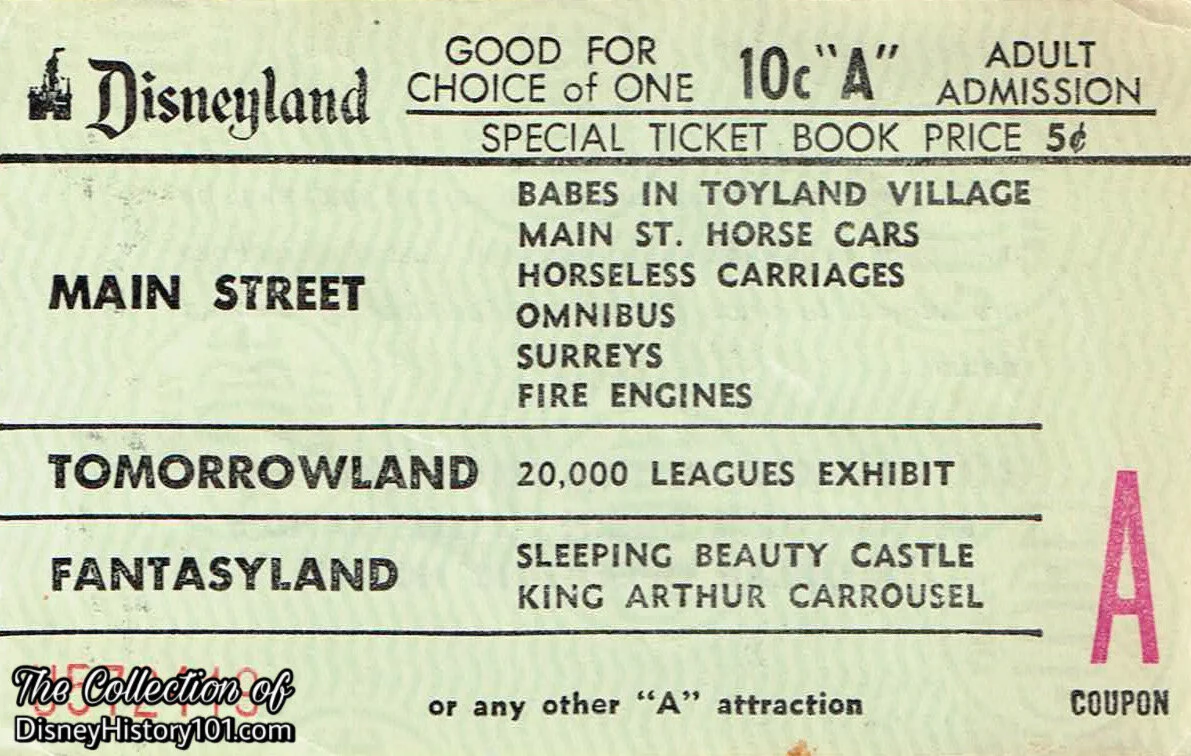
Many guests were sure to not miss Disneyland’s newest attraction - the “Babes in Toyland Village”, featuring actual picture sets from Walt Disney’s latest musical! Table IV of the ”Ride Operating Schedule” (effective October 3, 1962) reported a maximum capacity of 1,200 guests daily. The cost of admission was the same as Walt Disney Productions’ other feature film exhibit, the 20,000 Leagues Exhibit - 10 cents, or one “A” Coupon.
All the while, after the Park closed, the staff would take over with brooms, mops and dustcloths. Special attention was given to marred walls, posts and furniture. Items with marks that didn’t wash off were replaced or repainted. Floors were waxed and buffed to preserve their beauty and protect them from the thousands of feet that scuffled over them each day.
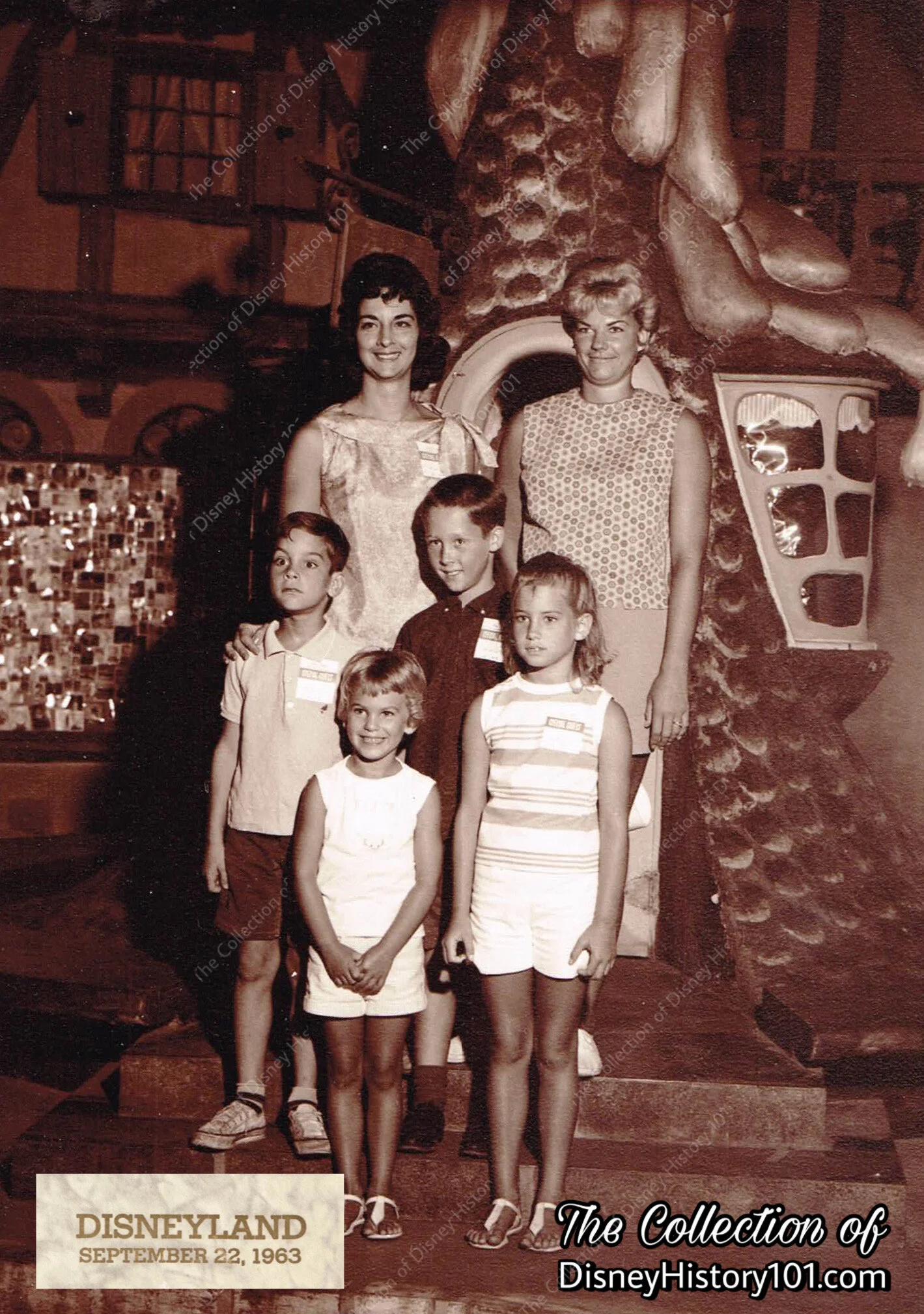
Guests who wished to commemorate their visit to the film’s set (and prove that they actually set foot in Mother Goose Village) could have their souvenir photo taken near the house that Jack Built - that of “Jack-Be-Nimble” (of candle-jumping fame)!
After visiting the exhibit, guests may find a memento of their experience in a location not advertised - the neighboring Toy Shop. Many souvenirs (found in contemporaneous c. 1961 shops) were themed around the Babes in Toyland characters - wooden frame tray puzzles (by companies like Jaymar) featuring memorable scenes from the film, vinyl Disneyland records and books featuring popular songs from the film, cute “Twistable” toys, hand puppets, “punch-out” figure books, and small plastic Marx Disneykins figures of toy soldiers.
During 1963, Grad Nite Chaperones used teh space as their greenroom and dined among the set while Grads explored the Park.
By the time this attraction had ceased operation, a grand total of 436,070 guests had experienced a stroll through the Village set pieces of Walt Disney’s latest live-action feature film [according to Admission Media Rides and Attractions Reports, published by Disneyland Research Department, April, 1971].
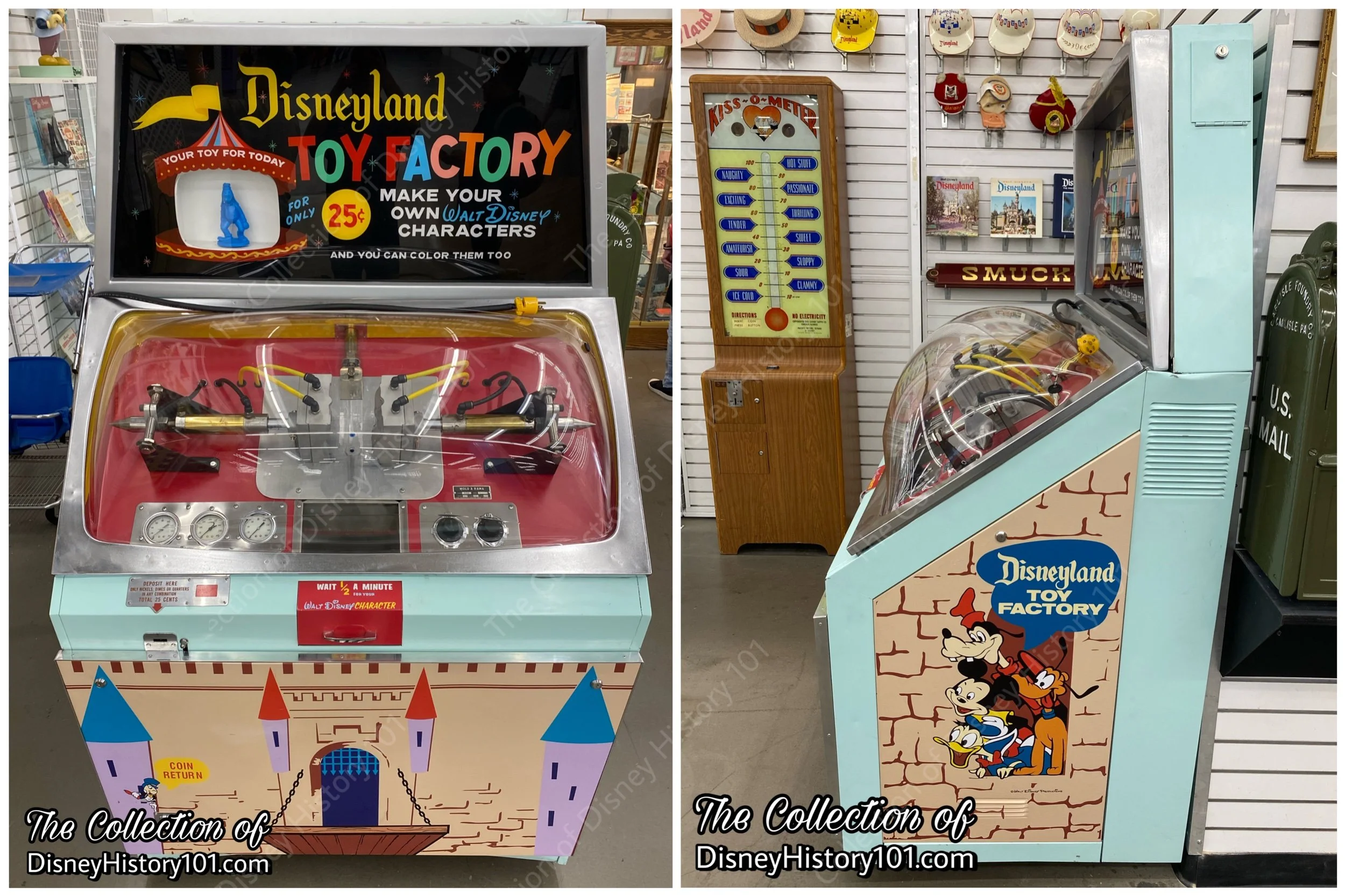
The Main Street Opera House housed a J.H. Miller Company Mold-A-Rama "Disneyland Toy Factory" machine.
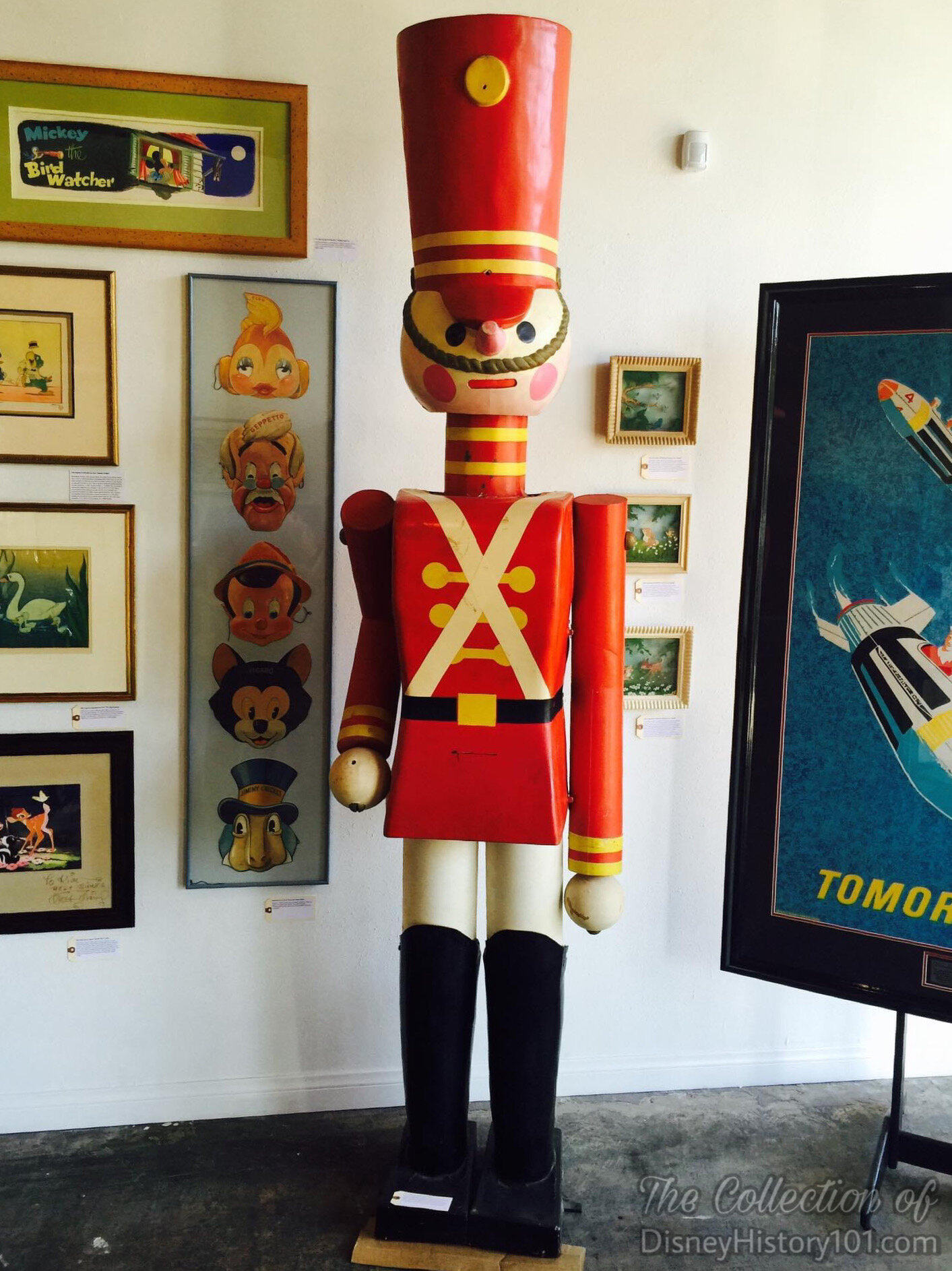
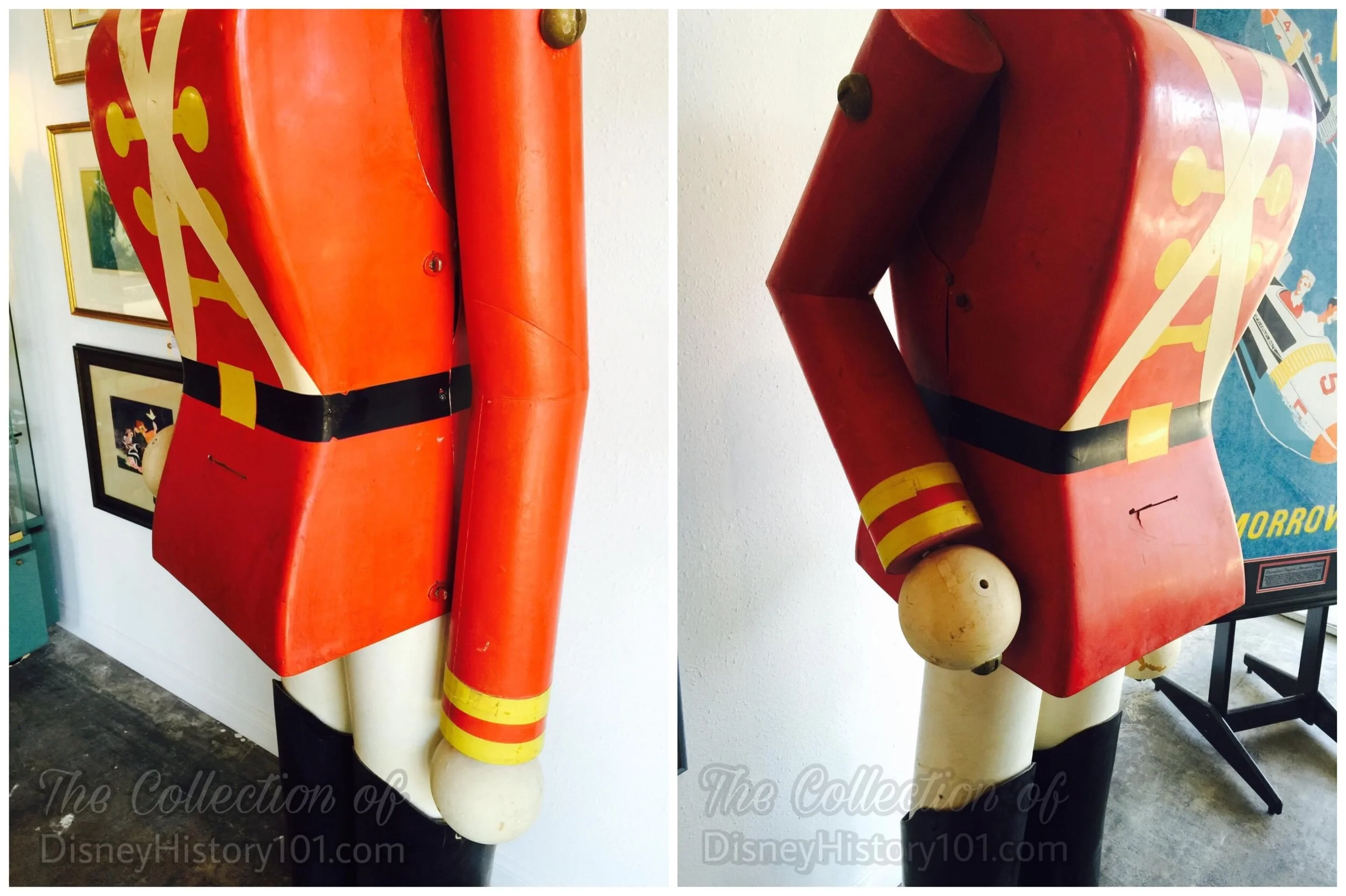
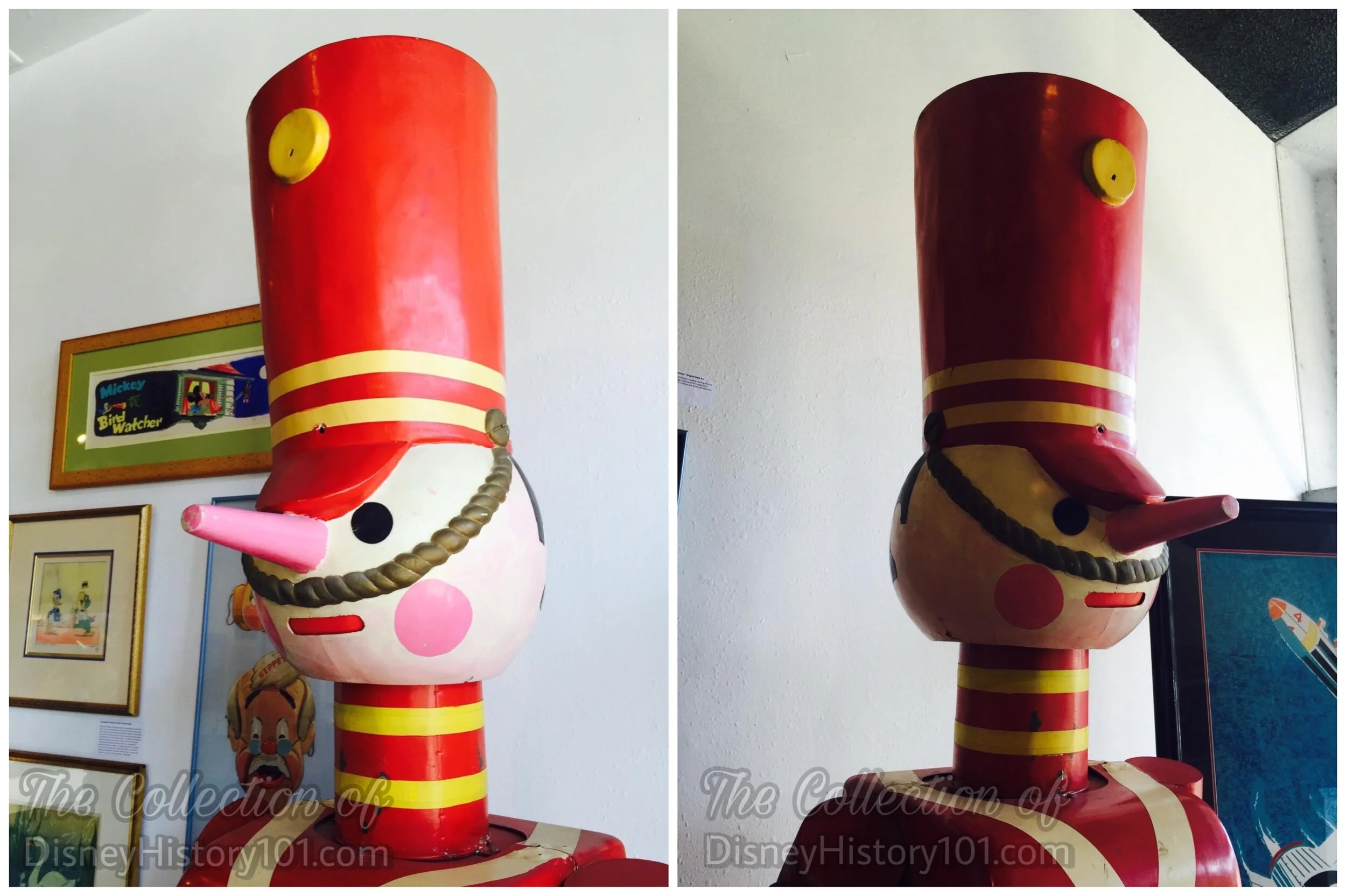
Before guests even set foot inside the technicolor fantasy world, towering Toy Soldiers in Candy-striped guard houses guarded the entryway into the Main Street Opera House, as George Brun’s storybook-inspired music tracks could be heard in the distance! Decades after these giant wooden Toy Soldiers briefly stood guard outside the Babes in Toyland exhibit, we had the pleasure to see one in person at one of Van Eaton Galleries’ prior pre-auction exhibitions! As a “sidelight”, you may notice that the soldier’s straps also form an “X” across their back. This was done with intent, as their creator was the legendary animator Francis Xavier Atencio!
The earliest concepts of Walt Disney’s Disneyland included descriptions of a Mickey Mouse Club attraction! This was likely due to the fact that the “The Mickey Mouse Club” television show was preparing to launch during the fall of 1955, and Walt (being a big believer in corporate synergy) was planning to use Disneyland as a stage to introduce his newest sensation! According to “Disneyland” (a document prepared for Disneyland Inc. by WED Enterprises), “Mickey Mouse, the best known personality in the world has his Mickey Mouse Club headquarters at Disneyland. Located on Treasure Island, in the middle of the river, a fantastic hollow tree and treehouse serves as the Club meeting place. The hollow tree is several stories high, with interesting rooms and lookout spots for Club members. There is a Pirate cove and buried treasure on the Island…and direct from this location the Club presents The Mickey Mouse Club Television Show.”
Disneyland partially owes its existence to the Mickey Mouse Club. According to Walt’s own words (in a Disneyland, Inc. Merchandise Association Meeting held Wednesday, January 25, 1956): “A year ago we were praying that we could have Disneyland open by July, then wondering if we would have enough money to open it. I reached a point where I needed a few more milion dollars, so took on quite a chore and started a new TV show - the Mickey Mouse Club… My budget for 100 hours of programming for the Mickey Mouse Club was $2,000,000,00 and I spent more than that… Money from this program was used to help finish Disneyland. Today the show has a 25 rating which is the highest rate of any day time show and compares very favorably with some of the night time shows. We use this to publicize Disneyland.”
Now, “The Mickey Mouse Club” television series had two runs up to this point - a one hour run for two years (from October 3, 1955-1957), and a half-hour run (from 1957-1959). During the latter run, Nielson ratings over a 52-week period (of 1958 alone) showed “The Mickey Mouse Club” was viewed by a total of 15-million Americans, five days a week.
By 1963, ”The Mickey Mouse Club” television series had recently become syndicated, and thus offered a wonderful opportunity - a “cross-pollination” promotion opportunity between Disneyland and Walt Disney Productions! Ultimately, the Mickey Mouse Club, would be regularly shown throughout the world.
Now, following the Babes in Toyland exhibit (which closed on September 30th, 1963), the Main Street Opera House briefly hosted the Mickey Mouse Club Headquarters - from September of 1963 to September of 1964! During this time, the Mickey Mouse Club Headquarters was open daily at Disneyland - from dawn until dusk - with varied opening hours, ranging from 8:30 am (or 9:30 am) to 5:00 pm! The entire adventure had a 900-guest capacity.
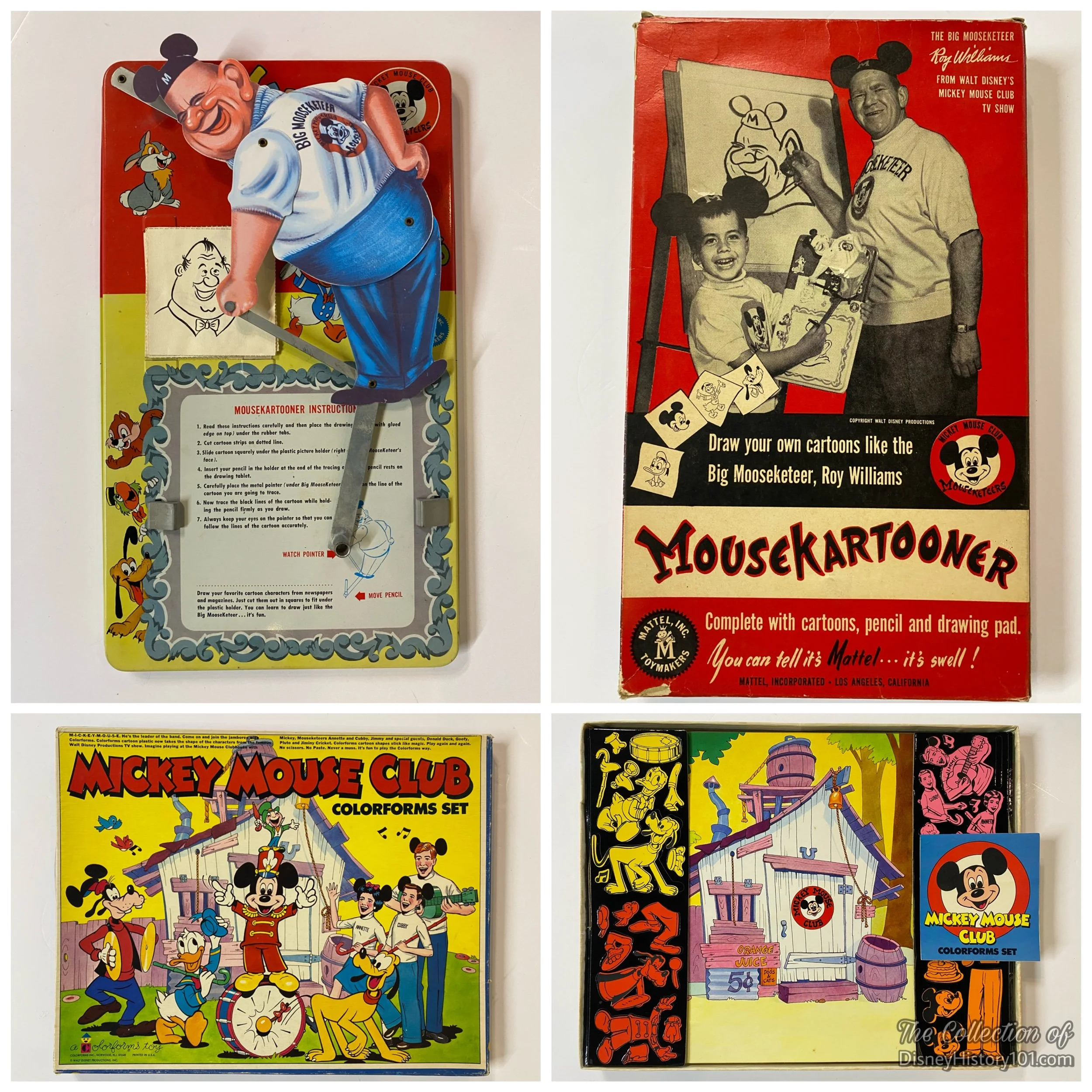
Here, the doors of the official “Mouseke-Club” were opened by Disneyland Guided Tours Hostesses (like Maggie Albright, Chief Hostess of the Mickey Mouse Club Disneyland Chapter). Then, “boys and girls from far and near” were “welcome as can be,” and everyday was “Guest Star Day.” Older Mickey Mouse Club Members (and Guests) “proudly put on their Mouseke-ears,” and experienced becoming honorary Mouseketeers (receiving their very own Charter Membership Certificate, Official Membership Card, and souvenir button). Fans of the series could have a souvenir photograph taken with Mickey Mouse (on their birthday), and guests of all ages found exclusive Mickey Mouse Club Headquarters souvenirs and miniature press photographs featuring the original cast were sold in the Mickey Mouse Club Shop (as it was referred to in Walt Disney’s Guide to Disneyland)! Just through the Opera House doors, the “Disneyland Toy Factory” Mold-A-Rama would produce plastic-injected molded figures of Mickey Mouse and friends.
“Guest Star Day”
Once entering, you stroll down a path with barns and the various days of the week on them (i.e. Guest Star Day). Some of television’s Mouseketeers would meet and greet guests near these barns. It wasn’t uncommon to see Roy Williams drawing caricatures, Jimmy playing his Mouseguitar, or other Mouseketeer Alumni visiting the exhibit. Of course, the most popular Mouseketeer was “the leader of the club that’s made for you and me“ - Mickey Mouse!
In addition to all these guest stars, Mouseketeer Ginny Tyler regularly recorded live 15-minute daily segments inside Disneyland’s Mickey Mouse Club Headquarters, which was broadcast on locally on KTTV as part of the syndicated “The Mickey Mouse Club” series. Comedians “Hub and Bub” (later known as Skiles and Henderson) made an appearance on one such segment. While many of the live televised segments featured the Backstage areas of Disneyland (i.e. the Mill, Model and Paint Shops, Decorating, the Monorail Shed, and the Train Roundhouse), one segment in particular highlighted “the inner workings of the Main Street Cinema.”
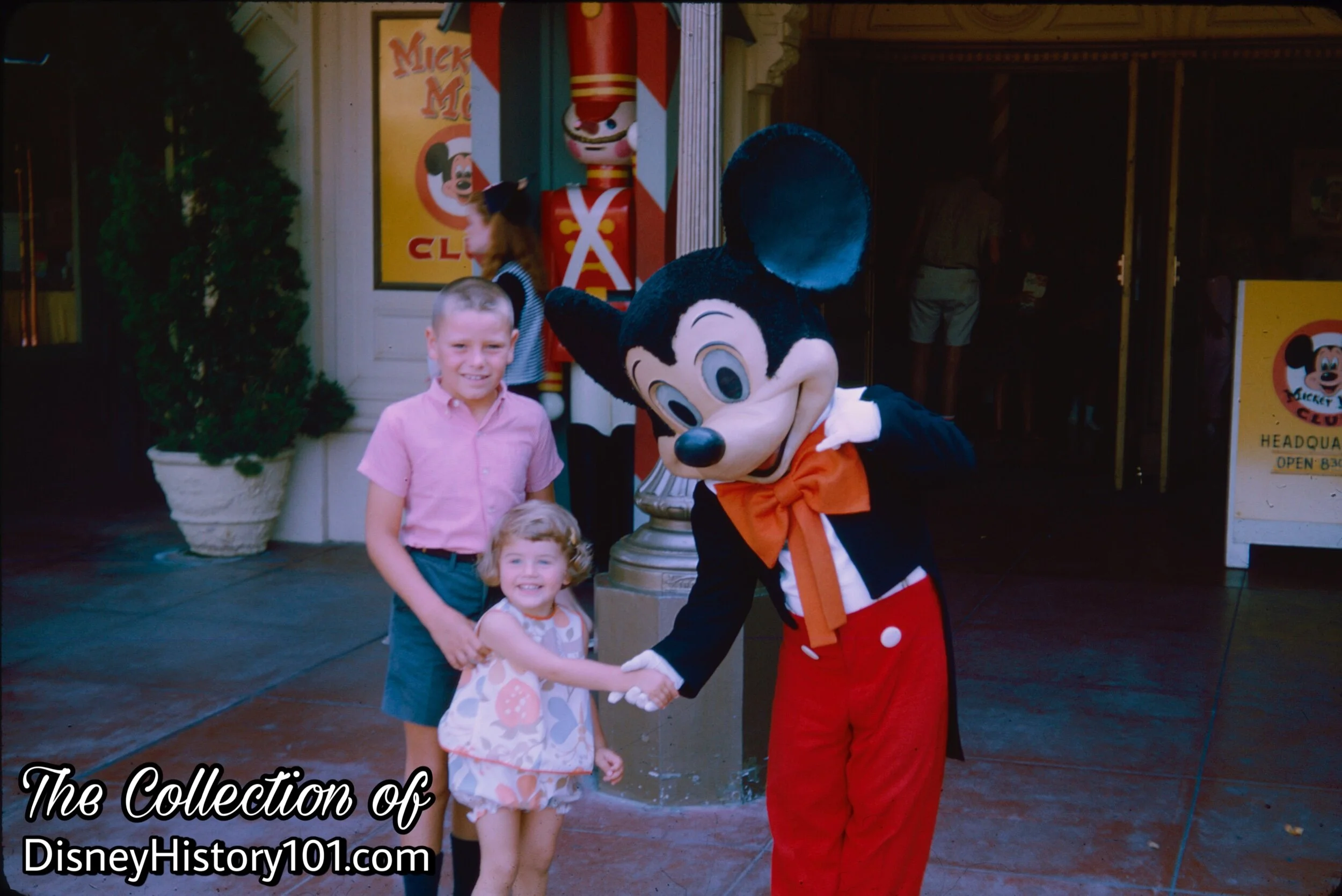
A Toy Soldier in a candy-striped guardhouse still stands guard before the entrance of the Main Street Opera House’s next exhibit!
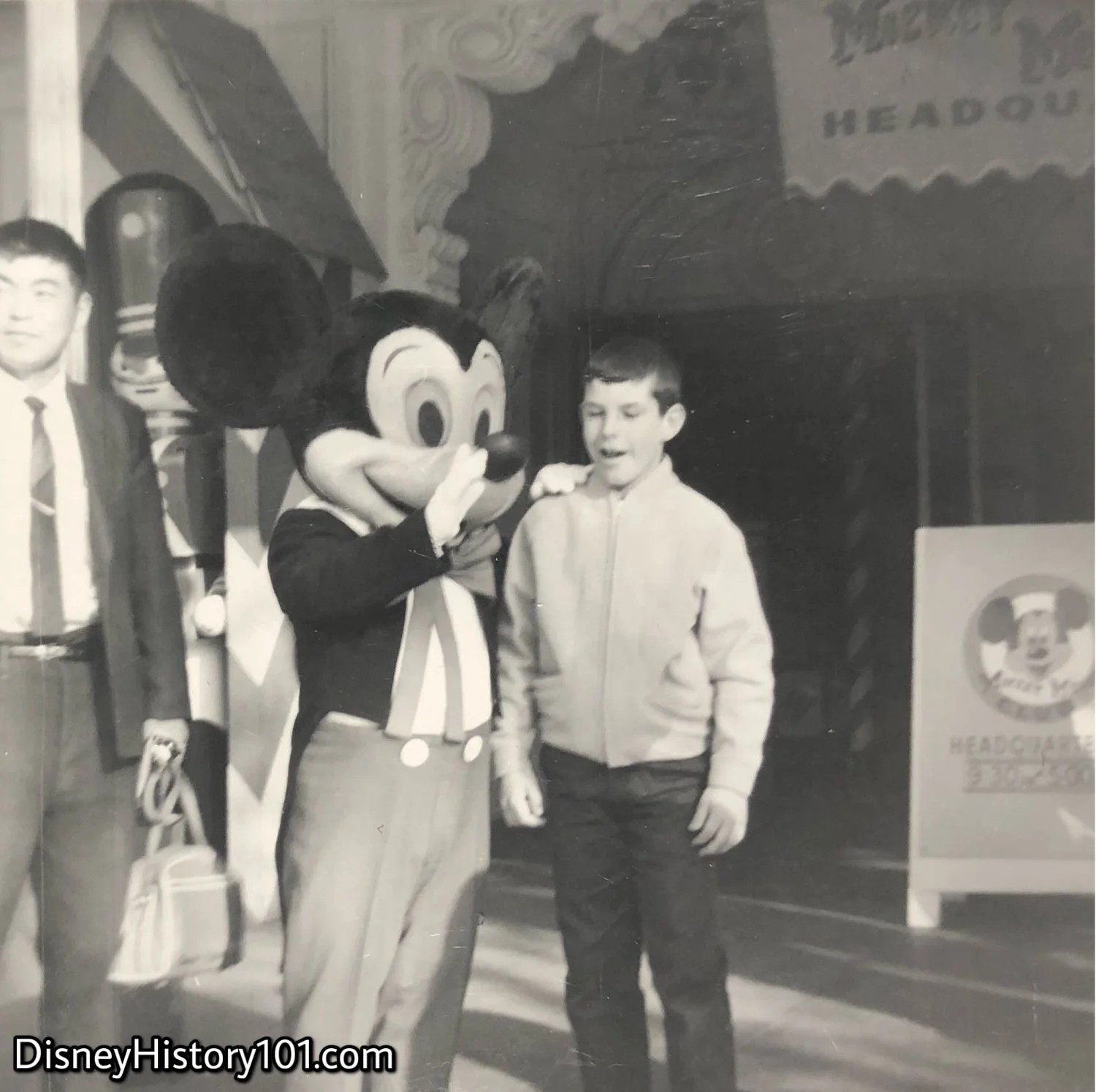
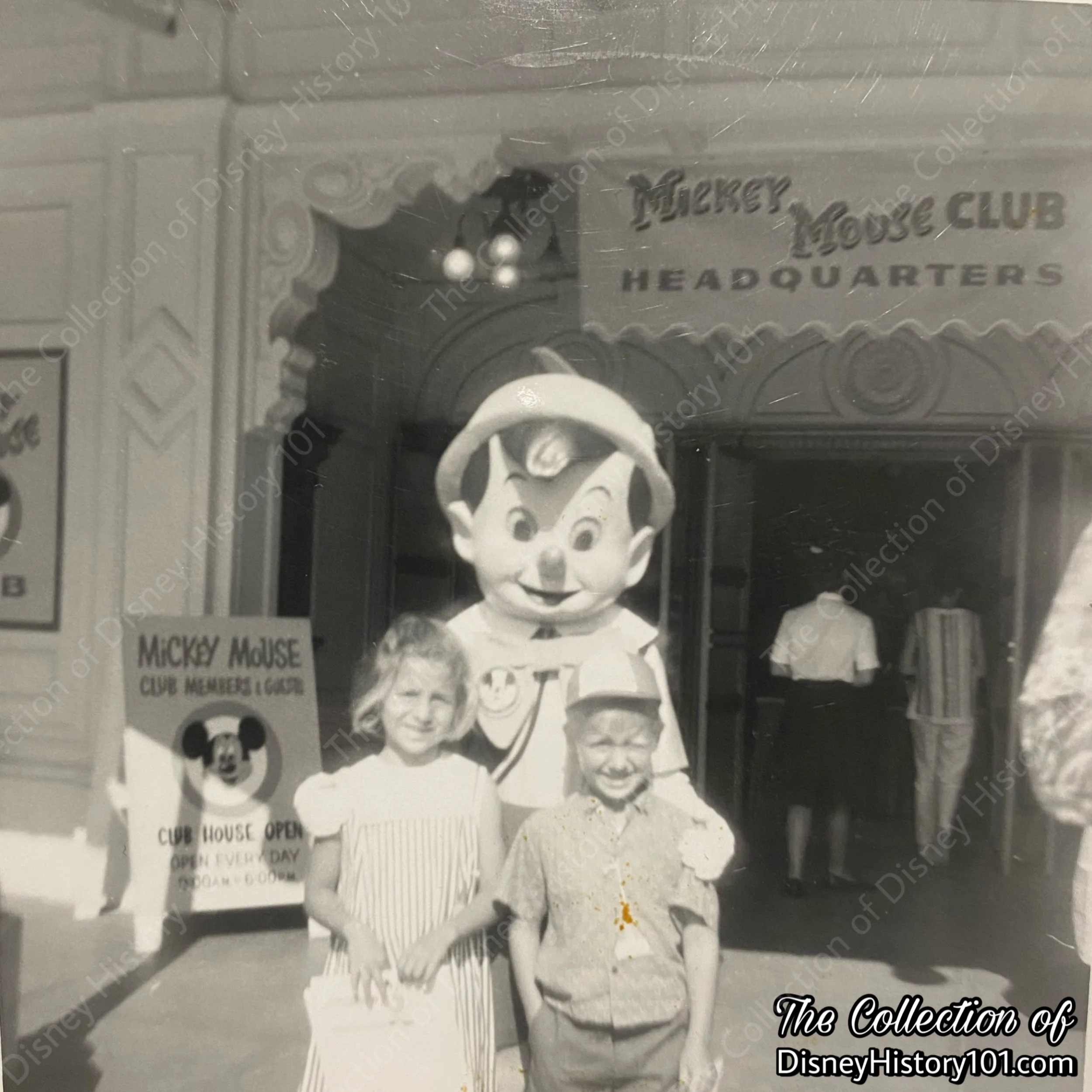
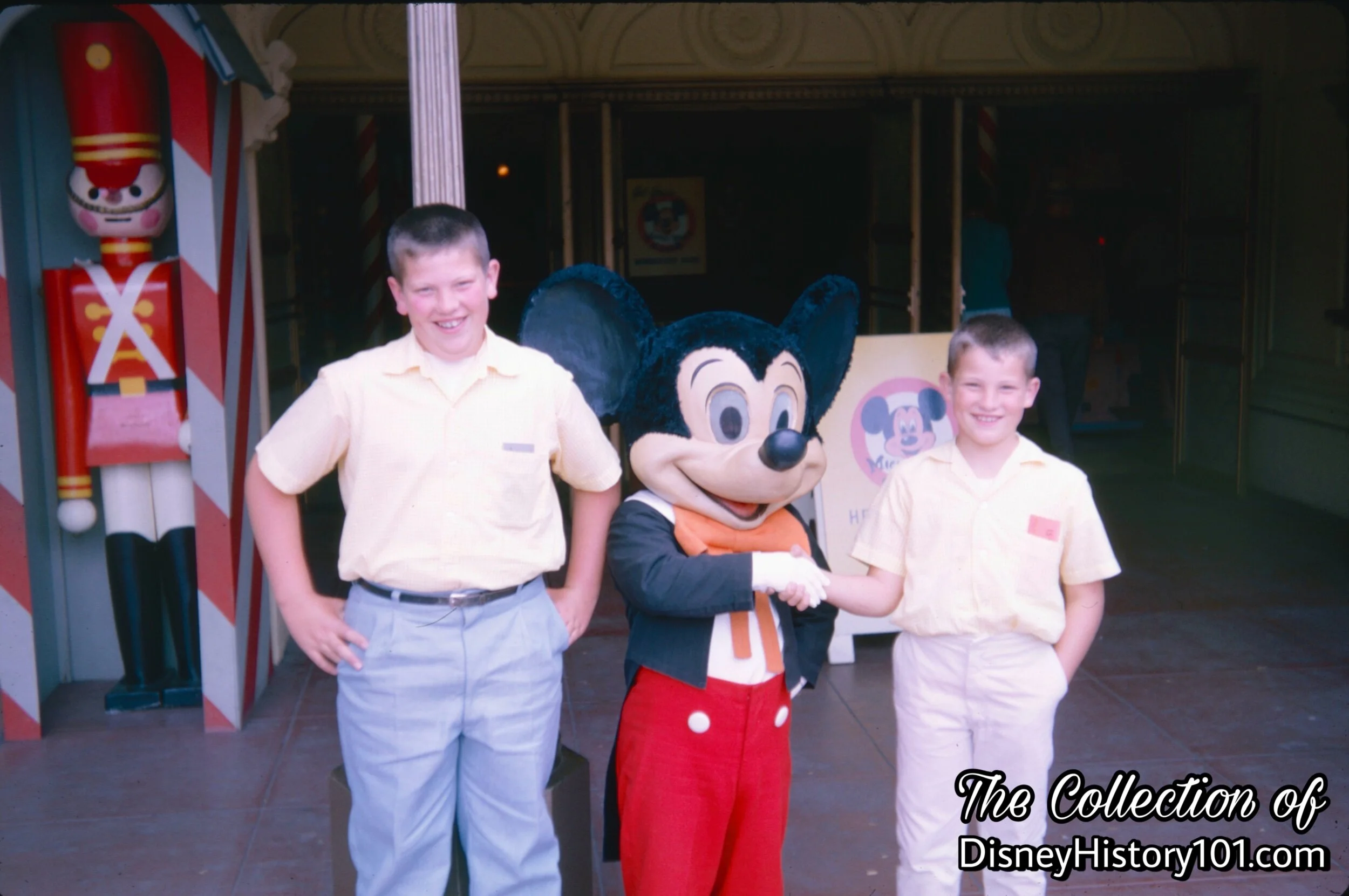
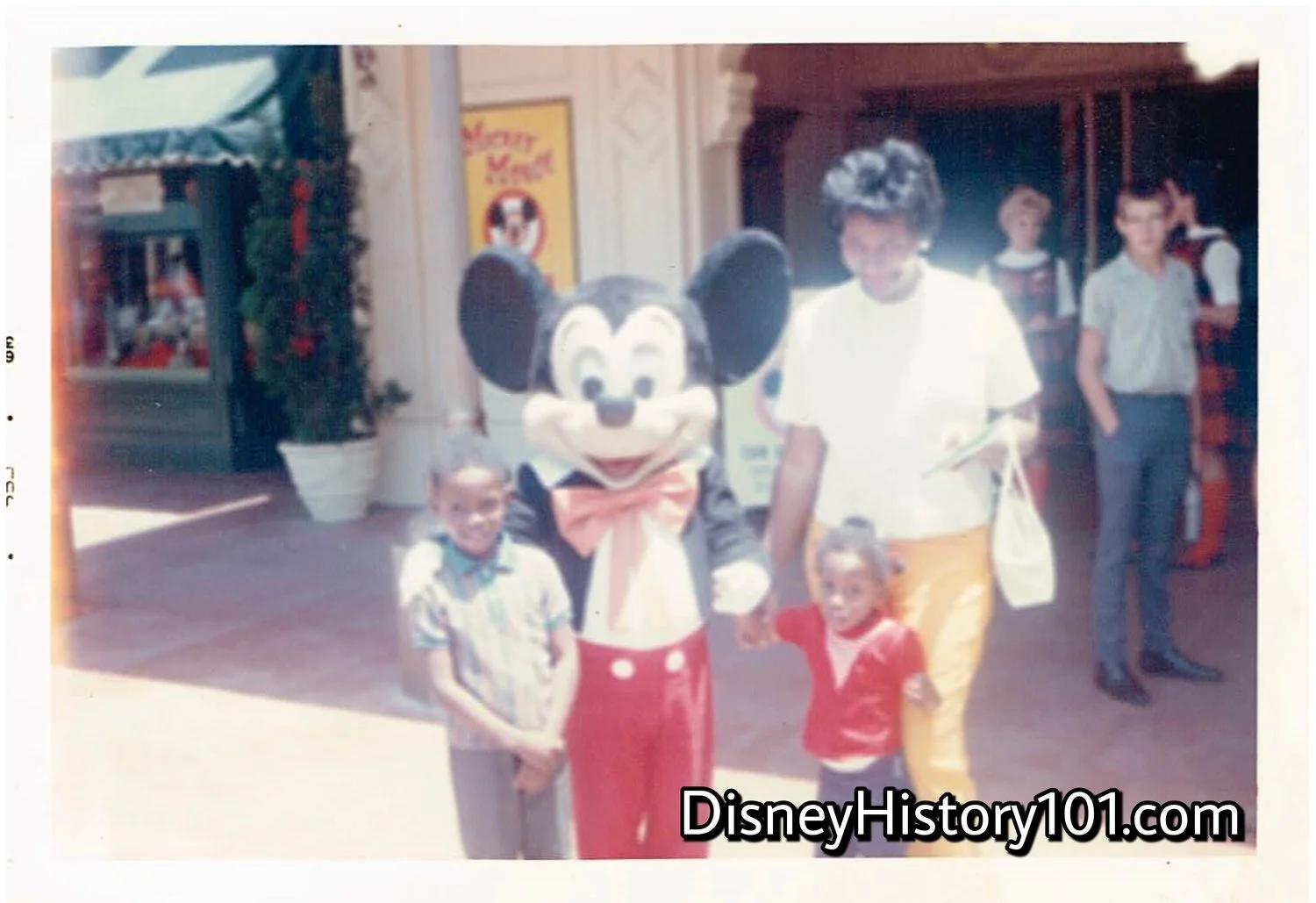
Who’s “the leader of the club, that’s made for you and me” ? Mickey Mouse welcomed new honorary Mouseketeers to the Mickey Mouse Headquarters, while Disneyland Hostesses (occasionally referred to as “Mickey Mouse Club Girls,” seen in the background) also welcomed guests!
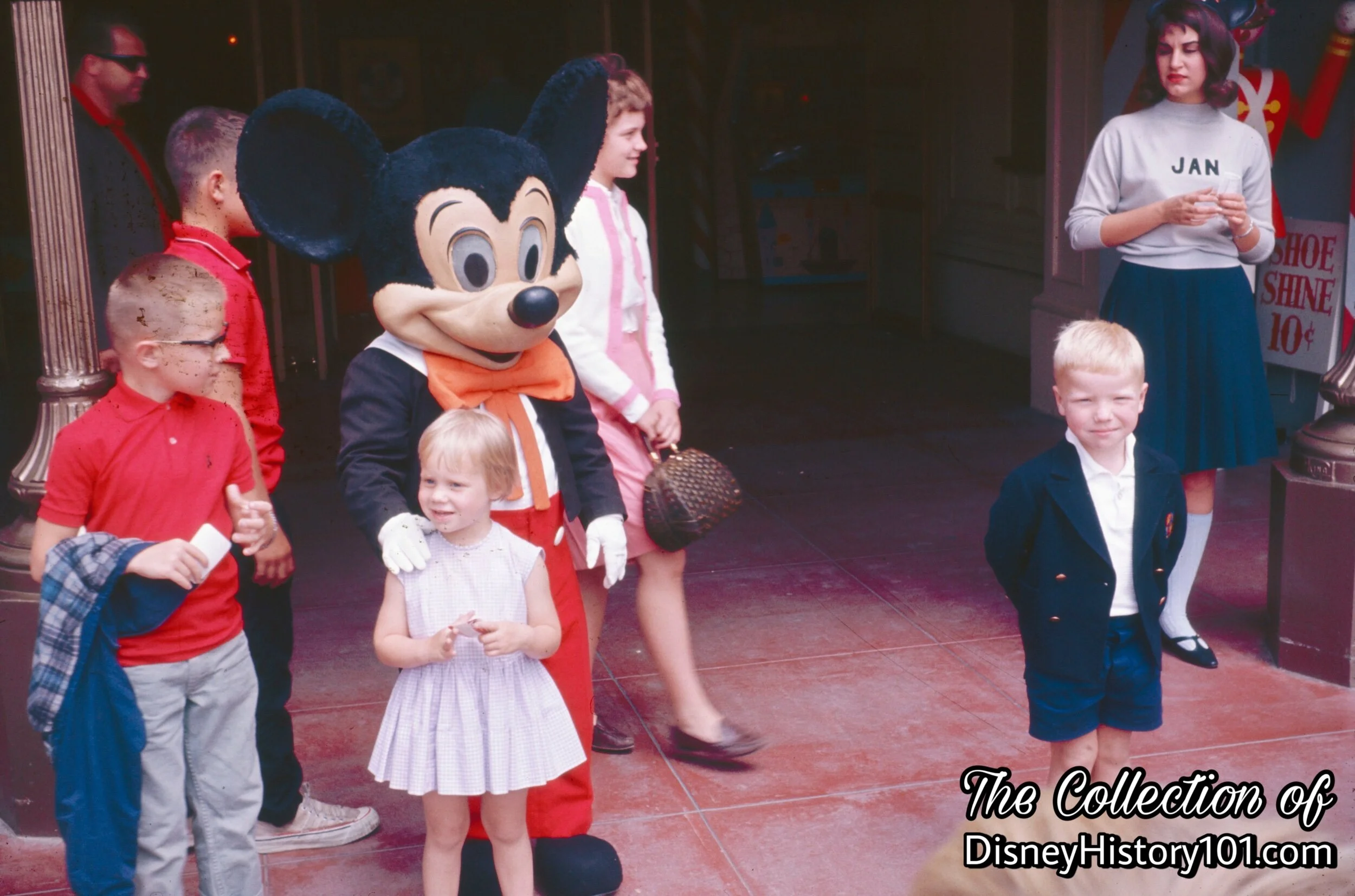
As late as April of 1964, the “mousekegirls” of “The Mickey Mouse Club” television show worked at the location. During this time, a total of 3,162 free souvenir birthday pictures (taken with the visiting cast) were given out to guests.
“The Mickey Mouse Club Headquarters”
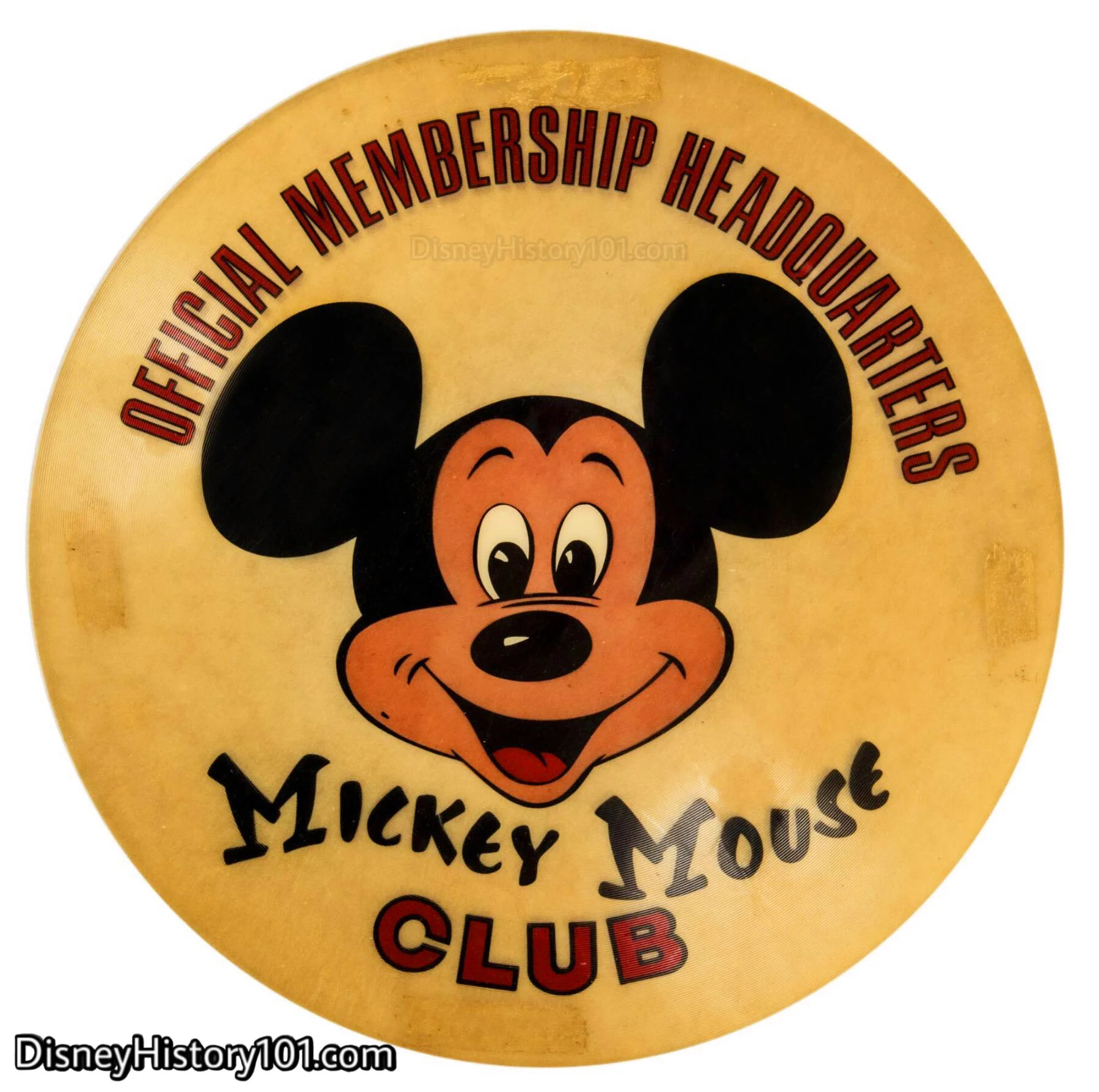
Signage like this would hang around the interior of the premises, announcing the temporary headquarters to Park guests. This was not the first time Mickey Mouse Club Membership was offered at Disneyland. During the winter of 1955, Wonderland Music Store in Disneyland offered an Official Mickey Mouse Club Certificate with a subscription to Walt Disney’s Mickey Mouse Club Magazine. Now, due to such an increased advertised presence, The Mickey Mouse Clubhouse Headquarters at the Opera House in Disneyland boosted membership during its tenure (membership of the Mickey Mouse Club Disneyland Chapter being promoted as early as 1962).
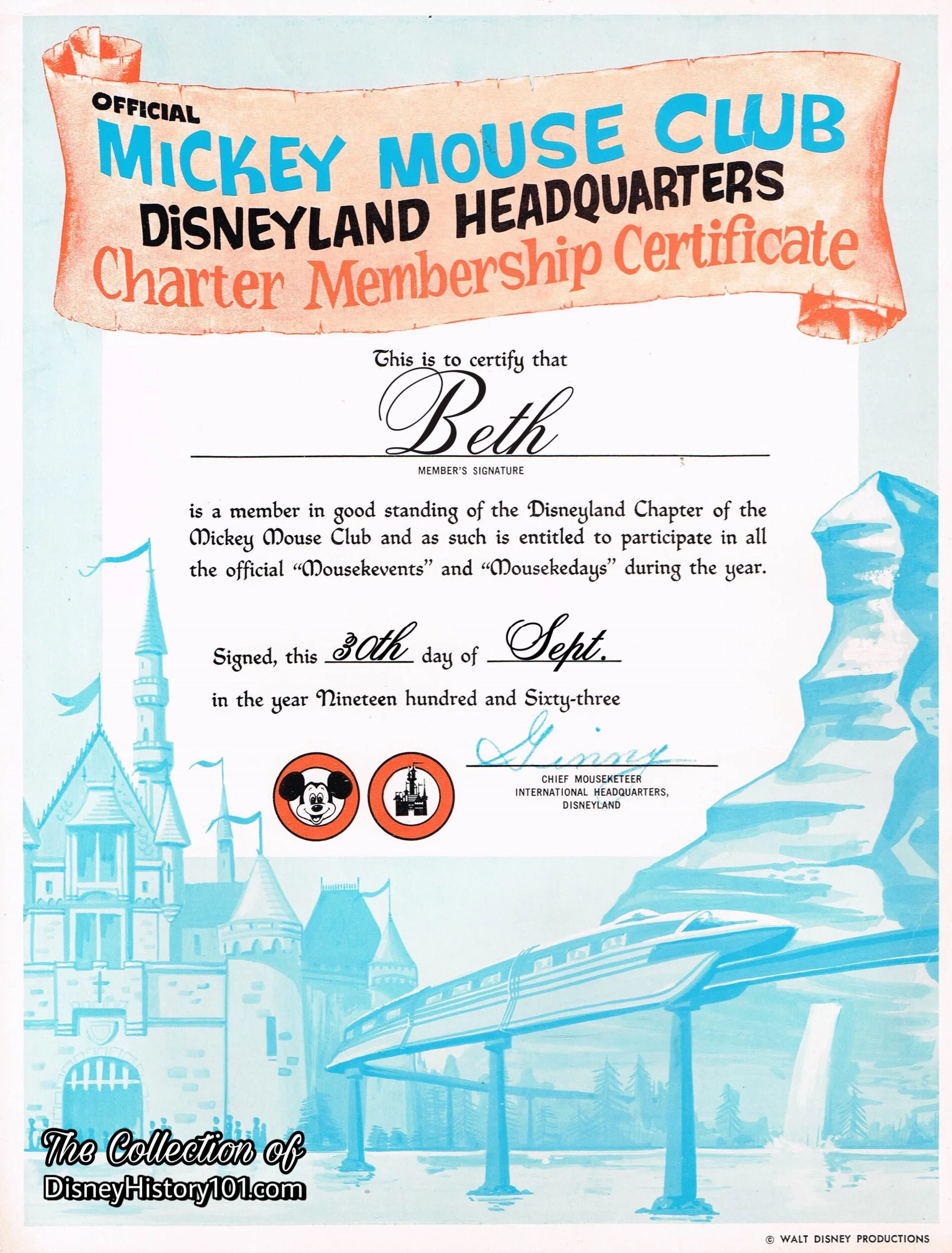
Guests visiting the Mickey Mouse Club Disneyland Headquarters would receive this Charter Membership Certificate (signed by “the Chief Mouseketeer [of] International Headquarters” - Ginny Tyler), welcoming them to the club! Even after this temporary experience would disappear, some guests would cherish their membership certificate for a lifetime.
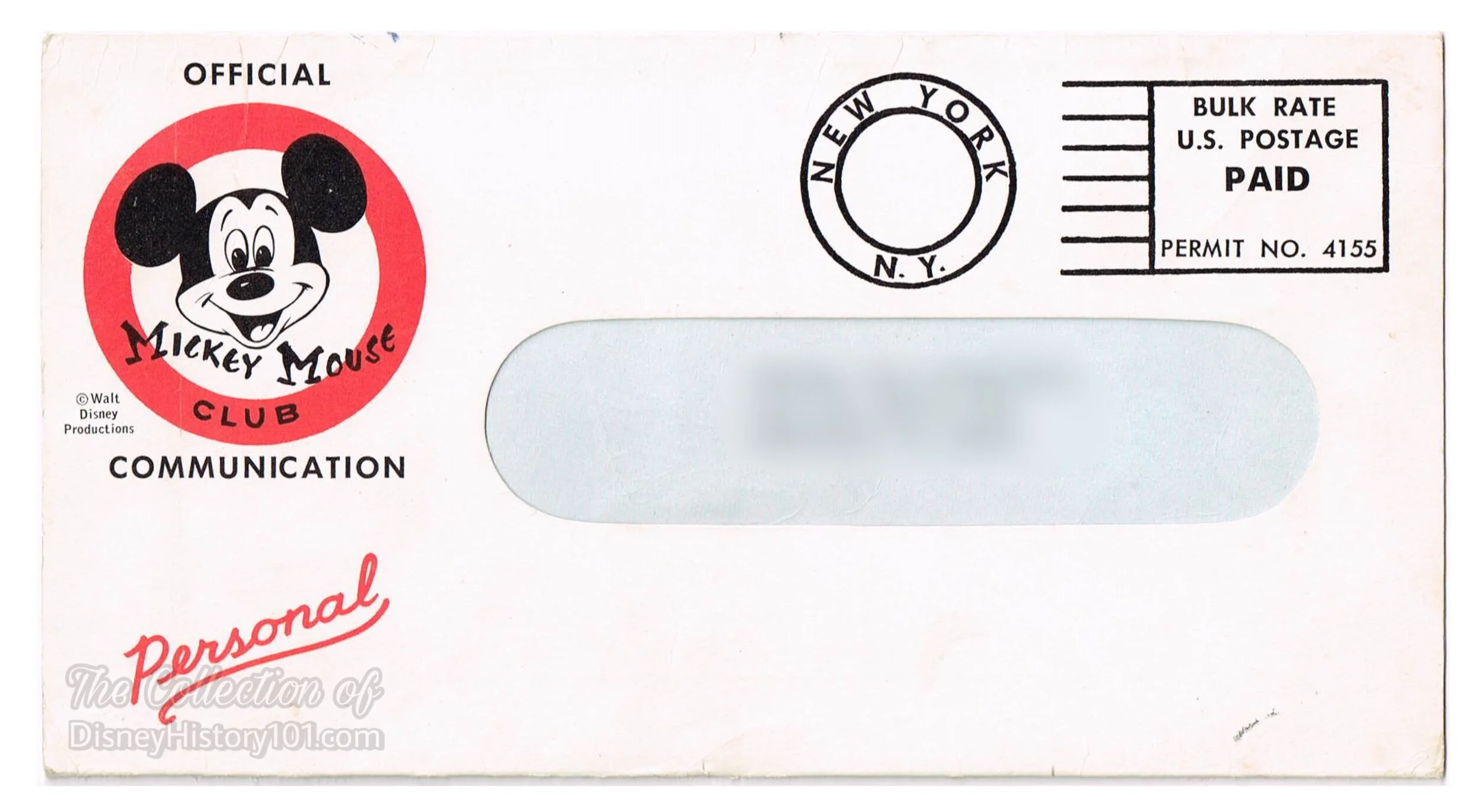
With increases in postage and first class mail shipping beginning in January of 1963, both Milt Albright and Ed Ettinger worked together to cut costs of the Mickey Mouse Club Disneyland Chapter (under the oversight of Jack Lindquist). It was Milt Albright who recommended the format for what you received in the mail - the “window” type of envelope, and not using a “form letter,” but “having the membership card be a ‘pop-out’ at will,” to increase savings. All these details were not even finalized by December 20th, 1962.
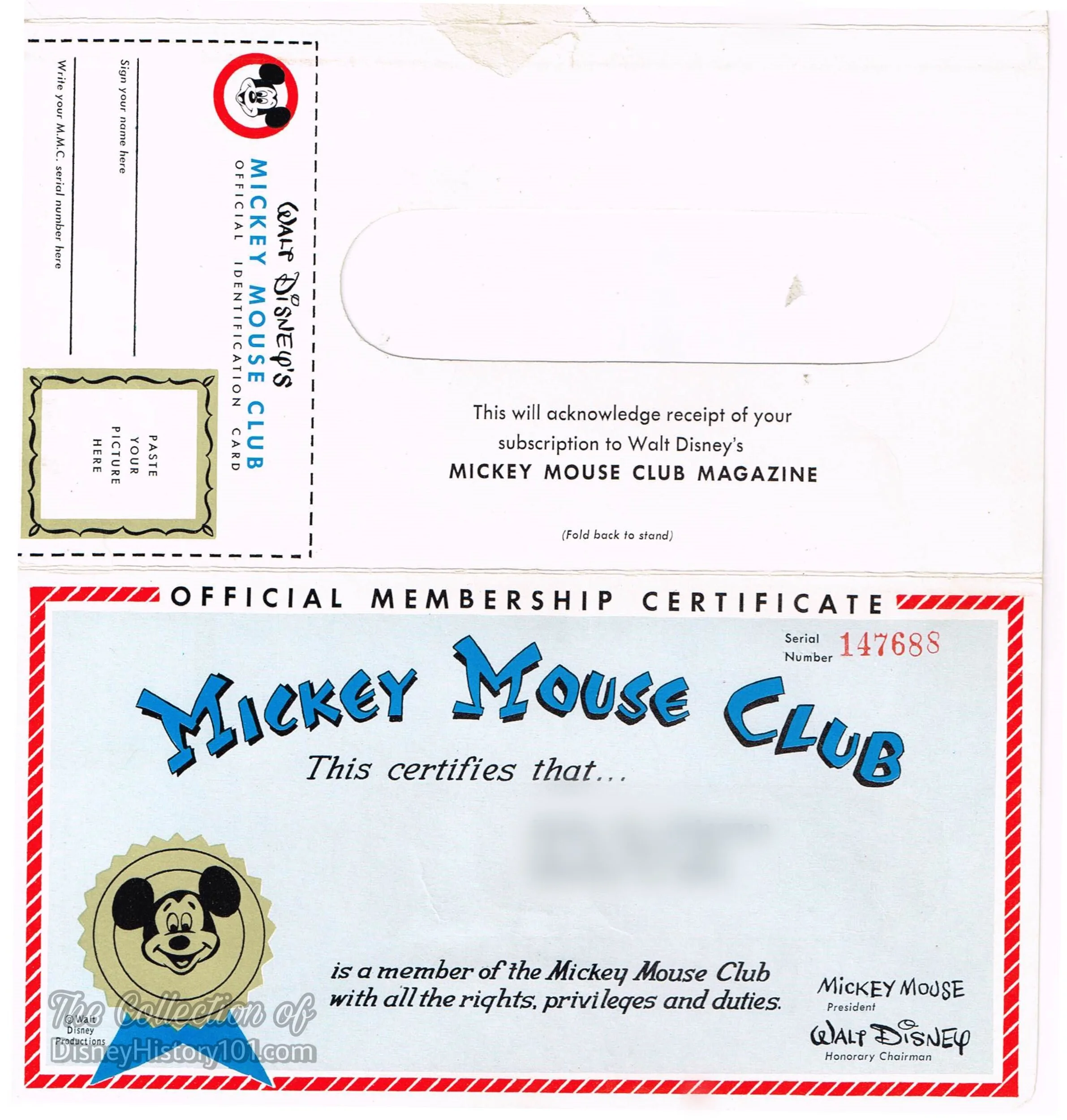
These “snap-out” Mickey Mouse Club documents were different from the ones acquired through the Disneyland headquarters.
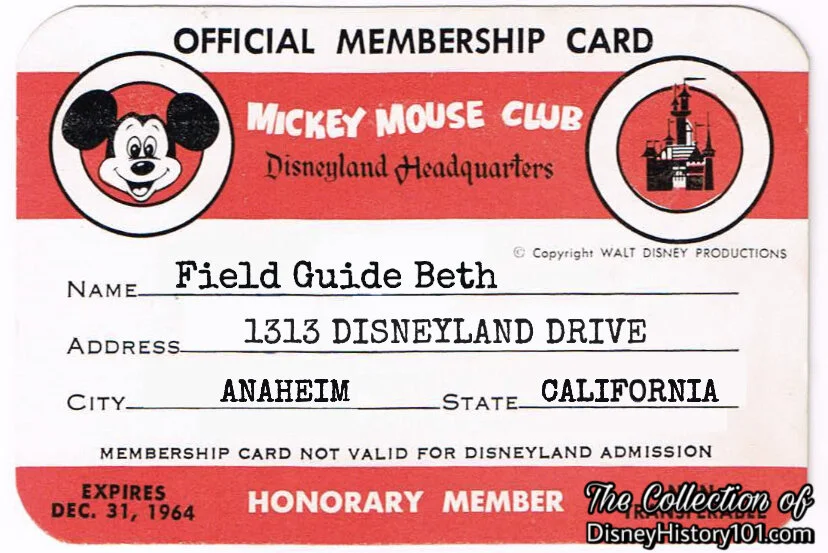
But ultimately, these little perforated “snap-out” Mickey Mouse Club Disneyland Chapter Membership Cards were sent to members approximately 2 weeks after their applications were received. There was no charge for Mickey Mouse Club Disneyland Chapter Membership. However, membership was limited to Southern California residents within the KTTV viewing area. Though the club had no age limit, it was designed to appeal to youngsters under the age of 16 years old.
In the end, Mickey Mouse Club “Weekly Activity” Reports showed that Mickey Mouse Club Disneyland Chapter Memberships (of Local Members, Honorary Members and new Members signed into the Clubhouse) hit peak numbers on Saturdays and Sundays at Disneyland. By April 29, 1964, the there were 191,473 Local Members, in addition to 53,448 Clubhouse Mail-ins, 122,735 Honorary Members, and renewals factored in, totaling in 367,656 Mickey Mouse Club Members. Of these, 328,724 were serviced at the Clubhouse located at Disneyland! Tommy Walker (head of Disneyland Public Relations) would often send weekly Inter-Office Communications, relaying Mickey Mouse Club Disneyland Chapter Activity Reports to “those concerned” - i.e. Card Walker, Donn Tatum and Vince Jeffords (at Walt Disney Studio), and Ed Ettinger, Bob Wormhoudt, Vern Croft, Wally Wade, Ted Crowell, Jack Lindquist, Linda Morse and Milt Albright (at Disneyland).
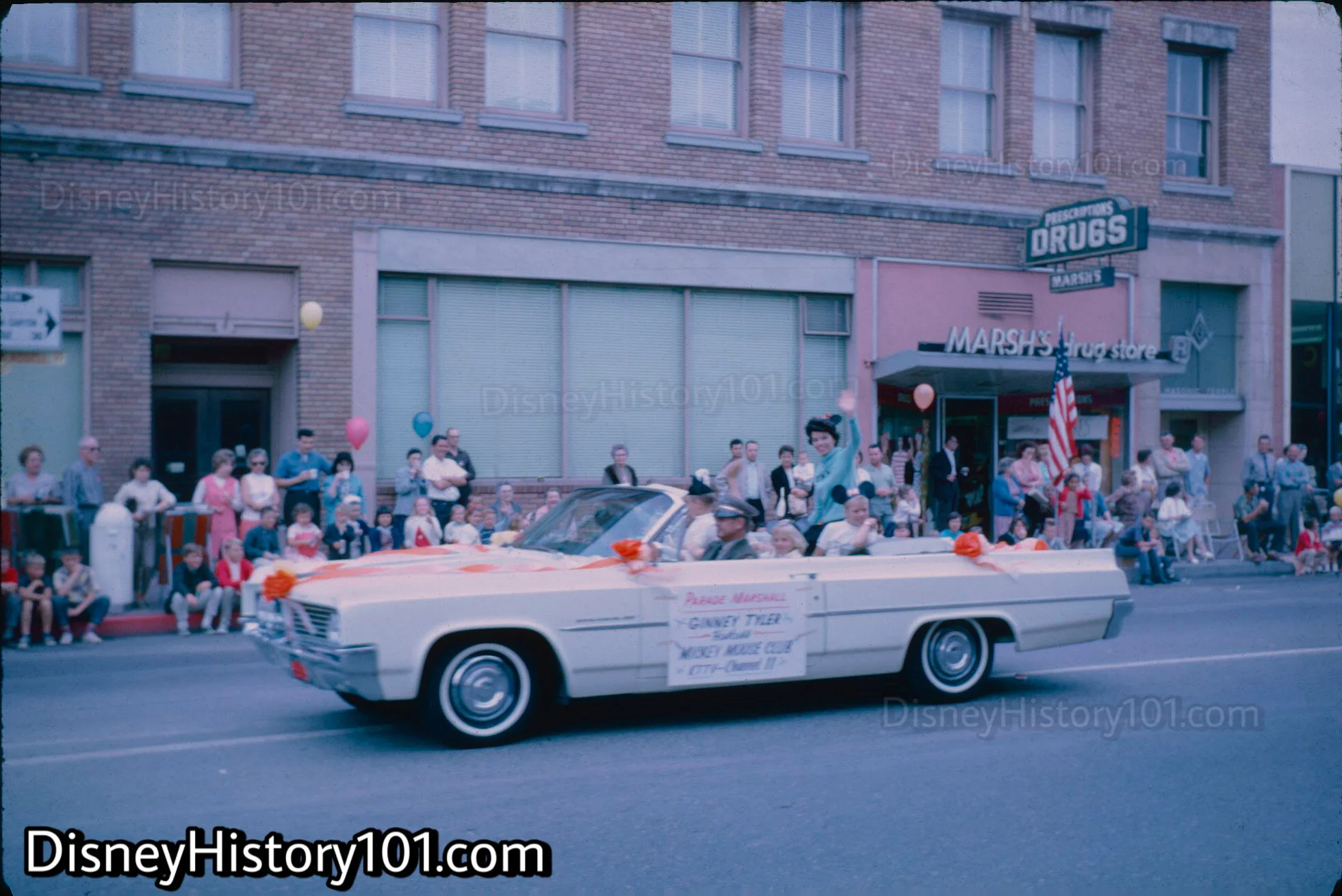
Since the beginning, Disneyland has synergistically worked with Walt Disney Studios to keep the Disney characters before the public and provide settings for television programs. This would not be the first time that segments of ”The Mickey Mouse Club” were filmed at Disneyland. On a most recent occasion, at least one segment of ”The Mickey Mouse Club” TV show was filmed in the Park during the month of January, 1963. But this routine filming of ”The Mickey Mouse Club” television show at Disneyland would take months to plan and develop. Now by July of 1963, Ben Harris began to select and pick up music (from local shops) and inspecting sound and recording facilities that would be utilized for the television recording. A few months later (during September of 1963 ; the same month that the Babes in Toyland Exhibit closed), a promotional parade (of which Ginny was a guest of honor), was held in neighboring Garden Grove. This was (of course), in advertisement for the upcoming Mickey Mouse Club Headquarters in Disneyland and the new segments of “The Mickey Mouse Club” television series which would be filmed at Disneyland!
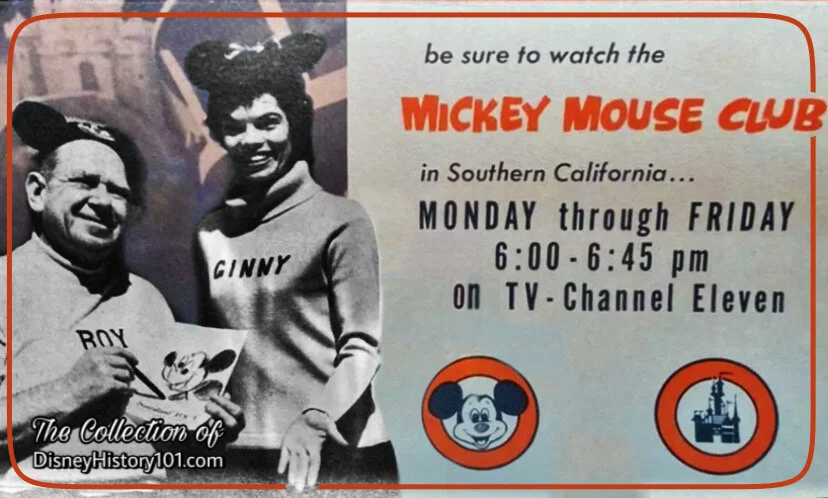
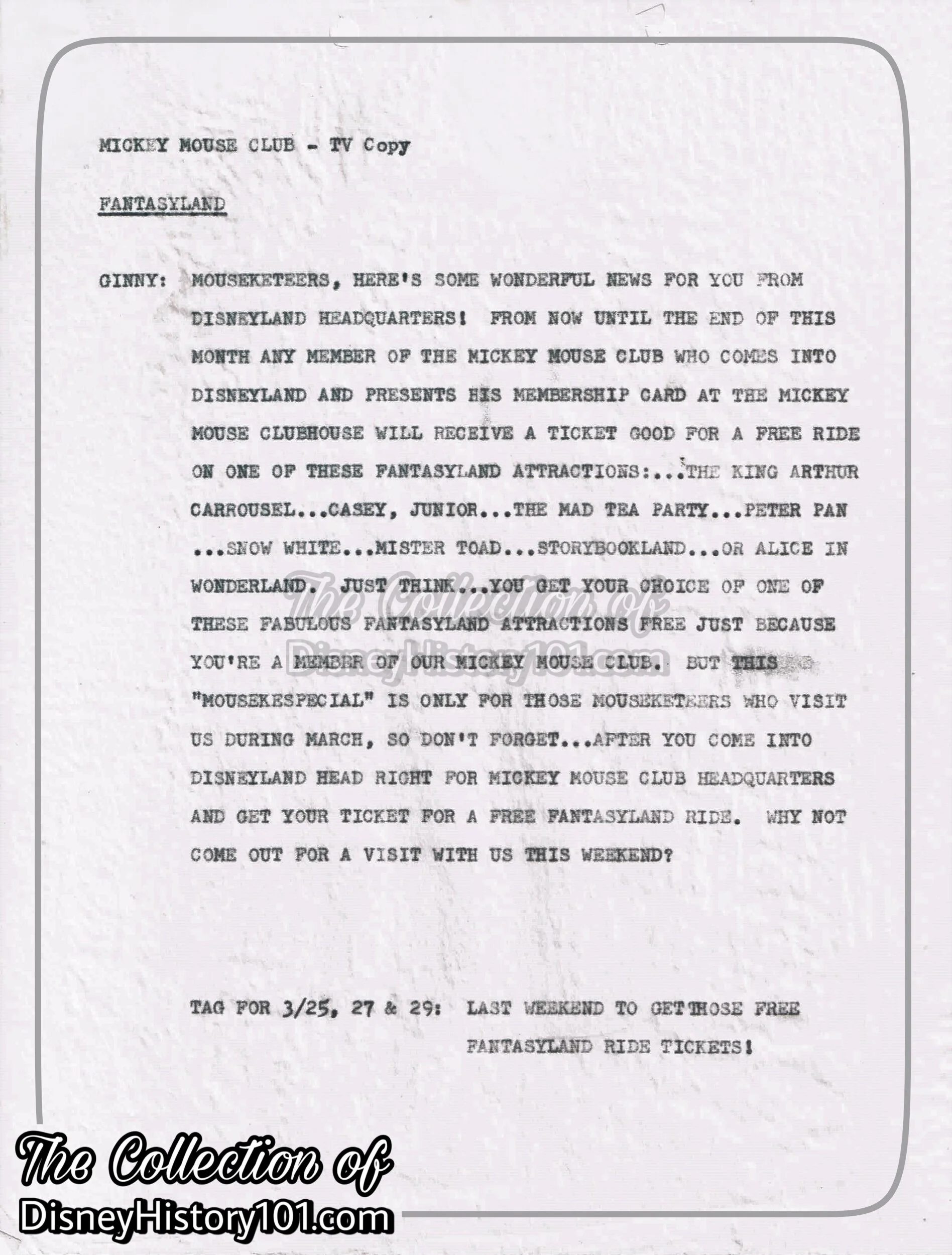
Scripts written for Ginny Tyler also introduced promotional Disneyland offers for Mickey Mouse Club members who visited the Park.
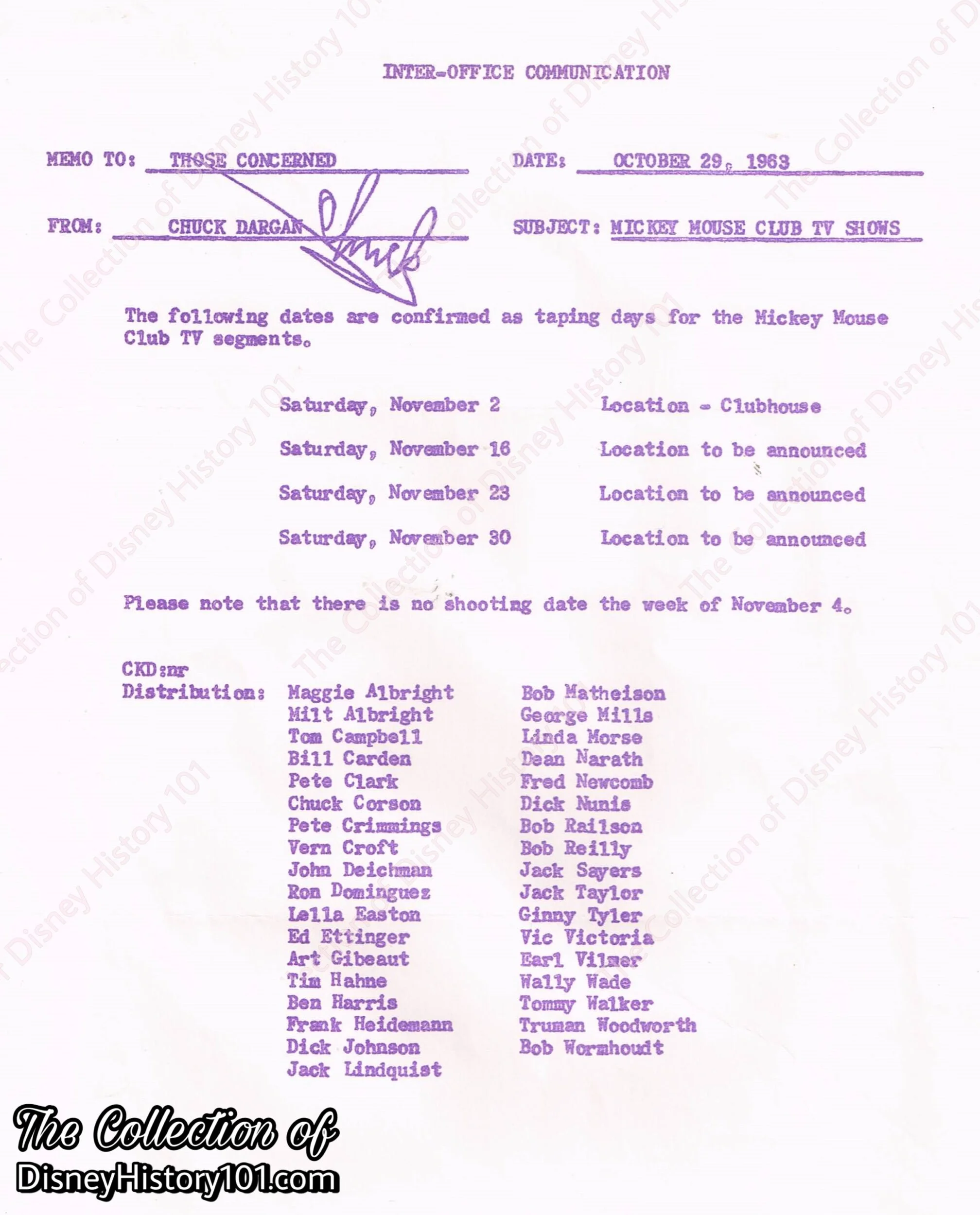
Proposed dates and locations for filming the Mickey Mouse Club Television Show in Disneyland are listed on this Inter-Office Communication. The dates ran every Saturday in the month of November, 1963.
By February of 1964, Ben Harris (of the Disneyland Production Department) held near-daily production discussions at the nearby Gourmet Restaurant (with the production companies and individuals like MMC Director Bob Lehman) pertaining to the forthcoming tv segments. One tentative shooting period ran from Saturday to Sunday, February 1 & 2, 1964, when the crew hoped to “get six or seven segments done.”
By March of 1964, the search was on for various “action props,” “bowling equipment,” and “physics equipment” to be used as screen on-screen props. Electrical equipment and musical equipment was also selected, rented and purchased. While these were acquired (either purchased or rented), physical set-up and staging began around mid-March.
As mentioned earlier, Mouseketeer Ginny Tyler soon (on March 28th, April 11th and 12th, 1964) recorded some of the first (of a series) of 15-minute segments inside Disneyland’s Mickey Mouse Club Headquarters, which was broadcast as part of the syndicated “The Mickey Mouse Club” series. According to Ben Harris’ account, some “105” of these segments would be filmed at Disneyland.
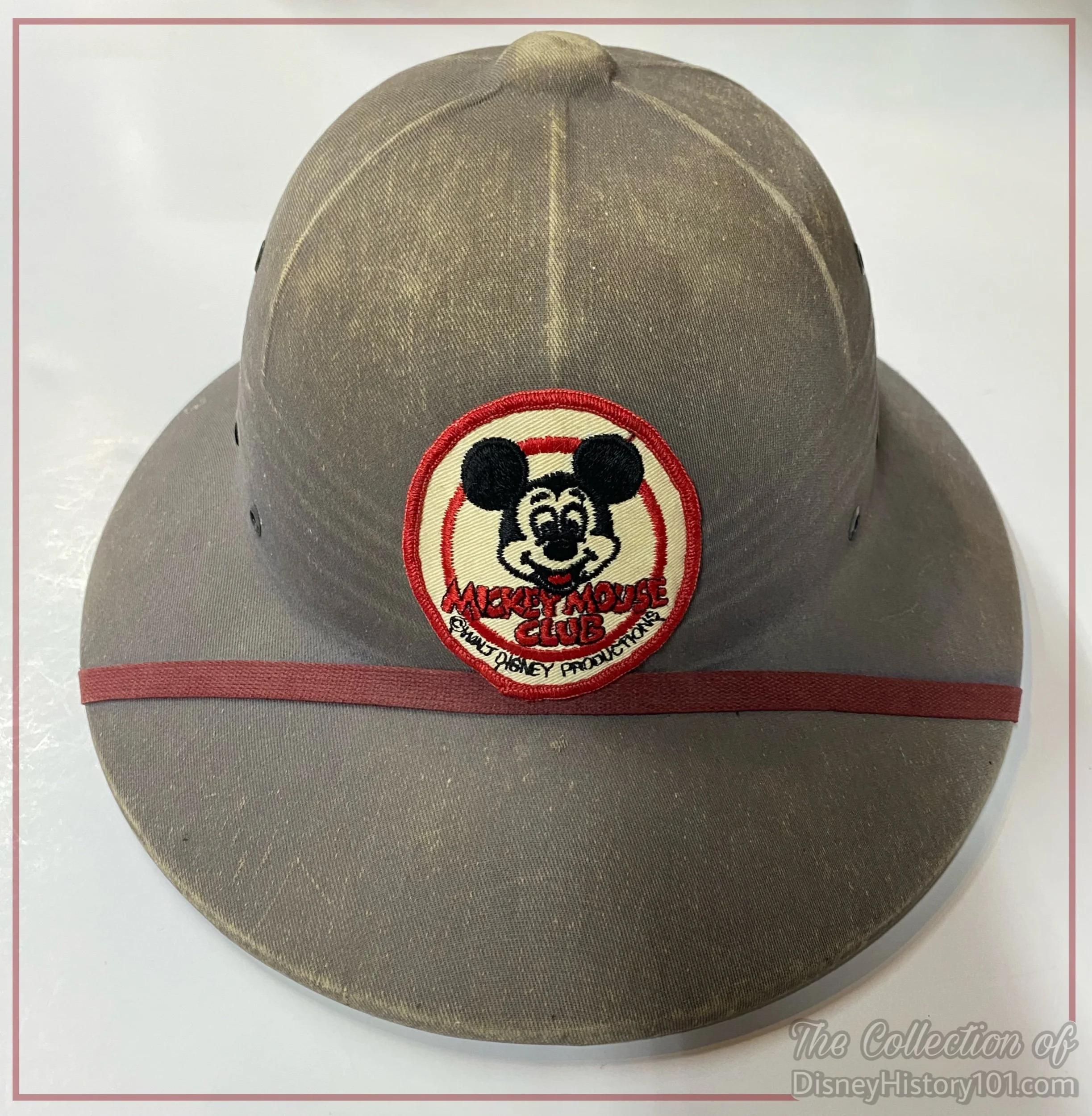
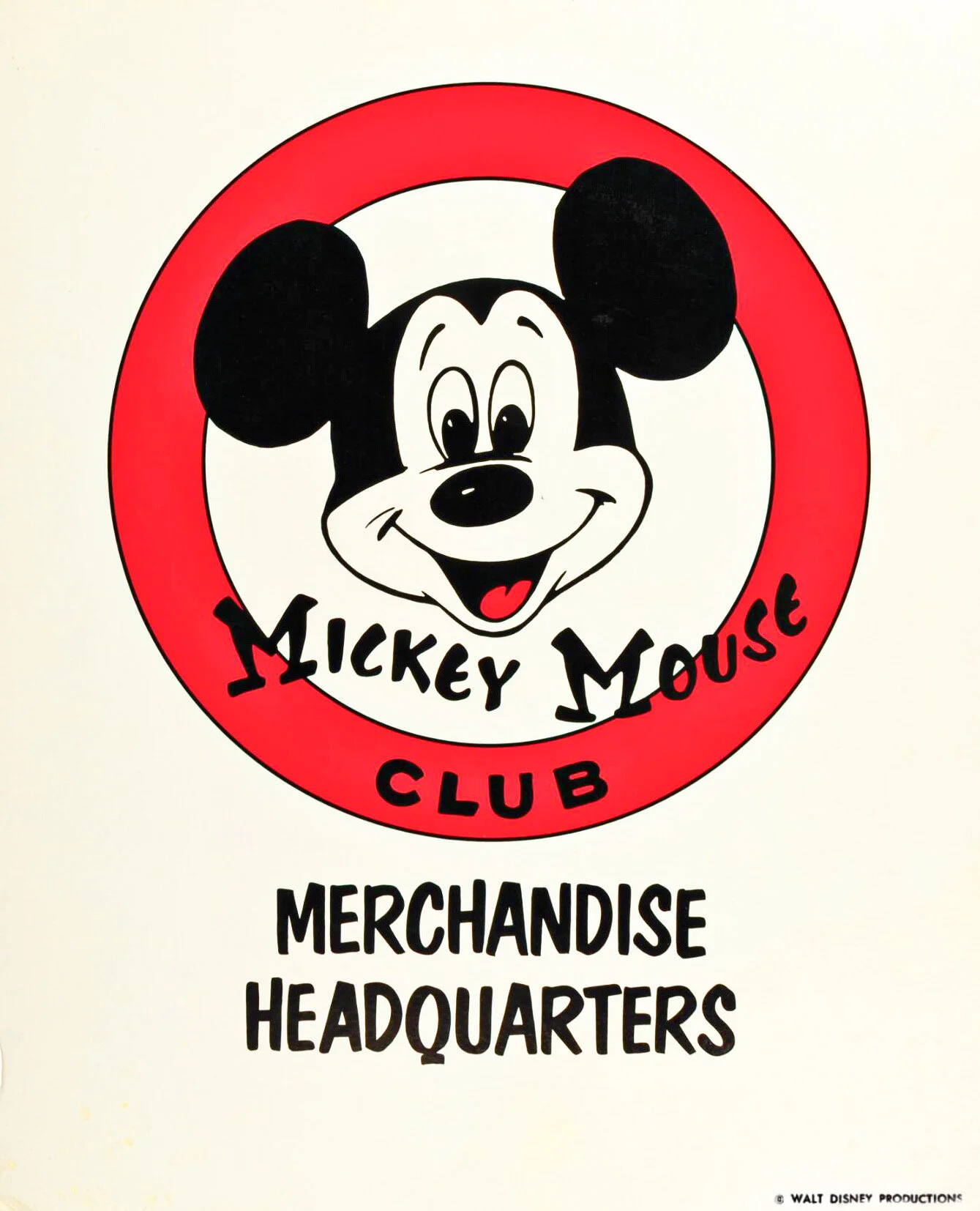
The Mickey Mouse Clubhouse Headquarters in Disneyland also sold an increased amount of merchandise during its tenure. Buttons and tin lapel clips were common pieces of “The Mickey Mouse Club” merchandise sold through the Merchandise Headquareters. Non-birthday-related pictures were sold at 75 cents each, and by April 19, 1964 a total of 1, 846 had been sold. There were also Free souvenir birthday pictures (when the Mousekagirls worked on the television show). Perhaps one of the more popular merchandise was the new “The Mickey Mouse Club TV Show” LP released by Disneyland Records in 1964.

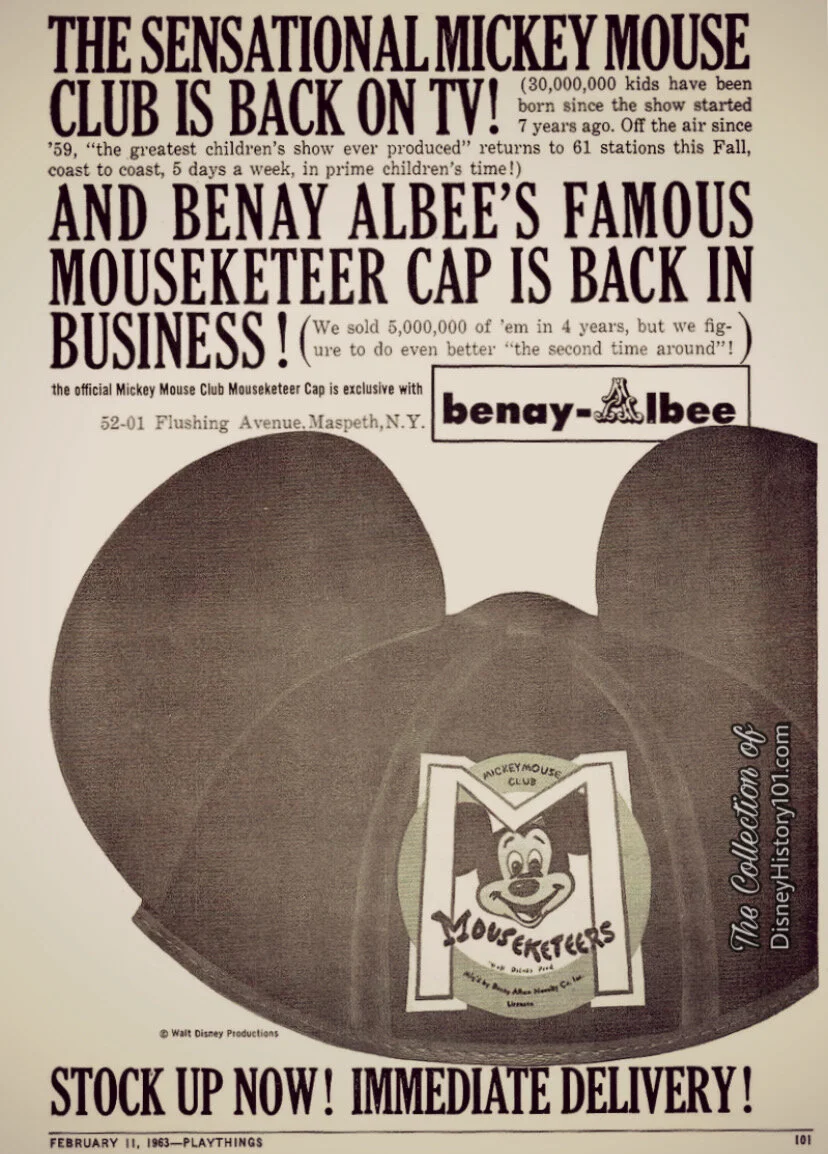
Now that ”The Mickey Mouse Club” was back on television (and the Mickey Mouse Club was Headquartered at Disneyland) the was the perfect opportunity for Benay Albee to bring their popular Mouseketeer Cap to Disneyland!
“The Mill Moves”
By the summer of 1965, a “new mill had to be built to handle all the business,” according to Bill Bealer of Backstage Disneyland magazine, Vol.4, No.4 ; December of 1965. The new MILL AND SHEET METAL SHOP (and even a Mill Annex) would eventually find a home in the Backstage West Service Area behind the Frontierland berm. By that time of Tencennial celebration, there were many new skilled craftsmen who had come to Disneyland after extensive experience. However, some of Disneyland’s original carpenters (Cliff Carothers, Earl Anderson, George Williams, George Le Fevre, Scotty Scribbs, L.H. Anderson, John Yorber and a certain “Harry”) still worked in a similar capacity with the Park. These men recollected fond memories of the original Mill’s role in Disneyland development.
*Some sources (as the “Disneyland Admission Media Rides and Attractions Report” published 1971; “Disneyland Rides & Attractions and Attendance Report,” 1981, page 50) cite July 16th, 1965.
As with any new ideas and American dreams, Great Moments with Mr. Lincoln (with its Audio-Animatronic star) was not created in “a day.” It was “perfected and proven only after long experience and trial.”
“A Few Great Moments in the Imagineering of Mr. Lincoln”
The idea of automated figures dates back to the 1600s and 1700s, when the kings of France (like Louis XVI) commissioned automated orchestras to be built. Two hundred years later (but still a decades prior to the conception of Disneyland), Walt began his childhood fascination with the United States President. According to Walt, “Ever since I was a small boy in Illinois, I've had a great personal admiration for Abraham Lincoln.” In fact, as a child, Walt even donned a stovepipe hat and portrayed Abraham Lincoln for a school project. This admiration of Abraham Lincoln continued for decades.
As for mechanical figures, they enter the Walt Disney story six years before Disneyland would premier to audiences. In 1949, Ken Anderson created a Disneylandia concept that consisted of an old-fashioned Barbershop Ensemble with a quartet of mechanical singers. In September of 1950, the famous sculptor Charles Cristodoro had joined the Walt Disney Studio, and a few months later he found himself busy carving the little figure of Buddy Ebsen. But how would Walt animate the figures?
The following year, on July 6, 1951, Walt, Lillian, and daughters Diana and Sharon Disney arrived in Le Bourget Airport, Paris, France. Diane Disney noticed that “Dad went out shopping on his own when we were in Paris. He came back to the hotel room with two large bags from a toy store filled with wind up toys. He unpackaged them, wound them all up, and studied them as we looked on, amused, but puzzled. 'It's amazing that you can get such interesting movement from a very simple mechanism, he explained.” Walt returned home with his Le Zoo Mécanique souvenirs from Paris. In 1951, Walt also returned from New Orleans with an antique mechanical Bontem’s bird automaton. All of these souvenirs would continue to progress Animatronics technology.
These would inspire Roger Broggie (a Walt Disney Studio Camera Repair Department machinist who had assisted with the fabrication of Walt’s Carolwood Pacific Lilly Belle engine) and Wathel Rogers (another of Walt’s character animator’s with a knowledge of the mechanical) to fashion the first ever “cam and lever” Audio-Animatronics figure (a 1/8 scale tap dancing Buddy Ebsen figure) for Walt Disney’s “Disneylandia.”
Walt Disney Studio artist Charles Levy (in interview with Bill Davidson of The Saturday Evening Post, published for November 17, 1964) recalled a momentous occurrence he observed when first employed in 1954: “I remember seeing him at the studio then, and he was a wrapped up in something mysterious he was doing with Buddy Ebsen who, in those days, was a fine dancer. He had Buddy do a dance number, and there were men in the room punching holes in what seemed to be a mechanical piano roll. Then I saw Walt playing with little Buddy Ebsen dolls, which were attached by electric wires to a huge console-machine. The men would feed the piano rolls into the console like a continuous I.B.M. card, and the little Buddy Ebsen dolls would repeat the dance steps I had seen Ebsen himself do. It didn't work because those were the days before transistors and the equipment was too cumbersome, so Walt put the whole thing aside.”
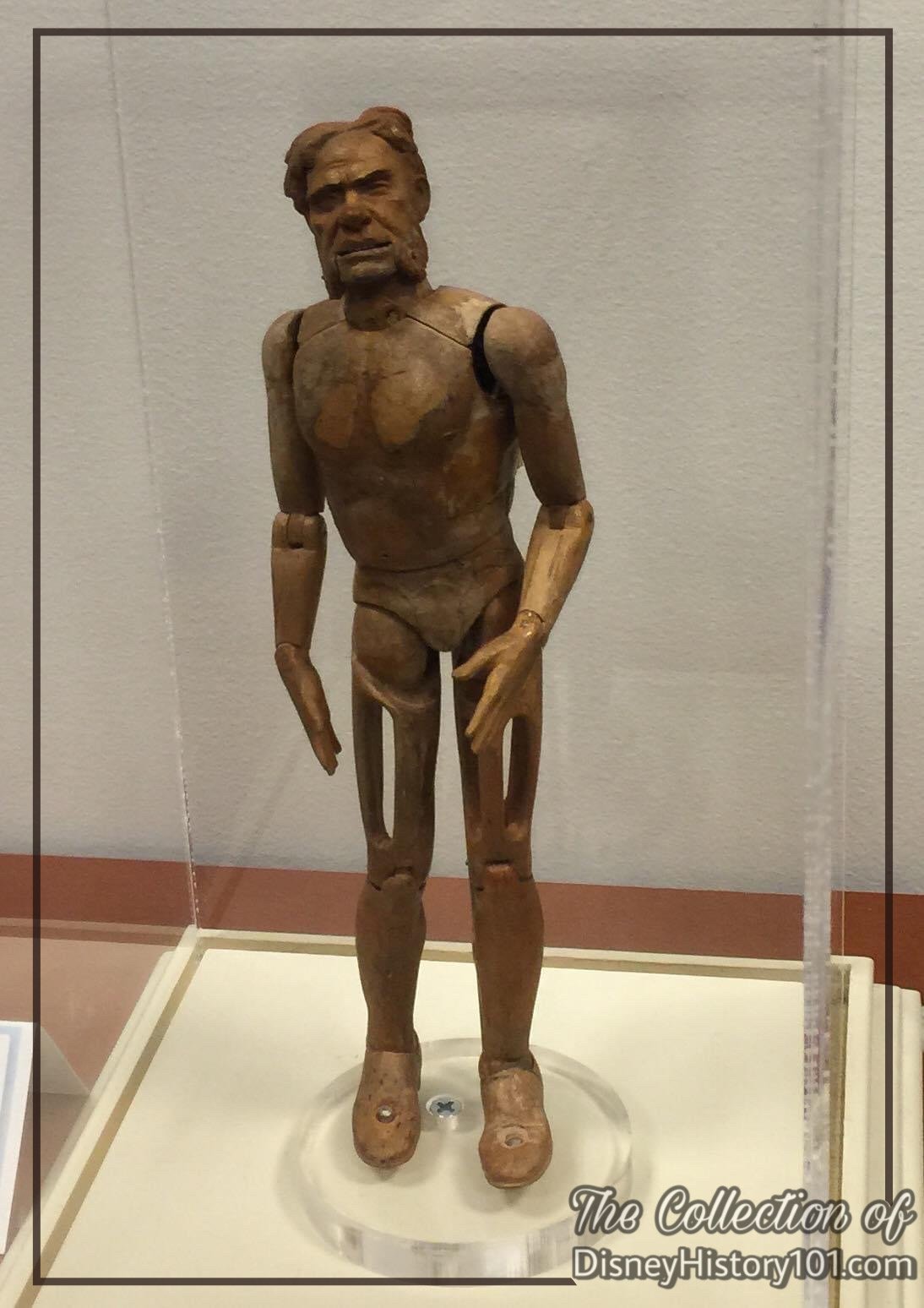
Roger Broggie recalled: “We got as far as building the guy in the chair and the barber behind him,” said Broggie. “Then the whole job was stopped.” While there were some frustrations and the project was aborted, this Imagineering feat led to other research and developments some six years later.
In 1957, The Disneyland Report to Anaheim and Orange County (prepared before August of 1957) mentioned future developments called Liberty Street with the Hall of Presidents, and Thomas Edison Square all planned for 1960. Meanwhile, Walt commissioned a Mr. Lincoln Audio-Animatronic figure prototype in 1958. Walt once recalled: “I had him on what we called Mark I and I had him under manual control. we could make him stand up and put his hand out.” However, the “Lincoln” project was also not completed, because, in Walt’s own words: “I figured it would take me 10 years to get Mr. Lincoln going.” Work continued and by October 1960, Marc Davis had prepared a “Reference for Animated Human Figures”, a sketchbook that explored how anatomy could be replicated with machines created by the Studio Machine Shop. This book was created at the personal behest of Walt Disney.
However, the project was “shelved” for five more years (until after the debut of Walt Disney’s Enchanted Tiki Room bird cast). But during this time, Mr. Lincoln would receive a visitor. Walt remembered how “Robert Moses was getting the World’s Fair going, and he came out. He came and visited Disneyland. He wanted to visit the Studio. He was trying to decide on what could be done. So I had him meet Abraham Lincoln. I said, ‘would you like to meet Mr. Lincoln?’ He gave me a funny look. I said, ‘well come on in - meet him.’ So when he walked in the door, I said, ‘Mr. Lincoln meet Mr. Moses,’ and Lincoln put his hand out and Moses went over and shook hands with him. Well Moses is quite a showman and he said I’ve got to have a Lincoln at the Fair. But I said this is 5 years away anyway. But Moses wouldn’t take no for an answer.”
Soon, a few “great moments” occurred in (not a meeting of Disneyland, Inc., or Walt Disney Productions, but) an Illinois Commission meeting (c. 1963) pertaining to their contribution to the upcoming World’s Fair. It was decided that their particular New York World’s Fair pavilion would be entitled - “The Land of Lincoln!” The highlight of the attraction would be none other than a three dimensional representation of the nation’s 16th president. Walt remembered: “The next thing I knew he had gotten with the State of Illinois and was trying to sell them on a Pavilion. And before I knew it, I had my arm twisted and I said yes.” After some negotiations and special agreements, the synergistic partnership was formed. Walt was soon interviewed by Fletcher Markle (on September 25, 1963), who revealed “the next step beyond the birds… to do the same kind of programming with human beings… and especially America's 16th president - Abraham Lincoln.” The State of Illinois would have their “Weenie” for “The Land of Lincoln” which would draw guests into their pavilion at the New York World’s Fair. In turn, Walt Disney would gain the funding to develop the necessary technology to run the show in New York and once the two years were complete (and in some cases, by 1964), Walt would have a brand new attraction for Disneyland.
By now there existed a Disney-patented technique of electronically synchronizing voices, music and sound effects to animated figures and objects. Walt continued: “We now had to get Mr. Lincoln on the road, I think, in about 13 months.” So immediately, some of Walt’s artists (with a diversity of backgrounds and skills) were transferred to WED Enterprises, Inc. in order to work with Audio-Animatronics - artists like Bill Justice (a former character animator who had assisted with the “come to life” Character designs for Disneyland in 1961), and Wathel Rogers (Walt Disney Studios animator who was a previously assigned to develop the miniature barber shop quartet for project “Little Man”). Both Bill Justice and Wathel Rogers would be among those assigned to bring life-like animation to the towering Mr. Lincoln. Studio retiree Jim Algar created Lincoln renderings & designs. Other contributors like Victor Greene of WED Enterprises, Inc., provided visual art direction. They were joined by John Hench (a c.1954 WED Enterprises hire, and old sketch artist from the Hyperion Avenue Studios, in 1939).
“Recreating the ‘Head of State’”
It was found that several of Walt’s shows being developed for the forthcoming 1964/1965 New York World’s Fair (like the General Electric Carousel of Progress and Great Moments with Mr. Lincoln) involved complex Audio-Animatronic heads. And so during the latter part of 1962 (while the Mickey Mouse Club Headquarters was still located on Main Street), another sort of “Head-Quarters” would take form - the Figure Head Shop (known in the present as the Figure Head Animation Shop)! Sculptor Blaine Gibson (who had been with the Disney Team since 1939, and became a WED Enterprises Sculpture Designer in 1954) now began exhaustive research on the Lincoln head while he was still pulling shifts animating. Blaine and other artists got to work, visiting libraries and museums in order to make Walt’s presentation of Abraham Lincoln’s representation as accurate as possible. According to Dave Smith (Chief Archivist Emeritus), “Disney’s Imagineers spent five months researching Lincoln’s exact measurements and physical appearance. There was intensive study of many photos, paintings, and written descriptions, including passages from Mary Lincoln’s diary.” [Disney Facts Revealed by Dave Smith, 2016]
As to his approach to figure sculpting, Blaine once commented : “When we do a figure, we’re thinking of a character - a living, breathing character.” This being the case, Blaine would look into the writings of William Henry Herndon (Lincoln’s old law partner) which were only recently published during the early 1950’s, and described in “microscopic” detail many things about the look of his friend, Abraham Lincoln. For example, Herndon “described Lincoln as having a long head with a ‘tall’ forehead, sloping backward. The forehead, he adds, was narrow but high ; ‘the cheek bones were high, sharp and prominent ; his jaws were long, up curved and massive, looking solid, heavy and strong ; nose large, long and blunt, a little awry toward the right eye ; chin, long, narrow, sallow and cadaverous. . . having on his face a few hairs here and there ; cheeks leathery and saffron colored ; ears large and jutting ; lower lip thick, hanging undercurved or down-curved ; little gray eyes.” Clearly, Herdon’s memoirs would be an invaluable source when bringing Abraham Lincoln to life. After the “Disney artisans” labored for five months, “their tender care… [was] evident in Mr. Lincoln’s face,” according to one official Souvenir.
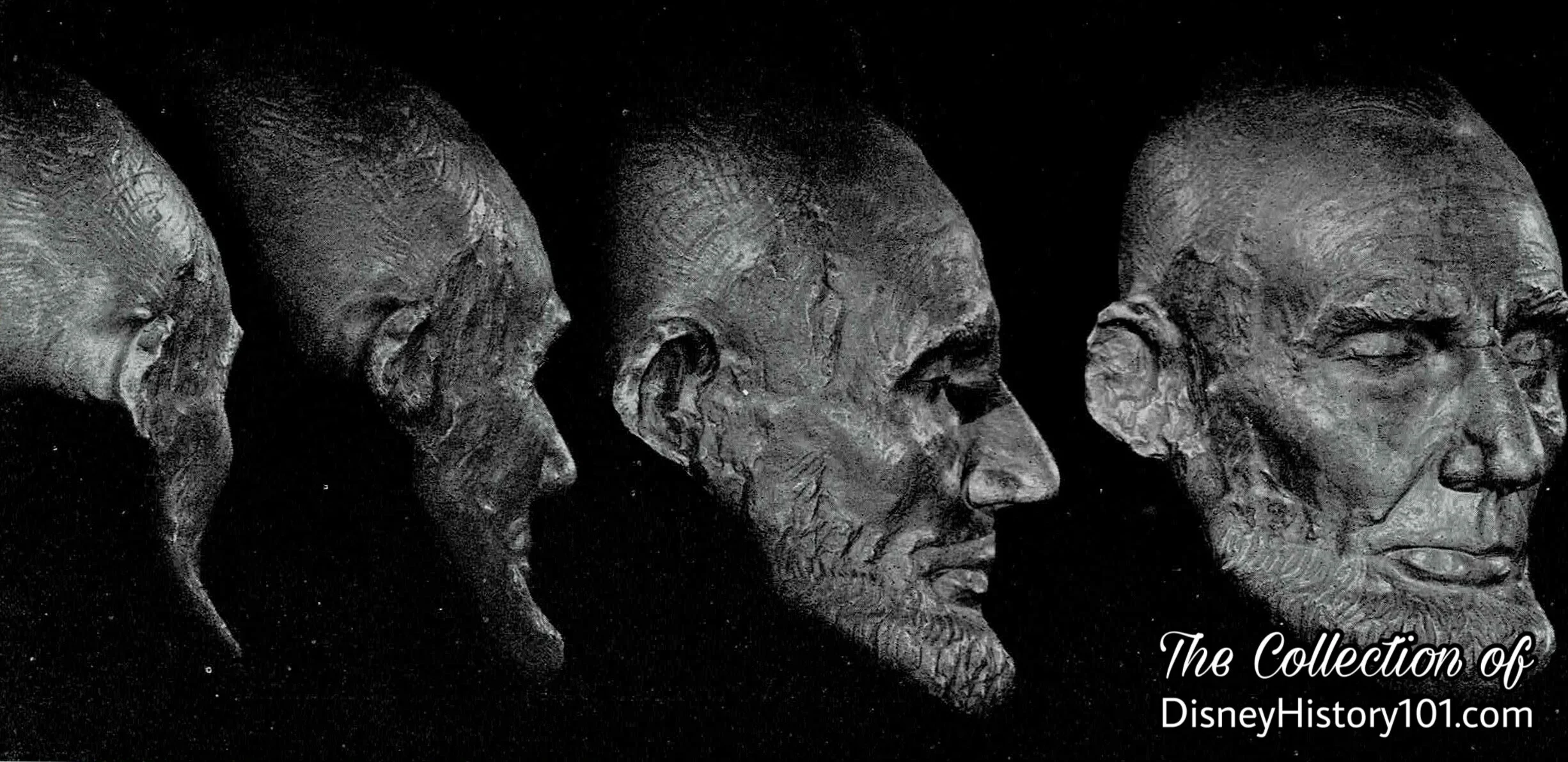
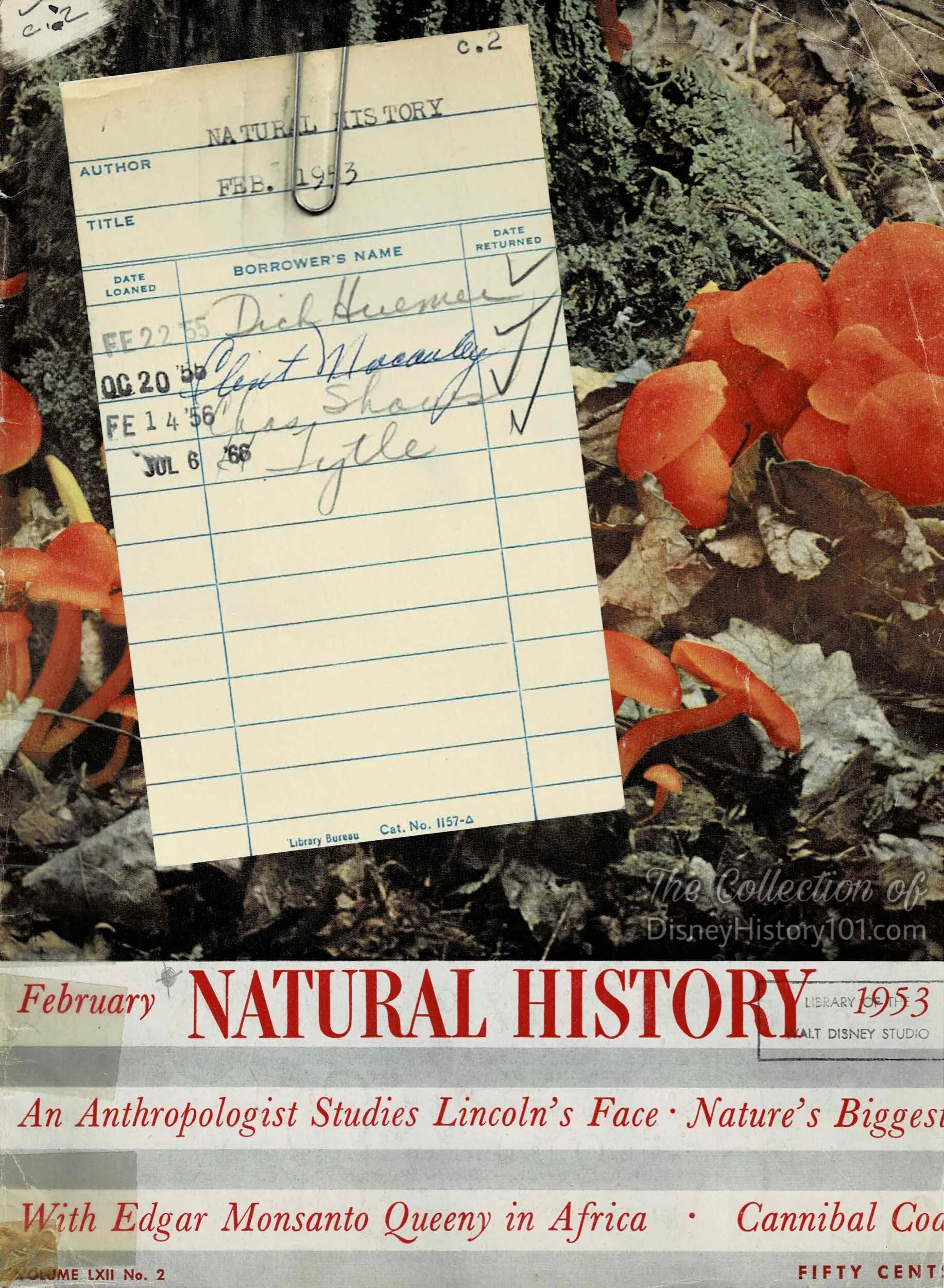
The face of the Audio-Animatronic Mr. Lincoln was also partially fashioned after a bronzed reproduction of sculptor Clark Mills’ life-mask of the 16th President of the United States (which was created some 60 days before the President’s assassination in 1865). As a “sidelight,” this bronzed reproduction had resided with the Smithsonian Institute since the 1950’s, and was featured in an issue of “Natural History” magazine (February of 1953), which was part of The Walt Disney Studio Library.
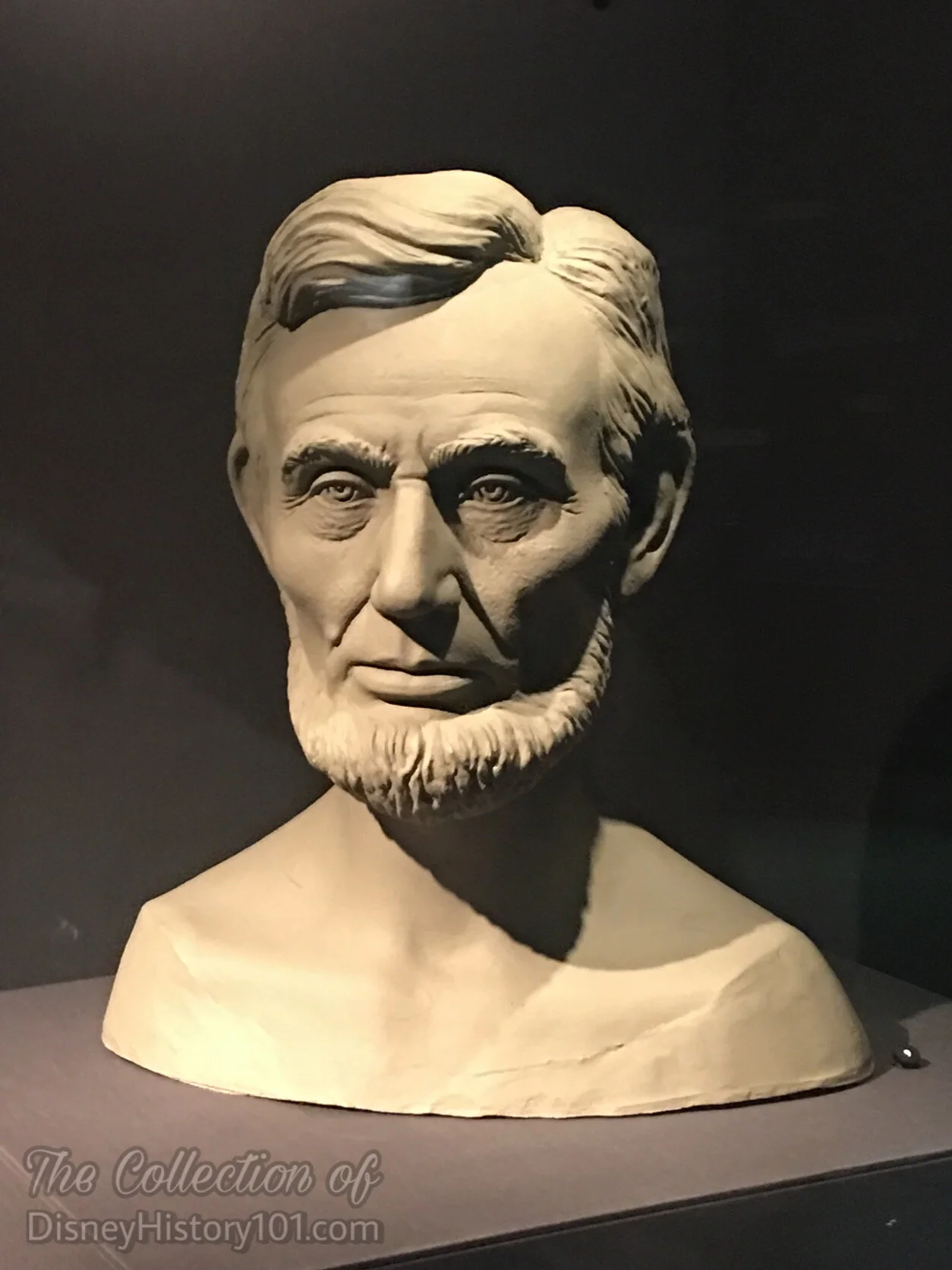
Still, yet another life mask (created earlier in 1860, in Chicago, by sculptor Leonard Volk) was also accessed and studied by artists. This particular mask preserved Lincoln before he was President and before he had a beard. Soon, Lincoln was sculpted in what Vacationland (Fall, 1965) called a “plastic clay.” Yes, “the skills of the sculptor and the talents of the artist” would soon enable audiences “in the presence of a man whose spirit guided the nation through a time of turmoil. Whose words inspired generations to follow.”
In addition, photographic evidence was collected, and from this, it was gathered that Abraham Lincoln towered over officers (as in a photograph taken at Antieam, in 1862). So, the entire Audio-Animatronics figure would need to be built to a scale that would at least simulate his true-life stature, of six foot- four inches tall. Some creative designs of the Audio-Animatronics figures (with a little creative license) were provided by members of the Disneyland Staff Shop. It was decided to increase Lincoln’s height by three inches to make him seem more imposing, so the height of the figure on the drawing is an impressive six feet, seven inches tall. The final figure would stand approximately six feet, four inches.
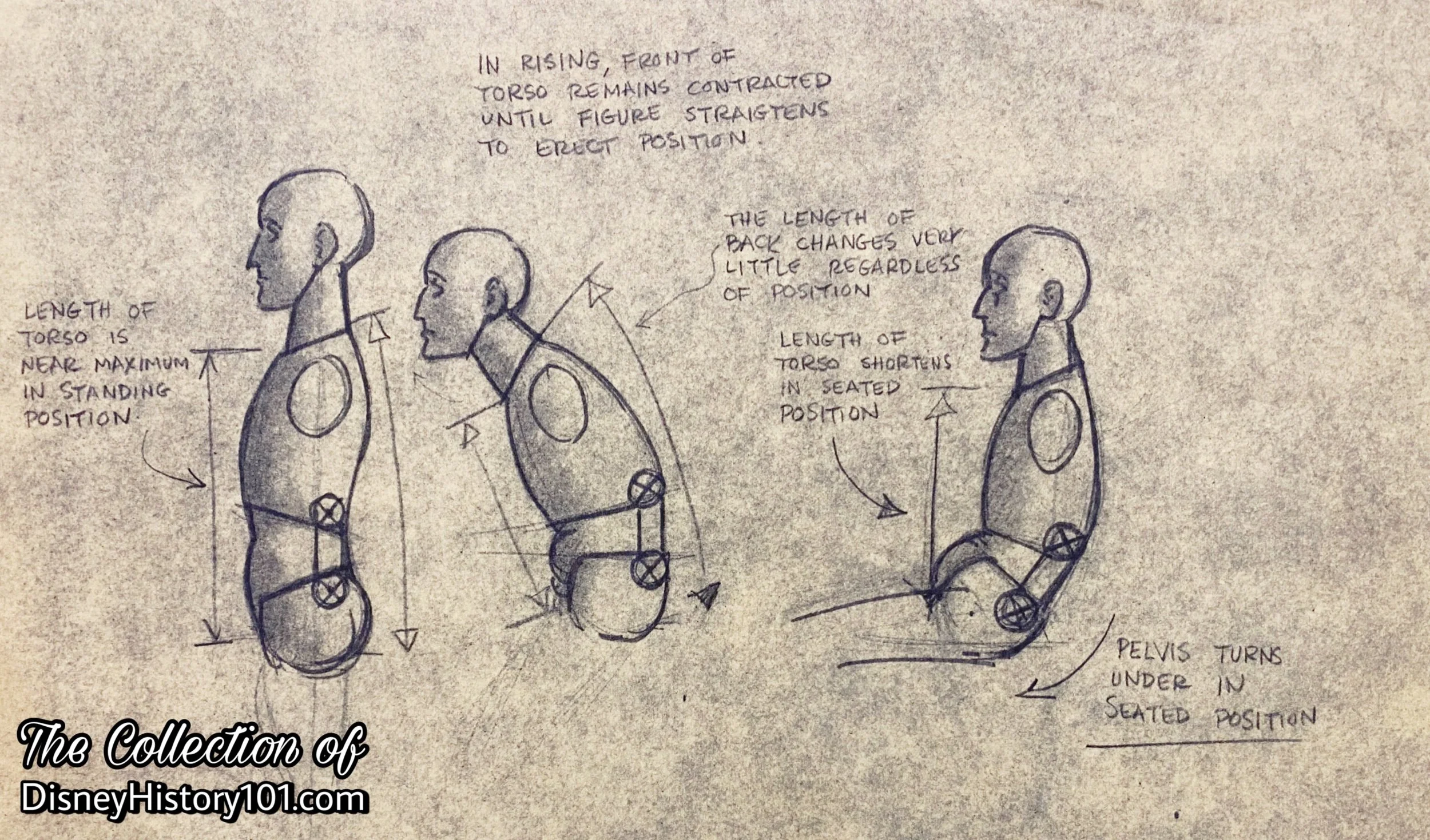
“Designing the Great Movements of Mr. Lincoln”
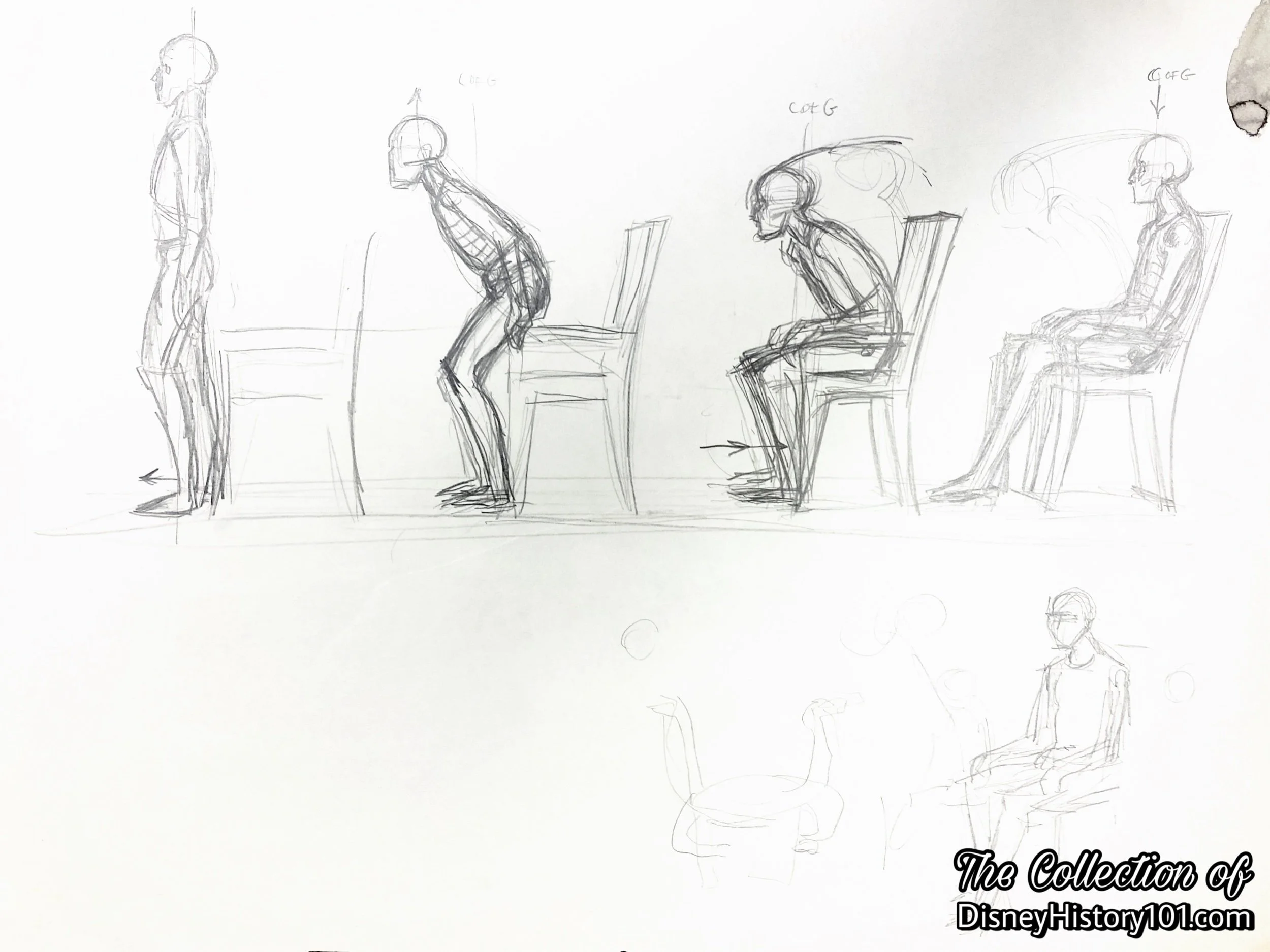
Now, this figure was to be far different than the static figures that were planned and in development for the “Pirate Wax Museum” at Disneyland. Mr. Lincoln would be animated, rising from his chair; his hands in contact with a chair until he could no longer reach; his arms swing forward as the figure reaches full height;
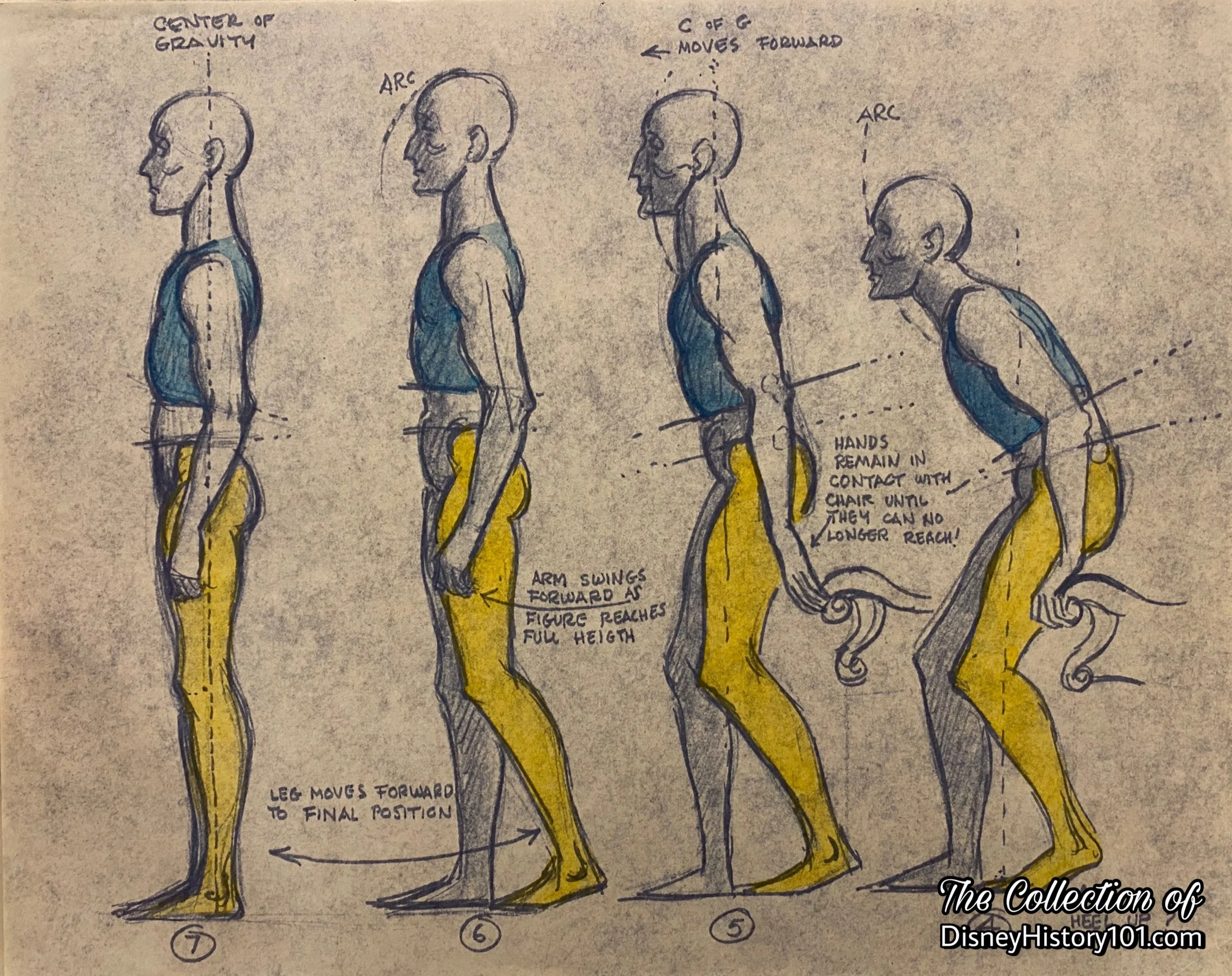
…and the figure finally taking one step forward, the leg, moving forward until the figure reaches the center of gravity. Marc Davis assisted with the design of this detailed A.A. Figure animation.
“Construction of Mr. Lincoln”
Bob Gurr remembered : “We had to figure out how do you do an animated human and design all the mechanical parts, and all the motions… We’d take the details to the Studio, and the Studio would make the parts. No time to explain how it’s going to work. They’d just build it on faith and see if we could make it run.” Many parts were constantly refined by the Walt Disney Studio Machine Shop (as “Lincoln’s Hands,” which were first produced during April of 1964, and the mechanics and aesthetics of which were refined greatly by May 3, 1965).
Bill Justice recalled “The original Audio-Animatronics figures were strictly mechanical. They were filled with cams, push rods, gears, pulleys and hydraulic lines. Their costumes had to be changed periodically because of oil leaks. Much of the mechanical equipment was located in the only large space available - the chest cavity. From there push rods and cables would go to the head and arms. The programmer's first lesson was to stay a safe distance away. The figures are all heavy enough and contain enough hydraulic pressure to break furniture. Or break heads. When you're learning how to move an arm and you don't quite know where it will go, it's best to stay well out of arm's reach.”
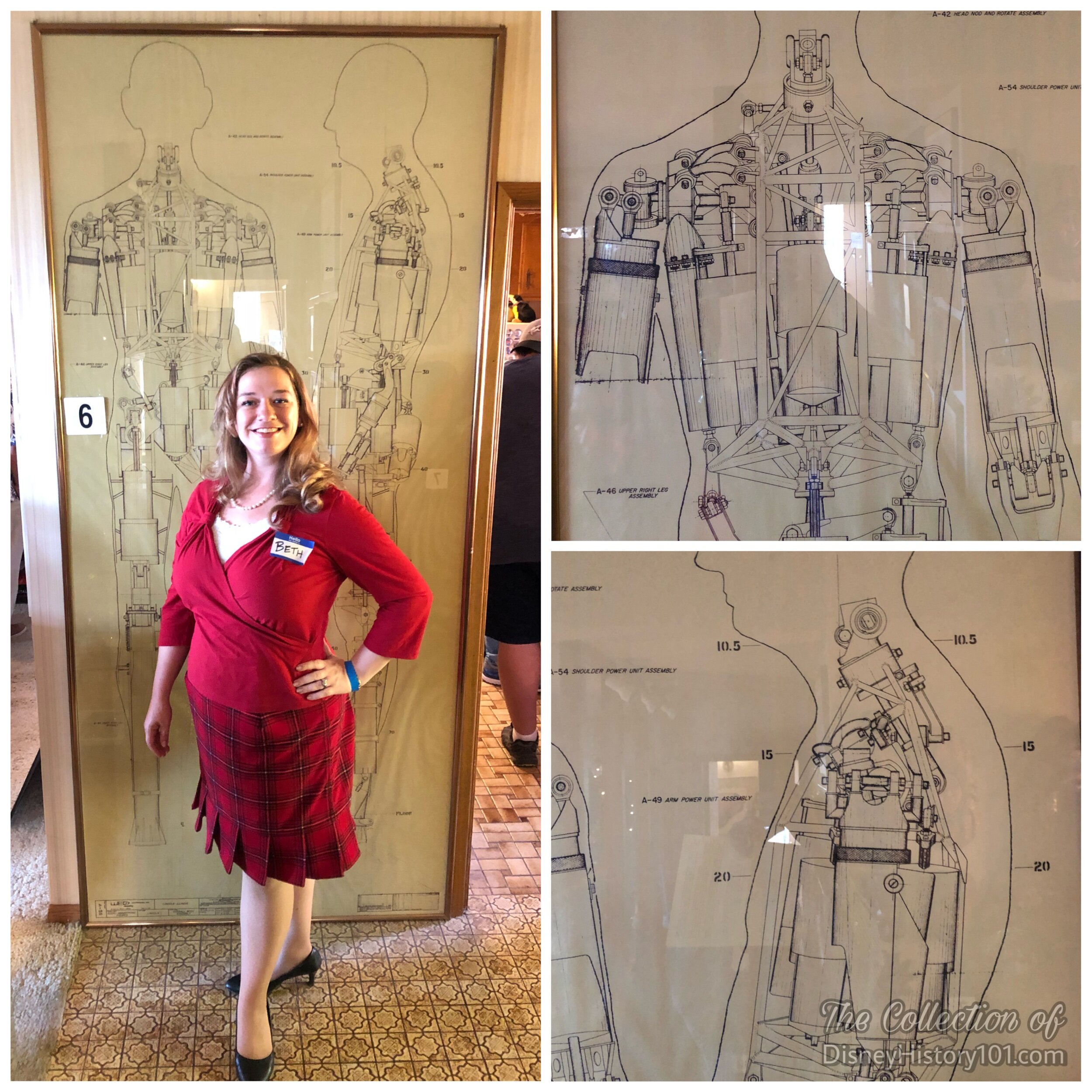
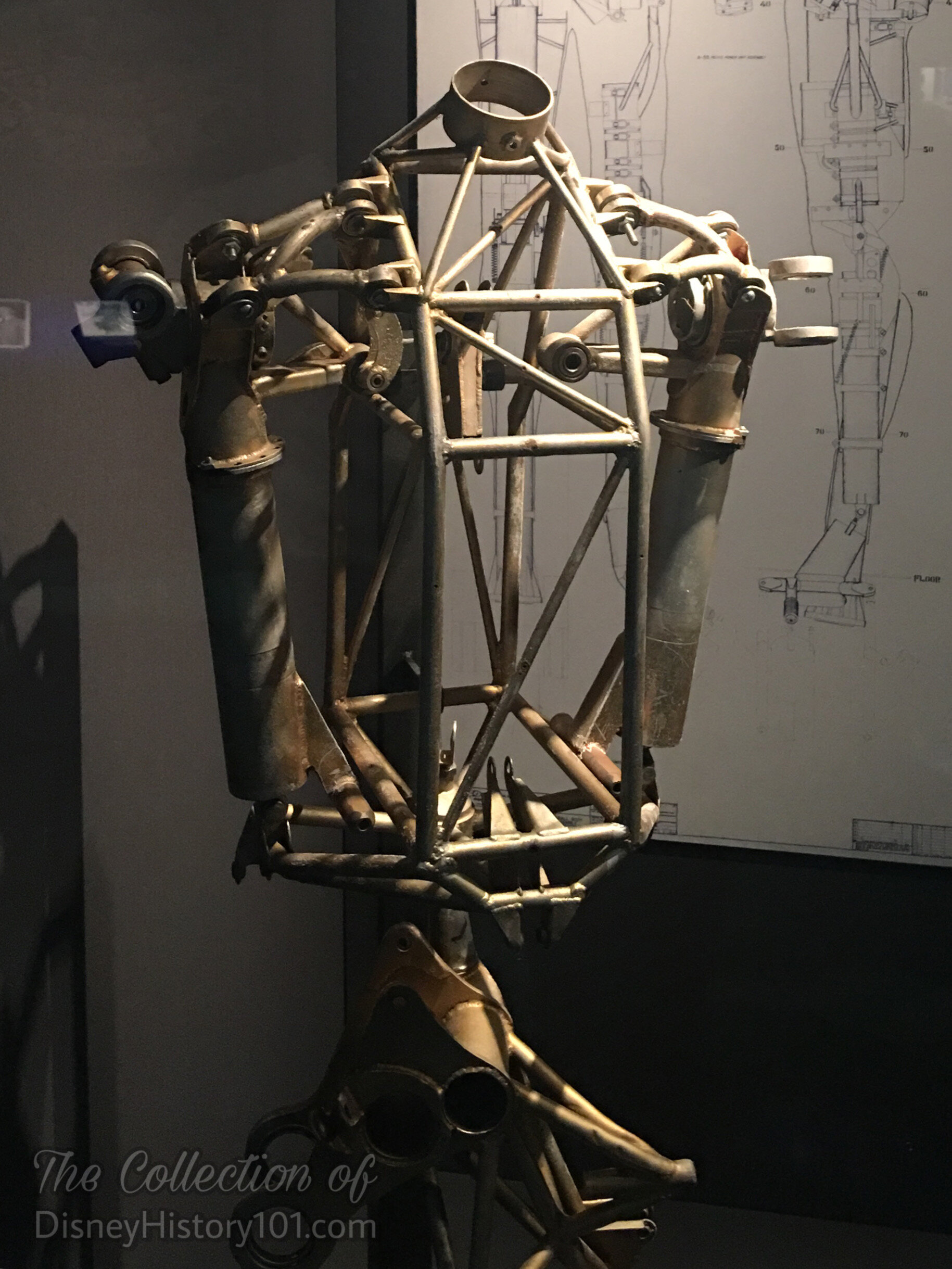
Robert H. Gurr (the very same engineer who helped redesign the Autopia Mark I chassis in 1955) was tasked with designing Mr. Lincoln’s “ribcage” (among other “skeletal” parts). “Remember, I’m a car guy. Lincoln has no wheels.” Bob accomplished this formidable and challenging task (with the help of Hogsett (a draftsman), and today he still (proudly) owns one of the life-size blueprints of Lincoln (he approved).
“Programming Mr. Lincoln”
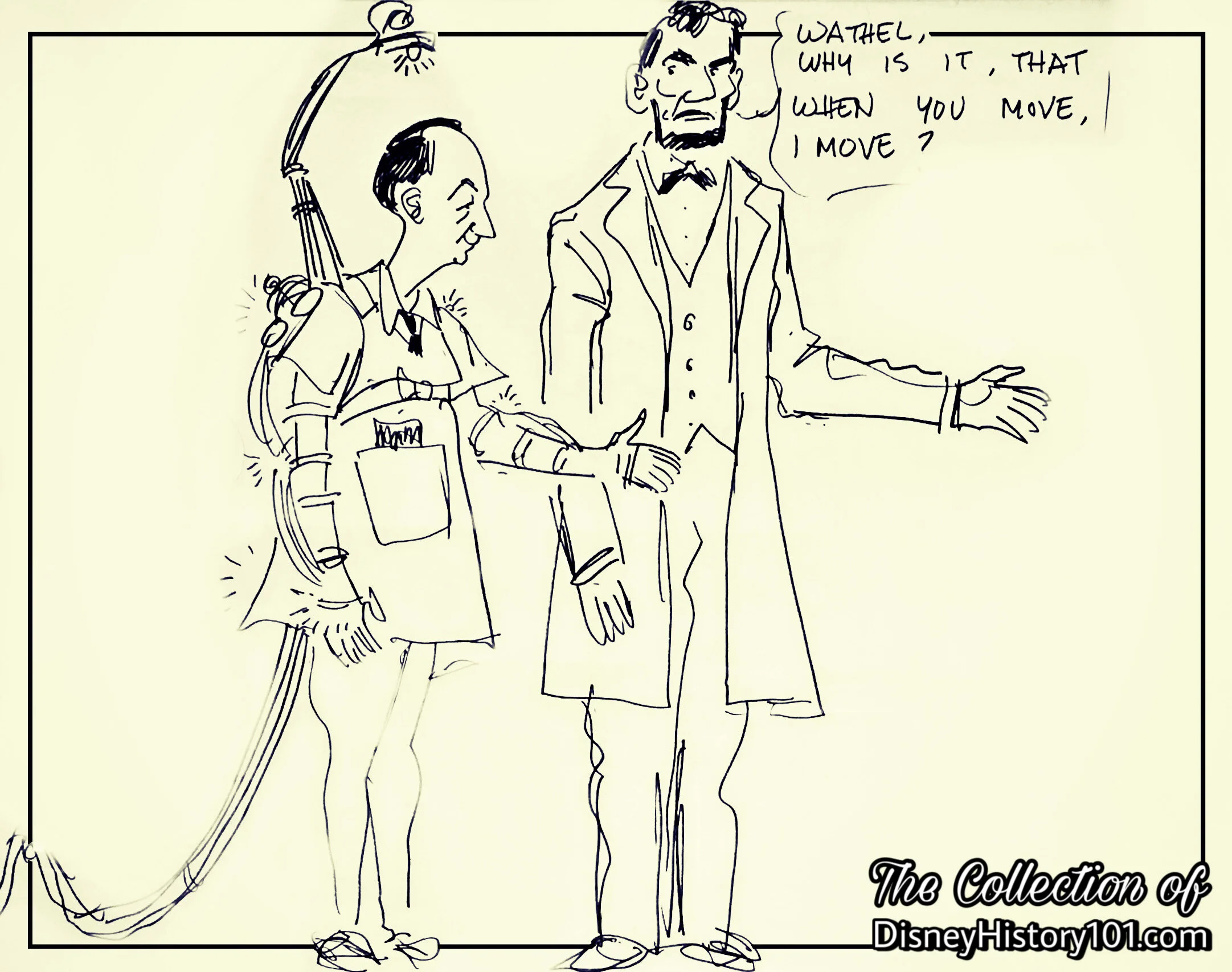
Bill Justice [“Justice for Disney”, page 75] recalled: “The original programming system was a harness arrangement worn by the programmer. He would move the way he wanted the figure to move. The harness would sense these motions and pass them on to the figure. That's how my mentor and colleague Wathel Rogers programmed the original Mr. Lincoln. Visitors would watch Wathel work and accuse him of overacting. He had to overact - the harness could sense only about two thirds of his movements. It was a pretty crude arrangement.” So instrumental was Wathel Rogers (of WED Enterprises Systems Development), that on January 11, 1966, an additional pay increase of $25 per/week (to his current personnel salary of $350/week) was deemed warranted and approved by both Mel Melton and Walt Disney.
The magic of Walt Disney’s patented Audio-Animatronics human figures soon made their debut though several televised previews. In one “Wonderful World of Color” episode (airing May 17, 1964) Walt Disney introduced the world to Audio-Animatronics with the help of animator Wathel Rogers (who wore the electronic rig of controls, which captured his own movements, and then recorded them on 35mm magnetic tape). Further, “sync marks” (would allow the movements to be analyzed, corrected and timed to keep the various animations in well-ordered synchronization). This impressive display was far more complicated than those remote controlled Tiki Room Birds, and this way, Wathel gave a televised demonstration of programming the movements of the “Father” figure for the General Electric Carrousel of Progress.
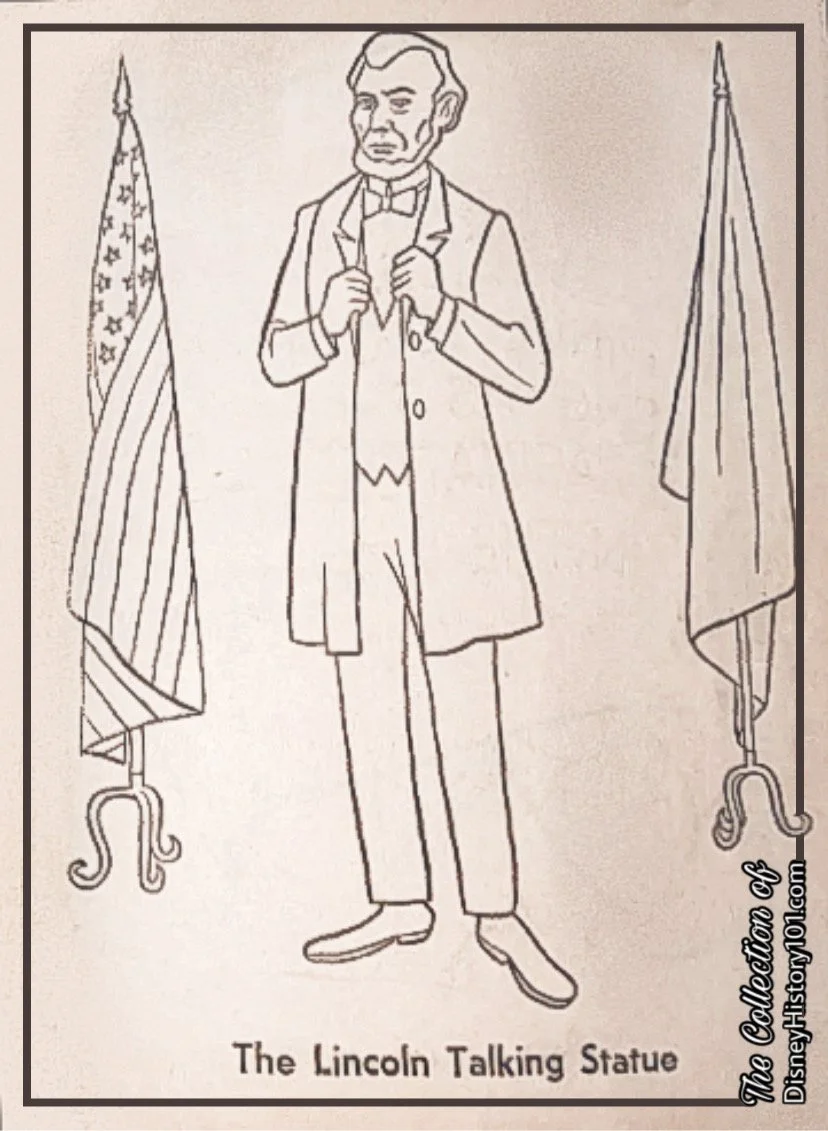
Walt Disney’s Mr. Lincoln would be no mere “talking statue”. These techniques would now be employed to give natural movement to the complex figure of Abraham Lincoln. According to Walt Disney (in a c. 1963 interview with Fletcher Markle), “Now, we’re making these… dimensional human figures move, we make animals move, we make anything move, through the use of electronics. It’s a tape mechanism. The tape, its like programming and sequencing when… they’re sending some missile to the moon. At different stages, at different times, things must happen. That’s all programmed - pre-determined. So our show’s put on that tape, programmed from this tape. And we run it off a little 1-inch tape that has 14 tracks. On each track, we can get up to 16 signals. Now, those little signals go and impulse this figure and make the figure move make the figure talk, and everything.”
“Recording Great Movements of Mr. Lincoln”
An Animator’s Console was used for programming the movements of the Audio-Animatronics® figures. Mr. Lincoln’s music and effects were pre-recorded on a 1-inch magnetic tape (capable of controlling hundreds of actions) and then synchronized with impulses. These impulses are simulated by transmissions sent from the magnetic tape to numerous pneumatic and hydraulic tubes running through his body. According to Backstage Disneyland (Vol.6, No.1 ; published Spring, 1967), “The heart of Mr. Lincoln is a one-inch-wide tape that contains 11 tracks of pulses. This, combined with a complicated hydraulic oil and air system, provides the smooth body movements seen in the show upstairs.“ The end result - through the magic of Audio-Animatronics, the great Abraham Lincoln comes to life before audiences, for a memorable six minute address - with “48* separate body actions with the figure’s 17 head motions and facial expressions” (*or, 48 separate body actions, by some accounts)! In fact, according to “The ‘Audio-Animatronic System’ : A New Concept in Entertainment,” “some 275,000 combinations of actions can be programmed for the Lincoln figure.” “With even more realism in sound and movement, the figure of the Civil War President is seated in thoughtful dignity in his White House office. He rises slowly to deliver his address, with complete coordination and movement, speech and mannerisms of Abraham Lincoln,” according to an excerpt from "Walt Disney's Vacation in Disneyland" A Gold Key Comic, Published 1965.
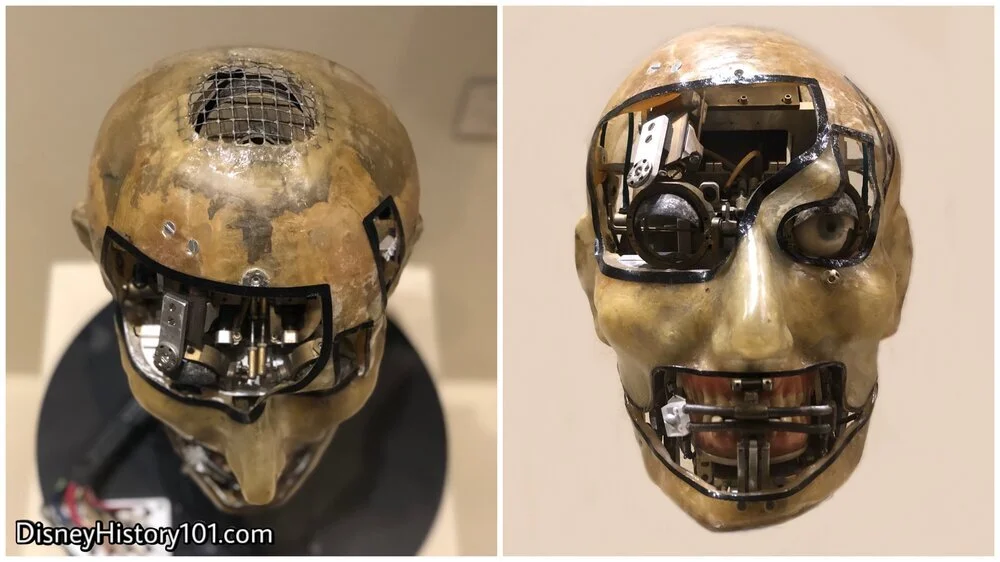
According to Disneyland LINE Magazine [October 28, 1994 ; Vol. 26, No. 42], “The Figure Head Animation Department came into existence in the latter part of 1962 to meet the demands of Disney’s exhibits at the 1964 World’s Fair,” which included the Cast of It’s a Small World, the General Electric Carousel of Progress, the Ford Magic Skyway, and Great Moments with Mr. Lincoln. The same article continues : “These exhibits introduced Audio-Animatronics technology on a grand scale. Two of the exhibits, Great Moments with Mr. Lincoln and the GE Carousel of Progress, had complicated animated heads. The Head Shop team was established to assemble them.”
The Audio-Animatronics head is covered with butyrate, a transparent, rigid, and easily malleable plastic used as a “shell.” Over the butyrate was a flexible latex “skin.”
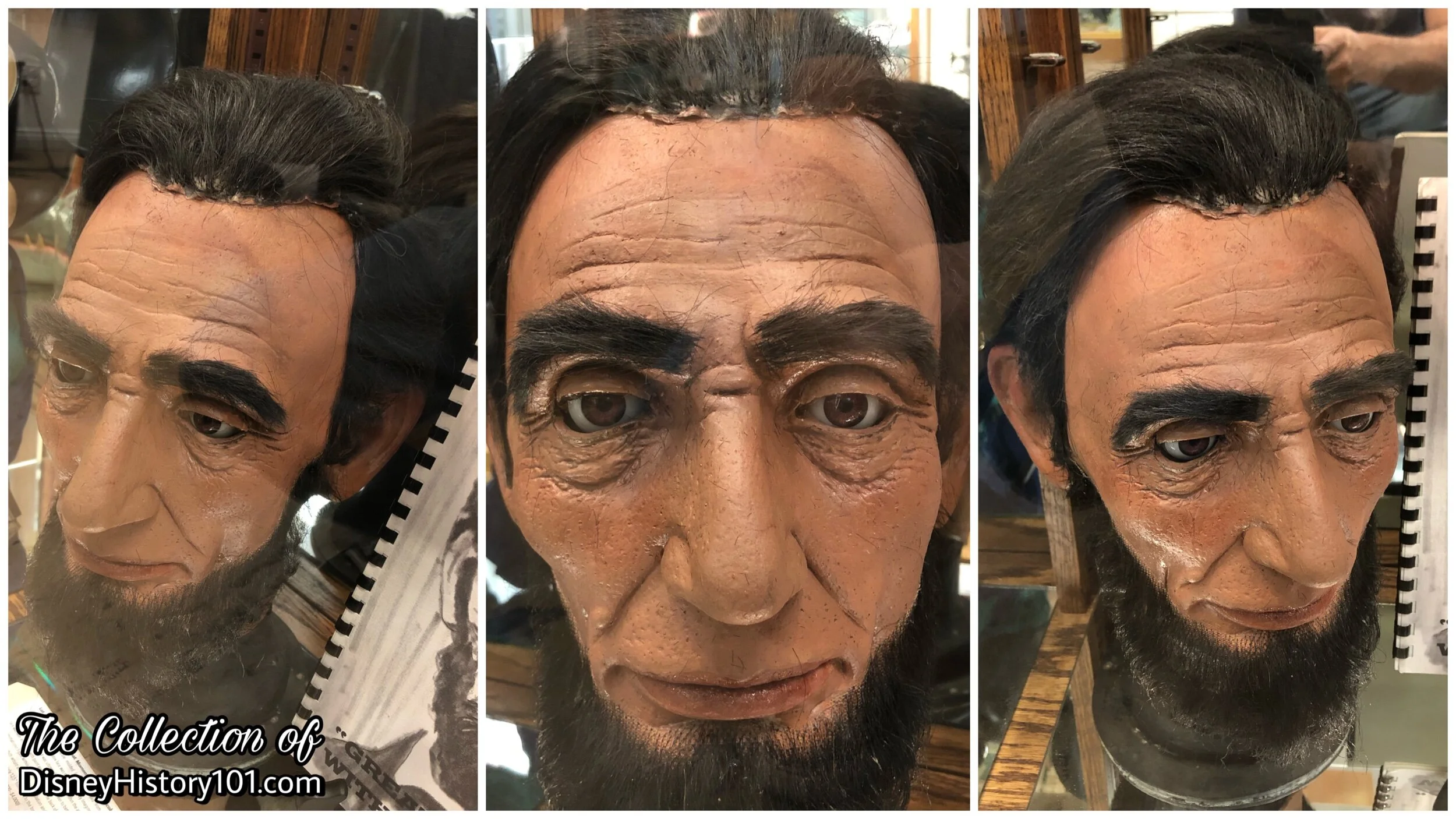
In order to find a resilient and flexible figure skin compound that could endure the rigors of performance after performance, Walt and company turned to Bart Thompson (a chemist for rival studio MGM), who had a knack for these sorts of things. Bart had previously helped develop the latex “skin” for one of Walt’s first Audio-Animatronic human figures (that of Confucius, for a scrapped Chinese restaurant project, that was to be located off Main Street at Disneyland). Now, Lincoln would be covered with a “flexible ‘skin’ in order to maintain the original details.” Such a flexible figure skin was pliable and capable of being “buttered” - worked with a hot iron. Finally (above), note the lip ring and upper and lower “pinch arms,” eye snaps, and screws for attaching the “skin” to the Head Assembly.
Meanwhile, “the hair and beard were created by a professional wig maker… eyes were created by WED artists, using techniques similar to those employed by prosthetic eye manufacturers, and dental techniques were used to design the gums and teeth,” according to Vacationland magazine (Fall, 1965).
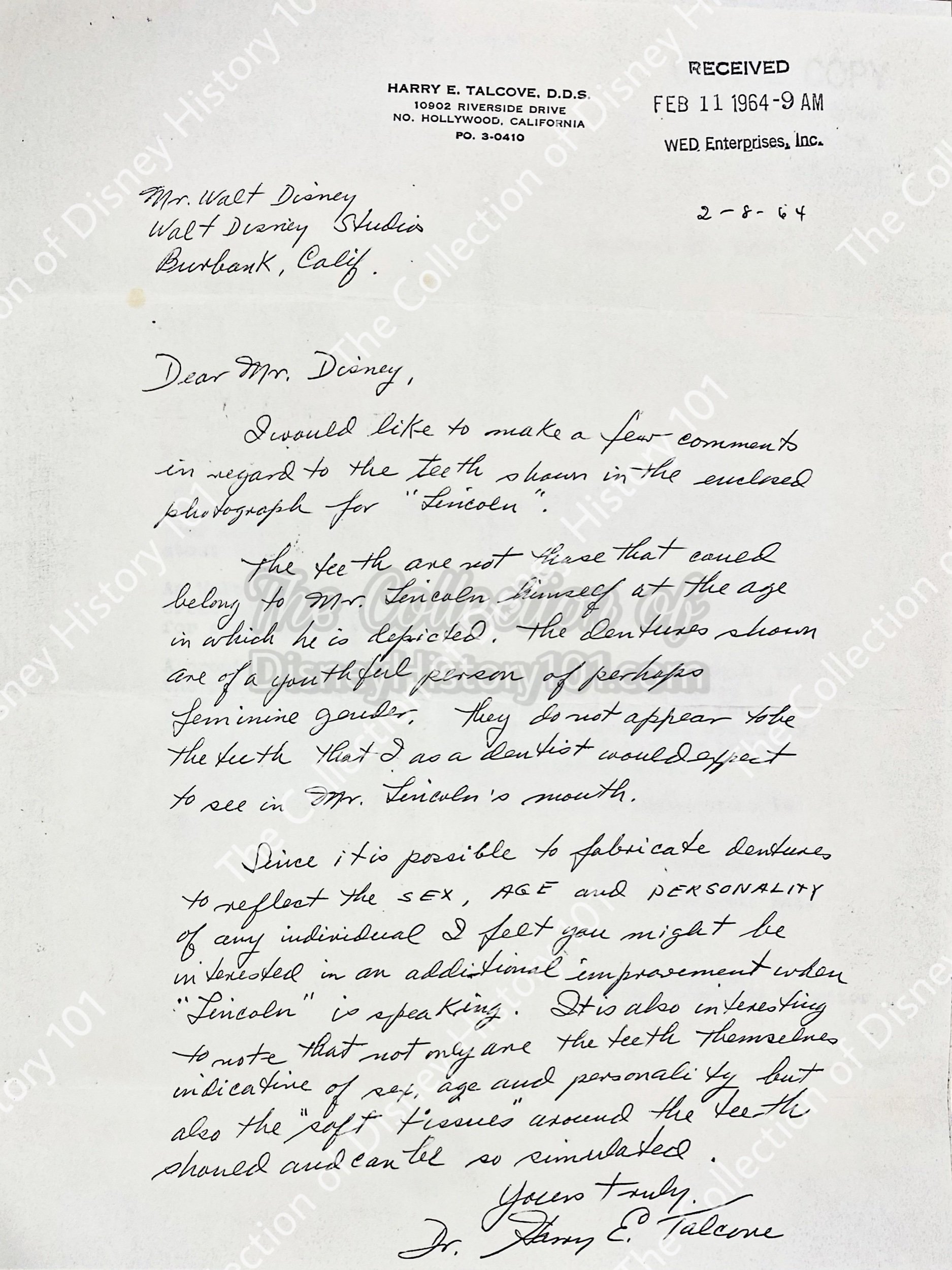
The dentures fabricated for the head were even scrutinized, as attested to in this letter to Walt Disney Productions from a contemporaneous, local Hollywood-based dentist who acted as a consultant for Mr. Lincoln.
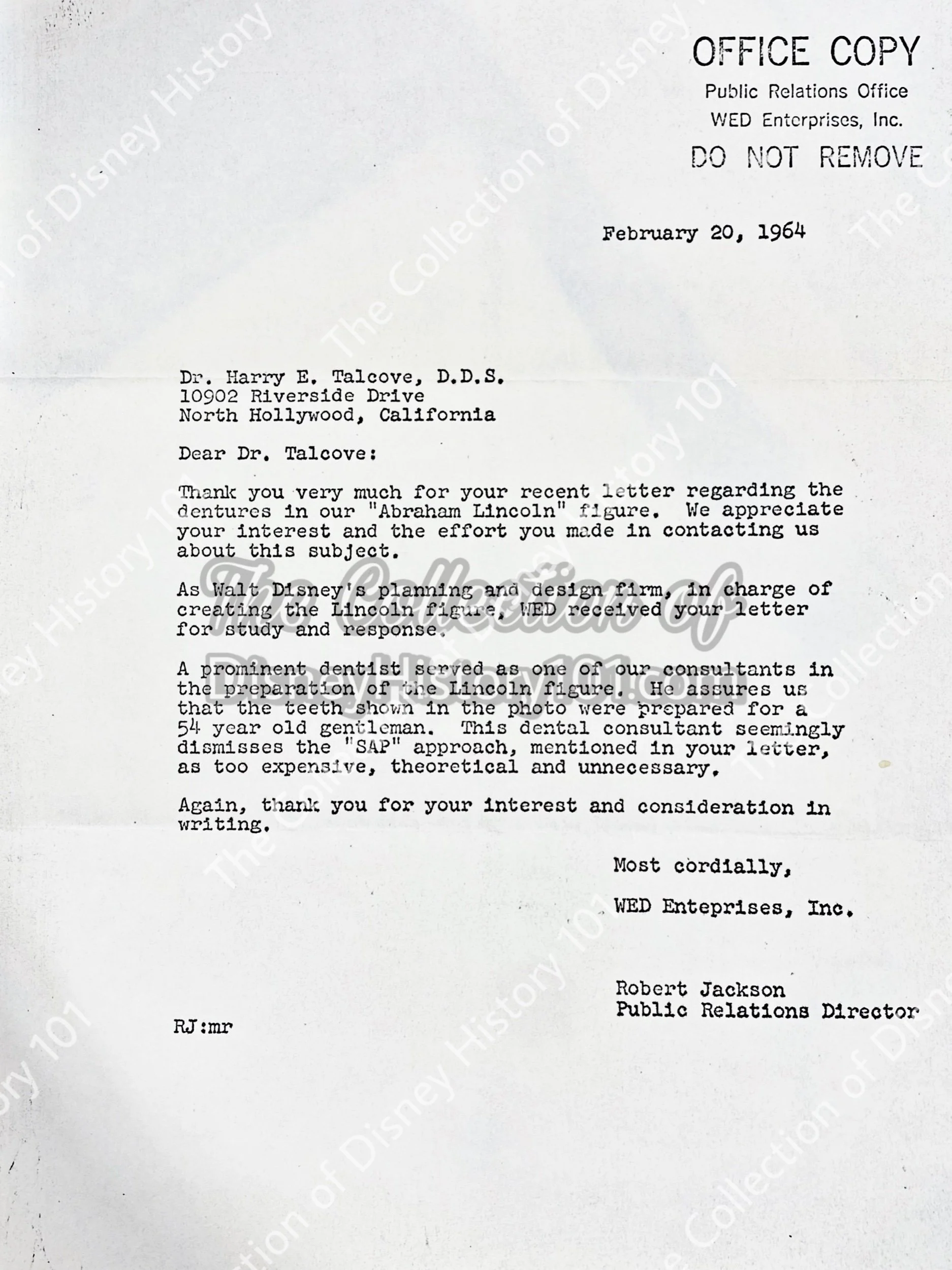
All of this facial detail was essential, because the complex Mr. Lincoln Audio-Animatronic would be unlike any other - a human character that would speak!
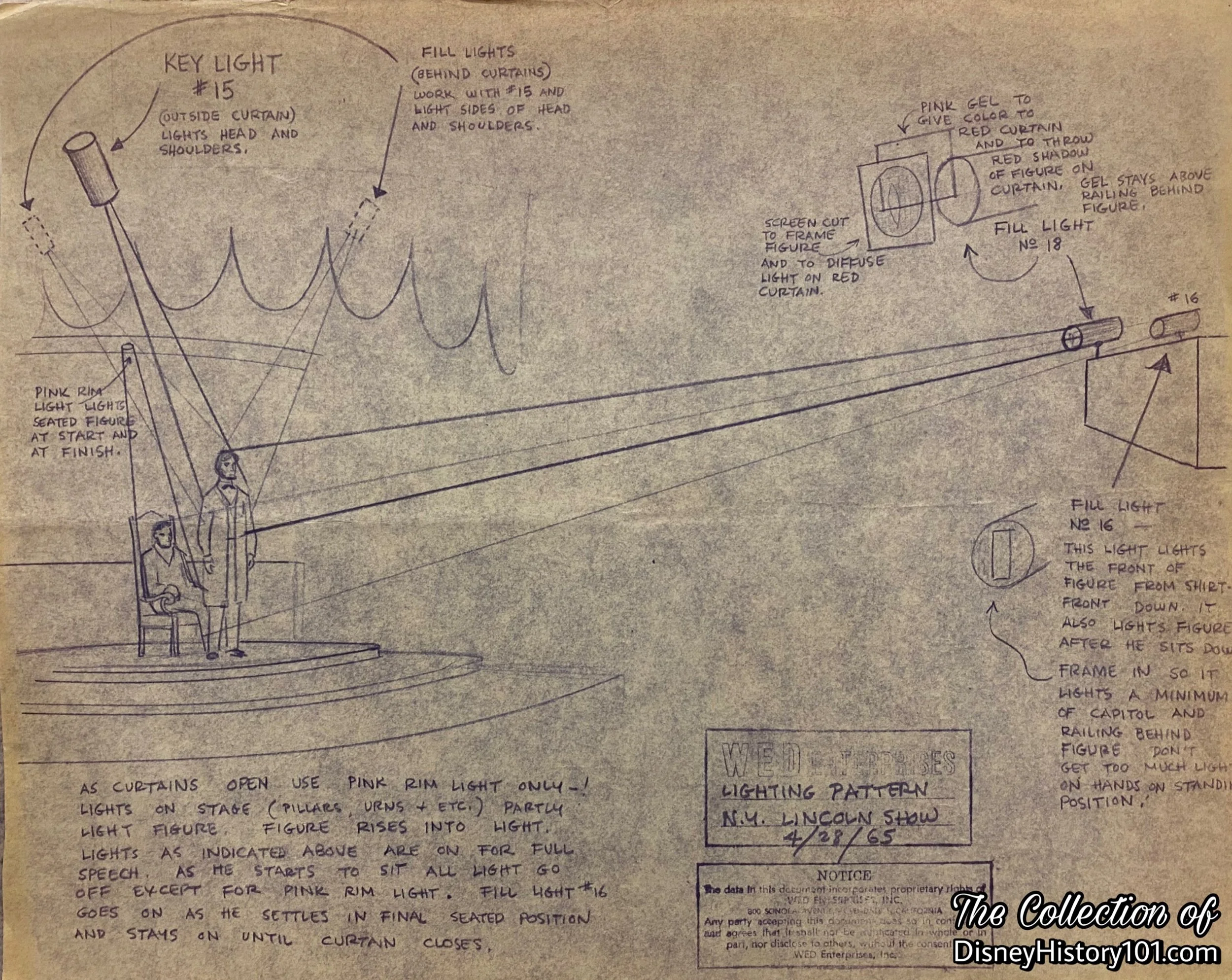
Last (but not least important) was the score, which was composed by Buddy Baker (who would later become renown for his compositions for both Adventure Thru Inner Space and the Haunted Mansion). Buddy had most-recently provided the score for the attraction at the State of Illinois Pavilion.
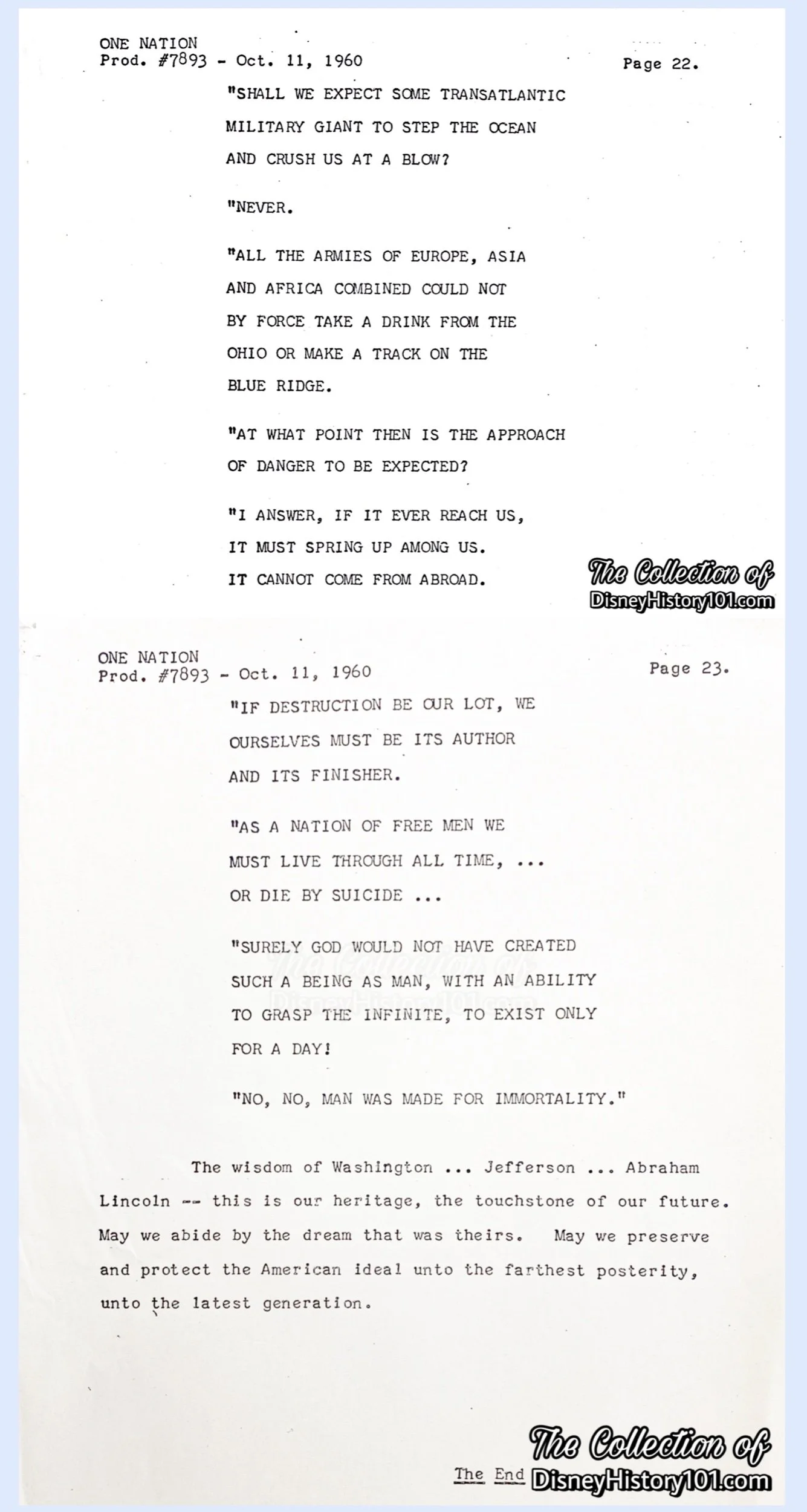
“Great Words of Mr. Lincoln”
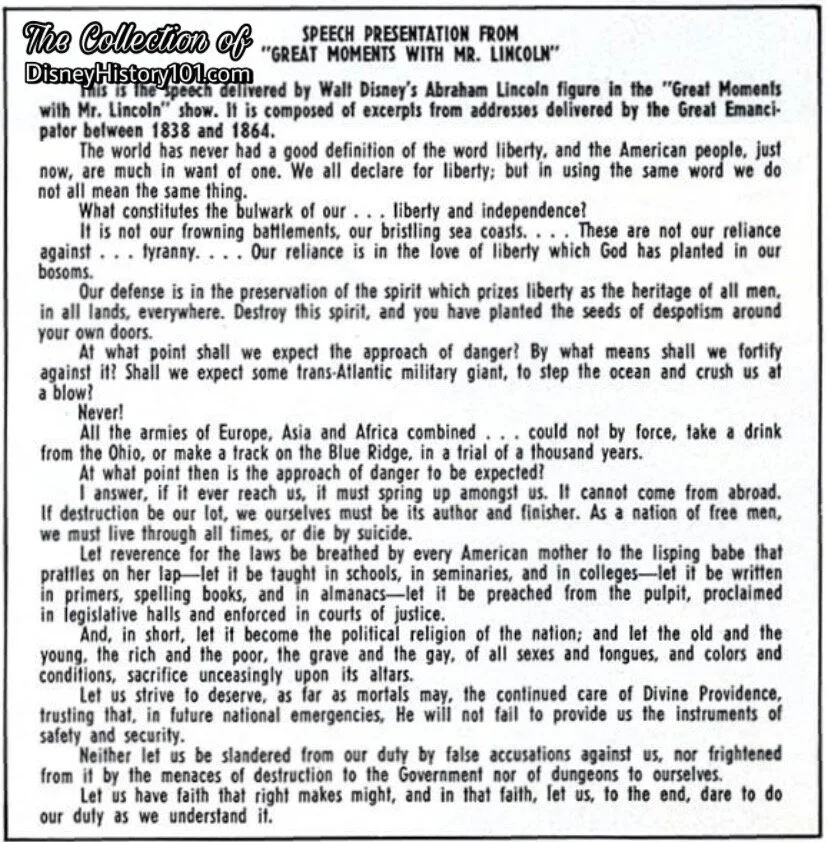
James Algar (a veteran of Walt Disney’s True-Life Adventures documenting people and places) was assigned to write the script for Great Moments with Mr. Lincoln. Soon, Walt Disney (and company) reached out to Ralph Newman (an avid and respected Civil historian). Though James had researched much material and drafts were completed (as early as August of 1963), many subsequent meetings and Inter-Office Communications took place on the subject of what Abraham Lincoln should say. According to Walt’s own words, “When we set out to select the speeches and writing for the monologue in the show, we decided to bypass the Gettysburg Address, even though its poetic qualities and poignant message are unexcelled. Because it is so familiar to every American, we felt that it would not contribute significantly to our purpose - an in-depth fresh presentation of Lincoln’s principles, ideals and philosophies.”
So, it was ultimately decided to not select any one of Lincoln’s deliveries (as The Gettysburg Address) for the monologue, but to write his words as some actual composite of President Lincoln’s speeches. Among the sources included were (1) the Address at Sanitary Fair, Baltimore, Maryland -April 18, 1864, (2) the Speech at Edwardsville, Illinois -September 11, 1858, (3) the Address before the Young Men's Lyceum, Springfield, Illinois -January 27, 1838, (4) the Address at Cooper Institute, New York city, New York - February 27, 1860.
“New York World’s Fair Debut and Response”
The results were ready in a few short months, and by April 5, 1963, Fairfax Cone (New York World’s Fair Illinois Commission Chairman) flew out to Walt Disney Studio. At the sight of Lincoln talking and moving, Fairfax soon thereafter wrote Walt : “I am sure you know that I was overwhelmed by the realism of the Lincoln figure that you showed Mrs. Cone and me last Friday. The possibility of our using the Lincoln figure and the effect of this upon visitors to the New York World’s Fair have not left my mind during any of my waking hours since I saw it. I am going to New York tomorrow to discuss the Illinois participation with the Fair people, and I expect to be in touch with Jack Sayers shortly to further explore this subject.” Soon after, the Governor of Illinois (Otto Kerner) appointed a new New York World’s Fair Illinois Commission Chairman - Mr. Ralph Newman. Ralph Newman was a known Lincoln enthusiast, and swiftly flew out to Walt Disney Studio, and was also so impressed with the Lincoln figure, that he had many good things to report to the Illinois Governor.
Around WED Enterprises, Inc., Audio-Animatronics purely served entertainment purposes. However, the art and science of Audio-Animatronics had taken such a great leap forward, that (by June 11th, 1965) the company had even been invited (through a certain Cornell University program) to submit a bid to the United States Navy. This bid was for a contract to develop a related “exoskeletal device” which would enable a man to “lift 1,500 pounds to a height of six feet and carry that load twenty-five feet in ten seconds.” It was clear that WED Enterprises, Inc. had come a long way in the field of Audio-Animatronics, by the 1960’s! More than two decades later (in 1984), WED designers met with scientists from the University of Utah's Center for Biomedical Design. Based upon Audio-Animatronic technology, a stunning new advancement was developed, creating incredibly life-like movements.
Complications (regarding syncing the tape and figure’s movements) prevented Mr. Lincoln’s scheduled debut at the 1964 New York World’s Fair, and Robert Moses went on record stating, that he wouldn’t “open the fair without that exhibit.” If the movements were not synced just right with the audio track, “It was sort of like a needle jumping the groove [on a record]. The result was, Lincoln would go into a complete spastic fit,” according to Bob Gurr. But, once these were fixed, Mr. Lincoln opened at the New York World’s Fair on April 6th, 1964 (some twelve years after the creation of the miniature barber shop quartet).
“‘Unbelievable’ and ‘inspiring’ were some of the words fair goers used to describe this new portrayal of Lincoln.” Understandably, “during the fair’s two six-month seasons, 91 percent of those who paid fair admission - nearly 47 million people - visited one or more of the quartet of Disney shows created for General Electric, Ford Motor Company, Pepsi Cola and the State of Illinois.” [“Information on America Sings,” prepared by Disneyland Marketing Division, 1974]. In reference to the popularity of the marvelous shows created for the 1964/1965 New York World’s Fair, Walt Disney once told Ray Bradbury, “Nothing has to die.” True to those words (and following the 1964 season of the New York World’s Fair), all four of Walt’s presentations were redeveloped by WED Enterprises, Inc. for relocation at Disneyland. Of these, work was soon wrapping up to make Great Moments with Mr. Lincoln presented by Lincoln Savings and Loan Disneyland’s 48th major attraction!
“Imagineering the Disneyland Show”
On February 3, 1965 WED Enterprises was no longer personally owned by Walt Disney, but was now incorporated as a subsidiary of Walt Disney Productions. MAPO was also soon incorporated on July 23, 1965. Before long WED Enterprises, Inc. and MAPO would work together to produce the Disneyland Show. WED Enterprises, Inc. would master-plan, design, and engineer the concepts. MAPO, Inc. would take those plans and fabricate, assemble, and test the show’s prototype systems and components (including those of the Audio-Animatronics figures). New parts were fabricated, including “a duplicate Audio-Animatronics Lincoln, because the original one was still running at the fair,” according to Dave Smith (Chief Archivist Emeritus of the Walt Disney Archives). [Disney Facts Revealed by Dave Smith, 2016]
A new six foot, four inch figure (weighing 140 pounds) was completed, capable of some 48 body actions, 17 head motions and facial expressions, and 438 separate actions. In fact, the refined figure was capable of a total of nearly 275,000 possible movements. At long last, “tomorrow's technology, married with the sensitivity of today's Disney artisans” would let audiences relive a few Great Moments with Mr. Lincoln!
The new figure would become the star of a brand new $1.5 million, 499-seat theater (or, “501-seats” in 13 rows, according to Vacationland magazine), with walls “lined in bone-white acoustical veneer for excellent sound control.” Therein, ‘Mr. Lincoln’ would deliver an inspiring address, with the entire show (voice-over narration, animations, lights, curtains, even the motion of the twelve entrance doors and twelve exit doors) recorded on a magnetic tape capable of holding 438 separate actions. The tape would be transmitted from the Audio-Animatronic Control Room under the Lincoln exhibit, which would feature a high-tech fire-proof system involving bell alarms, automatic door locks, and a temperature control system capable of lowering the temperature to 100 degrees below zero. In addition, many aesthetic details of the theater show were analyzed and effected like “mosque-gold” carpeting, deep red upholstery, new Hostess dresses (designed at Disneyland and made locally or in San Francisco). All these Show elements (and more) were being finalized, assembled, and finally installed during the summer of 1965, the latter under the oversight of Orlando Ferrante (a recent WDI hire who would go on to lead Project Installation Coordination). The cost of the new theater would bring the Park’s total investment to $53 million, but be well worth it. Five twelve-minute shows per hour could accommodate 2,500 guests per hour.
According to Marty Sklar, “Imagineering is the blending of creative imagination with technical know-how.” While he believed that Pirates of the Caribbean was “the quintessential attraction that expressed that,” the rollicking adventure undeniably owed its existence to the progress first made with Audio-Animatronics figures during the development of Great Moments with Mr. Lincoln.
“Setting the Stage”
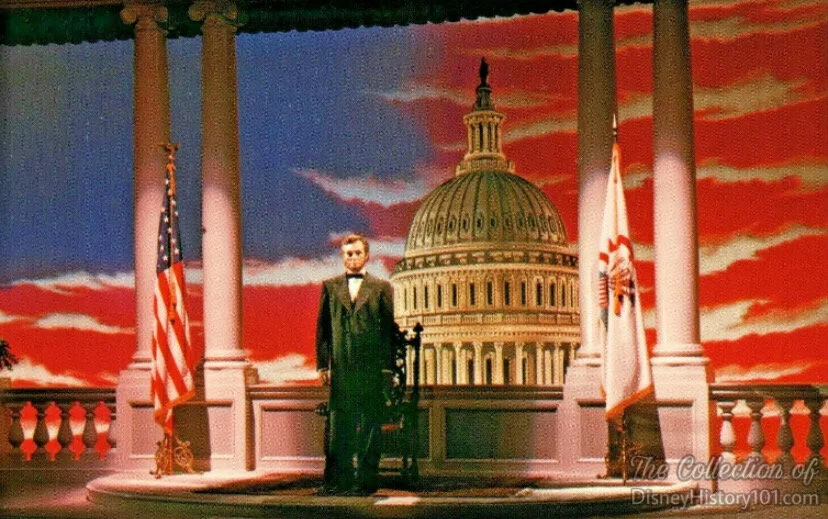
Walt is known to have said, “If you could see close in my eyes, the American flag is waving in both of them and up my spine is growing this red, white and blue stripe.” So, it isn’t a wonder that Walt responded to Herb’s presentation with the following suggestion. By May 13, 1963, Sam McKim had prepared a charcoal sketch of teh second stage curtain reveal and a grand star spangled sunset behind Mr. Lincoln. Fellow artist Herb Ryman (who previously created one of the first official drawings of Disneyland, and subsequent “One Nation” attraction concepts in 1954) divulged: “At Walt Disney’s urging, and in three an done half hours allowed me, the six sequential drawings from the main scenes, the graphics, the color and the stagecraft were all completed. The formula that was to stage the entire production right down to and including the rather ‘corny’ but effective ending with the symbolism of the ‘dawn’s early light’ sky and clouds dissolving into the American flag as background from the majestic capitol dome touched by an amethyst glow of dawn. Wrapping this all up and sticking it onto a story board, I waited Walt’s critique, as I had expected and anticipated that Walt would inevitably interject, ‘Now, Herbie, I’m going to tell you how I’m going to top it!’ I waited and I waited, knowing these words would come, and was, of course flattered and somewhat amused that his best efforts at ‘topping’ the presentation was this announcement: ‘I’m going to have the Mormon tabernacle choir in the finale, singing ‘The Battle Hymn of the Republic’ as the curtain closes. There was not attempt to add any visual climax to my very frantically and speedy three and one half hours of visualizations.” [“A Brush with Disney,” by Bruce Gordon and David Mumford, page 197.]
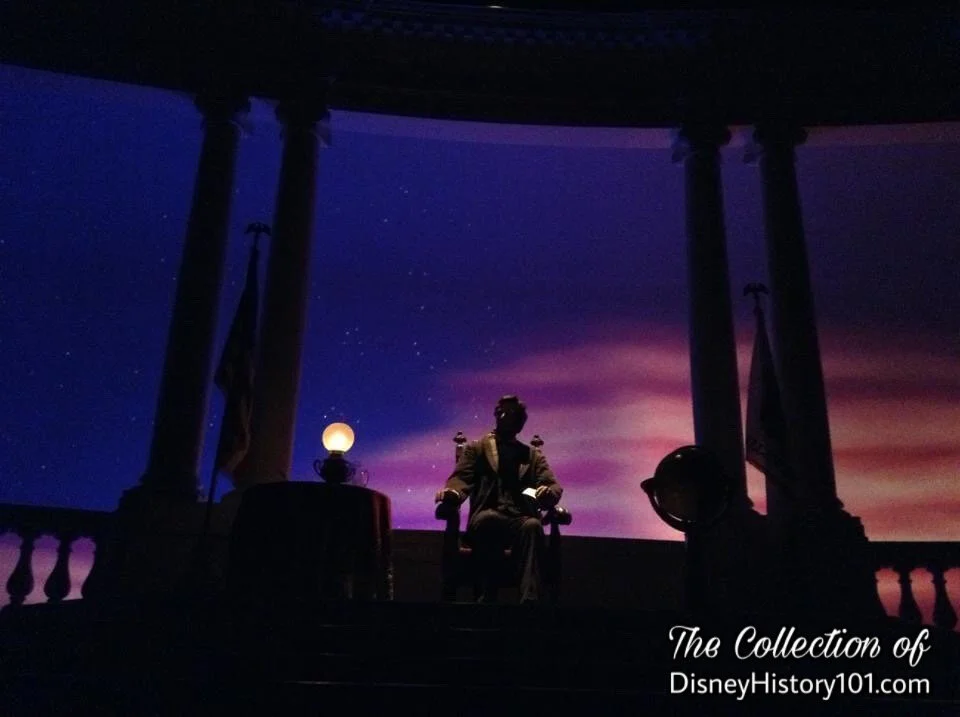
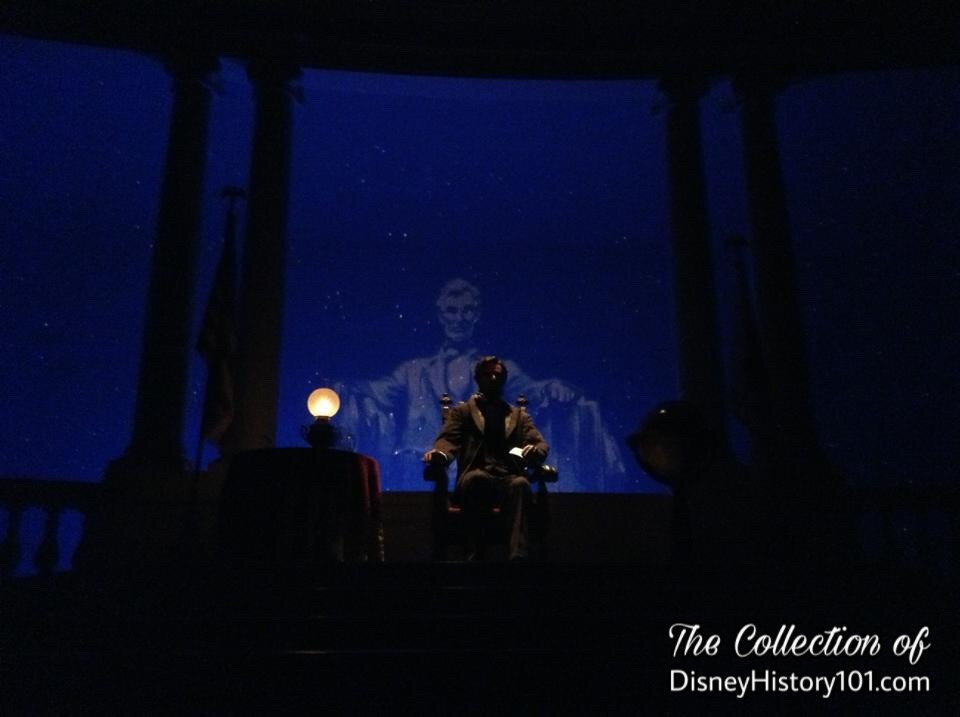
Yes, some seven years after Herb Ryman and Sam McKim first imagined this imagery in mixed media for the Liberty Street attraction, Walt Disney Imagineers and ACME Glass would bring to life this stunning show-stopping climax! Disneyland News (published Summer of 1965) described this scene in the following way: “In the background the audience will see a model of the Capitol dome as it was in the time of Lincoln. A dramatic, soul-stirring finale finds Lincoln again seated, now silhouetted against the imposing dome of the United States Capitol. It is dawn, and the early morning sun casts rays through a profusion of white clouds. A chorus of voices, joined in harmony, seem to move through the theater in an invisible procession, immersing the audience in a stereophonic choral presentation of The Battle Hymn of the Republic. Gradually, the crimson and white clouds behind Lincoln dissolve into a symbolic representation of the American Flag with the last stars.”
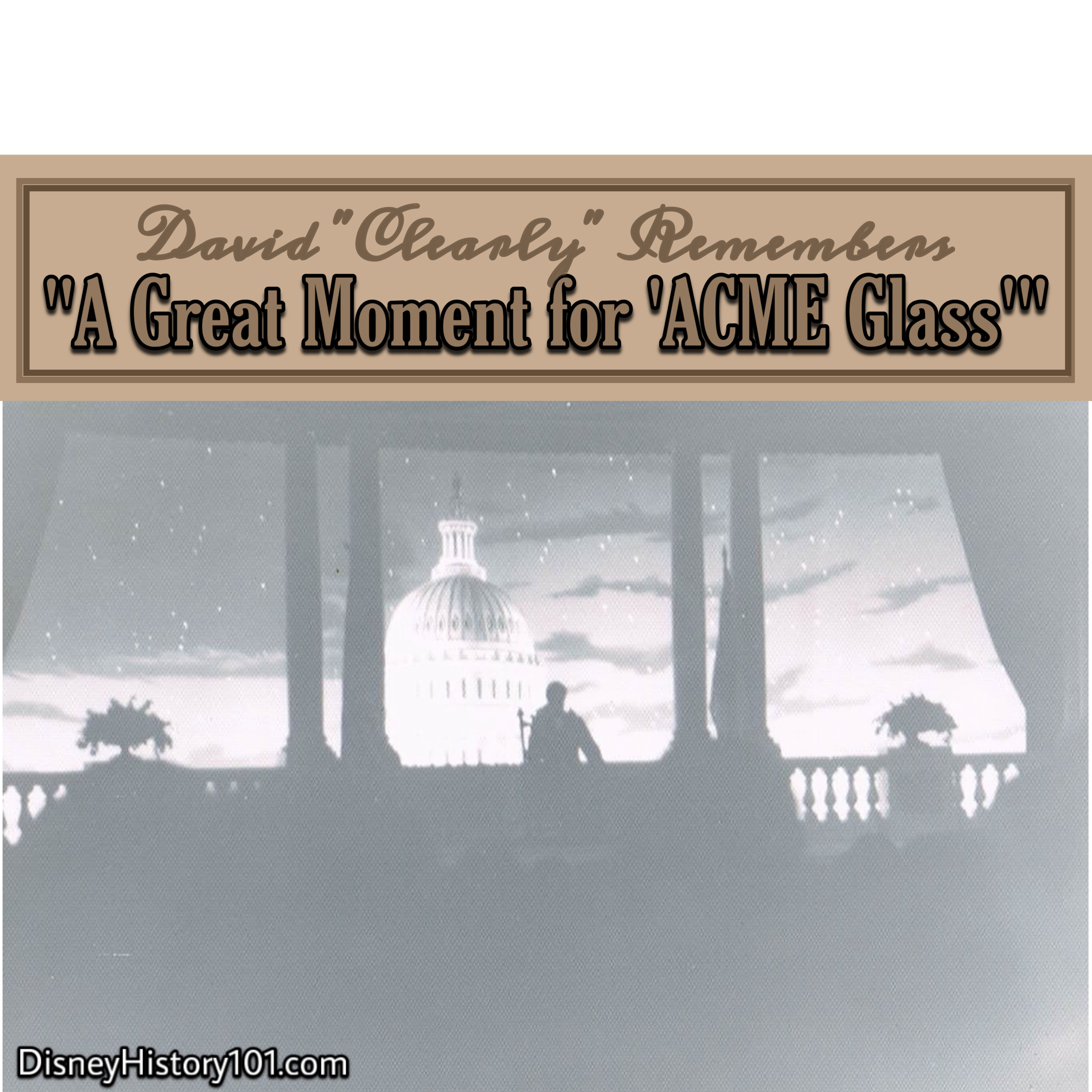
“Richard Hall Kent was Vice President of Fentron Industries, Incorporated. We were a family business, started by my maternal grandfather. We weren’t based in [Southern California]…We were a Seattle (Ballard) operation which did work all up and down the West Coast…We did curtain wall for commercial, glass for residential.
Our glass company was ironically named Acme Glass! Our company created the one way glass that allowed the flag sunrise [toward the end of the performance of Great Moments With Mr. Lincoln]. When he was a subcontractor on Great Moments [with Mr. Lincoln]…he would always have a tuna sandwich [at Chicken of the Sea] and nap next to the rock.
Our company [also] created the one way glass [in the Haunted Mansion] that … allows Madame Leota, the ballroom, and (my fave) the hitchhiking ghosts at the end. We lived in West Covina for a year (1965-1966) while he oversaw those projects, plus the UC Irvine Campus, the Nabisco Headquarters (next to I-5), and the Technicolor ‘skyscraper’ at the entrance to Universal. I call it that as it was used for exterior shots in several Universal TV shows (Kojak, McCloud, McMillan and Wife, etc.).”
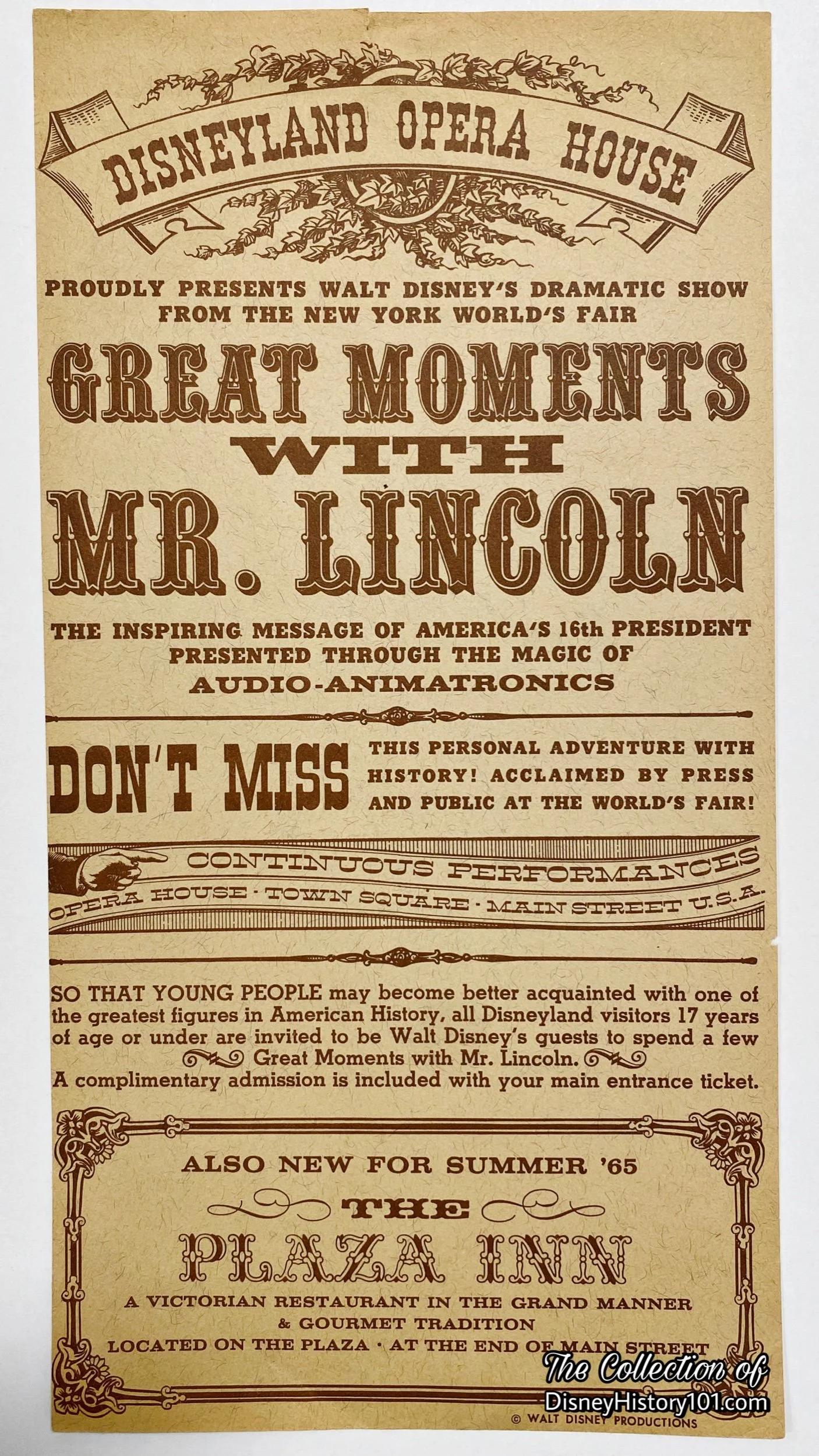
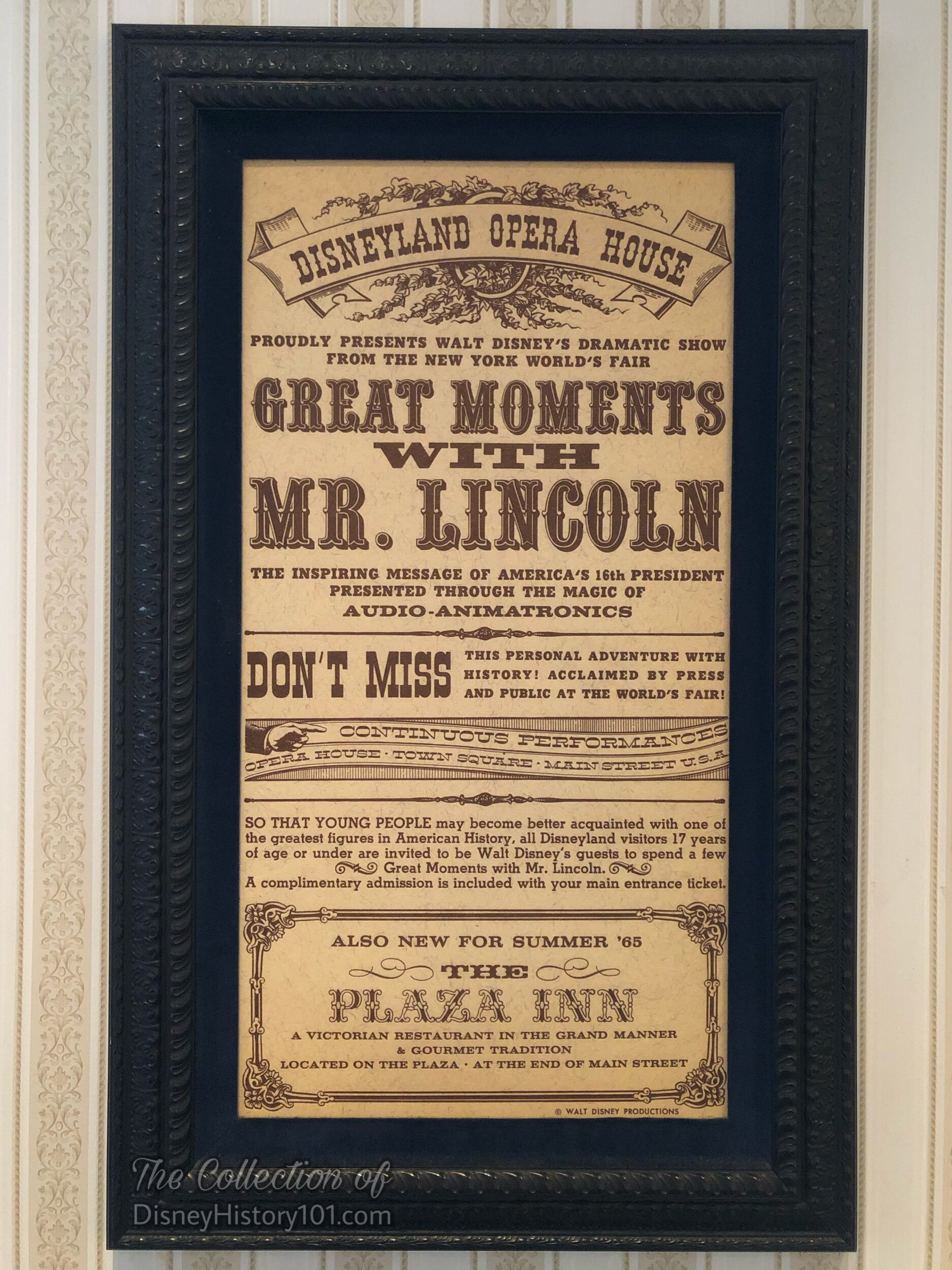
By 1966, WED Enterprises, Inc. opened Project number 034-53-00 relating to the preliminary design of posters for five new Disneyland attractions. These attraction posters included Great Moments with Mr. Lincoln, It's a Small World, New Orleans Square, Tomorrowland, and the Primeval Diorama. On June 17, 1966 an allowance estimate of $25,000 was allocated toward the cost of project number 034-53-00. By October 1, 1966, an actual cost of $10,000 was calculated with a $10,000 write off for project number 034-53-00.
The original “Great Moments with Mr. Lincoln” poster was based on posters of Lincoln’s day. According to one Main Street Opera House plaque, “It offered a personal invitation from Walt Disney to all young people, so that they might ‘become better acquainted with one of the greatest figures in American history.’” In fact, Disneyland ticket books included a free admission ticket to the show for every child and junior visitor.
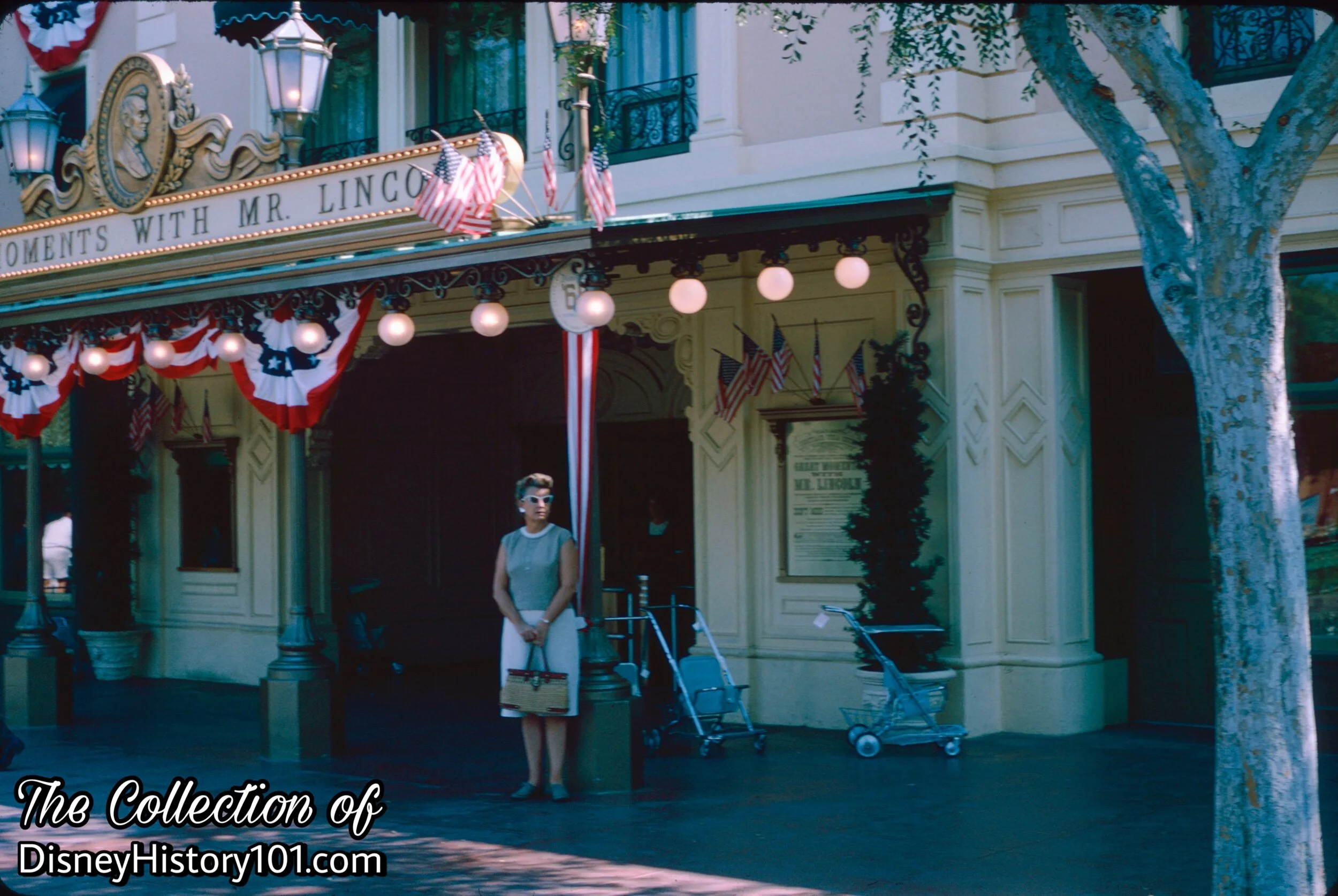
Red, white, and blue bunting decorated the Main Street Opera House, including the banners featuring the 13-starred 1777 “Cowpens” flag (an early United States flag), and miniature current United States flags (featuring 50 stars).
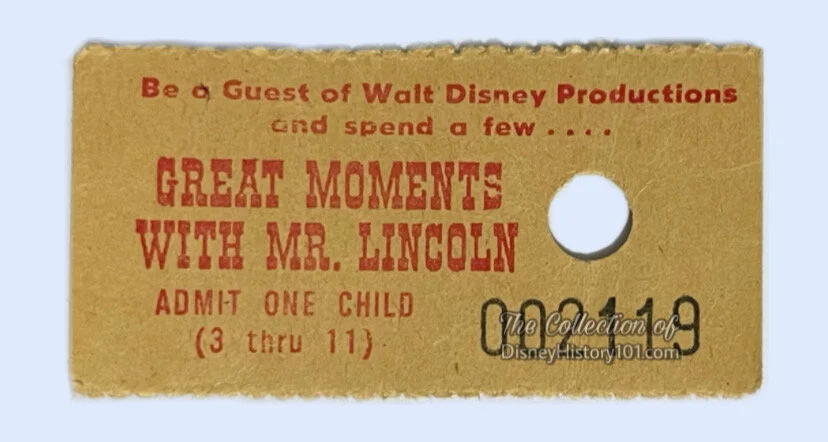
Now, complications prevented the show from opening (as planned, during June 1st) at Disneyland, and as a result, many Disneyland Cash Control and Admissions employees actually spent a great deal of time removing the Mr. Lincoln tickets from books for this very reason. Despite this, Great Moments with Mr. Lincoln - “one of Disneyland’s most dramatic and awe-inspiring presentations” - would open “in an impressive new theater on Disneyland’s Town Square as a high point of the Park’s year-long tenth anniversary celebration.”
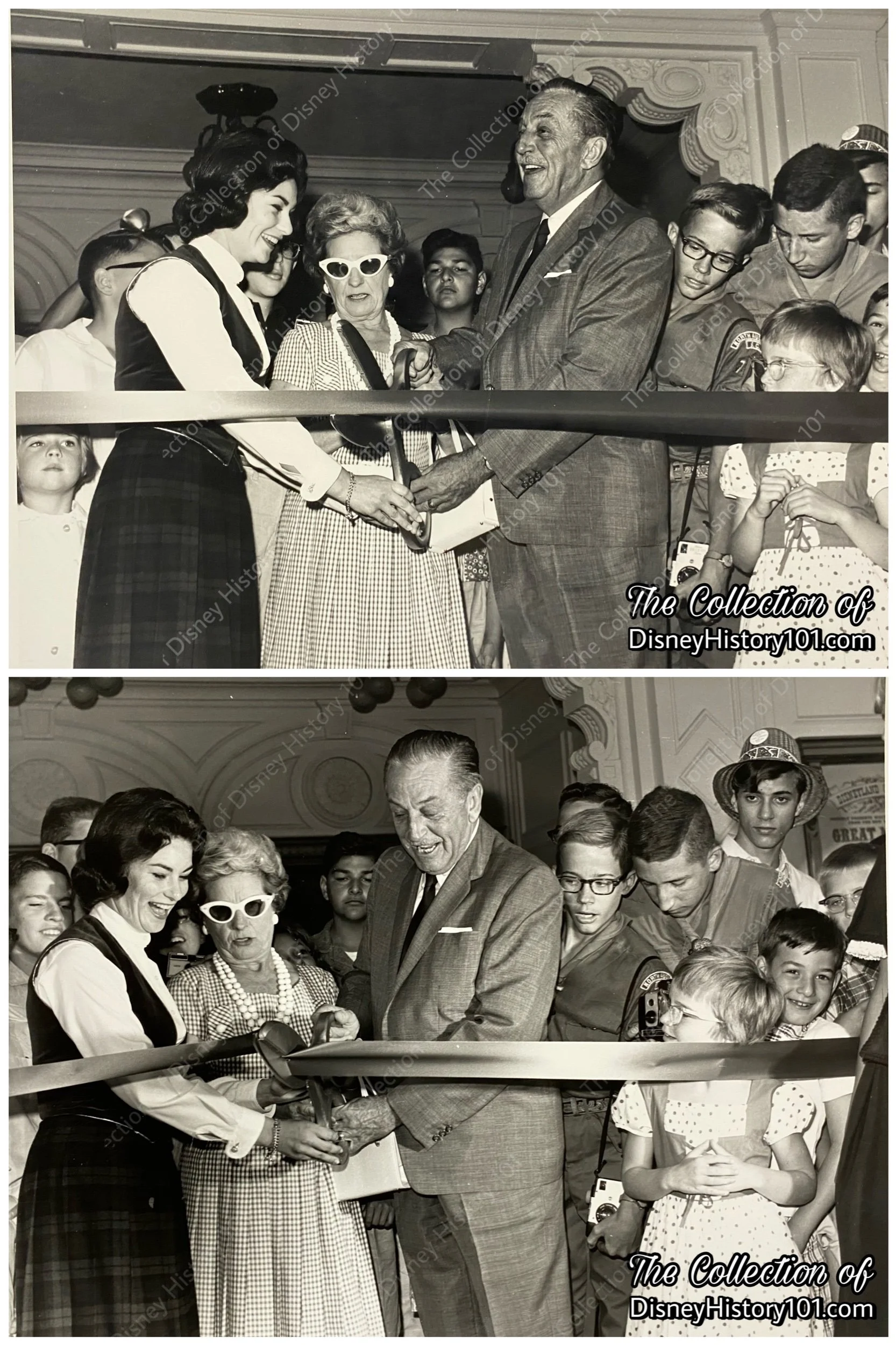
“The Grand Opening of Great Moments with Mr. Lincoln”
This 1965 Disneyland debut (came some “100 years after Lincoln left his indelible impression on our American culture”, and) was contemporaneous with the presentation’s “second season at the New York World’s Fair”. As the Disneyland marching band played on, Disneyland’s first Disneyland Ambassador Julie Reihm would assist Walt and Lillian Disney in the ribbon-cutting ceremonies in July of 1965! According to Walt Disney (in “Disneyland Through the Seasons”), “Ever since I was a youngster, I’ve had a great personal admiration for Abraham Lincoln. So when we decided to bring to Disneyland’s visitors some great moments in Mr. Lincoln’s life, we began an exhaustive research. We studied his mannerisms, his gestures, and even his voice characteristics. Above all, we wanted to create a faithful physical likeness in this audio-animatronic figure of Mr. Lincoln. When we held the opening ceremonies, it was a great occasion for all of us.”
“55er” Earl Anderson recalled: “When we opened up Mr. Lincoln, Roy was standing at the exit, watching people come out...and looking at their faces Some of the people had tears in their eyes. Roy said to me, 'Earl. this is going to catch on...it's going to be a good show!'”
The new $1.5 million Show was one of several additions that brought total Park investments to $53 million. At that time, the cost of admission for seeing Mr. Lincoln come to life and deliver his ten-minute speech in this world-acclaimed attraction was exactly one “E” coupon, or 75¢ for adults. However, young people up to 17 years old received a complimentary ticket with their Disneyland admission. By the following July 16th (one year after the opening) the outstanding free show and exhibit - a tribute to the United States of America’s 16th President - had performed for more than two million people (surpassing the record breaking attendance of the show during the 1964 New York World’s Fair season). The show continued to run (with the aforementioned sponsor) from July 18, 1965 to January 1, 1973.
Guests of all ages were inspired by Great Moments with Mr. Lincoln, including Ray Bradbury, author of the short story “Downwind in Gettysburg.” The attraction caused a change in the tour route, and by 1965 some guest reactions and Hostess experiences were preserved in Backstage Disneyland magazine (Vol.4, No.4 ; December, 1965, page 11) :
“We know Uncle Walt is a stickler for detail, but we rarely stop and consider how observant are our guests. A lady leaving the theatre, approached MARY DALESANDRO and said, "I was greatly impressed, but did you know that the left point of Mr. Lincoln's vest is caught under his watch chain.’ Upon checking, it was discovered that the point of the vest had bent back due to Mr. Lincoln repeatedly standing up and sitting down.
SHERI MAXWELL was probably nervous as she led her first group of guests into the main theatre, but in a clear voice she started her announce- ment. "Ladies and Gentlemen, in order to preserve the dignity of this occasion," and then she tripped and fell flat on her face. The guests either impressed by the sincerity of her voice or the grandeur of the theatre, never uttered a snicker. She picked herself up and went on with her speech. ‘We respectfully request, etc.’”
There is a sign behind the Illinois Booth that reads: FREE LAND OF LINCOLN PUBLICATIONS & INFORMATION. LUCINDA LYTLE tells us that guests sign their names and addresses expecting to receive FREE LAND.
One woman, talking to CARLA BLANK, insisted that the animated figure only slightly resembled Lincoln, but was identical to Royal Dano, who has played the part of Lincoln on Omnibus on T.V. and who’s voice is used in our Mr. Lincoln.
CINDY BROWNING overheard a family discussing the Capital Building. The little boy said, ‘Daddy, is that where Mickey Mouse lives?’ The father looked at his son and replied, ‘Some people think so.’
JOAN DANIEL was sitting in the last row of the theatre shortly after opening day, and heard a strange ticking sound. Upon investigating, Joan discovered a strange looking object chained to one of the seats Thinking that it probably was a time bomb, she reported it to WES DEMMONS. Security was then called and after checking, it was discovered that the ‘time bomb’ was an instrument used to measure the humidity in the theatre. Besides the guys and gals mentioned above, our night foreman, EARL SMICK, and our lovely hostesses JILL REPPERT, MARCLA DANNERBERGER, ROSANNE PIREES and KATHY WARD, join me m wishmg all of you a Merry Christmas and a Happy New Year.”
A number of Disneylanders worked Lincoln like Jim Patton (1967).
Unseen, Disneyland Sound Mechanics and Projectionists are perhaps the best hidden of the craftsmen in Maintenance. They are truly “backstage” but you'll also find them below the stage as at Lincoln. Behind the scenes the Disneyland Sound Shop Technicians (like Jerry White, hired 1957) assured that the shows were operating properly, monitoring Lincoln’s two separate tape systems and six t.v. monitors.
During a rehabilitation the MAINTENANCE SERVICES DEPARTMENT may have “Started out the day by picking up Mr. Lincoln in a casket at the Lincoln Theatre and moving him to Warehouse.”
Magic making MAINTENANCE MACHINISTS were challenged by unique new problems each day. A typical maintenance request representing part of a day's work may sound like: “There is gas in Mr. Lincoln… check out immediately.”
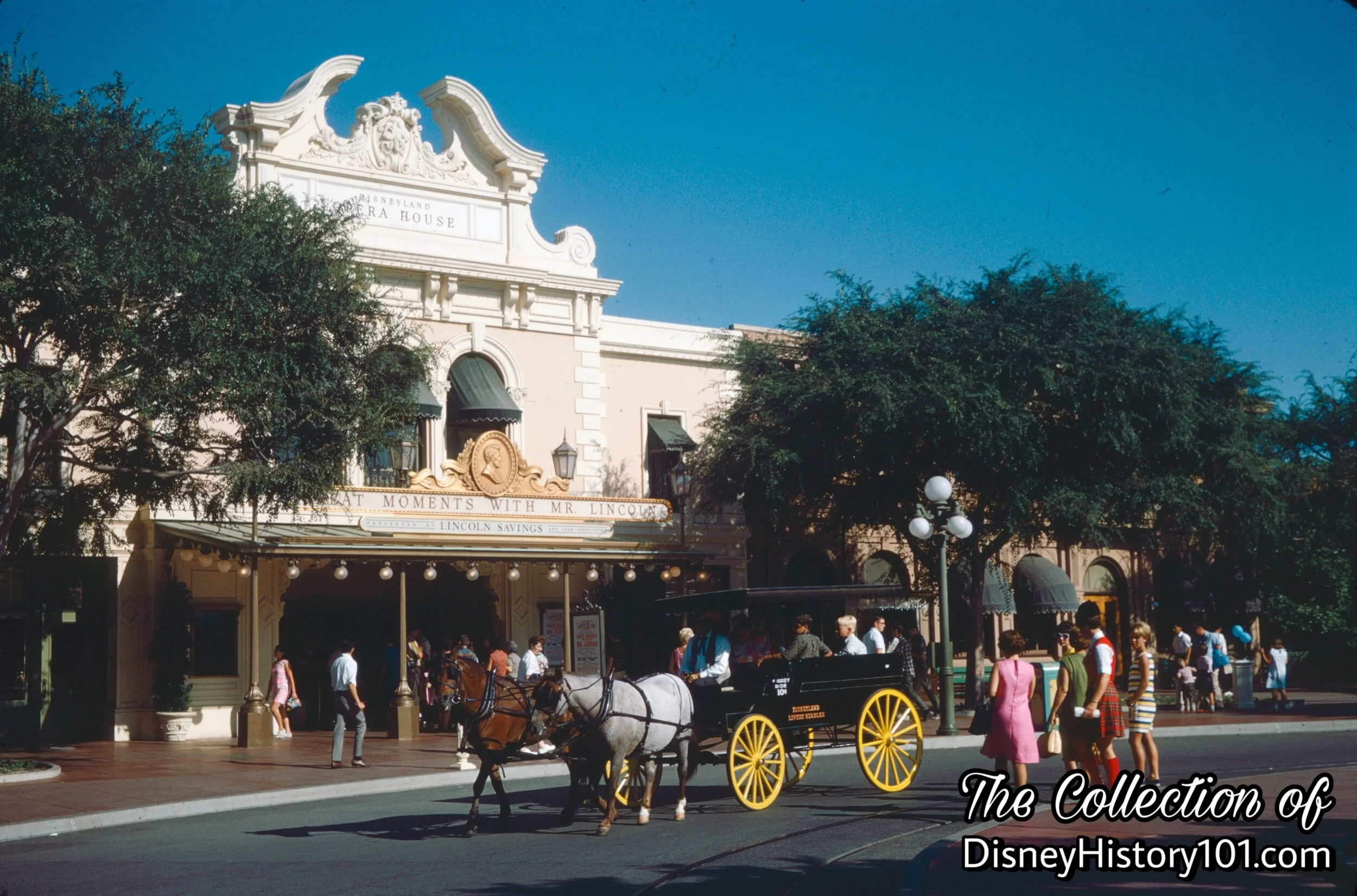
A new sign over the Main Street Opera House would feature a cameo of Abraham Lincoln, along with the attraction’s sponsor - Lincoln Savings and Loan! In addition, Great Moments with Mr. Lincoln resulted in a new “stop” along the Guided Tour of Disneyland.
The following year, on Thursday, August 18, 1966, some Walt Disney Studio photographers (under the direction of Hamilton Luske) took a few shots of the Main Street Opera House (with added horizontal and vertical bunting) for use as background plates. In a related matter, Ben Harris (Disneyland Production) visited the Walt Disney Studio in Burbank over the matter of “historical Lincoln filming.”
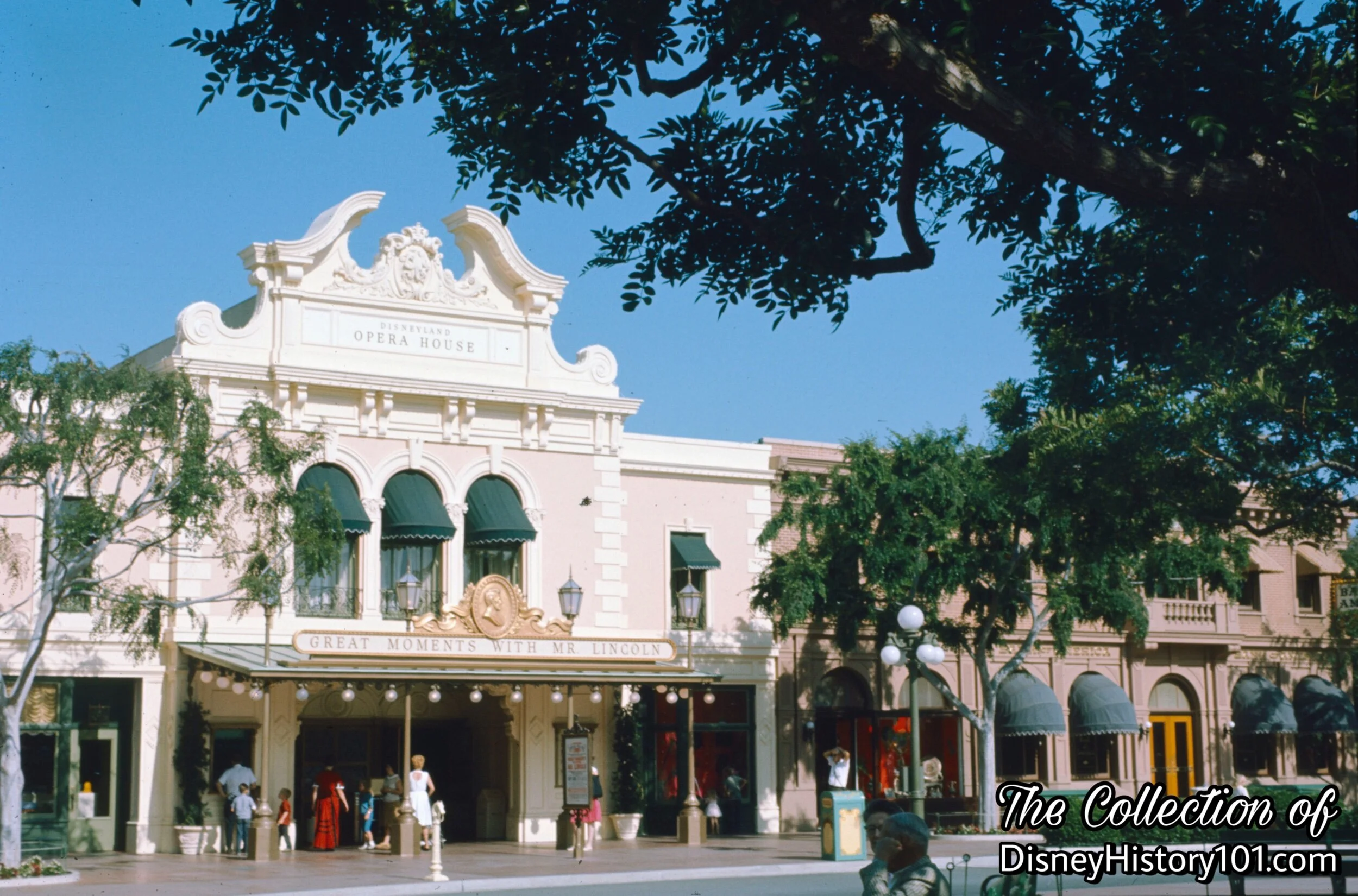
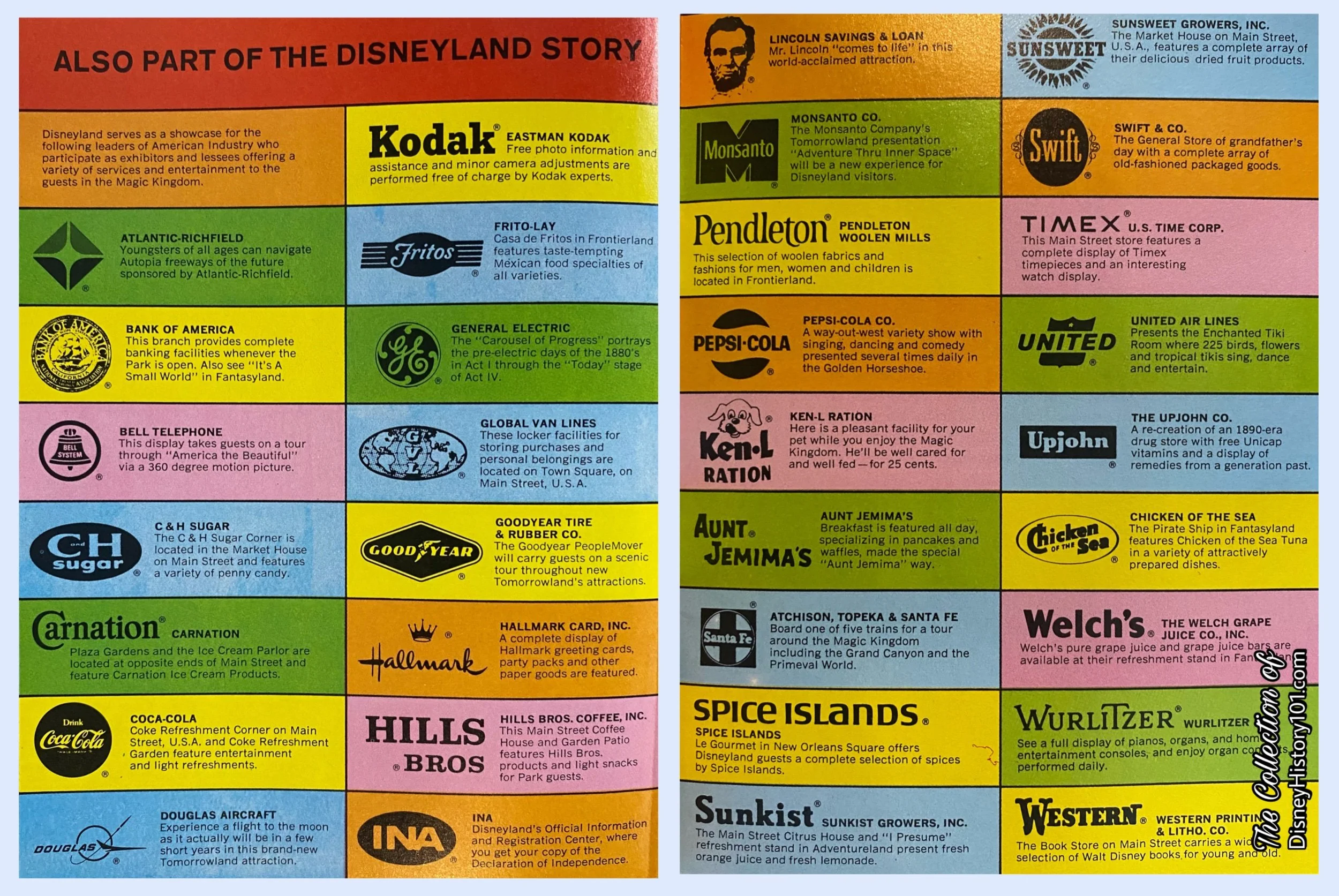
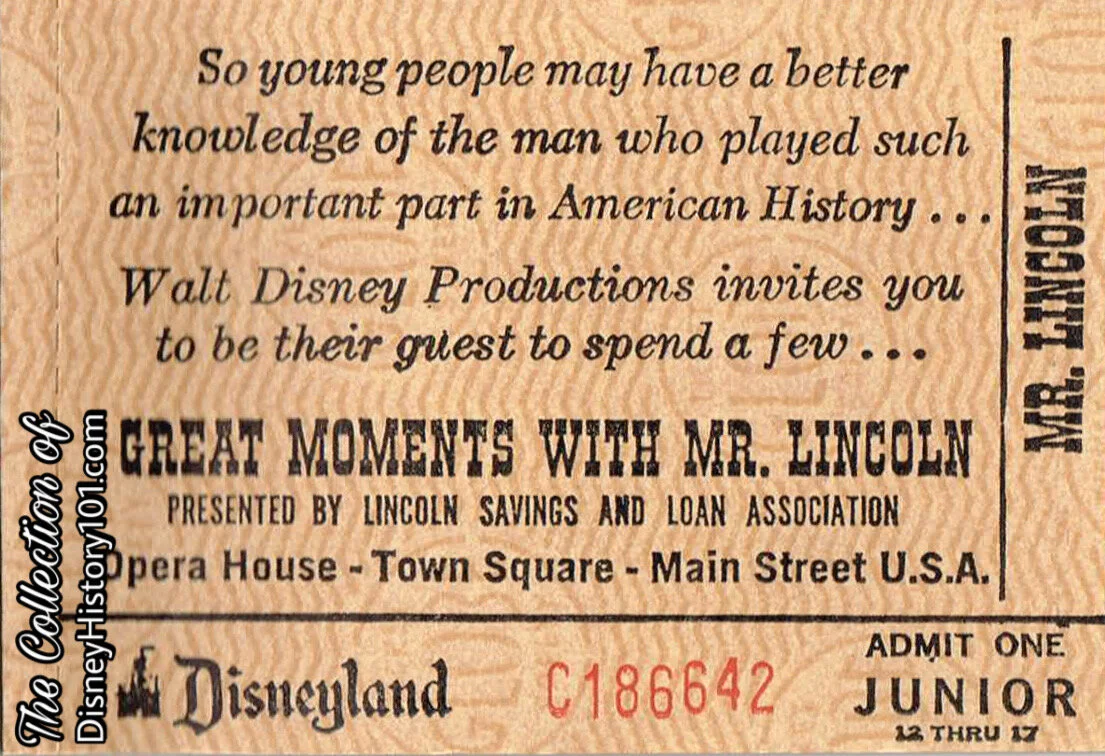
These Disneyland Coupons (generally admitting “children” ages 3-11 or “juniors” 3-17 ; pictured above) had no letter designation (or value) meaning that they could not be exchanged for any other attraction. These coupons were only valid for admission to Great Moments with Mr. Lincoln. One of these special coupons was included in each coupon book (in addition to purchase of other “letter” coupons). Note the important mission statement of this free exhibit and show, which was printed on each special coupon. According to “Walt” (a Cast member Exclusive and compilation of Walt Disney quotations, published 1975), “Our heritage and ideals, our code and standards - the things we live by and teach our children - are preserved or diminished by how freely we exchange ideas and feelings.”
“Great Rehabilitations for Mr. Lincoln”
There have been several additions and changes to the main show, as well as the exhibit hall. Bill Justice was involved in programming Mr. Lincoln’s movements sometime after Walt’s passing. After this (and through the years), routine maintenance has been essential to retain a high Show Quality standard of Great Moments with Mr. Lincoln. According to Backstage (Vol.6, No.1 ; published Spring, 1967), “Personal appearance is just as important to Mr Lincoln as it is throughout the rest of the Park. Each morning, Wardrobe checks to see if his hair is combed, pants pressed and shirt cleaned. Four shows are then run in the basement to check Mr. Lincoln’s ‘delivery’. An elevator then lifts him to stage level. During winter months, Mr. Lincoln is ‘put to bed’ eight hours or 48 shows later.”
According to the “Disneyland Dictionary” (compiled by WED Enterprises, Inc. and WED Public Relations Department, c. 1968), “This personal experience with history is Walt Disney’s tribute to a man who still lives on today in the hearts of all freedom-loving people everywhere. Featuring the lifelike, life-size ‘Audio-Animatronics’ figure of the Sixteenth President, Great Moments With Mr. Lincoln presents a message as applicable today as it was a hundred years ago. Located in the Opera House in Town Square, this presentation includes the nation’s capital in ‘capsulized realism,’ Lincoln memorabilia, a narrative of Lincoln’s life illustrated with full-color art murals.”
Other updates came later (as in 1984), when a more sophisticated version of the show originally presented by Walt in the State of Illinois Pavilion at the New York World’s Fair was introduced. Technology developed primarily for artificial limbs at the State of Utah would now influence the Show.
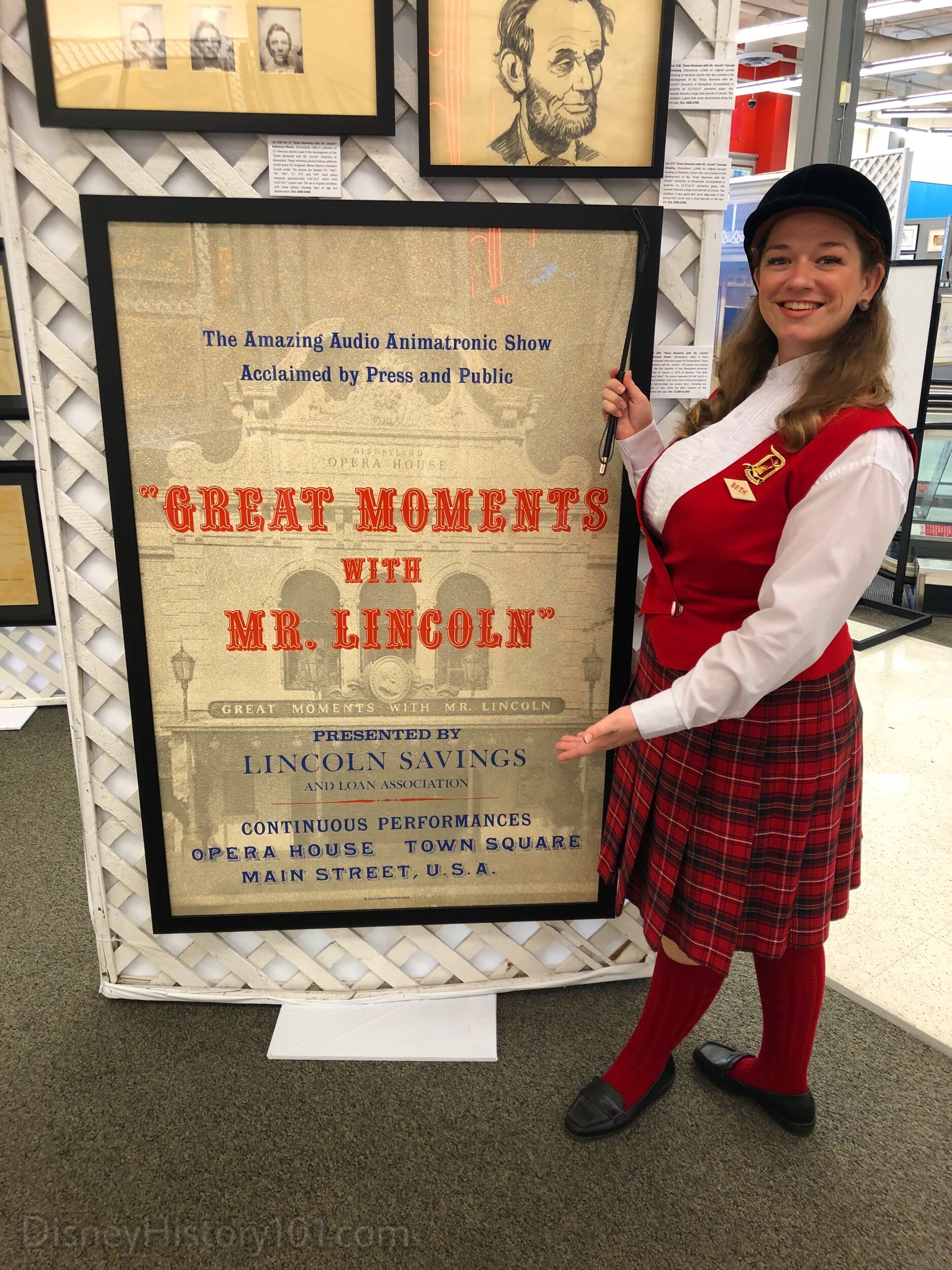
When the New York World’s Fair completed its second season (of 1965), “Great Moments With Mr. Lincoln” (currently sponsored by the State of Illinois) was “brought home” to Disneyland. As was the habit, a Disneyland Participant sponsored the new Disneyland show. Now, I would like to present one of the original “Great Moments With Mr. Lincoln” Disneyland attraction posters, featuring the original sponsor - Lincoln Savings and Loan!
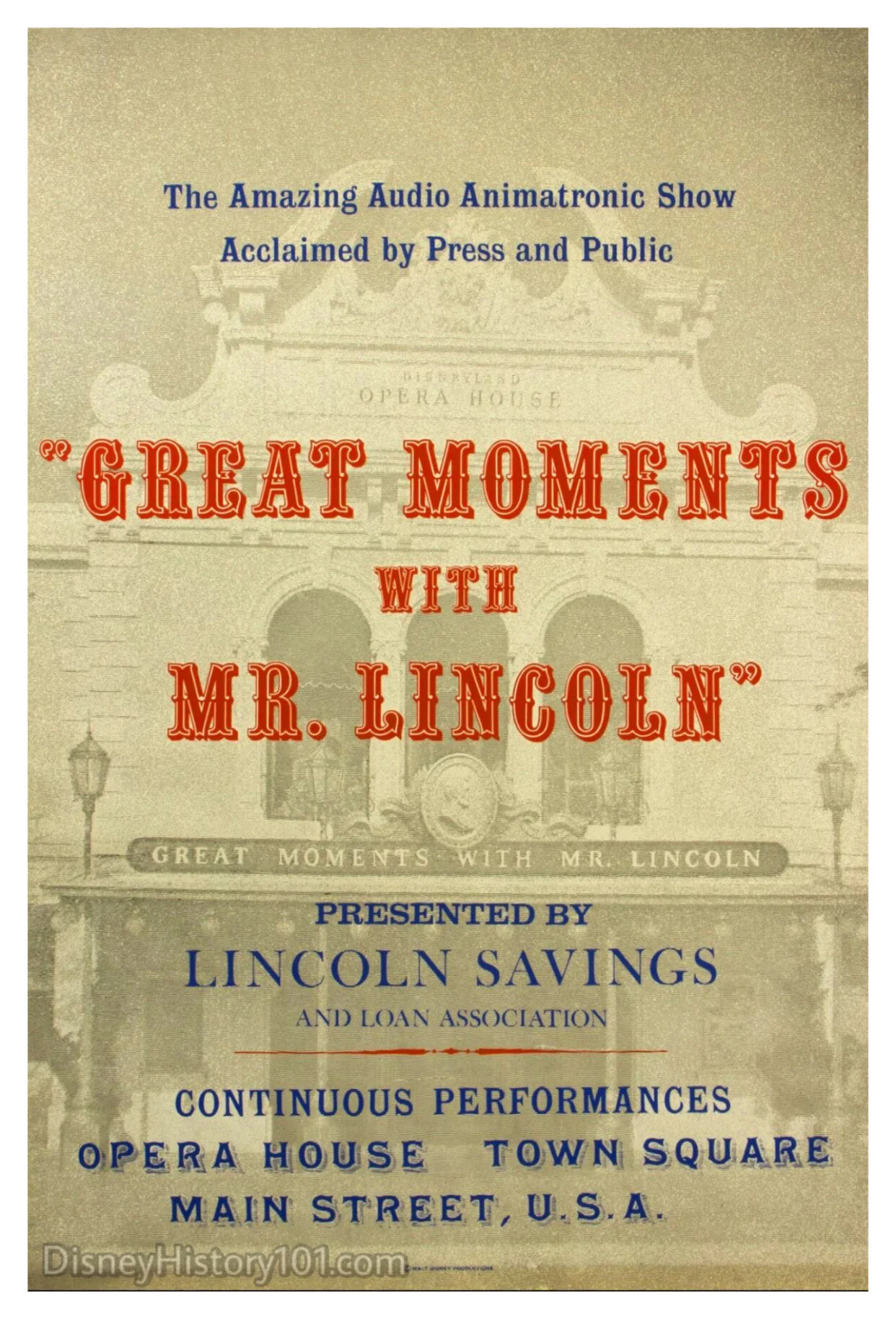
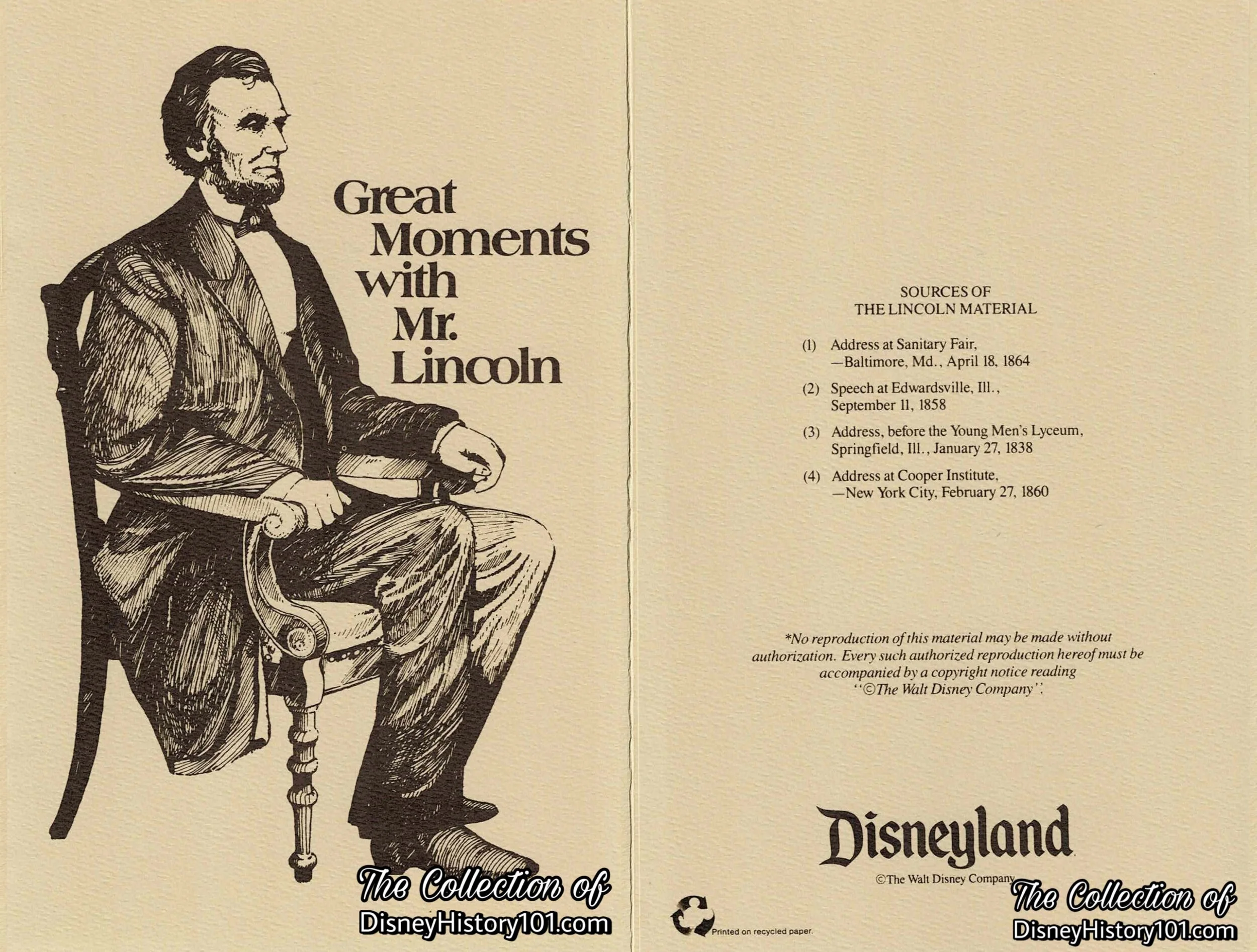
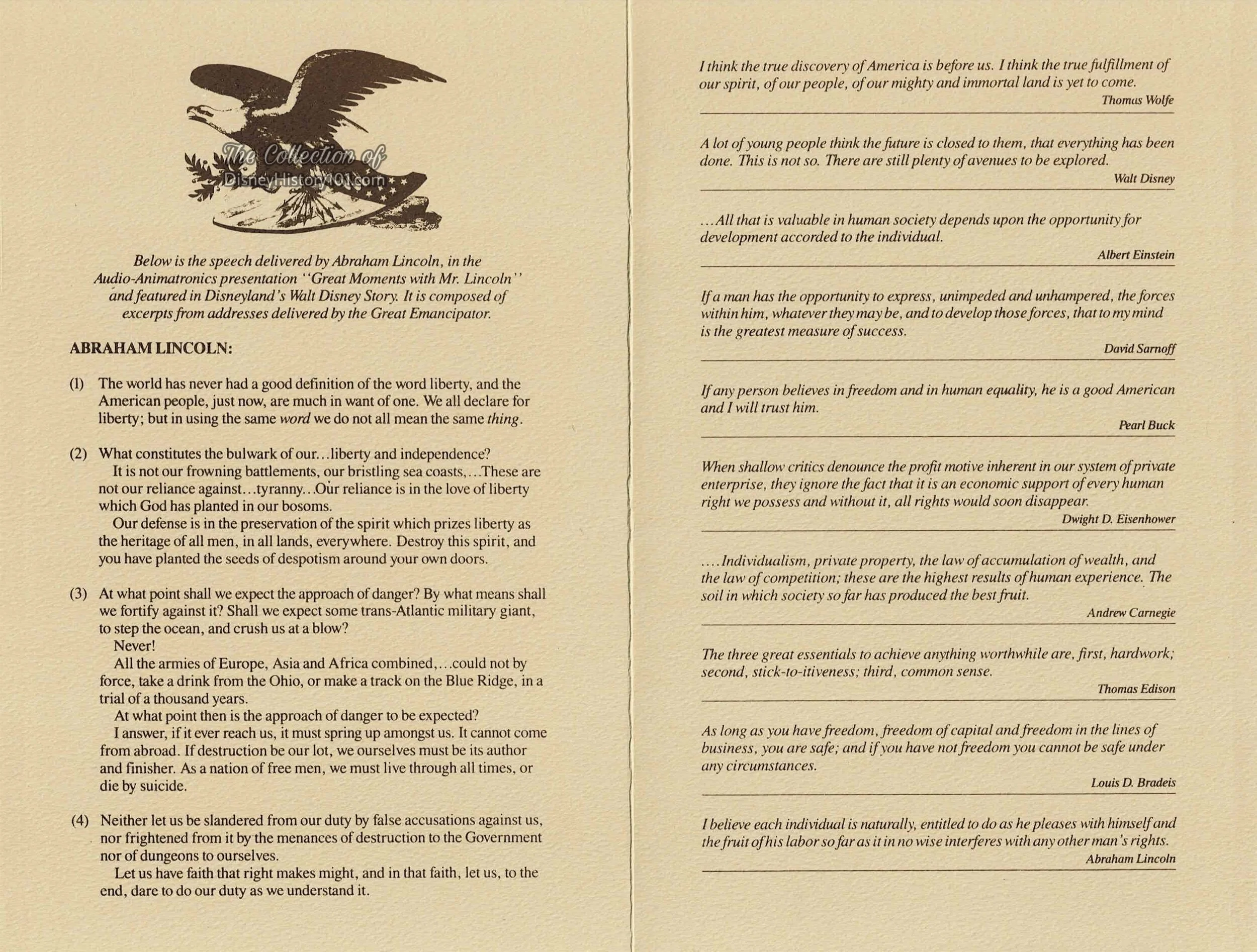
As another sidelight, I would like to recall the Souvenir LP 33 rpm records of Walt Disney’s Great Moments With Mr. Lincoln, which were released by Buena Vista Records in 1964. These were once sold through the Wonderland Music Shop at Disneyland (c. 1964) for $3.98 plus tax. Spoken words of the record album were based on Lincoln’s Address at Sanitary Fair in Baltimore, Maryland on April 18, 1864 ; his speech at Edwardsville, Illinois on September 11, 1858 ; his address before the Young Men’s Lyceum at Springfield, Illinois on January 27, 1838 ; his Eulogy to Henry Clay at Springfield, Illinois on July 6, 1852 ; and his address at Cooper Institute in New York City on February 276, 1860. The narration was written by James Algar, with a score composed and directed by Buddy Baker. The voice of Abraham Lincoln was performed by Royal Dano (who had previously portrayed Abraham Lincoln in James Agee’s “Mr. Lincoln”), with Narration by Paul Frees, under the production of James Algar. The record also included “Illinois” (words by C.H. Chamberlain ; music by Archibald Johnston), and “The Battle Hymn of the Republic” (words by Julia Ward Howe, music by William Steffe).
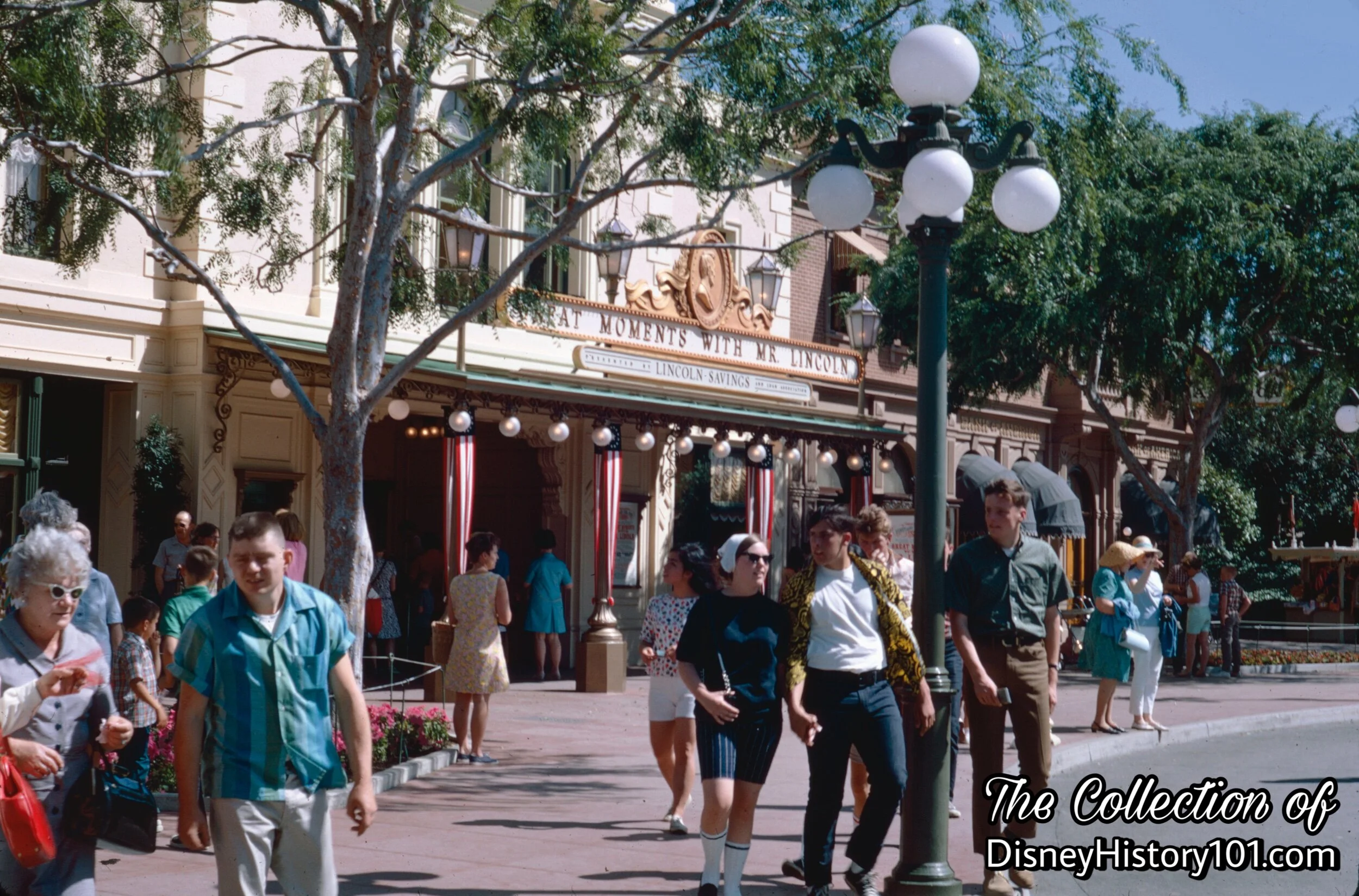
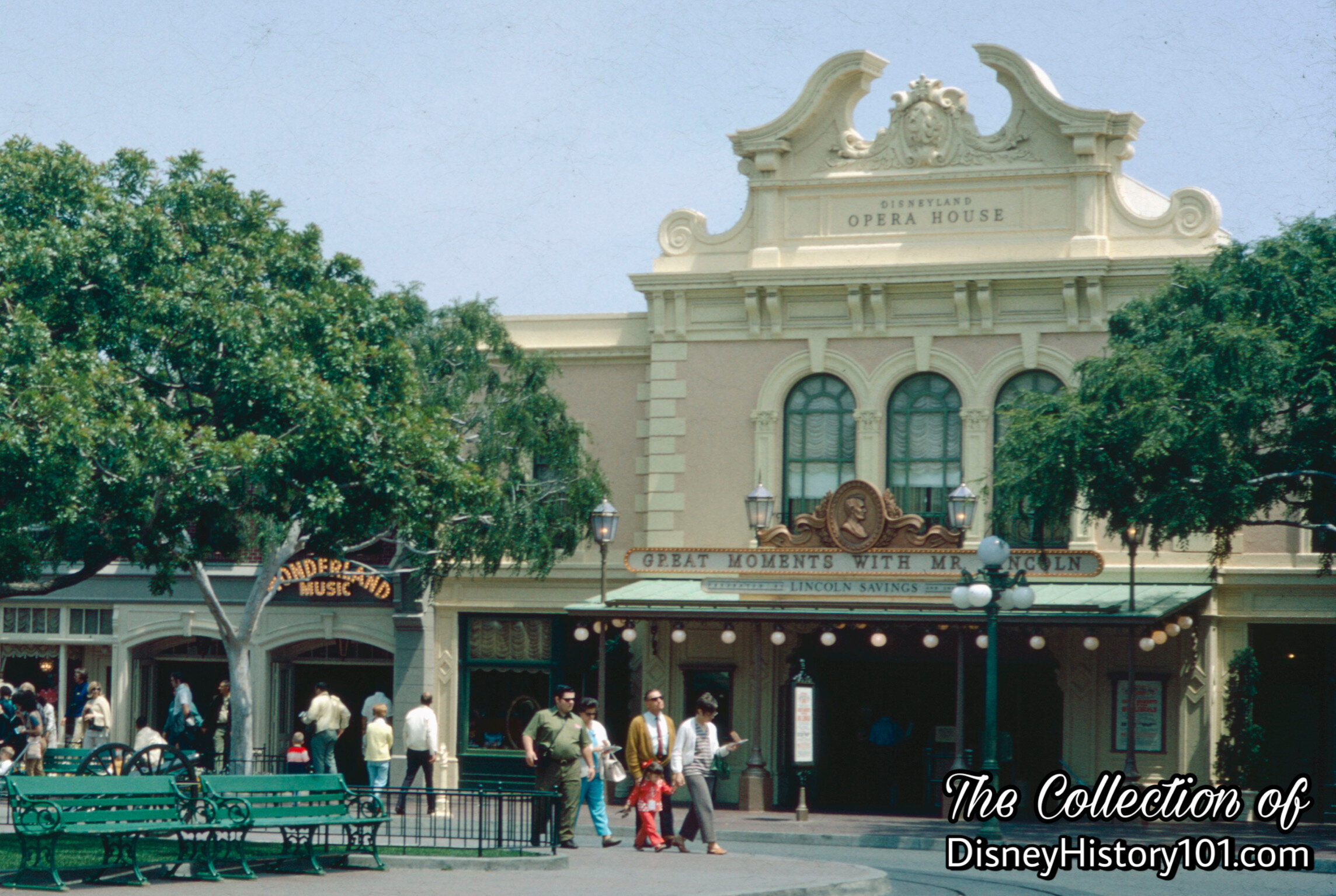
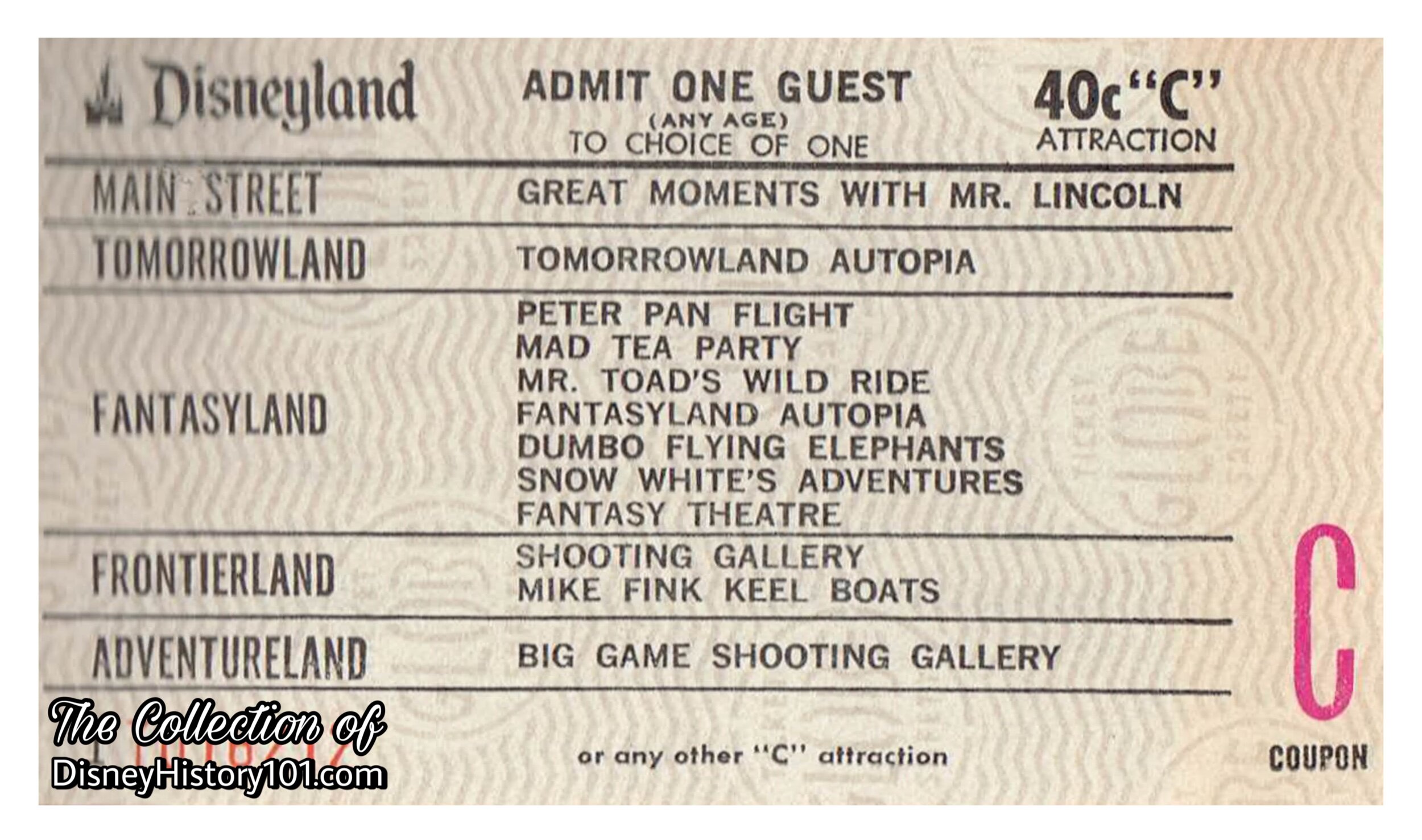
The original version of Great Moments with Mr. Lincoln “continued to run until it was replaced by ‘The Walt Disney Story’ in 1973,” according to Dave Smith (Chief Archivist Emeritus of the Walt Disney Archives). [Disney Facts Revealed by Dave Smith, 2016]
“Audience Waiting Areas” are especially designed as part of the attraction to make the guest's time waiting in line as comfortable as possible. Through the years, some “great” Pre-Show Exhibits have prepared audience’s hearts and minds for the presentation of “Great Moments with Mr. Lincoln” at the Main Street Opera House. You may recall “hanging in the outer lobby next to the Mad Hatter’s Shop,” was “an original oil painting of Lincoln, his wife and three sons.” This painting was based on a “smaller black and white work by F.B. Carpenter” and was “on loan to the Park by the New York Historical Society.” [“Disneyland - Did You Know?”]
Below we will explore many more Pre-Show displays (crafted by a variety of artists), which were as relevant yesterday, as they are today. We will also take a look back on a few seasonal rotating exhibits, courtesy of The Disney Gallery.
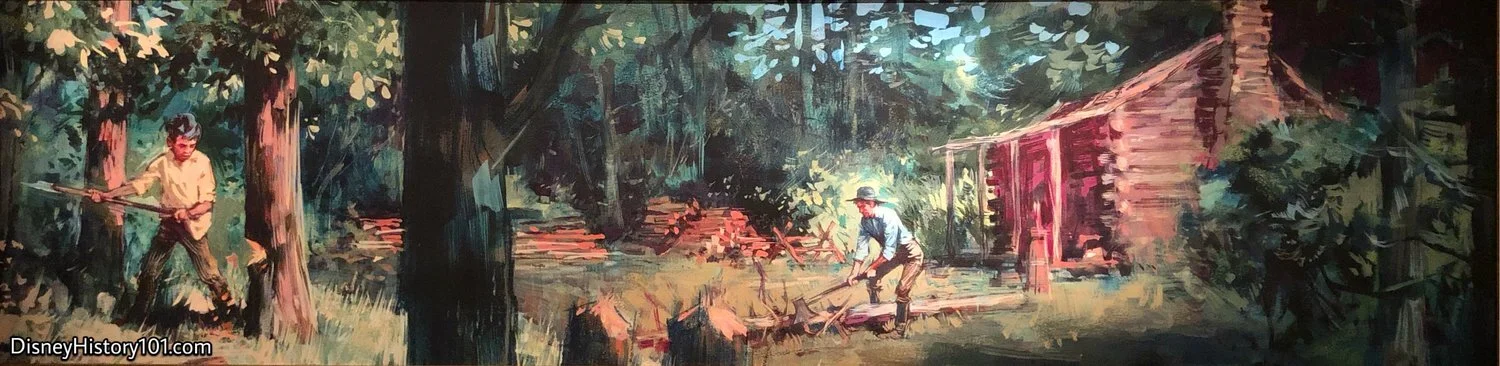
As we arrive at our first stop (“Young Lincoln” by Sam McKim) some of the narration of Abraham Lincoln echoes in our minds : “He removed from Kentucky to what is now Spencer County, Indiana in my eighth year. It was a wild region, with many bears and wild animals still in the woods. There I grew up. We settled in unbroken forest. And the clearing away of surplus wood was a great task ahead… I was large for my age and had an ax put into my hands at once. And from that until my twenty-third year was almost constantly handling that most useful instrument, less of course in plowing and harvesting seasons.”
In the original version of Great Moments with Mr. Lincoln Pre-Show, this image was included in the original six-minute autobiographical presentation screened in the Blue Room (the second exhibit after the United States Capital Panorama in the Foyer). According to Vacationland (Fall, 1965 ; Vol. IX, No.3), the presentation was “taken from Lincoln’s own words. His story is illustrated by full-color art murals, especially created by Walt Disney Productions.These murals are projected onto a 28-foot-long screen. After learning about Lincoln’s early life leading up to the White House, the guests are. invited into the theater to spend a few ‘Great Moments with Mr. Lincoln.’”
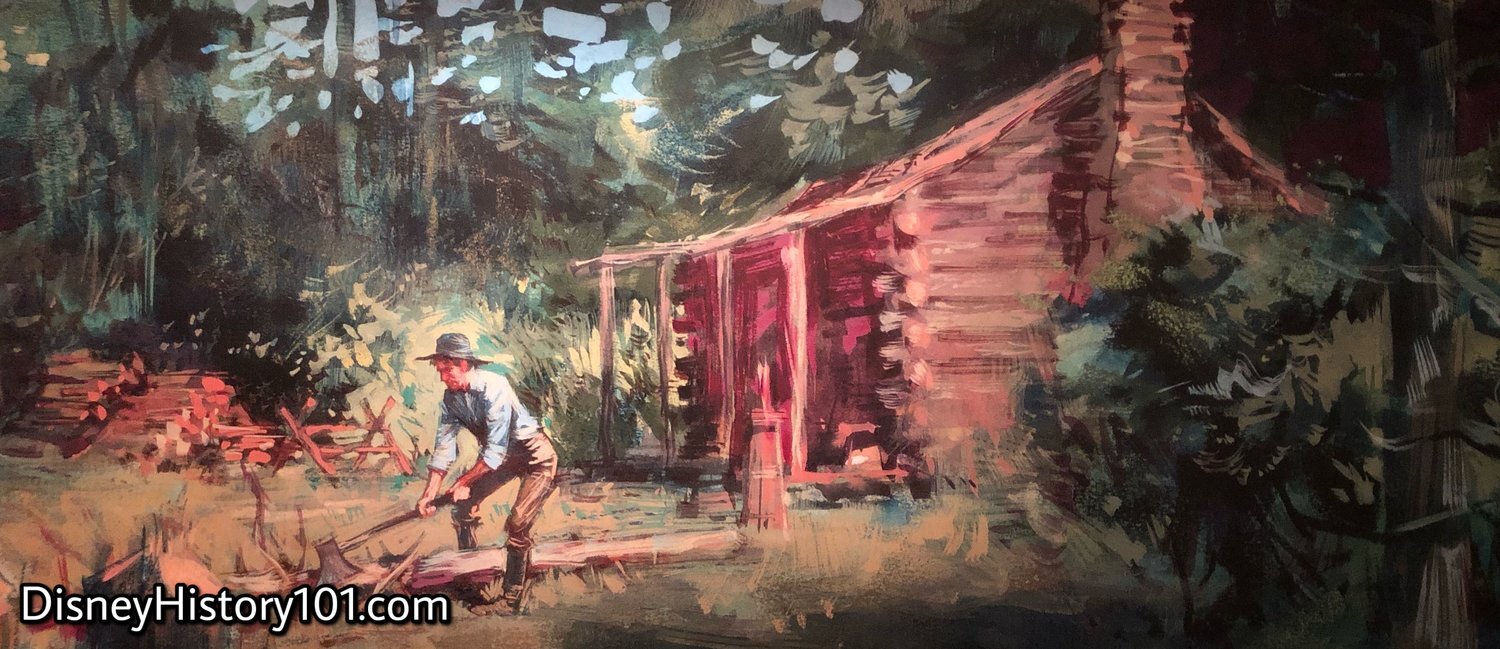
_________________________________________
“After moving to Los Angeles during the Great Depression, Sam McKim began his career in front of the camera, doing bit parts in [western] films with stars like Spencer Tracy, John Wayne, and Gene Autry. But he always knew that he wanted to be an artist. Between stints in the service, first in World War II and then Korea, he studied at Art Center College of Design and Chouinard Art Institute.” By this time, Sam was more thoroughly immersed in the visual graphic arts. In 1953, Sam had taken “a job drawing story sketches at 20th Century Fox over a role opposite Tyrone Power and Maureen O’Hara in a John Ford film.” In 1953, 20th Century Fox loaned him to Walt Disney “for what was supposed to be a couple of weeks. It ended up being 32 years.” Finally, Sam found his dream job, creating inspirational sketches for Disney theme parks.
Sam Mc Kim began working for Walt Disney's W.E.D. Enterprises (now Walt Disney Imagineering) in 1954, as an imagineer, doing original sketches Great Moments with Mr. Lincoln. Sam recalled, “Many studios wanted the art quick and dirty,… Disney didn't… Many times we were given the very basic idea of what was wanted and then were allowed to play with it.”
Today, Sam McKim “is best known as the creator of the Disneyland souvenir map illustrations, but his contributions to theme park attractions are legendary. Pirates of the Caribbean, Haunted Mansion, and Hall of Presidents were all touched by his spirited storytelling style. In this painting [pictured above], the story of Abraham Lincoln’s boyhood seems to spring to life.”
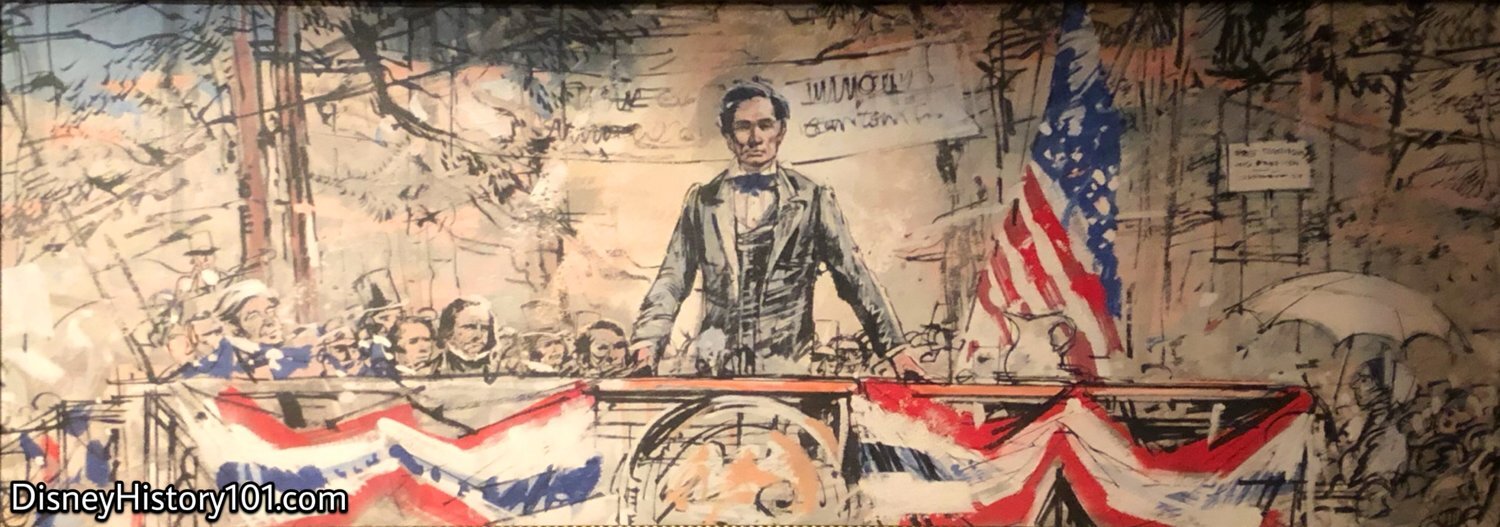
_________________________________________
Herb Ryman graduated from the Chicago Art Institute with honors, before moving to Hollywood in 1932 and storyboarding some of MGM’s greatest films, like “Mutiny on the Bounty” and “David Copperfield”. But then he met Walt Disney, and the rest is history. He became one of Walt’s most trusted partners in the development of Disneyland. Not only did he create the iconic illustrations that sold Walt’s unique theme park idea to bankers, but he also went on to help design some of its most famous feature, like Sleeping Beauty Castle and New Orleans Square. Imagineering Legend Marty Sklar says that Herb had an uncanny ability to intuit Walt’s ideas, and in his sketch of Abraham Lincoln campaigning, he captures the man of “immortal principles, ideals, and wisdom” that Walt envisioned.
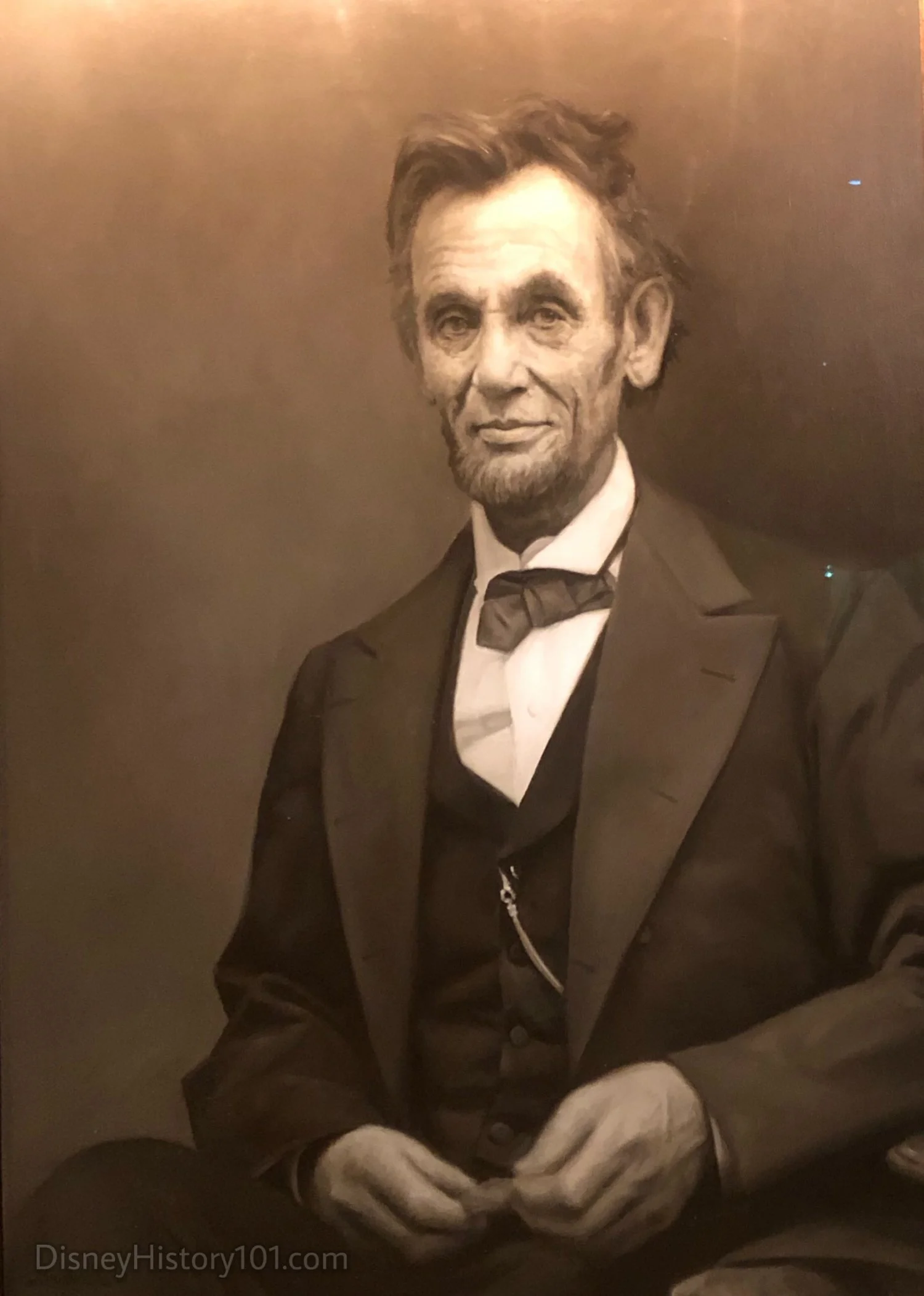
The Main Street Opera House plaque divulges a few details about Richard Broderick (the creator of the “Lincoln Portrait”). “An eclectic arts education that included studying with Disney animators, and even apprenticing in the outdoor billboard industry, led to Richard’s unique ability to paint realistic and emotionally powerful portraits. During his career he painted everything from 20-foot portraits of David Bowie and Arnold Schwarzenegger for the Sunset Strip, to animation storyboards. He then joined Walt Disney Imagineering, where he worked for 10 years on concepts for Disney’s California Adventure, Hong Kong Disneyland, and Disneyland Paris. He has taken advantage of his retirement to fine tune his painting technique, and his portrait of Lincoln demonstrates his desire to ‘go beyond a mere likeness and capture the personality.’”
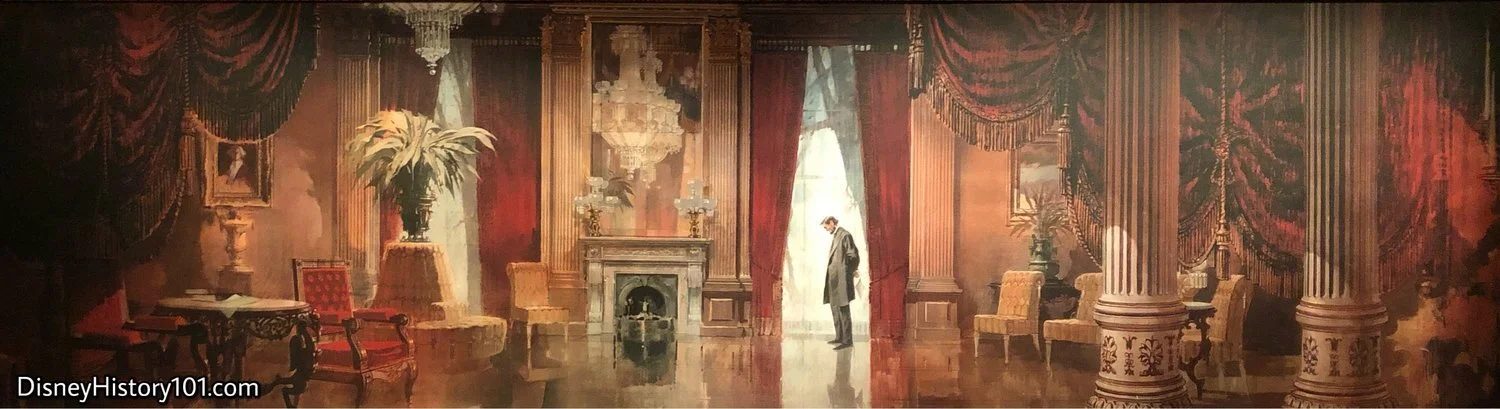
_________________________________________
Although he grew up in the 1920s when movies were in their infancy, John DeCuir Sr. would become fascinated by them. Against the wishes of his parents he studied art, becoming a student of the art at Choinard, and went on to become one of the most highly regarded film designers in Hollywood history. He almost single-handedly defined the term “motion picture spectacle” in the 1950s. “South Pacific,” “The King and I,” and “Cleopatra” all exhibit his lush, larger-than-life vision. He was nominated for all 11 Academy Awards during his career, but eventually he developed another fascination - for theme park design. He helped design both the Magic Kingdom and EPCOT ; in this emotional watercolor of Abraham Lincoln in the White House, his genius is apparent. Within his trademark larger-than-life panorama, we sense the lonely burden of the Presidency.
Around 1970, John DeCuir Sr. would go on to produce some of Herb Ryman’s concept paintings of “Battle Bull Run,” “Attack at Fort Sumter,” and “Surrender at Appomattox” for The Hall of Presidents in Liberty Square, Magic Kingdom, Walt Disney World.
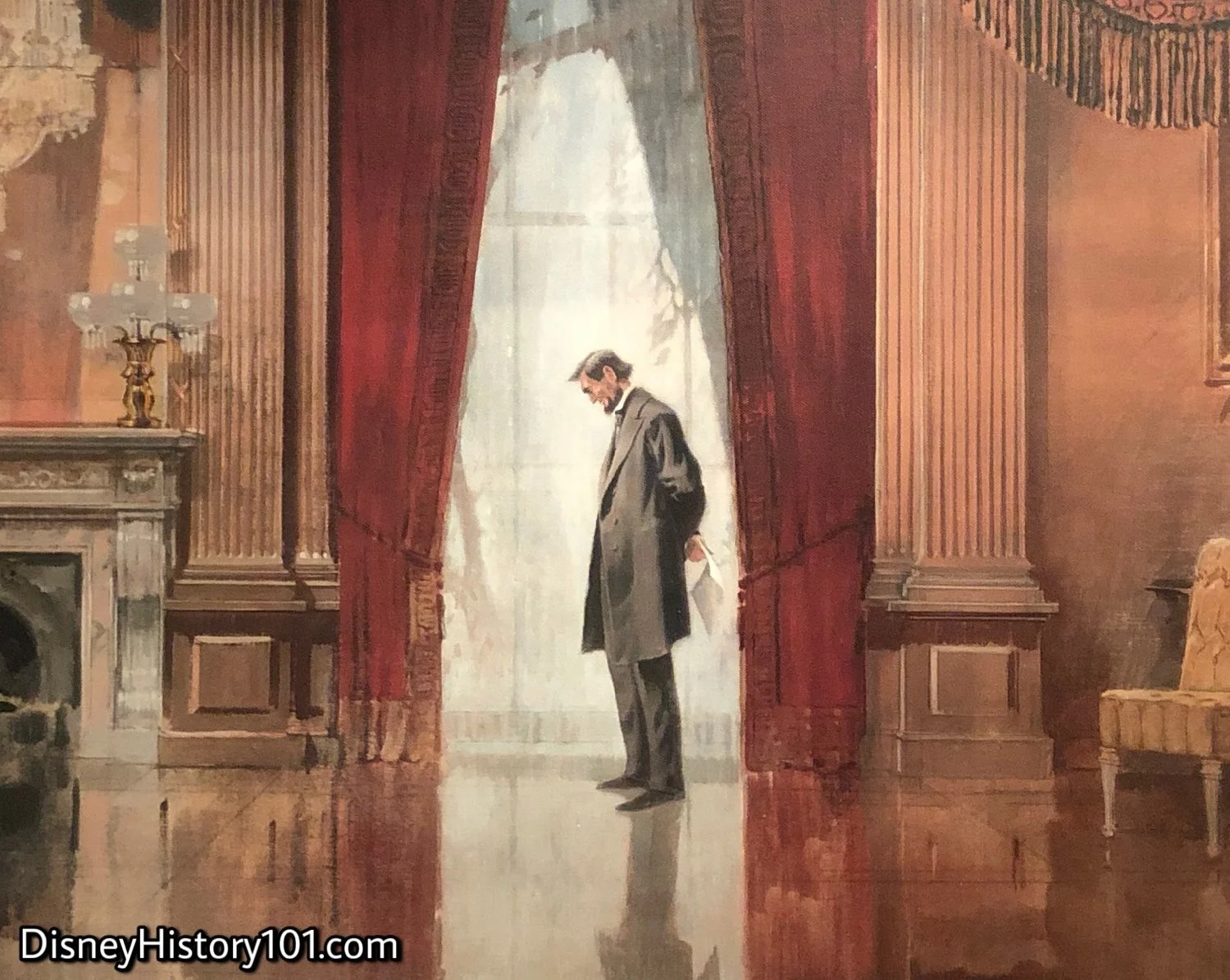
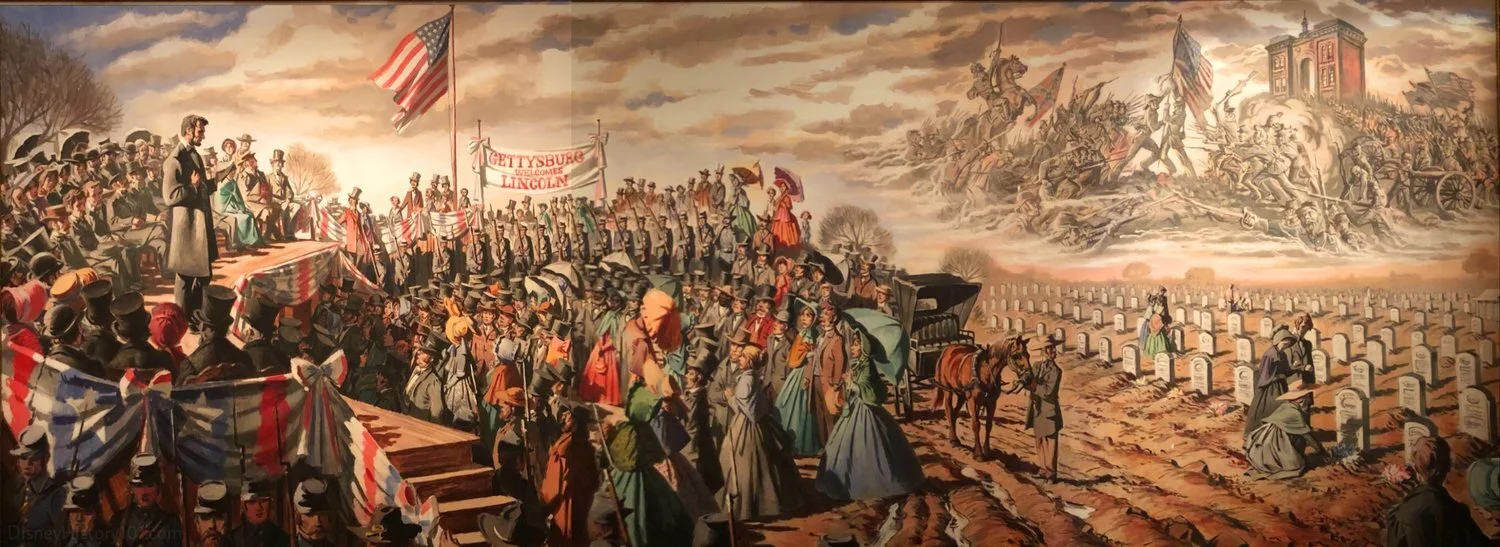
John Pomeroy has made notable contributions as a character animator toward both feature and short films (like “Winnie the Pooh and Tigger Too”, “Pete’s Dragon”, “The Rescuers”, “Pocahontas”, “Atlantis : The Lost Empire”, and “The Small One”). He served as Directing Animator to the latter. He has occasionally been known to give discourses on animation, and has also created numerous color illustrations for the picture biographical publication “Walt’s Imagination - The Life Of Walt Disney”. Disneyland Park-going fans of John Pomeroy may also know him by his “To All Who Come To This Happy Place, Welcome” limited edition artist proofs (coinciding with “45 Years of Magic” at Disneyland)!
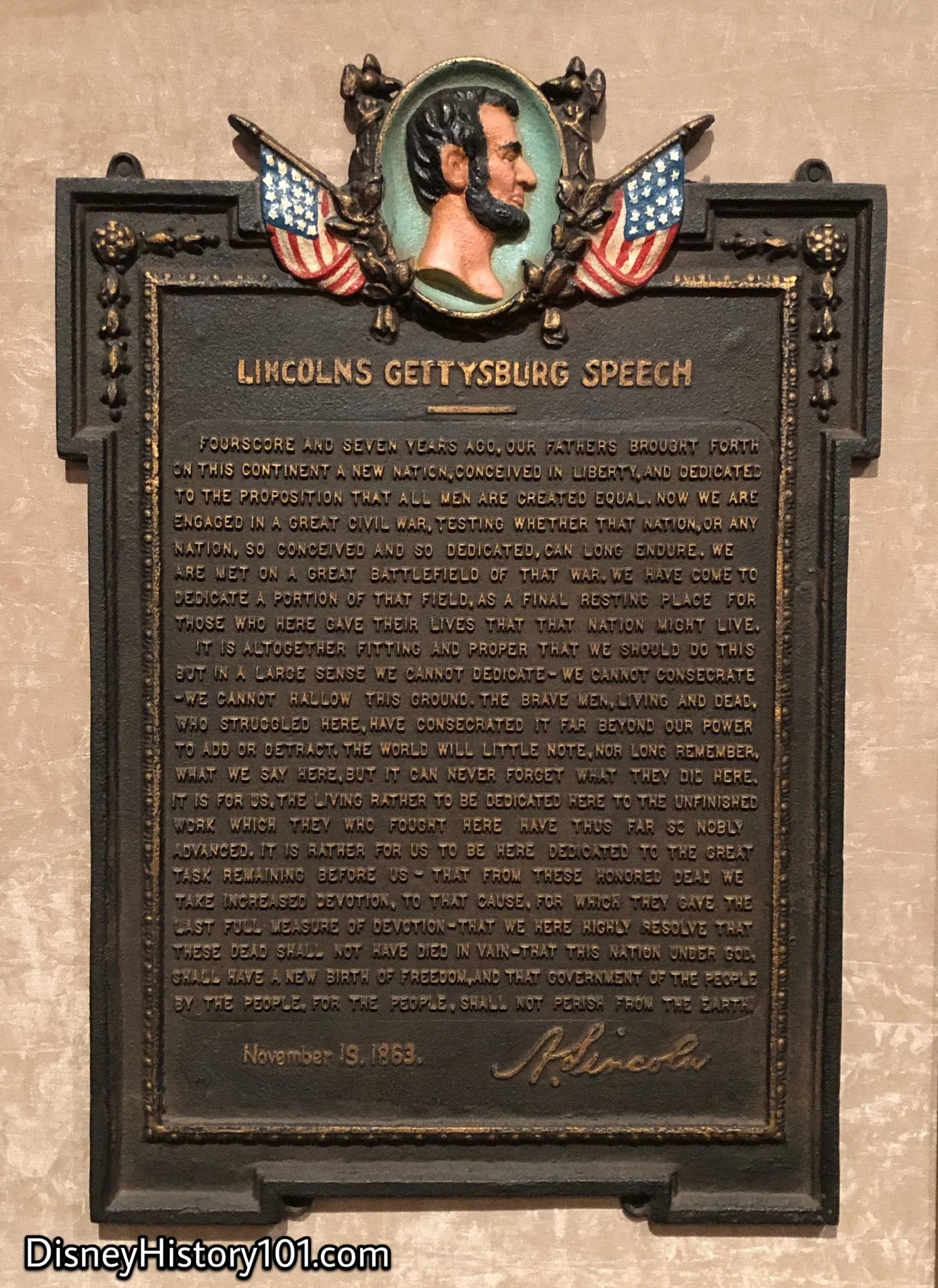
The layout and art of “Lincoln’s Gettysburg Speech” (and positioning of the flags and cameo) is similar to that of “Abraham Lincoln and His Emancipation Proclamation”, published 1888.
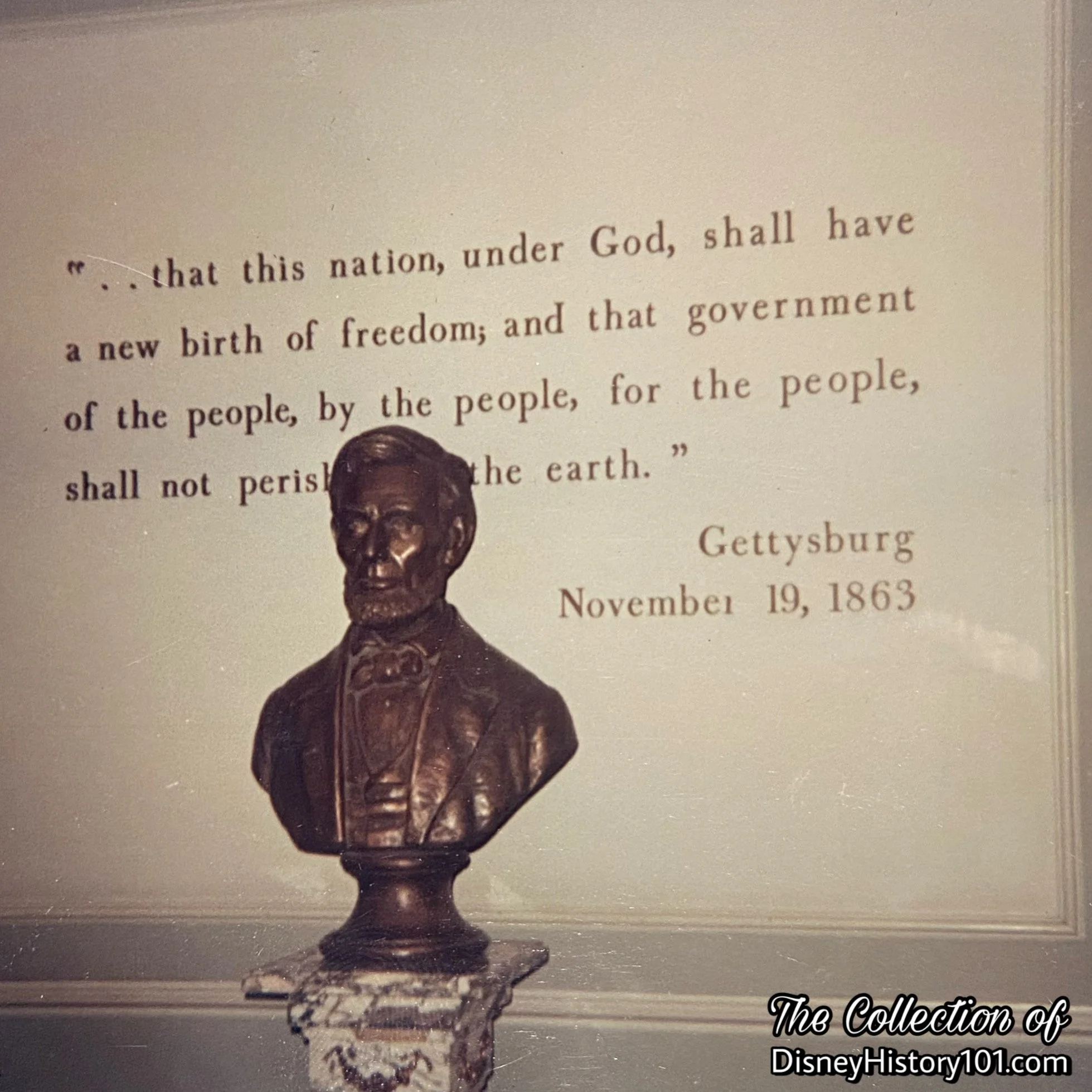
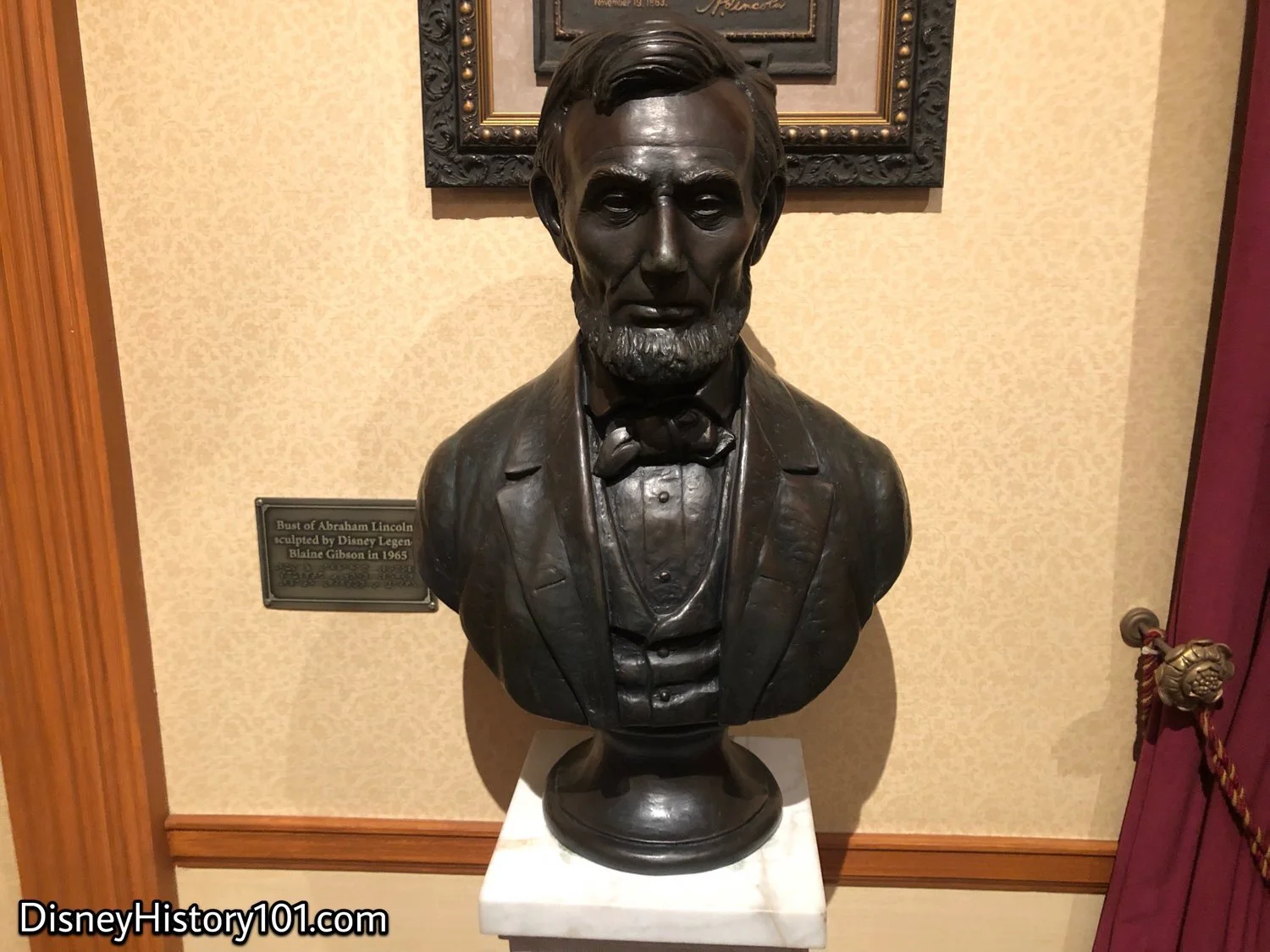
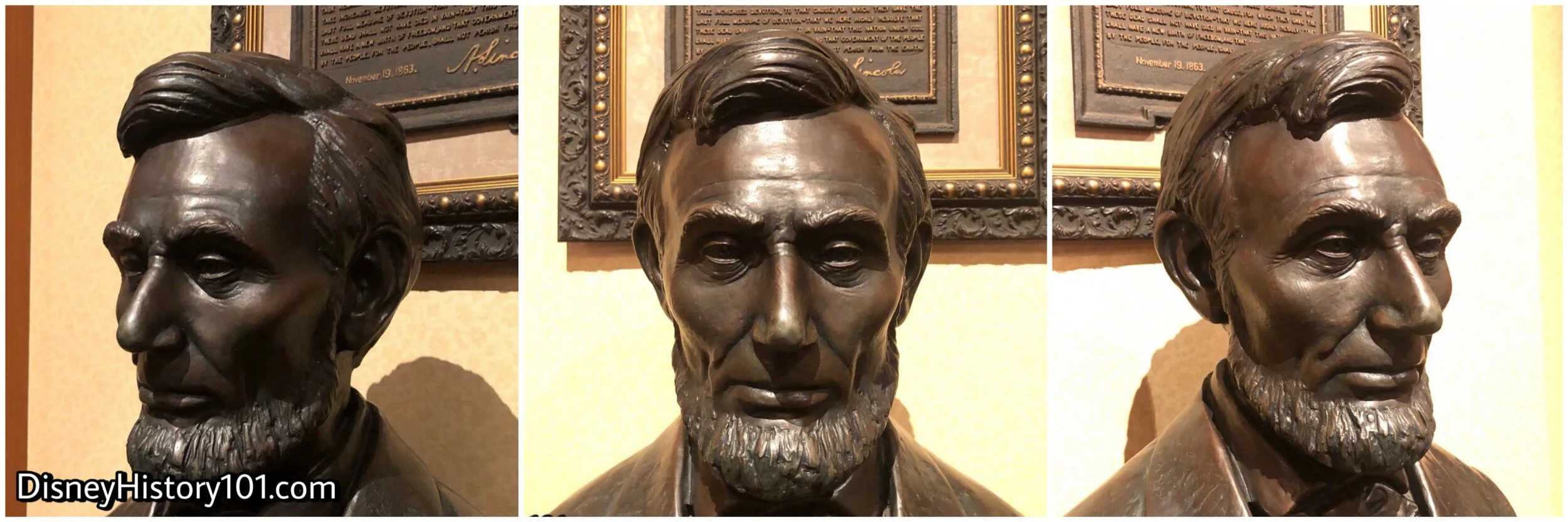
A number of cast pieces pay tribute to Abraham Lincoln. For instance, the eagle bearing the olive shield and arrows located over the stage first appeared in Civil War-era news papers as a symbol of the extents gone to in order to establish freedom.
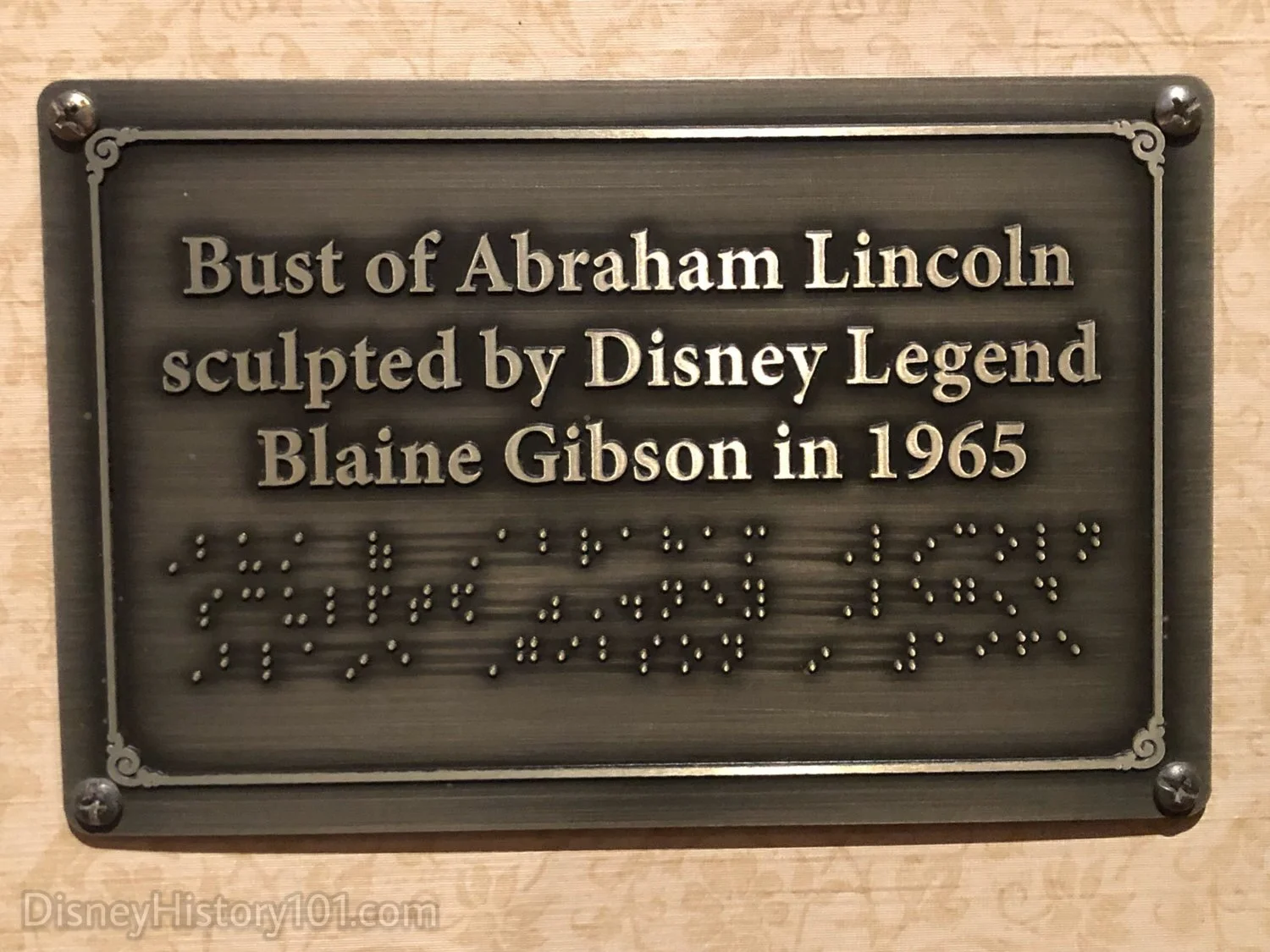
You may notice that many plaques featuring Braille, have been added around the exhibit.
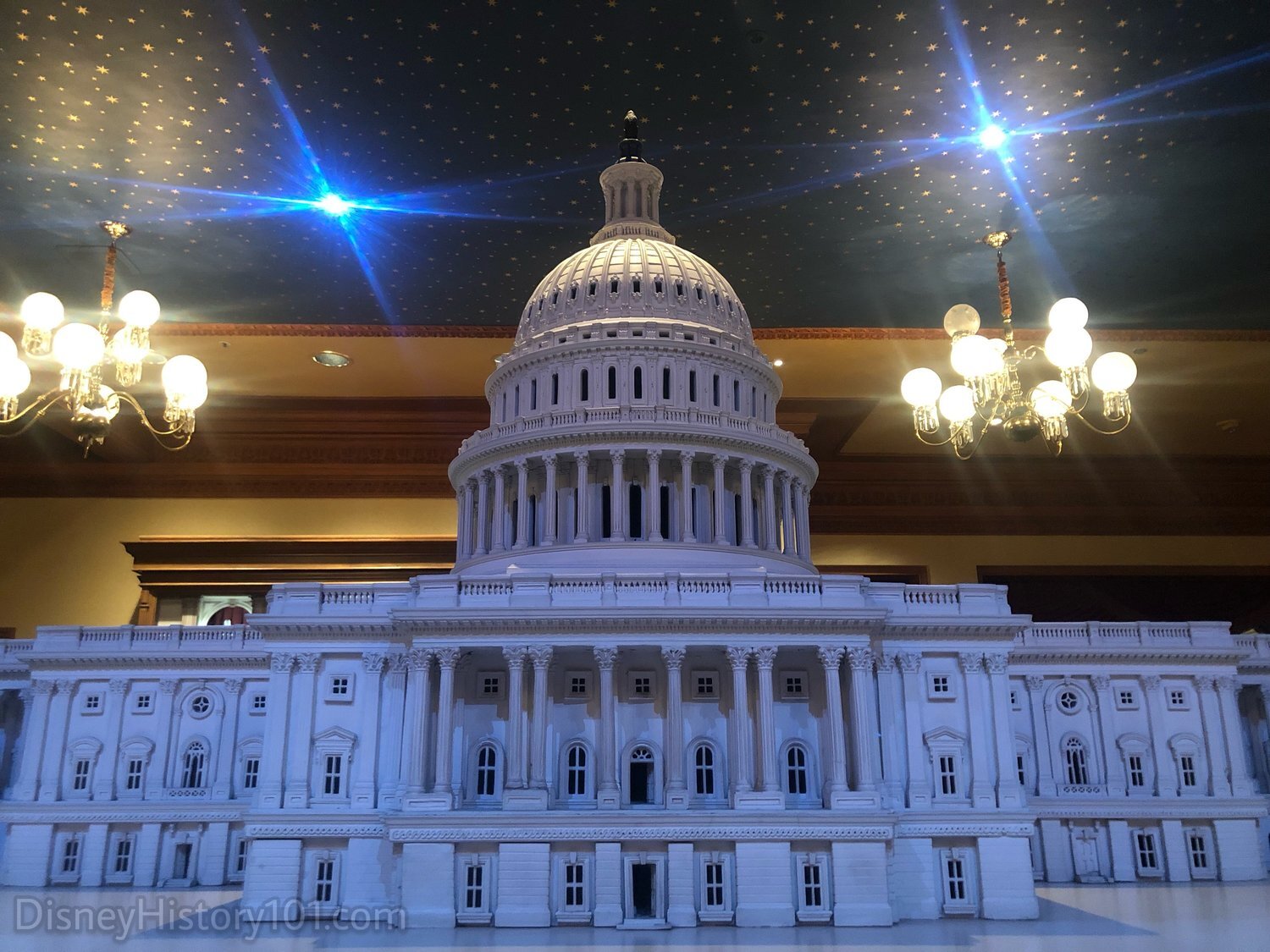
During Disneyland’s “first fabulous decade”, the Park often displayed collections and artwork within Disneyland, which were not the creation of Walt Disney Studio artists. For example, Jimmy Starr’s Show Business Souvenirs (1956-1959) featured a collection of authentic props once used in film production, while the Davy Crockett Frontier Arcade housed a collection of more than 50 historic guns and arms on loan by the N.R.A. Now, we will take a look at one particularly amazing Walt-era exhibit which still remains in the Park to this day - “The United States Capitol in Miniature”.
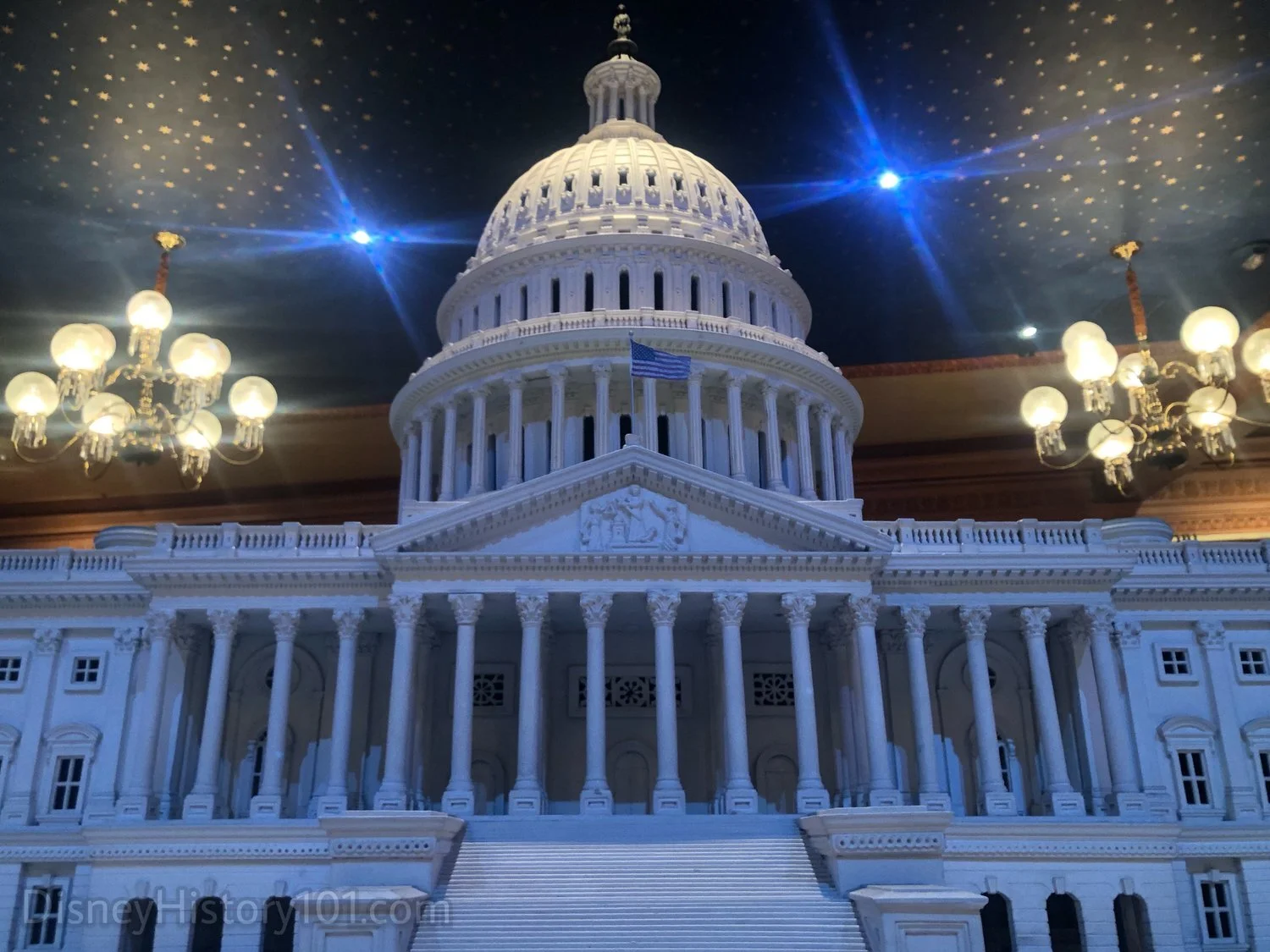
The creator of the small scale model, George Lewellyn Lloyd (1879-1962), was born in Wales, of The United Kingdom. George built more than models, and was a true-life Stone Mason and sculptor of monuments (as his forefathers before him). Over his lifespan, George made notable contributions to historically relevant structures - the House of Parliament (in Ottawa, Canada), the Cathedral of Saint John the Devine (in New York), and Rockefeller Chapel (in Chicago) to name a few locations.
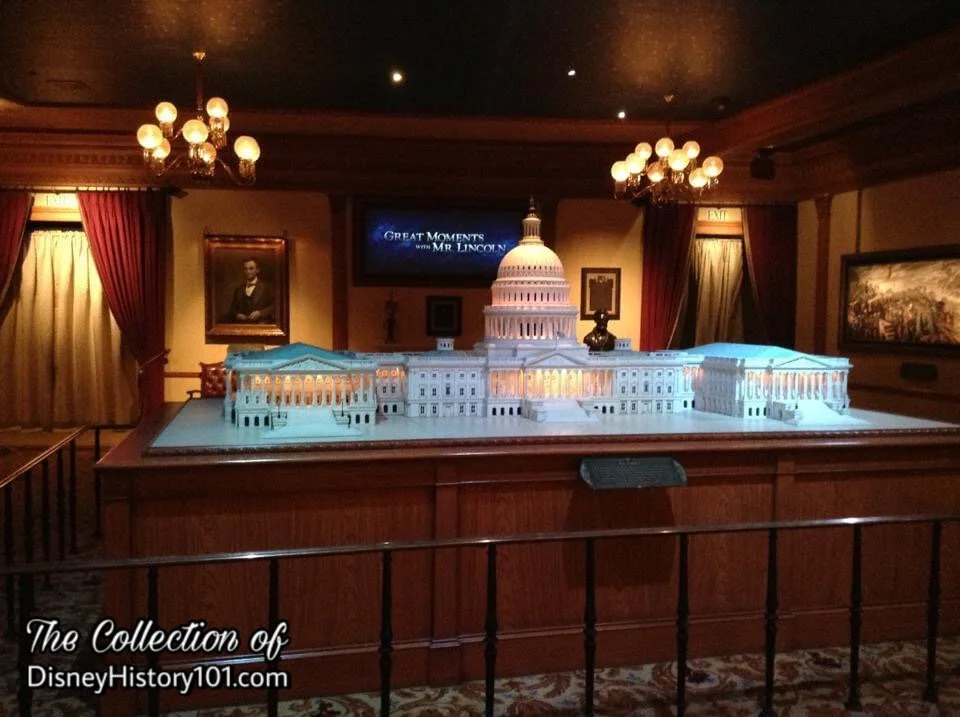
But incredibly one of his smallest works would perhaps gain the most attention. It’s origin goes back to 1918, when George saw a photograph of the U.S. Capitol Building in a Philadelphia newspaper, and decided that he would create a model of it. A few years later (while the United States was amidst its greatest economic depression), George found himself unemployed. It was at this time (c. 1929) that George decided to stay occupied with his art project, soon first visiting the Capitol Building in Washington, D.C. in order to see it in person.
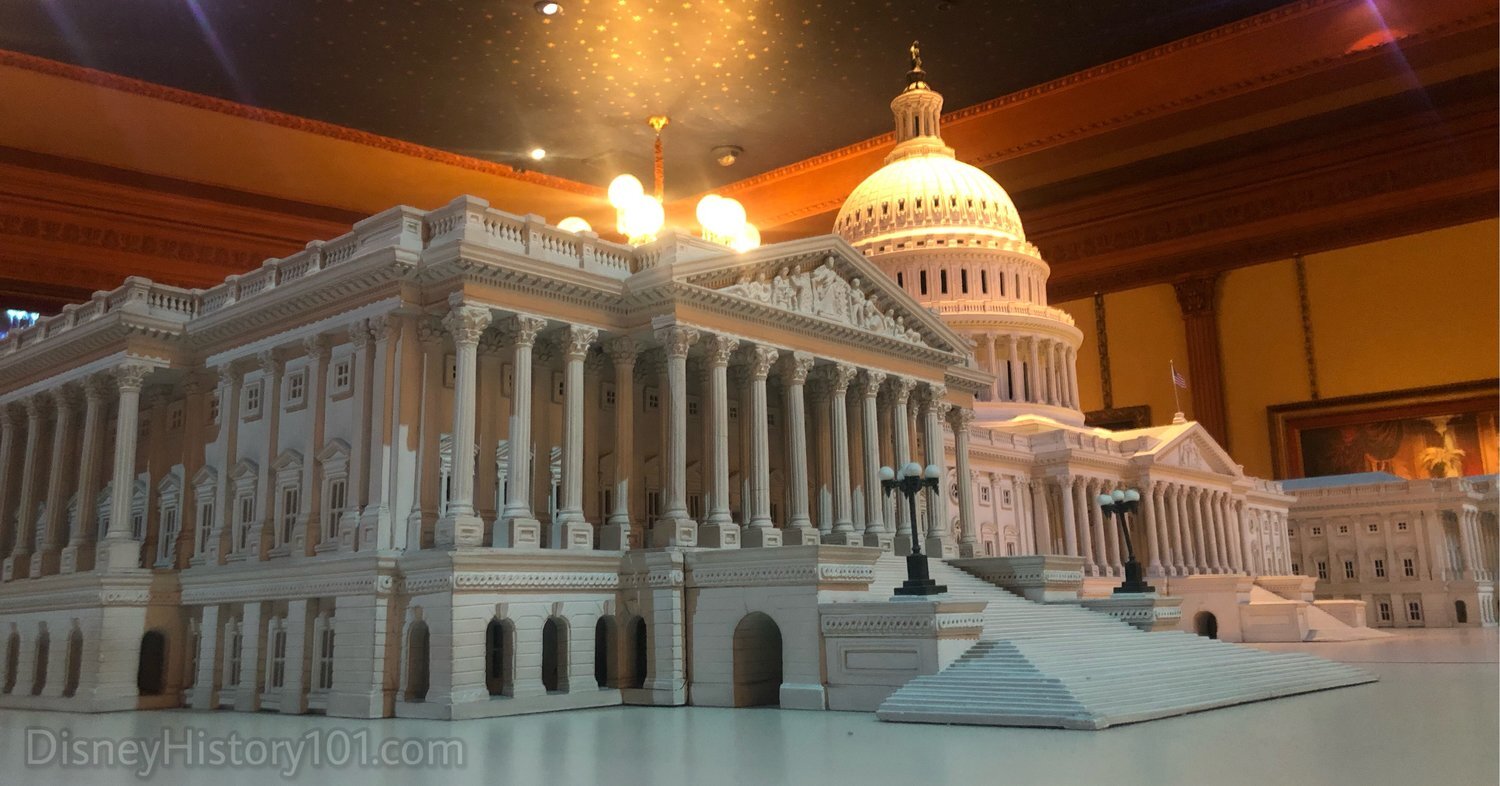
In order to make sure that this (“3/16 of an inch to the foot”) representation was faithful, he enlisted the help of David Lynn (the Capitol Architect who retained blue prints and photographs of the historic U.S. building). As for the medium, George chose one large block of French Caen Limestone, for its color and soft texture. In 1932, George began work on the miniature in Belleville, New Jersey, working up to 16 hours most days and nights. The intricate model (with its more than 500 hand-carved “columns, pedestals, caps, cornices, pediment, carvings, and dome” spread out across its eight sections) was finally completed by 1935. The dome alone, took three years to complete.
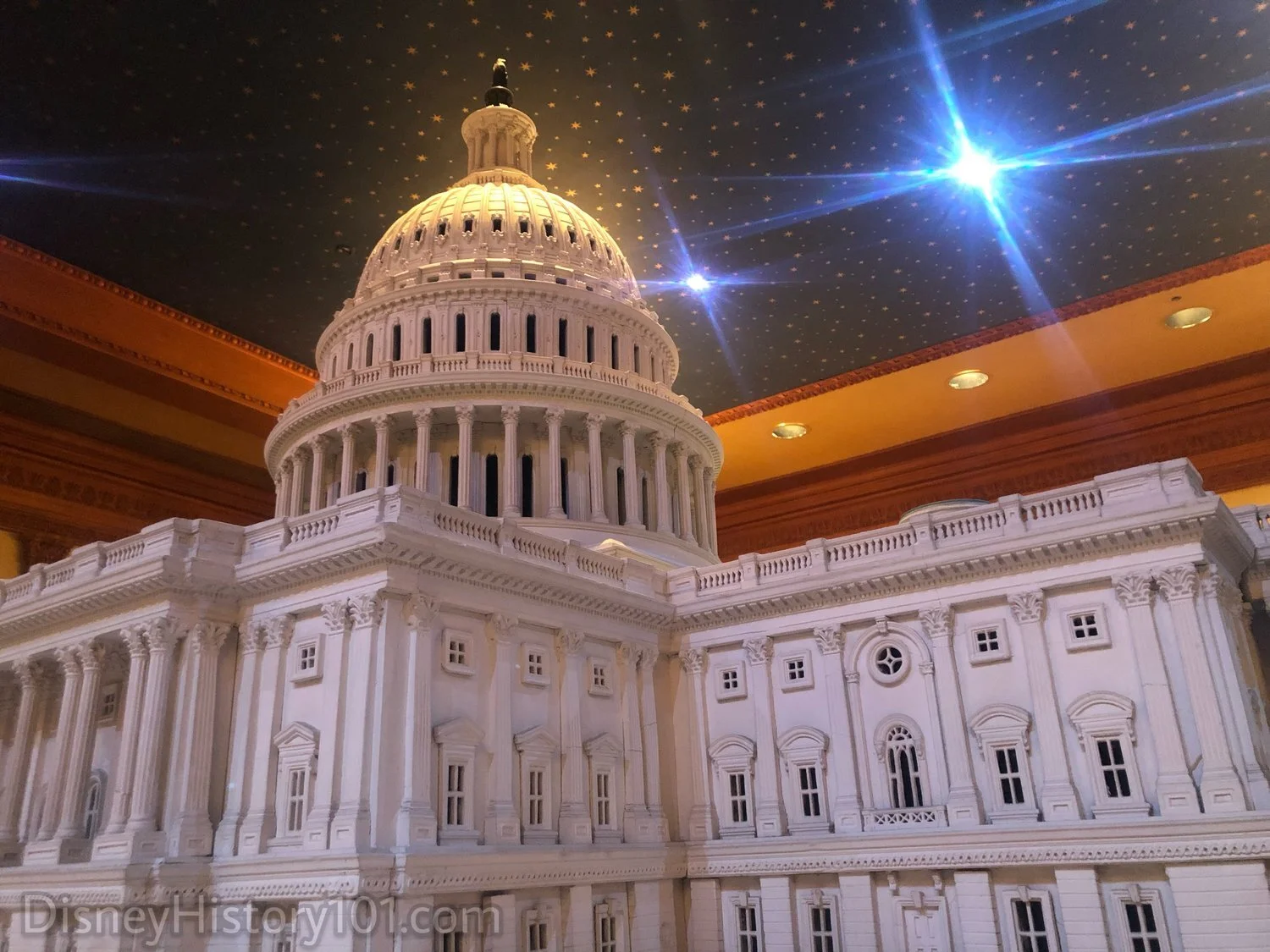
The United States Capitol in Miniature made its debut at the World Trade Fair (of Minneapolis, Minnesota), before touring major cities across the United States of America. It was during one of these tours (during August of 1955) when George’s model (of Caen limestone) was on display at Robinson’s Department Store, that George’s model attracted the attention of Walt Disney (who had an affinity for miniatures). Herb Ryman [in “Working With Walt - Interviews With Disney Artists” by Don Peri] recalled that “the man [George Llewellyn Lloyd] resembled Walt’s father. Walt met him and liked him. He said, ‘I’m going to buy that.’… [Herb, who was present] said, ‘What are you going to do with it?’ He said, ‘I don’t know, but we’ll find something.’” After some conversation, George sold the model to Walt Disney for $6,099.
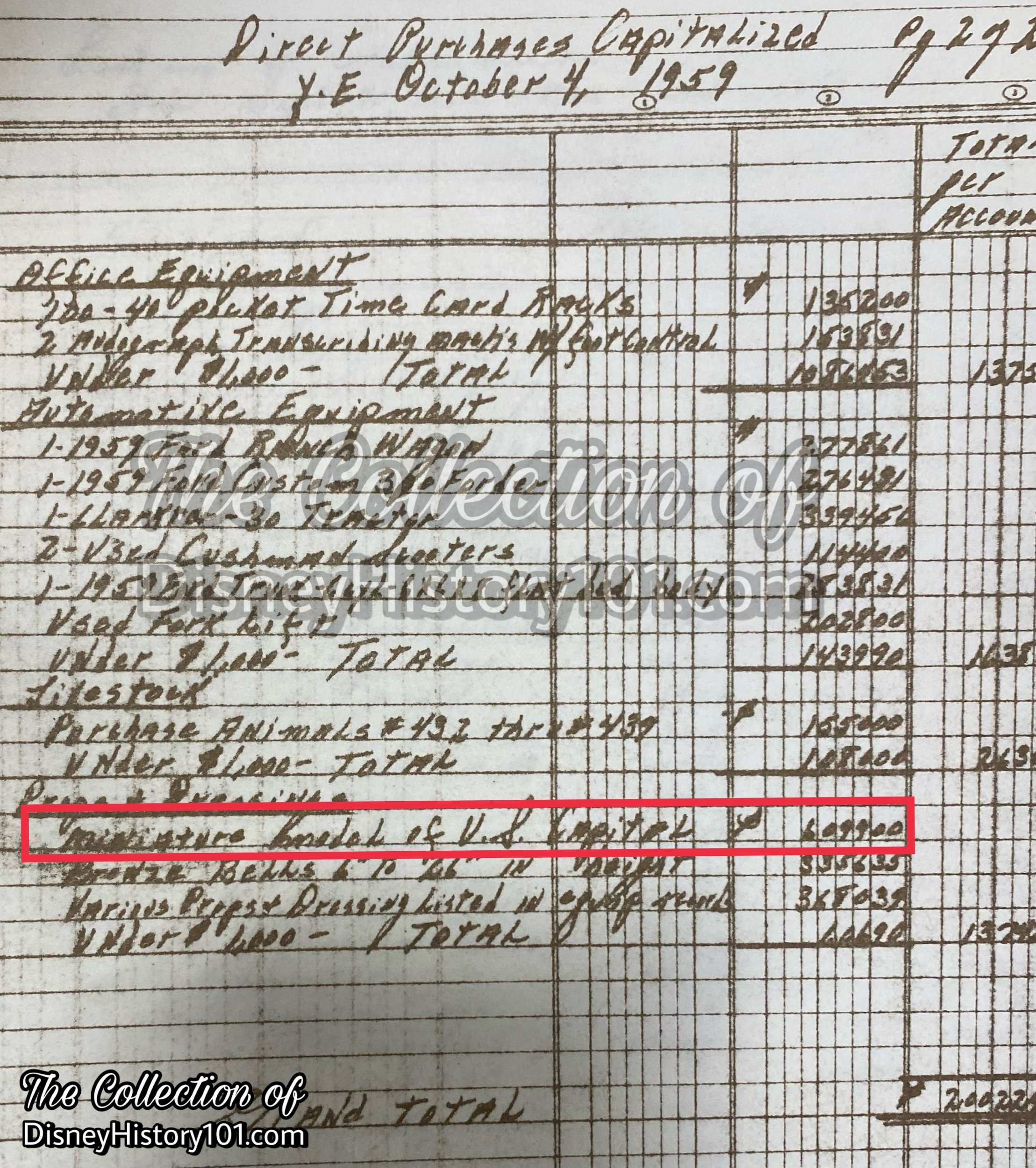
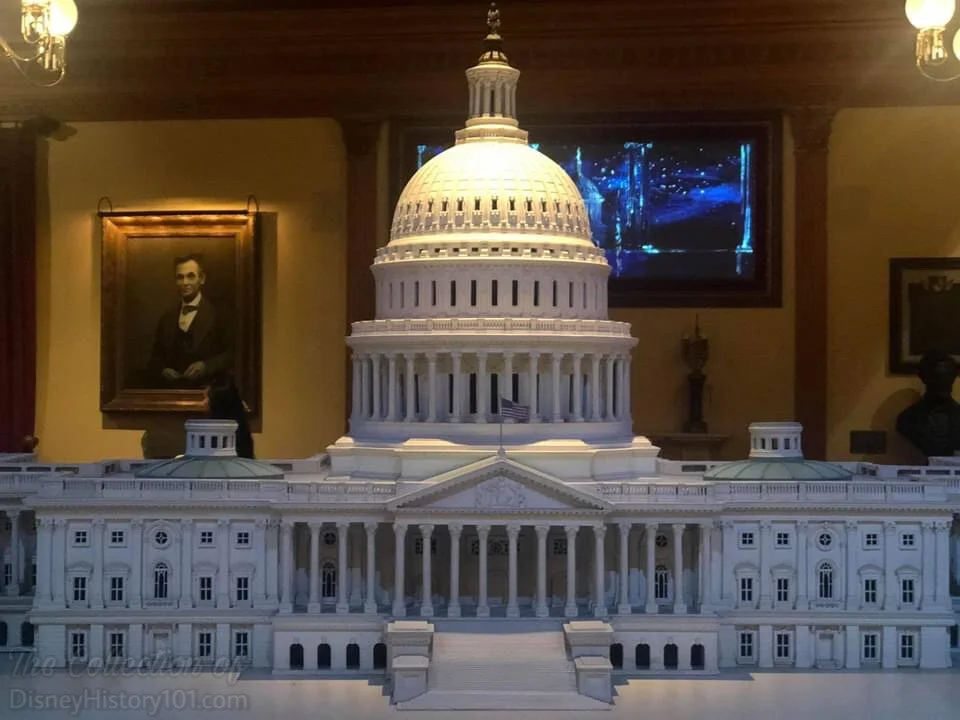
Now, not only was this 1955, but Walt Disney’s Disneyland was not even open yet. In fact, the Mr. Lincoln Audio-Animatronic figure would not debut at Disneyland until 1964 - nine years away. Clearly, Walt was looking to the future when he purchased George’s model, keeping it preserved for almost a decade, before the model became part of the Pre-Show of Great Moments with Mr. Lincoln at Disneyland.
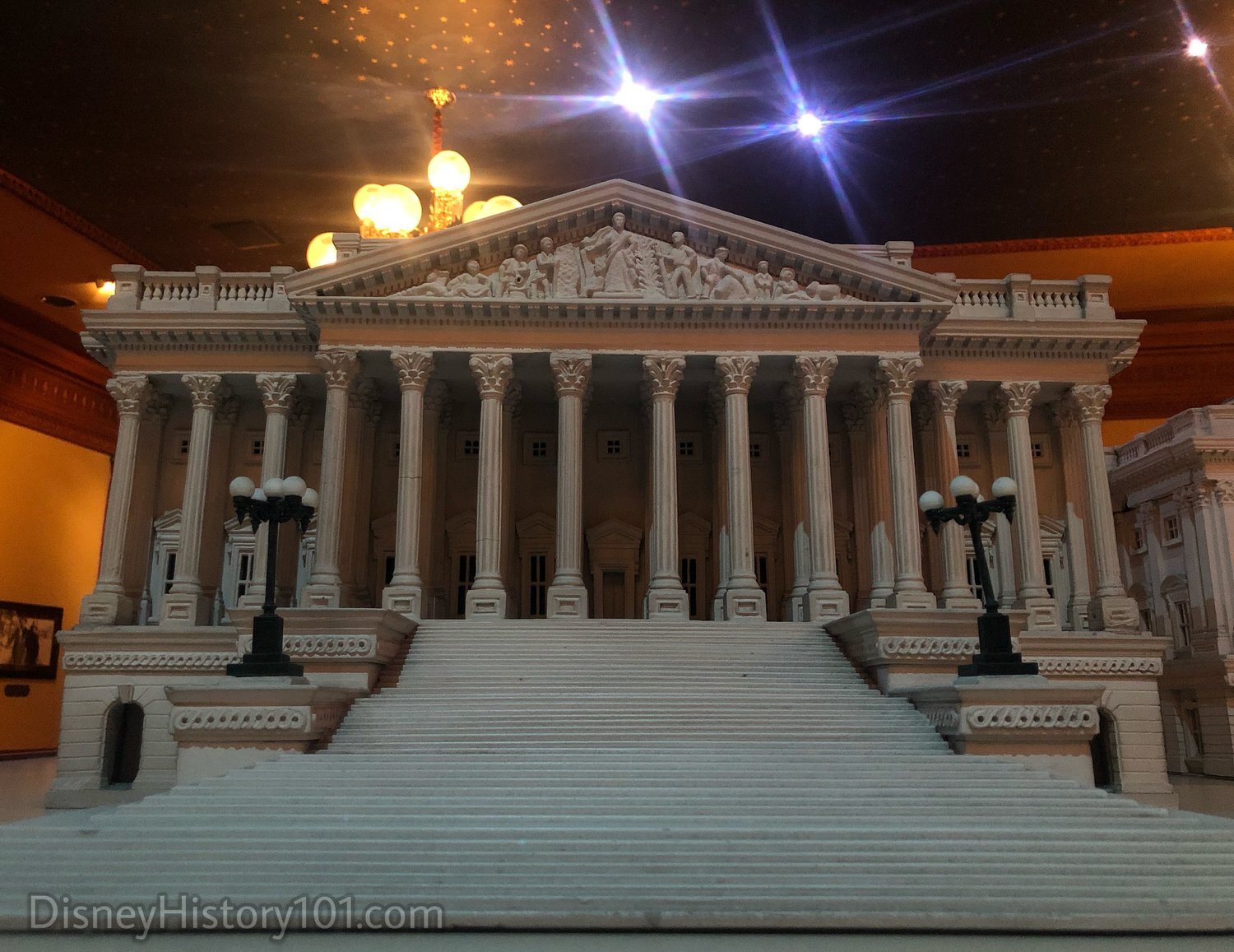
Take a closer look at the figures of (one of three) neoclassical pediments (that triangular-shaped element above the columns). The true-life U.S. Capitol features three different sculptures within each of the three pediments - over the Central Portico, over the Senate Wing, and over the House of Representatives. George made sure to add these little faithful elements to his miniature.
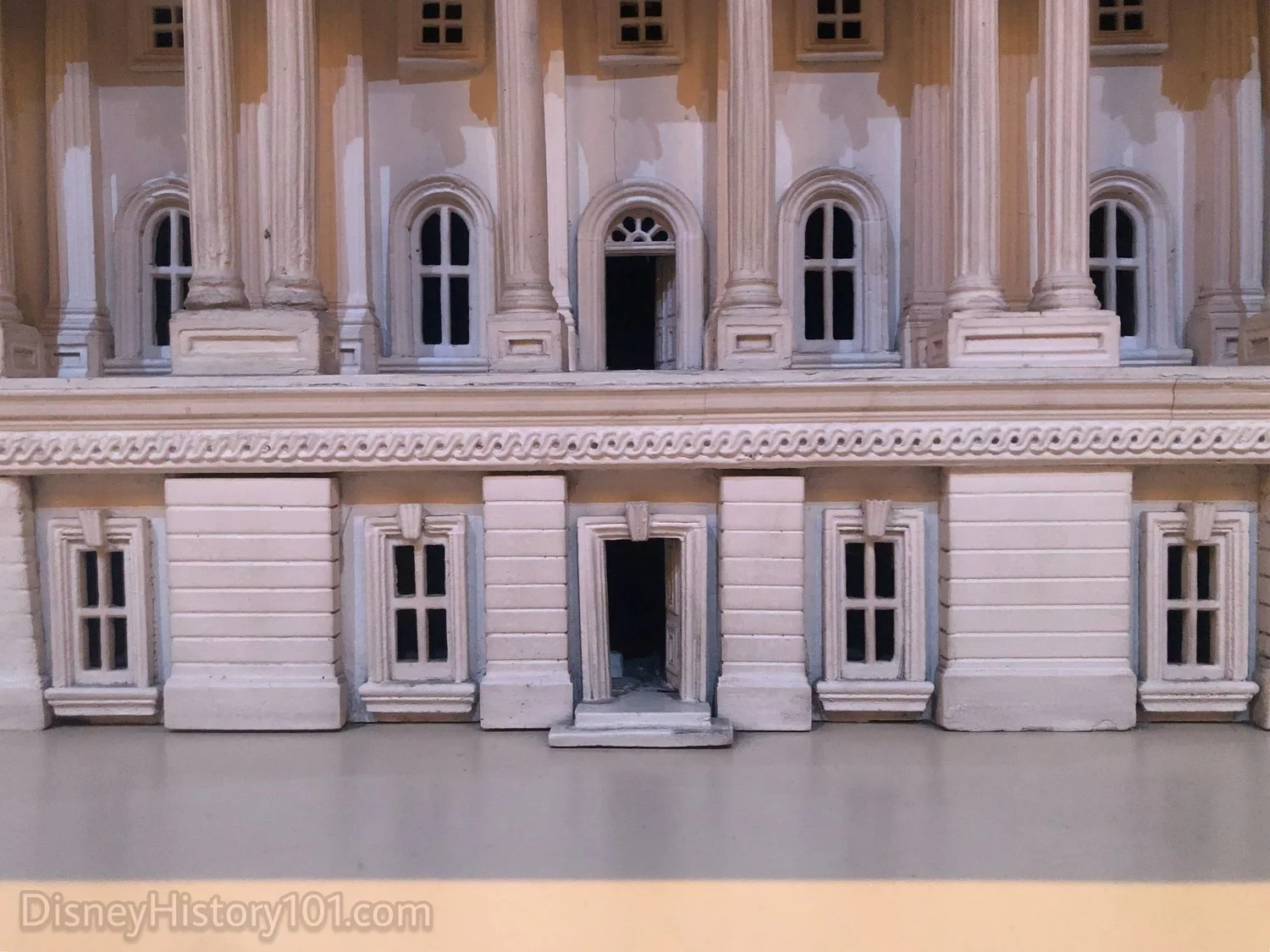
Finally, upon entering the foyer of the Main Street Opera House, guests were “greeted by a large picture window gracefully framed in red drapes. Stepping up to the window, they look out over a magnificent panorama of the United States Capitol with its beautiful surroundings. Countless diamond-like lights shine from Capitol windows and city as twilight settles over Washington,” according to Vacationland (Fall, 1965 ; Vol. IX, No.3).
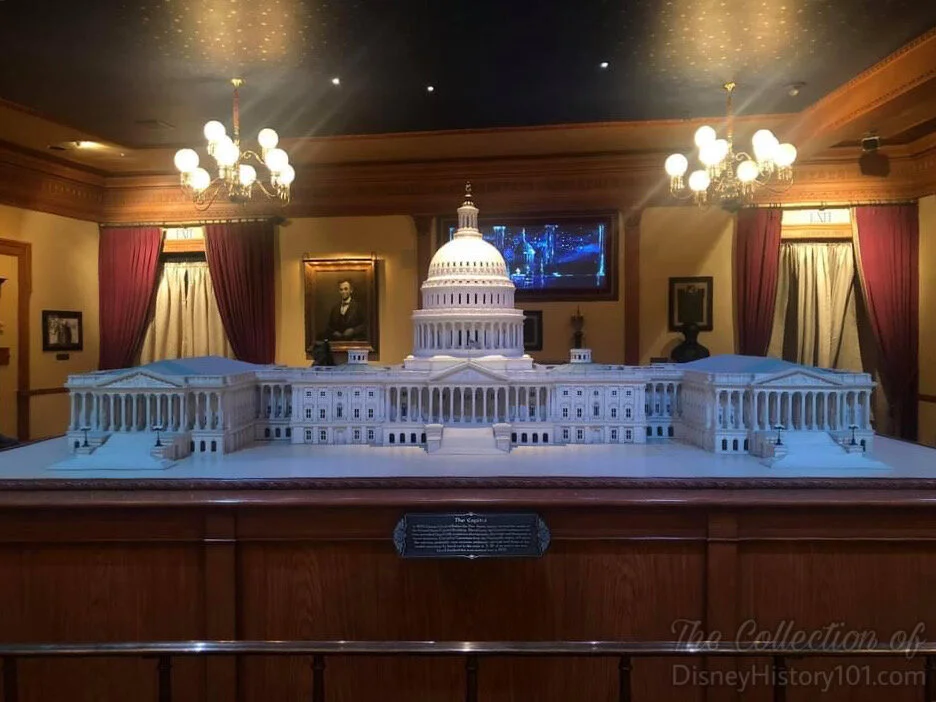
The former Walt Disney Imagineering Principal Creative Executive Marty Sklar would probably agree that the small details like these make the story appealing.
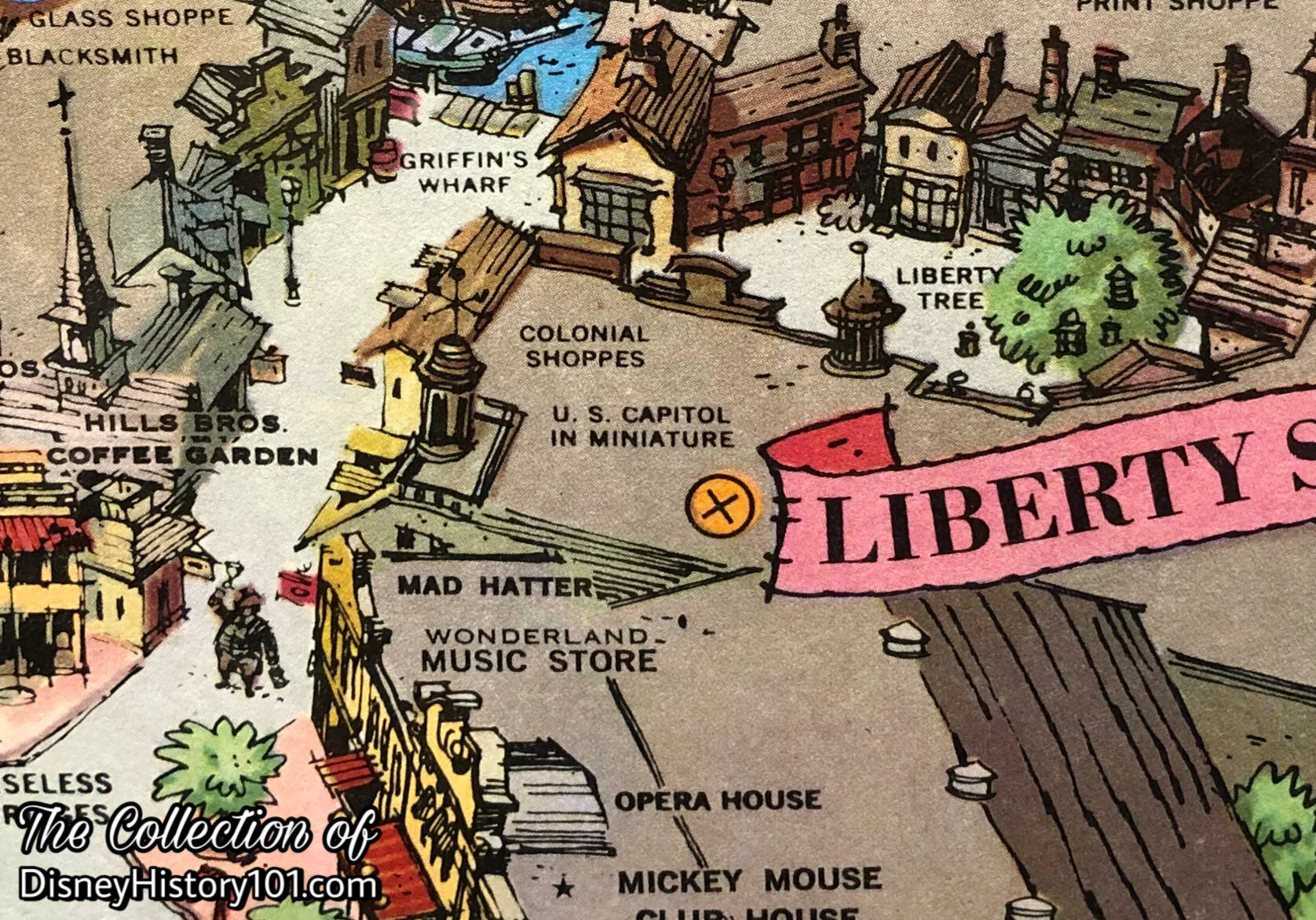
During the late 1950s and early 1960s, Walt was interested in developing the area behind the East side of Main Street into a brand new land. Sam McKim maps of the era feature some of these concepts (a yellow-orange circle with an “x” inside often used to symbolize a “Future Developement”). Evidently, the U.S. Capital in Miniature was to be retained as part of one “Future Development” called Liberty Square. George died in 1962, but it is quite possible that he was aware of these plans (involving his model) before his death.
Looking over even this small map excerpt, you will note more than a few elements (“colonial shoppes”, and the Liberty Tree, for instance) which were utilized more than a decade later, to bring Liberty Square (of Walt Disney World Magic Kingdom) to life! The U.S. Capitol in Miniature by George Llewellyn Lloyd seems to be the only attraction which has kept the “spirit of Liberty Square” alive at Disneyland up to our present day!
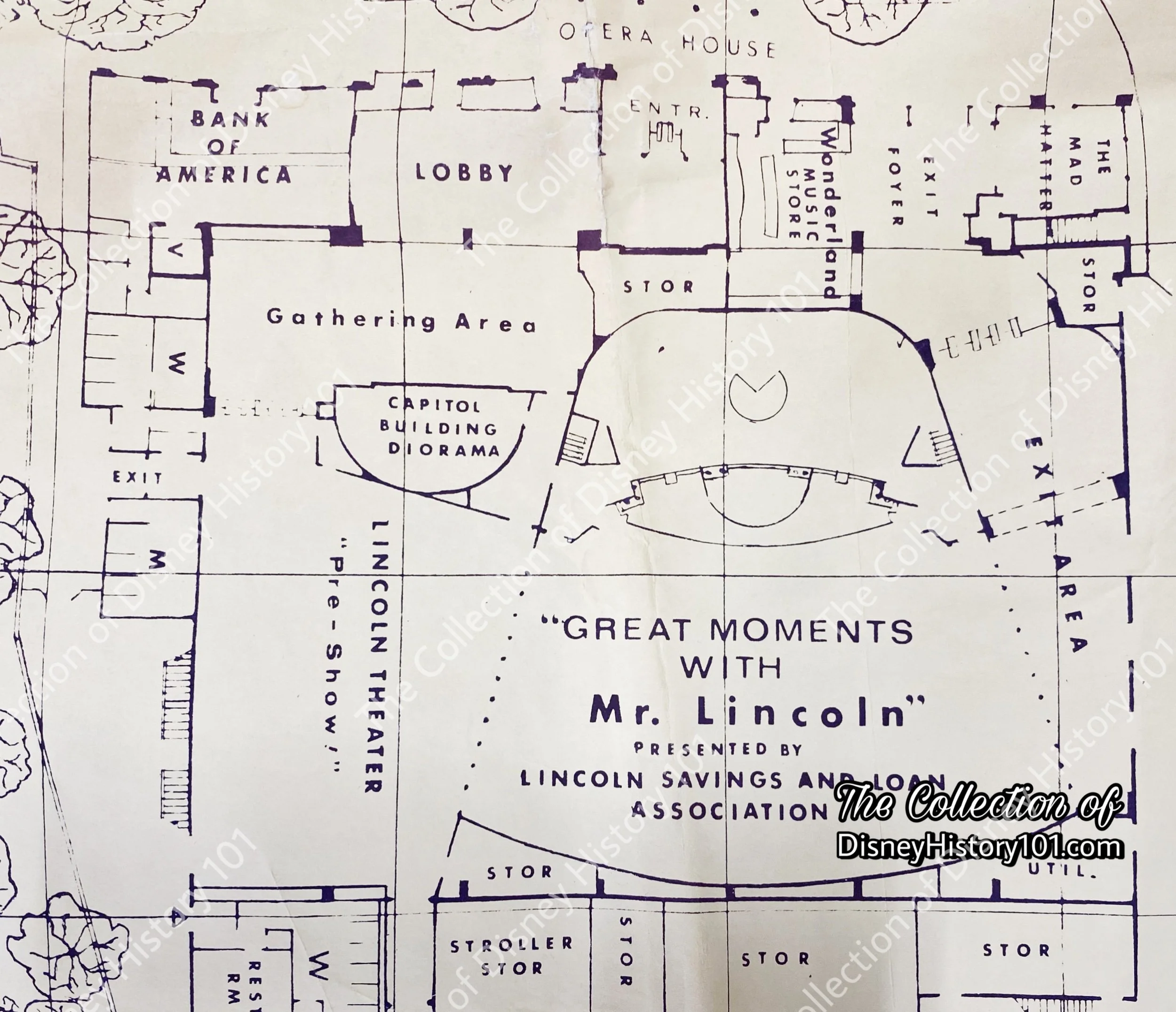
*(April 8, 1973 to February 15, 1973, according to “Disneyland Rides & Attractions and Attendance Report,” 1981, page 50).
After his passing, Walt Disney was posthumously honored in many ways. On March 25, 1969, Walt Disney was presented a gold medal by President Richard M. Nixon, accepted by Lillian Disney. The Disney image was also preserved when The Legacy of Walt Disney exhibit (which was displayed in the old Wurlitzer building from January 15th, 1970 to February 11, 1973), was moved to the Main Street Opera House. Only a few months after the grand opening of the exhibit, the Walt Disney Archives was established on June 22, 1970.
Owing to the newly formed Walt Disney Archives, The Walt Disney Story exhibit would open with a brand-new exhibit, marquee, an official dedication, and much fanfare during Easter week, on April 14th, 1973, attended by Disneyland Ambassador Bonnie Drury, Mickey Mouse, and Lillian Disney Truyens (former wife of Walt Disney). The opening coincided with the Park’s celebration of “fifty happy years of family entertainment,” and was also advertised as part of Disneyland’s “New Sights & Bright Lights” during the summer of 1973! The dedication at Disneyland predated the dedication of the Walt Disney World incarnation which occurred on May 6th, 1973.
The show was free to Park guests of Disneyland, courtesy of the Gulf Oil Corporation. Once inside, guests followed Walt Disney from his boyhood, to the creation of Walt Disney World as told through nostalgic photographs, intriguing displays of awards and honors, rare film footage, and priceless memorabilia. One screen (surrounded by photographs taken during the construction of Disneyland) shows a short film of the Park’s construction (sped-up, of course). Guests may especially recollect the exact reproduction of Walt Disney’s Formal Office once used for appointments with special guests. There were props from Walt Disney’s popular television productions, including Zorro (the cape, mask, and sword of the title character) and The Mickey Mouse Club (an original Mouseketeer hat).
One accompanying 28-minute film (partially narrated by Pete Renaday and Walt Disney himself), contained ”multi-media highlights of the life and accomplishments of Walt Disney, featuring rare film footage [like clips from the ‘Alice’ series, Walt Disney’s ‘Silly Symphonies’, ‘Steamboat Willie,’ and ‘Walt Disney’s Mary Poppins’ ; a rare treat during the pre-internet era]… photographs from family archives with Walt himself narrating the many milestones in Disney entertainment.” In the same short film,“He also explains the philosophy behind the ‘Audio-Animatronics’ figures developed by Walt Disney Productions for use at Disneyland and Walt Disney World.” According to the Press Release “utilizing excerpts with Walt, together with photos from family archives and vintage film footage, the wide-screen motion picture follows Disney from his humble Midwestern boyhood through his rise to International fame.” As aforementioned, this new show was on a 28-minute cycle (as opposed to five twelve-minute “Lincoln” shows per hour). This meant that The Walt Disney Story” was capable of accommodating a maximum of 1,000 guests per hour, as opposed to “Great Moments’” 2,500 guests per hour.
Much like Great Moments with Mr. Lincoln, this distinguished new attraction was free to all guests (though the Walt Disney World Magic Kingdom incarnation required a coupon for admission). The exhibit was successful, running until February 17, 1975 (with The Walt Disney Story film closing a few days earlier, on February 12, 1975). Four months later (and after a rehabilitation), The Walt Disney Story Featuring Great Moments With Mr. Lincoln presented by Gulf Oil Corporation (a free attraction with Audio-Animatronics figures) would return on June 12, 1975, and run until 2000. The Walt Disney Story still followed Walt Disney from his boyhood through the creation of Walt Disney World. Visitors could see rare film footage, narrated by Walt himself. This version of the show also featured the original form of the Great Moments with Mr. Lincoln Show which opened at Disneyland.
As the end of the day draws near, the Guest control lines grow progressively smaller. The lines are then maintained as they “go down” and are thoroughly swept when empty. In many cases, this required special equipment which would be issued by the Lead. Many attractions, such as the Walt Disney Story required a walk-through after closing for the removal of debris. At this time any defects were noted.
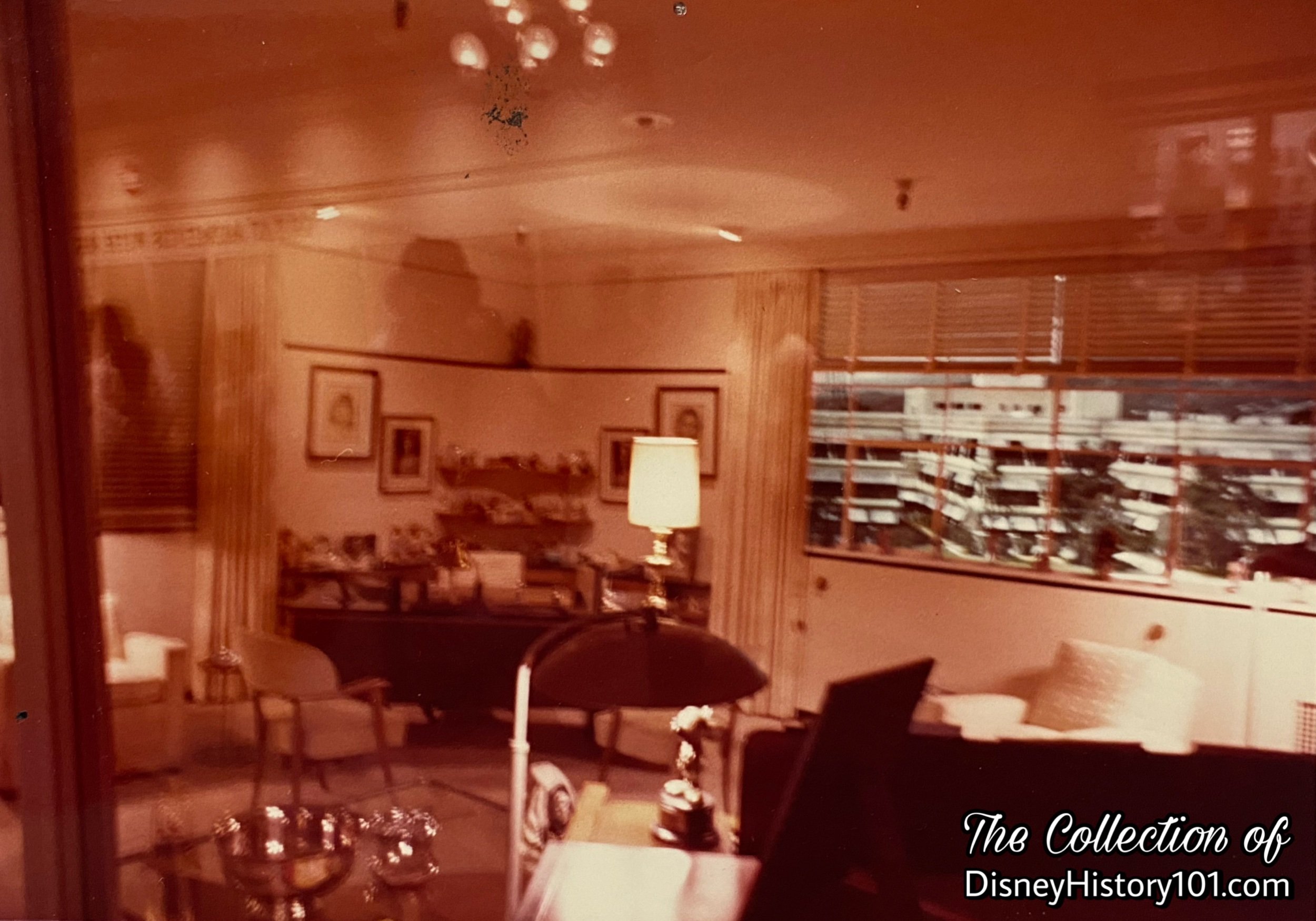
Depicted above is Walt's studio offices, recreated with the same items he used for 26 years. Kept as it was when he used it, everything from the wood paneling to the furniture was from the original Burbank, California, office.
In 2001, a photo shoot inside Walt Disney's Office in the lobby of Great Moments with Mr. Lincoln was auctioned off at the 2001 Official Disneyana Convention at Disneyland Resort. The Estimate was $500 - $1000. The lucky winner and two Guests had their photo shot in the formal office on the morning of Saturday, September 8, 2001. They also received a personal tour of the office by Dave Smith, Director of the Walt Disney Archives.
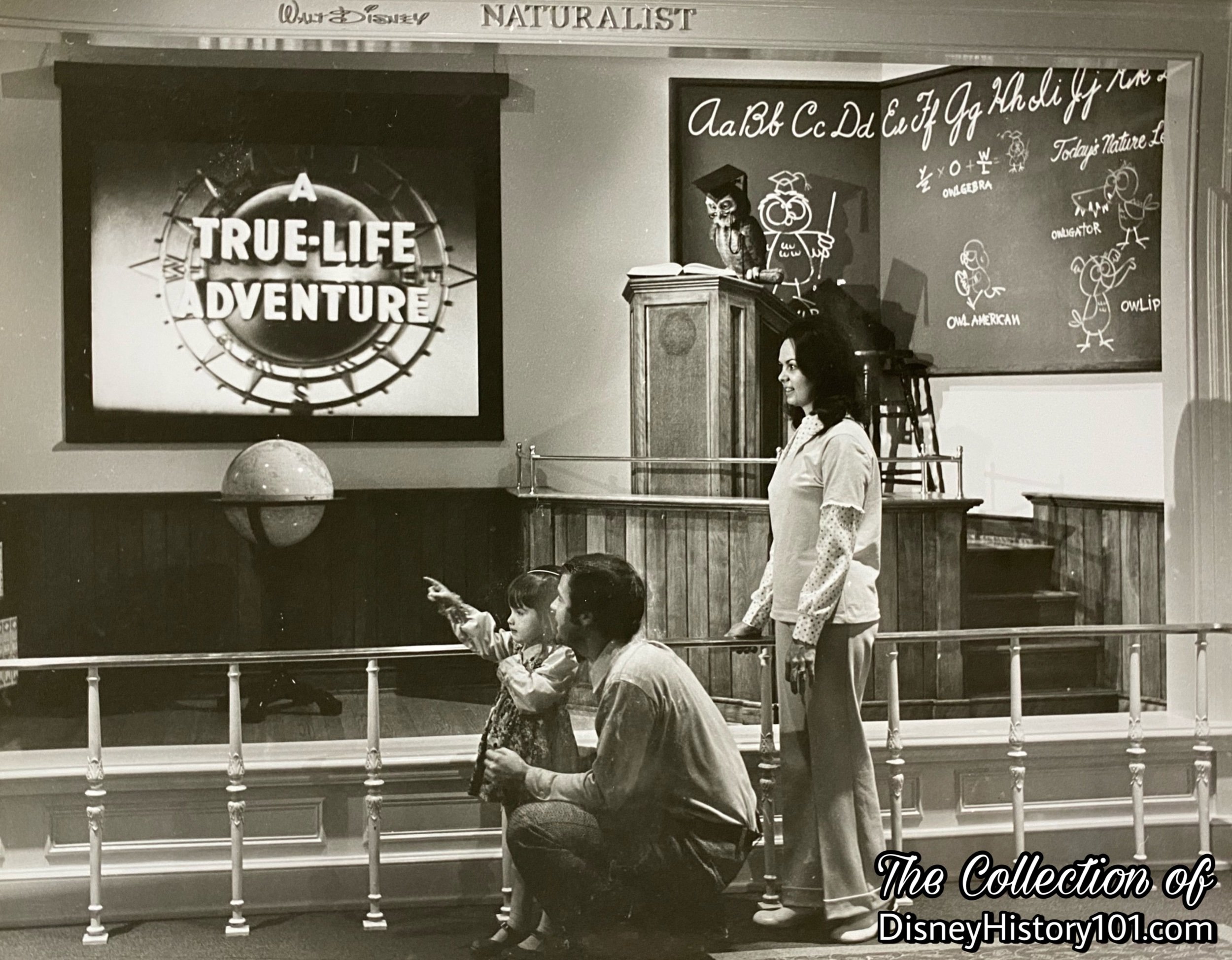
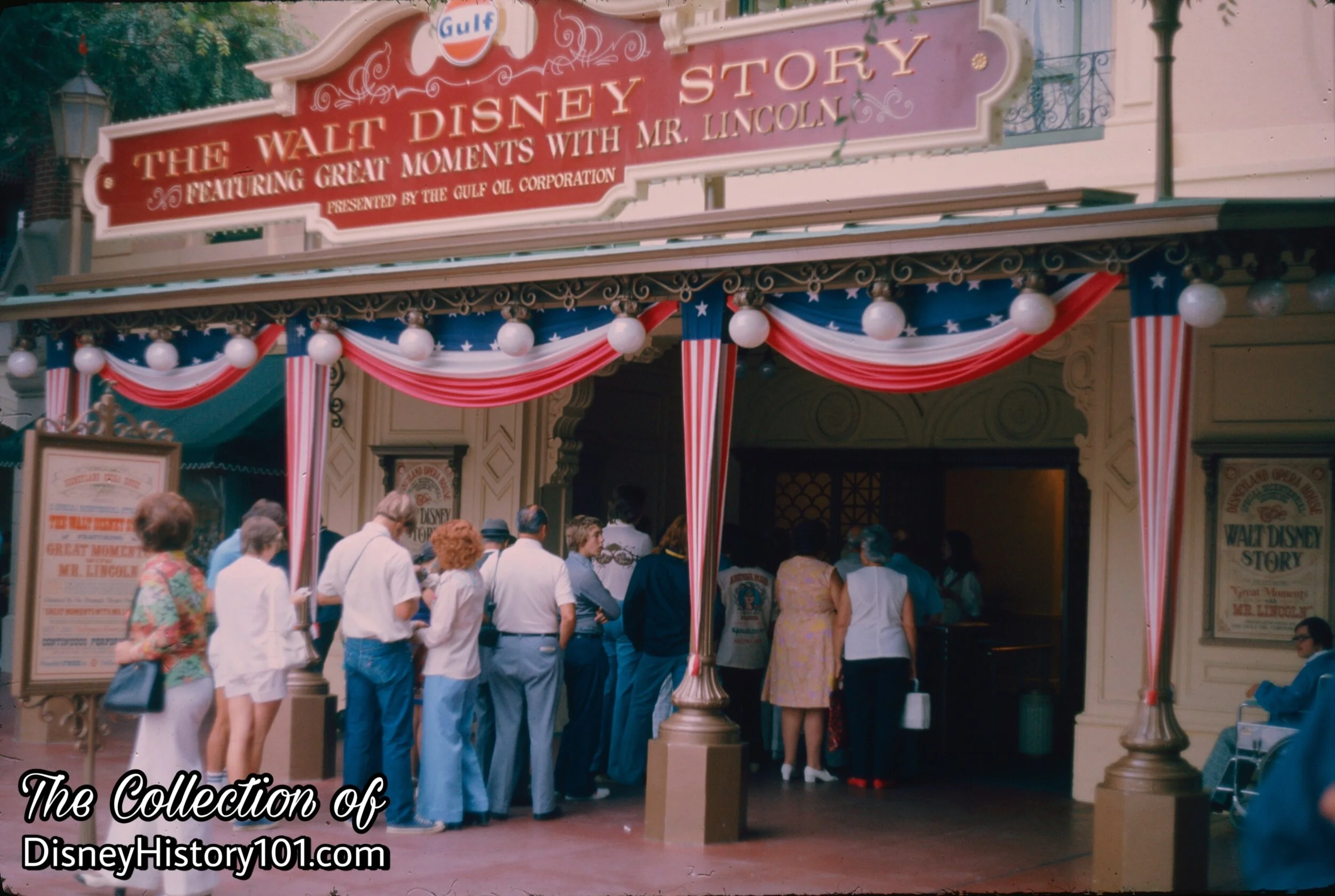
Around 1968, Gulf Oil sponsored quite a few episodes of Walt Disney’s Wonderful World of Color. Now, the new marquee of the Main Street Opera House advertises The Walt Disney Story Featuring Great Moments With Mr. Lincoln presented by Gulf Oil Corporation. You may have noticed that two (of four) of the original lamps were removed to accommodate the larger marquee.
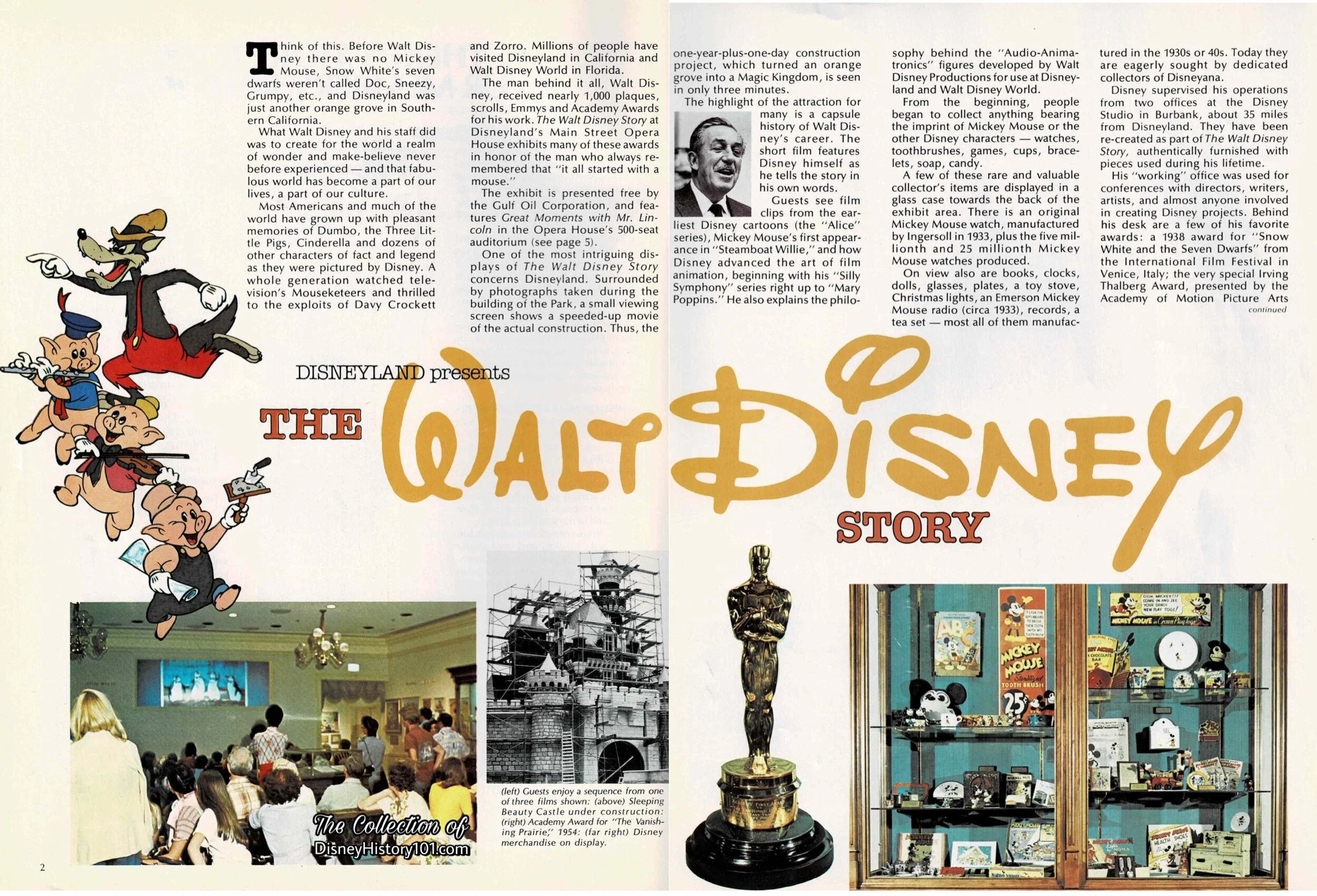
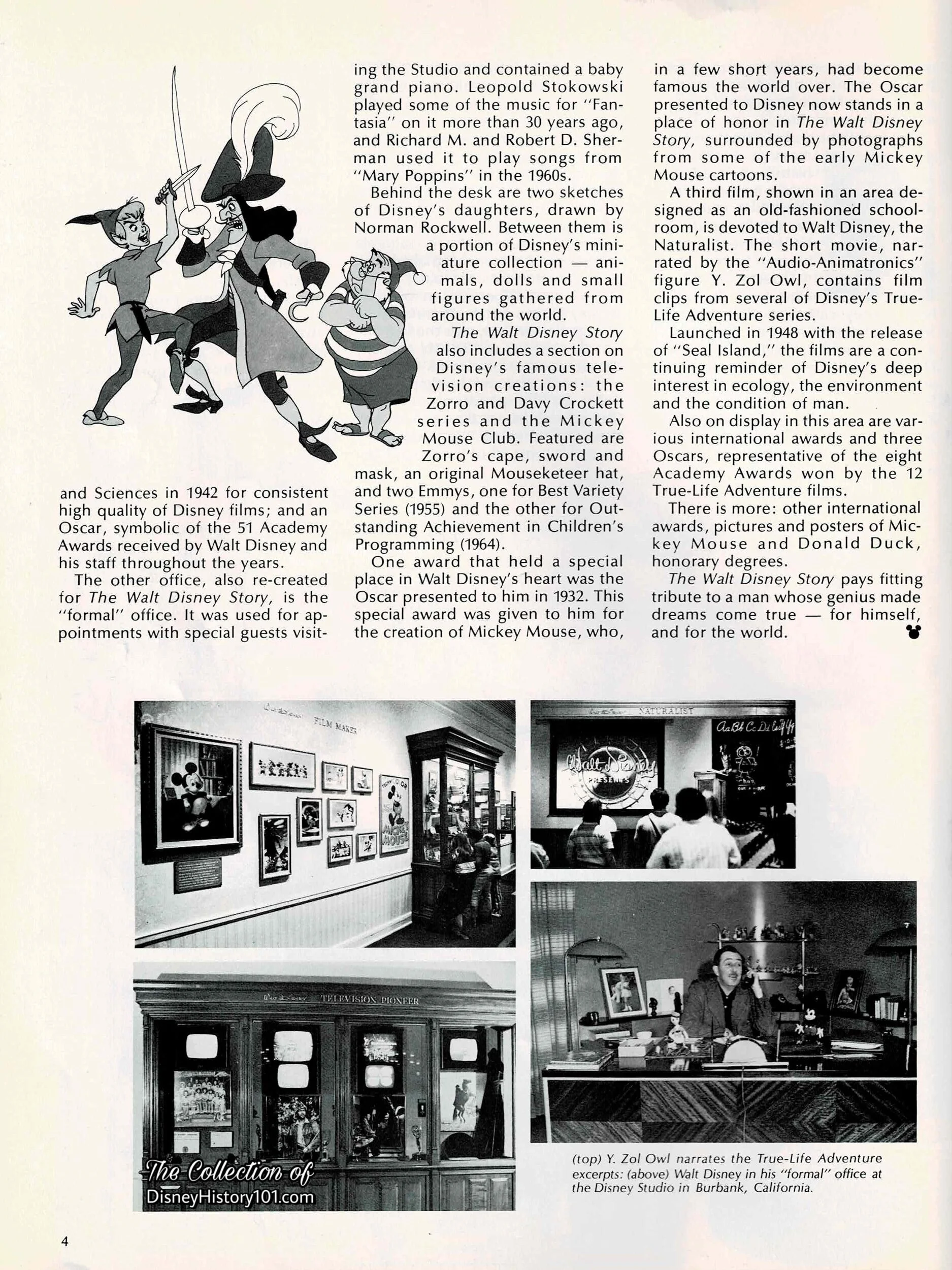
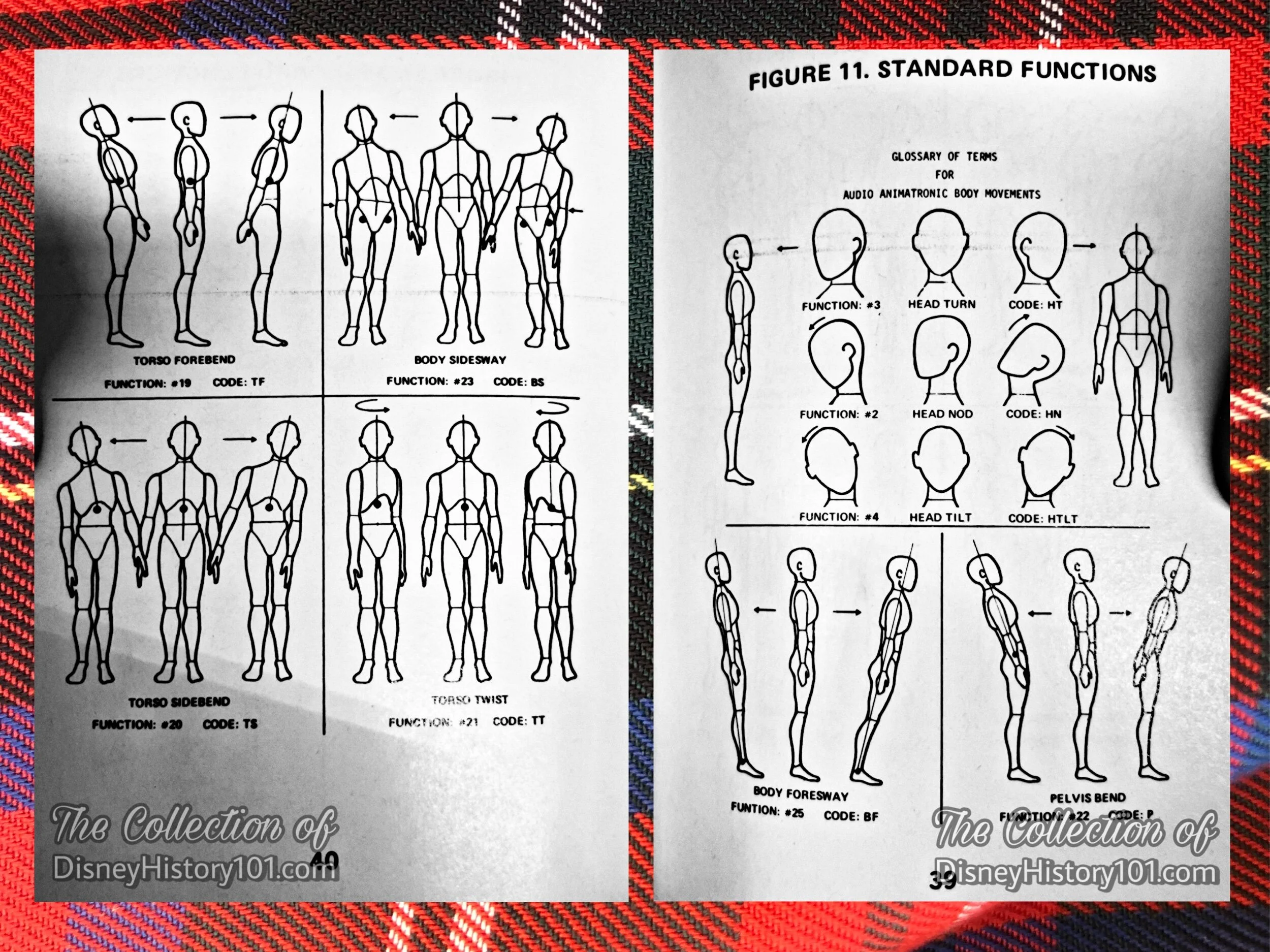
Owing to contemporaneous advancements in Audio-Animatronics technology, new Audio-Animatronics figures of “The Walt Disney Story” (June 12th, 1975) and the 31 figures added to the Jungle Cruise (in December of 1976), the WED Enterprises Imagineering Audio-Animatronic Maintenance Manual (first published 1977) was revised in 1978.
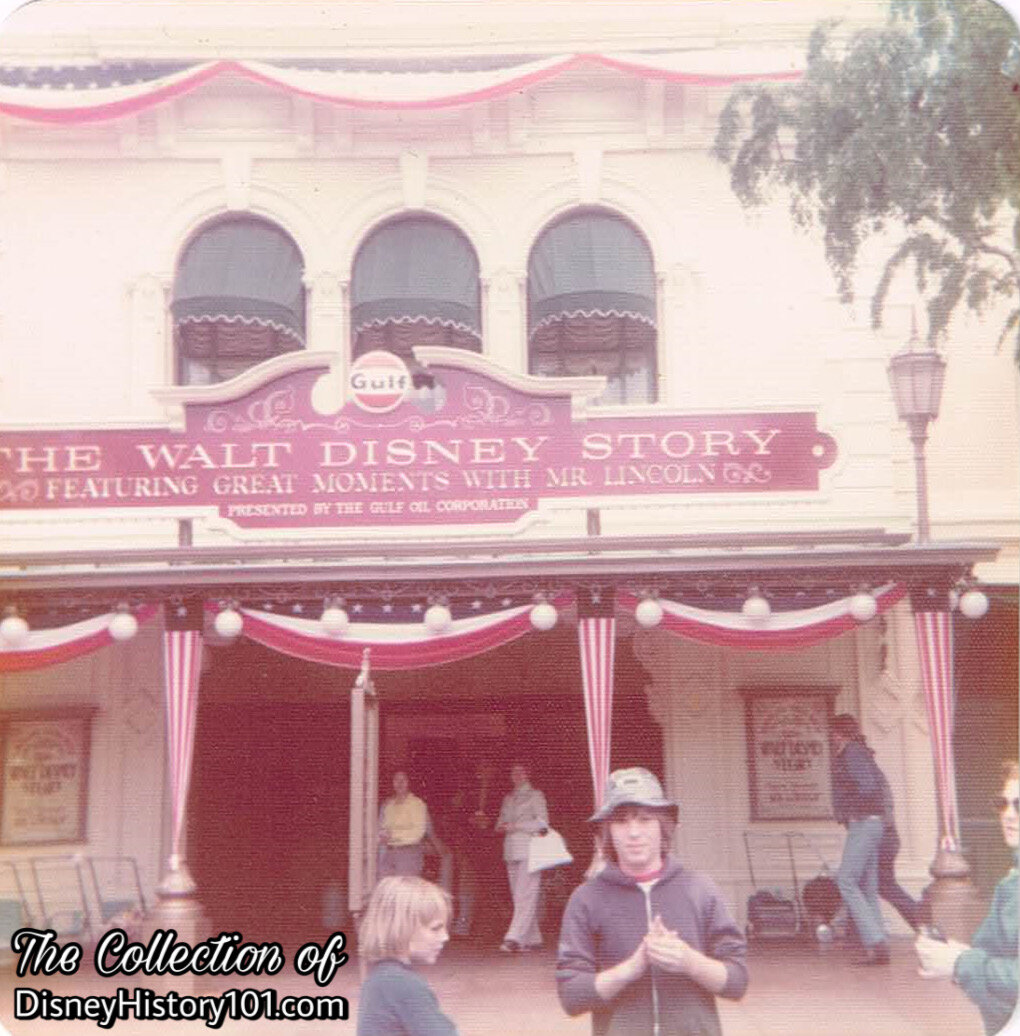
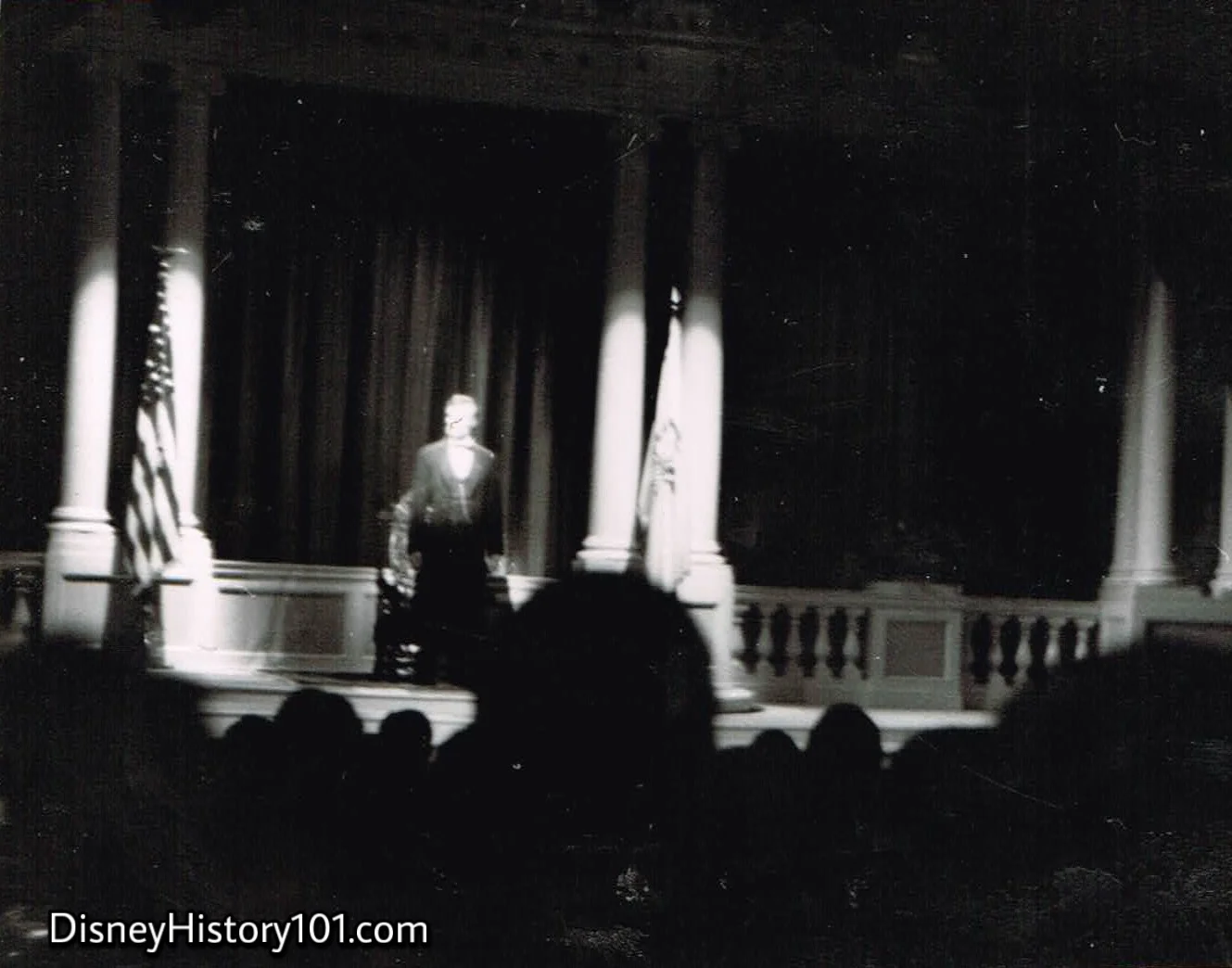
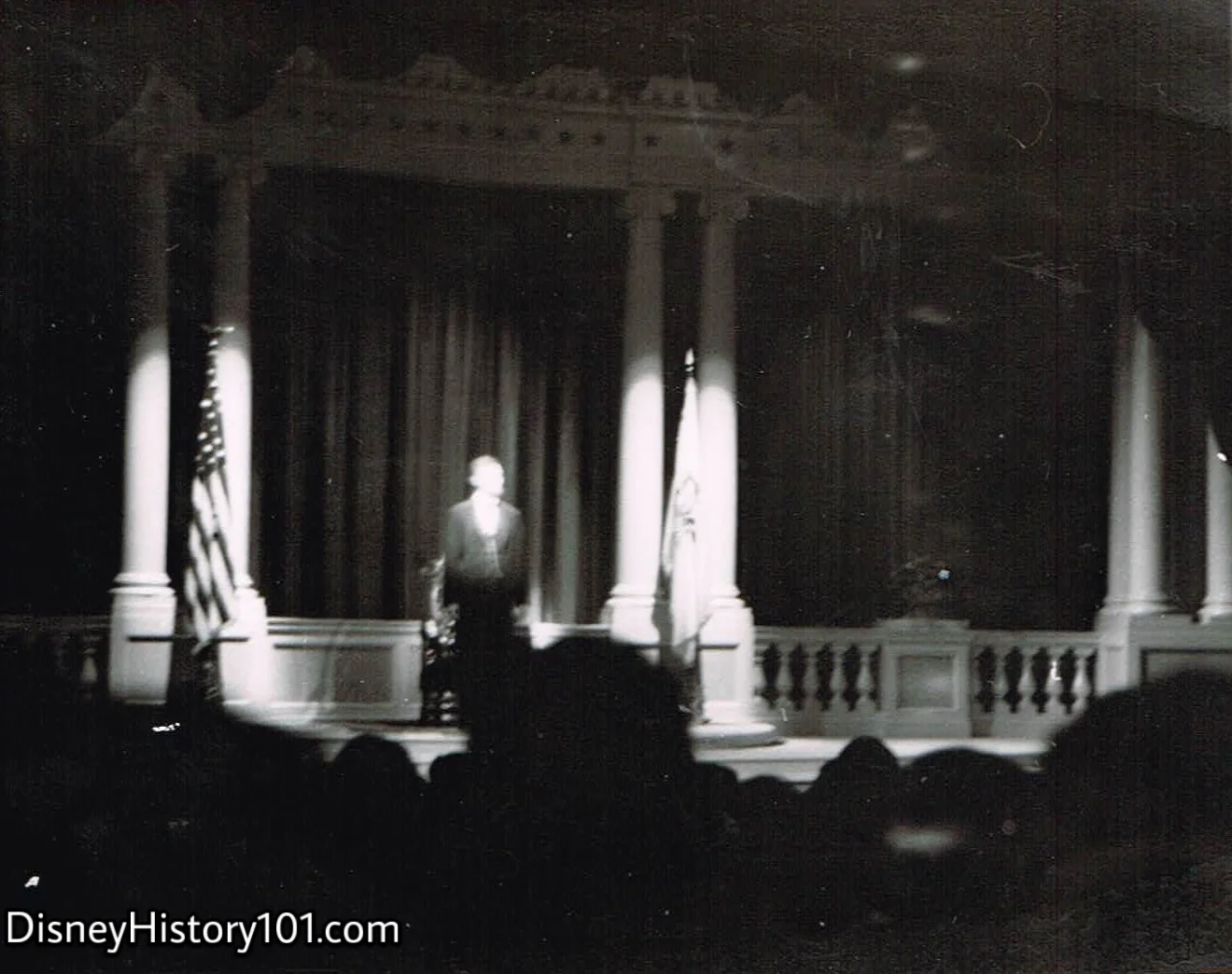
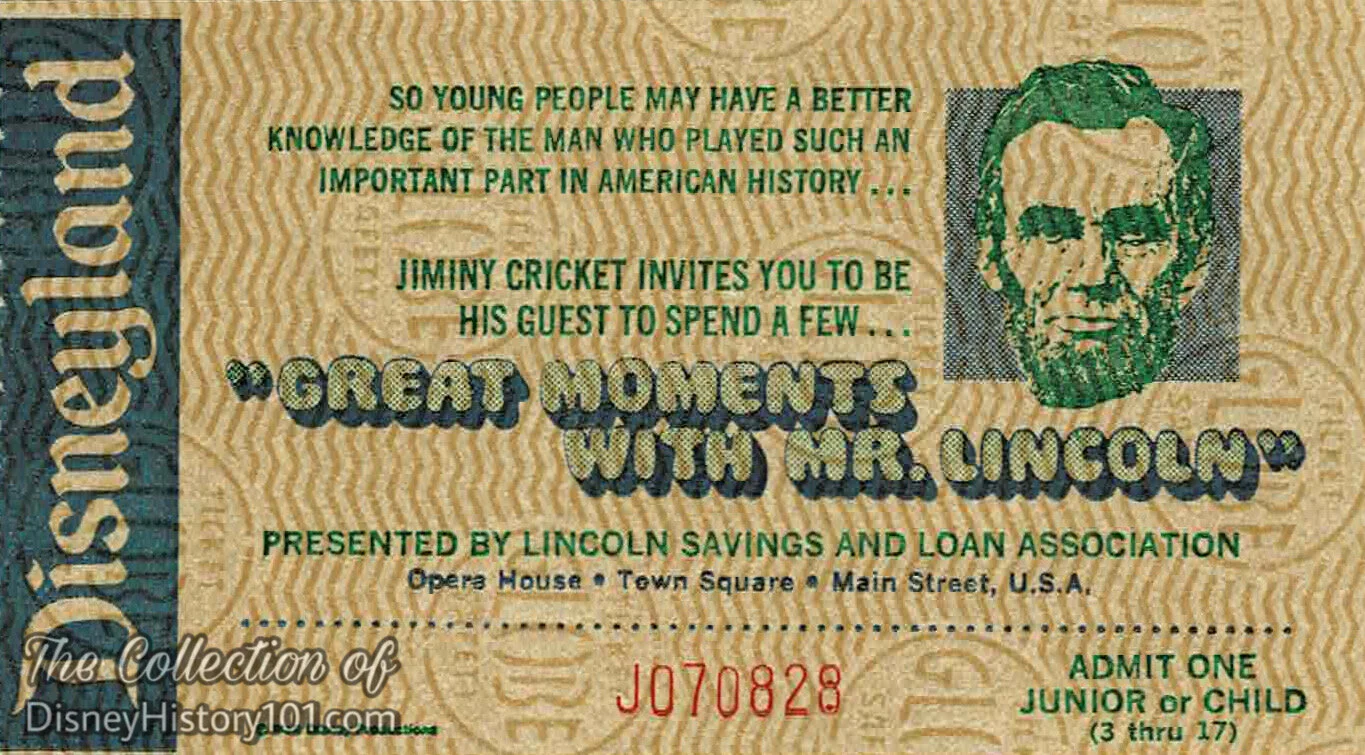
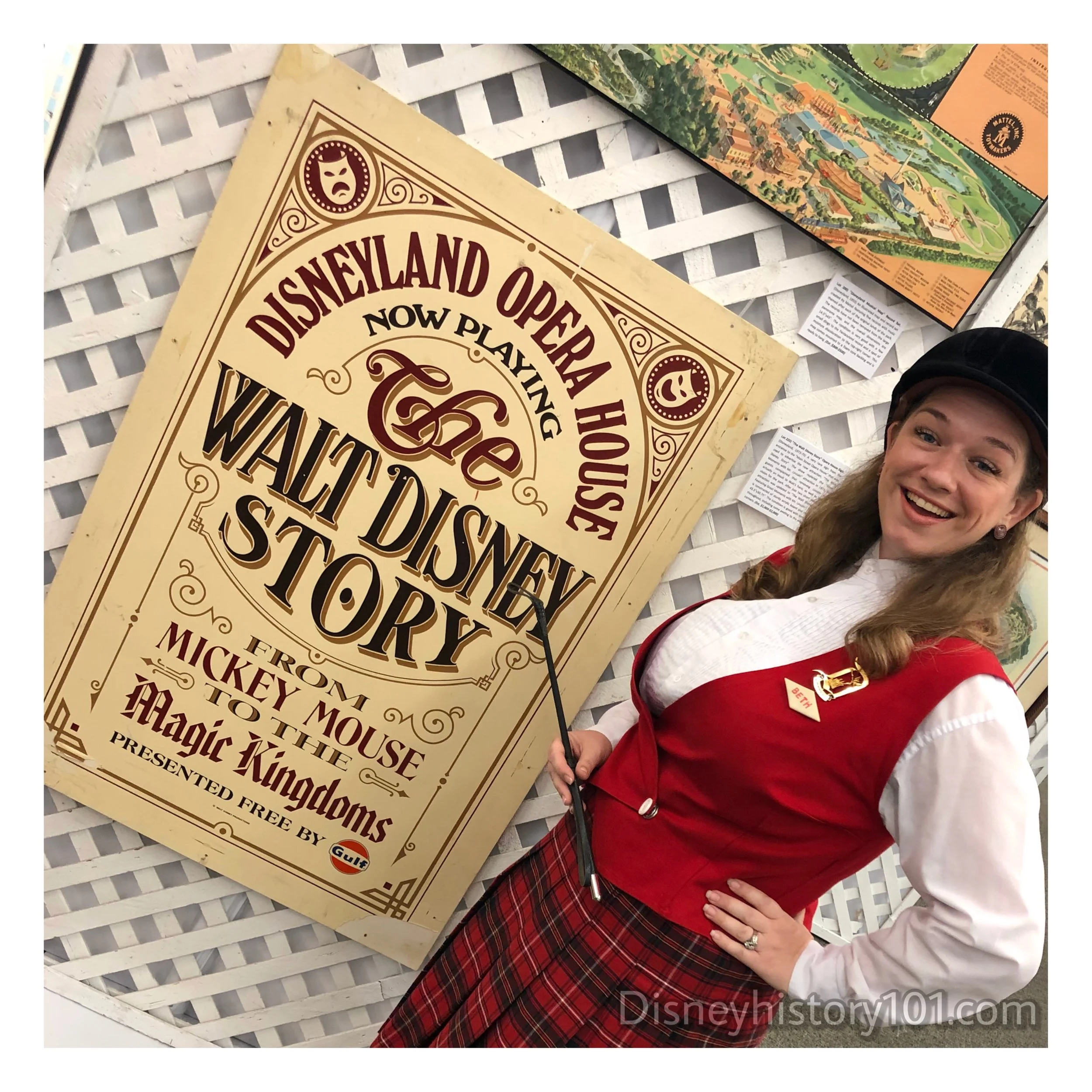
A poster for "The Walt Disney Story", the former Richard Kraft Collection. You may notice the logo of proud exhibit sponsor Gulf Oil Corporation near the bottom of the poster. During their era of sponsorship, the Gulf Oil Corporation ran advertisements in Vacationland magazine.
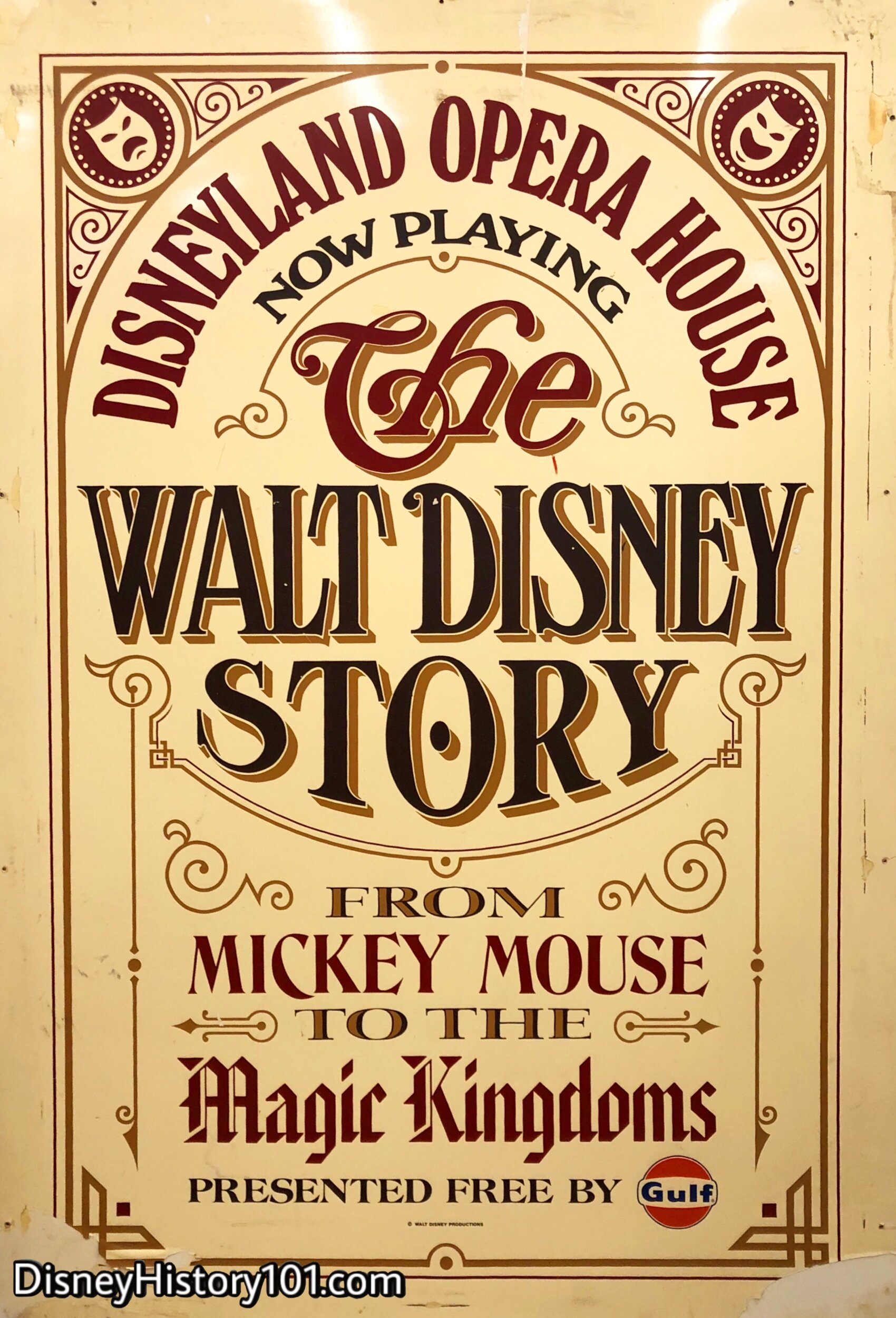
The Walt Disney Story : From Mickey Mouse to the Magic Kingdoms was presented by sponsor Gulf Oil! By 1972, Gulf Car Care Center (open seven days a week, 6 a.m. to 12 midnight) was located near the Disneyland Parking Lot at the corner of Katella Avenue and West Street. The Gulf Car Care Center was a complete automotive service center, which included a automated car wash and wax. Welcome to Disneyland brochures of the era advertised this convenience in the Information section.
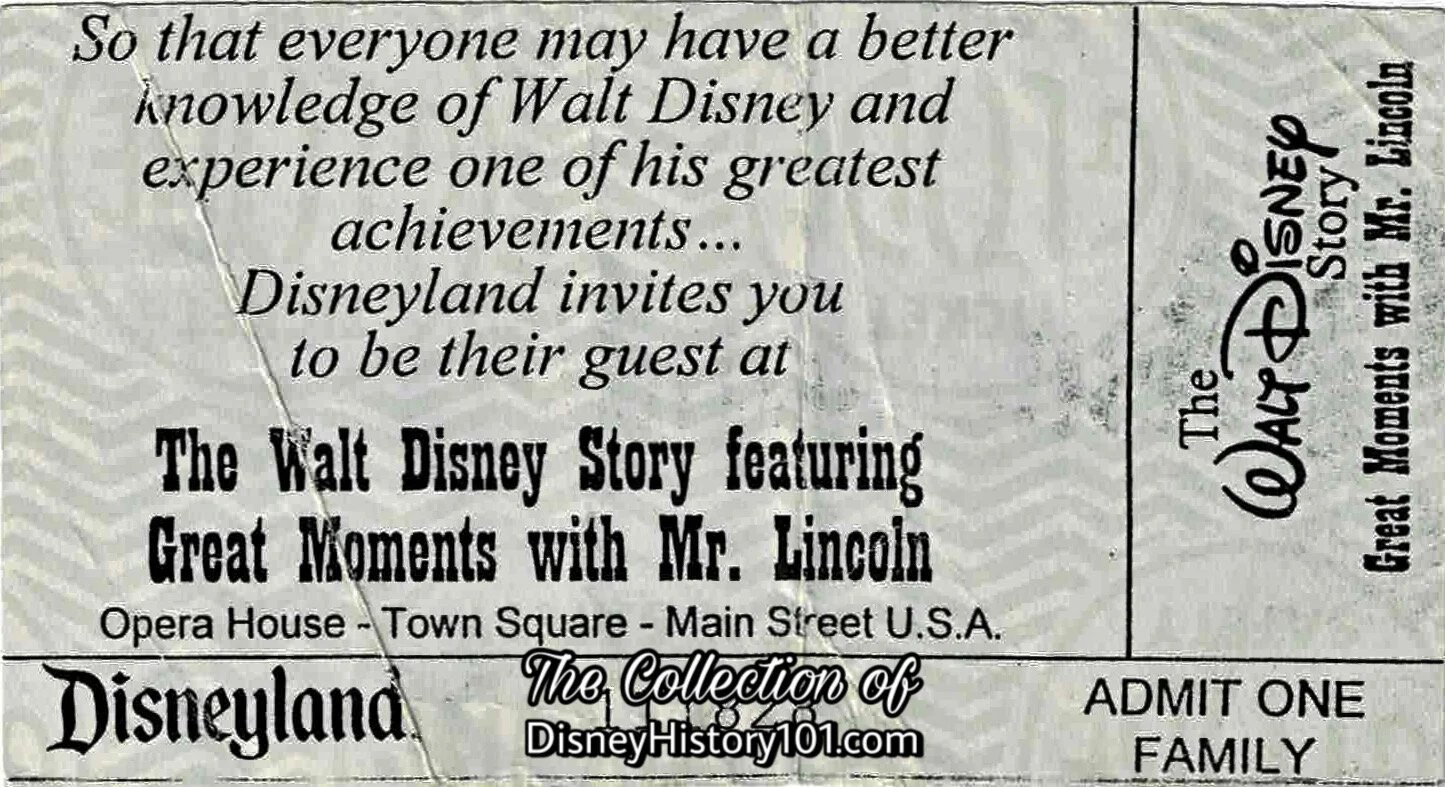
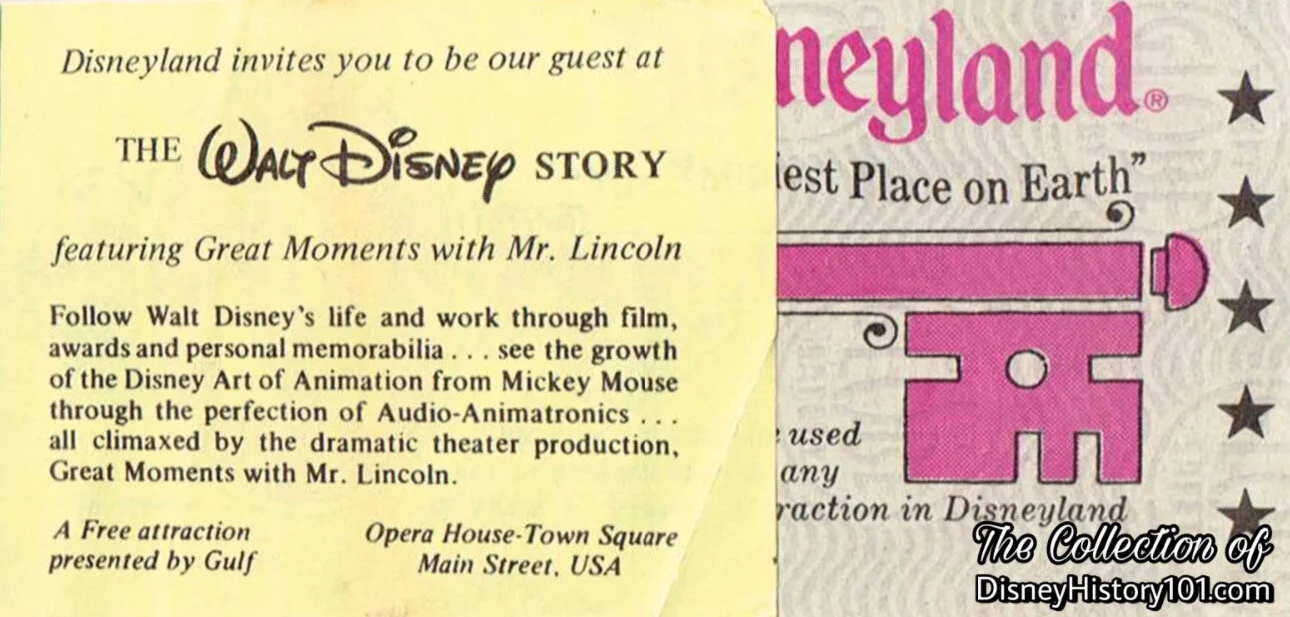
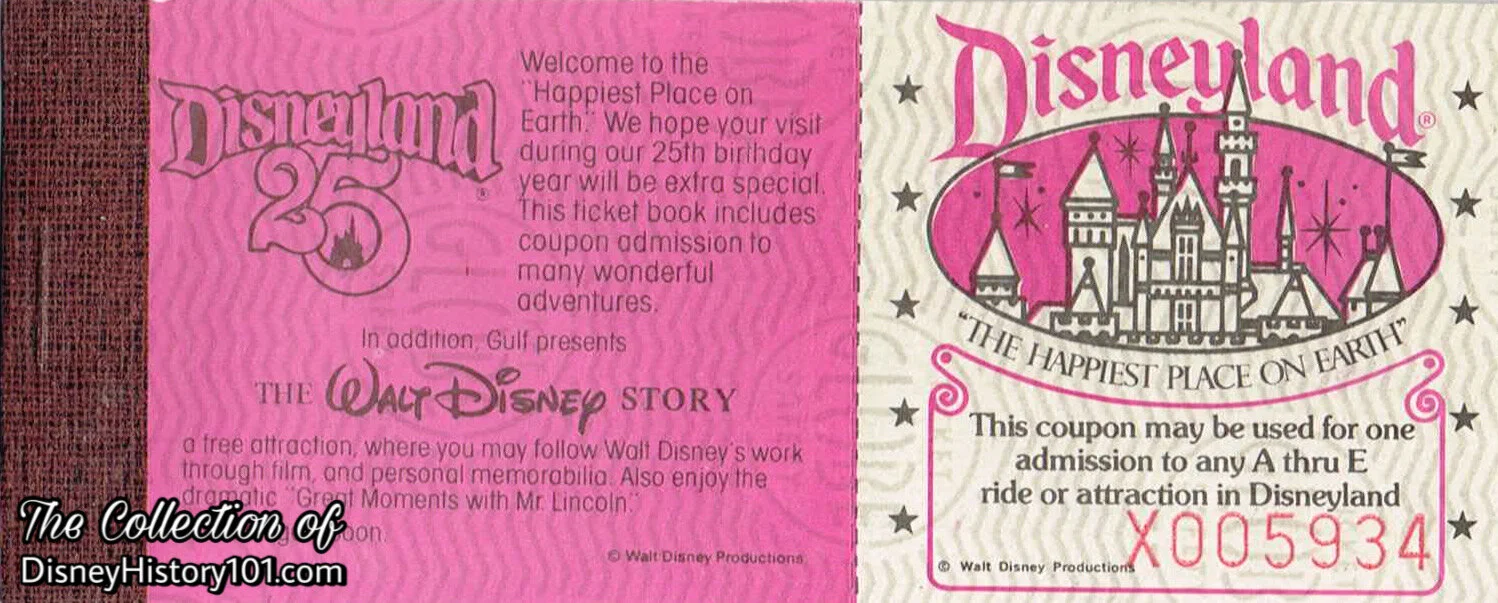
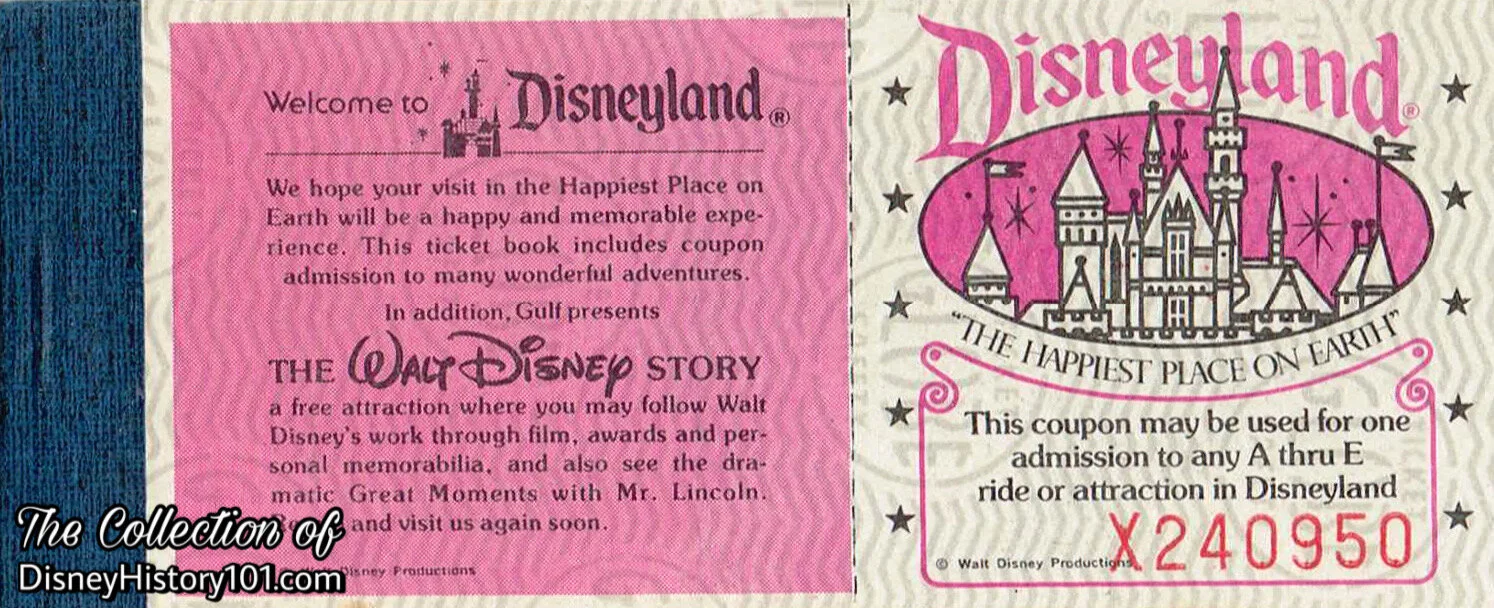
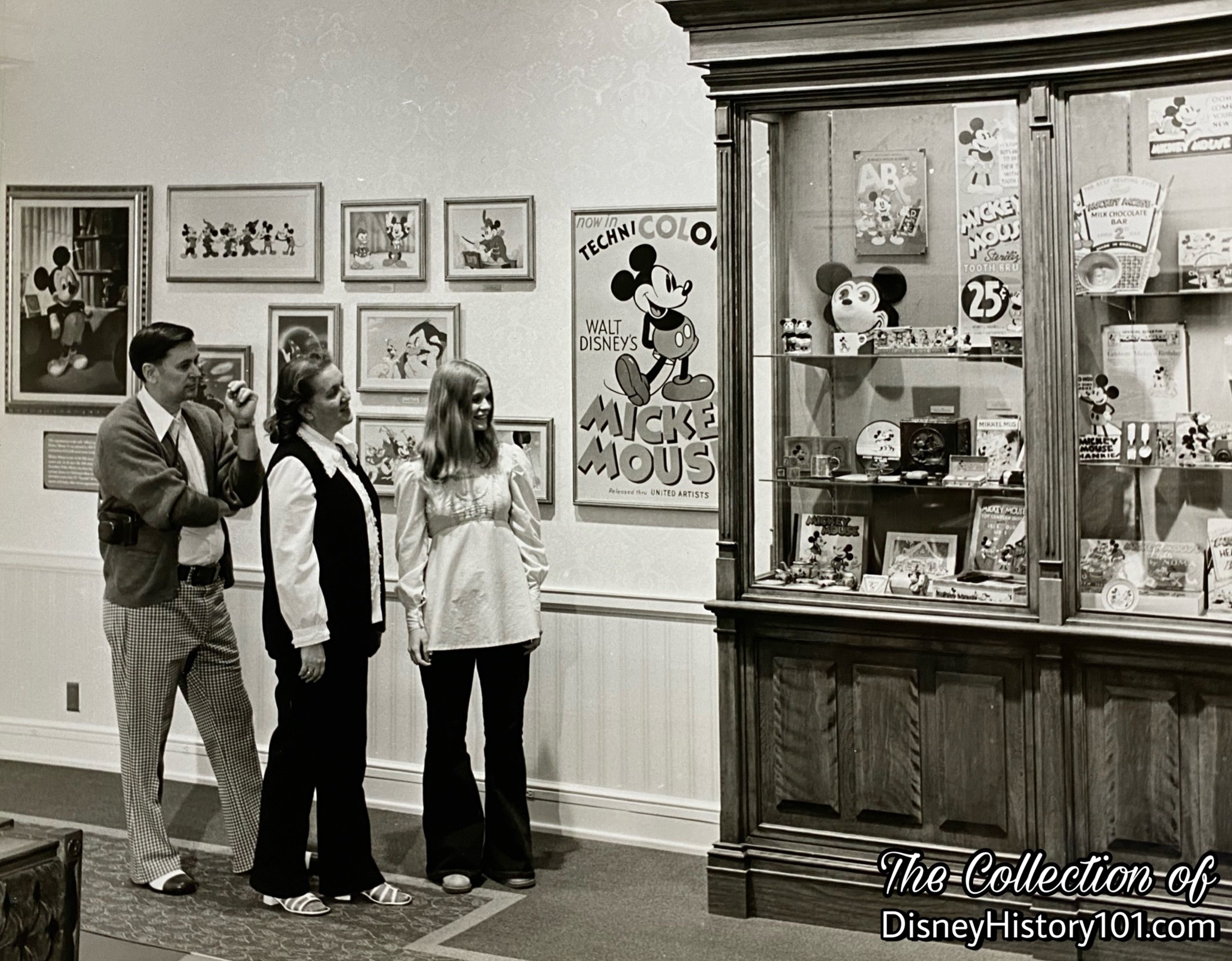
“From Mickey Mouse to the Magic Kingdoms”
From Mickey Mouse to the Magic Kingdoms presented by Gulf Oil Corporation was a limited exhibit that ran during 1975. Walt Disney had been awarded “nearly 1,000 plaques, scrolls, Emmys and Academy Awards for his work,” according to “Disney News” (Winter 1975/1976). “The Walt Disney Story at Disneyland’s Main Street Opera House exhibits many of these awards in honor of the man who always remembered that ‘it all started with a mouse.’”
According to a Press Release: “One wall of ‘The Walt Disney Story’ pre-show area is dedicated to Walt's most famous creation, Mickey Mouse. Included in this area are photos from some of Mickey's most memorable screen appearances and a case filled with vintage Mickey Mouse merchandise material from the 1930's.” A wide variety of collectibles were on display, including a copy of “Mickey Mouse’s 25th Birthday” (by John Hench, 1953), a poster heralding United Artist’s distribution of Mickey Mouse shorts in Technicolor, lithograph stills of memorable moments from Mickey Mouse short films, and the production artwork that would become the iconic logo of the Walt Disney Archives.
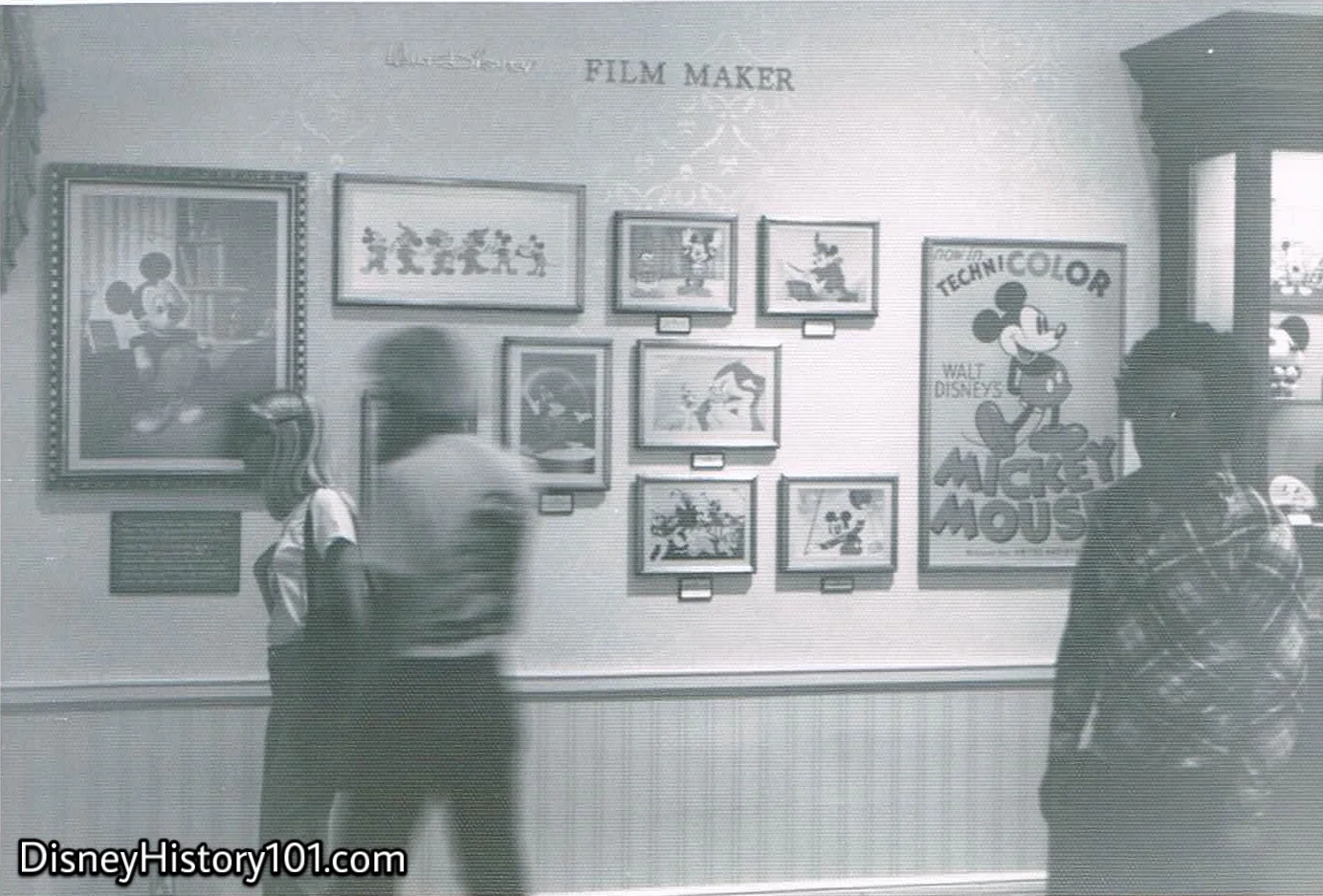
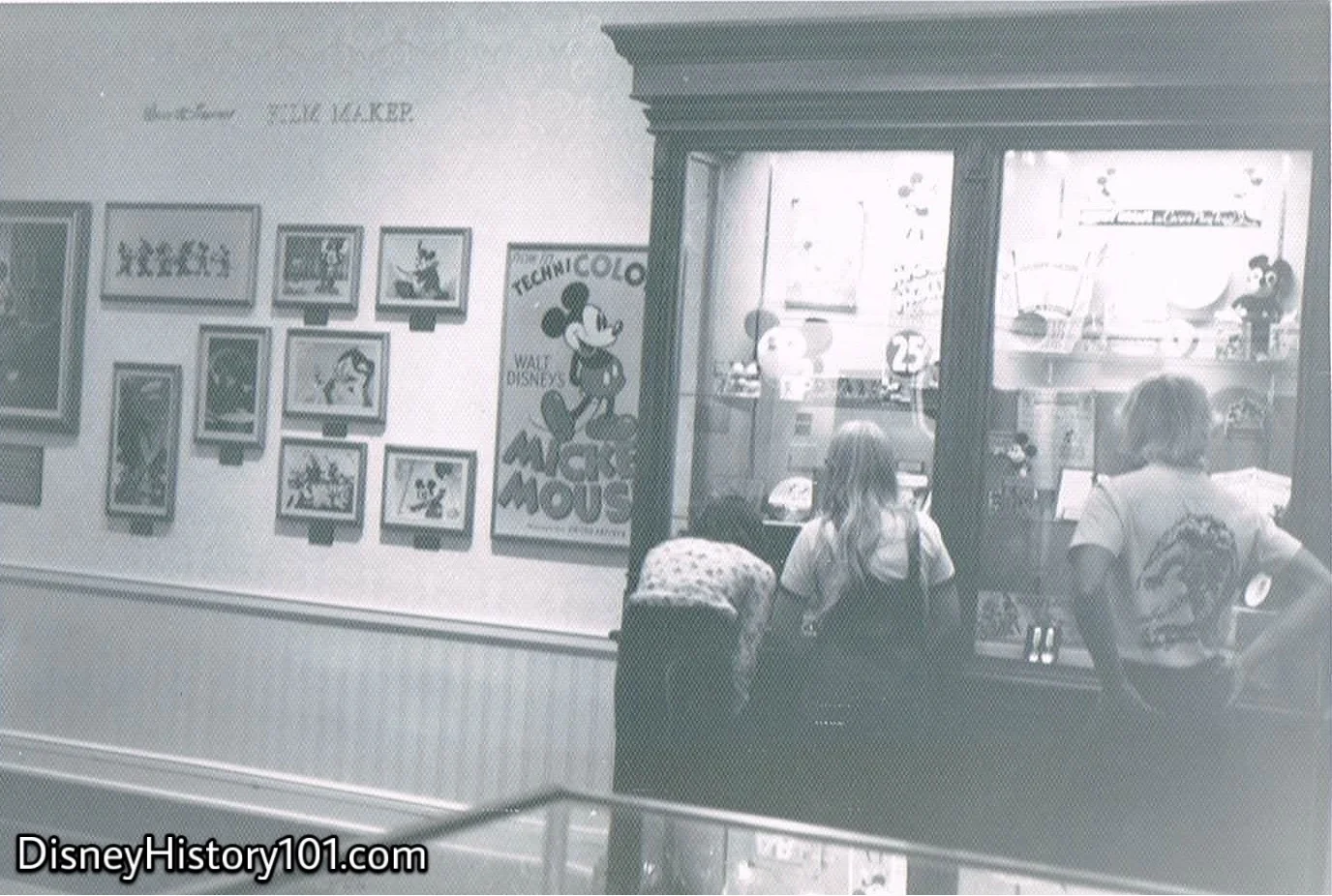
From Mickey Mouse to the Magic Kingdoms presented by Gulf Oil Corporation was a limited exhibit that ran during 1975. Many early examples of licensed Mickey Mouse merchandise were also on display.
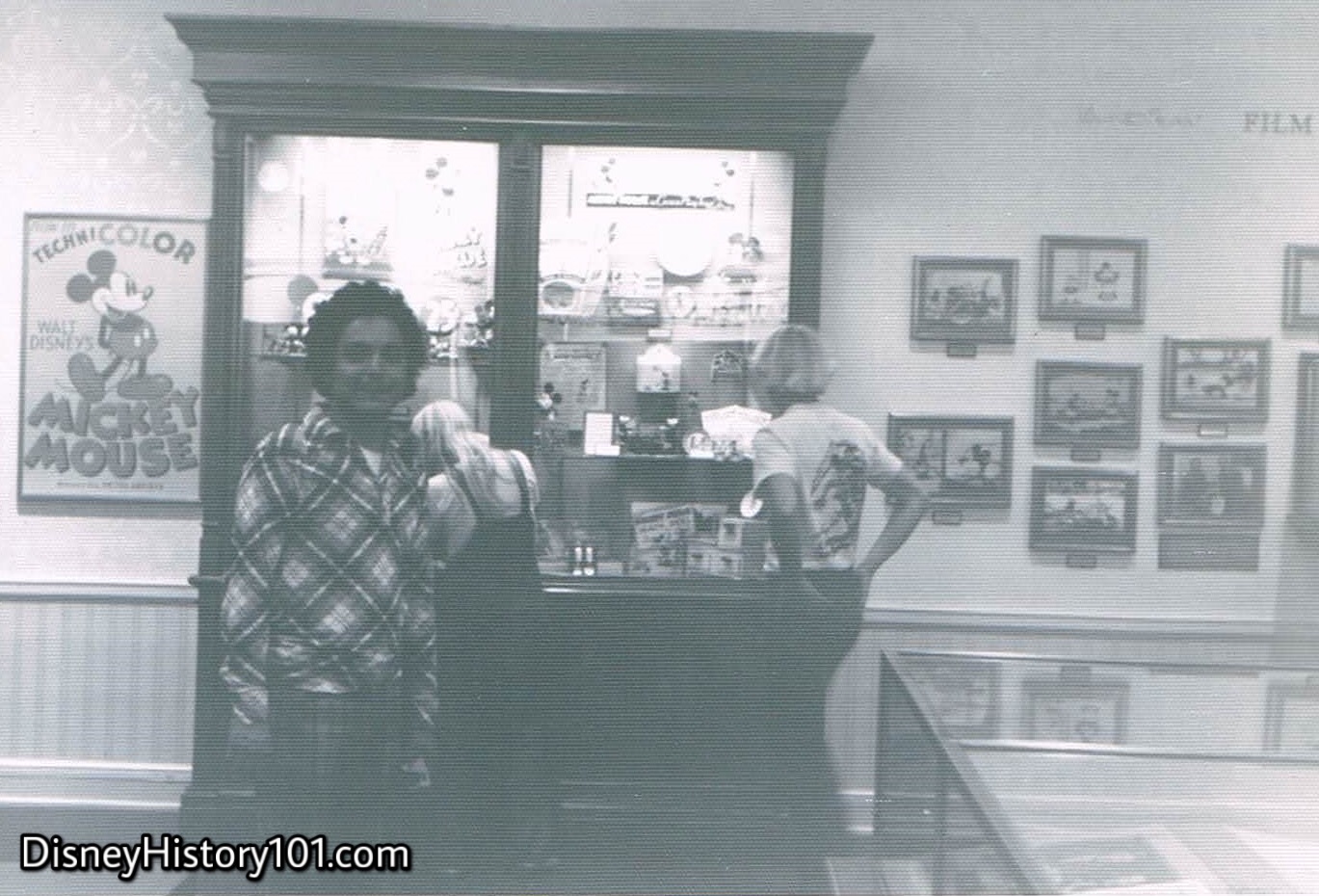
From Mickey Mouse to the Magic Kingdoms presented by Gulf Oil Corporation was a limited exhibit that ran during 1975. “The highlight of the attraction for many is a capsule history of Walt Disney’s career. The short film features Disney himself as he tells the story in his own words,” according to “Disney News” (Winter 1975/1976).
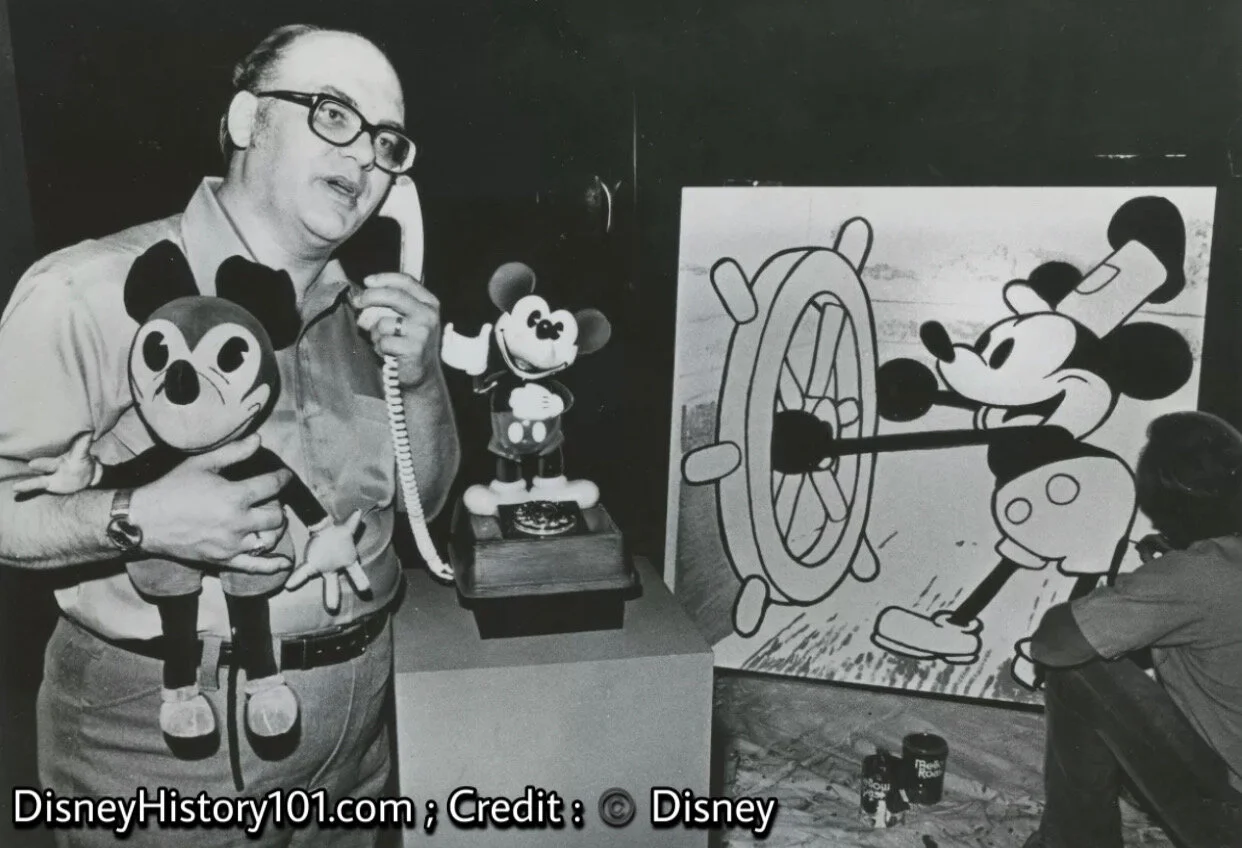
This Los Angeles Times publicity photograph (by Deris Jeanette) accompanied an article about some of the rare Mickey Mouse collectibles that were temporarily loaned for the duration of the exhibit. According to the accompanying caption, “Mickey Mouse fan Jerry Muller, at left, clutches a 1934 Mickey Mouse doll while using the latest Mickey phone, two items of the Mickey Mouse memorabilia he will be displaying at the Bowers Museum in Santa Ana, California to mark Mickey’s 50th birthday. At Muller’s right, an artist paints a facsimile of Mickey in ‘Steamboat Willie’, his cartoon debut, generally used to determine his birthday.”
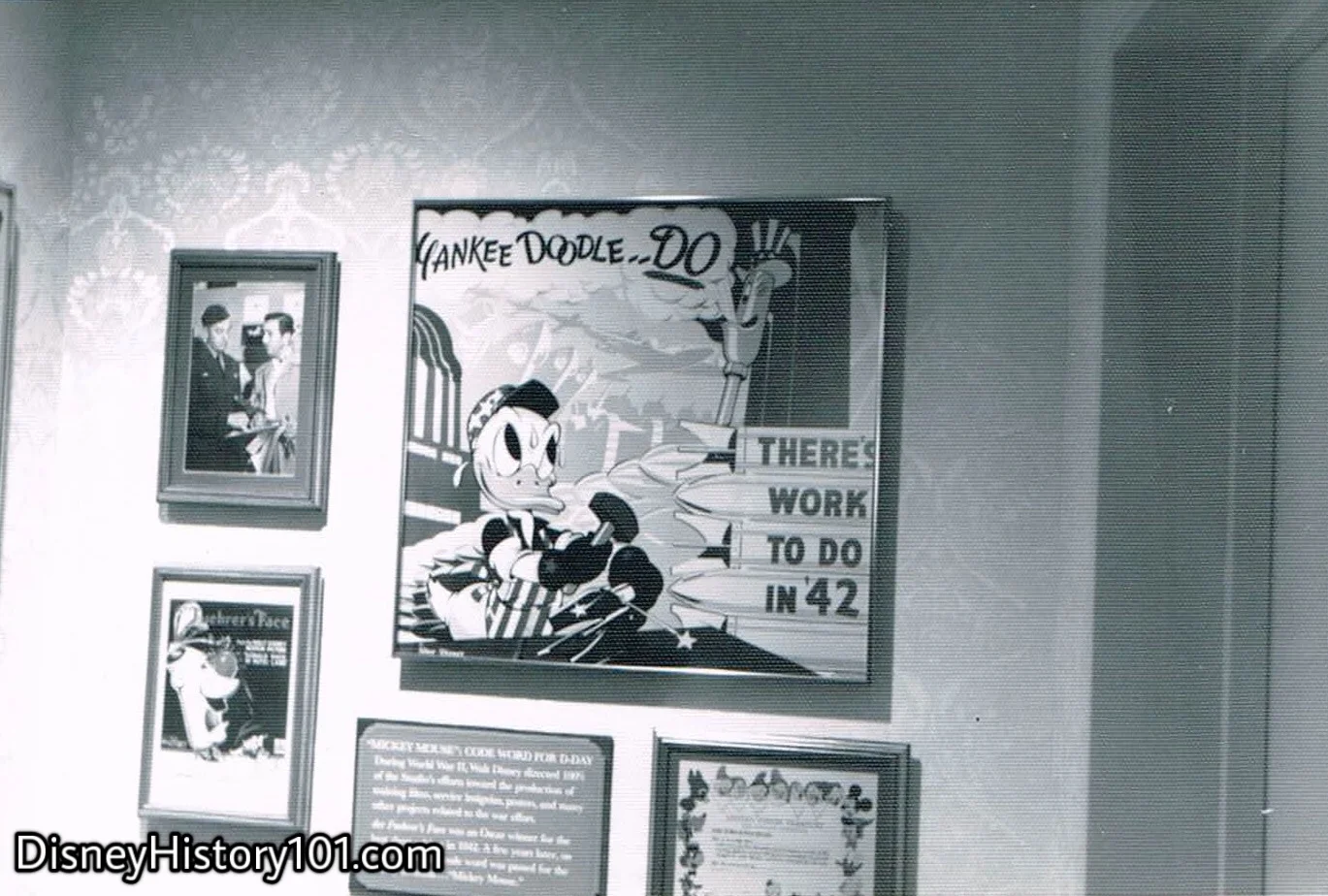
This portion of the exhibit showcased a few of Walt Disney’s wartime contributions including government-funded short films, United States Bond Certificates, illustrations utilized on bills and wartime insignia (featuring Walt Disney’s characters) provided to various branches of the United States Special Forces.
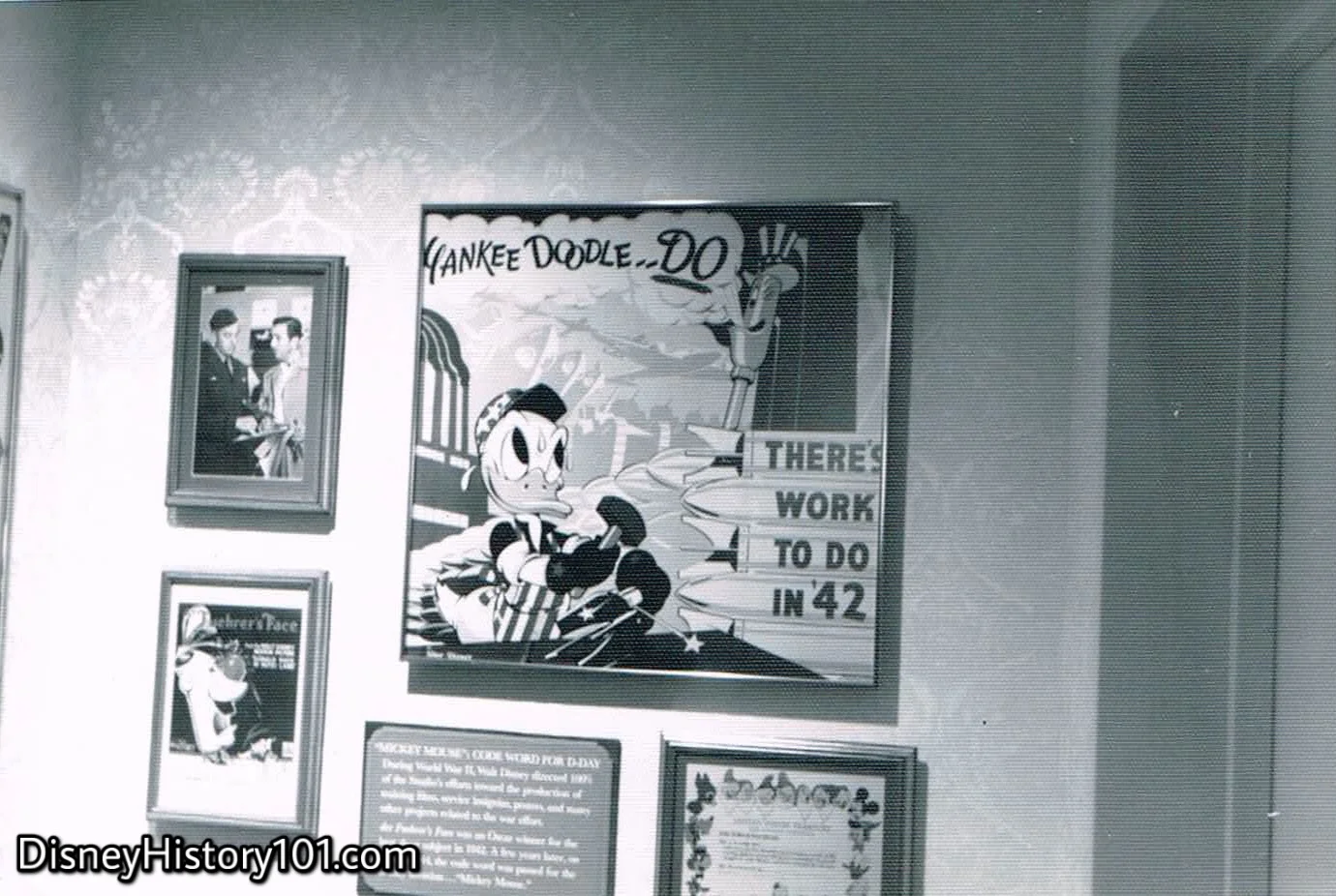
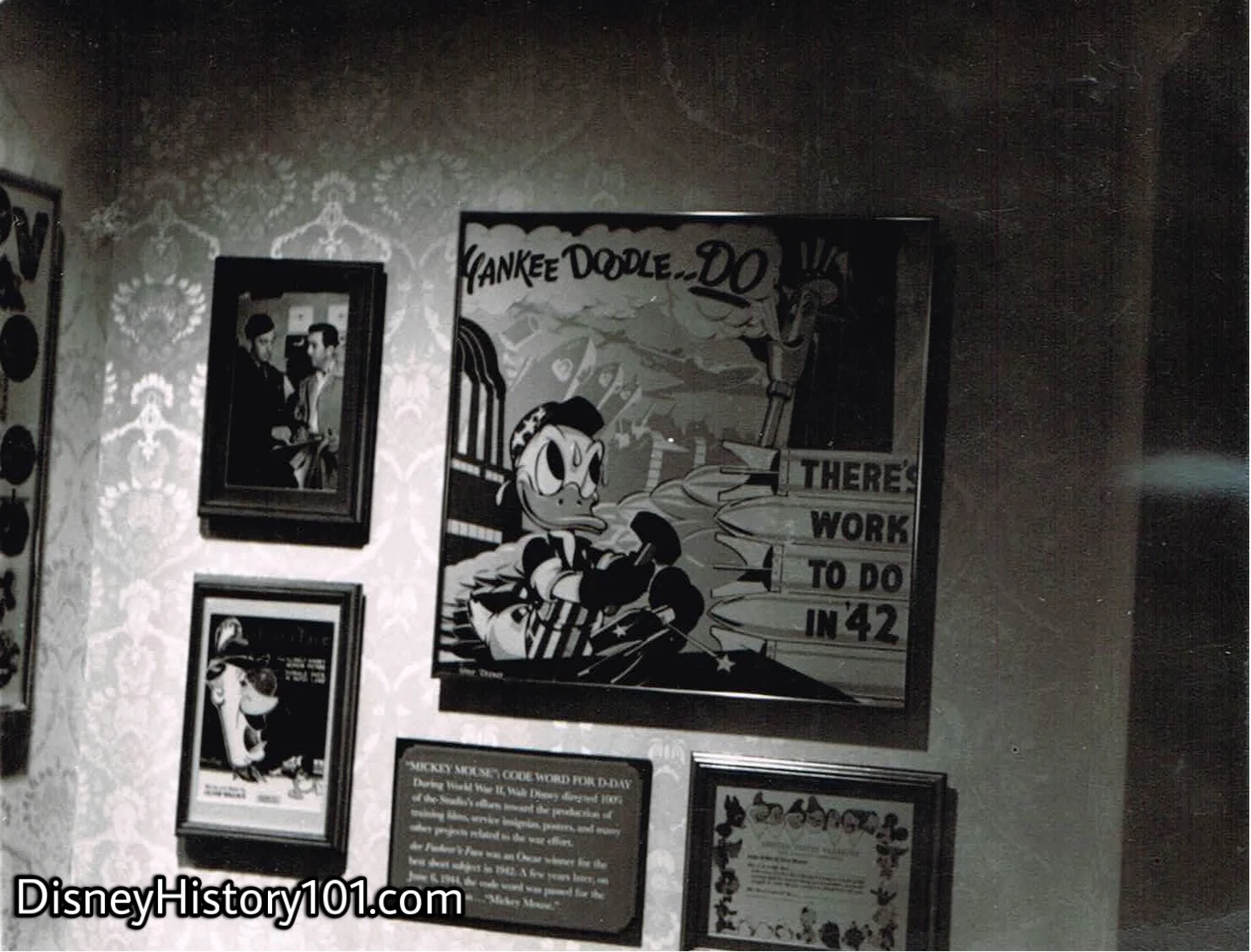
Another part of the exhibit displays artifacts pertaining to Walt Disney’s various contributions toward the (World War 2-era) war efforts. Some of these pieces related to training films, artwork featured on war bonds, and artwork created for insignia.
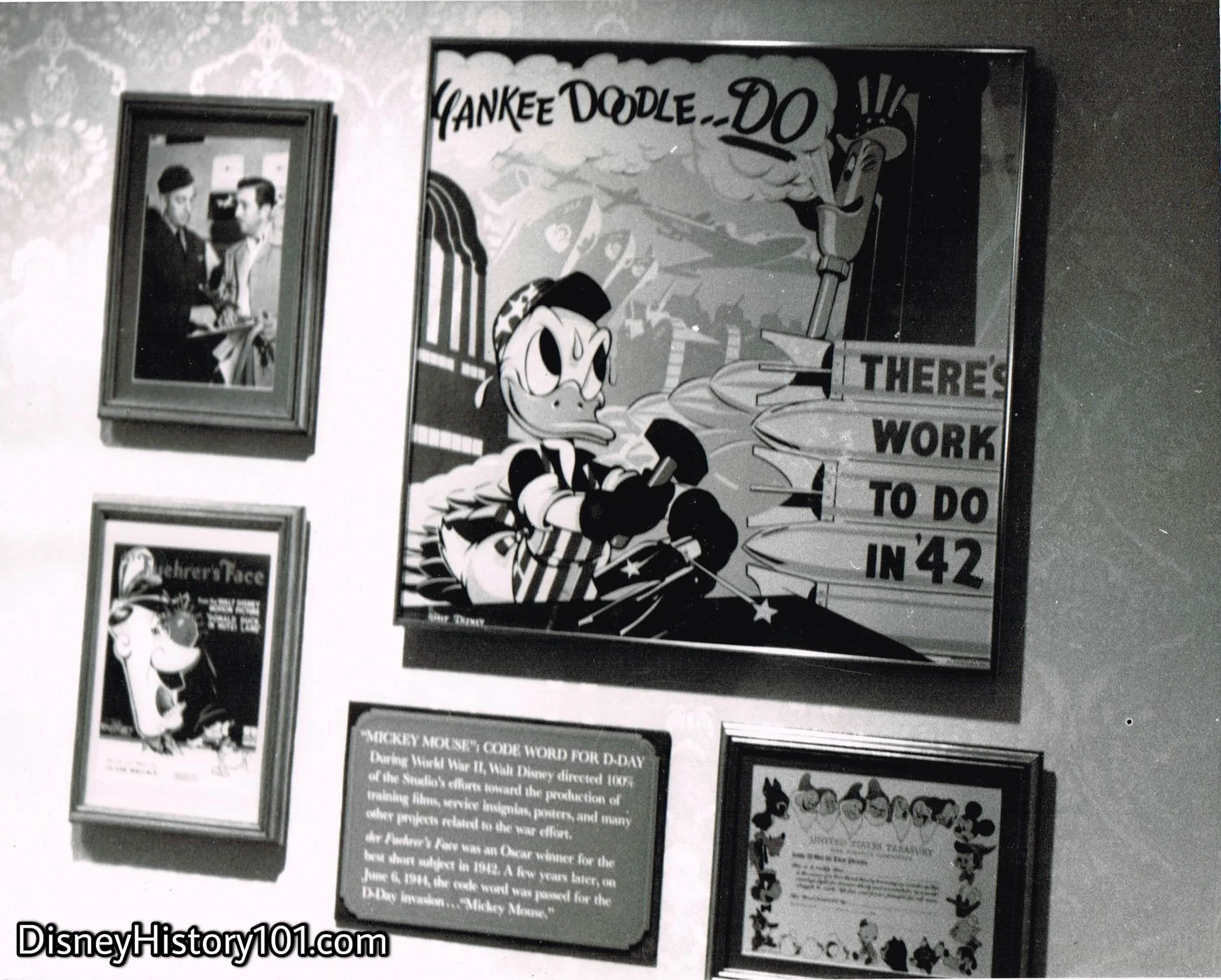
From Mickey Mouse to the Magic Kingdoms presented by Gulf Oil Corporation was a limited exhibit that ran during 1975. Another exhibit highlighted moments of “Walt Disney’s Dream Come True” - Disneyland! “One of the most intriguing displays of The Walt Disney Story concerns Disneyland. Surrounded by photographs taken during the building of the Park, a small viewing screen shows a speeding-up movie of the actual construction. Thus, the one-year-plus-one-day construction project, which turned an orange grove into a Magic Kingdom, is seen in only three minutes,” according to “Disney News” (Winter 1975/1976).
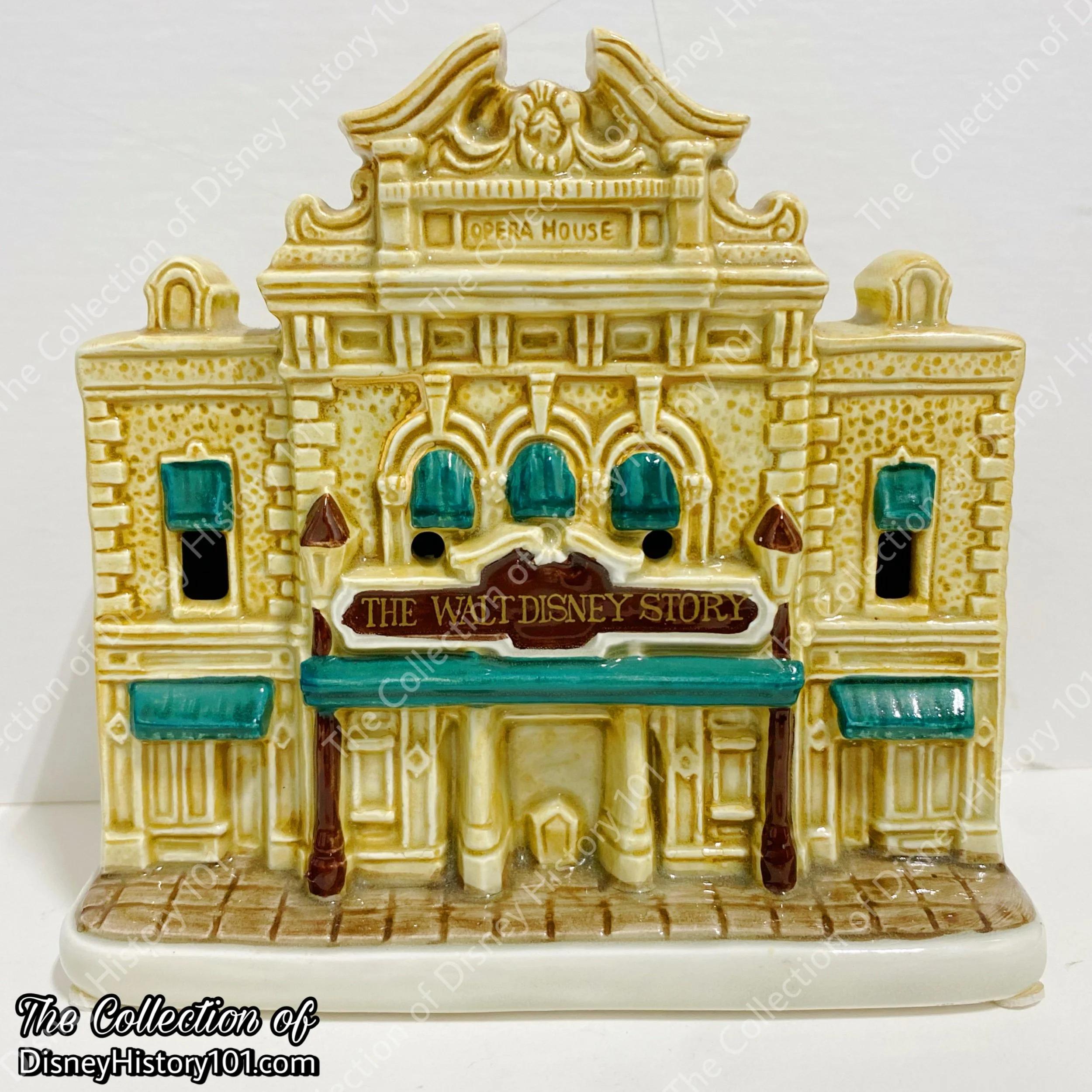
By 1981, The Walt Disney Story was a free attraction with a cycle time of 14.52 minutes, they show capacity of 500, and the capacity of 2000 Guests per hour.
“Main Street Opera House (or ‘Lincoln Theater’) Special Exhibits”
The late 1970s began to bring unique exhibits, attractions, and events to the Main Street Opera House! “Candidates for the City of Anaheim’s 1978 City Council elections” appeared at the Main Street Opera House [at 7:30pm] on April 6th, 1978, “as part of our Community Affairs Department - sponsored ‘Know Your Home Town.’”
During the ninth annual “Festival Japan” (October 12 & 13, 1985), Kookyu and Kumiko Serizawa’s Doll Exhibit was housed in the Great Moments with Mr. Lincoln Lobby from 9a.m. to 6p.m. Guests were inspired by the exhibit like Charra DeMarco (a contemporaneous Disneyland Word Processing Specialist) who became interested in doll making during a previous Festival Japan event held at Disneyland, and soon signed up for a class taught by Kumiko Serizawa. Charra’s teacher was so impressed, that “the DeMarco’s dolls were chosen to be in the exhibition… in the Park.” [Disneyland Line, Vol. 17, No. 41] As brief as this exhibit was, it would inspire an interest in Japanese culture within Disneyland Cast Members and guests, and would pave the way for other cultural events and exhibits showcased at the Main Street Opera House!
In addition to the special exhibits and shows, the “Lincoln Theatre” also became the stage for the occasional special Cast Member Exclusive presentation.
For instance, the EPCOT Center Project Update was presented at the Lincoln Theatre in Disneyland from July 11-16, 1982. The presentation was hosted by Ron Dominguez, and showcased the film “Epcot Behind the Scenes”. The presentation also featured the latest construction slides along with theme music from Pavilions, gave updates about Operations and Entertainment/Marketing plans.
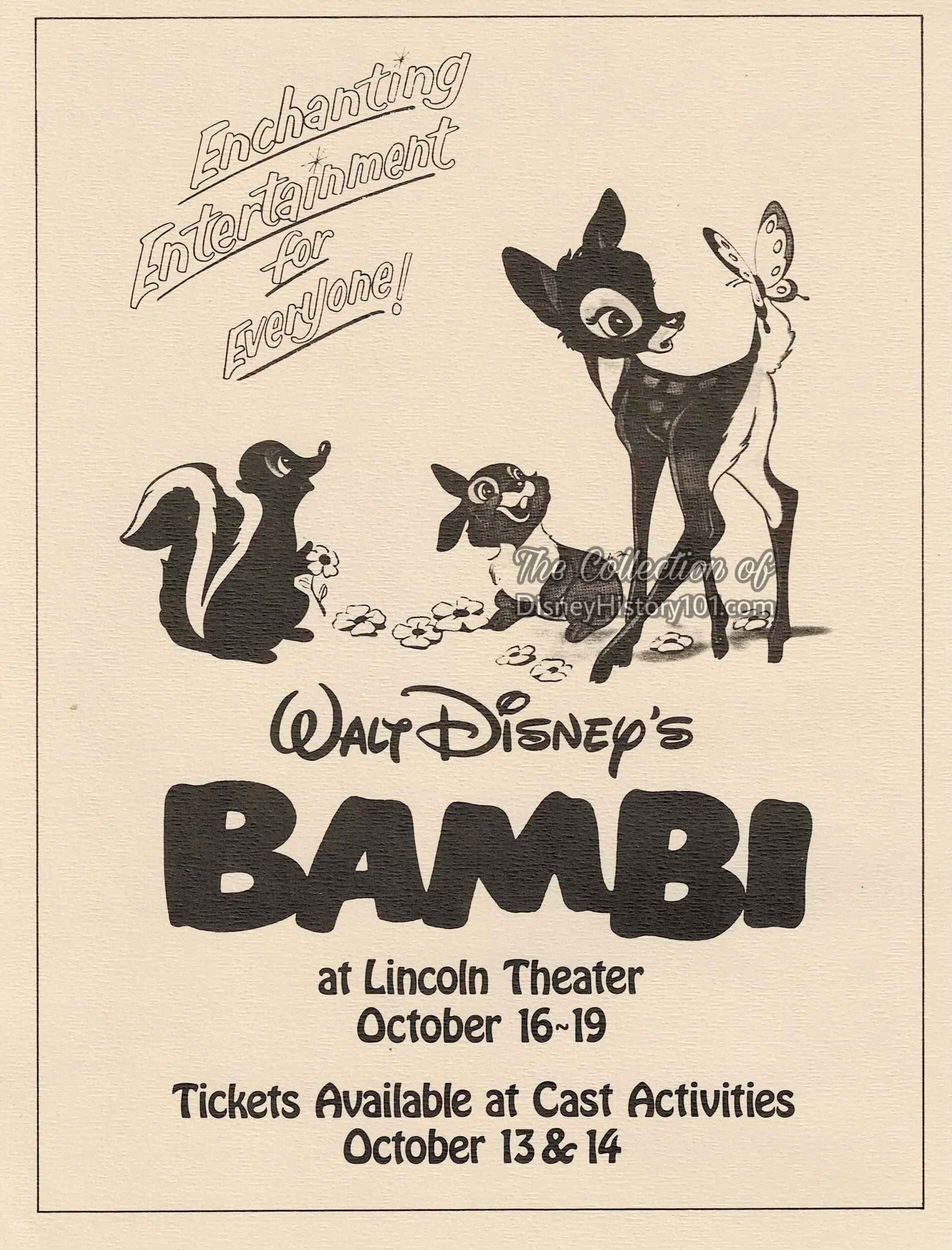
“Film Festivals”
Throughout the year, Cast Activities arranged for Cast Members and their families to have the opportunity to attend special showings of Disney films. Each spring and fall, a series of five “classics” was lined up for viewers to choose from, with showing times established around Park operating hours. In addition, new Disney films were previewed for Cast Members, generally before the film was released to the general public, through our Cast Film Premieres.
Tickets for all films were complimentary. Disneyland Cast Members may recall ticket information was often advertised through the covers and pages of Disneyland LINE magazine, while tickets were usually distributed On Site, through the Center (before Company D opened December 2, 1988 ; and Company D II soon followed, offering tickets as well).
Back in the 1960s, the Fall Film Series was presented (usually from the Mickey Mouse Theater). In the late 1970s, seasonal film festivals (twice a year, in the Spring and Fall) brought Cast Premiers of Walt Disney Productions to the Main Street Opera House.
Some of the earliest showings (held during the weeknight of the spring of 1977) were Walt Disney’s Sleeping Beauty, The Shaggy D.A., Freaky Friday, and The Love Bug (which had recently been released theatrically). The Fantasyland Theater also hosted showings (as Walt Disney’s Pinocchio), and all the films were shown with Walt Disney’s short films (like “Moose Hunters,” “Moving Day,” “For Whom the Bulls Toil,” “Boat Builders,”and others. The Song of the South was shown (from November 14th - 17th), with The Third Man on the Mountain being the last show of the Fall Family Film Festival, during 1977.
The following year, (March 13, 14, 15, and 16, 1978) brought Walt Disney’s “The Parent Trap” to both the Lincoln Theater and the Fantasyland Theater.
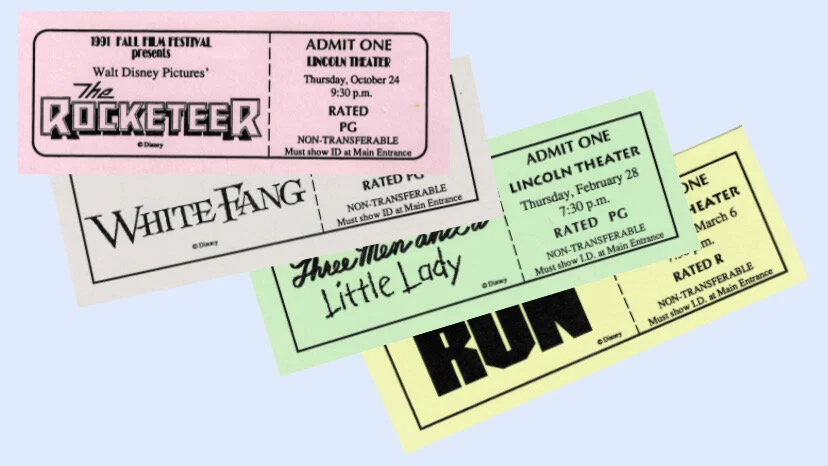
The Fall Film Festival of 1980 (for instance), brought “The Last Flight of Noah’s Ark” (the first Fall Film Festival showing of the year), “White Wilderness” (the True-Life Adventure), Walt Disney’s “Dumbo” with “The Brave Little Tailor”, and even Walt Disney’s “Song of the South”. As you can see, the feature-length films presented were eclectic - from Walt Disney’s classics to recent releases, and from live-action to animated! The year 1983 saw Cinderella (in February), while 1986 saw The Flight of the Navigator, Ruthless People, and Tough Guys shown on the big screen. Fast forward to the year 1987 (when the Cast Activities Disneyland Family Film Festival tradition still continued), bringing Cast Premiers of Walt Disney Productions (like “Peter Pan,” “Cinderella,” and “The Fox And The Hound”), Touchstone Pictures (like “Stakeout”, “Can’t Buy Me Love”, and “Adventures In Babysitting”), and “Benji The Hunted” to the Lincoln Theater and the Videopolis Stage. The Disneyland Hotel Grand Ballroom was also occasionally used as a theater (as for the August 24th, 1988 Special Cast Premier of “The Rescue”), but the “Lincoln Theater” (or Main Street Opera House) was still the preferred venue for the showings.
Fall Film Festivals (at the “Lincoln Theater”, at least), would briefly cease for a rehabilitation. During the 1990s, the 40-year-old original facade of the Main Street Opera House was given an “opulent” makeover - parts were recast in fiberglas and details (like the theater masks and filigree) were stripped and a glaze was added to enhance the original sculpts. After so many years, the awnings over the windows were removed, and it was decided to leave them off, in order to show off the detail around the windows.
Once the new Main Street Opera House was re-opened, the “Lincoln Theater” hosted the “35th Anniversary Cast Celebration” - “an exciting preview of future events and projects with your hosts Dick Nunez, Ron Dominguez, and Hideo Amemiya”. Refreshments were served, and reservations [to 1 of 18 showtimes, spread across January 6th - 9th, 1990] were made in the name of each current Cast Member. After the “35th Anniversary Cast Celebration”, there again occurred a special synergistic arrangement between Walt Disney Studios and Disneyland! Disneyland Cast Members and their immediate family members were once again treated to Walt Disney Film Festivals - opportunities to watch Walt Disney Pictures and Touchstone Pictures on the silver screen (in most cases) before their national release dates. Among the films shown were animated feature length films Walt Disney’s Snow White and the Seven Dwarfs and Walt Disney’s The Jungle Book. Live action feature length films that the whole family could enjoy - Blank Check, White Fang, A Far Off Place, The Mighty Ducks, The Rocketeer, Cool Runnings, Cool Runnings, Swing Kids, and many, many, more! Other Touchstone Pictures and Hollywood Pictures as The Distinguished Gentleman, Three Men And A Little Lady, Green Card, Run, Scenes From A Mall, The Color of Money, and Ruthless People were rated “R” (and as children under 17 were not permitted without a parent or guardian), Disneyland Cast Members had to decide whether or not they would bring their entire family to the special screenings. Admission for all showings required the purchase of a ticket through The Center, and a display of their Cast member I.D. and Main gate Pass. As a “sidelight”, during the same era, Disneyland Cast Members could also purchase Walt Disney Home Videos of feature-length films in VHS and Beta formats, available at the Center.
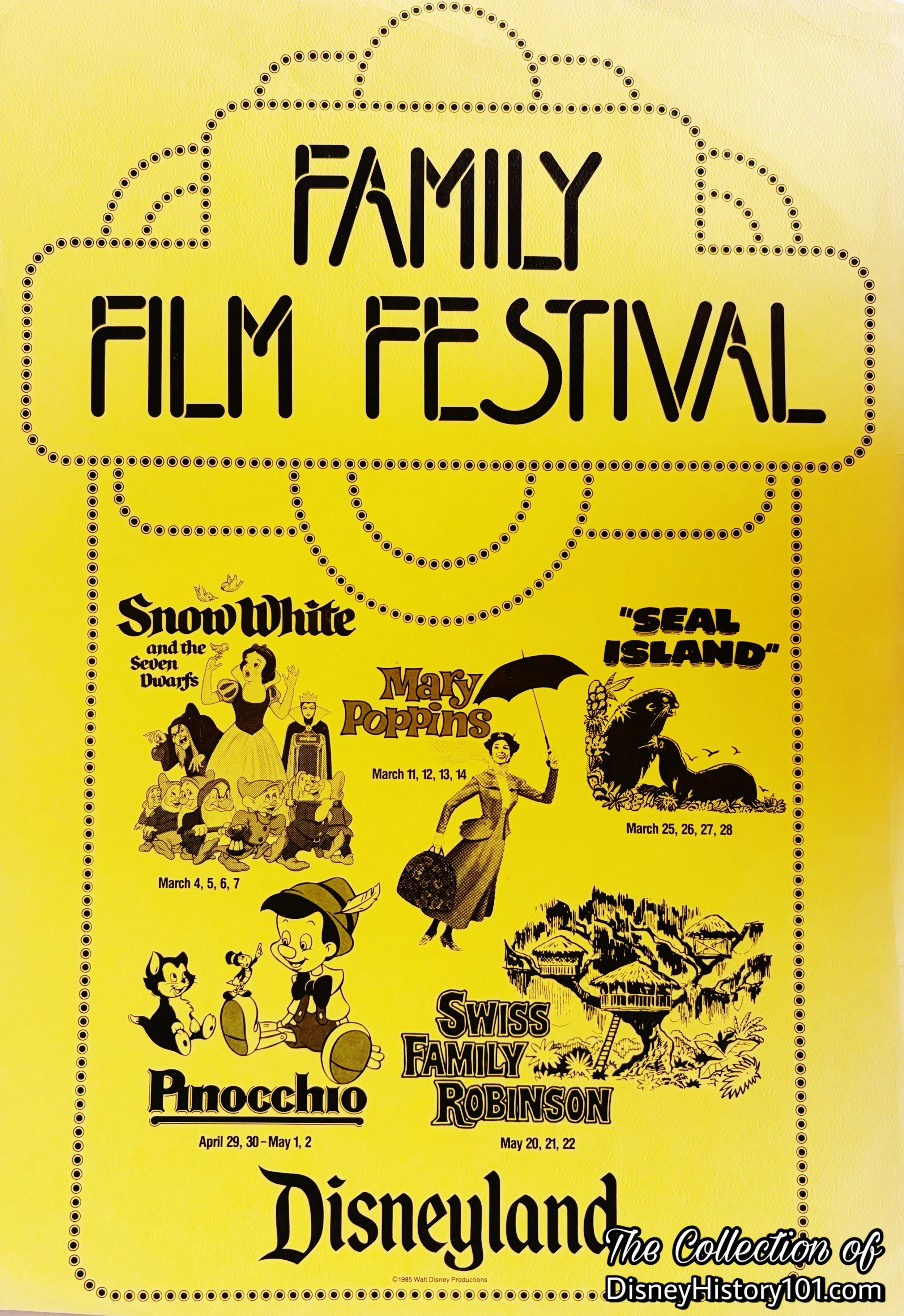
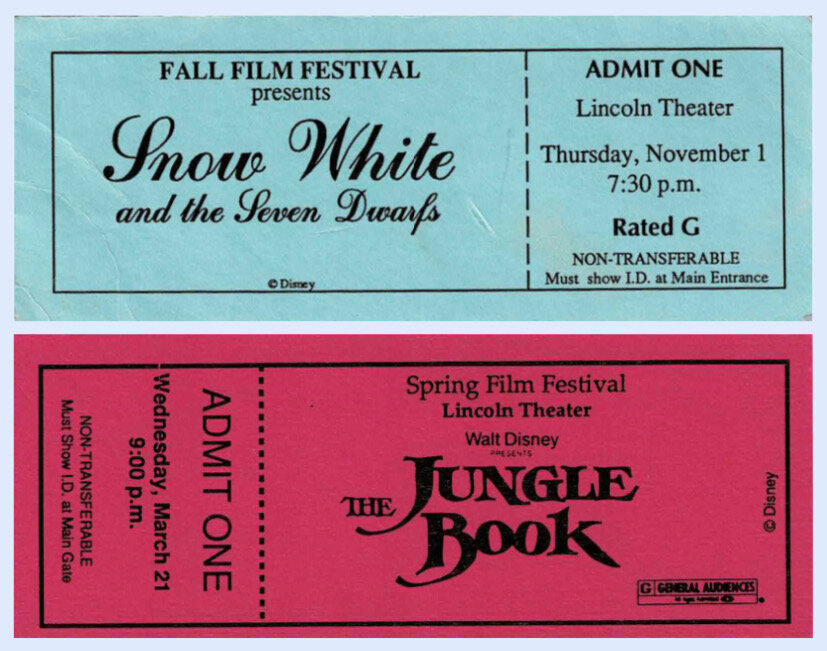
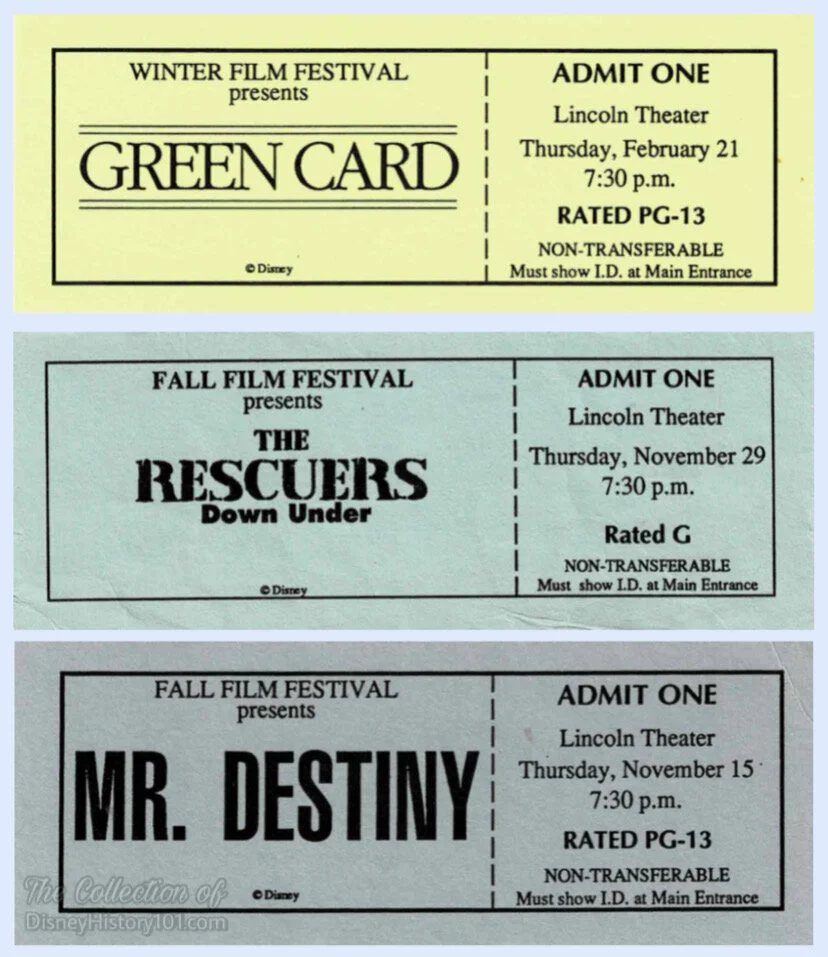
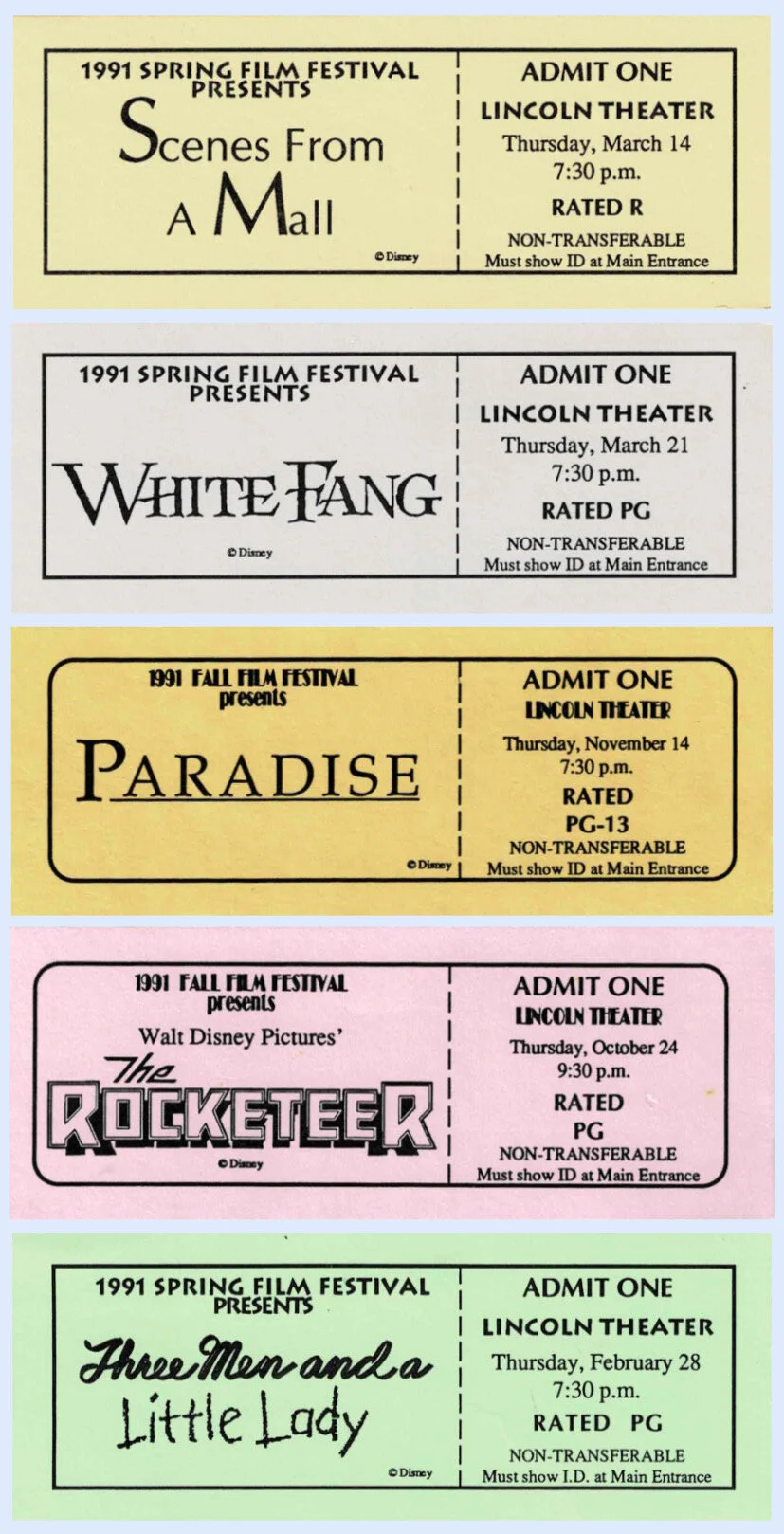
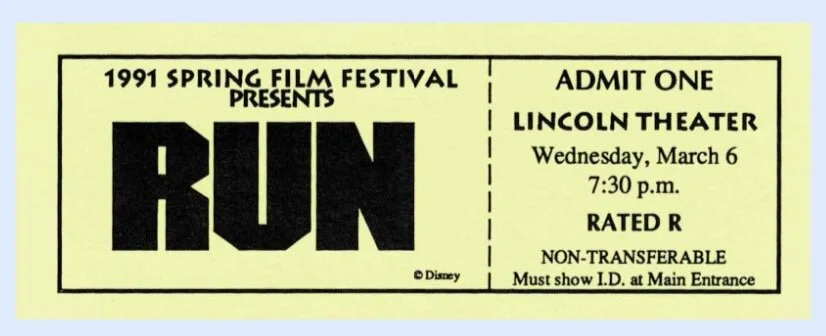
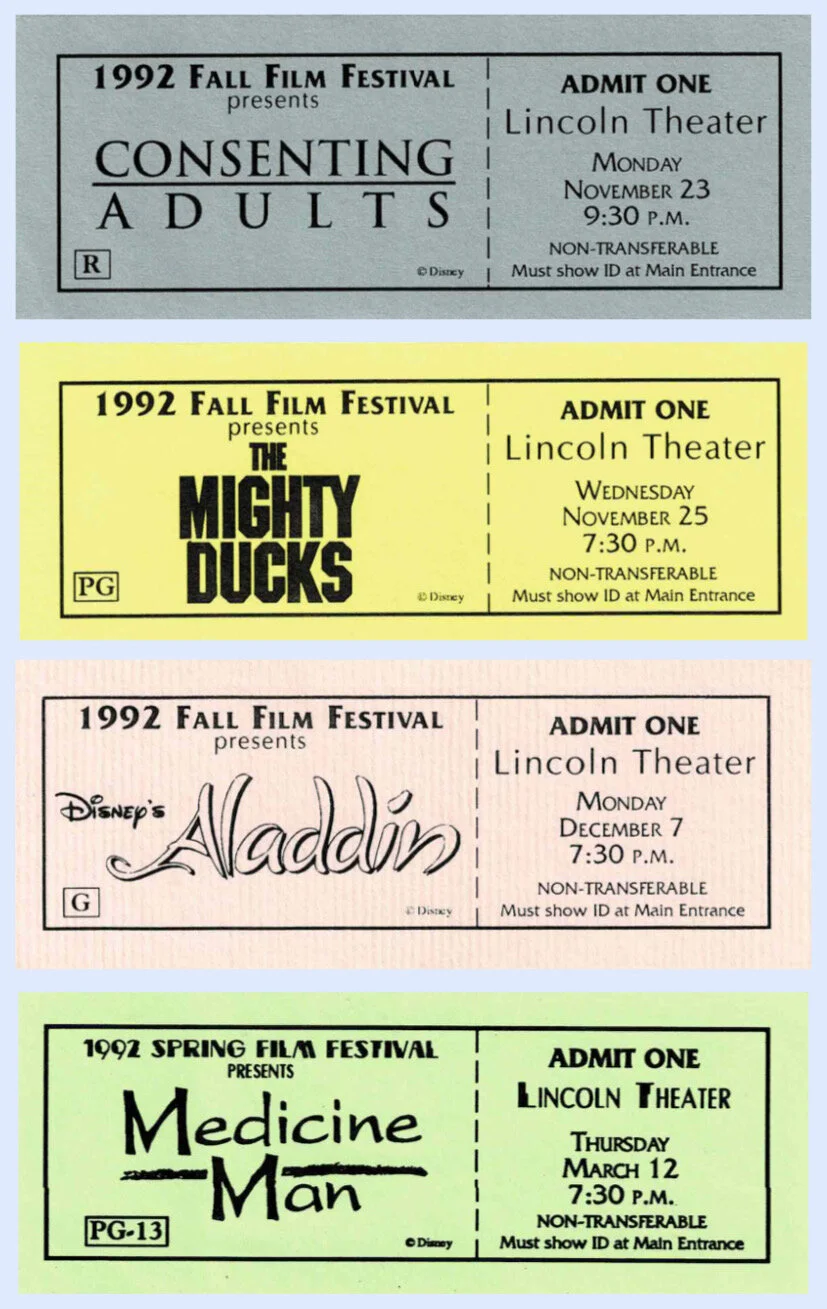
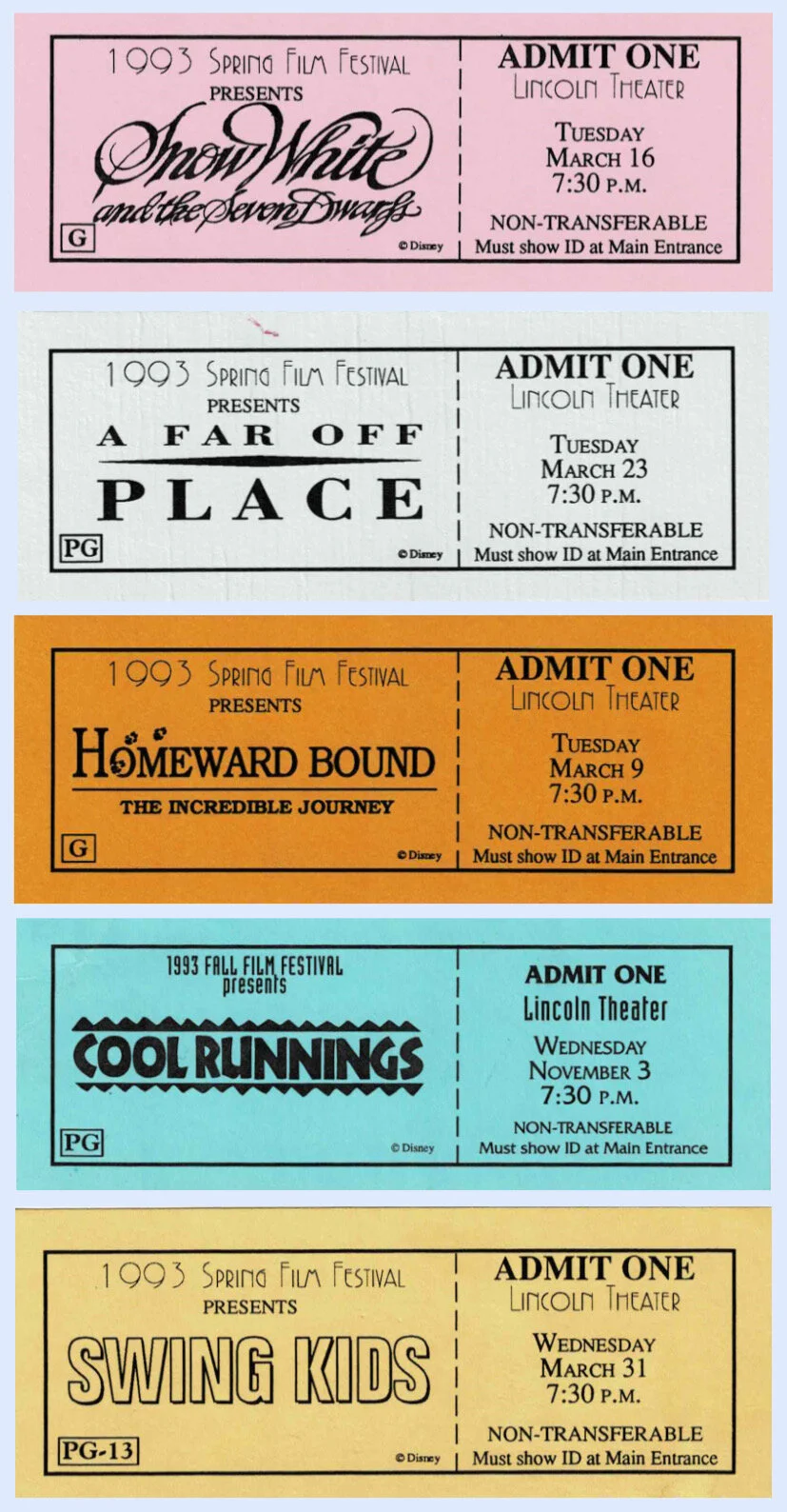
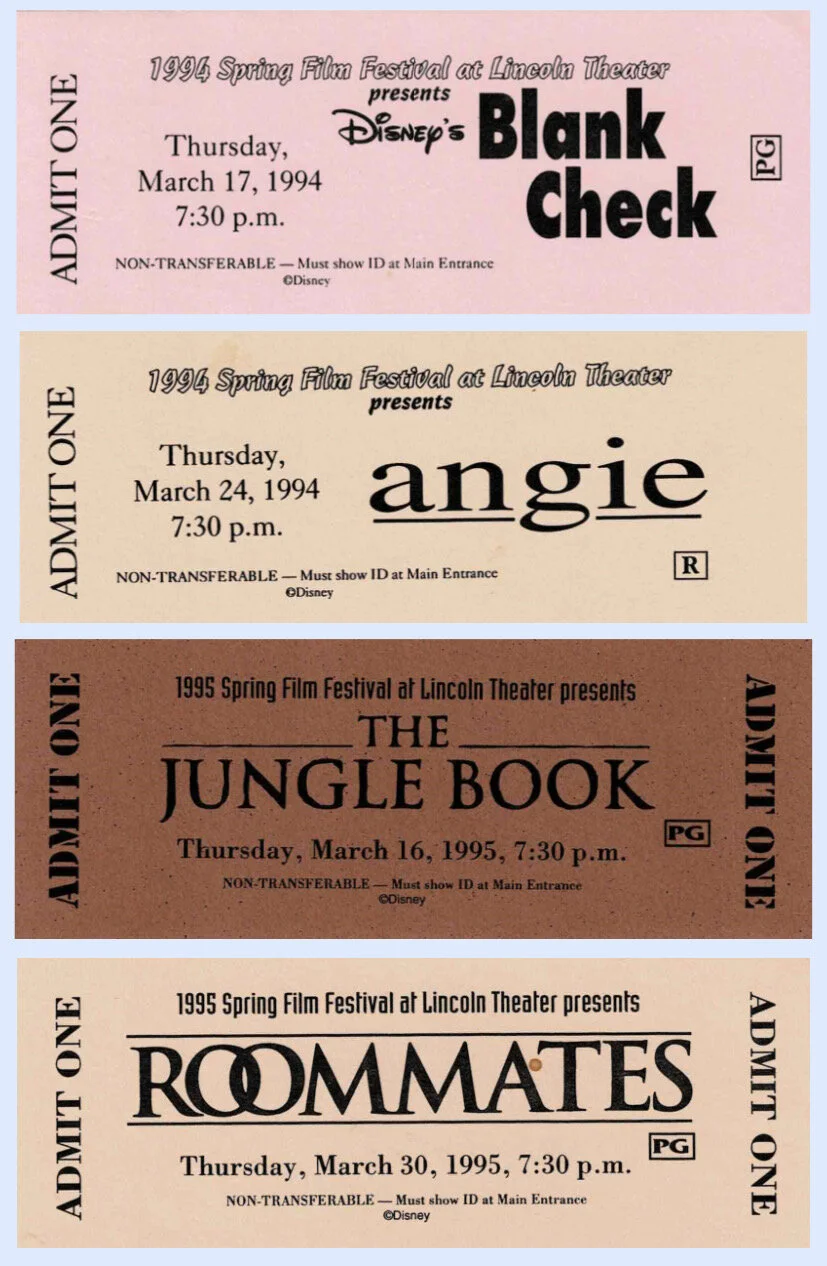
By 1996, The Walt Disney Story, featuring “Great Moments with Mr. Lincoln” was a Lobby show presenting the story of Walt Disney and The Walt Disney Company, while the Audio-Animatronics® theater show still honored the 16th President of the United States.
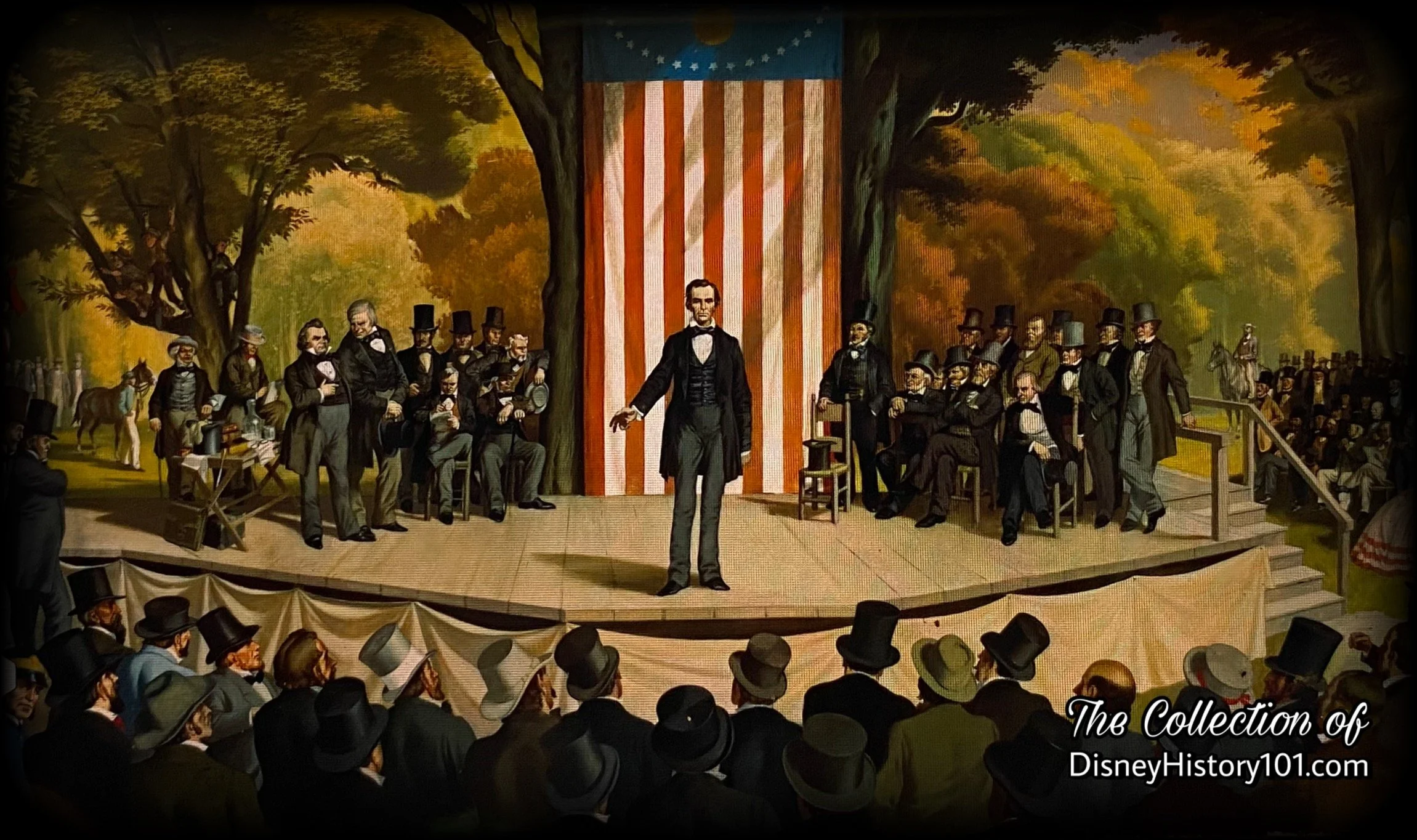
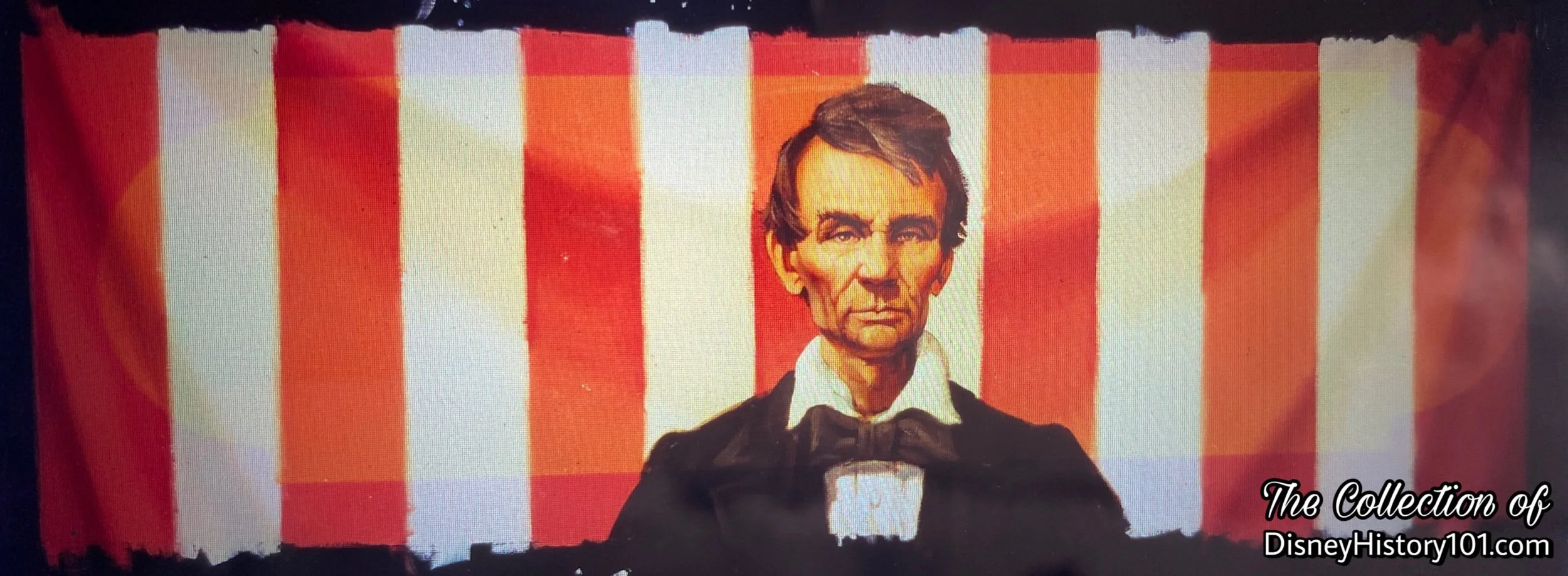
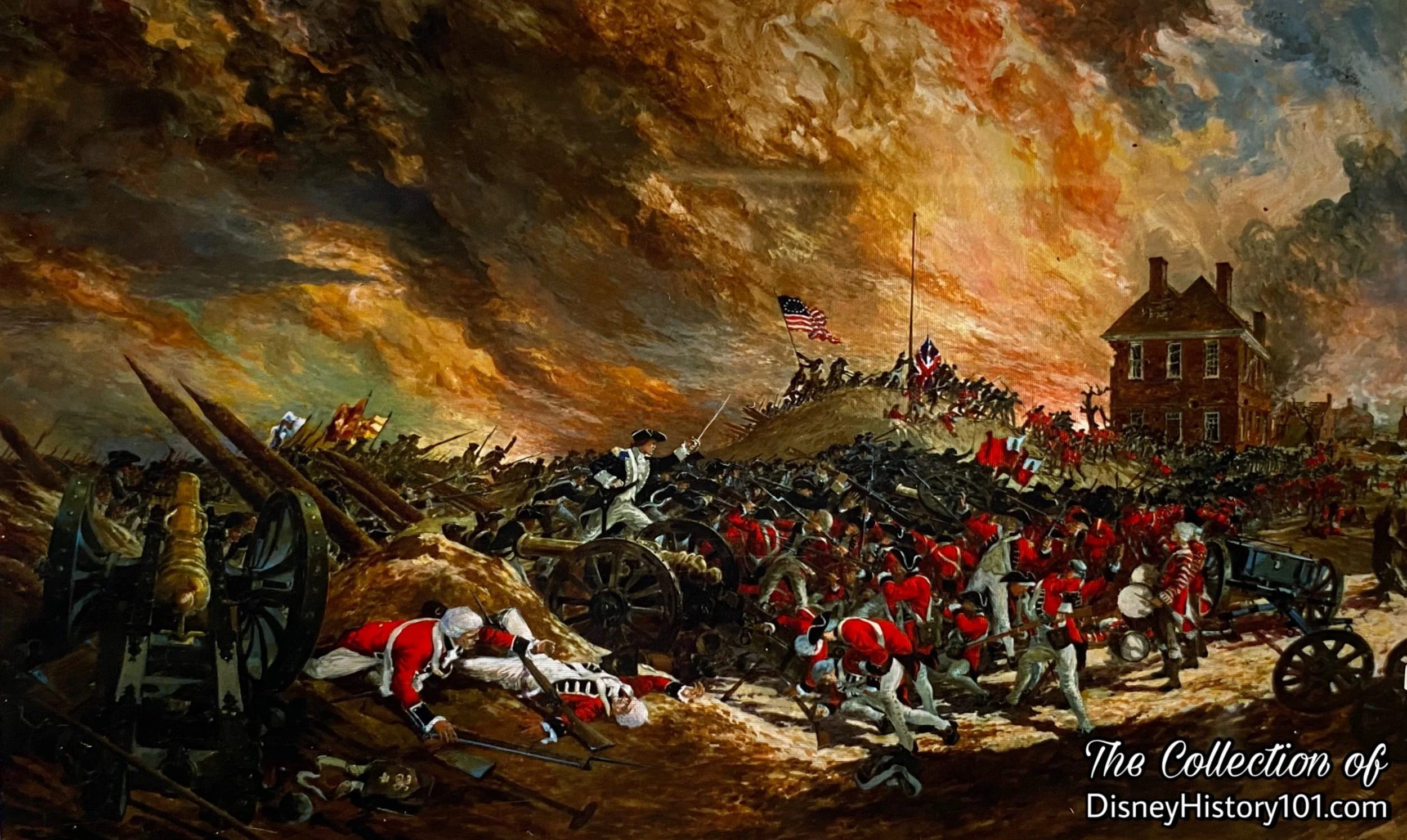
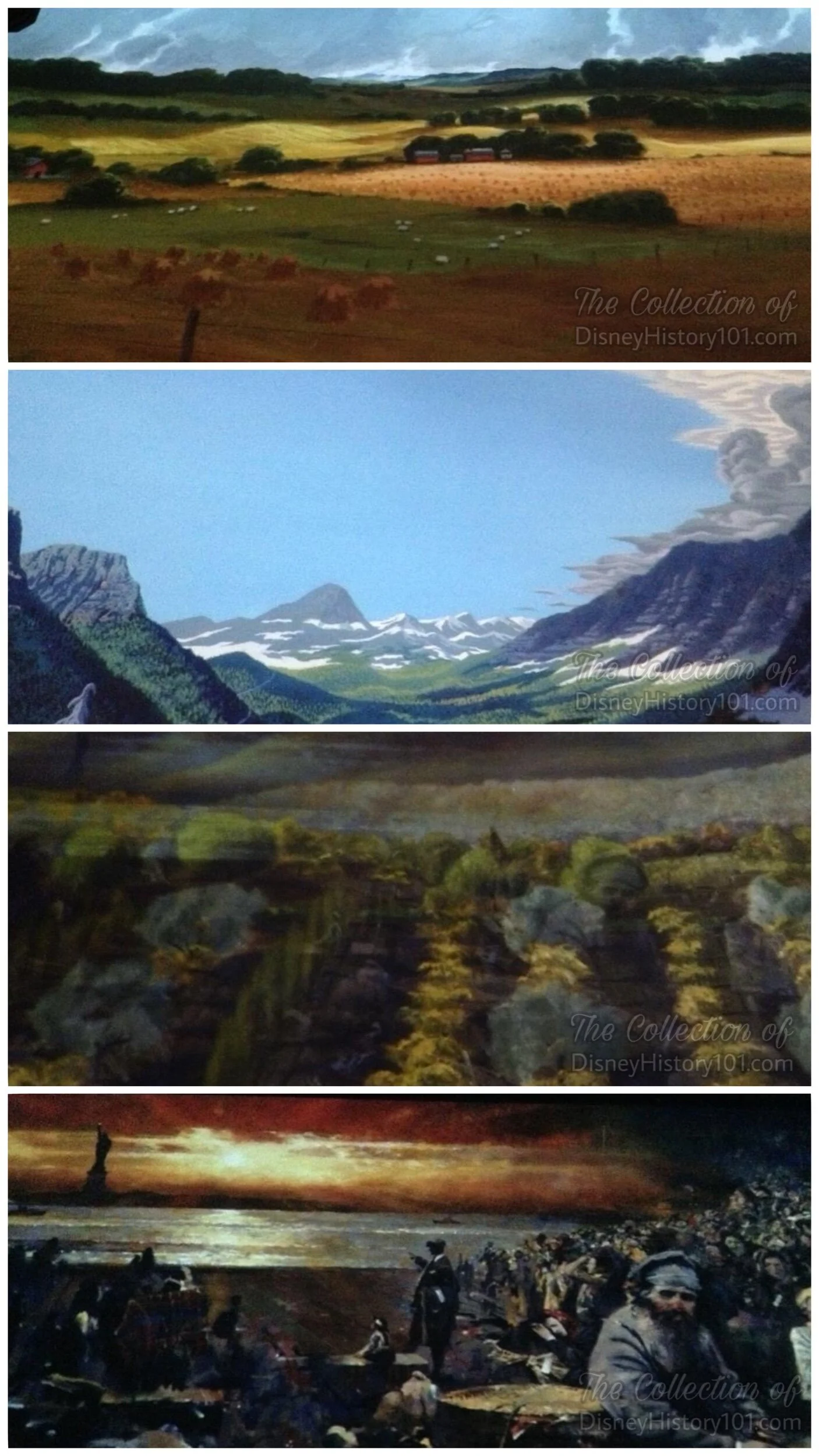
You may have seen some of these scenes before. Slides include imagery like Herb Ryman’s Immigrants at Ellis Island (a 51”x93” oil painting) originally produced c.1982 for The American Adventure at EPCOT Center.
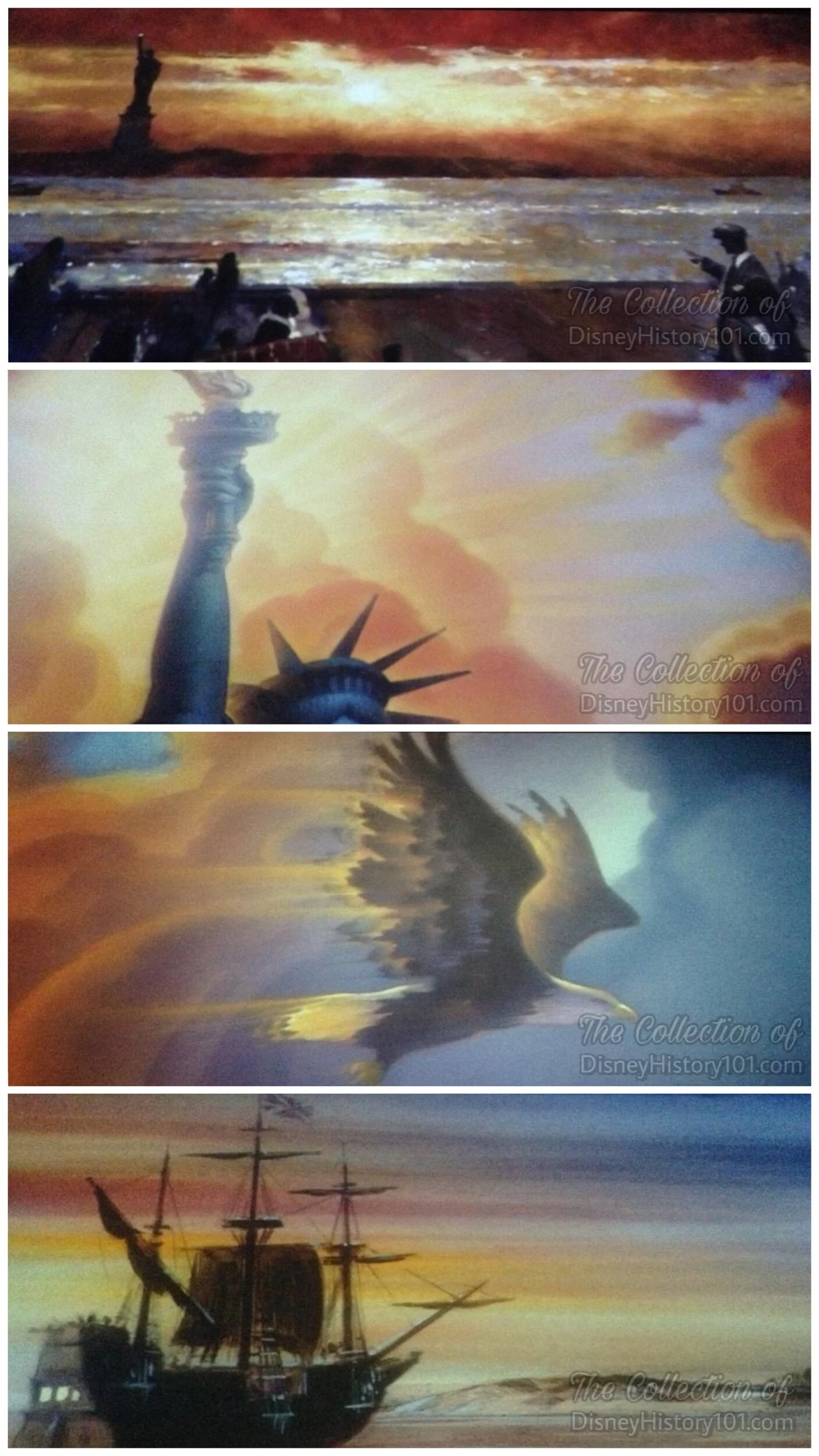
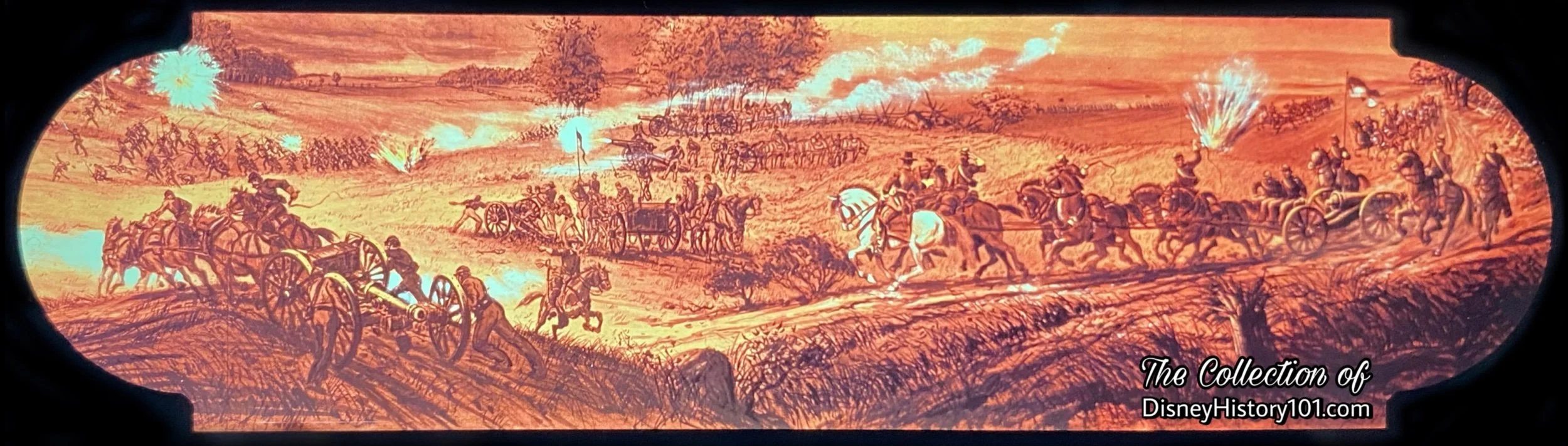
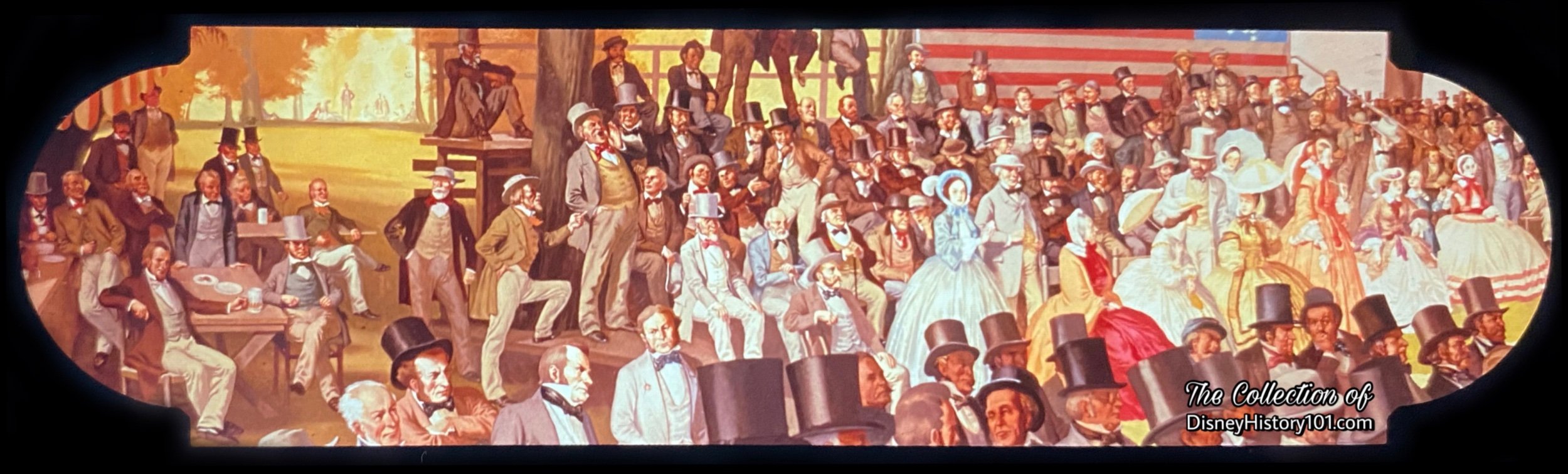
In 1999, Master Plans included a “Muppet Theater” located here.
A new slide show and Audio-Animatronics animation was added in 1984, enabling Mr. Lincoln to hold a paper in his hand for the first time. In addition, to two new songs originally written for The American Adventure, part of the American Pavilion at EPCOT Center. “Golden Dream” (with orchestration by Robert Moline, lyrics by Randy Bright & Lynn Hart, and vocals by Richard Page and Siedah Garrett), and “Two Brothers” (a traditional folk song with orchestration by Irving Gordon and lyrics by Ali Olmo).
Show Enhancement - “In 2001 the show was changed to focus on the Civil War,” according to Dave Smith (Chief Archivist Emeritus of the Walt Disney Archives). The short film told the tale of “Two Brothers,” who fought on separate sides of the American Civil War. The show featured glass magic lantern slides of true-life Civil War-era images, to “Two Brothers” (with orchestration and lyrics by Irving Gordon).
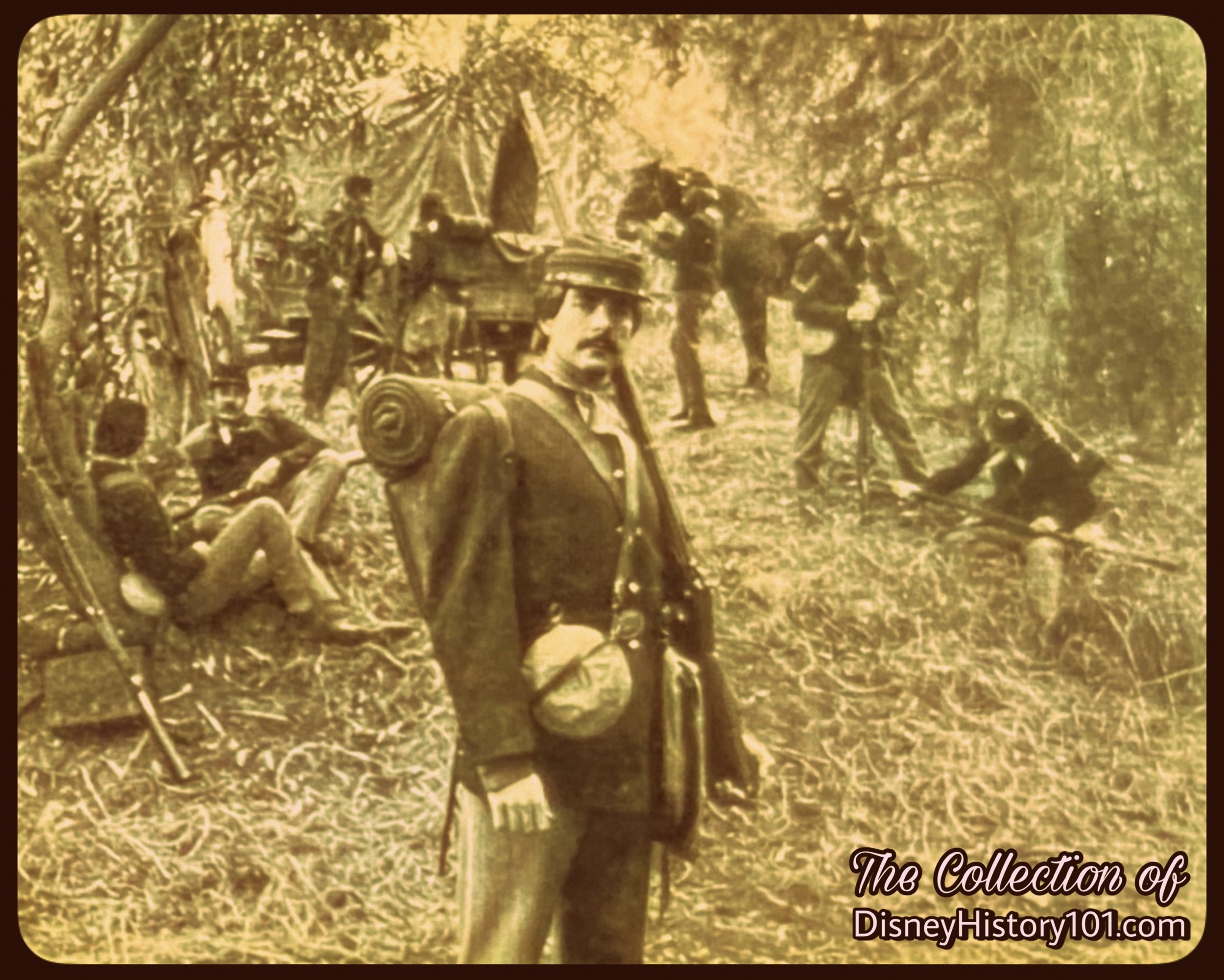
“Two brothers on their way,…”
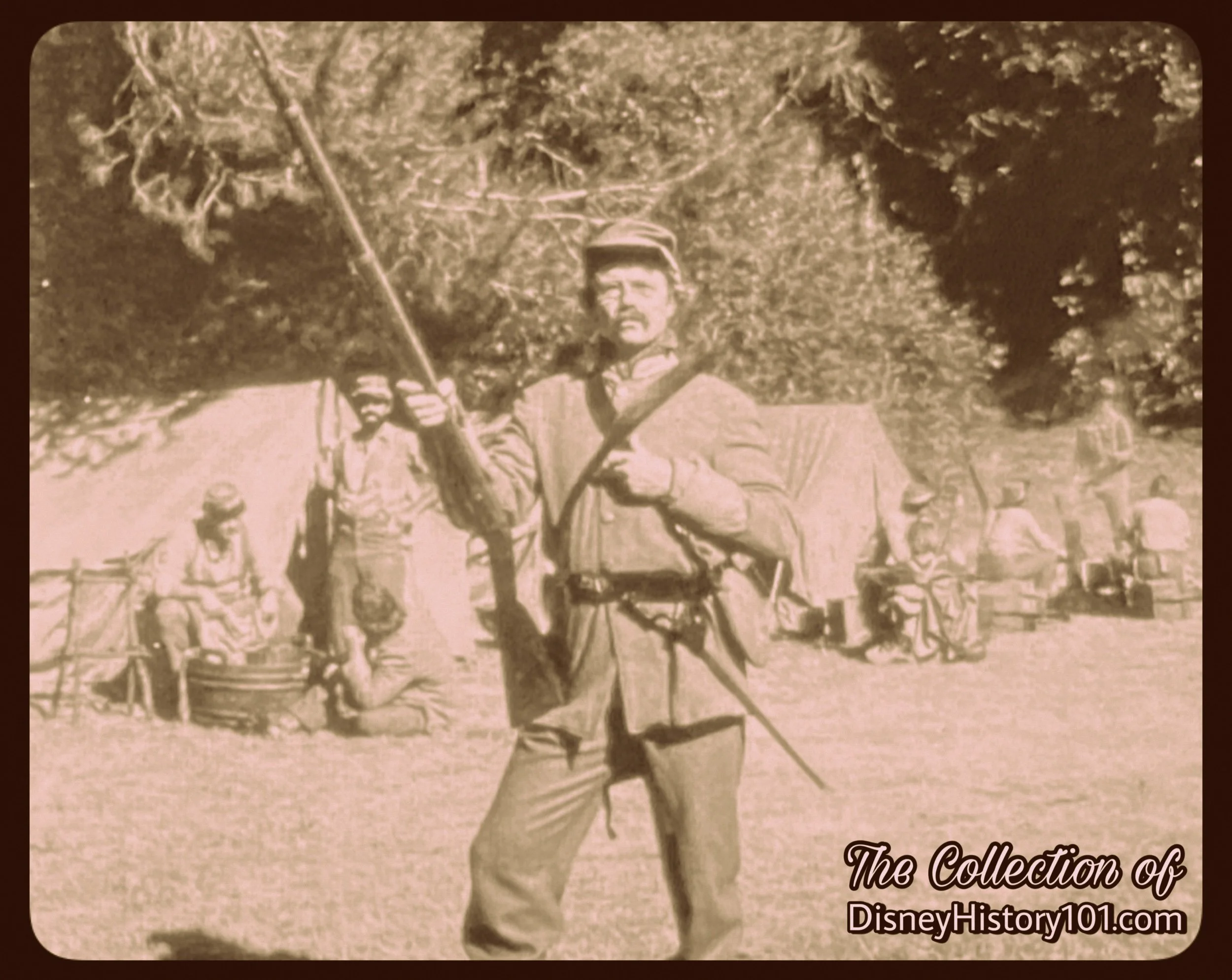
“Two brothers on their way.”
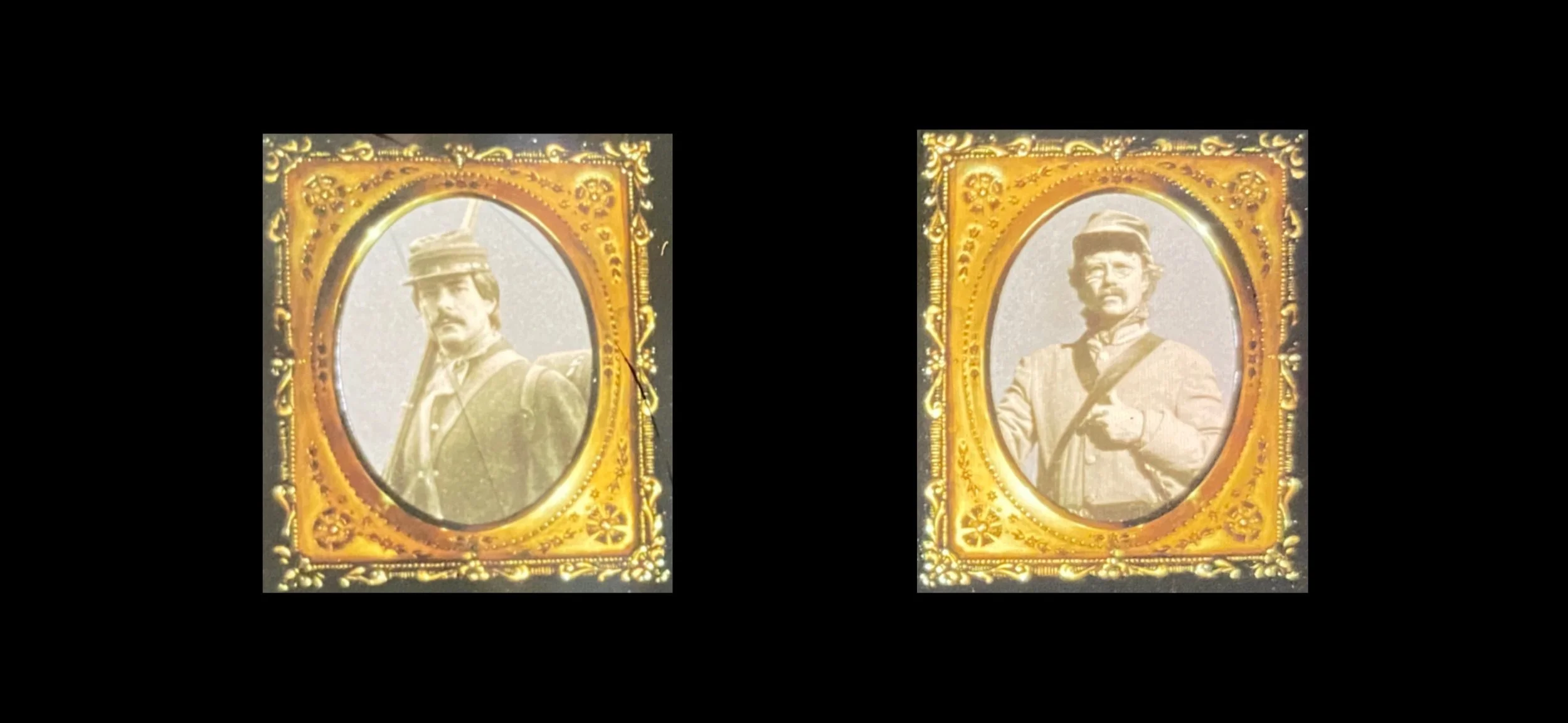
“One wore blue and one wore gray.”
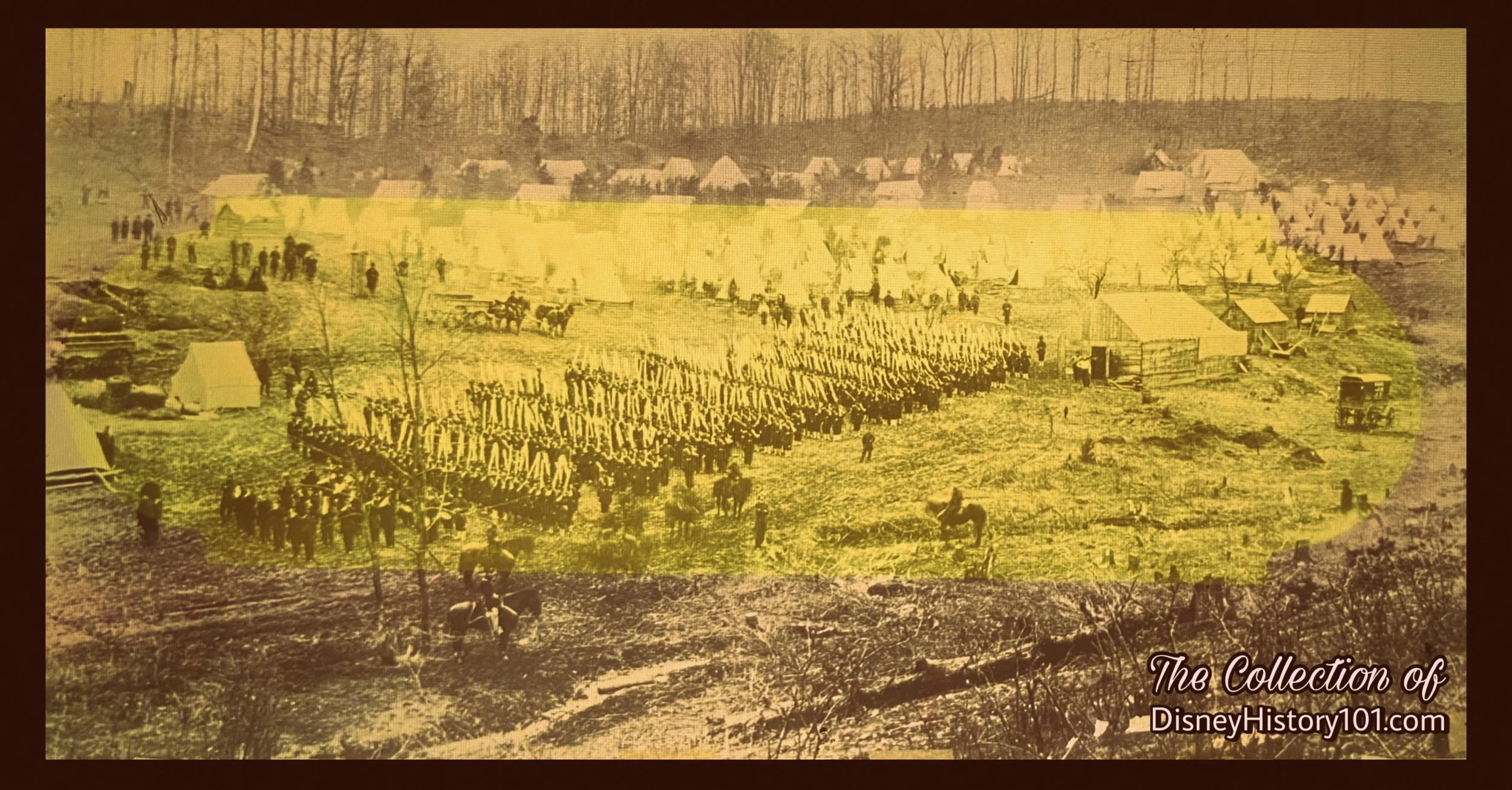
“The fife and drum began to play, all on a beautiful morning.”
“One was gentle, one was kind. One came home…”
“…one stayed behind. A cannon ball don’t pay no mind. A cannon ball don’t pay no mind, if you’re gentle, if you’re kind.”
“It don’t think of the folks behind…”
“It don’t think of the folks behind, all on a beautiful morning.”
Air-conditioning controls dust, and a practical mechanical application of the technology was essential in the attraction where projection equipment and film was used.
The original Royal Dano voiceover and Paul Frees narration were removed for the newly enhanced show in 2001. The show also featured “Lincoln reciting the Gettysburg Address,” according to Dave Smith (Chief Archivist Emeritus of the Walt Disney Archives). [Disney Facts Revealed by Dave Smith, 2016] Even more, the impresario of Garner Holt Productions was contacted to update the Lincoln figure, and dynamic scenic illustrator John Rayburn enhanced the painted colors of the theater, Abraham Lincoln’s chair, and even the man himself.
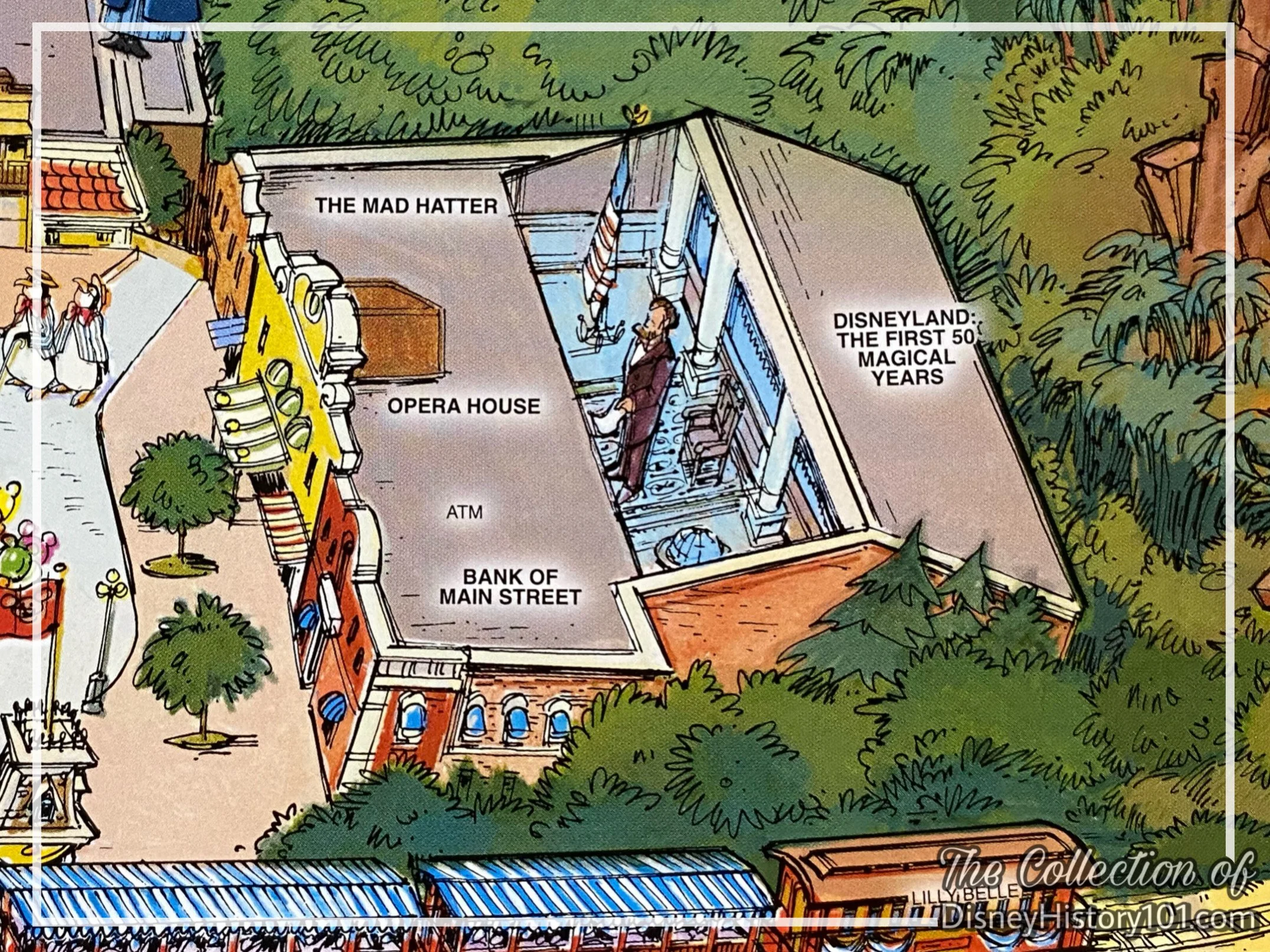
In commemoration of Disneyland’s 50th Anniversary, new exhibits were created, and the film Disneyland : The First Fifty Magical Years debuted at the Main Street Opera House on May 5, 2005, and run until 2009. During this time, Mr. Lincoln would take a hiatus.
During the 2005-2009 closure, the Mr. Lincoln Audio-Animatronics figure was removed and ultimately repurposed as the Indian Village Shaman who appears along the Rivers of America. Here’s where it really gets interesting - the Shaman has been programmed with some of the very same animations (movements) programmed for Mr. Lincoln.
Also during the time of closure (in 2008), WDI master plans entertained a concept which included a presentation of America the Beautiful featuring Great Moments with Mr. Lincoln. At this same time a new Pre-Show involving the second floor of the Opera House was also being researched as an option. This was to coincide with Abraham Lincoln’s 200th birthday on February 12th, 2009. However, the Imagineering of these concepts was not seen through. Lincoln did return, but with “a shortened version of the original speech,” according to Dave Smith (Chief Archivist Emeritus of the Walt Disney Archives). [Disney Facts Revealed by Dave Smith, 2016]
Eventually Mr. Lincoln would return in The Disneyland Story presenting Great Moments with Mr. Lincoln in 2009.
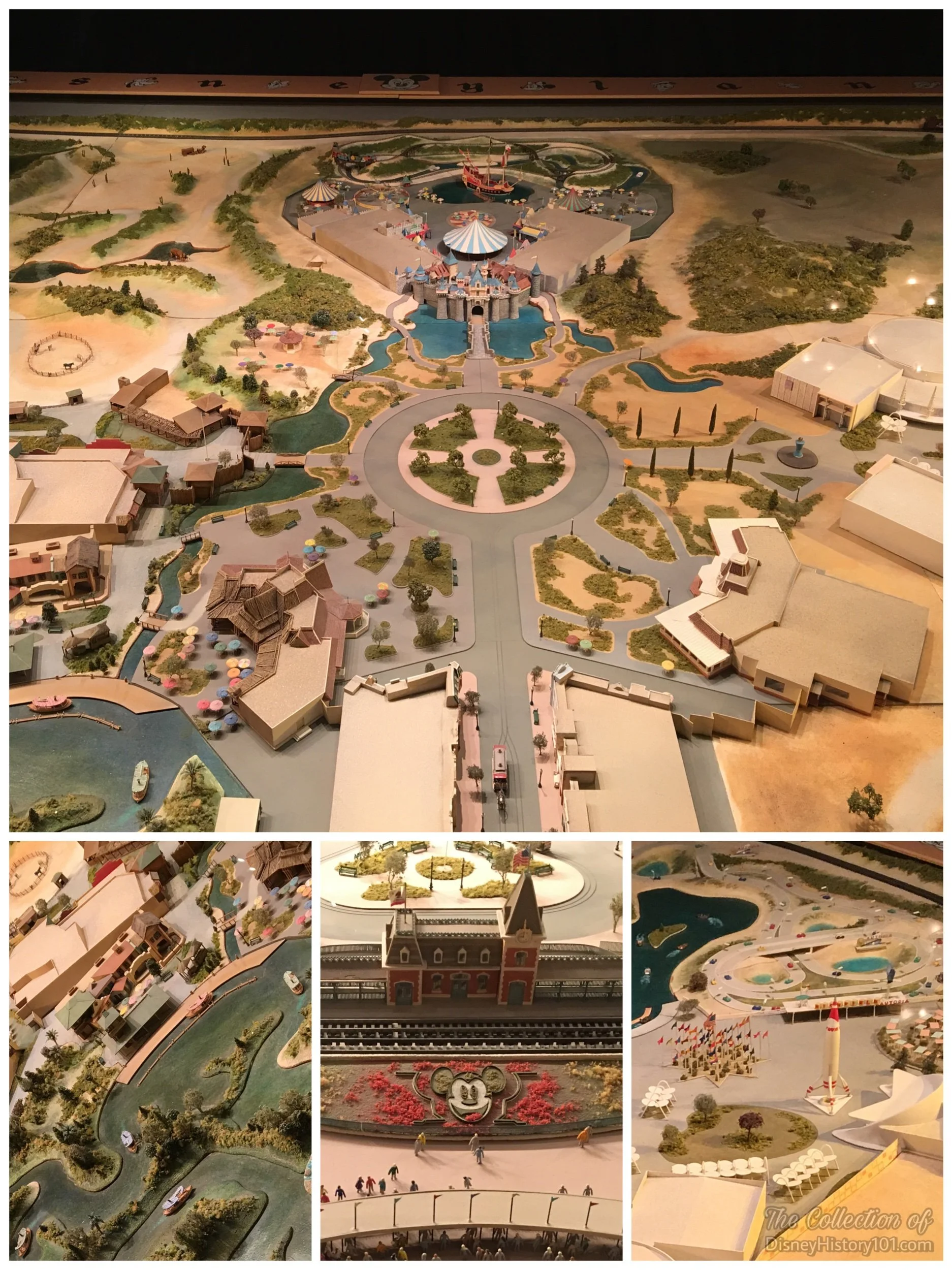
In the meantime, a number of exhibits were showcased, like a model of a c.1955 Disneyland. While the model is rather simple in some regards, there are so many amazingly accurate details. Some who had the pleasure may recall the Adventureland Bazaar (and adjacent canal), the original Mickey Floral Portrait, the Court of Flags, Tomorrowland Lake, and the original Autopia Track.
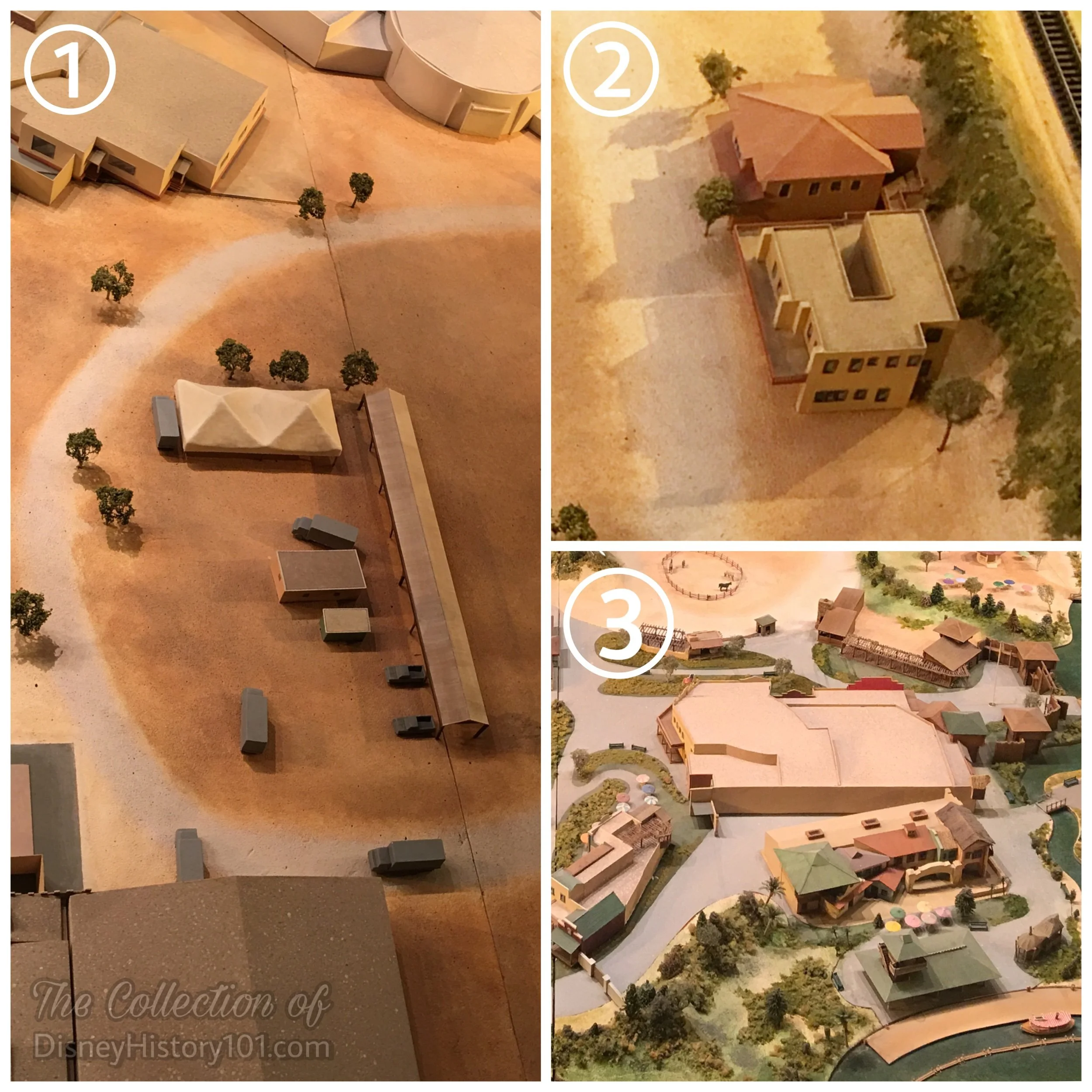
In addition to the Onstage details, most Disneyland Cast Members will note the (1) original Backstage Disneyland Employee Cafeteria and First Aid tents, (2) original Administration Building comprised of the old Callens and Dominguez residences, and (3) Backstage Adventureland/Frontierland.
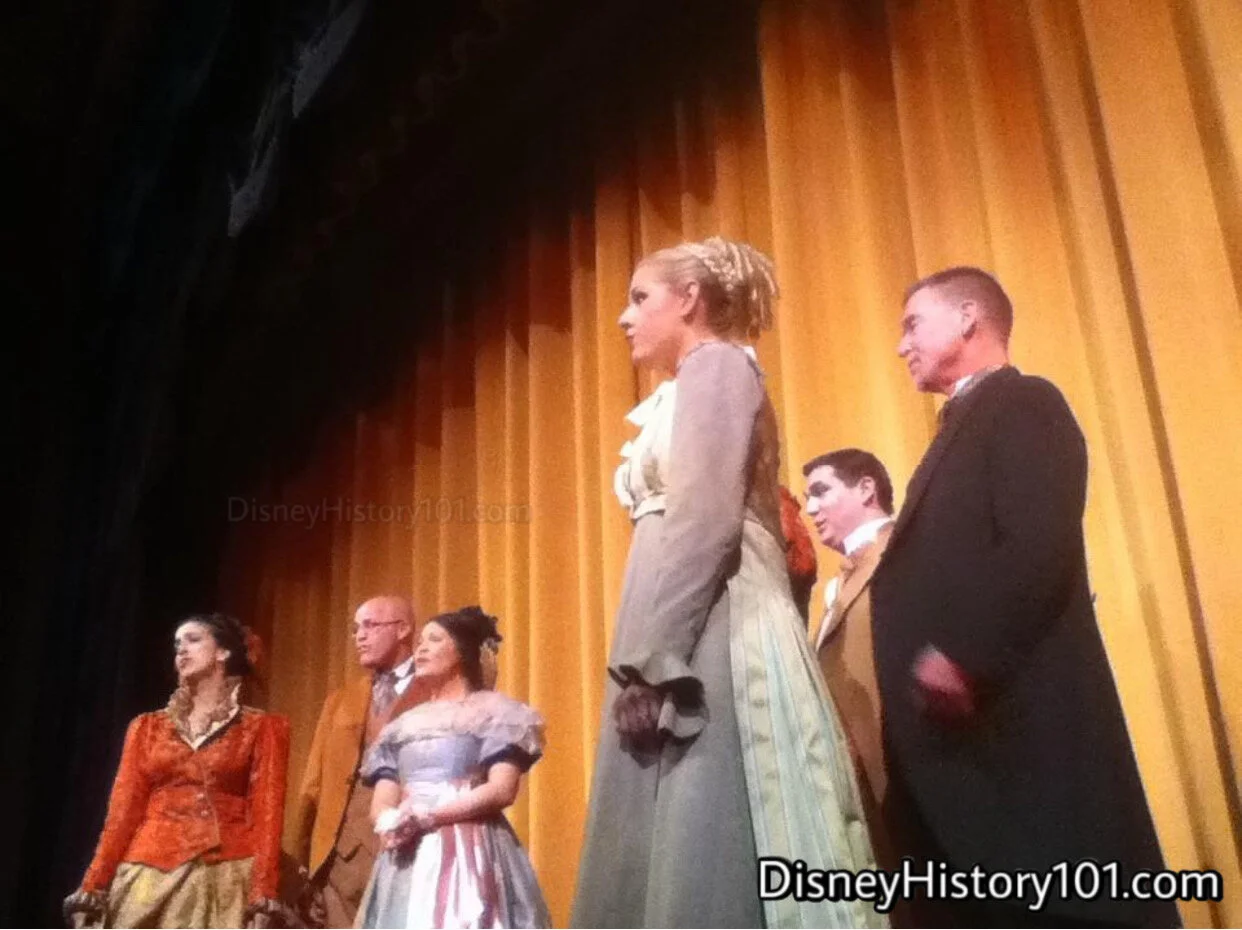
The eight-part harmony of “the Voices of Libery” (a Walt Disney World tradition) was lifted in a limited engagement on the stage of the “Lincoln Theater” during the Disneyland Diamond anniversary! The members provided Atmosphere Entertainment complimenting the theme of the area and entertaining Guests on an immediate and personal level.
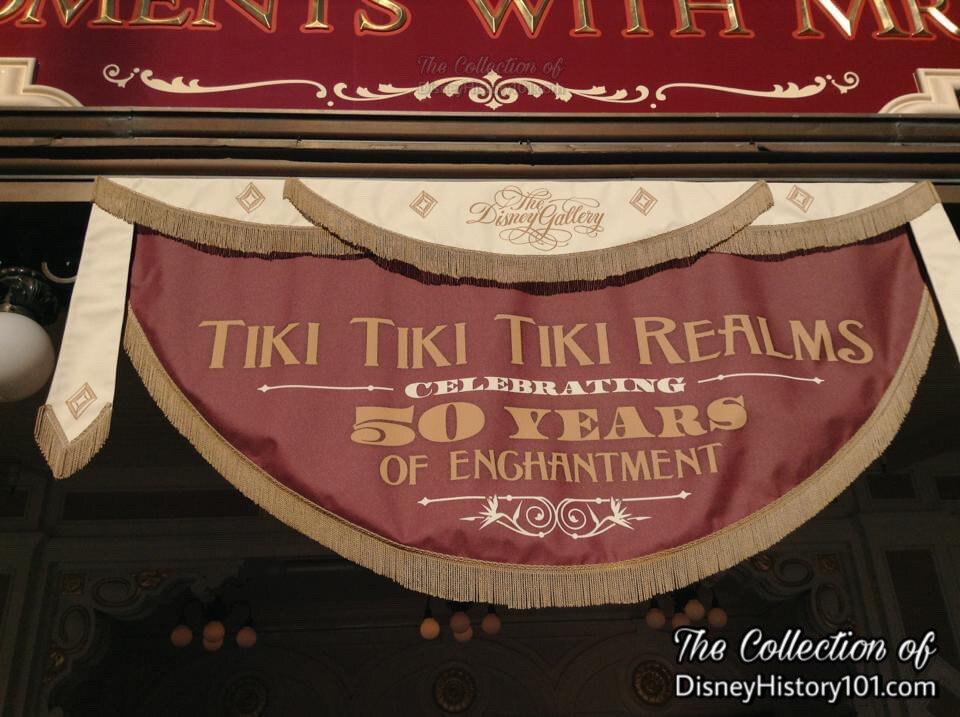
Well, it looks like things have come full circle for the old Main Street Opera House, which continues to serve one of its original intents - showcasing gallery exhibits and displays. Sometime after The Disney Gallery opened in the former Bank of America Building (in 2009), the Disney Gallery would soon expand to the Great Moments with Mr. Lincoln Lobby. In recent years, new exhibits (presented by The Disney Gallery) would feature both artwork and props featured in production of Disney Parks attractions, and even Walt Disney Studios feature length film productions.
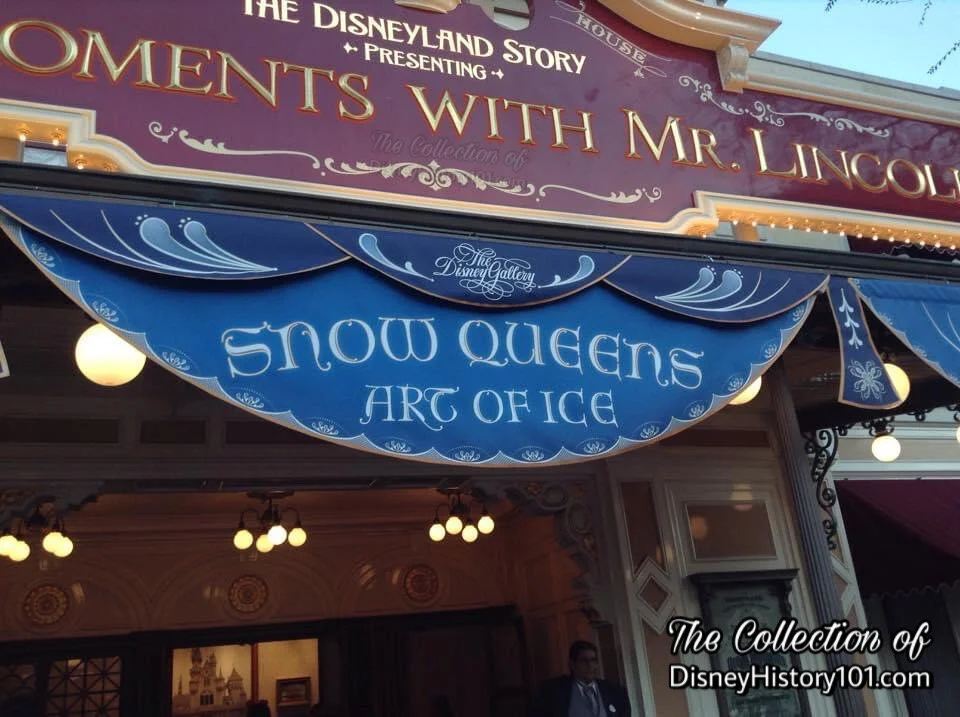
Some of the art featured included Marc Davis’ designs for the Snow Queen - star of the c.1970s Enchanted Snow Palace ride concept.
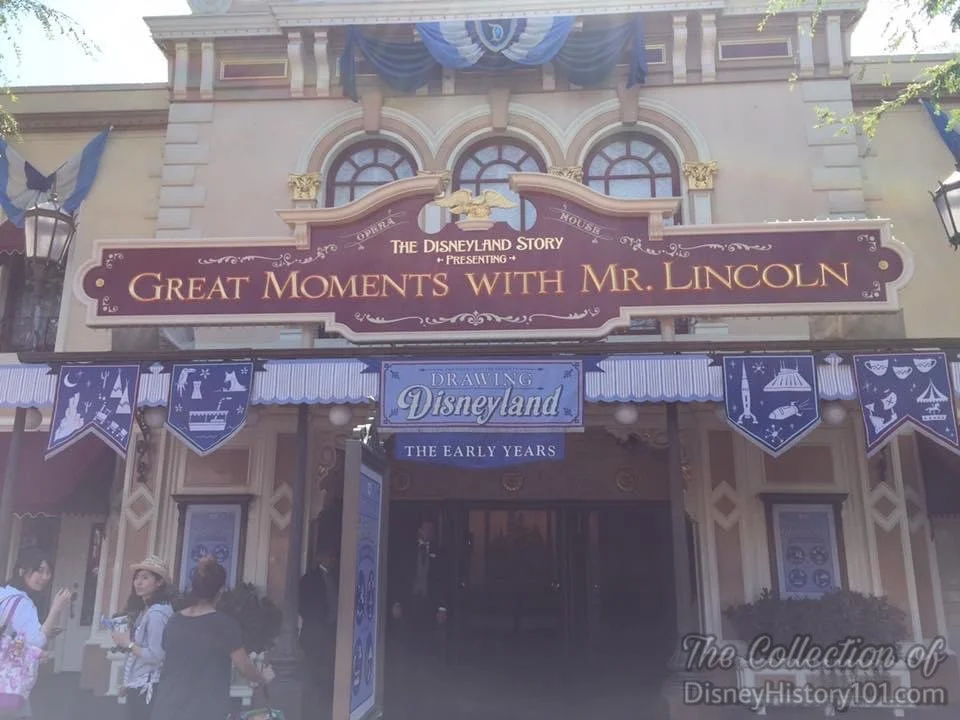
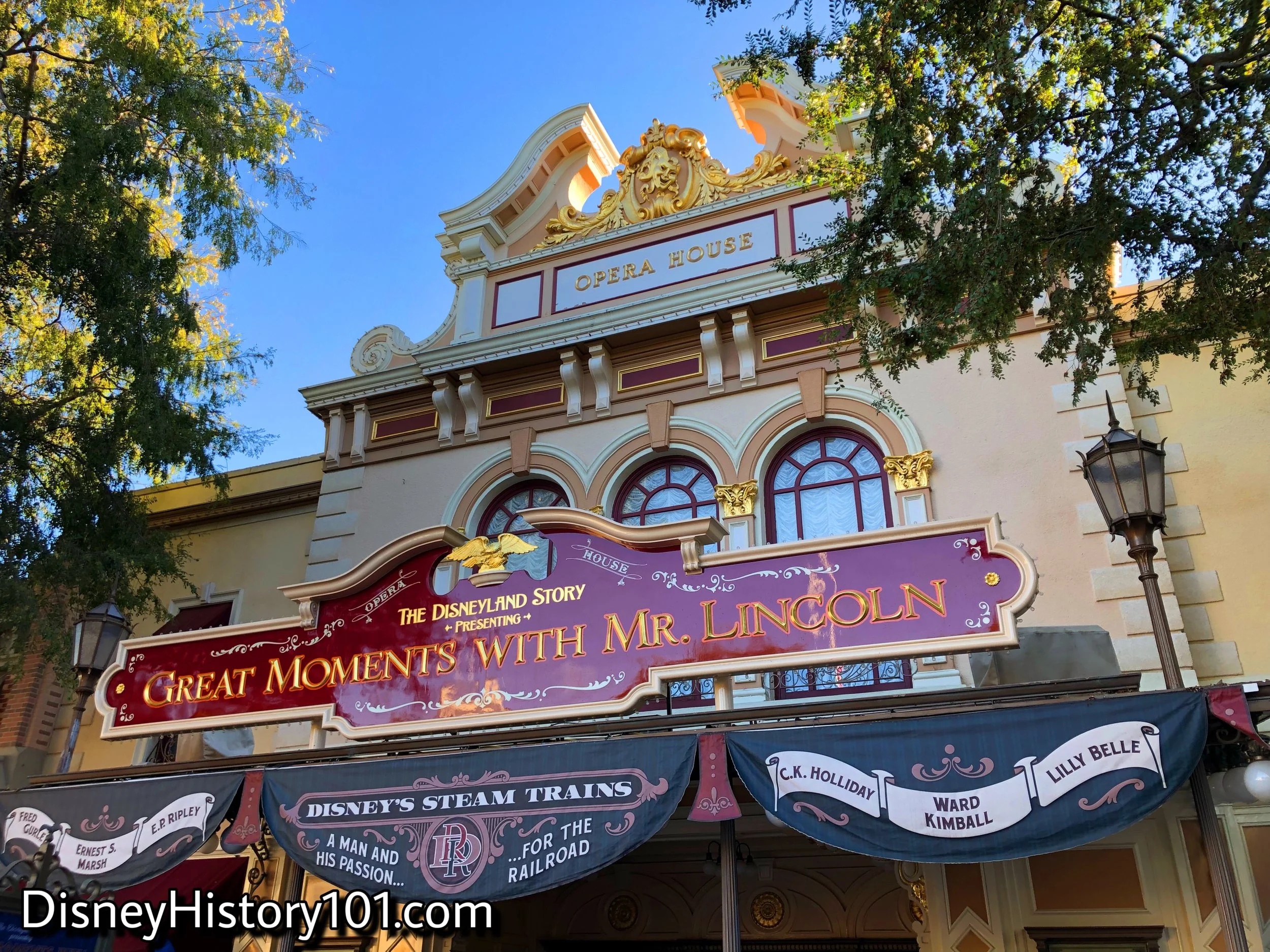
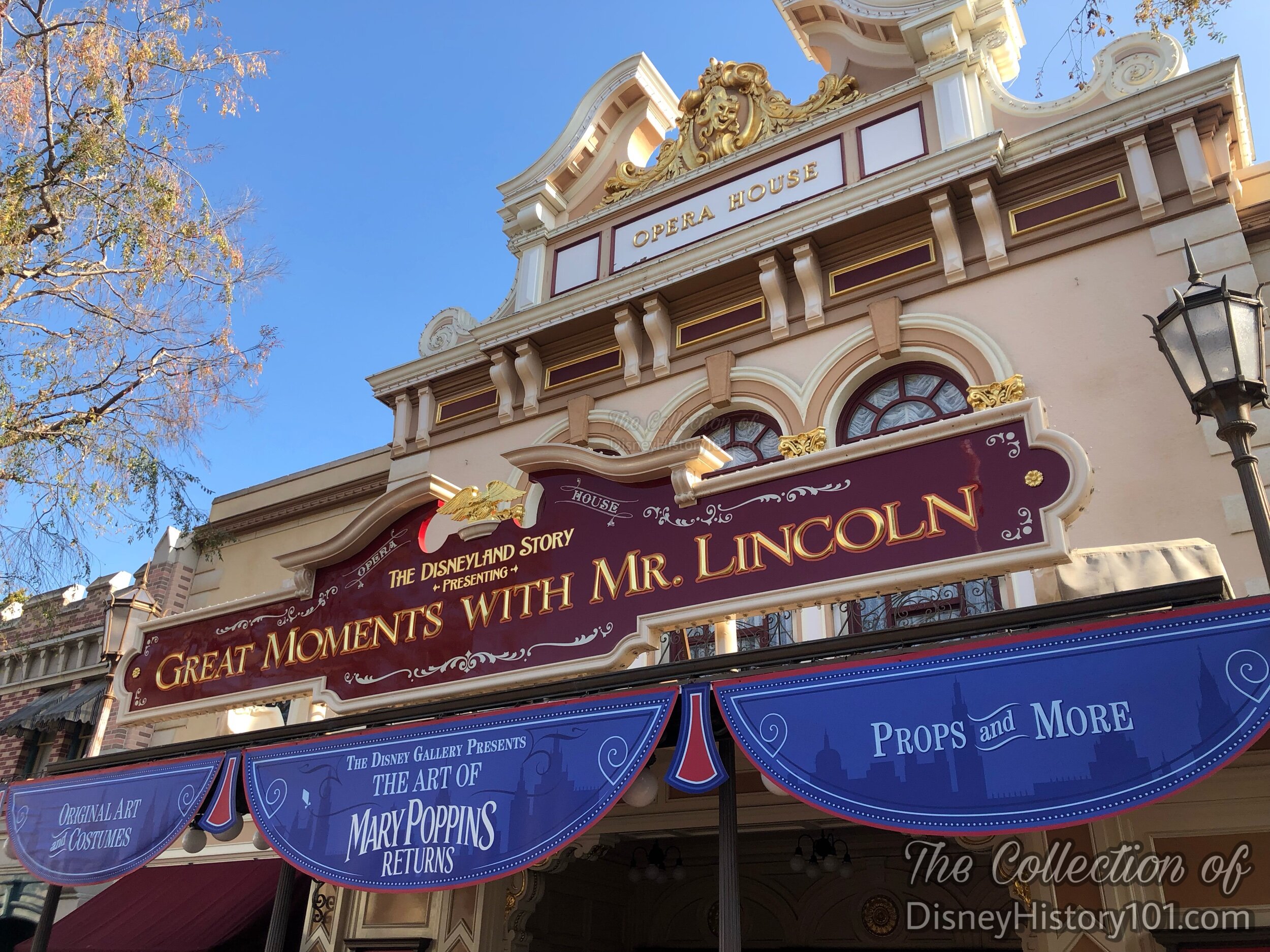
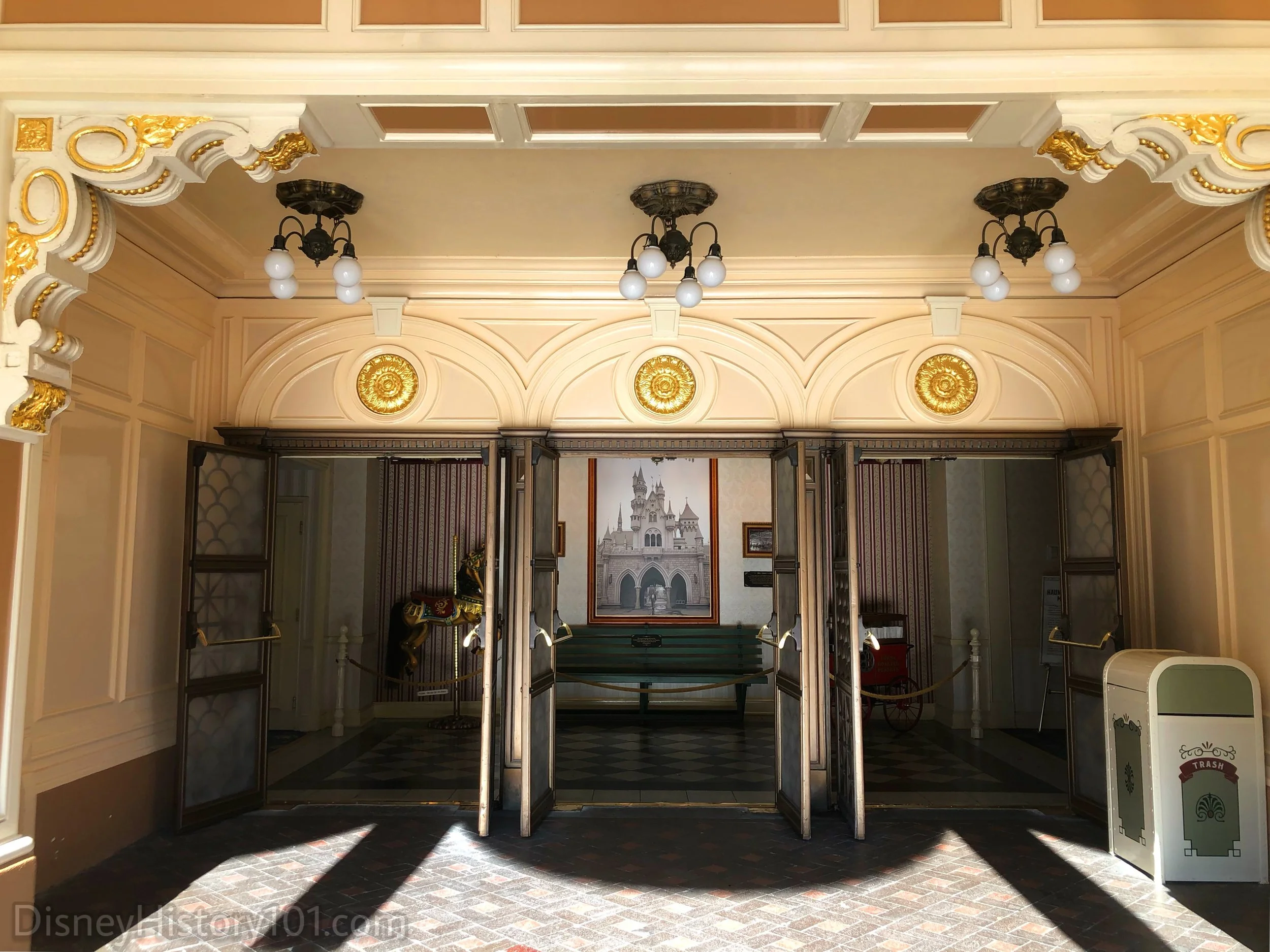
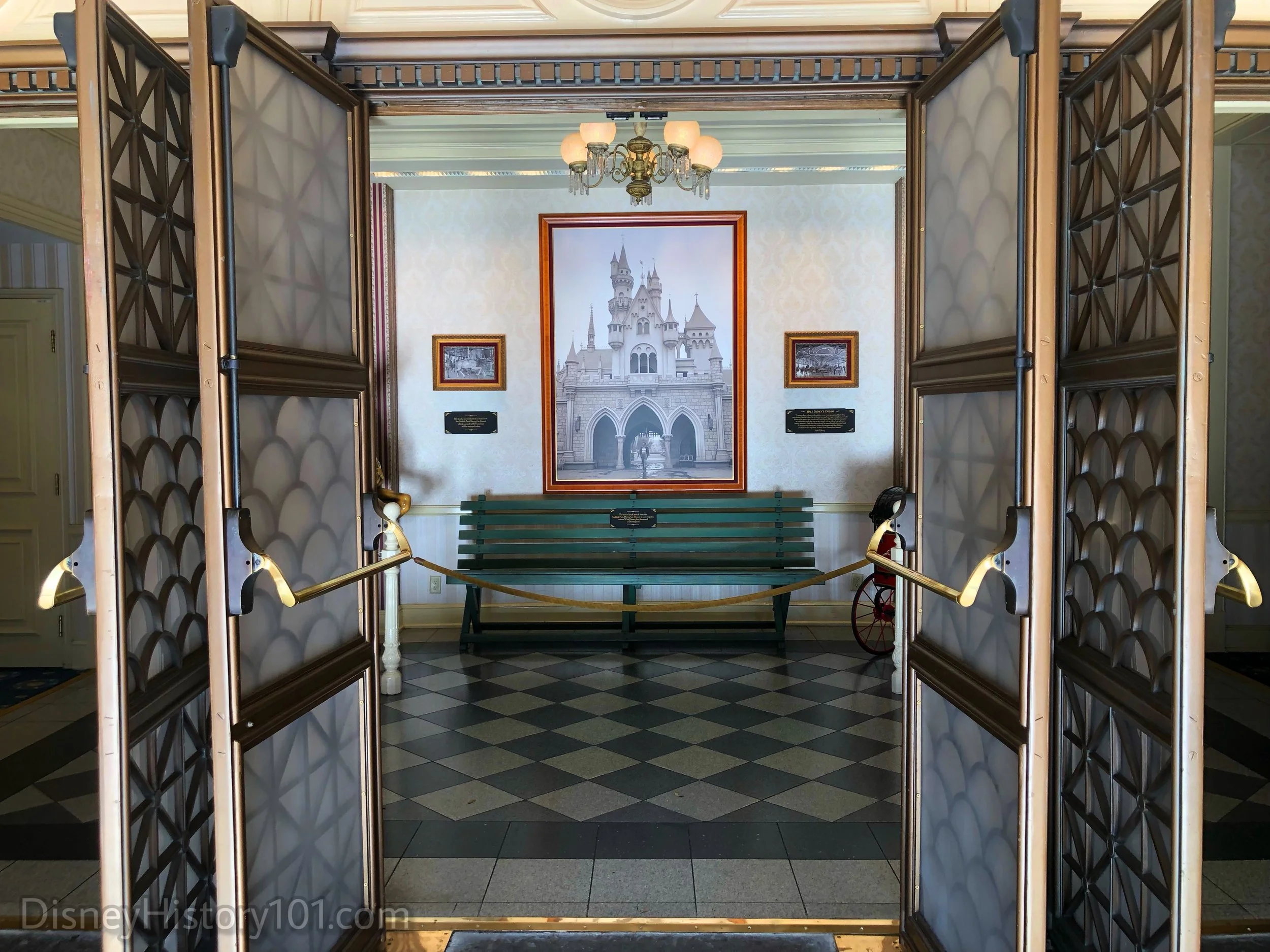
Just through the doors, Walt Disney’s toy is still told through a few special exhibits and displays featuring true-life artifacts from Park history. Gone are the “Disneyland Toy Factory” Mold-A-Rama Machines, and in their place are Disneyland Pressed Penny Souvenir Machines, offering another type of commemorative collectable.
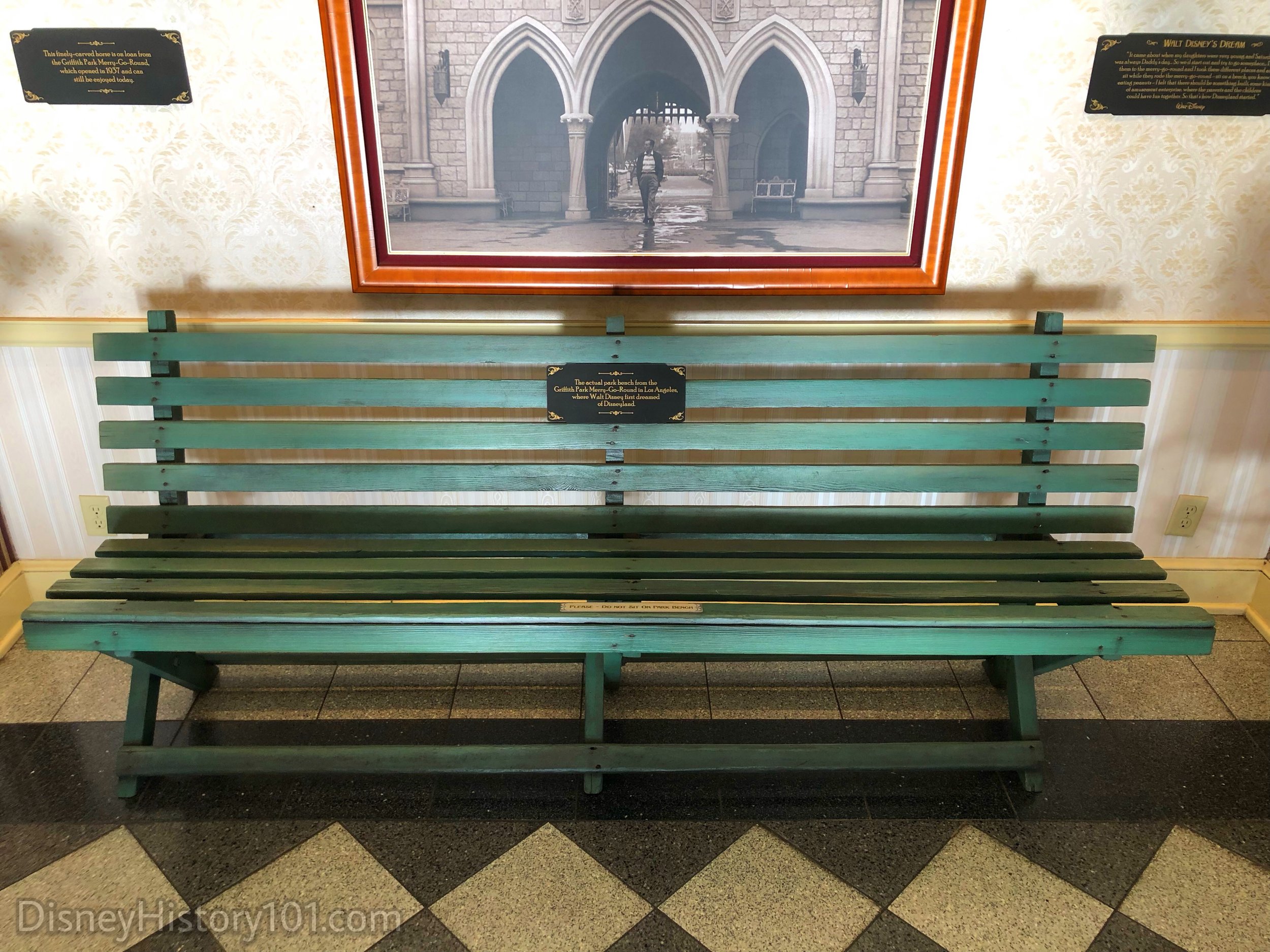
Despite what this plaque suggests, there are at least three known surviving Griffith Park Merry-go-Round benches - at The Walt Disney Family Museum, the Griffith Park Carousel, and inside the Main Street Opera House! Walt Disney may have sat on any (or all) of these benches as he dreamt up Disneyland.
Souvenirs cost 51¢.
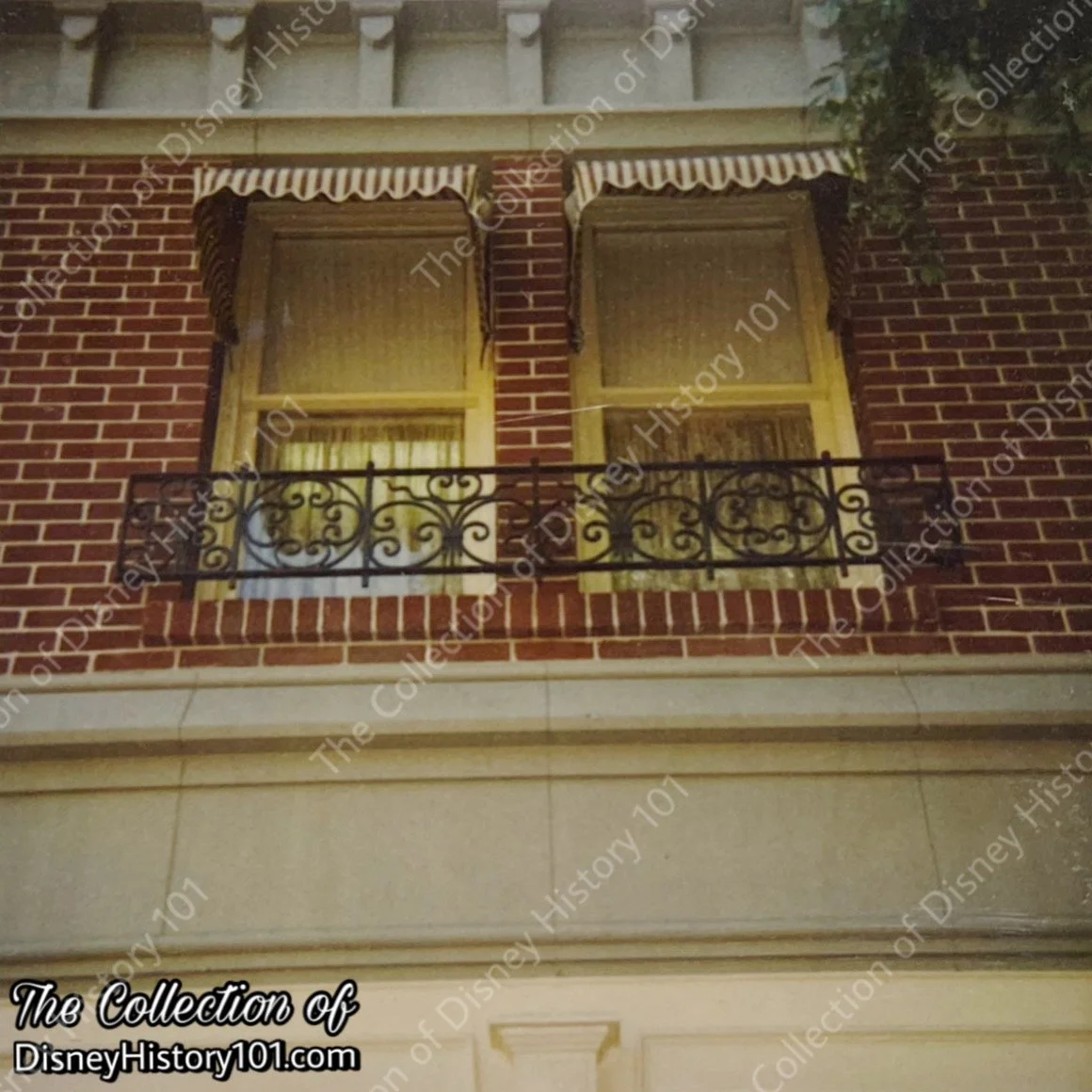
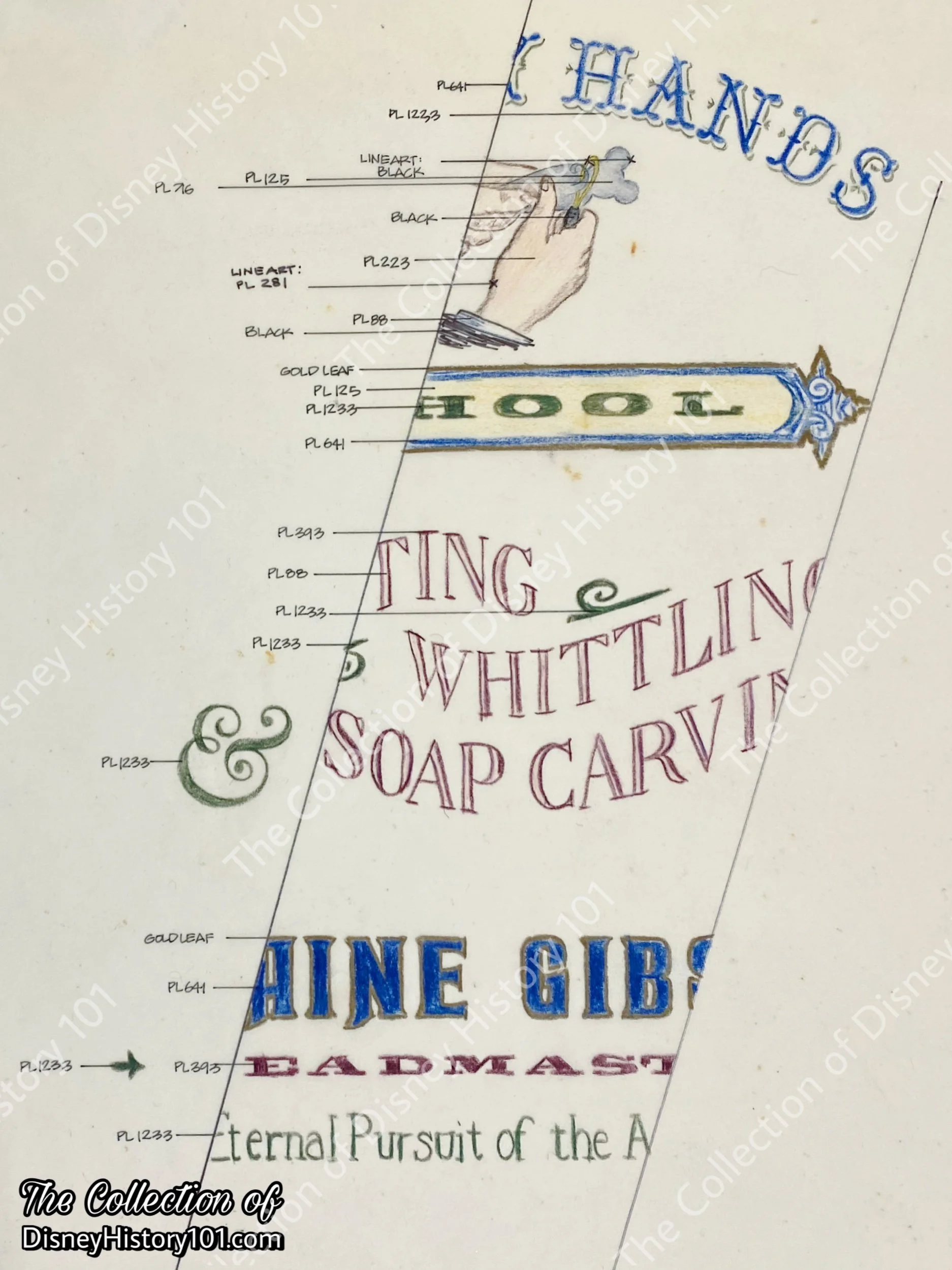
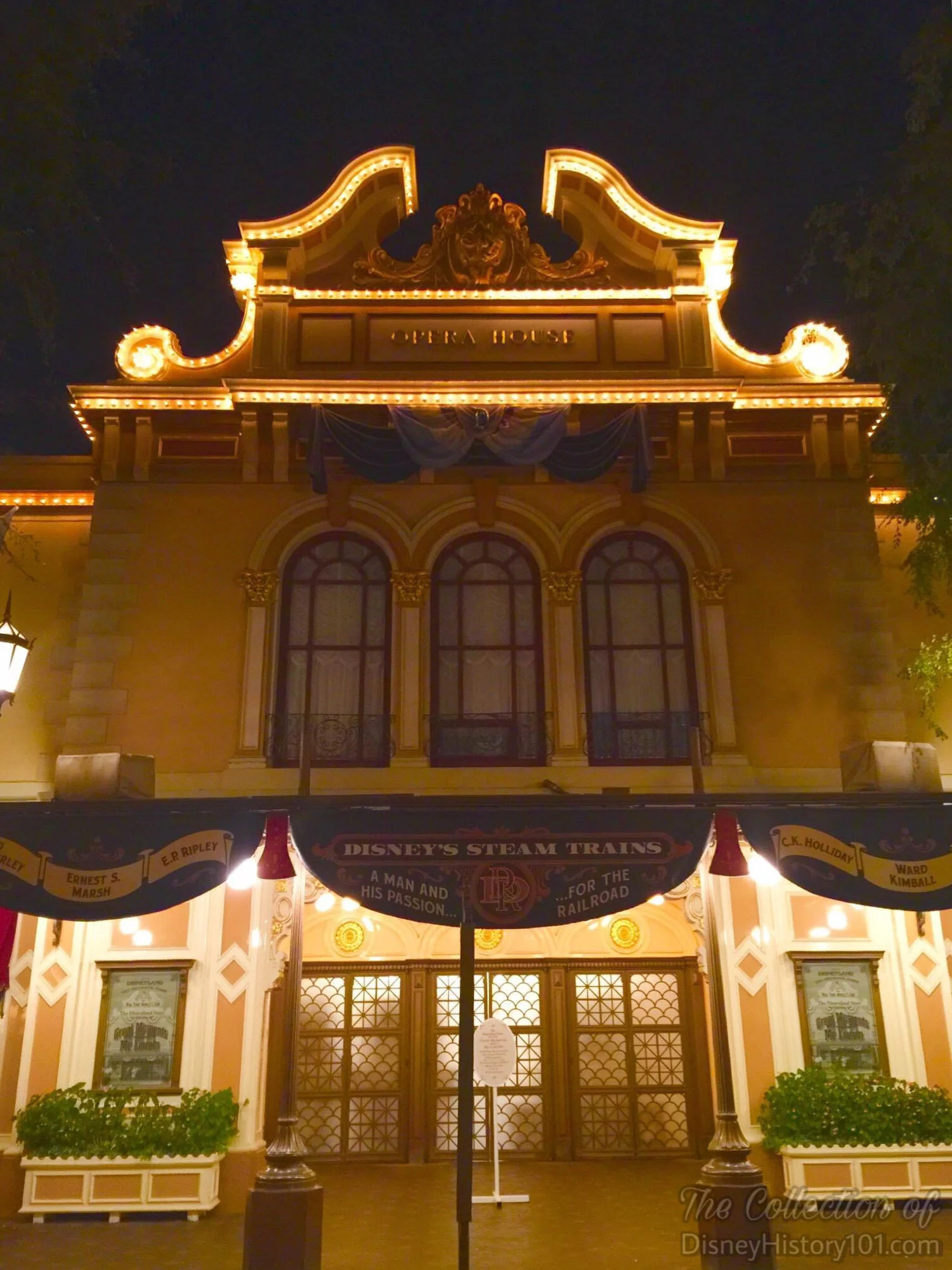
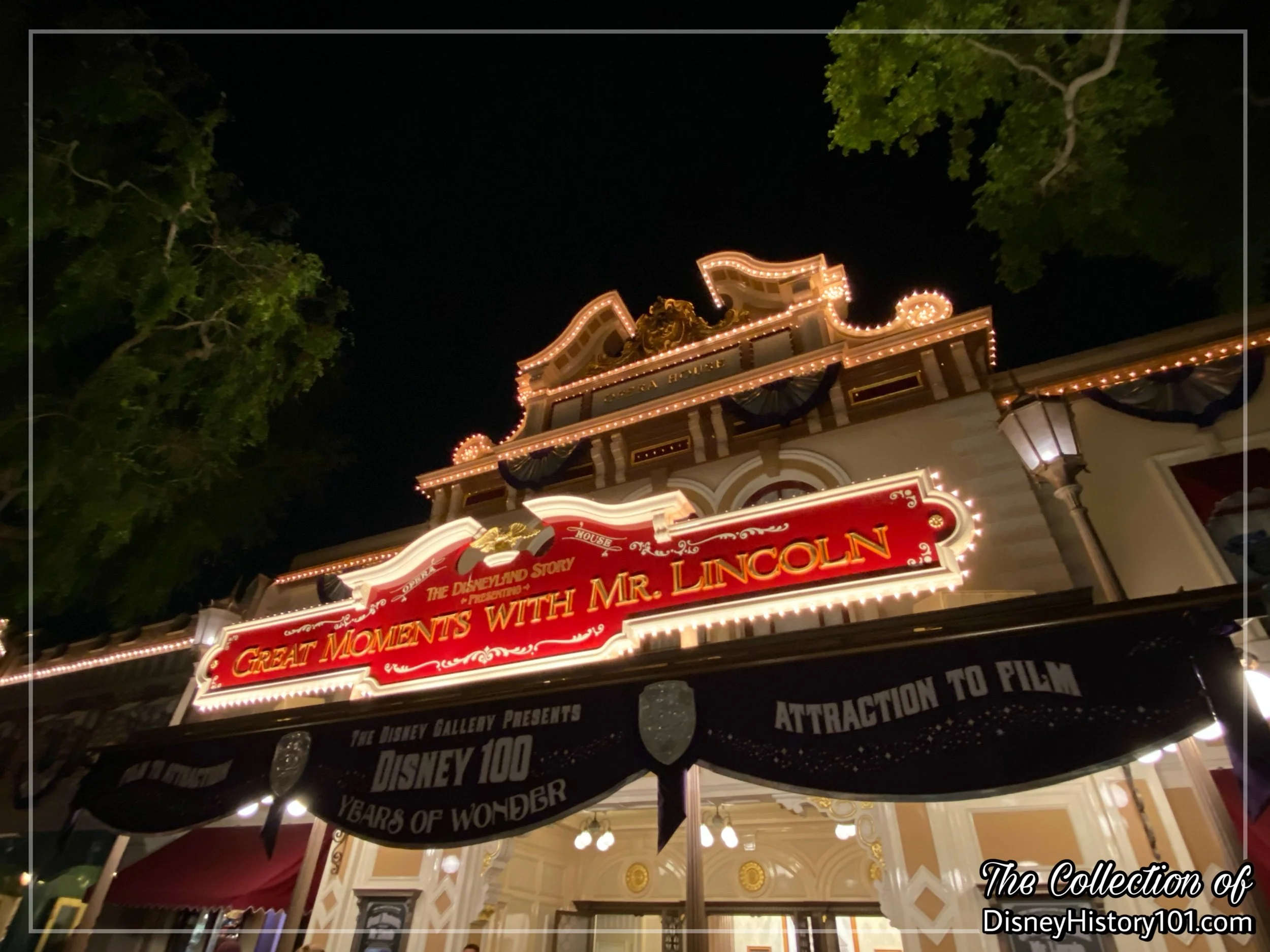
MARK TWAIN
“Preface”
One can easily slip into the jargon of “ride,” but at Disneyland there are adventurous attractions, each one a living experience for the guest! Disneyland ride-through attractions or adventures have officially been defined as an “individual show, ride, or exhibit designed to produce an entertaining Guest experience. Disney attractions stir the imagination, enliven the senses, and provide the participants with positive, innovative entertainment, which is the essence of the DISNEYLAND Show.” It is important to review the story of the attraction, tell the story, explain it, and create interest. This is the story of Mark Twain.
“The Story of the Steamboat and True-Life Frontierland”
The story of the Mark Twain attraction starts more than 100 years before the spark that lead to Disneyland. Walt described Frontierland as “a tribute to the faith, courage, and ingenuity of the pioneers who blazed the trails across America.” Many types of Flatboats were once commonly constructed and utilized to transport cargo down the Ohio and Mississippi Rivers, and these soon joined the river traffic of canoes, keel boats, and canal boats. An example of American ingenuity was the steam-powered paddle wheeler, the only recognized form of mass transportation invented in the United States.
The steamboat also has its origins set deep in American history, (and much like Walt) by a pioneering inventor whose invention was doubted by the masses. While the steam engine came from England, the hull was made in America, by Robert Fulton. Once called “Fulton’s Folly,” the Claremont (launched down the Hudson River in 1807), was soon considered the first successful steamship in America. A few years later (in 1819), the first steamship even crossed the Atlantic Ocean. Soon after, the sternwheel became a typical sight on the Ohio and Mississippi Rivers, transporting passengers and goods as residents of this country moved West.
Before the approach of the mid-19th century, a young Samuel Longhorne Clemens (1835-1910) grew up in Hannibal, Missouri, along the shore of the Mississippi River. He would pen many stories like “Tom Sawyer” and “The Adventures of Huckleberry Finn” under the name “Mark Twain” - a borrowed name inspired by the “nom de guerre” of a particular old captain who once published river conditions in the New Orleans Picayune.
“Walt & Company Recollect Riverboats”
The last sternwheelers were built in the U.S. approximately around the year 1900, so some of Walt’s own staff would be familiar with true-life riverboats. For instance, c.1954 hire Van Arsdale France once had a job as a dishwasher on a river boat going from Pittsburgh to New Orleans.
Walt Disney had a fondness for riverboats. In fact, in October 1931, Walt and Lilly Disney set out on their very first vacation together, and went first to St. Louis, where Walt planned to take a steamboat down the Mississippi. More than two decades later, Walt shared his most romantic expressions toward riverboats this way:
“One of the biggest joys of my life is sitting on the levee in the Frontierland section of Disneyland, our park in Anaheim, California. As I gaze to the north, I can see the smokestacks of the steamer Mark Twain belching smoke and skirting along toward the top of Tom Sawyer Island. Then the boat moves into view ; the crowd line against the white railings. It moves majestically along, the stern paddle churning up the river foam. The captain lets the whistle blast, signaling his attention to land, and the Dixieland band on the shore swings into a ragtime tune. I thrill all over every time that happens. Other people have told me they too get a big kick out of the Mark Twain swinging in to shore, but I doubt it if anybody could enjoy it as much as I do. You see, I go back a long way with stern-wheelers ; back to the Missouri River in the 1910’s. When I was growing up in Kansas City, there were still two stern-wheelers plying out of that town. They were called the Chester and the Majestic, and they were handsome boats to see. They ran down the river to St. Louis, but on Sundays one would be in port and would take customers on river excursions for a dollar a head. I was on hand for a cruise whenever I could scrape together a dollar from selling newspapers. The Missouri River boats had to be stern-wheelers because there were so many sand bars. When they ran aground they could reverse the wheel and pull off, something a side-wheeler couldn’t do. One of the thrills of my young life was when one of the excursion boats I was riding struck a bar. It remained there for an hour while the deck hands pushed long poles into the sand and the wheel churned mightily. Finally with a great whoosh and swirl of foam, the boat pulled itself free. These boyhood memories are the reason for my fondness for Frontierland. Of course, all the realms of Disneyland intrigue me - Fantasyland, Adventureland, Tomorrowland, and Main Street. But Frontierland evokes a special response because to reminds me of my youthful days on the Missouri.” [“Frontierland” by Walt Disney, True West magazine ; June, 1958, page 10].
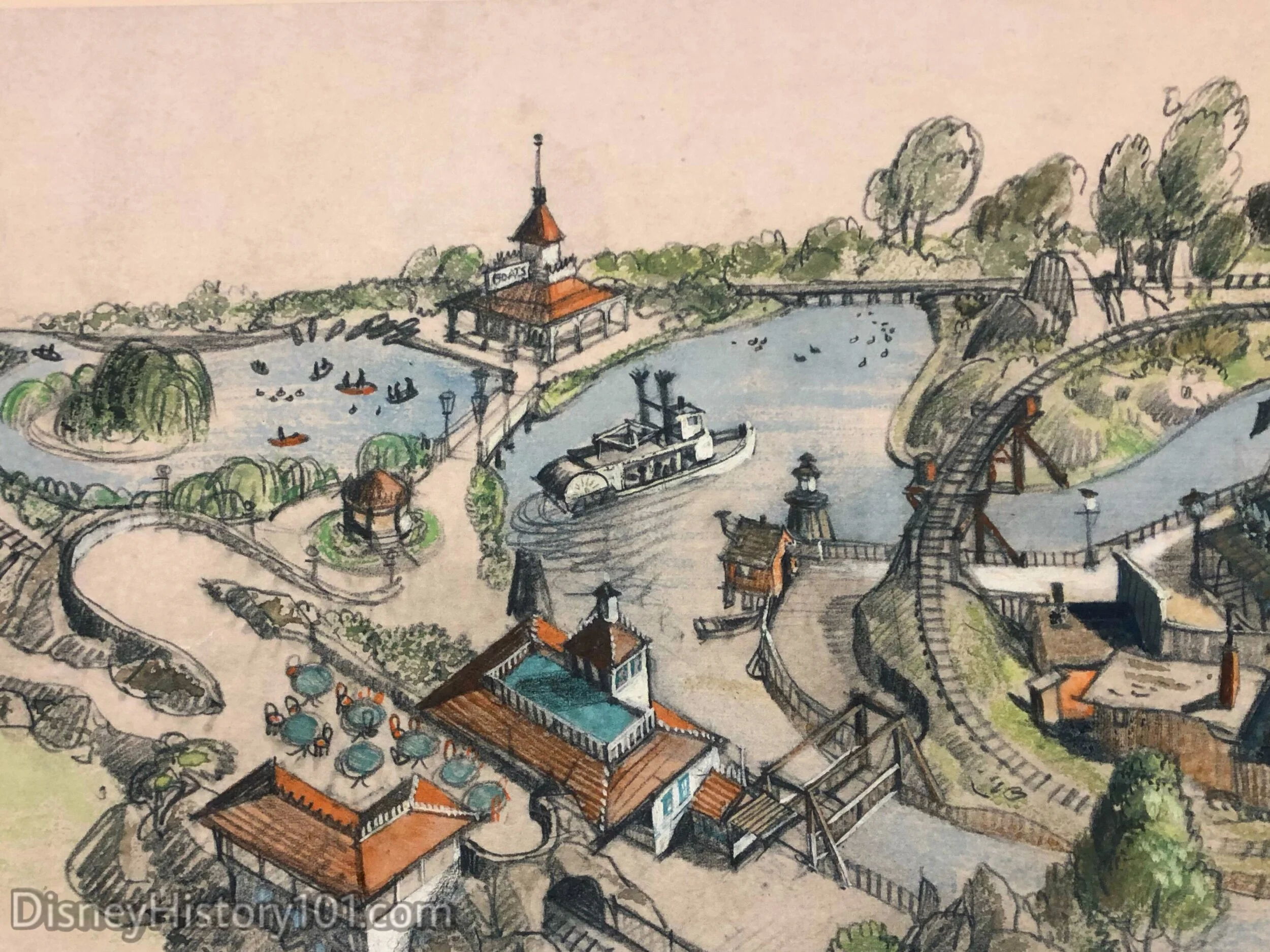
“Master Planning, Research & Developement”
Custom rides were created that would be subordinate to story and setting. And so naturally, some of the earliest drawings of Walt Disney’s “Mickey Mouse Park” featured a steam ship navigating a river! Can you imagine seeing the smoke stacks of a steamboat from the 11-acre triangular plot of land on other side of Riverside Drive in Burbank California? This almost became a reality, courtesy of these early drafts and proposals.
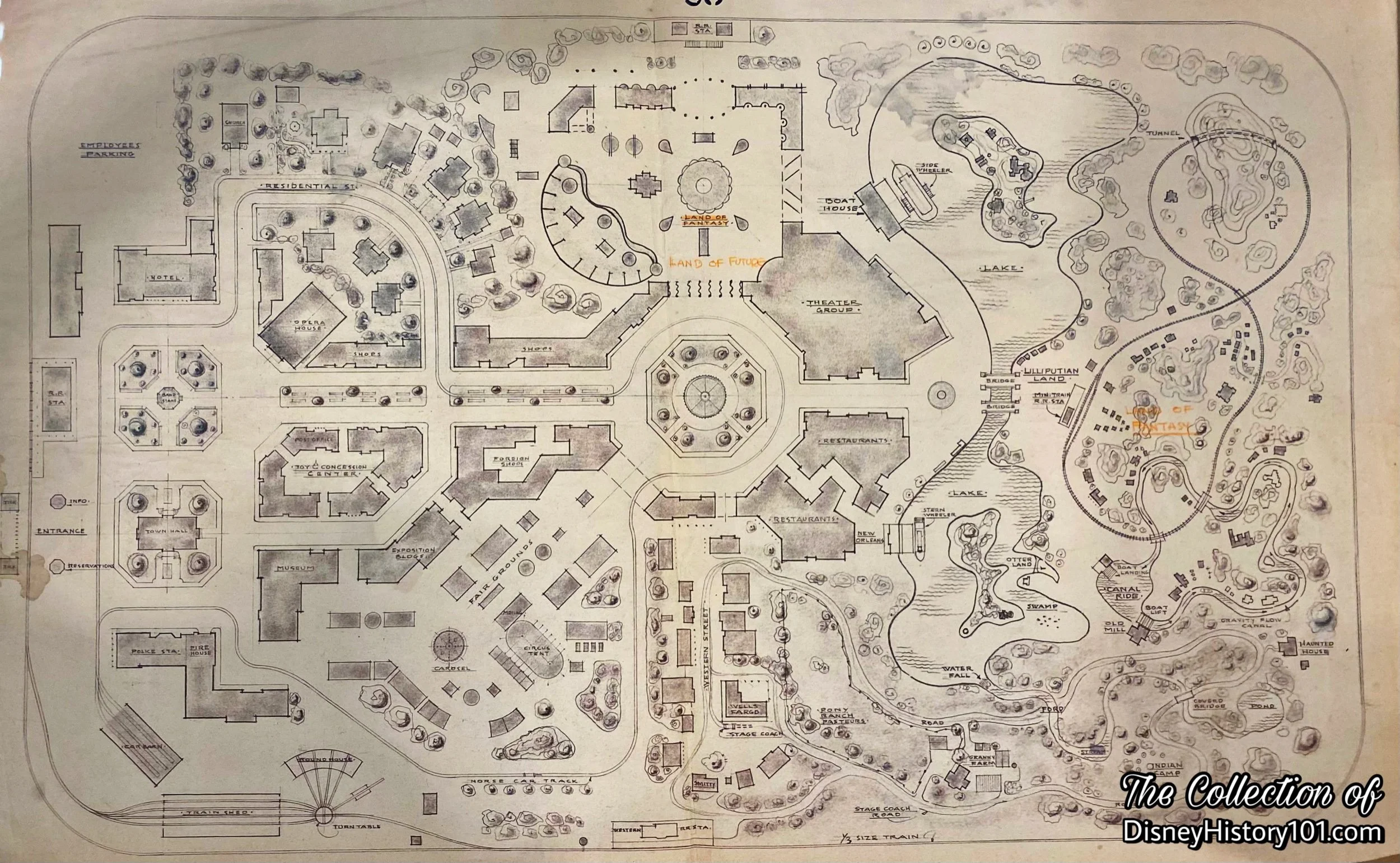
Then in 1952, Walt Disney founded a company called WED Enterprises, Inc. in order to master-plan and design his his dreams of a Park. The company was staffed by Animators, Art Directors, Artists, Artisans, Architects, Set Designers, and Planners from the Studio. Early thumbnail sketches and other concept artwork seemed to be unencumbered by restrictions of budget, schedule or the laws of nature and physics. Though guided by Walt, his artists appeared to engage in “free-thinking,” as if implementing the modern “Blue Sky” Imagineering process. Some of these viable project Concepts (as above), were supported by a well-developed business case and built expectation.
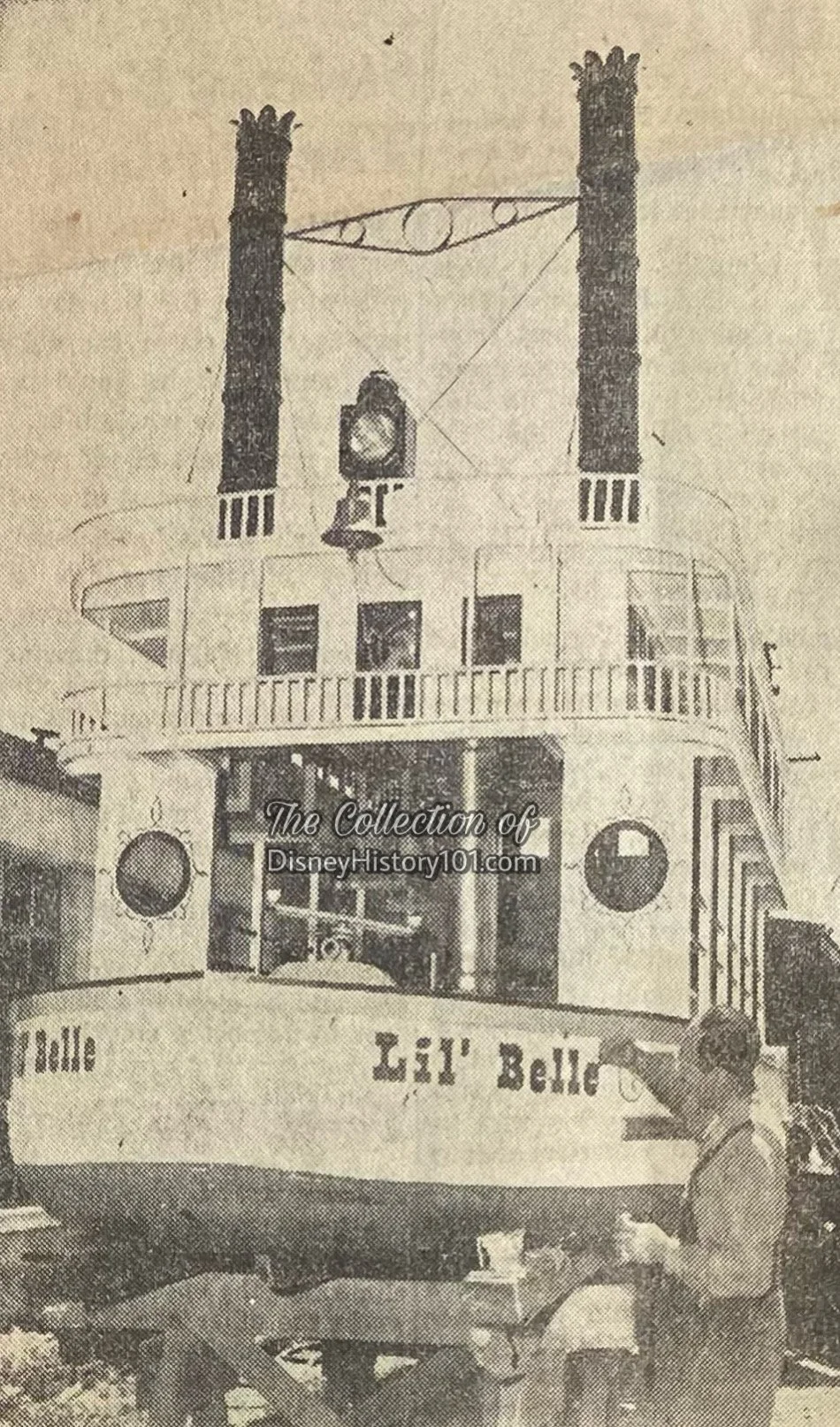
“A Lil’ Inspiration”
Walt soon began to inquire about the acquisition or production of a steamboat. This was carried out through Richard Irvine (a new c. 1952 hire of W.E.D. Enterprises), in a January 6th, 1953 letter addressed to Mr. W.J. Hardiman (of Arrow Development Co., Inc.). In the letter, Dick requests information about a 30-passenger boat which was being tested in the Anderson Reservoir before going into operating in a lagoon off Lake Merrit in Oakland, California. Arrow’s Lil’ Belle sternwheeler steam boat - authentic in many details was far smaller than the Mark Twain would be; by comparison (the Lil’ Belle was only 8 feet wide, 24 feet in length, and 14 feet high). Later, on April 17th, 1954, Walt Disney travelled to Children's Fairyland (along with Nat Winecoff and C.V. Wood), and it’s a possibility that he saw the Lil’ Belle in operation on nearby Lake Merritt during his visit.
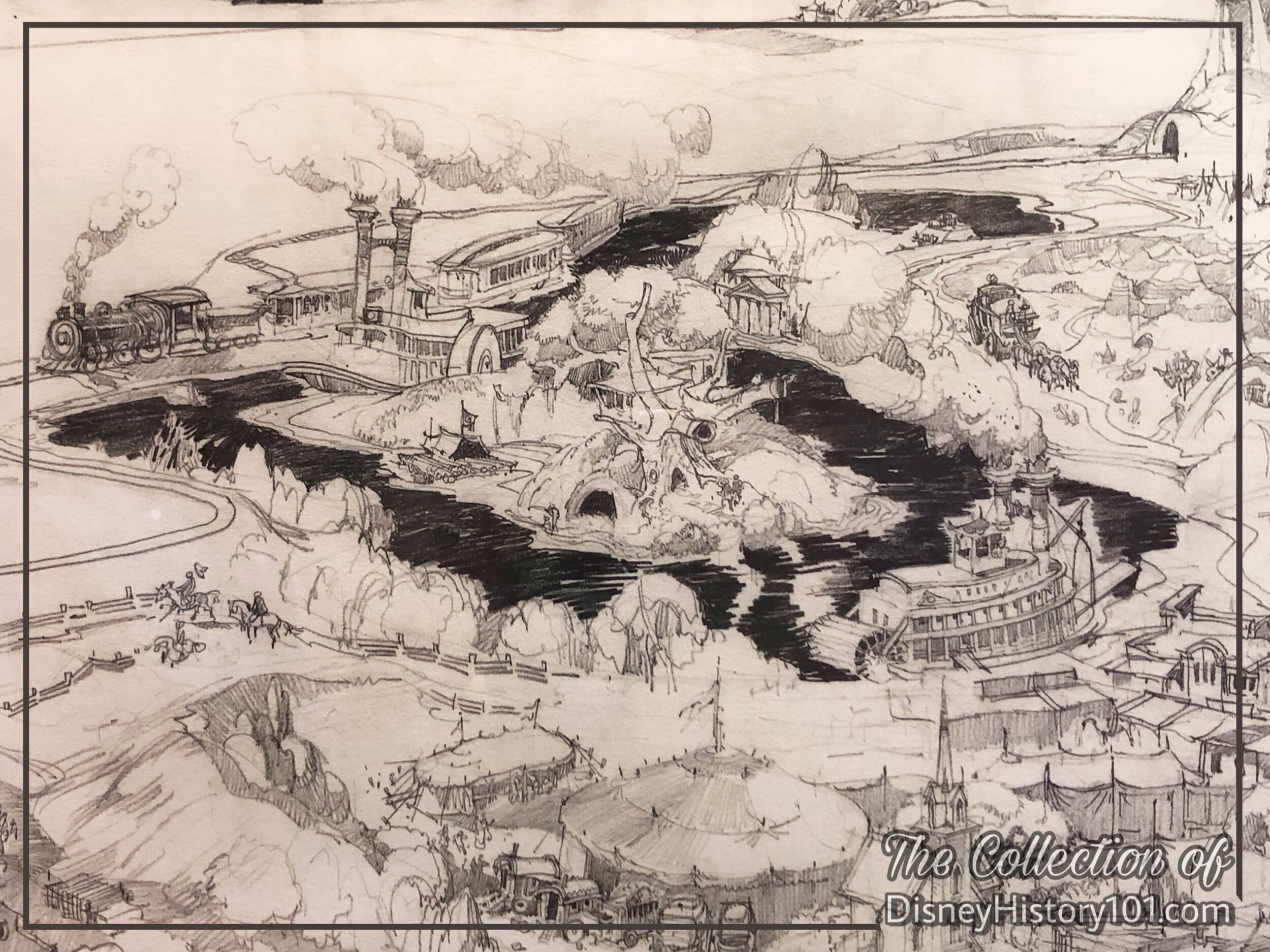
“Herb Ryman’s Aerial Over Disneyland and the Mark Twain”
Walt’s plans (with audiences in mind) continued to involve a steamboat, as indicated by Herb Ryman’s “Aerial Schematic View” over Disneyland, which was created under the watchful eye of Walt Disney, originally produced September 26 & 27, 1953. Though the sternwheeler and “sidewheeler” riverboats were flowing backwards (in a counter-clockwise fashion) in Herb Ryman’s drawing, many story elements were present, that would help imaginative artists and engineers further the design of the riverboats and the design of the river itself. This and a portfolio of colored sketches by Herb Ryman, Bruce Bushman, Harper Goff, and others was prepared for Dick Irvine and Nat Winecoff to take back East to sell the Disneyland concept to prospective licensees.
According to Magic Circle magazine (June, 1956): “Translating an idea into a real object usually isn’t a simple task at best, even when you know exactly what you want to produce. Take Frontierland’s river boat Mark Twain, for example. Here, the idea-into-object task was not further complicated by the idea being an original one. There have been thousands of river boats built. But not lately. There had been no sternwheel of the Mark Twain type built in the United States for half a century,” around 1900. The Mark Twain was based on true-life river boats like the Natchez and Little Rufus, but at 5/8 scale (similar to the Horseless Carriages and the Disneyland Railroad trains).
“Designing the Disneyland Sternwheeler”
By May 18-19, 1954, John Stoos of WED Enterprises had prepared 1/4 scale drawings of a “Typical Sternwheeler.” By July 1, 1954, George Whitney of Disneyland, Inc. directed Amusements, with Ron Miller overseeing analysis, philosophy, capacities, planning, operator training, and amusement procurement.
Soon, Mark Twain designs were so far along, that a Mark Twain float even appeared in the 1954 Anaheim Halloween Festival courtesy of Yale Gracey. By that time (in 1954), some of the earliest suggestions and concepts of Walt Disney’s “Disney Land” included descriptions of a “Riverboat Ride.” According to “Disneyland” (prepared for Disneyland Inc. by WED Enterprises), “At the end of Frontier Street is the boatlanding for Riverboat Ride. The old stern-wheeler takes you downstream on a nostalgic cruise past the romantic river towns, Tom Sawyer’s birthplace, and the old Southern Plantations.”
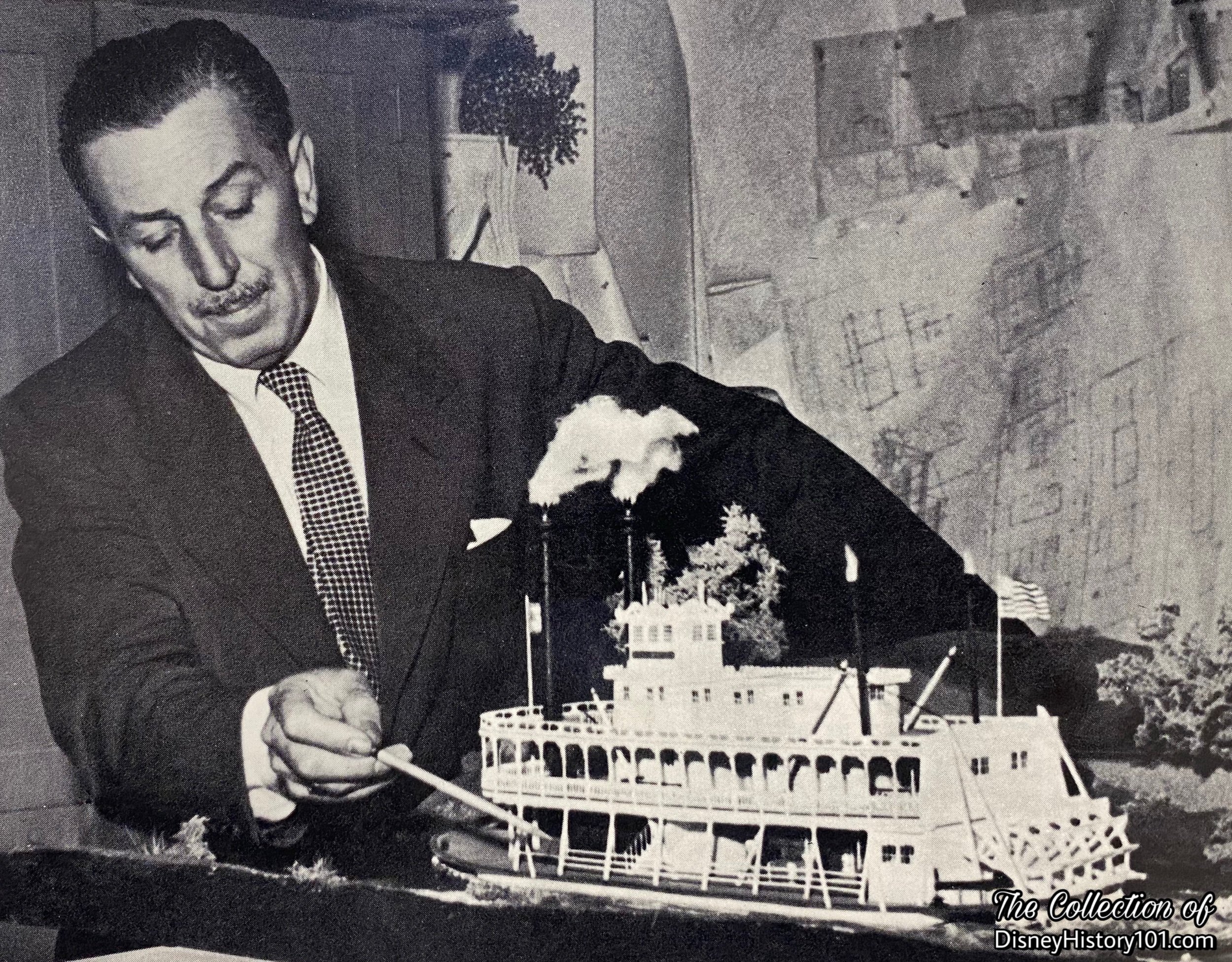
Once a design had achieved approval, it went to the model shop for one-dimensional cutout mock-ups in black and white medium.
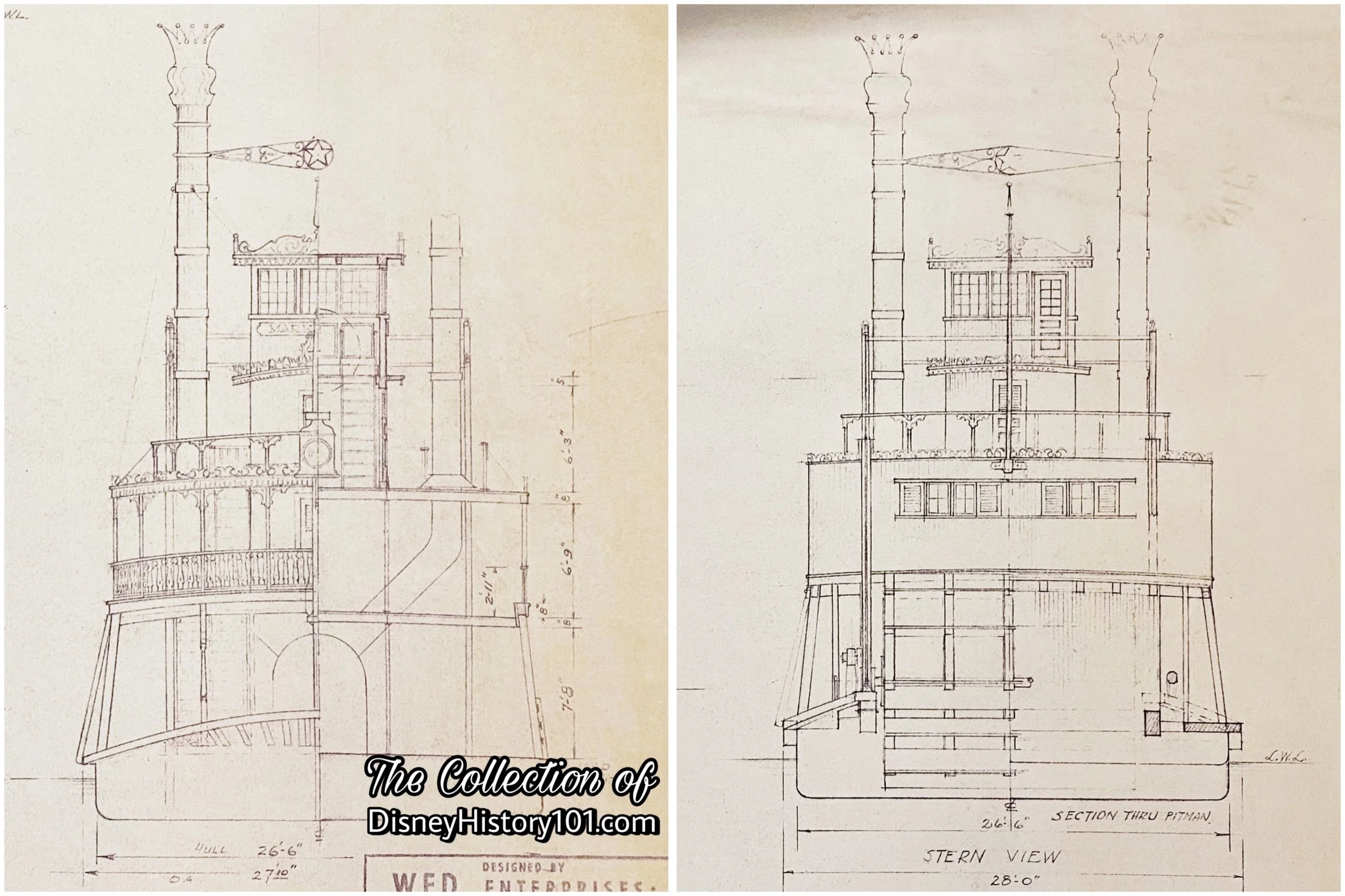
“The Hull”
Soon, the watertight five-compartment steel hull was being constructed (in November of 1954) by Todd Shipyards in San Pedro, California (with Todd Shipyards maintaining the rights to the original drawings off the hull). Wheeled mechanisms were built into the hull to interact with the underwater guide rail, and guide the boat on its tortuous course.
“The Paddlewheel”
The 9-ton paddlewheel (with paddles made of Douglas Fir, and spokes of mahogany) was also built by Todd Shipyards in Wilmington (San Pedro), California. According to one Kaiser publication: “The big beams that drive the paddle wheel on the 105-foot Frontierland steamboat had to be light to keep down above-decks weight, yet strong enough to withstand 22,000 pounds of alternate pull and thrust pressure. Aluminum I beams 13 feet long with 10-inch webs proved to be the solution.”
“The Engines”
The stern wheel propelled by twin horizontal, noncondensing steam engines (with a diesel fuel boiler). The engines were engineered by Dick Bagley. The engines were then built from scratch in The Walt Disney Studio Machine Shop, which was referred to as “a machine shop in the local area with qualified past experience,” according to “Building A Dream,” prepared by Disneyland, Inc. Public Relations Department, c. 1955. “Special construction was also called for in fitting the boiler into the hold,” according to “News From Disneyland” (a c.1956 press release document). This feature particularly impressed “the head of a tugboat company from New York,” according to Herb Ryman [in “Work With Walt” by Don Peri].
“Construction and De-Construction at Walt Disney Studios”
The Mark Twain paddlewheeler was a collaboration of Roger Broggie (the WED employee behind some of the Santa Fe & Disneyland Railroad’s engines), Dick Bagley, and Roland Peterson. Details and the super-structure of the vessel were manufactured by employees on the king-sized Stage 3 of the Walt Disney Studios, “where only a little while back, Davy Crockett was battling the soldiers of General Santa Ana,” (as seen in the televised Disneyland episode “Pre-Opening Report From Disneyland”) and 20,000 Leagues Under the Sea was partially filmed. “Since the deck slopes from one end to the other, each piece of wood had to be individually cut and fitted. To make sure it was completely authentic, we called in a supervisor - a Mississippi riverboat captain, who had spent a lifetime running just such a boat. Constructing such a large boat inside a building, 50 miles from water caused a lot of raised eyebrows. But unlike the fellow that built a boat in his basement, and couldn’t get it out, we had a plan.” The decks (sans hull) were entirely assembled on the “20,000 Leagues” soundstage. Scenes of these processes can be seen briefly in A Pre-Opening Report from Disneyland. It is worth mentioning a little-known fact, that “Walt’s father, Elias Disney, participated as a building contractor on the construction of the Mark Twain,” according to “Disneyland - A Treasure Chest of Trivia,” prepared by Walt Disney Productions, 1990.
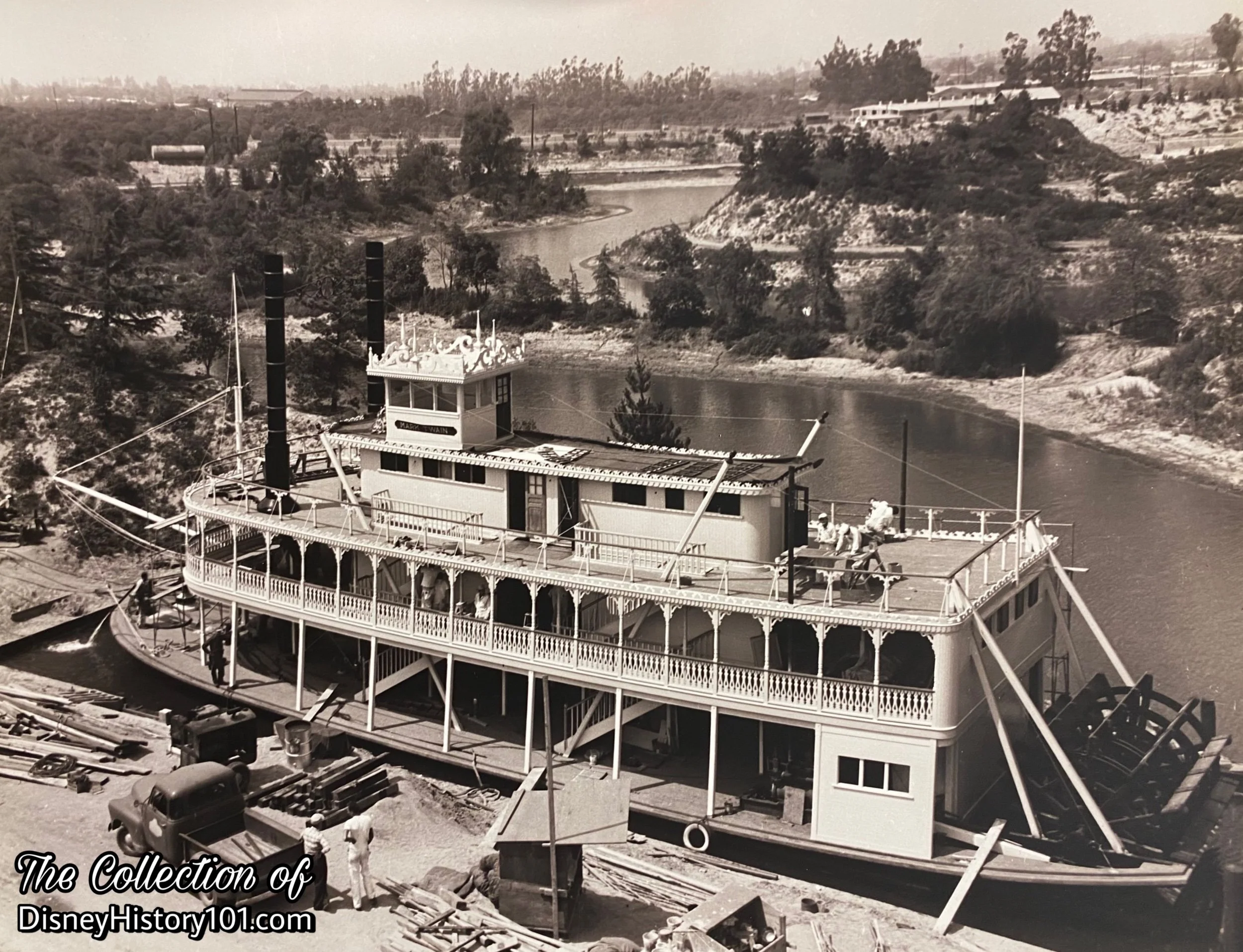
“Re-Construction at Disneyland”
Because of its massive size, the Mark Twain (108 feet long, 150 tons, was much too large and heavy to move through the doors of the giant sound stage of the Disney Studio. It was built only to be disassembled for shipping to Disneyland. According to “Walt Disney Disneyland” (published 1964): “It was… dismantled and trucked over the freeway, piece by piece.” This towing via truck, to Disneyland, from Todd Shipyard can be seen in “Homecoming - Destination Disneyland” by Carlene Thie ; photos by Mel Kilpatrick.
Soon the entire boat would be assembled and completed at Disneyland under the direction of Rear Admiral Joe Fowler, USN (Ret.) Vice President of Disneyland, Inc. and Director of Construction and Maintenance Division. The hull was the first component to arrive at the Joe Fowler’s Dry Dock in Frontierland, (even before the Rivers of America were filled with water. Once the decks arrived near the Frontierland Dry Dock at Disneyland, A.E. Fowler & Sons’ 20-ton Lorraine crane was used to place the assembled 5/8 scale decks on top of each other, eventually comprising the 150-ton vessel. In an amazing feat, the hull and decks fit together perfectly. This can be briefly seen in the Disneyland anthology episode entitled “Pre-Opening Report From Disneyland.” Other assembly was performed on site, and this is briefly preserved on film, in “Disneyland - The Park,” a Disneyland anthology television series short film (originally aired in 1957). Some of Mel Kilpatrick’s photographs of the smokestacks being placed on the Mark Twain with the help of a crane can be seen in “Homecoming - Destination Disneyland” by Carlene Thie, with photos by Mel Kilpatrick. According to the narrator of the aforementioned short film, “well-coordinated planned assured a perfect fit for all parts.” Walt inspected the construction near the Dry Dock, as seen in “Homecoming - Destination Disneyland” by Carlene Thie ; photos by Mel Kilpatrick.
“Illumination and Ornamentation”
LIGHT magazine (July and August 1956; published by the Large Lamp Department of General Electric, 1956) “shed some light” on the illumination. The Mark Twain, was “outlined in a thousand 7½-watt lamps for a gay and decorative effect. Power for lighting” was “generated by equipment right on the boat.” These 1,000 7½-watt lamps outlined the structure, each with porcelain sockets and open wiring.
“Marine equipment houses were searched over the nation for the gimble lights,” according to The Disneyland News (Vol.1, No.1 ; for July of 1955). Custom-built props - firefighting buckets and racks, gimble lights, smoke bells, and running lights - (of the period and size required), ornamented the vessel. The finished ship would hold what were once described as “ornate and plush cabins… on the upper decks,” including a captain’s quarters, wheelhouse, lounges. Including all this elegance (and Guests), the steam-powered ship would draw “about two feet of water” as it traveled the five-foot-deep Rivers of America, according to “News From Disneyland” (a c.1956 press release document).
To top off the proud American “Queen of the River” off, several 1861 34-star flags were flown from the top. According to Herb Ryman [in “Work With Walt” by Don Peri], “No steamship that ever plied the Mississippi River was as elegant as that little jewel that Walt built for Disneyland.”
“Working Title Announced & Studio Staff Preview”
Soon, one authorized “Disneyland Information & Nomenclature List” (prepared by Bill Cottrell of Disneyland Inc., May 25, 1955) divulged the working title of the “300 passenger sternwheeler” to Disneyland, Inc. employees as the “MarkTwain,” and elucidating the attraction the following way : “the S.S. Mark Twain takes you on a romantic story book cruise of the Rivers of America.”
As of June 2, 1955, C.V. Wood Jr. sent an Inter-Office Memorandum to Walt Disney regarding the best estimates that could be obtained at the time regarding the completion status of individual sections of the Park and Opening Day. C.V. wrote: “River Boat: Okay.”
Lastly, the Mark Twain (though incomplete) was dressed with patriotic bunting for a 4th of July party held for members of the Walt Disney Studios and their families. According to inserts in area newspapers, “Mickey Mouse enjoyed a trip with Walt aboard the Mark Twain as she got up steam and the nine-tone paddles turned for the first time.” The Mark Twain would embark on (what would become) a routine 20-minute journey, along a 2,450 foot-long guide rail located at the bottom of the Rivers of America. At 11:30 that night the Mark closed up and Walt invited the entire crew to a party at the Golden Horseshoe.
“Union Negotiations”
As the deadline neared, some unions descended on Disneyland. Among these was the Inland Boatmen’s Union who wanted jurisdiction over the Mark Twain Pilot operators, according to the recollection of Van Arsdale France. After negotiations with the Orange County Central Labor Council there was (what Van France referred to as) a “shotgun marriage” and a resulting total of 29 unions at Disneyland. But the talk of unions could not out a damper on what happened next.
By June 25, 1955, the Mark Twain Riverboat was mostly finished. But before the Mark Twain Riverboat was christened, several important events were scheduled.
Marc Davis and others from the Walt Disney Studio attended an exclusive preopening party for Disneyland on July 4, 1955. The Mark Twain was nearly ready for that event, a photo in “Marc Davis in His Own Words,” page 7, testifying to its near-complete condition. Then another event was scheduled.
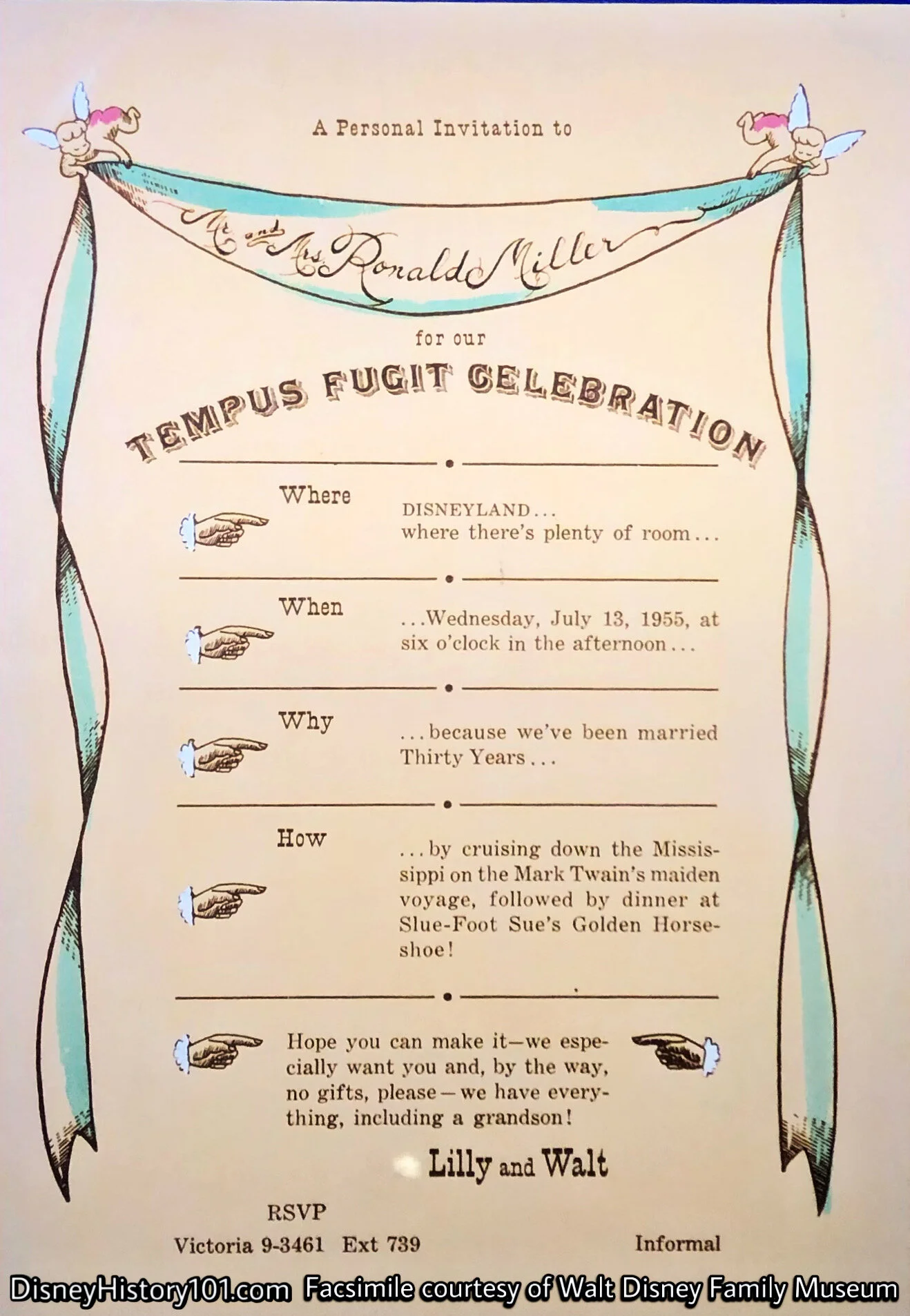
“The Mark Twain and Walt & Lillian’s Tempus Fugit Celebration”
According to Van France, “Walt had been working… at the Park, and welcomed the chance to relax with his friends and co-workers and show off Disneyland.” Five days before Disneyland opened to the public, Walt and Lillian Disney celebrated their 30th wedding anniversary with a star-studded party on the decks of the Mark Twain. Of this happy occasion, Bob Thomas once wrote: “The completion of Disneyland coincided with Walt and Lilly’s 30th wedding anniversary… and an invitation went to 300 people for the ‘Tempus Fugit Celebration.’
Where: Disneyland… where there’s plenty of room.
When: Wednesday, July 13, 1955 at 6:00 in the afternoon.
Why: Because we’ve been married 30 years.
How: By cruising down the Mississippi on the Mark Twain’s maiden voyage, followed by dinner at Slue-foot Sue’s Golden Horseshoe!
Hope you can make it… we especially want you and by the way, no gifts, please… we have everything, including a grandson!
-Lilly and Walt.”
Despite the fact that the invitations read: “6 o’clock,” many guests had not arrived. According to Van France’s recollection, “Jack Sayers was with Walt at the Main Gate at six o’clock… and nobody had shown up. I remember his escaping for a while to tell me… ‘God, Walt keeps saying, ‘Where is everybody?’ and I don’t know where they are. He’s blaming me because the guests are probably hung up in traffic.’”
Meanwhile, “using the Mark Twain that night made Joe Fowler very nervous. He had had a dream the previous night that the river had once again sprung a leak and gone dry. And the stern-wheeler had not yet been tested on the river, leaving a wide opening for Murphy's Law (if anything can go wrong, it will go wrong).
Fowler slipped away from the raucous party an hour before the planned excursion and headed for the ship landing. There he ran into a woman frantically sweeping shavings from the deck. Handing the startled admiral a broom, she said, ‘Come on, hurry, let's get this thing cleaned up!’ Together Fowler and Walt's wife, Lillian, gave the Mark Twain a ‘spit and polish’ cleaning for its maiden journey.” [Disneyland Inside Story by Randy Bright, page 93]
Finally, the cleaning was completed, and the party guests arrived. Mint juleps were served to the Disney’s closest friends aboard the Mark Twain! Then, the ship set off for its maiden voyage around the River. According to the recollection of Van Asdale France, Dick Nunis “served as a bartender at the party. And… if I know Dick, he ended up the evening doing janitorial work… counting and securing the liquor and sweeping up the Mark Twain.”
“55er” Joyce Belanger recalled “The night before opening the Mark Twain ticket booth was not finished windows were dirty all over... there was a lot that still looked unfinished.”
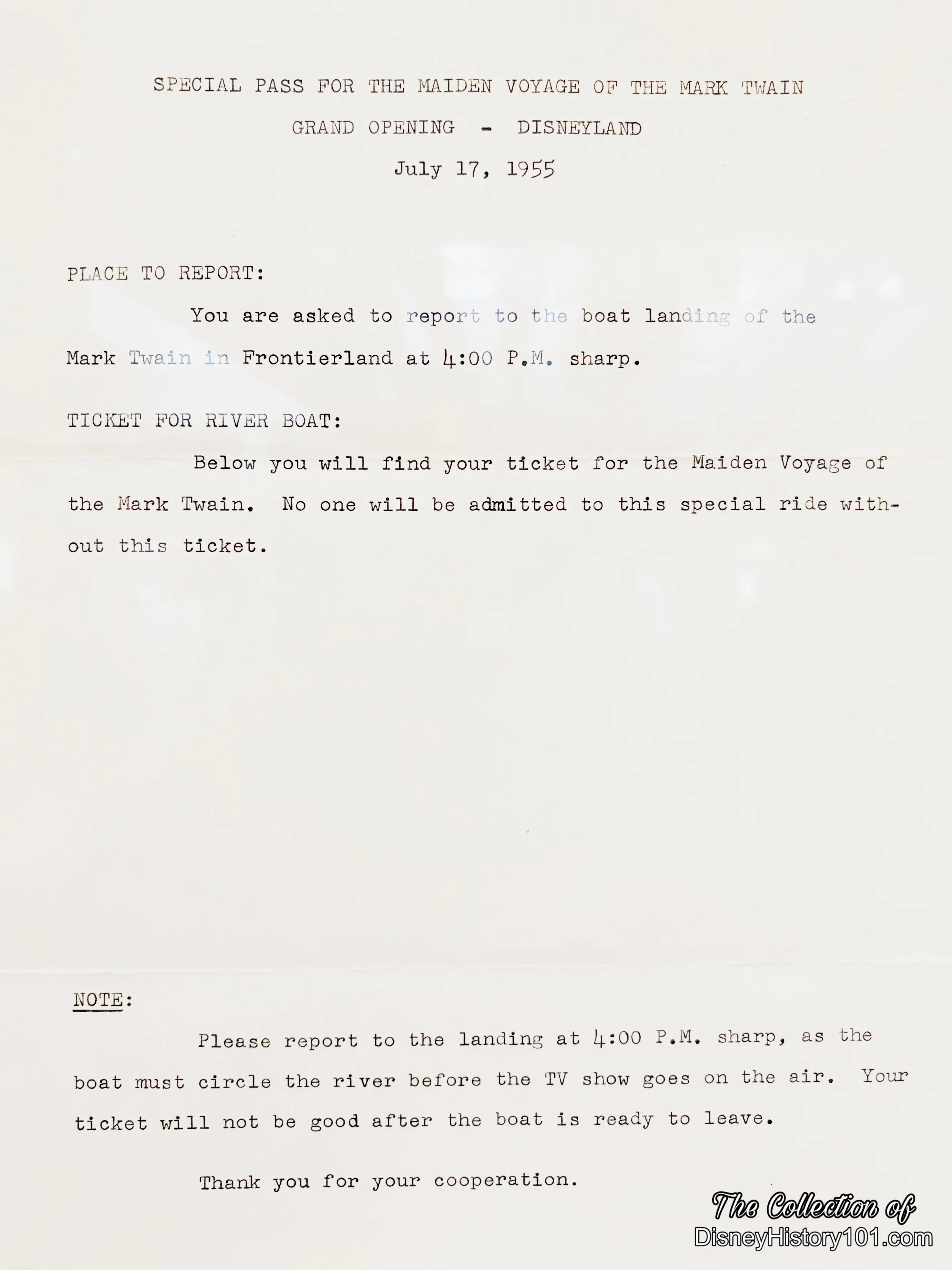
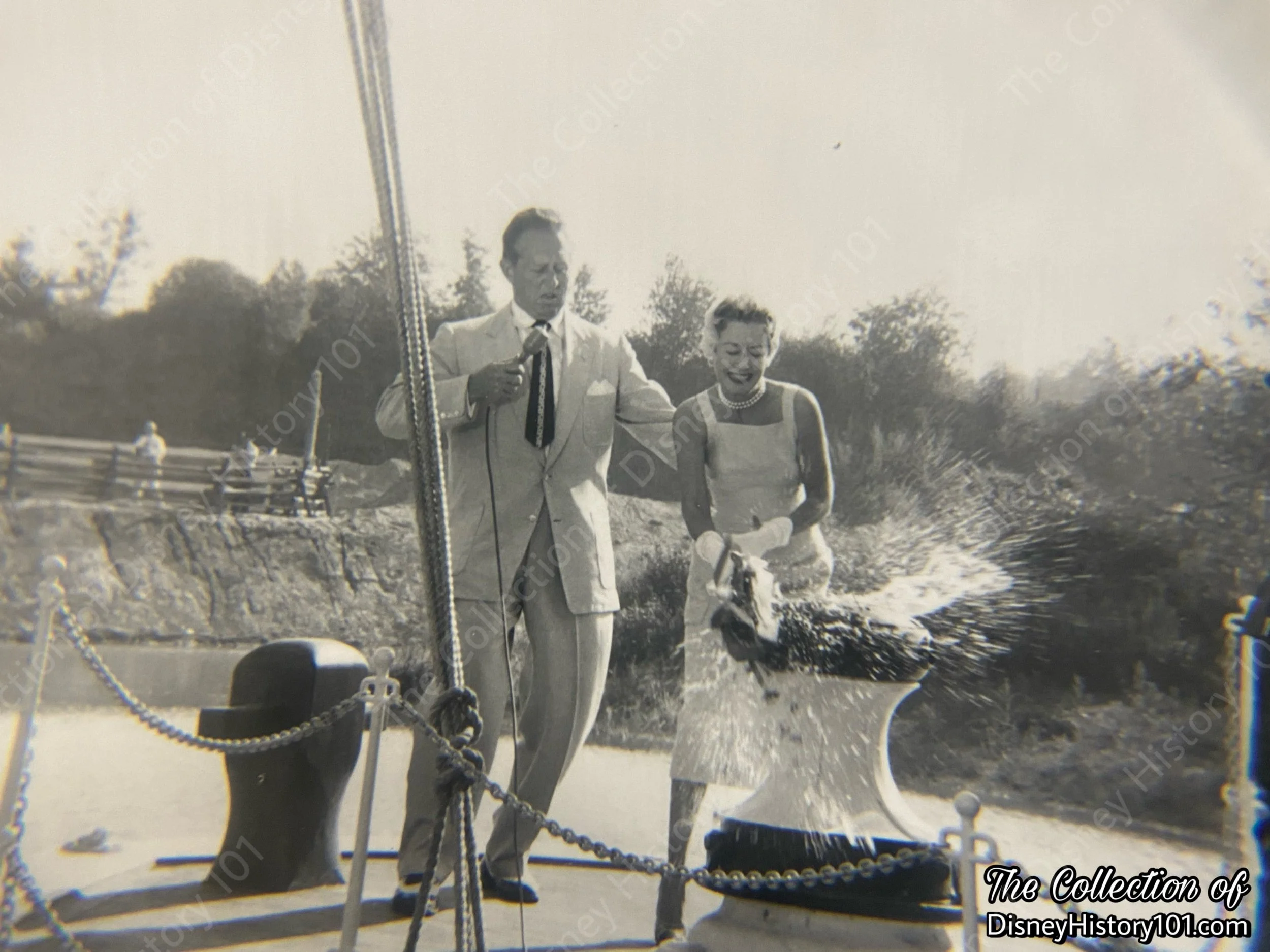
“The Press Preview of Disneyland and the Mark Twain Dedication”
Walt insisted on including a “romantic riverboat” in Frontierland and, though he had to pay out of his own pocket, The Mark Twain made it to opening day. Once Disneyland opened to the public, the Mark Twain would hold the place of 1 of 22 initial major attractions at the MAGIC KINGDOM®!
On Press Preview Day, the boat was officially dedicated by actress Irene Dunne of “Show Boat” (1936) fame (a plaque located behind the boat’s engine continues to commemorate Irene’s role in the dedication). This was more than appropriate, as Irene’s father “used to be supervising general of steamships in America” and her “grandfather used to build boats like this,” by her accounts to Art Linkletter.
“Art Linkletter called upon actress Irene Dunne to christen the Mark Twain with a bottle containing waters culled from the great rivers of the country. ‘My, it's listing,’ she noted, as a big crowd stormed on board the vessel. Dunne mistakenly called Linkletter ‘Walt’ and Art referred to the bottle's contents as coming from ‘the rivers of the world - of America, that is!’” Actually, Irene christened the Mark Twain, with a flask of water from all the true-life “leading” rivers of America, which was broken open (instead if the traditional bottle of champagne).
With that, Art Linkletter scurried off the deck, and while Admiral Joe Fowler blew the whistle (from the Wheelhouse) the Mark Twain departed for its half-mile maiden voyage plying the Rivers of America, at about four knots per hour! Actual capacity was reached with so many guests aboard, that Dick Nunis recollected, the Mark Twain was “overloaded and sinking,” that very day. According to one publication, “water washed up on the deck of the overcrowded Mark Twain Steamboat.”
“Since the Mark Twain had no set load limits, operators kept waving on guests until the deck neared the water line. During one trip along the sparsely vegetated river route, the ship almost capsized as passengers stampeded from one side to the other to view the riverbanks' few attractions. Immediately, the park established maximum capacities, which are still in effect today.” To top it all off, “a window fell out of the upper deck of the Mark Twain onto a man's head.” [“Mouse Tales: A Behind-The-Ears Look at Disneyland” by David Koenig]
However, after riding the Mark Twain, guests could enjoy the Mark Twain Special - a hearty, man sized stack of tangy Aunt Jemima Buckwheat Cakes.
“Grand Opening of Disneyland and the Mark Twain”
Cecil Gibson was the first engineer on the Mark Twain and recalled Opening Day: “There were 14 operators aboard and seven of them were 'Break Men. There was NOTHING on the River... and only a pile of earth for the Island. But the people thought it was great just to be riding on a steamboat!“ “55er” Homer Holland recalled: “I was supposed to be working on the Mark Twain, but they still didn't have my uniform by opening day. Well, the Mark Twain had too many operators and the jungle didn't have enough, so I went to the jungle for a year.”
Generally, the guide rail and a precise water level (of the Rivers of America) would assure that the vessel did not float off of the rail or drop onto the guide rail and break it. Almost. Disneylander and “55er” Dick Galentine recalled “One black winter night, many years ago, I was making my tour of the Park. I came aboard the Mark Twain to make a routine inspection of the fire fighting equipment. It had been raining very hard for a couple of days and the river was extremely high. While I was doing my duties, the Mark floated right off of her guides and the ship moved out several feet from the dock. All this was unbeknownst to me as I stepped off, right into the river! The water sure was cold, but the razzing I got was hot!”
“Response - The Mark Twain Makes the News”
Now, it was said that “Disneyland is News” as innumerable publications and journals reported on Disneyland just during the “first fabulous decade” alone. As really as 1956, “Motorboating” (a “nationally distributed magazine for yachtsmen and boat buffs”), published an article on the Mark Twain, written by Stewart Robertson, for June of 1956. As a result of the press reports, even more “high state, local and national government officials” as well as “luminaries from motion pictures, television and the theater” turned out to “pay tribute to this happy land” including the Mark Twain. [“Disneyland 1st Anniversary Souvenir Pictorial”, 1956, page 9] Among the first four million visitors to step though the Main Entrance Gate turnstiles and take a romantic river excursion was Groucho Marx and his family.
The Mark Twain was part of the Disneyland show that heightened the bar for the entire amusement park industry. The Mark Twain even directly inspired similar attractions at other theme parks around the world. For instance Freedomland (in New York) had two 110-foot, 400-passenger sternwheelers. These boasted to be the “last sternwheel steamers to be built in the United States,… specially constructed for FREEDOMLAND by Todd Shipyards.”
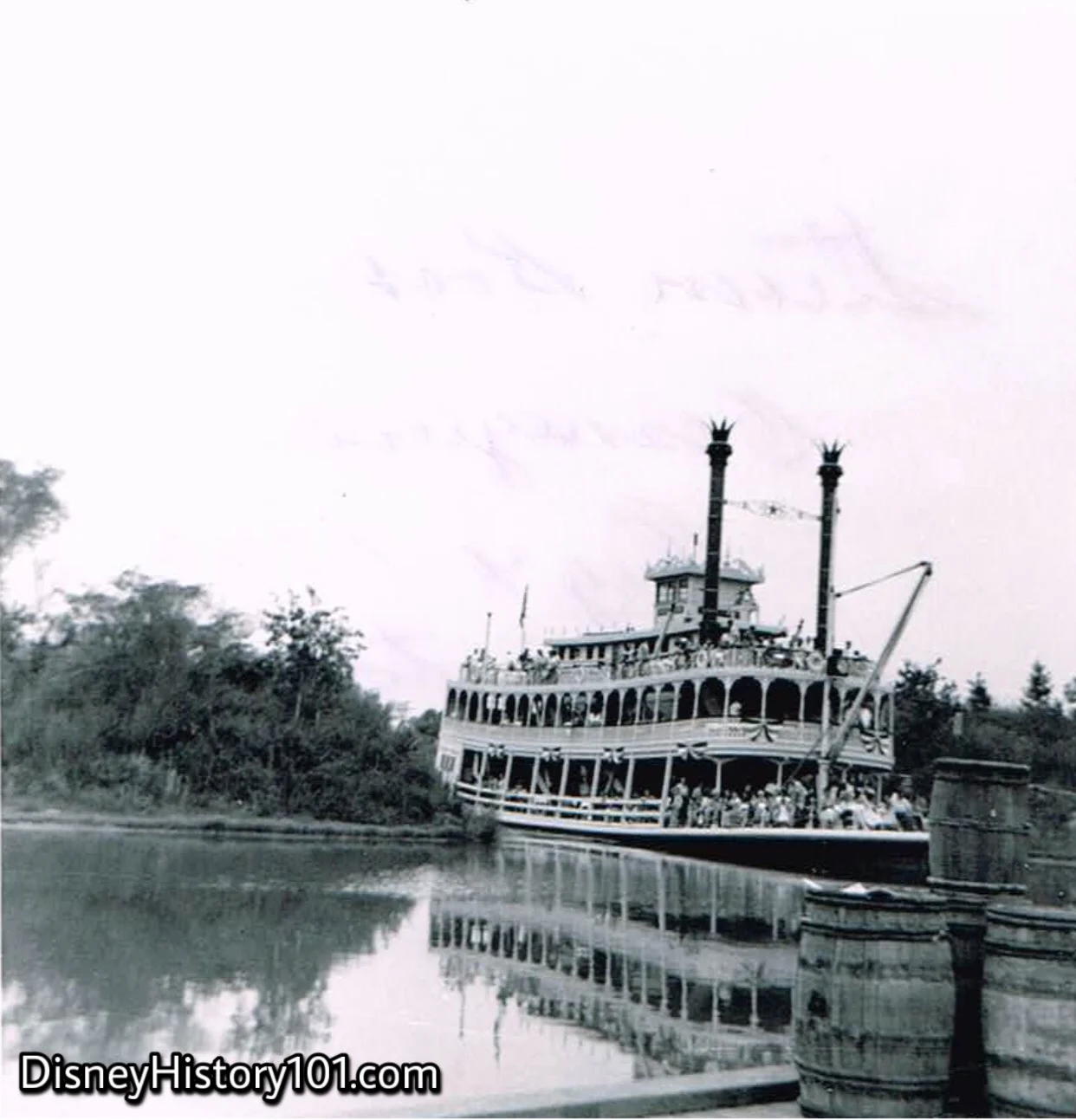
Tom Sawyer Island didn’t open until June 16th, 1956. This was the sparse scene along the shore of the Rivers of America when Disneyland opened. The feel of the journey was similar to taking a true-life steamboat cruise down the real Mississippi River.
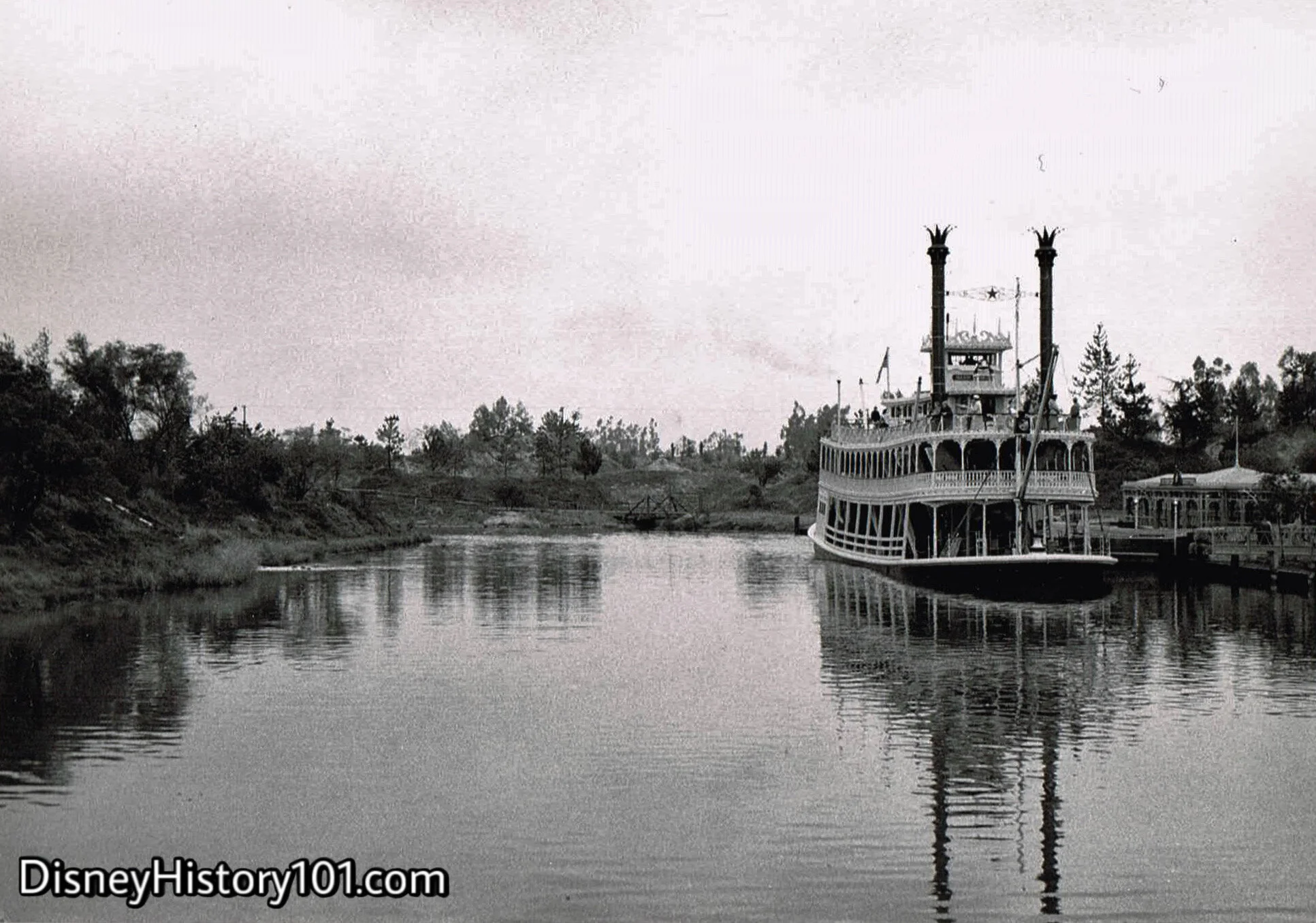
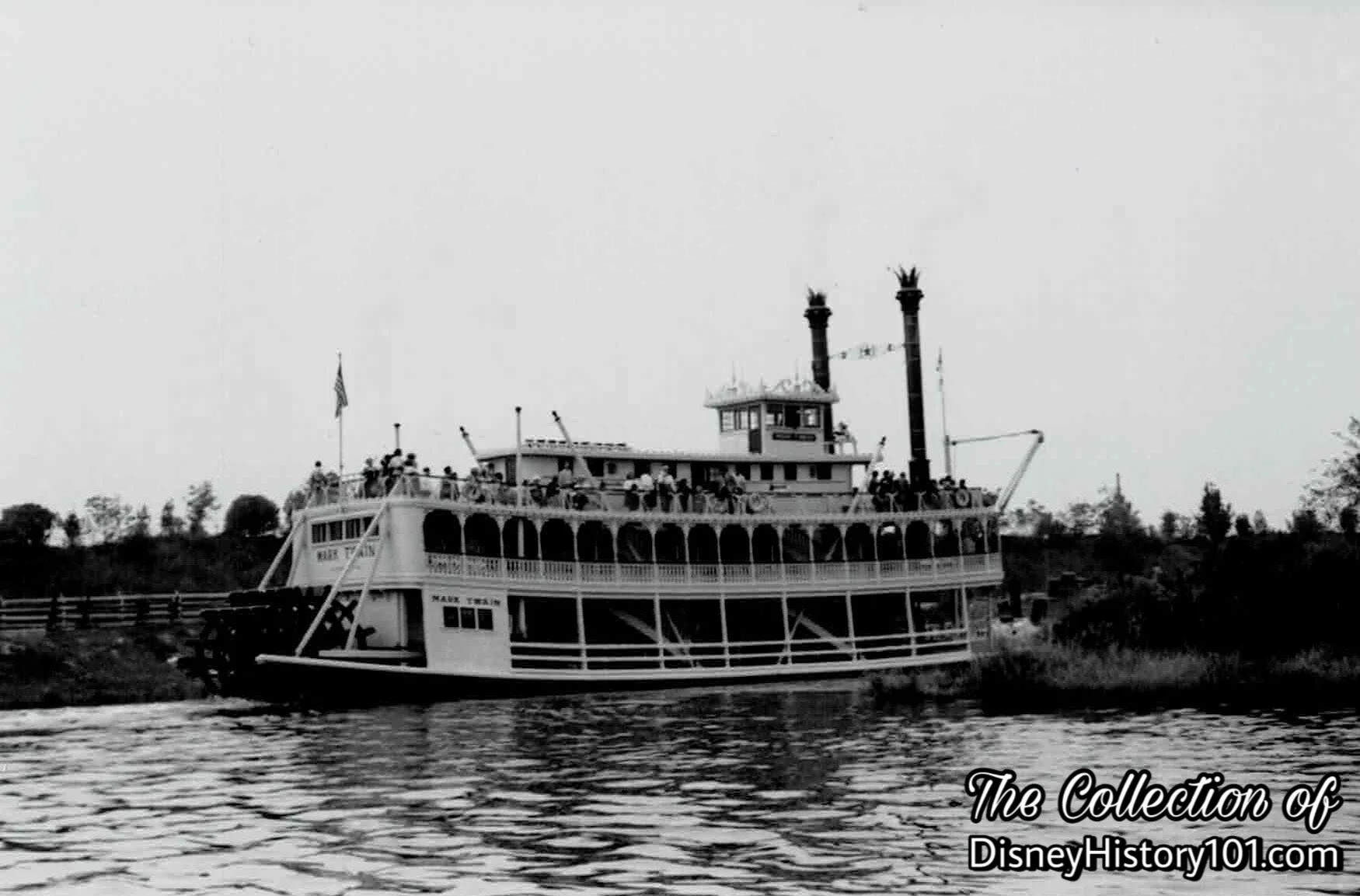
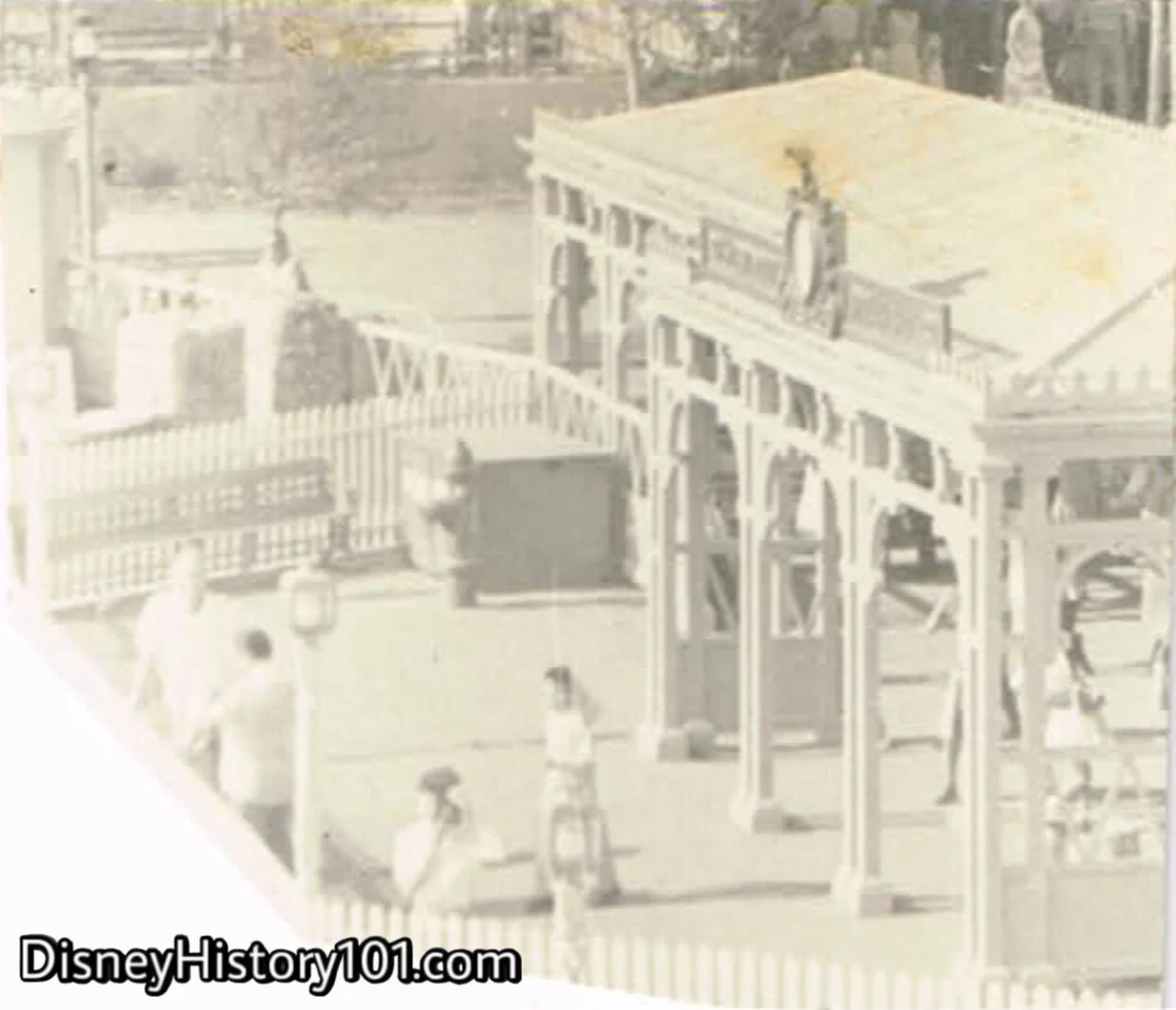
But eventually, the Mark Twain was open to the public and guests waited their turn at the Frontierland Dock (next to the Ice House), as the riverboat ran its course through the Rivers of America.
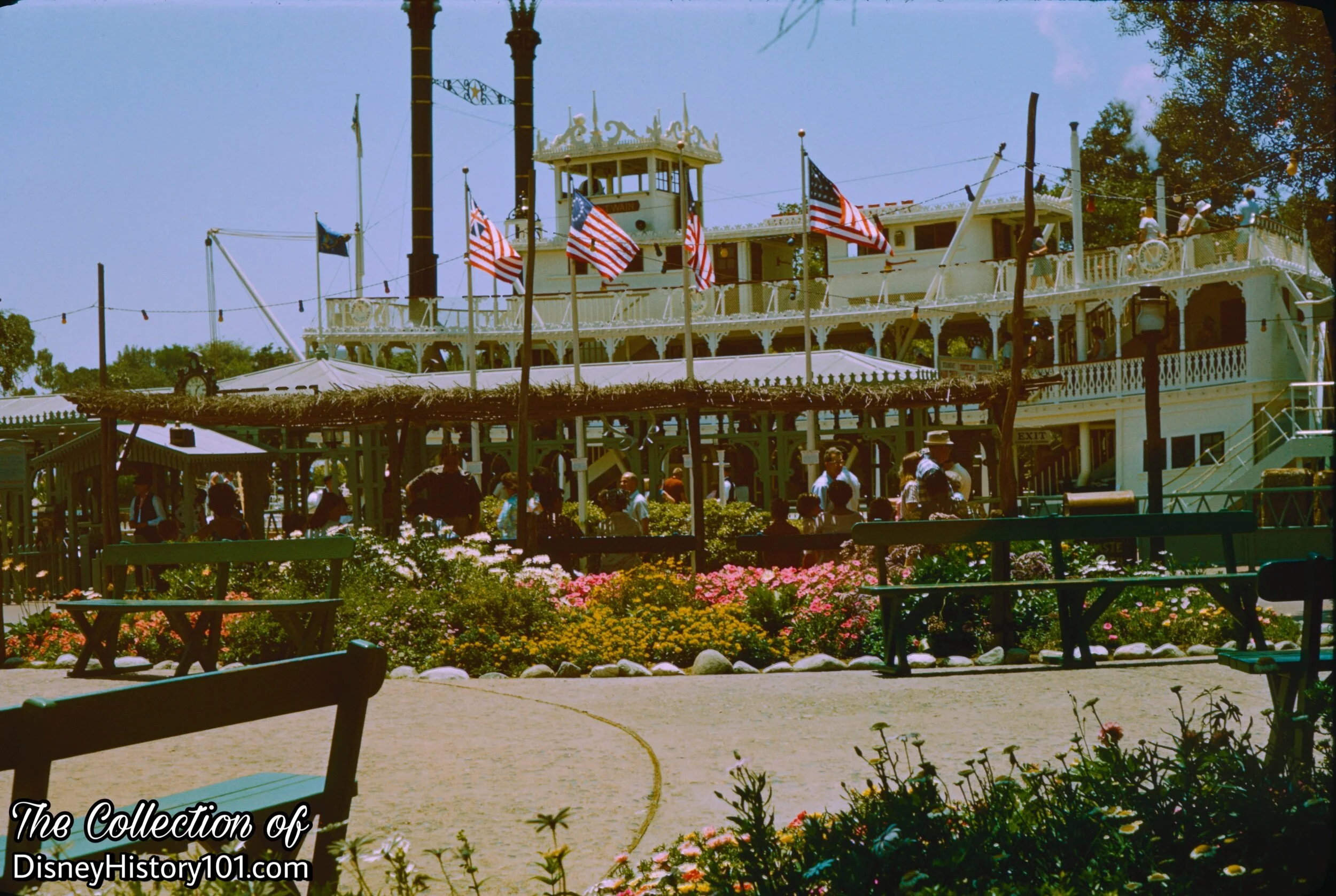
Eight early American flags were flown from the related Mark Twain Steamboat Dock. Among them were the Kings Colors (English Flag), Continental Flag, Betsy Ross (original 13 stars & 13 stripes), Grand Union Flag or Cambridge Flag, the John Cabot or St. George Cross flag flown over the Jamestown Settlement in 1607, the Pine Tree Flag or Washington's Cruisers Flag first carried by the ships of the American Navy, the first "Old Glory" (24 stars & 13 stripes), and the “Star Spangled Banner” (featuring the fifteen stripes and fifteen stars that inspired Francis Scott Key to write the national anthem). This is the only fifteen star flag that flies in Frontierland, as the rest have thirteen stripes of red and white. One version of the blue and gold Disneyland Flag (featuring Sleeping Beauty Castle, the Disney “D,” and six stars) manufactured by Hortie Van also flew over the Mark Twain Steamboat Dock (this one was different from the one flown from the Mark Twain).
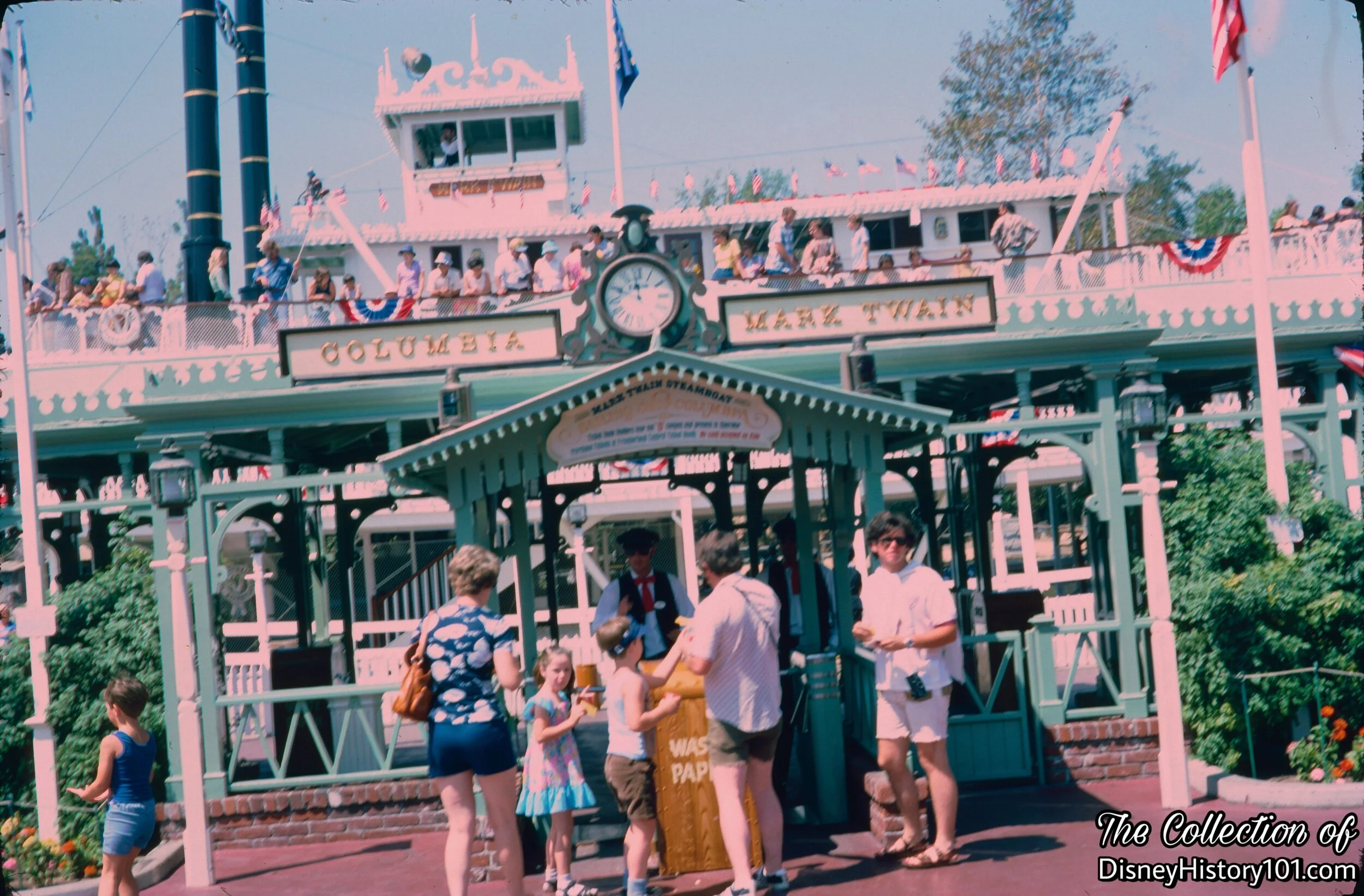
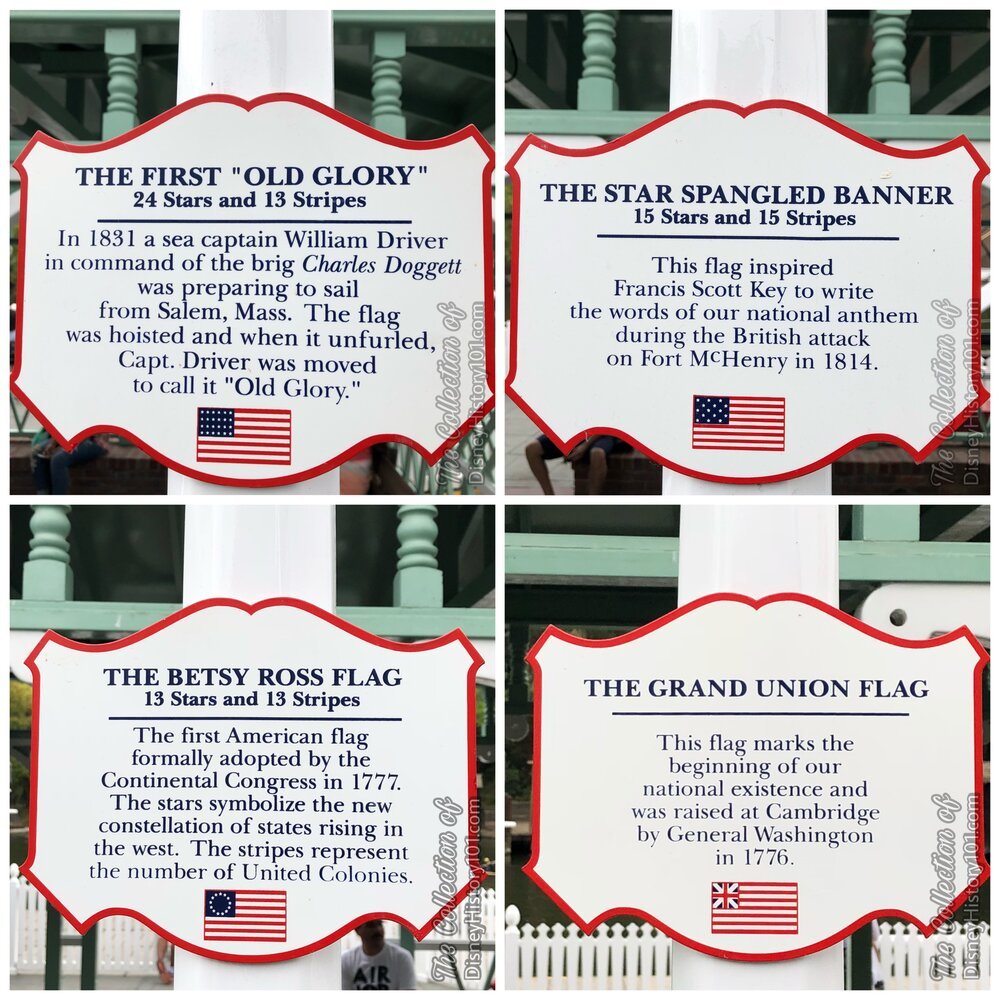
Among the early American Flags flown are the John Cabot Flag flown over the Jamestown Settlement in 1607, the Pine Tree Flag first carried by the six initial ships of the American Navy, and the “Star Spangled Banner” (featuring the fifteen stripes and fifteen stars that inspired Francis Scott Key to write the national anthem). This is the only fifteen star flag that flies in Frontierland, as the rest have thirteen stripes of red and white.
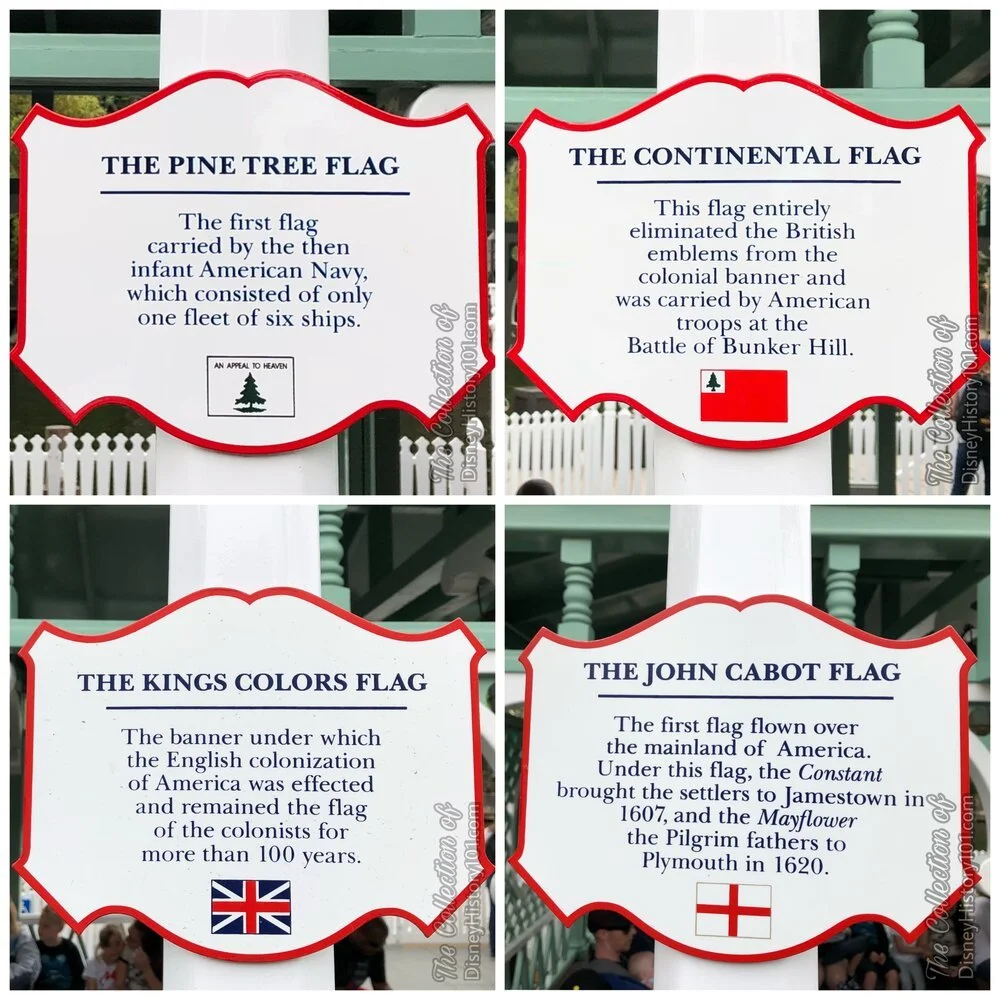
At Disneyland, signs were themed to support the stories with respectful graphics, colors, fonts, terminology, the overall design of sign, materials (wood, metal, banners, etc.), and verbiage used on the signage. These curate the American flag exhibit.
Paint is important. The “Master Color Book” is the Bible for color selection at Disneyland, maintaining a catalogue of 4,000 shades of color. The book contains color specifications for every land, building, exhibit, and prop which requires paint maintenance. It insures that Disneyland will always have the same bright colors selected by the art directors who designed the attraction. In addition to the Master Color Book, there is a standby supply of ready-mixed paint available for touch up work. Thousands of cans of paint are stored in a special room which sounds like a walk through of Disneyland. Each can is labeled with names. Disneyland painters repainted every prop in the Park every two years. By 1969, these signs were eight of 20,000 signs of various sizes and shapes and colors that needed to be maintained in their original condition.
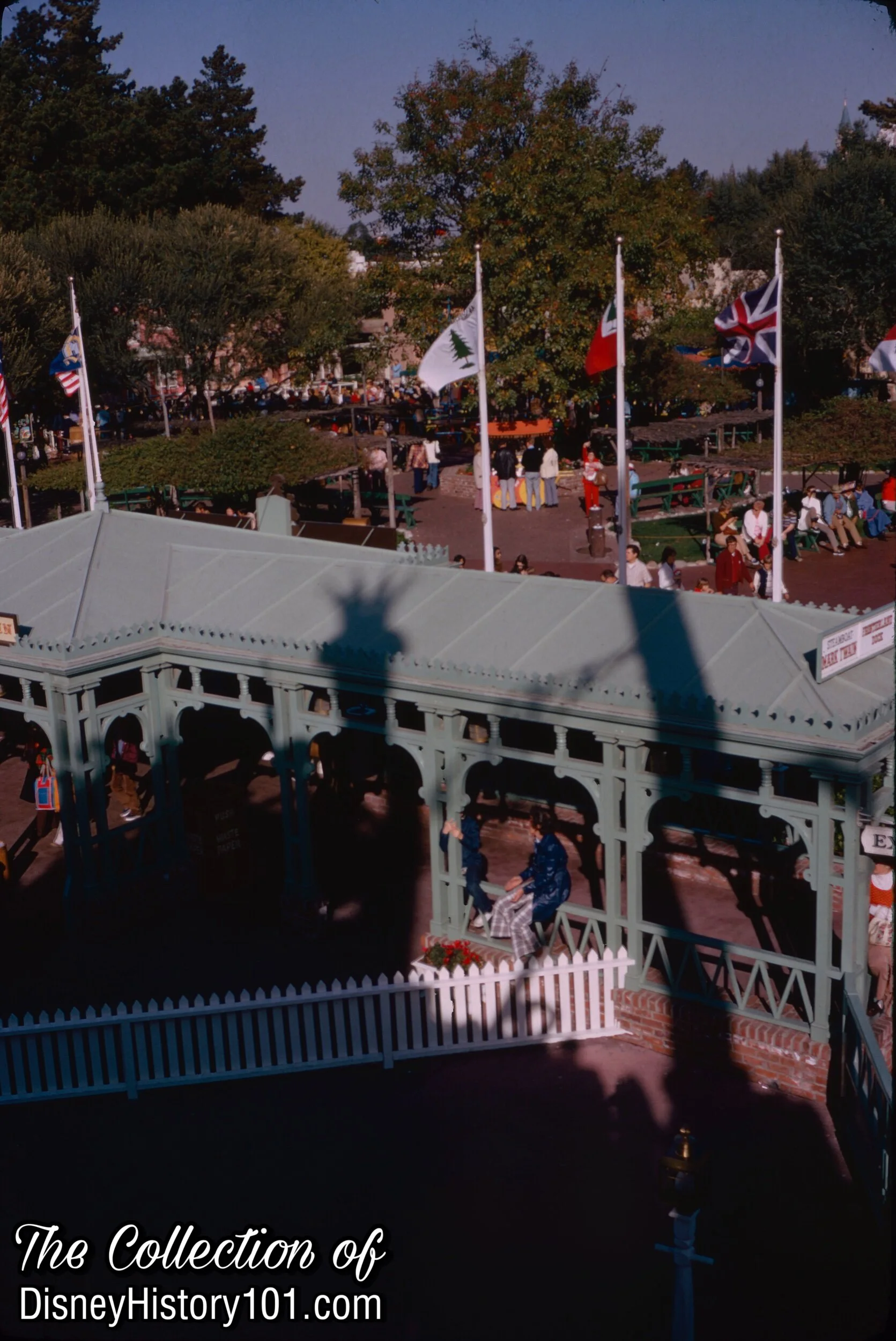
One version of the blue and gold Disneyland Flag (featuring Sleeping Beauty Castle, the Disney “D”, and six stars) manufactured by Hortie Van also flew over the Mark Twain Steamboat Dock (this one was different from the one flown from the Mark Twain).
As a representation of a “Betsy Ross Flag” hangs over the dock, we are immediately transported back to the time of the mid-19th century - a time of steam-powered river boats on the romantic tree-lined Mississippi River. From the sound of the Mark Twain’s whistle blowing, it sounds like they’re close to arriving at the dock.
There was plenty of entertainment for guests awaiting their voyage near the Mark Twain Steamboat Dock. During the mid-1950s (c. 1958, for instance) an orchestrion was housed near the dock.
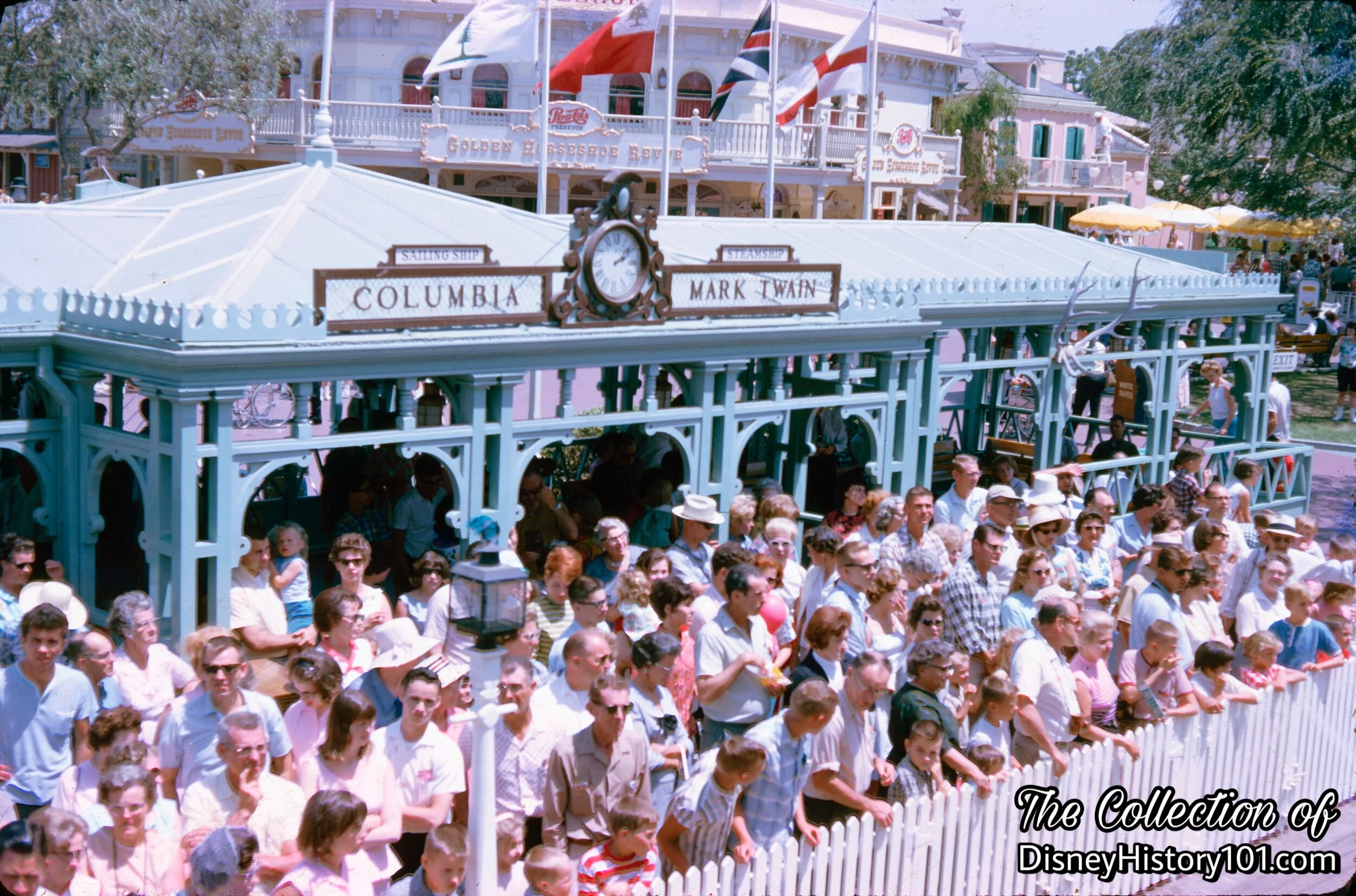
Disneyland “queue lines” (or Audience Waiting Areas) were designed as part of the attraction to make the Guests' time in line as comfortable as possible.
We wait on the dock of the New Orleans section of Frontierland, next to cargo “boxes, barrels, wooden buckets and sacks of cotton bales,” as the 1870’s paddle wheeler Mark Twain docks.
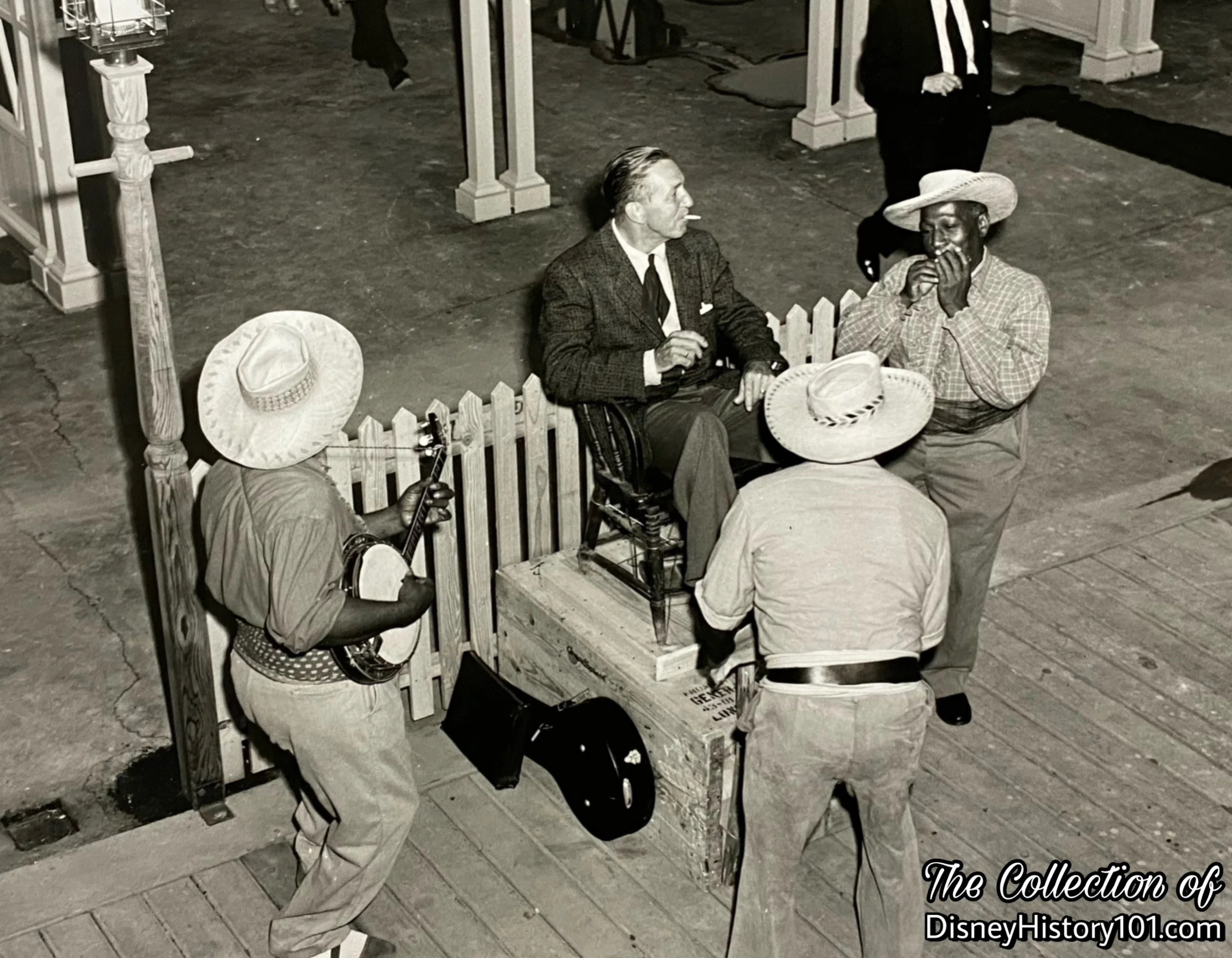
According to “THE DISNEY THEME SHOW - an introduction to the art of Disney outdoor entertainment”: “Important are the sounds which permeate the scene, for without them, the theme show is a silent movie . . . but with them it is a symphony of music, effects, and natural sounds that the finest stereo system in the world can't duplicate. These sights and sounds are provided not only by imagineered attractions and shows, but also through the multi-talented efforts of live entertainers . . . in special musical groups . . . in parades and pageants . . . providing an everchanging backdrop to virtually every area in the theme show.”
“Audience Waiting Areas” were especially designed as part of the attraction to make the guest's time waiting in line as comfortable as possible. Since the beginning, queue areas were equipped with live entertainment to set the mood for the forthcoming show. Before Shoeshine Boys (Teddy and Kenny) there was Wayne and Bill, Shoe Shining Co. Around the winter of 1956 and 1957, they performed for Guests near the Mark Twain Dock on Saturdays and Holidays (from 9:30 AM until 4:00 PM). In 1956, they entertained every other day from Saturday the 15th until December 31st.
Safety has always been key to the Disneyland Show. Related to this, the Foremen of attractions had the responsibility of checking out a Handie-Talkie radio unit (using the Radio Log) before reporting to their respective attractions each morning. The battery operated radios were carried via belt and holster. In Frontierland, the units were located at the Mark Twain and Columbia Sailing Ship (on main line), Mark Twain Dock (Mark Twain foreman, located at turnstile), and Tom Sawyer Island. The Handie-Talkie radio units were housed in a charging unit when in operation on the Mark Twain, Mark Twain dock, and the Columbia.
While waiting for the Mark Twain to arrive (or simply enjoying the waterfront scenery), many guests have used the opportunity to take a memorable photograph of their experience in Frontierland.
“IT LOOKS PRETTY GOOD” - Former Indian Village performer Cheryl recalls, “I remember [my father] …was working at the naval shipyard in Long Beach at Todd Shipyards part time. There were contracts a number of companies working at that time in Long Beach. He had between one and two jobs at a time to support us. My dad never bragged, but he just mentioned it later to us.” While visiting Disneyland with her father one day, they were passed by the Mark Twain, to which her father joked, “Well, it looks pretty good now.” As it turns out, he was a welder, and had worked on the hull construction of the Mark Twain, while it was in Todd Shipyards, San Pedro, California! Cheryl continues : “He never knew we were going to be working at Disneyland. It wasn’t a job he was searching for. It just happened. I remember that was a biggie when he said that he worked on the Mark Twain.”
The Mark Twain takes on passengers, as its crew prepares to embark on passage through the waters of the Rivers of America!
As we step aboard, we’re welcomed : “Howdy folks!…I’d like welcome you aboard the MARK TWAIN - the “Queen of the River Boats”. Our journey today will take us up the Rivers of America and into the western frontier. Along the way, I’ll be pointing out some interesting sites and tellin’ ya a few stories!” Leadsmen shout their safety calls “by the Mark” , to beckon the start of our journey, and we’re off!
Ahead of us, lay a romantic, nostalgic, “circuitous” trip into the rustic “splendor of the Old South and Early America” as it once was on the Mississippi, (as described by many early press publications)!
Perhaps you can recollect the “feel” of experiencing the Rivers of America for the first time, from the Main Deck of the Mark Twain. Maybe you can recall the sights of passing the tree lined riverbanks, the smell of the water, and sounds from the performing Dixieland bands. Walt had an affection for these elements and always loved the Mark Twain, later divulging to Joe Fowler, “When things get hectic, we can always get on the Mark Twain and just ride around the Rivers of America.”
The Promenade Deck (the second floor) once had a bar where guests (and performers) could order non-alcoholic refreshments (like Mint Juleps). These were served “during summer months,” according to the “Disneyland Dictionary”, compiled by WED Enterprises, Inc. and WED Public Relations Department, c. 1968. Here, a shutterbug has managed to capture Michael Delay (of The Young Men From New Orleans) getting a quick refreshment from the Promenade Deck Bar.
There were many positions within the rotation - the set order of operating positions established by the attraction's Working Lead. The Promenade Deck Bar would not have functioned without Disneyland Employees (above) who both stocked and served Disneyland audiences.
The Mark Twain Riverboat is one of several truly timeless Disneyland attractions! One 1958 appraisal by Bank of America made the following statement: “While the bulk of the improvements are 3 1/2 years old they have been considered as effectively new due to exceptional maintenance and slight obsolescence. Improvements to the real property including the landscaping and also the Columbia and Mark Twain have been given an economic remaining life of 40 years.”
In one of his final publications, Dave Smith (previous Chief Archivist Emeritus of the Walt Disney Archives), included the Mark Twain Riverboat among “the only attractions still at Disneyland today that were there on opening day, July 17, 1955.” [Disney Facts Revealed by Dave Smith, 2016] Dave continued : “It would be very difficult to make a count [of how many trips the Mark Twain Riverboat has sailed around the Rivers of America since the Park first opened], because many factors would have to be taken into consideration : the number of trips per day, the fact that Disneyland was closed on Mondays off-season from 1955 to 1957 (and on Mondays and Tuesdays from 1958 to 1985), the various rehabs of the attraction, the days on which the Mark Twain was cycled with the Columbia, and weather closings of the Park and of the attraction. Perhaps someone will attempt an estimate someday.”
By the 1960s, the Guided Tour of Disneyland included “a leisurely cruise on the Rivers of America aboard the elegant paddle-wheel steamer Mark Twain.” This seems like an appropriate time to share a few sidelights about the Mark Twain Steam Boat.
Scale : 5/8
Height : 28 feet tall (from Keel to Pilot House)
Length : 108 feet, unassembled 105 feet, (according to the televised Disneyland episode “Pre-Opening Report From Disneyland”)
Draft: 2 feet, 3 inches
Weight : 159 tons
Displacement : 125 tons
Beam : once 26 feet, 6 inches; 27 1/2 feet
Decks : 4 (From bottom to top - Main Deck, Promenade Deck, Texas Deck, Pilot House)
Crew : 1 Captain, 1 Engineer, 1 Deckhand
Passengers : 350 (c. 1955) ; 300 (current maximum)
Speed : Four Knots per Hour
“By The Mark, Twain.”
A few talented voices have been heard in this role through the years including Pete Renaday (providing the voice-over narration of Mark Twain).
Disneyland Guests Hilda and Lucille & Jim Roberts ride as passengers aboard the Mark Twain during their Tour of Disneyland! The Texas Deck was so named for the grand vantage of the northern Texas river bank granted to passengers of boats navigating the Rio Grande River!
The Texas Deck offers one of the highest vantages to be enjoyed by most guests (aside from the Wheelhouse). The Texas Deck also features the lower level of the Wheelhouse with a recreation of the Captain’s Quarters.
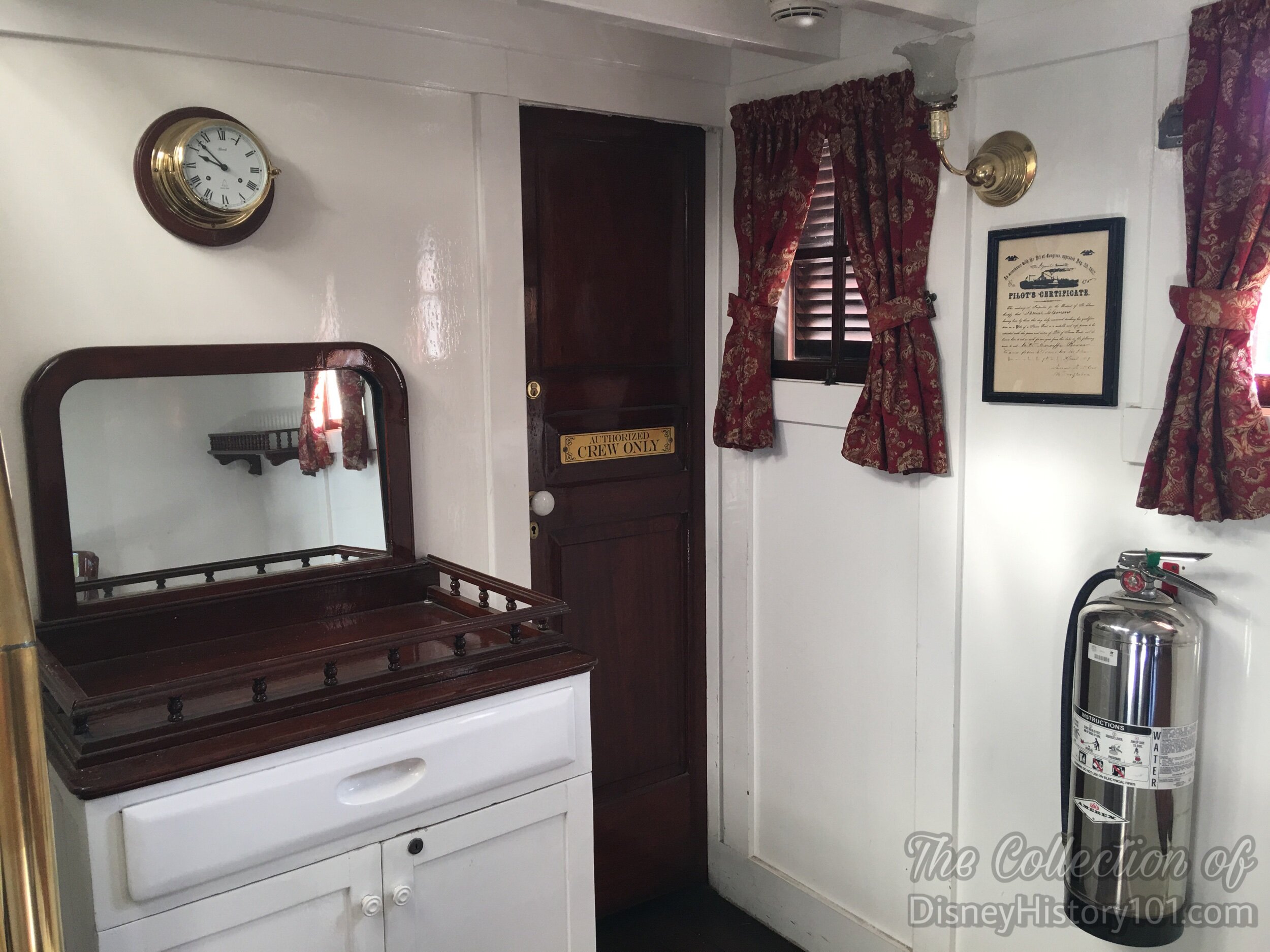
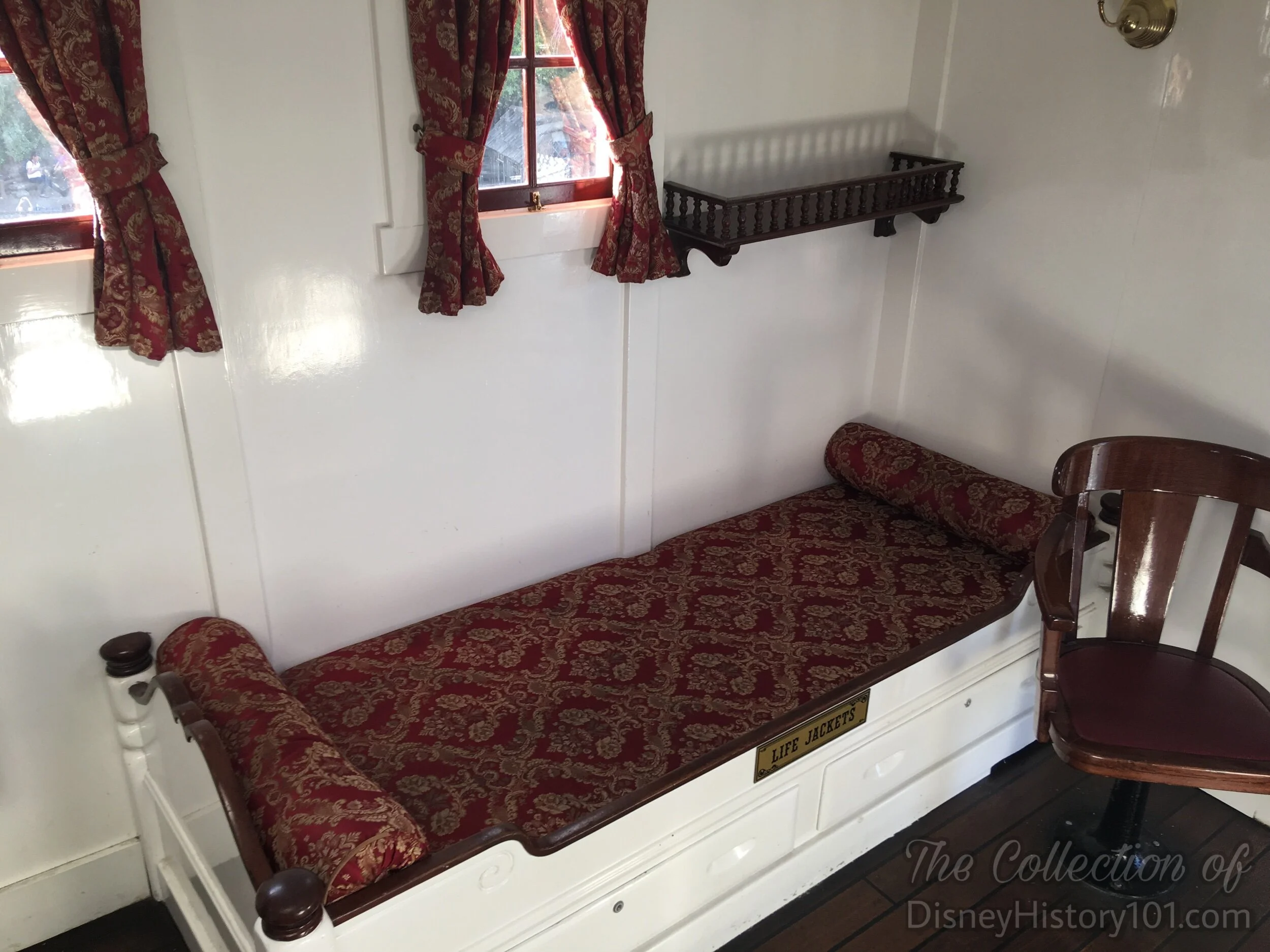
The former Walt Disney Imagineering Principal Creative Executive Marty Sklar would probably agree that the small details like these make the story appealing.
“55er” electrician George Short recalled meeting Walt : “I would run into him quite frequently on the Mark Twain. He would like to spend some time in the cabin below the pilot house.”
From the Texas Deck, we can see the Wheelhouse where the Captain controls and steers the Mark Twain. We use the term “steer” loosely, as the Mark Twain is guided by rails running 2,450 feet in length around the Rivers of America.
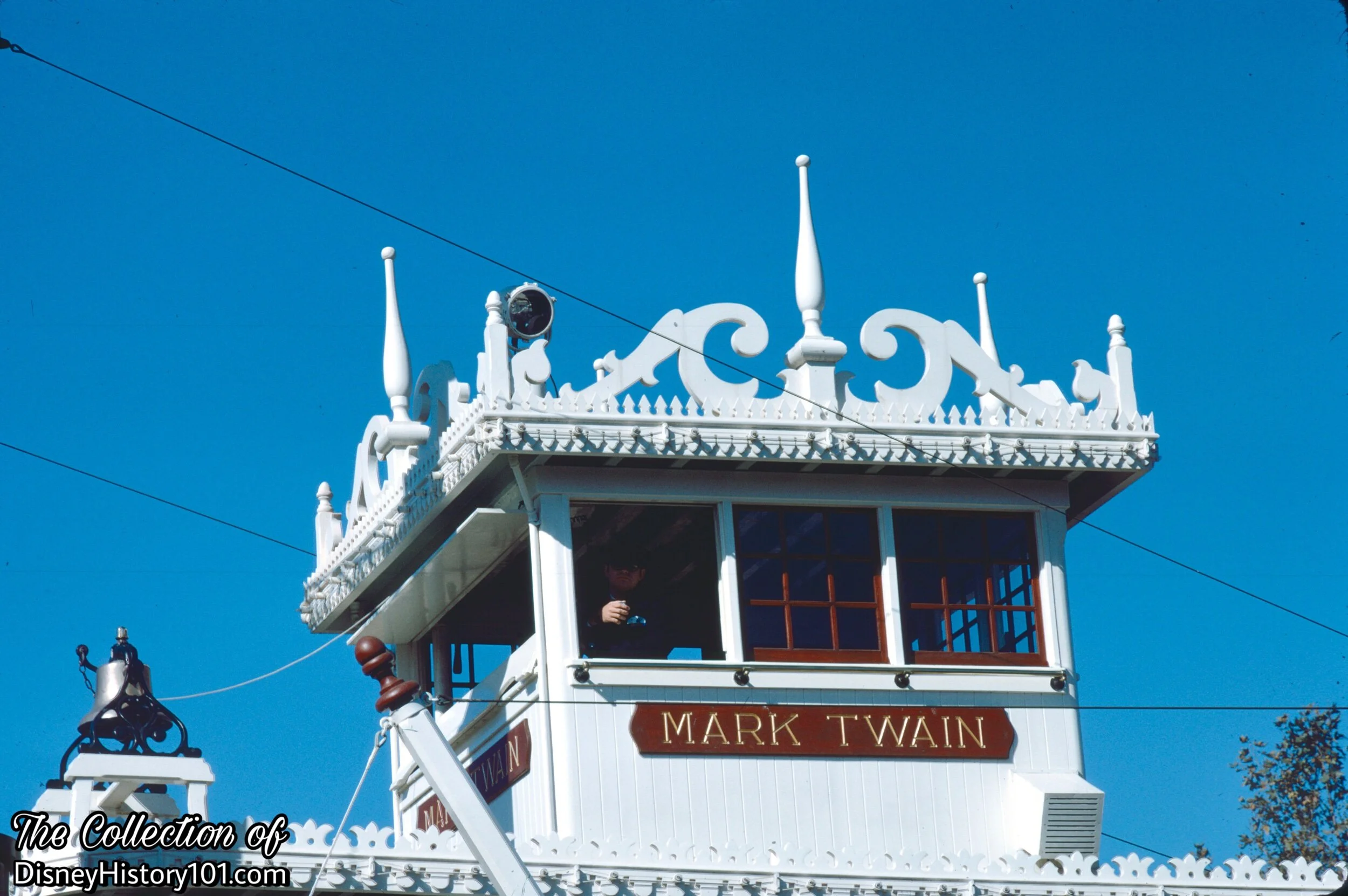
The Wheelhouse Host/Hostess has two primary responsibilities - Safety and show. Safety is always of primary importance, nevertheless show is also very important in creating quest happiness and enjoyment. Many responsibilities are observed by the wheelhouse Host/Hostess. They are the “eyes” of the Mark Twain. Because of the numerous other river craft and potential hazards, they are to be alertat all times and ready to respond to any situation with the appropriate action, using a two-way radio, emergency bell signals, intercom, life preservers, etc. From a show standpoint, their role is that of a riverboat Captain in frontier America. They play any spiels on cue, ring and blow the whistle, and steer the ship.
Each day brings a new adventure and new passengers to the Wheelhouse Host/Hostess. Cecil Gibson (the first Mark Twain Engineer) recalled: “I remember when an elderly, grey haired man with a yachtsman's cap came up to me and said that he never saw a man handle a boat on landing like that young whippersnapper up in the Pilot House. The man had been a steamboat captain back on the Mississippi. Now he stood shaking his head at such good landings.”
“55er” Roy Brem recalled “the day the Beauty Pageant girls came aboard the Mark Twain!… They were all over the boat, getting pictures taken and up in the wheelhouse steering the boat with me.”
The Mark Twain Riverboat is unique (along with the Disneyland® Railroad) among Disneyland attractions in that vehicle operation is performed by facilities Cast Members, not operations Cast Members.
So many Disneylanders worked the Mark Twain. For instance, Hank Block worked on the Mark Twain longer than any Disneyland employee. By 1966, Dick Wells was a Mark Twain Captain and went on to become an Assistant Supervisor of Frontierland.
You may have acquired your Moon Pilot License, or Autopia Driver’s License. Since the 1950s, those permitted to step inside the Wheelhouse were often made Honorary Pilots.
A great deal of licensed merchandise was inspired by the Mark Twain like the Riverboat Board Game and the Strombecker Paddle Wheel River Boat model kit. The latter was initially modeled by Herb Lozier, with designs drawn by Don Miller (both of Walt Disney Productions’ Character Merchandise Division, suggested and prepared from 1954-1955.
Designs for an acetate and styrene Mark Twain model were prepared by Strombeck-Becker. Details were created of the filigree, bell, and wheel of the pilot house, paddle wheel, smoke stack, flag pole and more.
Mark Twain fare changed over the decades. Admission during 1958 was one “jumbo” “D” coupon (the price of 35 cents, for one child), the same as the Jungle Cruise, Indian War Canoes, or the Tom Sawyer Island Rafts. On one day in the month of August, 1958, Disneyland's visitors took a total of 5,600 boat trips on the Park's nine (9) water rides (including the Mark Twain Steam Boat). By the very same year of 1958, the Mark Twain attraction (still popular as ever) was appraised, the ride structure valued between $47,500 and 50,000 and the equipment, scenery, props, and associated chattel valued between $280,200 and $260,000.
By 1959, Joe Fowler was Vice President of Disneyland Operations Committee and Doc Lemmon of Disneyland Operations was overseeing Operators of Rides & Amusements (like the Mark Twain Steam Boat), Livestock, Parking Lot, and Ticket Sellers.
By June 22, 1965, the Mark Twain carried 18,040 guests, beating the old record of 15,969.
At Disneyland, Atmosphere Entertainment compliments the theme of the area and was often staged to entertain Guests on an immediate and personal level. Since Walt and Lillian’s “Tempus Fugit Celebration,” the Mark Twain has been the scene of such live entertainment!
During the first year of operation through the late 1960s, the Disneyland Band often marched through Disneyland (from 11:20 a.m. to 12:15 p.m.), ending with a concert aboard the Mark Twain Riverboat. A selection of Dixieland folk melodies performed by the Disneyland Band often could be heard emanating from the Main Deck of the Mark Twain as it circumnavigated the River. This common sight was reminiscent of “Walt Disney’s Disneyland Band Concert” (the Disneyland Band’s 1956 “on location” record album cover. We can almost hear the Riverboat Medley (“Waitin’ For The Robert E. Lee”, “Cruisin’ Down the River”, and “Here Comes The Showboat”) now!
“The Mark Twain Stage - For Television”
Since the beginning, Disneyland has synergistically worked with Walt Disney Studios to keep the Disney characters before the public and provide a source of material for television programs. Around Disneyland, the name Mark Twain became so synonymous with live entertainment, that the vessel began to be utilized as a set piece or stage for numerous television shows filmed at Disneyland. The Mark Twain has even been the Stage for numerous productions captured on film for motion picture usage, including television specials, commercials, and even music videos. Twice, the Mark Twain acted as the main stage for the production of “Meet Me At Disneyland” (during the 3rd and 12th episodes) airing on ABC television in August of 1962. The “Rhythm of the River” episode (partially filmed aboard the Mark Twain) starred The Excelsior Banjo Band and The Young Men From New Orleans, while “Dixie On The Delta” (filmed almost entirely on the Mark Twain) starred the Hot Jazz Society Marching Band, the Albert McNeil Choir, Voices of the Hope, The Young Men From New Orleans, and Kid Ory! After this, Louie Armstrong performed aboard the romantic river steamer during the Disneyland After Dark television special in 1963.
The Mark Twain was also staffed and operated for television advertisements. An RCA commercial (filmed April 9th, 1963) featured the Queen of the River. Then, the 26-minute “The New Christy Minstrels” (episode 4) sponsored by Ford, was recorded in front of the Mark Twain on August 3, 1964, and broadcast on NBC, August 13, 1964.
On Thursday, August 18, 1966, some Walt Disney Studio photographers (under the direction of Hamilton Luske) took a few long shots of the Mark Twain (and New Orleans Square from the Mark Twain) for use as background plates. During the 1970s, E.J. Peaker performed and sang aboard the Mark Twain during a segment of “Disneyland Showtime” (a c.1970 Wonderful World of Disney episode).
“Special Performances Aboard the Mark Twain”
During Friday and Saturday nights of the summer of 1962, The Young Men from New Orleans Dixieland group performed from the Mark Twain during Disneyland After Dark. Also during the 1970s, the Banjo Kings provided happy music to accompany your “first class circuitous” journey down the Rivers of America. During the winter of 1976, the Kids of the Kingdom performed a show while riding aboard the Mark Twain. They were followed by more Kids of the Kingdom performing aboard a a Keel Boat, and the Rivers of America Water Pageant (a fireworks display set off from three separate barges around Tom Sawyer Island)!
The Mark Twain was once even the site of the first Disneyland wedding reception aboard an attraction, on Sunday, September 24th, when a “Just Married” banner was unfurled from the stern of the vessel in honor of the union between Patricia Gazda and Kevin Sullivan.
Of course, the most entertaining aspects of the adventure are the scenery as the Mark Twain circumnavigates the Rivers of America. Many sights have come and gone since the maiden voyage of the ship - Cascade Peak, Big Thunder Falls, Twin Sisters Falls, Burning Settler’s Cabin, Catfish Cove, the Cider Mill, and the Indian Village Burial Grounds.
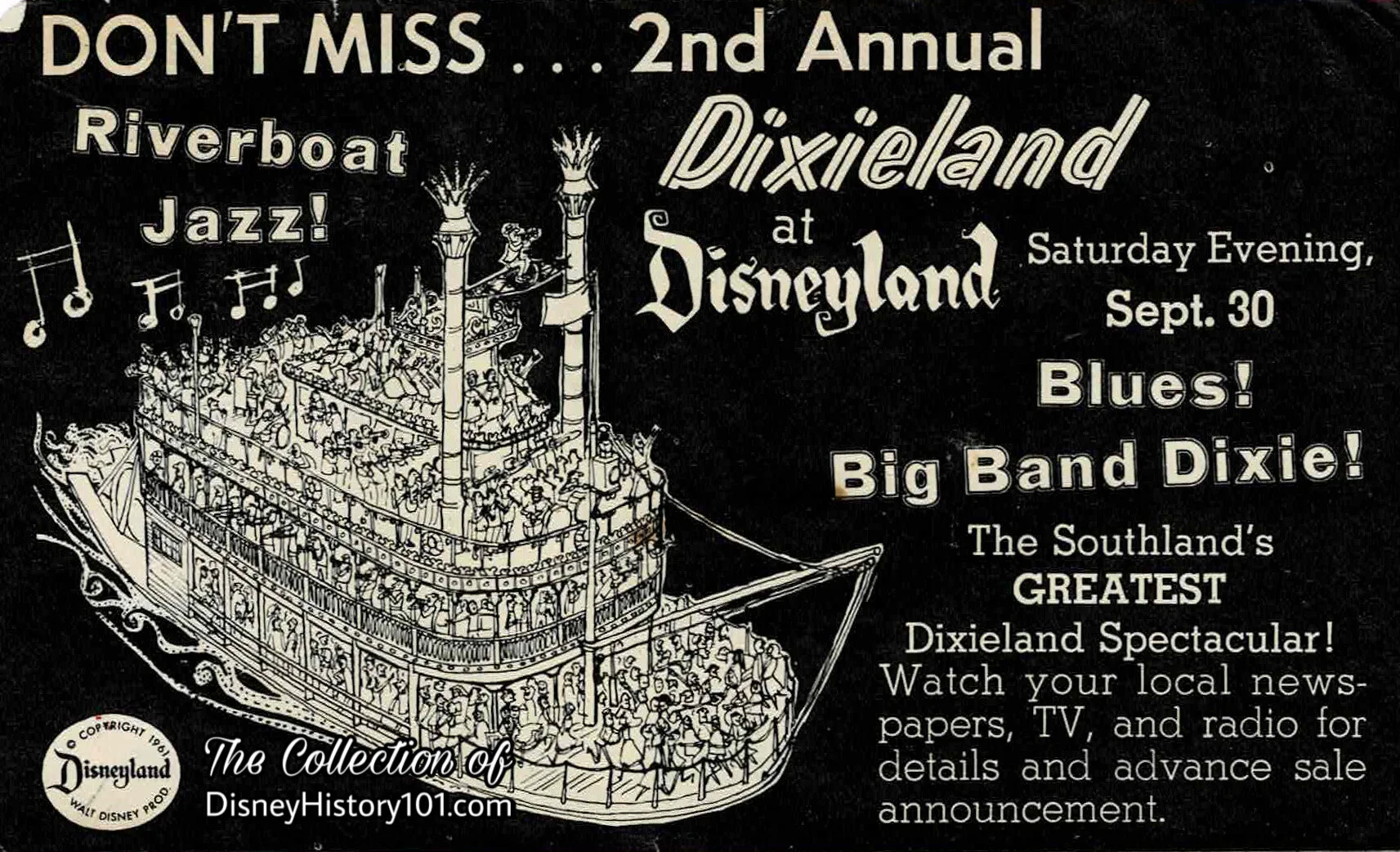
“Here Comes the Showboat”
1960 - The first annual Dixieland at Disneyland (featuring performances by six bands aboard rafts) was held October 1st, 1960, on the Rivers of America and other locations around Disneyland. The “two-beat Dixieland Jaxx and riverboat rhythms” of very first Dixieland at Disneyland attracted an attendance of 9,000 Guests (and drew “acclaim from guests and reviewers” according to The Disneyland Diary). According to Amusement Business magazine, “nearly 15,000 people… paid from $75,000 to $80,000 for admissions” to watch the shows. According to the same publication, “The Albert McNeil Choir of 50 opened on Tom Sawyer’s Island in the play of spotlights. Using river rafts as moving stages, Teddy Buckner and His Disneyland Band, Matty Matlock and His Dixieland All-Stars, The Firehouse Five Plus 2, The Young Men From New Orleans” and others were among the talent. Disneylander and “55er” John Gerlack recalled: “In my 20 years, I was most impressed by the show put on on Tom Sawyer Island for a Dixieland Night. there were pinwheels, rockets, everything. I thought the whole island was going to blow up!” “55er” electrician George Short remembered “The most exciting event was a big Dixieland Night on the River. The Mark Twain came around, blacked out except for hundreds of people with sparklers. The massed bands of Bob Crosby, Louis Armstrong, Teddy Buckner played on the bow.. and the fireworks on the Island!”
1961 - The second annual ‘Dixieland at Disneyland’ was held Saturday, September 30, 1961, from 8pm to 2am, bringing 14,000 guests. The event souvenir program cover featured the Mark Twain with good reason, for the advertised “conclusion” starred Louis Armstrong leading “the array of bands on rafts down the Rivers of America in Frontierland, followed by the ‘Mark Twain’ with 50 musicians playing ‘When The Saints Gio Marching In’ aboard.” Of the featured bands was “The Young Men From New Orleans,” (Johnny St. Cyr on banjo, Paul Barnes, Mike Delay on trumpet, Alton Redd on drums, with Monette Moore and by some accounts Harvey Brooks on piano), who performed their “St. Louis Blues” while “Floating Down the River.” By this time, The Young Men from New Orleans was considered a “permanent” band at Disneyland by 1961, appearing earlier from the deck of the Mark Twain, during Date Nites at Disneyland events, held during the Summer of 1961, (Fridays ‘til midnite and Saturdays ‘til 1:00a.m.). They would also perform their “pure” Jazz on Easter Sundays. Other headliners of the Second Annual Dixieland at Disneyland included Edwin “Kid” Ory, Teddy Buckner and his Dixieland Band, Matty Matlock and his Dixieland All-Stars (Eddie Miller, Moe Schneider, Dick Cathcart, Stan Wrightaman, Nick Fatool, and Ray Leatherwood) with special guest Louis Armstrong performing at the 20,000 Leagues Stage (and a specially designed floating Raft stage with crown atop), “housebands” The Firehouse Five + 2 (Eddie Forest, Danny Alguire, George Probert, Dick Roberts, Frank Thomas, and Don Kinch) at the Plaza Gardens, The Albert McNeil Choir (comprised of 50 voices) and The Disneyland Strawhatters (Warren Gale, Johnny Schmidt, Jim Barngrover, Ed Erickson, Sonny Anderson, and Jim Martin) at the Golden Horseshoe.
1962 - Louis “Satchmo” Armstrong would return alongside other musicians for Dixieland at Disneyland of 1962. Before that, the “Disneyland After Dark” live television broadcast (airing April of 1962) featured the previous (1961) appearance of Louis Armstrong singing “Up The Lazy River” aboard the Mark Twain.
1963 - “Dixieland at Disneyland” (of 1963) included “Al Hirt and a cast of 300 in a musical Mardi Gras”, and “drew 18,000 music lovers.”
The entertainers of the Fifth Annual Dixieland at Disneyland (of September 25 & 26, 1964) included Louie Armstrong joined by two of his “hot five,” (Kid Ory and Johnny St. Cyr of The Young Men from New Orleans), Sharkey Bonano and His Kings of Dixieland, Sweet Emma Barrett and Her New Orleans Jazz Band, Ben Pollack and His Dixieland All-Stars, the Clara ward Gospel Singers, the Elliot Brothers and their Big Band Dixie, and the Firehouse Five Plus Two. All appeared in “All That Jazz” staged on the Rivers of America in Frontierland, with a huge stage “being erected on the tip of Tom Sawyer Island for the production numbers staged and choreographed by Burch Mann. The entire river becomes a part of the stage as the starring musical groups drift by on colorfully decorated floats with settings taken from the streets and bistros of New Orleans. The climax comes when the entire cast of over a 100 is assembled together as the huge sternwheeler Mark Twain rounds the bend loaded with a full orchestra and hundreds of performers spinning lighted sparklers. At this moment a giant fireworks display is unleashed into the air and across the top of the water. It’s a thrilling sight, and one that will be remembered for years to come. Never in jazz history - even in New Orleans - have so many all-time greats gathered together for such a performance at that planned for this year’s ‘Dixieland at Disneyland.’” [as reported by Small World Newsletter, September 23, 1964, page 2] Film coverage of some acts took place on Thursday, October 1st, 1964. Maybe you recall the scene: “the riverboat Mark Twain steams round the bend twinkling with sparklers from bow to stern as Louis Armstrong leads 50 Dixieland jazzmen into When the Saints Come Marchin’ In.” [Walt Disney Disneyland, published 1964]
During the third week of January (c. 18th - 10th), of 1965, Tommy Walker, Card Walker, Ed Ettinger and Ben Harris (and others) spent some time at a Disneyland Staff Planning Meeting in Palm Springs. One of the subjects that was discussed was the forthcoming Dixieland at Disneyland event of 1965. While there, they met with Ben Pollack and His Five Piece Dixieland Band (at Ben Pollack’s Palm Springs home) over their appearance in Dixieland at Disneyland of 1964, as well as their ideas for 1965.
On September 22nd, 1965, a Ford car was prepared (washed and gasoline put in the tank) to pick up Louie Armstrong.
Dixieland at Disneyland was held Saturday, October 1, 1966 from 8pm to 2am.
The 1967 edition of Dixieland at Disneyland occurred Saturday, September 30, from 8 p.m. to 2 a.m. The edition starred Louis Armstrong and his band, Eddie Condon, Teddy Buckner and his band, Doc Souchon and his New Orleans All-Stars, the Firehouse Five +2, the Young Men from New Orleans, the Southern California Hot Jazz Society Marching Band, and the New Dixie Band (winner of Disneyland’s recent youth Dixie Band contest). Advance sale tickets (at $6 each) were available at the Disneyland Box Office, with $7 tickets available at several locations like Bank of America, Desmond’s stores, Wallich’s Music City, and the Disneyland Box Office.
Dixieland at Disneyland (Saturday, September 28, 1968, 8:30 pm to 2 am) brought Louis Armstrong and His Band, Turk Murphy and His Band, Teddy Buckner and His Band, the Firehouse Five + 2, and The Young Men From New Orleans! Louie Armstrong performed “Ten Feet Off the Ground” from “The One and Only, Genuine, Original Family Band”. This song was the third Sherman Song that Louis Armstrong recorded - first, in 1937, Robert “On A Little Bamboo Bridge.” Then, in 1955, Dick’s “Christmas In New Orleans.” And “Ten Feet off the Ground”!
During 1972, Banjo Kings (Sonny Helmer) performed.
Even after Dixieland at Disneyland ended its run, other bands (like The Banjo Kings, c. 1978) would perform from the Mark Twain.
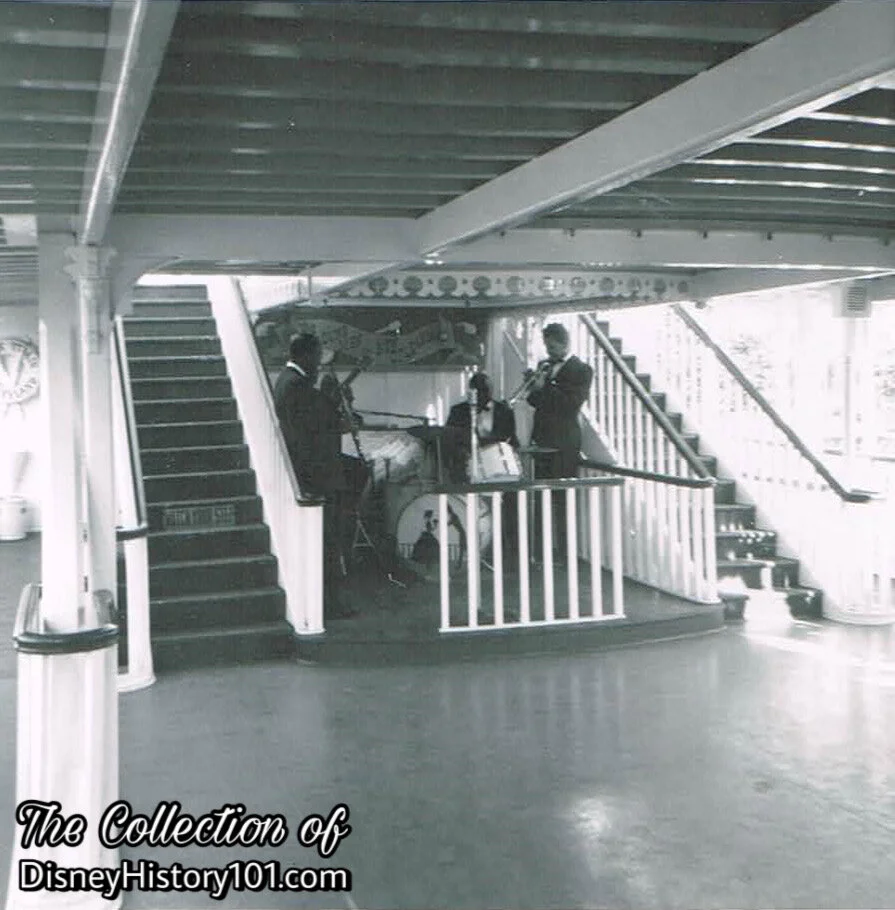
According to the Guided Tour Script of 1962 : “On weekends and holidays the Young Men of New Orleans, an authentic Dixieland Jazz Band, play for your dancing and listening pleasure as you float down the river.” It has been said that Harvey Brook’s Young Men From New Orleans “evoke memories of Fate Marable” as they perform “A Variety Musical Treat” aboard the Mark Twain Stage, on the Main Deck of the Steamboat!
A second dance floor was added on the upper Texas Deck of the Mark Twain for entertainment during the summer of 1961. The Disneylander (VOL. 5, NO. 6; JUNE, 1961) announced: “The real ‘show stopper’ is likely to be the newest addition authentic old New Orleans Dixieland jazz played in a setting to match the music aboard the Mark Twain. A dance floor has been added on the top deck of the stern wheeler and as it steams along the Frontierland river, ‘The Young Men From New Orleans.’ will rock the ship with all the Dixieland favorites.” According to the Guided Tour Script of 1962 : “On weekends and holidays the Young Men of New Orleans, an authentic Dixieland Jazz Band, play for your dancing and listening pleasure as you float down the river.”
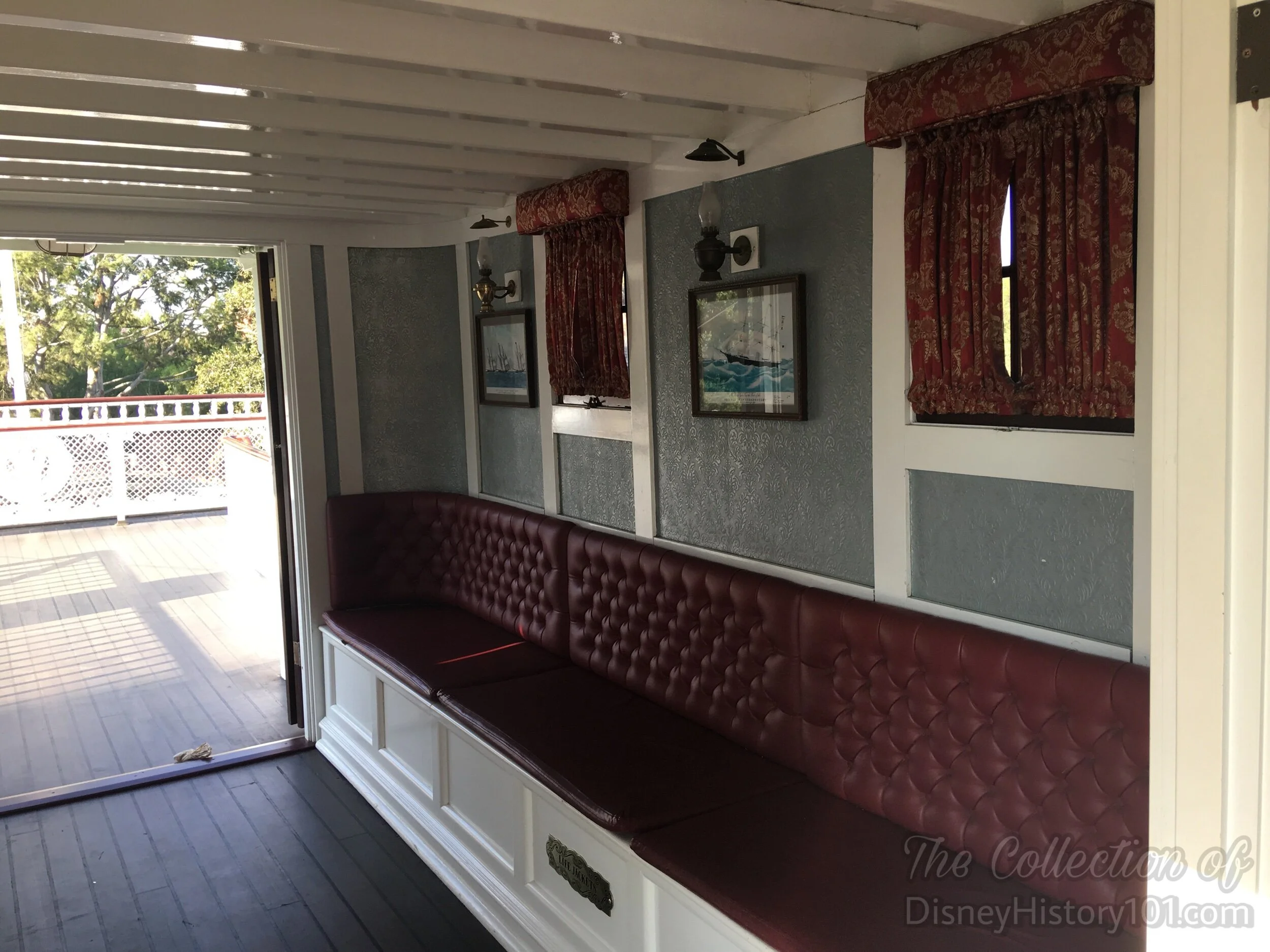
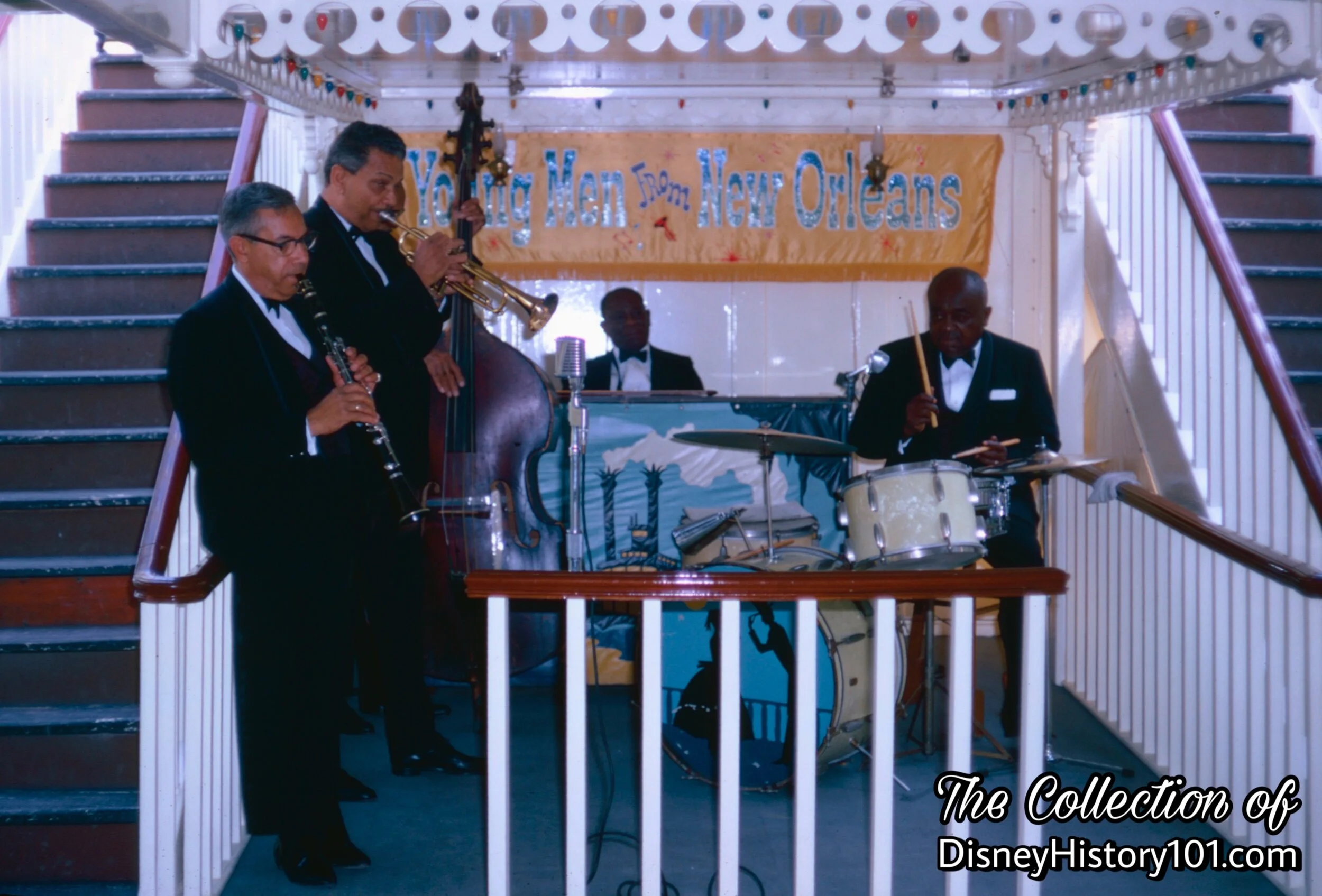
The immortal Young Men From New Orleans (the legendary Johnny St. Cyr occasionally on banjo, Harvey Brooks leading on piano, Alton Redd on drums, Joe Darensbourg on Clarinet, Aldolphus Morris on bass, and Michael Delay on trumpet) were the genuine article “long-time greats, and each member is over 60” (in fact some of them 70 years of age) according to Vacationland (Summer, 1961). The Young Men of New Orleans appeared on the third episode of “Meet Me At Disneyland” (airing on ABC) alongside The Excelsior Banjo Band, beginning in June of 1962. They also were part of the 1962-63 Winter Holiday Talent Schedule.
They also performed their “St. Louis Blues” while “Floating Down The River” during several important celebrations like the New Year’s Eve Special Party of January, 1963, and Grad Nite of 1964. During late 1960s Date Nites at Disneyland, The Young Men From New Orleans generally played sets of two-beat “Dixie Melodies” from the Mark Twain’s stage (pictured). Guests gathered to either dance or just listen as the stern-wheeler made its way down the river. This evening entertainment generally lasted from 5 p.m. to twelve midnight, so heaters were regularly set up on stage to accommodate the musicians.
During the 6th edition of Dixieland at Disneyland, the Young Men from New Orleans (Harvey Brooks on piano, Alton Redd on drums, Joe Darensbourg on clarinet, Adolphus Morris on bass, and Michael Delay on trumpet) entertained aboard the Mark Twain in Frontierland.
During the 7th edition of Dixieland at Disneyland (which was also incidentally the Third Camp Pendleton Night at Disneyland), the Young Men of New Orleans (Harvey Brooks on piano, Joe Darensbourg on clarinet, Michael Delay on trumpet, Alton Redd on drums, and Bernard Carrere on bass) performed from the Mark Twain on the night of Friday, September 29, 1967 from 8:00p.m. to 1a.m.! The Young Men From New Orleans also performed seven shows daily, from the Promenade Deck during the winter (from December 16, 1967 to January 1, 1968). The following Disneyland “Spring Fling” (occurring April 6th, 1968) brought The Young Men From New Orleans to the Mark Twain, and that is possibly the event that has been captured in this Vintage View (above).
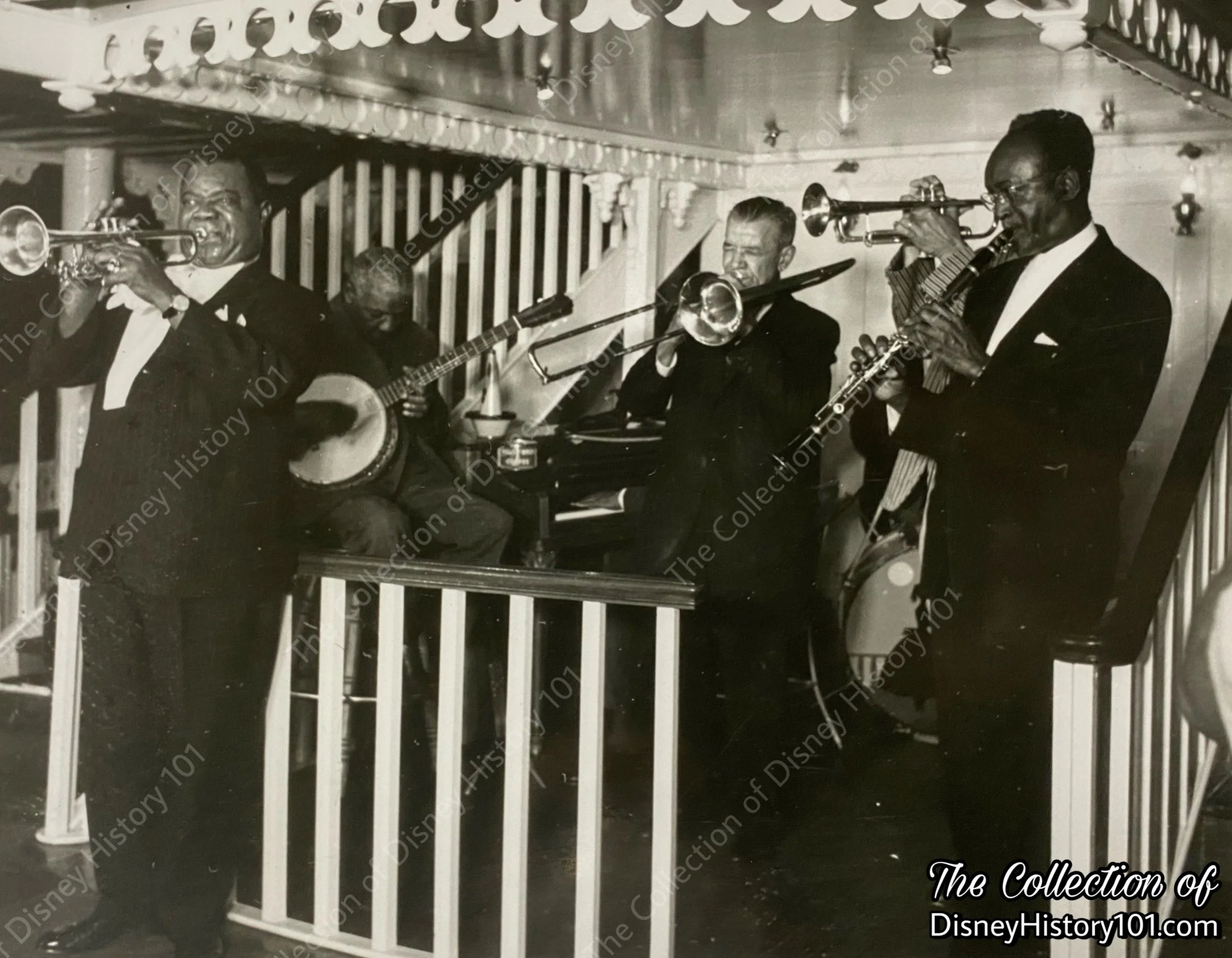
Other bands performed from the decks of the ship. For instance, Disneyland’s own Banjo Kings performed from the Mark Twain, in “American Music on Parade” on Memorial day, Monday, May 29, 1972. From November 26, 1972 through May 26, 1973, the Banjo Kings performed from 5:00 PM - 12:00 M.
The Mark Twain was used as a set piece or stage for numerous television productions. Twice (during the 3rd and 12th episodes), the Mark Twain acted as the main stage for the production of “Meet Me At Disneyland”, airing on ABC, in August of 1962. The “Rhythm of the River” episode (partially filmed aboard the Mark Twain) starred The Excelsior Banjo Band and The Young Men From New Orleans, while “Dixie On The Delta” (filmed almost entirely on the Mark Twain) starred the Hot Jazz Society Marching Band, the Albert McNeil Choir, Voices of the Hope, The Young Men From New Orleans, and Kid Ory! After this, Louie Armstrong performed aboard the romantic river steamer during the Disneyland After Dark television special in 1963.
The Mark Twain was also staffed and operated for an RCA commercial (filmed April 9th, 1963). The 26-minute “The New Christy Minstrels” (episode 4) sponsored by Ford, was recorded in front of the Mark Twain on August 3, 1964, and broadcast on NBC, August 13, 1964. On Thursday, August 18, 1966, some Walt Disney Studio photographers (under the direction of Hamilton Luske) took a few long shots of the Mark Twain (and New Orleans Square from the Mark Twain) for use as background plates. During the 1970s, E.J. Peaker performed and sang aboard the Mark Twain during a segment of “Disneyland Showtime” (a c.1970 Wonderful World of Disney episode).
The Mark Twain was featured in numerous pieces of promotional media and advertisements. Ten years after the first day of operation, the Mark Twain was featured in a Look Magazine photo shoot (in conjunction with new Disneyland 3-D post cards) on May 23, 1966.
During the 1970s, E.J. Peaker sang aboard the Mark Twain during a segment of “Disneyland Showtime” (a c.1970 Wonderful World of Disney episode). Karen and Richard Carpenter utilized the front of the lower deck during the filming of several scenes of their “Mr. Postman” music video released in 1975.
The Mark Twain inspired many things. In 1960, Freedomland opened in New York with a Great Lakes Cruise by sternwheeler, boarded from its Chicago 1871 area.
The Mark Twain Sternwheeler’s single wheel propels the paddle-river steamboat down the Rivers of America.
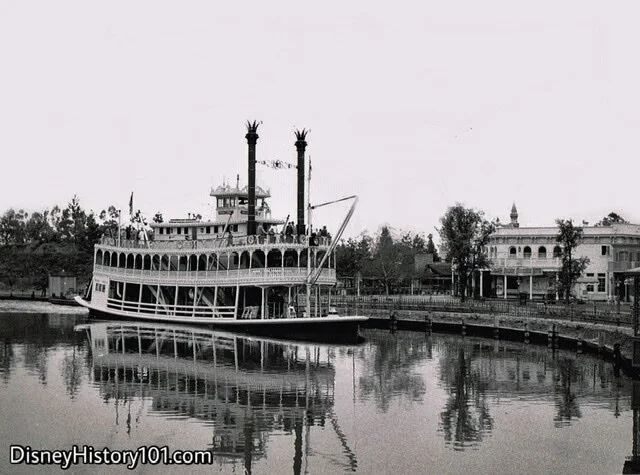
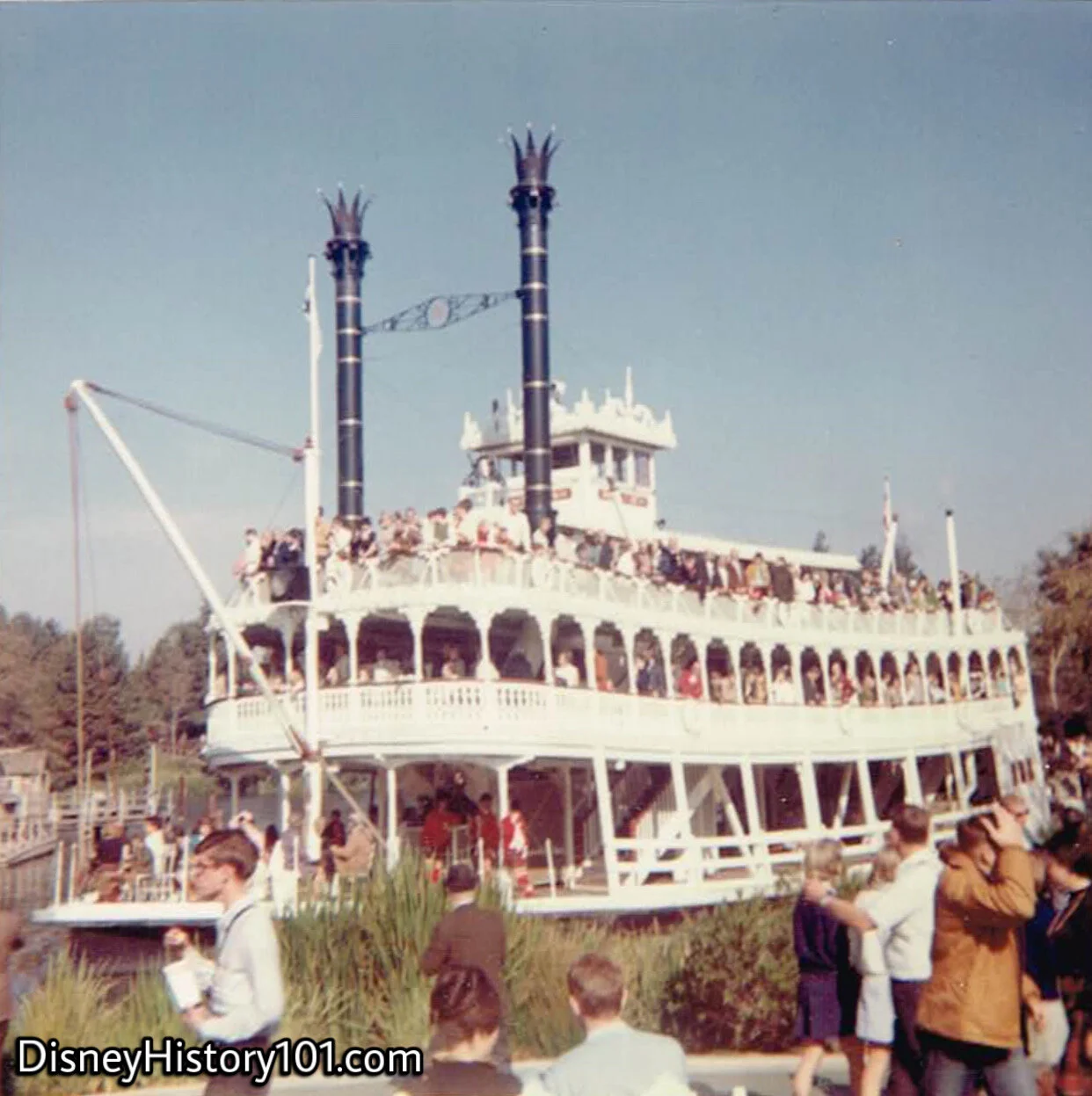
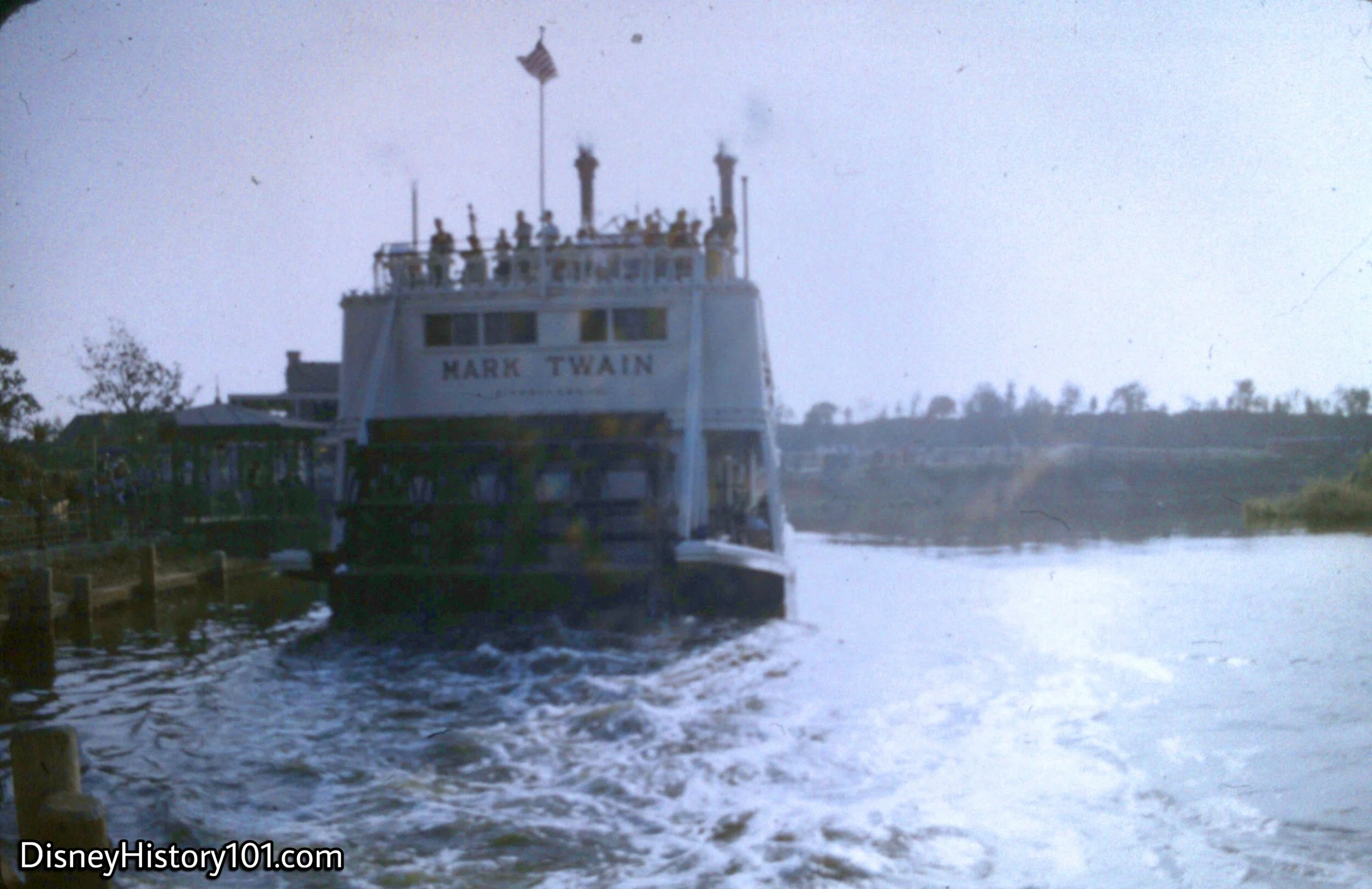
We wait our turn at the dock, as the Mark Twain Steamboat passes Swift’s Chicken Plantation restaurant before heading deep into “Frontier” territory.
Get ready for a nostalgic ride down the Rivers of America!
The Mark Twain rounds the southern bend of Tom Sawyer Island and the Rivers of America, passing the Chicken Plantation House.

Fort Wilderness (the last stand between the unfriendly Indian camp and civilization), stands tall above the forest of Tom Sawyer’s Island.
The Mark Twain offered transportation down the Rivers of America when other craft were in periods of seasonal non-operation.

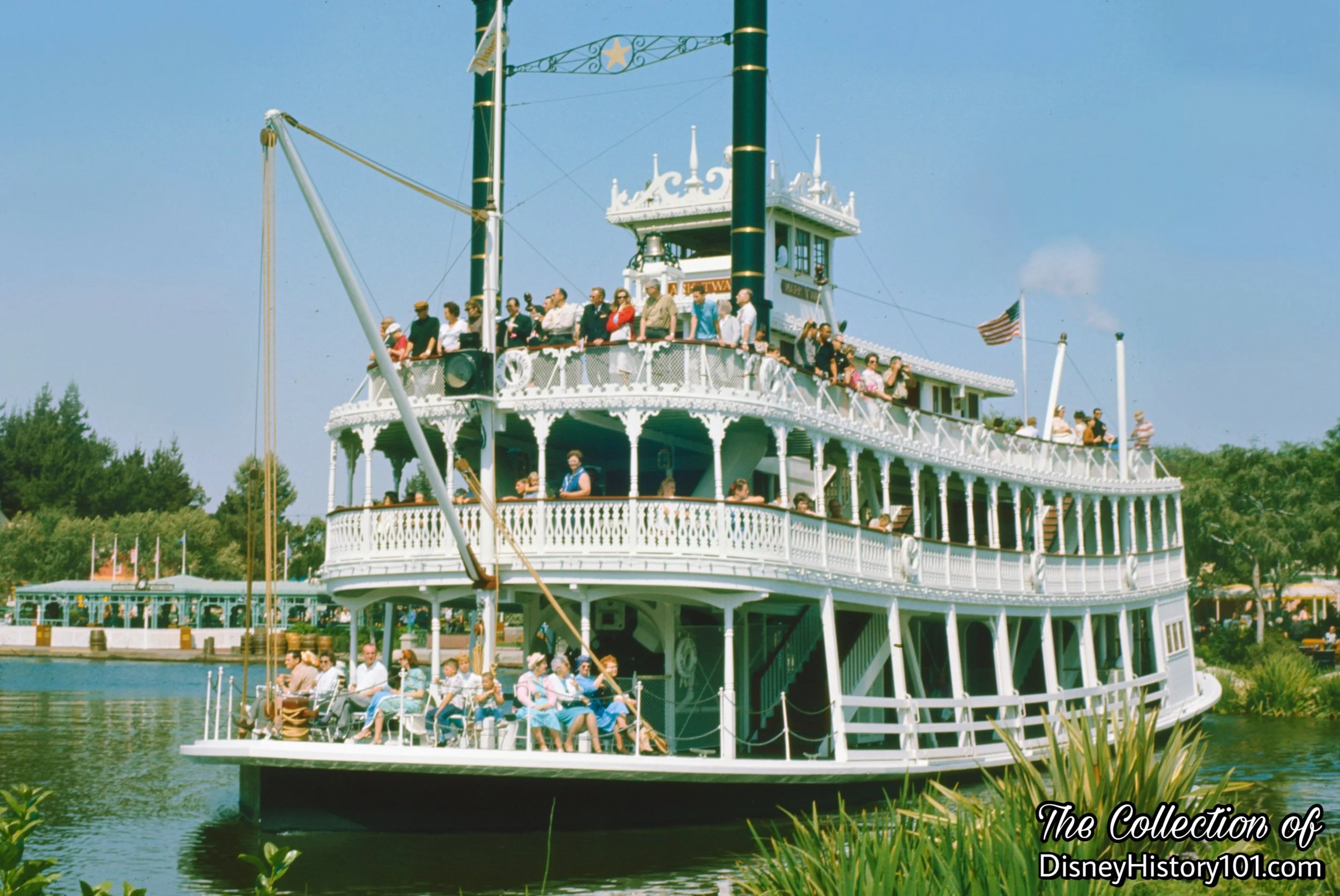
“Rehabilitations and New Ideas Enhance Show Quality & Safety”
Safety has always been important to Show Quality at Disneyland. “55er” Ray Schwartz recalled: “One time on the Mark Twain when Walt was aboard, he saw a bilge pump handle lying around. He picked it up, saying, Somebody's going to get hurt one of these days. The matter was very soon taken care of.”
The attraction was down for rehabilitation from Apr. 22-May 24, 1963.
After his purchase of WED in 1965, Walt wished to retain the Santa Fe and Disneyland Railroad trains, the Mark Twain, and the monorail trains. So he formed RETLAW Enterprises, Inc. for his privately held and owned vehicles and assets. Especially since that time, many changes and adjustments would continue to contribute to a safe show. For instance, by 1969-1970, one Motorola 2-way radio (Handie Talkie HT 200) Frequency 154.60 MHz. was assigned to the Mark Twain. This was in relation to River of America operation of the Mark Twain and to be used for emergencies on the river, breakdowns and first aid requirements. The price/unit was $646.00 without battery and antenna. Model #H23 DEN 3100 A.W. Also a By 1969-1970, two R.C.A. 2-way 2-frequency radios (Personalfone 150) Model # C.P. C. JIPNHTOA were assigned to the Rivers of America Mark Twain Dock. The price/unit was $546.00 with batteries and antenna.
Then, from March 5 to April 13, 1973 the Mark Twain was closed for a 6-week rehabilitation.
The “I Have an Idea” Program (est. 1978) would also come to yield many ideas that would influence and shape the efficiency and safety of how things were run. For instance, Disneyland Cast Member William Burnett had the idea to “attach floating keychains to key sets of attractions near the water, to support keys accidentally dropped in the water.” [Disneyland Line, March 1st, 1979]
As for the boat, though the paddle wheel’s parts had been replaced, the same paddle wheel (originally manufactured by Todd Shipyards) had churned the waters behind the steamboat for 32 years, until it was entirely replaced in 1987. According to Supervisor Frank Thomas, the Mark Twain was not in their plans when they went to take care of the usual rehabilitation in January of 1987. But when it was inspected, it was noticed that the wood had begun to rot after sitting omg the water for 32 years. Upon examination, it was decided that the entire structure needed to be replaced, so Todd Shipyards was contacted, and the original drawings of the paddle wheel were utilized. The old mahogany spokes of the paddle wheel were replaced with kapur wood (a native of Malaysia, and new to Disneyland - being used for the first time in the construction of a bridge in Adventureland during the 1980s). Douglas Fir was again utilized for the paddles, due to its density and resistance to torque forces at work. The wood was dipped in water sealant for extra protection. Then, the entire assembly took place in the Machine Shop with the help of hoists. U-Bolts (specially fabricated), clamps, and wedges were replaced, fastened, and then painted for a final touch (by employees like Bob Metz and Rudy Alvarez of the Paint Shop). The entire construction only took four weeks, and the wheel was back in action during February of 1987.
By 1989, Disneyland Plumbers used chemicals and processing to create the soft water necessary for the Mark Twain Steamboat.
Even the riverside scenery has changed through the years, to include unique vantages (from all decks) of New Orleans Square, Tom Sawyer Island (and Pirate’s Lair), and Critter Country!
“Routine Inspections”
Since it costs a fortune to drain the ride, Machinists (or highly skilled craftsmen) would learn scuba diving, and dive down to where the action is to check the equipment and the rails.
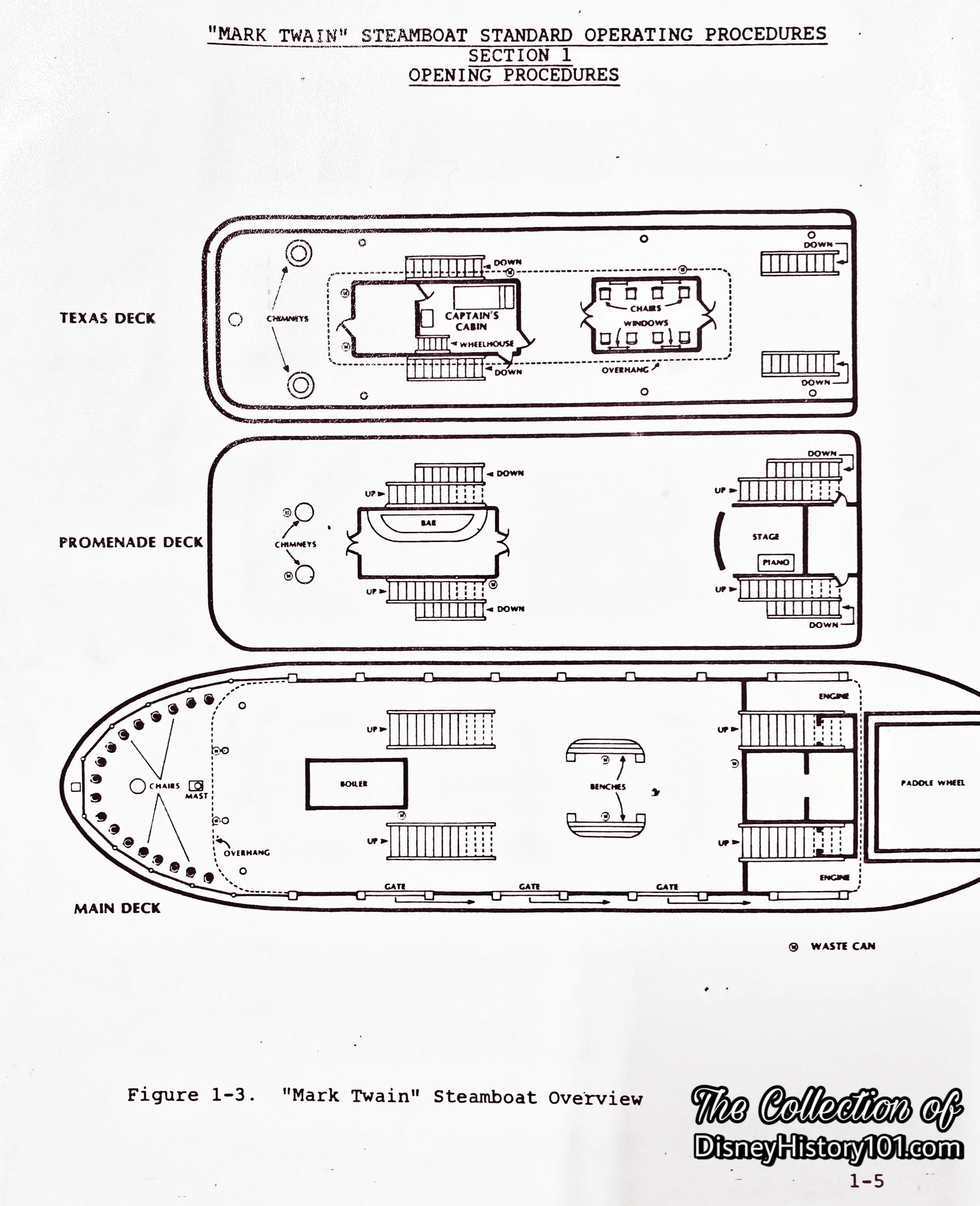
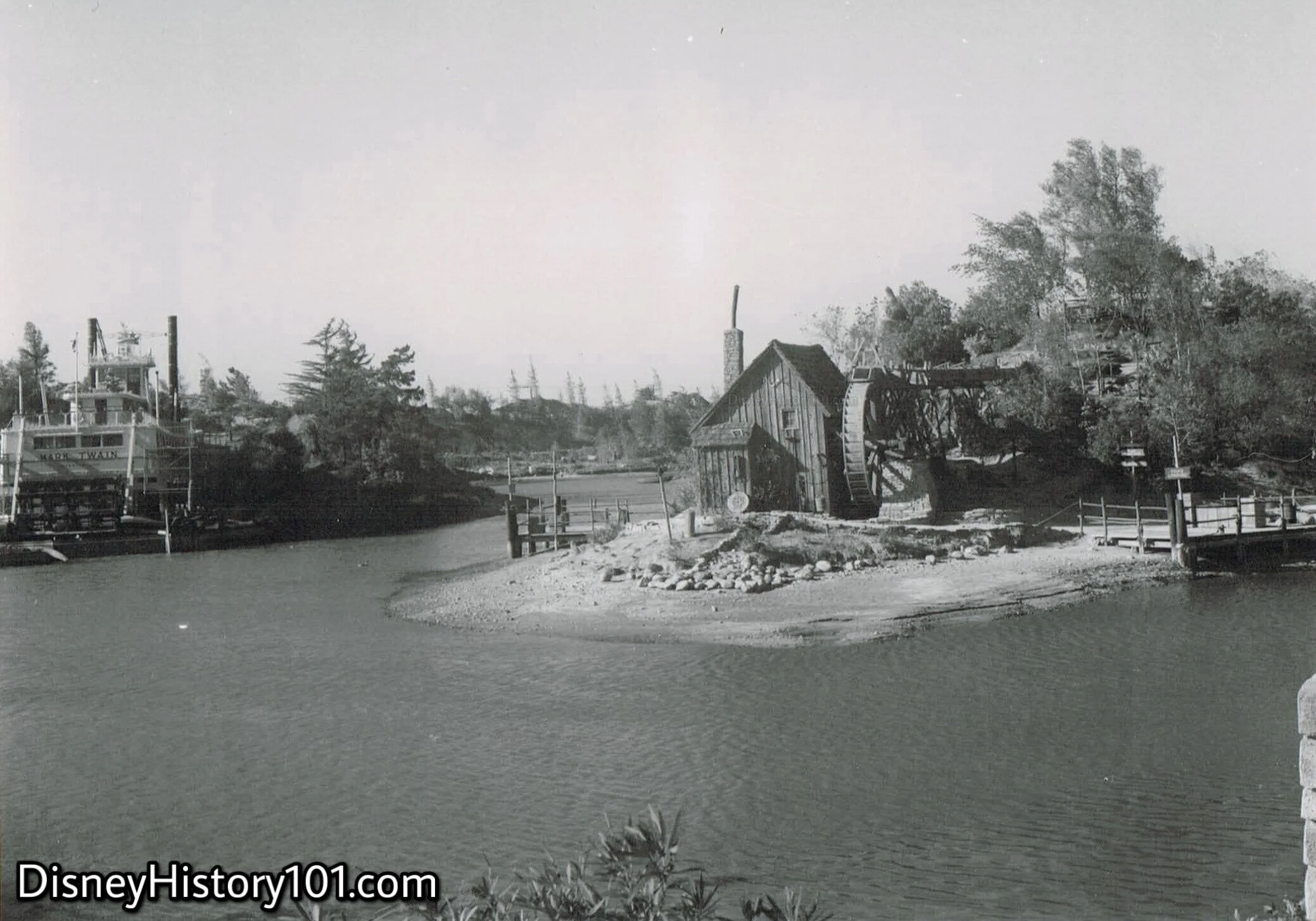
While some new structures have sprung up on that uncharted island, the Mark Twain receives some necessary repair work in Joe’s Ditch across the river. Just look at that construction scaffolding around the decks of the ship!
At the Frontierland Docks (along the New Orleans Square section of Frontierland), cargo of boxes, barrels, buckets, sacks, and cotton bales wait to be loaded aboard the steam ship.
At Disneyland, signs are themed to support the stories with appropriate graphics, colors, fonts, terminology, overall design of the sign, materials (wood, metal, banners, etc.), and verbiage used on the signage.
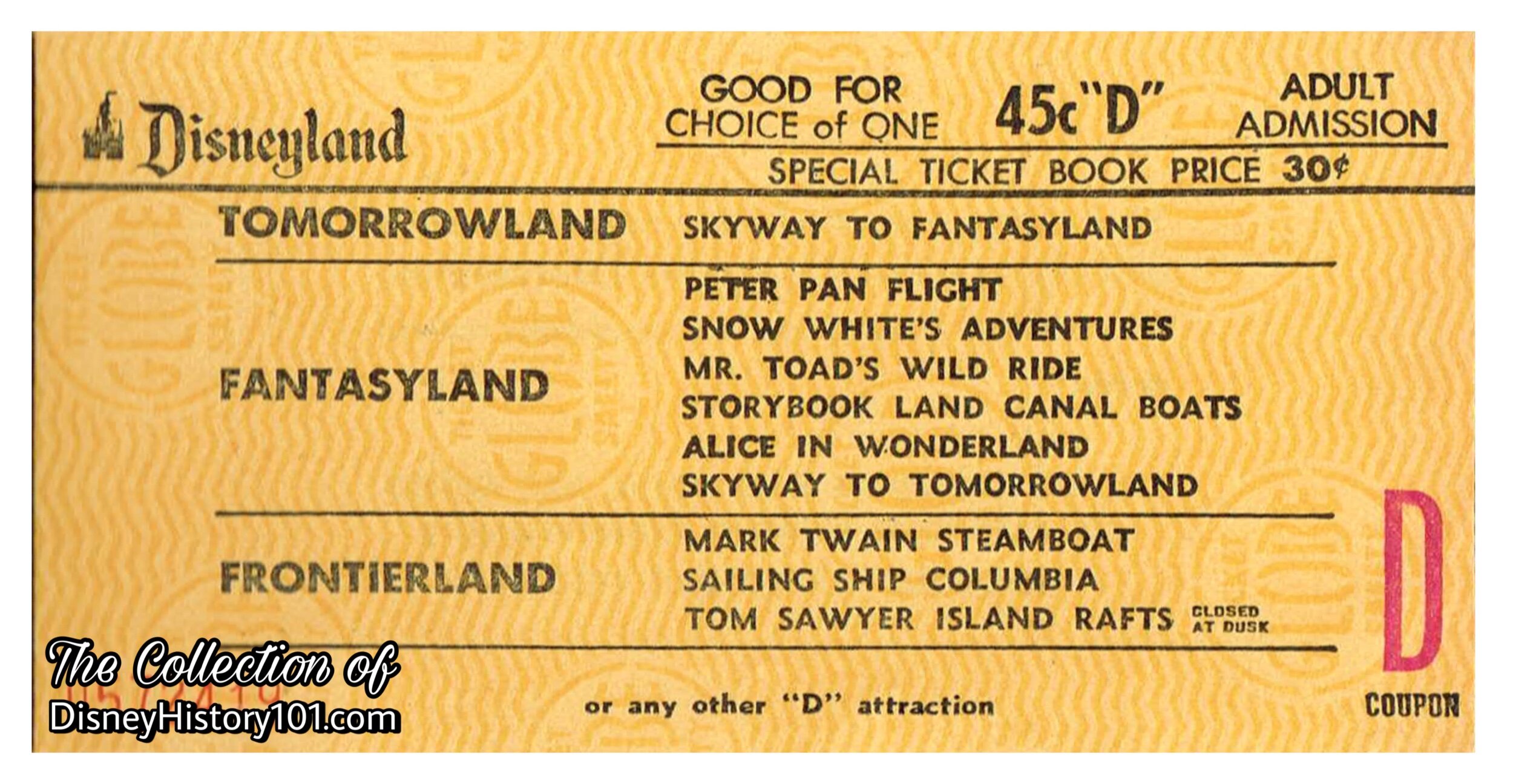
Later (in 1965), the cast of admission for a ride aboard the gleaming sternwheeler was exactly one “D” coupon, or 60¢.
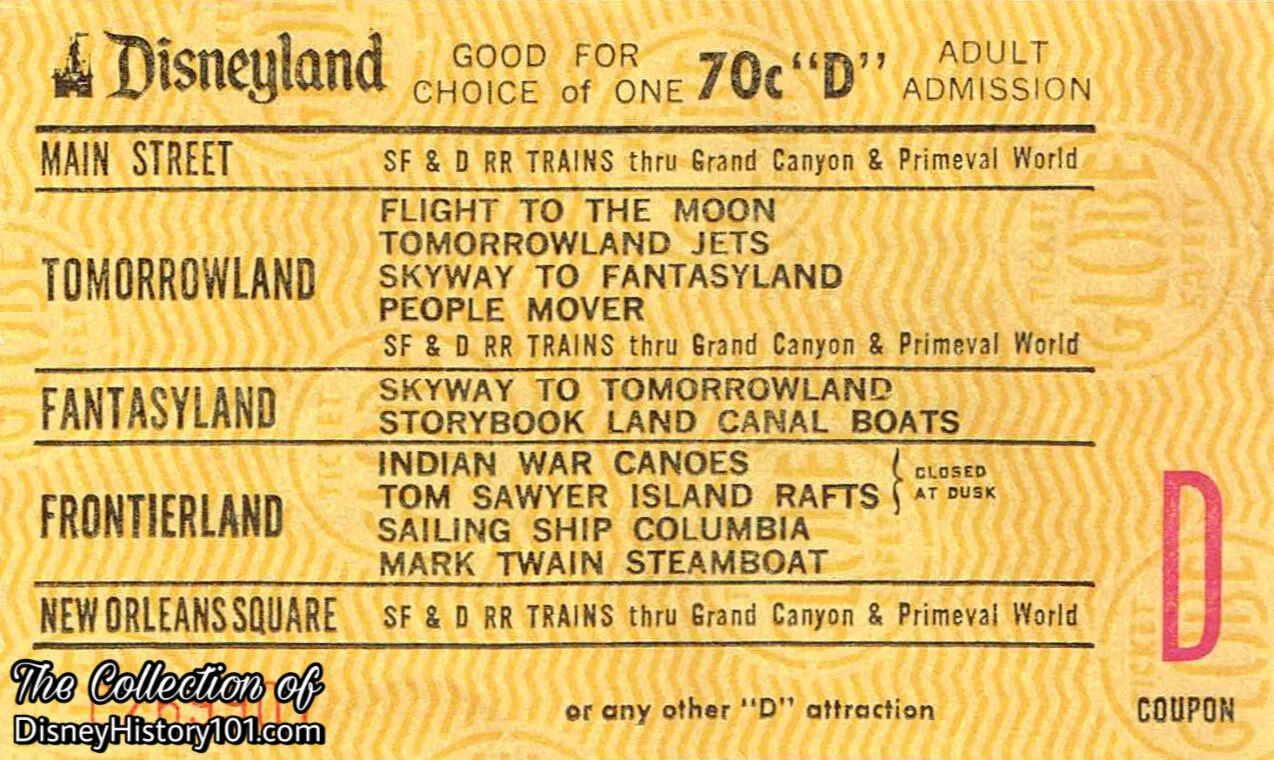
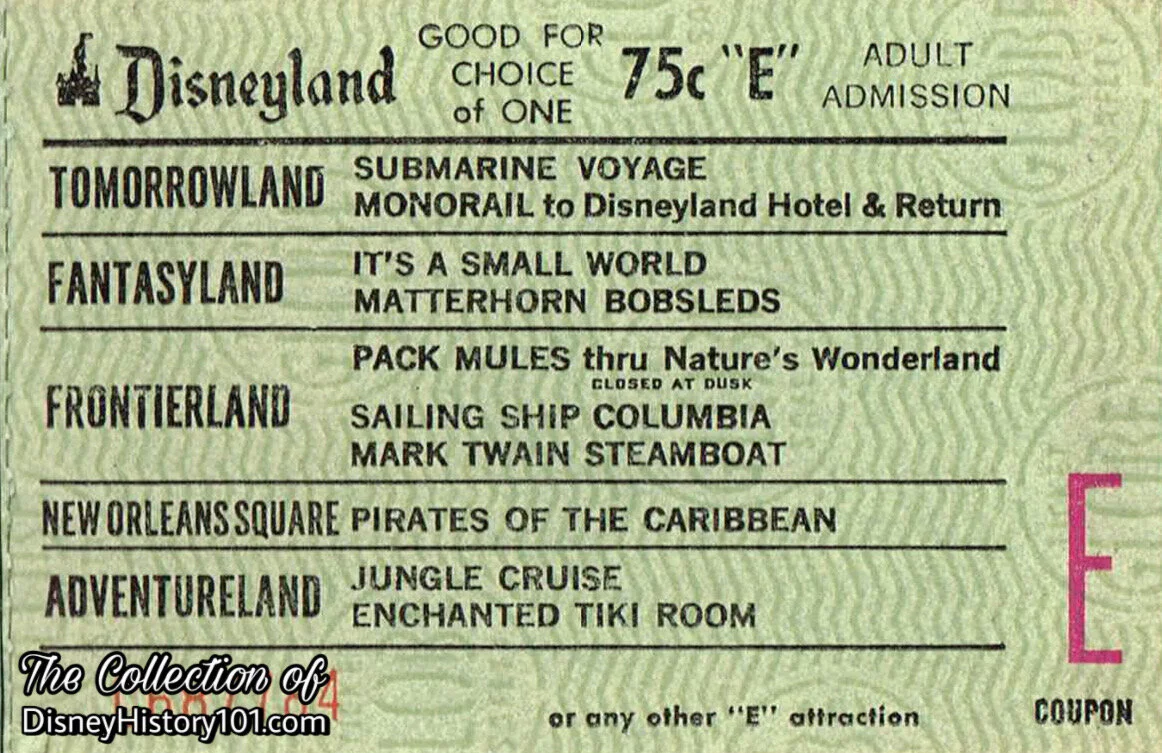
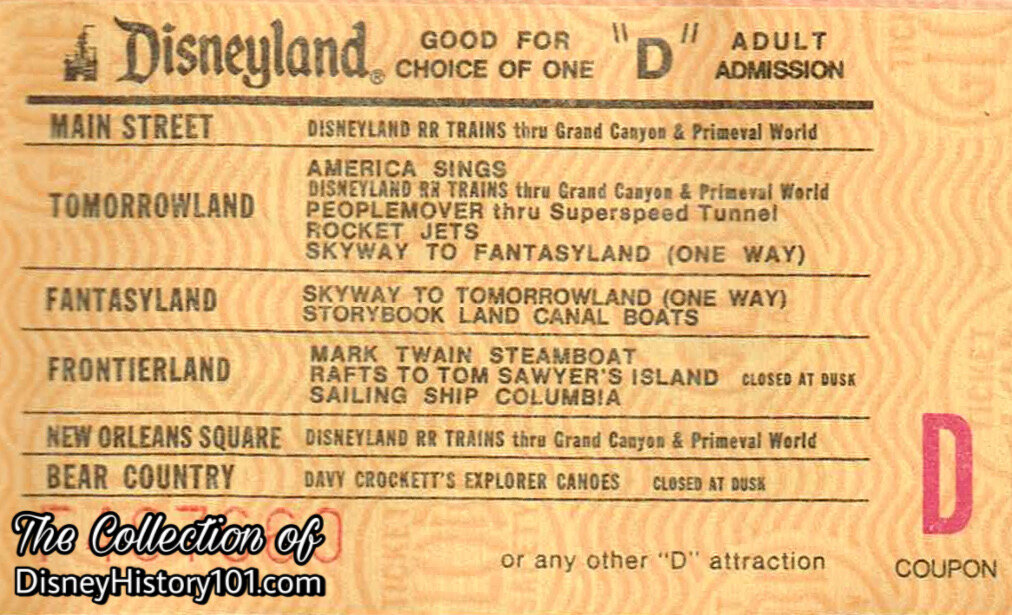
“Legacy”
At this time, the Mark Twain nearly had a direct legacy through a new theme park that was being developed by Walt Disney Productions. By 1963, Marvin A. Davis and W.M. Tuntke had prepared drawings of a “Jean Lafitte Adventure” (with bateaux; also called the “Blue Bayou Boat Adventure”), a “Lewis and Clark Boat Adventure” (with bateaux), “New Orleans Street” (with restaurants and shops), a “Mark Twain Type Restaurant”, an Audio-Animatronics Theatre (with a 750 audience capacity), two 6-minut Darkrides, and two Circarama Theatres (a 200 degree and 360 degree theatre) were being proposed for the Walt Disney Productions St. Louis Project.
MARKET HOUSE
Swift Market House (July 18, 1955 - 1965)
C&H Sugar Market House (1965 - 1970)
The Market House (1971 - present)
Starbucks (September, 2013-present)
“Swift’s and Company & Walt Disney”
Walt Disney and Gustavus F. Swift’s Swift’s and Company grocery business have been acquainted as far back as 1938. At the time, Walt Disney had several arrangements with other competitors of Swift’s, like a tie-in with Snow White and the Seven Dwarfs entitled “Ham What I Am” for Armor & Company. In a special arrangement between Walt Disney, Allsweet Oleomargarine, and Swift & Company seed assortments of “dwarf varieties of Calhopsis, Godetia, Marigold, Nasturtium, Dianthus, Aster, [and] Phlox” - were “christened by Walt Disney for one of the characters in his fascinating movie of ‘Snow White and the Seven Dwarfs’”! According to the “Mickey Mouse Merchandise” catalogue: “thousands of Oleomargarine box tops were received from amateur gardeners anxious to receive the ‘Snow White and the Seven Dwarfs’ flower seeds.” These were offered through Swift’s and Company grocery outlets.
Two decades later, and in advance of the (June, 1955) release of Walt Disney’s “Lady and the Tramp”, Swift’s Pard Dog Food (manufactured by Swift’s) ran magazine advertisements featuring the popular dog stars from the feature film. In addition, 25¢ and two Pard labels (or, one Pard Meal Box Top) sent to Pard’s Chicago P.O. Box got the consumer one three-foot “Lady and the Tramp” mobile!
Now during 1954, Walt was searching for participants to lease shop and restaurant spaces at Disneyland, and help generate the necessary capital to fund construction of Disneyland. By July 1, 1954, Russel Tippett of Disneyland Inc. Advertising oversaw Exhibitor’s Space Sales and Lease Agreements. It was intended that Disneyland feature “the turn-of-the-century shops and stores - the photographer's shop, ice-cream parlor, penny arcade, bakery, drug store, music shop, butcher, grocer, many of which are sponsored by outstanding American companies whose names are familiar ‘household words.’” In a synergistic relationship, the companies (in turn) could sell their products and advertise their corporate names in the Park as they provided services and shows. Disneyland Participant Corporate Sponsors were carefully selected. High quality, long term corporate sponsors would provide incremental income that enabled Disneyland to enhance its show and attractions, offset some operating expenses, and capitalize on marketing opportunities.
Many free exhibits of Main Street U.S.A. were sponsored by one of the United States’ “old reliable firms, which have been in business fifty years or more. Here they can show how they started and reproduce their first place of business.” [Disneyland Prospectus, 1954] Several of these turn-of-the-century pioneers, “reliable old firms” sponsored the “abundance of restaurants devoted to pleasing all tastes and all budgets,” according to “The Story of Disneyland”, published 1955. As a result, “shopping has been a part of the Disneyland scene since opening day, 1955, when just 45 employees worked in the Park’s five stores and stands,” according to Disney News (Fall, 1966). The same publication called Walt Disney’s “Magic Kingdom actually… like a huge specialty shopping center, with thirty Disney-operated stores catering to every taste and purse. In addition, some of America’s most famous ‘name brand’ merchandise is sold in the stores of Park lessees.”
One of those lessees - Swift Meat Company (and its subsidiary, Derby Foods, manufacturer of Peter Pan Peanut Butter) - was an appropriate sponsor of “Disneyland” the television show. Swift Meat Company would sponsor the Market House at Disneyland and the synergy was perfect for the old corporation. Swift’s (founded in 1855) had been celebrating their centennial during the time Disneyland (and Swift’s Market House) first welcomed guests to “dine at Disneyland”! Yes, by the time Disneyland’s construction was moving forward (in 1955), Swift’s Premium brand boasted more than 100 table-ready meats, some of which were served exclusively at Disneyland. Swift’s even manufactured “Swift’s Meats for Babies,” which was assured to keep “a baby busy growing.” Some of Swift’s products (Swift’s Premium Bacon and Allsweet Margarine) were being advertised in television commercials (as those starring actress and vocalist Fran Allison), which were aired during 1954 - 1955.
A decisive day came one morning in May of 1955, when the Vice President of Bank of America met for a presentation at the West Street Training Office (which Van Arsdale France had decorated with fan cards and Disneyland renderings from the Walt Disney Studios). Walt was not present, but Roy, and some executives from Eastman Kodak and Swift & Company were. After introductions, Van France introduced the theme stating: “You are here NOT to make money. You are here because... ‘You’ll create happiness!’” Next, creative "pitch cards" by Ned Jacobi were placed on a flannel board and Dick Nunis operated a projector and described the slides. Van France and Dick Nunis were nervous, but when it was over, “Roy Disney, a financial genius, and the President of Walt Disney Productions gave his approval and blessing,” according to France’s account.
Eventually (by June of 1955), a definitive list of Disneyland lessees was prepared by the Public Relations Department of Disneyland, Inc., listing Swift’s & Company’s three Disneyland locations (including their “grocery & market” on the “600 block” of Main Street).
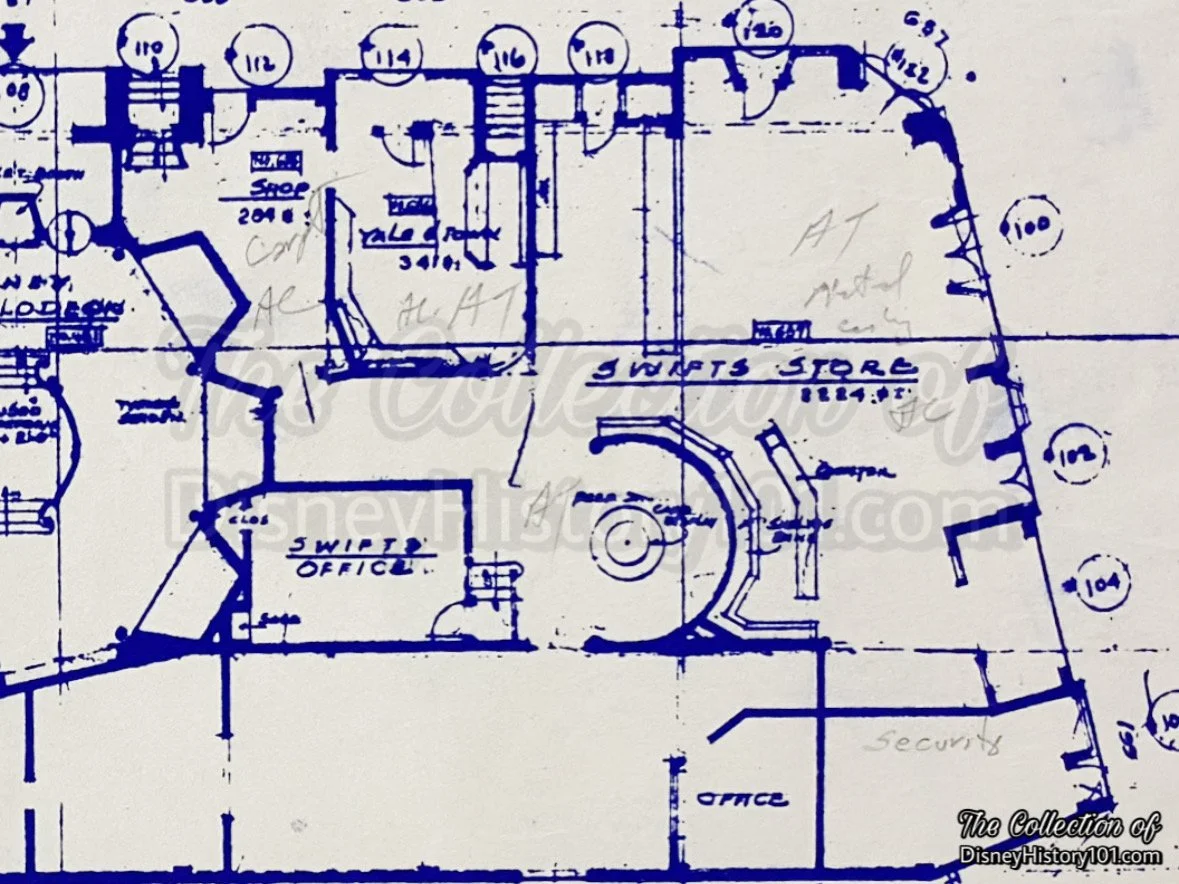
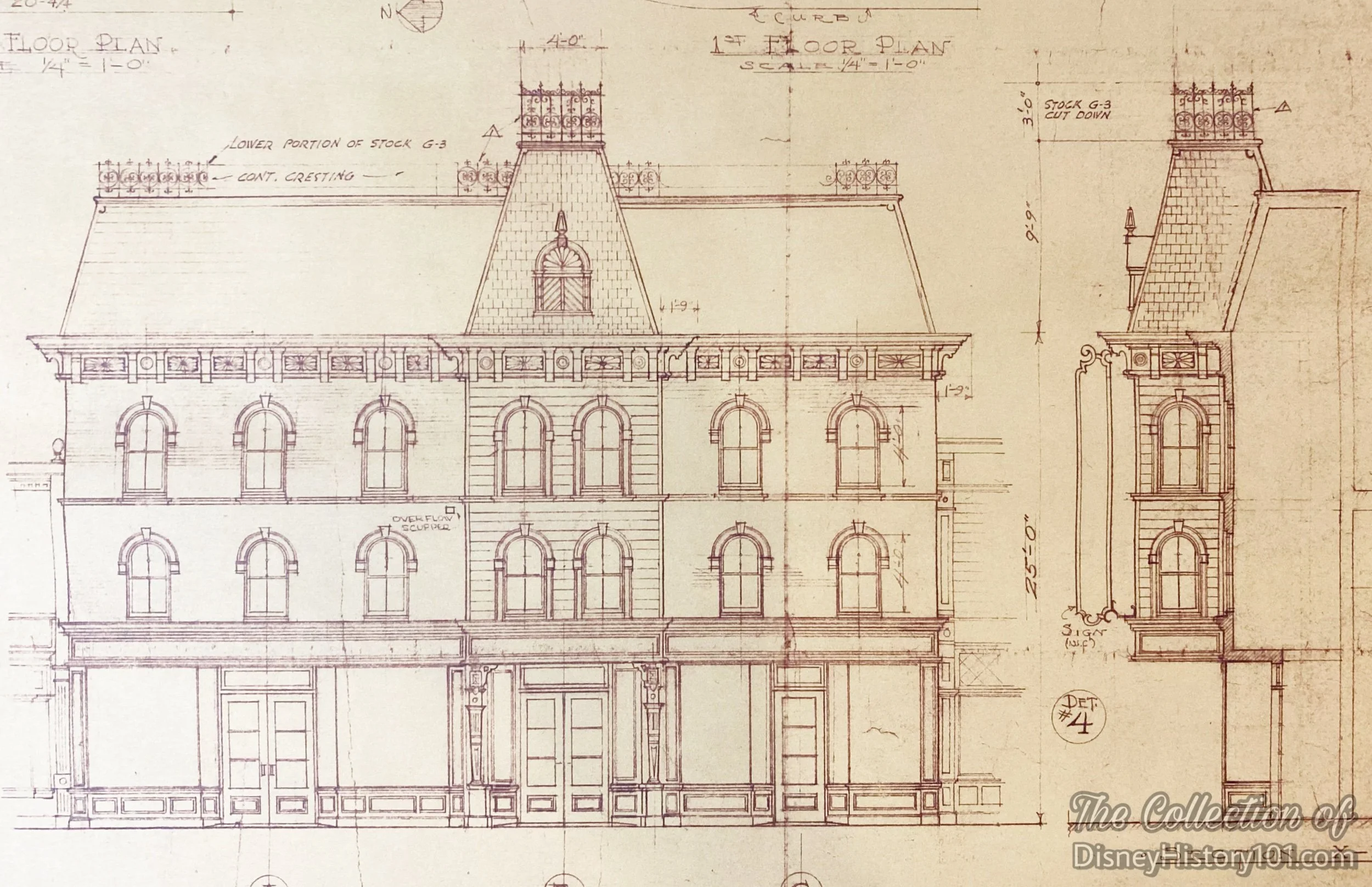
“Design and Draw Concept”
Early thumbnail sketches and other concept artwork of Disneyland seemed to be unencumbered by restrictions of budget, schedule or the laws of nature and physics. Though guided by Walt, his artists appeared to engage in “free-thinking,” as if implementing the modern “Blue Sky” Imagineering process. In designing the Market House and the rest of Main Street, there was a lack of 20th-century architectural reference material at the time of the conception of Disneyland, so some Walt Disney Studio artist (Ward Kimball) made the contribution of rare books of drawings from his own collection.
“Disneyland is unique in that some of the world's foremost creative artists and architects control all design at Disneyland.“ As early as 1953, artists Harper Goff, Herb Ryman, Sam McKim, Dale Hennesy, Harry Johnson (who was good friends with Herb Ryman, and whose designs were most influential), and others created many conceptual pieces for Main Street and it’s shops. Herb Ryman (who was an Illinois native, the same as Walt), “had a lot in common while discussing and developing Main Street” for the midwest visitors, according to “A Brush with Disney” by Herbert Ryman, page 148. Herb Ryman would create the first “Schematic Aerial View” over Disneyland (including Main Street USA), originally produced September 26 & 27, 1953.
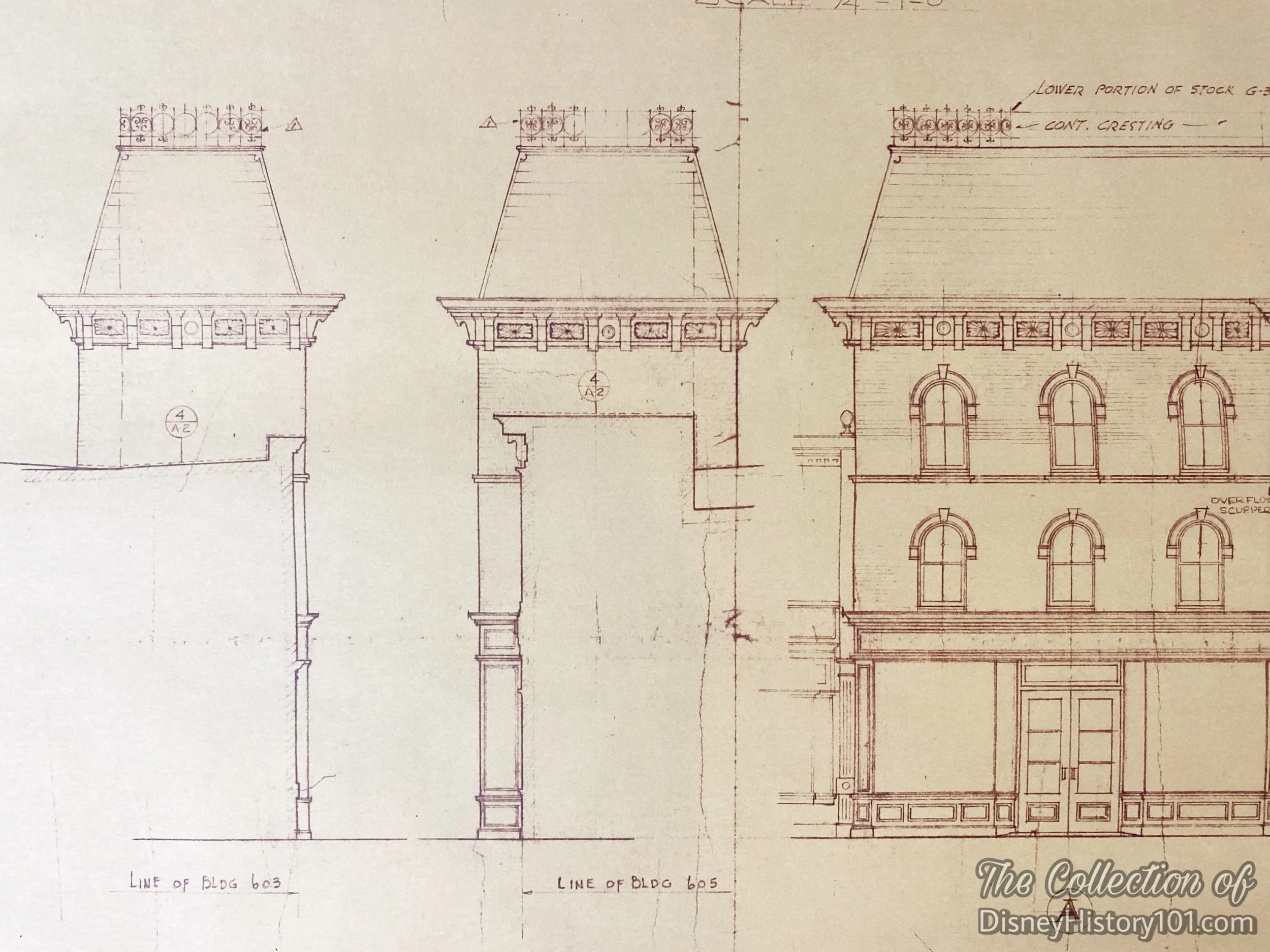
Other contributing artists were model-maker Fred Joerger (who was hired c.1953 to craft the “Barber Shop Quartet” show for “Project Little Man” of “Walt Disney’s Disneyland”) and Wathel Rogers were instrumental in translating the two-dimensional artwork into detailed miniature models of Main Street. Such models explored the various dimensional relationships, site-lines, flow patterns, ergonomics, and visual appeal to convey the desired creative intent.
On a leave of absence in 1954, Chuck Myall joined WED to help create some of the Main Street facades.
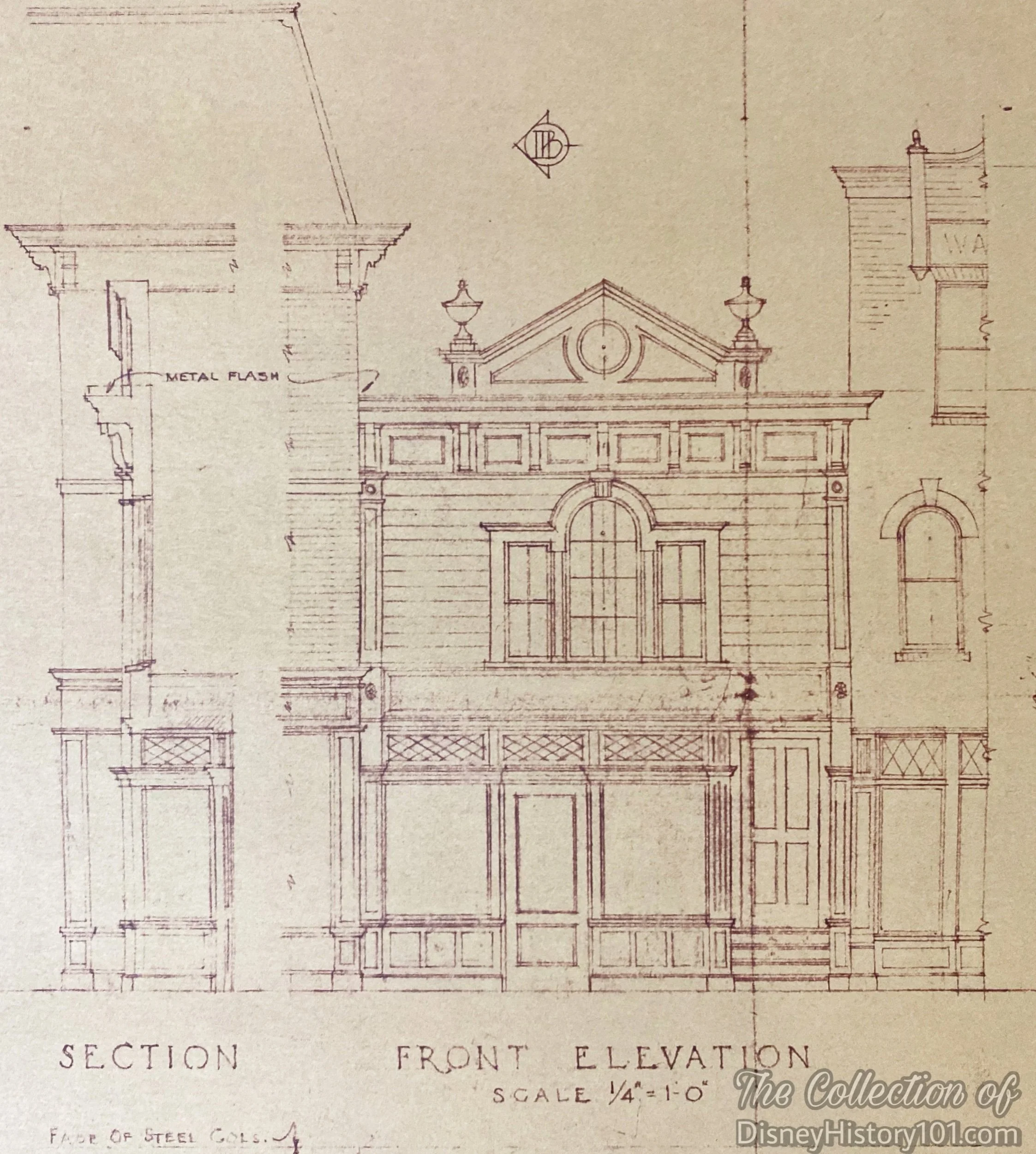
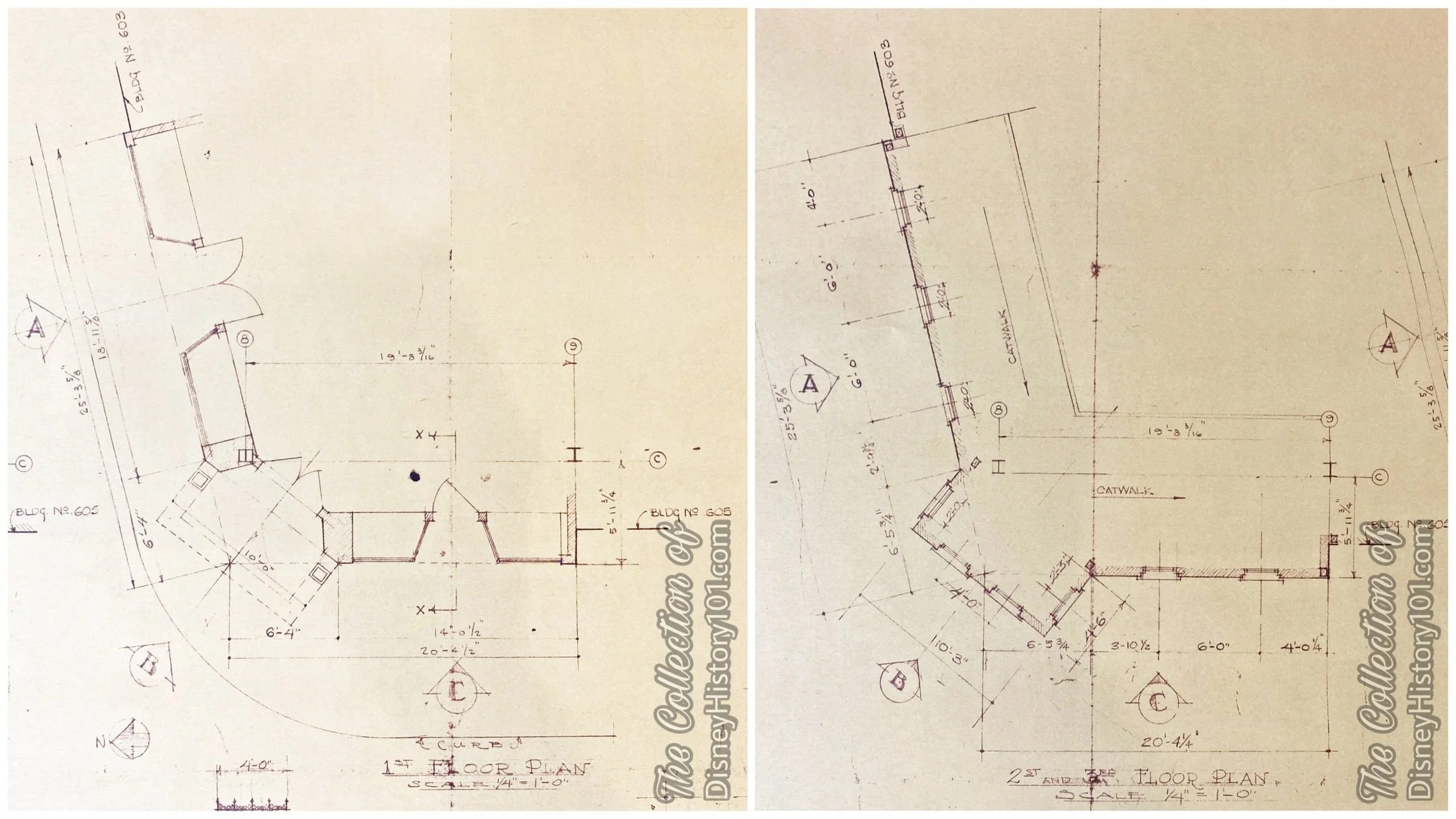
Lesser known artist Ed Held is of particular note, for preparing the architectural elevation facade and 2,152 square foot floor plan drawings for the Swift’s Market House by February 19, 1955. Fred’s architectural drawings helped define all designs, production and construction strategies, costs, schedule, and resource requirements. His drawings were soon checked (by a “GMB”), approved (by two individuals), and revised (by an “HGS”) by March 23, 1955.
“Construction”
“When the giant earth-moving undertaking was completed, the building crews took over. Soon, the rat-tat-tat of riveters was shattering the air, and sparks were flying from welders’ torches as the steel frameworks, capable of withstanding the ravages of time and the elements rose above the newly formed ground. While carpenters hammered and masons laid row upon row of brick and stone and mortar, the permanent buildings began to take shape and form,” according to “The Disneyland Story” published 1955. One of the first buildings to be constructed was the Main Street Opera House, which was used as the Mill. Here, the woodwork of Disneyland was generated - from the functional to the aesthetic! Approximately three and one-half million board feet of lumber went into the Park’s construction. Much of the wood was processed here by McNeil Construction (which formerly constructed Walt Disney Studio sound stages in 1947 and 1953), and under the direction of George Mills Sr. (the Prime General Contractor and Mill Foreman). Then, under the direction of Joe Fowler (Construction Supervisor), as well as Charles Alexander and Ray Conway (Construction Field Supervisors), the lumber was soon fashioned into the framing belonging to the very first buildings constructed at Disneyland - primarily the Main Street Complexes (on each side of the street).
In constructing each building, a concrete foundation and slab floors were prepared, followed by wood frame construction (while store units would have a combination wood and rigid steel frame). ”The first fabricated steel for the Main Street buildings arrived November 8 and was erected,” according to the narrator of “Disneyland - The Park,” a Disneyland anthology television series excerpt, first aired 1957 and Disneyland LINE (November 22, 1979). The roof covering was a variable, dependent on the architectural design.
According to inserts published in area newspapers during July of 1955, Disney buildings were roofed by Pioneer Roof & Shingle Company (then located at 608 Mateo Street, Los Angeles, California; 7522 Westminster Avenue, Westminster, California).
The building (as each on Main Street U.S.A.) possessed complete fire sprinkling systems. By June 30, 1955, related Disneyland Site Work Fire Protection Utilities Plot Plans were prepared for Disneyland Inc., by J.E. Thomasson of WED Enterprises Inc.
Ray Van de Warker (who became Department Manager of Office Support Services) remembered the distinct look of Main Street when he first came to work. “Main Street was dirt. Some of the buildings didn’t even have facades on.” (to Disneyland LINE, Vol.25, No.28, published July 16th, 1993). But soon the storefronts were erected. According to Florabel Muir (of the New York Daily News) divulged after a pre-opening (July 9th) tour by Walt, “the buildings are not false fronts as are seen on every studio backlot in Hollywood… Walking down Main Street, I saw a photographer’s shop, ice cream parlor, penny arcade, bakery, drug store, grocery and a butcher shop. These stores will be operated as concessions by well known U.S. firms. Swift & Co., for instance, will run the butcher shop, though instead of real pork, beef and lamb, they’ll sell candy imitations of their products.”
As with all of Disneyland’s Opening-Day landmarks, rides, and attractions, small local businesses provided materials, labor, and skills. Steel was provided by Triangle Steel & Supply Company (of Los Angeles). Newbery Electric Corporation gave electricity to Disneyland. “The electrical installations were supervised by Roy J. Gruendler, manager of Newbery's Orange County district office located at 1335 Santiago Ave, Santa Ana.”
Southern Counties Gas Company provided economical and clean gas, buildings were roofed by Pioneer Roof and Shingle Company (of Westminster, California), Mc Neil Construction Company provided labor, Evans and Reeves Landscaping Inc. (of West Los Angeles) achieved“the perfect landscape for Disneyland,” and so forth.
Forced perspective makes the buildings on Main Street appear taller than actually are. On Main Street the buildings are not full scale. Ground floors are built about 9/10ths scale. Second floors measure up to 7/10ths scale. Scale on the uppermost floors is smaller still.
The buildings of Main Street (Market House included) were soon after described by an appraiser as “all very ornate, with variable embellishments. The basic construction, consists of concrete foundation and slab floors, wood frame construction, (store units also have a combination rigid steel frame) roof covering is variable, being dependant on architectural design. All buildings have complete fire sprinkling systems.” “Some of the cresting and railing to be seen in… Main Street came from old plantations in Nashville and Memphis, Tennessee. Other furnishings came from San Francisco, Oakland and Sacramento, dating back to the ‘49 gold rush days,” according to an article published in The Disneyland News (Vol.1 - No.1 ; July of 1955). [“Building A Dream”, Disneyland Public Relations Department]
Larson Brothers Plastering Company of San Diego was a proud part of Disneyland. The company crafted the ornamental plastering and all brick used at Disneyland (including their amazing new plastered brick veneer). The versatile Quikbrick (real colorful and textural brick applied like plaster) was about half the price of ordinary brick. It insulated, beautified, and was meant to “last a lifetime.” It was used on the facade.
Lastly, a 45-star flag was flown atop the roof in keeping with the turn-of-the-century era.
As of June 2, 1955, C.V. Wood Jr. sent an Inter-Office Memorandum to Walt Disney regarding the best estimates that could be obtained at the time regarding the completion status of individual sections of the Park and Opening Day. C.V. wrote: “Building #602 - Swift: Will be completed. Electric Signs: All are in work - with the exception of the shoe store and the Bank of America, all will be completed.“
Some of these viable project Concepts (as above), were supported by a well-developed business case and built expectation. Readers of newspapers were treated to previews of Swift & Company’s Market House at Disneyland, by way of a supplement published July 15, 1955 (e.g. “Register” of Santa Ana, California).
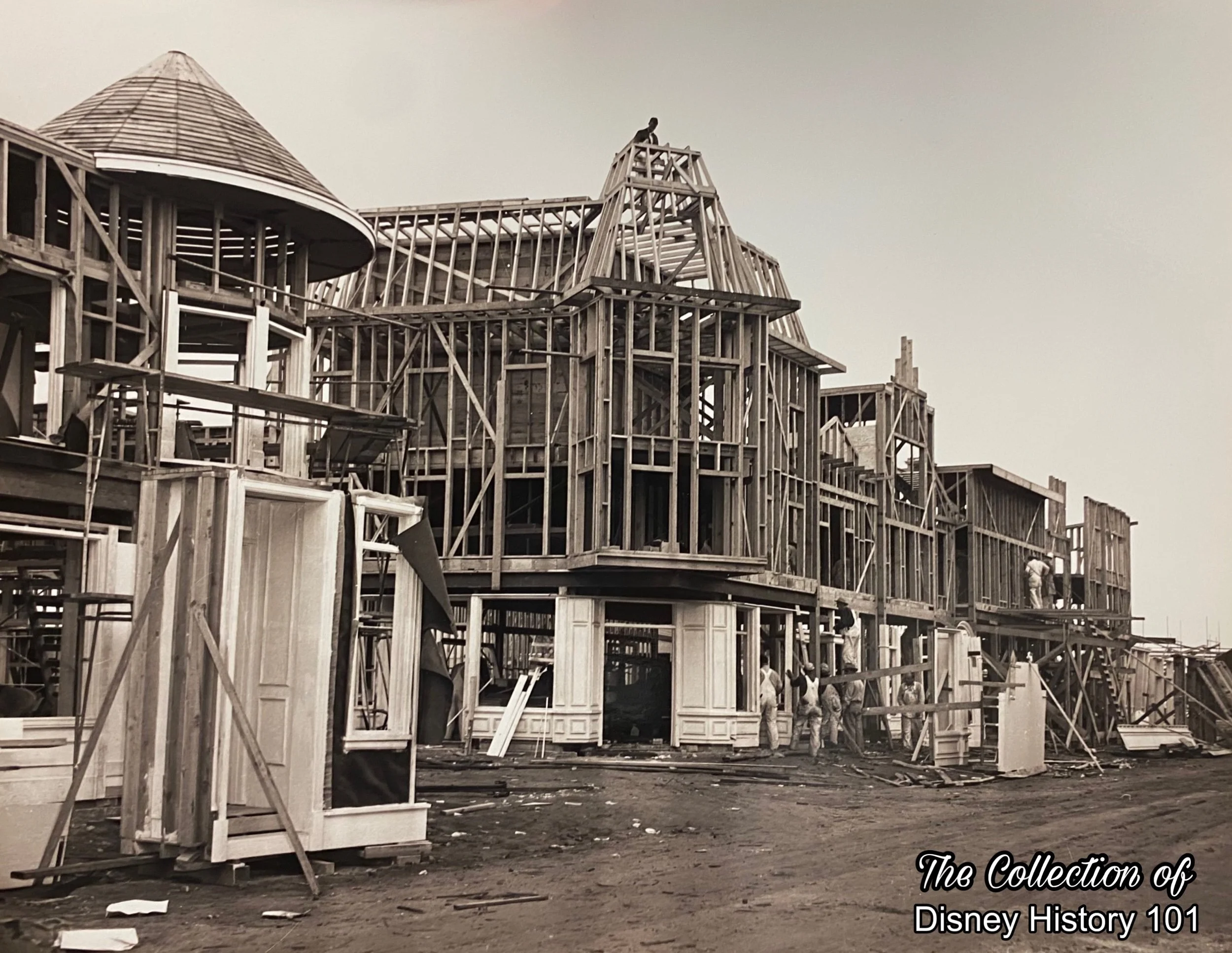
Then the big day arrived! A contributing writer of The Daily Oklahoman (who visited on July 17, 1955) noted: “The guests walked into a city square of the 1900 era, bounded by an old time railroad station, city hall and fire station, opera house and other vintage merchant houses.” Here on the 500 block of Main Street, we discover one such merchant house, the Market House, which was managed by the Red Wagon Company, which also operated the Red Wagon Inn, Plantation House, and the Snack Bar in Holidayland (once it opened). According to Bob Cummings (host of Dateline Disneyland, aired July 17, 1955), Swift’s Market House is “where all of us ‘ham actors’ will end up.”
In 1955, Swift’s Premium Meats were also served at Carnation Ice Cream Parlor at Disneyland.
The Market House was an old fashioned general store with jams and jellies, barrels of dill pickles, nuts, and goodies (like horehound and other hard “penny candies”), natural food snacks, cider, and a game of checkers just waiting for a couple of players. “Your grandmother shopped in a store like Swift’s Market House on Disneyland’s Main Street”, according to the Los Angeles Examiner, July 15, 1955. “Here we find the old-fashioned butcher in straw hat and cuffs, the pot-bellies stove, and shelves lined with authentic old-time meat and grocery products. Swift & Company, whose quality meats are served exclusively in Disneyland, is the sponsor of this exhibit.” According to Florabel Muir (of the New York Daily News) divulged after a pre-opening (July 9th) tour by Walt, “Swift & Co., for instance, will run the butcher shop, though instead of real pork, beef and lamb, they’ll sell candy imitations of their products.” You may recall the package of Swift’s Market House “candy meats” like the “Red Wagon Yummy Weenies Candy” which looked very much like a package of hot dog links. By the release of the “Disneyland 1st Anniversary Souvenir Pictorial” in 1956, the shop was reckoned among the “stores whose shelves bulge with worlds of distinctive merchandise.”
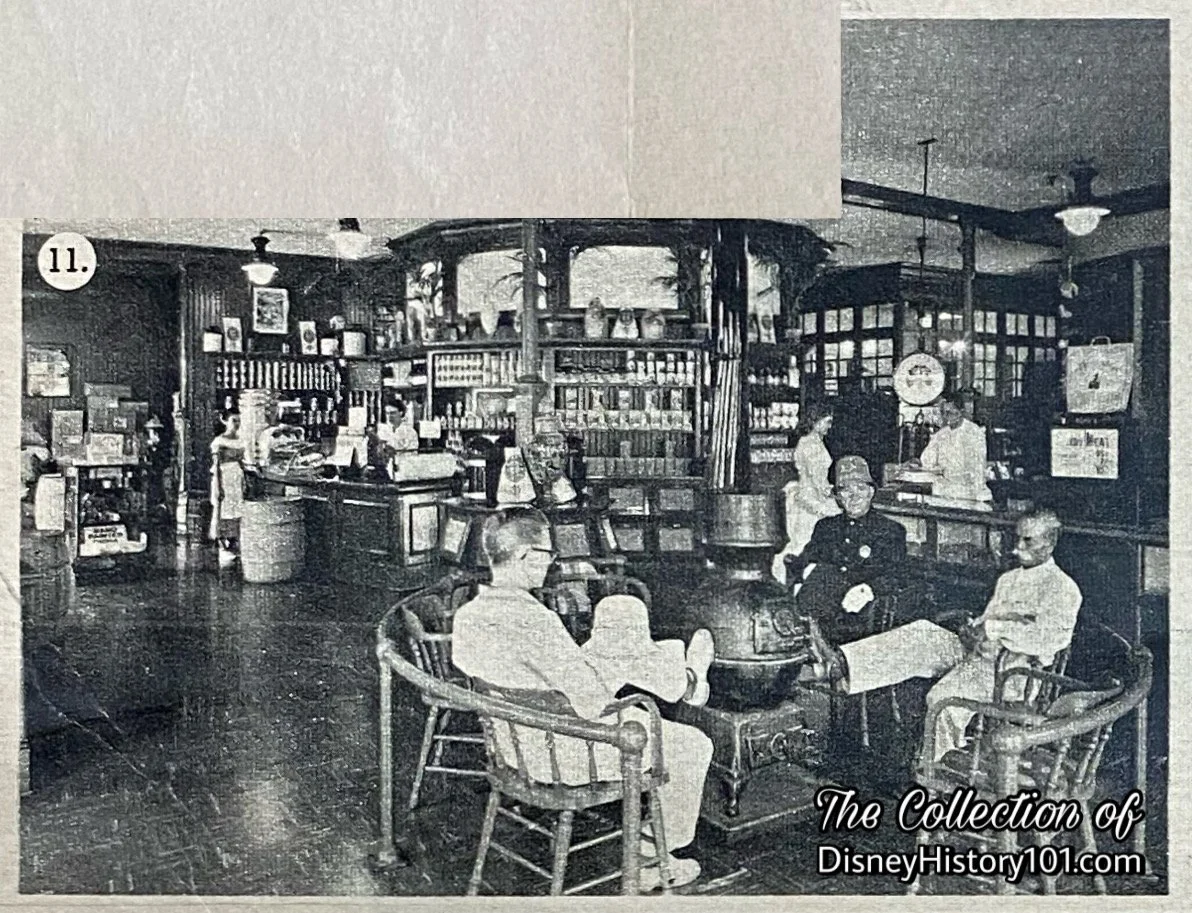
The pot-bellied stove was the center of conversation during the good old days.
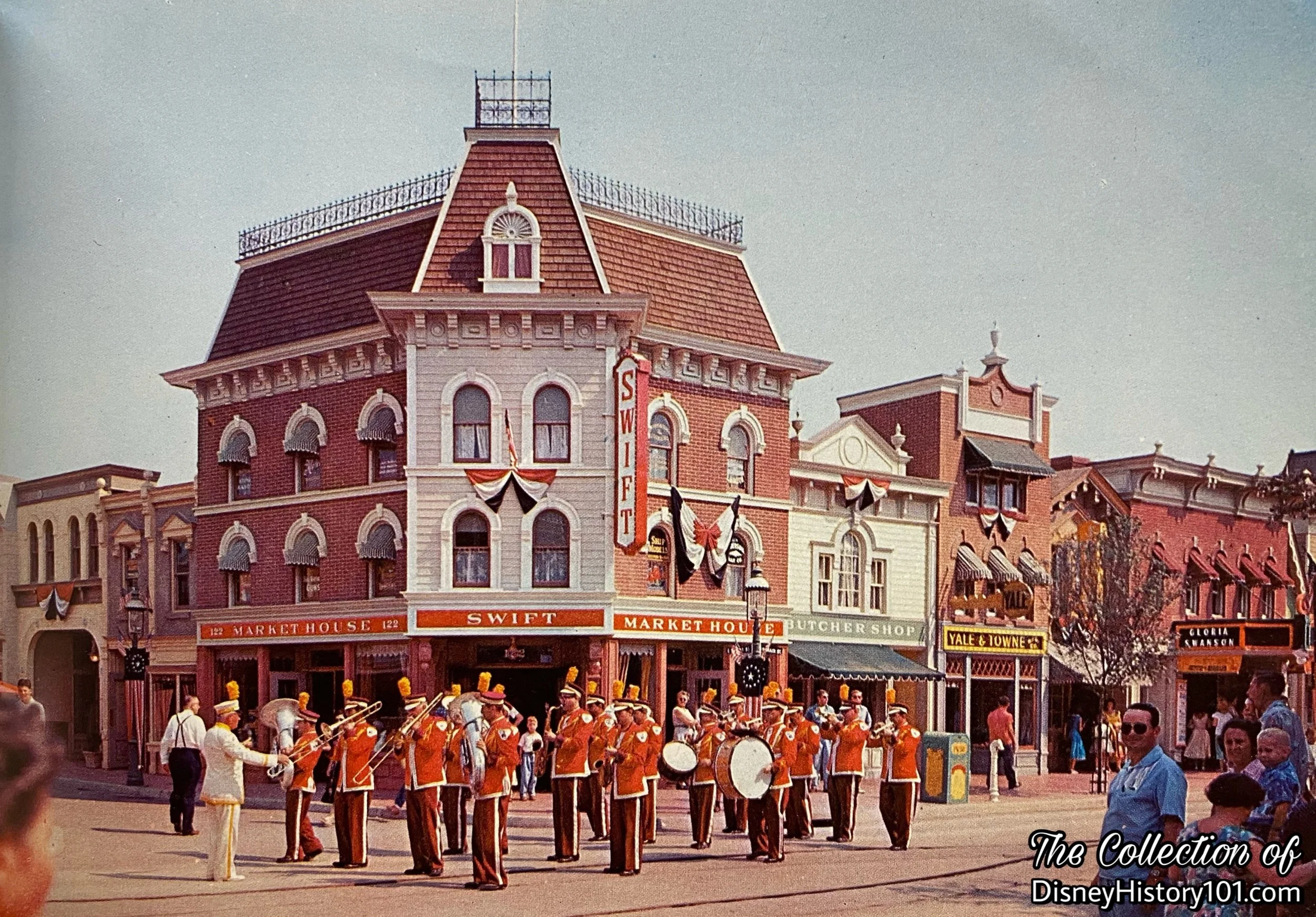
The Market House created tangible memories for Guests through Merchandise and Show.
Merchandise licensing fed concessionaires into the Park, and Disneyland turned concessionaires into licensees. You May recall purchasing old time toilet soap. Products like Vanity Fair Toilet Soap (a lanolin and hexachlorophene creme bar) was sold by the box, and a popular seller.
Guests of Disneyland were well familiar with Swift’s brand meat products - such as Swift’s Brookfield Pork Sausage, Swift’s Bologna, Swift’s Hard Salami, Swift’s Premium “Brown ‘N Serve” Fully Cooked Sausage, and Swift’s Premium Franks - as some of these products were “made fresh daily at local kitchens” and served at restaurants around Disneyland. Not only were Swift’s meat products found in the Swift’s Market House, but guests could once order a Swift’s Premium Cheeseburger or a Swift’s Premium Frankfurter at the Carnation Cafe in Disneyland. The aforementioned products could be purchased wholesale (with the help of a “Wholesale Price List” - complimentary Disneyland souvenirs courtesy of Swift’s)! By 1955, Disneyland visitors who were pet owners, were aware of Swift’s products, as the company even manufactured a line of dog food under the label Pard (which enjoyed a brief advertisements with “Lady”, star of “Walt Disney’s Lady and the Tramp”). Foreign guests were also soon familiar with the Swift’s brand, as (by 1958) the company was sponsoring some of Walt Disney Productions’ television programs represented in foreign markets.
In an age of free souvenir literature courtesy of Disneyland free exhibit sponsors, Swift’s Market House offered the 13-page “Swift’s Wholesale Price List No. 4” - a list of U.S. Government inspected quality meats for sale through Swift’s! Look for popular “delights” (as the Winchester Breakfast Bacon or Fancy Summer Sausage), or exotic articles (Swift’s Beef Fluid, Lamb Tongues, or Ox Lips).
Occasional recipes containing Swift’s Premium products were published in editions of The Disneyland News.
On December 10, 1955 the Swift & Co. provided food for the First Annual Christmas Party.
The window displays of Swift Market were maintained with a “fresh look” according to Disneylander (October 1957).
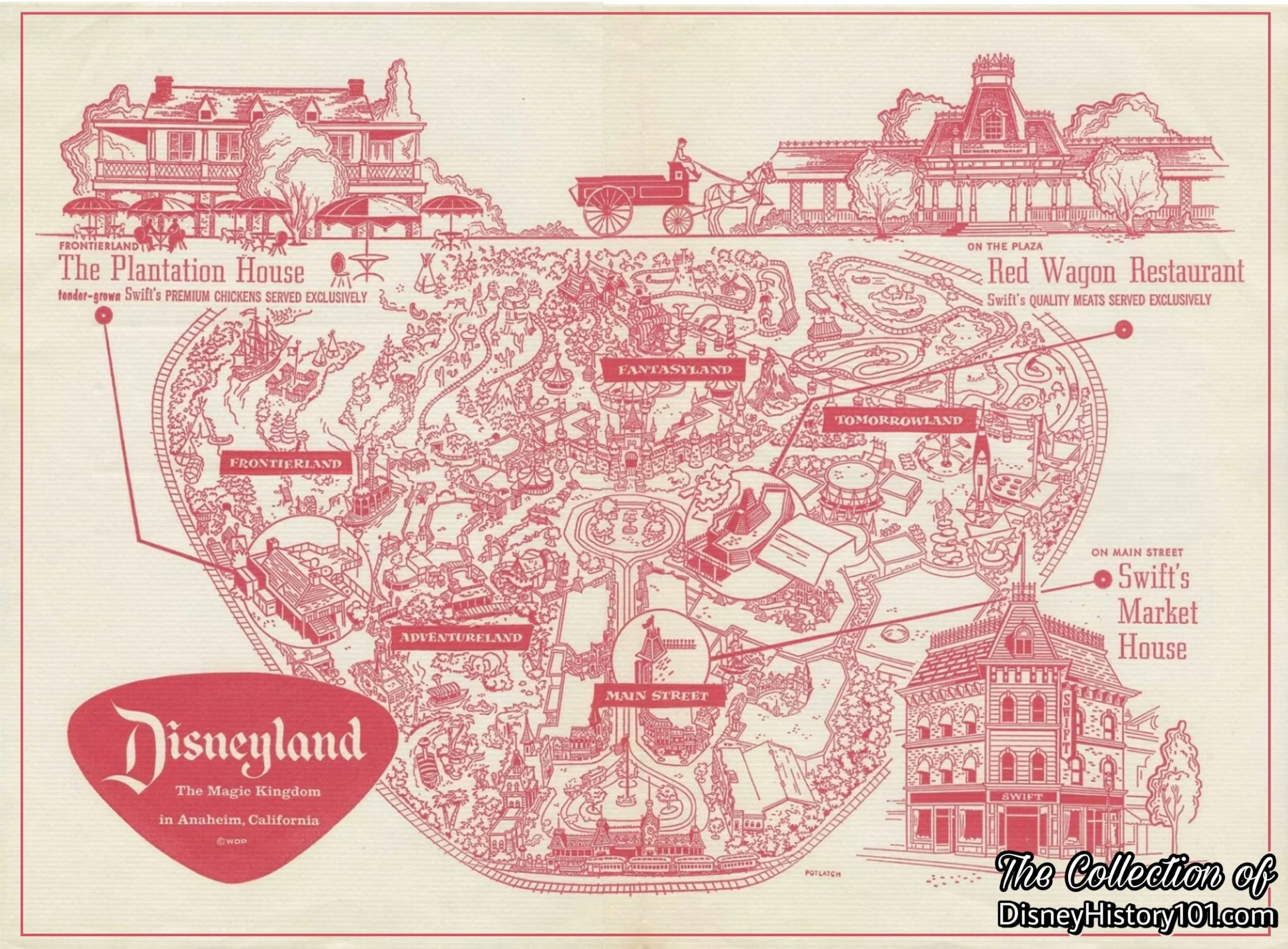
Placemats and other complimentary items like this are a prime example of “the possibilities for a sponsor to capitalize on this association” with Disneyland. The many ways of “merchandising, sales promotion, advertising, public relations and publicity programs are almost limitless. Regardless of the type of product, goods or services manufactured and marketed by sponsors, the Disneyland association can be effectively and importantly translated into the sponsor’s promotional activities,” according to “Disneyland, U.S.A.,” published 1958.
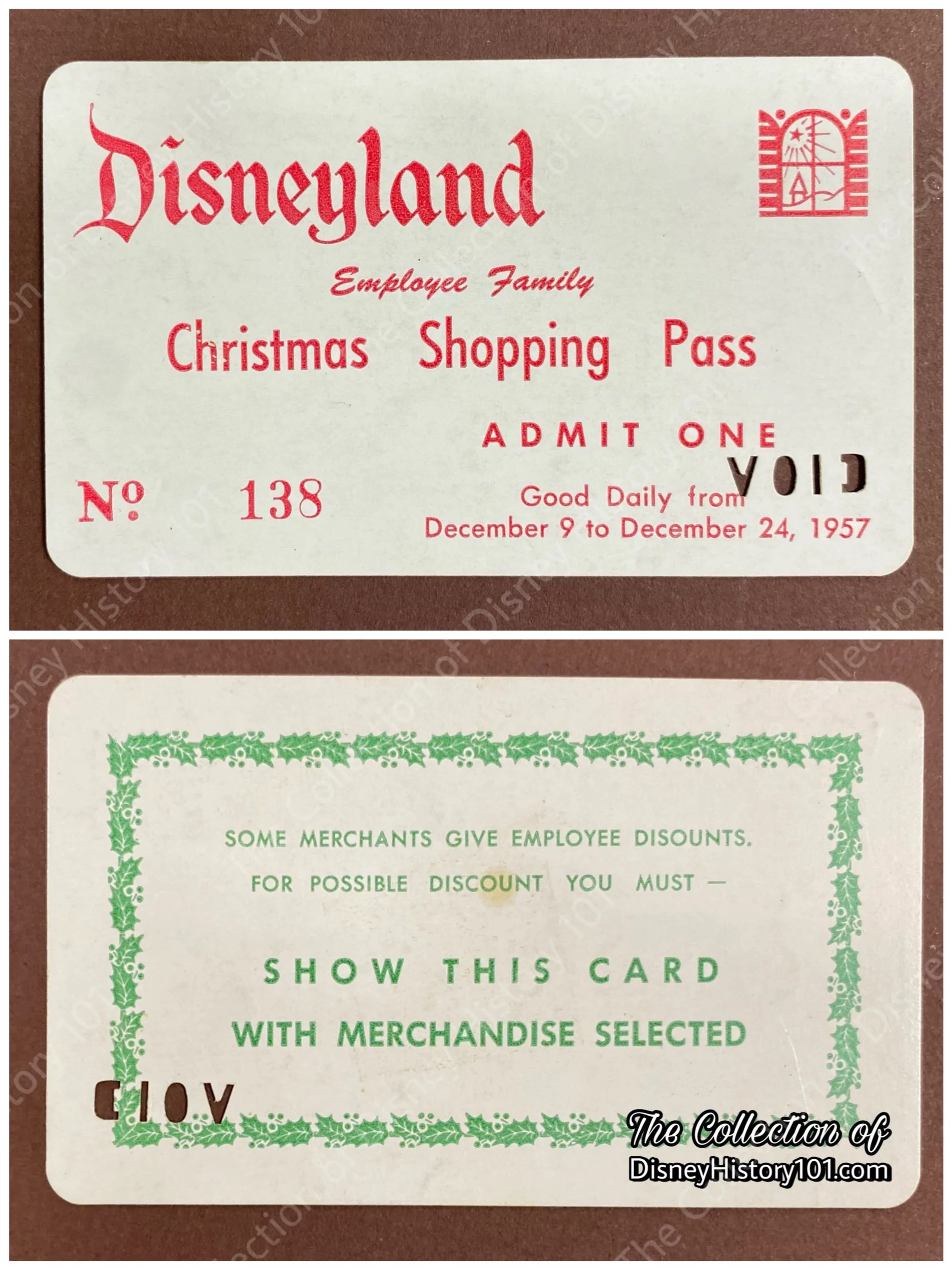
According to The Disneyland Shopper (published 1955): “Half the fun of buying Christmas Gifts is the atmosphere you shop in. You couldn't ask for more in the way of the spirit of Christmas than to shop in Disneyland. Especially along Main Street will you catch the air of the good old-fashioned Christmas with wreaths of holly, Christmas bells, carolers, snow-frosted windows gaily decorated with fairytale rhymes, and the scent of pine boughs in the air. Ringing through this Magic Kingdom are the Christmas Songs we all love to hear.”
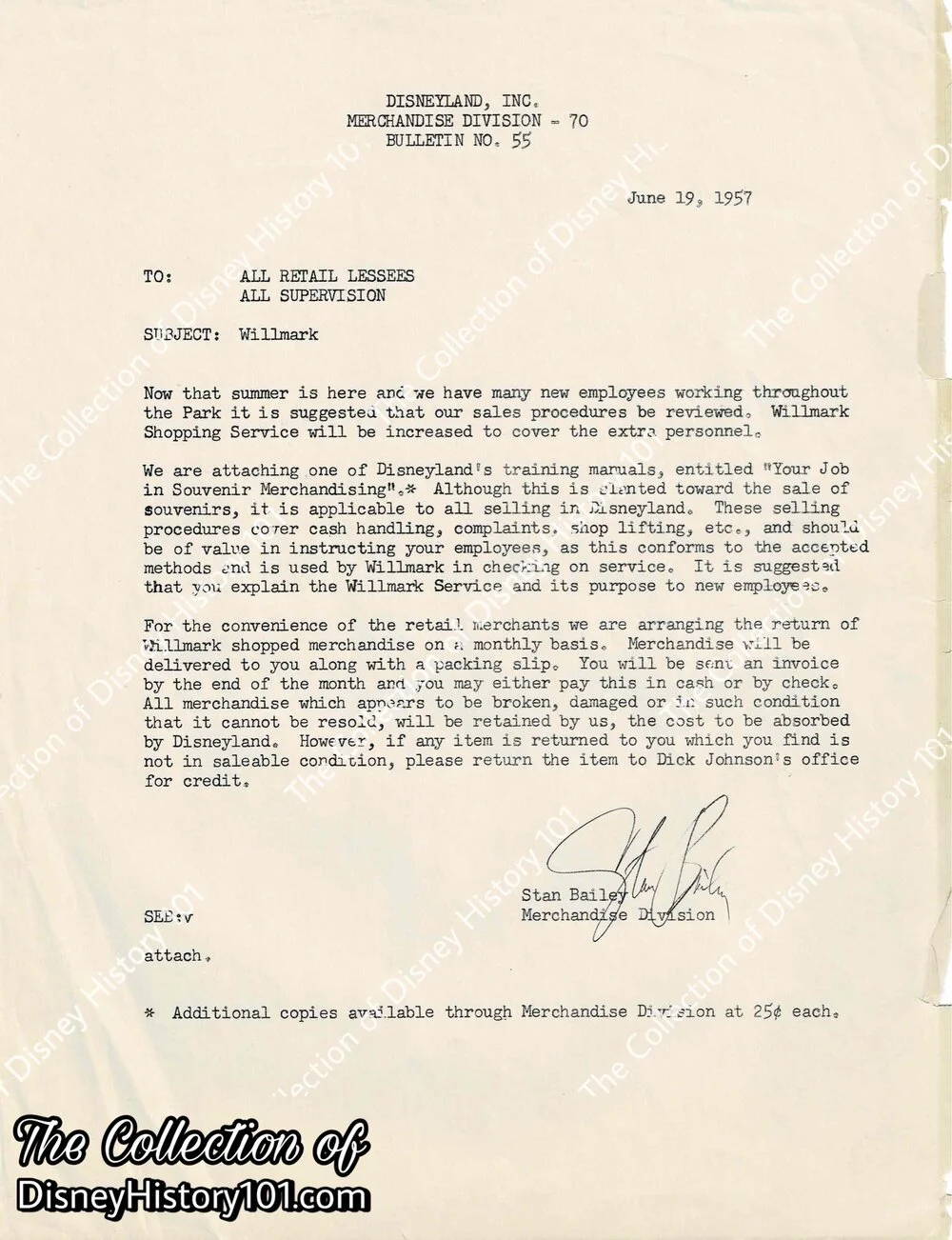
The 1957 TWA brochure “Let’s Talk About… My Visit to Disneyland, Anaheim, California: A Note from Mary Gordon TWA Travel Advisor” mentioned: “We learned that to fully explore Disneyland takes two days, so early next morning we were at the gates of the park again. The second day we spent more time shopping in the 50 inviting shops, and the youngsters bought inexpensive souvenirs to take home to friends.”
By January 1, 1958, the 2,152 square-foot Swift’s Market House was located in Main Street Building #600. The corporate synergy was good for a time. Some DISNEYLAND table service restaurants offered Swift‘s brand products in their recipes. For instance, Hills Bros. Coffee House offered Swift’s sliced baked ham on a sandwich.
As for DISNEYLAND, the institutional lessee Swift and Company yielded some revenue for Disneyland Inc. - $43,000 for the fiscal year ending September 29, 1957 and $43,000 for the fiscal year ending September 28, 1958.
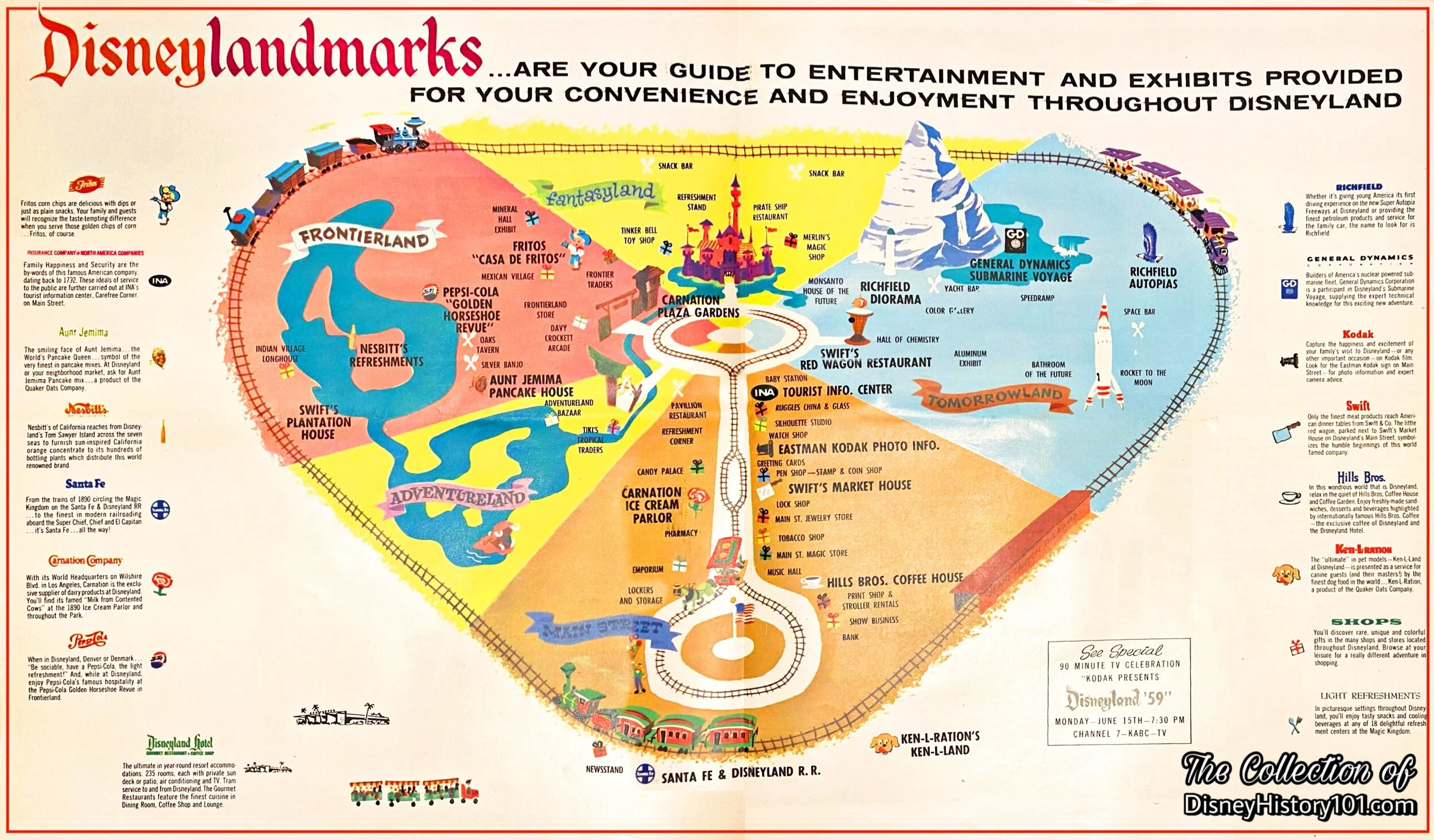
Owning to Jack Sayers (of Lessee Relations), Swift & Company was a contributing sponsor for Disneyland ‘59! By October of 1959, the company was (1) of over sixty-eight other firms playing a vital part in the team effort to bring happiness to Disneyland’s Guests. Some were small, specialized individual operators; some were huge companies such as Swift & Co. - the Bank of America - United Paramount Theaters (which you hear as UPT) - Carnation - Richfield - General Dynamics - Crane - and many others. These companies used the park to publicize their wares, leased space in the Park to sell their wares, and Disneyland collected advertising fees from them. By 1959, of the total income received by Disneyland, Inc. from leases, 16.02% was derived from the selling of advertising rights and 40.12% from the leasing of space to concerns whose main reason for occupancy is for advertising purposes. The remaining 43.86% of the lease income was derived from stores that sold various products and food.
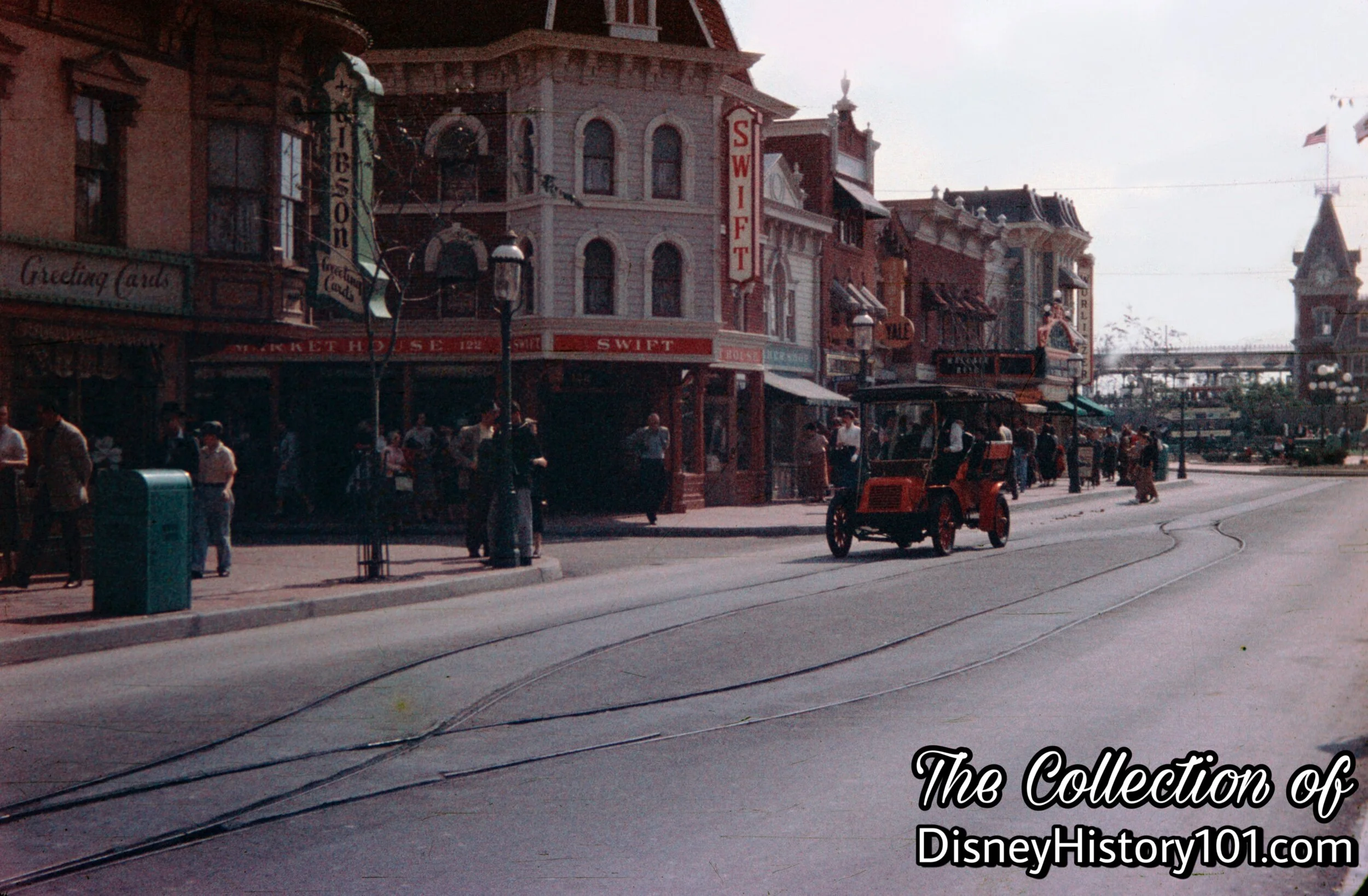
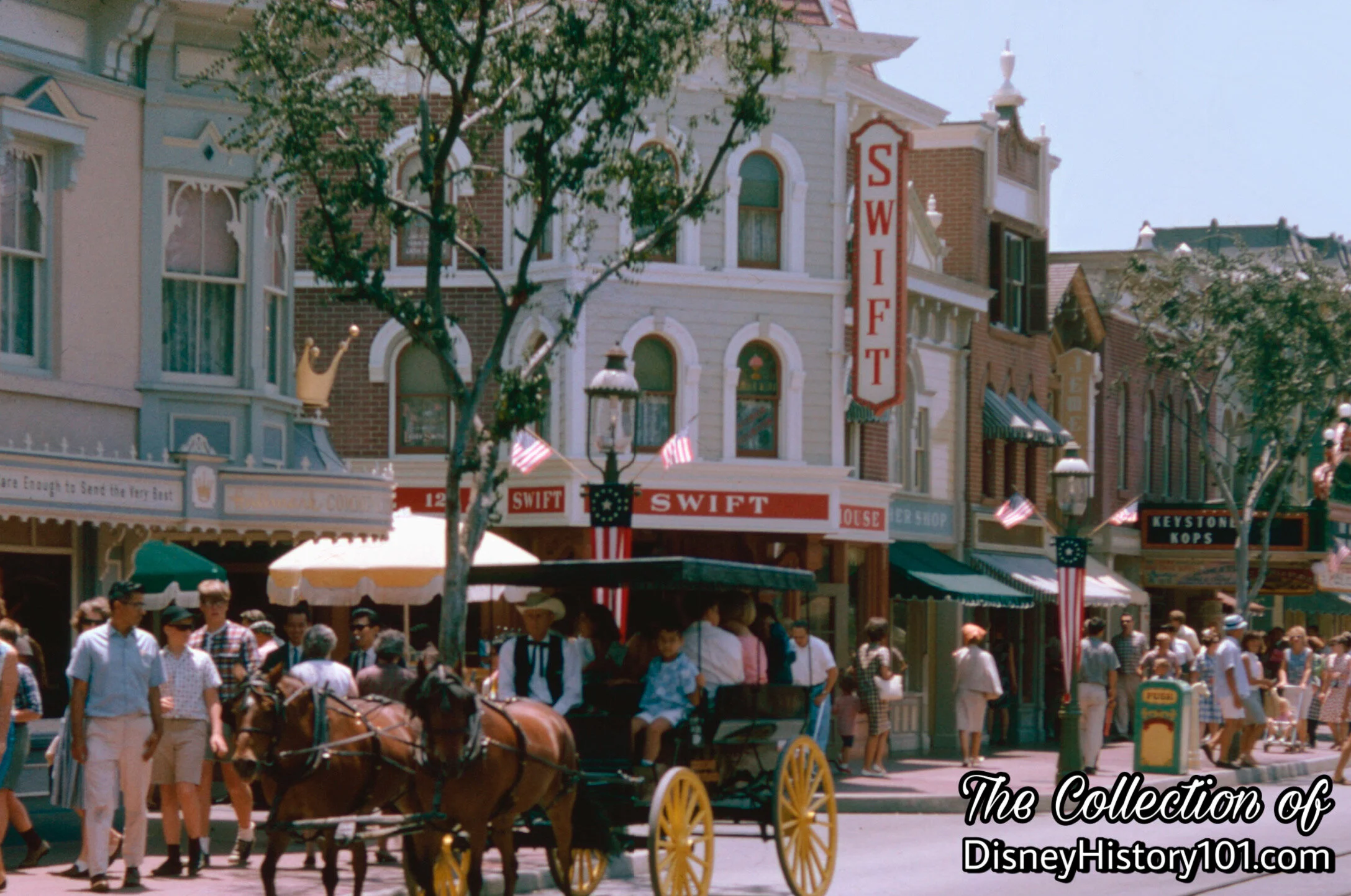
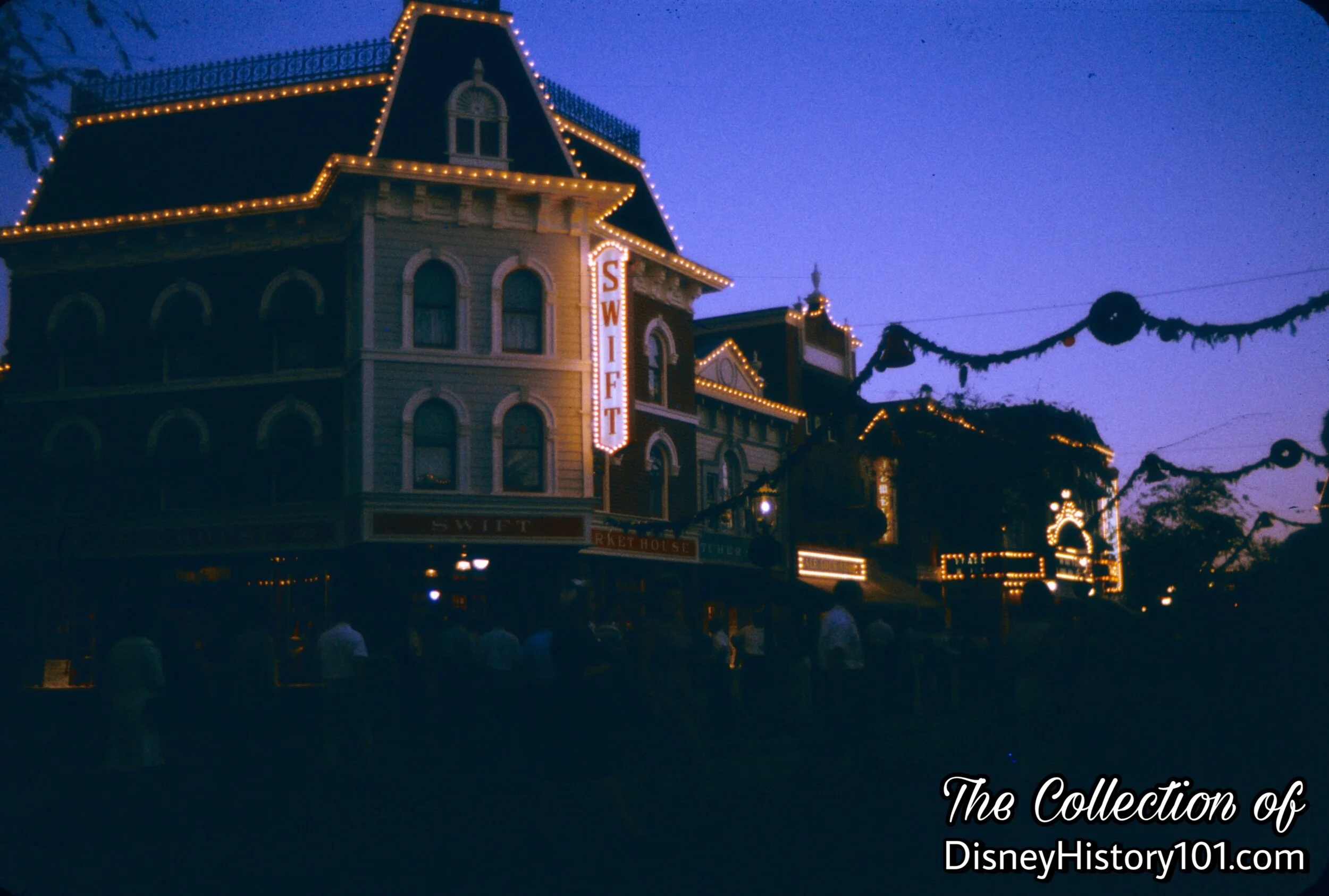
Outside, guests could step aboard the Swift & Company Wagon for a photo opportunity. This free exhibit was similar in fashion to the Carnation Farms Milk Truck, the Bekins Wagon, and the Global Van Lines Truck. The Swift Wagon was a “horse-drawn replica of the 1890’s that services all eating establishments in Disneyland with Swift fine foods.” When not parked near the Market House, the little “Red Wagon” could also be found stationed on East Plaza Street, near the Red Wagon Inn.
This exhibit helped Disneyland audiences understand the mode of transport (or, drayage) for the delivery of manufactured products (e.g. ice, milk, baked goods, meats, etc.) to small towns across the U.S.A.
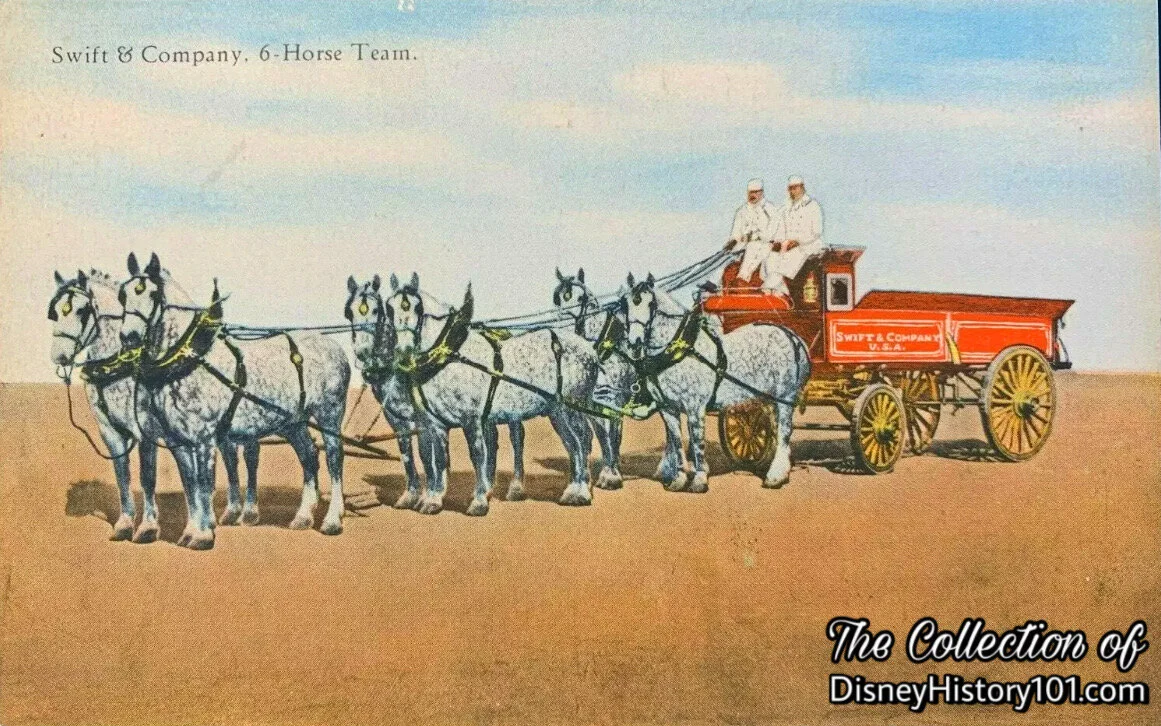
It seems that Swift & Company’s c.1910 horse drawn wagons were pulled by a six horse hitch. One model of Swift’s red wagons may have still been in use for drayage of Swift’s products by the time the International livestock exposition was held in Chicago (from November 26th - December 3rd, 1927).
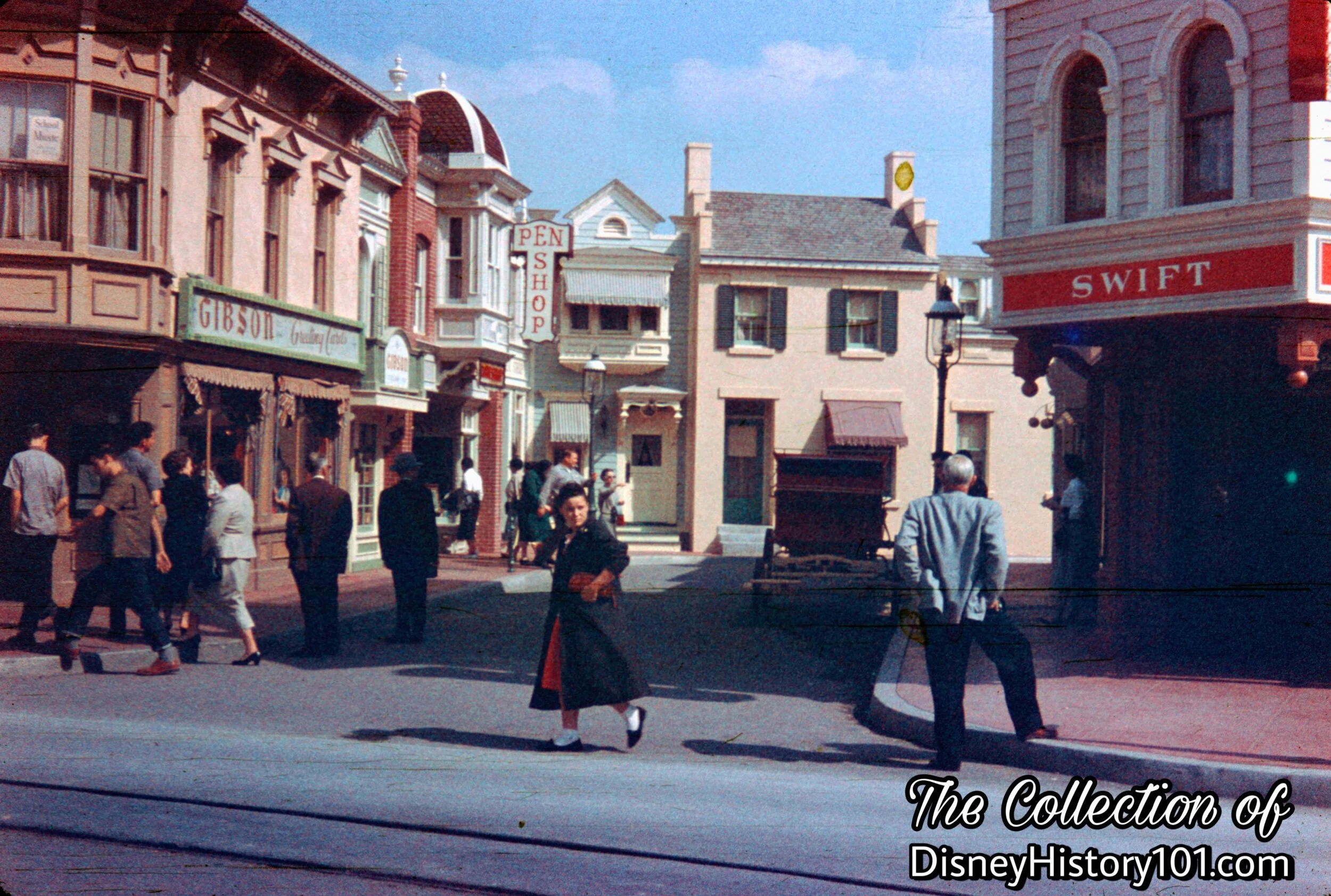
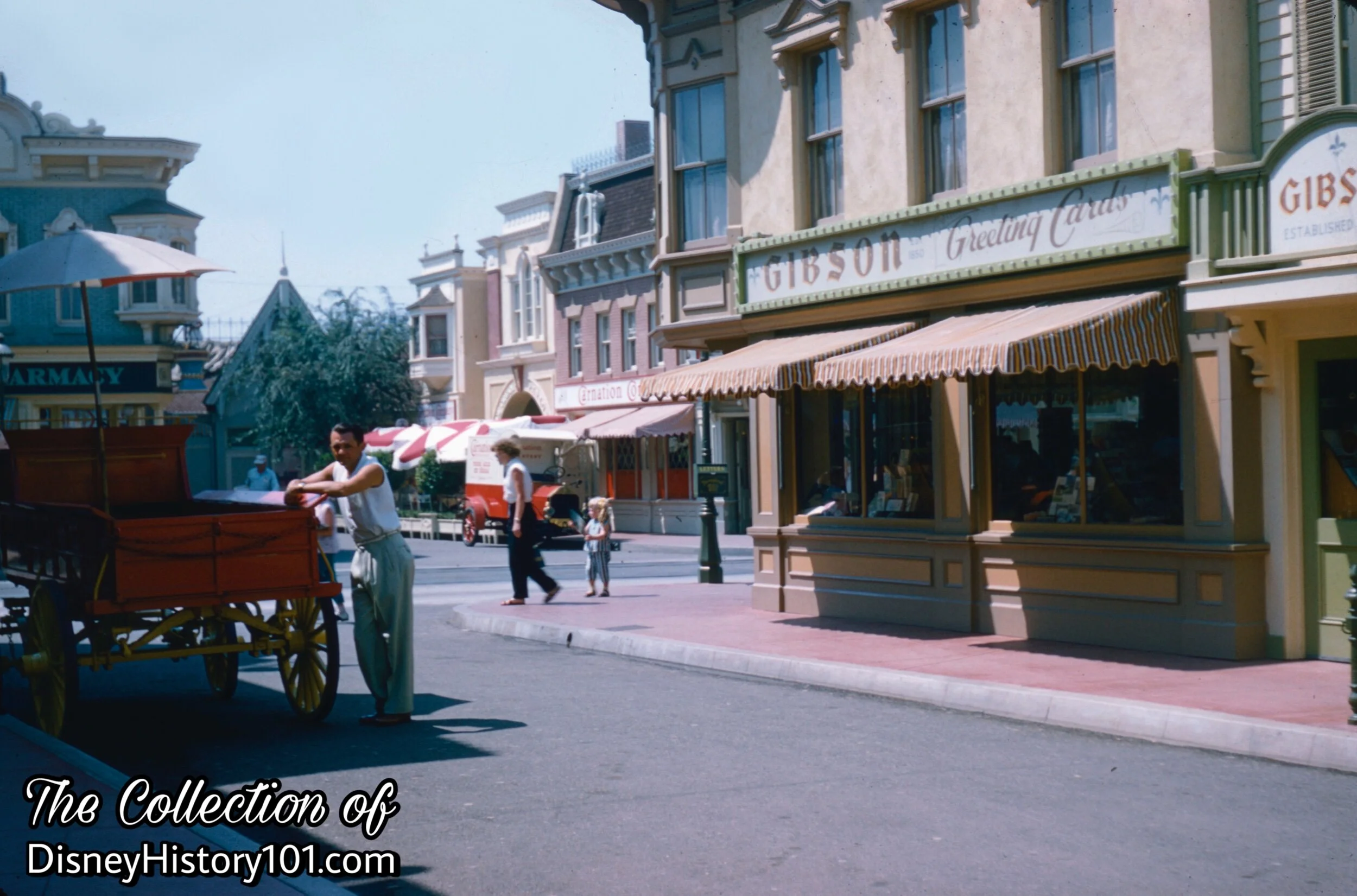
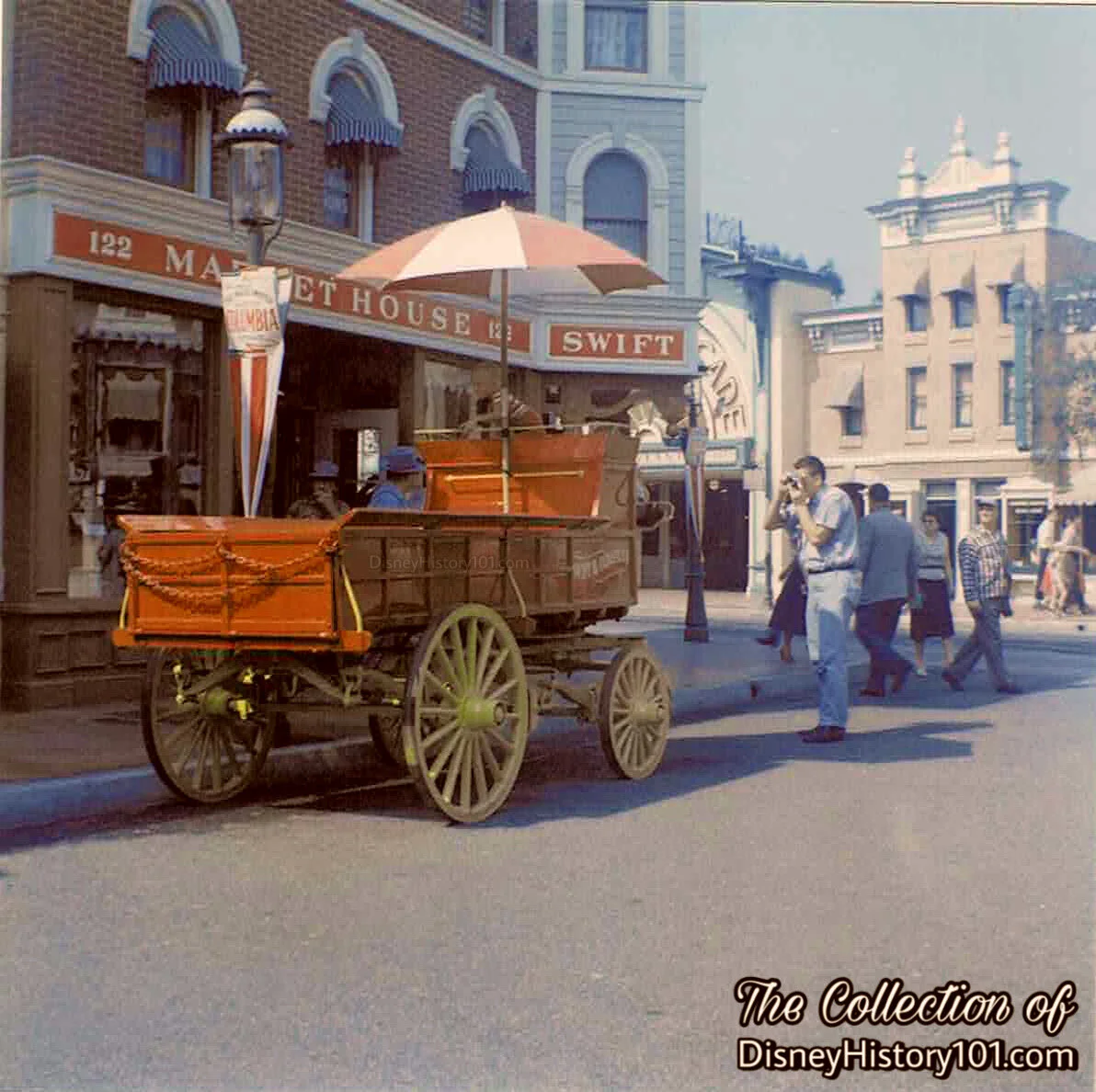
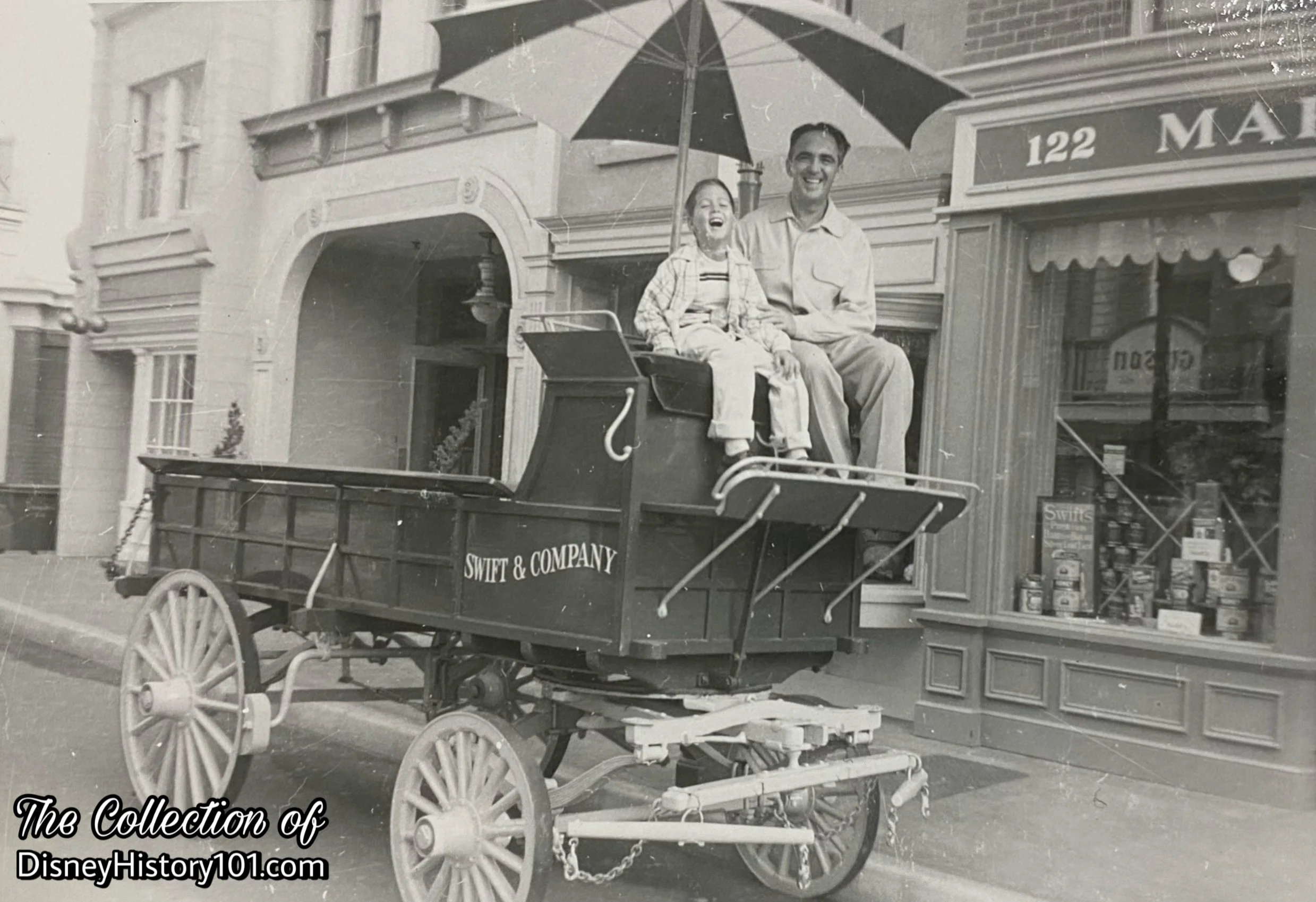
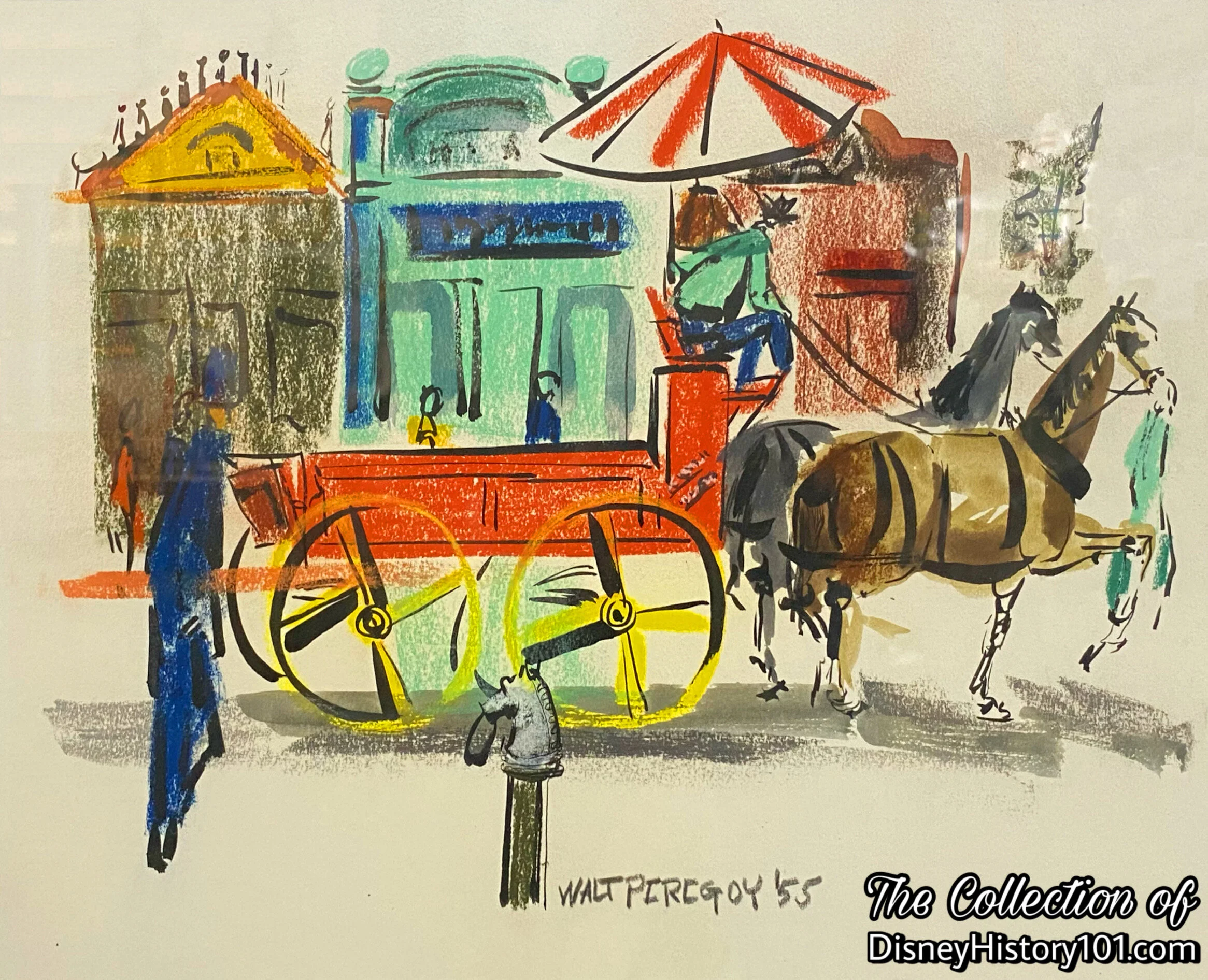
When Walt Disney Productions Background Artist Walt Peregoy visited Disneyland, he spent his time creating colorful studies of the Park, and at least one of them featured the Swift Wagon.
During C&H’s sponsorship, the Market House was an “old-fashioned general store complete to cider and dill pickles,” cookies, candies, natural food snacks, coffee and cider. Next door (but, technically located in the Swift Market House), the C&H Sugar Corner (sponsored by the Californian and Hawaiian Sugar Refining Corporation), featured a variety of penny candies and unique colored decorator sugar crystals. Other specialty items included Vanity Fair Toilet Deodorant Cream Soaps containing lanolin and Hexachlorophene.
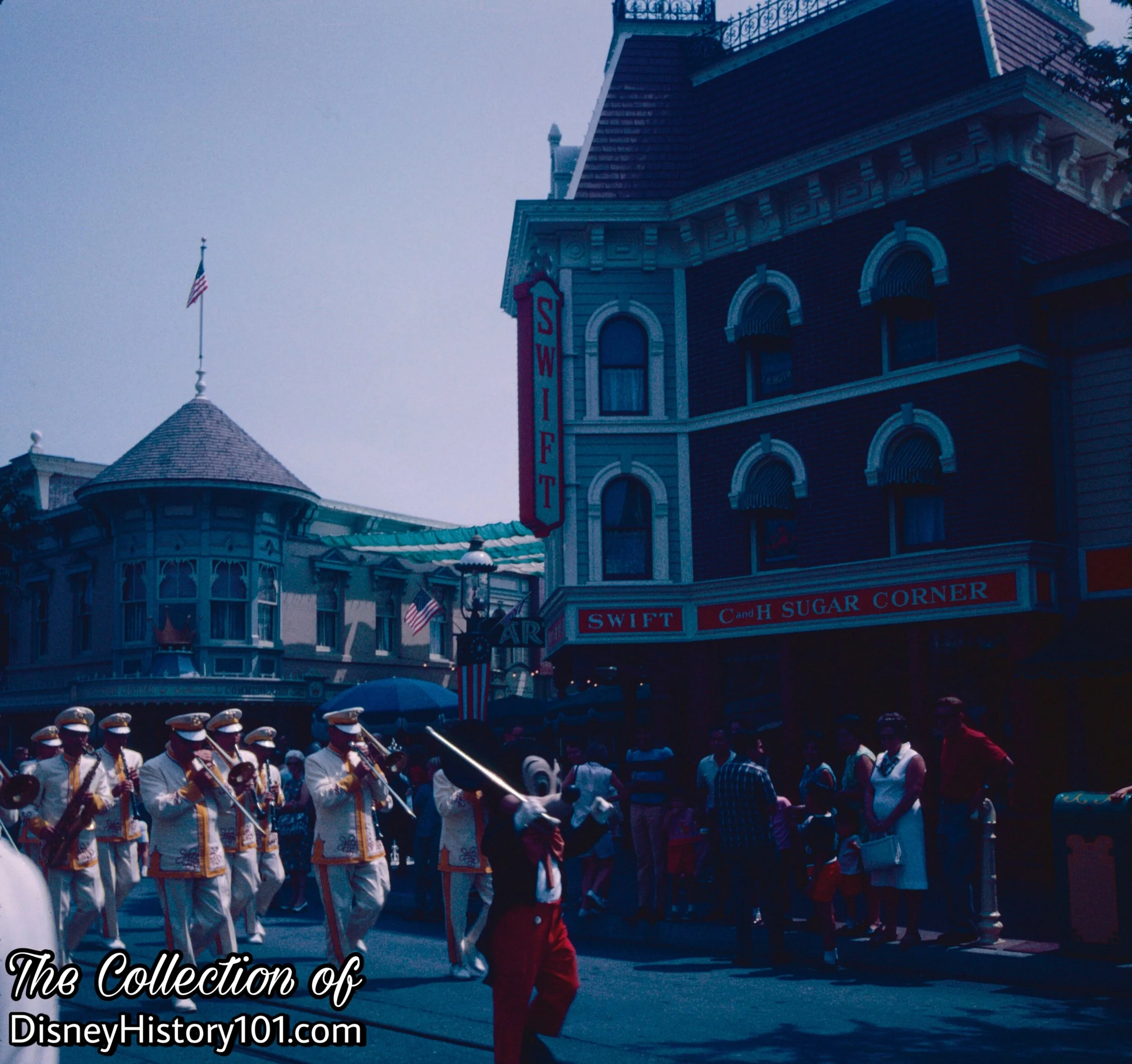
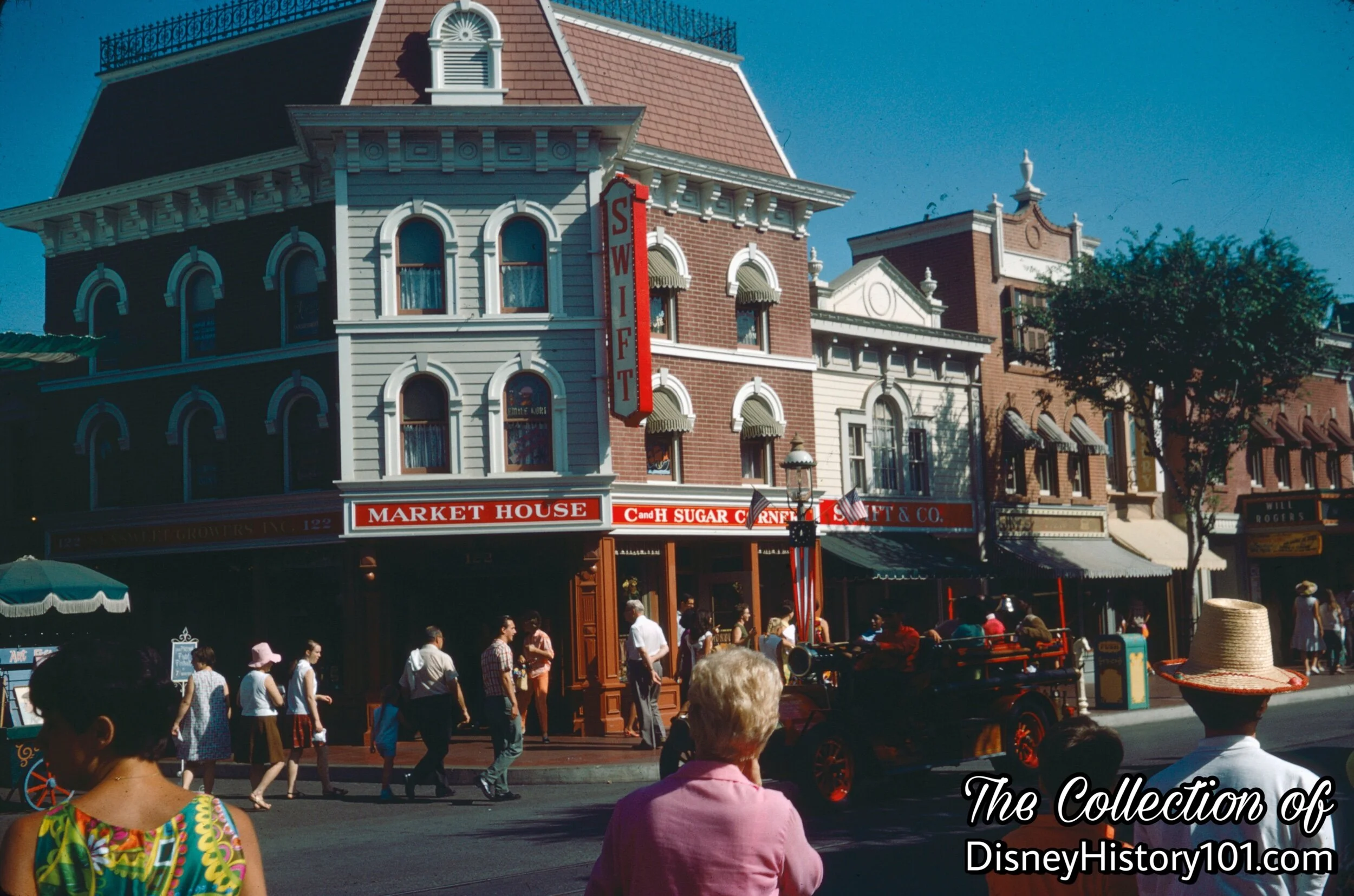
Swift’s contract was soon to lapse in 1966, so before that happened, Walt Disney Studio artist Dorothea Redmond began to create Market House concepts in 1964. The new shop and exhibit contained many original items and equipment collected from all over the world.
By 1970, the Market House (Main St. General Store) was sponsored by Swift & Co., C&H Sugar Corner and Sunsweet Growers.
![Among Dorothea ’s designs that were realized was “a pot-bellied stove and recorded party-line phones that [would] provide many chuckles for guests,” according to the “Disneyland Dictionary” (compiled by WED Enterprises, Inc. and WED Public Relati](https://images.squarespace-cdn.com/content/v1/5b3d7f804eddec6e826be0c9/1639720892240-I09G53FZ0XWRK81BNPDD/98B50E47-9A16-489E-8452-01A2582631A5.jpeg)
Among Dorothea’s designs that were realized was “a pot-bellied stove and recorded party-line phones that [would] provide many chuckles for guests,” according to the “Disneyland Dictionary” (compiled by WED Enterprises, Inc. and WED Public Relations Department, c. 1968).
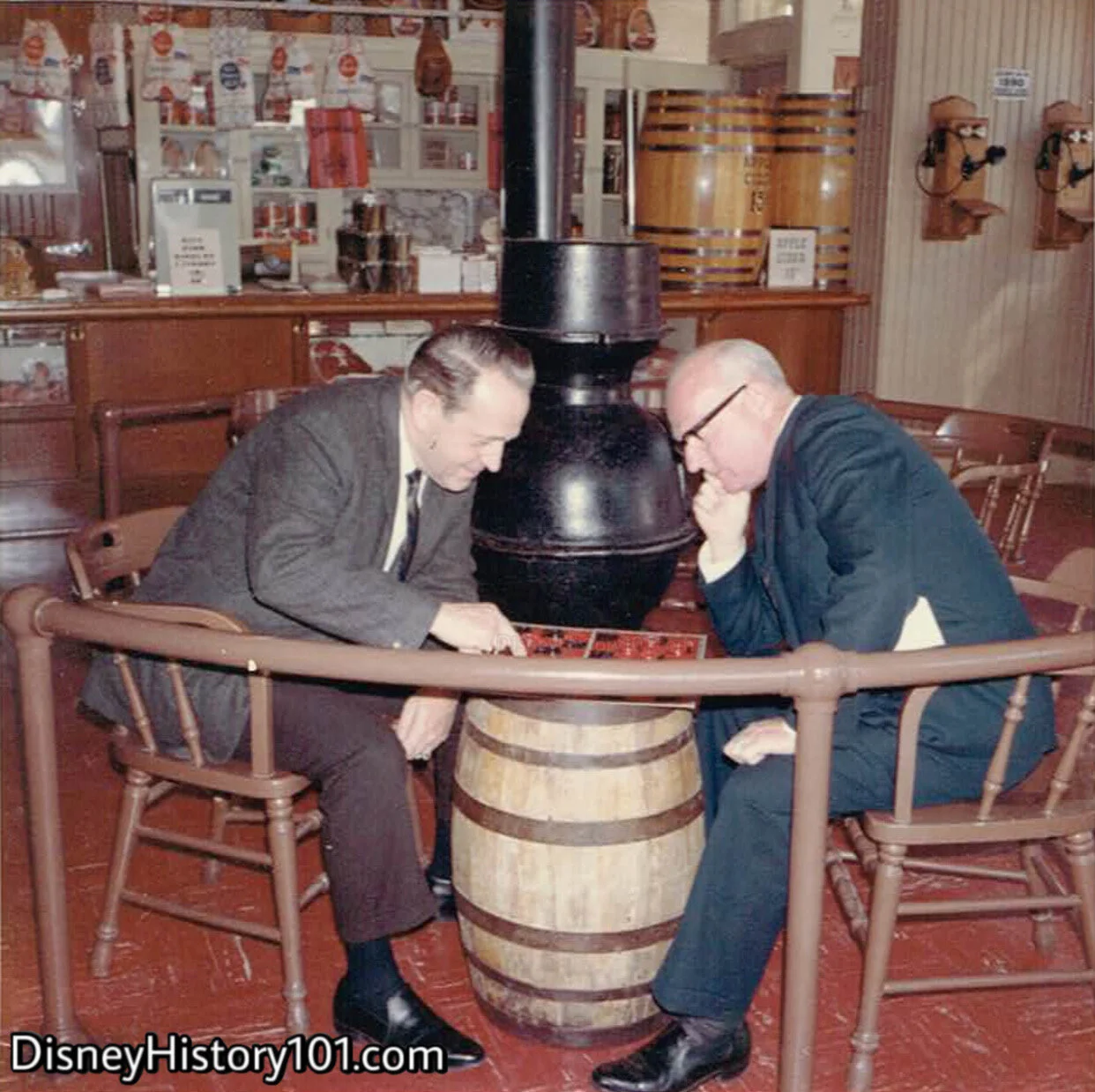
By 1969, an inventory list was maintained by the Disneyland Decorating Department and was perhaps the most unique manifest of items existing anywhere. It contained about 35,000 items of various sizes, shapes, and values with 4,000 items on Main Street alone.
At the Market House, the potbellied stove is an original. In the rear of the store stood a distinguished looking Seeburg upright grand piano built in 1910. The coffee grinders were authentic antiques and really worked.
Amidst it all, a memorable prop was the checker board, which was still a constant feature by the 1990s. This game offered Guests the rare opportunity to become part of the Atmosphere Entertainment of the Market House, complimenting the theme of area, and staged to entertain other Guests.
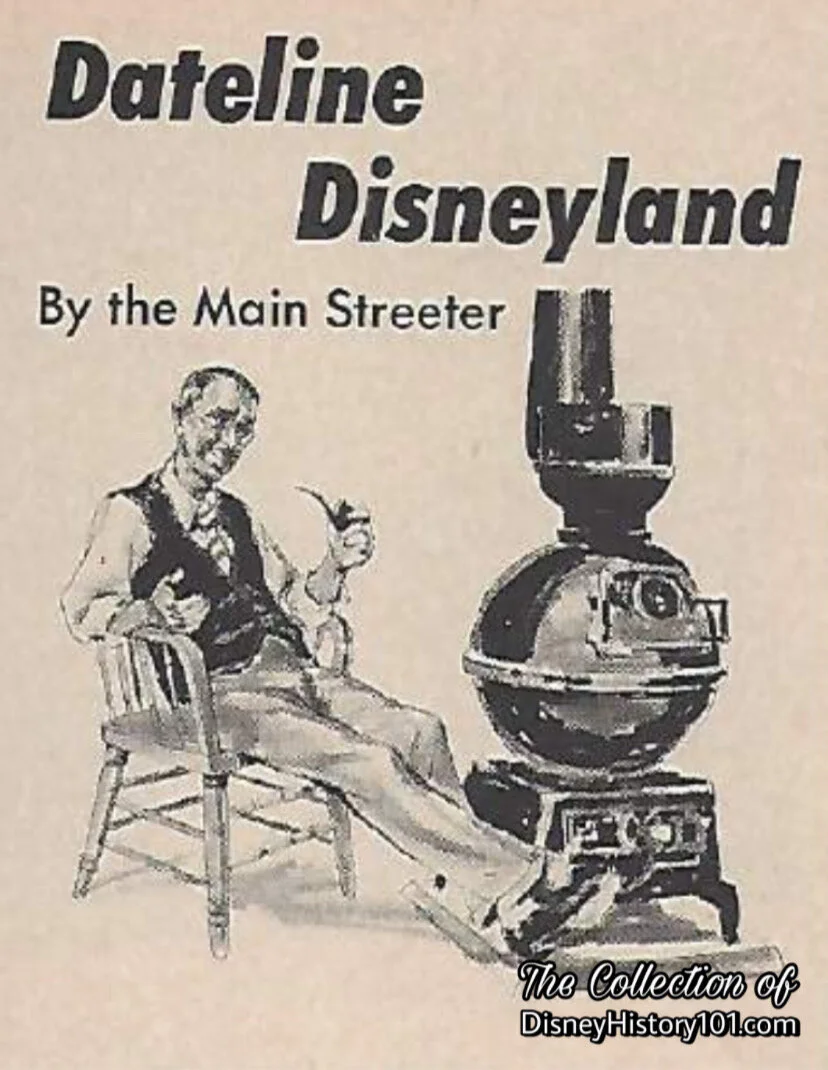
The area near the old potbellied stove was a great place to enjoy an old-fashioned game of checkers, or (as the “Main Streeter” of Vacationland magazine preferred) to “sit and spin yarns about the Magic Kingdom with all my friends visiting the Park from all around the country.”
Of course, there were other ways which ones could “get an earful” while visiting the turn-of-the-century Market House…
Among these was the installment of the half-a-dozen Party Lines, Swift’s Market House has been “the best place to listen in on the neighbor’s chatting,” according to Vacationland magazine (published for Winter/Spring of 1965). “Original bins that used to hold coffee beans and grains are placed around half a dozen old wall telephones where you can lift a receiver and hear conversations of years ago. All of these telephones had to be wired for conversation because they were authentic telephones of the turn-of-the-century era,” according to “Did You Know” (published by Disneyland in 1991).
These phones (and their party lines) may have inspired Wally Boag to “have an idea” which was submitted to Dick Irvine, on May 22, 1966. Wally’s idea was related to the Haunted Mansion which was still under construction, with a sign posted near the gate. Wally submitted :
“I hope you don’t mind if I make a suggestion. I notice that many people really remember too little about the Haunted House, even after reading the sign. I thought there might be a chance for a little pre-opening publicity. I’ve enclosed a script which might be used for a special gimmick out in front of the house. You could put an old-fashioned house phone by the gate. The first part of the script could be repeated over and over again until a guest pushes a button which starts the second tape. Once it had finished, the first tape comes back on, waiting for the next guests. With proper background, music, and effects, this could be a real gimmick for the Haunted House and would effectively publicize the attractions.”
The former Walt Disney Imagineering Principal Creative Executive Marty Sklar would probably agree that the small details like these Party Lines make the story appealing.
As a sidelight, if guests needed to make a true-life phone call, telephones were located on East Center Street between Swift's Market House and the Gibson Card Shop.
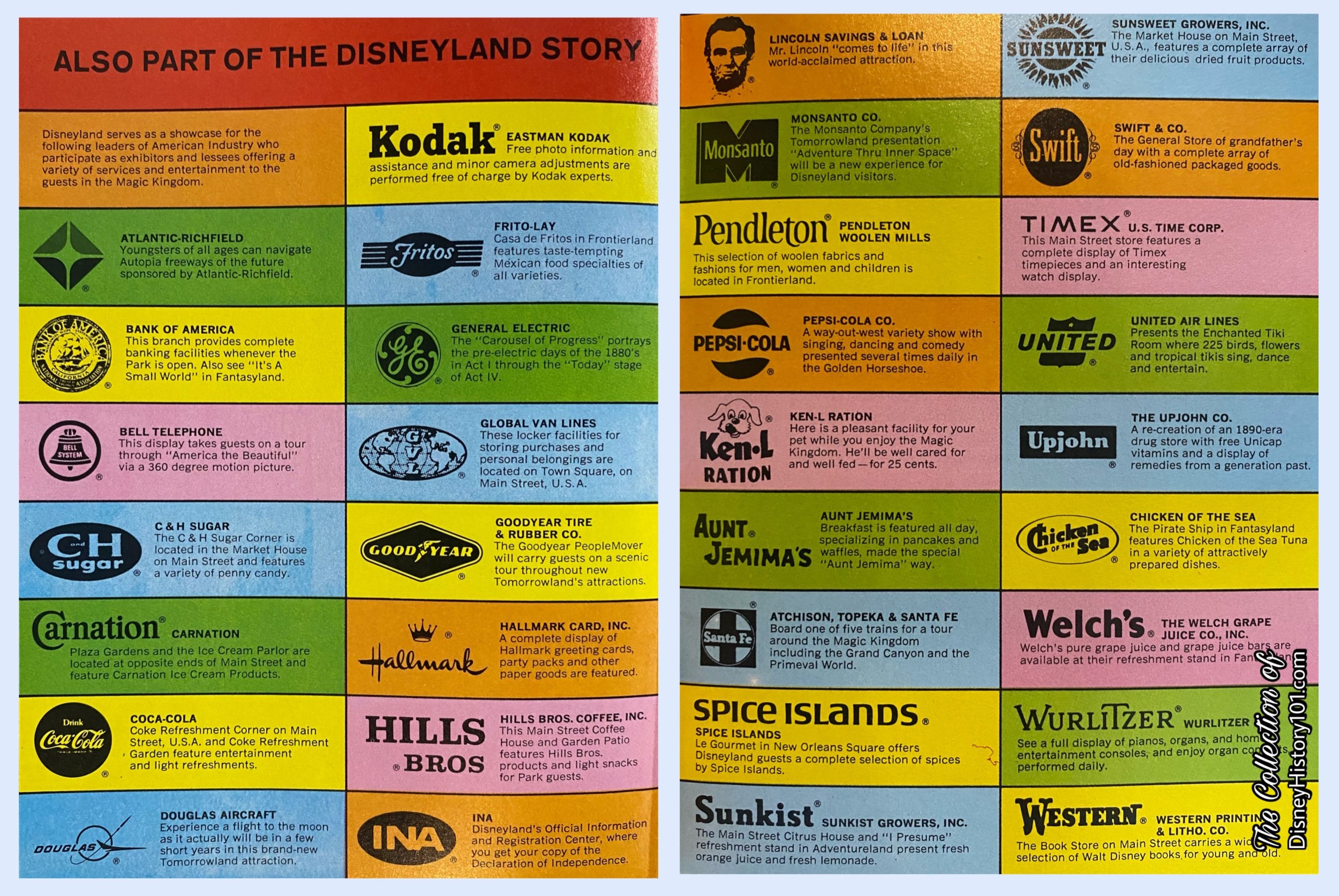
Unbeknownst to most guests, functional offices were hidden (from guests) toward the back of the entire building, in a Backstage Area. As a final touch, one of five 45-star flags in Disneyland flew atop the door, to complete the picture of a typical turn-of-the-century American Market House building.
By 1984, Market House hosted by Sun Giant--An old-fashioned general store featuring cider, coffee, pickles, cookies, natural food snacks, and stamps.
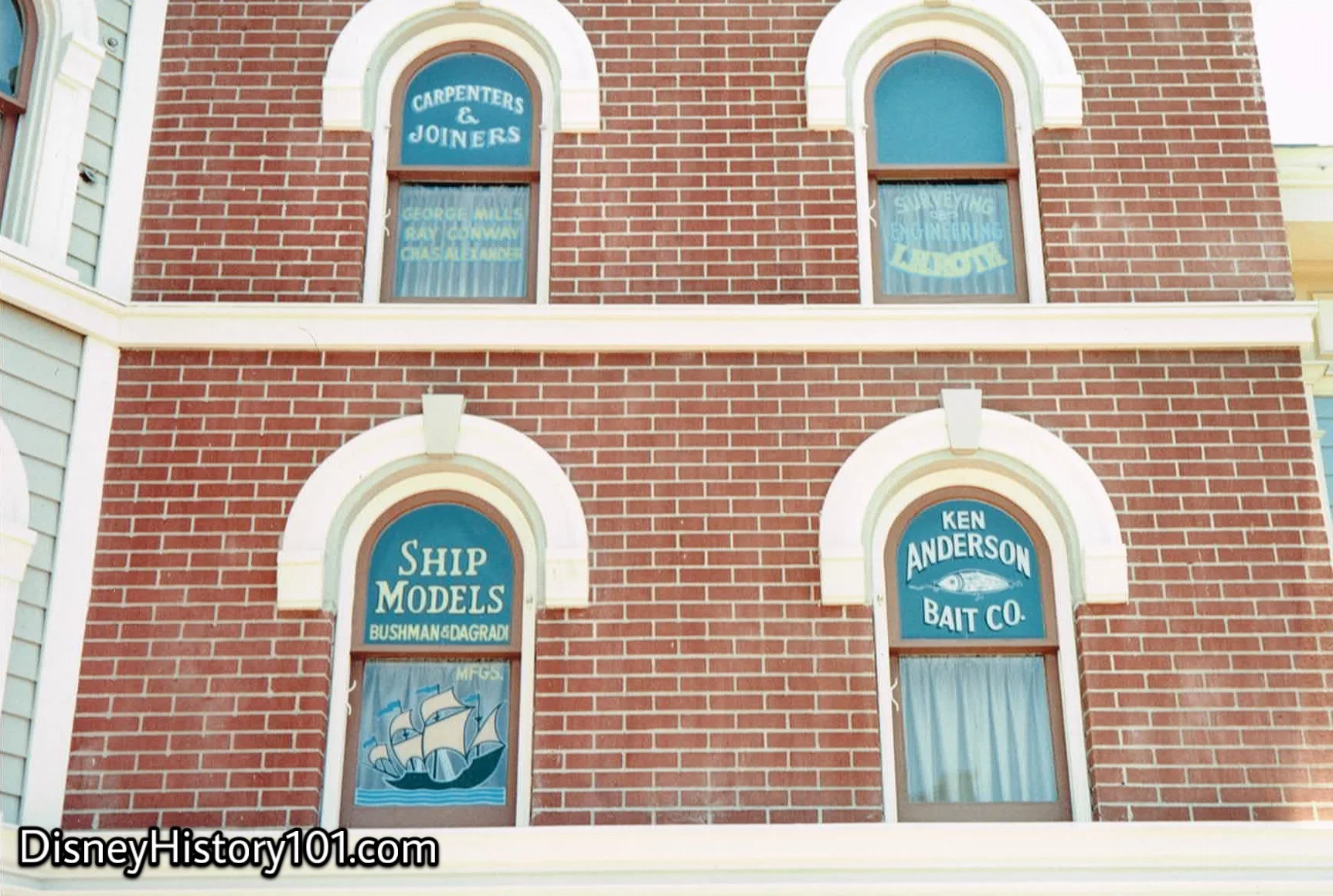
Martin Sklar once said “an individual's contribution can usually be found in the final product if one looks closely enough, but the Disney mind frame is to never point out ‘what I did’ to anyone… Marty professes that everybody who works as an Imagineer is a disciple of Walt… It's not our name on the front door, it's still ‘Walt Disney.’ He notes that even today, most people don't know ‘who we are individually’ at Imagineering and admits that there are some people who can't work that way. Some have big egos and want their name in lights, and they soon leave. Some pretty talented people have left Disney to do their own thing, and, you know, I appreciate that and am alright with it. I'm still close to a lot of them. Some of them even come back and do consulting work for us.”
However, a few outstanding individuals have been publicly recognized for their contributions and even ceremoniously honored by the Company.
According to Magic Kingdom Club (Fall of 1970) : “With the envied Disney penchant for artfully avoiding the direct or obvious in favor of the cleverly obscure, Walt had fun assigning to many of the Main Street window names ‘occupations’ or pursuits that often sidestepped reality. For instance, in his goldleaf salute to Ken Anderson, veneered to a glass pane above the Market House at 122 Main Street, Walt listed him as proprietor of a bait company. Anderson, still one of the Studio’s finest artists and, therefore, one of the best in the business, designed many Disneyland elements. He also happens to be a champion fly-caster and dedicated fisherman. Thus : ‘Ken Anderson Bait Co.’ By 1990, Ken Anderson was still serving as consultant for Walt Disney Imagineering.
‘Bushman and DaGradi, Ship Models’ is another tenant of the Market House.”
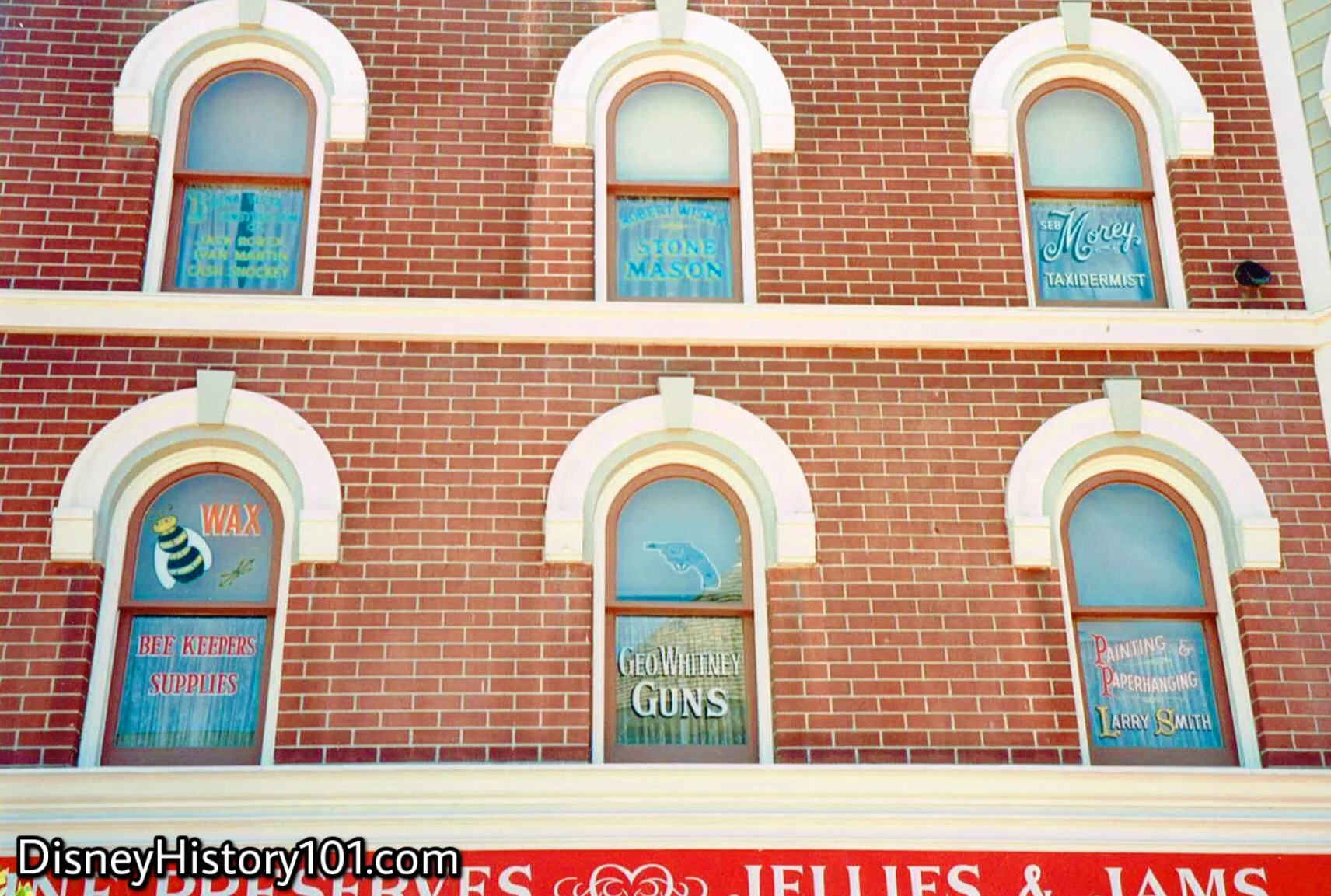
“Robert Wisky, Stone Mason” was the result of an accidental change of the window’s wording to “Robert Whisky.” By 2016, his name had been restored at both Parks. Robert Jerome Washo aka Bud Washo (still known today as “Bud”) was Disneyland’s Buildings Manager. Bud headed the Staff Shop (which made the concrete, plaster, and plastic work for the Park). This, Bud did since Disneyland’s construction phase, until his retirement. According to Dave Smith (Chief Archivist Emeritus of The Walt Disney Archives), “Bud Washo (1923-1999) originally served in the staff (manufacture of interior and exterior ornamentation in fiberglass, etc.) and plaster shops at Fox, Columbia, Universal, and Paramount Studios. He joined Disneyland in 1954 as supervisor of the staff-and-plaster shop, and later moved to Walt Disney World to hold the same position.” [Disney Facts Revealed by Dave Smith, 2016].
“Seb.” (Sebastian) Morey (of the Disneyland Decorating Department, from 1956-c.1995). Originally, this window read “Bob Mattey - Taxidermist” from 1955-1969.
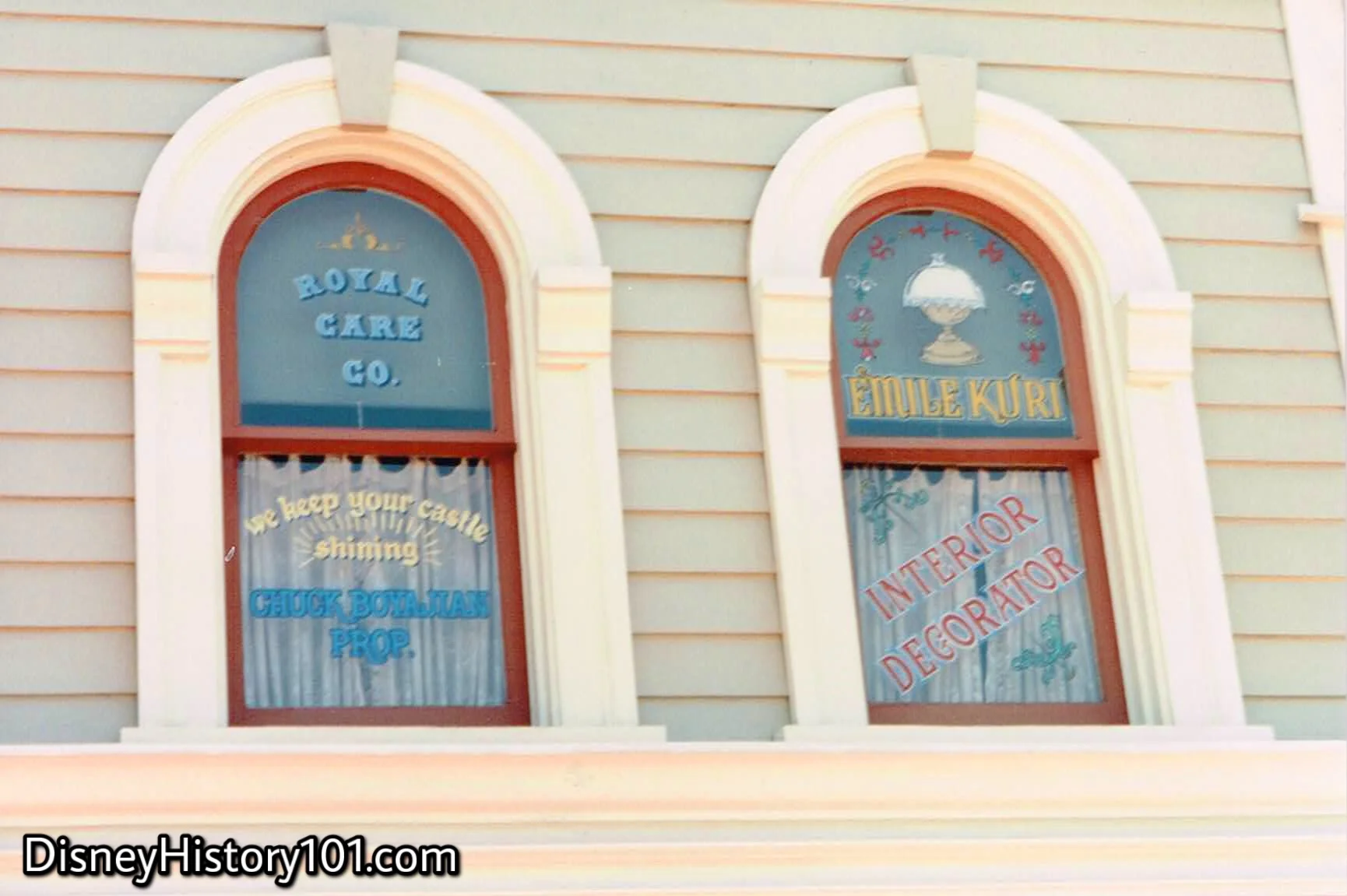
“From the Park’s earliest design stages to the time he retired, Emile Kuri contributed decorating talent to many of its settings. He supervised the Studio’s Set Decorating Department, and regularly assisted in creating Academy Award-winning stage settings. He is remembered with the window: ‘Emile Kuri, Interior Decorator,” according to “Disneyland - A Treasure Chest of Trivia,” prepared by Walt Disney Productions, 1990.
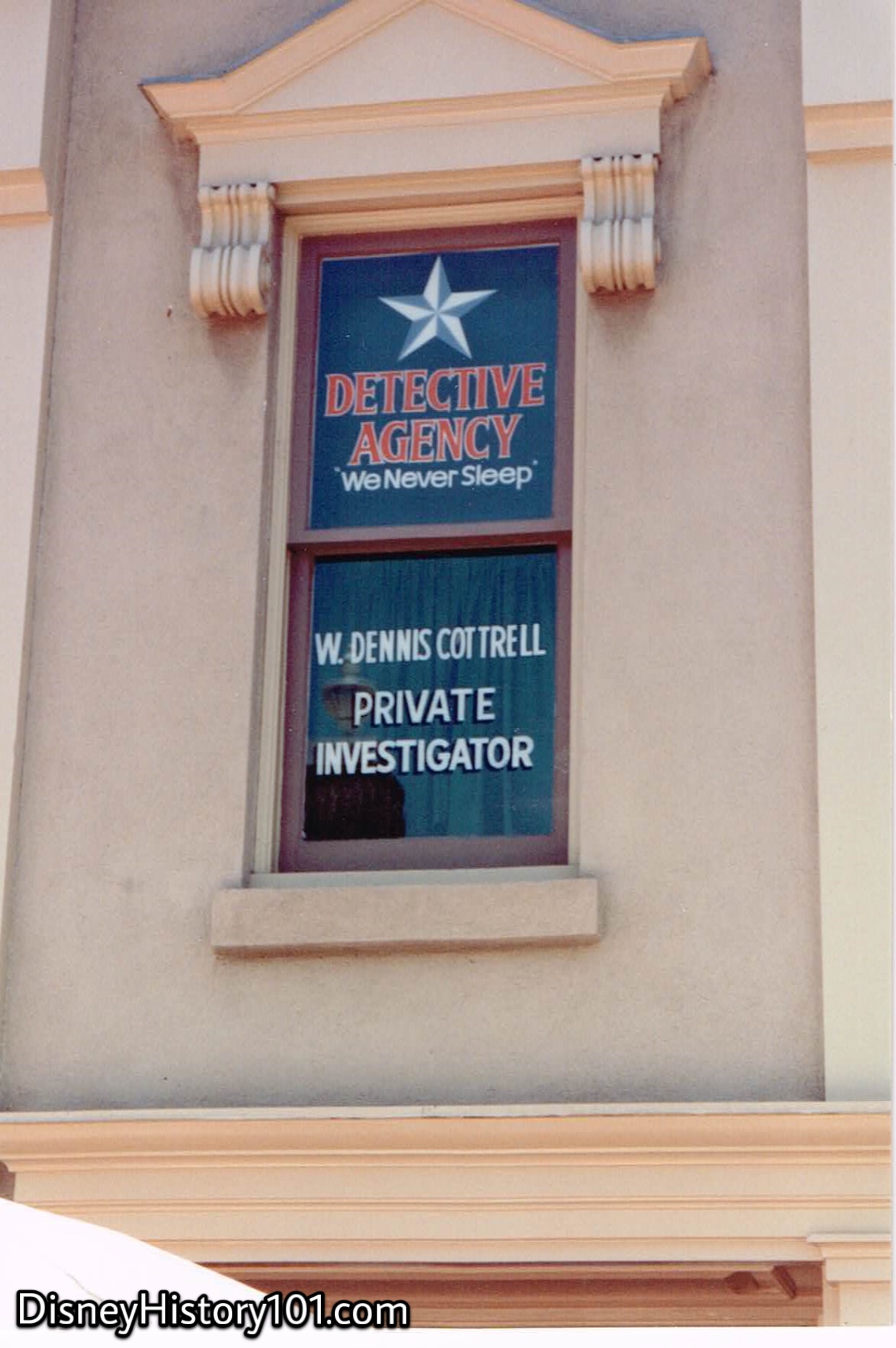
“‘W.H. Dennis Cottrell, Detective Agency, Private Investigator. We never sleep.’ ‘Bill’ Cottrell is the retired President of Retlaw Enterprises, a private firm owned by Walt’s family. He was the President of the newly formed Walt Disney Imagineering when Disneyland opened. Mr. Cottrell was an ardent collector of items and information on Sherlock Holmes, which led Walt to ‘convert’ Bill into a detective for the window honor,” according to “Disneyland - A Treasure Chest of Trivia,” prepared by Walt Disney Productions, 1990.
The Market House tradition lives on through other Disney Parks worldwide. For instance, the Market House Bakery at Hong Kong Disneyland (Hosted by Maxim's) features delicious pastries.
If you would like to read more about both the Swift Market House and the C&H Sugar Market House, it’s my pleasure to recommend adding Marcy Smothers’ “Eat Like Walt - The Wonderful World of Disney Food” to your personal Disney Home Library! Therein, Marcy has extensively researched and finely crafted a small section of a chapter dedicated to “Walt Disney’s Disneyland - Main Street U.S.A.” If you would like to bring the magic of Disneyland restaurants and concessions to your dining room table, “please step this way” toward www.eatlikewalt.com where Marcy has shared a few recipes for memorable Disneyland menu options, so you too can “Eat Like Walt.”
MAXWELL COFFEE HOUSE (HILLS BROS. COFFEE HOUSE (& COFFEE GARDEN & AMERICAN EGG HOUSE)
“Let’s dine at Disneyland,” on the 600 block of Main Street U.S.A.), in Town Square at Disneyland® Park!
“Participant Sponsorship”
Our story begins in 1951, when Walt Disney and Art Linkletter visited the famous entertainment complex Tivoli Gardens in Copenhagen. He was researching and talking notes to build a family entertainment center and Tivoli was much like what he envisioned. It was clean, directed to the entire family, fun, entertaining and educational. Walt noted how important it was to have a lot of places for guests to sit down and a wide variety of eating spots that served excellent meals.
Fast forward to 1954 when Walt was searching for participants to lease shop and restaurant spaces at Disneyland, and help generate the necessary capital to fund construction of Disneyland. In a synergistic relationship, the companies (in turn) could sell their products and advertise their corporate names in the Park. Disneyland Participant Corporate Sponsors were carefully selected. High quality, long term corporate sponsors would provide incremental income that enabled Disneyland to enhance its show and attractions, offset some operating expenses, and capitalize on marketing opportunities.
Several of these turn-of-the-century pioneers, “reliable old firms” sponsored the “abundance of restaurants devoted to pleasing all tastes and all budgets,” according to “The Story of Disneyland,” published 1955. Ultimately, Maxwell Coffee House Division of General Foods became one of those forty-seven lessees to sign a contract with Walt Disney Productions (regarding creating happiness at Walt Disney’s Disneyland)!
It was estimated that the table service facility would have the capacity to serve about 400 guests per hour. Despite the fact that Maxwell Coffee House Restaurant did not open in July of 1955, it became reckoned among Disneyland’s twenty eating facilities which were predicted to contribute to accommodating “15,000 persons daily, hitting a peak of 60,000 o holidays and week-ends…” and one of “twenty restaurants and snack bars, capable of saving 8,000 hourly,” at least according to “Building A Dream” (prepared by the Disneyland, Inc. Public Relations Department). Years later in 1958, Bank of America appraisers figured of the total income received from leases, 16.02% was derived from the selling of advertising rights and 40.12% from the leasing of space to concerns whose main reason for occupancy is for advertising purposes. The remaining 43.86% of the lease income was derived from stores that sell various products and food. It is this income that supported the construction and growth of Disneyland. Clearly, these participant corporate sponsors were not here to make money, but to create happiness!
“Initial Concept Designs by Disneyland, Inc.”
According to “THE DISNEY THEME SHOW - an introduction to the art of Disney outdoor entertainment: Volume II”: Of all the guests’ senses that come into play at Disneyland, the most difficult response to predict was taste. If 70,000 guests were to arrive on a single day, there would probably be 70,000 different ideas about food. Generally speaking, Disneyland food locations fall into three categories - sit-down restaurant service, “buffeteria,” and fast-food categories. The most extensive theming has always been found in the sit-down restaurant locations but all locations were housed in authentically motified facilities.
As Walt described to Bob Thomas (of Associated Press), “some industries will have exhibits, but all of them must be in keeping with the era.” Soon (c. 1954-1955), Sam McKim (with audiences in mind) and possibly other contributing artists were creating designs for the Maxwell Coffee House Restaurant Show Building Facade. This building would camouflage a construction wall.
Early thumbnail sketches and other concept artwork of Disneyland seemed to be unencumbered by restrictions of budget, schedule or the laws of nature and physics. Though guided by Walt, his artists appeared to engage in “free-thinking,” as if implementing the modern “Blue Sky” Imagineering process. Like some advanced “High Concept,” final designs were quickly generated and approved.
Next, architectural drawings helped define all designs, production and construction strategies, costs, schedule, and resource requirements. “Disneyland is unique in that some of the world's foremost creative artists and architects control all design at Disneyland.“ Models explored the various dimensional relationships, site-lines, flow patterns, ergonomics, and visual appeal to convey the desired creative intent.
“Architectural Designs by Lessees”
Disneyland, Inc. printed materials for Lessees detailing specifications for architectural designs of exhibit spaces. These were revised by March 16, 1955 and issued to Lessees.
All of the interior architectural drawings were done by competent registered architects or an approved display house of the lessee's choice. All of the designs submitted by the lessee's architect, whether for buildings or construction of interiors in DISNEYLAND, were approved as to the theme and general plan of DISNEYLAND as established by WED Enterprises, Inc.
Three sets of preliminary drawings were furnished DISNEYLAND, Inc. as soon as possible after signing of the lease. Two sets were retained by DISNEYLAND and one set was returned to the lessee’s architect with any revisions noted thereon and stamped “APPROVAL TO PROCEED TO FINAL DESIGN.” This stamp when properly signed and dated constituted the lessee’s authority to proceed with the final drawings.
The Lessees revised their final drawings to incorporate any revisions noted on the approved preliminary drawings, and submitted three sets of the revised drawings to DISNEYLAND. One set was returned to the lessee’s architect and any revisions noted thereon are to be incorporated on the original drawings. When the lessee had incorporated the final revisions on the drawings, two sets of transparent ozalids were forwarded to DISNEYLAND for approval. DISNEYLAND would stamp both sets “FINAL DESIGN APPROVED” and “LESSEE’S CONTRACT DRAWINGS”, and return one set to the lessee who could then release drawings for bid and/or construction.
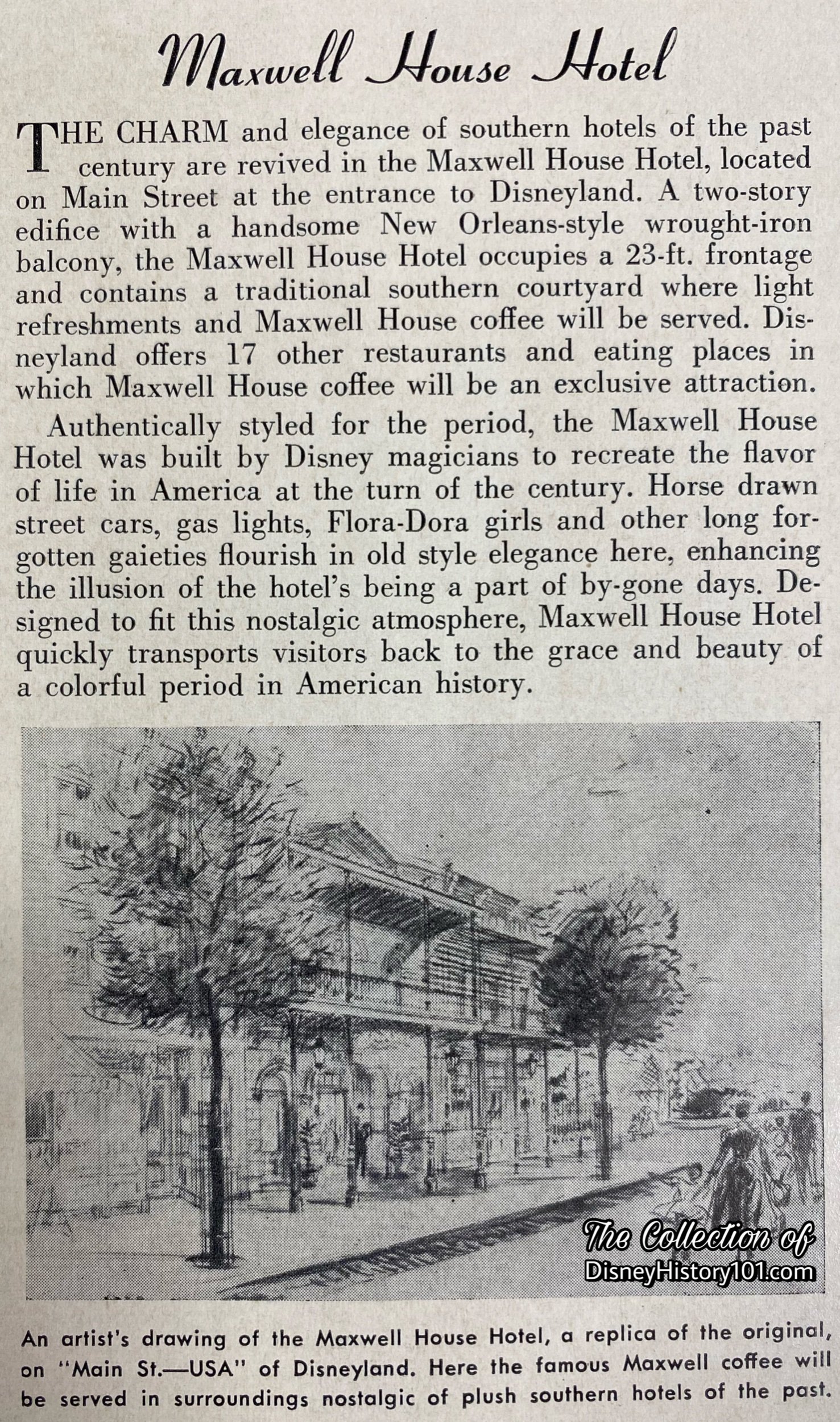
“Construction”
“When the giant earth-moving undertaking was completed, the building crews took over. Soon, the rat-tat-tat of riveters was shattering the air, and sparks were flying from welders’ torches as the steel frameworks, capable of withstanding the ravages of time and the elements rose above the newly formed ground. While carpenters hammered and masons laid row upon row of brick and stone and mortar, the permanent buildings began to take shape and form,” according to “The Disneyland Story” published 1955. One of the first buildings to be constructed was the Main Street Opera House, which was used as the Mill. Here, the woodwork of Disneyland was generated - from the functional to the aesthetic! Approximately three and one-half million board feet of lumber went into the Park’s construction. Much of the wood was processed here by McNeil Construction (which formerly constructed Walt Disney Studio sound stages in 1947 and 1953), and under the direction of George Mills Sr. (the Prime General Contractor and Mill Foreman).
Then, under the direction of Joe Fowler (Construction Supervisor), as well as Charles Alexander and Ray Conway (Construction Field Supervisors), the lumber was soon fashioned into the framing belonging to the very first buildings constructed at Disneyland - primarily the Main Street Complexes (on each side of the street).
In constructing each building, a concrete foundation and slab floors were prepared, followed by wood frame construction (while store units would have a combination wood and rigid steel frame). ”The first fabricated steel for the Main Street buildings arrived November 8 and was erected,” according to the narrator of “Disneyland - The Park,” a Disneyland anthology television series excerpt, first aired 1957 and Disneyland LINE (November 22, 1979). The roof covering was a variable, dependent on the architectural design.
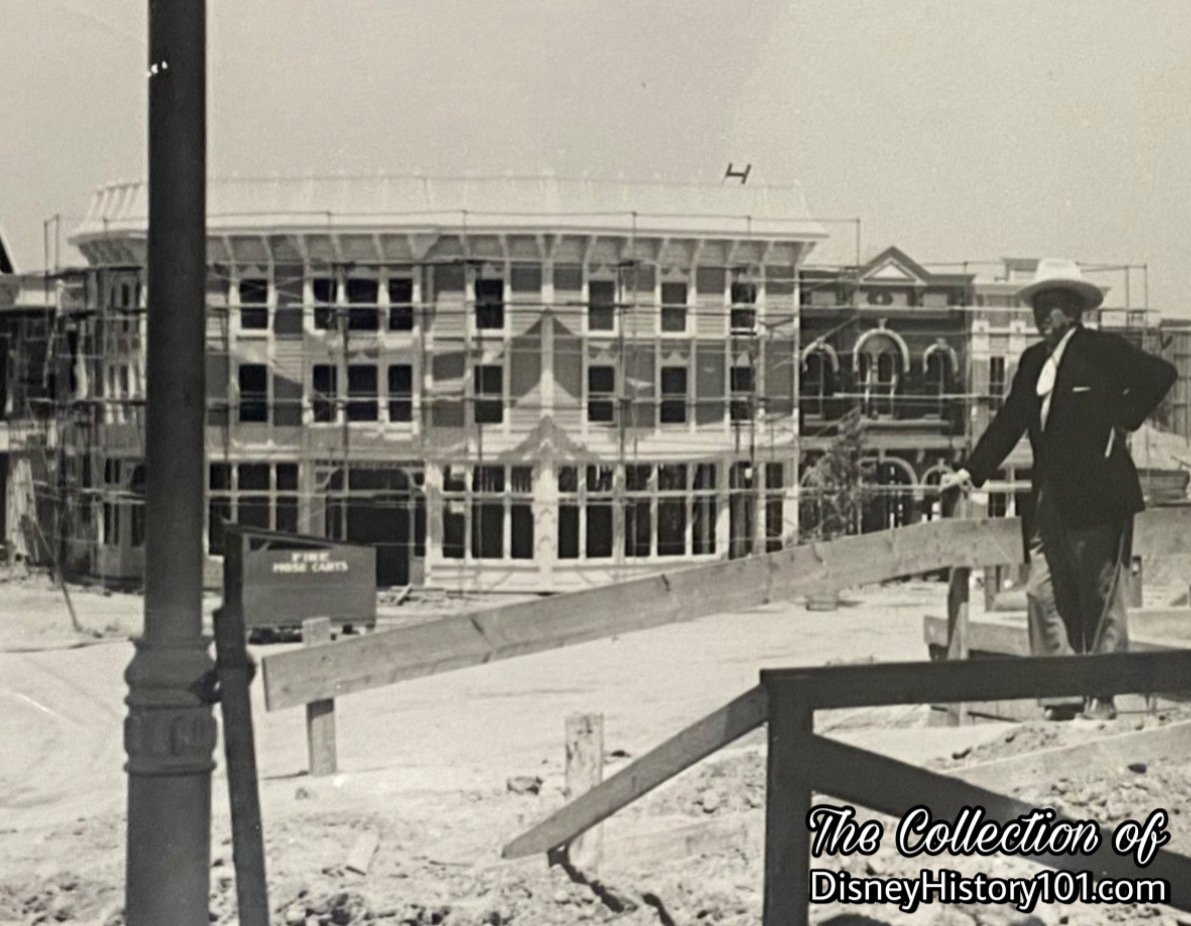
As of June 2, 1955, C.V. Wood Jr. sent an Inter-Office Memorandum to Walt Disney regarding the best estimates that could be obtained at the time regarding the completion status of individual sections of the Park and Opening Day. C.V. wrote: “Building #612 - Maxwell House. Will not be completed. We will have to dress. Electric Signs: All are in work - with the exception of the shoe store and the Bank of America, all will be completed.“
The building (as each on Main Street U.S.A.) possessed complete fire sprinkling systems. By June 30, 1955, related Disneyland Site Work Fire Protection Utilities Plot Plans were prepared for Disneyland Inc., by J.E. Thomasson of WED Enterprises Inc.
All fixtures were placed in their correct motif and many light fixtures of Disneyland were authentic antiques. The Disneyland News added: “From its wrought iron and old stonework exterior to the patio-type serving area, the Maxwell House represents all that was fine and gracious in turn-of-the-century life in the New Orleans section of the Old South. Built to resemble a hotel of that time and place, it offers a jewel-like lobby sumptuously dec orated with crystal chandeliers and velvet and plush furnishings. Past the lobby is the intimate coffee shop, serving coffee and pastries. Although indoors, the coffee shop ceiling fades away to a midnight blue and stars twinkle above.”
The wrought iron work and staff work was also performed right on the jobsite by Lawrence G. and Bruce McNeil’s forces.
Food service equipment was provided by Coast Distributing Company of Los Angeles (who ran a “Congratulations” message to Walt Disney and Staff in “The Disneyland News”, Vol. 1, No.2 ; August 10, 1955).
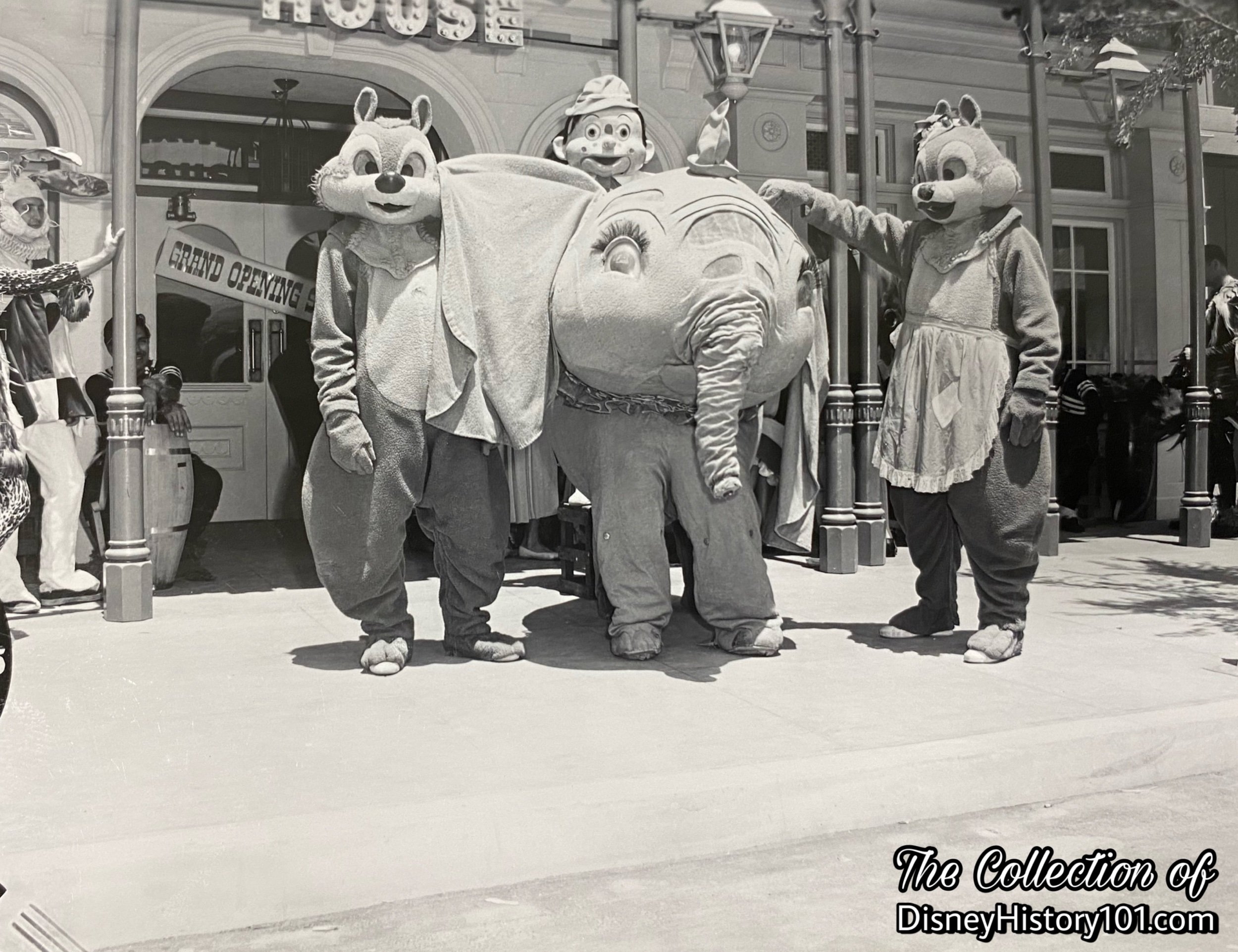
“The Press Preview Day of Disneyland”
Bob Milek recalled: “Opening day was very exciting...a big parade with movie stars…and I took pictures from the roof of Hills Bros.” But Maxwell Coffee House was not ready by July 17, 1955. Disneyland Mill Foreman Scotty Cribbes remembered: “On opening day, I was walking down Main Street with a cup of coffee in each hand, when I ran into Walt Disney. Walt stopped me and I thought I was going to be fired, but Walt just wanted to know where HE could get a cup of coffee!”
In the meantime there were several places that served Maxwell House coffee. In a move of corporate synergy, the fabulous Disneyland exclusively served Maxwell House Coffee at 16 eating locations (i.e. Aunt Jemima’s Kitchen, UPT Food Stands, Carnation Ice Cream Parlor, Chicken Plantation, Railroad Station, Red Wagon Inn, Space Bar, Pirate Ship, Frito House, and the Tropical Saloon, to name but a few). The price for a cup of coffee? Maynard Swenson recalled that “Coffee was 5¢ a cup then!”
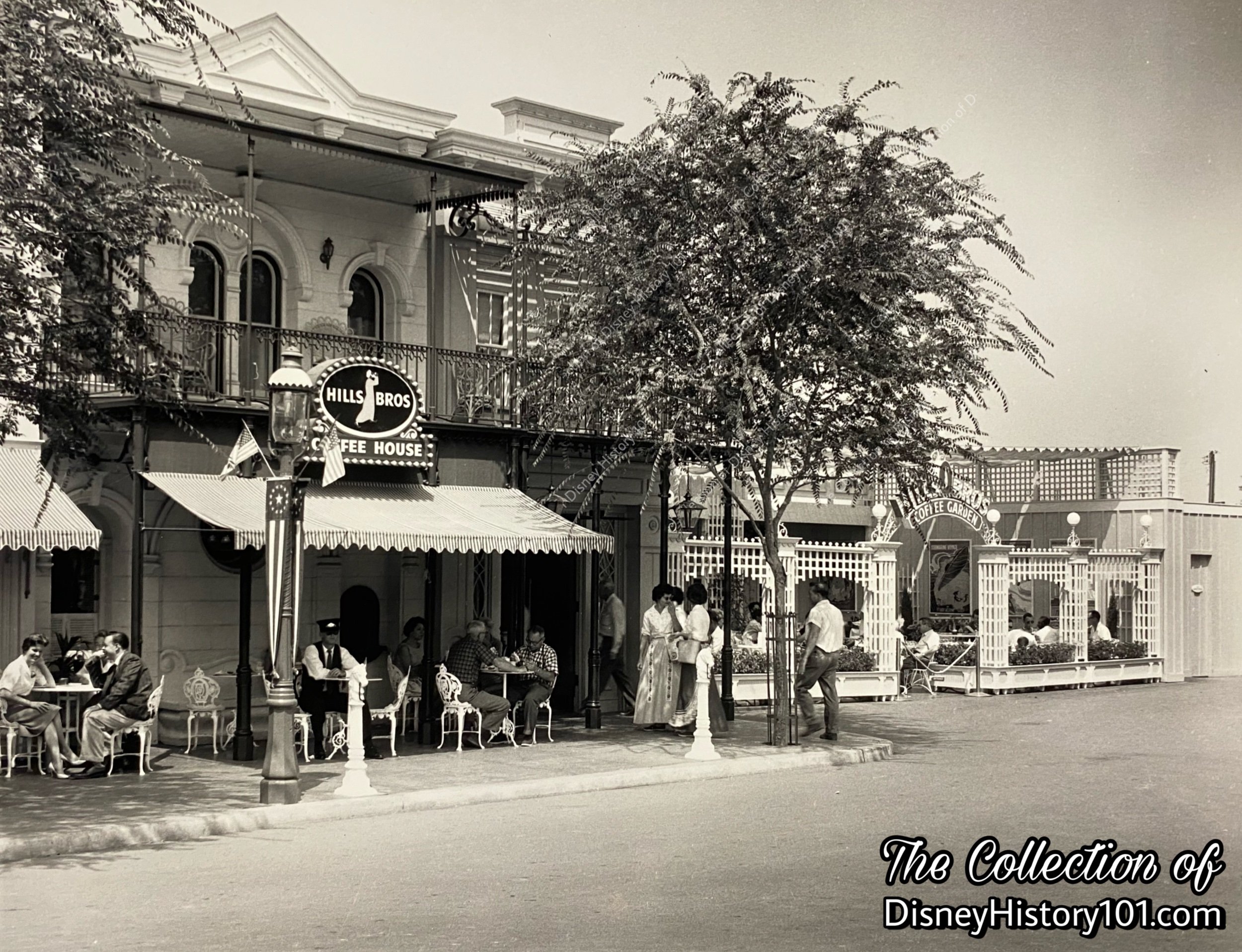
“The Maxwell Coffee House Grand Opening”
After Disneyland opened, the Disneyland News (of August, 1955) began advertising a Maxwell House opening soon in Disneyland. One advertisement (published in The Disneyland News, September 1955, page 22) announced that the Maxwell House would open soon on Main Street U.S.A.! It would be a few more months before the official opening occurred on December 1st, 1955, to “all the excitement of a Hollywood premier,” with “celebrities from the business and entertainment world” joining Walt Disney and Russell Kramer, General Manager of the Institutional Products Division of General Foods! “Some 1000 American Hotel Association conventioners were also on hand to mark the event, guests of General Foods and Maxwell House for the evening.” According to another headline added, “Televisions stars Eve Arden (‘Our Miss Brooks’), Spring Byington, and Dean Miller (‘December Bride’) were on hand to assist with the opening.”
Guests had the opportunity to meet “The Greatest Guy In The World, the Man Who Takes His Family Out to Dine, central figure in General Foods’ national advertising - the most dramatic promotion in the history of the food service industry,” according to The Disneyland News (Vol.1 -No.6 ; published December 10, 1955).
Marcy Smothers (in her book “Eat Like Walt - The Wonderful World of Disney Food”) adds that Walt attended “though he had a terrible case of laryngitis. Despite buckets of rain, the cancellation of the planned parade, and the postponement of Walt’s award as the ‘Greatest Guy In The World’, the dedication ceremonies in Town Square went off without a hitch. Following the ceremonies, two hundred of the Guests boarded the train at the Main Street Station for the brief ride to the Frontierland Station, while others followed the Disneyland Band to the Plaza. Everyone came together again for dinner and entertainment at the Chicken Plantation Restaurant. Maxwell House VIPs were then treated to an after-party at the Red Wagon Inn.”
The story “New Maxwell House Graces Main Street” covering the opening of the new Maxwell Coffee House (and the full-page advertisement “Maxwell House Welcomes American Hotel Association”) were both published in The Disneyland News (Vol.1 -No.6 ; for December 10, 1955).
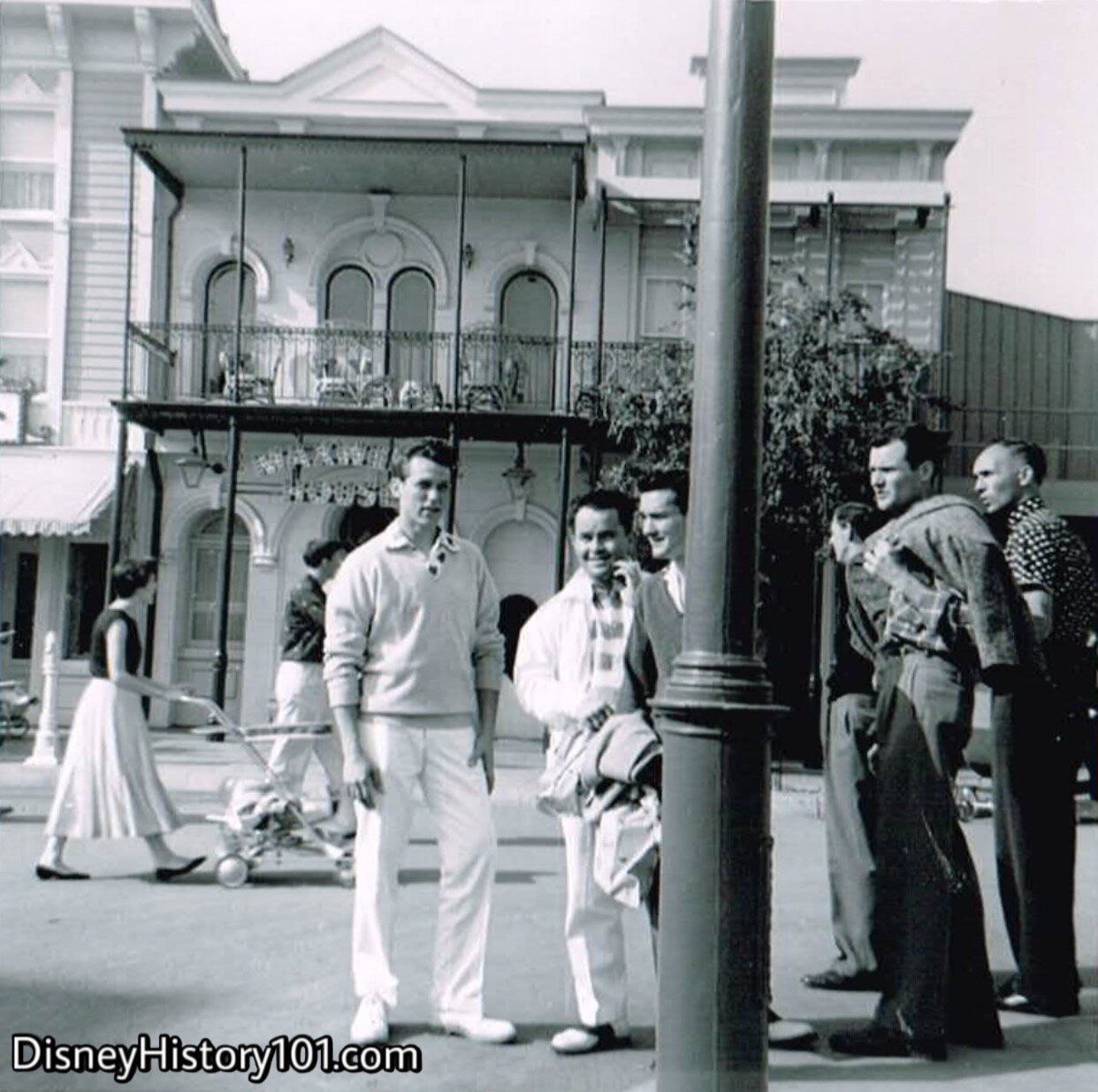
Now, Maxwell House Restaurant became the prime table-service restaurant of two Town Square locations where guests would to “tarry for a moment’s relaxation” before the rest of the Park opened in the morning, and enjoy a delicious cup of “good ‘til the last drop” Maxwell House Coffee (with superior flavor, aroma, and body)!
After setting foot inside the “turn-of-the-century hotel lobby, complete with an authentic registration desk,” guests “may choose a table in the starlight dining room, or be seated on the open-air patio,” according to “Food Showmanship Disney Style.”
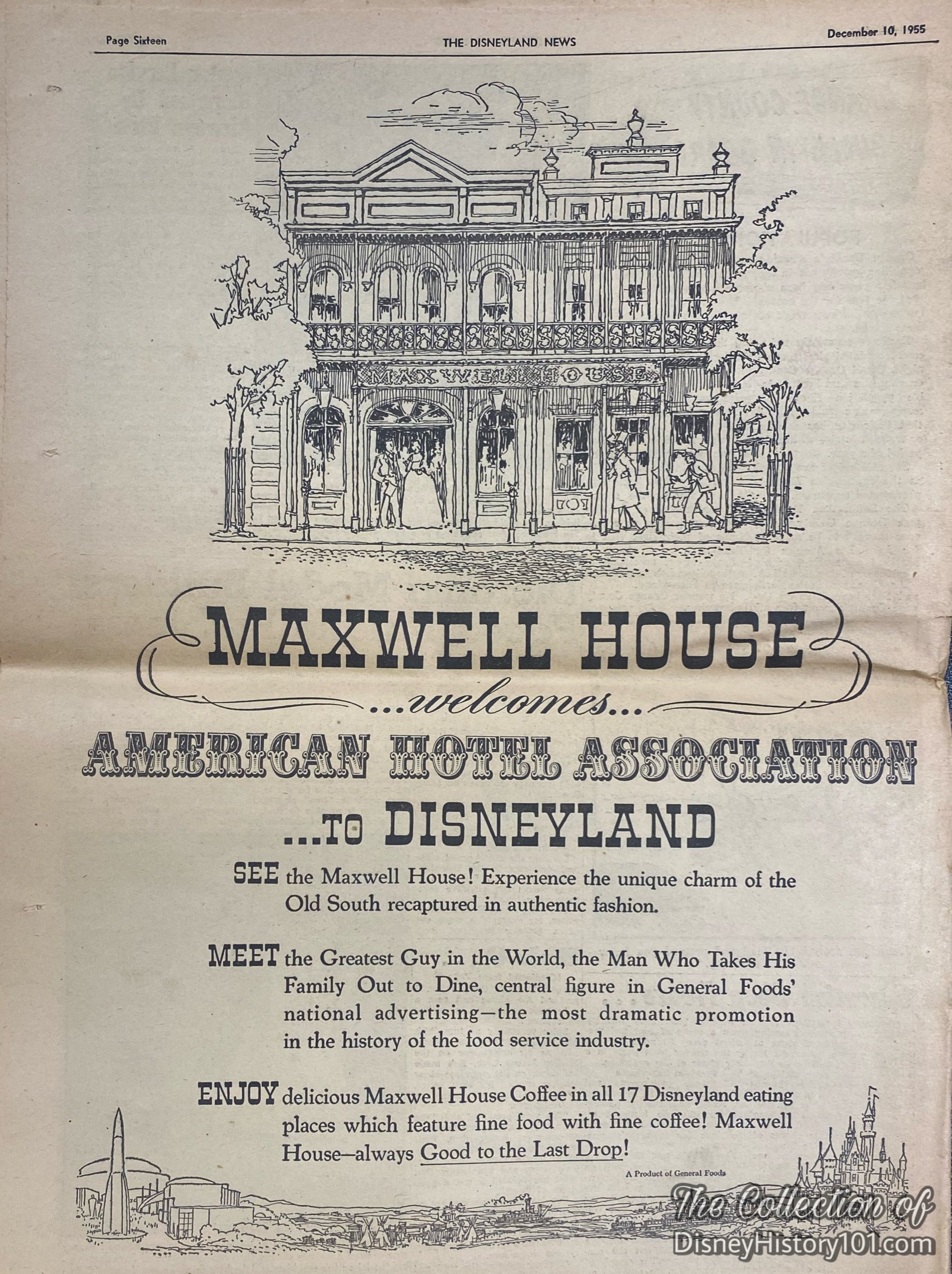
“The Greatest Guy In The World - The Man Who Takes His Family Out To Dine”
We are (of course) referring to another individual (in addition to Walt), who was key to the placement of the Disneyland lessee. The Maxwell Coffee House (as other restaurants and concessions) was strategically placed by Mister James D’Arcy. Owning to this, Ron D’Arcy would become part of the opening Maxwell House crew. Long before New Orleans Square, the decor of the Maxwell House represented “the New Orleans section of the ‘Old South’. Built to resemble a hotel of that time and place, it offers a jewel-like lobby sumptuously decorated with crystal chandeliers and velvet and plush furnishings. Past the lobby is the intimate coffee shop, serving coffee and pastries. Although indoors the coffee shop ceiling fades away to a midnight blue and stars twinkle above.” If some of the “railing and cresting (found here and other places on Main Street U.S.A. and Frontierland)” look authentic, its because some of them actually “came from old plantations in Nashville, Memphis, Tennessee, and some came from San Francisco, Oakland and Sacramento, California, dating back to the ‘49 days,” according to “News From Disneyland” (a Press Release document published c. 1956).
Maxwell Coffee House at Disneyland offered guests a variety of Maxwell House beverages including delicious Maxwell House Coffee, refreshing Maxwell House Iced Coffee, steaming Maxwell House Tea, refreshing Maxwell House Iced Tea, Baker’s rich Hot Cocoa, and Baker’s Ice Cold Chocolate Flavored Drink. Though the restaurant did not serve meals, it did carry a variety of light snacks (or, “Specialty items”) including Apple Sauce Cake, Homemade Danish pastry (served warm), Superb Cheese Cake (which paired well with a cup of Maxwell House Coffee), Old Fashioned Strawberry Short Cake, Assorted French Pastries, Hot Fudge Ice Cream Cake, and a fancy Jell-O gelatin dessert topped with whipped cream!
On December 10, 1956, George Banning, distributor of Maxwell House coffee provided beverages for the First Annual Christmas Party.
Both Walt Disney and those who held his business ethics, principles, and standards for Disneyland, made sure that the price of coffee was always economical and reasonable. Walt assured that coffee was “only worth a dime.” This was true during Maxwell’s participation and during participation of the following sponsor. After Walt’s passing, “Card Walker, Vice President of advertising and sales, further insisted, ‘Disneyland will always have a ten-cent cup of coffee.’ It wasn’t until after Walt’s passing in 1966 that the price increased,” according to “Eat Like Walt - The Wonderful World of Disney Food” by Marcy Smothers.
The corporate synergy was good for a time. Institutional lessee Maxwell House Coffee yielded some revenue for Disneyland Inc. - $28,599 for the fiscal year ending September 29, 1957 and $79 for the remainder of its occupation during the fiscal year ending September 28, 1958. The synergy was also beneficial for both. For instance, when the Disneyland Recreational Club and Athletic Coordinator Frank Smith sponsored a new Gun Club, Maxwell House Coffee Shop hosted Disneylanders attending the first meeting on January 10, 1958.
Future additions to Maxwell were soon planned for Building 600, which would have included a large room and an office.

However (by September 28, 1958), Disneyland Participant Affairs (or, “Industry Sales”) and Maxwell House could not negotiate a cooperative agreement to maintain their ongoing relationship. So Maxwell House would depart from Disneyland at a lease termination expense of $34,730.
If you would like to read more about Maxwell Coffee House, it’s my pleasure to recommend adding Marcy Smothers’ “Eat Like Walt - The Wonderful World of Disney Food” to your personal Disney Home Library! If you would like to bring the magic of Disneyland restaurants and concessions to your dining room table, “please step this way” toward www.eatlikewalt.com where Marcy has shared a few recipes for memorable Disneyland menu options, including that of the Santa Fe Express Sundae, so that you too, can “Eat Like Walt!”

A number of Disneyland Participants sweetened the coffee of guests through the years! When Disneyland first opened in 1955, the “extra-fluffy and silky-soft” powdered sugar of Spreckels Sugar Company (of San Francisco, California) was the exclusive sugar of Disneyland. Creamy frostings were whipped up using Spreckels and guests dining at the Hills Bros. Coffee House would often sweeten their coffee with Spreckels sugar cubes and Spreckles sugar packets. Advertisements for Spreckels Sugar even ran in the earliest issues of “The Disneyland News.”

By 1972, Dixie Crystals became the official sugar of the Magic Kingdom and Walt Disney World. Soon, there was another “No. 1 Sugar on Main Street in Disneyland” - C and H Pure Cane Sugar from Hawaii. C&H became the official sugar of Walt Disney’s Magic Kingdom, in 1962! Still other sugar brands (like Domino Sugar) could be found contemporaneously at Wrather Corporation’s Disneyland Hotel.
The corporate synergy was “good ‘til the last drop,” until (after less than two years) Participant sponsor Maxwell Coffee departed from Disneyland. After a brief period of vacancy (at least by January 1, 1958), Hills Bros. Coffee stepped in to sponsor the 1,340 square-foot space and additional 180 square-foot kitchen. The remaining Maxwell Coffee House interiors were sold to Hills Bros. at a cost of $27,500.
Only now (by 1958-1959), the leaseholder - Hills Bros. - made an improvement. Disneyland Inc. opened Hills Bros. Patio Job #032-50-26 for the construction of an addition to the Kitchen and dishwashing area of the building and an open patio adjoining Hills Bros. premises on the East side of building and facing Town Square.
Preliminary Designs were created by the Studio at the cost of $1,549.47, and working drawings were created (by the studio at $390.65; by another party at $438.88). Curtains, shades, awnings & canopy were fabricated at a cost of $301.27. Including the Studio EB (part before direct distribution), Studio overhead @ 25%, Studio charges, Construction Overhead, Subcontracts (in the IBM job file), total costs for Job #032-50-26 totaled $26,144.47. After a portion of the job was billed to Hills Bros., the cost was $4,255.00, with a $21,889.47 net to capital.
The additions of enlarging both the kitchen and dish-washing areas were later appraised at $4,000. An 8’x12’ women’s dressing room (Job #032-50-50; constructed at $1,248.02) was also attached to the Hills Brothers storeroom in the service area.
Before long, “a taste of San Francisco” arrived with the Hills Brothers Coffee Shop and Coffee Garden operated by Food Service, Inc. The interior of the restaurant was still decorated in a “southern garden motif with an adjacent dining patio,” according to the “Disneyland Dictionary” (compiled by WED Enterprises, Inc. and WED Public Relations Department, c. 1968).
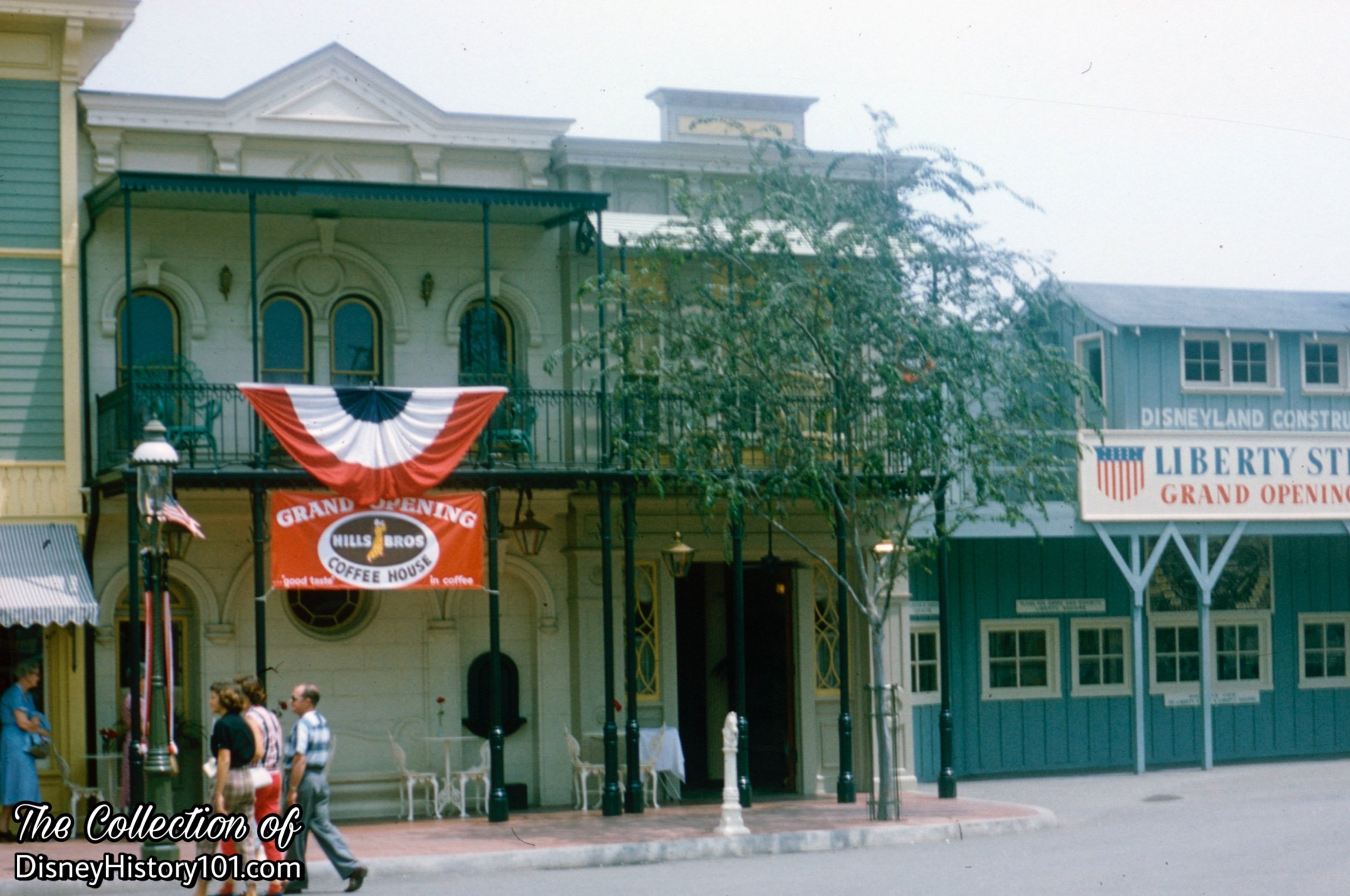
Guests were soon welcomed “to the garden of ‘Ahh!’” Hills Bros. remained the sponsor of the Hills Bros. Coffee Garden for almost twenty memorable years! During this time, the Hills Bros. Coffee Garden offered waitress service, with a maximum guest capacity of 125.
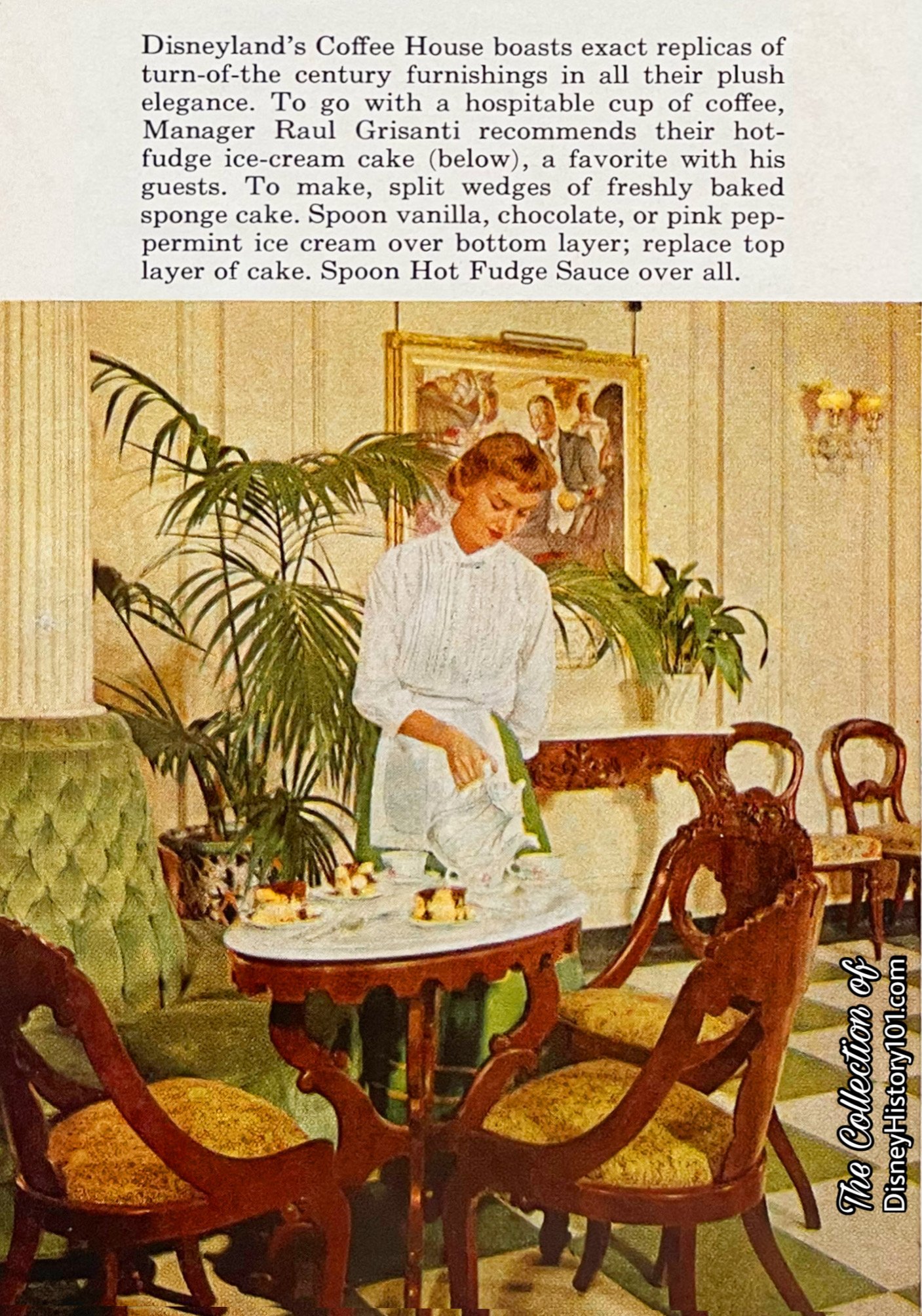
After the Park closed, the staff would take over with brooms, mops and dustcloths. Special attention was given to marred walls, posts and furniture. Items with marks that didn’t wash off were replaced or repainted. Floors were waxed and buffed to preserve their beauty and protect them from the thousands of feet that scuffled over them each day.
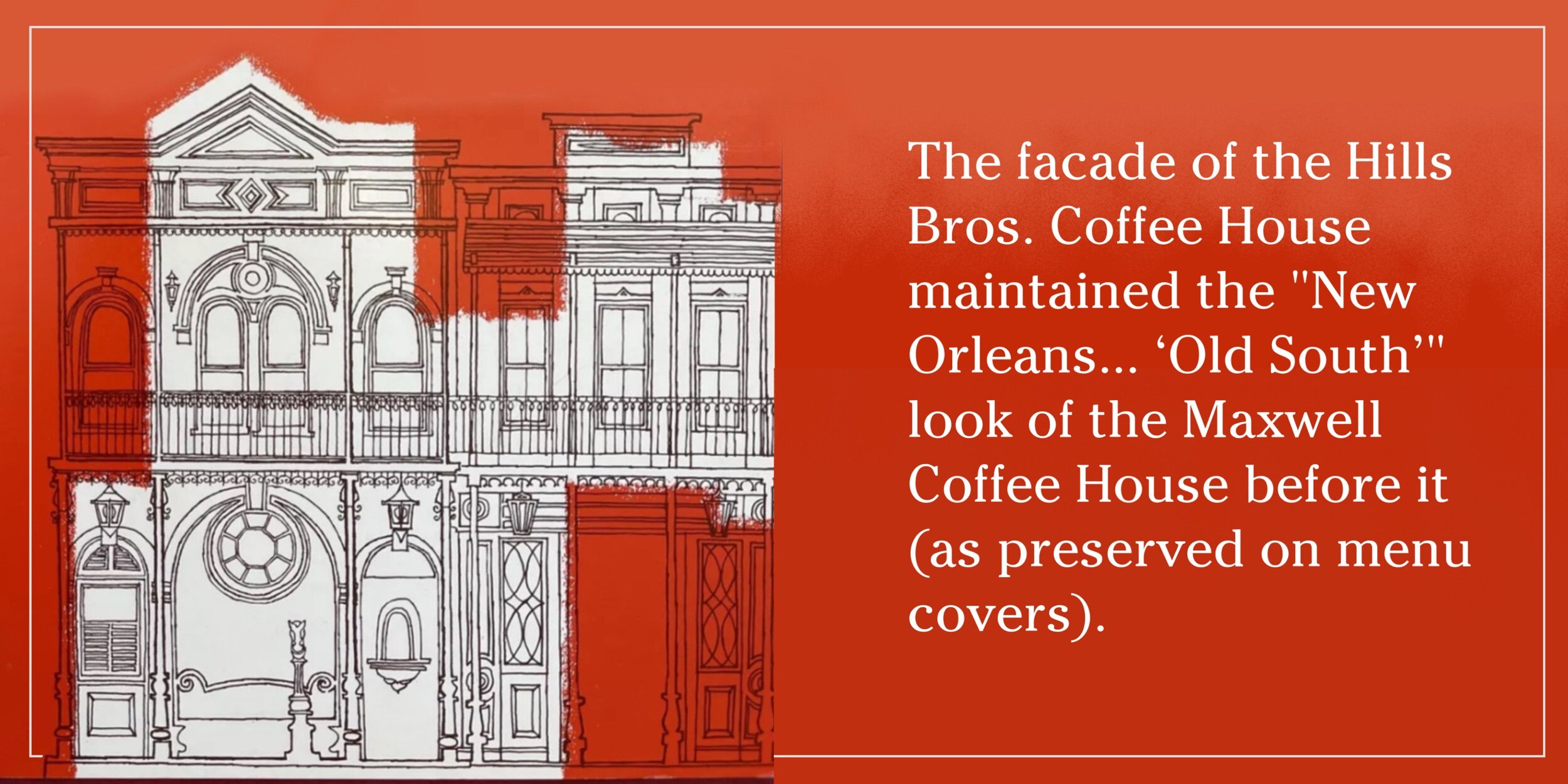
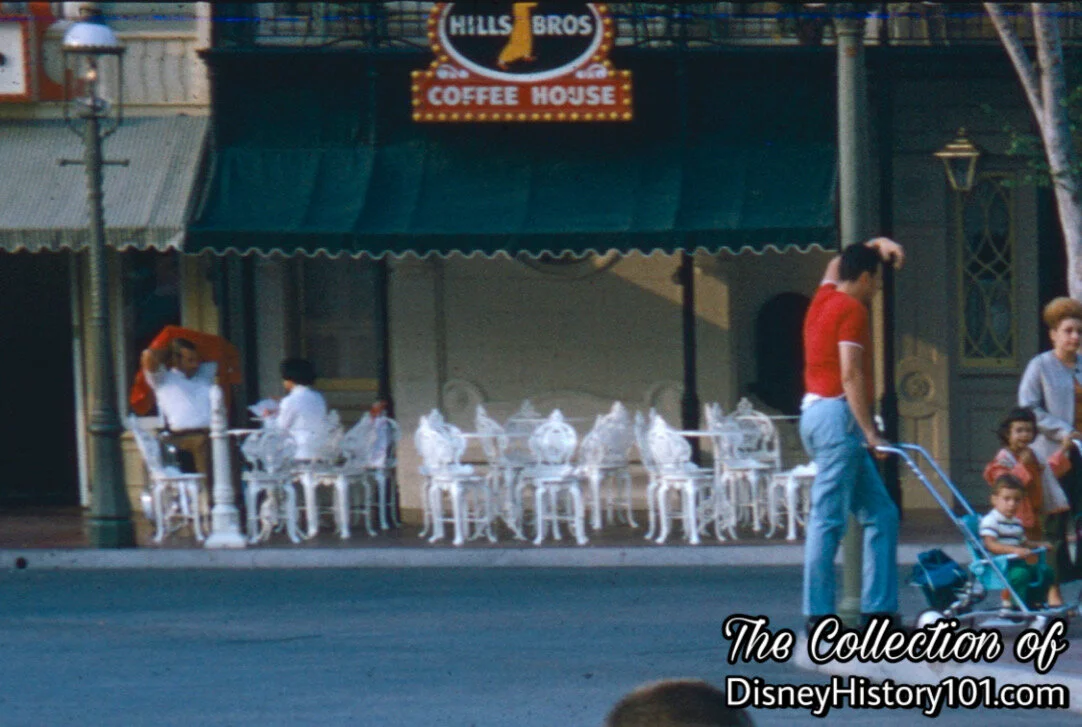
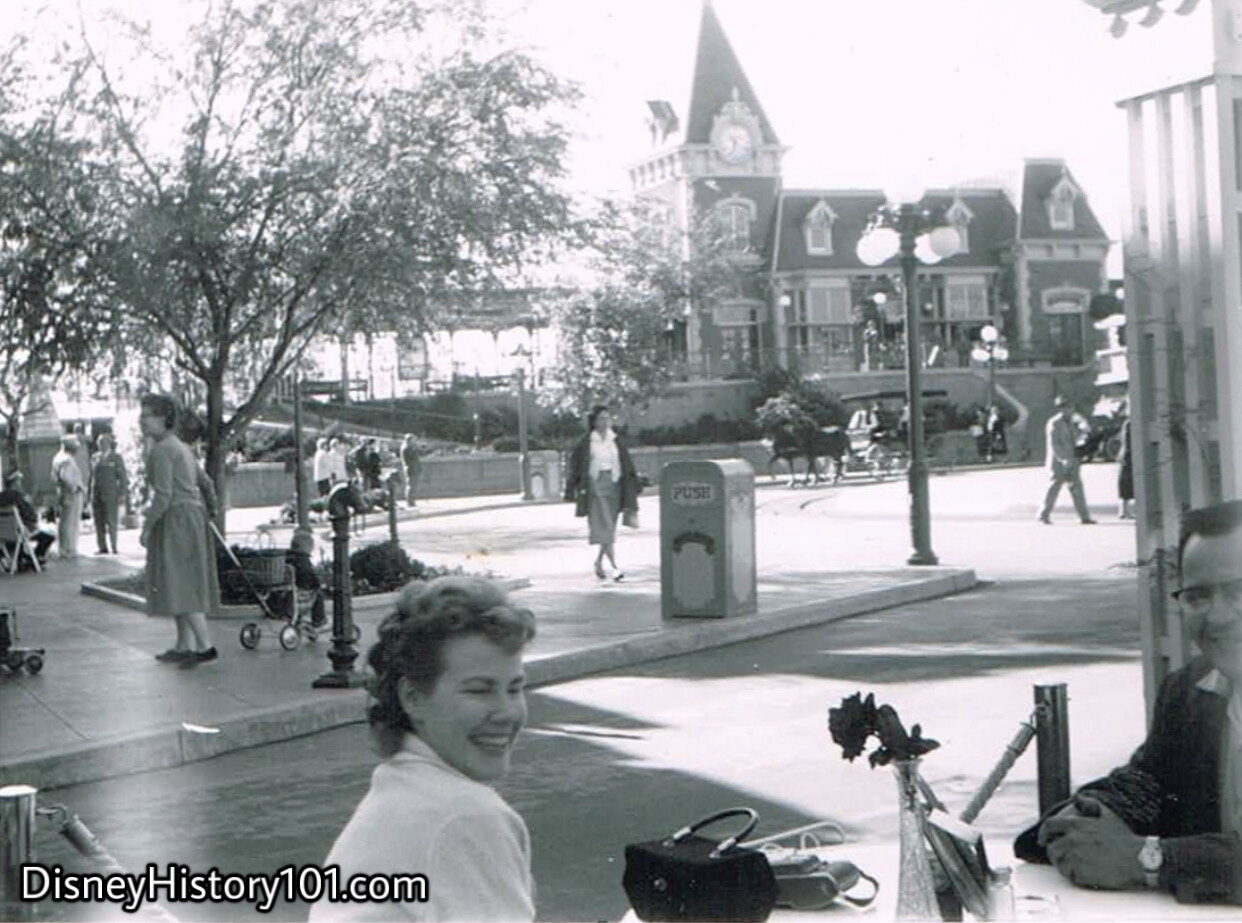
These guests prefer to brighten their “morning with a cup of delicious Hills Bros. Coffee!” The Town Square tradition of enjoying a cup of coffee in the garden continues as guests were invited to start their morning with a refreshing cup of Hills Bros. Coffee.
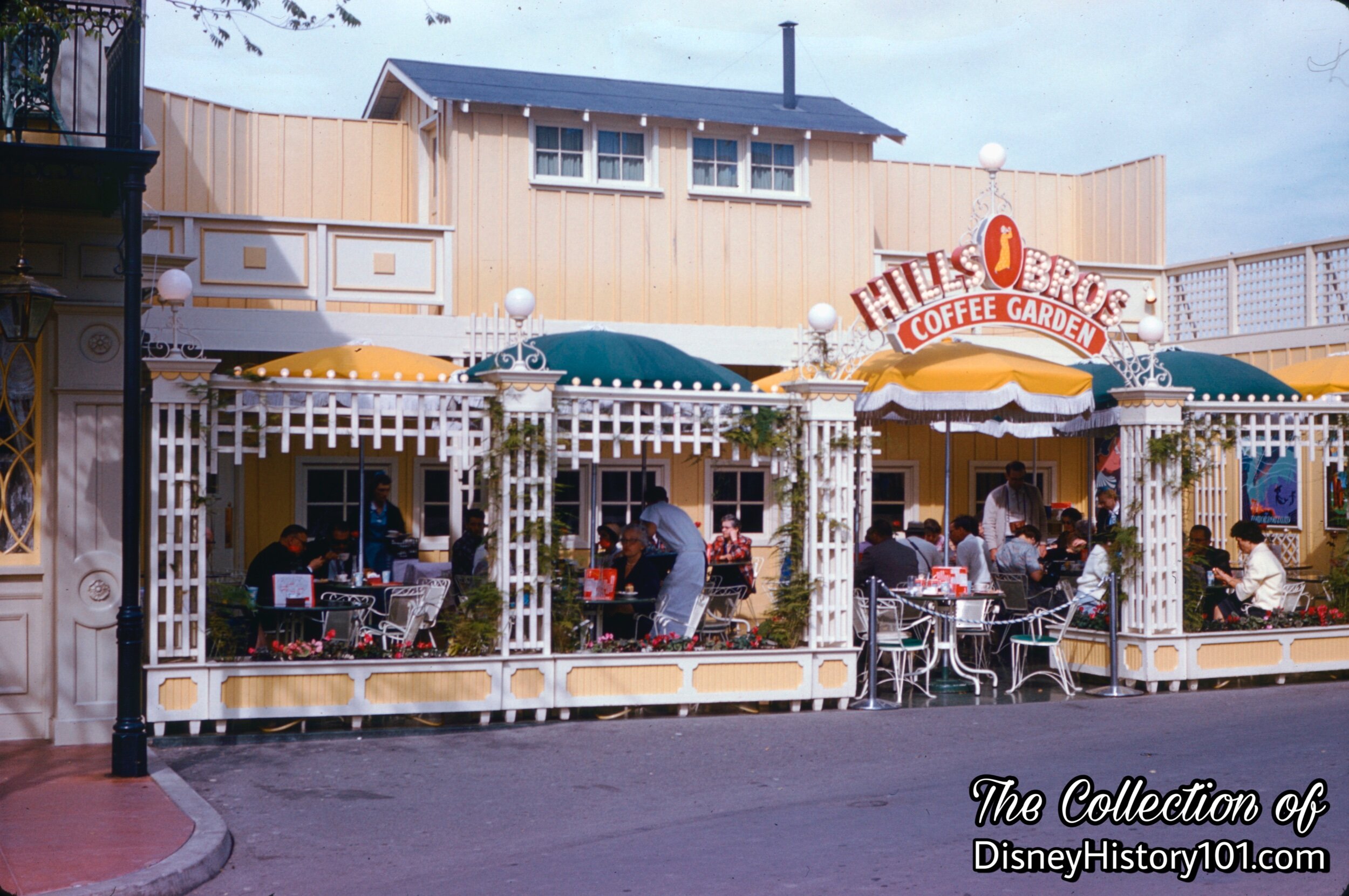

Disneyland visitors are welcome to relax with a Hills Bros. Coffee prepared either piping hot or icy cold. Youngsters can also recharge with nourishing drinks. Where the Maxwell Coffee House offered light snacks, Hills Bros. Coffee Garden offered meal items. According to one Disneyland Guide, guests could now “pause to enjoy freshly-made sandwiches and a variety of delectable desserts and beverages” at Hills Bros. Coffee Garden. Yes, in addition to beverages, doughnuts, breakfasts, and sandwiches were offered.
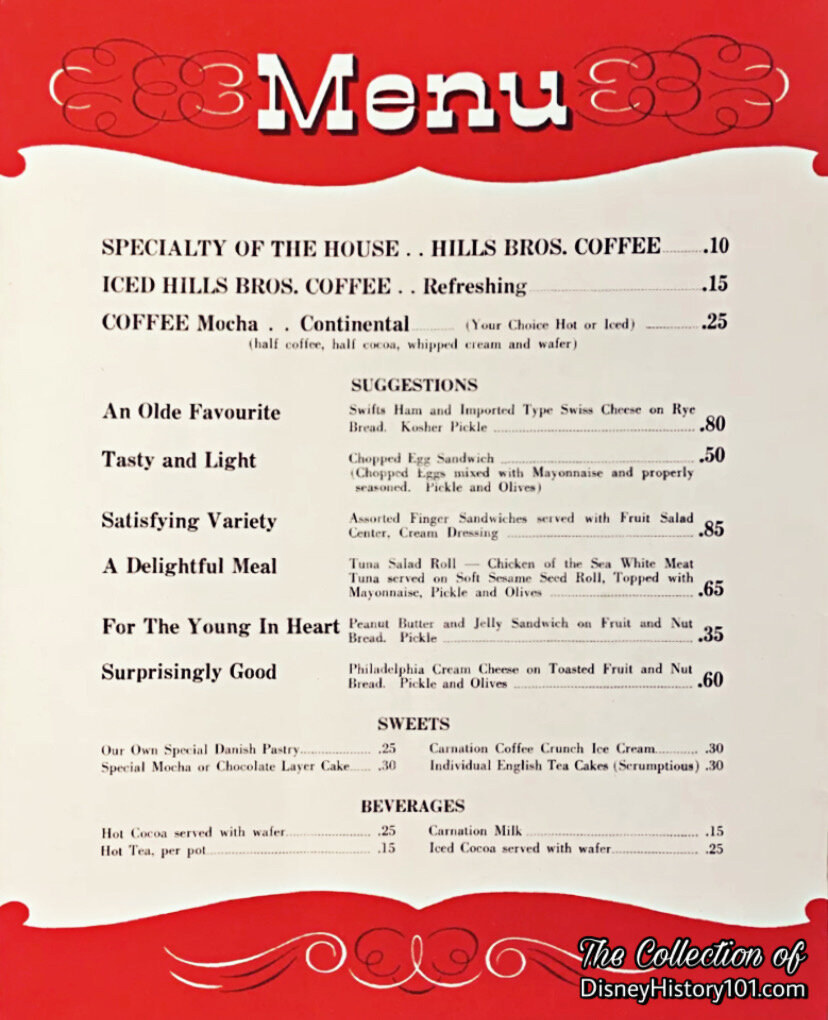
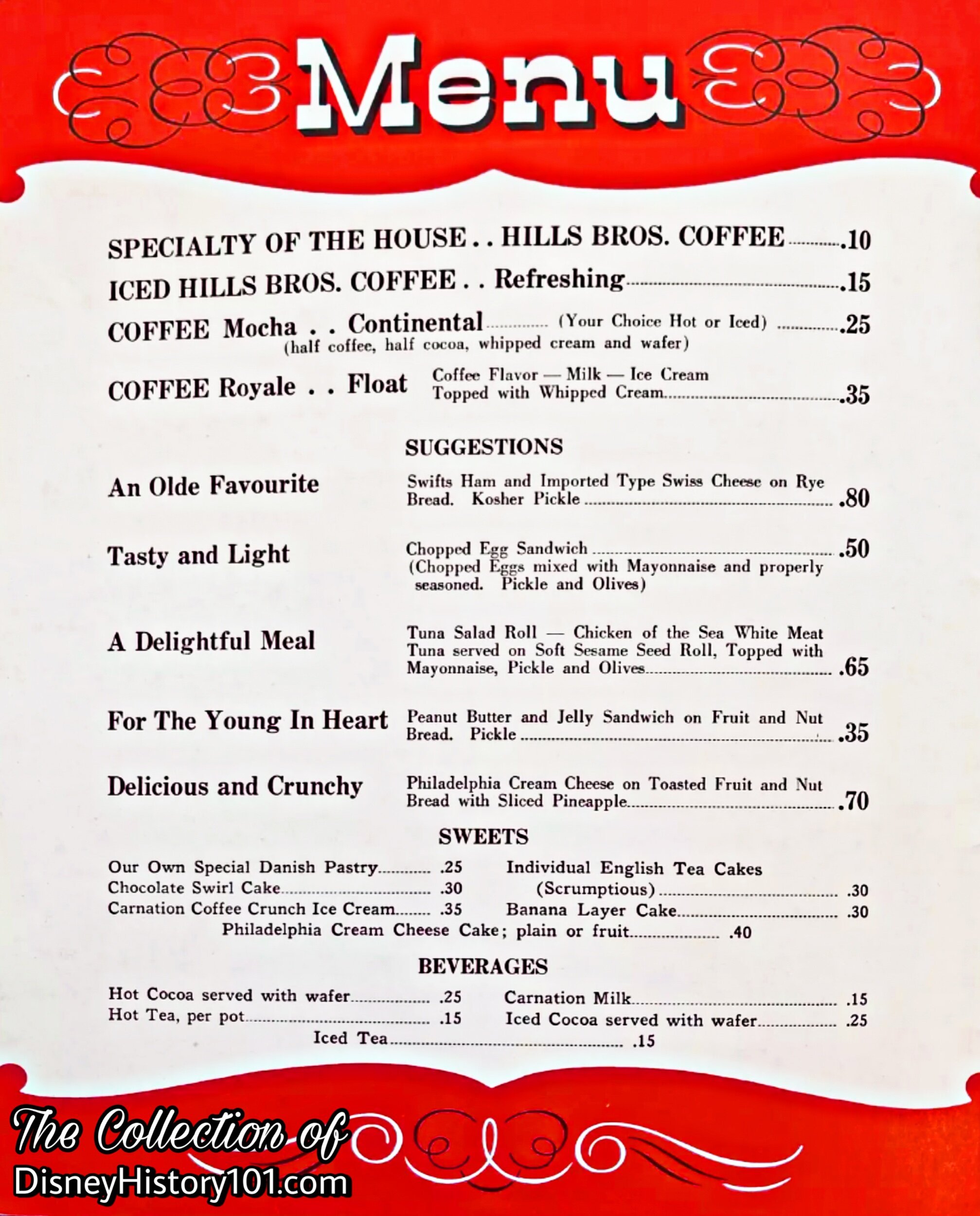
The option described as the “Delicious and Crunchy” suggestion was (on other menus) also referred to as the “Surprisingly Good” sandwich! But this sandwich was in like most - toasted fruit on a nut bread, with a Philadelphia Cream Cheese spread.
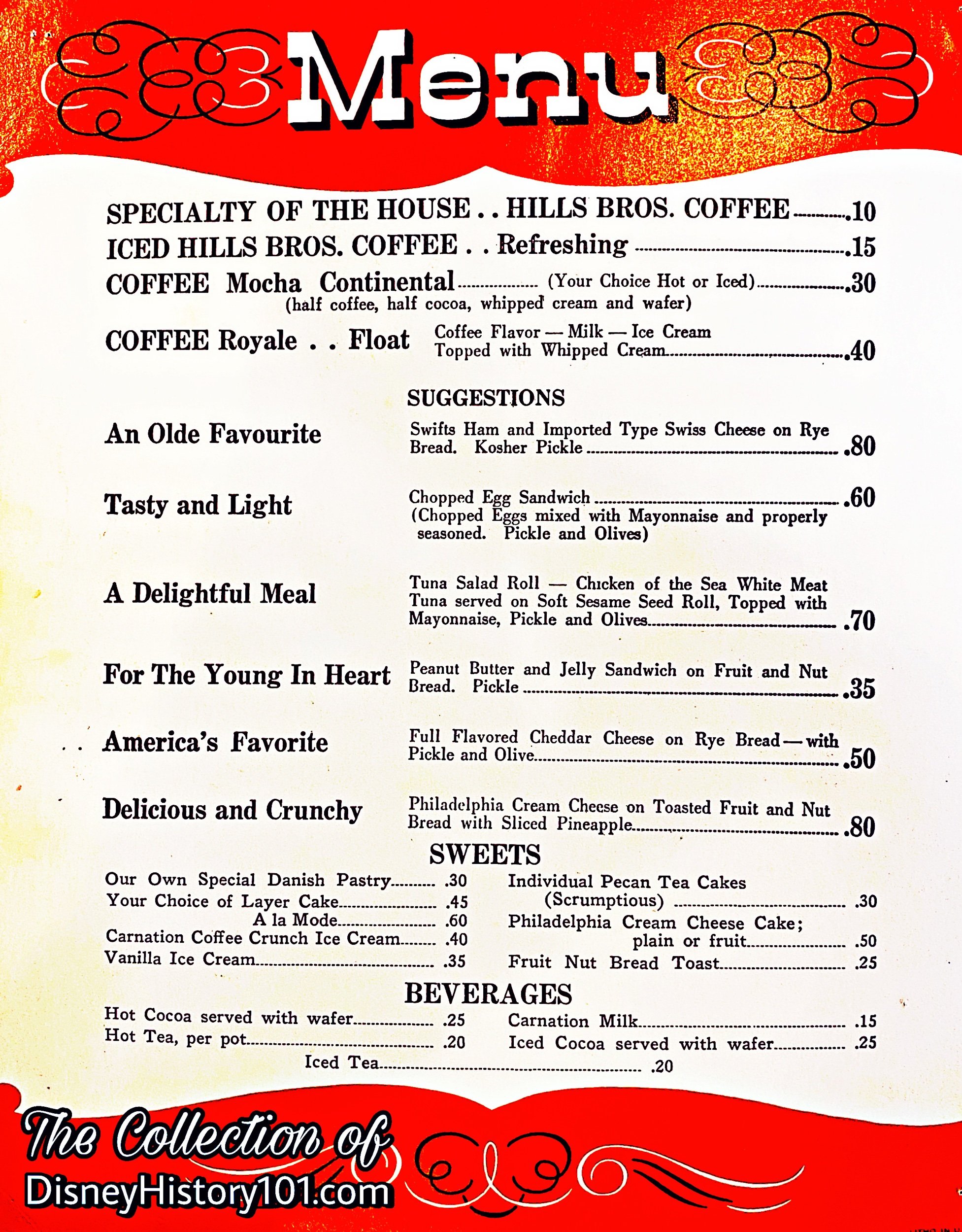
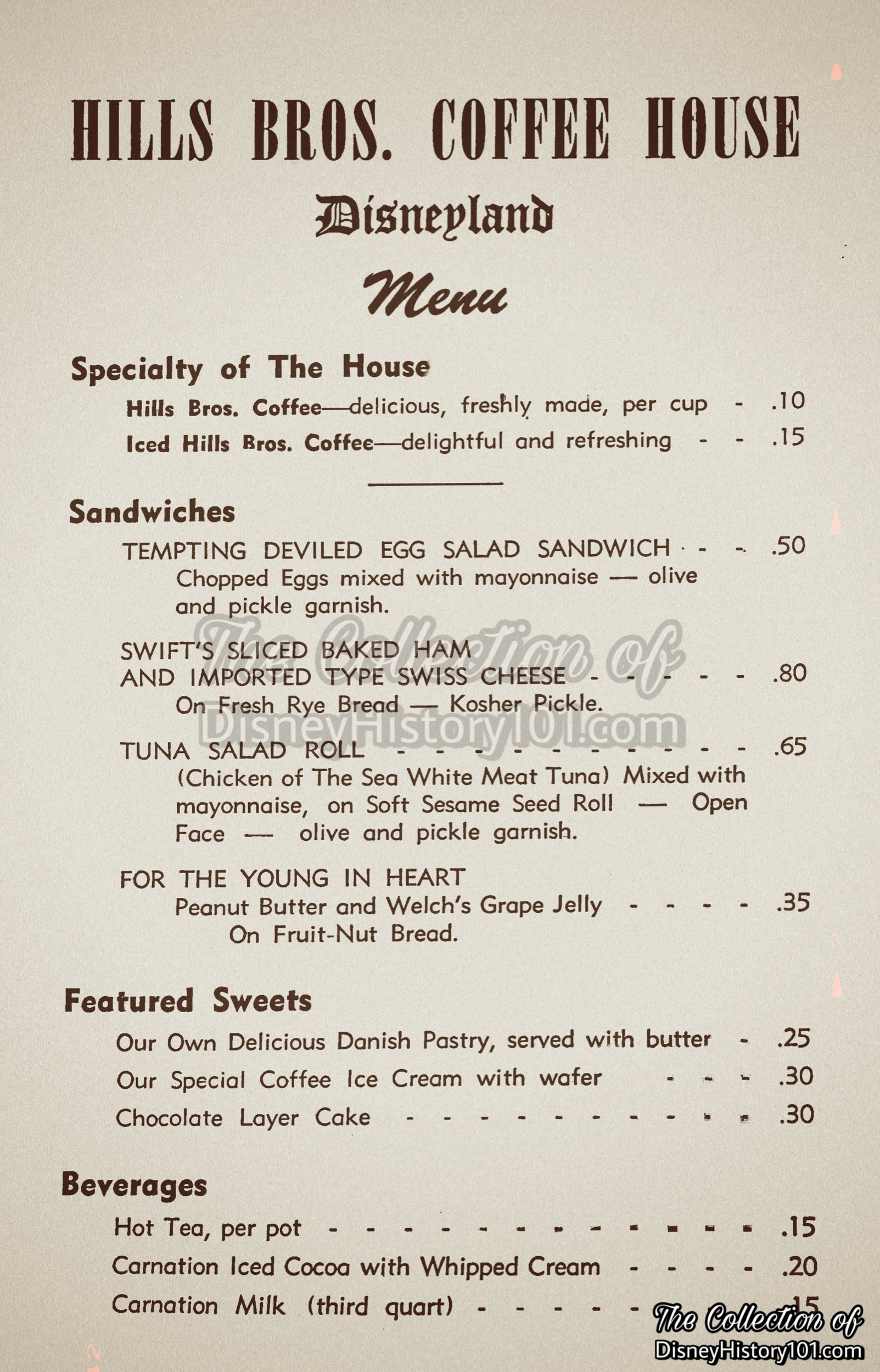
If all these delicious options weren’t enough, guests could also schedule direct reservations for dining at the Disneyland Hotel Gourmet Restaurant and Coffee Shop from the Hills Bros. Coffee House.
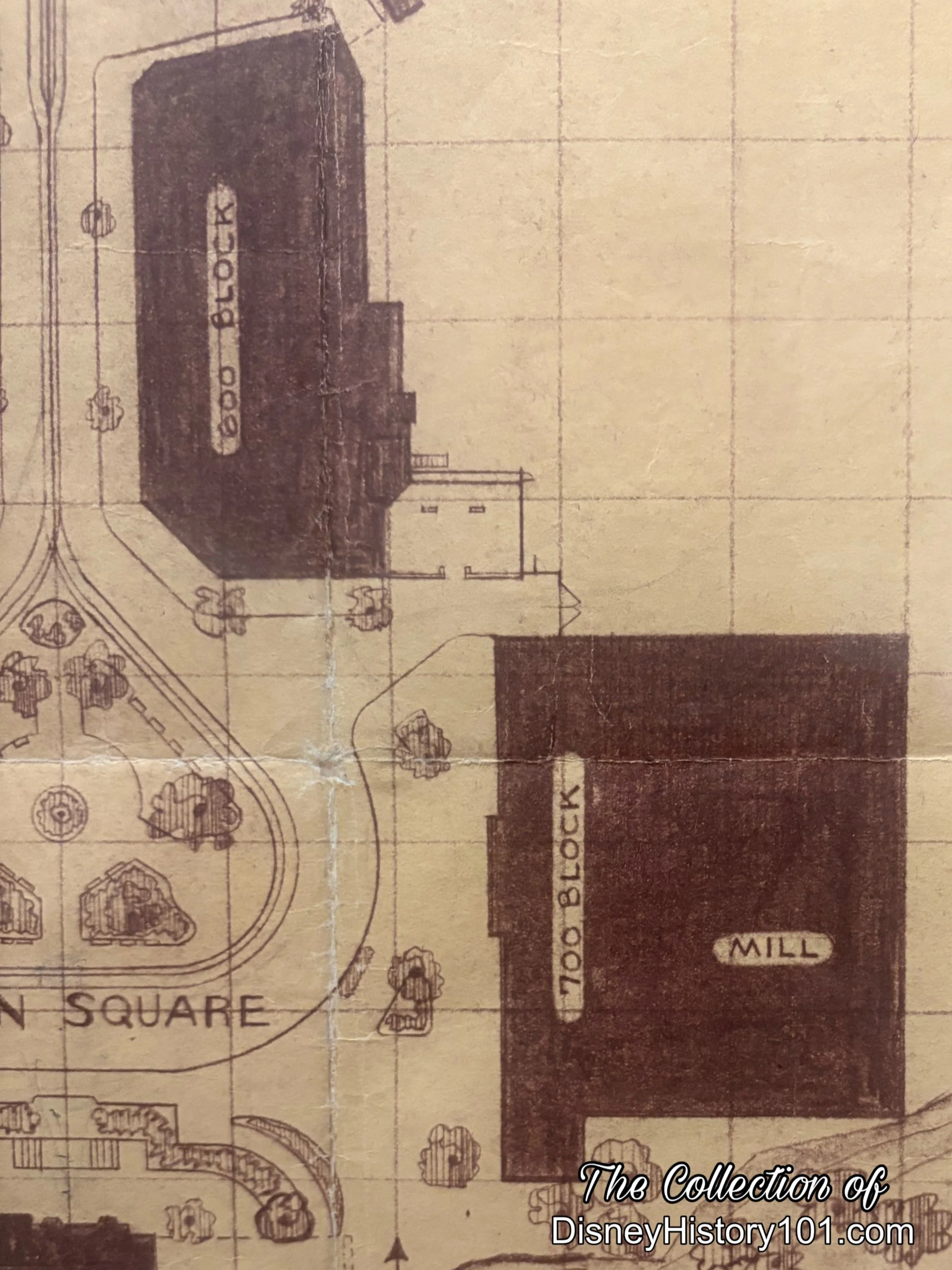
While relaxing with a cup of Hills Bros. Coffee, guests could pick up a menu and read the success story of Austin H. and Rubin W. Hill, as well as their innovations - “Instant Coffee” and vacuum-packaged coffee beans!
The corporate synergy was good for a time. Institutional lessee Hills Bros. Coffee, Inc. yielded some revenue for Disneyland Inc. - $9,626 for the fiscal year ending September 28, 1958.
Not far from where Mickey Mouse greeted guests, the Disneyland Christmas Carolers (under the direction of Dr. Charles C. Hirt and lead by Mr. Robert G. Hasty), also known to perform near “Hills Bros.” during various times of the day, from December 16th, 1967 thru January 1st, 1968. [“Disneyland Holiday Talent Master Schedule,” prepared for the period of December 16, 1967 through January 1, 1968]
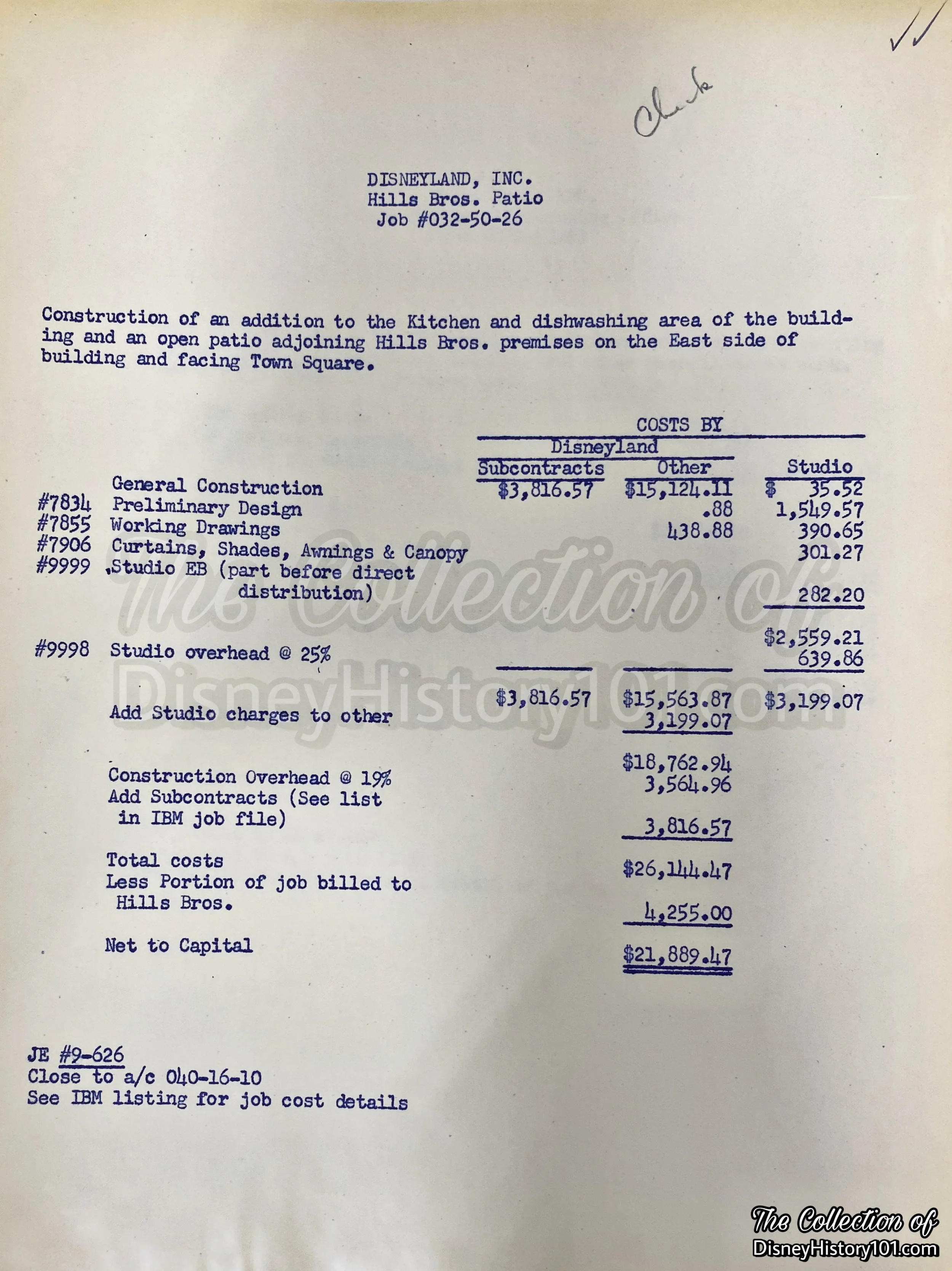
DISNEYLAND, INC. opened Job #032-50-26, for a Hills Bros. Patio. Construction was to include an addition to the Kitchen and dishwashing area of the building, and an open patio adjoining Hills Bros. premises on the East side of the building and facing Town Square.
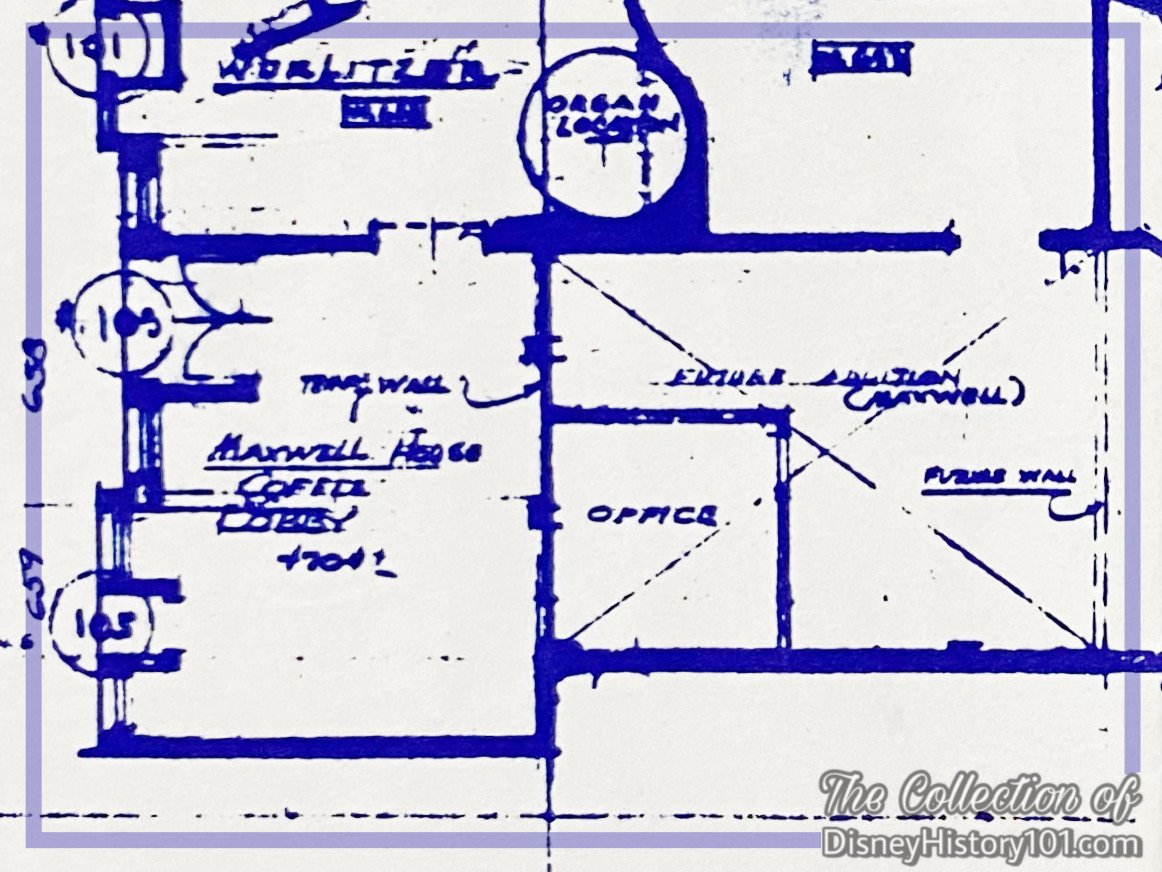
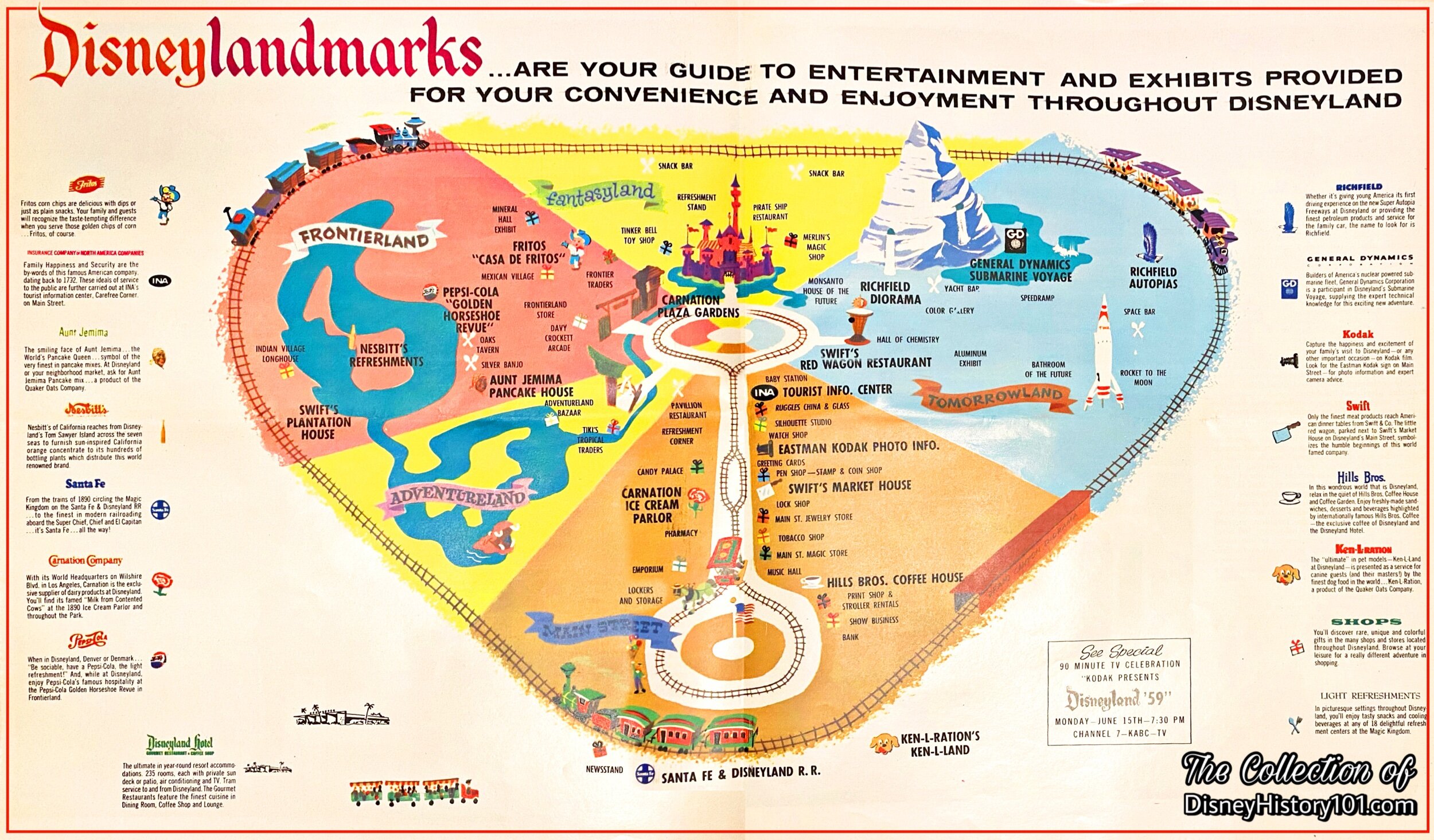
The first Disneyland Dictionary (printed in October of 1959) noted “Hills Brothers Coffee Shop and Coffee Garden operated by Food Service, Inc.” served “Hills Brothers' Coffee and light refreshments.” Owning to Jack Sayers (of Lessee Relations), Hills Bros. Coffee was a proud and contributing sponsor of “Disneyland ‘59”! In fact by October of 1959, Hills Bros. was (1) of over sixty-eight other firms playing a vital part in the team effort to bring happiness to Disneyland’s Guests. Some were small, specialized individual operators; some were huge companies such as Swift & Co. - the Bank of America - United Paramount Theaters (which you hear as UPT) - Carnation - Richfield - General Dynamics - Crane - and many others. These companies used the park to publicize their wares, leased space in the Park to sell their wares, and Disneyland collected advertising fees from them.
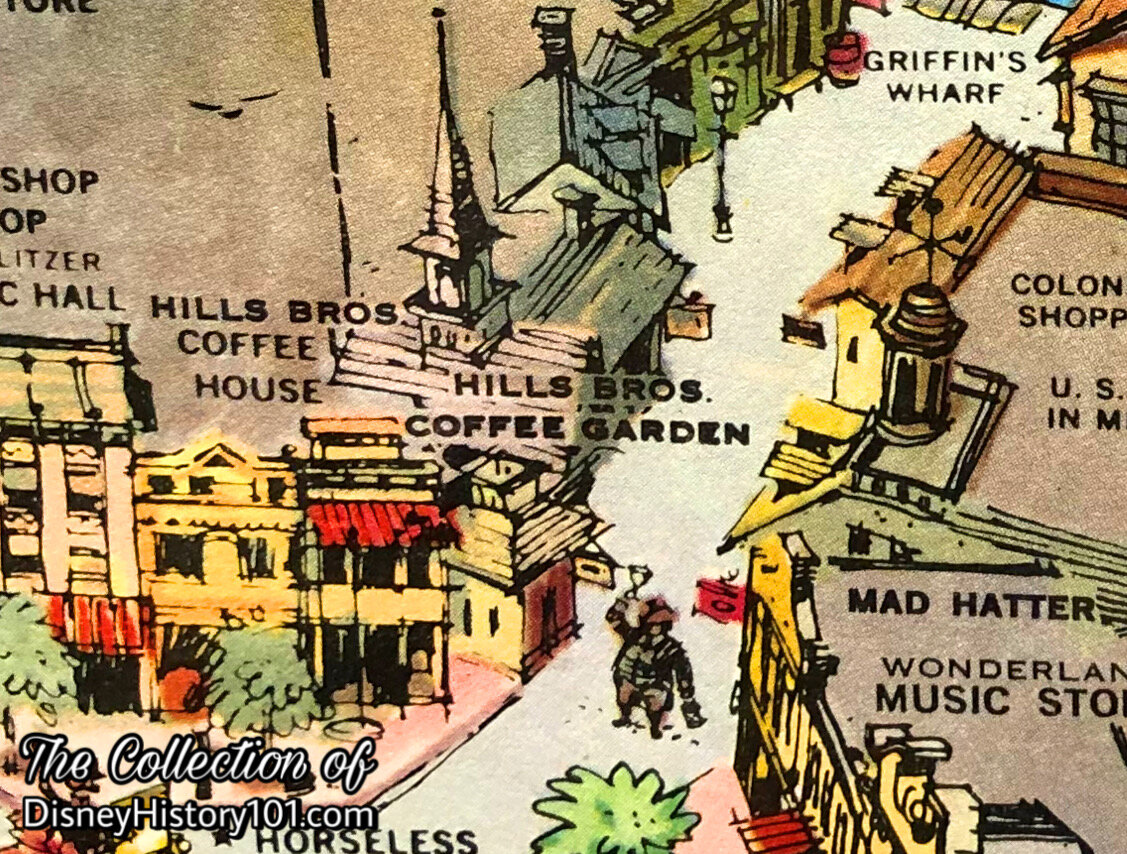
The Hills Bros. Coffee House would have stood at the gateway to the planned “Future Attraction” of Liberty Square.
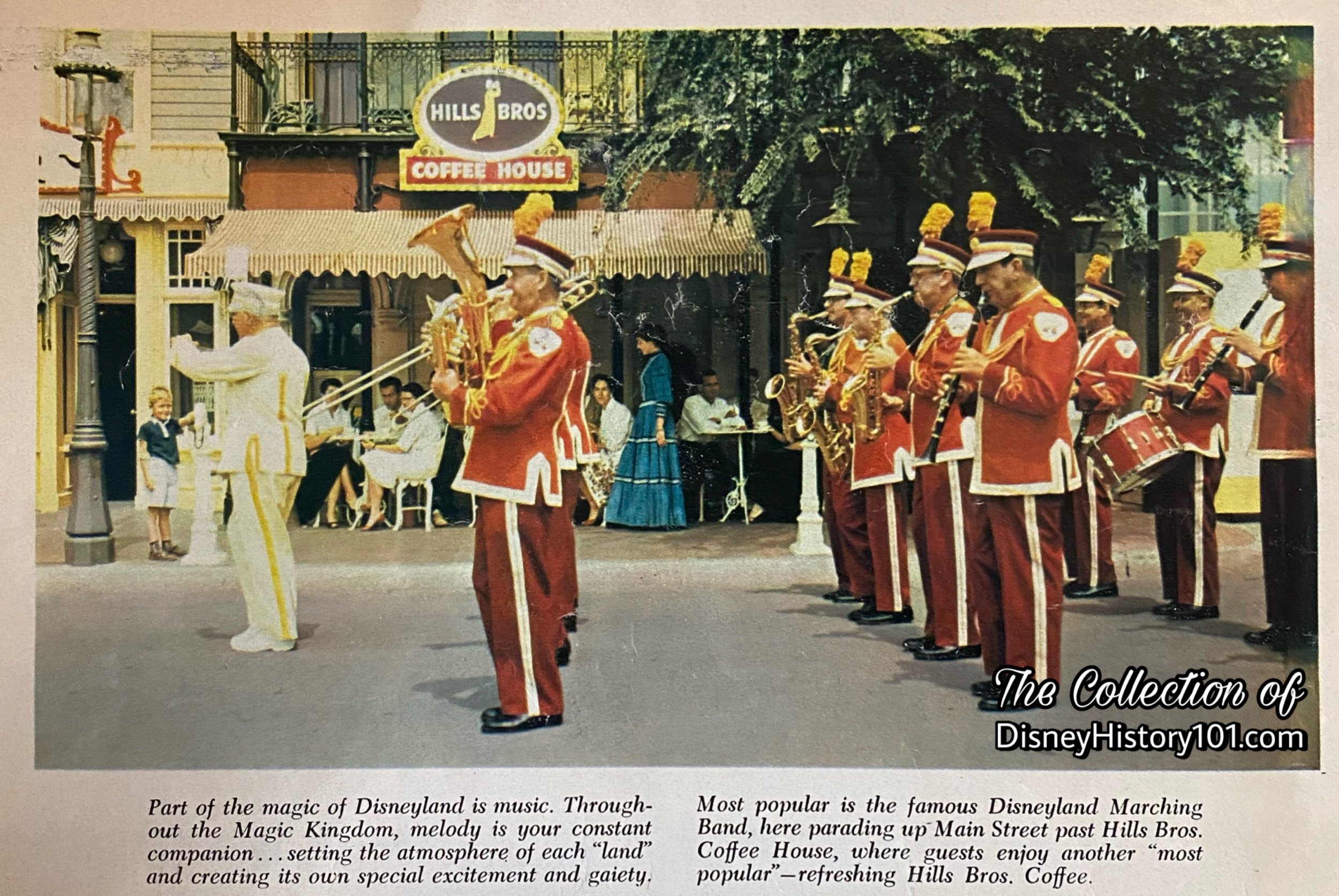
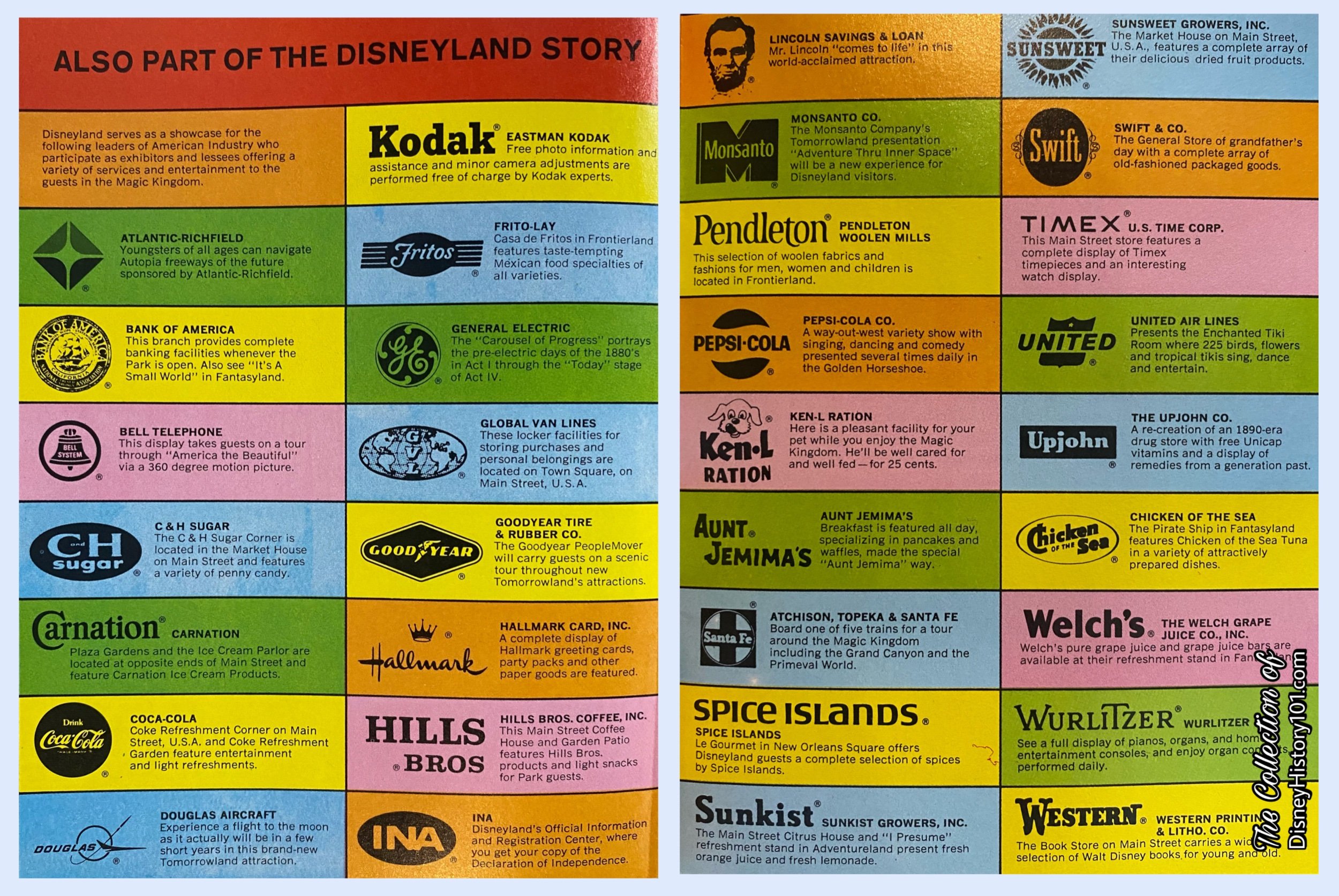
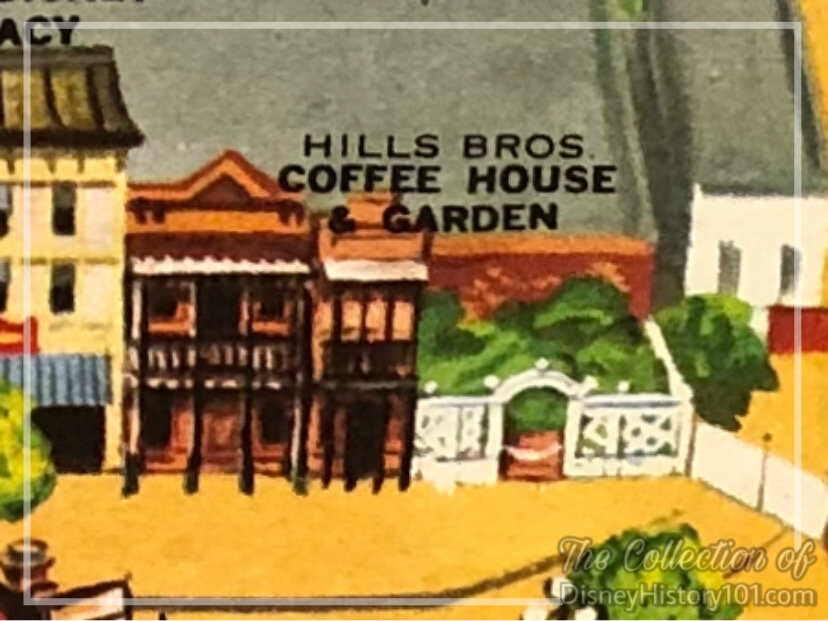
Sponsored by Hills Bros. Coffee Co., Hills Brothers Coffee House and Restaurant featured famous Hills Bros. coffee. The restaurant also offered tempting sandwiches and desserts within an interior that was in a southern garden motif with an adjacent dining patio.
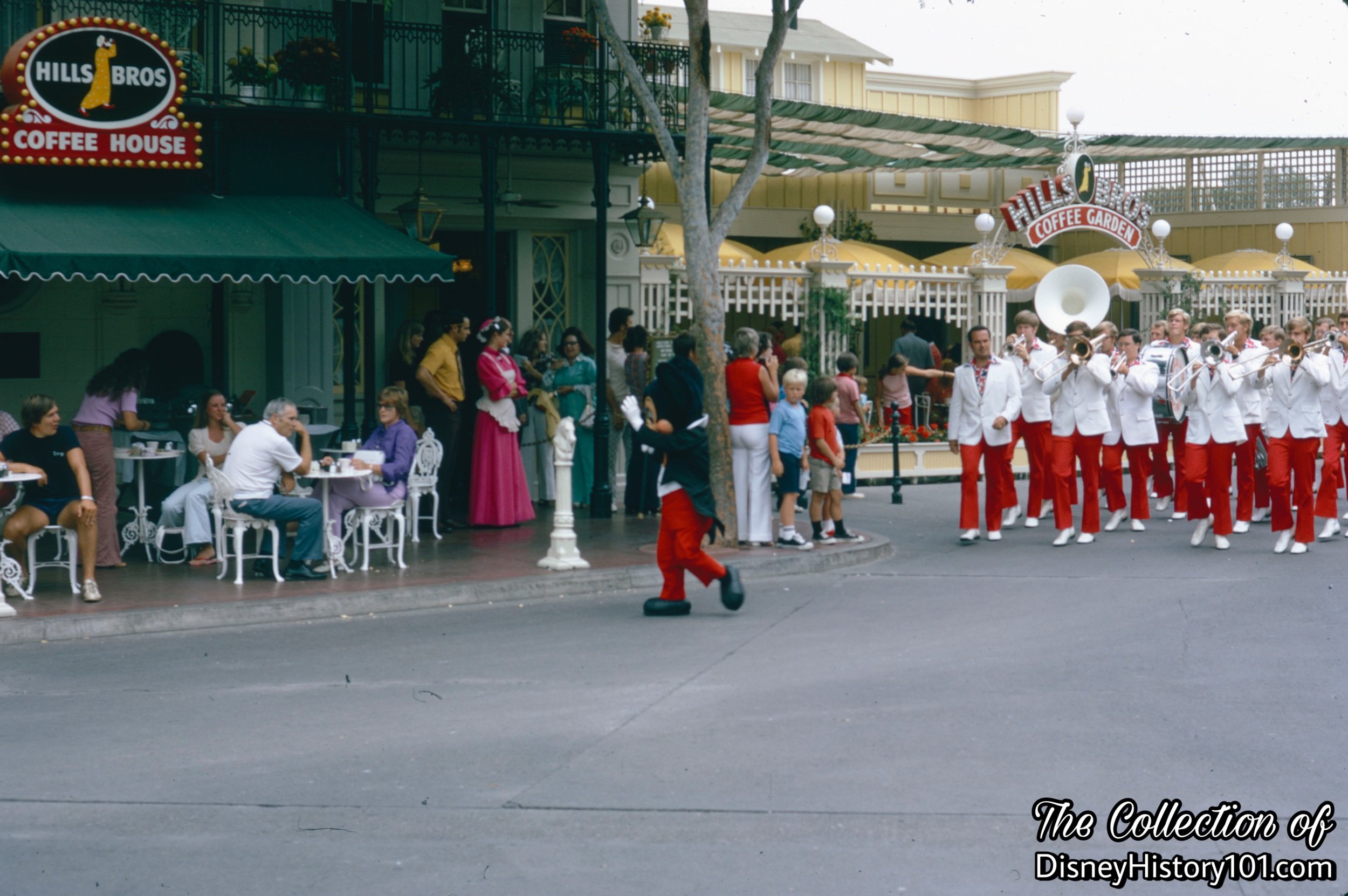
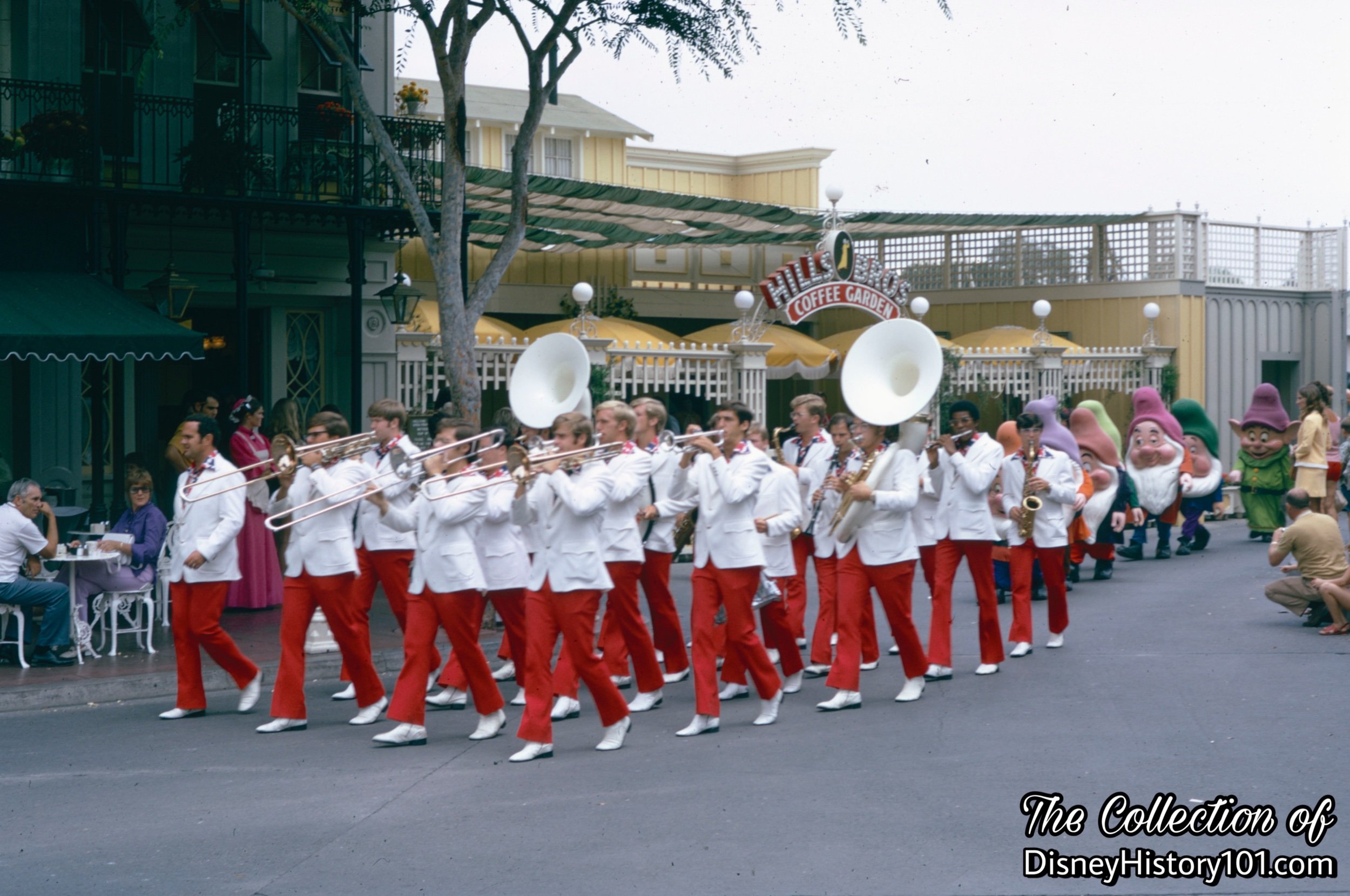

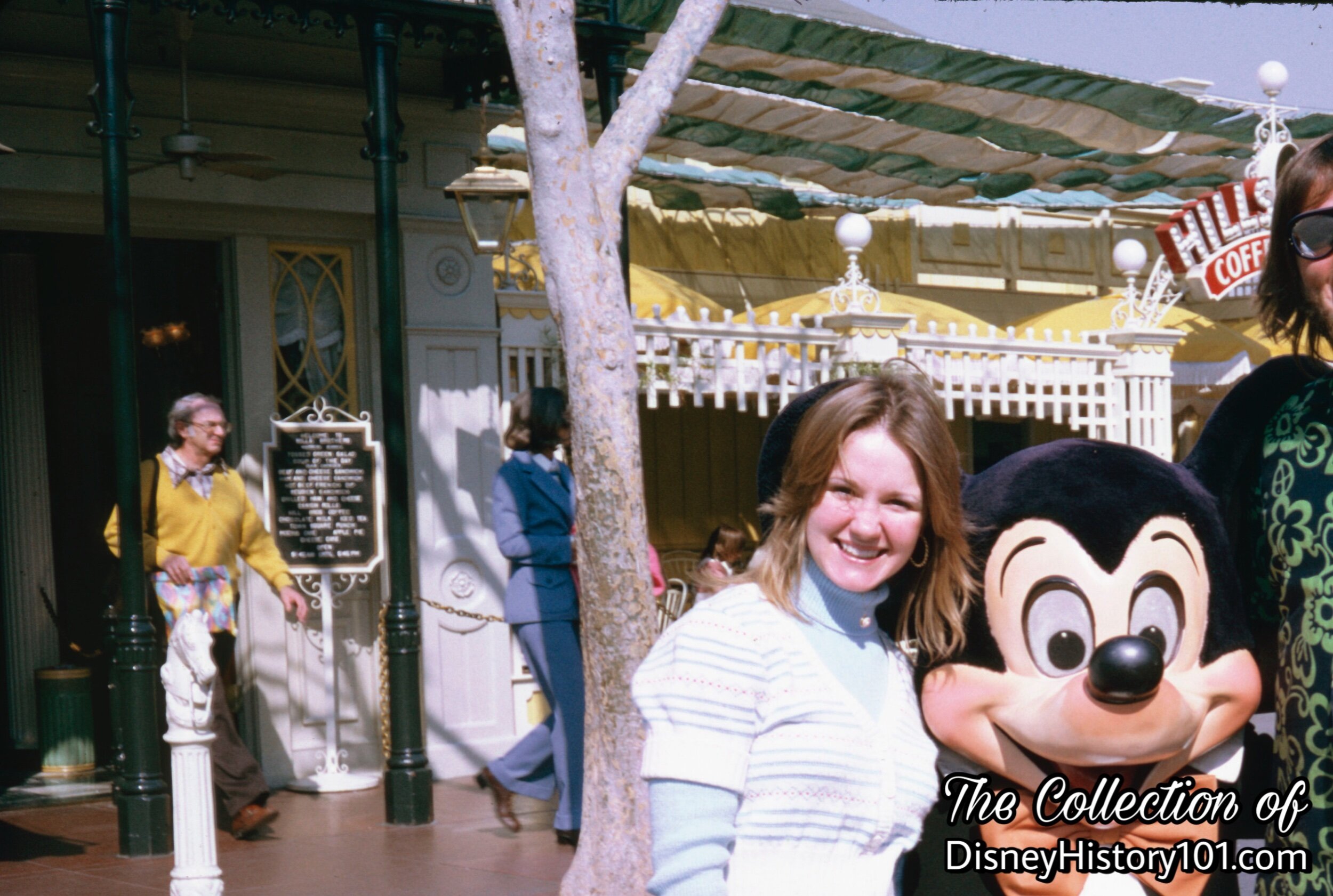
(July 14, 1978 - September 30, 1983)
The American Egg House (presented by the newest Disneyland Participant - the American Egg Board) opened next door to the Disney Showcase on Friday, July 14th, 1978. The restaurant was renowned for its Victorian Decor, Demonstration Chef, and Breakfast and Lunch Menus.
Much like its predecessor, the new restaurant offered table service in the dining room and on the patio and was open for breakfast, lunch, and dinner. The Grand Opening Ceremonies (on Friday, July 14, 1978) included culinary demonstrations by World Champion Omelet Maker - Chef Howard Helmer (of the American Egg Board), who prepared 217 two-egg omelets in 30 minutes, breaking the previous Guinness World Record of 188. [Disneyland LINE, July 20, 1978] The same writer continued: “The American Egg Board, sponsors of the American Egg House, has found a position here at Disneyland as the Park's latest member of the Participant Development Program. The new restaurant will be featuring a wide variety of egg dishes, from omelets to quisches to sandwiches.”
The American Egg Board advertised the highlight of their menu this way : “Eggs are nature’s most nearly perfect food. Low in calories and high in protein, eggs are economical - especially important in preparing nutritious meals at low cost. Eggs are versatile, too. They’re good at any time of the day…in an elegant soufflé or a quick and easy omelet…delicious any way you fix them. The Incredible Edible Egg - a natural wonder incredibly good so many different ways.” By 1981, the restaurant offered a few sandwiches, but their predominant focus was on egg-related dishes - the American Egg House Deluxe
Two Large Farm Fresh Eggs or Eggs and Steak (served any style), the Omelet Extraordinaire, Egg Salad Sandwich, California Omelet, the Spanish Omelet, the Omelet Delight, Egg Sandwich Supreme, Eggs Benedict, The American Egg Burger, Grilled Steak and Cheese Omelet, and the American Egg Burger (one fried egg on Canadian bacon, topped with American cheese, tomato and mushrooms, served in a sesame seed bun). Even the “Luncheon and Dinner Menu” offered many egg options - omelets, salads, sandwiches, quiches, merengues, and custards containing healthy American eggs.
A particularly popular specialty beverage was “The Instant Egg Pick-up” - “a blend of fresh egg, orange juice, and honey”! There were also plenty of Belgian waffle menu options as well as fruit dishes which included grapefruit, fresh melon, strawberries, fresh orange juice and tomato juice. Pastries and baked goods offered included warm danishes, blueberry muffins, English muffins, cherry pie a La mode, strawberry and ambrosia crepe, and cheesecake with strawberry topping.
In 1981, the American Egg House with its Victorian decor, demonstration chef, and breakfast and lunch menus produced $518,000 in revenue for Main Street Food. This was owning to VIPs of Disneyland (guests), its Main Street Foods hosts and hostesses (totaling 176 summer/118 fall), two Main Street Foods Stage Supervisors, and Main Street Foods Area Stage Supervisor.
Ultimately, Disneyland Participant Affairs and Disneyland Participant and Lessee American Egg Board could not negotiate a new cooperative agreement to maintain their ongoing relationship regarding this Location, so the two “reliable firms parted ways.” Though there were three sponsors in this location since 1955, the American Egg House would live on when this location would be referred to as the “Egg Gate.”
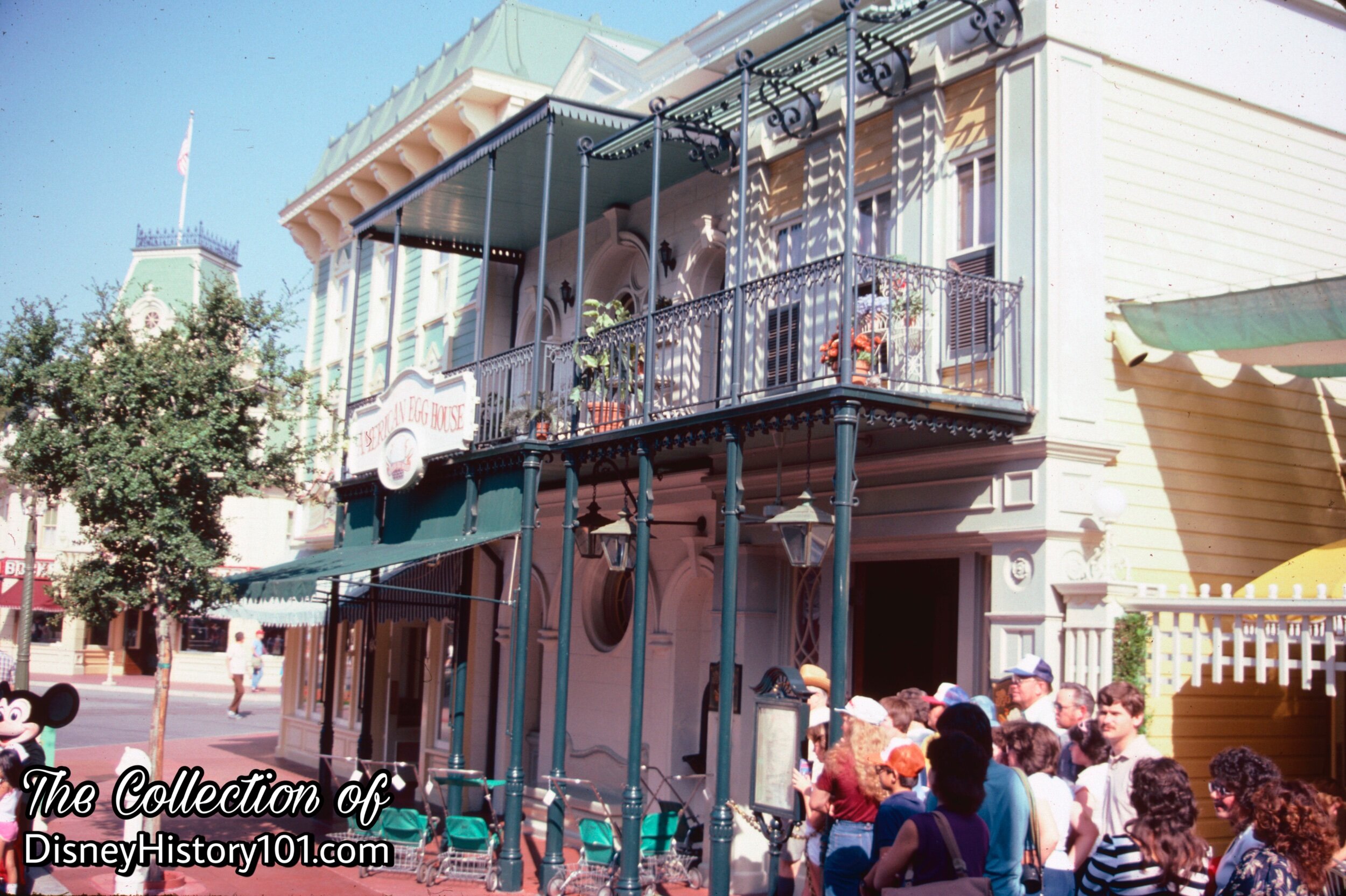

Town Square Cafe (winter, 1976 - spring, 1978)
The first incarnation of Town Square Cafe opened for lunch and dinner with a number of omelets - Omelet Extraordinaire (three farm fresh eggs, ham, American cheese, mushrooms, green onions, and chili salsa), the California Omelet (three farm fresh eggs, sliced avocado, diced tomato, alfalfa sprouts, sour creme, and pine nuts), the Spanish Omelet (three farm fresh eggs, diced tomato, green Ortega chilis, Spanish sausage, green onions and cheese), and the Omelet Delight (three farm fresh eggs, ham, and American cheese)! Town Square Cafe also offered salads including the Seafood Louis (with pink shrimp, tuna, crisp greens, Louis dressing, hard-boiled egg, and lemon wedges). Other offerings included several choices of burgers (Ortega Cheese, Avocado and Bacon, Bacon Cheese, and the Original Hamburger Platter), the Fire House Favorite hot dog, a couple of sandwiches (Steak Sandwich and the Club Sandwich), desserts (Apple Pie, Cherry Pie, Cheesecake with cherry topping, Cinema Sundae), and plenty of beverages (including coffee, soft drinks, tea, hot cocoa, and milk).
Town Square Cafe (October 1, 1983 - August 23, 1992)
The new Town Square Cafe restaurant offered table waitress service, and was “a great place for breakfast and lunch with a menu featuring eggs, omelets, hamburgers, specialty sandwiches, salads, and desserts.” In addition, healthier menu options - Chicken Breast Sandwich, Chef’s Salad, Seafood Louis, and Omelettes with less cholesterol - were now available to guests! The Town Square Cafe occasionally hosted special events, like Private Parties (e.g. GM and Hughes Employees, January of 1986).
The Disney Characters often walked close-by the Town Square Cafe Patio.
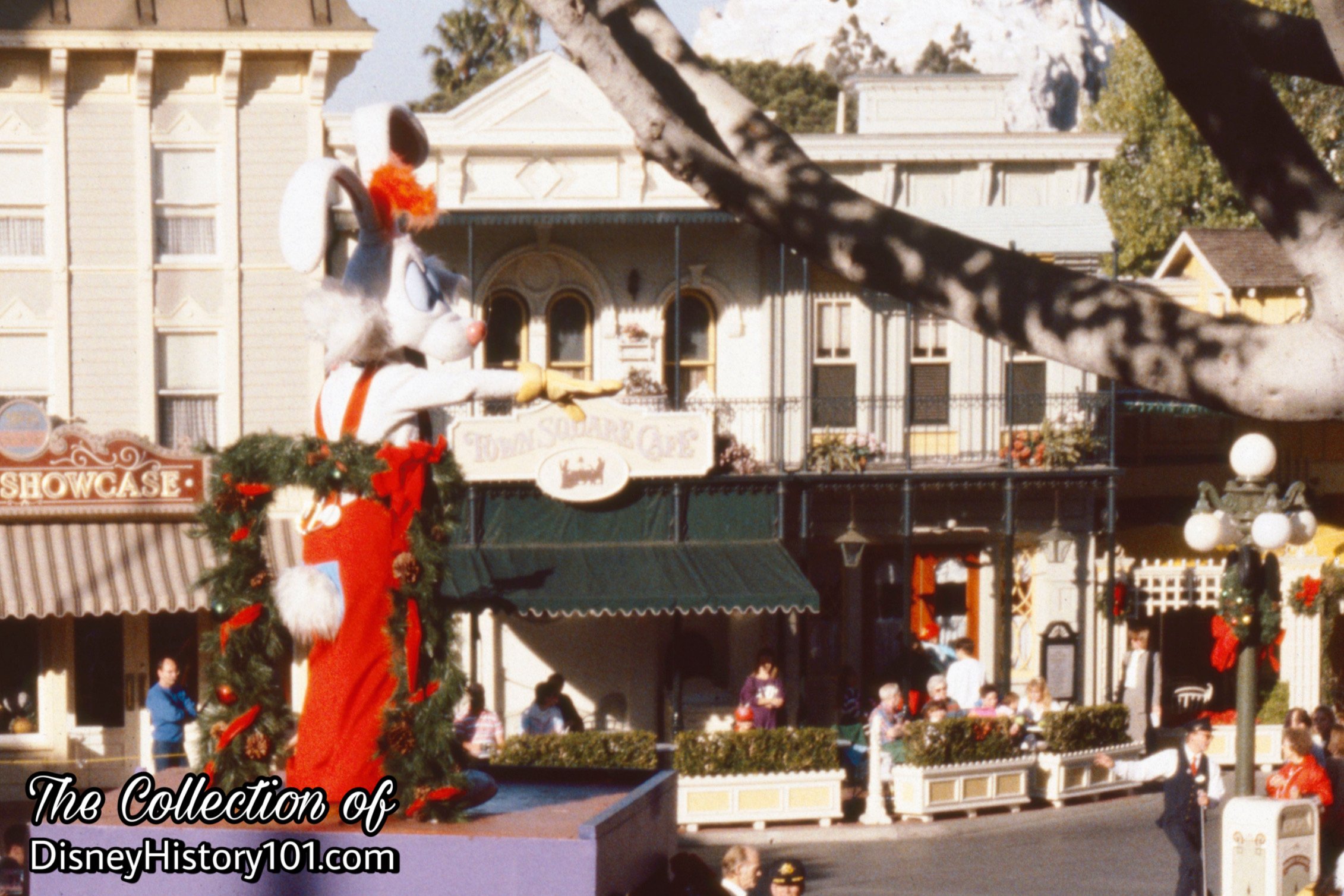
The Town Square Cafe Patio also offered a fantastic view of parade units (as in this Vintage View which may have preserved a moment of Roger Rabbit’s very first Christmas, during December of 1988). Through the years, Parade Units would often headed from the “Parade Formation Area” and out of the old Hills Bros. Gate (also known as the Egg House Gate).
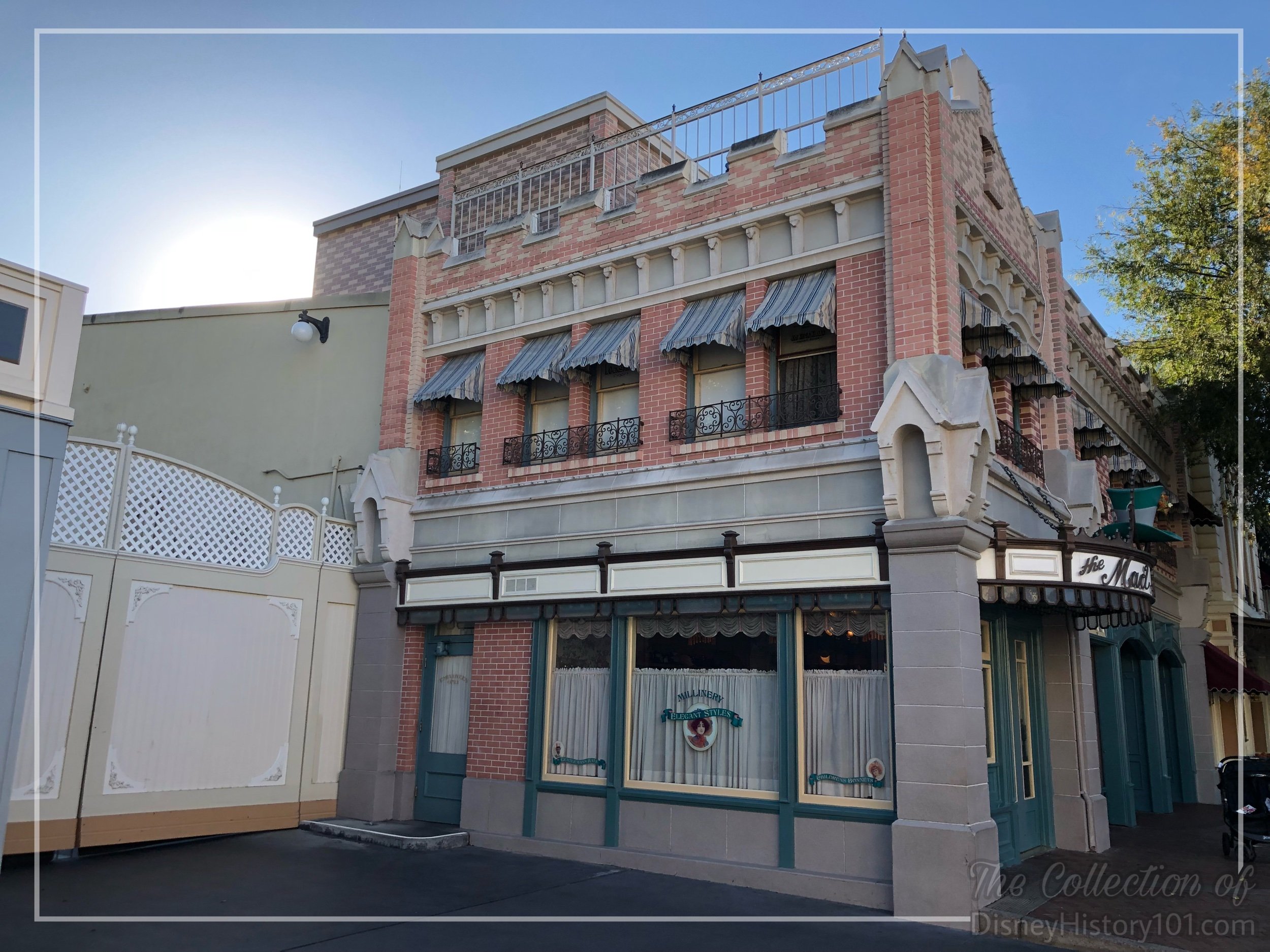
MINE TRAIN THRU NATURE'S WONDERLAND (RAINBOW CAVERNS MINE TRAIN)
*Some sources (i.e. “Disneyland Rides & Attractions and Attendance Report” Fiscal Year 1981) cite July 1st, 1956
“HOWDY FOLKS! Welcome to the little mining town of Rainbow Ridge - the gateway to Nature’s Wonderland.” When Disneyland first opened there were only a few ways to explore this portion of Frontierland - all of them by horse or mule. There were Stagecoaches, Conestoga Wagons, Yellowstone Coaches, and mule trains which traversed seven acres of Disneyland to bring it all to life.
“New Pages of the Disneyland Story”
Now, on the eve of Disneyland’s first day of operation, Walt had promised that “Disneyland will never be completed. It will continue to grow, to add new things, as long as there is imagination left in the world.” So it must have seemed strange to some when a year later (during 1956), “a few of Disneyland’s fabulous rides closed temporarily, [when] construction operations in Frontierland… made it necessary to shut down the three ‘Painted Desert’ rides - the Stage Coach, the Mule Pack Train and the Conestoga wagon,” according to “The Disneyland News” (Extra Edition). Only a few days prior, at a meeting of the Disneyland Merchant's Association (held January 25, 1956), a momentous announcement was made: “All horsedrawn vehicles in the Frontierland area will be shutdown for approximately two months, during the redesign and reconstruction of this area. This will be a whole new development to increase ride capacity. We are building a mountain to be called Rainbow Mountain. This will be seen from the River and the Mark Twain. The existing corral and Black smith Show will be the entrance to a new ‘Mine Train’ ride. This will be an old fashioned Mining Train with 6 open cars. The engine will look like a real engine. The ride will go through a canyon out into the desert; then into a Rainbow Mountain where you tunnell with stalagmites and stalactities and three different water falls of different colors, joining in the river. This ride will take about 6 minutes. One of the most interesting rides we have in the park is the True Life Boat Ride. Me hope to make the ‘Mine Ride’ an equal to that one.”
Though Walt set the “Painted Desert” budget at $400,000, nearly $500,000 of improvements (of a total $1.5 million total Park investments for 1956) brought major developments and “reconditioning” to the Painted Desert area of Frontierland! A new town sprang up in the hills overlooking Frontierland, newly rails were laid, and the opportunity arose to head past rushing rivers and into the uncharted caverns and caves of the Painted Desert! “Towering above the scene, Rainbow Mountain provides a snow-capped background for all this action,” according to the “Disneyland 1st Anniversary Souvenir Pictorial,” published 1956.
As some of these new Frontierland attractions appeared on page 5 of The Disneyland News (published June of 1956), the Rainbow Caverns Mine Train began to prove the truth of Walt Disney’s promise of an ever-expanding Disneyland! Similar to how Walt Disney’s True Life Adventure series spawned True Life Adventureland, Nature’s Wonderland (and its refurbishment) were directly influenced by films released from 1950 to 1954. But while those films were “two-dimensional in scope, the Theme Park surrounds the guests with the story and impacts all of their senses”, according to “Disney By Design” Tour scripts. Artists like set designer Wilson “Bill” Martin (who had left 20th Century Fox, to work on Walt Disney Productions’ Disneyland project) was influential in the design of Nature’s Wonderland, his talents as art director applied to the attraction.
Though total investment for Disneyland had now reached $18,500,000, the rich story of the Mine Train was among the attractions that were projected to add a 40% ride capacity to the Park!
Today, our story begins at a junction in the small mining town of Rainbow Ridge. Instead of saddling up atop a dusty pack mule, we’ll load into a mine train gondola for what would typically be a seven minute excursion, en route to a “wondrous” destination tucked deep in the earth! A place where (according to Holiday magazine, published Summer, 1958), “seven multicolored waterfalls cascade and stalactites and stalagmites form beautiful patterns.” However, today we won’t look at our watches, or worry about the uniform “trip time.” We won’t heavily rely on the pre-recorded voice-over narration of Dallas McKinnon, or the script. Instead, I’ll be providing a custom spiel along our journey, which will be of an undetermined time length.
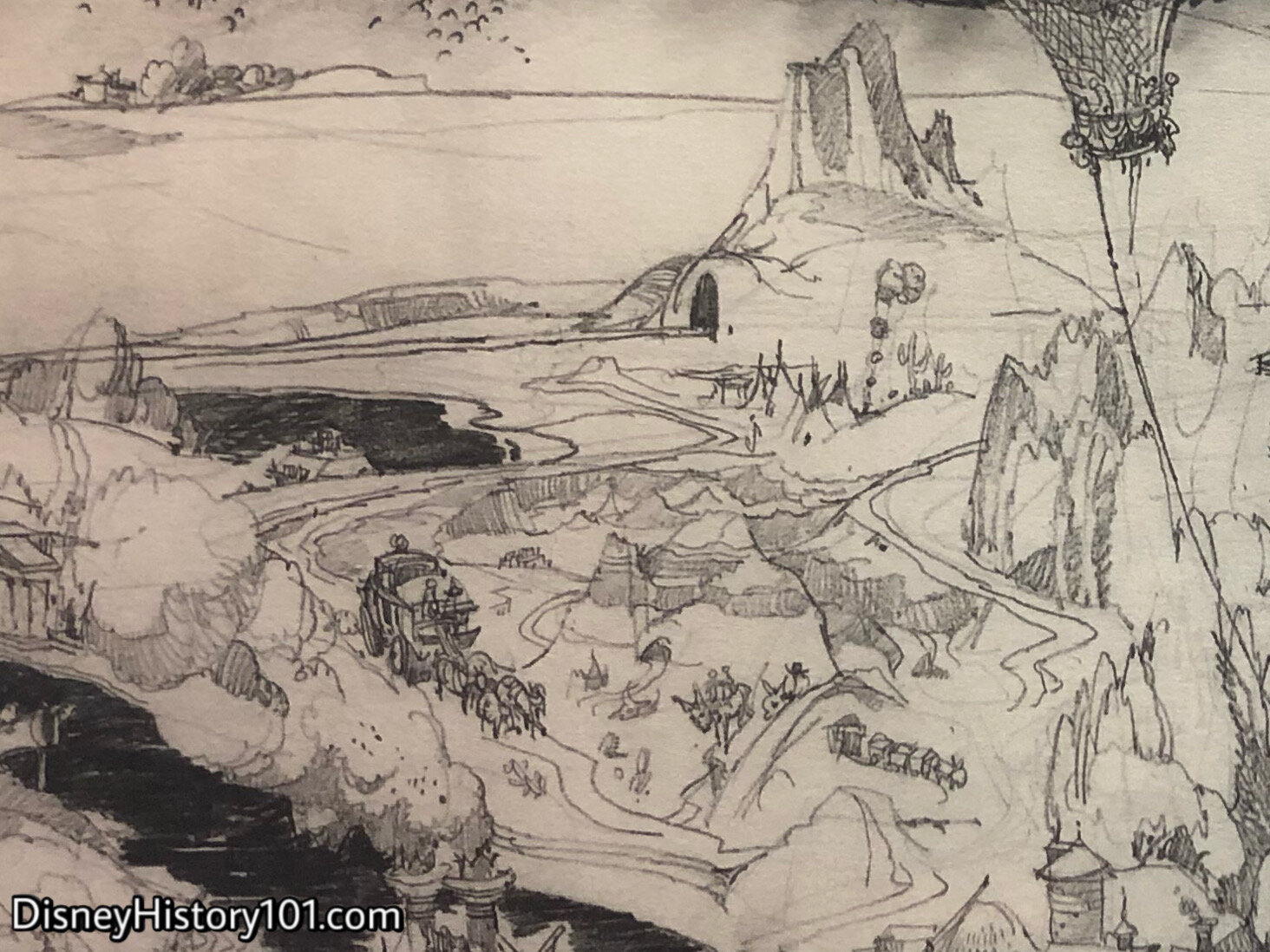
Herb Ryman hand-inked, and hand-colored one of the original Disneyland concept drawings between September 26th and 27th, 1953. Subsequently, hundreds of drawings were made, based on the original (with constant modifications being made, as Walt Disney’s “Disneyland” developed). Some of these viable project Concepts (as above), were supported by a well-developed business case and built expectation.
“The Painted Desert” (the name used to identify this region during 1955), appeared on the early drawings of Disneyland that were shown to potential investors as early as 1953. However, it seems (as depicted in the drawings) that it was only meant to be traversed and explored by way of a Stagecoach or Mule Train. The “The Disneyland Story” describes the scenery of the “Painted Desert” : “As you go into the Painted Desert you will pass the Indian encampment, go through a Pine Forest, and Ford a stream. When you get to the Painted Desert you will see the things you usually find there, such as the beautiful cactus plants, trees, probably the water hole with the ‘poison sign’, the skeleton of a steer, and other appropriate dressings of the desert. As well as the stage coach ride, you will be able to take the Conestoga Wagon and Mule Pack ride into the Painted Desert.” For a time, it does not appear that a Mine Train was considered an option to explore the Painted Desert.
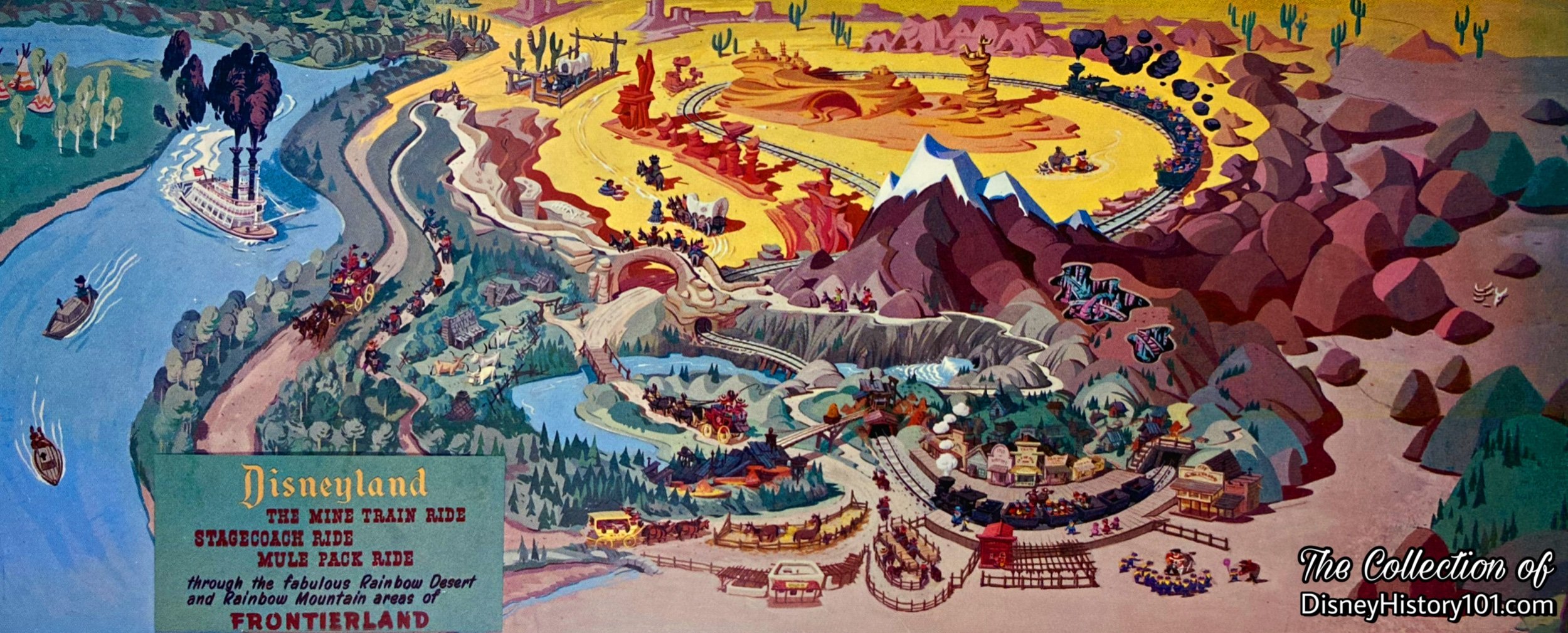
Above is a Walt Disney Artist's conception of a section of FRONTIER-LAND in Disneyland, featuring the awe inspiring Mine Train Ride, the exciting Stagecoach and Mule Pack Rides, where one can journey through the many fantastic sights of the Rainbow Desert and Rainbow Mountain areas, returning with a view of the famous Mark Twain River Boat and Tom Sawyer Island. Just outside the mining town of Rainbow Ridge sat the boarding station for the pack mule train. Now, there were “three wonderful ways” to enjoy the Painted Desert at Disneyland.
This illustration (created for Guide Books and merchandising) gave us a clear view of the ‘natural wonders’ that await Mule Trains, Stagecoahes, and little dark-green Mine Trains in the “Rainbow Desert” (the name used for this region from 1956 to 1959)! If you look real careful, you can see the destination reserved for the passengers of mine trains. A small cutaway on the side of Rainbow Mountain, reveals a preview of the magnificent Rainbow Caverns!
Elevation drawings were still being prepared as late as May of 1956, to assist in land grading, and the integration of the paths of the “Stage Road,” the “Mule Overpasses” and “Mule Crossings,” and railroad tracks. Soon, the “bandsawn” shadowy forms of Rainbow Caverns, and pipe water sources were installed to flow over “metal cones” for form. Then, the headline of “The Disneyland News” (Vol. 2, No.2 ; August, 1956) heralded the “Mine Train Ride Now Open!”
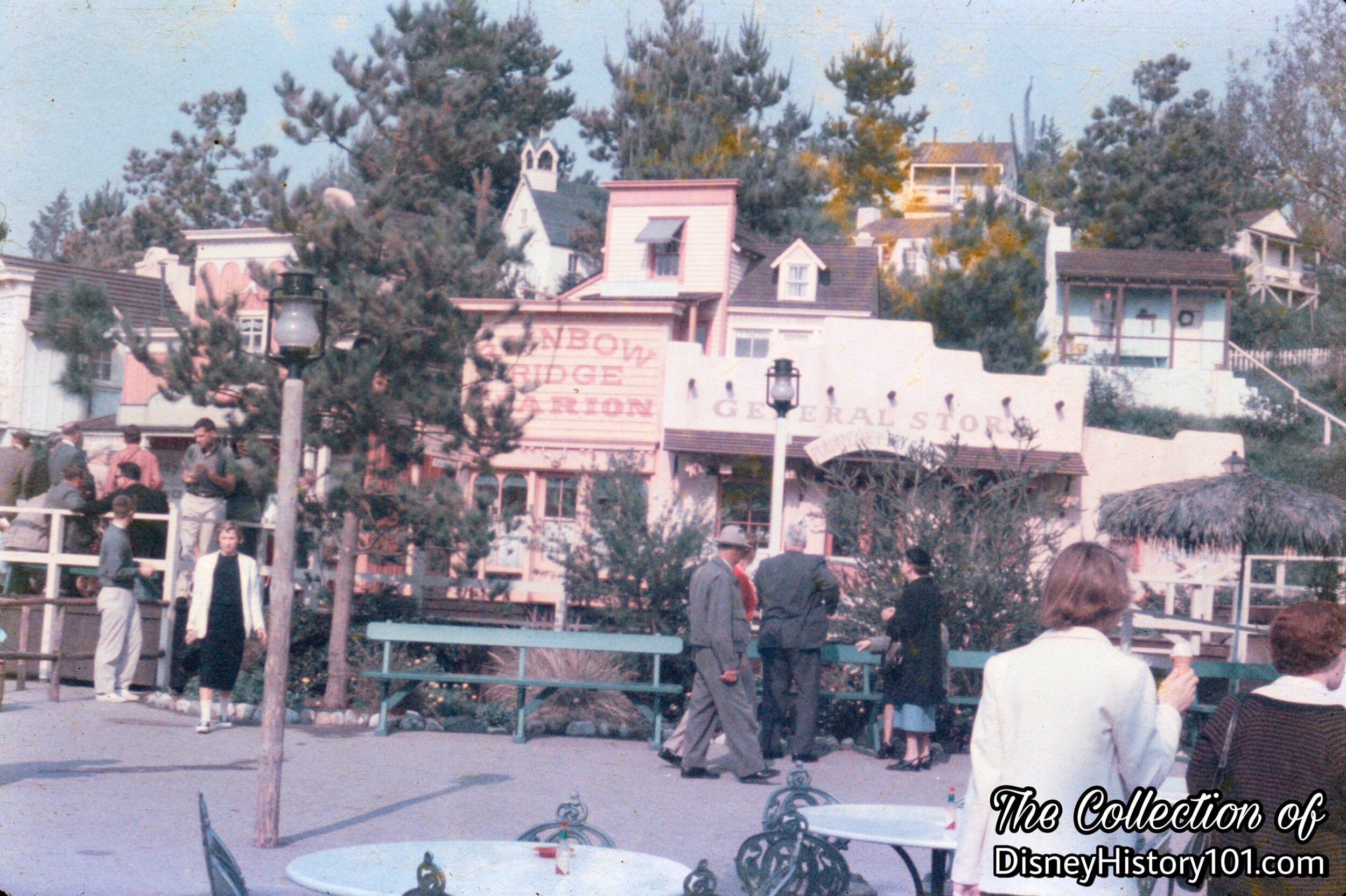
The Town was built in miniature with forced perspective on the side of Rainbow Mountain.
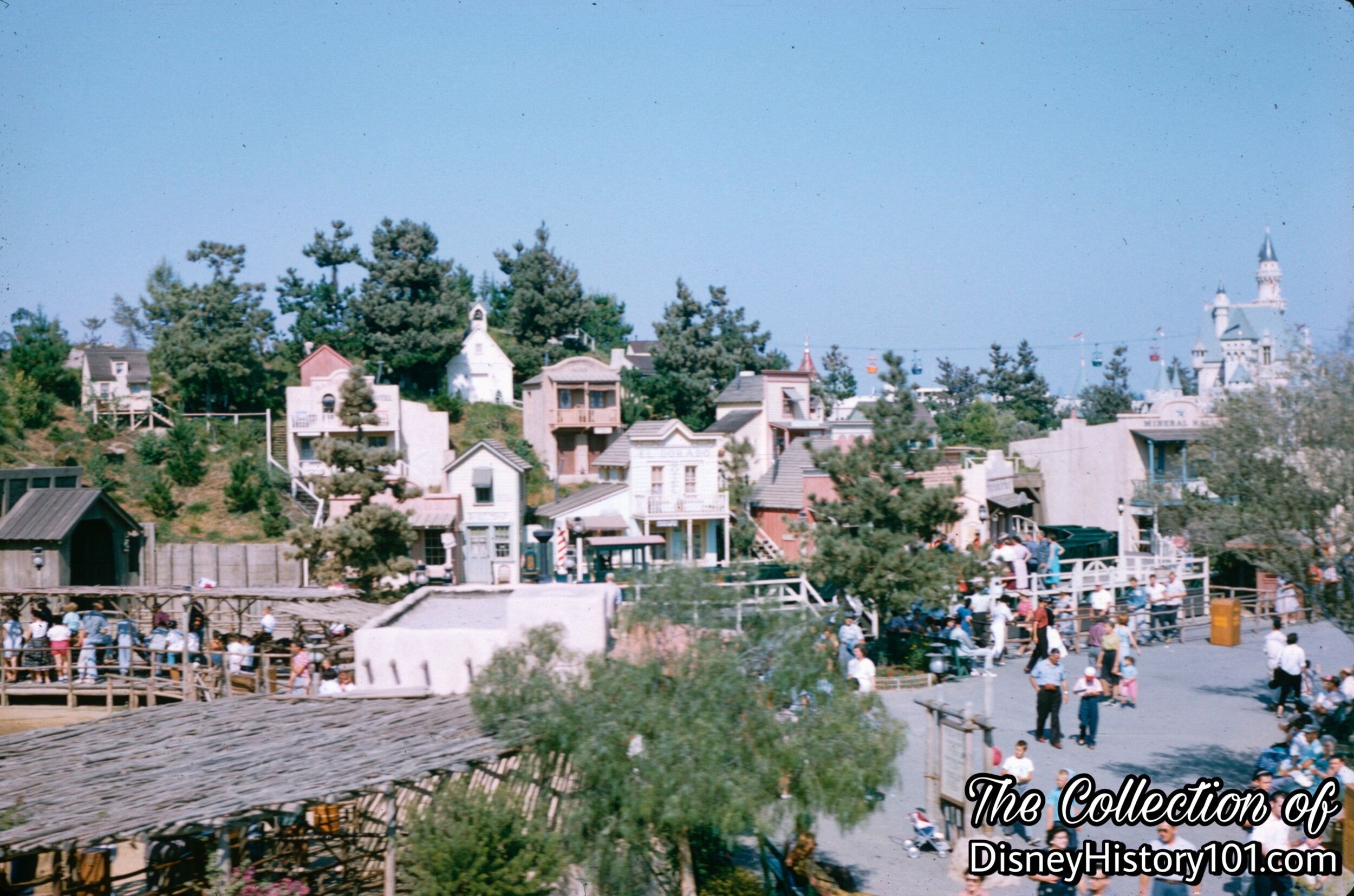
The Rainbow Caverns Mine Train was one of several exciting attractions debuting during 1956, that increased ride capacity (with all it’s gondolas). By the release of the “Disneyland 1st Anniversary Souvenir Pictorial,” it was reported that “new rides have added some 40 percent to the Park’s ride capacity,” listing “the Rainbow Caverns ride” among the contributors. Owing to this, one day in August of 1956 saw a peak total of “197,547 individual rides” enjoyed by Guests (according to a letter from Walt to Ward Kimball, dated January 23, 1957).

Our “tickets for today’s adventure”, and a rare view of the magnificent Rainbow Caverns tickets (pictured above), come courtesy of collector and historian James Keeline. Further, James is “just the ticket” when it comes to the facts about these rare Rainbow Mountain attraction admission tickets!
What were the earliest Disneyland tickets like?
“In the first few years of Disneyland the tickets sold inside the park were often for specific attractions. There were also tickets sold, perhaps at a later date, with A-B-C-D-E.”
What was the original price of one admission to the “Rainbow Caverns”?
“We can fine tune it by noticing the adult price…on the ticket…(50¢). The price stayed the same for a few years but the lettered individual tickets started to appear in this era too.”
Why are these (previously pictured) tickets labeled ‘Rainbow Caverns’?
“The region was initially called the ‘Painted Desert’ [in 1955]. It was redeveloped to add the Mine Train and the name became the ‘Rainbow Desert.’ The desert portion was called the ‘Living Desert’ for the Nature's Wonderland era.”
What do those punched holes (in the previous photo) indicate?
”The hole in each ticket was part of the distribution mechanism. ‘VOID’ was used when they wanted to have tickets to put on display in the park ticket booths if people wanted to trade them in towards passports, etc.”
Later, admission during 1958 was one “jumbo” “D” coupon (the price of 35 cents, for one child), the same as the Jungle Cruise, Indian War Canoes, or the Tom Sawyer Island Rafts.
Ticket inspectors - you’ve got to hand it to them! After you hand your ticket to them, they place it in the Ticket Box. The Ticket Box was usually made of fiberglass or metal and supported a ticket bag or container, and in which torn admission coupons are de-posited. The Ticket Bag was a canvas liner of a ticket box used to collect torn admission coupons. The Ticket Container was a plastic container which fit inside a ticket box (in place of a ticket bag) and was used to collect torn admission coupons.
Our Rainbow Caverns tickets will be taken by the Ticket Receptionist, on the Rainbow Ridge Boarding Platform, before embarking on our journey.
People like Dick Tryon (Manager of Ticket Sales, 1955-59) would have somewhat familiar with these tools and procedures.
Now, we’re ready to “get back on track” and take a ride!
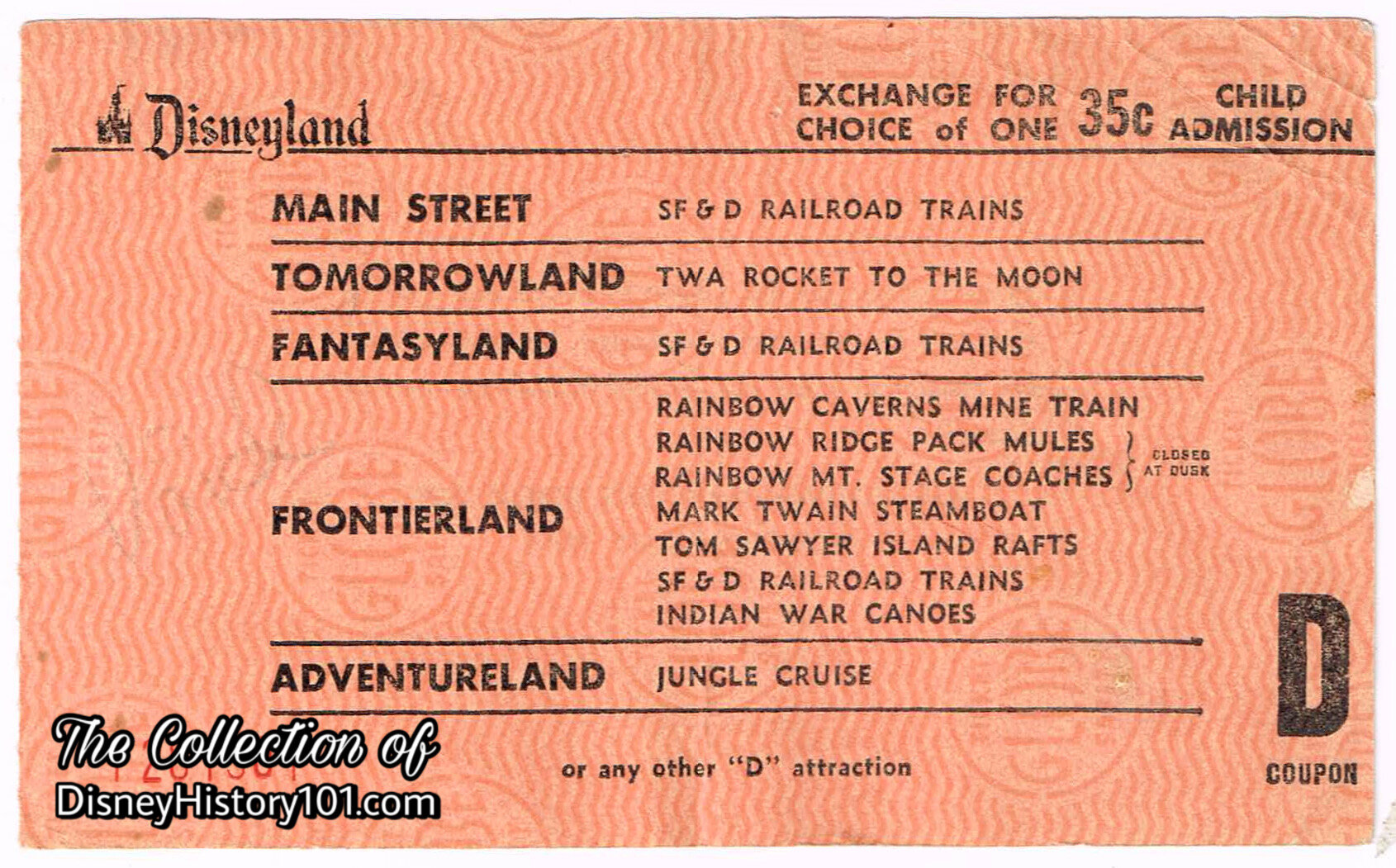
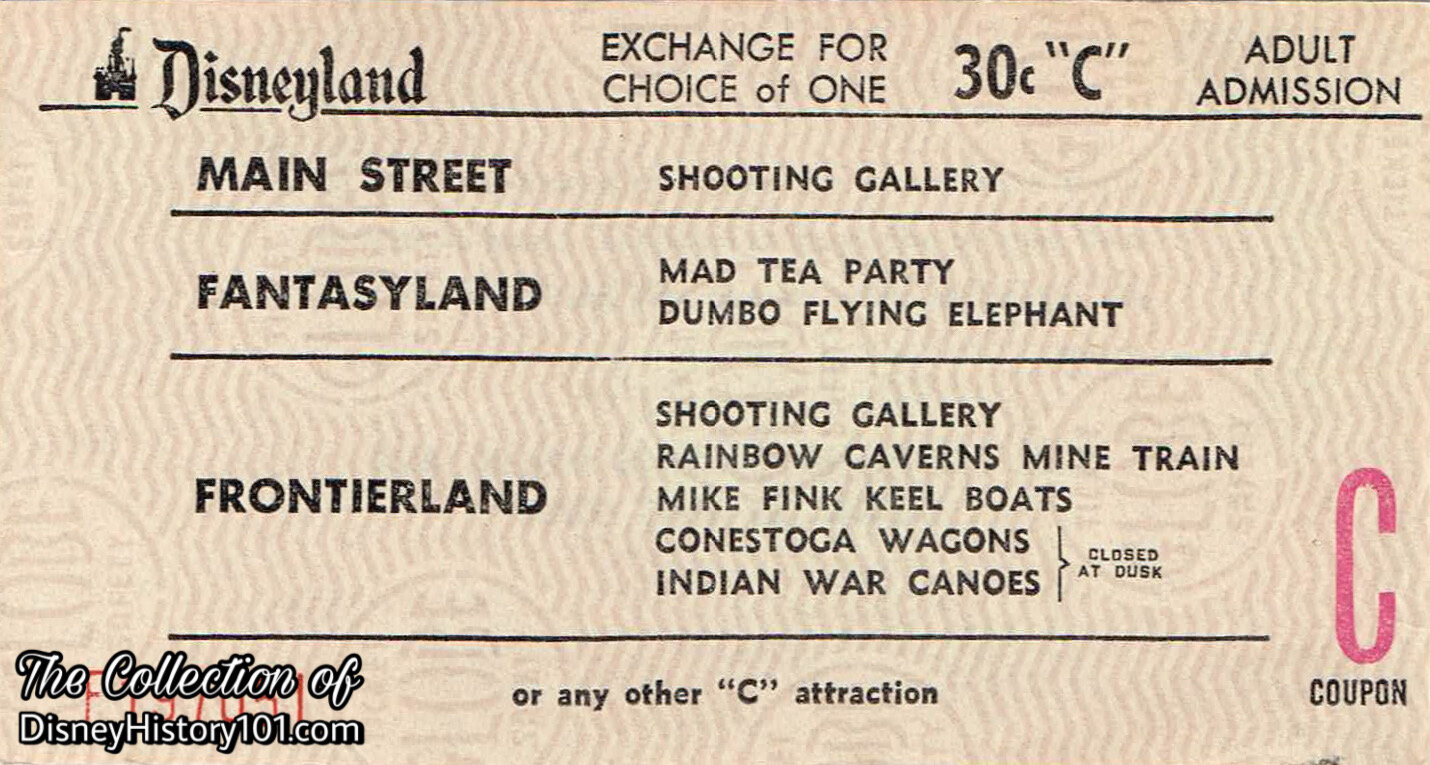
Can you believe that 30” rail similar gauge to the one pictured, supported the weight of those mine trains and gondolas that ran thru the Painted Dessert (and the rest of Nature’s Wonderland)? The weight of the rails was roughly 20 pounds per yard.
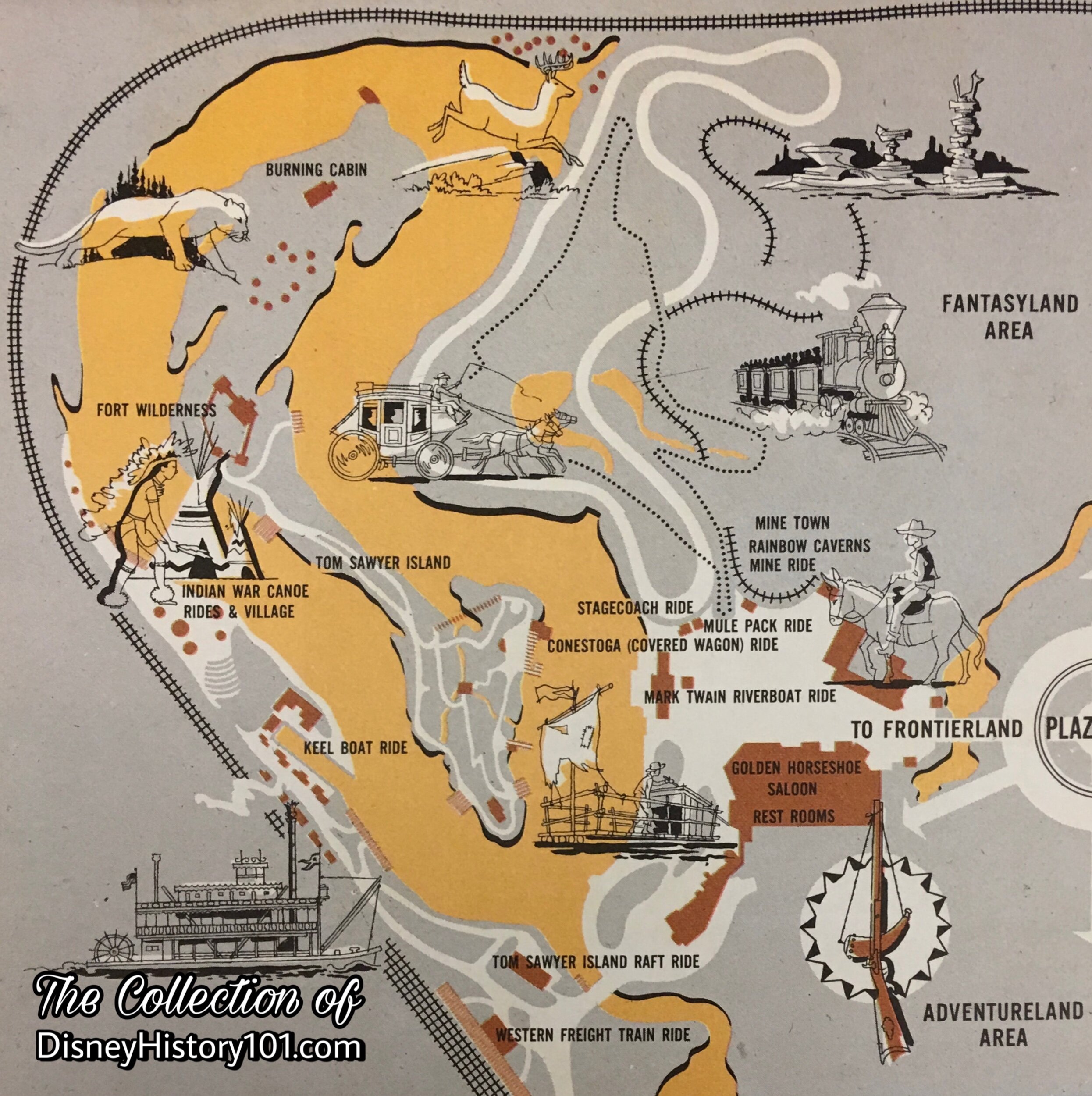
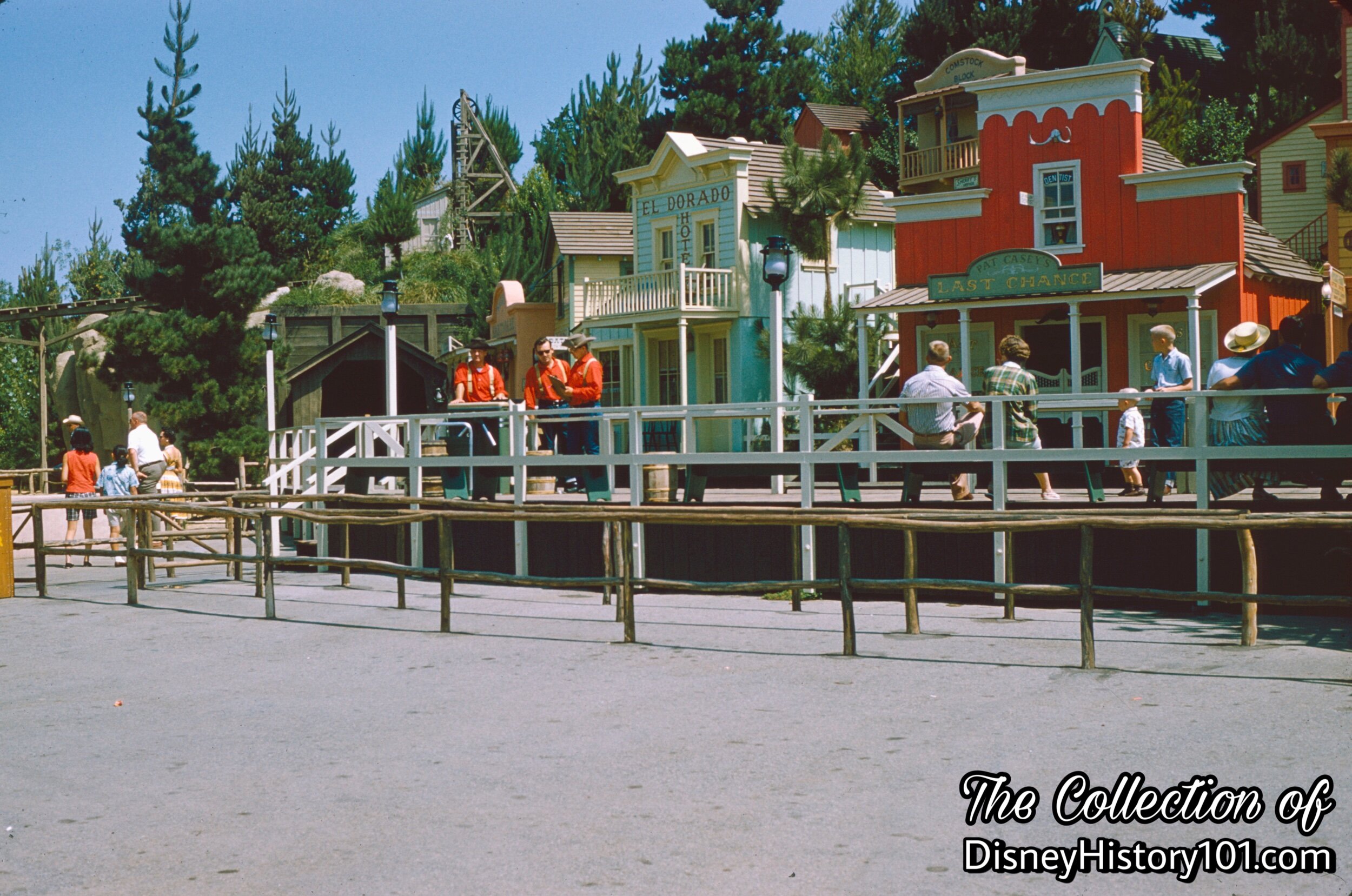
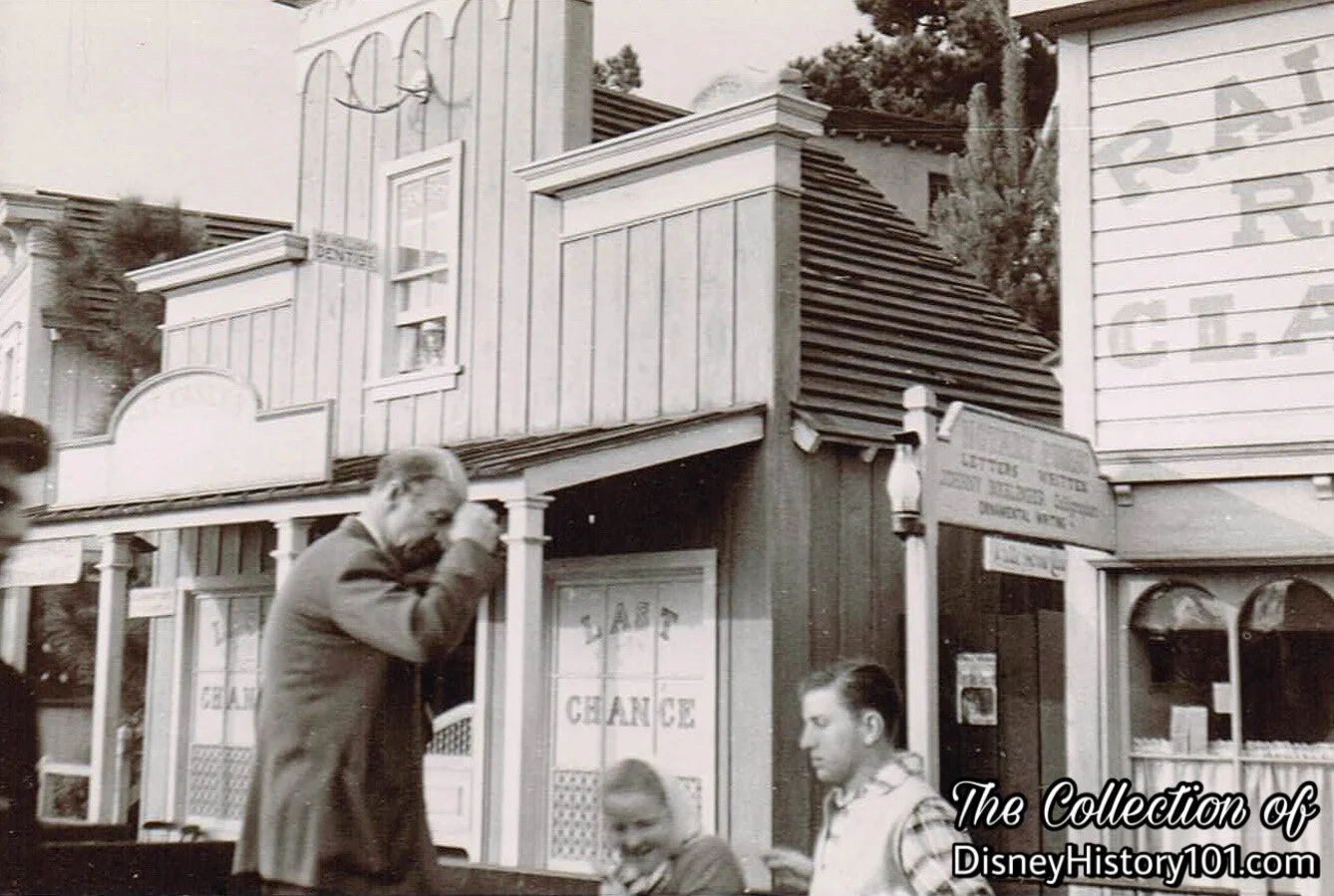
Guests board the dark green gondolas.
The Rainbow Mountain Mining & Exploration Co.
(Mine Ride-Frontierland) had two engines. Each engine was designed and built at the Walt Disney Studios under the supervision of machinist Roger Broggie, Jr. (who understood narrow gauge railroads, because he had his own at home and helped fabricate Walt Disney’s Lilly Belle engine)!
Mine Train historian James Keeline shares some of the likely inspiration for these iconic locomotives :
“The locomotive that is the most likely inspiration for the Mine Train was the 0-4-2 called the Joe Douglass. It was used to help build the dam at Lake Arrowhead. Afterward it was left as a static display. The Broggie family notes that they visited this. It was moved at some point to the La Paz guest ranch in Palm Springs, CA. It is possible that Walt Disney saw it there during one of his visits to his property on Smoke Tree Ranch which was nearby. The locomotive was later donated to the Nevada State Railroad Museum in Carson, NV. The similarity in shape and the connections with the Broggie family, and perhaps Walt, make this the most likely inspiration when the Mine Trains were being designed.
The particular design of the locomotives was a little different from what was normally used. Typically, a small "pony engine" would have a saddle tank over the boiler….Note that Big Thunder (and the Calico Mine Train) use saddle tank versions….There was a family member of someone whose father worked for Mancha (later Goodman) who supplied the electric mining locomotives which were used.”
Each engine was powered by 530 amp electric batteries.
Each engine had a capacity of 64 Guests.
Originally (from 1956 to 1959), dark green locomotives (powered by 530 amp electric batteries) pulled the open ore cars of Rainbow Mountain Mining and Exploration Company. These transported a capacity of 64 Guests through the Painted Desert and mother-lode country of the old West, through Rainbow Caverns with its multi-colored fountains and falls.
“The climax for the ride was the trip through Rainbow Caverns. However, to give it more of a reason to be there, they came up with the name ‘Rainbow Mountain’ to describe the area where the mine (and Rainbow Caverns) was located.”
Even in these early days, the desert heat was known to “get” to guests. Sometimes the cacti appear to be “thumbing a ride”, or look like an eight-armed octopus! At times, the bellowing from these old pipe organ cacti sometimes even appear to form symphonies as the desert wind passes through them.
The proximity of multiple paths cut through the Painted Desert (or, “three fabulous ways to enjoy the Painted Desert”) are depicted in this Vintage View!
Passing Dead Man’s Spring, we come to Rocky Gorge with such formations as Coyote Rock, Inscription Rock, Elephant Rock, Natural Window Rock, and the Balancing Rocks, “teetering precariously on wind and sand worn points”, according to “News From Disneyland”, a press release published 1956).
While the tracks run through the shadows of desert canyons (like Horse Thief Canyon), Hopi dwellings can be seen high above the wind-swept cliffs. These stand “in silent tribute to the artistry of an ancient people”.
“Now folks, we gotta git through Balancing Rock Canyon!”
The Rainbow Mountain Mine Train chugs through the desert in this Rainbow Caverns Mine Train Panoramic Postcard Image. We can see Natural Window and Balancing Rock Canyon - two real mysteries of the desert!

This short paragraph (published only months after the Rainbow Caverns Mine Train opened), describes what guests will encounter as they pass through the Rainbow Desert.
It appears that the vibrations from our whistle have made“these rocks really ‘rock and roll’!” In reality, the sound from our train whistle has tripped a sound actuated switch and motors causing the rocks to tip wildly overhead!
Sometimes the desert heat really gets to our guests…why, somebody even saw the Seven Dwarfs out here yesterday. Sometimes, the desert heat gets to these here cactus, and makes them see strange things - like dark green mine trains heading through the wilderness!
Get ready to head deep into the earth to explore the dazzling Rainbow Caverns! Multiple publications tantalized readers with details of the sights. The complimentary Disneyland News (published for June of 1956) briefly mentioned a multi-colored waterfall, stalactites and stalagmites on all sides, a Bottomless Pit, and a River of Gold. “The First Annual Report To Disneyland Lessees” (prepared 1956, by Disneyland Public Relations Division, Disneyland Inc.) described this portion of the “New Attractions” :
“Then, destination is reached. The train passes though a jagged fissure in the face of Rainbow Mountain itself and is quickly swallowed up in the tomb-like stillness of an abandoned mine. Bones and skeletons glowing in the unnaturally lit interior of the mine give evidence that others have tried this path - - and failed to survive the hazards. The tracks easily span a yawning chasm - - formerly the great barrier to the mine’s interior - - - and the train is now in the Rainbow Caverns. Underground river rush past, showing flecks of pure gold. Mineral formations in the walls give the interior a particular glow, exhibiting all the colors of the rainbow but strangely refracted without natural light. The train rushes on in the half-dark. Many colored waterfalls and cascading streams contribute to the effect of being deep in the heart of the earth. Suddenly, round a bend, a narrow shaft of light appears and the train rushes to meet it, ascending abruptly and once again into the pleasant daylight of Disneyland’s summer. Close by, the Mule Pack Ride, the Stage Coach and the Conestoga wagon rides will be boarding passengers for a more leisurely trip through the desert area.”
All of this dark ride portion of the adventure was housed in the 18,250 square foot Mine Train Building.
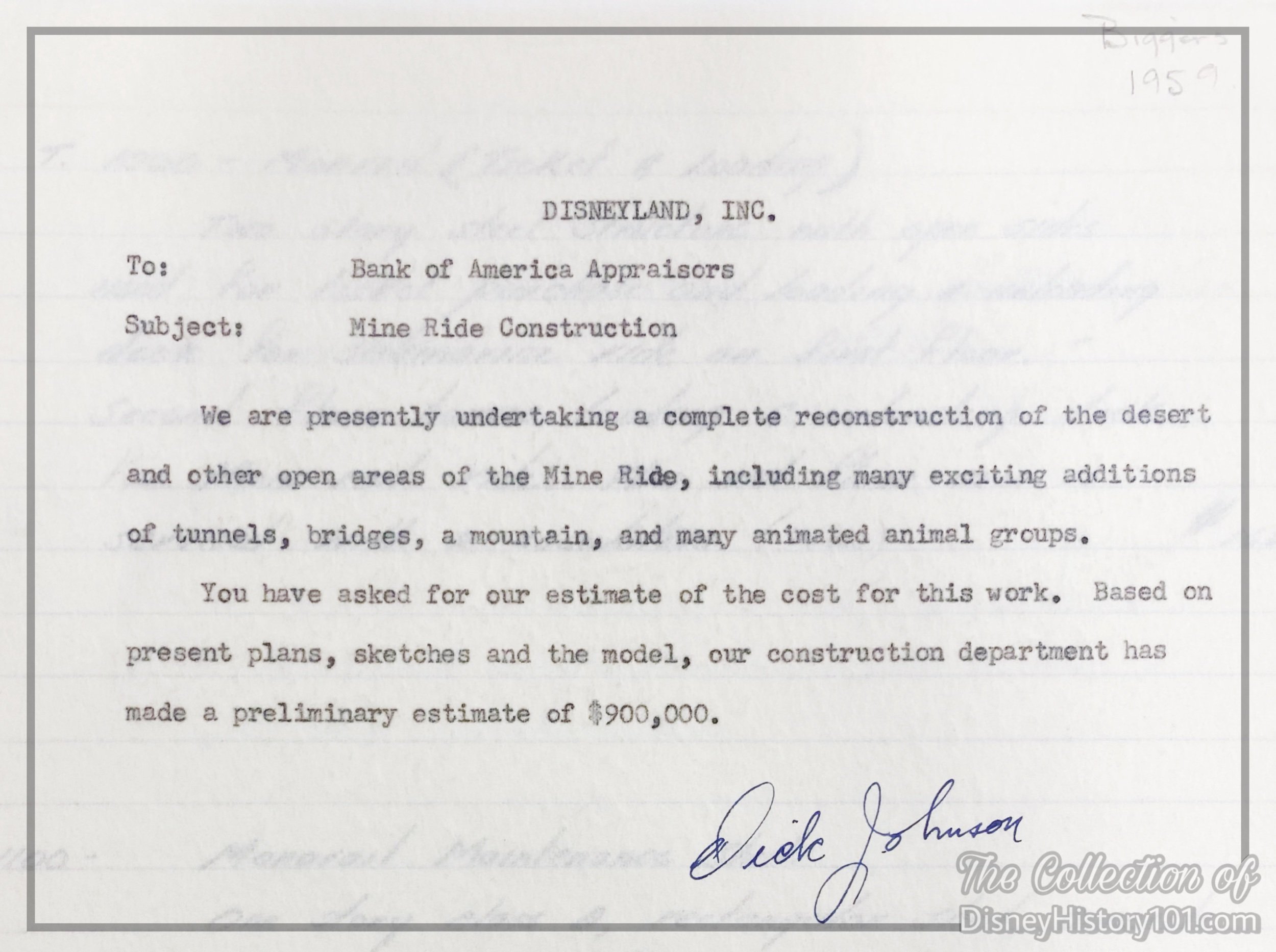
By September 28, 1958, Disneyland, Inc. made approximately $389,181.00 of land improvements to the Rainbow Desert. That same year of 1958, an appraisal of the original ride structure valued it at $275,900 while the original equipment was valued at $91,600.
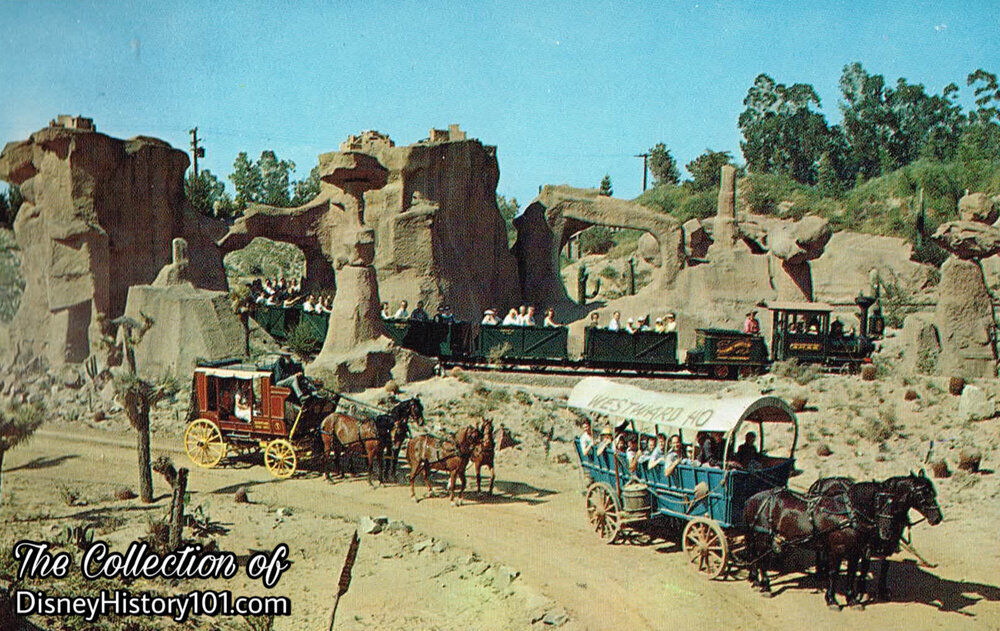
By 1959, Joe Fowler was Vice President of Disneyland Operations Committee and Doc Lemmon of Disneyland Operations was overseeing Operators of Rides & Amusements (like the Midget Autopia), Livestock, Parking Lot, and Ticket Sellers. The Disneyland “C” Coupon of the era once equated the value of a ride aboard the Rainbow Caverns Mine Train with the alternate desert route of the Conestoga Wagons. However, an incident would occur that would result in the end of an era for the “three wonderful ways to enjoy” the Painted Desert!
According to one headline (published just after the incident), “Eleven [were] injured as horses bolted at Disneyland”. The same article continues : “Eleven persons including six children, suffered minor injuries Monday at Disneyland when the four-horse team of a stagecoach bolted. The injured were the driver and 10 of the 12 passengers in the stagecoach at the amusement park. Several were thrown to the ground when the stagecoach collapsed after its undercarriage was torn off by the wild horses. A Disneyland spokesman said the horses became frightened at the sound of the Park’s train whistle.”
A few months later, another syndicated article divulged Walt’s thoughts and feelings over what had occurred. “‘We had stagecoaches riding through the Painted Desert area’, he explained. And we had a few minor accidents on them. Nothing serious, but enough to worry me. We have a fine safety record at the Park, and I wanted to keep it that way. So I redid the desert to do away with the stagecoaches.”
With that, the final horse-drawn vehicle made its way along the dusty trails of Frontierland, on September 13th, 1959.
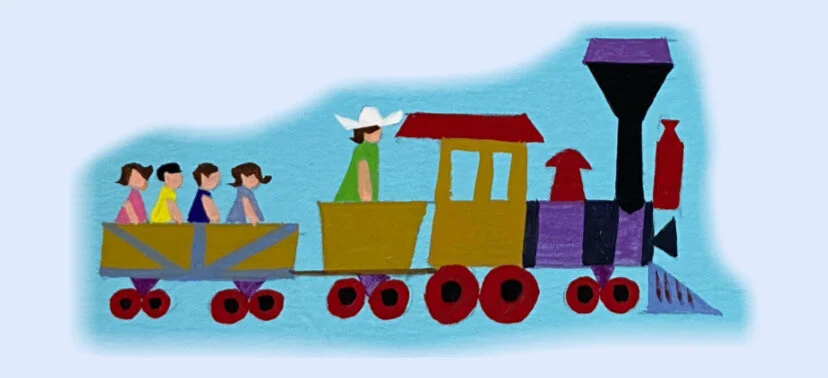

*Official opening ceremonies took place on June 12th, 1960. Some sources (i.e. “Disneyland Rides & Attractions and Attendance Report” Fiscal Year 1981) cite January 3rd, 1977.
During the 1958-59 winter season, over $6,000,000 of new rides and attractions debuted, including the Matterhorn Bobsled Ride, the Submarine Voyage, the Monorail, and extensive revisions in other rides adjacent to them. The drawing power of those spectacular new features accounted for a larger attendance trend during the summer and winter. So to prepare for the following summer, a major project commenced, re-designing the desert area in Frontierland to provide more exciting and higher capacity rides.
Beginning October 11th, 1959, Mine Train excursions through the Rainbow Mountain Mining & Exploration Co. briefly ceased for refurbishments that were well worth the wait! About this time, Walt Disney was quoted (in Wisdom magazine, published December 1959), “I have great love of animals and laughter.” Given this expression, it wasn't any surprise when (during the following year of 1960), a $1.8 million construction cost far exceeded the preliminary construction estimate of $900,000 given Bank of America appraisers in 1959. This amount brought tunnels, bridges, a mountain, and an unprecedented cast and show to the 7-acre (or, 14 of “nature’s half acres”) parcel of “North American wilderness” in Frontierland!
Joe Fowler (Disneyland Operations Committee) and Earl Vilmer oversaw the Construction & Maintenance division including Engineering, New Construction, Maintenance, and Janitorial related to the installation of the attraction.
Show design was heavily inspired by Walt Disney’s award-winning True-Life Adventures! According to “A University of Disneyland Guide For Nature’s Wonderland Hosts and Hostesses” : “No dress designer can duplicate the wardrobe of nature ; no prop designer or special effects man can do better than a meek imitation of nature’s own trees, rocks…waterfalls. It’s impossible to compete with the Aurora Borealis or a Pacific sunset for a backdrop. But in Nature’s Wonderland in Disneyland, people from around the world can enjoy nature as it is…or as it was…with accuracy and fidelity. To bring the beauty of drama of nature to mankind has been one of Walt Disney’s interests.” This Walt had previously effected through his True-Life Adventures series of theatrical films, where those animals were viewed on a screen.
Many of those films would become most influential to the show design of the Disneyland attraction! There was “In Beaver Valley” which had previously been awarded for Best Two-Reel Short Subject of 1950. On November 10, 1953, Walt released “The Living Desert,” the first film distributed by the new Buena Vista Distribution. The film won an award for Best Documentary Feature, 1953. Later at the 1954 Oscars (a year before the Opening day of Disneyland), Walt Disney & RKO Radio Productions’ “Bear Country” was awarded an Oscar for “Achievement in Two-Reel Short Subject, 1953” at the 26th Academy Awards Ceremony. Upon accepting one of his awards that day, Walt declared, “Well, I just wanna say on behalf of my staff (and especially the naturalist photographers who have played such a great part in making the nature films), ‘Many, many thanks!’” Soon, “the youngster who never saw an elk except in a parade or convention” would soon be “able to see Olympic Elk as he lived his life in Nature’s Wonderland,” at least according to the same aforementioned publication. This “composite True-Life Adventure… based on elements of four Disney Films - Beaver Valley, Bear Country, The Living Desert and The Olympic Elk,” would be the product of a great deal of Walt’s studio staff. [“Walt Disney Disneyland,” page 44, printed by Officine Grafiche Arnoldo Mondadori - Verona; first published 1964]
Walt Disney’s Imagineers knew their audience. About a year after Disneyland began its first day of operation, Herb Ryman continued to produce rough drawings detailing proposed Show additions to the island and shores of Frontierland’s “River Ride.” One particular (c. 1956) rough sketch produced in ink (on exhibit at The Walt Disney Family Museum, Gallery 9) lists natural scenic elements - “Semi-Submerged Logs”, “Dead Trees With Moss”, a “Cave Up High On Bank”, “Rock Strata Ledges”, “Some Cypress Swamp Area,” as well as “Animals” (like “Bear, Buffaloes, Deer, Wild Turkey, Grouse, etc., Goat, Bighorn”). Claude Coats (a WED Project Designer with a talent for color and styling) played a key role in the attraction’s development, according to his “Capsule Biography” prepared for WED Enterprises.
By now, “One of the most popular, and beautiful, attractions in the Park, the Mine Train journey through Nature’s Wonderland,…[was] based on elements of four Disney films, three of them Academy Award winners. In Beaver Valley, Bear Country, The Living Desert, and Olympic Elk, provided the inspiration for the seven-acre adventure,” according to Disney News (published Winter 1967-1968). Recreating something “natural” requires work similar to that of a movie studio. “A University of Disneyland Guide For Nature’s Wonderland Hosts and Hostesses” continues : “To recreate Nature’s Wonderland required the skills of the photographer, the naturalist, the artist, the landscape designer, the mechanic, the plumber, and many others.”
RockWork and hardscape was designed with much tooth (texture and rough surface). Then areas were landscaped.
“The Flora of Nature’s Wonderland”
For instance, a total of 156 species of plants, trees, and flora were imported into Nature’s Wonderland and placed by landscape architects Evans and Reeves, to generate authentic settings. Among these were palo verde trees, mesquite, joshua trees, and cactus. According to Vacationland magazine (published Summer, 1960), the result was a Western Mine Train that would take guests through “a faithful recreation of the forest regions of Wyoming, the deserts of Arizona and New Mexico, mountain terrain of Colorado and many other sections of western wilderness…”
One arid rock canyon in Nature's Wonderland averaged 110 degrees of heat with virtually no water. It was the perfect home for California juniper, Joshua tree, piñon pine and red-flowering ocotillo.
In addition, Walt had the telephones along the backdrop of Frontierland removed, paying the utility company to place the telephone poles underground.
This attraction would be (according to the very same c.1960 Vacationland), “populated by the natural inhabitants : an assortment of 50 separate varieties of bird, beast, and reptile, representing every specie of animal still roaming the North American continent.” The larger (and more varied) animal cast of 204 life-like animals (according to “The Disneyland Diary”), were first envisioned by character animator Marc Davis and then translated and developed into three dimensions by artist Bob Mattey (who helped build the terrifying “40-ton” squid which James Mason battled in “20,000 Leagues Under The Sea”), who would now help bring these animals to life using similar methods (and new ones).
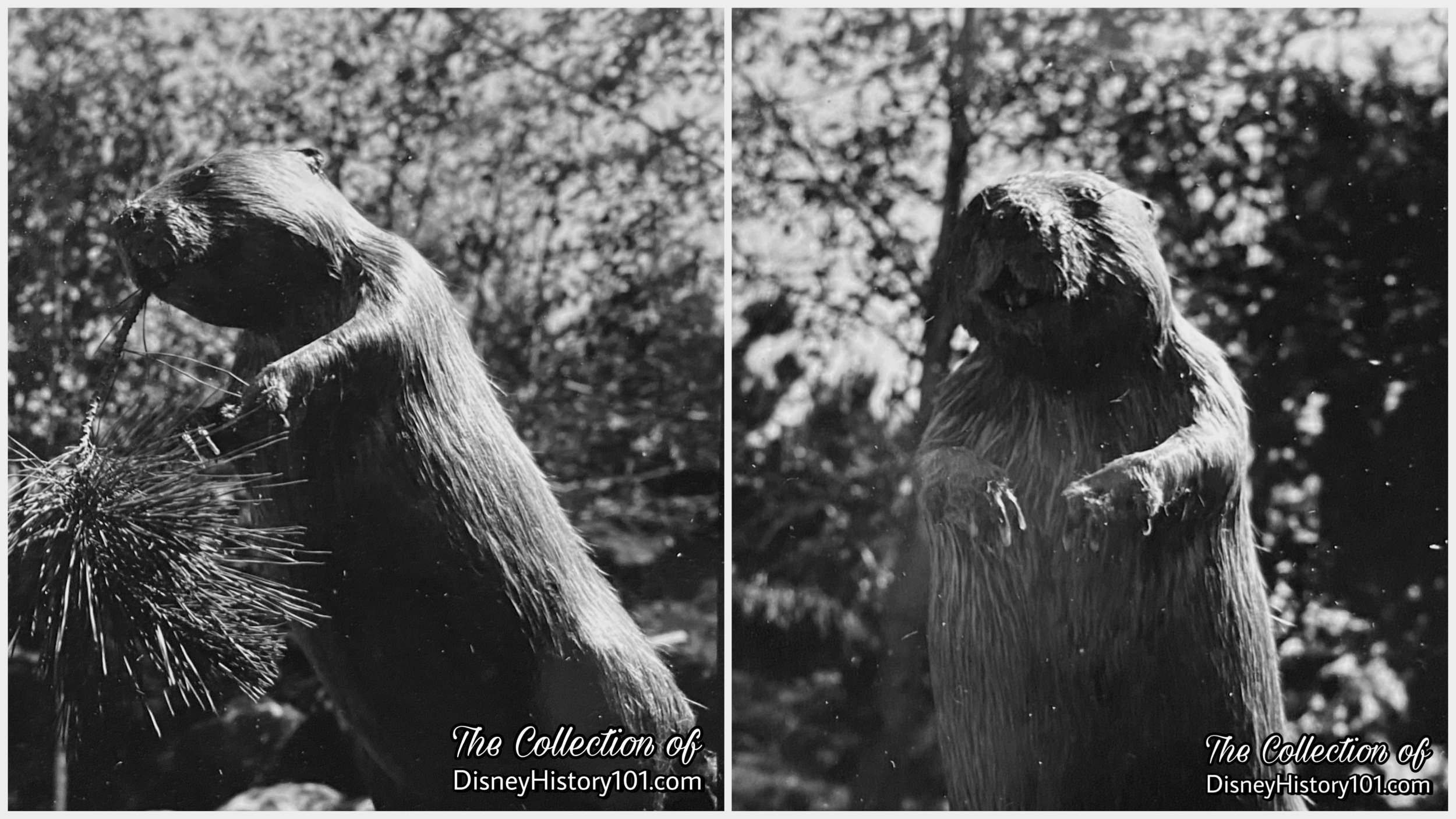
“Audio-Animatronics”
Developed by WED Enterprises, this amazing system utilizes pneumatics hydraulics and electronics to animate human, animal, and other three-dimenstonal figures. Many Disneyland attractions feature Audio-Animatronics figures. “The term ‘Audio-Animatronics’ was first used to describe the bears and beavers in Nature's Wonderland.”
To accomplish this show, the attraction would employ Audio-Animatronics® - the Disney-designed system that combines sound, mechanics and electronics for three-dimensional animation. The (more than two hundred) “mechanical marvels” included representatives of : Coyote, Beavers (pictured above), Frogs, Ravens, Raccoon, Prairie Dogs, Blue Jays, Black Bears, Rainbow Trout, Side Winders, Meadowlark, American Eagles, Bobcats, Owl, Burrowing Owls, Hawk, Elk, Jack Rabbit, Antelope, Gila monster, Swallows, Robins, Road Runners, Lizard, Grazing Elk, Woodpeckers, Wild Pigs, Mountain Lions, Wild Turkey, Badgers, Skunk, Fox, Quail, Ferret, Armadillo, Rattlesnakes, and Desert Tortoise. By this time, WED Enterprises, Inc. (which later created designs and held patents for Audio-Animatronics) had come a long way in making their animals move. These animated figures were not as the sophisticated Tiki Room Birds, pirates and presidents that followed, but they did have varying degrees of animation - “one or two movements to many complex body actions.” Most of this movement was accomplished through “electronic hydraulic-pneumatic” technology combined with the early “cam-lever” technology. There were hidden well - “skins” or the ground hiding metal bases. There were cement rocks (which animals were bolted to), hiding the mechanisms and self-contained hydraulics systems. Fiber-glas rocks and trunks (with doors) housed animation electronics. Other animals in the water (as fish and bears), had timer controls and proximity switches to trigger their “swimming” animations.
According to Bob Thomas (of Associated Press), “all of these [were]… formed in plastic, stuffed with mechanical innards, covered with real skins treated for weathering.” Unlike true-life animals, many of these animated characters (i.e. the Bears, Battling Elk, Prong Horn Antelope, the Mountain Lion, and even the Balancing Rocks) now “ran on timers,” typically following the script, and acting on cue when all went well. These actors were costly - for instance the Bears alone cost $64,733, the total cost of all Sheep was $29,449, all the Gray Foxes cost $2,933, and the Raccoons cost $3,294 (to highlight the value of a few). As a sidelight, part of this expense included the high cost of natural skin coverings, (which were swiftly changed to synthetic skins around 1962).
By April of 1960, the total cost of the Show had reached $1,800,000. By June of 1963, the cost of the props, dressings, and “actors” involved in this particular enormous Disneyland show was divulged in one publication, at a total of $2,581,000 - surpassing “the original combined cost of the Statue of Liberty, Grant’s Tomb, and the original production of Ben Hur”. Due to the large audience at Disneyland, many of these were conveniently inspected by Walt Disney at his Walt Disney Studio in Burbank. You may recall seeing images of Walt and Bob Sewell inspecting Mountain Lions, or Walt and Wathel Rogers inspecting scaled-down models of animated elk during this time.
The DISNEYLAND ENGINEERING DEPARTMENT was the coordinating group working between the world's most unusual creative organization - WED - and the world's most unique maintenance organization. Disneyland engineers work closely with maintenance artisans and WED personnel, who are responsible for the show at Disneyland. A conventional routine directed engineer may become involved in a bear who isn't properly scratching his back or some other critter. The Disneyland welding department staff was capable of working on all types of metal and using all types of welding techniques. They had to be flexible, fast, and ingenious, with a specific skill in performing ten rush jobs at one time. The staff performed their surgical work on crabs, elephants, hippos, battling elks, drunken pirates, and dancing dolls in Small World.
Bud Washo remembered how Walt would even act out animation. “I remember working on the Painted Desert and we were talking about the bobcat on top of the big cactus. He would stand up there and lift his hands up like paws, and he said...I want it to go ARRGGG!..like that.”
“Disney's technicians have done well --- too well, in fact. The birds in Nature's Wonderland are so realistic that blackbirds (real ones) have been attacking ravens (animated variety) perched in the trees of Nature's Wonderland. Owls (Disney created) are being pecked into the repair shops by frustrated crows and blackbirds (live ones). And to top it off, a nest of baby red-tail hawks --- the realistic but unreal kind - so confused a mother bird flying overhead that she tried to deposit her own children's dinner down the throats of the young hawks! Wathel Rogers, a Disneyland animator, just shakes his head in puzzlement. ‘These migrating birds flying through Nature's Wonderland are a sight,’ he says, ‘They swoop down like dive bombers on the attack, sink their beaks into a raven's wing and take off as though someone had fed them a loaded worm. Then, from a tree nearby, they stare at the raven and try to figure out why he doesn't fight back!‘ The casualty report includes three ravens in Disneyland repair docks for shattered wings, an owl with a busted beak, and feathers all over the place. Live bird injuries have been restricted to wounded pride and broken spirits. Bill Martin, project director, indicates how complicated this situation may become. ‘The other day a bird landed on my head out here. When I brushed him off, he flapped away as though he had just seen a ghost move. I guess he thought I was animated too!!’”
Those “brass-trimmed” locomotives (“patterned after the gold and silver ore carriers of a century ago) also received a rehabilitation and a new coat of paint (or two).
The result was an “all-new” exactly nine-minute (no more, no less), 2,307-foot Mine Train Thru Nature’s Wonderland route through “faithful recreations of the forest regions of Wyoming, the deserts of Arizona, and New Mexico, mountain terrain of Colorado and many other sections of western wilderness….These are dominated by Disneyland’s second great mountain, ‘Cascade Peak’, visible from almost all Frontierland and easily recognized by its giant waterfalls that plummet from rocky ledges high on its granite slopes”, according to Art Linkletter’s own description. In addition, the little mining town of Rainbow Ridge also experienced a “boom” of expansion and development as far as the highest ridge! The “D” (and ultimately “E” ticket attraction) featured multiple dramatic animatronic vignettes of “life and landscape” recreated from five of Walt Disney’s greatest True-Life Adventure movies (four of these Academy Award-winning) - Beaver Valley, The Olympic Elk, Bear Country, The Living Desert, and The Vanishing Prairie. The new attraction (which contributed toward carrying the total Park investment to $34,500,000) was both exciting and educational! Even more, it was Walt’s intention that those reflecting on “the animal world” would acquire “a renewed sense of kinship with the earth and all its inhabitants.”
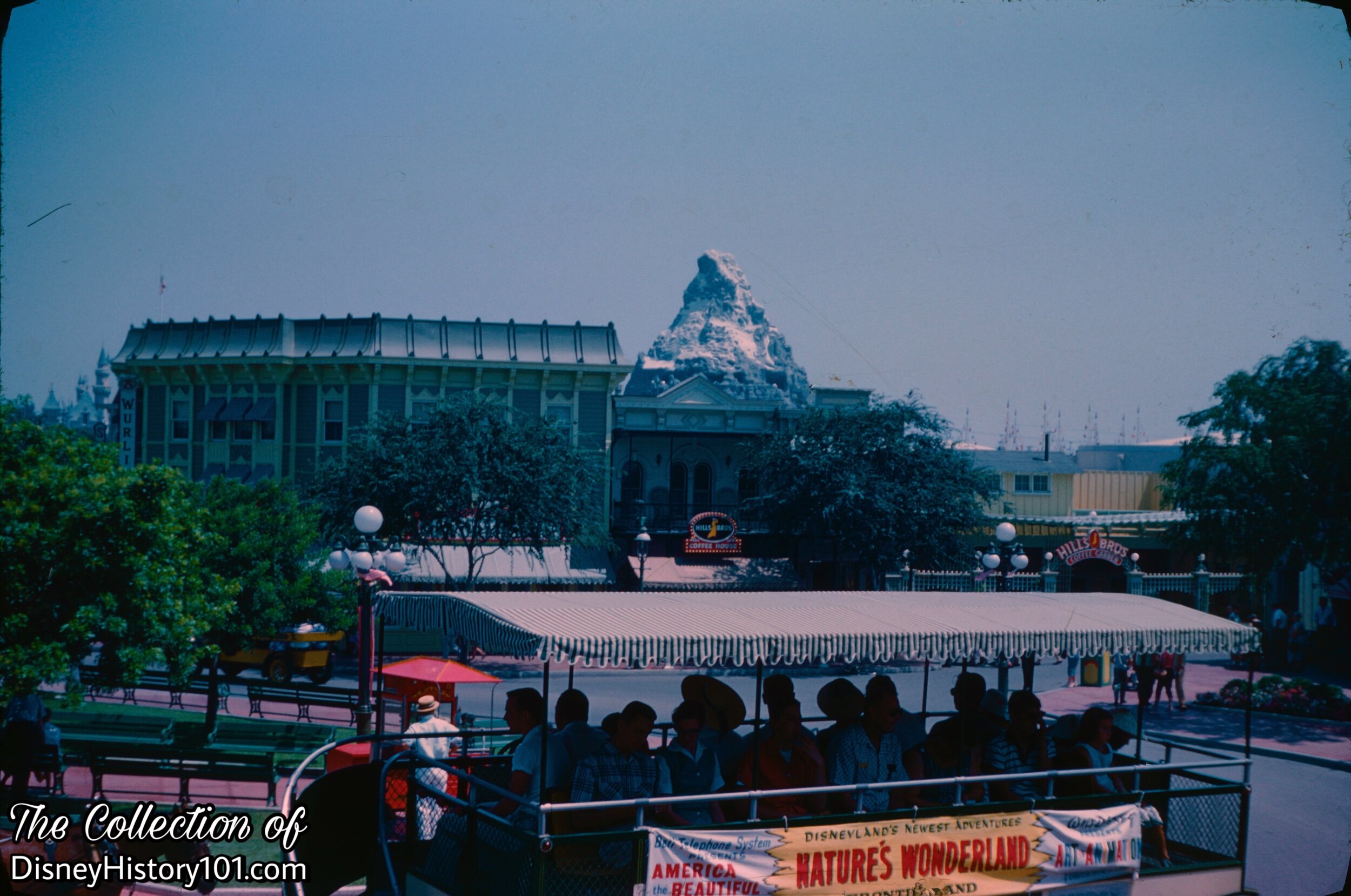
The Main Street Omnibus heralded the newest attraction of 1960 - the old-west adventure of the Mine Train Through Nature’s Wonderland!
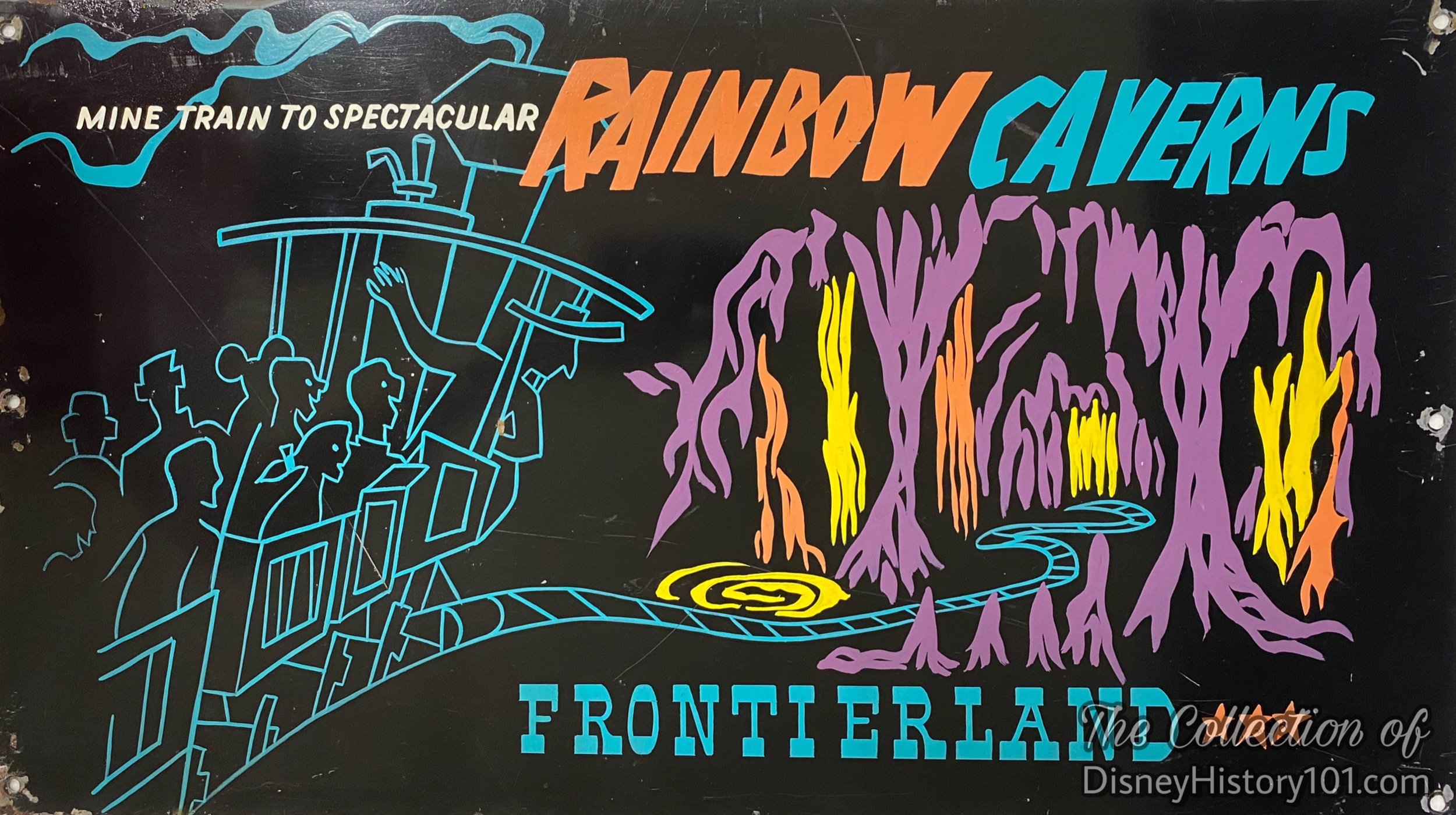
By 1960, the Guided Tour of Disneyland included a fascinating trip, via mine train, through Disneyland's newest adventure, Nature’s Wonderland.
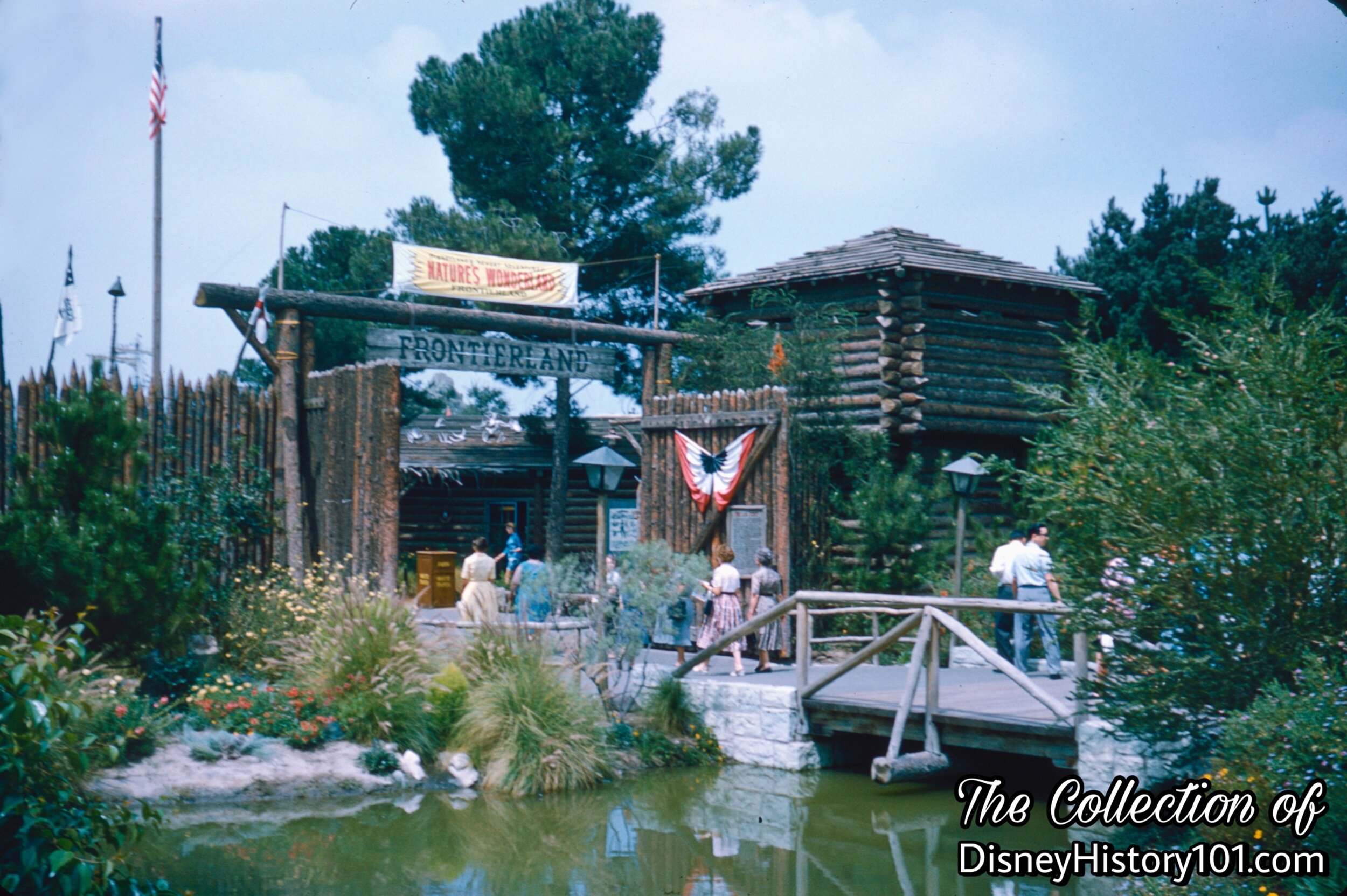
The Mine Train Thru Nature’s Wonderland received much fanfare when it opened. The Frontierland Stockade celebrated Frontierland’s newest attraction with banners and bunting! All art work, posters, etc. were created by the Walt Disney Studios.
This Operating Guide/OG (approved by Dick Nunis), was created for the Ticket Sales Hostesses, Attraction Hosts and Operators, Engine Operators, Station Hosts, and Backstage Cast (of mechanics, electricians, craftsmen and others) of the Mine Train Thru Nature’s Wonderland! At seven acres and 2,307 lineal feet of track, this was Disneyland’s largest show at the time. To quote from the guide : “Now, it requires the many skills of the ‘backstage’ crew who maintain this attraction, and the ‘story telling’ skills of the ‘on stage’ crew to put on a ‘good show’.” From time to time, we’ll refer to this guide and “outline…the specific procedures for this attraction….to tell a good story.” We’re told, “your guests will appreciate it”.
Those trees behind the frontier town of Rainbow Ridge obscure the turn-of-the-century Main Street U.S.A. and Matterhorn mountain from guests. Note the Matterhorn in the following photo.
There were three ticket booths - FRONTIERLAND CENTRAL TICKET BOOTH #1 (FRITO AREA), FRONTIERLAND CENTRAL TICKET BOOTH #2 (BURRO AREA), and FRONTIERLAND CENTRAL TICKET BOOTH #3 (PLANTATION AREA). According to manuals (published, 1964), Ticket Sales Hostesses were (invariably) girls. These provided information for both the Mine Train Thru Nature’s Wonderland and the Mule Packs.
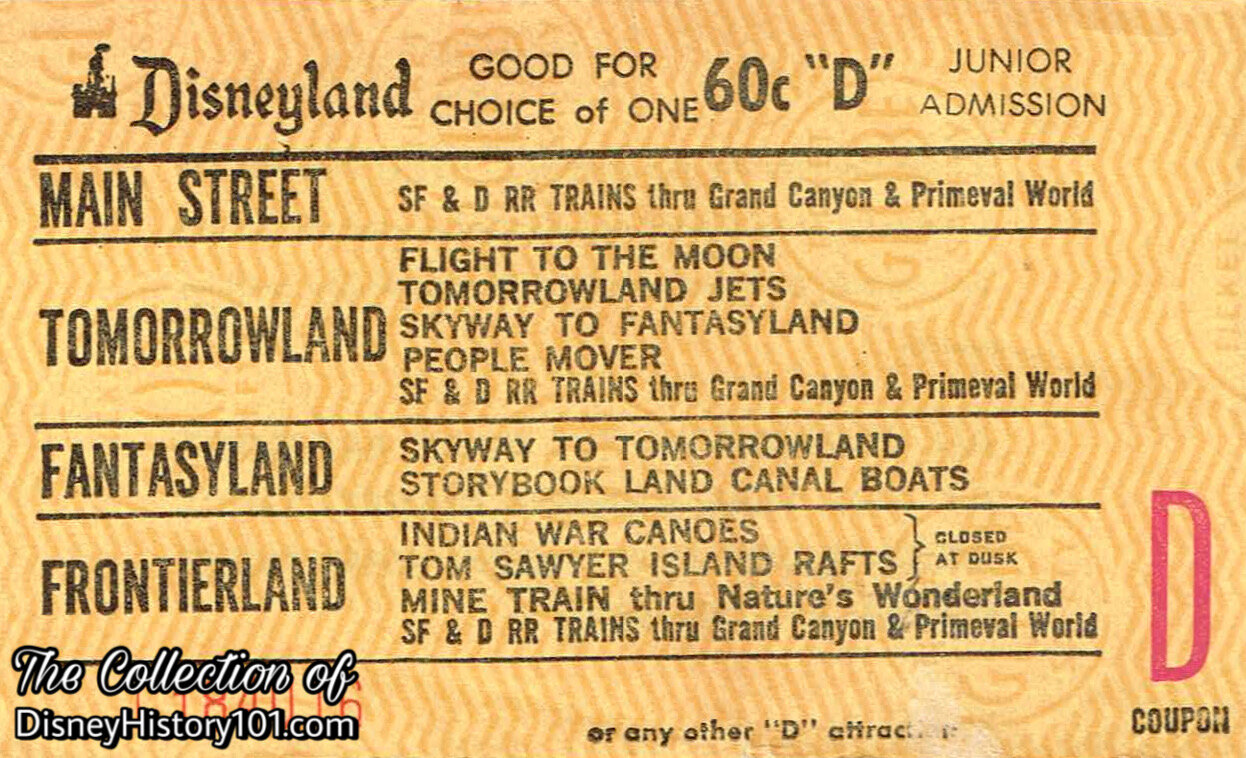
In 1958, admission for passage aboard the Rainbow Caverns Mine Train was one “D” coupon, or 35 cents. In 1965, the cast of admission for a ride aboard the western mine train through Nature’s Wonderland, Rainbow Caverns, and much more, was exactly one “D” coupon, or 60¢.
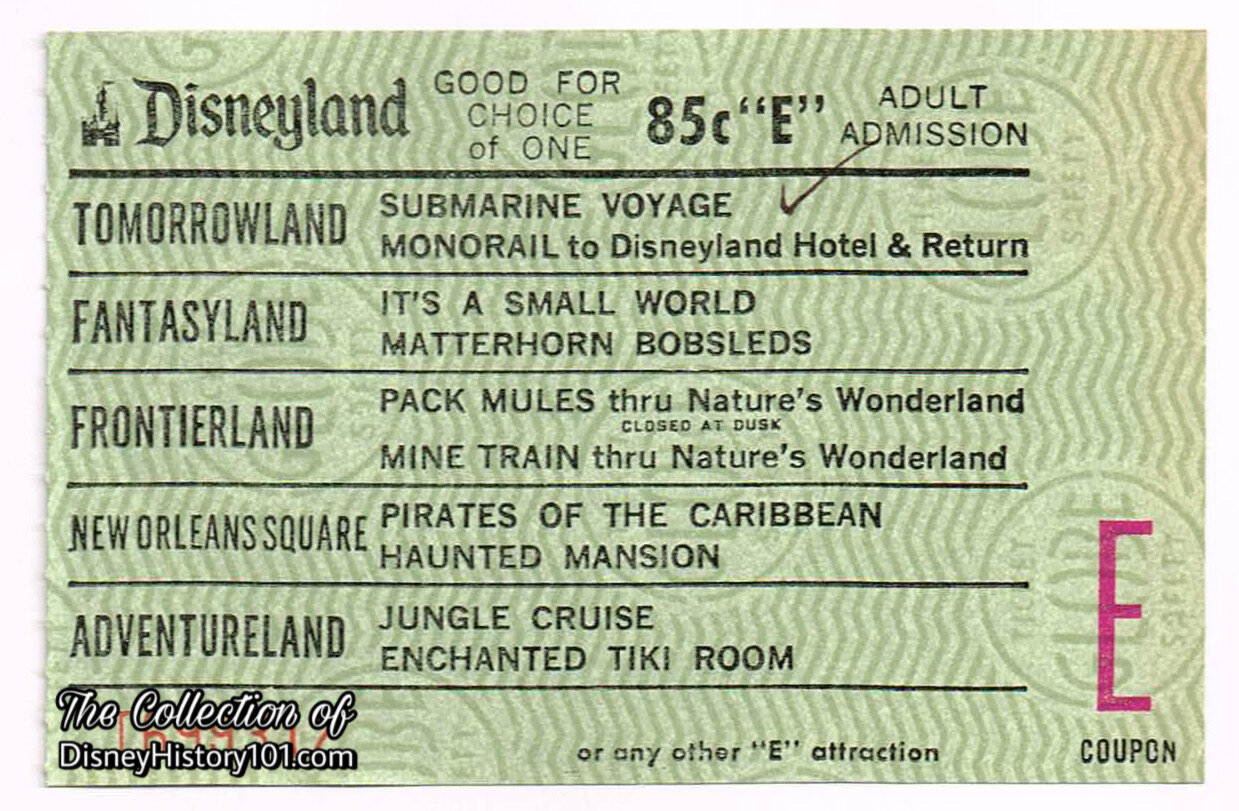
After the success of Disneyland, developers of the amusement centers saw the benefit of a mine train attraction in their parks. On June 19, 1960, Freedom Land, U.S.A. opened in the Baychester Area of Bronx, New York, an entertainment center “founded on the inspiring story of America and its people”. One of its opening day attractions was a Mine Caverns: underground ride in its “Old Southwest: 1890“ Area.
Welcome to the “little” mining town of Rainbow Ridge! If’n ya want ta see just how small it is, just make yer way towards those buildings up in the hills. Walt Disney’s Imagineers employed “forced perspective” and landscaping techniques to give the town depth! Art Director Bill Martin generated many conceptual drawings of Rainbow Ridge.
“Audience Waiting Areas” are especially designed as part of the attraction to make the guest's time waiting in line as comfortable as possible. Before we head out into the Painted Desert, we pause to look at a few Wanted Posters (perhaps hung by resident U.S. Marshall Willard P. Bounds). Be on the lookout for more of these scoundrels around the town of Rainbow Ridge. Why, only a few moments ago, the local sheriff engaged in a stand off with the villainous Black Bart after he robbed the Golden Horseshoe’s receipts and took off on foot near the outskirts of Rainbow Ridge! Of course, real vintage wanted posters didn’t have photographs on them as this would have been problematic considering the printing process of the era.
You’ll notice that nothing stops these little mine trains from running (not even a little minor refurbishment to the structures of Rainbow Ridge)!
This is the last chance to stock up on supplies before heading out into the rugged wilderness.
The sounds of the lively Rainbow Ridge can be heard as we make our way through town.
“Last Chance” for a couple of burly Mine Train engineers, before embarking on a routine excursion into Nature’s Wonderland!
You can blame it on the Walt Disney Production. Like many Frontierland elements (like Pecos Bill and Slue Foot Sue), the look of Pat Casey’s Last Chance was partially derived from designs used in backgrounds created for the Pecos Bill segment of Melody Time (1948). As a final (and loyal) touch to set the Stage, 36-star flags hang around this little mining town!

Before you come aboard, we’d like to introduce you to a very special Mine Train conductor Frank Mc Nell - an original and founding member of the Order of the Red Hankerchief - one of Disneyland’s oldest unsanctioned employee organizations! Thirty-six original members who operated the Mine Train Through Rainbow Caverns (like Ray Van de Warker) founded this organization during February of 1964. Many notable Disneylanders had a privileged part in the Mine Train rotation - the set order of operating positions established by the attraction's Working Lead. A total of 256 cast members would ultimately join (like George Kissinger, Clay Mitchell, John McCoy, and so many others). We just have one question - where’s Frank’s handkerchief?
Another distinguished title was that of “Most Mine Train Derailments”, a title held by Ron Dominguez (due to forgetting “to throw the switch”), according to accounts of Ray Van de Warker (to Disneyland LINE magazine, Vol. 25, No. 28). Ron Dominguez went from the Mine Train to the Director of Disneyland Operations.
Many a Disneylander has operated a Mine Train, including Frank Block (c.1966; former Submarine Captain).
“As we head for the wilderness, a couple of suggestions - please stay seated at all times…”
“…and [please] keep your hands and arms inside the train. The animals get mighty hungry. And uh, no smoking please, ‘cause we don’t want to start a forest fire.”
Guests are grouped, loaded, and (once aboard) the five gondola doors are safely “buttoned” closed. Once complete, the Ticket Receptionist hollers “All Aboard”, and a dispatch signal to the Engine Operator!
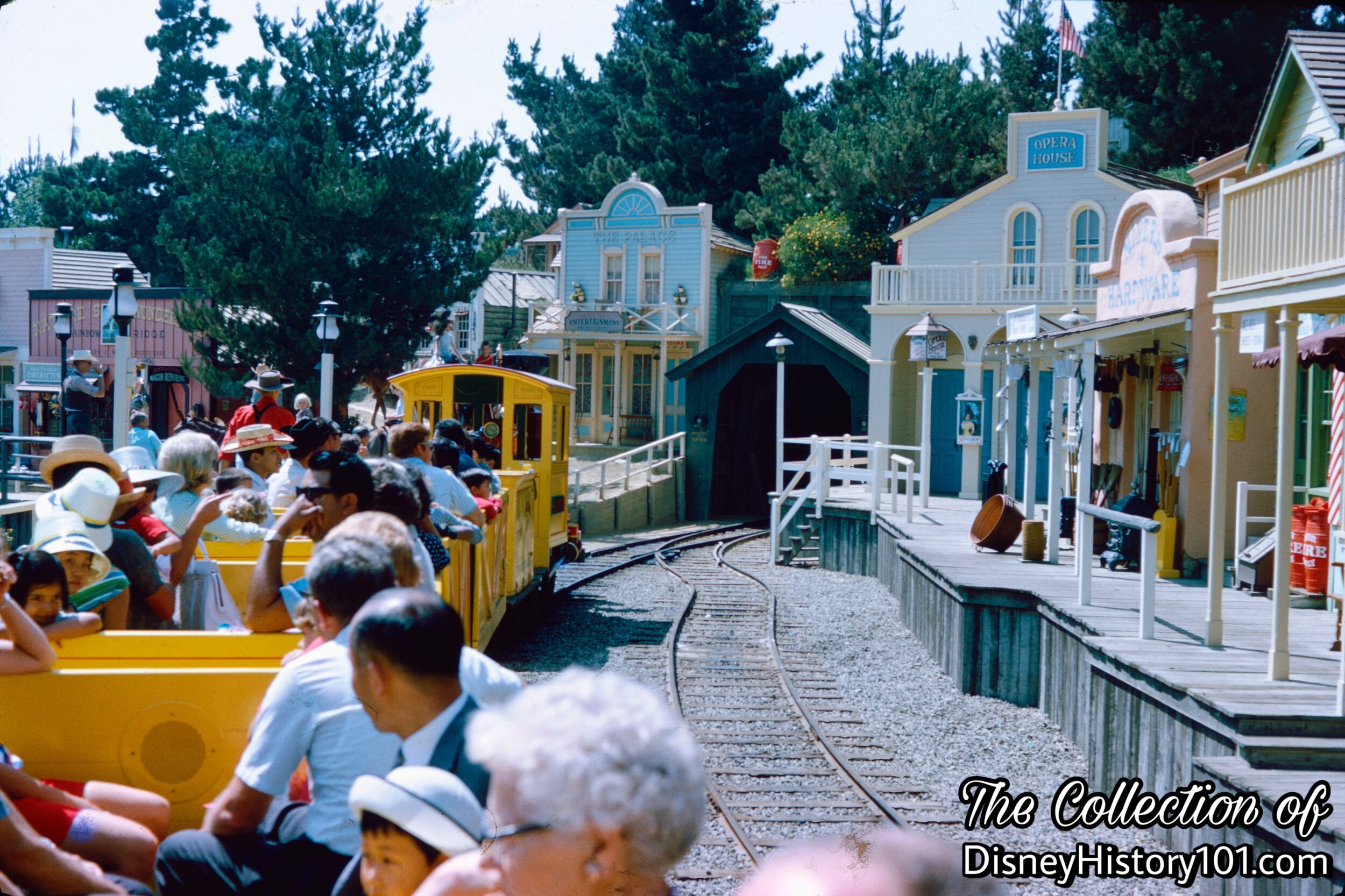
Now that each ten-passenger car is loaded to capacity, we’ll get on our way!
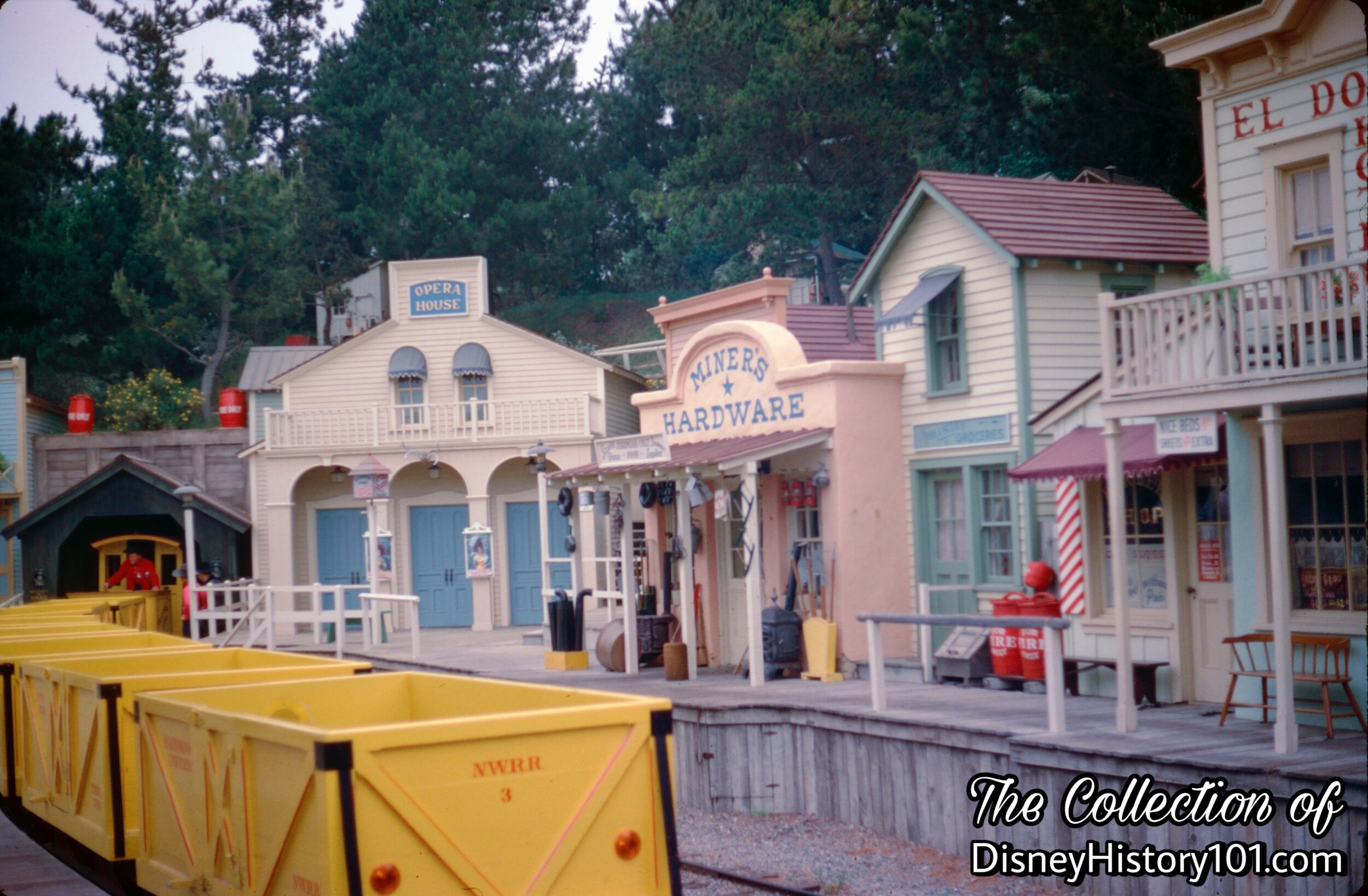
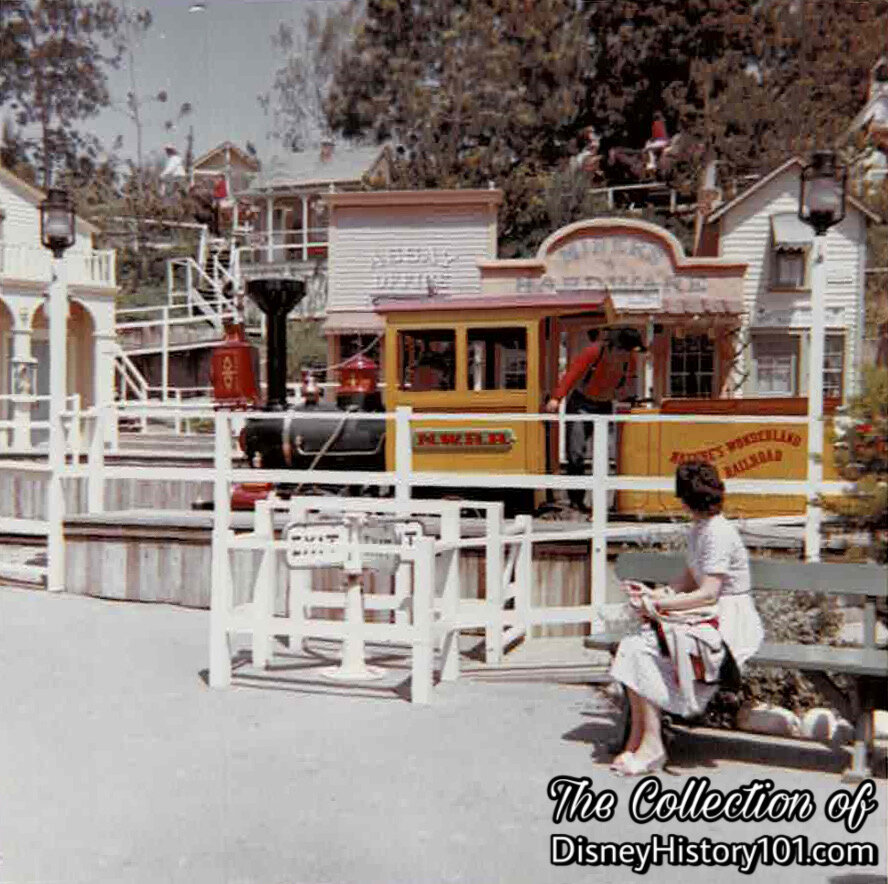
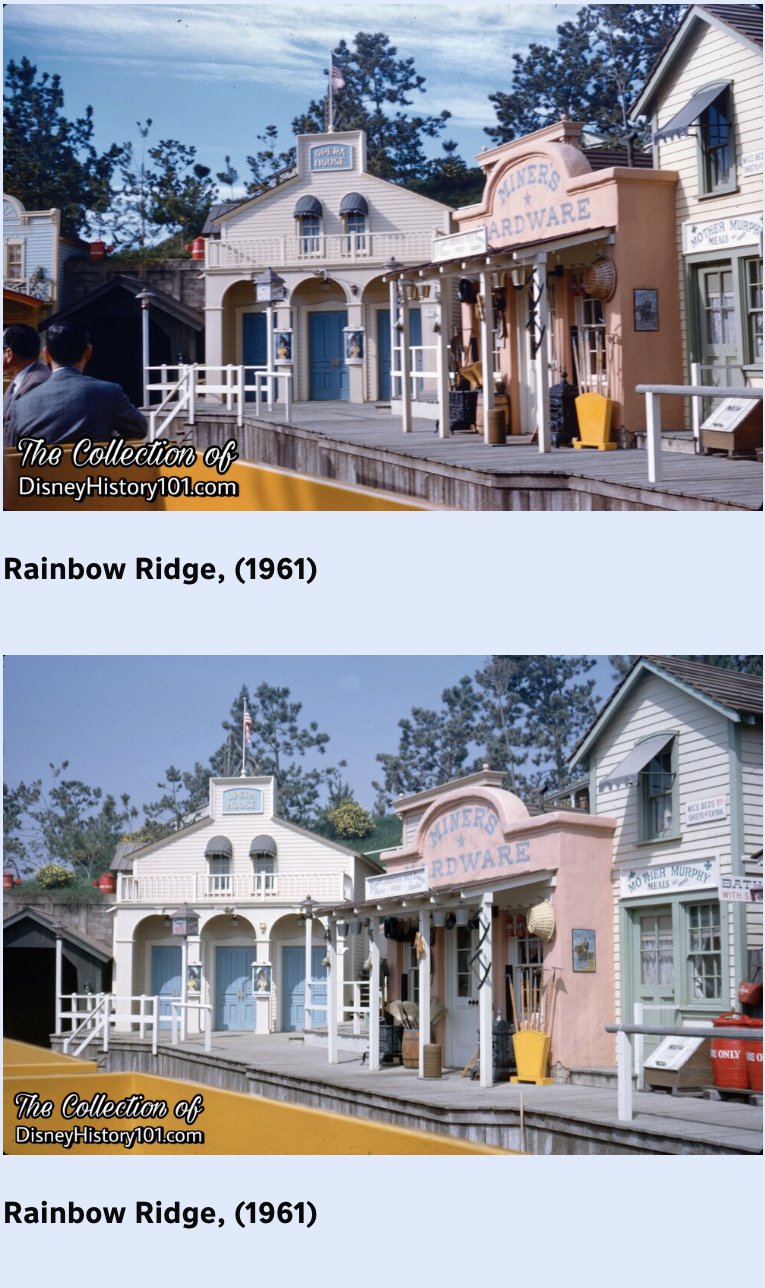
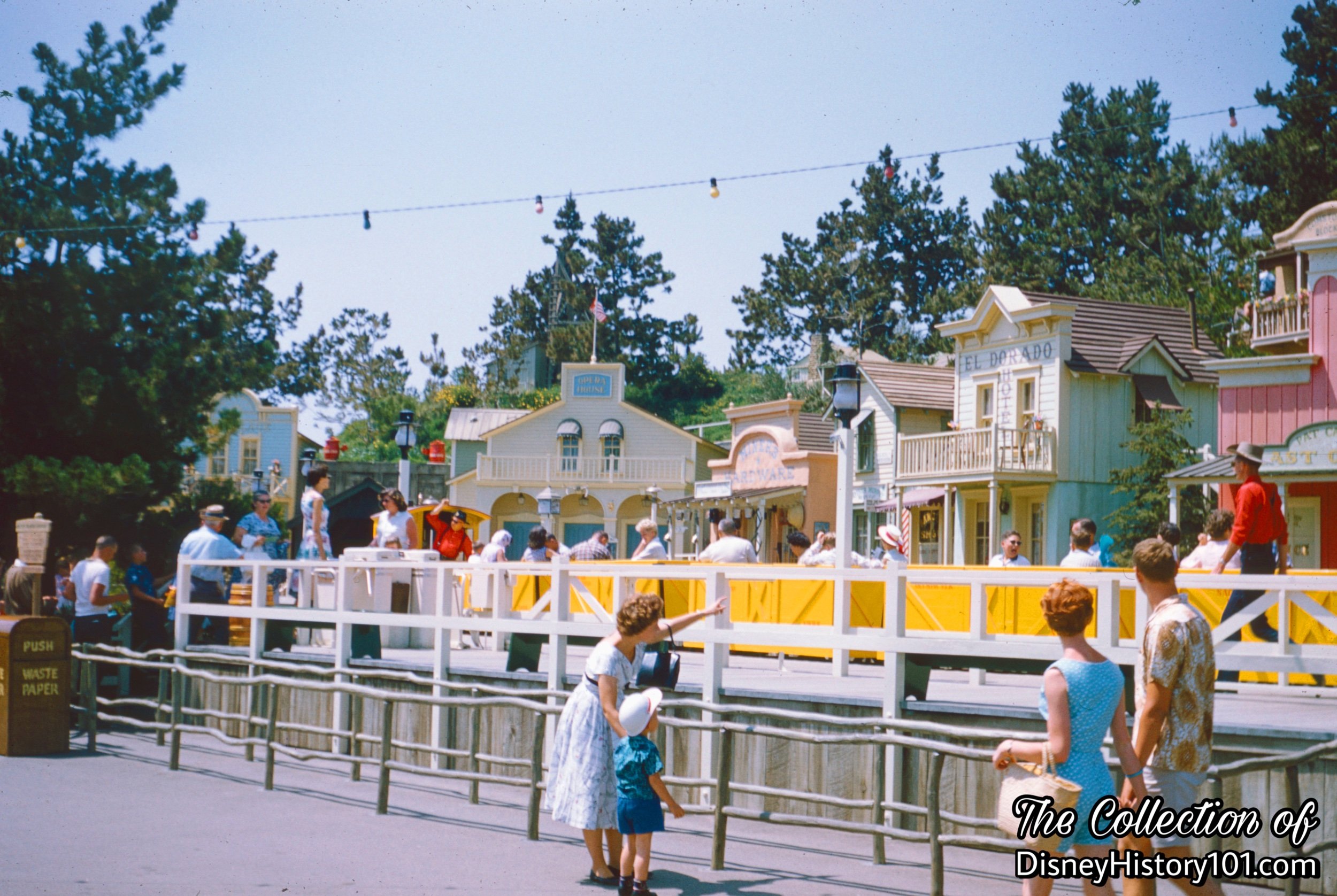
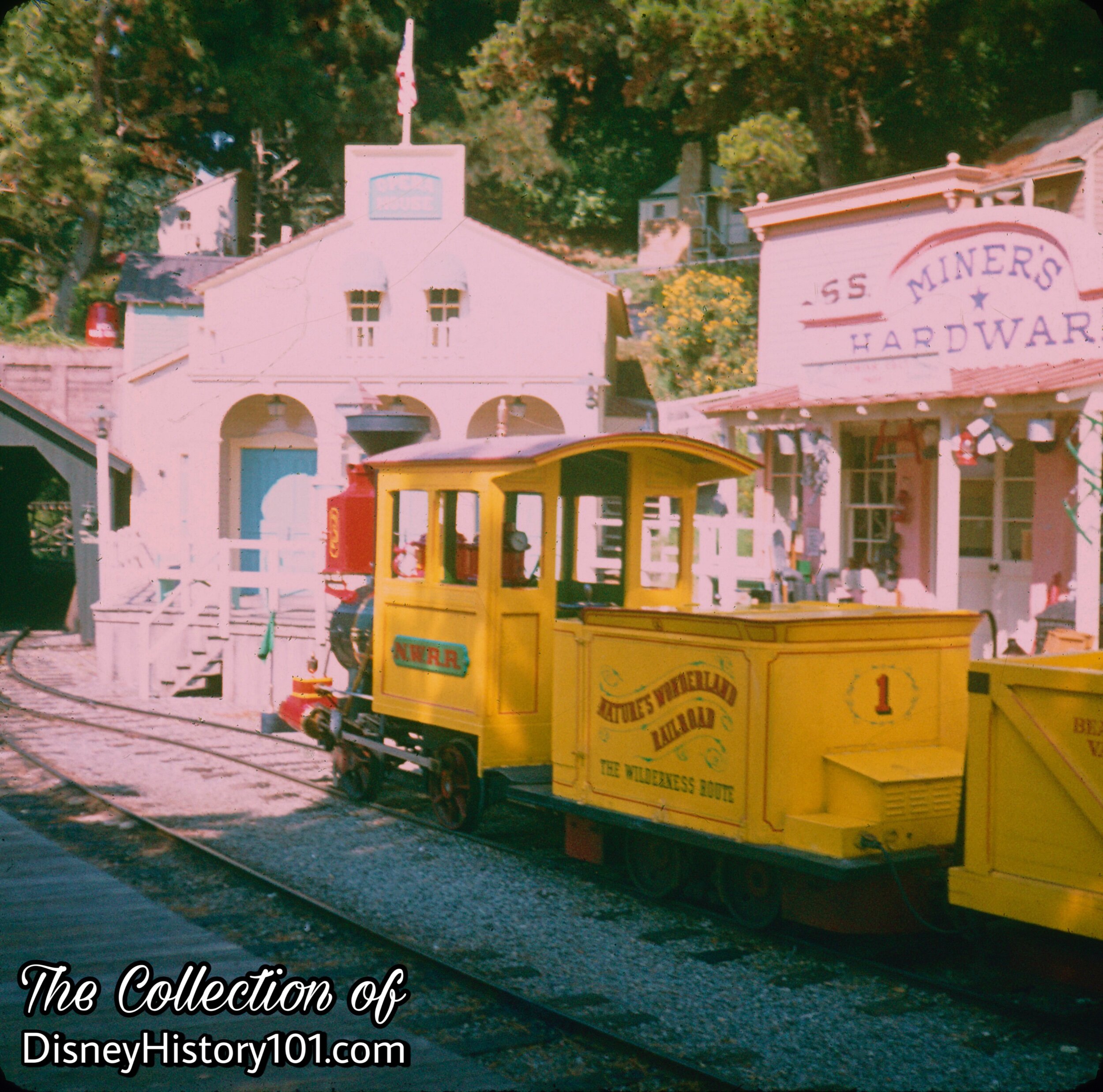
This is the “Center Stage” of Nature’s Wonderland’s big show, the boarding and unloading area - a typical little California mining town of California’s “gold rush era”! Today, mine train engines and gondolas from this era are typically observed in the Northern California area, (of course) with the exception of Disneyland’s bright and shiny Mine Train Thru Nature’s Wonderland, in Southern California.
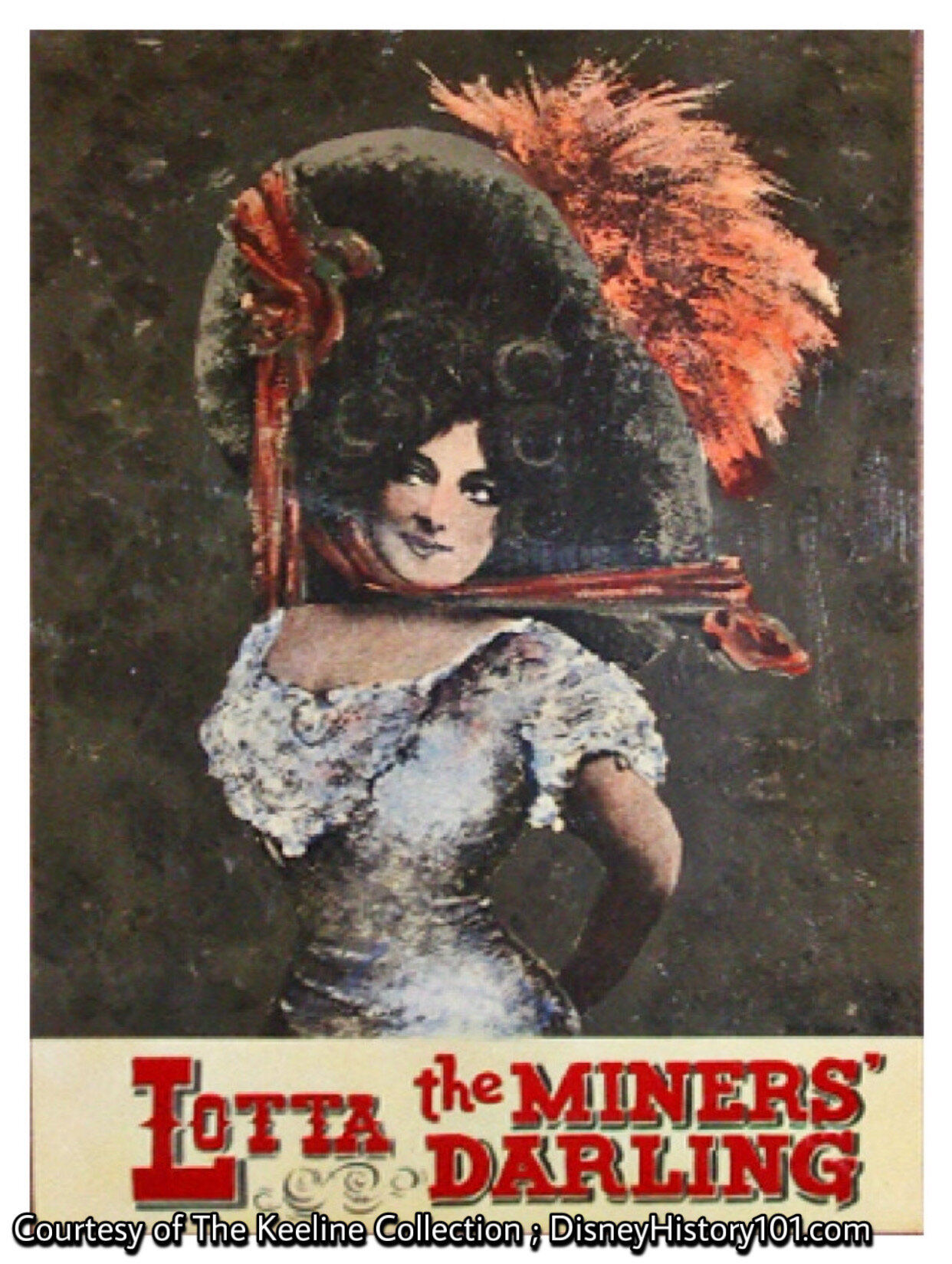
While the Golden Horseshoe Saloon has Slue Foot Sue, “Lotta the Miner’s Darling” performs daily (for your entertainment) in Rainbow Ridge. In fact that’s her voice emanating from the Raintbow Ridge Opera House now!
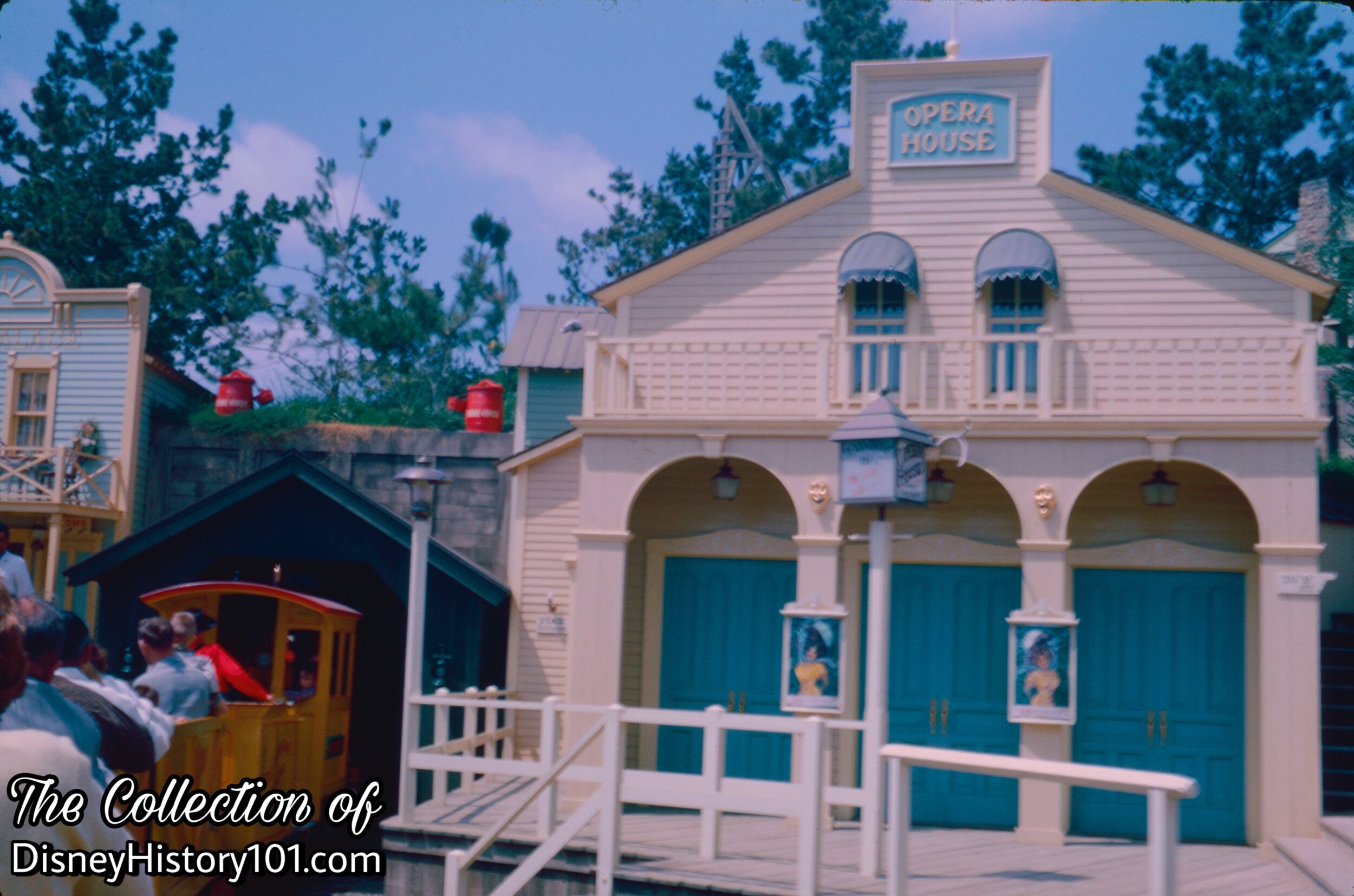
“As the passenger on the Nature's Wonderland Railroad emerges from the first tunnel on the mine ride, he sees beavers at work on their local dam project. Pine trees framing the scene are a mixture of Montereys from California and Aleppos from the Holy Land. The birch trees are from Europe, the cottonwoods from southwest United States. The mountain meadows of California supplied the thick stands of rushes found along the river. The other curious reed at the water's edge, known as "horsetail; is an old-time resident of the United States. It dates back about 40 million years, according to the paleontolo-gists. We also have native water primrose, which we inherited -it just crept out of the mud and joined us.” [Disneyland World of Flowers by Morgan Evans]
You may be wonderin’ who that little “rascal” is. “That little fellow…is one of your new friends in Nature’s Wonderland. No its not your foreman or supervisor ; its a Beaver, and he’s one of 200 of nature’s characters assigned to your stage,” according to Dick Nunis, Director of Operations. In fact, some 11 Beavers populate Nature’s Wonderland, turning heads, as they tug branches toward their dam, and dive in the water. Some of these show scenes were inspired by “In Beaver Valley,” 1951 Academy Award winning Best Two-Reel Subject of 1950.
You know, Walt Disney once said, “Animals have personalities like people and must be studied,” [Wisdom magazine, December, 1959]. “As we come out of this first tunnel, we’ll be entering Beaver Valley…”. It looks like these little fellows are “busy as a beaver”. Walt shared one observation and lesson he’d learned from the beaver this way: “Everyone needs deadlines. Even the beavers. They loaf around all summer, but when they are faced with the winter deadline, they work like fury. If we didn’t have deadlines, we’d stagnate.”
Speaking of deadlines, we’d better keep this scheduled train tour on the move.
You know what sends these waters over the dam? In reality, a 65 horsepower pump produces more than 3,800 gallons of water over Beaver Valley waterways, per minute. Some of the effects are owed to the power of water. “Beavers building a dam…swimming, diving, and carrying branches to their home in life-like fashion, these beavers are moved along on underwater tracks by means of a water jet. The flow from the jet is kept constant, assuring a smooth swimming action, by a pressure-reducing valve which is hidden and partially submerged in the beaver dam”, according to one ServiSoft Exchange periodical.
Many year later, people would populate a trail running through this area, clear from Frontierland to Fantasyland. For now, it’s home to this little rascal.
Most of the rocks and the mountains in Disneyland were products of the Staff Shop.
By 1974, the falls would recycle some of the 11 million gallons of water that comprise the Rivers of America.

The Tunnel from Beaver Valley lets out onto the Rivers of America, where we began to round Cascade Peak, with its roaring waterfalls!
“Now, beyond these hills lies Nature’s Wonderland. Yer apt to see a whole lot a wildlife, so keep a real sharp “hunter’s eye” .

We’re heading towards Disneyland’s 75-foot-tall “second great mountain, ‘Cascade Peak’…easily recognized by the giant waterfalls that plummet from rocky ledges high on its granite slopes”, as described by Vacationland (Summer, 1960). “If ya never gone beneath a waterfall before, then get set cause we’re comin’ up on Big Thunder - the biggest falls in all these here parts!”
Keep a real sharp “hunters eye”, because you’re about to see one of the rarest Audio Animatronic creatures to ever set foot in Frontierland. We present the Mountain Goat near the top of the 75-foot RockWork of Cascade Mountain! The Mountain Goat had been spotted at the top of Cascade Peak, the Bounding Deer atop Rainbow Mountain over Beaver Valley, while the Bounding Big Horn Sheep were seen briefly along the Mule Train Trail in Beaver Valley). The Bounding Big Horn Sheep was even so prominently featured on the poster artwork for the Nature’s Wonderland Rail Road (which was modeled after the circa 1869 “Union Pacific Platte Valley Route Grand Opening” poster), which can be seen on the “Disneyland ‘60” handbills given to guests at the Main Gate! According to Bob Gurr’s True-Life tale, their bounding would spook the mule trains, so the Bounding Bighorn Sheep (atop Cascade Mountain), the three Bounding Deer (a buck, doe and fawn) at the top of Rainbow Mountain, as well as Mountain Goats would silently disappear within a month of the start of Mine Trains Thru Nature’s Wonderland. Similar precautions were taken by the Mine Train operators to not spook the mules with the bells or whistles.
“MATT LEIKER REALLY REMEMBERS SEEING SOMETHING ATOP CASCADE PEAK, c. 1990”
“Finally!!!! Something I have wondered about for over twenty years gets answered!!! When I was a trainer on Big Thunder Mountain Railroad in the early 90s I used to hop the fence with my trainees and take ‘em out to explore the mule trails. I would also take ‘em inside Cascade Peak and we’d climb the ladder and exit outside the top for the view. As soon as we would emerge there was a rusted base, and parts of a mechanical contraption that you can tell once held some sort of object that would move or rock back and forth. Vintage Disneyland photos and history are everywhere now but back in the pre-internet days of 1994 there was absolutely no place to find out what was once there. I sometimes marvel at that…how even while working at the park, there were really no sources for quality park history or people around who knew (or even cared) what much of the old stuff was. The best you could ever find were framed photos of old attractions adorning the walls of a scheduling office but even those were usually the same tired staged photos that were used and reused in the souvenir guide books through the years.
Anyway…I continued to wonder about this for years, always studying every old photo or postcard of the peak, looking for a sign of some animatronic, balancing rock or special effect that once existed up there. Over two decades passed with no luck but I remained absolutely sure that some show element used to exist up there. Finally, today the mystery question gets answered and confirmed!!!
Thank you.”
This “natural wonder” was actually a hollow seven story frame of wood and steel. Inside Cascade Mountain, are three pumps (totaling 510 horsepower) feeding 91 tons of water into pools and into the 11-million-gallon Rivers of America! You may be wonderin’ where all that water comes from, as it seems to spill forth endlessly. Well,… Disneyland actually has several wells on property. Coupled with a supply of city water, (some of which comes as far away as Parker Dam), this truly wonderful and “natural” scene is effected!
“Them other two falls - they call The Twin Sisters. I recon that’s because they’re always babblin’!” The sheer sound of the rushing water masks the song of robins and jays in the nearby tree branches.
It doesn’t look as if we’ve had a “breakdown”, so there’s no need to call Disneyland Operations or the Disneyland Maintenance Department (though this may ultimately end up in our Daily Maintenance Report). The Brakeman generally sits in the last car in case we need to bring the train to a halt.
Milo Rainey recalled standing on a little porch on the last car and giving a live spiel.
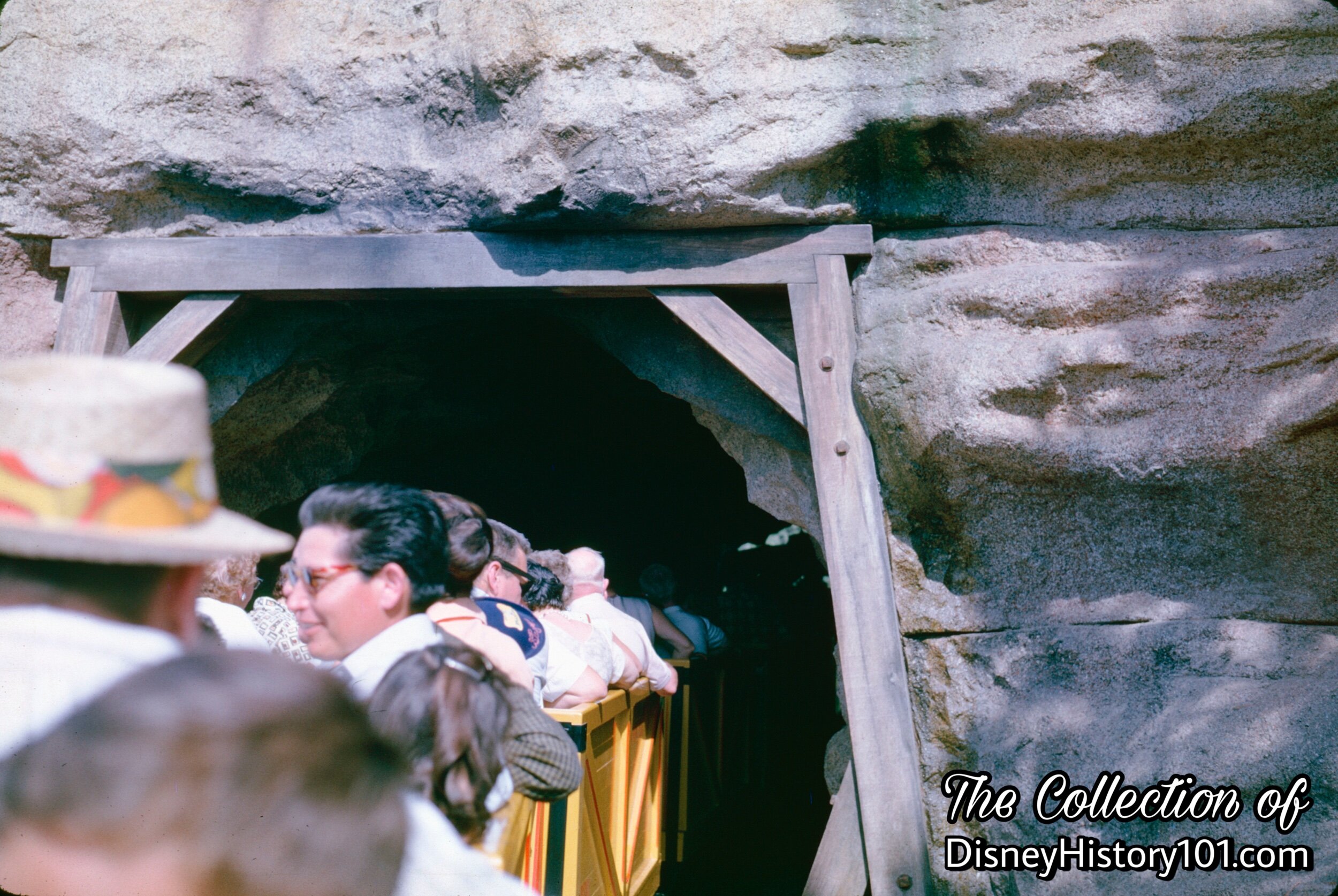
The next section of Nature’s Wonderland was inspired by the Academy First Award, Best Two-Reel Short Subject for Bear Country, 1953.
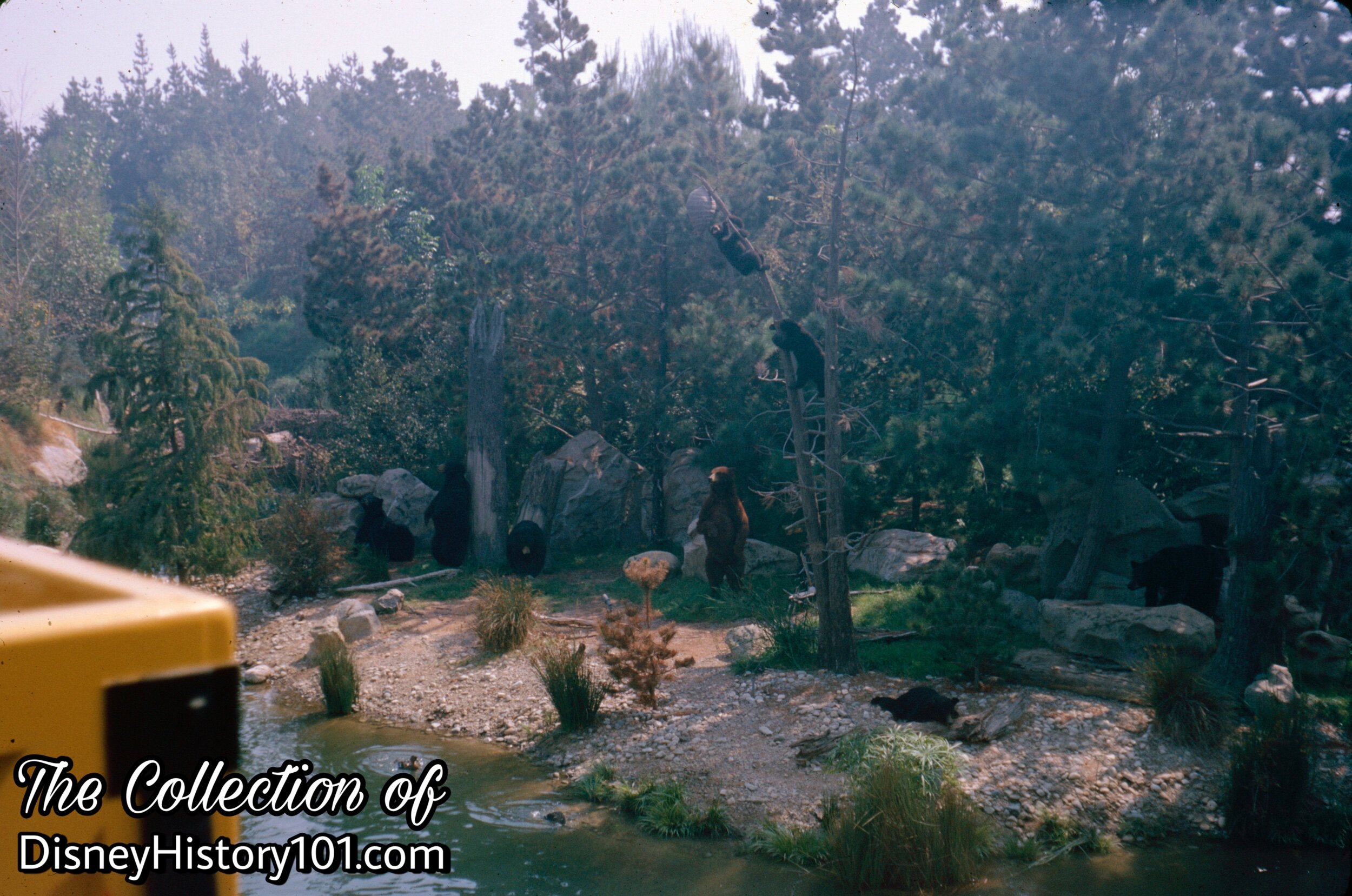
“Y’know bears is one of the most playful animals there is…lazy too. All they want to do is lay around and scratch, fish, an’ swim. That is, when they ain’t sleepin’.” Here, twelve Bears and cubs swim, fish, eat, and relax around Bear Country! Just one question - which one is “King of the Grizzlies”?
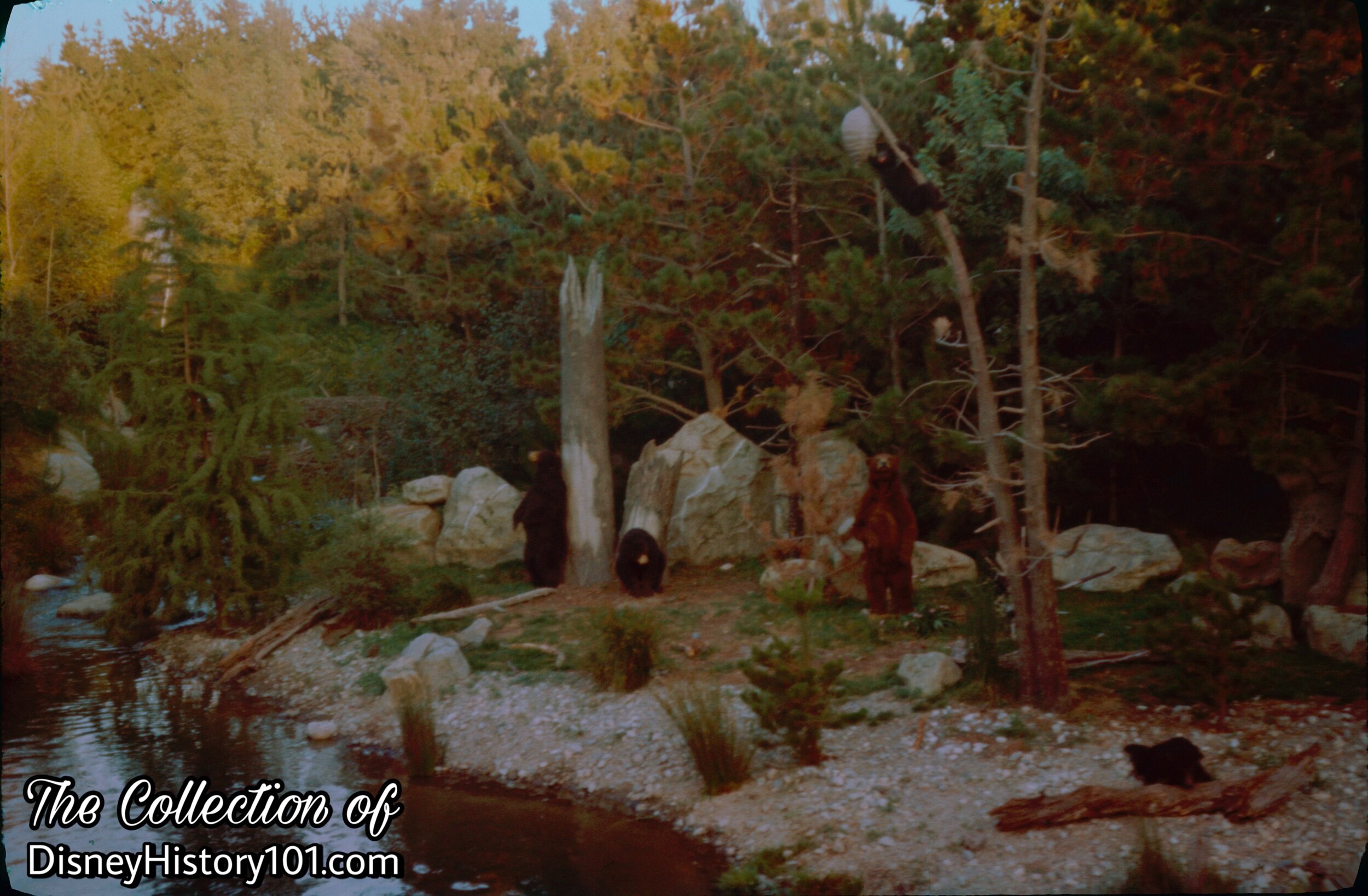
“We’re comin’ into Bear Country now folks, and while we’re crossin’ the ol’ tressle ya got ta sit real still. No tellin’ how long he’s gonna last.” Many of these “natural” vignettes were designed by Marc Davis (the same designer behind many of the Pirates of the Caribbean’s show scenes)!
If you look into the hills, you’ll notice just some of Nature’s Wonderland’s 156 different types of trees and other flora. Many of these were imported to Disneyland and placed under the direction of Landscaping employees Evans and Reeves.
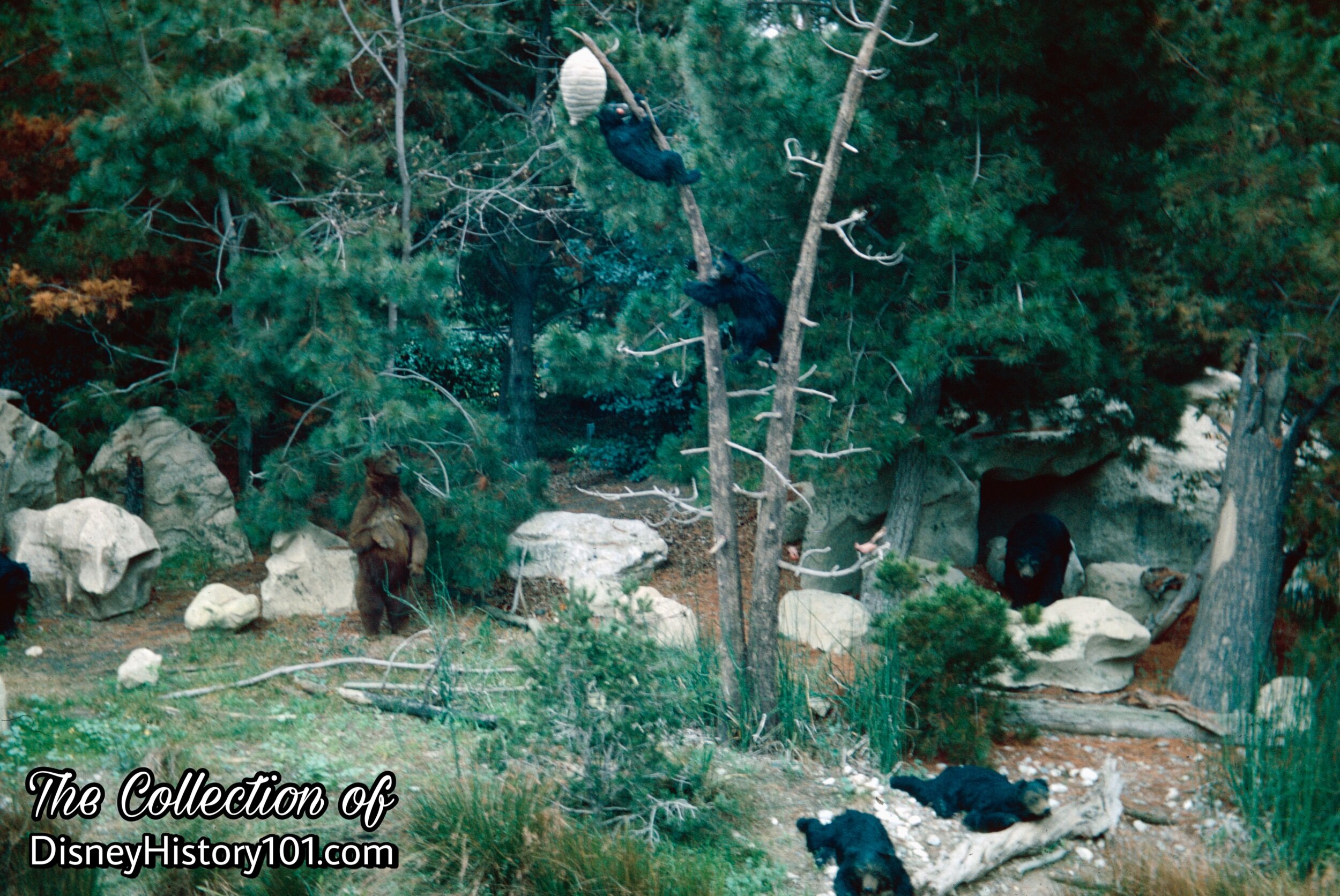
You may notice a number of rocks across the landscape, along your tour today. Many of those rocks were not manufactured at WED, but are “true-life” rocks, carefully selected, imported, and “installed under the direction of a WED Enterprises Art Director”.


If you look off to the sides of the wooden trestle bridge, you’ll notice two swimming bears (one on each side of the Mine Train).
This was the scene as the train passed along a timber trestle over Bear Country. Some of these same jumping fish still inhabit an area near Big Thunder Mountain.
As we get to the other side of the wooden trestle, we hear what appears to be the sound of branches breaking.
On the right, at the end of the trestle, we get quite a show!
“Y’know Nature’s Wonerland can be awful pretty but sometimes she can be a mighty rugged place ta live. Out here in the wilderness, the struggle for survival leaves only the strong and sometimes the lucky. Say, look on that bank across Bear Creek there - now there’s a real struggle for survival. Two stags are battlin’ for them Cow Elk.”
The battling Olympic Elk scene was derived loosely on an exciting scene in the 1952 RKO release The Olympic Elk - a True Life Adventure presented by Walt Disney Studios. Like most films of the True-Life Adventures series, The Olympic Elk “presented the strange facts about the world we live in”, and was directed by James Algar, produced by Ben Sharpsteen, with some script by Winston Hibler and others. Unlike Disneyland’s big show, the films were “photographed in their natural settings” and were “completely authentic, unstated, and unrehearsed” - or, so read the opening dialogue.
True-life Bull Elk maneuver harems of cow elk as they migrate and graze through meadow pastures and mountainsides. Challengers occasionally gather and ambitiously confront the herd of Bull Elk, where they engage in combat, and perchance become antler-locked.
Here at Disneyland, these six animated elk recreate the drama for passengers of mine trains. The Disneyland Welding Department would occasionally perform surgical work on the battling elks.

Ward Kimball would sure agree, that it is “tough to be a bird” in Nature’s Wonderland. A chorus sound of Meadow Larks, Mocking Birds, and Thrush can be heard in the distance as we come upon a sight - a hungry Bobcat attempting to ascend to the nest of a family of Red Tail Hawks!
Disneylander and “55er” John Gerlack recalled: “My job was to WAKE UP' the NATURE'S WONDERLAND birds. You see, their beak's mechanism would get rusty and they couldn't sing very well. I would hold the bird's beak open with one hand and with an eye dropper in the other hand, I would squirt some lubricating oil into the beak. Well, one Sunday, while I was at my bird waking chores, Walt slipped up silently and said, ‘How ya doin, Doc?’”
You may have heard the true-life tale of how the “nest of baby red-tail hawks (animated ones) so confused a mother hawk (real) that she tried to deposit dinner down their throats.” [Walt’s Animation Is Too Successful, Associated Press]
Not every animal character had a name, so I’ve decided to call the large bird “Hootsie the Owl.” You may have also heard another true-life account of how “Hootsie” and other owls around Nature’s Wonderland were “being pecked into the repair shops by frustrated but real crows and blackbirds.” This sort of thing was happening as far back as 1964, according to “Walt Disney Disneyland,” page 44, printed by Officine Grafiche Arnoldo Mondadori - Verona; first published 1964. It’s a fact that the Blackbirds have also been known to attack animated ravens around these Frontier parts. [Walt’s Animation Is Too Successful, Associated Press]
Moose in thicket.
As we pass through ol’ Natural Arch Bridge, a passing Mule Train looks upon the great Living Desert down below. This portion of Nature’s Wonderland was inspired by the Academy First Award, Best Documentary Feature for The Living Desert, 1953.
As we pass through Natural Arch Bridge, we’ll refrain from blowing our whistle or ringing the bell of the engine. We also ask our guests to maintain their silence. The reason, is so as not to disturb the mule train crossing overhead.
Y’know, the desert’s a dry place, and full of some pretty mean varmints. It looks as if a herd of Pronghorn Antelope have made their way toward Desert Pond - a water source in the Living Desert! But, they’re being followed.
“But the desert’s got her beauty too! The yeller streaks runnin’ through them sandstone cliffs are called Coconino. The red we call them supai.”
“A Living Desert must, in truth, appear as a living desert”, reads the forward of Disneyland World of Flowers (published 1965), by Morgan Evans. This area of the Painted Desert was modeled after the American Southwest with reddish rock, sandy plateaus, cactus, and Joshua Trees.
“The desert heat sometimes gets to ya, and makes these here cactus take on strange shapes like animals and sometimes even people.”
“Now ahead of us folks, is a Giant Saguaro Cactus Forest!”
These colorful desert blooms stay fresh all year round!
This scene of a tweed bobcat atop a cactus was taken from Walt Disney’s Academy Award-winning “The Living Desert”.

Geyser Country features four geysers (including Old Unfaithful) that operate from an underwater deep well pump that pressurized air and water.
“A Real Mystery of the Desert”
“Say, ever hear of the Devil’s Paintpots? (You can see them off in the distance there.) REAL mystery of the desert - bubblin’ pots o’ mud in all kinds o’ colors”, (unless you read Popular Mechanics of November, 1957)!
These thermal fissures appear to throw bubbling, steaming multicolored lava up through the crust, only to be caught in cauldrons of yellow, rust, and blue, adding “a note of color” to the desert! According to conceptual artwork (published in Popular Mechanics, November of 1957), an underground air compressor sends air from a storage tank to a specially designed manifold (which releases varying amounts of air at intervals). It turned out that the actual device was much simpler - an air jet would release air into an submerged and inverted bucket. The large air bubble would become large enough, until it was ultimately released, creating this “real mystery of the desert”.
Geyser Country features four geysers (including Old Unfaithful) that operate from an underwater deep well pump that pressurized air and water.
“This is ‘geyser country’ too. Uh, oh. ‘There she blows’. Sure glad ya all brought yer rain coats. But look out now. Ya never know when she’s gonna go off. That’s why they call ‘er “Ol’ Unfaithful. LOOK OUT NOW! You folks in them last cars be ready. She’s threatenin’ again.”
It looks as if the geyser’s subsiding from shooting 70-foot high streams of water into the air, giving us just enough time to escape!
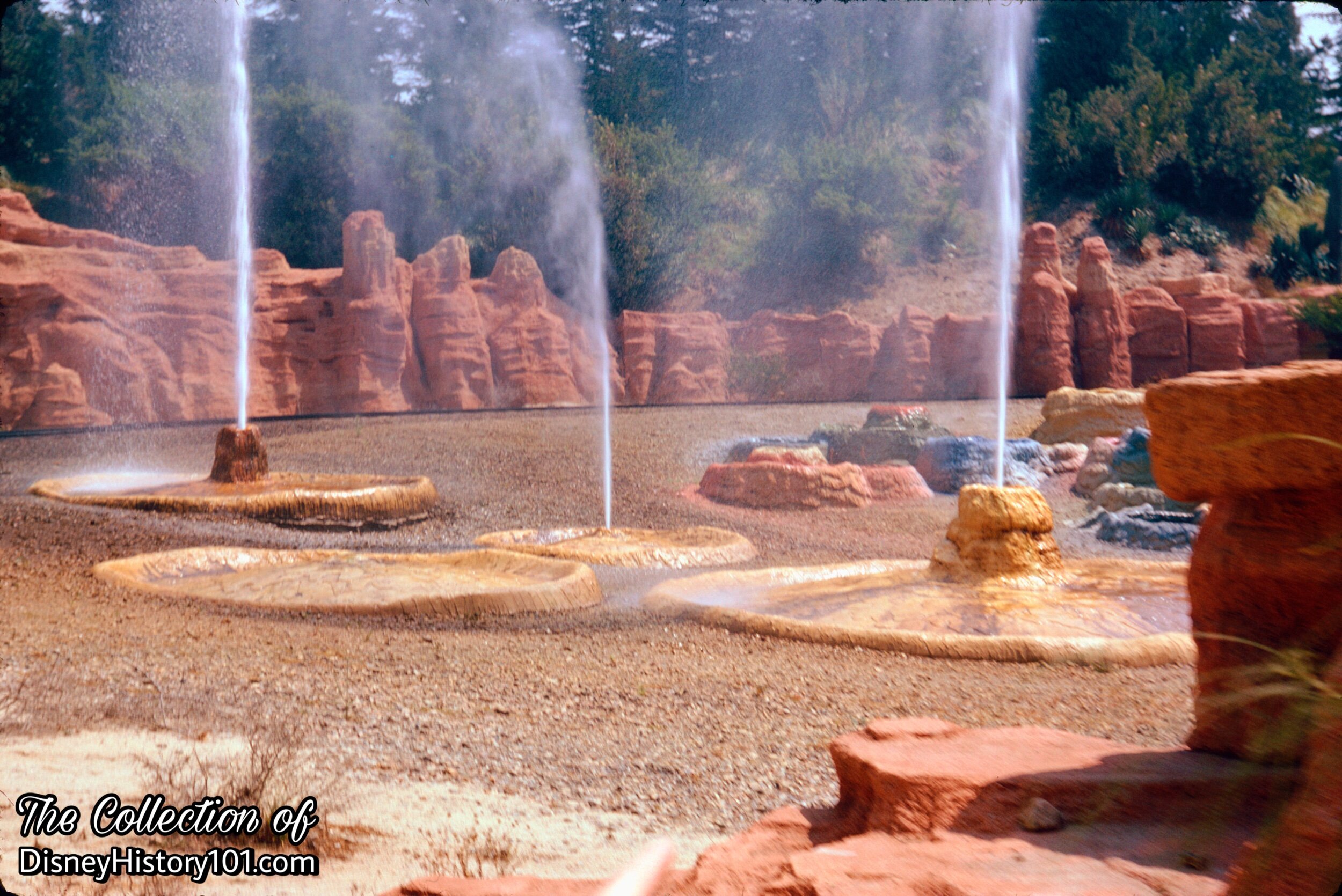
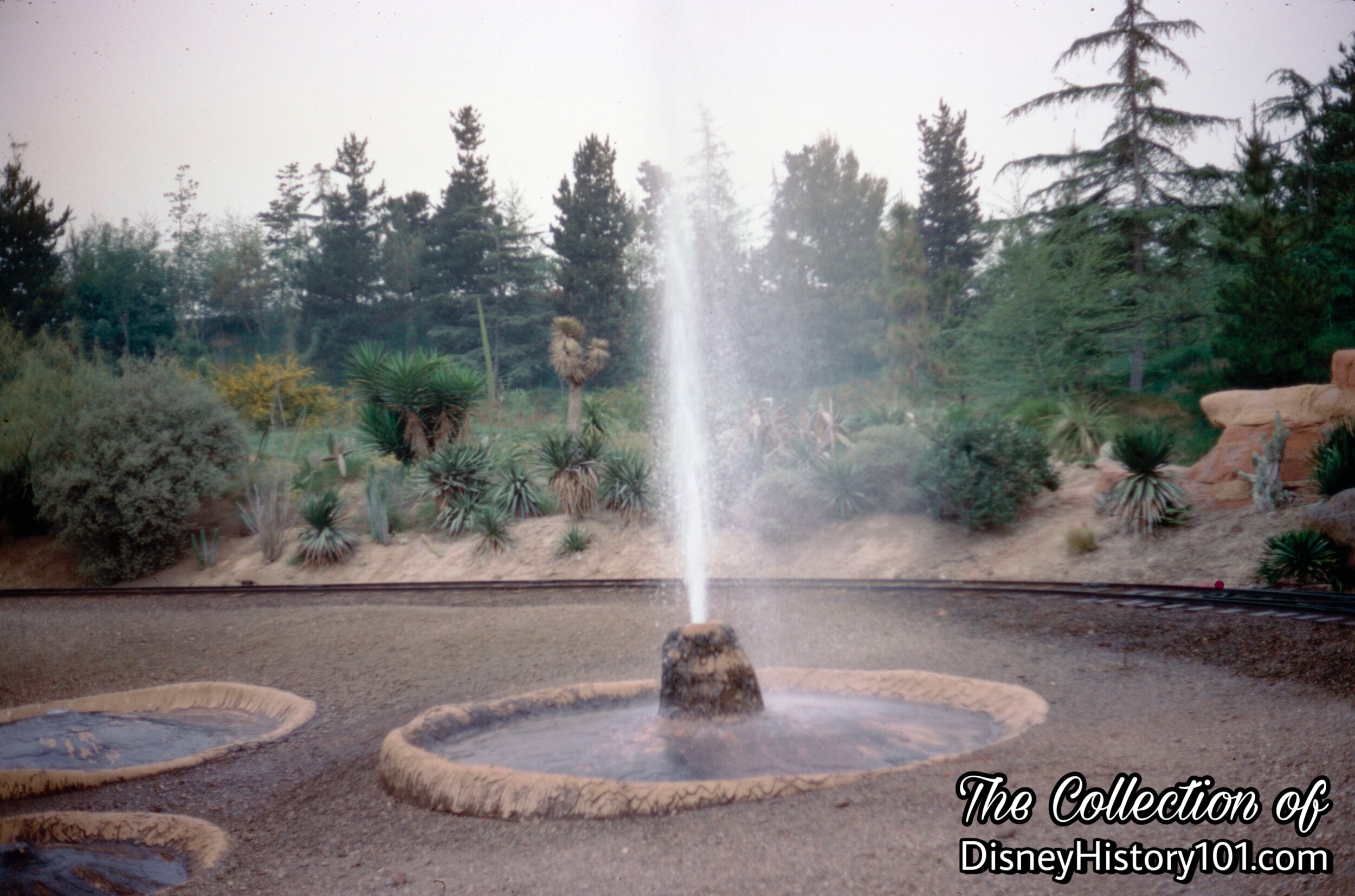
Apparently, rainbows weren’t just seen around the magnificent Rainbow Caverns. Sometimes the hydrogeological conditions of Geyser Country made momentary colorful displays for passengers of passing Mine Trains - rainbows!
Even long after these elements of Disneyland’s own “living desert” have vanished, there’s a rainbow at the end of the Disneyland “Geyser Country” story - a legacy. Decades later, yet another “Geyser Country” would be discovered along the railroad tracks of Euro Disney’s Frontierland! And then there’s Geyser Gulch (part of Grizzly Gulch at Hong Kong Disneyland), accidentally built on top of active geysers. Now it's a great place for water play and to get completely soaked!
The sounds of the Canyon Wren echo through the rock formations.
In the early days, “20,000 year old dinosaur tracks near the trail” were observed by Stage Coach passengers (according to “New Frontiers at Disneyland”, published in Mickey Mouse Club Magazine, Vol. 1, No. 3, by Bobby Burgess. Eventually, this fossilized skeleton and nest of eggs were “discovered” by a team of miners. Many years later (and not far away), another dinosaur skeleton would be unearthed near a pool of water at the bottom of Dinosaur Gulch.
A last look back at those wondrous “Devil’s Paintpots”!
We first encountered one Coyote in Beaver Valley and one Coyote near that den of Mountain Lions. Now, like a scene out of Walt Disney’s True-Life Adventure “The Vanishing Prairie”, six coyotes “howl” and “yip” from the top of a mesa called Coyote Rock. Many years later, the sound of Coyotes would be heard around a place called Coyote Canyon.
A few kit fox have found the Watering Hole. This seems to be a popular place for Kit Foxes, Jack Rabbits, Tortoise, and Badgers to gather.
We carefully pass by Rattlesnake Gulch (on the right), we can see a number of beasts and critters (on the left), including tortoises and badgers, who have made their way to the Watering Hole, and are now sunning themselves on the sun-baked terrain of the Living Desert!
“Look out, they’re startin’ to tumble!”
“Watch that wildcat, lady!…”
“Glad he stayed up there. We’ve known these critters to take on a full-grown deer, more than ten times their size in weight.”
I’ve seen some four Mountain Lions in all of Nature’s Wonderland. It looks as if one lonesome Mountain Lion (or, “cougar” near the geysers) may have tracked us to the tunnel. Some Disneyland Cast Members around these Frontier parts have gone to naming him, “Charlie.”
Well, it looks like we got the green signal to proceed inside the Rainbow Caverns. We’ll blow our whistle to alert any workmen or others who may be traversing the silver and gold lined caverns. Along our route, we’ll “pass bones and skeletons glowing in the natural light of the abandoned old mine, and cross a yawing chasm that once barred further exploration”, according to “News From Disneyland” (a press release document, published 1956). In the earlier years of the Rainbow Caverns, there was a many colored waterfall which “tumbles from great height in the Cavern’s weirdly lit interior to splash at the foot of the track right of way… the ‘Bottomless Pit’ and ‘River of Gold’ are other sights of the Rainbow Caverns,” according to The Disneyland News (Vol. 1, No. 12 ; June of 1956). Now guests had the opportunity to see other formations - Bridal Veil Falls, Paint Pot Falls, Red Devil Falls, Angel Falls, Geyser Grotto, Dance of the Seven Sisters, Rainbow Falls, and the Witches Cauldron.
“The Rainbow Ridge mine train tunnels deep into the beautiful Rainbow Caverns where surging waterfalls and multi-colored stalactites and stalagmites are viewed in breathtaking splendor.”
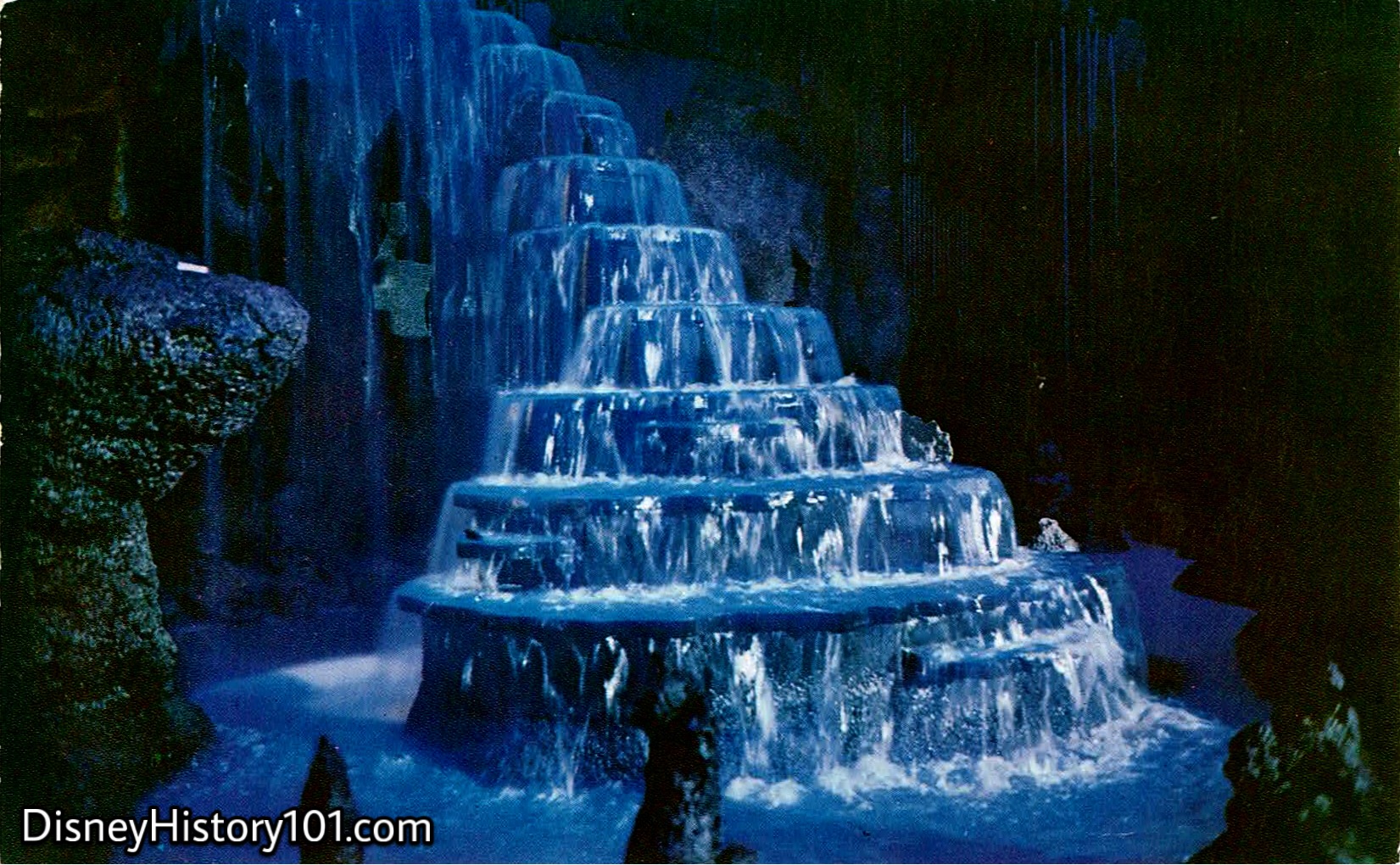
“The Rainbow Caverns”
“Now we’re going deep into the earth to view the dazzlin’ Rainbow Caverns. You’ll see giant stalagmites, stalactites ‘n colorful falls on ever side. Say, if yuh look real careful, you’ll see Geyser Grotto ‘n even the Witches Cauldron…!”
According to Disney News (Spring, 1985), “A designs challenge posed by the addition of the Mine Trains through Rainbow Caverns’ became a springboard to one of Disney’s creative axioms. After winding through the desert terrain, the ol’ prospector’s train was to end up in a cavern of multicolored waterfalls, iridescent pools and geysers.” The original Rainbow Caverns featured all sorts of “true-life-like” formations. There was the golden Bridal Veil Falls, Red Devil Falls (red water pouring over rocks shaped like a devil), the Witches Cauldron… (which had red water falling over rocks shaped like an old witch, and then into a bubbling pot below), Paint Pot Falls, Geyser Grotto (spelled “Gyser Grotto” on a directional sign in the Caverns), and the falls of the Dance of the Seven Sisters (which gave the appearance of women dancing).
All the “Cavern Building” dark ride features were created by Claude Coats with schematics (like elevations) drafted by Sydney Louis Lev. The Second Edition of “Disneyland - The Nickel Tour” preserves images of Claude’s colorful concepts and developmental designs on pages 133 & 134. “Claude first set out designing a series of caverns, set deep in the mountain. He began by using an interesting asset the Disney Studios still had lying around... some leftover set pieces previously used in Walt's live-action feature film, 20,000 Leagues Under the Sea. (The rest of the sets wound up in Tomorrowland.) … Claude employed a crew of carpenters for several weeks, nailing up lumber and welding metal, turning the random set pieces into believable caverns. Before long they would be reincarnated as a part of Disneyland history.”
Of course the most spectacular of these water features was the multicolored Rainbow Falls - a magical effect that did not come about by some mere “happy accident.”
“‘I was trying to work out a rainbow-colored waterfall for the Mine Train ride,’” said artist designer Claude Coats. “‘I thought I had the thing working pretty good.’” At this time, Walt “called on a noted scientist to determine if it could be done.” This scientist’s name was Heinz Haber, a colleague of Werner Von Braun’s, and he proceeded to prove that the waters would splash together, and “within a week all of the colors would turn to gray,” according to Disney News (published Winter 1967-1968). Claude continued, “I told Walt what Heinz said about the rainbow waterfall being impossible to bring off. He just winked at me and said: ‘It’s kind of fun to do the impossible.’ So I started working about twice as hard and figured out a way to make it work.” [“Insights” by Steven Hulett ; “Disneyland 25” Advertising Supplement, January 20, 1980] The attraction with its show-stopping pinnacle opened within months, and guests could spot six vibrant colors! Some of this success can be attributed to Walt Disney who had formed a habit of always “exploring new paths and experimenting with new technologies.” It was said that “Walt, who seldom turned away from a challenge, merely impressed upon his staff, ‘its kinda fun to do the impossible,’” according to Disney News (Spring, 1985).
Yes, “approximately 270,000 gallons of water per hour are circulated to create the seven multi-colored waterfalls seen in the Rainbow Caverns in Frontierland. This is at a 40 foot head,” according to “A Complete Guide To Disneyland,” published 1957. This was so impressive that the first eight Tour Guides were given a Backstage Tour of the various pumps and dye processes to help them understand how the colors were maintained. Those colors truly never faded and this was further proven by the comments recorded in publications. For instance, three years later (during the summer of 1960), “new lighting and creations in color and unusual formations of stalagmites and stalactites have been added to the seven multi-hued underground waterfalls which cascade into boiling pools,” according to Vacationland, (Summer, 1960). Two years after that, the Guide Tour Script (1962) added : “It might interest you to know that the colored waterfalls are created through the use of fluorescent dyes in the water and black light. An elaborate … [six-pump] system [which] circulates over 43,000 gallons of water per hour.”
In 1963, the author of one sanctioned “Disneyland” publication referred to the creation of the effect (on the eve of another rehabilitation) stating: “Seemingly ‘impossible’ things are done as a matter of course at Disneyland. As an art director explains, the scientist who claimed that the design for Rainbow Caverns was not possible was absolutely right. But with a little persistence and ingenuity, a lot of baffles to separate the streams of colored water, and a lot more luck, the impossible project turned out to be feasible. And so, seven years after it was first opened at Disneyland, Rainbow Caverns is under-going extensive changes. Walt Disney has decided to make the underground attraction even more spectacular. And, while he is at it, he may add a color or two.”
Finally, ultraviolet lamps were used in the attraction to give a glowing effect to the fluorescent paint. These new Show Quality enhancing fluorescent effects were so impressive, that scientist Edmund A. Braun drew attention to them in his book “Black Light Creates Fascinating Fluorescence” (published 1968) : “World-famous Disneyland makes use of fluorescence in its ‘dark’ rides…Disneyland’s Mine Ride also uses black light and fluorescence to great advantage.” By 1974, one quart of ultraviolet paint was still being used to keep the color balance just right, according to Cal Harnetiaux (Disneyland Paint Department). It is clear that by that time, the rainbow of colors hadn’t become one “authentic water-color gray” but continued to be distinct.
Nightly these pools and fountains were cleaned.
Now, if guests could actually explore the “backside” of the magnificent Rainbow Caverns, they would discover several necessary areas, including various pumps on the Fantayland side, a Mine Train Storage Area, the Machine Shop, Sub Station No. 4, and even Disneyland Offices.
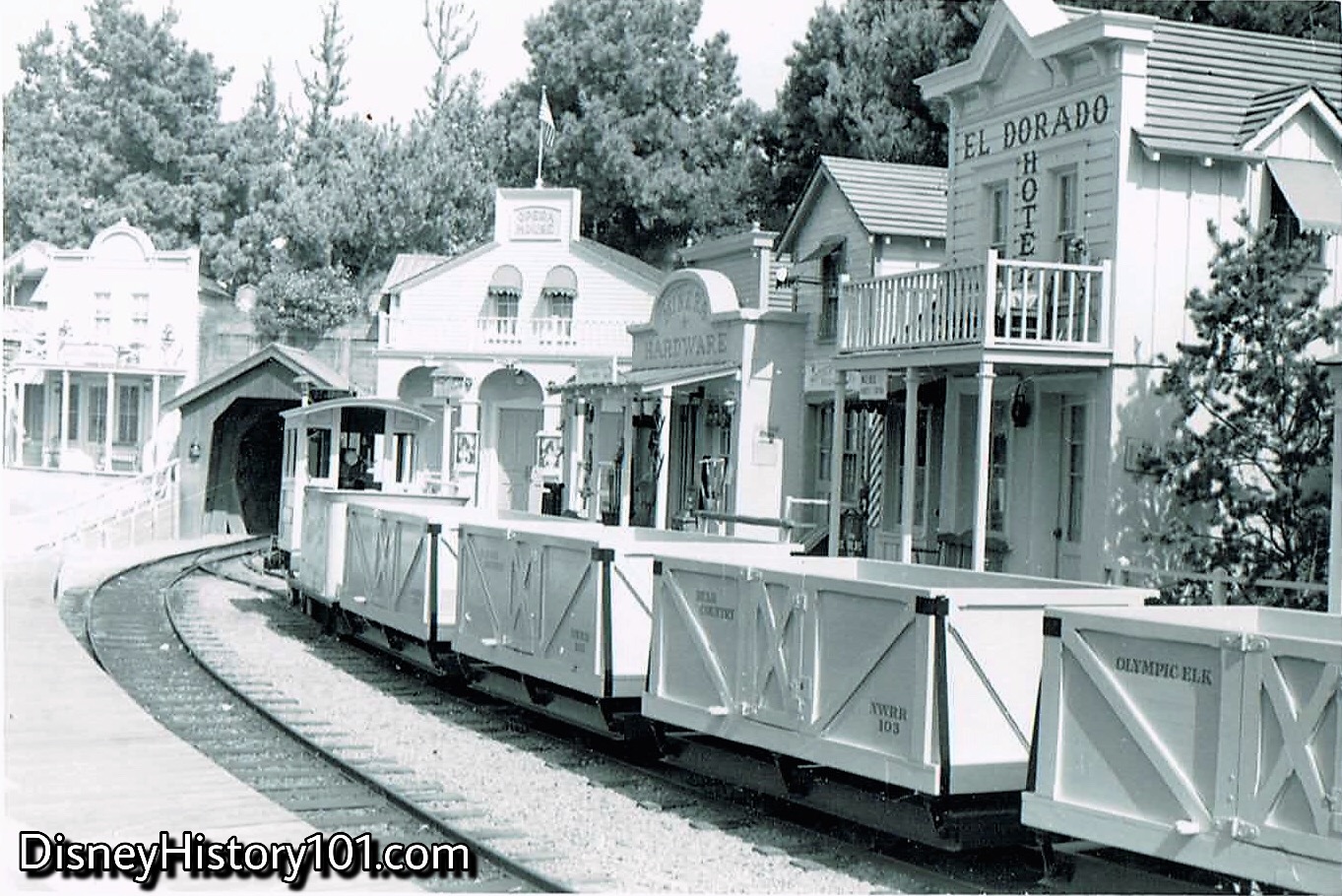
“Well…I see we’re comin’ back to Rainbow Ridge again.”
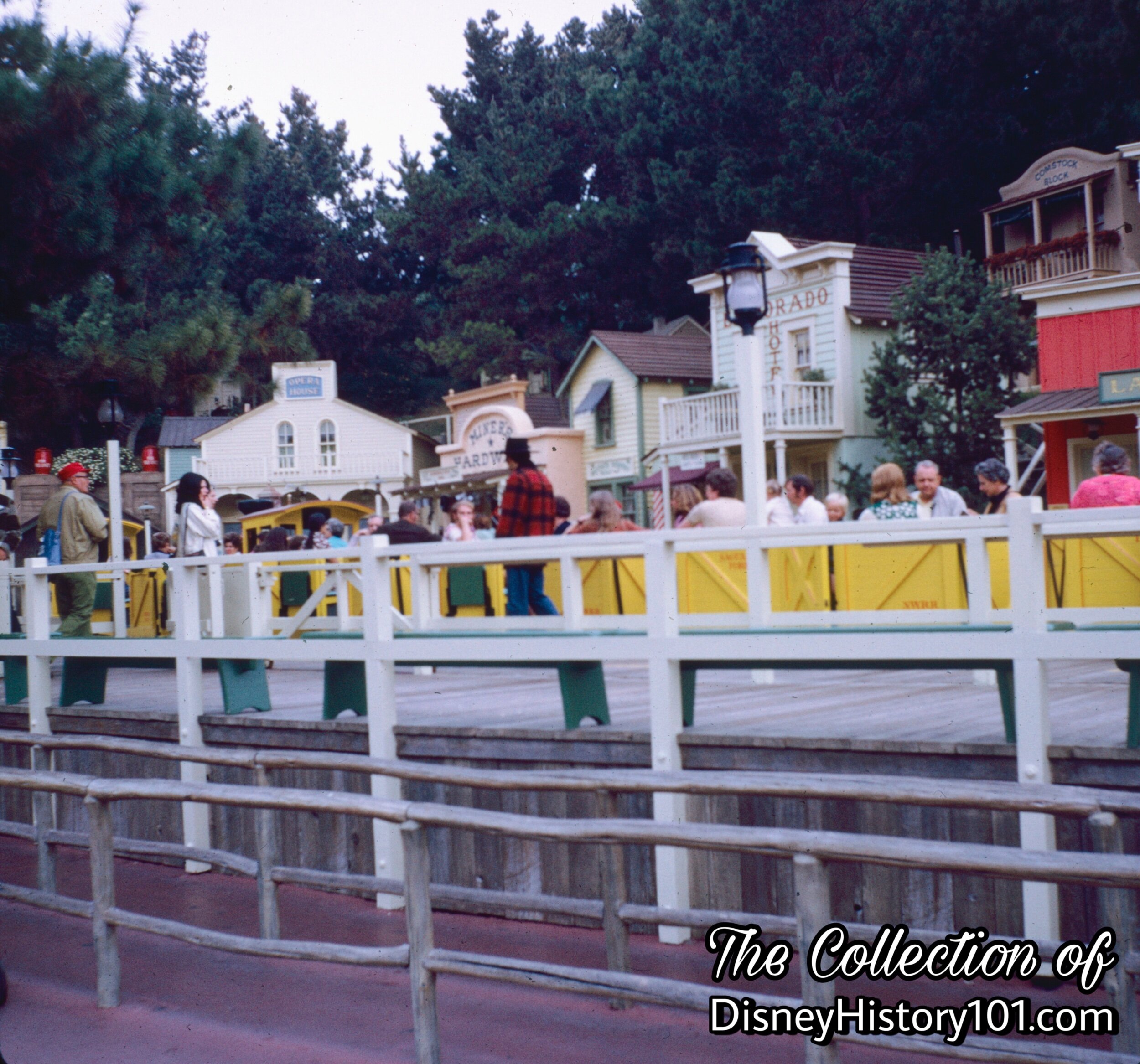
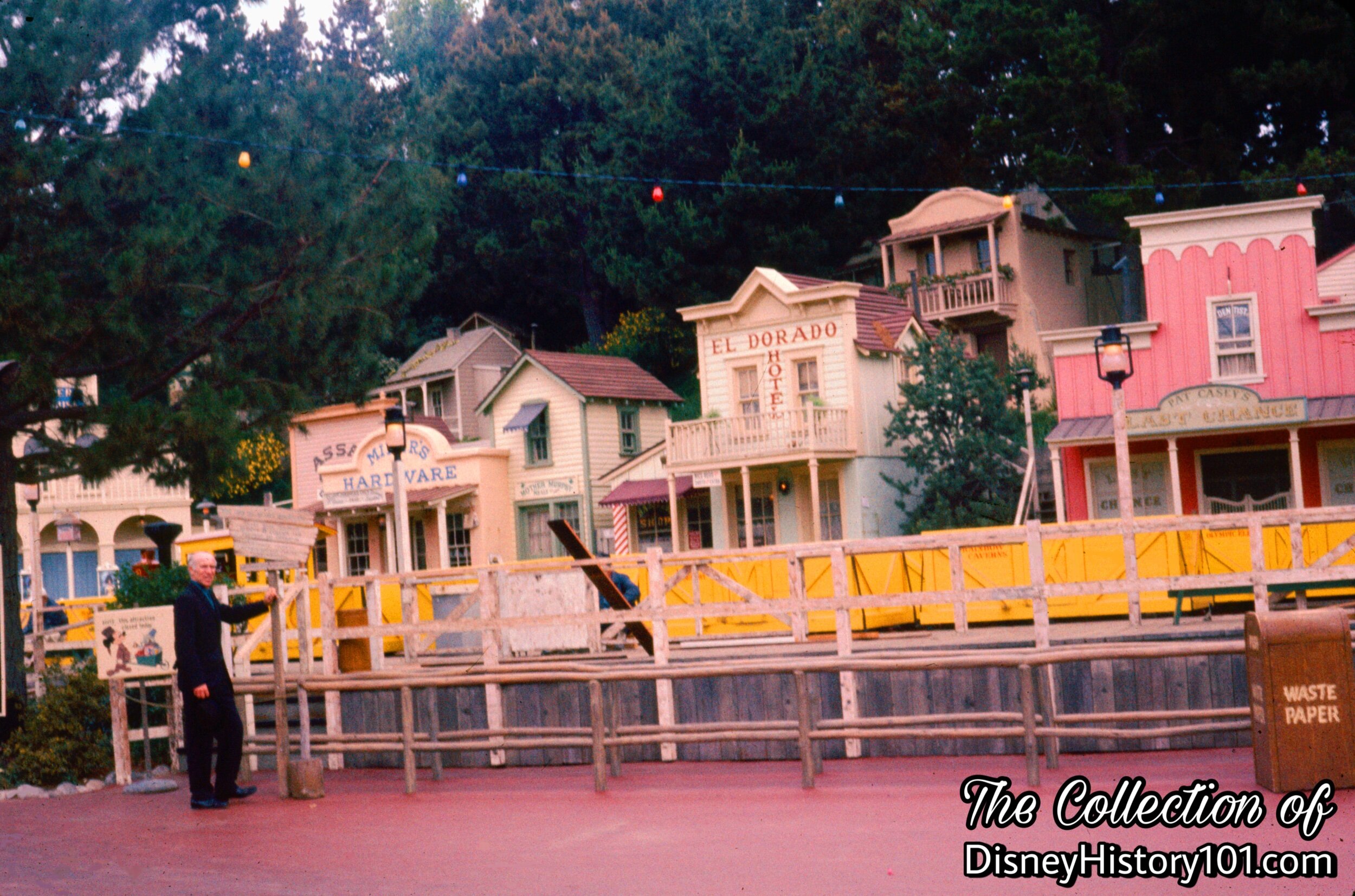
Regular rehabilitations led to freshly repainted trains and even a new platform (pictured above, c. 1966).
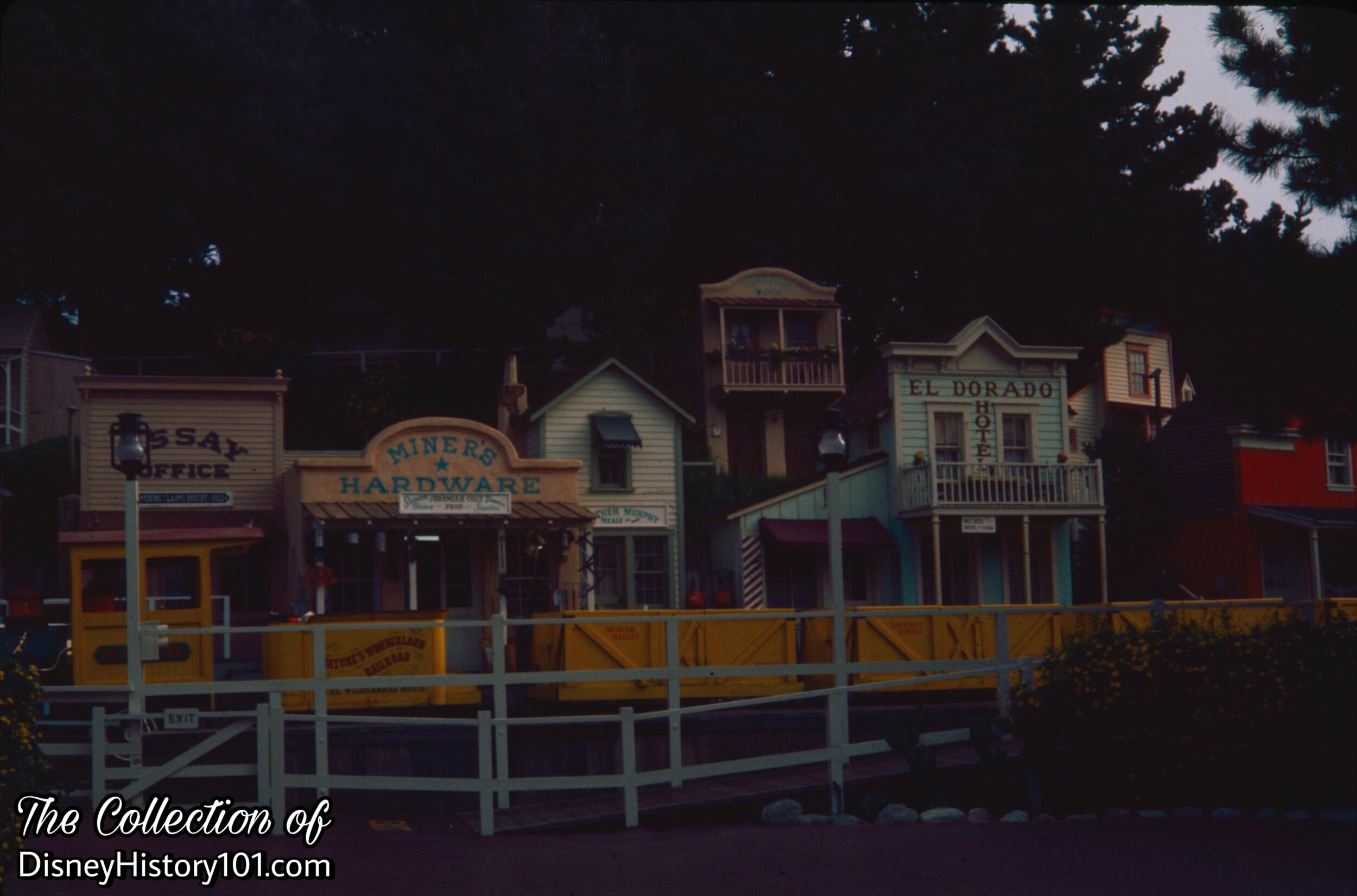
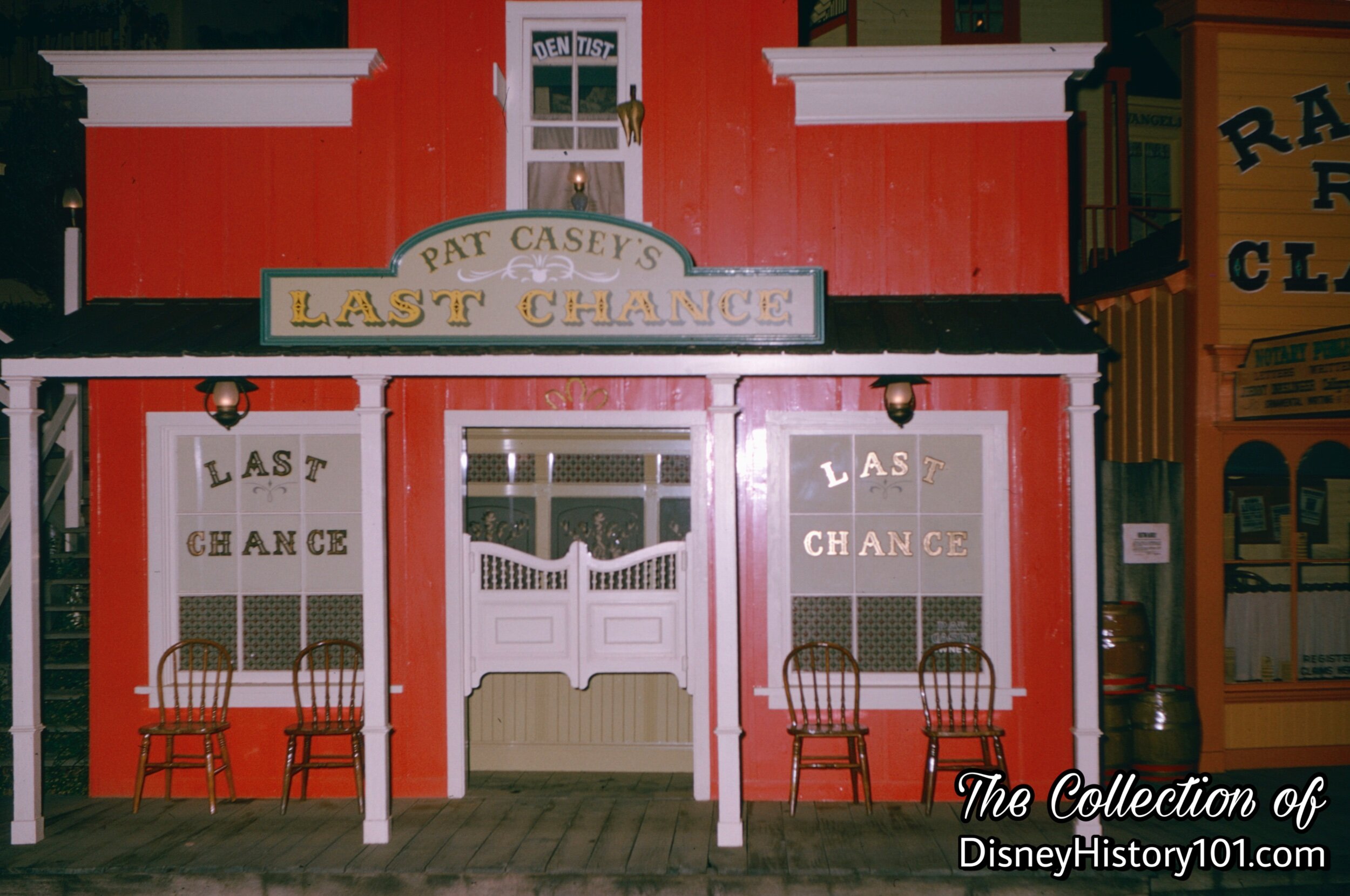
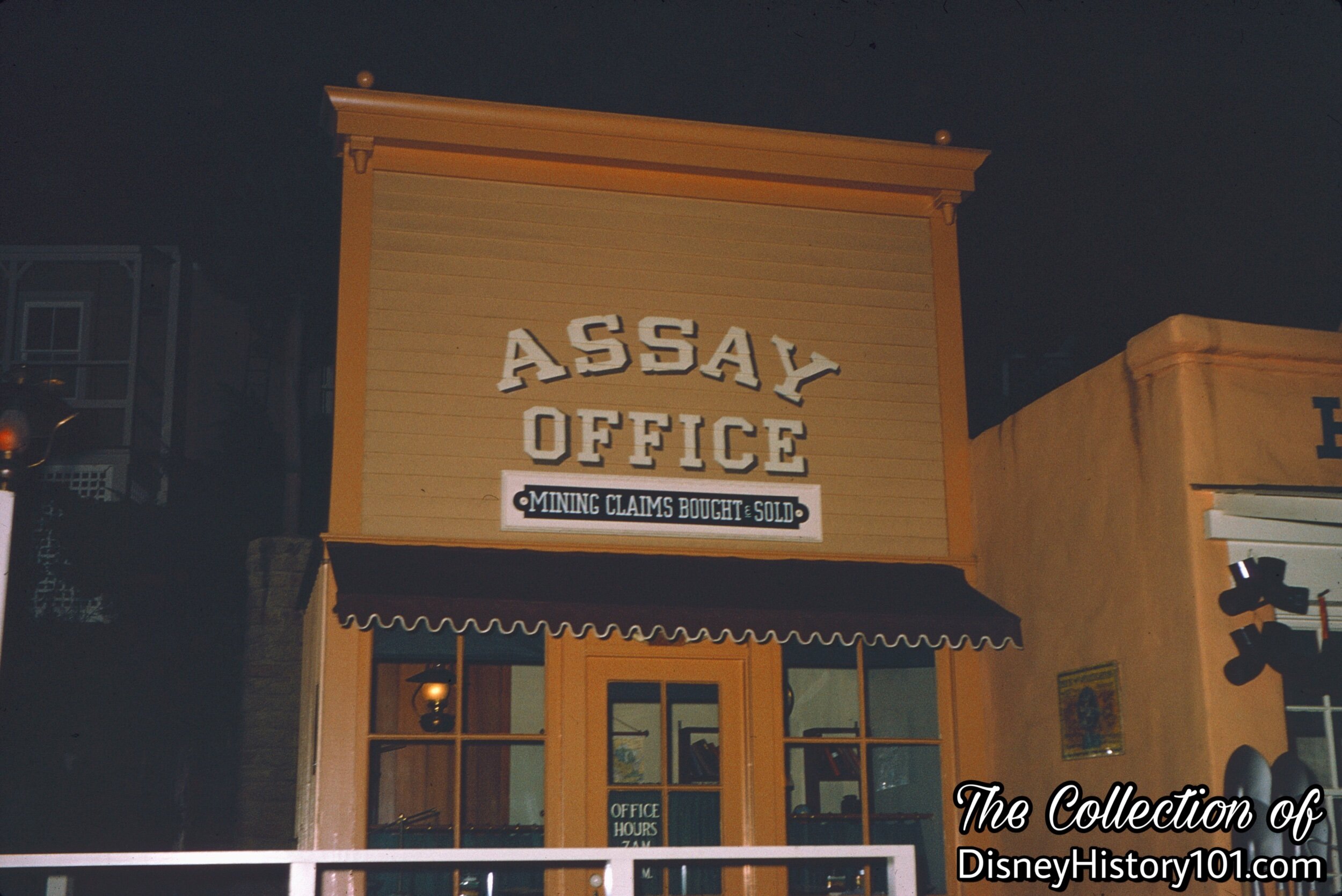
It looks like the sun is setting over the town of Rainbow Ridge and Natures Wonderland. Y’know, dusk is one o’ the best times to spot critters in their natural habitat!
Character lighting was themed to enhance the overall appearance and complement the interior, such as a chandelier or kerosene lamp. These add to the show, but don't necessarily create enough illumination for operation.
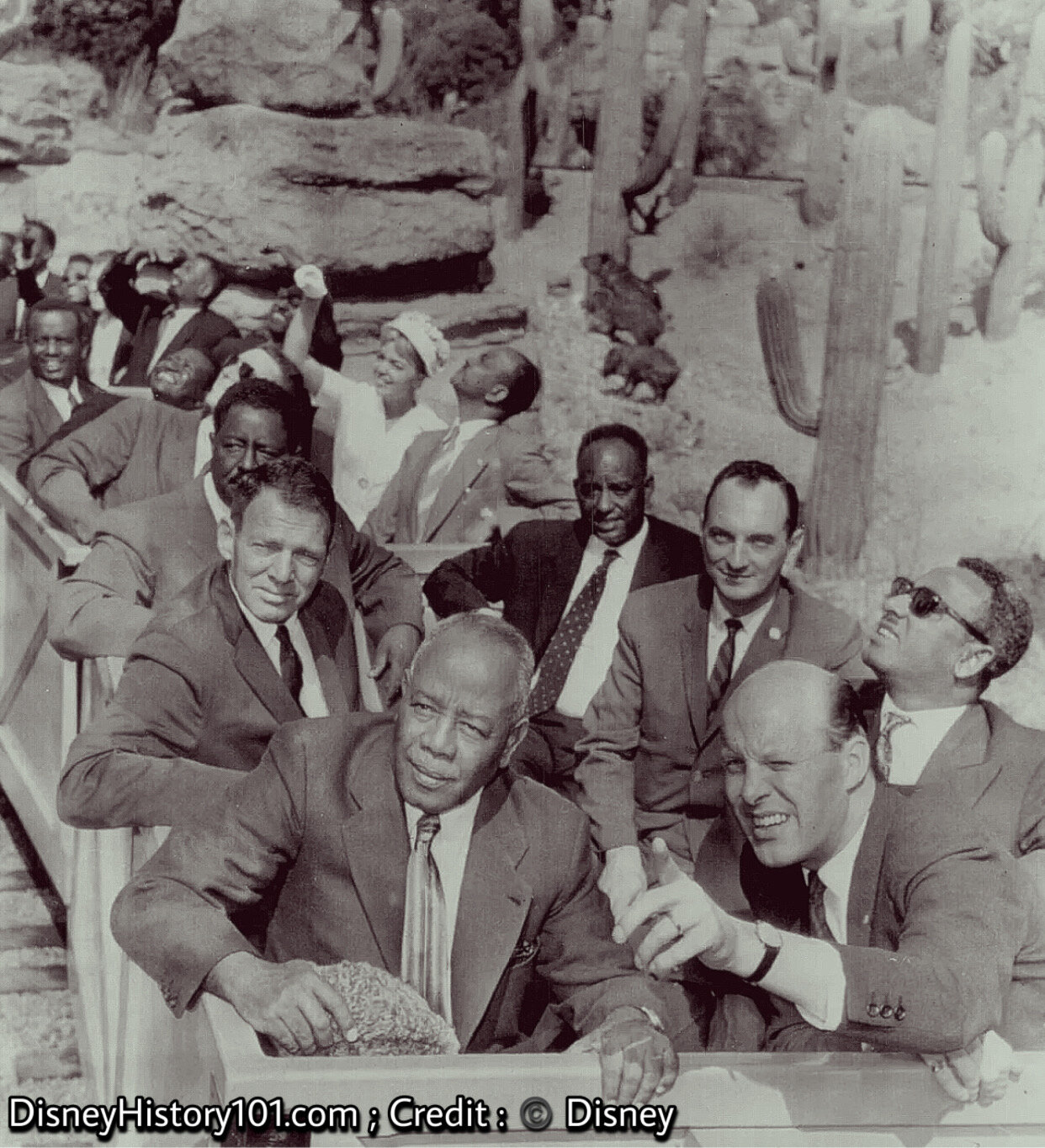
Quite a few notable events occurred around the town of Rainbow Ridge and Nature’s Wonderland. First, Frontierland personality Black Bart usually attempted to escape into the outskirts of Rainbow Ridge before being foiled by the local law enforcement. The latter was part of a concept (popularized through World’s Fairs, like Expo ‘67), which Walt pioneered since Disneyland’s earliest days - entertaining queue lines with live performers. Fantasyland had its life-size characters, both Adventureland and Tomorrowland had their live musical entertainment, and Frontierland had its gunfighters near the town of Rainbow Ridge! The area also served as a “set” of sorts, home to a Character experience or meet and greet with Black Bart, the Sheriff, and other “Gunfighters.”
“Walt Disney’s Guide to Disneyland” books (published for 1960) contained inserts advertising the new adventure. As the Mine Train Through Nature’s Wonderland was one adventure often included along Disneyland Guided Tours and V.I.P. Guided Tours of Disneyland, many notable guests recall experiencing this adventure!
The first President of Sudan visited Disneyland (on October 8th, 1961). “As a pack of Peccaries move though the Living Desert (in the background), President Ferik Ibrahim Abboud (left foreground) and his party look at the sights in show, from the Mine Train ride at Disneyland. Showing Abboud the points of interest is Henning Bodenhoff (right foreground) of Disneyland’s staff.”
(Credit : UPI Telephoto)

Occasionally the town of Rainbow Ridge was utilized as a stage for filming (but more commonly) performances. On Wednesday afternoon (March 21,1962), Ben Harris “met with the Universal Pictures Survey Group and conducted them on a three hour tour of the Park in preparation for [their] forthcoming film.” Owning to this, both a Mine Train and the town of Rainbow Ridge can briefly be seen in the memorable and comedic chase scene of “40 Pounds of Trouble”, starring Tony Curtis (released 1962). Pictured above, Tony Curtis removes a mushroom costume near the Mine Train Through Nature’s Wonderland Queue.
The Mad Mountain Ramblers performed from a stage set up in this area during Grad Nite 1964. During the summer of 1966, Hearts and Flowers performed near the Mine Train from 1:00 PM - 8:00 PM.
“Maintenance”
Since the beginning, the Four Keys of the DISNEYLAND Show (operating priorities in presenting the DISNEYLAND Show) have been present - Courtesy, Safety, Show, and Efficiency. Guided by these Four Keys, are Walt Disney Imagineers, who are always seeking out new magical opportunities to increase the efficiency, safety, and showquality of Disneyland adventures.
“55er” Jim Harman remembered “l used to fight gophers in Nature's Wonderland At that time, the sound speakers were hidden in false rocks and the gophers would fill the speakers in with earth. They sent me into combat with the critters… I remember how, during the course of a season, the ants would eat the real fur off of the birds and animals.” During rainy seasons, the animals were covered to protect their fur and feathers.
In the name of the overall Park Show Quality, many rehabilitations kept Rainbow Ridge, and all of Nature’s Wonderland looking like a true-life adventure. For instance, Bob Johnson (who began working as the Park’s taxidermist under Bud Washo around 1960) made “the rounds of his 230 animals in Frontierland,” according to Backstage Disneyland (Fall of 1965). The same article continues : “In other scenes Bob has added a domestic touch by creating three baby skunks and two baby owls and placing them next to their adopted parents. Bob is also good at improvising. The plastic claws on the black bear broke repeatedly on the bottom of the stream as the bear scooped for fish. Bob solved the problem by designing a set of rubber claws.” Bob even rehabilitated the most difficult to recover - “the two diving bears” which “bob up and down and turn from side to side. The skin must have enough slack to allow movement yet not look too shabby.”
Owning to the maintenance and rehabilitations, Disneyland (and the Mine Trains) have occasionally been utilized as a backdrop for many advertising campaigns made for television and publications (like magazines and newspapers). For instance, during September of 1962, Max Stewart, Larry Clemmons, and Art Crookshank (of the Walt Disney Studio) filmed and shot scenery from a Mine Train for Studio Production #3185. In their “minutes” they described their shoot this way : “We moved to the Mine Train Loading Dock. The Mine Train was held up (8) minutes. We loaded two Mine Trains, backed them up into the Rainbow Caverns and cued them non-stop through the loading dock.”
About two years later, during July of 1964 (and in the name of Show Quality, before it was so-named), Bob Matheison (of the Customer Relations Division) was studying an area near the Mine Train and coming up with “a recommendation as to whether… [Disneyland] should have musicians there on Friday and Saturday evenings, within budget.” About one year later, photographs for the “Schwinn Takes A Trip To Disneyland” catalogue (including this one pictured above, where the town of Rainbow Ridge used as a background for the new Schwinn Fastback Sting-Ray models) were both shot at Disneyland during the Disneyland Tencennial celebration of 1965.
By 1964, the character of the 11th hole of The Magic Kingdom Golf Course of the Disneyland Hotel Golf Centre was still themed after the Painted Desert.
From April 30 to May 25, 1973 the Mine Ride was closed for a 4-week rehabilitation.
From late 1974 through early 1975, Marc Davis and George McGinnis worked on several proposals for the addition of an earthquake sequence for the Mine Train Thru Nature’s Wonderland in which the locomotive would detach from the train and its cars of passengers would “run away”, passing molten lava, a disturbed owl and a panicked bear. But they never got around to developing this concept further.
At least one Mine Train was used to carry Karen and Richard Carpenter during the filming of several scenes for their “Mr. Postman” music video released in 1975.
But by 1977, it was time to say “goodbye” and bid “farewell” to the two acres surrounding Rainbow Ridge as we knew it. The town of Rainbow Ridge disappeared from the hills overlooking Frontierland some time in 1977, when construction began, of the soon-to-be-iconic Big Thunder Mountain - ‘the wildest ride in the wilderness!’ Most of the buildings were temporarily moved to the Backstage, in order to be redeveloped for their relocation to Thunder Ridge. Some (like the Panhandle Hotel and the Big Thunder Epitaph) were present in 1956, and went on to exist for several decades.
Maintenance salvage and tree boxing began around March of 1977, to “determine those elements of scenery and animation which can be saved from Nature’s Wonderland and put to future use.” Any critters that could be salvaged needed to be cleared out by May, when major demolition was scheduled to begin. [Disneyland LINE, February 24, 1977] Some simple figures and static figures (like coyotes, desert deer and marmots) were preserved, or repurposed, while a few that could not be moved, were either paved over or left in the river.
Some descendants of Nature’s Wonderland still populate parts of Frontierland. For instance, “the legend of lobo” lives on near Big Thunder Mountain. Last (but not least), thanks to the c.1984 Imagineered renderings of Gene Johnson, at least one old Mine Train (the victim of a land slide) sat abandoned on tracks along the Rivers of America, where it became home to quite a few “playful marmots” from about 1985 to 2010. A 1984 report revealed that the Mine Ride Cars weighed 2,200 lbs. while the Mine Ride power unit weighed 9,600 lbs.
You may recall once purchasing a print of Gene’s concept through The Disney Gallery.
We’ve heard of some strange happenings…stories of an abandoned old mine train vanishing from tracks along the Rivers of America (some time in 2010), and reappearing some 35 miles away in Griffith Park, California (during 2015)!
After some negotiations and an agreement between the Walt Disney Company and the Carolwood Foundation and Carolwood Pacific Historical Society (which is known for its preservative nature toward train-related Walt Disney artifacts), the Mine Train locomotive, tender, and gondolas disappeared yet again (but this time for careful rehabilitation). In May of 2019, former Orange County Register contributor Mark Eades wrote a wonderful sneak preview of the Mine Train locomotive, tender, and gondola, as well as an update on the “Disneyland Mine Train Restoration Under Way” [which can be read by visiting the LINK HERE].
Finally (in 2019), one of the gondolas was unveiled through a limited engagement held at the MUZEO Museum and Cultural Center in Anaheim (another fine institution which perseveres some Disneyland history in relation to the story of Orange County)!

A designation has been applied to one of the two cars being restored - SAGUARO FOREST! What will the other cars designation be?
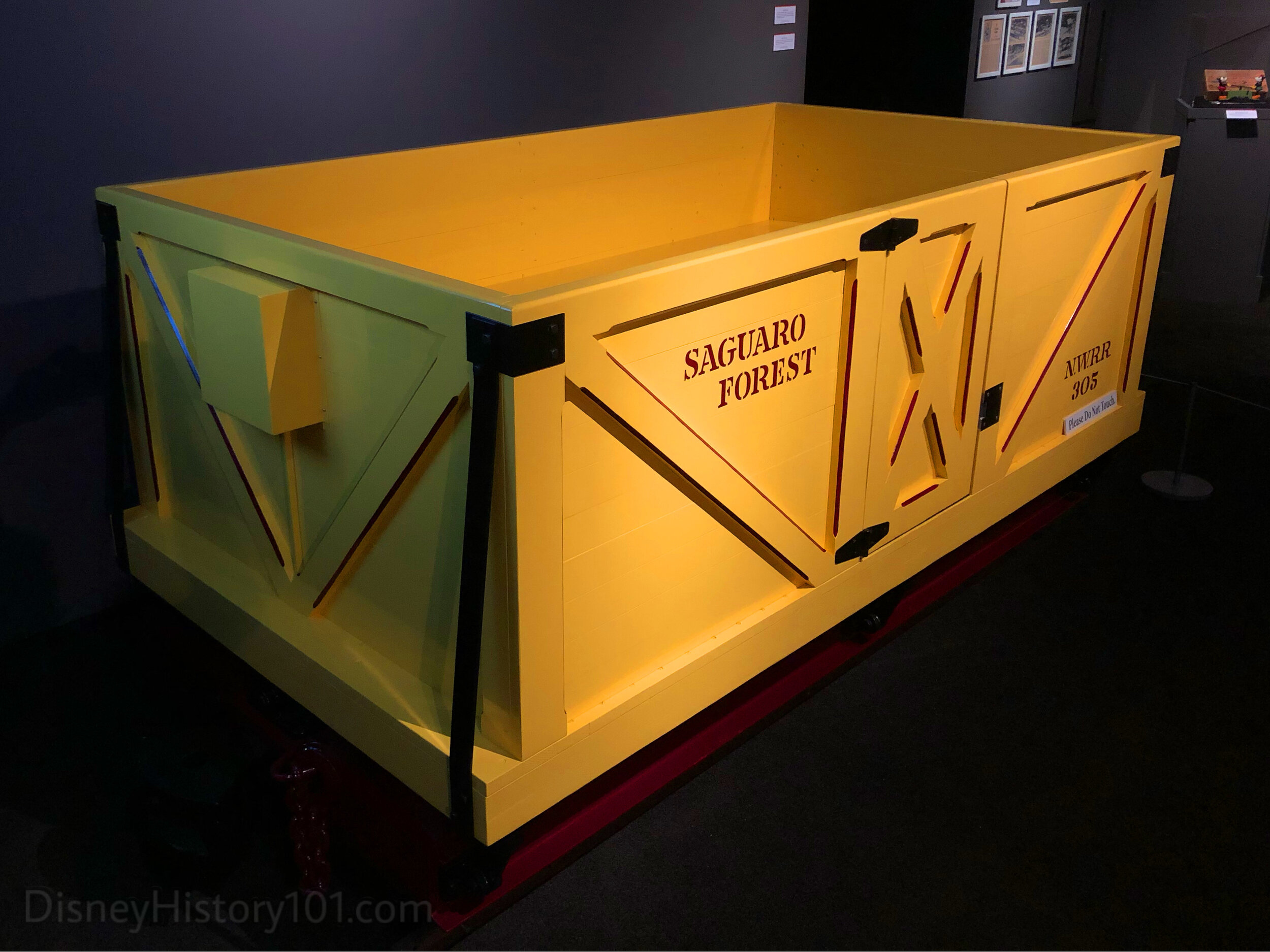
We’re looking at one of the “Mine Train Through Natures Wonderland” gondolas restored by TLJ Construction, Incorporated in Burbank, California. This much anticipated preview comes courtesy of The MUZEO museum (in Anaheim), and the Carolwood Foundation. According to curators : “this mine car was one of seven passenger cars coupled to Locomotive #1 on the Nature’s Wonderland Railroad.”
Will this speaker eventually broadcast a version of the pre-recorded spiel? Only time will tell.
Many of the original metallic parts (like this coupler), were the first parts to be cleaned up and restored to their former glory.
Here, Mine Train enthusiast and historian James Keeline shares a few artifacts from the mining town of Rainbow Ridge, and “a tale of two critters” that once inhabited the desert-scape of the Painted Desert!
Upon retirement, replica engine plates were made into plaques. These plaques were given to members of the Order of the Red Handkerchief. This particular plaque was bestowed upon “Wild Bill” Berry, an engineer who operated engines from 1958, right up to the attraction’s close in 1979!
This is actually one of four Number Plates, from the Rainbow Mining & Exploration Company era (of green-colored mine trains). The trains of that era were 3, 4, and 5, and this Number Plate is actually No.5 repurposed into Plate No.2.
(Property of the Walt Disney Archives ; On loan from Walt Disney’s Carolwood Barn)
According to curators : “The Nature’s Wonderland Railroad sign is originally from Locomotive #1 of the Mine Train Through Nature’s Wonderland, which ceased operations in 1977 and was later replaced by Big Thunder Mountain Railroad.”


Quisque iaculis facilisis lacinia. Mauris euismod pellentesque tellus sit amet mollis.