
MAIN STREET OPERA HOUSE (Featuring Great Moments with Mr. Lincoln)

(1955 - present)
Today, Disneyland’s Main Street Opera House is known for its main attraction (and the last remaining Main Street U.S.A. exhibit from Disneyland’s “free exhibit era”) - Great Moments with Mr. Lincoln. But as far back as Disneyland’s developement & construction (and its “fabulous first decade”), the Main Street Opera House has served many other lesser-known (and forgotten) functions.
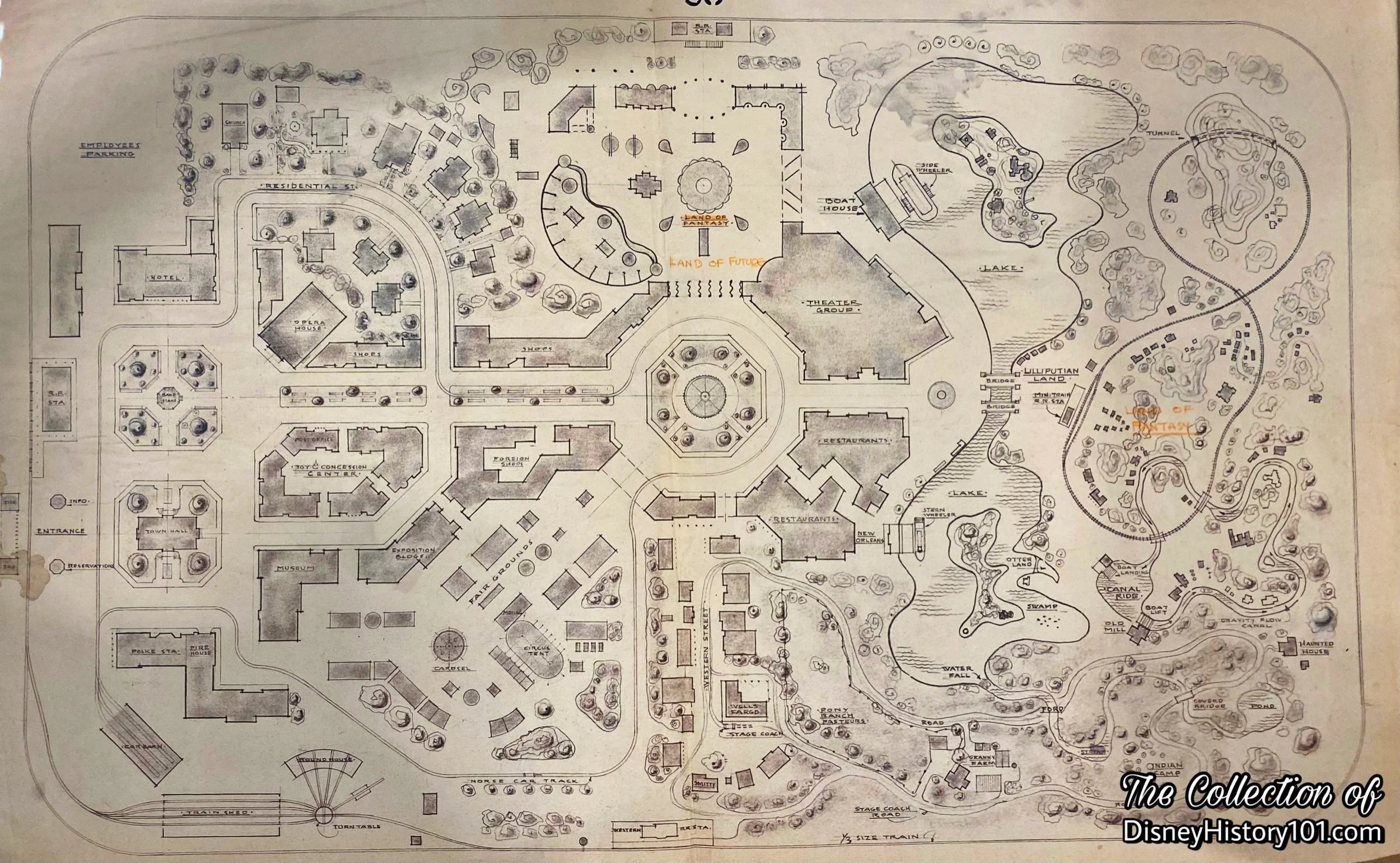
“Disneyland Preliminary Scheme #1”
“Blue Sky for the Disneyland Pharmacy”
Back in 1948, Walt Disney visited the 1948 Chicago Railroad Fair with his friend animator Ward Kimball. On the way home, the two “railfans” also made a visit to Henry Ford's outdoor museum tribute to Americana called Greenfield Village, located in Dearborn, Michigan. It was Walt’s third visit to the history museum within his lifetime. Ward later recalled that Walt enjoyed the entire experience so much that it was all he talked about on the train back to Los Angeles. When Walt Disney returned home, he composed a memo which laid out in great detail some of his earliest ideas for a themed amusement center. In describing his earliest vision of a frontier town, Walt prominently mentioned an Opera House in addition to other attractions like a drugstore with a soda fountain, a toy store, horse cars, and a railroad station. This concept of a recreation of a frontier town would continue to develop over time.
On August 31, 1948, Walt was still dreaming about his Park (to be located across the street from the Studio in Burbank). A memo was circulated among artists of the Walt Disney Studios. Some thoughts in the “Mickey Mouse Park” prospectus made mention of an “Opera House.” [“The Spirit of Disneyland”]
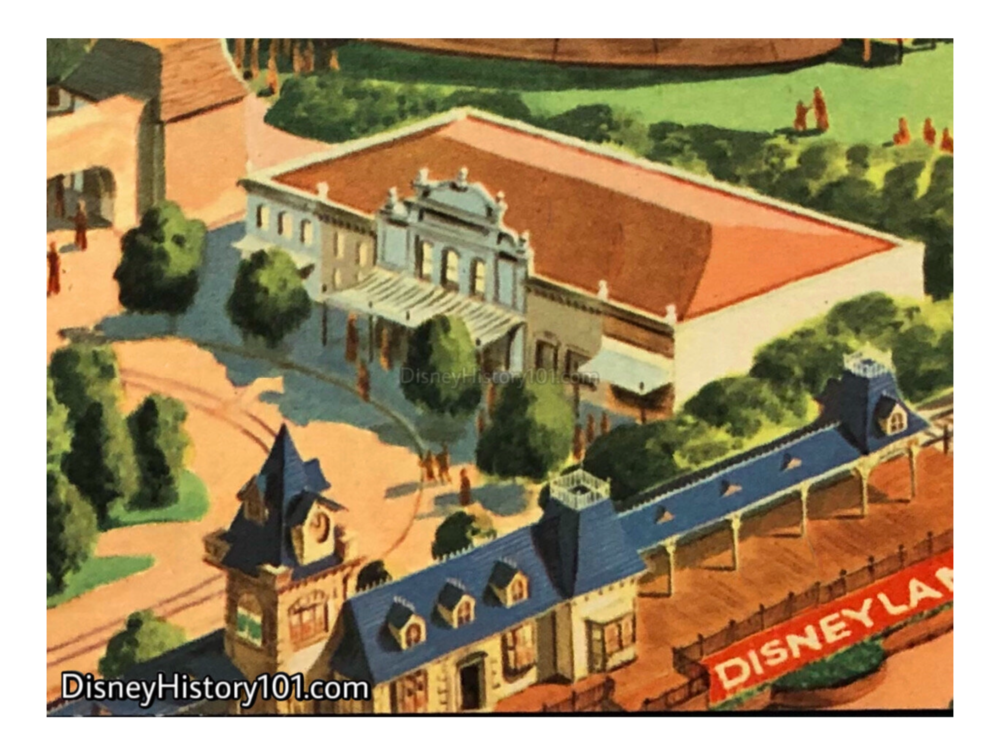
Pictured Above : Mattel “Disneyland Musical Map” Record Set Illustration, 1955. This illustration (produced for an early licensed Disneyland product), granted a glimpse of the Opera House located in the Town Square of Disneyland’s Main Street!
Eventually, Walt’s visions of a themed amusement center evolved into Disneyland, and by 1954, the first definitive piece of art was produced and included an Opera House. You may have heard of Herb Ryman’s iconic “Aerial Over Disneyland” concept drawing. This and a portfolio of colored sketches by Herb Ryman, Bruce Bushman, Harper Goff, and others was prepared for Dick Irvine and Nat Winecoff to take back East to sell the Disneyland concept to prospective licensees. A subsequent document entitled “The Disneyland Story” was produced (on September 3, 1954), in order to tell the story of what guests would experience upon entering Disneyland. The opening page states : “You find yourself in a Civic Center or Town Square at the turn-of-the-century, any time from 1890 to 1910. Here you will see…the OldOpera House.”
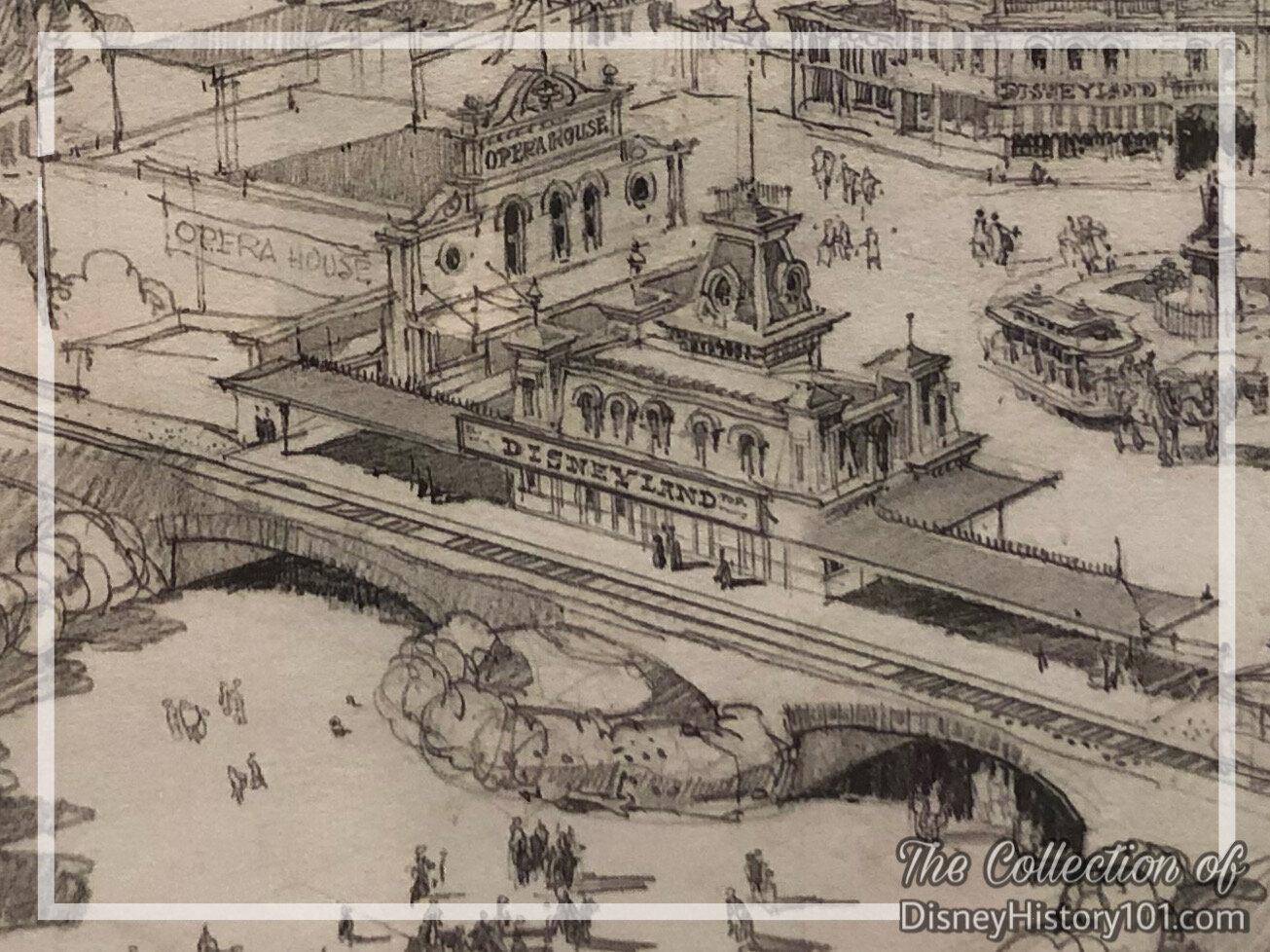
“Draw Concept” - An Excerpt of “Aerial View Over Disneyland,” by Herb Ryman (originally produced September 26 & 27, 1953) depicts the Opera House on the East side of Town Square.
Early thumbnail sketches and other concept artwork seemed to be unencumbered by restrictions of budget, schedule or the laws of nature and physics. Though guided by Walt, his artists appeared to engage in “free-thinking,” as if implementing the modern “Blue Sky” Imagineering process. Like some advanced “High Concept,” final designs were quickly generated and approved. Some of these viable project Concepts (as above), were supported by a well-developed business case and built expectation.
Next, architectural drawings helped define all designs, production and construction strategies, costs, schedule, and resource requirements. “Disneyland is unique in that some of the world's foremost creative artists and architects control all design at Disneyland.“ Models explored the various dimensional relationships, site-lines, flow patterns, ergonomics, and visual appeal to convey the desired creative intent. Once the dimensional model was created, the Opera House was moved to the other side of Town Square.
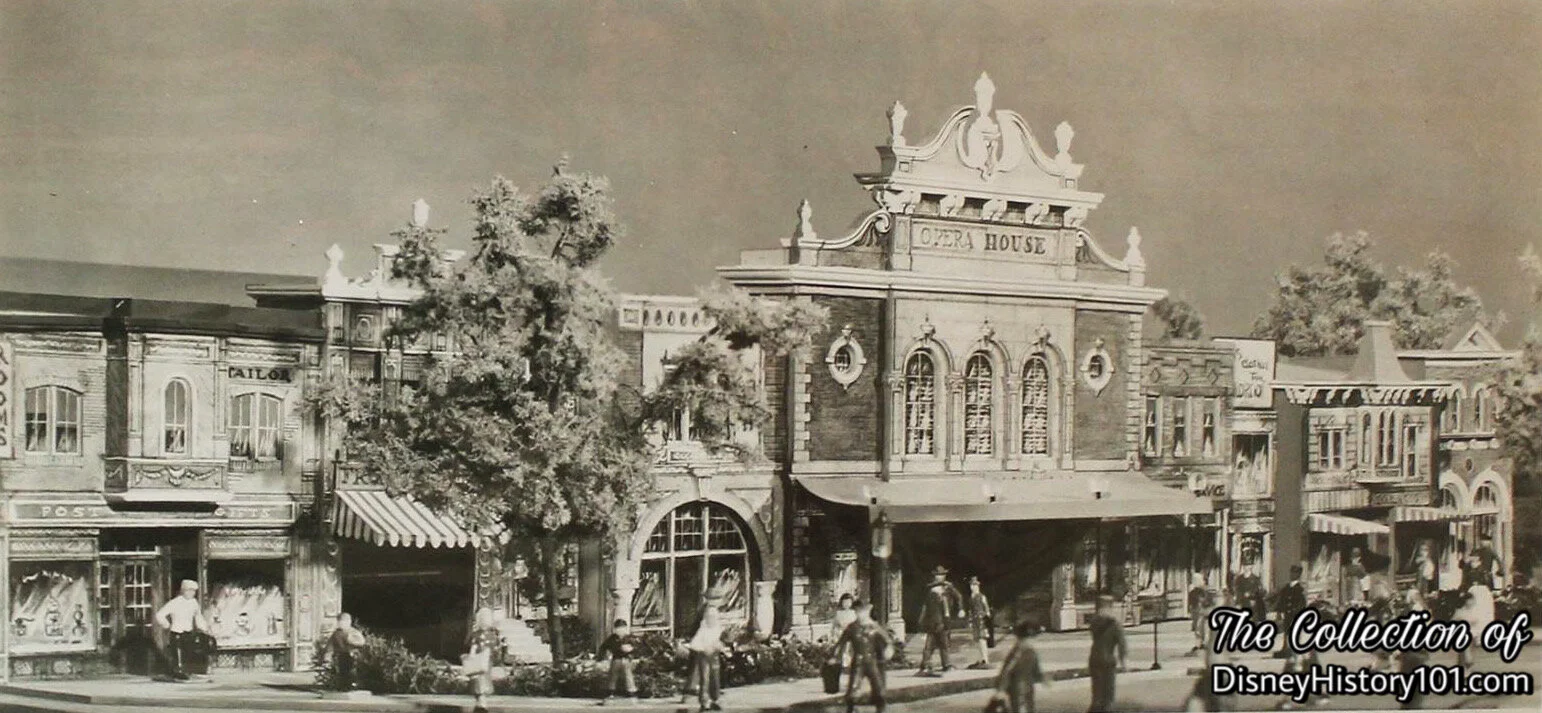
Images of the Main Street Architectural Model by Fred Joerger and Wathel Rogers included in “The Story of Disneyland” Documents, (1955)
“Not Your ‘Run-Of-The-Mill’ Opera House”
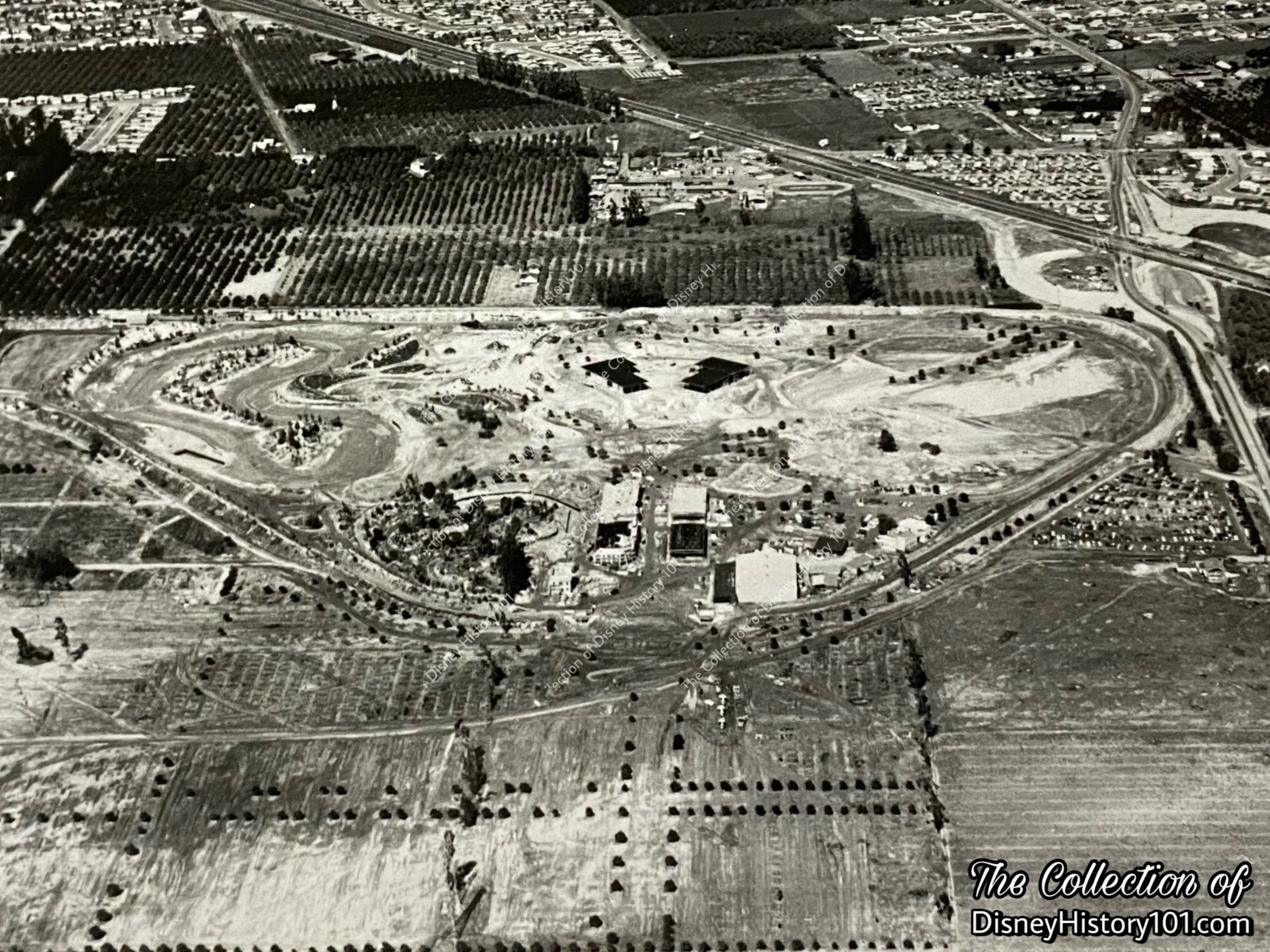
As far back as Disneyland’s creation (and its “fabulous first decade”), the Main Street Opera House has served many other lesser-known (and forgotten) functions. This soon came after “the giant earth-moving undertaking was completed, the building crews took over. Soon, the rat-tat-tat of riveters was shattering the air, and sparks were flying from welders’ torches as the steel frameworks, capable of withstanding the ravages of time and the elements rose above the newly formed ground. While carpenters hammered and masons laid row upon row of brick and stone and mortar, the permanent buildings began to take shape and form,” according to “The Disneyland Story” published 1955.
The Mill is the most outstanding structure in this early press release photo excerpt; ©️Walt Disney Productions.
From groundbreaking until opening, the construction of Disneyland would start about July 17, 1954 and be completed by July 17, 1955. One of the first buildings to be constructed was the Main Street Opera House, which was first utilized as a Mill. However it took some time according to newspaper inserts published in July of 1955. “The construction department was following hard on the heels of planners… on December 18, an order came through to set up a lumber mill on the site… By January 3rd, about $50,000 worth of machinery had been installed, but power was not available until Jan. 17, and the mill went into production on that date.”
Scotty Cribbes read about Disneyland in the papers when he was living in Santa Ana (home of the grapefruit label), and put in an application. He started with the McNeil Construction Company as a carpenter and after a week he went to the Mill as a foreman.
George Mills recalled: “On January 3, 1955 I came to Disneyland and worked for McNeil Construction Company, raising steel and pouring concrete. For the most part, the Park was built in six months. Our mill was where the Opera House is now and the workers wore blue jeans and white T-shirts.”
First, a concrete foundation and slab floors were prepared. Earl Anderson recalled how his first job was helping to build the lumber storage building. “I would get down on my hands and knees in the rain and mud to work on the foundations.” The foundation was followed by wood frame construction (while store units would have a combination wood and rigid steel frame).
According to inserts published in area newspapers during July of 1955, Disney buildings were roofed by Pioneer Roof & Shingle Company (then located at 608 Mateo Street, Los Angeles, California; 7522 Westminster Avenue, Westminster, California). The roof covering was a variable, dependent on the architectural design.
The entire Main Street Building # 700 (including the Maintenance and Construction Mill) possessed complete fire sprinkling systems, as did each on Main Street U.S.A. By June 30, 1955, related Disneyland Site Work Fire Protection Utilities Plot Plans were prepared for Disneyland Inc., by J.E. Thomasson of WED Enterprises Inc.
Once complete, the 14,000 square foot Maintenance and Construction Mill generated the woodwork of Disneyland - from the functional to the aesthetic. The Mill temporarily included the Plaster Shop which created ornamental pieces for structures like Sleeping Beauty Castle. But most of all, approximately three and one-half million board feet of lumber went into the Park’s construction - much of it processed here by Lawrence G. and Bruce W. McNeil’s McNeil Construction (the Prime contractor), and fashioned into the surrounding structures of Main Street U.S.A.! Disneylander and “55er” Stan Gomez recalled carrying lumber on his back up and down Main Street and taking saws to be sharpened.
Sometime later, in a somewhat “tongue in cheek” manner, “The Disneyland Story” (prepared 1963) divulged that “The Mill is the Disneyland Carpenter Shop. With the tools and talents located in this section, one could request and receive anything from an ornamental toothpick to a boat or house.” There, “Cabinet-makers carved and painted the accurate reproductions that furnish the buildings.”
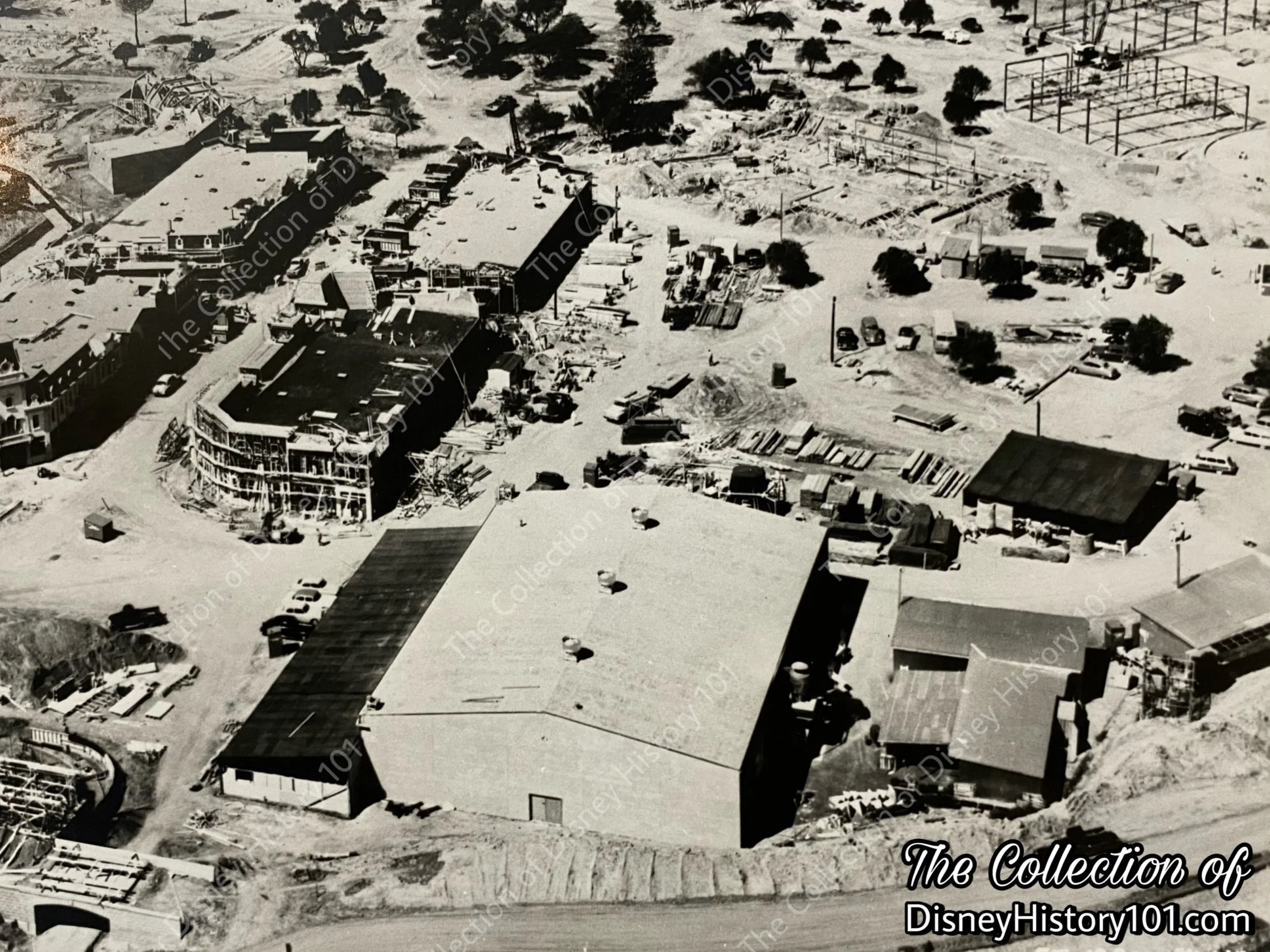
The Mill as seen in an excerpt from a c.1955 press release photo; ©️Walt Disney Productions.
Some of Disneyland’s original carpenters (Cliff Carothers, Earl Anderson, George Williams, George Le Fevre, Scotty Scribbs, L.H. Anderson, John Yorber and a certain “Harry”) recollected fond memories of the original Mill’s role in Disneyland development to LINE Magazine : “when many complete buildings were built down by the Old Mill [not on Tom Sawyer Island]…but Main Street, and taken to the field. For example, the Railroad Tower at the entrance to Disneyland was built in the Mill and then set up, as was the Draw Bridge at the Castle.”
When Ed Winger came to the Park as a Hod Carrier, working for Herrick and Herrick, the only building on Main Street was the Opera House and the skeleton of the Train Station. Decorative elements were soon added to facade, as the posts which support the awning and marquee. These are actually lampposts, similar in origin to those which line Main Street. One authorized “Disneyland Information & Nomenclature List” (prepared by Bill Cottrell of Disneyland Inc., by May 25, 1955) listed “official and authorized nomenclature” of Disneyland, and distinguished the “Buildings in Civic Center” : “Disneyland Police Department, Disneyland City Hall, Disneyland Fire Department, Disneyland Opera House.”
By July 17, 1955, the structure was still not completed. A contributing writer with The Daily Oklahoman (on July 17, 1955), noted: “Everywbere there were the last minate rush. A painter put final touches on the marquee of the Disneyland Opera House.”
“Original Site Plans and Developments”
“Walt had always intended that television would play a major role in the Disneyland show, and this was especially true during the first decade. One of the requirements in the initial site survey was that a clear television signal could be beamed out of the Park. Plans were also made for the construction of sound stages and the implementation of regular telecasts,” according to Disneyland LINE (Vol. 12, No. 27 ; July 3, 1980).
In “WALT DISNEY PRODUCTIONS ANNUAL REPORT to Shareholders and Employees” published for the Fiscal Year Ended October 2, 1954, Walt Disney personally stated: “The Disneyland the park, which will be the physical base for the ABC telecasts, is now well under construction for opening this summer. Its various features of amusement, education and audience participation will also provide rich material for televiewers. Facilities to accommodate 40,000 visitors and 10,000 autos daily on the 160-acre site near Anaheim, California, indicate its entertainment potential and its reciprocal influence on our other interests.”
Some Site Plan (or Plot Plan) Drawings (produced during October of 1954) depicted or detailed a “museum”, “cartoon studio”, and 20,000 Leagues Under the Sea set pieces (including a walkthrough of a giant Nautilus, and a walk-through Salon with the terrifying Squid) planned for this space. The “cartoon studio” detail may have been one reason why a journalist for the Anaheim Bulletin (published Saturday, May 1, 1954) described Disneyland as a “fantasy-playground and television plant.”
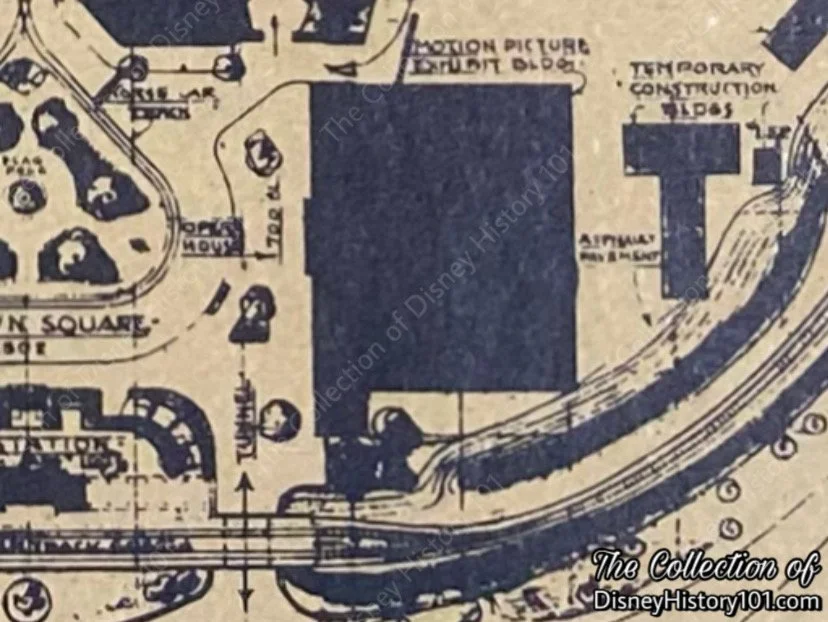
Motion Picture Exhibit Building; Plot Plan of Disneyland by Marvin Aubrey Davis of WED.
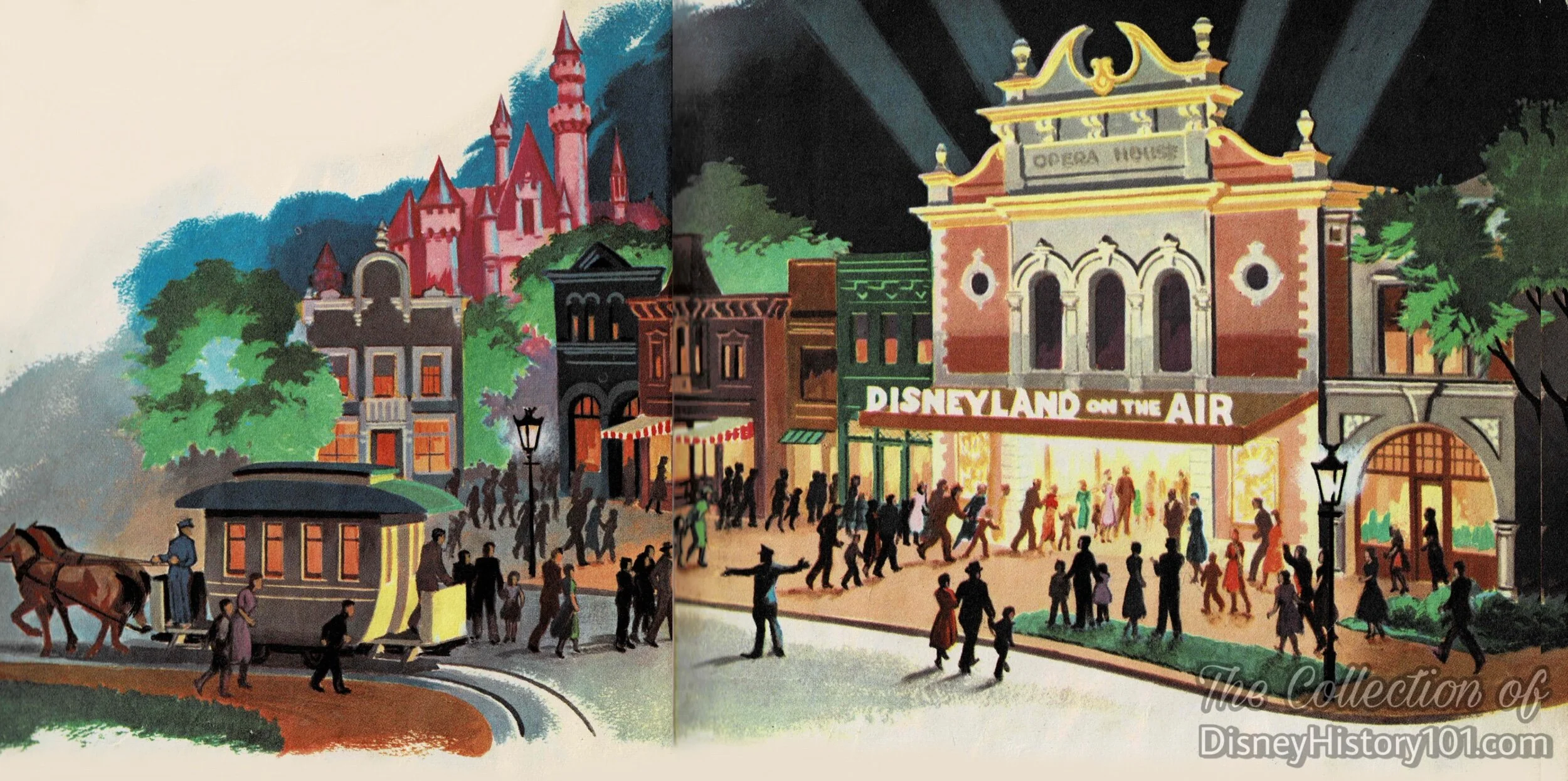
“For The First Time,” Main Street Opera House is Sampled in Book Form, in “Disneyland On The Air”
Back in October 1954, the Walt Disney Productions report for shareholders announced: “Disneyland the park, which will be the physical base for the ABC telecasts, is now well under construction for opening this summer. Its various features of amusement, education and audience participation will also provide rich material for televiewers. Facilities to accommodate 40,000 visitors and 10,000 autos daily on the 160-acre site near Anaheim, California, indicate its entertainment potential and its reciprocal influence on our other interests.” Early licensed merchandise even featured the Main Street Opera House being utilized as a television sound stage where a show was recorded and transmitted to the folks back at home watching from their televisions.
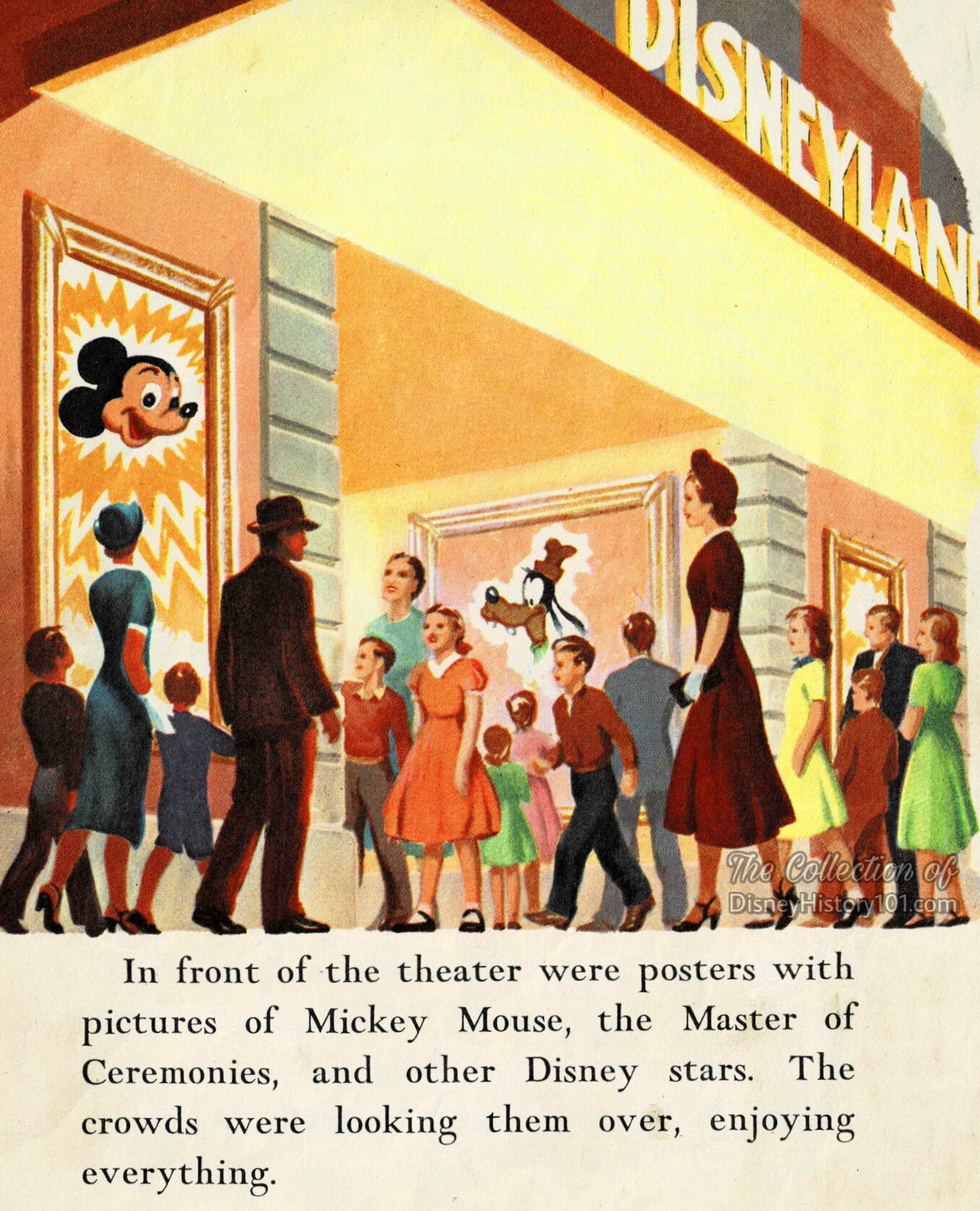
“Disneyland On The Air” Excerpt
Though live television broadcasts would occur many times at Disneyland through the early years (i.e. on July 15th, 1955, July 14th, 1959, April of 1962, etc.), the Main Street Opera House was not utilized as a sound stage, and was ultimately first used for other necessary functions as early as May of 1955. During one Pre-Opening Day interview (with Bob Thomas of the Associated Press), Walt divulged that “we’re using it [the Opera House] for a mill now, but eventually I plan to make it a motion picture exhibit.”
“The Disneyland Public Address System”
While the 14,000 square foot Backstage portion (of most of the first floor) continued to be utilized as the Mill, the 3,354 square foot second floor came to efficiently house several necessary functions in a maximum utilization of space. First of all, the Park Public Address System was housed here, where announcements could be broadcast and heard throughout Disneyland. Announcements included Park opening and closing announcements, as well as event showtimes (e.g. those of the Mickey Mouse Club Circus). As a “sidelight,” Town Crier Bud Coulson would announce important events for the day, like Disneylander’s birthdays. If you visited Disneyland during the 1960’s you may have heard the voice of Ben Harris (Production Coordinator ; Wardrobe) making announcements over the system. All the while, the Disneyland Sound Department was responsible for maintaining the Park Public Address System.
The Main Street Music which helped establish the ambiance of the area, was also controlled from this location.
“The Disneyland ‘Private Branch Exchange’”
In 1954, the Disneyland telephone system had its beginning with a two-position, manual 555 Bell System Cord Board. The Main Street Opera House held a 560 square foot Disneyland Telephone Office known as the PBX (or, Private Branch Exchange) Offices of Disneyland Telephone Operators in mid-May of 1955. According to the Los Angeles Mirror (published June 10th, 1955), “the Disneyland telephone exchange, opened only three weeks ago… enlarged three times already, and still can’t get enough trunk lines… The switchboard girls, Pat Zimmerman,… Clarabelle Maxwell,… and Mona Harvey… are swamped with calls from people who want to know the opening date, prices and other data.” An insert published in area newspapers mentioned how: “The switchboard at Disneyland, according to telephone company, had an average of 900 incoming calls per hour during peak construction per riods. This amounted to 42,000 incoming calls a week, figured on an 8 hour day, 6 day week.”
A month after this article was published (and during Dateline Disneyland, which aired July 17, 1955), some of these very Disneyland PBX Operators can be seen waving from the second -floor windows (as some of the windows were ajar during the hot summer month)! The fact that the PBX Operators had a fantastic view of Town Square, is impressed by the following historic anecdote. “A few guests complained at City Hall that the clock on the Main Street Train Station was incorrect, and had caused them to miss their bus. A maintenance man was dispatched, and after checking the mechanism, he called the operator for the correct time. A few days later, guests complaints were still being received. Maintenance again dispatched a man, who checked the mechanism and called the operator. Guests complaints continued - the clock was wrong. In exasperation, the procedure was gone over, step-by-step it turned out that Maintenance was calling the Disneyland operator, who would look out from her switchboard above the Opera House, glance up at the clock tower, and read the time on the dial to the man inside,” according to Disneyland LINE (Vol 12, No. 29 ; July 17, 1980)
“Disneyland Cast Call Time”
In addition to inquiries by employees, the PBX office (and its first “555” telephone switchboard system) received many other types of phone calls. “According to the park’s chief operator, Mickey Mouse is one of the most frequently called Disneylanders. Explaining with obvious regret, she says, ‘Mickey’s personal appearance schedule prevents him from taking the many calls for him. We wish he could, especially when the young caller is phoning long-distance, which many do’”, according to Disney News (published Winter 1967-1968). Calls of this sort were just some of the 2,850,000 calls received during the 1967 year. Things had not changed a decade later, as guests still “requested to speak to Mickey Mouse”, according to Chief PBX Operator (c.1968-1976) Becky Morris.
By 1976, the Disneyland PBX Department held a staff of 12, with only 4 working the switchboard at a time. About this time you may recall hearing the voices of Betty, Connie, Dorothy, Jane, Janet, Judy, Reva, Ruth, and Virginia.
Soon the PBX Department held the Dimension System leased by AT&T for a number of years, and individual Cast Members suddenly had (not just Comm. lines, but) their own personal extensions. This came in handy when Disneyland received a brand new number for guests seeking hours and show information - (714)778-2552. Then (on April 27, 1979). On April 28, 1979, the implementation of the Dimension 2000 made the telephone system at Disneyland one of the finest and most innovative in Southern California.
With the addition of the Dimension 2000 came 25 incoming truck lines, 14 out-going local lines, 27 foreign-exchange lines, 20 tie lines, 920 extensions, and 1583 total instruments. The old “cord board” was done away with and Joe Berezny (Pacific Telephone’s Lead Installer) replaced the “cord board” with an SL1 System, which tied directly into Walt Disney Productions, WED, MAPO, and even Walt Disney World. By the time the department was known as “Communications Services” (around the late 1980’s), a brand new Northern Telecommunications Meridian System was installed. In addition, other bright ideas led to developments (like the installment of direct lines for convenience and speed). Unbeknownst to most guests, all of this was happening (for decades) from the upper floor of the Main Street Opera House!
“Other Disneyland Offices Back of House”
By the Press Preview Day of June 17th, 1955, the Lost and Found was located “above Opera House, Town Square” in those early days, according to “A Complete Guide To Disneyland” (published 1956). Over the next few years, other functions were based from the second floor of the Opera House. By January of 1958, the second floor of Main Street Building #700 housed a 165 square-foot Photo Lab, the 245 square foot Photographic Department Office, the 221 square foot Customer Relations & Public Opinion Office and Disneylander Office, the 1,582 square foot Merchandising Offices, in addition to 581 square feet of stairs and a hallway. By September 28, 1958, Bank of America appraised the Main Street Opera House Building (considered a Park Asset) and valued it at $258,398. In 1959, Allen Malmstem’s Food Services Office was added to this location. All of these were once situated on the entire oft-unseen second floor of the Opera House which totaled 3,354 square feet.
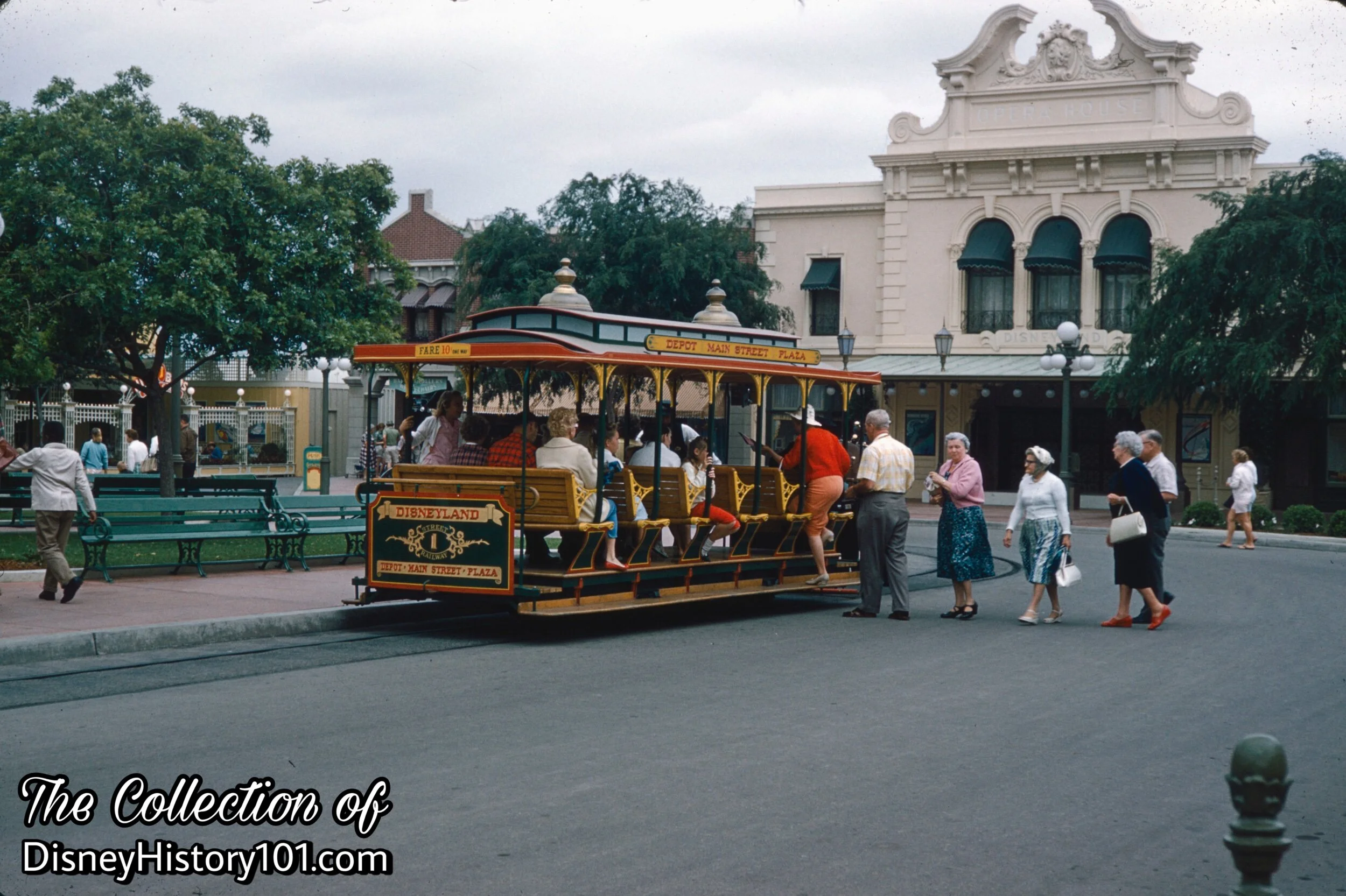
Main Street Opera House, (1960)
Guests prepare to board a Horse Drawn Streetcar and depart for a ride down Main Street U.S.A., not far from the Main Street Opera House in Town Square.
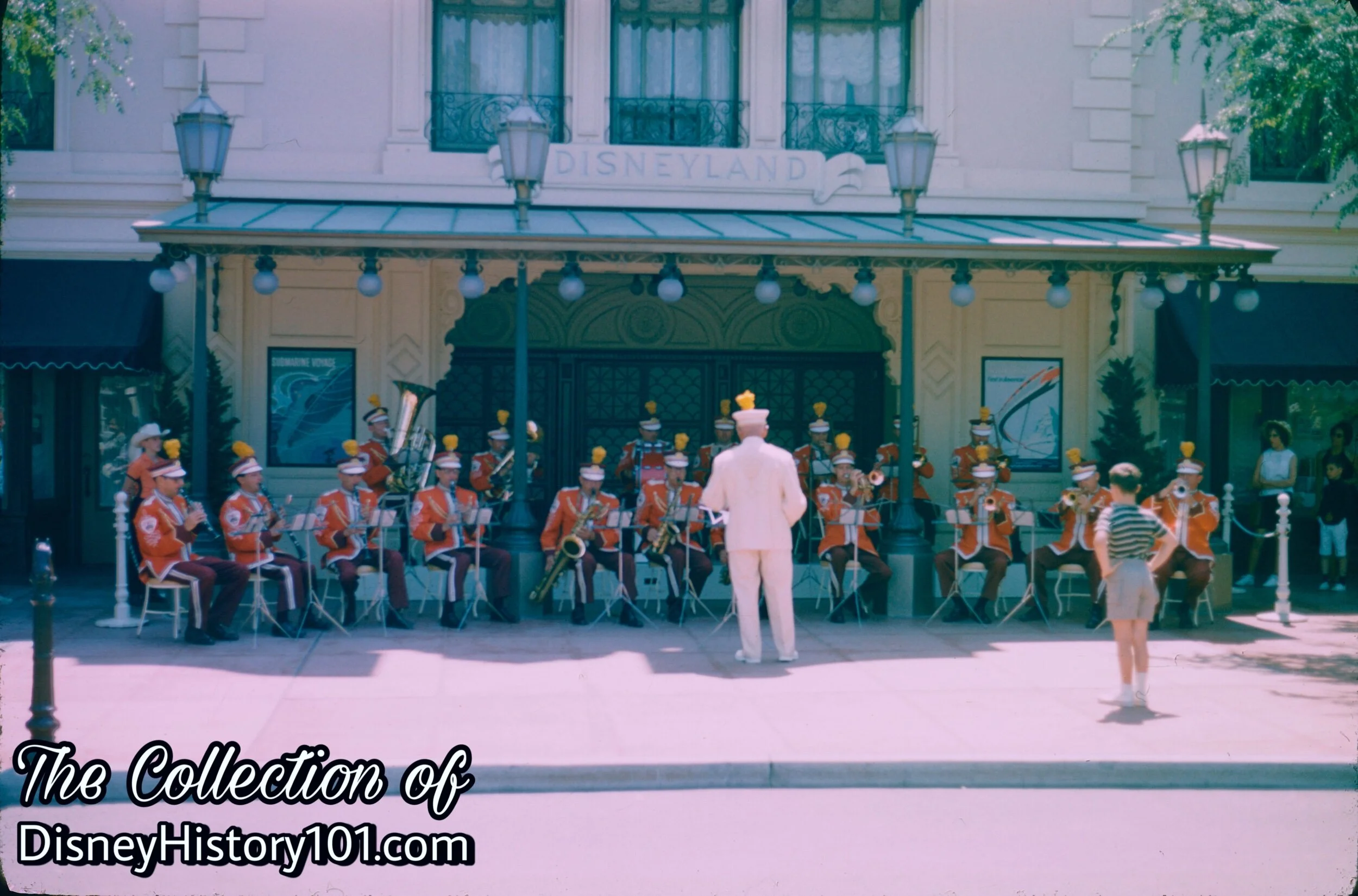
Main Street Opera House Front of House, photographed during a September, from 1959-1961.
“Grand Opening”
As of June 2, 1955, C.V. Wood Jr. sent an Inter-Office Memorandum to Walt Disney regarding the best estimates that could be obtained at the time regarding the completion status of individual sections of the Park and Opening Day. C.V. wrote: “Electric Signs: All are in work - with the exception of the shoe store and the Bank of America, all will be completed.”
Art Linkletter (while hosting Dateline Disneyland, aired July 17, 1955) implied that the Grand Opera House was a location “where Jenny Lind [a Swedish Opera Singer] or a Chautauqua [adult educational] lecture might take place.” Though (during the first few years), the doors were usually closed to guests, music would still emanate from the Main Street Opera House. During the early years, it’s sidewalk area under the awning was prominently used by the Disneyland Marching Band for concerts. In fact, those Disneyland PBX operators (stationed upstairs) received a free concert every morning, as the Disneyland Marching Band played right in front of the Main Street Opera House doors! During the latter part of the “first fabulous decade,” the Shoeshine Boys often performed near the entrance. You probably couldn’t hear the sound of the Mill (which operated until about 1960). During later winter seasons, the Disneyland Christmas Carolers (under the direction of Dr. Charles C. Hirt and lead by Mr. Robert G. Hasty), also known to perform near the “Lincoln” theater during various times of the day, from December 16th, 1967 thru January 1st, 1968. [“Disneyland Holiday Talent Master Schedule,” prepared for the period of December 16, 1967 through January 1, 1968]
During the early 1960’s the 450 square foot Main Street Opera House Lobby was utilized as a “Sponsor’s Headquarters” for representatives of senior classes attending Grad Nite at Disneyland. It seems (during this time) that there were many ideas as to what purpose the Main Street Opera House Lobby (comprising some 450 square feet) could serve at Disneyland. Over time, The Main Street Opera House on the 600 block of Main Street in Town Square, came to house a number of popular displays (as originally intended). One of the first events held inside was a publicity event for Walt Disney’s Zorro television show. A few years later (during November of 1962), Milt Albright entertained the idea of dividing the Main Street Opera House into a “Birthday Village” comprised of six areas. The area would have been rented for a period of (approximately) 45 minutes, and the package would potentially include lemonade and birthday cake, an overall photograph with their guests, and perhaps a special hat. With the thoughts of lemonade in mind, we turn our attention to the Main Street Opera House’s first memorable (and “Mother Goose”-inspired) exhibit…
(December 17th, 1961 - September 30, 1963)
You may recollect Walt’s Pre-Opening Day interview (with Bob Thomas of the Associated Press), where he divulged that “eventually I plan to make it a motion picture exhibit.” More than six years after Walt spoke those words, one of the first special exhibits to be displayed inside the Main Street Opera House was the Babes in Toyland Exhibit, from December 17th, 1961 to September 30, 1963 (with a brief closure during the winter of 1962). This was a walk-through exhibit featuring giant-size motion picture sets recently used in the filming of Walt Disney’s 1961 theatrical musical Babes In Toyland.
Babes in Toyland was quite an achievement itself, as the Walt Disney Studios had first entered negotiations in with Merian C. Cooper in 1933, to produce an adaptation of Victor Herbert's 1903 operetta Babes in Toyland. By 1957, Walt Disney shared how “planning product for today's changeable theatrical market in the United States is not easy. Theatre goers have become very selective. But we are firm believers in the basic desire of people for good theatre fare-good stories, well told.” Still, Walt expressed much enthusiasm for the “important new project slated for production” at his Walt Disney Studios. In the 1957 Walt Disney Productions Annual Report to Shareholders and Employees, he described Babes in Toyland as “a live-action spectacular to be built around the classic Victor Herbert music.”
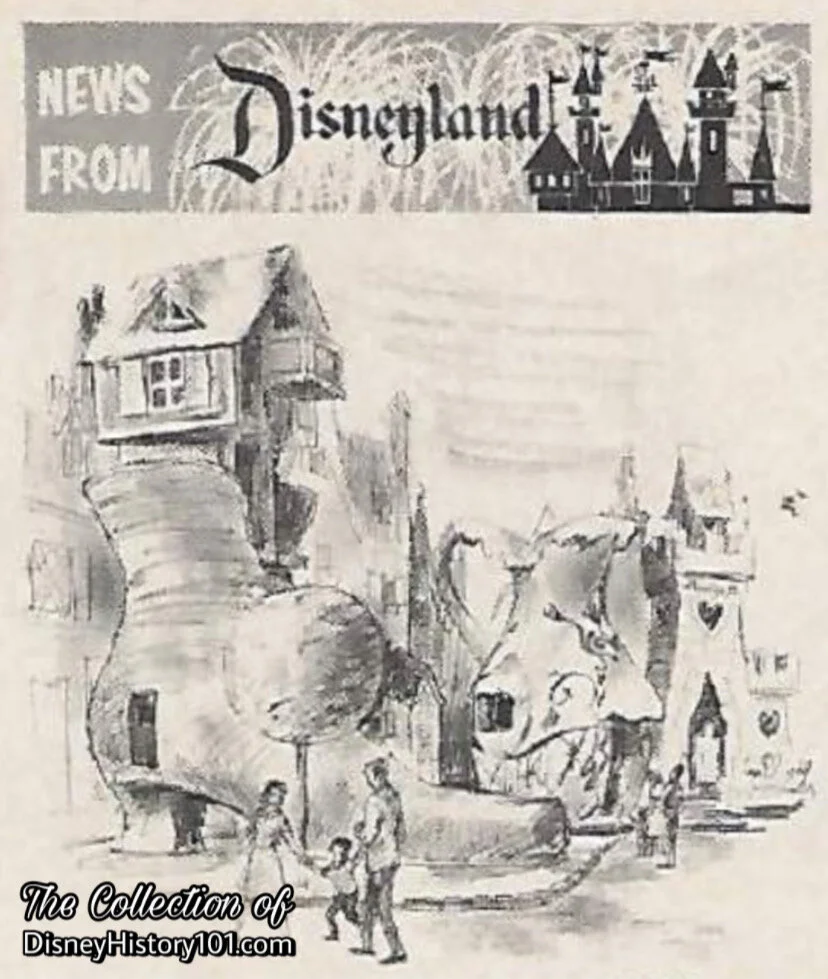
Vacationland, Winter 1961-1962 Excerpt
The set pieces for Babes in Toyland were created under the Artistic Direction of an established and renowned Hollywood Art Director Carroll Clark and Marvin Aubrey Davis (both of whom would go on to Direct the Art of many live-action Walt Disney Productions through the 1960s). The massive fantasy sets were also created under the Set Direction of Emile Kuri (the Academy Award Winning Set Director of Walt Disney’s 20,000 Leagues Under the Sea), and Hal Gausman (who had recently served as Set Director for Walt Disney’s Absent Minded Professor, and would later serve as Art Director for Walt Disney’s Mary Poppins)! Emile’s work had previously been a constant and popular feature of Tomorrowland!
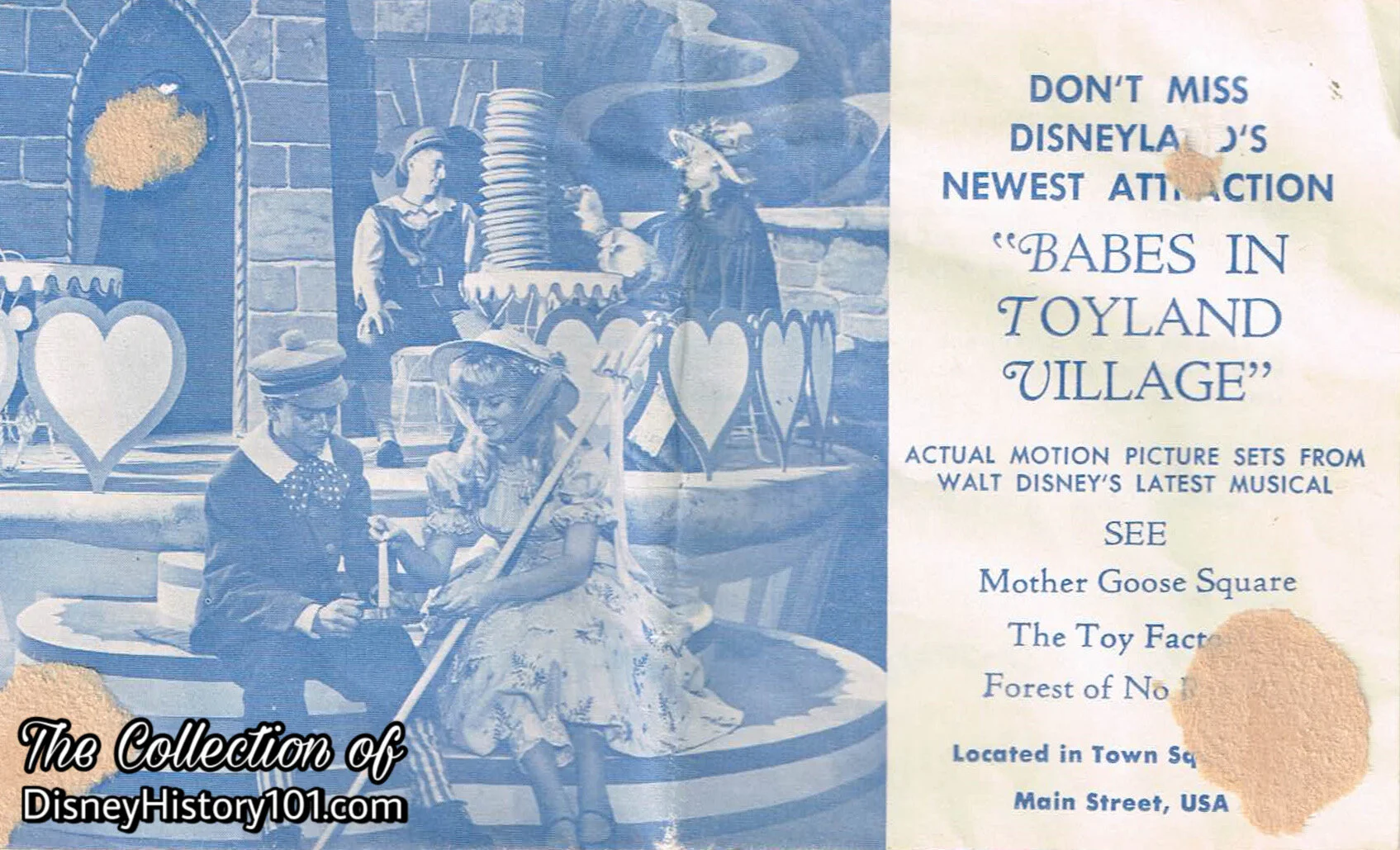
"3 Wonderful Ways to Enjoy Disneyland" Leaflet, December 17th, 1961 to September 30, 1963
Once through the Forest of No Return, “all roads lead to the magical, merry” Mother Goose Village Square! Guests could see “the pumpkin house of Peter, Peter, Pumpkin Eater ; the Queen of Hearts Tart Shoppe, the Shoe in which the Old Woman lived ; … and the Toymaker’s Toy Shoppe”. In addition, there was “Mary’s Cottage and garden ; a storybook castle and a little greystone church”, and in the distance (far outside of town) the crooked house of the “crooked old man” Barnaby villainously looms at the top of the hill. One of the sections of this “3 Wonderful Ways to Experience Disneyland” leaflet advertises some of the explorable locations of the “Babes In Toyland Village”. “See Mother Goose Square, The Toy Factory, [and] The Forest of No Return.”
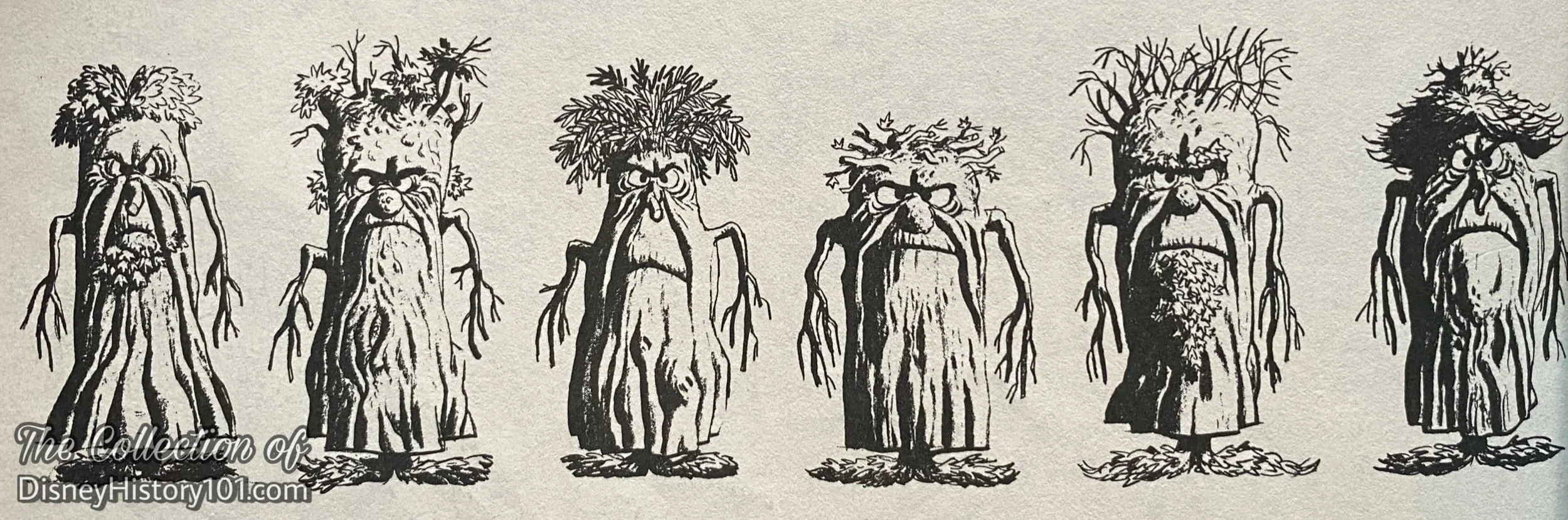
The Forest of No Return in Walt Disney’s Fantasyland Excerpt, Golden Press and Western Publishing Company ; ©️1965 Walt Disney Productions
The Forest of No Return could be a little scary for younger guests. It’s been said that “those who stumble in, those who fumble in, never can get out.”
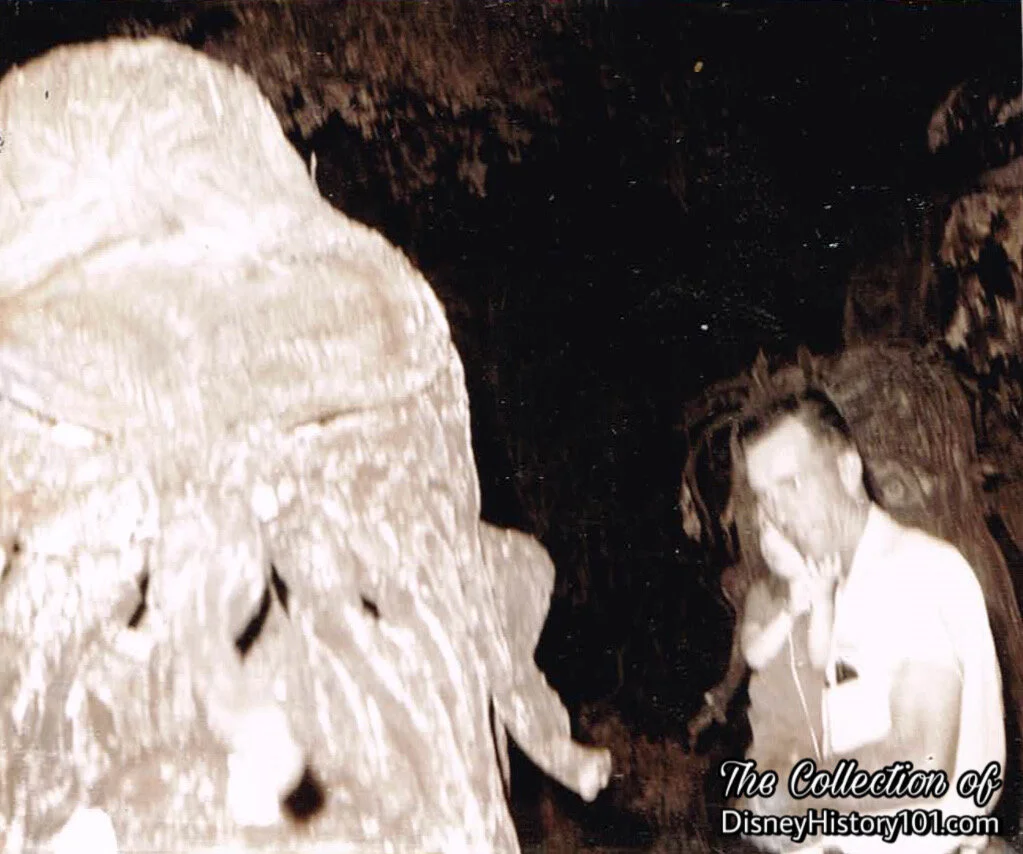
“Forest of No Return”
Here, a father holds his child as they ignore the signs reading “Go Away” and “Get Out”, and make their way through the encircling trees. Beware, as Barnaby’s cohorts (Gonzorgo and Roderigo) may be following closely behind!
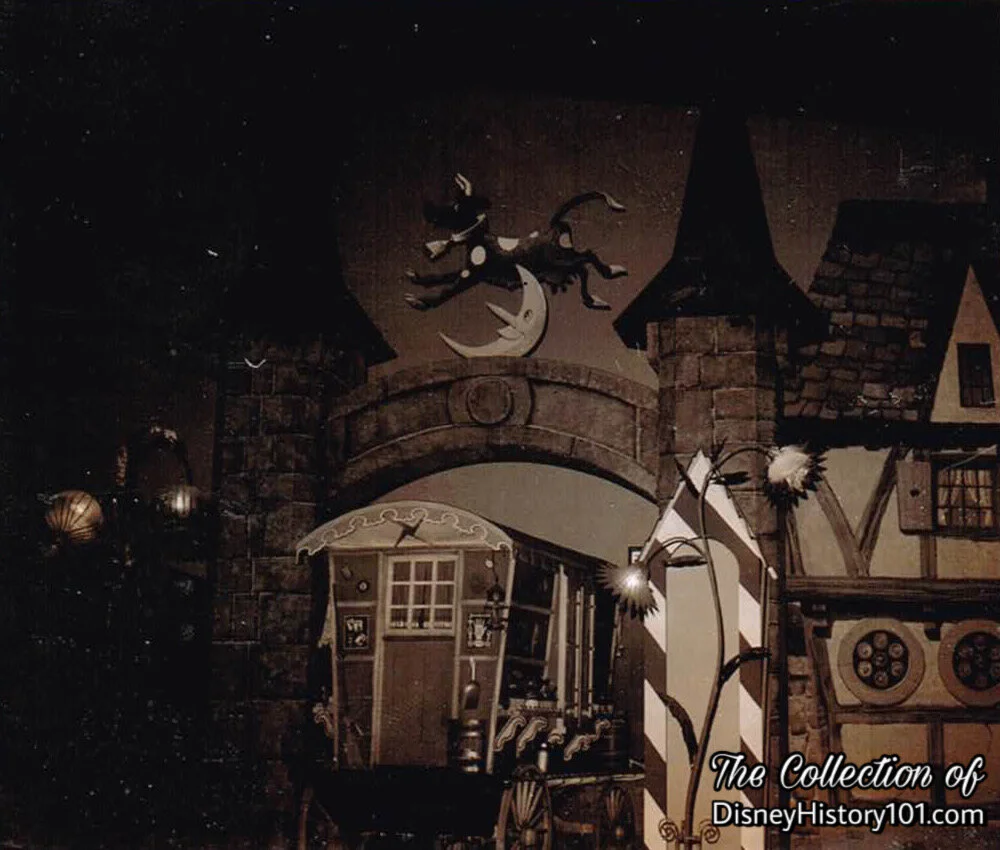
“Mother Goose Village”
By the time we arrive at Mother Goose Village, it appears that a Gypsy caravan has also arrived!
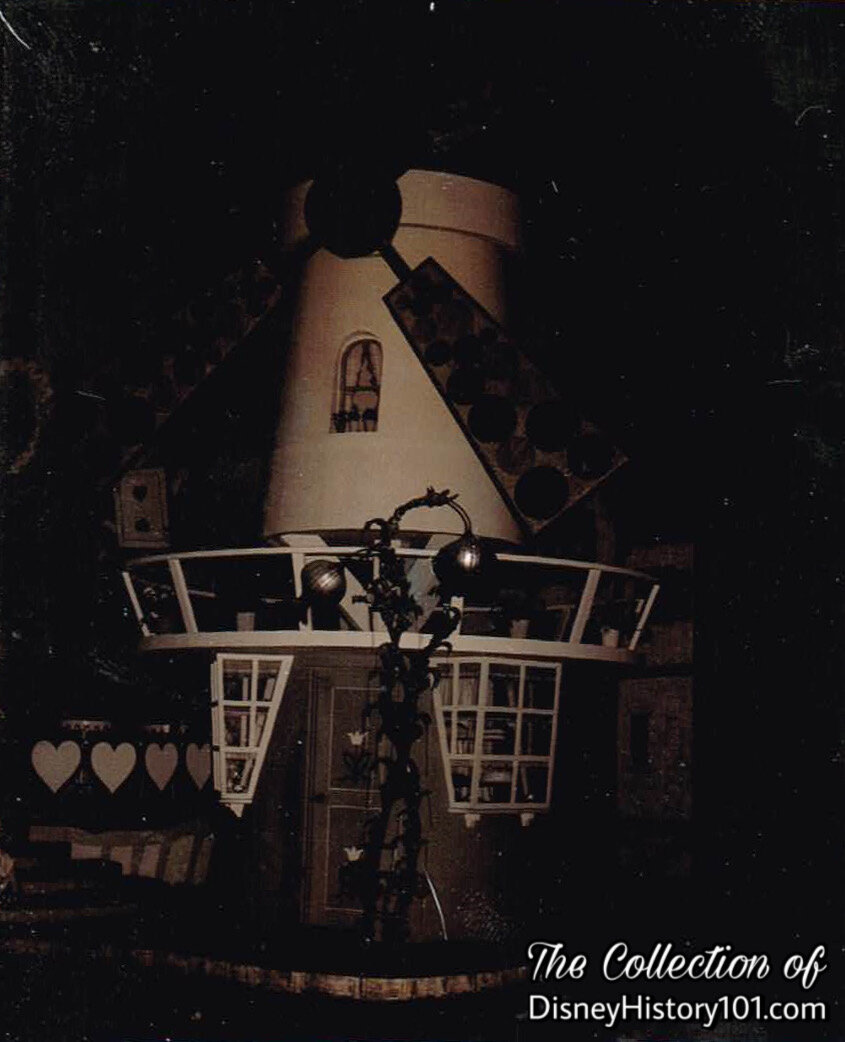
The 30-Foot Dutch Windmill of “Mother Goose Village”
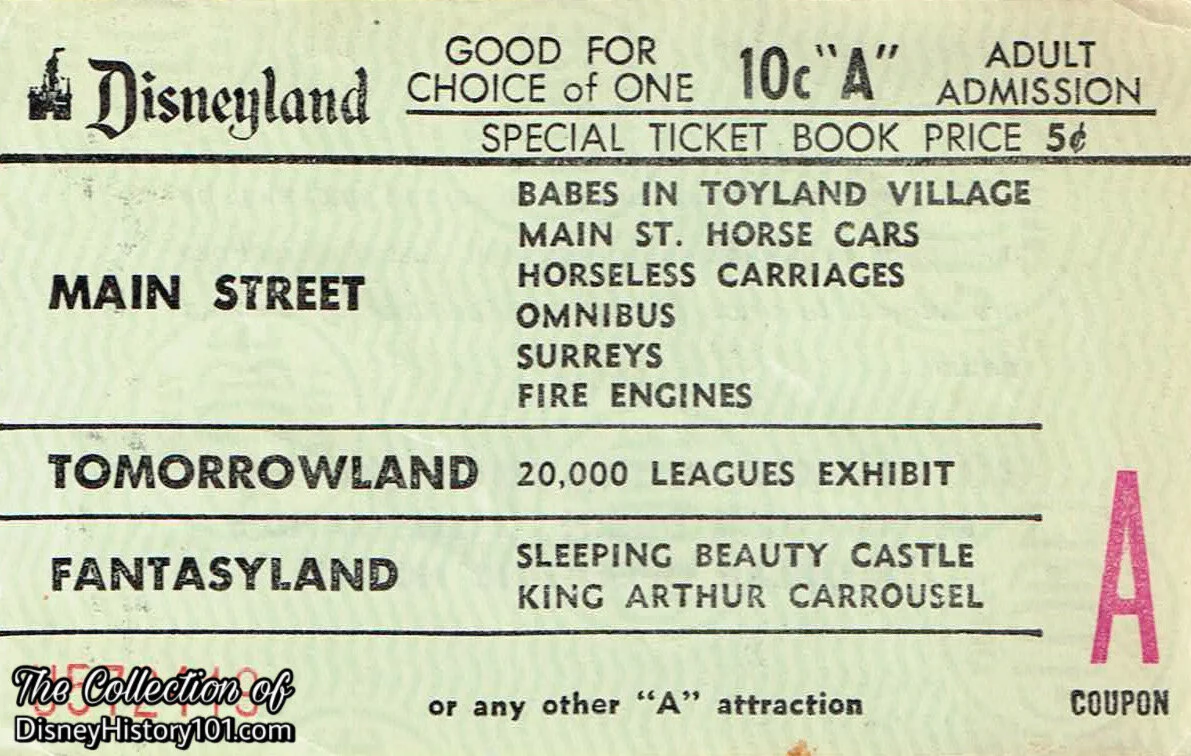
Disneyland "A" Coupon featuring the Babes in Toyland Village, December 17th, 1961 to September 30, 1963
Many guests were sure to not miss Disneyland’s newest attraction - the “Babes in Toyland Village”, featuring actual picture sets from Walt Disney’s latest musical! Table IV of the ”Ride Operating Schedule” (effective October 3, 1962) reported a maximum capacity of 1,200 guests daily. The cost of admission was the same as Walt Disney Productions’ other feature film exhibit, the 20,000 Leagues Exhibit - 10 cents, or one “A” Coupon.
All the while, after the Park closed, the staff would take over with brooms, mops and dustcloths. Special attention was given to marred walls, posts and furniture. Items with marks that didn’t wash off were replaced or repainted. Floors were waxed and buffed to preserve their beauty and protect them from the thousands of feet that scuffled over them each day.
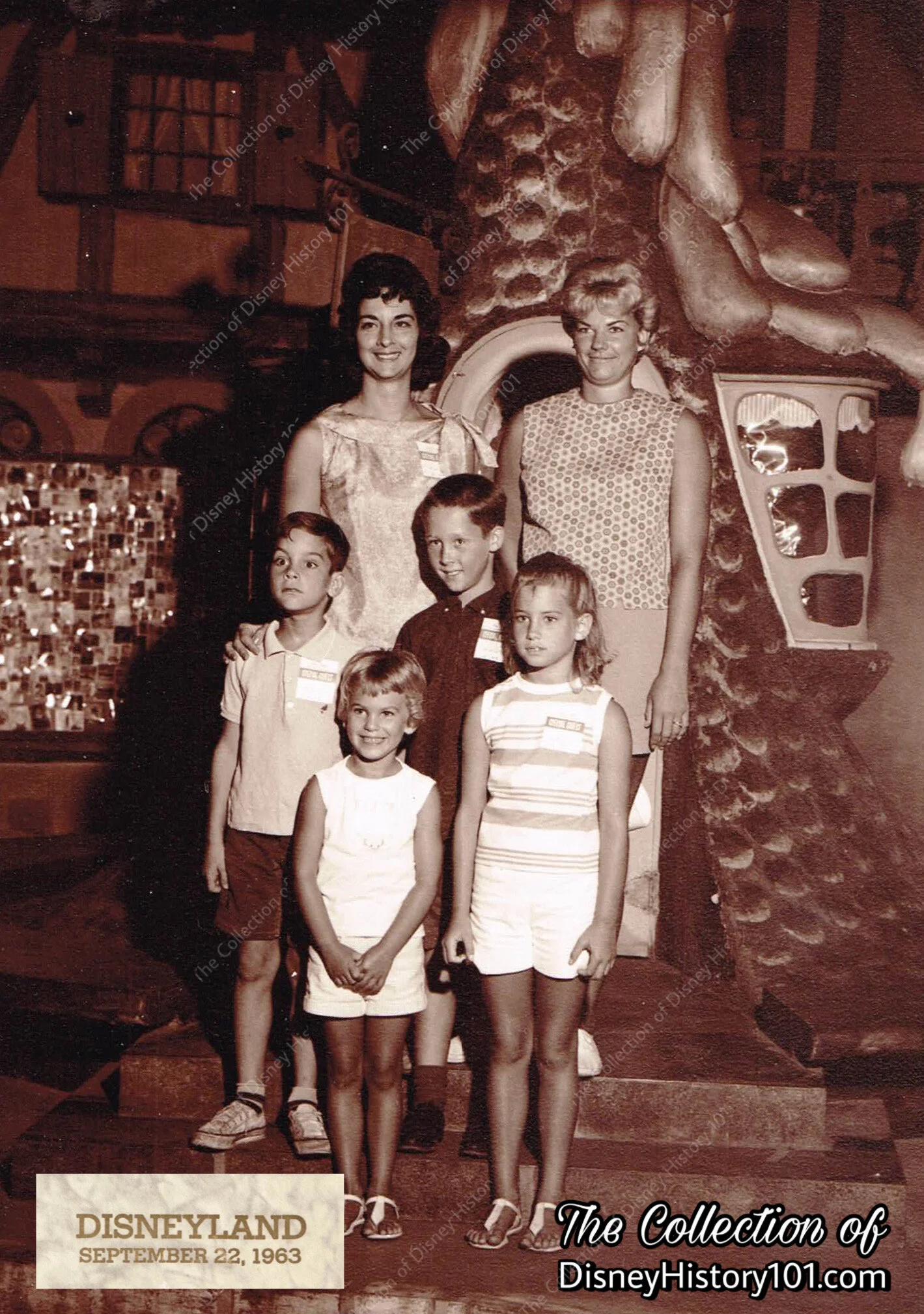
Babes in Toyland “Mother Goose Village” Souvenir Photo Near The Candle Shop of “Jack-Be-Nimble,” September 22, 1963.
Guests who wished to commemorate their visit to the film’s set (and prove that they actually set foot in Mother Goose Village) could have their souvenir photo taken near the house that Jack Built - that of “Jack-Be-Nimble” (of candle-jumping fame)!
After visiting the exhibit, guests may find a memento of their experience in a location not advertised - the neighboring Toy Shop. Many souvenirs (found in contemporaneous c. 1961 shops) were themed around the Babes in Toyland characters - wooden frame tray puzzles (by companies like Jaymar) featuring memorable scenes from the film, vinyl Disneyland records and books featuring popular songs from the film, cute “Twistable” toys, hand puppets, “punch-out” figure books, and small plastic Marx Disneykins figures of toy soldiers.
During 1963, Grad Nite Chaperones used teh space as their greenroom and dined among the set while Grads explored the Park.
By the time this attraction had ceased operation, a grand total of 436,070 guests had experienced a stroll through the Village set pieces of Walt Disney’s latest live-action feature film [according to Admission Media Rides and Attractions Reports, published by Disneyland Research Department, April, 1971].
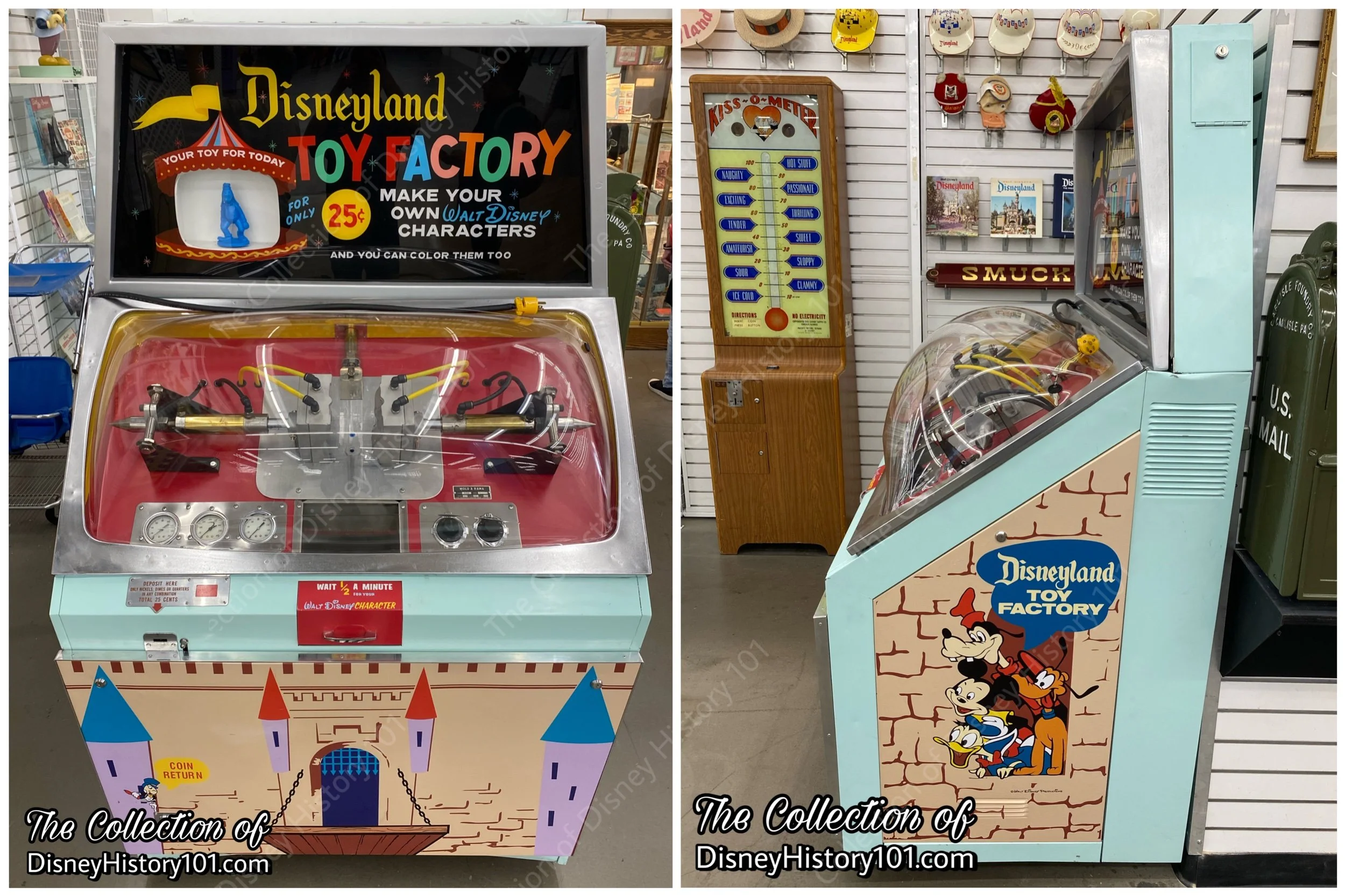
One of J.H. Miller Company's Mold-A-Rama "Disneyland Toy Factory" machines in Burbank, California.
The Main Street Opera House housed a J.H. Miller Company Mold-A-Rama "Disneyland Toy Factory" machine.
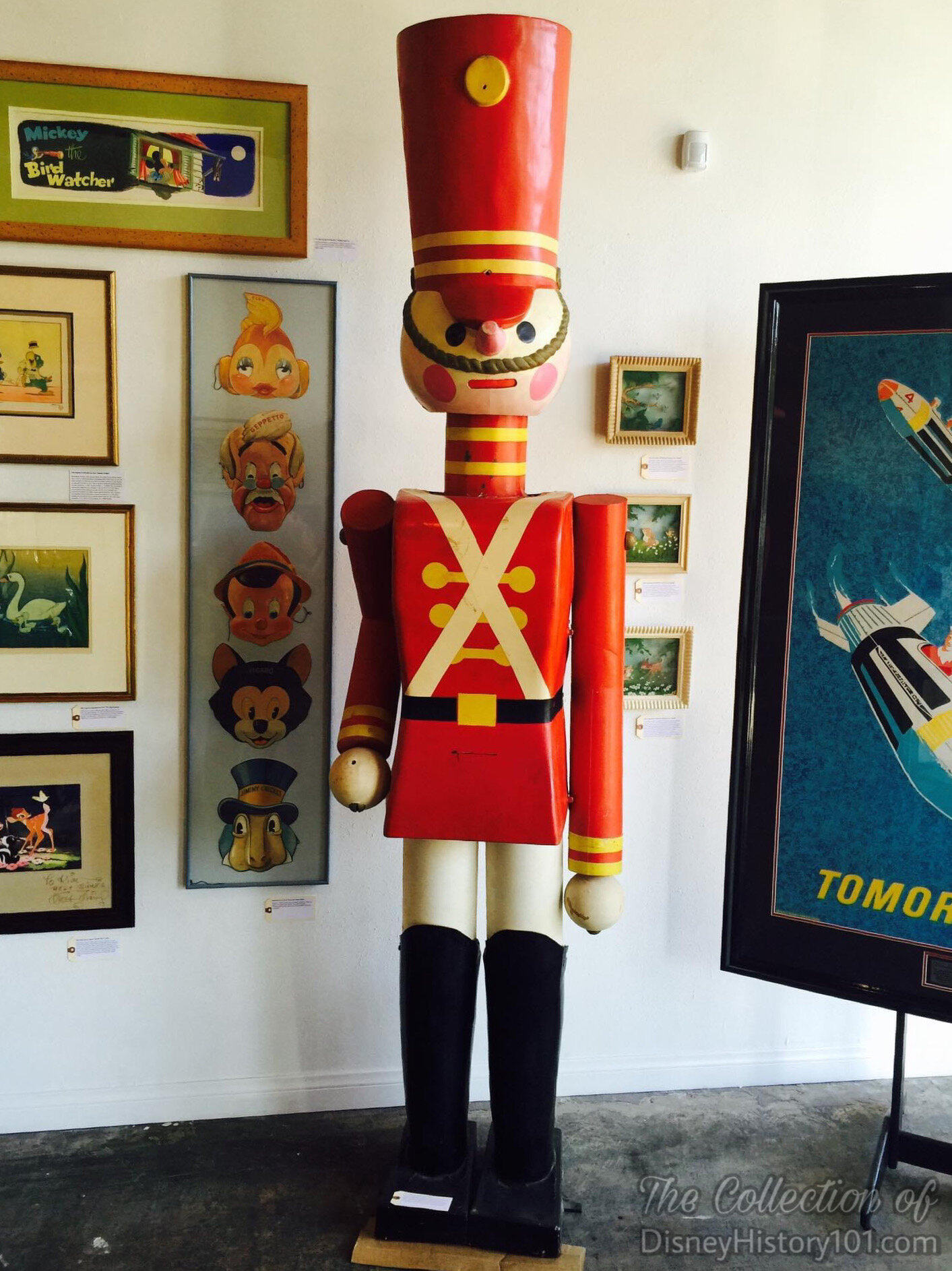
Babes in Toyland Soldier Prop (Previously on Display at Van Eaton Galleries), c. 1961
Before guests even set foot inside the technicolor fantasy world, towering Toy Soldiers in Candy-striped guard houses guarded the entryway into the Main Street Opera House, as George Brun’s storybook-inspired music tracks could be heard in the distance! Decades after these giant wooden Toy Soldiers briefly stood guard outside the Babes in Toyland exhibit, we had the pleasure to see one in person at one of Van Eaton Galleries’ prior pre-auction exhibitions! As a “sidelight”, you may notice that the soldier’s straps also form an “X” across their back. This was done with intent, as their creator was the legendary animator Francis Xavier Atencio!
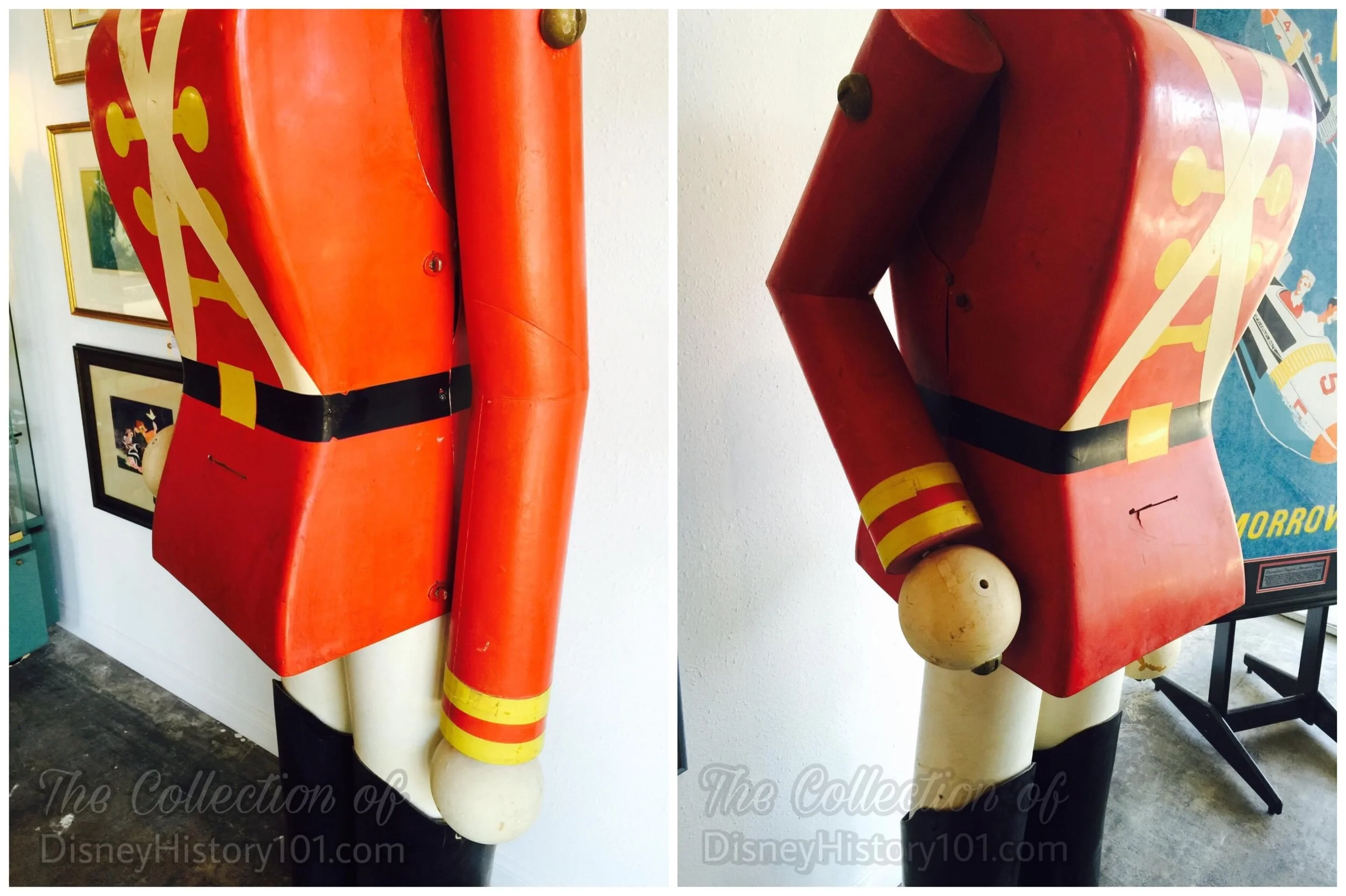
Babes in Toyland Soldier Prop (Previously on Display at Van Eaton Galleries), c. 1961
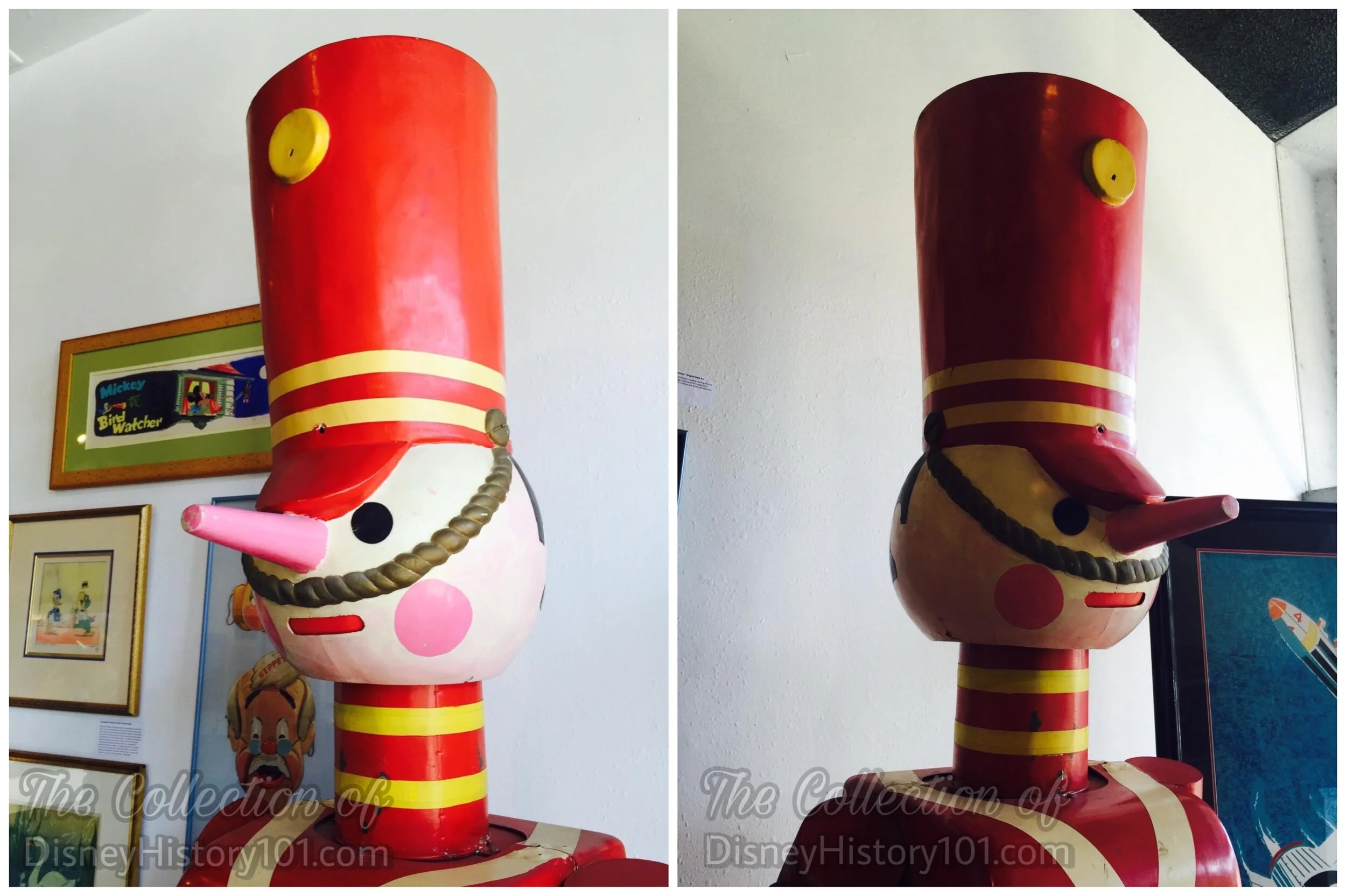
Babes in Toyland Soldier Prop (Previously on Display at Van Eaton Galleries), c. 1961
(September, 1963 - September, 1964)
The earliest concepts of Walt Disney’s Disneyland included descriptions of a Mickey Mouse Club attraction! This was likely due to the fact that the “The Mickey Mouse Club” television show was preparing to launch during the fall of 1955, and Walt (being a big believer in corporate synergy) was planning to use Disneyland as a stage to introduce his newest sensation! According to “Disneyland” (a document prepared for Disneyland Inc. by WED Enterprises), “Mickey Mouse, the best known personality in the world has his Mickey Mouse Club headquarters at Disneyland. Located on Treasure Island, in the middle of the river, a fantastic hollow tree and treehouse serves as the Club meeting place. The hollow tree is several stories high, with interesting rooms and lookout spots for Club members. There is a Pirate cove and buried treasure on the Island…and direct from this location the Club presents The Mickey Mouse Club Television Show.”
Disneyland partially owes its existence to the Mickey Mouse Club. According to Walt’s own words (in a Disneyland, Inc. Merchandise Association Meeting held Wednesday, January 25, 1956): “A year ago we were praying that we could have Disneyland open by July, then wondering if we would have enough money to open it. I reached a point where I needed a few more milion dollars, so took on quite a chore and started a new TV show - the Mickey Mouse Club… My budget for 100 hours of programming for the Mickey Mouse Club was $2,000,000,00 and I spent more than that… Money from this program was used to help finish Disneyland. Today the show has a 25 rating which is the highest rate of any day time show and compares very favorably with some of the night time shows. We use this to publicize Disneyland.”
Now, “The Mickey Mouse Club” television series had two runs up to this point - a one hour run for two years (from October 3, 1955-1957), and a half-hour run (from 1957-1959). During the latter run, Nielson ratings over a 52-week period (of 1958 alone) showed “The Mickey Mouse Club” was viewed by a total of 15-million Americans, five days a week.
By 1963, ”The Mickey Mouse Club” television series had recently become syndicated, and thus offered a wonderful opportunity - a “cross-pollination” promotion opportunity between Disneyland and Walt Disney Productions! Ultimately, the Mickey Mouse Club, would be regularly shown throughout the world.
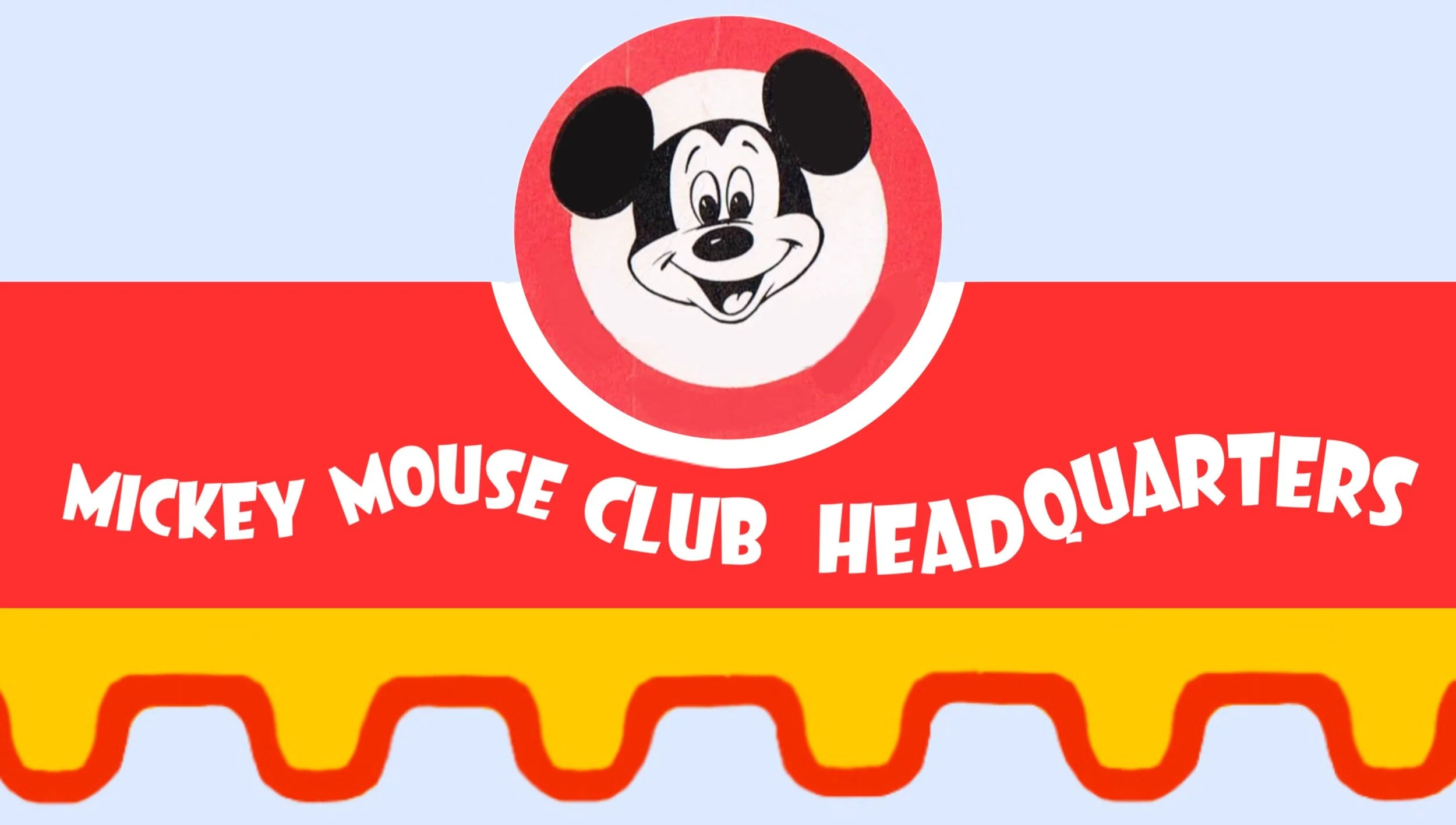
Now, following the Babes in Toyland exhibit (which closed on September 30th, 1963), the Main Street Opera House briefly hosted the Mickey Mouse Club Headquarters - from September of 1963 to September of 1964! During this time, the Mickey Mouse Club Headquarters was open daily at Disneyland - from dawn until dusk - with varied opening hours, ranging from 8:30 am (or 9:30 am) to 5:00 pm! The entire adventure had a 900-guest capacity.
Here, the doors of the official “Mouseke-Club” were opened by Disneyland Guided Tours Hostesses (like Maggie Albright, Chief Hostess of the Mickey Mouse Club Disneyland Chapter). Then, “boys and girls from far and near” were “welcome as can be,” and everyday was “Guest Star Day.” Older Mickey Mouse Club Members (and Guests) “proudly put on their Mouseke-ears,” and experienced becoming honorary Mouseketeers (receiving their very own Charter Membership Certificate, Official Membership Card, and souvenir button). Fans of the series could have a souvenir photograph taken with Mickey Mouse (on their birthday), and guests of all ages found exclusive Mickey Mouse Club Headquarters souvenirs and miniature press photographs featuring the original cast were sold in the Mickey Mouse Club Shop (as it was referred to in Walt Disney’s Guide to Disneyland)! Just through the Opera House doors, the “Disneyland Toy Factory” Mold-A-Rama would produce plastic-injected molded figures of Mickey Mouse and friends.
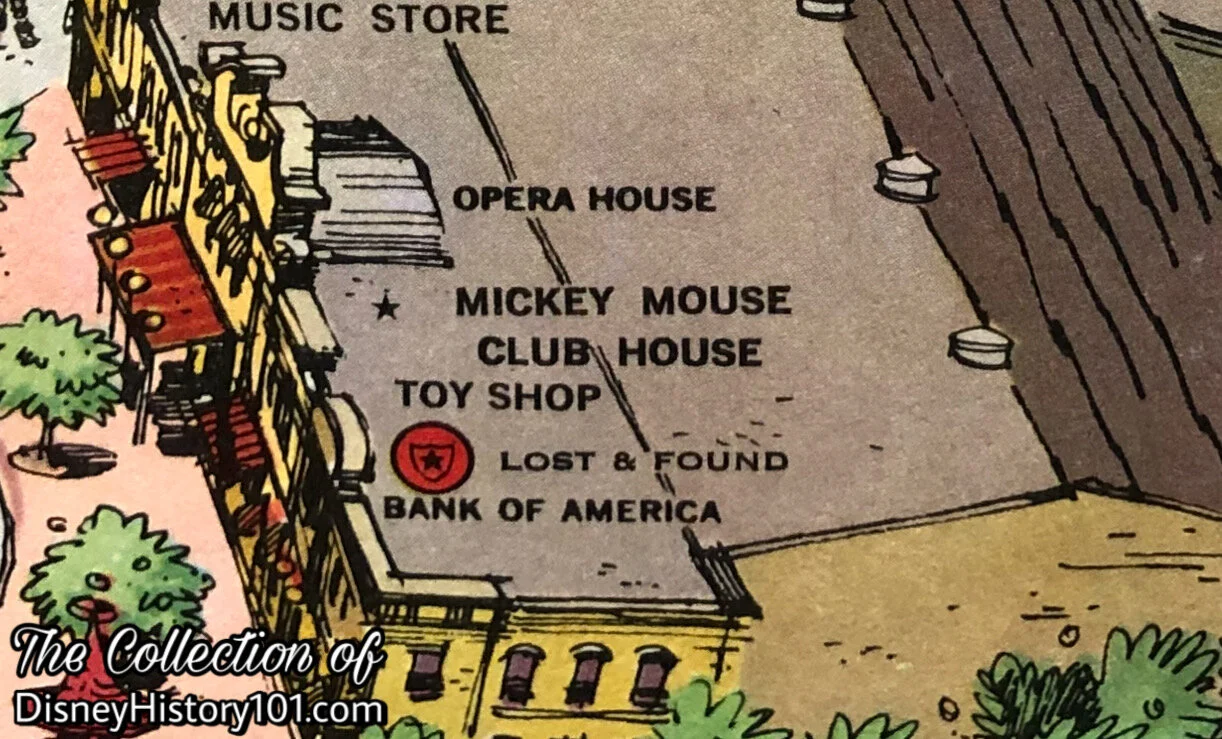
“The Mickey Mouse Club Headquarters” Detail, Disneyland Map by Sam McKim Excerpt, (1964)
“Guest Star Day”
Once entering, you stroll down a path with barns and the various days of the week on them (i.e. Guest Star Day). Some of television’s Mouseketeers would meet and greet guests near these barns. It wasn’t uncommon to see Roy Williams drawing caricatures, Jimmy playing his Mouseguitar, or other Mouseketeer Alumni visiting the exhibit. Of course, the most popular Mouseketeer was “the leader of the club that’s made for you and me“ - Mickey Mouse!
In addition to all these guest stars, Mouseketeer Ginny Tyler regularly recorded live 15-minute daily segments inside Disneyland’s Mickey Mouse Club Headquarters, which was broadcast on locally on KTTV as part of the syndicated “The Mickey Mouse Club” series. Comedians “Hub and Bub” (later known as Skiles and Henderson) made an appearance on one such segment. While many of the live televised segments featured the Backstage areas of Disneyland (i.e. the Mill, Model and Paint Shops, Decorating, the Monorail Shed, and the Train Roundhouse), one segment in particular highlighted “the inner workings of the Main Street Cinema.”
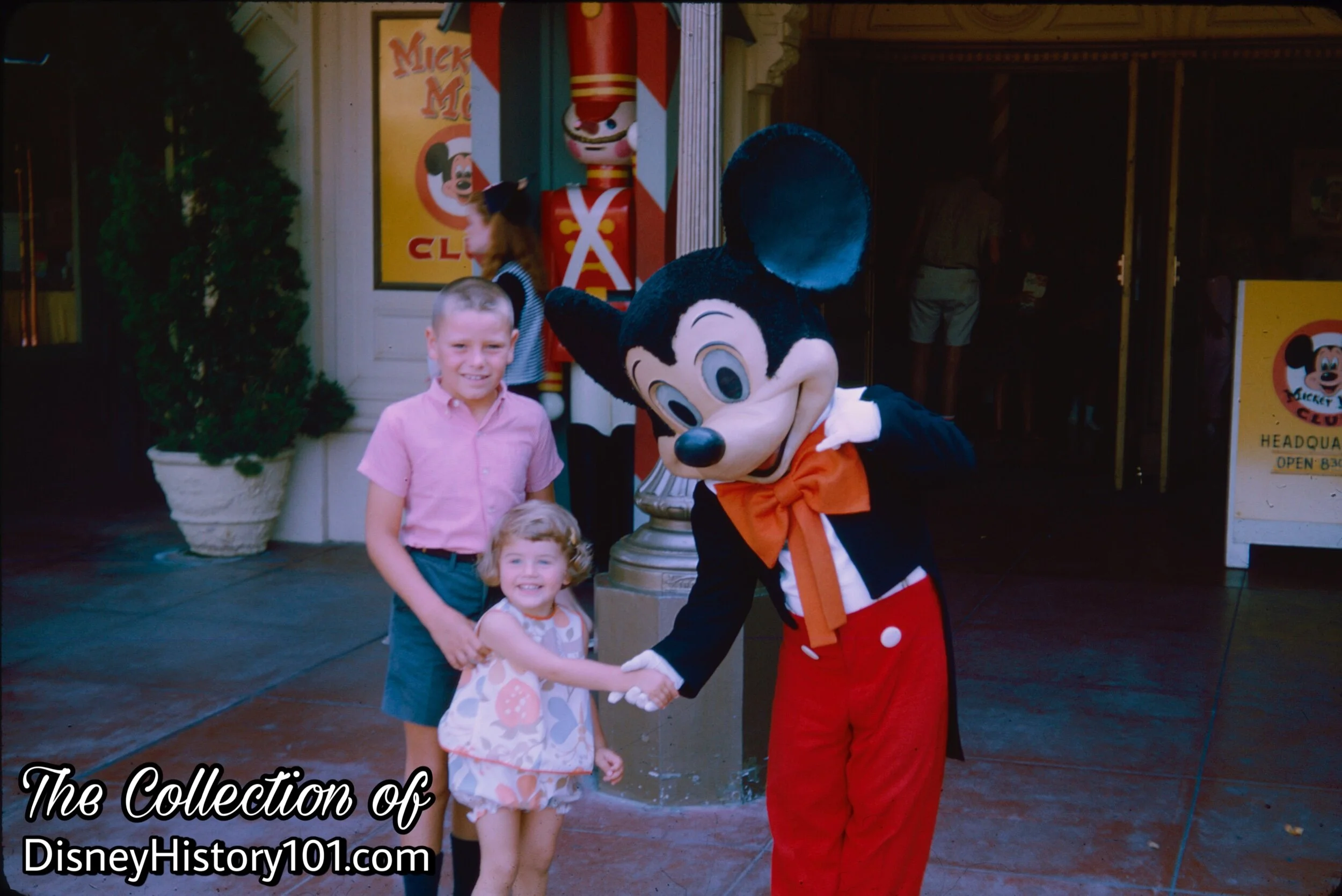
“The Mickey Mouse Club Headquarters”, late 1963
A Toy Soldier in a candy-striped guardhouse still stands guard before the entrance of the Main Street Opera House’s next exhibit!
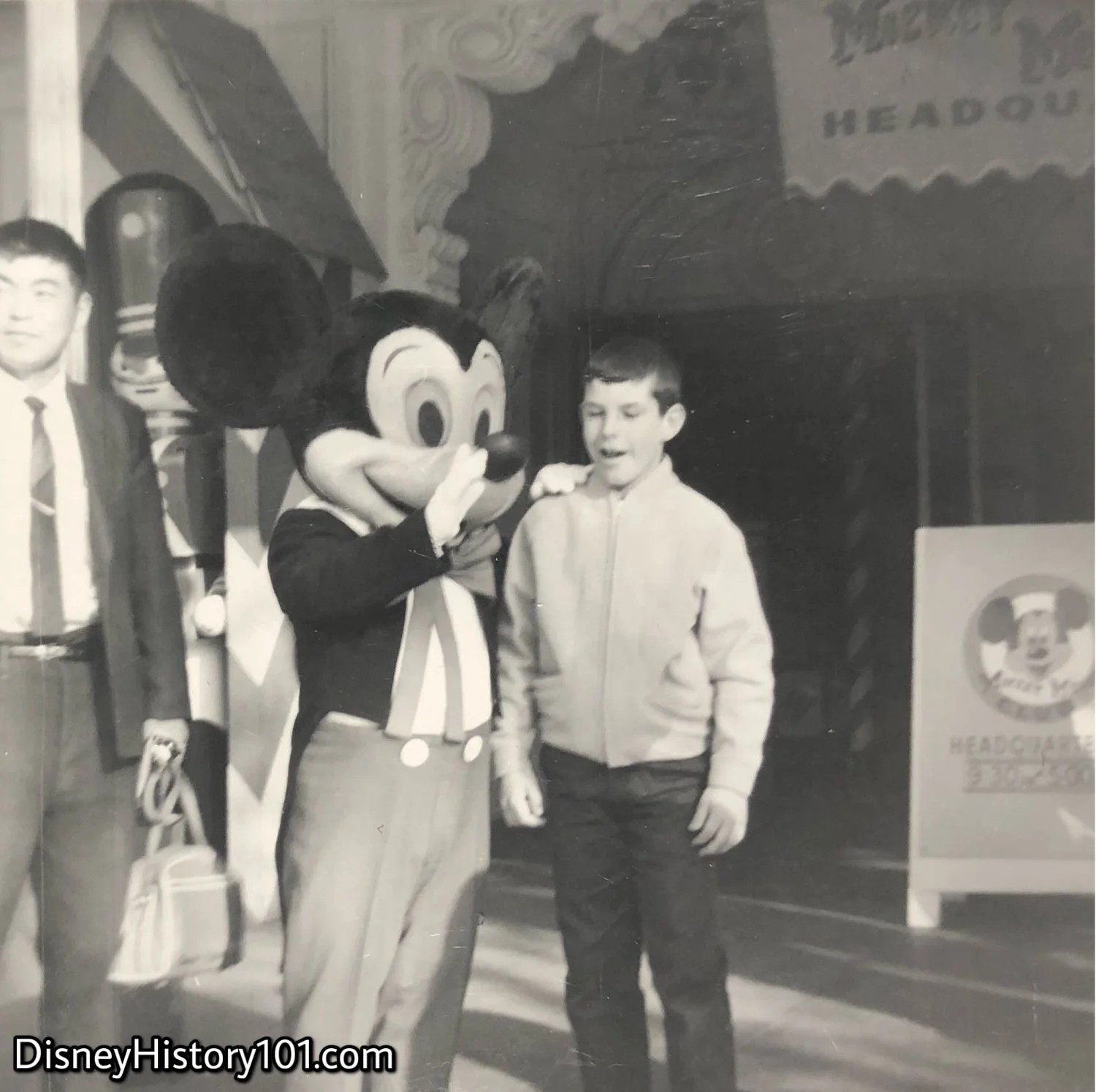
“The Mickey Mouse Club Headquarters,” January of 1964.
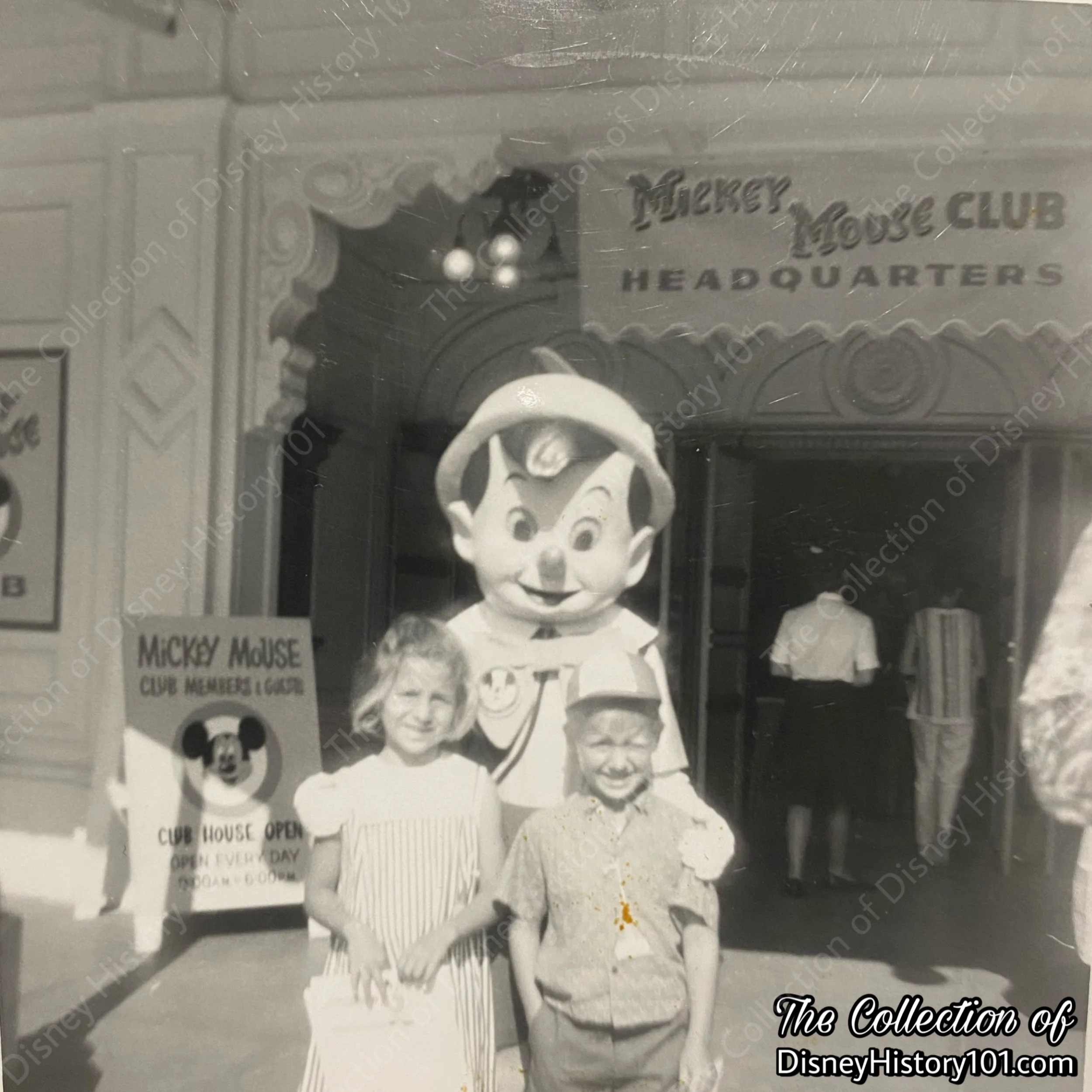
September of 1963.
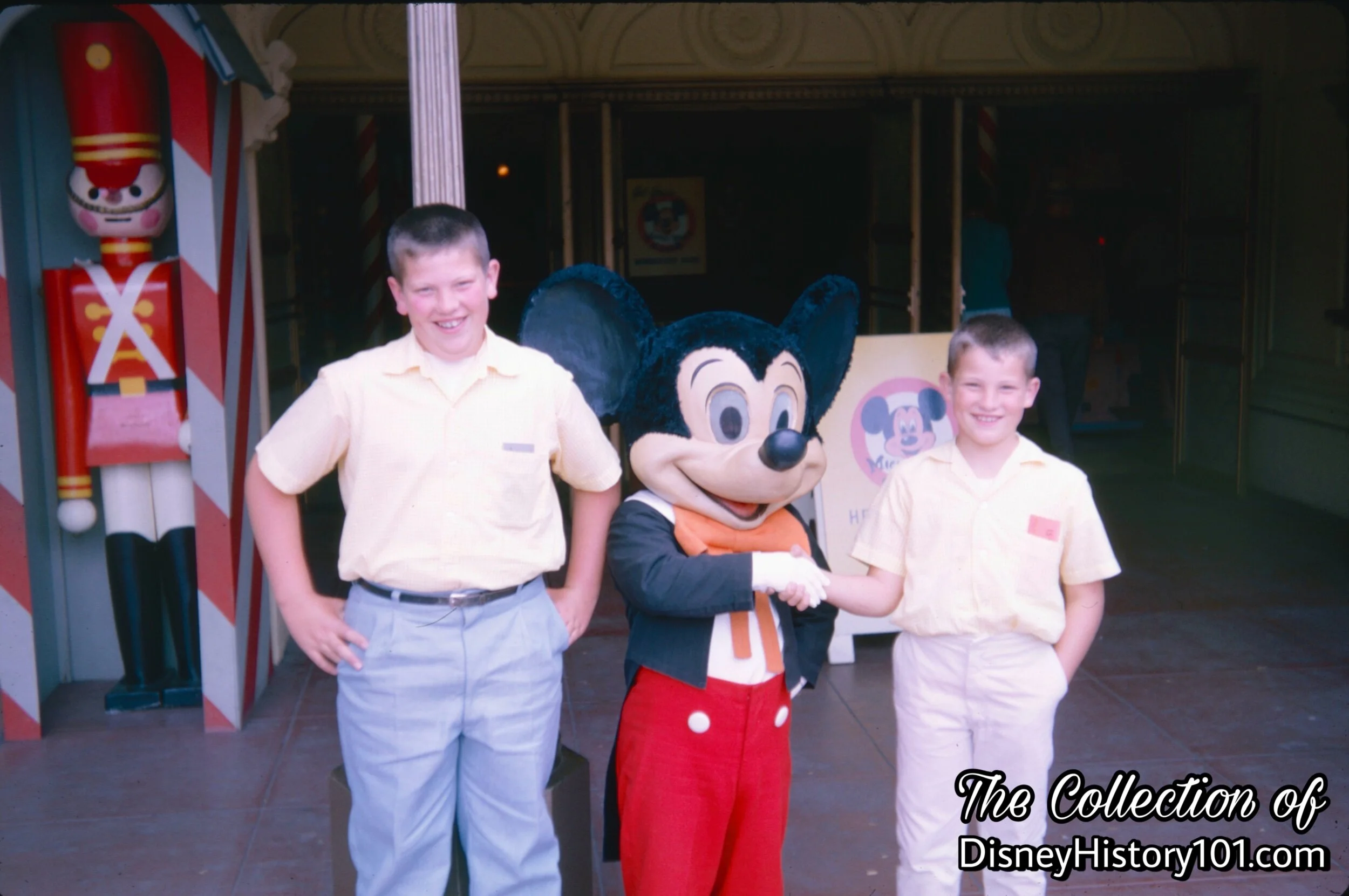
“The Mickey Mouse Club Headquarters”
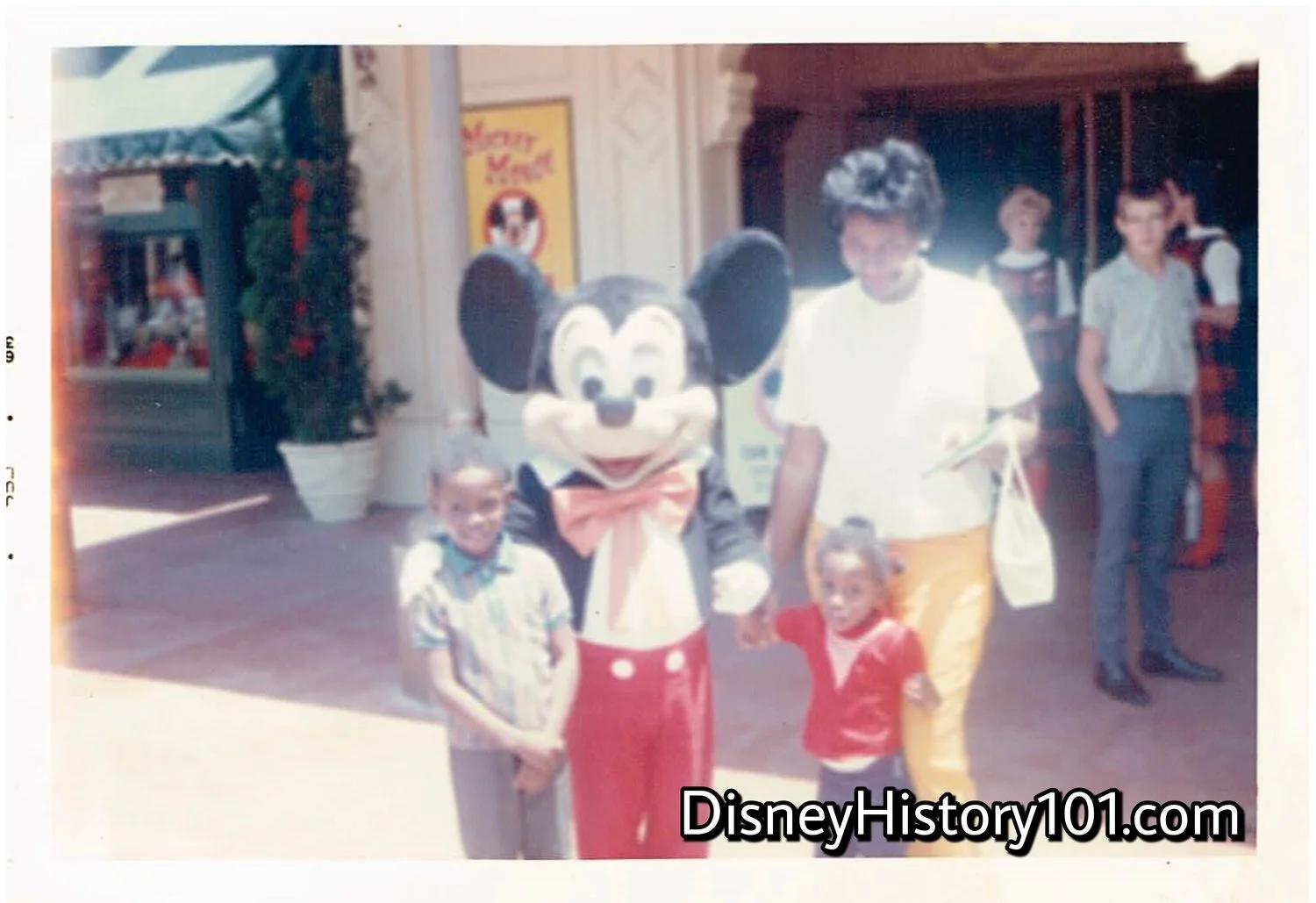
Mickey and Guided Tour Hostesses welcome guests to “The Mickey Mouse Club Headquarters” at Disneyland, in 1964
Who’s “the leader of the club, that’s made for you and me” ? Mickey Mouse welcomed new honorary Mouseketeers to the Mickey Mouse Headquarters, while Disneyland Hostesses (occasionally referred to as “Mickey Mouse Club Girls,” seen in the background) also welcomed guests!
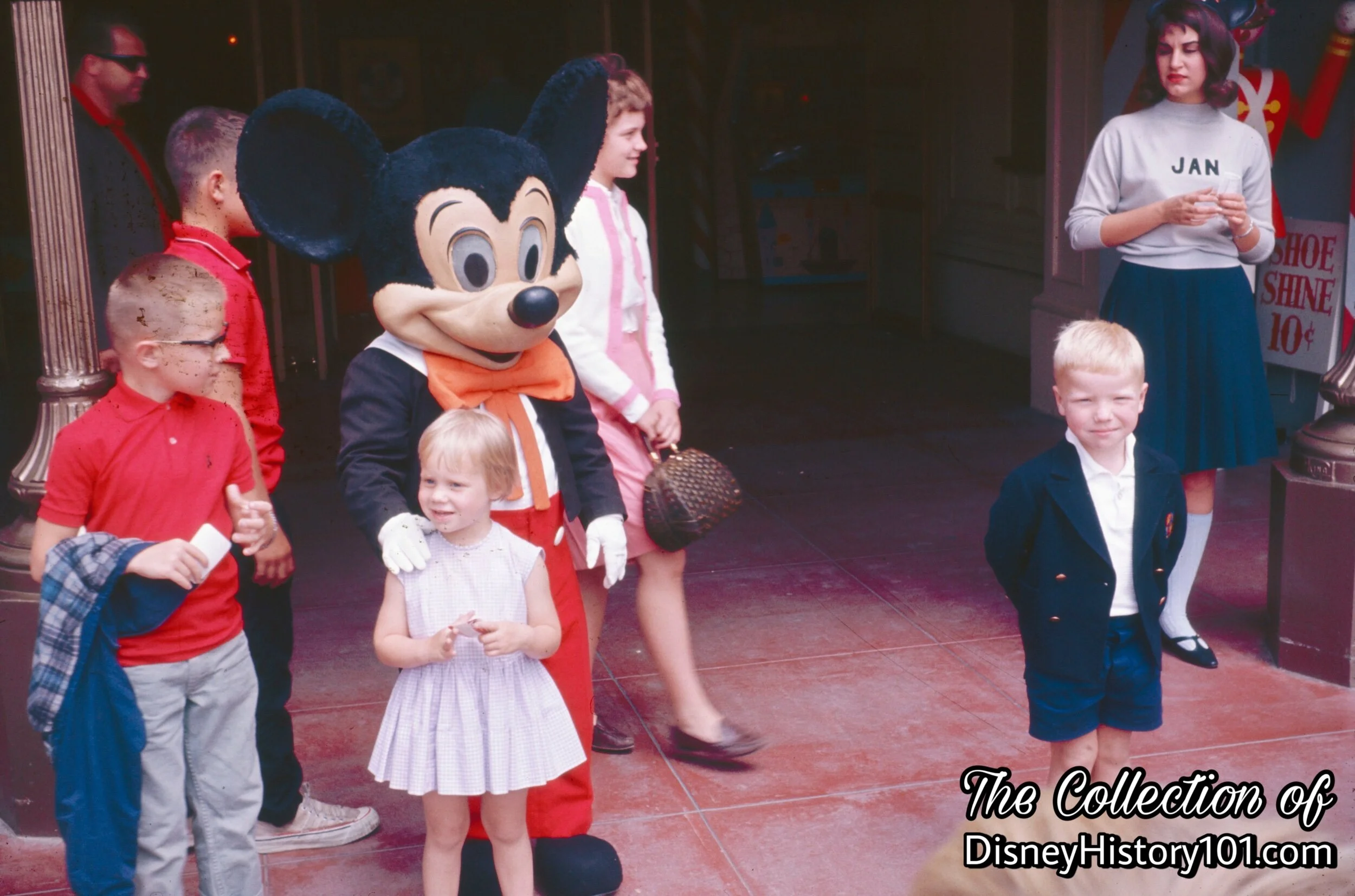
Mickey and Mouseketeer Jan welcome guests to “The Mickey Mouse Club Headquarters”
As late as April of 1964, the “mousekegirls” of “The Mickey Mouse Club” television show worked at the location. During this time, a total of 3,162 free souvenir birthday pictures (taken with the visiting cast) were given out to guests.
“The Mickey Mouse Club Headquarters”
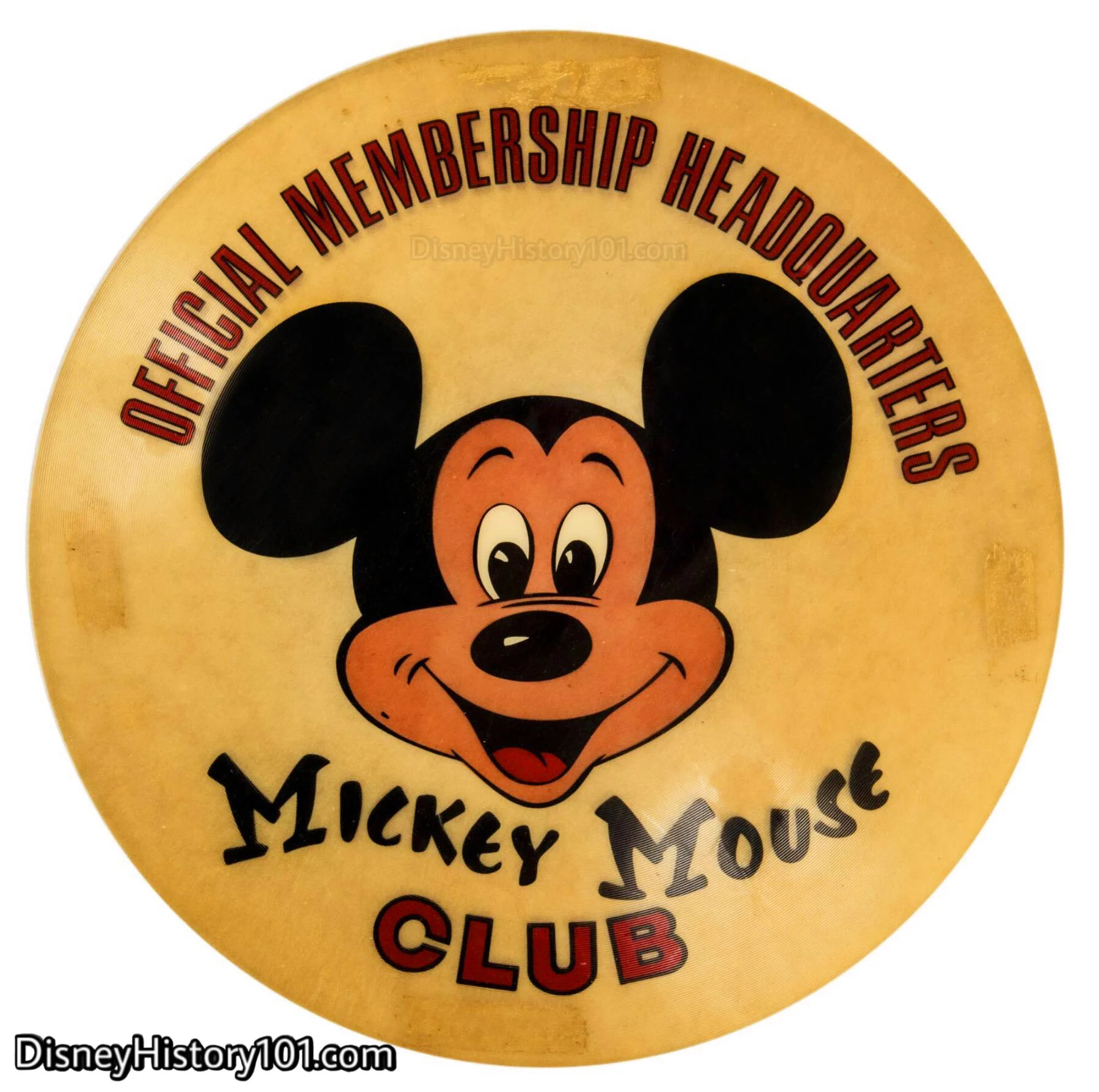
Official Membership Headquarters Sign (Courtesy of Van Eaton Galleries)
Signage like this would hang around the interior of the premises, announcing the temporary headquarters to Park guests. This was not the first time Mickey Mouse Club Membership was offered at Disneyland. During the winter of 1955, Wonderland Music Store in Disneyland offered an Official Mickey Mouse Club Certificate with a subscription to Walt Disney’s Mickey Mouse Club Magazine. Now, due to such an increased advertised presence, The Mickey Mouse Clubhouse Headquarters at the Opera House in Disneyland boosted membership during its tenure (membership of the Mickey Mouse Club Disneyland Chapter being promoted as early as 1962).
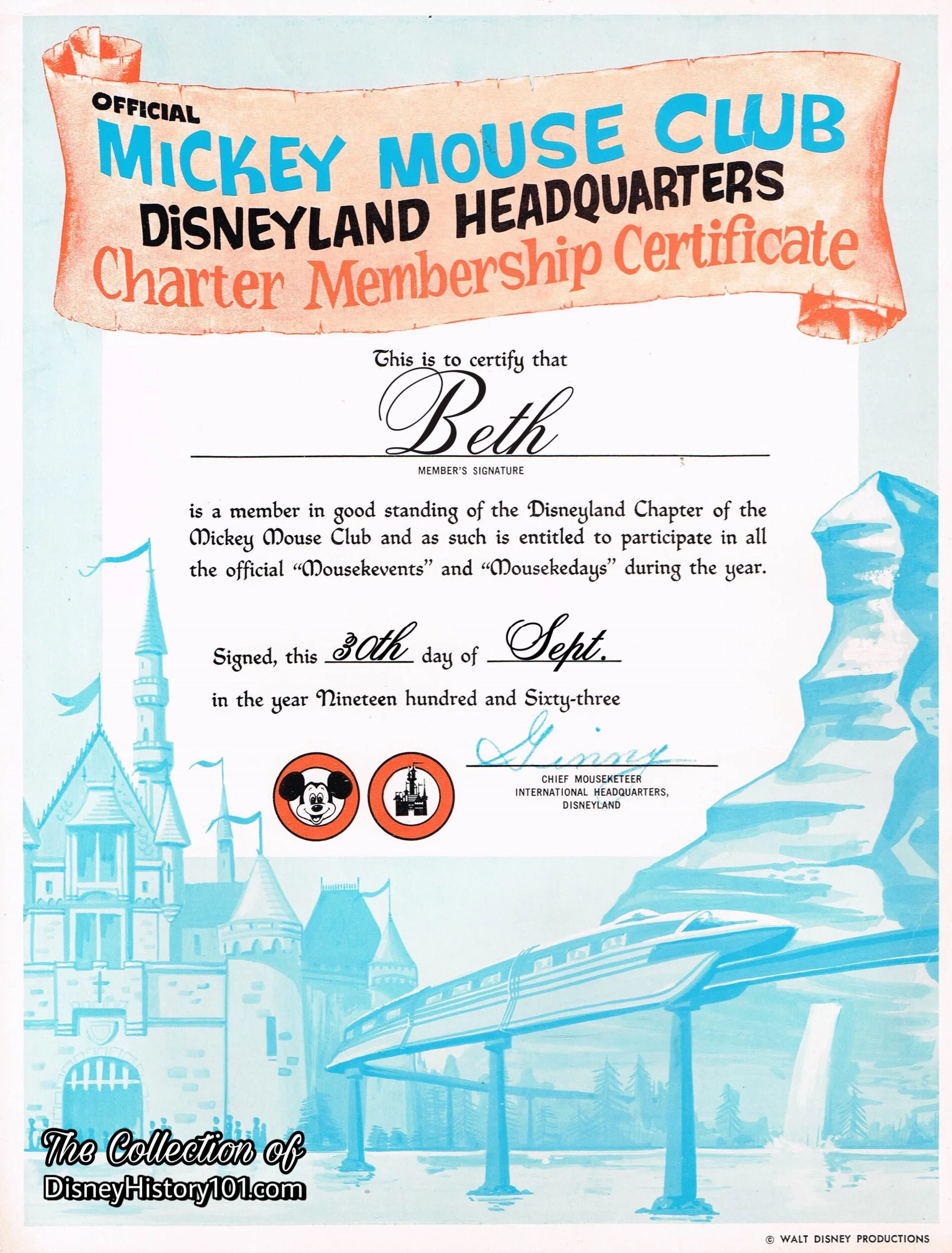
Mickey Mouse Club Disneyland Headquarters Charter Membership Certificate
Guests visiting the Mickey Mouse Club Disneyland Headquarters would receive this Charter Membership Certificate (signed by “the Chief Mouseketeer [of] International Headquarters” - Ginny Tyler), welcoming them to the club! Even after this temporary experience would disappear, some guests would cherish their membership certificate for a lifetime.
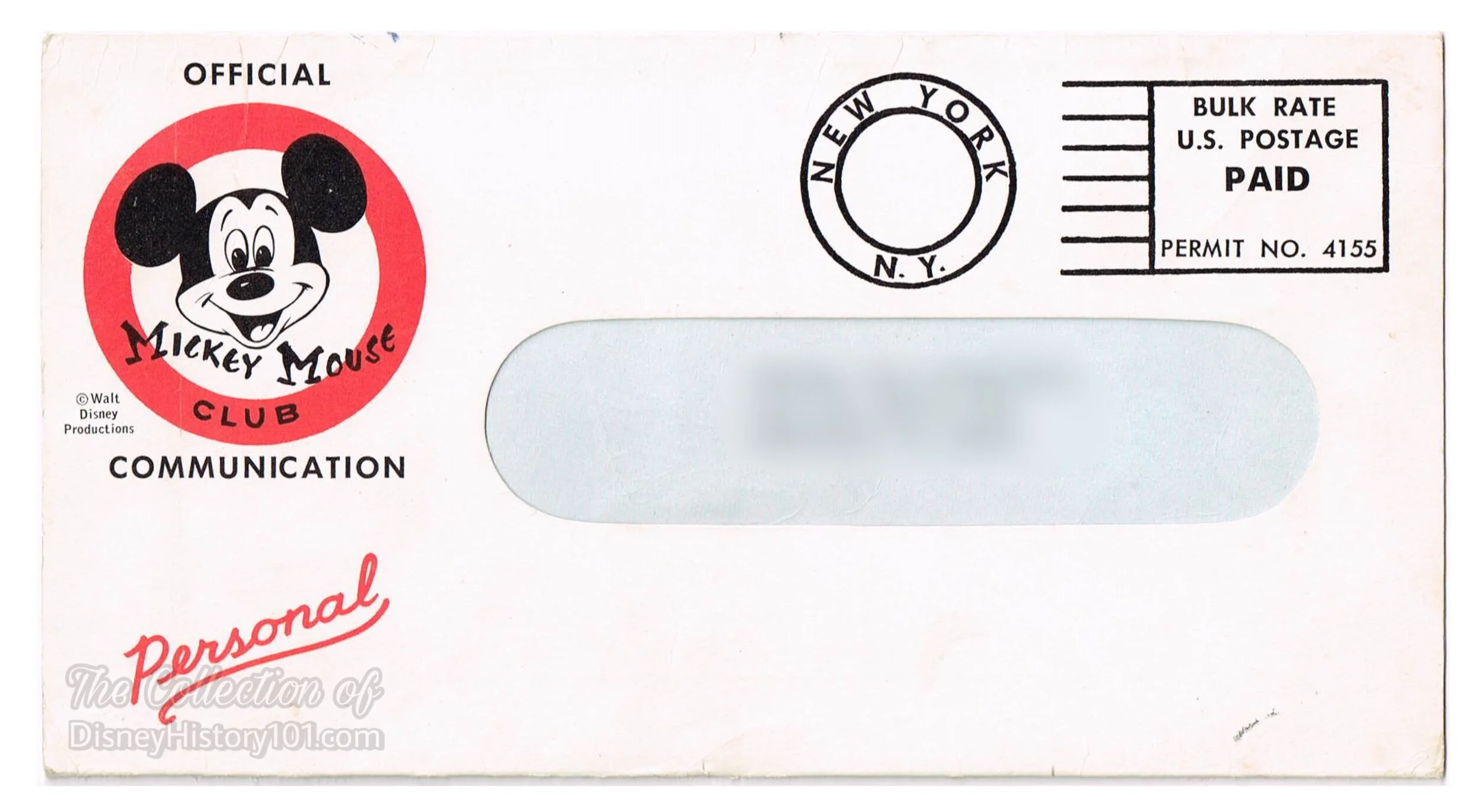
Mickey Mouse Club Magazine Identification Card and Certificate "Window" Envelope
With increases in postage and first class mail shipping beginning in January of 1963, both Milt Albright and Ed Ettinger worked together to cut costs of the Mickey Mouse Club Disneyland Chapter (under the oversight of Jack Lindquist). It was Milt Albright who recommended the format for what you received in the mail - the “window” type of envelope, and not using a “form letter,” but “having the membership card be a ‘pop-out’ at will,” to increase savings. All these details were not even finalized by December 20th, 1962.
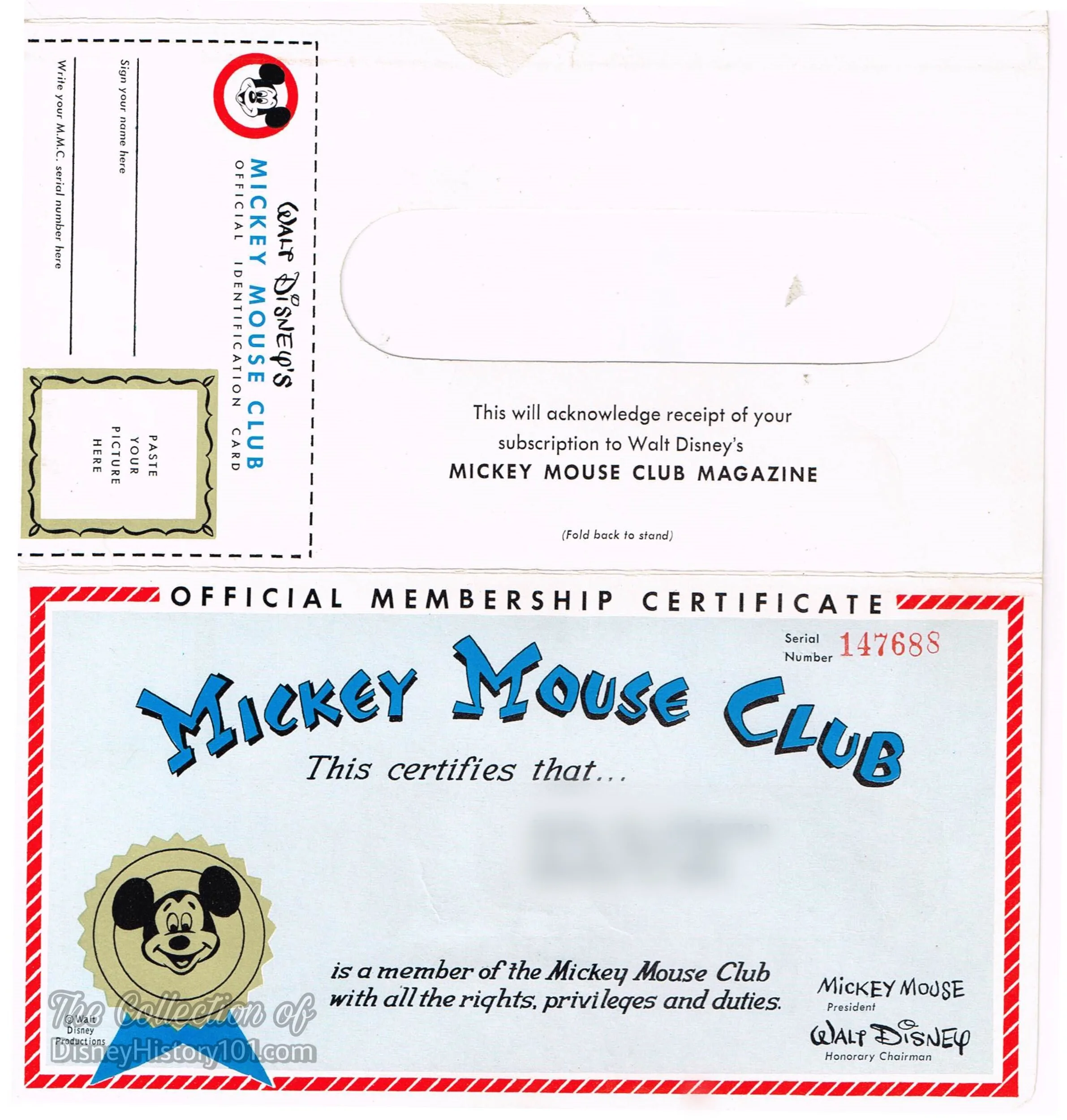
Mickey Mouse Club Magazine Identification Card and Certificate
These “snap-out” Mickey Mouse Club documents were different from the ones acquired through the Disneyland headquarters.
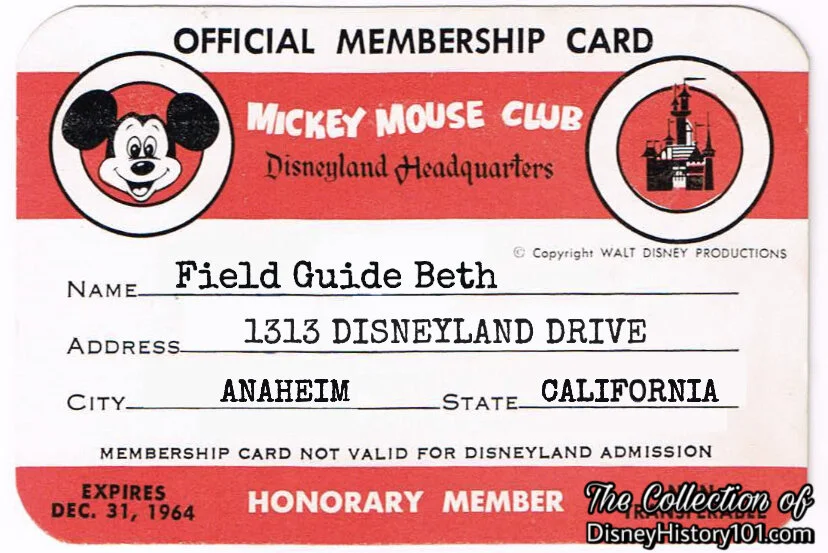
Mickey Mouse Club Disneyland Chapter Membership Card
But ultimately, these little perforated “snap-out” Mickey Mouse Club Disneyland Chapter Membership Cards were sent to members approximately 2 weeks after their applications were received. There was no charge for Mickey Mouse Club Disneyland Chapter Membership. However, membership was limited to Southern California residents within the KTTV viewing area. Though the club had no age limit, it was designed to appeal to youngsters under the age of 16 years old.
In the end, Mickey Mouse Club “Weekly Activity” Reports showed that Mickey Mouse Club Disneyland Chapter Memberships (of Local Members, Honorary Members and new Members signed into the Clubhouse) hit peak numbers on Saturdays and Sundays at Disneyland. By April 29, 1964, the there were 191,473 Local Members, in addition to 53,448 Clubhouse Mail-ins, 122,735 Honorary Members, and renewals factored in, totaling in 367,656 Mickey Mouse Club Members. Of these, 328,724 were serviced at the Clubhouse located at Disneyland! Tommy Walker (head of Disneyland Public Relations) would often send weekly Inter-Office Communications, relaying Mickey Mouse Club Disneyland Chapter Activity Reports to “those concerned” - i.e. Card Walker, Donn Tatum and Vince Jeffords (at Walt Disney Studio), and Ed Ettinger, Bob Wormhoudt, Vern Croft, Wally Wade, Ted Crowell, Jack Lindquist, Linda Morse and Milt Albright (at Disneyland).
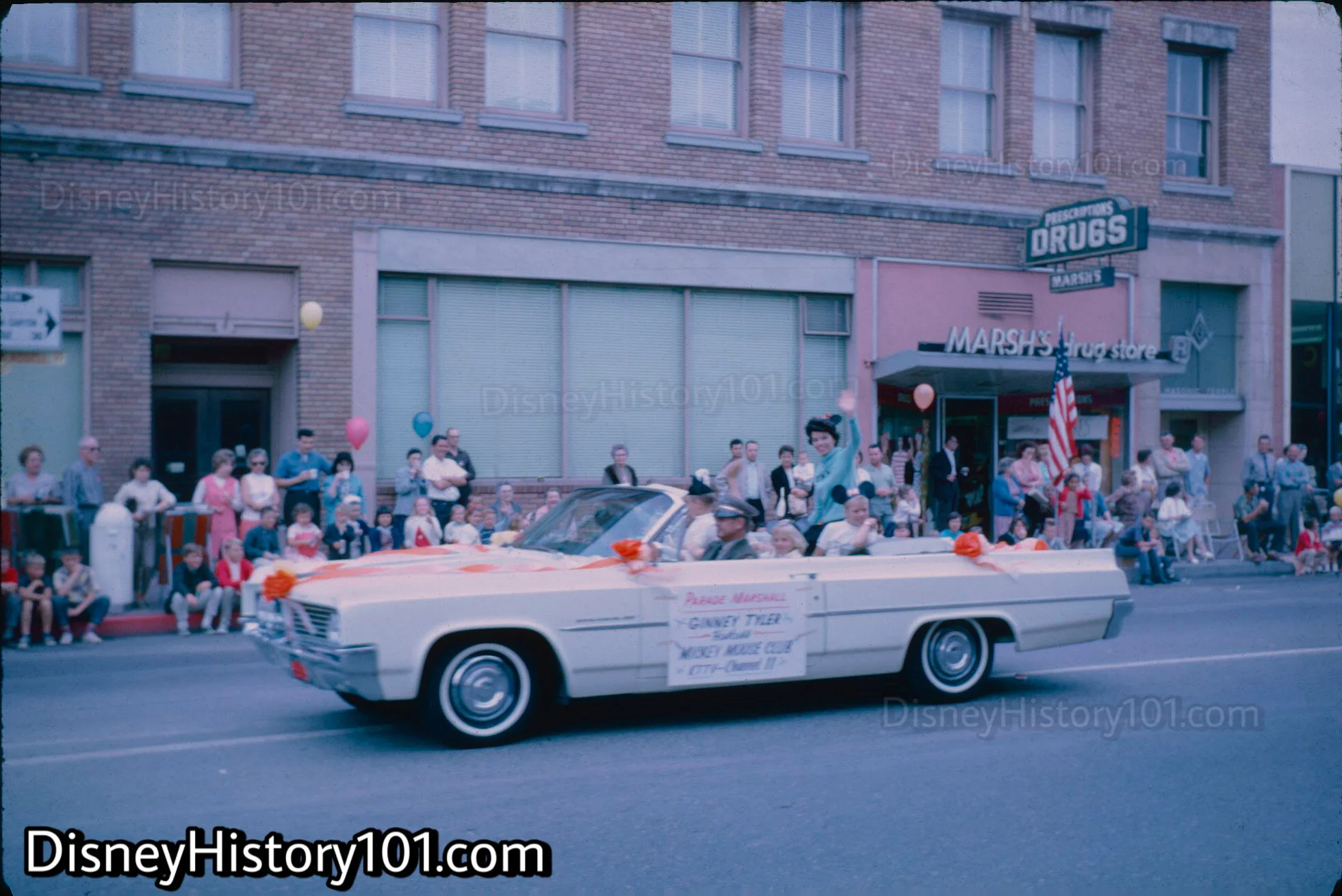
Ginny Tyler makes a public appearance in a local parade in September, 1963.
Since the beginning, Disneyland has synergistically worked with Walt Disney Studios to keep the Disney characters before the public and provide settings for television programs. This would not be the first time that segments of ”The Mickey Mouse Club” were filmed at Disneyland. On a most recent occasion, at least one segment of ”The Mickey Mouse Club” TV show was filmed in the Park during the month of January, 1963. But this routine filming of ”The Mickey Mouse Club” television show at Disneyland would take months to plan and develop. Now by July of 1963, Ben Harris began to select and pick up music (from local shops) and inspecting sound and recording facilities that would be utilized for the television recording. A few months later (during September of 1963 ; the same month that the Babes in Toyland Exhibit closed), a promotional parade (of which Ginny was a guest of honor), was held in neighboring Garden Grove. This was (of course), in advertisement for the upcoming Mickey Mouse Club Headquarters in Disneyland and the new segments of “The Mickey Mouse Club” television series which would be filmed at Disneyland!
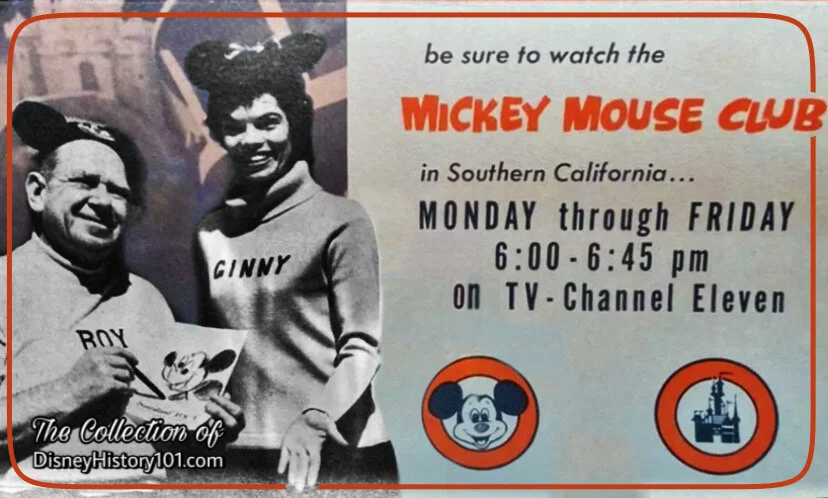
Two Wondeful Ways to Enjoy Disneyland Advertisement for the Mickey Mouse Club on KTTV Channel 11, c. 1963.
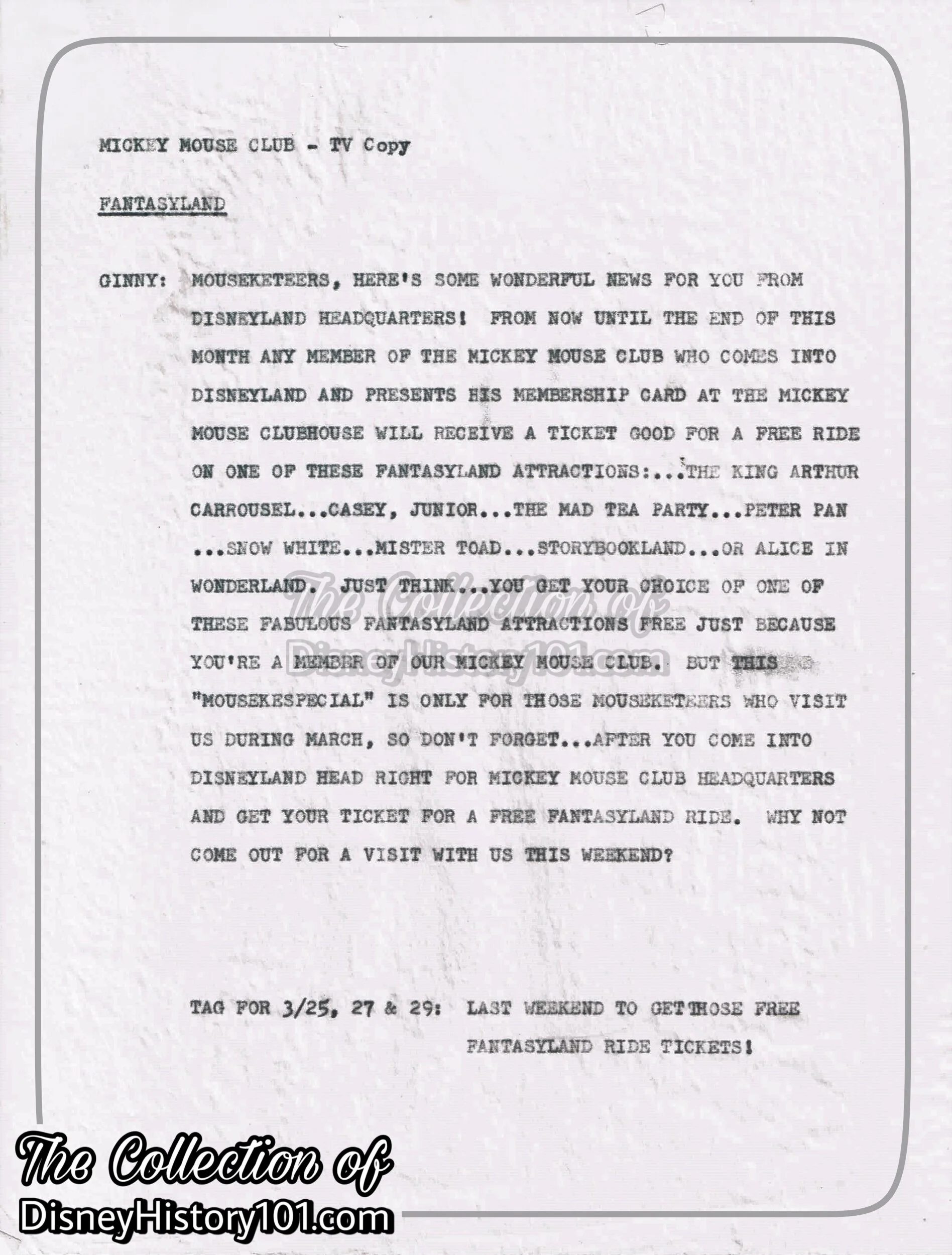
Mickey Mouse Club Promotional Script, 1960s.
Scripts written for Ginny Tyler also introduced promotional Disneyland offers for Mickey Mouse Club members who visited the Park.
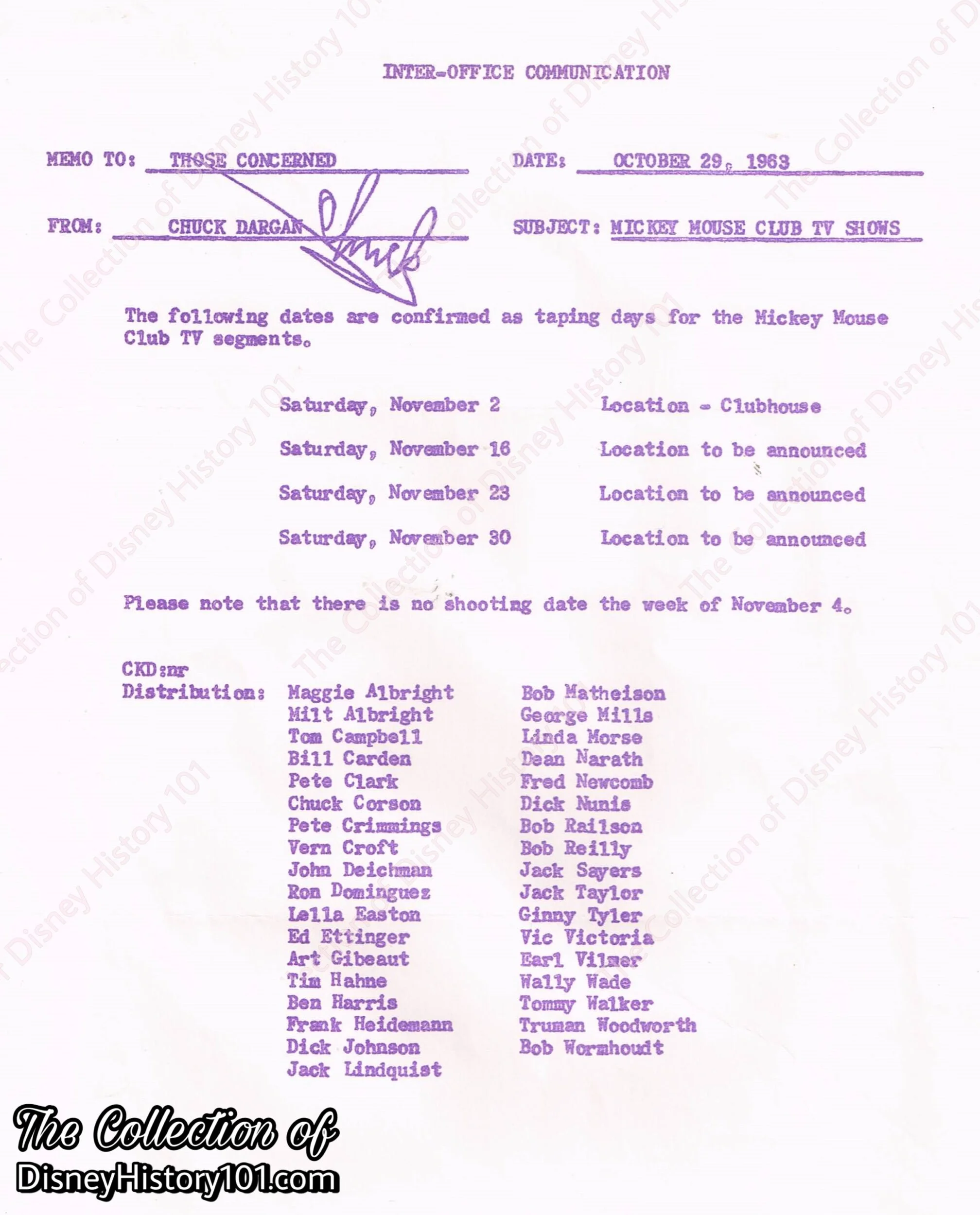
Inter-Office Communication, October 29, 1963
Proposed dates and locations for filming the Mickey Mouse Club Television Show in Disneyland are listed on this Inter-Office Communication. The dates ran every Saturday in the month of November, 1963.
By February of 1964, Ben Harris (of the Disneyland Production Department) held near-daily production discussions at the nearby Gourmet Restaurant (with the production companies and individuals like MMC Director Bob Lehman) pertaining to the forthcoming tv segments. One tentative shooting period ran from Saturday to Sunday, February 1 & 2, 1964, when the crew hoped to “get six or seven segments done.”
By March of 1964, the search was on for various “action props,” “bowling equipment,” and “physics equipment” to be used as screen on-screen props. Electrical equipment and musical equipment was also selected, rented and purchased. While these were acquired (either purchased or rented), physical set-up and staging began around mid-March.
As mentioned earlier, Mouseketeer Ginny Tyler soon (on March 28th, April 11th and 12th, 1964) recorded some of the first (of a series) of 15-minute segments inside Disneyland’s Mickey Mouse Club Headquarters, which was broadcast as part of the syndicated “The Mickey Mouse Club” series. According to Ben Harris’ account, some “105” of these segments would be filmed at Disneyland.
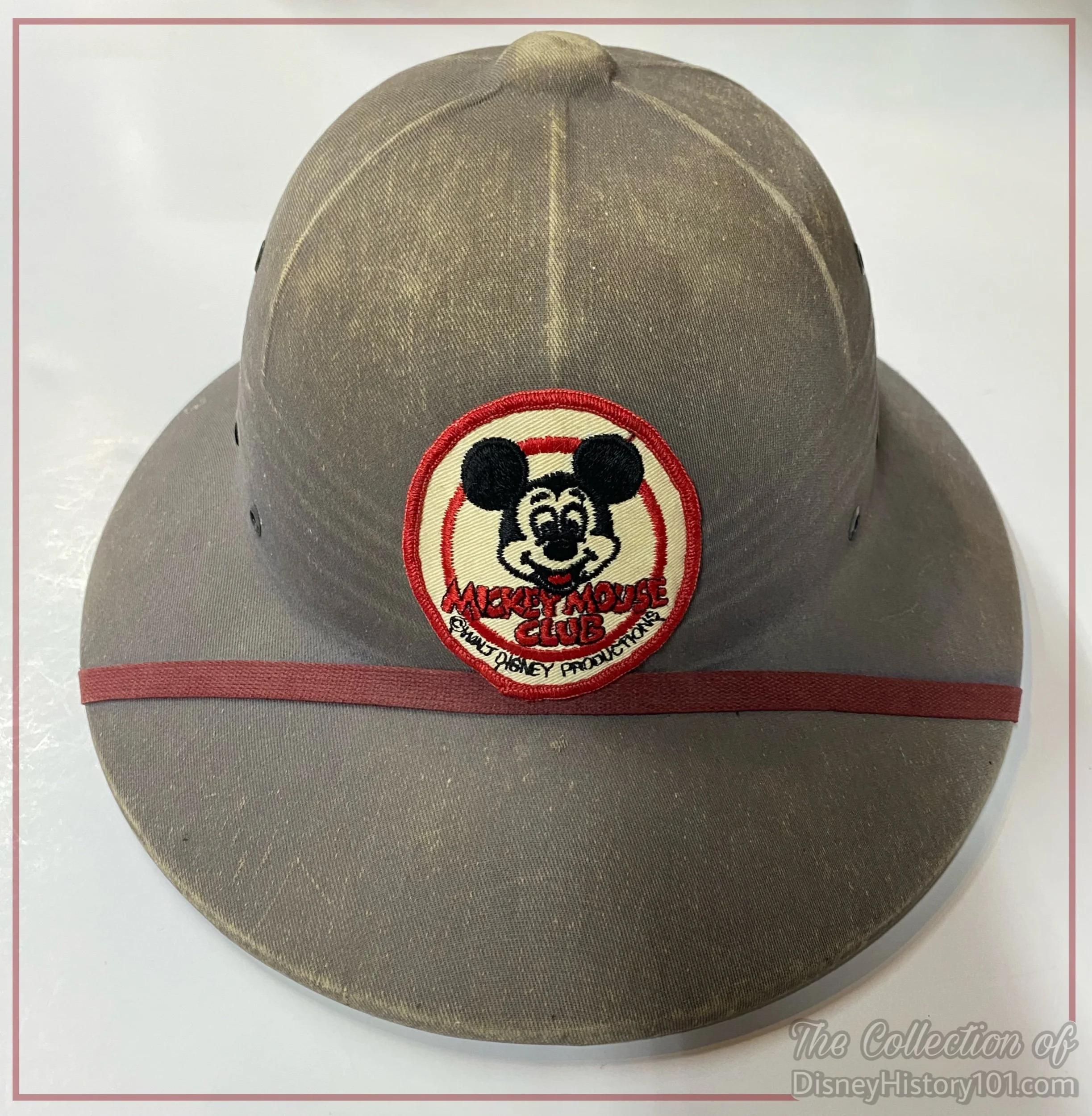
A prop hat from a segment of “The Mickey Mouse Club” filmed at Disneyland.
Mickey Mouse Club Disneyland Headquarters - Merchandise Headquarters Bill
The Mickey Mouse Clubhouse Headquarters in Disneyland also sold an increased amount of merchandise during its tenure. Buttons and tin lapel clips were common pieces of “The Mickey Mouse Club” merchandise sold through the Merchandise Headquareters. Non-birthday-related pictures were sold at 75 cents each, and by April 19, 1964 a total of 1, 846 had been sold. There were also Free souvenir birthday pictures (when the Mousekagirls worked on the television show). Perhaps one of the more popular merchandise was the new “The Mickey Mouse Club TV Show” LP released by Disneyland Records in 1964.
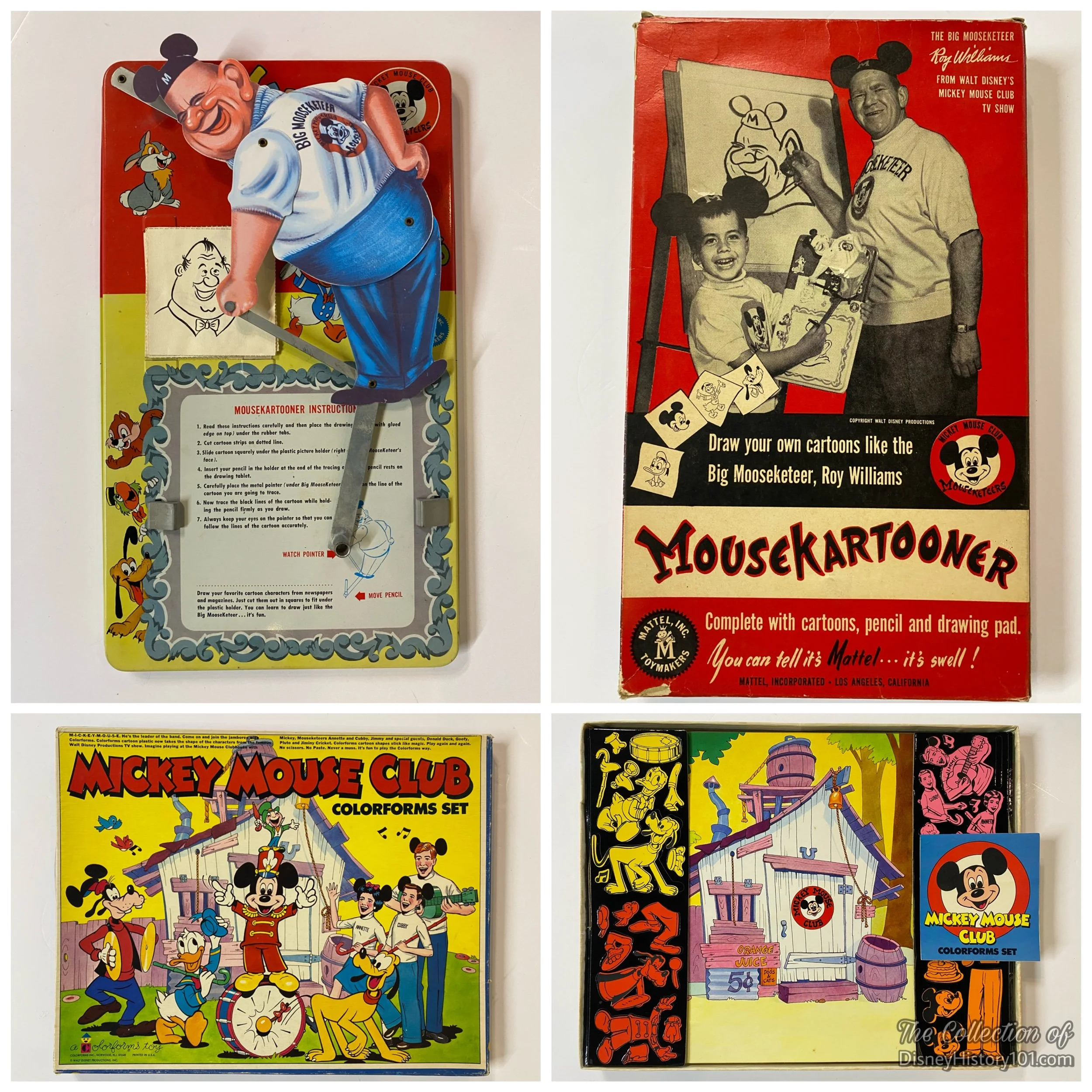
”The Mousekatoys” - The Mousekartooner and Mickey Mouse Club Colorform Set.

A Mickey Mouse Club souvenir photo.
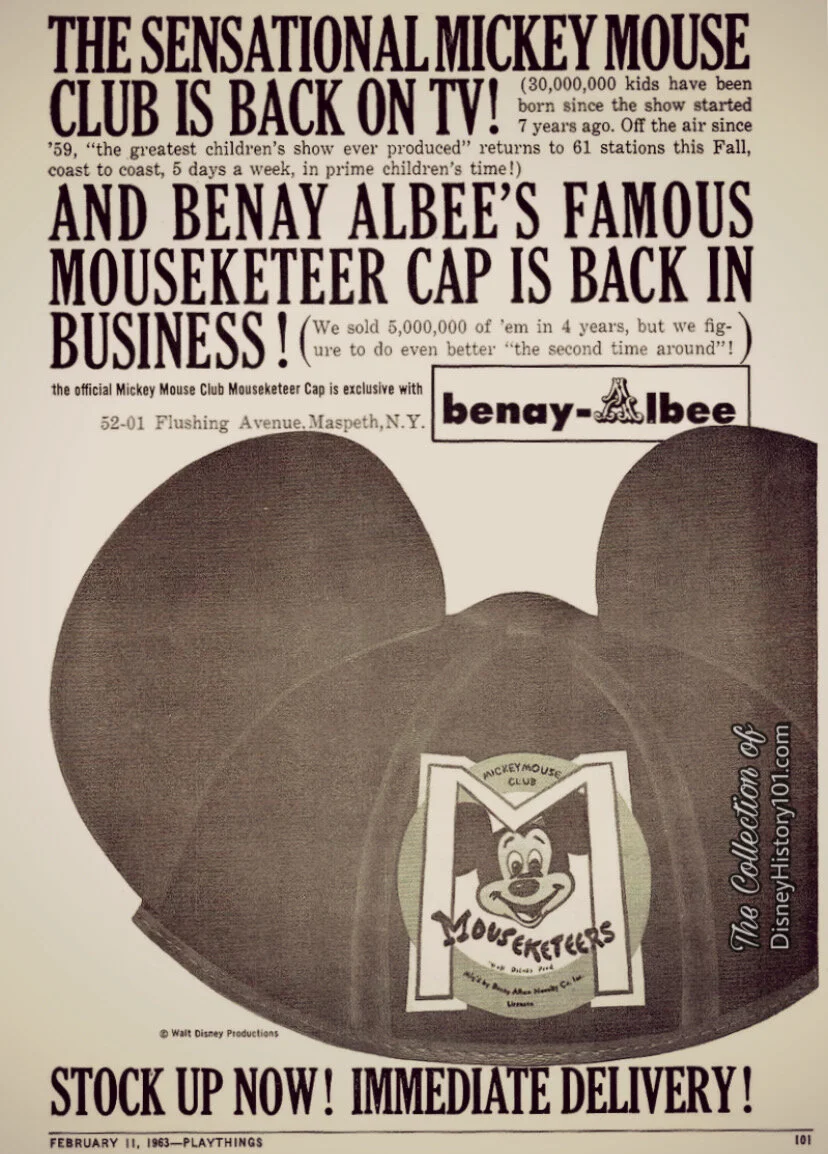
Benay-Albee Mouseketeer Cap Advertisement (published in "Playthings - The National Magazine of Toy Trade", (February, 1963)
Now that ”The Mickey Mouse Club” was back on television (and the Mickey Mouse Club was Headquartered at Disneyland) the was the perfect opportunity for Benay Albee to bring their popular Mouseketeer Cap to Disneyland!
“The Mill Moves”
By the summer of 1965, a “new mill had to be built to handle all the business,” according to Bill Bealer of Backstage Disneyland magazine, Vol.4, No.4 ; December of 1965. The new MILL AND SHEET METAL SHOP (and even a Mill Annex) would eventually find a home in the Backstage West Service Area behind the Frontierland berm. By that time of Tencennial celebration, there were many new skilled craftsmen who had come to Disneyland after extensive experience. However, some of Disneyland’s original carpenters (Cliff Carothers, Earl Anderson, George Williams, George Le Fevre, Scotty Scribbs, L.H. Anderson, John Yorber and a certain “Harry”) still worked in a similar capacity with the Park. These men recollected fond memories of the original Mill’s role in Disneyland development.
(July 18th*, 1965 - January 1st, 1973)
*Some sources (as the “Disneyland Admission Media Rides and Attractions Report” published 1971; “Disneyland Rides & Attractions and Attendance Report,” 1981, page 50) cite July 16th, 1965.
As with any new ideas and American dreams, Great Moments with Mr. Lincoln (with its Audio-Animatronic star) was not created in “a day.” It was “perfected and proven only after long experience and trial.”
“A Few Great Moments in the Imagineering of Mr. Lincoln”
The idea of automated figures dates back to the 1600s and 1700s, when the kings of France (like Louis XVI) commissioned automated orchestras to be built. Two hundred years later (but still a decades prior to the conception of Disneyland), Walt began his childhood fascination with the United States President. According to Walt, “Ever since I was a small boy in Illinois, I've had a great personal admiration for Abraham Lincoln.” In fact, as a child, Walt even donned a stovepipe hat and portrayed Abraham Lincoln for a school project. This admiration of Abraham Lincoln continued for decades.
As for mechanical figures, they enter the Walt Disney story six years before Disneyland would premier to audiences. In 1949, Ken Anderson created a Disneylandia concept that consisted of an old-fashioned Barbershop Ensemble with a quartet of mechanical singers. In September of 1950, the famous sculptor Charles Cristodoro had joined the Walt Disney Studio, and a few months later he found himself busy carving the little figure of Buddy Ebsen. But how would Walt animate the figures?
The following year, on July 6, 1951, Walt, Lillian, and daughters Diana and Sharon Disney arrived in Le Bourget Airport, Paris, France. Diane Disney noticed that “Dad went out shopping on his own when we were in Paris. He came back to the hotel room with two large bags from a toy store filled with wind up toys. He unpackaged them, wound them all up, and studied them as we looked on, amused, but puzzled. 'It's amazing that you can get such interesting movement from a very simple mechanism, he explained.” Walt returned home with his Le Zoo Mécanique souvenirs from Paris. In 1951, Walt also returned from New Orleans with an antique mechanical Bontem’s bird automaton. All of these souvenirs would continue to progress Animatronics technology.
These would inspire Roger Broggie (a Walt Disney Studio Camera Repair Department machinist who had assisted with the fabrication of Walt’s Carolwood Pacific Lilly Belle engine) and Wathel Rogers (another of Walt’s character animator’s with a knowledge of the mechanical) to fashion the first ever “cam and lever” Audio-Animatronics figure (a 1/8 scale tap dancing Buddy Ebsen figure) for Walt Disney’s “Disneylandia.”
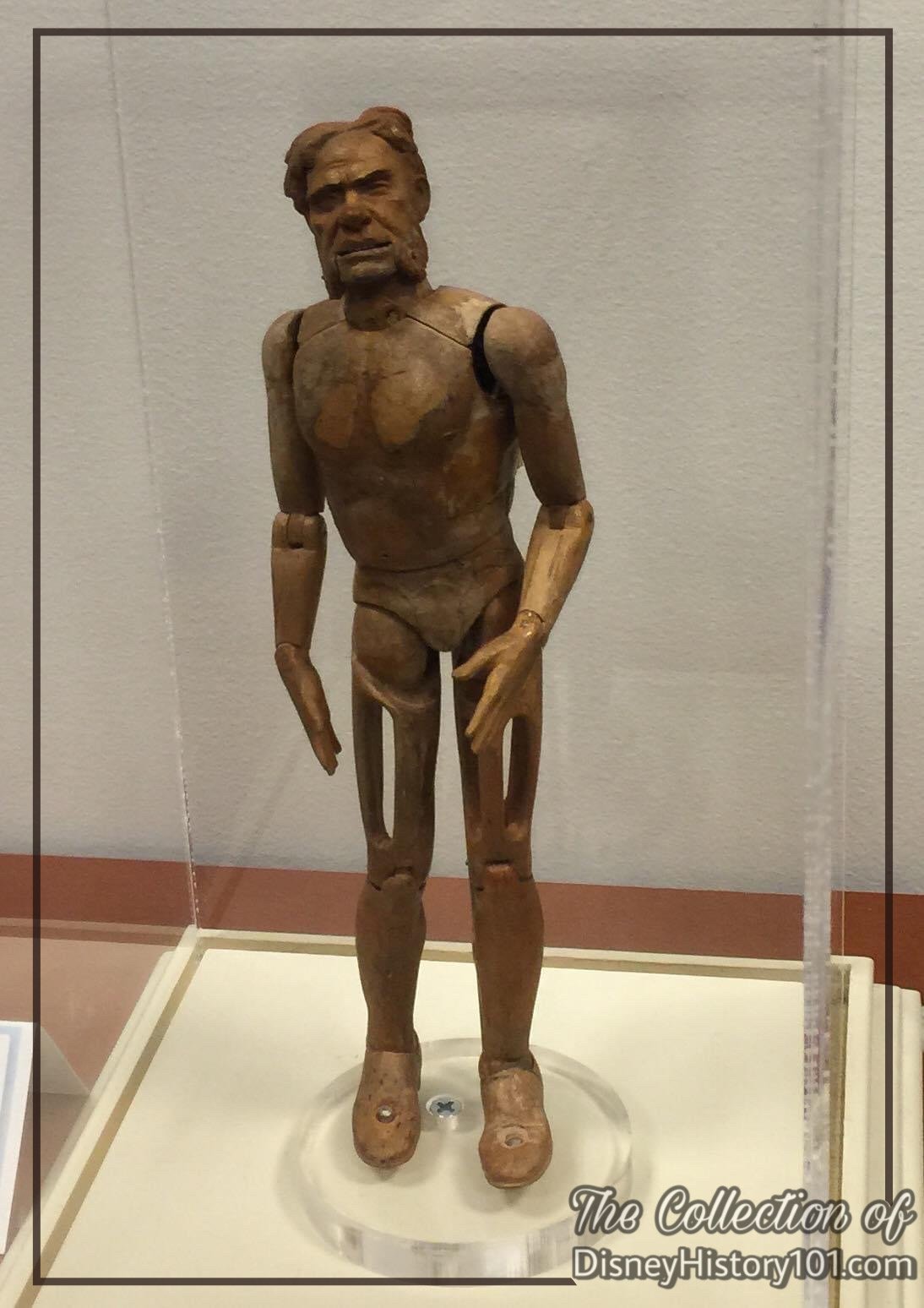
The Cam & Lever Buddy Ebsen Figure; The Walt Disney Archives.
Walt Disney Studio artist Charles Levy (in interview with Bill Davidson of The Saturday Evening Post, published for November 17, 1964) recalled a momentous occurrence he observed when first employed in 1954: “I remember seeing him at the studio then, and he was a wrapped up in something mysterious he was doing with Buddy Ebsen who, in those days, was a fine dancer. He had Buddy do a dance number, and there were men in the room punching holes in what seemed to be a mechanical piano roll. Then I saw Walt playing with little Buddy Ebsen dolls, which were attached by electric wires to a huge console-machine. The men would feed the piano rolls into the console like a continuous I.B.M. card, and the little Buddy Ebsen dolls would repeat the dance steps I had seen Ebsen himself do. It didn't work because those were the days before transistors and the equipment was too cumbersome, so Walt put the whole thing aside.”
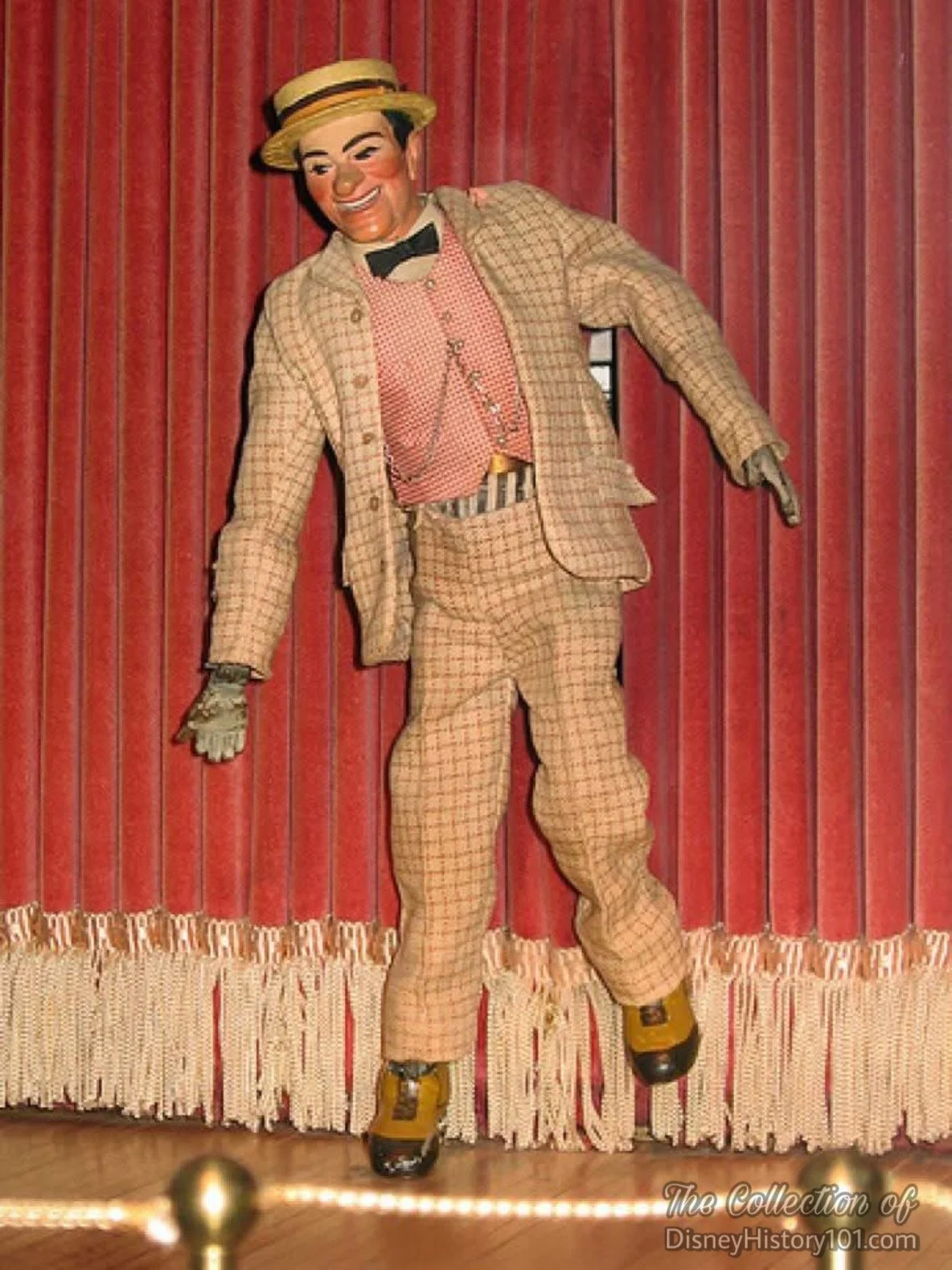
Roger Broggie recalled: “We got as far as building the guy in the chair and the barber behind him,” said Broggie. “Then the whole job was stopped.” While there were some frustrations and the project was aborted, this Imagineering feat led to other research and developments some six years later.
In 1957, The Disneyland Report to Anaheim and Orange County (prepared before August of 1957) mentioned future developments called Liberty Street with the Hall of Presidents, and Thomas Edison Square all planned for 1960. Meanwhile, Walt commissioned a Mr. Lincoln Audio-Animatronic figure prototype in 1958. Walt once recalled: “I had him on what we called Mark I and I had him under manual control. we could make him stand up and put his hand out.” However, the “Lincoln” project was also not completed, because, in Walt’s own words: “I figured it would take me 10 years to get Mr. Lincoln going.” Work continued and by October 1960, Marc Davis had prepared a “Reference for Animated Human Figures”, a sketchbook that explored how anatomy could be replicated with machines created by the Studio Machine Shop. This book was created at the personal behest of Walt Disney.
However, the project was “shelved” for five more years (until after the debut of Walt Disney’s Enchanted Tiki Room bird cast). But during this time, Mr. Lincoln would receive a visitor. Walt remembered how “Robert Moses was getting the World’s Fair going, and he came out. He came and visited Disneyland. He wanted to visit the Studio. He was trying to decide on what could be done. So I had him meet Abraham Lincoln. I said, ‘would you like to meet Mr. Lincoln?’ He gave me a funny look. I said, ‘well come on in - meet him.’ So when he walked in the door, I said, ‘Mr. Lincoln meet Mr. Moses,’ and Lincoln put his hand out and Moses went over and shook hands with him. Well Moses is quite a showman and he said I’ve got to have a Lincoln at the Fair. But I said this is 5 years away anyway. But Moses wouldn’t take no for an answer.”
Soon, a few “great moments” occurred in (not a meeting of Disneyland, Inc., or Walt Disney Productions, but) an Illinois Commission meeting (c. 1963) pertaining to their contribution to the upcoming World’s Fair. It was decided that their particular New York World’s Fair pavilion would be entitled - “The Land of Lincoln!” The highlight of the attraction would be none other than a three dimensional representation of the nation’s 16th president. Walt remembered: “The next thing I knew he had gotten with the State of Illinois and was trying to sell them on a Pavilion. And before I knew it, I had my arm twisted and I said yes.” After some negotiations and special agreements, the synergistic partnership was formed. Walt was soon interviewed by Fletcher Markle (on September 25, 1963), who revealed “the next step beyond the birds… to do the same kind of programming with human beings… and especially America's 16th president - Abraham Lincoln.” The State of Illinois would have their “Weenie” for “The Land of Lincoln” which would draw guests into their pavilion at the New York World’s Fair. In turn, Walt Disney would gain the funding to develop the necessary technology to run the show in New York and once the two years were complete (and in some cases, by 1964), Walt would have a brand new attraction for Disneyland.
By now there existed a Disney-patented technique of electronically synchronizing voices, music and sound effects to animated figures and objects. Walt continued: “We now had to get Mr. Lincoln on the road, I think, in about 13 months.” So immediately, some of Walt’s artists (with a diversity of backgrounds and skills) were transferred to WED Enterprises, Inc. in order to work with Audio-Animatronics - artists like Bill Justice (a former character animator who had assisted with the “come to life” Character designs for Disneyland in 1961), and Wathel Rogers (Walt Disney Studios animator who was a previously assigned to develop the miniature barber shop quartet for project “Little Man”). Both Bill Justice and Wathel Rogers would be among those assigned to bring life-like animation to the towering Mr. Lincoln. Studio retiree Jim Algar created Lincoln renderings & designs. Other contributors like Victor Greene of WED Enterprises, Inc., provided visual art direction. They were joined by John Hench (a c.1954 WED Enterprises hire, and old sketch artist from the Hyperion Avenue Studios, in 1939).
“Recreating the ‘Head of State’”
It was found that several of Walt’s shows being developed for the forthcoming 1964/1965 New York World’s Fair (like the General Electric Carousel of Progress and Great Moments with Mr. Lincoln) involved complex Audio-Animatronic heads. And so during the latter part of 1962 (while the Mickey Mouse Club Headquarters was still located on Main Street), another sort of “Head-Quarters” would take form - the Figure Head Shop (known in the present as the Figure Head Animation Shop)! Sculptor Blaine Gibson (who had been with the Disney Team since 1939, and became a WED Enterprises Sculpture Designer in 1954) now began exhaustive research on the Lincoln head while he was still pulling shifts animating. Blaine and other artists got to work, visiting libraries and museums in order to make Walt’s presentation of Abraham Lincoln’s representation as accurate as possible. According to Dave Smith (Chief Archivist Emeritus), “Disney’s Imagineers spent five months researching Lincoln’s exact measurements and physical appearance. There was intensive study of many photos, paintings, and written descriptions, including passages from Mary Lincoln’s diary.” [Disney Facts Revealed by Dave Smith, 2016]
As to his approach to figure sculpting, Blaine once commented : “When we do a figure, we’re thinking of a character - a living, breathing character.” This being the case, Blaine would look into the writings of William Henry Herndon (Lincoln’s old law partner) which were only recently published during the early 1950’s, and described in “microscopic” detail many things about the look of his friend, Abraham Lincoln. For example, Herndon “described Lincoln as having a long head with a ‘tall’ forehead, sloping backward. The forehead, he adds, was narrow but high ; ‘the cheek bones were high, sharp and prominent ; his jaws were long, up curved and massive, looking solid, heavy and strong ; nose large, long and blunt, a little awry toward the right eye ; chin, long, narrow, sallow and cadaverous. . . having on his face a few hairs here and there ; cheeks leathery and saffron colored ; ears large and jutting ; lower lip thick, hanging undercurved or down-curved ; little gray eyes.” Clearly, Herdon’s memoirs would be an invaluable source when bringing Abraham Lincoln to life. After the “Disney artisans” labored for five months, “their tender care… [was] evident in Mr. Lincoln’s face,” according to one official Souvenir.
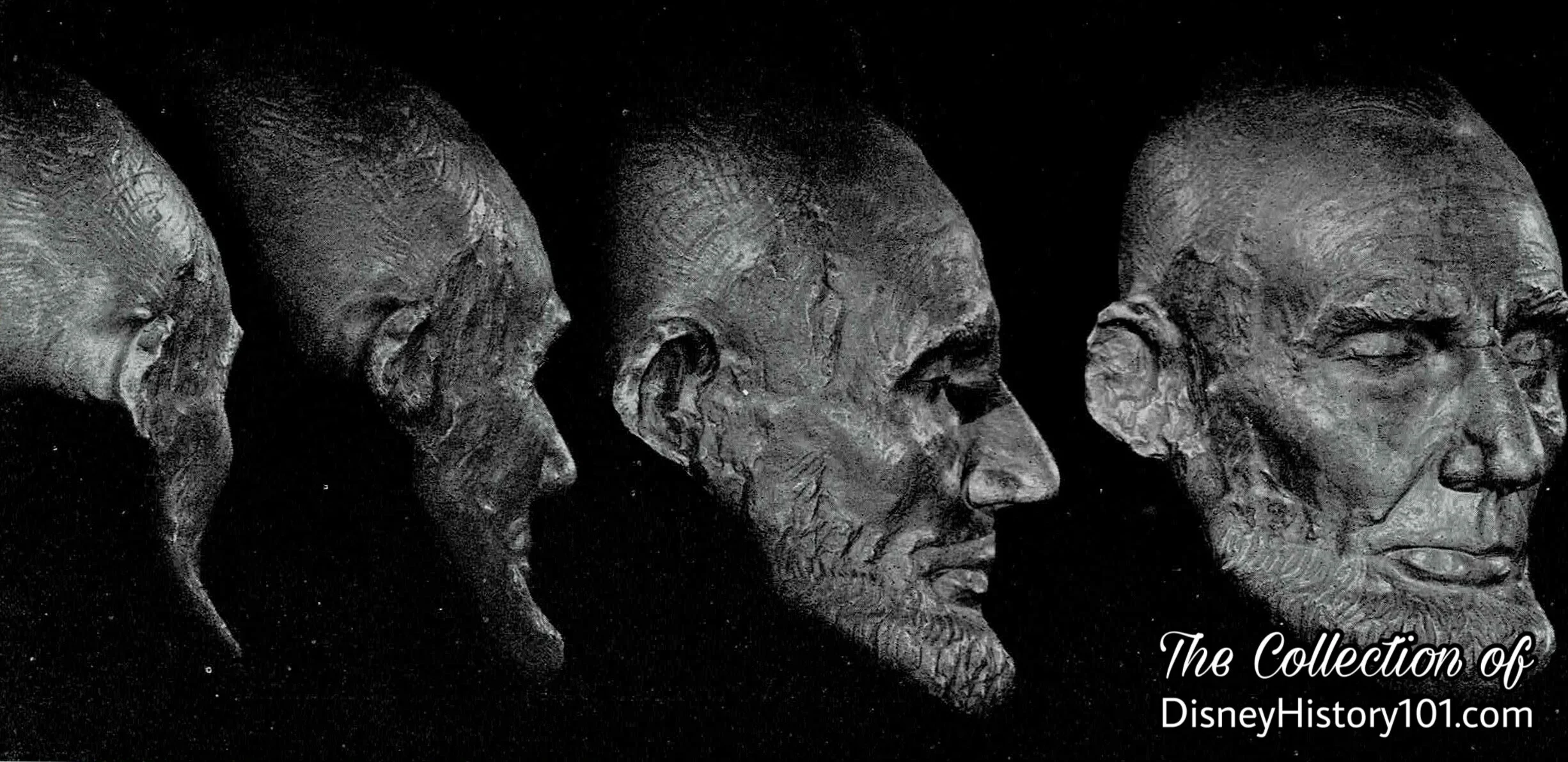
Natural History Magazine Excerpt Featuring the Only Bronze in Existence From The Clark Mills Life Mask of Abraham Lincoln
The face of the Audio-Animatronic Mr. Lincoln was also partially fashioned after a bronzed reproduction of sculptor Clark Mills’ life-mask of the 16th President of the United States (which was created some 60 days before the President’s assassination in 1865). As a “sidelight,” this bronzed reproduction had resided with the Smithsonian Institute since the 1950’s, and was featured in an issue of “Natural History” magazine (February of 1953), which was part of The Walt Disney Studio Library.
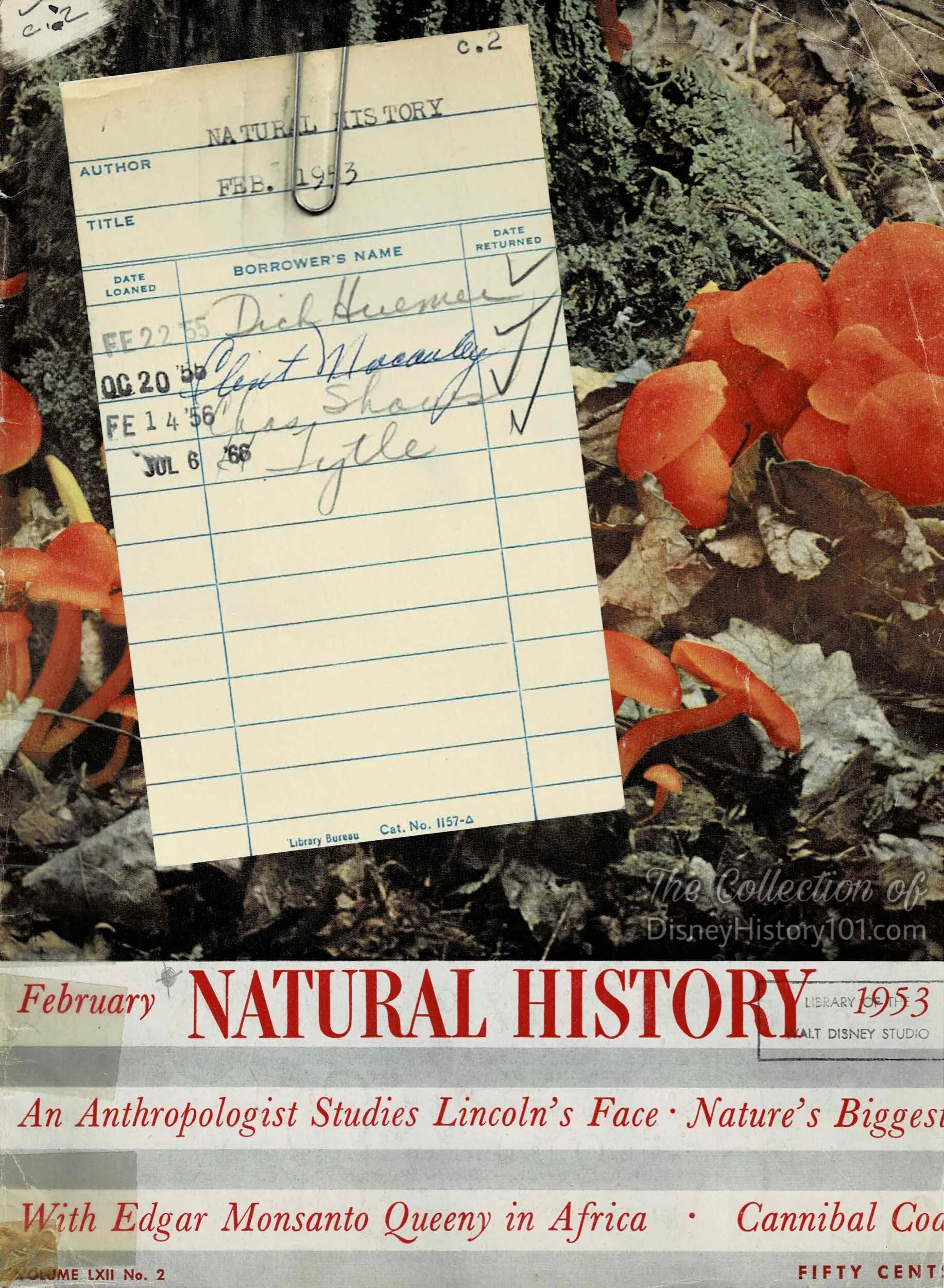
Natural History Magazine (February, 1953) ; Former Walt Disney Studio Library Copy
Still, yet another life mask (created earlier in 1860, in Chicago, by sculptor Leonard Volk) was also accessed and studied by artists. This particular mask preserved Lincoln before he was President and before he had a beard. Soon, Lincoln was sculpted in what Vacationland (Fall, 1965) called a “plastic clay.” Yes, “the skills of the sculptor and the talents of the artist” would soon enable audiences “in the presence of a man whose spirit guided the nation through a time of turmoil. Whose words inspired generations to follow.”
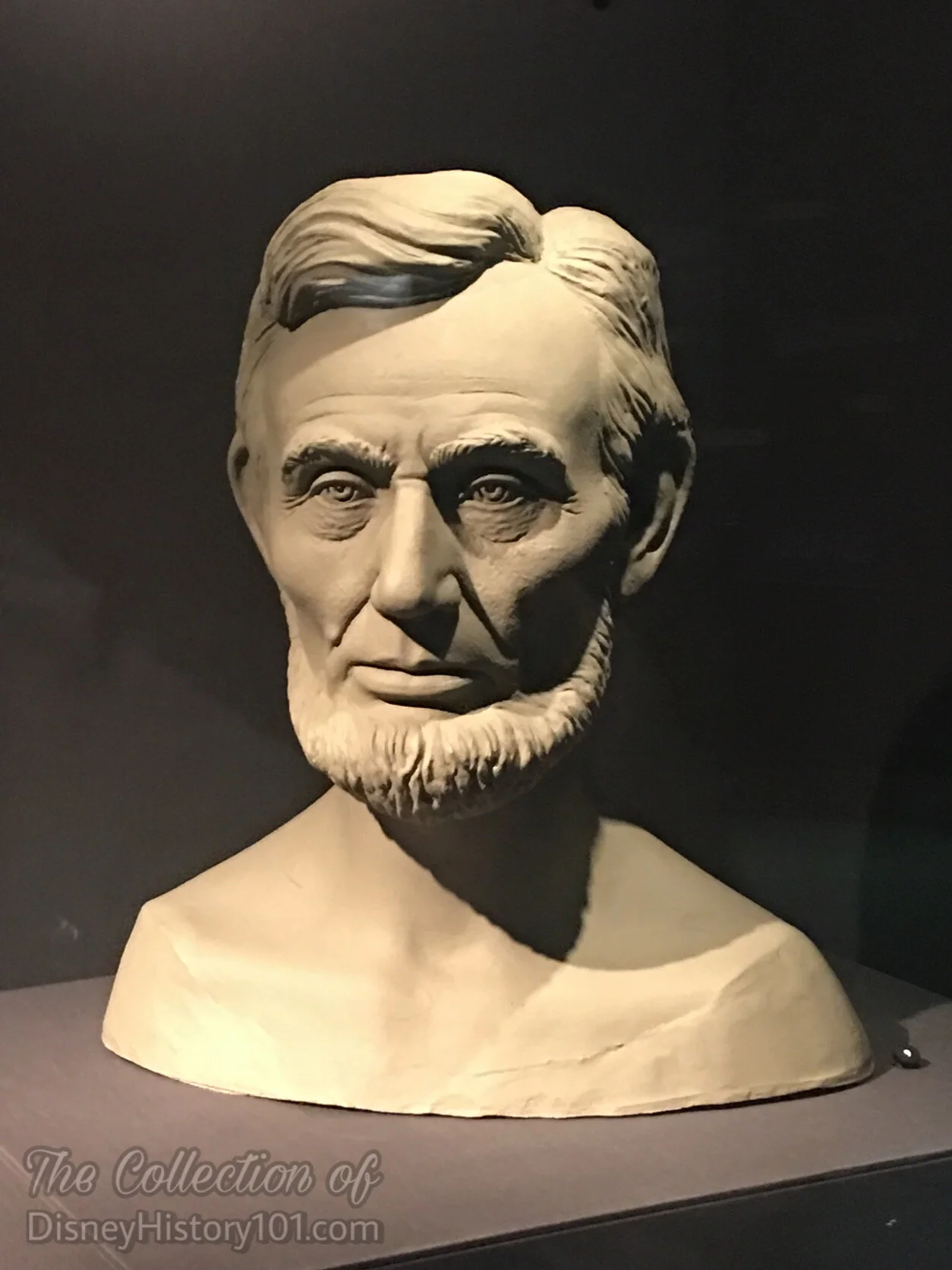
Abraham Lincoln Bust cast replica made from a mold of an original sculpture, The Walt Disney Family Museum
In addition, photographic evidence was collected, and from this, it was gathered that Abraham Lincoln towered over officers (as in a photograph taken at Antieam, in 1862). So, the entire Audio-Animatronics figure would need to be built to a scale that would at least simulate his true-life stature, of six foot- four inches tall. Some creative designs of the Audio-Animatronics figures (with a little creative license) were provided by members of the Disneyland Staff Shop. It was decided to increase Lincoln’s height by three inches to make him seem more imposing, so the height of the figure on the drawing is an impressive six feet, seven inches tall. The final figure would stand approximately six feet, four inches.
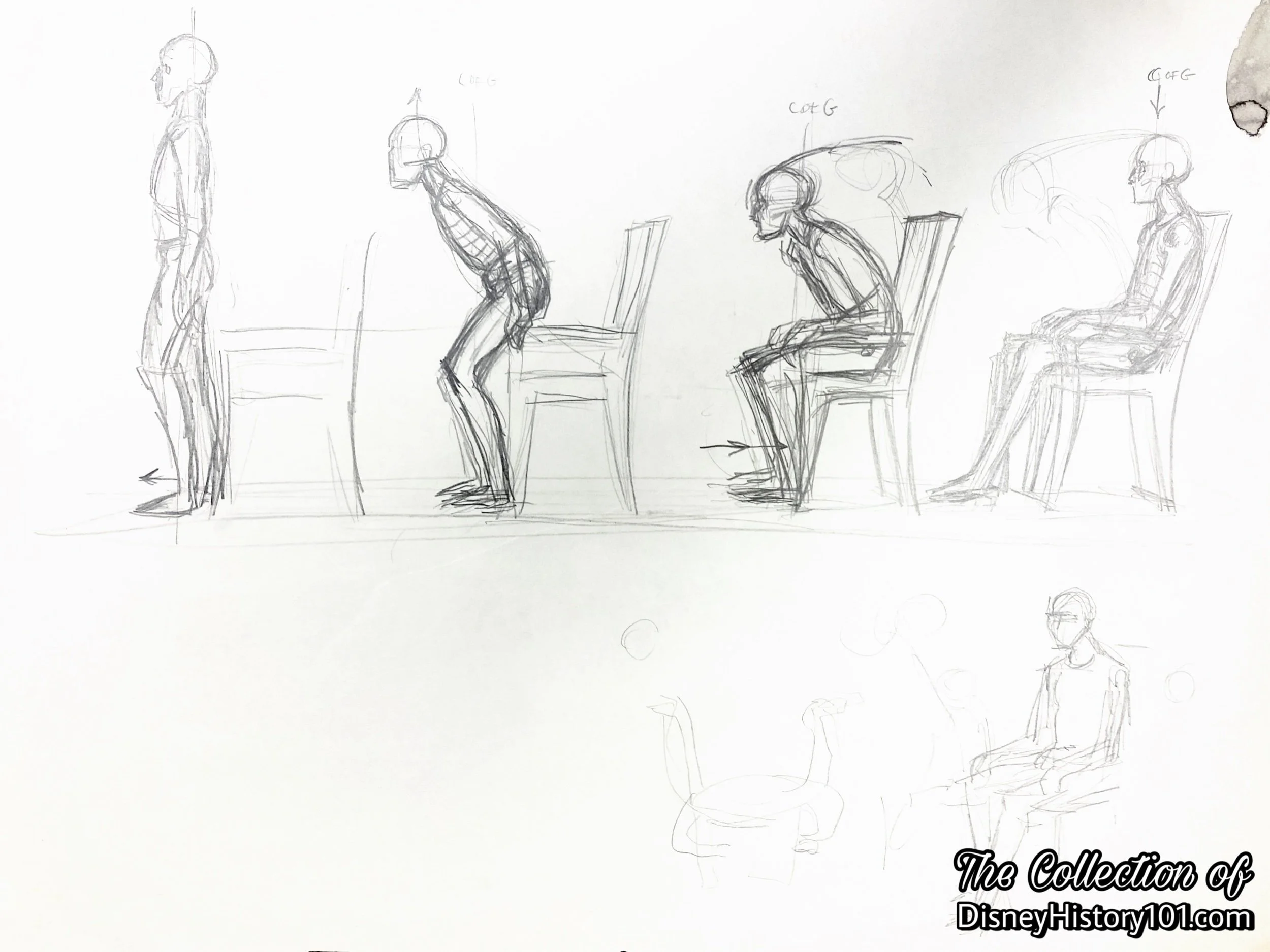
Rough sketches prepared by Marc Davis; 1962.
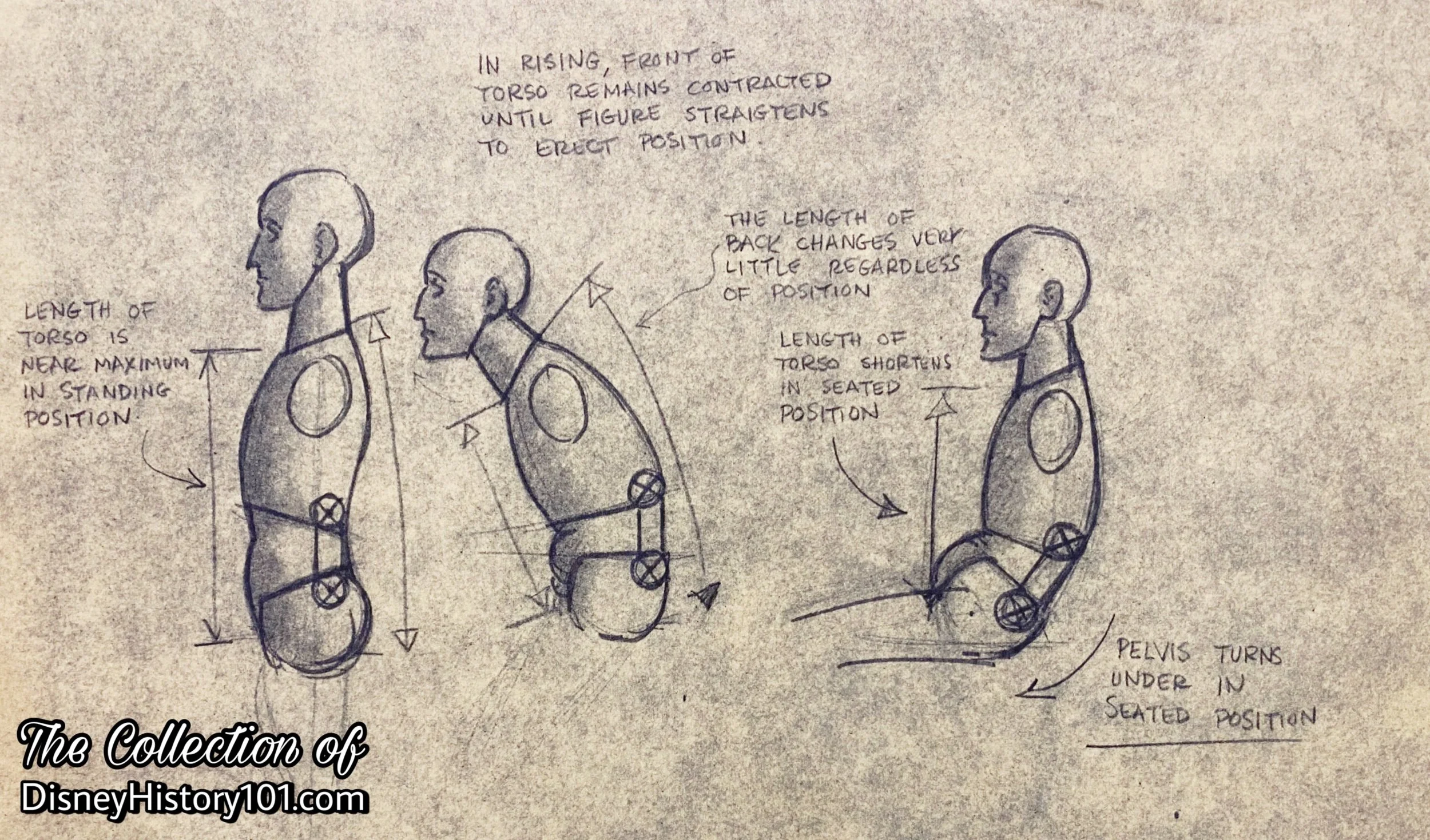
This brownline of Marc Davis' design details the connection points between the torso and pelvis for the rising motions of Mr. Lincoln.
“Designing the Great Movements of Mr. Lincoln”
Now, this figure was to be far different than the static figures that were planned and in development for the “Pirate Wax Museum” at Disneyland. Mr. Lincoln would be animated, rising from his chair; his hands in contact with a chair until he could no longer reach; his arms swing forward as the figure reaches full height;
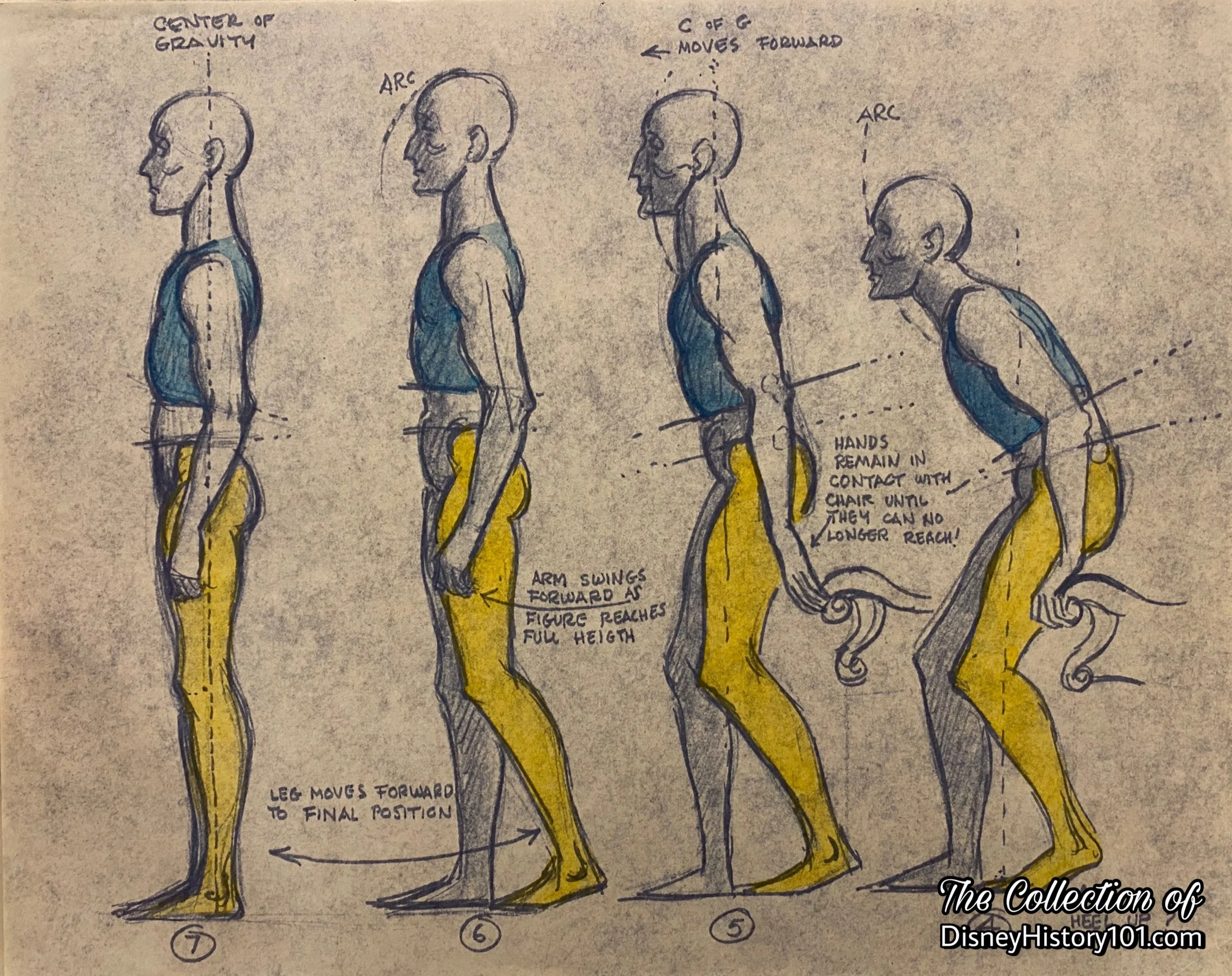
Marc Davis' design for teh rising motions of Mr. Lincoln.
…and the figure finally taking one step forward, the leg, moving forward until the figure reaches the center of gravity. Marc Davis assisted with the design of this detailed A.A. Figure animation.
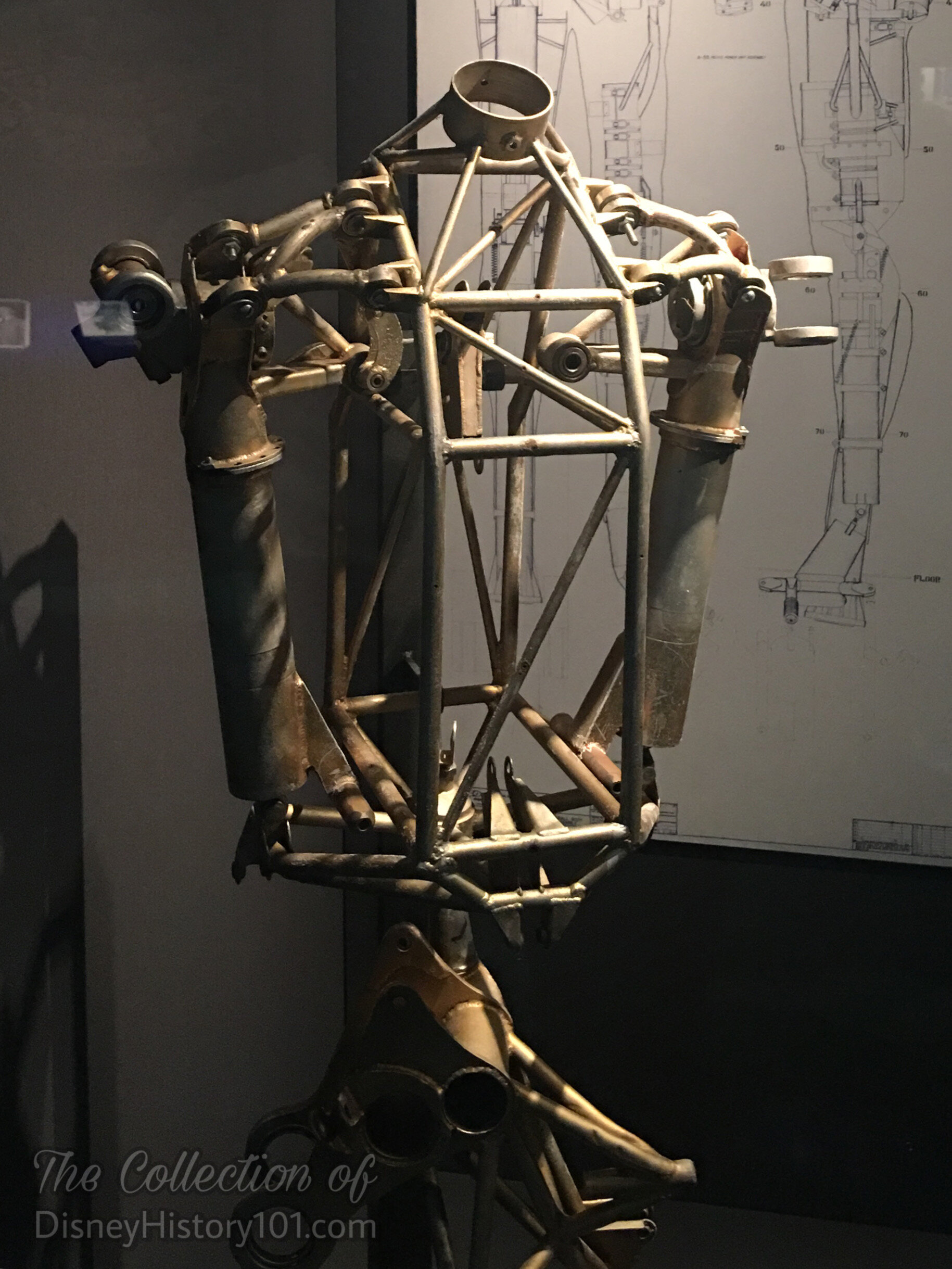
Abraham Lincoln "Ribcage" armature Featuring Hydraulics and Pneumatic Valves, The Walt Disney Family Museum
“Construction of Mr. Lincoln”
Bob Gurr remembered : “We had to figure out how do you do an animated human and design all the mechanical parts, and all the motions… We’d take the details to the Studio, and the Studio would make the parts. No time to explain how it’s going to work. They’d just build it on faith and see if we could make it run.” Many parts were constantly refined by the Walt Disney Studio Machine Shop (as “Lincoln’s Hands,” which were first produced during April of 1964, and the mechanics and aesthetics of which were refined greatly by May 3, 1965).
Bill Justice recalled “The original Audio-Animatronics figures were strictly mechanical. They were filled with cams, push rods, gears, pulleys and hydraulic lines. Their costumes had to be changed periodically because of oil leaks. Much of the mechanical equipment was located in the only large space available - the chest cavity. From there push rods and cables would go to the head and arms. The programmer's first lesson was to stay a safe distance away. The figures are all heavy enough and contain enough hydraulic pressure to break furniture. Or break heads. When you're learning how to move an arm and you don't quite know where it will go, it's best to stay well out of arm's reach.”
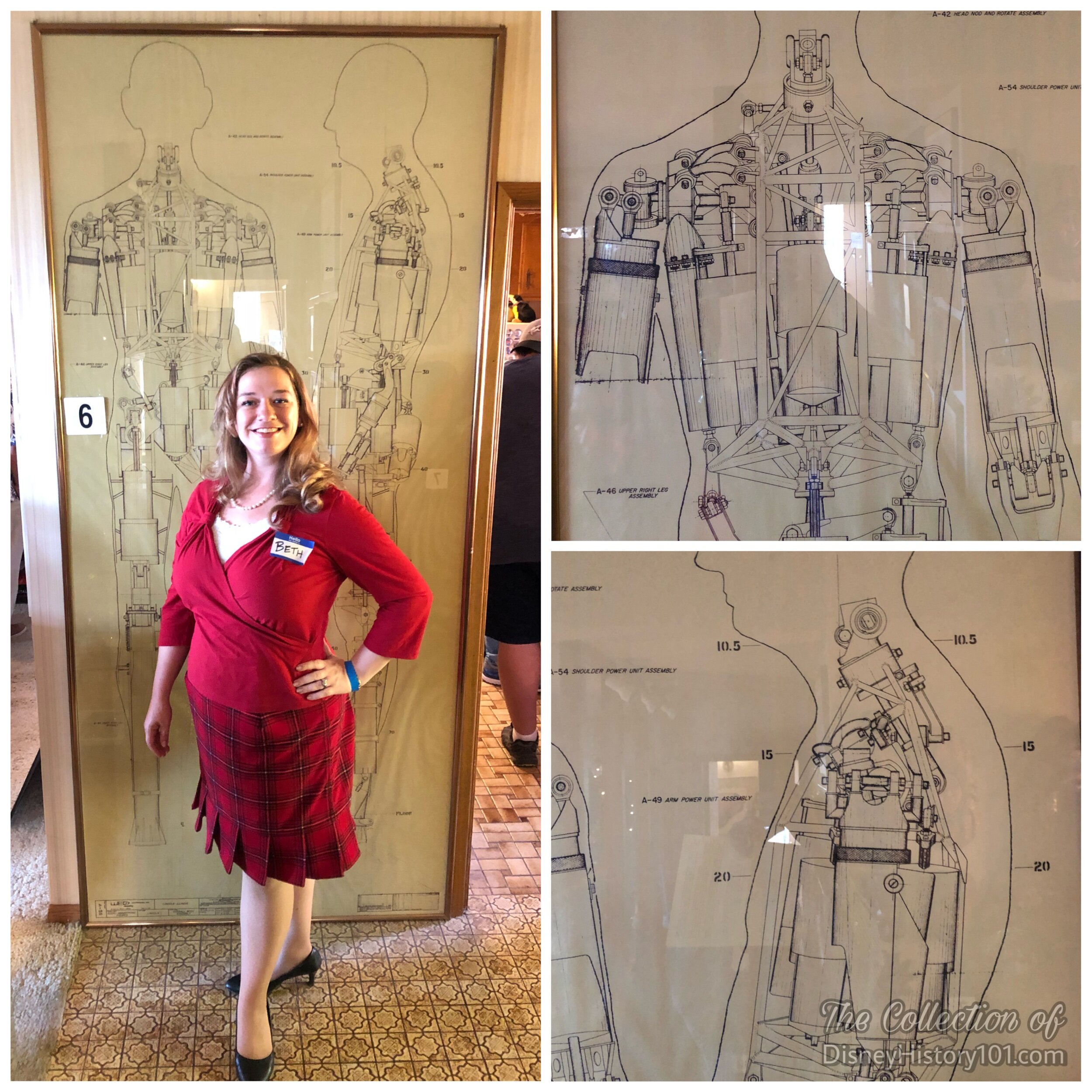
Audio-Animatronic Lincoln Figure Overall Body Assembly Sheet A-56, WED Enterprises, Inc., Collection of Bob Gurr
Robert H. Gurr (the very same engineer who helped redesign the Autopia Mark I chassis in 1955) was tasked with designing Mr. Lincoln’s “ribcage” (among other “skeletal” parts). “Remember, I’m a car guy. Lincoln has no wheels.” Bob accomplished this formidable and challenging task (with the help of Hogsett (a draftsman), and today he still (proudly) owns one of the life-size blueprints of Lincoln (he approved).
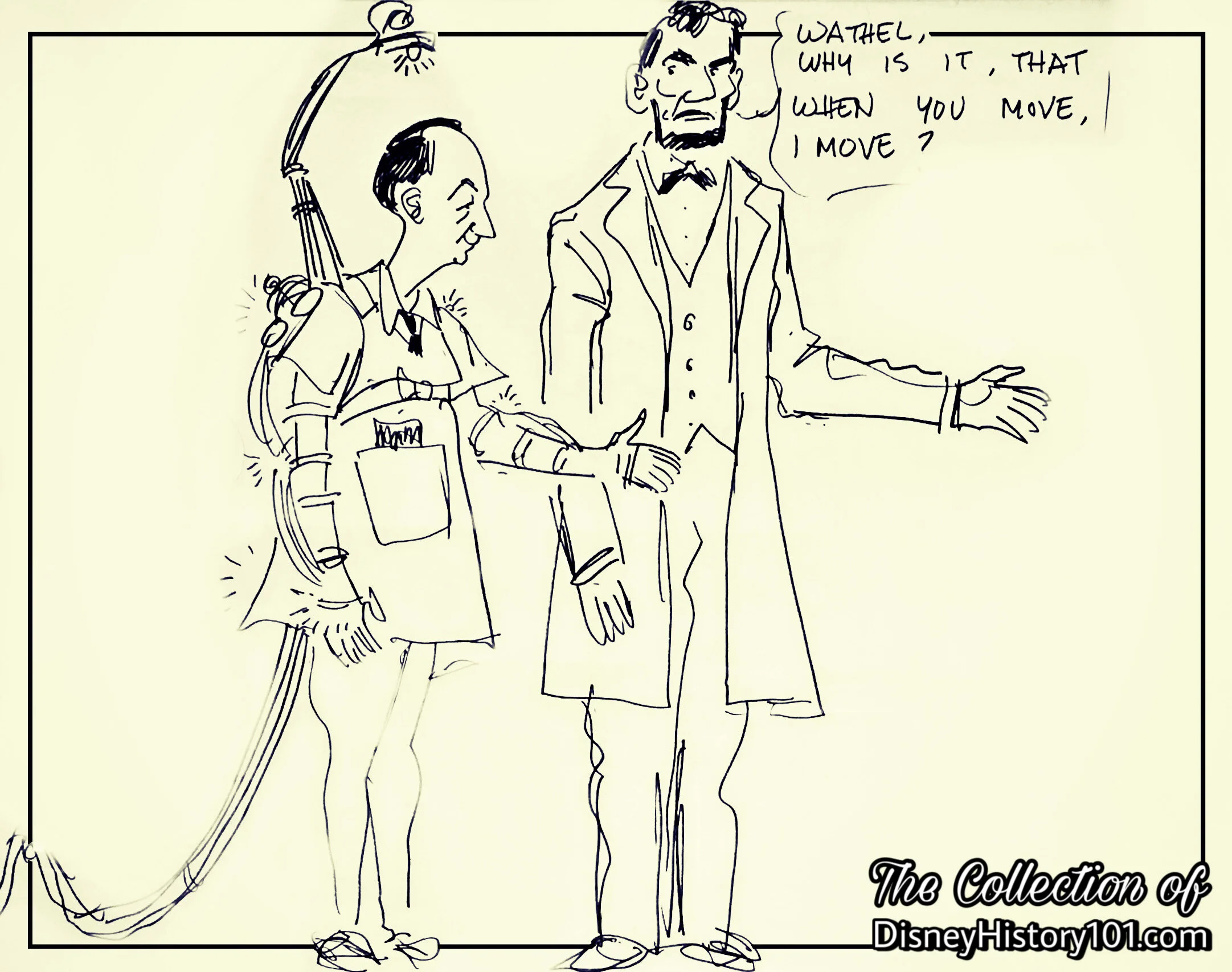
Before the Animator’s Console, a caricature of Wathel Rogers wearing the Control Harness for programming depicts the Abraham Lincoln Audio-Animatronics Figure confused as to why he moves in sequence.
“Programming Mr. Lincoln”
Bill Justice [“Justice for Disney”, page 75] recalled: “The original programming system was a harness arrangement worn by the programmer. He would move the way he wanted the figure to move. The harness would sense these motions and pass them on to the figure. That's how my mentor and colleague Wathel Rogers programmed the original Mr. Lincoln. Visitors would watch Wathel work and accuse him of overacting. He had to overact - the harness could sense only about two thirds of his movements. It was a pretty crude arrangement.” So instrumental was Wathel Rogers (of WED Enterprises Systems Development), that on January 11, 1966, an additional pay increase of $25 per/week (to his current personnel salary of $350/week) was deemed warranted and approved by both Mel Melton and Walt Disney.
The magic of Walt Disney’s patented Audio-Animatronics human figures soon made their debut though several televised previews. In one “Wonderful World of Color” episode (airing May 17, 1964) Walt Disney introduced the world to Audio-Animatronics with the help of animator Wathel Rogers (who wore the electronic rig of controls, which captured his own movements, and then recorded them on 35mm magnetic tape). Further, “sync marks” (would allow the movements to be analyzed, corrected and timed to keep the various animations in well-ordered synchronization). This impressive display was far more complicated than those remote controlled Tiki Room Birds, and this way, Wathel gave a televised demonstration of programming the movements of the “Father” figure for the General Electric Carrousel of Progress.
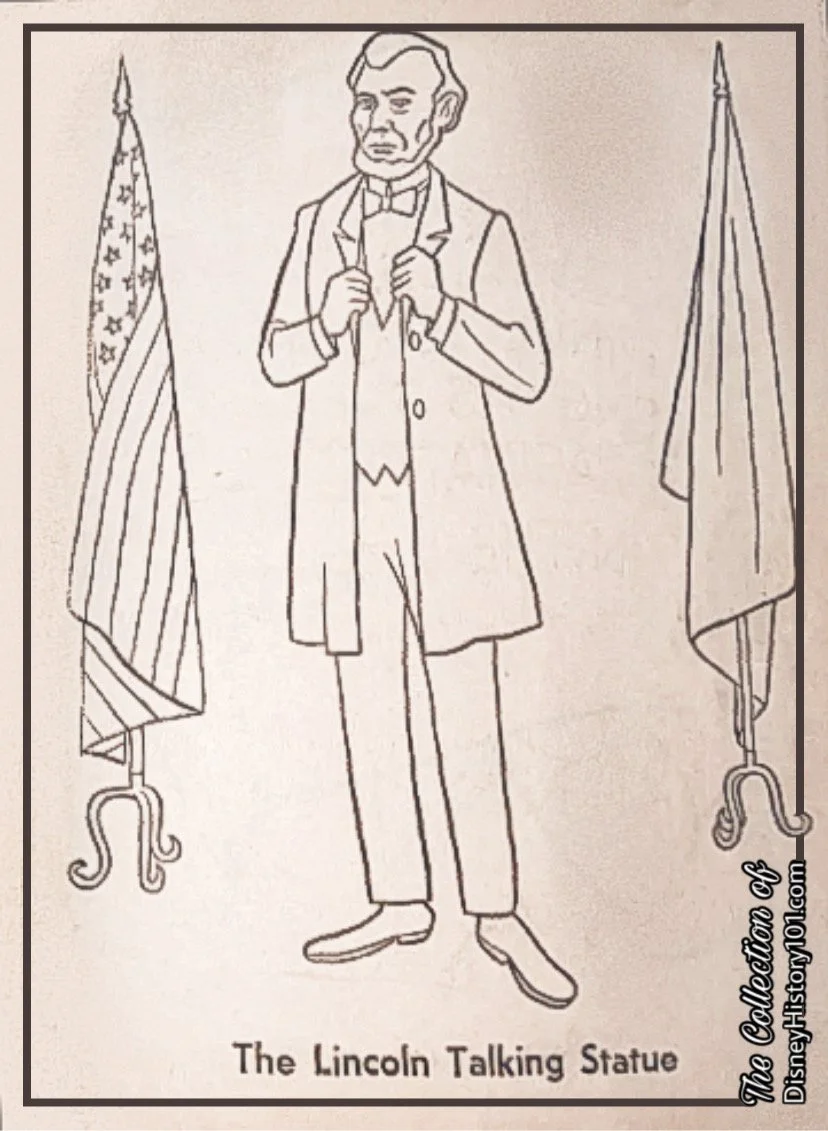
One Disneyland Coloring Book image published in 1964, depicts “The Lincoln Talking Statue”.
Walt Disney’s Mr. Lincoln would be no mere “talking statue”. These techniques would now be employed to give natural movement to the complex figure of Abraham Lincoln. According to Walt Disney (in a c. 1963 interview with Fletcher Markle), “Now, we’re making these… dimensional human figures move, we make animals move, we make anything move, through the use of electronics. It’s a tape mechanism. The tape, its like programming and sequencing when… they’re sending some missile to the moon. At different stages, at different times, things must happen. That’s all programmed - pre-determined. So our show’s put on that tape, programmed from this tape. And we run it off a little 1-inch tape that has 14 tracks. On each track, we can get up to 16 signals. Now, those little signals go and impulse this figure and make the figure move make the figure talk, and everything.”
“Recording Great Movements of Mr. Lincoln”
An Animator’s Console was used for programming the movements of the Audio-Animatronics® figures. Mr. Lincoln’s music and effects were pre-recorded on a 1-inch magnetic tape (capable of controlling hundreds of actions) and then synchronized with impulses. These impulses are simulated by transmissions sent from the magnetic tape to numerous pneumatic and hydraulic tubes running through his body. According to Backstage Disneyland (Vol.6, No.1 ; published Spring, 1967), “The heart of Mr. Lincoln is a one-inch-wide tape that contains 11 tracks of pulses. This, combined with a complicated hydraulic oil and air system, provides the smooth body movements seen in the show upstairs.“ The end result - through the magic of Audio-Animatronics, the great Abraham Lincoln comes to life before audiences, for a memorable six minute address - with “48* separate body actions with the figure’s 17 head motions and facial expressions” (*or, 48 separate body actions, by some accounts)! In fact, according to “The ‘Audio-Animatronic System’ : A New Concept in Entertainment,” “some 275,000 combinations of actions can be programmed for the Lincoln figure.” “With even more realism in sound and movement, the figure of the Civil War President is seated in thoughtful dignity in his White House office. He rises slowly to deliver his address, with complete coordination and movement, speech and mannerisms of Abraham Lincoln,” according to an excerpt from "Walt Disney's Vacation in Disneyland" A Gold Key Comic, Published 1965.
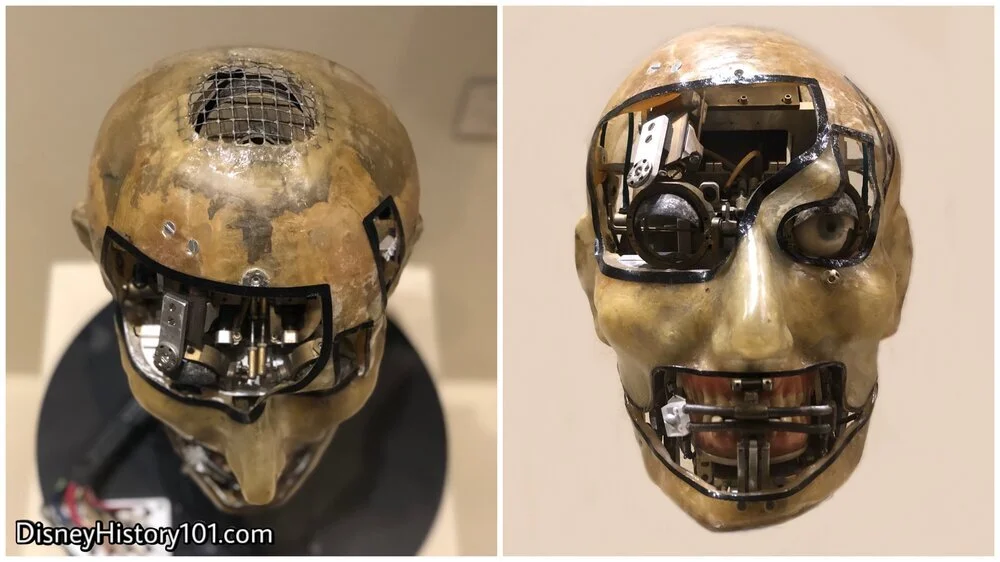
Audio-Animatronics Head & Jaw Assembly - Great Moments with Mr. Lincoln (1964), State of Illinois Pavilion, New York World's Fair ; The Walt Disney Archives.
According to Disneyland LINE Magazine [October 28, 1994 ; Vol. 26, No. 42], “The Figure Head Animation Department came into existence in the latter part of 1962 to meet the demands of Disney’s exhibits at the 1964 World’s Fair,” which included the Cast of It’s a Small World, the General Electric Carousel of Progress, the Ford Magic Skyway, and Great Moments with Mr. Lincoln. The same article continues : “These exhibits introduced Audio-Animatronics technology on a grand scale. Two of the exhibits, Great Moments with Mr. Lincoln and the GE Carousel of Progress, had complicated animated heads. The Head Shop team was established to assemble them.”
The Audio-Animatronics head is covered with butyrate, a transparent, rigid, and easily malleable plastic used as a “shell.” Over the butyrate was a flexible latex “skin.”
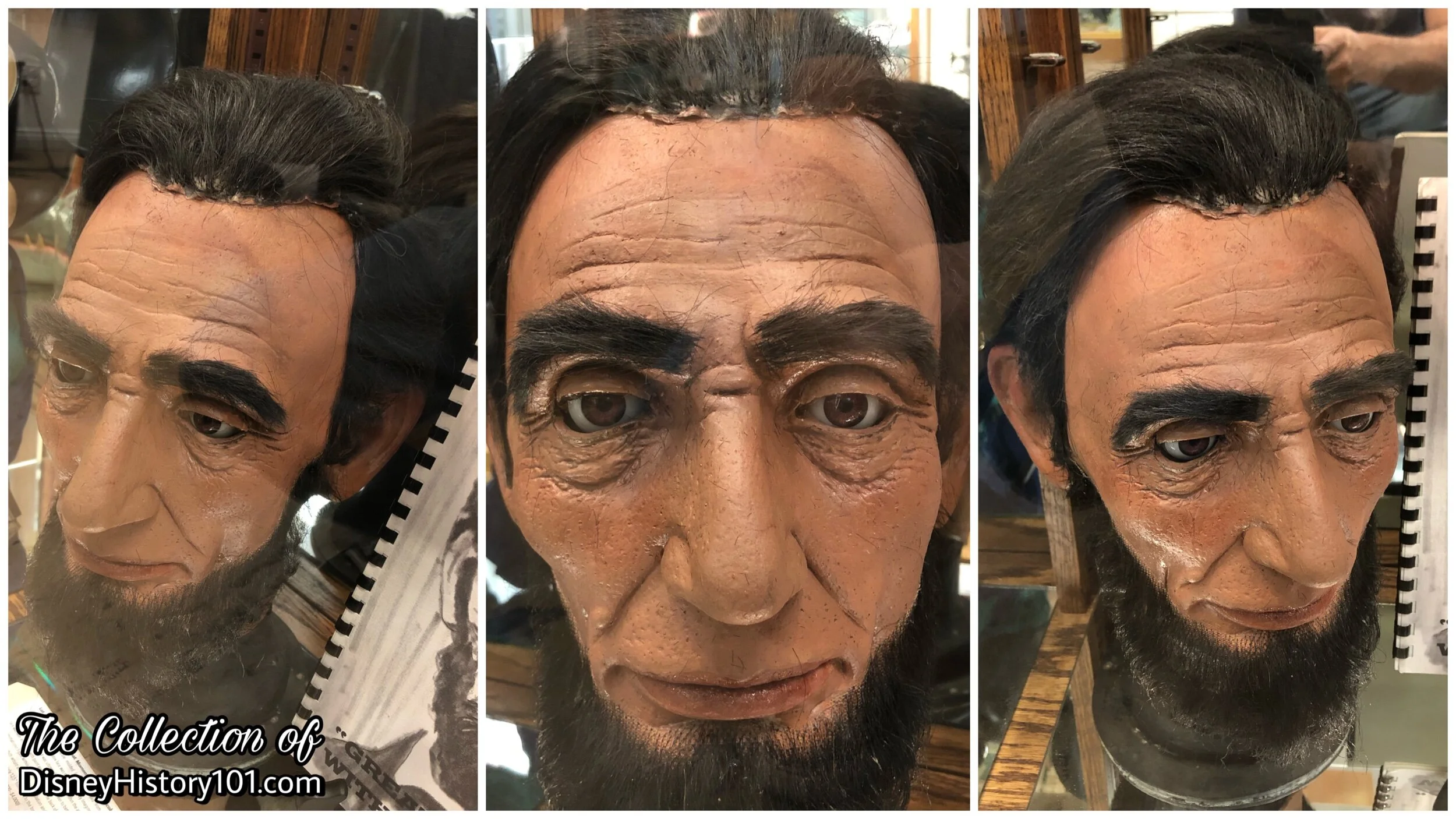
Mr. Lincoln Head Flexible Figure Skin, (1980s).
In order to find a resilient and flexible figure skin compound that could endure the rigors of performance after performance, Walt and company turned to Bart Thompson (a chemist for rival studio MGM), who had a knack for these sorts of things. Bart had previously helped develop the latex “skin” for one of Walt’s first Audio-Animatronic human figures (that of Confucius, for a scrapped Chinese restaurant project, that was to be located off Main Street at Disneyland). Now, Lincoln would be covered with a “flexible ‘skin’ in order to maintain the original details.” Such a flexible figure skin was pliable and capable of being “buttered” - worked with a hot iron. Finally (above), note the lip ring and upper and lower “pinch arms,” eye snaps, and screws for attaching the “skin” to the Head Assembly.
Meanwhile, “the hair and beard were created by a professional wig maker… eyes were created by WED artists, using techniques similar to those employed by prosthetic eye manufacturers, and dental techniques were used to design the gums and teeth,” according to Vacationland magazine (Fall, 1965).
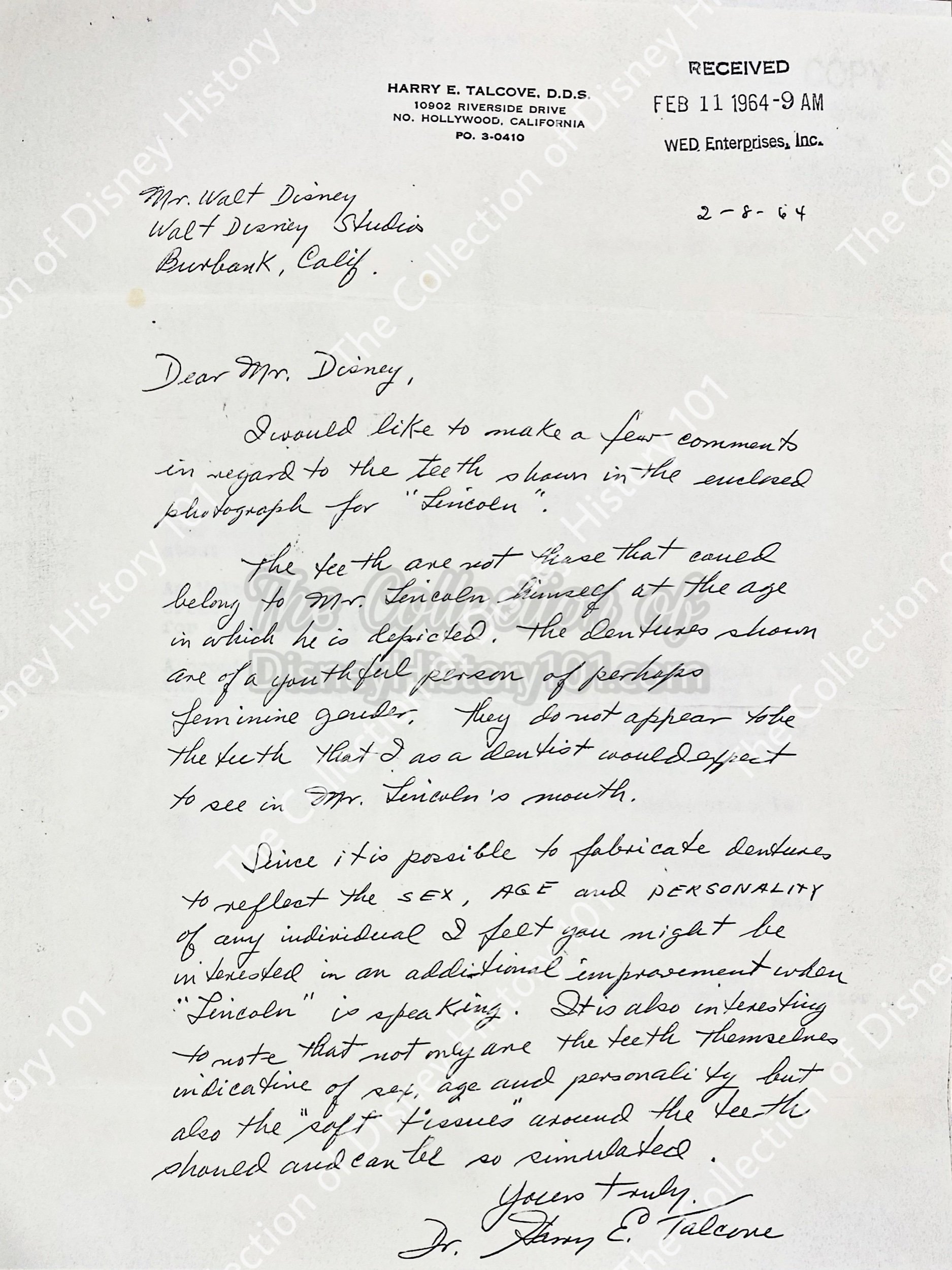
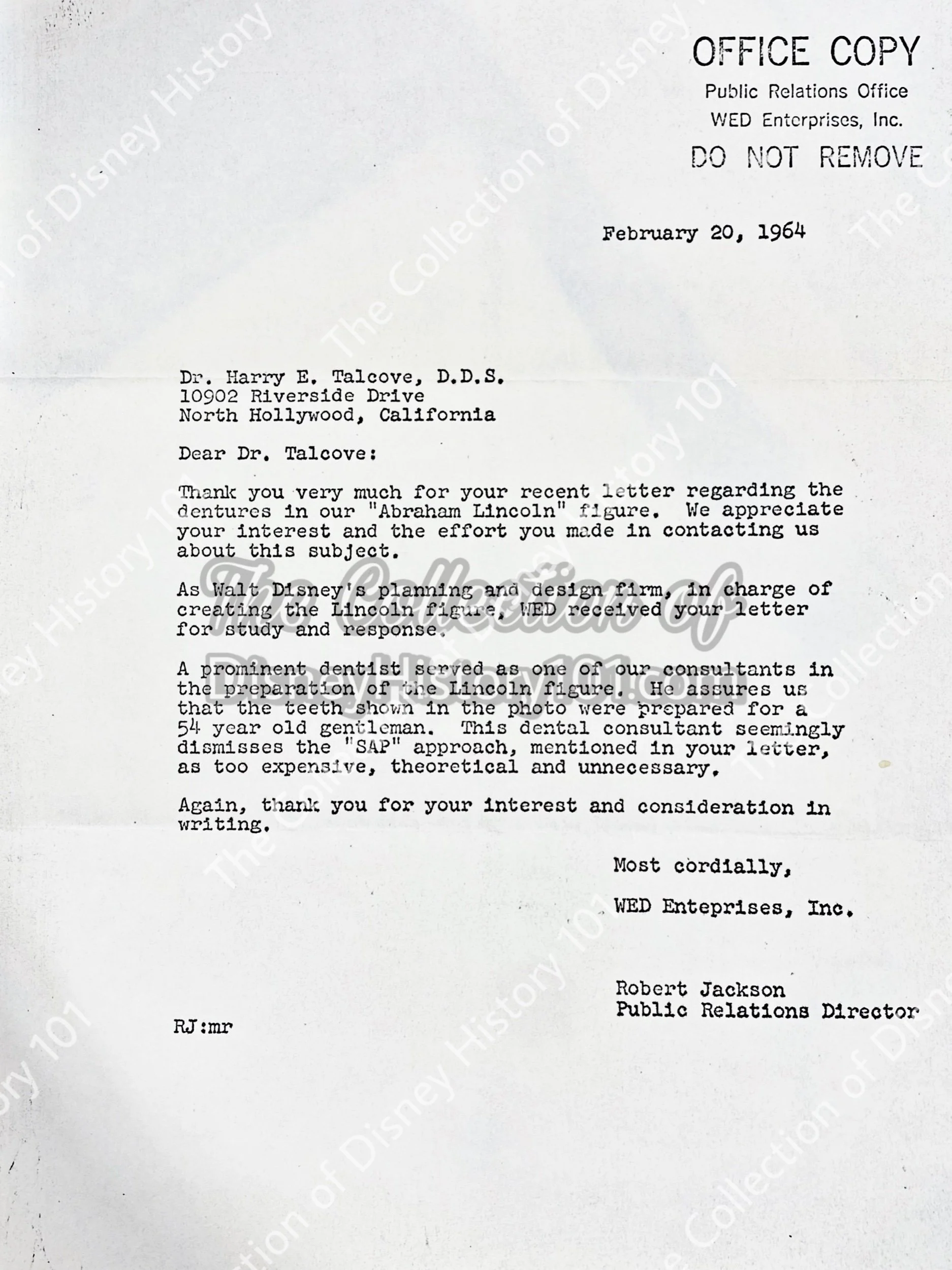
The dentures fabricated for the head were even scrutinized, as attested to in this letter to Walt Disney Productions from a contemporaneous, local Hollywood-based dentist who acted as a consultant for Mr. Lincoln.
All of this facial detail was essential, because the complex Mr. Lincoln Audio-Animatronic would be unlike any other - a human character that would speak!
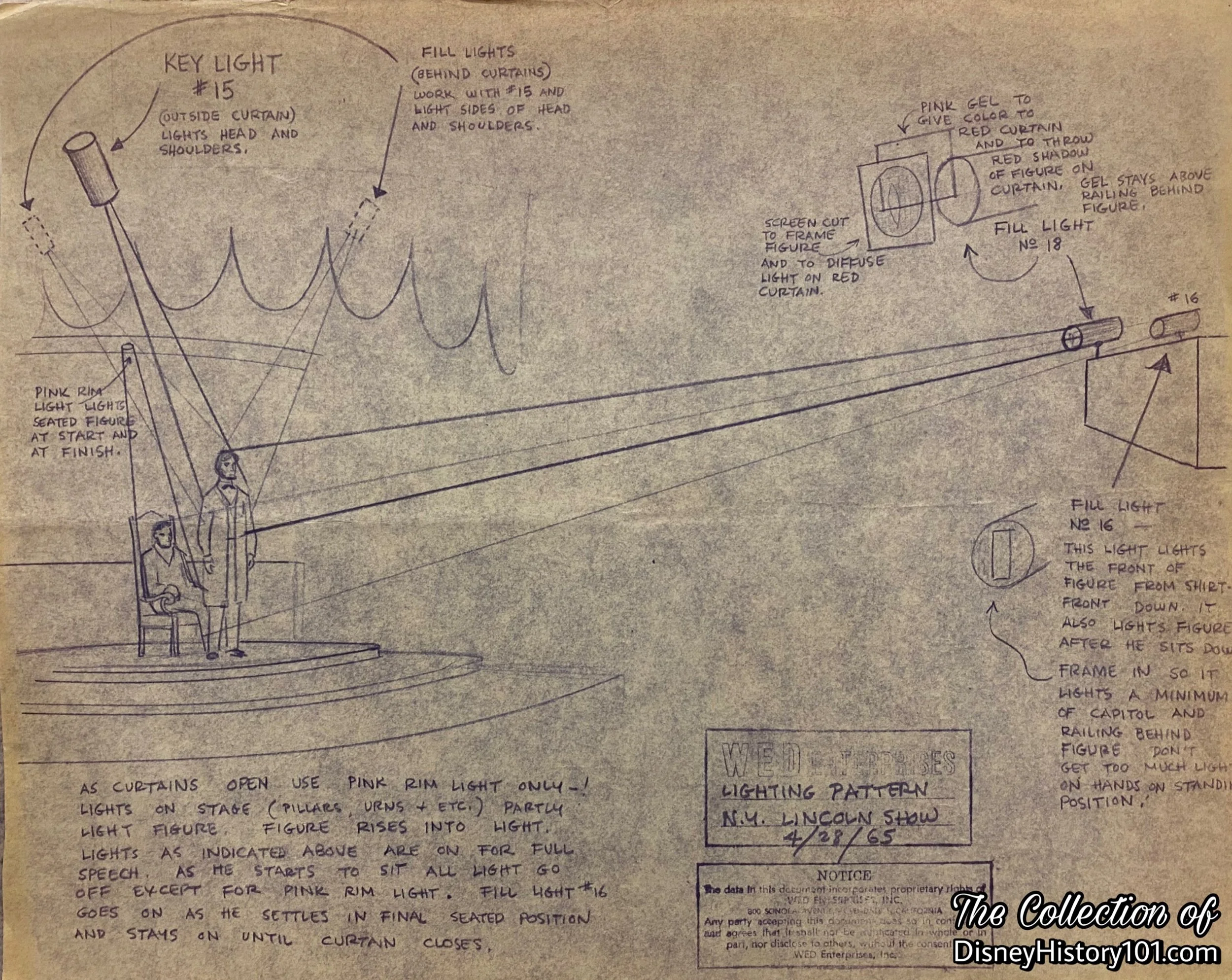
Dramatic lighting patterns were prepared for the show.
Last (but not least important) was the score, which was composed by Buddy Baker (who would later become renown for his compositions for both Adventure Thru Inner Space and the Haunted Mansion). Buddy had most-recently provided the score for the attraction at the State of Illinois Pavilion.
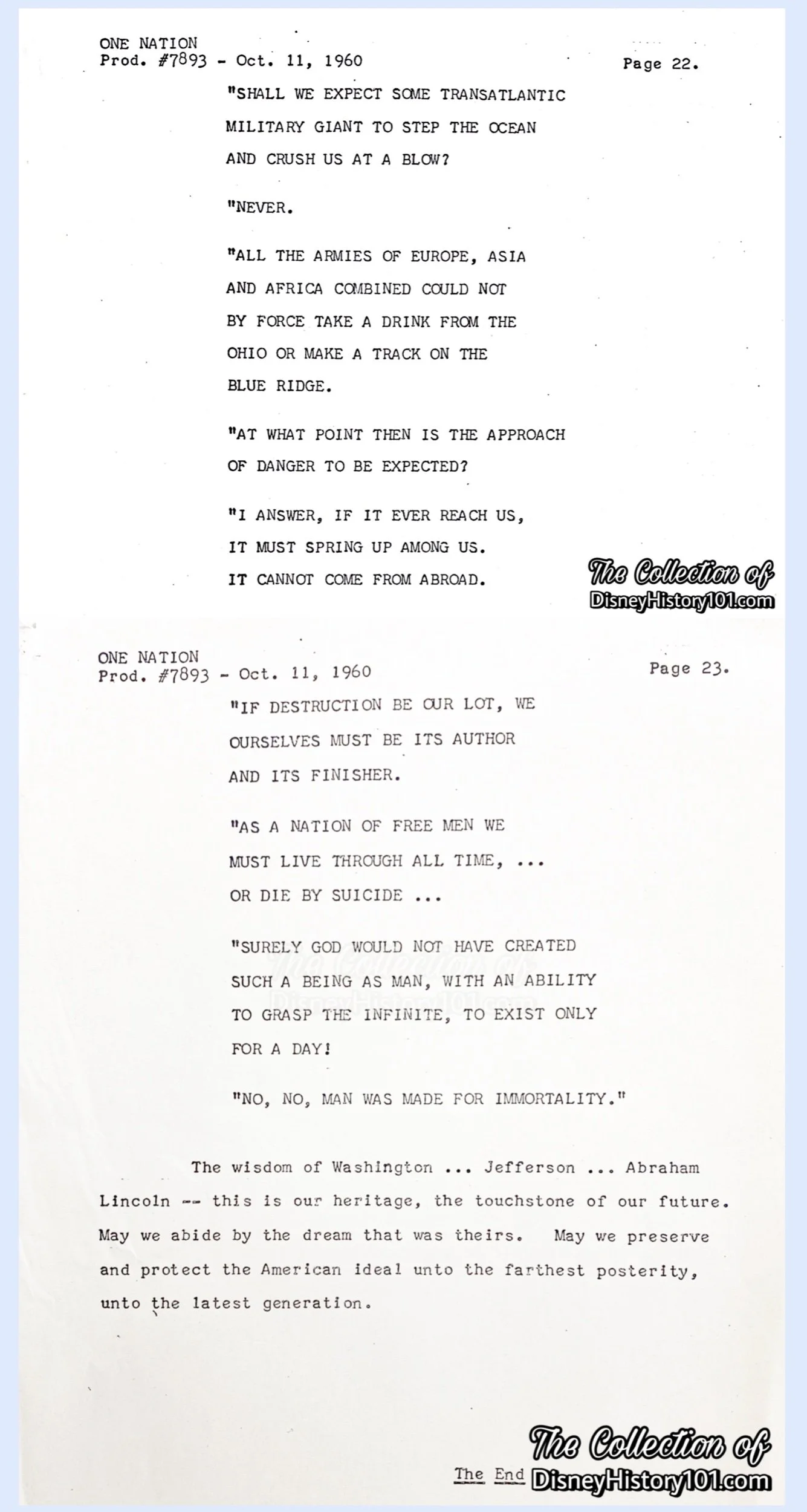
“One Nation” script excerpts prepared by October of 1960 ended up in parts of the Great Moments with Mr. Lincoln show.
“Great Words of Mr. Lincoln”
James Algar (a veteran of Walt Disney’s True-Life Adventures documenting people and places) was assigned to write the script for Great Moments with Mr. Lincoln. Soon, Walt Disney (and company) reached out to Ralph Newman (an avid and respected Civil historian). Though James had researched much material and drafts were completed (as early as August of 1963), many subsequent meetings and Inter-Office Communications took place on the subject of what Abraham Lincoln should say. According to Walt’s own words, “When we set out to select the speeches and writing for the monologue in the show, we decided to bypass the Gettysburg Address, even though its poetic qualities and poignant message are unexcelled. Because it is so familiar to every American, we felt that it would not contribute significantly to our purpose - an in-depth fresh presentation of Lincoln’s principles, ideals and philosophies.”
So, it was ultimately decided to not select any one of Lincoln’s deliveries (as The Gettysburg Address) for the monologue, but to write his words as some actual composite of President Lincoln’s speeches. Among the sources included were (1) the Address at Sanitary Fair, Baltimore, Maryland -April 18, 1864, (2) the Speech at Edwardsville, Illinois -September 11, 1858, (3) the Address before the Young Men's Lyceum, Springfield, Illinois -January 27, 1838, (4) the Address at Cooper Institute, New York city, New York - February 27, 1860.
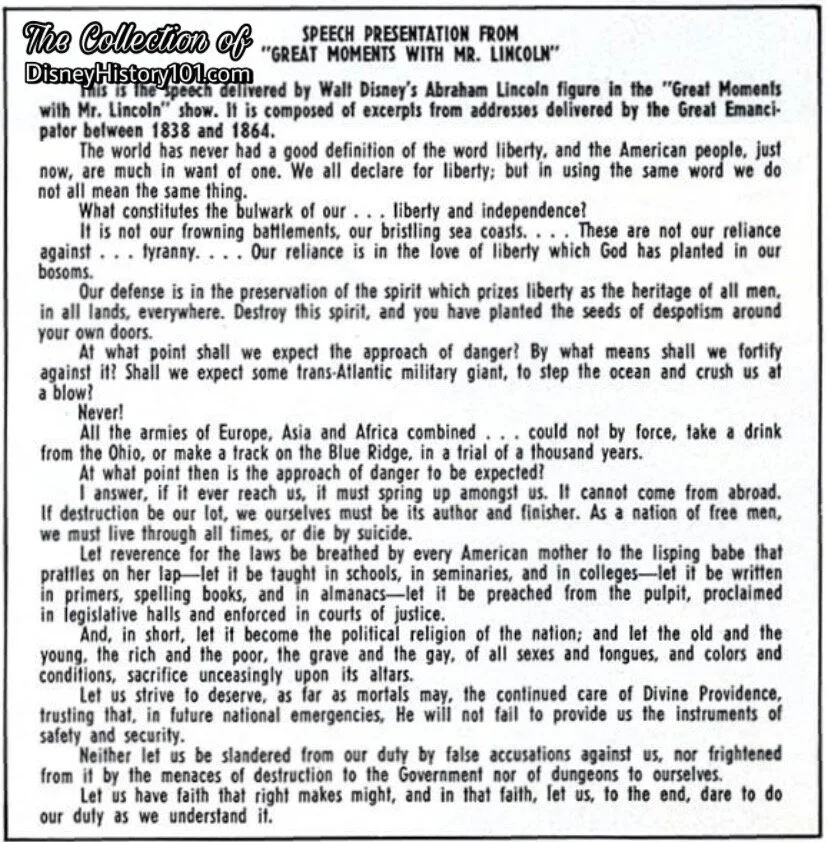
Vacationland Excerpt Featuring The Great Emancipator's "Entire" Speech, Published 1965
“New York World’s Fair Debut and Response”
The results were ready in a few short months, and by April 5, 1963, Fairfax Cone (New York World’s Fair Illinois Commission Chairman) flew out to Walt Disney Studio. At the sight of Lincoln talking and moving, Fairfax soon thereafter wrote Walt : “I am sure you know that I was overwhelmed by the realism of the Lincoln figure that you showed Mrs. Cone and me last Friday. The possibility of our using the Lincoln figure and the effect of this upon visitors to the New York World’s Fair have not left my mind during any of my waking hours since I saw it. I am going to New York tomorrow to discuss the Illinois participation with the Fair people, and I expect to be in touch with Jack Sayers shortly to further explore this subject.” Soon after, the Governor of Illinois (Otto Kerner) appointed a new New York World’s Fair Illinois Commission Chairman - Mr. Ralph Newman. Ralph Newman was a known Lincoln enthusiast, and swiftly flew out to Walt Disney Studio, and was also so impressed with the Lincoln figure, that he had many good things to report to the Illinois Governor.
Around WED Enterprises, Inc., Audio-Animatronics purely served entertainment purposes. However, the art and science of Audio-Animatronics had taken such a great leap forward, that (by June 11th, 1965) the company had even been invited (through a certain Cornell University program) to submit a bid to the United States Navy. This bid was for a contract to develop a related “exoskeletal device” which would enable a man to “lift 1,500 pounds to a height of six feet and carry that load twenty-five feet in ten seconds.” It was clear that WED Enterprises, Inc. had come a long way in the field of Audio-Animatronics, by the 1960’s! More than two decades later (in 1984), WED designers met with scientists from the University of Utah's Center for Biomedical Design. Based upon Audio-Animatronic technology, a stunning new advancement was developed, creating incredibly life-like movements.
Complications (regarding syncing the tape and figure’s movements) prevented Mr. Lincoln’s scheduled debut at the 1964 New York World’s Fair, and Robert Moses went on record stating, that he wouldn’t “open the fair without that exhibit.” If the movements were not synced just right with the audio track, “It was sort of like a needle jumping the groove [on a record]. The result was, Lincoln would go into a complete spastic fit,” according to Bob Gurr. But, once these were fixed, Mr. Lincoln opened at the New York World’s Fair on April 6th, 1964 (some twelve years after the creation of the miniature barber shop quartet).
“‘Unbelievable’ and ‘inspiring’ were some of the words fair goers used to describe this new portrayal of Lincoln.” Understandably, “during the fair’s two six-month seasons, 91 percent of those who paid fair admission - nearly 47 million people - visited one or more of the quartet of Disney shows created for General Electric, Ford Motor Company, Pepsi Cola and the State of Illinois.” [“Information on America Sings,” prepared by Disneyland Marketing Division, 1974]. In reference to the popularity of the marvelous shows created for the 1964/1965 New York World’s Fair, Walt Disney once told Ray Bradbury, “Nothing has to die.” True to those words (and following the 1964 season of the New York World’s Fair), all four of Walt’s presentations were redeveloped by WED Enterprises, Inc. for relocation at Disneyland. Of these, work was soon wrapping up to make Great Moments with Mr. Lincoln presented by Lincoln Savings and Loan Disneyland’s 48th major attraction!
“Imagineering the Disneyland Show”
On February 3, 1965 WED Enterprises was no longer personally owned by Walt Disney, but was now incorporated as a subsidiary of Walt Disney Productions. MAPO was also soon incorporated on July 23, 1965. Before long WED Enterprises, Inc. and MAPO would work together to produce the Disneyland Show. WED Enterprises, Inc. would master-plan, design, and engineer the concepts. MAPO, Inc. would take those plans and fabricate, assemble, and test the show’s prototype systems and components (including those of the Audio-Animatronics figures). New parts were fabricated, including “a duplicate Audio-Animatronics Lincoln, because the original one was still running at the fair,” according to Dave Smith (Chief Archivist Emeritus of the Walt Disney Archives). [Disney Facts Revealed by Dave Smith, 2016]
A new six foot, four inch figure (weighing 140 pounds) was completed, capable of some 48 body actions, 17 head motions and facial expressions, and 438 separate actions. In fact, the refined figure was capable of a total of nearly 275,000 possible movements. At long last, “tomorrow's technology, married with the sensitivity of today's Disney artisans” would let audiences relive a few Great Moments with Mr. Lincoln!
The new figure would become the star of a brand new $1.5 million, 499-seat theater (or, “501-seats” in 13 rows, according to Vacationland magazine), with walls “lined in bone-white acoustical veneer for excellent sound control.” Therein, ‘Mr. Lincoln’ would deliver an inspiring address, with the entire show (voice-over narration, animations, lights, curtains, even the motion of the twelve entrance doors and twelve exit doors) recorded on a magnetic tape capable of holding 438 separate actions. The tape would be transmitted from the Audio-Animatronic Control Room under the Lincoln exhibit, which would feature a high-tech fire-proof system involving bell alarms, automatic door locks, and a temperature control system capable of lowering the temperature to 100 degrees below zero. In addition, many aesthetic details of the theater show were analyzed and effected like “mosque-gold” carpeting, deep red upholstery, new Hostess dresses (designed at Disneyland and made locally or in San Francisco). All these Show elements (and more) were being finalized, assembled, and finally installed during the summer of 1965, the latter under the oversight of Orlando Ferrante (a recent WDI hire who would go on to lead Project Installation Coordination). The cost of the new theater would bring the Park’s total investment to $53 million, but be well worth it. Five twelve-minute shows per hour could accommodate 2,500 guests per hour.
According to Marty Sklar, “Imagineering is the blending of creative imagination with technical know-how.” While he believed that Pirates of the Caribbean was “the quintessential attraction that expressed that,” the rollicking adventure undeniably owed its existence to the progress first made with Audio-Animatronics figures during the development of Great Moments with Mr. Lincoln.
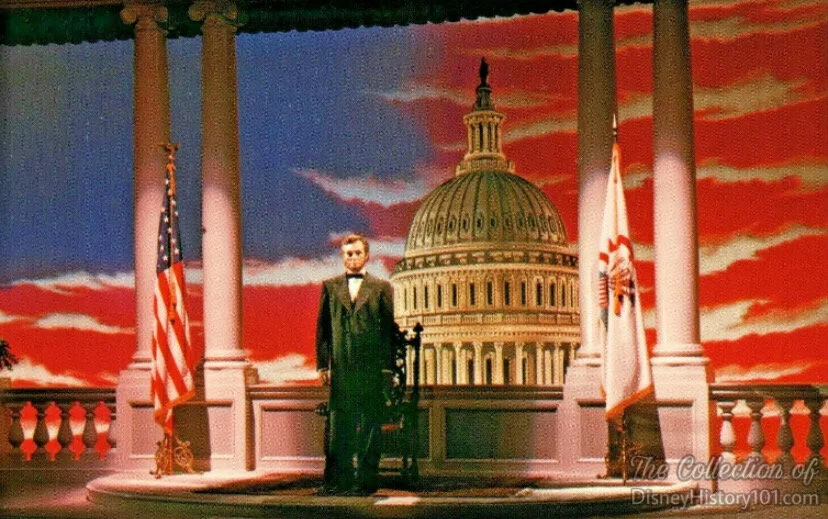
Sam McKim's Great Moments With Mr. Lincoln Flag Sunrise Against ACME Glass on a Postcard
“Setting the Stage”
Walt is known to have said, “If you could see close in my eyes, the American flag is waving in both of them and up my spine is growing this red, white and blue stripe.” So, it isn’t a wonder that Walt responded to Herb’s presentation with the following suggestion. By May 13, 1963, Sam McKim had prepared a charcoal sketch of teh second stage curtain reveal and a grand star spangled sunset behind Mr. Lincoln. Fellow artist Herb Ryman (who previously created one of the first official drawings of Disneyland, and subsequent “One Nation” attraction concepts in 1954) divulged: “At Walt Disney’s urging, and in three an done half hours allowed me, the six sequential drawings from the main scenes, the graphics, the color and the stagecraft were all completed. The formula that was to stage the entire production right down to and including the rather ‘corny’ but effective ending with the symbolism of the ‘dawn’s early light’ sky and clouds dissolving into the American flag as background from the majestic capitol dome touched by an amethyst glow of dawn. Wrapping this all up and sticking it onto a story board, I waited Walt’s critique, as I had expected and anticipated that Walt would inevitably interject, ‘Now, Herbie, I’m going to tell you how I’m going to top it!’ I waited and I waited, knowing these words would come, and was, of course flattered and somewhat amused that his best efforts at ‘topping’ the presentation was this announcement: ‘I’m going to have the Mormon tabernacle choir in the finale, singing ‘The Battle Hymn of the Republic’ as the curtain closes. There was not attempt to add any visual climax to my very frantically and speedy three and one half hours of visualizations.” [“A Brush with Disney,” by Bruce Gordon and David Mumford, page 197.]
Yes, some seven years after Herb Ryman and Sam McKim first imagined this imagery in mixed media for the Liberty Street attraction, Walt Disney Imagineers and ACME Glass would bring to life this stunning show-stopping climax! Disneyland News (published Summer of 1965) described this scene in the following way: “In the background the audience will see a model of the Capitol dome as it was in the time of Lincoln. A dramatic, soul-stirring finale finds Lincoln again seated, now silhouetted against the imposing dome of the United States Capitol. It is dawn, and the early morning sun casts rays through a profusion of white clouds. A chorus of voices, joined in harmony, seem to move through the theater in an invisible procession, immersing the audience in a stereophonic choral presentation of The Battle Hymn of the Republic. Gradually, the crimson and white clouds behind Lincoln dissolve into a symbolic representation of the American Flag with the last stars.”
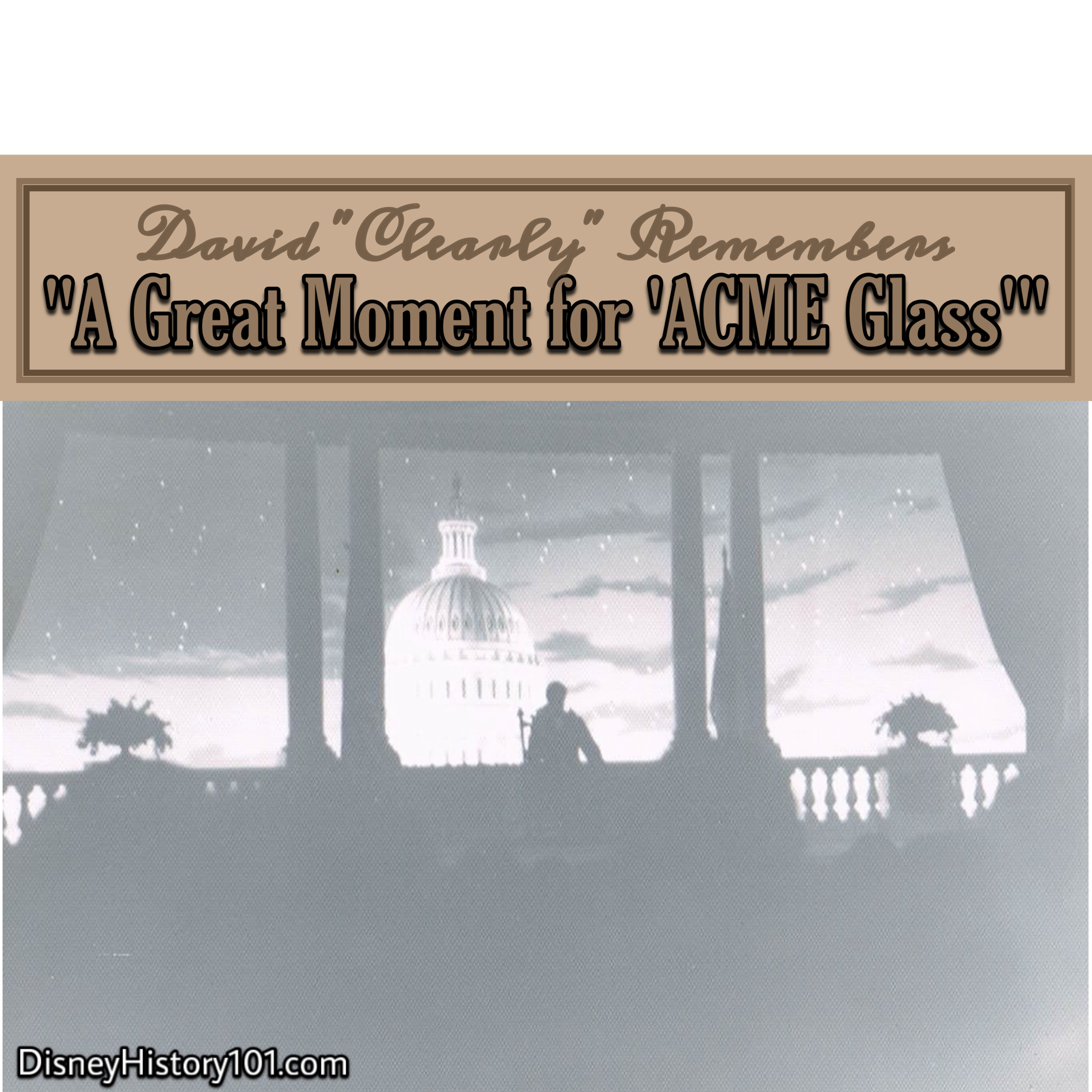
Pictured : Great Moments with Mr. Lincoln Finale, 1975
“Richard Hall Kent was Vice President of Fentron Industries, Incorporated. We were a family business, started by my maternal grandfather. We weren’t based in [Southern California]…We were a Seattle (Ballard) operation which did work all up and down the West Coast…We did curtain wall for commercial, glass for residential.
Our glass company was ironically named Acme Glass! Our company created the one way glass that allowed the flag sunrise [toward the end of the performance of Great Moments With Mr. Lincoln]. When he was a subcontractor on Great Moments [with Mr. Lincoln]…he would always have a tuna sandwich [at Chicken of the Sea] and nap next to the rock.
Our company [also] created the one way glass [in the Haunted Mansion] that … allows Madame Leota, the ballroom, and (my fave) the hitchhiking ghosts at the end. We lived in West Covina for a year (1965-1966) while he oversaw those projects, plus the UC Irvine Campus, the Nabisco Headquarters (next to I-5), and the Technicolor ‘skyscraper’ at the entrance to Universal. I call it that as it was used for exterior shots in several Universal TV shows (Kojak, McCloud, McMillan and Wife, etc.).”
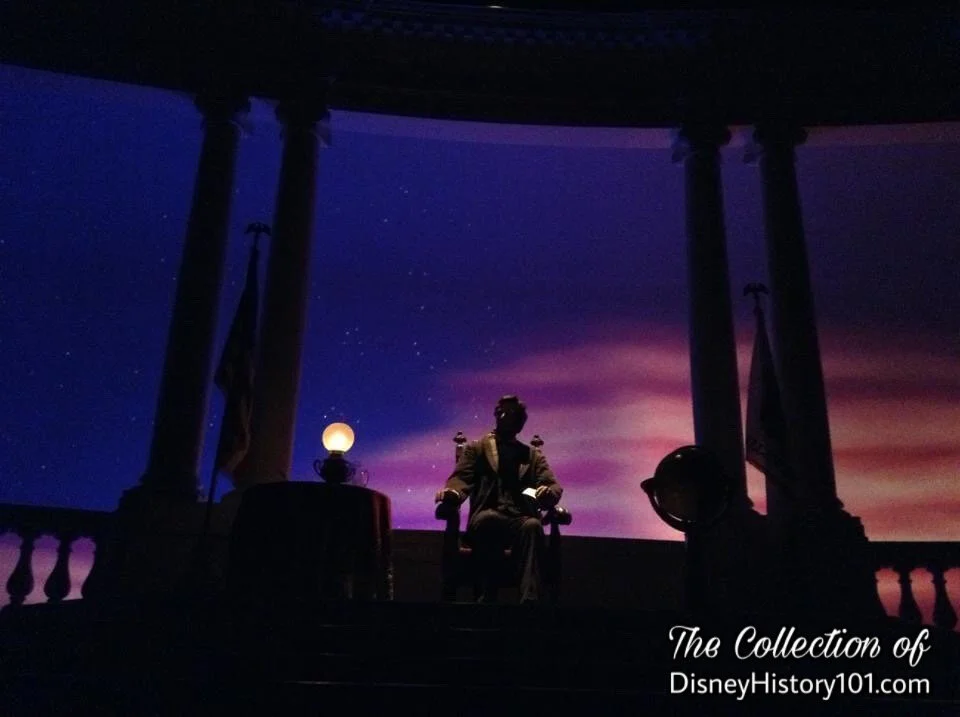
Sam McKim's Great Moments With Mr. Lincoln Flag Sunrise Against ACME Glass
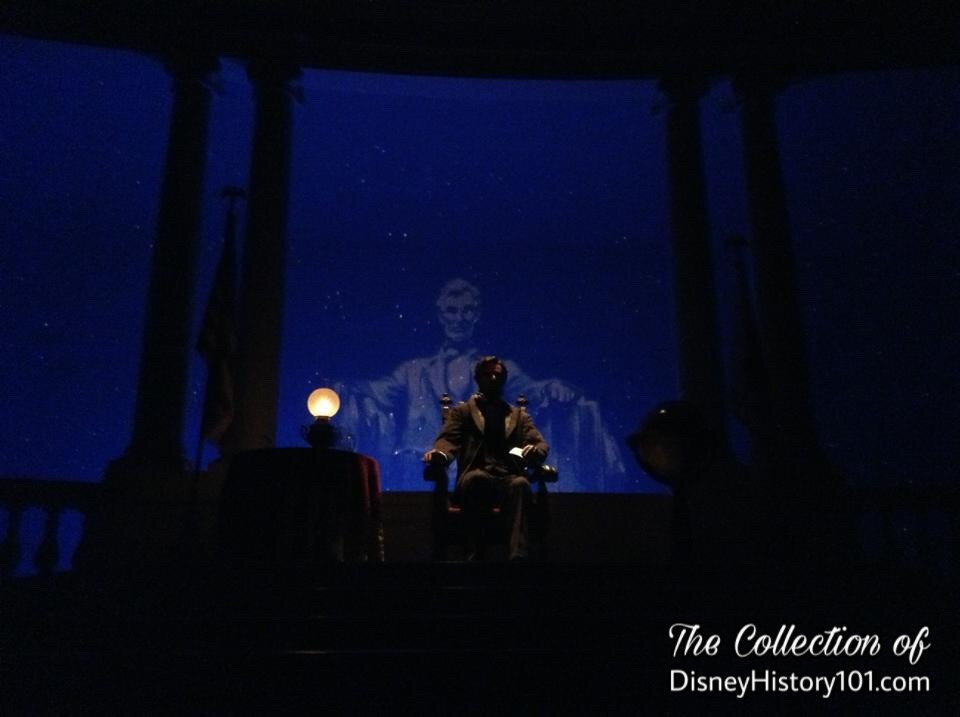
Great Moments With Mr. Lincoln Memorial Imagery Against ACME Glass
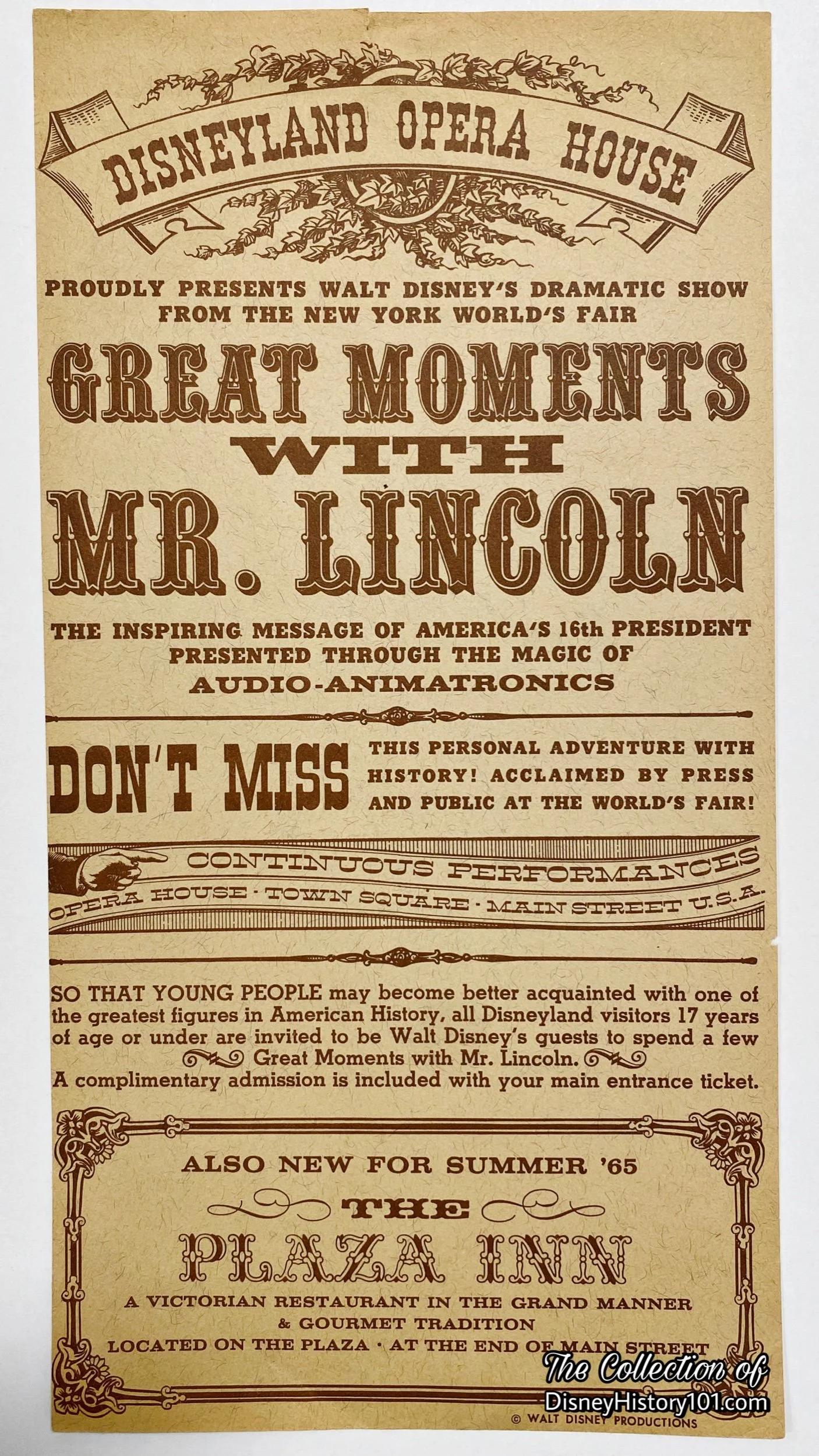
“Great Moment With Mr. Lincoln” Handbill / Poster Art.
By 1966, WED Enterprises, Inc. opened Project number 034-53-00 relating to the preliminary design of posters for five new Disneyland attractions. These attraction posters included Great Moments with Mr. Lincoln, It's a Small World, New Orleans Square, Tomorrowland, and the Primeval Diorama. On June 17, 1966 an allowance estimate of $25,000 was allocated toward the cost of project number 034-53-00. By October 1, 1966, an actual cost of $10,000 was calculated with a $10,000 write off for project number 034-53-00.
The original “Great Moments with Mr. Lincoln” poster was based on posters of Lincoln’s day. According to one Main Street Opera House plaque, “It offered a personal invitation from Walt Disney to all young people, so that they might ‘become better acquainted with one of the greatest figures in American history.’” In fact, Disneyland ticket books included a free admission ticket to the show for every child and junior visitor.
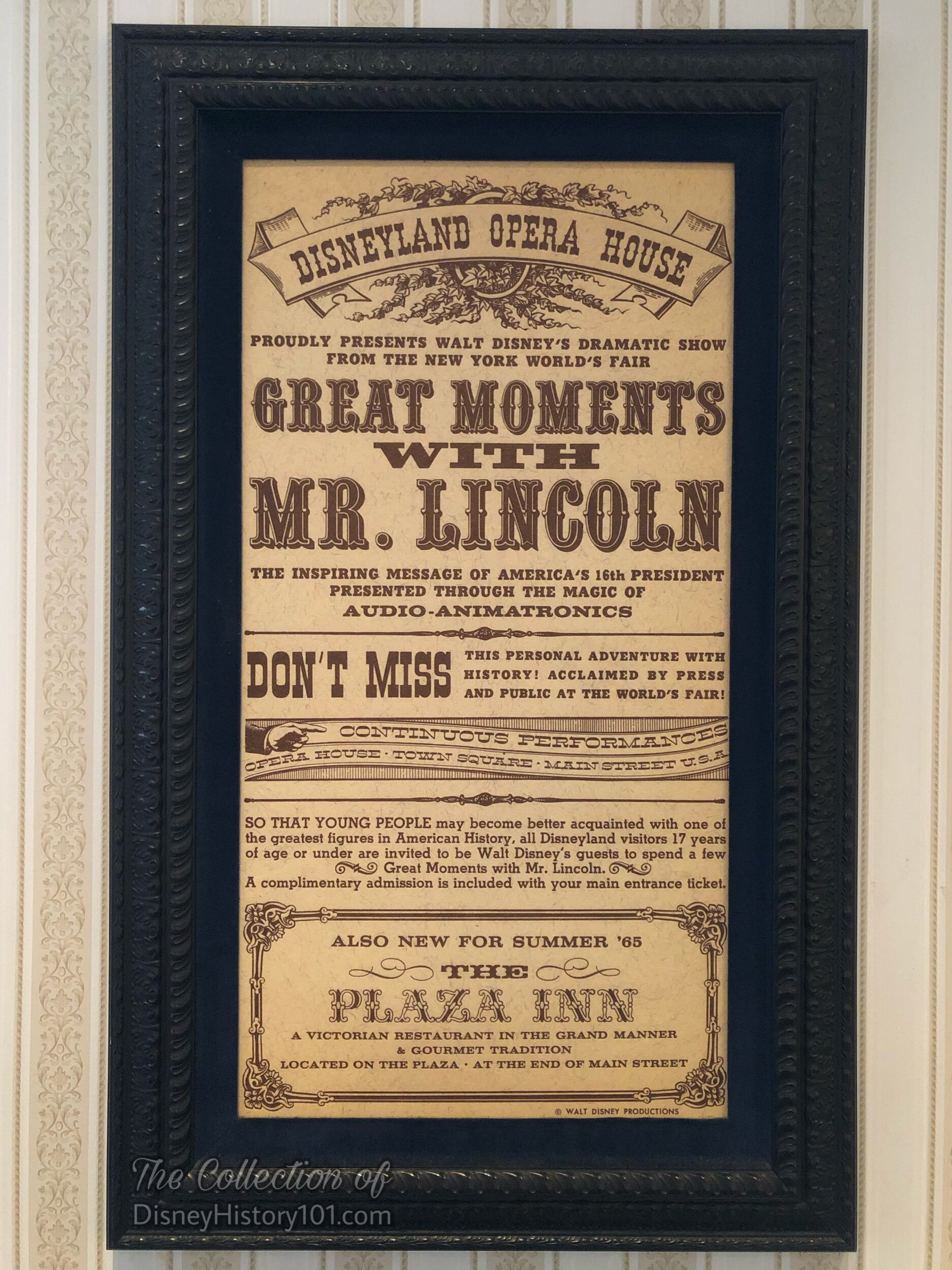
“Great Moment With Mr. Lincoln” Handbill / Poster Art.
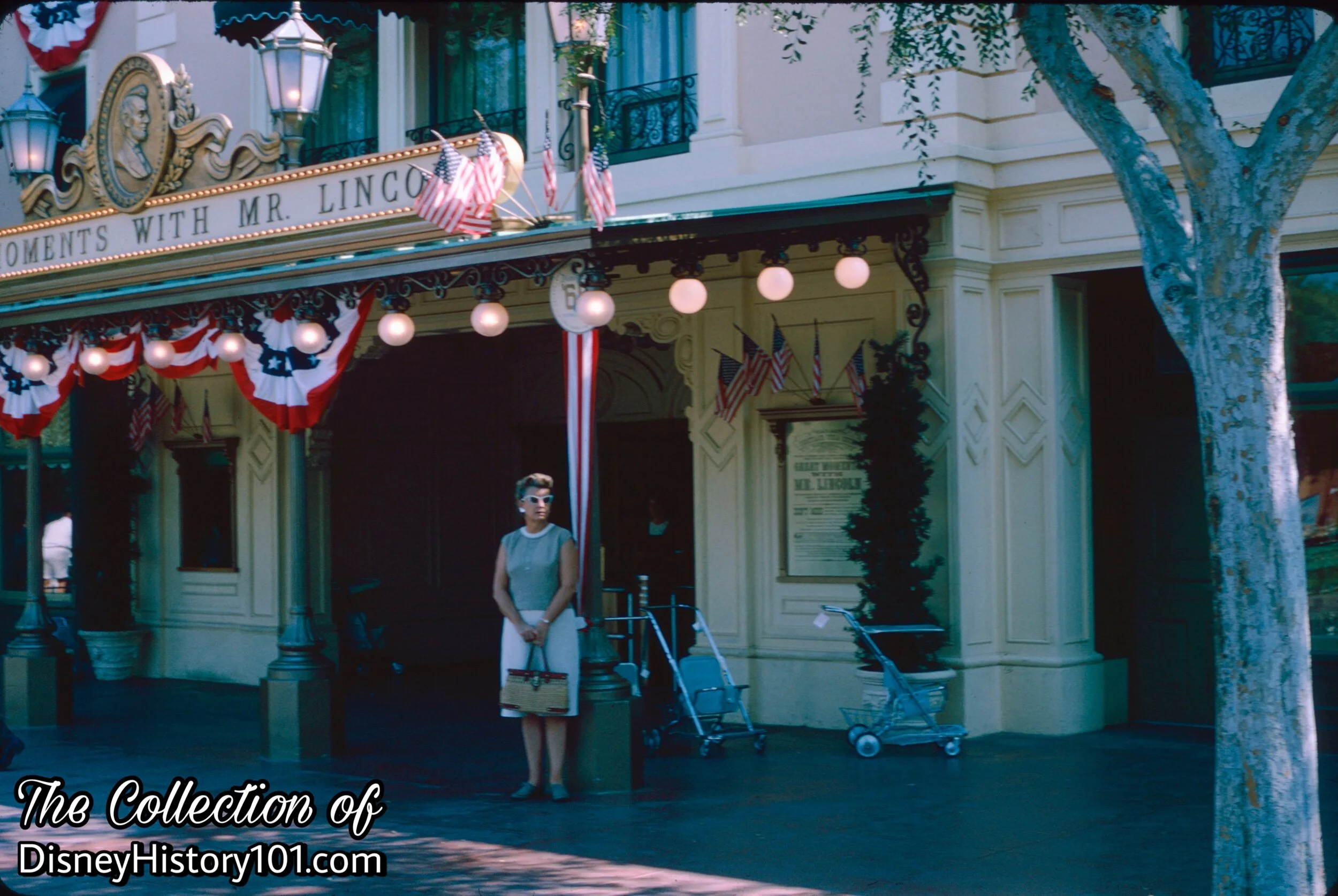
Main Street Opera House, (1965)
Red, white, and blue bunting decorated the Main Street Opera House, including the banners featuring the 13-starred 1777 “Cowpens” flag (an early United States flag), and miniature current United States flags (featuring 50 stars).
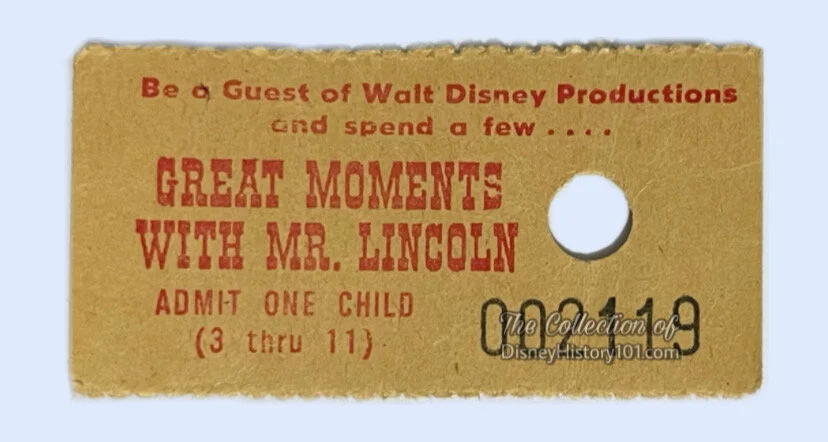
Disneyland Great Moments with Mr. Lincoln Attraction Child Coupon
Now, complications prevented the show from opening (as planned, during June 1st) at Disneyland, and as a result, many Disneyland Cash Control and Admissions employees actually spent a great deal of time removing the Mr. Lincoln tickets from books for this very reason. Despite this, Great Moments with Mr. Lincoln - “one of Disneyland’s most dramatic and awe-inspiring presentations” - would open “in an impressive new theater on Disneyland’s Town Square as a high point of the Park’s year-long tenth anniversary celebration.”
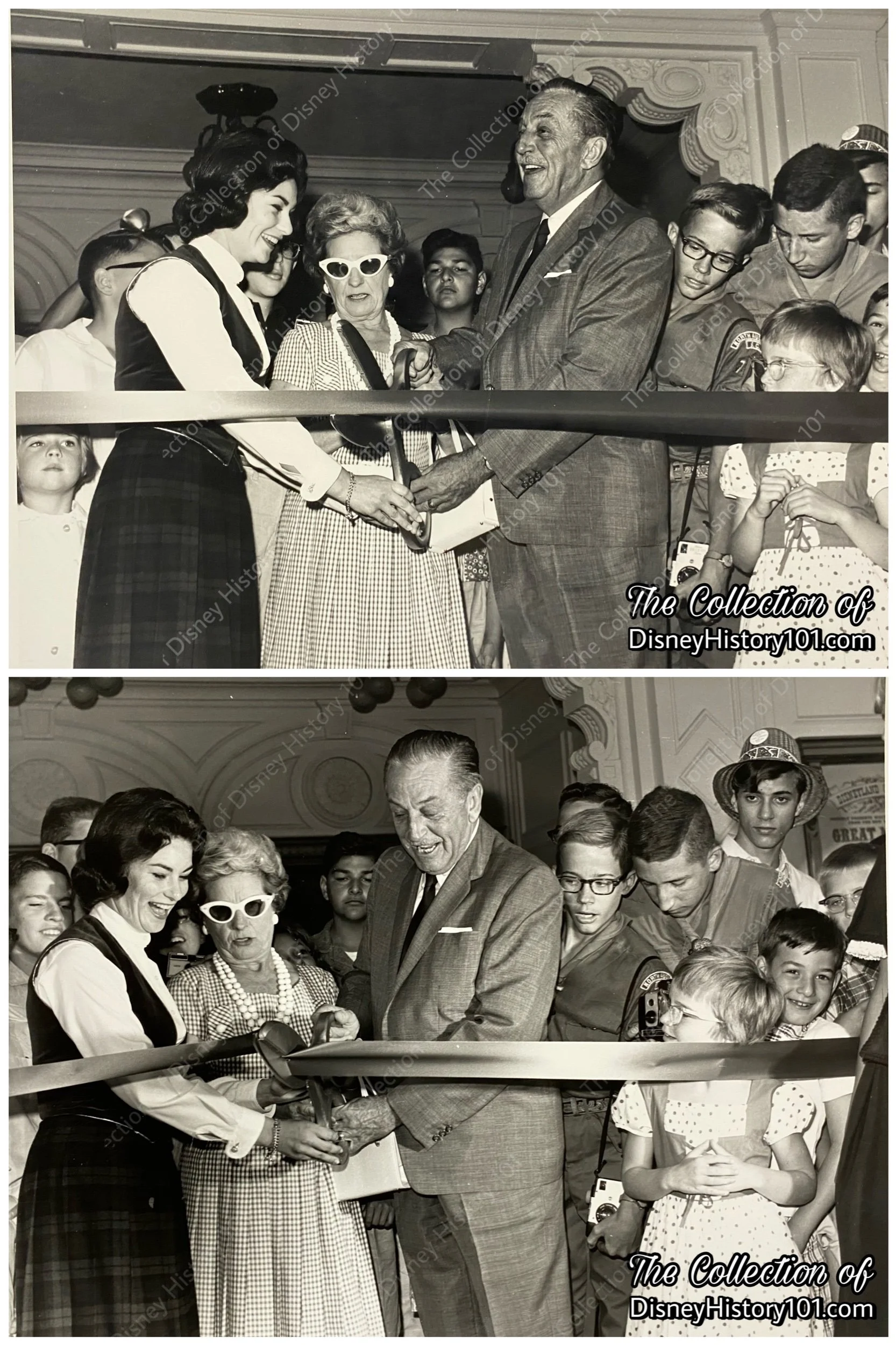
Walt & Lillian Disney and Disneyland Ambassador Julie Reihm open Great Moments with Mr. Lincoln courtesy of a giant pair of scissors.
“The Grand Opening of Great Moments with Mr. Lincoln”
This 1965 Disneyland debut (came some “100 years after Lincoln left his indelible impression on our American culture”, and) was contemporaneous with the presentation’s “second season at the New York World’s Fair”. As the Disneyland marching band played on, Disneyland’s first Disneyland Ambassador Julie Reihm would assist Walt and Lillian Disney in the ribbon-cutting ceremonies in July of 1965! According to Walt Disney (in “Disneyland Through the Seasons”), “Ever since I was a youngster, I’ve had a great personal admiration for Abraham Lincoln. So when we decided to bring to Disneyland’s visitors some great moments in Mr. Lincoln’s life, we began an exhaustive research. We studied his mannerisms, his gestures, and even his voice characteristics. Above all, we wanted to create a faithful physical likeness in this audio-animatronic figure of Mr. Lincoln. When we held the opening ceremonies, it was a great occasion for all of us.”
“55er” Earl Anderson recalled: “When we opened up Mr. Lincoln, Roy was standing at the exit, watching people come out...and looking at their faces Some of the people had tears in their eyes. Roy said to me, 'Earl. this is going to catch on...it's going to be a good show!'”
The new $1.5 million Show was one of several additions that brought total Park investments to $53 million. At that time, the cost of admission for seeing Mr. Lincoln come to life and deliver his ten-minute speech in this world-acclaimed attraction was exactly one “E” coupon, or 75¢ for adults. However, young people up to 17 years old received a complimentary ticket with their Disneyland admission. By the following July 16th (one year after the opening) the outstanding free show and exhibit - a tribute to the United States of America’s 16th President - had performed for more than two million people (surpassing the record breaking attendance of the show during the 1964 New York World’s Fair season). The show continued to run (with the aforementioned sponsor) from July 18, 1965 to January 1, 1973.
Guests of all ages were inspired by Great Moments with Mr. Lincoln, including Ray Bradbury, author of the short story “Downwind in Gettysburg.” The attraction caused a change in the tour route, and by 1965 some guest reactions and Hostess experiences were preserved in Backstage Disneyland magazine (Vol.4, No.4 ; December, 1965, page 11) :
“We know Uncle Walt is a stickler for detail, but we rarely stop and consider how observant are our guests. A lady leaving the theatre, approached MARY DALESANDRO and said, "I was greatly impressed, but did you know that the left point of Mr. Lincoln's vest is caught under his watch chain.’ Upon checking, it was discovered that the point of the vest had bent back due to Mr. Lincoln repeatedly standing up and sitting down.
SHERI MAXWELL was probably nervous as she led her first group of guests into the main theatre, but in a clear voice she started her announce- ment. "Ladies and Gentlemen, in order to preserve the dignity of this occasion," and then she tripped and fell flat on her face. The guests either impressed by the sincerity of her voice or the grandeur of the theatre, never uttered a snicker. She picked herself up and went on with her speech. ‘We respectfully request, etc.’”
There is a sign behind the Illinois Booth that reads: FREE LAND OF LINCOLN PUBLICATIONS & INFORMATION. LUCINDA LYTLE tells us that guests sign their names and addresses expecting to receive FREE LAND.
One woman, talking to CARLA BLANK, insisted that the animated figure only slightly resembled Lincoln, but was identical to Royal Dano, who has played the part of Lincoln on Omnibus on T.V. and who’s voice is used in our Mr. Lincoln.
CINDY BROWNING overheard a family discussing the Capital Building. The little boy said, ‘Daddy, is that where Mickey Mouse lives?’ The father looked at his son and replied, ‘Some people think so.’
JOAN DANIEL was sitting in the last row of the theatre shortly after opening day, and heard a strange ticking sound. Upon investigating, Joan discovered a strange looking object chained to one of the seats Thinking that it probably was a time bomb, she reported it to WES DEMMONS. Security was then called and after checking, it was discovered that the ‘time bomb’ was an instrument used to measure the humidity in the theatre. Besides the guys and gals mentioned above, our night foreman, EARL SMICK, and our lovely hostesses JILL REPPERT, MARCLA DANNERBERGER, ROSANNE PIREES and KATHY WARD, join me m wishmg all of you a Merry Christmas and a Happy New Year.”
A number of Disneylanders worked Lincoln like Jim Patton (1967).
Unseen, Disneyland Sound Mechanics and Projectionists are perhaps the best hidden of the craftsmen in Maintenance. They are truly “backstage” but you'll also find them below the stage as at Lincoln. Behind the scenes the Disneyland Sound Shop Technicians (like Jerry White, hired 1957) assured that the shows were operating properly, monitoring Lincoln’s two separate tape systems and six t.v. monitors.
During a rehabilitation the MAINTENANCE SERVICES DEPARTMENT may have “Started out the day by picking up Mr. Lincoln in a casket at the Lincoln Theatre and moving him to Warehouse.”
Magic making MAINTENANCE MACHINISTS were challenged by unique new problems each day. A typical maintenance request representing part of a day's work may sound like: “There is gas in Mr. Lincoln… check out immediately.”
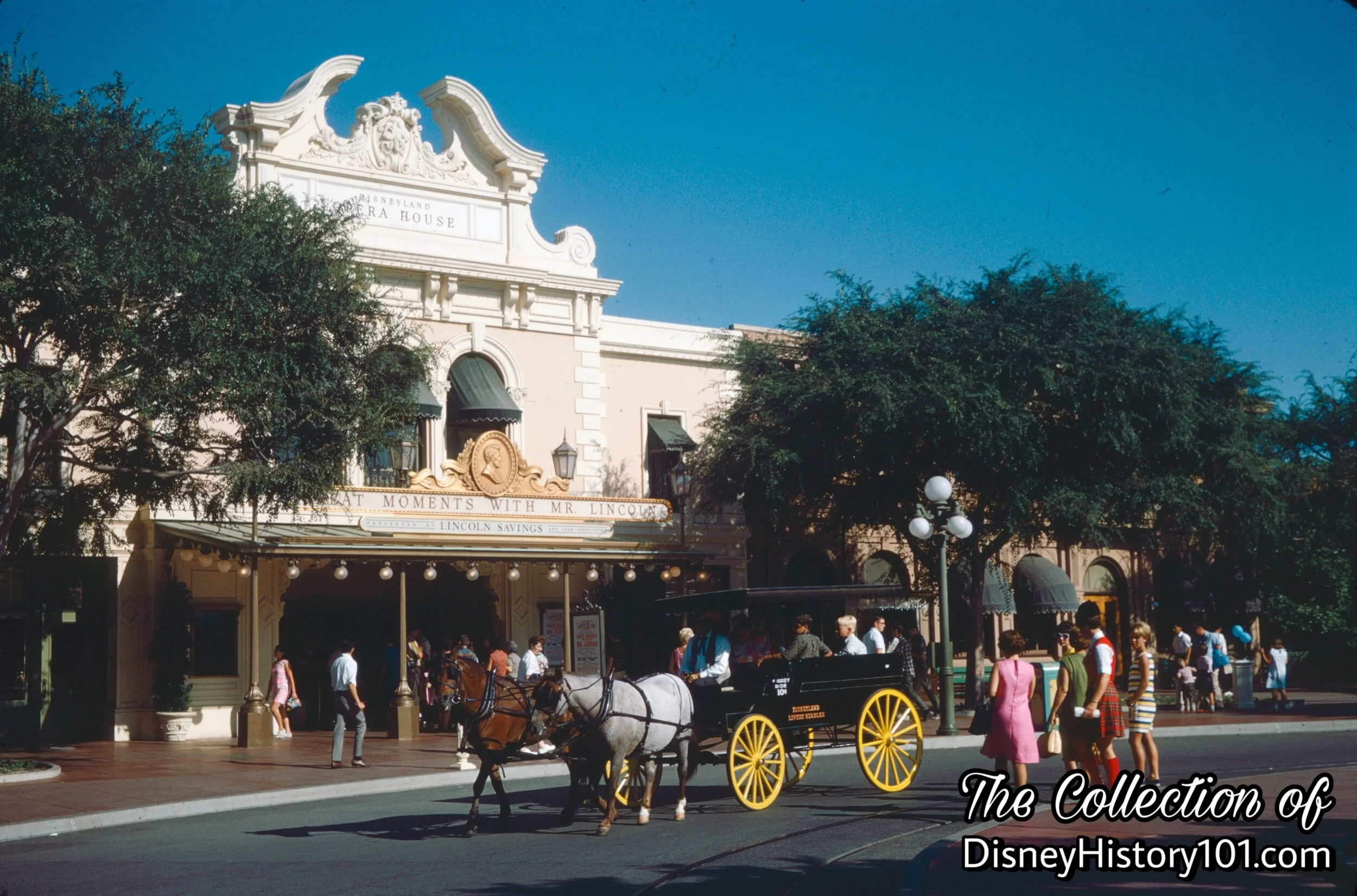
Main Street Opera House, (c. 1965)
A new sign over the Main Street Opera House would feature a cameo of Abraham Lincoln, along with the attraction’s sponsor - Lincoln Savings and Loan! In addition, Great Moments with Mr. Lincoln resulted in a new “stop” along the Guided Tour of Disneyland.
The following year, on Thursday, August 18, 1966, some Walt Disney Studio photographers (under the direction of Hamilton Luske) took a few shots of the Main Street Opera House (with added horizontal and vertical bunting) for use as background plates. In a related matter, Ben Harris (Disneyland Production) visited the Walt Disney Studio in Burbank over the matter of “historical Lincoln filming.”
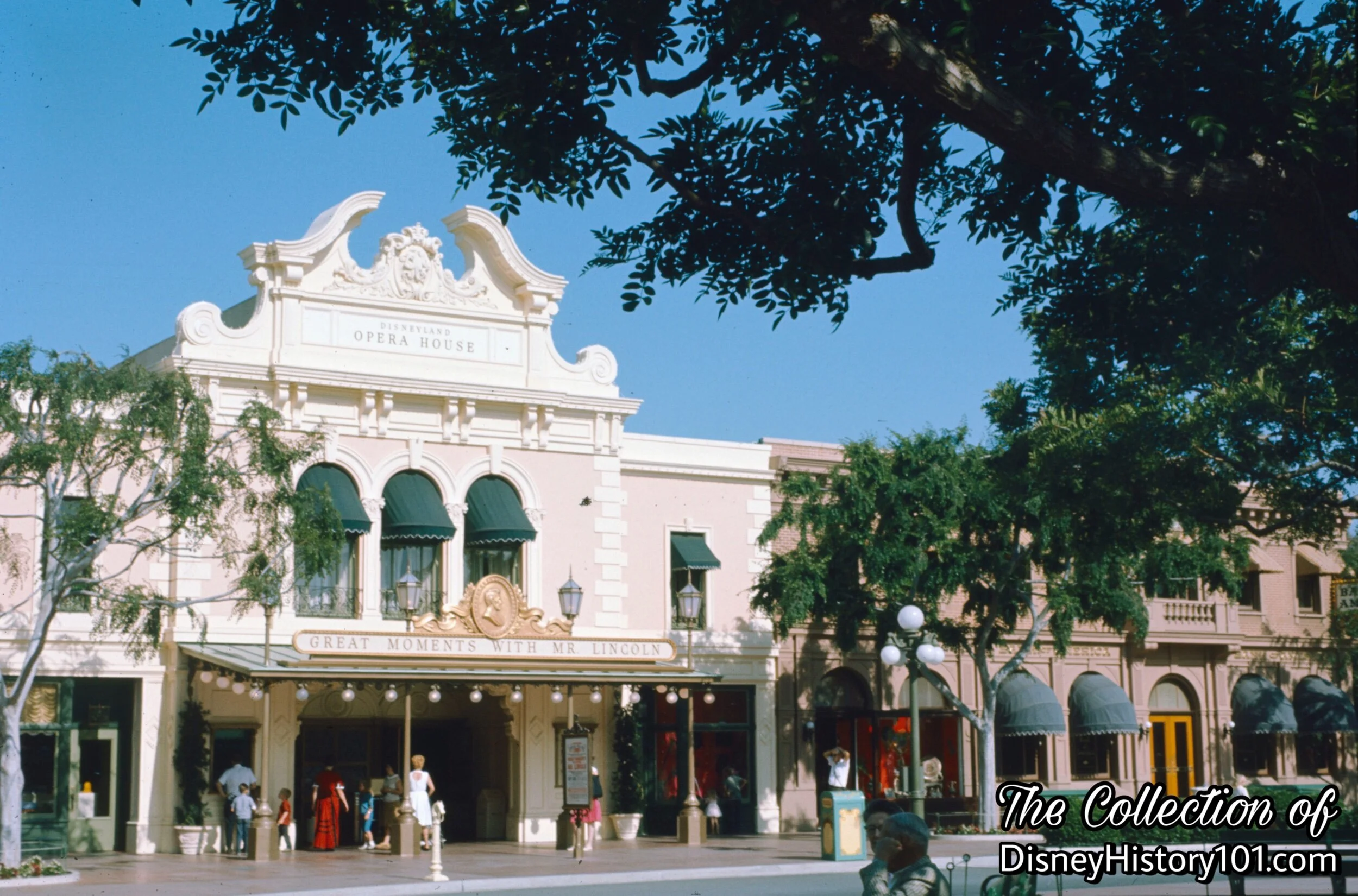
Main Street Opera House
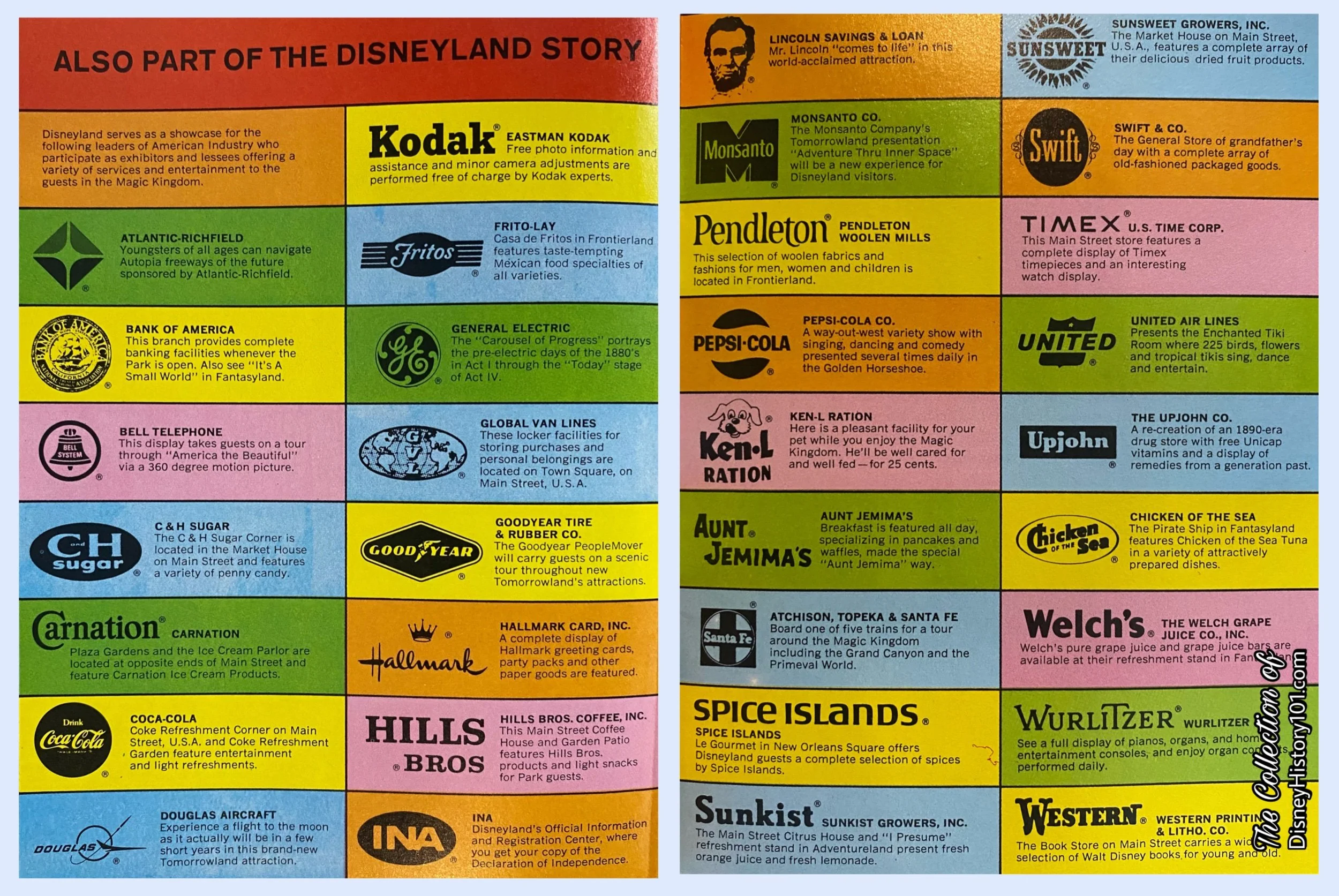
Lincoln Savings & Loan was a Disneyland Participant and thus “part of the Disneyland story according to this “Disneyland ‘67” Excerpt.
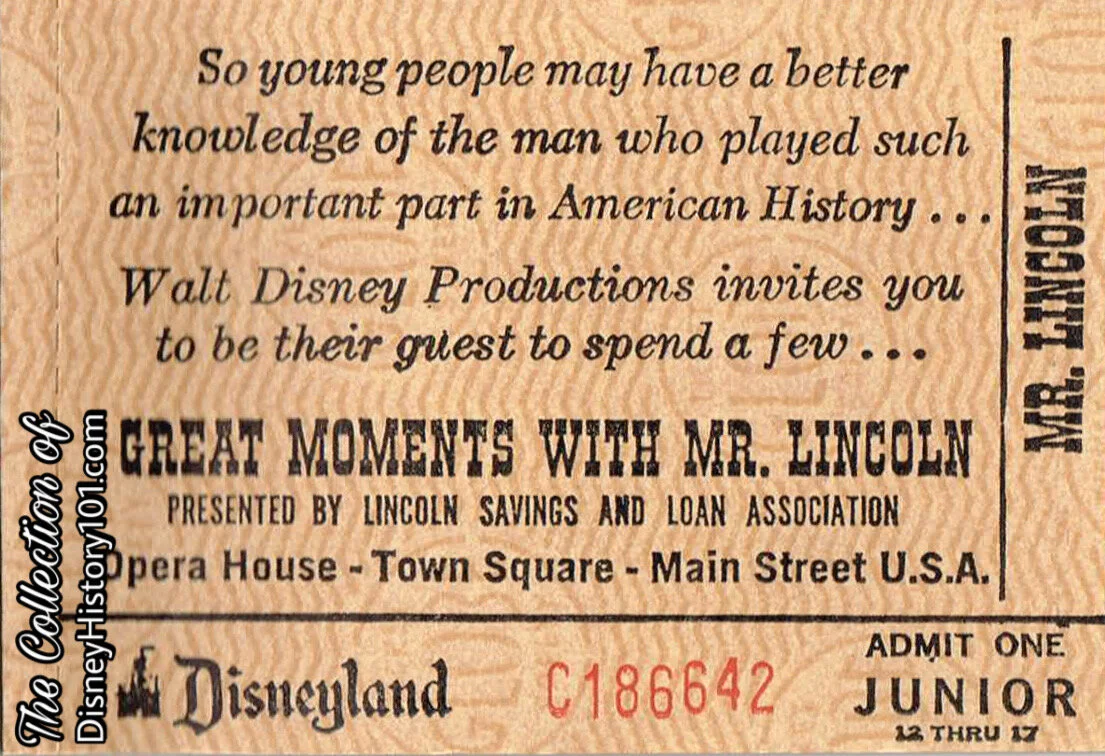
Great Moments With Mr. Lincoln (Junior) Disneyland Coupon, c. 1966
These Disneyland Coupons (generally admitting “children” ages 3-11 or “juniors” 3-17 ; pictured above) had no letter designation (or value) meaning that they could not be exchanged for any other attraction. These coupons were only valid for admission to Great Moments with Mr. Lincoln. One of these special coupons was included in each coupon book (in addition to purchase of other “letter” coupons). Note the important mission statement of this free exhibit and show, which was printed on each special coupon. According to “Walt” (a Cast member Exclusive and compilation of Walt Disney quotations, published 1975), “Our heritage and ideals, our code and standards - the things we live by and teach our children - are preserved or diminished by how freely we exchange ideas and feelings.”
“Great Rehabilitations for Mr. Lincoln”
There have been several additions and changes to the main show, as well as the exhibit hall. Bill Justice was involved in programming Mr. Lincoln’s movements sometime after Walt’s passing. After this (and through the years), routine maintenance has been essential to retain a high Show Quality standard of Great Moments with Mr. Lincoln. According to Backstage (Vol.6, No.1 ; published Spring, 1967), “Personal appearance is just as important to Mr Lincoln as it is throughout the rest of the Park. Each morning, Wardrobe checks to see if his hair is combed, pants pressed and shirt cleaned. Four shows are then run in the basement to check Mr. Lincoln’s ‘delivery’. An elevator then lifts him to stage level. During winter months, Mr. Lincoln is ‘put to bed’ eight hours or 48 shows later.”
According to the “Disneyland Dictionary” (compiled by WED Enterprises, Inc. and WED Public Relations Department, c. 1968), “This personal experience with history is Walt Disney’s tribute to a man who still lives on today in the hearts of all freedom-loving people everywhere. Featuring the lifelike, life-size ‘Audio-Animatronics’ figure of the Sixteenth President, Great Moments With Mr. Lincoln presents a message as applicable today as it was a hundred years ago. Located in the Opera House in Town Square, this presentation includes the nation’s capital in ‘capsulized realism,’ Lincoln memorabilia, a narrative of Lincoln’s life illustrated with full-color art murals.”
Other updates came later (as in 1984), when a more sophisticated version of the show originally presented by Walt in the State of Illinois Pavilion at the New York World’s Fair was introduced. Technology developed primarily for artificial limbs at the State of Utah would now influence the Show.
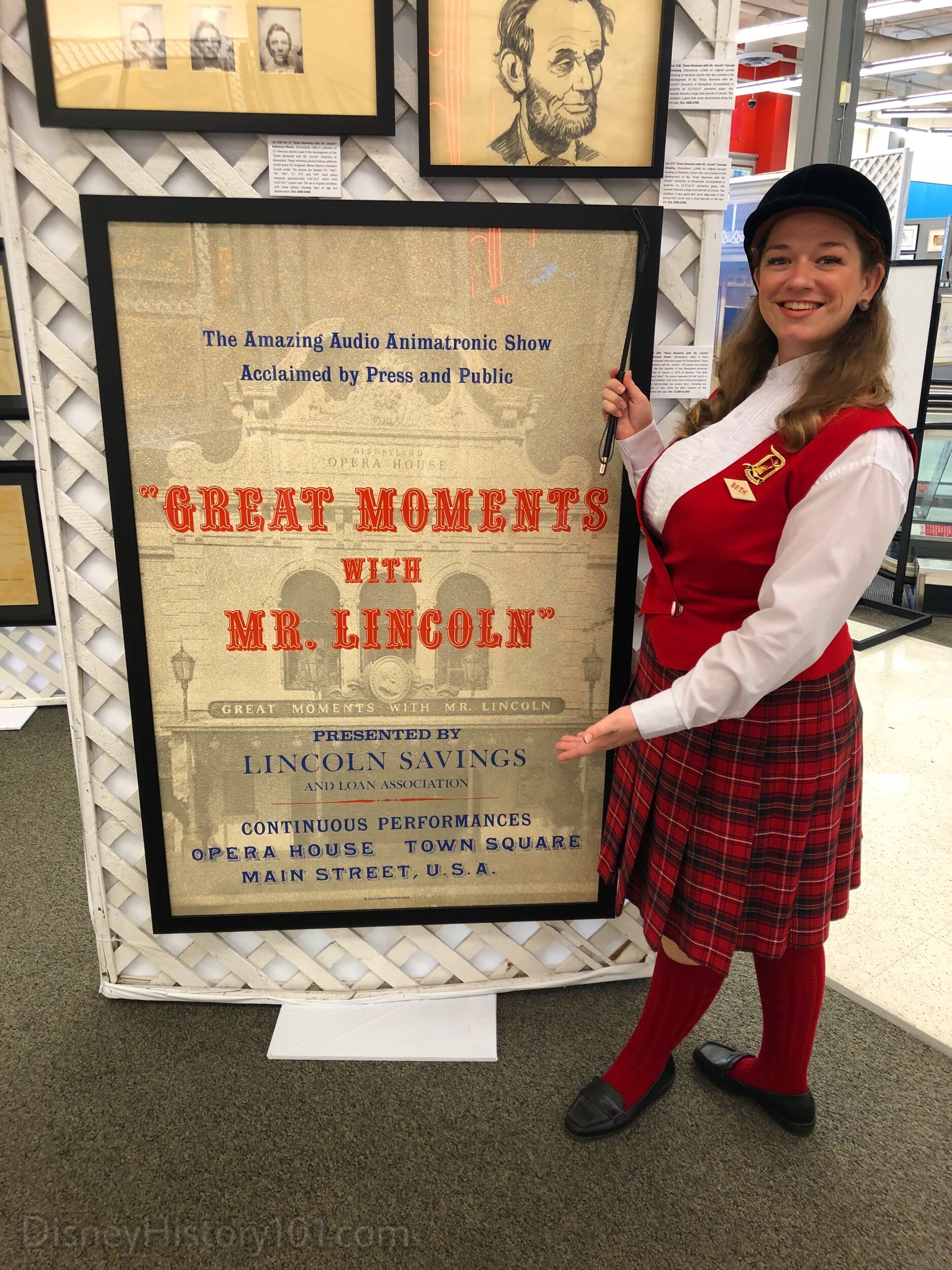
Great Moments with Mr. Lincoln Presented by Lincoln Savings & Loan Poster (July 18, 1965 - January 1, 1973)
When the New York World’s Fair completed its second season (of 1965), “Great Moments With Mr. Lincoln” (currently sponsored by the State of Illinois) was “brought home” to Disneyland. As was the habit, a Disneyland Participant sponsored the new Disneyland show. Now, I would like to present one of the original “Great Moments With Mr. Lincoln” Disneyland attraction posters, featuring the original sponsor - Lincoln Savings and Loan!
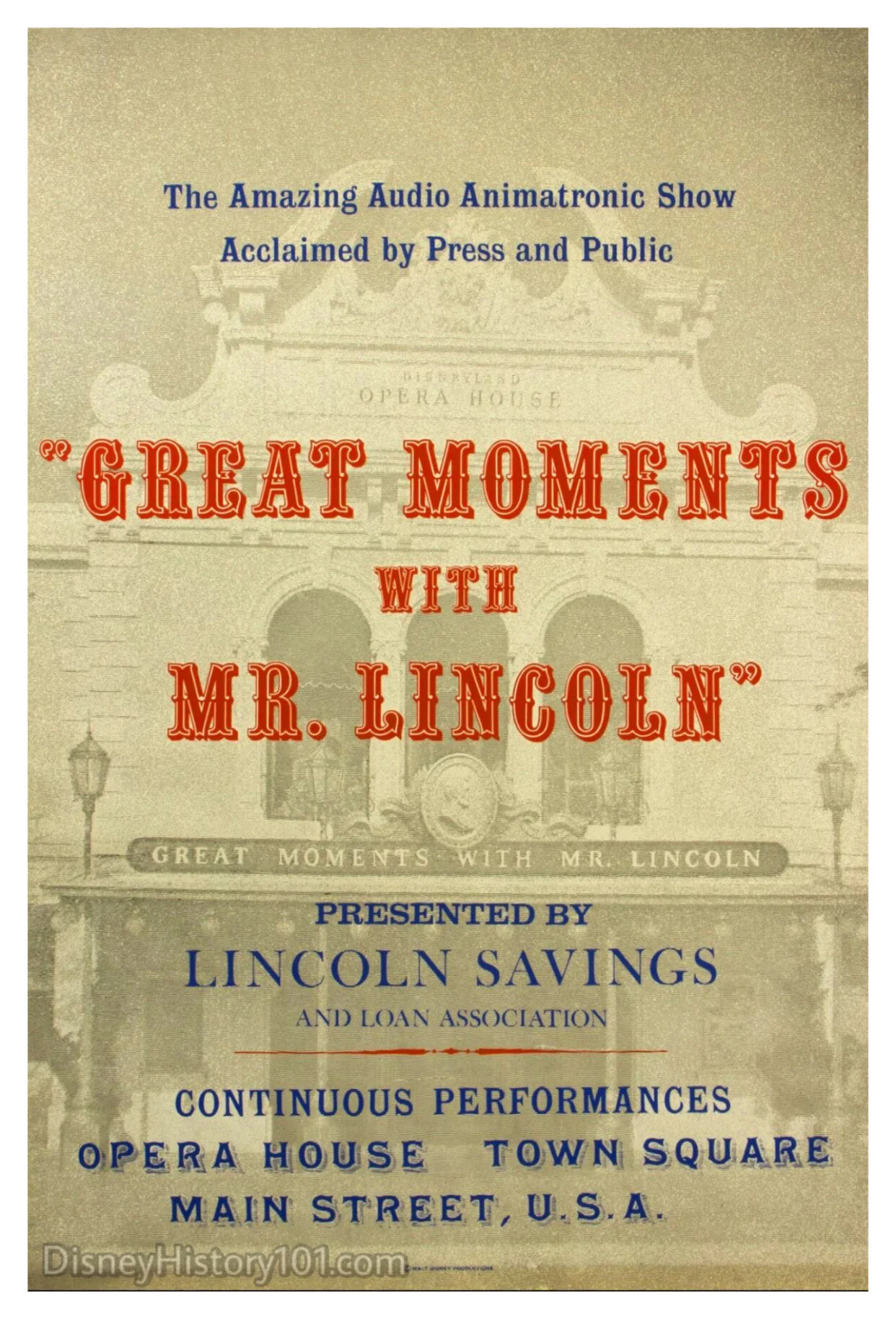
Great Moments with Mr. Lincoln (Presented by Lincoln Savings and Loan Association) Poster by an unknown artist, (July 18, 1965 - January 1, 1973)
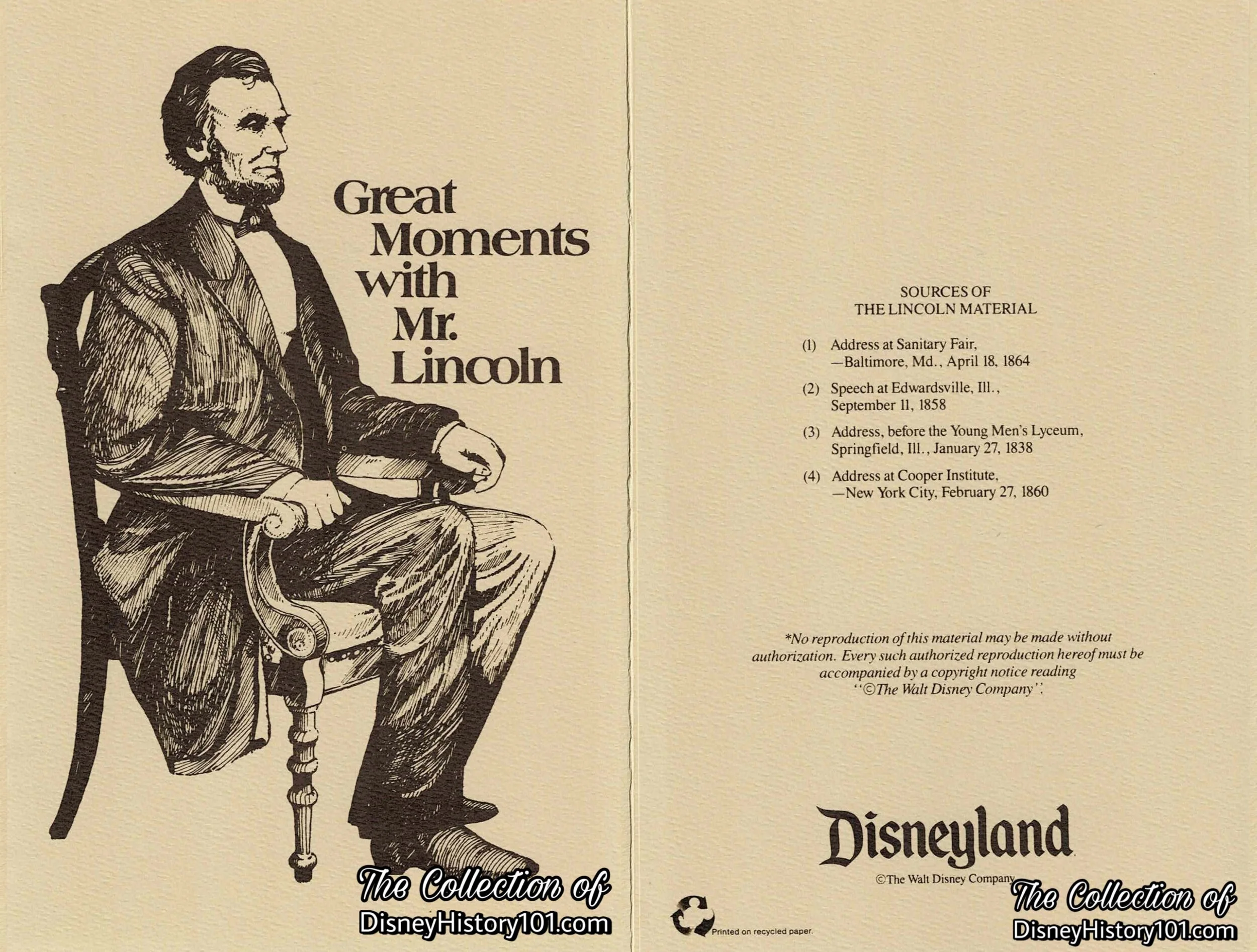
Great Moments with Mr. Lincoln Souvenir (Cover), ©️The Walt Disney Company
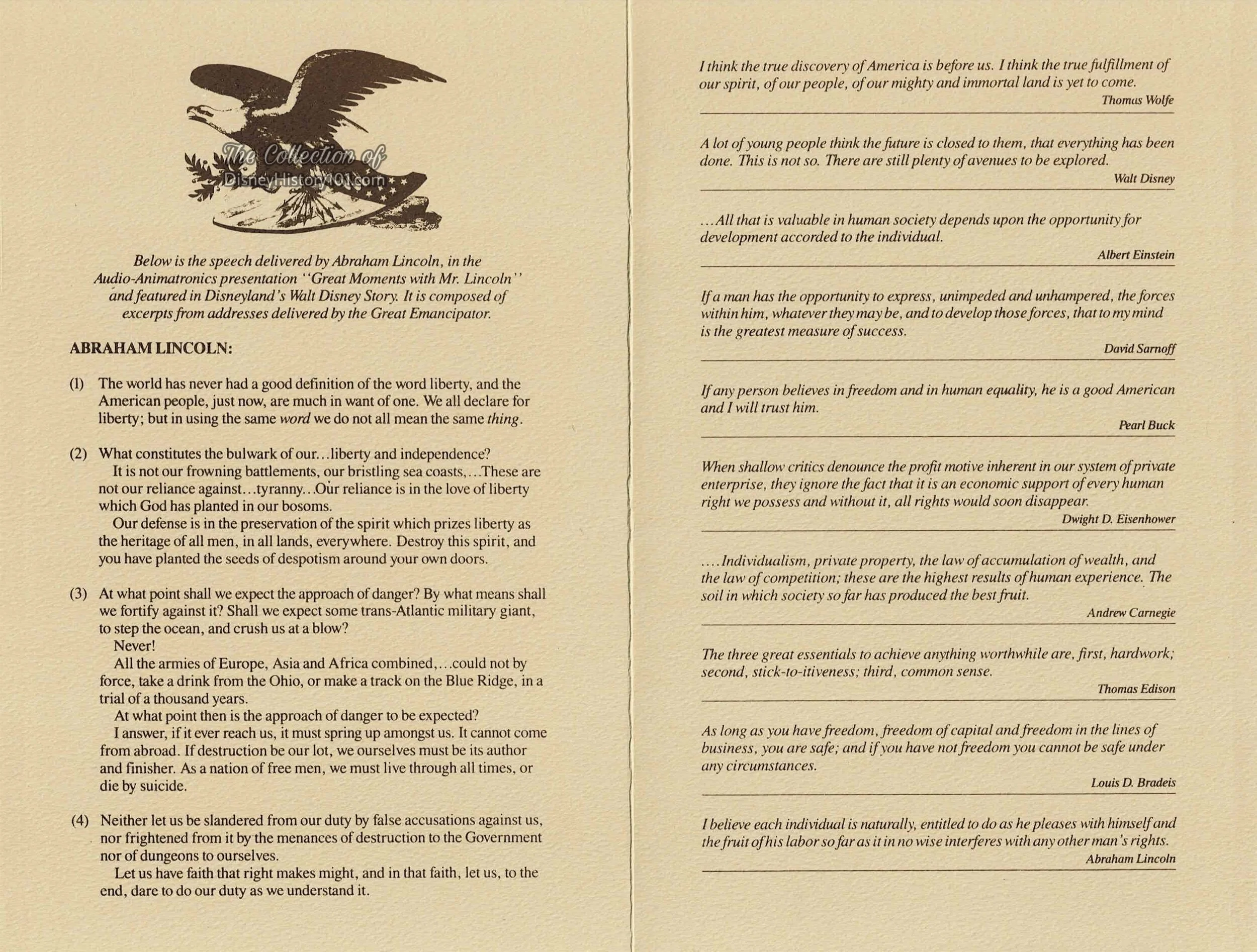
Great Moments with Mr. Lincoln Souvenir Interior, ©️The Walt Disney Company
As another sidelight, I would like to recall the Souvenir LP 33 rpm records of Walt Disney’s Great Moments With Mr. Lincoln, which were released by Buena Vista Records in 1964. These were once sold through the Wonderland Music Shop at Disneyland (c. 1964) for $3.98 plus tax. Spoken words of the record album were based on Lincoln’s Address at Sanitary Fair in Baltimore, Maryland on April 18, 1864 ; his speech at Edwardsville, Illinois on September 11, 1858 ; his address before the Young Men’s Lyceum at Springfield, Illinois on January 27, 1838 ; his Eulogy to Henry Clay at Springfield, Illinois on July 6, 1852 ; and his address at Cooper Institute in New York City on February 276, 1860. The narration was written by James Algar, with a score composed and directed by Buddy Baker. The voice of Abraham Lincoln was performed by Royal Dano (who had previously portrayed Abraham Lincoln in James Agee’s “Mr. Lincoln”), with Narration by Paul Frees, under the production of James Algar. The record also included “Illinois” (words by C.H. Chamberlain ; music by Archibald Johnston), and “The Battle Hymn of the Republic” (words by Julia Ward Howe, music by William Steffe).
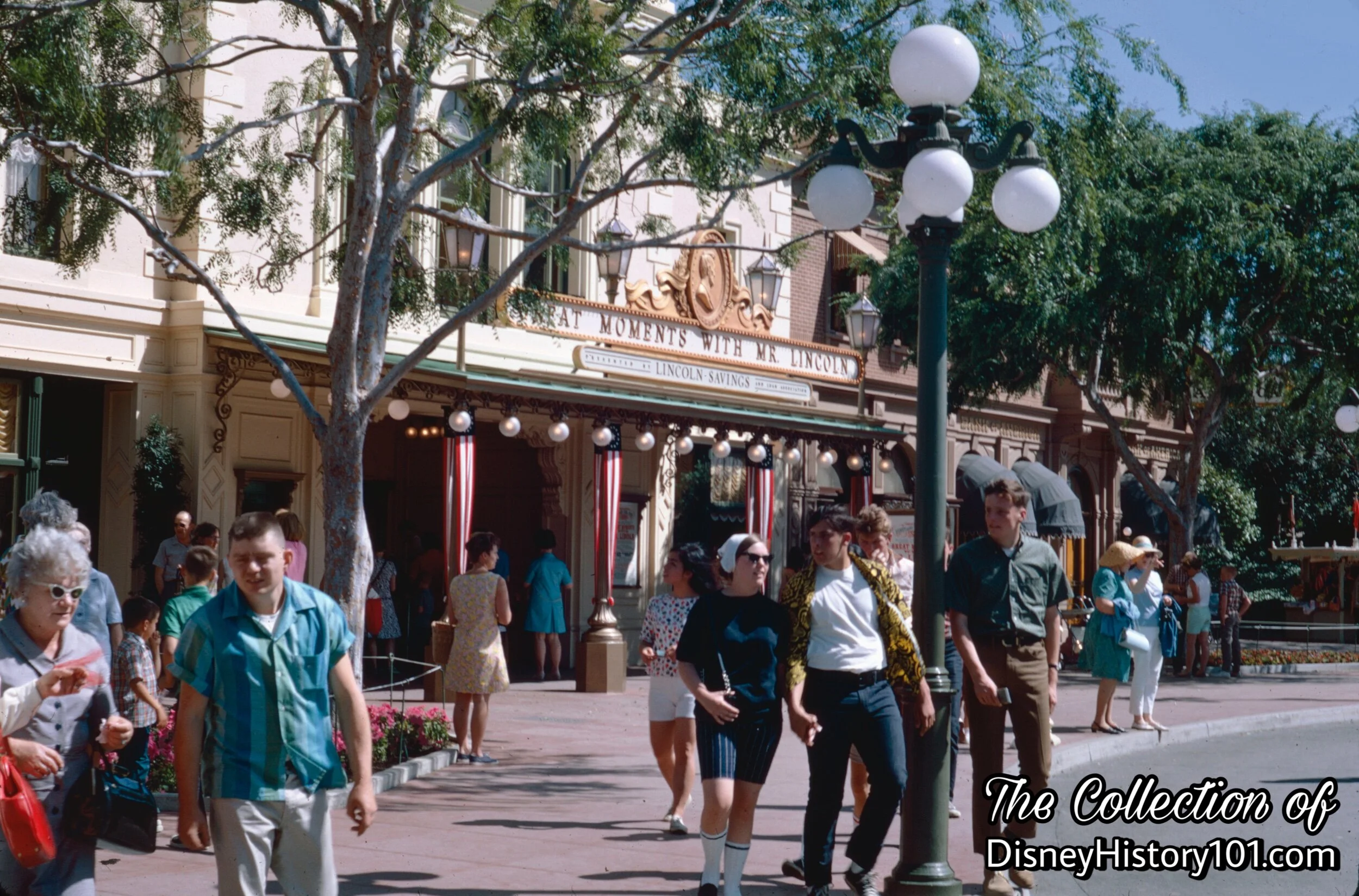
Main Street Opera House, (1968)
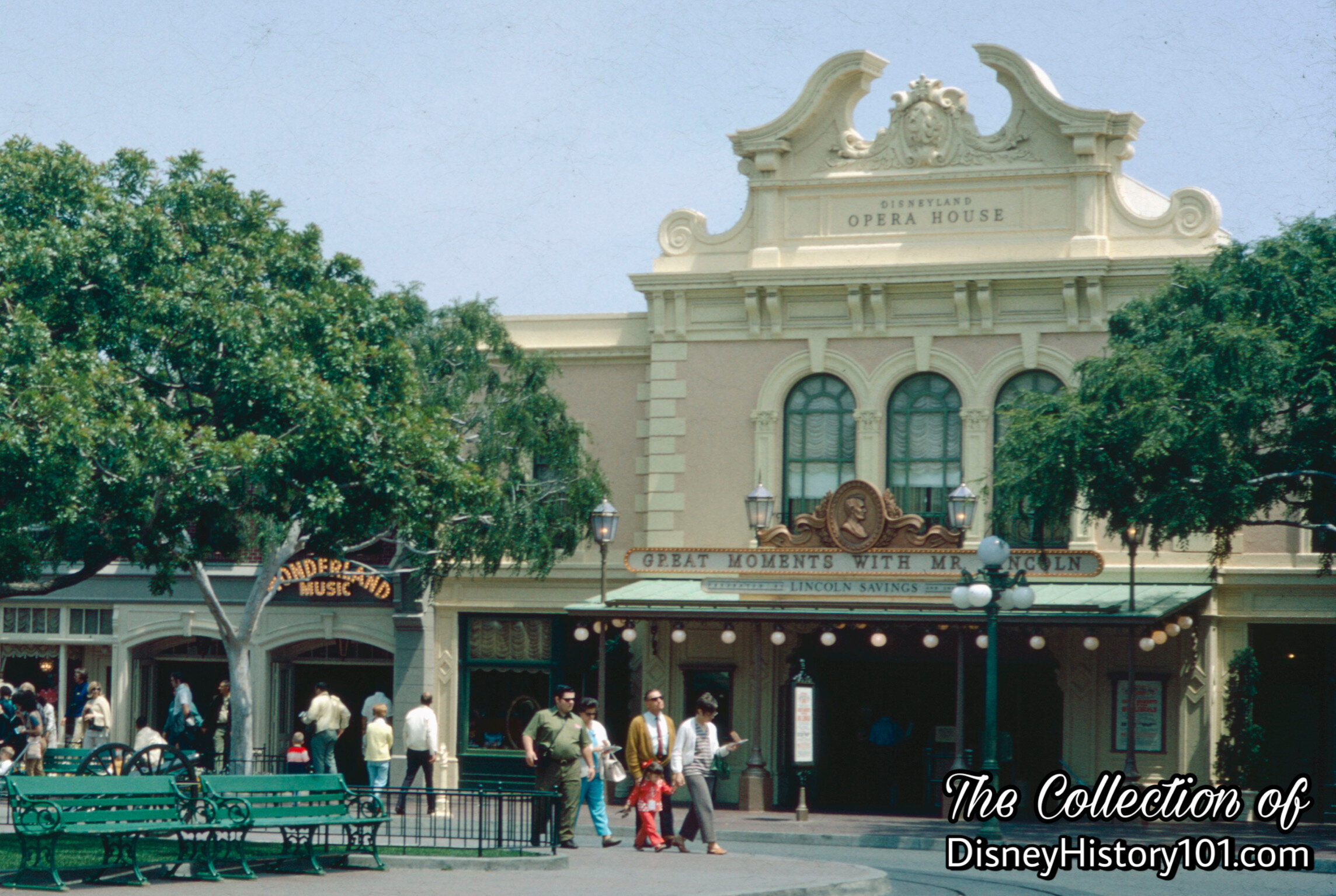
Main Street Opera House, (1971)
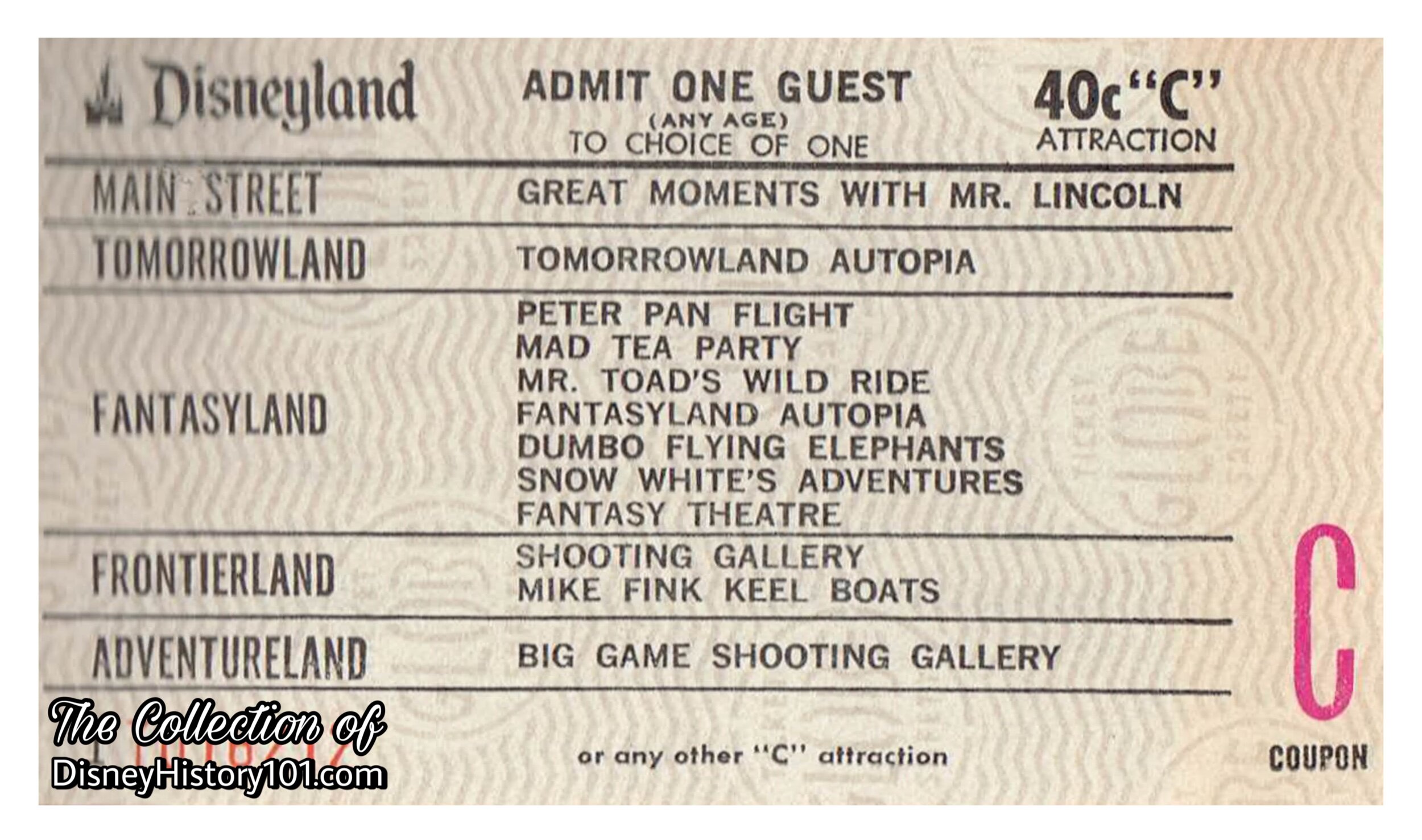
Disneyland “C” Attraction Coupon (40¢ Value)
The original version of Great Moments with Mr. Lincoln “continued to run until it was replaced by ‘The Walt Disney Story’ in 1973,” according to Dave Smith (Chief Archivist Emeritus of the Walt Disney Archives). [Disney Facts Revealed by Dave Smith, 2016]
“Audience Waiting Areas” are especially designed as part of the attraction to make the guest's time waiting in line as comfortable as possible. Through the years, some “great” Pre-Show Exhibits have prepared audience’s hearts and minds for the presentation of “Great Moments with Mr. Lincoln” at the Main Street Opera House. You may recall “hanging in the outer lobby next to the Mad Hatter’s Shop,” was “an original oil painting of Lincoln, his wife and three sons.” This painting was based on a “smaller black and white work by F.B. Carpenter” and was “on loan to the Park by the New York Historical Society.” [“Disneyland - Did You Know?”]
Below we will explore many more Pre-Show displays (crafted by a variety of artists), which were as relevant yesterday, as they are today. We will also take a look back on a few seasonal rotating exhibits, courtesy of The Disney Gallery.
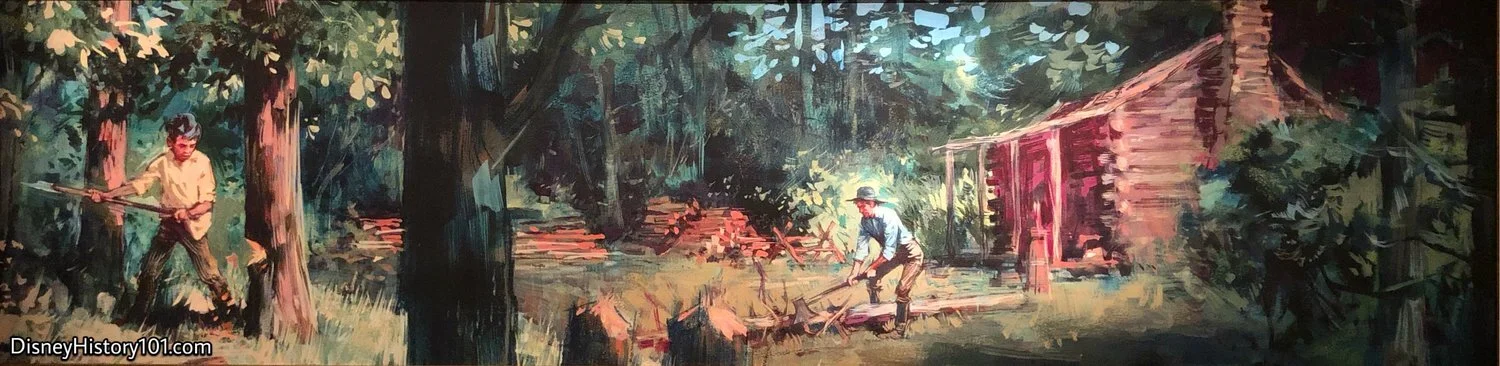
"Young Lincoln" by Sam McKim
As we arrive at our first stop (“Young Lincoln” by Sam McKim) some of the narration of Abraham Lincoln echoes in our minds : “He removed from Kentucky to what is now Spencer County, Indiana in my eighth year. It was a wild region, with many bears and wild animals still in the woods. There I grew up. We settled in unbroken forest. And the clearing away of surplus wood was a great task ahead… I was large for my age and had an ax put into my hands at once. And from that until my twenty-third year was almost constantly handling that most useful instrument, less of course in plowing and harvesting seasons.”
In the original version of Great Moments with Mr. Lincoln Pre-Show, this image was included in the original six-minute autobiographical presentation screened in the Blue Room (the second exhibit after the United States Capital Panorama in the Foyer). According to Vacationland (Fall, 1965 ; Vol. IX, No.3), the presentation was “taken from Lincoln’s own words. His story is illustrated by full-color art murals, especially created by Walt Disney Productions.These murals are projected onto a 28-foot-long screen. After learning about Lincoln’s early life leading up to the White House, the guests are. invited into the theater to spend a few ‘Great Moments with Mr. Lincoln.’”
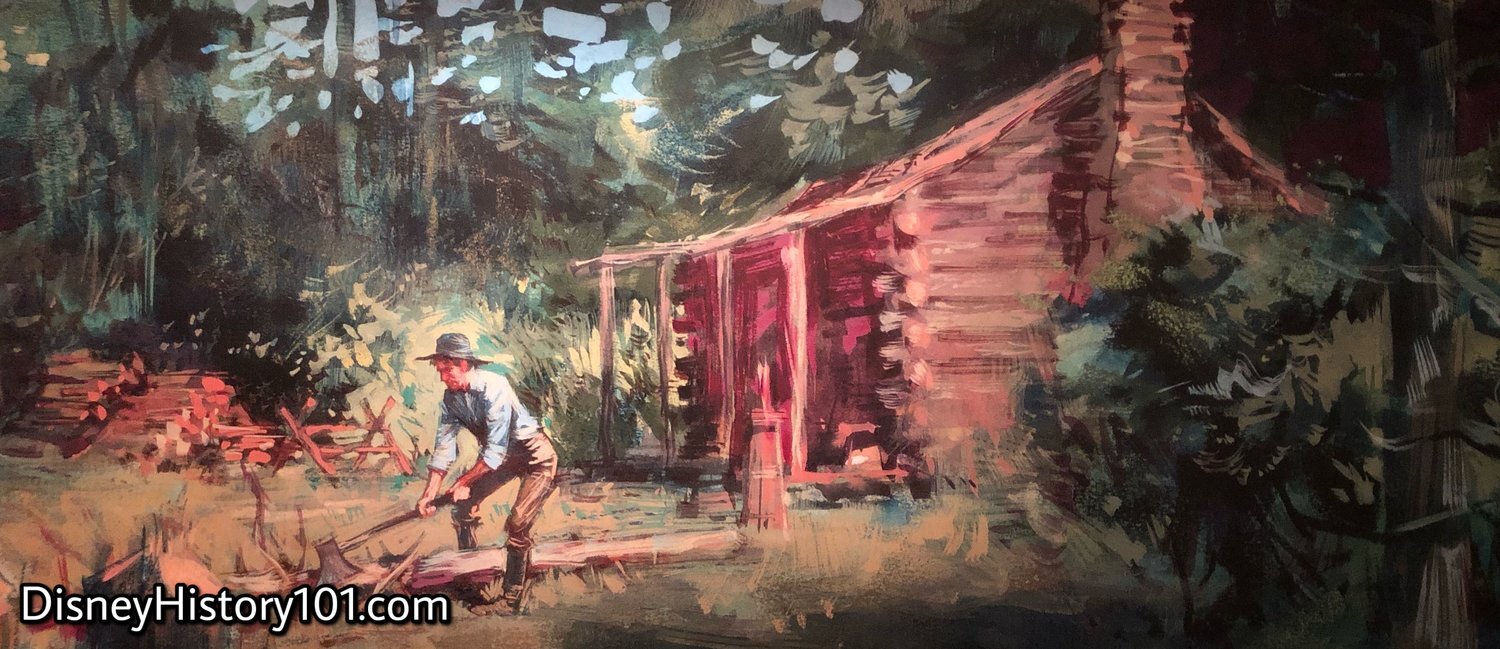
"Young Lincoln" by Sam McKim
_________________________________________
“After moving to Los Angeles during the Great Depression, Sam McKim began his career in front of the camera, doing bit parts in [western] films with stars like Spencer Tracy, John Wayne, and Gene Autry. But he always knew that he wanted to be an artist. Between stints in the service, first in World War II and then Korea, he studied at Art Center College of Design and Chouinard Art Institute.” By this time, Sam was more thoroughly immersed in the visual graphic arts. In 1953, Sam had taken “a job drawing story sketches at 20th Century Fox over a role opposite Tyrone Power and Maureen O’Hara in a John Ford film.” In 1953, 20th Century Fox loaned him to Walt Disney “for what was supposed to be a couple of weeks. It ended up being 32 years.” Finally, Sam found his dream job, creating inspirational sketches for Disney theme parks.
Sam Mc Kim began working for Walt Disney's W.E.D. Enterprises (now Walt Disney Imagineering) in 1954, as an imagineer, doing original sketches Great Moments with Mr. Lincoln. Sam recalled, “Many studios wanted the art quick and dirty,… Disney didn't… Many times we were given the very basic idea of what was wanted and then were allowed to play with it.”
Today, Sam McKim “is best known as the creator of the Disneyland souvenir map illustrations, but his contributions to theme park attractions are legendary. Pirates of the Caribbean, Haunted Mansion, and Hall of Presidents were all touched by his spirited storytelling style. In this painting [pictured above], the story of Abraham Lincoln’s boyhood seems to spring to life.”
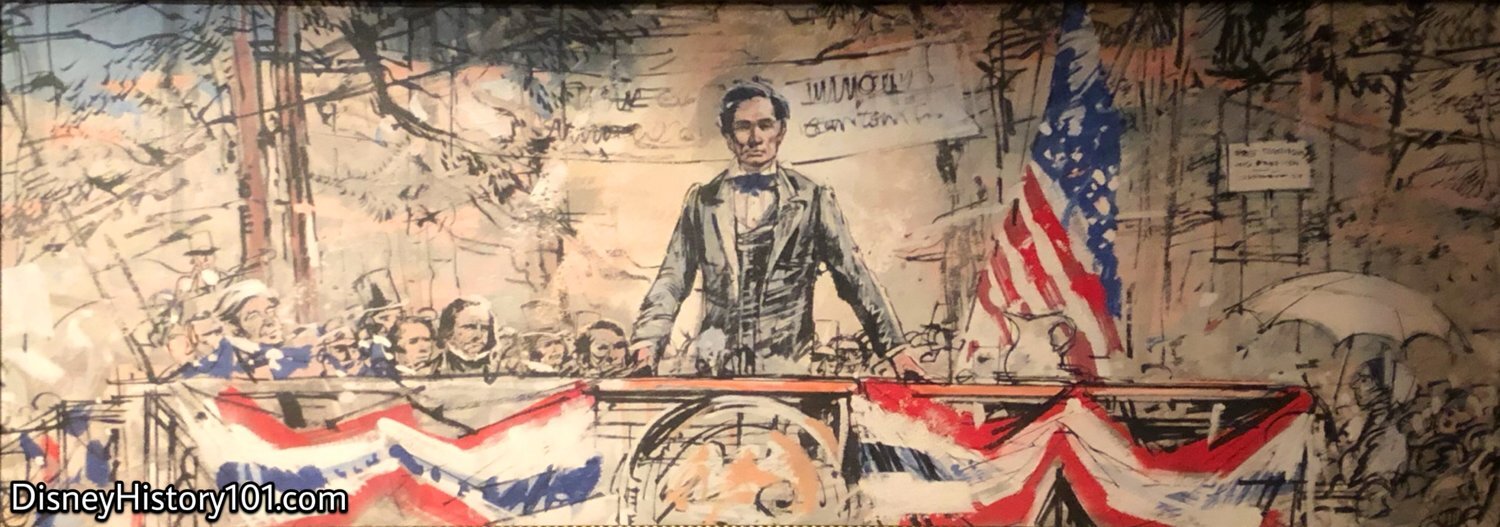
"The Presidential Campaign" by Herb Ryman
_________________________________________
Herb Ryman graduated from the Chicago Art Institute with honors, before moving to Hollywood in 1932 and storyboarding some of MGM’s greatest films, like “Mutiny on the Bounty” and “David Copperfield”. But then he met Walt Disney, and the rest is history. He became one of Walt’s most trusted partners in the development of Disneyland. Not only did he create the iconic illustrations that sold Walt’s unique theme park idea to bankers, but he also went on to help design some of its most famous feature, like Sleeping Beauty Castle and New Orleans Square. Imagineering Legend Marty Sklar says that Herb had an uncanny ability to intuit Walt’s ideas, and in his sketch of Abraham Lincoln campaigning, he captures the man of “immortal principles, ideals, and wisdom” that Walt envisioned.
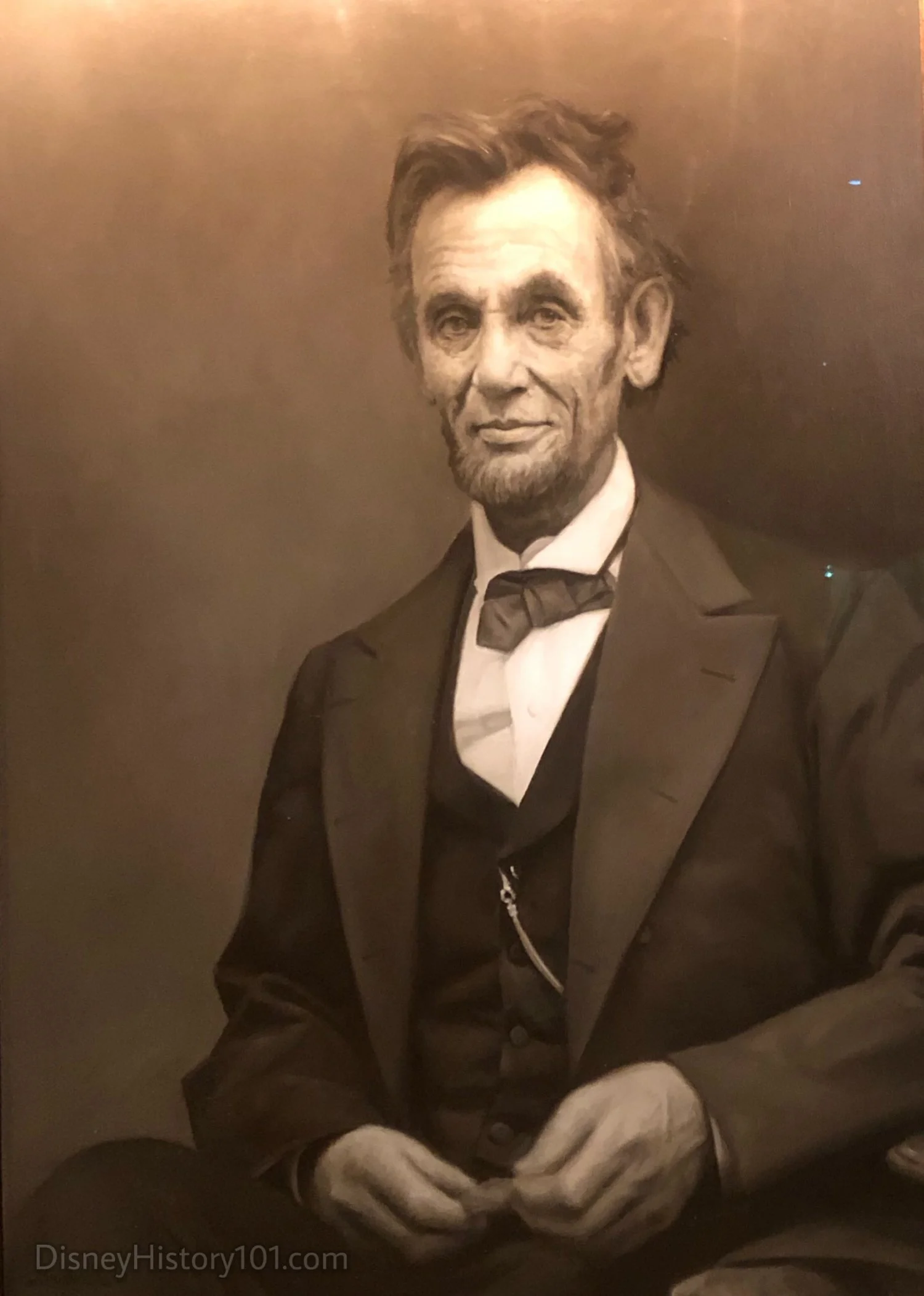
"Lincoln Portrait" by Richard Broderick
The Main Street Opera House plaque divulges a few details about Richard Broderick (the creator of the “Lincoln Portrait”). “An eclectic arts education that included studying with Disney animators, and even apprenticing in the outdoor billboard industry, led to Richard’s unique ability to paint realistic and emotionally powerful portraits. During his career he painted everything from 20-foot portraits of David Bowie and Arnold Schwarzenegger for the Sunset Strip, to animation storyboards. He then joined Walt Disney Imagineering, where he worked for 10 years on concepts for Disney’s California Adventure, Hong Kong Disneyland, and Disneyland Paris. He has taken advantage of his retirement to fine tune his painting technique, and his portrait of Lincoln demonstrates his desire to ‘go beyond a mere likeness and capture the personality.’”
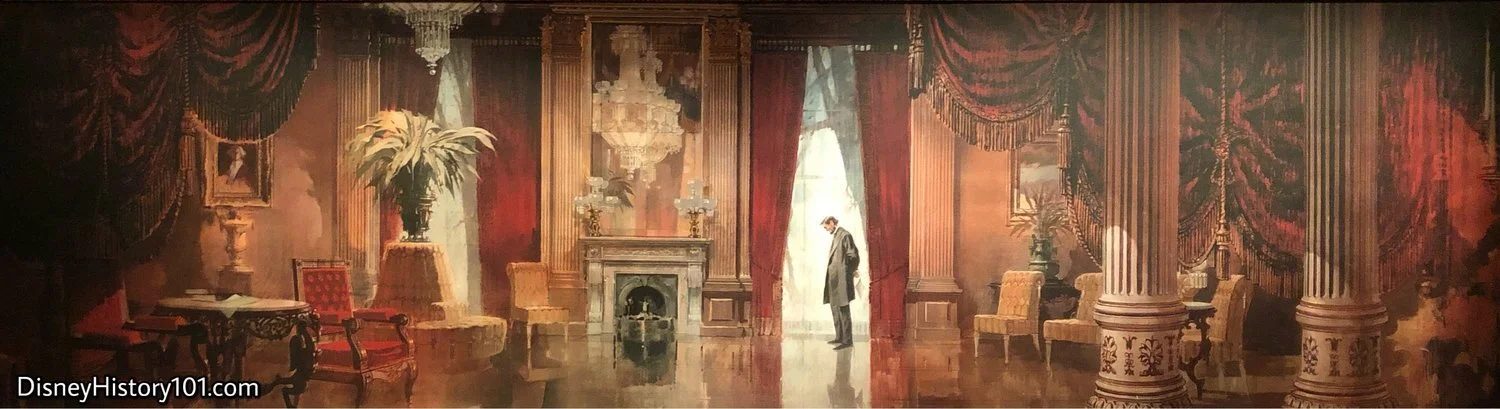
"The Burden of War" by John DeCuir Sr. from which the vignette was made.
_________________________________________
Although he grew up in the 1920s when movies were in their infancy, John DeCuir Sr. would become fascinated by them. Against the wishes of his parents he studied art, becoming a student of the art at Choinard, and went on to become one of the most highly regarded film designers in Hollywood history. He almost single-handedly defined the term “motion picture spectacle” in the 1950s. “South Pacific,” “The King and I,” and “Cleopatra” all exhibit his lush, larger-than-life vision. He was nominated for all 11 Academy Awards during his career, but eventually he developed another fascination - for theme park design. He helped design both the Magic Kingdom and EPCOT ; in this emotional watercolor of Abraham Lincoln in the White House, his genius is apparent. Within his trademark larger-than-life panorama, we sense the lonely burden of the Presidency.
Around 1970, John DeCuir Sr. would go on to produce some of Herb Ryman’s concept paintings of “Battle Bull Run,” “Attack at Fort Sumter,” and “Surrender at Appomattox” for The Hall of Presidents in Liberty Square, Magic Kingdom, Walt Disney World.
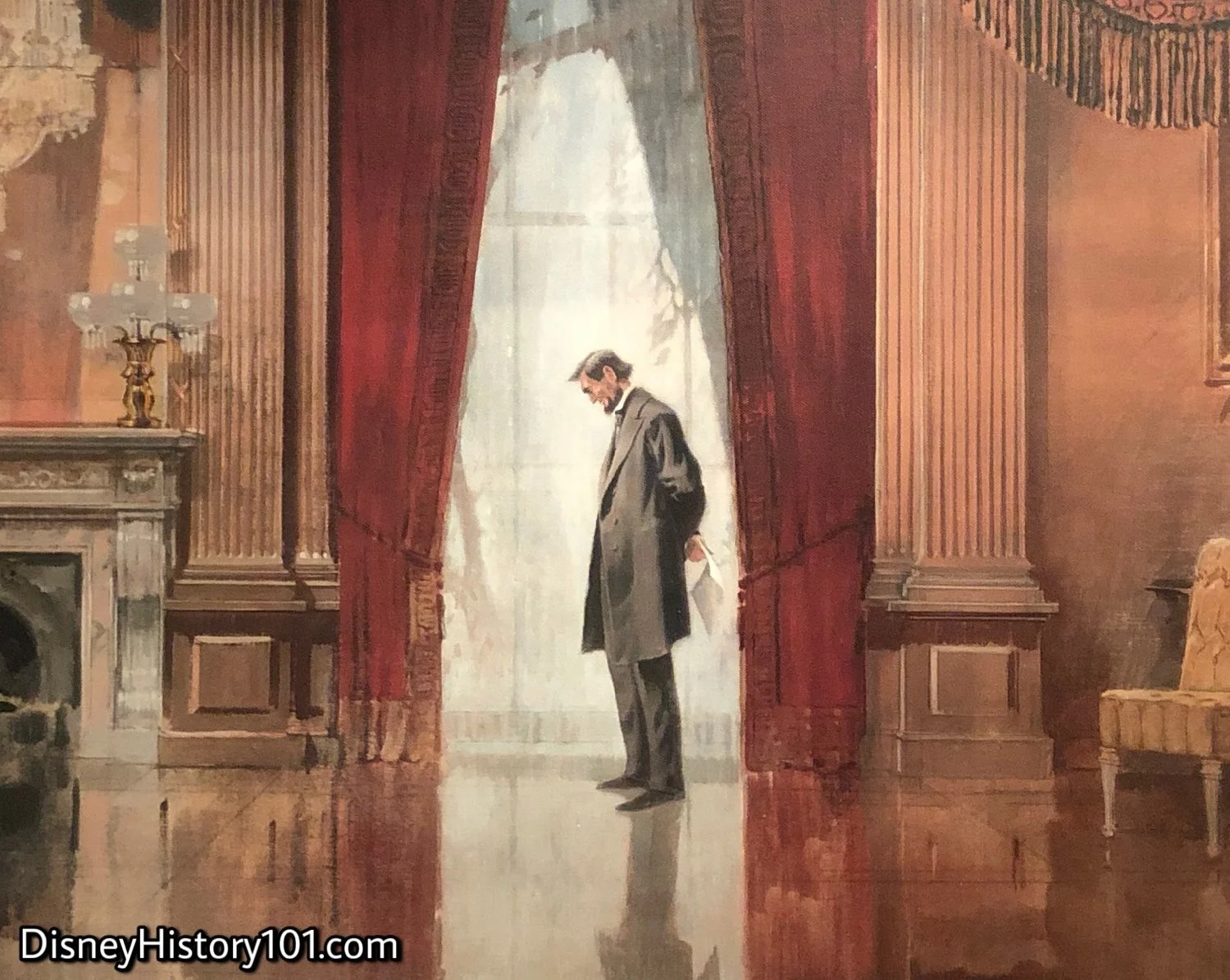
"The Burden of War" by John DeCuir Sr. (Close-Up)
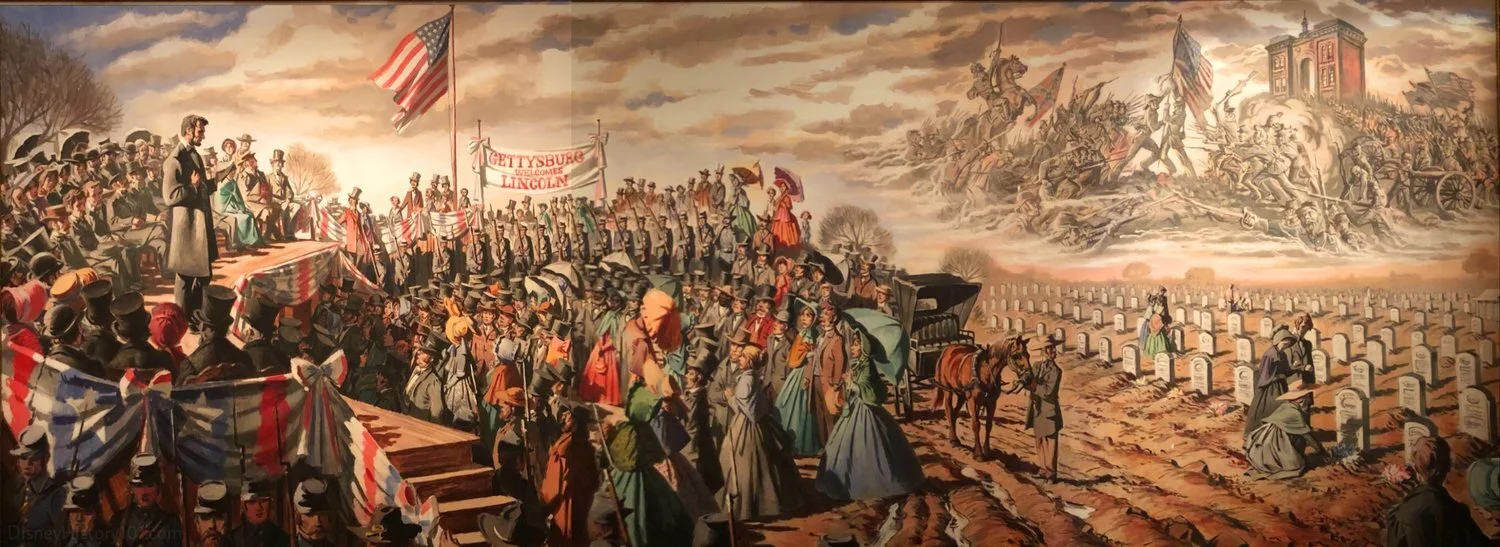
"The Gettysburg Address" by John Pomeroy
John Pomeroy has made notable contributions as a character animator toward both feature and short films (like “Winnie the Pooh and Tigger Too”, “Pete’s Dragon”, “The Rescuers”, “Pocahontas”, “Atlantis : The Lost Empire”, and “The Small One”). He served as Directing Animator to the latter. He has occasionally been known to give discourses on animation, and has also created numerous color illustrations for the picture biographical publication “Walt’s Imagination - The Life Of Walt Disney”. Disneyland Park-going fans of John Pomeroy may also know him by his “To All Who Come To This Happy Place, Welcome” limited edition artist proofs (coinciding with “45 Years of Magic” at Disneyland)!
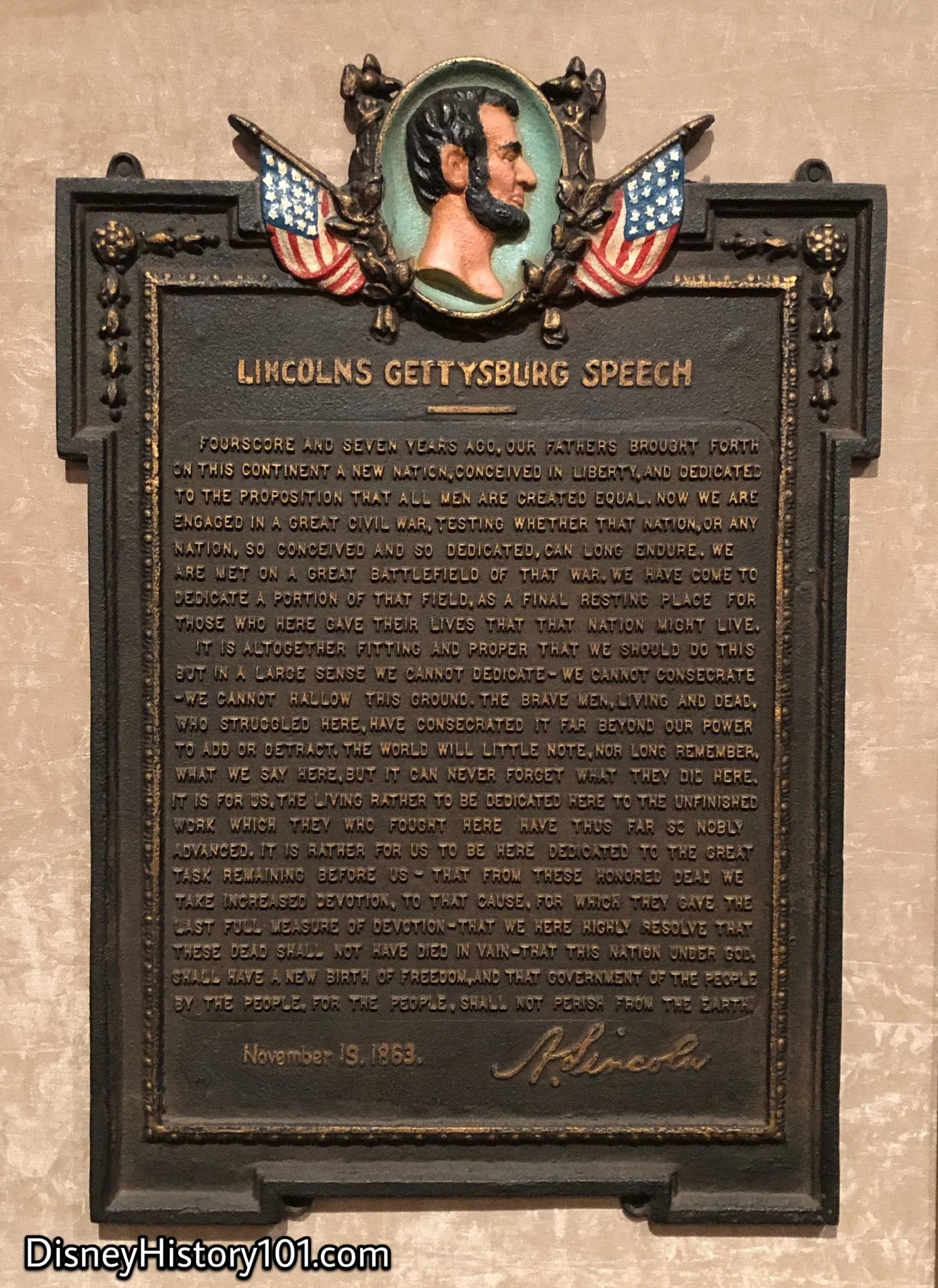
"Lincoln's Gettysburg Speech" Plaque
The layout and art of “Lincoln’s Gettysburg Speech” (and positioning of the flags and cameo) is similar to that of “Abraham Lincoln and His Emancipation Proclamation”, published 1888.
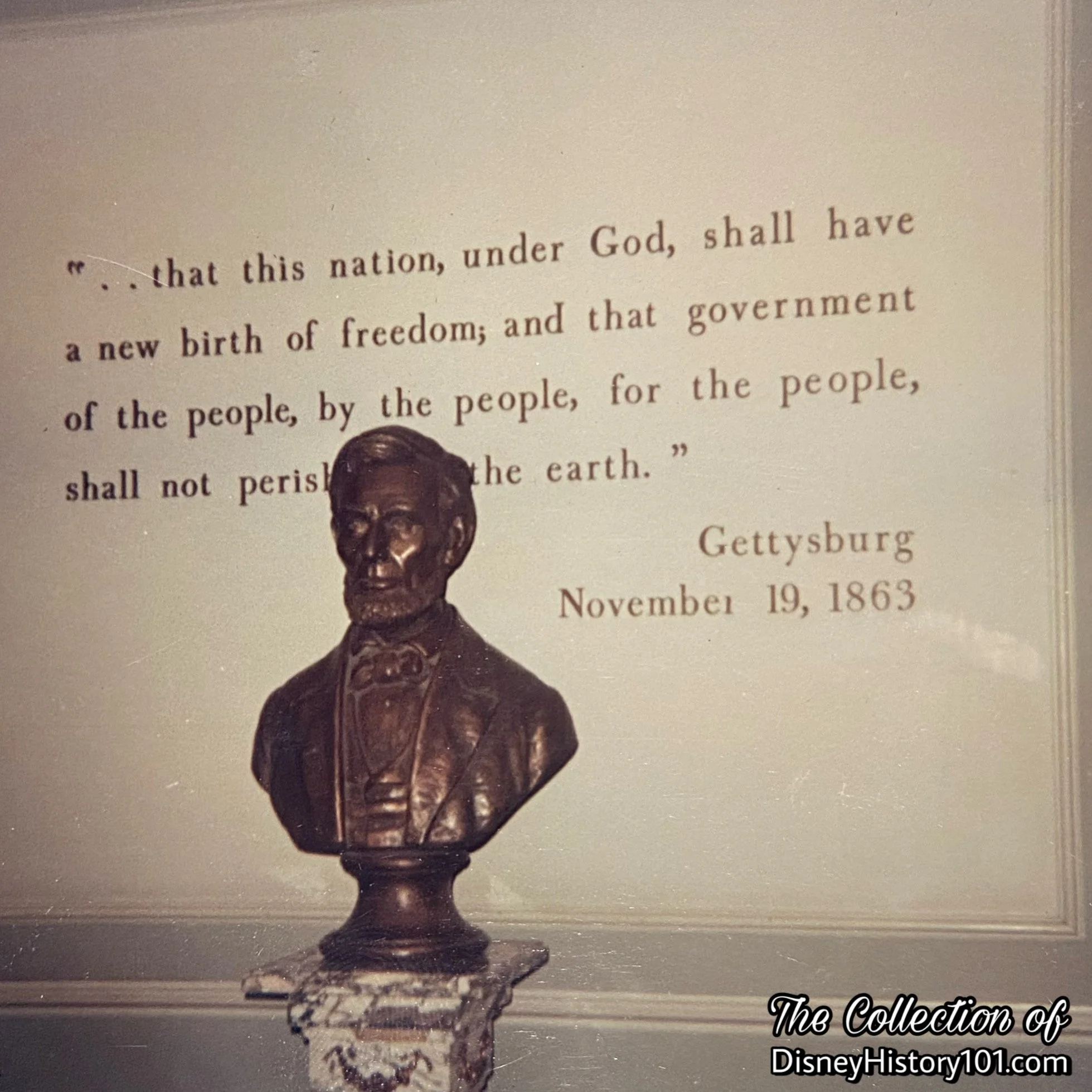
Bust of Abraham Lincoln sculpted by Disney Legend Blaine Gibson, photographed during the 1960s.
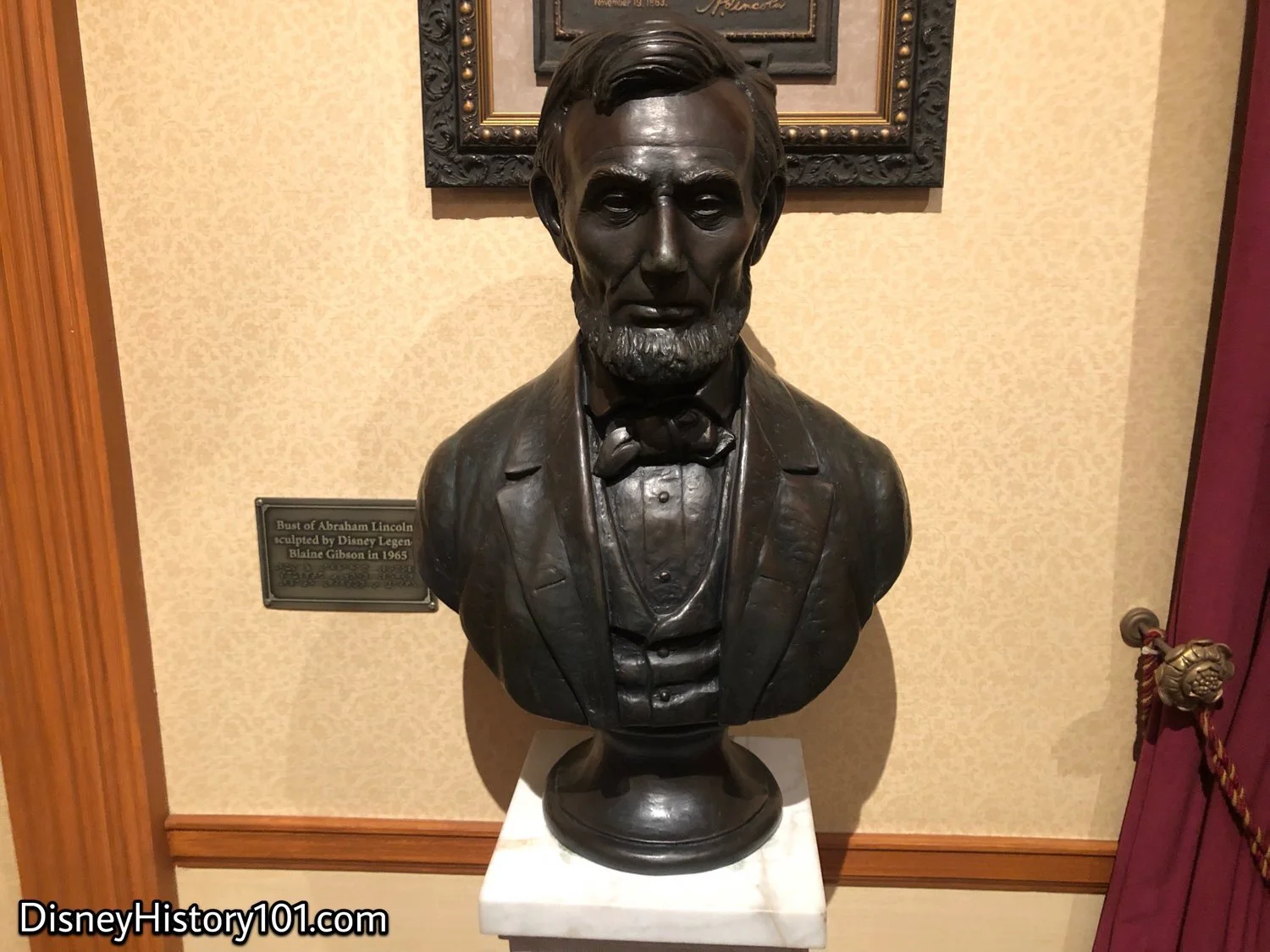
Bust of Abraham Lincoln sculpted by Disney Legend Blaine Gibson in 1965; as seen in the present.
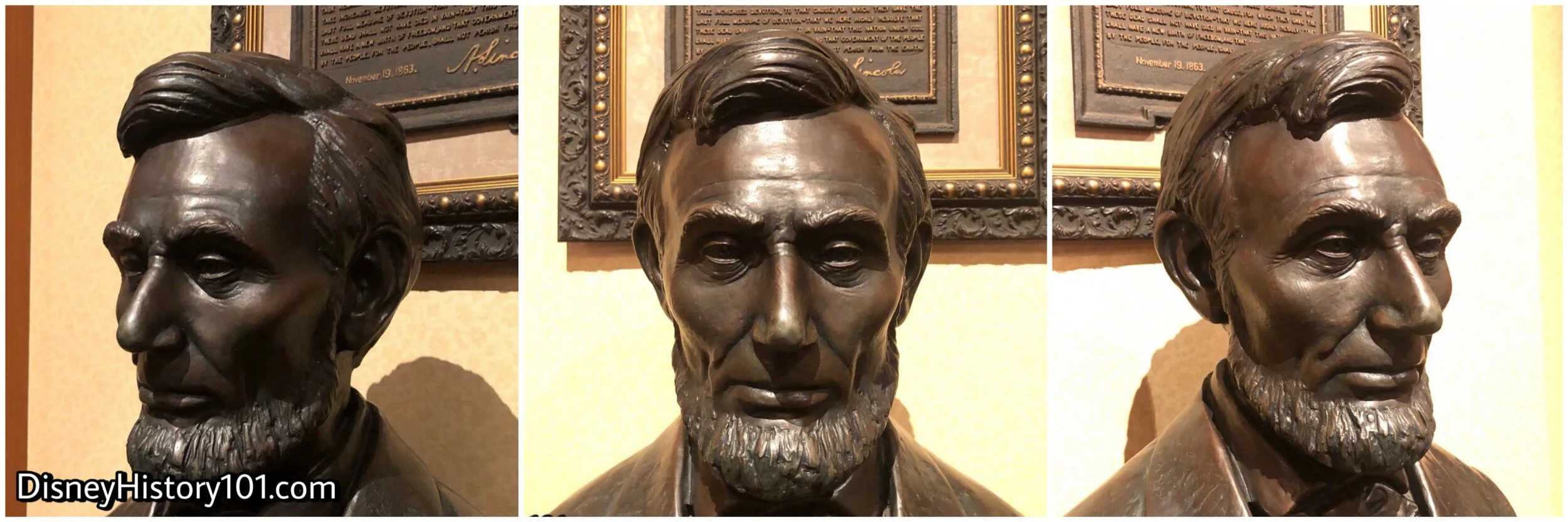
Bust of Abraham Lincoln sculpted by Disney Legend Blaine Gibson, (1965)
A number of cast pieces pay tribute to Abraham Lincoln. For instance, the eagle bearing the olive shield and arrows located over the stage first appeared in Civil War-era news papers as a symbol of the extents gone to in order to establish freedom.
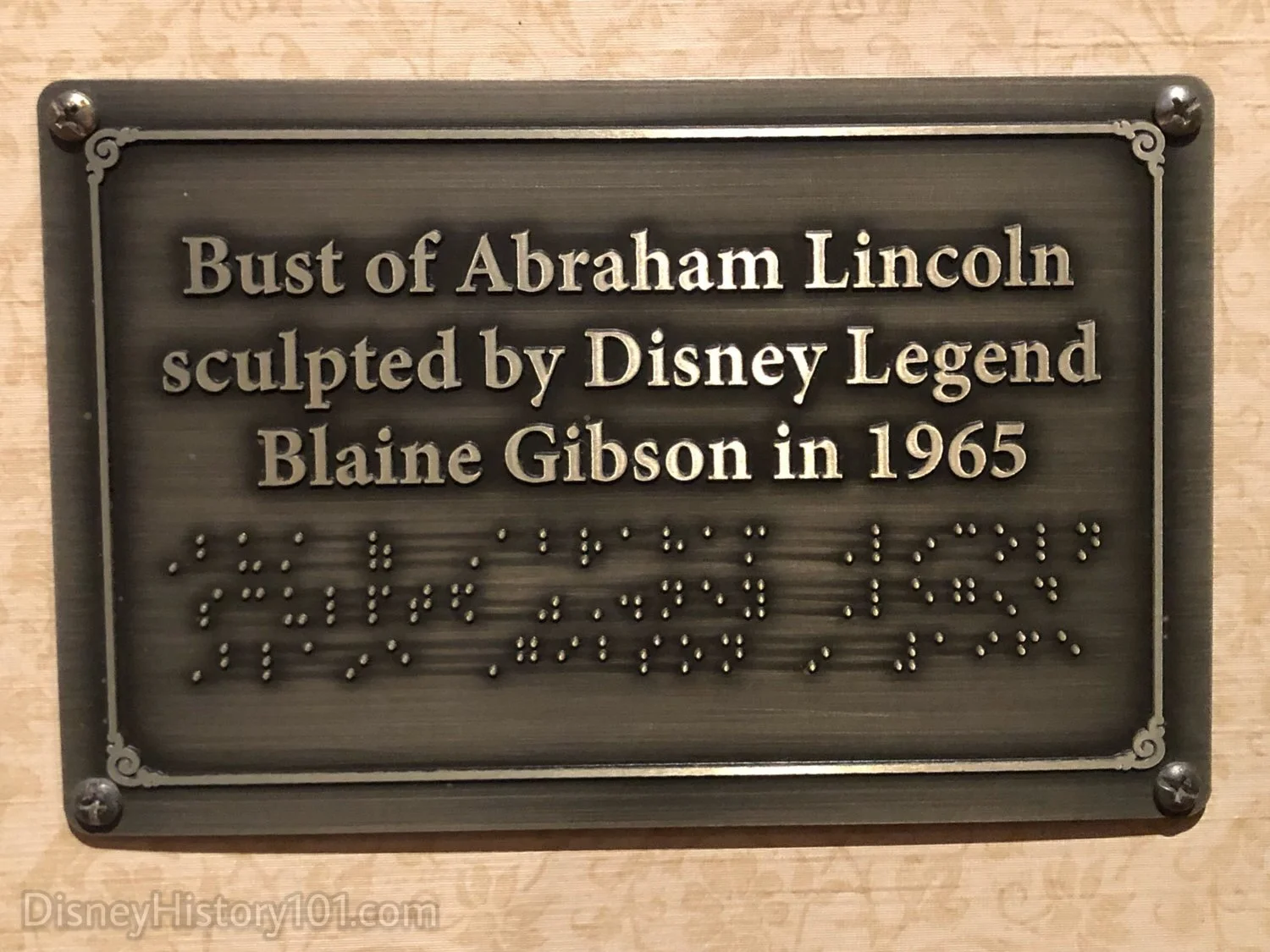
Abraham Lincoln Bust Plaque
You may notice that many plaques featuring Braille, have been added around the exhibit.
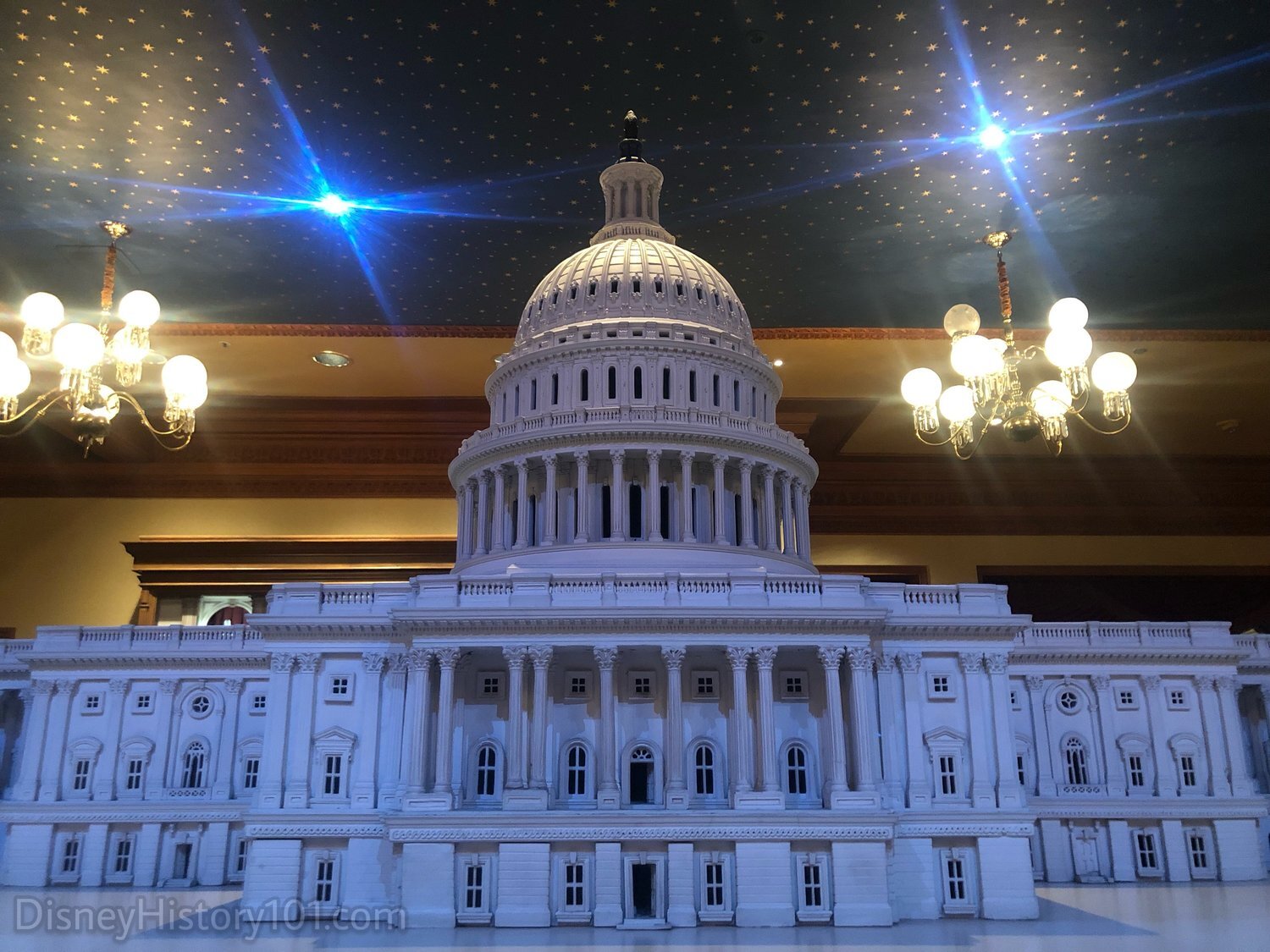
U.S. Capitol in Miniature by George Llewellyn Lloyd
During Disneyland’s “first fabulous decade”, the Park often displayed collections and artwork within Disneyland, which were not the creation of Walt Disney Studio artists. For example, Jimmy Starr’s Show Business Souvenirs (1956-1959) featured a collection of authentic props once used in film production, while the Davy Crockett Frontier Arcade housed a collection of more than 50 historic guns and arms on loan by the N.R.A. Now, we will take a look at one particularly amazing Walt-era exhibit which still remains in the Park to this day - “The United States Capitol in Miniature”.
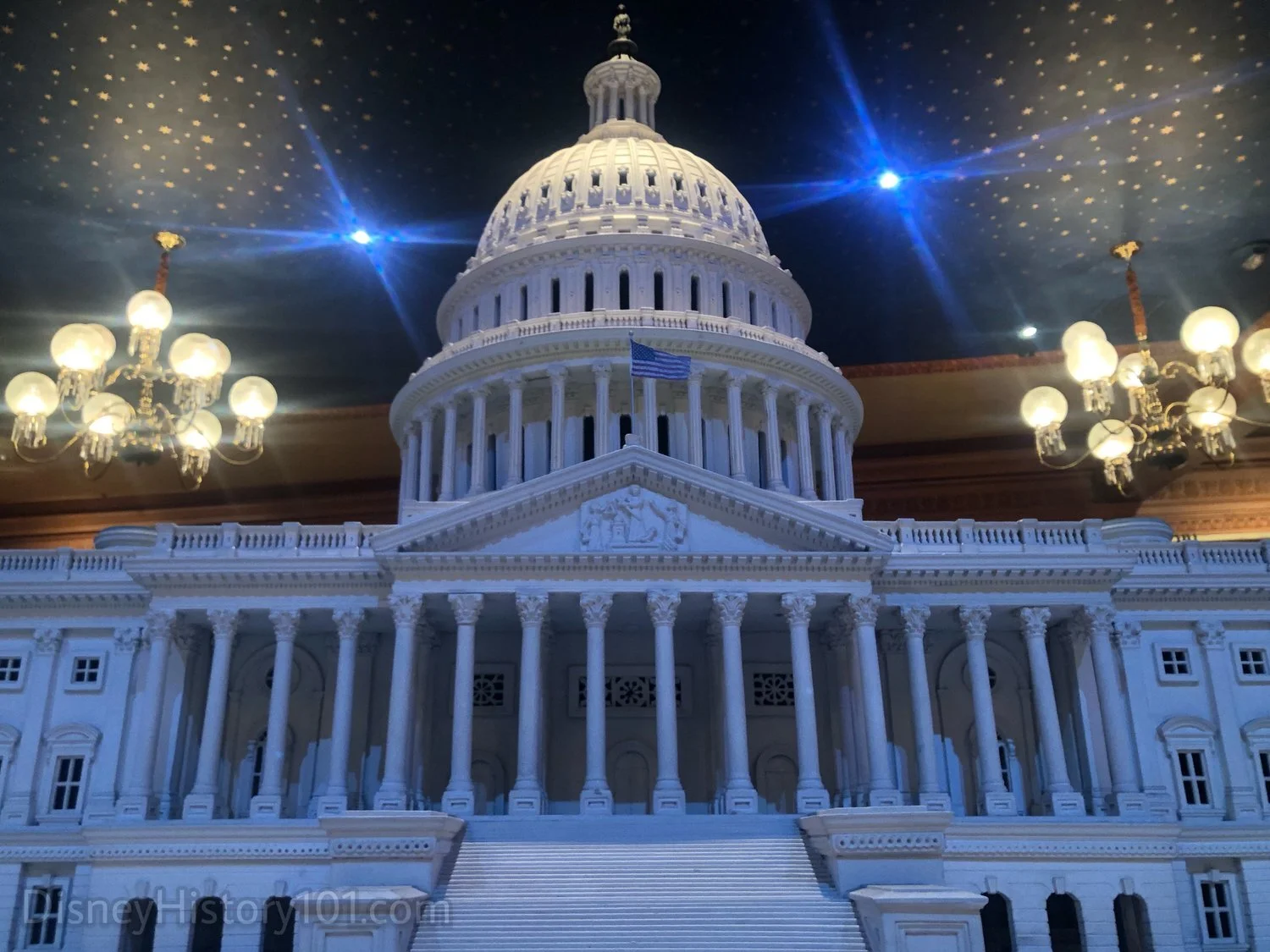
U.S. Capitol in Miniature by George Llewellyn Lloyd
The creator of the small scale model, George Lewellyn Lloyd (1879-1962), was born in Wales, of The United Kingdom. George built more than models, and was a true-life Stone Mason and sculptor of monuments (as his forefathers before him). Over his lifespan, George made notable contributions to historically relevant structures - the House of Parliament (in Ottawa, Canada), the Cathedral of Saint John the Devine (in New York), and Rockefeller Chapel (in Chicago) to name a few locations.
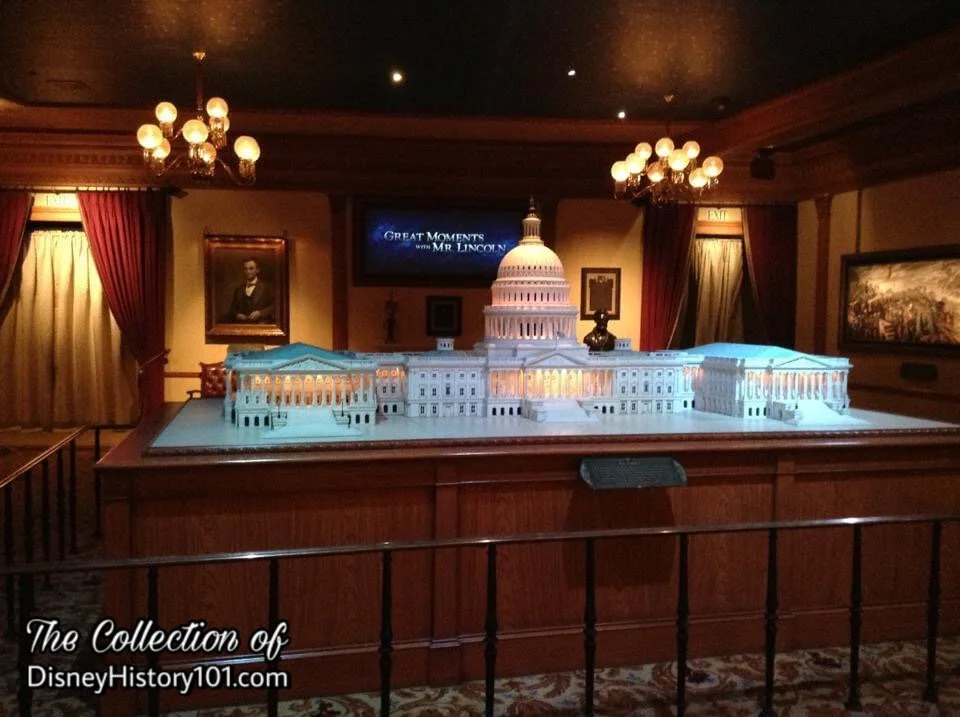
U.S. Capitol in Miniature by George Llewellyn Lloyd
But incredibly one of his smallest works would perhaps gain the most attention. It’s origin goes back to 1918, when George saw a photograph of the U.S. Capitol Building in a Philadelphia newspaper, and decided that he would create a model of it. A few years later (while the United States was amidst its greatest economic depression), George found himself unemployed. It was at this time (c. 1929) that George decided to stay occupied with his art project, soon first visiting the Capitol Building in Washington, D.C. in order to see it in person.
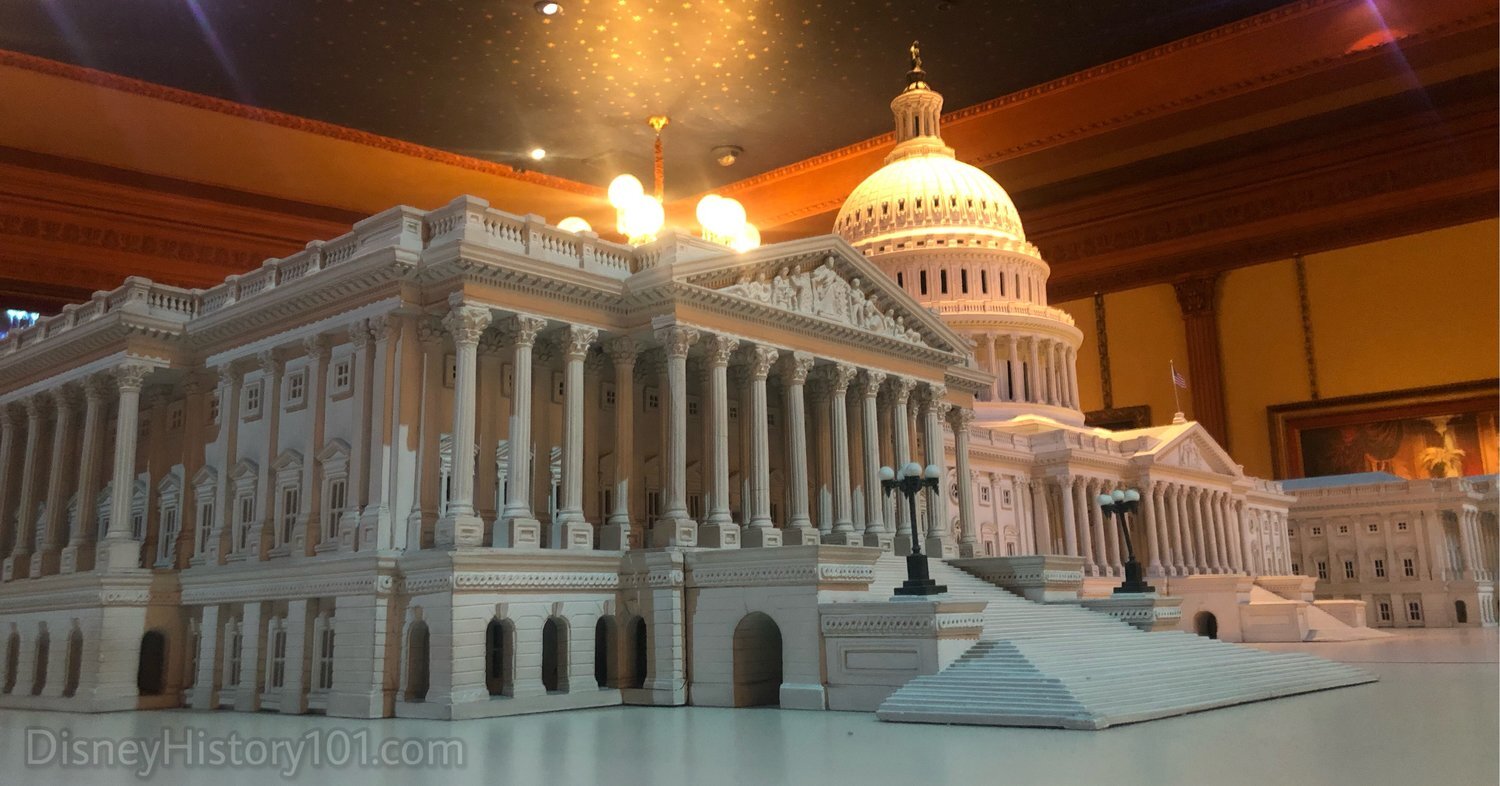
U.S. Capitol in Miniature by George Llewellyn Lloyd
In order to make sure that this (“3/16 of an inch to the foot”) representation was faithful, he enlisted the help of David Lynn (the Capitol Architect who retained blue prints and photographs of the historic U.S. building). As for the medium, George chose one large block of French Caen Limestone, for its color and soft texture. In 1932, George began work on the miniature in Belleville, New Jersey, working up to 16 hours most days and nights. The intricate model (with its more than 500 hand-carved “columns, pedestals, caps, cornices, pediment, carvings, and dome” spread out across its eight sections) was finally completed by 1935. The dome alone, took three years to complete.
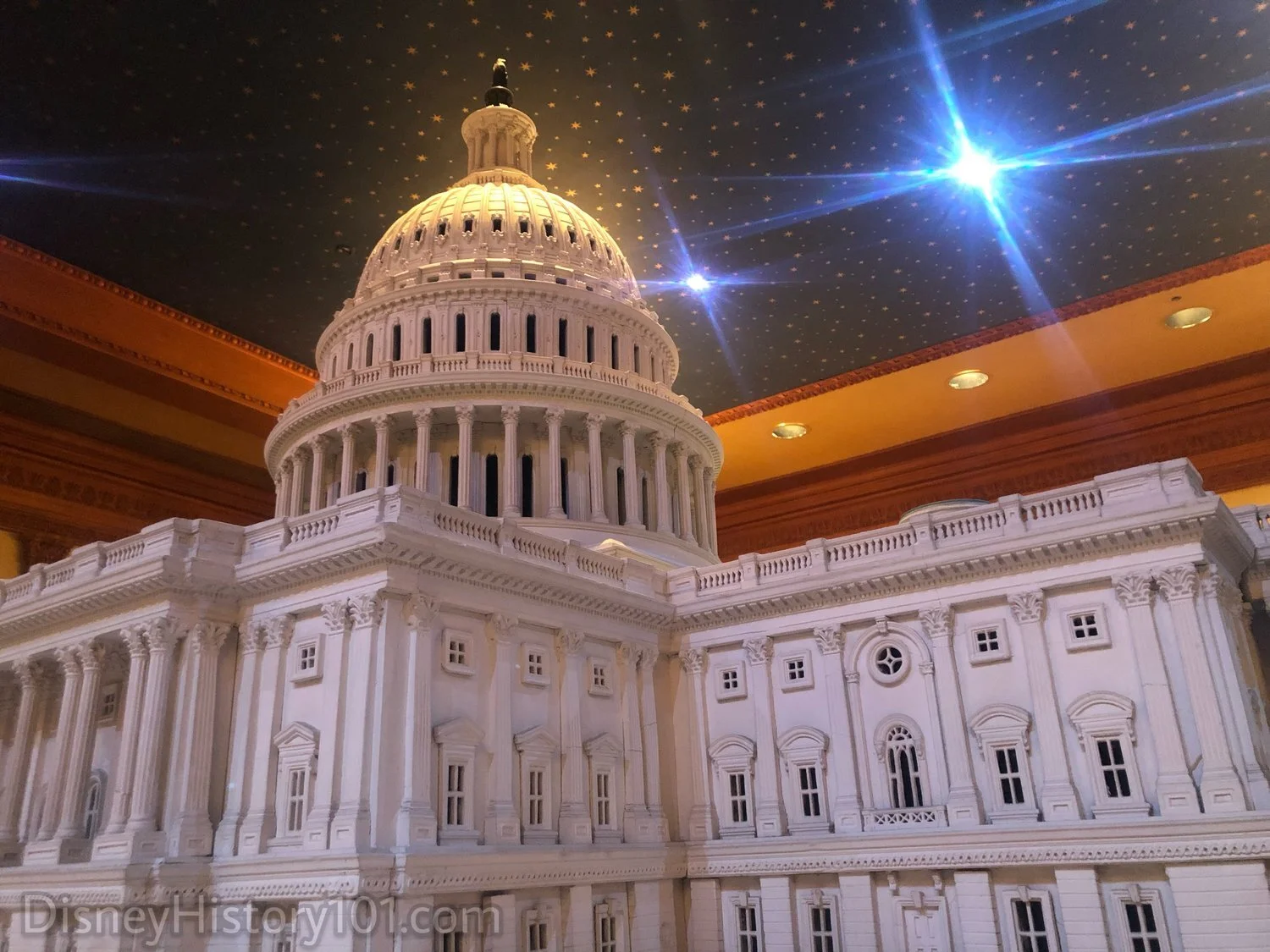
U.S. Capitol in Miniature by George Llewellyn Lloyd
The United States Capitol in Miniature made its debut at the World Trade Fair (of Minneapolis, Minnesota), before touring major cities across the United States of America. It was during one of these tours (during August of 1955) when George’s model (of Caen limestone) was on display at Robinson’s Department Store, that George’s model attracted the attention of Walt Disney (who had an affinity for miniatures). Herb Ryman [in “Working With Walt - Interviews With Disney Artists” by Don Peri] recalled that “the man [George Llewellyn Lloyd] resembled Walt’s father. Walt met him and liked him. He said, ‘I’m going to buy that.’… [Herb, who was present] said, ‘What are you going to do with it?’ He said, ‘I don’t know, but we’ll find something.’” After some conversation, George sold the model to Walt Disney for $6,099.
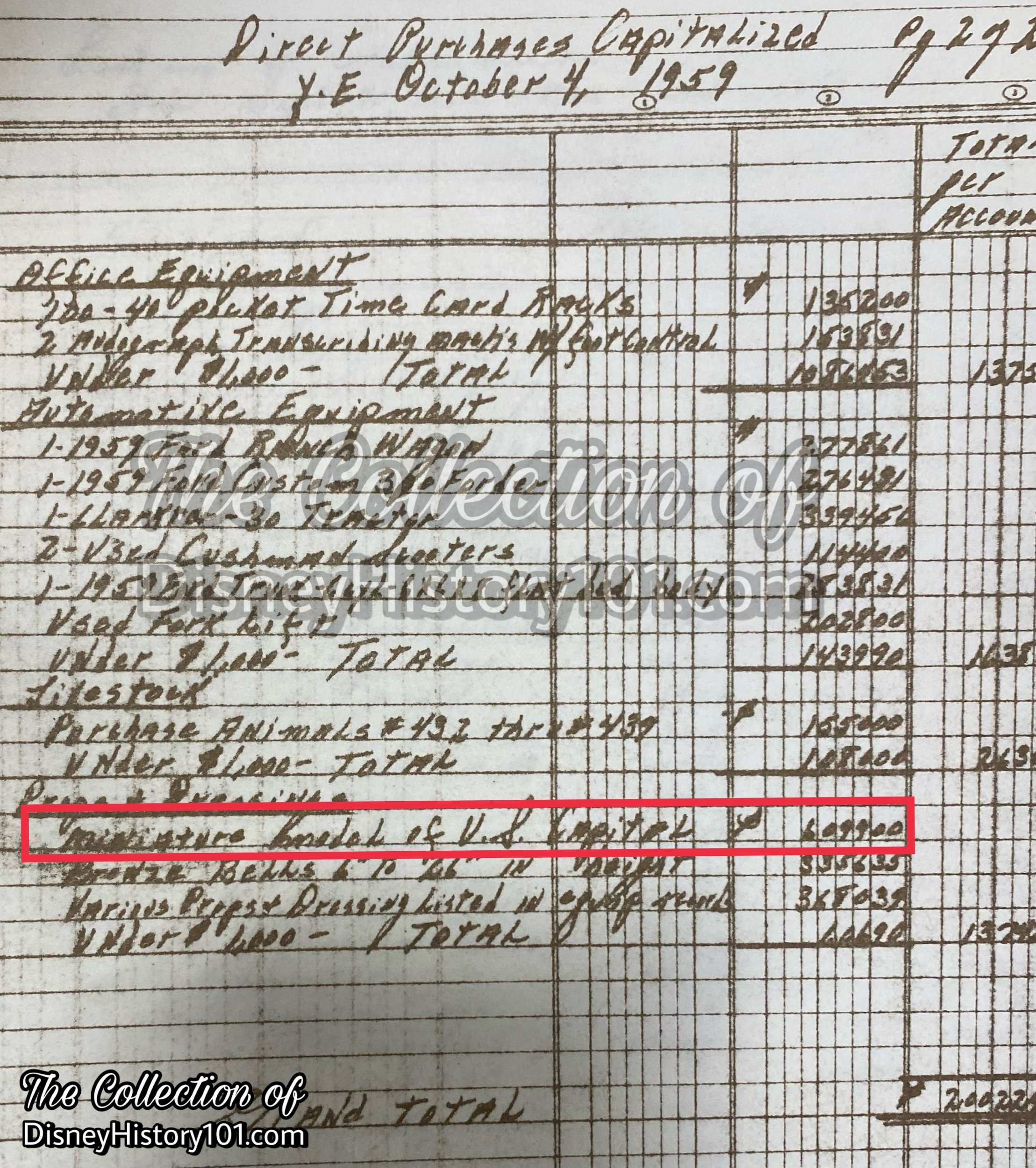
Disneyland Direct Purchases Capitalize; October 4, 1959.
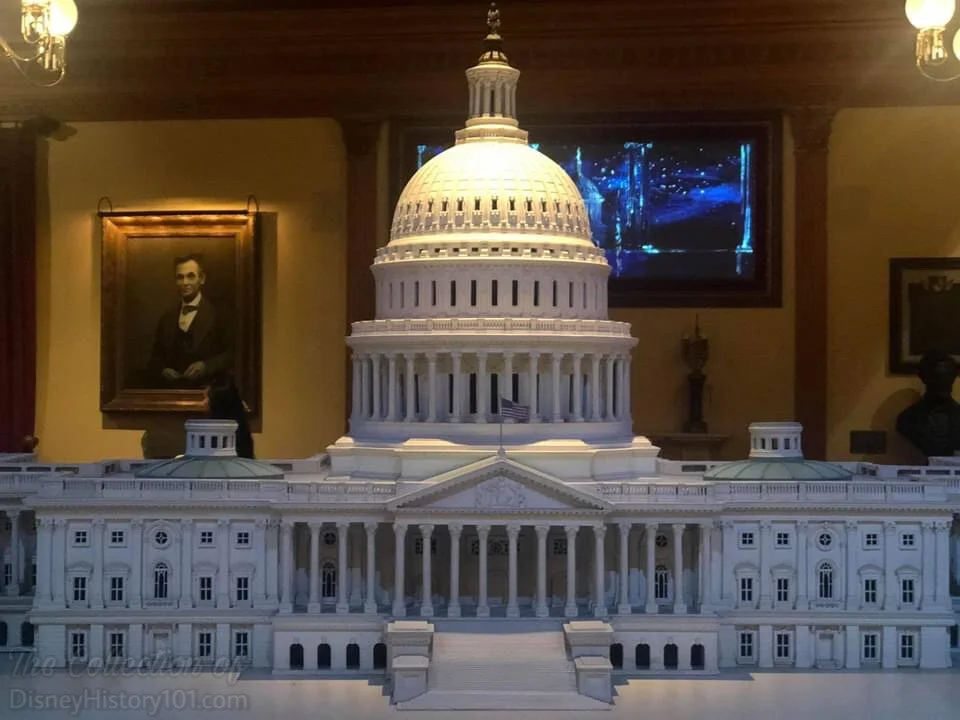
U.S. Capitol in Miniature by George Llewellyn Lloyd
Now, not only was this 1955, but Walt Disney’s Disneyland was not even open yet. In fact, the Mr. Lincoln Audio-Animatronic figure would not debut at Disneyland until 1964 - nine years away. Clearly, Walt was looking to the future when he purchased George’s model, keeping it preserved for almost a decade, before the model became part of the Pre-Show of Great Moments with Mr. Lincoln at Disneyland.
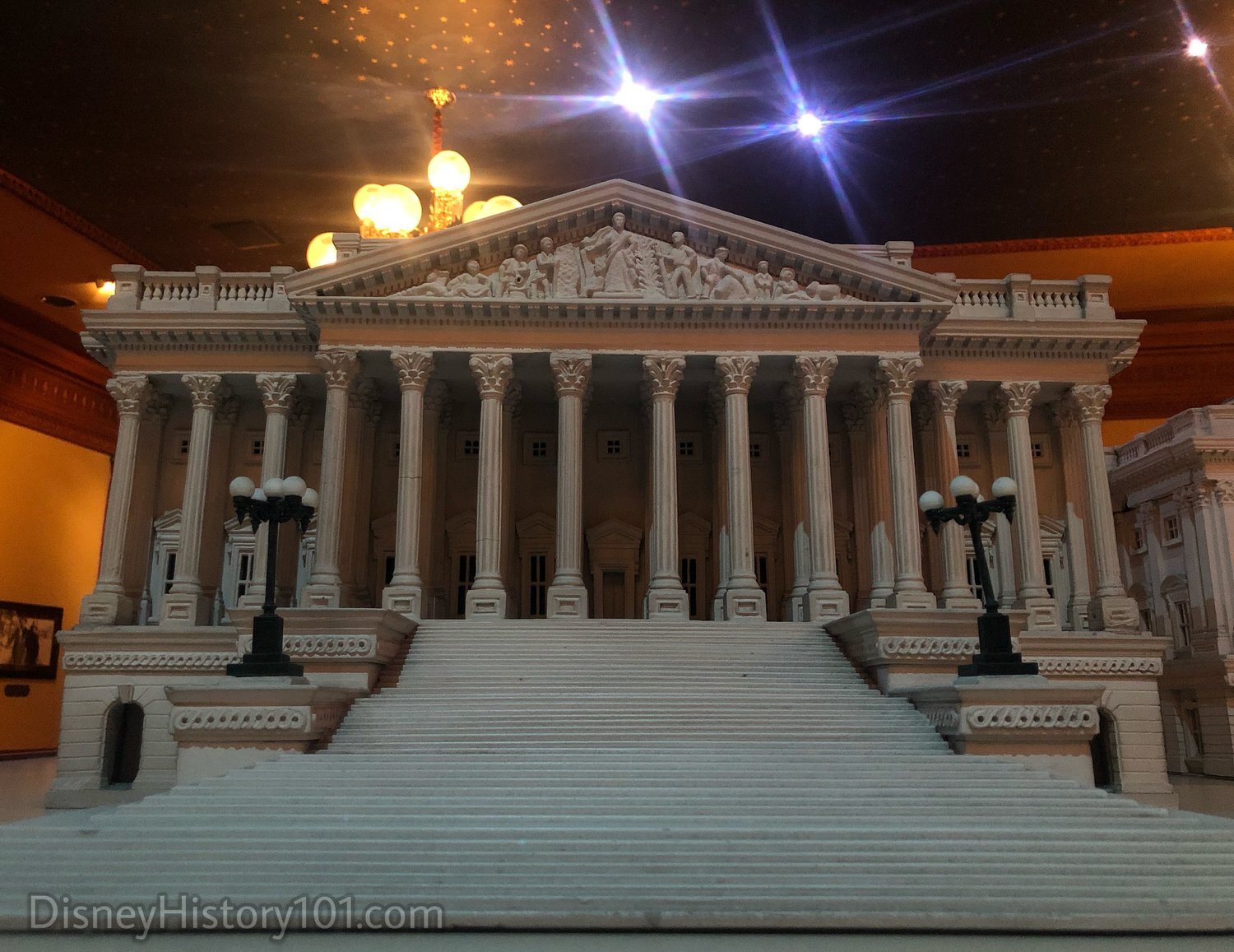
U.S. Capitol in Miniature by George Llewellyn Lloyd
Take a closer look at the figures of (one of three) neoclassical pediments (that triangular-shaped element above the columns). The true-life U.S. Capitol features three different sculptures within each of the three pediments - over the Central Portico, over the Senate Wing, and over the House of Representatives. George made sure to add these little faithful elements to his miniature.
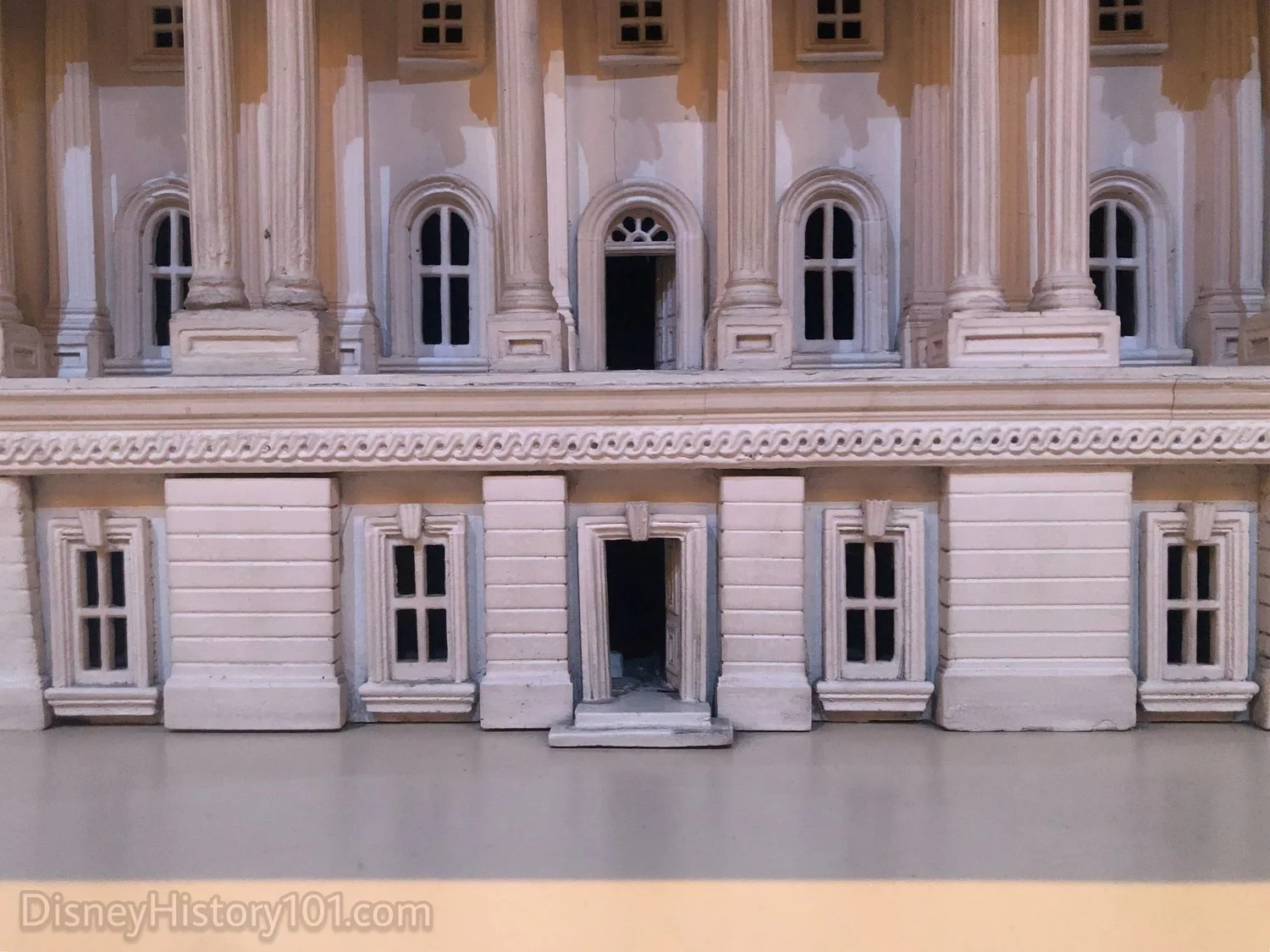
U.S. Capitol in Miniature by George Llewellyn Lloyd
Finally, upon entering the foyer of the Main Street Opera House, guests were “greeted by a large picture window gracefully framed in red drapes. Stepping up to the window, they look out over a magnificent panorama of the United States Capitol with its beautiful surroundings. Countless diamond-like lights shine from Capitol windows and city as twilight settles over Washington,” according to Vacationland (Fall, 1965 ; Vol. IX, No.3).
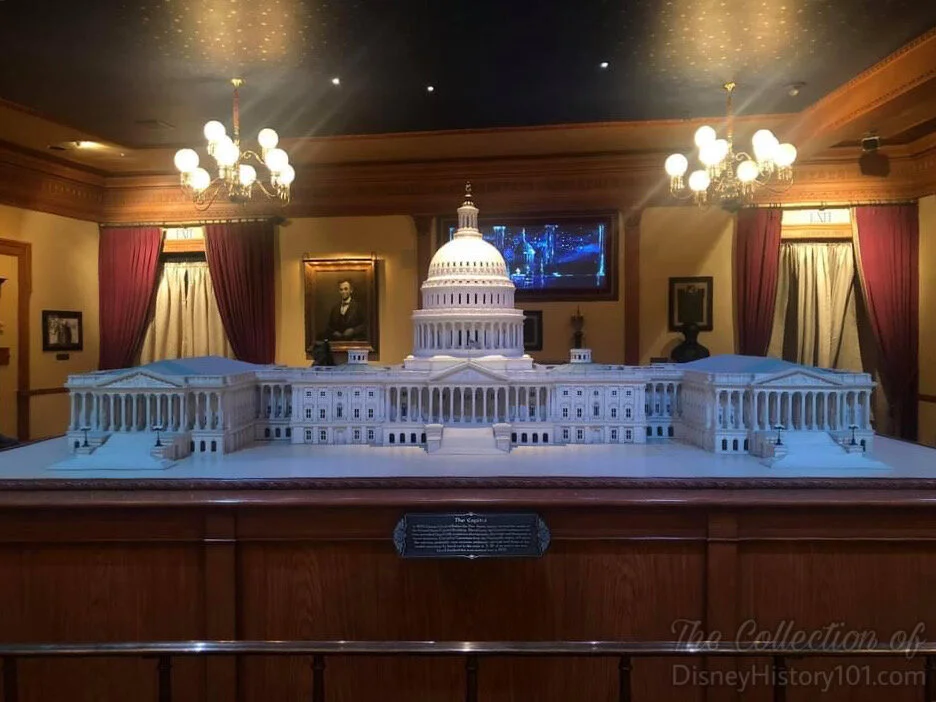
U.S. Capitol in Miniature by George Llewellyn Lloyd
The former Walt Disney Imagineering Principal Creative Executive Marty Sklar would probably agree that the small details like these make the story appealing.
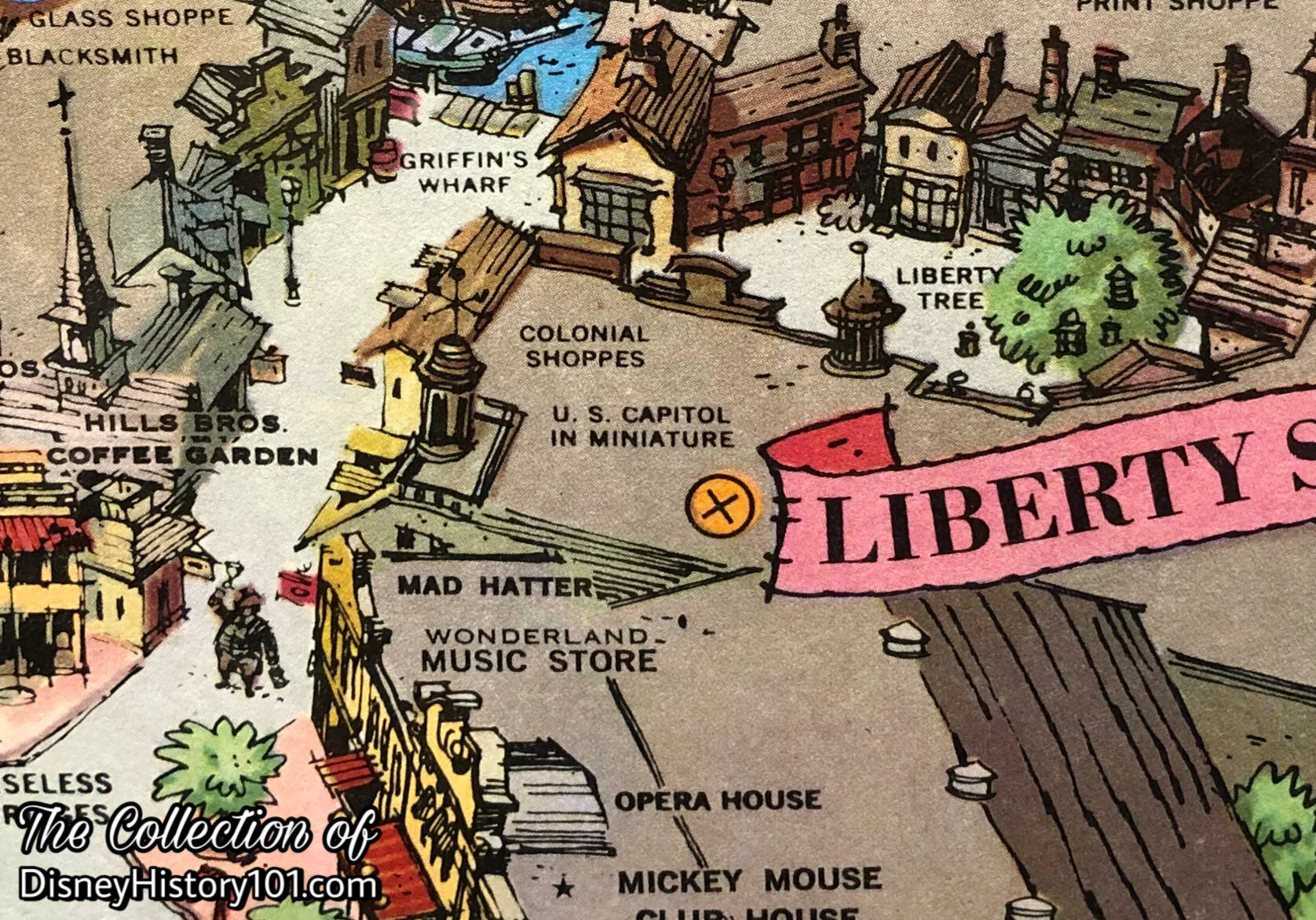
Disneyland Map by Sam Mc Kim Excerpt, Early 1960s
During the late 1950s and early 1960s, Walt was interested in developing the area behind the East side of Main Street into a brand new land. Sam McKim maps of the era feature some of these concepts (a yellow-orange circle with an “x” inside often used to symbolize a “Future Developement”). Evidently, the U.S. Capital in Miniature was to be retained as part of one “Future Development” called Liberty Square. George died in 1962, but it is quite possible that he was aware of these plans (involving his model) before his death.
Looking over even this small map excerpt, you will note more than a few elements (“colonial shoppes”, and the Liberty Tree, for instance) which were utilized more than a decade later, to bring Liberty Square (of Walt Disney World Magic Kingdom) to life! The U.S. Capitol in Miniature by George Llewellyn Lloyd seems to be the only attraction which has kept the “spirit of Liberty Square” alive at Disneyland up to our present day!
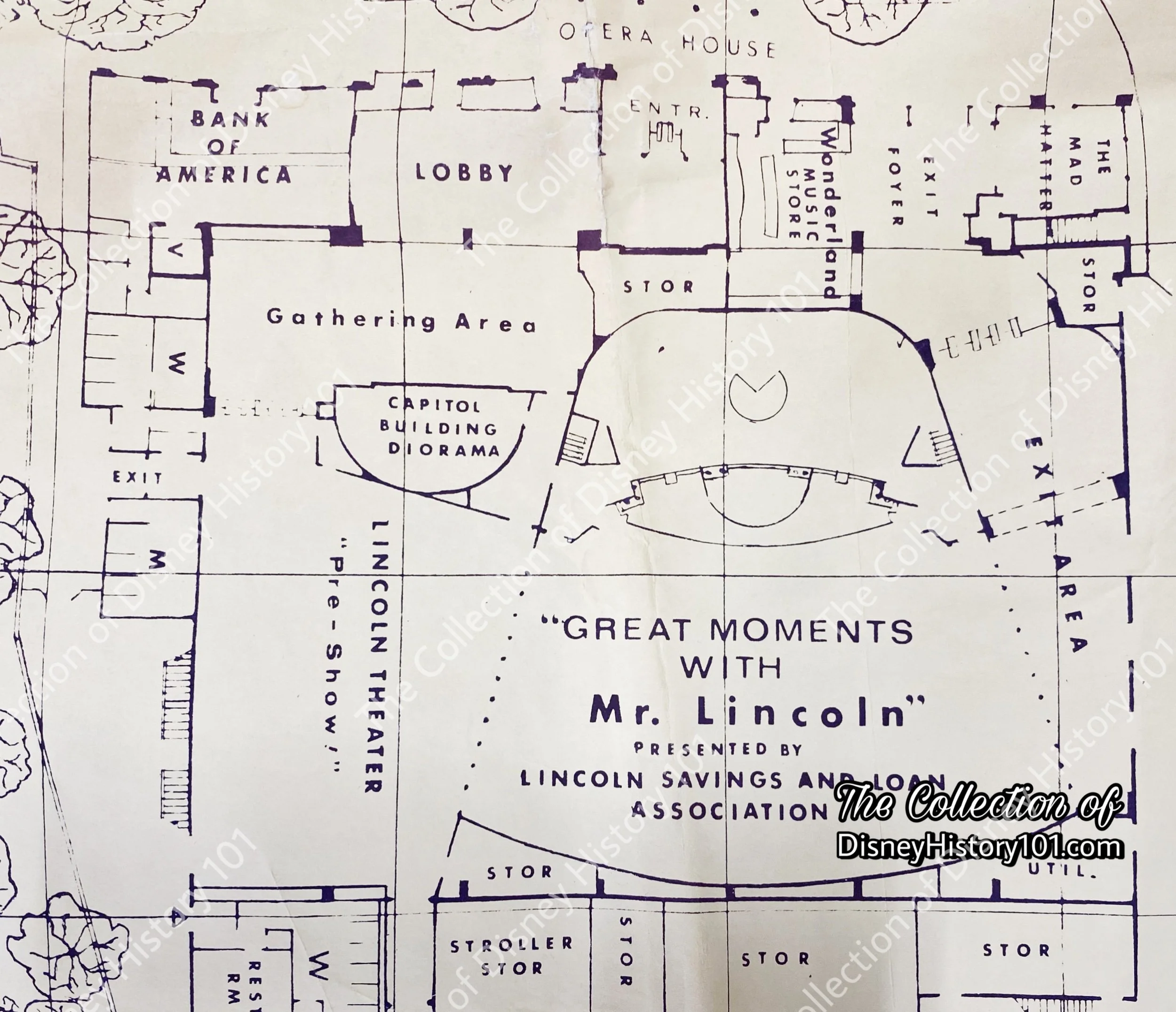
Opera House Landscape Plan & Twenty Scale Plot Plan by Weldon Paige; 1968.
(April 1st, 1973 - February 17th, 1975)
*(April 8, 1973 to February 15, 1973, according to “Disneyland Rides & Attractions and Attendance Report,” 1981, page 50).
After his passing, Walt Disney was posthumously honored in many ways. On March 25, 1969, Walt Disney was presented a gold medal by President Richard M. Nixon, accepted by Lillian Disney. The Disney image was also preserved when The Legacy of Walt Disney exhibit (which was displayed in the old Wurlitzer building from January 15th, 1970 to February 11, 1973), was moved to the Main Street Opera House. Only a few months after the grand opening of the exhibit, the Walt Disney Archives was established on June 22, 1970.
Owing to the newly formed Walt Disney Archives, The Walt Disney Story exhibit would open with a brand-new exhibit, marquee, an official dedication, and much fanfare during Easter week, on April 14th, 1973, attended by Disneyland Ambassador Bonnie Drury, Mickey Mouse, and Lillian Disney Truyens (former wife of Walt Disney). The opening coincided with the Park’s celebration of “fifty happy years of family entertainment,” and was also advertised as part of Disneyland’s “New Sights & Bright Lights” during the summer of 1973! The dedication at Disneyland predated the dedication of the Walt Disney World incarnation which occurred on May 6th, 1973.
The show was free to Park guests of Disneyland, courtesy of the Gulf Oil Corporation. Once inside, guests followed Walt Disney from his boyhood, to the creation of Walt Disney World as told through nostalgic photographs, intriguing displays of awards and honors, rare film footage, and priceless memorabilia. One screen (surrounded by photographs taken during the construction of Disneyland) shows a short film of the Park’s construction (sped-up, of course). Guests may especially recollect the exact reproduction of Walt Disney’s Formal Office once used for appointments with special guests. There were props from Walt Disney’s popular television productions, including Zorro (the cape, mask, and sword of the title character) and The Mickey Mouse Club (an original Mouseketeer hat).
One accompanying 28-minute film (partially narrated by Pete Renaday and Walt Disney himself), contained ”multi-media highlights of the life and accomplishments of Walt Disney, featuring rare film footage [like clips from the ‘Alice’ series, Walt Disney’s ‘Silly Symphonies’, ‘Steamboat Willie,’ and ‘Walt Disney’s Mary Poppins’ ; a rare treat during the pre-internet era]… photographs from family archives with Walt himself narrating the many milestones in Disney entertainment.” In the same short film,“He also explains the philosophy behind the ‘Audio-Animatronics’ figures developed by Walt Disney Productions for use at Disneyland and Walt Disney World.” According to the Press Release “utilizing excerpts with Walt, together with photos from family archives and vintage film footage, the wide-screen motion picture follows Disney from his humble Midwestern boyhood through his rise to International fame.” As aforementioned, this new show was on a 28-minute cycle (as opposed to five twelve-minute “Lincoln” shows per hour). This meant that The Walt Disney Story” was capable of accommodating a maximum of 1,000 guests per hour, as opposed to “Great Moments’” 2,500 guests per hour.
Much like Great Moments with Mr. Lincoln, this distinguished new attraction was free to all guests (though the Walt Disney World Magic Kingdom incarnation required a coupon for admission). The exhibit was successful, running until February 17, 1975 (with The Walt Disney Story film closing a few days earlier, on February 12, 1975). Four months later (and after a rehabilitation), The Walt Disney Story Featuring Great Moments With Mr. Lincoln presented by Gulf Oil Corporation (a free attraction with Audio-Animatronics figures) would return on June 12, 1975, and run until 2000. The Walt Disney Story still followed Walt Disney from his boyhood through the creation of Walt Disney World. Visitors could see rare film footage, narrated by Walt himself. This version of the show also featured the original form of the Great Moments with Mr. Lincoln Show which opened at Disneyland.
As the end of the day draws near, the Guest control lines grow progressively smaller. The lines are then maintained as they “go down” and are thoroughly swept when empty. In many cases, this required special equipment which would be issued by the Lead. Many attractions, such as the Walt Disney Story required a walk-through after closing for the removal of debris. At this time any defects were noted.
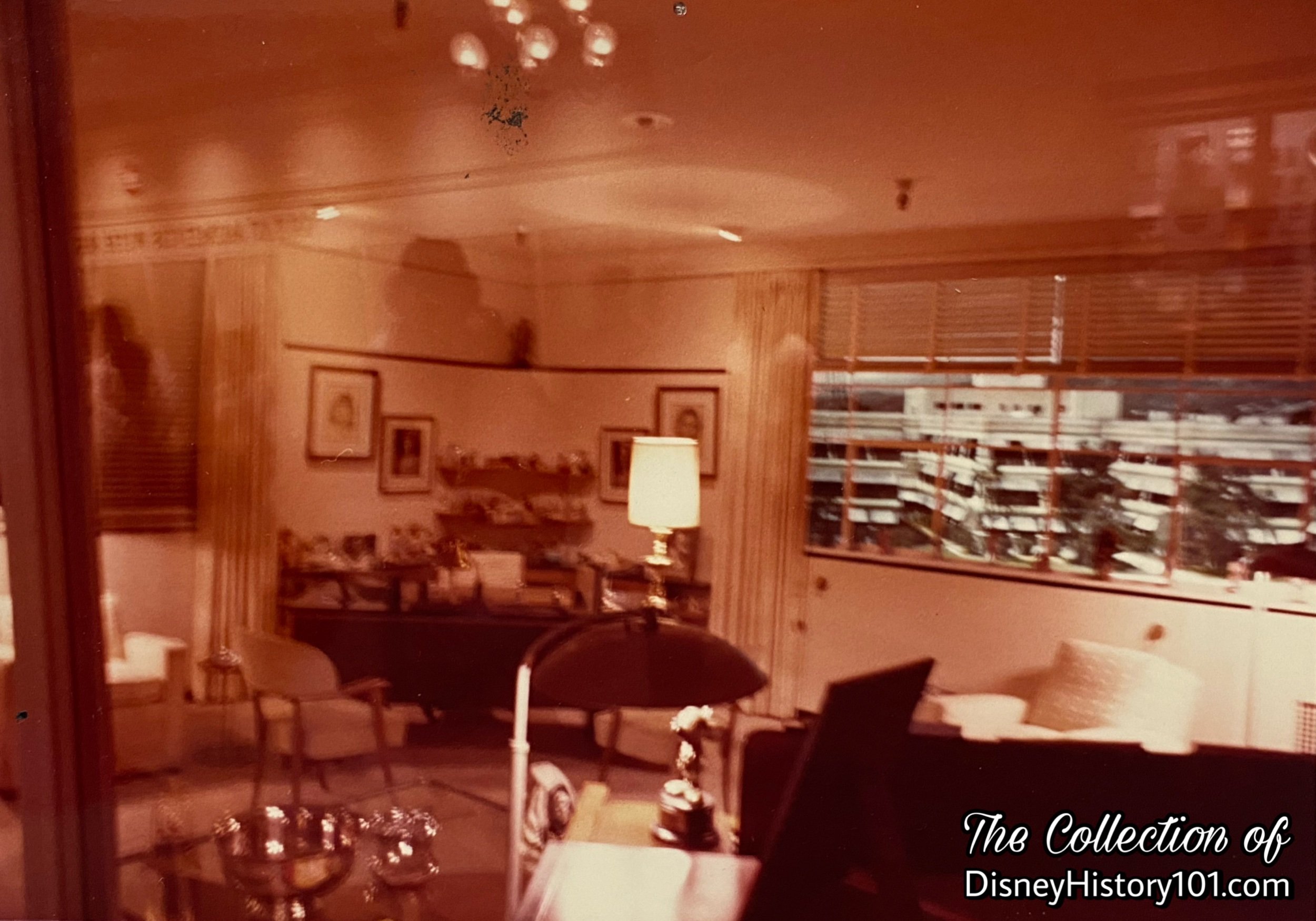
The Office of Walt Disney.
Depicted above is Walt's studio offices, recreated with the same items he used for 26 years. Kept as it was when he used it, everything from the wood paneling to the furniture was from the original Burbank, California, office.
In 2001, a photo shoot inside Walt Disney's Office in the lobby of Great Moments with Mr. Lincoln was auctioned off at the 2001 Official Disneyana Convention at Disneyland Resort. The Estimate was $500 - $1000. The lucky winner and two Guests had their photo shot in the formal office on the morning of Saturday, September 8, 2001. They also received a personal tour of the office by Dave Smith, Director of the Walt Disney Archives.
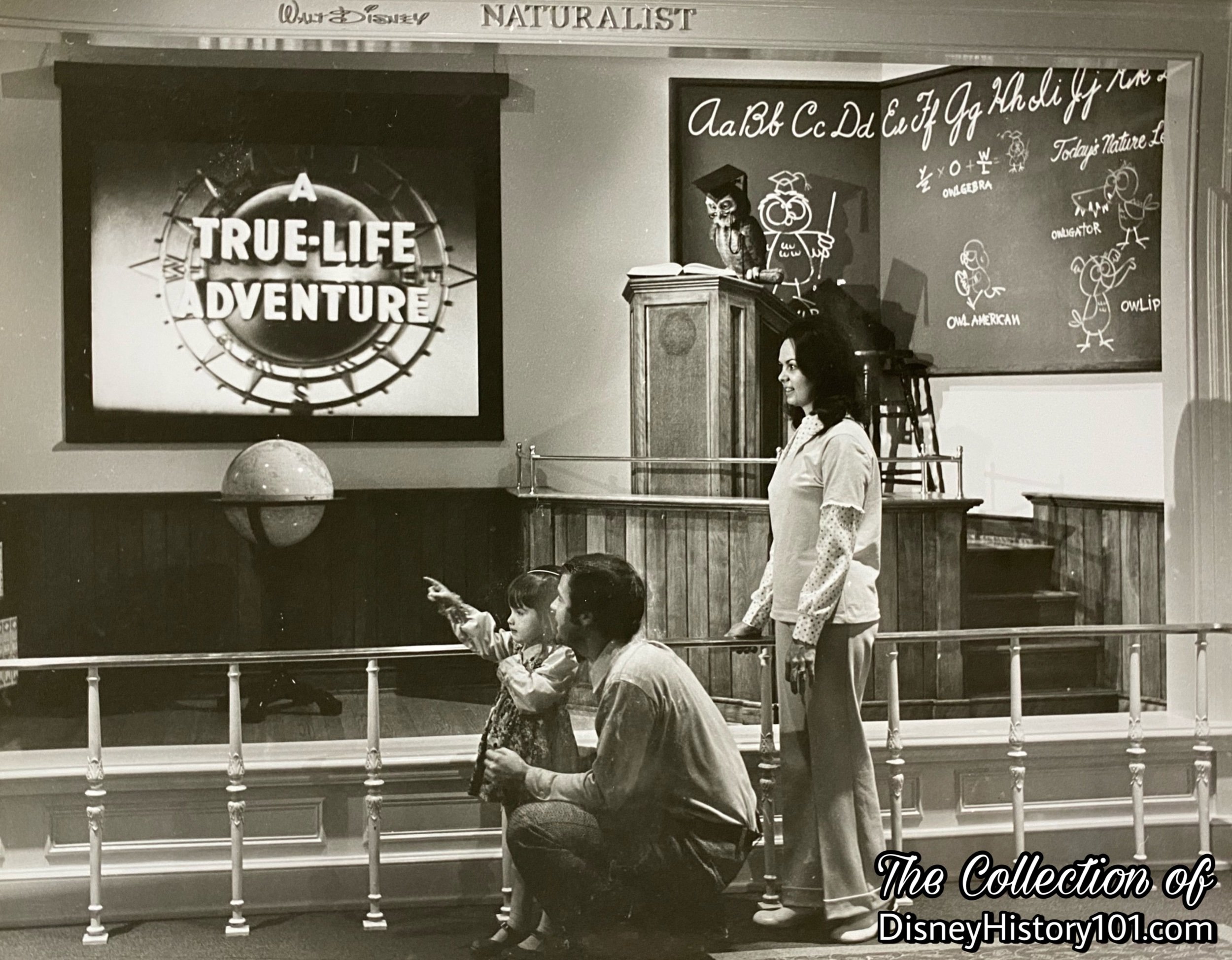
Press Photo, ©Disney.
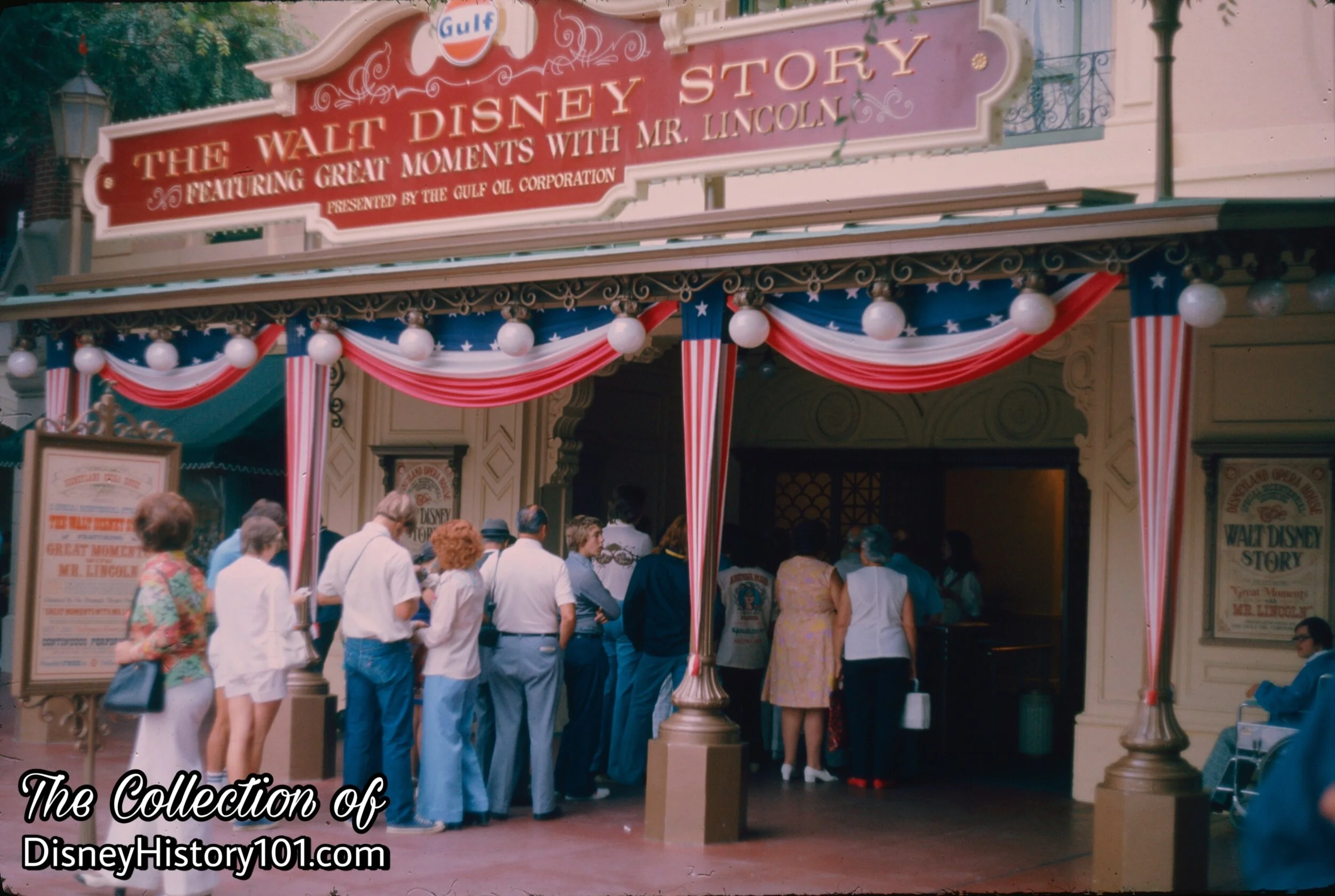
The Walt Disney Story Featuring Great Moments With Mr. Lincoln , (c. August, 1975)
Around 1968, Gulf Oil sponsored quite a few episodes of Walt Disney’s Wonderful World of Color. Now, the new marquee of the Main Street Opera House advertises The Walt Disney Story Featuring Great Moments With Mr. Lincoln presented by Gulf Oil Corporation. You may have noticed that two (of four) of the original lamps were removed to accommodate the larger marquee.
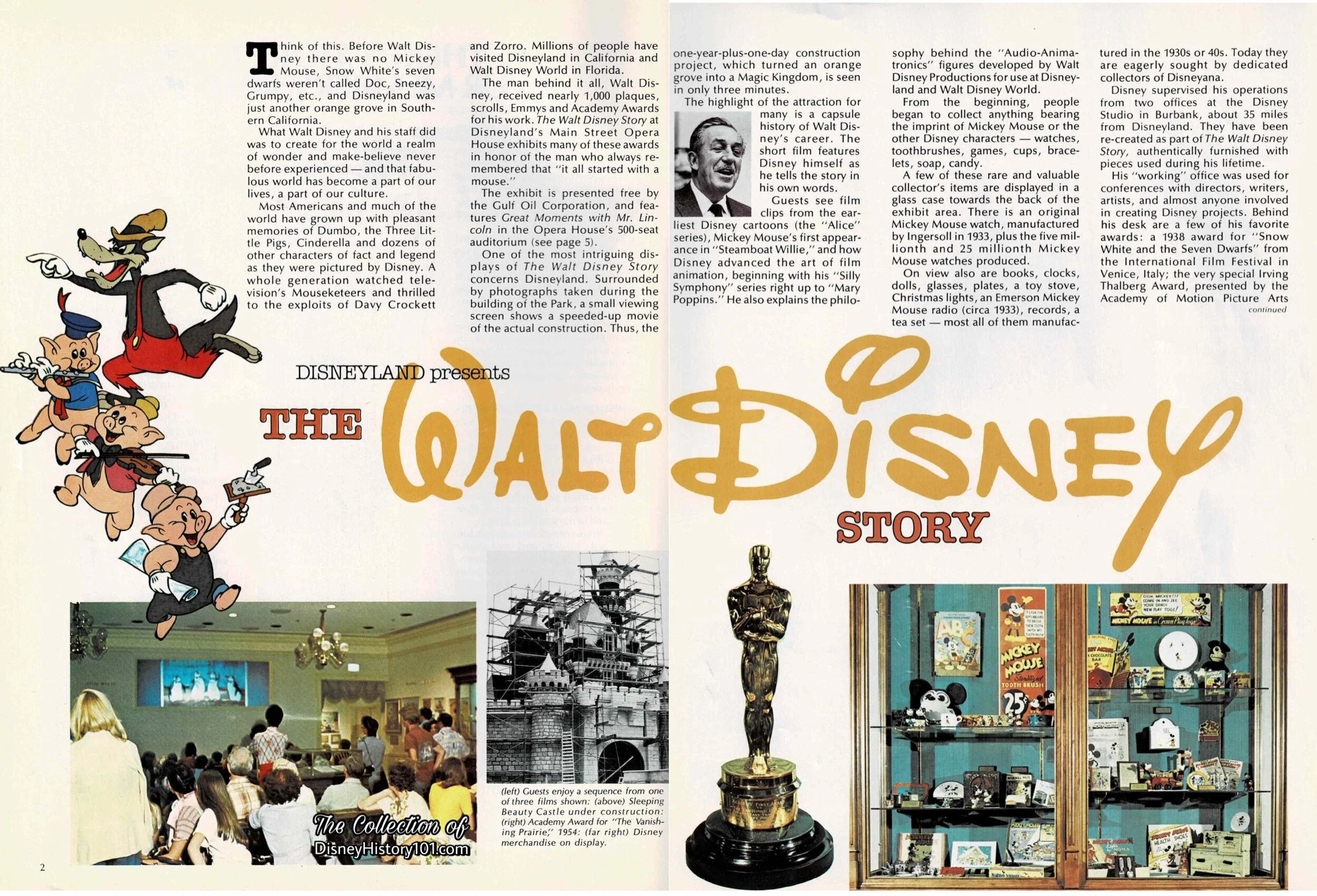
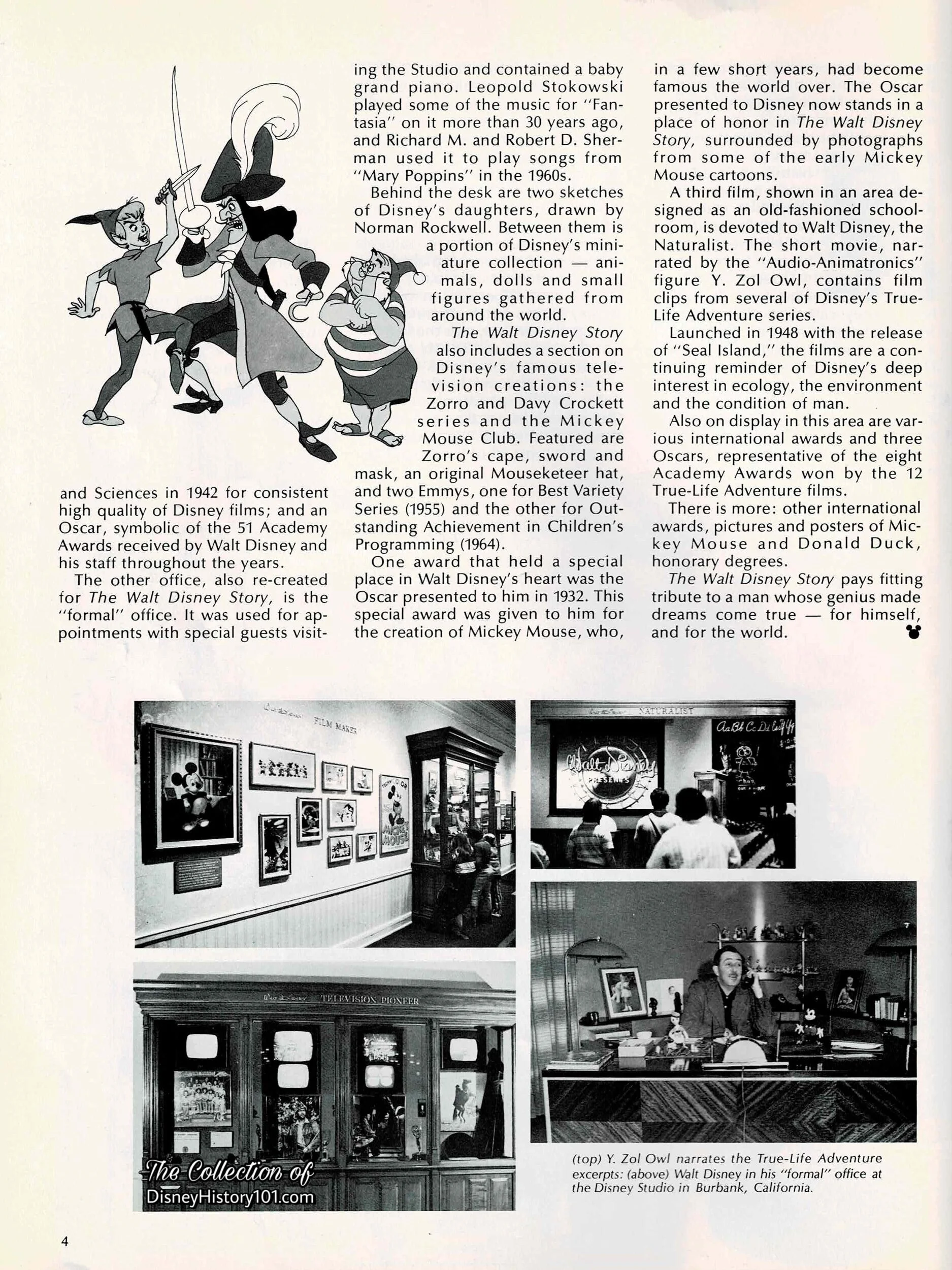
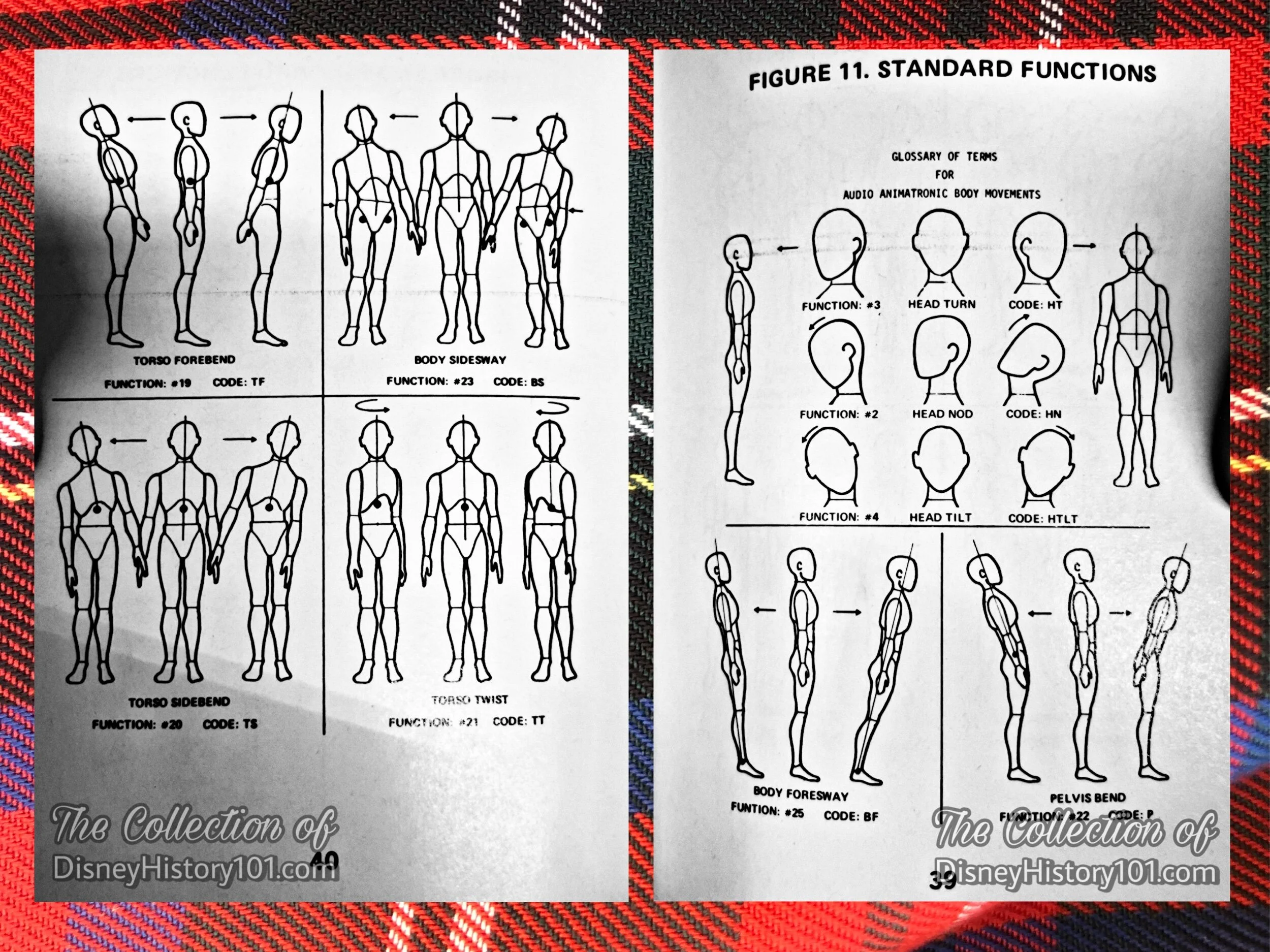
The Revised WED Enterprises Imagineering Audio-Animatronic Maintenance Manual, (1978)
Owing to contemporaneous advancements in Audio-Animatronics technology, new Audio-Animatronics figures of “The Walt Disney Story” (June 12th, 1975) and the 31 figures added to the Jungle Cruise (in December of 1976), the WED Enterprises Imagineering Audio-Animatronic Maintenance Manual (first published 1977) was revised in 1978.
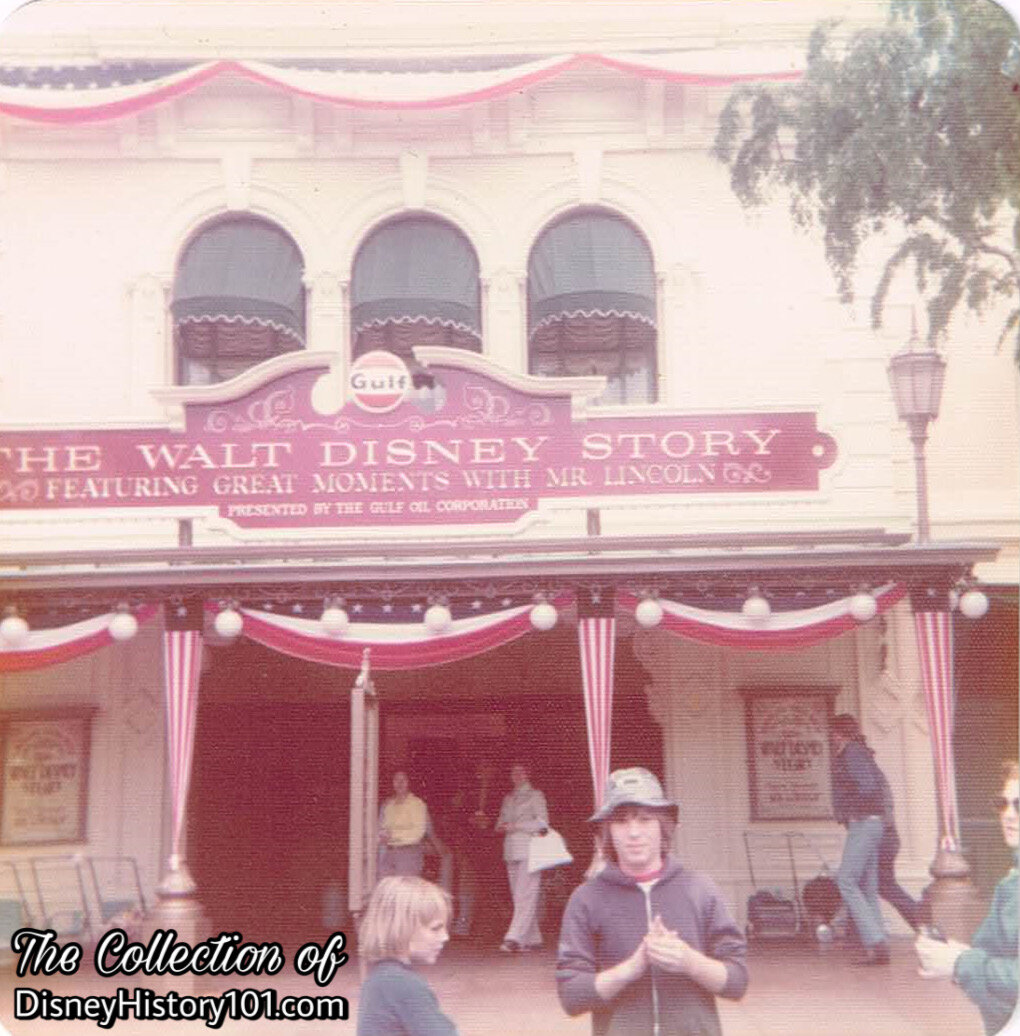
The Walt Disney Story Featuring Great Moments With Mr. Lincoln
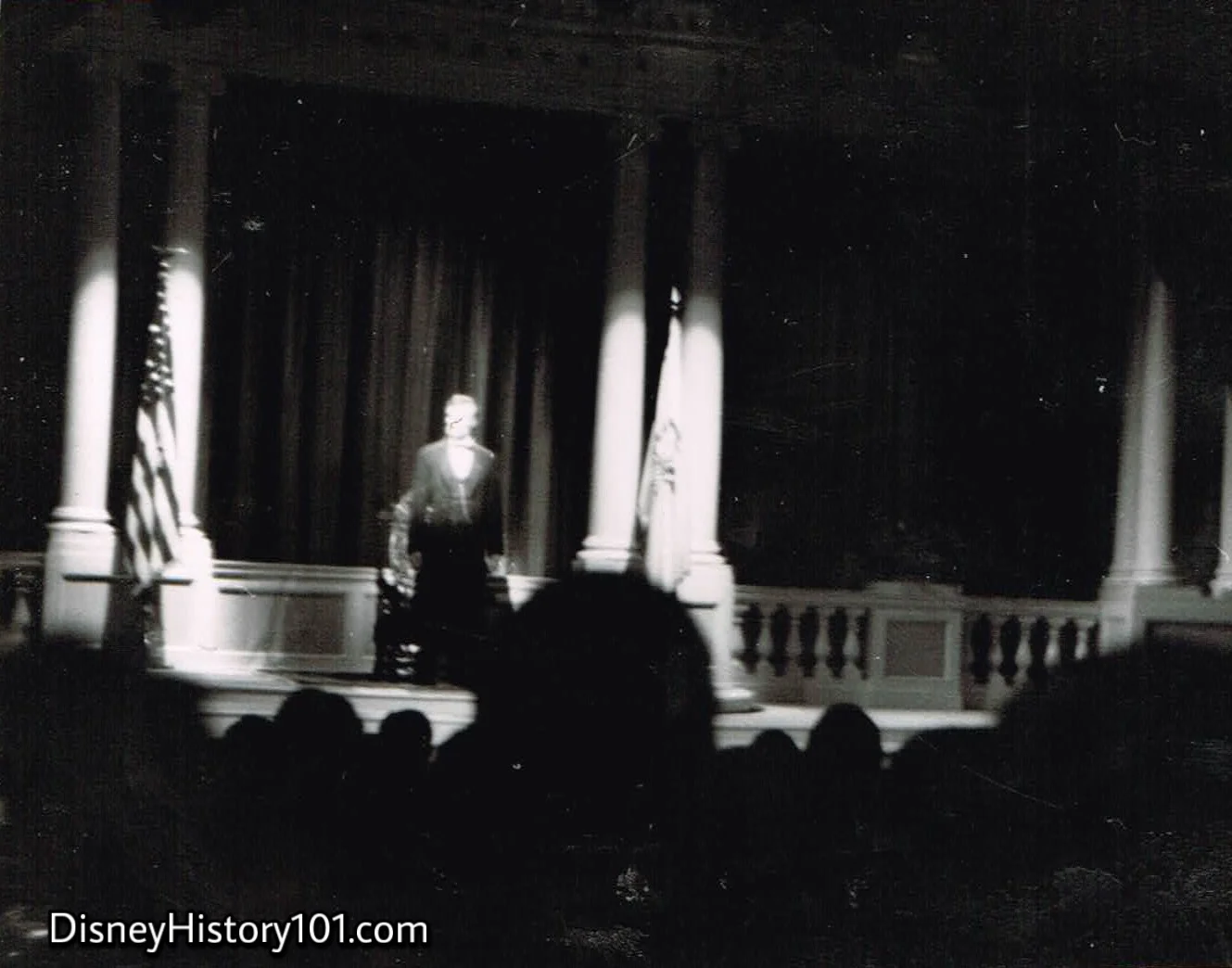
The Return of Great Moments with Mr. Lincoln, 1975
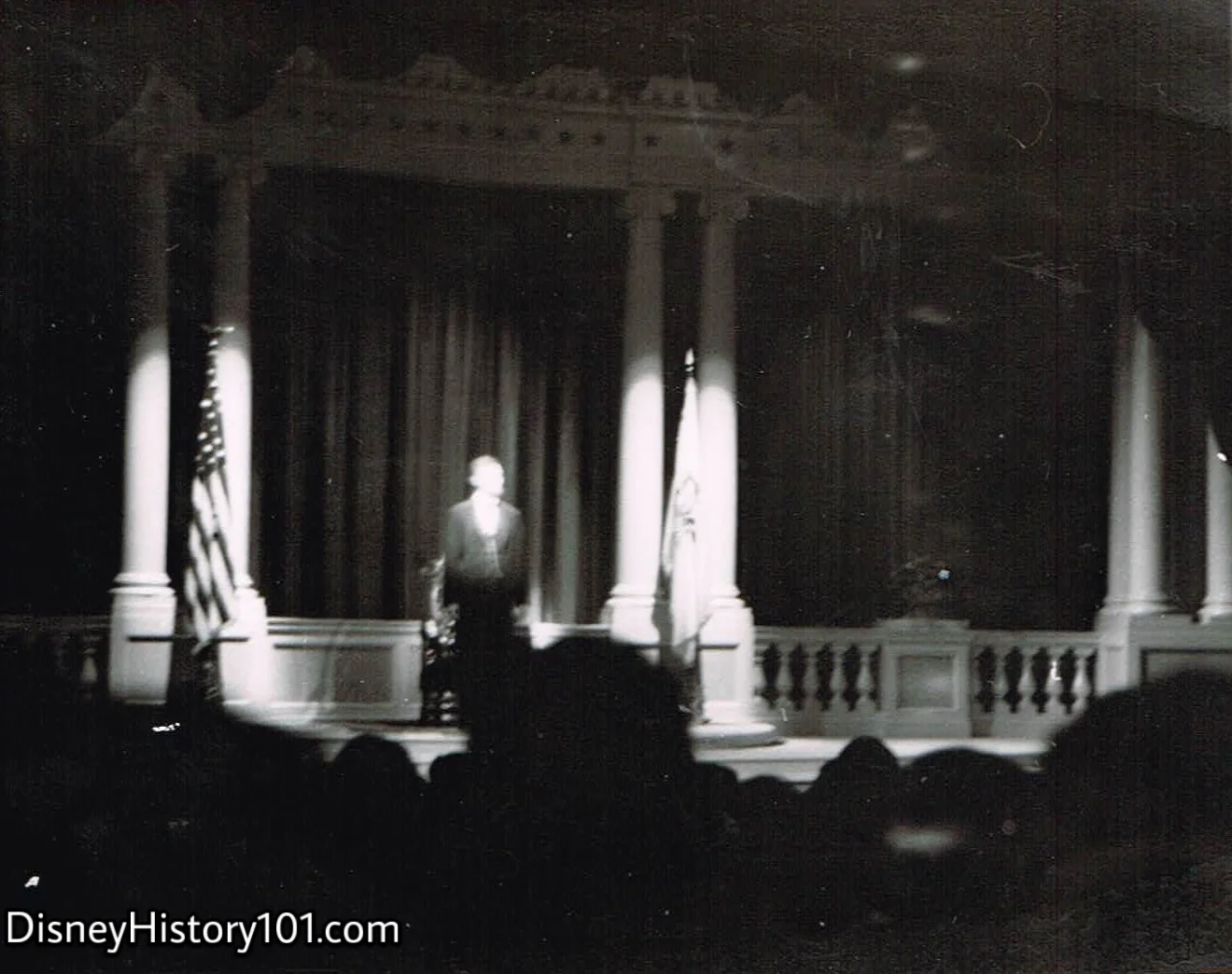
The Return of Great Moments with Mr. Lincoln, 1975
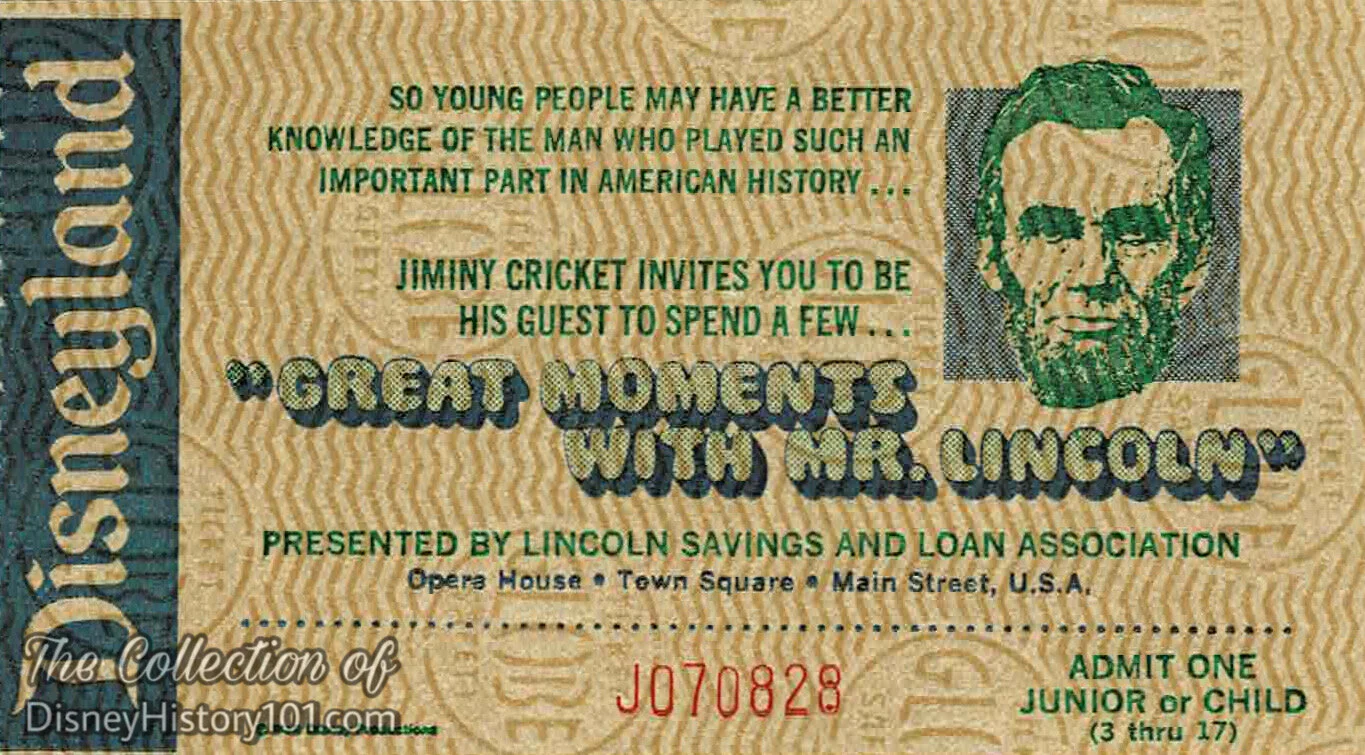
Great Moments with Mr. Lincoln Junior or Child Cricket Ticket
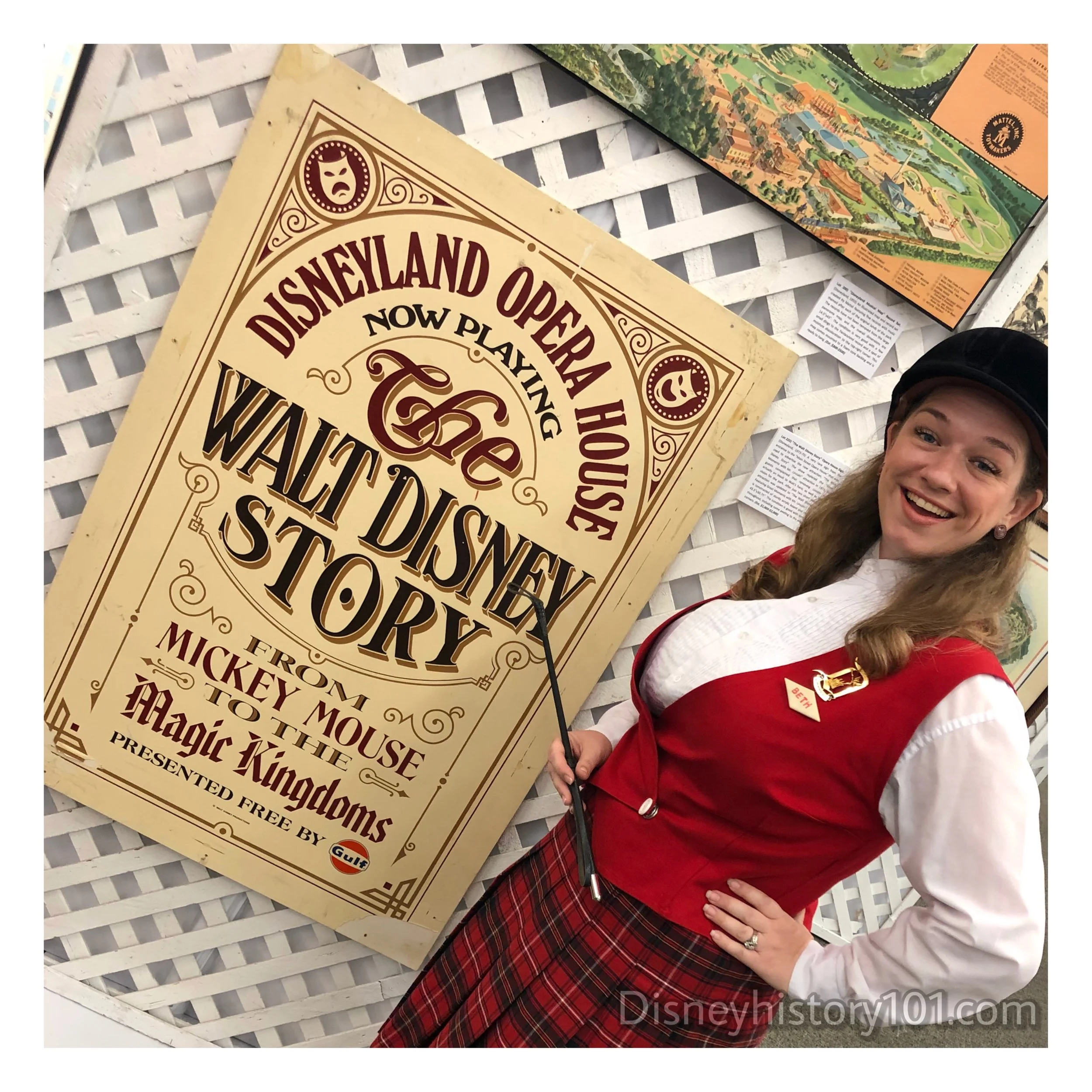
(April 8th, 1973 - February 17th, 1975)
A poster for "The Walt Disney Story", the former Richard Kraft Collection. You may notice the logo of proud exhibit sponsor Gulf Oil Corporation near the bottom of the poster. During their era of sponsorship, the Gulf Oil Corporation ran advertisements in Vacationland magazine.
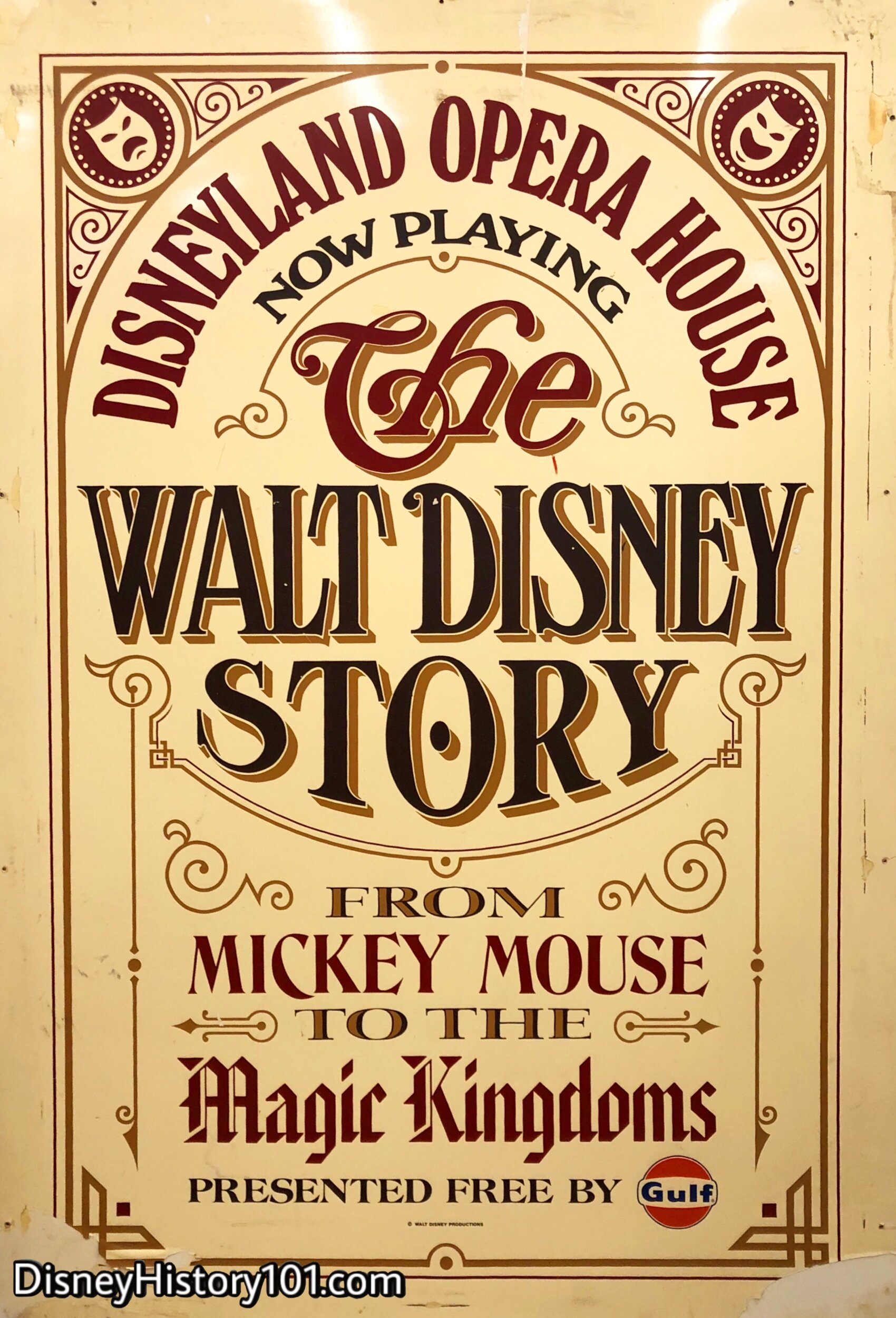
(April 8th, 1973 - February 17th, 1975)
The Walt Disney Story : From Mickey Mouse to the Magic Kingdoms was presented by sponsor Gulf Oil! By 1972, Gulf Car Care Center (open seven days a week, 6 a.m. to 12 midnight) was located near the Disneyland Parking Lot at the corner of Katella Avenue and West Street. The Gulf Car Care Center was a complete automotive service center, which included a automated car wash and wax. Welcome to Disneyland brochures of the era advertised this convenience in the Information section.
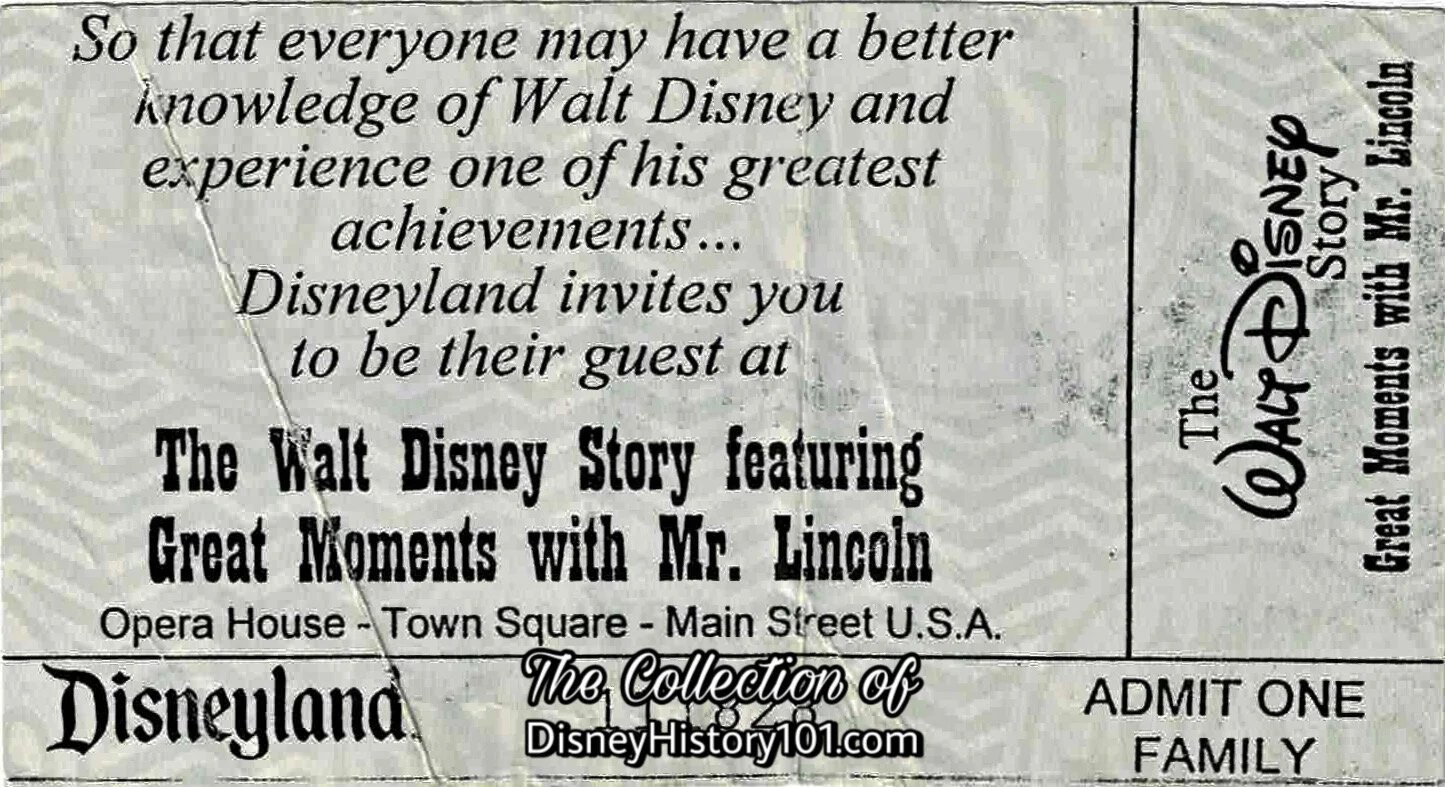
“The Walt Disney Story” featuring Great Moments with Mr. Lincoln Family Admission Ticket (Front)
“The Walt Disney Story” featuring Great Moments with Mr. Lincoln Family Admission Ticket & Stamp (Back)
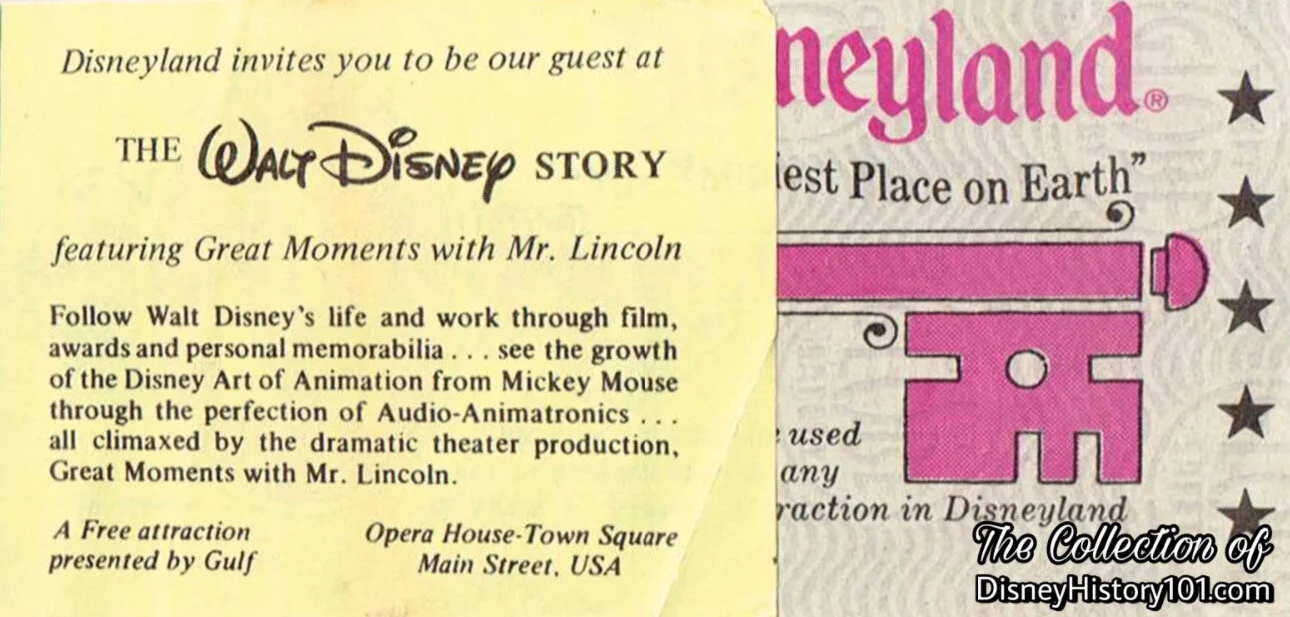
Disneyland Coupon Book Featuring “The Walt Disney Story” Advertisement
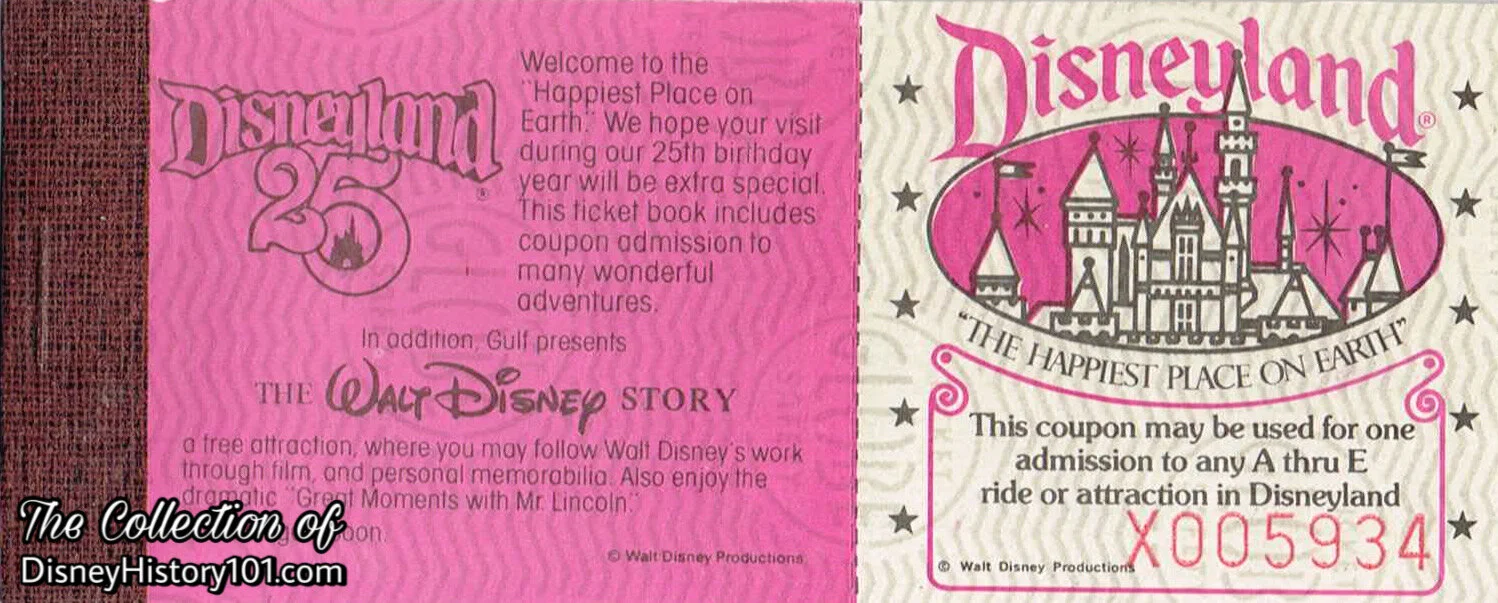
Disneyland Coupon Book Featuring “The Walt Disney Story” Advertisement
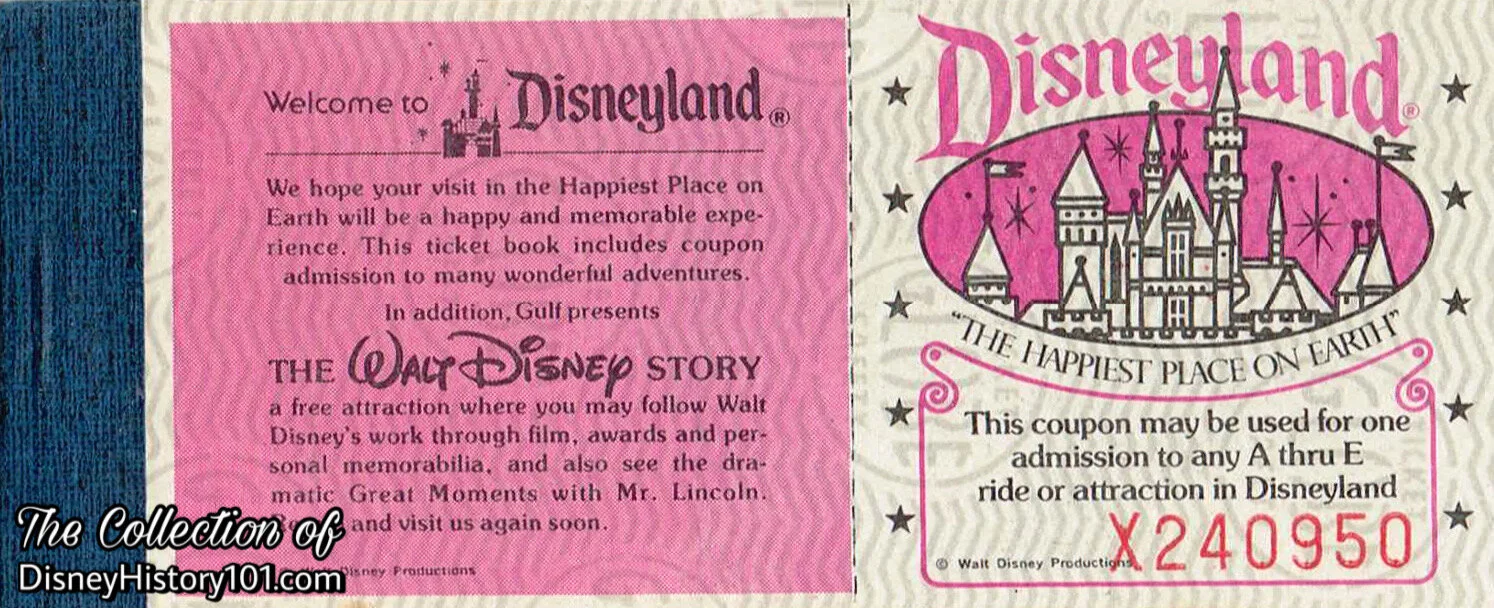
Disneyland Coupon Book Featuring “The Walt Disney Story” Advertisement
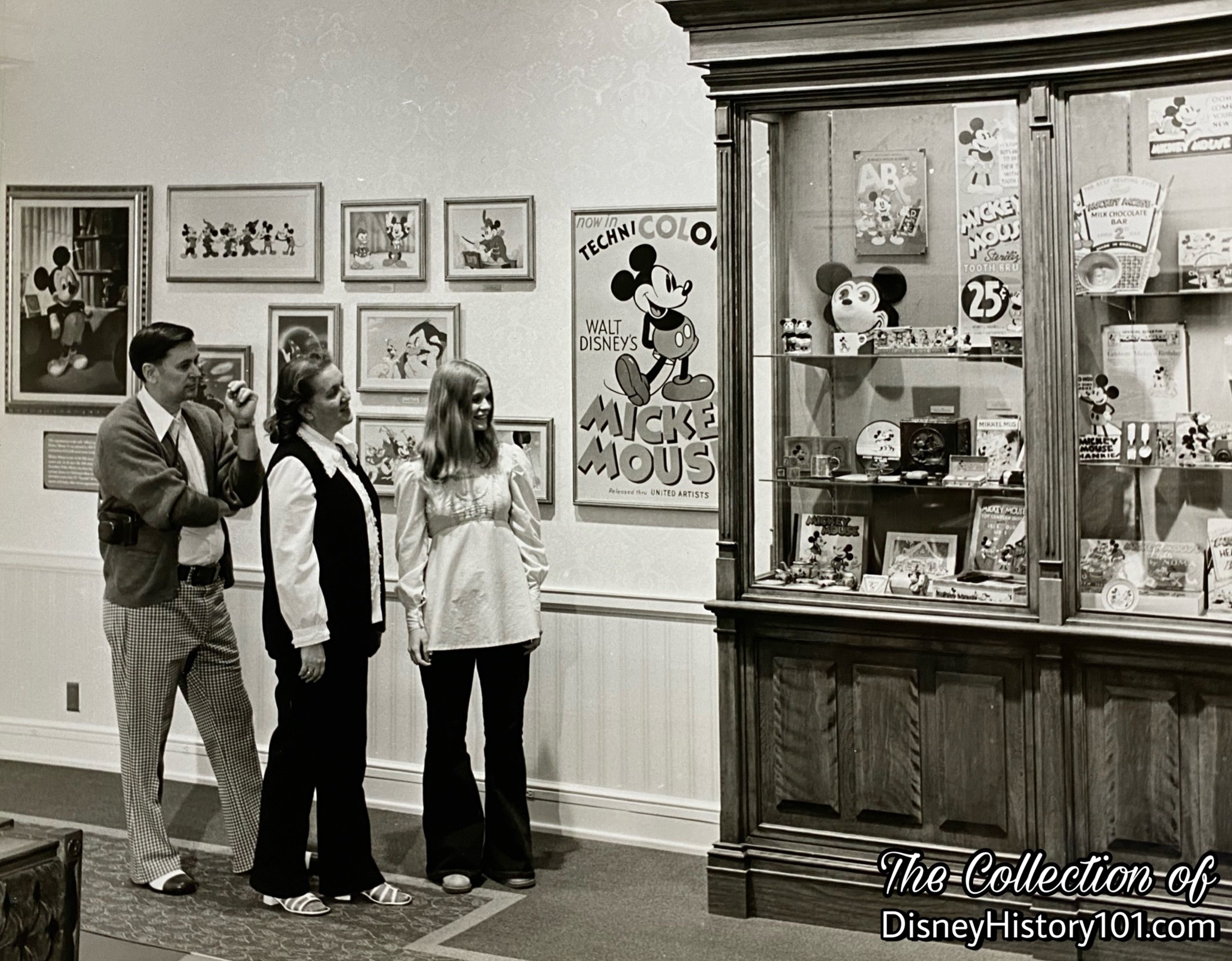
Press Photo, ©Disney.
“From Mickey Mouse to the Magic Kingdoms”
From Mickey Mouse to the Magic Kingdoms presented by Gulf Oil Corporation was a limited exhibit that ran during 1975. Walt Disney had been awarded “nearly 1,000 plaques, scrolls, Emmys and Academy Awards for his work,” according to “Disney News” (Winter 1975/1976). “The Walt Disney Story at Disneyland’s Main Street Opera House exhibits many of these awards in honor of the man who always remembered that ‘it all started with a mouse.’”
According to a Press Release: “One wall of ‘The Walt Disney Story’ pre-show area is dedicated to Walt's most famous creation, Mickey Mouse. Included in this area are photos from some of Mickey's most memorable screen appearances and a case filled with vintage Mickey Mouse merchandise material from the 1930's.” A wide variety of collectibles were on display, including a copy of “Mickey Mouse’s 25th Birthday” (by John Hench, 1953), a poster heralding United Artist’s distribution of Mickey Mouse shorts in Technicolor, lithograph stills of memorable moments from Mickey Mouse short films, and the production artwork that would become the iconic logo of the Walt Disney Archives.
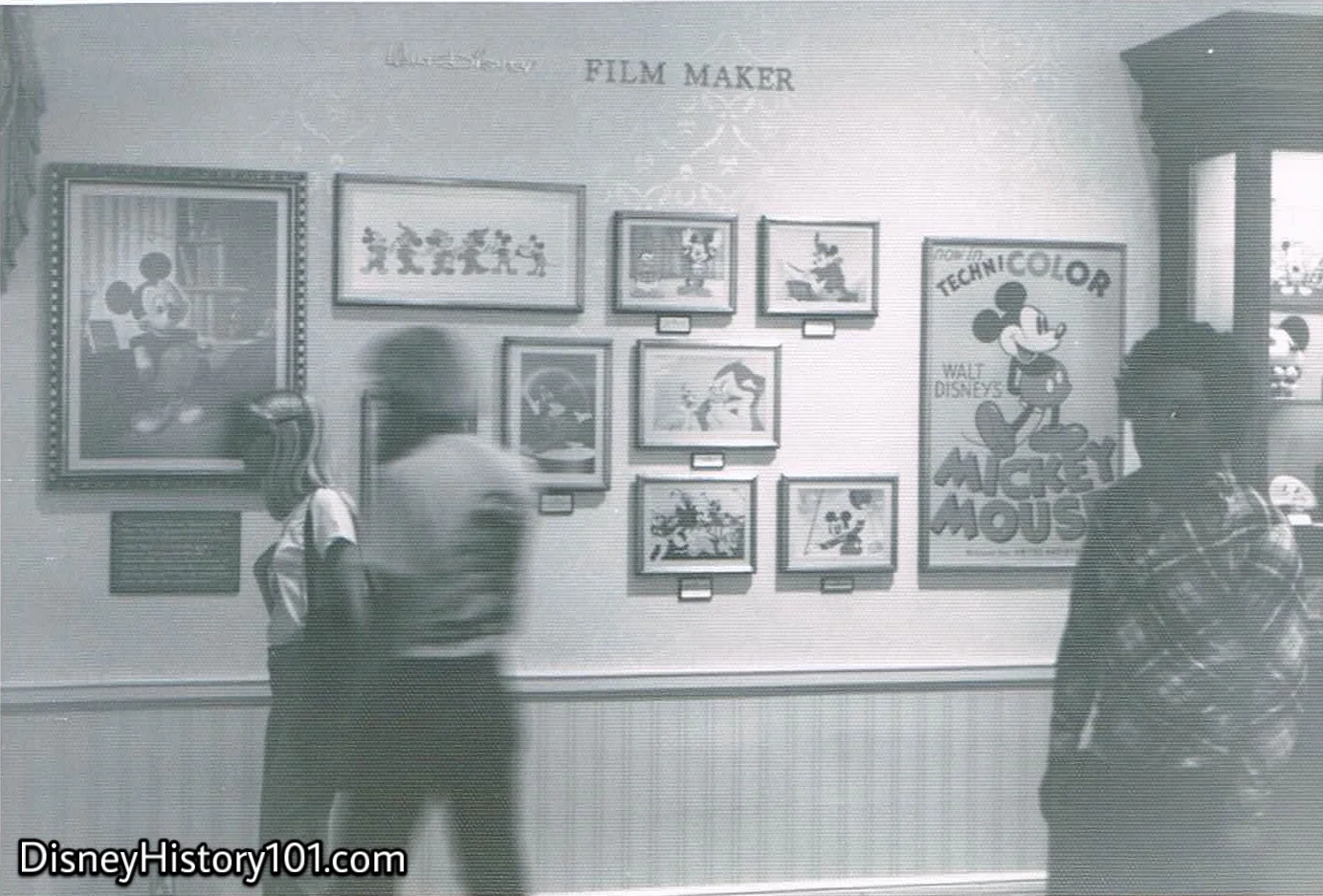
"Walt Disney - Film Maker" Display at "From Mickey Mouse to the Magic Kingdoms", (1975)
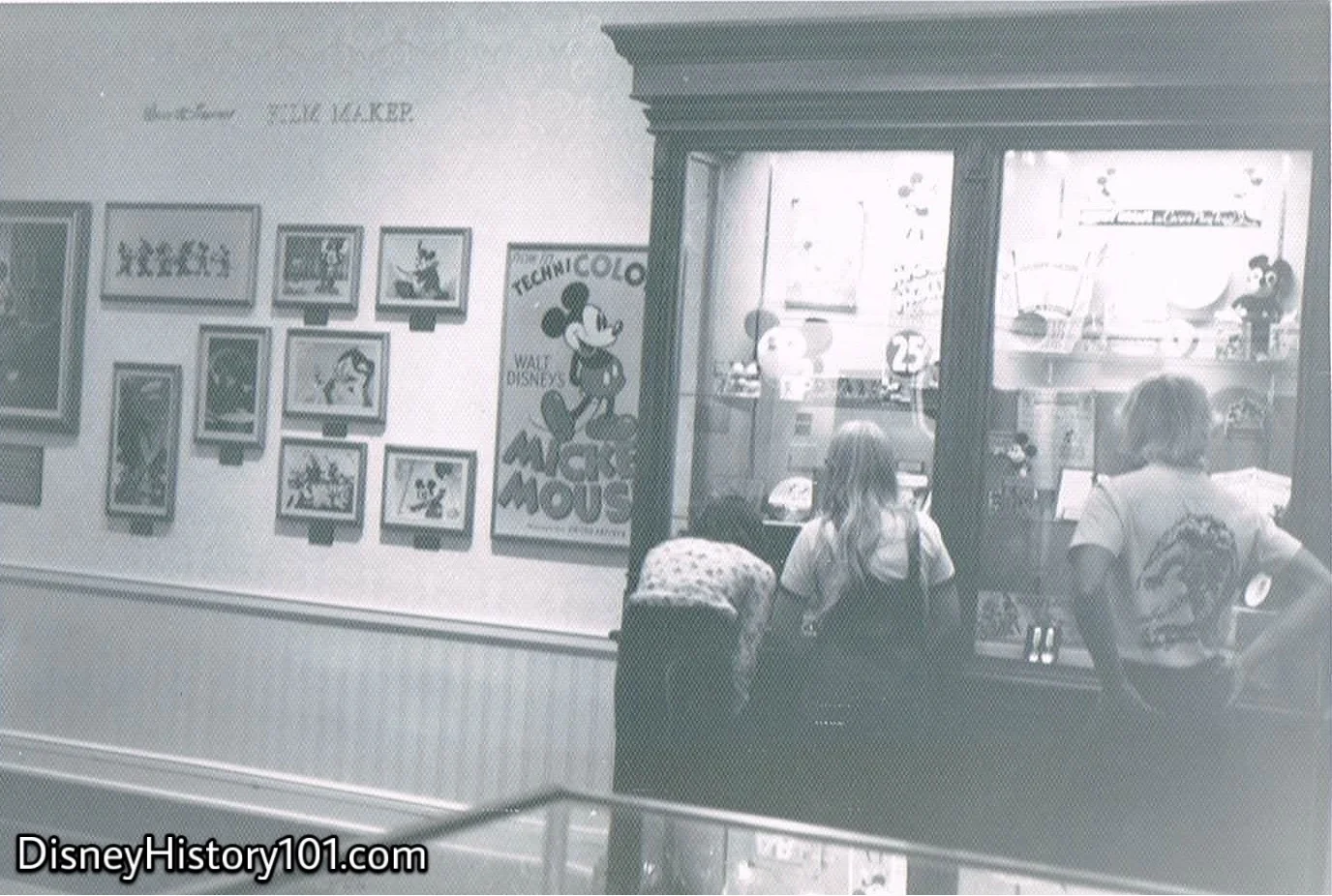
"Walt Disney - Film Maker" Display at "From Mickey Mouse to the Magic Kingdoms", (1975)
From Mickey Mouse to the Magic Kingdoms presented by Gulf Oil Corporation was a limited exhibit that ran during 1975. Many early examples of licensed Mickey Mouse merchandise were also on display.
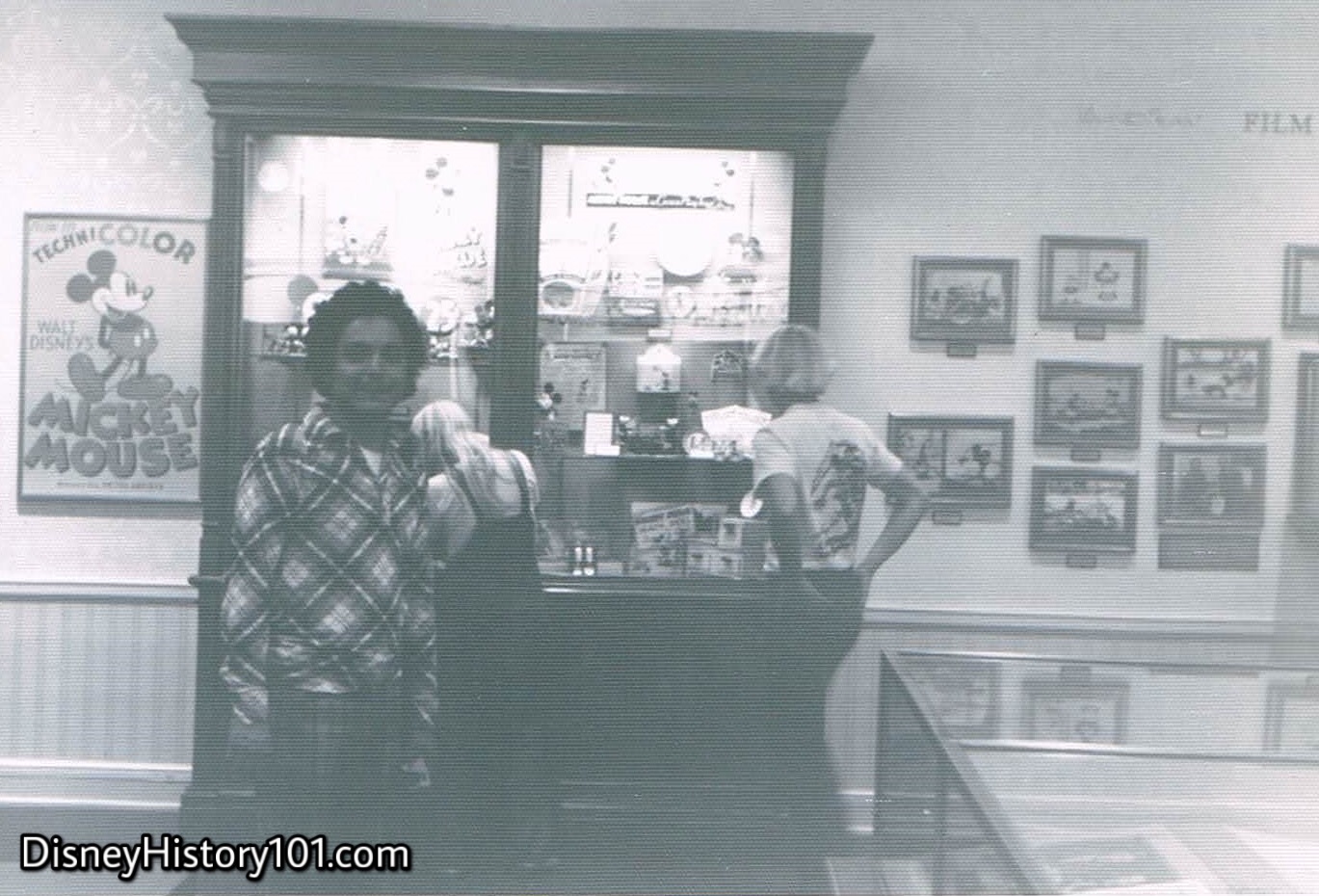
"Walt Disney - Film Maker" Display at "From Mickey Mouse to the Magic Kingdoms", (1975)
From Mickey Mouse to the Magic Kingdoms presented by Gulf Oil Corporation was a limited exhibit that ran during 1975. “The highlight of the attraction for many is a capsule history of Walt Disney’s career. The short film features Disney himself as he tells the story in his own words,” according to “Disney News” (Winter 1975/1976).
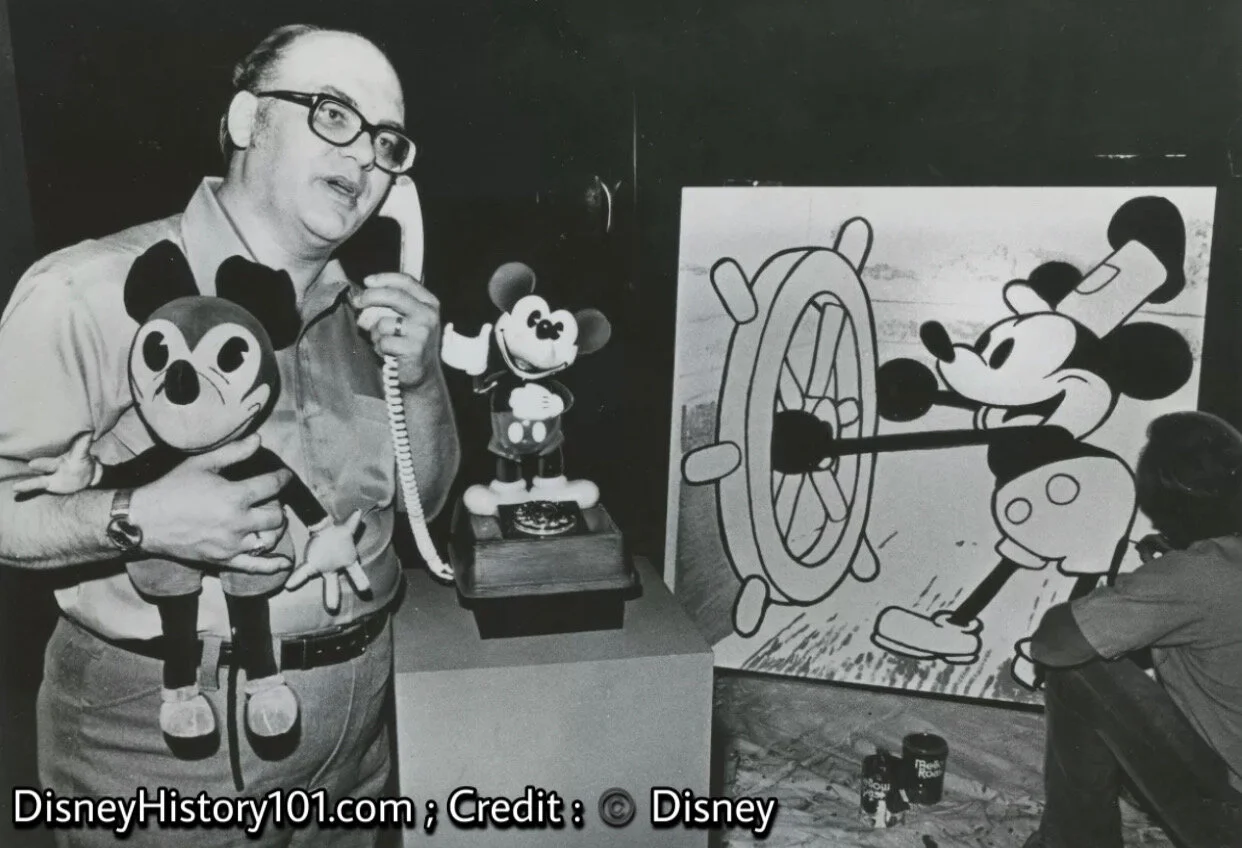
"From Mickey Mouse to the Magic Kingdoms"
This Los Angeles Times publicity photograph (by Deris Jeanette) accompanied an article about some of the rare Mickey Mouse collectibles that were temporarily loaned for the duration of the exhibit. According to the accompanying caption, “Mickey Mouse fan Jerry Muller, at left, clutches a 1934 Mickey Mouse doll while using the latest Mickey phone, two items of the Mickey Mouse memorabilia he will be displaying at the Bowers Museum in Santa Ana, California to mark Mickey’s 50th birthday. At Muller’s right, an artist paints a facsimile of Mickey in ‘Steamboat Willie’, his cartoon debut, generally used to determine his birthday.”
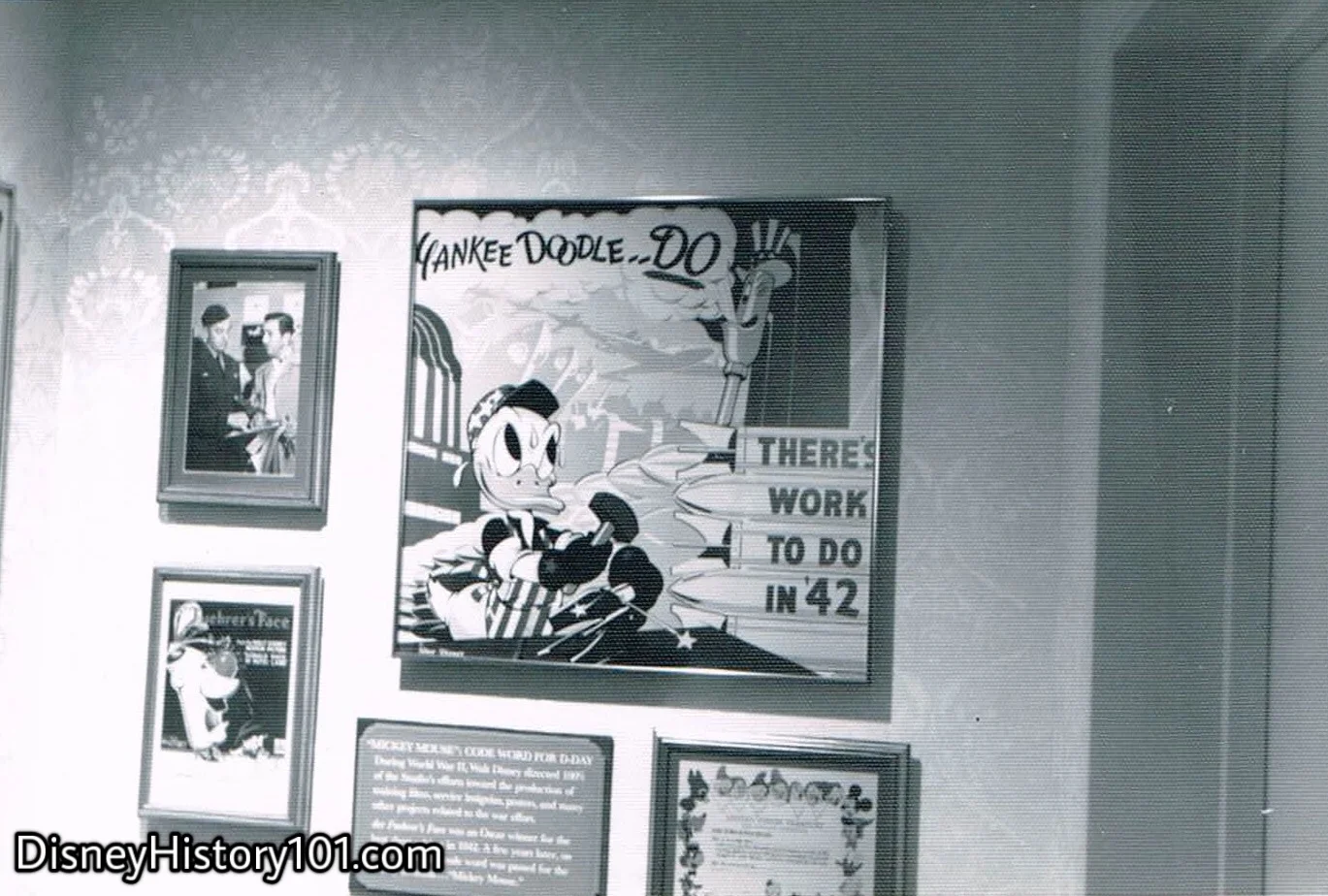
From Mickey Mouse to the Magic Kingdoms, 1975
This portion of the exhibit showcased a few of Walt Disney’s wartime contributions including government-funded short films, United States Bond Certificates, illustrations utilized on bills and wartime insignia (featuring Walt Disney’s characters) provided to various branches of the United States Special Forces.
From Mickey Mouse to the Magic Kingdoms, 1975
From Mickey Mouse to the Magic Kingdoms, 1975
Another part of the exhibit displays artifacts pertaining to Walt Disney’s various contributions toward the (World War 2-era) war efforts. Some of these pieces related to training films, artwork featured on war bonds, and artwork created for insignia.
From Mickey Mouse to the Magic Kingdoms, 1975
From Mickey Mouse to the Magic Kingdoms, 1975
1975
From Mickey Mouse to the Magic Kingdoms presented by Gulf Oil Corporation was a limited exhibit that ran during 1975. Another exhibit highlighted moments of “Walt Disney’s Dream Come True” - Disneyland! “One of the most intriguing displays of The Walt Disney Story concerns Disneyland. Surrounded by photographs taken during the building of the Park, a small viewing screen shows a speeding-up movie of the actual construction. Thus, the one-year-plus-one-day construction project, which turned an orange grove into a Magic Kingdom, is seen in only three minutes,” according to “Disney News” (Winter 1975/1976).
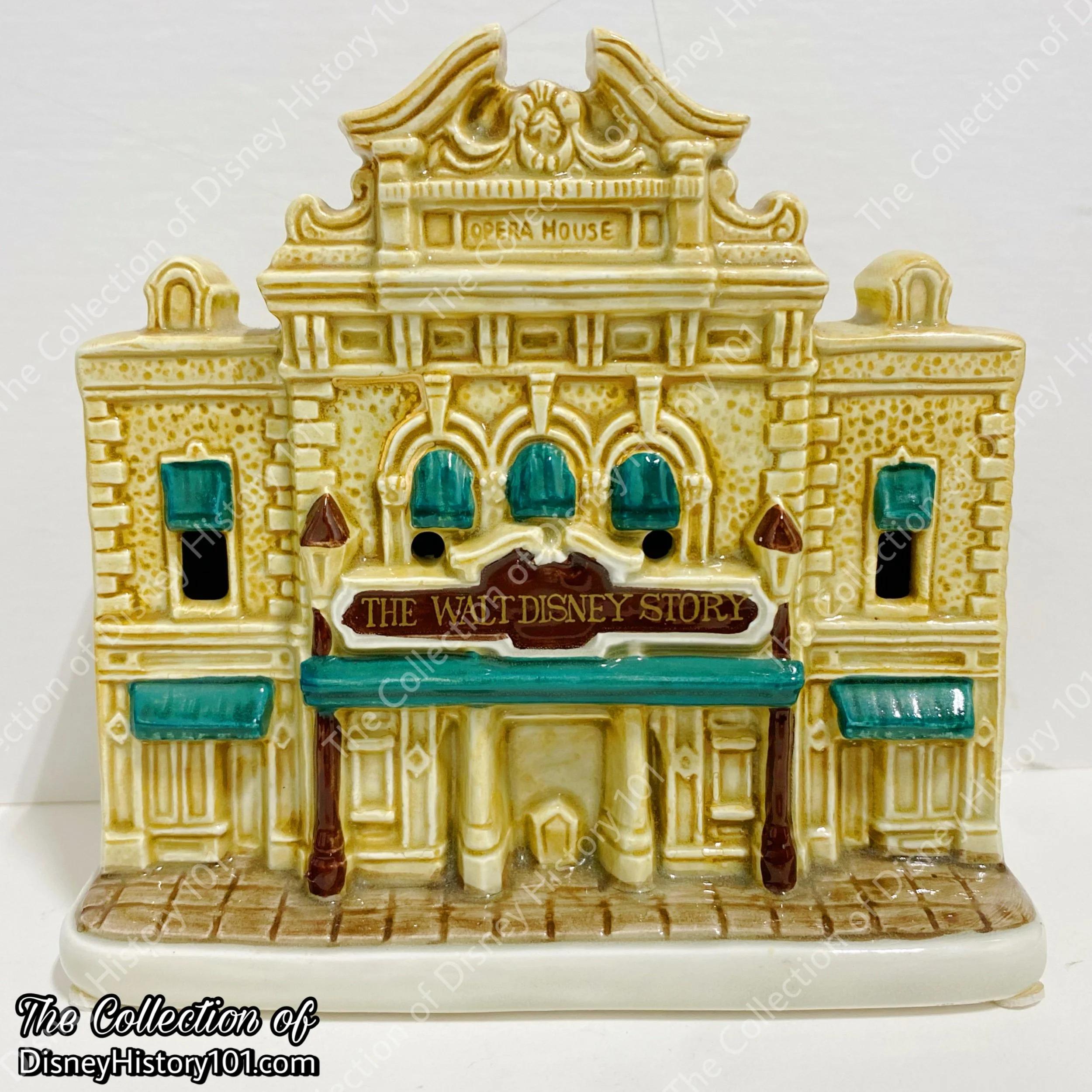
By 1981, The Walt Disney Story was a free attraction with a cycle time of 14.52 minutes, they show capacity of 500, and the capacity of 2000 Guests per hour.
The 7th Annual Festival Japan Schedule, October 12 & 13, 1985
“Main Street Opera House (or ‘Lincoln Theater’) Special Exhibits”
The late 1970s began to bring unique exhibits, attractions, and events to the Main Street Opera House! “Candidates for the City of Anaheim’s 1978 City Council elections” appeared at the Main Street Opera House [at 7:30pm] on April 6th, 1978, “as part of our Community Affairs Department - sponsored ‘Know Your Home Town.’”
During the ninth annual “Festival Japan” (October 12 & 13, 1985), Kookyu and Kumiko Serizawa’s Doll Exhibit was housed in the Great Moments with Mr. Lincoln Lobby from 9a.m. to 6p.m. Guests were inspired by the exhibit like Charra DeMarco (a contemporaneous Disneyland Word Processing Specialist) who became interested in doll making during a previous Festival Japan event held at Disneyland, and soon signed up for a class taught by Kumiko Serizawa. Charra’s teacher was so impressed, that “the DeMarco’s dolls were chosen to be in the exhibition… in the Park.” [Disneyland Line, Vol. 17, No. 41] As brief as this exhibit was, it would inspire an interest in Japanese culture within Disneyland Cast Members and guests, and would pave the way for other cultural events and exhibits showcased at the Main Street Opera House!
A poster for the “EPCOT Center Project Update” that was presented from the Lincoln Theatre at Disneyland, July 11-16.
In addition to the special exhibits and shows, the “Lincoln Theatre” also became the stage for the occasional special Cast Member Exclusive presentation.
For instance, the EPCOT Center Project Update was presented at the Lincoln Theatre in Disneyland from July 11-16, 1982. The presentation was hosted by Ron Dominguez, and showcased the film “Epcot Behind the Scenes”. The presentation also featured the latest construction slides along with theme music from Pavilions, gave updates about Operations and Entertainment/Marketing plans.
"Lincoln Theater" Advertisement, Published in Disneyland LINE, (October 12, 1978)
“Film Festivals”
Throughout the year, Cast Activities arranged for Cast Members and their families to have the opportunity to attend special showings of Disney films. Each spring and fall, a series of five “classics” was lined up for viewers to choose from, with showing times established around Park operating hours. In addition, new Disney films were previewed for Cast Members, generally before the film was released to the general public, through our Cast Film Premieres.
Tickets for all films were complimentary. Disneyland Cast Members may recall ticket information was often advertised through the covers and pages of Disneyland LINE magazine, while tickets were usually distributed On Site, through the Center (before Company D opened December 2, 1988 ; and Company D II soon followed, offering tickets as well).
Back in the 1960s, the Fall Film Series was presented (usually from the Mickey Mouse Theater). In the late 1970s, seasonal film festivals (twice a year, in the Spring and Fall) brought Cast Premiers of Walt Disney Productions to the Main Street Opera House.
Some of the earliest showings (held during the weeknight of the spring of 1977) were Walt Disney’s Sleeping Beauty, The Shaggy D.A., Freaky Friday, and The Love Bug (which had recently been released theatrically). The Fantasyland Theater also hosted showings (as Walt Disney’s Pinocchio), and all the films were shown with Walt Disney’s short films (like “Moose Hunters,” “Moving Day,” “For Whom the Bulls Toil,” “Boat Builders,”and others. The Song of the South was shown (from November 14th - 17th), with The Third Man on the Mountain being the last show of the Fall Family Film Festival, during 1977.
The following year, (March 13, 14, 15, and 16, 1978) brought Walt Disney’s “The Parent Trap” to both the Lincoln Theater and the Fantasyland Theater.
The Fall Film Festival of 1980 (for instance), brought “The Last Flight of Noah’s Ark” (the first Fall Film Festival showing of the year), “White Wilderness” (the True-Life Adventure), Walt Disney’s “Dumbo” with “The Brave Little Tailor”, and even Walt Disney’s “Song of the South”. As you can see, the feature-length films presented were eclectic - from Walt Disney’s classics to recent releases, and from live-action to animated! The year 1983 saw Cinderella (in February), while 1986 saw The Flight of the Navigator, Ruthless People, and Tough Guys shown on the big screen. Fast forward to the year 1987 (when the Cast Activities Disneyland Family Film Festival tradition still continued), bringing Cast Premiers of Walt Disney Productions (like “Peter Pan,” “Cinderella,” and “The Fox And The Hound”), Touchstone Pictures (like “Stakeout”, “Can’t Buy Me Love”, and “Adventures In Babysitting”), and “Benji The Hunted” to the Lincoln Theater and the Videopolis Stage. The Disneyland Hotel Grand Ballroom was also occasionally used as a theater (as for the August 24th, 1988 Special Cast Premier of “The Rescue”), but the “Lincoln Theater” (or Main Street Opera House) was still the preferred venue for the showings.
Fall Film Festivals (at the “Lincoln Theater”, at least), would briefly cease for a rehabilitation. During the 1990s, the 40-year-old original facade of the Main Street Opera House was given an “opulent” makeover - parts were recast in fiberglas and details (like the theater masks and filigree) were stripped and a glaze was added to enhance the original sculpts. After so many years, the awnings over the windows were removed, and it was decided to leave them off, in order to show off the detail around the windows.
Once the new Main Street Opera House was re-opened, the “Lincoln Theater” hosted the “35th Anniversary Cast Celebration” - “an exciting preview of future events and projects with your hosts Dick Nunez, Ron Dominguez, and Hideo Amemiya”. Refreshments were served, and reservations [to 1 of 18 showtimes, spread across January 6th - 9th, 1990] were made in the name of each current Cast Member. After the “35th Anniversary Cast Celebration”, there again occurred a special synergistic arrangement between Walt Disney Studios and Disneyland! Disneyland Cast Members and their immediate family members were once again treated to Walt Disney Film Festivals - opportunities to watch Walt Disney Pictures and Touchstone Pictures on the silver screen (in most cases) before their national release dates. Among the films shown were animated feature length films Walt Disney’s Snow White and the Seven Dwarfs and Walt Disney’s The Jungle Book. Live action feature length films that the whole family could enjoy - Blank Check, White Fang, A Far Off Place, The Mighty Ducks, The Rocketeer, Cool Runnings, Cool Runnings, Swing Kids, and many, many, more! Other Touchstone Pictures and Hollywood Pictures as The Distinguished Gentleman, Three Men And A Little Lady, Green Card, Run, Scenes From A Mall, The Color of Money, and Ruthless People were rated “R” (and as children under 17 were not permitted without a parent or guardian), Disneyland Cast Members had to decide whether or not they would bring their entire family to the special screenings. Admission for all showings required the purchase of a ticket through The Center, and a display of their Cast member I.D. and Main gate Pass. As a “sidelight”, during the same era, Disneyland Cast Members could also purchase Walt Disney Home Videos of feature-length films in VHS and Beta formats, available at the Center.
An advertisement for the 1985 Springtime Family Film Festival at Disneyland
c. 1990 Film Festival at The Lincoln Theater Tickets
c. 1990 Film Festival at The Lincoln Theater Tickets
c. 1991 Film Festival at The Lincoln Theater Tickets
c. 1991 Film Festival at The Lincoln Theater Tickets
c. 1992 Film Festival at The Lincoln Theater Tickets
c. 1993 Film Festival at The Lincoln Theater Tickets
c. 1994-1995 Film Festival at The Lincoln Theater Tickets
By 1996, The Walt Disney Story, featuring “Great Moments with Mr. Lincoln” was a Lobby show presenting the story of Walt Disney and The Walt Disney Company, while the Audio-Animatronics® theater show still honored the 16th President of the United States.
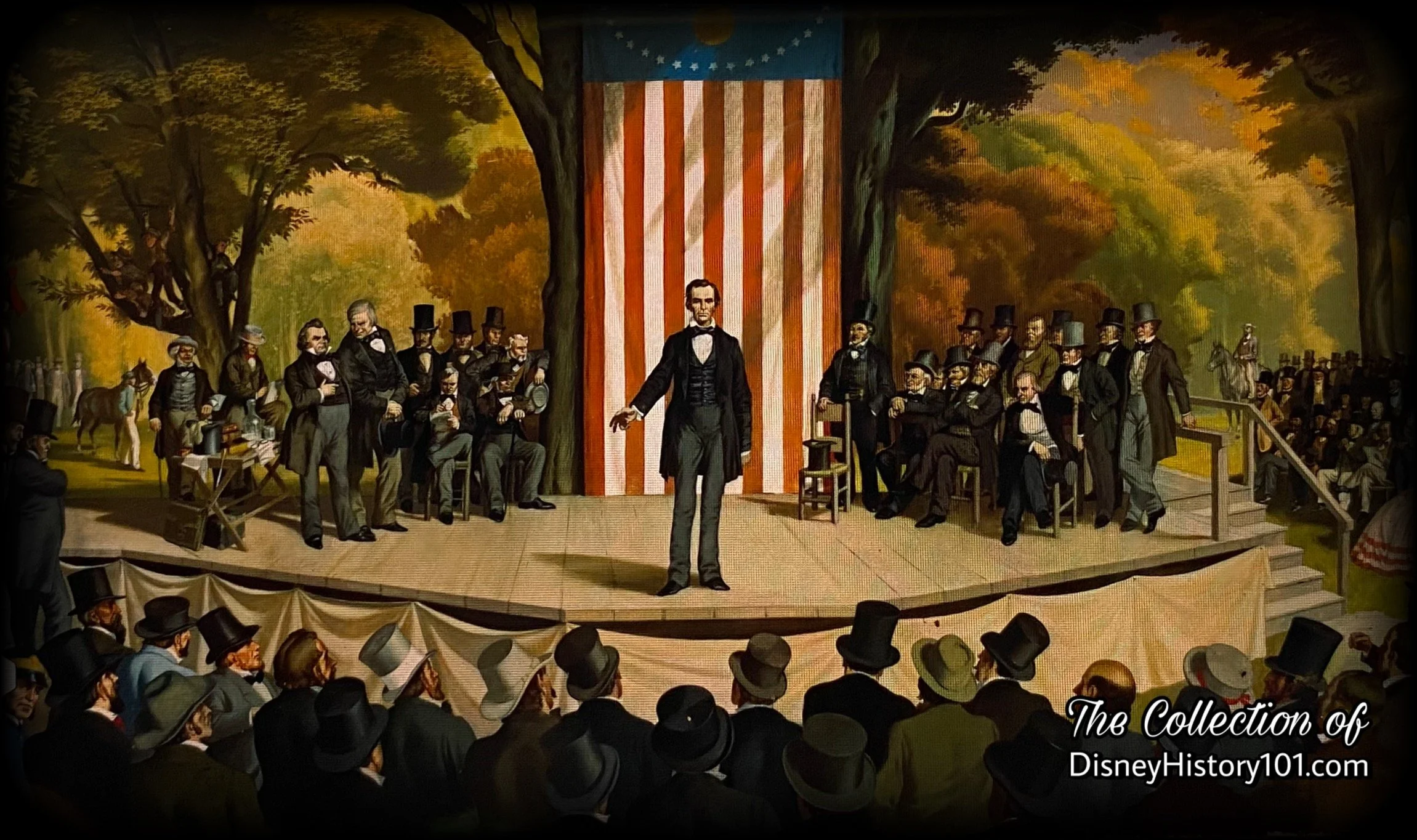
Note the frame’s complete field photographed by the camera in this Frame
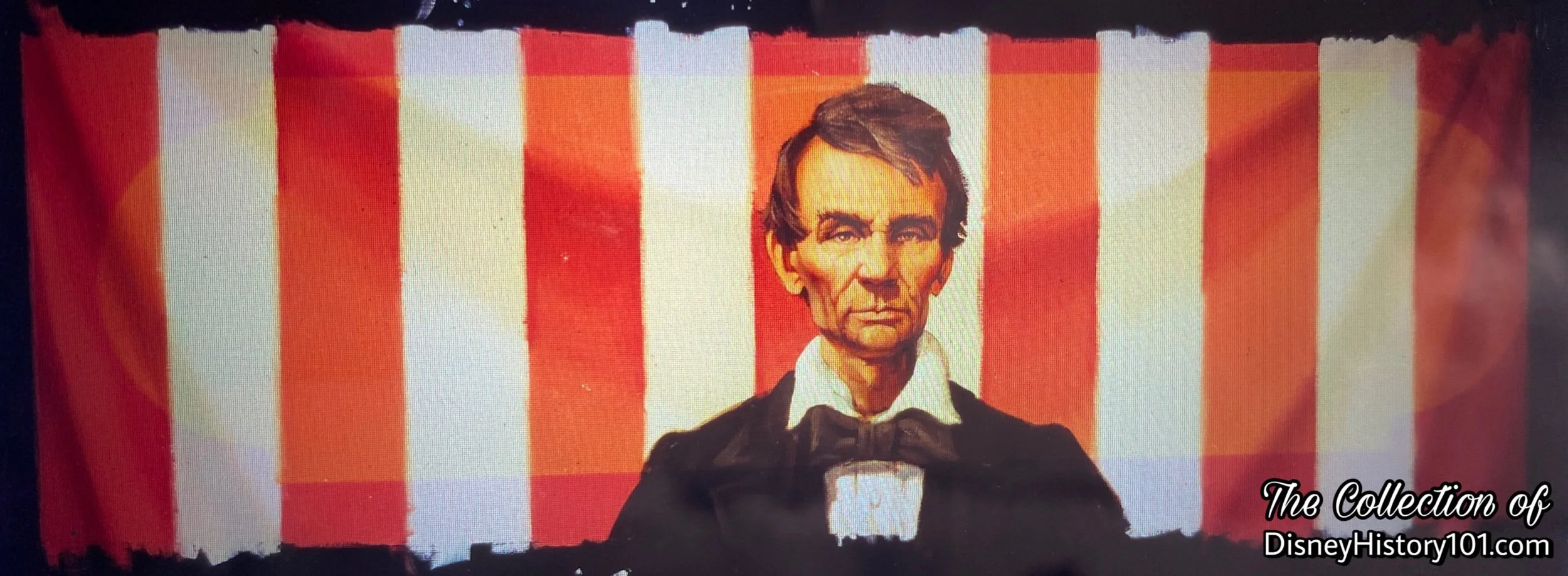
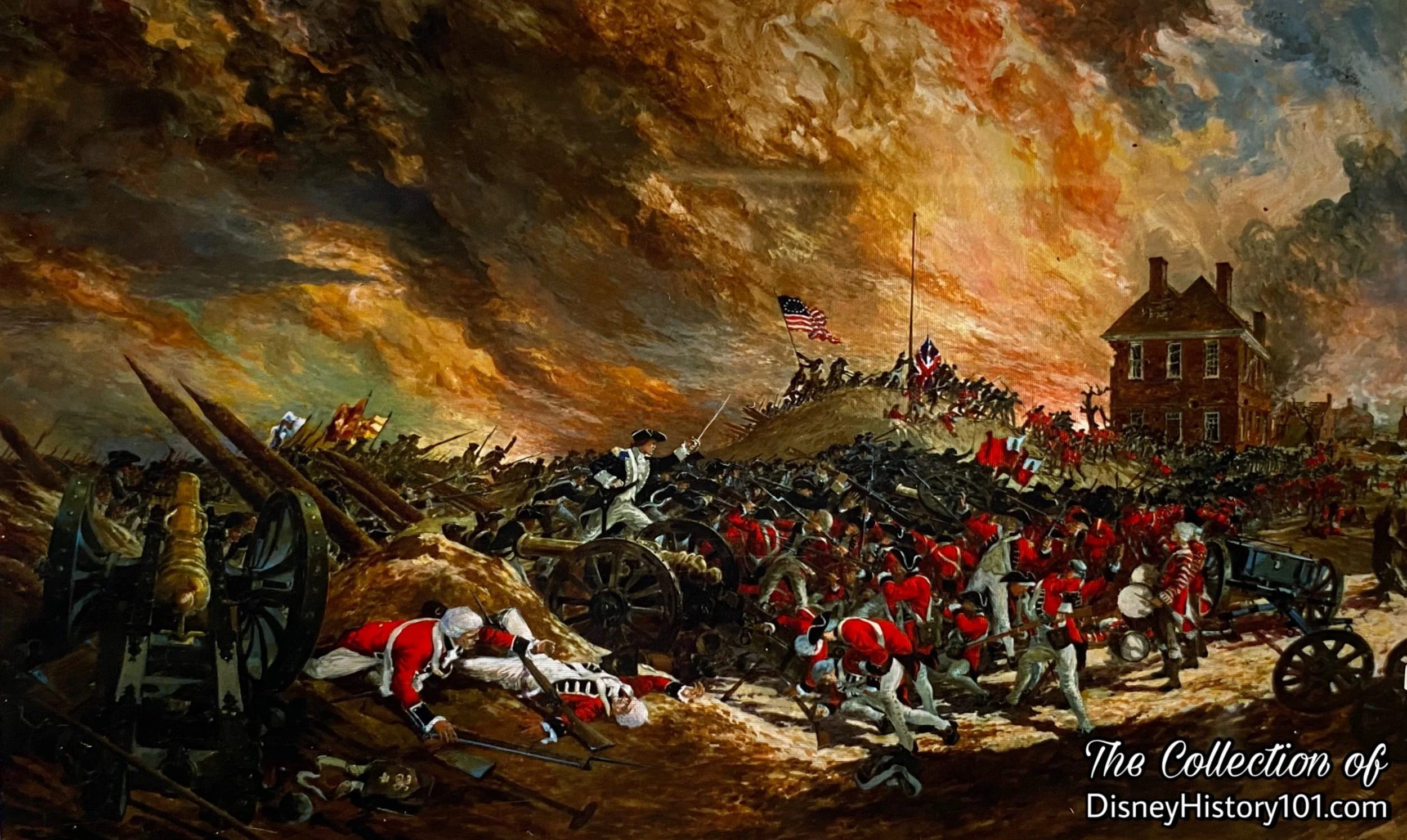
Frame
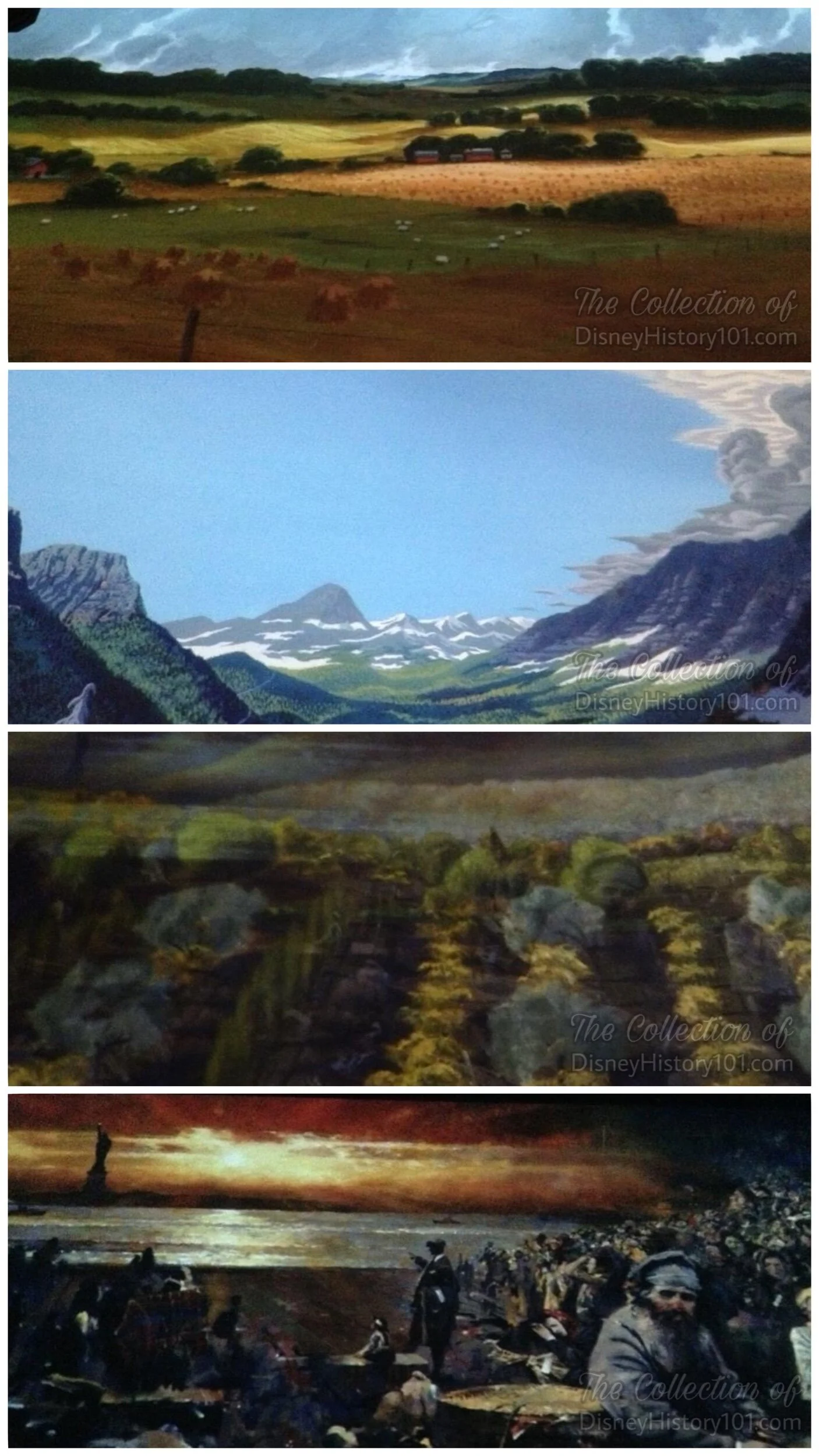
Great Moments with Mr. Lincoln Projected Pre-Show Scenes
You may have seen some of these scenes before. Slides include imagery like Herb Ryman’s Immigrants at Ellis Island (a 51”x93” oil painting) originally produced c.1982 for The American Adventure at EPCOT Center.
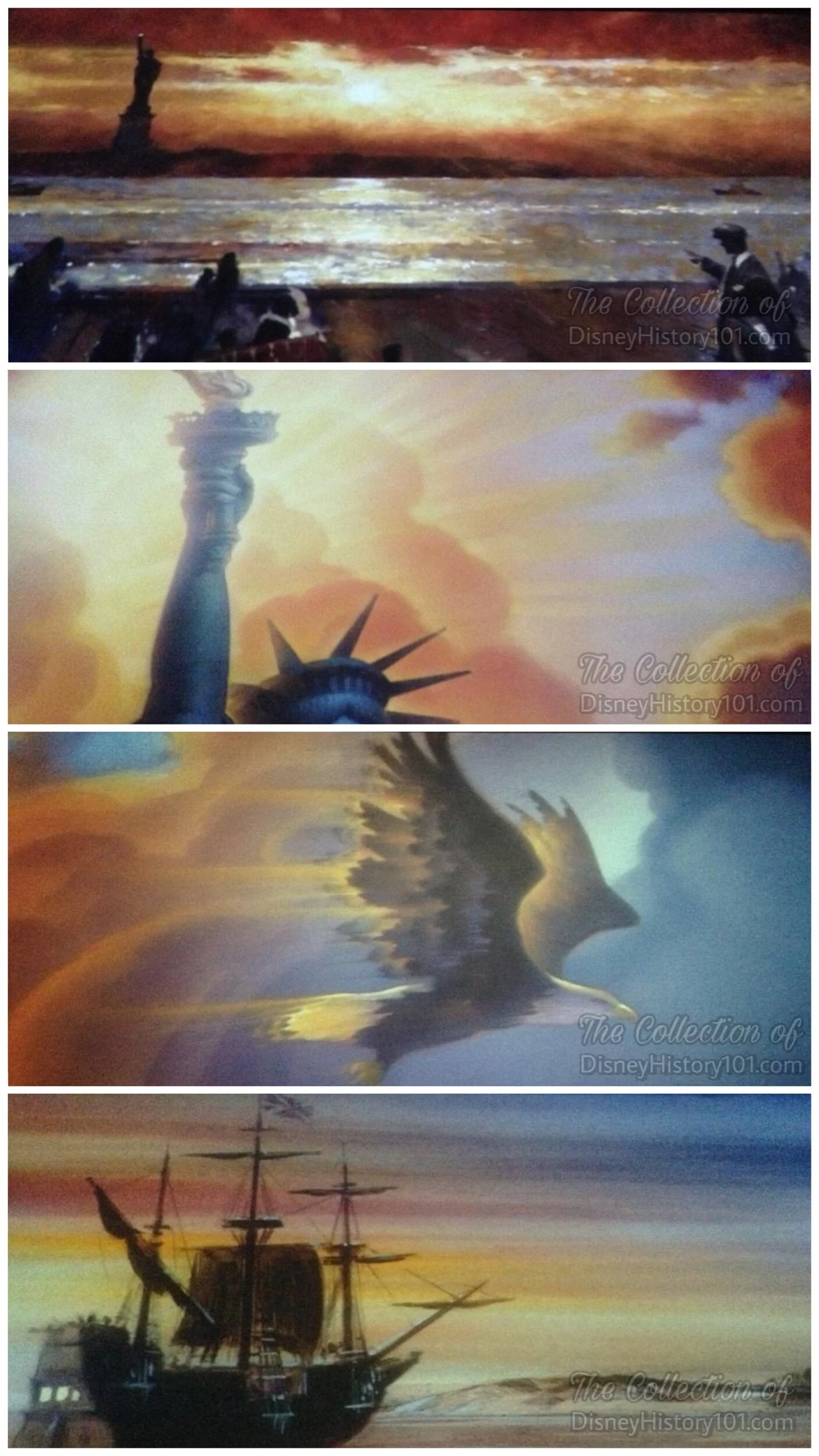
Great Moments with Mr. Lincoln Projected Pre-Show Scenes
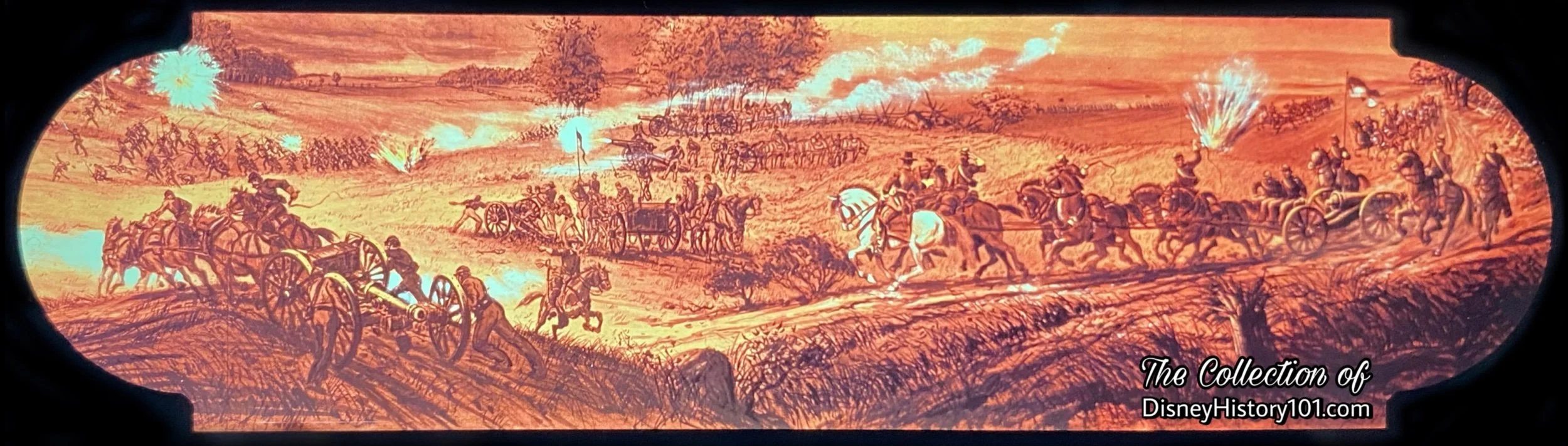
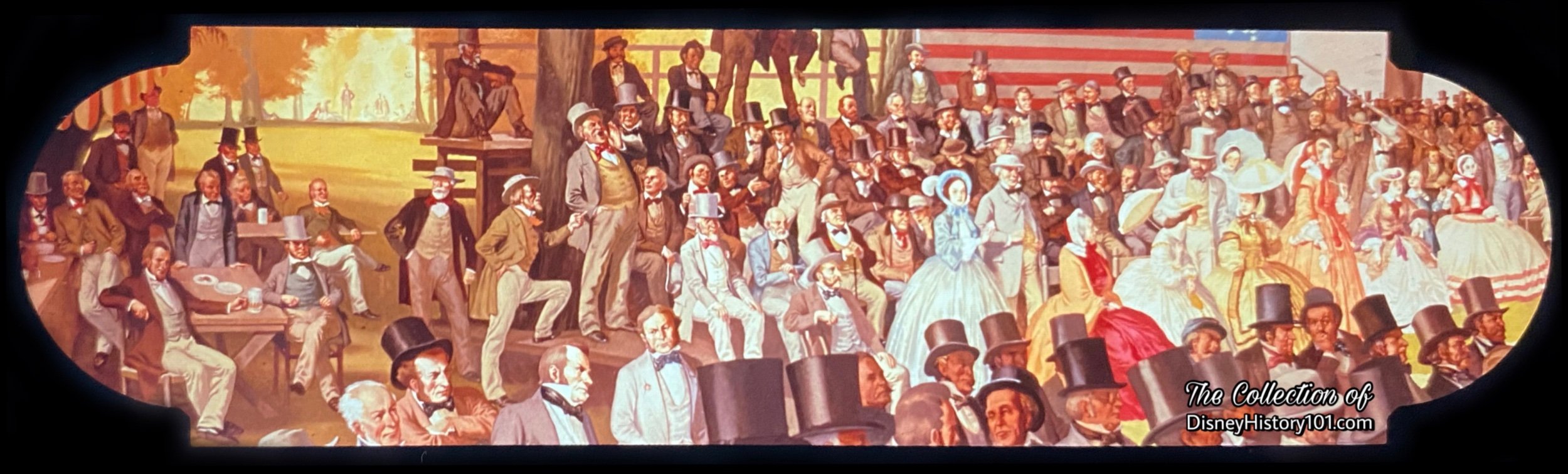
In 1999, Master Plans included a “Muppet Theater” located here.
A new slide show and Audio-Animatronics animation was added in 1984, enabling Mr. Lincoln to hold a paper in his hand for the first time. In addition, to two new songs originally written for The American Adventure, part of the American Pavilion at EPCOT Center. “Golden Dream” (with orchestration by Robert Moline, lyrics by Randy Bright & Lynn Hart, and vocals by Richard Page and Siedah Garrett), and “Two Brothers” (a traditional folk song with orchestration by Irving Gordon and lyrics by Ali Olmo).
Show Enhancement - “In 2001 the show was changed to focus on the Civil War,” according to Dave Smith (Chief Archivist Emeritus of the Walt Disney Archives). The short film told the tale of “Two Brothers,” who fought on separate sides of the American Civil War. The show featured glass magic lantern slides of true-life Civil War-era images, to “Two Brothers” (with orchestration and lyrics by Irving Gordon).
“Two brothers on their way,…”
“Two brothers on their way.”
“One wore blue and one wore gray.”
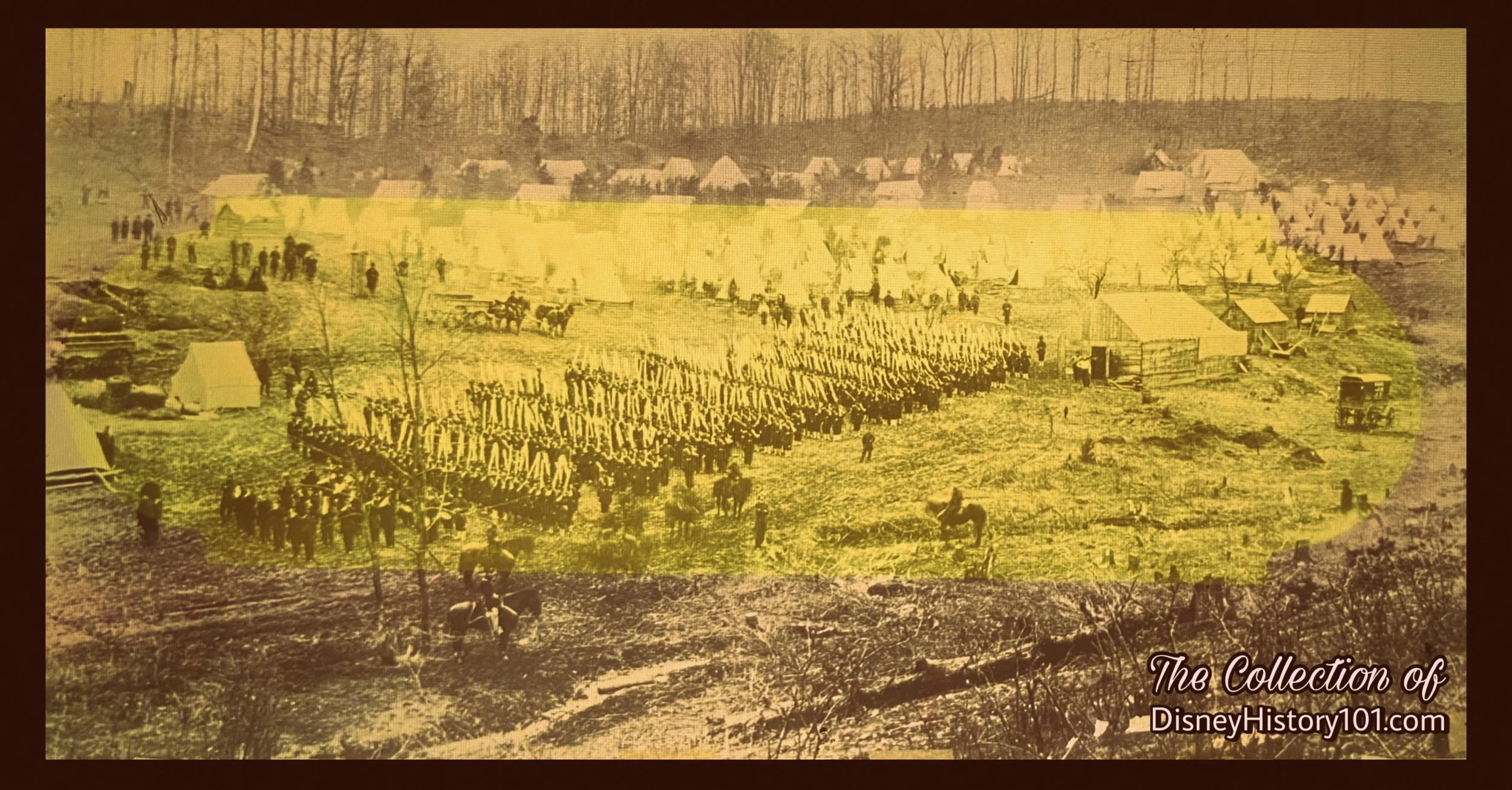
“The fife and drum began to play, all on a beautiful morning.”
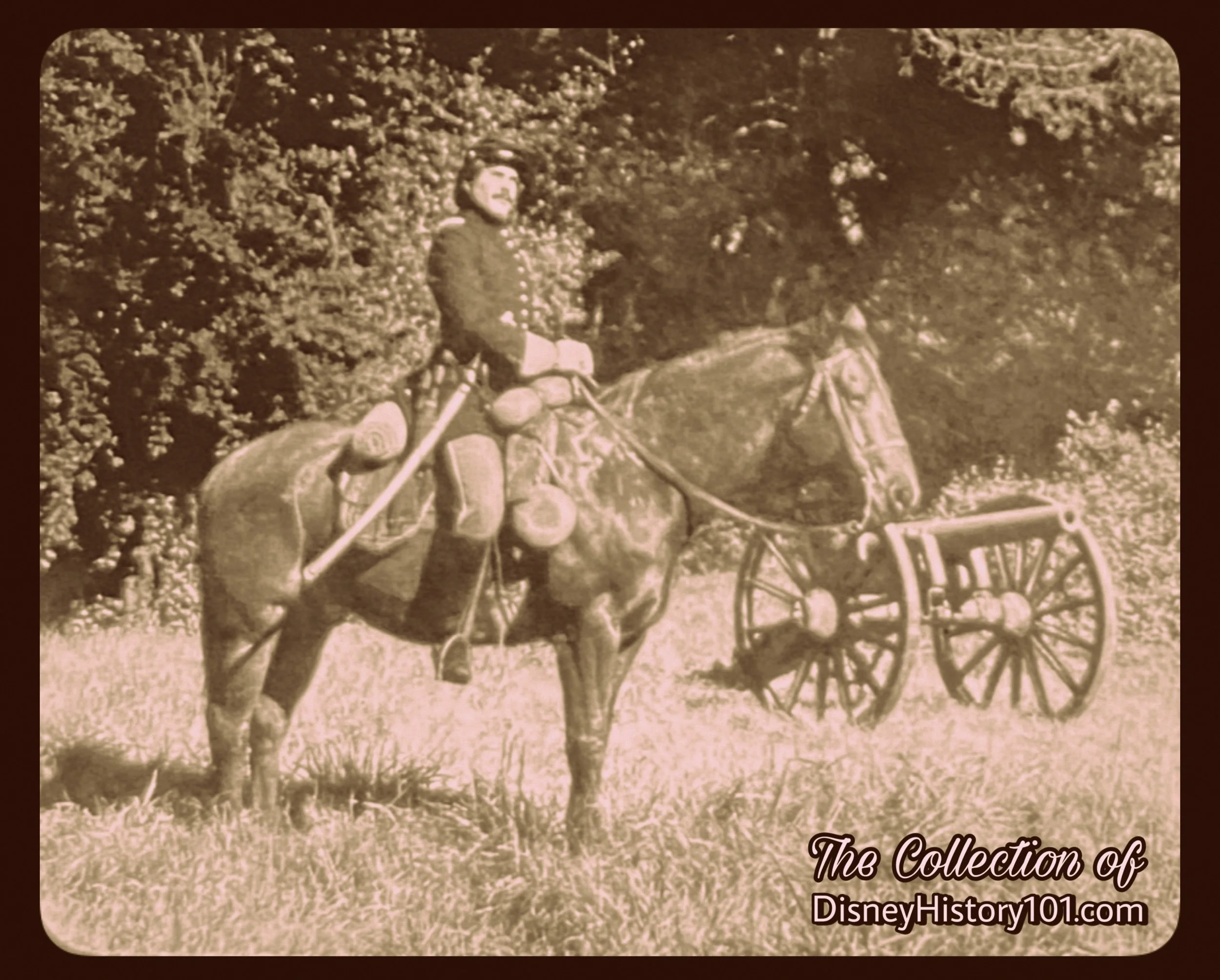
“One was gentle, one was kind. One came home…”
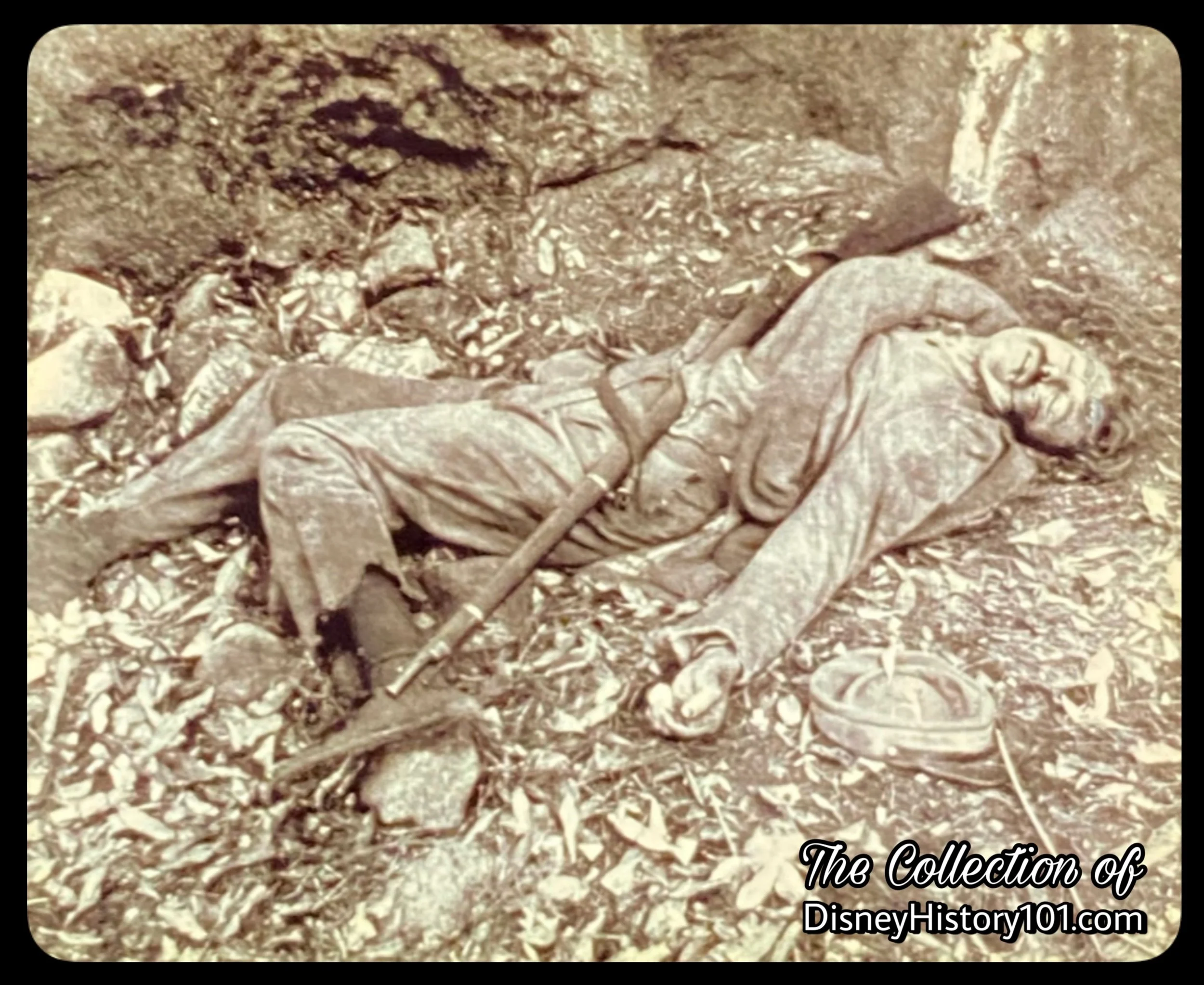
“…one stayed behind. A cannon ball don’t pay no mind. A cannon ball don’t pay no mind, if you’re gentle, if you’re kind.”
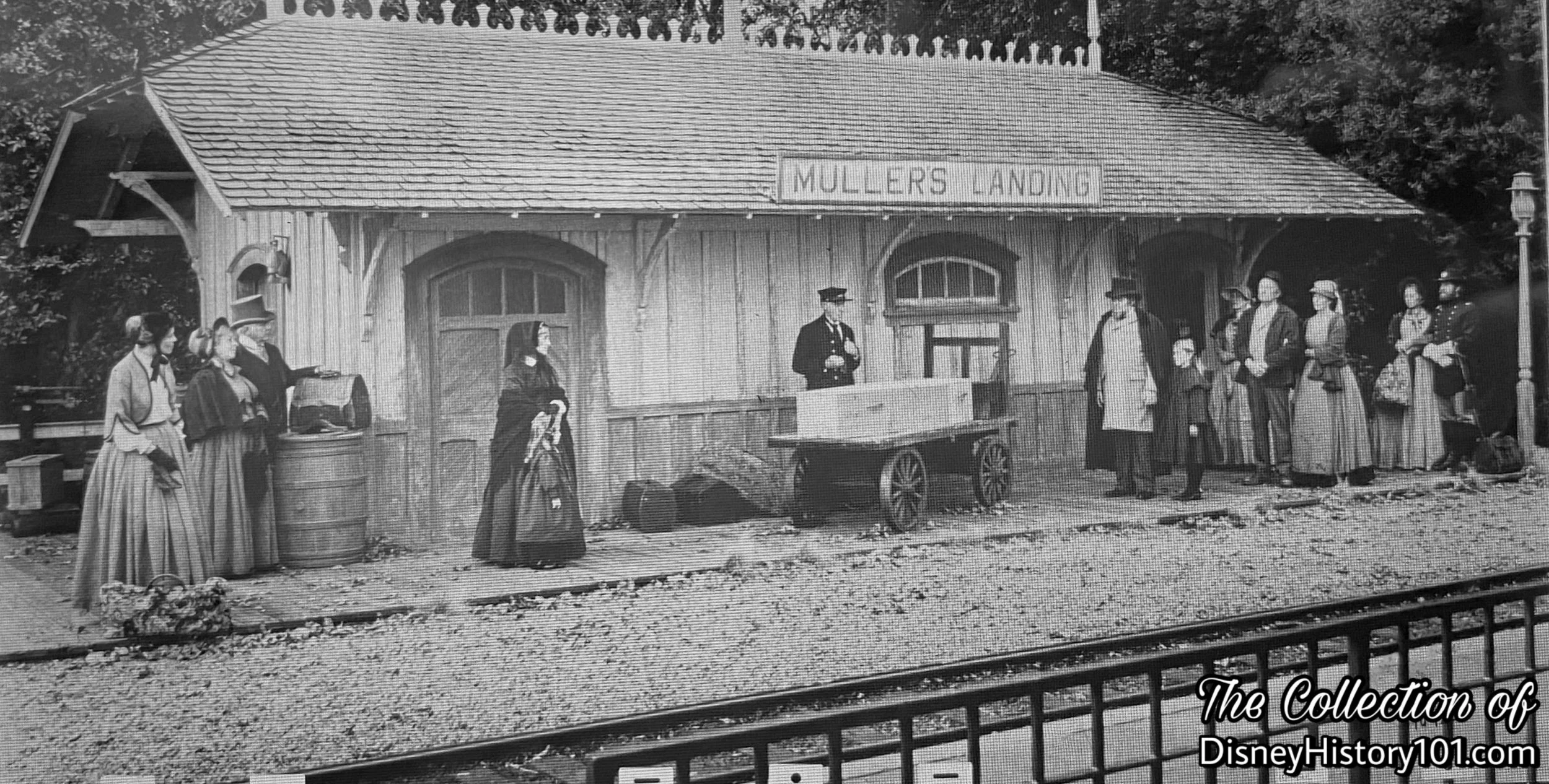
“It don’t think of the folks behind…”
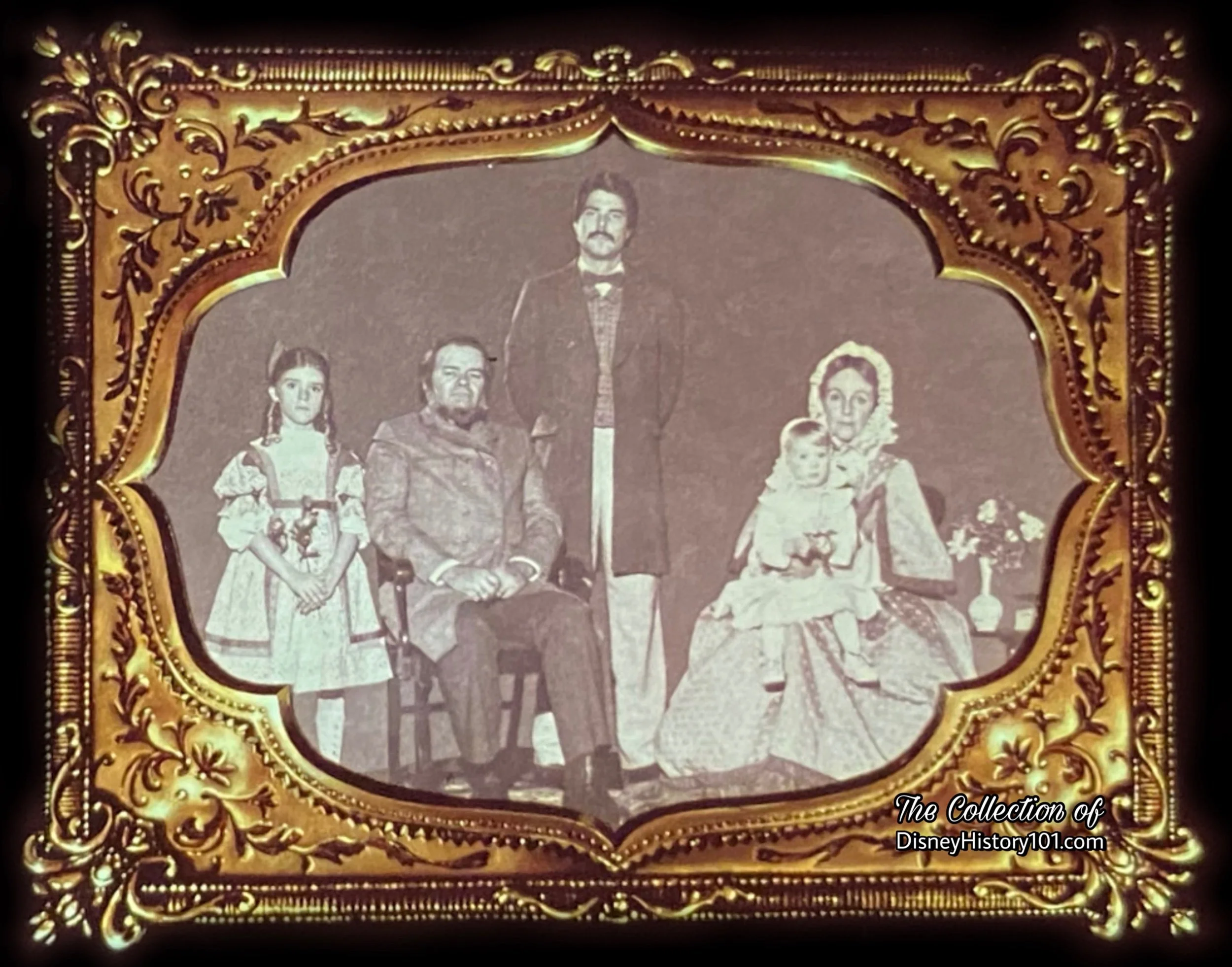
“It don’t think of the folks behind, all on a beautiful morning.”
Air-conditioning controls dust, and a practical mechanical application of the technology was essential in the attraction where projection equipment and film was used.
Abraham Lincoln Pre-Show Silhouette, before the curtain rises to the fanfare, the narrator welcomes guests to Great Moments with Mr. Lincoln!
The original Royal Dano voiceover and Paul Frees narration were removed for the newly enhanced show in 2001. The show also featured “Lincoln reciting the Gettysburg Address,” according to Dave Smith (Chief Archivist Emeritus of the Walt Disney Archives). [Disney Facts Revealed by Dave Smith, 2016] Even more, the impresario of Garner Holt Productions was contacted to update the Lincoln figure, and dynamic scenic illustrator John Rayburn enhanced the painted colors of the theater, Abraham Lincoln’s chair, and even the man himself.
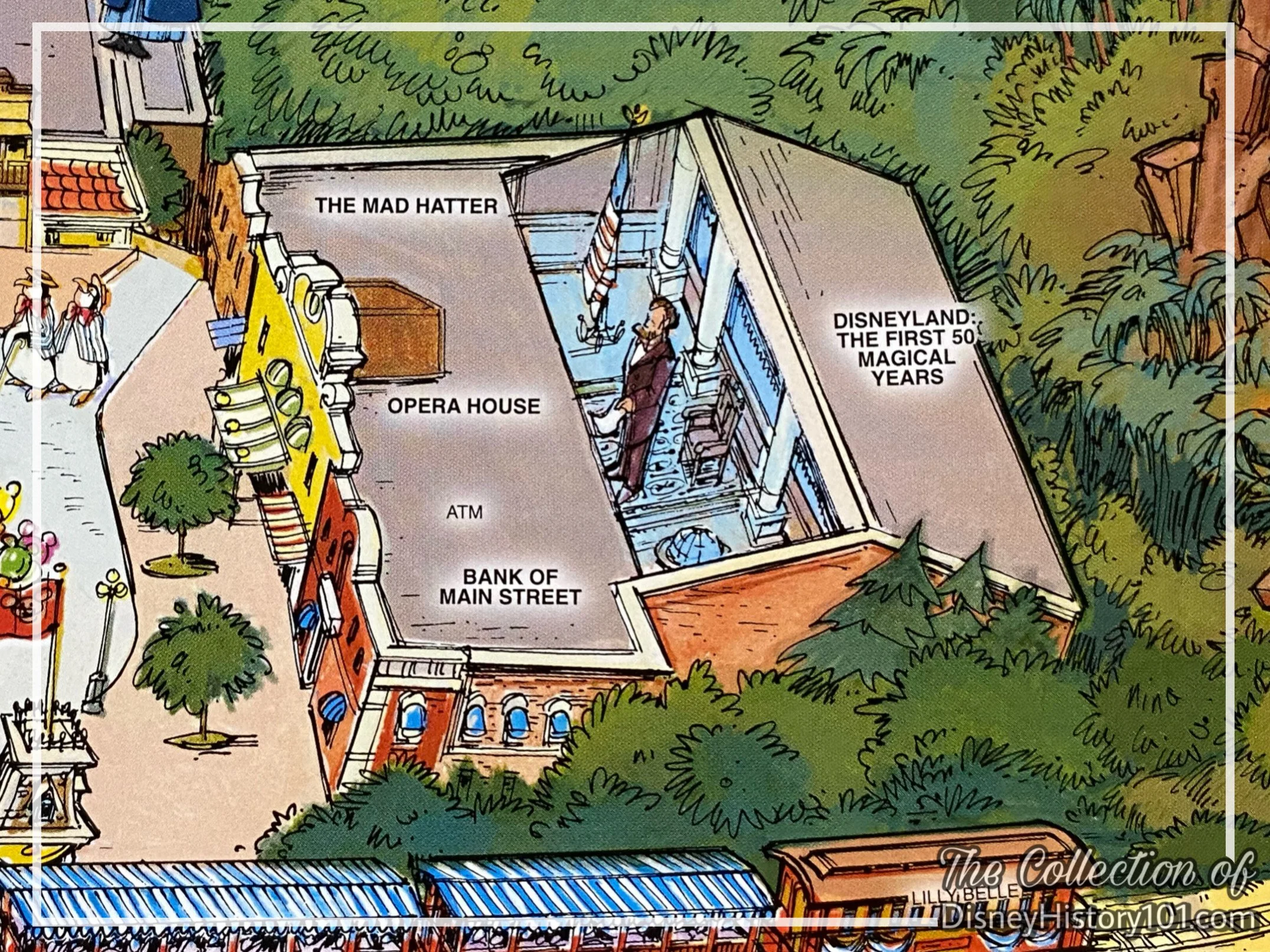
Disneyland 50th Anniversary Map by Nina Rae Vaughn.
In commemoration of Disneyland’s 50th Anniversary, new exhibits were created, and the film Disneyland : The First Fifty Magical Years debuted at the Main Street Opera House on May 5, 2005, and run until 2009. During this time, Mr. Lincoln would take a hiatus.
During the 2005-2009 closure, the Mr. Lincoln Audio-Animatronics figure was removed and ultimately repurposed as the Indian Village Shaman who appears along the Rivers of America. Here’s where it really gets interesting - the Shaman has been programmed with some of the very same animations (movements) programmed for Mr. Lincoln.
Also during the time of closure (in 2008), WDI master plans entertained a concept which included a presentation of America the Beautiful featuring Great Moments with Mr. Lincoln. At this same time a new Pre-Show involving the second floor of the Opera House was also being researched as an option. This was to coincide with Abraham Lincoln’s 200th birthday on February 12th, 2009. However, the Imagineering of these concepts was not seen through. Lincoln did return, but with “a shortened version of the original speech,” according to Dave Smith (Chief Archivist Emeritus of the Walt Disney Archives). [Disney Facts Revealed by Dave Smith, 2016]
Eventually Mr. Lincoln would return in The Disneyland Story presenting Great Moments with Mr. Lincoln in 2009.
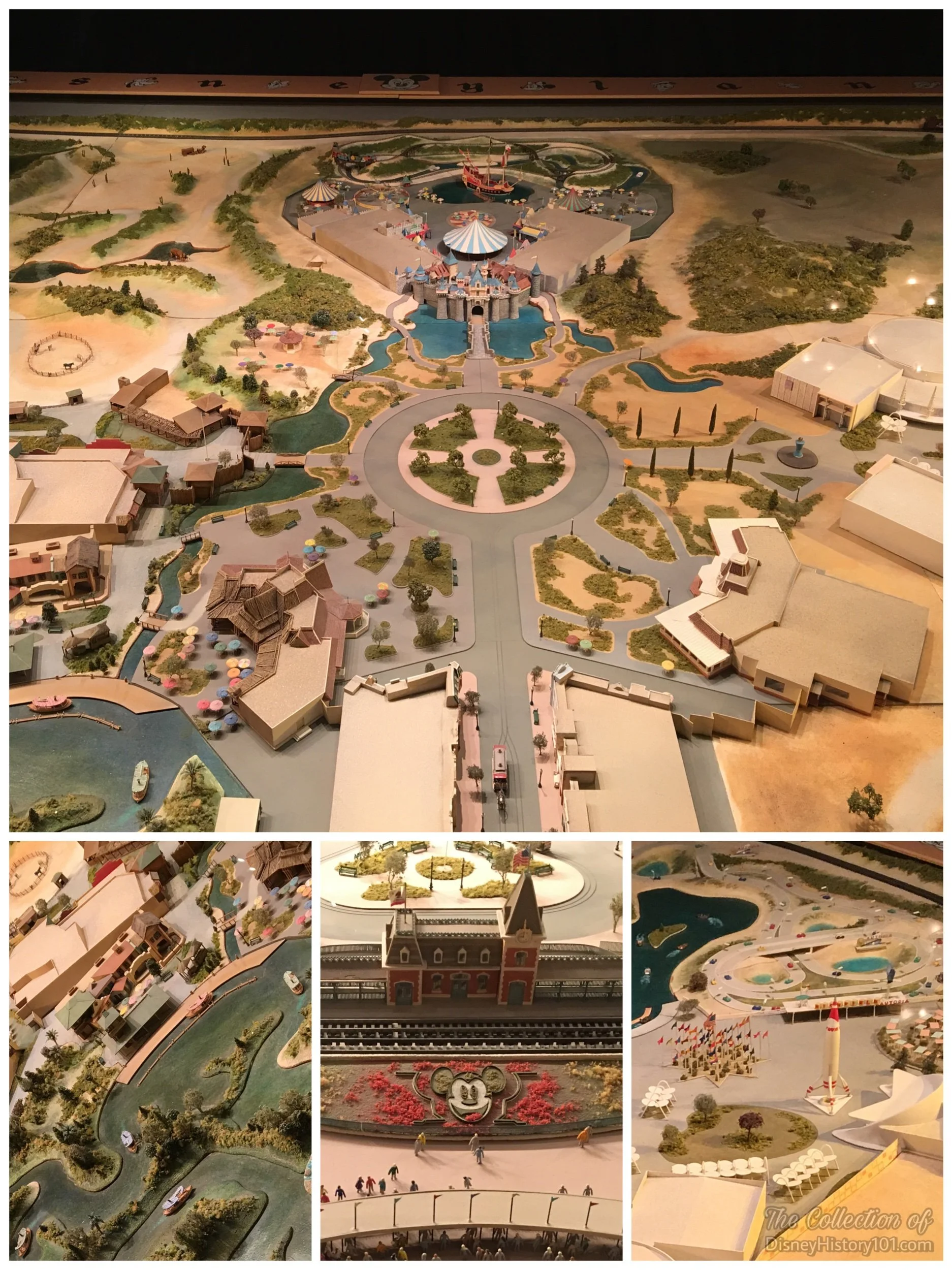
A model of “Disneyland” as it looked in 1955.
In the meantime, a number of exhibits were showcased, like a model of a c.1955 Disneyland. While the model is rather simple in some regards, there are so many amazingly accurate details. Some who had the pleasure may recall the Adventureland Bazaar (and adjacent canal), the original Mickey Floral Portrait, the Court of Flags, Tomorrowland Lake, and the original Autopia Track.
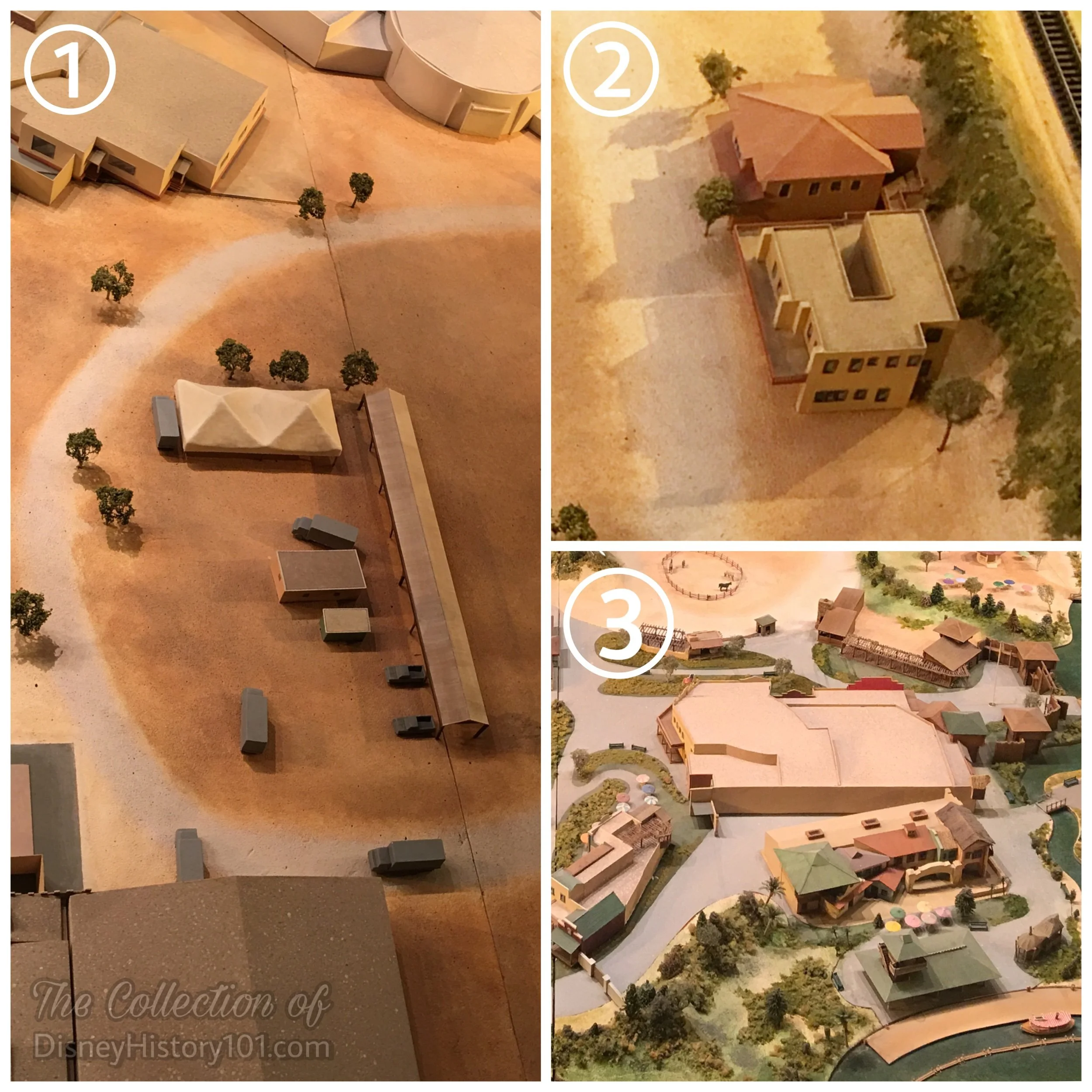
A model of “Disneyland” as it looked in 1955.
In addition to the Onstage details, most Disneyland Cast Members will note the (1) original Backstage Disneyland Employee Cafeteria and First Aid tents, (2) original Administration Building comprised of the old Callens and Dominguez residences, and (3) Backstage Adventureland/Frontierland.
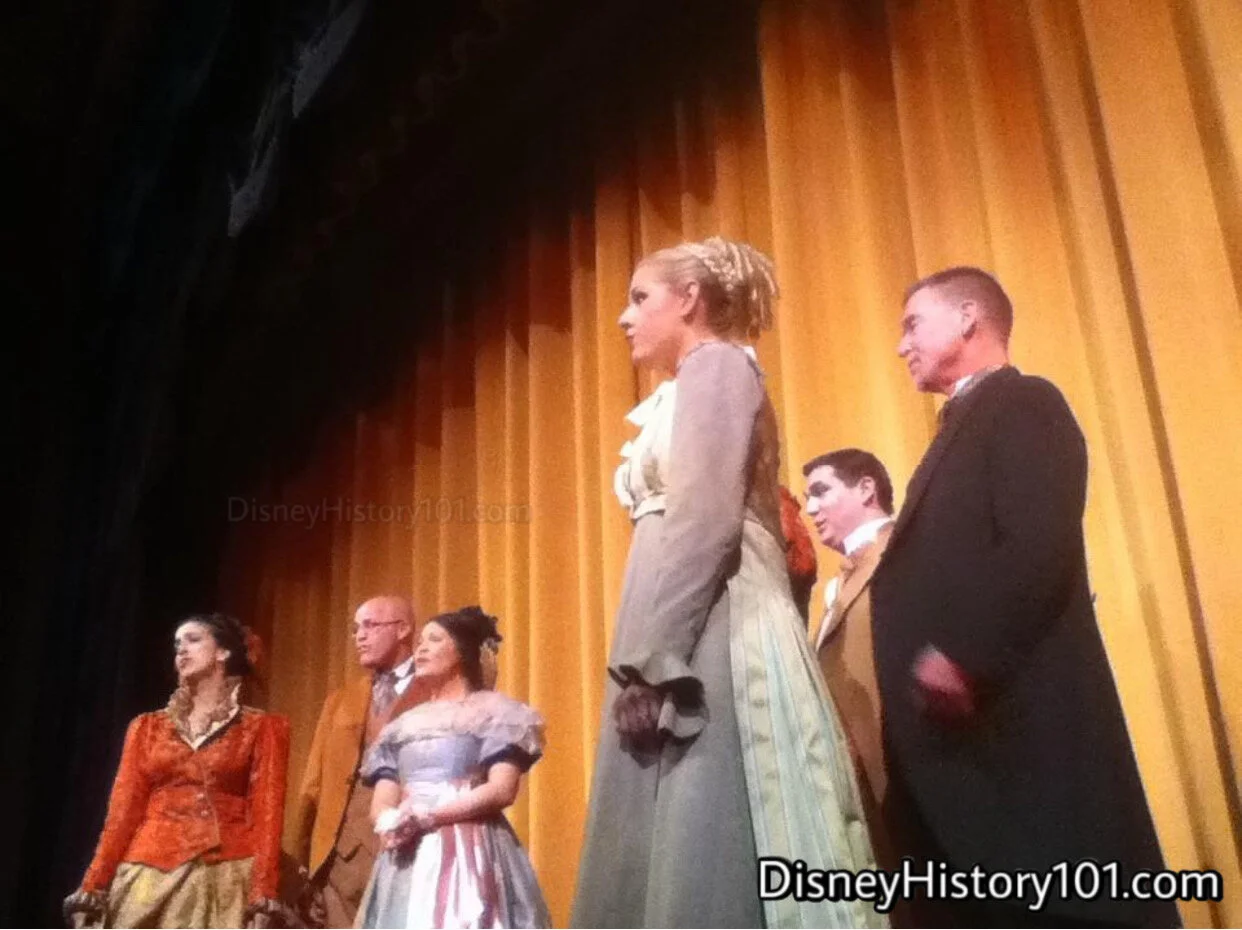
“The Voices of Liberty,” 2015.
The eight-part harmony of “the Voices of Libery” (a Walt Disney World tradition) was lifted in a limited engagement on the stage of the “Lincoln Theater” during the Disneyland Diamond anniversary! The members provided Atmosphere Entertainment complimenting the theme of the area and entertaining Guests on an immediate and personal level.
Main Street Opera House Featuring "Tiki, Tiki, Tiki Realms-Celebrating 50 Years of Enchantment," (2013 - )
Well, it looks like things have come full circle for the old Main Street Opera House, which continues to serve one of its original intents - showcasing gallery exhibits and displays. Sometime after The Disney Gallery opened in the former Bank of America Building (in 2009), the Disney Gallery would soon expand to the Great Moments with Mr. Lincoln Lobby. In recent years, new exhibits (presented by The Disney Gallery) would feature both artwork and props featured in production of Disney Parks attractions, and even Walt Disney Studios feature length film productions.
Main Street Opera House Featuring "Snow Queens Art of Ice," (January 7, 2015 - )
Some of the art featured included Marc Davis’ designs for the Snow Queen - star of the c.1970s Enchanted Snow Palace ride concept.
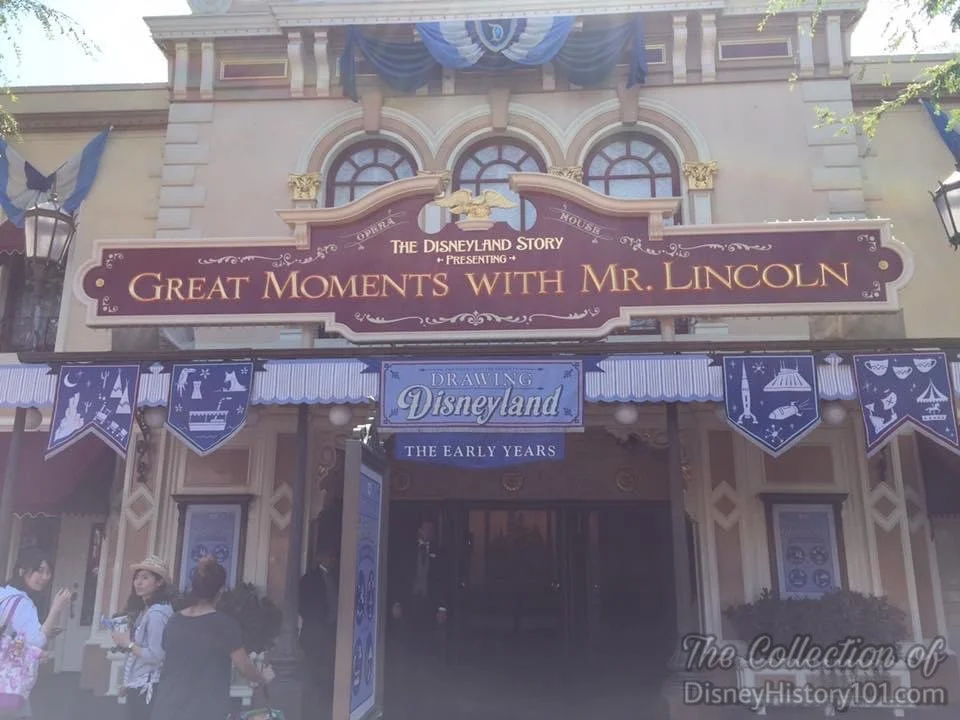
Main Street Opera House Featuring "Drawing Disneyland - The Early Years," (May 2015 - )
Main Street Opera House Featuring "Drawing Disneyland - The Early Years," (May 2015 - )
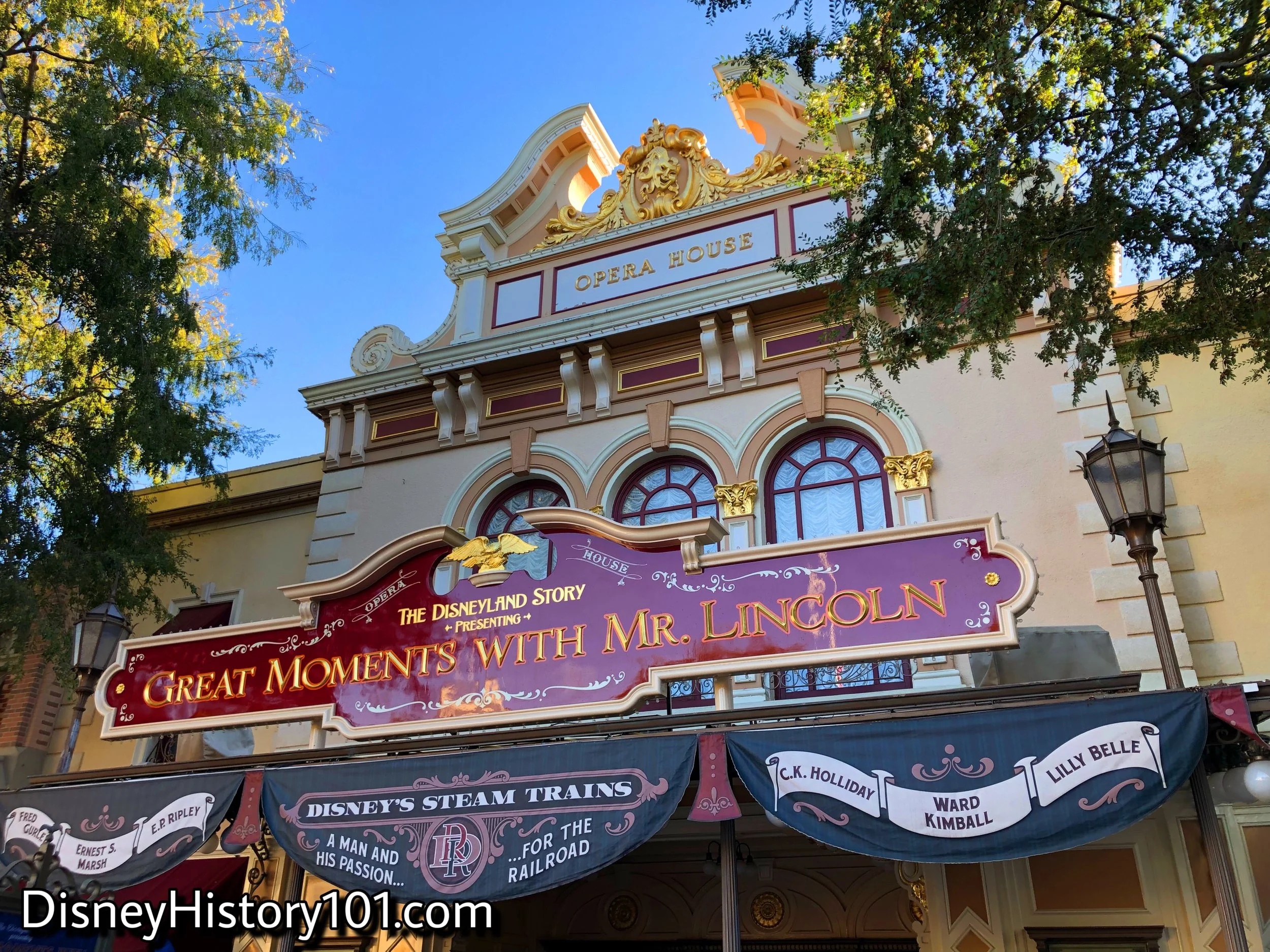
Main Street Opera House Featuring "Disney's Steam Trains," (April 2016 - )
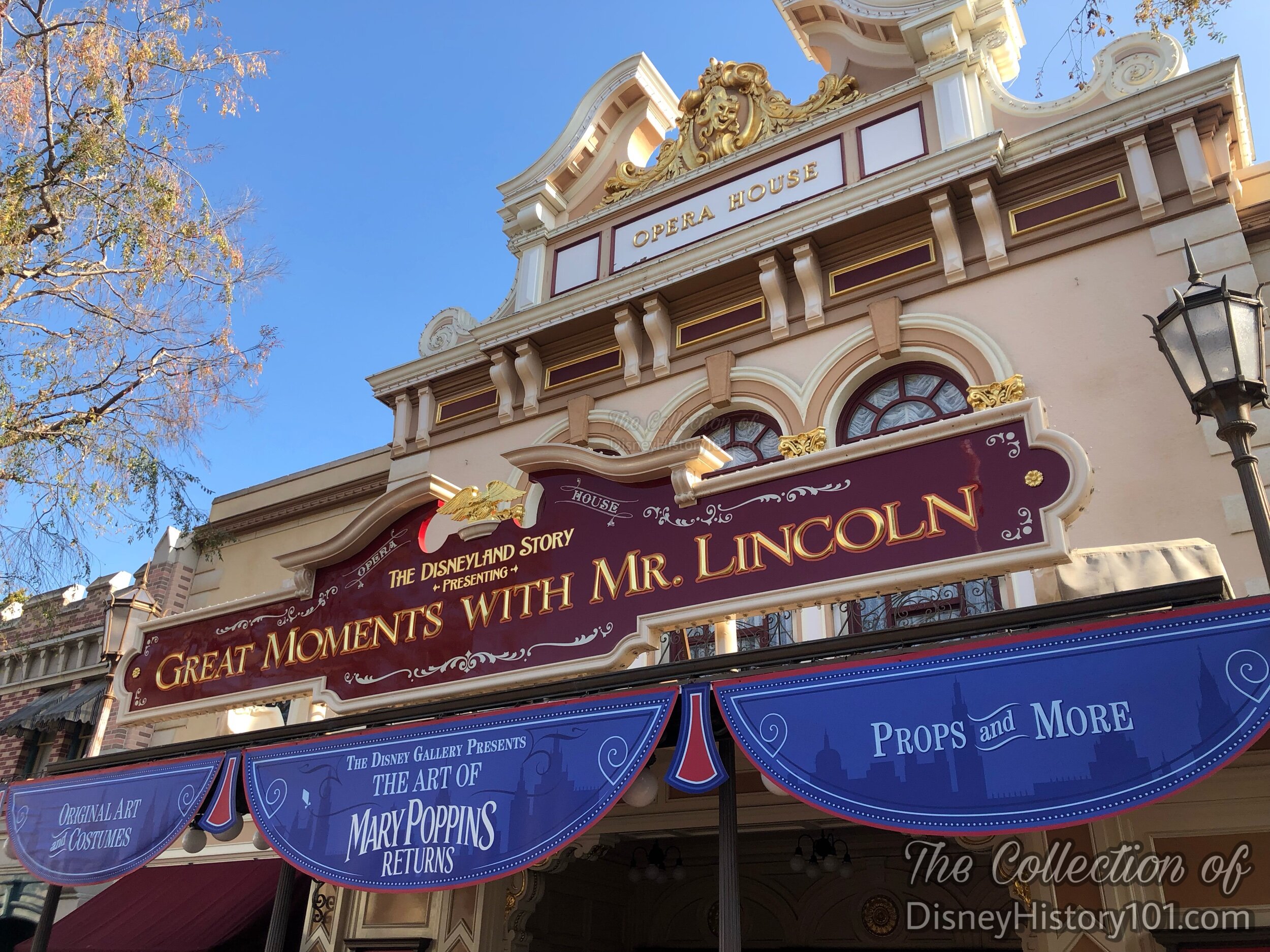
Main Street Opera House Featuring "The Art of Mary Poppins Returns," (2018)
Main Street Opera House Featuring "The Art of Mary Poppins Returns"
Main Street Opera House Featuring "The Art of Mary Poppins Returns"
Costumes Worn by Mena Massoud and Naomi Scott ; “Disney Aladdin Exclusive Sneak Peek,” (2019)
Prop Lamp and Carpet as seen in the film ; “Disney Aladdin Exclusive Sneak Peek,” (2019)
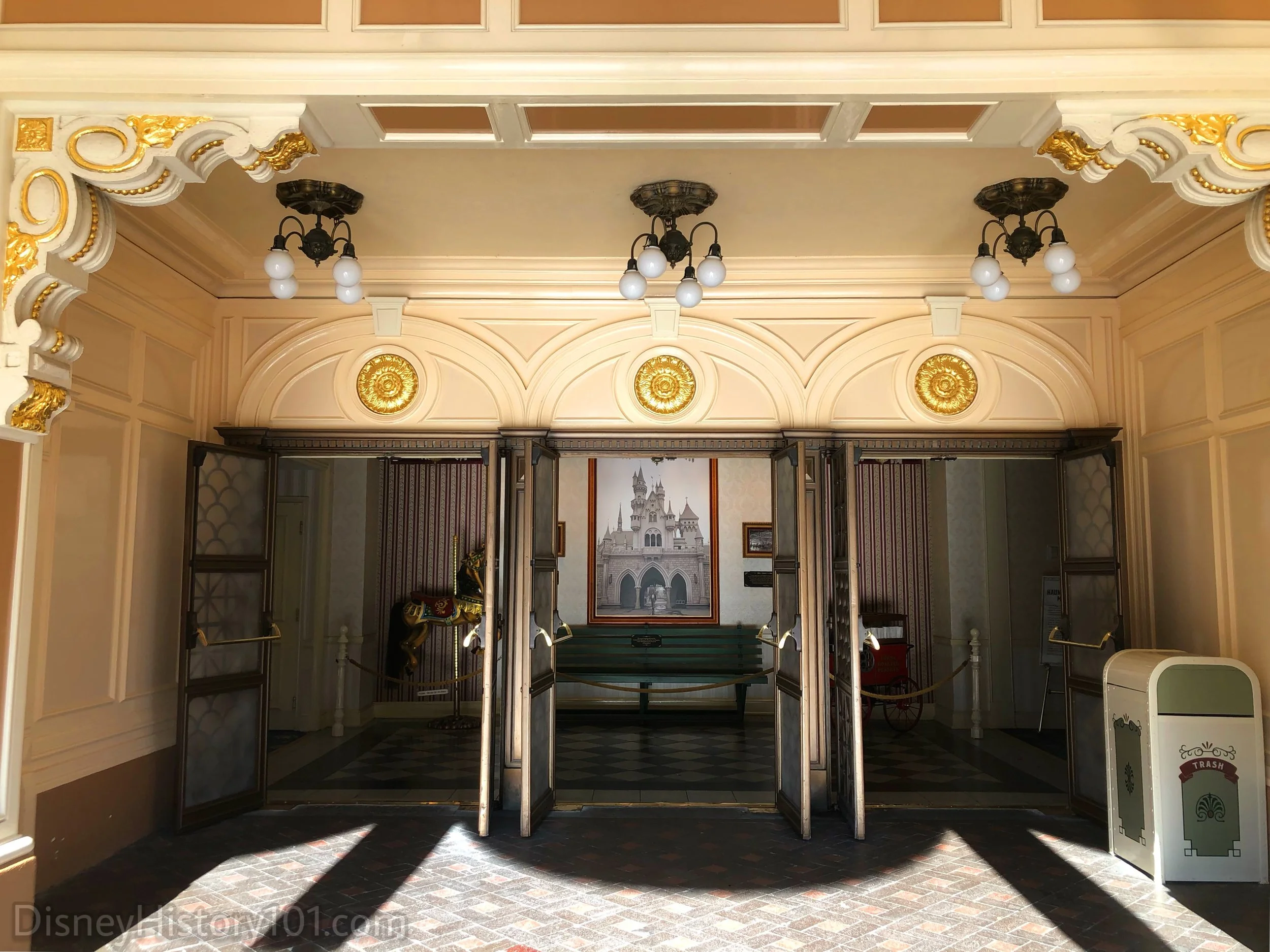
Main Street Opera House, The Present
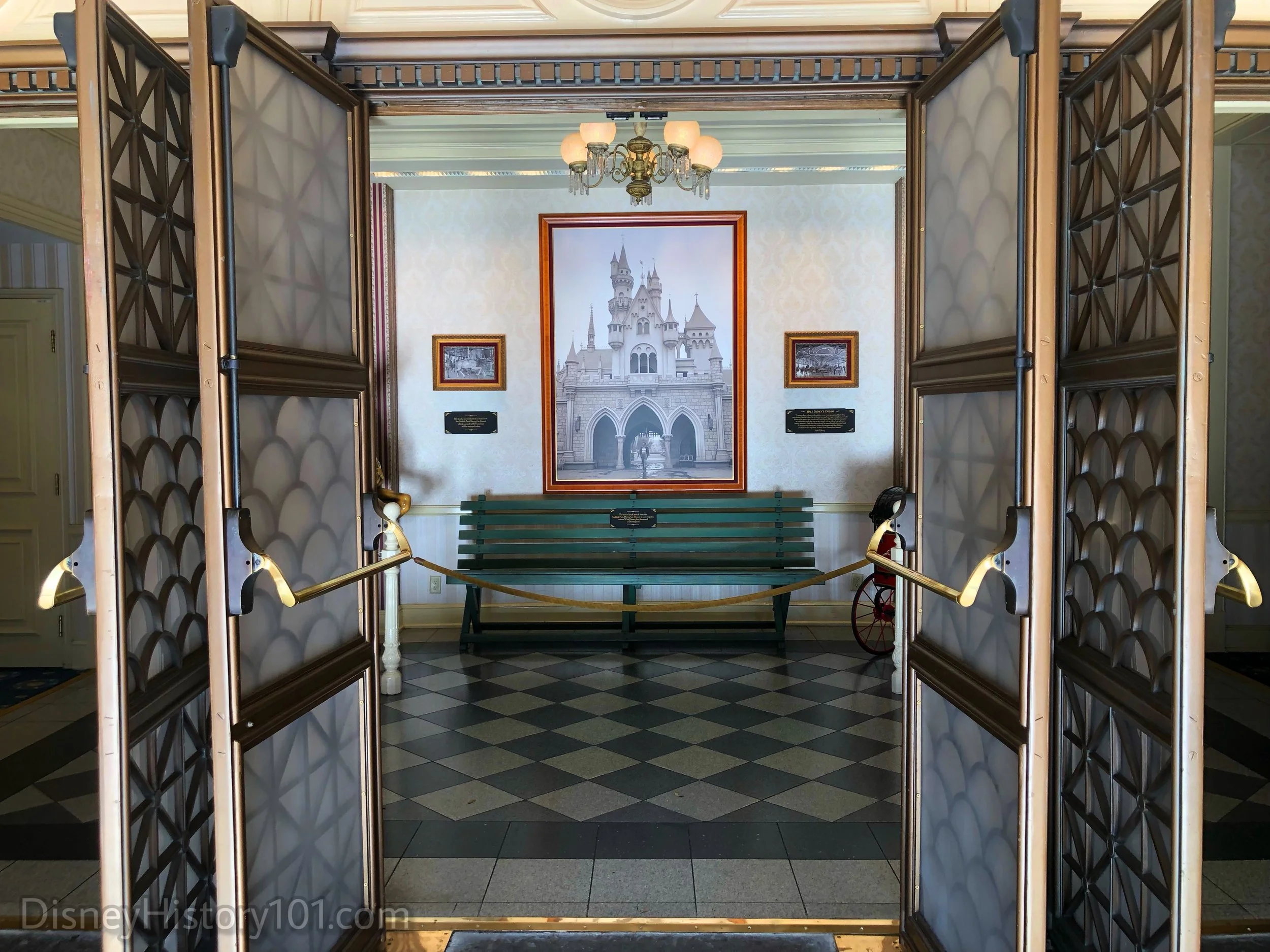
Main Street Opera House, The Present
Just through the doors, Walt Disney’s toy is still told through a few special exhibits and displays featuring true-life artifacts from Park history. Gone are the “Disneyland Toy Factory” Mold-A-Rama Machines, and in their place are Disneyland Pressed Penny Souvenir Machines, offering another type of commemorative collectable.
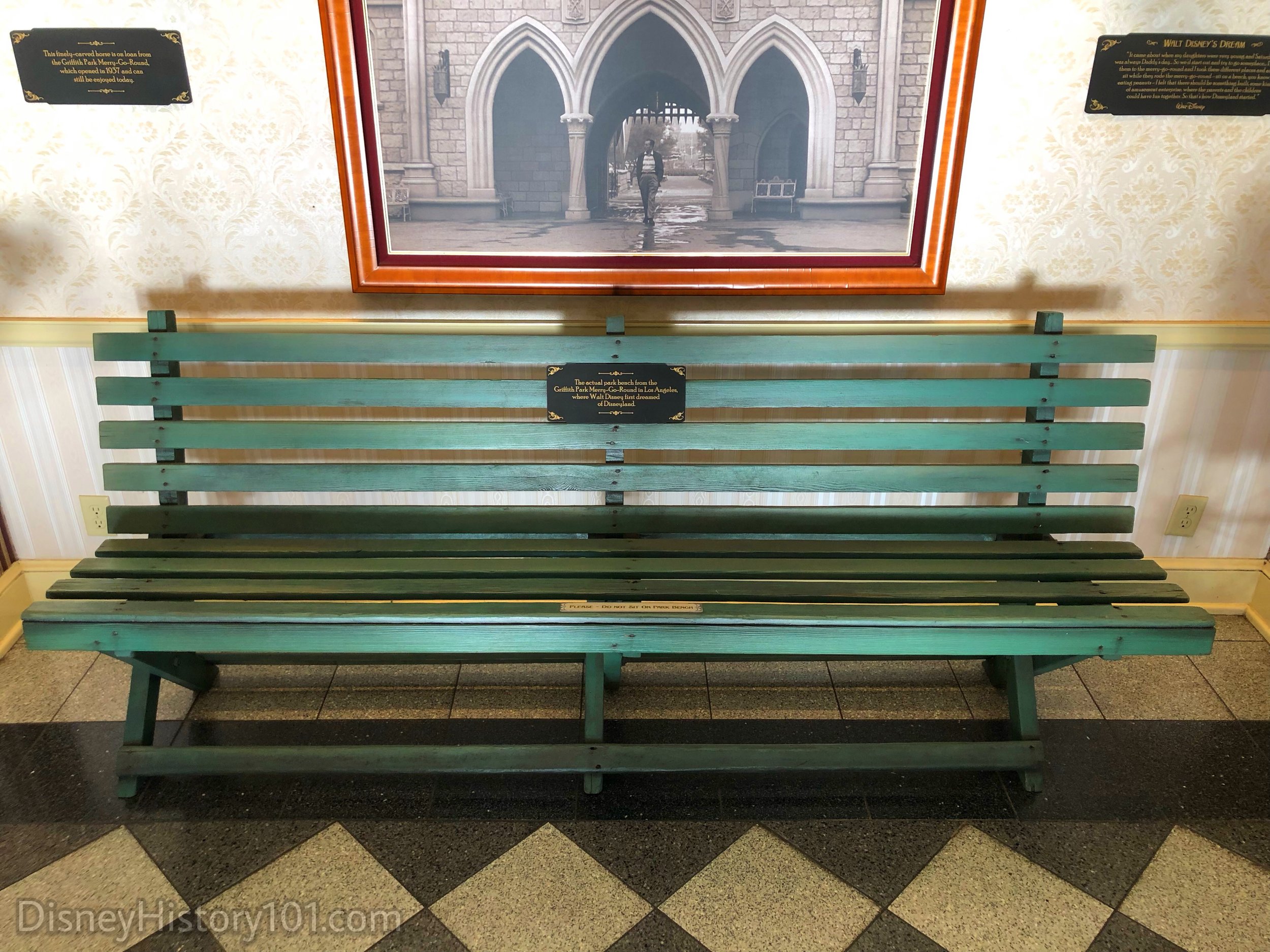
"The Griffith Park Bench"
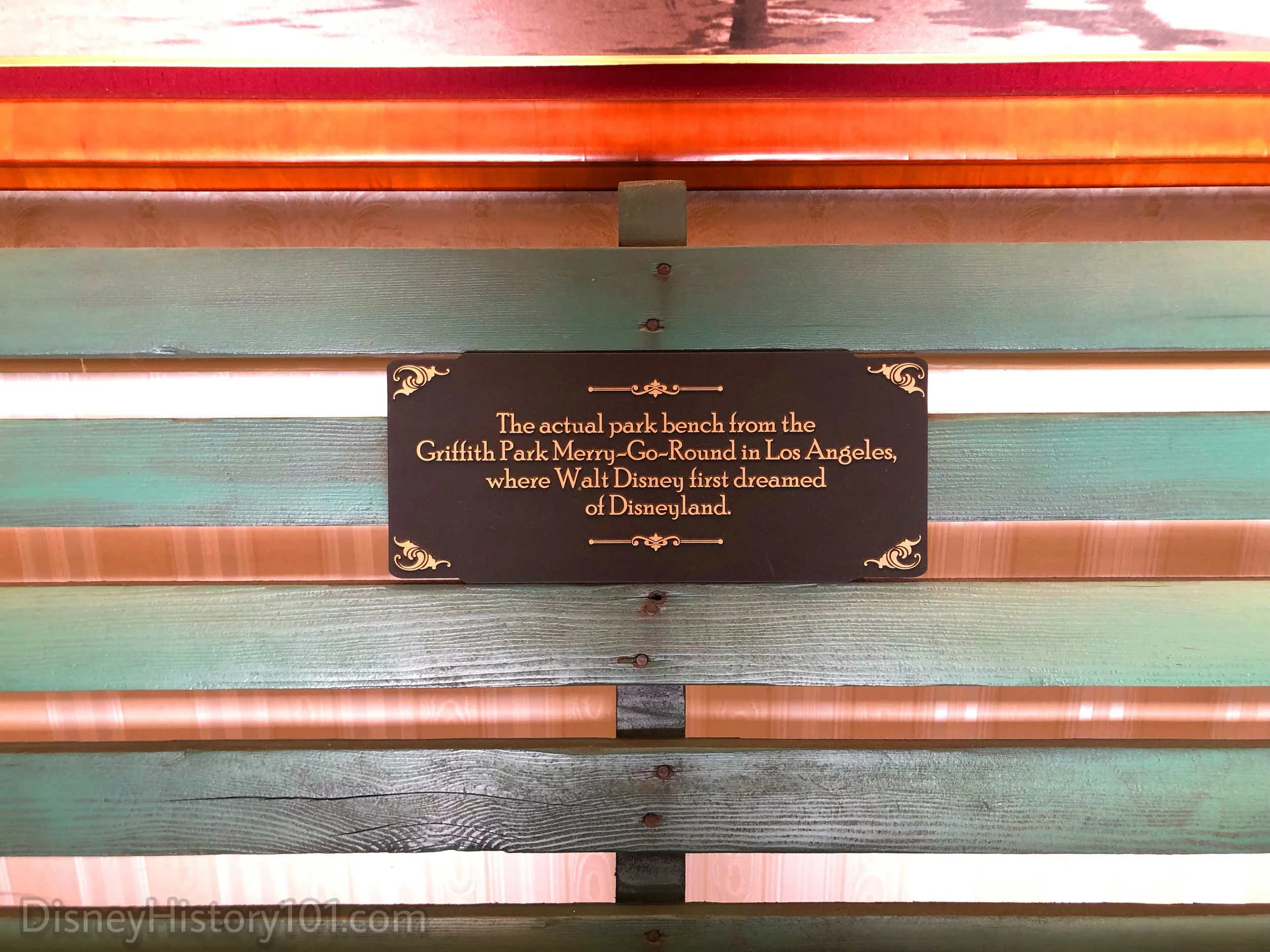
"The Griffith Park Bench"
Despite what this plaque suggests, there are at least three known surviving Griffith Park Merry-go-Round benches - at The Walt Disney Family Museum, the Griffith Park Carousel, and inside the Main Street Opera House! Walt Disney may have sat on any (or all) of these benches as he dreamt up Disneyland.
One of the Disneyland Pressed Penny Souvenir Machine, 2015.
Souvenirs cost 51¢.
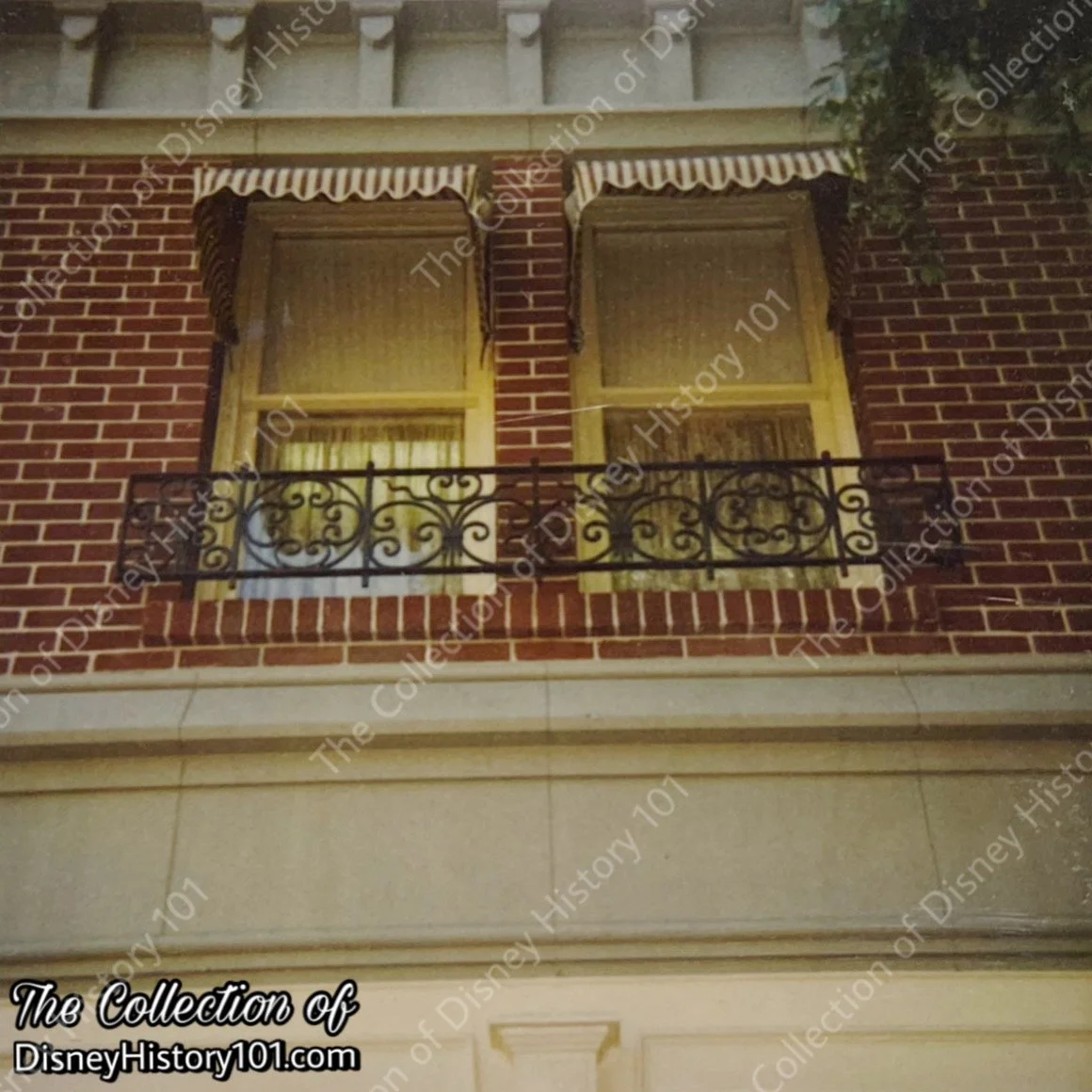
Blaine Gibson window between the mad hatter and the Walt Disney story
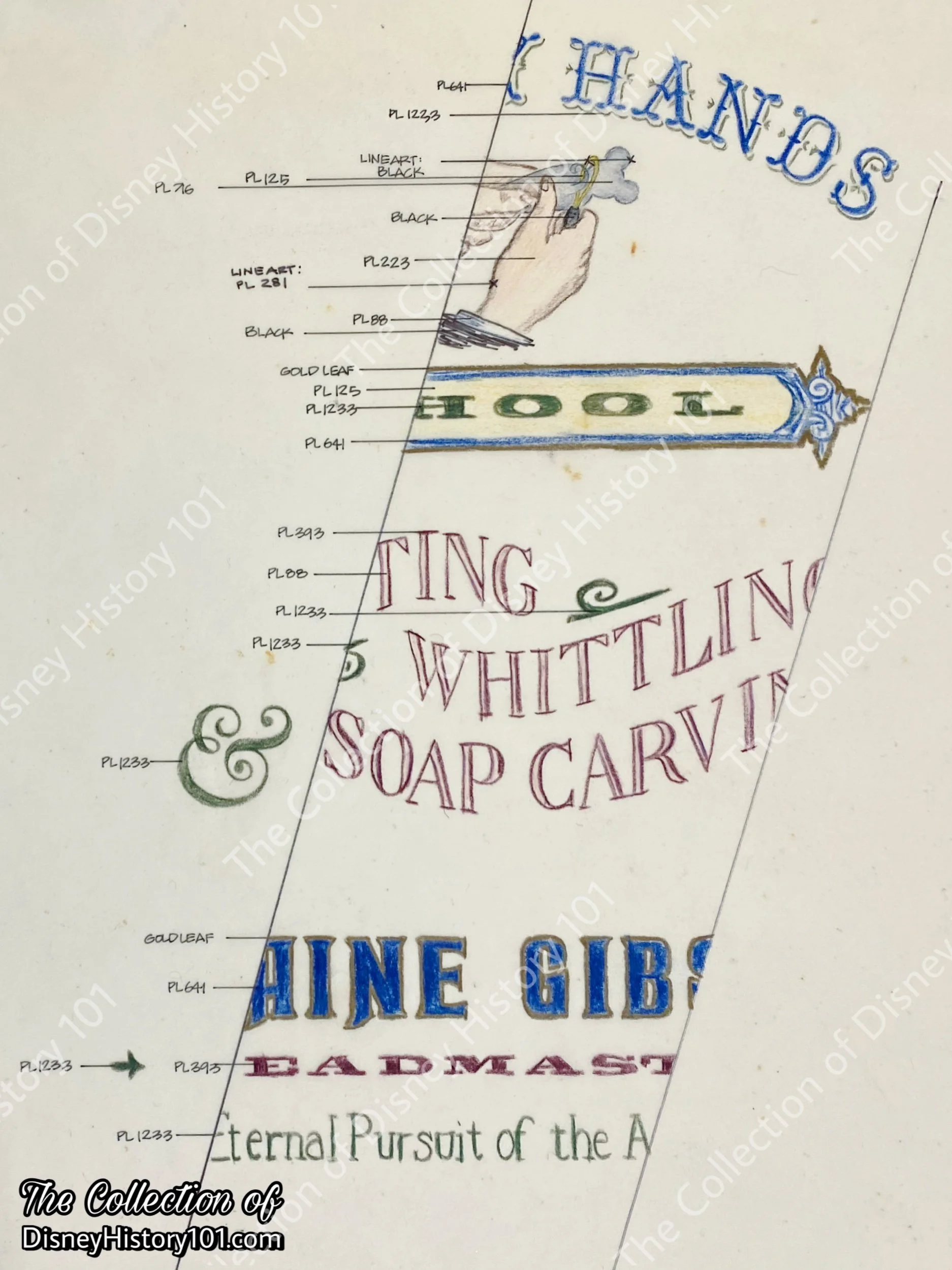
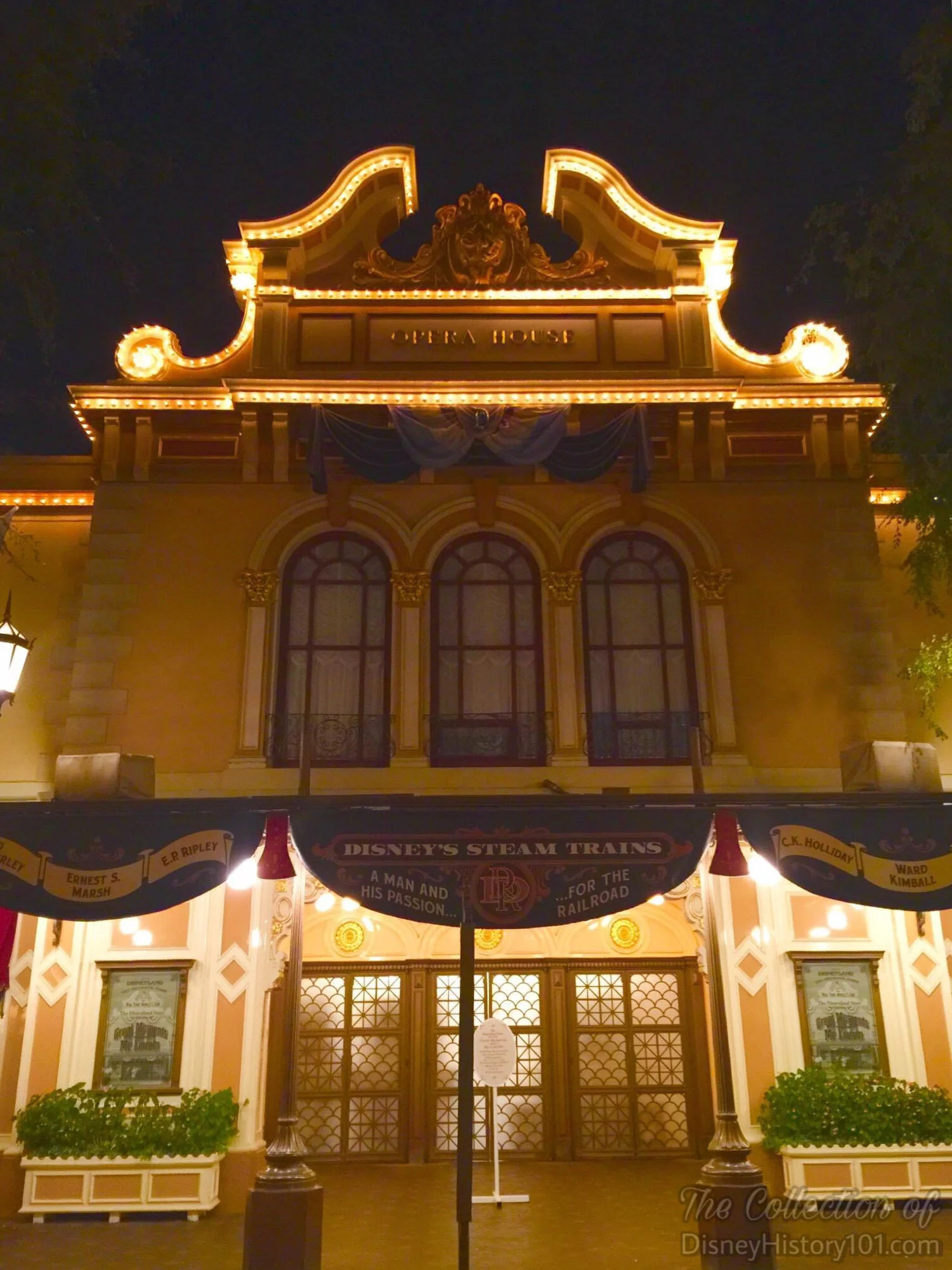
Main Street Opera House Architectural Facade
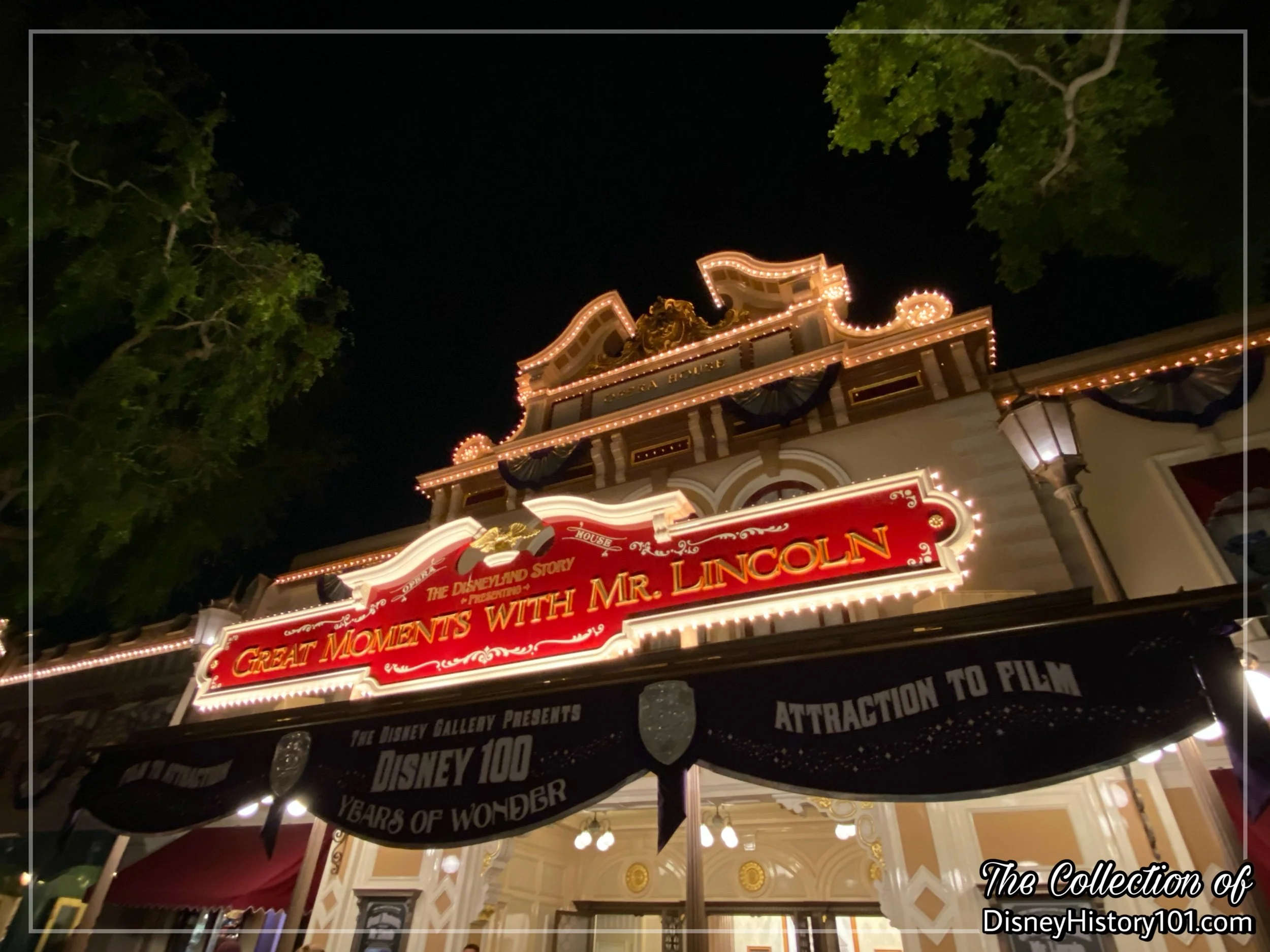
Quisque iaculis facilisis lacinia. Mauris euismod pellentesque tellus sit amet mollis.