POP CORN (& CRETORS)
“Prologue”
Popcorn has been around almost as long as our country has been around. But even before that, the First Peoples of this land have been eating popcorn for over 5000 years!
Popping corn has a small amount of moisture which is caught inside the hard shell of the kernel as it grows. When heated, this moisture vaporizes to steam, exerting a tremendous amount of pressure, and “explodes” the kernel. In addition, there are two colors of popping corn . . . yellow and white. Of these, the yellow variety was preferred by gourmets for its flavor!
Today, popcorn is sold as the number one treat in over 99% of all movie theaters! Around Disneyland, popcorn cretors are a common sight in each land, the smell of popcorn fills the air, and the warm snack continues to be very popular with Guests.
“Cretors”
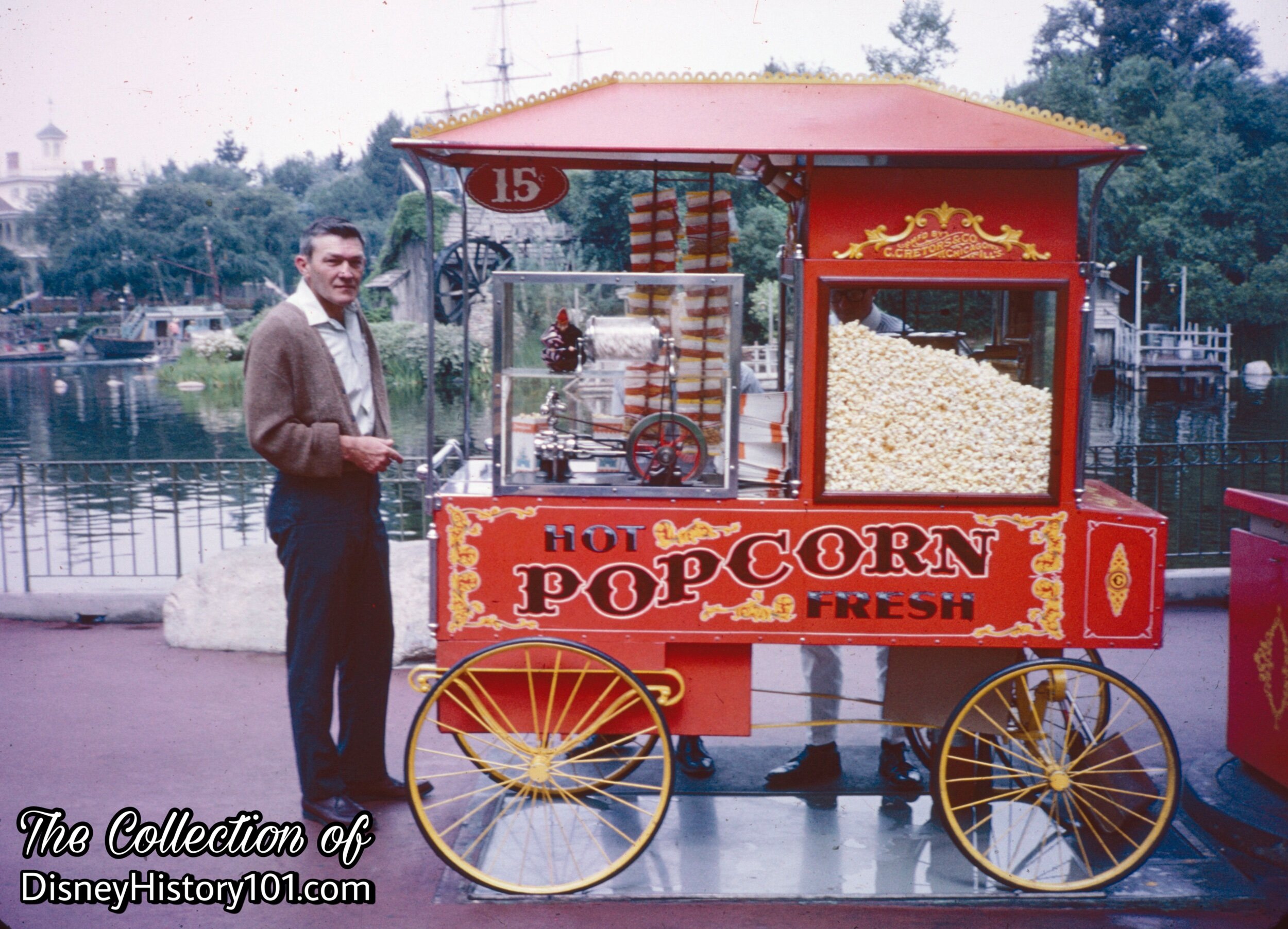
Many have asked, ‘What exactly is a Cretor?’, so I would like to address this inquiry first. The word takes its origin from the C. Cretors & Company - the 1855 company that first manufactured the old-fashioned carts and “doll” vendors! It is no surprise that the old-fashioned Cretor (Popcorn Cart) vendor has been synonymous with the smell of freshly-popped kernels in Disneyland since 1955! The gay red Cretors were imported from Germany, and rehabilitated (with the help of Ferro Sheet Metal). The final products can be seen on Dateline Disneyland (aired July 17, 1955), and one can readily be seen on East Center Street, in some footage of “Disneyland, U.S.A.” (a “People and Places” feature film, released in the U.S. on December 20, 1956 through Buena Vista Film Distribution Company). At the same time, A Complete Guide to Disneyland (c. 1956) tantalized Guests with the following advertisement : “Eager adventurers with hearty appetites find Disneyland’s popcorn vendors and their shiny red wagons irresistible.”
By July of 1954, Raul Grizante of Disneyland, Inc. was overseeing food philosophy, area & location, food specialties, and beverages for Disneyland.
Through the 1950s and early 1960s, the Popcorn Wagons were operated by UPT Concessions. These offered popcorn and peanuts to Disneyland Audiences in multiple On Stage locations (like in Town Square and on Center Street) during peak seasons.
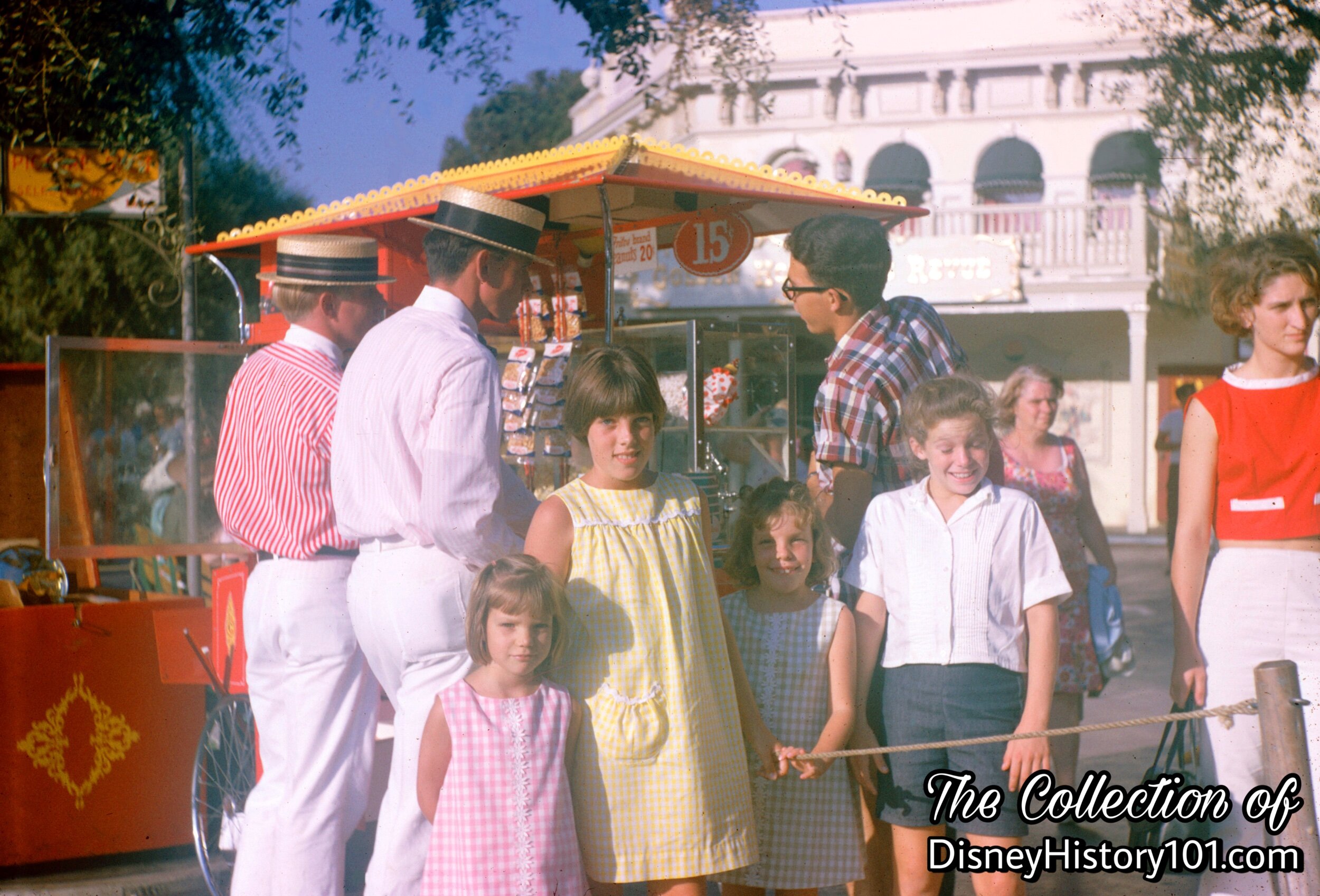
By the time that the previous Vintage View was captured, the Cretors (operated by UPT Concessions) also offered a selection of Fritos brand snacks (including Fritos brand peanuts). According to The Story of Walt Disney by Diane Disney as told to Pete Martin, peanuts were sold without shells because they had potential to dirty up the sidewalks at Disneyland.
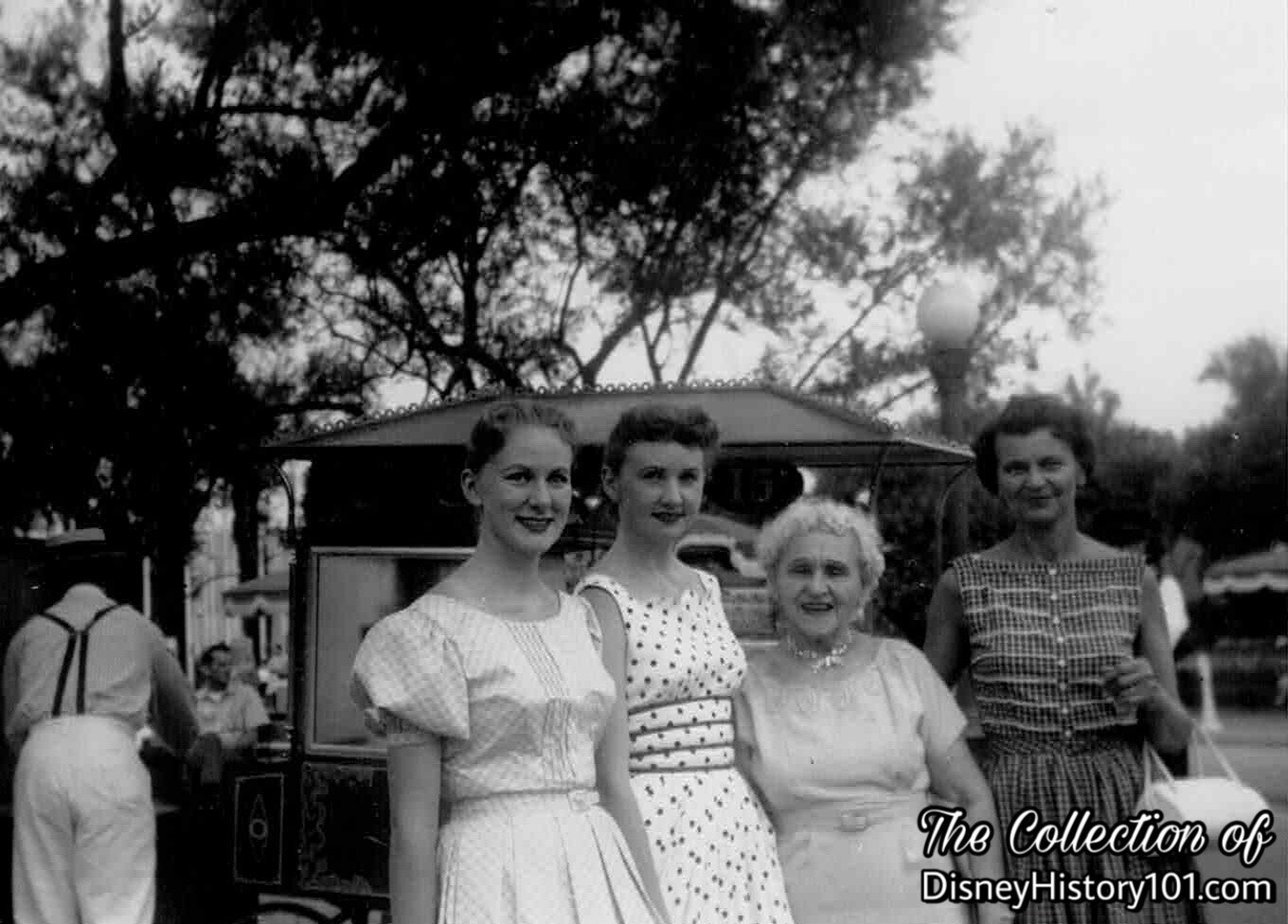
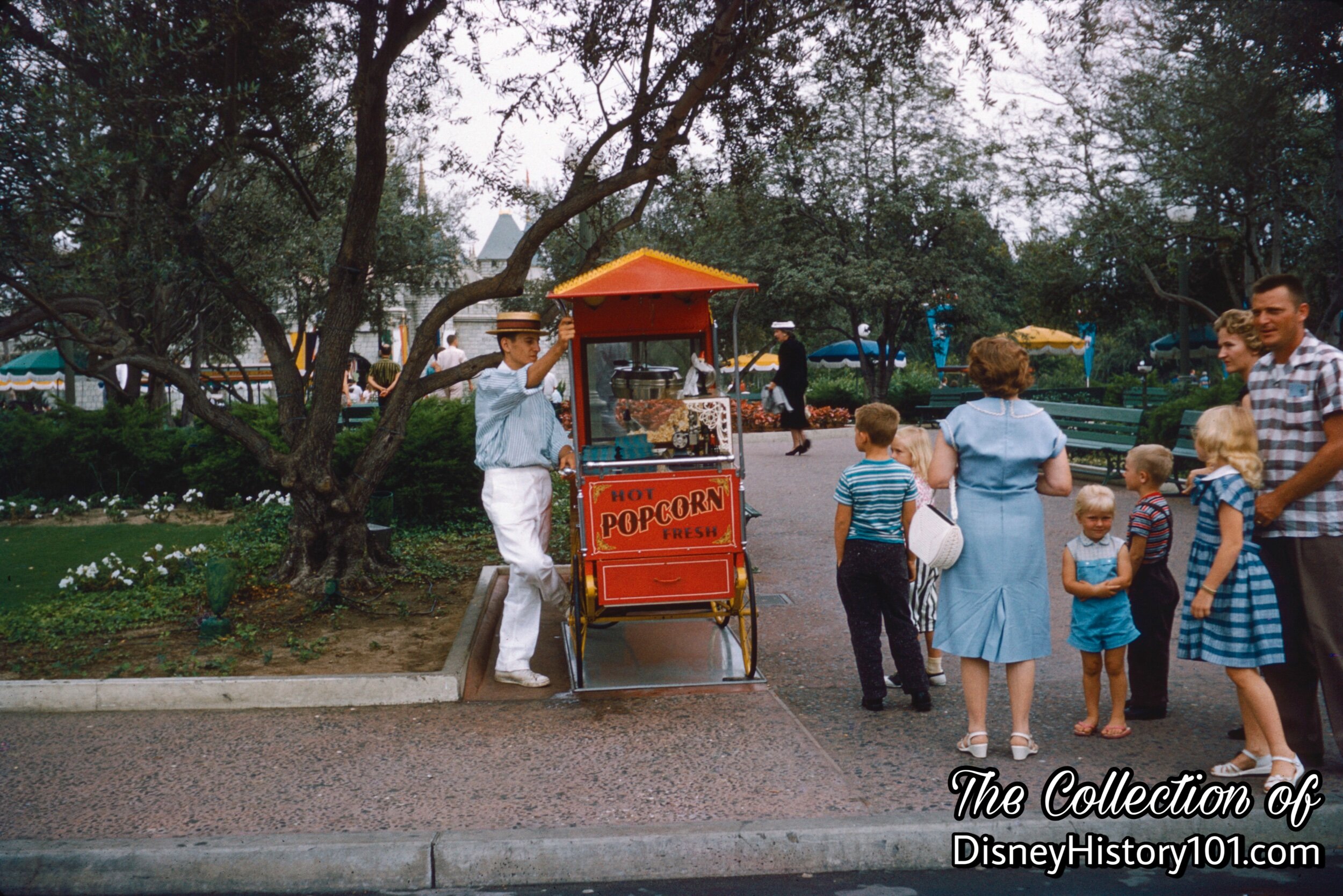
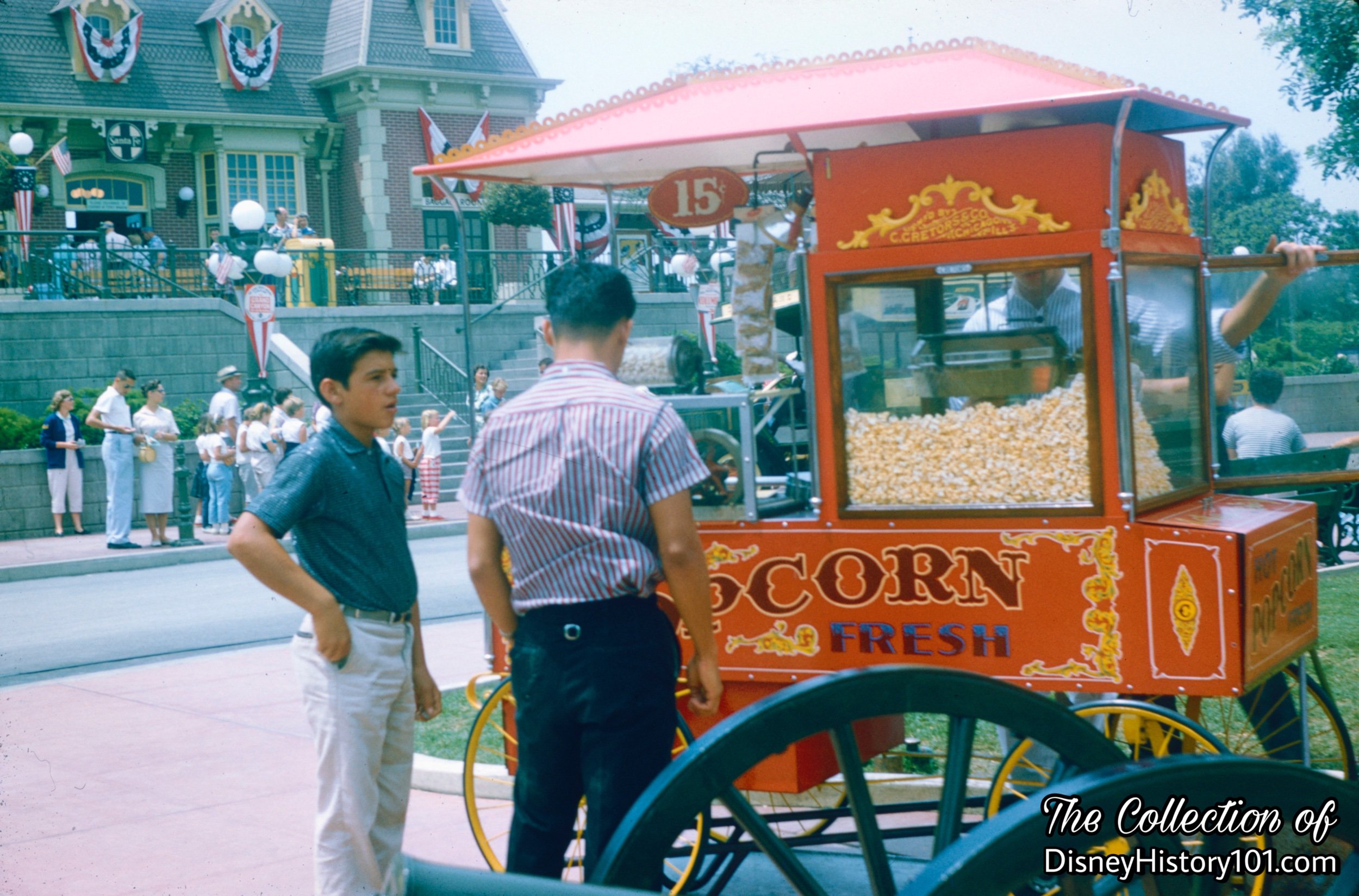
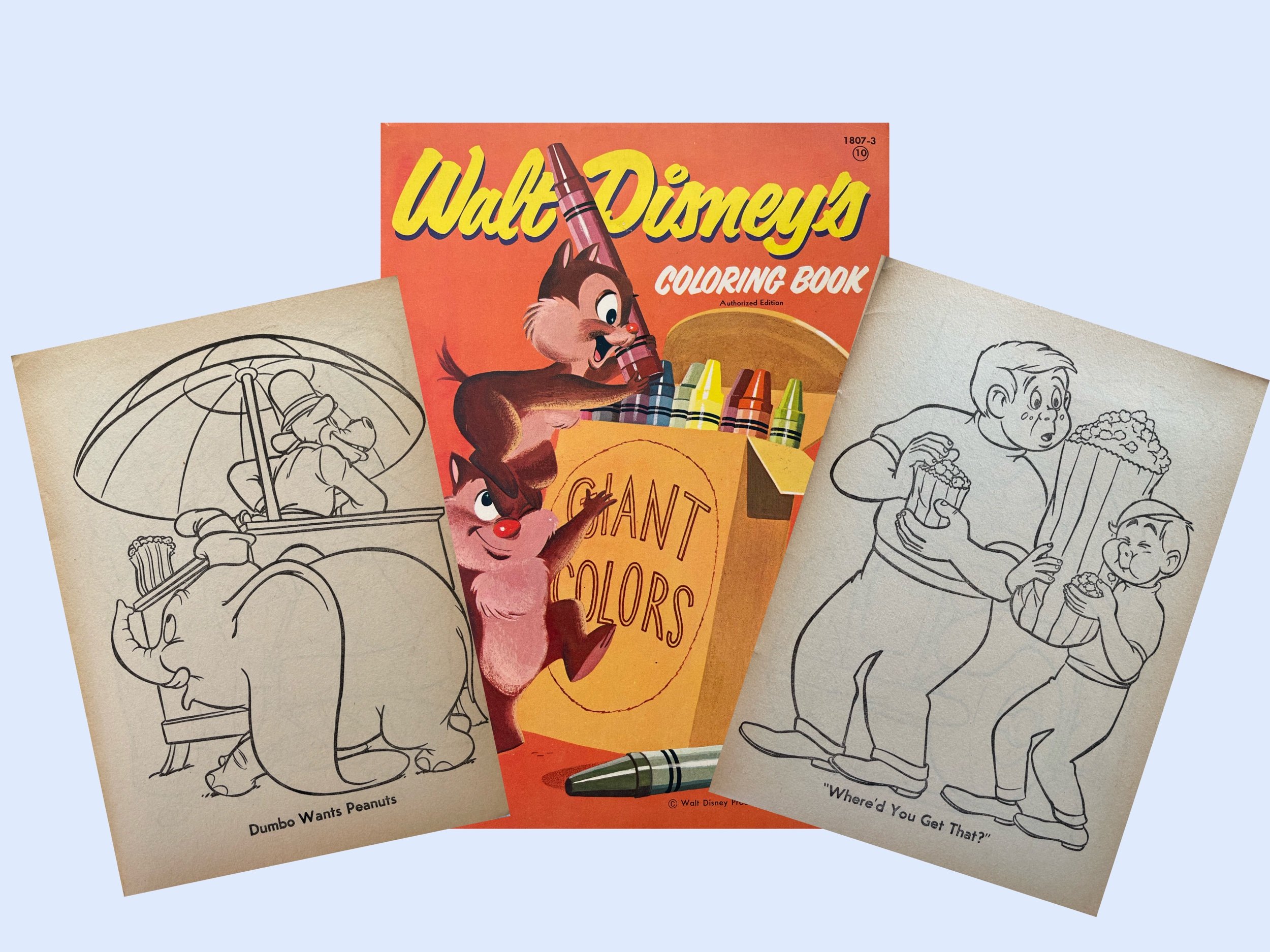
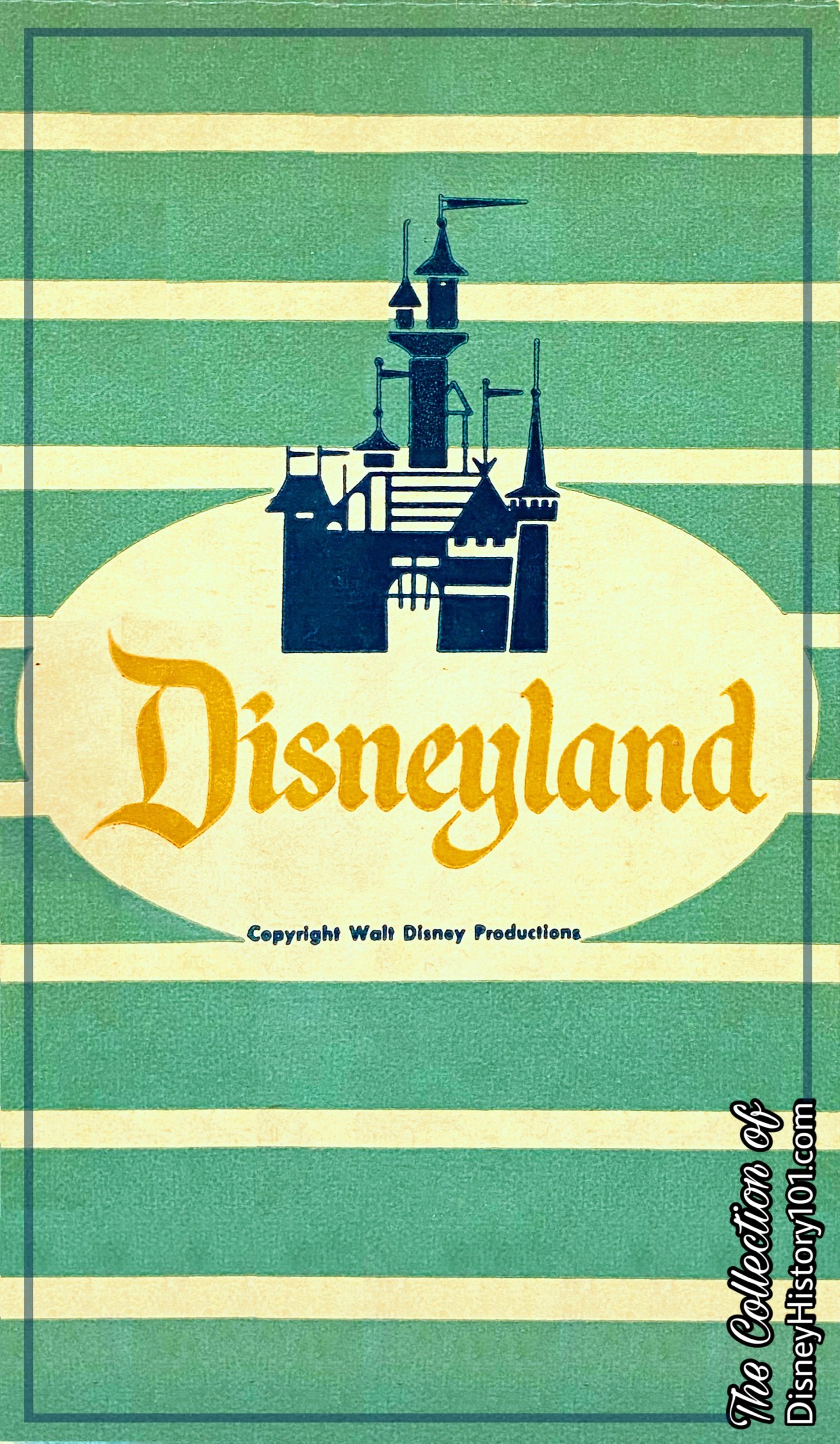
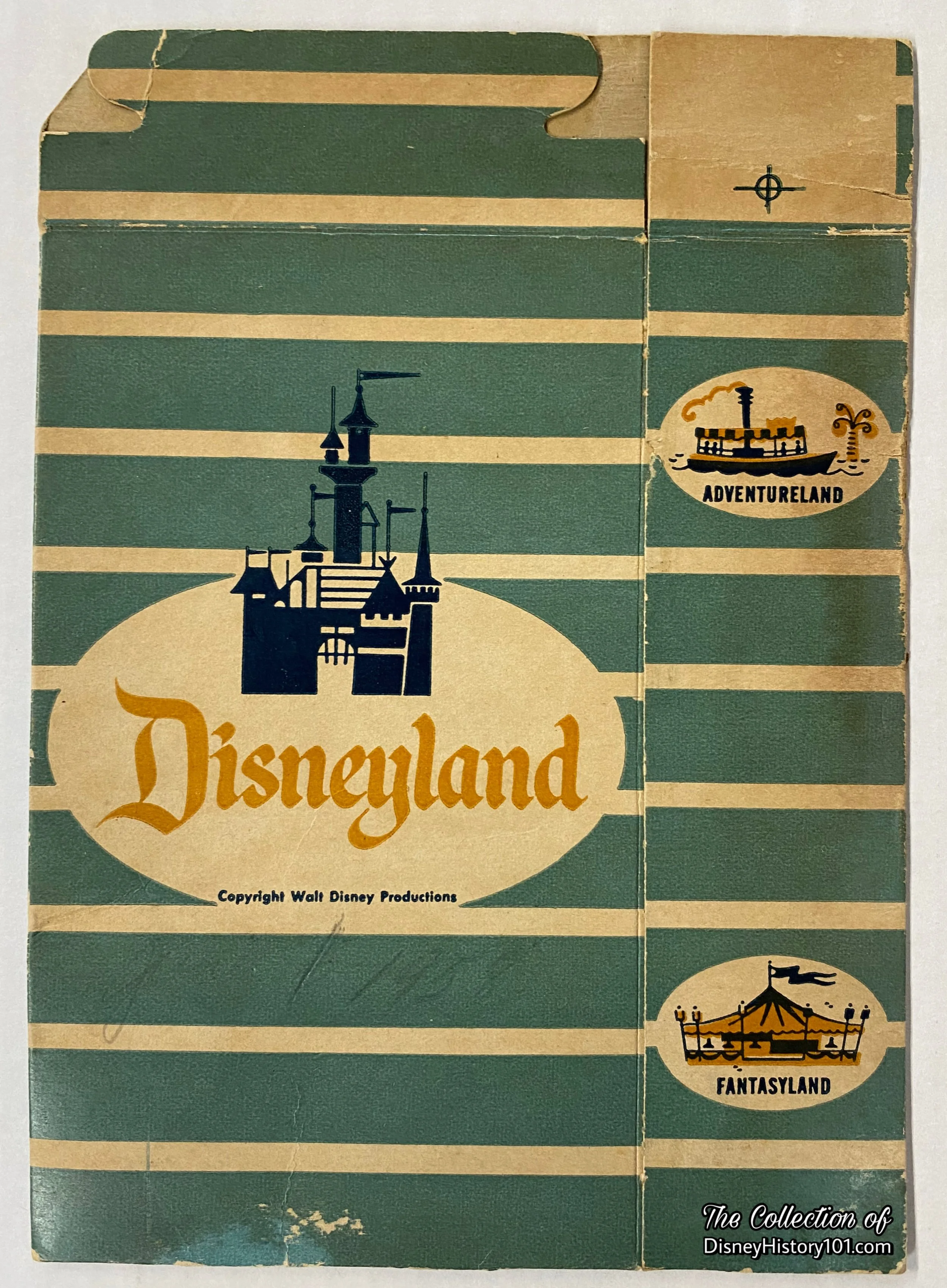
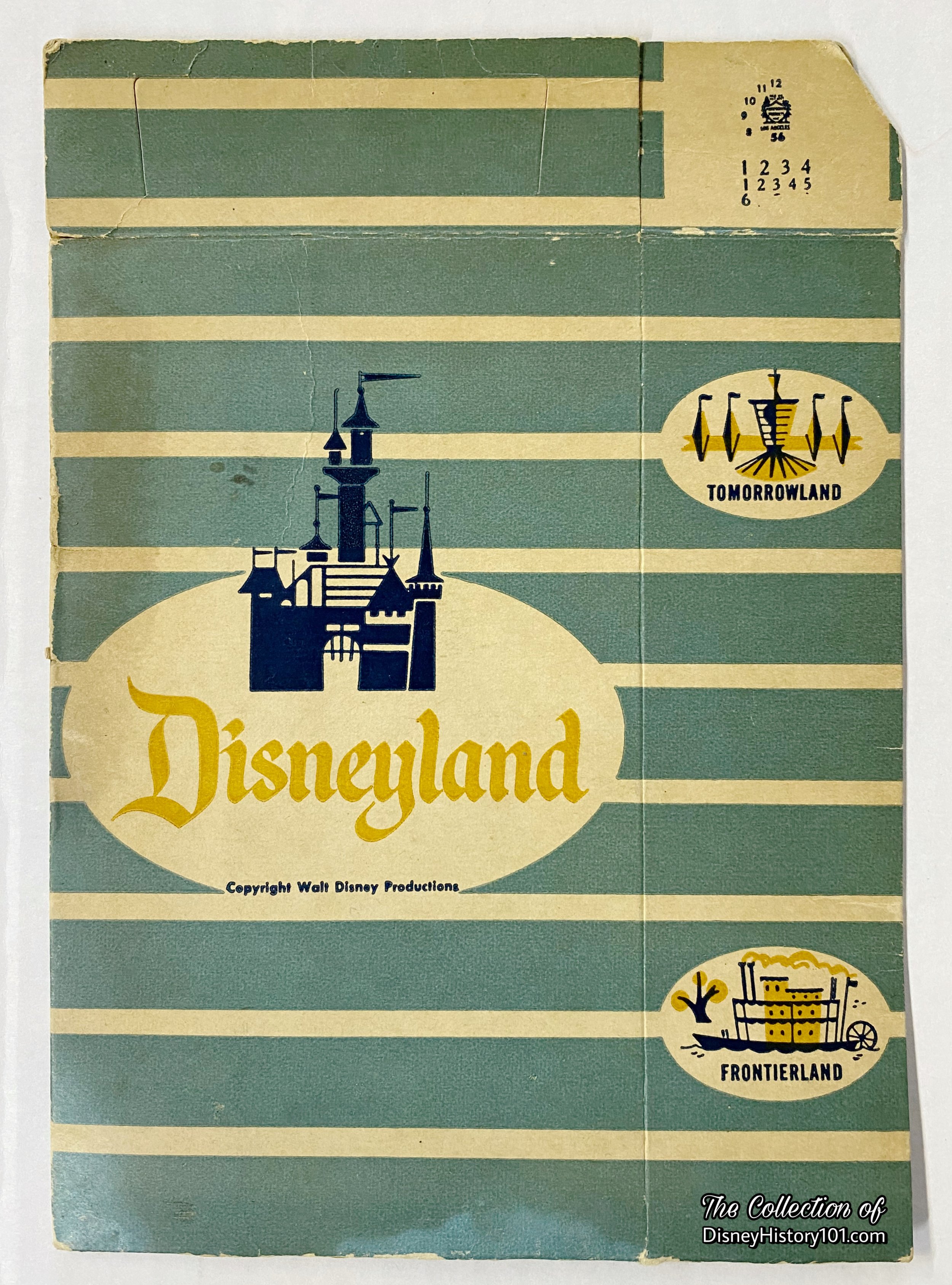
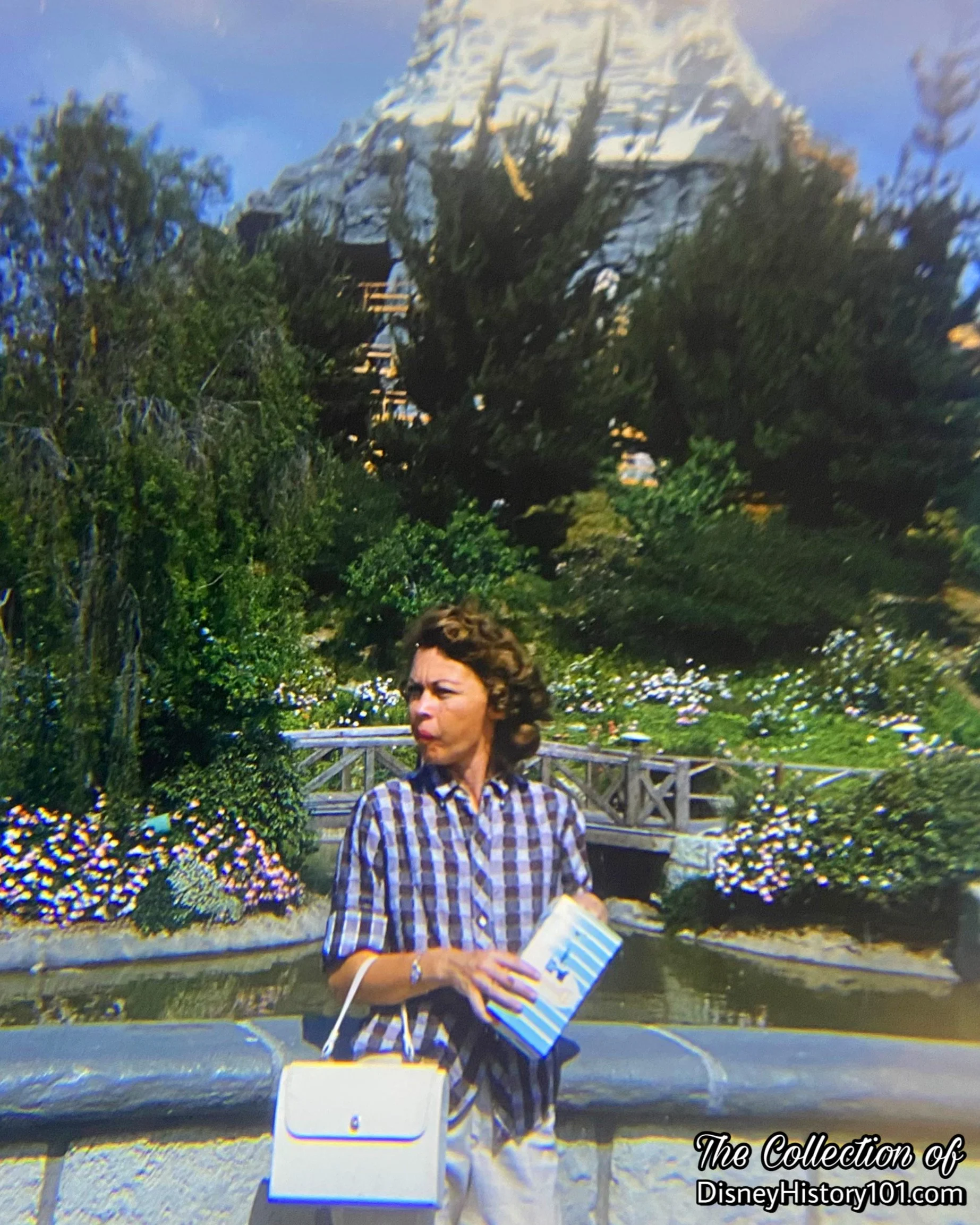
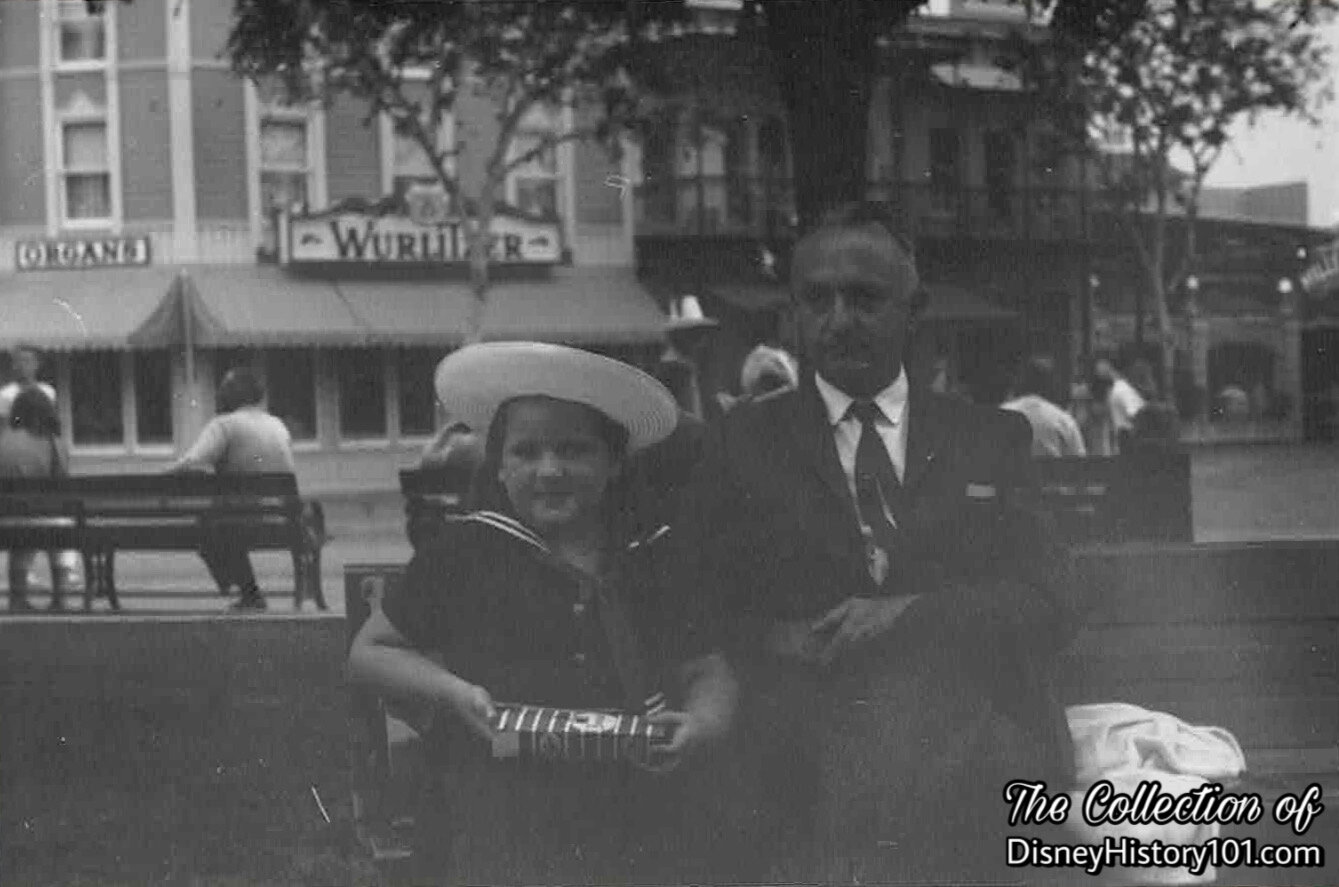
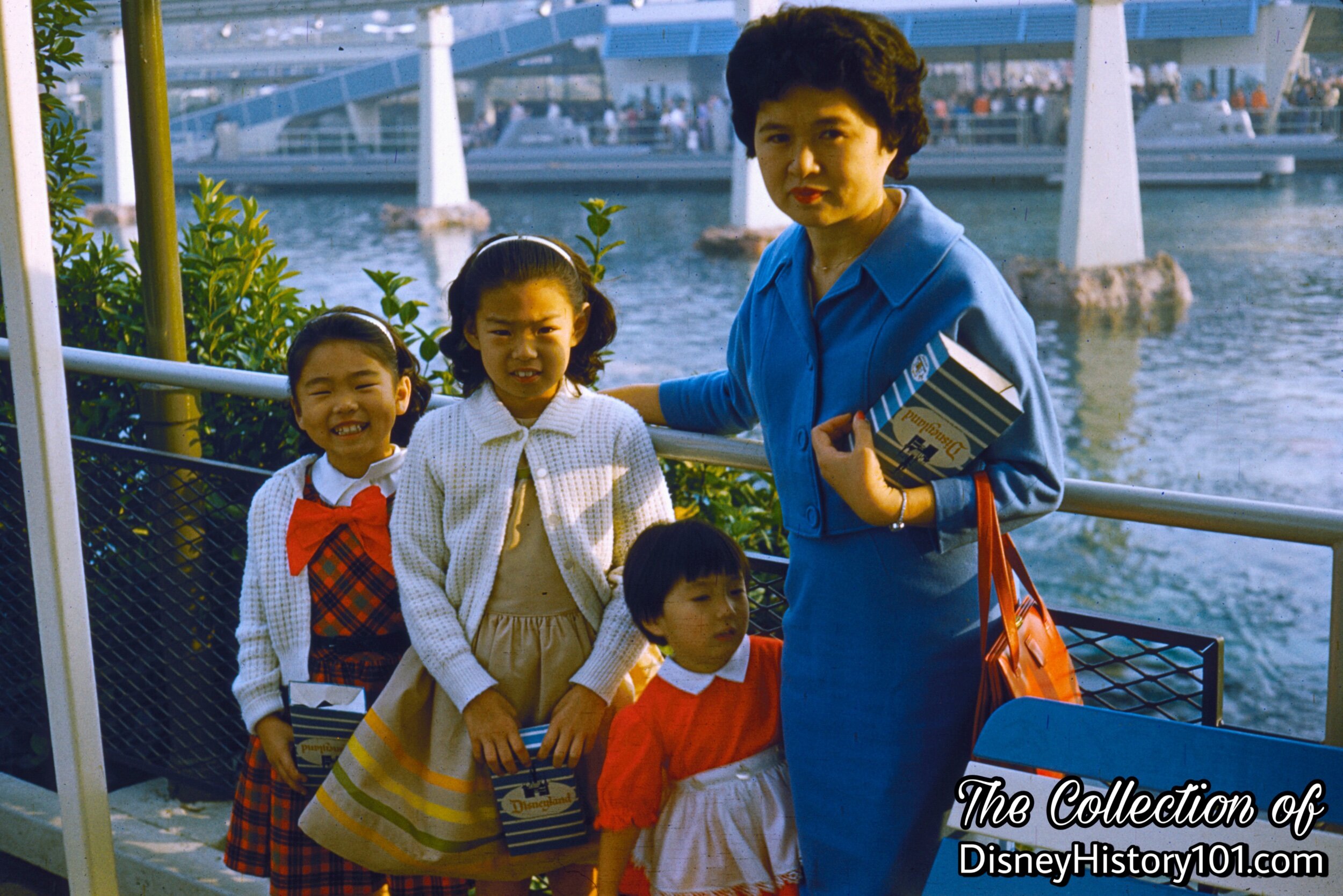
Don’t be fooled by those coloring book illustrations. Until about 1960, Disneyland Popcorn was served in rectangular boxes.
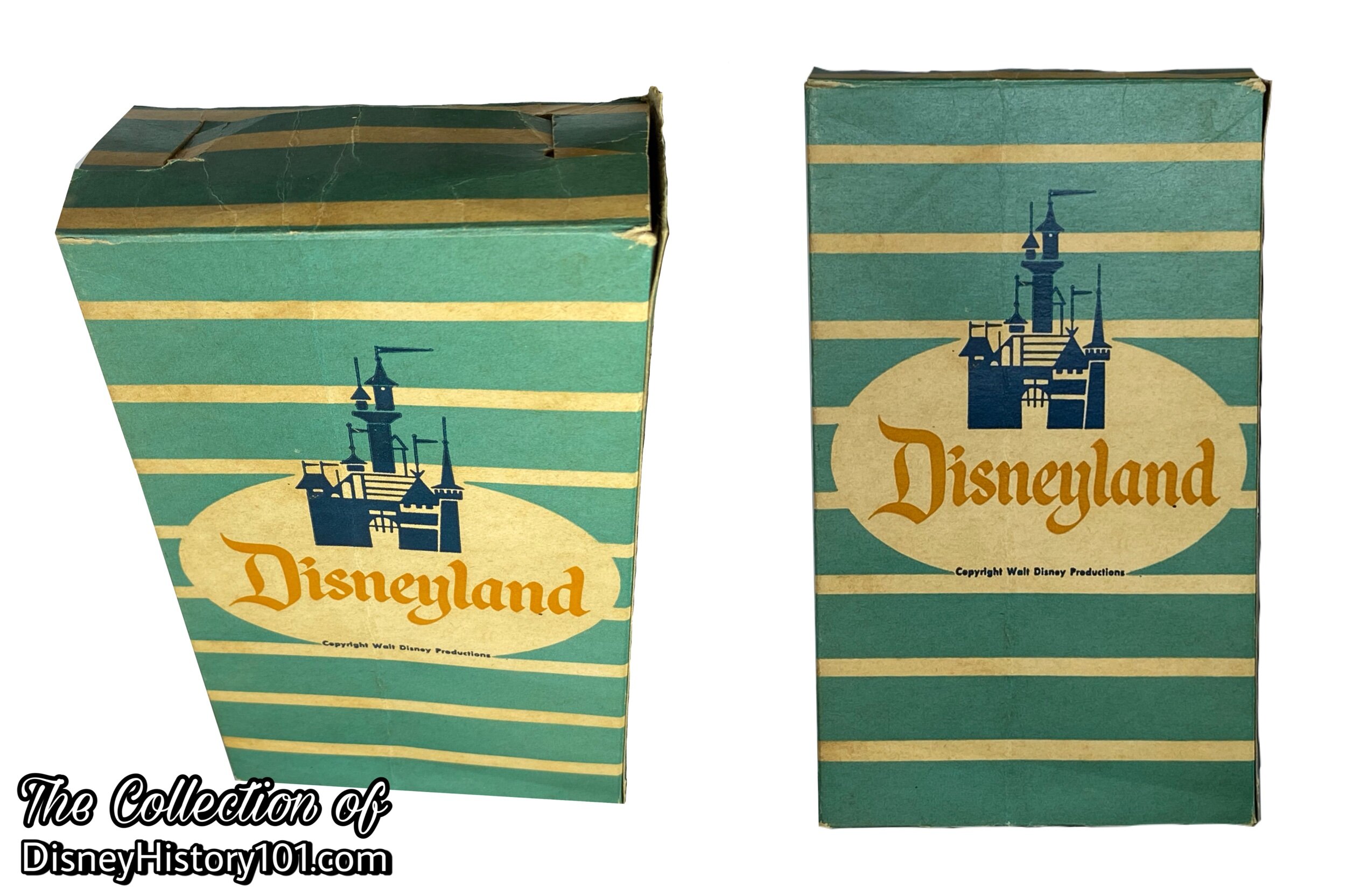
These boxes had the capability of being sealed (to take the extra popped and unpeopled kernels home). Still, these boxes were found small, and a newer design would soon allow guests to easily reach the popcorn at the bottom of the box.
The first Disneyland Dictionary (printed in October of 1959) noted that the Popcorn Wagons
were operated by UPT Concessions served popcorn and peanuts, with two locations “in Town Square and on Center Street during peak seasons.”
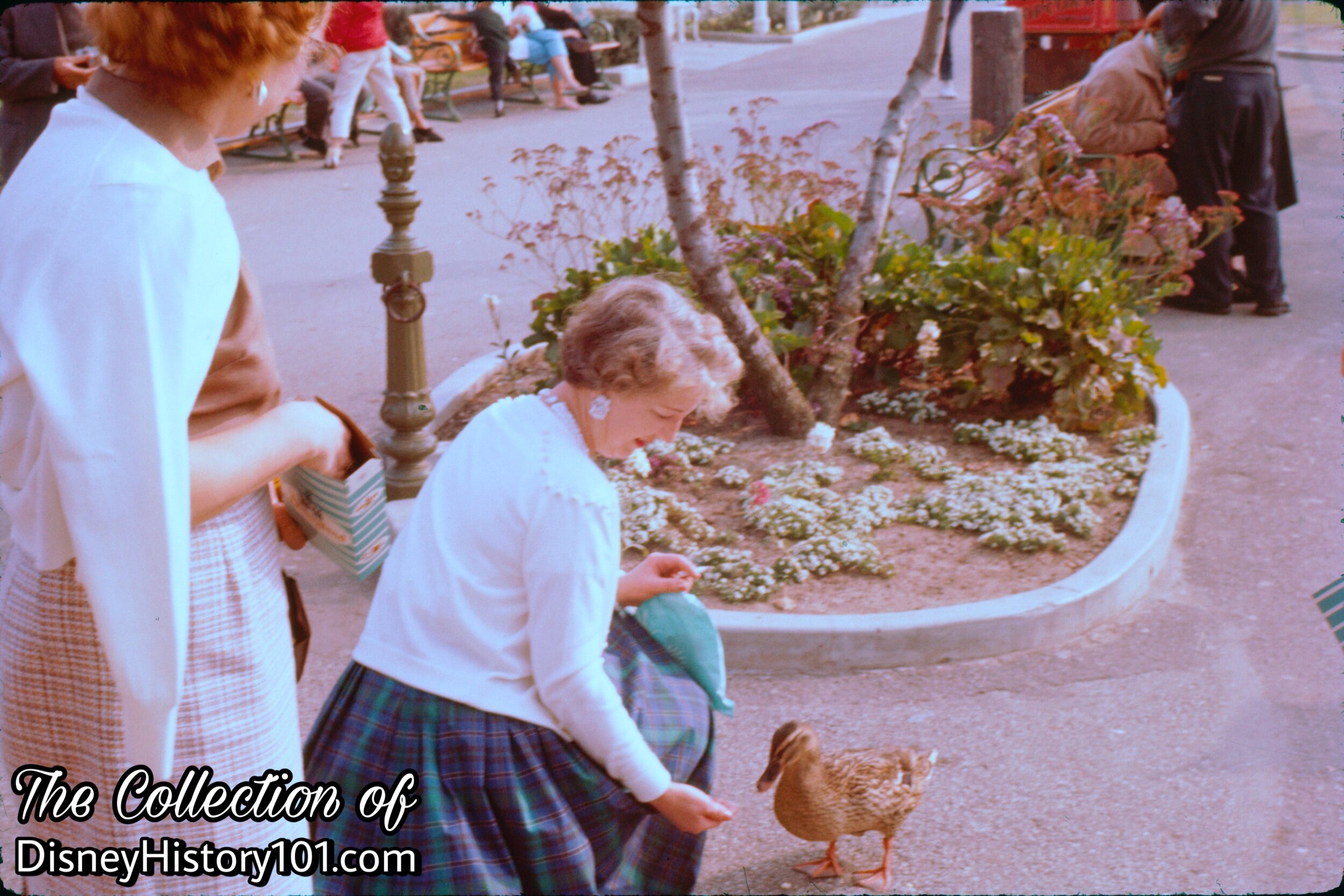
“A Brief Word About the Birds”
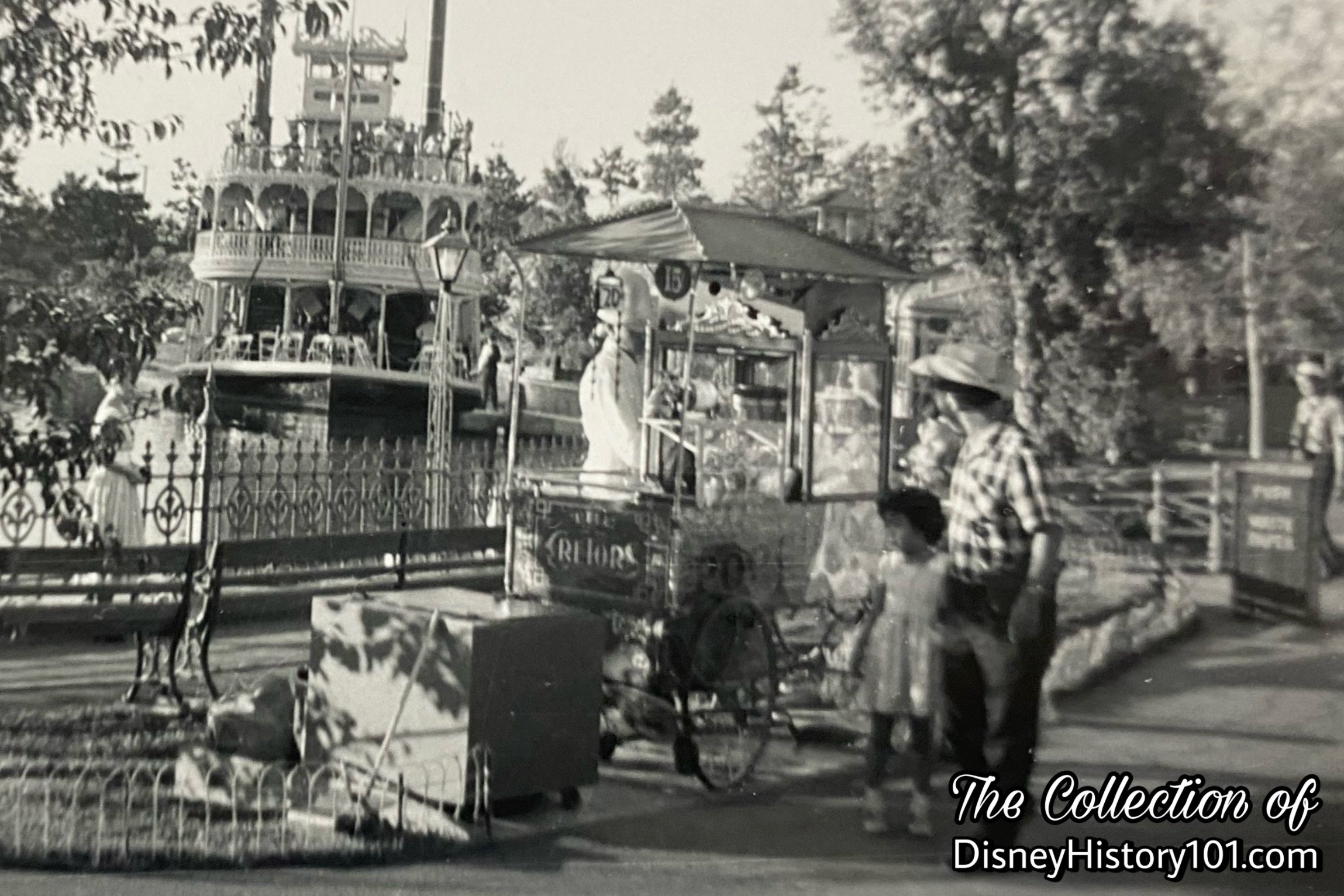
Human guests weren’t the only ones who found the “hot and fresh” popcorn served from Disneyland’s Cretors, irresistible! In the beginning, exotic wild geese, mallards, and other birds migrated to Disneyland. Others were either donated or purchased by Disneyland, Inc. something of an attraction in Disneyland. By 1959, the Rivers of America were teeming with white ducks whom were both raised and cared for by Disneyland, Inc. The Disneyland News (October 1956) once told the tale of Gertie the Duck who was “brought to Disneyland, and launched into the ‘Rivers of America’ from aboard the Mark Twain.”
Soon, other wild life of North America had “‘discovered’ Disneyland. Flocks of wild geese, mallards, and other birds have found Frontierland’s River a safe retreat in their pilgrimages south. The birds pause to rest here, and in some cases stay on for several months,” according to “A Complete Guide to Disneyland” (published 1956, 1957). The “Disneyland Dictionary” (published 1959) noted: “Wild geese, mallards, and other birds around the island and mainland in Frontierland migrated here, and the white ducks on the Rivers of America were raised by Disneyland.”
“55er” Mary Van Thyme recalled: “One time I was in my booth down on the raft dock and Milo Rainey and Bob Allen were on the dock. All of a sudden two ducks started fighting and biting each other's necks. So I called to Milo and Bob to put a stop to it. Milo strolled over, and with a big grin, said, ‘Don't be silly, dearie, haven't you heard about the BIRDS AND THE BEES?!’”
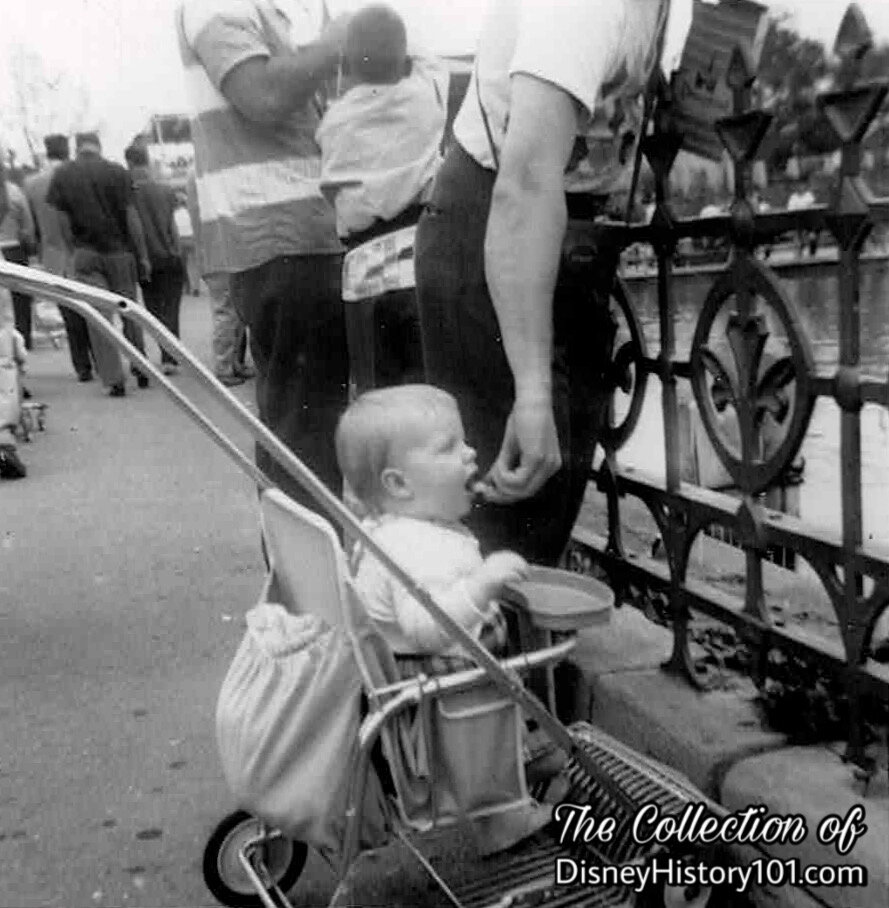
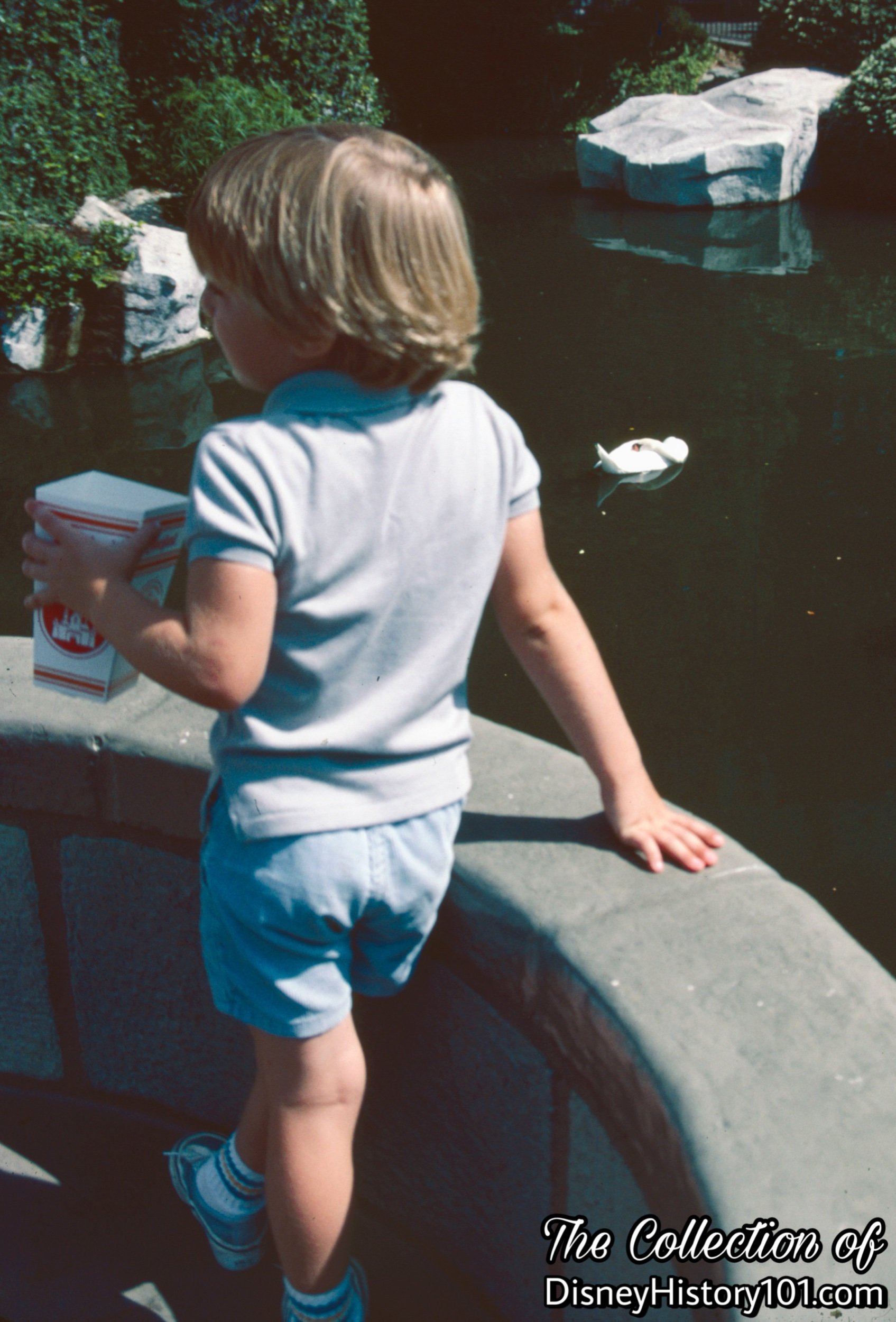
These feathered guests also took the opportunity to do more than rest - they dined! As you can see in the picture (above), some guests couldn’t help treating their feathered fellow guests to morsels of popcorn. The Wonderful World of Disney episode “Holiday Time at Disneyland” (1962) displayed images of a young guest tossing popcorn to feathered guests in the water, while the narrator joked, “Its no wonder when ducks fly into Disneyland, they make it their permanent home!” But therein was highlighted a problem - once the birds learn where to find “hand-outs,” they would never leave the Park. Even more, according to Backstage Disneyland magazine (Vol.1, No. 2, December, 1962), there persisted a “problem of ducks sleeping on our many ferocious wild animals throughout our park.”
These charming “Disney ducks” have continued to captivate guests, proving it isn’t so “tough to be a bird” as they manage to discover occasional "handouts” near concessions. While at Disneyland, never mind what the “little old bird woman” says, because Guests are presently discouraged from feeding the birds! Ducks they do not require them, as they cleanup show contradictions like fallen popcorn that have a huge impact on the guest experience.
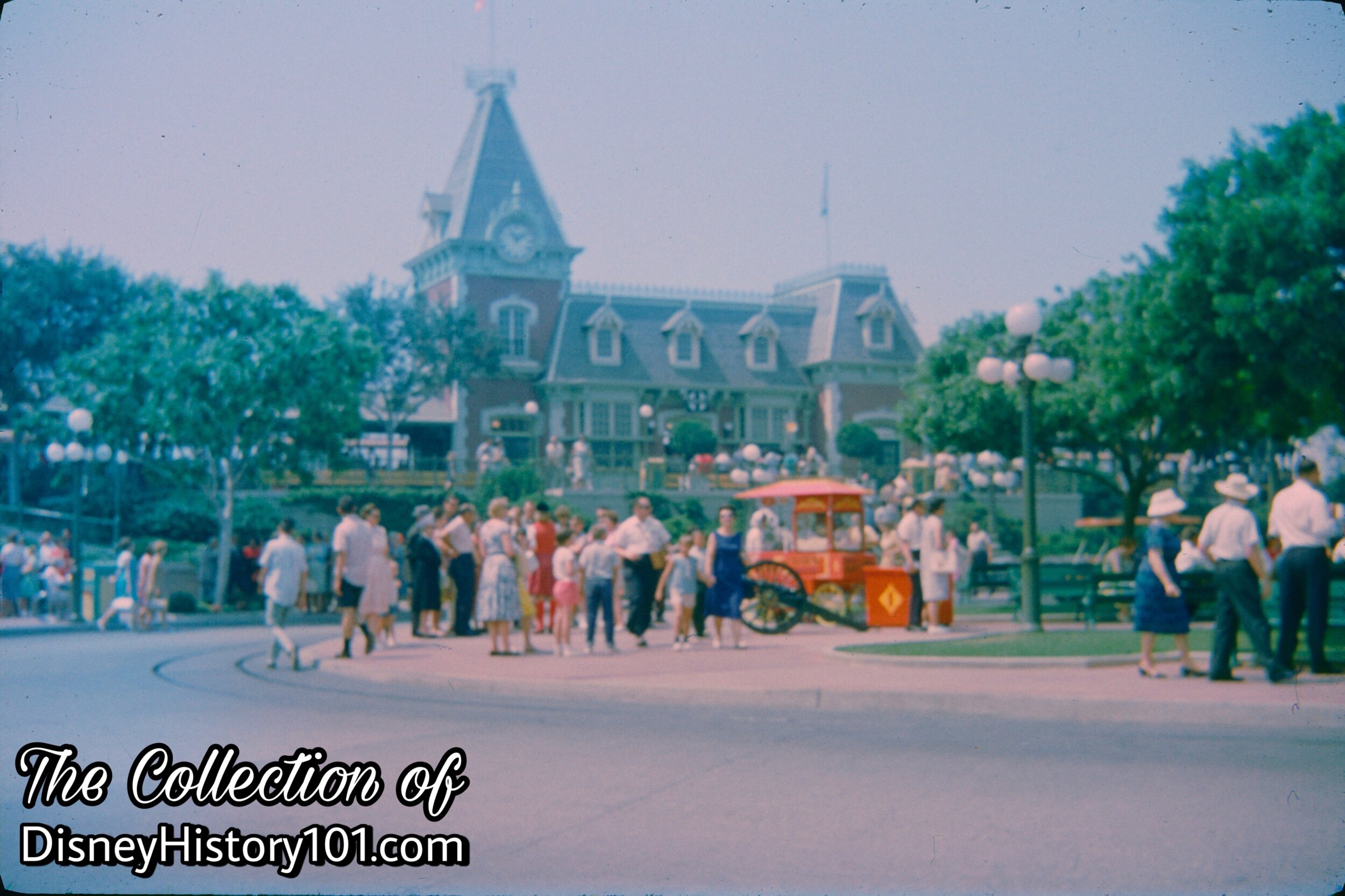
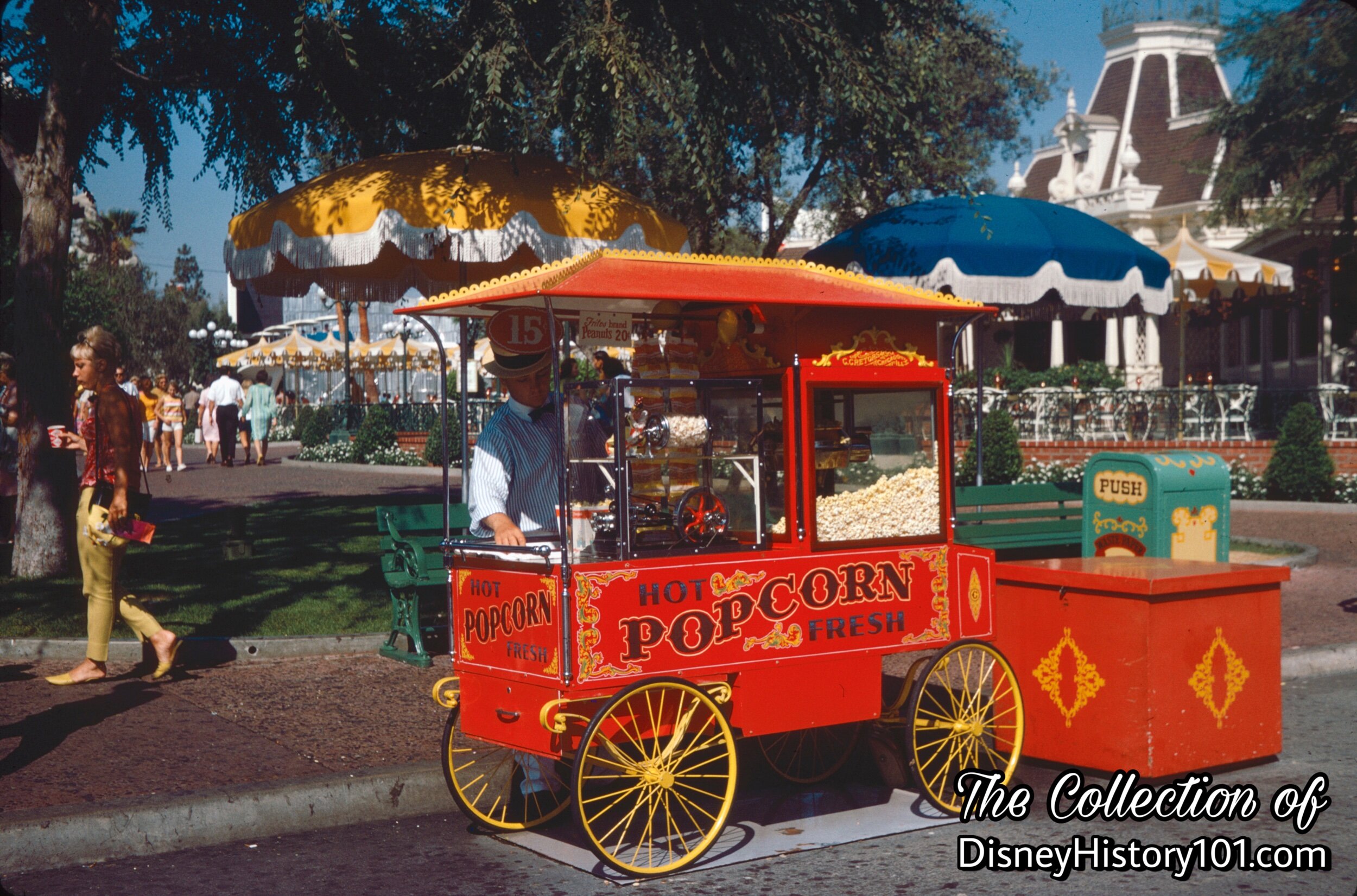
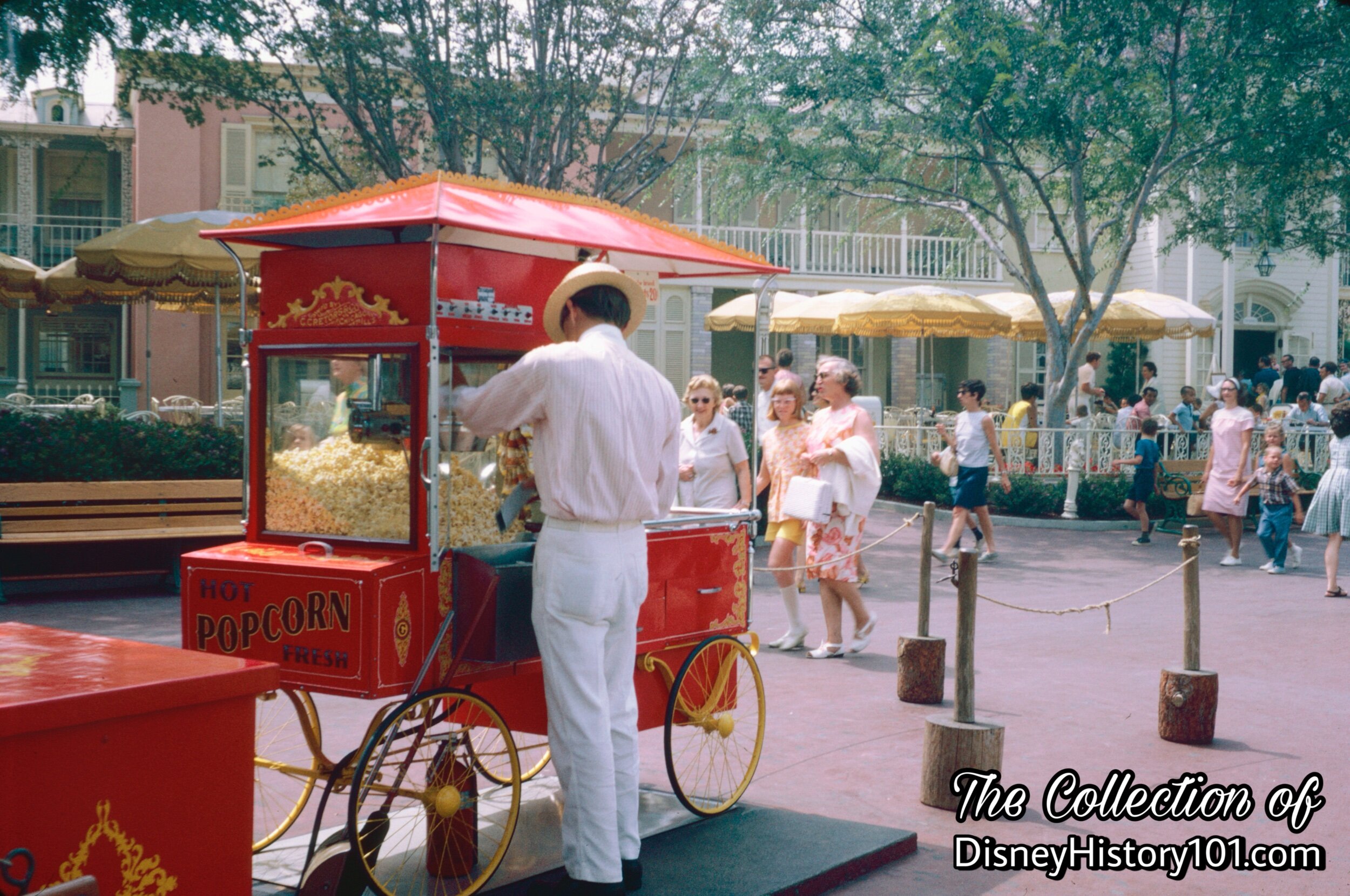
A Cretor services the Main Street USA crowd!
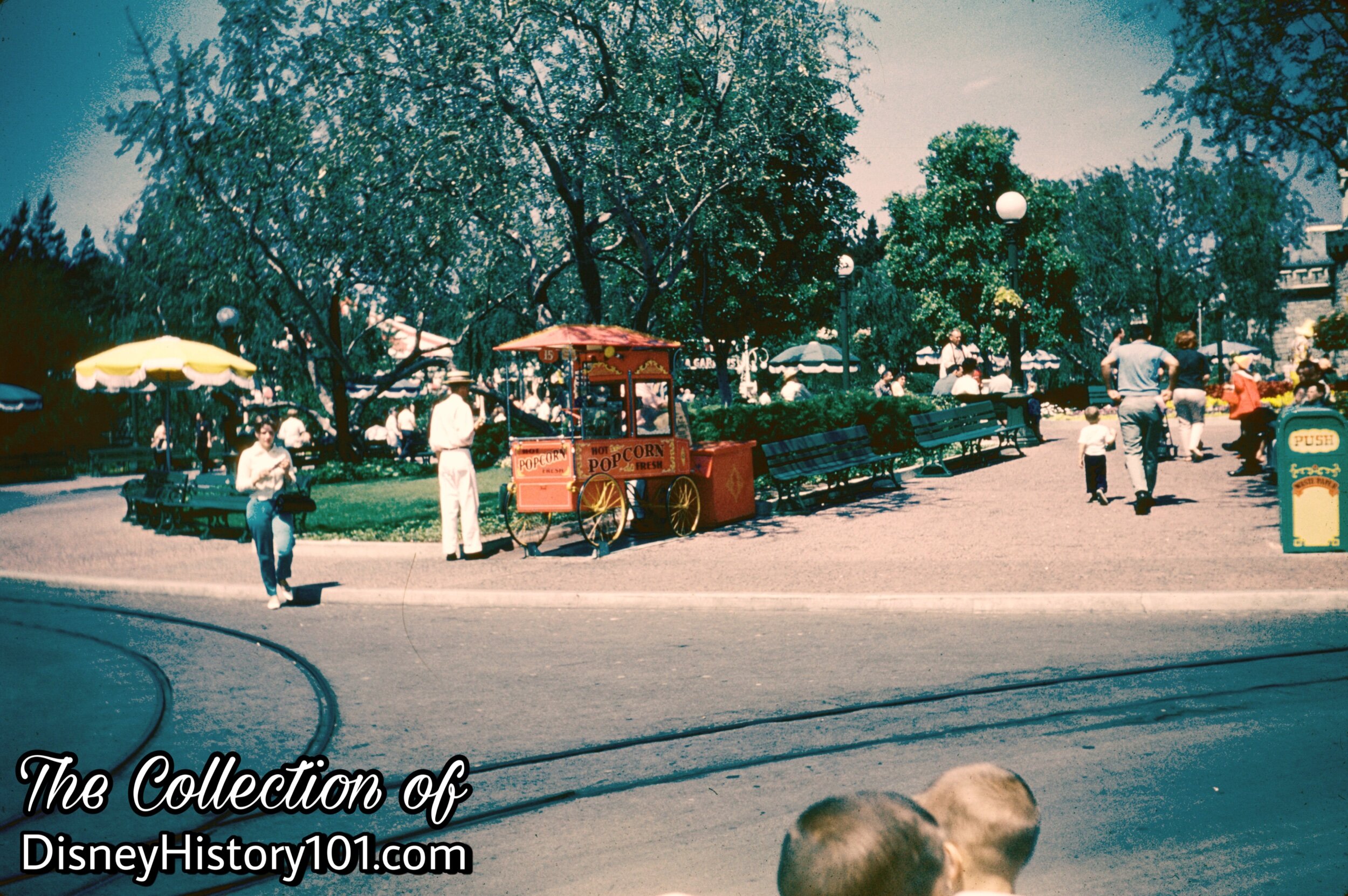
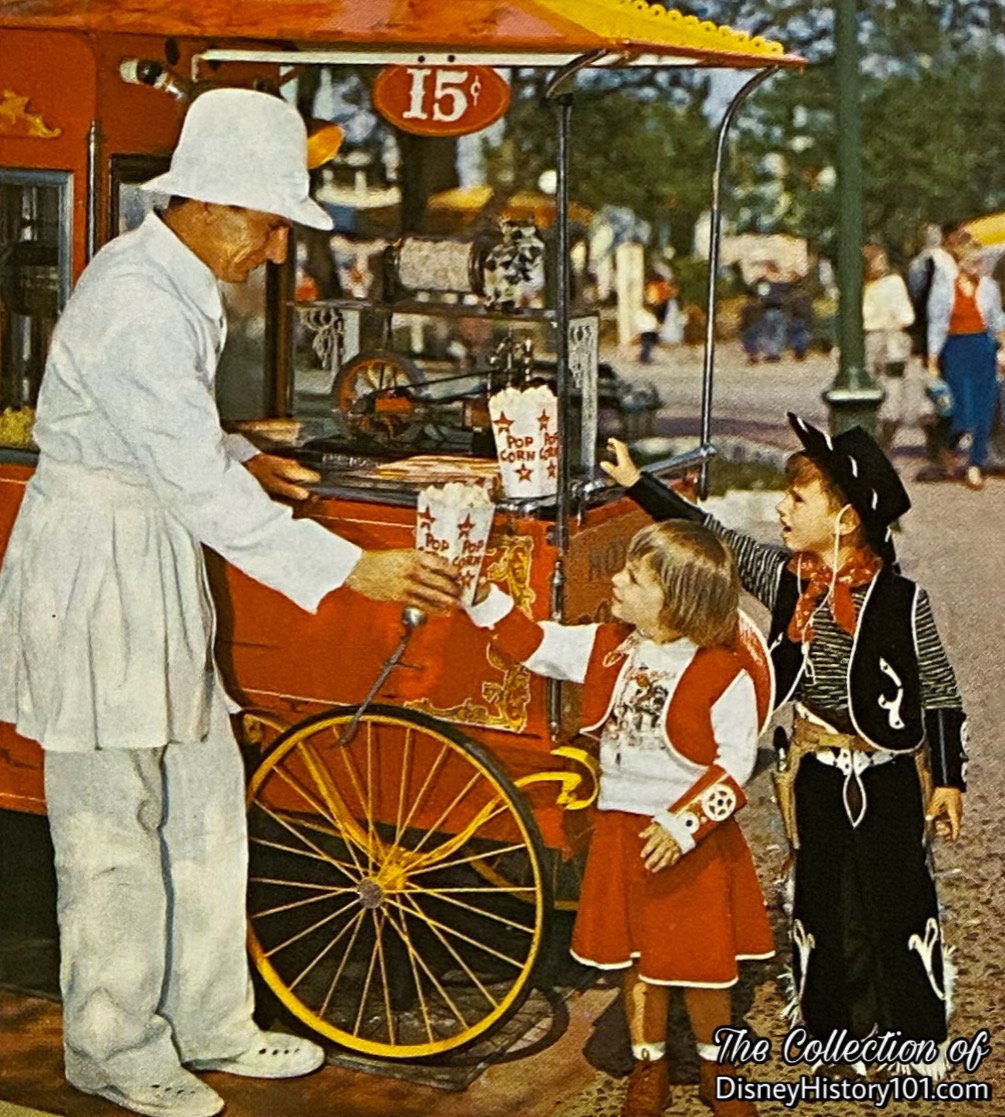
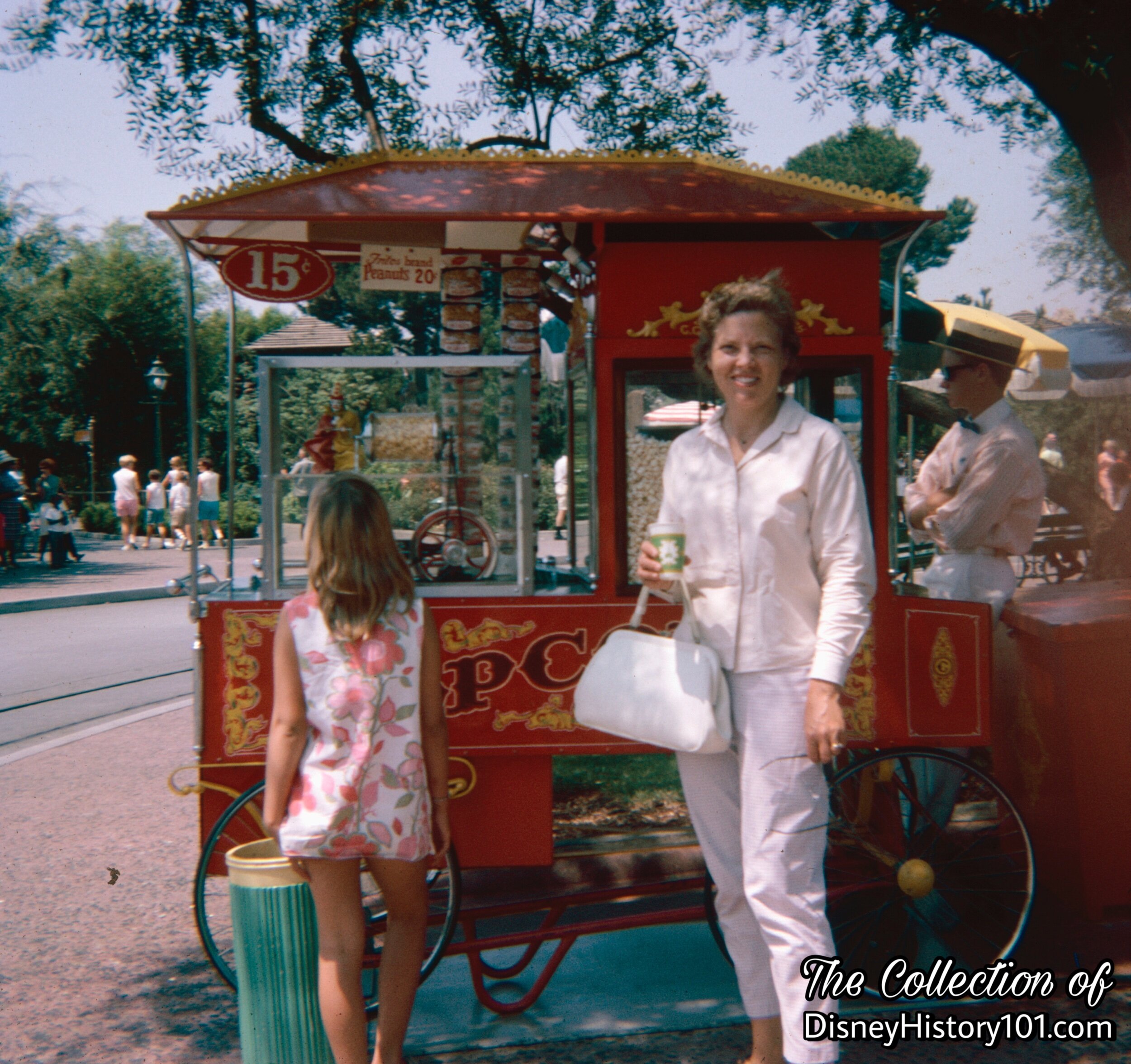
During the 1960s, Disneyland Concessions (like Fantasy 1 & Fantasy 2), the Ice Cream carts, and the Popcorn Cretors were run by United Paramount Theaters. During this same era (c. 1966), Disneyland Popcorn Cretors offered more than hot fresh popcorn. Hot and fresh Fritos Brand Peanuts were also offered, as an alternative light snack, at 20 cents a box!
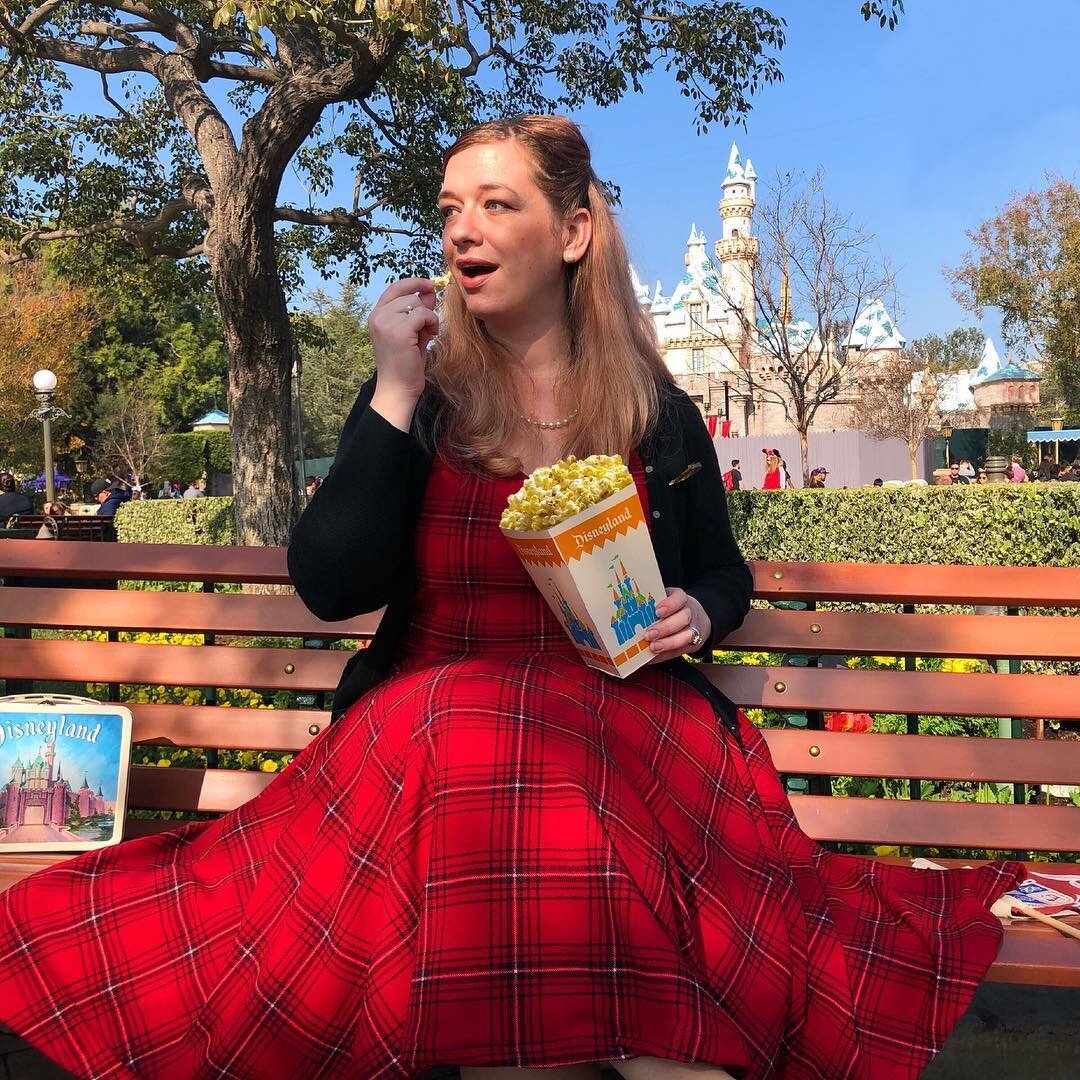
Still, long before the novelty popcorn buckets, the main attractions at the Cretor carts were (and continue to be) each and every one of their hot and freshly-popped buttery kernels! Now, packaging is essential to catching the attention of guests. As Disneyland would enter the 1960s, Disneyland popcorn boxes would feature new designs and eye-popping design graphics (similar to the one pictured above)! These were used until 1967.
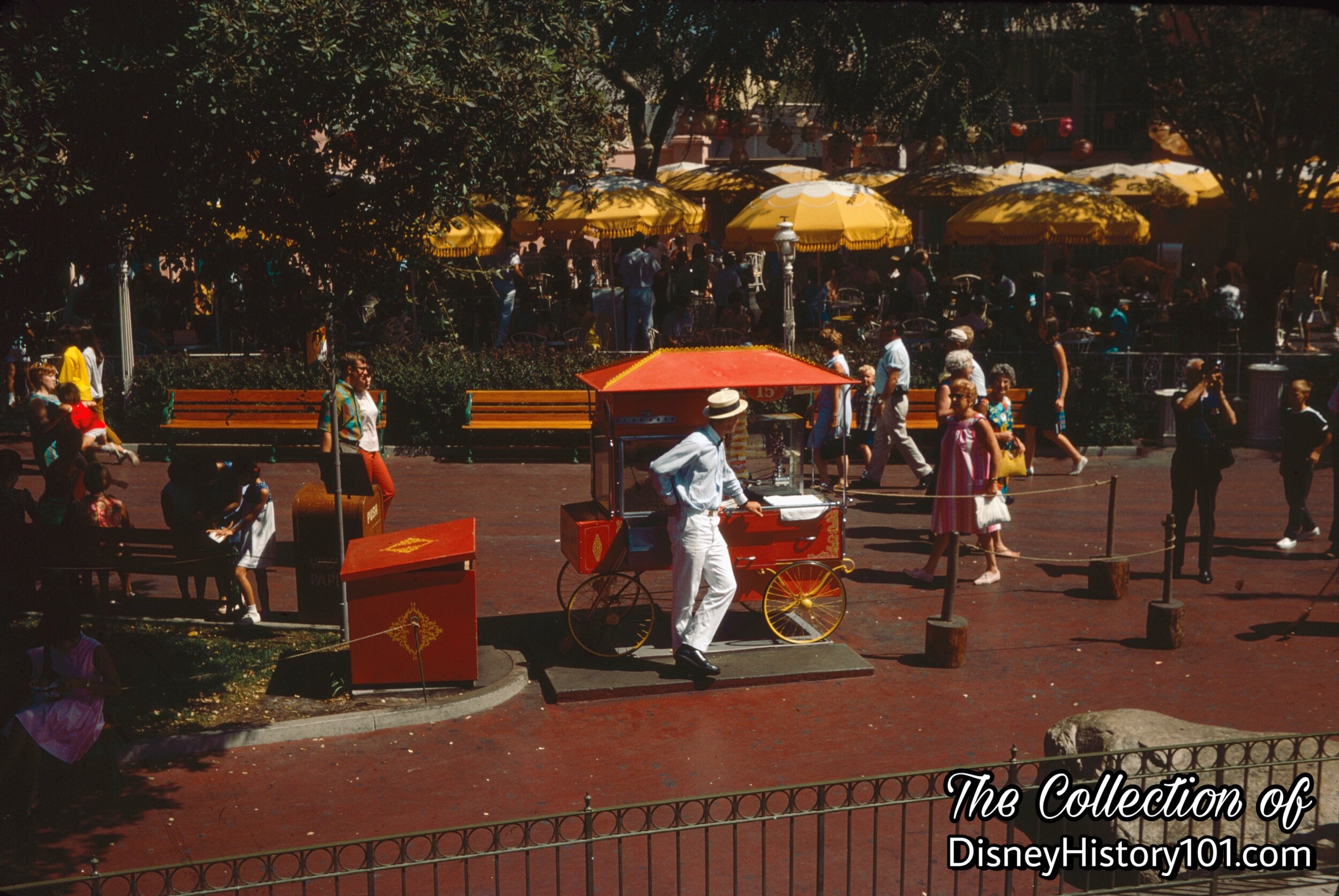
A Cretor sits in the main thoroughfare of Frontierland, along the Rivers of America, c. 1967.
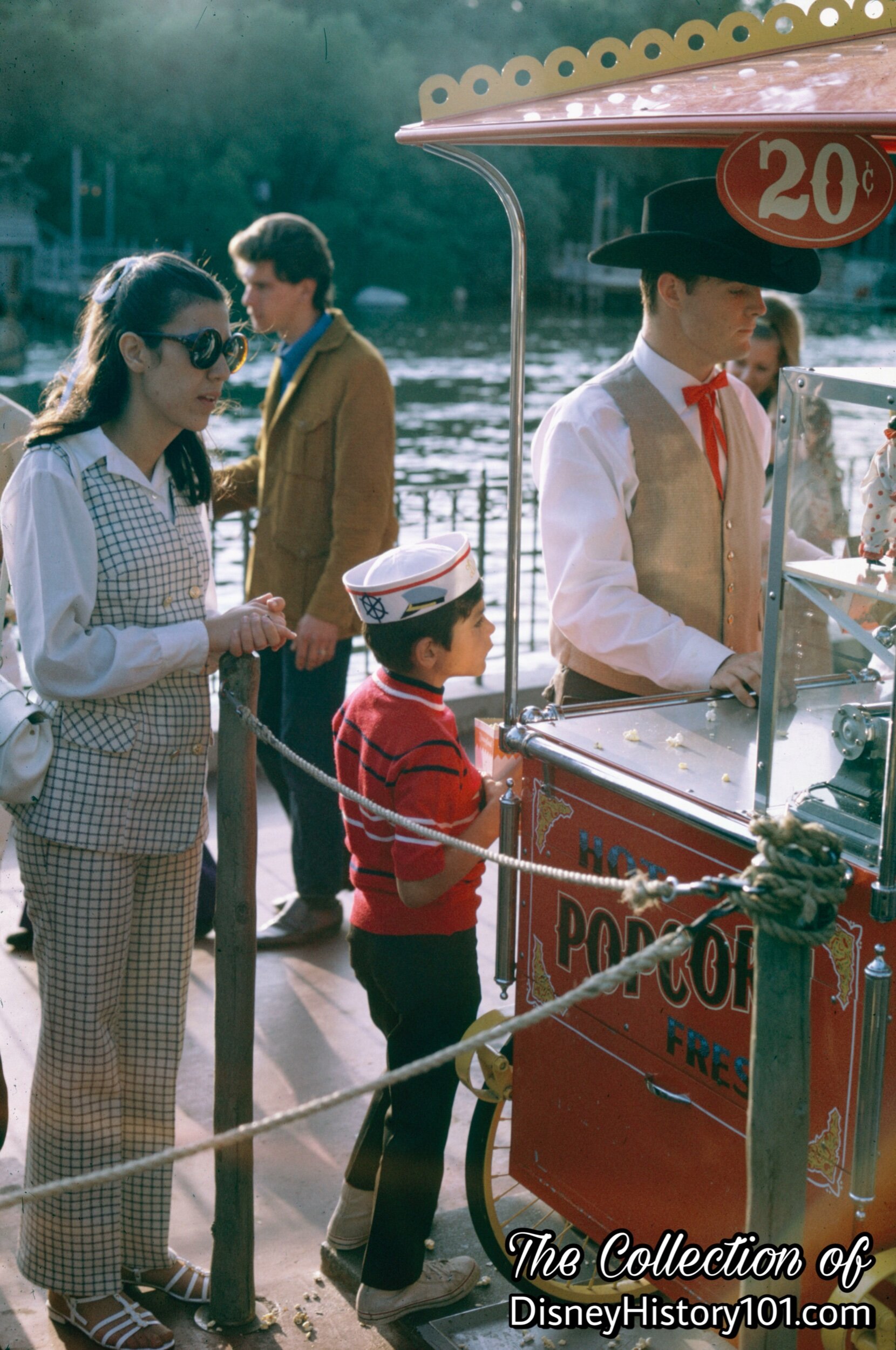
Popcorn prices would increase slightly (by five cents) in 1968.
By 1969 it was figured: “Our popcorn supplier figures it out. We sell enough popcorn every year to cover an area of 30 acres with a layer of popcorn three inches thick, and our guess is that about five acres of that is spilled at one time or another.“ [“THE MAINTENANCE OF MAGIC IN THE ‘MAGIC KINGDOM’”]
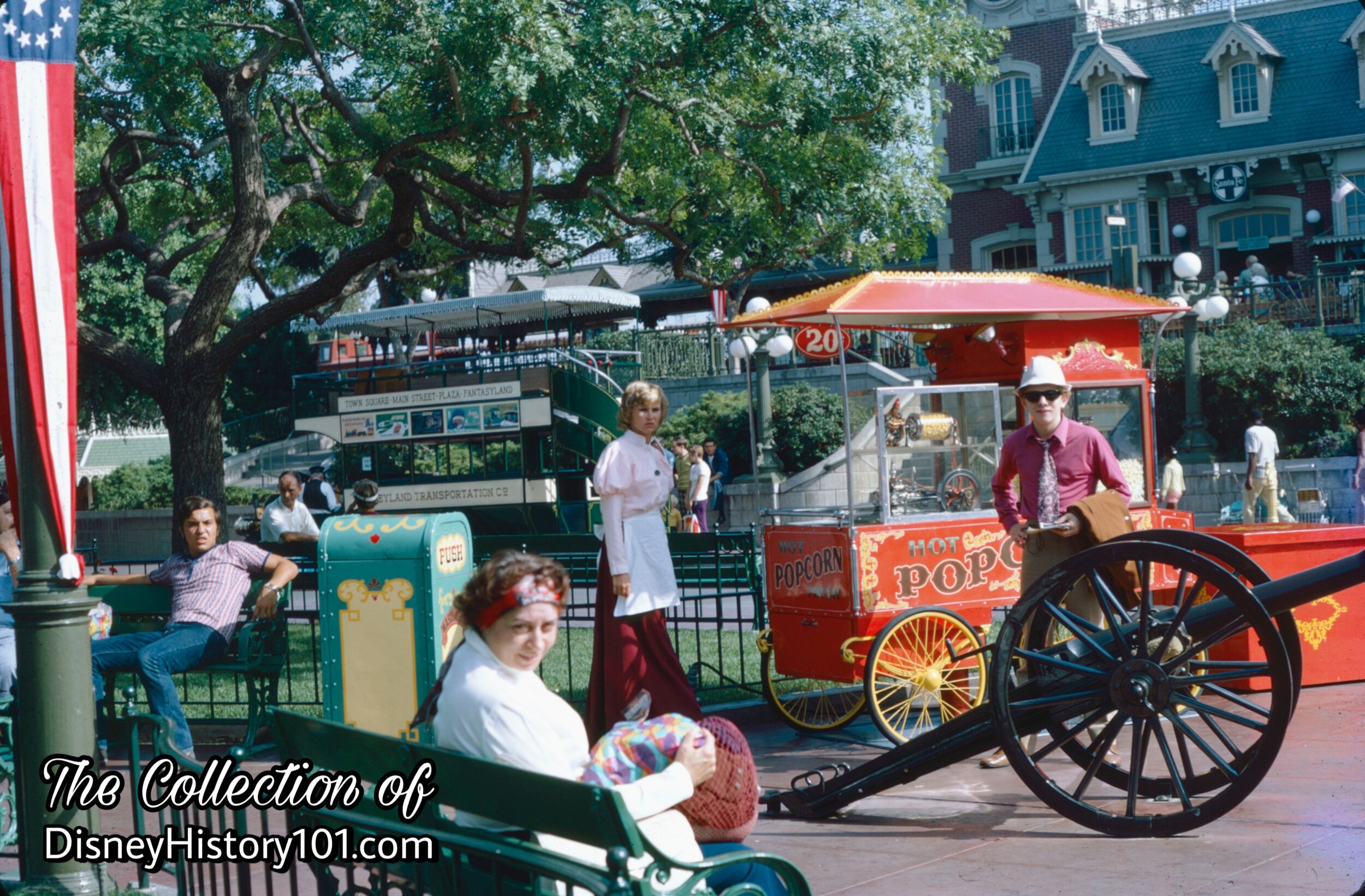
By the 1970s, Disneyland’s Popcorn Cretor pots were changed from Cretor brand to Manley brand. Also, by about 1971, McGlashan Enterprises a division of Buena Vista Distribution Co., Inc. (the same company that manufactured and designed air cannons, lead shot, and plastic ammunition in addition to shooting galleries and air rifles for Disneyland) had designed and was manufacturing a line of custom-crafted popcorn wagons for Disneyland, Walt Disney World and other amusement facilities in the U.S., Canada, and Belgium.
The price point for one serving of Disneyland Popcorn - 20¢. Still, during peak periods of operation (c. 1973), “as many as 1,000 people” bought “a box of popcorn from one wagon in just one hour,” according to “Food Showmanship Disney Style”, published 1973. According to the same publication, “On a busy day the outdoor food hosts, working from seven wagons located throughout the Park, will sell as many as 33,000 boxes of popcorn.”
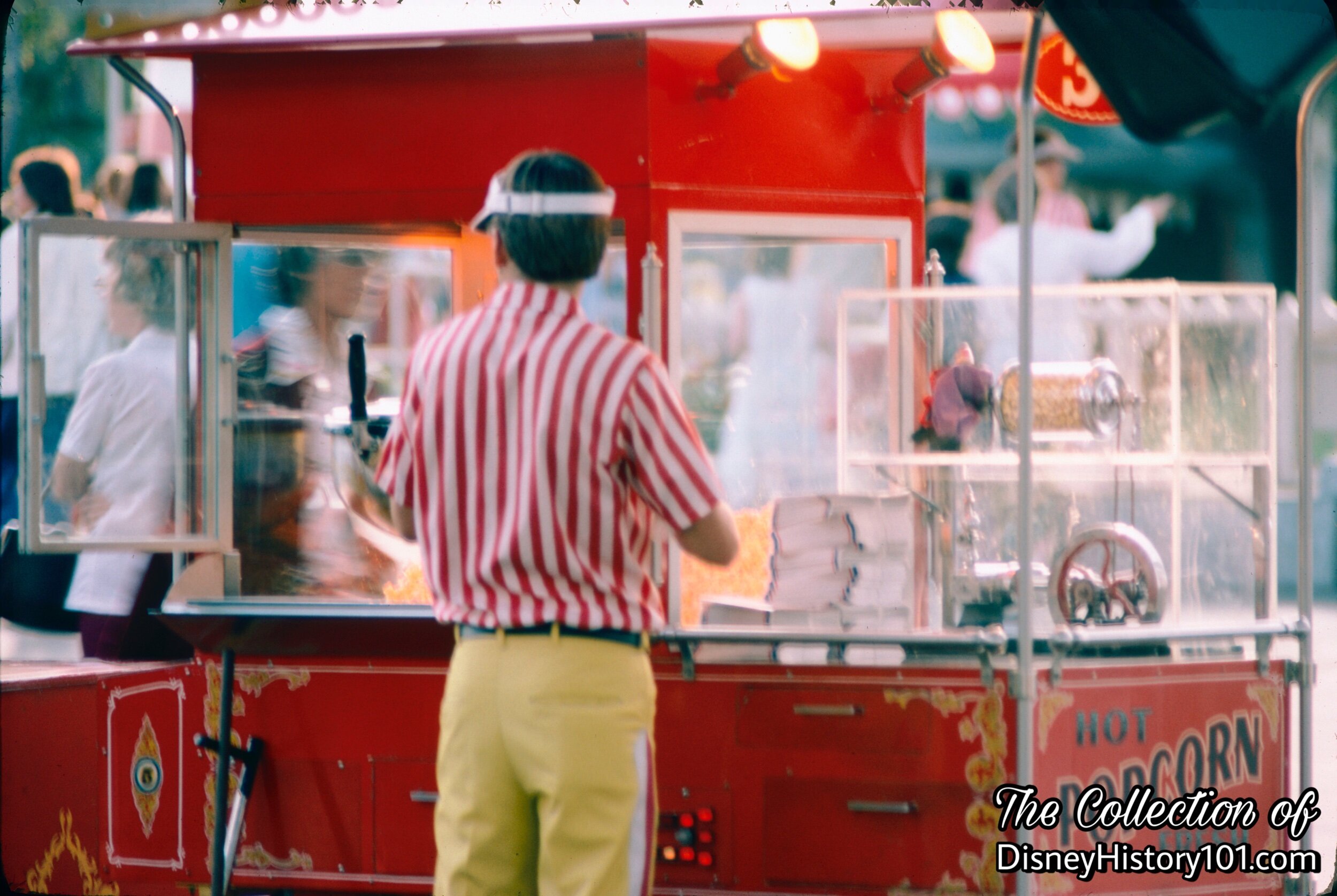
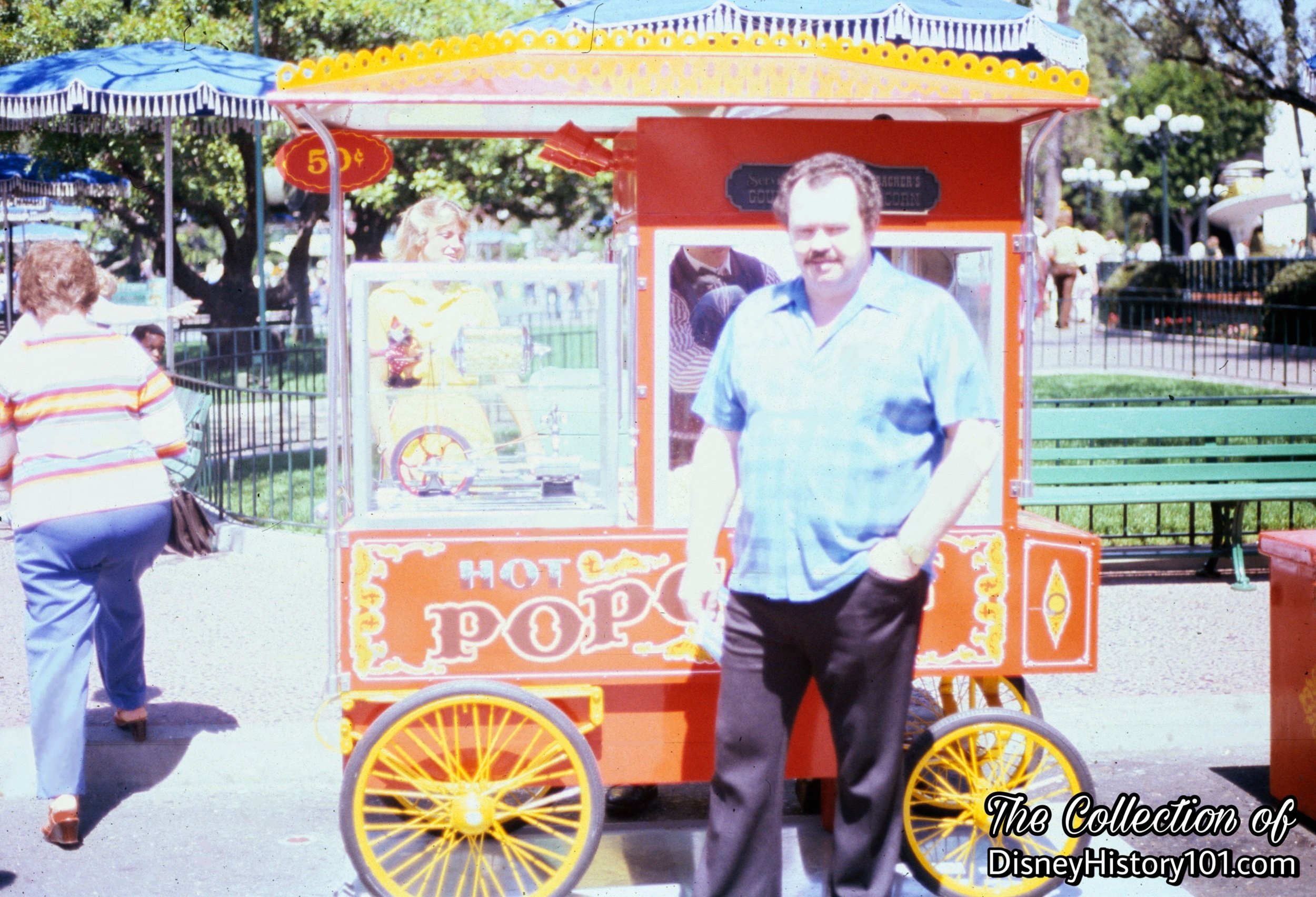
In the early days of Disneyland corn was purchased from farms. Cal McMurtrey recalled: “We got a farm near Pismo Beach and we raised hybrid corn for poppin...it had small kernels. We had 500 acres and I remember one time I had gotton the whole crop sold to Disneyland. It was in 600 sacks and each sack was a hundred pounds. But by the time I got back to tell Dad, he'd had it all ground up into chicken feed!”
After Orville Redenbacher became the official popcorn of Disneyland, Disneyland LINE magazine (published for Cast Members) ran the following story.
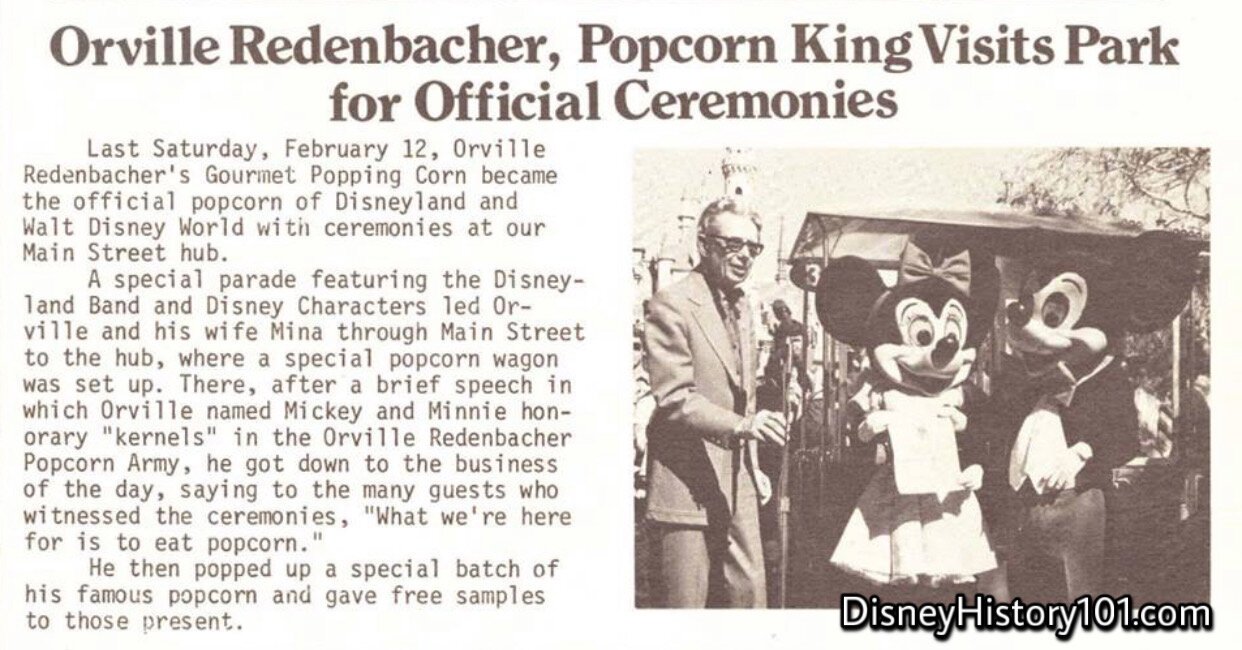
Decades later, Orville Redenbacher became the official popcorn of Disneyland during a special daytime ceremony on February 24th, 1977! After this momentous occasion, “hot, buttery and finger licking good” Orville Redenbacher Gourmet Popping Corn continued to be offered at various Popcorn Wagon locations throughout the Park.
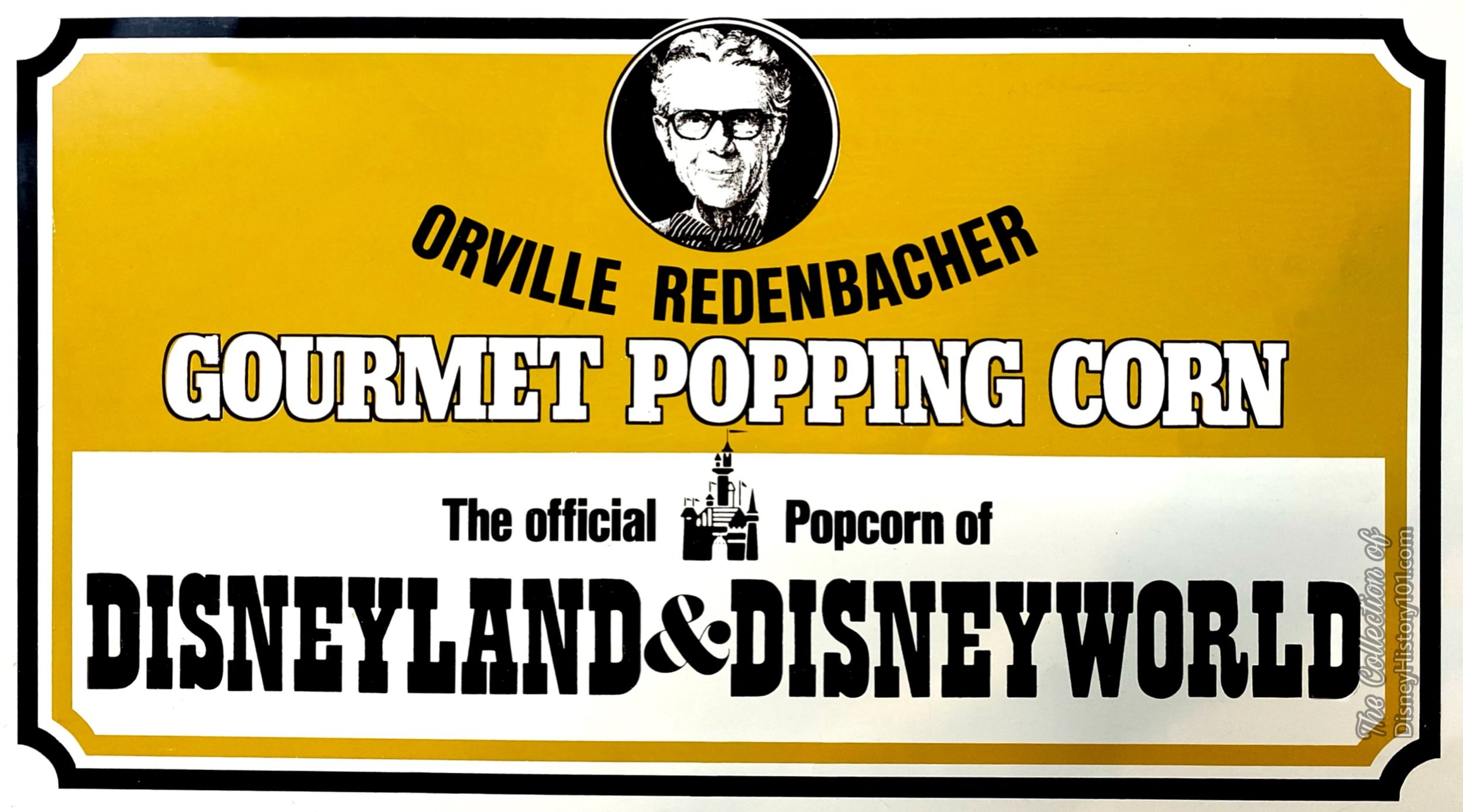
Over in Walt Disney World, an average of 90 tons of popcorn was sold to guests annually. Soon, Cast Members were invited to attend festivities and meet Orville Redenbacher in person at the Village.
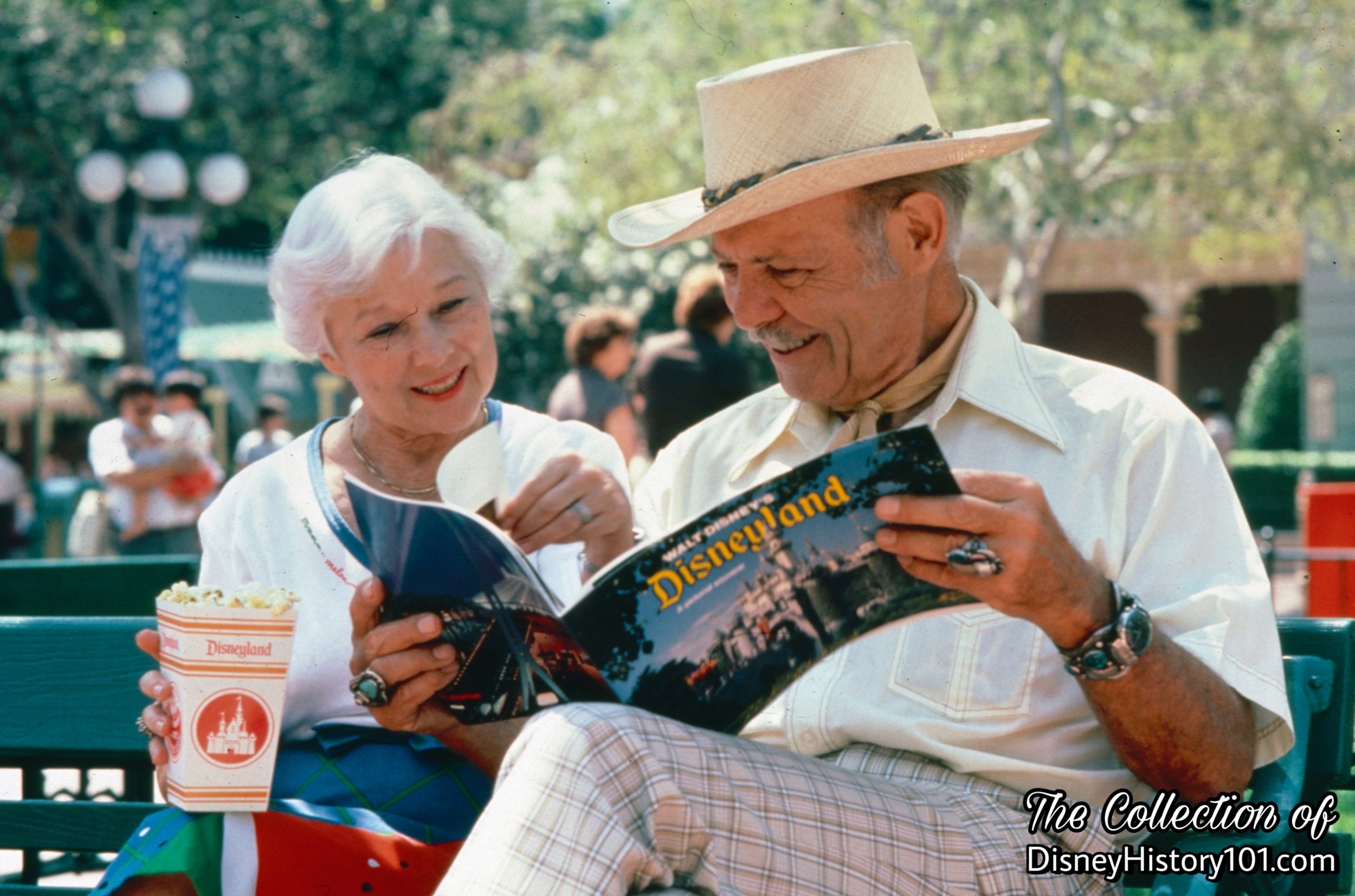
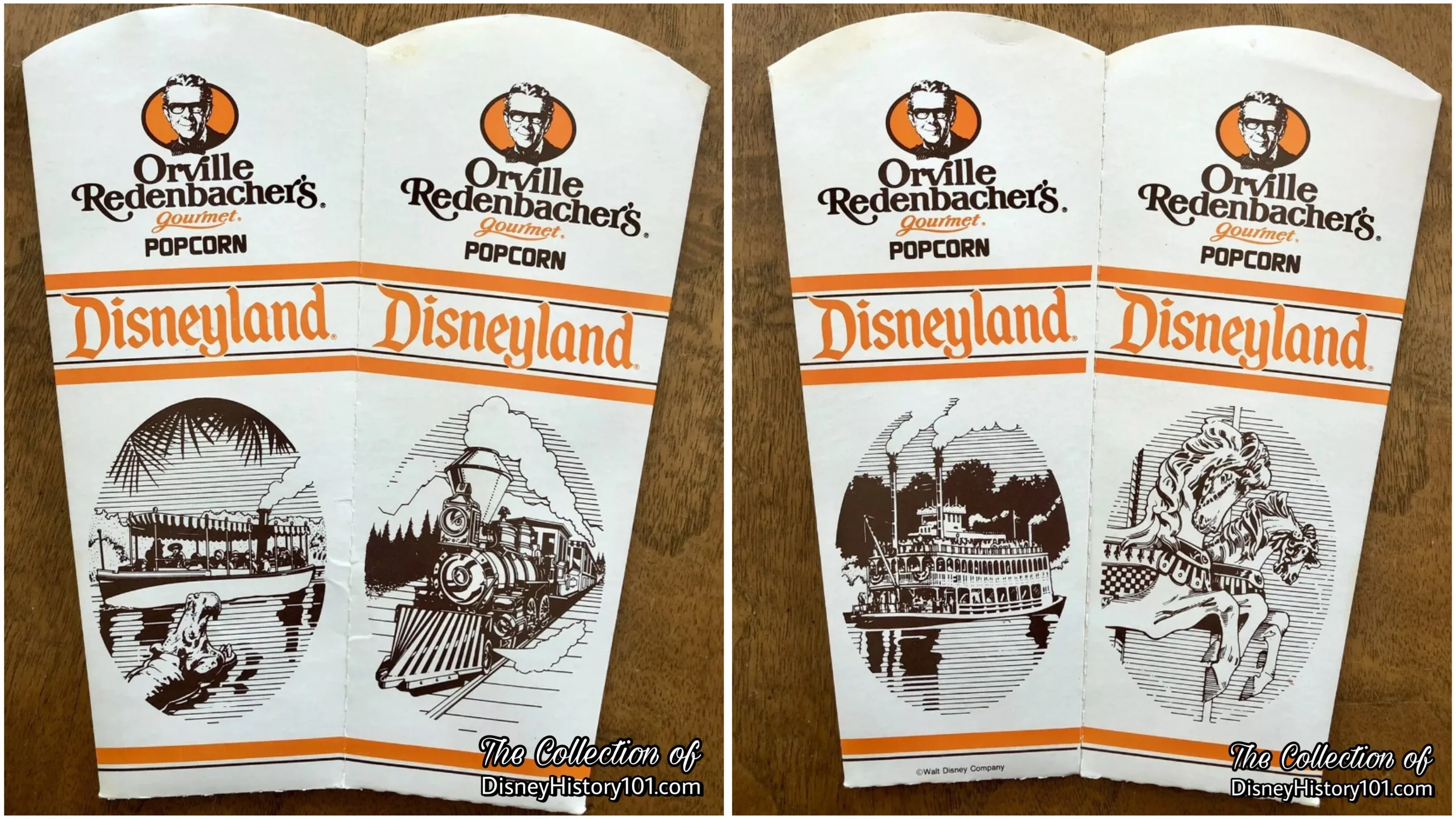
By 1990, Disneyland audiences were purchasing 3.2 boxes of popcorn annually from various locations around the Park.
Con Agra’s Orville Redenbacher brand continued the official popcorn of Disneyland until new Disneyland Participant Diamond Foods’ (and Pop Secret) were brought aboard in 2015. The new Participant sponsor of Disneyland and Walt Disney World Resorts signed a multi-year deal which included the sponsorship of Fantasmic at Disney’s Hollywood Studios.

“MODIFICATIONS AND MAINTENANCE”
The Arcade Mechanics team regularly repaired the popcorn machines. David (a Disneyland Arcade Department “Electro-Mechanical Technician"), who worked around these carts between 1974 and 1998, shares some of the history of the antique Disneyland Popcorn Cretors :
“My knowledge goes back to 1974. I believe we had 6 or 7 wagons back then. We rehabbed each one every year over the winter months. Back then I watched the Arcade Department add sheet metal, rebuild, modify, and restore each wagon. I can’t say for sure that they were the same ones from 1955/1956. However, looking at all the early photos and knowing what we had in 1975, I believe they just kept upgrading the originals. I saw when they removed the old Cretors signage (original cast iron sign). The modifications always kept the original look, but made the wagons operate more efficient.
The early carts had no storage space…supplies on the ground in metal open boxes.” David adds that a “lower section [was] added so storage would be off the ground. I remember when we upgraded the wheels so they would hold the added weight of the modifications.
Each year every wagon was stripped of its sides exposing the angle iron frame. The parts were steam cleaned and primed to keep from rusting. The wiring would be improved to reduce ‘down time’. Oil storage and delivery was modified many times over the years. The sign shop would hand paint and letter the signage like new every year. I believe we probably fabricated additional wagons in-house and we also had a couple of wagons made in Japan by the company that made them for Tokyo Disneyland.
…As of 2019, the last ‘vintage’ red popcorn wagon still in operation, [was] currently in New Orleans Square. It [was] used as a spare when one of the new wagons needed work in the shop.”
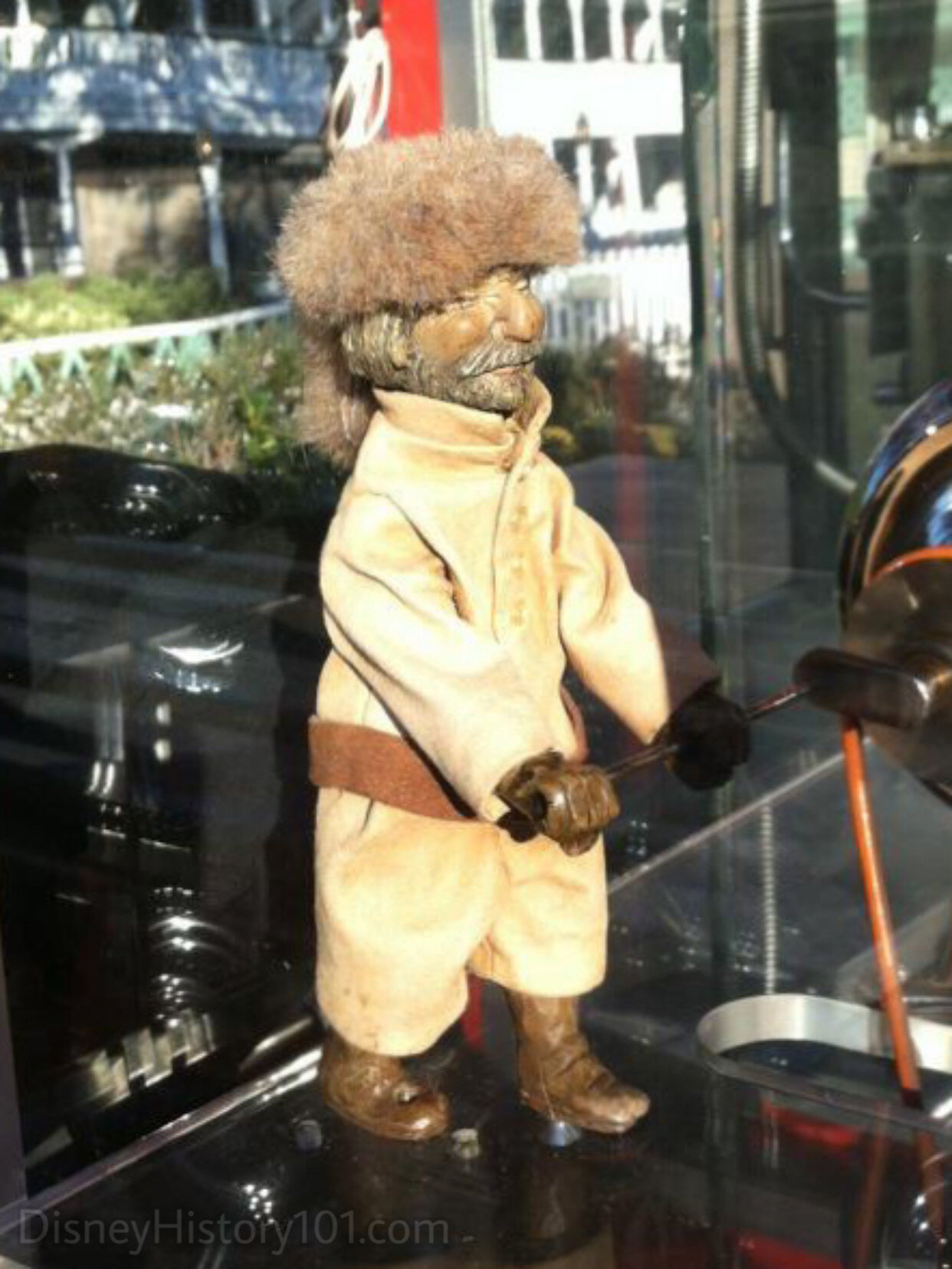
“CRETOR’S CHARACTERS”
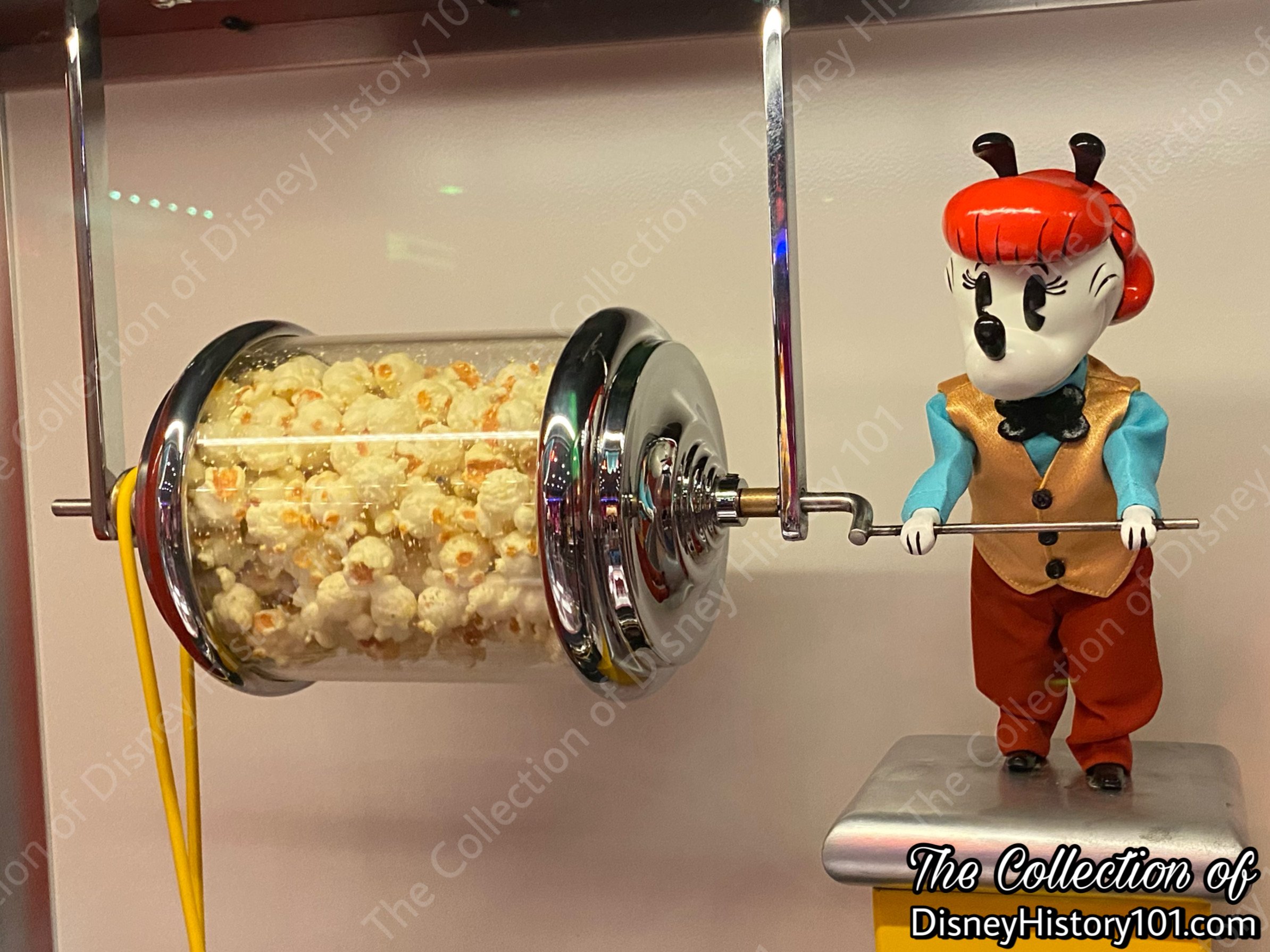
The Cretors carts created tangible and delicious memories for Guests through Merchandise and Show!
By 1991, a team of six Disneyland Cast Members (comprised of the Audio and Costume Divisions) would check the Audio-Animatronics® figures to assure the current standards of Show Quality were met. The walk-through of this attraction and 14 other attractions (in addition to a few other locations like the Br’er Bar, which had figures), would occur some four-to-five hours before the Park opened. Oil stains were cleaned away, and rips and tears were repaired on the one-of-a-kind pieces of wardrobe belonging to some 700 figures. Meanwhile one costume (of three spares kept in cabinets of the attraction’s Backstage Areas) was used to re-dress the figure. Some of these figure’s locations pose a challenge for the Costume Division Cast Members.
As for character maintenance, David recalls :
“The animation was restored and put in a cabinet. Later the cabinets were replaced with ‘trophy cases’. Everything stayed in the old frames. The clowns were kept, and more were purchased over the years. They are probably still available. Costuming would sew replacement clothes [for them]. Though the lever-cranking figures have been altered to thematically match the land that hey inhabit, the Main Street Town Square Cretor still carries a clown figure as a nod to its origin!”
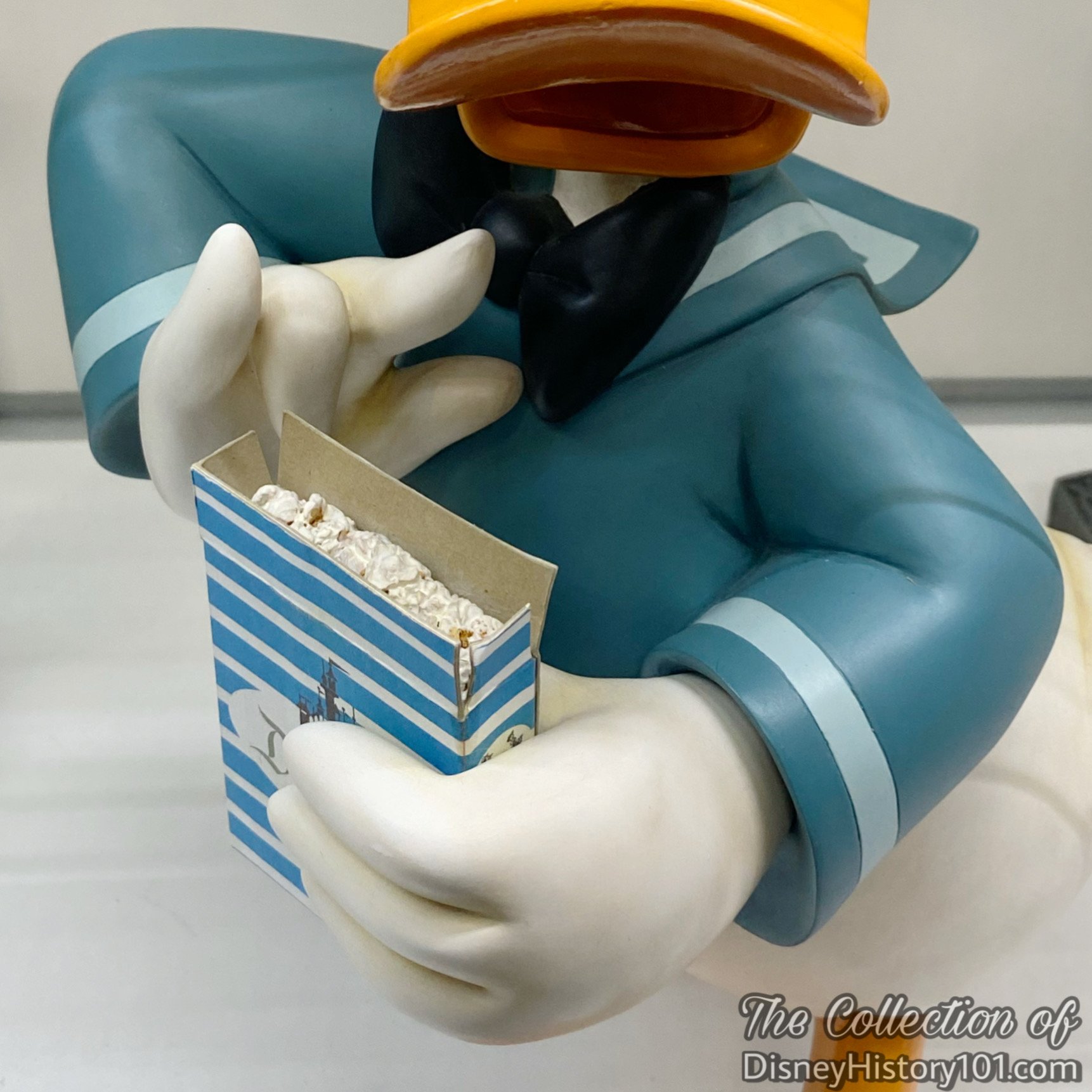
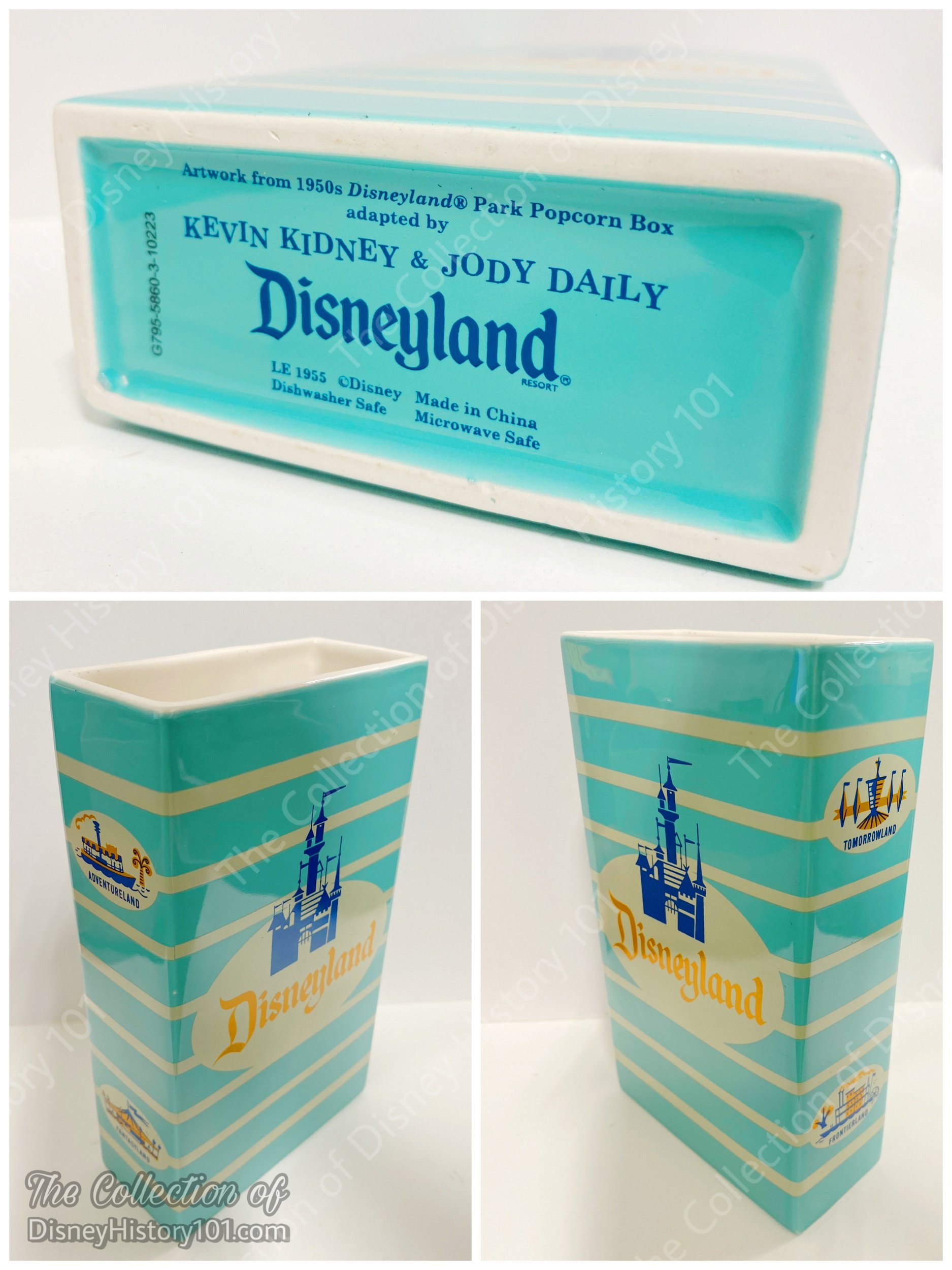
The 1950s box art was so memorable, that ceramic reproductions (by Kevin Kidney and Jody Daley) paid homage and were made available as a limited collectable for Disneyland’s 55th Anniversary in 2010.
“Popcorn Cart Legacy”
The cart attraction has a legacy, “popping up” in areas of lands in Disney Parks worldwide. For instance, Hong Kong Disneyland has Popcorn Carts on Main Street, U.S.A., in Grizzly Gulch, Fantasyland and Tomorrowland.
The very concept of Outdoor Vending Carts continues to have a legacy through Disney Parks worldwide. Hong Kong Disneyland has Outdoor Vending Carts featuring Korean Squid, Turkey Legs, and Frozen Lollipops Presented by Dole.
Today Outdoor Vending/Outdoor Ventures/ODV is the business unit responsible for selling popcorn, ice cream, balloons, etc., in outdoor locations. It’s called Outdoor Vending at Disneyland Park and Outdoor Ventures at Disney's California Adventure Park.
RAINBOW MOUNTAIN STAGECOACH RIDE (and CONESTOGA WAGONS)
At Disneyland there is a "story behind the story" of every attraction, every attraction is a living experience for the guest. Disneyland ride-through attractions or adventures have officially been defined as an “individual show, ride, or exhibit designed to produce an entertaining Guest experience. Disney attractions stir the imagination, enliven the senses, and provide the participants with positive, innovative entertainment, which is the essence of the DISNEYLAND Show.” It is important to review the story of the attraction, tell the story, explain it, and create interest. This is the story of Rainbow Mountain Stagecoaches.
“Horse-Drawn Coaches and Frontier America”
Since the early 1700s, coaches have transported Americans from place to place. In 1791, even George Washington toured 1,900 miles of the colonies in his White Coach. Before long, there were the (occasionally covered) stage wagons, or “mud wagons,” used for passengers and freight. The heavy Brewster Coach could transport many more passengers inside and atop.
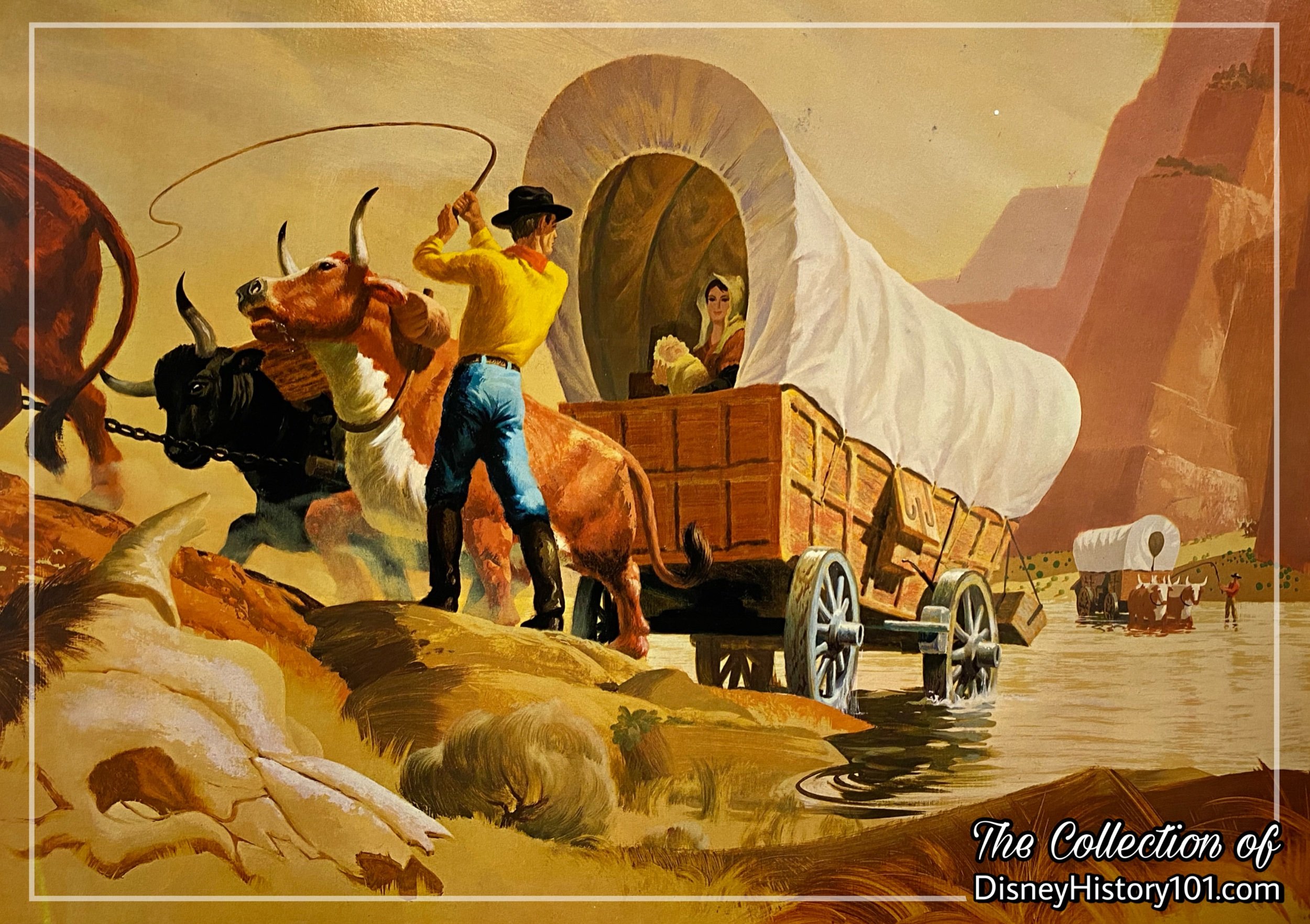
Soon, Conestoga, Pennsylvania gave birth to the Conestoga wagon, used to transport folks West along the Oregon Trail and Santa Fe Trail. “Many Americans, with everything they owned piled high in the back of a covered wagon, headed out to explore and settle the wilderness.” The Conestoga wagon could be pulled by a four or six-horse (or even oxen) hitch. While it was not so comfortable, the driver often walked alongside the vehicle, the Conestoga wagon got the job done, moving goods and people West. Not long after, the town of Concord, New Hampshire gave birth to the Concord coach. While the Concord coach was generally pulled by a team of horses, it much more luxurious, typically outfitted with comfortable seats, and even leather straps which acted as shock absorbers against the rough terrain. Both vehicles become the standard of transportation for some time across America by the time Horace Greeley uttered those famous words - “go west.” As for the Concord, it outlasted the Conestoga, and was used to transport passengers, mail, a strong box, and a man riding “shotgun.” In fact, a Concord stage line began to operate from Missouri to California, and a concord stage made the first transcontinental trip. And before the railroad replaced the Concord coach, a form of the vehicle was even adapted as a railroad car.
While the horse-drawn methods of transportation became archaic an outdated with the advent of the motorcar, a passion for horseback riding and equestrian sports persisted into the new century.
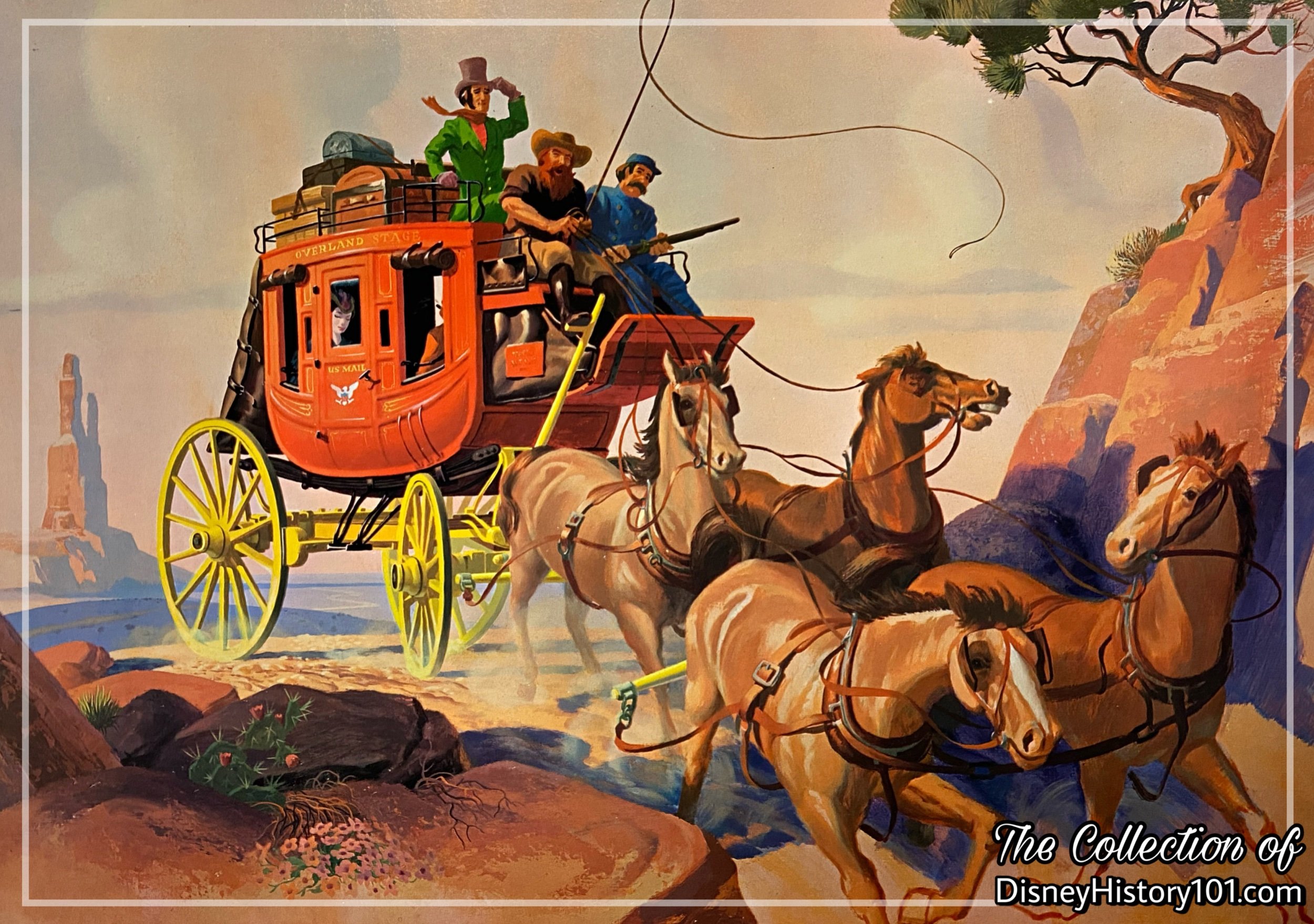
“Walt Disney & Horses”
Now it’s a fact that Walt Disney was one such person who had an affinity for horses! Beginning in 1932, Walt became an avid polo player with his very own Mickey Mouse Polo Team engaging at Uplifters and Riviera Fields. Walt even had a small stable of horses. Despite an untimely polo injury, Walt continued to ride horses along with the elite Ranchos Vistadores (a group of celebrities and prominent Californians who enjoyed equine), in the mountains of Santa Barbara just like true-life cowboys.
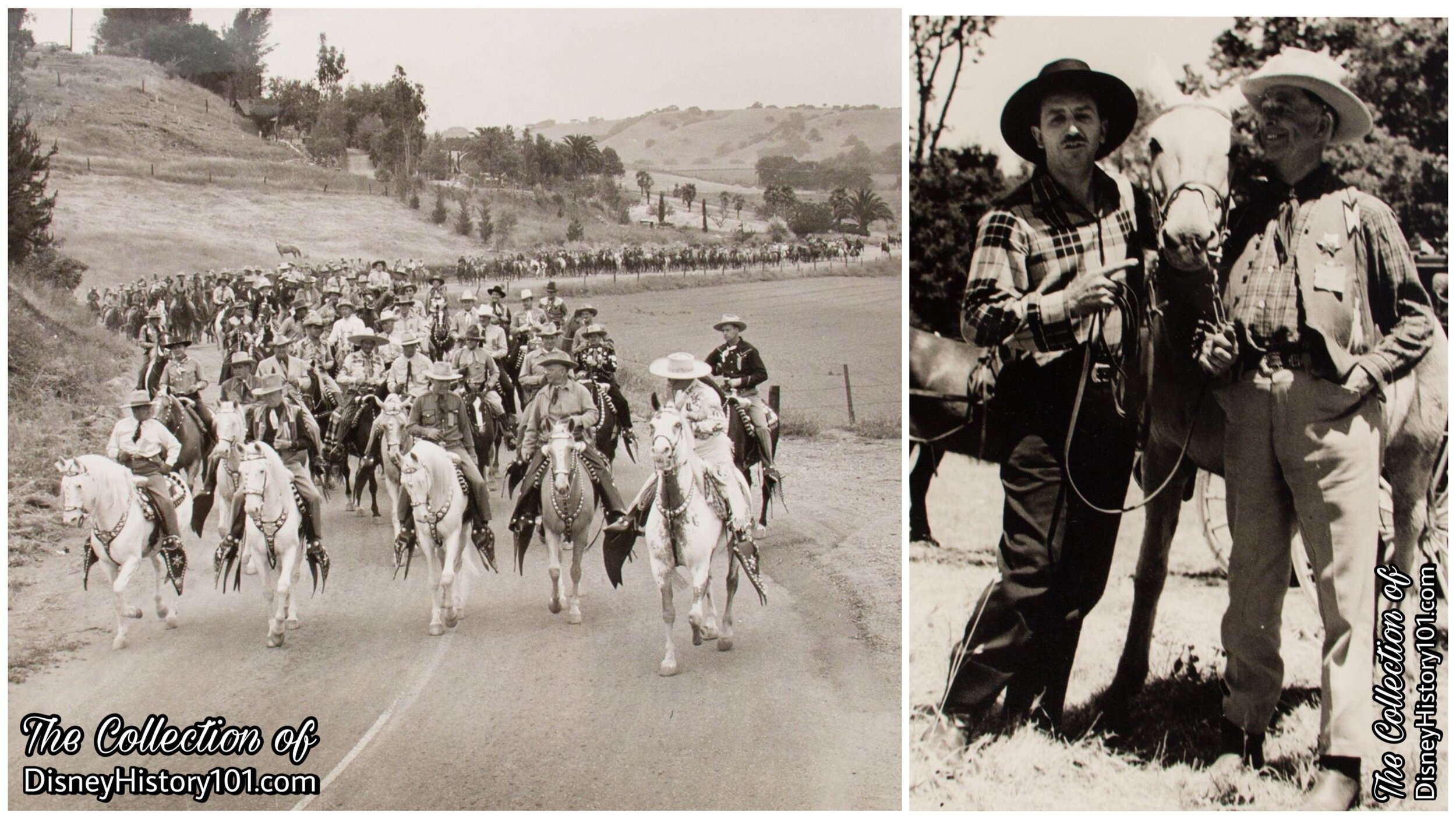
All the while, Walt Disney’s love for horses was evident as his studio produced a couple of live action films with equestrian-related themes a stars. Similar to Walt, Mickey Mouse acquired a couple of horse friends - Horace Horsecollar his plow horse appeared in early animated shorts and Tanglefoot appeared later in the comics. Many films featured horses, including Mickey’s Polo Team (released 1936), How To Ride a Horse starring Goofy (released 1941), Stormy the Thoroughbred Horse (released 1954) and The Littlest Outlaw (released 1955).
So, it wasn’t any surprise (to some Walt Disney Studio artists) when Walt began developing a few equestrian-related ride concepts among his earliest plans for a Mickey Mouse themed amusement park which first appeared on paper as far back as 1932.
“Blue Sky for Walt Disney’s Amusement Park Stagecoaches”
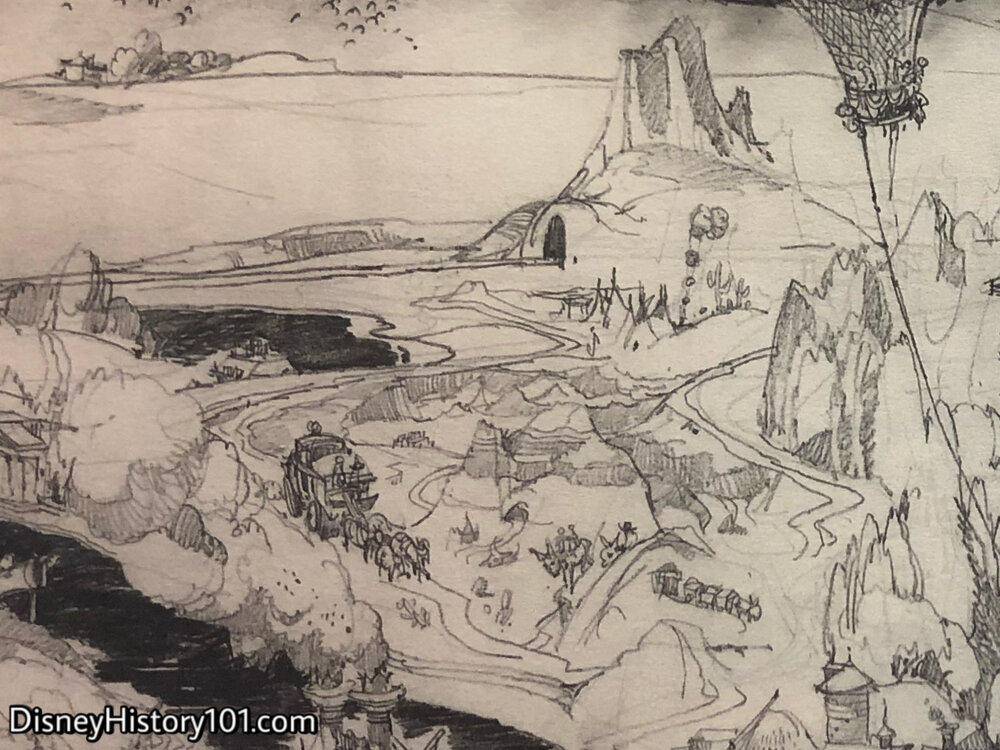
The Mickey Mouse Park Stage Coaches were perhaps the some of the earliest attraction vehicles to be both researched and developed. Yes, their earliest “stage” of development begins more than a decade later, on August 31, 1948, when Walt was dreaming about a Park (to be located across the street from the Studio in Burbank). Obviously, the fastest way to move people over the extended areas of Walt’s Park would be by utilizing moving vehicles. A memo was circulated among artists of the Walt Disney Studios, mentioning a “Horse-Drawn Carriage” attraction. It is clear that stage coaches were reckoned to be a part of the drawings and other plans for “Mickey Mouse Park” on an 11-acre plot of land (to be located near Griffith Park, in Burbank, California).

The excerpt (pictured above) is from an early artist’s rendering of the aforementioned “Mickey Mouse Park.” By the time that the project’s name was changed to Disneyland, the attraction’s story had begun to develop much further beyond what you see here, but the coaches were retained and featured on plot plans like “Disneyland Preliminary Scheme #1”.
“Designing & Selling Disneyland”
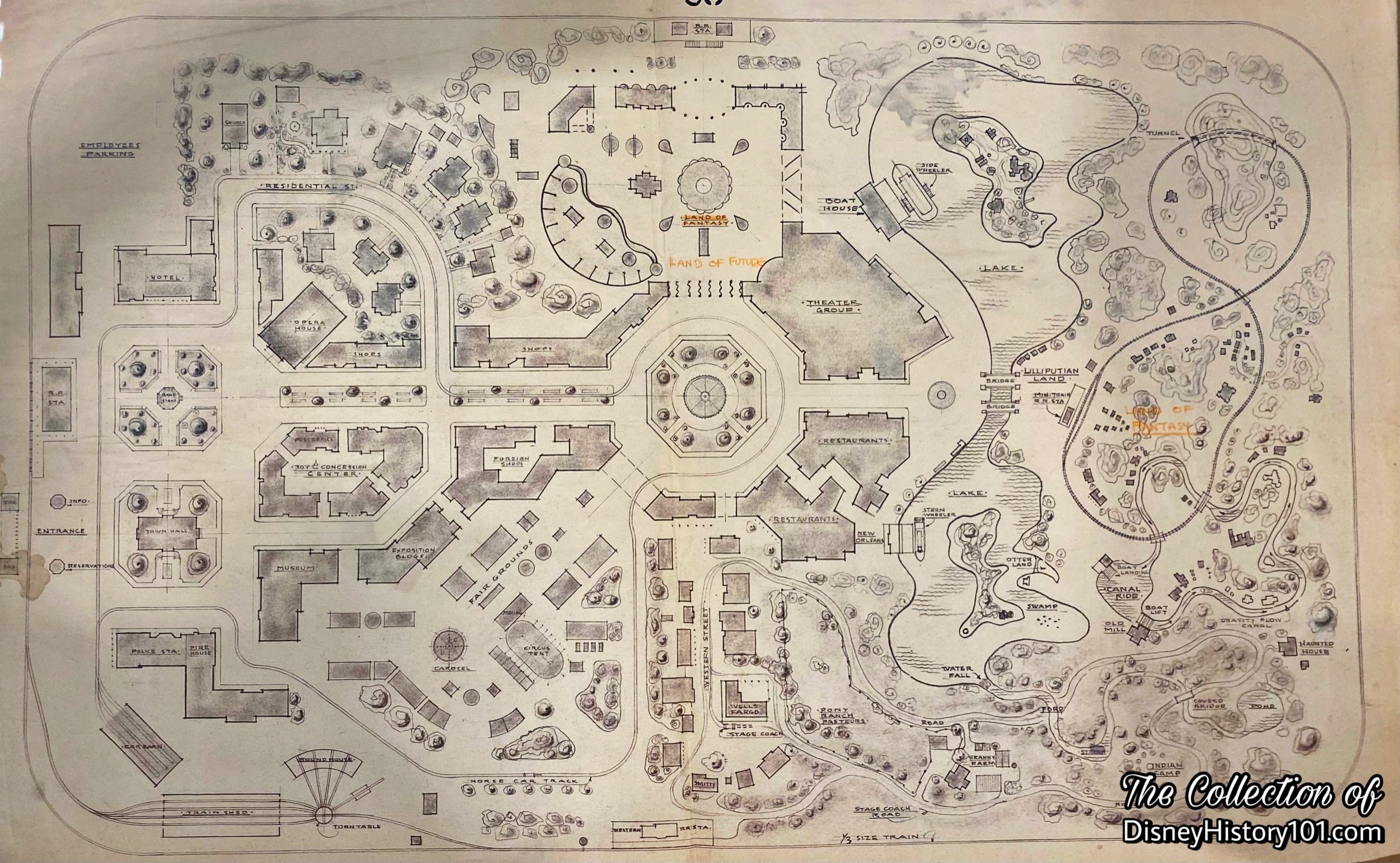
While many artists contributed, the talented Herbert Ryman is of note. Herb had joined the Disney Studio in 1938, after Walt saw a public show of his work in New York. (Herb's paintings were being exhibited with those of another up and coming artist, Andrew Wyeth.) Herb Ryman acted as art director for such films as Fantasia and Dumbo, but had left Walt Disney Studios in 1946 and (by 1953) was employed by 20th Century Fox. Walt reached out to Herb and during one weekend (September 26 & 27, 1953) the first “Schematic Aerial View” over Disneyland originally produced!
After new economic research reports had recommended a final resting place for Walt Disney’s Disneyland, artist Herb Ryman had hand-inked, one of the original Disneyland concept drawings - “Aerial Schematic View” over Disneyland - between September 26th and 27th, 1953. Subsequently, his original drawing was copied, and hundreds of resultant drawings were made (some of them hand-colored), based on the original (with constant modifications being made, as Walt Disney’s “Disneyland” developed). An excerpt from one is pictured above, with the stagecoaches and wilderness trails clearly part of the plans (Marvin Aubrey Davis’ Plot Plan even labeled “Canastoga Road” and “Stage Coach Rd.,” implying separate trails for the vehicles). By this time, some of the vehicles of this attraction were briefly referred to as “Yellowstone Stagecoaches.”
But, what scenery lay in store for passengers of the Stage Coaches? It seems that many elements of drawings produced for the 11-acre Burbank plot were retained. Proving this is an early form of (what would come go be known as) the “Disneyland Prospectus” [prepared in 1953 for Disneyland Inc. by WED Enterprises], which reads : “Frontier Country….where the Stagecoach meets the TRAIN and the RIVERBOAT for its trip down the river to New Orleans…Ride shotgun on the STAGE COACHES…past GRANNY’S FARM, a practical working farm operated with real live miniature horses, cows, oxen, and donkeys…through the pine forest, fording streams into Indian country and through the Painted Desert.”
“The Painted Desert” (the name used to identify this region during 1955), appeared on the “Proposed Diagramatic Layout of Disneyland” (Marvin A. Davis’ plot plan, produced for WED Enterprises, by September 12, 1953) that was shown to potential investors as early as 1953. According to “Disneyland” (prepared for Disneyland Inc. by WED Enterprises, 1953), “Ride shotgun Stage Coaches…past Granny’s Farm, a practical working farm operated with real live miniature horses, cows, oxen, and donkeys…through the pine forest, fording streams into Indian country and through the Painted Desert.” However, it seems (as depicted in the drawings) that it was only meant to be traversed and explored by way of a Stagecoach or Mule Train. The “The Disneyland Story” describes the scenery of the “Painted Desert” this way : “As you go into the Painted Desert you will pass the Indian encampment, go through a Pine Forest, and Ford a stream. When you get to the Painted Desert you will see the things you usually find there, such as the beautiful cactus plants, trees, probably the water hole with the ‘poison sign’, the skeleton of a steer, and other appropriate dressings of the desert. As well as the stage coach ride, you will be able to take the Conestoga Wagon and Mule Pack ride into the Painted Desert.” Later, another early document describing Walt Disney’s Disneyland included that of a “Stage Coach Ride.” So it seems (at least for a brief period), that the Conestoga Wagon (and not a Mine Train or Stage Coaches) were considered as options to explore the highroads and byroads of the Painted Desert in Frontierland.
On December 3, 1953, Walt wrote his sister Ruth Beecher: “Our DISNEYLAND project is getting nearer an actuality all the time and I'm anxiously awaiting the time when it does get under way. In the meantime we are gathering up all sorts of things for our exhibits. We have… about thirty miniature ponies that we keep out on the back end of the studio lot, with most of the mares in foal. Then there are three stage coaches that we made here at the studio - they're real beauties, painted in bright red, with gold trimmings. We're all very excited about this project and feel It will be a wonderful thing for everybody.”
Meanwhile, viable project Concepts (as seen above) featuring stage coaches, were supported by a well-developed business case and built expectation. These were carried to potential investors back East. Frank Pfannenstiel recalled how Walt was preparing to ride one of his horses when he received important news: “I was getting Walt's horse saddled, when Roy came over and put an arm around Walt, saying, ‘I’ve got the money, let's go to work.”
By September 16, 1954, Walt excitedly wrote to his sister Ruth Beecher in Portland, Oregon, briefly describing Frontierland and its stage coaches and “prairie schooners” (another term for Conestoga wagons): “We are very busy here at the studio, what with the television program and getting our DISNEYLAND Park under way, we’re knee-deep in work. The Park is scheduled to open in July of next year. It will be a miniature world’s fair idea. There will be trains, river boats, prairie schooners, fantastic rides, etc., etc… FRONTIERLAND… will be of the gold rush period, with Indians, Buffalo, Stage Coaches, etc.”
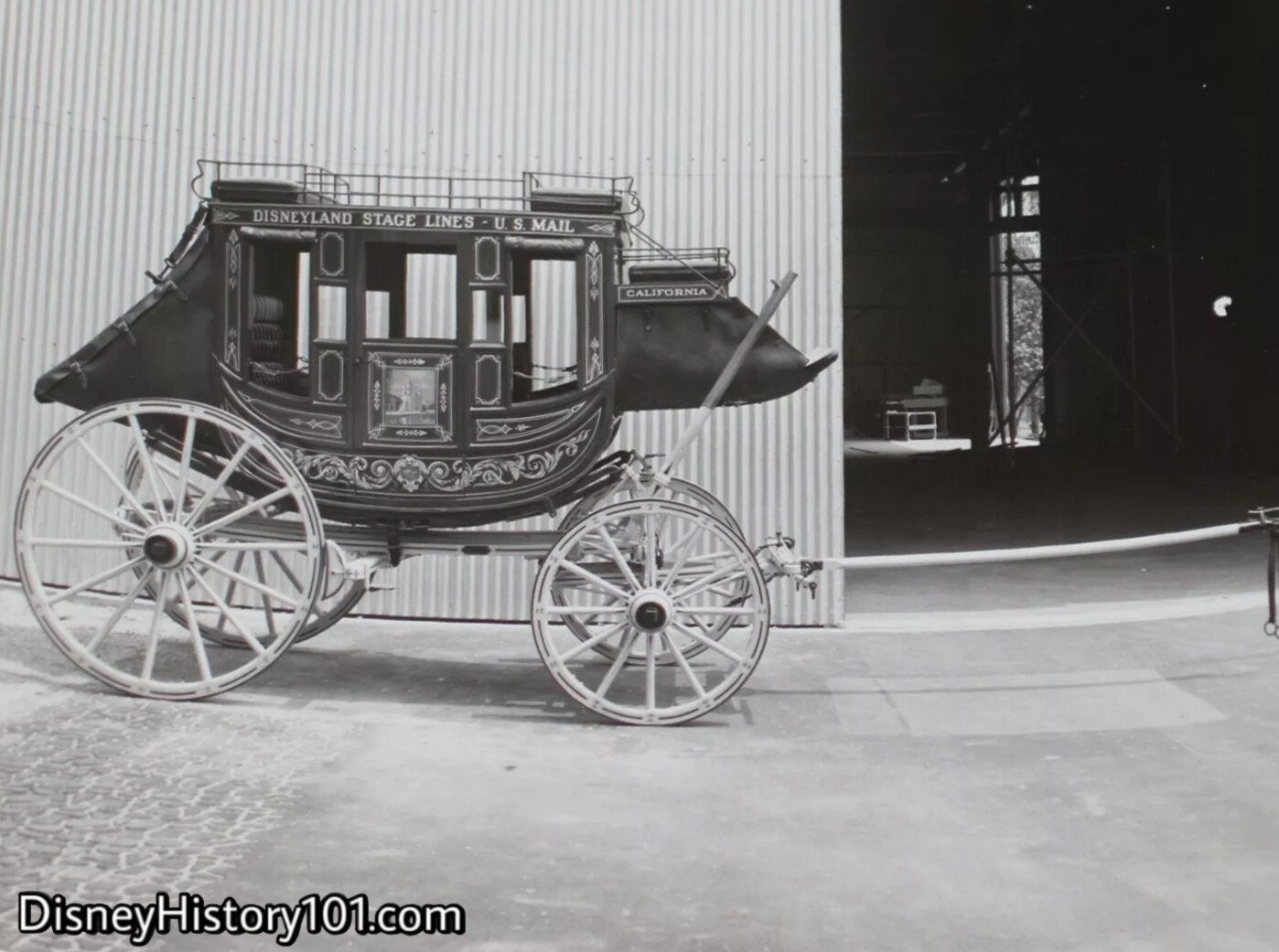
So while alternative modes of desert transportation were “on the drawing table,” the Disneyland Stage Lines Stage Coaches were perhaps the earliest of Disneyland’s attraction vehicles to be researched and developed. As aforementioned, their story actually begins in 1950, when Walt was toying with the idea of a “Mickey Mouse Park.” About this time (in 1951), a couple by the name of Owen and Dollie Pope (who had previously manufactured horse trailers in Fort Worth, Texas) was running an equestrian show at the Pan Pacific Auditorium (in Sacramento, California), and Disneyland production artist Harper Goff attended. Harper recommended their show to Walt, who was subsequently so impressed with the showmanship and their ponies that he arranged a meeting with the couple during the spring of 1951. The idea was to get their assistance with “putting together some livestock for his future park.” After some negotiation and throught, the Popes (Owen and Dolly) were ultimately persuaded by Walt Disney, under the offer that he give him room and board. So Owen and his wife Dolly were hired by Walt Disney. This happened on the Sunday after Thanksgiving in November of 1951 - four years before Disneyland opened its gate to the public.
It is important to note that the “Proposed Diagramatic Layout of Disneyland” (Marvin A. Davis’ plot plan, produced for WED Enterprises, by September 12, 1953) mentions three equestrian rides in “Frontier land” : (1) a “Pack Mule Ride”, (2) a “Stage Coach Road” for Stage Coaches, and (3) a “Pony Ride” next to a “Corral.” All of these massive projects necessitated Owen and Dollie living on the Walt Disney Studio Lot for the duration of their development. Both Owen and Dollie supervised the fabrication and built the original four (what would become to be known as) the Disneyland Stage Lines Stage Coaches during 1954. The three “80 percent” scaled-down stage coaches (named after the states of California, Arizona, and Colorado), were designed and developed to be drawn by a “six pony hitch” of a miniature breed of midget horses, ponies, and Sardinian Donkeys.
“Breeding and Training Stock”
Now it has been said that “a cowboy needs a horse.” To meet this need, Owen and Dollie also oversaw the breeding, care, and training of these animals, most of which were intended for “Frontier Land, which is Disney’s favorite section of the fair,” according to Loius Berg (Reporter for “This Week Magazine”)! Louis Berg had the privilege to tour the Walt Disney Studio “stud farm” late in 1954, when he divulged : “I visited the stud farm where the midget horses, ponies, and Sardinian donkeys that will draw the wagons, carts and surreys are being nursed. And it’s a sight in this world to watch the tiny foals nuzzling up to mothers themselves no bigger than a normal foal. Disney knows every colt and every pony by name, and can tell you the characteristics of each of the several hundred animals : one likes to chew on cigarettes, another is a brat. ‘Get away, General,’ he said to a young colt that was biting his trouser leg affectionately.” While many of the other 5/8-scale ponies would become known to Park visitors at the time of their big debut to the public during Disneyland’s Opening day Parade, one (often famously seen pictured with Walt Disney) was born at the studio. “‘We call him ‘General George’ because he was born on George Washington’s birthday,’ Disney explained,” to Louis Berg. Herb Ryman [in “Work With Walt” by Don Peri] recalled how Walt “loved the the little animals - the little horses, ponies, and mules.” You may have seen a few images of Walt welcoming the new arrivals - foals, colts and fillies born at the studio during this era. As a sidelight, Walt even rode horse in one of Disneyland’s parades alongside Davy Crockett. Columnist Louis Berg continues : “Incidentally the pony corral is the favorite of Disney employees and their children. Most constant visitor is ‘Bunky’ Thompson, receptionist, who spends lunch hours feeding the animals.”
An insert which accompanied area newspapers mentioned how “Disneyland stables were turned into a nursery tem-porarily, with nine mares expecting the stork before Disneyland's opening day, and five colts having arrived after the move to Anaheim from the Burbank stables. More than 200 ponies are working in the park.”
In addition to feeding, the equine were trained. Van Arsdale France once wrote: “He [that is, Owen] was worried about the horses ‘spooking’ with all the sights and sounds of Disneyland. So, a recording of sounds from arcades and shooting galleries, and yelling kids made up. This was used as an audio aid for horse training. Since the horses were not directly on the payroll, they had to be carried as assets. All were given names. They all received names of people in accounting. Lucy Cotton, for example had a mule on the records named, ‘Lucy Mule.’”
Concord Stage Coaches were not commonplace in the typical society of 1951. After “Museum authorities devoted their knowledge and skill to the accurate reproduction Conestoga wagons, Concord stages, [and] Western Buckboards,” it was deemed a requirement that certain arts and crafts were resurrected in order to fabricate the hubs, wheels, thoroughbraces, and other parts. One of the main crafts that was revived, was that of the wheelwright - the art of making wheels like the pioneers of frontier America! Studio Craftsmen had to heat the metal rim to the exact temperature, then fit and cool it, without scorching the wood. “Because of the great number of guests carried, the wheels are more sturdy than those on most of the catalogue models - another safety factor built into the attraction”, states one Disneyland Operation Manual. As a final touch, small details like the pin-striping on the wheels and stenciled letters were completed on the Walt Disney Studio backlot, by sign painters. According to Park historians : “One of the artists working on the coaches took issue with Walt about all those details. ‘People aren’t going to get this. It’s too much perfection,’ the artist said. With his disapproving eyebrow raised, Walt responded, ‘‘Yes they will. They will feel good about it. And they will understand it’s all done for them.’”
“In 1954, Day Sechler [sic] went to the STUDIO, where he helped Owen Pope make street cars, surreys, stage coaches and even a fire engine.”
Charley Brock recalled: “I had an older brother who was helping to build Disneyland and the Mark Twain. One day he came to see me and said that there was goin' to be a lot of horses at Disneyland. He told me to put on a clean shirt and overalls, and come with him. I saw Owen Pope and started workin' in the barn, gettin' horses and stage coaches ready.” Soon, publications explained that “Museum authorities devoted their knowledge and skill to the accurate reproduction of Conestoga wagons, Concord stages, and Western buckboards.”
It is perhaps around this time that Walt Disney Studios animator Willie Ito (hired June 1954) recalled wandering onto the back lot and, in one of the workshops, seeing “large molds of the Dumbo ride, miniature trains, stagecoaches, huge blueprints on the walls, etc. It was teaming with activity.”
Walt was personally interested and involved in his Stagecoaches. About this time Louis Berg (of This Week Magazine published for September 19, 1954) wrote: “And into this dreamland, Disney has already escaped. If you want to see him nowadays, don't look for him in his office. Seek him out in the workshops. Like as not, he'll be polishing a wagon tongue for one of the stage coaches… In the carpenter shop, Owen Pope one of the last great wagon builders, was putting the finishing touches on a stagecoach - there will he four of them - scaled down 80 per cent from the Deadwood model.”
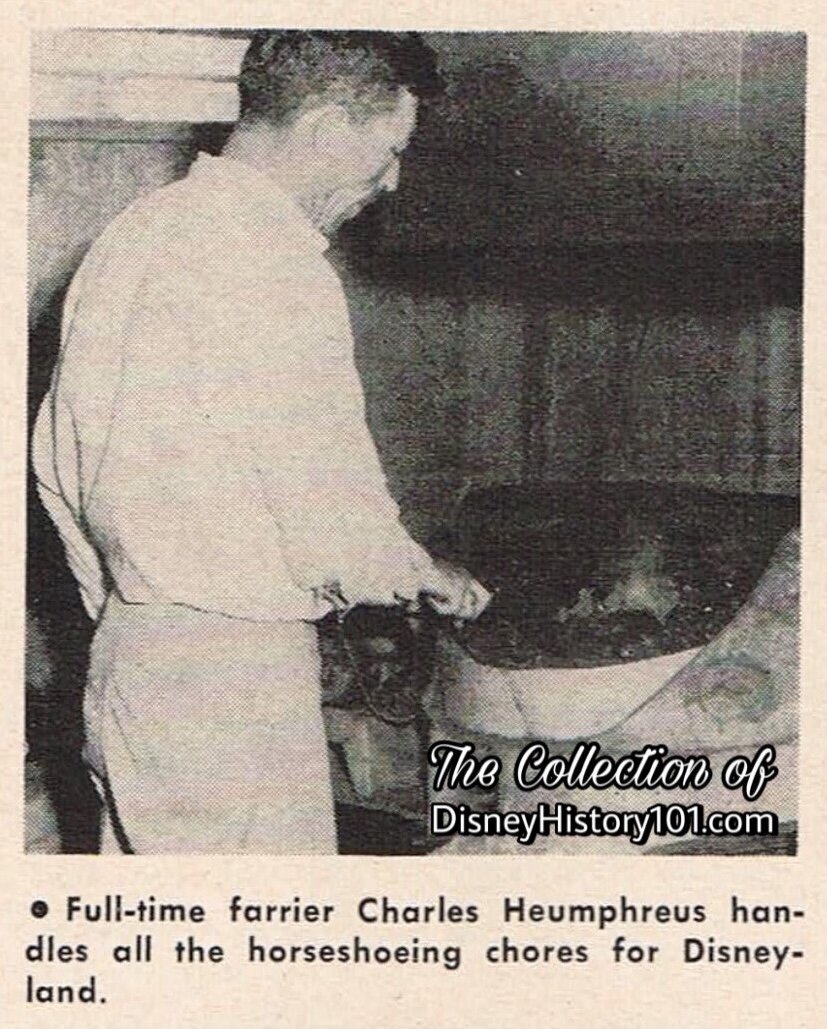
The horseshoes of the hoof-branded Belgians, Clydesdales, Percheron, and Shire-Percheron cross-breeds were made of rubber (to generate the “clip-clop” sound on Main Street). However, the horseshoes of the Frontierland equine (mules, Sardinian donkeys, midget horses and ponies) that travelled through unpaved areas were made of iron metal, the old fashioned way.
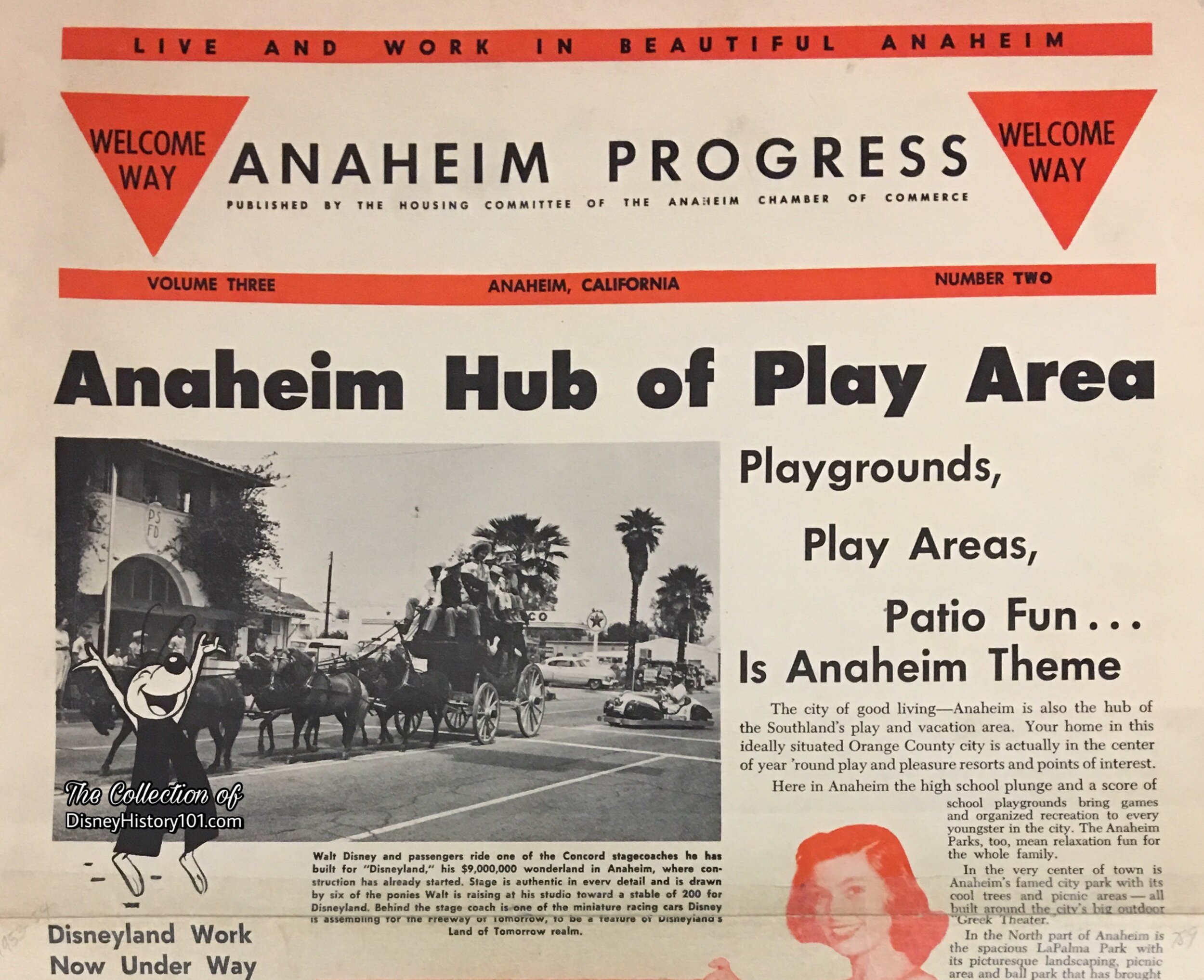
When at least one of the scaled-down Disneyland Stage Lines Stage Coaches was complete, Walt was so proud of it! Louis Berg (“This Week Magazine” Reporter), noted (by September of 1954) that “one of these coaches is already finished, and when Disney is in good humor, he’ll drive visitors in it though his grounds, handling the reins like Deadwood Dick.” Walt invited almost everyone to step aboard his new Stage Coach. The six-and-a-half-foot-tall Claude Coats recalled “Walt and a driver were giving rides around the lot, but he wouldn’t let me get in. He said I spoiled the scale.” Walt even took one completed Stage Coach down to the location of his former vacation home and “laughing place” in Palm Springs, for the Desert Circus (an annual springtime Palm Springs parade and community event). This was (of course) great pre-opening day Disneyland promotion, and resulted in Walt acquiring a few sponsors (through his former neighbors at Charlie Doyle’s Smoke Tree Ranch).
Now, by the time Disneyland was in development, Stage Coaches were not unheard of by area residents of Orange County. After all, Walter Knott had his Butterfield Stagecoaches and his Overland Southern Coaches running through Wild West routes of his own Knotts Berry Farm! So, part of what would set Walt’s stagecoaches apart would be their setting - the aforementioned “pine forest, fording streams into Indian country and through the Painted Desert.”
By July 1, 1954, George Whitney of Disneyland, Inc. directed Amusements, with Ron Miller overseeing analysis, philosophy, capacities, planning, operator training, and amusement procurement.
“Stagecoach Road Construction and Landscaping”
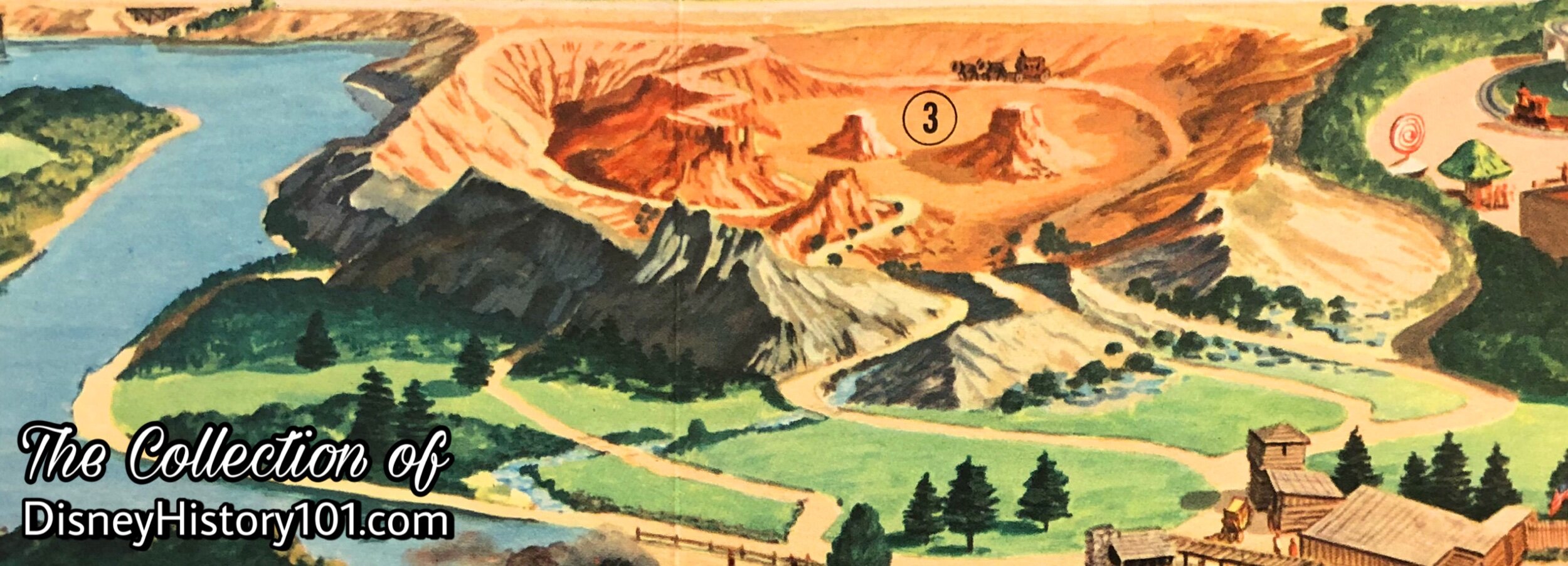
Fortunately, Disneyland was constructed with enough space for the expansive area that would become Frontierland. As to the “greenscape,” it began to take form when Bill Evans helped save a number of orange trees along the route of the Conestoga Wagons, according to “Creating the Disney Landscape - An Interview with Bill Evans,” published in The “E” Ticket, Spring 1966. Walt continued to oversee the progress of the other Stage Coaches, according to Look Magazine (November of 1954). “As construction progresses on the Park, no detail is too picayune for Walt Disney’s attention. He bobs in and out of the workshops almost every day to check on the accuracy of the scaled- down stage coaches.” Walt also drive a jeep (at least on one occasion, as it “bounced over a stagecoach trail which will lead through the Painted Desert and along a river,” (according to one construction-era Bob Thomas article). Meanwhile, the finishing “natural” touches were being added to Disneyland’s own true-life desert, in Anaheim, California. Even before Disneyland opened, Walt’s friend (and Hollywood columnist) Hedda Hopper divulged, “Had a sneak preview of Disneyland…It was the planting that awed me. Walt bought $400,000 worth of trees and shrubs ; he depleted our nurseries and is now importing trees from Santa Barbara and San Diego. Cactus from Arizona already dots Disney’s painted desert”. [“Disneyland Park Found as Fantastic as Its Creator”, Published in “Looking at Hollywood”, May 22, 1955]. As for the outcome, the author of “Disneyland World of Flowers” reminisced about the greenscape: “If you were an early visitor to Disneyland you will recall a stage coach and Conestoga wagon ride that departed from this same area and carried the traveler through pine-covered country, a sun-baked desert, and back along the tree-lined river shore.”
All of this work was performed by the team of Jack and Bill Evans, under the direction of female architect and landscaper Ruth Shellhorn (to whom much of the Park’s original plant and tree selection is credited). This early piece of artwork (pictured above) was included inside the Disneyland Musical Map by Mattel - a mail-away preview of Walt Disney’s Disneyland, and perhaps one of the first pieces of licensed Disneyland merchandise. Those who purchased this c. 1954-1955 Disneyland promotional item could view the many roads (fit for wagons) coursing through the hills and desert of Frontierland’s Painted Desert!
As of June 2, 1955, C.V. Wood Jr. sent an Inter-Office Memorandum to Walt Disney regarding the best estimates that could be obtained at the time regarding the completion status of individual sections of the Park and Opening Day. C.V. wrote: “Wagon Rides: Okay. We still need design decision regarding some of the things you will see on the ride.”
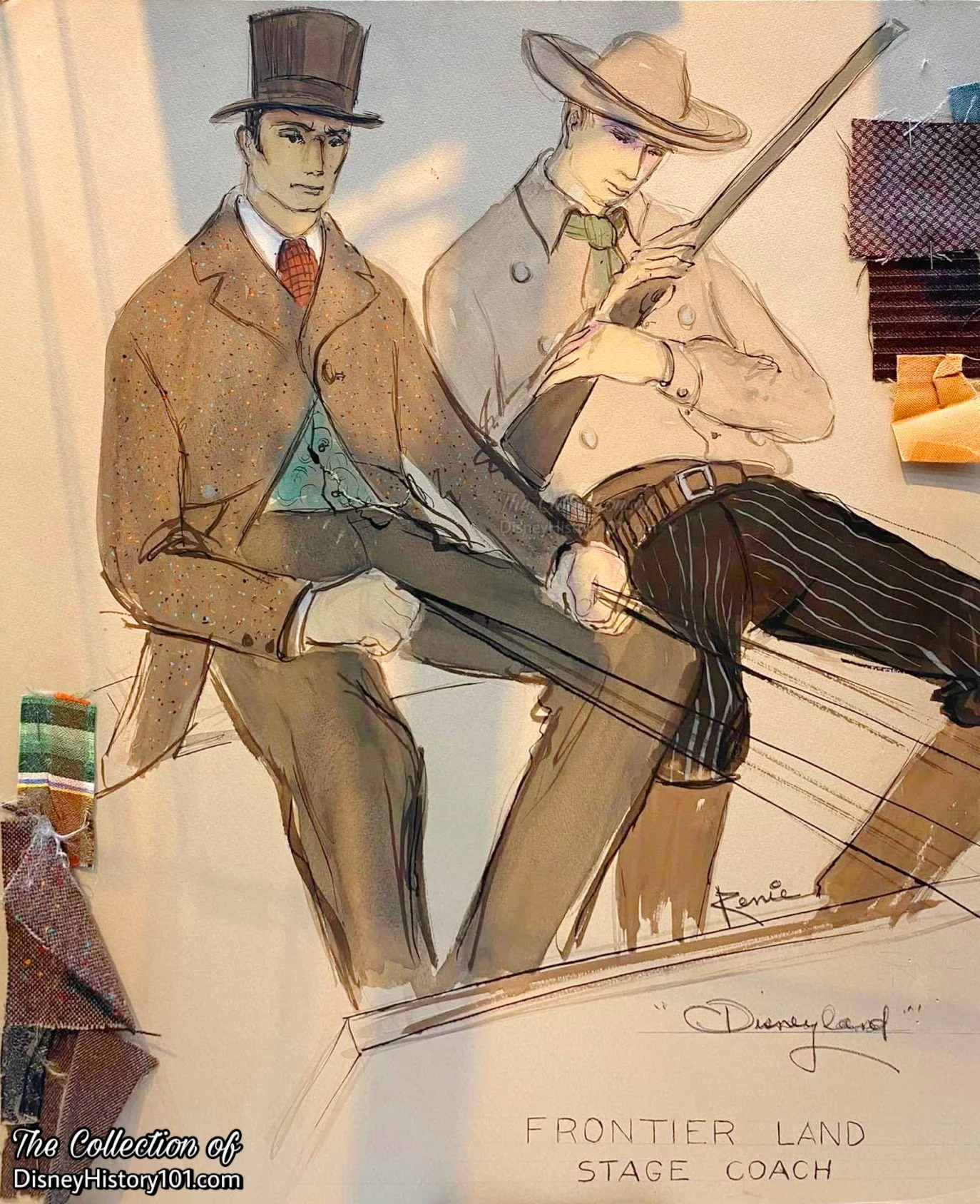
Rénie Conley was a former Hollywood costume designer with RKO Pictures, who was hired by Walt Disney to designed the costumes worn by Disneyland Cast Members. Conley prepared detailed ink, graphite, and watercolor sketches for the “Frontier Land Stage Coach” cast and many other others.
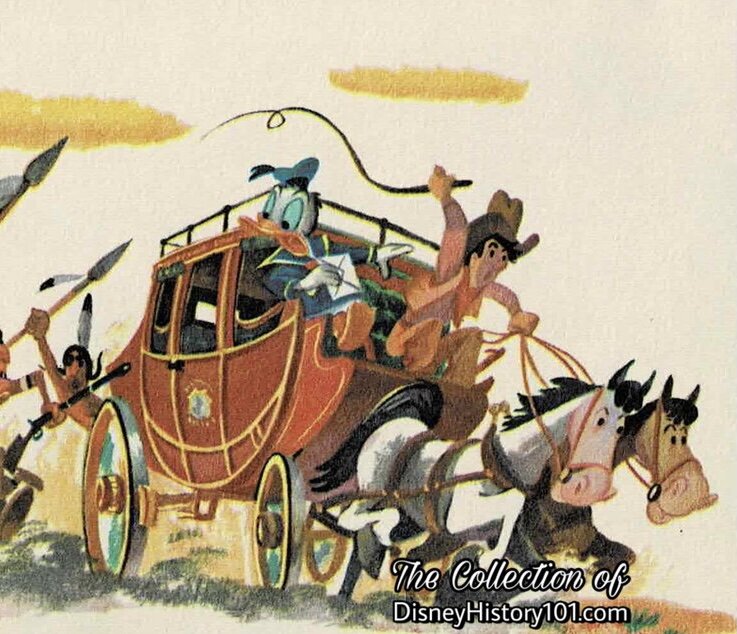
Though the conestoga stage coach looks different from Owen Pope’s final products, contemporaneous licensed Disneyland merchandise tantalized future guests, by granting these potential visitors a preview of Disneyland adventures.

Soon one authorized “Disneyland Information & Nomenclature List” (prepared by Bill Cottrell of Disneyland Inc., by May 25, 1955) divulged the details of “Disneyland Stage Lines” to Disneyland, Inc. employees. The three Coaches (California, Colorado, and Arizona) were to have a “4 horse hitch per stagecoach,” while the related Conestoga Wagons attraction consisted of “2 wagons” with a “6 mule hitch per each wagon.” In addition to these, the same documents mentioned “other wagon rides” which included the “Disneyland Transportation Company” or “Yellowstone Coaches,” - “3 Coaches - 4 horses per. each Coach.” There were also to be “3 Surreys - 1 horse per Surrey, 1 Buggy - 1 horse hitch, 3 wagons - 2 horses per wagon, and [sic] 4 Wagons - 2 horses per wagons.”
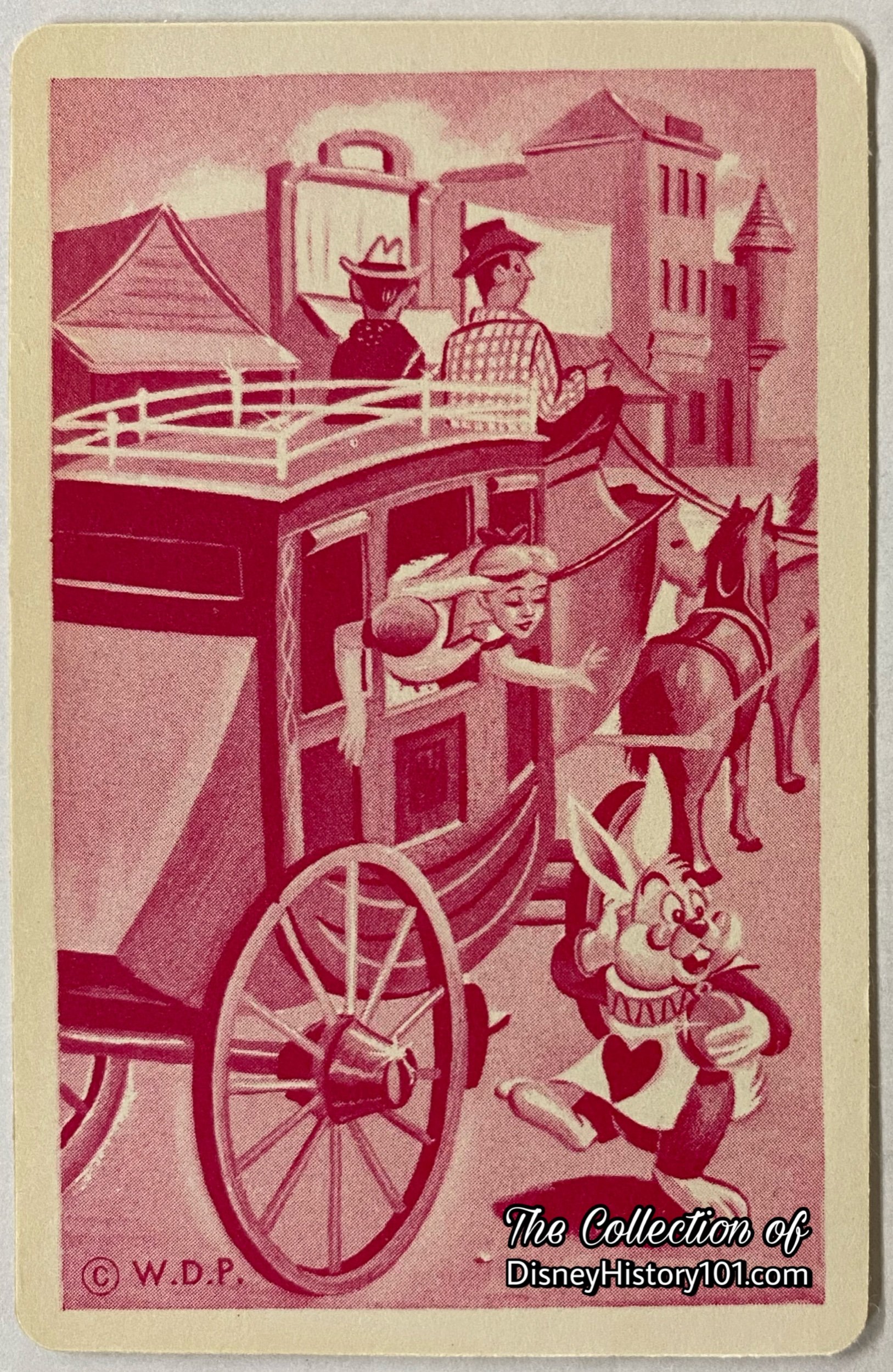
"She's late, she's late!" exclaimed the White Rabbit checking his big watch. "Don't you know the Queen's never on time!" explained Alice. "Let's take our ride across Disneyland's Painted Desert without her. "Oh me, oh my!" replied the Rabbit. "I was supposed to meet the Queen yesterday! I'm the one who's late!"
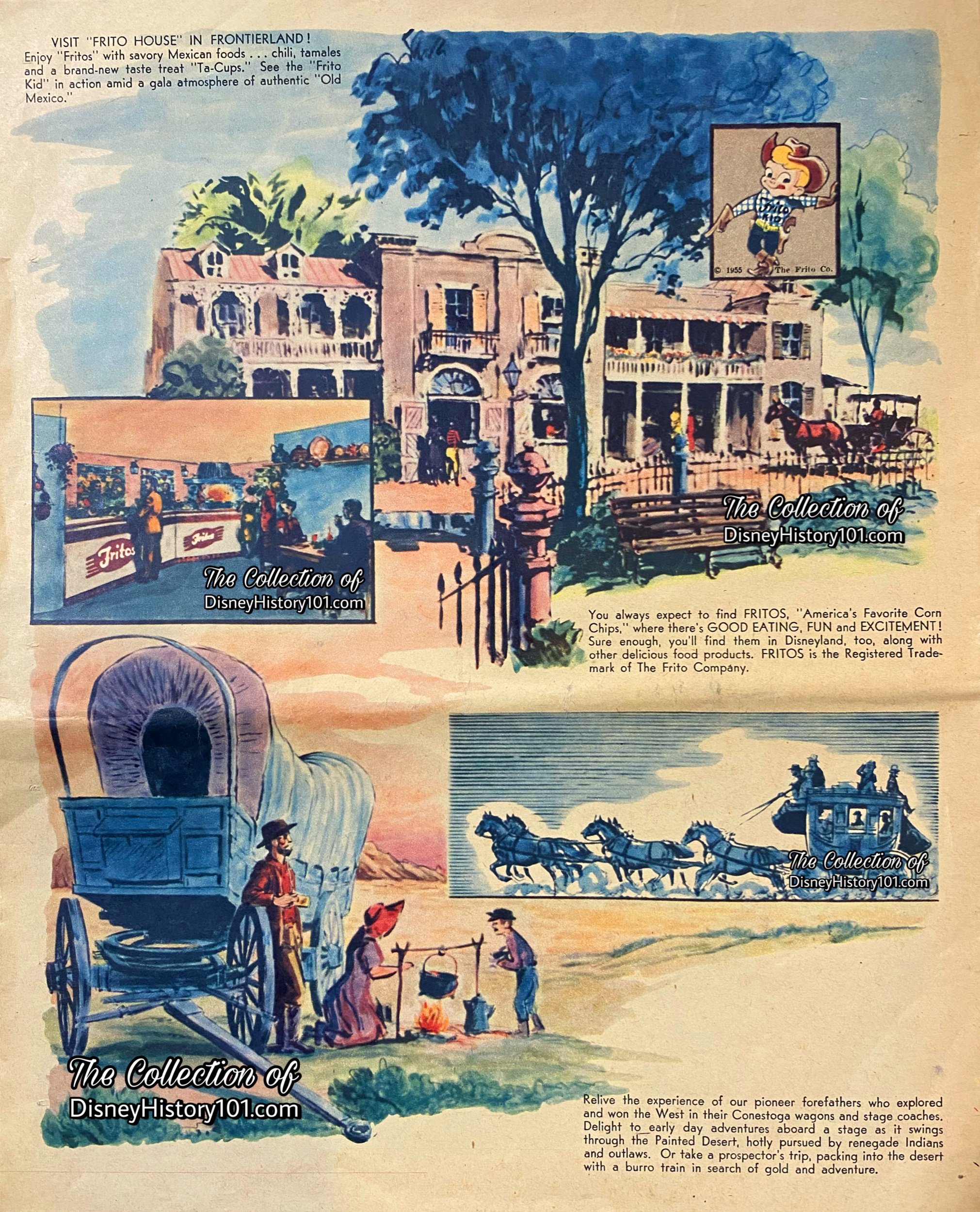
Disneyland’s horse-drawn vehicles made the news in many publications even before they hit the Frontierland trails. Panorama magazine (published spring of 1955) mentioned that “Buckboards and Conestoga wagons carry visitors to a Wells Fargo station for a stage-coach trip through the Painted Desert.” The pre-opening “Go Santa Fe to DISNEY-LAND” brochure printed sometime between July 4 and July 18 mentioned Conestoga Wagons, Surreys, Buggies, Buckboards, and Disneyland Stage Lines (3 stages and a four horse hitch) among the rides to open.
Day Sechler recalled: “Trying to get ready for Opening Day, I worked a double shift from 7 A.M. until 11 P.M. from May through Jul 17. I was training co-ordinator and we were breaking green horses."
Finally, a thirteen-star flag was hoisted to the top of the Frontierland Stockade Flagpole, and the doors of the Frontierland Stockade were opened for a train of Frontierland “Conestoga Wagons, riders and all.” Now that Disneyland opened, “The Story of Disneyland” souvenirs advertised the Yellowstone Coach, Stage Coach Ride, Surrey Rides, Buggy Rides, and the Buckboard Ride.
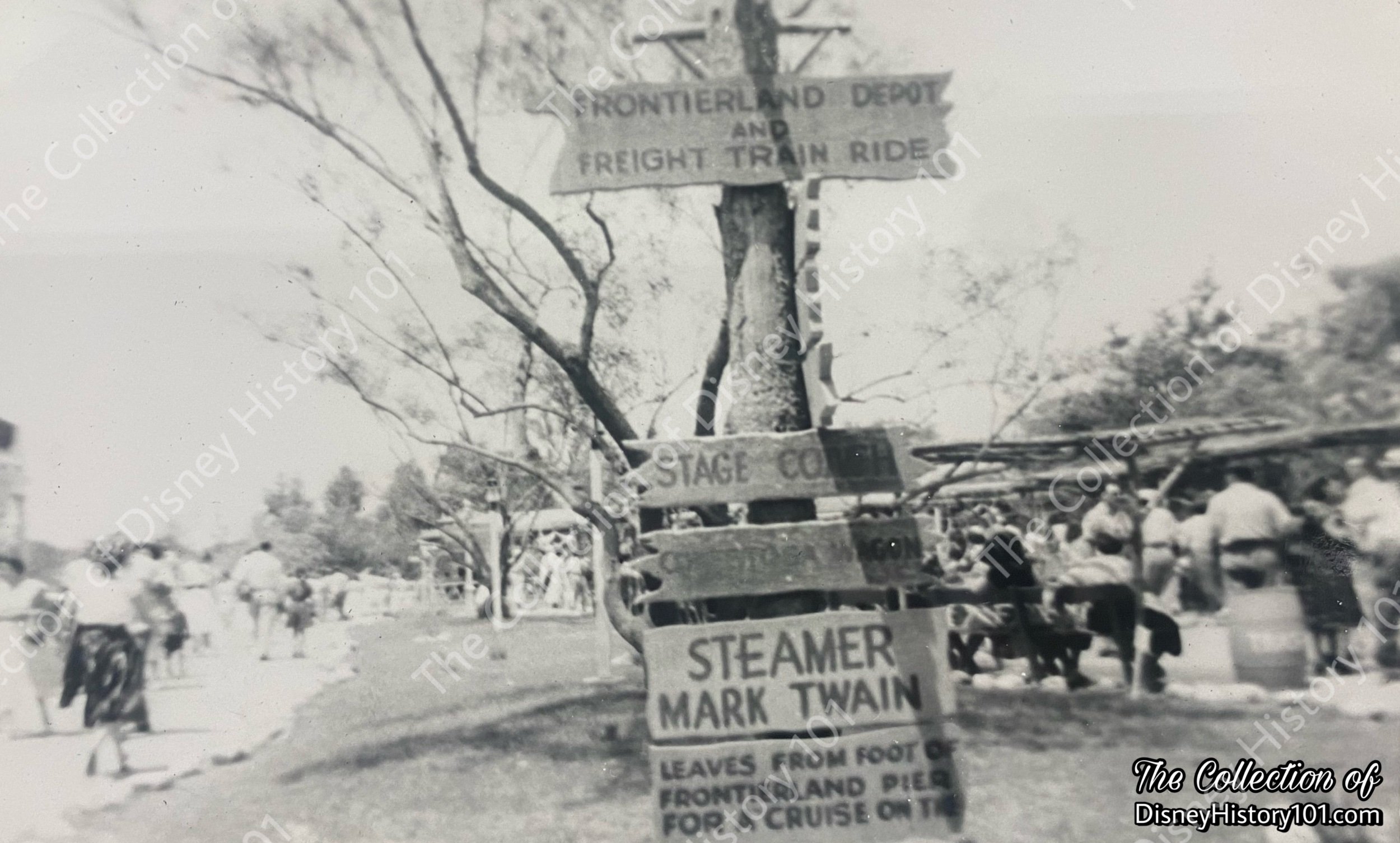
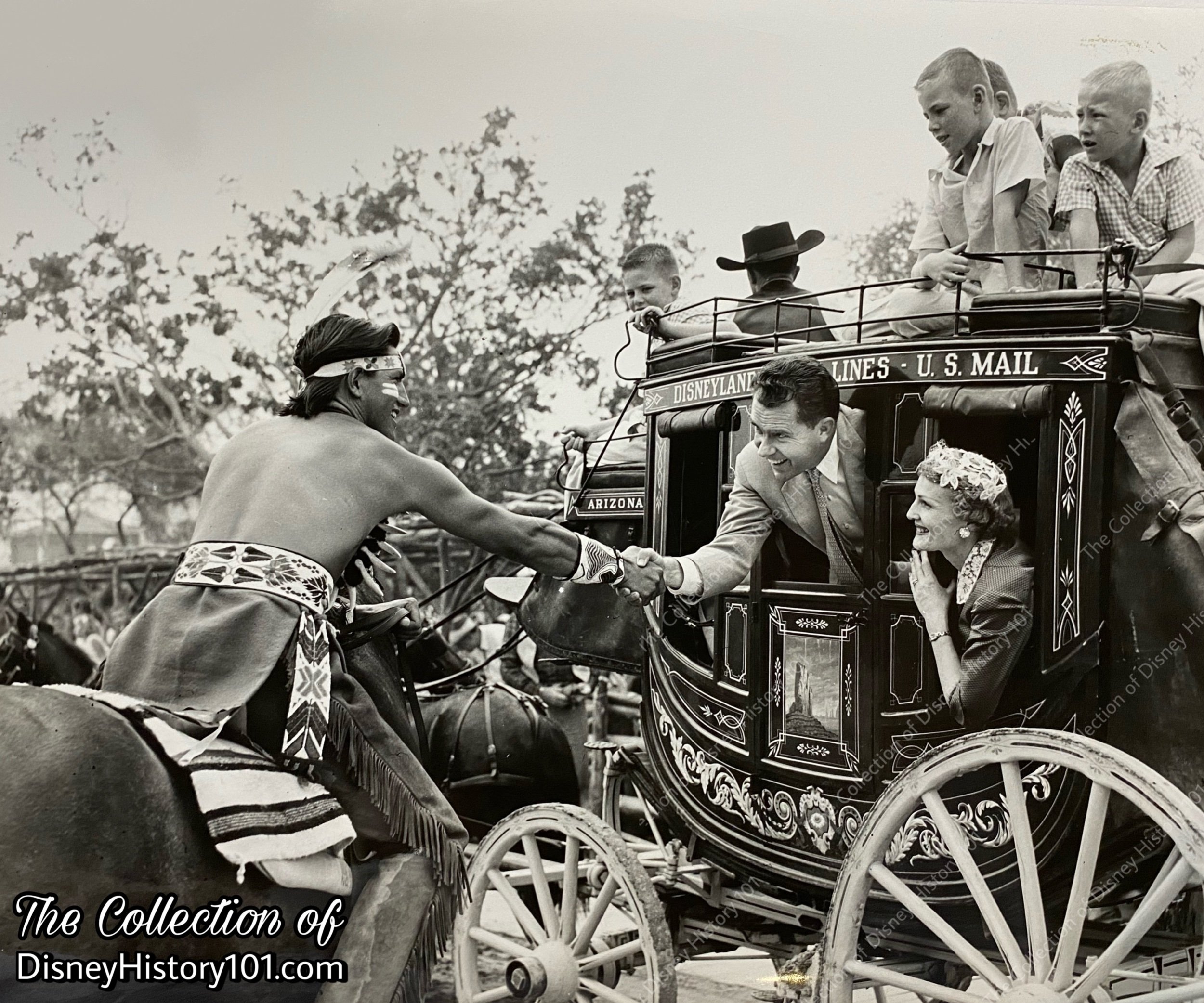
Once through the Frontierland Stockade, they headed off into (what Art Linkletter described as) “Stage Coach country.” Day Sechler recalled Danny Thomas and family riding aboard one of the Buckboards. Gale Storm and her kids rode inside on of the Stage Coaches.
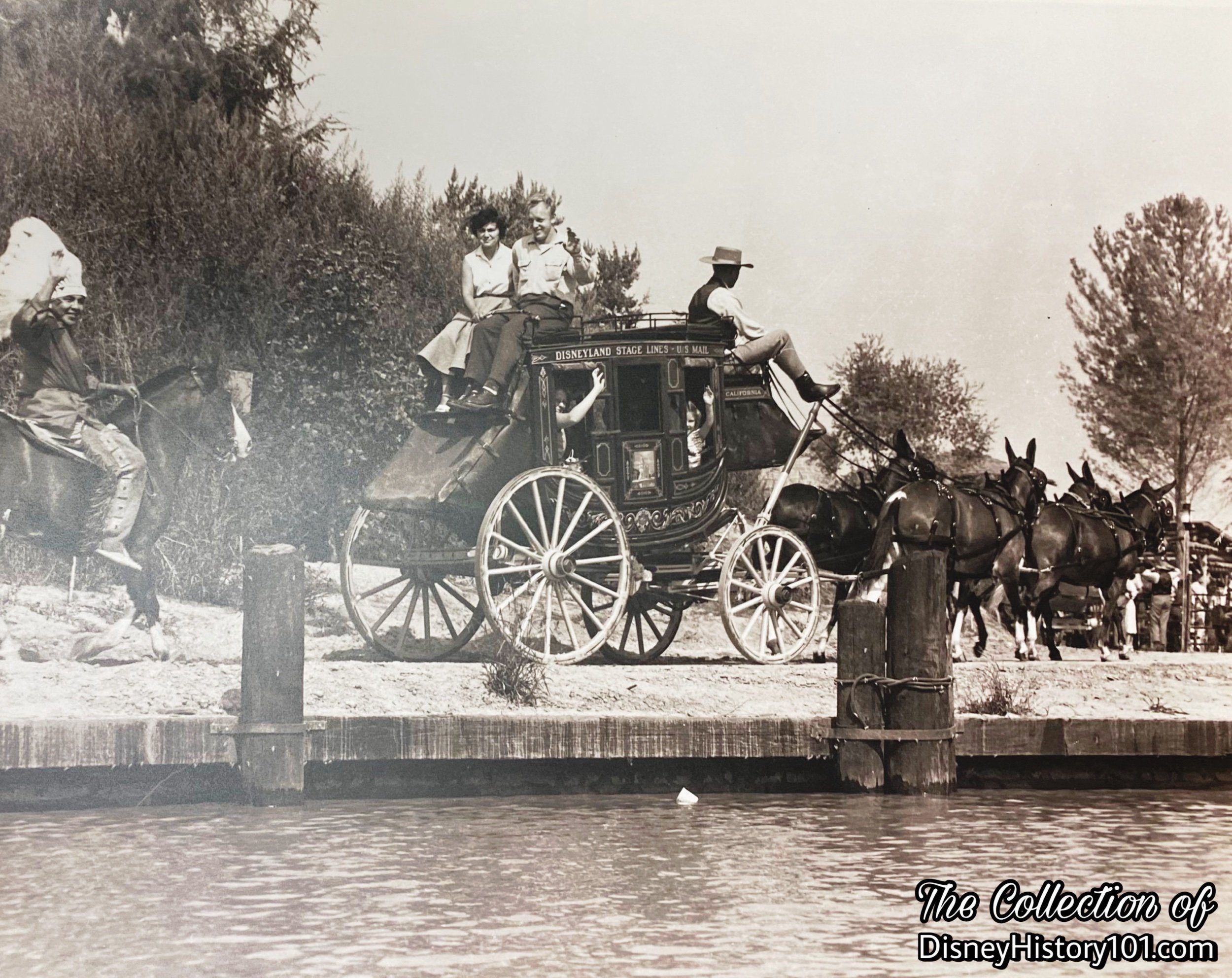
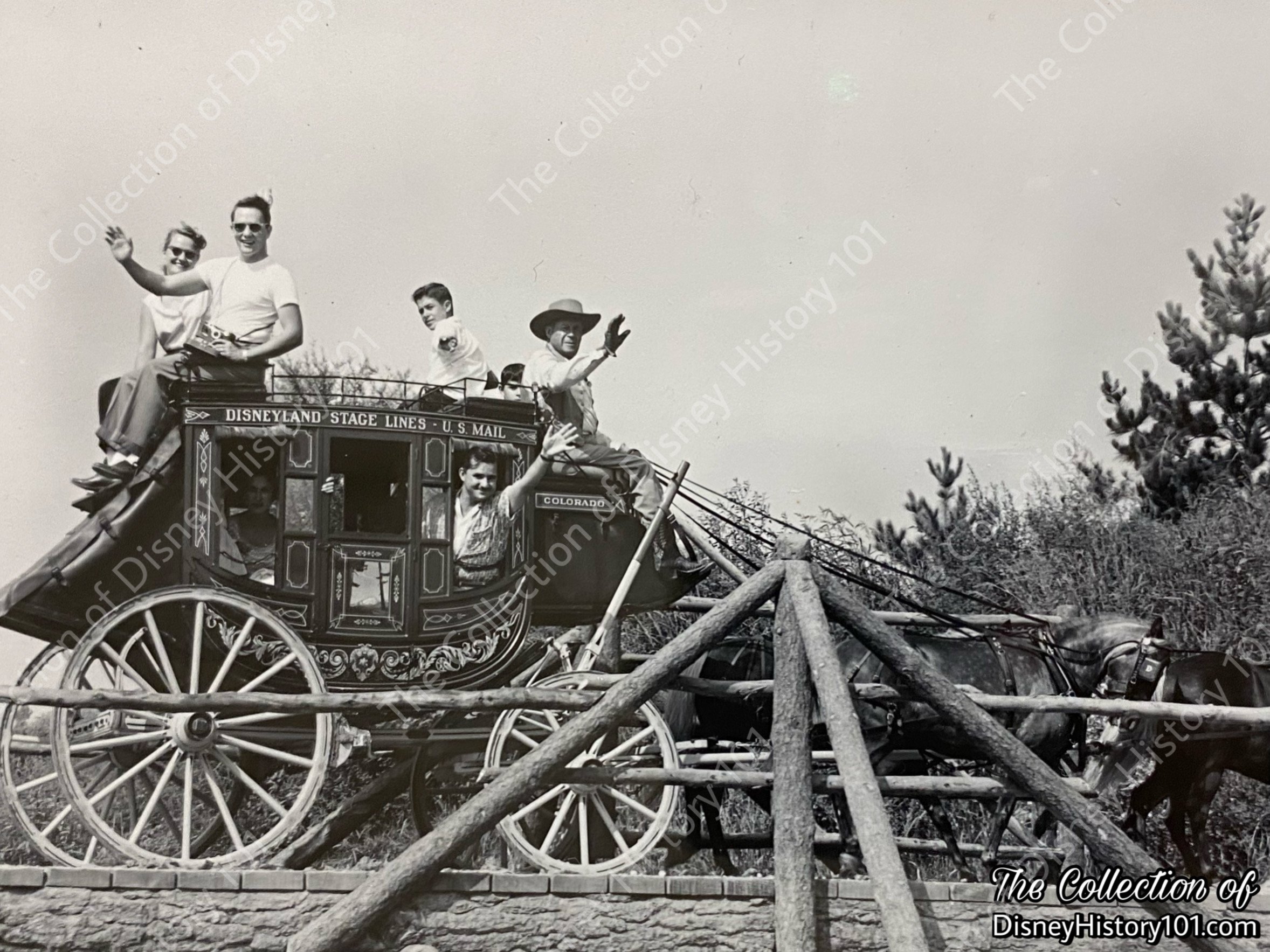
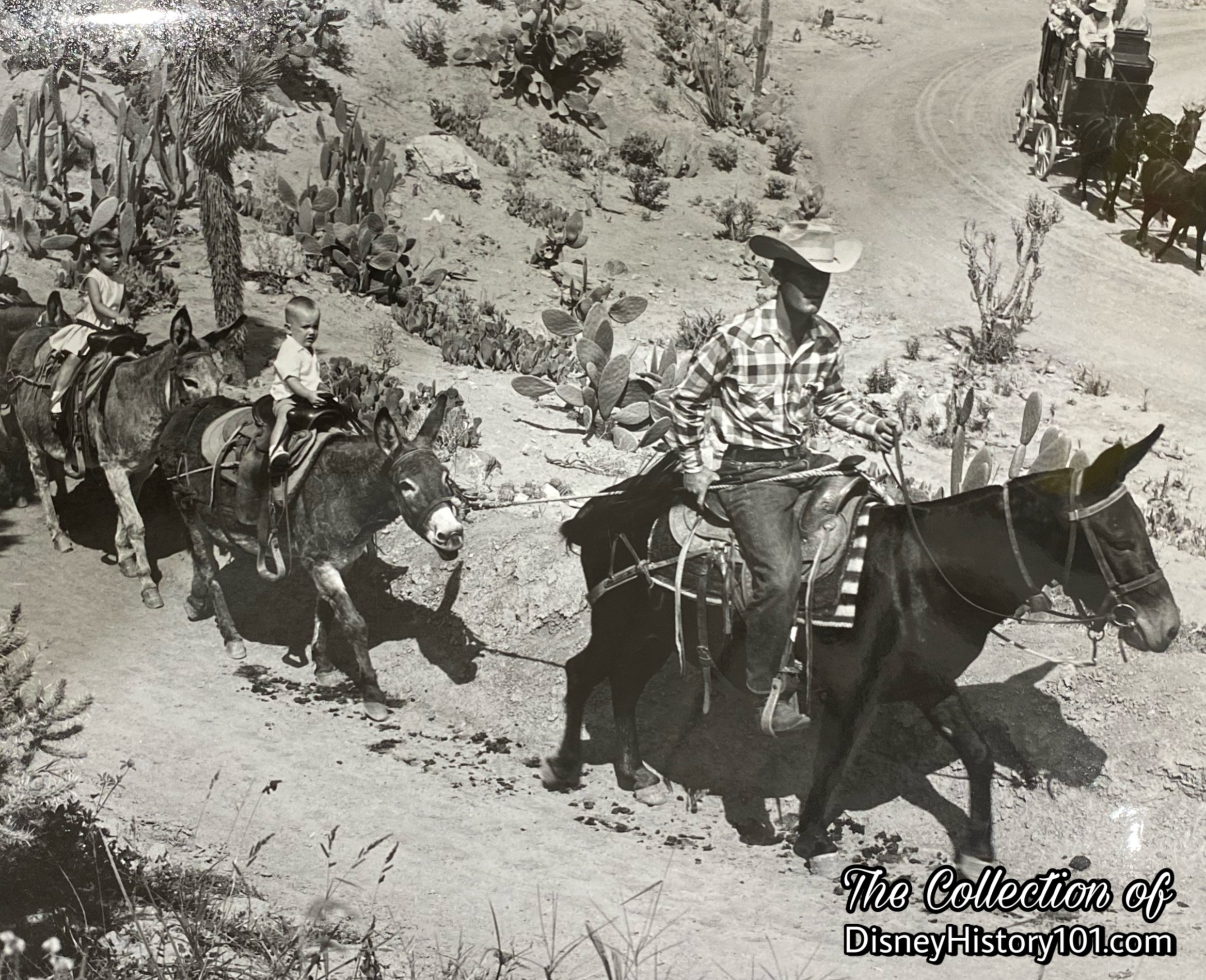
At long last, the Disneyland Stage Coaches (and their four-horse hitches) became 1 of 22 initial major attractions at Disneyland, on July 18th, 1955!
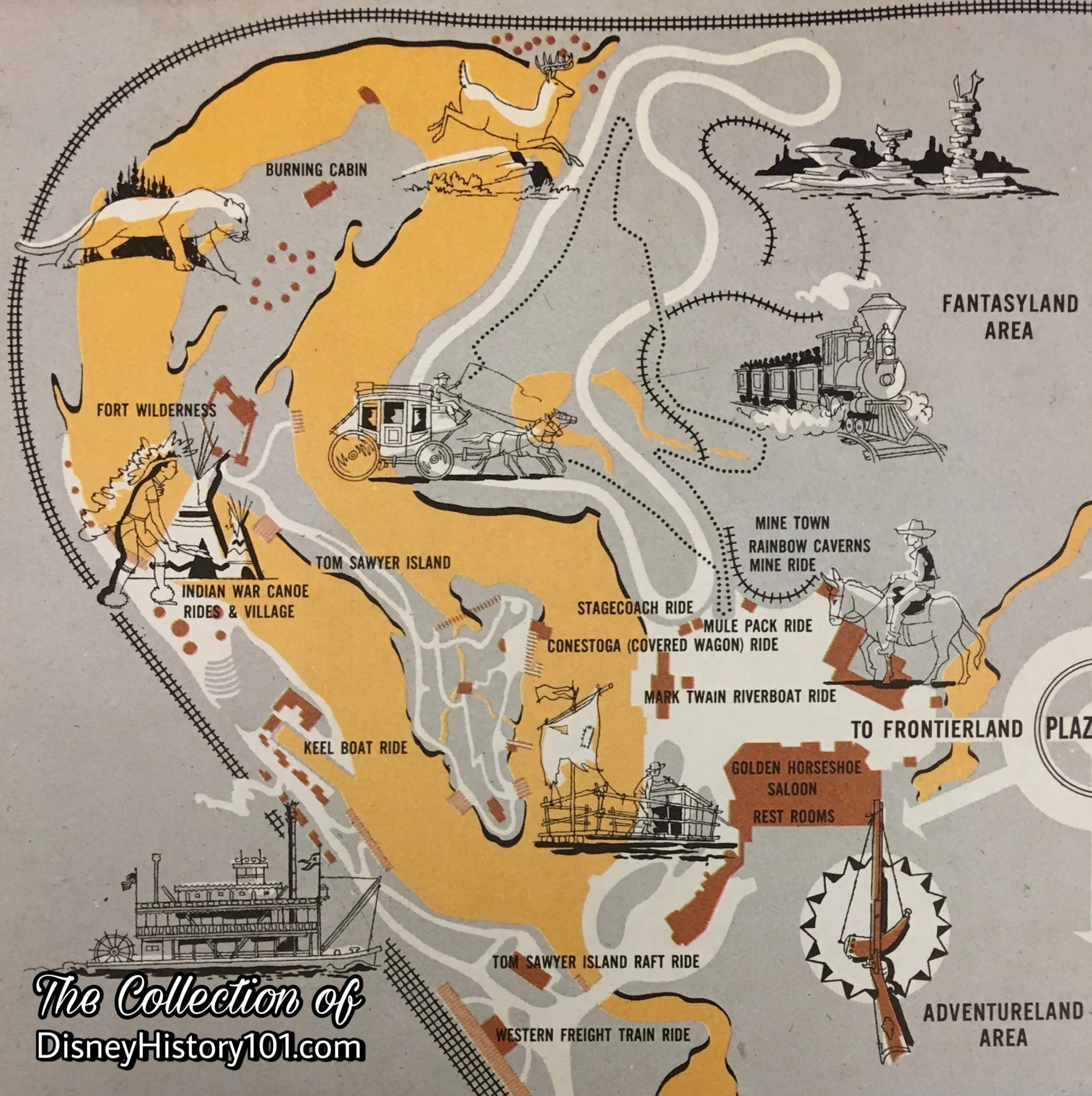
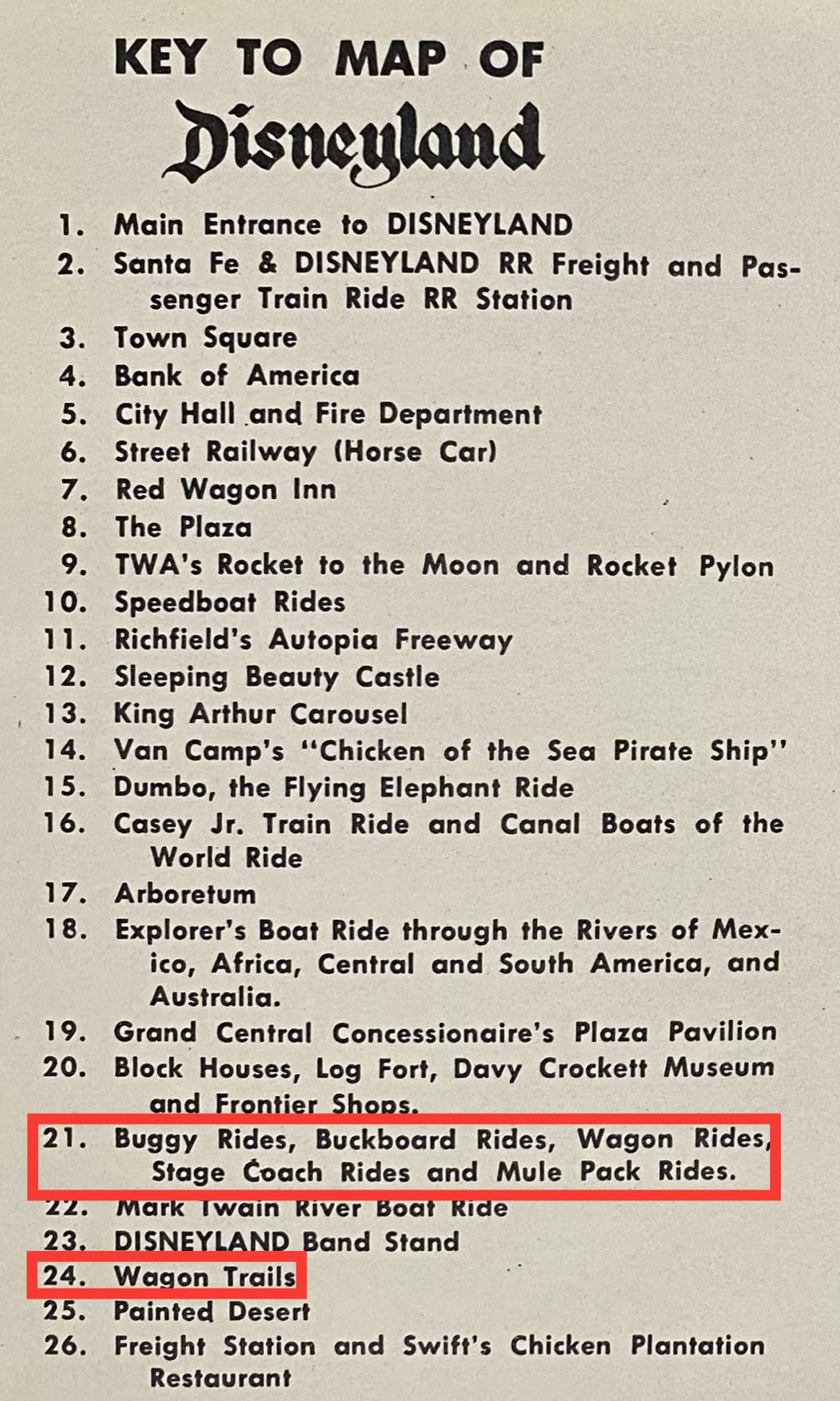
Your Guide To Disneyland, published 1955 featured a map of Disneyland depicting the Painted Desert and Wagon Trails stretched out over half of Frontierland (as drawn by artist Michael Harvey). The same map detailed where guests could experience a multitude of adventures by stepping aboard “Buggy Rides”, “Buckboard Rides”, “Wagon Rides”, “Stage Coach Rides”, and “Mule Pack Rides”! At the neighboring Blacksmith Shop, guests could “watch ponies being shod,” and “next door… the harness maker hard at work,” according to c. 1955 “Welcome to Disneyland” maps.
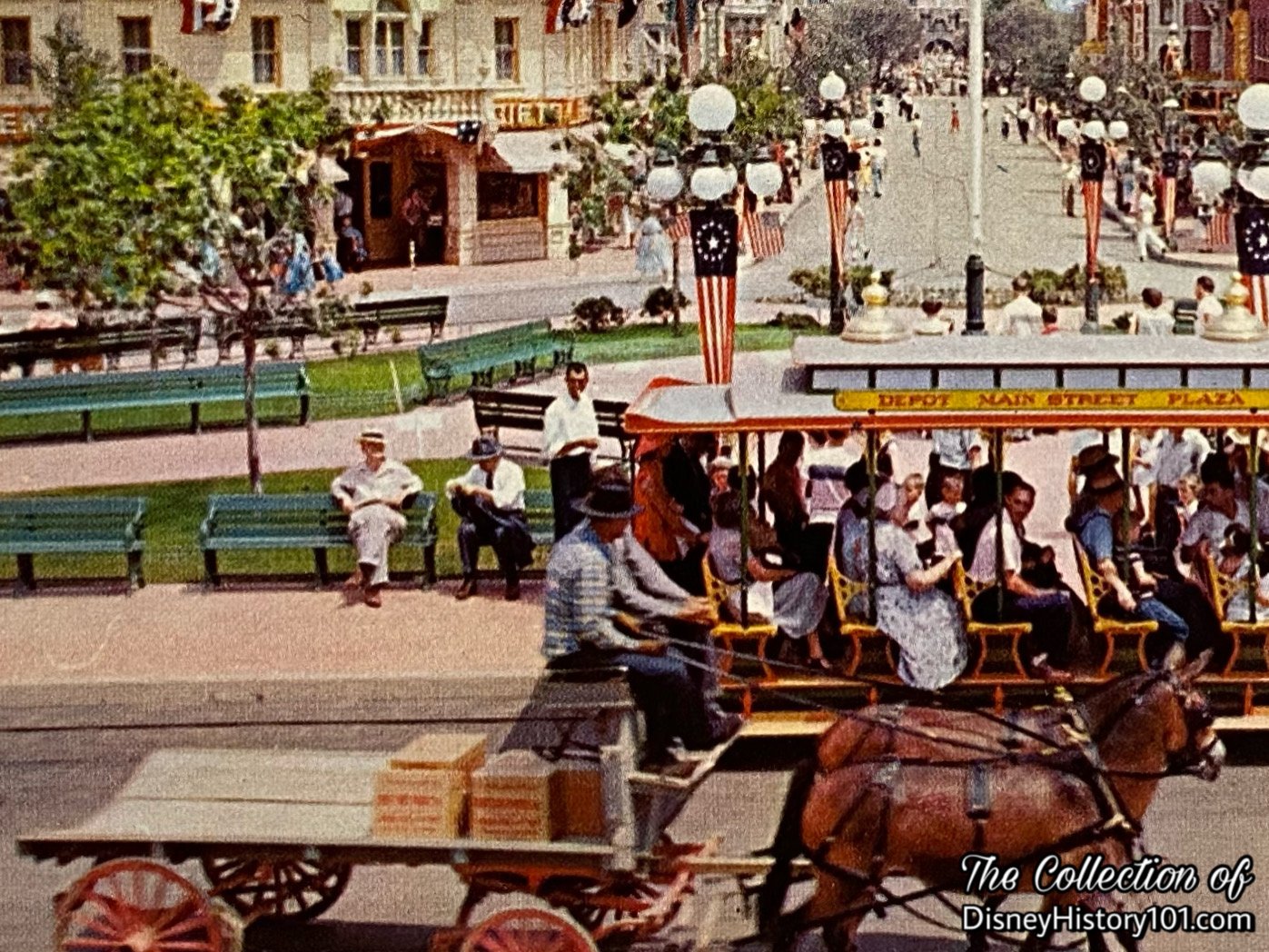
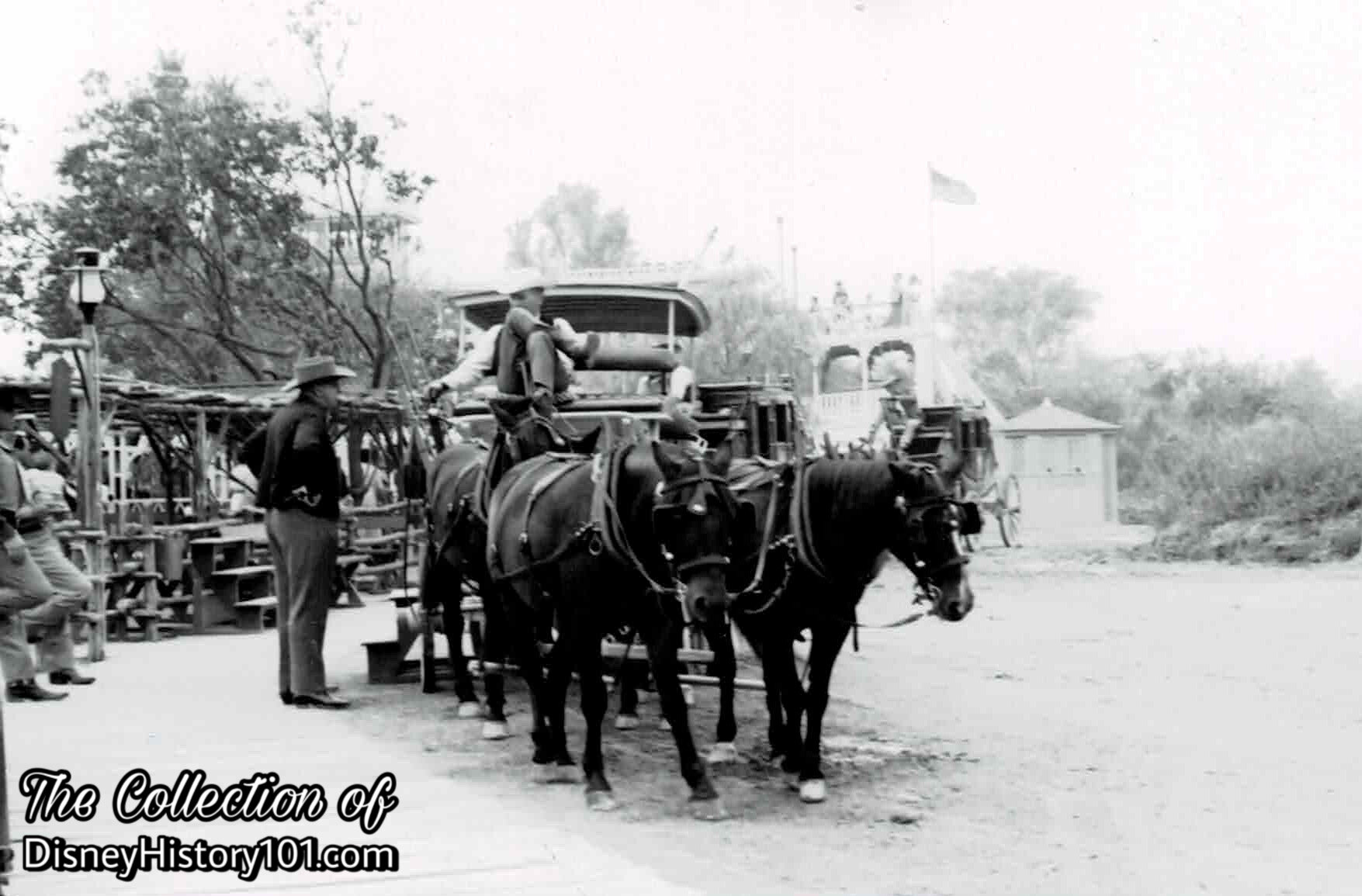
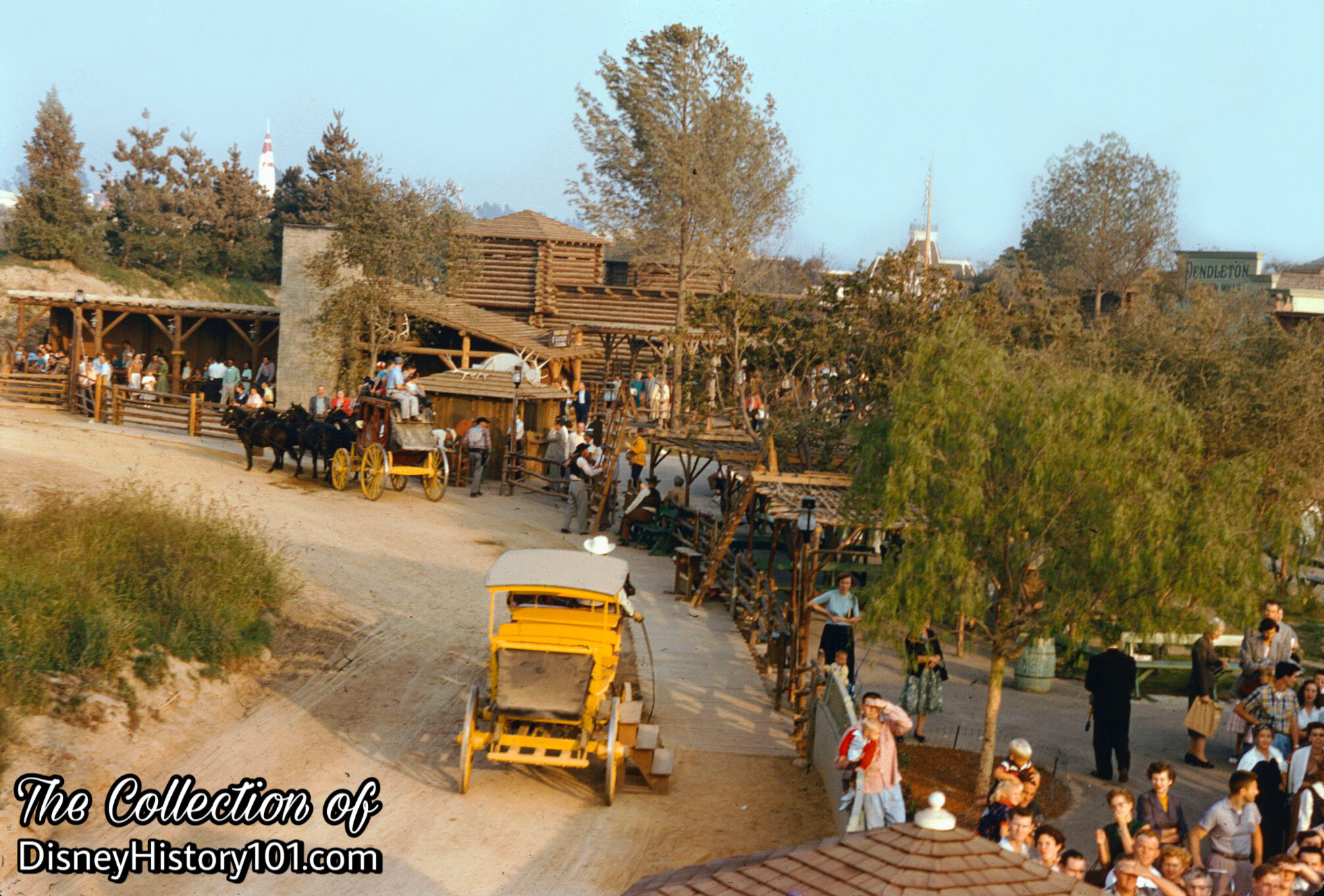
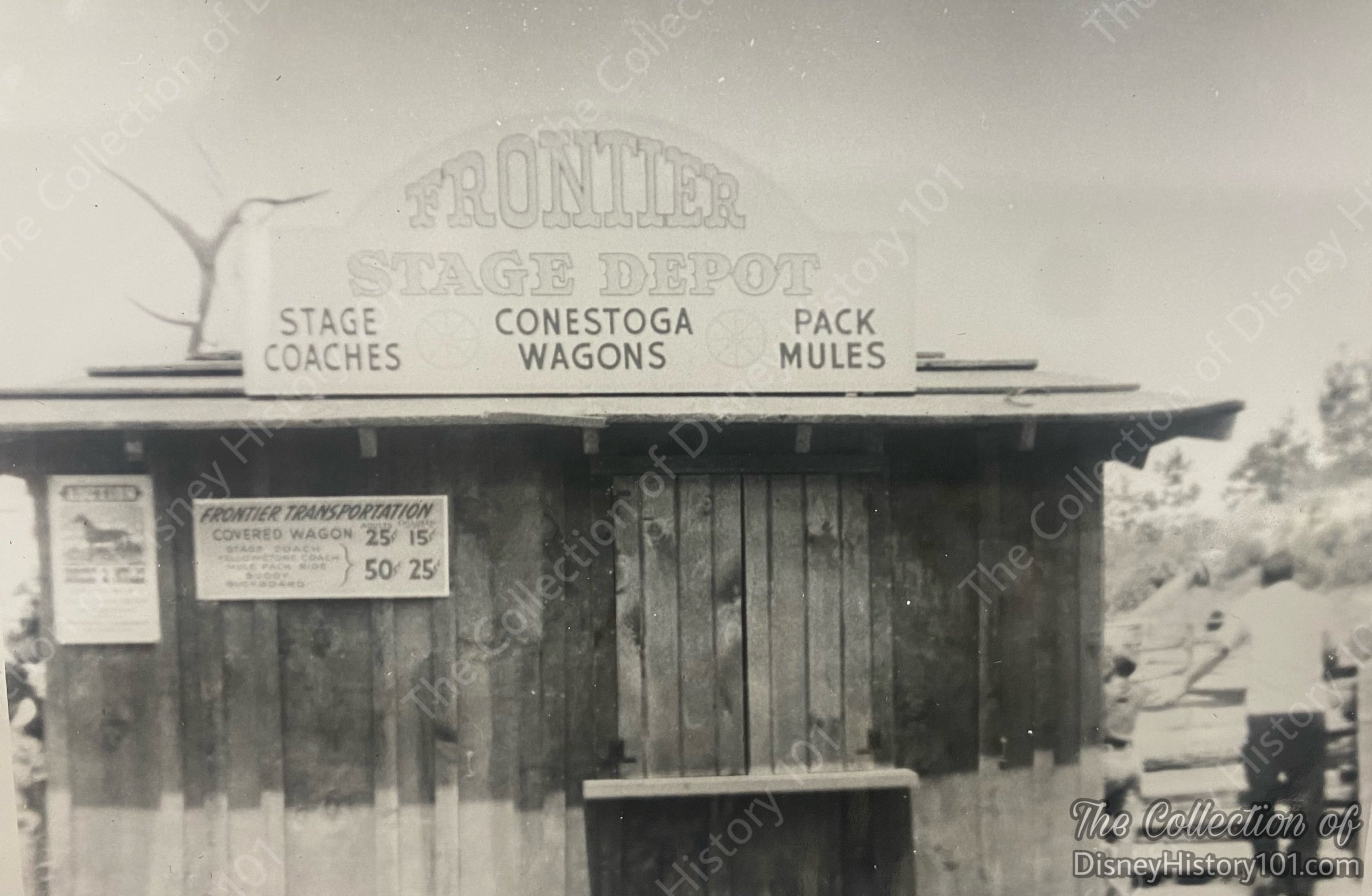
“Audience Waiting Areas” are especially designed as part of the attraction to make the guest's time waiting in line as comfortable as possible. The antler-crested structure (near the center) was the old Frontierland Depot, where passage was booked and tickets acquired aboard one of the Stage Coaches, Conestoga Wagons or Pack Mules. It was Just beyond the Frontierland Stockade, guests step aboard a Disneyland Stage Lines Stage Coach (and a Yellowstone Coach in the foreground) prepared to wheel across the desert and rugged wilderness, as their passengers relive the Frontier days of hardy western pioneers!

Younger guests loved sitting inside, above, and (especially) riding “shotgun” in the Driver’s Box of the Disneyland Stage Lines Stage Coach. You may recollect the loading and unloading process took a few minutes to complete. During one Spring of 1956 Disneyland photoshoot, actress Spring Byington (of “December Bride) and child actor Bobby Diamond (of “Fury”) were photographed aboard the “Colorado” Stage Coach (with the tree artwork on the door) for their 1956 “TV Radio Mirror” photoshoot at Disneyland!
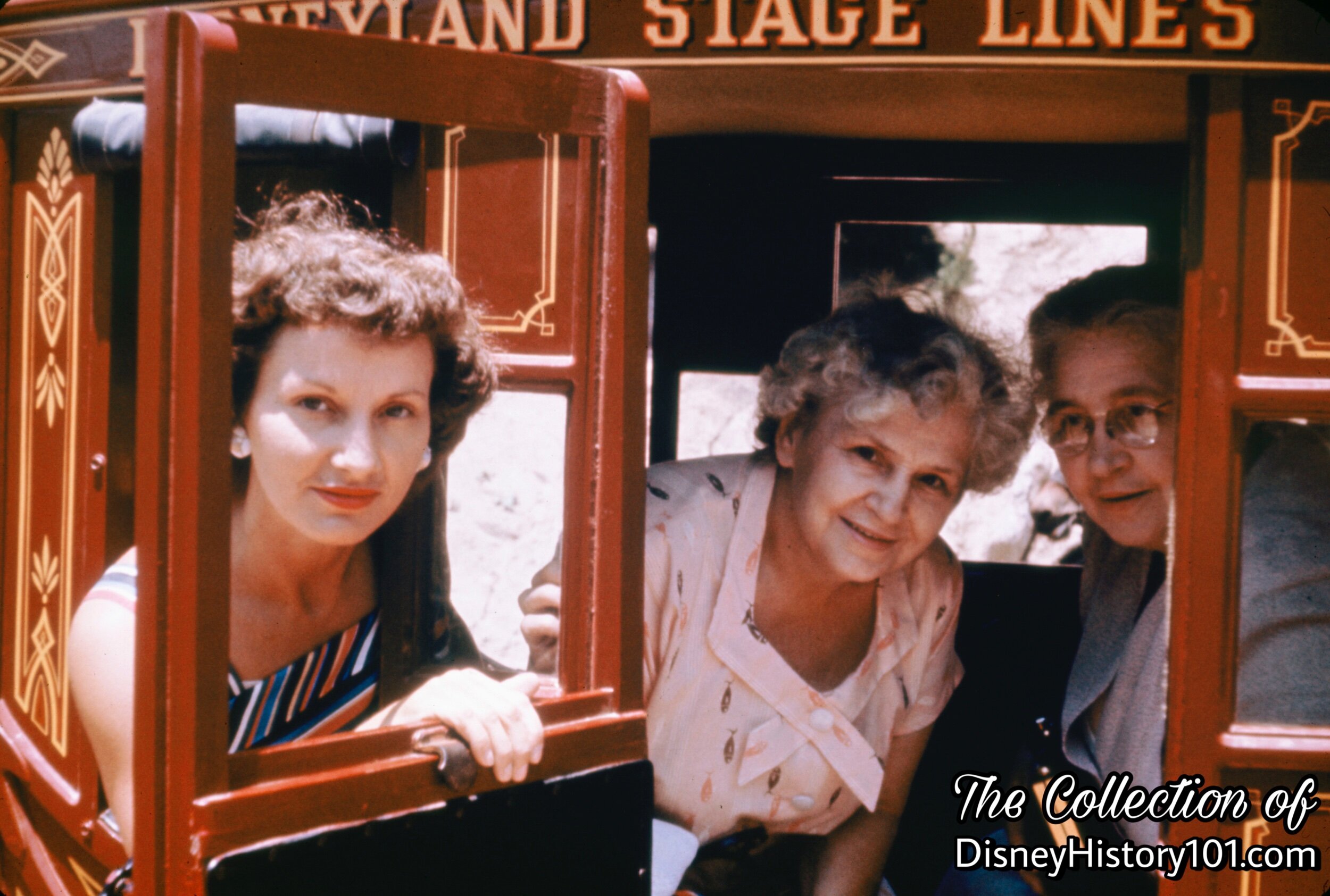
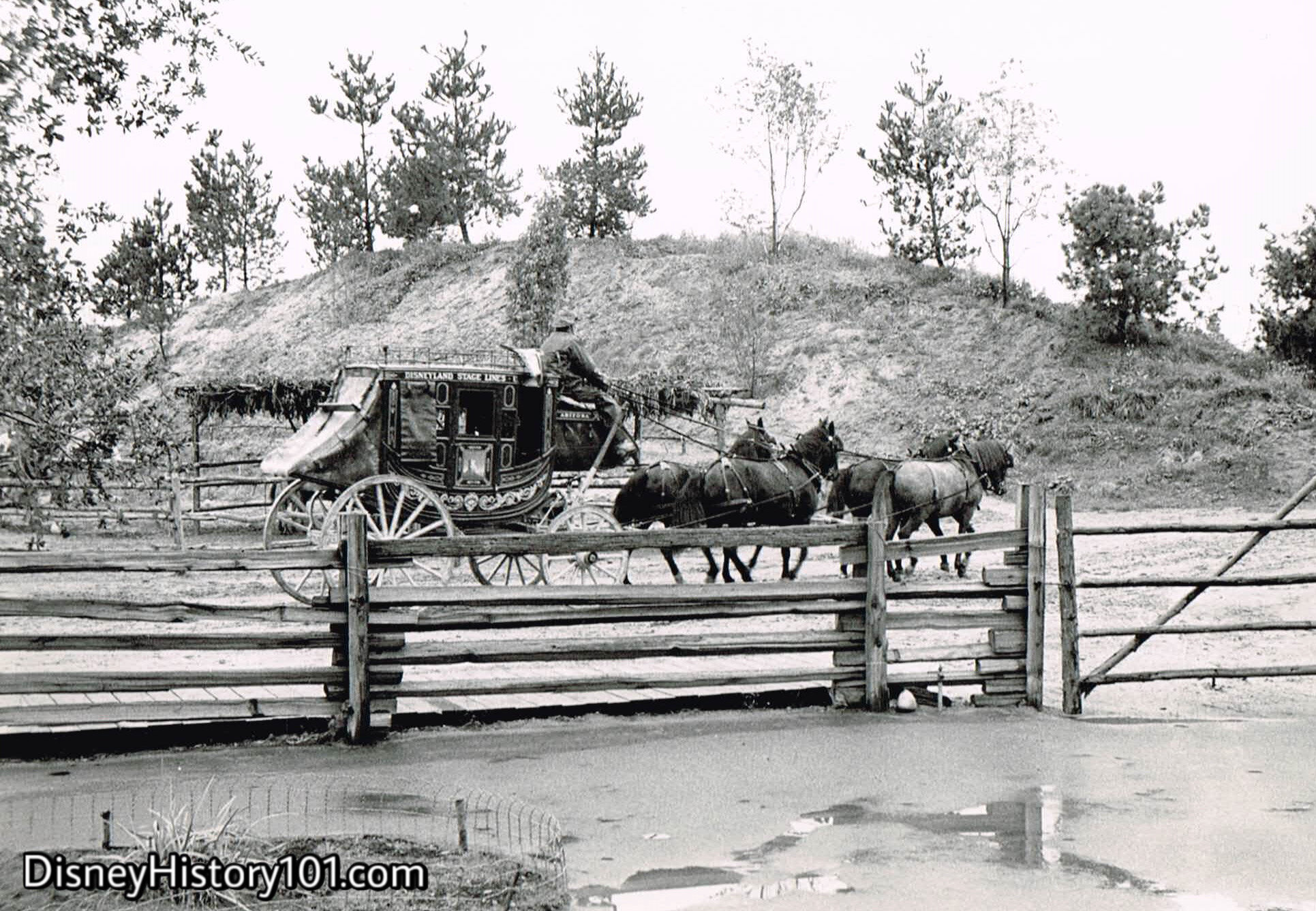
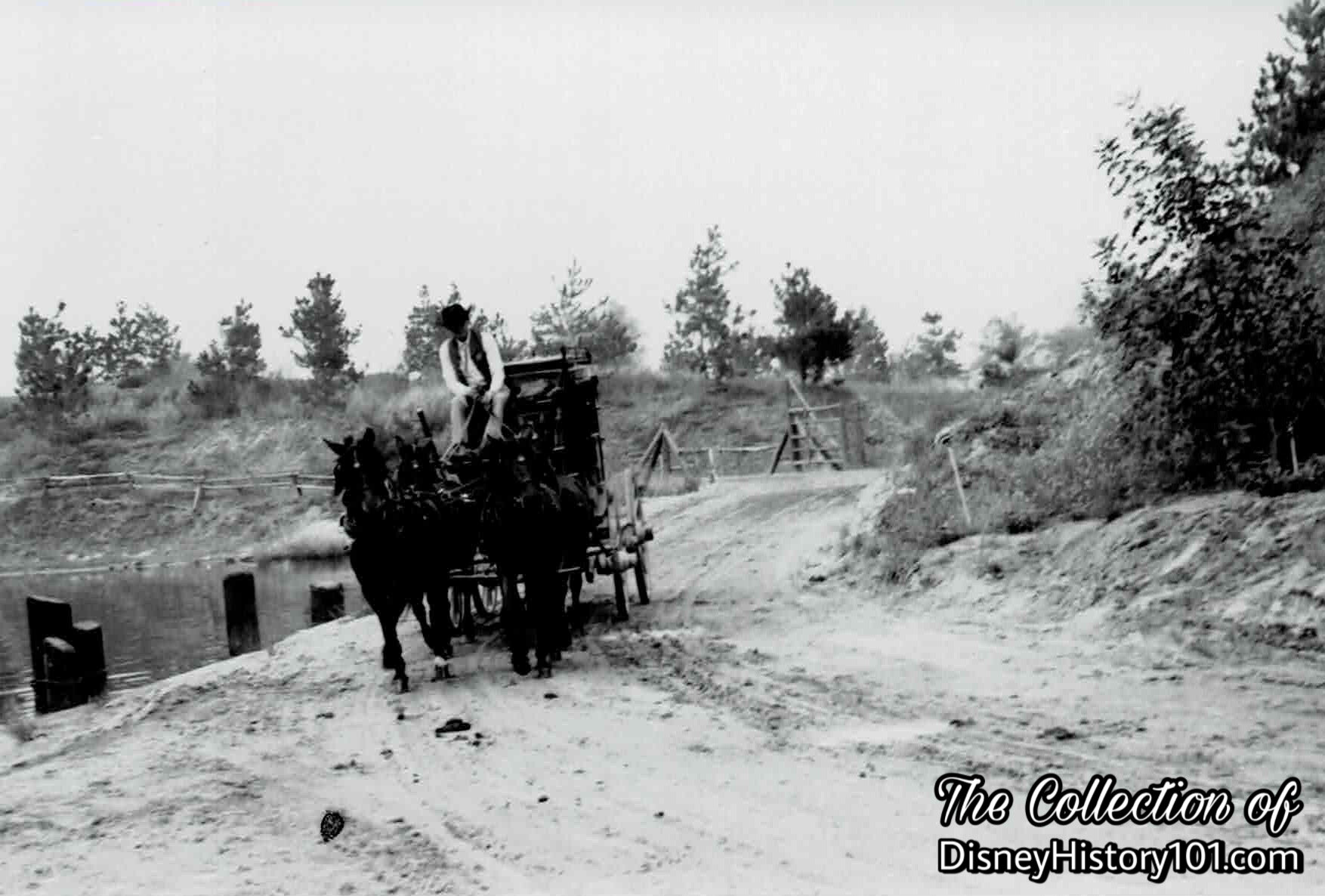
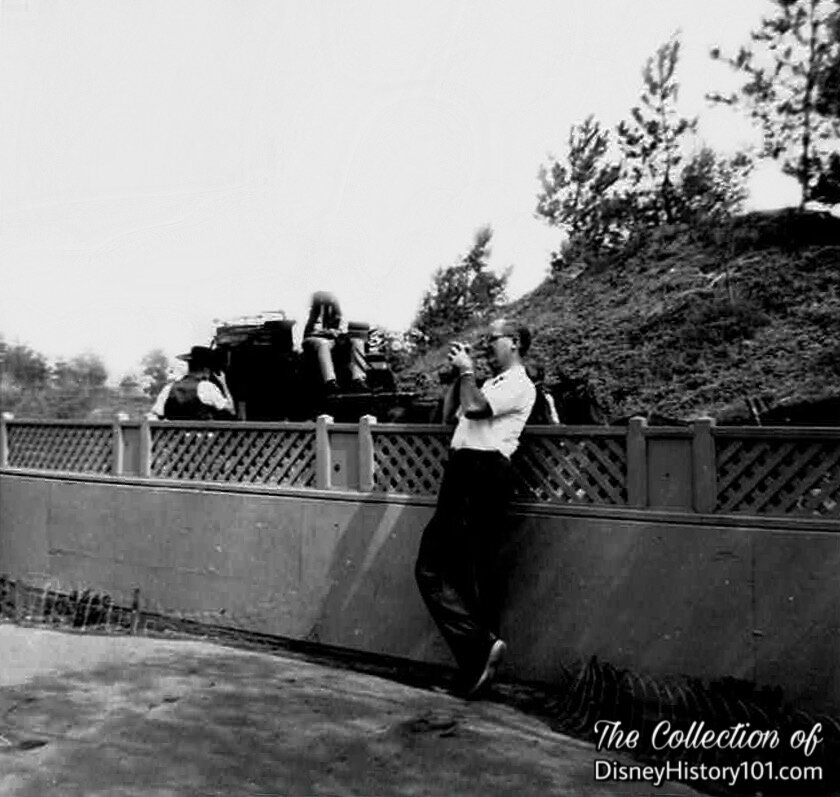
A Disneyland Stage Lines Stage Coach passes on the other side of the wall running from the Frontierland River “Boat Dock” to the Stage Coach Loading Platform and queue.
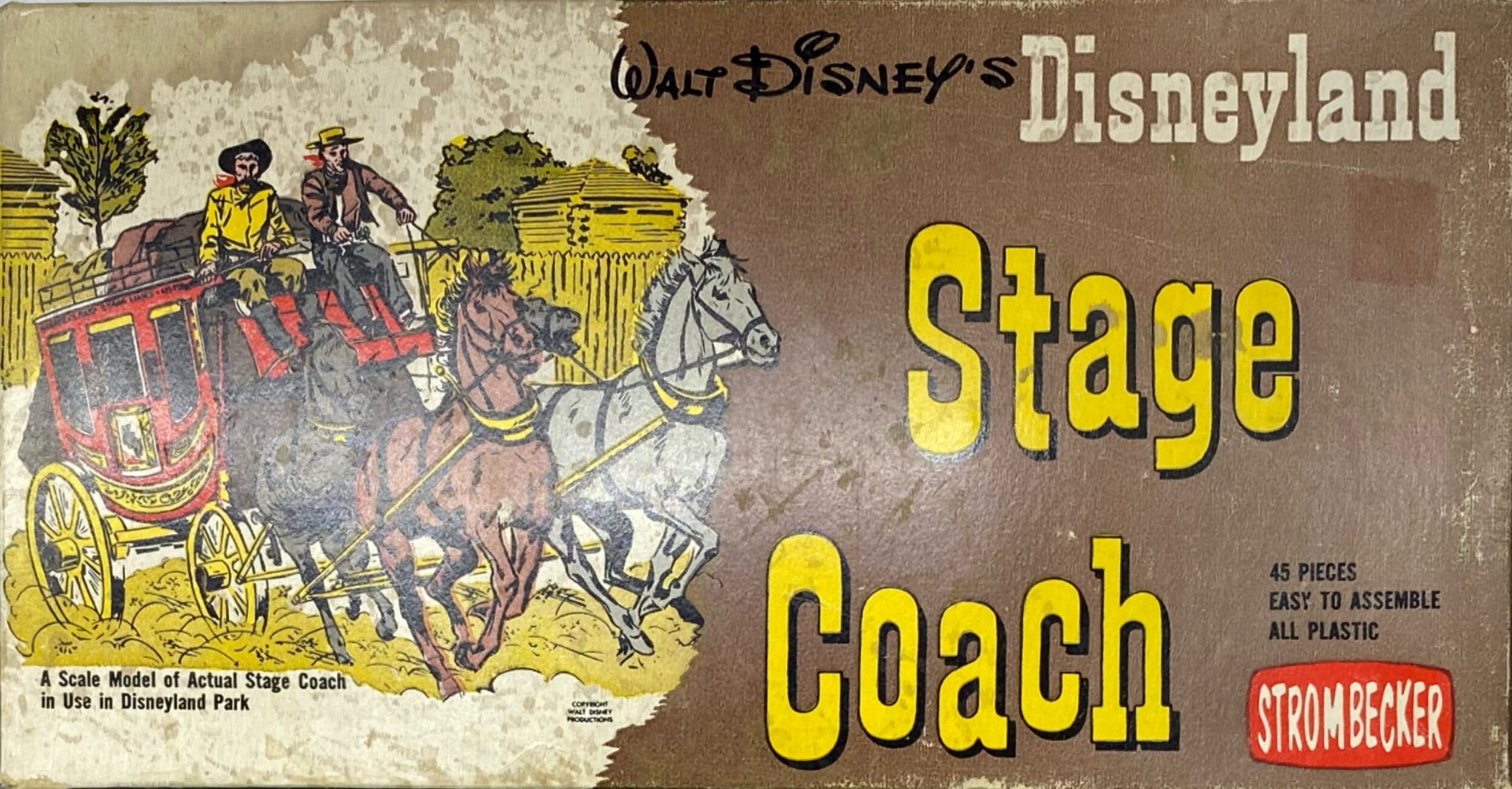
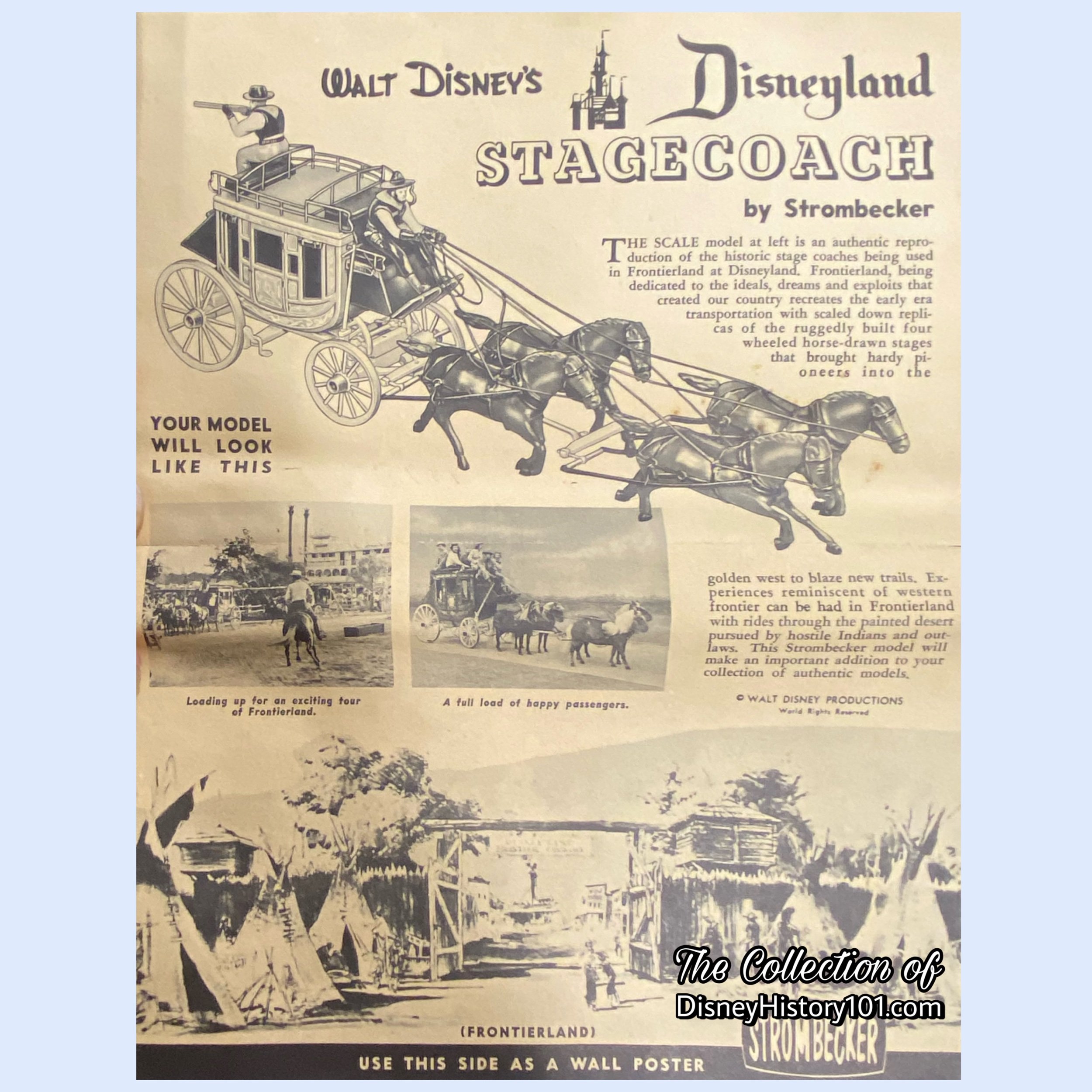
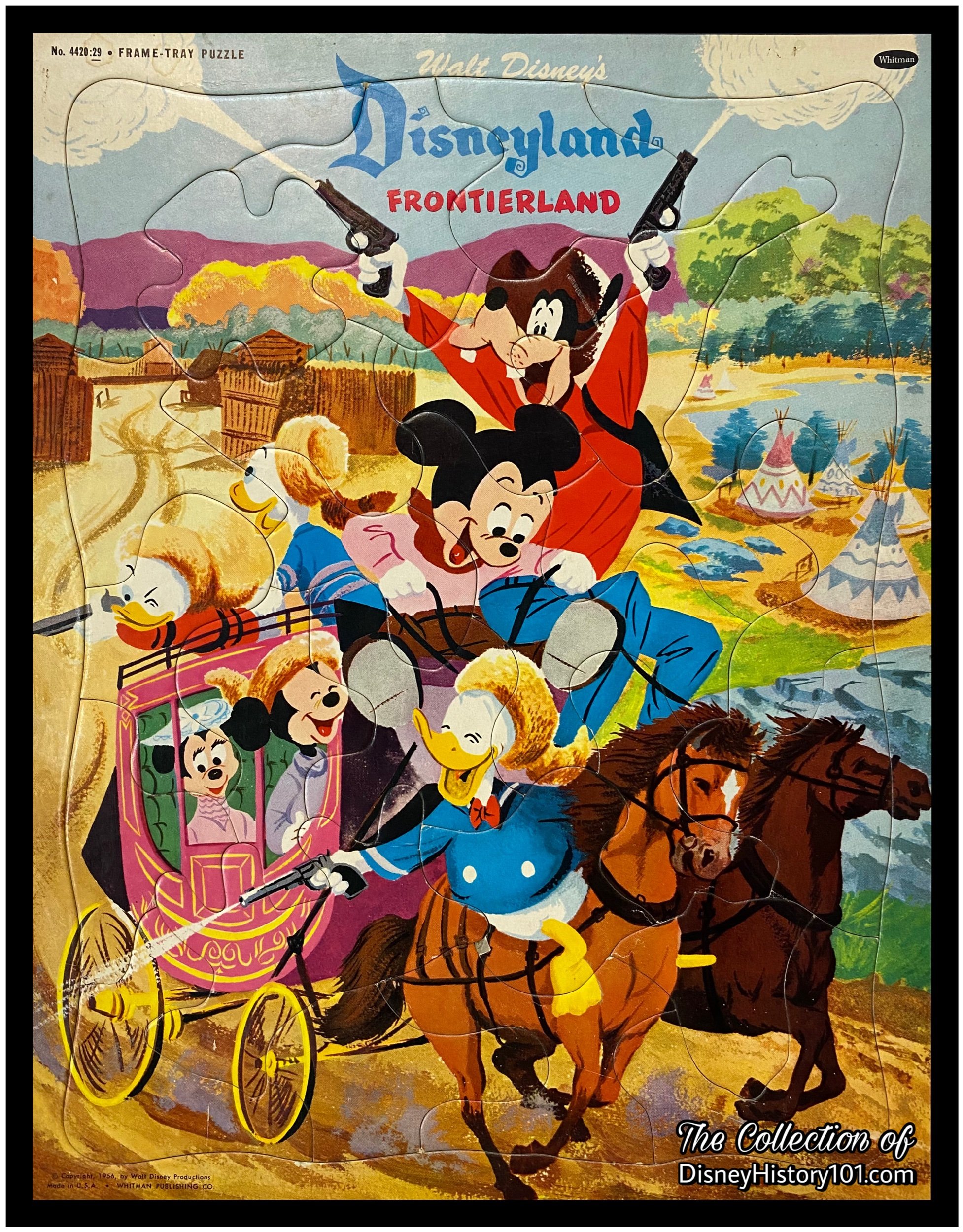
Disneyland provided an excellent outlet for licensed merchandising that was also available through retailers outside the park. Many of Disneyland’s iconic attractions were licensed as merchandise - from frame-tray puzzles and plastic toys, to salt-and-pepper shakers and ash trays. Some of them even received the “model” treatment - from the Global Van Lines Truck, to the “Jolly Roger” (known around these Disneyland parts as the Chicken of the Sea Pirate Ship Restaurant)! Strombecker manufactured several models of craft featured in Walt Disney’s “Man in Space” and “Mars and Beyond” (i.e. the Satellite Launcher, Moon Rocket, Space Station, and Space Ship), both Disneyland anthology series episodes of which first aired during 1955 and 1957. But now (by 1954-1955), Strombeck-Becker, Mfg. would commemorate the quaint and terrestrial Disneyland “Concord” Stage Coaches. By June 8, 1955, Mr. Lozier (of Walt Disney Productions Character Merchandise Division) had produced a model with horses, which had been approved by C.S. Olson (of Strombeck-Becker Mfg. Product Developement) and was ready to be presented to Philip Sammeth (of WDP Character Merchandise Division).
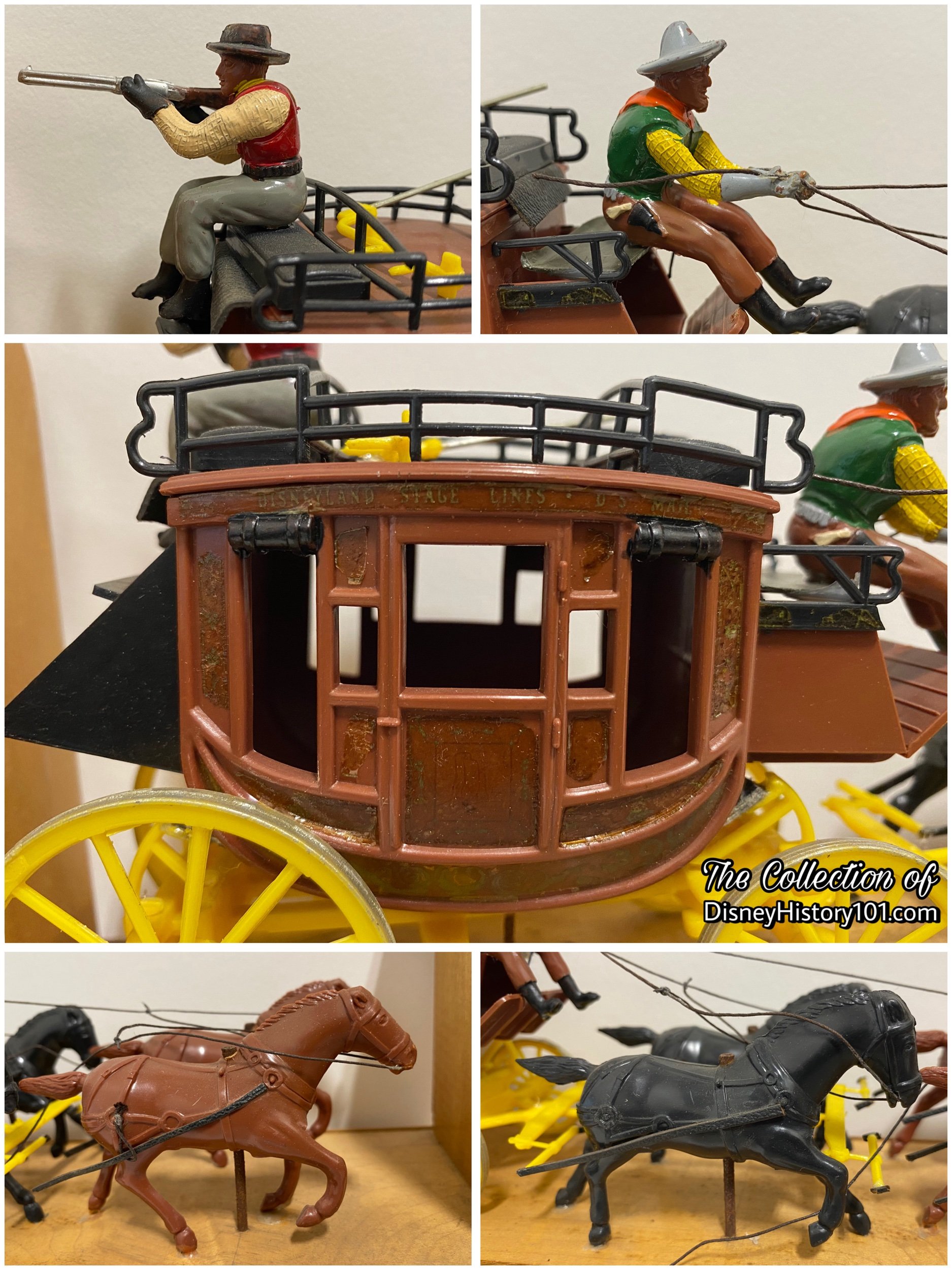
The final product was a Strombecker-manufactured easy-to-assemble 45-piece plastic Disneyland Stage Coach Model Kit, which was “a scale model of [an] actual stage coach in use in Disneyland Park” (as advertised on the box). The model kit came with decals to recreate the Disneyland Stage Lines Arizona Coach. This model was so popular (within 1954-55), that both Conestoga Wagon and Mule Pack kits (potentially Walt Disney Productions licensed merchandise) were also suggested by Strombeck-Becker Mfg.
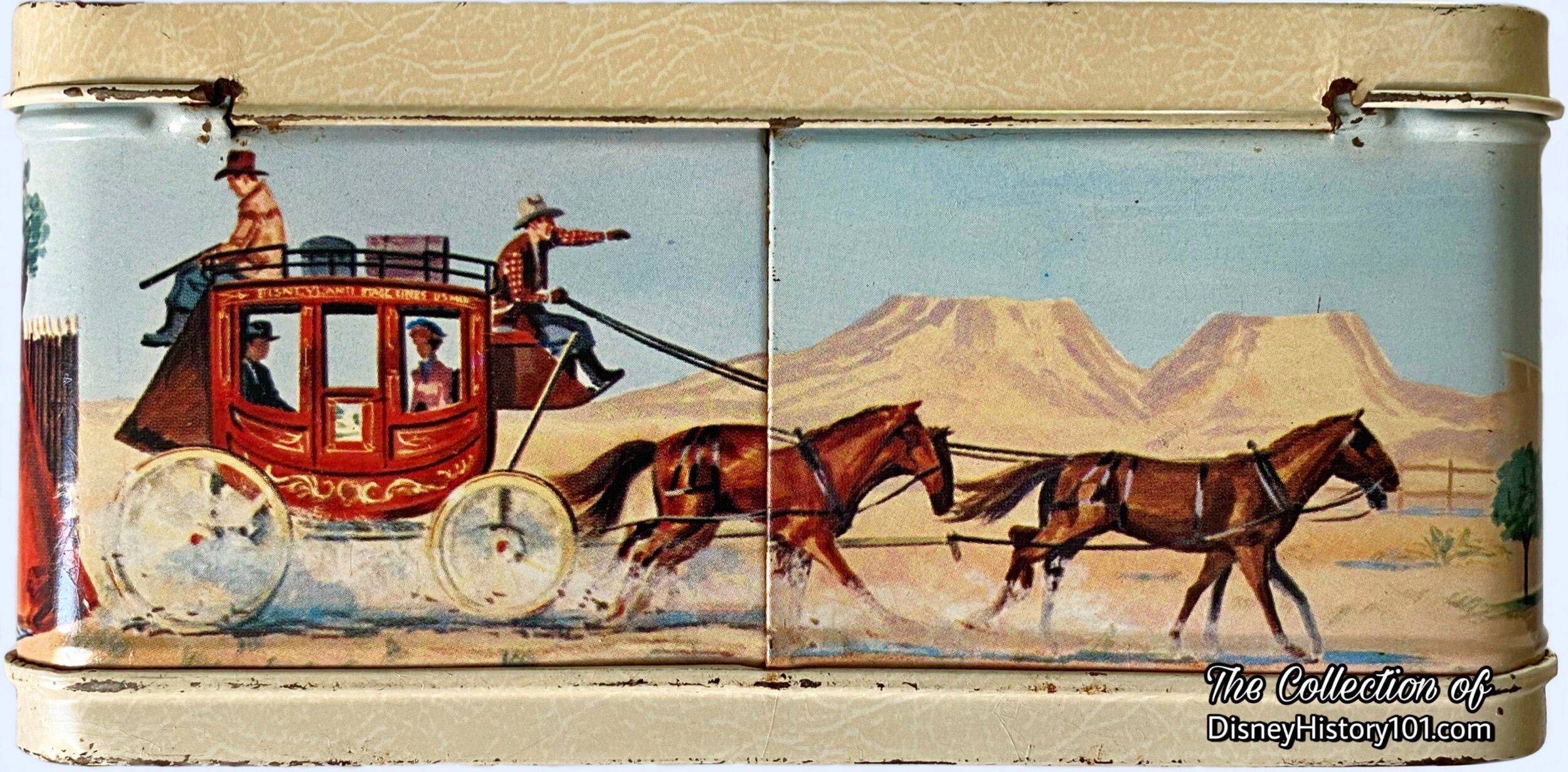
From iron-on transfers to lunch boxes - many other pieces of licensed Disneyland merchandise featured the character of the Rainbow Mountain Stage Coaches.
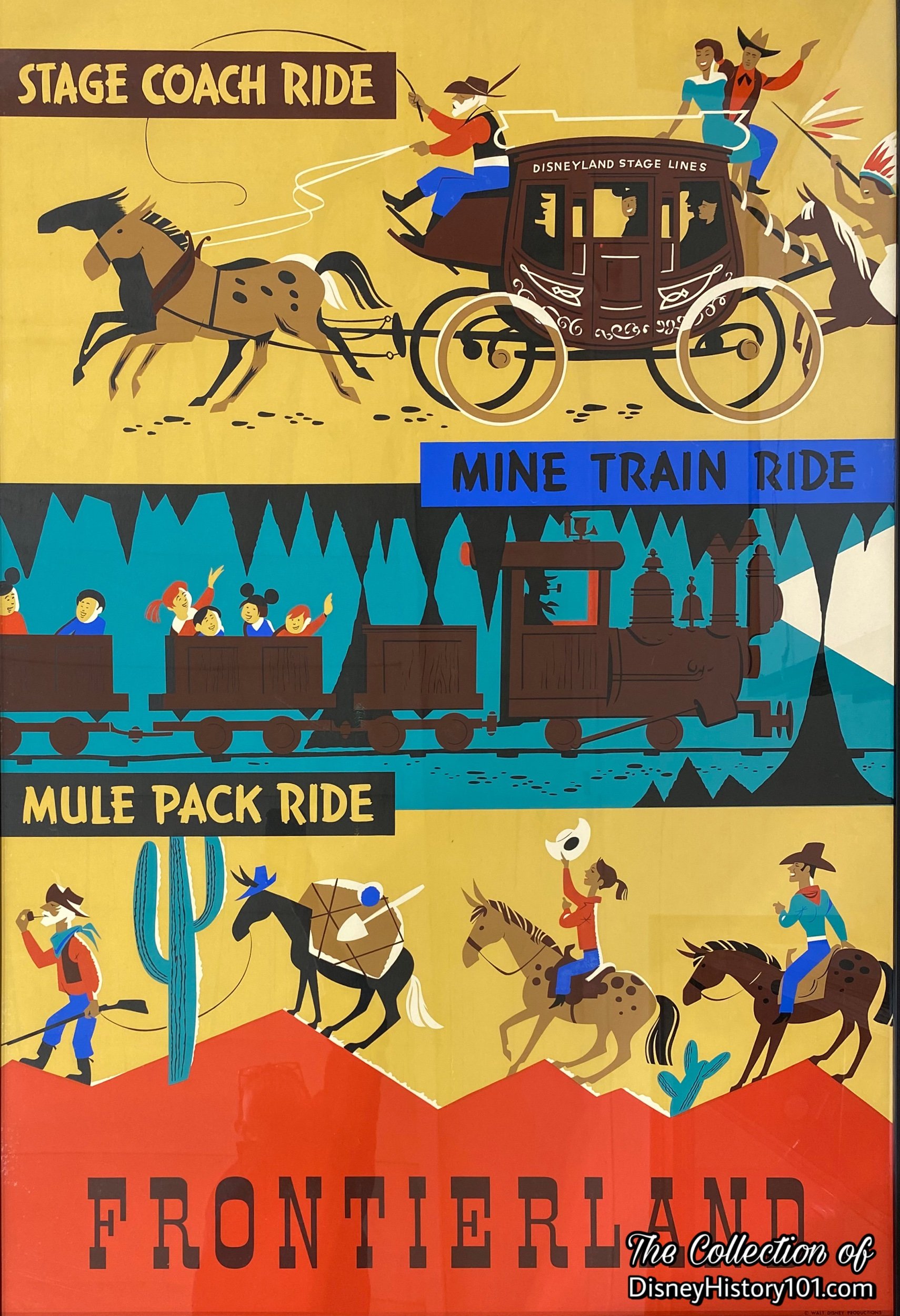
*Some sources as the Disneyland Rides, Attractions & Attendance Report cite February 10th, 1960 (though it is unlikely, as Nature’s Wonderland was under construction).
Times were “a changing’” and soon, new features of the desert were added to maps. At a meeting of the Disneyland Merchant's Association (held January 25, 1956), a momentous announcement was made: “All horsedrawn vehicles in the Frontierland area will be shutdown for approximately two months, during the redesign and reconstruction of this area. This will be a whole new development to increase ride capacity. We are building a mountain to be called Rainbow Mountain. This will be seen from the River and the Mark Twain. The existing corral and Black smith Show will be the entrance to a new ‘Mine Train’ ride. This will be an old fashioned Mining Train with 6 open cars. The engine will look like a real engine. The ride will go through a canyon out into the desert; then into a Rinbow Mountain where you tunnell with stalagmites and stalactities and three different water falls of different colors, joining in the river. This ride will take about 6 minutes…Stage Coach Rides route will be changed and we will add three new Stage Coaches.”
Other vehicles also started offering an alternate view of what was now billed as the “Rainbow Desert” (formerly the Painted Desert) beginning in 1956. The Disneyland Stage Lines Stage Coaches would embark from a cross-roads for all sorts of desert explorational vehicles - the new little mining town of Rainbow Ridge! Only now, the Disneyland Stage Lines Stage Coaches (also referred to as the “Yellowstone Stage Coaches”) would be renamed as the Rainbow Mountain Stagecoaches, and would soon be replaced by three Mud Wagons, or Buckboards - No. 4, No. 5, and No. 6 (intended to be pulled by a four-pony hitch). Once completed a 1958 appraisal placed the old western stage coaches and Conestoga wagons at a value of $172,800 (ride structure) and $36,790 (equipment).
This proved the truth of Walt Disney’s promise of an ever-expanding Disneyland! These new modes of desert transportation were among some of the exciting attractions debuting during 1956, that increased ride capacity! Owing to this, one day in August saw a peak total of “197,547 individual rides” enjoyed by Guests (according to a letter from Walt to Ward Kimball, dated January 23, 1957).
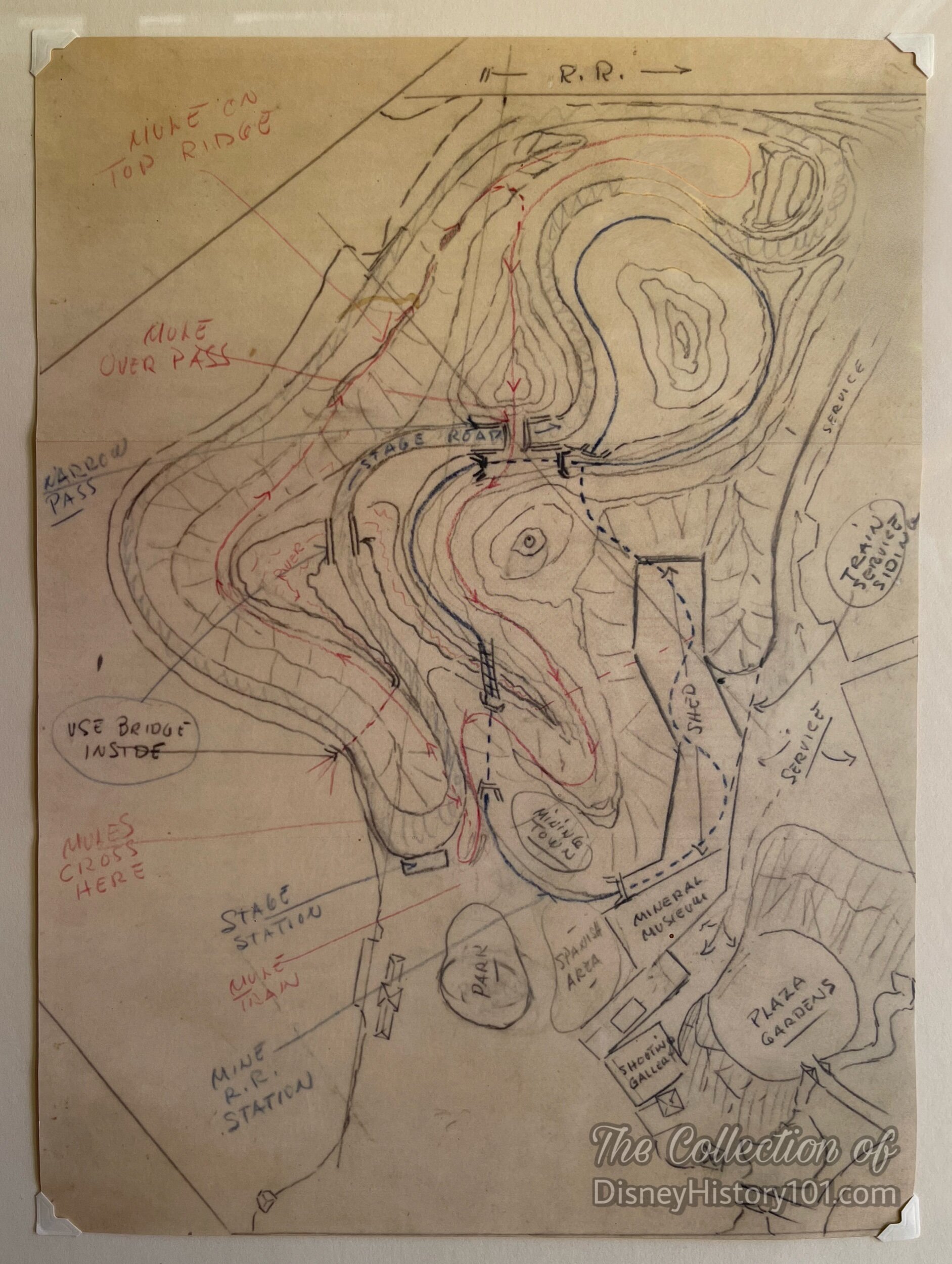
The region was initially called the ‘Painted Desert’ [in 1955]. It was redeveloped to add the Mine Train [July 2nd, 1956] and the name became the ‘Rainbow Desert.’ This was the name of the desert territory that the Disneyland Stage Lines Stage Coaches would traverse, for their duration of operation! These same Concord Stage Coaches (now renamed Rainbow Mountain Stage Coaches) would continue to give passage through the desert (from dawn until dusk) for three years.

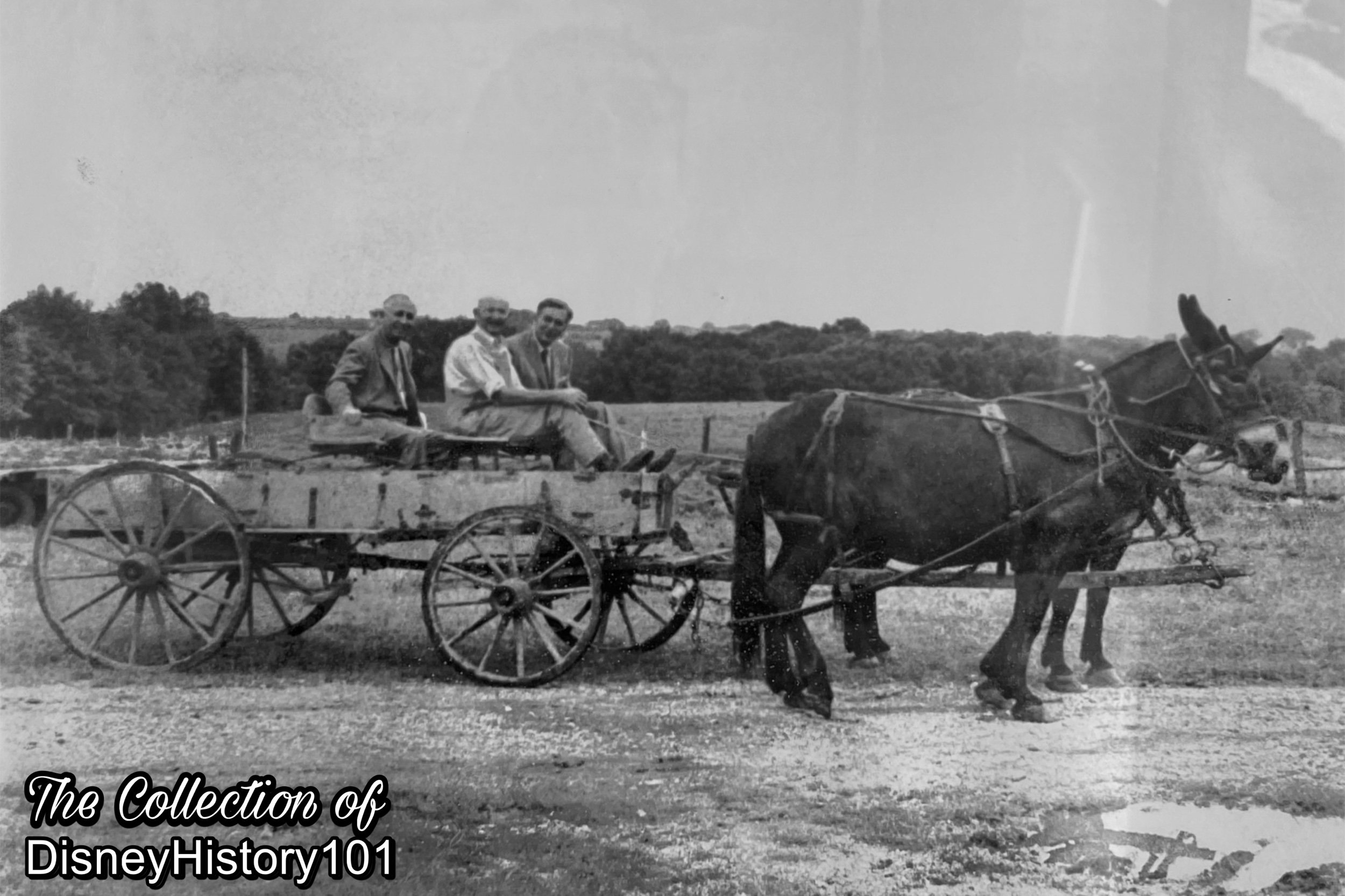
In 1906 Frank had delivered fence posts to the Disney Farm in his Peter Schttler Wagon. When Walt and Roy came back for a visit in 1956 (not long after the addition of the Mud Wagons at Disneyland) they enjoyed a ride in a similar type of mule-driven wagon.
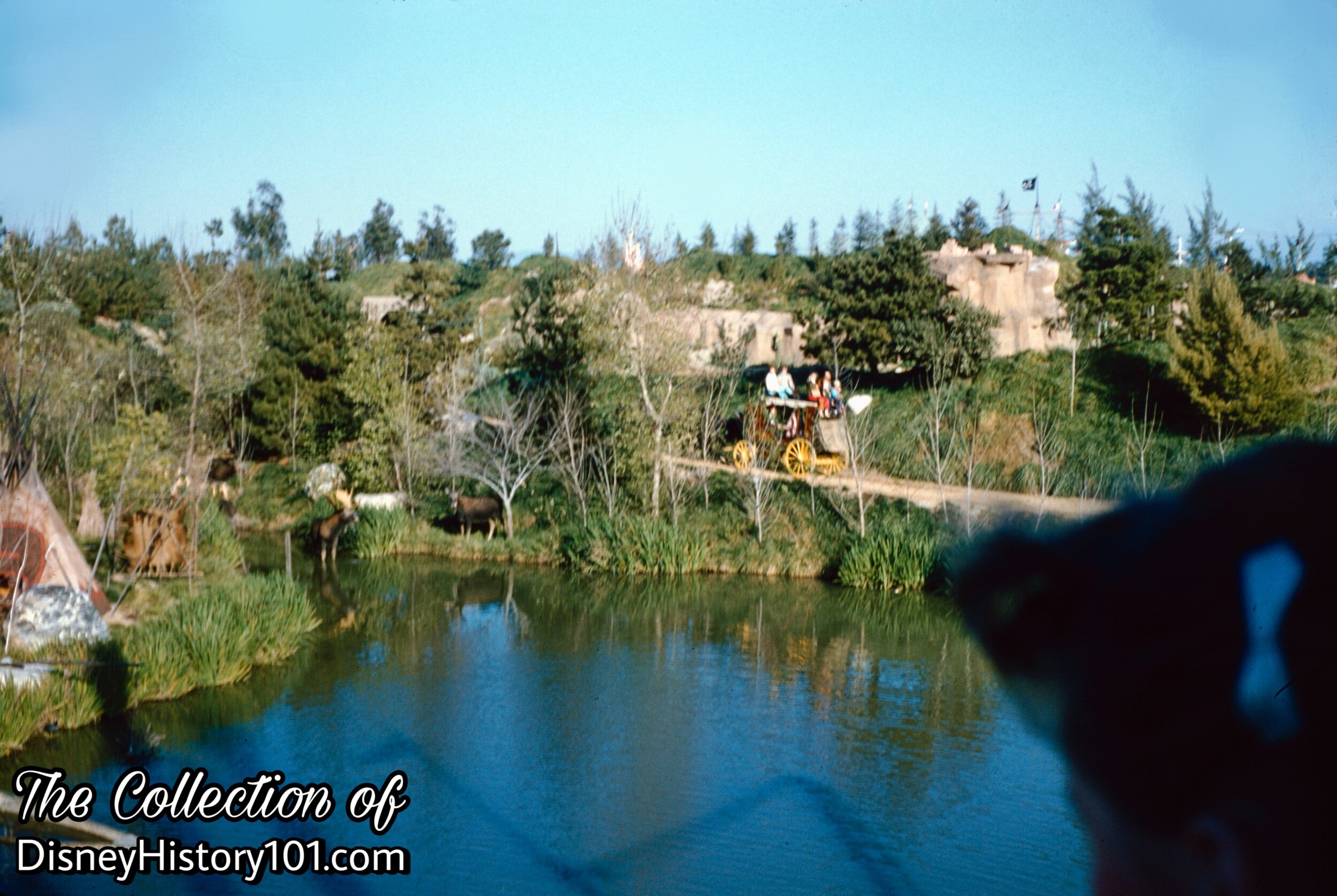
The Rainbow Mountain Stage Coaches continued through Friendly Indian territory, and once gaining passage, come to a fork in the road. Instead of heading over the berm (and toward the Pony Farm), the Stage Coaches head into the desert!
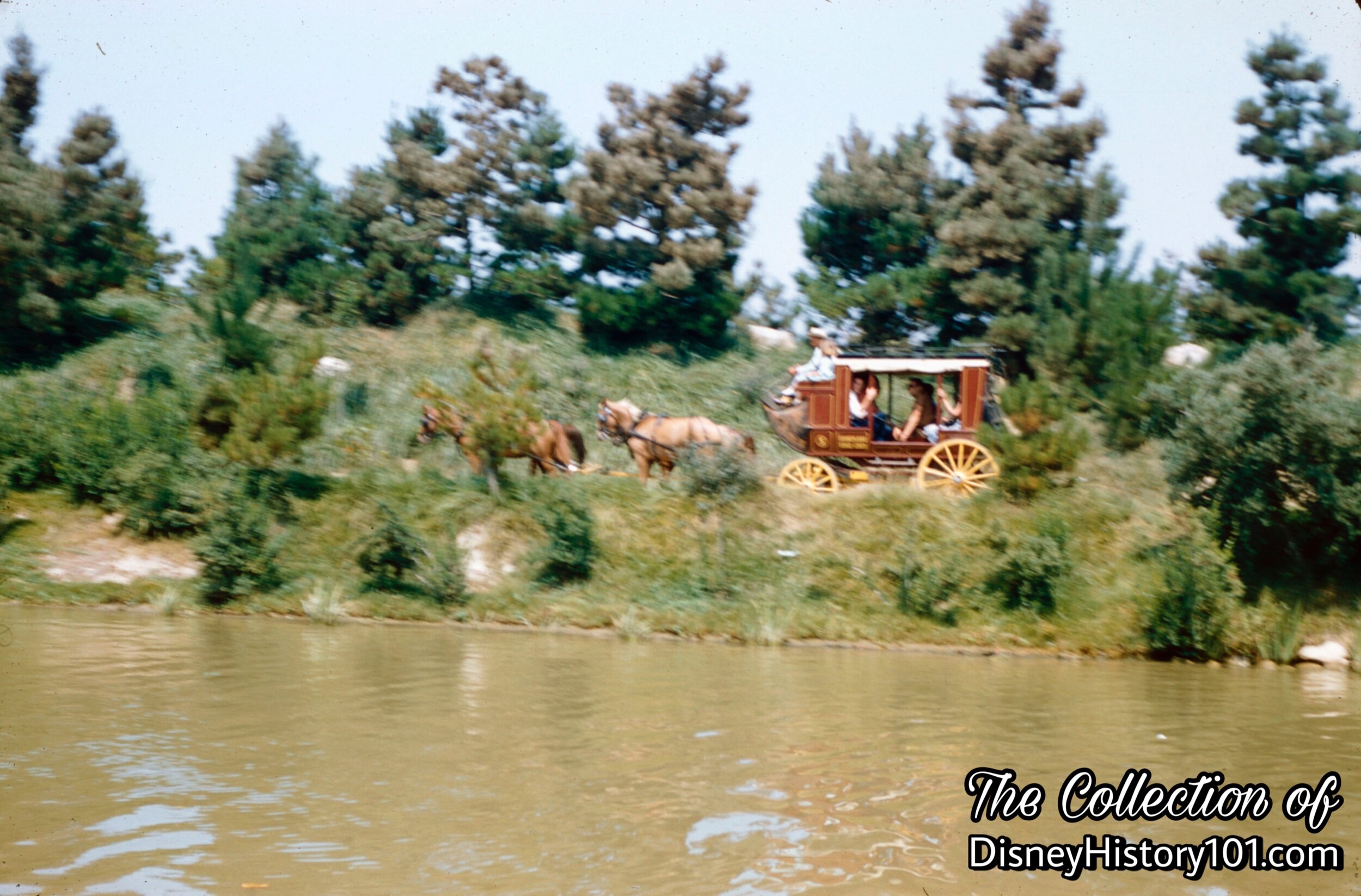
After departing the town of Rainbow Ridge, the Disneyland Stage Lines Stage Coaches ran along a route parallel with the waters of the Rivers of America!
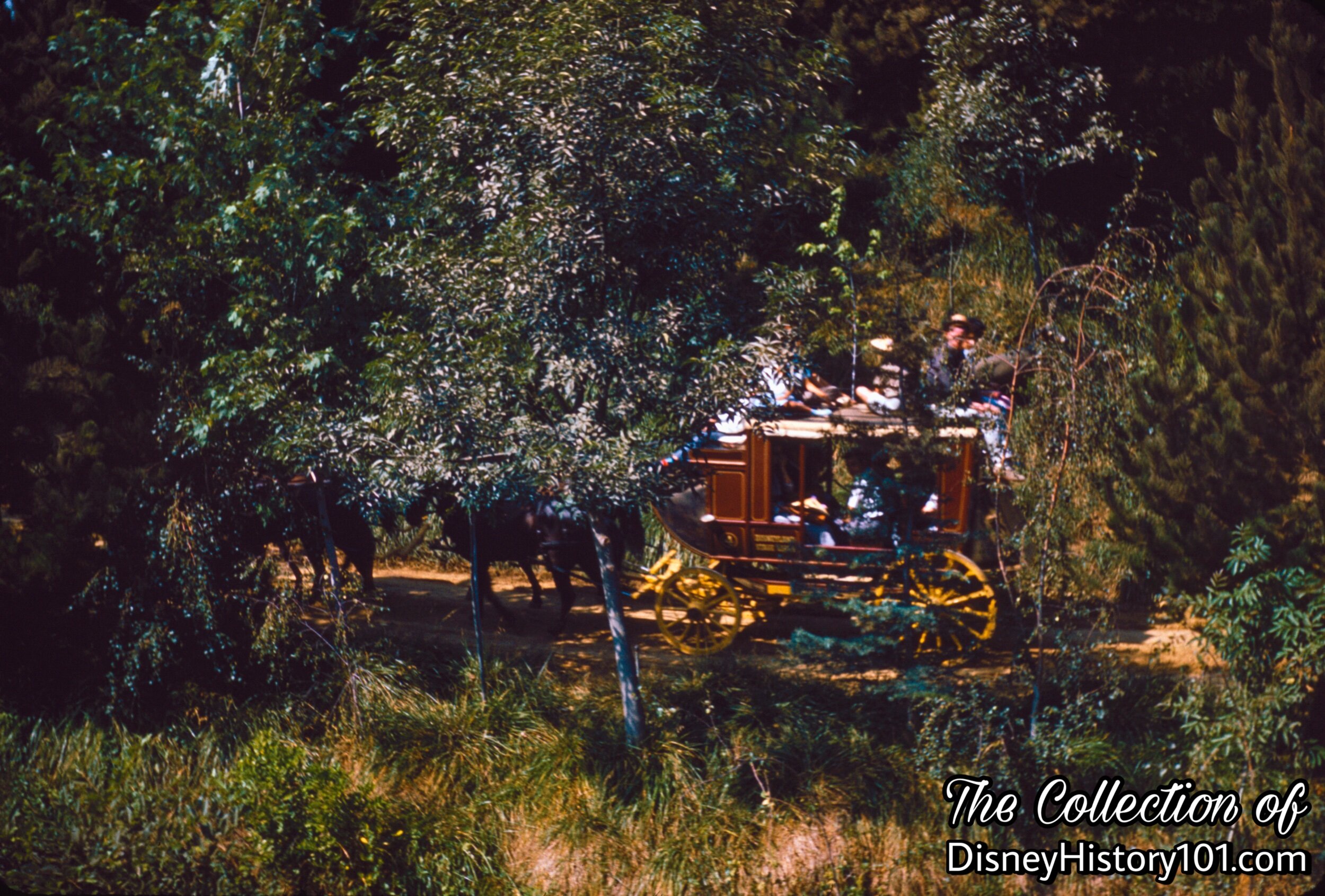
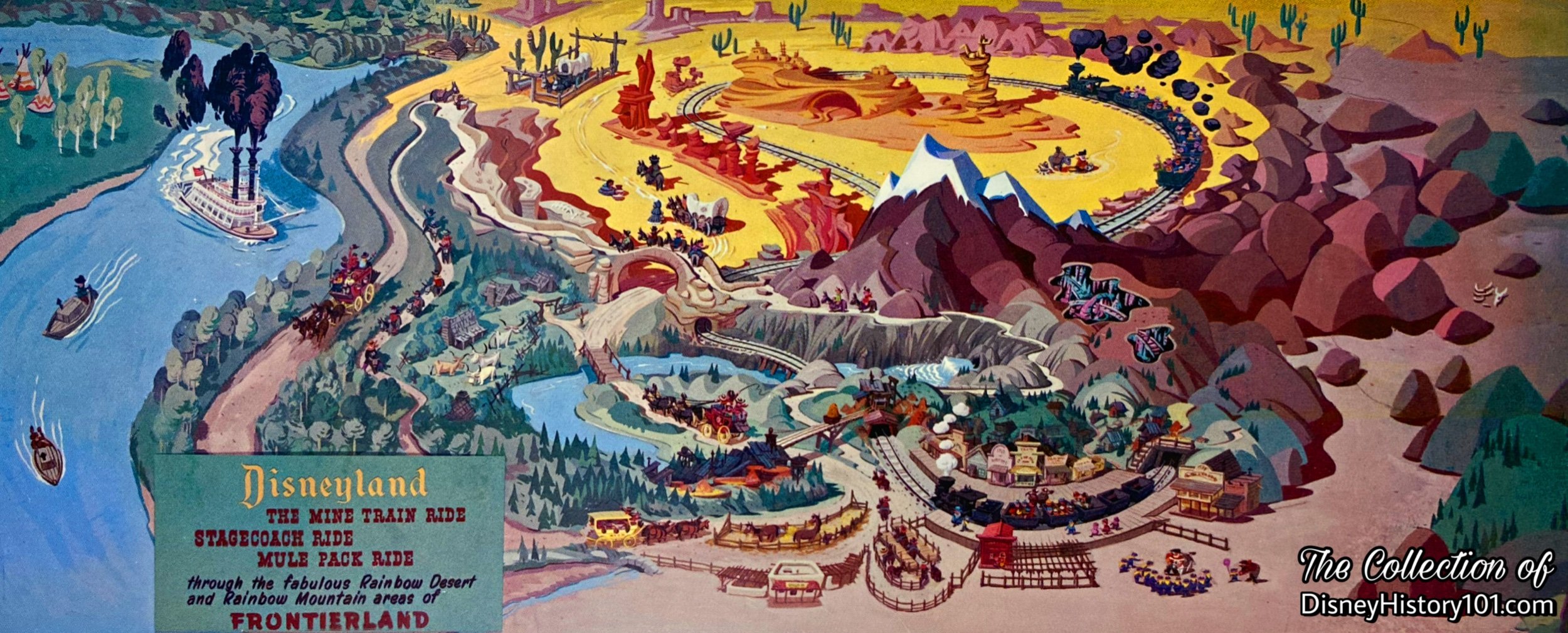
"The Official Guide to Disneyland" Excerpt, 1956. This is a Walt Disney Artist's conception of a section of FRONTIER-LAND in Disneyland, featuring the awe inspiring Mine Train Ride, the exciting Stagecoach and Mule Pack Rides, where one can journey through the many fantastic sights of the Rainbow Desert and Rainbow Mountain areas, returning with a view of the famous Mark Twain River Boat and Tom Sawyer Island.
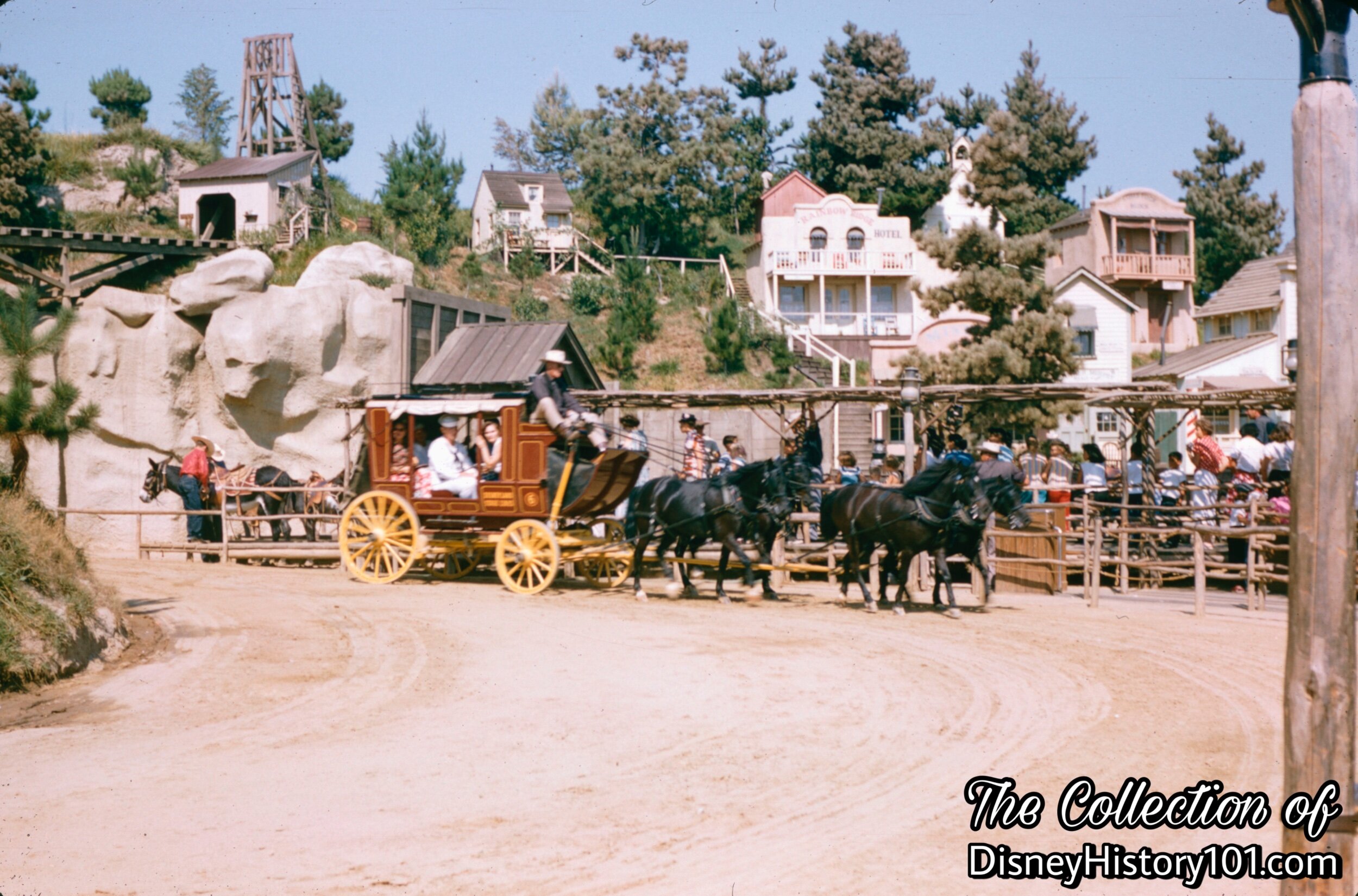
Rainbow Ridge would prove to be the crossroads for mine trains, pack mule trains, and the Disneyland Stage Lines Mud Wagon Coaches!
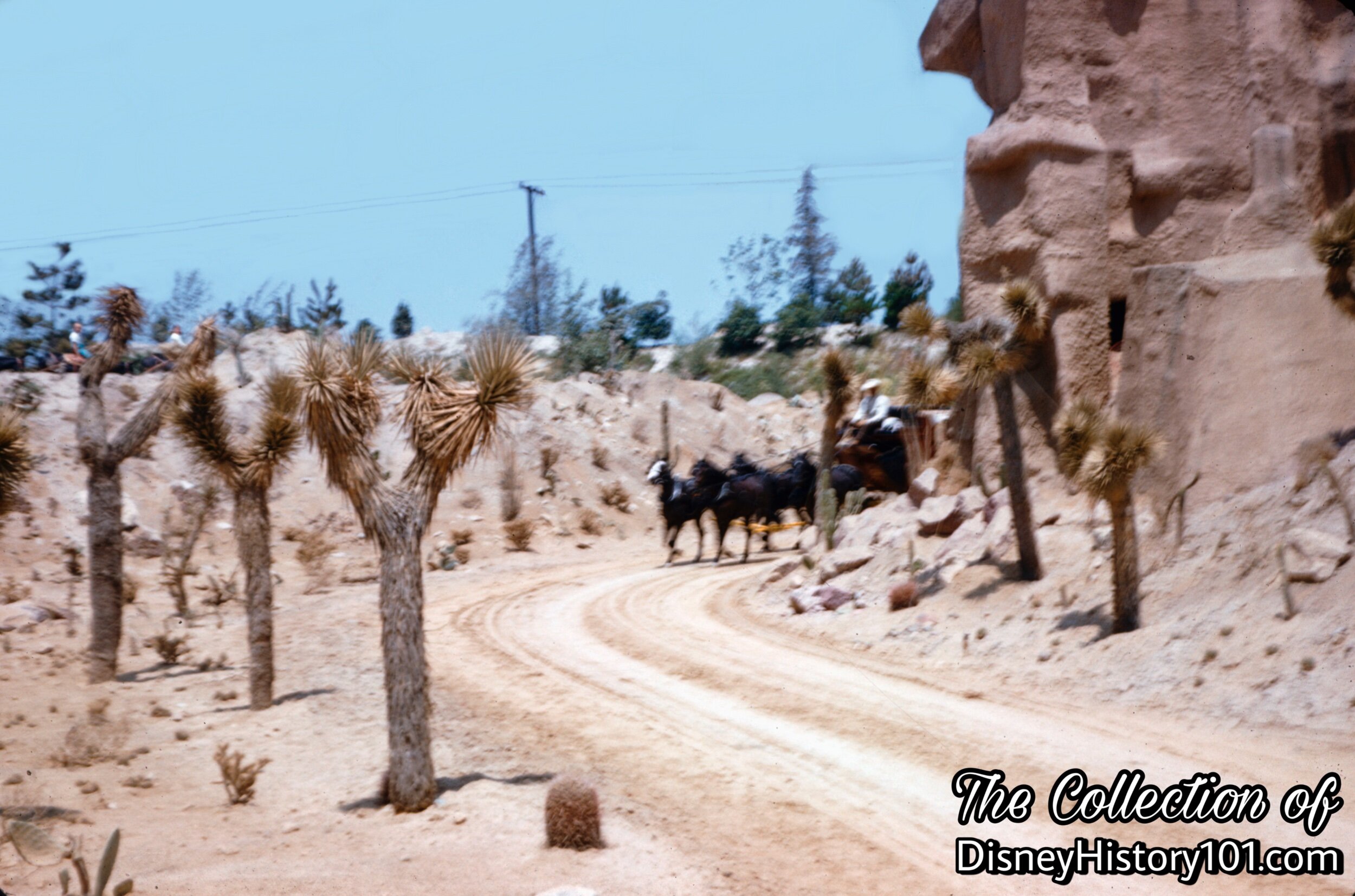
The Painted Desert was a true-life living desert of sand dunes and dry soil! Here Joshua Trees (pictured), Sahura trees, cactus, sagebrush, and other brightly colored flora line the dusty roads which the buckboard wagons and Conestoga wagons travel.
Disneyland was encircled by an earth wall called, the ”Berm.” Walt Disney's purpose was to make Disneyland a place separate from the world of today. It was intended that lush foliage screen out even more of the real world from sight. You may have noticed those telegraph lines at the horizon, behind that dirt berm in the background. Eventually those twentieth-century visual intrusions were removed from the sight of this On Stage area.
According to “Ripley’s Legends - pioneers of the Amusement Park Industry” by Tim O’Brien, Volume One: If the environment wasn’t believable, people wouldnt buy into the story. Martin Sklar recalled “one afternoon in Disneyland when he and a photographer drove a cat behind the scenes to Frontierland to take publicity photos. Walt saw what they were doing and was quite dismayed. ‘What are you doing with a car here in 1860?’ Walt queried as he was making a very strong point to both Marty and the photographer. Walt's point was that we had just destroyed the story. There was the Mark Twain (sternwheeler) with all these people aboard out in the wilderness and here we were with an automobile from another age. We had broken the continuity of the story. Visual intrusion is something we are constantly aware of today.”
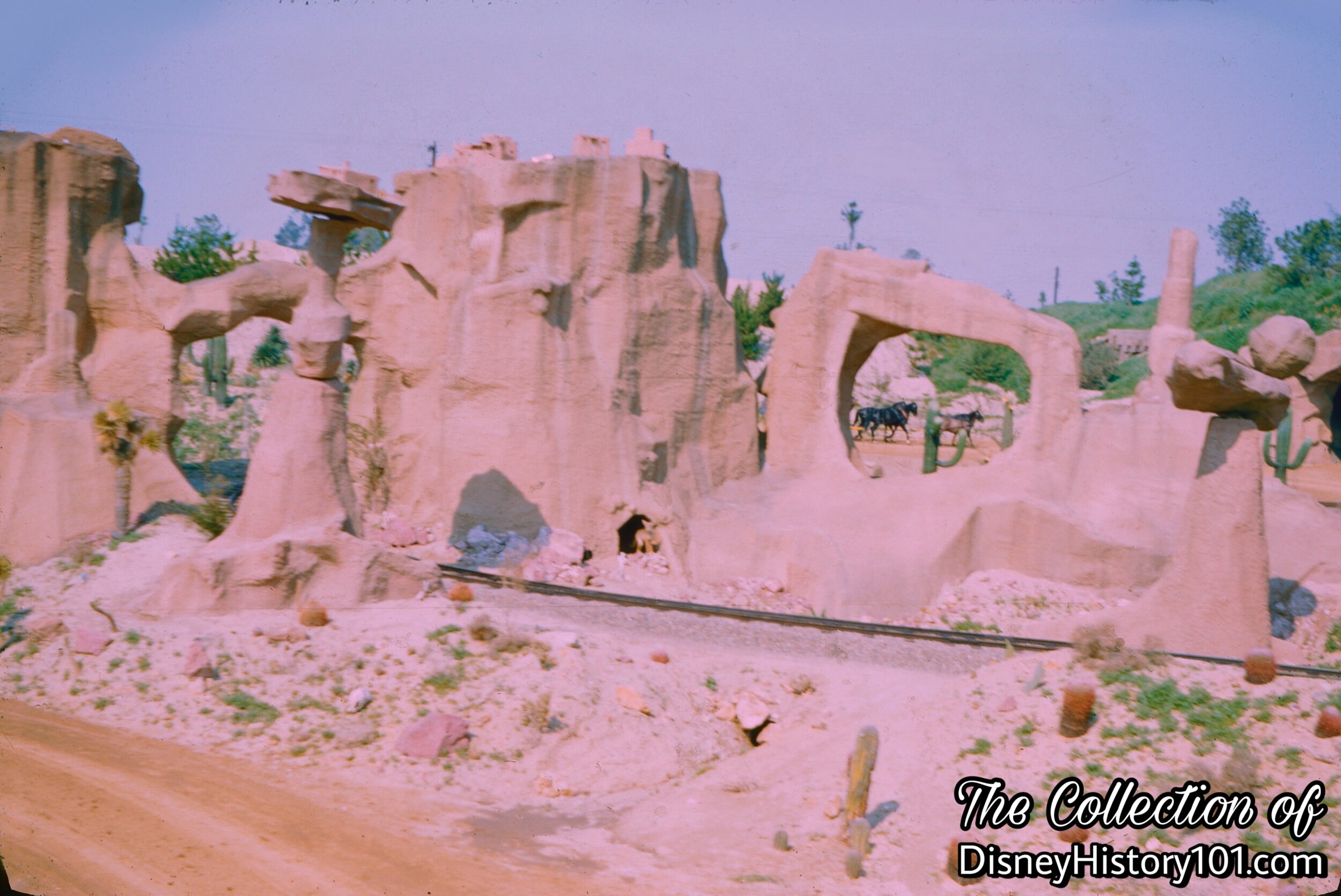
Because the drivers of the Disneyland Stage Lines Stage Coaches, Buckboards, and Conestoga Wagons were wise to not travel through Balancing Rock Canyon, passengers received this preview of the hoodoos and arches that await them along a different desert route! Horses and mules are known to be spooked easily, sometimes by wildlife, like bounding Big Horn Sheep (but that’s another tale). It’s best that they keep their distance, because those toppling rocks overhead would (no doubt) have spooked the horses.
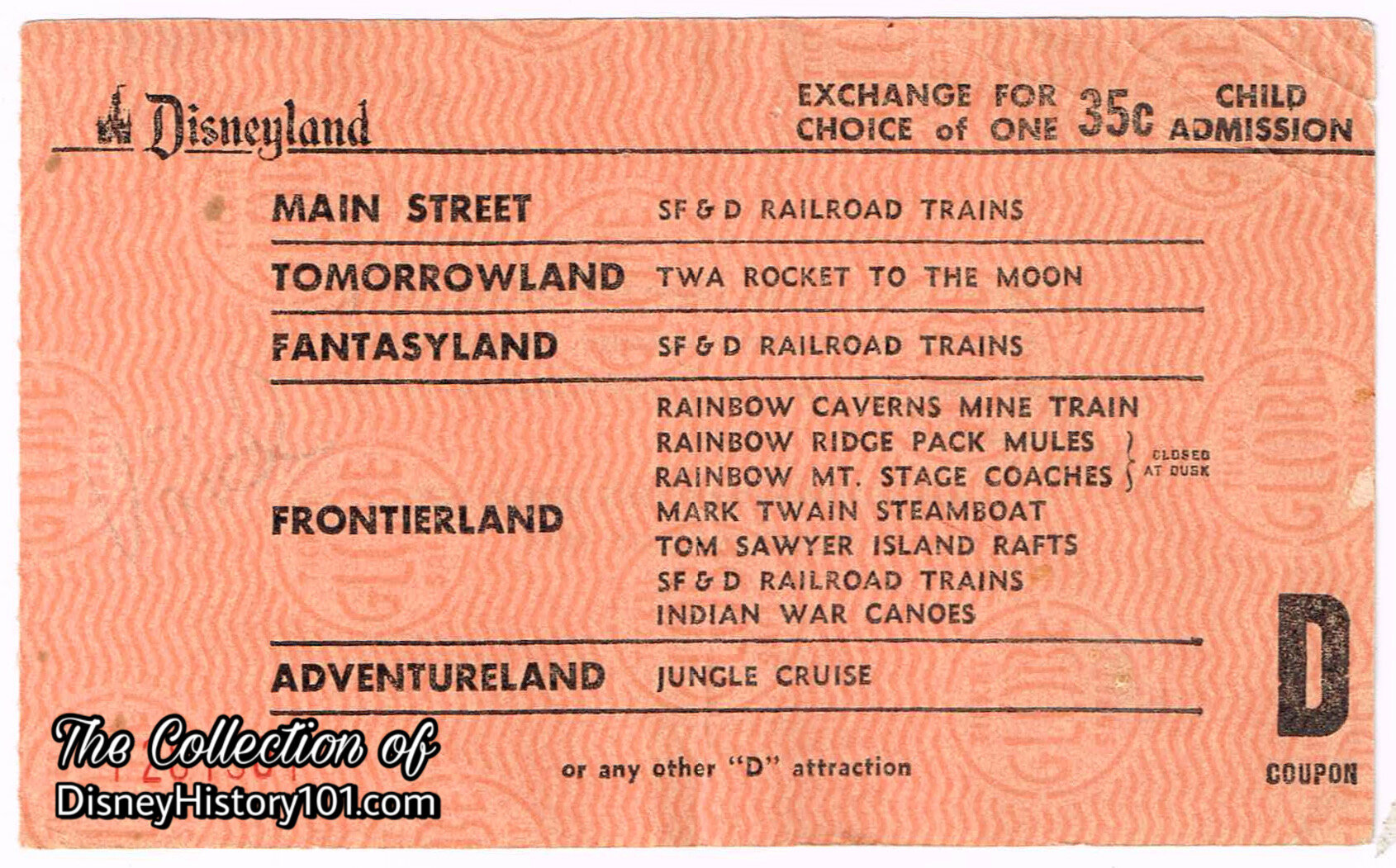
Admission for the Rainbow Mountain Stagecoach adventure during 1958, was one “jumbo” “D” coupon (the price of 35 cents, for one child), the same as the Jungle Cruise, Indian War Canoes, or the Tom Sawyer Island Rafts.
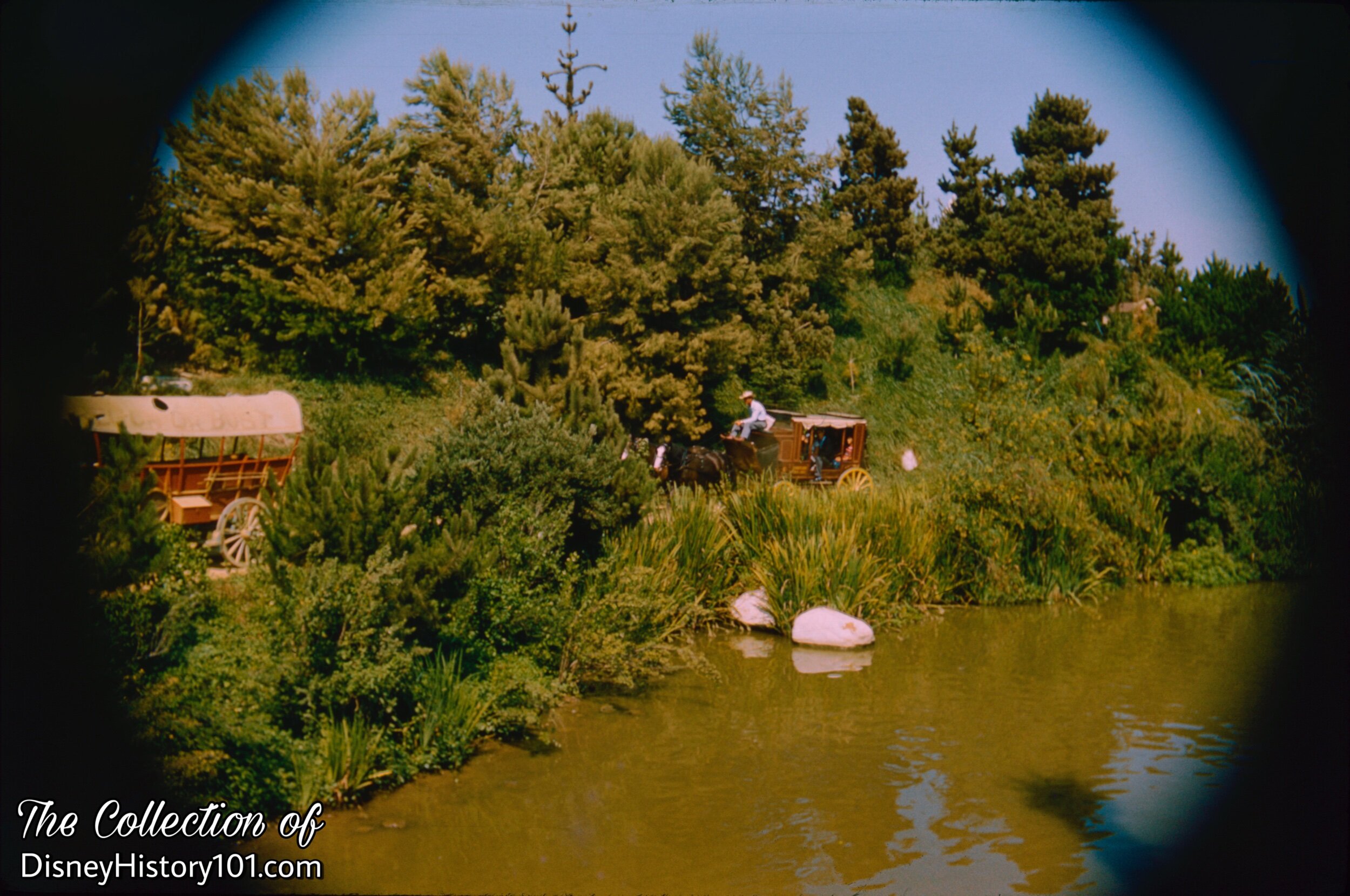
From Fort Wilderness and Tom and Huck’s Treehouse, we can see the Rainbow Mountain Mud Wagon Coach and another type of vehicle - Covered Conestoga Wagons - that blaze the trails of the Rainbow Desert on the other side of the Rivers of America!

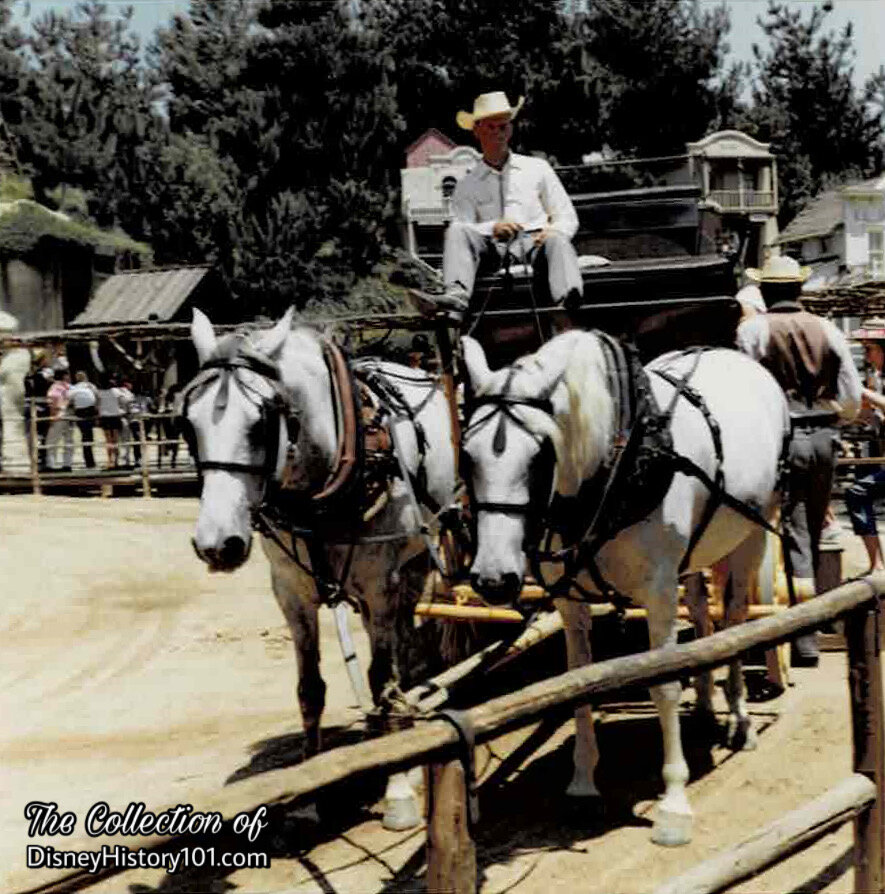
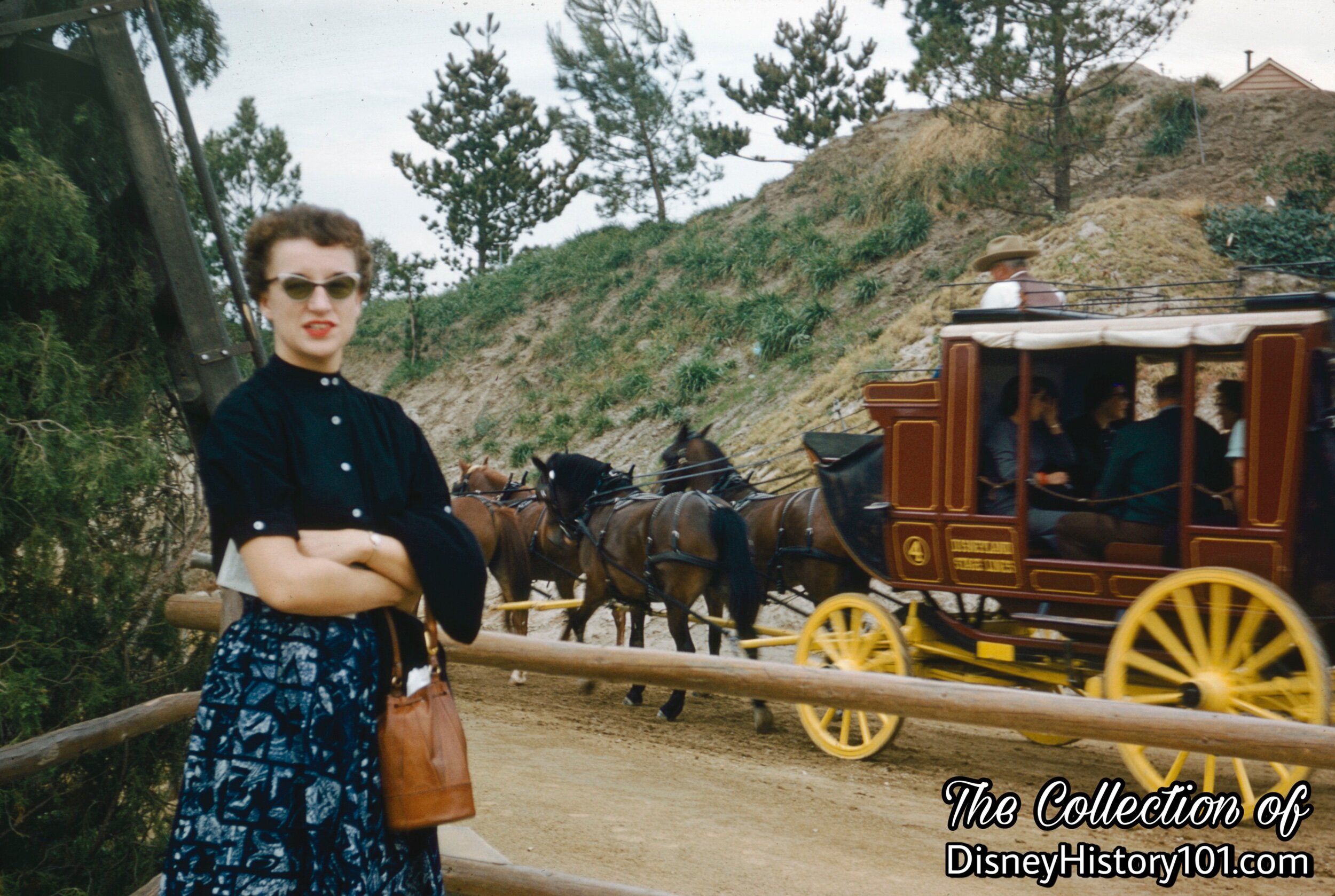
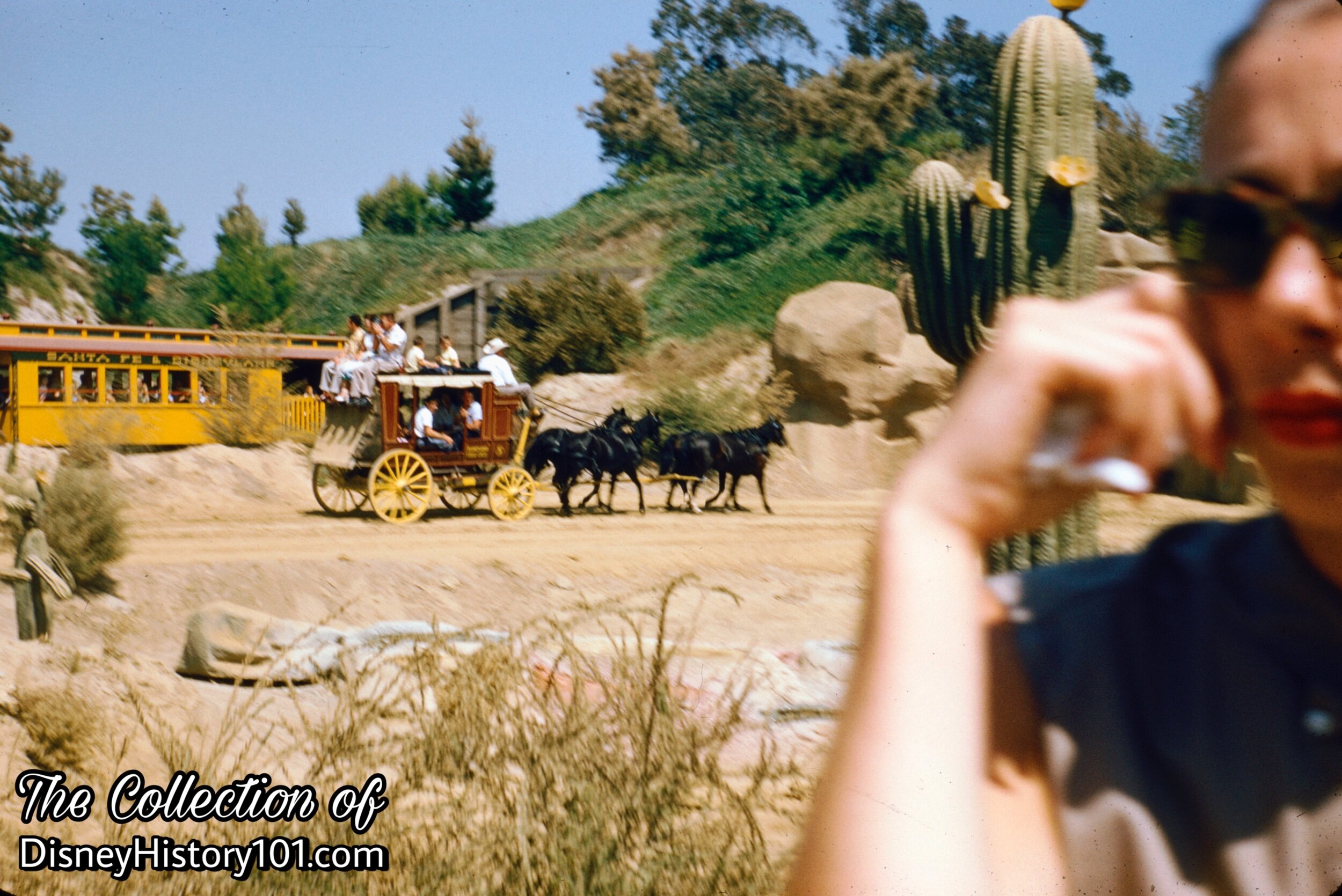
The rails of the Santa Fe & Disneyland Railroad also ran through the Rainbow Desert, offering a view of the wonders of the desert, as well as their trafficked roads.
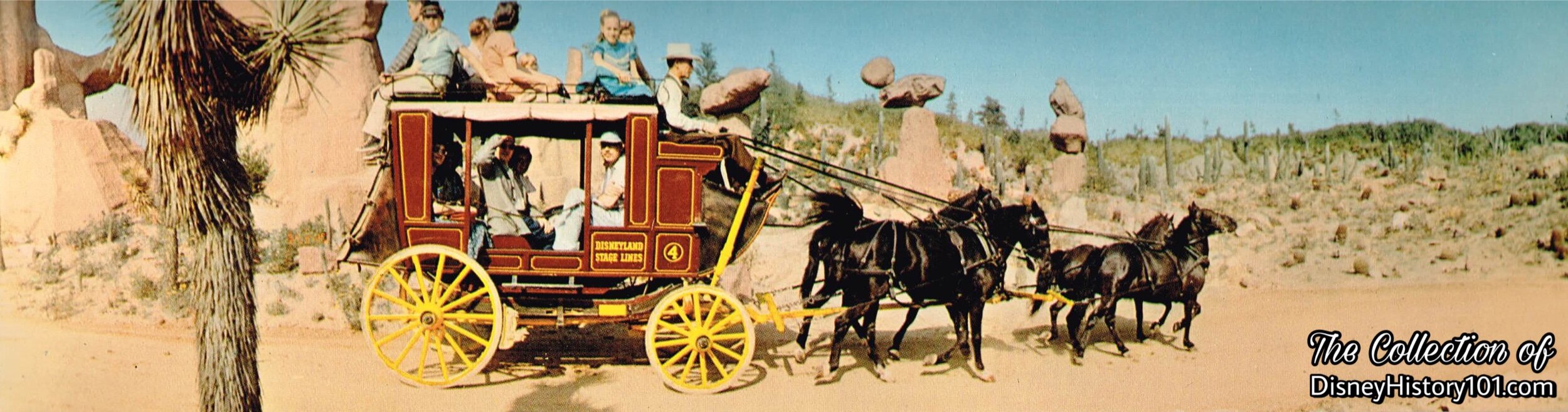
One of several wonderful ways to see the Rainbow Desert is immortalized on this souvenir panoramic postcard!
Before they disappeared, the Disneyland Stage Lines Coaches made a couple of appearances on film. One Stage Coach was utilized in filming a scene of Slue Foot Sue, Can-Can Dancers and the Traveling Salesman arriving at the Golden Horseshoe (perhaps on Saturday, October 5, 1957) for the “An Adventure in the Magic Kingdom” episode of Walt Disney’s Disneyland (airing in 1958). Perhaps this is when costume designer Renié Conley crafted costume concepts for the “Disneyland Frontier Land Stage Coach.”
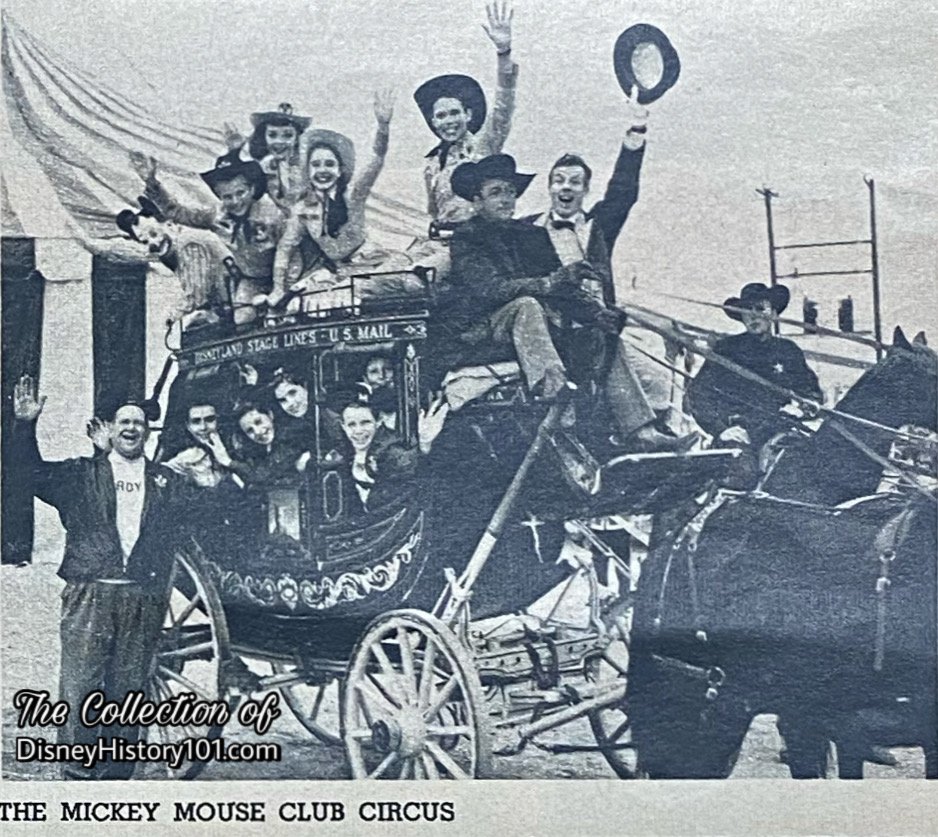
The craftsmanship of the old Disneyland Stage Lines Stage Coaches was just too good, and the Stage Coaches were not disposed of, but brought back to Walt Disney Studios. They were soon featured within the second season “Talent Round Up” Roll Call act of the Mickey Mouse Club television show (featured from 1956 to 1957).
During 1959, one of the Rainbow Mountain Stage Coaches was notably utilized to transport celebrity Richard Eastham (of Tombstone Territory fame) along the route of the “Disneyland ‘59” pageant and parade! A few months later, the Rainbow Mountain Stage Coaches took their last excursion through the Rainbow Desert, and then closed on September 13th, 1959. By this date, a grand total of 1,350,589 guests had the privilege of riding aboard one of Disneyland’s Concord Stagecoaches!

A covered wagon appeared in the Press Preview Day Parade. Frank Pfannenstiel recalled “the covered wagon going down Main Street on Opening Day, with Fess Parker and the governor of Tennessee.”
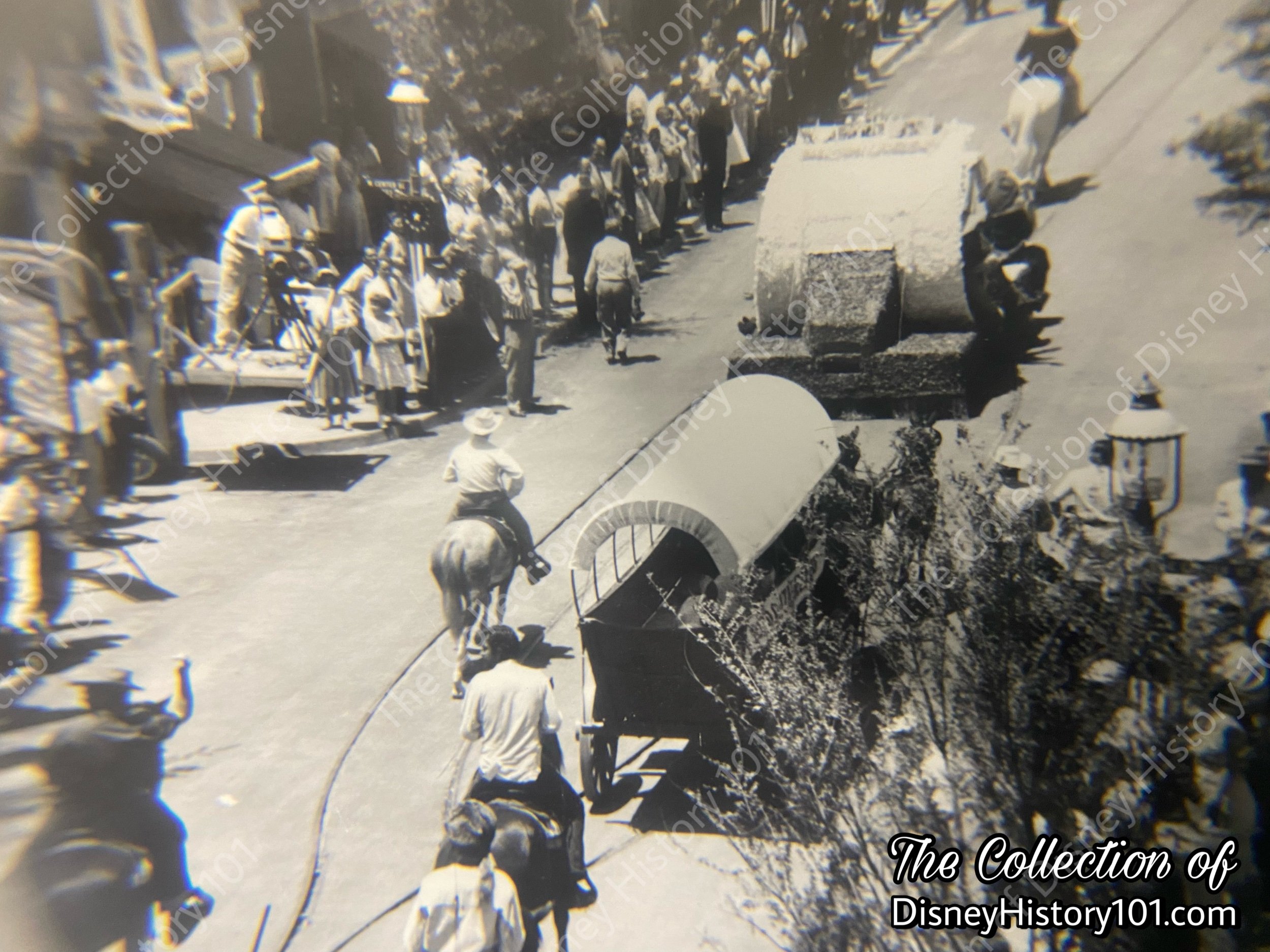
Very soon, “to provide transportation throughout Disneyland, the almost forgotten art of wagon making was revived. We built Conestoga Wagons…,” according to the narrator of “Disneyland - The Park,” a Disneyland anthology series episode (first aired 1957) which briefly preserves the construction of the Conestoga wagons. After Walt Disney Productions’ Westward Ho the Wagons! “wrapped” production (and was released during December of 1956), some props were utilized in the Disneyland Indian Village. “Cross-pollinations” (between Walt Disney’s studio and Disneyland) were commonplace during the 1950s and 1960s. Free exhibits in Tomorrowland and Main Street Opera House would feature props and sets of Walt Disney Productions’ feature length films (like, “20,000 Leagues Under the Sea” and “Babes in Toyland”) and Walt Disney’s Mickey Mouse Club television variety show. As for the Conestoga Wagons featured in the production of “Westward Ho!,” some were redecorated to match the theme of the feature film, reading “Westward Ho!” and “Oregon or Bust!” on the cover.
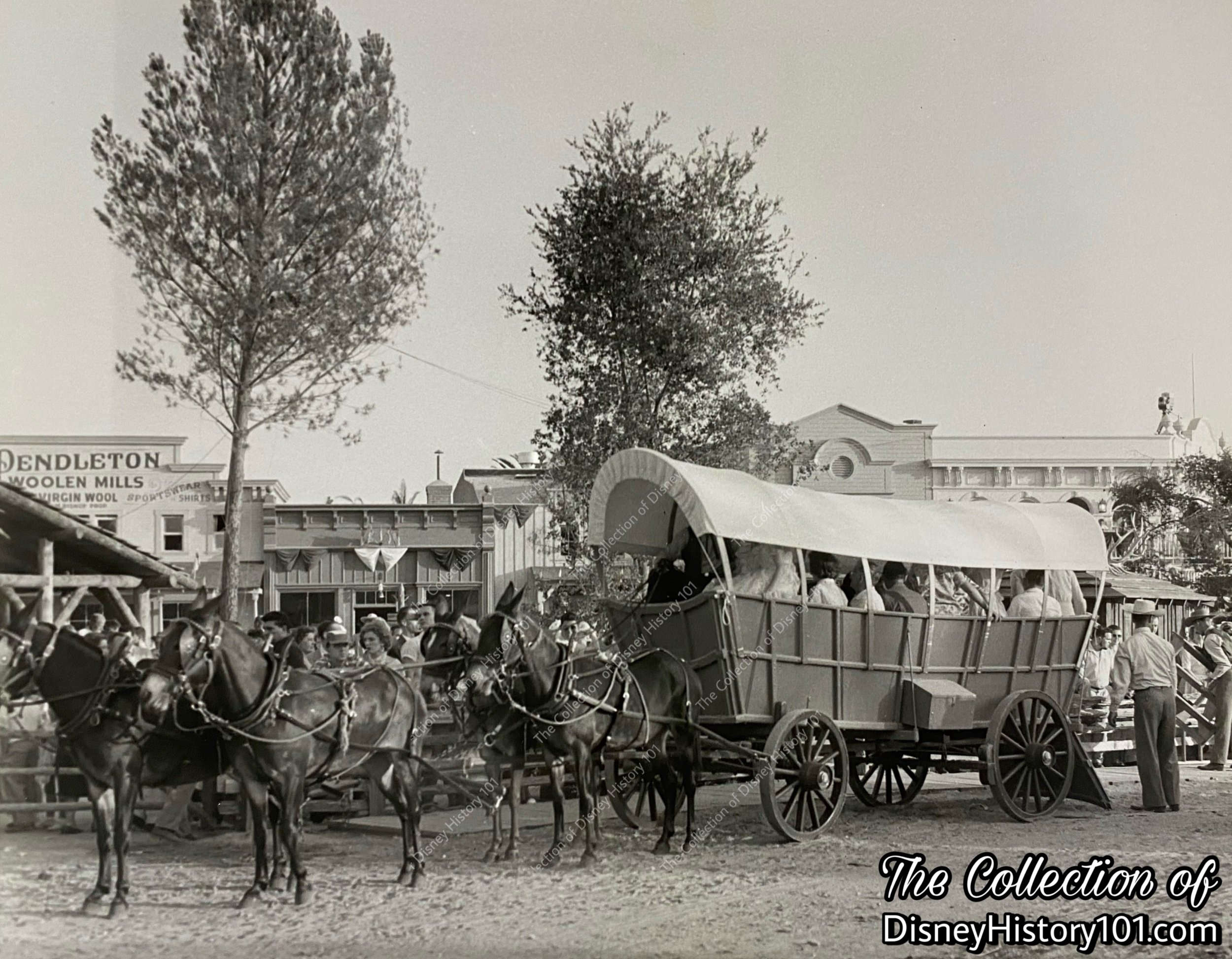
To pull these 5/8-scale vehicles along desert dusty road, over bridge, and across ford also required the breeding of specially-bred scaled-down equine. Some of these mules (of the Backstage Pony Farm) are briefly preserved on film, in “Disneyland - The Park,” a Disneyland anthology television series short film (originally aired in 1957). According to a “Nomenclature List” (updated May 25, 1955), there were “2 wagons and [sic.] a six mule hitch per wagon.” Both of these Conestoga Wagons officially enter the Frontierland Stockade during the live ABC Broadcast on July 17th, 1955.
![Now (a month after Disneyland’s first day of operation), “ Along [Frontierland’s own stretch of the] Oregon Trail” , the “wringle, wrangle, jinggy, jong, jangle” of the Conestoga Wagons ’ mighty fine equine (and their gear) were heard from August](https://images.squarespace-cdn.com/content/v1/5b3d7f804eddec6e826be0c9/1685204676011-9JHNZI48KVDJ7WN893KY/DAC3A0D0-9C62-4B79-B060-409BC87033D9.jpeg)
Now (a month after Disneyland’s first day of operation), “Along [Frontierland’s own stretch of the] Oregon Trail”, the “wringle, wrangle, jinggy, jong, jangle” of the Conestoga Wagons’ mighty fine equine (and their gear) were heard from August 16, 1955 to June 14, 1959. In these new vehicles, passengers were put in the middle of another true-life adventure - an alternate experience of the Painted Desert attraction in Frontierland, and a better understanding of how some early Americans moved west!
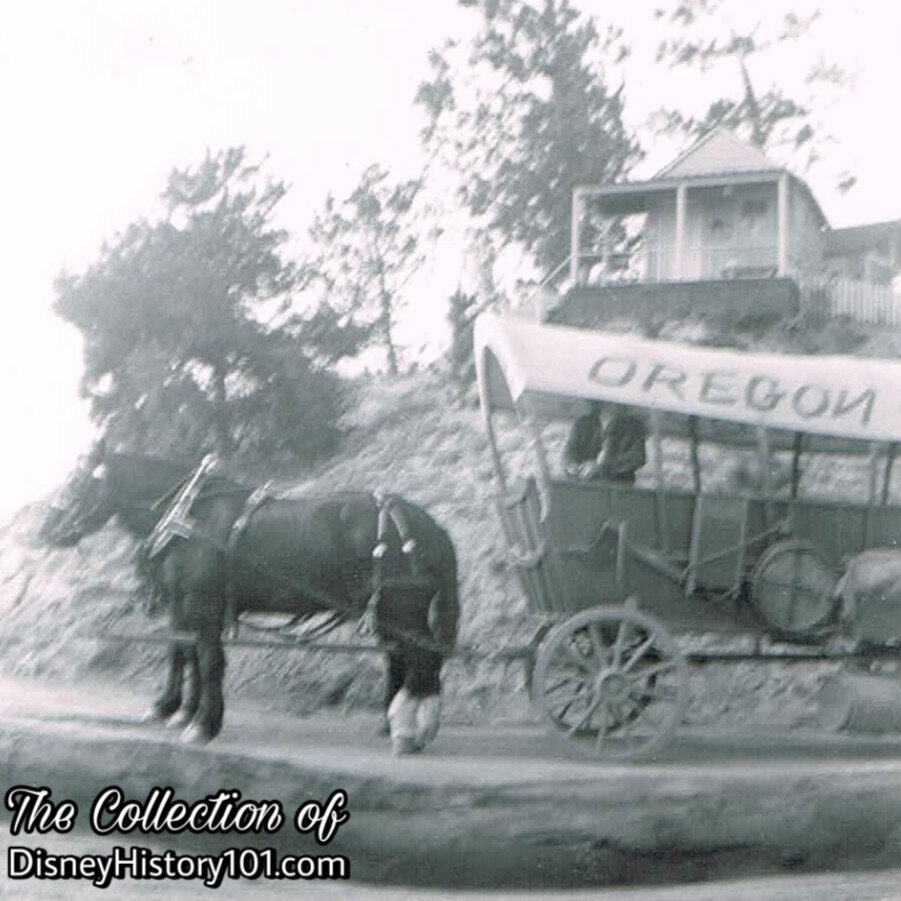
We’ll depart the false-fronted store buildings and hitching rails of the town for a trek out west!
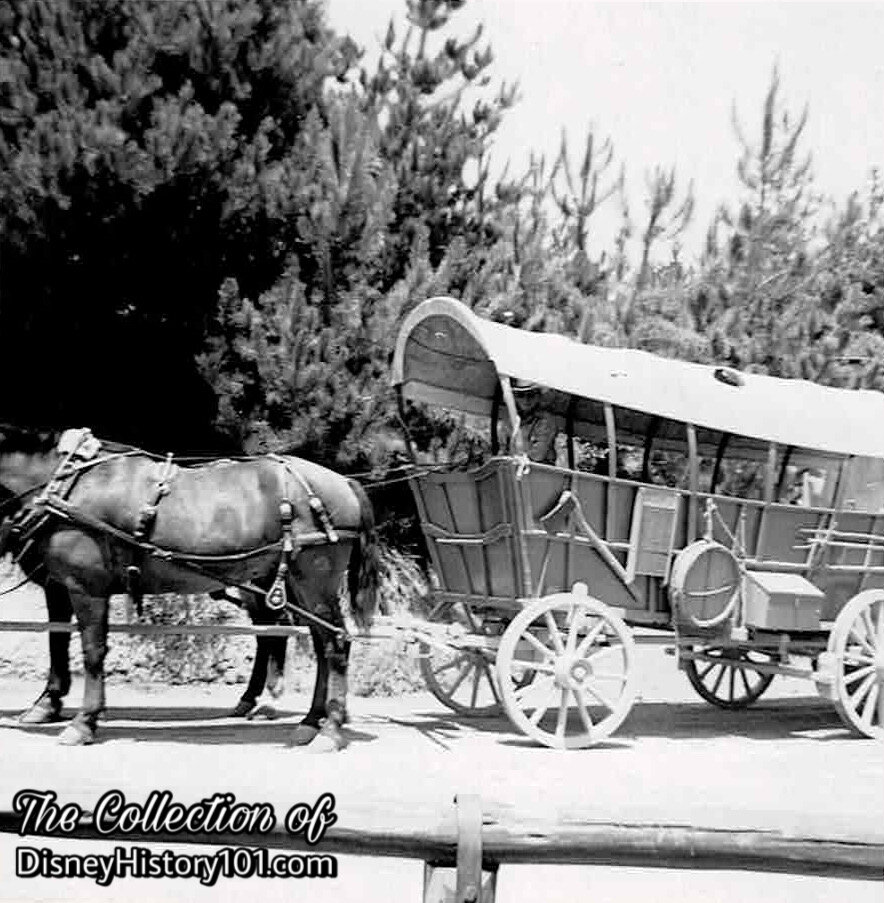
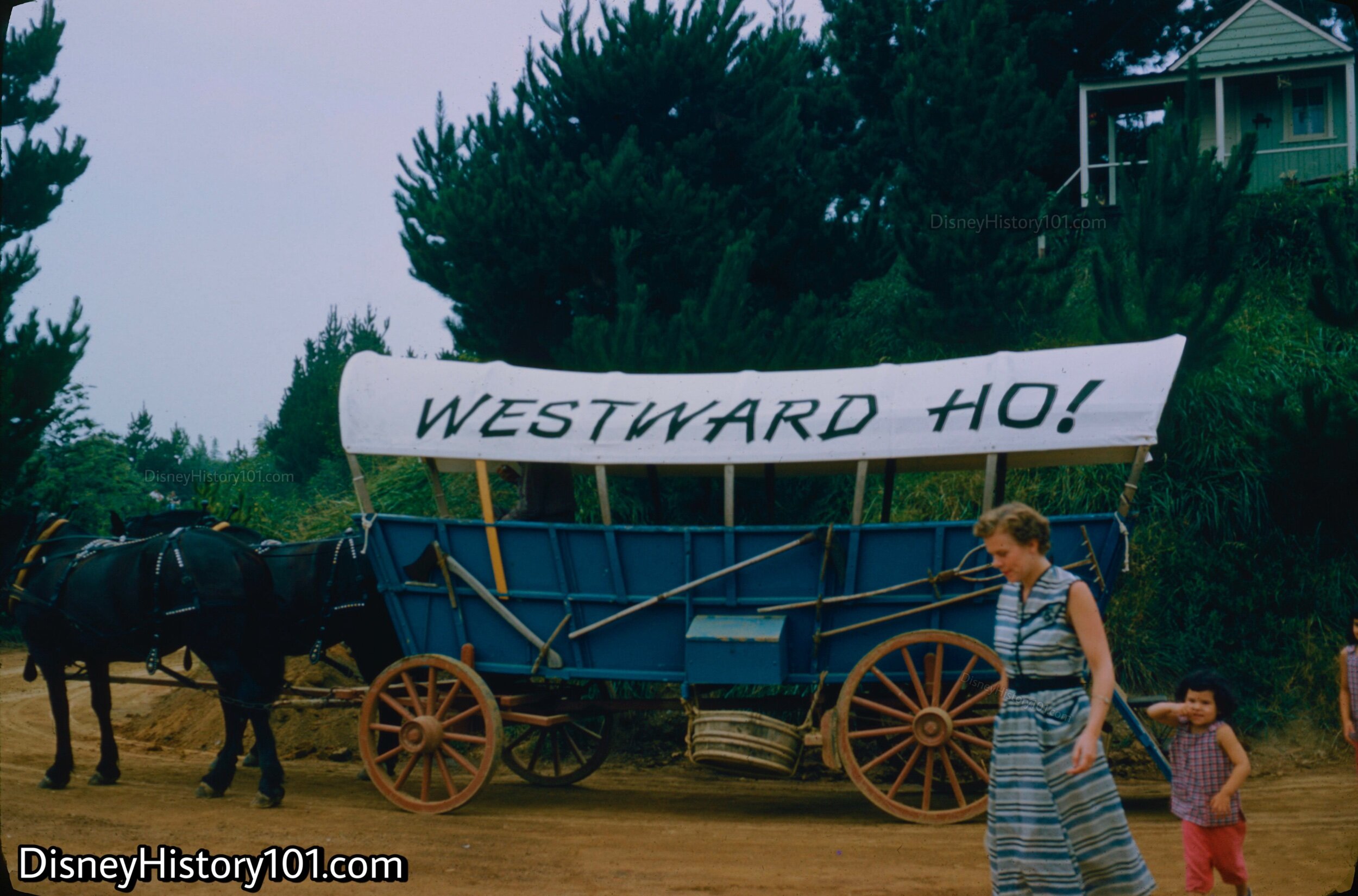
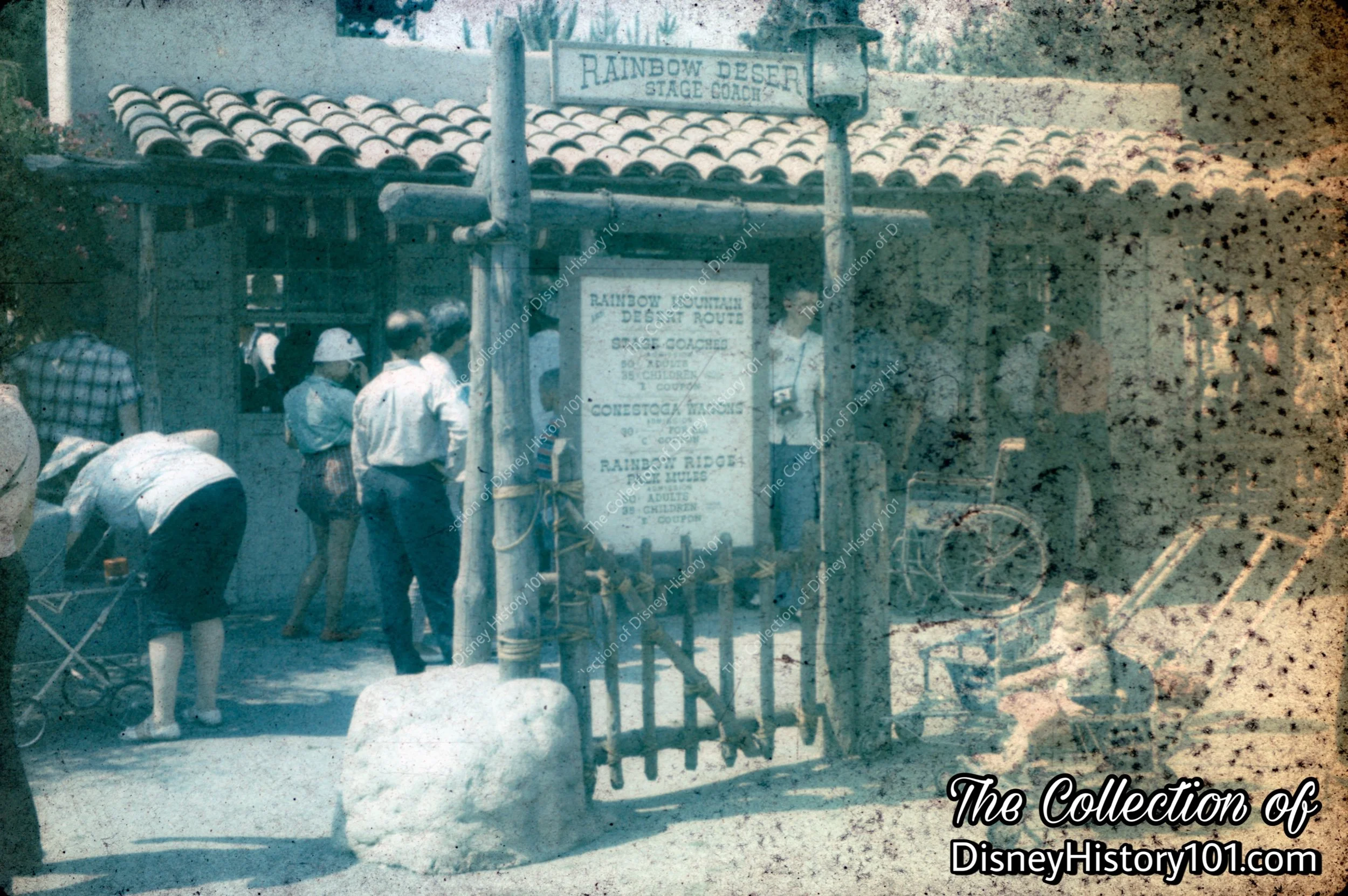
Once upon a time, Mule Packs, Conestoga Wagons, and Stagecoaches transported guests through the Rainbow Desert.
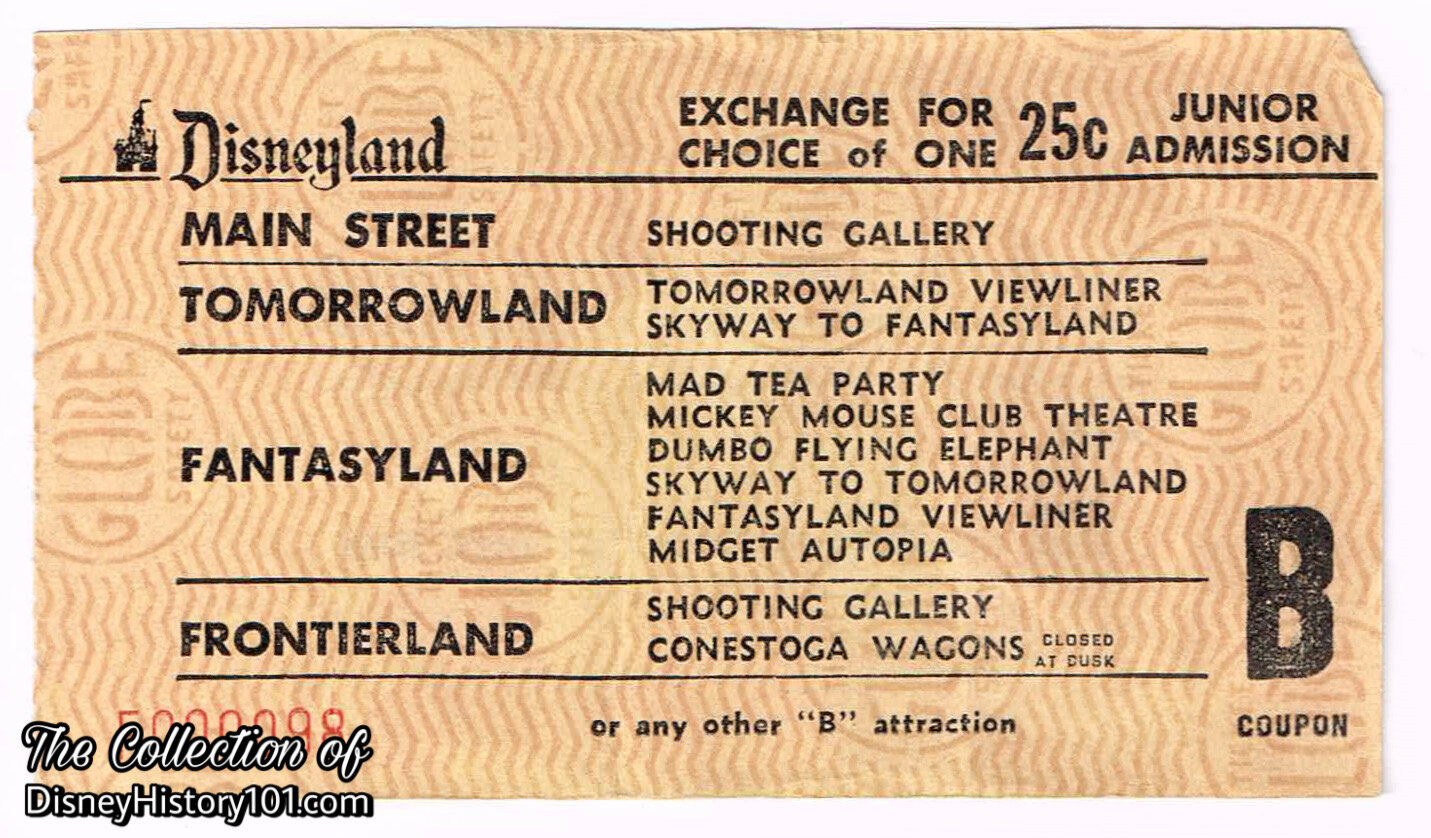
The original cost of passage through the desert aboard one of the Conestoga Wagons was one “B” Coupon (or, 25 cents).
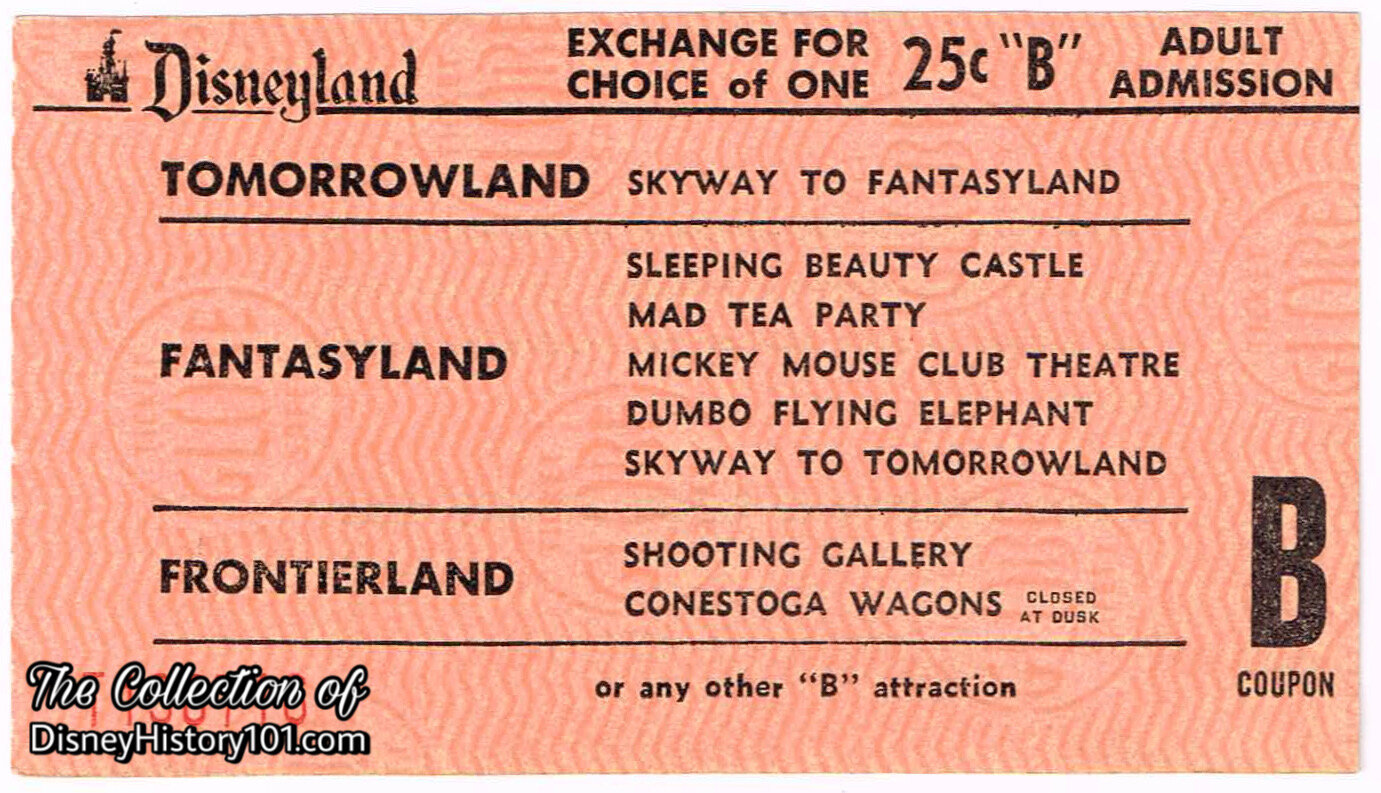
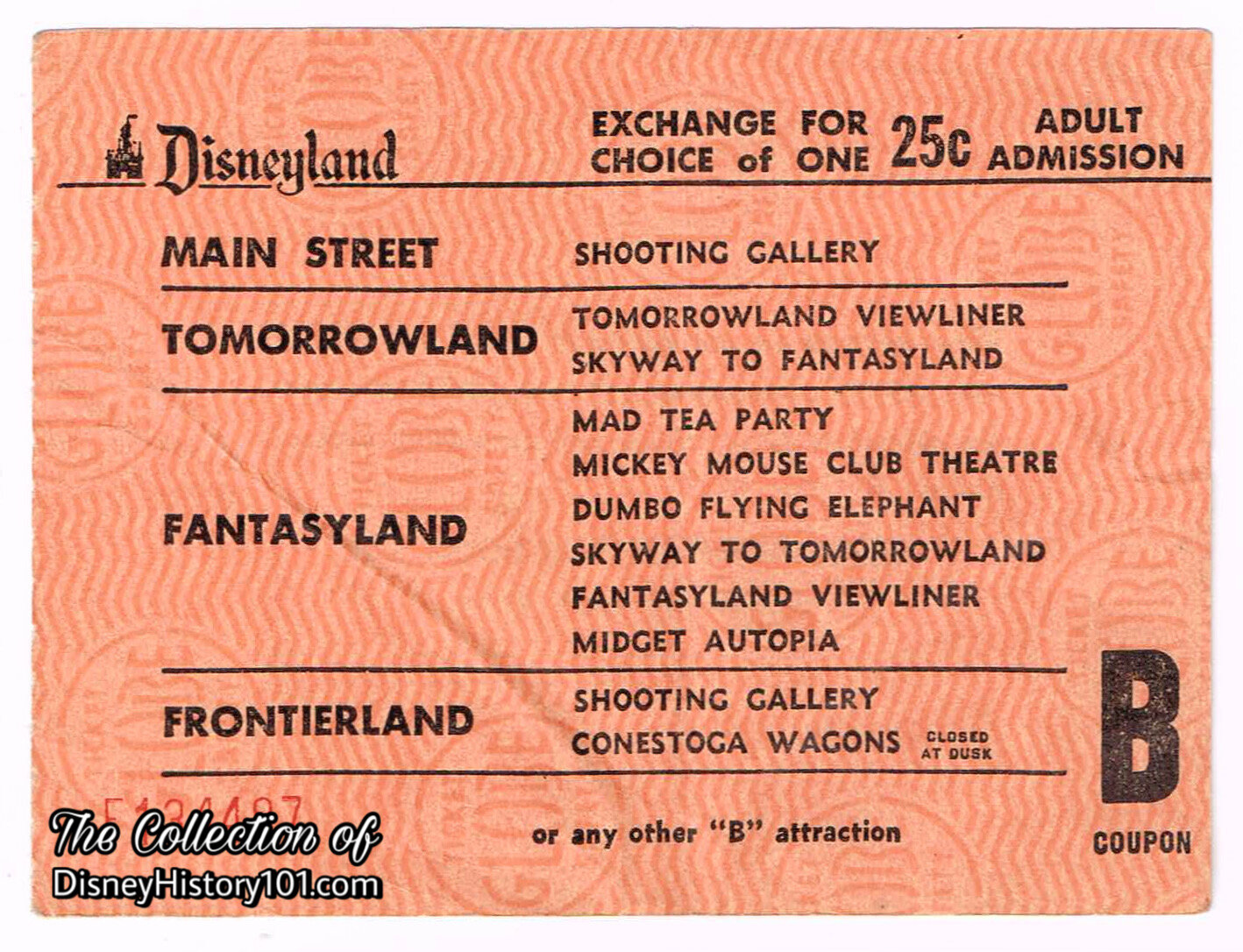
Admission for the Conestoga Wagons (during 1957) was one “jumbo” “B” coupon (or, 25 cents, for one adult), the same as a round of ammunition in the Main Street Shooting Gallery, entry into the Mickey Mouse Club Theater, or a ride aboard the Fantasyland Viewliner or Tomorrowland Viewliner!
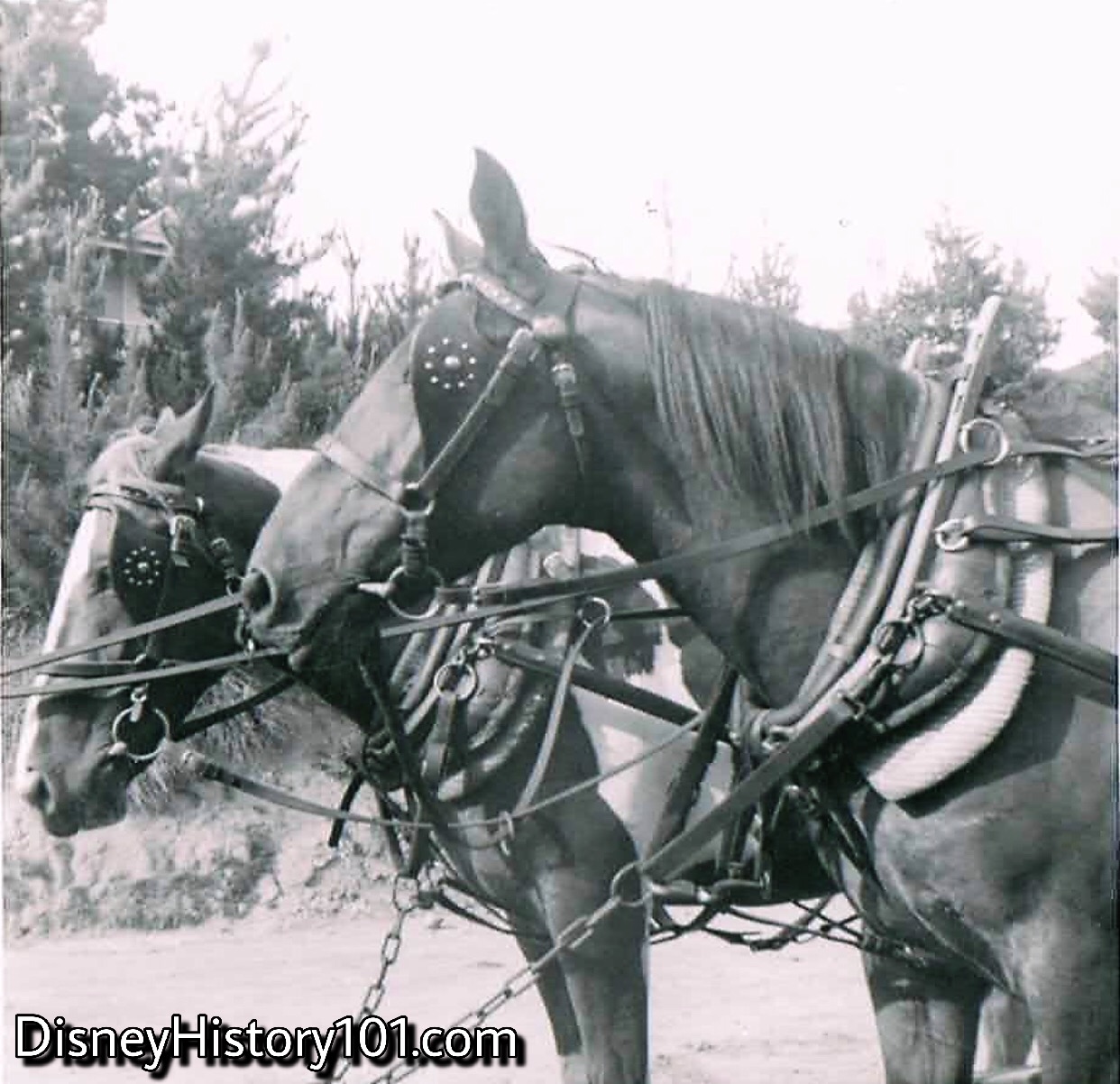
Before we step aboard we take a look at our faithful horses that are hitched to one of the Conestoga Wagons (those old “Prairie Schooners”). We’re mighty careful not to spook the horses, as we note the beautifully hand-crafted tack (brow bands, bridles, collars, and other harness parts) which were created under the direction of Owen Pope, and will generate the “wringle” and “wrangle” as the horses head down the dirt road.
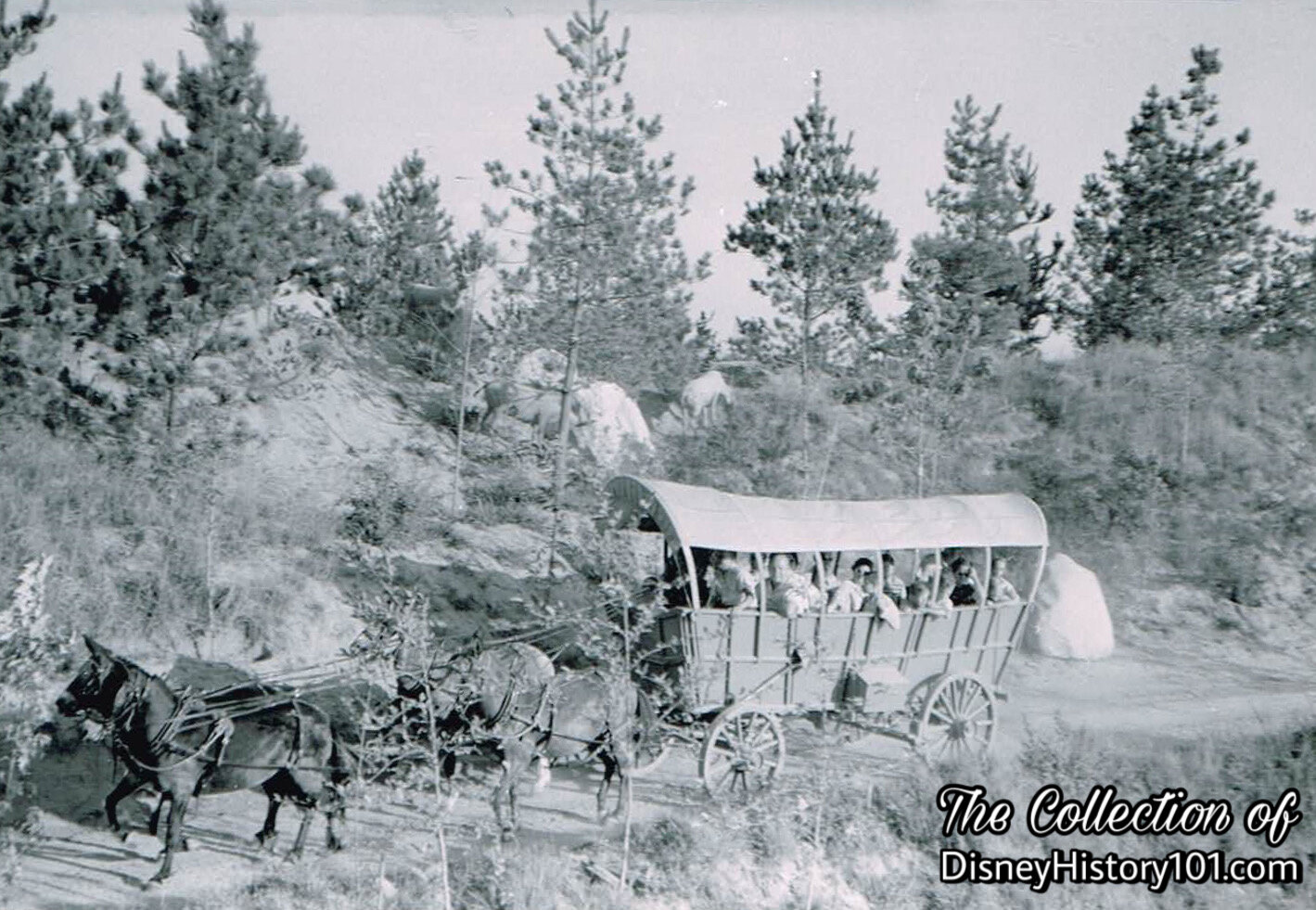
In the hills, “children of the covered wagon” pass pines, oaks, and olive trees.

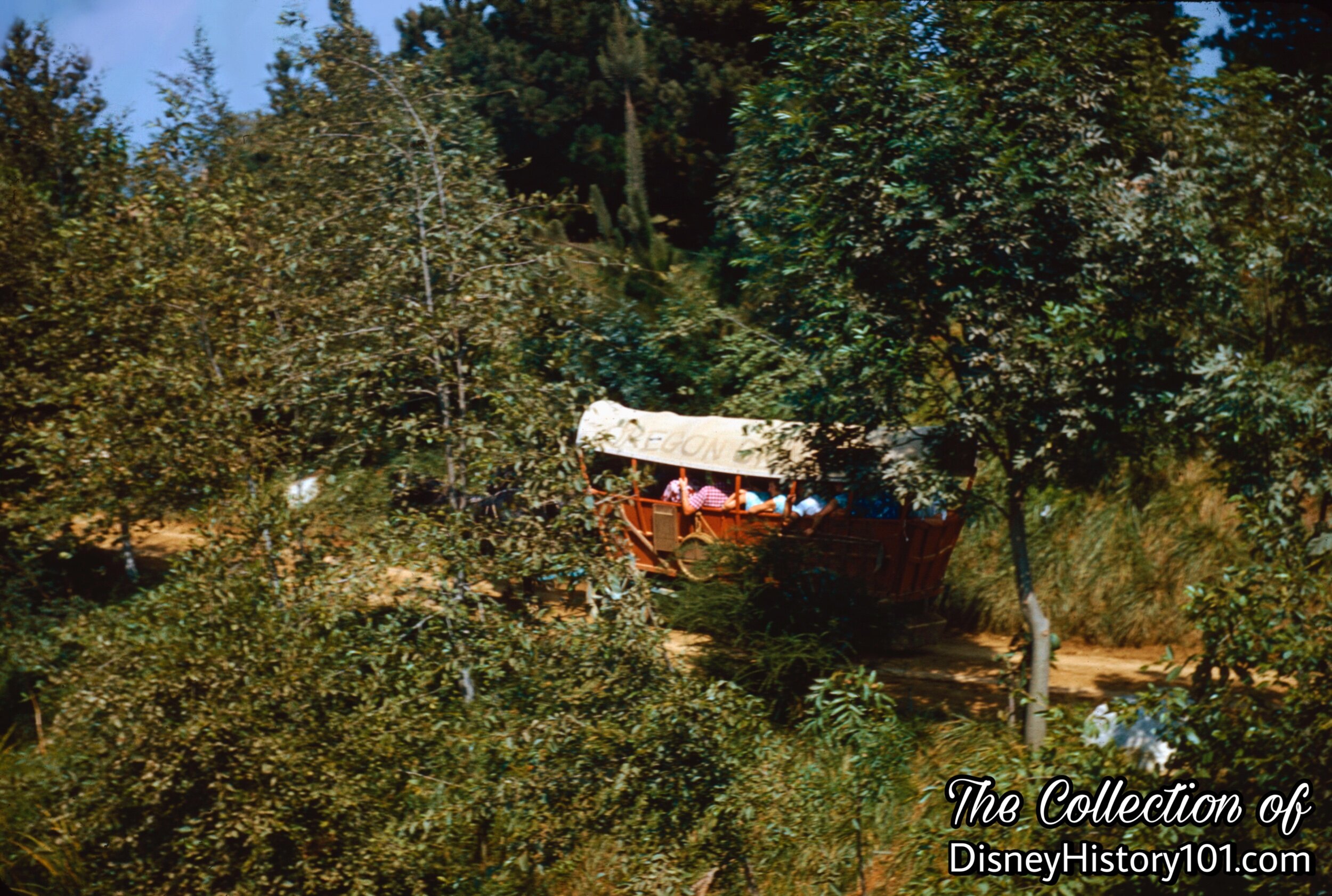
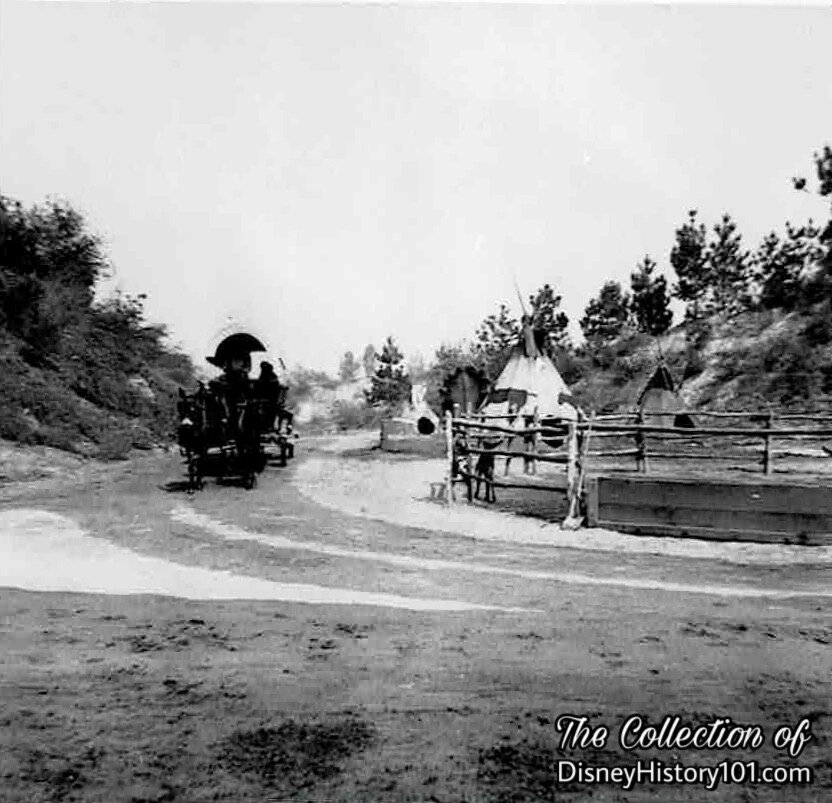
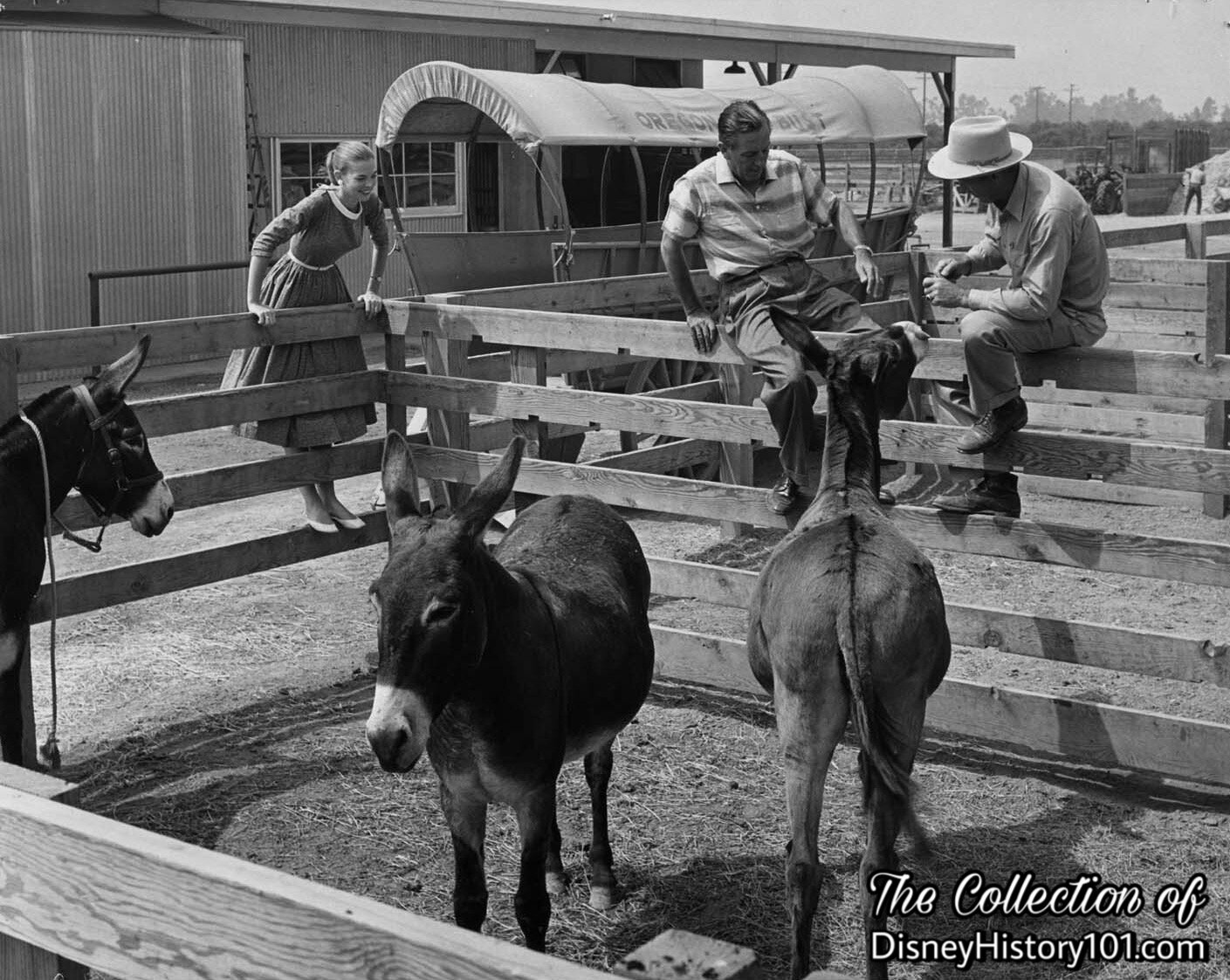
You’ll recall that Owen cared for both the animals and the equestrian equipment on the 10-acre Pony Farm, in Backstage Disneyland. Note one of the Conestoga Wagons on the service road behind the Mule corral. “55er” Day Sechler recalled: “At Disneyland, … Walt [sic] came to the Pony Farm a lot to watch us break horses. He was always concerned if he could do anything for you.”
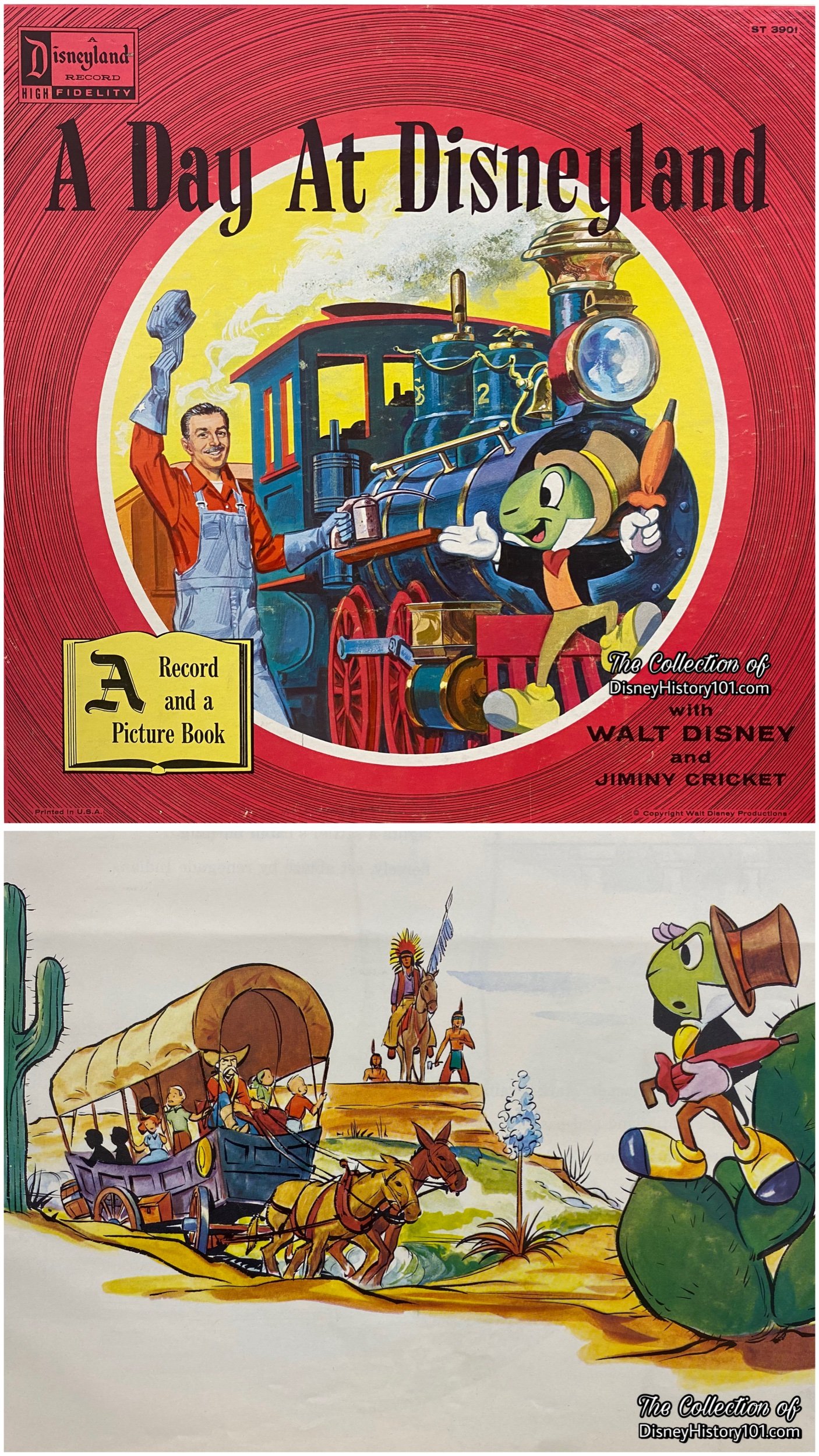
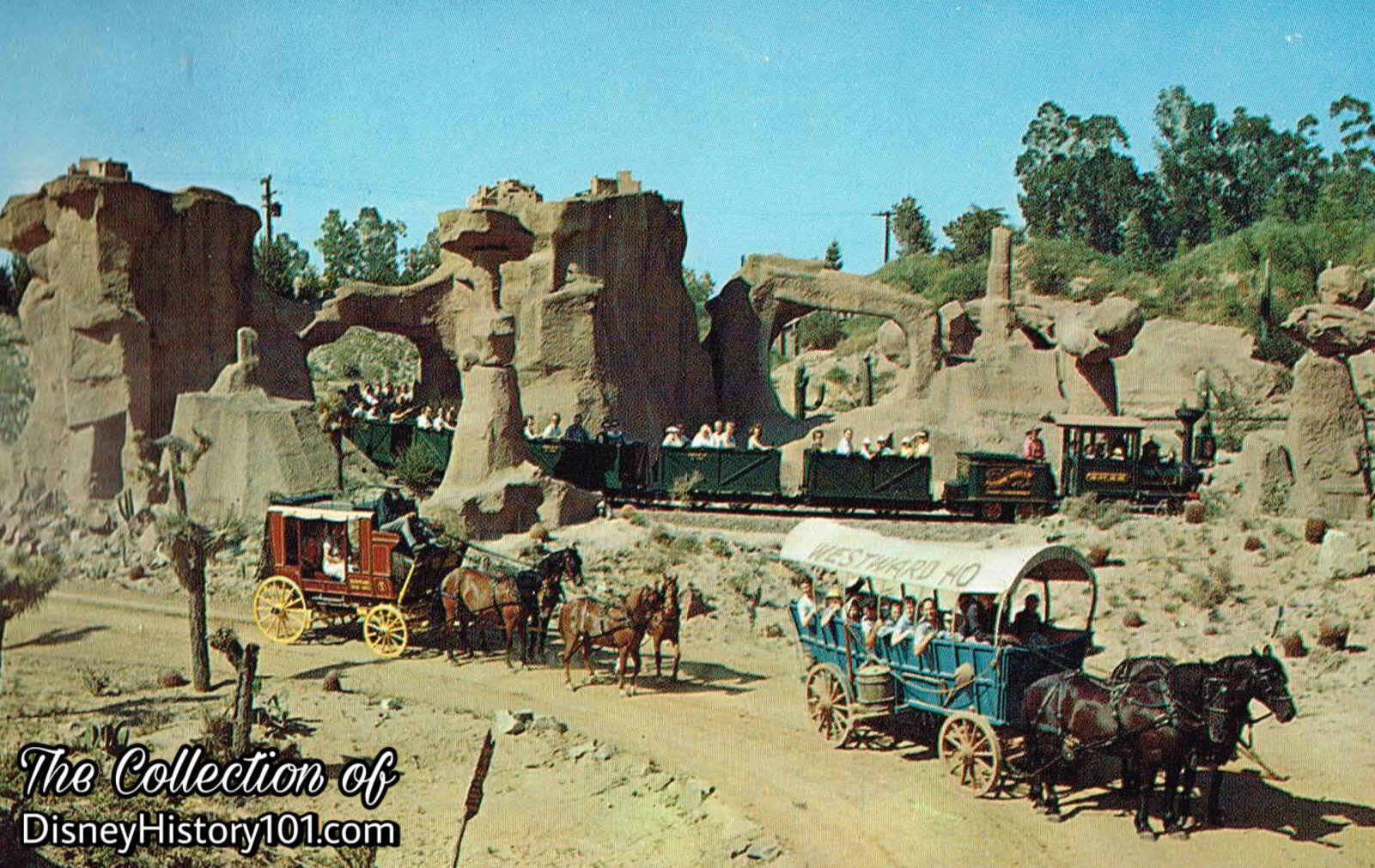
This rare Disneyland Postcard features a rare sight one of the Rainbow Ridge Mud Wagons, a Conestoga Wagon, and one of the Rainbow Mountain Mining & Exploration Co. trains! Art would soon imitate life, when the more archaic forms of desert transportation would make way for the steam-powered future! For now though, engineers of those engines were mighty careful about their whistle-blowing, so as to prevent spooking the equine that pulled the horse-drawn vehicles.
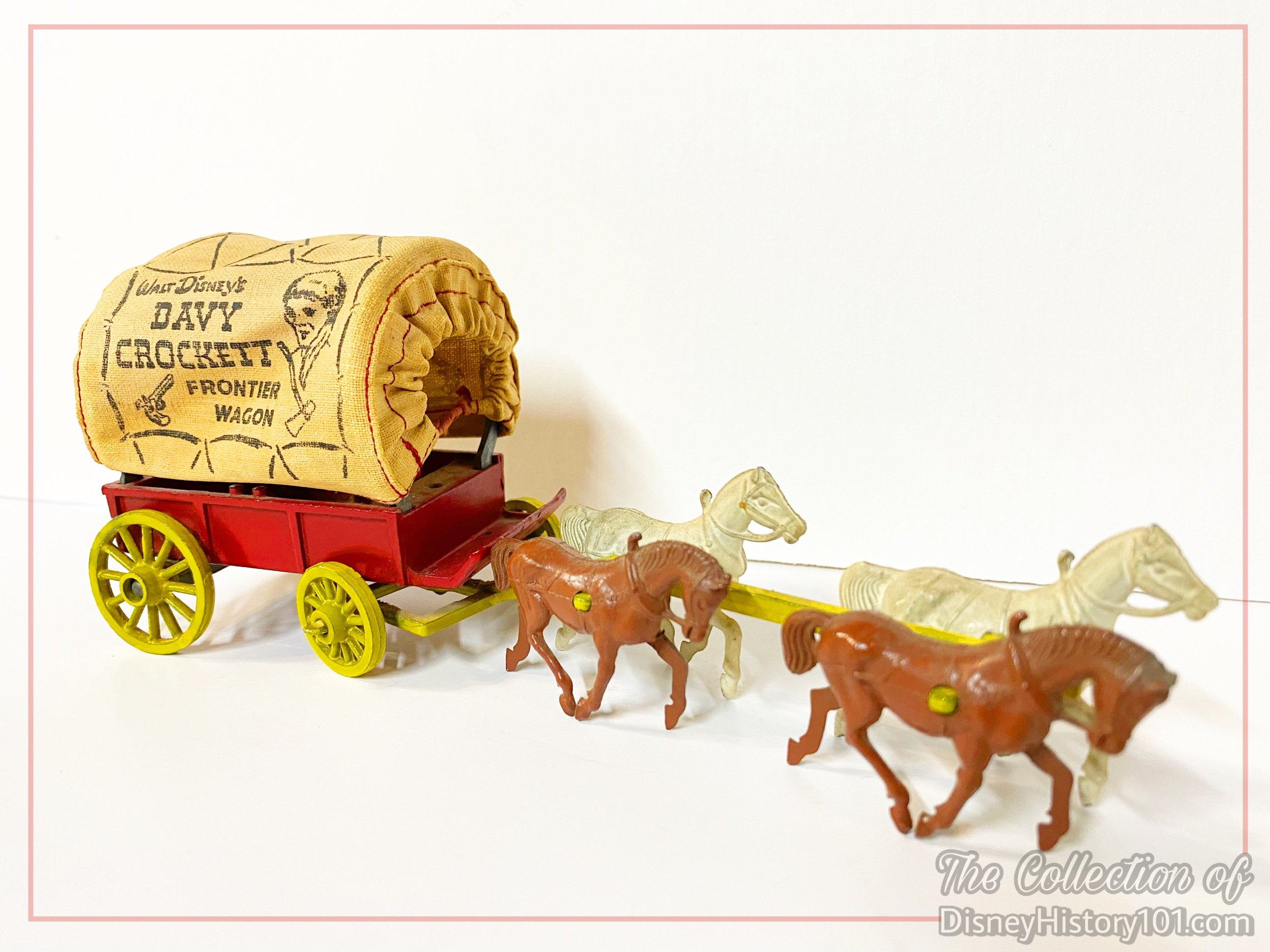
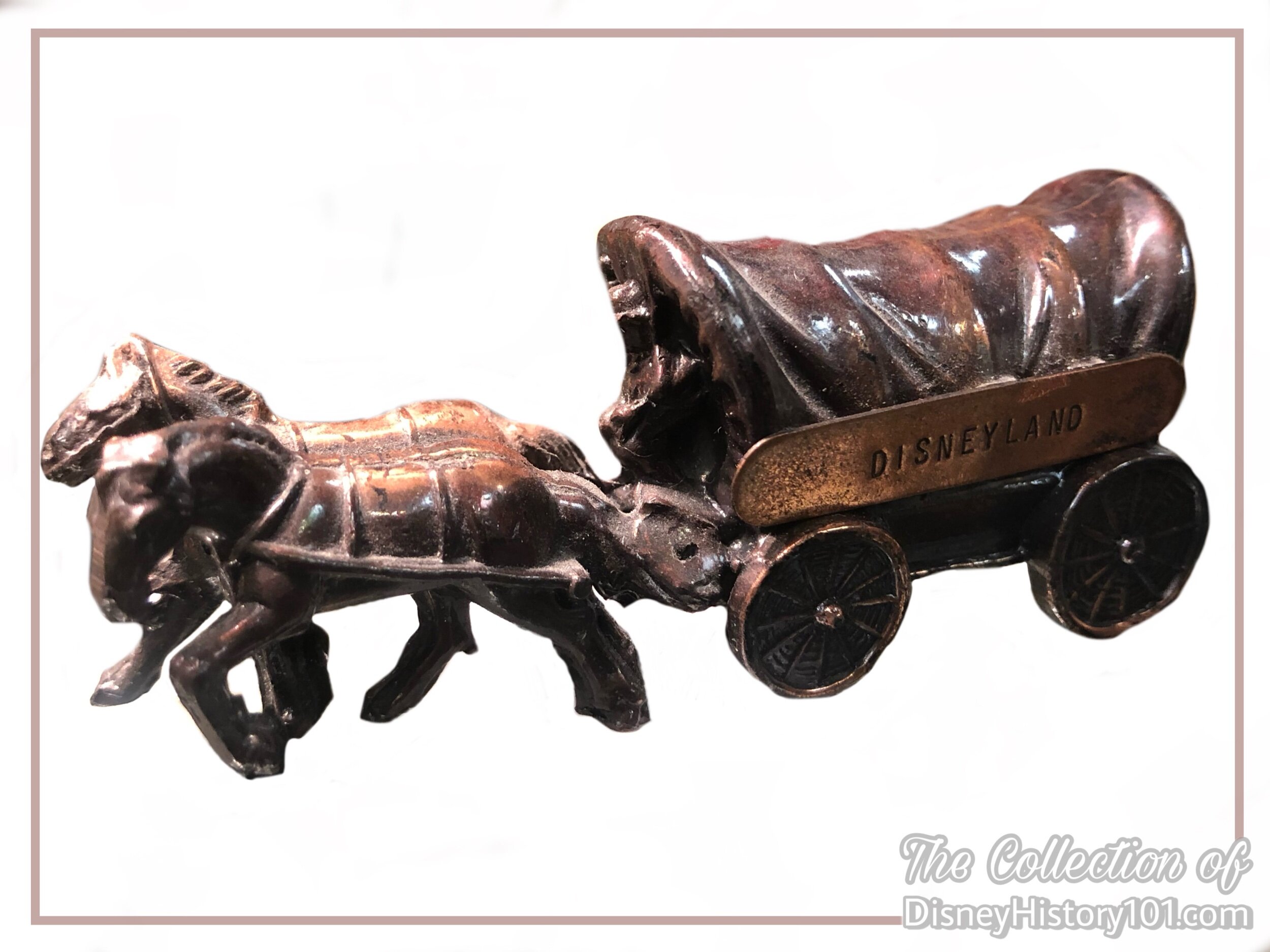
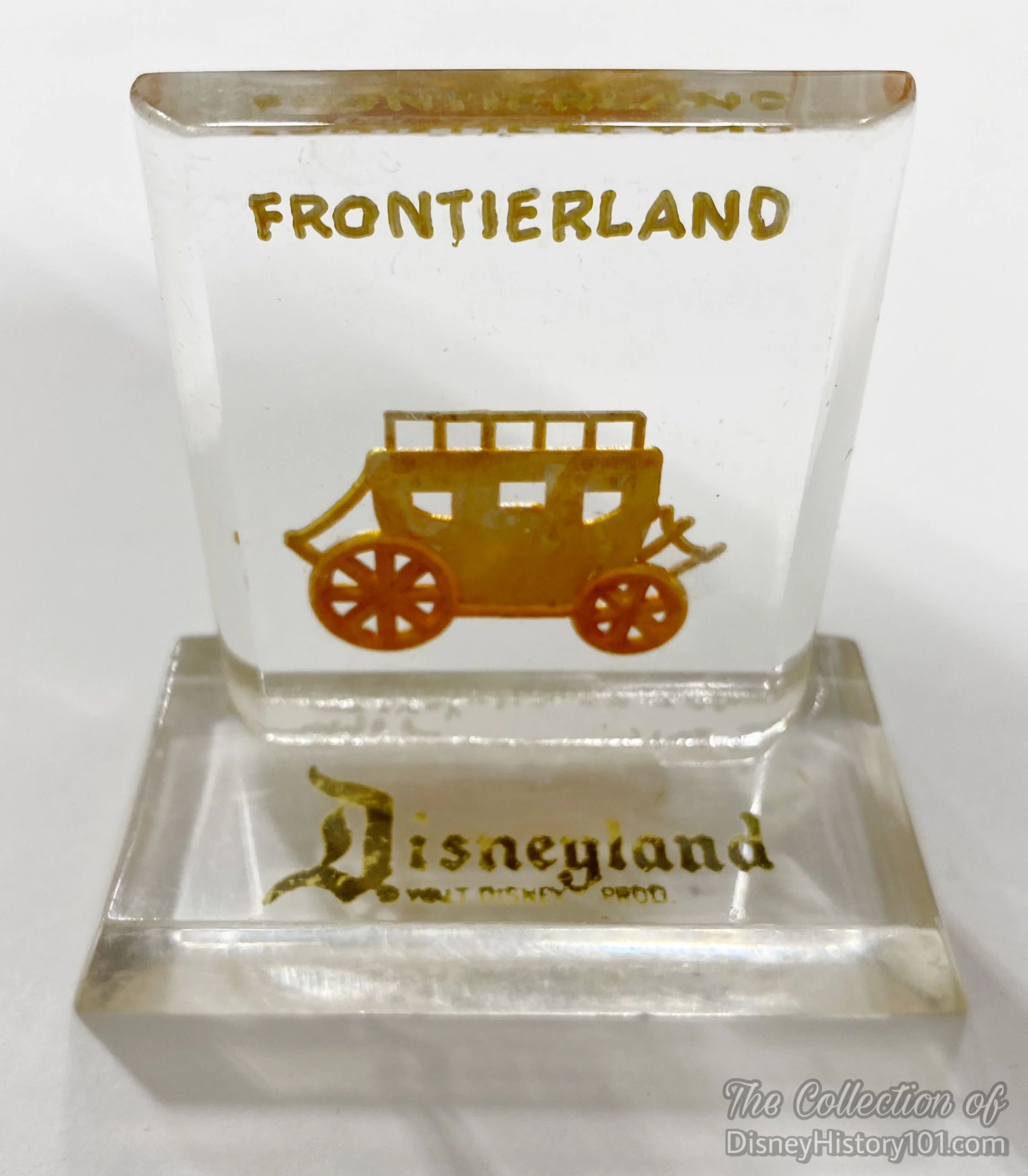
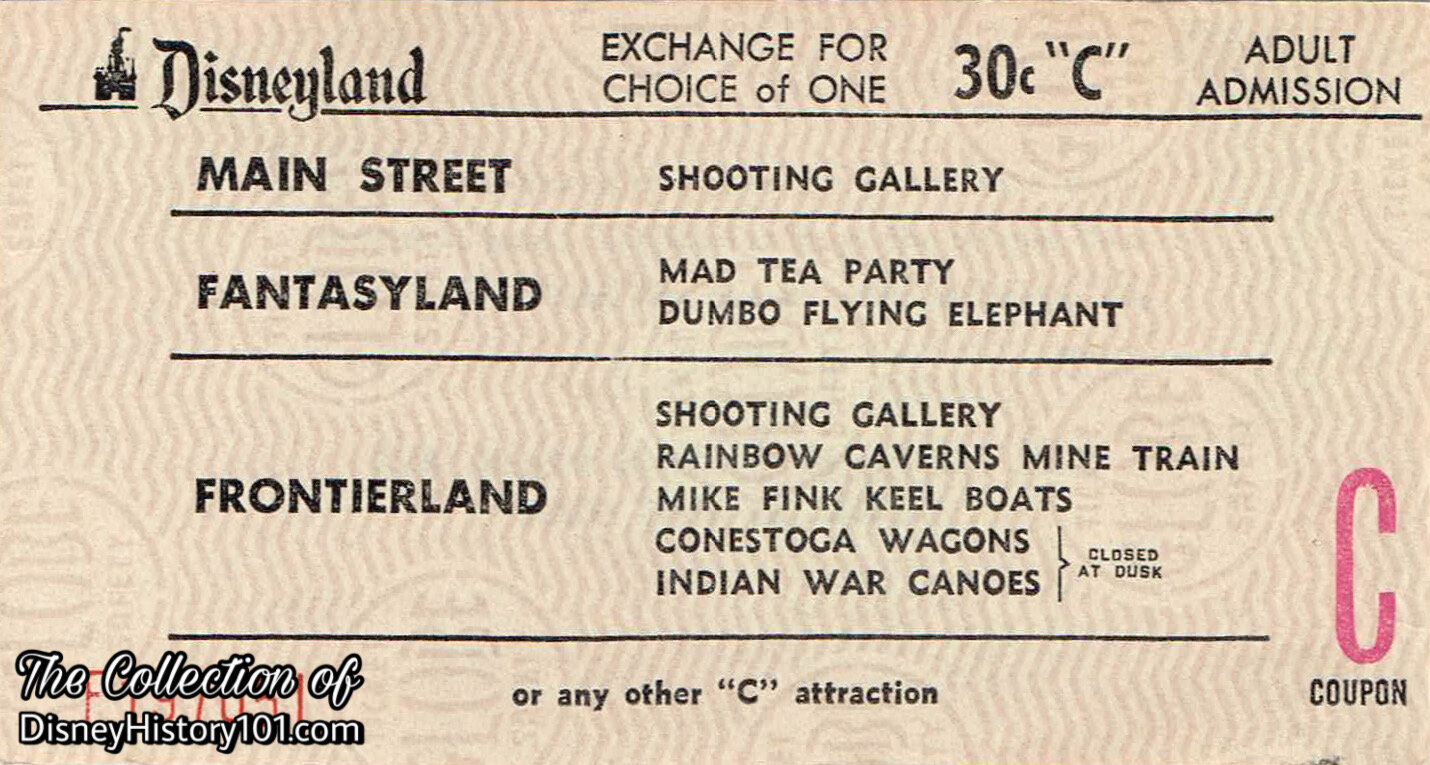
By 1959, Joe Fowler was Vice President of Disneyland Operations Committee and Doc Lemmon of Disneyland Operations was overseeing Operators of Rides & Amusements (like the Conestoga Wagon and Rainbow Mountain Mud Wagon Coaches), Livestock, Parking Lot, and Ticket Sellers. By that time, Disneyland Admission media “C” Coupons (above) equated the value of a ride aboard the Rainbow Caverns Mine Train with the alternate desert route of the Conestoga Wagons.
“Incidents & Liability”
Owing to incidents, by September of 1958, Disneyland, Inc. had a liability - a Public Liability and Property Damage Insurance Policy valued at $ $80,250 (according to an appraisal by Bank of America). By 1959, Disneyland, Inc. had many more types of insurance policies. Disneyland, Inc. had “liability property damage” at coverage of $500,000 per person and $2,000,000 per incident, $500,000 on property and $2,000,000 on aggregate products, at an annual premium of $165,957. Disneyland, Inc. had also increased its “multiple perils” insurance policy coverage twice; from a coverage of $6,000,000 for 5 years, increased by 3,700,000 for 4 years, and increased by 490,000 for 3 years. After all, the policy had a coverage of $10,190,000 at an annual premium of $9,717. Despite the coverage, incidents would occur that would result in the end of an era for the Disneyland stage coach and its route!
Milo Rainey recalled: “Sometimes runaways would be caused by ducks flying across the river.” Day Sechler recalled: “We were loadin' a stage coach one time when we looked up and people were hollerin' and yellin' from the MARK TWAIN, pointin' at a stage coach with four ponies on the dead run- and NO DRIVER! They ran into a coach that was loading and turned it clear over on its side - with JIM LINDSEY UNDERNEATH!”
Day Sechler also recalled: “Another time, a coach turned over with 17 people when a shot of steam from the train scared the ponies at Rainbow Bridge. A safety device released the coach from the front wheels. It sure was a sight to see the ponies come racing home draggin' only the 2 front wheels!”
According to a related newspaper headline (published just after the latter incident), “Eleven [were] injured as horses bolted at Disneyland.” The same article continues : “Eleven persons including six children, suffered minor injuries Monday at Disneyland when the four-horse team of a stagecoach bolted. The injured were the driver and 10 of the 12 passengers in the stagecoach at the amusement park. Several were thrown to the ground when the stagecoach collapsed after its undercarriage was torn off by the wild horses. A Disneyland spokesman said the horses became frightened at the sound of the Park’s train whistle.”
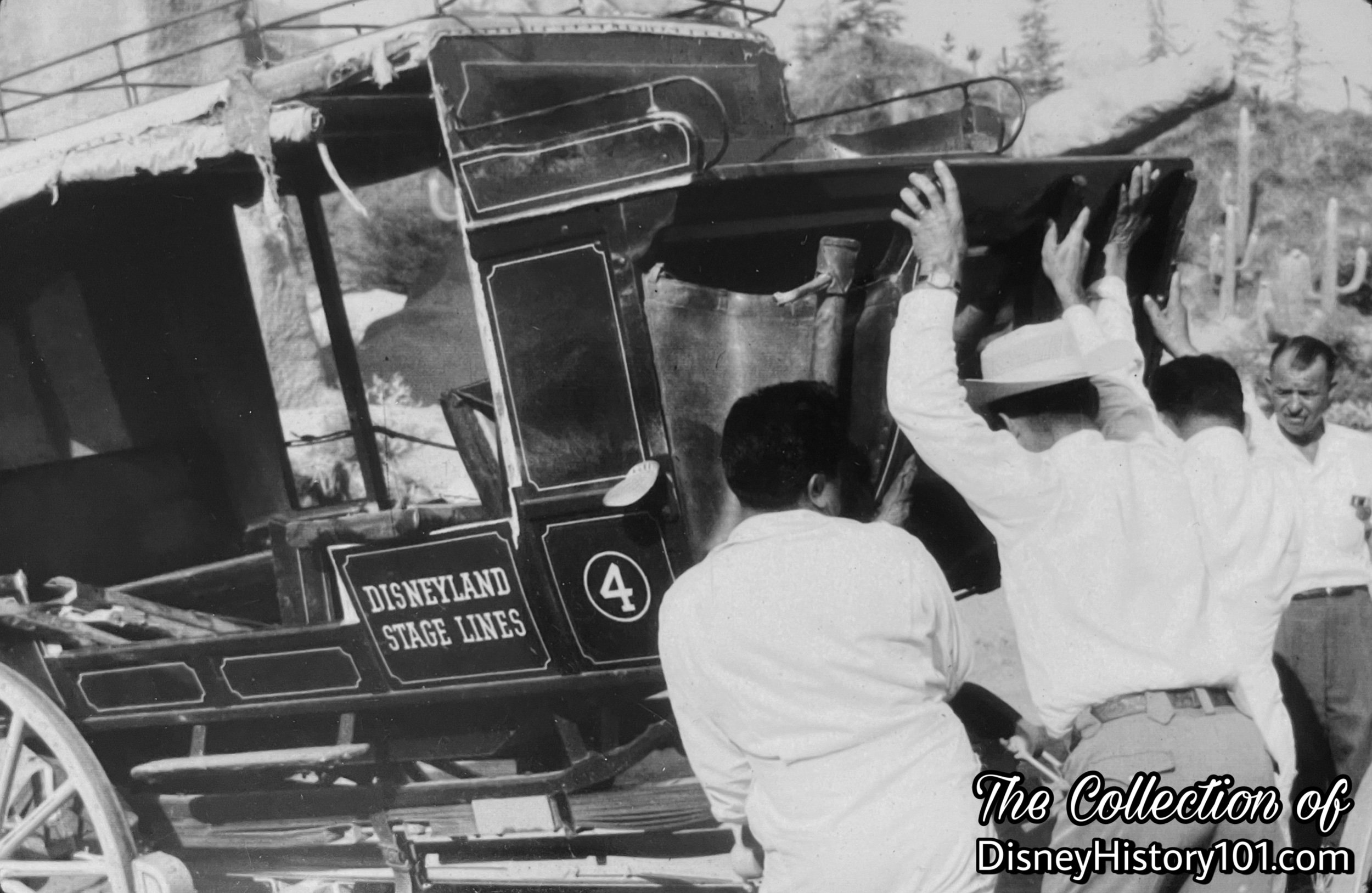
A few months later, another article (by Bob Thomas of the Associated Press) divulged Walt’s thoughts over what had occurred. “‘We had stagecoaches riding through the Painted Desert area’, he explained. And we had a few minor accidents on them. Nothing serious, but enough to worry me. We have a fine safety record at the Park, and I wanted to keep it that way. So I redid the desert to do away with the stagecoaches.”
This decision may not have been easy for Walt. Years later (in 1973) an interview with Joe Fowler perhaps revealed Walt’s feelings over the stagecoaches going “101”: “You know, I could go on for hours with the great understanding that man had and the things he loved and the way that he recognized that he had to make compromises. One of the things he loved, I guess, more than anything else was the stagecoaches that we had, the six horses in Frontierland. Well, we had three accidents. The damn thing was top-heavy where we'd put the people on top of the coach as well as inside. Of course, a horse is the one thing that, as Owen Pope will tell you, you can't predict. He may go along three hundred days and then suddenly bang! He shies at some damn thing. And it was a problem with these horses. We'd had three accidents and fortunately no injuries, but there might have been people killed. I went to Walt and I said, ‘Walt, I'm sorry but we just have to take the people off the top of the stagecoaches or we’re going to have an accident. We've had three near ones!’ Walt said, ‘Oh, Joe, if we don't have the people on top of the coaches, it's no show. Besides the damn horses are gettin’ their heads off. Let's discontinue it and have the mule ride,’ which we did. But I knew him well enough by that time to know what it cost him.”
It may as well be a “Safe ‘D’ Fact” that if an attraction at the Park proves to be dangerous, the problem is corrected or the attraction is eliminated. Dangerous attractions just aren’t “Good Show” as they do not support a positive Disney image. So, the stagecoaches would experience a “Show Failure” situation and go “101.” After three tip overs, Walt Disney got rid of the ride.
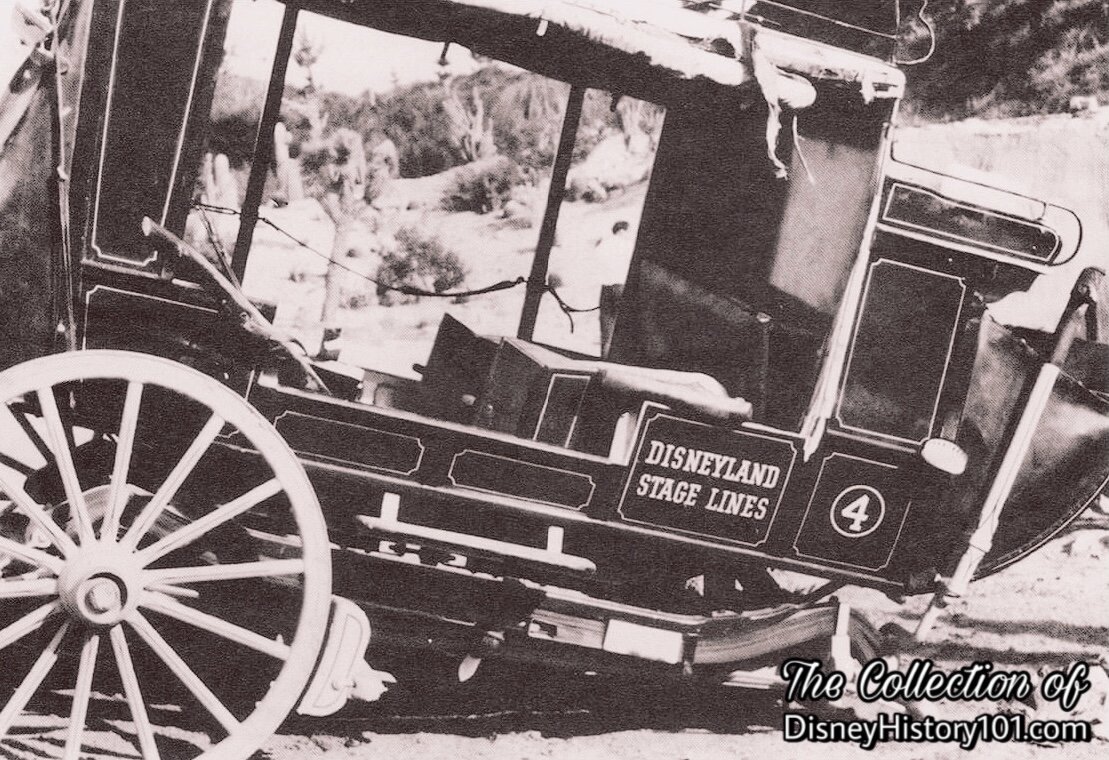
There wasn’t a “pioneer’s prayer” that could help Disneyland Stage Lines “Mud Wagon” Coach #4 ever go “102” again. However, not withstanding these incidents, one of the Rainbow Mountain Mud Wagon Coaches was still notably utilized to transport celebrity Richard Eastham (of “Tombstone Territory” fame) along the route of the “Disneyland ‘59” pageant and parade! But alas, the Conestoga Wagons would suddenly ceased operation on June 14, 1959, ahead of the Rainbow Mountain Mud Wagon Coaches. By the end of their run, a grand total of 560,646 guests had experienced dessert passage aboard a Conestoga Wagon. A few months later, the Rainbow Mountain Mud Wagon Coaches took their last excursion through the Rainbow Desert, before closing on September 13th, 1959. By this date, a grand total of 1,350,589 guests had the privilege of riding aboard one of Disneyland’s Concord Stagecoaches and Disneyland Stage Lines’ Mud Wagons!
While some publications (like the “Golden Magazine for Boys and Girls”, June of 1965) mistakenly still included photos of the stage coaches in descriptions of Frontierland within their pages, this was “the end of the trail” for the Conestoga Wagons, the Rainbow Mountain Mud Wagon Coaches, and their desert routes at Disneyland. However, it wasn’t the end of the Rainbow Desert territory. In fact, construction was now brewing, regarding a large refurbishment centered around one of two wonderful ways to explore Frontierland’s Rainbow Desert - the Rainbow Caverns Mine Train! But, that’s another story, for another time. (However, if you wish, you may STEP THIS WAY to explore the history of the Mine Train Thru Nature’s Wonderland.)
“Legacy”
After the success of Disneyland, developers of the amusement centers saw the benefit of a stage coach ride in their parks. On June 19, 1960, Freedom Land, U.S.A. opened in the Baychester Area of Bronx, New York, an entertainment center “founded on the inspiring story of America and its people”. One of its opening day attractions was a Fort Cavalry Stage Line stage-coach ride over
Lewis and Clark route, of its “The Great Plains: 1803-1900” Area.
Owen Pope regularly oversaw the acquisition and fabrication of equestrian-related parade vehicles (like the Scarecrow Band Hay Cart for Fantasy on Parade of 1965). In addition, through special arrangements, Owen’s pony teams often pulled some of the vehicles (like the Biggest Bass Drum).
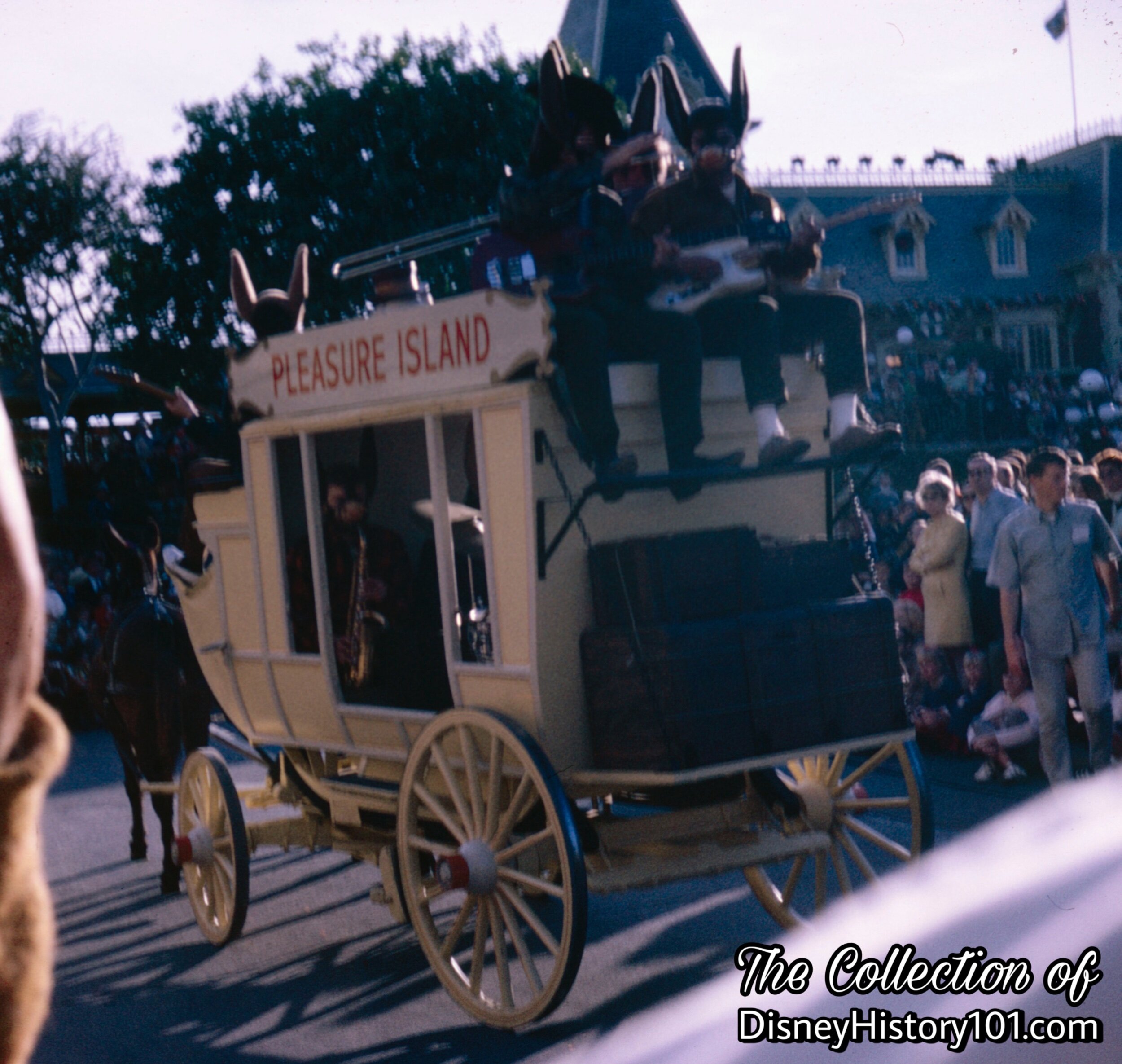
Even some ten years later, one of the old Disneyland Stage Mud Wagon Coaches was repurposed (likely under Owen’s oversight and direction) as a parade vehicle for a Pleasure Island Unit of a seasonal winter holiday parade. This time, the equines also rode in the body, driver’s box and shotgun.
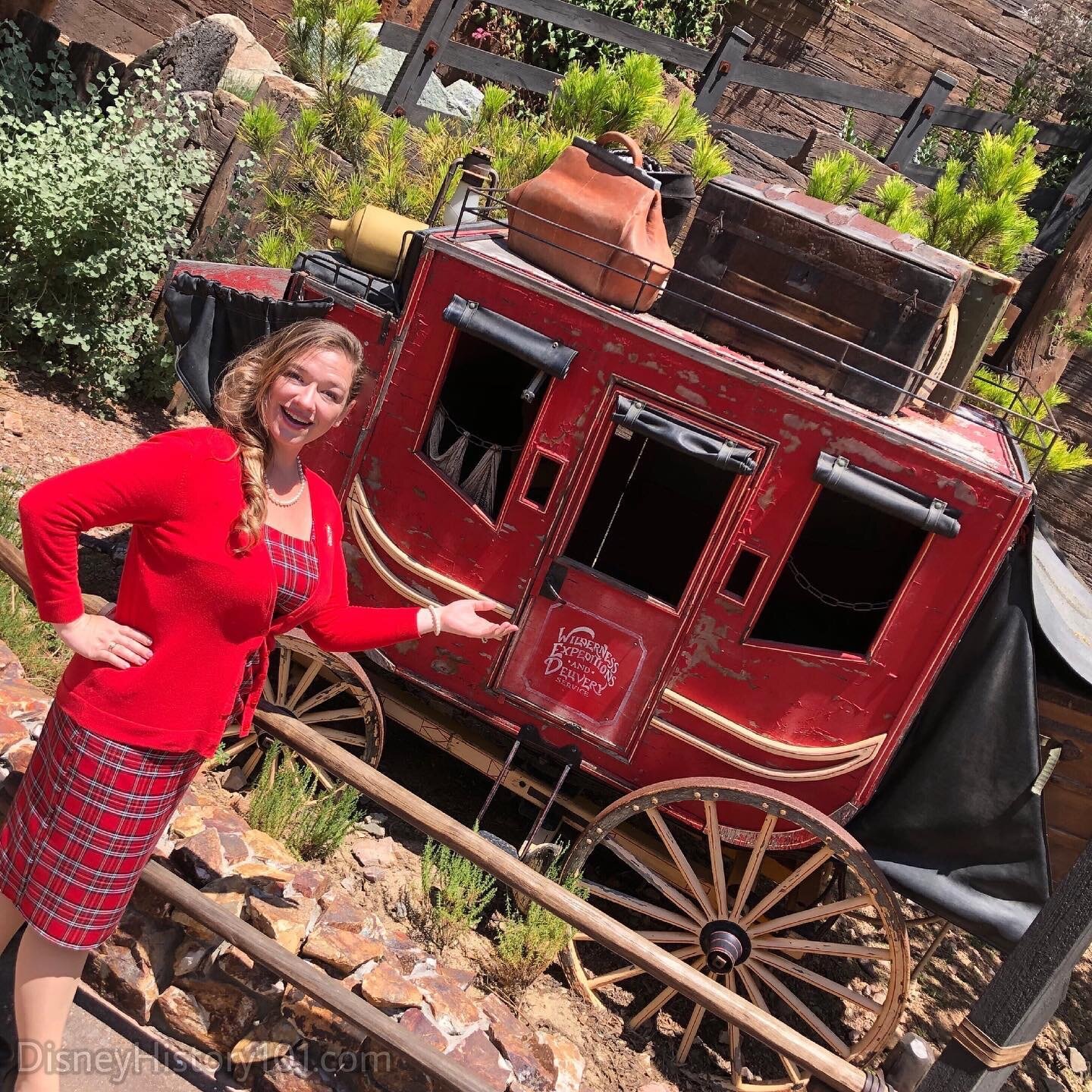
In the present, Stagecoaches haven’t completely disappeared from Disneyland altogether. During the stages of “Project Stardust,” this stage coach came to sit alongside one of Frontierland’s main roads. It may look similar in style to the Stagecoaches that operated out of Rainbow Ridge (from 1955-1960). However, it is surely not one of them. There are numerous differences between the overall shapes of the bodies, the wheel hubs, railings, and overall cargo sections, to name a few differences. Rumors abound that this is one of the neighboring Knott’s Berry Farm’s stagecoaches, yet we are still in search of a source to validate this claim.
Still, this stagecoach carries several story references to Frontierland elements! First, the words “Wilderness Expeditions and Delivery” appear on the doors - an acronym that (when abbreviated) spells “WED.” Maybe you’ve also noticed the name of Tony Baxter’s original Big Thunder Mountain Railroad character Jason Chandler, referenced on a luggage tag on the back of the Wilderness Expeditions and Delivery Service Coach. According to legend, Jason Chandler was the founder of Discovery Bay.
If you would like to see (what are perhaps) two of the last surviving true-life Disneyland Stage Lines vehicles(including the Disneyland Stage Lines “California” Stage Coach, which was previously on exhibit at the Park during the Disneyland 50th Anniversary ; and Disneyland Stage Lines Mud Wagon No.6), you will need to be invited to visit the Circle D Ranch in Norco, California.
In Florida, Walt Disney World Stagecoach Ride carried the Frontier tradition at Fort Wilderness.
ROYAL STREET BACHELORS

It has been said that “Disney magic” begins with the Disneyland Cast Member who support a “Good Show” - a positive Disney image! Since the beginning, Atmosphere Entertainment complimenting the theme of areas was staged to entertain Disneyland Guests on an immediate and personal level. A variety of live shows entertained Guests throughout the day.
“Disneyland revolutionized outdoor entertainment and established a new approach to showmanship. The concept of a living stage was a radical change from the conventional amusement park, fair or fun zone. A variety of live shows entertained Guests throughout the day.”During early years of Disneyland (1955 to 1965), Frontierland featured a riverfront path known as Orleans Street. One of the popular attractions along Orleans Street was the Dixieland Gazebo Bandstand, where several dixieland bands performed throughout the day and night. Of these, the most notable band was the Disneyland Strawhatters.
However, in 1966 new waterfront “land” (New Orleans Square) was introduced, and with that land came brand new entertaining Atmosphere units. One band in particular would have such a profound effect on New Orleans Square, that their image would become synonymous with New Orleans Square, and their name immortal. Yes, long before the Bootstrappers, or the Jambalaya Jazz Band, the original “one-of-a-kind” Royal Street Bachelors (occasionally billed as the “Royale Street Bachelors”) once performed signature Dixieland notes on the quiet streets and courtyards of New Orleans Square, Disneyland. INA Guides described their contribution to the Disneyland show as : “Sparkling, toe-tapping Dixieland melodies… heard in New Orleans Square from 11:00 a.m. to 6:00 p.m.”
Please step this way, as we meet both the founding and supportive members of the original Royal Street Bachelors, and learn a little about their work and legacy!
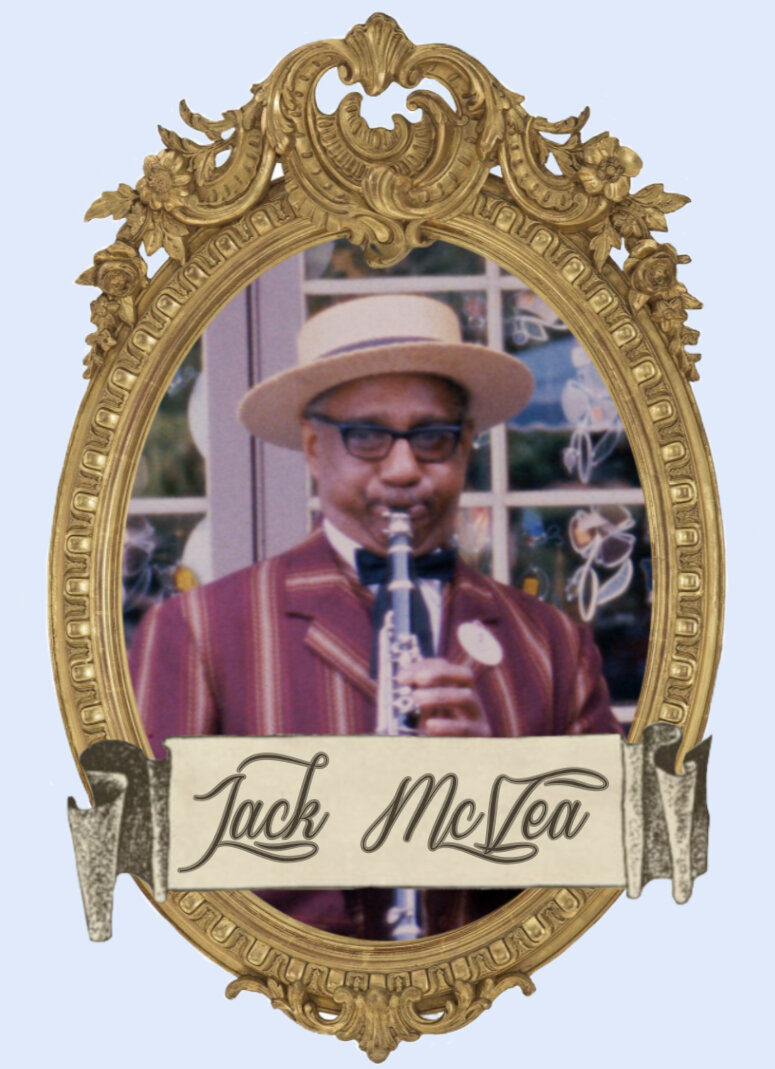
Jack McVea (November 5, 1914 - December 27, 2000) was the son of Los Angeles musician Satchel McVea (of Satchel McVea and his Howdy Entertainers). Owing to his father’s talent, Jack learned to play the banjo from the age of 12, and he also learned to read music. Even more, Jack soon became fond of playing both tenor and baritone saxophone (for which he is now, most remembered), and after leaving school, had the privilege to play with both Lee Williams and Lionel Hampton’s big bands.
In 1946, the door would open to Jack McVea & His All Stars, when they recorded the hit song “Open the Door Richard” on the Black and White record label. Though his group disbanded some years later, “fortuosity” was in his favor. Jack was specifically sought out by Disneyland, to contribute a New Orleans sound to the atmosphere of Disneyland’s future developement! A Disneyland Press Release divulged, “According to McVea, he was not much of a clarinetist but learned overnight to play three songs to secure the job.” After his diligence, he was hired immediately, and became the face of his Royal Street Bachelors.
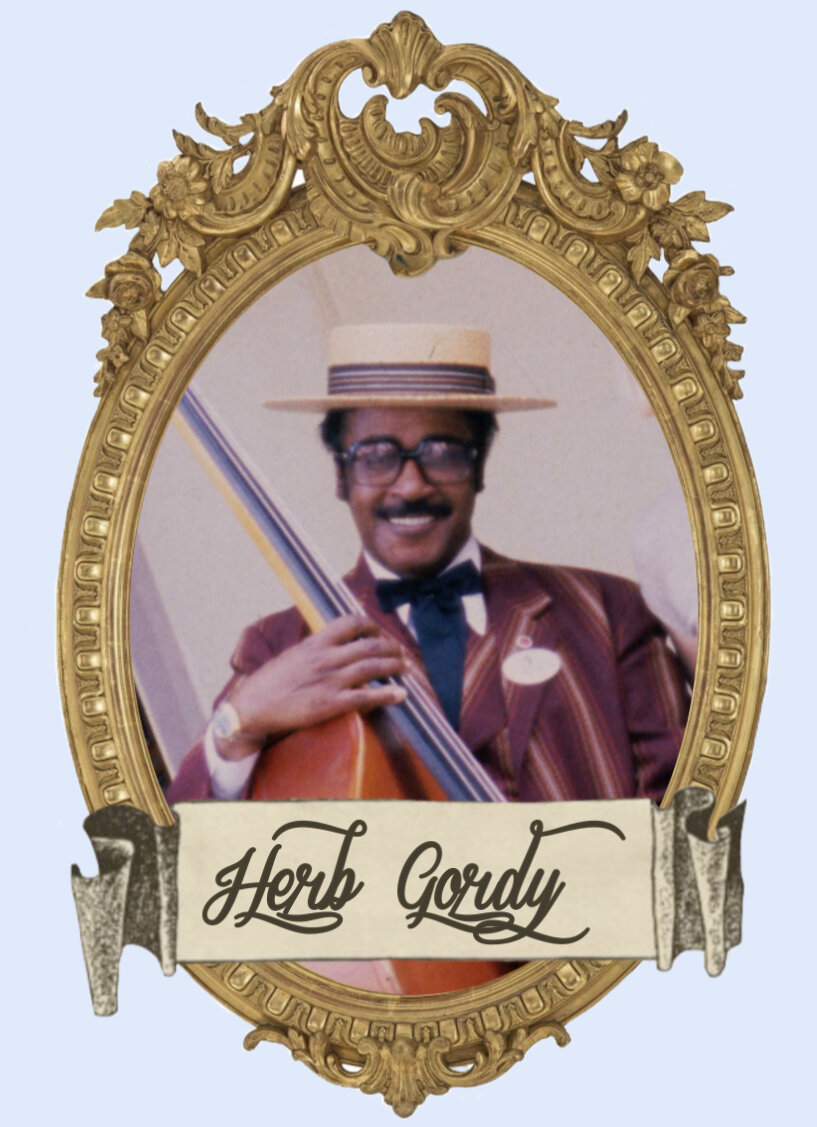
Herb Gordy, was a cousin of music publisher Berry Gordy. From an early age, the left-handed artist became a skillful double bassist. He performed with Tiny "Mac" Grimes and the Rocking Highlanders. According to one account, “he also painted the edges of his bass in green phosphorescent paint. When Herb did his solo, they turned out all the lights, and the audience saw a ghostly green double bass dancing on stage.” This talent would provide the essential bass for the Royal Street Bachelors, and provide Herb a long career with Disneyland! If you’re a Cast Member, you may have heard the nickname of the large New Orleans Dressing Room - the “Herb Gordy Dressing Room” - in his honor.
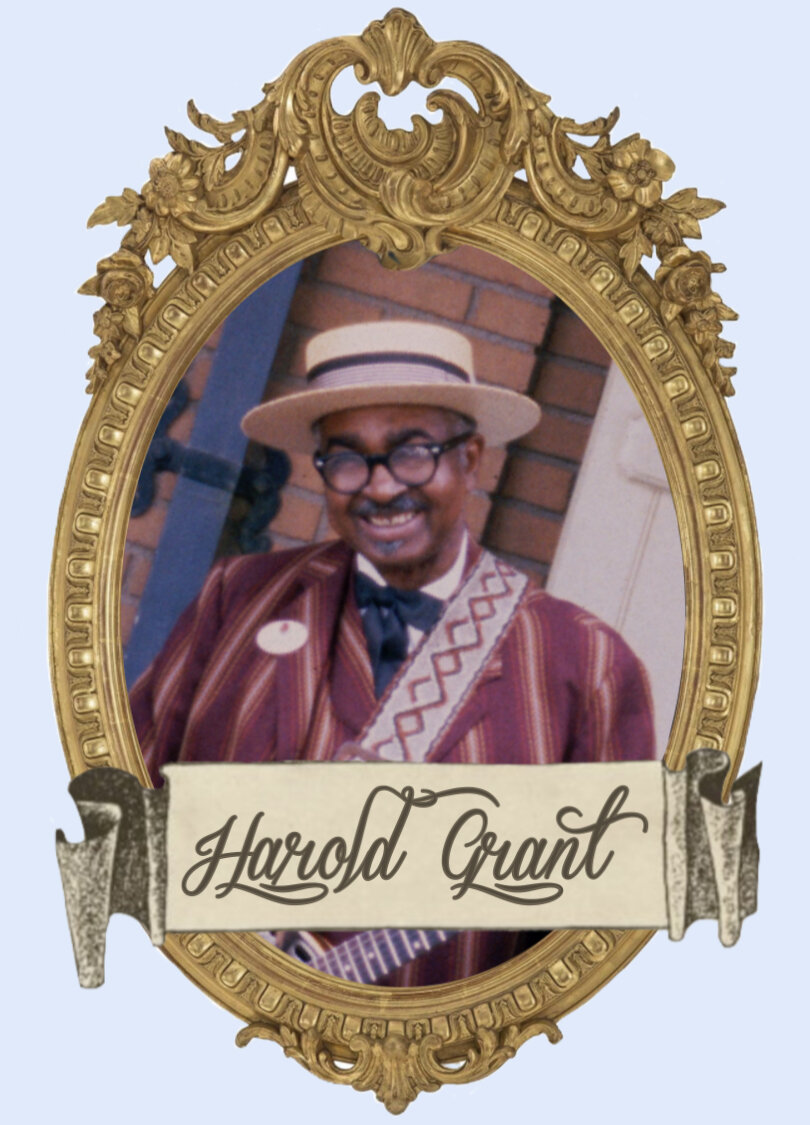
Harold Grant joined the band after the passing of the original banjo player*. He had a talent for both banjo and guitar, and was featured in recordings (like Fred Clark’s “Ground Hog Snooper”, recorded 1953). Harold loyally continued with the trio for some 25 years. If you have any information or experiences involving Harold’s time with the Royal Street Bachelors, we hope to preserve more about his story here.
*The original Royal Street Bachelors banjoist is believed to have been a musician named Herman “Tiny” Burrell Mitchell). If you have any information or images leading to confirming his identity, please contact us. We would just love to preserve his story alongside those of his band members!
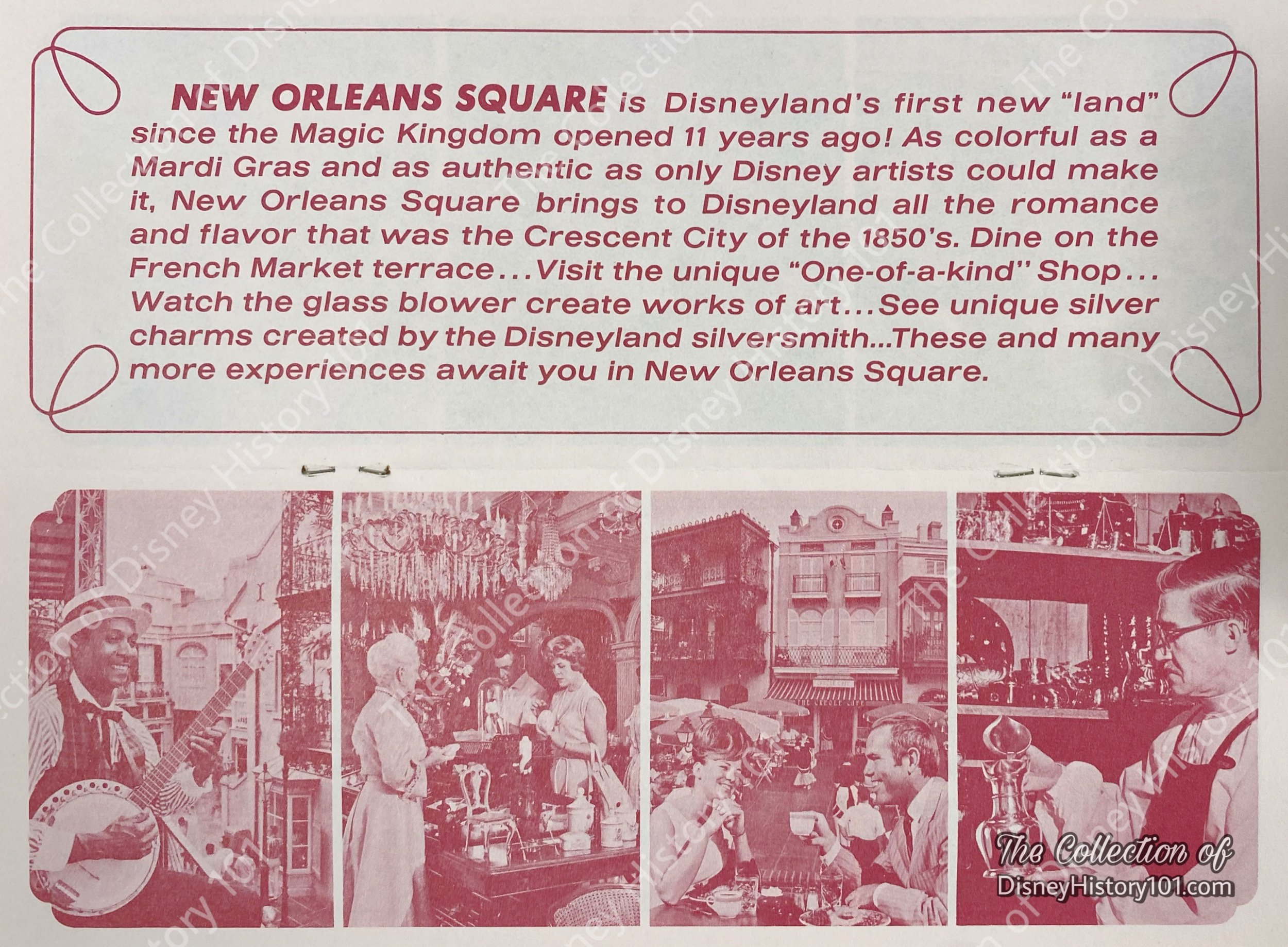
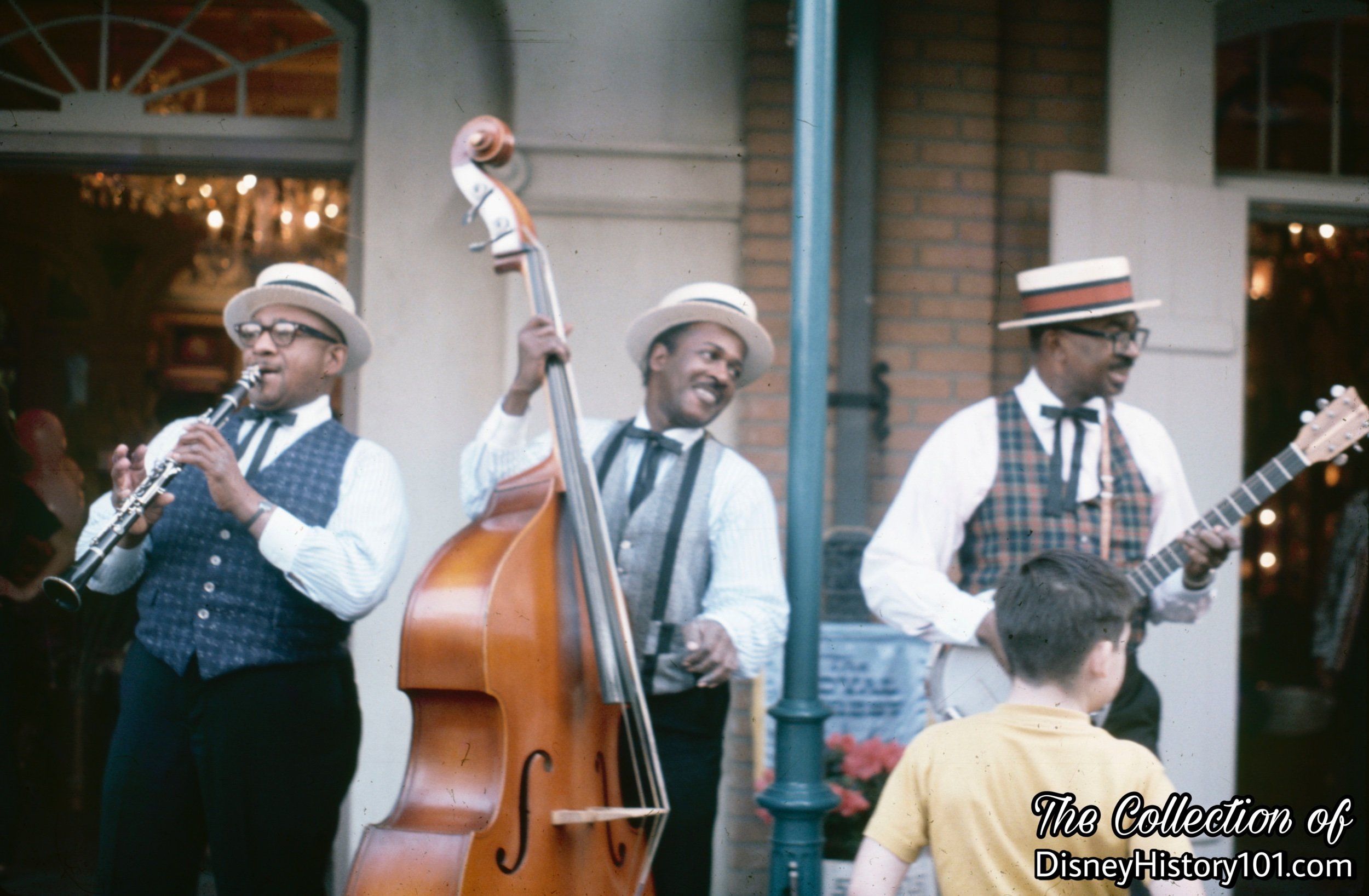
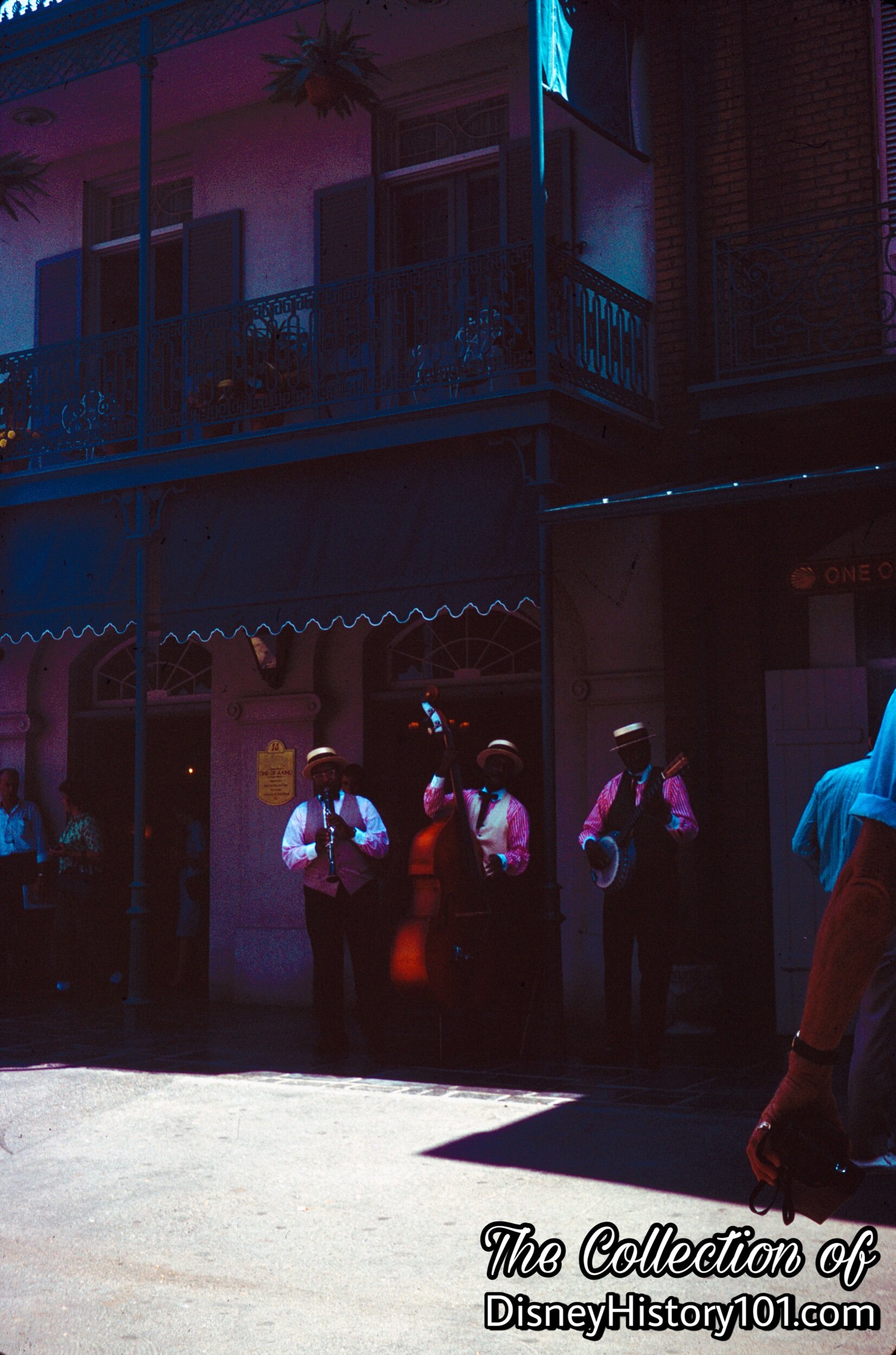
During their early days, the Royal Street Bachelors performed at one of their usual Royal Street locations near the opened Hench doors off the One-of-A-Kind Shop in New Orleans Square. Shows generally occurred throughout the day, from 10:30 a.m. to 5:30 p.m. Billed as the “Royale Street Bachelors,” the trio performed alongside other legendary jazz musicians at the 6th annual Dixieland at Disneyland (held Saturday, October 1st, 8pm to 2am).
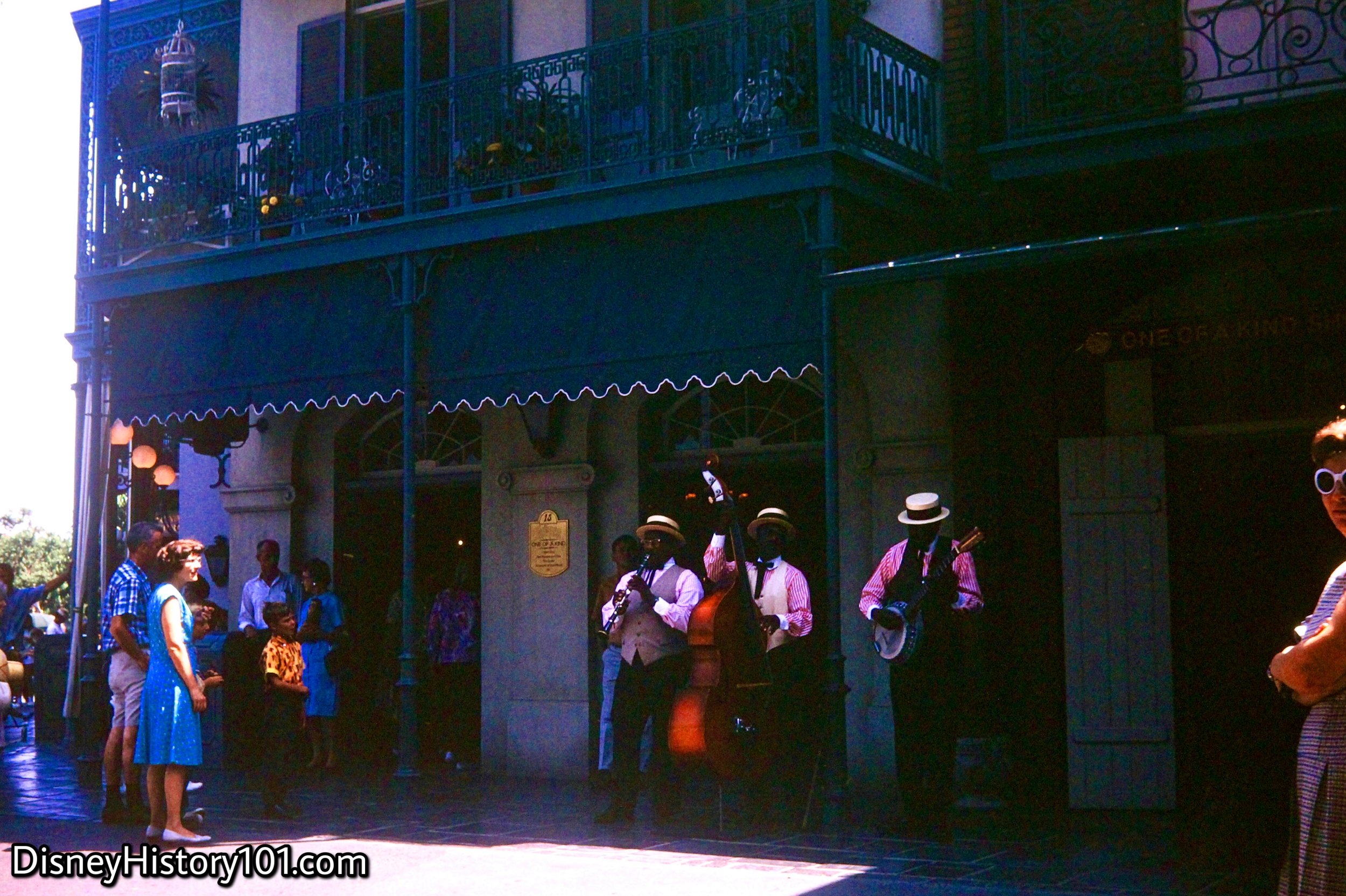
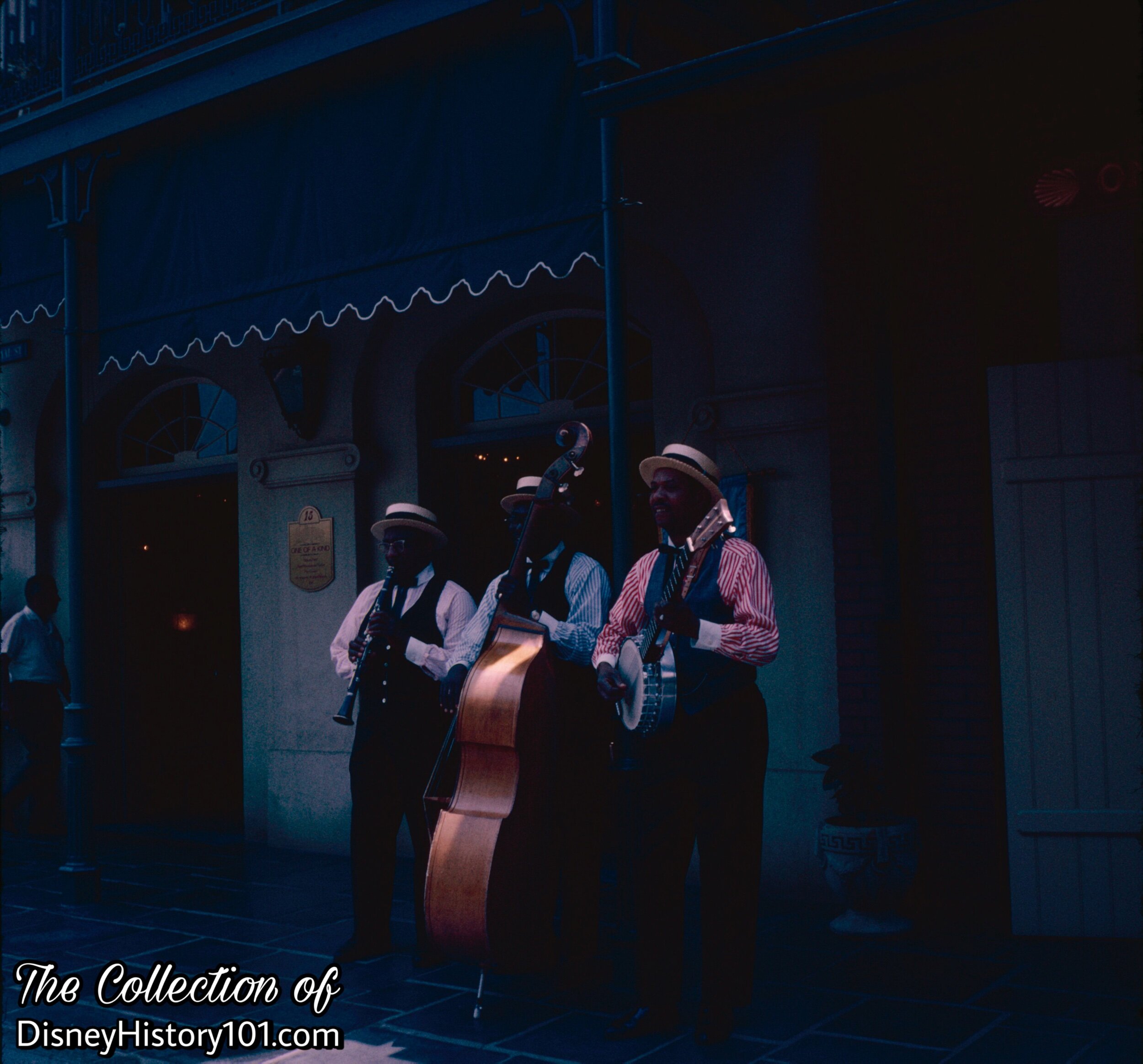
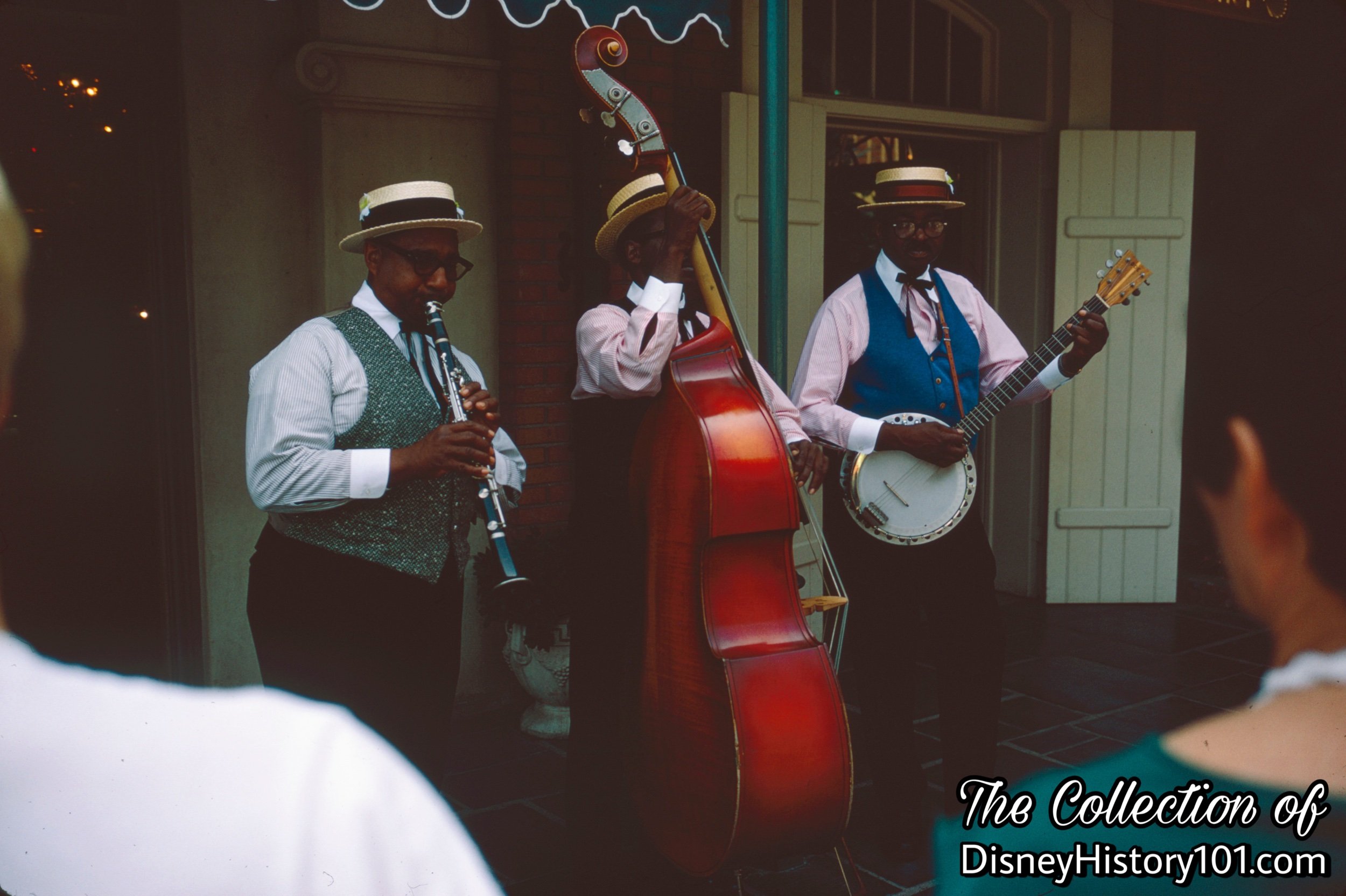
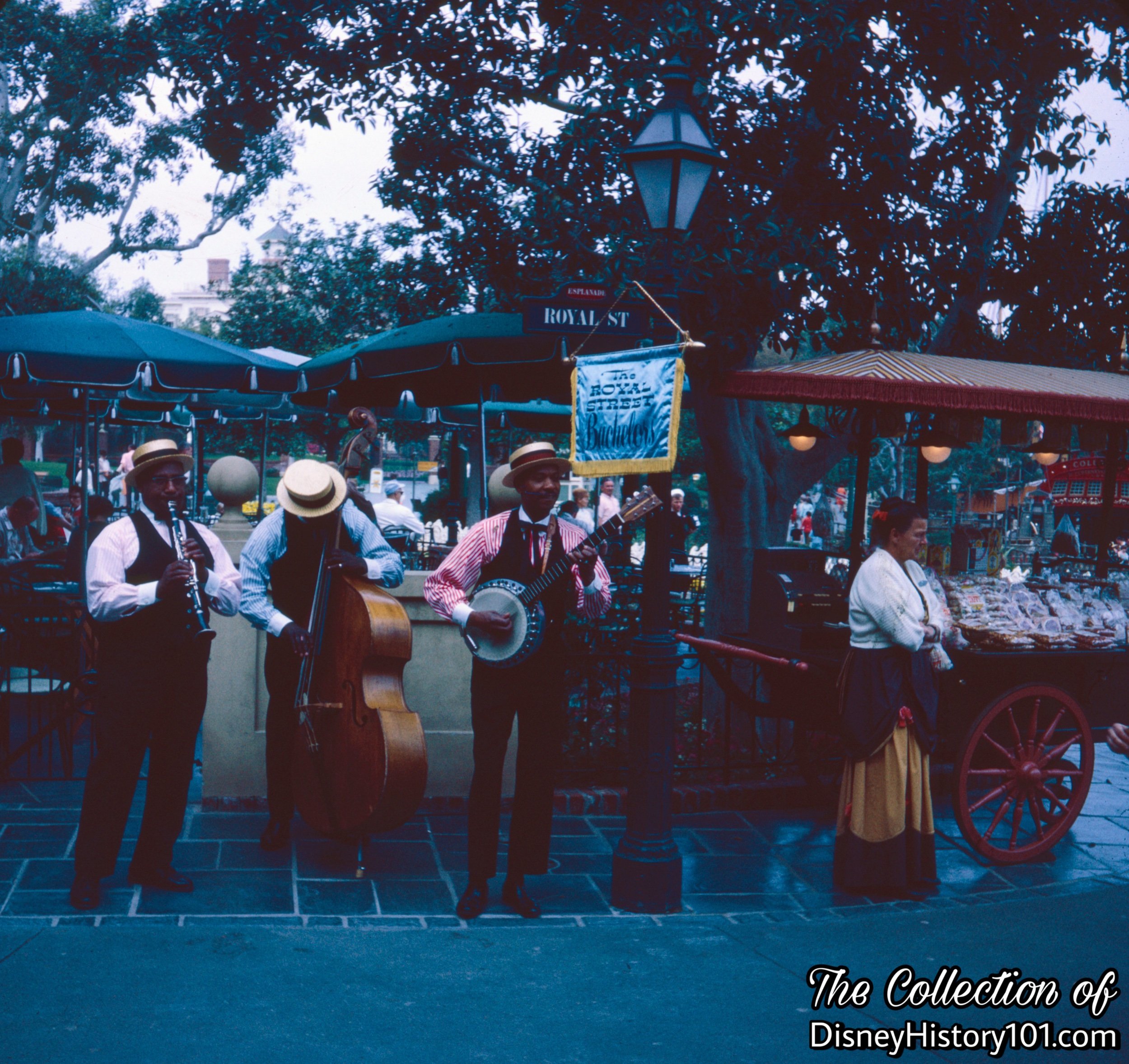

The Royal Street Bachelors occasionally teamed up with another iconic Disneyland act - the Strawhatters. The Strawhatters predated the Royal Street Bachelors by nearly a decade, performing from the Dixieland Gazebo Bandstand along Frontierland’s waterfront thoroughfare originally known as Orleans Street. When New Orleans Square debuted (and the streets were renamed), the Royal Street Bachelors regularly played the One-Of-A-Kind Shop storefront, and the Strawhatters were moved to the French Market Stage. But occasionally the two (now) legendary bands met, and when they did, the result was something special!
Though the Royal Street Bachelors and other New Orleans Square musicians performed in different areas of the land, the “Bachelors” occasionally performed alongside the Shoeshine Boys (Teddy and Kenny) and the Delta Ramblers, as their shifts overlapped.
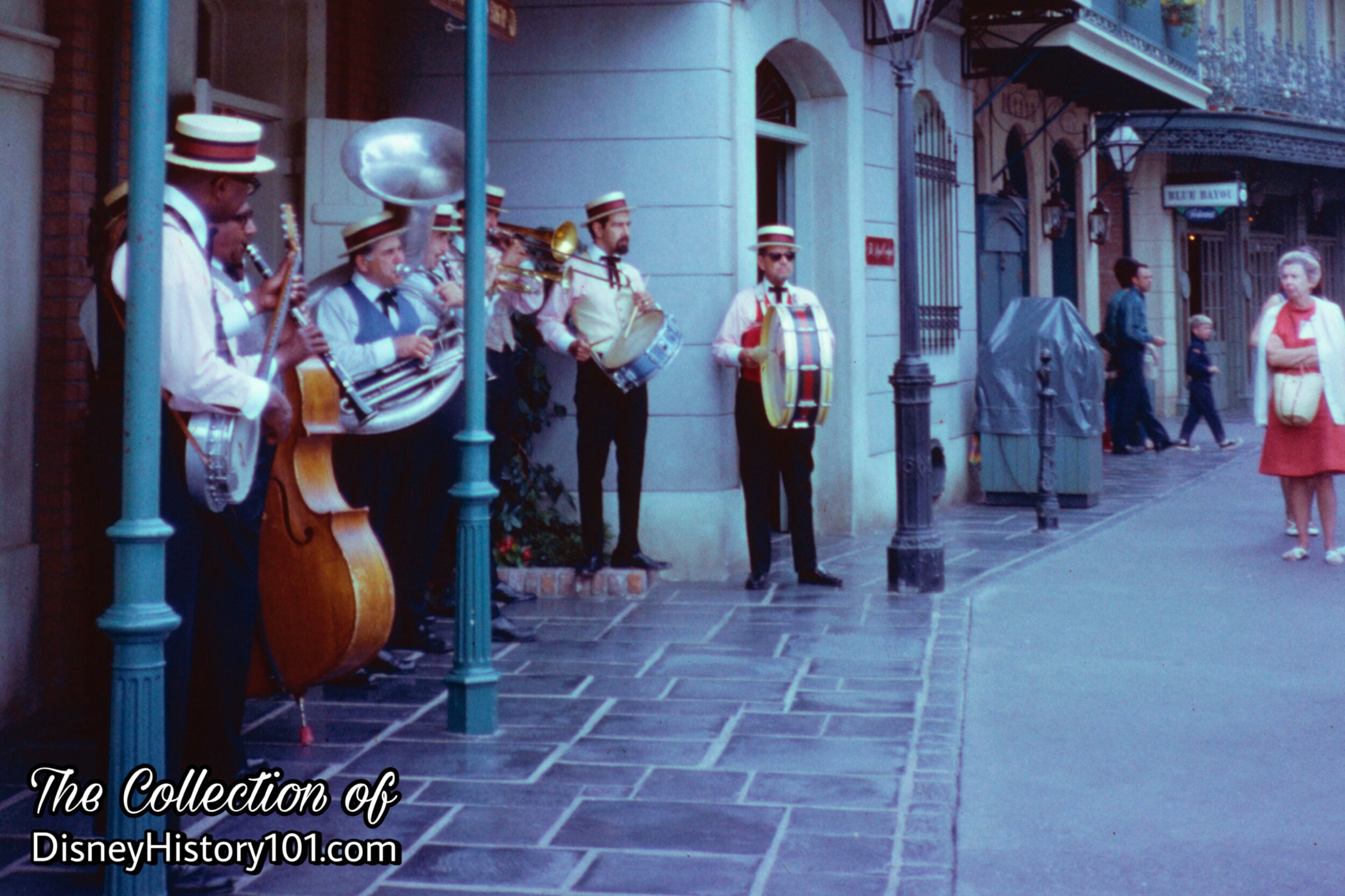

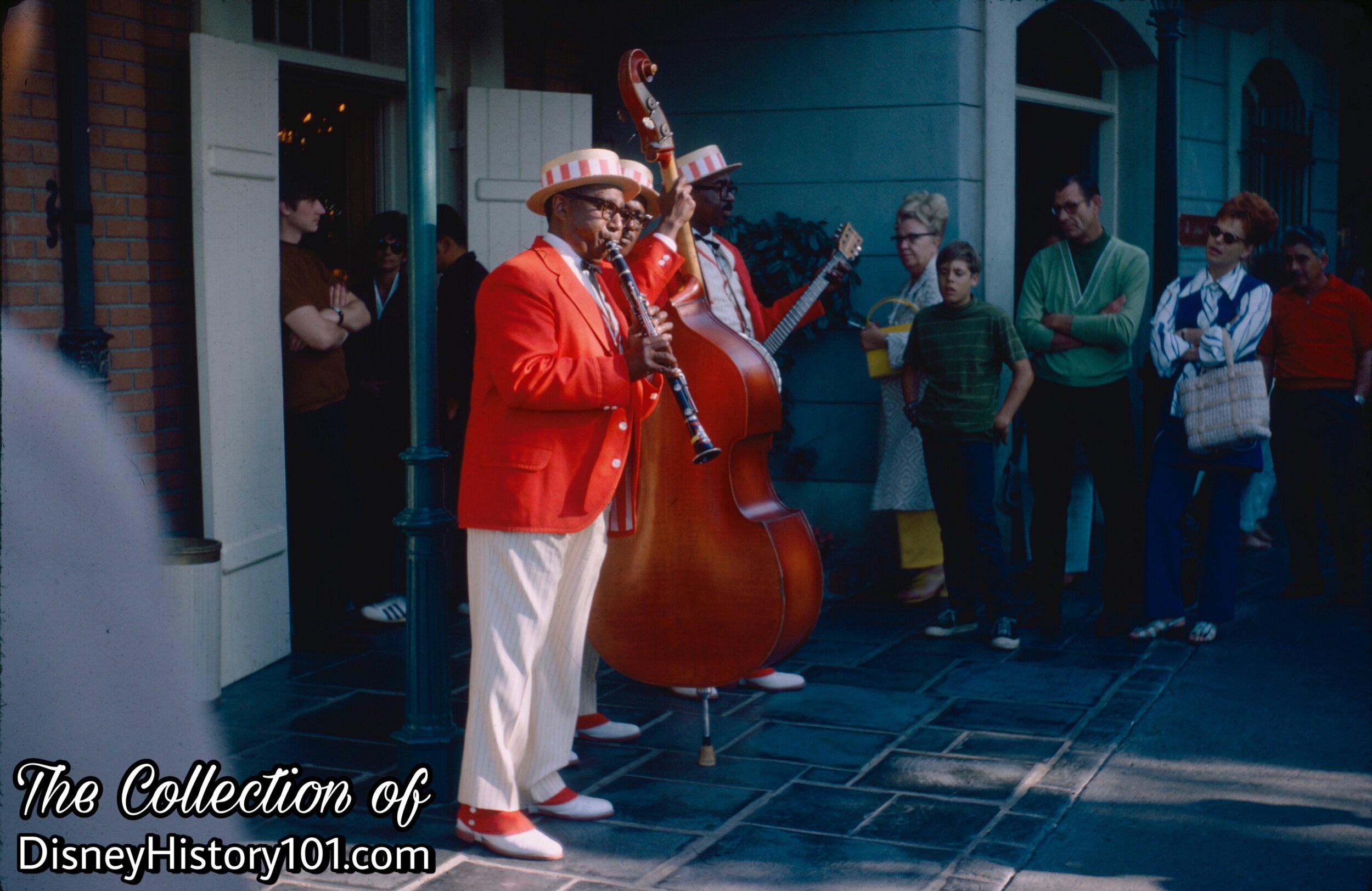
The trio can briefly be seen wearing this very ensemble for their Court of Angels performance of “When The Saints Go Marching In”, while Donnie Osmond, Jay Osmond, Br’er Bear, and Br’er Fox enjoy their melodies and beats, in “Disneyland Showtime” (a c.1970 Wonderful World of Disney episode).
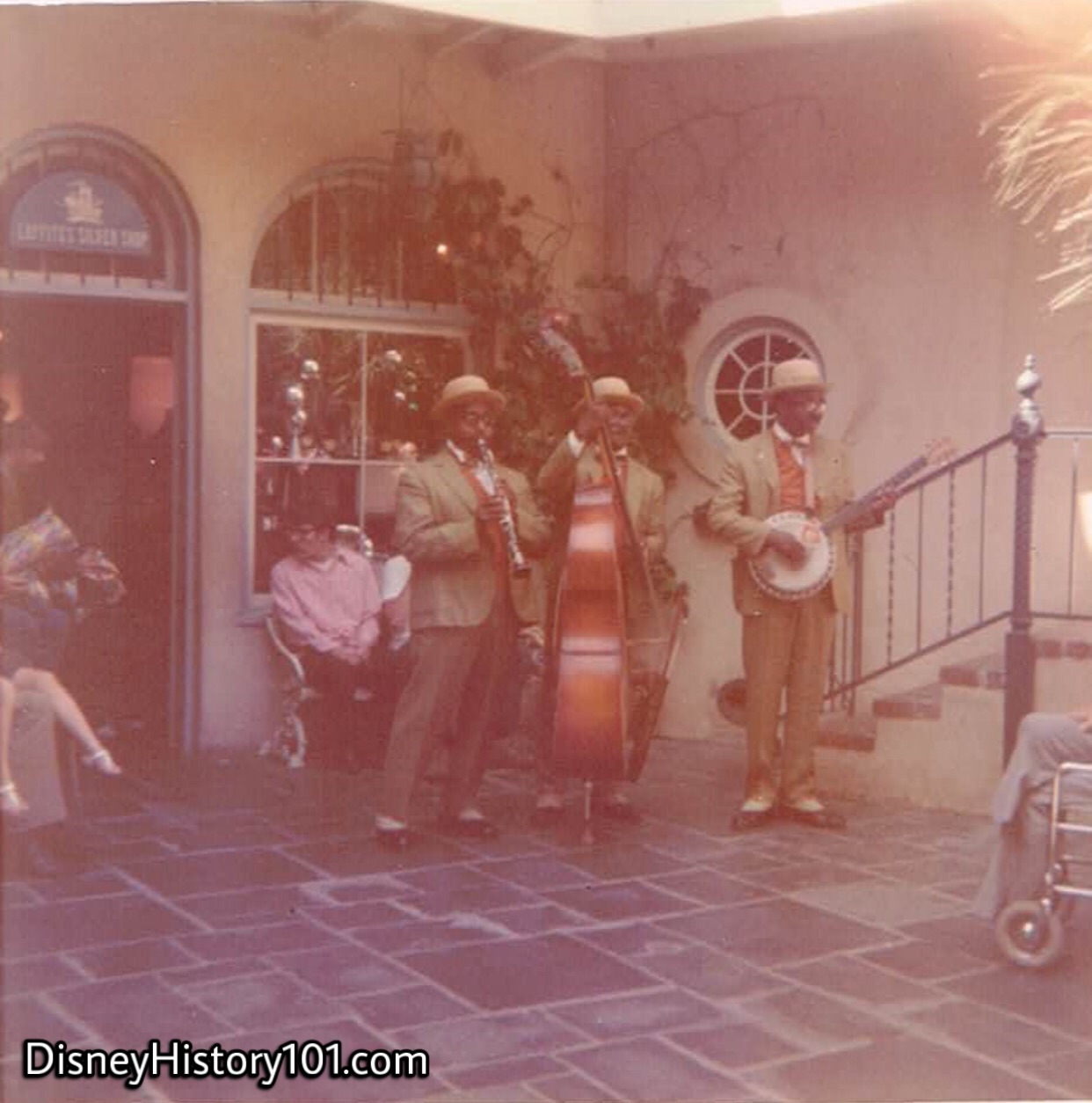
The trio was also known to frequent the little cool alcove near LaFitte’s Silver Shop. Here, they would perform for 30 or 45 minutes. A typical daily schedule looked like this:
11:00 - 11:45
12:00 - 12:45
1:00 - 1:30
2:30 - 3:15
3:45 - 4:15
4:30 - 5:00
5:15 - 5:45
The same year that the preceding “Vintage View” was captured, the Royal Street Bachelors provided evening entertainment for the “Lead-Foreman “End-of-Summer Dinner” (held during the Fall of 1972) for more than 2,000 Park Employees of Disneyland’s Food Division.
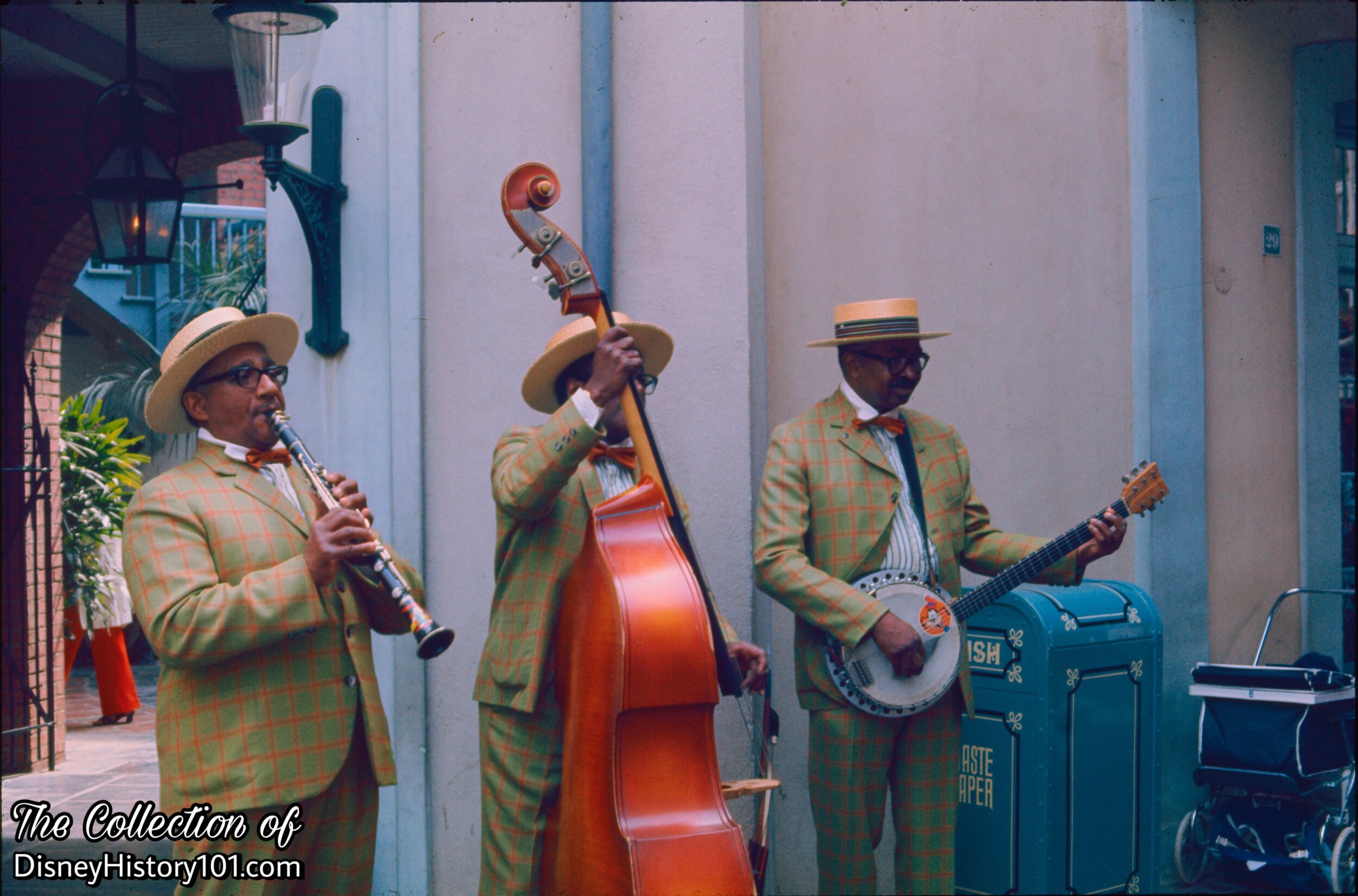
The trio played in the streets of New Orleans Square, nearby Le Gourmet and La Boutique d’Orleans.
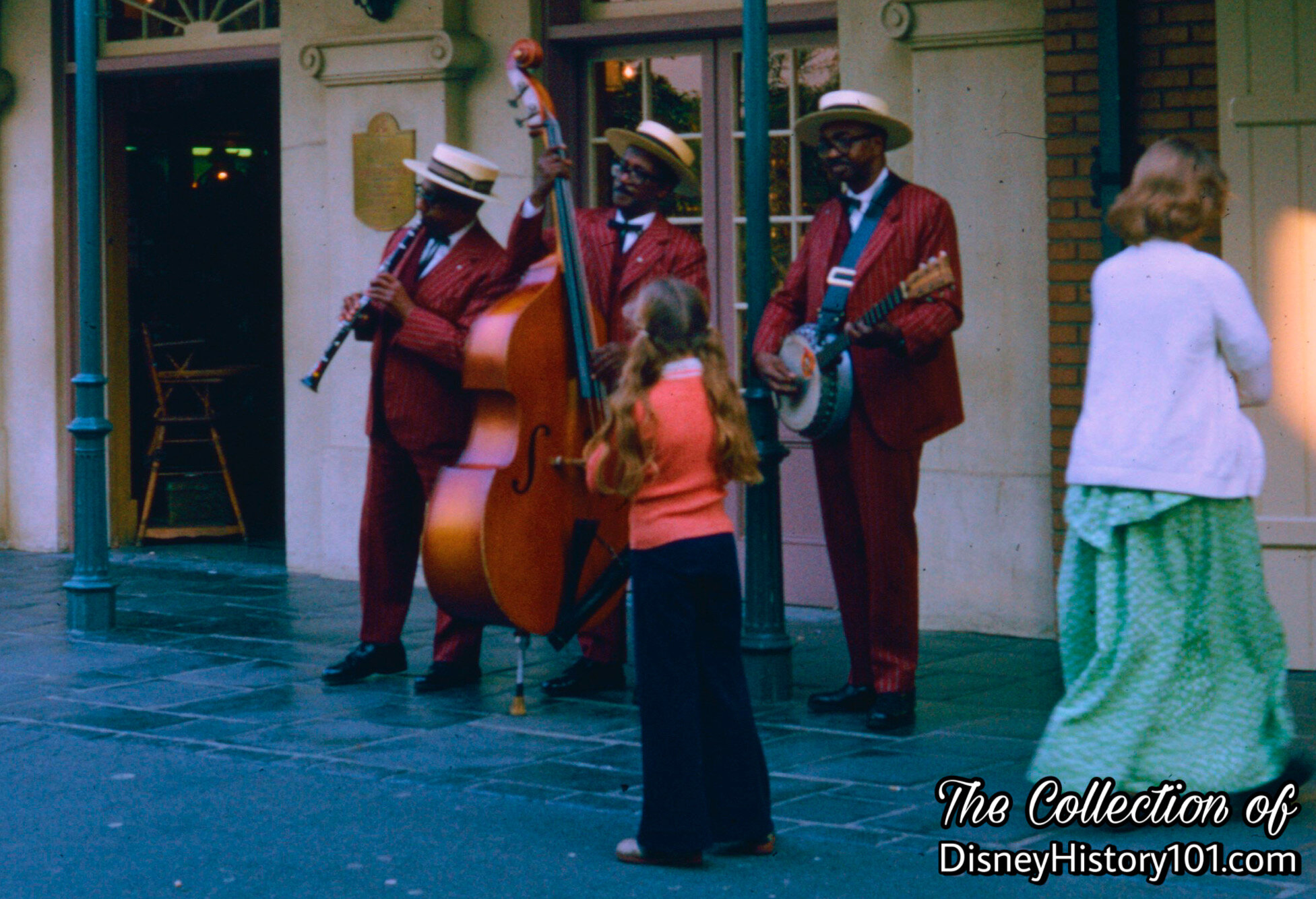
The “one-of-a-kind” trio forms a New Orleans Square “welcoming committee” as they perform in one of their most common locations - the corner of Esplanade and Royal Street, near the One-of-a-Kind Shoppe! During the very year that this Vintage View was captured, Disney News (the official magazine for Magic Kingdom Club Families) told the story of the Royal Street Bachelors in its Spring, 1974 issue.
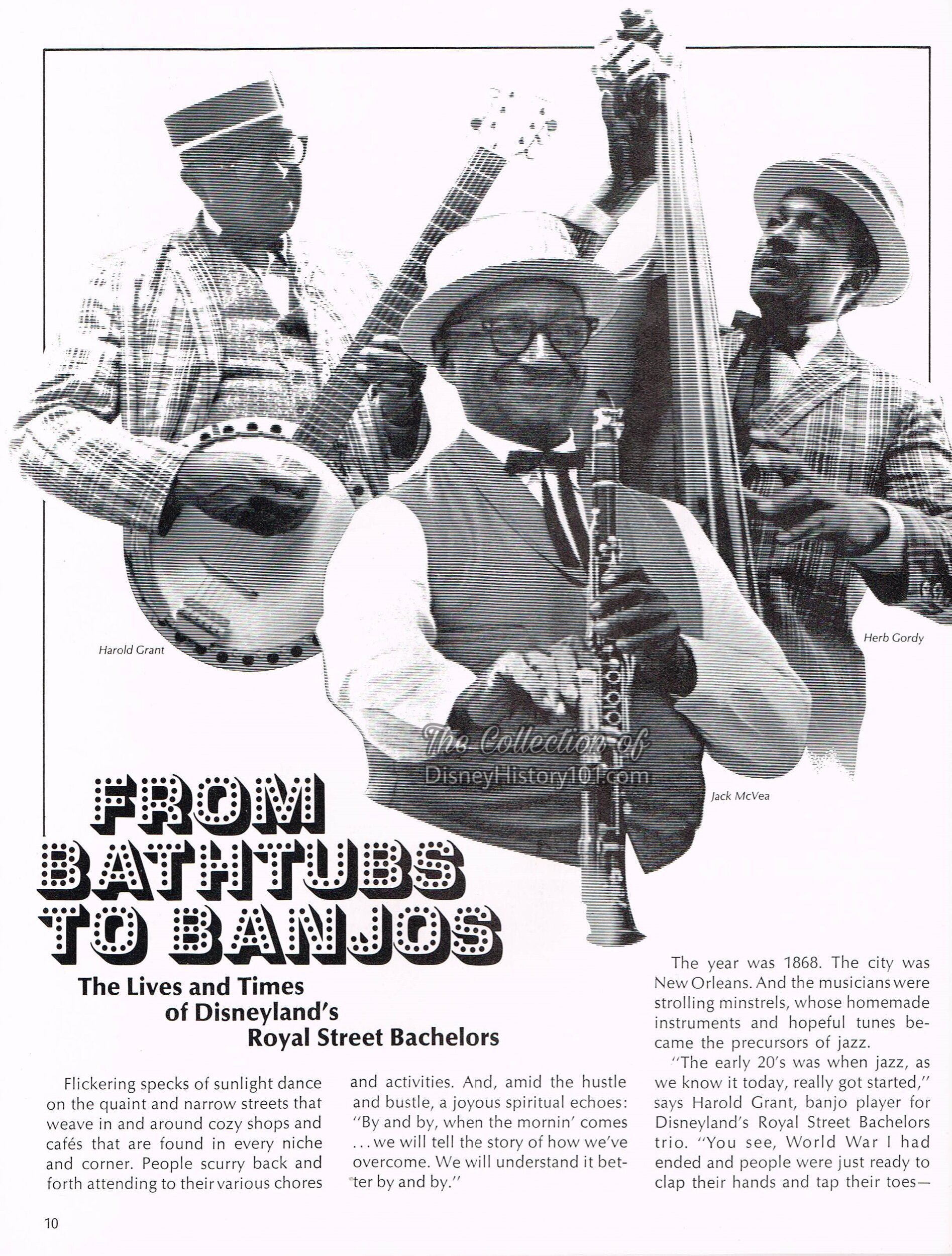
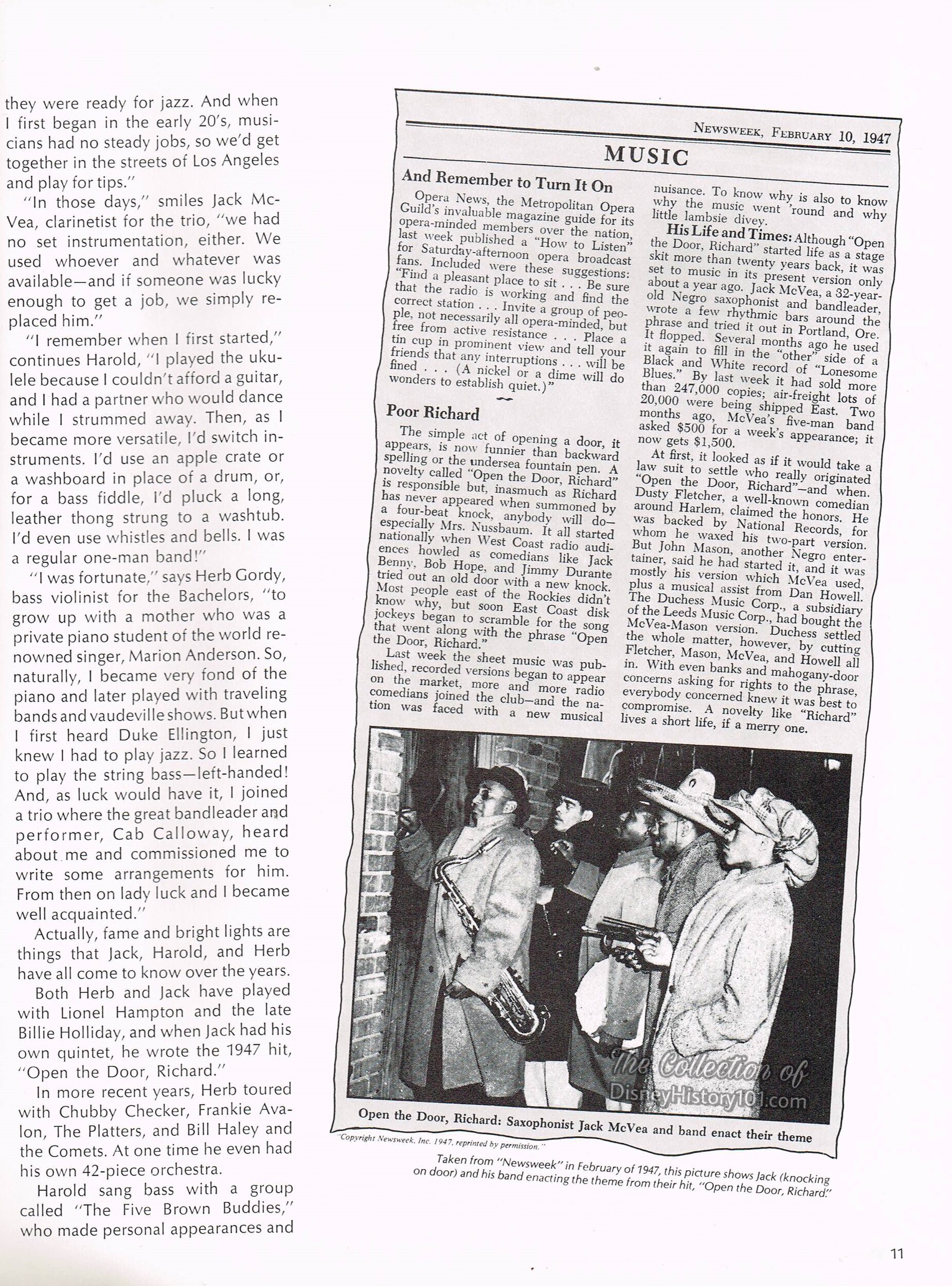
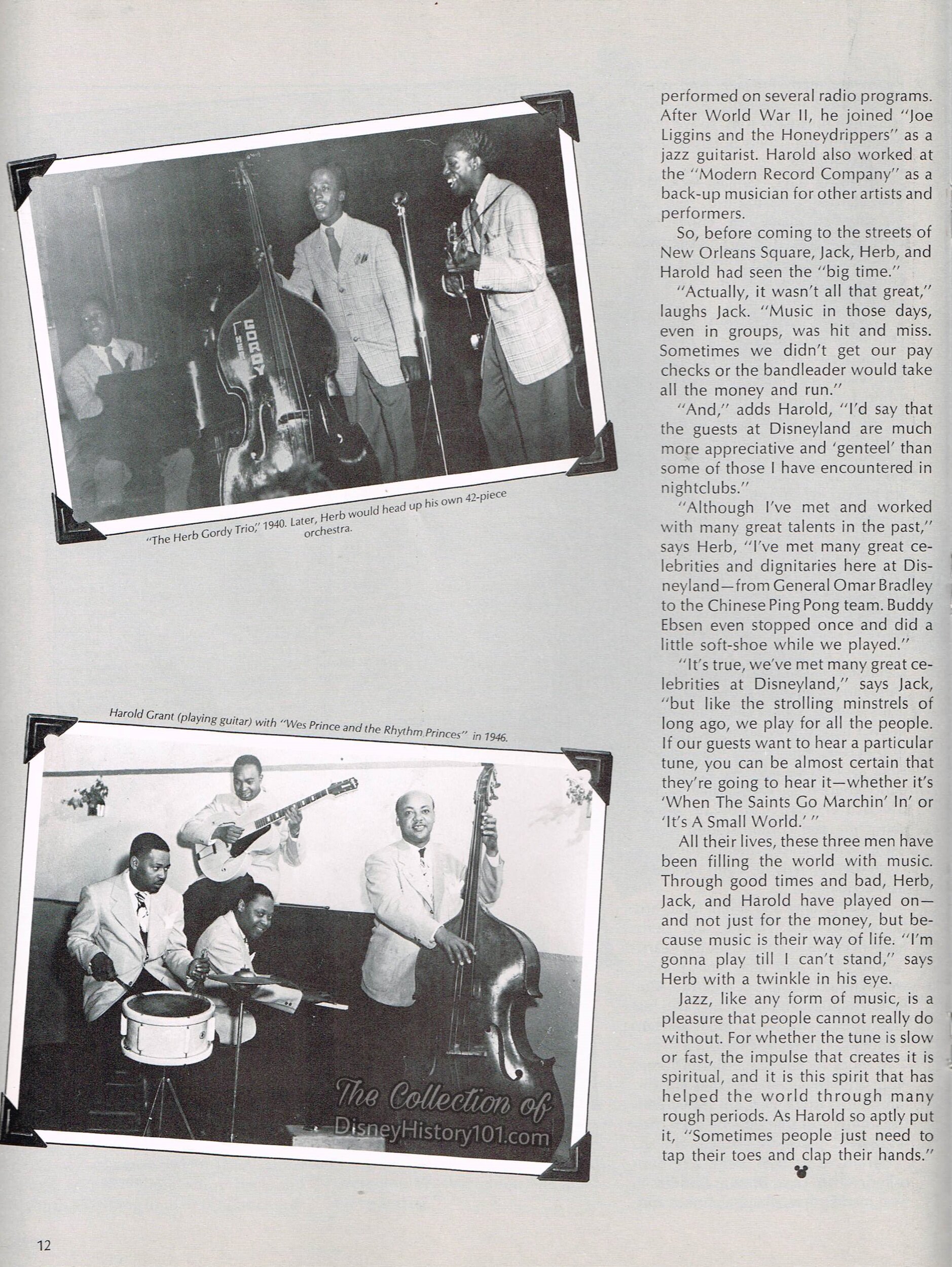
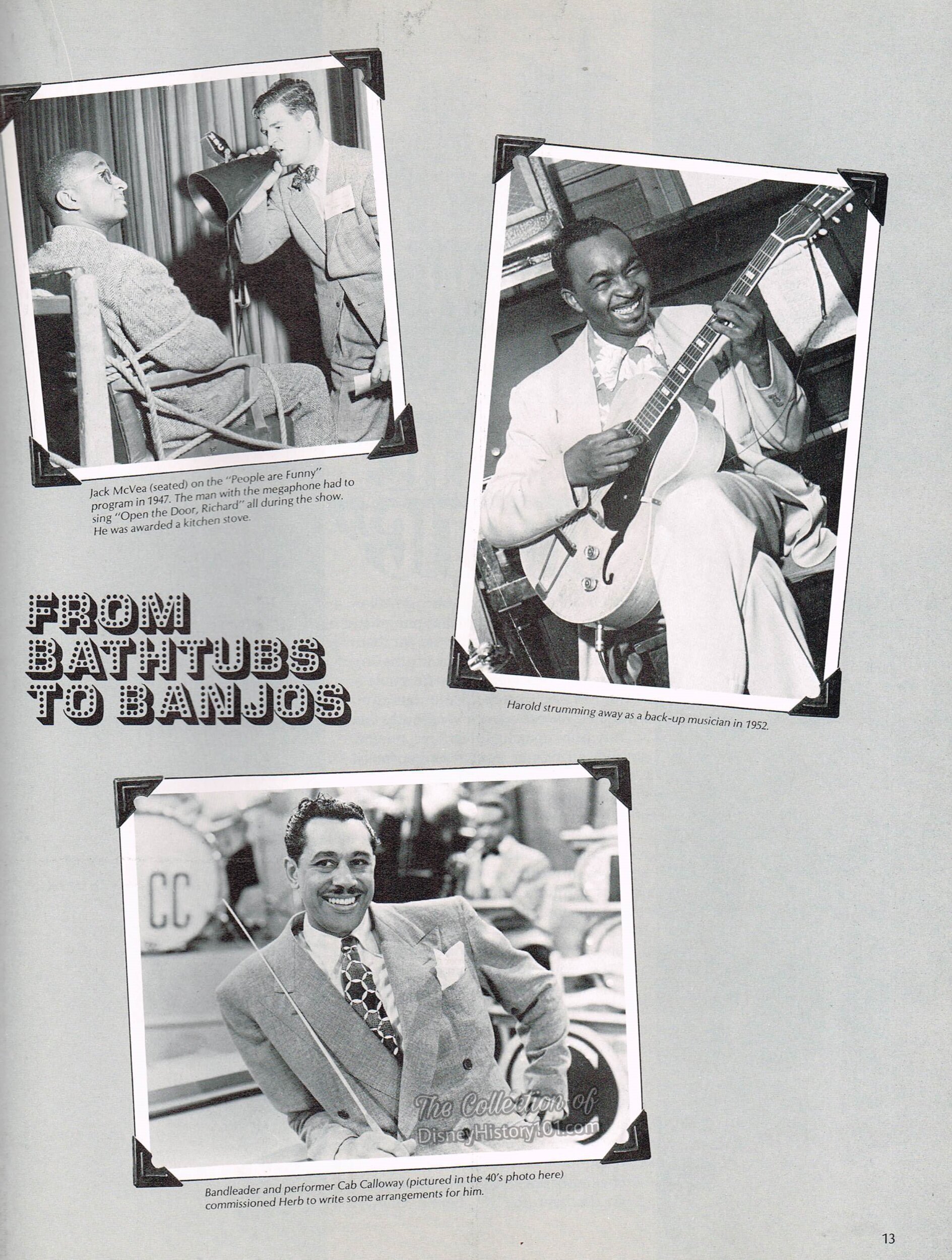
There’s another Disney connection on this page - Herb guest starred on Art Linkletter’s People Are Funny television show. If you’ve ever seen Disneyland’s opening day broadcast, then you know that Art Linkletter has been involved with Disneyland’s most momentous occasions since the beginning!
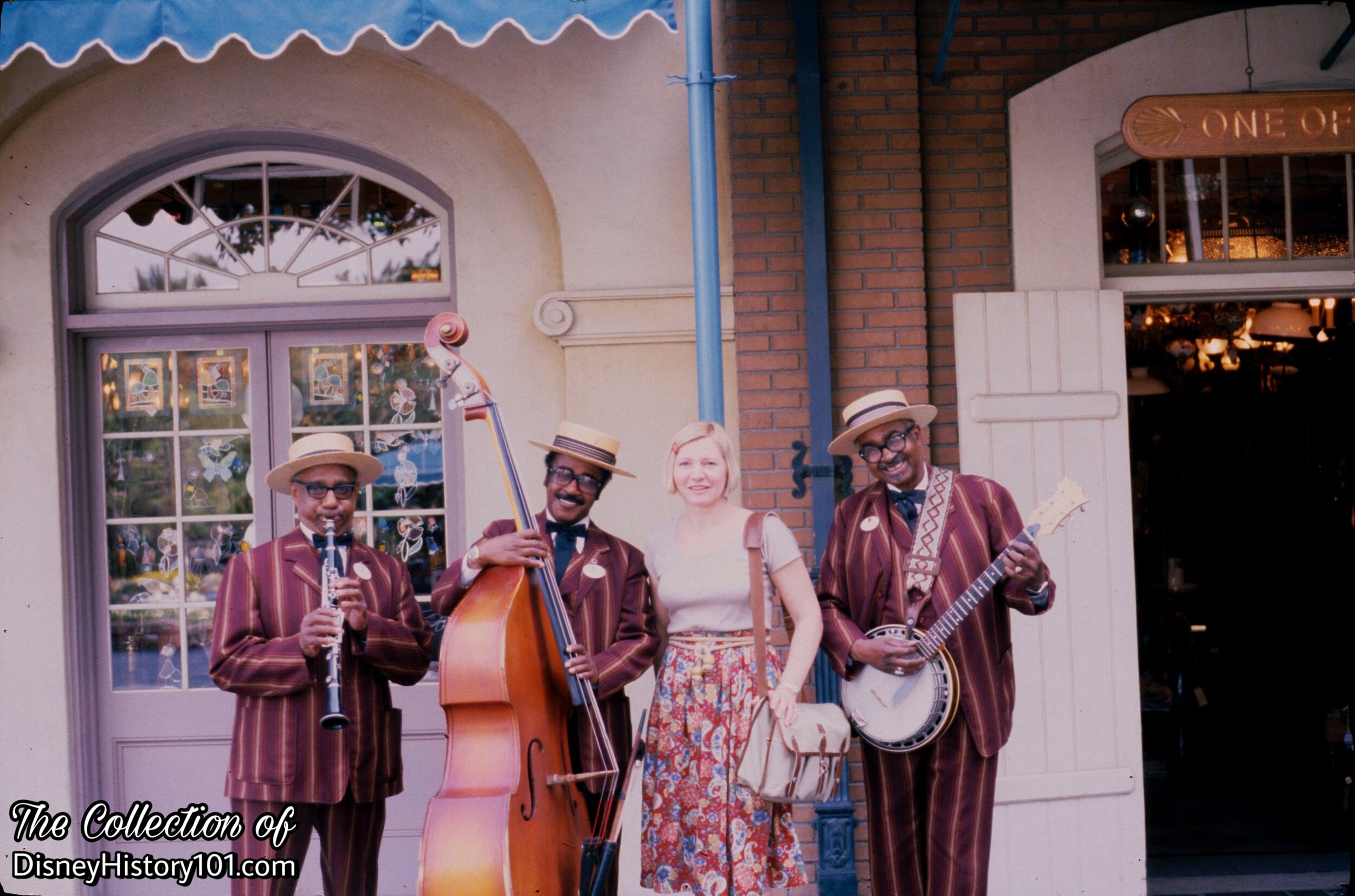
During their later years, the Royal Street Bachelors continued to welcome guests to New Orleans Square near one of their original prime locations, and Disneyland Employee Newsletters occasionally mentioned the members of the Royal Street Bachelors! The band even performed special shows for Disneyland Cast Members only, during the Family Open House of 1980.
Disneyland LINE (vol. 15, no. 25), published June 23, 1983, gave honorable mention to Jack McVea (17 years), Herb Gordy (16 years), and Harold Grant (15 years) - veteran Cast Members who possessed a “world famous Disneyland smile” that was “guaranteed to shine throughout the Park all summer long”! The accolades had not ceased three years later, when Disneyland LINE (vol.18, no. 6) of February 6th, 1986, highlighted Jack McVea’s contributions in the column “It Takes People”. The Royal Street Bachelors continued to be featured in Park media, for instance, they can be seen performing for a brief few seconds, on the c.1993-1994 VHS format “A Disneyland Day - Relive The Memories” souvenir.
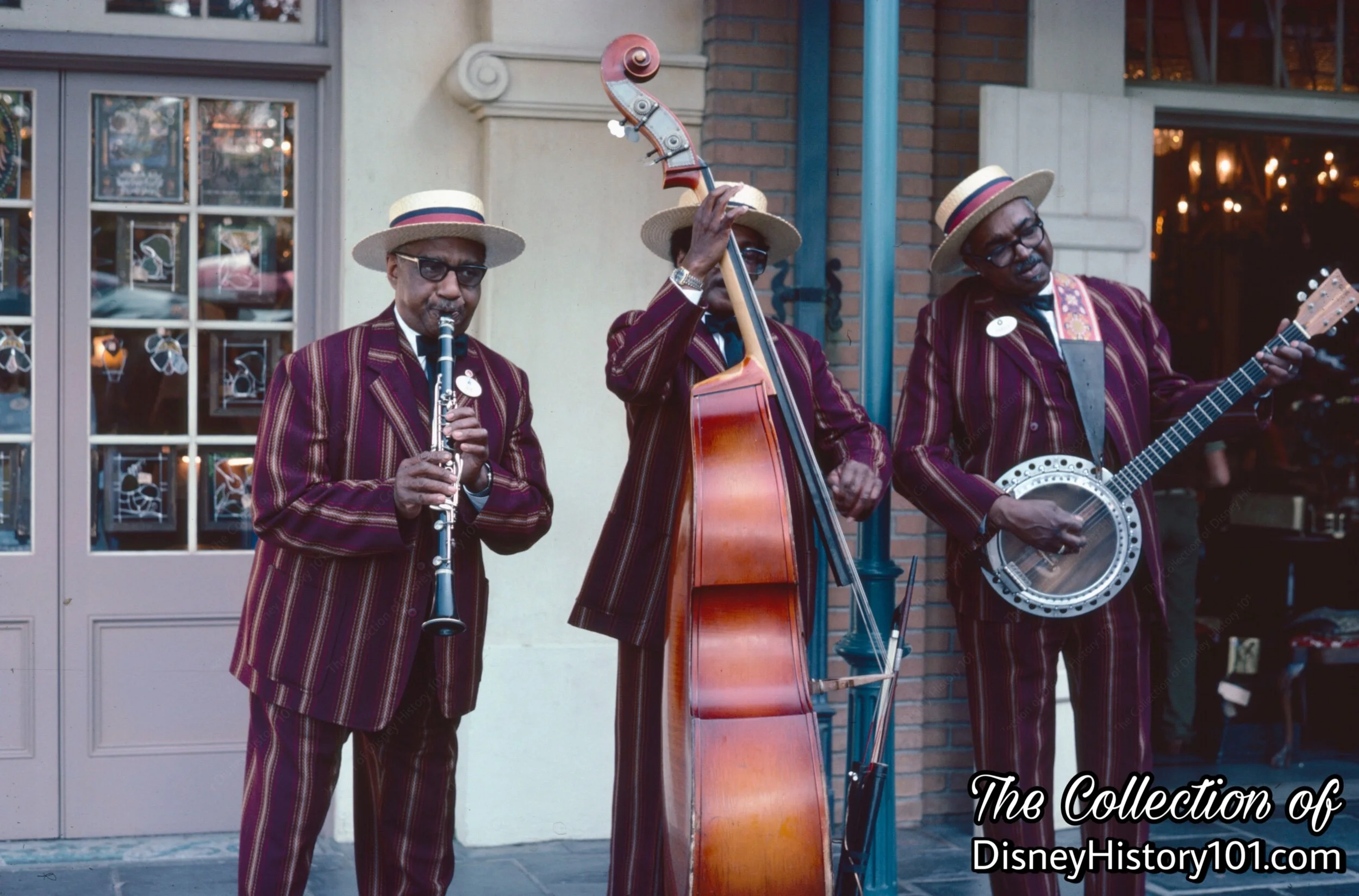
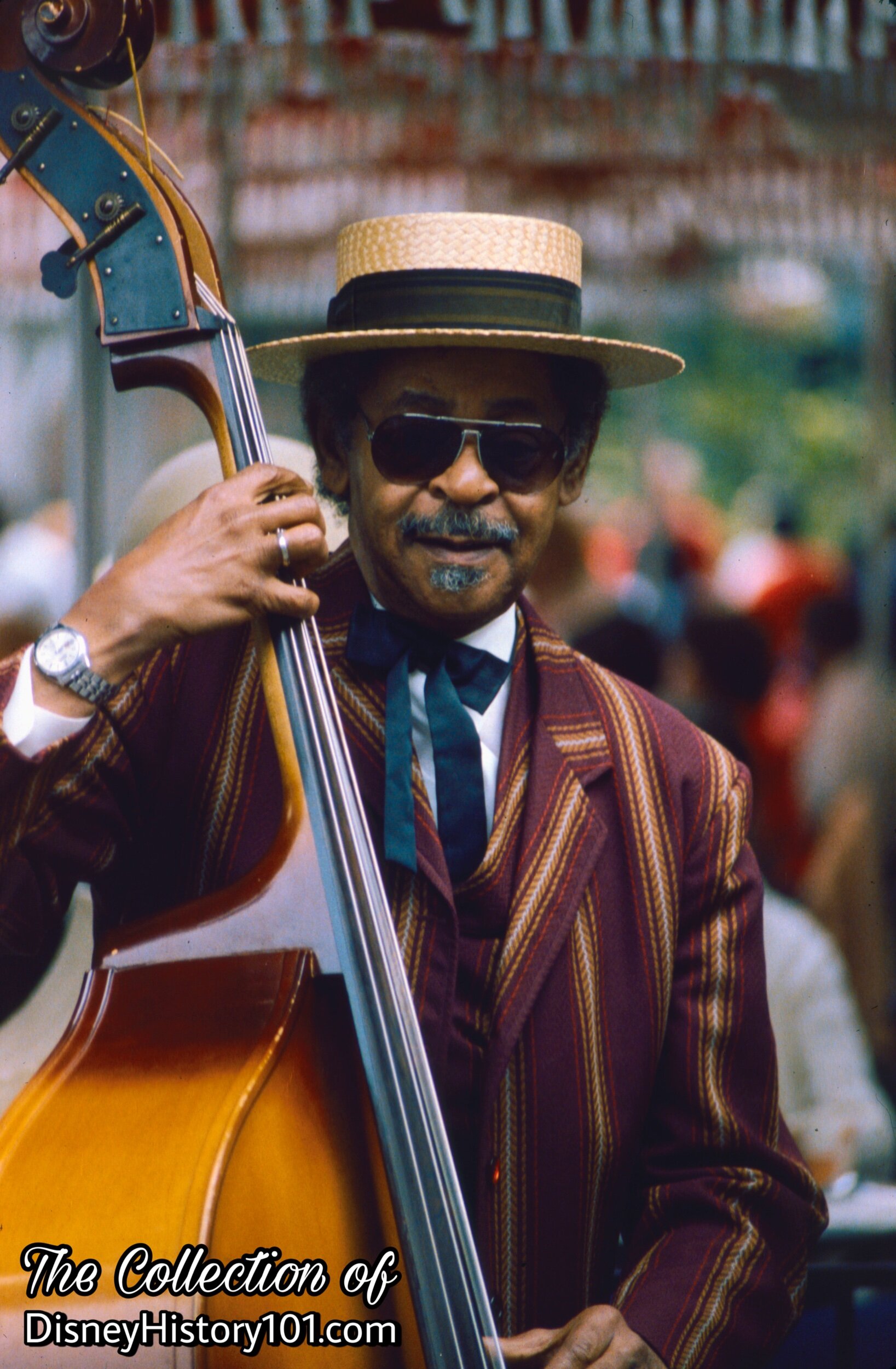
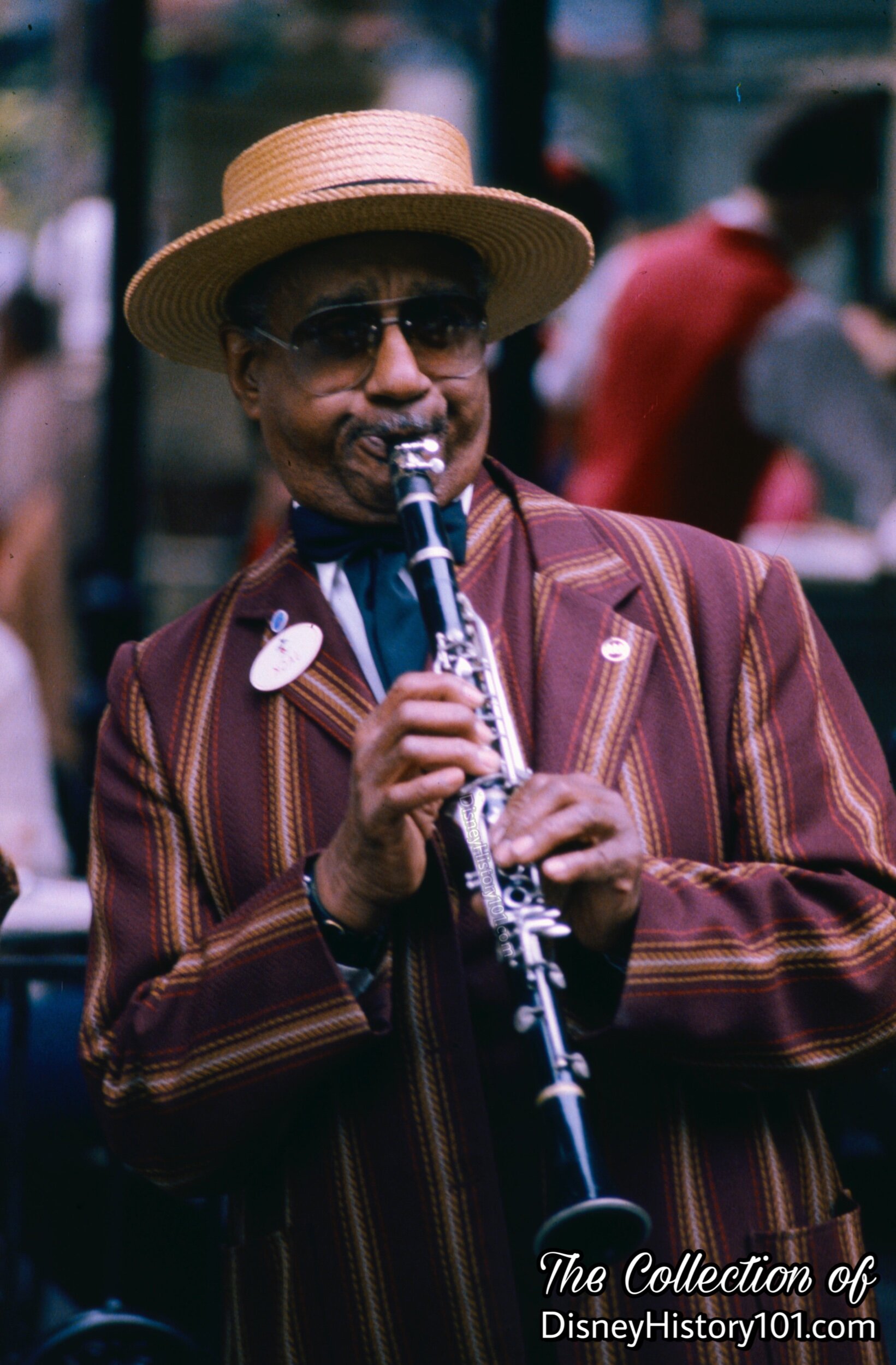
By 1986, the Royal Street Bachelors were performing between 10:30 a.m. and 5:15 p.m., Wednesday through Friday.
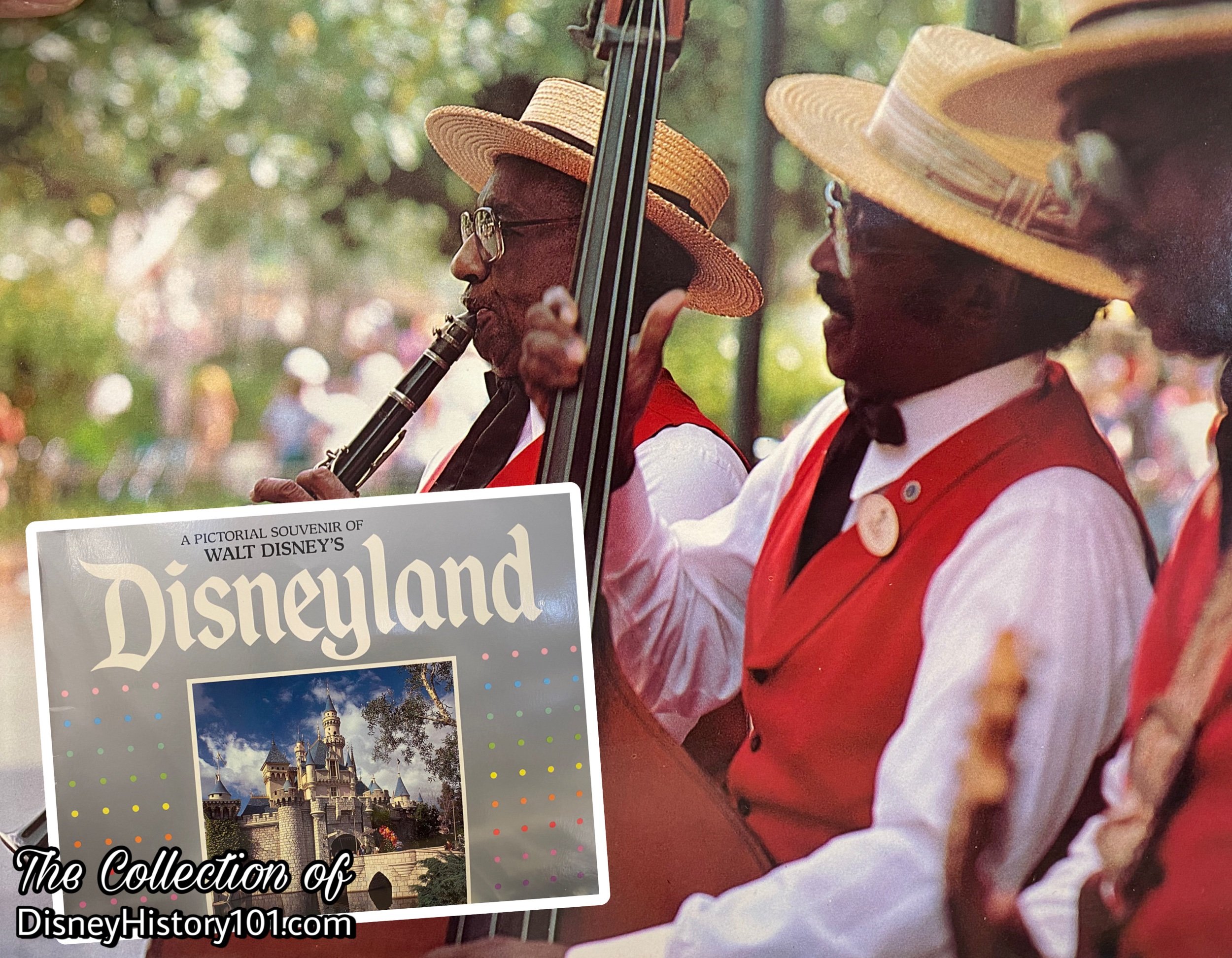
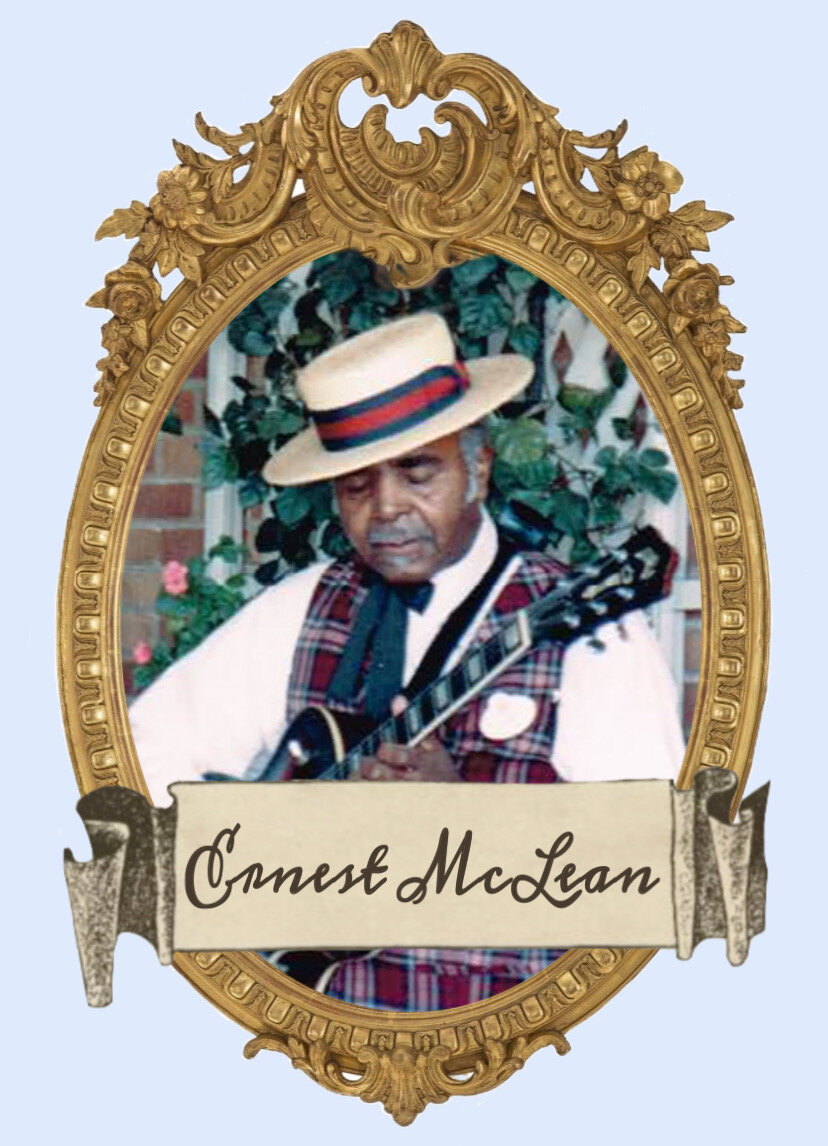
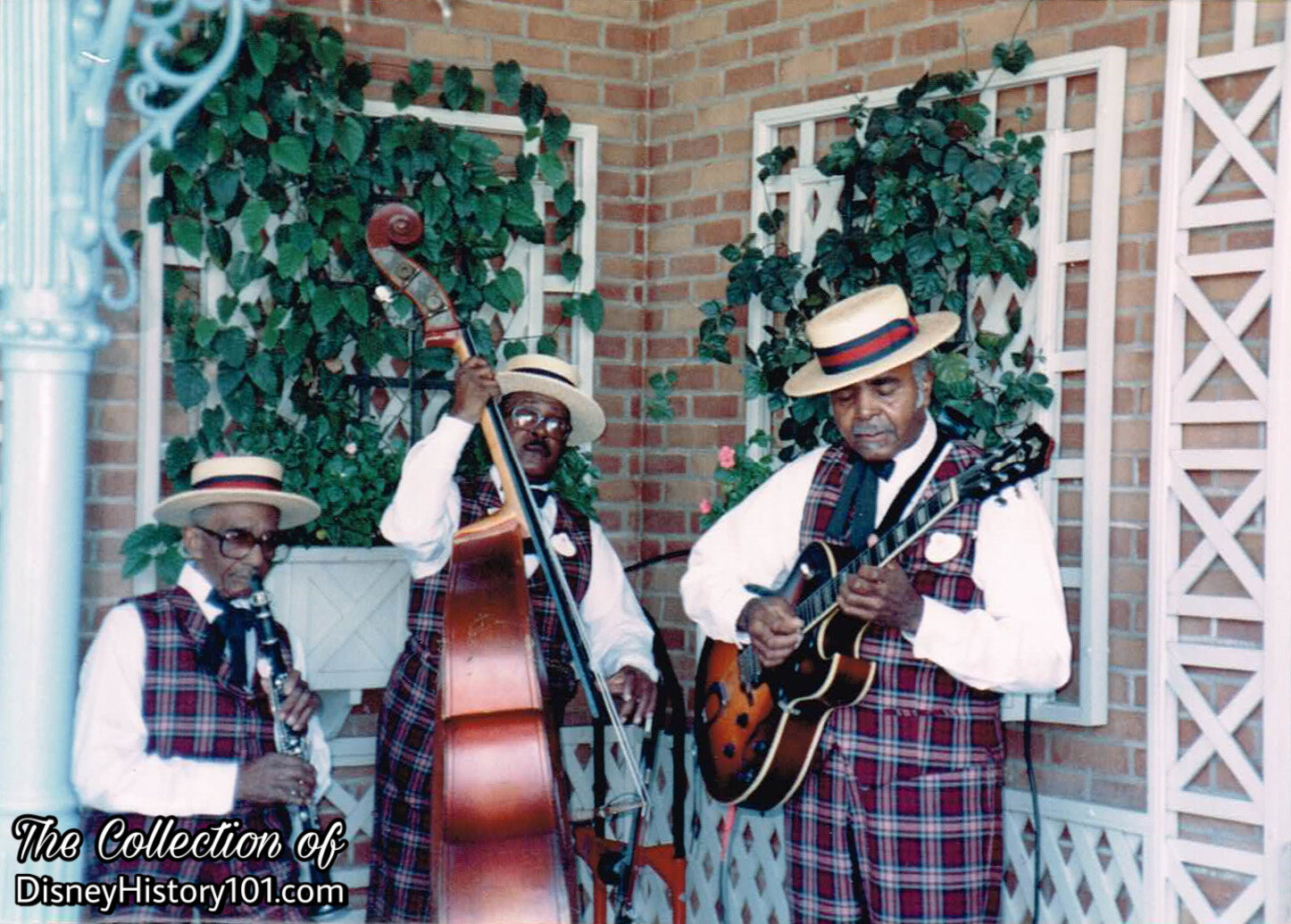
Ernest (a.k.a. “Ernie”) McLean would later substitute for Harold Grant (on banjo). In an excerpt of a Disney Parks interview (which can be read at the DisneyParks Blog HERE). Ernest recalled how he was personally called by Walt Disney, to be a part of the Royal Street Bachelors in Disneyland : “I auditioned as a guitar player for a tour. I didn’t think I was going to get the job. Then they started to talk about rehearsals and going to the studio, so I stopped them and said, ‘You haven’t offered me the job,’ and they replied, ‘Why do you think we are telling you this if you didn’t get the job?’ Once the tour ended, [Walt] Disney eventually called me to sub for the banjo player at Disneyland. That is when I became permanent at Disneyland.” When he wasn’t playing a solo (near a hidden amplifier) in one of New Orleans Square’s quiet alleys, Ernie was a Royal Street Bachelors regular on guitar and banjo. This he did for more than 30 years.
Two years after this Vintage View was captured, Jack would retire from Disneyland.
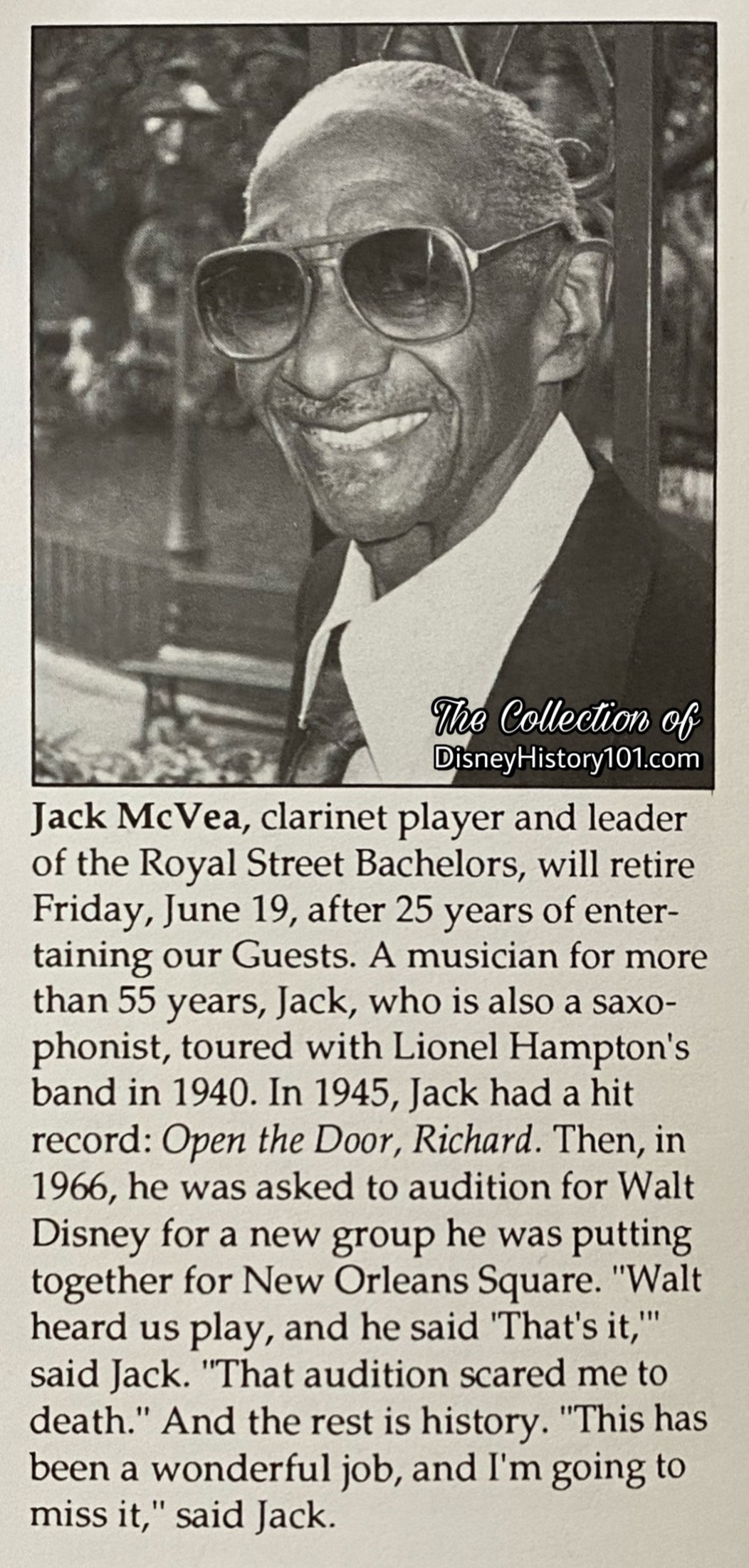
Yes, Jack McVea led his original Disneyland band - the Royal Street Bachelors - for a total of twenty-six years - from 1966, until his retirement in 1992! During that time, Jack encouraged the principles involved in a process that Walt called “Performance Excellence.” He encouraged the members of the Royal Street Bachelors to strive to excel each day in the fulfillment of their individual roles and responsibilities in an environment consistent with defined Disney behaviors. As a result, the Royal Street Bachelors were continually challenging themselves and each other to try new methods of working more effectively and efficiently. This was evident through their harmonious teamwork as they accomplishing these efforts.
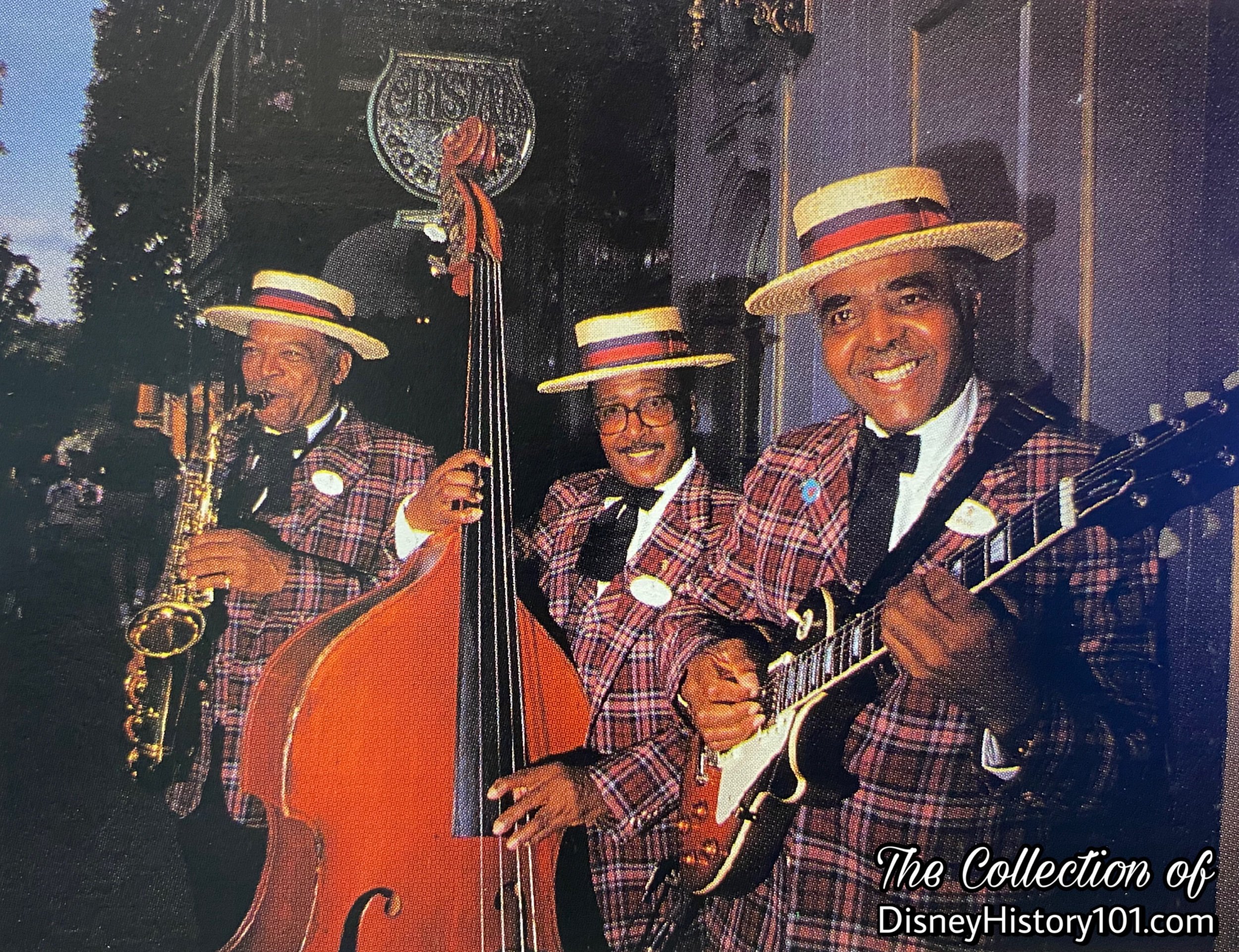
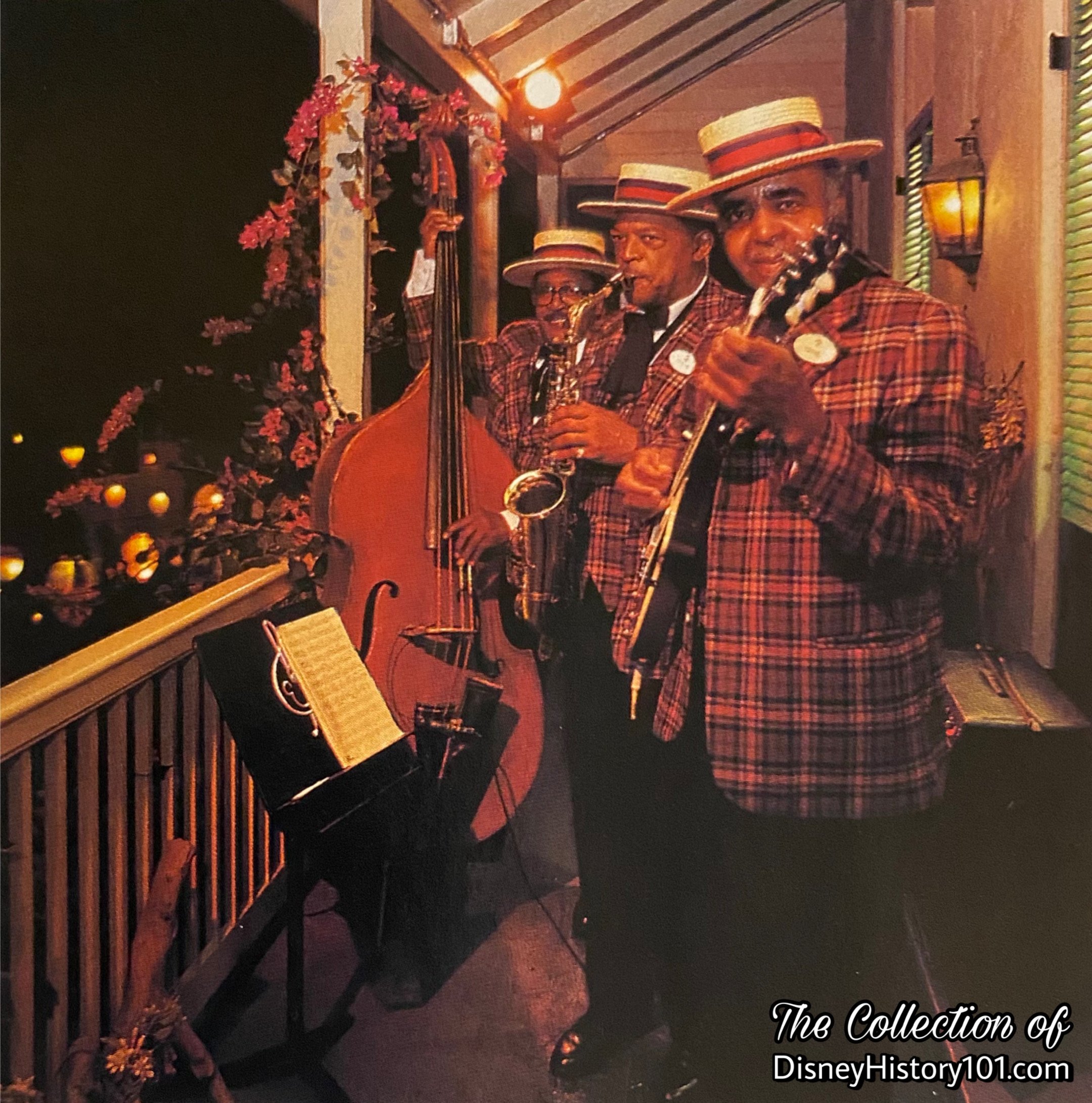
Unlike other successive bands which would appear on Disneyland’s “stage,” this trio would become immortalized as both a New Orleans Square icon and tradition (well beyond their lifetime). Their images can be seen in numerous pieces of promotional printed items (like Disneyland Souvenir Guides, and advertisements). The measure of the Royal Street Bachelors’ contributions, can be seen, felt, and heard, in the rich and living legacy which they have left behind. The presence of the Royal Street Bachelors is still certainly felt in New Orleans Square!
Though the present Royal Street Bachelors band consists of more than three members (on stage at one time), it carries on the spirit of the original band, by channeling some of the same Dixieland melodies that the original trio played. Members over the years have included Kenny Treseder (saxophone), Terry Evens (guitar), Jefferey Littleton (bass), and many others. Instead of performing in various locations along Royal Street, the Royal Street Bachelors now generally perform from the French Market Restaurant Stage. The present showtimes occur occasionally in the morning, around noon, and generally hourly after that, until around 5p.m.

During 1991, Imagineer John Horny immortalized “The Royal Street Bachelors” in a painting that would be released as a limited lithographic print thru The Disney Gallery. One of the prints hung in the original foyer stairway of Club 33 at Disneyland for a number of years. An associated plaque read : “John Horny captures the true spirit of ‘the birthplace of jazz’ in his painting of the Royal Street Bachelors - Jack, Herb, and Ernest performing in New Orleans Square as they have since the land debuted in 1966.” The homage likely had the approval of the current members, who autographed an original print (which was auctioned through Van Eaton Galleries many years later). A print currently resides in the foyer of Disneyland’s redesigned Club 33.
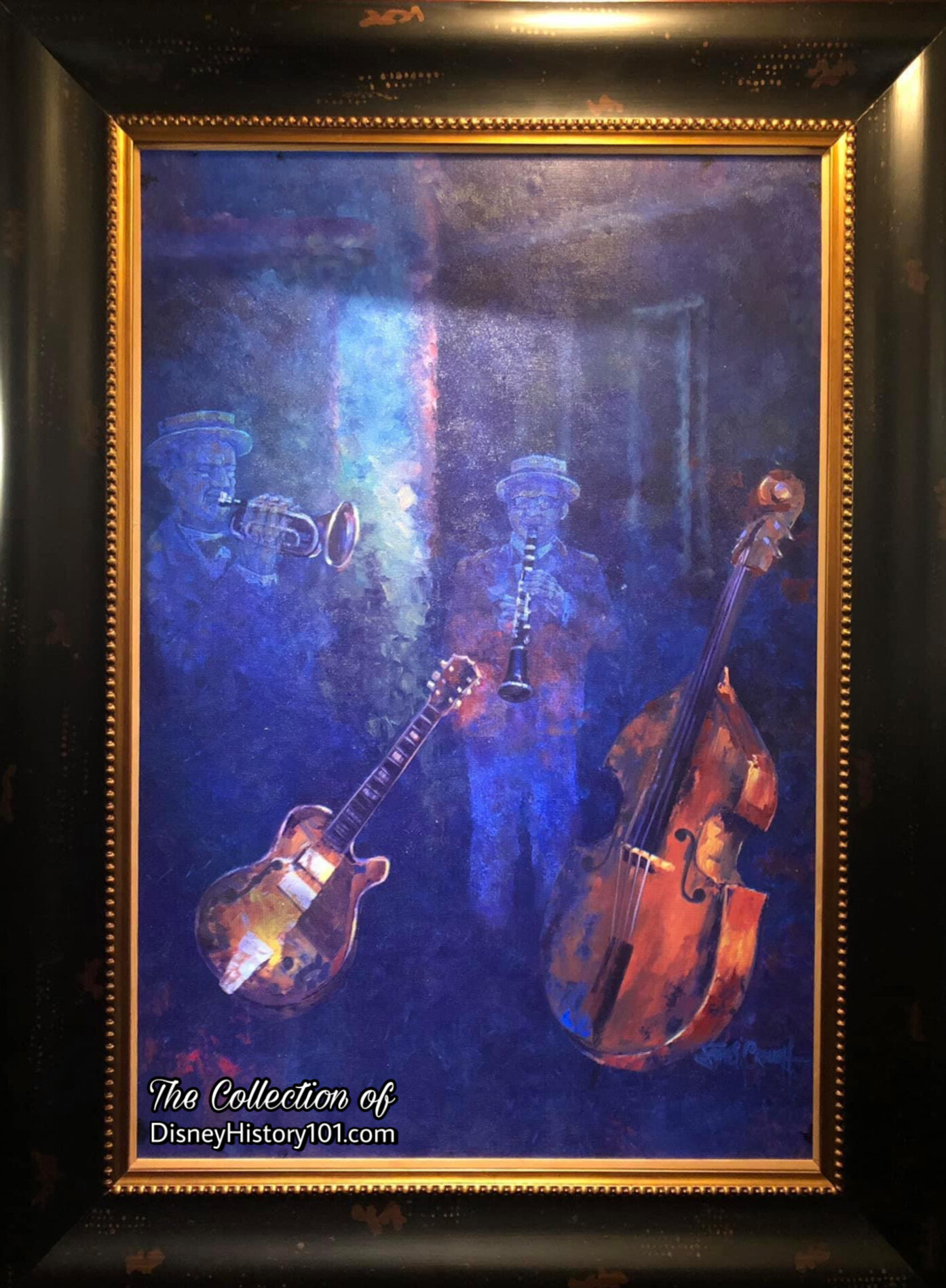
The Royal Street Bachelors also inspired another iconic New Orleans Square attraction which is unseen by most Disneyland guests (but must be seen to be believed) - an animated painting, which hangs in the Members-Only Lounge of the new Club 33! At intervals, members of the trio (plus one Strawhatters member) will “disappear” to “play” a solo or a duet. The wall mounted instrument animates and seems to play by itself. Once silenced, the Royal Street Bachelors member reappears yet again in the painting. Designers of this Club 33 Members Only Lounge went to great lengths to make sure that the feel and tone of the accompanying music honor the memory of the original Royal Street Bachelors!
SPACE BAR

Get ready to “dine at Disneyland” like never before - enjoying “Tomorrow’s food service today!” A long time ago…before General Electric’s Carousel of Progress…before Innoventions…and (definitely) long before Star Wars Launch Bay…was Tomorrowland’s “Stratosnak” Space Bar!
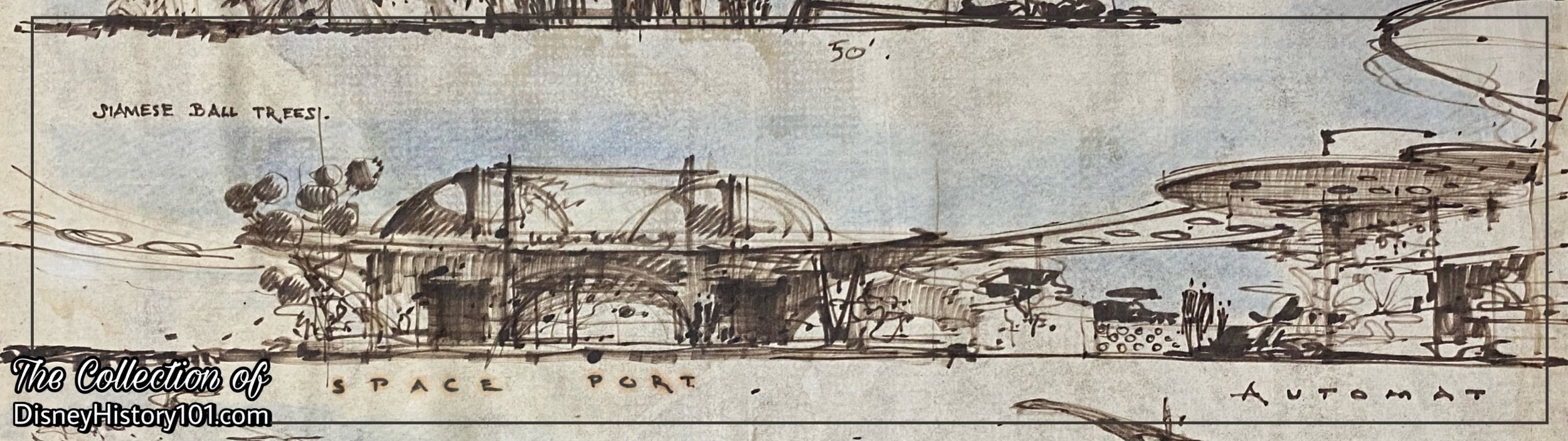
According to “THE DISNEY THEME SHOW - an introduction to the art of Disney outdoor entertainment: Volume II”: Of all the guests’ senses that come into play at Disneyland, the most difficult response to predict was taste. If 70,000 guests were to arrive on a single day, there would probably be 70,000 different ideas about food. Generally speaking, Disneyland food locations fall into three categories - sit-down restaurant service, “buffeteria,” and fast-food categories. The most extensive theming has always been found in the sit-down restaurant locations but all locations were housed in authentically motified facilities.
The Space Bar was to be the first West Coast version of the automat (a common type of dining experience in New York during the 50s and 60s), with a catch - guests would dine in the futuristic year of 1986. Both Herb Ryman and Gabriel Scognamillo created many concepts (rough layouts, elevations, and artistic drawings) which contributed to the final design of the “futuristic” automat. [Some of these designs were refined and published later on July 15, 1955, as a supplement for the “Register” of Santa Ana, California.]
Meanwhile (in 1954), Walt was searching for participants to lease shop and restaurant spaces at Disneyland, and help generate the necessary capital to fund construction of Disneyland. In a synergistic relationship, the companies (in turn) could sell their products and advertise their corporate names in the Park. Several “reliable old firms” sponsored the “abundance of restaurants devoted to pleasing all tastes and all budgets,” according to “The Story of Disneyland”, published 1955. “55er” Rima Bruce (who started with Jim D'Arcy in Food when all food was Lessee and typed memos and menus) recalled that “the phone never stopped ringing with everybody trying to get a food lease in the Park.“
By October 195, 34.48% of Disneyland Inc. stock was owned by American Broadcasting-Paramount Theatres, Inc.
By July of 1954, Raul Grizante of Disneyland, Inc. was overseeing food philosophy, area & location, food specialties, and beverages for Disneyland. This colorful quick service pavilion would be both partially designed and operated by UPT Concessions Inc. a subsidiary of American Broadcasting-Paramount Theaters Inc. Food service equipment was provided by Coast Distributing Company of Los Angeles (who ran a “Congratulations” message to Walt Disney and Staff in “The Disneyland News,” Vol. 1, No.2 ; August 10, 1955). “55er” Marion Schawacha recalled: “one day I put in an application and I saw Chet Miller with the U.P.T. We were taken around the property, climbing over piles of lumber, as projects were pointed out. On the first of June, I went to the Space Bar, doing everything… stocking the shelves and getting set up for hamburgers. chicken pot pies, tuna burgers, chili beans.”

The Space Bar structure was a one-story cafe comprising 2,779 square-feet. The Space Bar was of stucco and cemesto board on steel frame composition, built atop a concrete foundation and slab. The entire plywood interior structure was covered by a flat composition roof, with a formed steel canopy covering the concrete and terazzo floors. The Space Bar also had three restrooms (containing 19 fixtures) and was connected to the 1,760 square-foot Skyway Station. Altogether, the Space Bar was valued between $63,100 and $65,900.
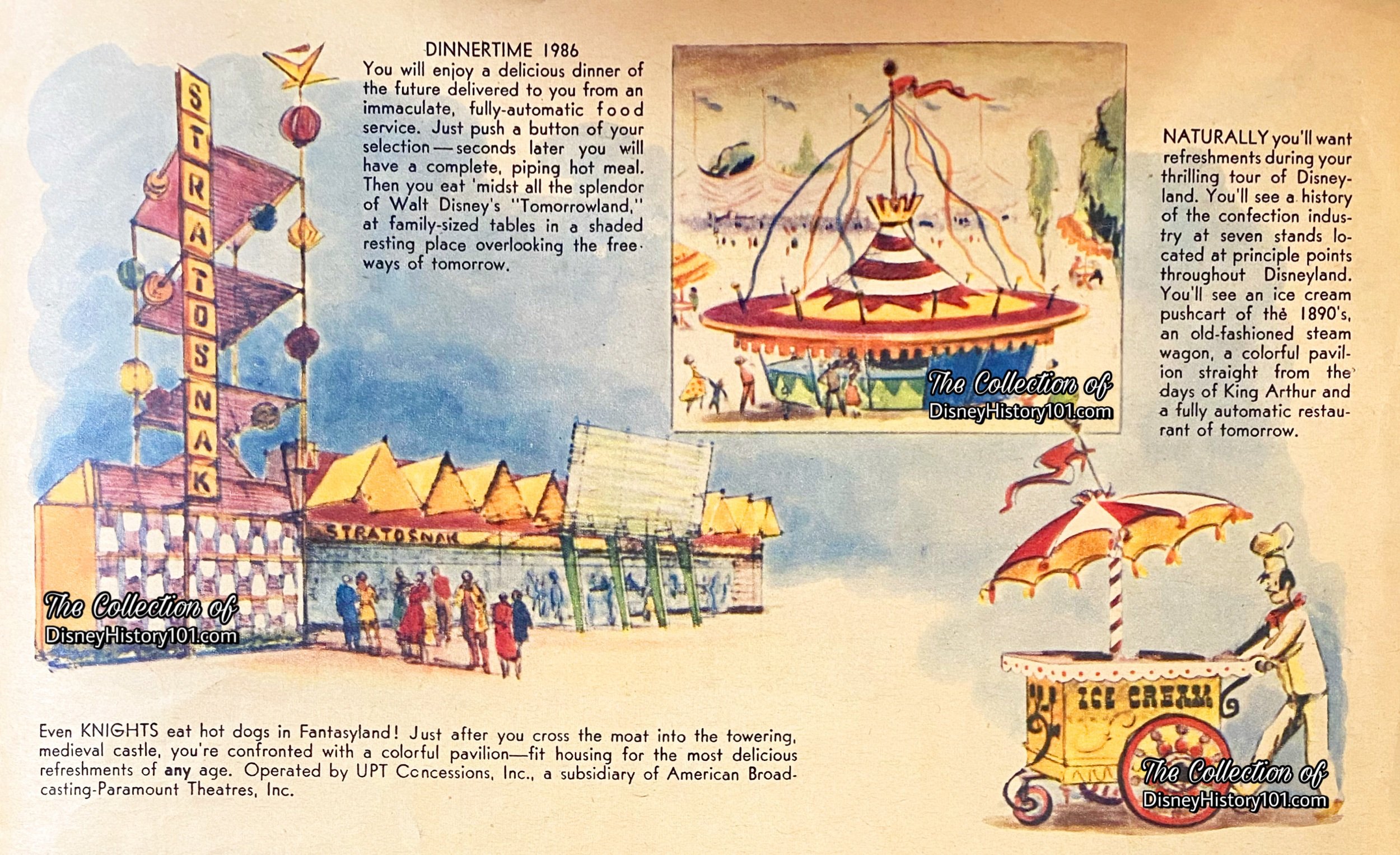
Some of these viable project Concepts (as seen above), were supported by a well-developed business case and built expectation.
Disneyland, Inc. continued to team with the Participant sponsor to develop the attraction. As late as May 25, 1955, “ABC’s Automat type restaurant… was [sic] changed from Autosnak to Stratosnak,” according to one official and authorized “Disneyland Information & Nomenclature List” (prepared by Bill Cottrell of Disneyland Inc., by May 25, 1955). It was estimated that the Stratosnak Space Bar would have the capacity to serve 800 guests per hour. With that, the Space Bar would become one of Disneyland’s eating facilities which was predicted to contribute to accommodating “15,000 persons daily, hitting a peak of 60,000 on holidays and week-ends…” and one of “twenty restaurants and snack bars, capable of saving 8,000 hourly,” at least according to “Building A Dream” (prepared by the Disneyland, Inc. Public Relations Department).
As of June 2, 1955, C.V. Wood Jr. sent an Inter-Office Memorandum to Walt Disney regarding the best estimates that could be obtained at the time regarding the completion status of individual sections of the Park and Opening Day. C.V. wrote: “Stratosnack: Will be completed.”
“55er” Dean Penlick was a Chef Manager in a very successful Beverly Hills Restaurant when it was purchased by the American Broadcasting Company. Then UPT was the Lessee for all fast foods in Disneyland, and brought Dean to Disneyland as a food consultant.
“55er” Marion Schawacha recalled opening day: “The waiting lines were all mixed up and criss-crossing each other. The line from Autopia would end up at the Space Bar, and vice versa. All you could see in Tomorrowland was PEOPLE!”Beginning in July of 1955, a variety of food and refreshments were available! Guests could order soft drinks (Root Beer, Coca-Cola, Pepsi-Cola, and Orange Drink), salads, sandwiches (hamburgers, hot dogs), desert (pastry and pie), Coffee and candy. Carnation Farms would also serve this and 14 other wholesale customers who operated restaurants and snack bars in Disneyland.
Dean Penlick recalled: “I was working in Tomorrowland at a food facility that was an automat. It was all vending machines. This operation would take in many thousands of dollars a day in coin… but we were too busy to count the coins. So we worked up a formula where we weighed the coins and used that weight as a basis for our deposits.”
A few Disneylanders fulfilled a starting role at the Space Bar, like Terry Carnes.
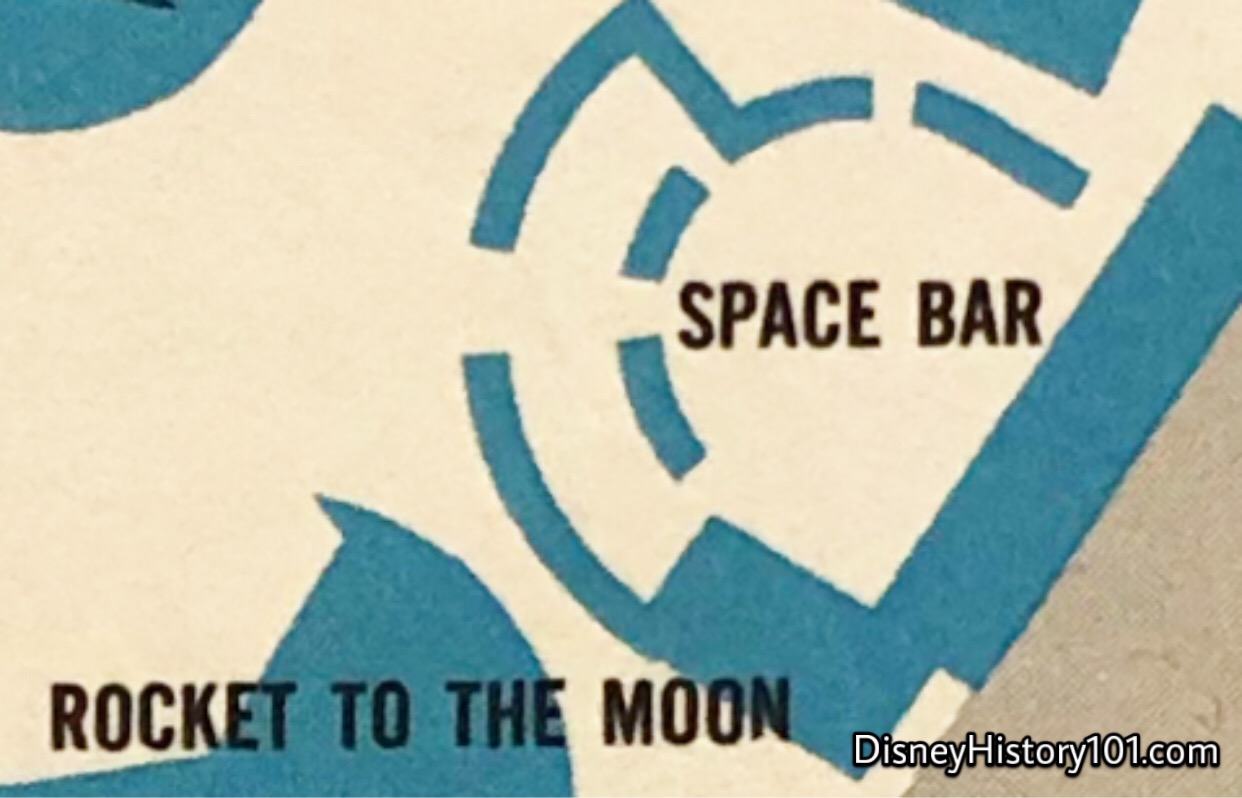
Guests selected these items from immaculate, fully-automated vending machines, and placed them on their trays, before making their way toward the Patio Seating area. The Space Bar Patio Seating Area was located in a rather central location - providing a great view of several attractions, like the busy Tomorrowland Autopia race track and (later) the Skyway cabins ascending from the Tomorrowland Skyway Station! This early Disneyland Map excerpt (though rather simple) gives an idea of what the Space Bar Patio’s table arrangement under the Space Bar awning looked like.
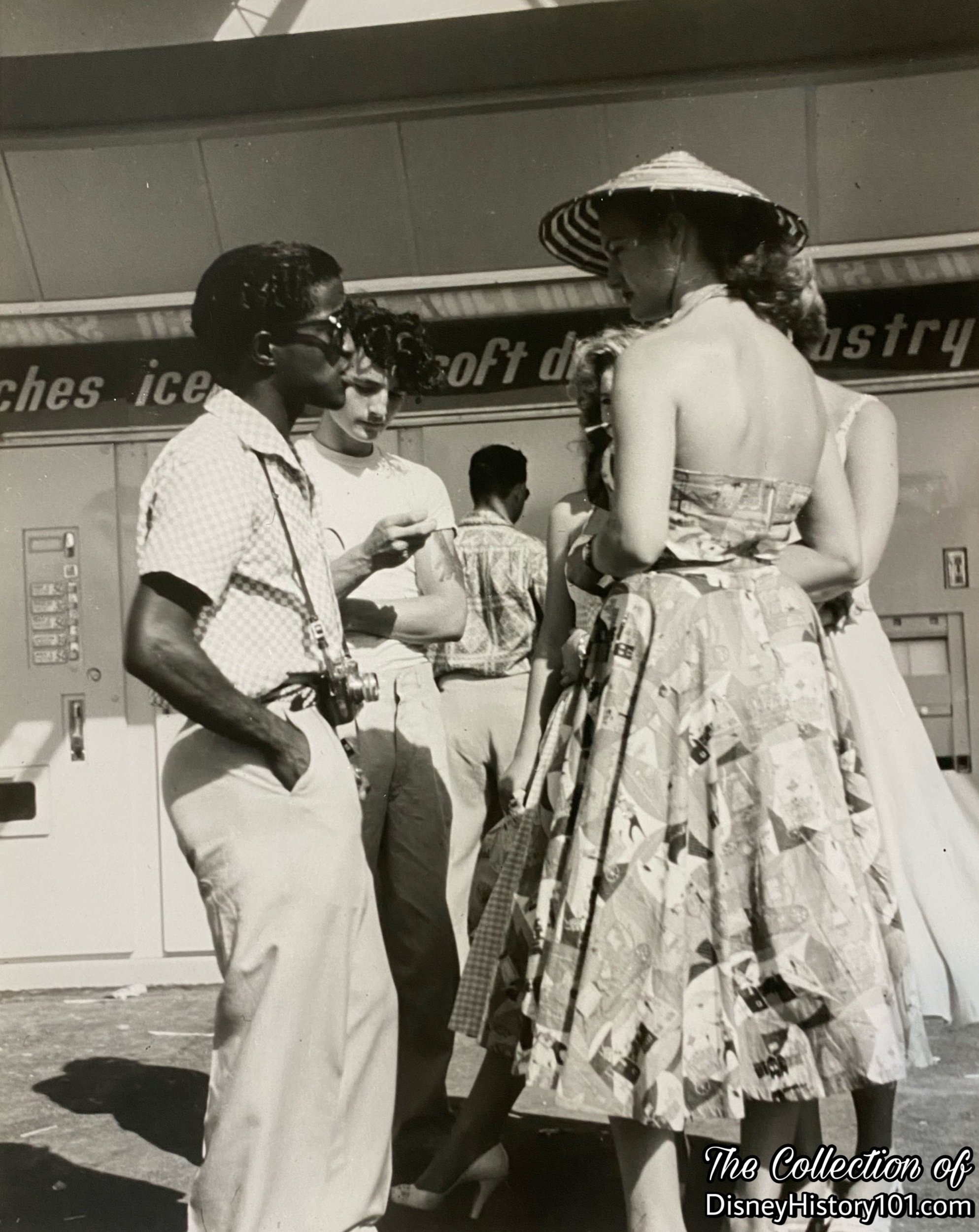
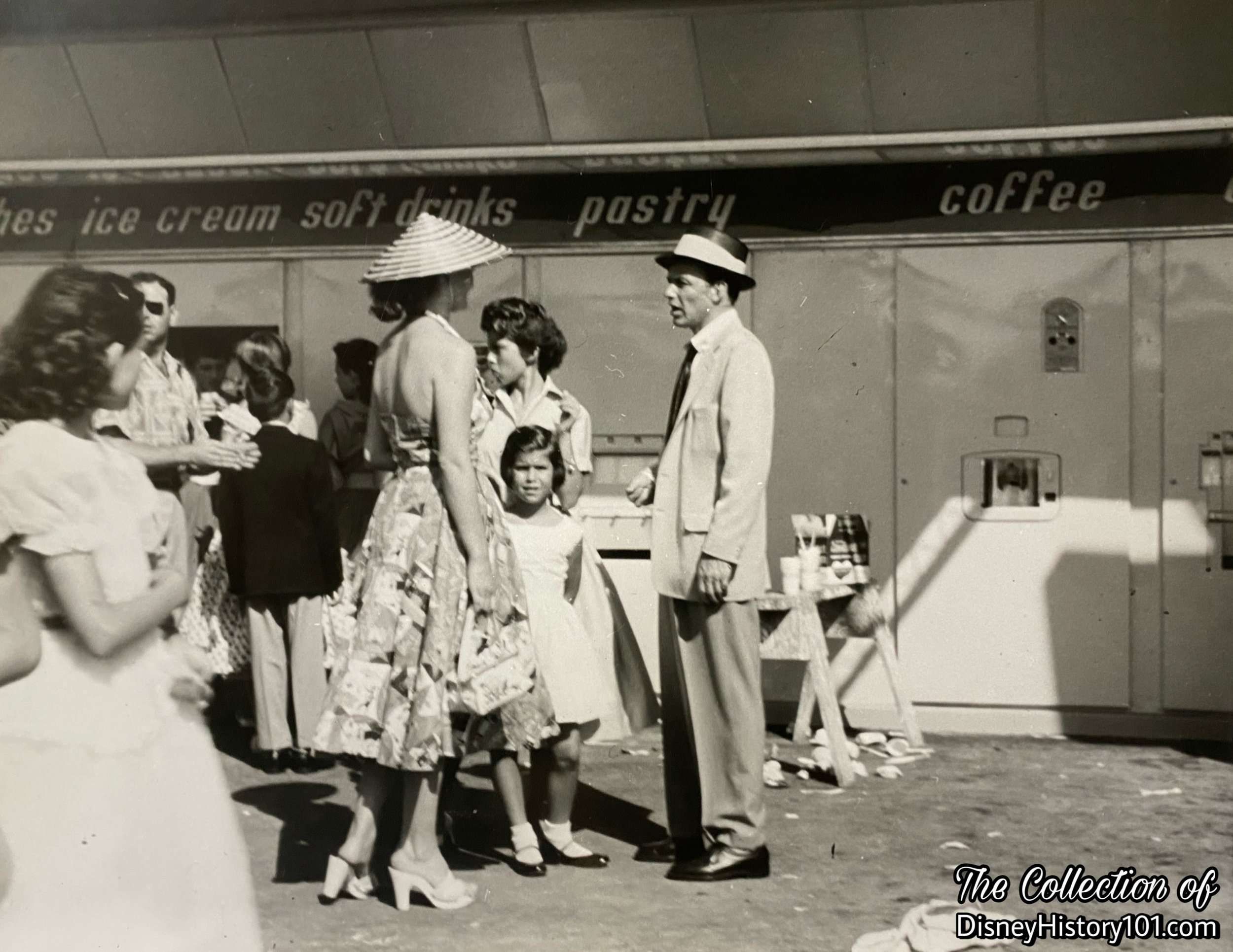
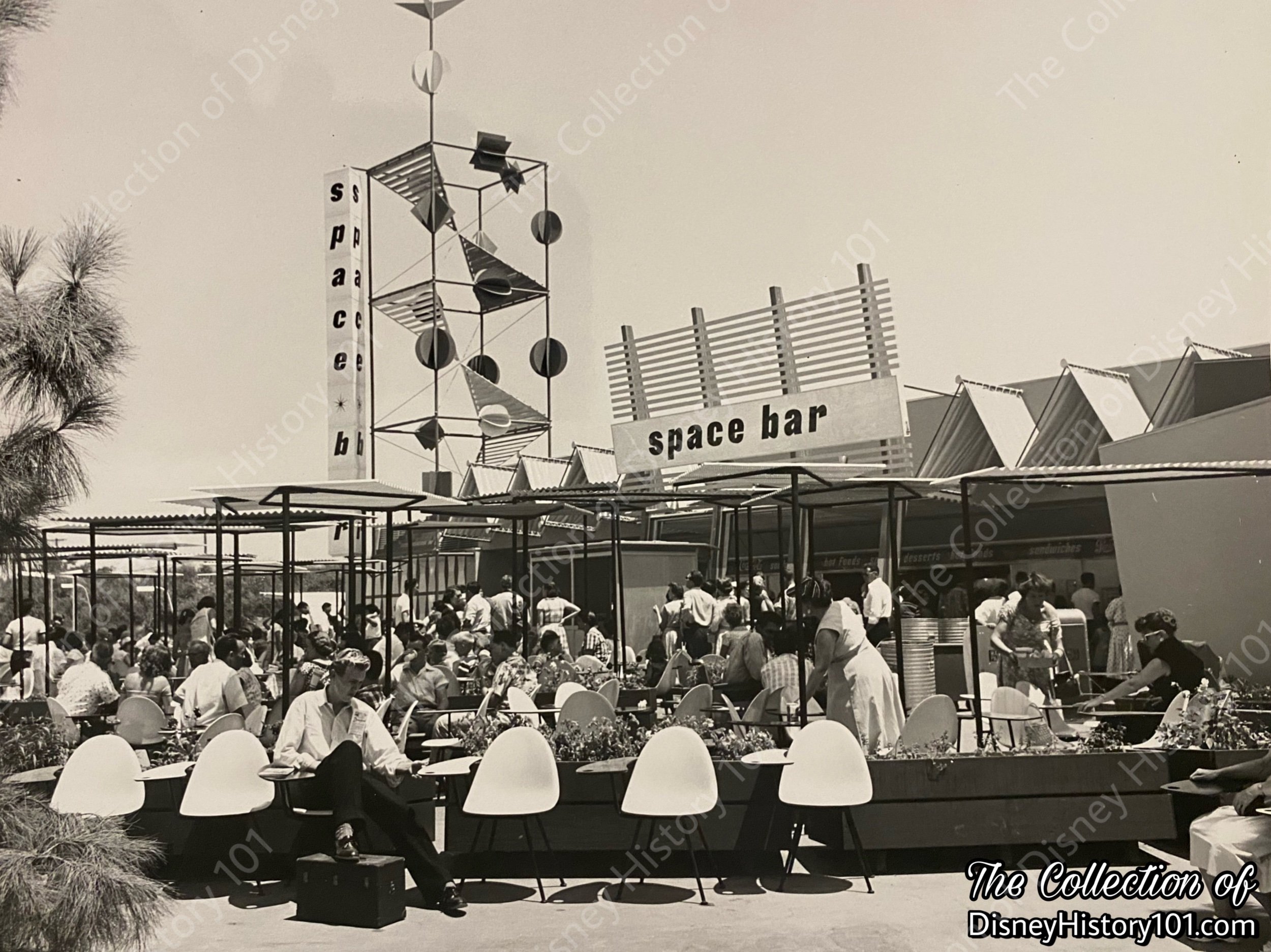
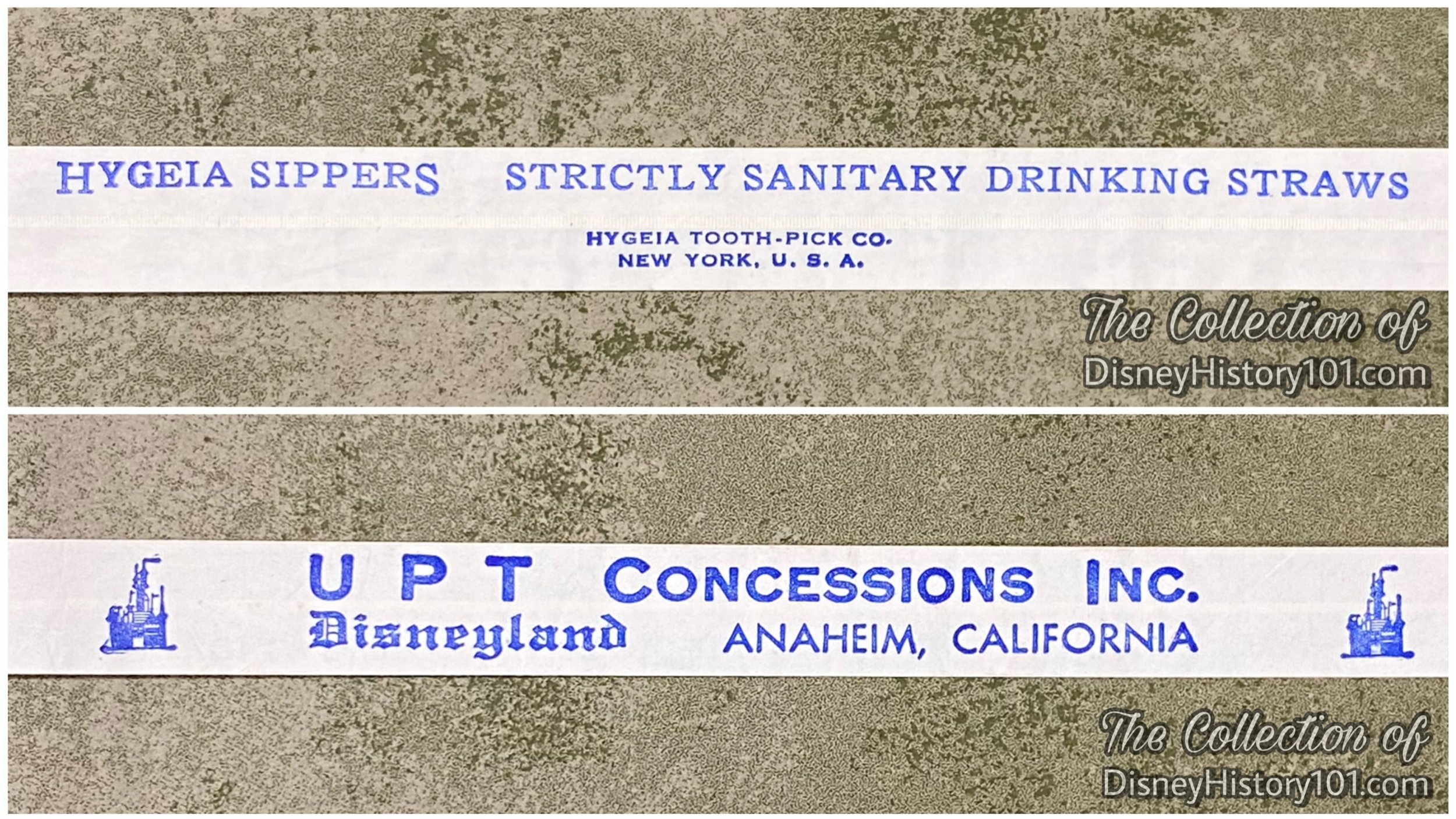
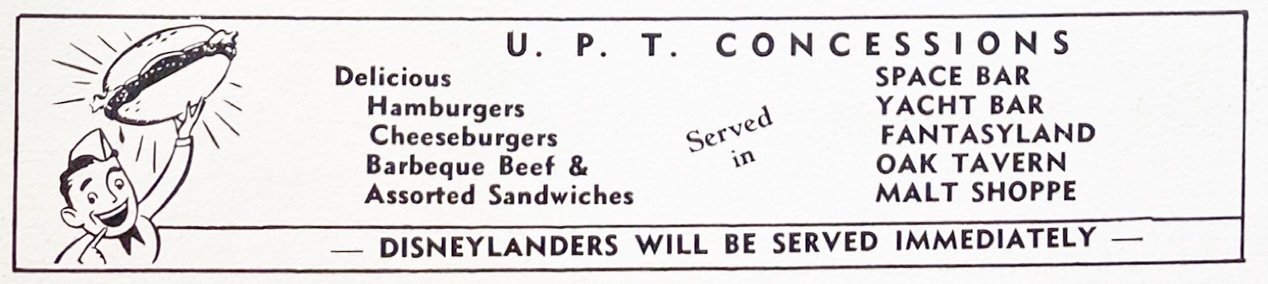
The Space Bar was operated by U.P.T. Concessions with a scope of sales on snacks and soft drinks for VIPs and Disneylanders. Marion Schawacha recalled: “Walt was a fantastic man...he had great pride in the place. He liked popcorn and he liked hot dogs and he would always PAY for his food! Instead of taking his guests to a fine restaurant, he would bring them to the SPACE BAR!”
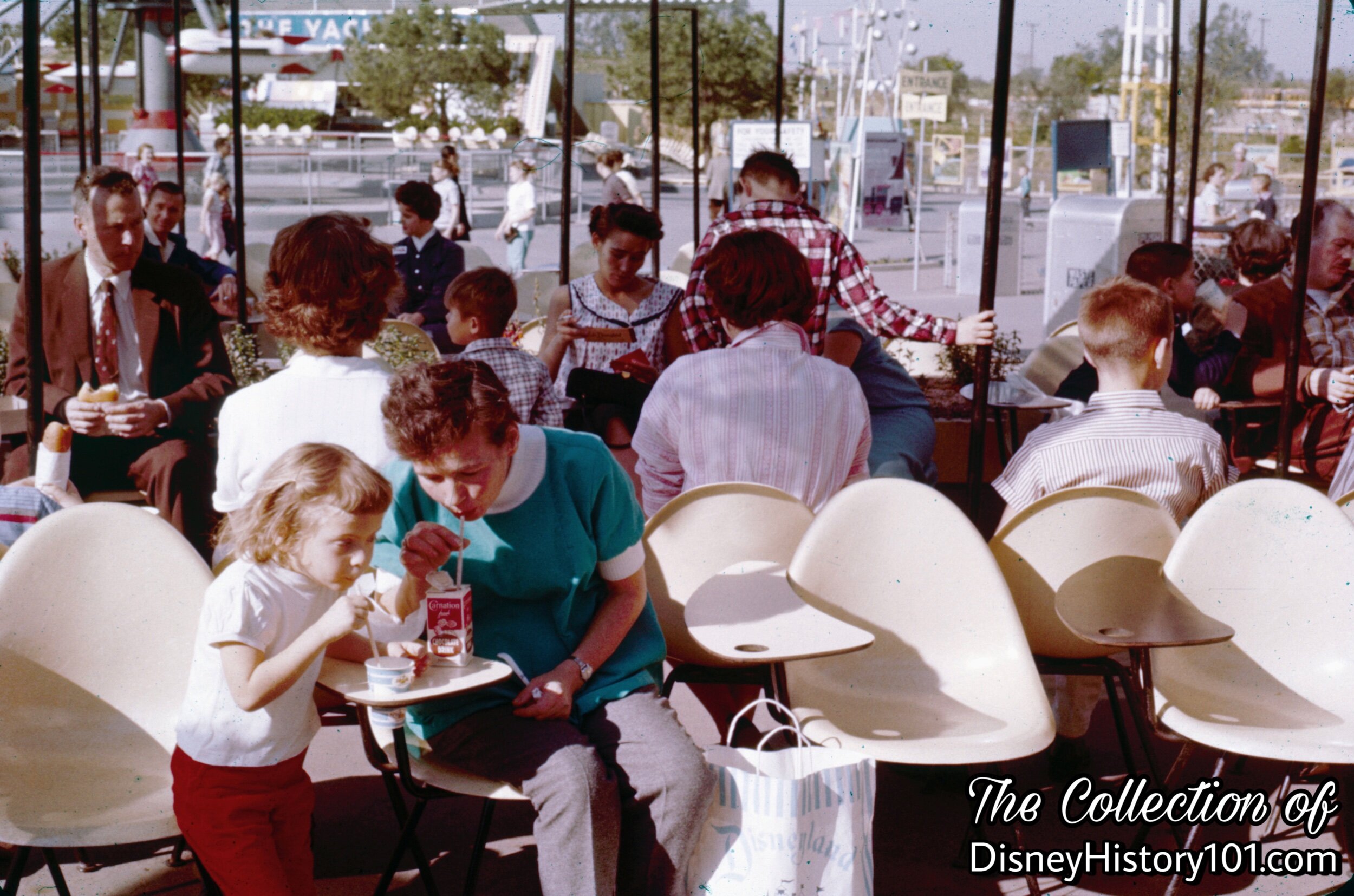
Additional covered seating was available nearby, offering another amazing view of Tomorrowland! At one time there were a total of 26 metal canopies (measuring 4’x4’) on steel posts.
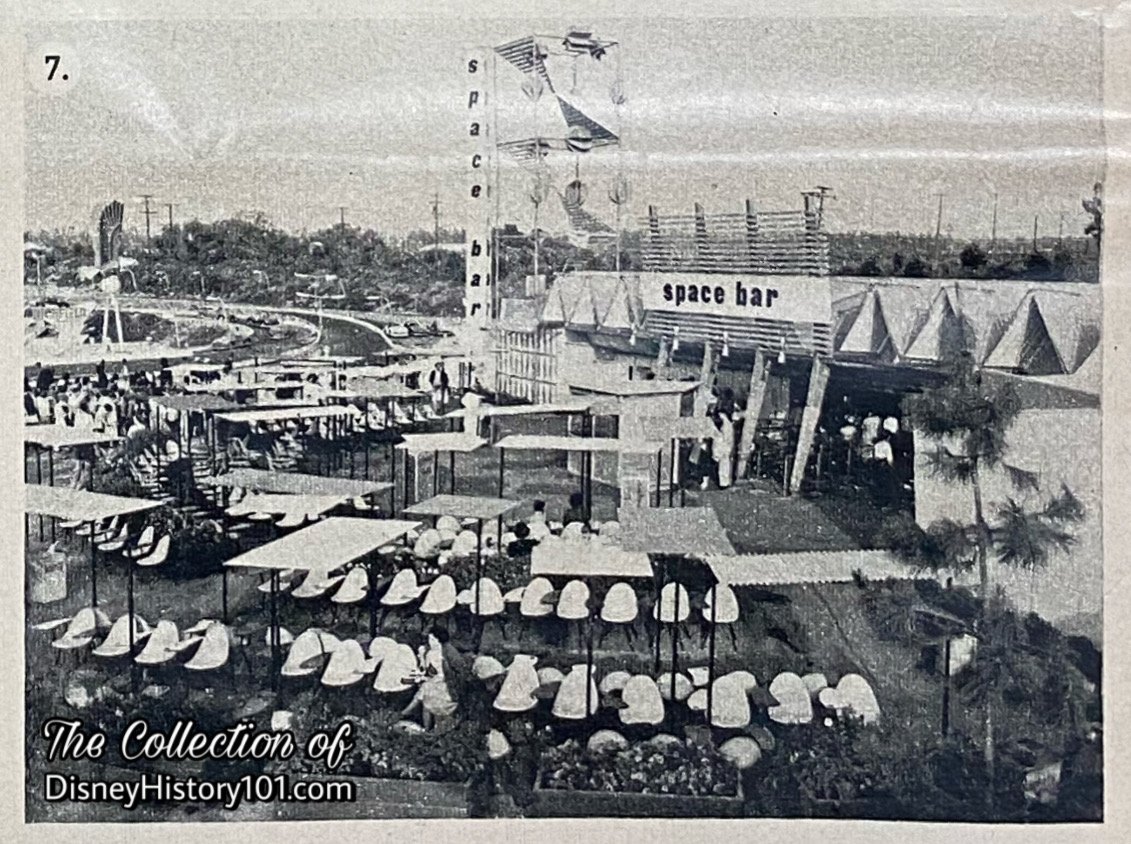
In a move of corporate synergy, the Space Bar was one of 16 Disneyland “eating places” which featured “fine food with fine coffee - Maxwell House,” from 1955 to 1957, as well as Carnation Farms products!
The vending machines at Disneyland also yielded some revenue for Disneyland Inc. Notwithstanding annual operating expenses (at $1,429 in materials) and repair and maintenance materials (at $15), a total of $8,497 (less $154 for expenses) for the fiscal year (52 weeks) ending September 29, 1957 and a total of $10,333 (less $1,468 for expenses) for the fiscal year (52 weeks) ending September 28, 1958.

A rare view of Space Bar construction (and barriers) as seen from a shaky Skyway gondola descending into Tomorrowland.
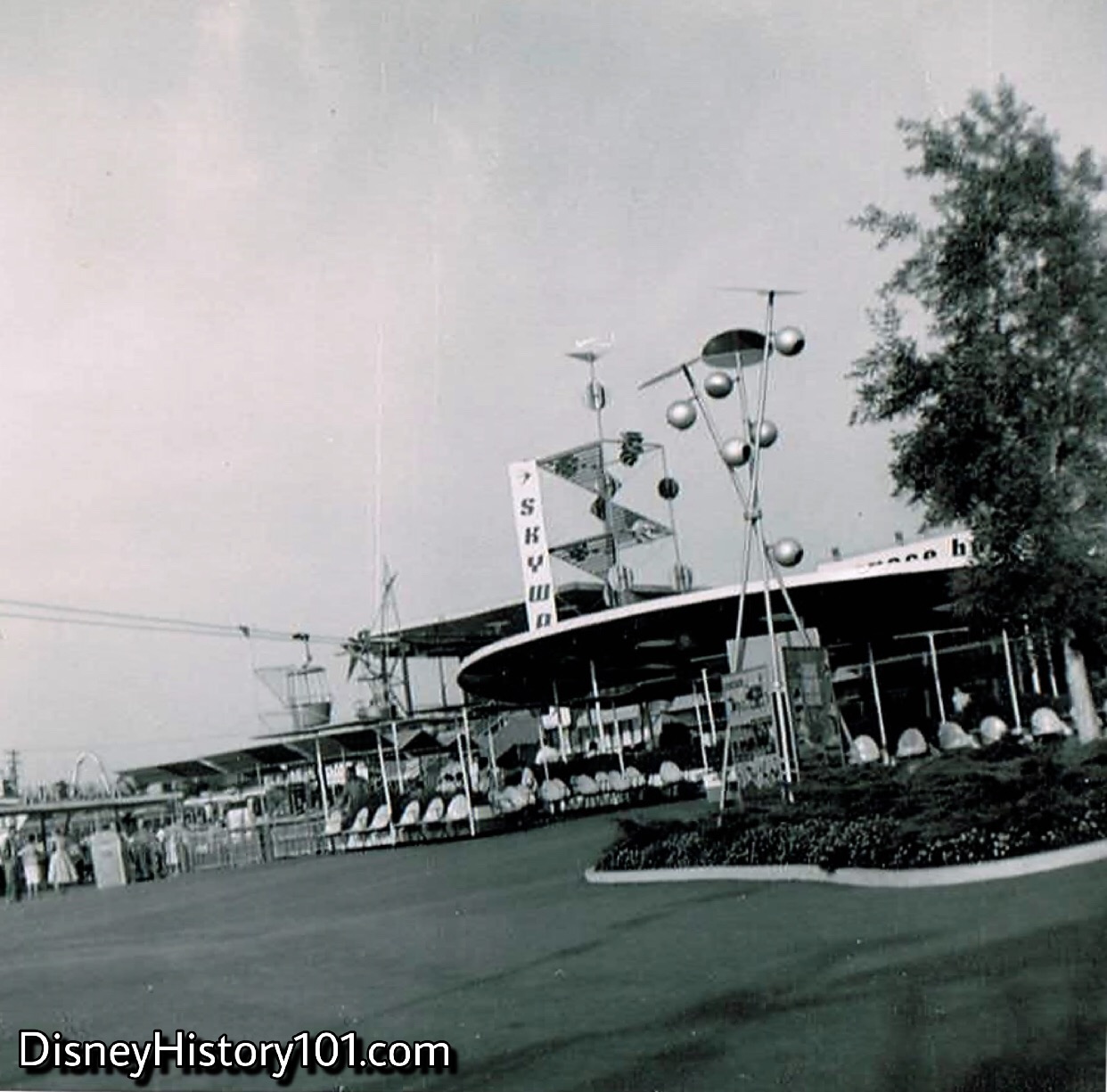
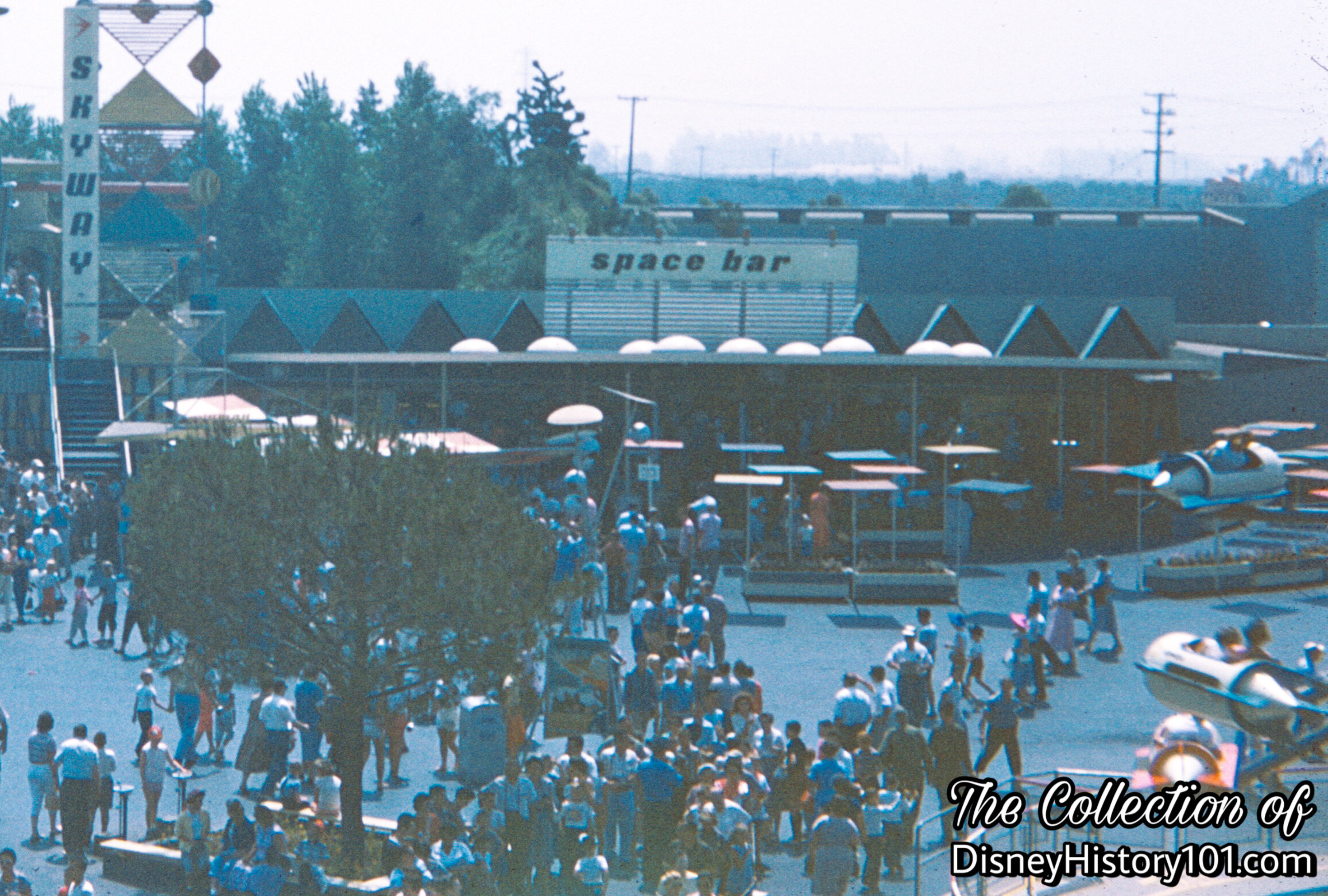
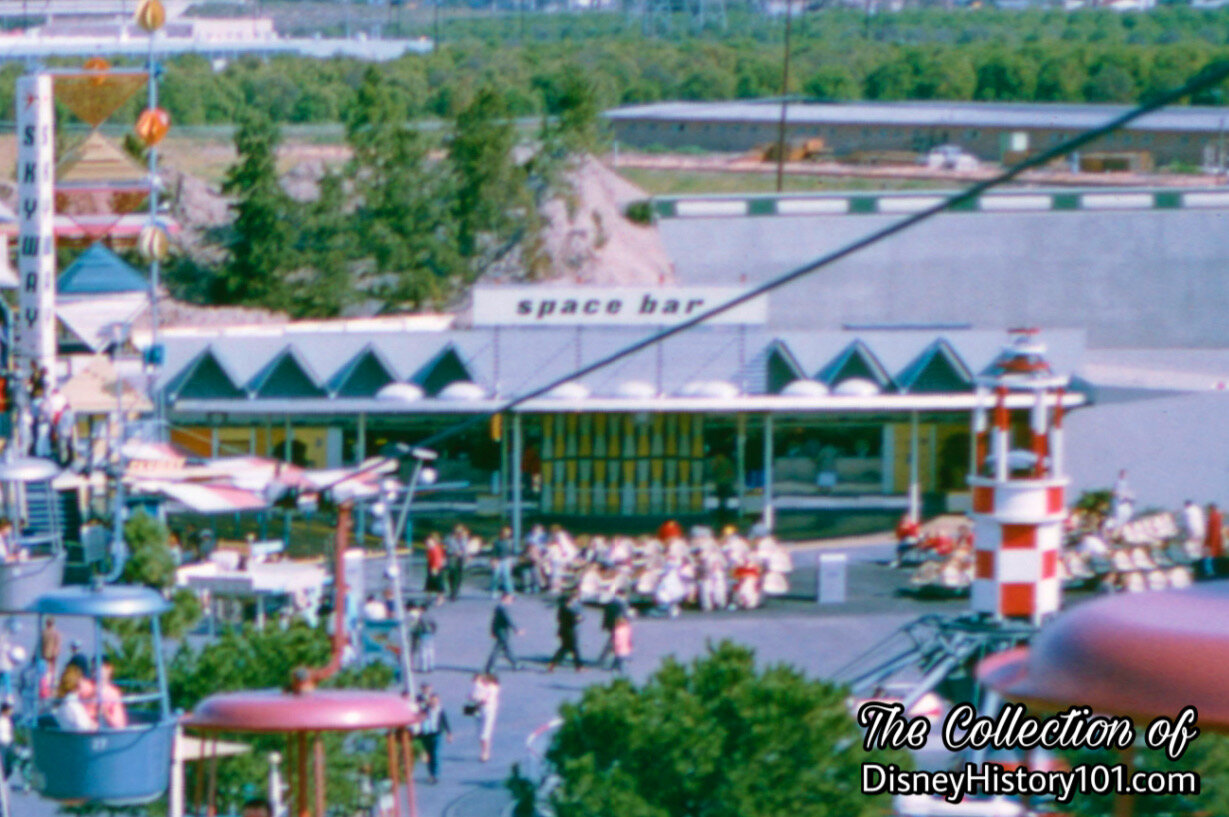
A storage addition was added to the Space Bar in 1958. After labor, materials, purchases, and sub contracts (Automatic Sprinklers, Allstate Roofers, and Jezowski & Markell), the cost of the job totaled $1,615.57. By September of 1958, an appraisal of Disneyland “land improvement” assets valued the Automat at $129,117.
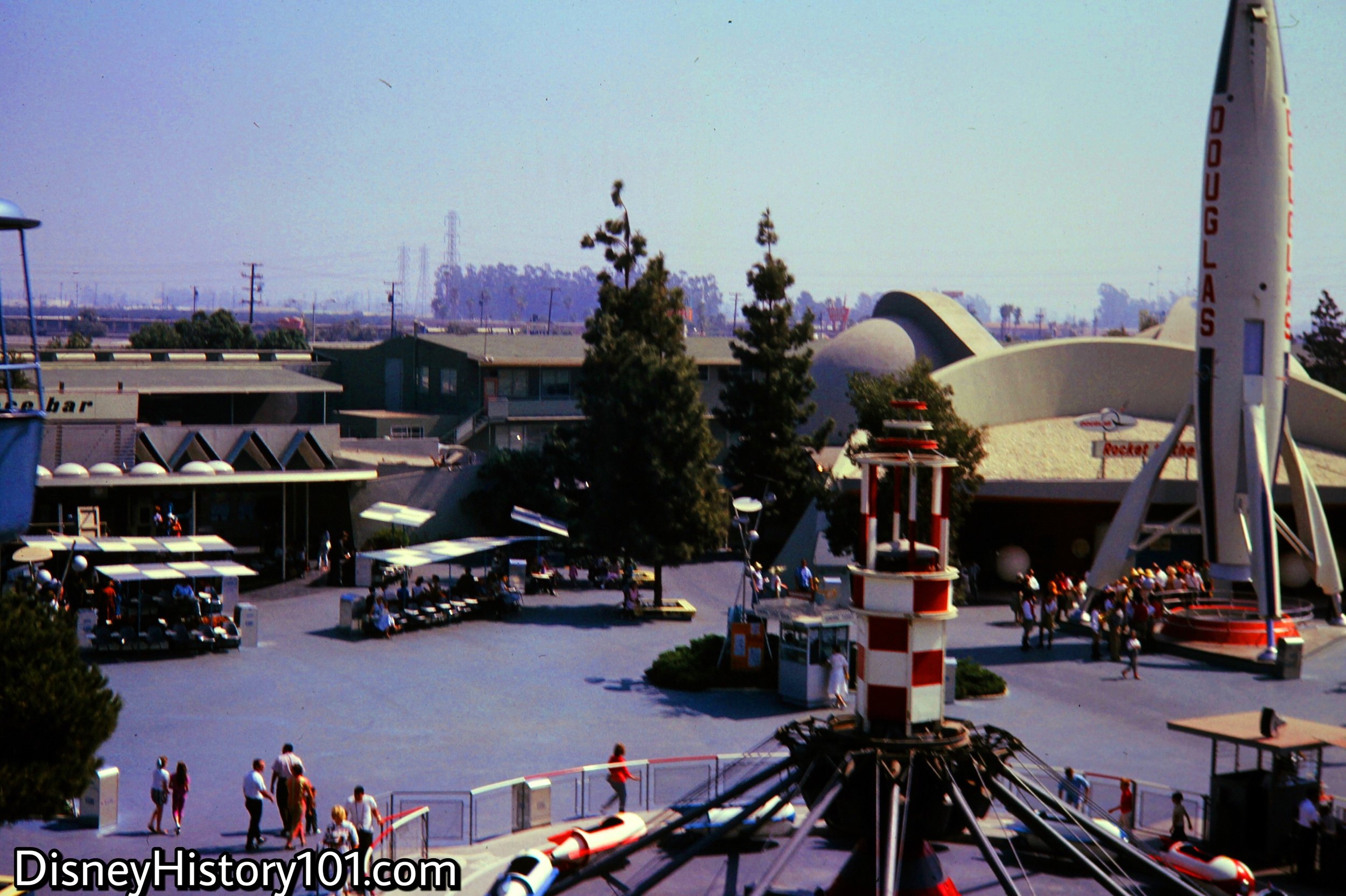
In the left corner of the photo, you’ll notice a space in the midst of the Tomorrowland “StratoSnak” Space Bar seating area. This location was often utilized for dancing and Date Night Dance bands during peak seasons.
According to Disneyland World of Flowers by Morgan Evans, “On each side of the dining terrace you will see a curious tree called ‘star pine’ (Araucaria excelsa). It comes from faraway Norfolk Island in the south Pacific, where it is known (not surprisingly) by yet another name, ‘Norfolk Island pine.’ It is not truly a pine, but a sort of second cousin. If you are a tree and have needles, and your seed is borne in cones, it's all in the family - the conifer family.”
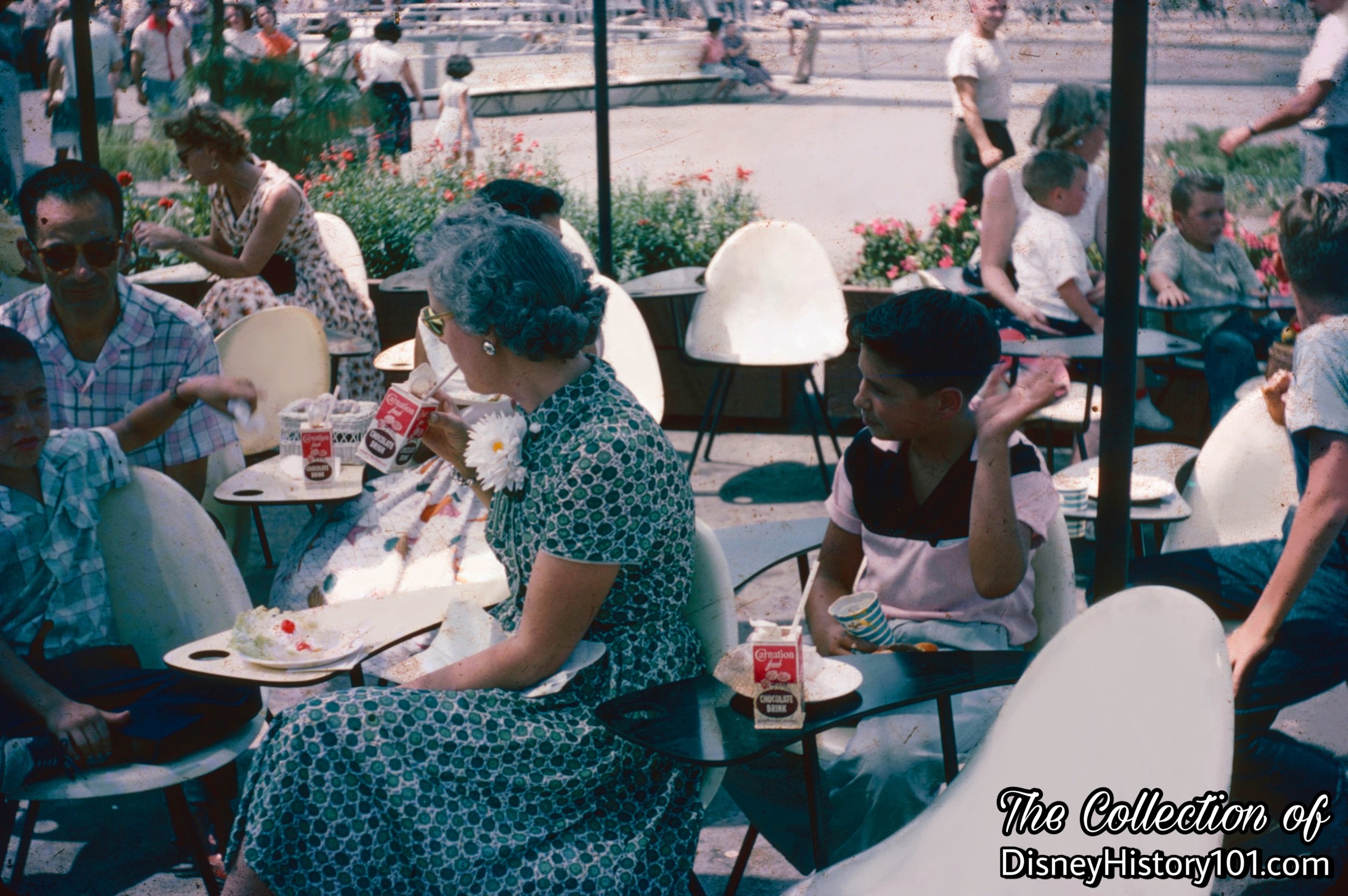
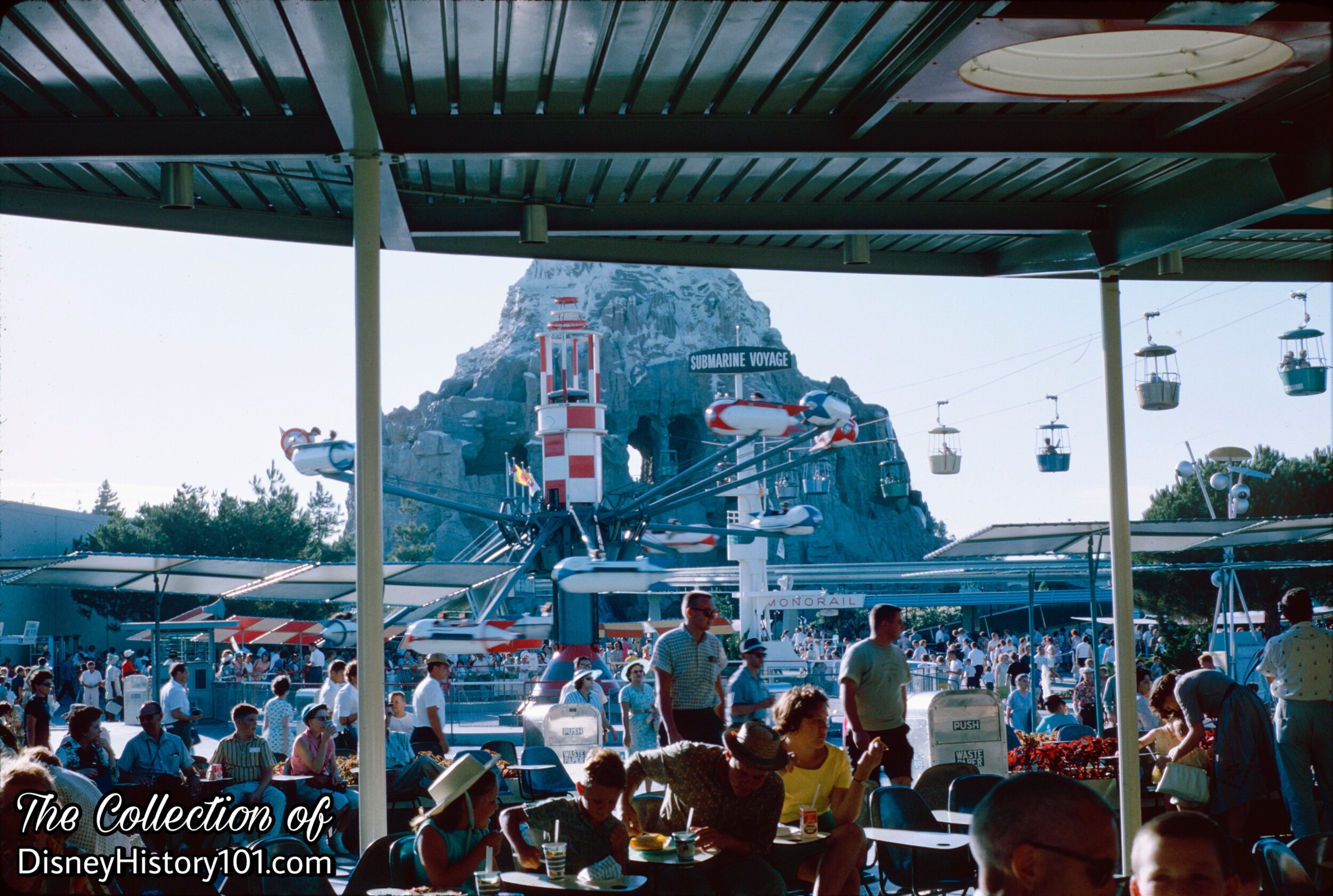
This was the view from underneath the StratoSnak Space Bar awning.
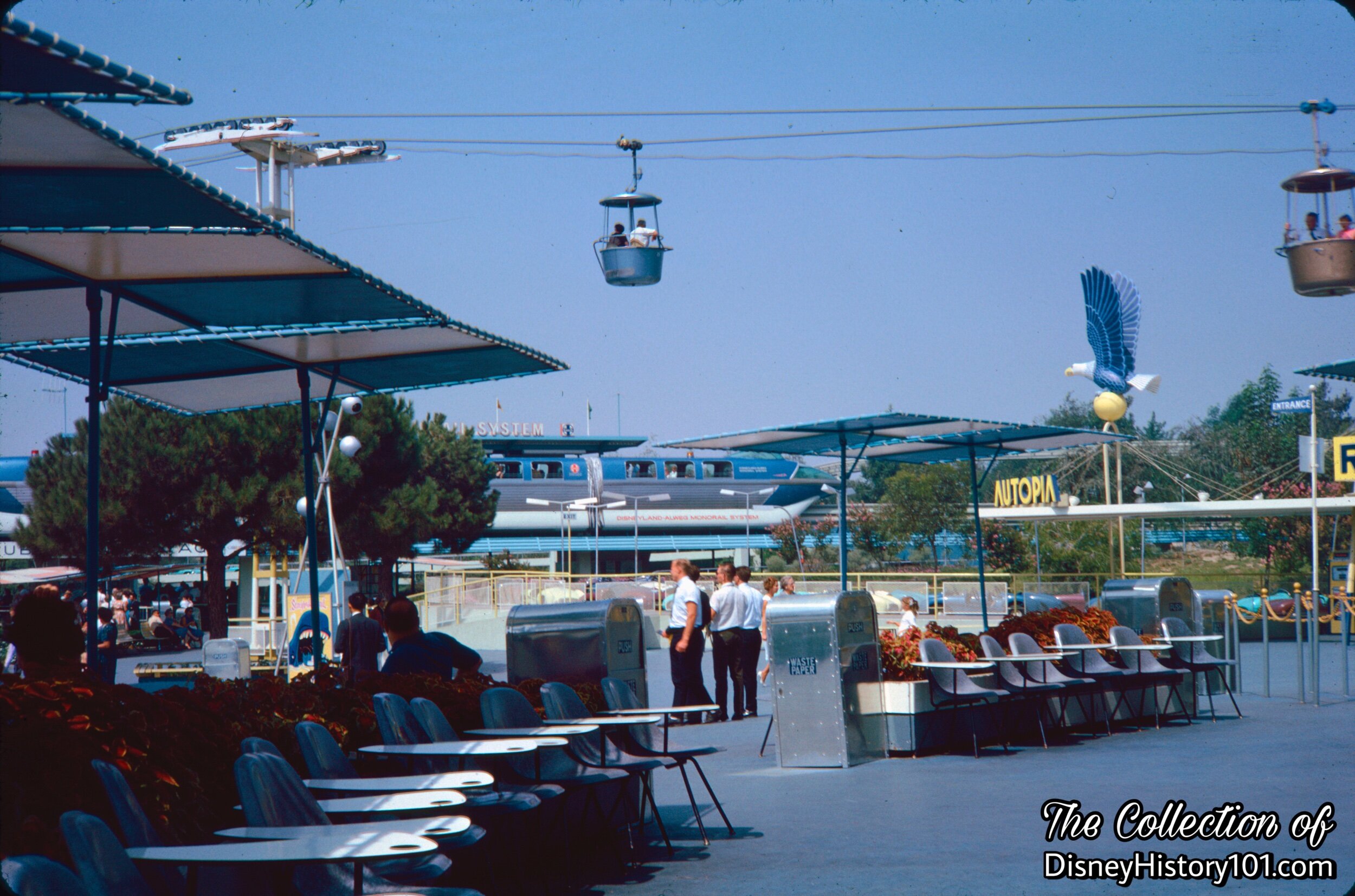
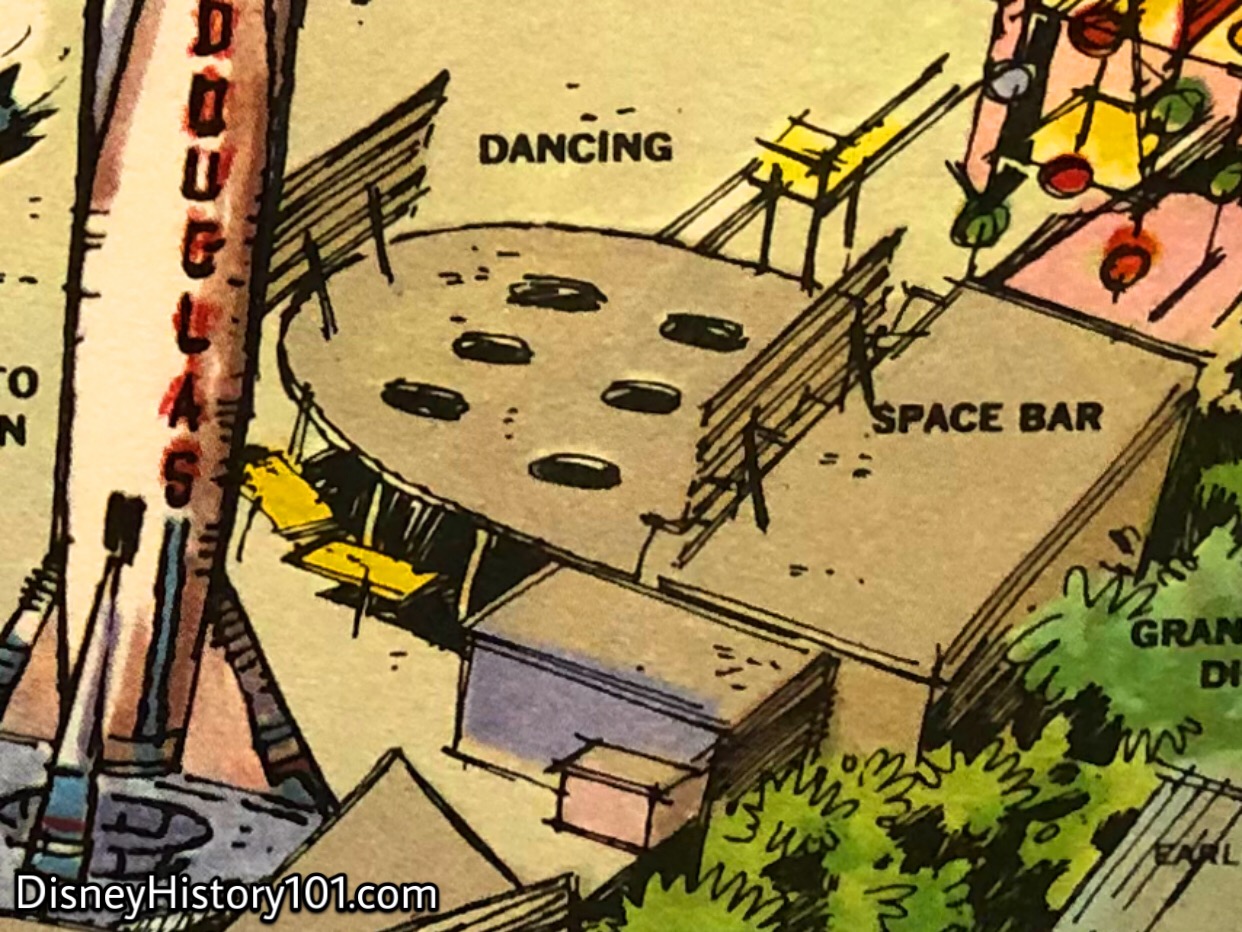
According to Dave Smith (previous Chief Archivist Emeritus of the Walt Disney Archives), “In its early years, Disneyland did not have the atmosphere bands that are used today… It would be several years before other bands appeared on a regular basis : Kay Bell and the Spacemen first performed in 1961.” [Disney Facts Revealed by Dave Smith, 2016] In addition to the usual Tomorrowland ambiance, entertainers made appearances at the Space Bar. Chuck Corson (Disneyland Entertainment casting Director, 1959 - 1973) was responsible for much of the big-name talent (and big bands) that appeared in the Park, it was Sonny Anderson (of Disneyland Entertainment) who was largely responsible for many of the youthful bands that performed at the Space Bar (and later, Tomorrowland Terrace). Acts like the Mustangs and the Spacemen owe their appearance at Disneyland, predominantly to Sonny Anderson.
The area had a permanent, covered dance floor for Date Night dance bands during peak seasons. Guests also found plenty of room to swing at the Space Bar Dance Area (labelled in some guides like “Walt Disney’s Guide to Disneyland”, published 1964). Both the Space Bar Band (debuting during the summer of 1961), and the Astronauts (the band) could be found providing swingin’ melodies during Date Nites (perhaps starting during the Summer of 1961) at the nearby the Space Bar! During 1962, both Teddy Buckner and his Band performed during Disneyland’s 2nd Annual Grad Nite, and Bobby Rydell performed in a segment of “Disneyland After Dark,” from the Space Bar Stage. The 5th Annual New Years Eve Party (held Monday, December 31st, 1962 thru Tuesday, January 1st, 1963) brought the vocalist Kay Bell and the Spacemen to the Space Bar. Grad Nite 1964 continued to bring performances by the Spacemen and Kay Bell to this dining area. Also during 1964, Gary Lewis (Jerry Lewis’ son) won the contract to perform with his six-piece rock and roll band (at the Space Bar in Tomorrowland) on Friday and Saturday nights. Charlie Barnet and His Orchestra also performed at the Space Bar.
By January, 1966, Disney had bought out the UPT facilities, a subsidiary of American Broadcasting Company.
I’m 1967, the Space Bar tarmac was raised in front to a point, level with, or just a bit higher than the dance floor.
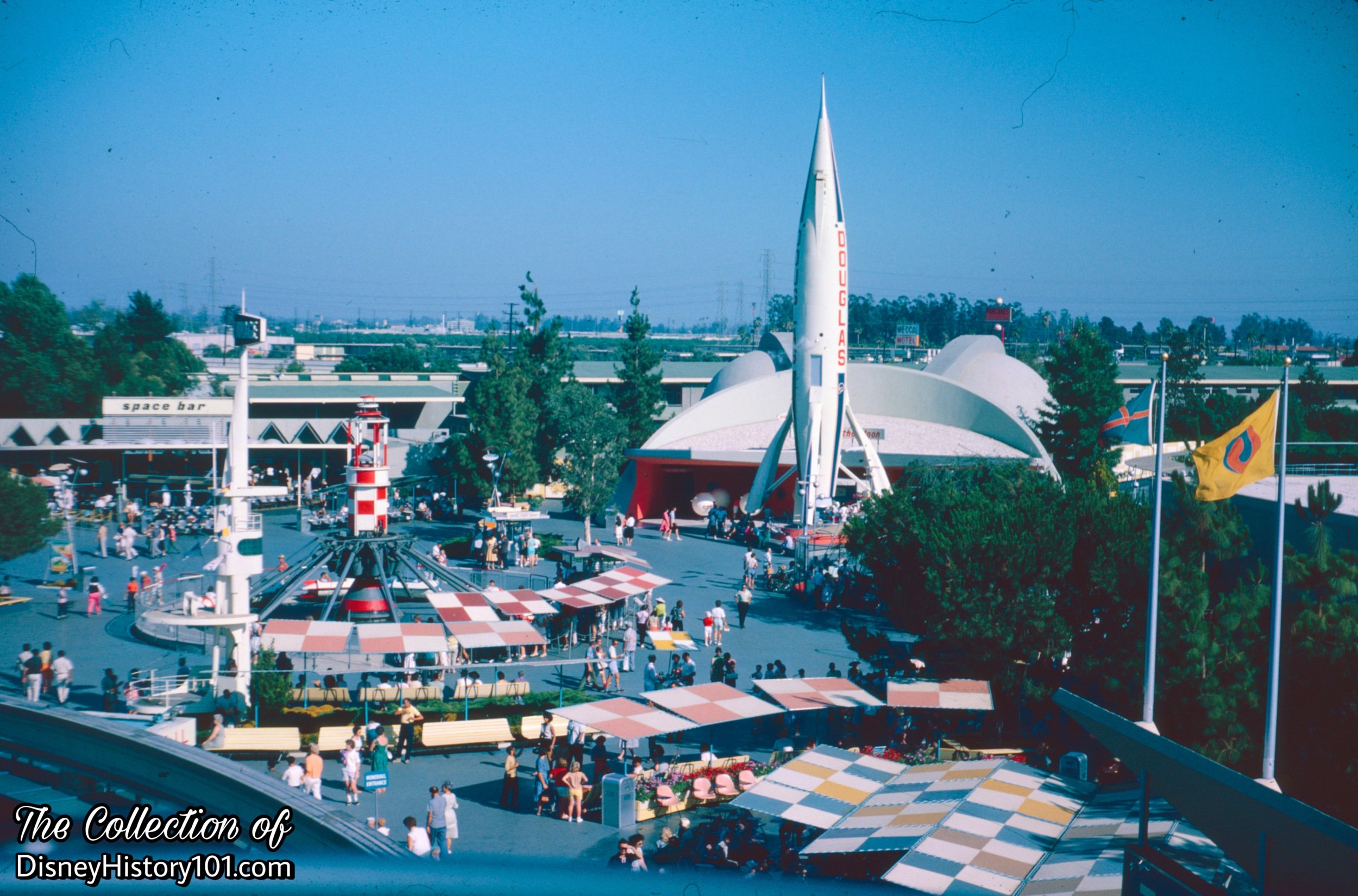
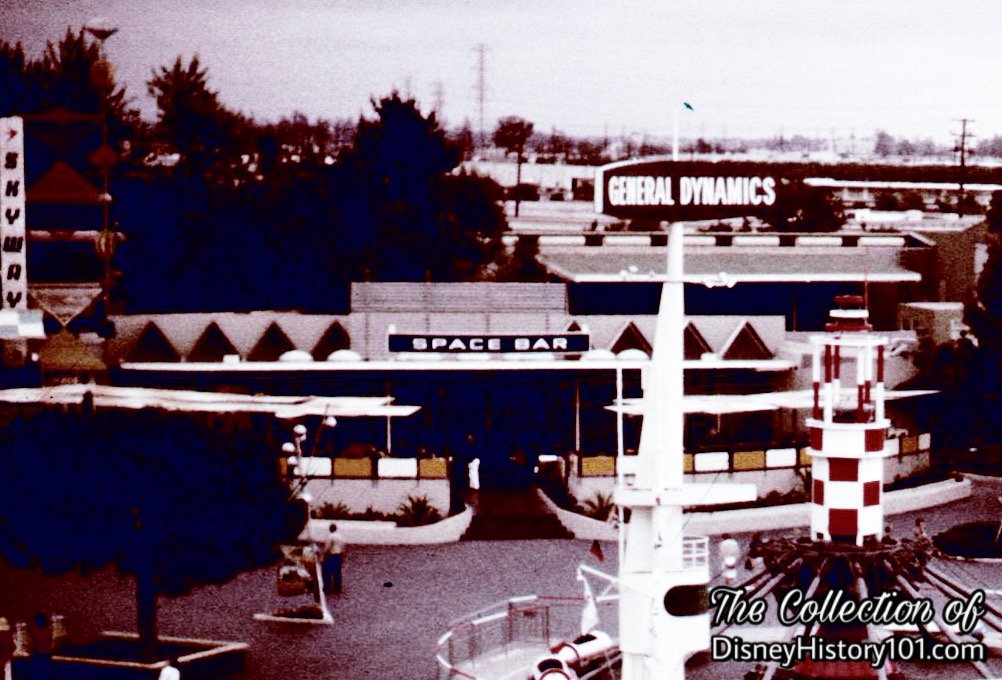
For about a decade (during the 1960s), the Patio Seating area was elevated and enclosed with panels.
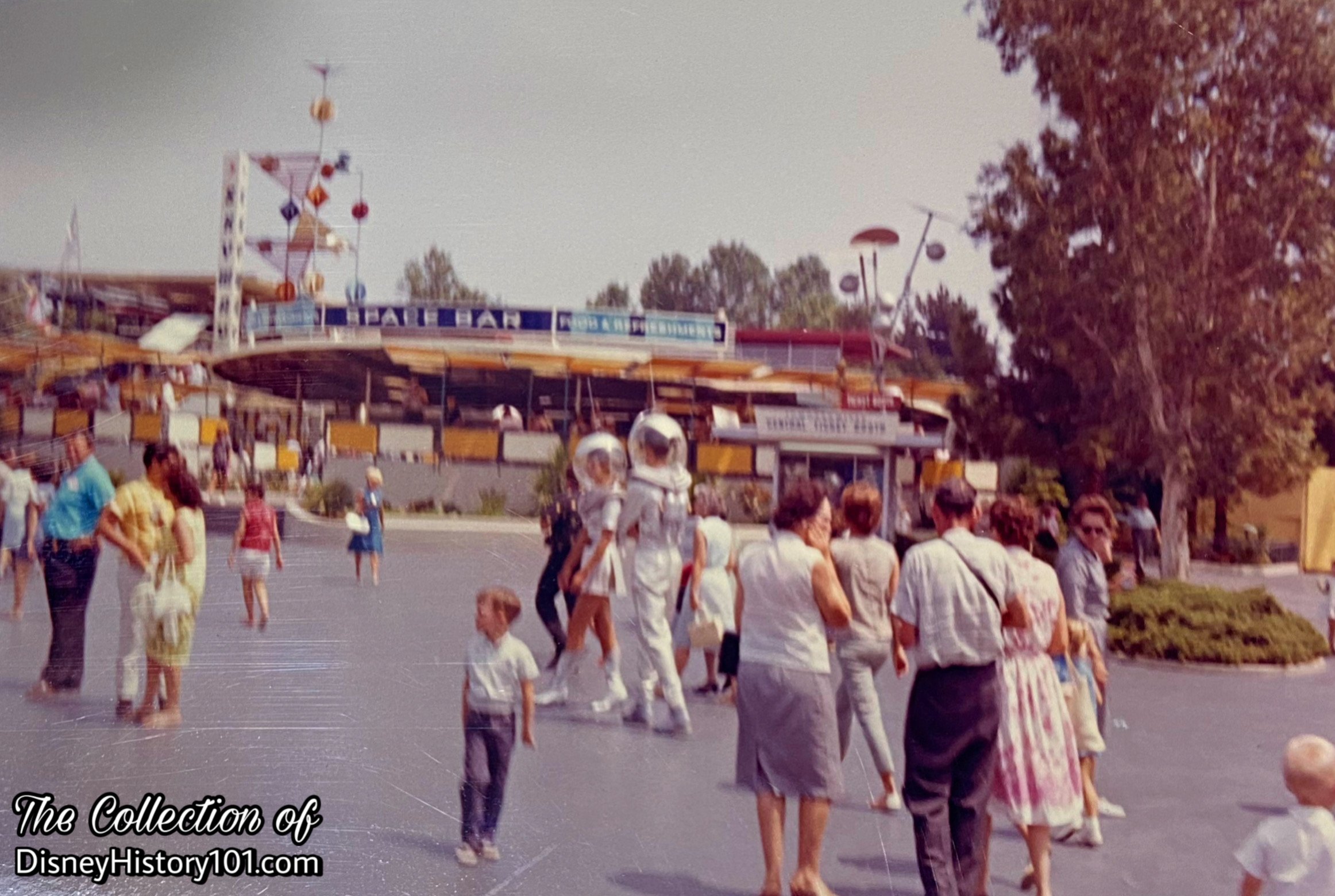

According to Bill Evans (“Walt Disney Disneyland World of Flowers”): “Yucca and Australian spear lily, seasonally highlighted by cockscomb and verbena, greet visitors to the Space Bar.”
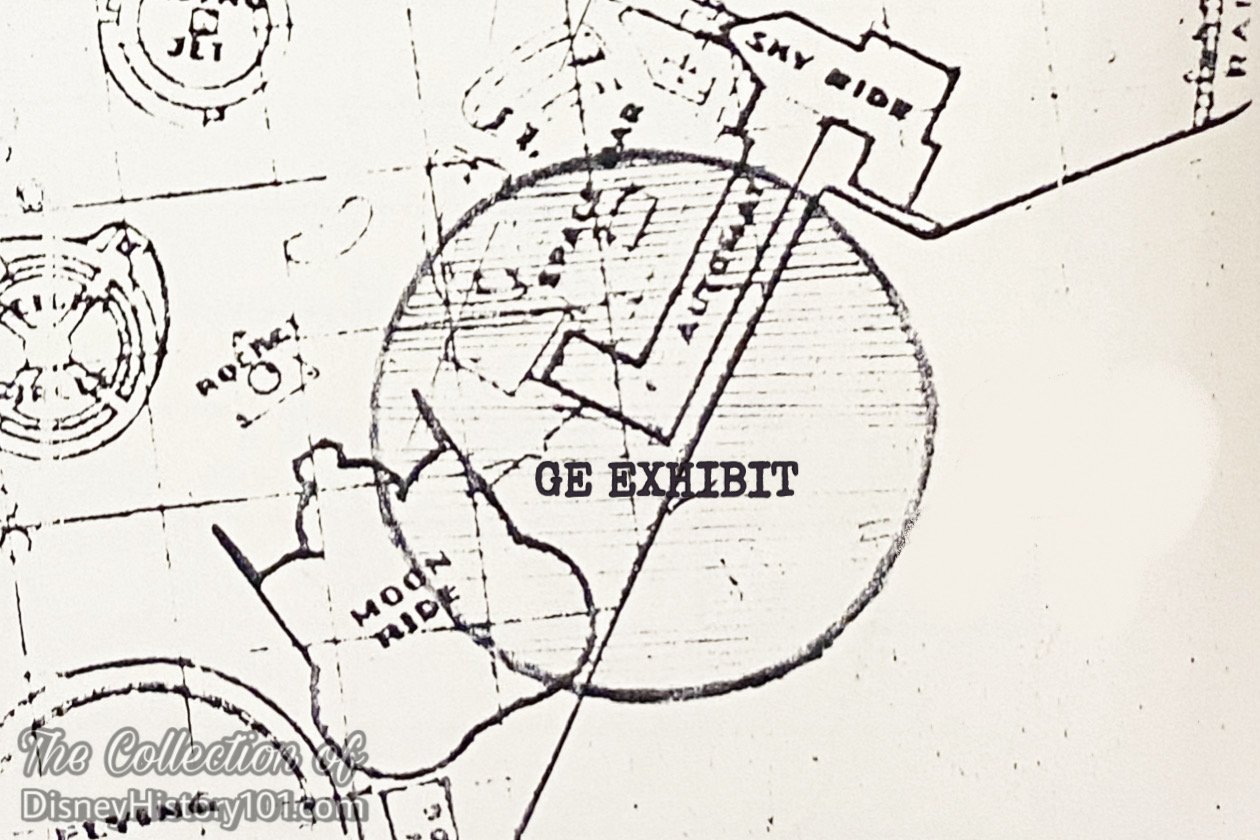
During the construction of the New Tomorrowland, the site of the old Space Bar was utilized for the Carousel Theater.
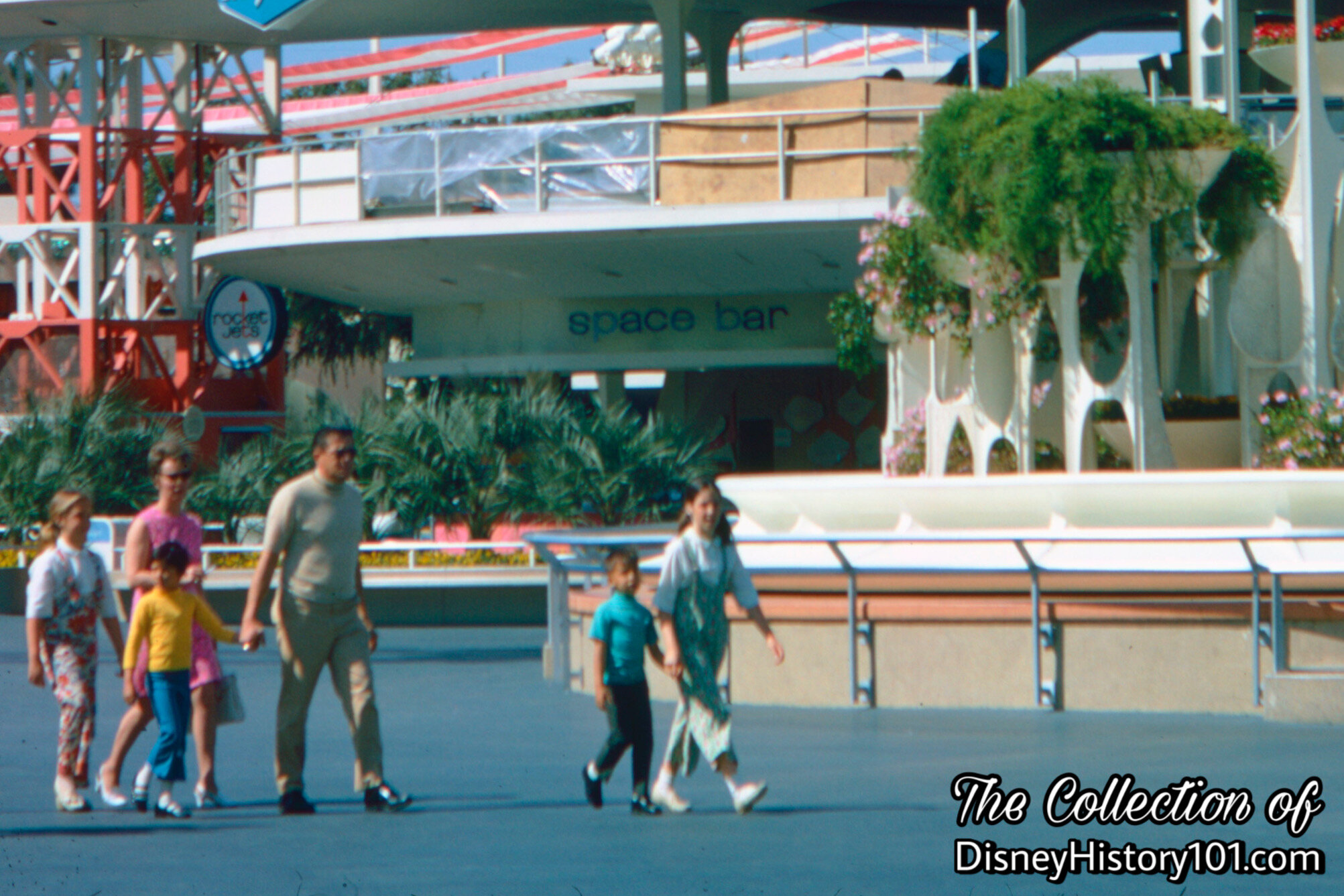
While located beneath the PeopleMover station, the new Space Bar offered “soft drinks, ice cream, popcorn and other refreshments.”
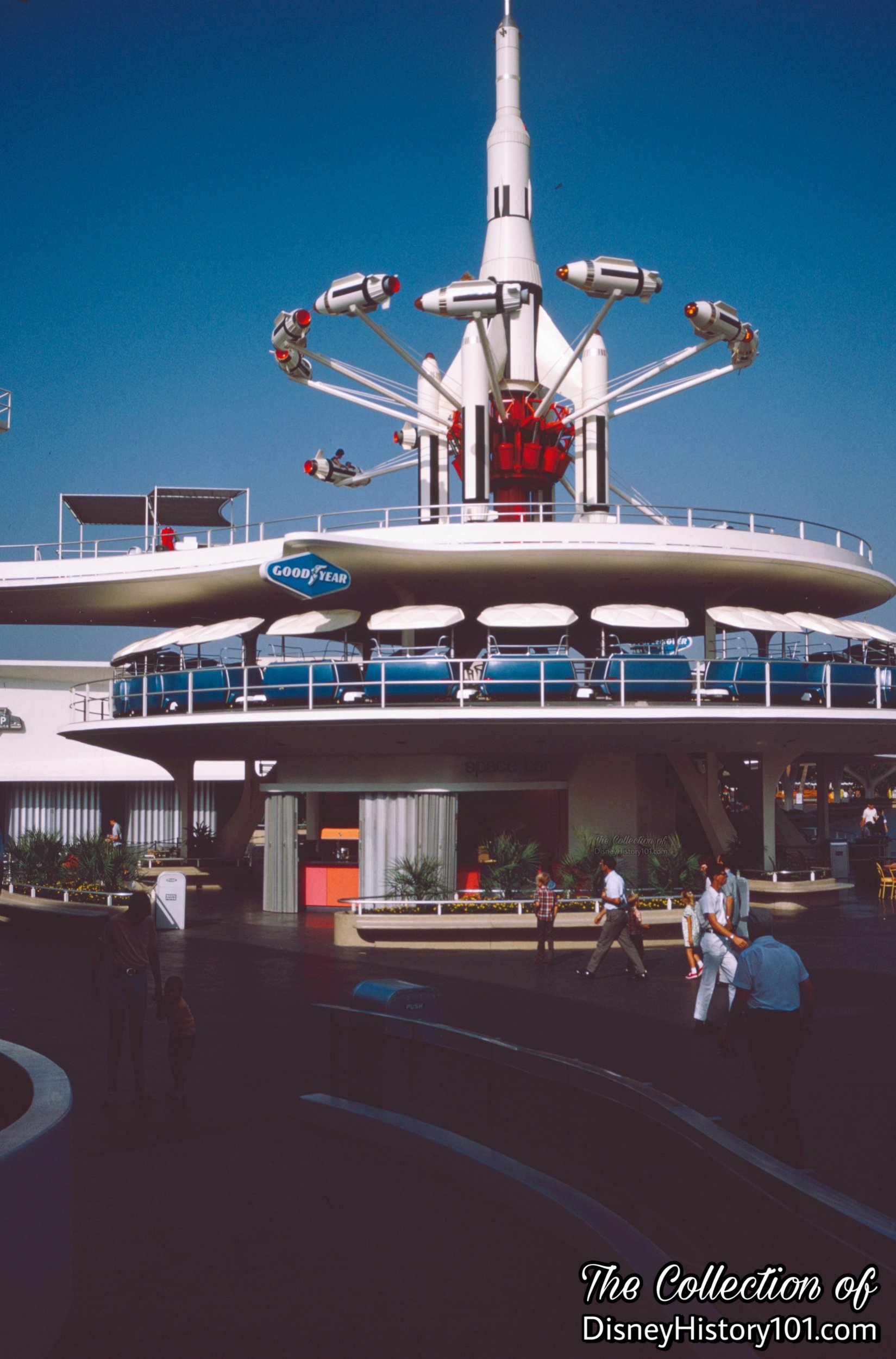
During the development of Space Mountain, a new form of the Space Bar was renamed The Lunching Pad. About 1981, the Tomorrowland fast food location offered Popcorn, Space Mist, Ice Cream Bars, Ice Cream Sandwiches, Frozen Bananas, Coffee, Hot Chocolate, Twinkies, Milk, Almonds, Raisins, and Ham and cheese sandwiches.
If you would like to read more about the original Space Bar, it’s my pleasure to recommend adding Marcy Smothers’ “Eat Like Walt - The Wonderful World of Disney Food” to your personal Disney Home Library! Therein, Marcy has extensively researched and finely crafted a small section of a chapter dedicated to “Walt Disney’s Disneyland - Tomorrowland” If you would like to bring the magic of Disneyland restaurants and concessions to your dining room table, “please step this way” toward www.eatlikewalt.com where Marcy has shared a few recipes for memorable Disneyland menu options, so you too can “Eat Like Walt.”
SPACE MOUNTAIN
Construction : June of 1975 - 1977
Opening : May 4*, 1977
Dedication : May 27, 1977
*Disneyland Rides & Attractions and Attendance Report, Fiscal Year 1981.
One can easily slip into the jargon of “ride” but at Disneyland there are attractions and every attraction is a living experience for the guest. Disneyland ride-through attractions or adventures have officially been defined as an “individual show, ride, or exhibit designed to produce an entertaining Guest experience. Disney attractions stir the imagination, enliven the senses, and provide the participants with positive, innovative entertainment, which is the essence of the DISNEYLAND Show.”
There is also a “story behind the story” of every attraction. It is important to review the story of the attraction, tell the story, explain it, and create interest. This is the story of Space Mountain.
When Disneyland was being conceived, Walt intended that his Park have “no roller coasters”, by the recollection of Buzz Price. However, Walt Disney also said : “Disneyland will never be completed. It will continue to grow, always adding new things to provide its visitors with exceptional and entertaining attractions.” In Walt’s eyes, Disneyland was “like a piece of clay,” because if there was something he didn’t like, he wasn’t stuck with it. He could reshape and revamp it. After years of personally reshaping and revamping, Walt divulged: “I’m not the perfectionist anymore. It’s my staff - they’re the ones always insisting on doing something better and better.”
The success of the Matterhorn Bobsleds a few years prior (in 1959), had proved the viability of thrill rides within Walt Disney’s Magic Kingdom! While some early research and development was conducted through Arrow Development, Space Mountain would become one of the Park’s first roller coaster-type attractions to be developed through WED Enterprises. In 1964, Walt assigned WED Enterprises artist “Captain” John Hench (an old sketch artist from the Hyperion Avenue Studios era of 1939; a background artist) with the task of researching and creating initial concepts and sketches for future indoor roller coaster attraction at Disneyland. This potential adventure would be included in the New Tomorrowland expansion project of the mid-1960s.
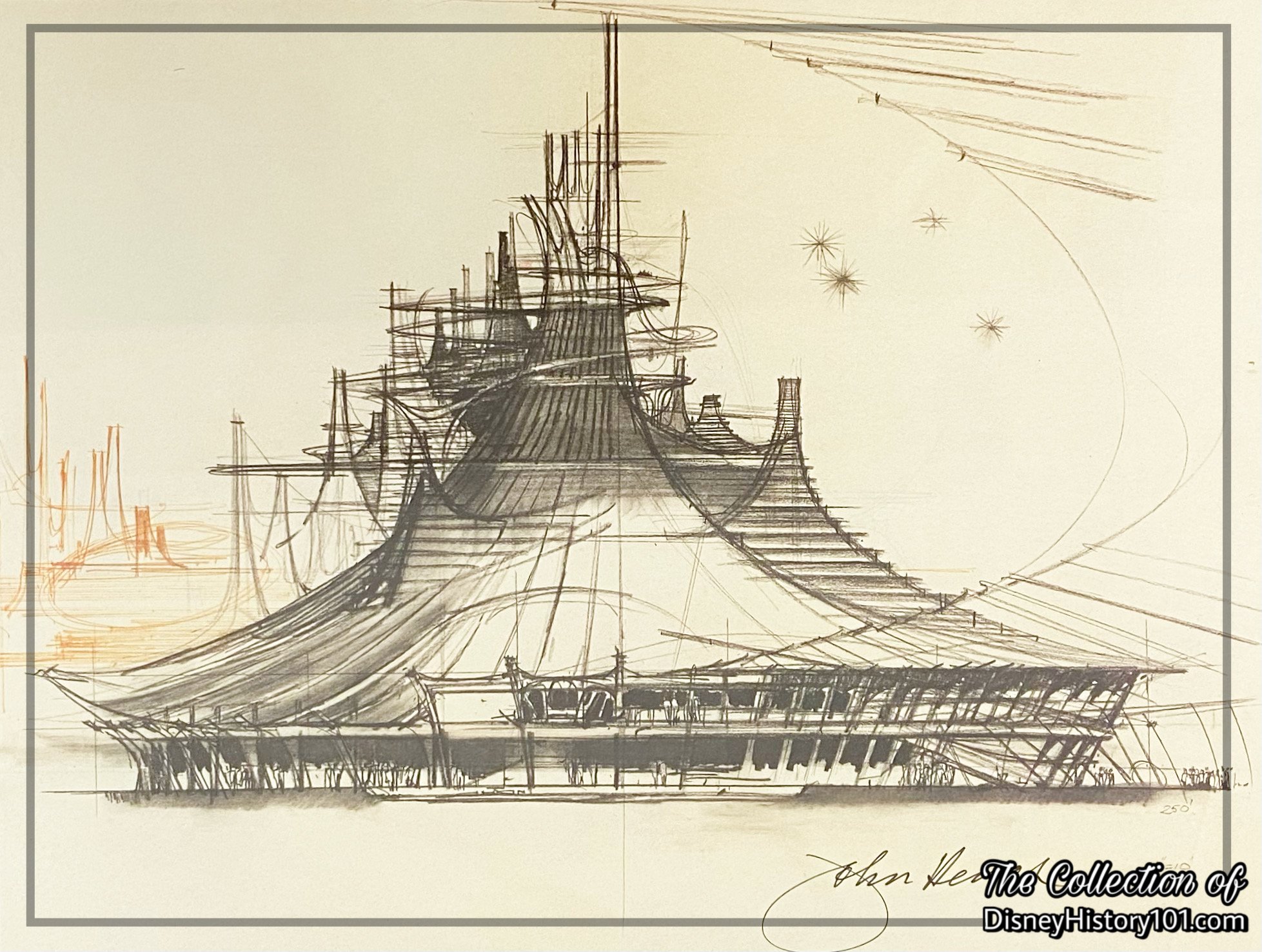
Walt Disney’s Imagineers knew their audience. Even while Tomorrowland featured the Flying Saucers attraction, early 1960s maps began to depict another space-themed attraction - a “Spaceport & Rocket Flight Future Attraction” (also referred to as “Space Voyage.” Some of the earliest visions of the Show Complex Building (with its towering white spires) were created by the Legendary John Hench, who made “the first little sketches on the thing.” Even such early renderings proved that the building was designed to have ”draw concept” - designed in a manner in which it would generate interest and beckon the observer. In the words of John Hench, “It's all very obvious: careful communication, watching what you say, and being explicit and having something to say in the first place.”
According to Marty Sklar “I like to think that I interpreted and reinforced Walt's creative approaches because it was really Walt Disney who set this whole thing up. I've worked hard to be the champion of Walt's philosophy and values over the years… John Hench was the king of design, but even being as smart as he was, he wasnt able to communicate easily down the line, so there was a role for me in helping to achieve what the great designers had developed.” [“Ripley’s Pioneers: Legends of the Amusement Park Industry Volume One” by Tim O’Brien]
“Disneyland is unique in that some of the world's foremost creative artists and architects control all design at Disneyland.“ Walt Disney Productions artist Herbert Ryman was influential to some exterior elements, while some interior settings were sketched by WED Enterprises Employee George McGinnis. Notable WED Enterprises, Inc. engineers and artists like Bill Watkins and Roger Broggie Sr. would also be involved in the development of the space adventure - “Space Voyage”!
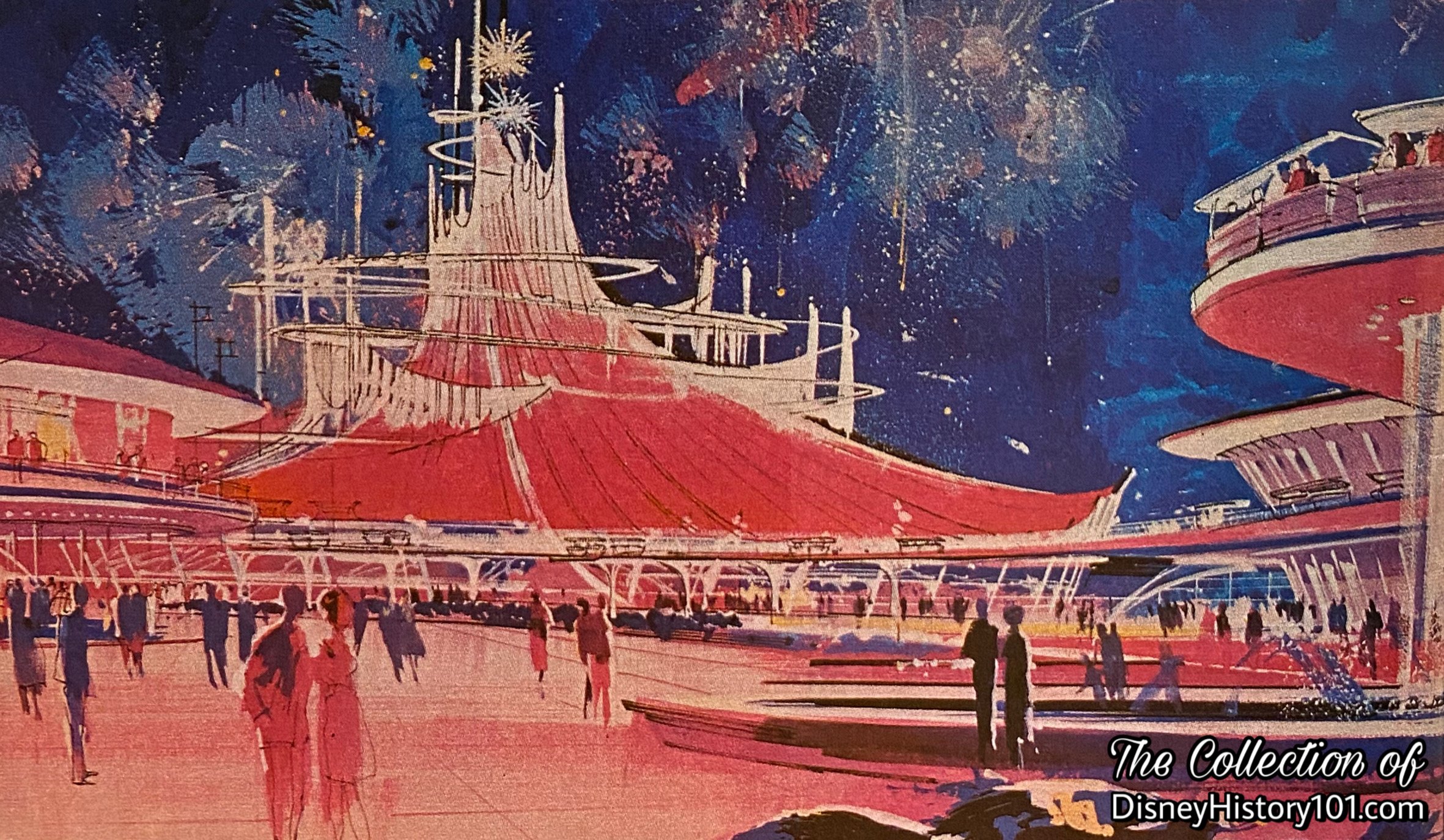
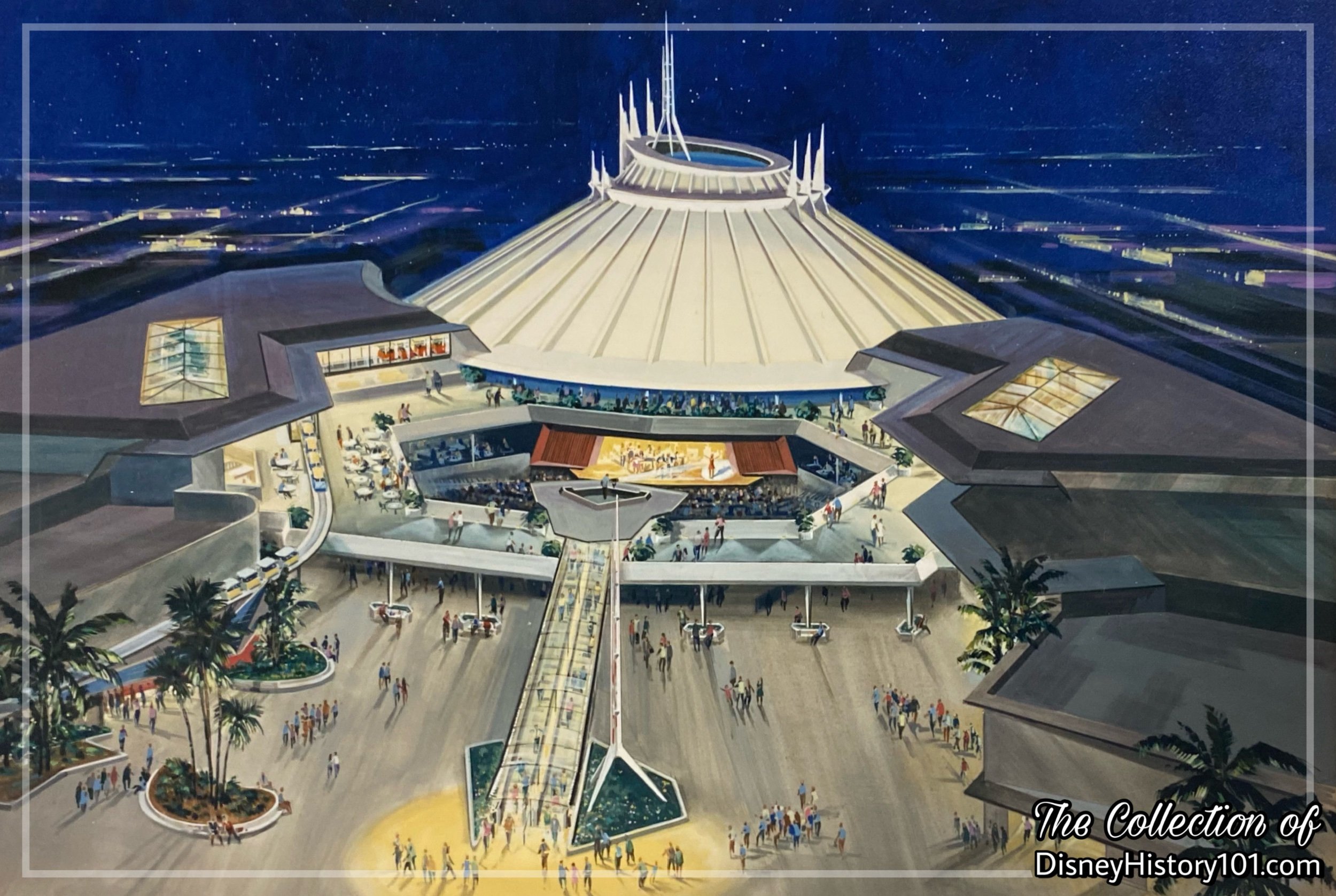
According to LINE Magazine, “John remembers his first meeting with Walt about the project in late 1964. ‘Walt didn’t call it Space Mountain at that time but he felt we needed an attraction in Tomorrowland that would present the future through space travel. Walt had a prophetic ability and knowledge of how to bring different experiences together in a perfect blend…and he knew Space Mountain would be attraction that would serve to enrich the guest’s experience one step further.’” Space Mountain was likely one of several attractions that Walt had in mind when mentioning he had ”plans afoot - some on the drawing board or in model form, others only in the ‘dreaming’ stage…to be added through the year 1980.” [“Walt Tells Problems Studied for New Disneylands,” by Ted Thackery Jr., published Thursday, February 11, 1965, for the Herald Examiner of Los Angeles, California.]
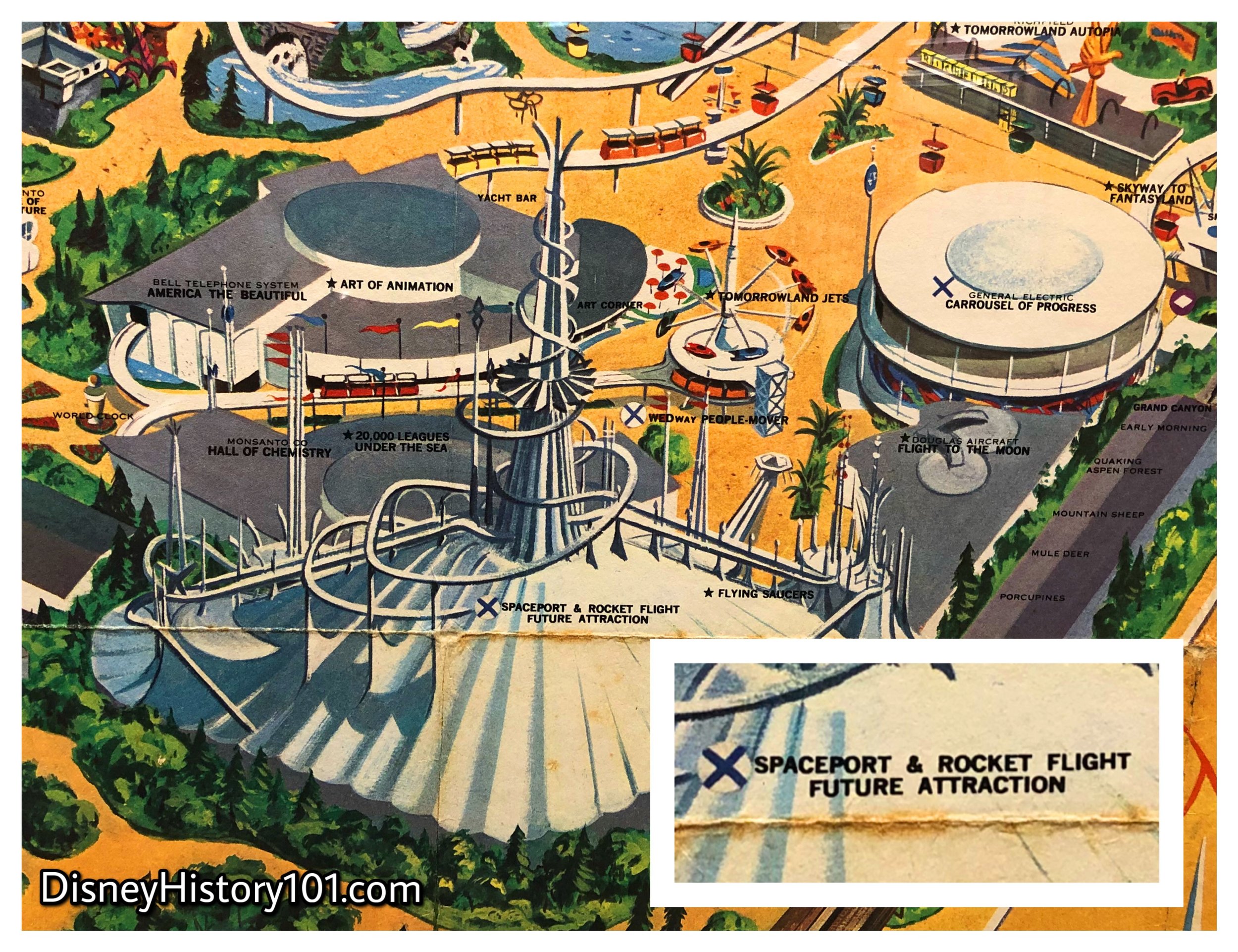
Early concepts featured four “tracks” (some of which wove inside and outside of the Show Building), complete with “soaring spires” (borrowing some style from Herb Ryman’s c.1964 “suggestions” for the New Tomorrowland). About the years 1965 to 1966, the job of “Space Ride R & D” (No. 034-53-22) was opened at WED Enterprises, Inc. Project 034-53-22 was described as Research & Design of a “Matterhorn-type ride with a structure housing four separate loading areas and ride tracks.”
According to “Progressland at Disneyland: a proposal for the General Electric Company from Walt Disney Productions” ©1965: “The word for 1967 is Tomorrowland -a New Tomorrowland. When the present Tomorrowland was designed, in the early 1950's, Early Bird, Gemini and Apollo were space age terms of the distant future. Even the household word ‘astronaut’ was still to be coined. Times-and-tomorrows have changed. So recently Walt Disney and his creative staff have taken a new look at the Tomorrowland area. To research ideas. Walt and his team visited Houston, Huntsville and Cape Kennedy, discussing the latest Space Age wonders with astronauts and scientists, including Dr. Wernher Von Braun. The result: a decision to close the entire Tomorrowland section of Disneyland in the Fall of 1966 for complete redevelopment - the re-building and enlarging of an entire area of Disneyland to provide for dramatic and exciting new attractions and exhibits. In New Tomorrowland, a towering structure will serve as spaceport and theme center. Inside, guests will experience the sensation of racing through distant space.“
Internal materials published in 1966 mentioned: “With four maior new attractions nearing completion for summer, 1966, openings at Disneyland, Walt and his staff af WED are looking toward 1967 - 1968.“ By May 25, 1966, an allowance of $150,000 was allocated toward the cost. By October 1, 1966, an actual cost of $119,000 with a write off of $119,000 was pending approval.
According to John Hench (who led the project), even back in 1965, plans called for a two-level building with guests entering from the second level. “Walt had originally thought of having the lifts on the outside”, John recalls, “but we could control the light much better with an enclosed structure.” Testifying to this is image of this design can be seen in the pages of “A World of Smiles” (the Tencennial Tour Guide scrapbook). Soon, the “Walt Disney Productions Annual Report to Shareholders and Employees Fiscal Year Ended October 2, 1965” announced: “In New Tomorrowland, a towering structure will serve as a spaceport and theme center. Inside, guests will board four-passenger ‘rocket ships’ to experience the sensation of racing through distant space. Spiraling upwards as high as an 18-story building, the ‘Tomorrowland Mountain’ will be the highest point in the Magic Kingdom, a magnet visible for miles.”
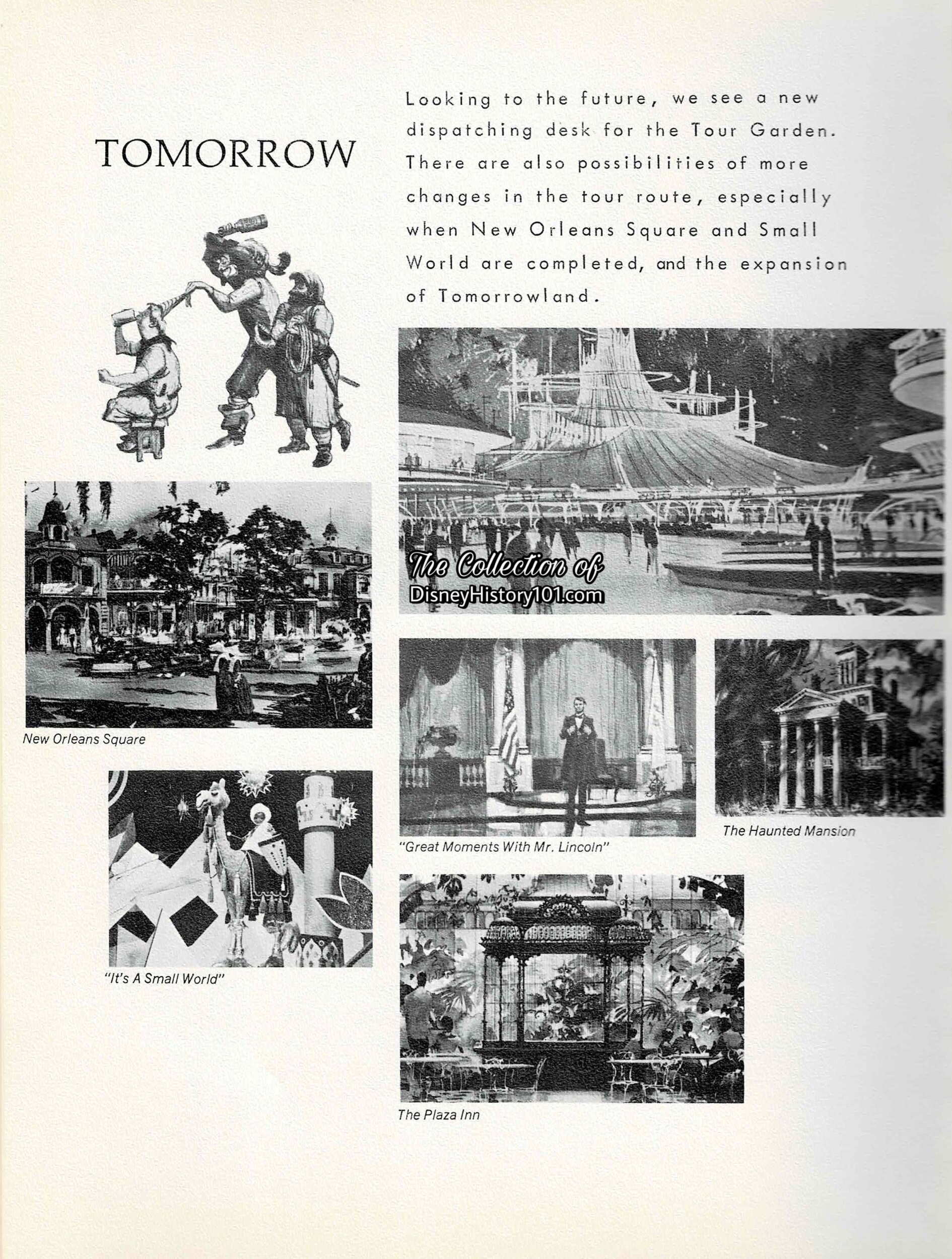
“A ‘Hold’ on Space Mountain, and a ‘Gap’ in Development” - It’s a fact, that the “Space Mountain” name was first attached to the project during 1966. During this time, Herb Ryman produced mode concepts of the spire-topped show building and WED Enterprises, Inc. engineers were utilizing “far-ahead” computers to conduct stress and design analysis (including those of the curves and turns of the track). The layout revolved around utilizing gravity and kinetic energy to keep the cars moving forward. Some of these viable project Concepts (as seen above), were supported by a well-developed business case and built expectation. However, it seemed that there was not the necessary space to house this attraction, as Walt was “running out of building room inside the 20-feet Hugh earthen berm surrounding Disneyland.”
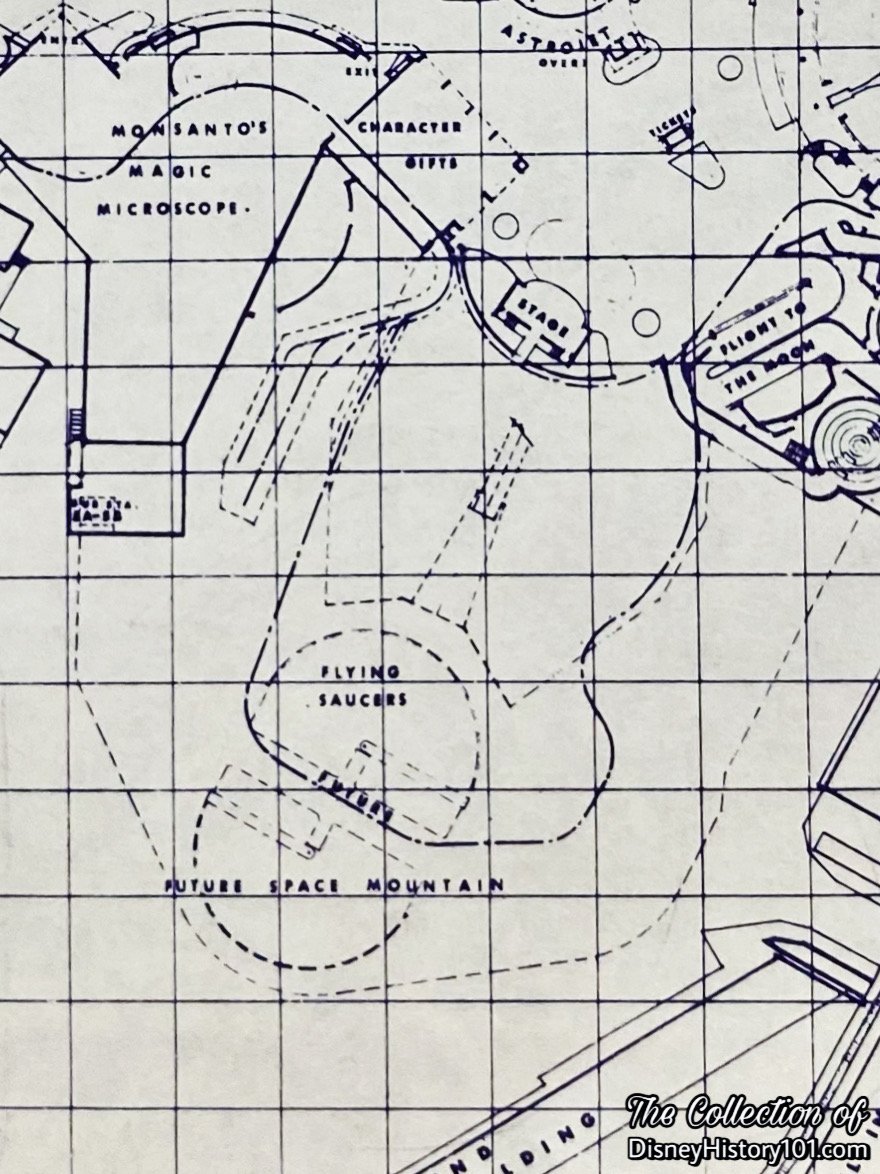
Then there was the matter of the computer technology to control the safety “Block (brake) System.” The Automatic Block System was a series of consecutive blocks governed by block signals that were actuated by a train, engine or by certain conditions affecting the use of a block. The system was used on the Disneyland Railroad but was seemingly limited for application toward Space Mountain. So after Walt’s passing (in December of 1966), any plans for this particular future Disneyland attraction were put on hold while Walt Disney’s Magic Kingdom was brought to reality.
A WED philosophy is that there is no bad idea. “We say that because if you get in a meeting and somebody comes up with something and someone turns to him and says, ‘That's a stupid idea!’ you'll probably never get another idea from that person. So, we try to create an open environment where people can say anything. Quite often, something that sounds dumb at the time will turn out to be just the little spark that sets everything off Somebody will come in later and say, You know, I thought what so and so said was dumb, but I’ve been thinking about it and I think there's a little gem here.’ Its amazing how many times that happens…‘ Marty said that he's been around so long and has discussed so many ideas that he has seen many resurface after many years. ‘When that happens, I know from experience that a lot of them won't work, but I don't say, 'Well, you know what? We tried that 20 years ago and it won't work; because so much changes. If we went back through our archives, we'd probably find a lot of things that we could do today that we couldn't do at the time because the technology wasn't there.’“ [“Ripley’s Legends - pioneers of the Amusement Park Industry” by Tim O’Brien, Volume One]
Walt once said: “Since my outlook and attitudes are ingrained throughout our organization, all our people have this curiosity; it keeps us moving forward, exploring, experimenting, and opening new doors.” So began the blending of creative and technological innovation with the essence of great Disney storytelling. Soon, one of the Magic Kingdom’s planned adventures included the “Space Voyage” - the first incarnation of Space Mountain! Four years later (and by the early 1970s), true-life space-age computer technology had advanced enough to control the proposed safety “Block System” enabling multiple cars to safely run along the rails simultaneously. In fact, the block system was controlled with the help of two Data General Nova 2/10 computers. Sensors (electronic elements in the track) monitored the speed and spacing of vehicles.
So, the plans (employing research, development, and conceptual artwork of John, George, and Herb) were “dusted off” by the WED Creative Development Division members. New concept art was created by artists like Walt Disney Imagineer Clem Hall (c.1974). New software from NASA was utilized to design the support structure and required specs of the attraction. Though the original four “track” concept was reduced to two “tracks” and the attraction would be fully-enclosed in the Show Building (design by WED Enterprises Imagineering Project Engineers Glenn Durflinger, Bud Stacy and Randy Carter), the attraction would make use of the old c. 1966 working title.
By about 1974, one official publication commented: “WED's number one priority at present is to investigate all the elements of a possible ‘Space Mountain’ in Disneyland-design, track layout, show, cost, etc. ‘Space Mountain’ -now being completed at Walt Disney World, is a thrill ride beyond compare, where space shuttle-like cars zoom past black light and fluorescent laser effects at ‘un-believable’ speeds. The most exciting portion of this "trip," however, is the sector in which shuttle passengers seem to enter a state of weightlessness while passing through space at supra sound barrier speeds. It is tentatively planned for behind the Tomorrowland stage.” [“WED - What. Where. Why and Who?” by Vicki Stowe]
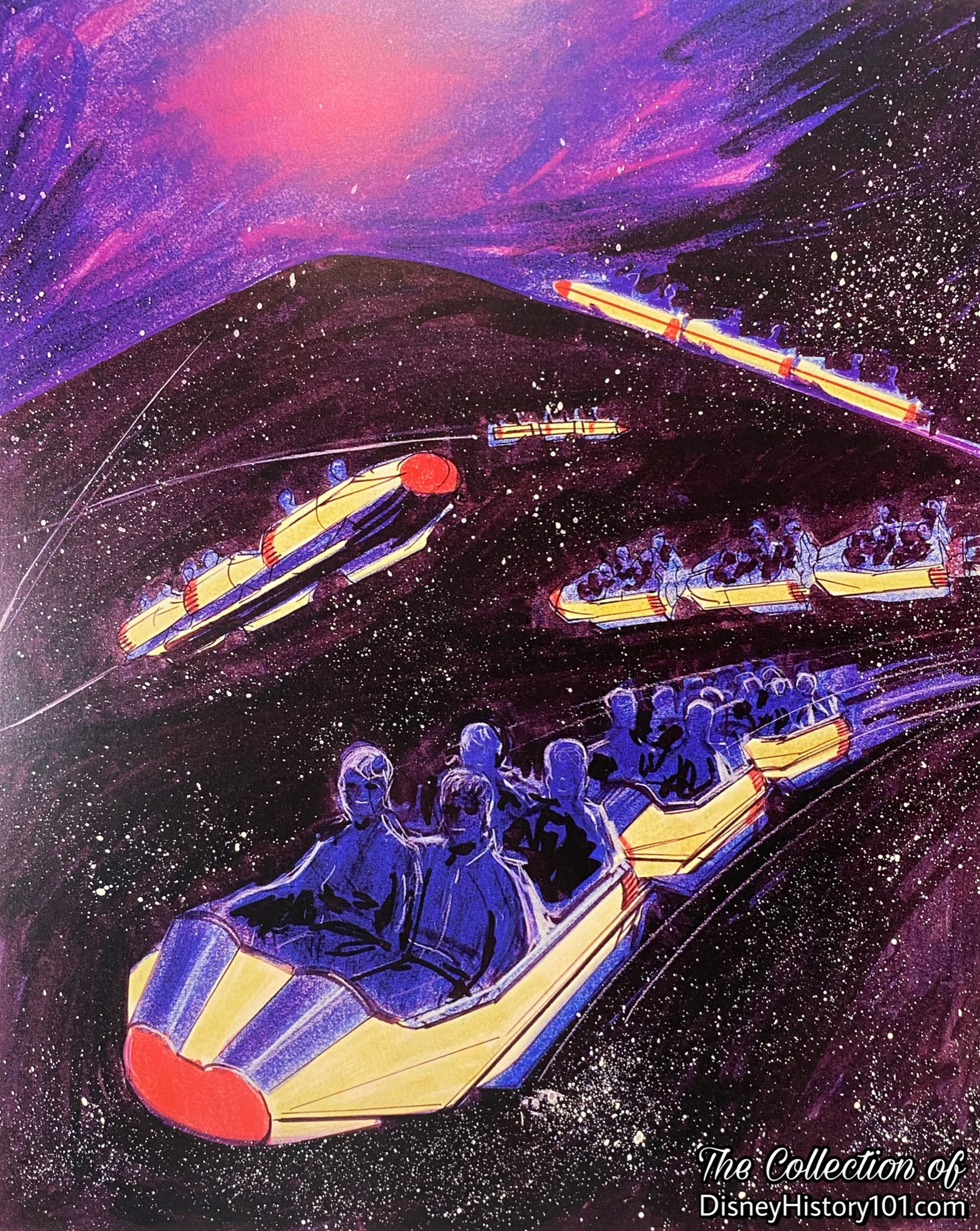
True life astronauts Gordon Cooper (of the Mercury 9 & Gemini 5), James Irwin (of the Apollo 15), and Scott Carpenter (of the Mercury 7) helped open Space Mountain at Walt Disney’s Magic Kingdom, on January 15th, 1975. Space Mountain was a grand success.
Meanwhile, Disneyland had managed to “maintain its levels of attendance in the face of rapidly expanding competition for California's leisure dollar, and despite the fact that the Park has not opened a major new area since Bear Country in early 1972.” As approximately 60% of the Park's attendance came from within the state of California, “new attractions remained a vital factor in stimulating repeat visits and assuring the Park's continued future growth. Therefore, in 1975, the Company committed itself to a major new capital development program for Disneyland.” By September of 1975, construction crews received the “All Clear” (under the supervision of Maintenance Lead Bud Poole) to begin work on the second incarnation of Space Mountain, and Disneyland's second “mountain.” Construction commenced during September of 1975.
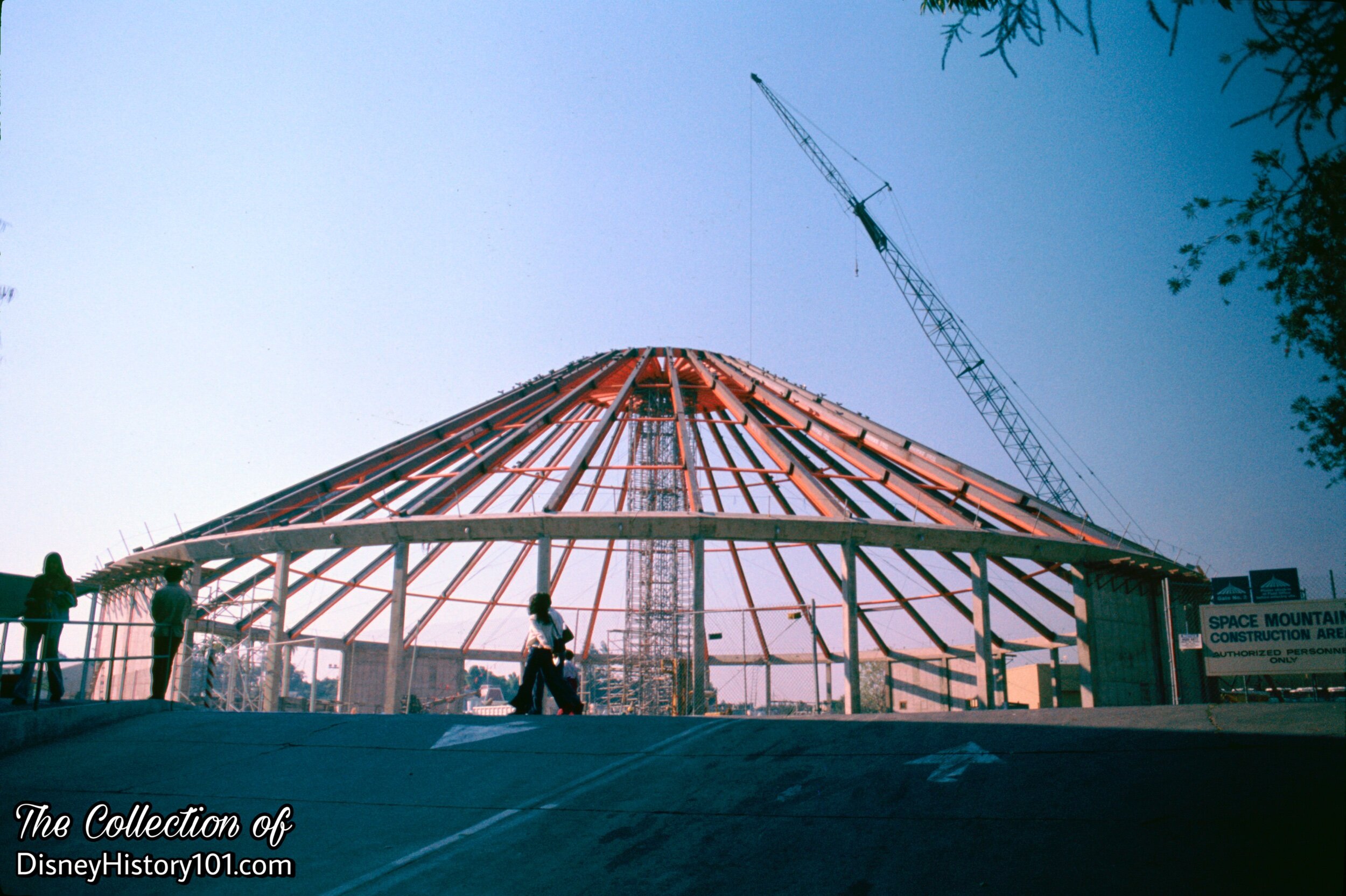
The steel frame of the Space Mountain show building is 200 feet in diameter, holding more than 1 million cubic feet of space. It is hard to see from this “Vintage View”, that the base of the structure is set 17 feet below grade (or, ground level). A considerable portion of Space Mountain was placed below the ground level in order to reduce the height visually in relation to the smaller Sleeping Beauty Castle. From ground-level, the structure would measure 75 feet tall not including the spires. If Imagineers did not scale down and sink part of Space Mountain deep into the earth it would have become a Visual Intrusion and a contradiction, dwarfing Sleeping Beauty Castle and all of Main Street.
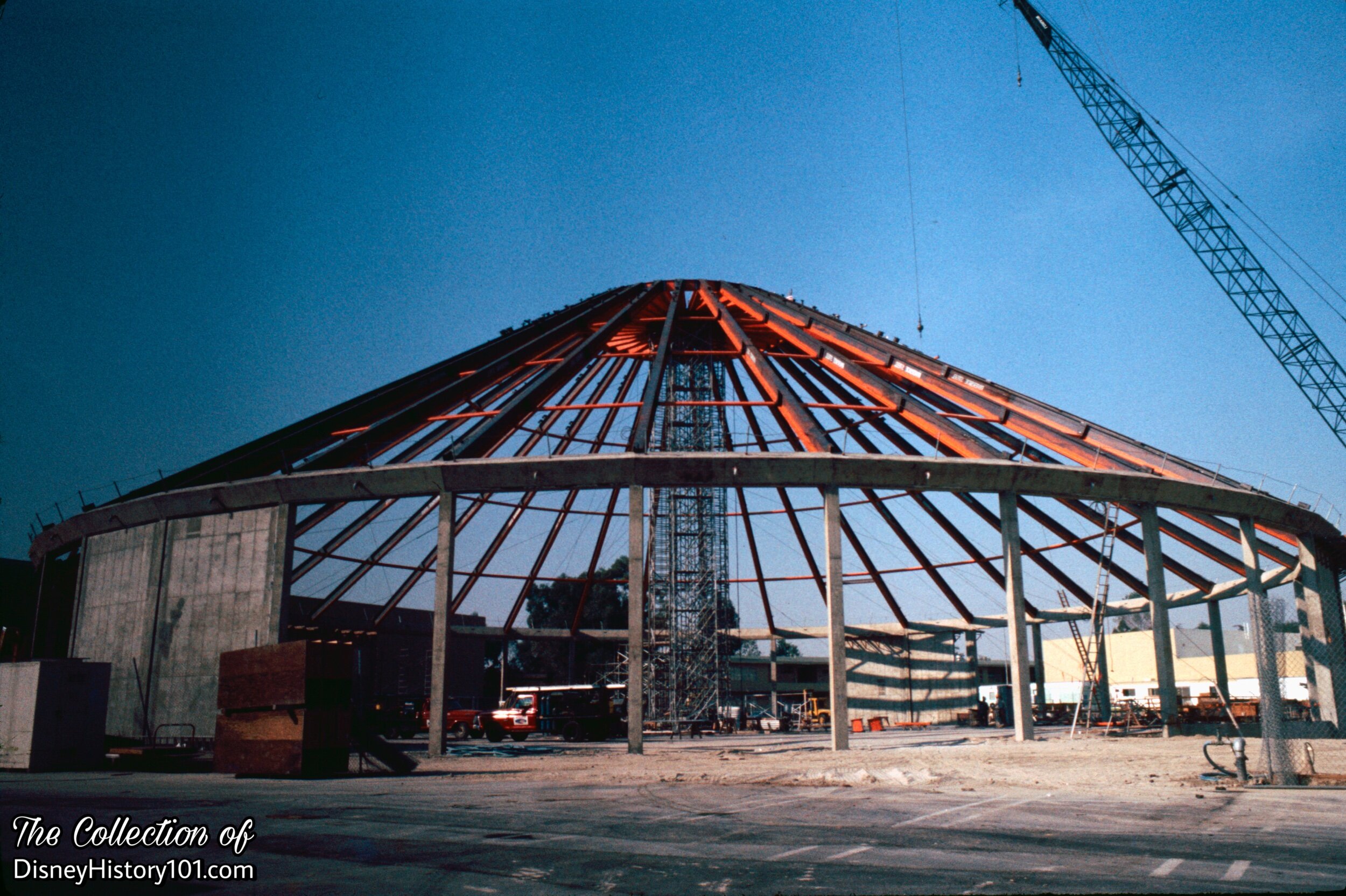
There are a total of thirty-six steel support beams atop forty-five concrete pilings.
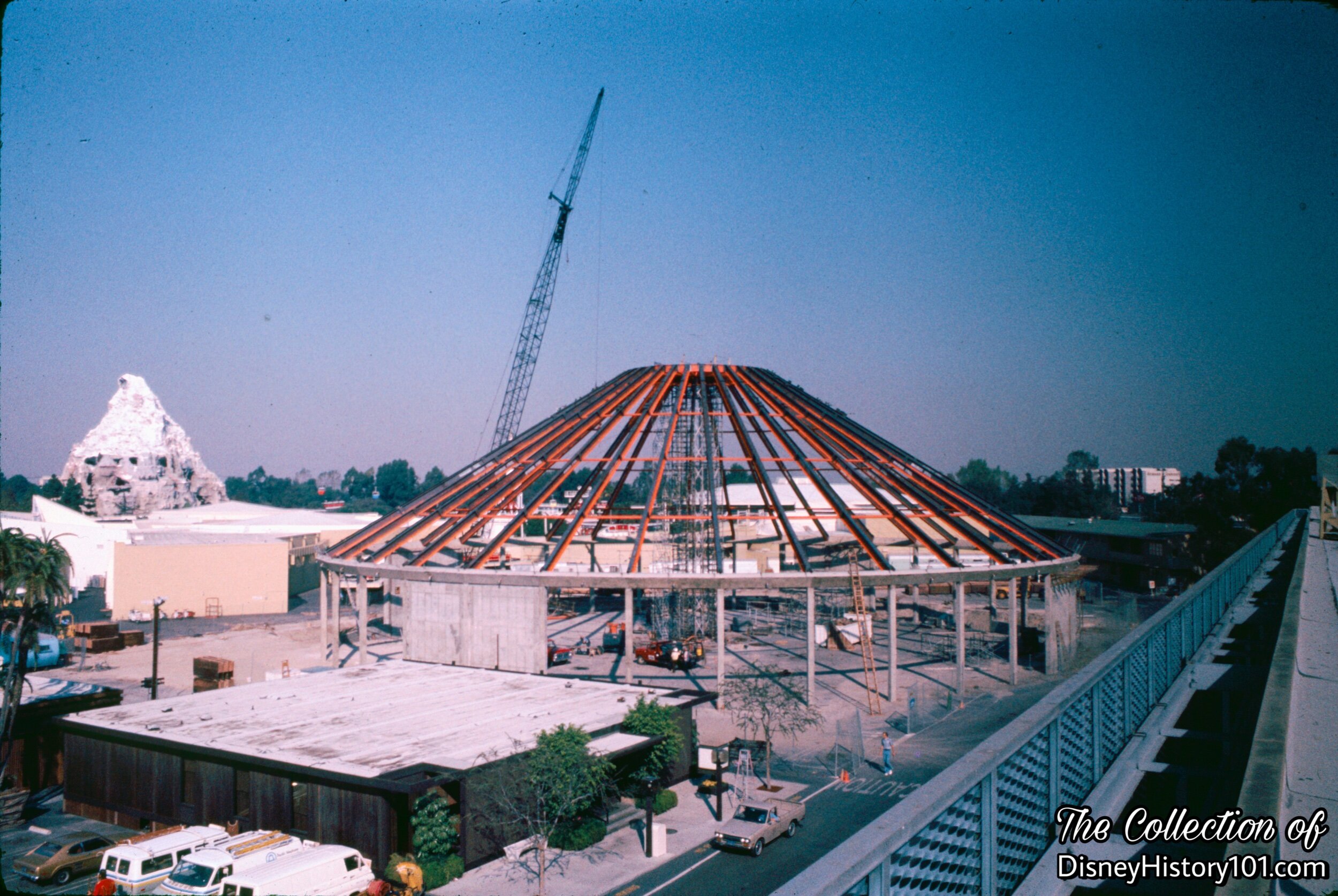
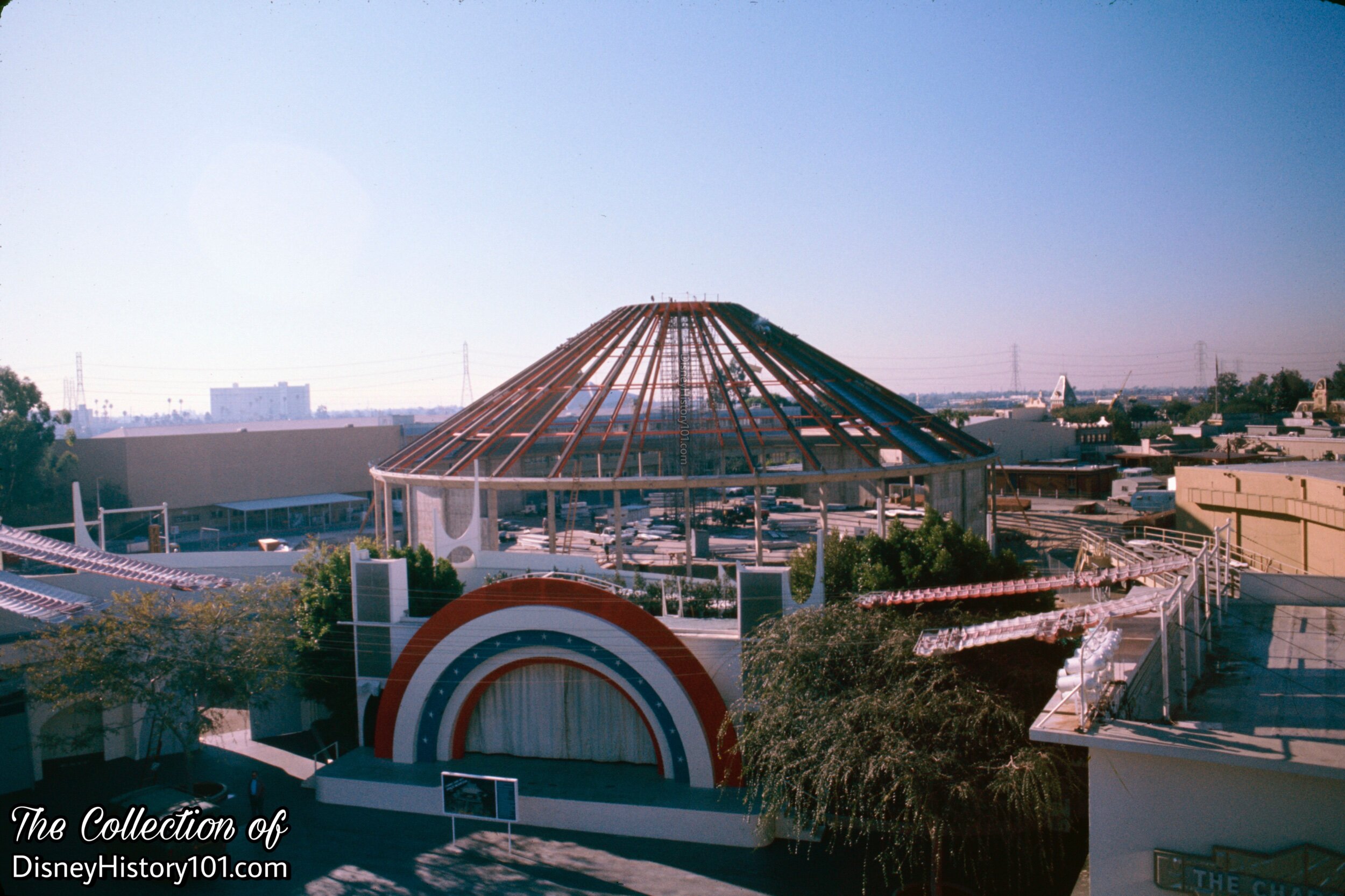
Before the 1,100 seat Space Stage was installed in front of the Space Mountain Complex, this was the look of its facade and the Tomorrowland Stage.
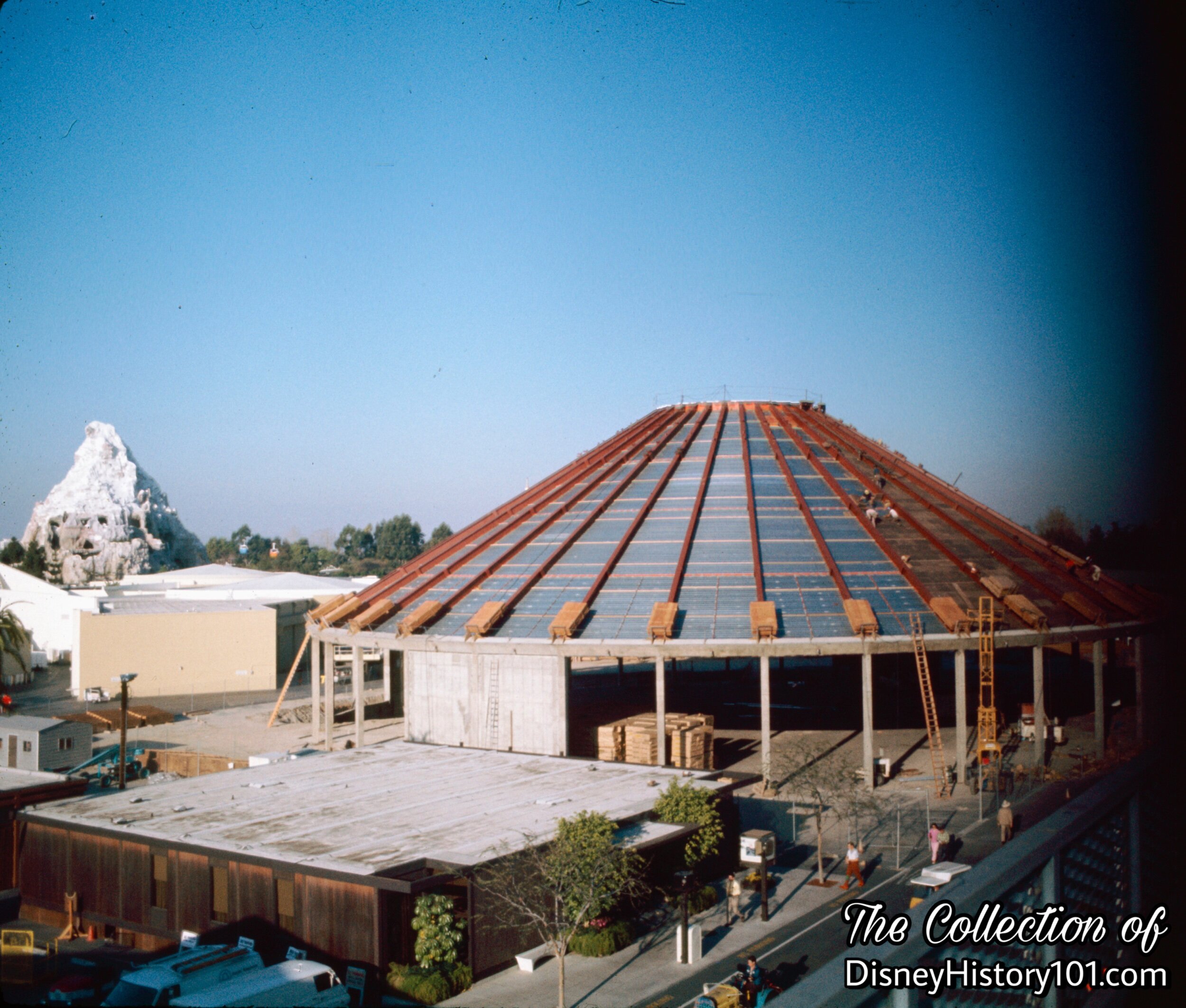
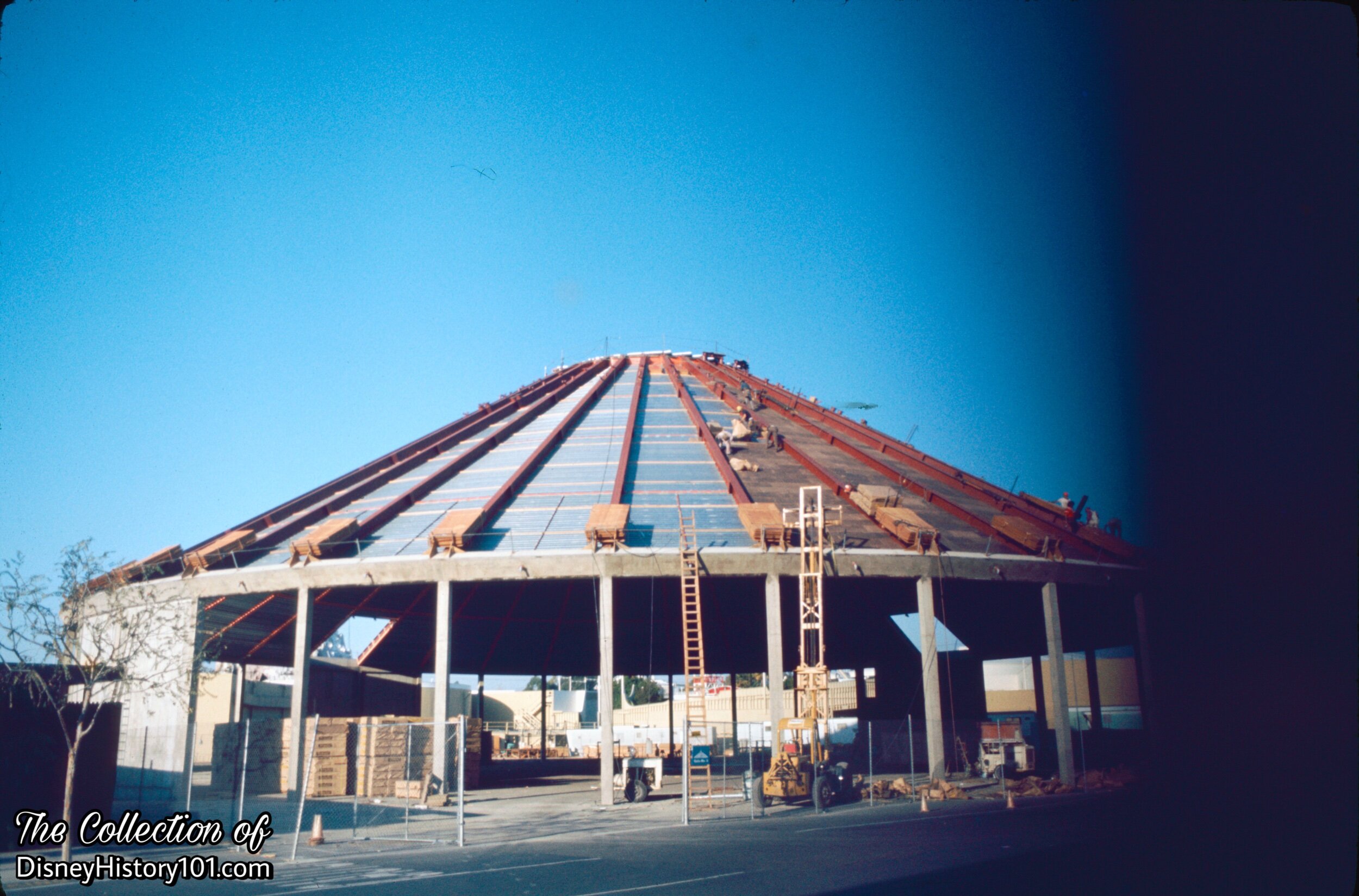
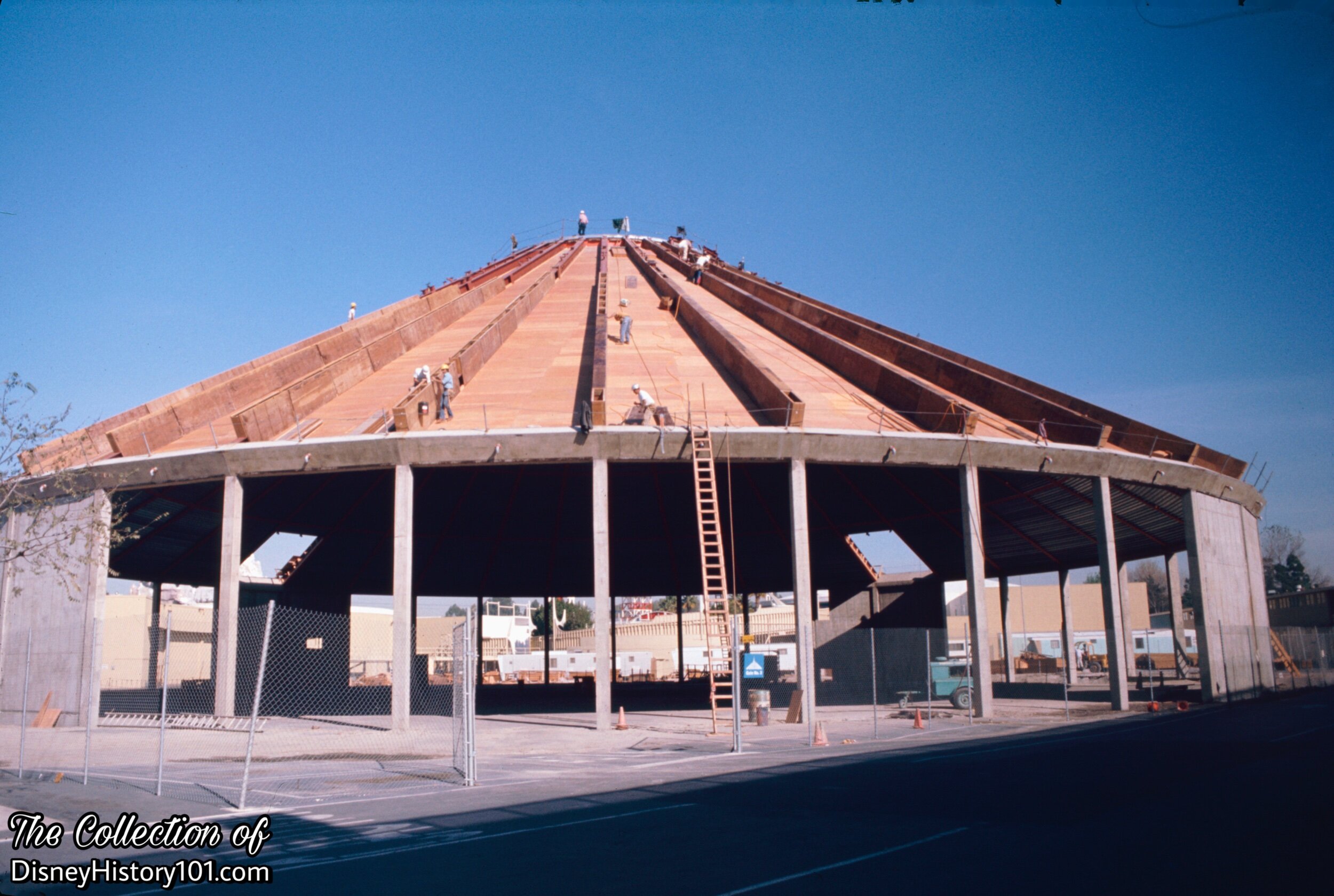
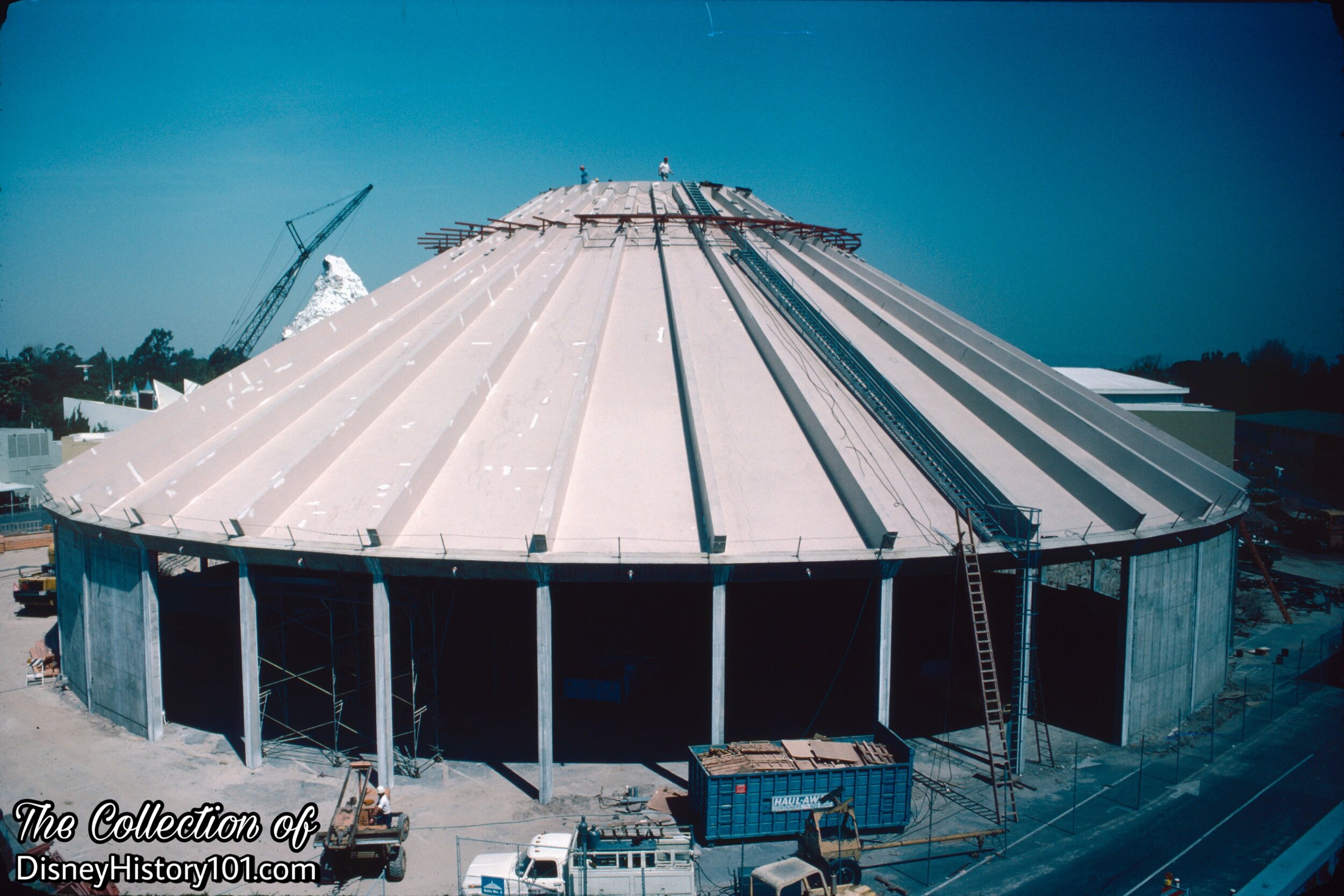
The show building was 75 feet tall (without the external spires).
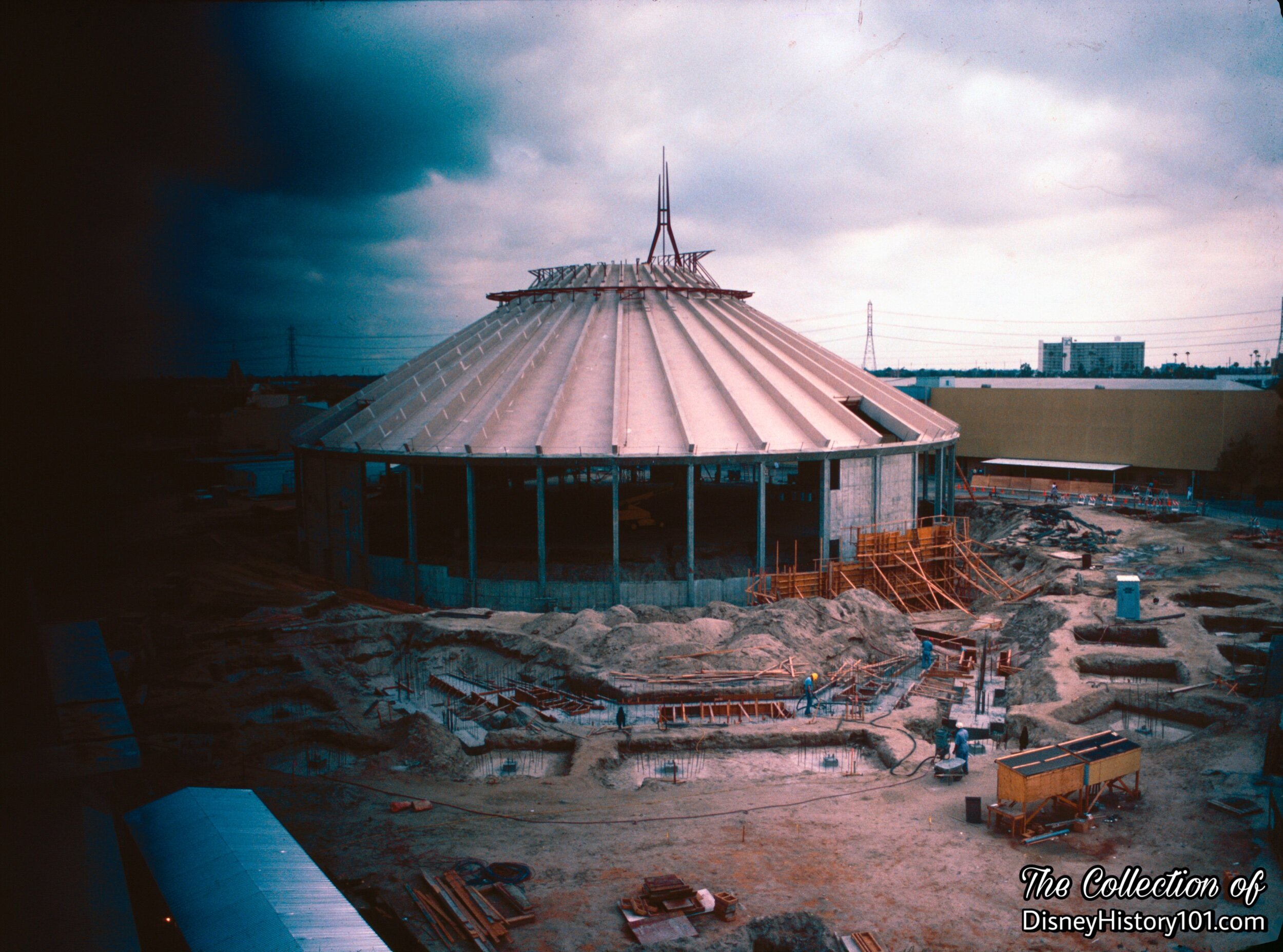
But it was 117 feet from the ground to the top of the tallest spire point.

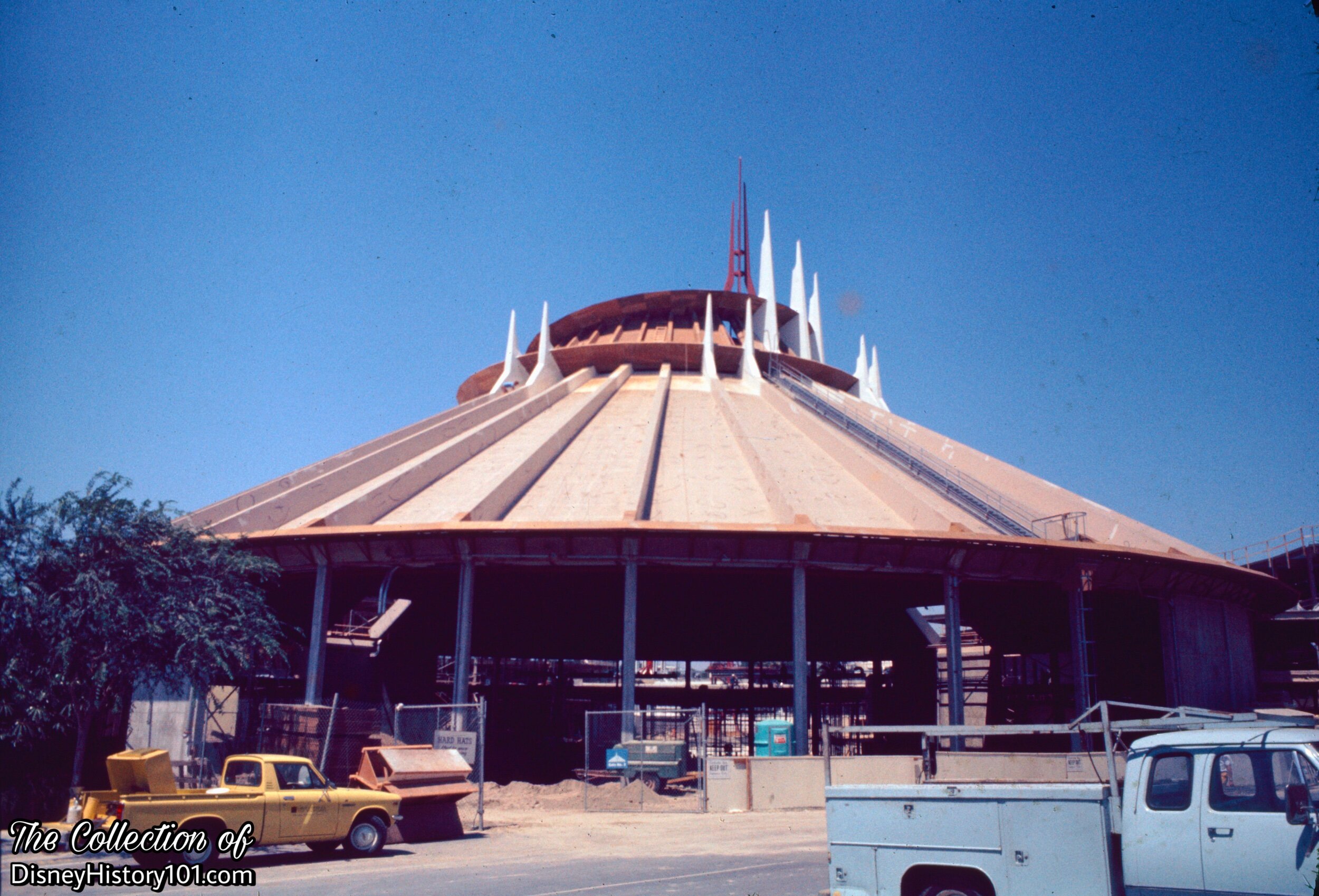
The show building would measure 117 feet from ground-level to the top of the tallest spire.
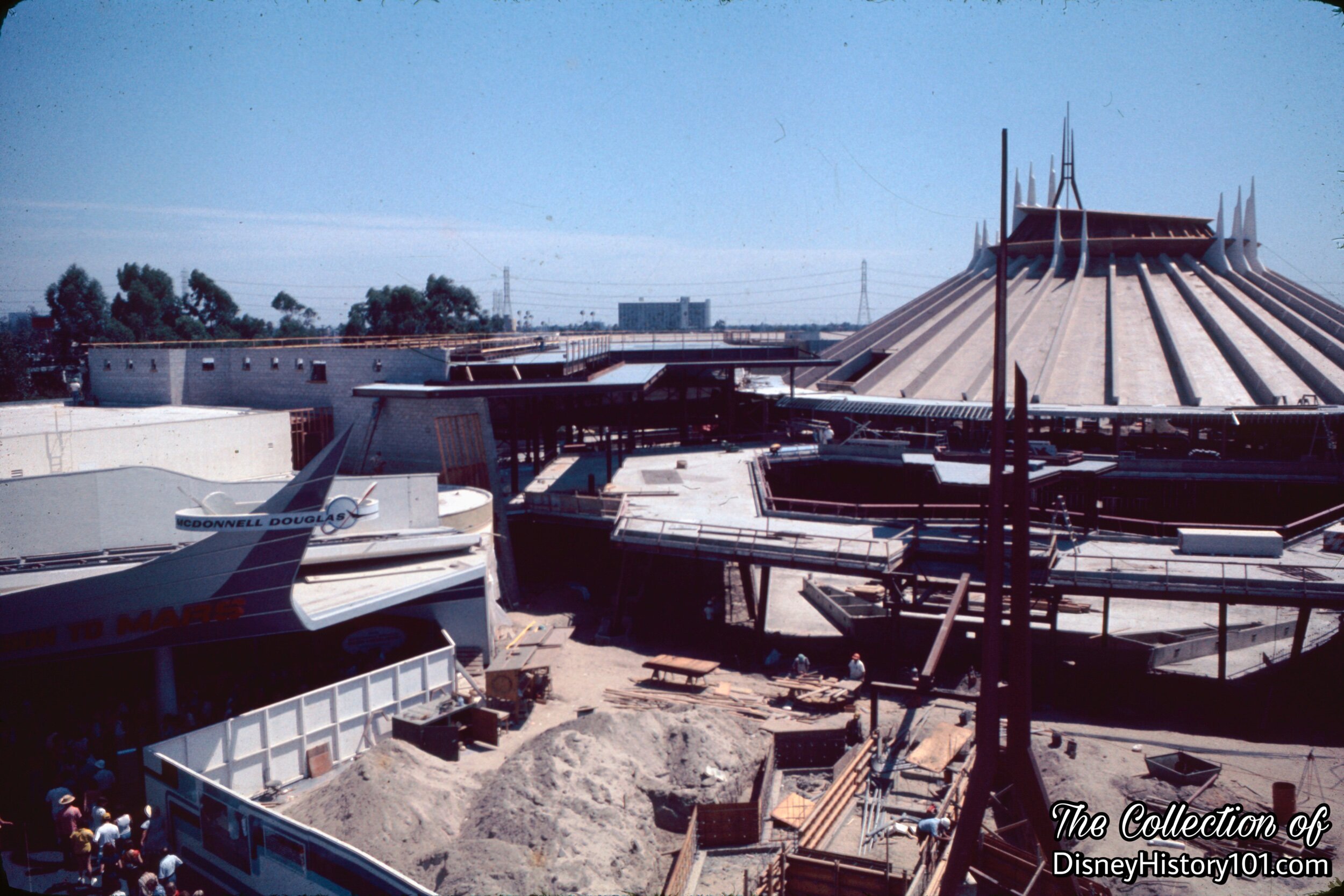
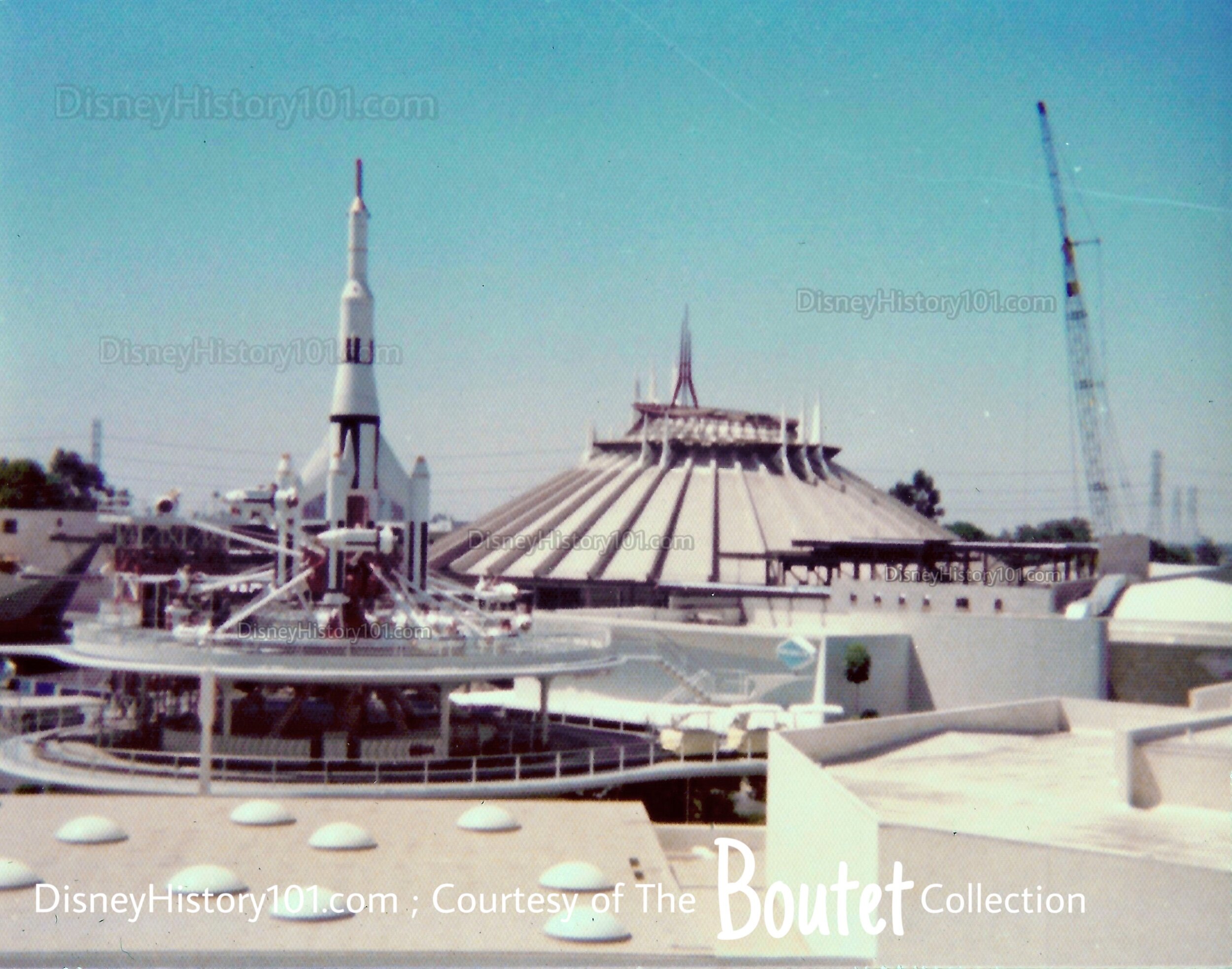
While the tubular steel track layout of the Matterhorn Bobsleds was installed before much of the wood frame and stucco was applied, the Space Mountain show building exterior was enclosed before the steel track was laid. The length of the competed ride track was 3,035 feet, (not including the spur track, and storage track, which brought the approximate total to 3,450 feet). Soon, one Program Logic Controller (PLC) system and a Nova system (“for message generation” and alerting operators and engineers to any conditions of units) was installed. These were similar to those first installed at Walt Disney’s Magic Kingdom in Florida.
Plans for the majestic Space Mountain Show Building were still being approved by February of 1975. But as soon as construction began, LINE magazine often published the “Space Mountain Update”, to educate Cast Members on the progress of the attraction.
For instance :
•Saturday, March 5, 1977 : 2400 pounds of sand was cycled through the Mountain to evaluate structural aspects of the attraction.
•By March 10, 1977 Disneyland LINE reported : “The Spaceport Load/Unload Area construction is progressing rapidly an assembly has started on the Intergalactic Probe. All attraction control equipment has been delivered and installed, and initial ride control testing will begin [during the remairing days - March, 10th-12th] this week. All catwalks along the track have been installed. Installment of the five speed ramps is currently in progress. Regrading of the area in front of Mission to Mars was started this week. Regrading is necessary for a smooth thematic transition into the new Space Mountain complex.”
Air-conditioning controls dust, and a practical mechanical application of the technology was essential in the attraction where projection equipment and film was used.
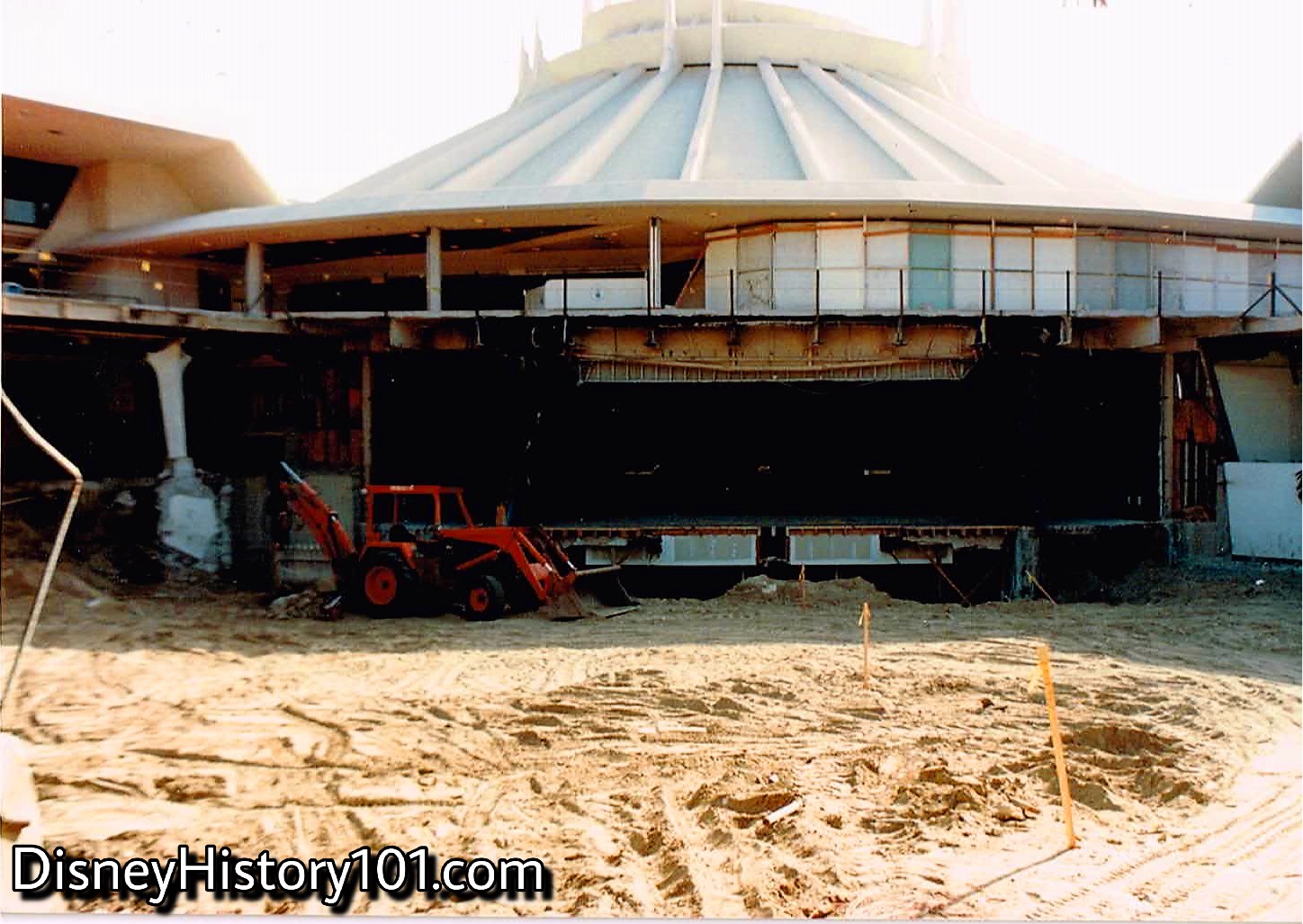
The lower areas of the Space Mountain Complex will house a modern arcade, a merchandising shop, a fast food facility, and a large amphitheater for live entertainment.
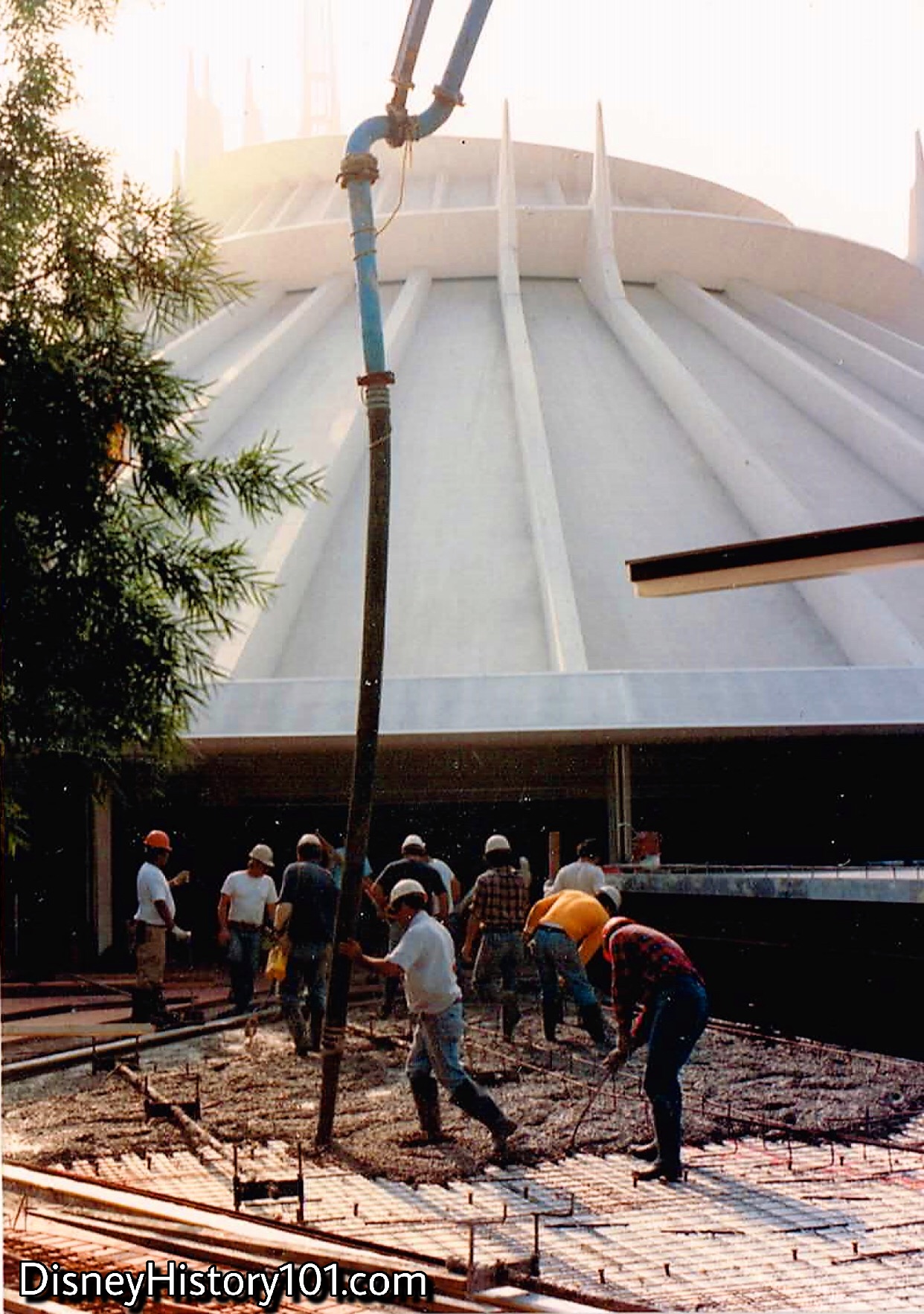
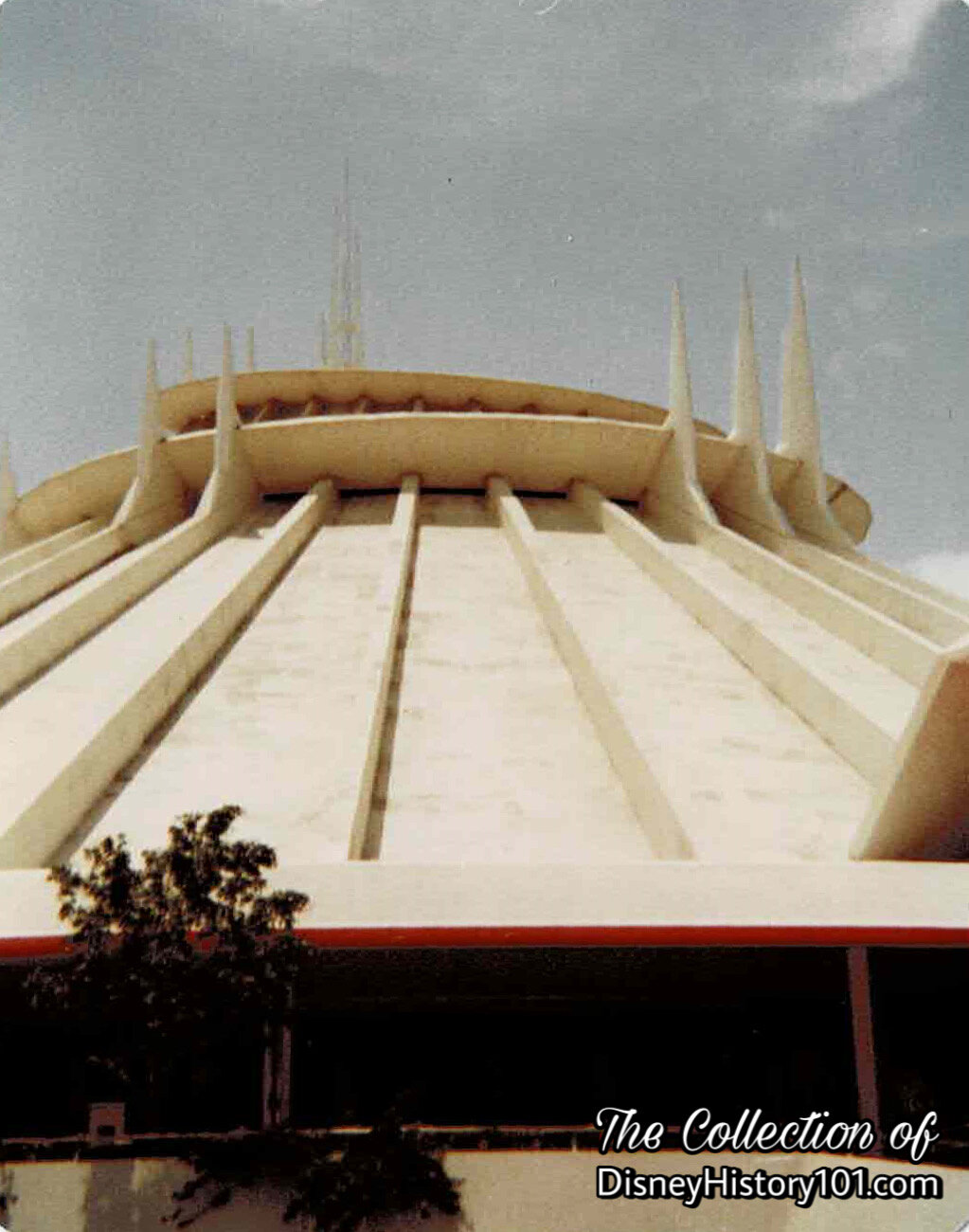
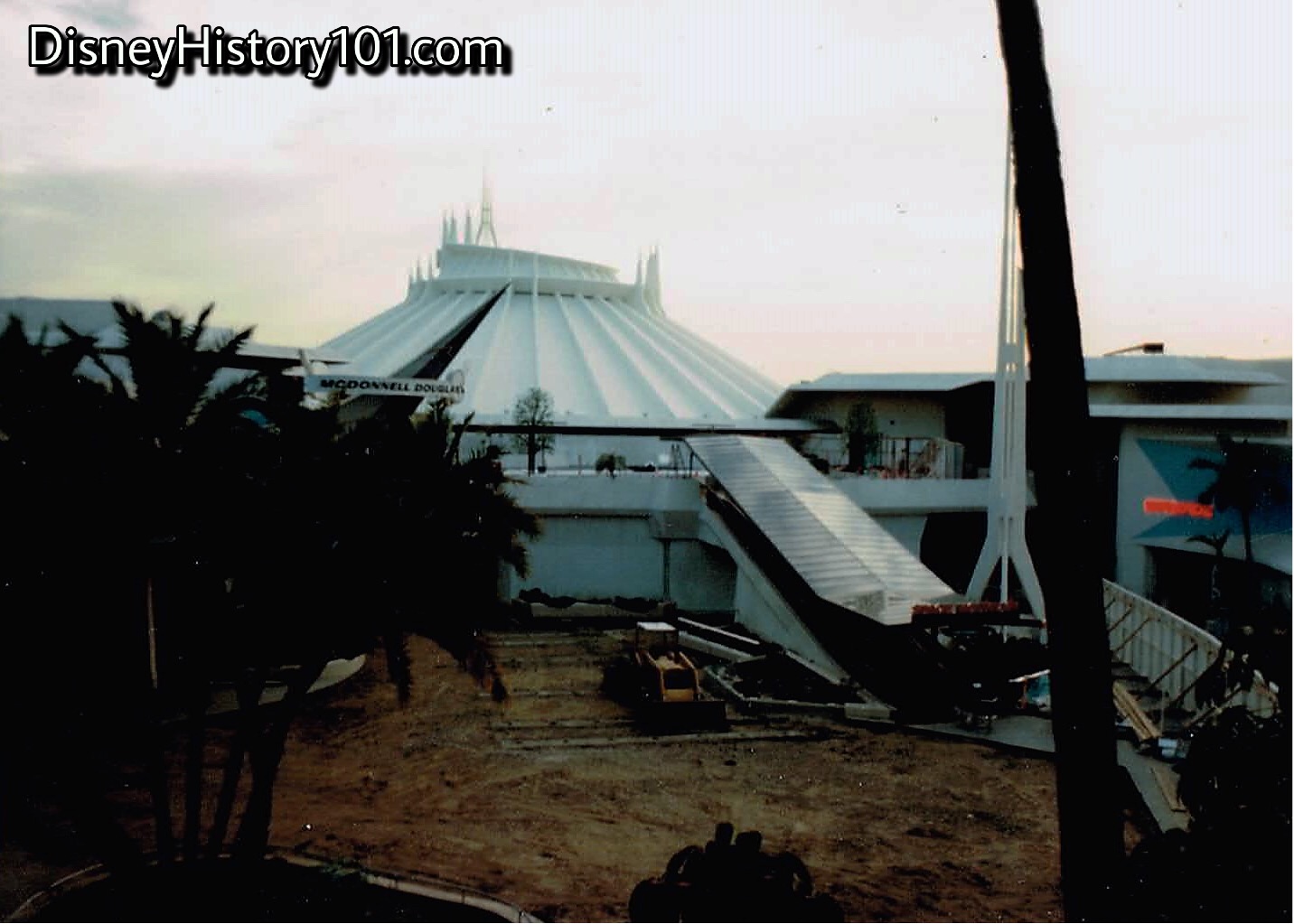
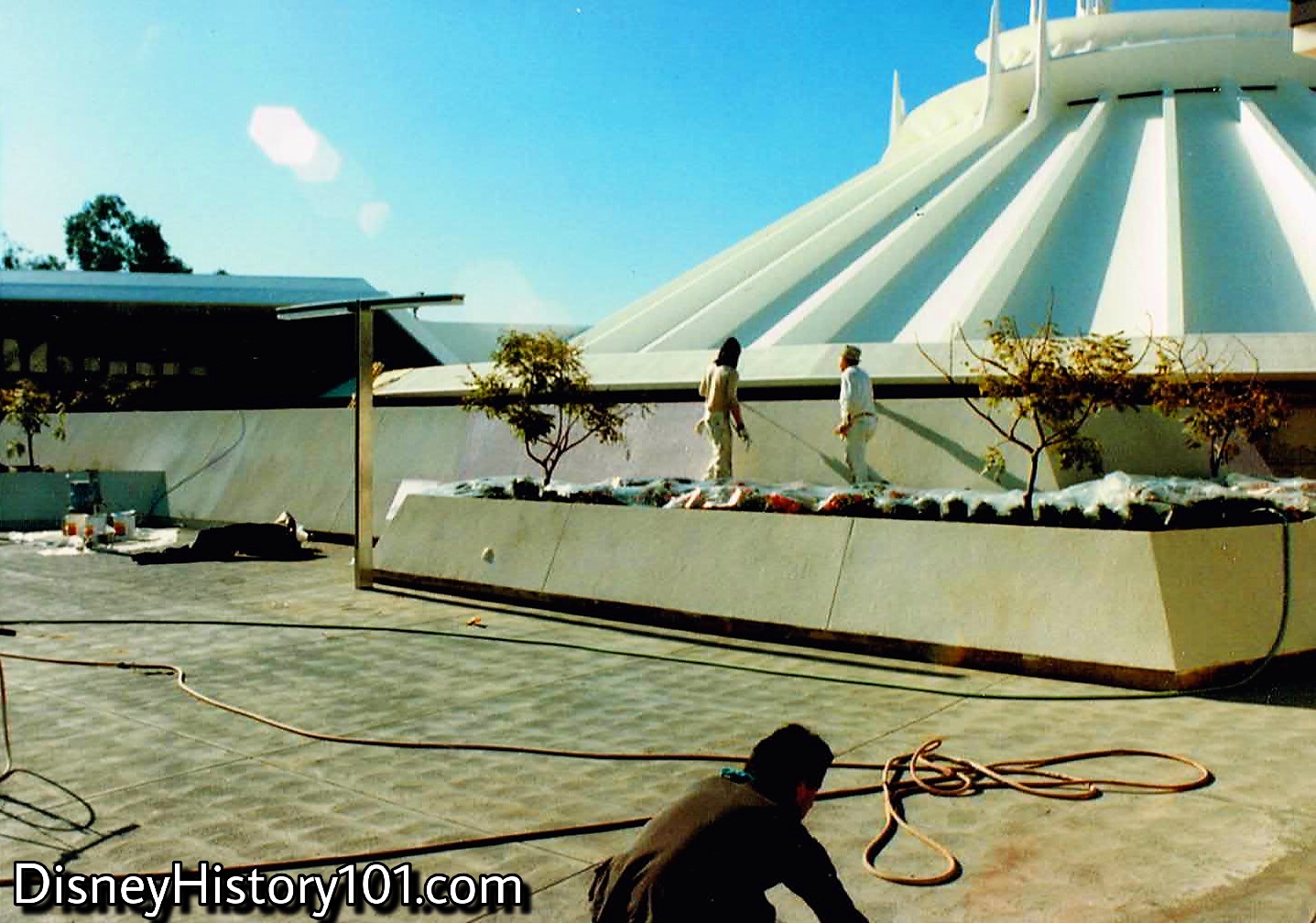
This is where Guests will wait in an orderly fashion (queue) to board Space Mountain.
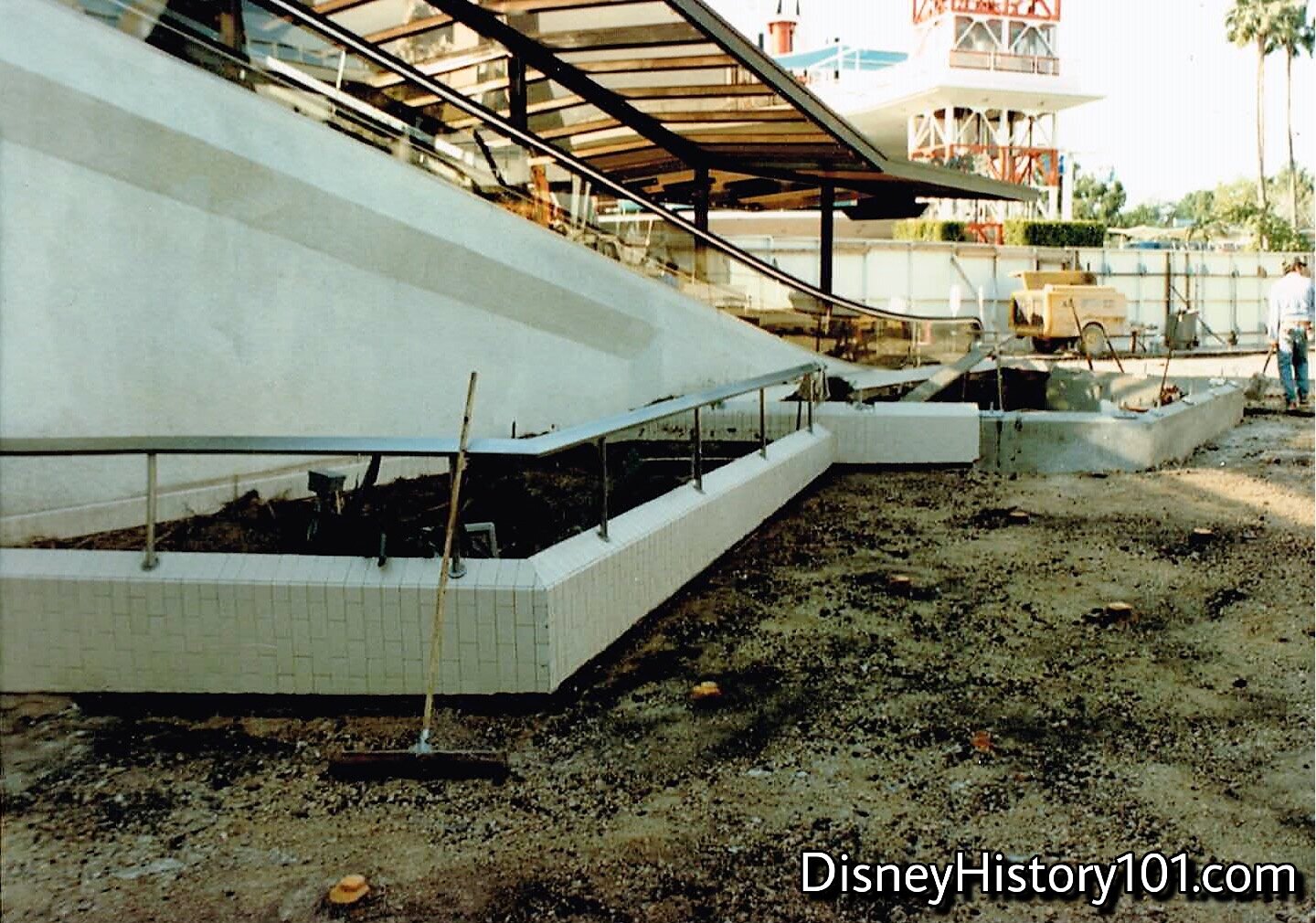
Disneyland “queue lines” were designed as part of the attraction to make the Guests' time in line as comfortable as possible.
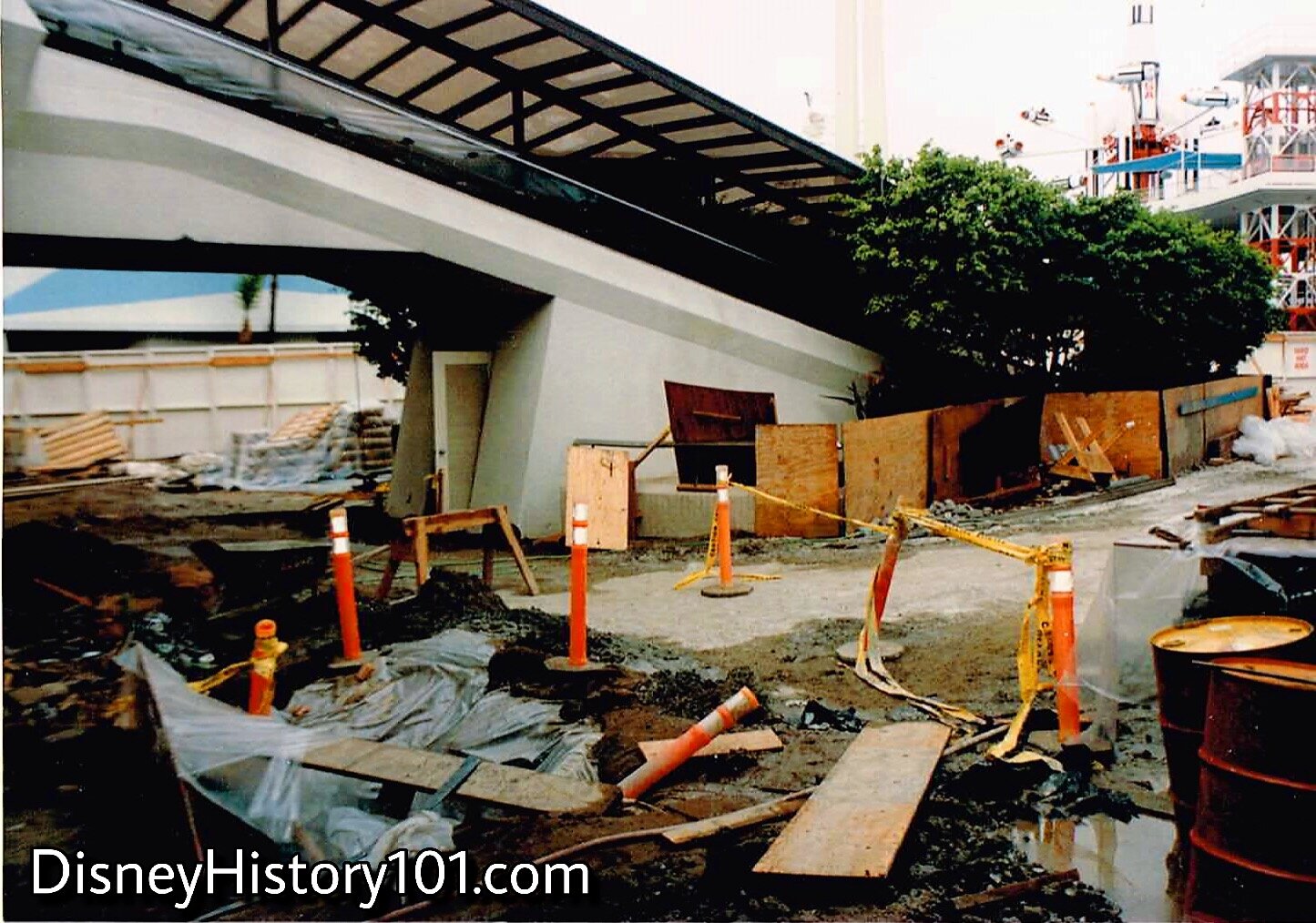
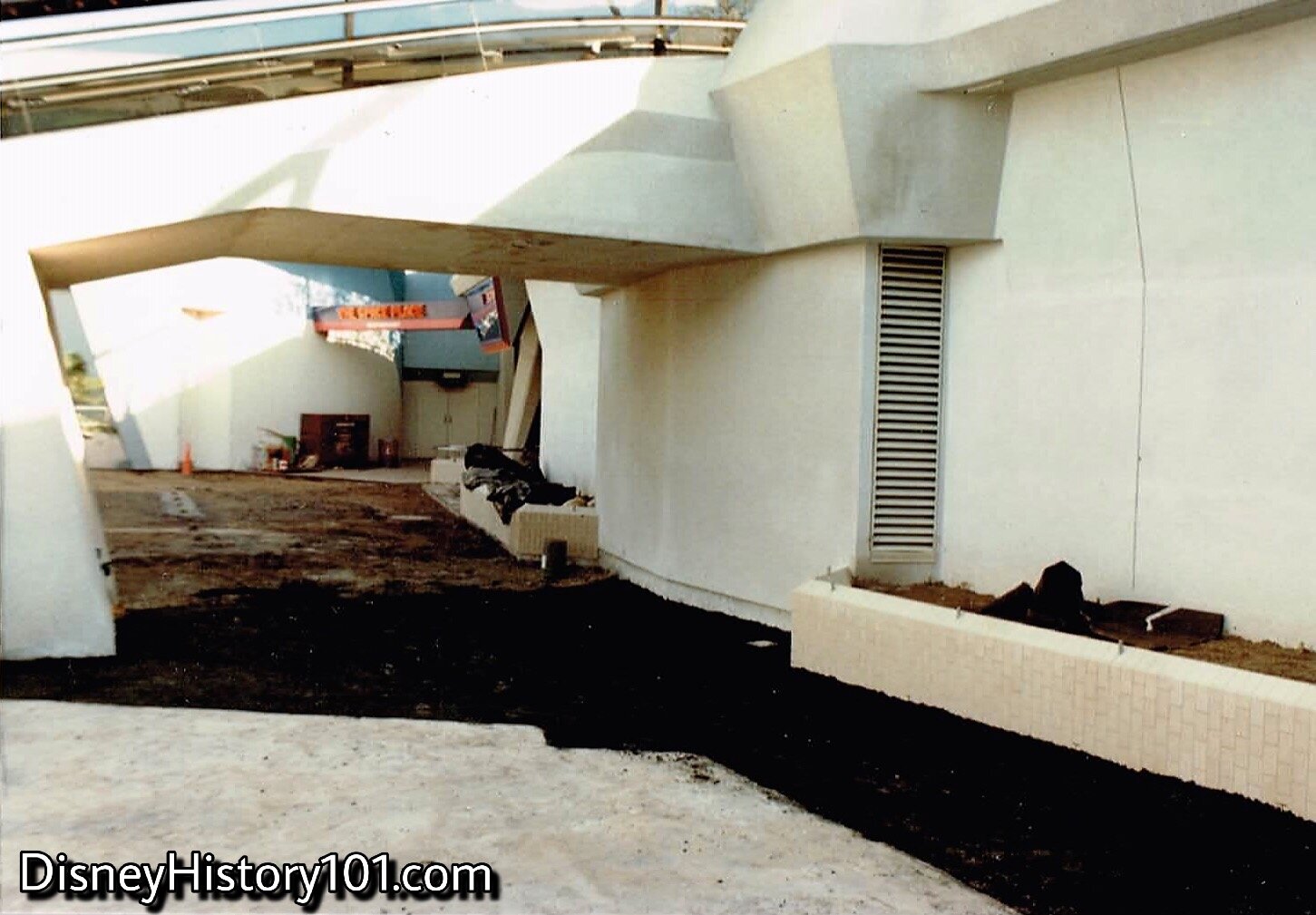
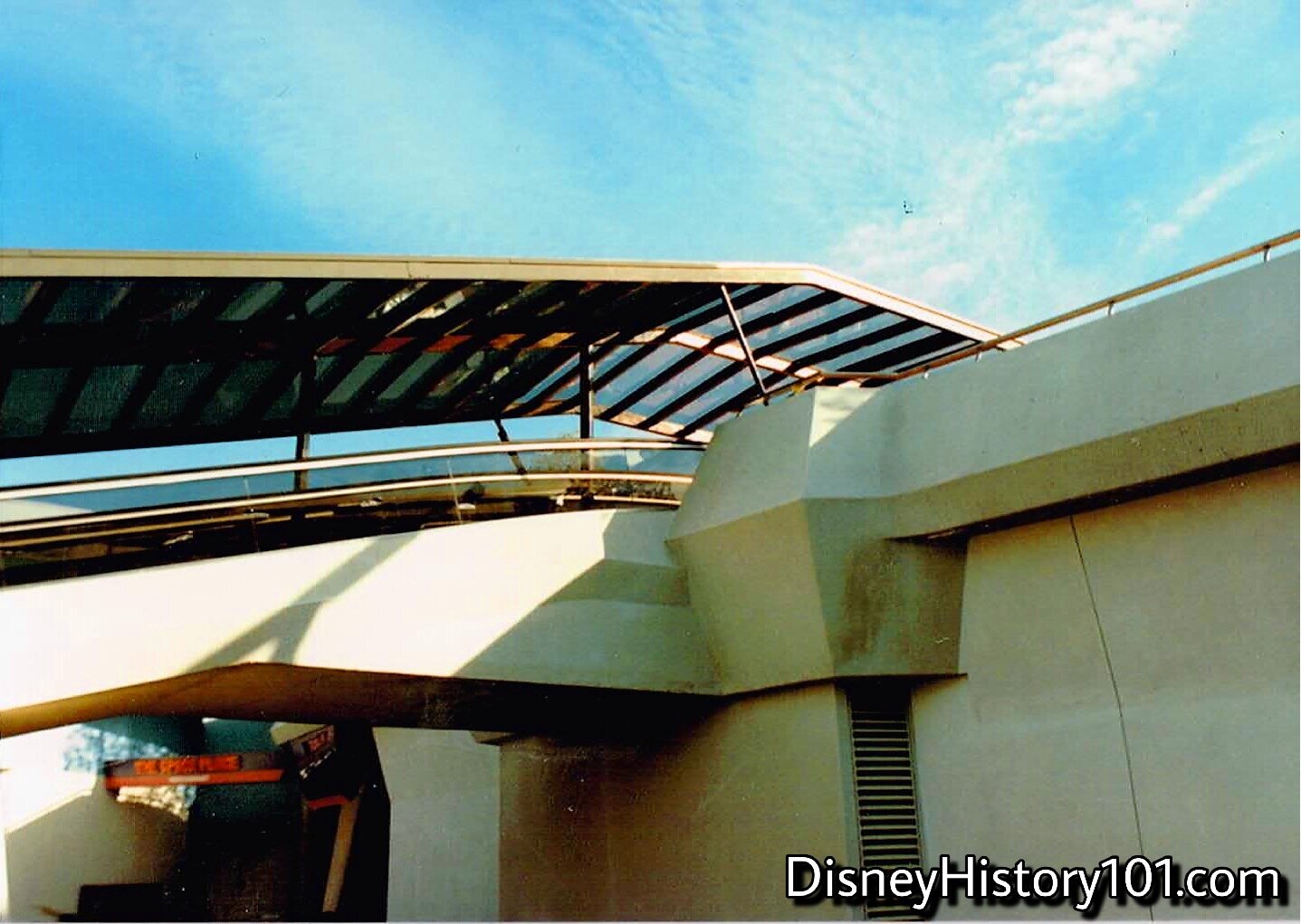
Two moving sidewalks (similar to the Stephens-Adamson Speedramp at the Tomorrowland Monorail Station) were installed in front of Space Mountain. These Speedramps would help guests to the upper concourse (and ride entrance).
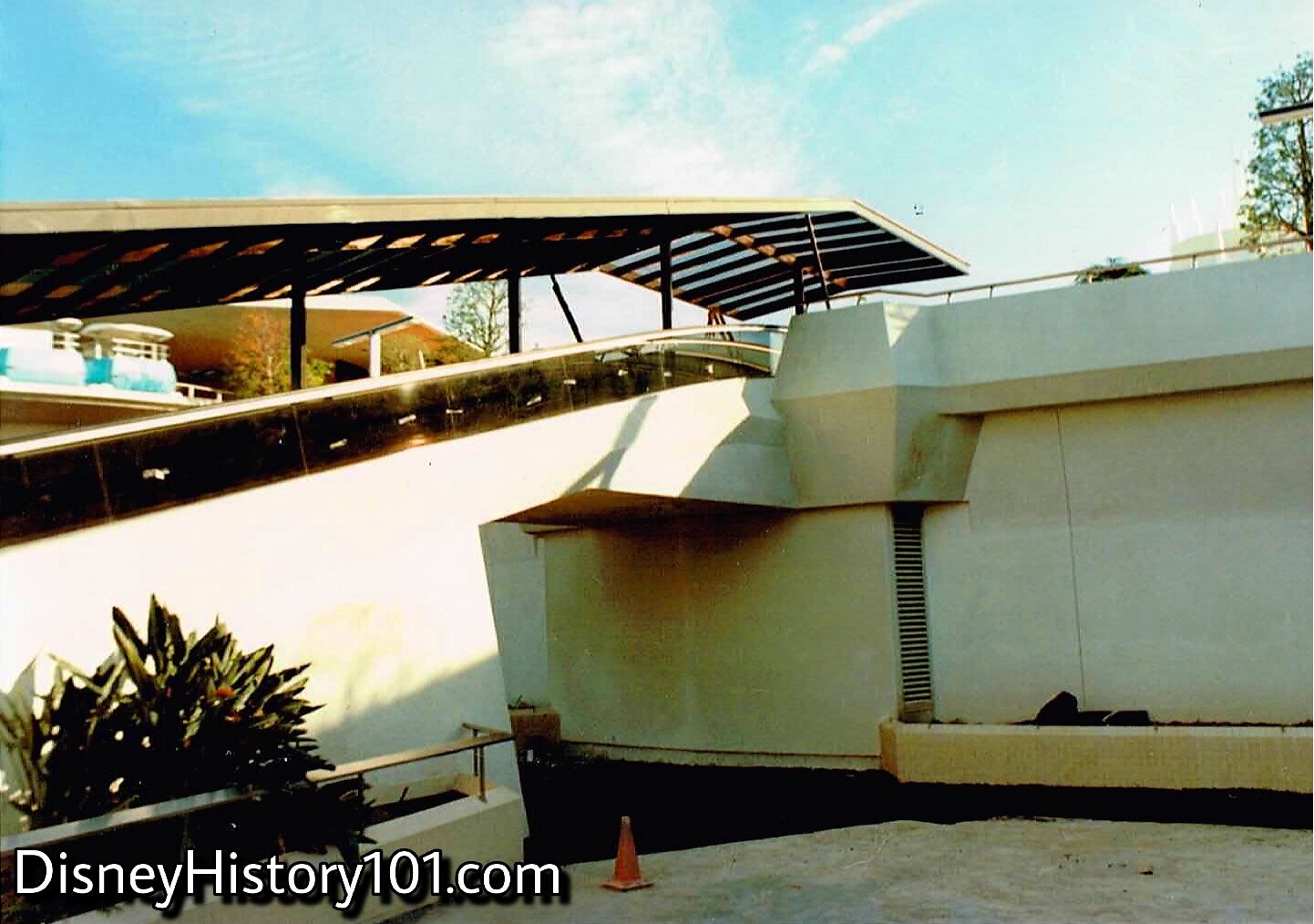
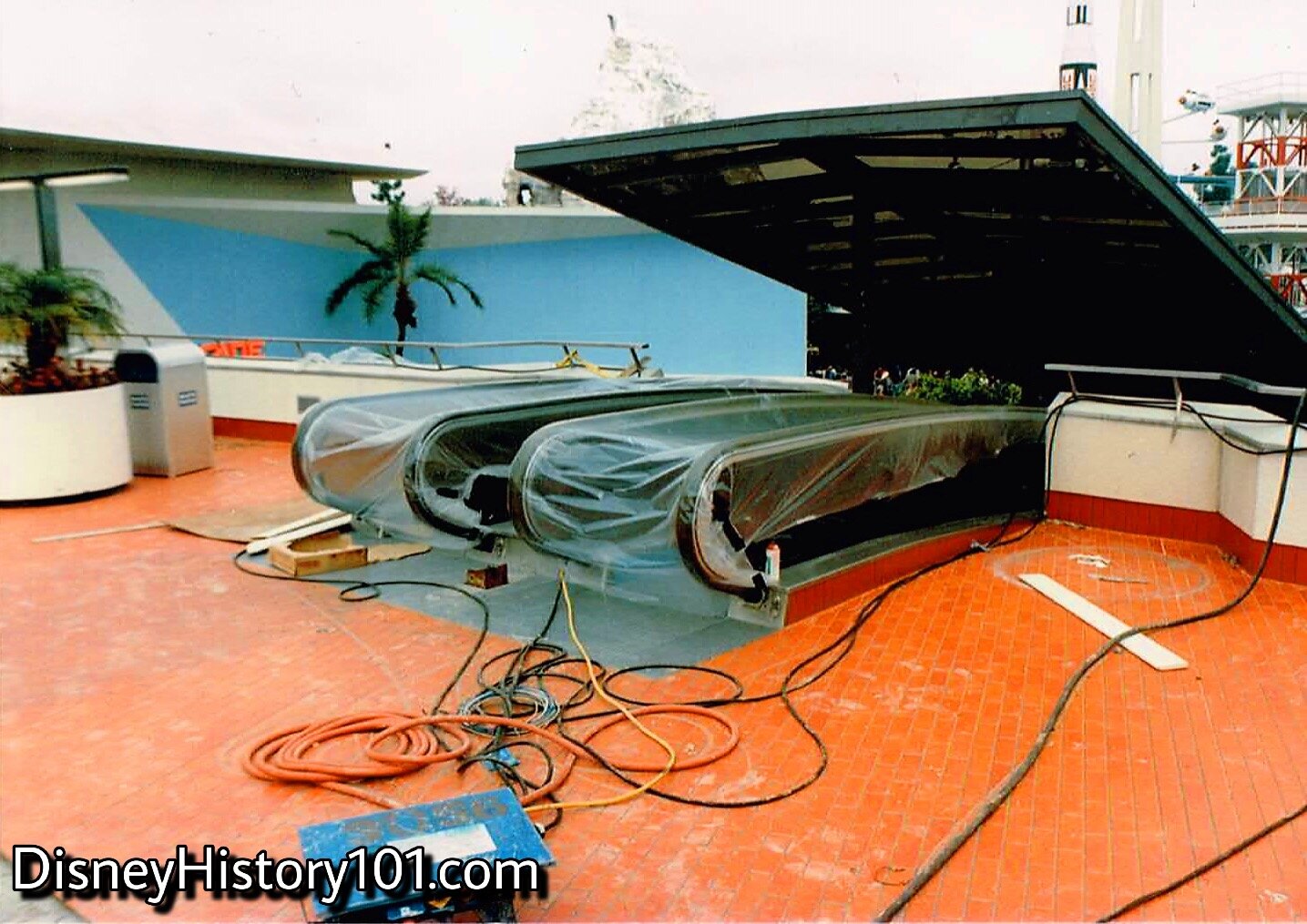
In 1981, the “I-Have-An-Idea” Program yielded new Starcade and Space Mountain Speed Ramp handrails, courtesy of Phil Hilde, Larry Johnson, and Virgil Stroud of the Disneyland Mechanical Department. Under the older system the handrails were wearing out and being replaced every three weeks. Under the new Guest Control queue area routing system, the handrails only needed to be replaced every four or five months.
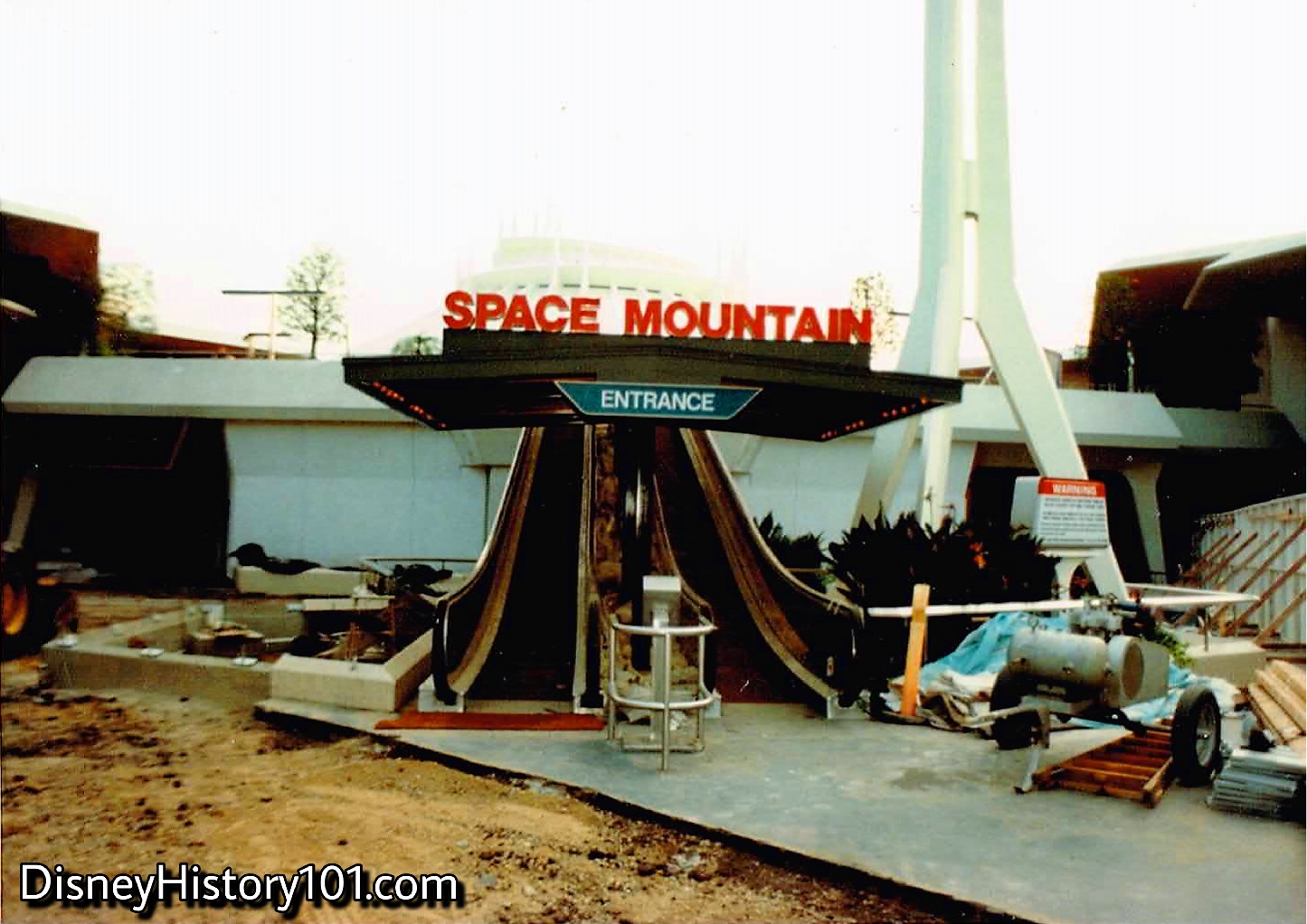
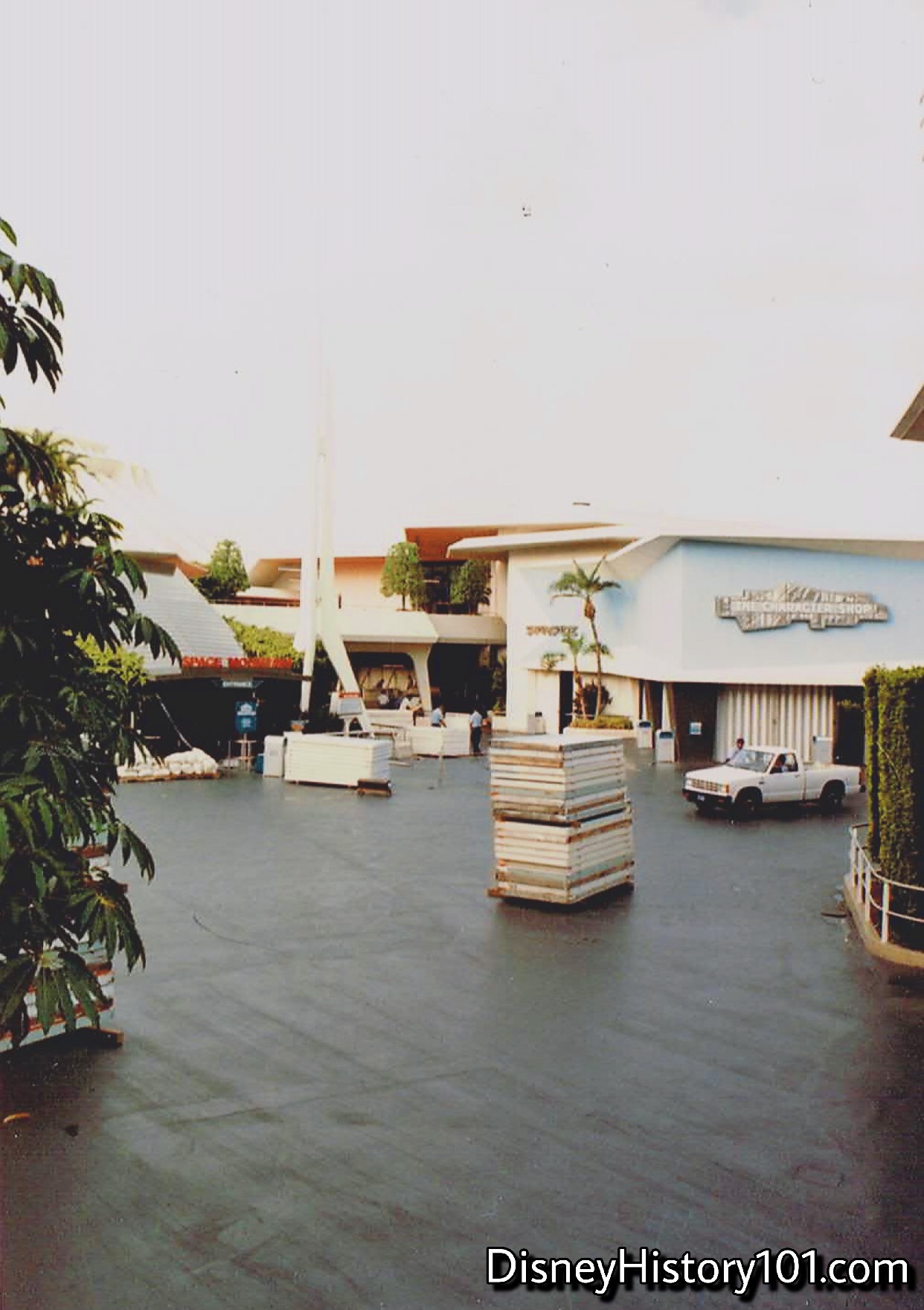
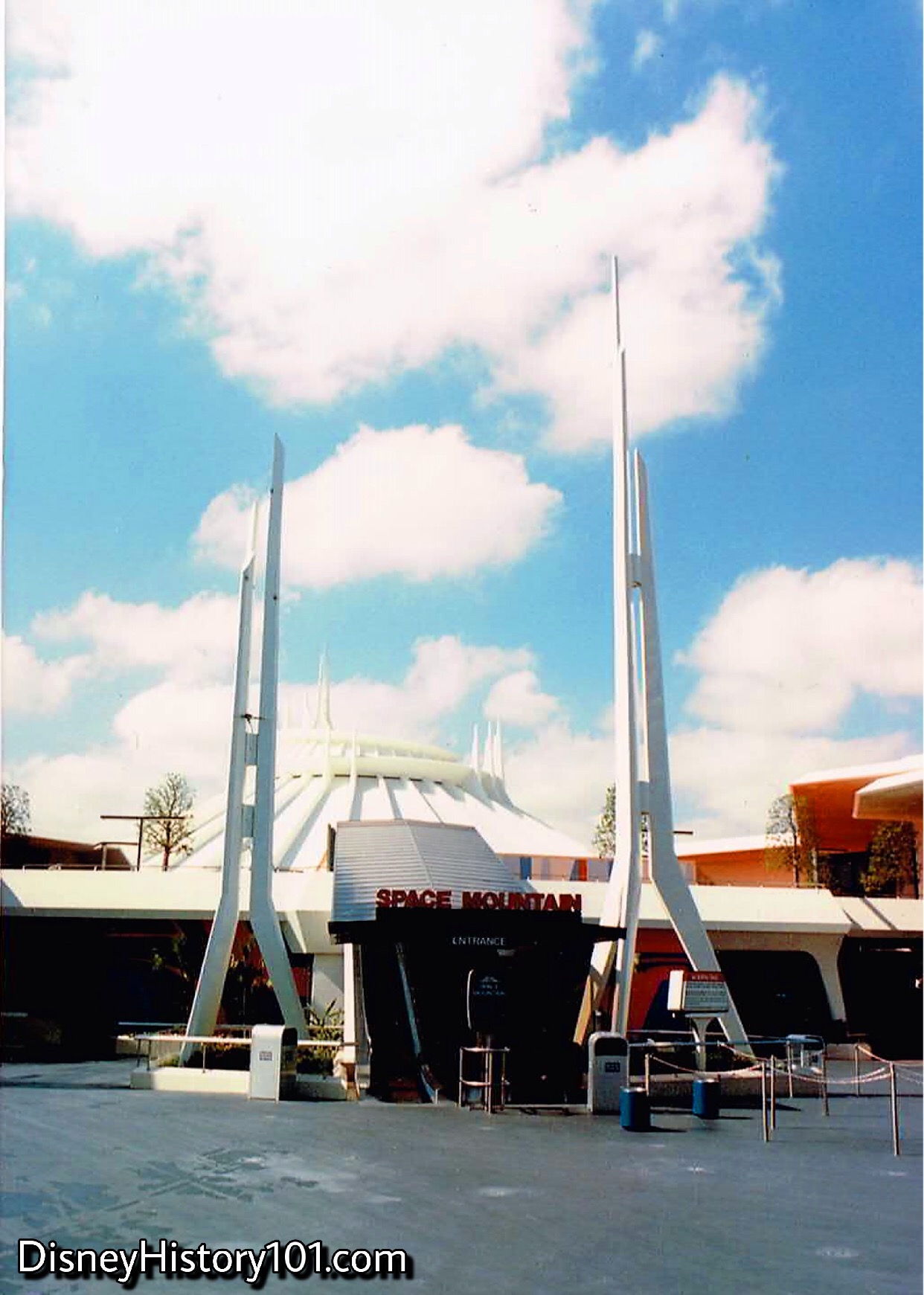
Two coats of an Elastomeric Coating are applied (over a span of weeks) to the 100,000 square feet of peaks that comprise the surface of the Space Mountain complex. The resulting finish will last up to five years according to Disneyland LINE (June 29, 1978).
Due to the ongoing construction in the Backstage Area, the Hills Bros. Gate was not used during the Easter Parade of April 10, 1977 (at 2:00 pm). The route would run from the Fire Station Gate to the Small World East Gate.
After 12 years of planning and two years of construction, Space Mountain was completed during May of 1977. Press Release packets divulged the following “operational data” about Space Mountain.
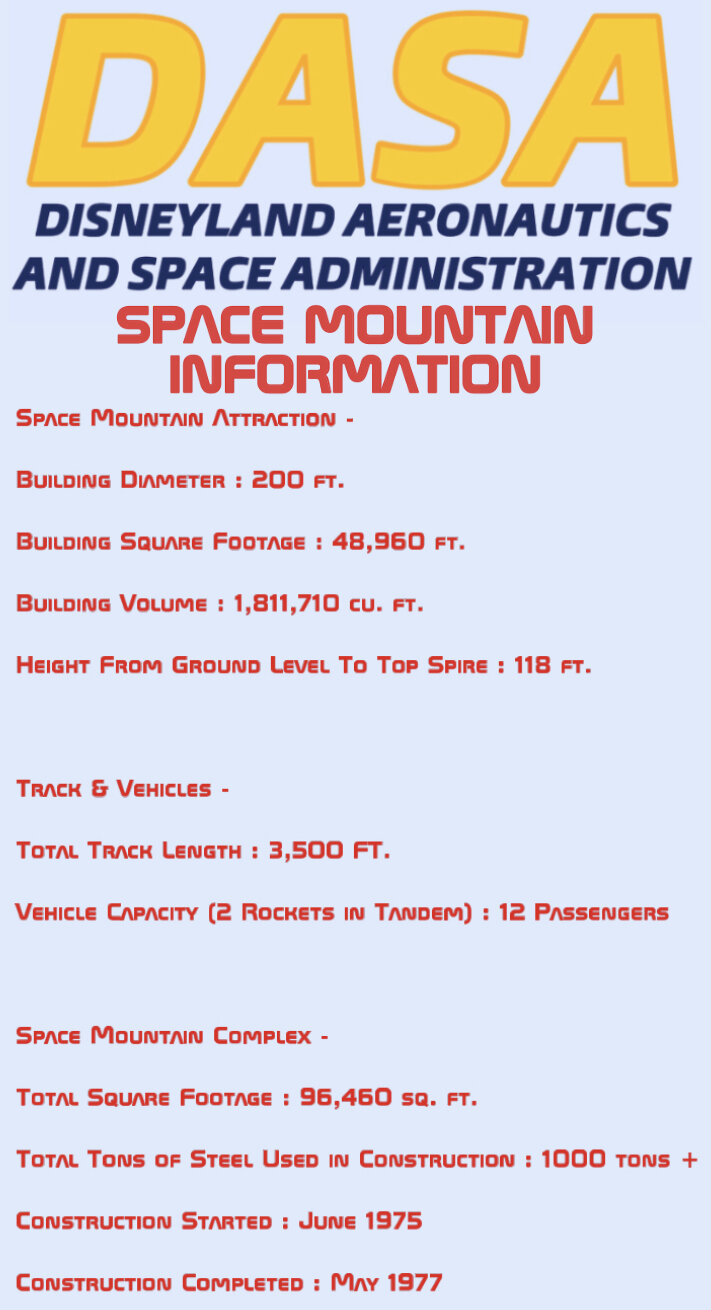
Disneyland Publicity Writers of the Marketing Division (Bob Roth, Frank Whiteley, and Al Flores) were very busy brainstorming Press campaigns related to the big grand opening! Meanwhile, quite a few Disneyland Cast Members recall becoming “test pilots.”
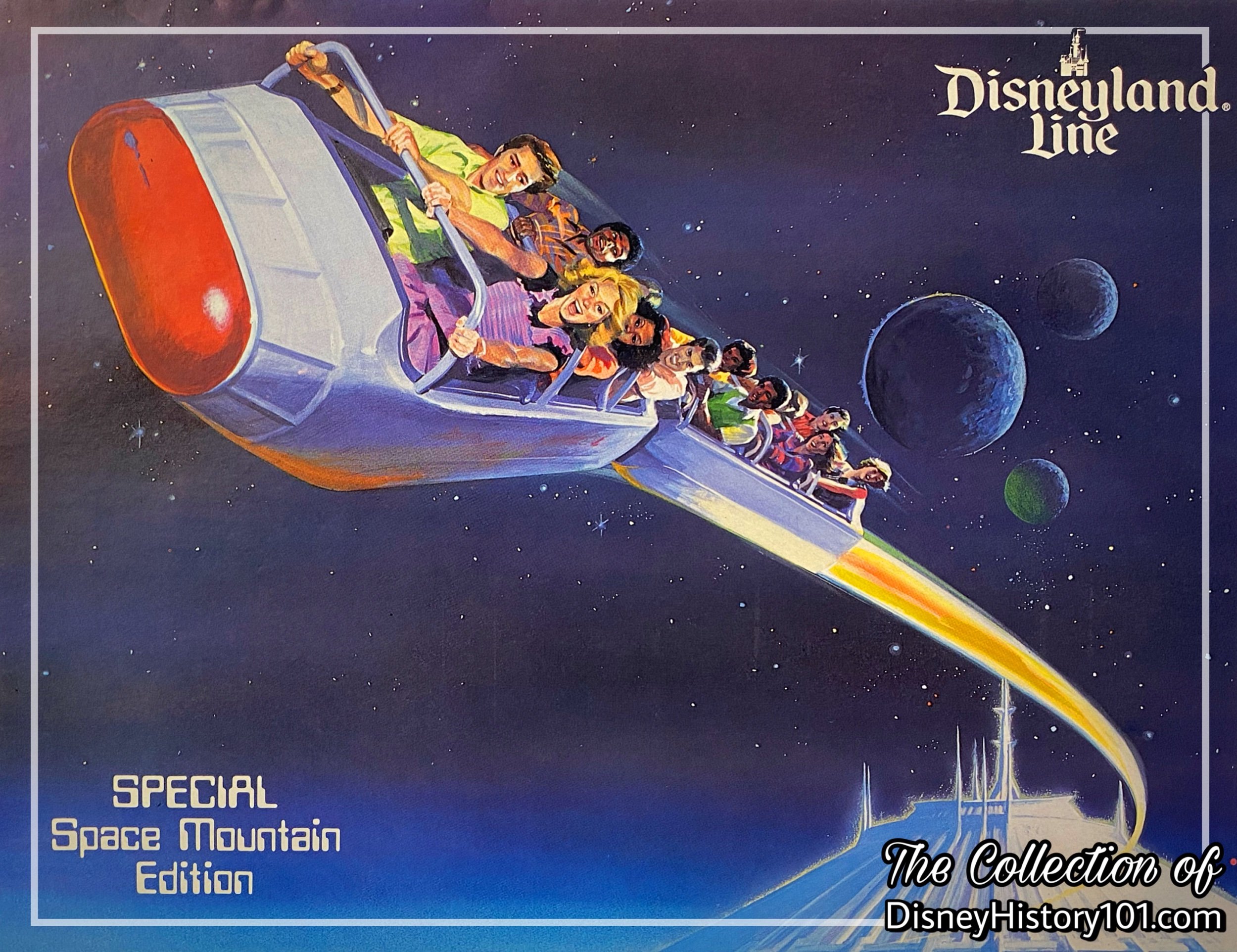
According to writer Donia Ruescher:
“Space Mountain captures the essence of Superspace. The expectant ‘space voyager’ is transported through the space station launch portal, and through the vast man-made ‘solar field.’ He then orbits the glowing ‘satellite,’ become engulfed in spectacular nebulae and plunges past myriads of strange stars and unknown galaxies to begin reentry.”
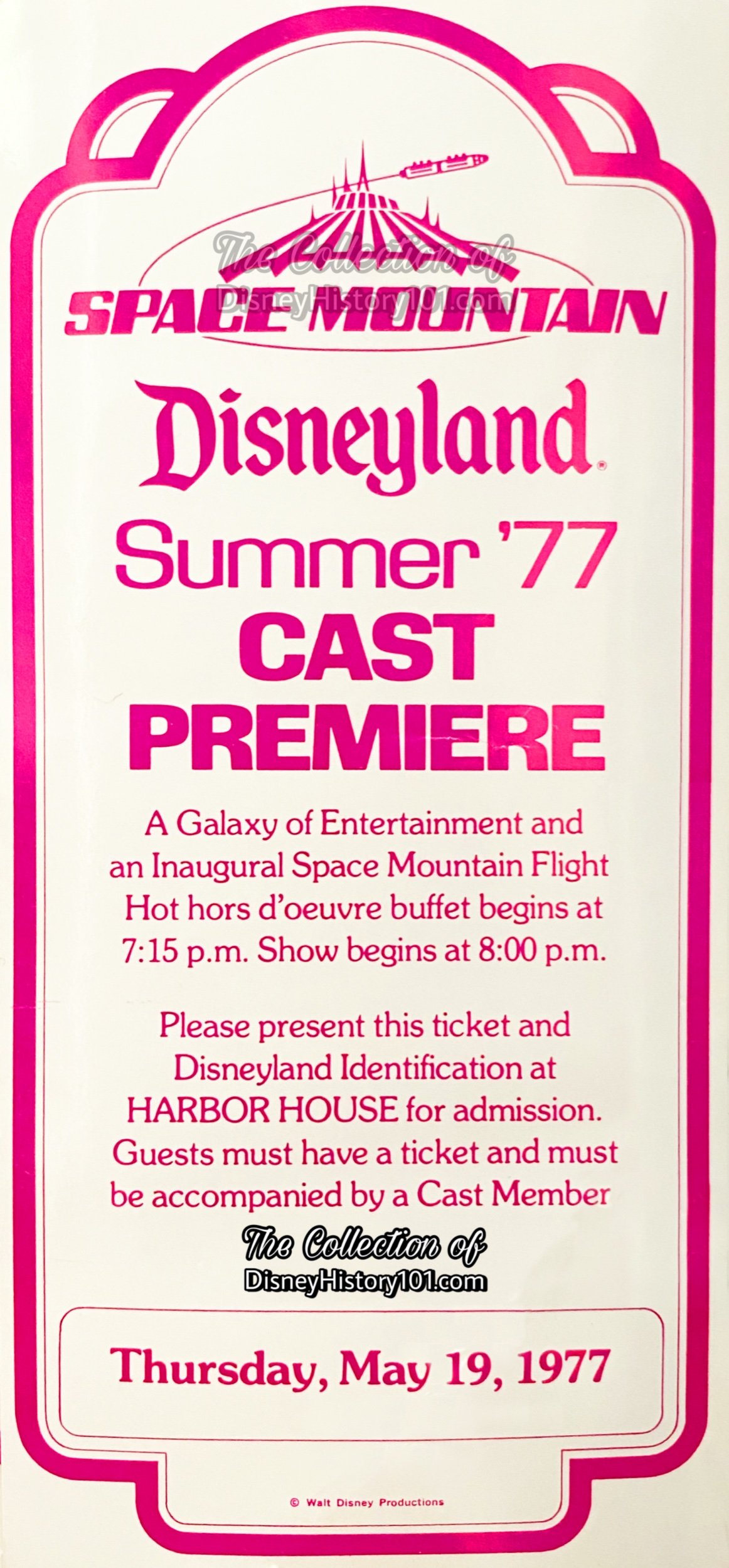
While a few fortunate Disneyland Cast Members recalled test piloting Space Mountain well before the official Disneyland Cast Premier, most of the Cast attended the Disneyland Cast Premier to be accounted among the Inaugural Flight Crew. These lucky astronauts were given these mementos of their journey!
“More than 6,000 Disneyland Cast Members and their guests enjoyed Space Mountain Cast Premiere ceremonies over five nights during the last two weeks in preparation for the Grand Opening of our new Tomorrowland addition this Friday, May 27.” [Disneyland Line, May 26. 1977]
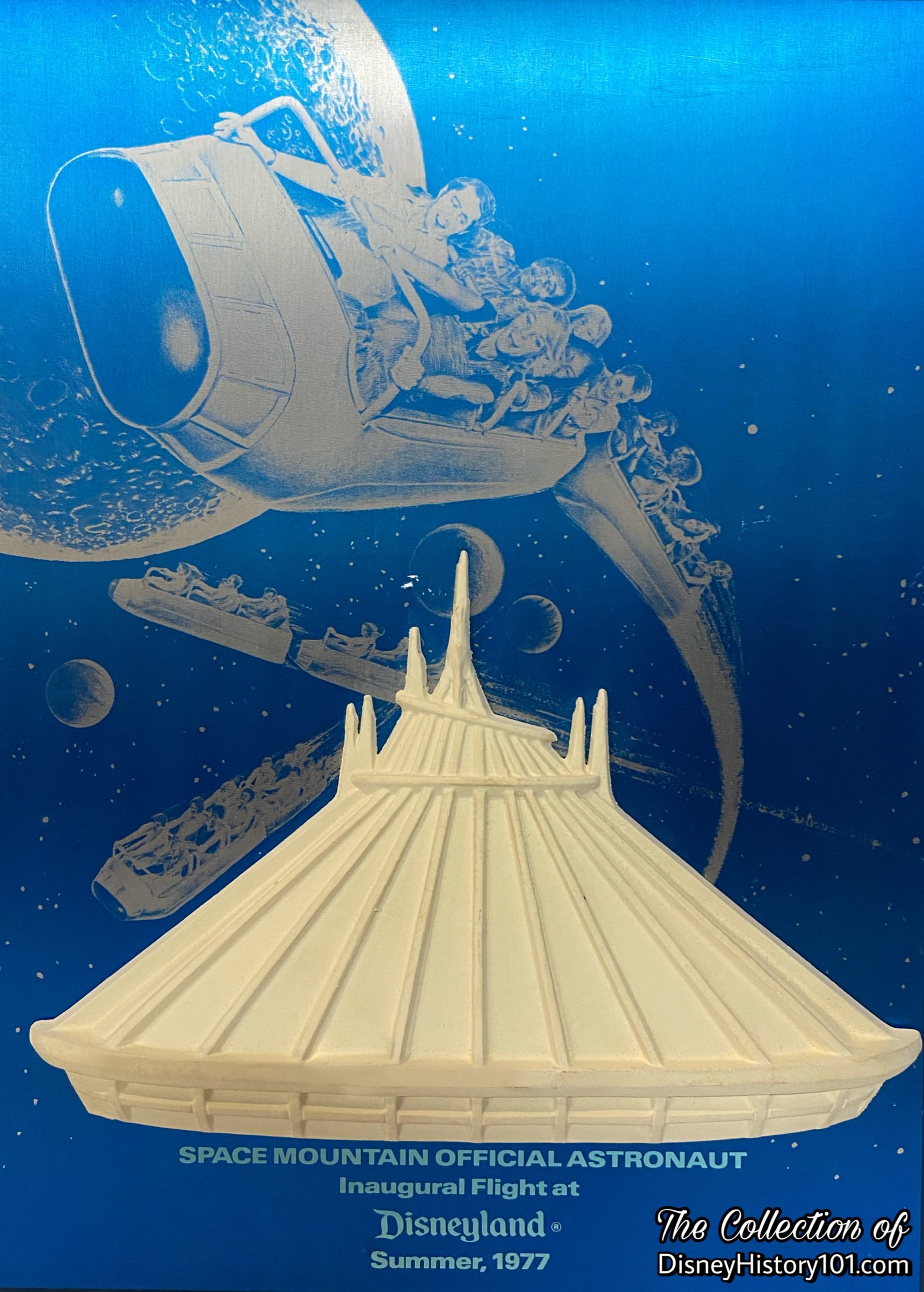
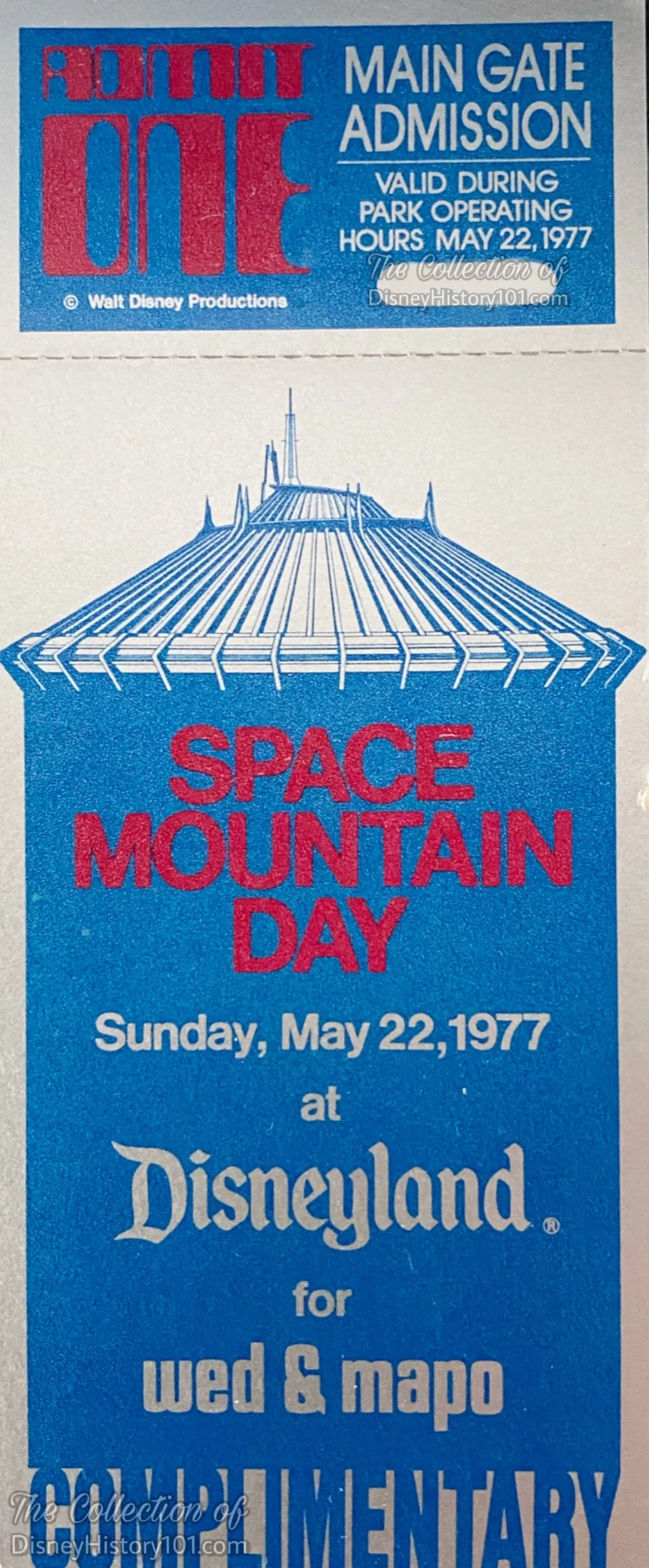
On May 27, 1977, “space travelers” led by true-life Mercury astronauts (Alan Shepard Jr., Walter Schirra Jr., Virgil Grissom, Colonel L. Gordon Cooper, Donald Slayton, Commander M. Scott Carpenter, and William Douglas) were gathered after eighteen years, and welcomed to Futuristic Station - a massive spaceport! Some of these astronauts had been involved with other flights (Mercury 7, Mercury 8, Mercury, 9, Gemini 5, Gemini 6, Apollo 7, Apollo 14, and the Apollo-Soyuz Test Project). Their 18-year reunion was officiated by Disneyland Ambassador Susan Donald, and would span three days (May 27 - 29, 1977). These were joined by John Glenn Jr. (of Mercury 6) for a tour on the Saturday following the Grand Opening. For now (May 27th, 1977), these astronauts entered the attraction queue, and stepped aboard futuristic Speedramps (in service from 1977 to 1997), to help move comfortably from the ground floor to the upper level of Tomorrowland. Transmissions from Mission Control and Flight Dispatch echo through the Space Port, as the Mission Status Board charts current Space Flights. Guests make their way past windows where rockets streak by with flashes of light (as stars glitter in the distance). After passing below the hovering Intergalactic Probe (which “warms its engines for an explorative venture into the unknown”), guests boarded one (of twelve) sleek rockets bound for the “vast dark void of outer space”. Moving slowly along an ascent, the rockets prepare for “blast-off”. Their ascent takes them through meteor showers, “passing through the apparent infinity of a Solar Energizer, where chasms of light seem to stretch forever”. Circling a glowing geodesic satellite, the rockets approach a colorful gaseous nebula, shooting stars falling to each side. Suddenly the rockets reach the apogee of their ascent and quickly plunge into the realm of ‘Superspace’, where time is non-existent and distances are spanned at infinite speeds. Roaring past unexplored galaxies the rockets twist, turn and dip thier way home, finally bursting through a cosmic vapor curtain before slowing to landing speed at the Space Port”, according to the Disneyland Aeronautics and Space Administration’s “Space Mountain Rockets.”
Even after that event, a WED/MAPO Official Inaugural Flight event was held on June 2nd, 1977, with commemorative posters given to all those who participated.
Disneyland’s spectacular new $20 million voyage thru outer space (or, journey along 3,450 feet of track, at maximum speeds of 30 to 32 miles per hour) - Space Mountain - was “the most incredible attraction in 22 years,” according to Vacationland magazine, Summer, 1977). Eight years after the live broadcast of the Apollo Moon Landing was viewed (on this very location) and during the summer of 1977, thousands of Disneyland Guests waited in lines to board Space Mountain. These impressive lines (“kept on queue” by Audience Control Crews) wound all the way through the Tomorrowland Mall, and clear to the entrance of Tomorrowland (a picture of this can be viewed in “Backstage,” Summer of 1977). Just two years later (by 1979 - 1980), it was still just as “incredible,” as admission for a flight through Space Mountain was one “E” coupon, the same as passage down the icy slopes of the Matterhorn, stepping aboard Big Thunder Mountain Railroad, or admission to the Country Bear Jamboree. This was with good reason - Space Mountain was a realization of one of Walt’s “dreams”! At this point, we must recall the words of John Hench who once said, “We didn’t just build this because we needed another thrill attraction…Walt always intended this to be here and we never abandoned the idea.”
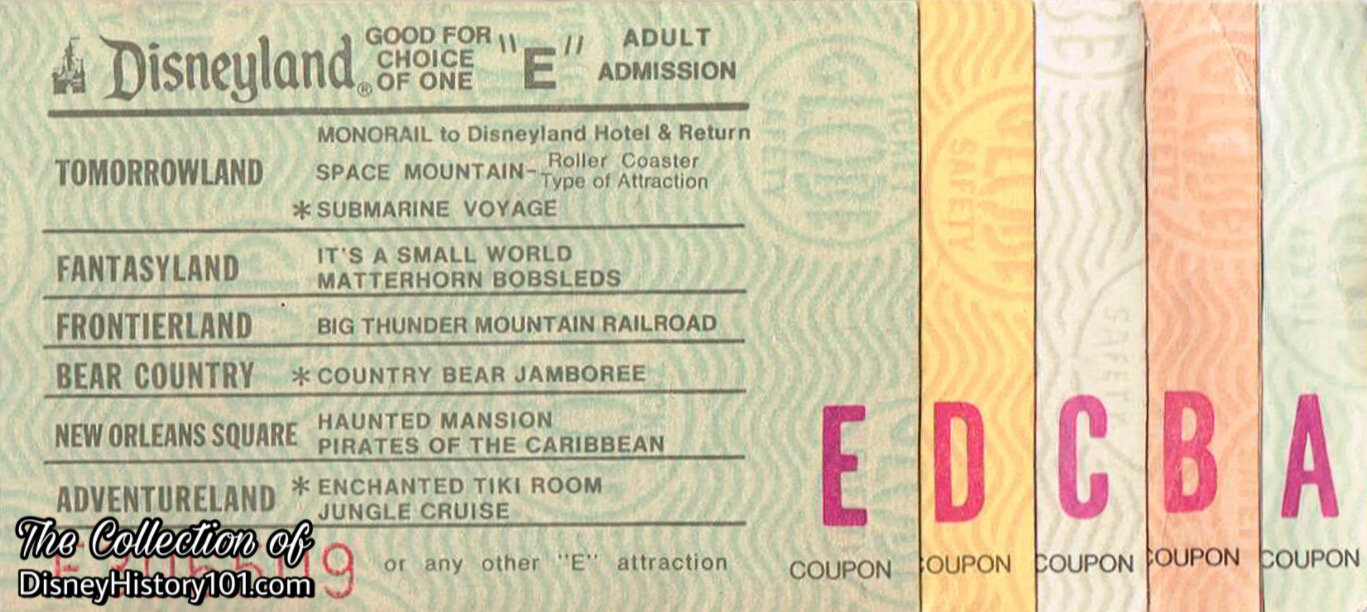
The Disneyland Planning Department prevented having too many attractions of the same ticket value down at the same time.
While five years of negotiations were underway for Tokyo Disneyland, it was decided to bring the smaller incarnation of Space Mountain (Disneyland, Anaheim, California) to Japanese guests! Space Mountain opened at Tokyo Disneyland, on April 15, 1983!
A new Space Mountain ride control system was installed in 1988, which simplified the role that Hosts and Hostesses performed.
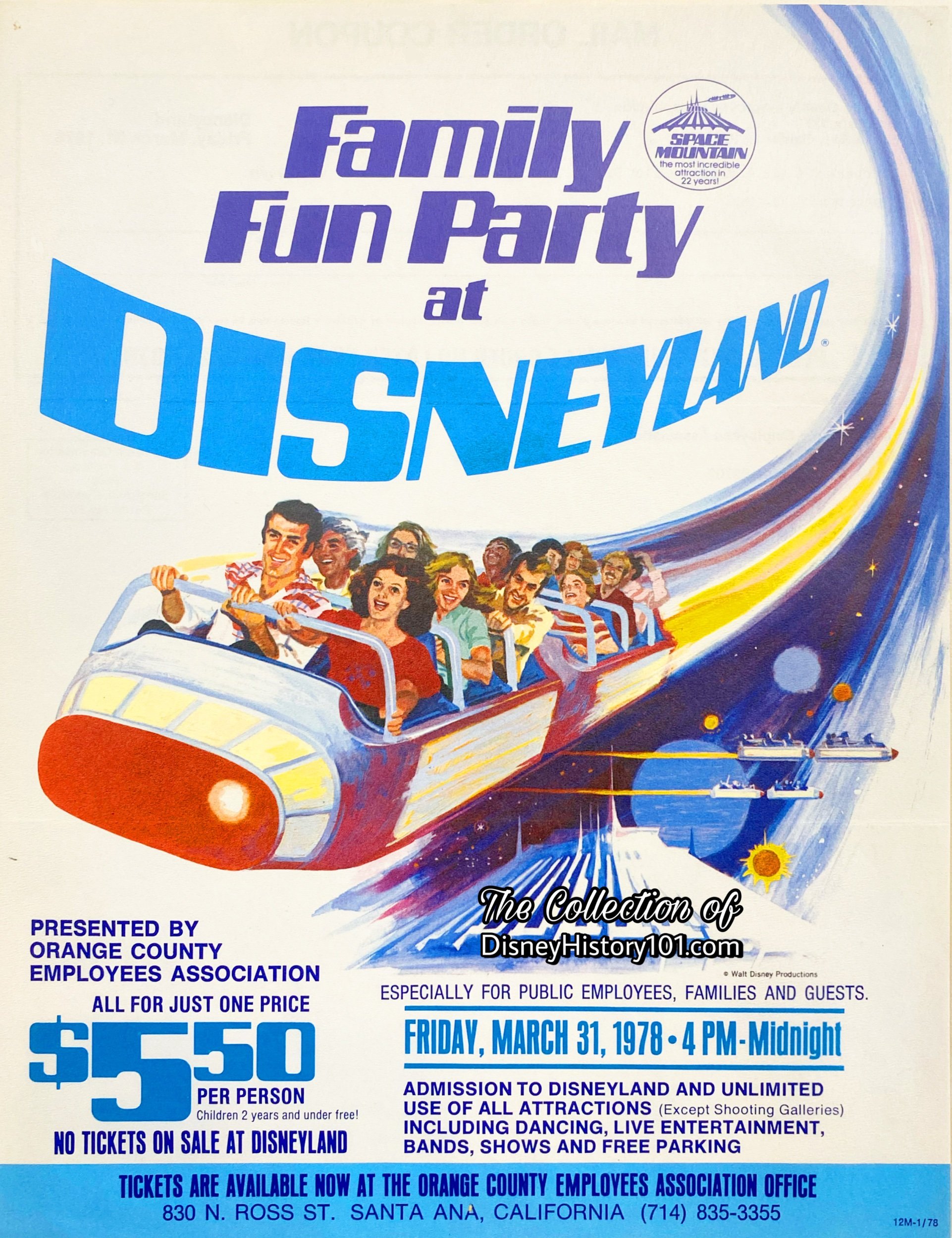
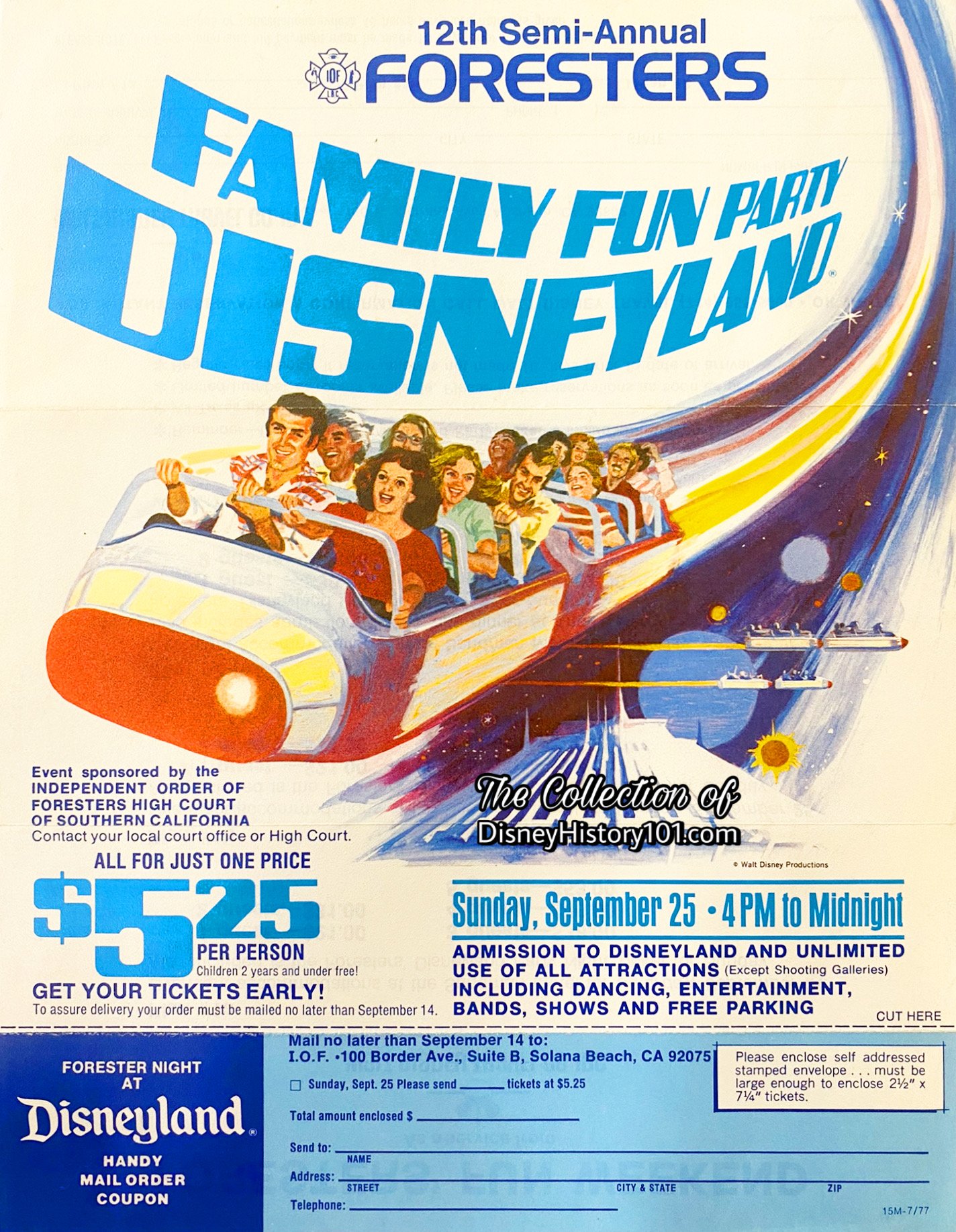
Space Mountain still offered to opportunity to race through outer space to the far reaches of the universe.

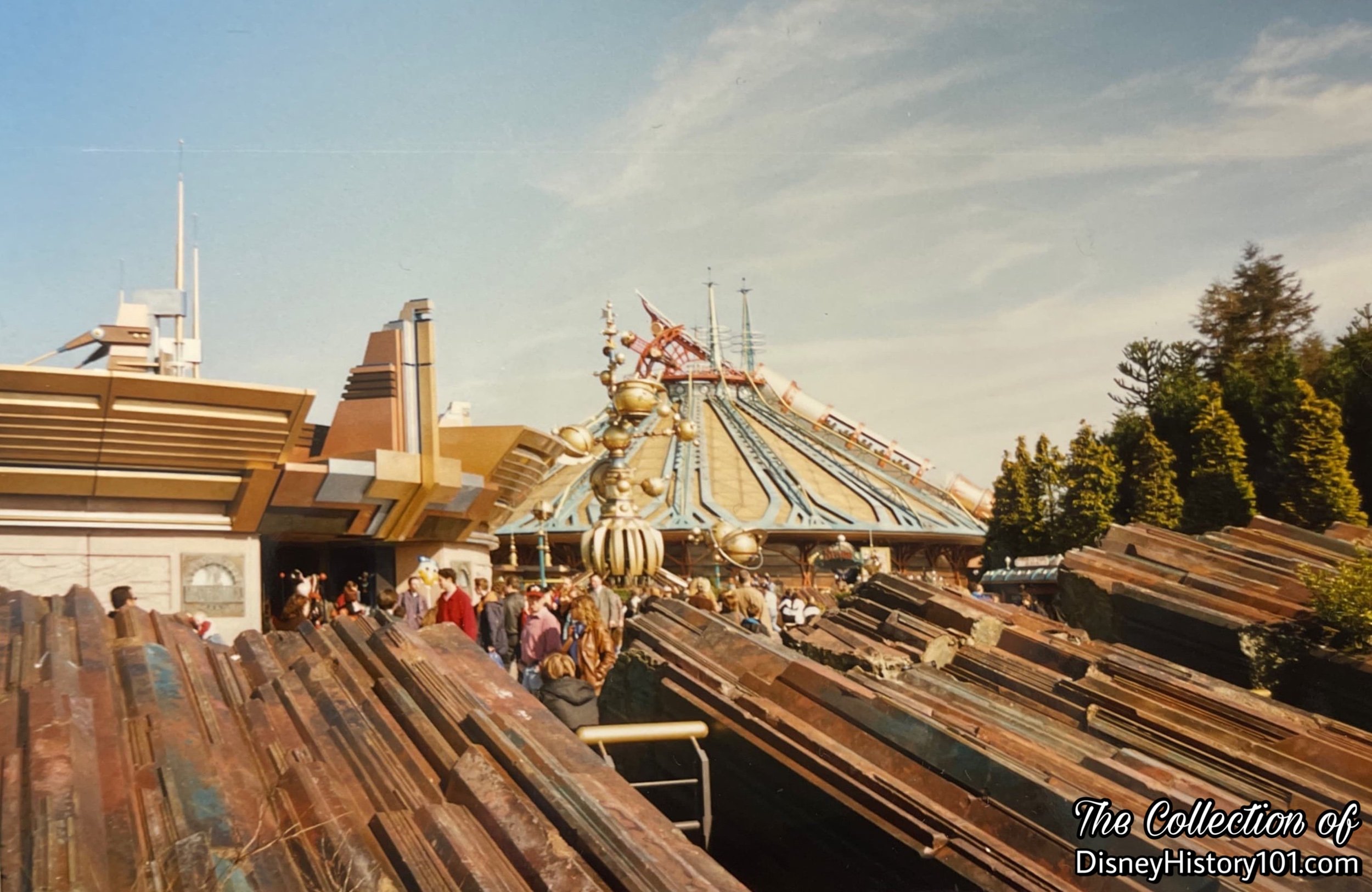
After Euro Disney’s Jules Verne-inspired version of Space Mountain opened (with its higher speed, first-ever loops in a Disney Park, and the first ever synced audio track to a roller coaster-type thrill ride), one of these elements would soon come to Disneyland (in Anaheim, California).
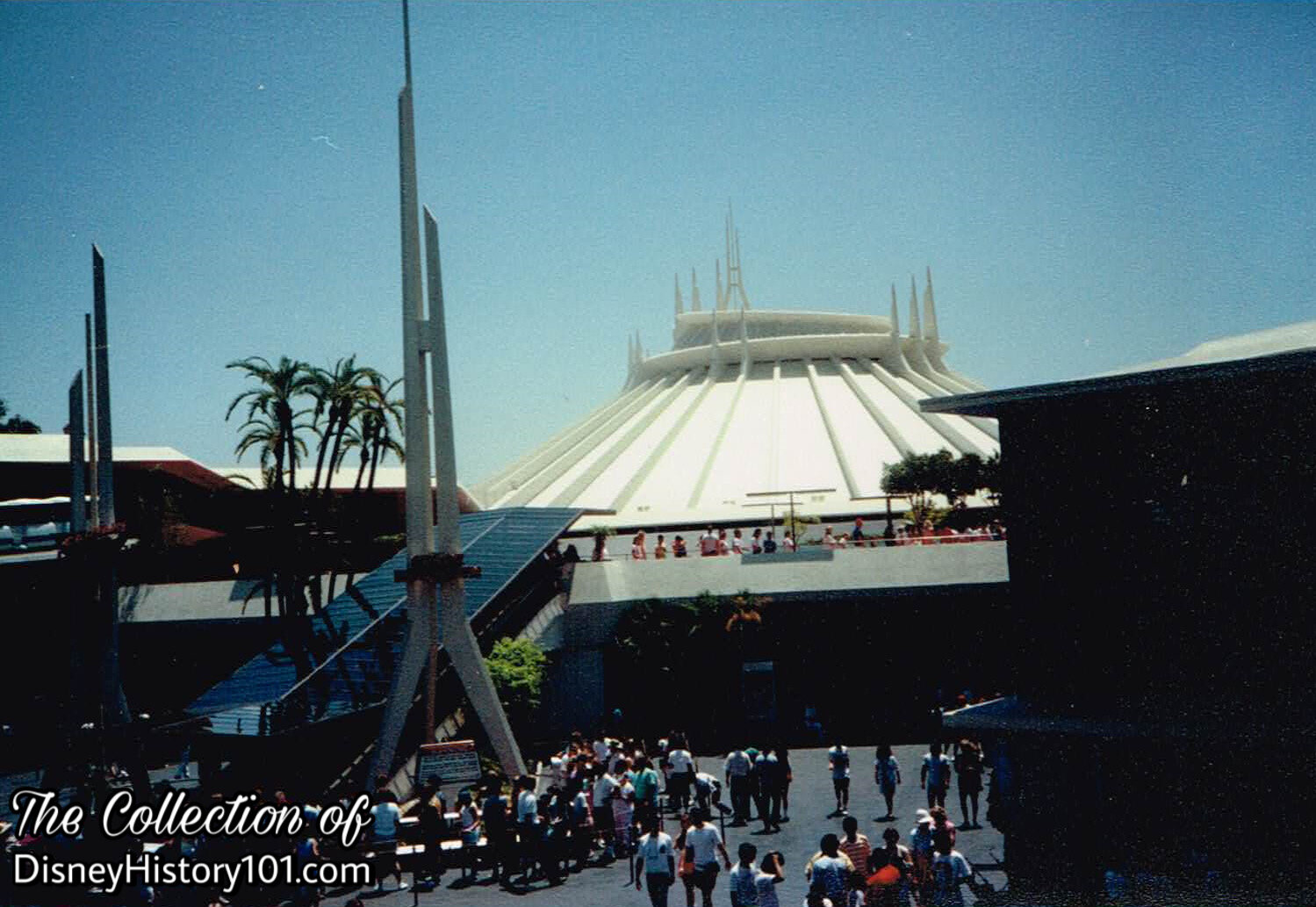
For now, this (prior Vintage View) was the sight of Space Mountain.
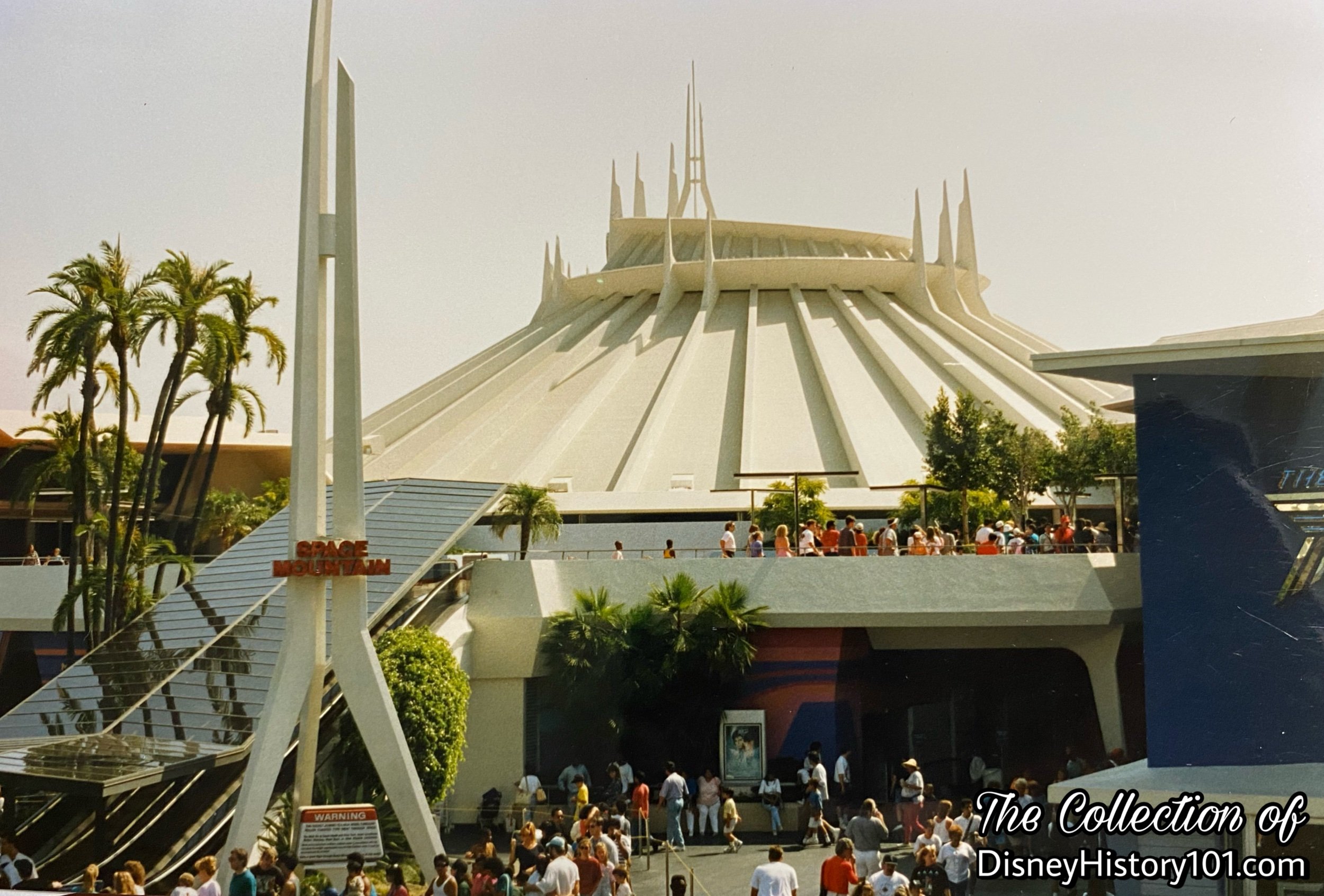
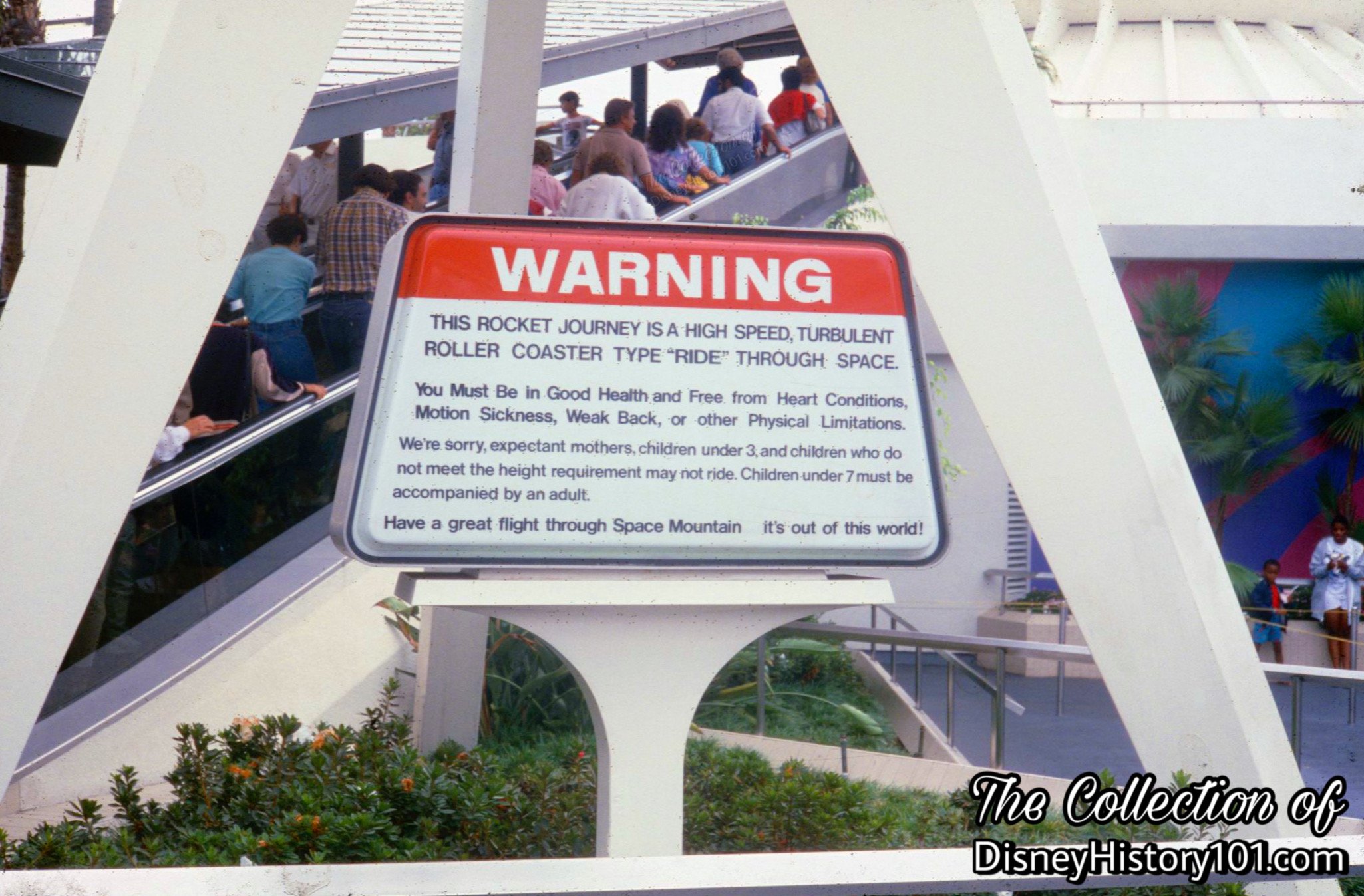
“Safety”
Safety is a major concern of the Park Operations Crew. Each day, the M-43 Machinist would make a standard opening inspection of all speed ramps in the area. M-43 would then notify M-41 of any further work to be done or parts needed prior to opening. The M-43 would go to the Space Mountain workshop, read Mechanical log book, and notify M-41 of any further work to be done or parts needed prior to opening.
During each day M-43 would, at least once, circulate to all attractions in T/L and discuss with each attraction lead any problems, defects, or any other feedback regarding the attraction. M-43 would then notify the Mechanical Dept. of anything regarding this department, and notify the M-1 of anything regarding other crafts.
Safety is also a major concern of Engineering. Every year they would make a complete test and inspection of all structural parts of Disneyland. And since Guests would look to Disneyland for their safety the department team was continuously designing new guest and personnel safety devices.
Guests also play a role in safety. This aforementioned sign served as a form of Guest Control, courteously reminding Guests (the elderly, expectant mothers, and those with under age children) to be consider any physical limitations which might be aggravated by the nature of the ride. Guests with any type of back or neck brace and children under three were not permitted to ride. Though signs were posted, the courteous Cast Member also took the responsibility to monitor for under age children and expectant mothers, directing wheelchair guests to the front of the attraction, and determining if a physical limitation might be aggravated by the nature of the ride.
Height restrictions on signs safeguarded guests long before Ride Switch, the process that allowed Guests with children who do not meet age and/or height requirements to enjoy an attraction.
“Federal Express & Pan Galactic News Network Pre Show“
In 1995, Federal Express (FedEx) became a Disneyland Participant as sponsor of Space Mountain. New “magical opportunities” were Imagineered, including improved lighting and effects. A new show entertained the guests leaving the attraction before exiting into the new Tomorrowland Light & Power Co. arcade.
But the biggest change was a brand new 15-minute out-of-this world show created by Eddie Sotto, produced by Doug Miller and Tom Fitzgerald (WED Senior Vice President of Theme Park Productions), and co-written by Seven Spiegel, that featured parody broadcasts and commercials. You may recall humorous clips from PNN (the Pan Galactic News Network), “My Favorite Earthling” (on the UFO Network), and the “Blast Off Channel” (“24 hours of lift-offs, launches and laughs), as viewed through “channel surfed” screens. [See WED Eye Openers, August 15, 1995] Of course, some of the most memorable spoofs parodied concurrent commercials of Space Mountain sponsor Federal Express.
Here, an astronaut floats in deep space and desperately needs a package. The package is sent to the wrong address because the sender used “Ozone Express” instead of Federal Express.
A number of talented actors and actresses appeared contributed to the short films. Mario Lopez (of “Saved by the Bell”) was the channel-surfing host in Mission Control, comedian Charles Fleischer performed the role of used satellite salesman Crazy Larry, with Glenn Shadix as fashion designer Ray Cathode and Kelly Coffield (of “In Living Color”) was transformed into weather caster Wendy Beryllium. The preceding Vintage View preserves a Backstage moment for Michael Carrington and Elaine Hendrix (of “Get Smart”) who portray the SMTV News Broadcasters Pam Pulsar and Dirk Tachyon as News Anchors of PNN. They weren’t the only celebrities to make an appearance, as the futuristic broadcast also included a statement by President Garco (the robot featured alongside Walt Disney in the c.1954 Disneyland episode “Mars and Beyond”).
Costume Designer Colleen Atwood designed all the costumes for the SMTV video. This Vintage View preserves a costume fitting for actress Alexandra Wentworth (who had roles on Seinfeld and In Living Color) as Space Mountain Pan-Galactic News Network Reporter, Wendy Berrylium.
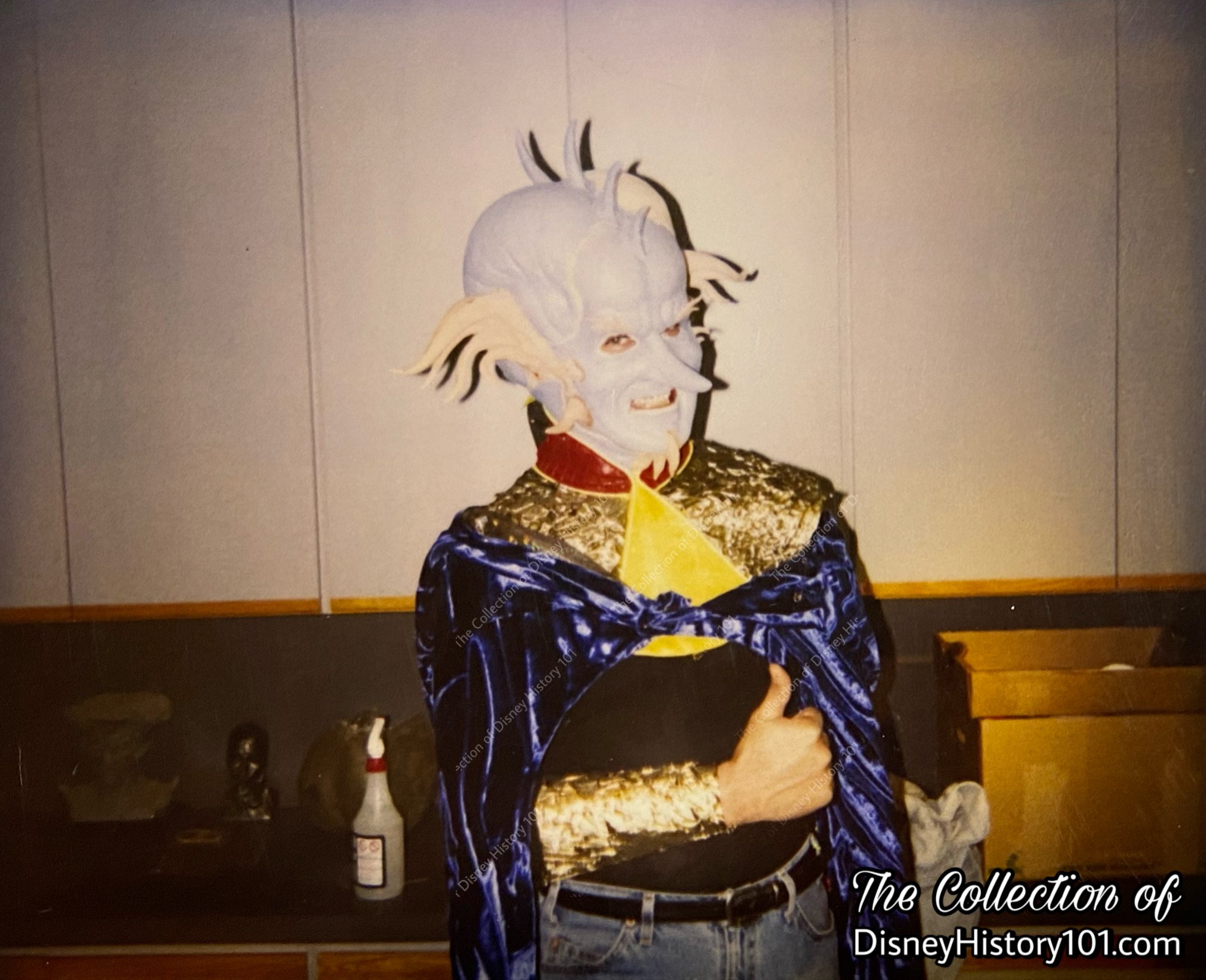
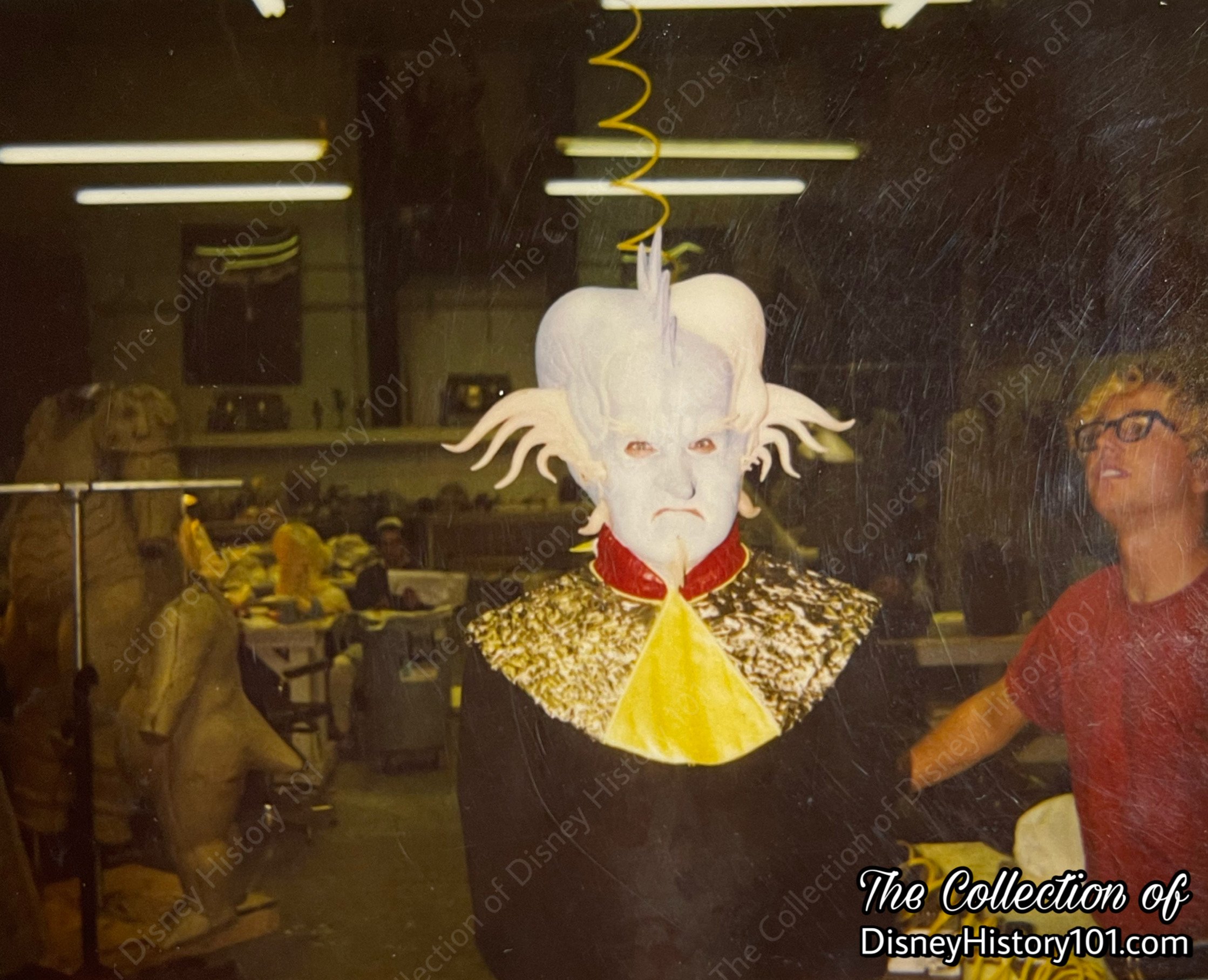
The “Wd Eye Openers” column (published August 15, 1995) gave a wonderful, detailed summary of production.
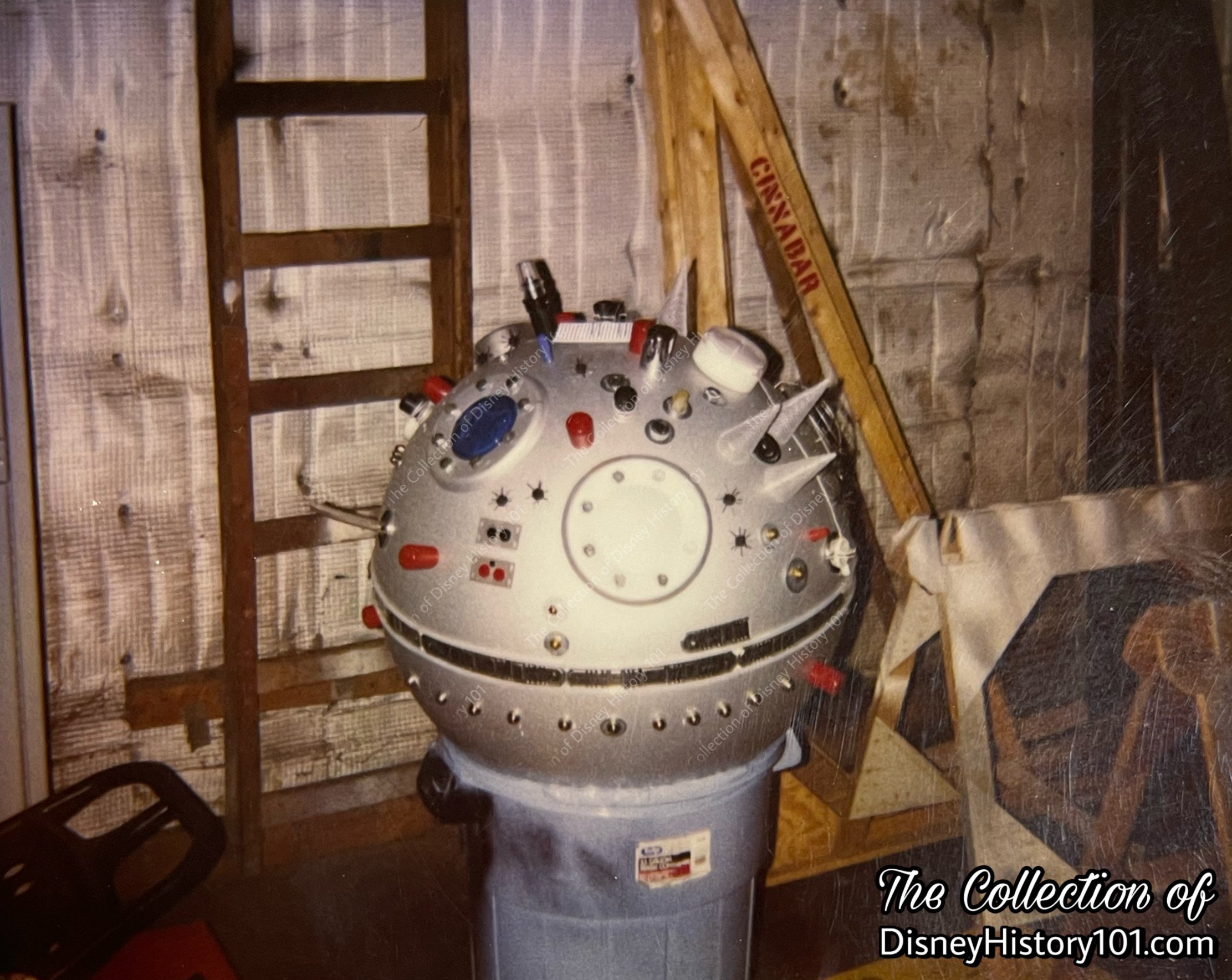
Beyond these years, both 1996 and 1997 were momentous for Space Mountain at Disneyland! In 1996, Dick Dale’s surfer sound descended upon the warp-speed roller coaster ride.
The following year (1997), many aesthetic changes occurred, altering the Show Quality of the building. Notably, a third ring was added to the roof of the Space Mountain Complex, and the Speed Ramp was removed during a massive Tomorrowland overhaul.
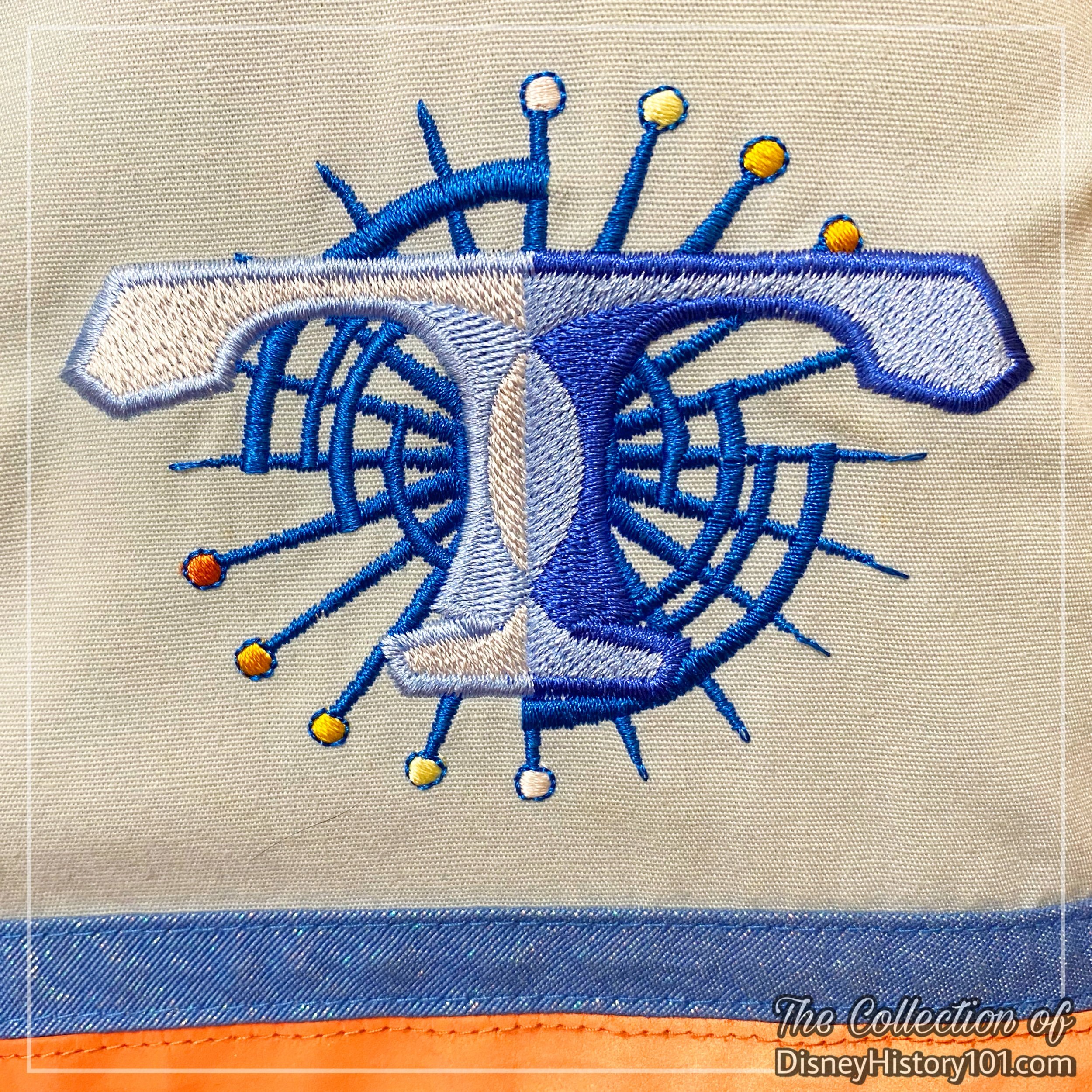
Ten years after FedEx became a Disneyland Participant (and after some renovation), Space Mountain would re-open (on July 15, 2005), with a “refurbished” brand-new track, new pre-Show scenes, an updated score (by Michael Giacchino) and a special ceremony attended by former astronaut Neil Armstrong.
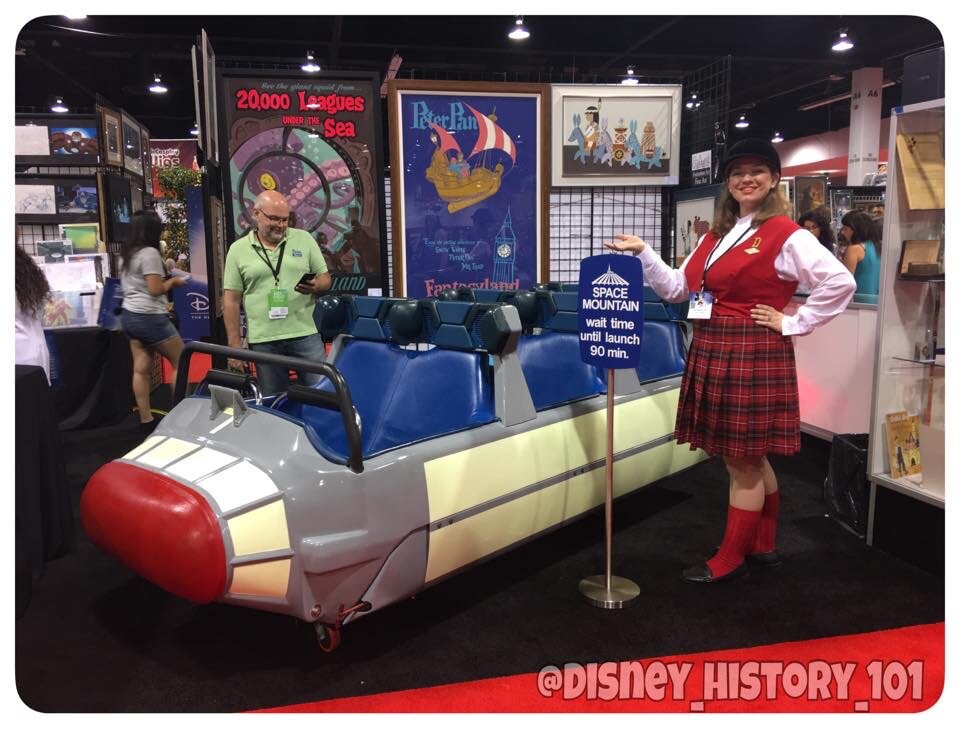
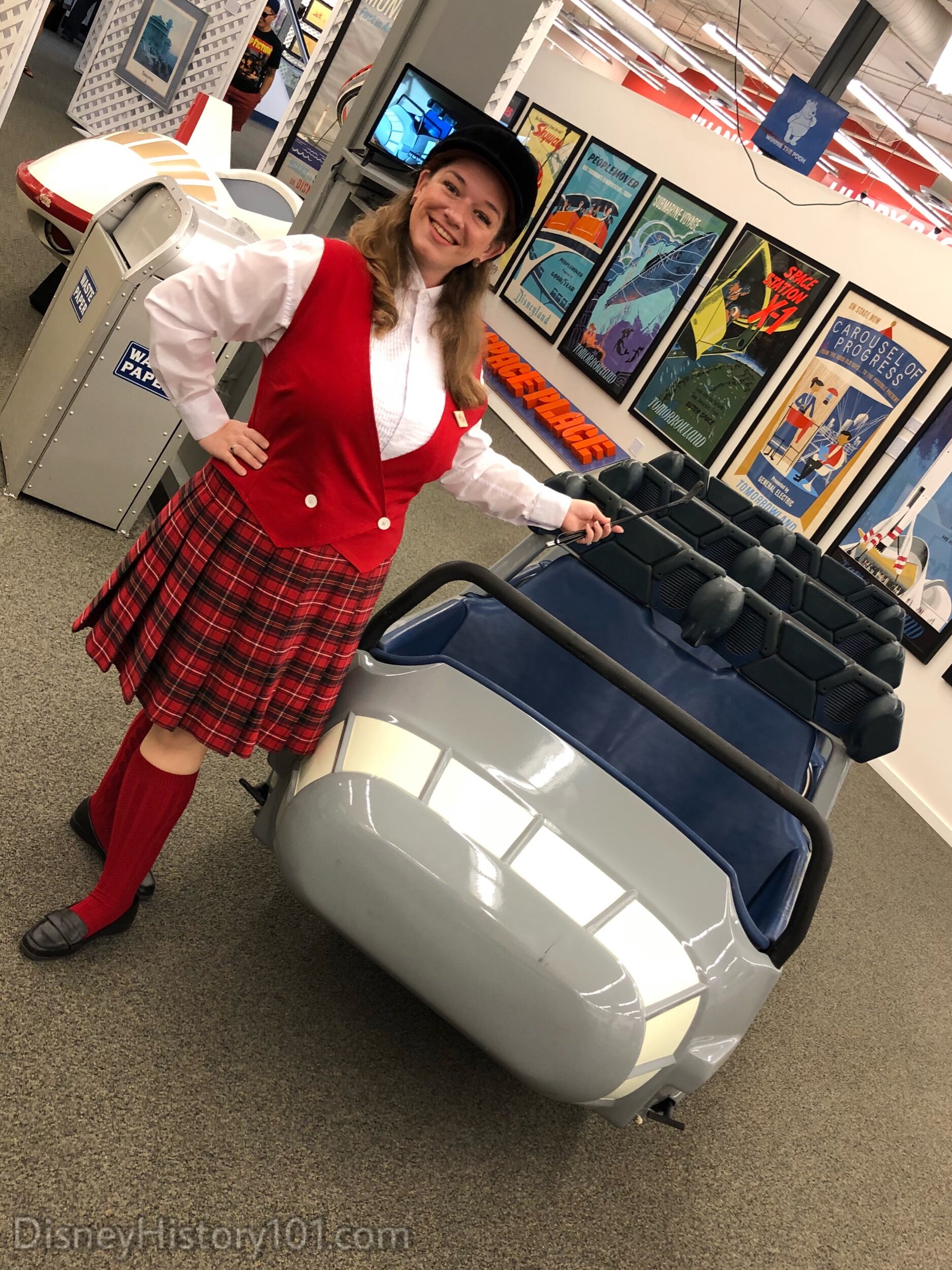
“Remove Vehicles” - In a historic (and frankly, never-to-be-repeated) auction, Van Eaton Galleries in conjunction with Richard Kraft offered the public a free show of rarely seen “Disneyana.” Among Richard Kraft’s former artifact collection at the “That’s From Disneyland” pre-auction museum show was one of the original twelve c.1977 Space Mountain Vehicles. Compared with those of the Walt Disney World Magic Kingdom, the new vehicles were streamlined and simplified, with a wider body, side-by-side seating for twelve passengers (as opposed to single-file seating for eight passengers). By 1984 a report revealed that a pair of Space Mountain tandem sleds weighed 2,300 lbs.
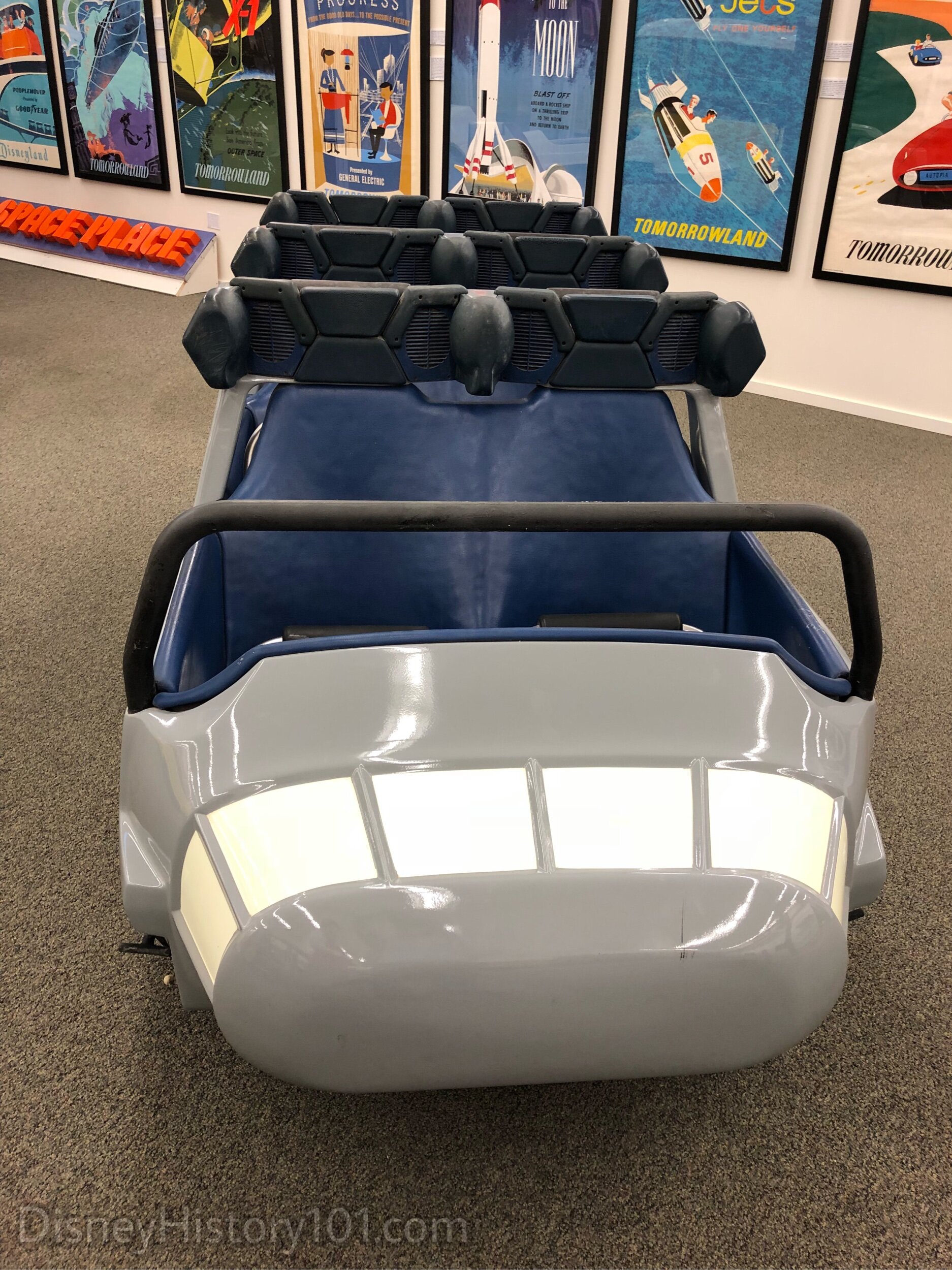
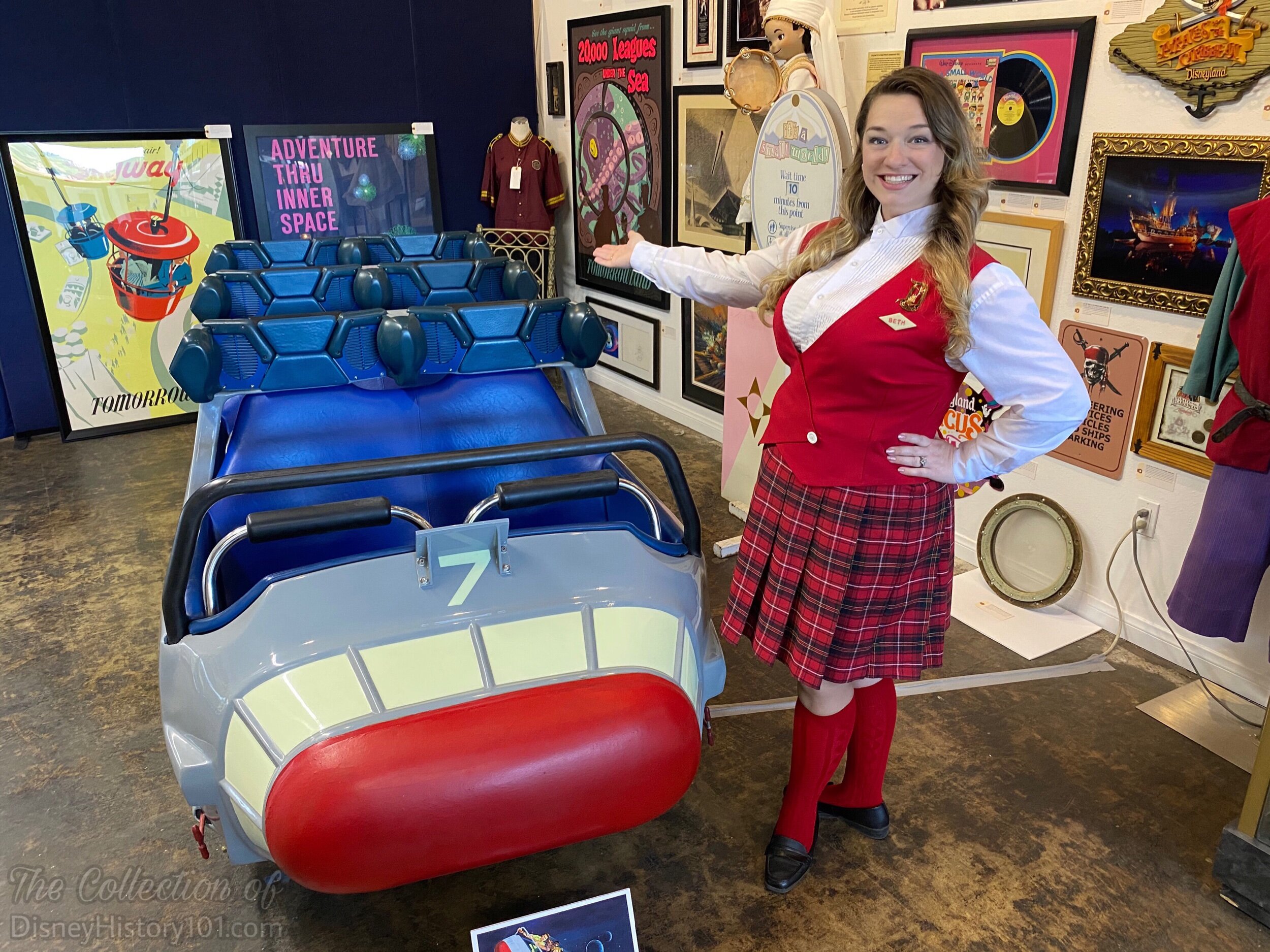
This is yet another original Space Mountain Vehicle that once shuttled guests through the reaches of the cosmos at “hyperspeed”. During 1996, Boston Acoustic speakers were installed that would only enhance the attraction’s Show Quality experience with a new onboard soundtrack. In 2020, one of these vehicles (with speakers) was auctioned off through Van Eaton Galleries, and became the property of a proud new owner.
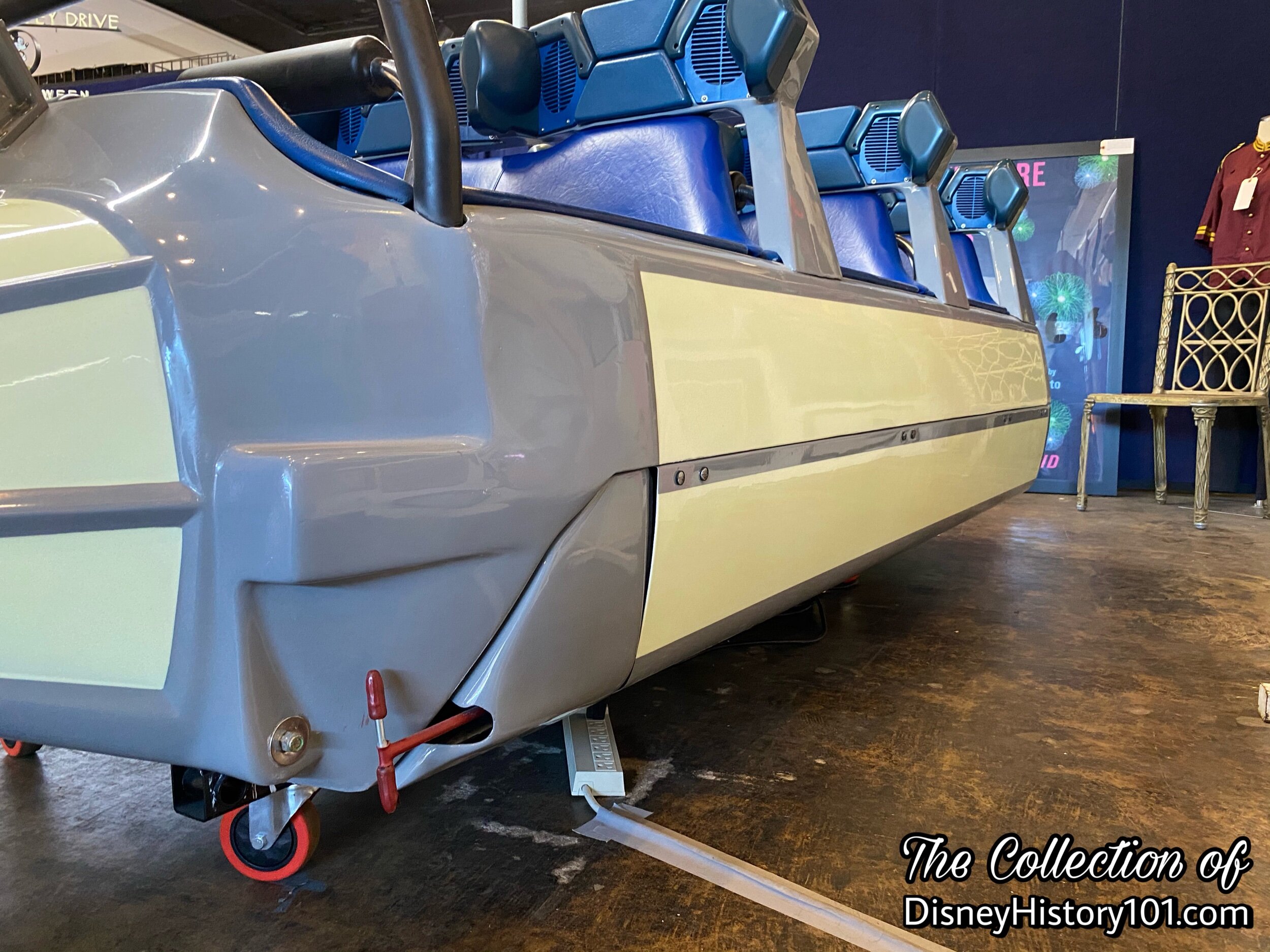
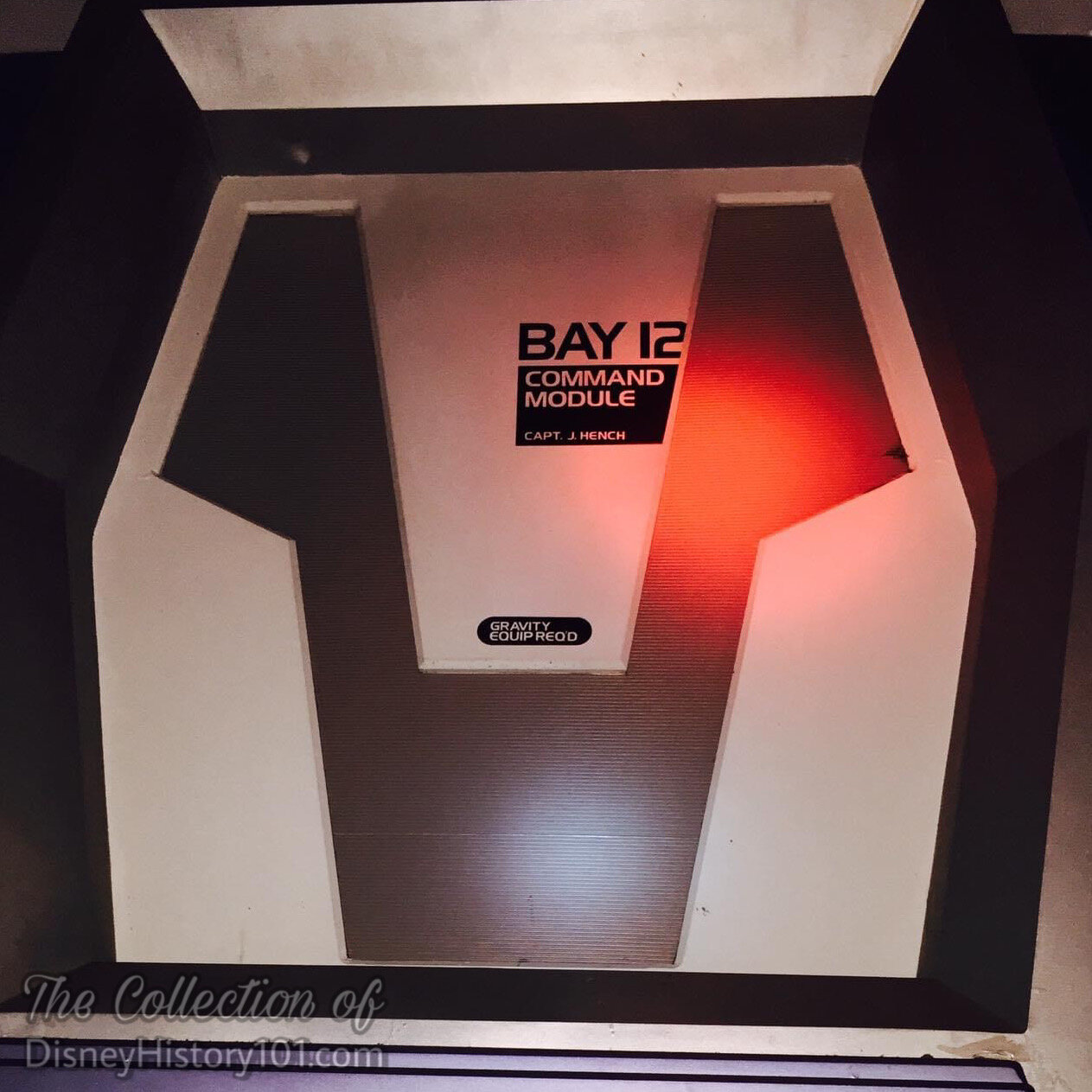
Which brings us to our final “sidelight.” Inside Space Mountain (just above a Decompression Supplies Hatch, along the queue), is another hatch appropriately labelled, “Bay 12, Command Module, Captain John Hench.” This is appropriate, as John Hench (the longest-termed Disneyland employee, at 64 years with the company) first created concepts for Tomorrowland, and then assisted in re-designs of Tomorrowland (in 1967 and 1998). Two years after Space Mountain opened, John assumed the title of WED Enterprises Senior Vice President on September 17, 1979. John helped develop many shows and attractions for Disneyland, and was “instrumental in master-planning every Disney park world-wide, actively involving himself in show concepts, architecture, costumes, graphics and every other aspect of design.” But most important were his contributions toward the towering Space Mountain!
Marty remembered Hench as a “mentor”: “John Hench was the most articulate and well-read person that ive ever worked with and he encouraged me in so many ways.” It is of note to the credit of John’s humble character: “John Hench, an original Imagineer with WED, told Marty [Sklar], ‘When we get finished with a project, you or none of us can say, ‘I did that, I did this, because we all did it, so many hands touched it, changed it and made it better, that it's a we, it's never an I.’”
By 2003, the Space Mountain had a legacy in Tomorrowland at Honk Kong Disneyland. A prospectus describes: “A warp-speed adventure to the far reaches of the universe and back. Guests board 12-passenger ‘rockets’ that streak at white-knuckle speeds through a meteor shower. Each vehicle has an on-board sound system that synchronizes music and sound effects with the racing rocket.” The complex would also have a concourse, “a futuristic garden area between Space Mountain and Buzz Lightyear Astro Blasters that serves as a rest spot for weary intergalactic travelers in Tomorrowland. Shade trees, benches and unique water elements enhance the park-like environs.”
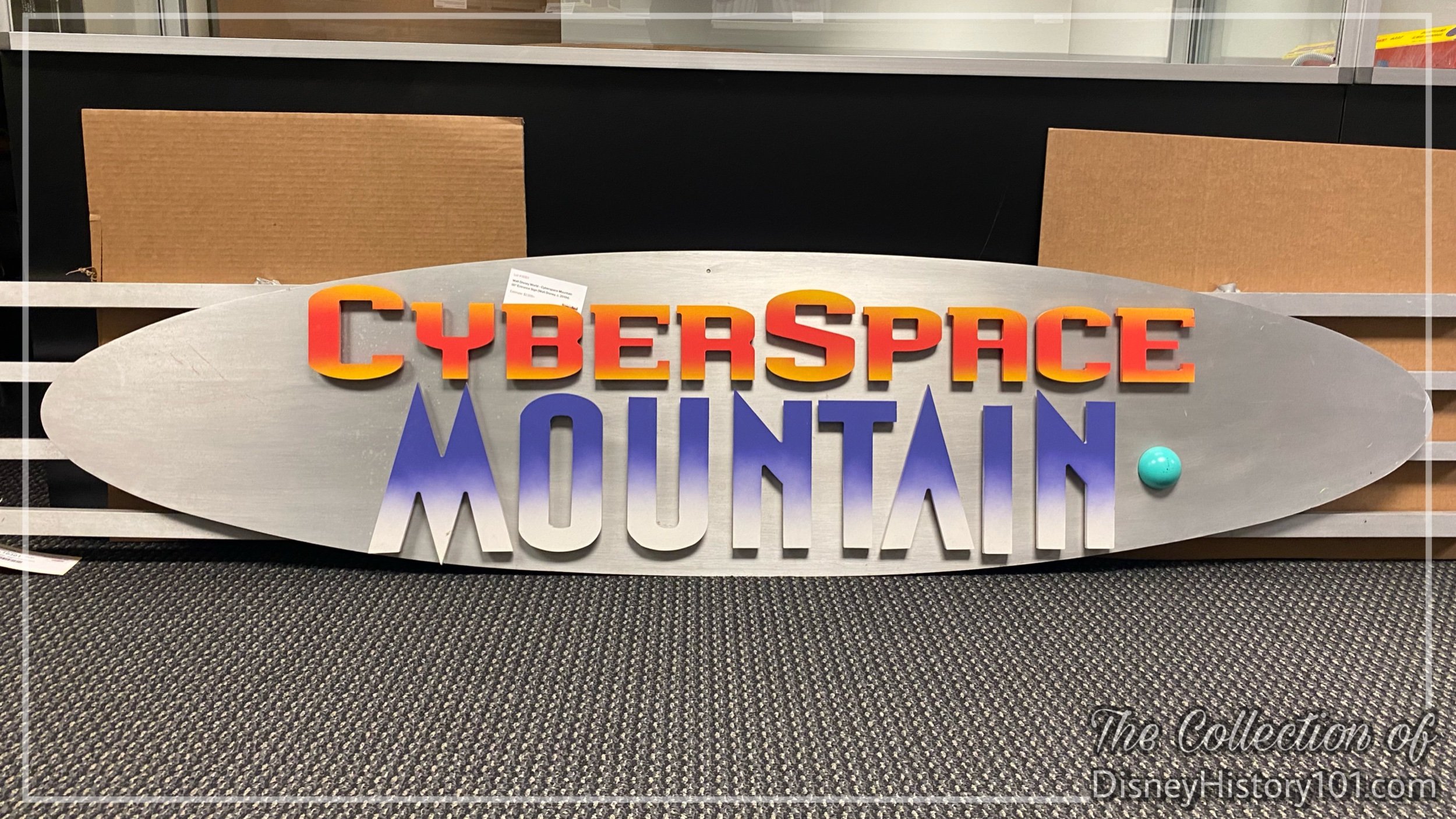
Then there was CyberSpace Mountain at DisneyQuest in Downtown Disney, allowing Guests to design their very own rollercoaster.
Since the beginning, the Four Keys of the DISNEYLAND Show (operating priorities in presenting the DISNEYLAND Show) have been present - Courtesy, Safety, Show, and Efficiency. Guided by these Four Keys, are Walt Disney Imagineers, who are always seeking out new magical opportunities to increase the efficiency, safety, and show quality of Disneyland adventures. This being the case, Walt Disney Imagineers are constantly seeking to improve upon the show of Tomorrowland and one of its most popular attractions - Space Mountain! During the 1990s, Tim Delaney (of Walt Disney Imagineering Creative Development) created concepts of a Star Wars inspired Death Star overlay for Space Mountain. In 2008, WDI master plans entertained the concept of an update to the Space Mountain Show Building, Forecourt and “HISTA” involving some sort of Global 3-D technology.
On July 15, 2005, Space Mountain was relaunched with a new generation of special effects, state-of-the-art show elements, new rocket vehicles, and an upgraded sound system, featuring an all-new audio track. The opening ceremony took place at 10AM and the attraction was open to guests at 11 AM.
There have been many “Overlays” to Space Mountain over the years, like borrowing “Ghost Galaxy” from Hong Kong. A few years later, the Space Mountain Show was temporarily changed for the spring of 2016, when a new Star Wars inspired adventure started a tradition of temporary seasonal ride refurbishments! After being launched into hyperspace, shuttles jump right out of hyperspace travel, and into battle with several tie fighters and a star destroyer in Hyperspace Mountain! In 2017, Hong Kong Disneyland carried the Hyperspace Mountain tradition, as Guests dodge blaster fire and dash through a raging dogfight between Rebel X-wing Starfighters and Imperial TIE fighters.
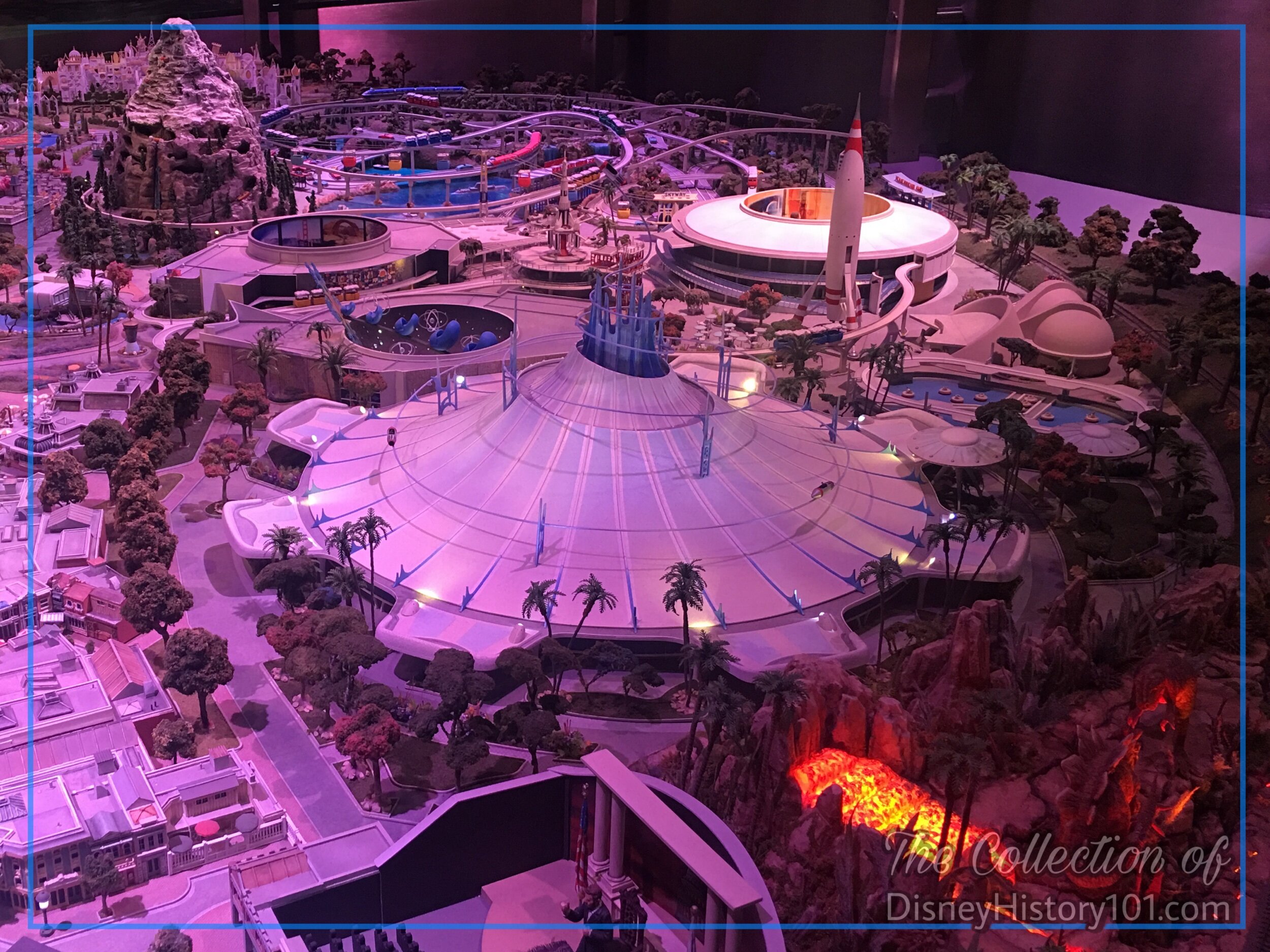
While new “Overlays” add new dimensions of adventure to Space Mountain, there’s at least one location where guests can enjoy the Space Mountain of John Hench’s imagination (at least, in miniature form) - The Walt Disney Family Museum in San Francisco, California!
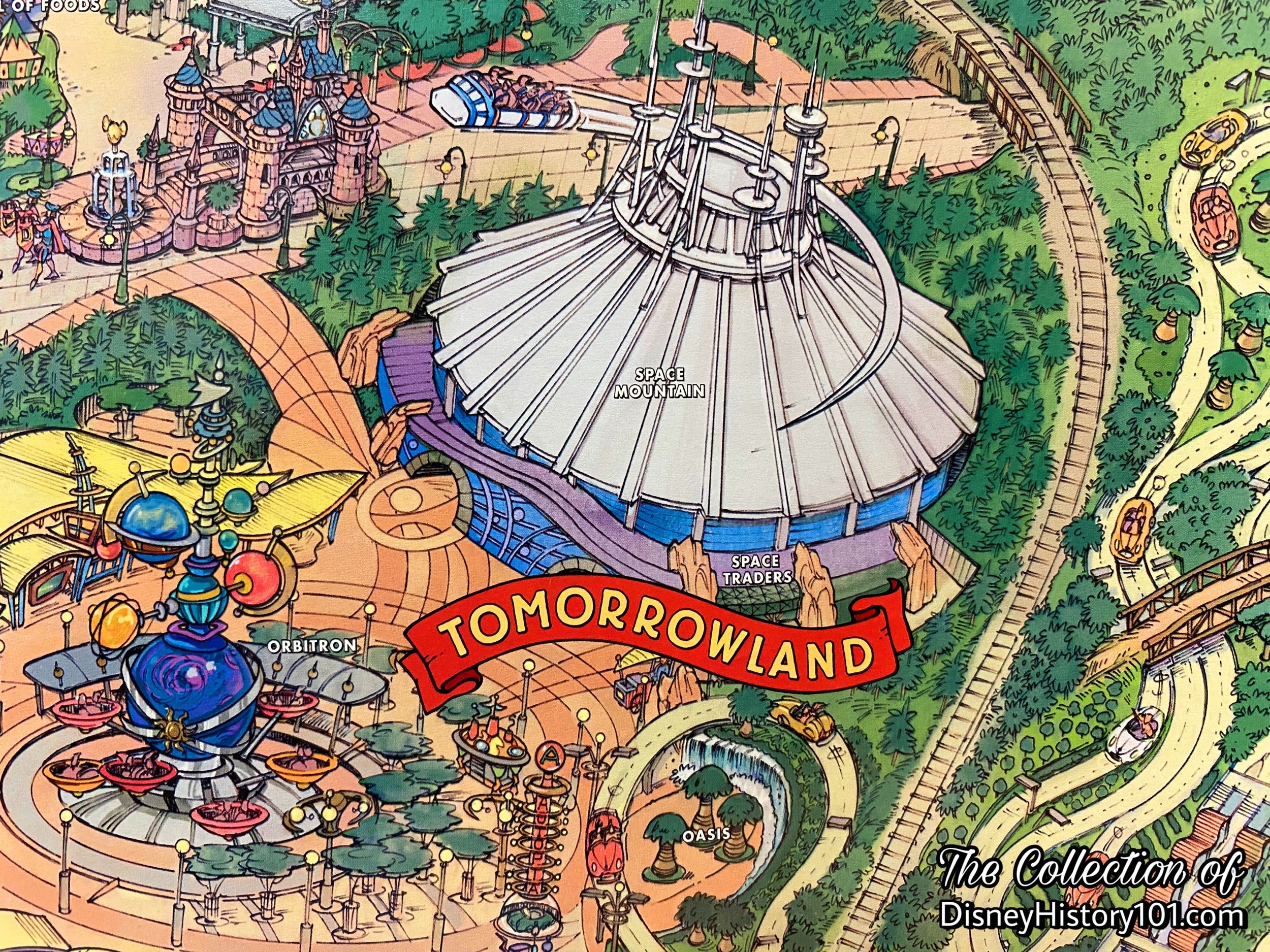
STAR TOURS
A long time ago… George Lucas and Walt Disney Imagineering became a strong force for revolutionizing Disney Theme Park storytelling, introducing Captain RX-24 and the ultimate thrill experience aboard a StarSpeeder 3000. Relive the first flight, new adventures and the continuing legacy of STAR TOURS at DISNEYLAND!
STAR TOURS presented by M&Ms Chocolate Candies (January 9, 1987 - 1995)
STAR TOURS presented by Energizer (by c.1996-2006)
STAR TOURS – THE ADVENTURES CONTINUE (2015-Present)
At Disneyland there are living experiences for the Guest. Disneyland ride-through adventures have officially been defined as an “individual show, ride, or exhibit designed to produce an entertaining Guest experience. Disney attractions stir the imagination, enliven the senses, and provide the participants with positive, innovative entertainment, which is the essence of the DISNEYLAND Show.” Star Tours was certainly one attraction which has epitomized these purposes since its beginning. The adventure transports Guests on a thrilling sightseeing excursion to the Moon of Endor and the universe of Star Wars© guided by a fearless rookie pilot. Now we invite you to relive the origin story of Star Tours, from the creative forces of Walt Disney Imagineering and George Lucas!
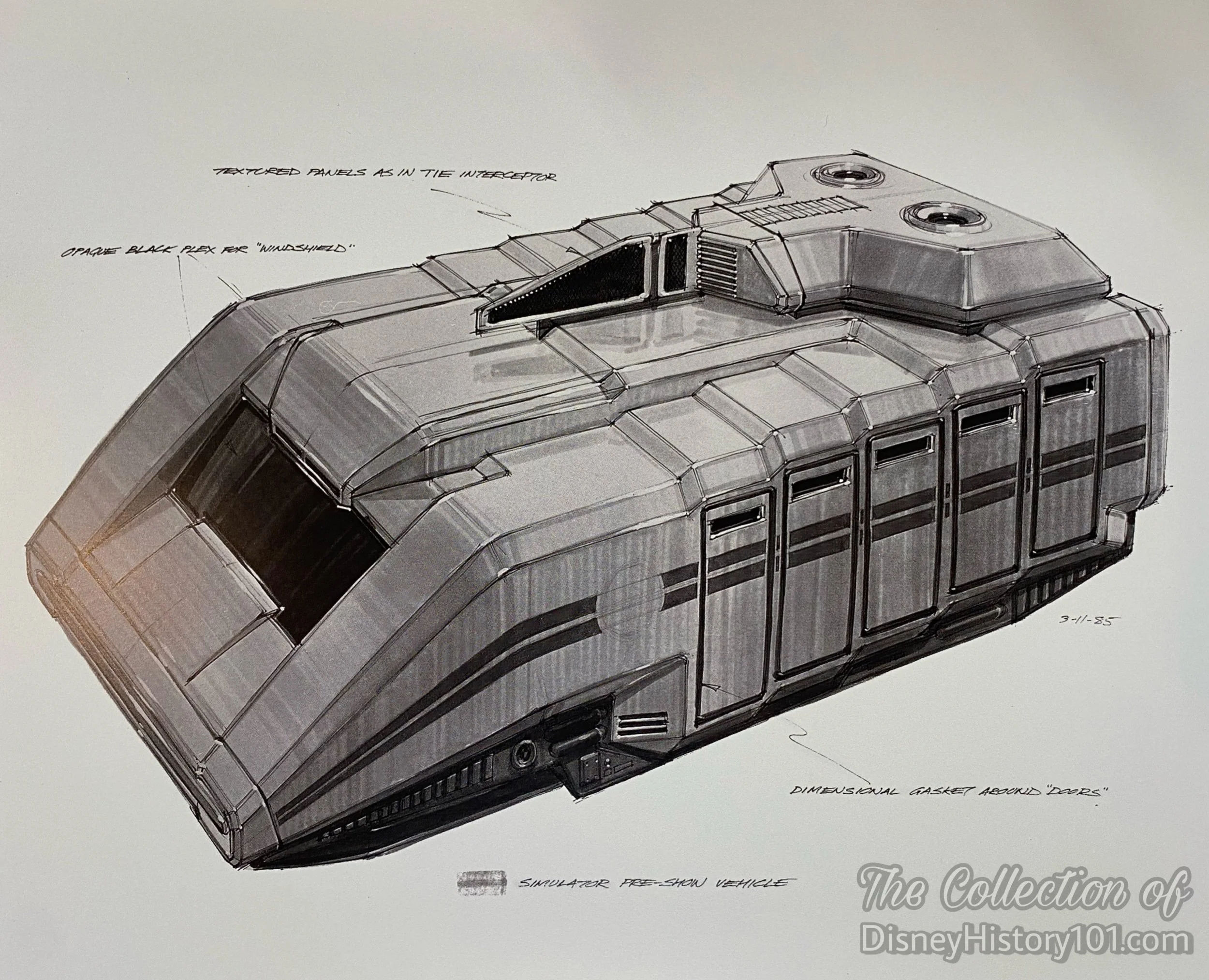
“Blue Sky for Star Tours”
A short time ago… in a nearby galaxy… a big decision during the era of Michael Eisner’s and Frank Wells’ leadership would end in the first full Disney Parks’ attraction based on a non-Disney movie! “The ultimate thrill adventure from the creative forces of Disney and George Lucas” would become Tomorrowland’s premier attraction!
Walt Disney once said: “Since my outlook and attitudes are ingrained throughout our organization, all our people have this curiosity; it keeps us moving forward, exploring, experimenting, and opening new doors.” Walt also once divulged, “When we consider a new project, we really study it. And when we go into that new project, we believe in it all the way.” [“Walt Disney Productions Annual Report to Shareholders and Employees Fiscal Year Ended October 2, 1965”] Both of those philosophies had become traditional, core guiding principles for Walt Disney Imagineers by the time that Star Tours was in development.
In “One Little Spark! Mickey’s Ten Commandments and The Road to Imagineering,” Marty Sklar recalled: “We were meeting at the Imagineering offices in 1985 to discuss the Star Tours simulator attraction. The charge was to find a way to interpret George Lucas’ Star Wars films in a four-and-a-half minute experience. It was all new to all of us - it was the first simulator show of its kind when it opened little more than a year after concept work began. One of my colleagues complained about the number of cliches that seemed to flow from our Imagineering team members. That’s when George Lucas spoke up with the sage advice: ‘Don’t avoid the cliches - they are cliches because they work.’”
So, Walt Disney Imagineers follow the sage advice of Walt Disney and George Lucas – they believed in the new project “all the way” and leaned into the clichés of the Star Wars universe.
“Concept”
The initial concepts for the show were formulated by Show Designers. Walt Disney Imagineers designed and developed concepts themed to the time, place, and story of Star Wars, capturing the Interest and partnership of George Lucas. John Stone created several inspirational acrylic art pieces depicting the thrills and chills of a “Star Wars Ride”. Gil Keppler designed the pre-show vehicle which included textural panels, reminiscent of Tie Interceptors.
“Script”
The scriptwriter contributes the storyline, narration, and dialogue to the show's conceptual development.
“Design – Storyboards to Models”
Storyboard – The storyboard enables artists and writers to visually organize the initial sequence of scenes for a show.
Design – The show exterior of the Starspeeder 3000 was designed by Walt Disney Imagineering (of Glendale, California), with key plans, elevations, and other drawings completed by Bechtel Civil, Inc. (of San Francisco, California). Each Starspeeder would ultimately contain a RX024 (REX) Audio-Animatronics figure, a Monitor, Film and Projection System and even Strobe light effects.
Show Set Design – Designers took the concept from storyboard and scale models to actual set designs and blueprints.
From set designs and storyboards, model builders constructed Show Models - miniatures of the various show scenes. Under the direction Tony Baxter, Walt Disney Imagineers John Stone, Tom Morris, Bruce Gordon, Chris Tietz, Joe Rhode, & John Horney prepared a 1/20-scale model of a New Tomorrowland tailored to the “Disney - Lucas” joint adventure.
Next, “Audio-Animatronics” figures were sculpted in miniature, before being sculpted in full-size. The show’s mood and atmosphere were enhanced by the special effects and lighting created by the WED "Illusioneering" laboratory. Meanwhile, engineers developed the facility, ride and show systems to meet design specifications.
“Audio-Animatronics”
Developed by WED Enterprises, this amazing system utilizes pneumatics hydraulics and electronics to animate human, animal, and other three-dimenstonal figures. Many Disneyland attractions feature Audio-Animatronics figures. This attraction employed Audio-Animatronics® - the Disney-designed system that combines sound, mechanics and electronics for three-dimensional animation.
Sculpting, Casting & Molding – As mentioned, the “Audio-Animatronics” figures were first sculpted in miniature, before being sculpted in full-size. At MAPO, several plaster molds were made of each full-size clay figure. From those, a fiberglass “shell” parts were cast and covered with the flexible or firm parts.
Electric and Mechanical Manufacture & Assembly – All the while, MAPO designed the electronic and mechanical components, which were then manufactured and assembled. After that, the fiberglass “shell” case was attached over the electronic at mechanical workings of the Audio-Animatronics figures.
It’s a fact that all droids leaving the system must cleared by customs control. Ordinarily, MAPO would next send the figures back to WED for embellishments like fur, feathers, paint and wigs. But all of the Audio-Animatronics figures were robotic androids. For the C-3PO Audio-Animatronics Figure, Walt Disney Imagineers utilized some parts of the authentic gold-leaf plated C-3PO costume (worn by Anthony Daniels during the filming of Star Wars). The G2-9T repair droidswere actually repurposed Audio-Animatronics Geese Quartet frames from America Sings.
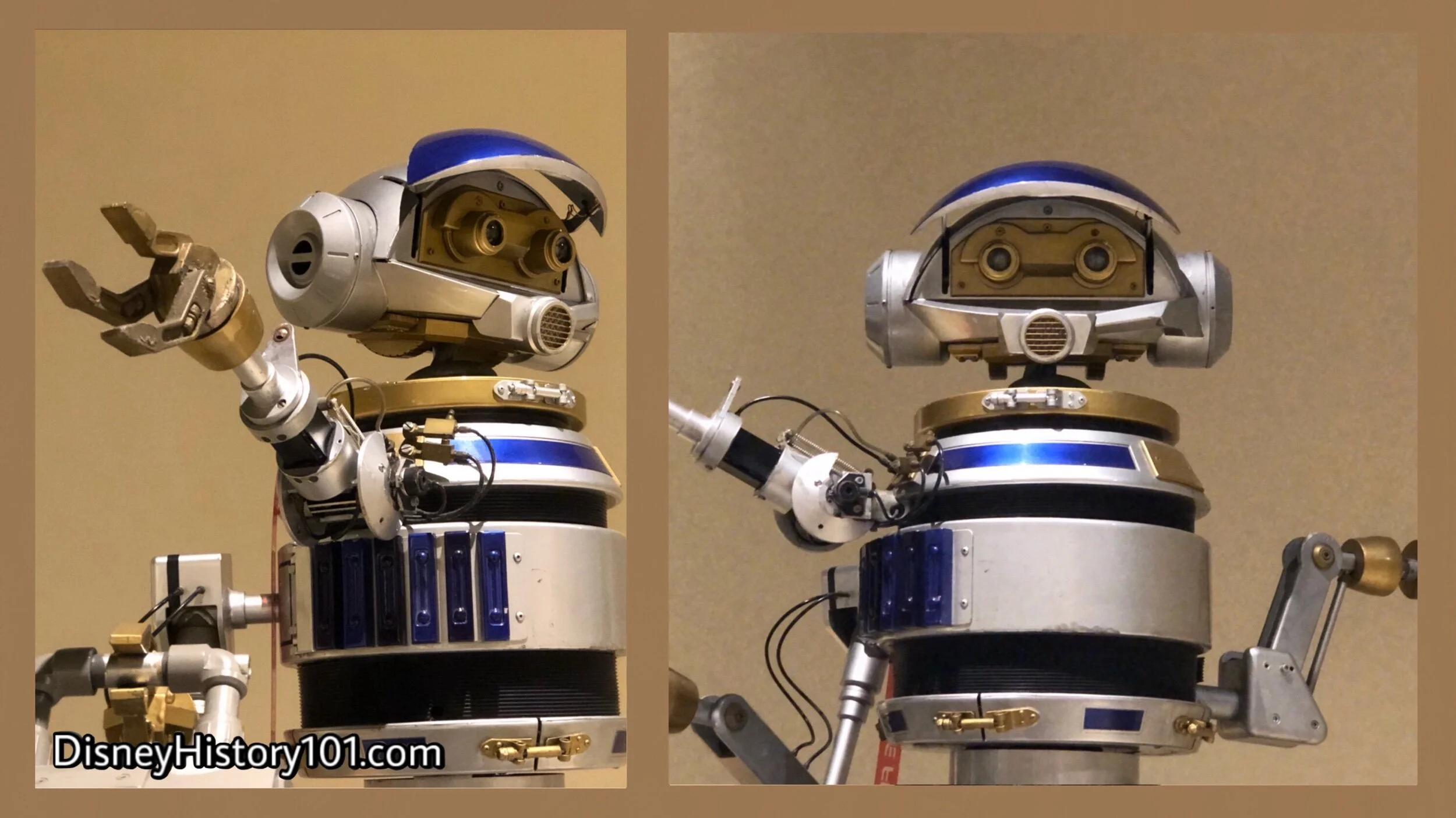
Audio – Dialogue for C-3PO, RX-24 and the rest of the cast was recorded. C-3PO was voiced by Anthony Daniels, while it’s breakout star, the memorable Captain REX was voiced by Poul Reubens.
Then the final show tracks including sound effects, dialogue, narration and music score were mixed.
Animation – Next, Walt Disney Imagineers used a console and computer to program the life-like movements of the show’s three-dimensional “Audio-Animatronics” figures. This included Captain REX, who “never got used to his programming”.
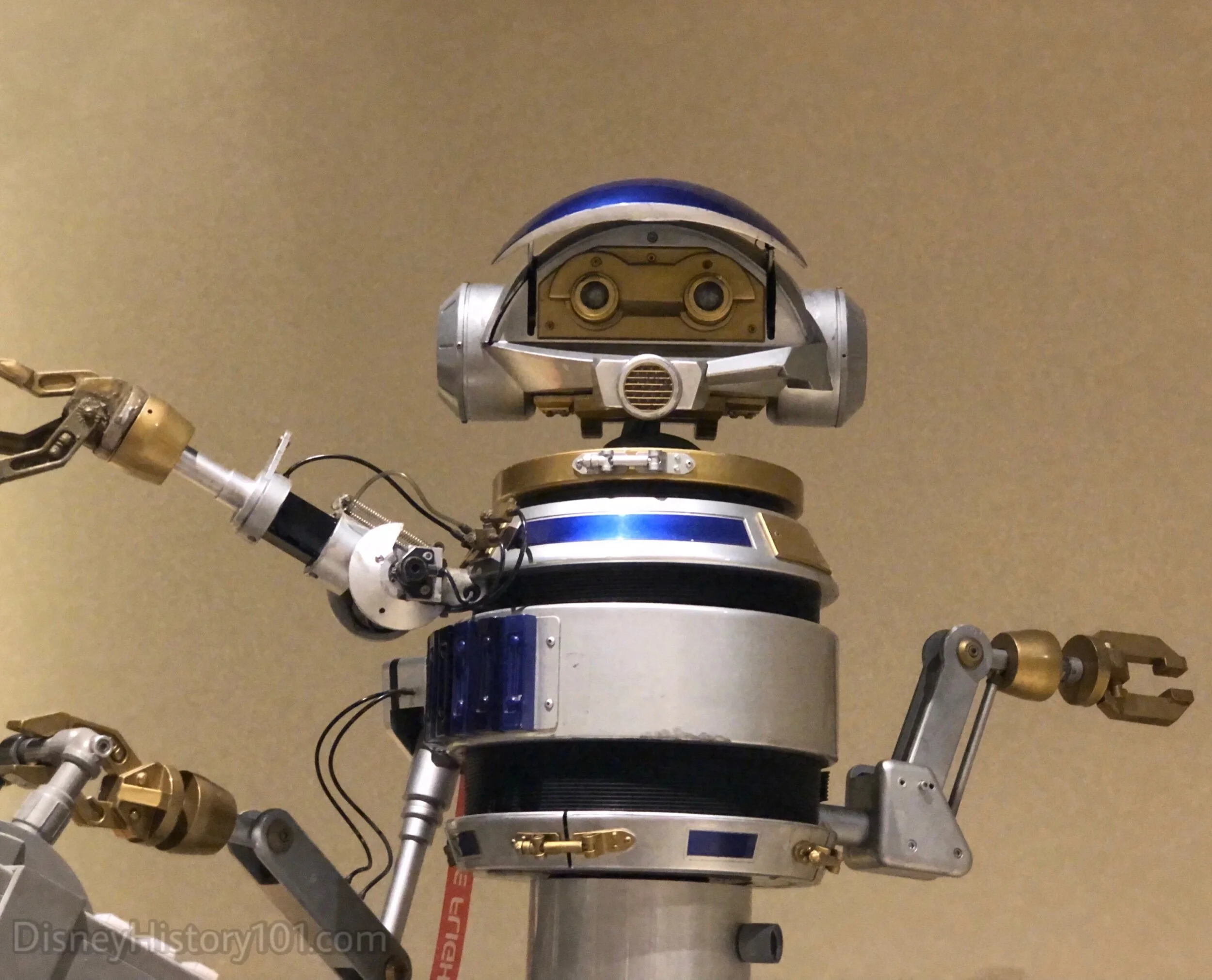
One of the most memorable cast members was the Captain REX Audio-Animatronics ®️ Figure who first piloted StarSpeeders at “light speed for Endor”, in Star Tours at Disneyland.
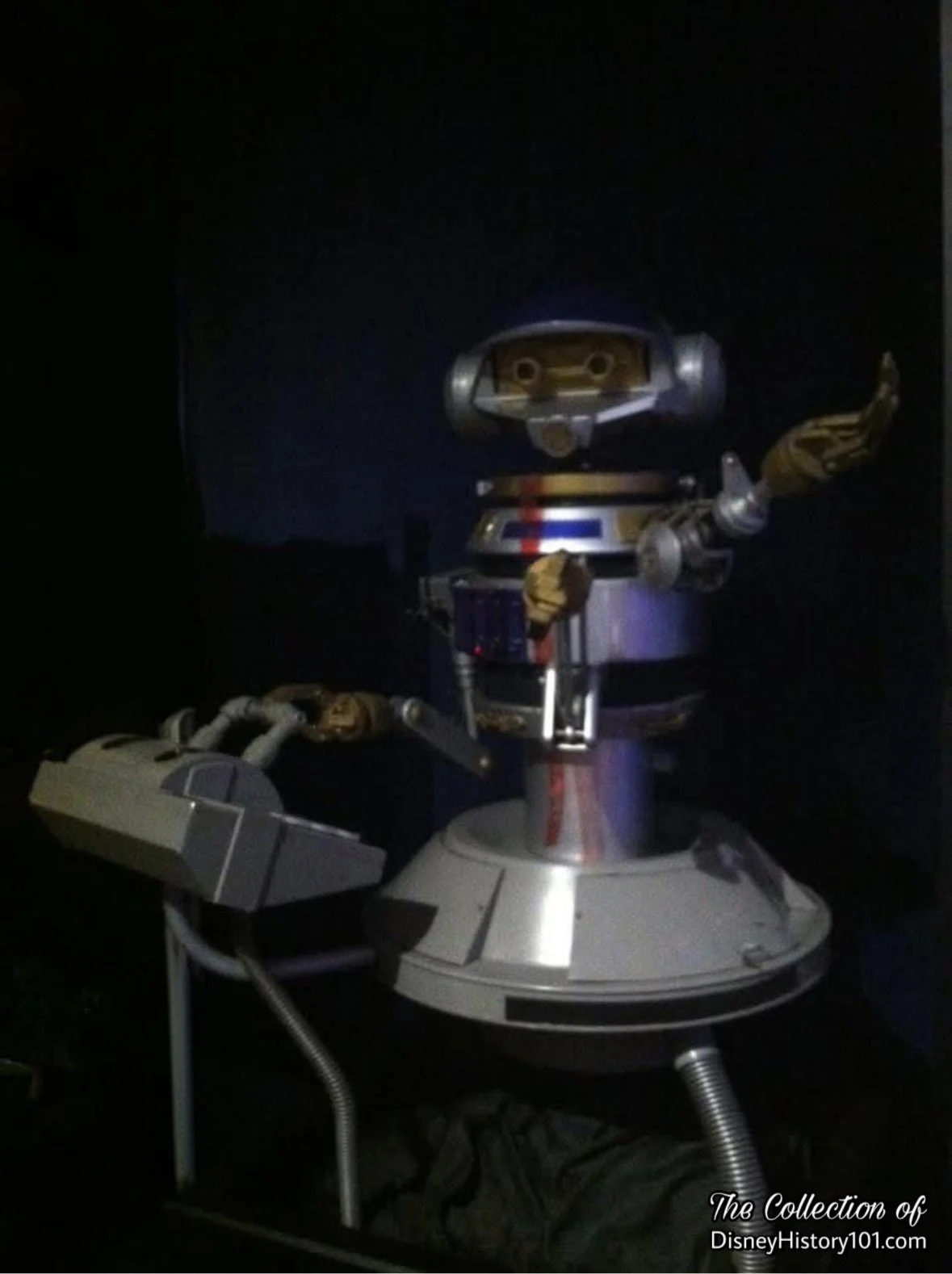
“Show Set Design”
Since 1955, Disneyland queue areas and “Audience Waiting Areas” were especially designed as part of the attraction to make the guest's time waiting in line as comfortable as possible. During Walt’s day, they were equipped with live entertainment to set the mood for the forthcoming show. After Walt, Disneyland “queue lines” continue to be designed as part of the immersive experience for Guests.
For Star Tours, full-sized show sets were constructed from smaller models at the Tujunga facility. Next, many fixtures and props for the show were carefully selected to give attention to story consistency in all elements of the show.
Unique one-of-a-kind props were also individually fabricated. These would be installed in the physical structure that was being constructed at the site.
Meanwhile, all of the show’s graphics and signing were also being individually designed.
Little stage dressing details factored into the immersive storytelling. For instance, audiences’ attention would be captured by this “Gate 2” sign when they heard the announcement: “There has been a gate change for Star Tours flight 114, StarSpeeder service to Endor. Flight 114 will now be departing for Gate Number 2. This is a gate change only. Thank you.”
In the original Star Tours, homage to George Lucas’ first feature film was made through an announcement heard in the queue: “Will the owner of a red and black landspeeder vehicle ID THX-1138 please return to your craft? You're parked in a no-hover area.”
Since then, “THX” has appeared in numerous aspects of the story, and worked its way into the mythology of the Star Wars universe.
However, more than references to George Lucas were worked into the Star Tours story. Another announcement heard in the queue heralded: “Star Tours flight 55 is now ready for boarding at gate number 3.”
Special Effects & Lighting – The show’s mood and atmosphere were enhanced by the those aforementioned special effects and lighting created by the WED “Illusioneering” laboratory. This included the liquid crystal display and illuminated Status Board, in Show Scene 1. All of these were prepared, awaiting installation in the show building.
Film – The attraction’s entire main show film ran at 70mm/30 frames per second. The Audio/Video System was through a Videodisc Player.
Air Conditioning – A practical mechanical application of Air-conditioning technology was installed to control the dust, and was essential where projection equipment and film was used. It looks like droids aren’t the only ones that could suffer from a little dust contamination.
Entertainment Costuming – Meanwhile, Disneyland Wardrobe provided the designs and furnished costumes for Attractions Hosts and Hostesses, which would also give careful attention to story consistency. Disneyland and Walt Disney World each prepared their respective park’s costuming.
On July 22, 1986, a very limited number of Walt Disney Imagineers stepped board a simulator for a preview of Star Tours, at the Walt Disney Imagineering “Sharing the Magic” Open House Event.
“Construction”
On September 3, 1985, construction commenced on site. Steadily, the project would take shape, with a scheduled grand opening of January 9, 1986.
One of the earliest jobs involved cast-in-place concrete foundations, which were poured within wooden frames on the construction site. Underneath the concrete foundations were hydraulic pipe trenches, and other essential elements related to function of the motion simulator.
Above, the wood “formwork” was removed from the concrete foundations.
The reinforced concrete mat would become a foundation for bolting the legs of the motion simulator. This dense mass of a thick concrete foundation block would act as a dampener, distributing massive stress evenly across the earth, ensuring the ATLAS simulator machinery stayed perfectly level and never broke loose over millions of ride cycles. Without this concrete foundations, the intense, repeating shaking, jolts, and drops from the hydraulic pistons would transfer directly into the building’s main framework, causing severe structural fatigue and rattling the entire show building.
Rolling compaction commenced, compacting and grading the dirt soil around the motion simulator base. This created a stable, dense base that could safely support the weight of the show building, and further fortified the concrete foundation of ATLAS motion simulator bases.
The steel skeleton frame of the Star Tours show building began to take shape, with a corrugated steel roof deck crowning its steel columns and horizontal girders.
Working with the show set designers, architects designed the physical structure in which the Star Tours show was to be presented. These plans were translated into reality through teams of construction crews.
Above, the Star Tours “Show 1 Stage” and queue began to take form. Paneling has been added to the security tower and things are starting to take shape.
The highlight of the “Show 1” area would be a security center control with Mon Calamari operators overlooking passengers in the queue below.
This vantage from the PeopleMover track overlooks what would become the “Show 1” stage where the C3PO Audio-Animatronics figure would be installed.
This is a ground view of a corner of the future Droidnostics Center show scene of “Show 2”. The upper tier is the queue ramp that guests would eventually use to walk through the room.
Walt Disney Imagineers in London had looked into developments of a company called Rediffusion Simulation, which was constructing simulators (“a large box with seats mounted on six hydraulic rams”) primarily for military application.
Next, engineers developed the ride systems to meet design specifications. Here we can see one of the final four military-grade ATLAS flight simulator cabins (or “Starspeeders”) resting on the roof. It’s has been prepared to be lowered into the attraction building via crane. This attraction "vehicle" will be used to convey the show/ride experience to guests.
Walt Disney Imagineers intended to transport the Starspeeders by helicopter, but it was decided to haul them by truck and lower them through the attraction’s hatch by crane. Project Manager Dave Melanson described its transportation and installment this way (in Disneyland LINE Magazine, No. 35, Vol. 18, August 28, 1986) : “To get the StarSpeeder in Glendale trucked down to the Park, we had to get clearance from the California Highway Patrol. we had to move the StarSpeeder in the middle of the night when there would be the least amount of traffic. All four would be brought down Harbour Boulevard and then through Katella Gate, since clearance under the Monorail was best through that entrance.“
Project Manager Dave Melanson continued to describe: “A crane stationed near the Kennel would lift each StarSpeeder over the Berm and the Administration Building. A second crane would take it from there and finally lowering it through the hatch. These are very specialized cranes, having 165-ton capacity and a 260-foot boom - the kind of cranes you’d use, for example, to lift a 747 plane.” Above, one of hydraulic motion-based “StarSpeeder” cabins can be seen, as it was lowered through the hatch and into its position within the Star Tours attraction building.
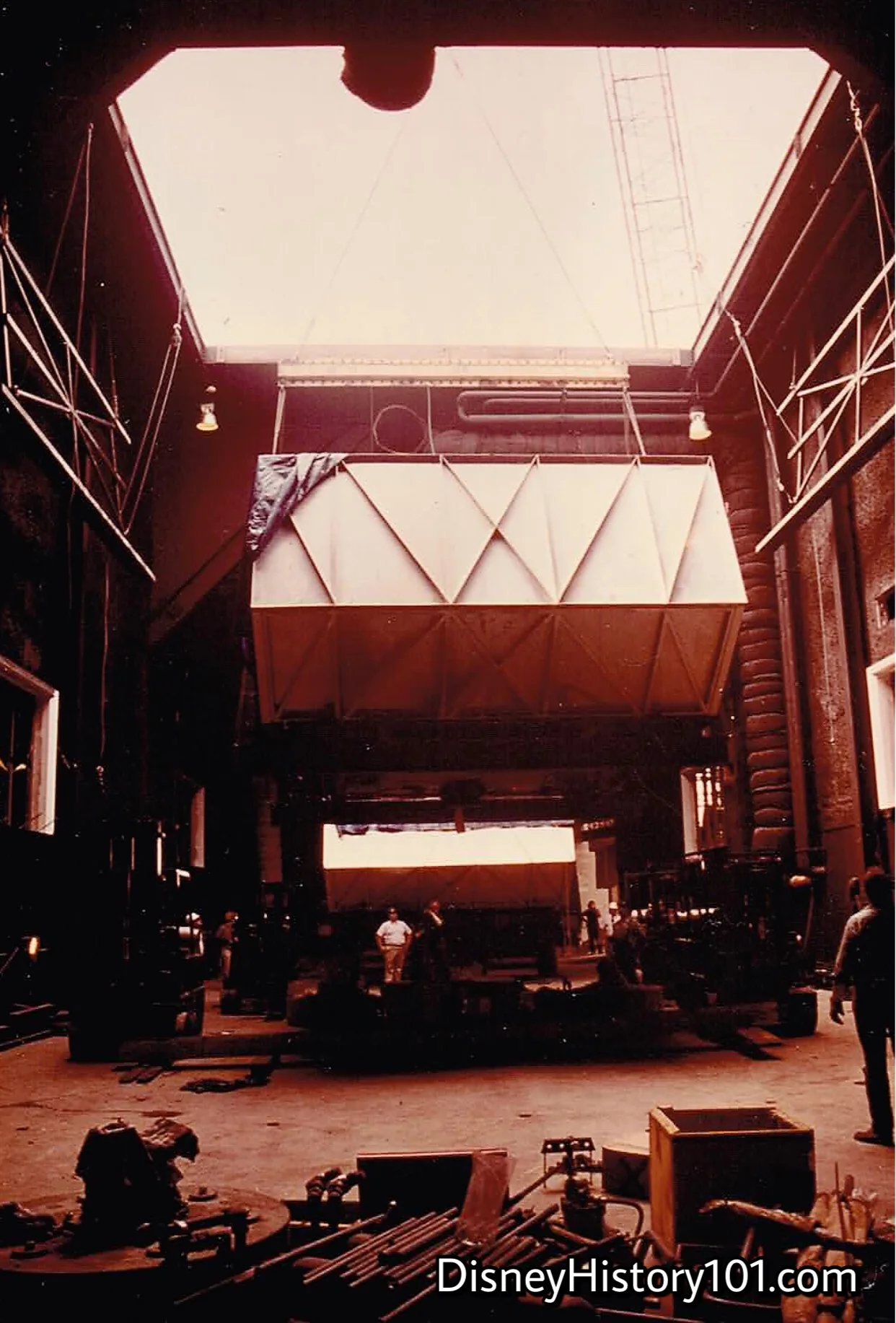
Project Manager Dave Melanson continued: “When each Starspeeder was lowered through the hatch , four heavy-duty fork lifts, which moved in synch, carried the cabins to their spot. Now comes the job of getting everything ready and testing it out.” Next, each Starspeeder was mounted to its Motion Base - a moving platform, with hardware installed below it.
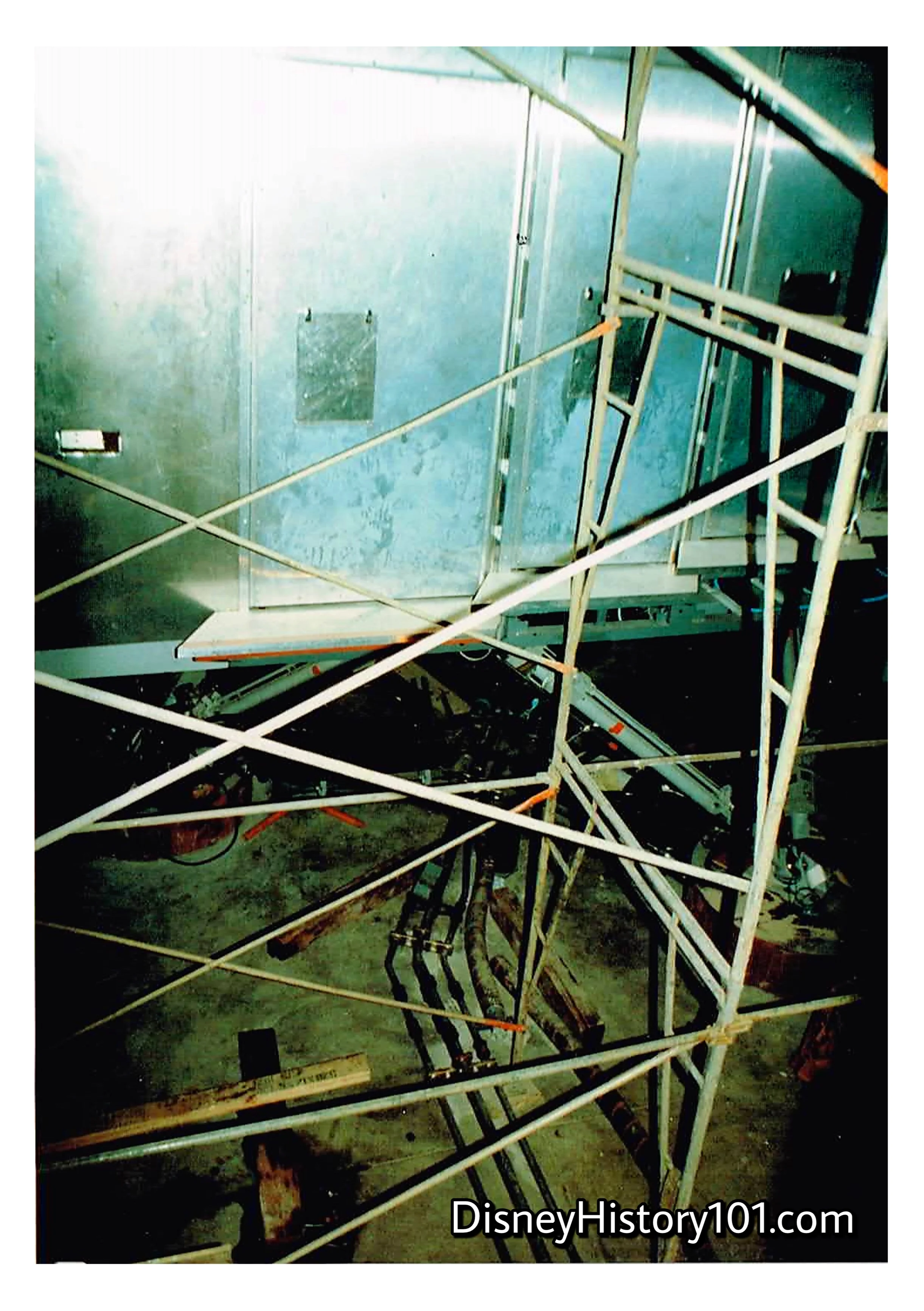
What the Starspeeder looks like resting inside the attraction, with construction scaffolding around it.
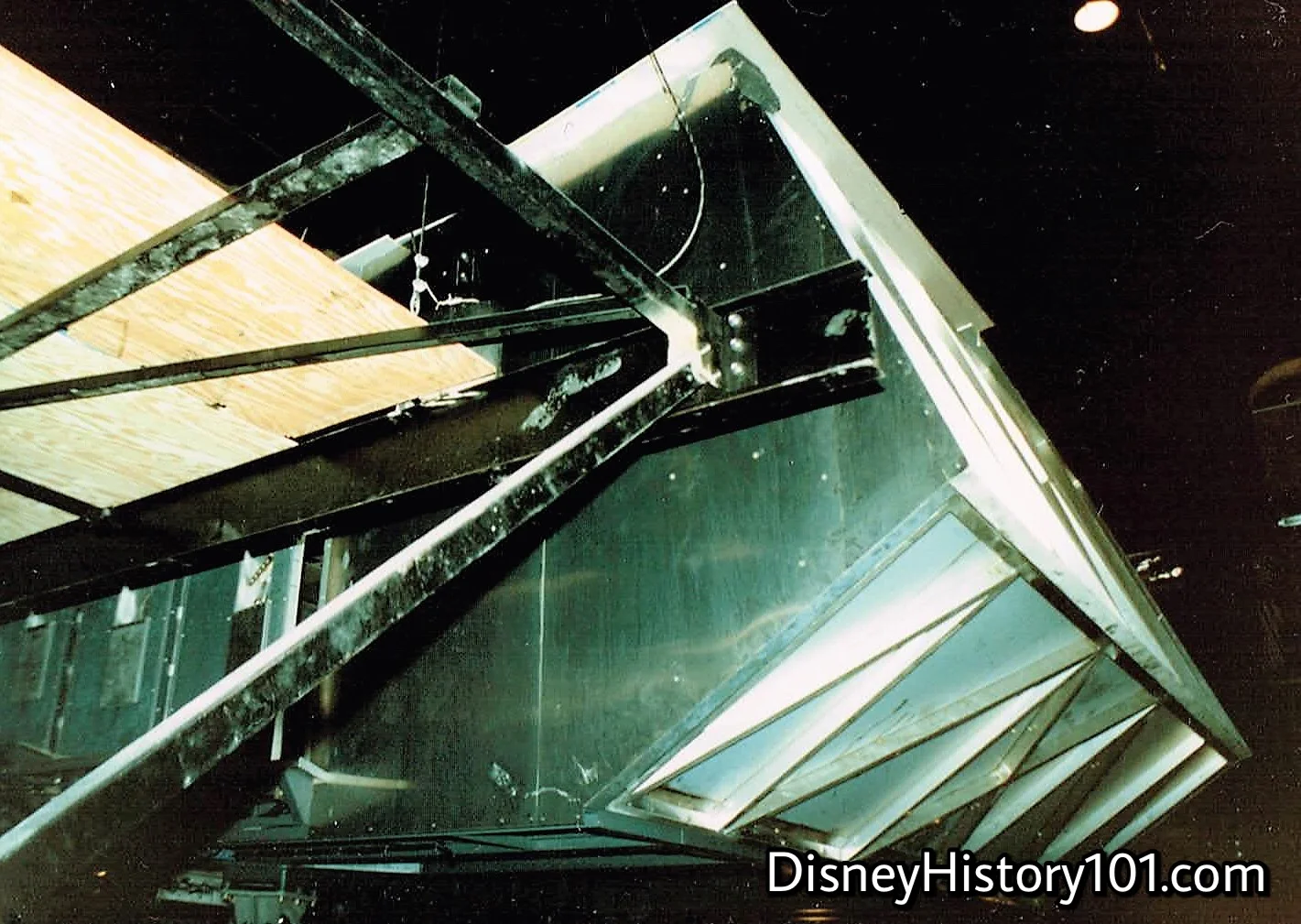
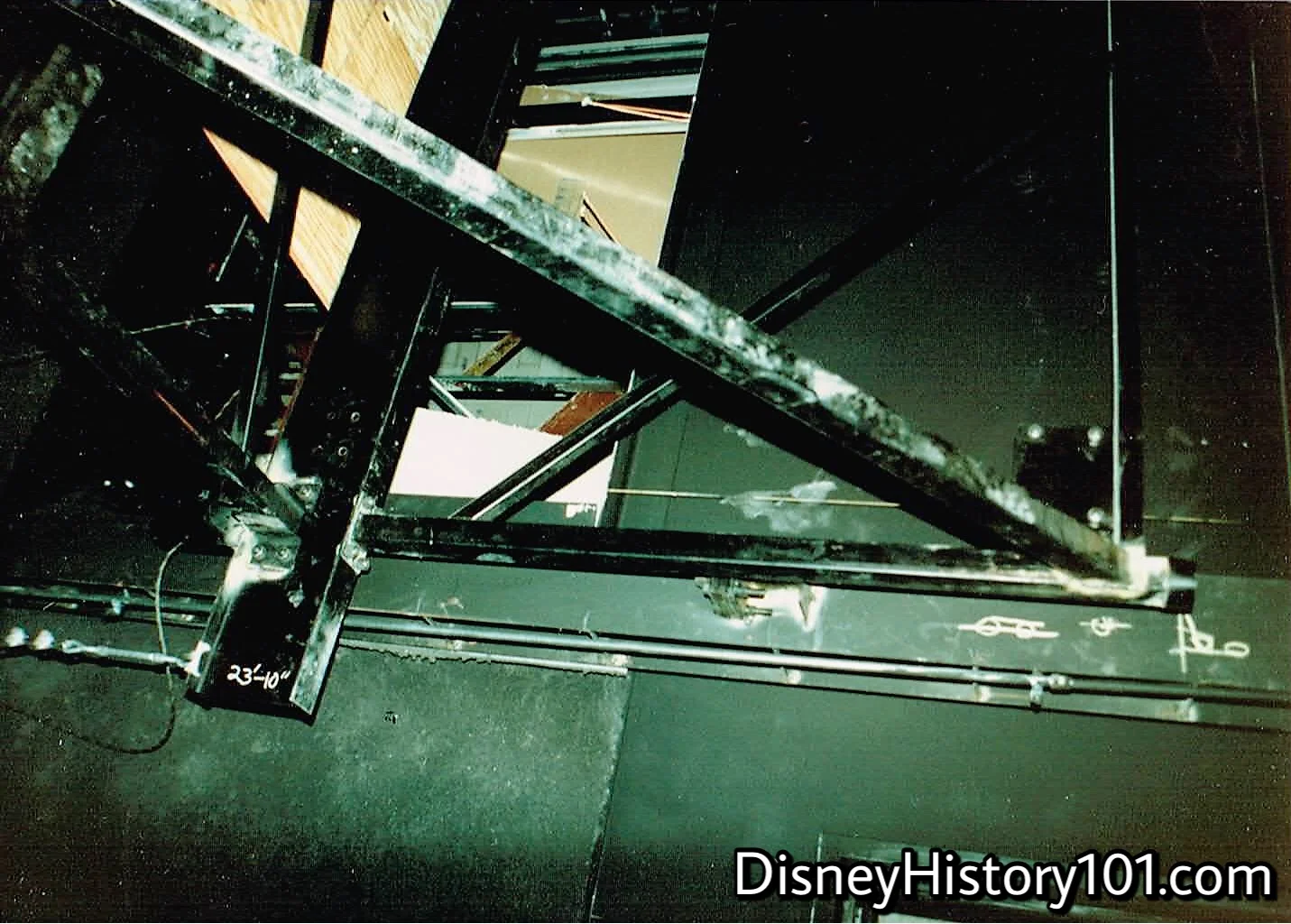
This doorway would connect the Star Tours Loading Area with the motion simulator.
Those legs beneath the cabin are called “Pivot Shafts” or “Actuators”, and were originally manufactured by Rediffusion Simulation in England. Each simulator had a total of six Actuators – hydraulically-operated devices, which provided precise movement to the Starspeeder Motion Base. In fact, an astounding six degrees of freedom provided the ability to move up to 35 degrees, in the X, Y, and Z planes. This resulted in exact tilting shaking, and nudging the cabin to match the screen visuals experienced by passengers of StarSpeeder 1000s. When the Actuators (or “Pivot Shafts”) were in the “settled” simulator position they were fully retracted.
The Actuators were also capable of supporting the massive weight of ATLAS cabins. It was estimated that each of the four “StarSpeeder” simulators contained 40 seats and could support a vehicle weight with a payload of approximately 26,000 lbs. – owing to its “Actuators”.
This attraction vehicle technology led to Imagineering the ride systems referred to as EMVs Enhanced Motion Vehicles, used in the Indiana Jones Adventure:Temple of the Forbidden Eye.
“Don’t Get Technocal With Me! What Pressure?”
What REALLY propels a StarSpeeder through space – hydraulic power! These heavy-duty hydraulic pumps fluid reservoirs, and accumulator assemblies would supply high-pressure fluid to the motion base actuators. However, hydraulic machinery generates significant heat, noise, and vibration, requiring a dedicated service room away from the guest queue and ride cabins. But after all, this system would be responsible for creating the aggressive tilts, pitches, and drops experienced by passengers of Starspeeder 1000s.
This image is a little hard to see, but you’re looking at the left portion of the southern “The Spirit of Creative Energies” mural behind the construction barrier. Mary Blair’s murals (together with the facade of Its a Small World) were the optimistic “bookends” that encapsulated the progressive story of Walt Disney’s vision of Tomorrowland.
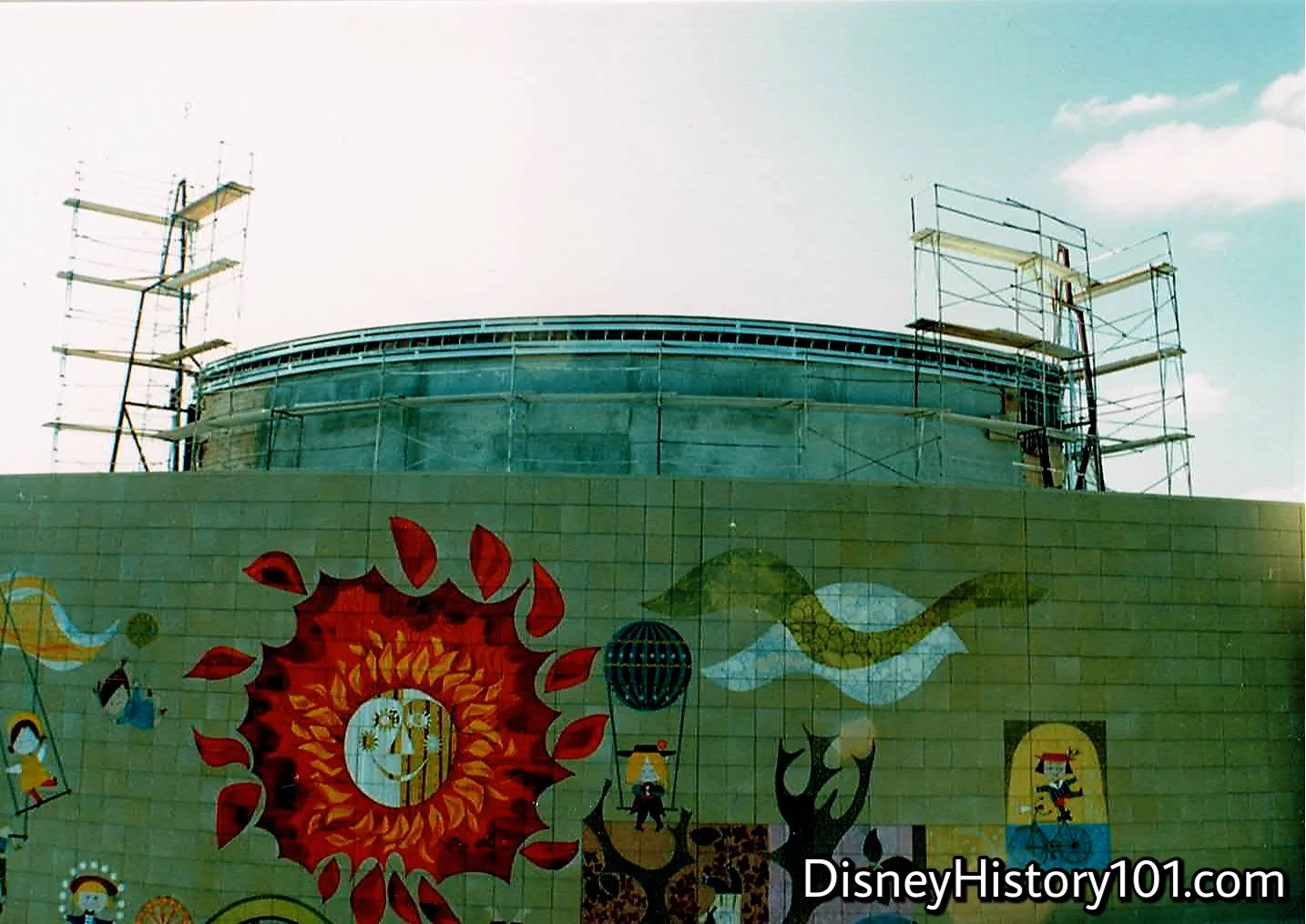
The southern “The Spirit of Creative Energies Among Children” mural encompassed the façade of the former Adventure Through Inner Space building. In this photograph, an extension has been made to top the structure, before exterior work is carried out. Soon, Mary’s murals would be removed from the show building and replaced by a new vision of Tomorrowland.
The Future is NOW - 1986! Guests of Tomorrowland, passed posters teasing “The Ultimate Thrill Experience” that was headed exclusively to Disneyland during the winter of 1986. As the posters never mentioned a particular adventure or attraction, this campaign was exciting and ambiguous, inciting much anticipation among guests as to what was coming.
Ultimately, the “ultimate thrill experience” – Star Tours, joined the Magic Eye Theater & Captain EO, and Star Traders during the winter of 1986.
Signage and other decorations were prepared for the big event.
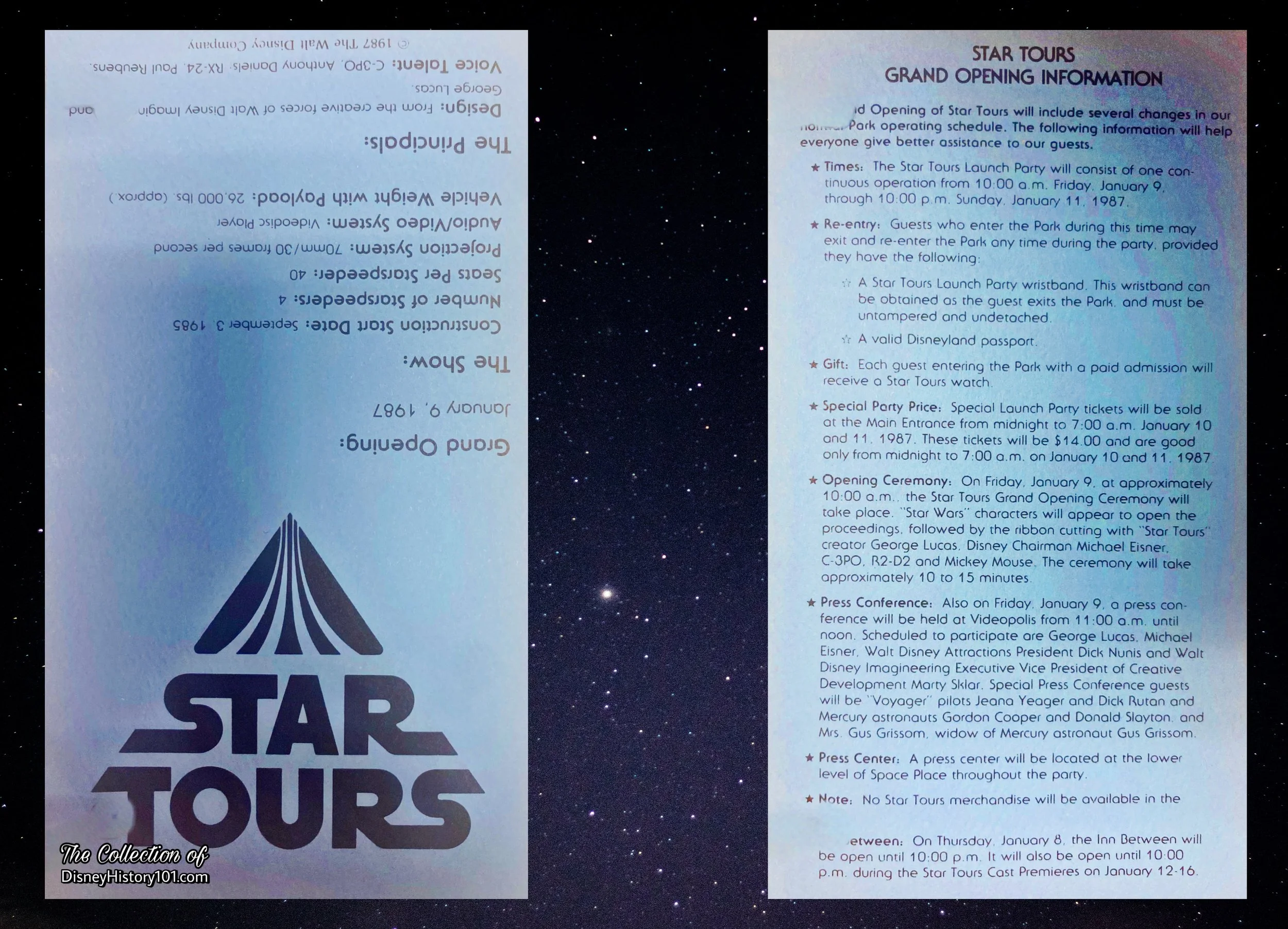
Disneyland Cast Members were trained and prepared.
Finally, the ultimate thrill experience arrived!
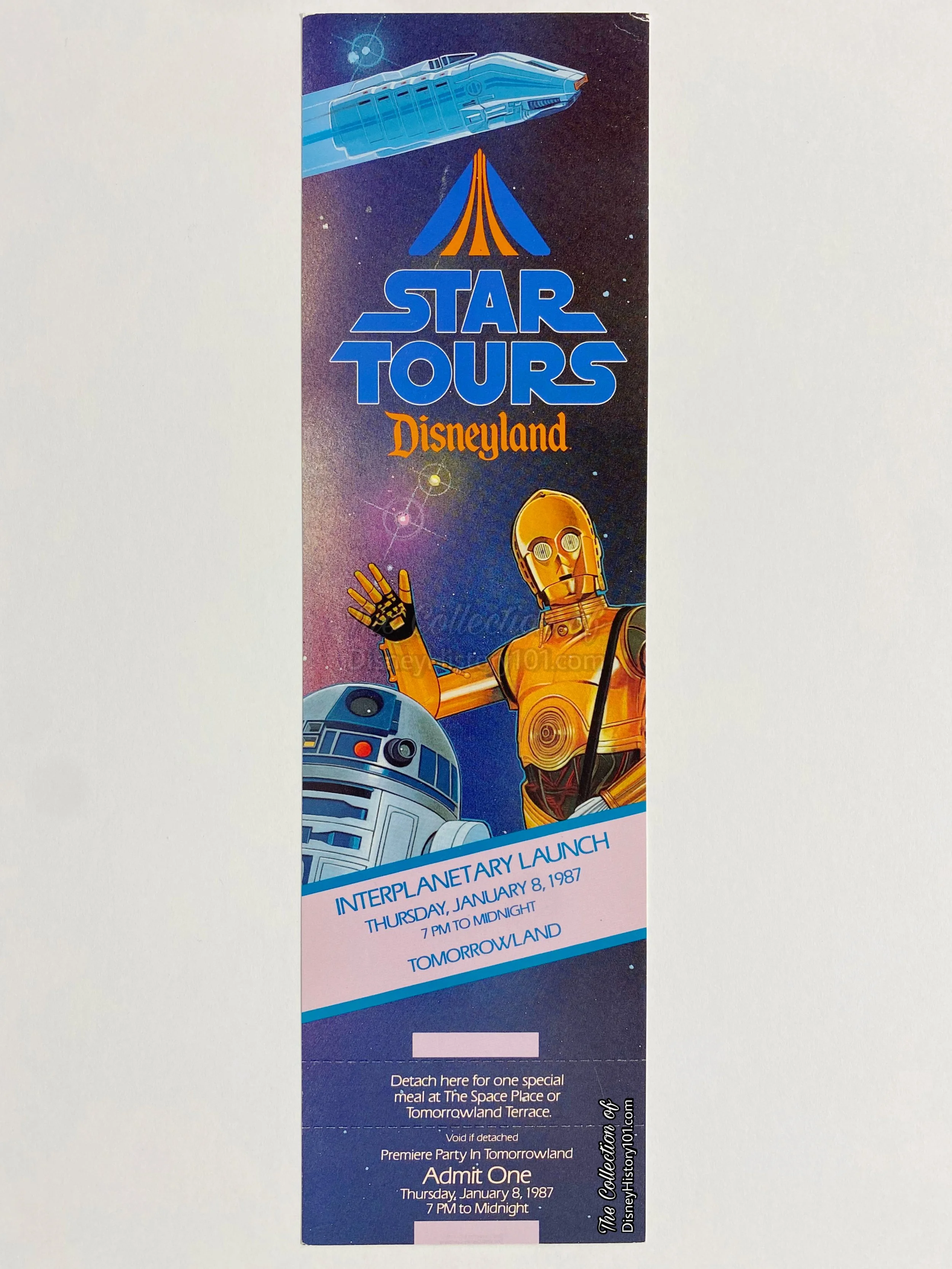
“Launch Party”
The Star Tours Launch Party consisted of one continuous operation from 10:00 a.m. Friday, January 9, through 10:00 p.m. Sunday, January 11, 1987. Special Launch Party tickets were sold at the Main Entrance from midnight to 7:00 a.m. January 10 and 11, 1987. These tickets were $14.00 and are good only from midnight to 7:00 a.m. on January 10 and 11, 1987.
Guests excitedly lined up in a 4-hour queue that extended all the way down Main Street U.S.A., and park hours were extended for an astounding total of 60 straight hours of Park operation from 7pm to midnight! Guests who entered the Park during this time could exit and re-enter the Park any time during the party, provided they had a Star Tours Launch Party wristband. This wristband could be obtained as the guest exits the Park, and needed to be untampered and undetached, and a valid Disneyland passport was required. All of this, so that guests may board one of four shuttles to a “galaxy far, far, away.”
Of course, “due to the nature of the attraction expectant mothers and guests with certain physical handicaps may not ride. Certain height and age restrictions also applied”, according to the Guide to Disneyland (published 1987).
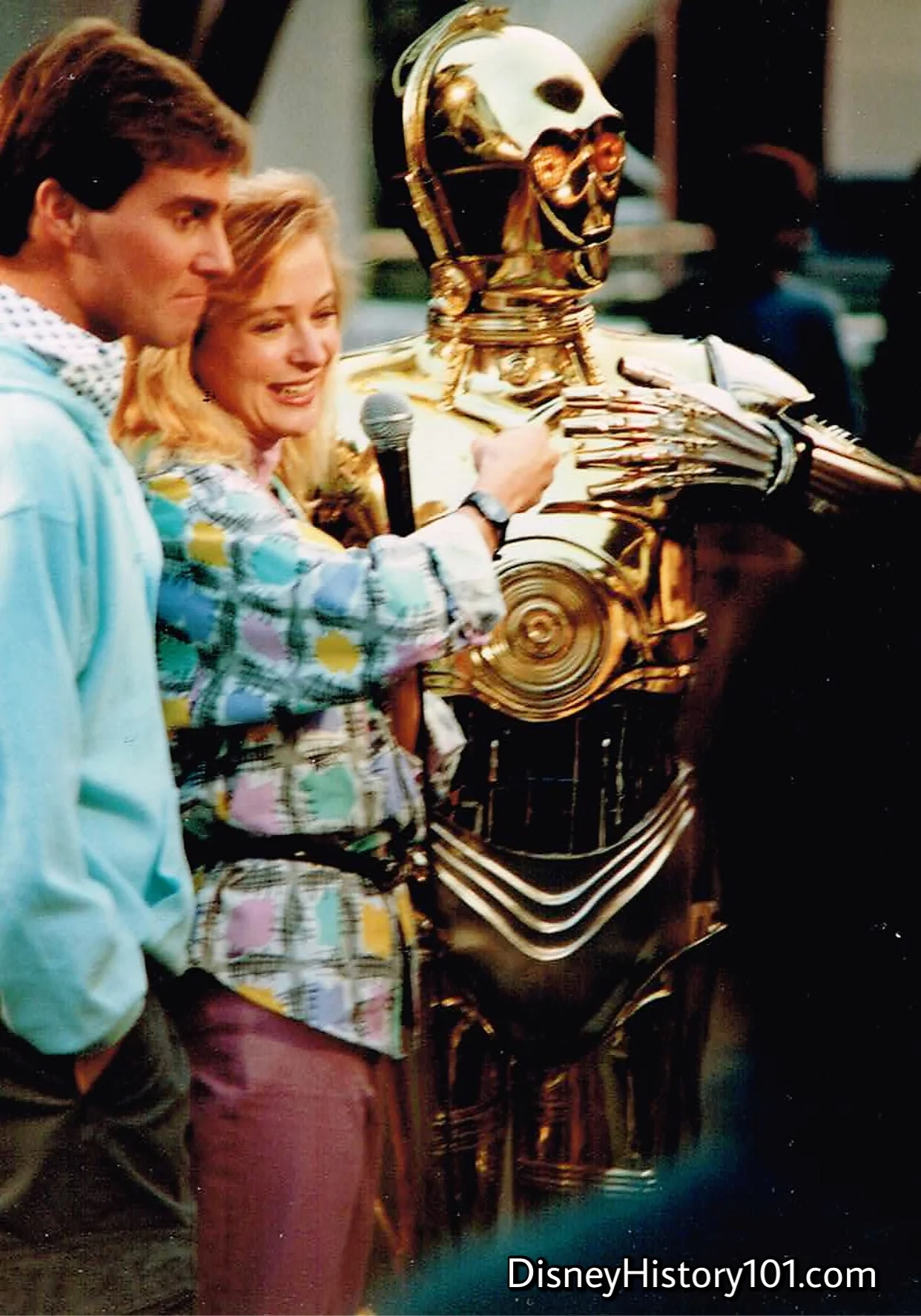
This Vintage View was captured during the filming of the Star Tours 60-Hour Party Promotional Television Spots.
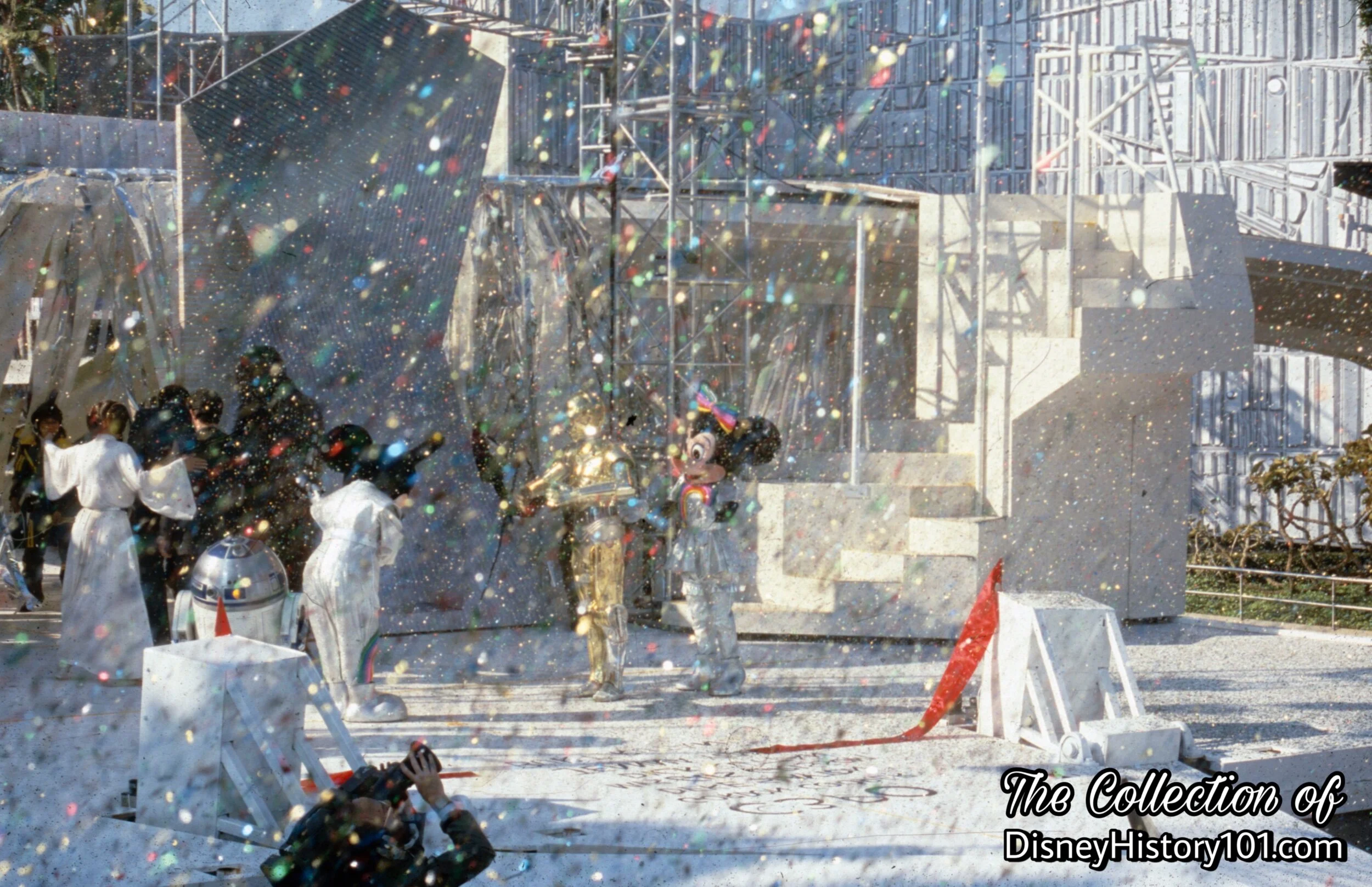
“Opening Ceremony”
The $32 million attraction first shuttled guests to a moon of Endor in “a galaxy far, far away” (all with the help of RX-24 and R2-D2), during January of 1987. On Friday, January 9, at approximately 10:00 a.m.. the Star Tours Grand Opening Ceremony took place, launching the first Disneyland attraction to feature stories and characters that were not originally a part of Walt Disney Productions. “Star Wars” characters appeared to open the proceedings, followed by the ribbon cutting with “Star Tours” creator George Lucas and Disney Chairman Michael Eisner wielding a lightsaber, while C-3PO, R2-D2 and Mickey Mouse looked on. The ceremony took approximately 10 to 15 minutes, before nonstop flights commenced.
Also on Friday, January 9, a press conference was held at Videopolis from 11:00 a.m. until noon. A press center was located at the lower level of Space Place throughout the party. George Lucas was among Disneyland Guests on the second day of operation according to interviews conducted during the 1980s. Scheduled to participate were Michael Eisner, Walt Disney Attractions President Dick Nunis, and Walt Disney Imagineering Executive Vice President of Creative Development Marty Sklar. Special Press Conference guests were “Voyager” pilots Jeana Yeager and Dick Rutan and Mercury astronauts Gordon Cooper and Donald Slayton, and Mrs. Gus Grissom, widow of Mercury astronaut Gus Grissom.
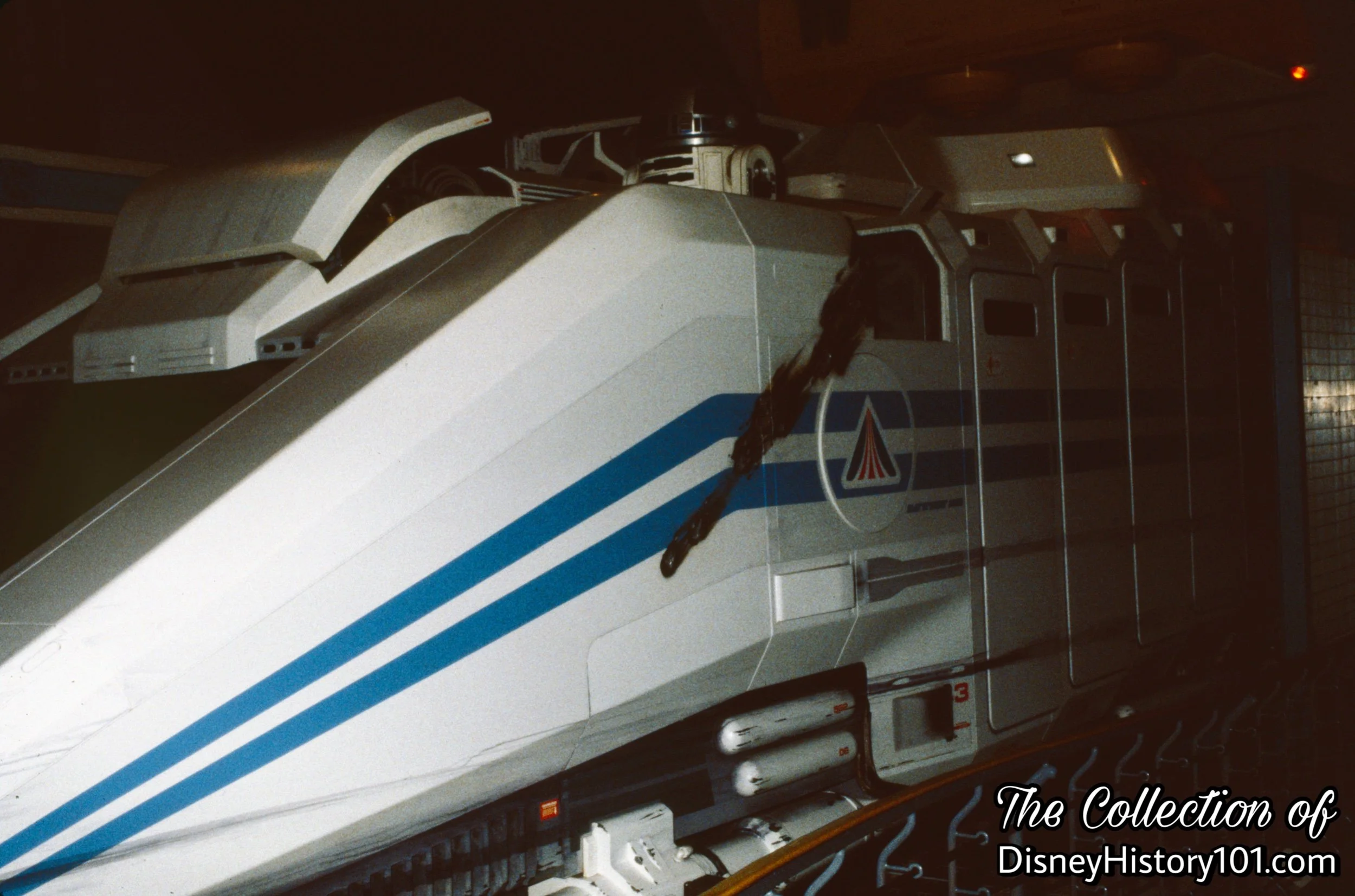
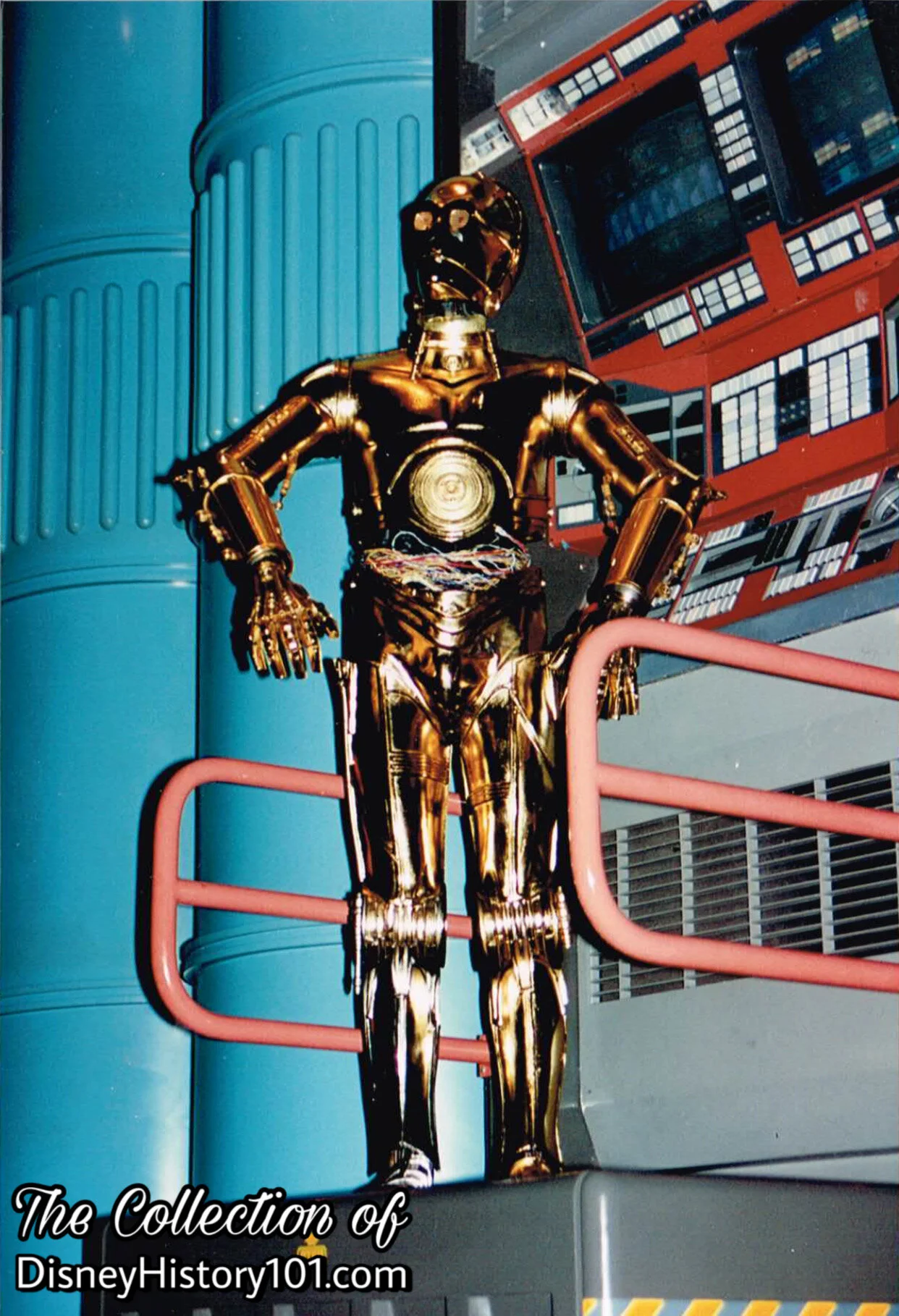
Here, in Star Tours “Show 1”, C-3PO and R2-D2 run diagnostics on a Starspeeder 3000. Overhead, a Liquid Crystal Display runs travel advertisements for galactic destinations while a Status Board, gives information about gates and incoming and outbound flights. Meanwhile, a couple of Mon Calamari Security officers overlook the passenger-filled queue from a Control Tower.
Above, a Supervisor shouts: “Hey, you droids on transport 22, get back to work!”
“Now see what you have done! We'll lose our jobs for sure.”
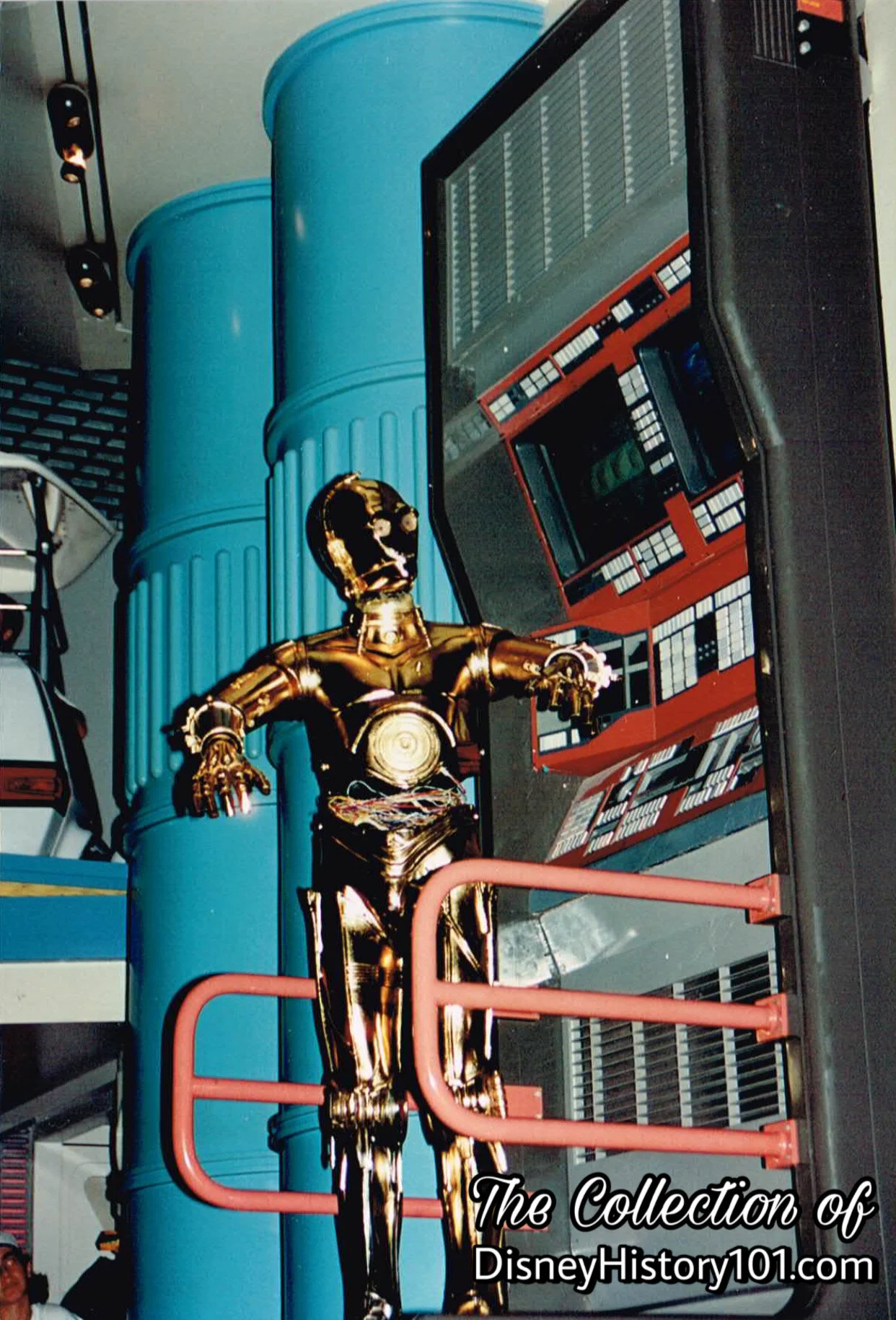
“Don't insult me, you overgrown scrap pile! At least I'm doing my job!“
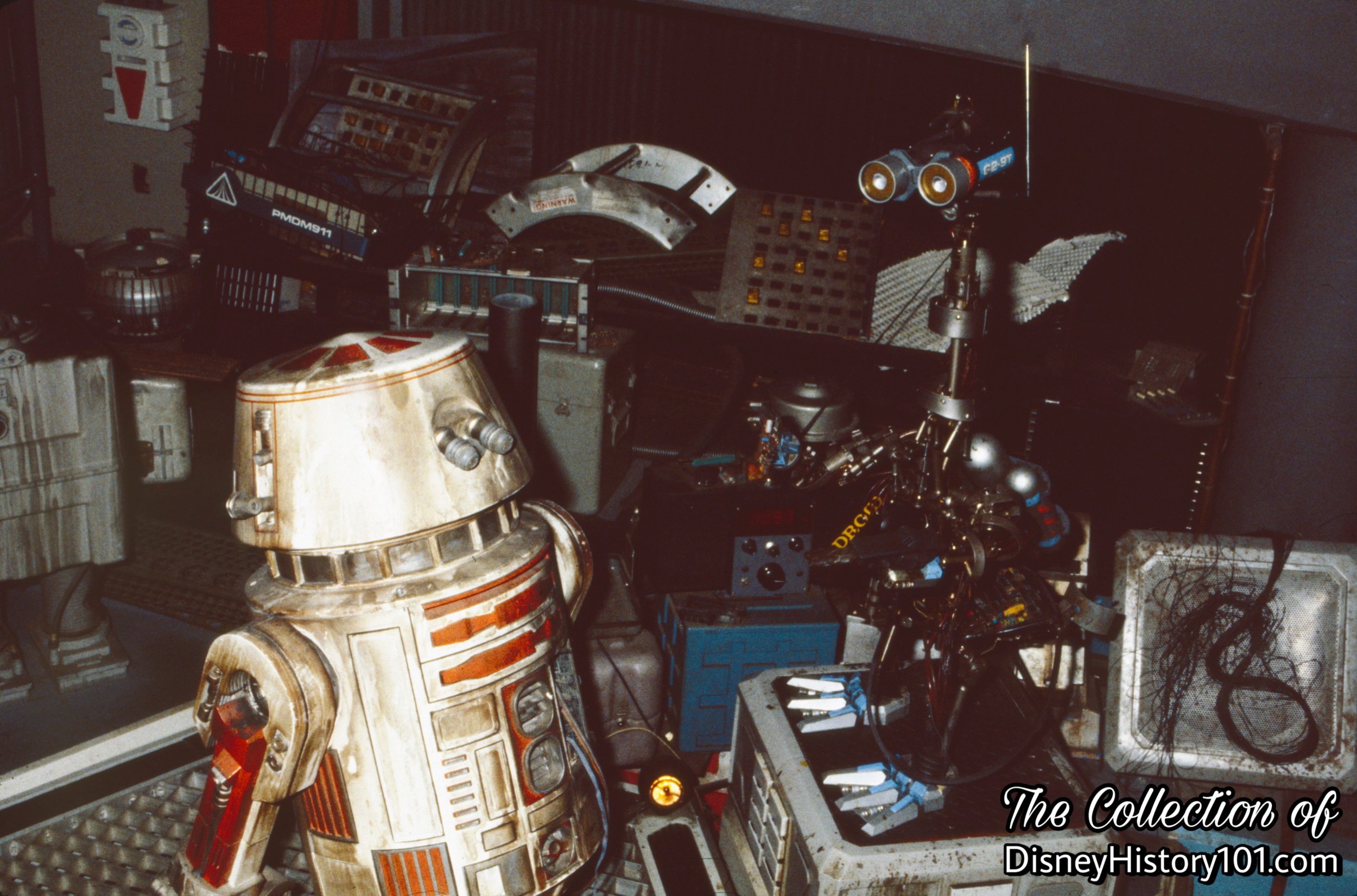
In Star Tours “Show 2”, Guests entered Droidnostics Center (Sector 2) of the Tomorrowland Starport. There, they through the Lower Droid Room and Upper Droid Room, divided by a Liquid Crystal Display Wall. Inside, Guests were introduced to a new repair droid named G2-9T, who was completely repairing a navigator droid whohadcompletely burnt out its logic module during a routine flight.
“Loading Area”
Guests continued into the Loading Area Pre-Show containing 12 Video Monitors.
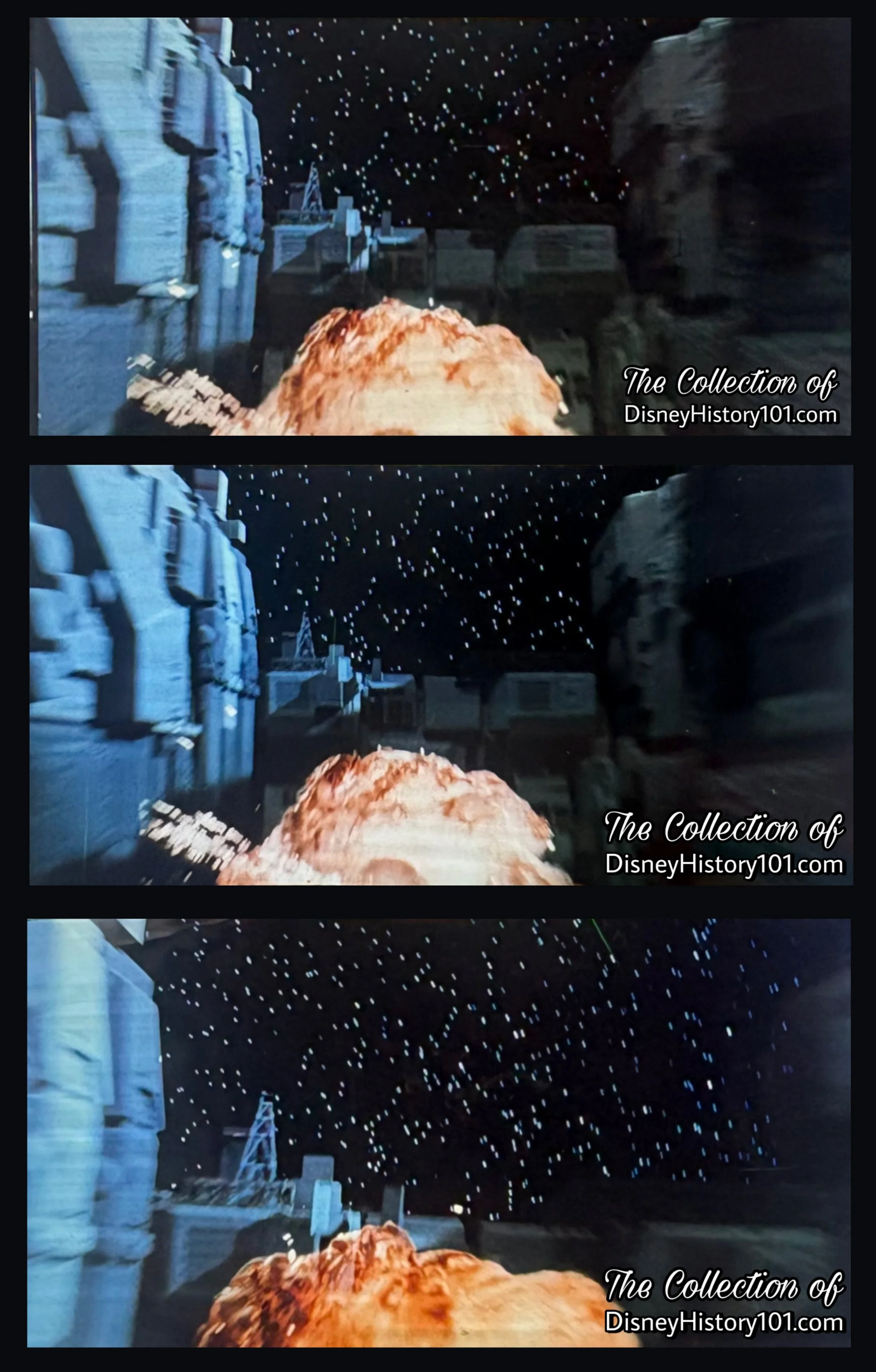
“Main Show”
Captain RX-24’s very first commercial space flight began a little “bumpy”. After a critical navigation error he turned the wrong way, missed the main spaceport exit, and nearly crashed the StarSpeeder 3000 through a maintenance bay door. But after overriding the brakes, Captain Rex was able to narrowly pull the ship back into the launch tube and blast into space.
R2-D2 initiated the hyperdrive shortcut to Endor, but overshot the peaceful forest moon, and dropped the StarSpeeder out of hyperspace directly inside a dense, turbulent ice comet field. After successfully navigating a labyrinth of obtrusive ice crystals, the StarSpeeder 3000 shattered free of the a massive comet and into open space.
Immediately after escaping, the StarSpeeder 3000 is intercepted by an Imperial Star Destroyer and pulled into its tractor beam. However, an X-wing fighter squadron arrives and attacks the Star Destroyer, taking out the tractor beam emitter and freeing the StarSpeeder. Captain Rex follows the Rebel starfighters into battle, joining a dangerous trench run assault against a third Death Star. The StarSpeeder maneuvers through the trench, dodging Turbo Laser Tower fire and Imperial TIE fighters. One X-wing fires proton torpedoes that blow up the Death Star battle station, just as Rex makes a final, desperate jump to lightspeed to escape the explosion!
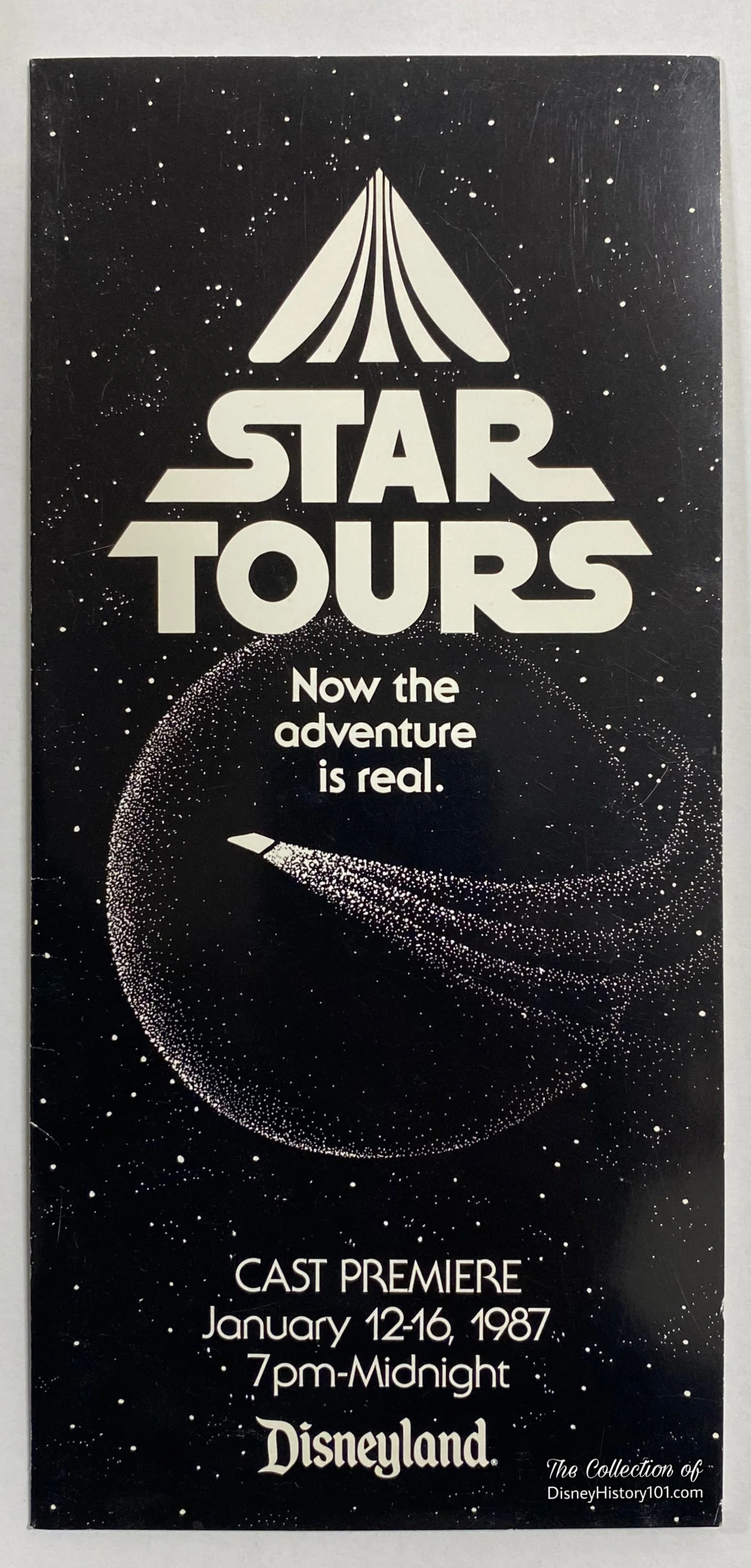
“Star Tours Cast Premier”
The Star Tours Cast Premier was held January 12-16, 1987! All interplanetary travelers were required to have a current passport, the necessary visas and a Boarding Pass prior to leaving the space port.
Many Disneyland Cast Members experienced heightening expectation that could only be reflected by the sentiments of Captain Rex: “I've always wanted to do this!”
Desiree (a former Tomorrowland Character Shop employee) recollected her realization (during that month) that “now the adventure is real” : “The Character Shop cast members were…the first to ride Star Tours. We were cashing out our registers when they came down the exit and needed to test it with people, so we all got to go on several weeks before the opening. Well…it was beyond amazing. Of course, they kept it a secret, but we had heard the term ‘simulator’ come up, but at that time, no one knew what it meant. It just blew our minds. You just couldn’t believe that something like that could be created and I remember telling my parents it was like a fantasy to be able to feel like you were literally in the middle of a Star Wars movie.”
At first glance at this Star Tours “Space Sickness” Bag you may remember just how much you hate space travel.
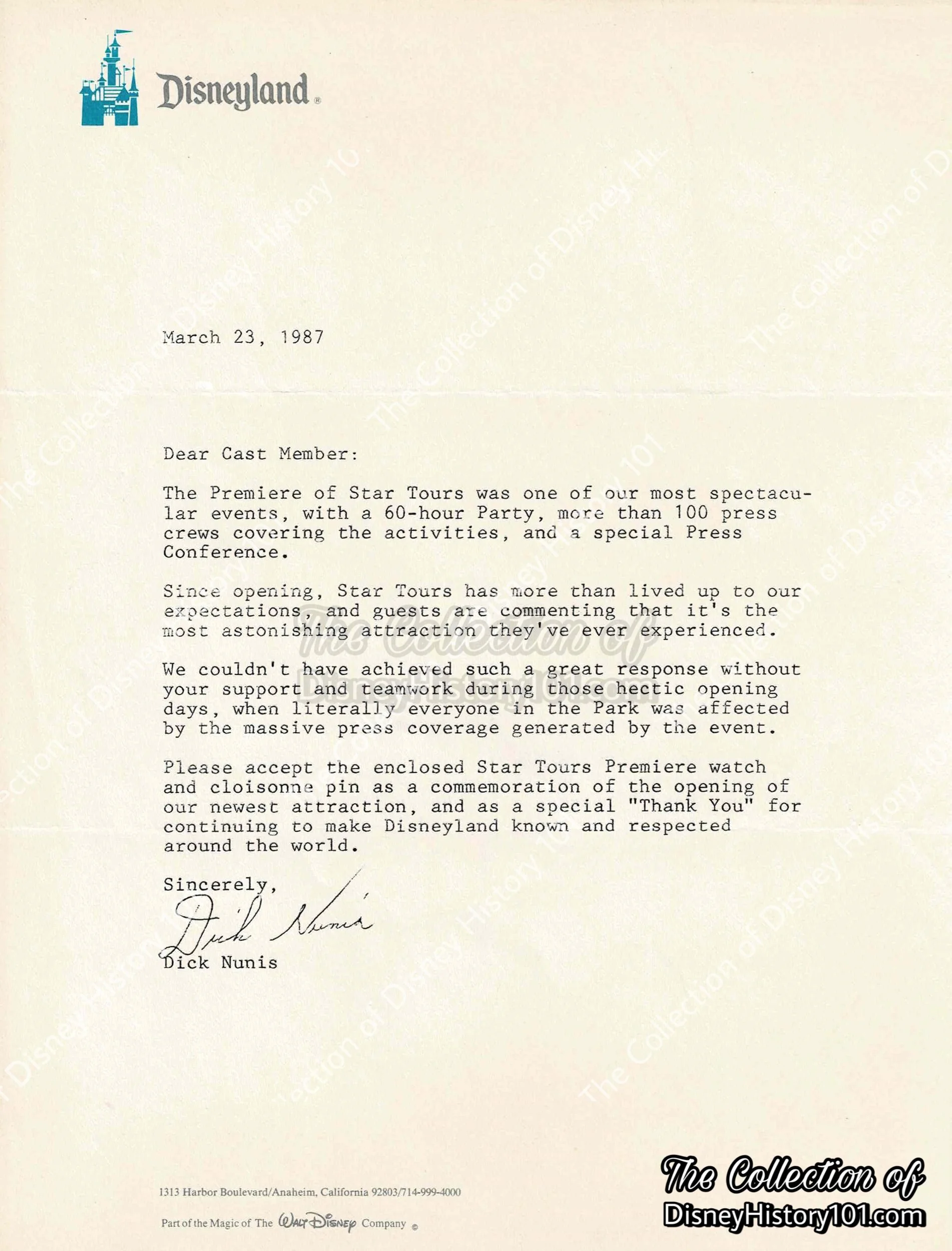
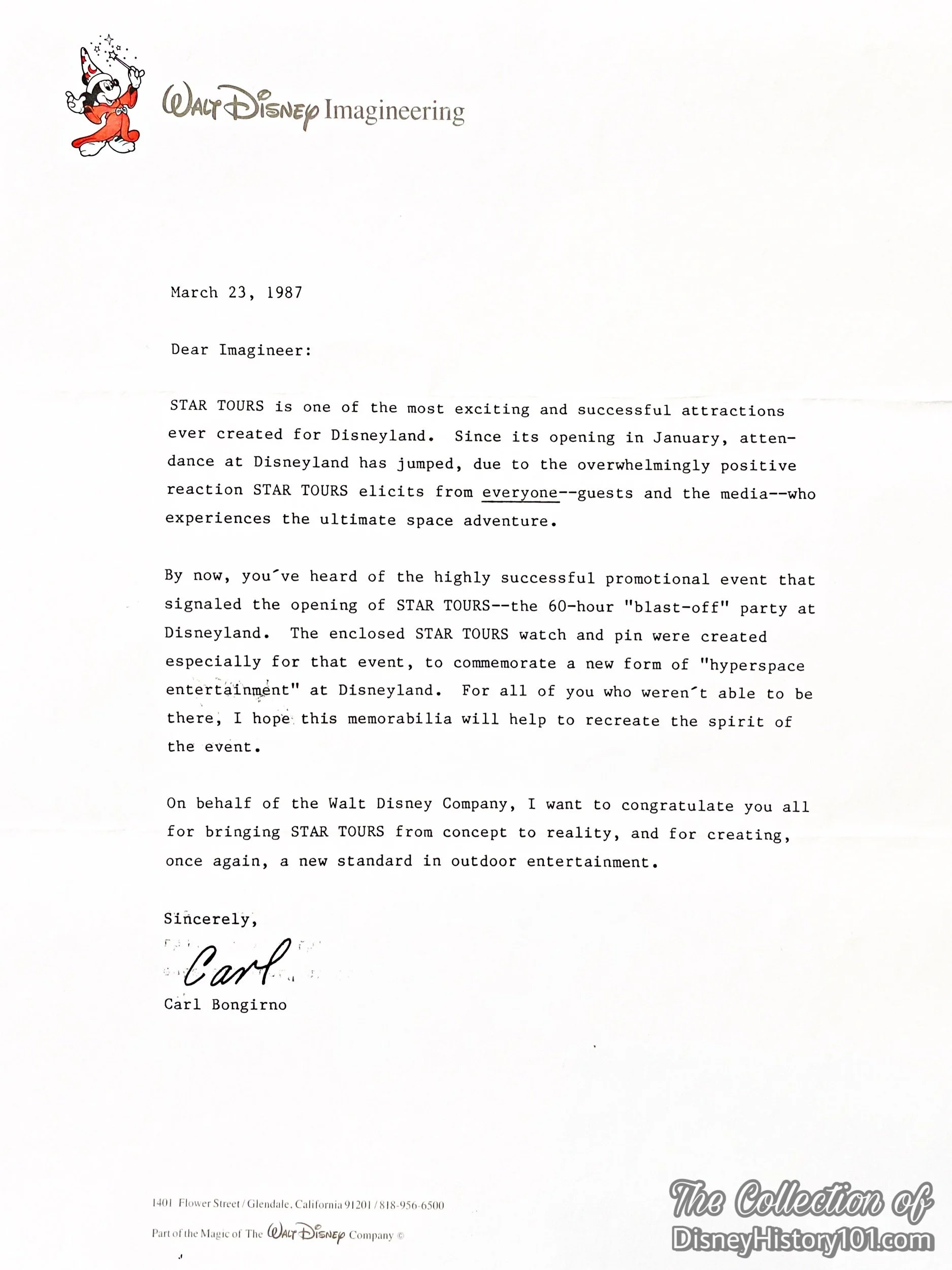
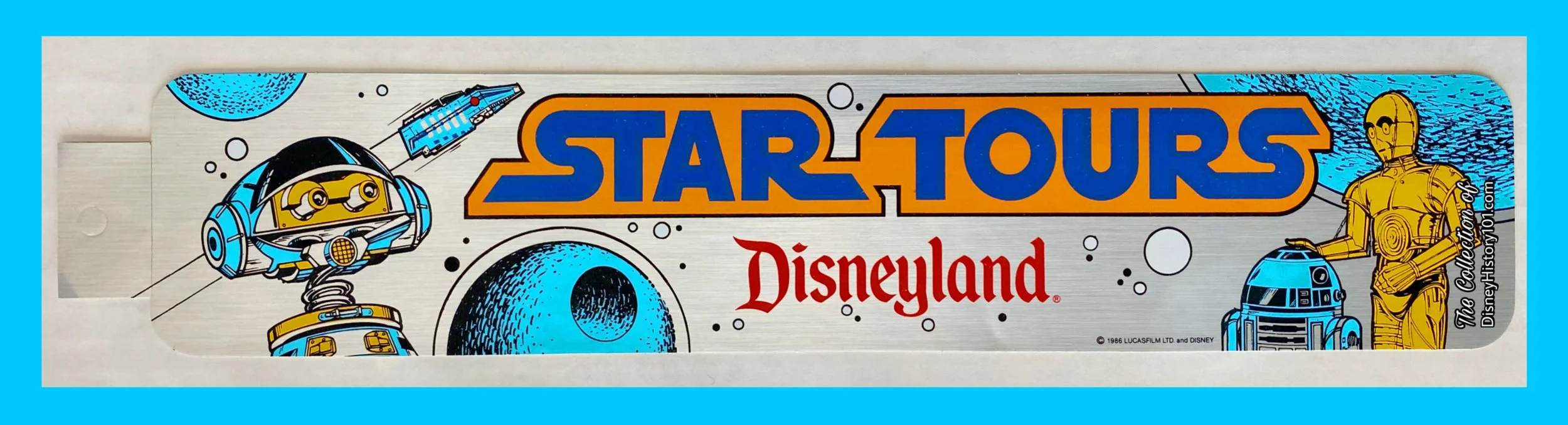
On the Grand Opening Day, no Star Tours merchandise was available in the Park, and this was reinforced in print, on those pre-opening Fact Cards issued to Disneyland Cast Members. However, each guest entering the Park with a paid admission received a Star Tours watch.
Things were far different during the one-year anniversary of the attraction, which was celebrated with an Oldsmobile Cutlass Supreme promotion!
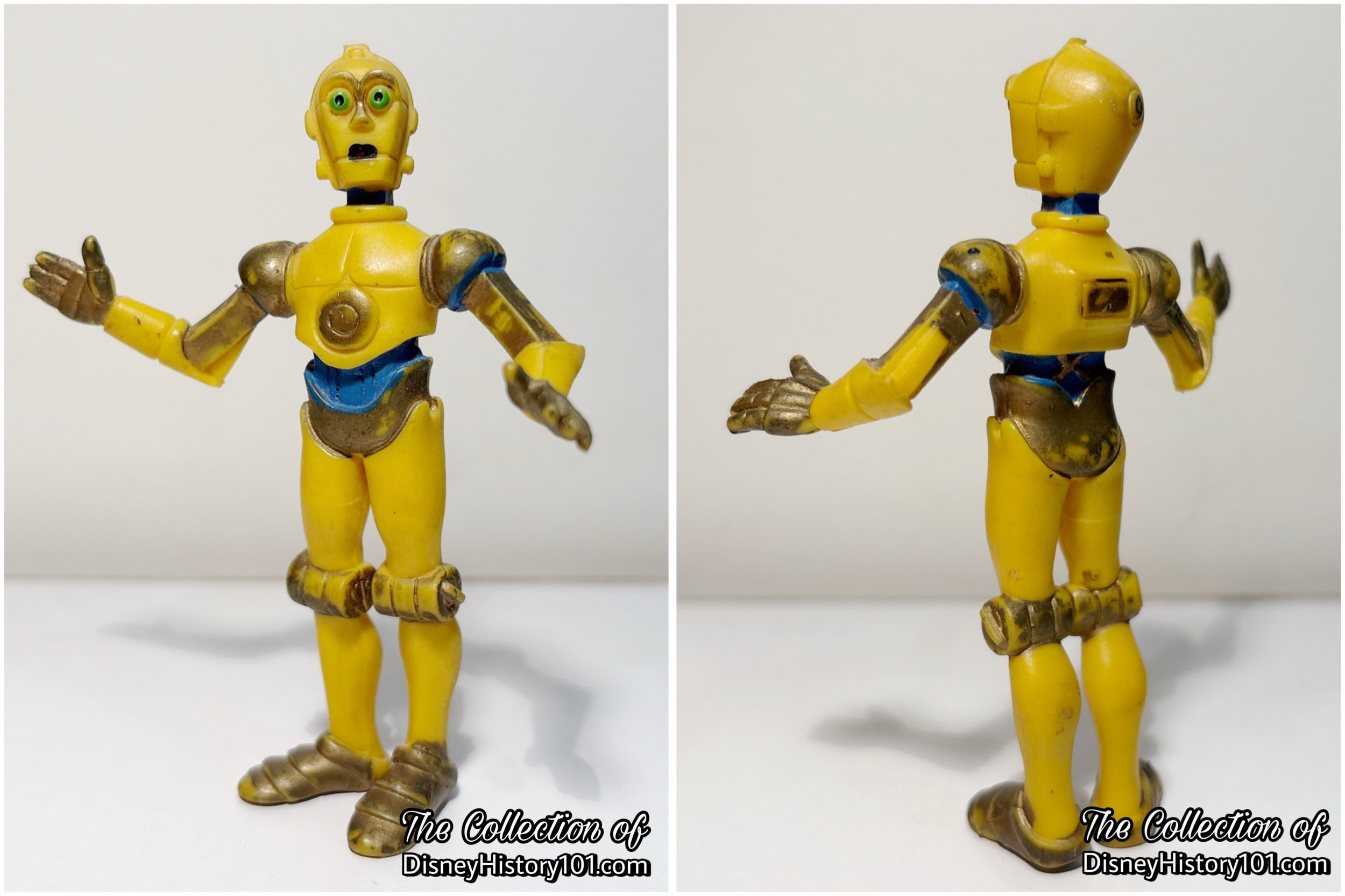
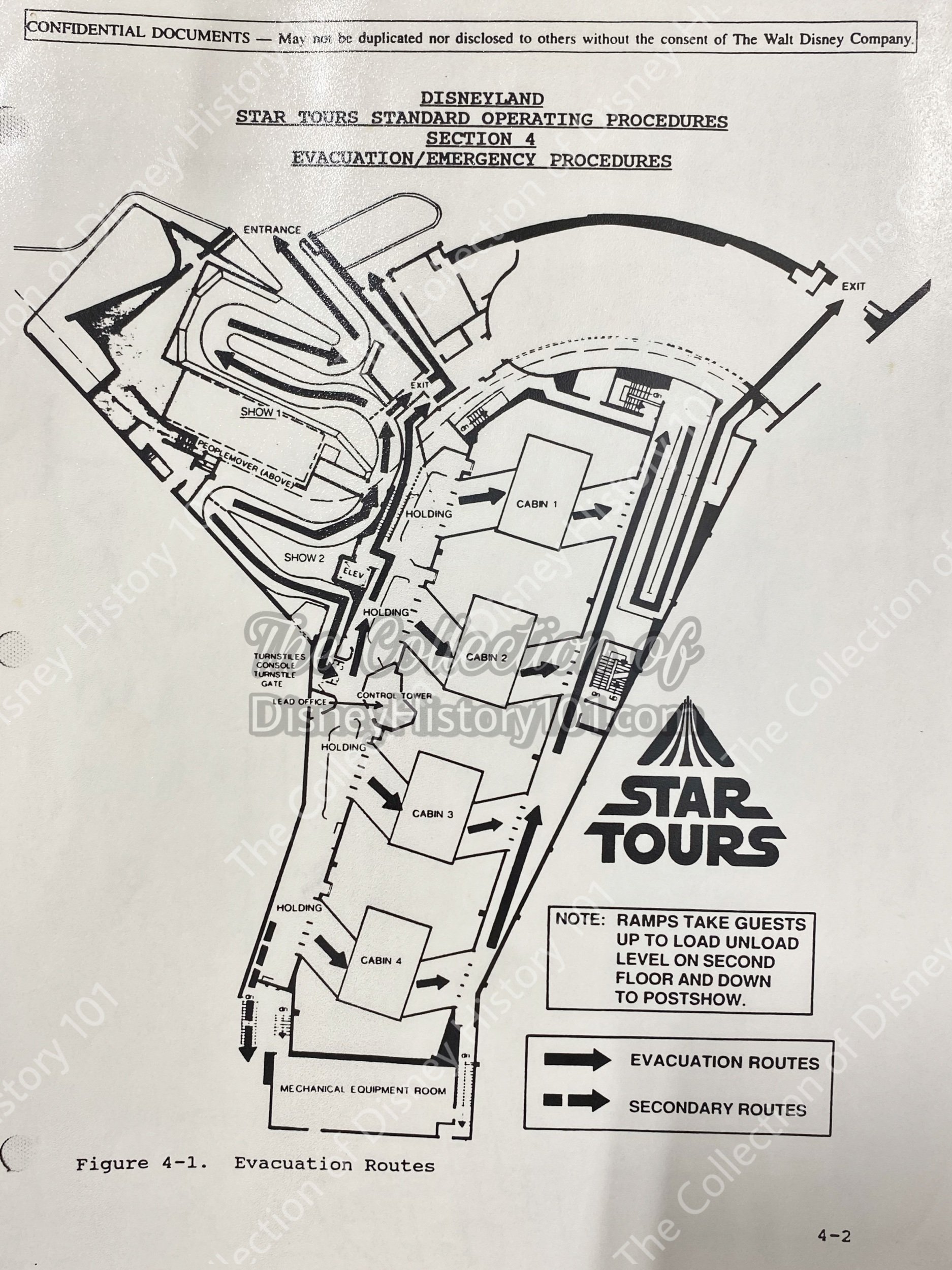
“Rehabilitations”
When routine rehabilitations called for maintenance to be performed on Audio-Animatronics figures, they were carefully repositioned as closely as possible to their “night mode” positions so that when a trial run was started, the movements of the functions were not violent.
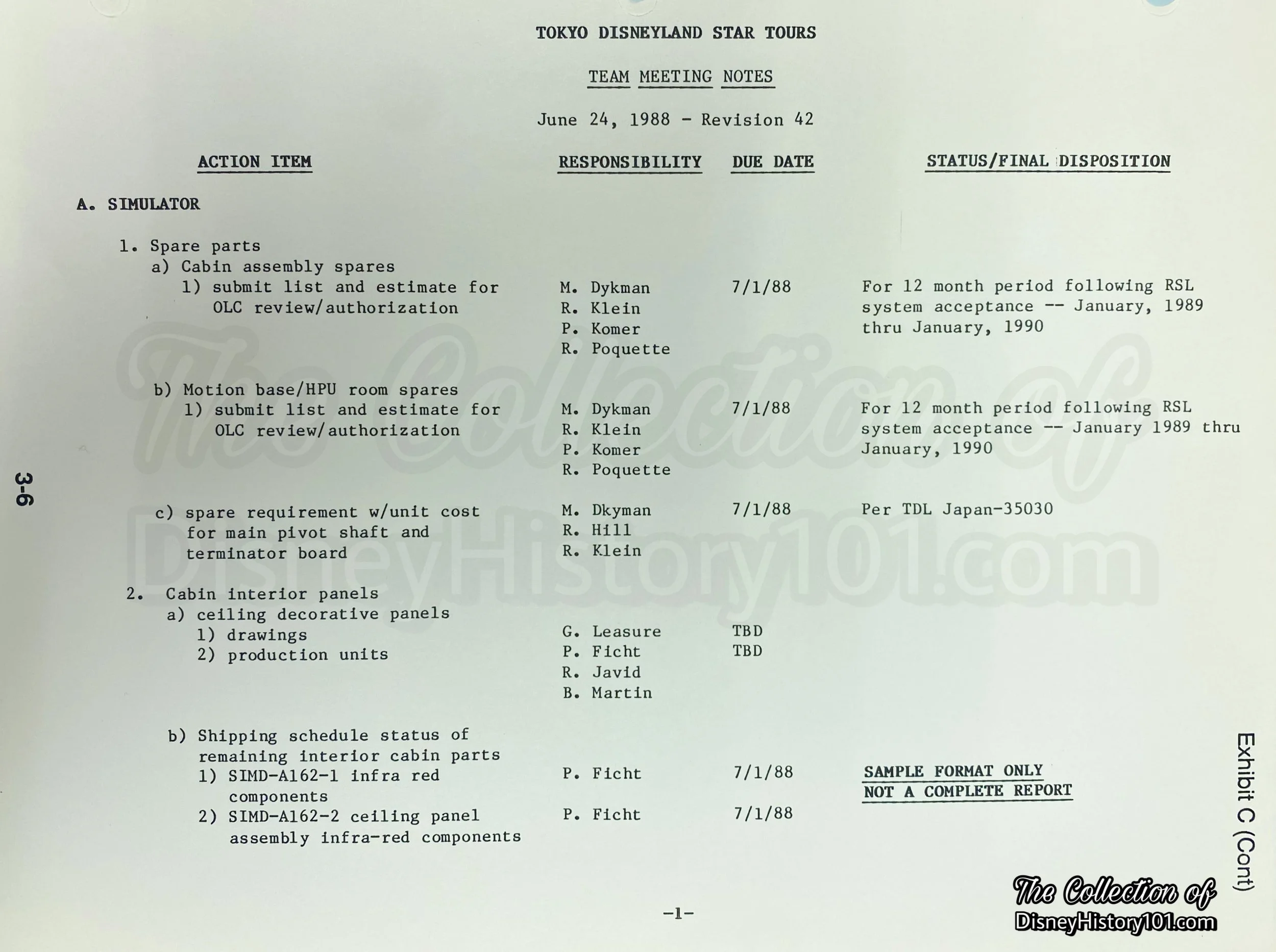
“Legacy”
The “E” Ticket adventure Star Tours had again proven the name Disney was synonymous with excellence. Since its origination by Walt Disney in 1952, Walt Disney Imagineering had been the creator of theme parks like Tokyo Disneyland and attractions like Star Tours. Now, operator Oriental Land Company was interested in bringing the galaxy far, far away to their Tokyo Disneyland Park.
Walt Disney Imagineering was already instrumental in the creation, design, engineering, production, construction, and installation of the original Star Tours at Disneyland in Anaheim, California. Star Tours at Tokyo Disneyland was not a new project, but a replication of an existing attraction. So, it’s Project Life Cycle would take less time to complete. Beyond that, Walt Disney Imagineering would achieve what was then referred to as the “Triangle of Success” – exceeding the Disney standard of distinctive, lasting entertainment value; completing the job on schedule; and completing it within budget. Many Walt Disney Imagineers likely recalled the confident words of Captain Rex “I'm sure to do better next time!“
By Summer 1988, plans were moving at lightspeed, toward the completion of Star Tours’ newest destination at Tokyo Disneyland. Walt Disney Imagineering (the exclusive design, research and development firm that manufactured experiences for the Walt Disney Company), Walt Disney Attractions Japan (a subsidiary of the Walt Disney Company who oversaw and managed Disney’s operational, strategic, financial, and licensing relations for the Tokyo Disney Resort) and the Oriental Land Company (the operator of Tokyo Disneyland) gathered for weekly Tokyo Disneyland Star Tours Team Meetings.
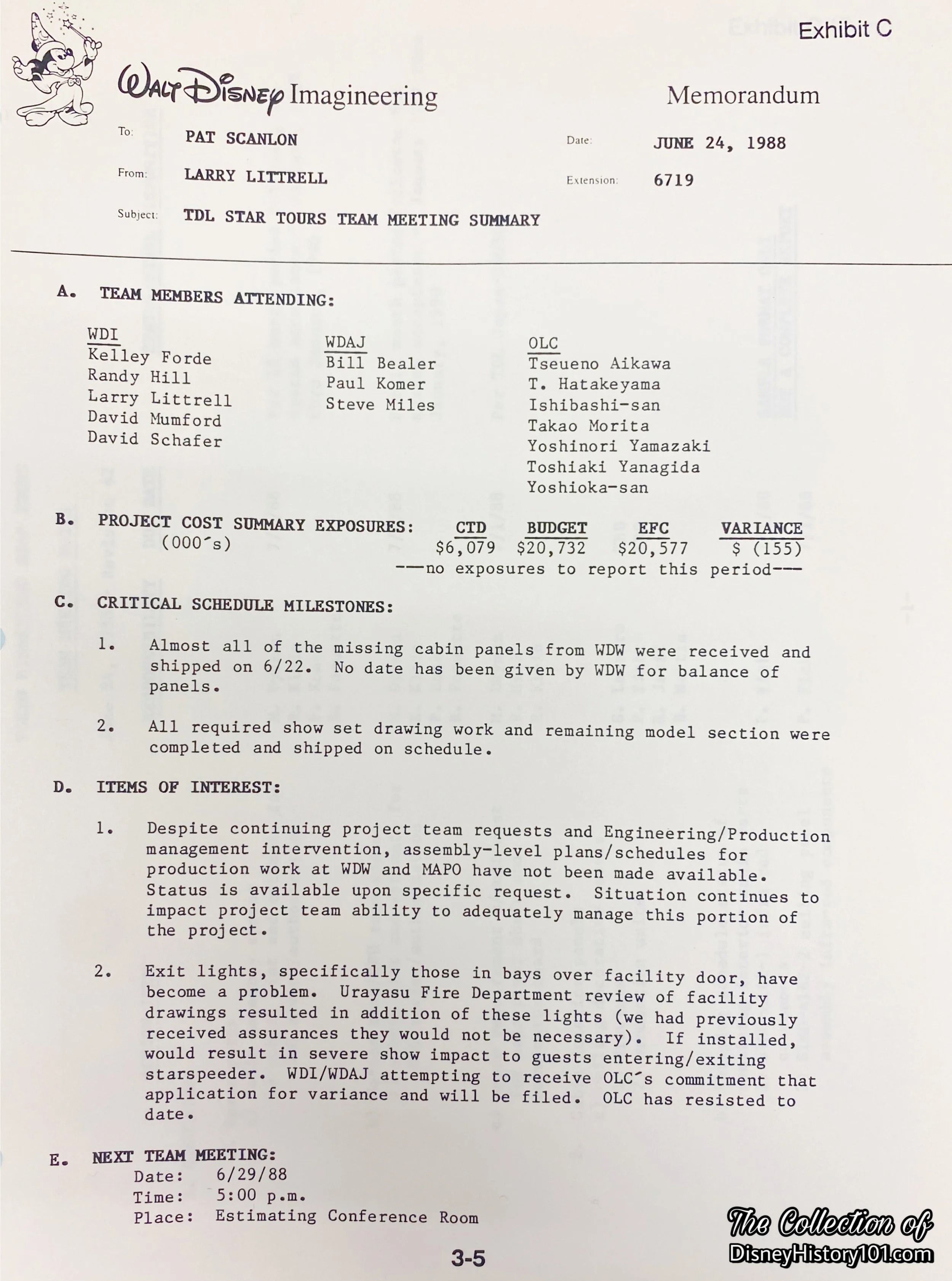
For example, the Tokyo Disneyland Star Tours Team Meeting Summary (above), documented some of the topics that were discussed in the Estimating Conference Room of Walt Disney Imagineering Campus during June 1988. On that occasion, one of the primary topics were Project Cost Summary Exposures – documented financial risks, uncommitted budget portions, and potential cost variances that could impact the baseline budget of Star Tours or Tokyo Disneyland. The Star Tours Project’s Cost to Date for any actual expenditures, approved invoices, and work physically performed up to the reporting period totaled $6,079, and was within the budget of $20,732. This influenced the Estimated Total Cost which was slightly lowered to $20,577 (a variance of $155).
Critical Schedule Milestones were achieved and discussed. Apparently, an undisclosed number of cabin panels went missing from Walt Disney World, but had been “received” and shipped to Tokyo Disneyland by June 22. According to the summary, all required show set drawing work and remaining model sections were completed and shipped on schedule.
Items of interest were noted. For example, the Urayasu Fire Department had reviewed the Star Tours facility drawings, and specifically suggested the addition of “Exit” lights in the bays where guests were entering and exiting Starspeeders. This raised a problem for Show Designers, because those “Exit” lights were severely impacting show quality.
Meanwhile, production work was also wrapping up for the arrival of Star Tours at Disney-MGM Studios Theme Park in Florida. This impending job schedule deadline was severely impacting the availability of the WDW Project Team when various requests were made by Engineering and Production Managers or members of the TDL Project Team. The assembly-level plans and schedules for production work carried out by WDW and MAPO, on Star Tours at Disney-MGM Studios Theme Park, were available upon specific request, but were occasionally not made available as the Project Team struggled to adequately manage that portion of the project. So naturally, this was also a item of interest at the June 1988 Tokyo Disneyland Star Tours Team Meeting.
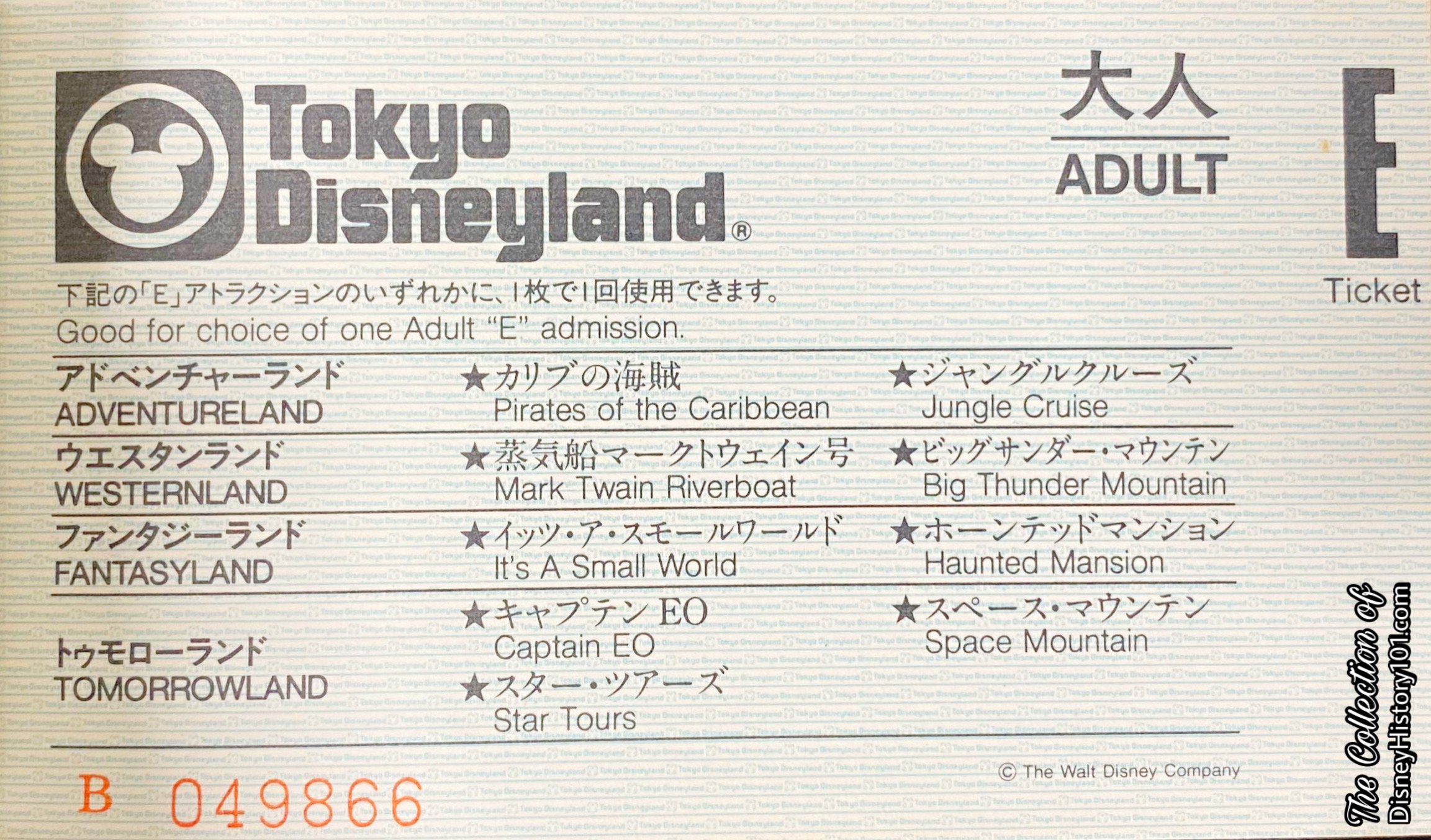
“It All Begins Soon… Only From Star Tours – at Tokyo Disneyland”
But after those few remaining meetings and all of the completed jobs, Star Tours introduced the perfect getaway vacation – exclusive tour packages conveniently departing daily from Tokyo Disneyland. On July 12, 1989, the “E” Ticket Star Tours adventure opened in a magnificent newly designed show building.
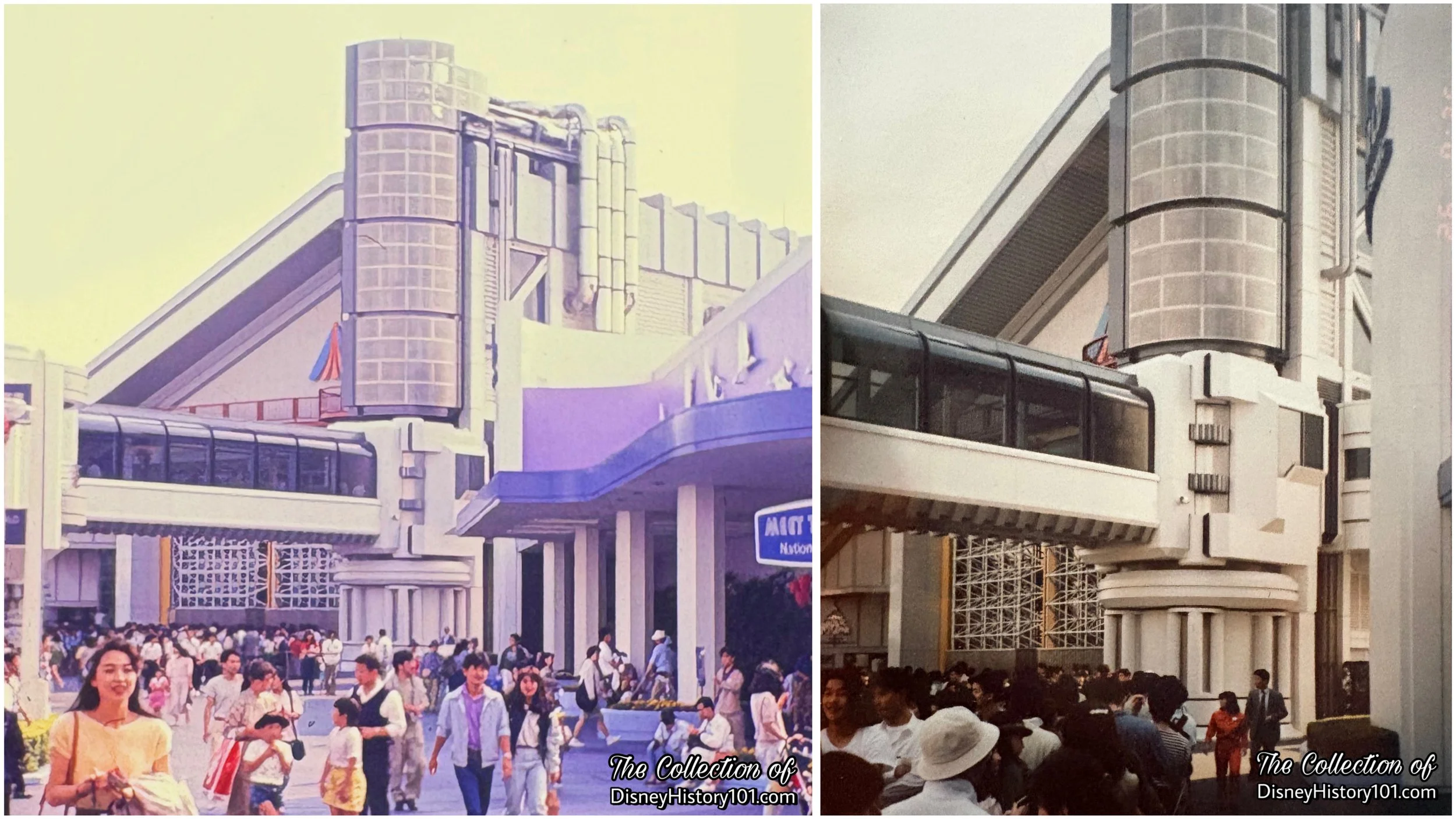
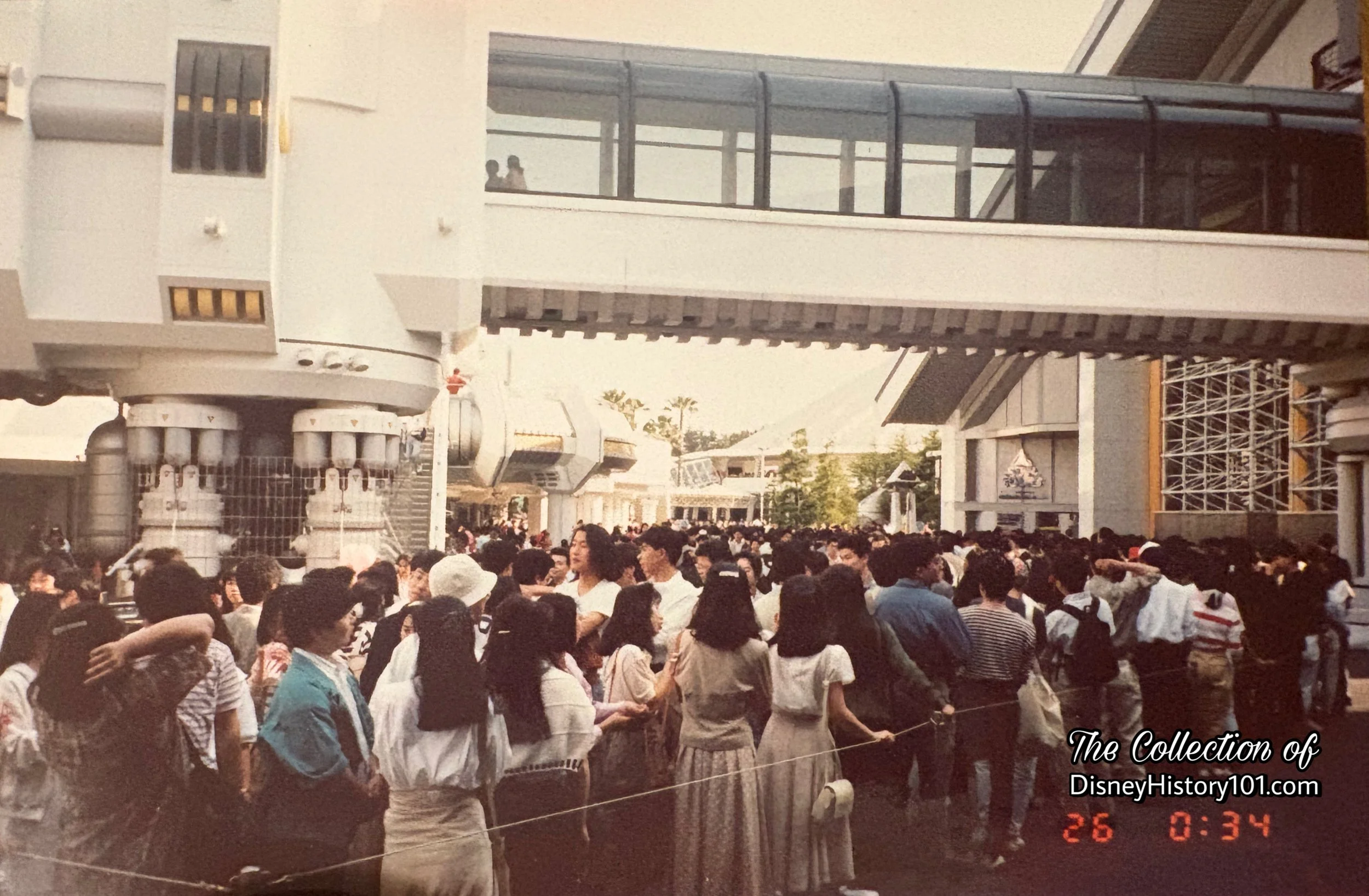
Star Tours at Tokyo Disneyland introduced a few new characters, like the SK-Z38 Droids. According to the story, a few months after the Battle of Endor, the G2-4T Repair Droid discovered a couple of SK-Z38s within the Star Tours Travel Agency.
Guests discovered these very same droids also settled down in Star Tours at Disney-MGM Studios Theme Park, when it opened on December 15, 1989.
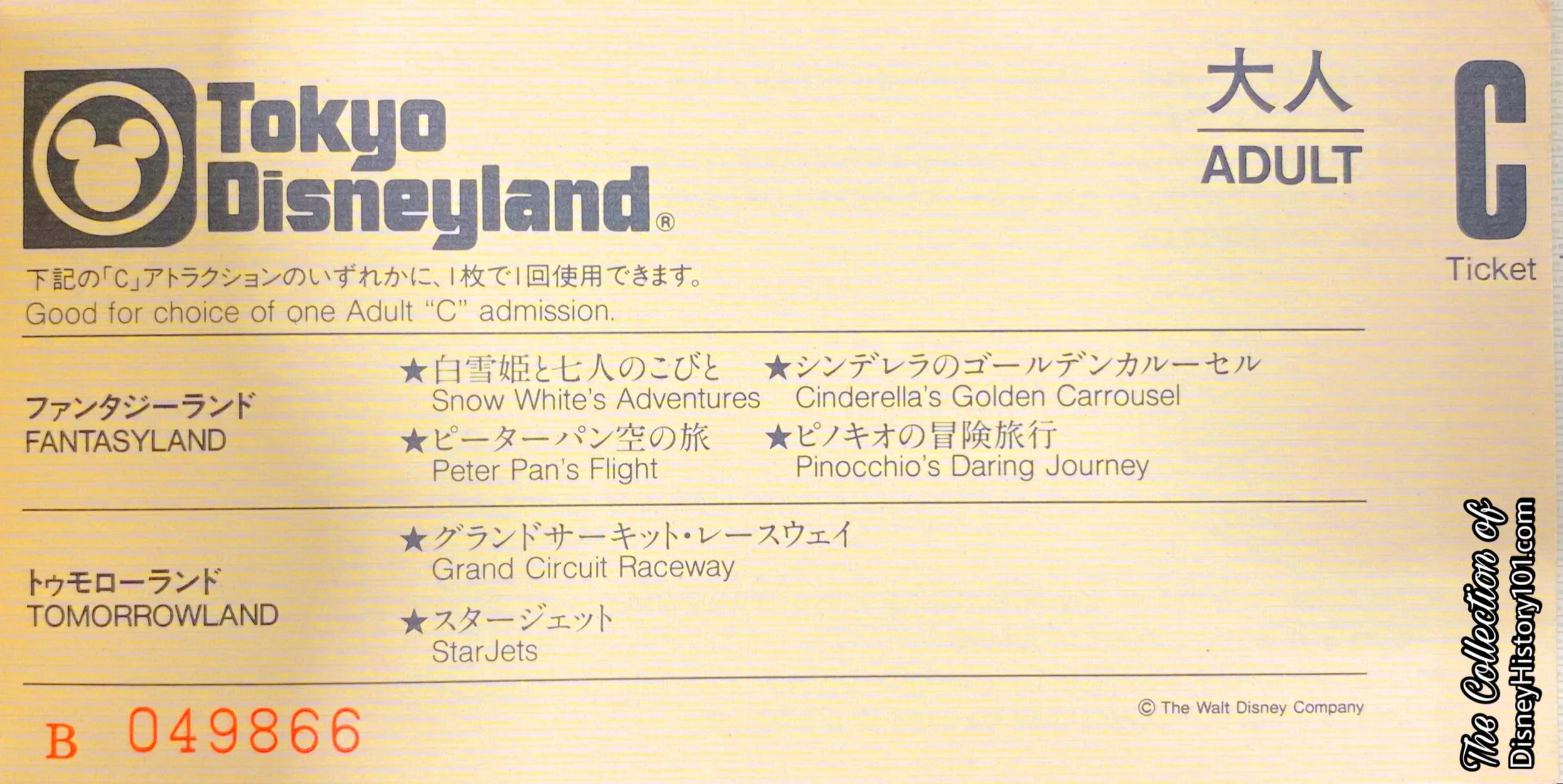
Star Tours opened in Discoveryland at Euro Disney on April 12, 1992.
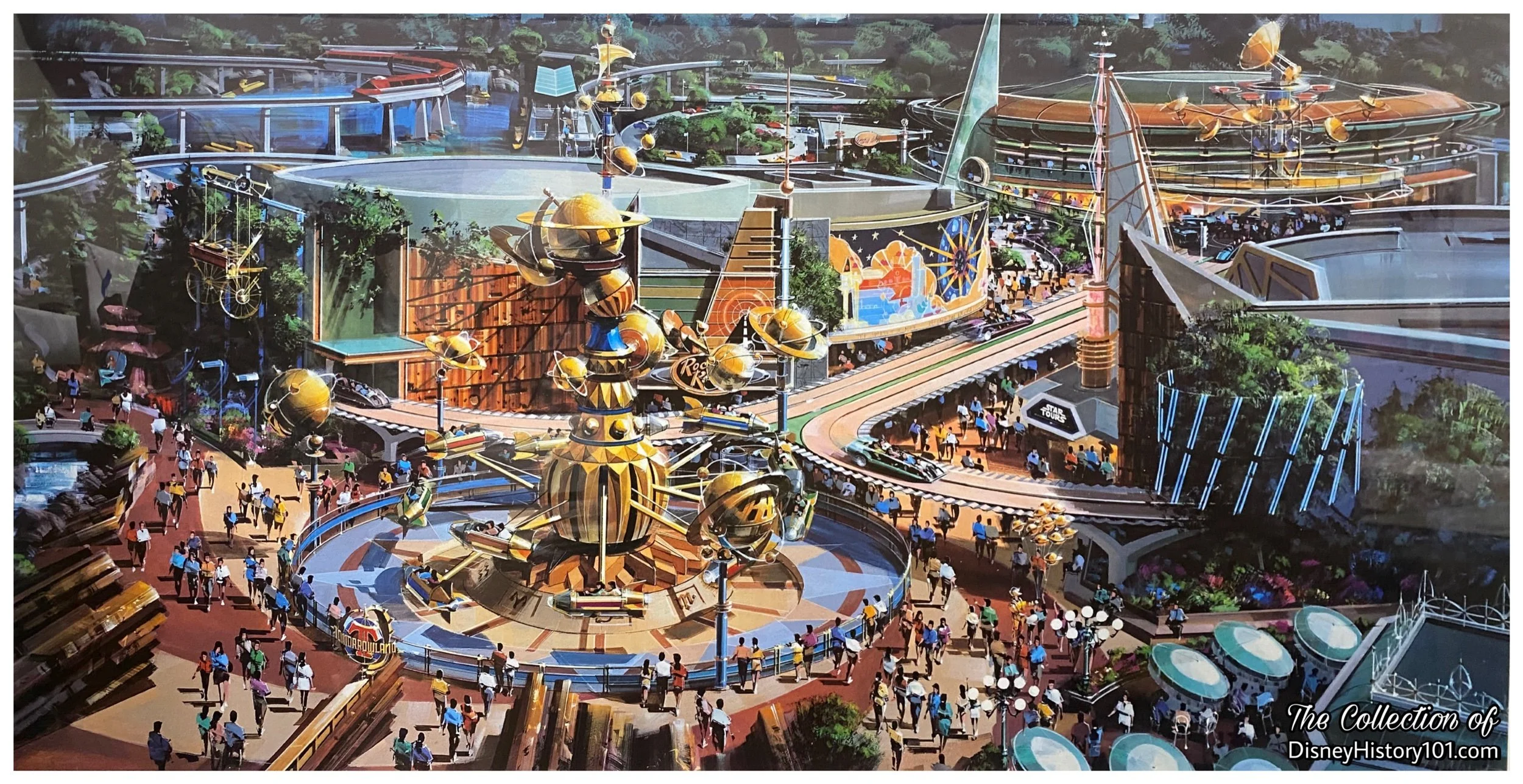
“Star Tours the Adventures Continue”
By 2008, WDI master plans entertained the concept of of a “classic update and adjacent placemaking” to Star Tours at the original Disneyland. “Star Tours 3.5” had a target of realization within the following 5 years.
In 2011, Star Tours the Adventures Continue introduced new exotic destinations for passengers of the new StarSpeeder 1000 models. According to Dave Smith (Chief Archivist Emeritus),many actresses and actors fulfilled roles in the new attraction: “The rebel pilot [of the Hoth Snow Speeder] … is Rob Howe, and the Naboo Squad Leader is April Royster ; neither of them work for Imagineering or ILM. I’m also told that Darren Criss, also of Glee, provided some miscellaneous voices.” [Disney Facts Revealed by Dave Smith, 2016]
“New Magical Opportunities for Star Wars”
Just a few years later, The Walt Disney Archives announced: “on December 21, 2012, The Walt Disney Company completed its acquisition of Lucasfilm Ltd. Included in the deal were the special effects powerhouse Industrial Light & Magic (ILM) and Skywalker Sound, along with the rights to the Star Wars and Indiana Jones franchises.” This would pave the way for even more Star Wars-themed entertainment, merchandise, and attractions produced by Disney Enterprises, Inc.
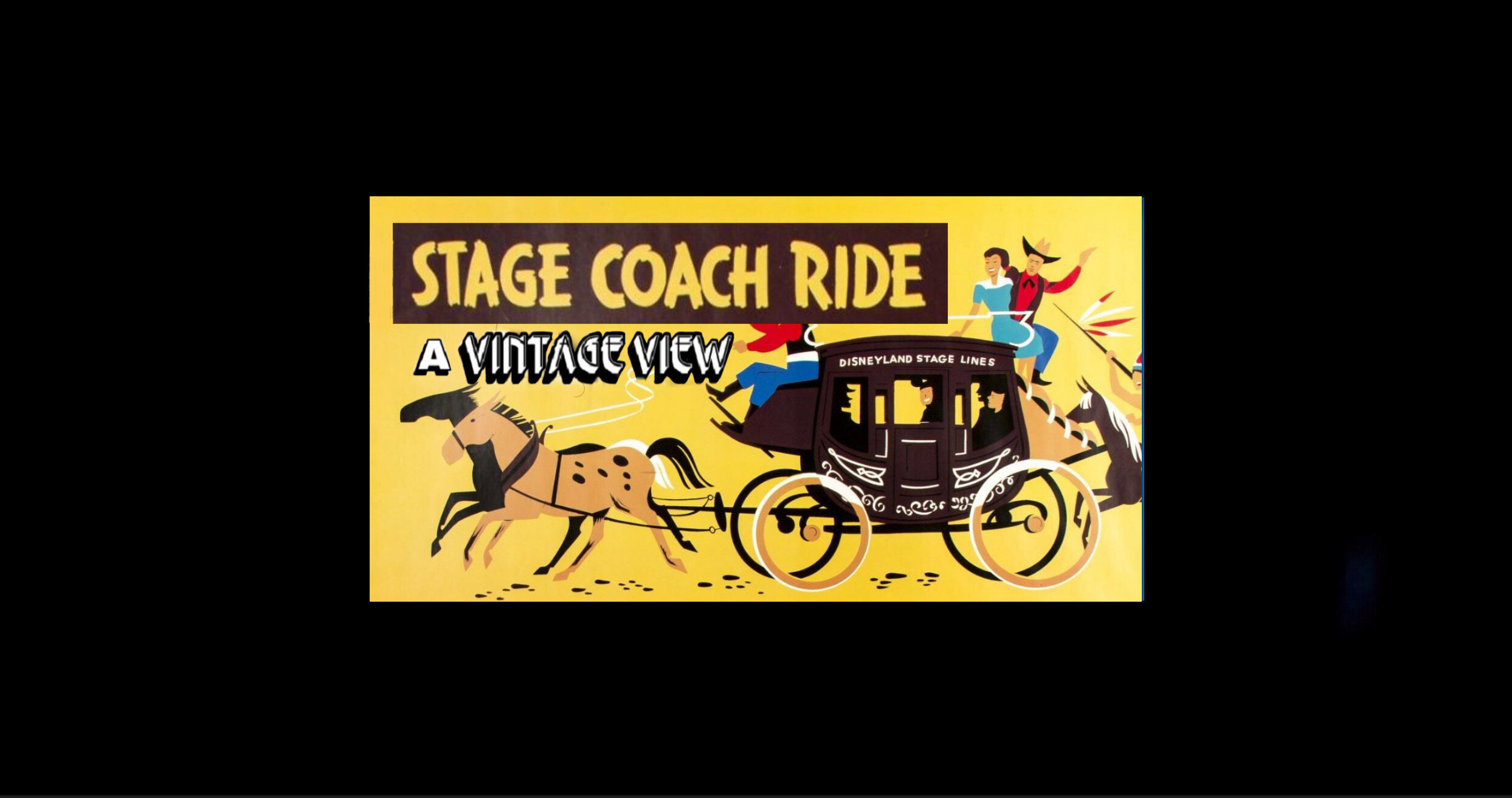
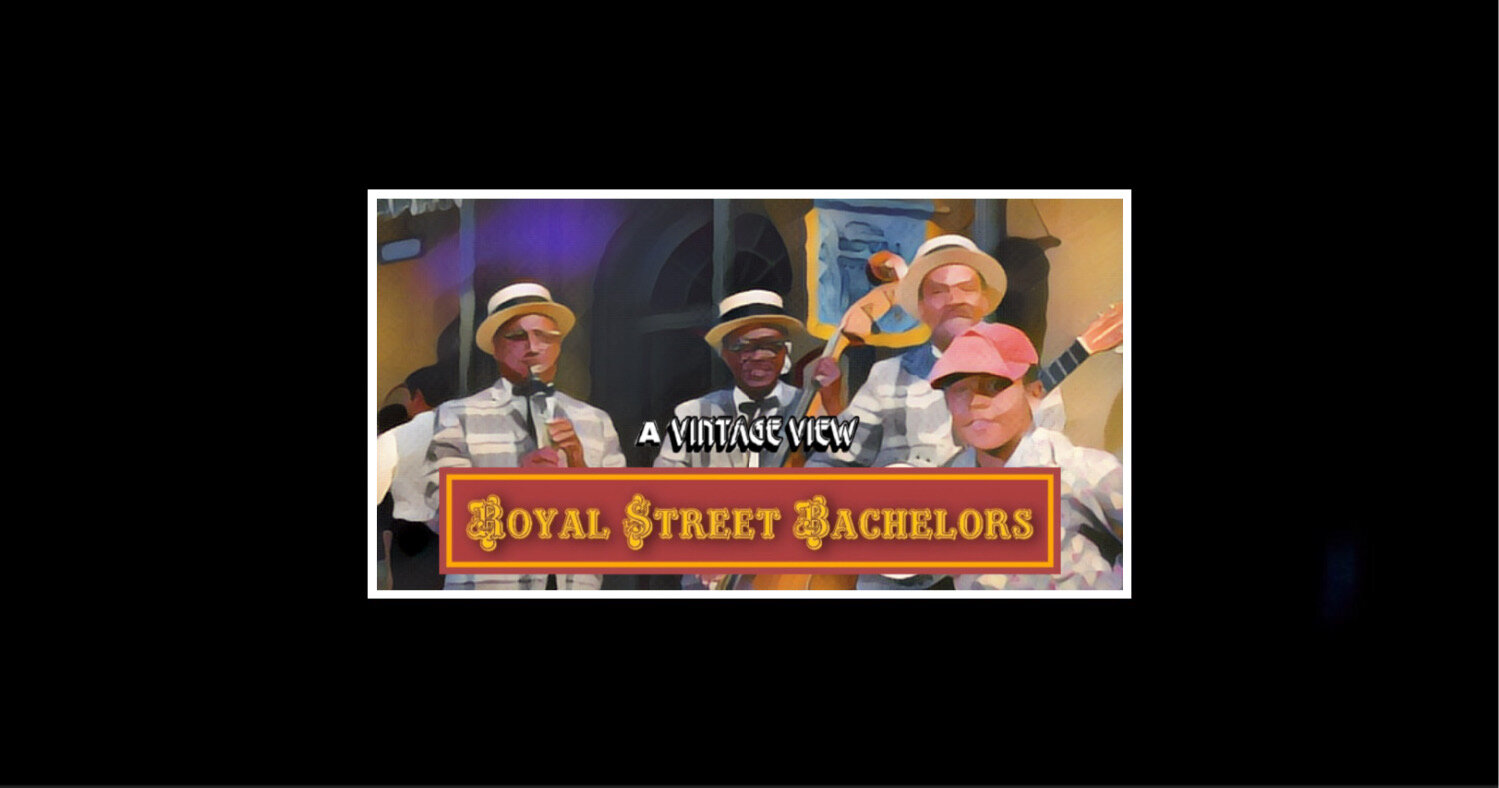
Quisque iaculis facilisis lacinia. Mauris euismod pellentesque tellus sit amet mollis.