
By Contributing Disney Historian Mark Ballard
“When Fantasy First Took Root”
Do you think you know the story of how Disneyland found a home in Anaheim? PLEASE CLICK through the fantastic, abridged story below.
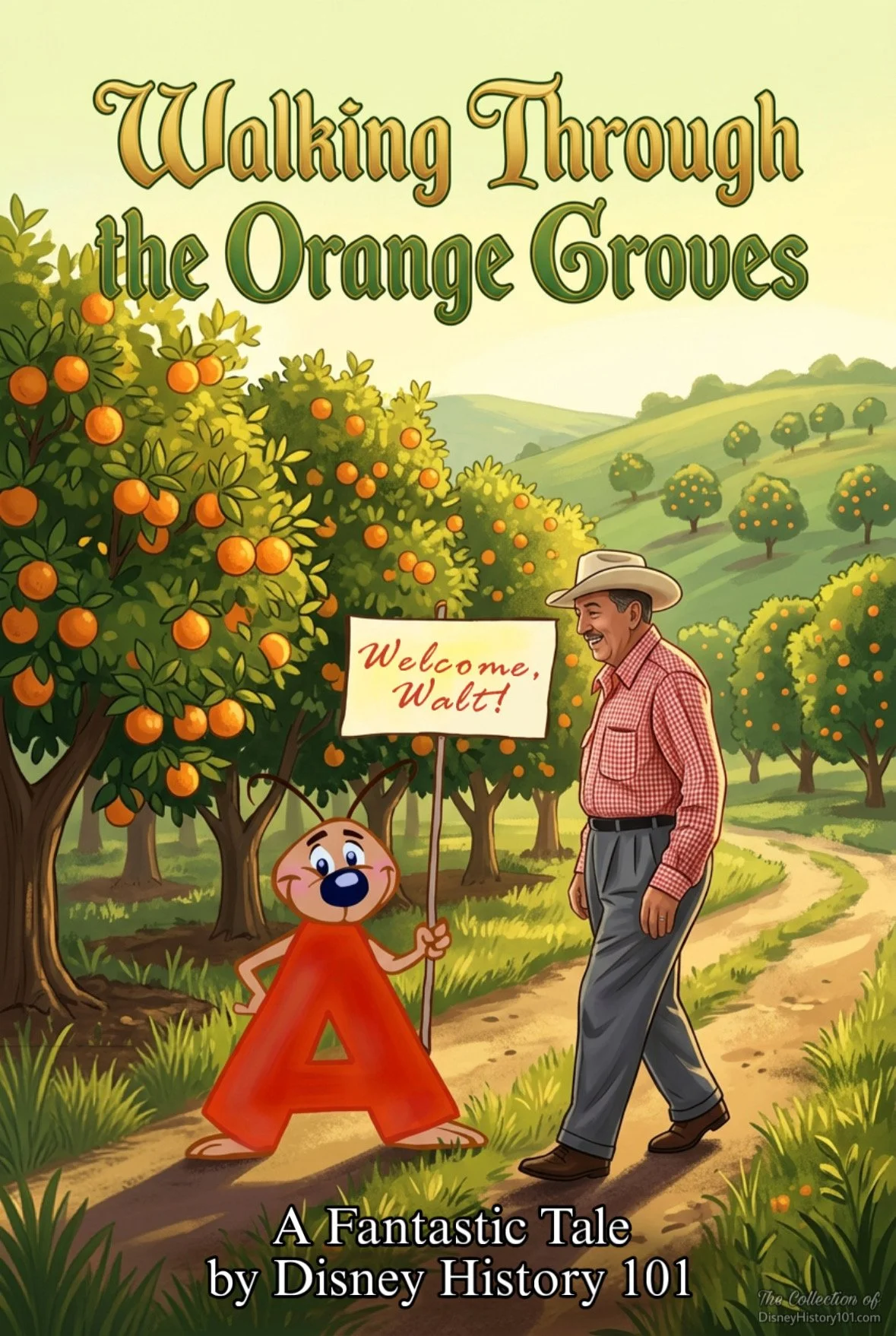
Now, prepare to learn the true-life story of how Disneyland was annexed to Anaheim — a tale that begins not with fireworks, but with whispered deals in city hall corridors, and ends with the gates of the Magic Kingdom opening a new era to the groves of Orange County. It’s a saga of ambition, civic pride, and a tug-of-war between fantasy and reality, where the fate of a castle was decided by the stroke of a pen.
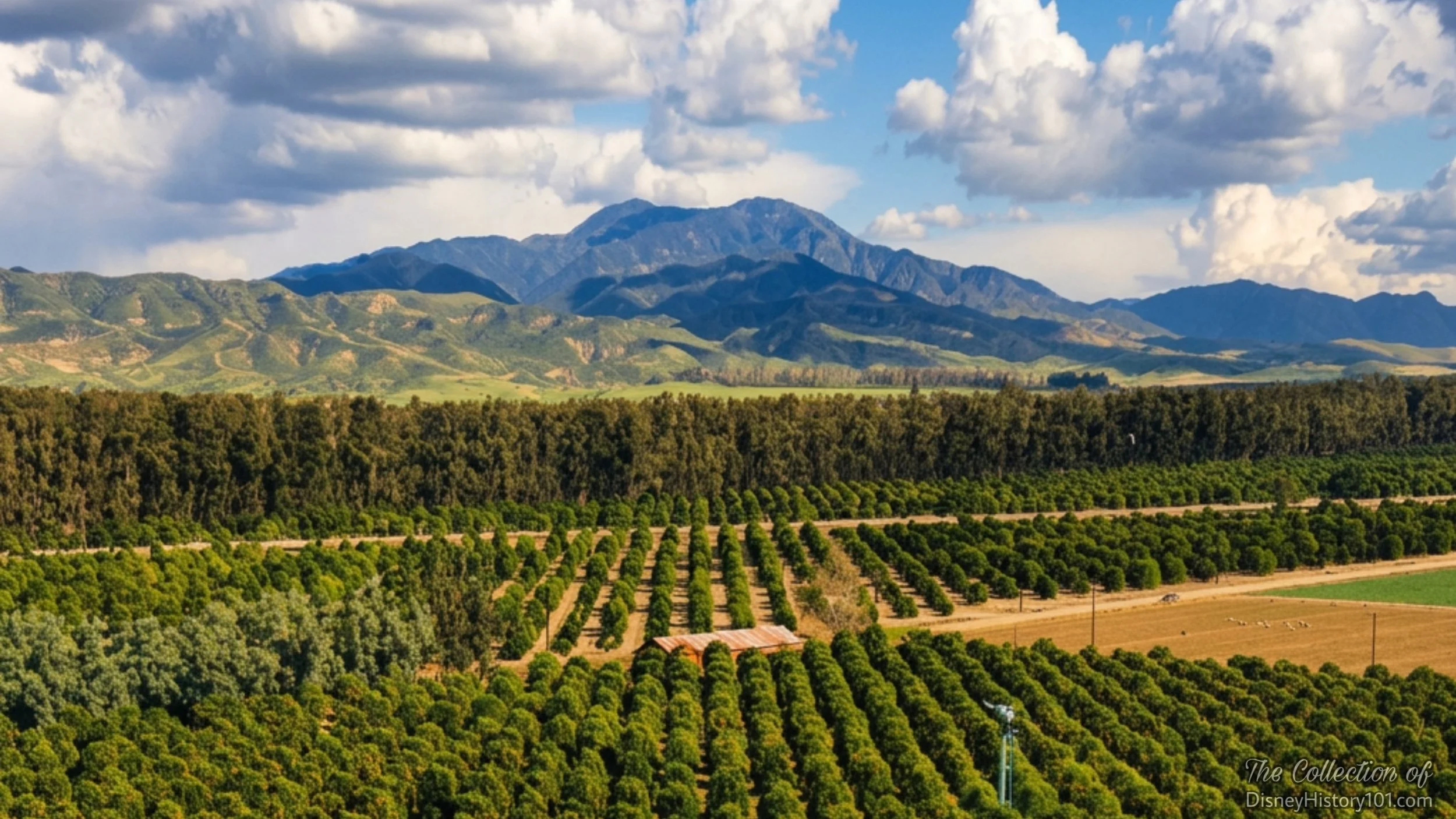
A sunny section of sweet, Orange County groves, circa 1950s.
“The ‘Good Life’ of Orange County”
Once upon a time, there were dozens of communities spanning six Southern California Counties, known as the “Citrus Belt”, but none compared to the land of Orange County! It was a sun-drenched haven, where the scent of sweet, intoxicating citrus and walnut blossoms perfumed the crisp California air for miles. Orange County, with its ideal climate and massive labor force, grew to become an unrivaled titan of agricultural production, renowned as “the heart of the Valencia Orange empire”, located at the epicenter of the citrus world. As a result, Orange County dominated the industry, as a farming powerhouse of California!
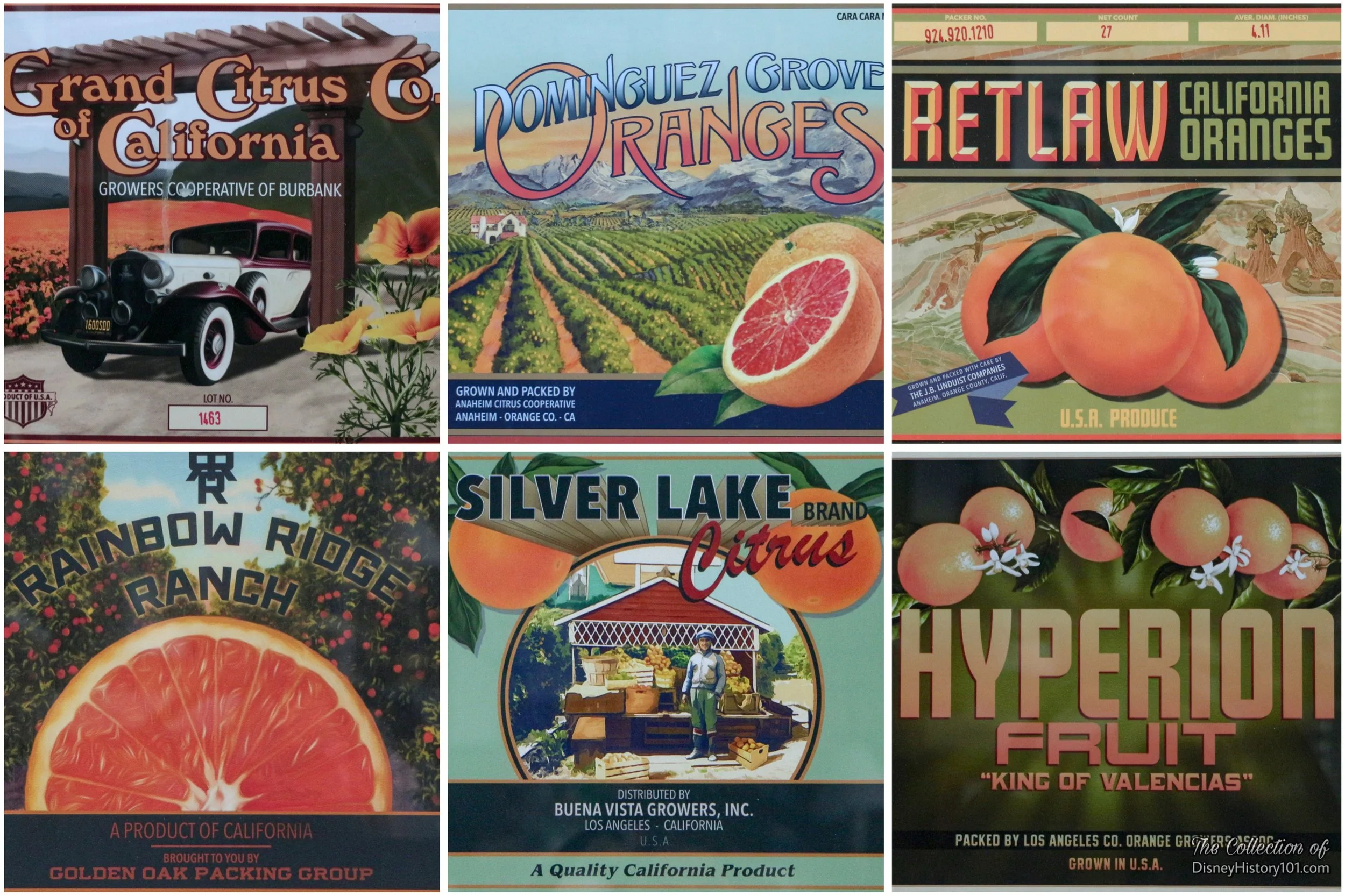
Ok, there was no Rainbow Ridge Ranch or RETLAW California Orange. These vibrant prints decorate Disney’s Grand Californian Hotel & Spa and pay homage to the historical orange groves of California that became home to Disneyland and supportive infrastructure of Walt Disney Productions.
For good reason, locals branded this family-friendly farm community as “the city of good living”. Long-time Orange County resident Ron Dominguez fondly recalled the pleasurable time growing up around the sun-kissed orchards of his parents’ 10-acre ranch in this farming community: “It was a most ideal climate. I liked the small-town atmosphere... the country life. During my school days, I worked in the groves, doing fertilizing and irrigating, while our Orange Growers Association picked the fruit.”
As to the people of Orange County, Van Arsdale France (who had the pleasure of working amidst its later, developing suburban utopia) describing the values of the community as “solid” and “conservative”. Area resident Bill Sullivan remembered that “it was a great place to grow up. West Street was just a dirt road… The population here then was about 14,000…and there were about 14 cops on the police force, and they knew all of us by name.”
All of this slow-paced, pastoral perfection was conveniently close to the Los Angeles Basin, but still a 20-mile distance from the neon lights and bustling gridlock of Los Angeles. Far enough away that neighboring Anaheim was humorously included in Jack Benny’s humorous comedic routine, which Bill Sullivan remembered: “Well, I happened to have been born here during those days when Jack Benny would talk about Anaheim, Azusa and Cucamonga.” The remote, rural Orange County was a booming agricultural paradise, but it was known for its beautiful parks, and its neighbor Anaheim even hosted a couple of major Southern California attractions – Jungle Jack’s Zoo and Walter Knott’s Ghost Town. While Orange County was virtually unincorporated, Anaheim boasted industrial manufacturing plants of Delco Remy Batteries, U.S. Electrical Motors, and Northrop. Side-by-side, the mid-century, rural country lands of Orange County and Anaheim, were clearly fertile and bursting with potential!
Back in 1939, Orange County Board of Supervisors began rezoning along the corridor of Manchester Boulevard, to allow for freeway construction. Fast forward to 1952, when the Santa Ana Freeway was only half-completed, but pushing relentlessly South, like some black asphalt blade, toward its 27-mile destination to Los Angeles City Hall. Severing ancient groves (and anything in its path), it would funnel the inevitable tide of iron and cement toward the doorstep of Anaheim and Orange County. This future freeway brought with it, something else, that would change this quiet, picture-perfect, haven, forever.
“The Secret Harvest”
Unbeknownst to locals, the Stanford Research Institute team had been hired in April 1953, to complete a year-long study and evaluation of various areas throughout Southern California. They looked at many factors, including land availability, freeway access, and the direction in which the center of population was moving.
Now, the prestigious research firm had turned its attention to an ideal quarter-section of mostly-level citrus groves, in a residential zone belonging to the unincorporated area of Orange County. They found that its parcels amounted to 160 acres (65 hectares), with a span of a half mile (804 meters) on each of its sides. To top it all off, the assessed land was valued a mere $59,550, (just $410 per acre).
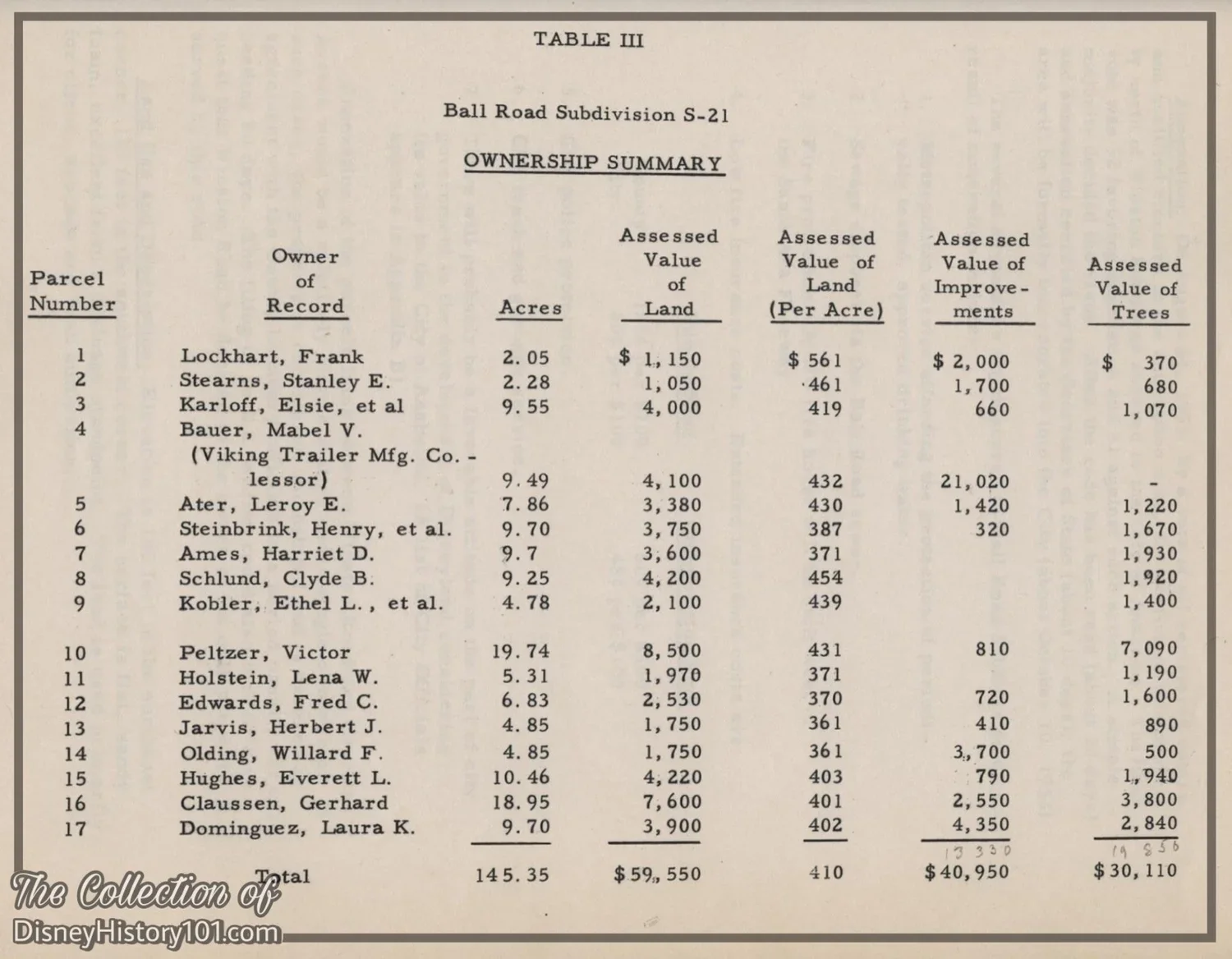
“Table III” of the “SRI Report” lists the assessed land values and owners within the Ball Road Subdivision S-21 of Orange County.
Like “wind from the East with mist blowing in”, something ominous began to happen in the quiet groves of Orange County. Mysterious limousines started showing up, and those limousines were followed by a couple of familiar Anaheim-area realtors named Ed Wagner and Frank Miller, who began to approach area residents with “contracts for deed” in-hand, making no mention of Walt Disney.
But Ron Dominguez recalled some of those limousines: “In those early days, particularly on weekends, we’d see this big, black limousine or Cadillac or Lincoln (whatever type of car it was), driving around real slow and they’d stop at each home and look at the property and look at the surroundings. Not knowing who that person was in the car, we figured it was whoever was buying the property. We really didn't know until maybe a year out exactly who it was.” It was a mystery that could have been unraveled by the sharp observation, quick-witted deduction and insatiable curiosity of teen detectives the Hardy Boys – if only they were around!
Even a decade prior, Orange County locals were well familiar with the Disney brand. Since 1948, Walt Disney Productions had been establishing a cordial and friendly name with the community by designing floats for the big, annual Anaheim Halloween Festival Parade. That tradition of partnership between Walt Disney Productions and the Anaheim Halloween Festival Parade had continued up to the year of 1953. As a result, Walt Disney Productions had become known to local-area government officials, like Anaheim City Chamber of Commerce Manager Earnest W. Moeller, Chairman Robert Wurgaft, Co-Chairman Henry Porcella, Staff Assistant Burr Williams and others. So, to see the presence of Walt and company around Anaheim would have made headlines but wouldn’t necessarily have been out of the ordinary.
However, it was the First WED Enterprises’ Executive Nat Winecoff who hired the Stanford Research Institute to perform economic and industrial planning research. During the Summer of 1953, the SRI Team reached out to Anaheim Chief Administrative Officer Keith Alger Murdoch and Anaheim Chamber of Commerce Secretary Ernest W. Moeller, who liked the concept of Disneyland, knowing that it would provide another taxpaying, industrial resource for Anaheim, much like Knott’s Berry Farm or Jungle Jack’s. So Murdoch and Moeller directed the SRI Team to at least two large parcels, the latter of which was 160 acres near Anaheim, adjoining the Santa Ana Freeway, about twenty minutes driving time from metropolitan Los Angeles. Then, the Stanford Research Institute team (under the direction of Harrison “Buzz” Price), suggested this quarter section of Orange County to Disneyland, Inc. management, who in turn, sought to purchase the tract. Then, to prevent massive public speculation, artificial price gouging, and the potential loss of their prized operation, “City Heads” and Anaheim Chamber of Commerce Secretary Earnest W. Moeller orchestrated the anonymous acquisition of land through the help of local, trusted Anaheim-area realtors Ed Wagner and Frank Miller.
However, there was “a leak in vital information to spectators early on in the project” which resulted in the local residents of this little Orange County farm community catching wind of Walt Disney’s involvement. Ron Dominguez recalled his speculations of who those people in the mysterious black limousines and other cars may have been, expressing: “Walt Disney and probably Roy Disney along with him.” As it also turned out, Walt had asked Art Linkletter “to join him and a group from Stanford for an auto ride to look at the spot where they had decided future growth of population would be.” Linkletter recalled: “We were all sworn to secrecy about this area, Anaheim.” Ron Dominguez remembered the moment that he and his family were finally made aware of what was happening: “One of the real estate people, Ed Wagner, was a good friend of my folks and he gave us an insight into who was buying the property and what he was trying to do… It’s too bad that Walt didn’t stop, get out and say, ‘Hey, I’m the guy.’”
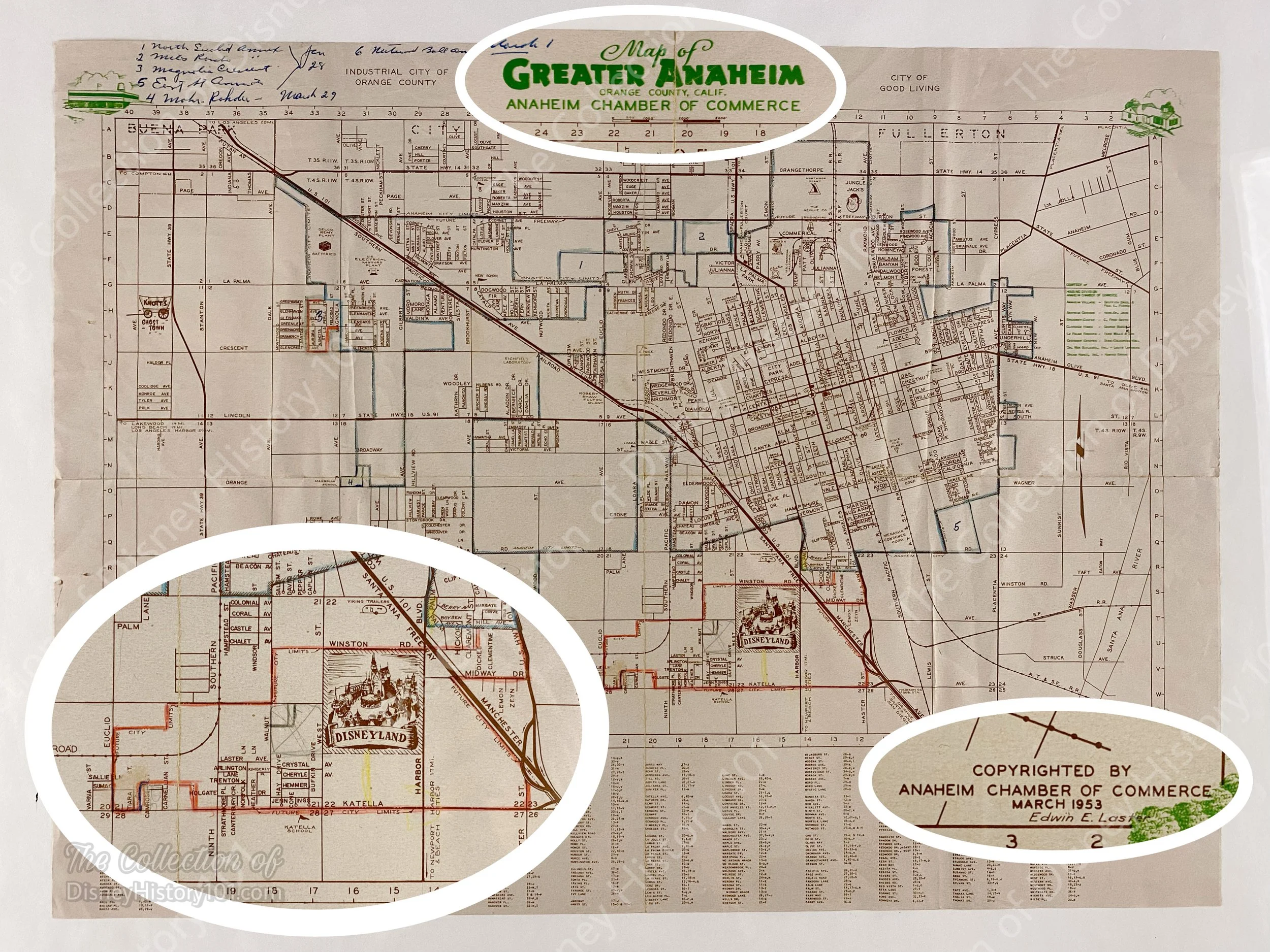
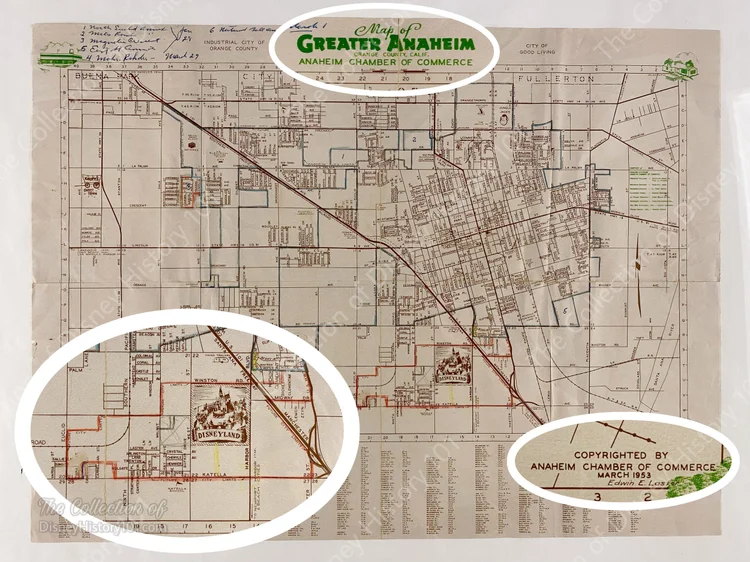
Disneyland is outstandingly depicted this “Map of Greater Anaheim”, published by the Anaheim Chamber of Commerce, around Fall 1953. Someone drew colored boundary lines through generational homesteads, representing land annexes. There are many things of note on this map, including hand-written annotation at the top which links six numbered zones with their dates of annex. The most-outstanding note is about the “Ball Road” Annex (#6) which was dated “March 1” and directly related to the periphery of Disneyland.
By the Autumn of 1953, any remaining mystery of the land-purchaser’s identity had been unraveled, with the revealing of the 1953 “Map of Greater Anaheim” (above). Published by the Anaheim Chamber of Commerce, the map identified the future location of something called “Disneyland” (supplemented with Herb Ryman’s illustration of a castle and a carousel), scheduled to be located within the boundaries of Winston Road, Harbor Boulevard and West Street.
Purchasing the required land for the construction of Disneyland Park was a monumental challenge in its own right. There were twelve parcels, owned by seventeen parties. Compounding the challenge of such a huge land purchase was the fact that the owners were located across two states including California and Ohio, and even Alaska. Further, the response of these local Orange County residents varied. Not all the landowners were so consenting to quickly sell their property. Laura Dominguez later wrote: “We had no thought of ever selling the property where I was born. This property had been in the family sixty years. But when Mr. Disney came...we decided to accept the offer.” Resident Gerhard Claussen required an arrangement to allow his daughter live on the property until 1954. Vic and Irma Peltzer requested $1000 more per acre. Some never sold out to Disneyland, Inc., like Hiroshi Fujishige who purchased neighboring acreage and resiliently retained and managed a 56-acre strawberry farm for decades.
Van Arsdale France (University of Disneyland founder) worked from one of the houses which were relocated on site and expressed: “In spite of the fact that the City Fathers of Anaheim had actively worked to bring Disneyland to their town, there were some old-time residents who were opposed to this intrusion by what they considered ‘those Beverly Hills types’… and, actually, I hardly blame them. That the many square miles of delightful orange groves and little farms should disappear in the name of progress was one thing. But when the key resident on our property sold out, they were leaving their homes. And those homes were lovely.”
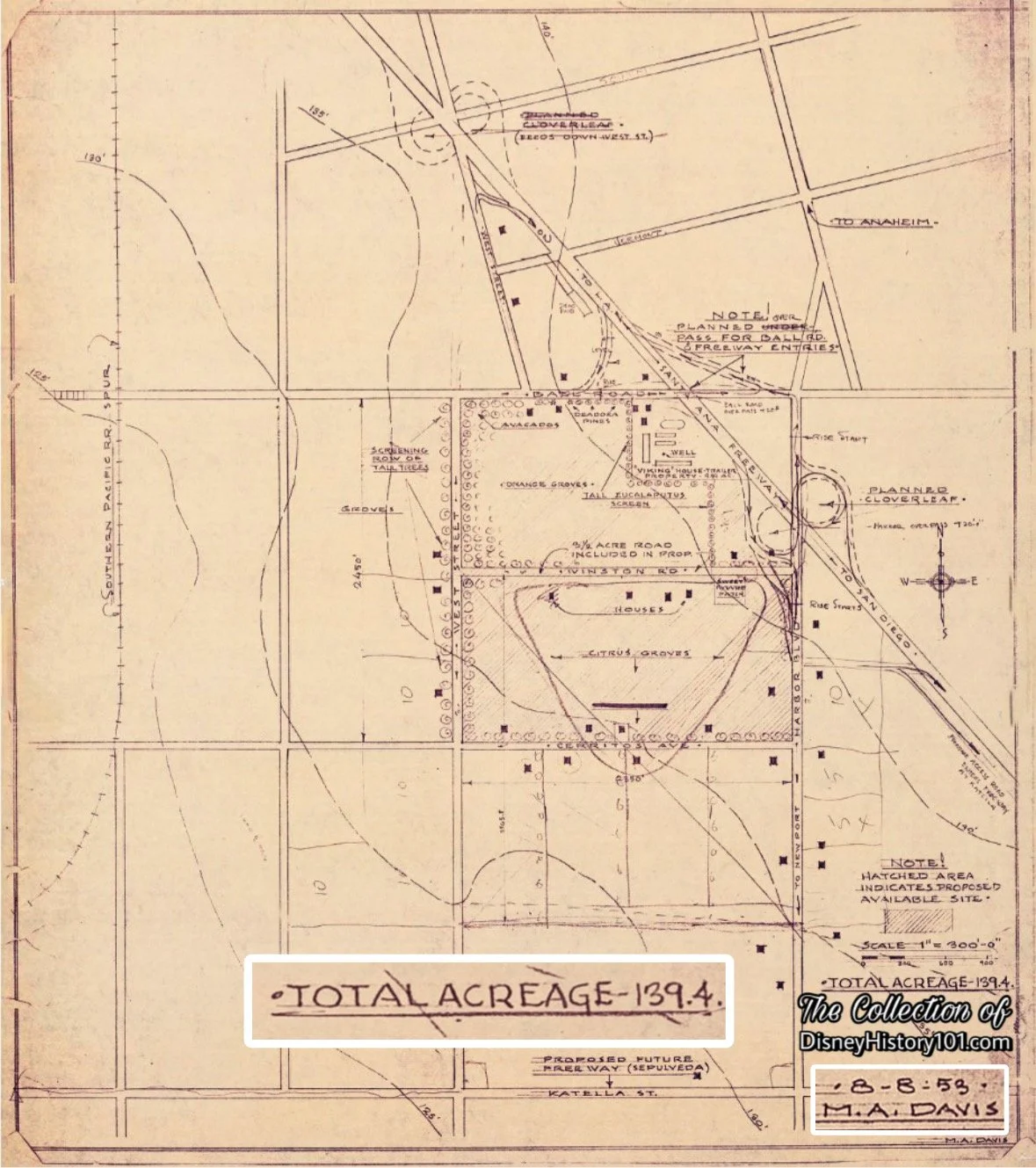
In August 1953, these plans were drawn detailing a total of 139.4 acres belonging to the “proposed available site” (indicated by a “hatched area”). What can’t be missed is the rough outline of what would become the “grand circle tour” of the Santa Fe & Disneyland Railroad, overlapping with both the “proposed available site” and other properties which were not available at the time. At that time, the “proposed available site” contained at least (11) homes and structures, citrus groves and even a sweet potato patch.
But after all, Anaheim realtors Ed Wagner and Frank Miller managed to gather 17 initial signatures on land sale contracts related to the land required for Disneyland Park - Frank Lockhart, Stanley E. Stearns, Elsie Karloff et al, Mabel V. Bauer, (Viking Trailer Mfg. Co. - lessor), Leroy E. Ater, Henry Steinbrink et al, Harriet D. Ames, Clyde B. Schlund, Ethel L. Kobler, Victor Peltzer, Lena Holstein (Fable), Fred C. Edwards, Herbert J. Jarvis, Willard F. Olding, Everett L. Hughes, Gerhard Claussen, and Paul & Laura Knowlton Dominguez.
Ron Dominguez (whose mother Laura was born on the property in 1898) recalled: “We were the LAST ones to move as my mother was sentimentally attached to the homestead. She was born here and had struggled hard over the years to keep it.” During negotiations, the Dominguez family (Laura, Paul Sr., Paul Jr., and Ron) ultimately conceded to progress and the growth of the community, and sold their property about 1953, but requesting a local 200’ x 200’ lot as part of the arrangement.
According to Ron Dominguez (in the same aforementioned publication), “After the deal was put to bed and all of the information became public, the Disney Company invited all of the local community businesspeople and city fathers and the landowners up to the Walt Disney Studios to view what was planned for this thing in Anaheim. Everybody was quite comfortable with Walt’s approach to Disneyland and his ideas of how to operate it and maintain it. Everybody felt assured that they weren’t getting a circus moving into town that wild be gone in a year.”
In April 1954, the land transaction was complete, for the quarter-section of Orange County that would become Disneyland. Van Arsdale France remembered: “As I understand it, the resources of Walt Disney Productions were then harnessed to buy up 240 acres of land at a price of about $4,500.00 per acre.” Instead of paying $1,080,000, the land was purchased at a cost of $640,000, with Disneyland, Inc. paying the mere $778,666 for the land purchase. This price was far less than Walt Disney Productions had predicted, and the land was accompanied by a great deal of resources – “land improvements” (like houses and other structures) valued at $40,950 and trees valued at $30,110.
During the Spring 1954, legal titles were issued to the buyer, the final harvests of oranges and other crops were gathered, and most of the remaining tenants moved out. Then, for a few months, the quarter-section of Orange County citrus groves grew mostly silent, except for the rustling of the leaves, chirping of local birds and the dry buzz of cicadas. Seemingly, the greatest hurdles were behind Walt, Disneyland Incorporated, and the City of Anaheim, but Walt’s creative spark would ignite more than a dream.
“Powering Walt’s ‘One Little Spark’”
Walt’s seemingly boundless power of the mind had brought forth one little spark of imagination! That tiny spark was shaping up, destined to become a “living, breathing” and immersive environment, incomparable to any other park or amusement center of its day. Its Main thoroughfare would be a turn-of-the-century wonderland illuminated by gas lamps, electric streetlights and interior lighting. There would be fantastic “dark rides”, mechanically driven along tracks, through show scenes, which relied on blacklights, spotlights and electric show lighting to create illusions. There would be a rotating carousel, teacups and flying elephants that were operated by mechanical cranks, electric motors, and hydraulic systems. A steam-powered stern-wheeler, jungle launches and motorboats would ply its waterways. Along the way, Guests would encounter concession stands and restaurants, where they could enjoy a warm meal and cool refreshments. Of course, drinking fountains and restrooms would be thoughtfully located for the convenience of its VIPs.
To bring Walt’s grandest dream “to life” would certainly command a resilient underground network of municipal water mains and sewer wastewater services. But the parcels comprising the future site of Disneyland had only a few drains and just “nine sources of water from local wells, only two of which were wholly owned by Disneyland, Inc.” The two “wholly owned” wells could not readily assure the required supply of the water that flowed from Tomorrowland to Adventureland and Frontierland. Also, utilities were few. Even during construction, Disneyland would command an unprecedented number of underground utilities, transformers, power lines, and electrical substations.
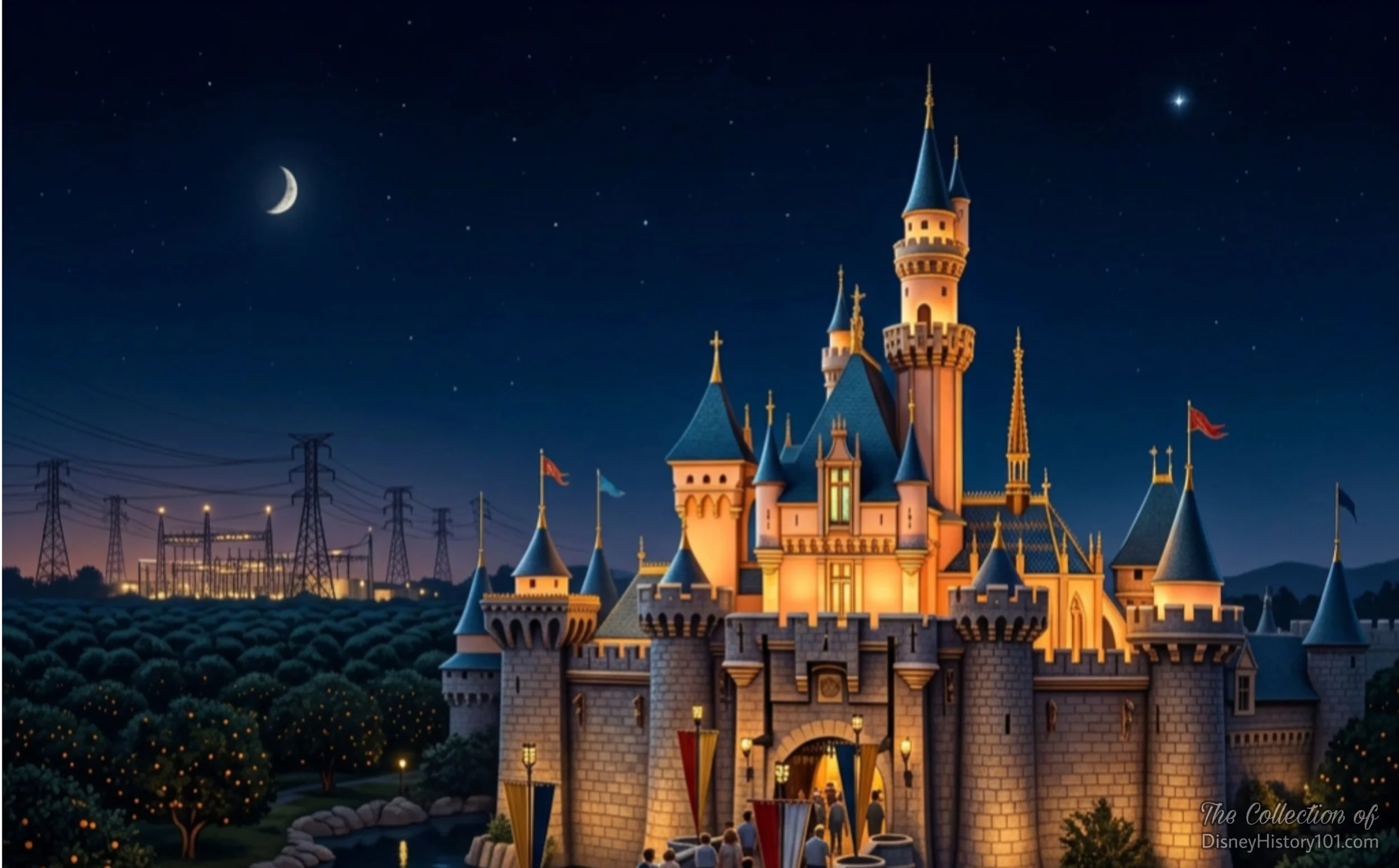
This fantastical image depicts Walt Disney’s dream of Disneyland, sustained by underlying water and power infrastructure.
Rural, unincorporated Orange County was designed to support farming, irrigation and rural homes. It was simply not prepared with a high-capacity infrastructure of massive waterworks or electrical grids required to support the commercial volume a major theme park - especially one that comprised about 20 percent of Orange County’s square-mileage and was forecasted to draw much water and power. These were resources that only the neighboring City of Anaheim could provide.
“A Scheme to Fuel the Dream”
The future site of Disneyland was sitting on farmland, equipped for farming. Due to its location at an intersection near Manchester Boulevard (then known as Highway 101) and Harbor Boulevard (southwest of Anaheim), it was still part of Orange County and reckoned as “an island in the midst of the other acreage.” This being the case, “a strip of land was needed in order for the city legally to annex Disneyland” to the City of Anaheim.
About that time, it is believed that someone (with knowledge of the importance of this strip of land) made annotation on a 1953 “Map of Greater Anaheim” (and we invite you to take a look ABOVE). It depicts the boundaries of Disneyland on a strip of land defined by Winston Road, Harbor Boulevard and West Street. Other pencil graphite markings outlined a location adjacent to the proposed site of Disneyland, on West Street, indicating that other acreage was possibly being investigated. But not to missed is the red-colored pencil “line-work” that defines the boundaries of something called the “Ball Road” Annex (#6) dated March 1.
“Disneyland Officially Comes to Anaheim”
On Saturday, May 1, 1954, the Anaheim Bulletin published the front page headline: “Disneyland Comes Here”. The article’s author wrote: “Anaheim seems certain to be the site of Disneyland - Walt Disney’s multi-million-dollar entertainment and educational project slated for California. The Bulletin learned today that official announcement will be made over the weekend that Disney and his associates had acquired options on all the land necessary to go ahead with the project.”
The author of the article also mentioned three landowners who were not part of the initial land purchases but created “options on all the land necessary” for the Parking Area of Walt Disney’s Disneyland - Agnes Callens (who owned the largest plot south of Cerritos), N.B. Reed (who owned the last walnut farm in the area, located East of the Callens Estate), and D.W. Fall (whose land was also located East of the Callens Estate).
Unmentioned in the article were Linnaeus D. & Grace A. Witherill, (who owned one of the smaller parcels of land, south of N.B. Reed). Linnaeus was very involved in the Anaheim community, as both an active Mason (Los Angeles Shrine and Scottish Rite), and a Santa Ana Elks Lodge member. Though there were many opposed to the land annex, the Witherills were supportive of the Disneyland development and ultimately sold their property (and houses) to Disneyland, Inc. on May 5th, 1954.
About this time, the Anaheim Chamber of Commerce published another edition of the “Greater Anaheim” Map, accented with “Andy Anaheim” - a new mascot designed by Walt Disney Productions as a gift to the growing City of Anaheim.
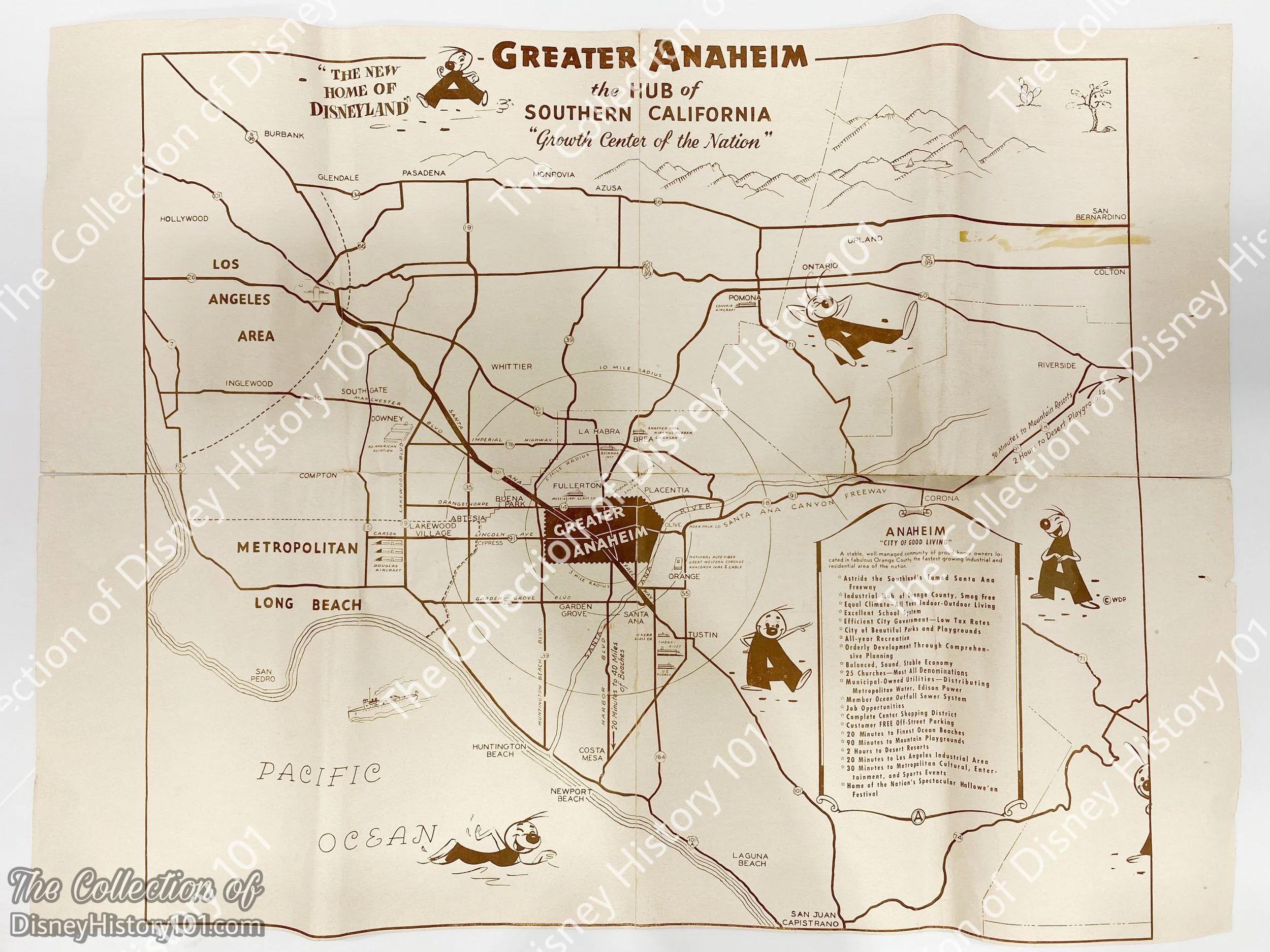
The 1954 “Greater Anaheim” Map featured Andy Anaheim officially introducing “the new home of Disneyland”, with the expression “Greater Anaheim” radiating from the area of the site of Disneyland, (but obscuring its definitive boundaries).
The artwork depicted Andy enjoying Southern California - swimming in the Pacific Ocean and hurriedly running to Anaheim, “the new home of Disneyland”. The new map boasted “the fastest growing industrial and residential area of the nation” and many perks were touted - low tax rates, job opportunities, all-year recreation, municipal-owned utilities, the distribution of metropolitan water and Edison power, its Member Ocean Outfall Sewer System, and home of the nation’s spectacular Halloween Festival.
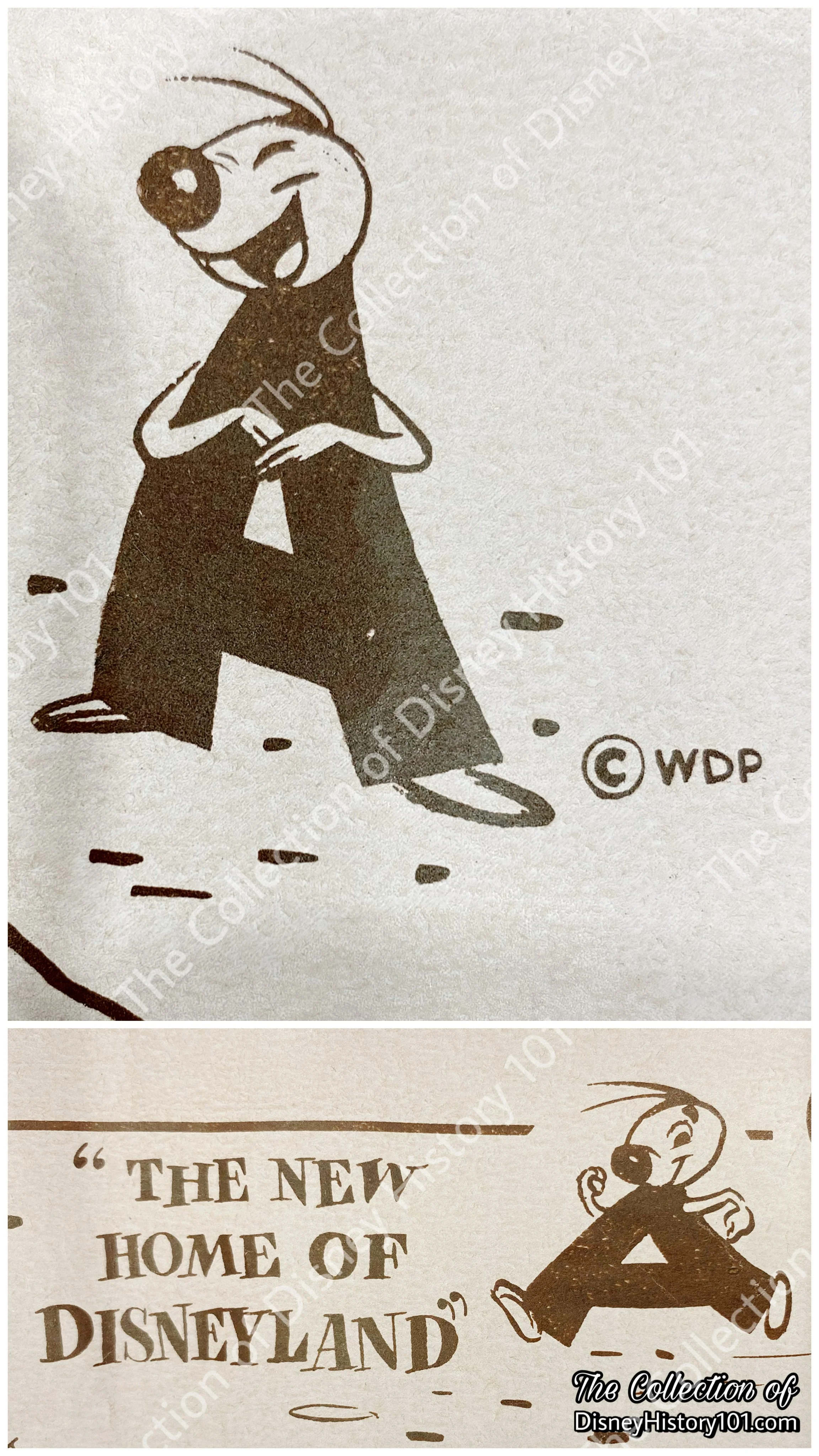
Excerpts of an animated Andy Anaheim from the “Greater Anaheim” Map, and the Walt Disney Productions © notation.
Even before the escrow proceedings on the Orange County land were completed, many titans of industry (including the American Broadcasting Company, Paramount Theaters, and Western Printing and Lithography Company) partnered with Walt Disney’s Disneyland project. It was expected that after escrow proceedings were finished, the land annexation to the City of Anaheim would easily run its course, paving the way for the development of Disneyland. A month-and-a-half later, on June 16, 1954, the deal was assured, as Disneyland, Inc. was added to the chain of title for the properties comprising the quarter-section of Orange County.
By June-July 1954, Mc Neil Construction arrived on “the site”, moving heavy equipment in, breaking ground, and hauling dirt and trees out. Dirt was being churned into dreams and farmland was becoming Fantasyland, but Walt’s inspirational spark had triggered more than his creation.
“The Beginnings of The Battle Over Disney Land”
The low rumble of bulldozers grading and excavating signaled the climactic, approaching, battle over the annexation of 768 acres (including Disneyland’s 160-acre Orange County parcel) to Anaheim. At its helm was a forthcoming decisive annexation election scheduled for September 15, 1954. One contributing writer of the Long Beach Press Telegram (published September 20, 1954) who neutrally noted: “A simple majority of those voting will decide the issue.”
While many conservative locals of Orange County and Anaheim who were optimistic over the annexation of Disneyland, there were also some that viewed the move with intense skepticism and were against its very presence in their community. Orange County agricultural landowners were very concerned over the potential massive influxes of water usage and divergence of city resources that would impact their farm community. Then there was the matter of Cerritos Avenue, which was a major Orange County thoroughfare until the Callens-Reed-Fall-Witherill properties were sold. The City of Anaheim soon decommissioned a stretch of street between West and Harbor, resulting in a disruption of traffic flow for some area neighbors of the construction site. This may have fueled a deep anxiety over future traffic congestion. Perhaps the most prevalent fear was that their quiet agricultural community would soon be overrun by a loud, chaotic “carnival” or “circus” atmosphere.
“Area Residents Draw the Line”
Orange County Area residents immediately pushed back, in a petition protest to halt the election over the annexation of 768 acres (including Disneyland’s 160-acre parcel) to Anaheim. According to some sources, a majority 58 out of some “70 to 80” names of area residents were submitted, in an attempt to halt the land annex.
However, Anaheim City Clerk Dene Williams testified at a public hearing, that “the protests fell short of the required 51 per cent of land involved in the annexation” (leading to the 58 “names on petitions [becoming] invalid”). According to Anaheim City Administrator Keith Murdoch, “12 per cent of property owners involved” were blocking “the desires of the other 88 per cent.” And so to give “the other 88 percent” an opportunity to be heard, the impending land annexation election date was to be rescheduled from Wednesday, September 15 to Friday, September 24, 1954.
Two days later (on Friday, September 17, 1954), the Plaintiff Attorney James E. Walker replied by filing an injunction lawsuit with the Orange County Superior Court, on behalf of opposed area residents - plaintiffs William M. Landsdale & L. Dyke Landsdale (of Dyke Water Company, a public utility water company in Garden Grove Businessmen), Moore-Built Homes, Inc (a developer)., and Walnut Co., Ltd. The suit alleged irregularities in the annexation electoral proceedings by several high-profile defendants including the City of Anaheim, its Anaheim City Mayor Charles Pearson, Anaheim City Council Member Glenn Fry, Anaheim Council Member L.N. Wisser, Anaheim City Clerk Dene Williams, Anaheim City Clerk Ex-Officio Charles E. Griffith, Ray Van Wagoner (a resident of Anaheim Judicial Township of Northern Orange County), and A.J. Shutte.
To assist Anaheim City Attorney Preston Turner in contesting the injunction suit, the O’Melveny and Myers firm was called upon. The following day of Tuesday, September 28, a special morning meeting was held in which Anaheim City Attorney Preston Turner, Associate Attorney Claude Owens and a representative, Attorney Howard J. Deards, from the Los Angeles law firm of O'Melveny and Myers, were retained by the Anaheim City Council, to assist and counsel Attorney Turner in the suit, representing the defendants.
The Plaintiffs charged Anaheim, its City Council, City Clerk Dene M. Williams and former City Clerk Charles E. Griffith with acting irregularly in the setting up of the annexation. They contended that certain areas were eliminated from the annexation area which should have been included. Furthermore, they asserted they didn’t want to help pay off the City’s reported $1 million-plus bonded indebtedness. Allegations that the City Anaheim didn’t consult with the cities of Orange and Santa Ana on the annexation were also contained in the briefs.
The city, on the other hand, said everything was in order. The legal representatives of the Defendants asserted that the residents of the area had been well informed. It was asserted that a public hearing was held, but there were not enough sufficient objections to block the annexation move.
Anaheim City Attorney Preston Turner led the arguments for the defendants. The City Attorney told Judge West: “The writ was submitted upon the respondents late Friday and I have had no time to prepare the material. Also, Attorney Deards has had no time to study the case. I request, your Honor, that the writ be modified and the election he allowed to proceed as scheduled because of the great expense to the city.” Anaheim City Attorney Preston Turner also added that he has lined up his vacation to start the following week.
Attorney James E. Walker (for the plaintiffs) agreed it was best to hold the election Friday, September 30, but argued against the passing or adopting of an ordinance by the City Council certifying the election results. He explained that it would put his clients at a disadvantage. “I suggest,” Plaintiff Attorney James E. Walker said, “that the canvassing of votes after the election by the council is all right. However, I think the body should be restrained from passing a resolution certifying the vote… That won’t delay the proceedings because they can’t take formal action until the matter has been settled in court. The resolution can just as well be made at a later date.”
According to a paragraph in the California Government Code, which was read to the court, the council was permitted to adopt an ordinance after a vote canvas. If they did not, they would be required to submit the issue for vote in the following election. Judge West declared: “I think your problem is more fancy than real.” At one time during the motion arguments Judge West suggested that the council could hold a first reading on the ordinance and then postpone the second hearing until after the court trial had been completed. But ultimately, he decided against the latter when it was found the action would be outside his jurisdiction. The Plaintiffs were in favor of West’s idea: the Defendants were opposed. Of course, if the election failed to pass, a trial wouldn’t be necessary.
The bone of contention all afternoon was not whether the election should be held Friday, but whether the council should adopt an ordinance of election certification. Under the judge’s ruling, then, they could have moved ahead with the ordinance but would have been restrained from sending it to the Secretary of State until the court case had ended. Commenting on the results of the hearing in Dept. 1 of the Superior Court, at 2 p.m., on the prior day, City Administrator Keith Murdoch said, “The judge’s decision is certainly equitable, and it gives the people in the area an opportunity to what they want.”
The following day, on September 29, Superior Court Judge Franklin G. West ordered that the Anaheim Disneyland Annexation election to proceed as on the following day (September 30). But considering the injunction, he granted a motion for continuance of court action against the city. Further, Judge West set November 8, 1954 as the trial date on a suit for injunction, review or mandamus against the city brought by William M. Lansdale, Dyke Lansdale, Moore Built Homes and Walnut Co., Ltd. Judge West also attached two restraining orders to his decision: (1) City Clerk Dene M. Williams was ordered to refrain from certifying the election vote ordinance and (2) from sending the ordinance to former Anaheim City Clerk Charles E. Griffith said: “The decision is satisfactory. I certainly hope that the voters will get out tomorrow and exercise their franchise.”
“The Disneyland Annexation Election”
The important date of September 30th, 1954 arrived, a day that decided the fate of approximately 760 acres and whether Anaheim’s borders would be rewritten over the annexation proposal. The votes were tallied and the press released the news: the totals were 56 to 2, in favor of annexing Disneyland to the City of Anaheim. While the Anaheim Annexation Election was a seeming, rousing success by some viewpoints, one final appeal (scheduled for November 8th) would determine the final fate of the land annexation.
“The Appeal”
Even after the Superior Court Judge Franklin upheld the annexation, he granted a restraining order to Plaintiff Attorney James E. Walker, allowing him to file an appeal of the annexation election results. This was a last resort, which James Walker intended to perform through the Fourth District Court of Appeals in San Bernardino. But by the deadline (at noon, on some day) was reached, and instead, Walker and the City negotiated an agreement.
“Orange County Redrawn”
The results of the Superior Court’s judgment of the Disneyland land annexation (and the terms of the agreement between the City of Anaheim & Dyke Water Company vs. the Plaintiffs as well as contractors for three subdividers for the Plaintiffs) were soon airmailed to the Secretary of State and filed. Altogether, “ten annexations were acted upon by the Planning Commission and the City Council comprising 5149.83 acres, 7.763 square miles of territory.”
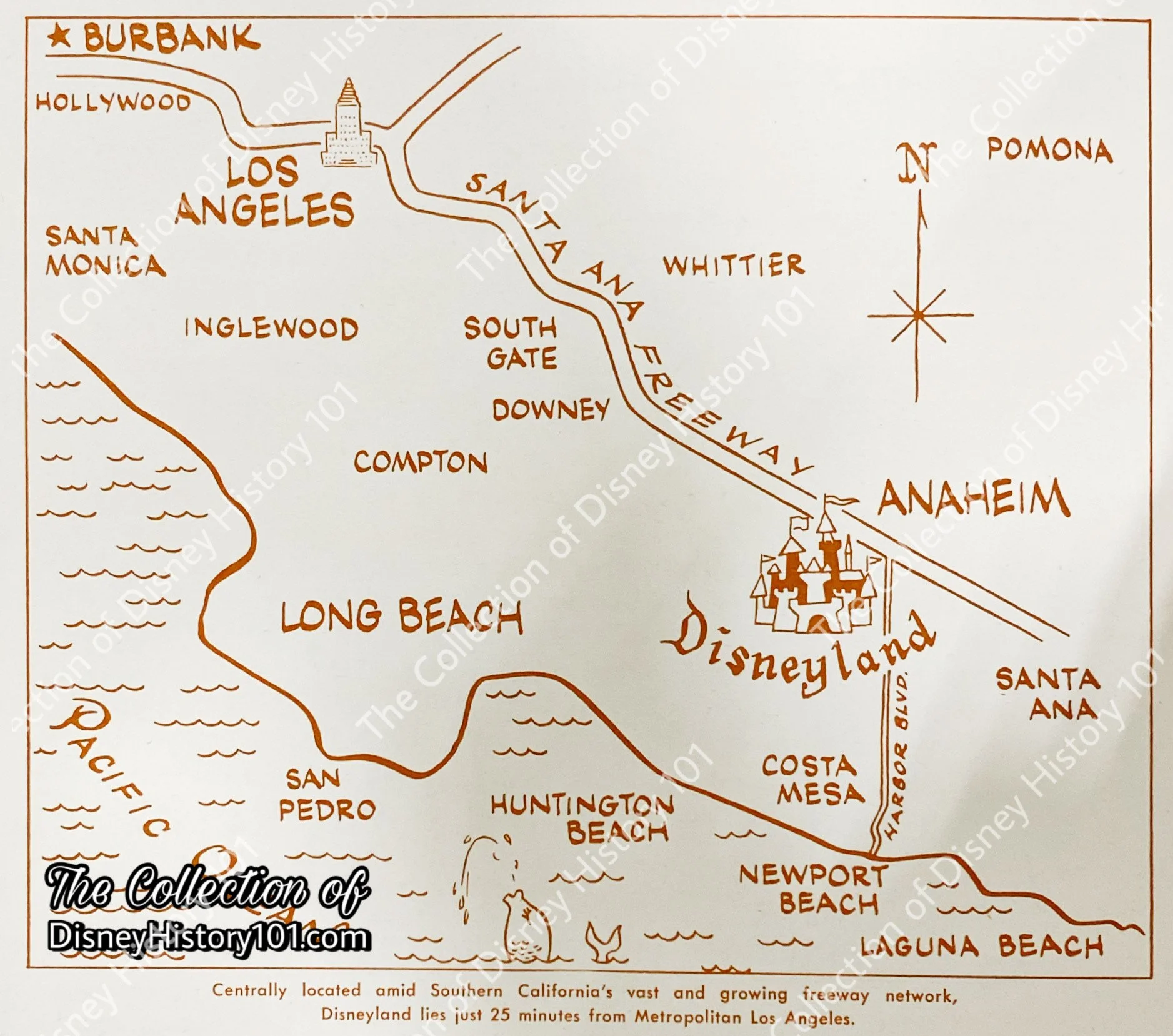
The “WALT DISNEY PRODUCTIONS ANNUAL REPORT to Shareholders and Employees” Fiscal Year Ended October 2, 1954, announced the location of Disneyland with this map (pictured above), which touted the accessibility of Walt Disney’s Disneyland Park, mentioning the freeway network and proximity to Los Angeles. The caption underneath reads: “Centrally located amid Southern California's vast and growing freeway network, Disneyland lies just 25 minutes from Metropolitan Los Angeles.”
Of course, the most influential, indelible and memorable annexation to date, was Anaheim Annexation No. 48 (Ordinance No.932), enacted October 13, 1954, which brought the unincorporated acreage of orange and walnut groves purchased by Walt Disney into the Anaheim City Limits. Particularly it was six-term Anaheim City Mayor Charles A. Pearson, who had aggressively championed and fast-tracked the annexation of unincorporated Orange County land that secured Disneyland, and was called “a solid booster” by Van France. Pearson was supported by Anaheim City Administrator Keith Murdoch and the Anaheim City Chamber of Commerce had become strong advocates of Disneyland since their first contact with the SRI Team. All three “rolled out the red carpet” and made “many concessions” to bring Disneyland to Anaheim. Other moving parts were managed by individuals like Anaheim Asst. City Administrator Wynn Priday (who is mentioned in few records), Anaheim City Clerk & Purchasing Agent Harold Daoust, Orange County Road Department Representative Allan Koch, and Fran Cheatham of Orange County, (whose role is ambiguous, but “who knocked himself out to help” according to Van France).
Back around April 1954, the California State Highway Commission had called for “adequate entrances from Manchester and Harbor Boulevard, into the grounds of Disneyland”. So now, a second planned cloverleaf of the Santa Ana Freeway, was being proposed to accommodate the flow of traffic heading into the Harbor Boulevard Entrance of Disneyland Park. Also, a planned “underpass” to enter the Santa Ana Freeway from Ball Road was being considered for modification into an “overpass”.
When some land, houses, and groves North of Winston Road were acquired for Backstage infrastructure of Disneyland, Anaheim City Administrator Keith Murdoch arranged for that stretch of Winston Road (between West Street and Harbor Boulevard) to be decommissioned. Another stretch of Cerritos Avenue ran between West Street and Harbor Boulevard - right through the area that was necessary for the Town Square of Main Street USA and the Disneyland Parking Area. So, that section of Cerritos was also decommissioned. All along, building permits were fast-tracked, and construction was expedited, to meet schedules and the approaching opening deadline of July 1955.
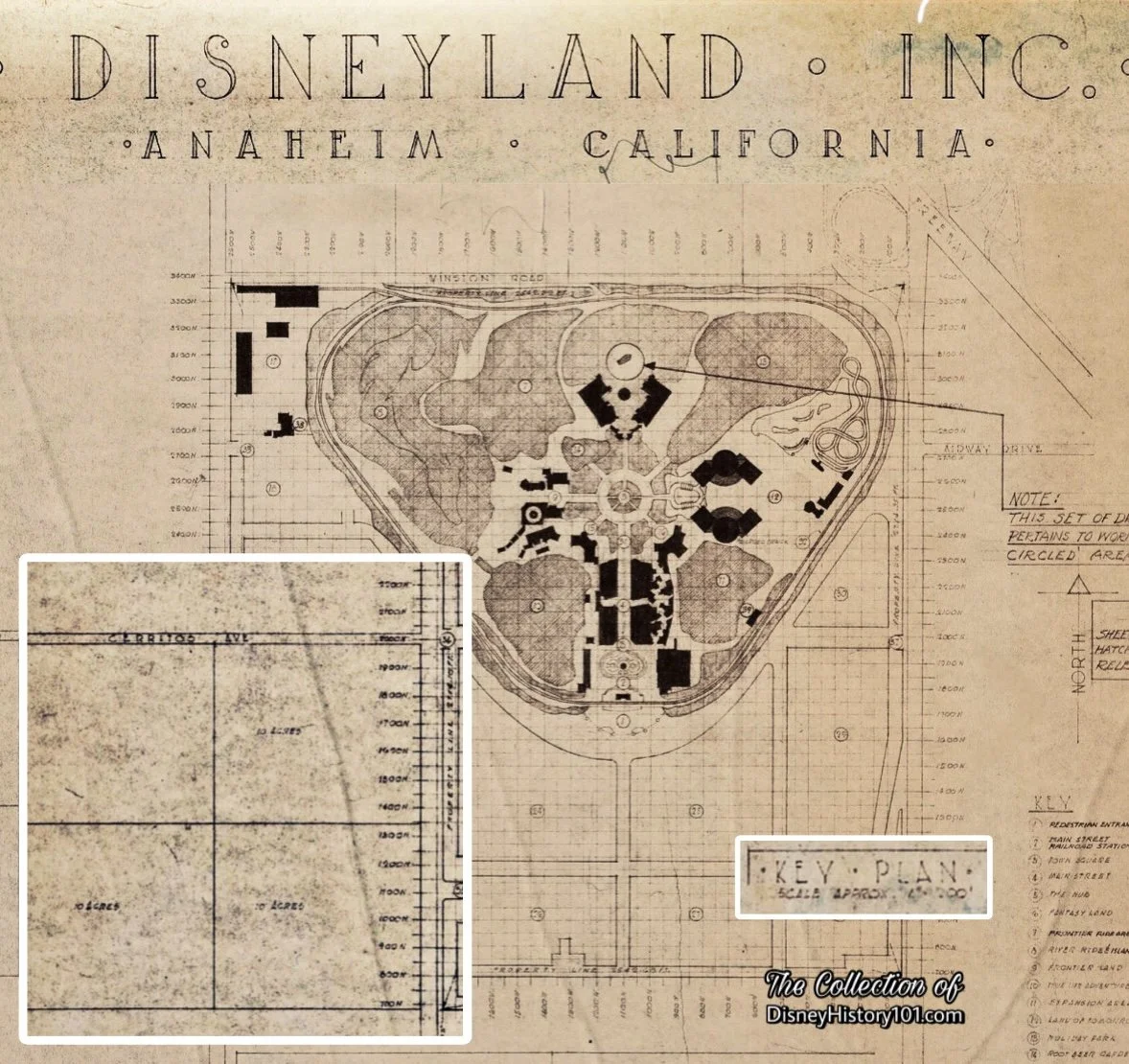
This “Disneyland Key Plan” was prepared predominantly for the construction schedules of the structures like the rotating Pirate Ship (that’s another story), but also detailed the dimensions of the land and surrounding acreage along the periphery of Disneyland.
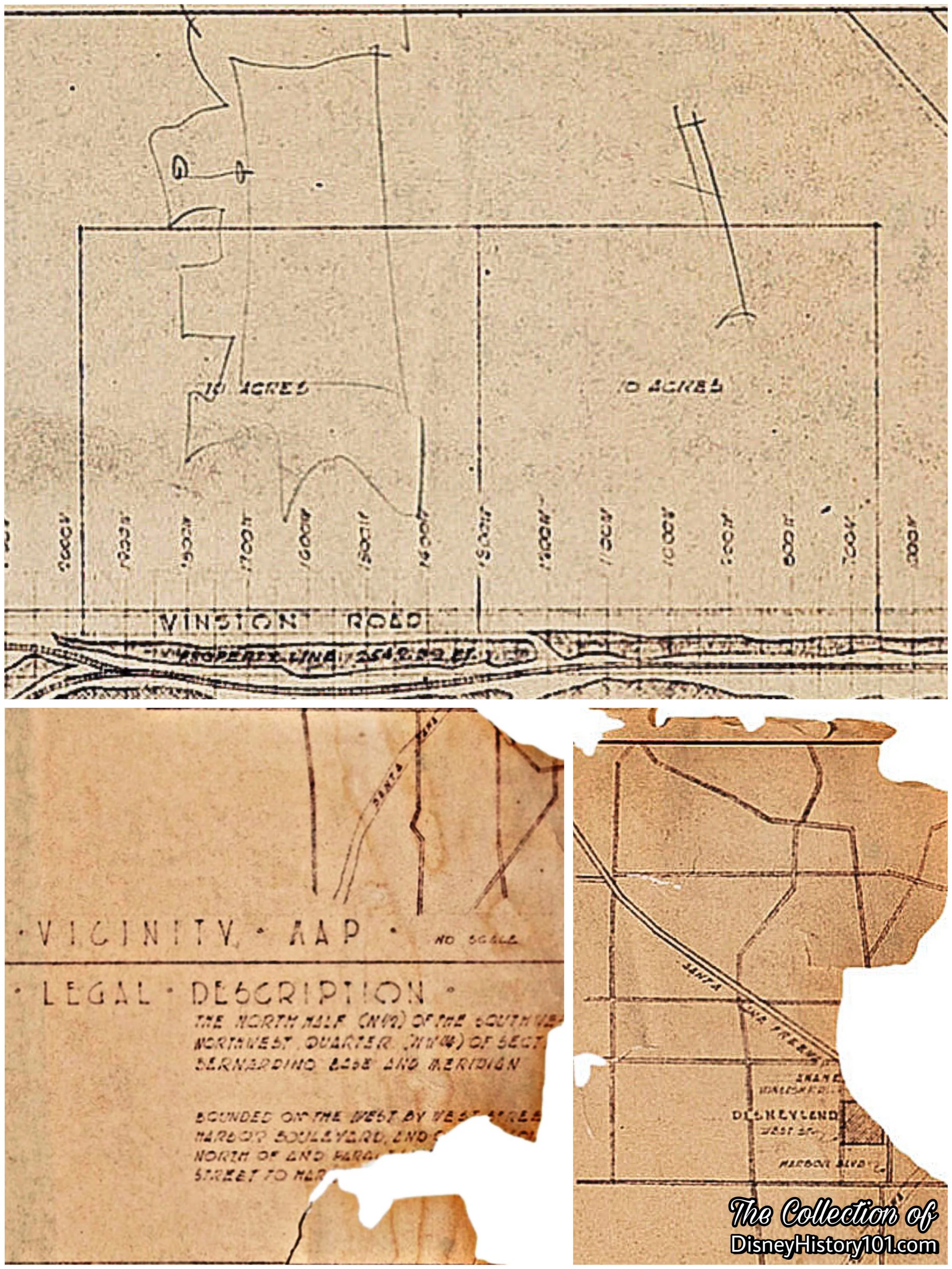
Excerpt blowups from the “Disneyland Key Plan” reveal an inset “Vicinity Map” of Disneyland along the Santa Ana Freeway, a legal description of the boundaries (in text), and some pencil scrawling in the acreage just North of Winston Road.
During this time, the “young and aggressive” Anaheim Chief of Police Mark Stephenson provided public safety planning and lead a growing police force within the vast, new boundaries. Another supporter who is identified in documents was Her Noll, who was connected somehow to the California Highway Patrol.
Altogether, the City of Anaheim invested $153,000 on the water, sewer, and road upgrades to pave the way for Disneyland. As a result, building permits and building progress also increased exponentially in the City of Anaheim. Amidst all of this, the population of Anaheim increased to 29,007 in 1954. As “The Spirit of Disneyland,” put it: “Because of this, Anaheim reaped the benefits, becoming one of the fastest growing areas in California.”
“The Magic Finds a Home - Disneyland Becomes a Part of Anaheim”
The date was January 5, 1955 - more than two months after the results of the Superior Court’s judgment of the Disneyland land annexation had been airmailed to the Secretary of State and filed. The local “Anaheim Bulletin” ran the front-page headline: “Disneyland Becomes Official Part of Anaheim”, published January 5, 1955. Underneath, the bold-text summary lead read: “State Okays Annexation To End Fight for Parcel”.
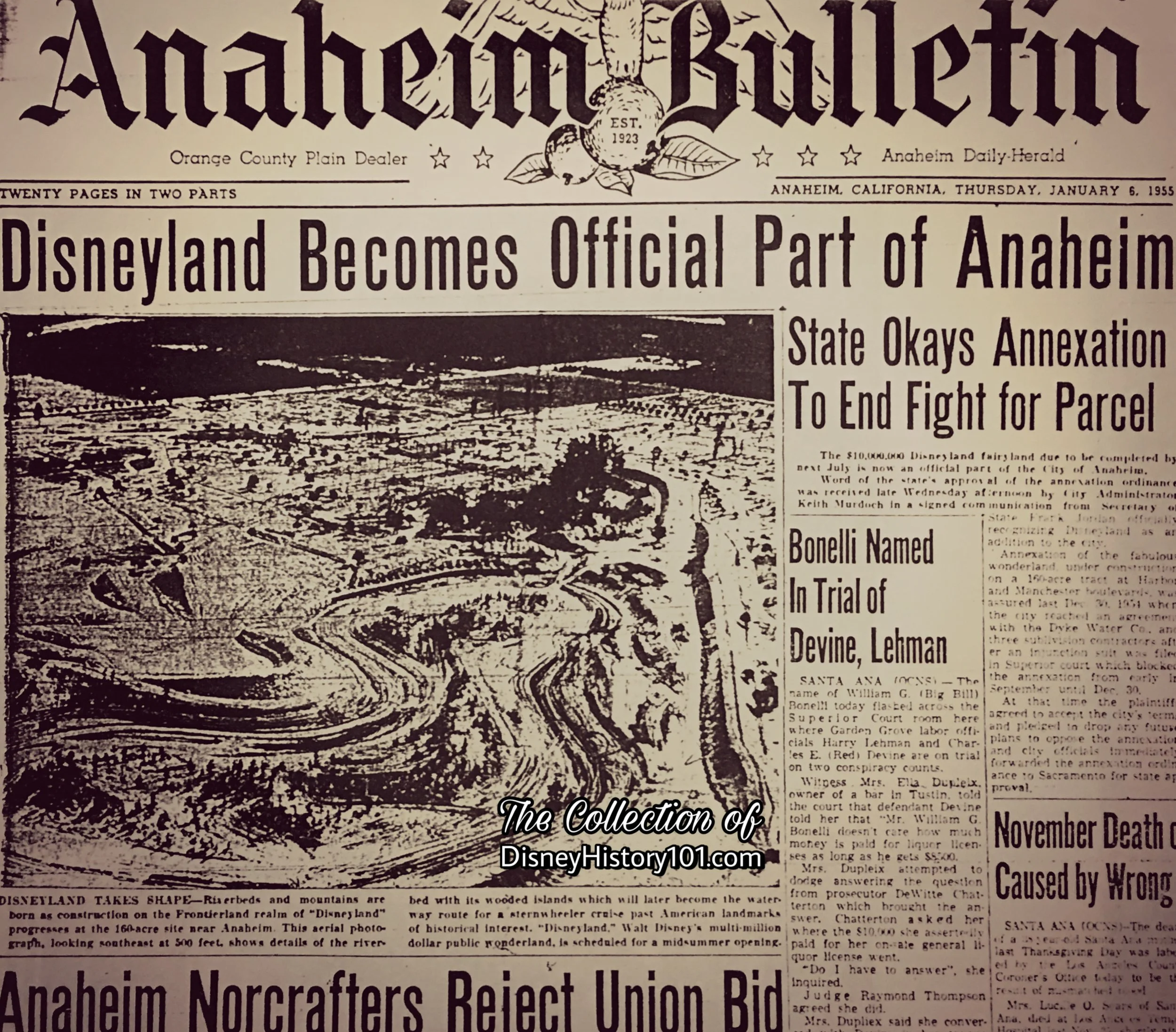
“Disneyland Becomes Part of Anaheim” is a headline in the Anaheim Bulletin, Thursday, January 6, 1955.
Soon, local-area vehicles began carrying bumper stickers and windshield decals that heralded the new home of Walt Disney’s Disneyland in Anaheim, California.
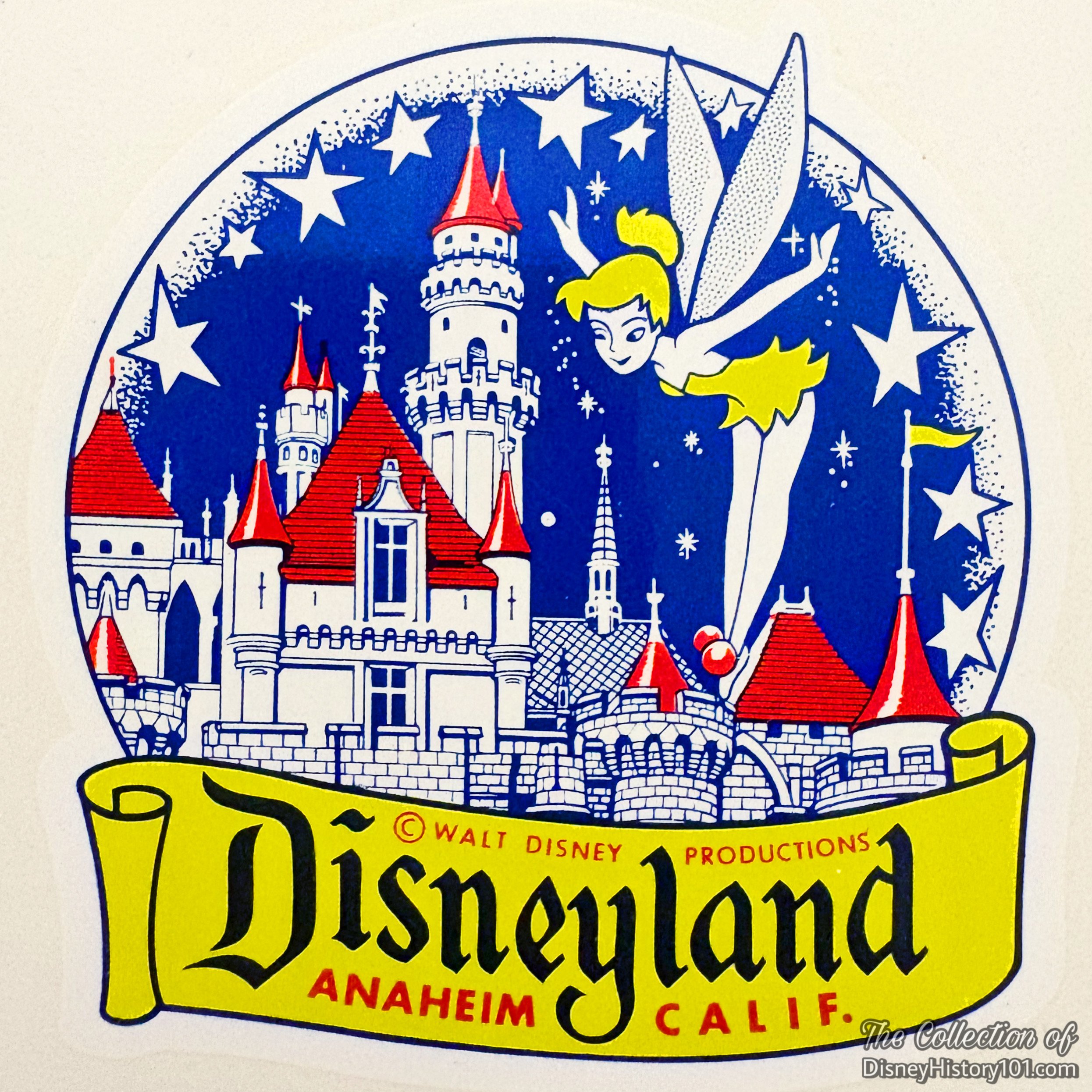
This Disneyland Decal was intended for vehicles and advertised the home of the magic kingdom, in Anaheim, California.
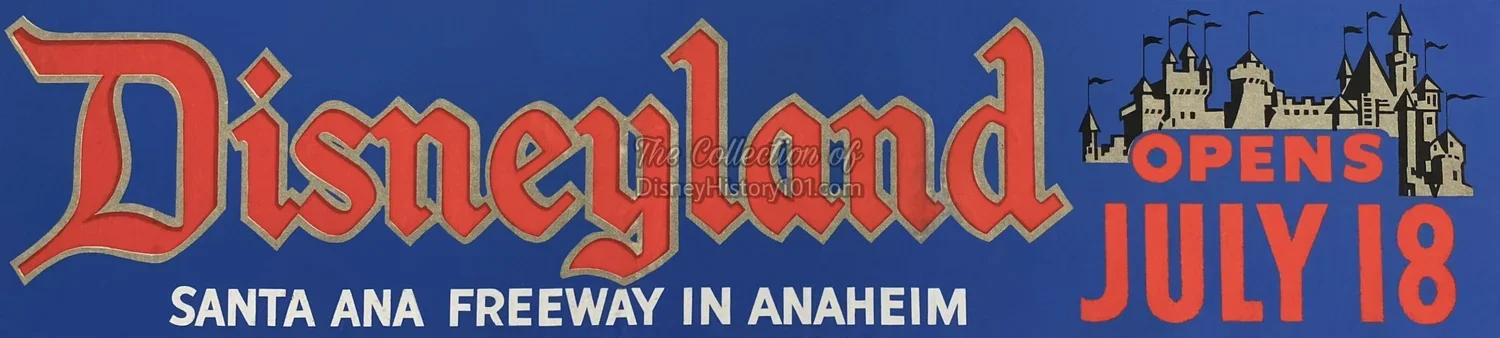
A pre-opening bumper sticker promoting not just the home of Disneyland in Anaheim, but its proximity to the Santa Ana freeway.
About January 1955, “The Little Man of Disneyland” was published, a Little Golden Book with story by Annie North Bedford (Jane Werner), and illustrations by the Walt Disney Studios.
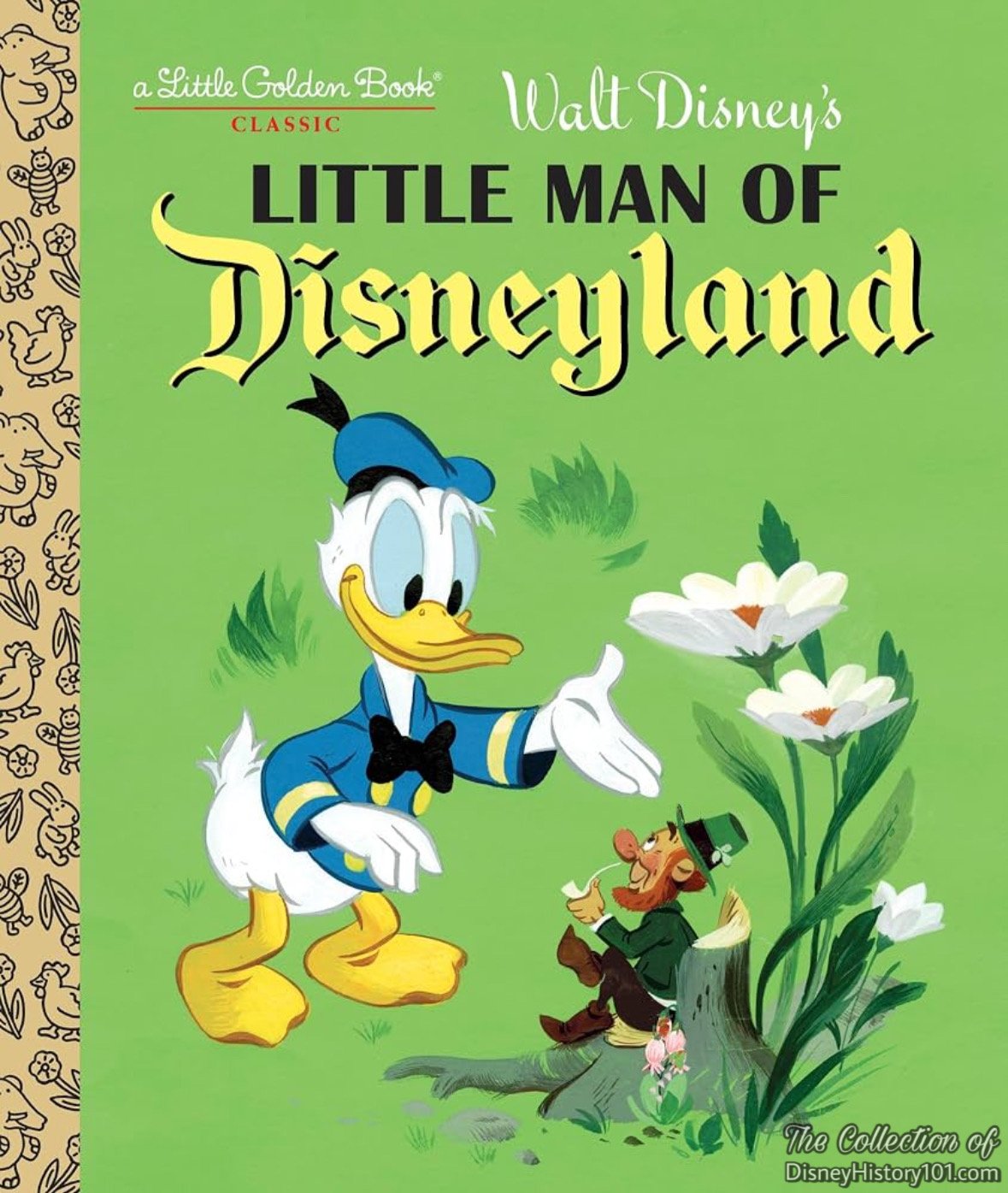
The cover of “Walt Disney’s Little man of Disneyland” - A Little Golden Book, published January 1955.
The children’s story introduced Patrick Begorra, a leprechaun who lived a quiet life, in a tiny house, in the roots of an orange tree, until Mickey Mouse, Donald Duck, Goofy and Pluto arrive with heavy machinery to build a magical new theme park called Disneyland. When Patrick confronted the cartoon characters and protested the disruption to his home, he was whisked away on a helicopter to the Walt Disney Studios in Burbank, where he was shown blueprints and artwork.
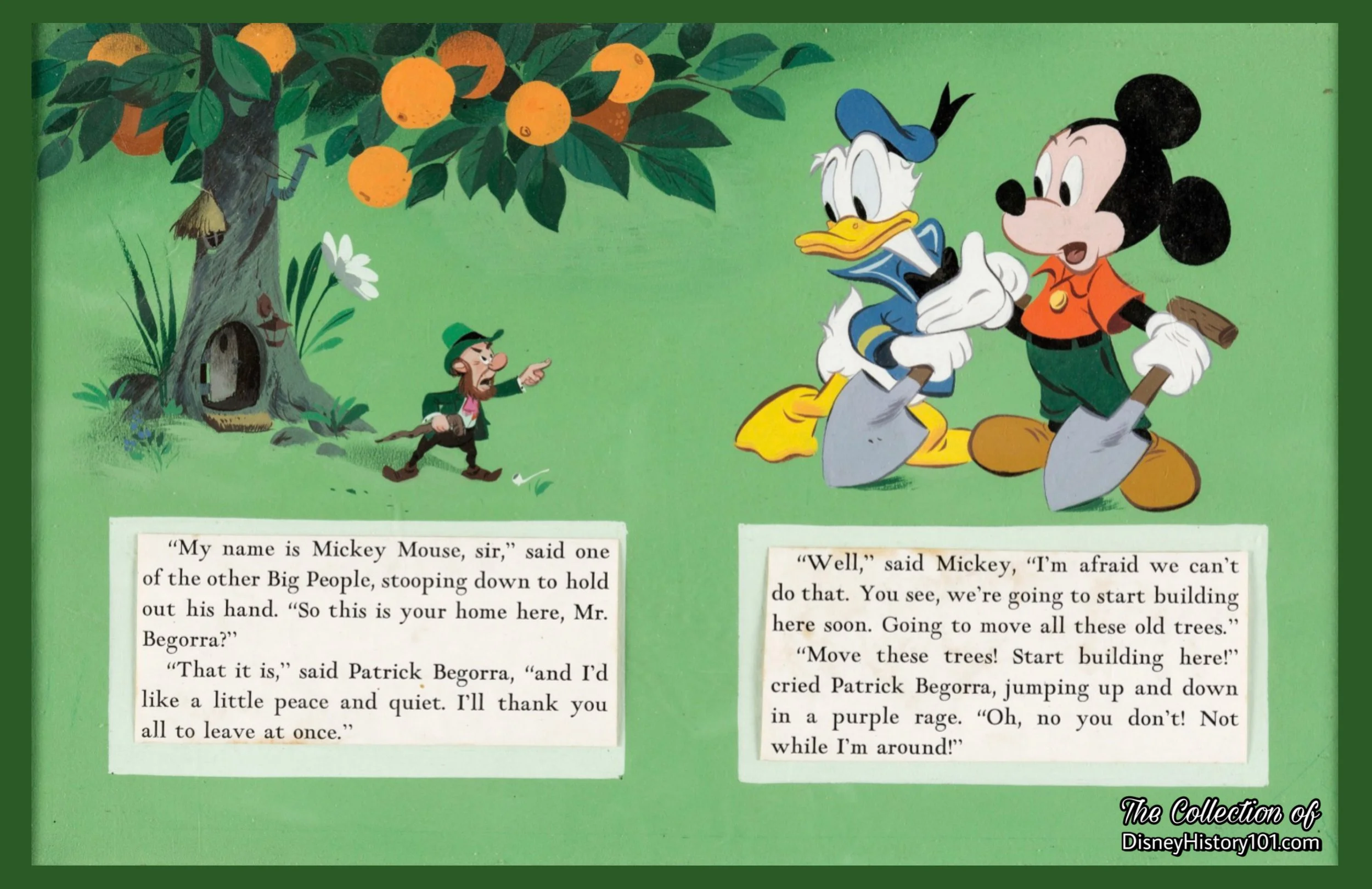
The namesake character confronts the shovel-toting “Big People” over moving his trees, in this excerpt from “The Little Man of Disneyland”, A Little Golden Book published January 1955,
After all, Patrick agreed to the development. This fantastic, fictitious story surely would have “hit home” with many old and new area residents of Orange County and Anaheim.
“Expansion of Utilities”
The Southern California Edison Company had expanded from 670,463 meters in 1945, to more than 1,300,000 meters in 1955. By August 1955, the Southern California Edison Company was serving a total of 10 Southern and Central California counties, and 5,000 acres were in various stages of annexation in Anaheim. By 1956, the residential population of Anaheim had increased to 48,500. By that year, the results of the recent land annex that brought Disneyland out of Orange County land to Anaheim would result in an unprecedented record demand for power service and electricity.
Walt underestimated some of the “drawing power” of his Anaheim Park when he purchased only 230 acres. Soon, a great number of ugly motels, drive-ins, restaurants and other businesses sprouted up along the perimeter of Disneyland. This sparked a race, with the Edison Co. attempting to keep pace with the demand through planning and expanding its utilities and facilities which were expected to generate, transmit, and distribute electrical power to Disneyland and the surrounding community.
“From Frontier Houses to the Land of Tomorrow”
July 1955 arrived and marked the moment when Anaheim’s orchards gave way to enchantment, as Disneyland transformed humble soil into a stage for dreams. A quiet agricultural kingdom had been rewritten - ranch homes for a stately castle, and rows of walnuts and oranges for avenues of wonder!
Van France recalled how the “other homes were to be torn down to make room for the park.” However, a few of the old ranch houses were repurposed and used by the Disneyland Operations Staff. For instance, the old Witherill House was repurposed - taken to the 10-acre Disneyland Pony Farm, where it would eventually be known as “the Pope House”. Located on West Street (a couple blocks north of the Disneyland Hotel construction site) was another old house which was utilized for the Disneyland Employment Office, and right across the street from it was the Vandenberg House.
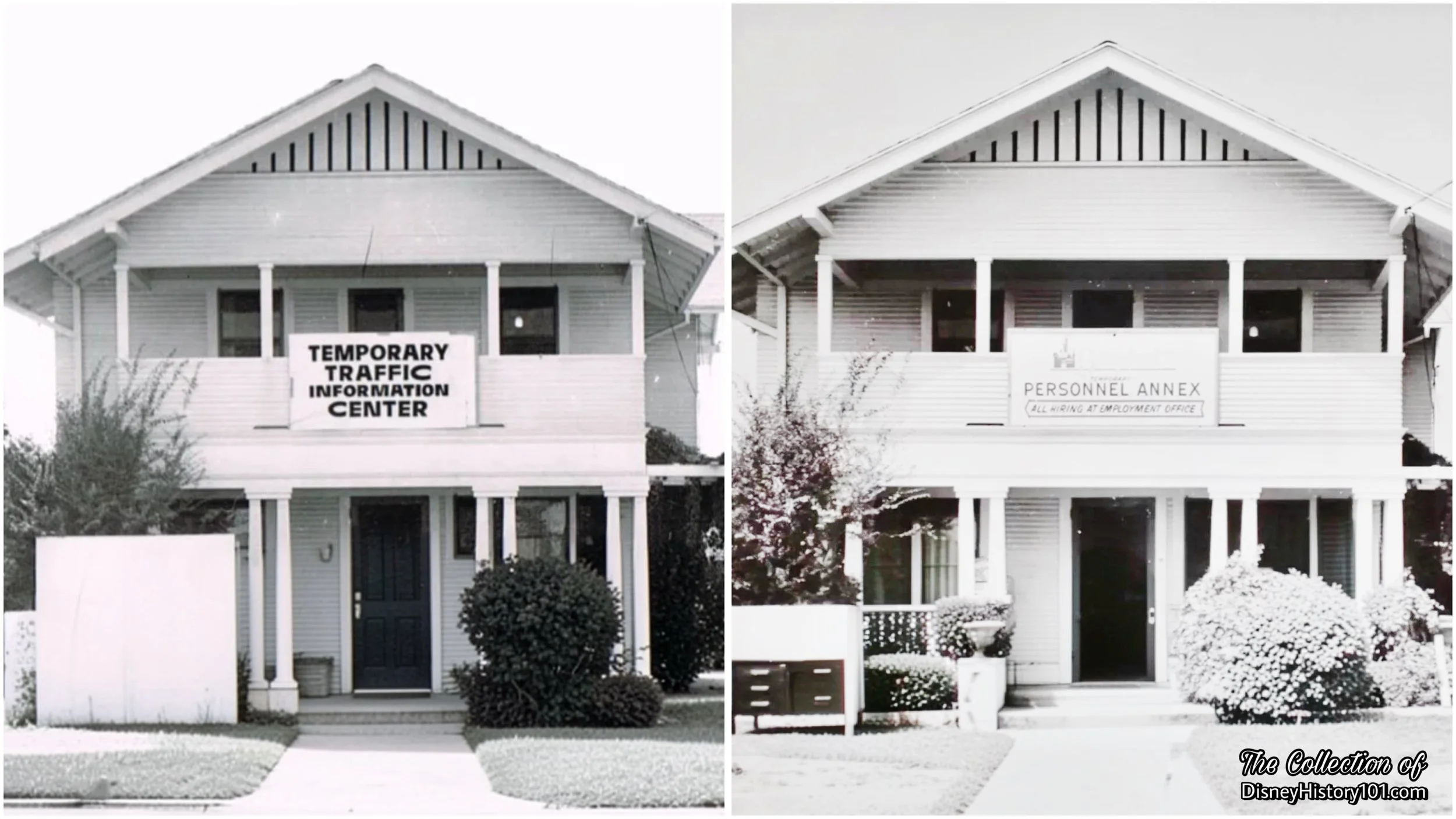
The old Vandenberg House was rehabilitated and became the Temporary Traffic Information Center for Anaheim P.D. before being utilized as the Personnel Annex of Disneyland.
The Vandenberg House was used by Van Arsdale France as the original training location for what would become the University of Disneyland. Van France continued: "What a lovely place! It was a home. There were about five bedrooms... a charming living room, a spacious and comfortable porch. There was a cellar for storing food. There was an abandoned chicken coop...and avocado trees... along with the oranges. In the evening, after a long day, we would sit in the rooms and have a few drinks. We had a neighbor, Mrs... Mohn, who still had chickens that would cluck around... and there were, still, orange trees with their fragrance. I had a little office in somebody's past bedroom... with a little porch... and the evenings were aromatic and soft. It must have been a wonderful place to live, to grow up, to raise a family. I don't see how those who sold out could have found any other homes, and lifestyle, which could compare.”
Van France went on: “Thanks to Earl Shelton, we borrowed some craftsmen who knocked out a wall between two upstairs bedrooms, which made a cozy training room holding about 30 people. Just about the right size. We'd acquired a lot of Disney pictures and fan cards and Disneyland renderings at the studio. I picked up a key, and Dick and I moved down to see our new surroundings. We couldn't get anyone else to help and Dick worked over that place like a ‘White Tornado’ which he is sometimes called today. He swept up, cleaned windows, and did a lot of things with our pictures which made the place quite attractive. Many of the people who were to arrive later couldn't find a place to light so they came to our Beach Head. Before opening we were to be the home of the Safety Department... the Fire Department... the Medical Department… the Wonderland Music Company... and finally the temporary home of special details from the Anaheim Police Department and the California Highway Patrol.”
Van France remembered the eventuality of the Vandenberg House, ultimately became the site of a Disneyland Hotel Driving Range: “My adopted family home remained for two years more and was finally torn down to make room for a driving range... in the name of ‘progress.’ I didn't see that happen. I might have cried.”
Perhaps the most prominent was the old Dominguez House which (for years) fulfilled the most distinguishing supportive role of the Disneyland Administration Building. Finally, in 1958, there was a necessity for a larger Administration Building and the Dominguez House was finally demolished, with Ron Dominguez (son of Paul & Laura Dominguez; original resident of the property on which Disneyland now stands) taking the inaugural demolition swings at the structure.
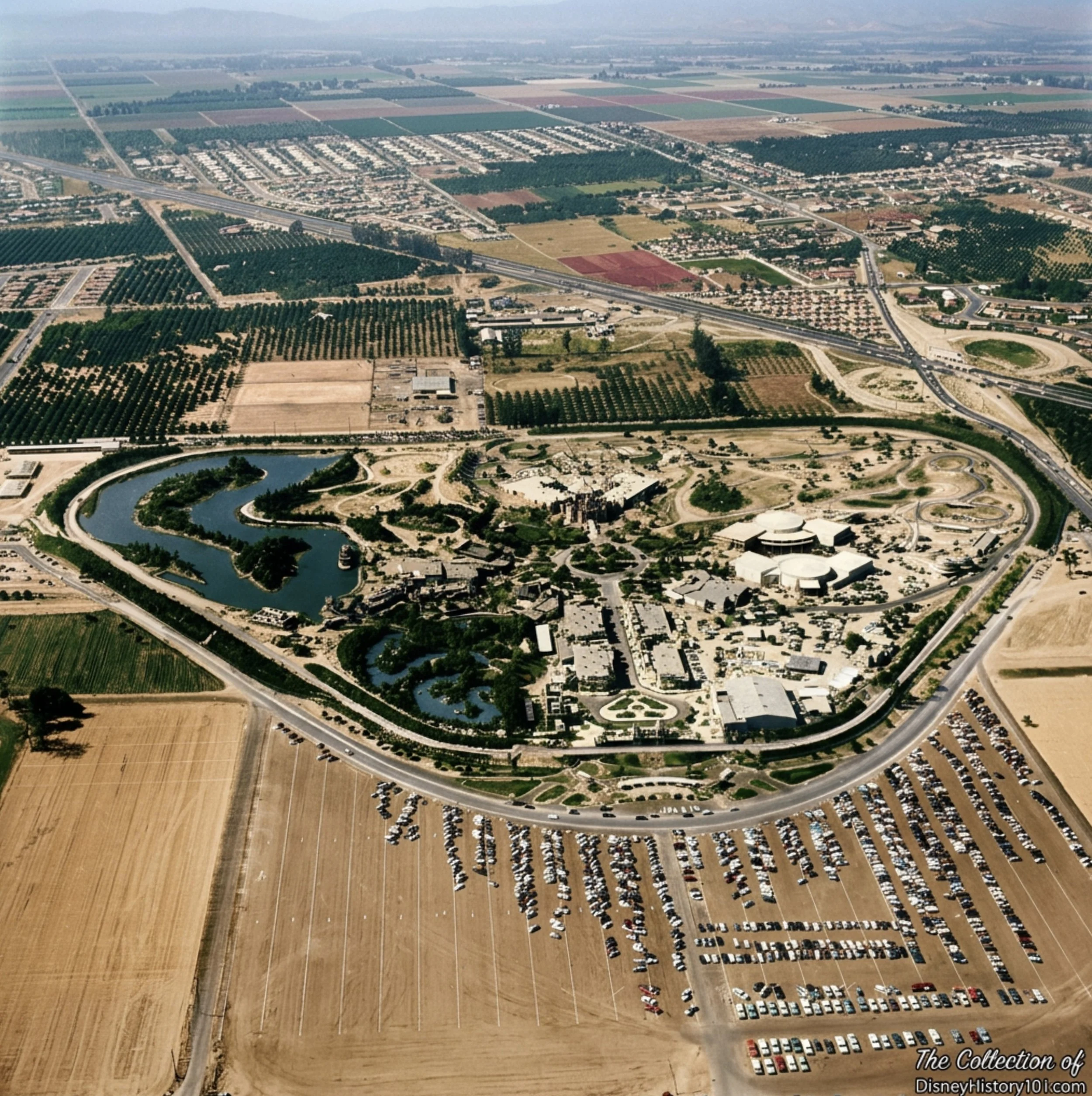
An aerial image of Disneyland, circa 1955.
“Whispers in the Groves”
What of those residents of Old Anaheim? Linnaeus Witherill passed early in 1955, never coming to a full understanding of the impact that his business transaction with Walt Disney would have on his neighborhood, community, and the world. Ron Dominguez recalled how his mother Laura “was so sentimental about the property. She was very proud of what Disneyland became.” In a letter, Laura expressed: “We never could imagine any thing as wonderful, than what Mr. Disney has brought to our community. We are very happy and proud to have had a part in this wonderful and clean attraction. Children and adults as well enjoy it.”
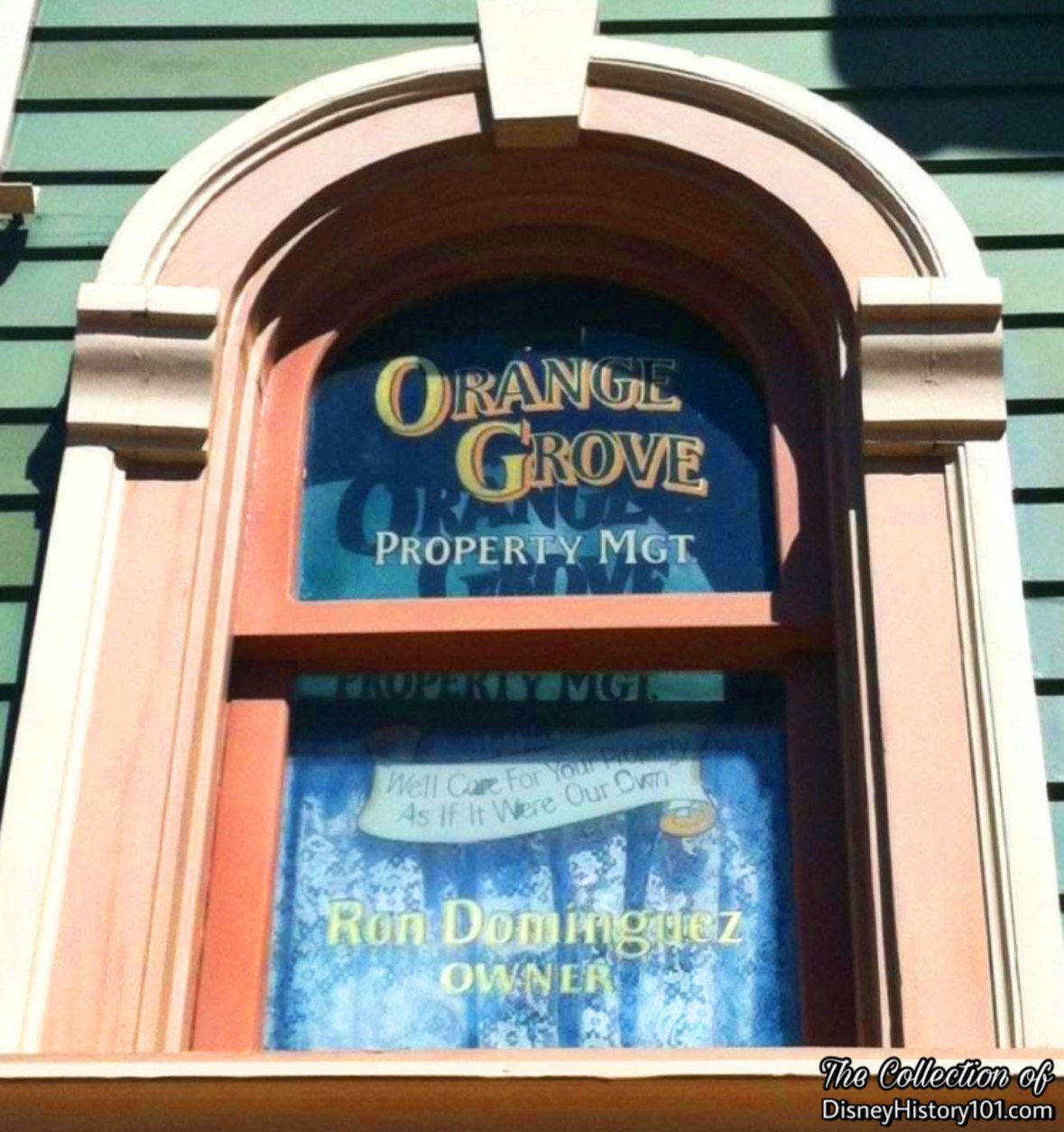
In a window over the Market House on Main Street USA, Ron Dominguez “Orange Grove Property Manager” is honored in a nod to his family’s storied history with the land.
Some of the children of the original citrus grove residents weren’t “left in the dust”, like Chuck Peltzer, and Ron Dominguez, who continued contributing toward developing the land after it was transformed into Disneyland. Ron started as a “Ticket Taker” in 1955 and worked to become Executive Vice President of Disneyland.
Then there were Hiroshi and Masao Fujishige, who, like Walt and Roy, were brothers with a dream. One year after the U.S. Supreme Court struck down California’s Alien Land Law, which had previously barred Japanese Americans from owning land, they purchased 56 acres for their strawberry farm for $3,500.00. Incidentally, the land was near the periphery of the future site of Disneyland, a controversial quarter-section of grove which was going through annexation proceedings that would bring it into the City of Anaheim. The brothers refused to sell to Disneyland, Inc. (or anyone else) and resiliently retained their property and managed their strawberry farm for decades, until the passing of Hiroshi Fushigi at age 76. By that time of 1998, the land was worth $90 million, and the Fujishige Family sold 52.5 of their acres, retaining 3.5 acres.
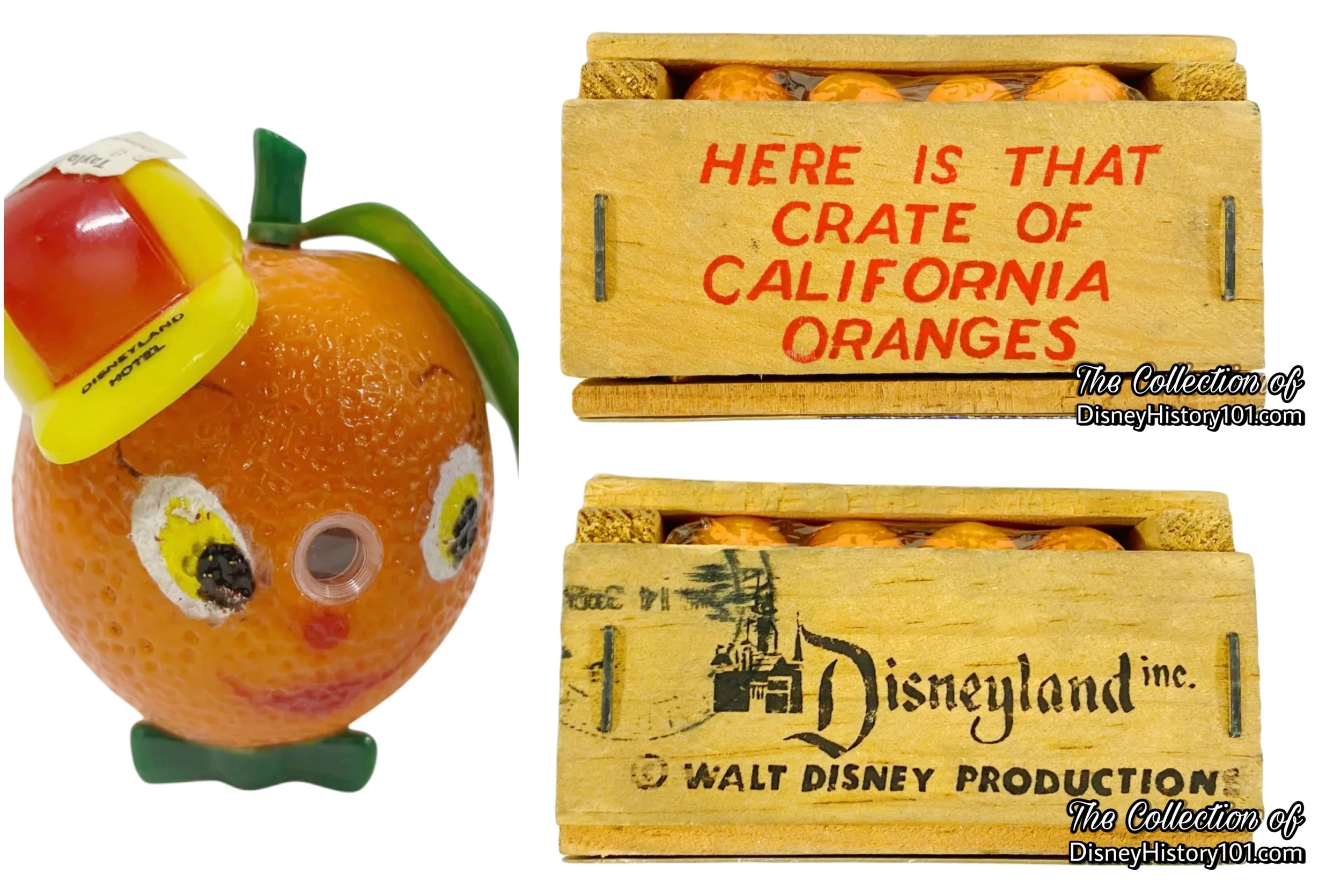
California oranges continued to play a starring role in the souvenirs of Disneyland and the Disneyland Hotel for a number of years. Pictured above is a charming microfilm film viewer and a sweet, miniature crate of California oranges.
Meanwhile, the origins of Disney “land” have not been forgotten. Sunkist became a participant sponsor of Disneyland, operating two quick-service restaurant locations - “Sunkist Citrus House” on Main Street and “Sunkist, I Presume” in Adventureland, beginning in July 1960. Even by 1961, some 26 acres of citrus groves were still extant, located around the Disneyland Heliport, while some 56 acres were rented out to companies like Global Van Lines.
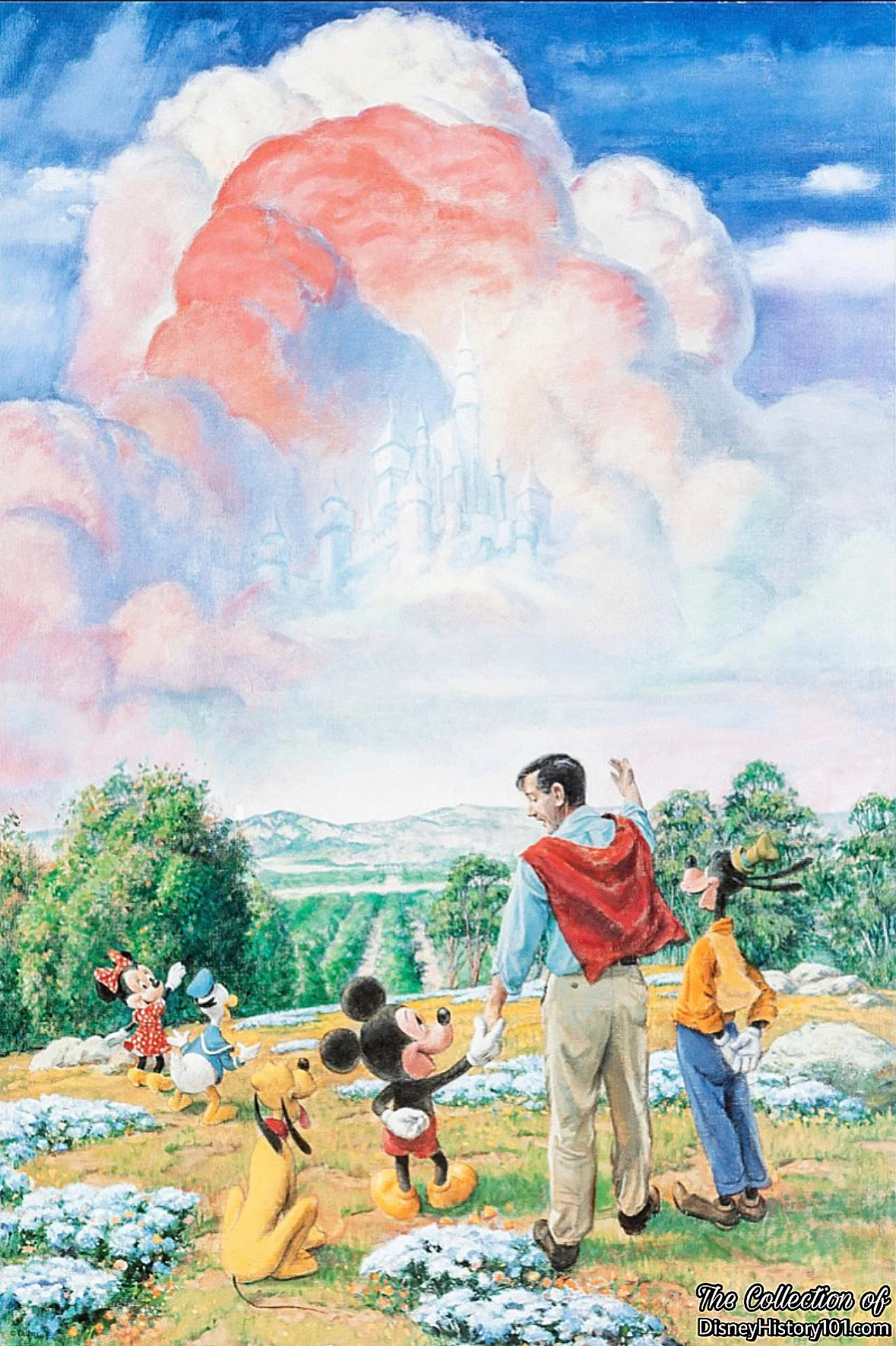
“Walt’s Dream” by Disneyland Master Illustrator Charles Boyer, 1999.
Through those years and beyond, licensed merchandise and artwork was occasionally themed after California oranges. This tradition of weaving the rich history of California oranges into storytelling continues to the present, through decorative elements that have been thoughtfully placed throughout Disneyland Resort.
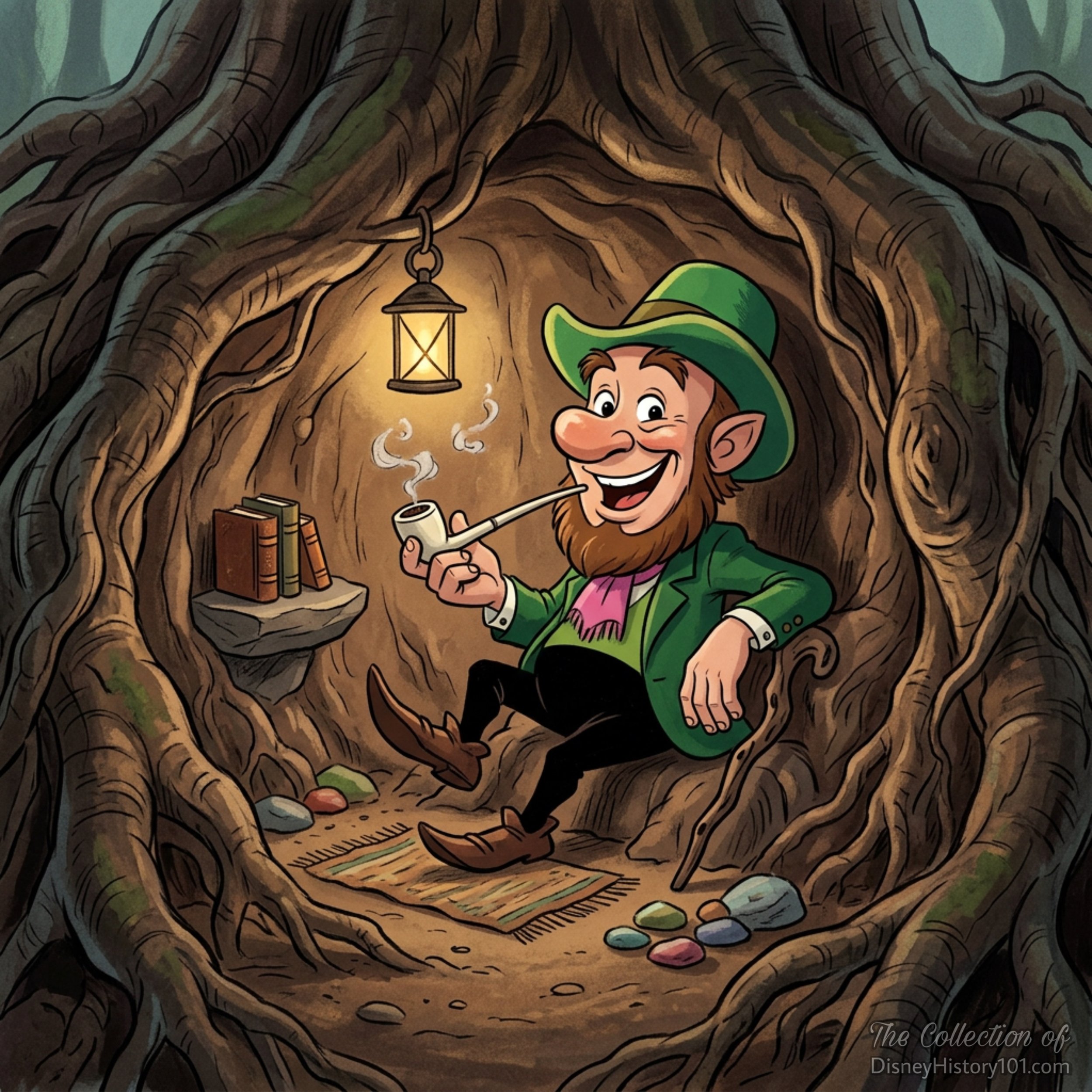
Even “little man” Patrick Begorra was given a fairytale ending in a “wee snug house” amidst a lush, tropical area of Disneyland.
But eventually, time moved on, people have come and gone, participant sponsors parted ways, merchandise was phased out, and citrus groves have disappeared. But hopefully, through talking about this historic account, their inspiring stories and indelible legacies will live on.

A visit to the magic kingdom is more inspiring, when you pause and picture the roots of Disneyland - sunny citrus groves of Orange County!
It is with all of these things in mind, that we at Disney History 101 “take a stroll down memory lane”, and remember those original residents of California citrus groves, whose leaves once whispered in the quiet Orange County sun. A place where a magic kingdom rose from the soil, and Disneyland Park grew into Disneyland Resort, forever altering the landscape of its local community, and redefining the boundaries of human imagination and joy for people all over the world!
*”Disneyland Comes Here”, Anaheim Bulletin, XXXI, No.215, page 1; published Saturday, May 1, 1954.
*“Judge West Rules Election May Be Held; Certification Held Up”; published 1954.
*”Anaheim History Shows Expansion: Rapid in Population, Area Growth”, “The Disneyland News”, Vol.1, No.2; published August 1955.
* “Backstage Disneyland - A Personal History", by Van Arsdale France, pages 24 and 25.
*“Homecoming - Destination Disneyland” by Carlene Thie.