UPJOHN PHARMACY (Upjohn Apothecary) and NEW CENTURY WATCHES & CLOCKS

Regarding most any project pursued, Walt Disney once said: “We have always tried to be guided by the basic idea that, in the discovery of knowledge, there is great entertainment as, conversely, in all good entertainment there is always some grain of wisdom, humanity, or enlightenment to be gained.” While fewer current Disneyland attractions embody the spirit of those words, the story was far different in the beginning. Back then, “Disneyland is a place to have fun… and with the fun it is a place where you can learn,” according to “Disneyland, U.S.A.” (published 1958, for potential Participants).
“Blue Sky for the Disneyland Pharmacy”
Back in 1948, Walt Disney visited the 1948 Chicago Railroad Fair with his friend animator Ward Kimball. On the way home, the two “railfans” also made a visit to Henry Ford's outdoor museum tribute to Americana called Greenfield Village, located in Dearborn, Michigan. It was Walt’s third visit to the history museum within his lifetime. Ward later recalled that Walt enjoyed the entire experience so much that it was all he talked about on the train back to Los Angeles. When Walt Disney returned home, he composed a memo which laid out in great detail some of his earliest ideas for a themed amusement center. In describing his earliest vision of a frontier town, Walt prominently mentioned a drugstore with a soda fountain, in addition to other attractions like a toy store, an opera house, horse cars, and a railroad station. This concept of a recreation of a frontier town would continue to develop over time.
According to The Disneyland Story (September 3, 1954) : “You find yourself in a Civic Center or Town Square at the turn of the century, any time from 1890 to 1910. Here you will see…the Drug Store.” As we make our way by the barbershop quartet, and ice cream parlor, we arrive at another turn-of-the-century small town “staple” - Upjohn Pharmacy! This was Main Street U.S.A.’s original corner drug store, and an opening day Disneyland attraction at that. As guests entered the 1,480 square foot exhibit, they could experience real licensed pharmacists (in period specific clothing), performing turn-of-the-century tasks amidst medical and surgical Antiques of a Victorian-era apothecary shop.
All of this, was sponsored by the Upjohn Company - one of the United States’ turn-of-the-century business pioneers, “old reliable firms, which have been in business fifty years or more. Here they can show how they started and reproduce their first place of business.” [Disneyland Prospectus, 1954]
By July 1, 1954, George Whitney of Disneyland, Inc. directed Amusements, with Ron Miller overseeing analysis, philosophy, capacities, planning, operator training, and amusement procurement. By July 1, 1954, Russel Tippett of Disneyland Inc. Advertising oversaw Exhibitor’s Space Sales and Lease Agreements. Disneyland Participant Corporate Sponsors were carefully selected. High quality, long term corporate sponsors would provide incremental income that enabled Disneyland to enhance its show and attractions, offset some operating expenses, and capitalize on marketing opportunities.
It was intended that Disneyland feature “the turn-of-the-century shops and stores - the photographer's shop, ice-cream parlor, penny arcade, bakery, drug store, music shop, butcher, grocer, many of which are sponsored by outstanding American companies whose names are familiar ‘household words.’” As Walt described to Bob Thomas (of Associated Press), “some industries will have exhibits, but all of them must be in keeping with the era.”
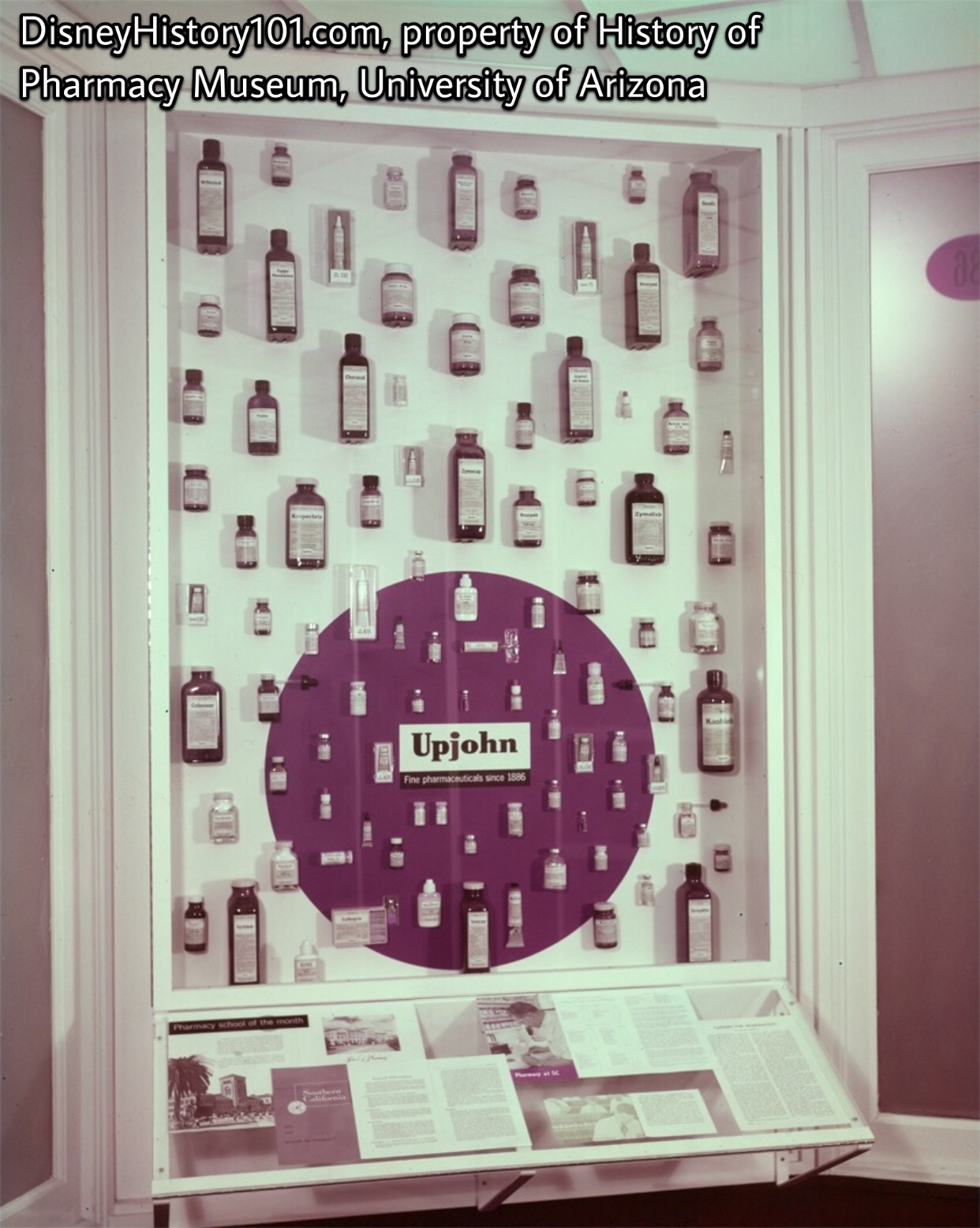
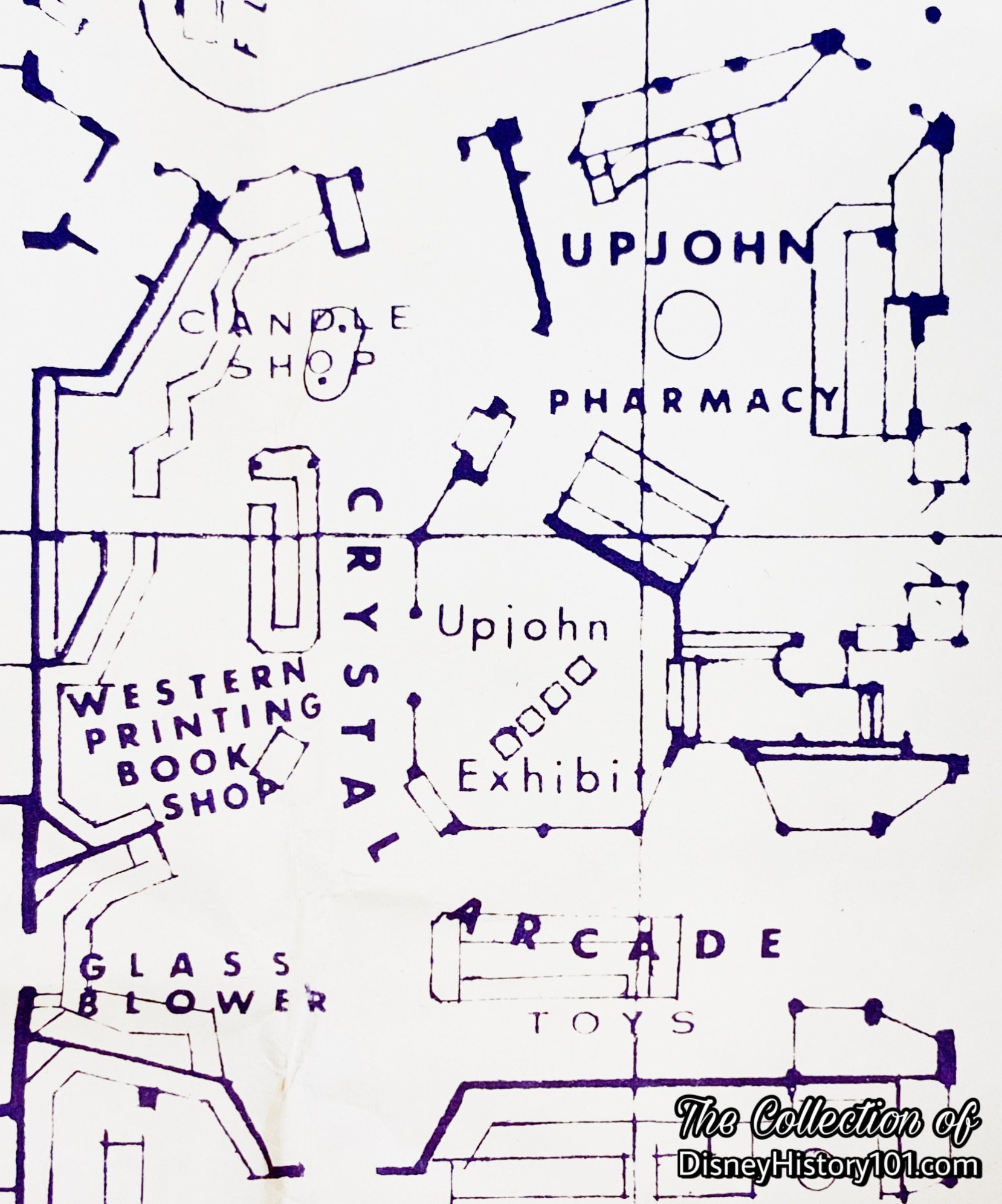
“Disneyland is unique in that some of the world's foremost creative artists and architects control all design at Disneyland.“ While the facade was designed by architect Earle G. Kaltenbach and Hollywood art director Gabe Scognamillio, the interior of the shop was first designed by artists of WED Enterprises, Inc., but re-designed (by architect Will Burton) to resemble a typical apothecary shop circa 1886. Upjohn had two main publicly accessible rooms - the Victorian era drugstore apothecary shop (filled with more than 1,000 medical antiques), and a contemporary-style Modern Room (which showcased Upjohn Company’s drug manufacturing processes). Here, Disneyland guests could look back to the roots of the Upjohn Pill and Granule Company, as well as the future of the Upjohn Company of Kalamazoo, Michigan!
“Architectural Designs by Lessees”
Disneyland, Inc. printed materials for Lessees detailing specifications for architectural designs of exhibit spaces. These were revised by March 16, 1955 and issued to Lessees.
All of the interior architectural drawings were done by competent registered architects or an approved display house of the lessee's choice. All of the designs submitted by the lessee's architect, whether for buildings or construction of interiors in DISNEYLAND, were approved as to the theme and general plan of DISNEYLAND as established by WED Enterprises, Inc.
Three sets of preliminary drawings were furnished DISNEYLAND, Inc. as soon as possible after signing of the lease. Two sets were retained by DISNEYLAND and one set was returned to the lessee’s architect with any revisions noted thereon and stamped “APPROVAL TO PROCEED TO FINAL DESIGN.” This stamp when properly signed and dated constituted the lessee’s authority to proceed with the final drawings.
The Lessees revised their final drawings to incorporate any revisions noted on the approved preliminary drawings, and submitted three sets of the revised drawings to DISNEYLAND. One set was returned to the lessee’s architect and any revisions noted thereon are to be incorporated on the original drawings. When the lessee had incorporated the final revisions on the drawings, two sets of transparent ozalids were forwarded to DISNEYLAND for approval. DISNEYLAND would stamp both sets “FINAL DESIGN APPROVED” and “LESSEE’S CONTRACT DRAWINGS”, and return one set to the lessee who could then release drawings for bid and/or construction.
“Construction”
“When the giant earth-moving undertaking was completed, the building crews took over. Soon, the rat-tat-tat of riveters was shattering the air, and sparks were flying from welders’ torches as the steel frameworks, capable of withstanding the ravages of time and the elements rose above the newly formed ground. While carpenters hammered and masons laid row upon row of brick and stone and mortar, the permanent buildings began to take shape and form,” according to “The Disneyland Story” published 1955. One of the first buildings to be constructed was the Main Street Opera House, which was used as the Mill. Here, the woodwork of Disneyland was generated - from the functional to the aesthetic! Approximately three and one-half million board feet of lumber went into the Park’s construction. Much of the wood was processed here by McNeil Construction (which formerly constructed Walt Disney Studio sound stages in 1947 and 1953), and under the direction of George Mills Sr. (the Prime General Contractor and Mill Foreman). Then, under the direction of Joe Fowler (Construction Supervisor), as well as Charles Alexander and Ray Conway (Construction Field Supervisors), the lumber was soon fashioned into the framing belonging to the very first buildings constructed at Disneyland - primarily the Main Street Complexes (on each side of the street).
All fixtures were placed in their correct motif and many light fixtures of Disneyland were authentic antiques.
F.M. Franz, manager of operations for MeNeil Construction expressed: "We feel sure there has never been anything built like this in Southern California, or elsewhere in the United States. Many of the items were constructed from artist’s sketches.” Work began on the 11,860 square-foot Main Street Building #300 and its 1,480 square-foot Upjohn Drug Company Building. In constructing the building, a concrete foundation and slab floors were prepared, followed by wood frame construction (while store units would have a combination wood and rigid steel frame). ”The first fabricated steel for the Main Street buildings arrived November 8 and was erected,” according to the narrator of “Disneyland - The Park,” a Disneyland anthology television series excerpt, first aired 1957 and Disneyland LINE (November 22, 1979).
According to inserts published in area newspapers during July of 1955, Disney buildings were roofed by Pioneer Roof & Shingle Company (then located at 608 Mateo Street, Los Angeles, California; 7522 Westminster Avenue, Westminster, California). The roof covering was a variable, dependent on the architectural design.
Newbery Electric Corporation gave electricity to Disneyland.“Theelectrical installations were supervised by Roy J. Gruendler, manager of Newbery's Orange County district office located at 1335 Santiago Ave, Santa Ana.”
As of June 2, 1955, C.V. Wood Jr. sent an Inter-Office Memorandum to Walt Disney regarding the best estimates that could be obtained at the time regarding the status of individual sections of the Park and Opening Day. C.V. wrote: “Building #307 - Upjohn: The construction of the walls and fixtures will be complete. A lot of the props are here now. We do not know if this is all there is to come and if not, if it will all be here for opening… Electric Signs: All are in work - with the exception of the shoe store and the Bank of America, all will be completed.”
The building (as each on Main Street U.S.A.) possessed complete fire sprinkling systems. By June 30, 1955, related Disneyland Site Work Fire Protection Utilities Plot Plans were prepared for Disneyland Inc., by J.E. Thomasson of WED Enterprises Inc.
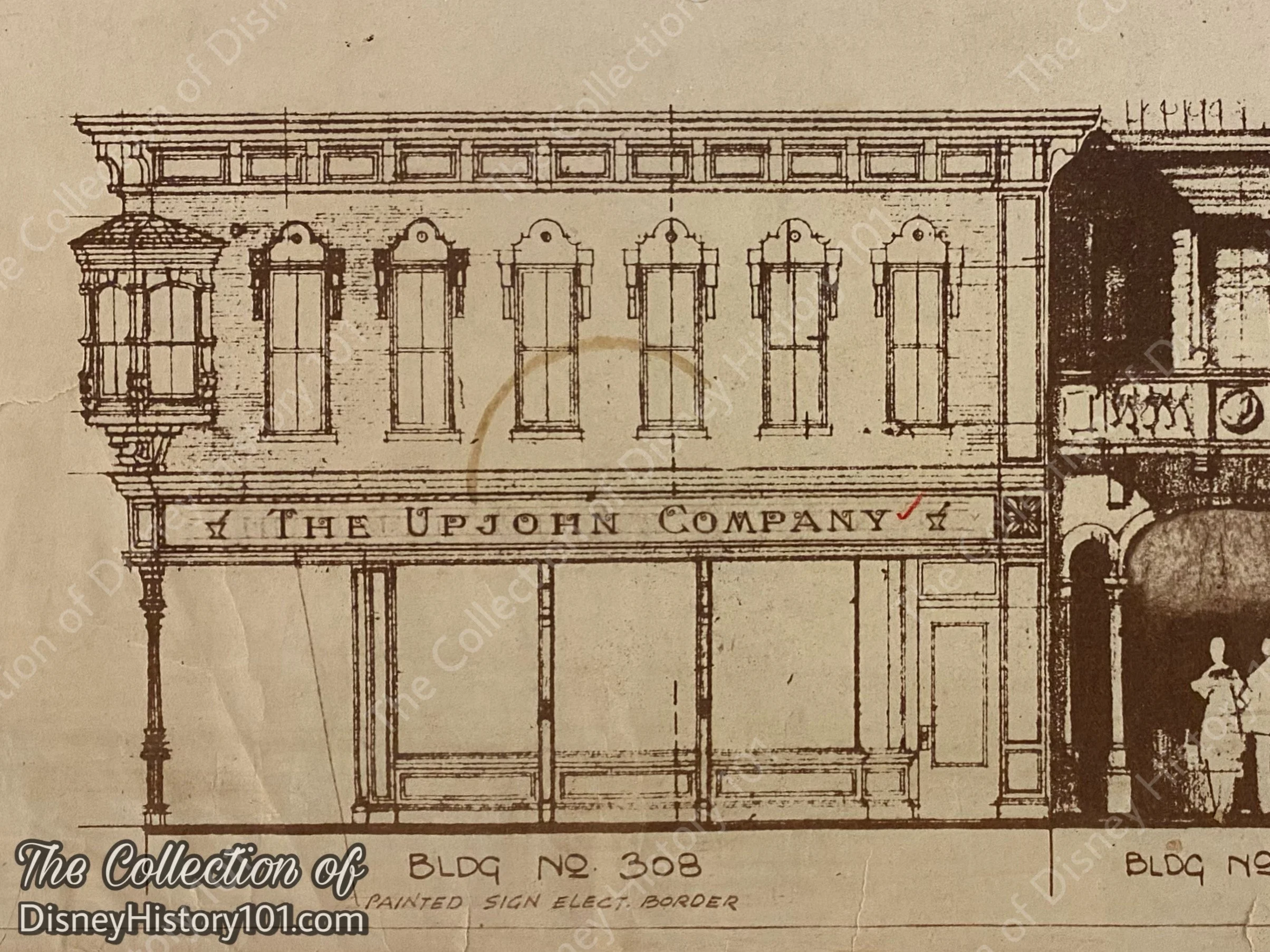
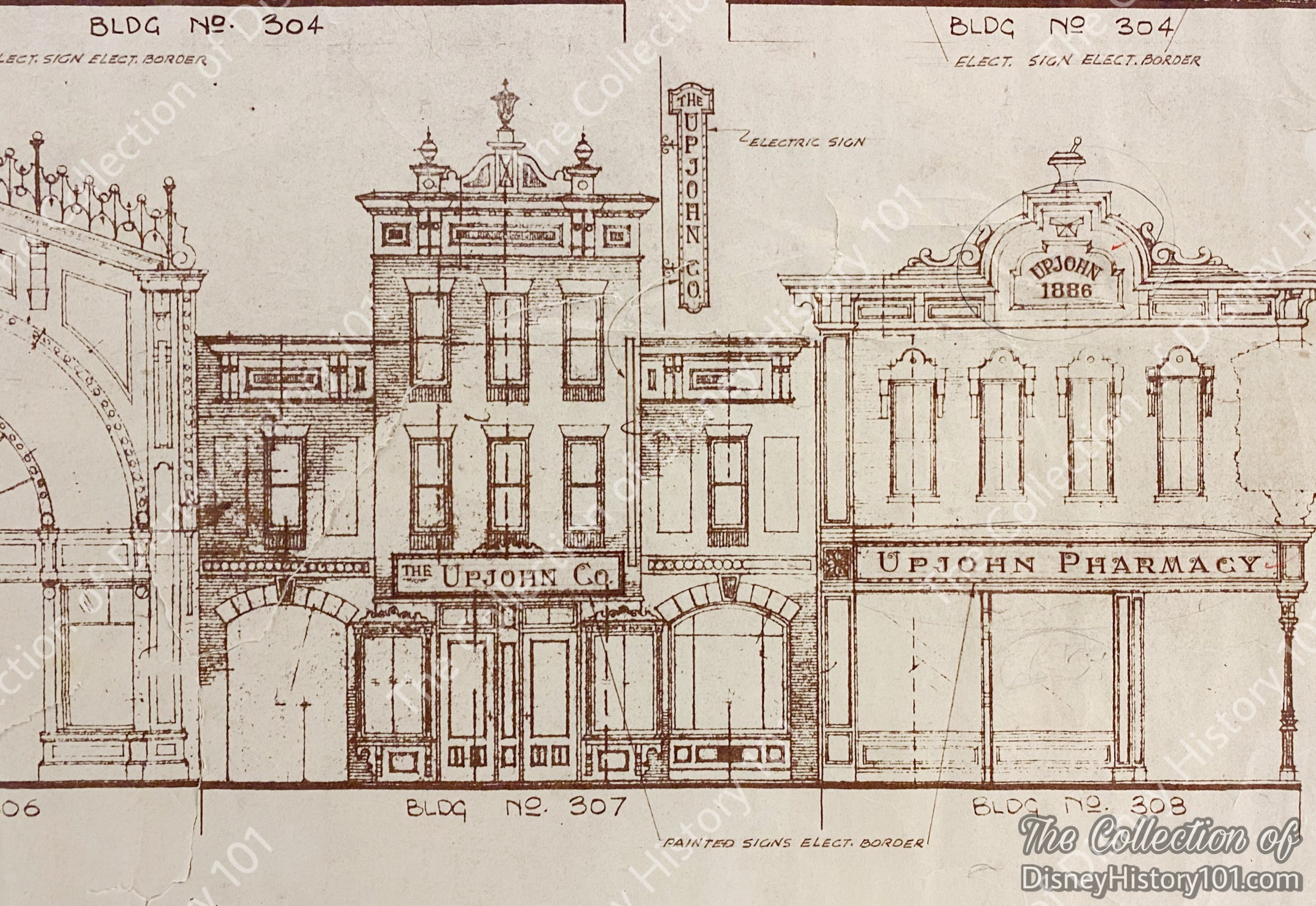
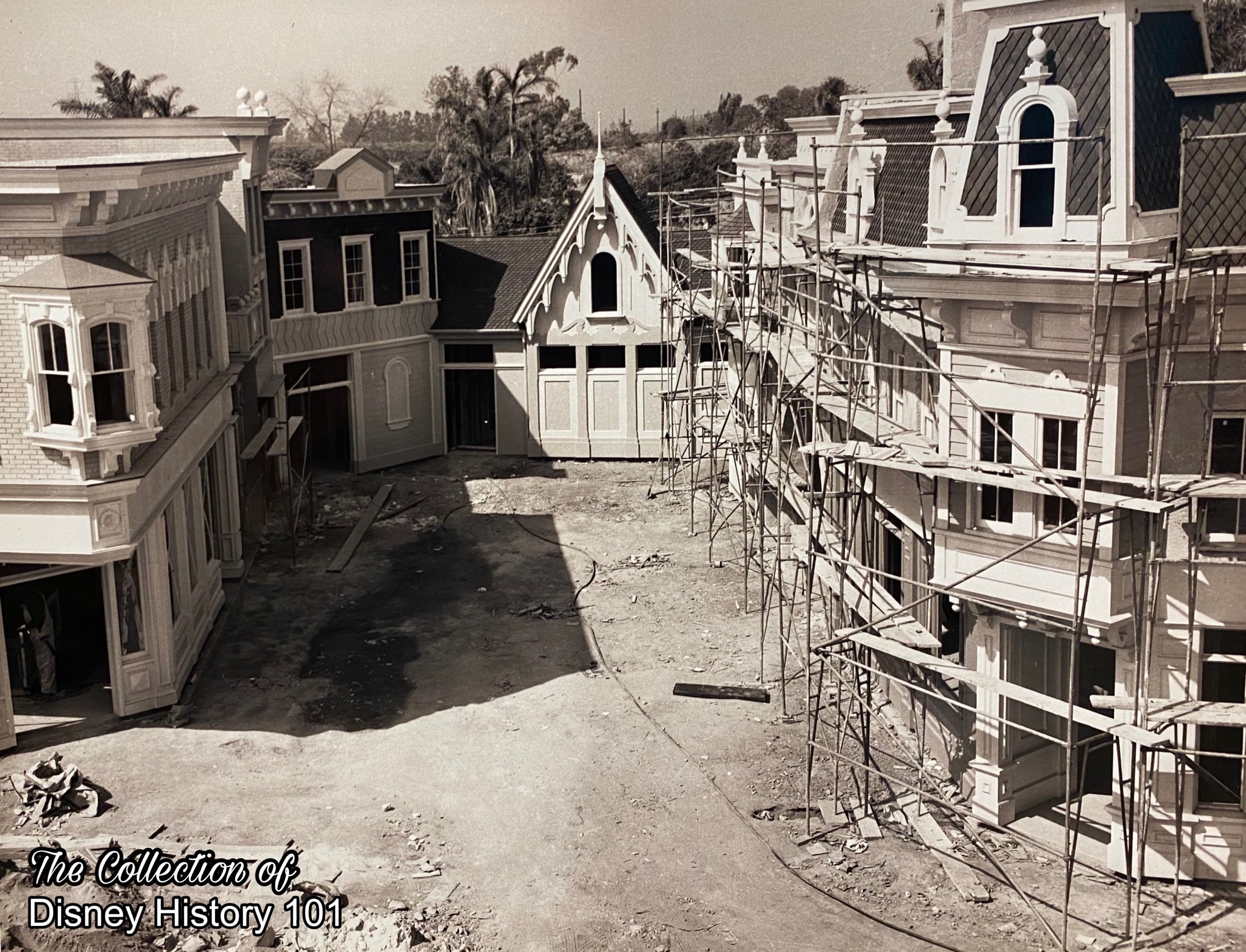
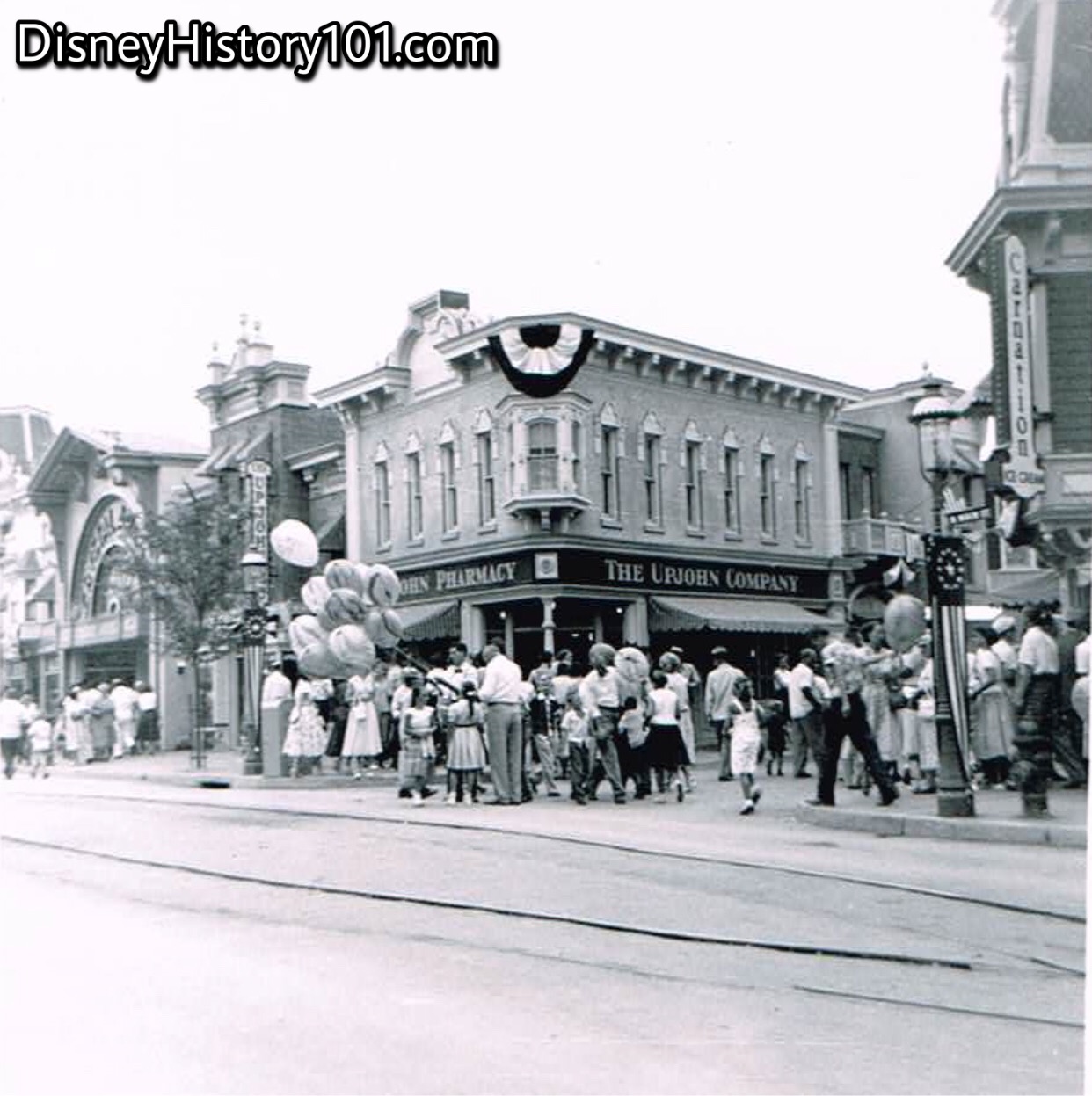
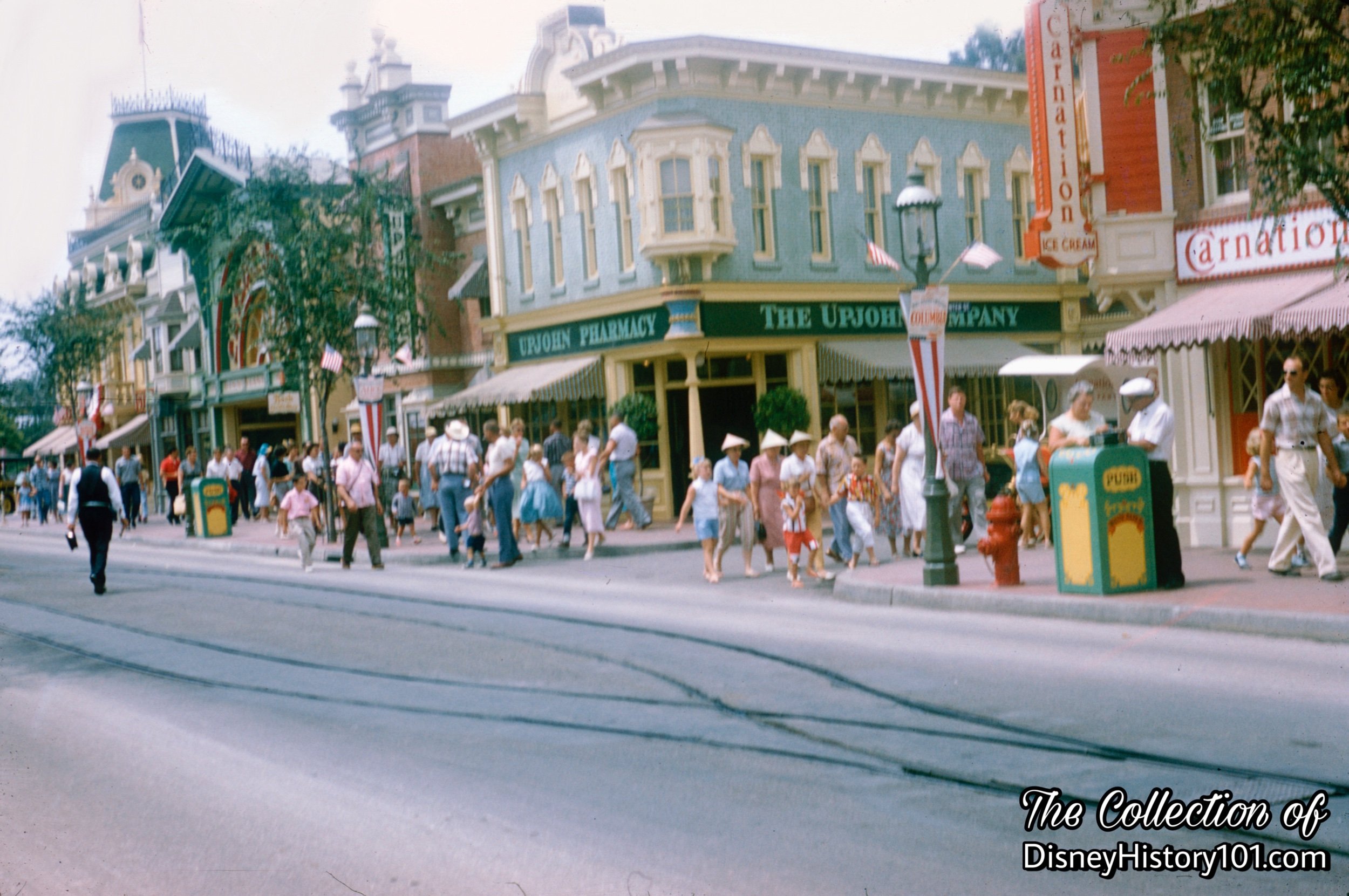
According to The Disneyland Story (September 3, 1954) : “You find yourself in a Civic Center or Town Square at the turn of the century, any time from 1890 to 1910. Here you will see…the Drug Store.” As we make our way by the barbershop quartet, and ice cream parlor, we arrive at another turn-of-the-century small town “staple” - Upjohn Pharmacy! This was Main Street U.S.A.’s original corner drug store, and an opening day Disneyland attraction at that. As guests entered, they could experience real licensed pharmacists (in period specific clothing), performing turn-of-the-century tasks in a Victorian-era apothecary shop. Pictured above, you’ll note an early “Vintage View” of Upjohn Pharmacy taken within a month of Disneyland’s opening day. The construction was unfinished, and the iconic mortar and pestle lamp was still not attached above the corner entrance.
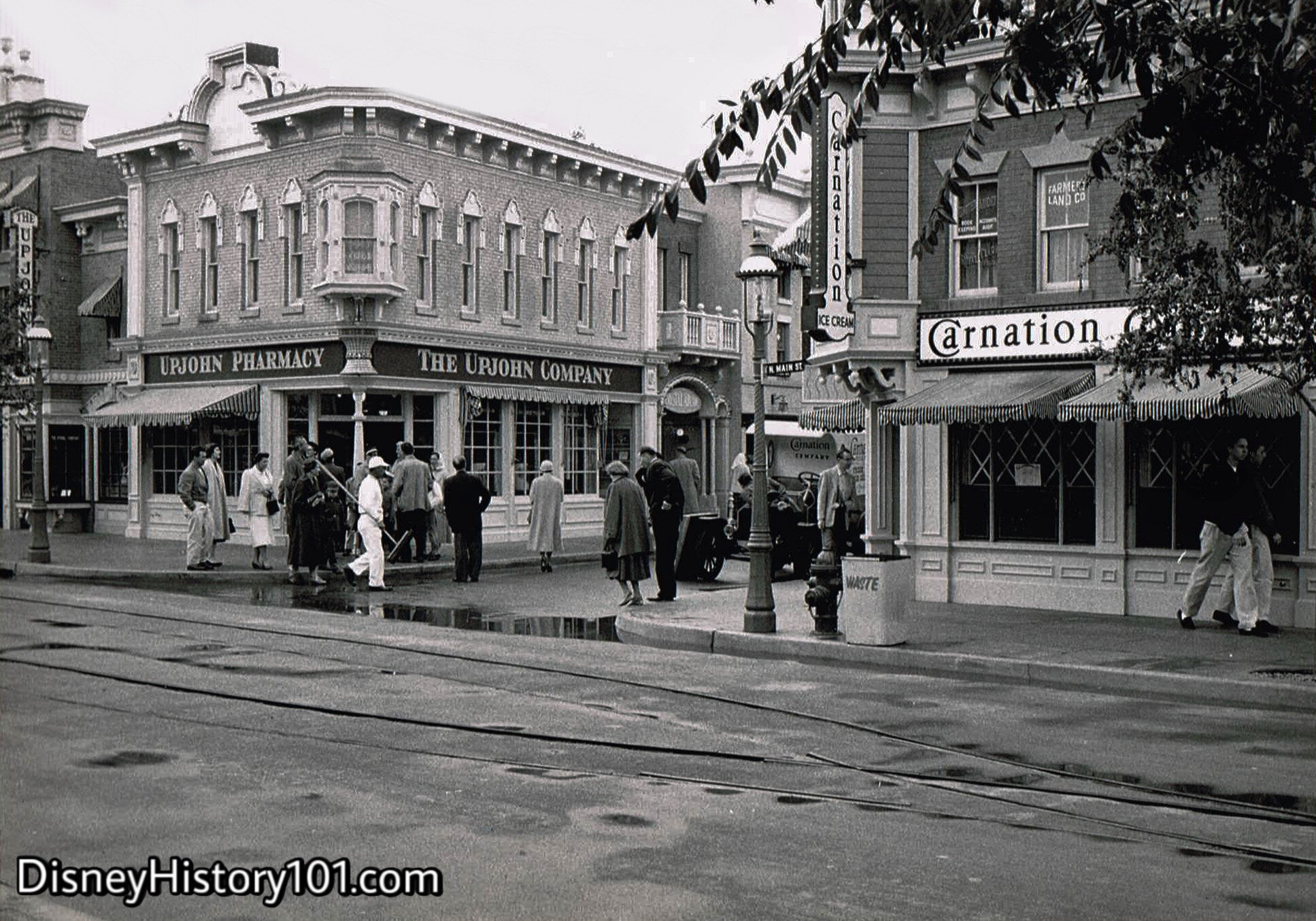
By September of 1955, the mortar and pestle lamp was fixed in place over the corner store’s entrance!
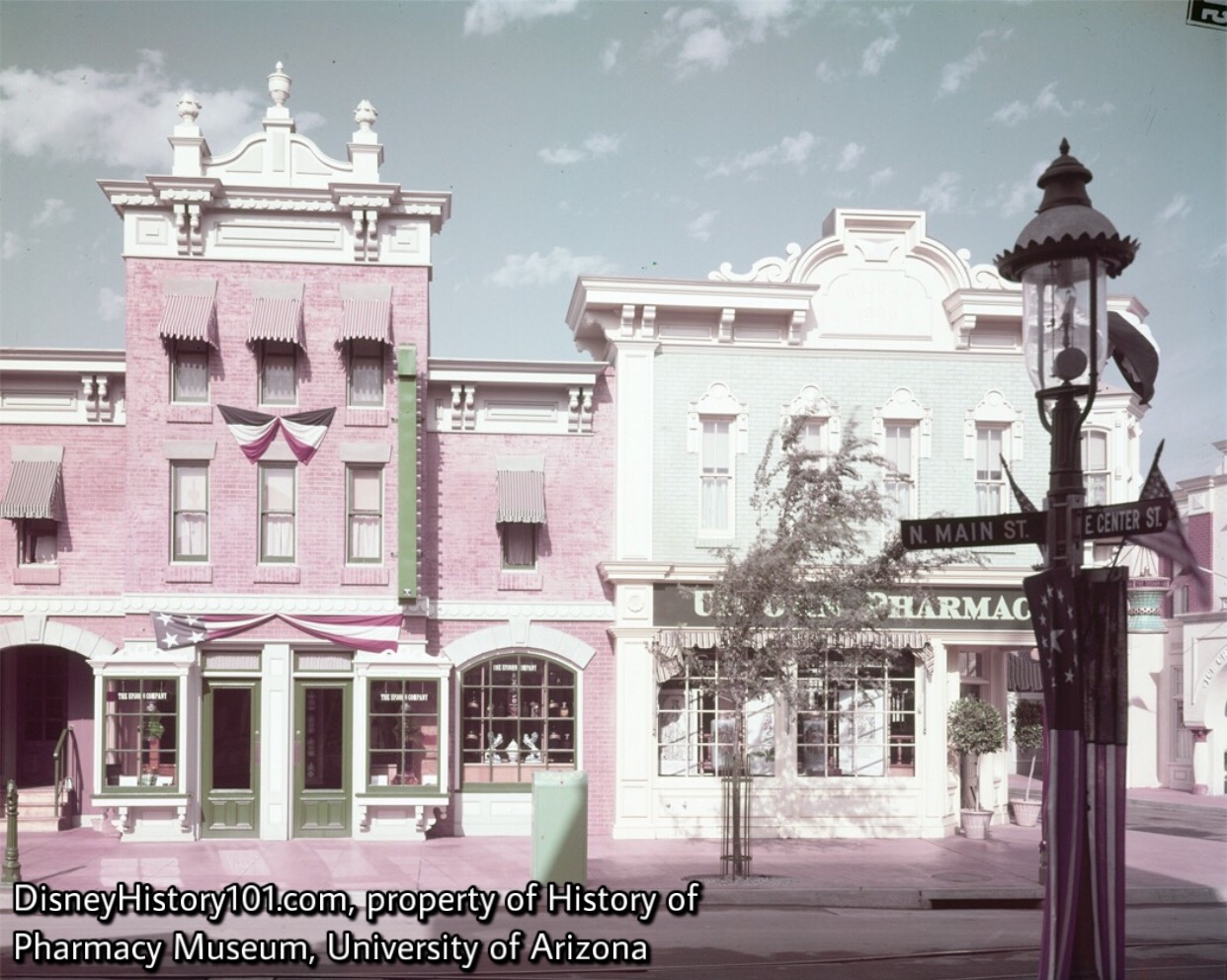
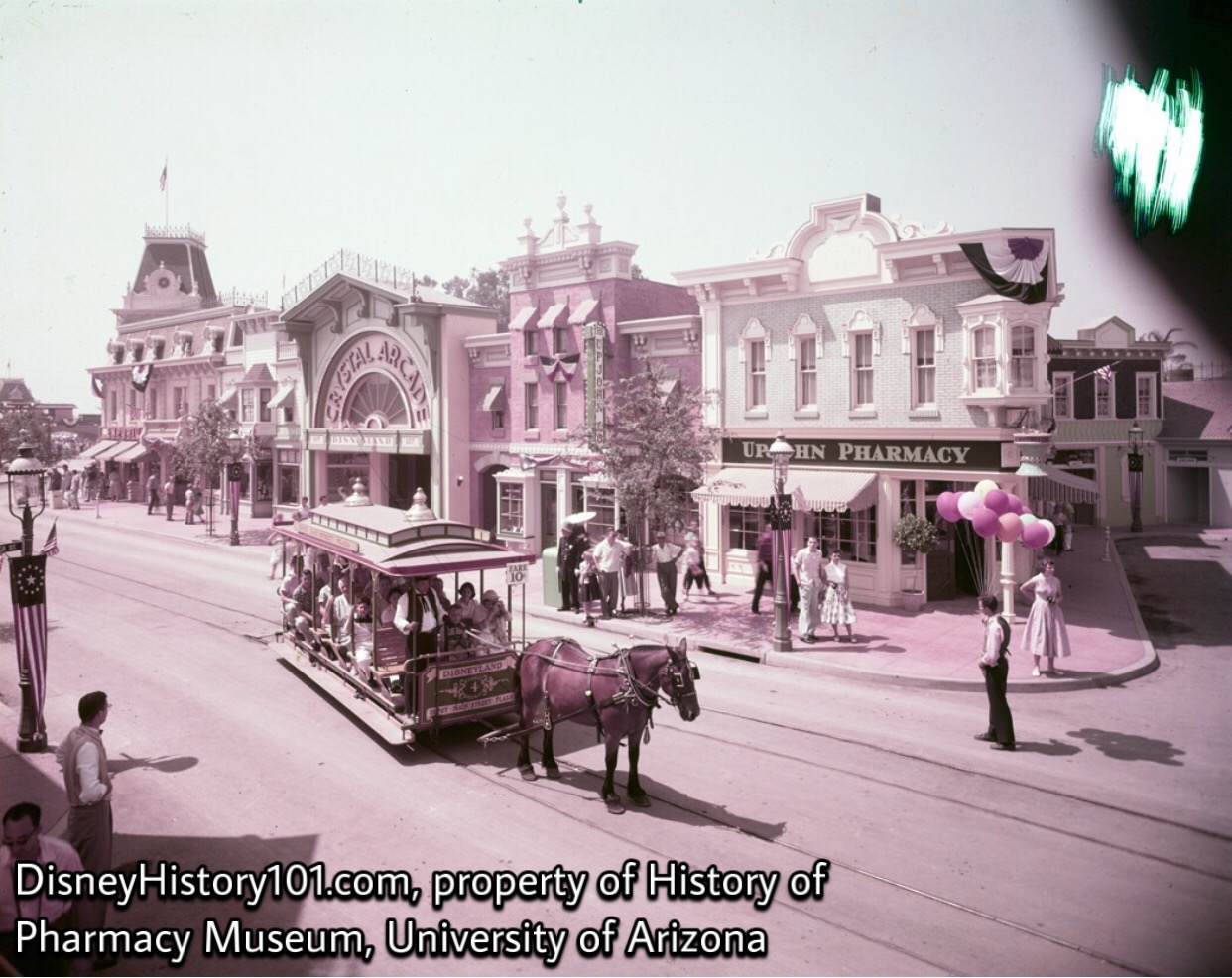
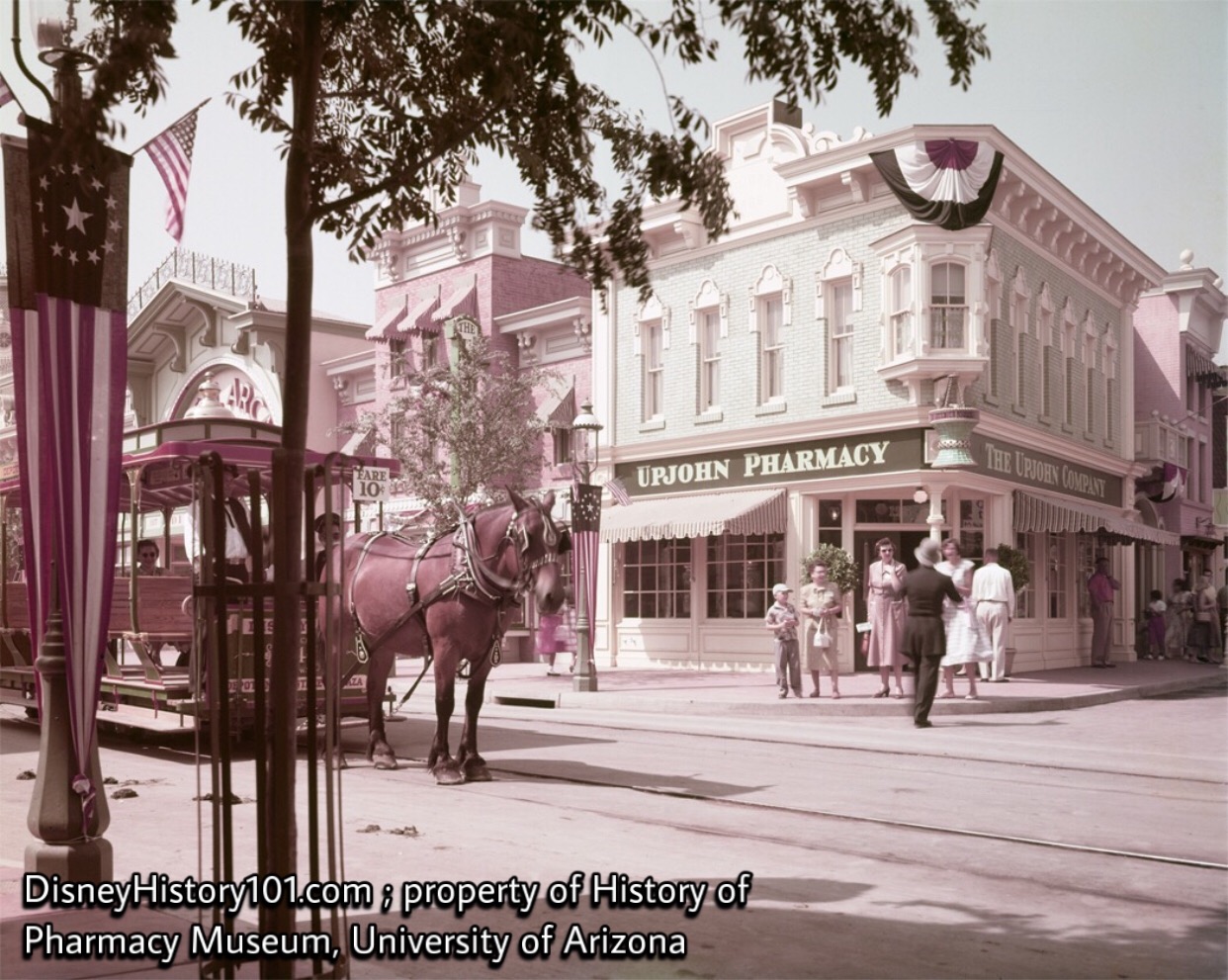
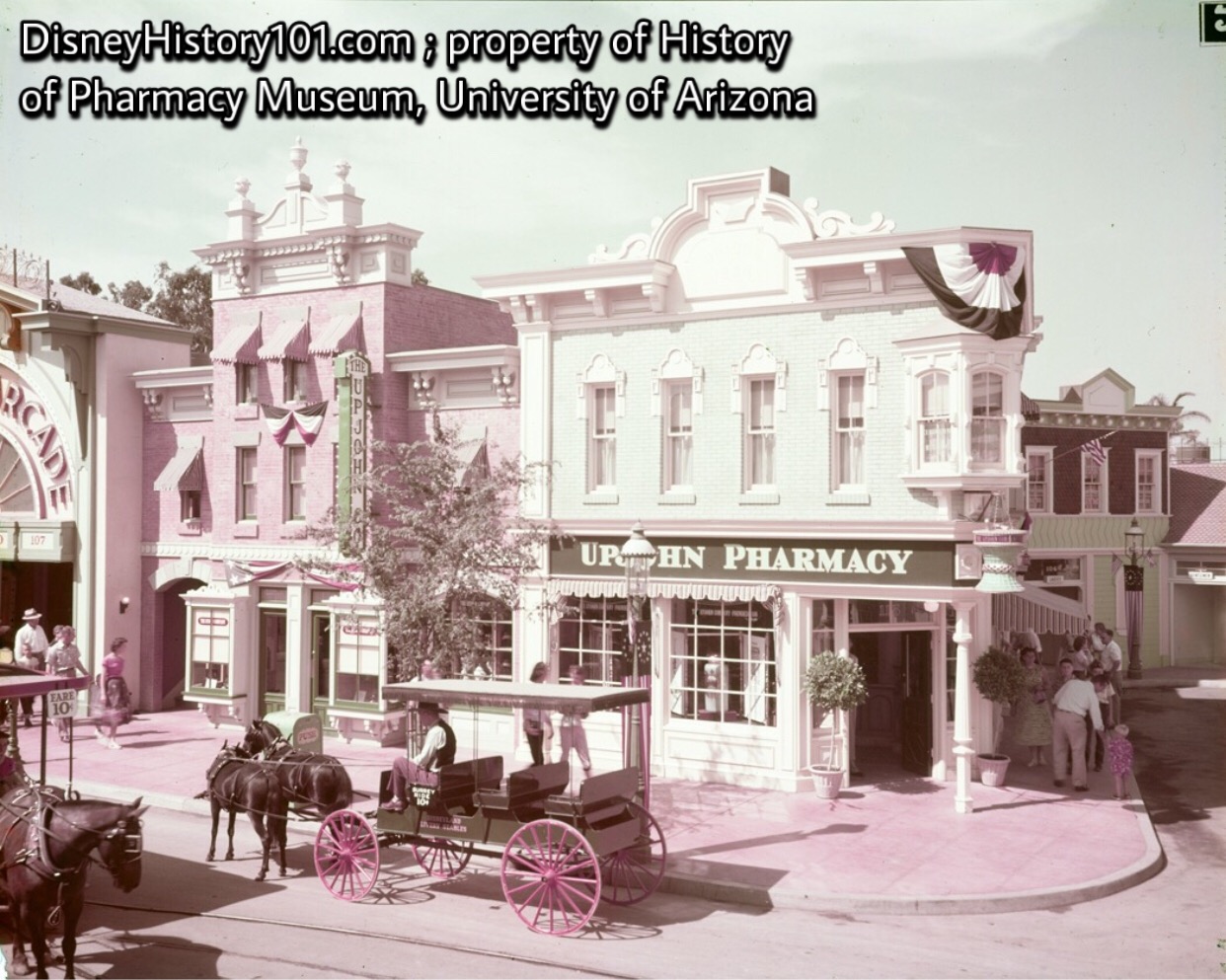
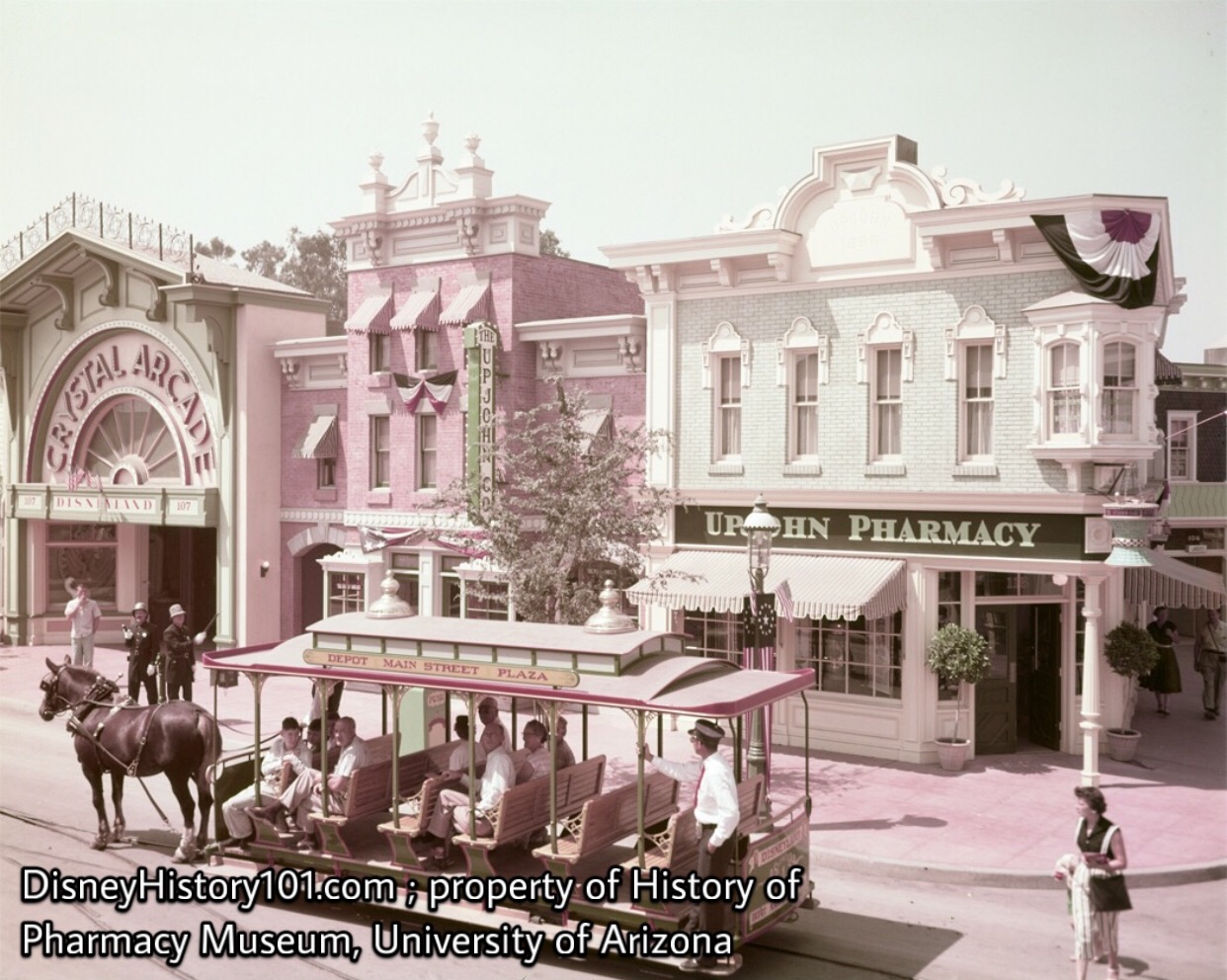
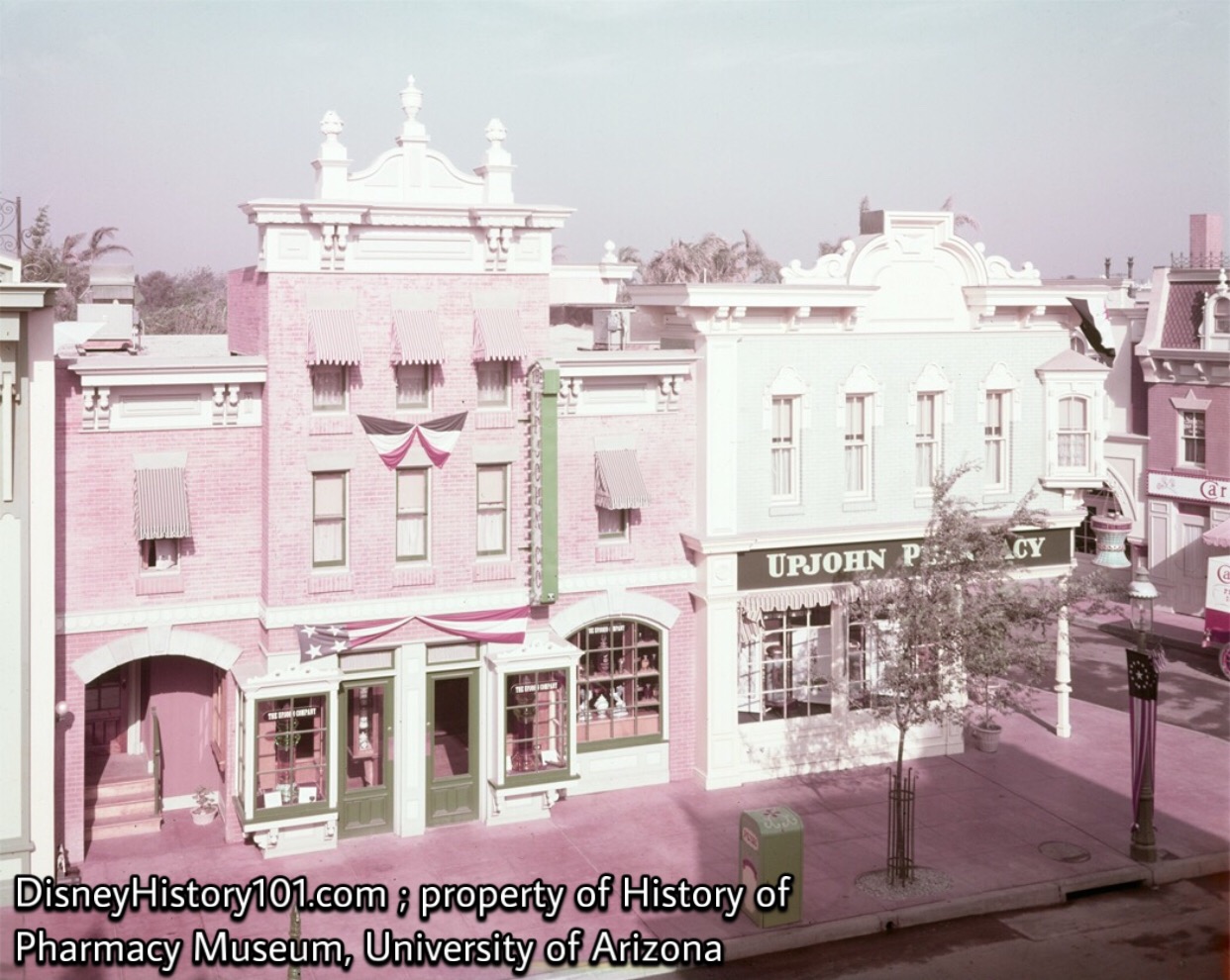
This image was used to produce Disneyland Upjohn Company souvenir postcards that were sold inside the corner store. The caption on the back read, “On the corer of Main Street and Center Streets in Disneyland, the Upjohn Pharmacy comprises one of the most complete museums of pharmaceutical wares, equipment and furnishings.”
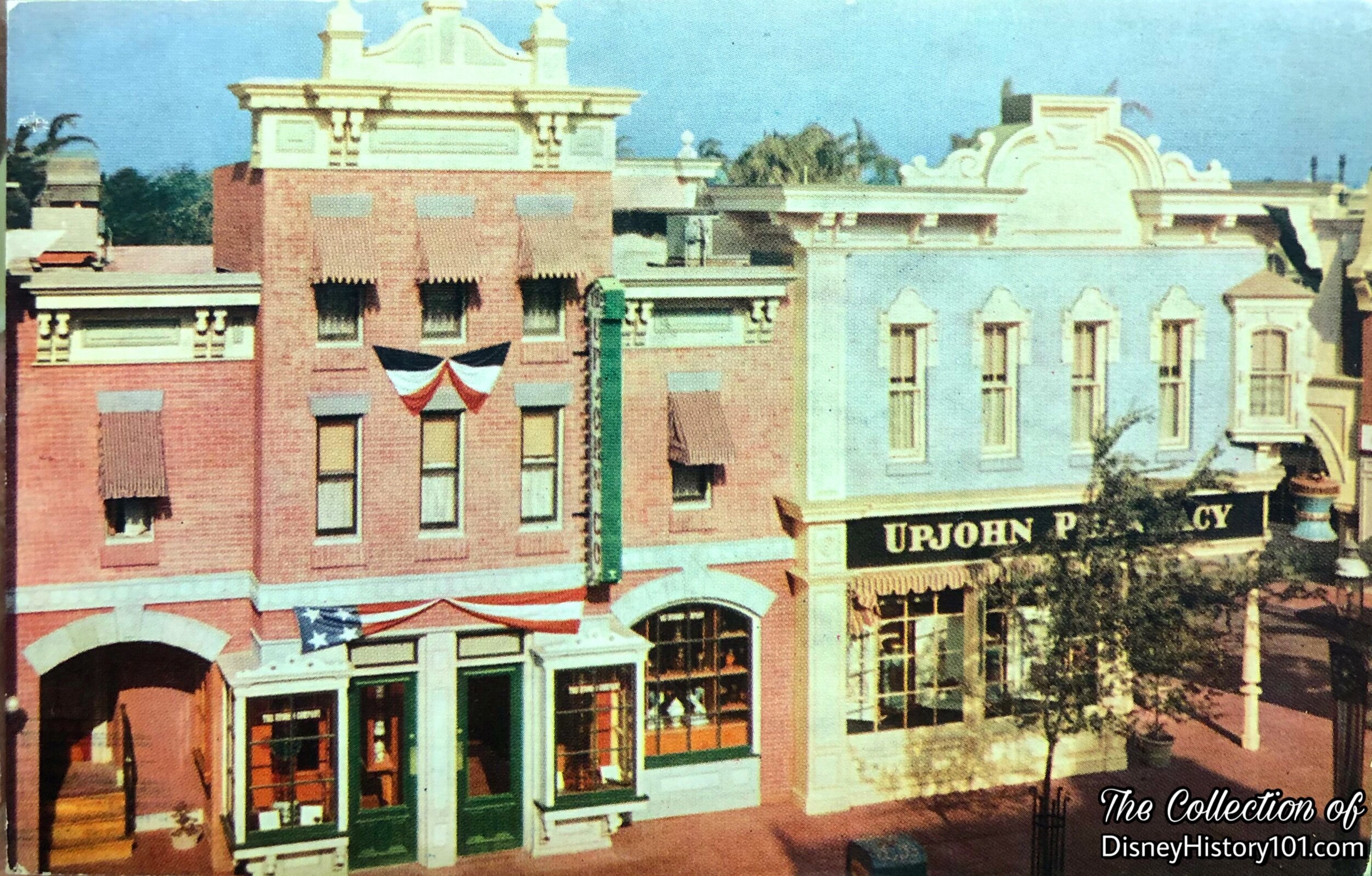
Here, we can see one of the actual postcards sold inside the Upjohn Company during Disneyland’s first fabulous decade.
The corporate synergy was good for a time. Institutional lessee The Up john Company yielded some revenue for Disneyland Inc. - $29,087 for the fiscal year ending September 29, 1957 and $29,600 for the fiscal year ending September 28, 1958.
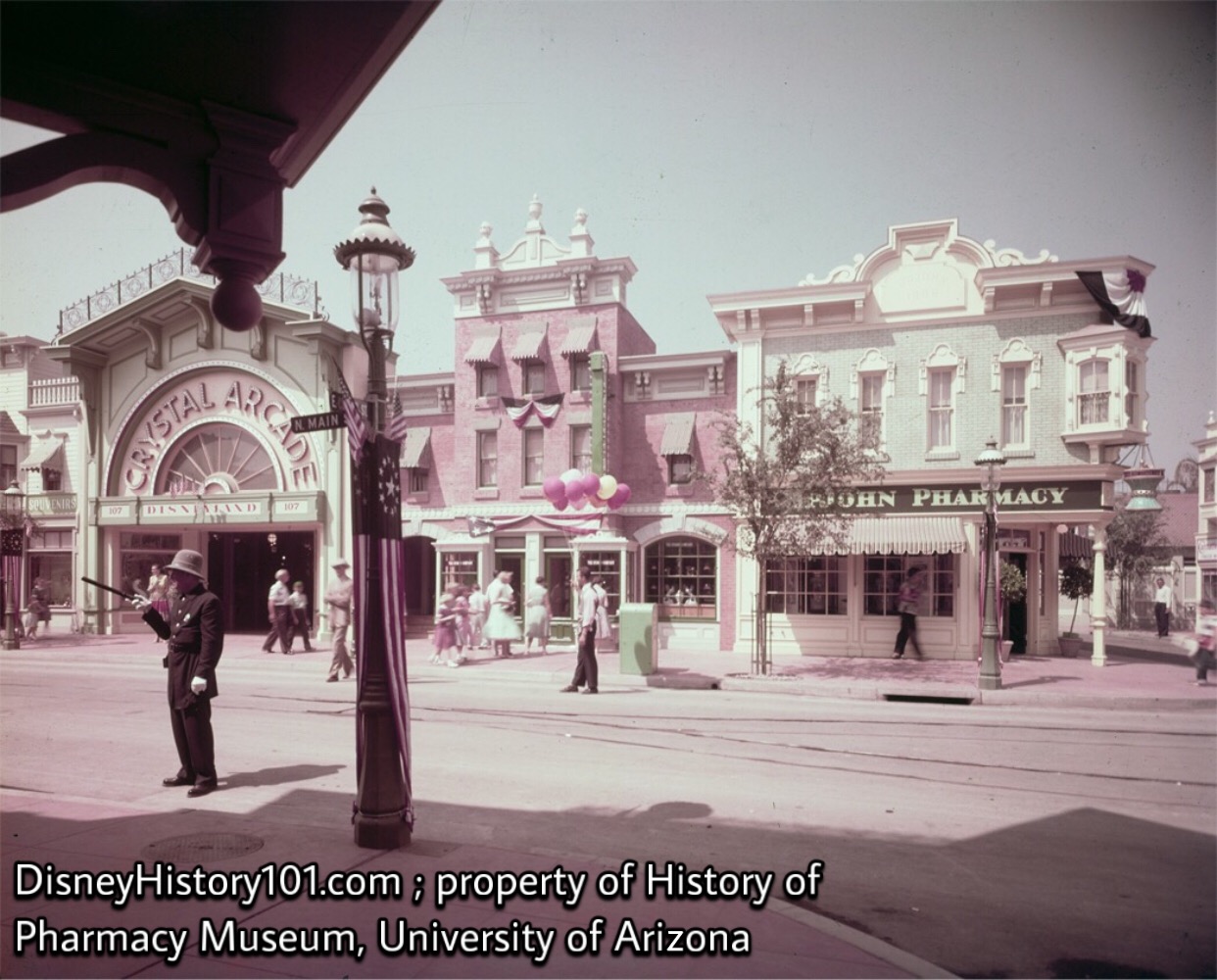
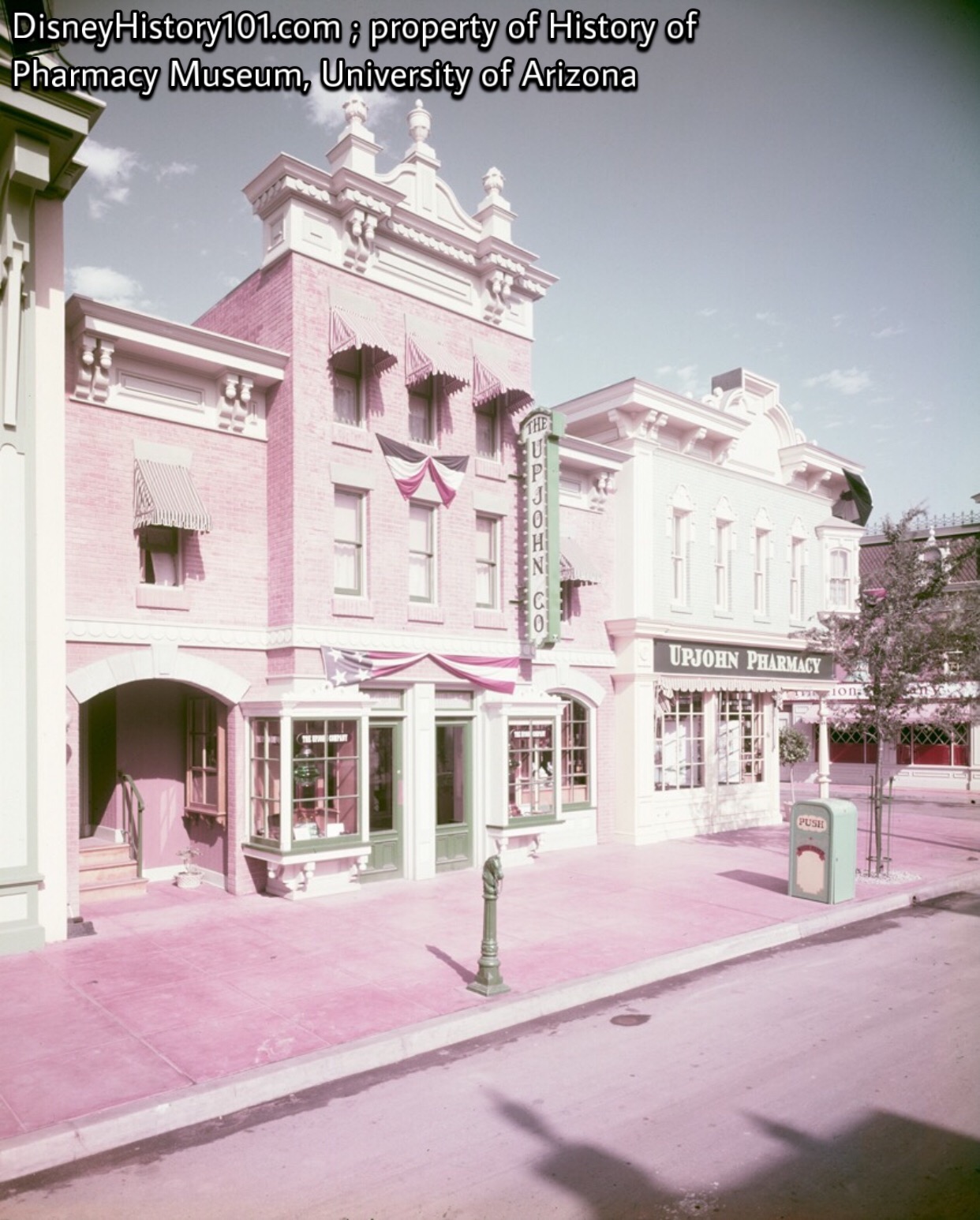
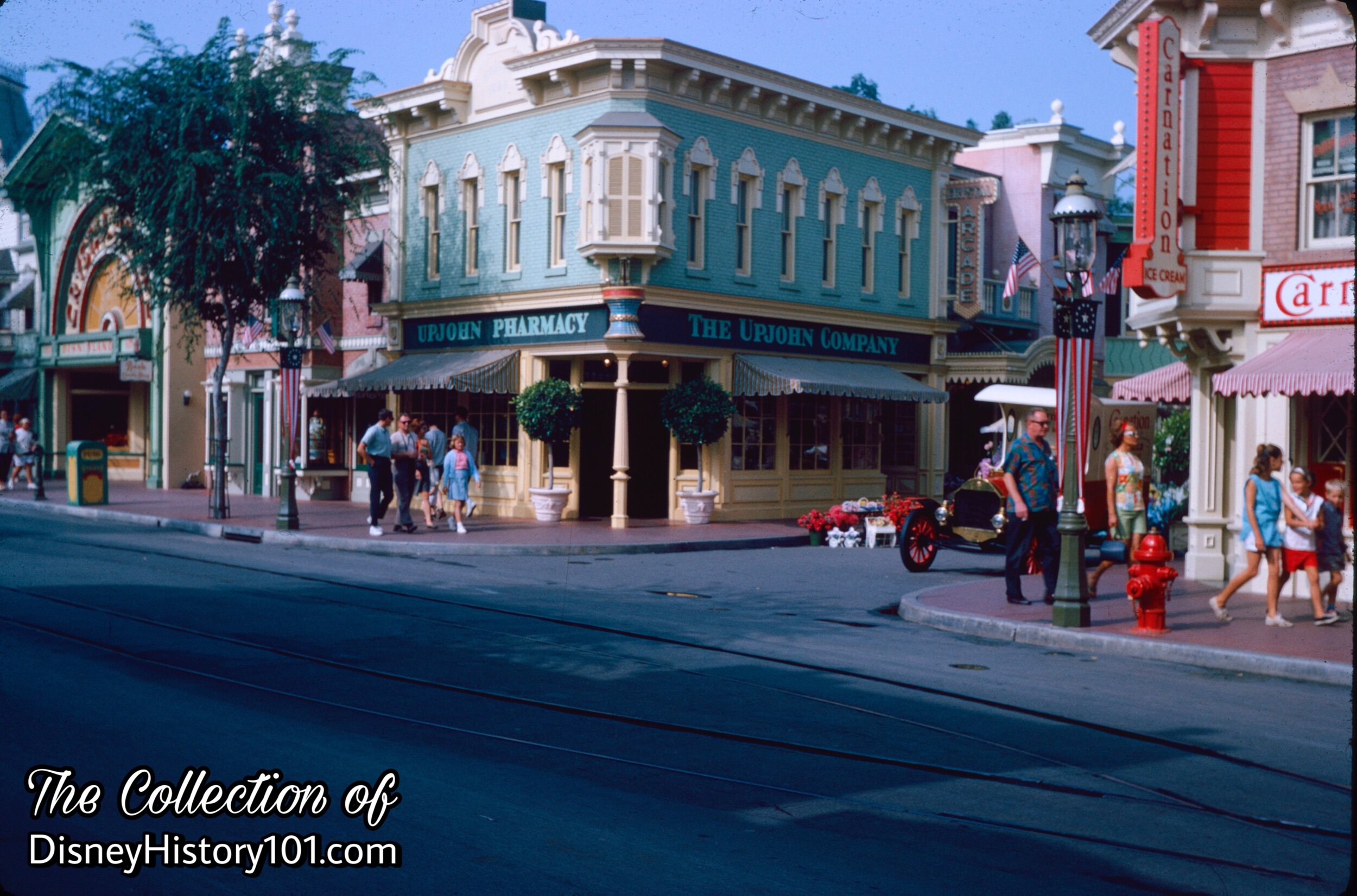
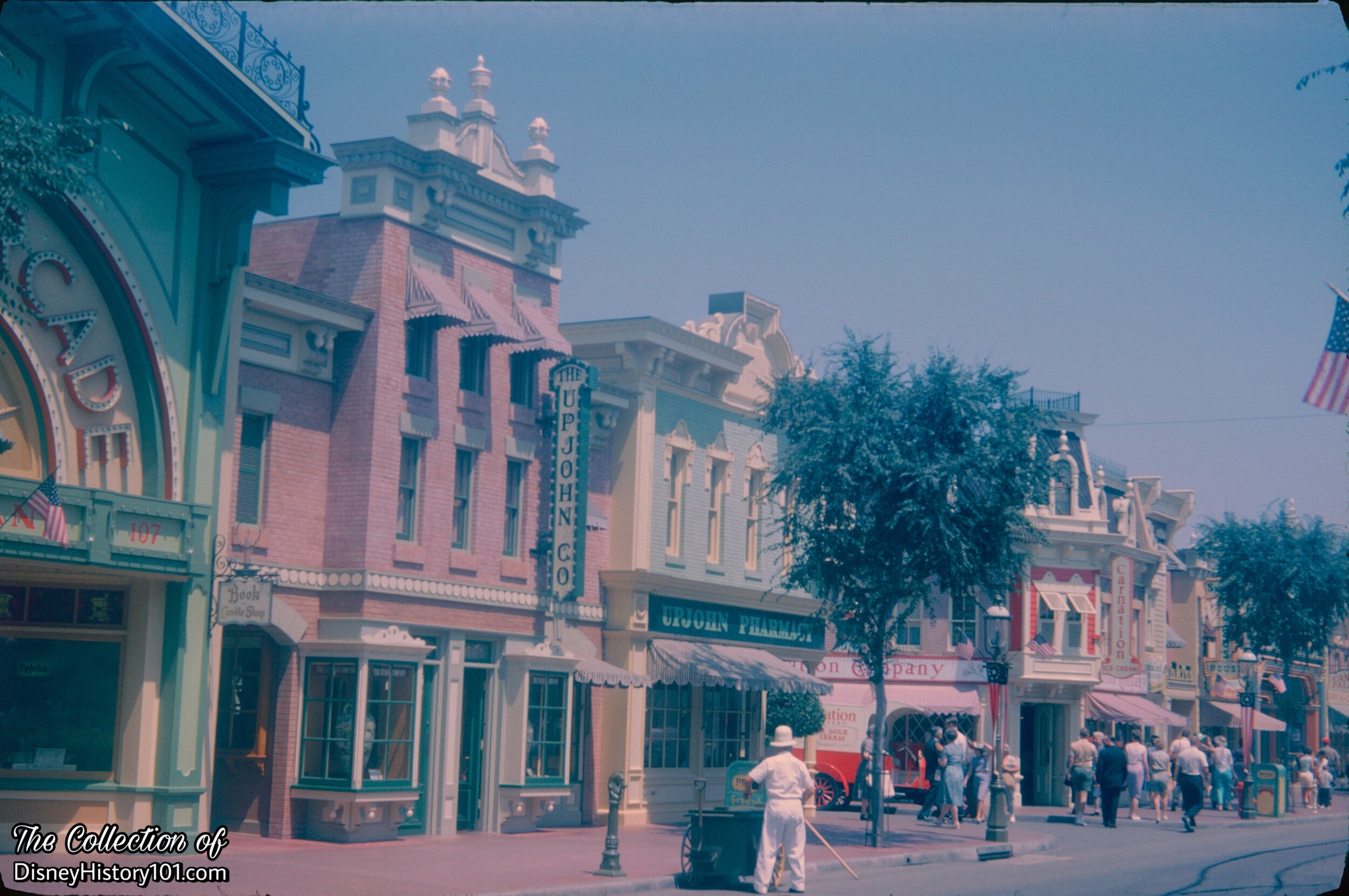
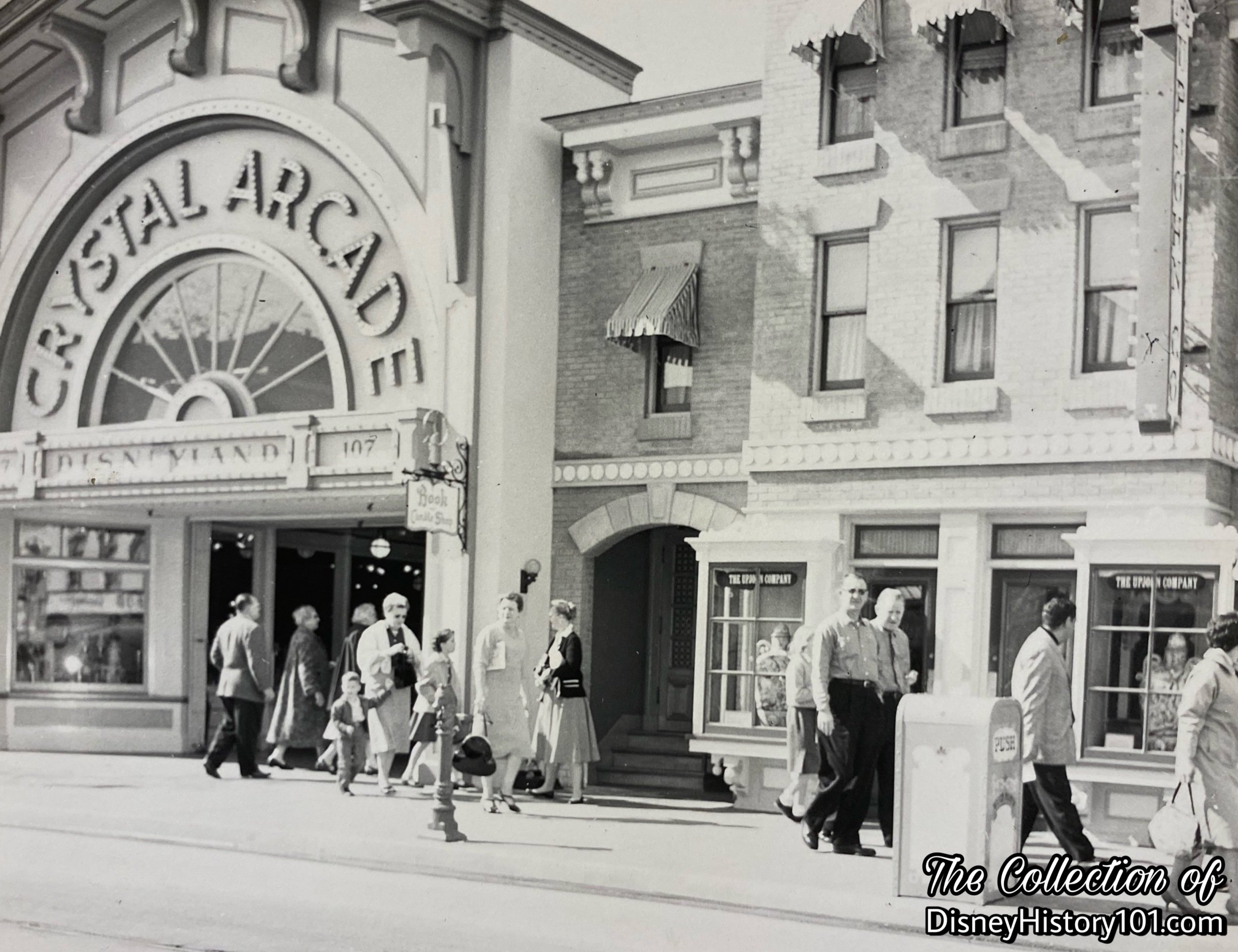
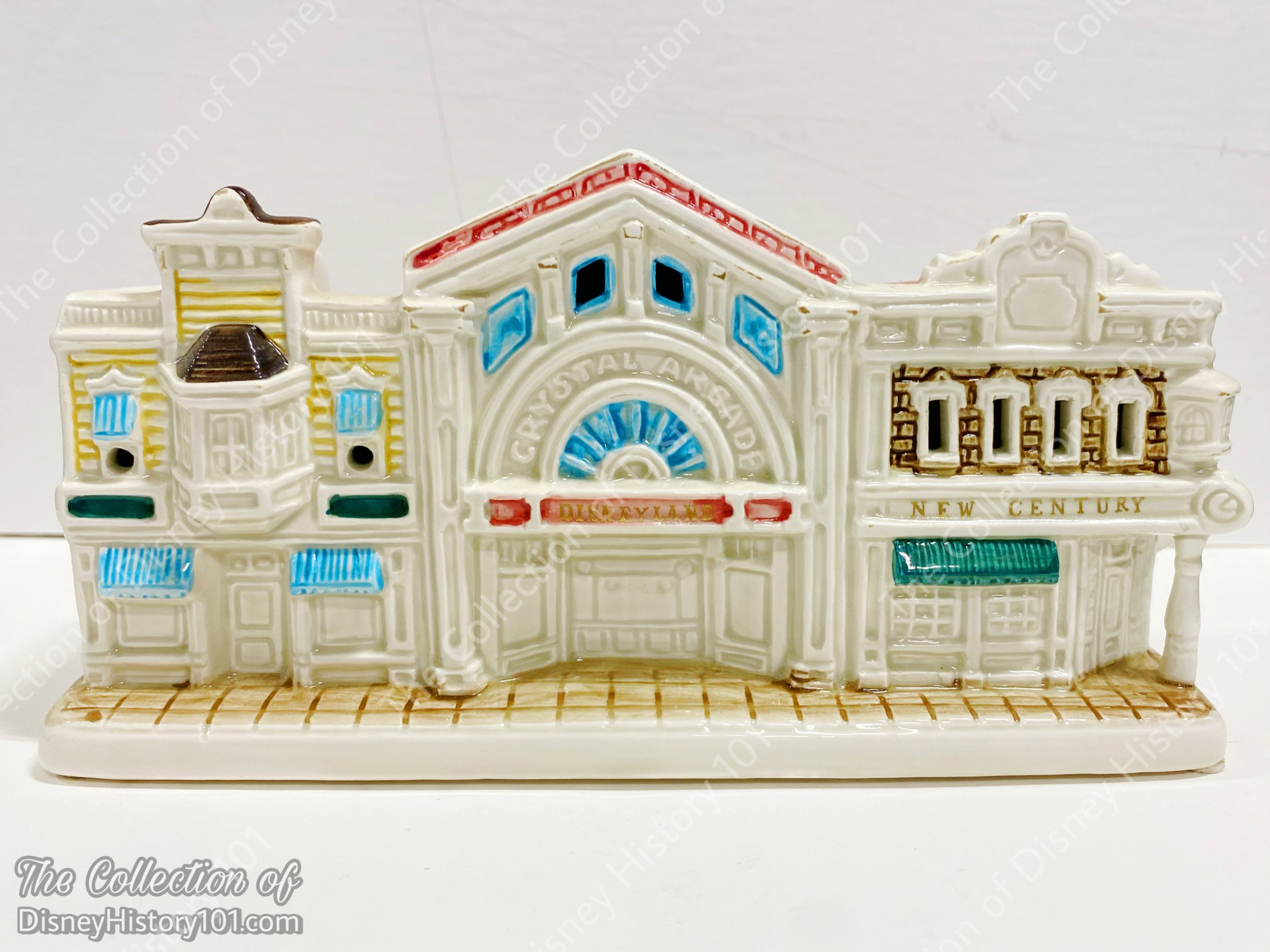
This rare Vintage View gives us a look at just how far the Upjohn Pharmacy’s storefront window displays stretched - clear down to the north side of the Crystal Arcade’s entrance! Notice those stained glass panels above the Crystal Arcade’s entrance, bearing the familiar mortar and pestle logo which hung over the Center Street entrance. The mortar and pestle was ironic, since the Upjohn pills had the reputation of being friable (meaning that they could be crushed “under the thumb”.
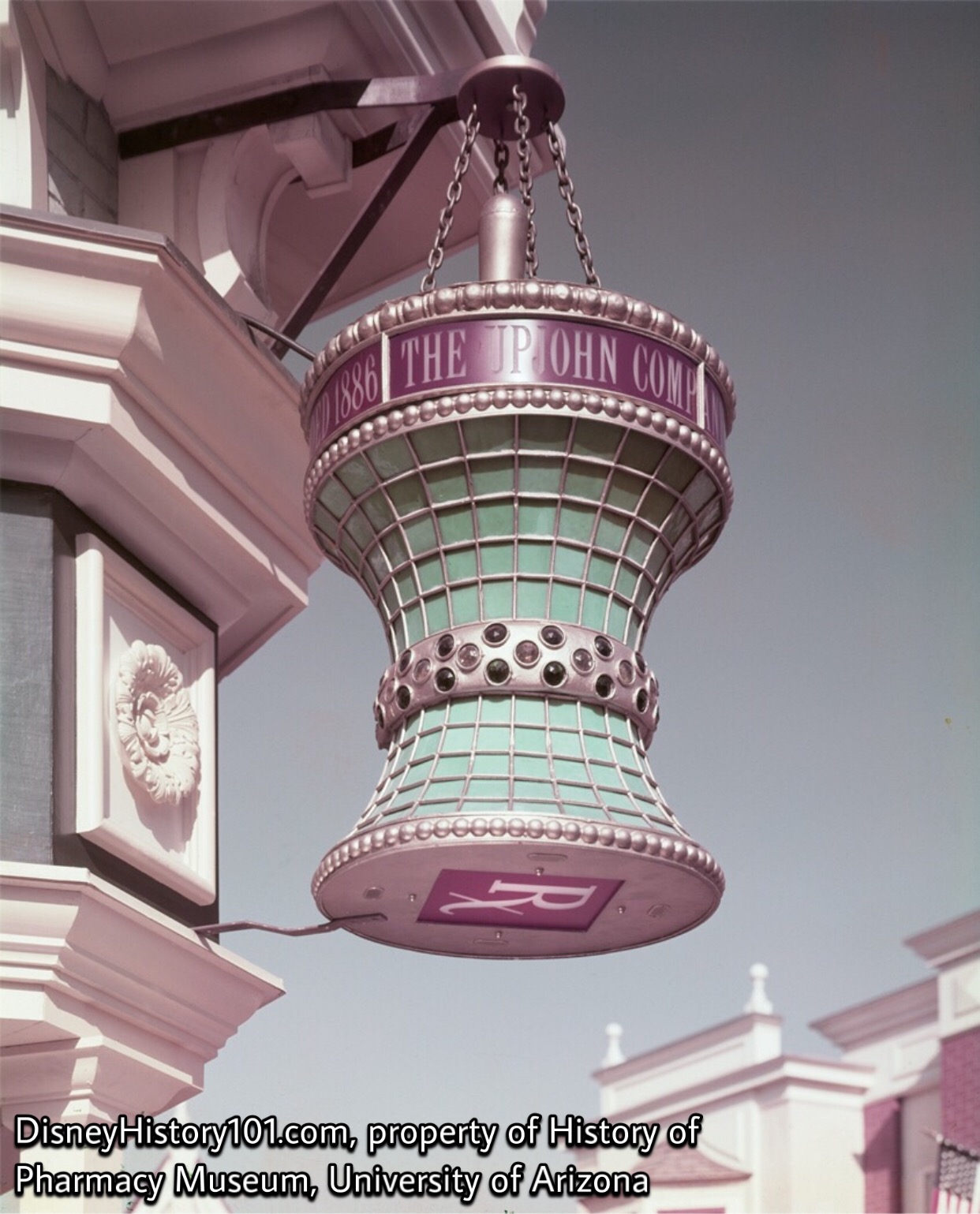
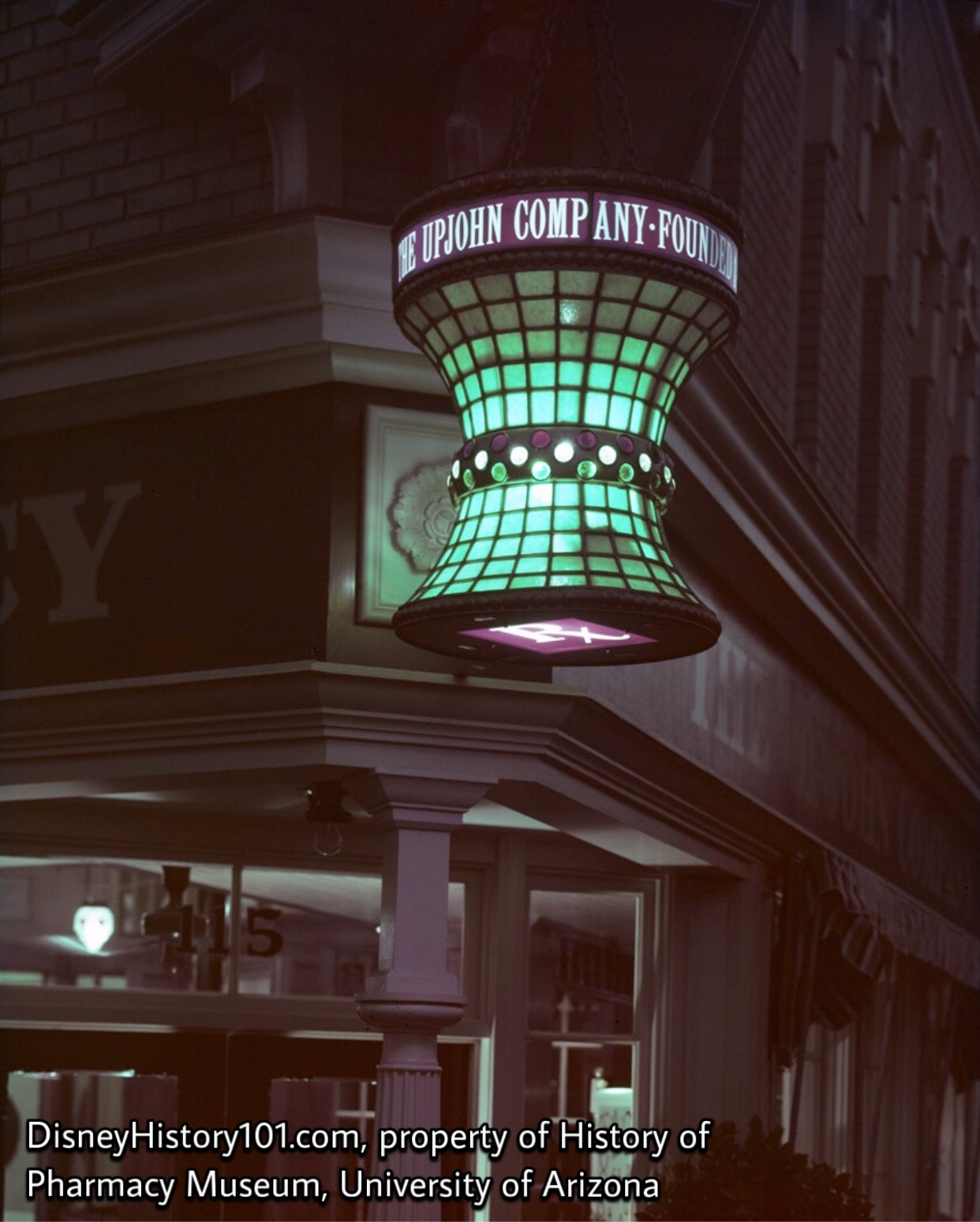
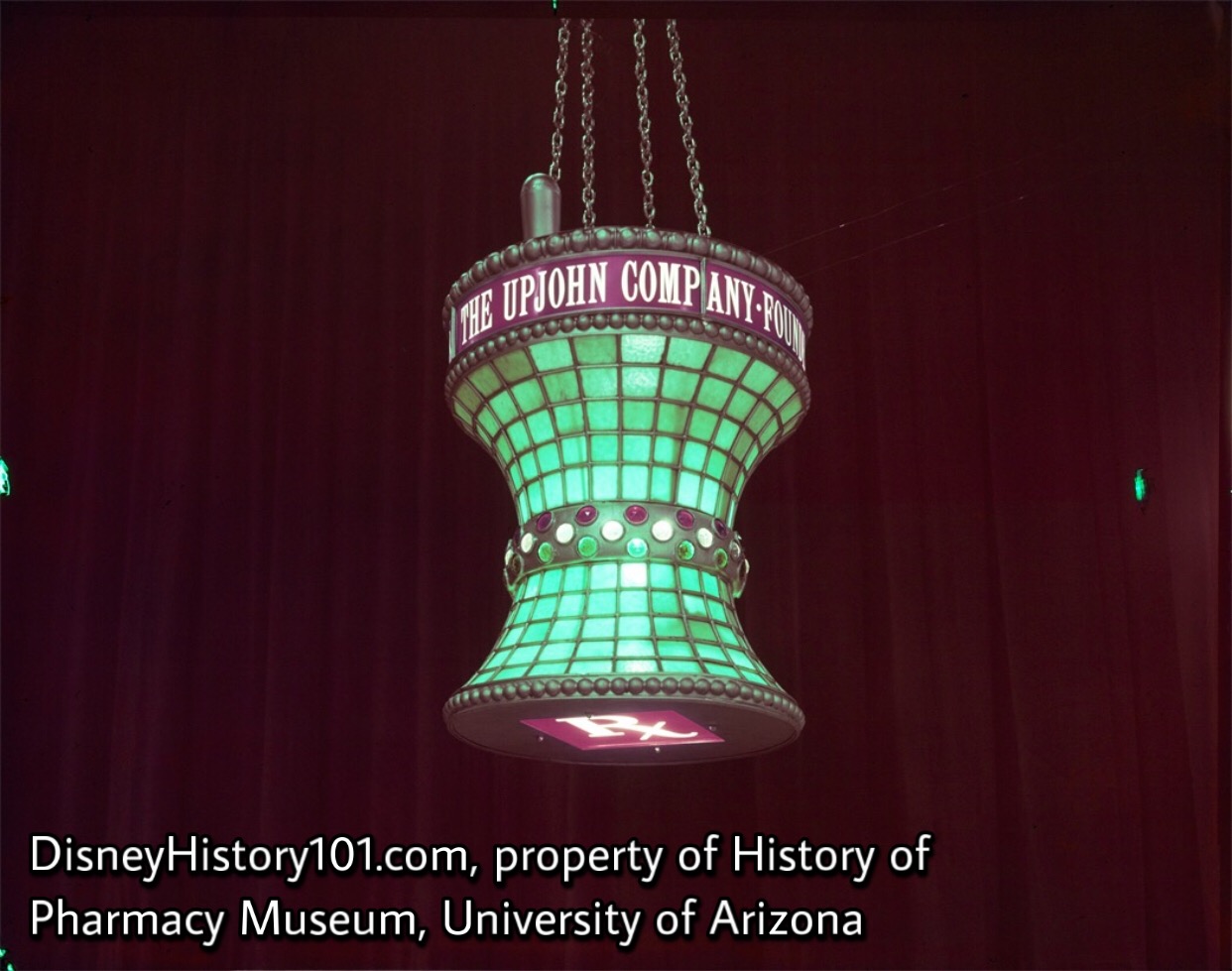
Looking over the Illuminated mortar and pestle lamp, we are reminded of Walt’s own words (in 1962), “I like to be around when the lights come on. It seems like a new kind of magic takes over in Disneyland after dark.”

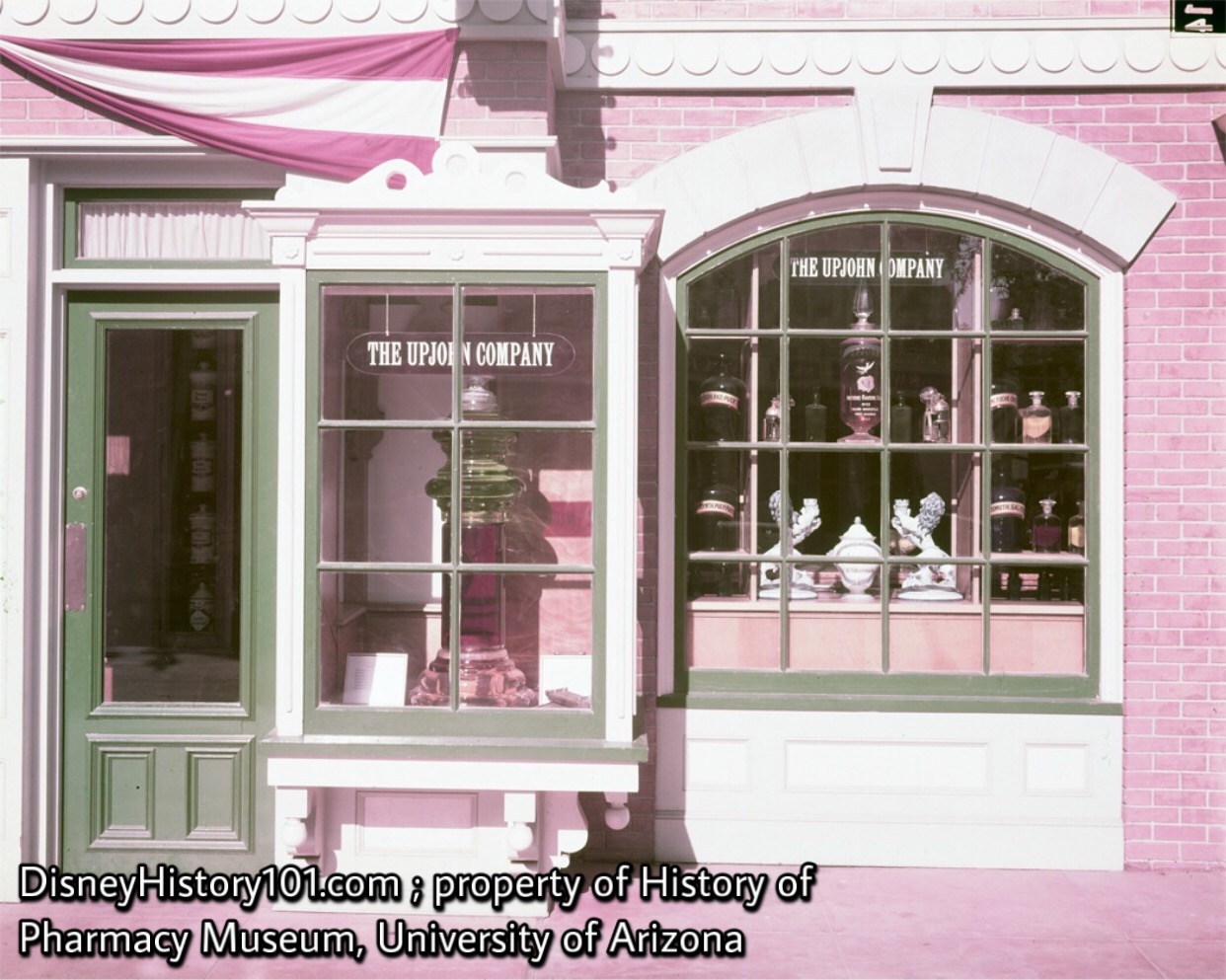
Window displays have always played an important role -communicating to guests the essence of a shop and were designed to invite guests into the store. These may be animated or still and would also include props used for display purposes.
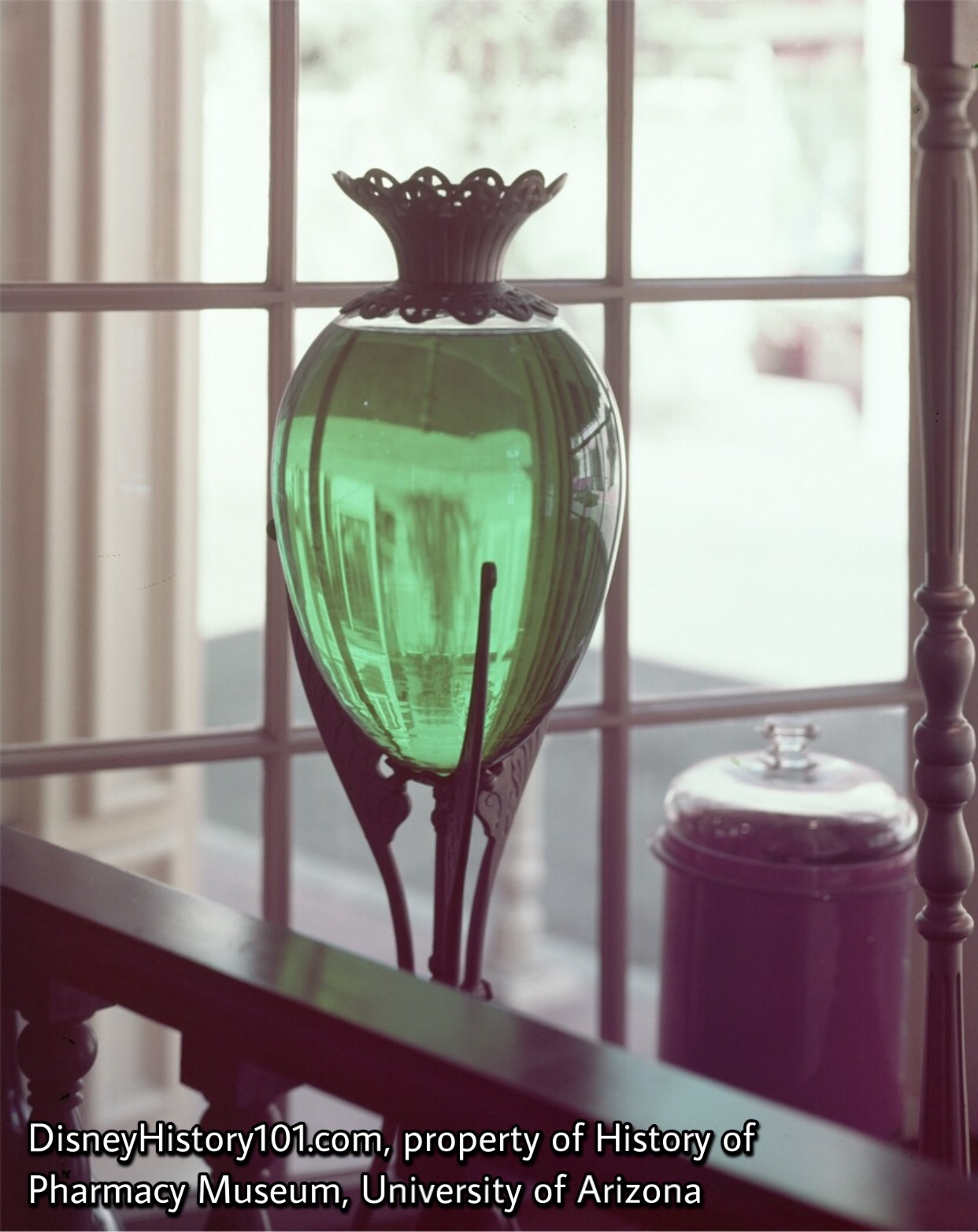
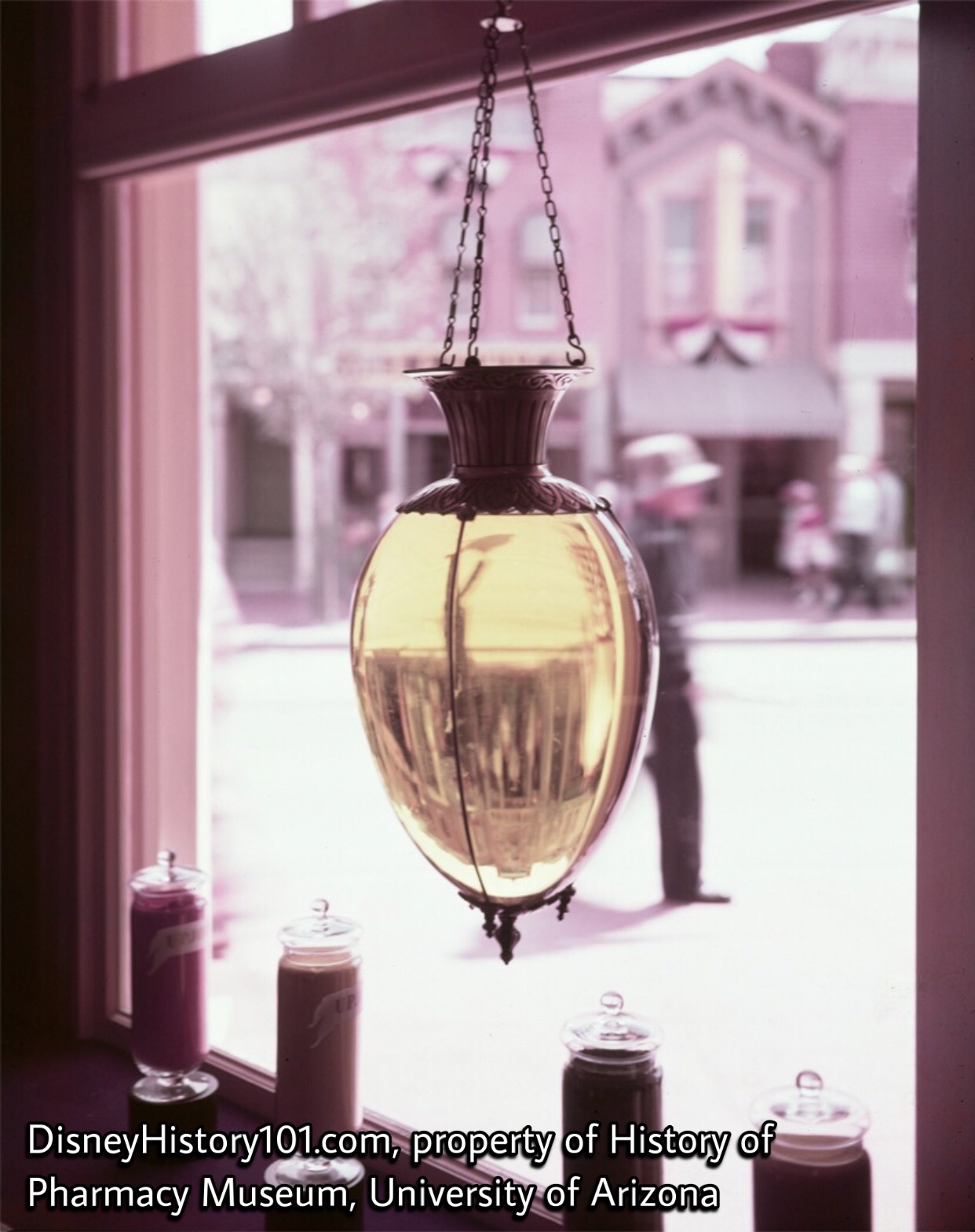
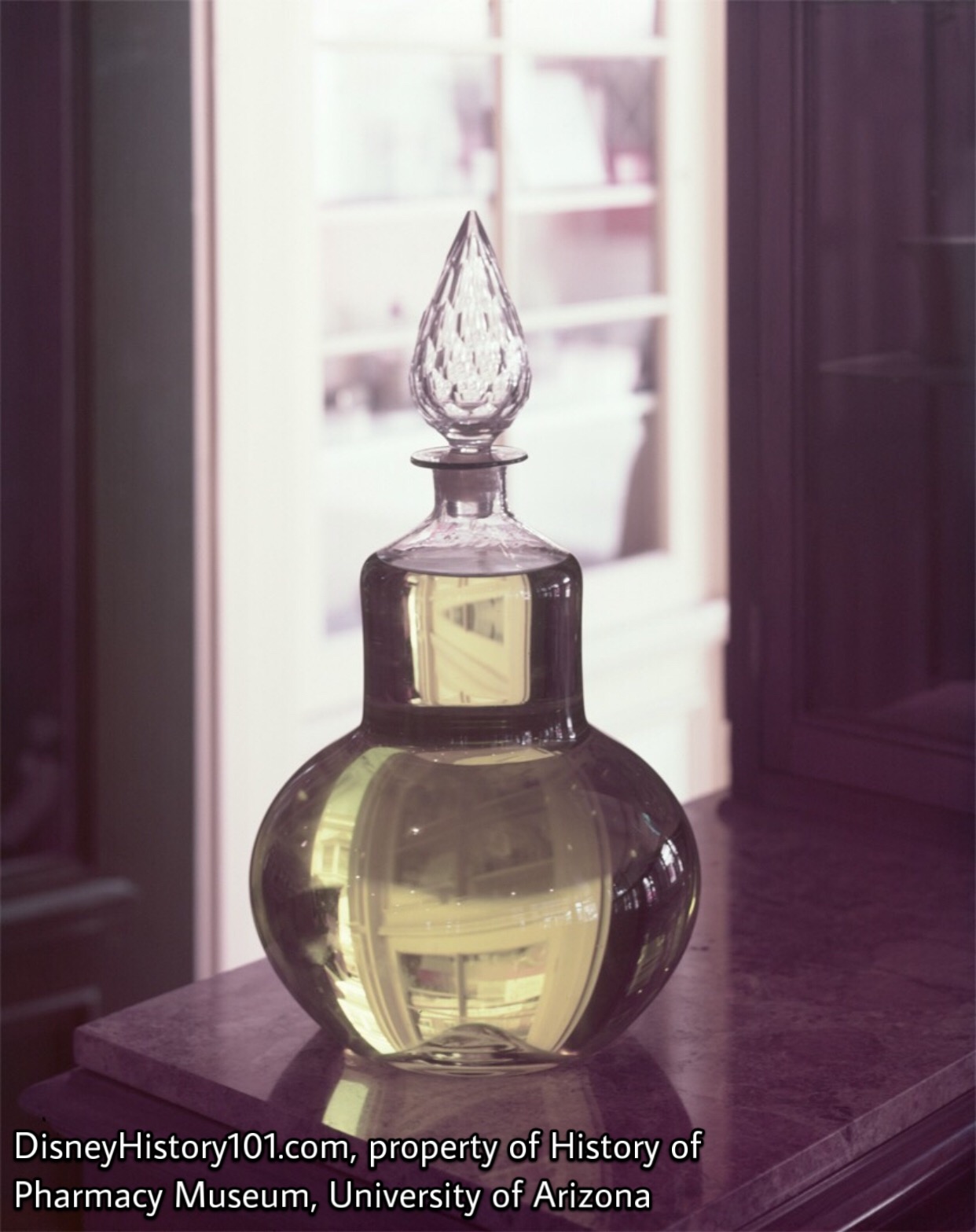
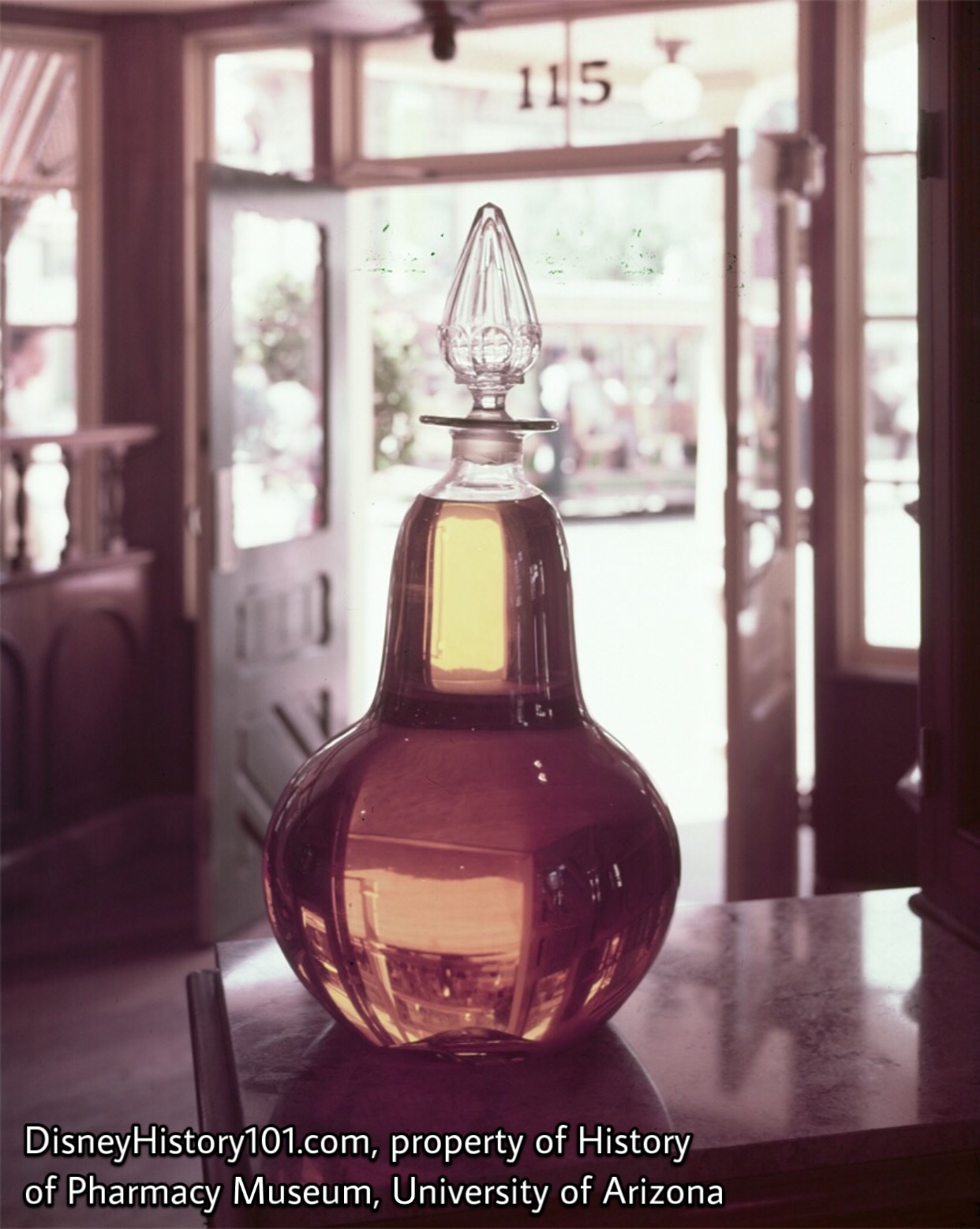
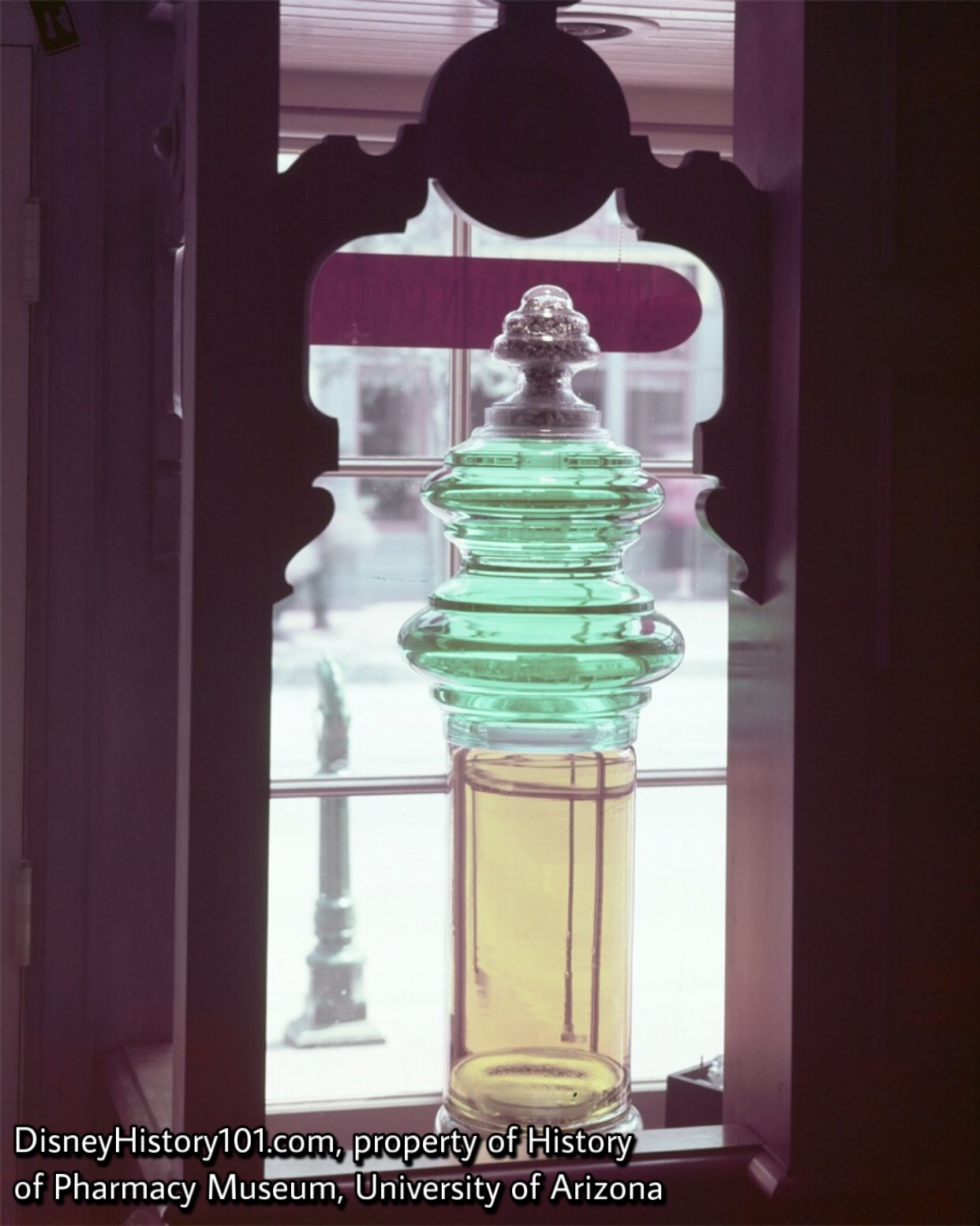
Upjohn Pharmacy housed several show globes. Much like the barber’s pole, show globes were once associated with Apothecaries. There remains a mystery as to the meaning of the globe’s color or the etymology of the name. Some believe that the color may have advertised the health of the local community to travelers passing through town, but there are no sources to confirm or deny that this was the case.
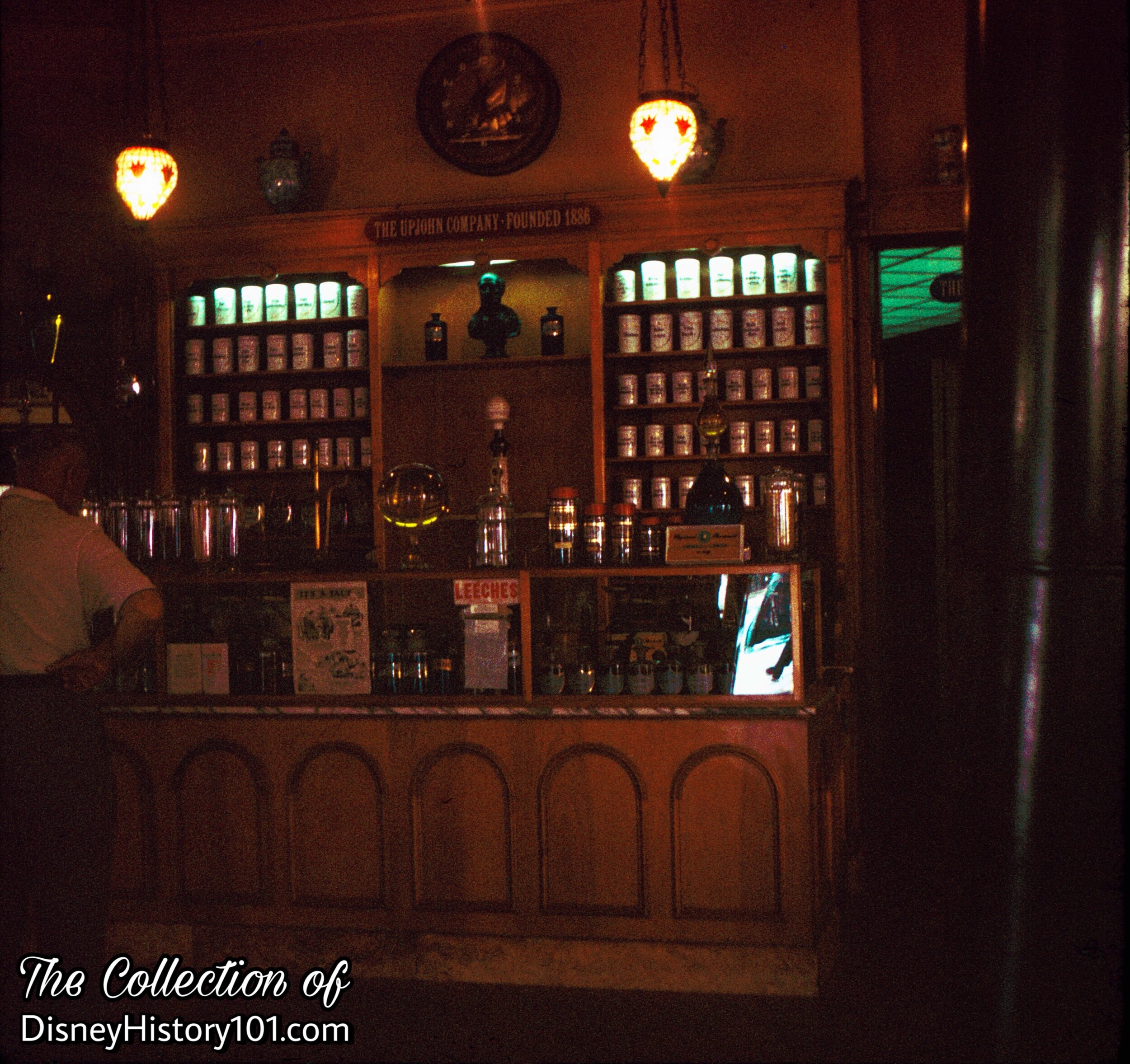
In the center of the counter, you can see the jar holding genuine leeches on display such as were used in medical practice before modern-times.
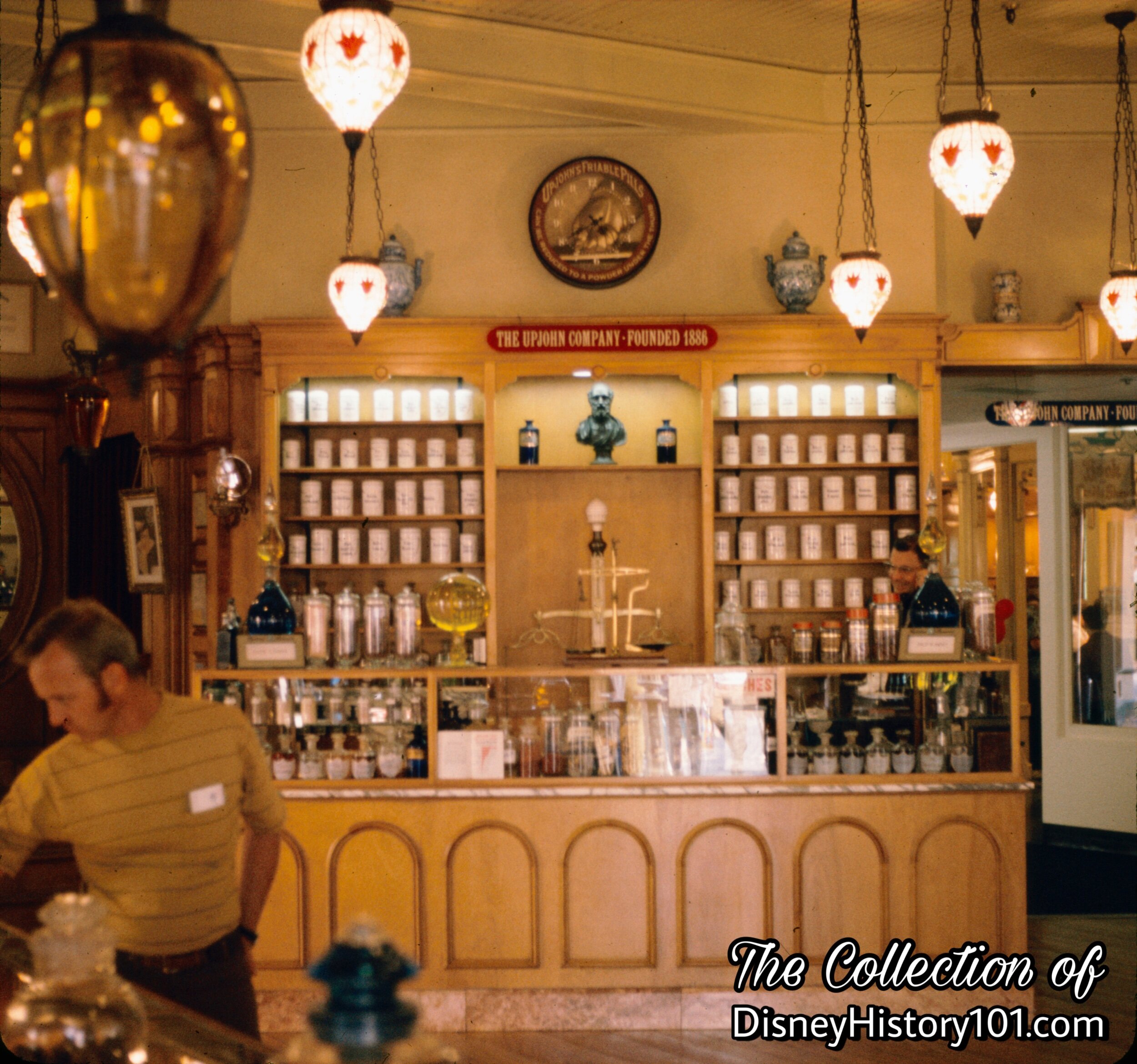
Guests like Disneylander Ron Dominguez (who thought about leaving after his first summer in 1955 and originally wanted to be a pharmacist) may have been inspired by the exhibit.
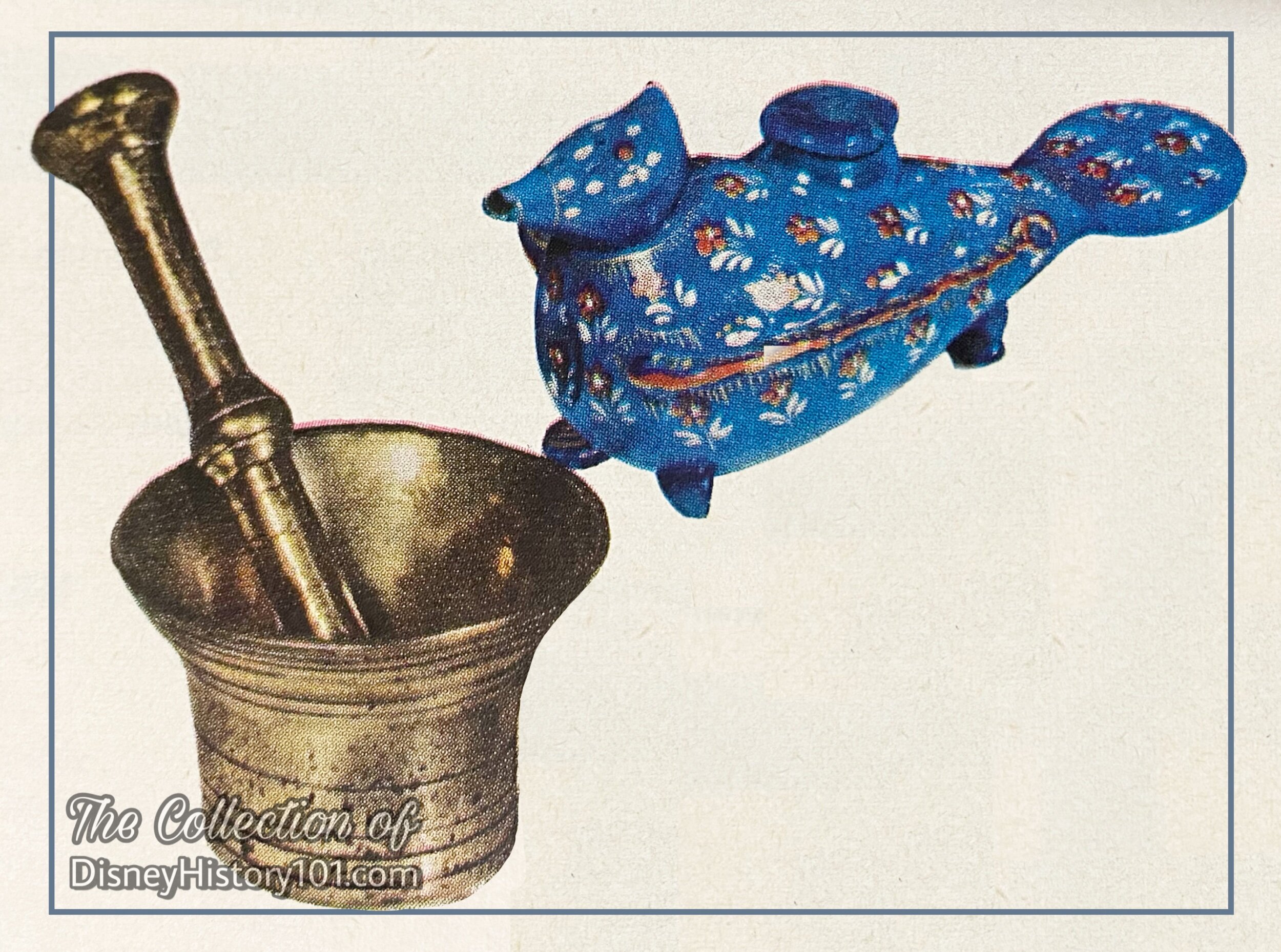
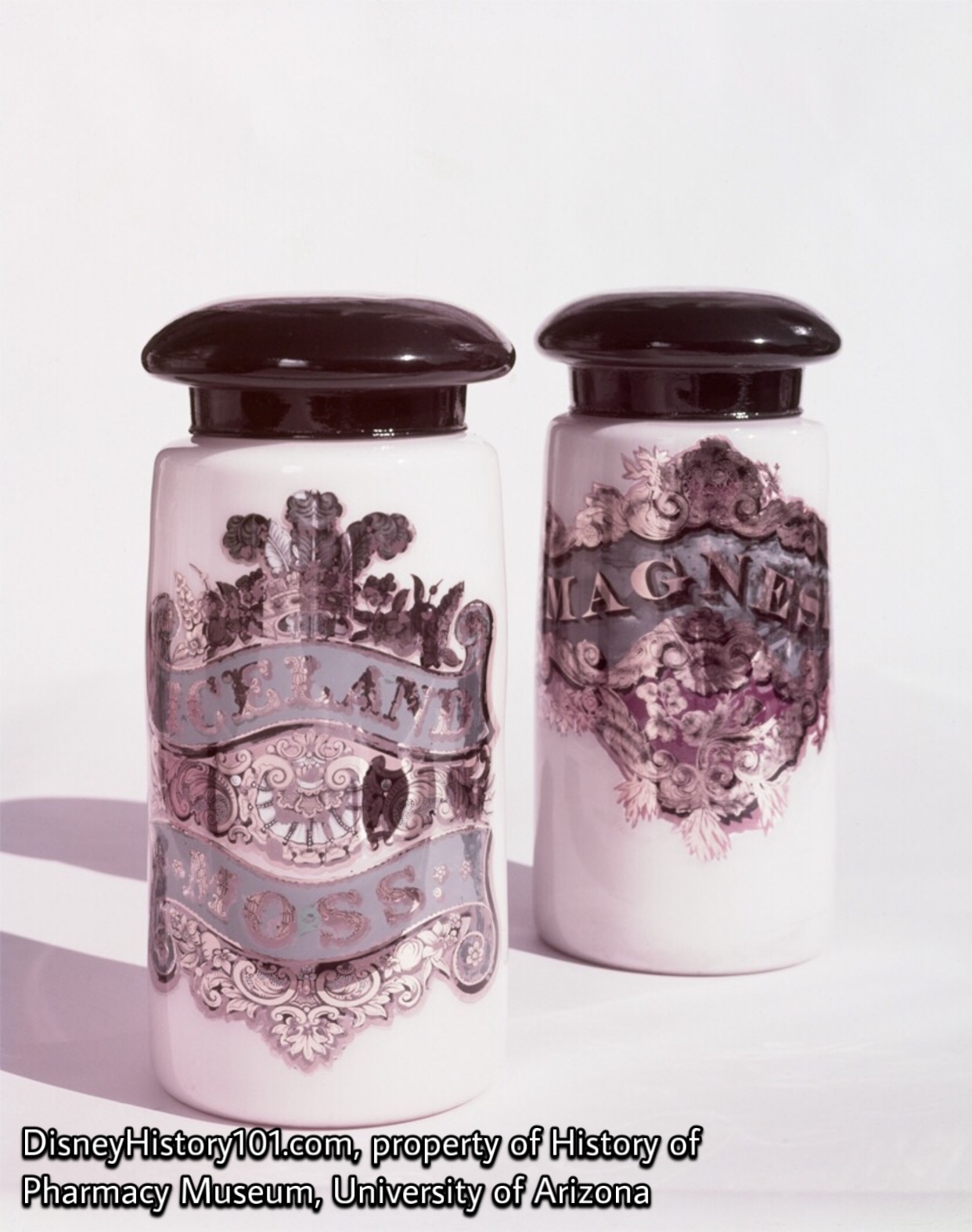
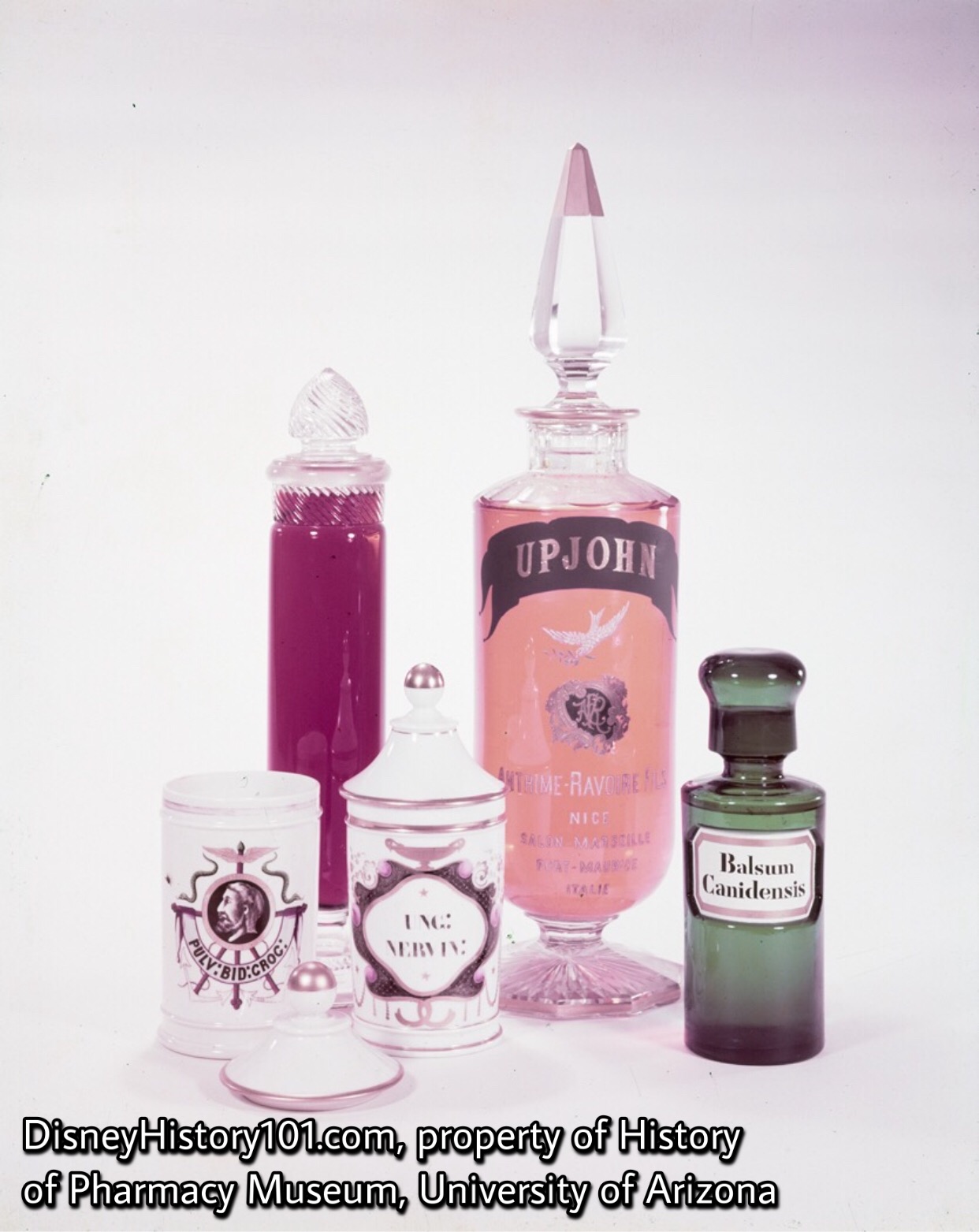
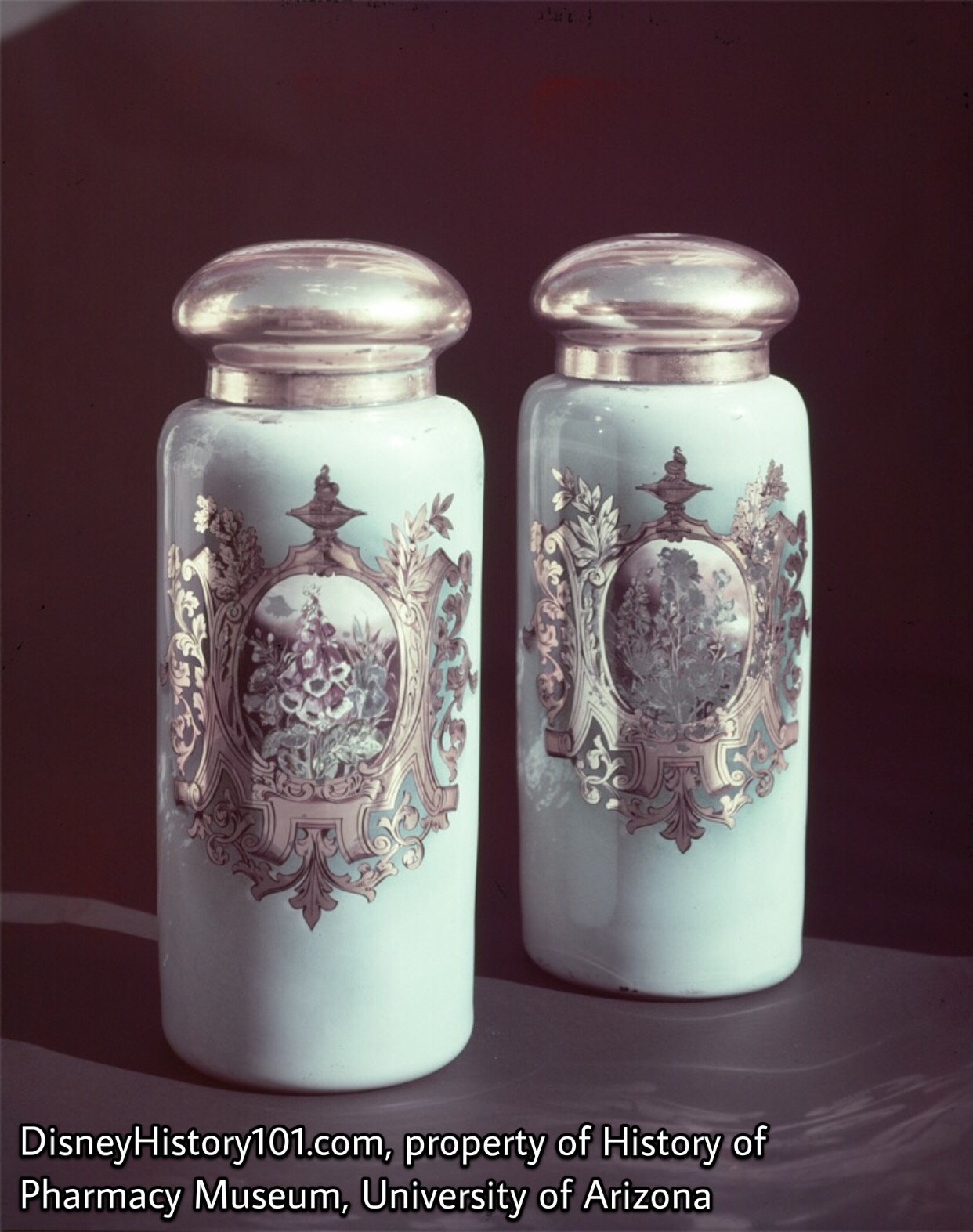
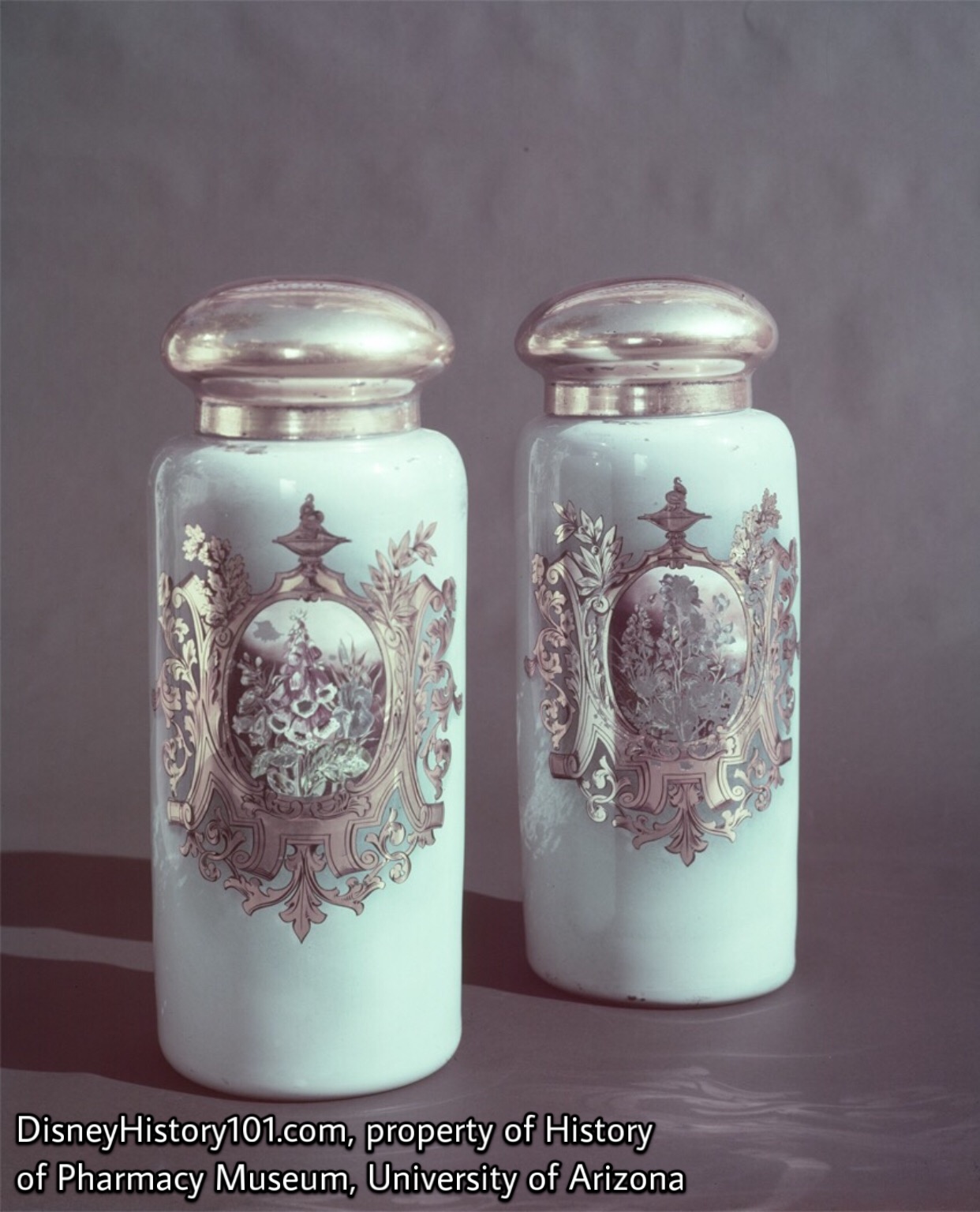
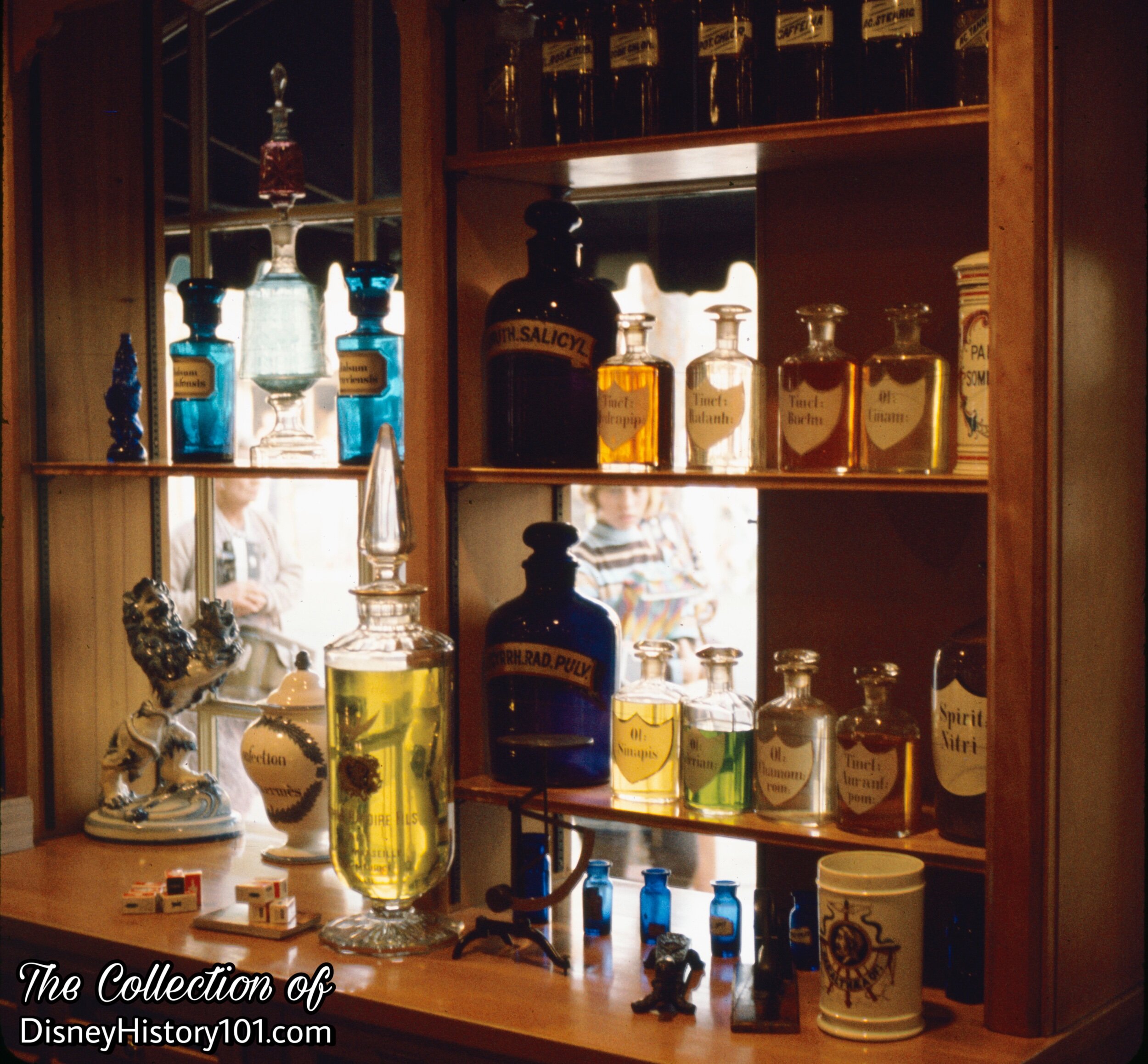
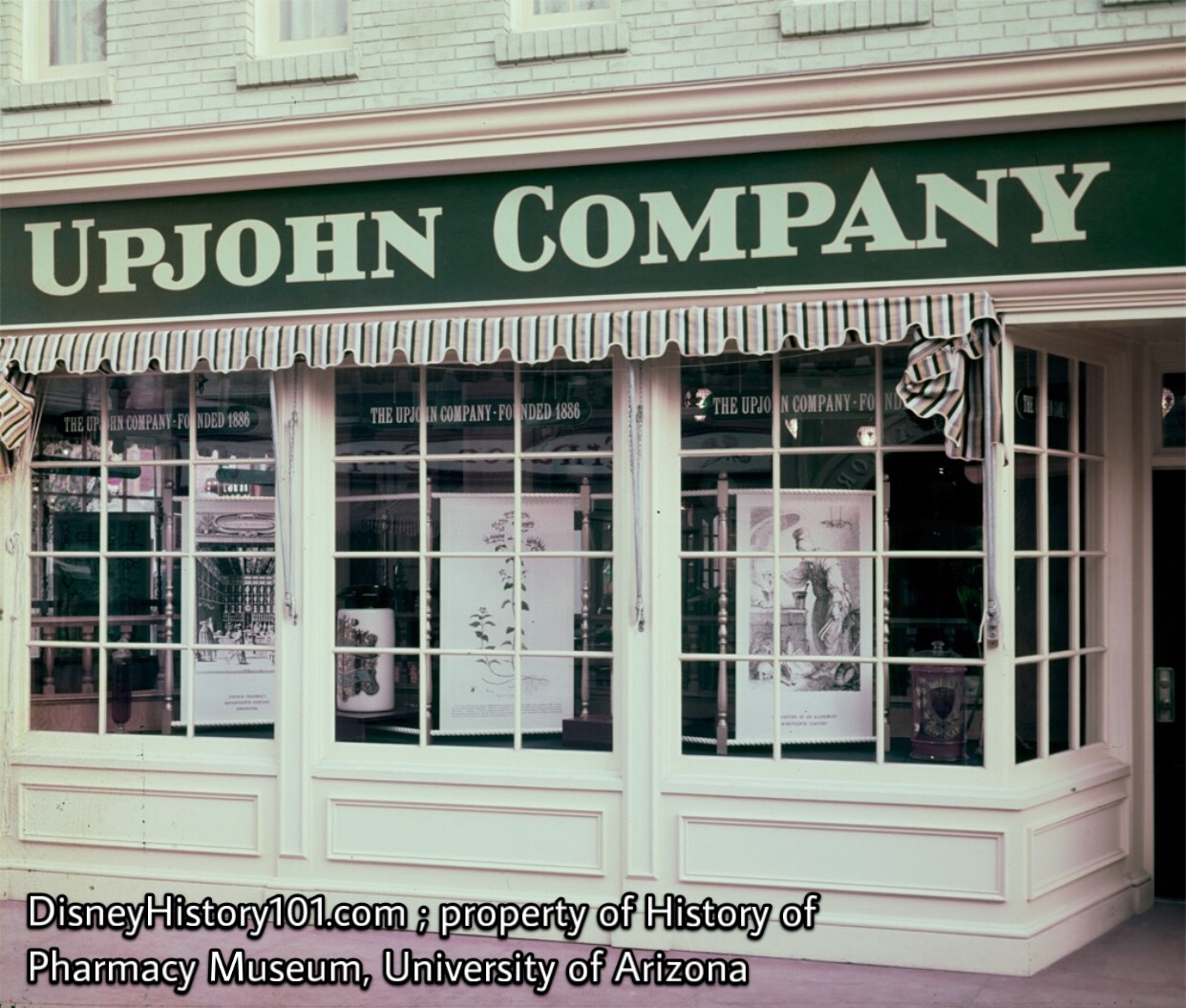

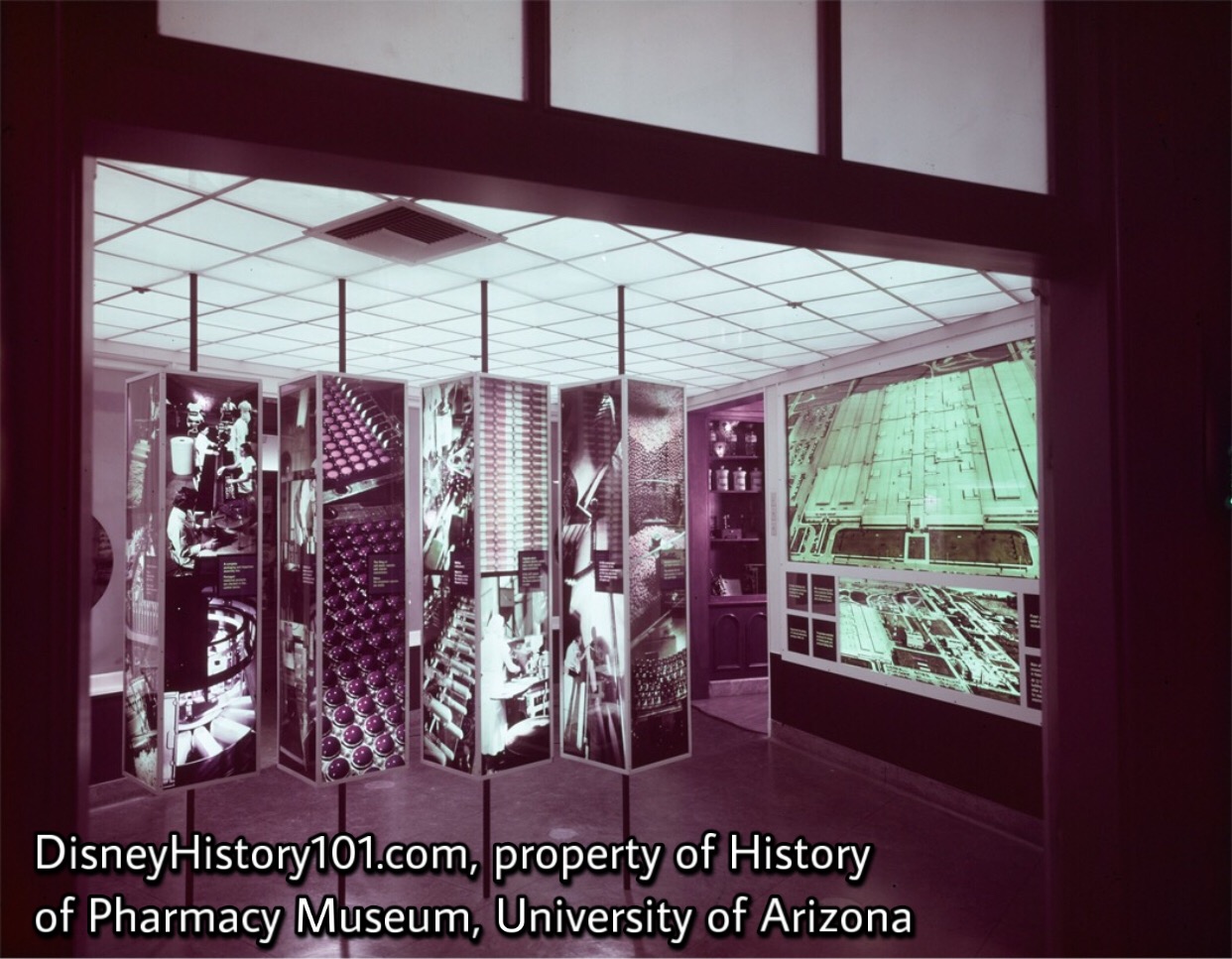
The $15,000 addition of the Modern Room was added in 1958.
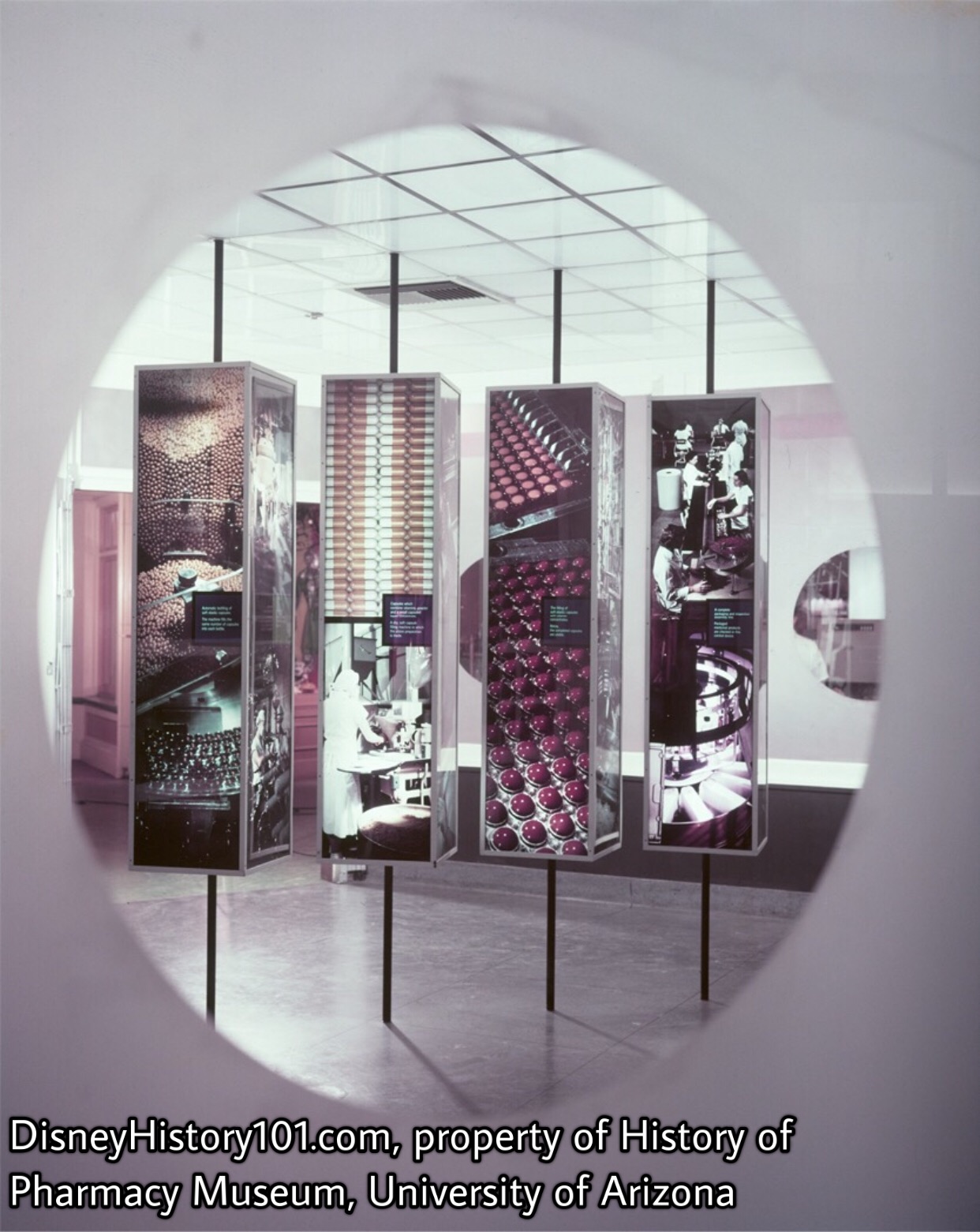
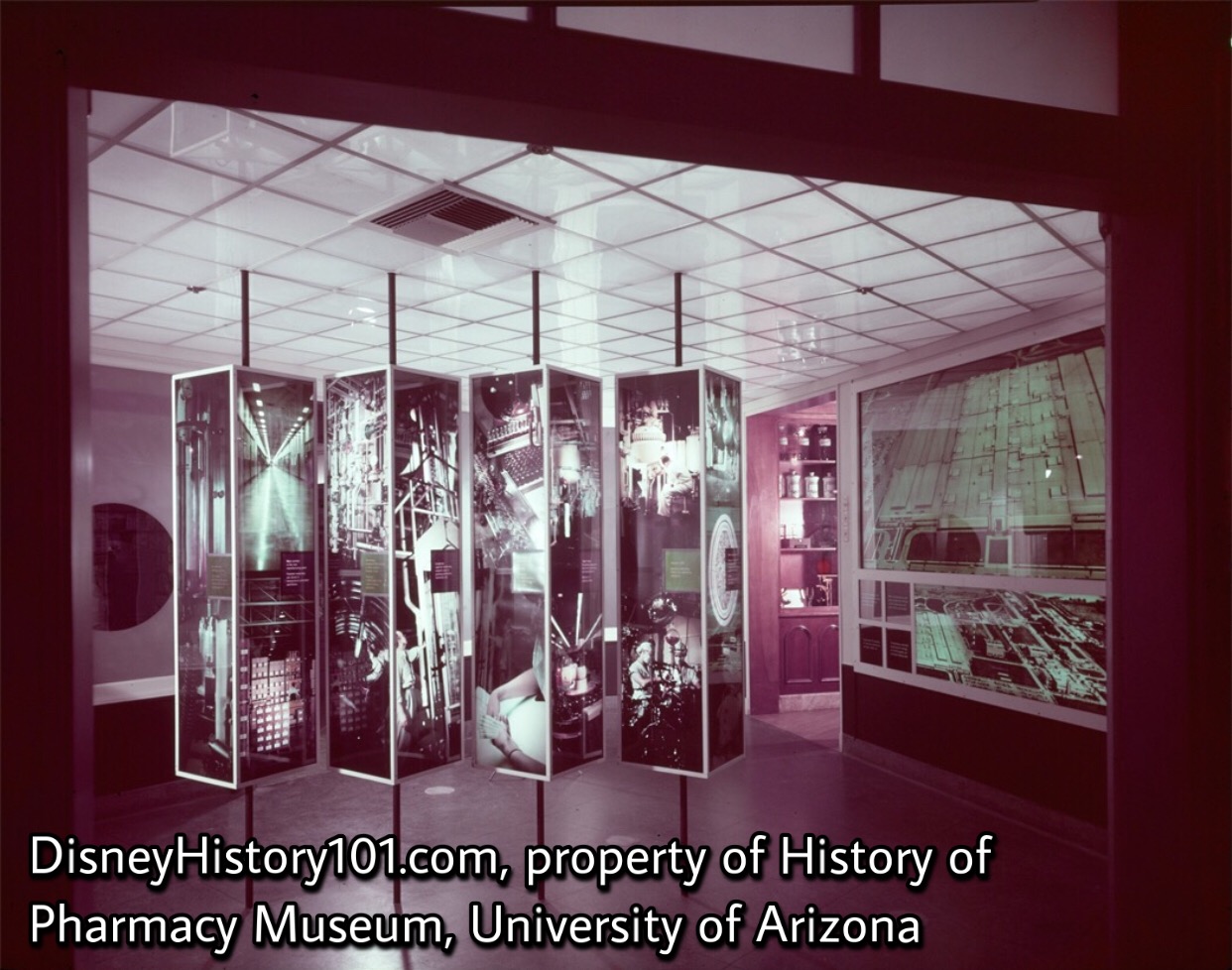
"As you have seen, the fixtures and equipment in the typical drugstore of the late 1800's bear little resemblance to the ultra-modern pharmacy that serves your community today. The basic philosophy of the pharmaceutical profession has, however, remained constant : integrity of service '; quality and purity of product.”
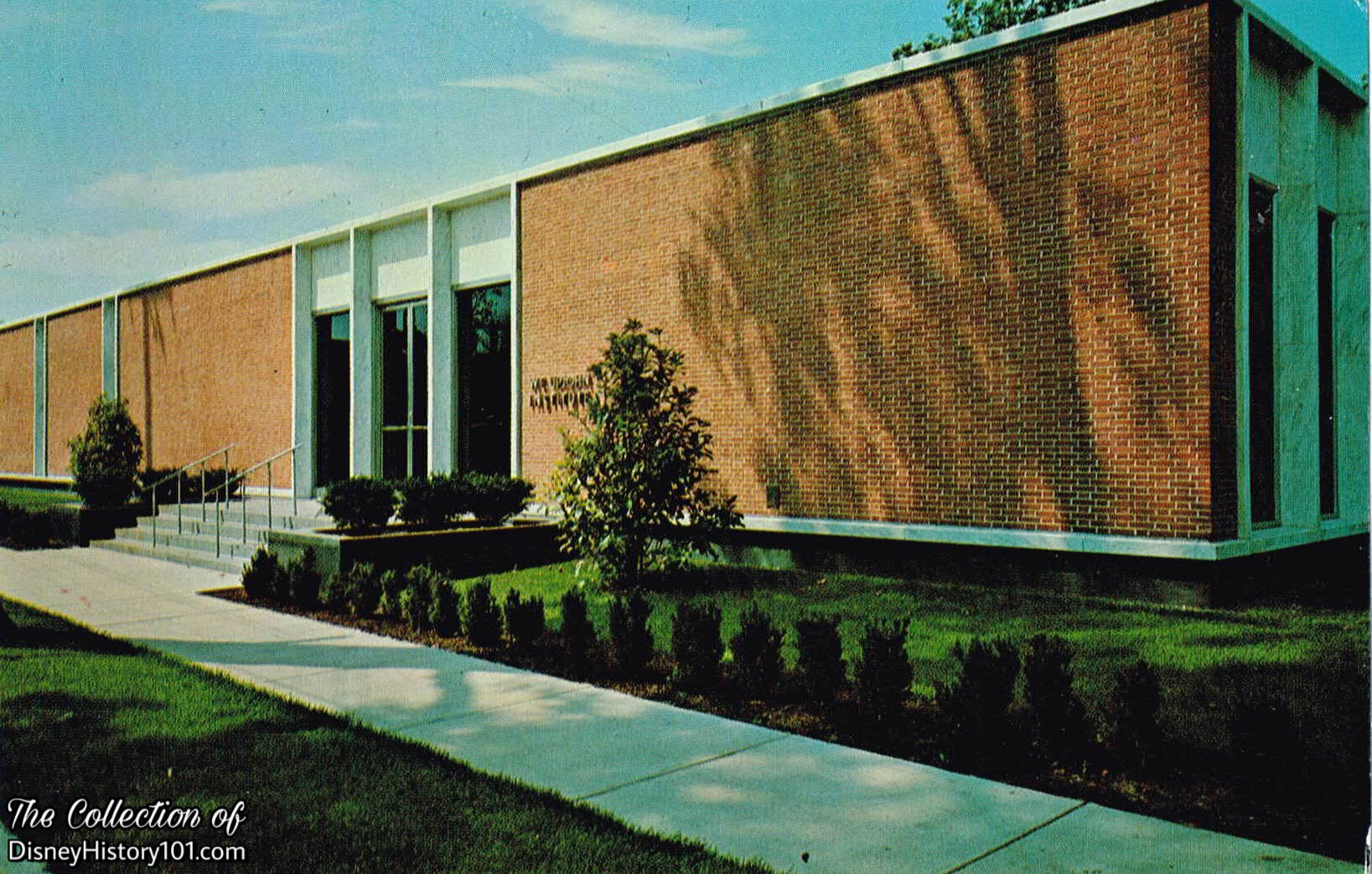
The new Upjohn facility in Kalamazoo, Michigan was a “23-acre facility under one roof”.
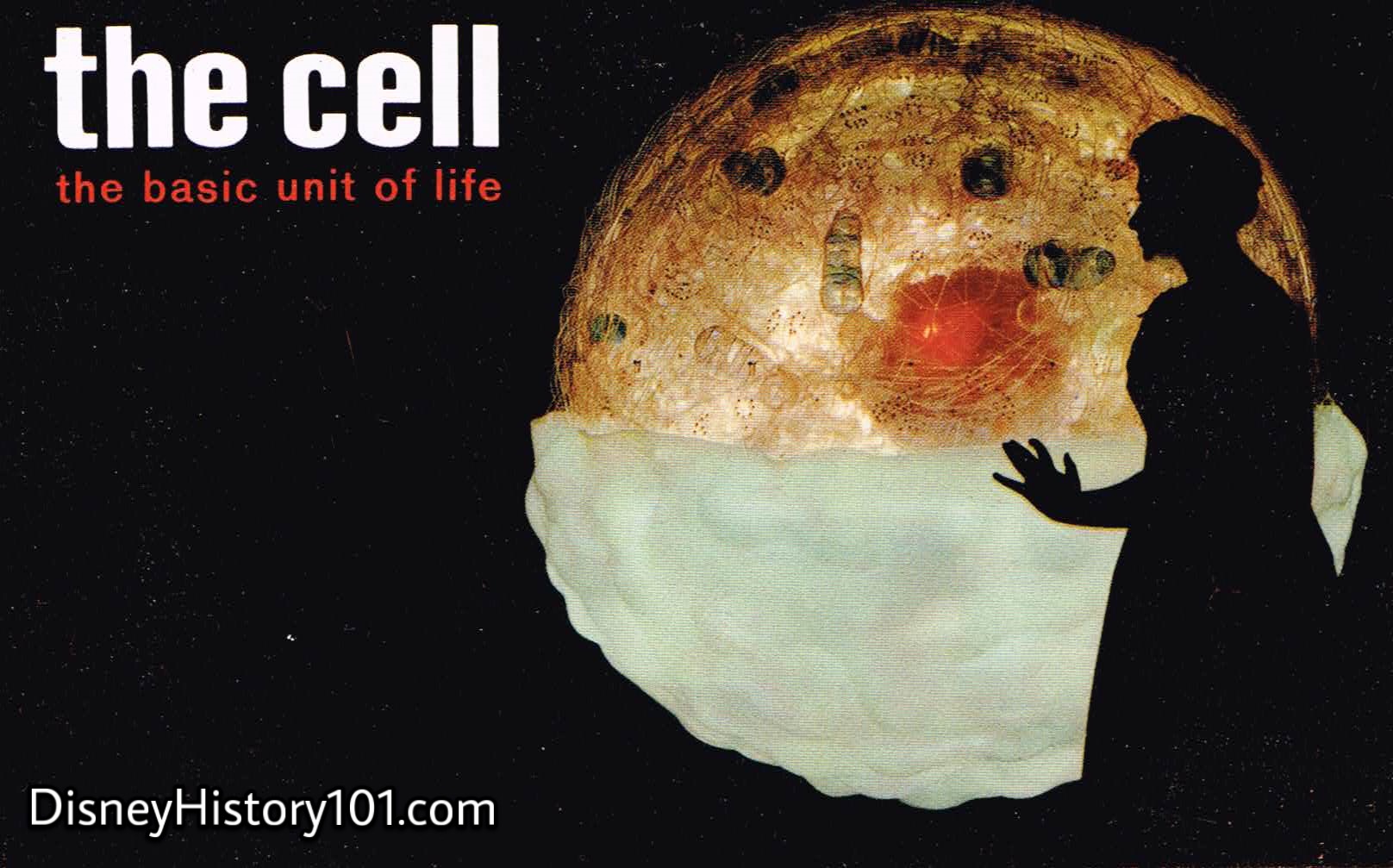
The Modern Room also featured additional displays over the years, like a display illustrating 20,000 years of medicine history added July of 1966. Another memorable display was this dynamic model of a human cell designed (by Upjohn Company resident graphic designer, and “Scope” Magazine Art Director - Will Burton) as an educational tool for physicians, cytologists, and students. Will had previously manufactured many displays and exhibits for Upjohn - models of proteins, models of vitamin pills, X-ray refraction patterns - usually on exhibition at the Kalamazoo Art Center. Now, Upjohn commissioned a total of three models of the human cell. By September 28, 1958, Disneyland Inc. job number 4012-515 for the Upjohn Company “Micro-world exhibit” was in progress at a cost of $13,056.
The original (and much larger) Upjohn-sponsored model (which was a precursor to the one appearing at Disneyland), first required a year for “its research, its collation of fact and surmise, and for its construction. Representative of no particular part of the human body, it is an abstraction of the cell - but a controlled abstraction, as technically accurate as the knowledge and conjecture…could make it.
Magnified more than 1,000,000 times the size of a human red blood cell, the model is [more than 20] feet in diameter and 11 1/2 feet high [though Disneyland’s was much smaller in dimension]. It sits on a metal mirror, so that as a viewer walks through and around, he has an impression of being inside the organism, at the center of it. The model is constructed of acrylic plastic tubing for the cytoplasm, or the outer material. There are some 2200 pieces in the cytoplasmic structure, measuring 3700 linear feet, their 7500 joints connected by hand. This…structure is built on a five-piece irregular module regularly repeated with the pieces…[fitted] together at an angle of 78 degrees. Along the…’wall’ are displayed scale models of all the elements of the cell. Because nothing of its kind has ever been attempted before, new problems of conception required novel solutions in construction, for example the chromosomes {the long curly forms in the nucleus} are made of vacuum cleaner [hoses]”, according to Industrial Design magazine (published August, 1958).
Still, the smaller version that exhibited at Disneyland, featured many of the same parts of the “organic whole” display - from the transparent and rigid mitochondria (where food is transformed into energy), to the flat sack-like endoplasmic reticula (believed to once be responsible for the formation of the cel’s proteins)! This display was so popular that it was moved around and displayed in several places (after its Disneyland exhibition), and it was even featured on a Disneyland postcard during 1960!
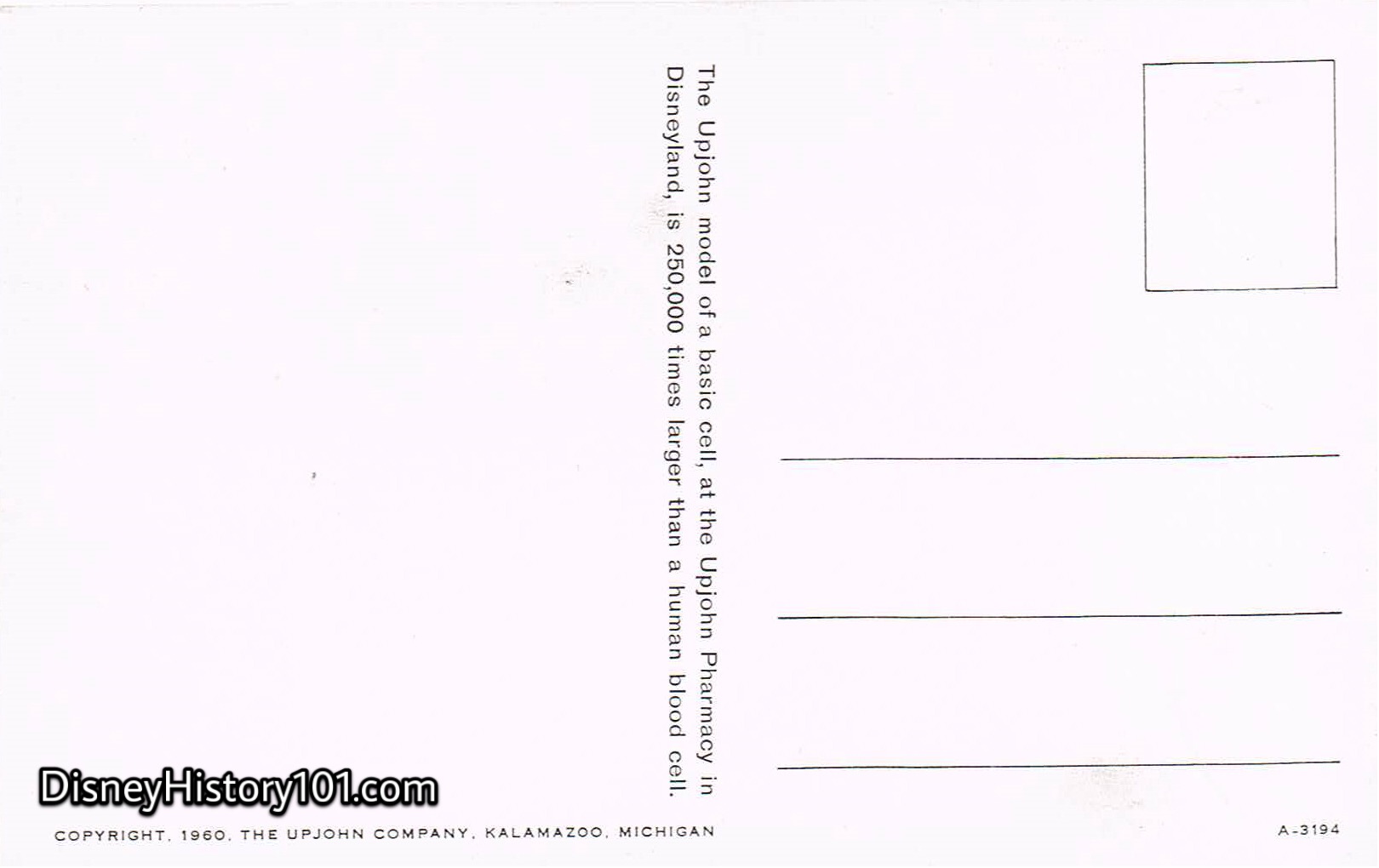
The back of the Upjohn Postcard featuring the human cell carries an interesting fact about the size of the model. The model is a staggering 250,000 times larger than the average human blood cell!
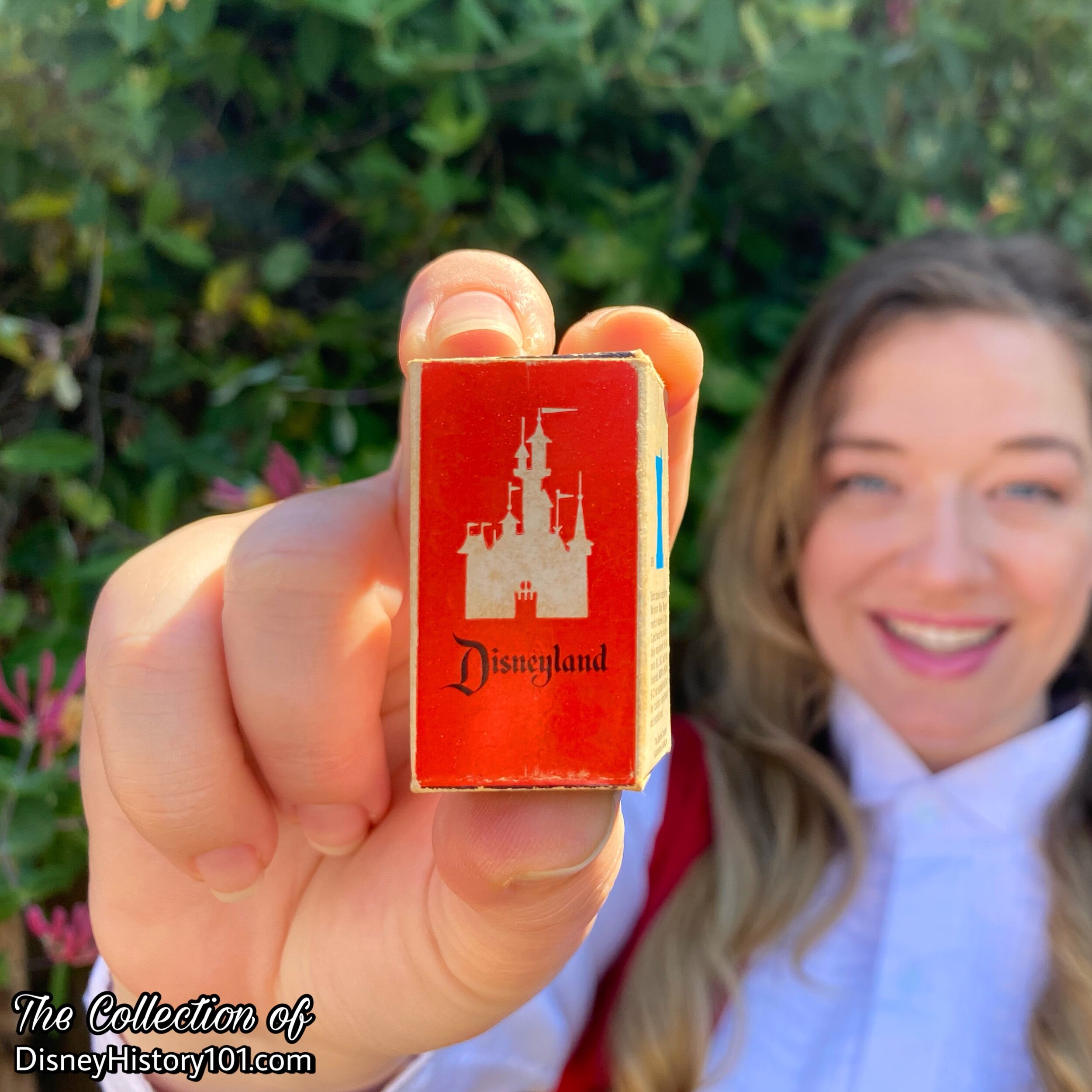
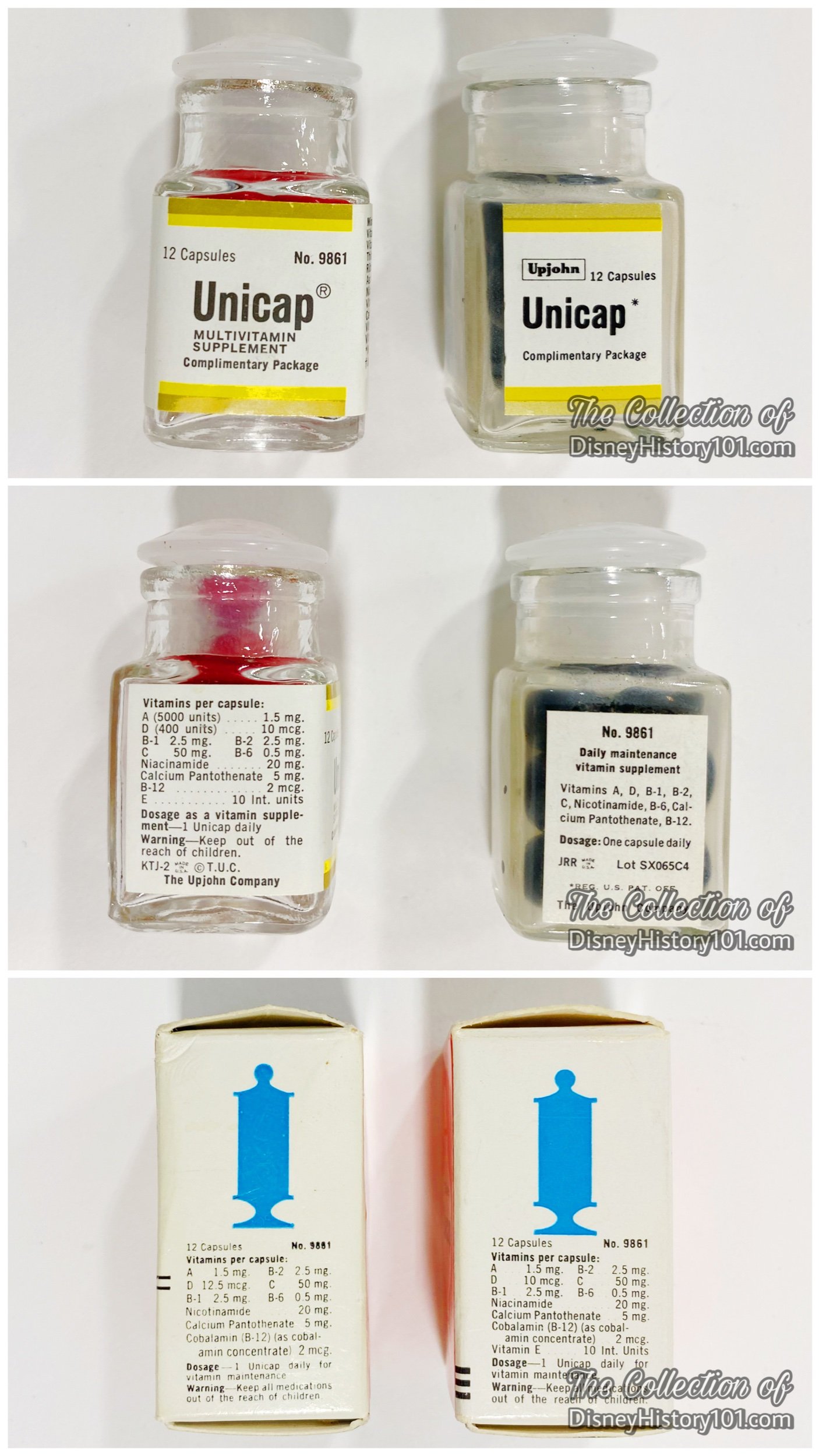
You may recollect receiving this “souvenir of Disneyland”, that was a complimentary item given to guests of Main Street U.S.A.’s little corner drug store.
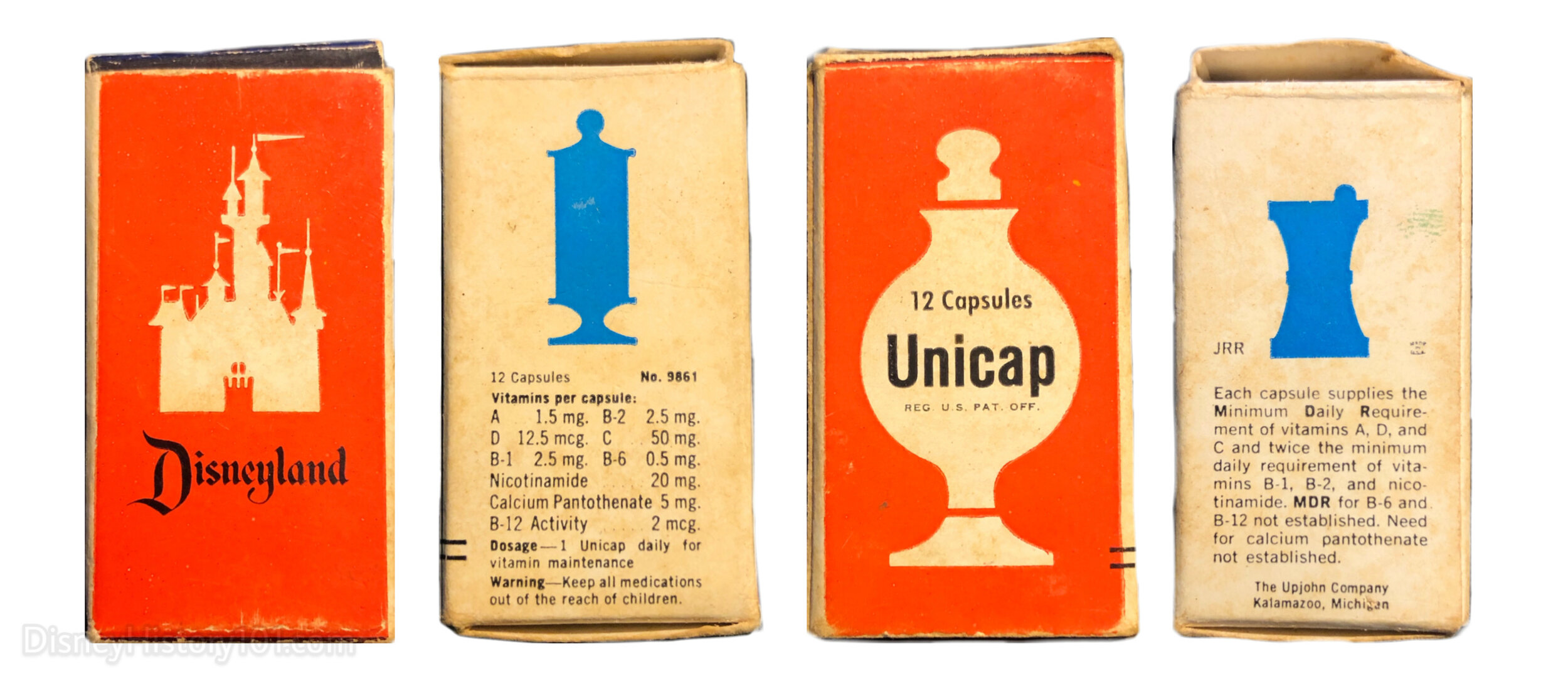
Through the years, the boxes (which contained the sample bottle of 9 to 12 “Unicap” capsule pills) generally had an expiration date stamped on them. These were sample portions of actual medicine pills (minimum daily requirements of A, D, and C, Nicotinamide, twice the daily requirement of B-1, B-2, and possibly the daily minimum requirement of B-6, B-12, and Calcium Pantothenate). “Unicap… [was] just one of the hundreds of fine pharmaceutical products produced by the Upjohn Company” and was once available at your local pharmacy. These samples were not to be confused with the bottles of “Pixie Dust” from Doctor Tinker Bell, recommended in doses measuring “a pinch”, to “relieve the blues, blahs, and frowns of an occasionally bad day.”
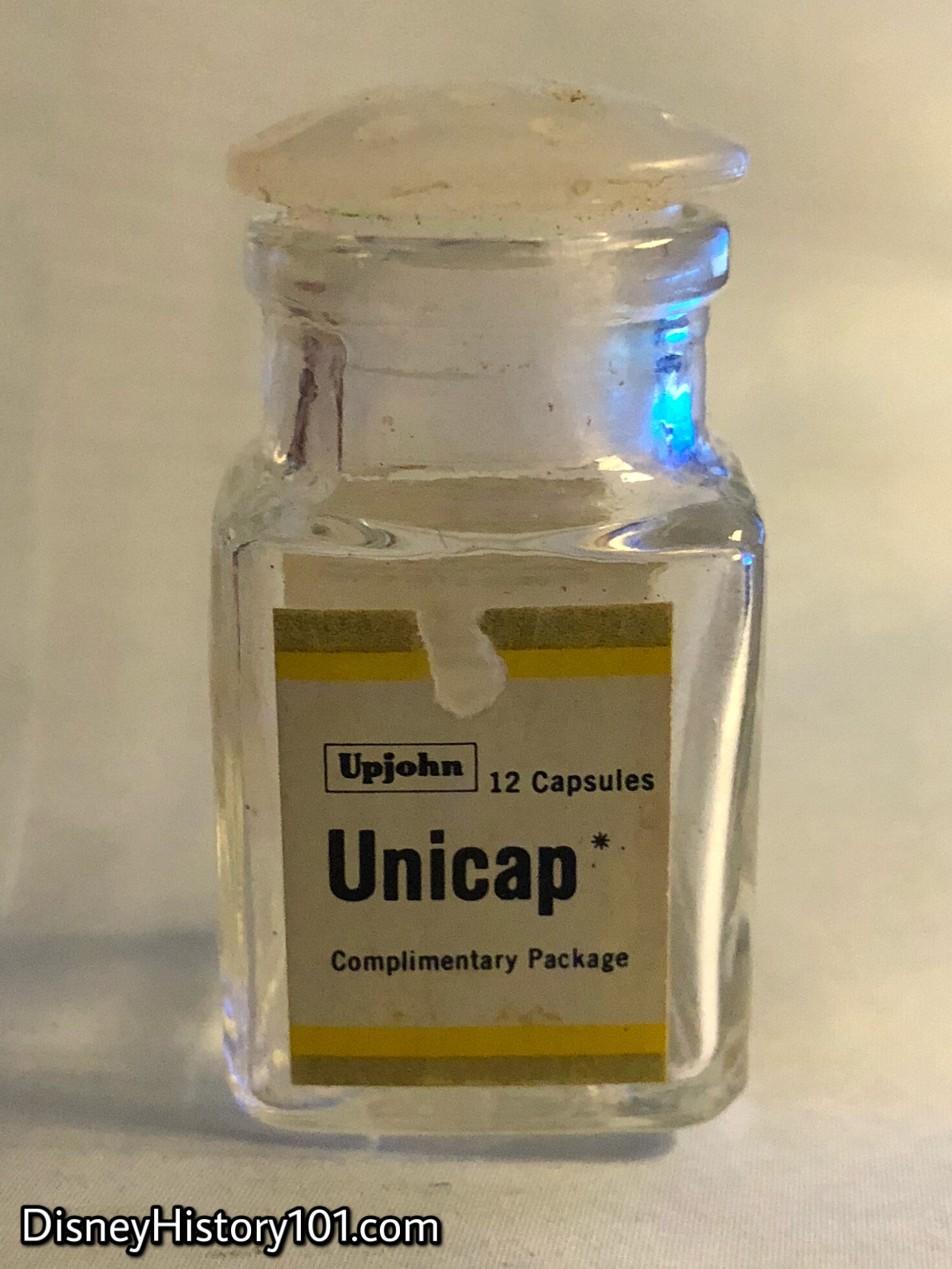
During 1962, Disneyland Guides reminded guests, “If you are just a bit worn out at the end of the tour, remember to stop by the Upjohn Pharmacy for your free vitamin pills.” Perhaps you still have your souvenir bottle somewhere?
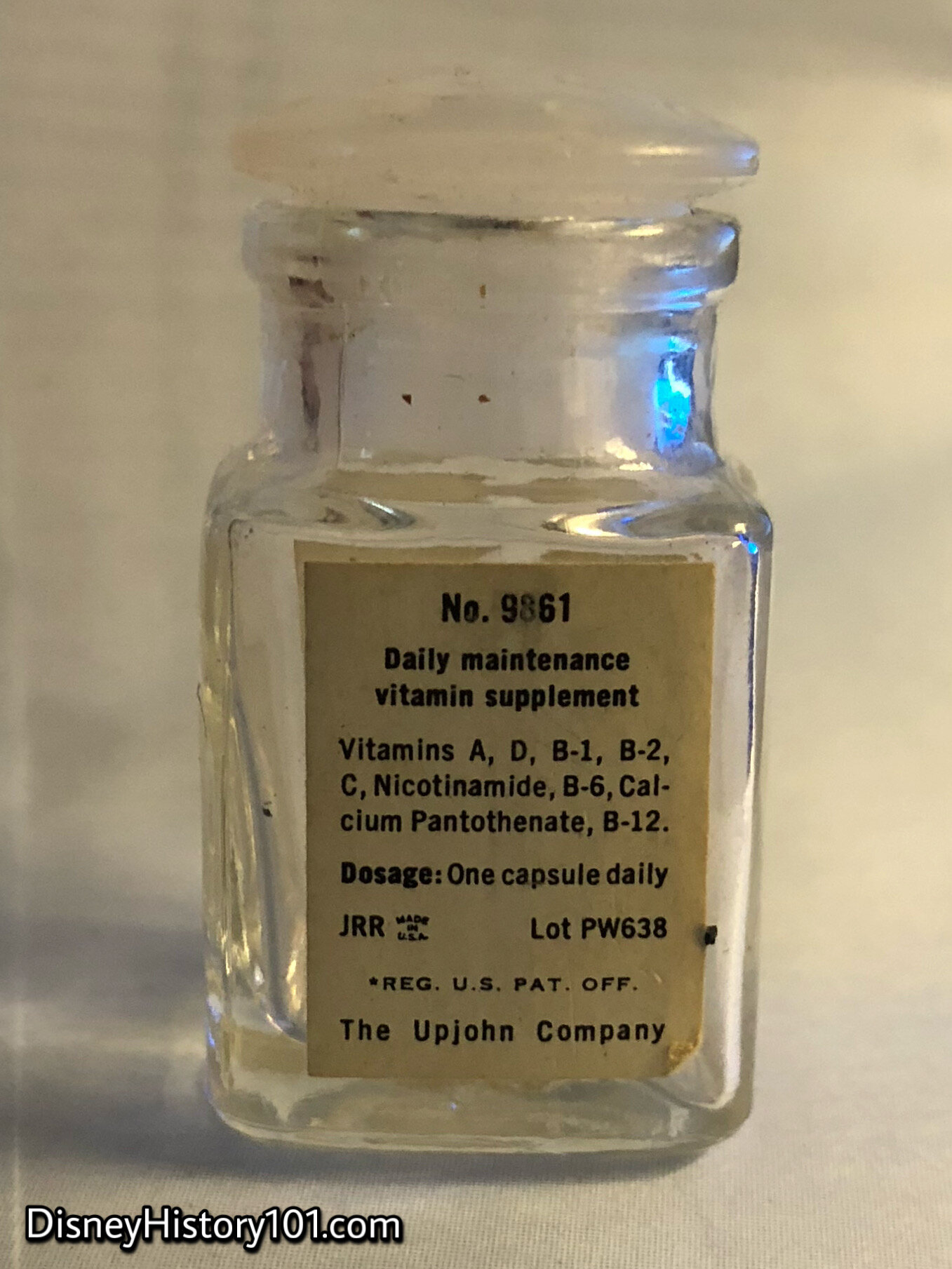
According to an accompanying label :
“Each UNICAP multivitamin capsule contains ten essential vitamins and provides these vitamins in greater amounts than the minimum daily requirement (where established) to insure adequate vitamin intake. UNICAP multivitamins are just one of the many contributions of the Upjohn Company since 1886.” These samples (according to literature contained inside the box) were proof that “the basic philosophy of the pharmaceutical profession has, however, remained constant : integrity of service, quality and purity of product.”
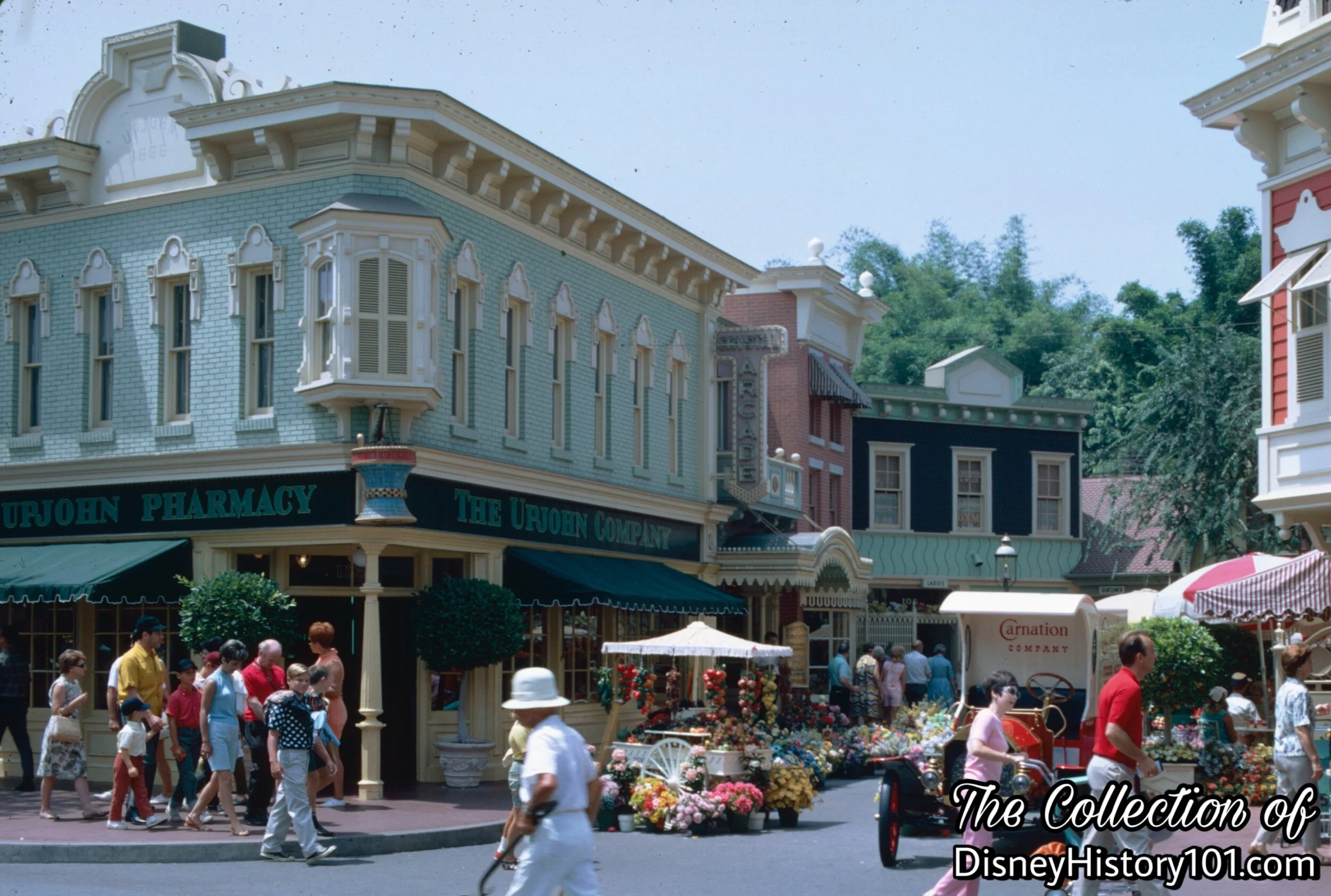
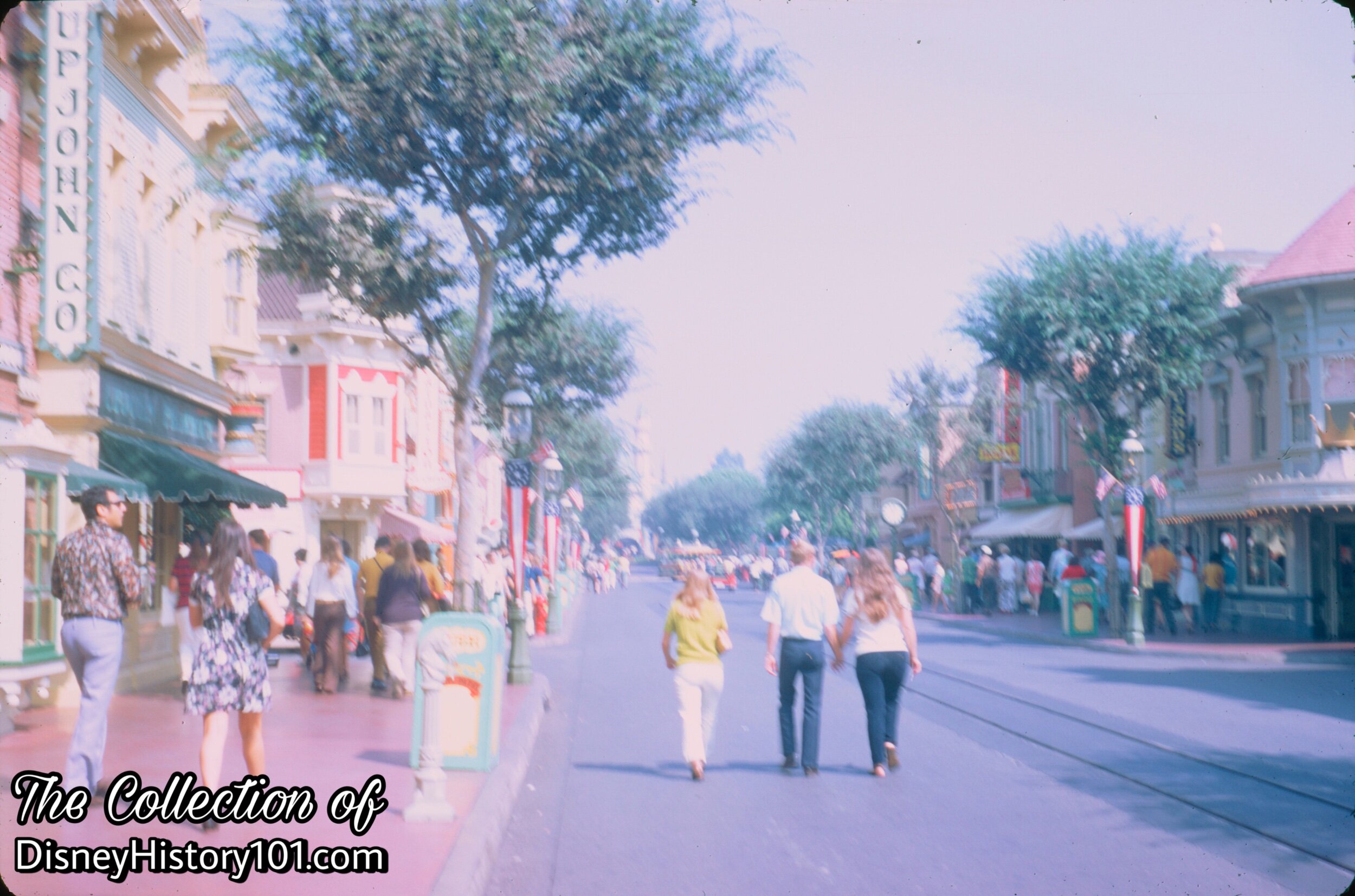
Ultimately, Disneyland Participant Affairs and Disneyland Participant Upjohn Co. could not negotiate a new cooperative agreement to maintain their ongoing relationship, so the two “reliable old firms parted ways.” Here we are in the month of August (pictured above), and the end of an era for the Disneyland of Walt’s era. The folks who took this photo may not have known that this was one of the last times the Upjohn name (one of the original sponsors) would be seen on Disneyland’s Main Street U.S.A.!
Considering all of these displays, it is easy to see why by the year 1958, the Upjohn Pharmacy was considered one of 15 free educational shows and exhibits at Disneyland. Ultimately Upjohn corporate sponsorship ended, and the Upjohn Pharmacy closed. However, much of Upjohn’s collection of antiques is currently being preserved at the University of Arizona.
PLEASE, STEP THIS WAY, as Disney History 101 prescribes the following tour of Upjohn Pharmacy with your Filed Guide Beth! Along our tour today, we will explore how residents of Walt’s favorite vacation destination (Smoke Tree Ranch) played a crucial part in this opening day attraction. We will also visit Disneyland’s “working” pharmacy through a rarely-seen, collection of preserved Upjohn artifacts at Arizona State University!
Please step this way, as YOUR Disney History 101 - Upjohn Pharmacy Tour departs HERE!
Under the current agreement, four eleven-minute films will be produced within a period of two and a half years, their cost to be underwritten by the Upjohn Company, one of the world's best-known pharmaceutical manufacturers. Distribution will be made by our company through its 16mm Division.
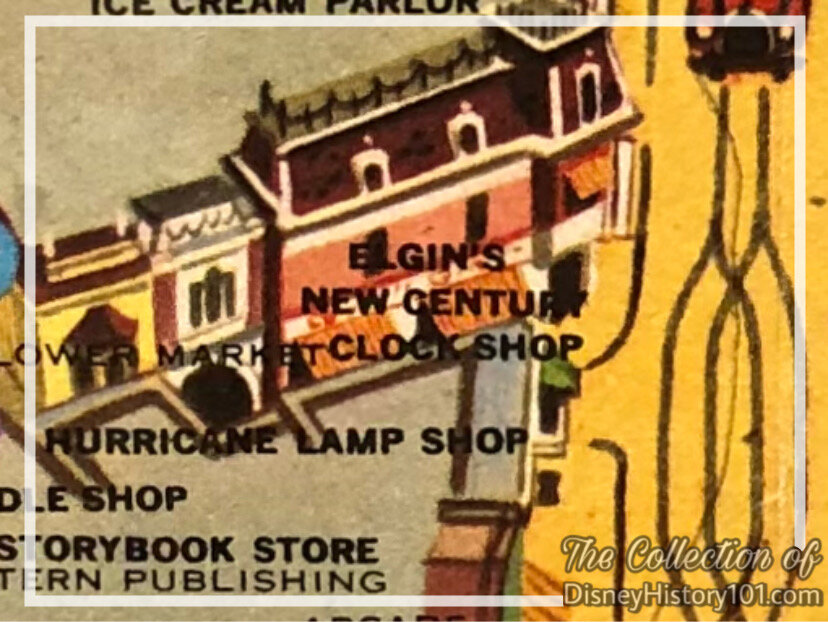
Soon, the Elgin Company (a then, reliable 100-year-old firm and a Disneyland Participant since 1971) moved (from the other side of Main Street) next door to Carnation.
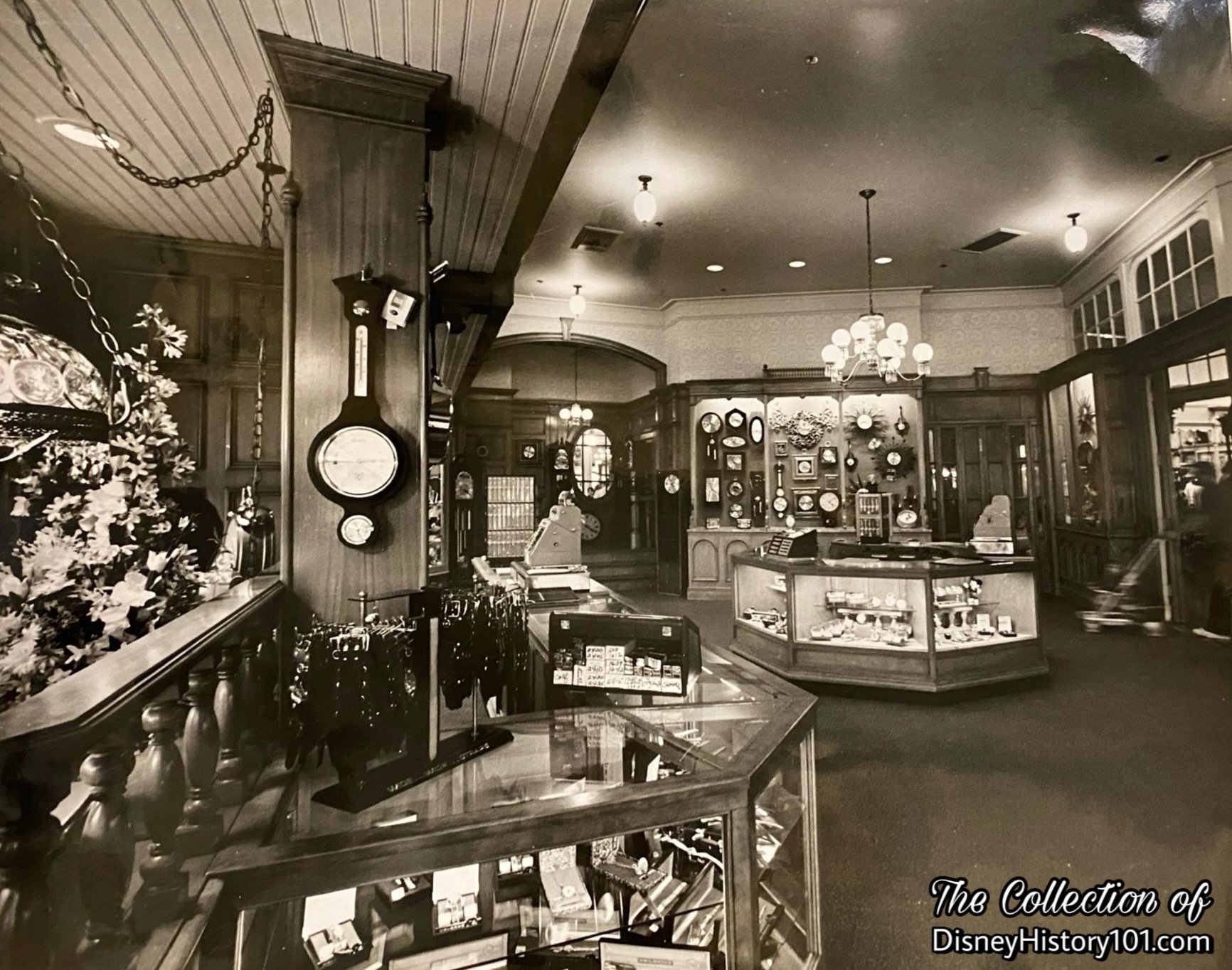
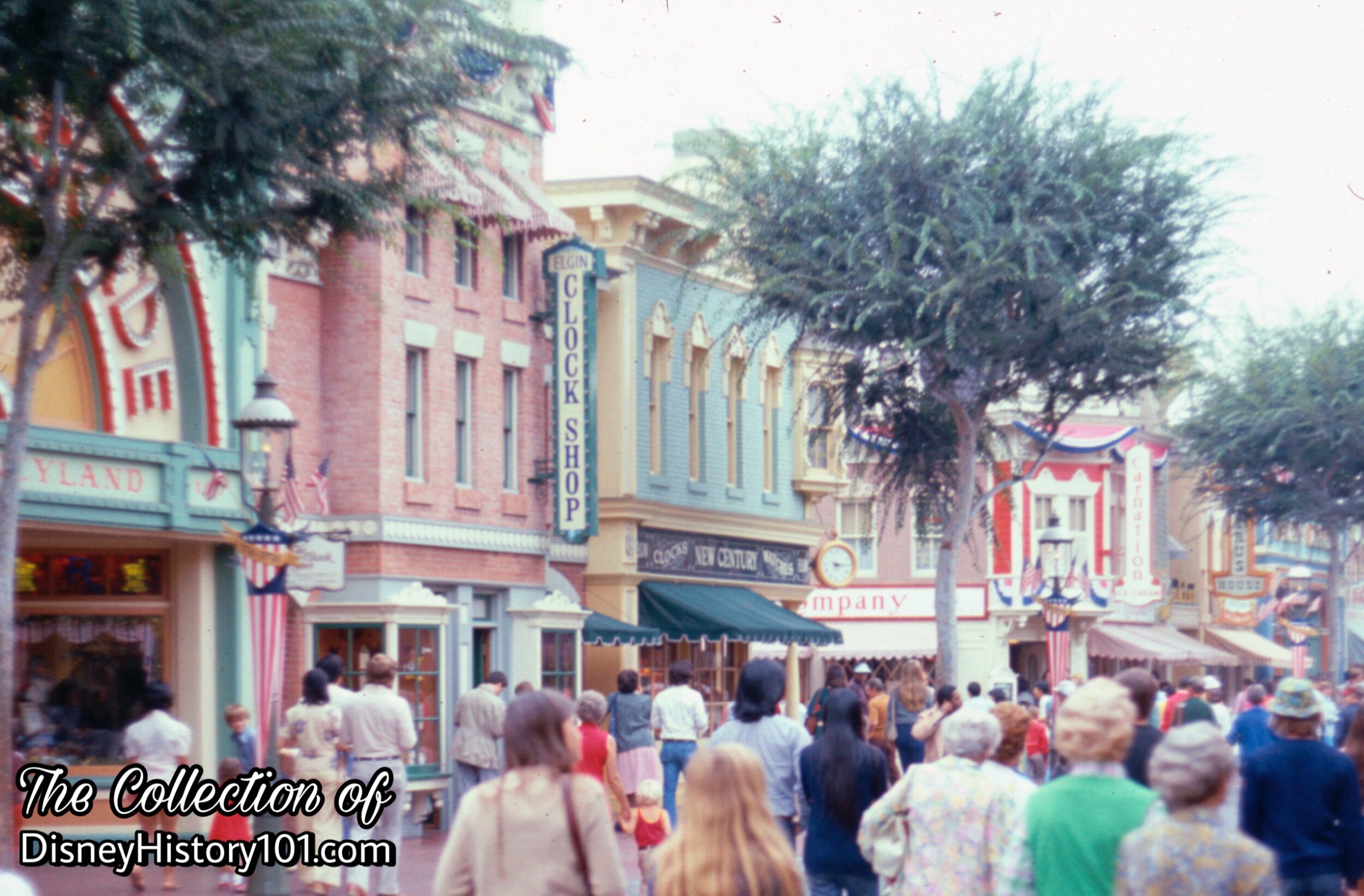
“Here, guests will find (or can order) calendar watches, automatic watches, chronographs, electric watches, electronic watches, casual and dress watches, pocket and pendant watches, and special watches such as Walt Disney character watches, divers’ watches, engineers’ watches, nurses’ watches, and sportsmen’s timers.
In the clock line, the shops features hand-wound, battery-powered, and electric clocks, wall clocks, kitchen clocks, alarm clocks, digital clocks, clock-radios, table clocks, and Elgin’s decorator clocks, including “Traditional Heirloom Strike and Chime Timepieces,” “Handcrafted Hall Clocks,” “Baroque Decorator Timepieces,” “Mediterranean and Early American Classics,” and “Galaxy” and “Contemporary” timepieces.”
The New Century Clock Shop would feature an exhibition of early antique Elgin timepieces, as well as 50 styles of Mickey Mouse watches including limited editions (just in time for Mickey’s 50th Birthday in 1978)! The shop was very popular and the shop’s team of employees were successful. High sales records were achieved during the following two years - on August 7, 1979 ($10,662), and on August 15, 1980 ($12,062).
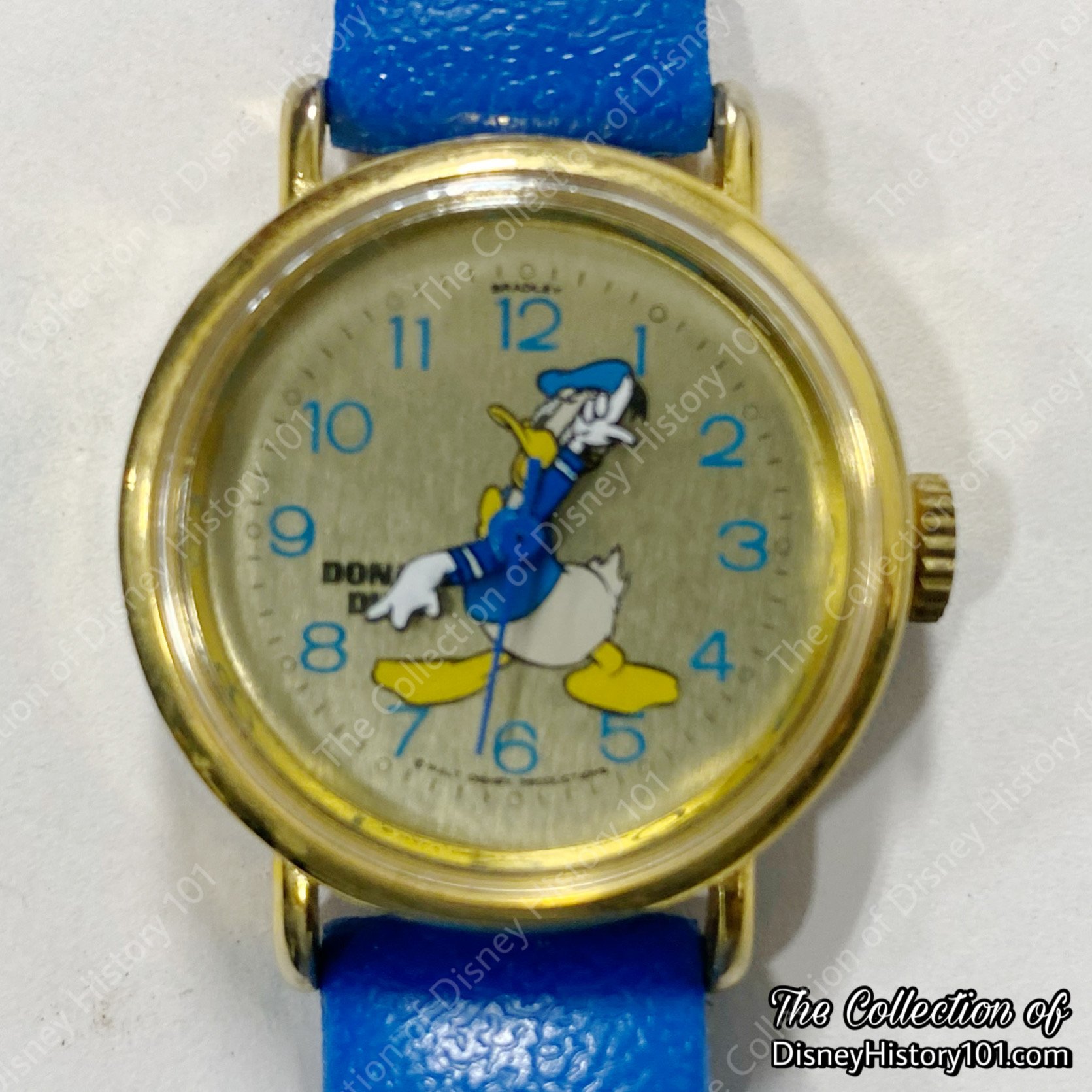
New Century Clock and Watch Shop hosted by Elgin-Timepieces by Elgin, featured a complete selection of Mickey Mouse and Disney Character watches and clocks. Unique themed watches (like the Swiss-made “The Black Hole” Wrist Watch by Bradley, released 1980) were made available at Disneyland and fine stores everywhere. An unnumbered limited edition Haunted Mansion exclusive watch featuring the Bride was released on the 26th and 27th of an unknown year.
Imagineer Eddie Soto’s proposed “watch program” ran from 1994-2013, and when it ended, “a large batch of original artwork for the watches was… acquired by the Walt Disney Archives,” according to Dave Smith (Chief Archivist Emeritus of the Walt Disney Archives). [Disney Facts Revealed by Dave Smith, 2016] In 2008, WDI master plans entertained the concept of a merchandise update for the Clock Shop.
“Upstairs,” one second story window above the New Century Jewelry Shop features the name of “Dr. Benjamin Silverstein M.D. - General Practitioner - Have a Fever? Have the Flu? Come on in and we’ll cure you!” As “fortuosity” would have it, Dr. Benjamin Silverstein M.D. “inhabits” the address above the former site of the Upjohn Apothecary Shop. While Benjamin does not seem to be based on a true-life individual, it is one of the few locations at Disneyland where both a mezuzah (and, “shema” on the doorpost) as well as a menorah can be found on Main Street U.S.A. (the latter placed in the window during the winter season).
VIEWLINER TRAIN OF TOMORROW
*Some sources cite a soft opening date of June 21st, 1957.
At Disneyland there is a "story behind the story" of every attraction, every attraction is a living experience for the guest. Disneyland ride-through attractions or adventures have officially been defined as an “individual show, ride, or exhibit designed to produce an entertaining Guest experience. Disney attractions stir the imagination, enliven the senses, and provide the participants with positive, innovative entertainment, which is the essence of the DISNEYLAND Show.” It is important to review the story of the attraction, tell the story, explain it, and create interest. This is the story of the Viewliner.
“Concept”
You may recall hearing how Walt Disney, on the eve of Disneyland’s first day of operation, promised that “Disneyland will never be completed. It will continue to grow, to add new things, as long as there is imagination left in the world.” One such “new thing” was the shortest-lived attraction - the Viewliner! The Viewliner “high speed train of the future” was designed and built by WED Enterprises, Inc., debuting during Disneyland’s second year, in 1957. One Associated Press article “Plan Trip Into Drop of Water, Liberty Square for Disneyland” (by Bob Thomas, published April 20, 1957) briefly divulged the big project. Upon being invited to Walt Disney Studio, Bob Thomas mentioned, “Walt gave me a preview of his ambitious plans at his Burbank studios. He showed models and sketches…plans call for… the train of tomorrow, a half scale, high speed streamliner.”
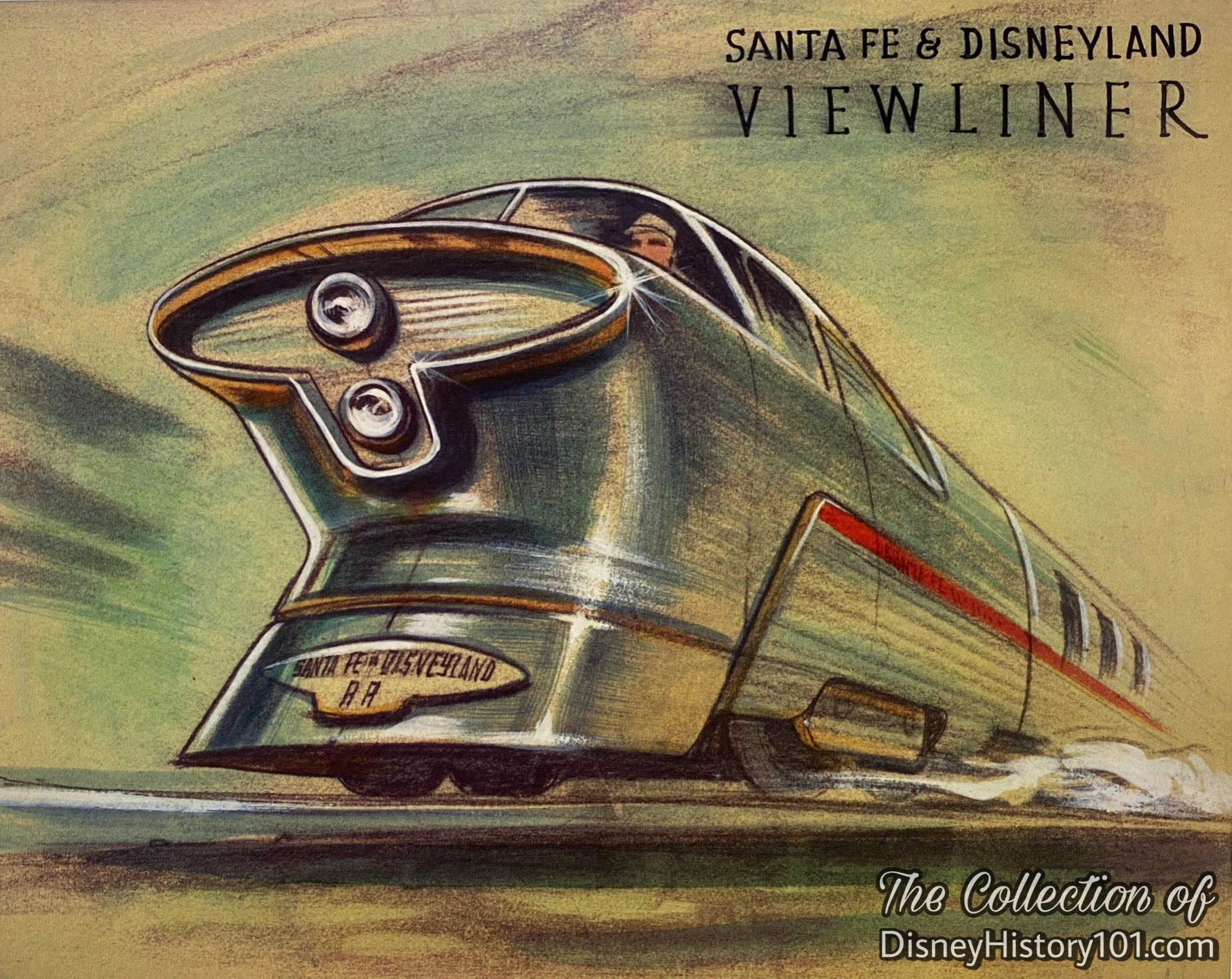
Some of these viable project Concepts (as seen above), were supported by a well-developed business case and built expectation.
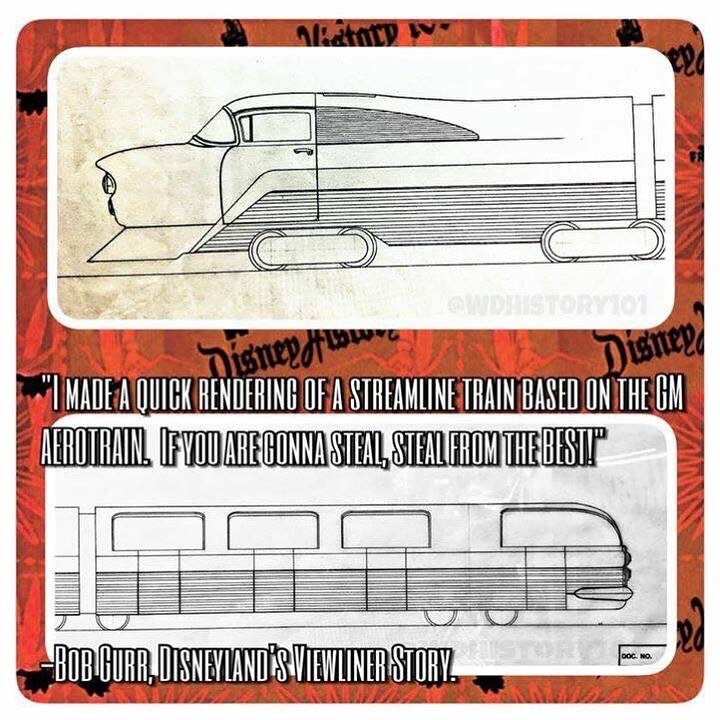
Does the body of the Viewliner look familiar? It should, for two reasons. First, artist Sam McKim created some of the earliest concept art of the attraction, inspired by the experimental GM Aerotrain! Did you know that the General Motors Aerotrain was christened (in August of 1955) a month after Disneyland opened? The streamlined electric train was thereafter tested on the rails of the Pennsylvania Railroad and New York Central.
The second reason why the Viewliner may look familiar, is that the cab was comprised of quite a few Oldsmobile parts. The trains were prepared at the Walt Disney Studios Machine Shop.
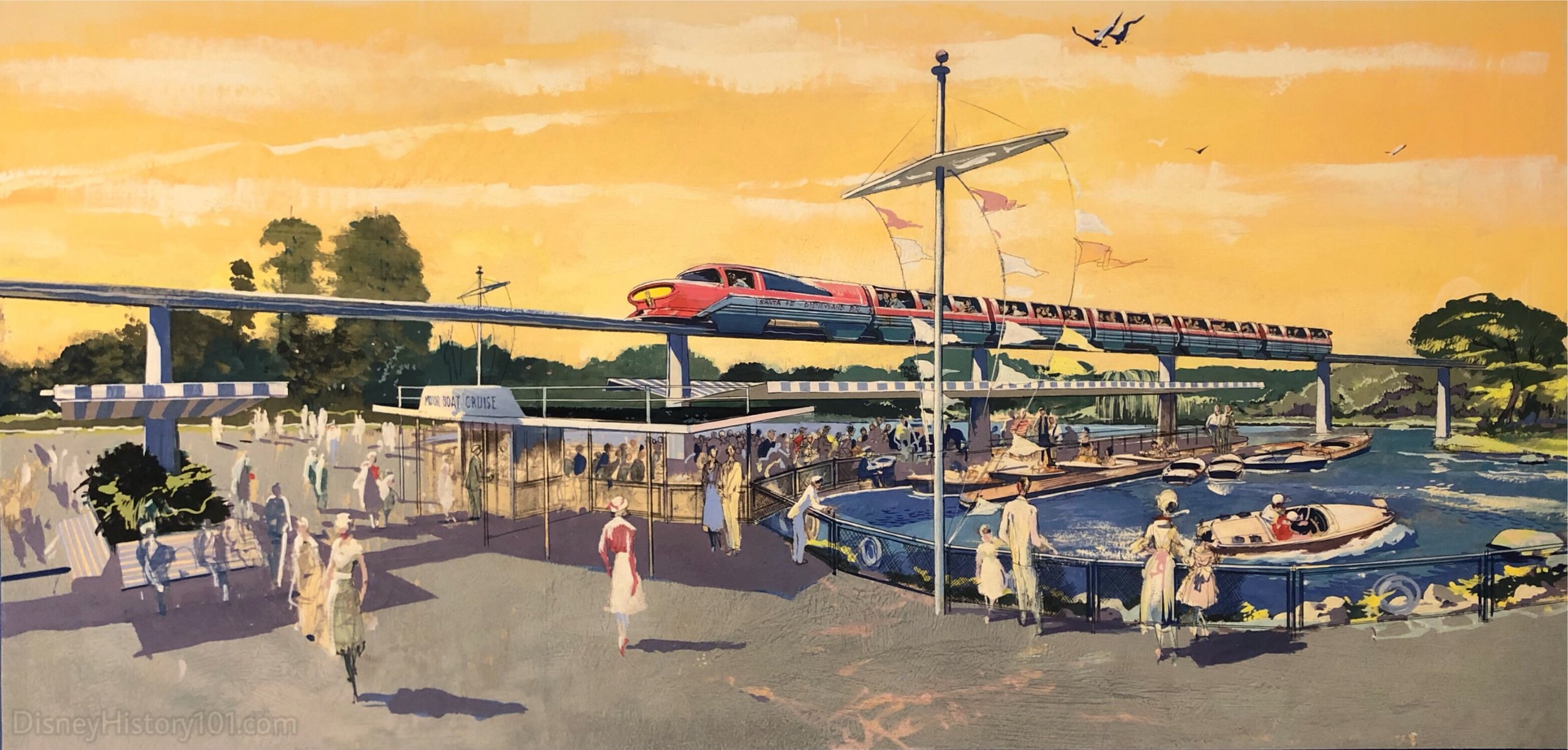
This concept is rarely-seen, published twice to our knowledge. It may have also helped inspire its successor - the ALWEG-Disneyland Monorail! You may notice the influence of the aforementioned Aerotrain on the look of the engine and its stock, and the Viewliner Train of Tomorrow’s elevated tracks over the Motor Boat Lagoon and nautical themed area!
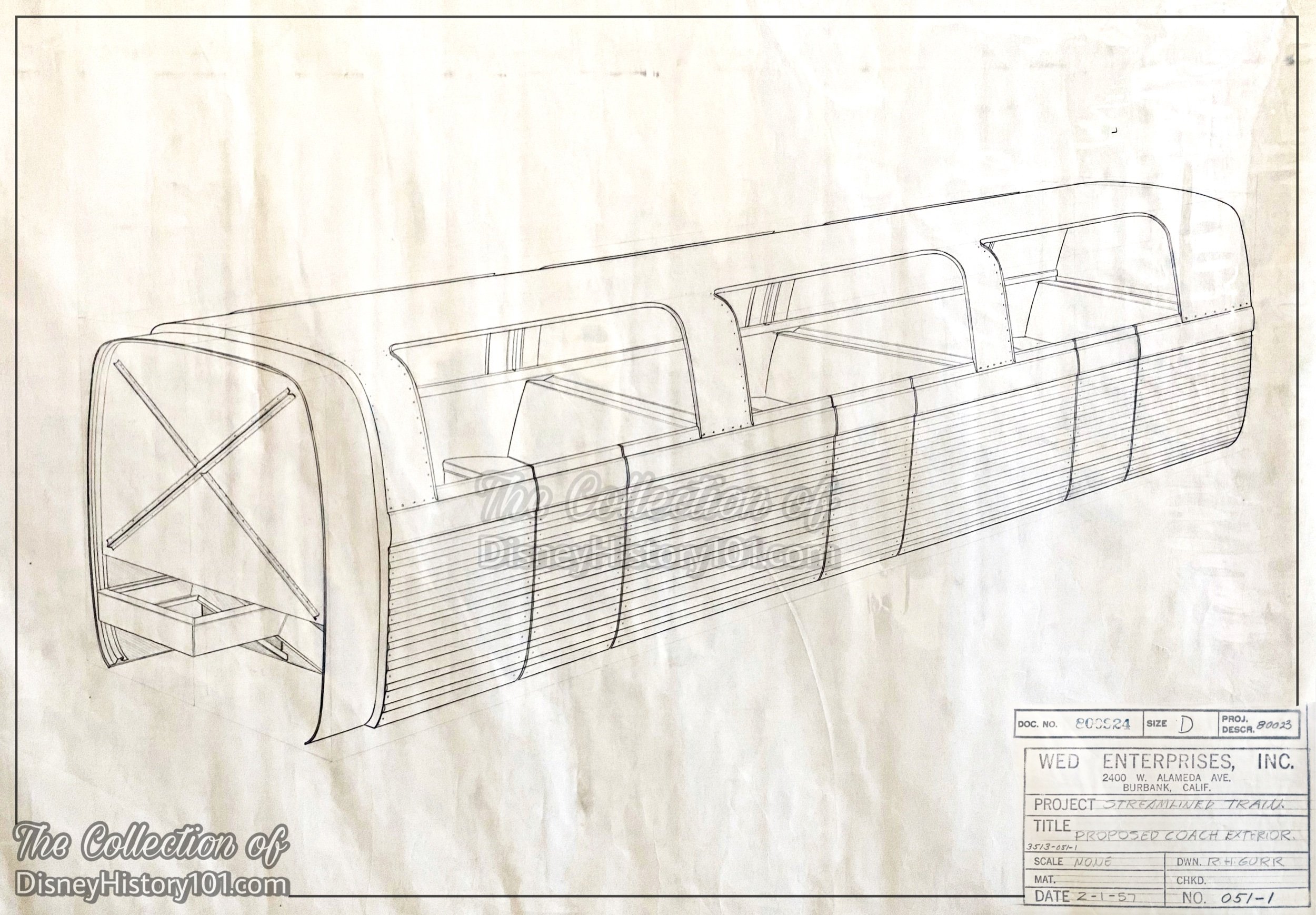
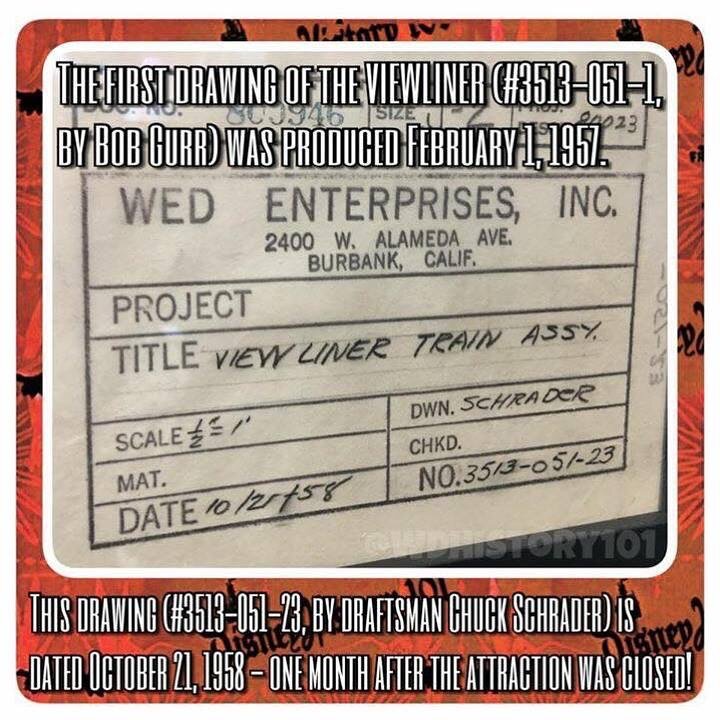
Soon after, Bob Gurr had elaborated upon Herb’s concept, with proposals for “streamlined train” engines and coach exteriors created by February 1, 1957. These were working (construction) drawings and were the final plans from which the attraction was built.
In order to lay the rails, the land was “graded” (or, leveled), and then construction began on the rails. According to Michael Broggie : “Rails were spiked atop plates into five-foot-long wooden ties, themselves treated with creosote and seated in rock ballast. As a safety feature, the track’s block-signal system could apply the brakes electronically if a train ran through a red signal.” Joe Fowler (Disneyland Operations Committee) oversaw the Construction & Maintenance division including Engineering, New Construction, Maintenance, and Janitorial related to the installation of the attraction.
This narrow-gauge railroad layout would be of the most expensive Disneyland attractions to date! The authorized construction costs of the attraction were divulged in expense reports :
•$53,264.88 (for two engines)
•$81,202.40 (for all 10 coaches)
•$33,521.48 (for track, ties, and bed)
•$20,748.40 (for the trestles)
•$13,411.32 (for the block signal system)
•$1,981.70 (for the P.A. systems for the stations)
Yes, at $204,130.18, the Viewliner was truly one of the most expensive Disneyland attractions by 1957! Once complete, each 5,000-pound locomotive was unloaded onto the rails with the help of a crane.
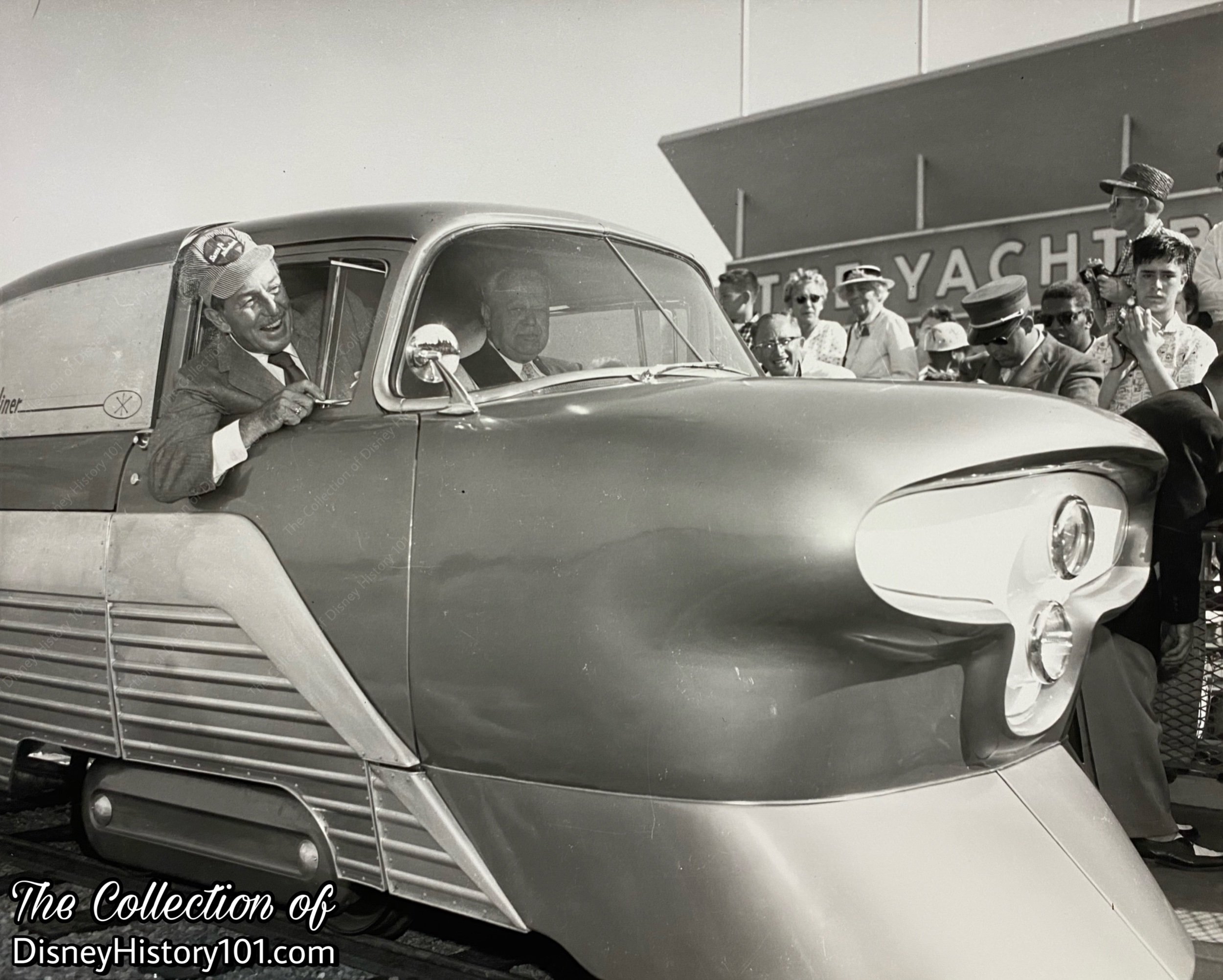
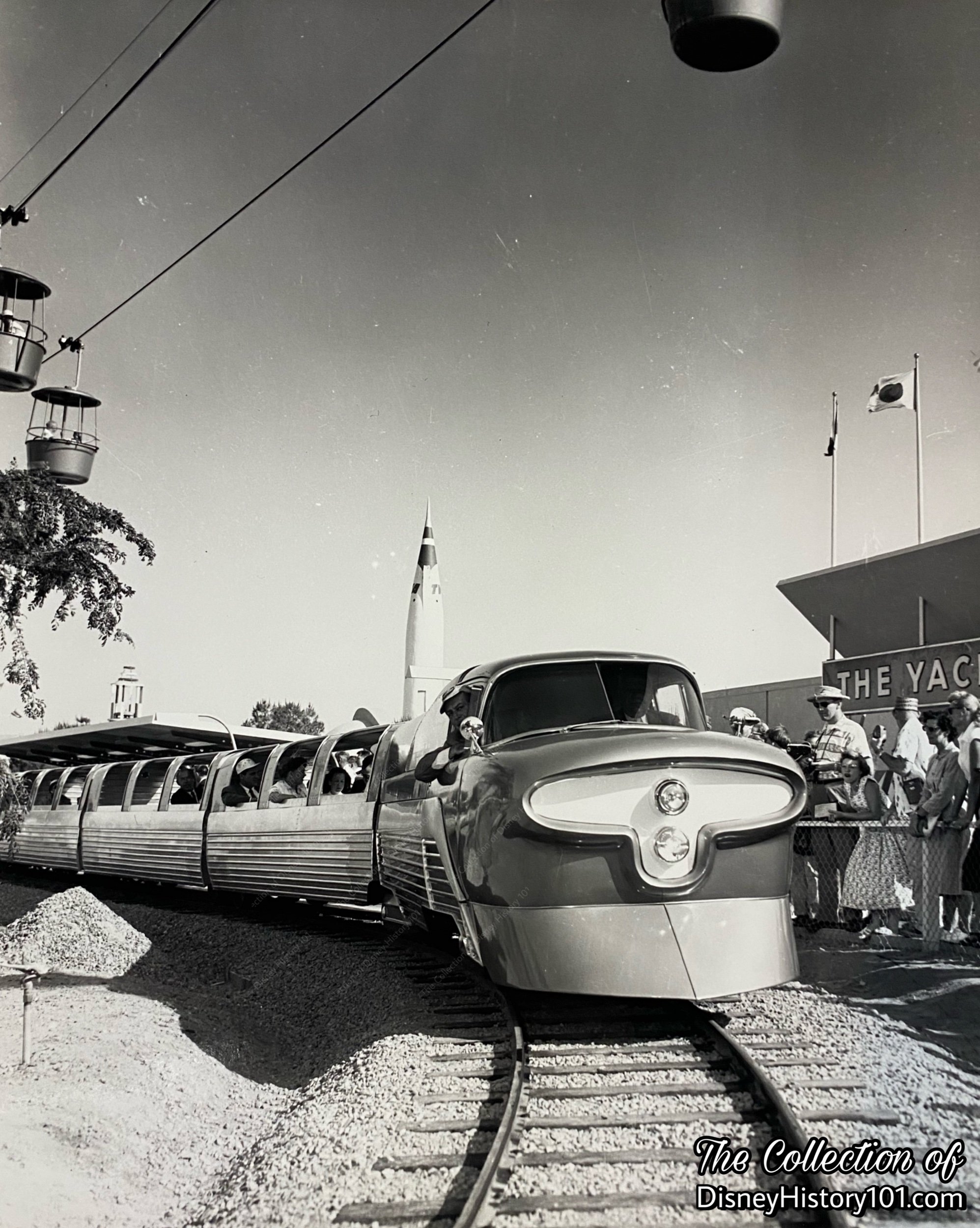
“55er” Joyce Belanger recalled: “On opening day for the view liner, Walt was at the controls. There were some beautiful new flower beds at the station and as everybody crowded closer and closer to see Walt, they got into the flowers. This kinda bothered Walt a bit and he asked the people to ‘Please keep off the flowers!’”
Bob Gurr also attended the opening and dedication, dressed in an Engineer ride operator costume.
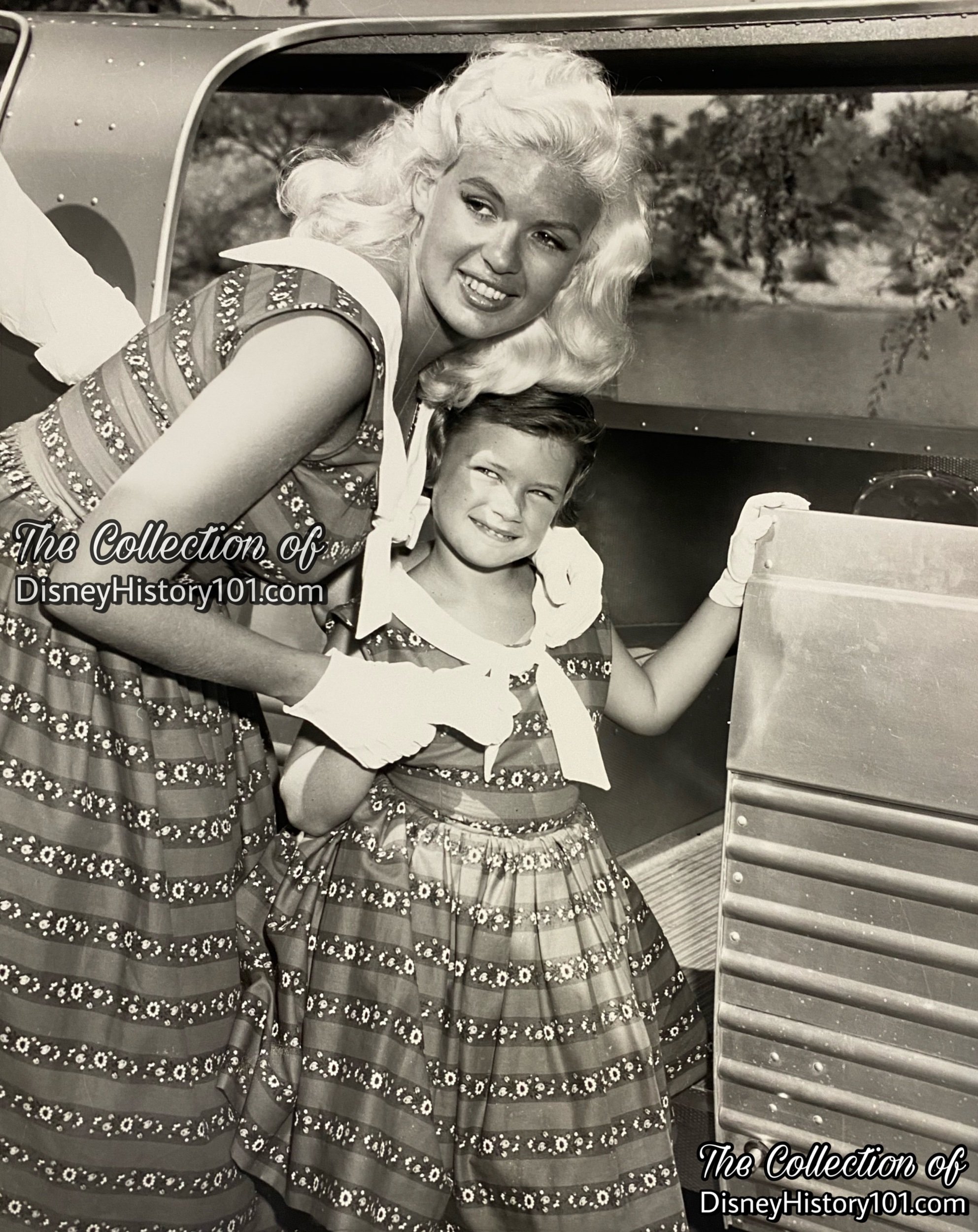
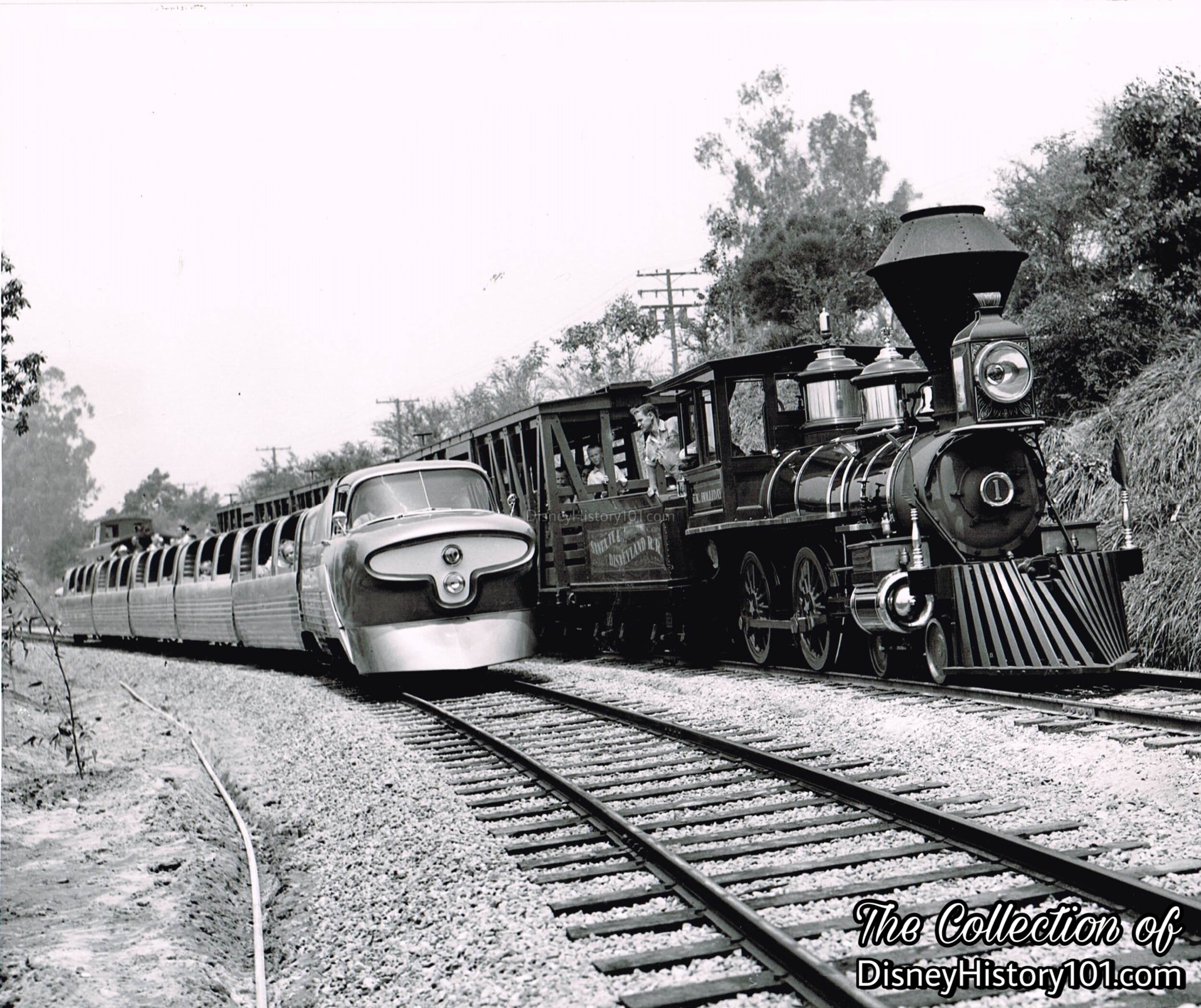
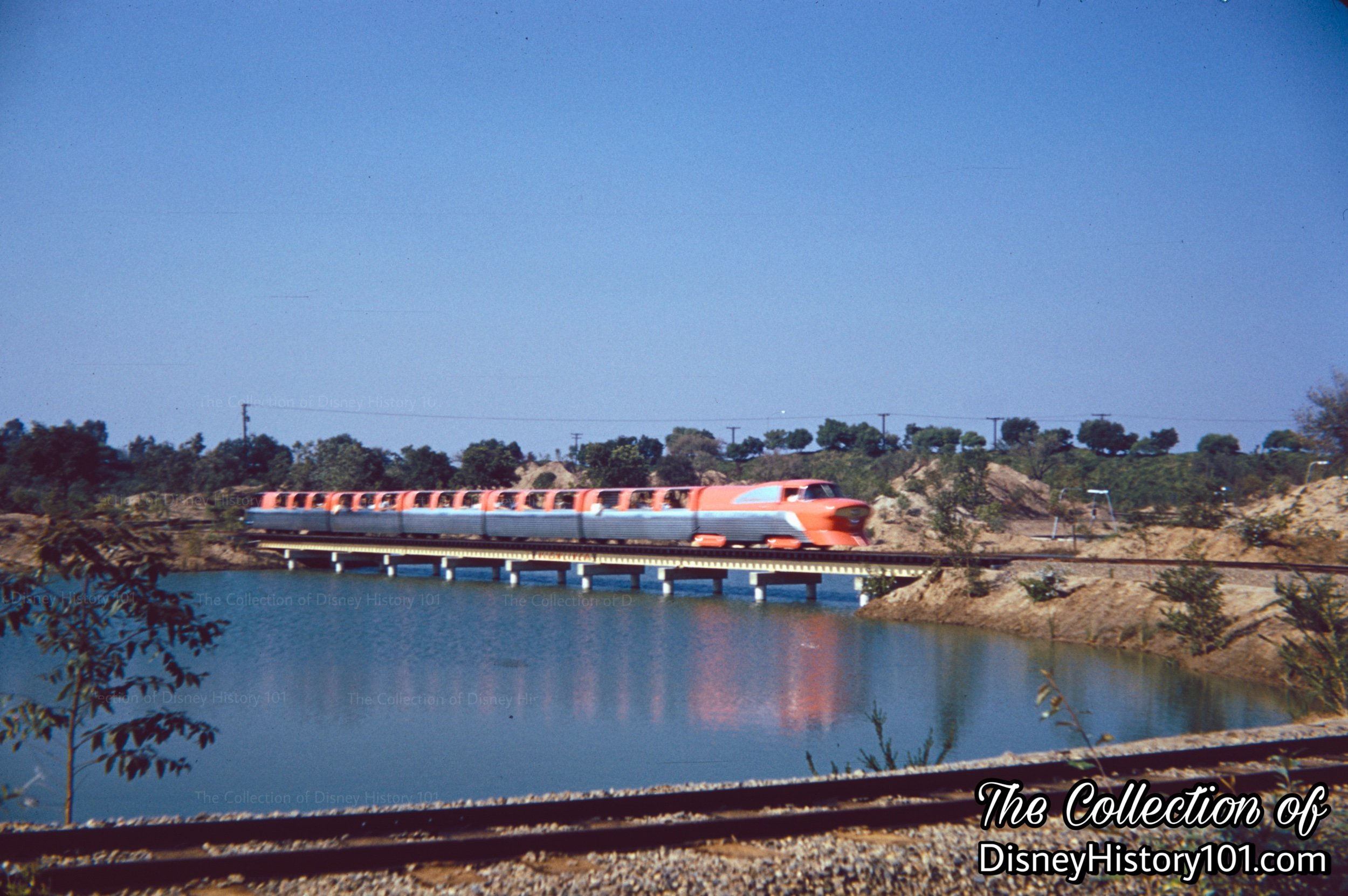
“Railfans” (and automotive fans) would appreciate that each of the 18’4” Viewliner engines were a 0-4-4-0 (8-wheel drive) type engine, weighing 5,000 pounds, and powered by a modified 1954 Oldsmobile 88 gasoline-powered engine! The Viewliner engines had an automatic transmission, drive shafts, and differentials. Where the full-scale Aerotrain would move at speeds of 120 miles per hour, the Viewliner (capable of speeds of 60 miles per hour) operated at comparative speeds of 30 miles per hour in Disneyland. As a “sidelight,” “at an actual ground speed of 30 mph, the Viewliner speedometers registered 120,” according to Michael Broggie (in Walt Disney’s Railroad Story”). According to “Walt Disney’s Railroad Story” by Michael Broggie (page 297), this may have been owning to the fact that “each car featured two speedometers… calibrated to register four times the train's actual speed.” Regardless, this was all very impressive considering the attraction’s narrow 30-inch gauge rails, rails that ran around and over Tomorrowland Lake!
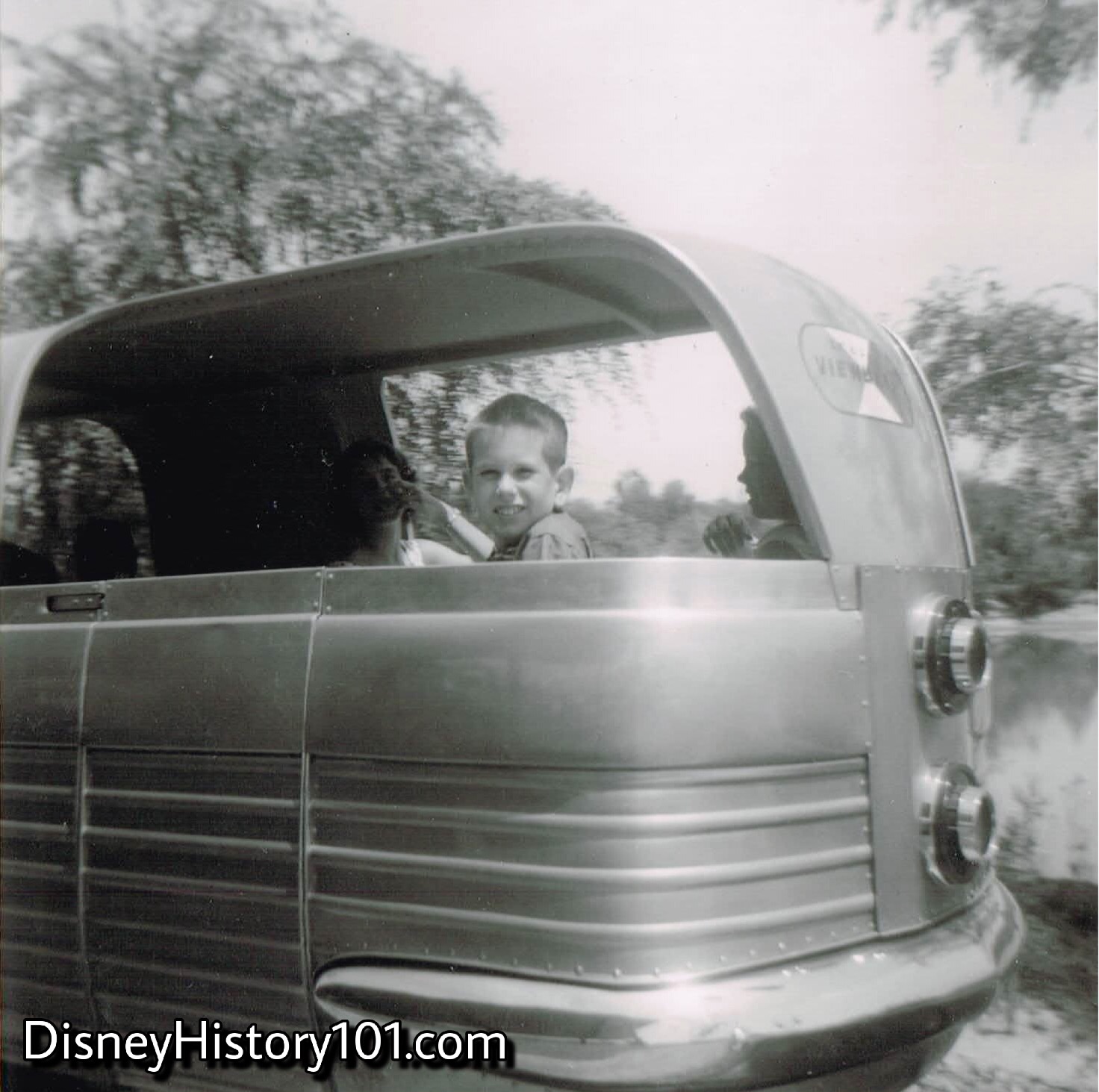
During its “peak” attendance periods of its short heyday, the Viewliner was often operated by a maximum of 2 engineers, 2 ticket takers, 4 platform men, and 2 relief men.
The attraction had two 32-seat trains with an average total guest capacity of 12 (for the passenger cars), and 16 (for the observation car). Guests sat inside the comfortable and modern 2,000 pound aluminum and steel-frame passenger coaches or observation coach of each train. Pictured above, one of the Tomorrowland Viewliner’s younger passengers enjoys the view from one of the best seats!
Communication speakers allowed the engineer to make announcements. Automatic electric doors (also controlled by the engineer), and vacuum operated brakes (on every wheel) kept the guests safe inside the coaches for the duration of the ride. The 16’10”-long Coaches (like the engines) featured standard automotive parts (particularly, General Motors components within their suspension assembly), a gimbel bearing connection, and two speedometers.
The names of the two train engines (and their rolling stock) were :
•Tomorrowland Viewliner - and passenger cars Jupiter, Venus, Mercury, Mars, and observation car Saturn.
•Fantasyland Viewliner - and passenger cars Pinocchio, Cinderella, Bambi, Alice, and observation car Tinkerbell.
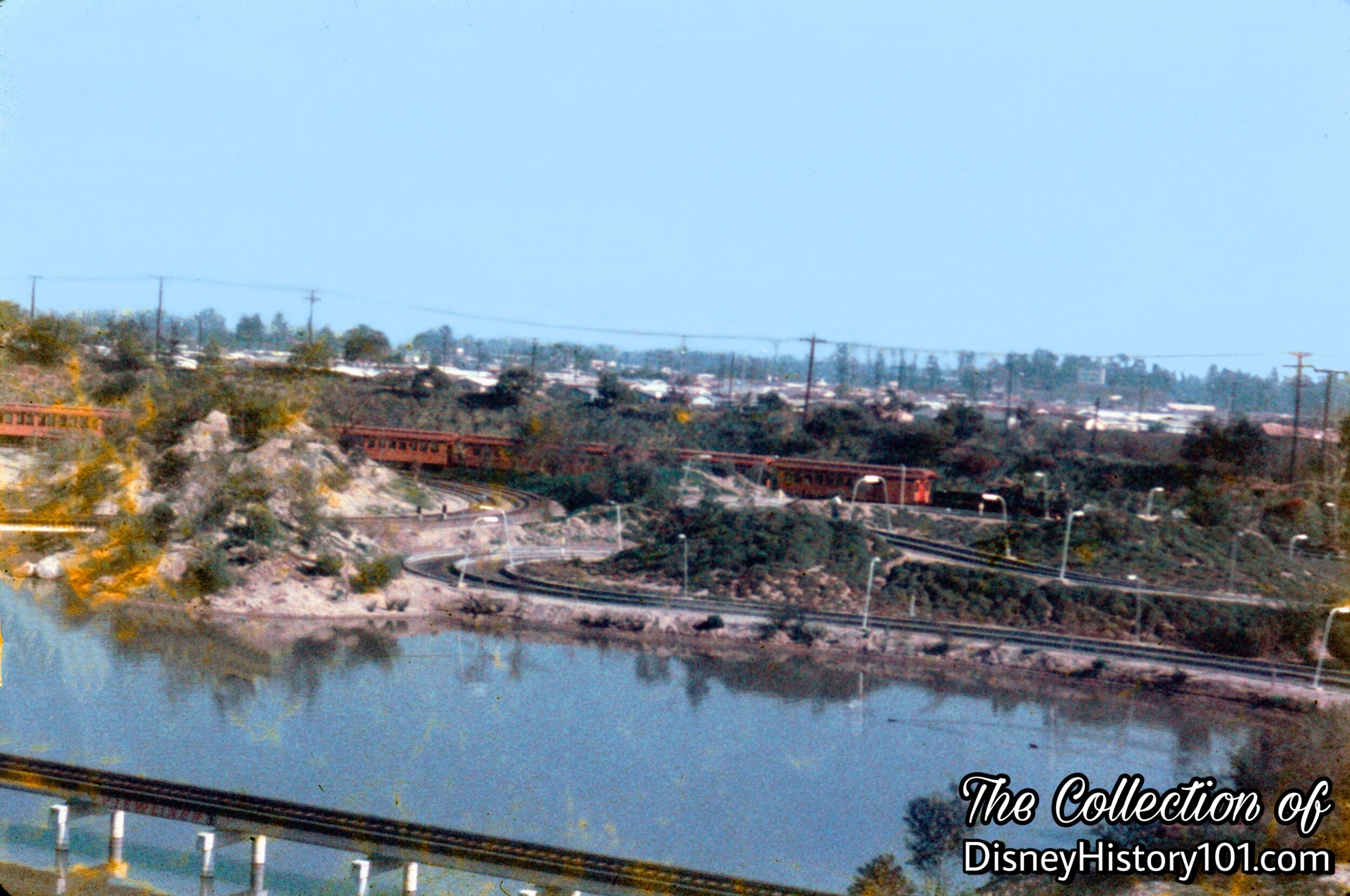
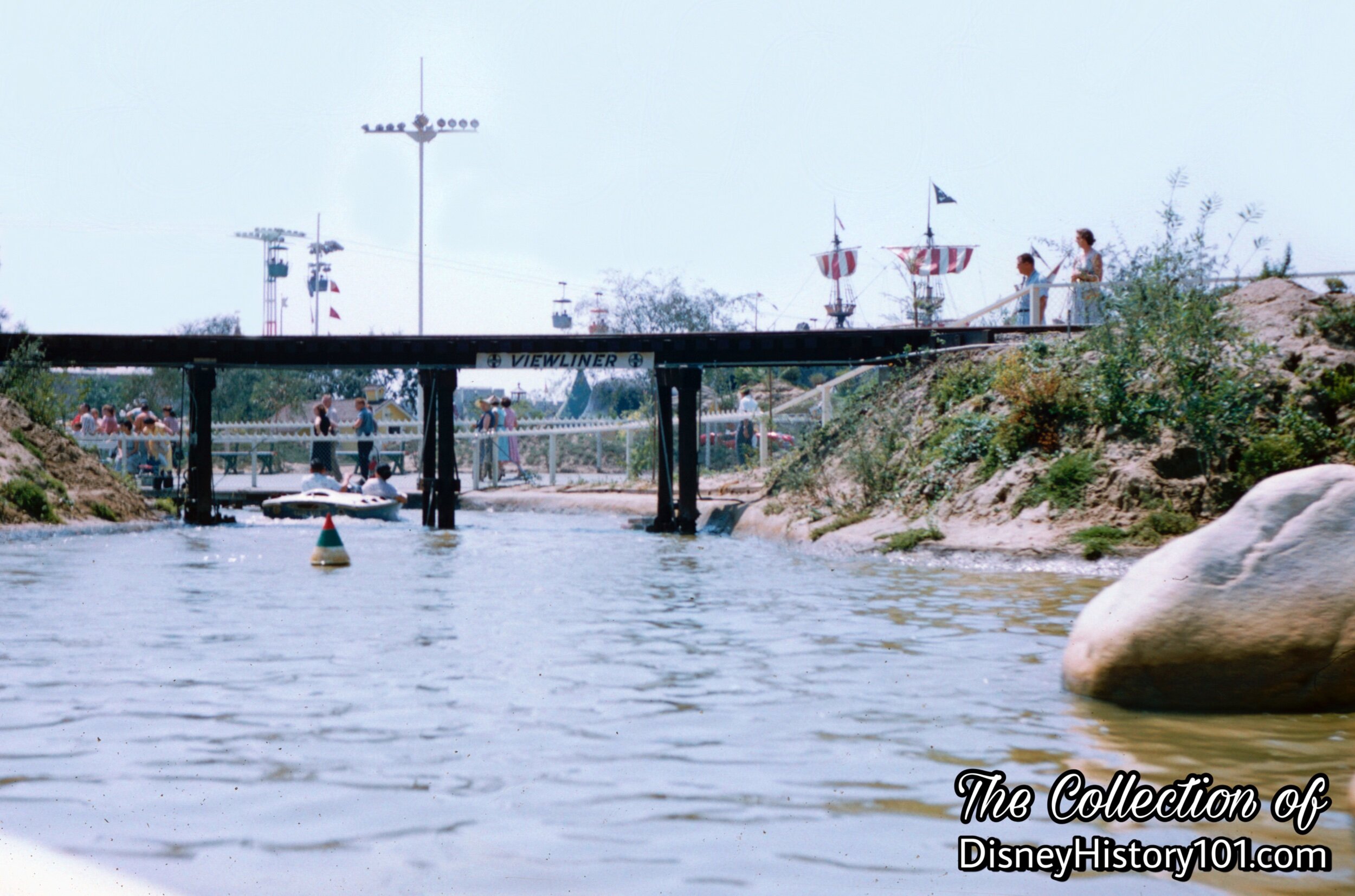
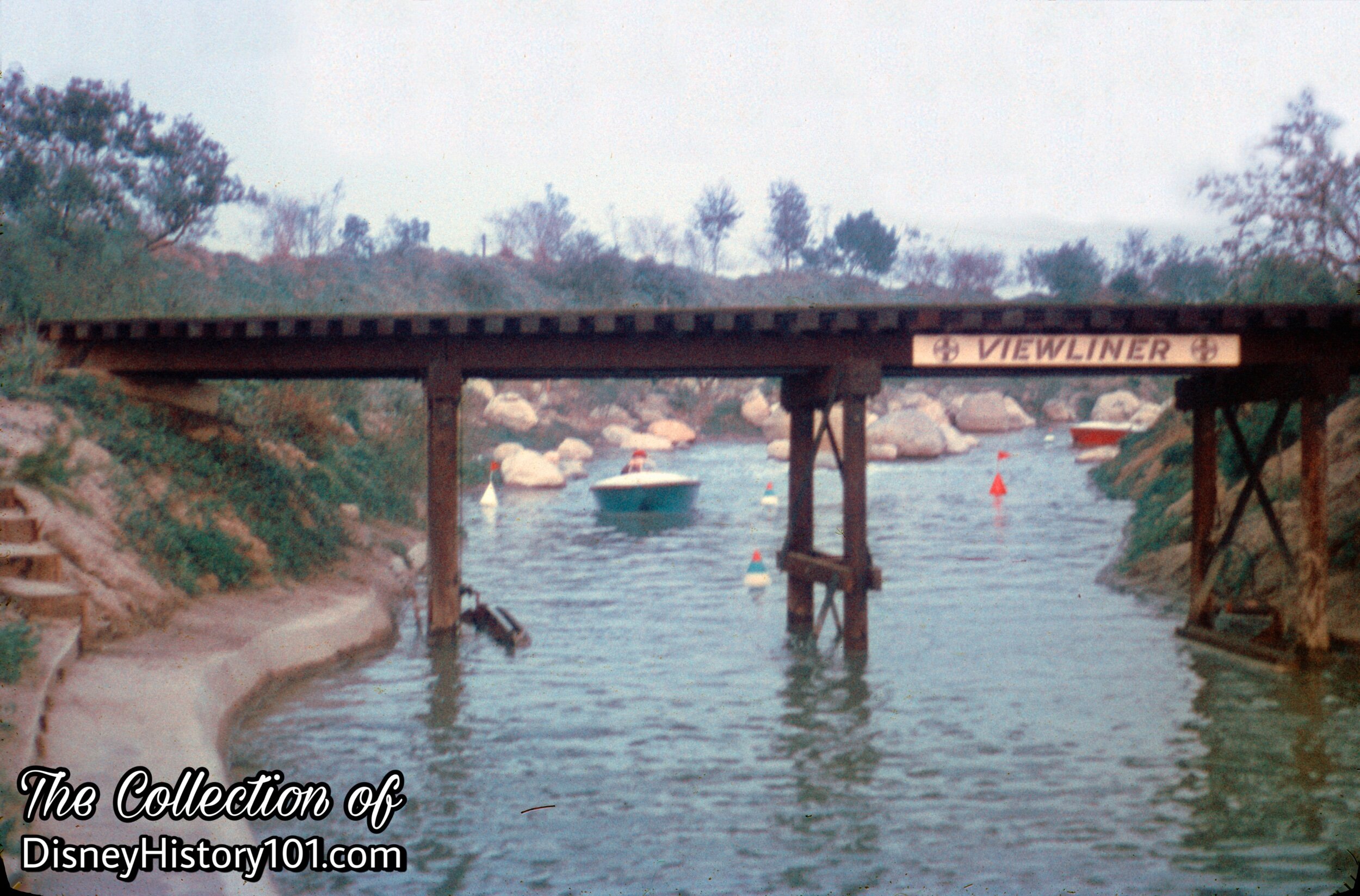
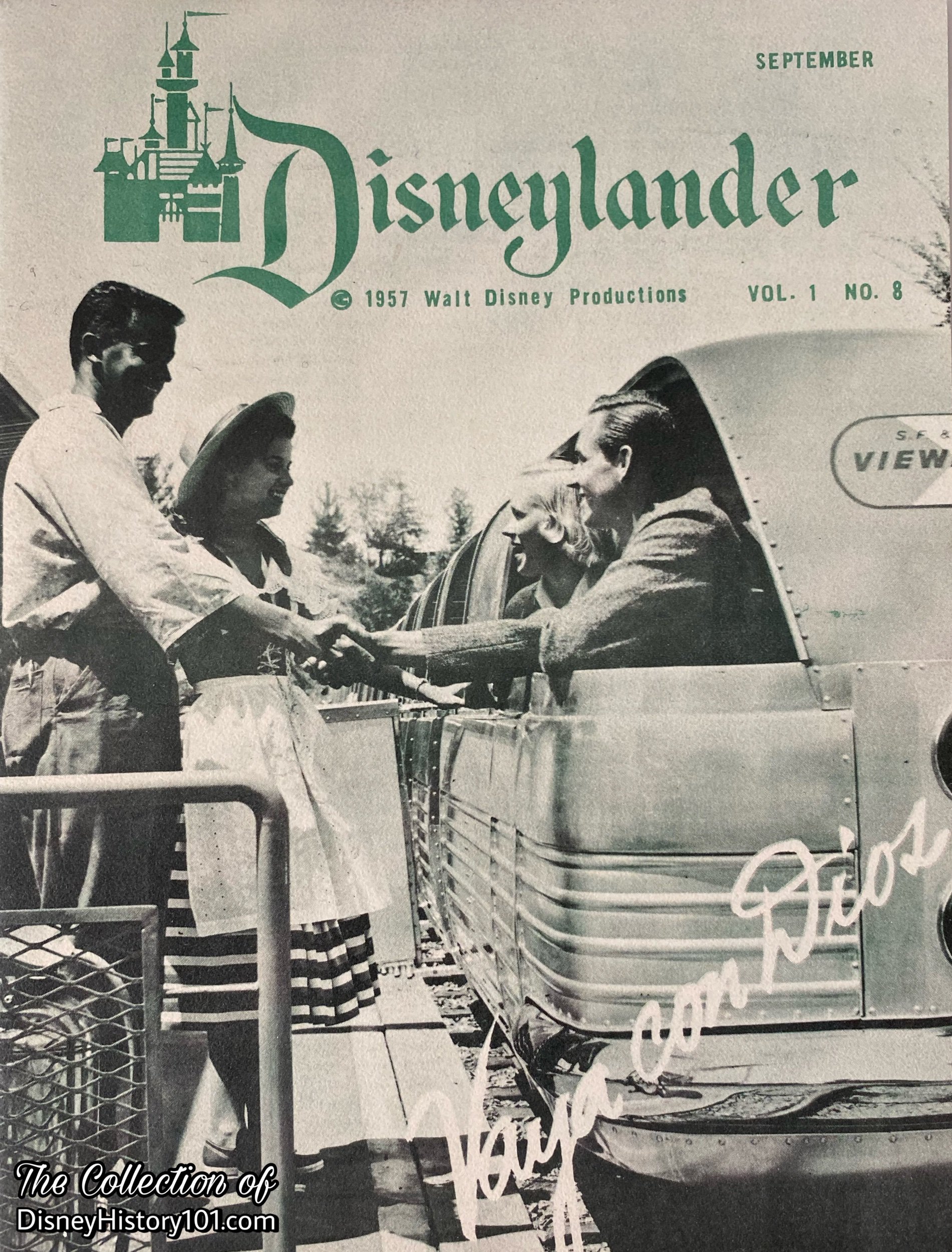
A fond farewell is issued to a couple of Disneylanders aboard the Viewliner on this cover of Disneylander. Little did anyone know that they would be bidding “Vaya con Dios” to the Viewliner a year later.
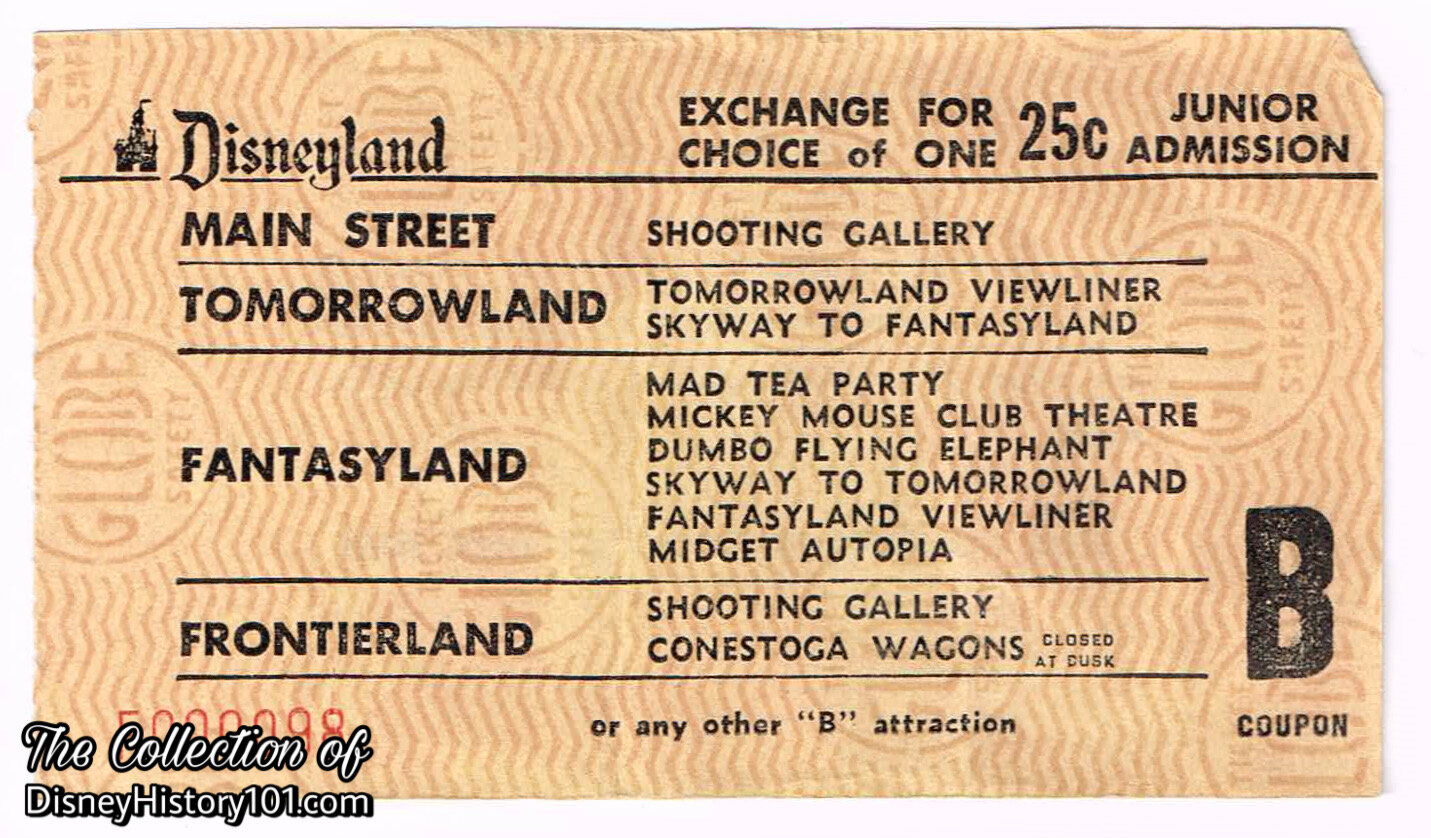
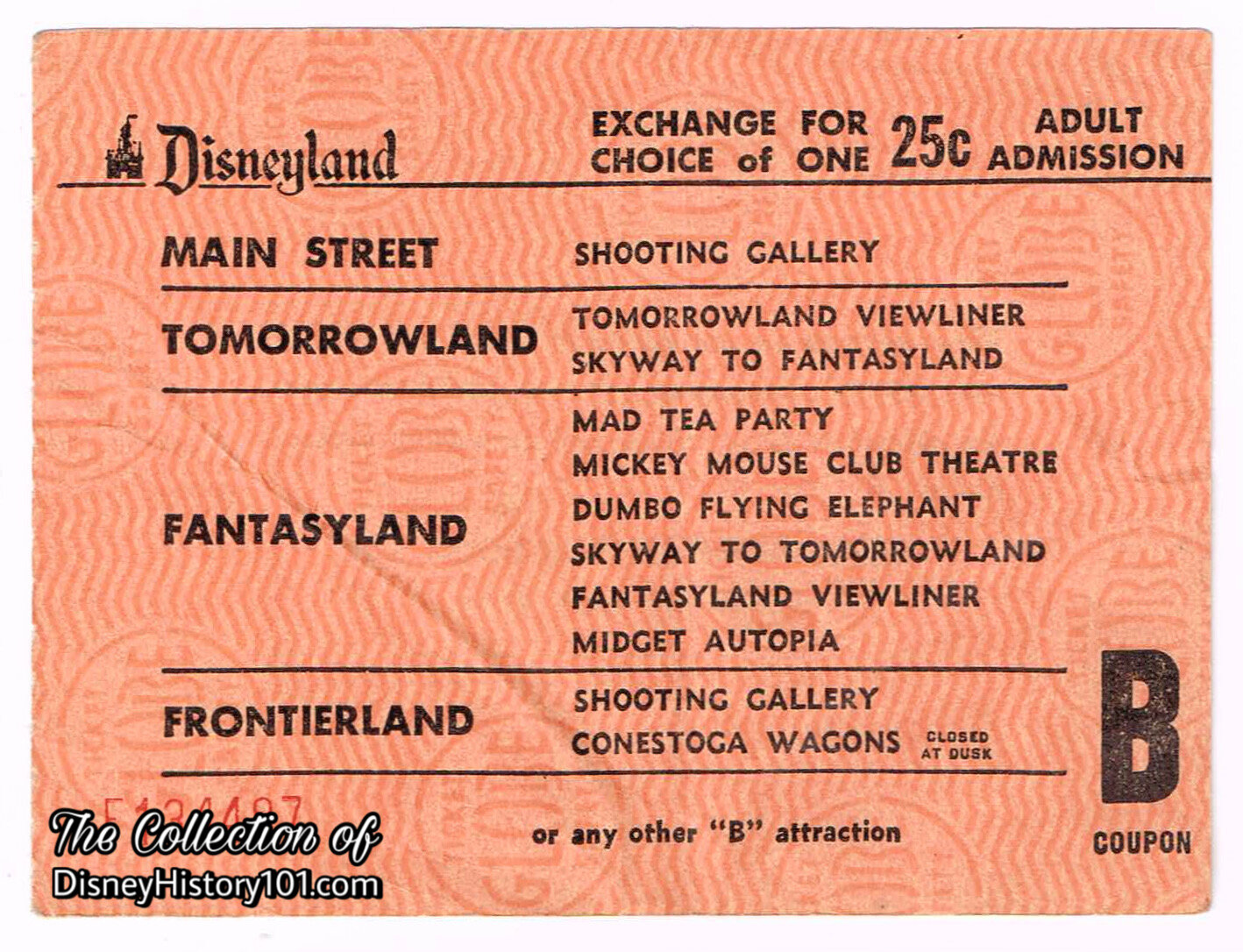
Admission for the 3-minute trip aboard the Fantasyland Viewliner or Tomorrowland Viewliner was one “B” Admission Coupon (or, 25 cents, for one adult), the same as a round of ammunition in the Main Street Shooting Gallery, entry into the Mickey Mouse Club Theater, or a ride aboard the Conestoga Wagons in Frontierland! This translated into the Santa Fe & Disneyland Viewliners yielding total revenue (in management fees for Disneyland Inc.) of $19,594 for the fiscal year (52 weeks) ending September 29, 1957 and a total of $35,524 for the fiscal year (52 weeks) ending September 28, 1958.
Soon after its grand opening, the Viewliner Train of Tomorrow (with Walt at the controls) was amazingly preserved on film in the “An Adventure in the Magic Kingdom” episode of Walt Disney’s “Disneyland” television series (filmed during “Walt Disney Studio Day at Disneyland ” in 1957, and airing on television in 1958)!
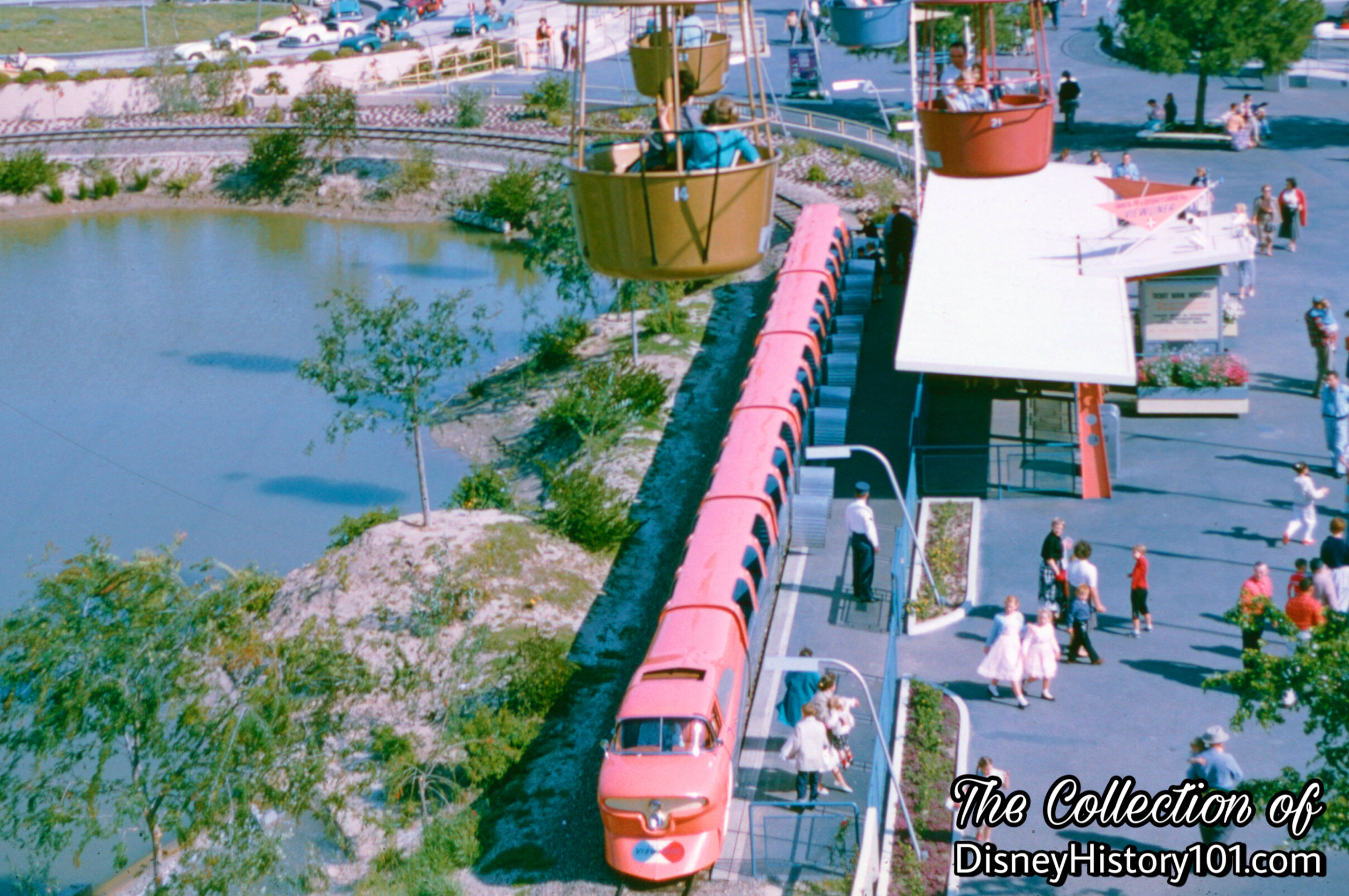
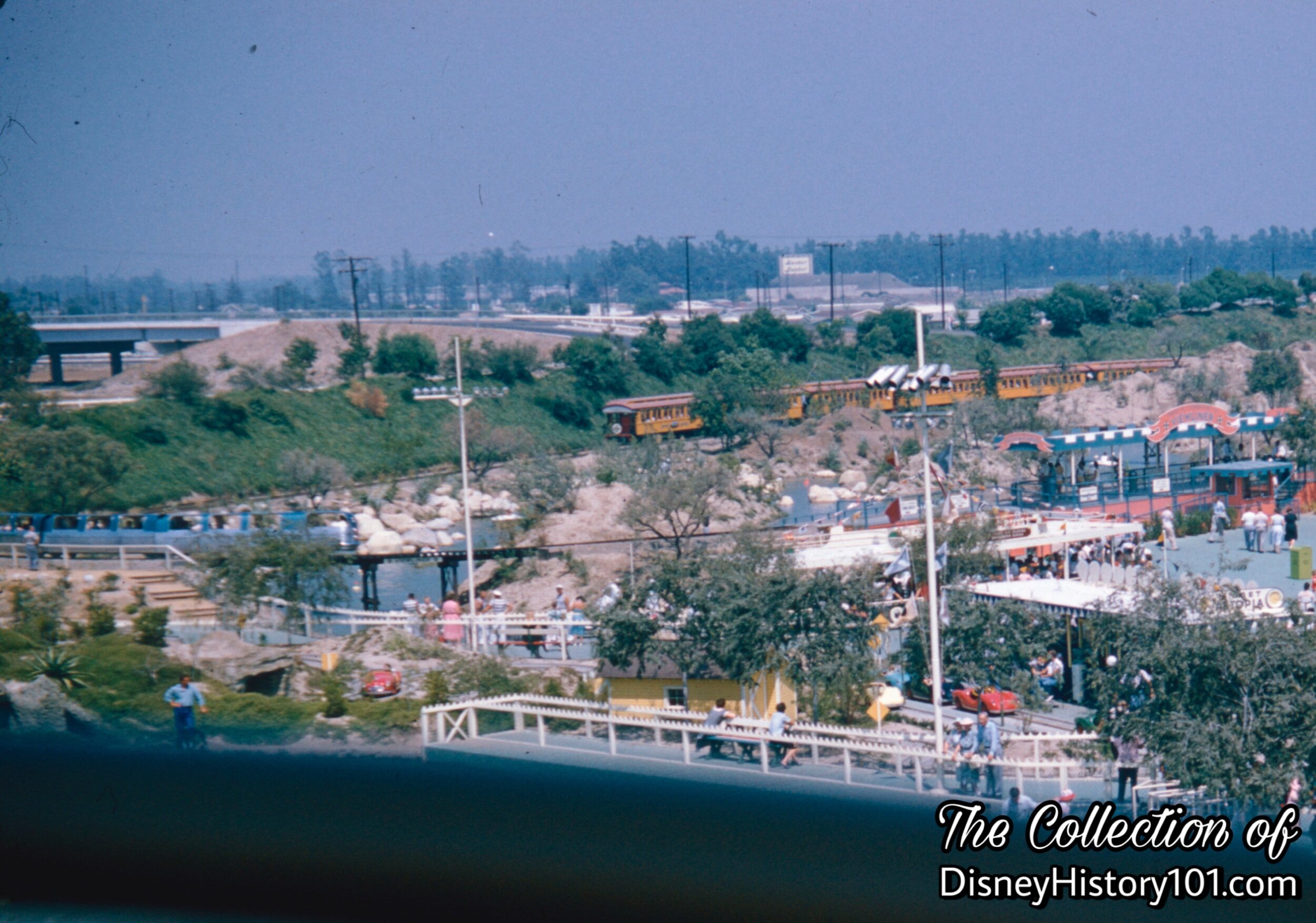
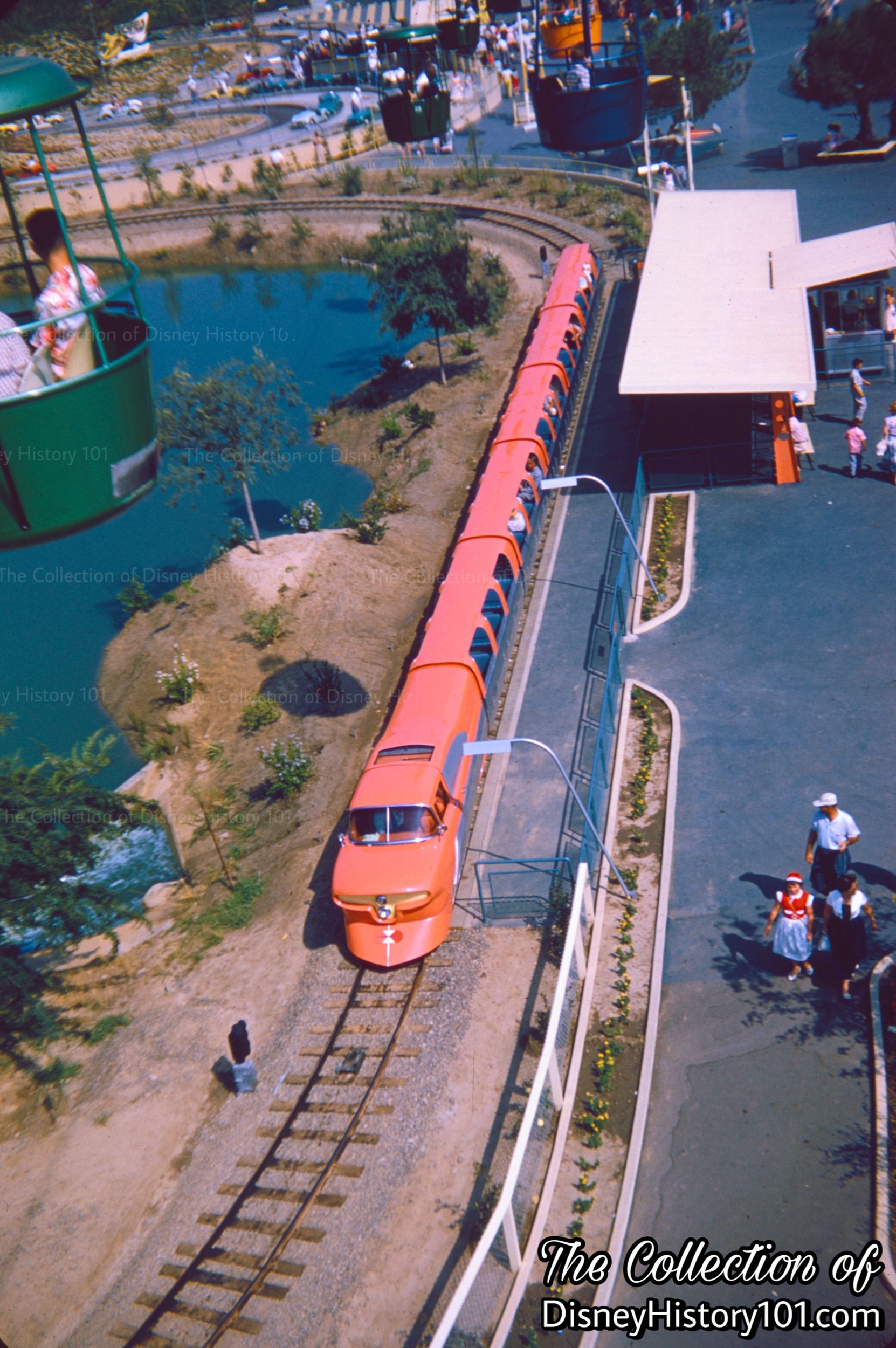
All together, each 96’8” Viewliner train could easily pull in alongside one of two stations (each, with a 109-foot loading platform) - one in Fantasyland and the other in Tomorrowland (pictured above)!
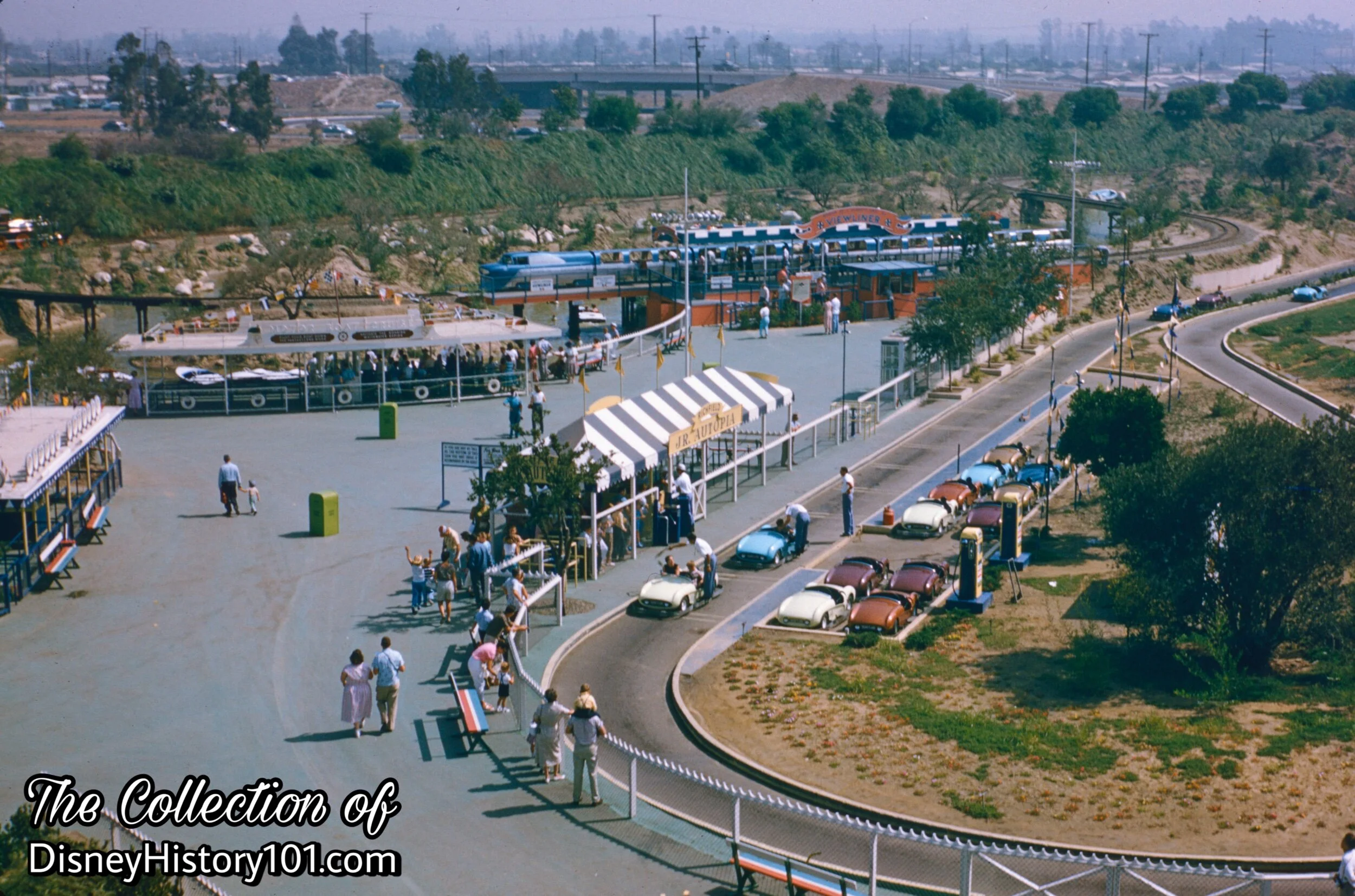
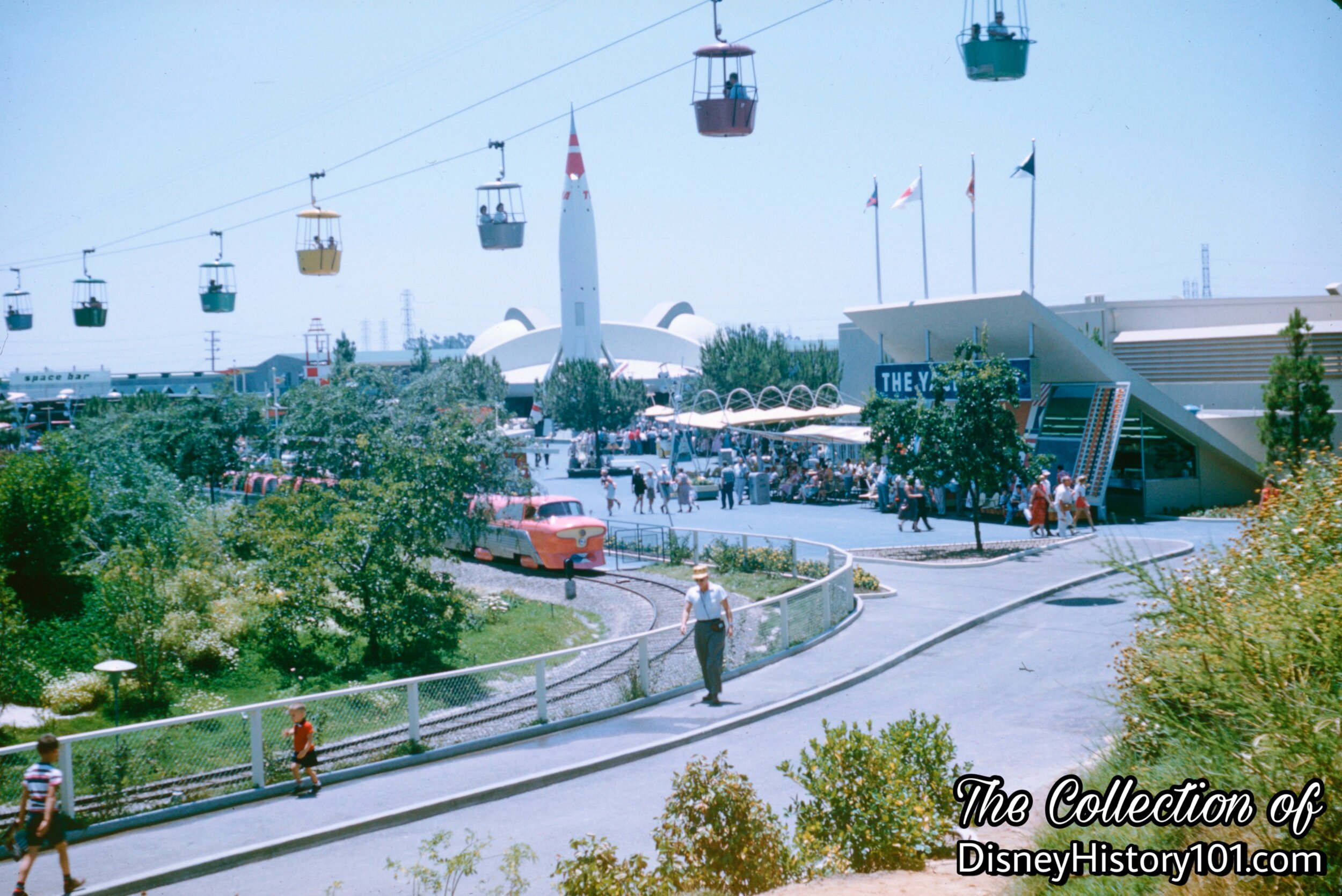
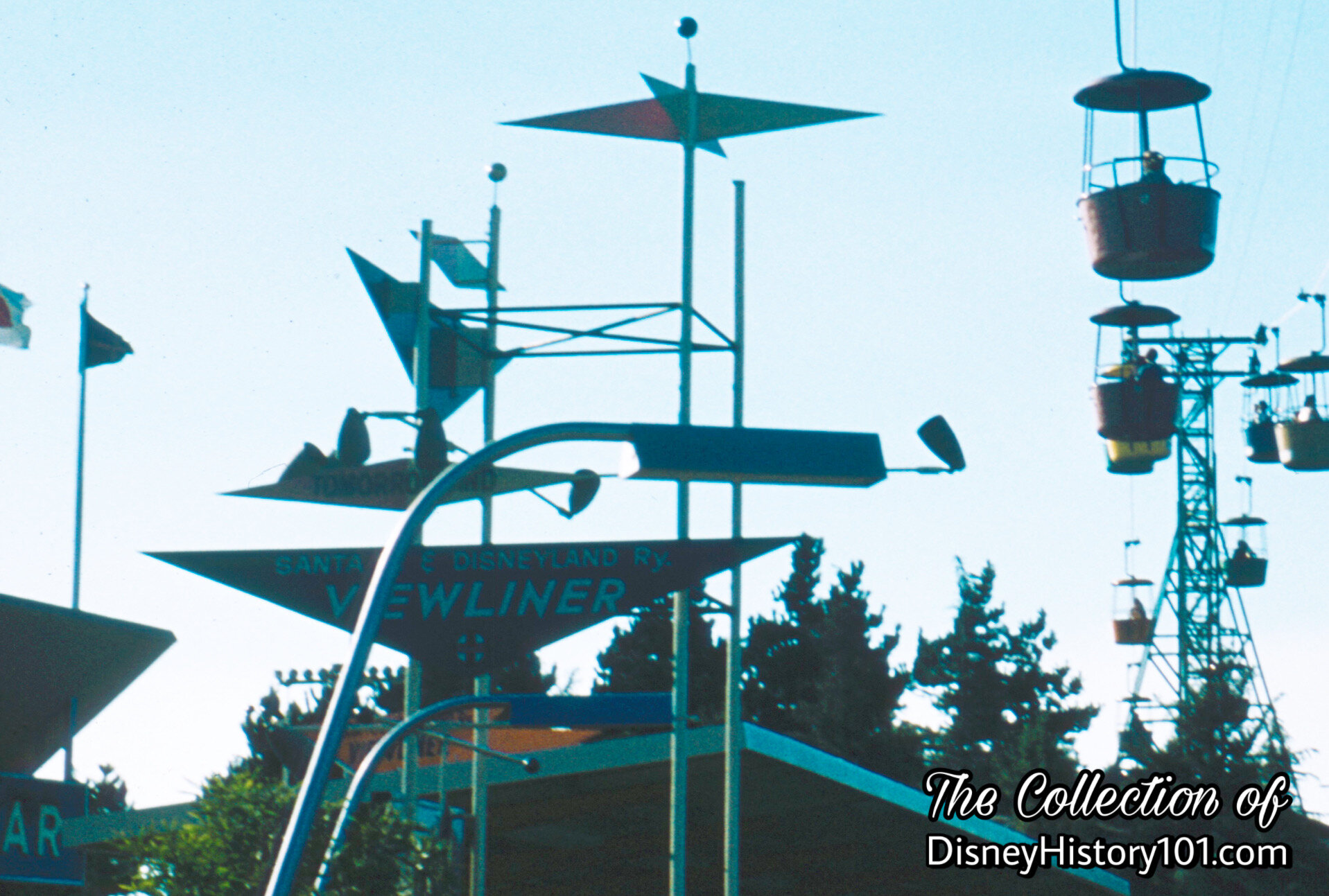
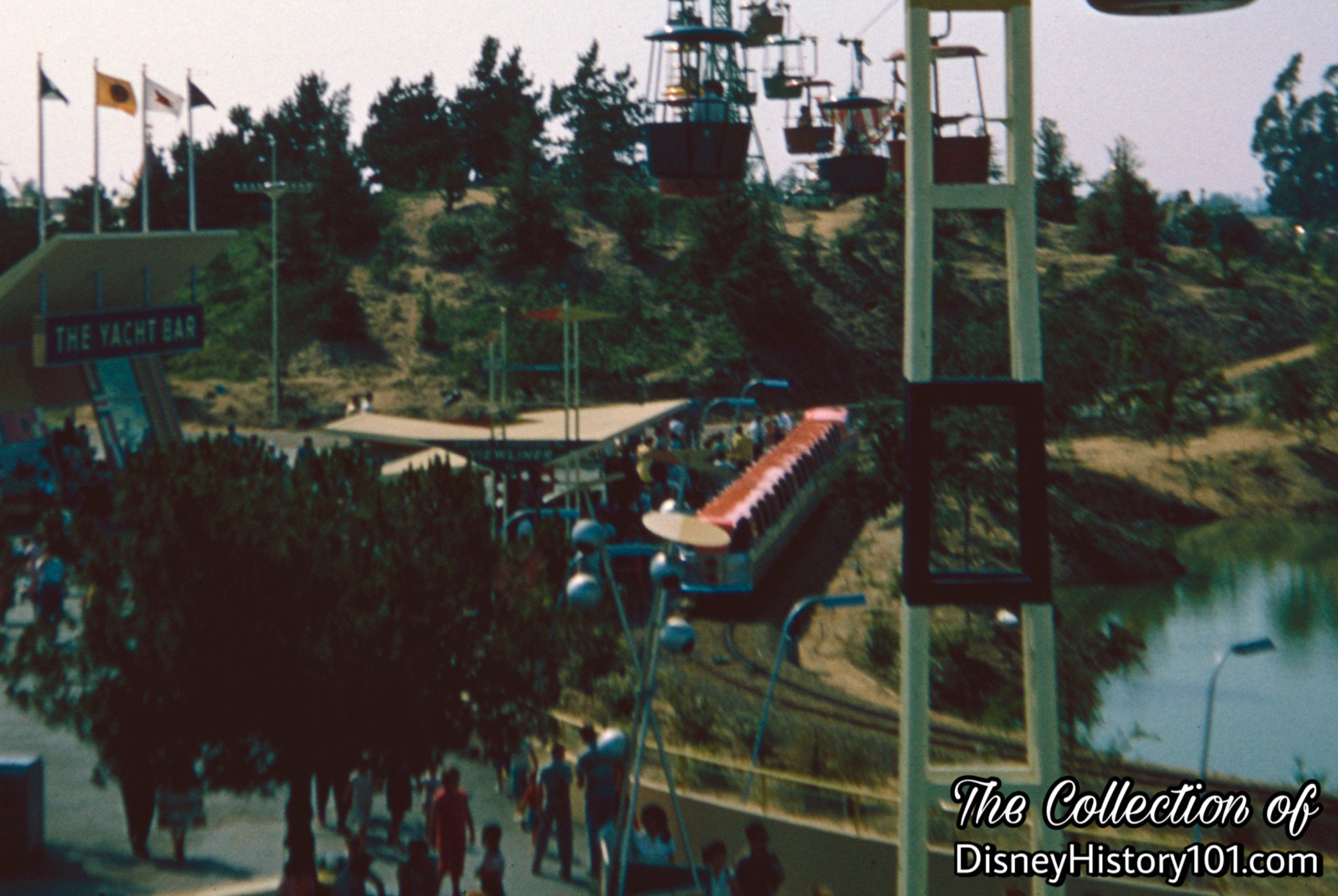
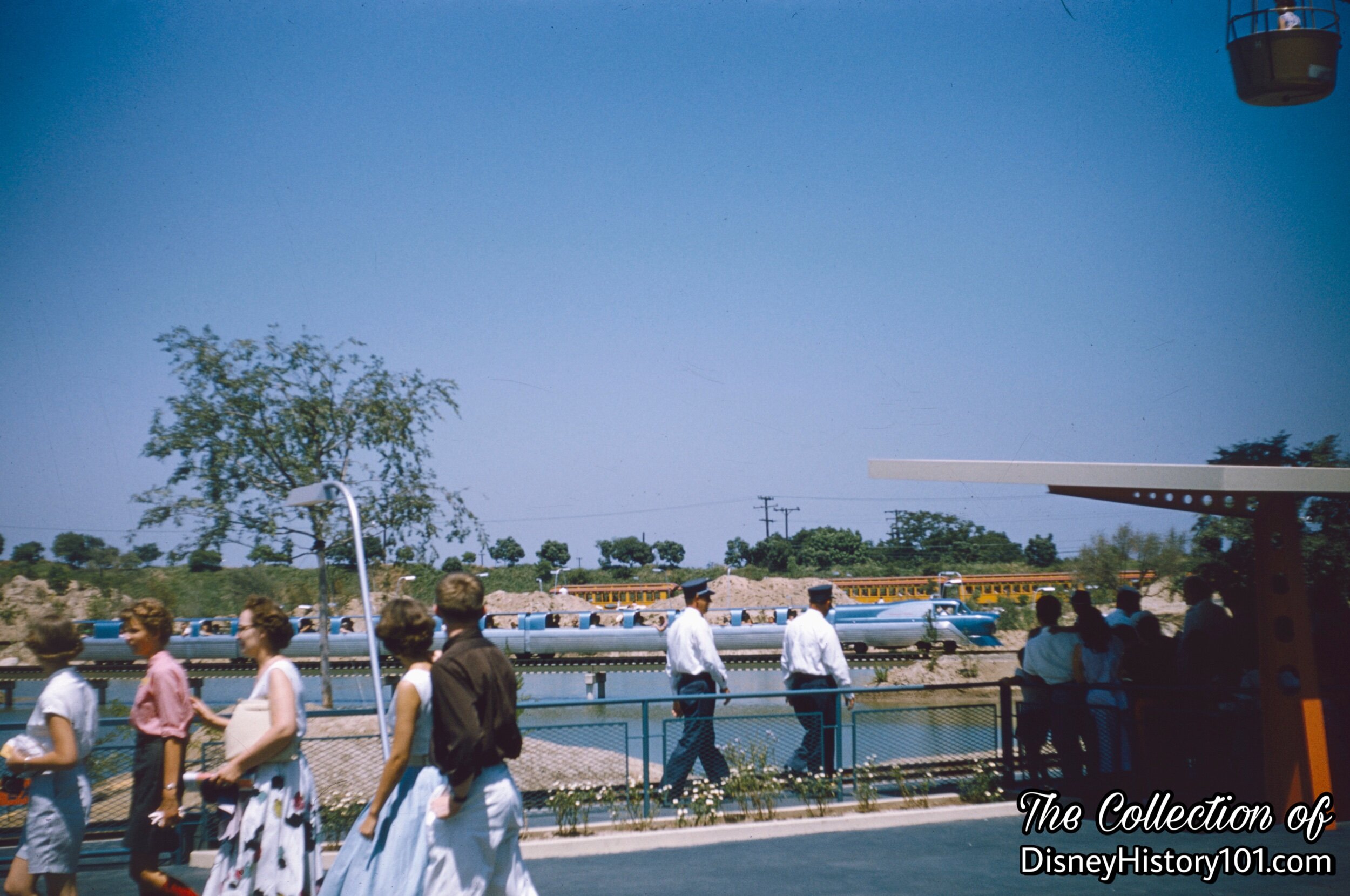
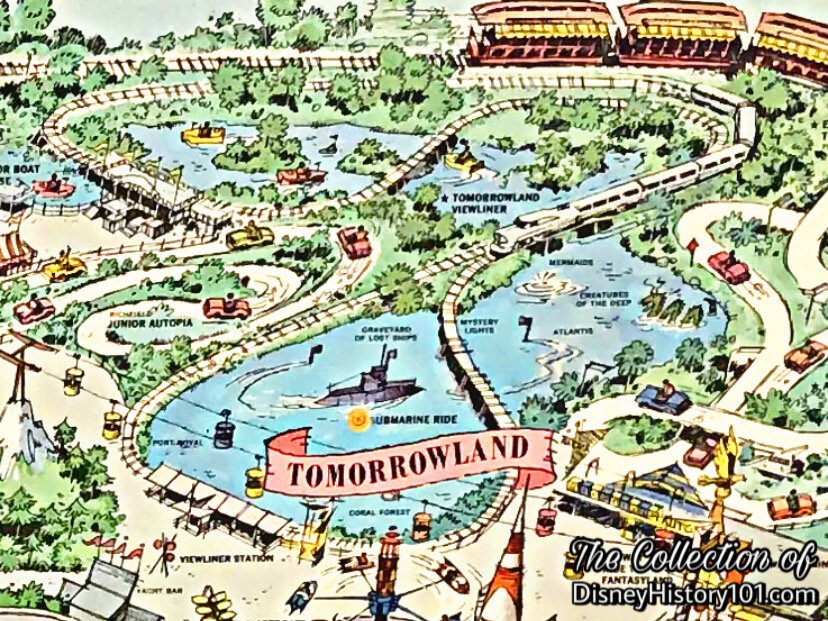
By the details of 1 (of 3 of) Sam Mc Kim’s c. 1958 Disneyland Wall Map (“1958 A”), it appeared that the Viewliner’s tracks and trestles were to run over the tides of Tomorrowland Lake and the “Submarine Ride” (with its “Coral Forest,” “Port Royal,” “Graveyard of Lost Ships,” “Mystery Lights,” “Mermaids,” “Creatures of the Deep,” and “Atlantis” Show Scenes.
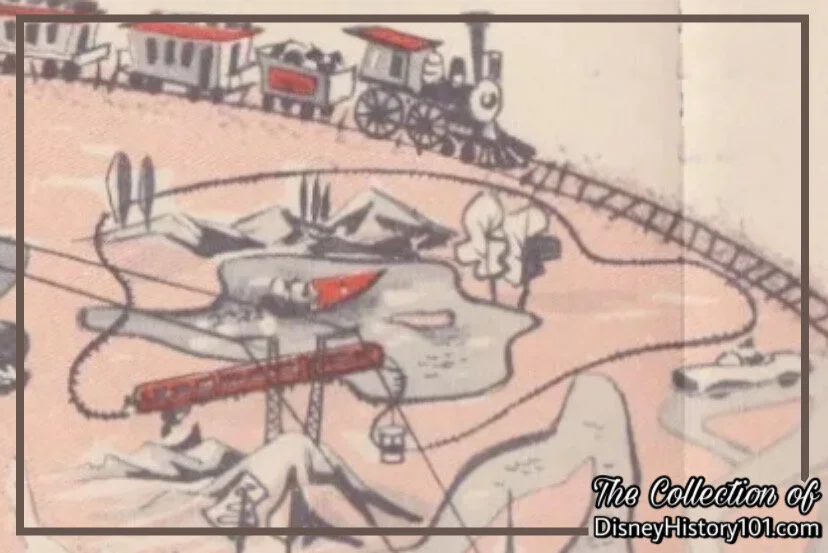
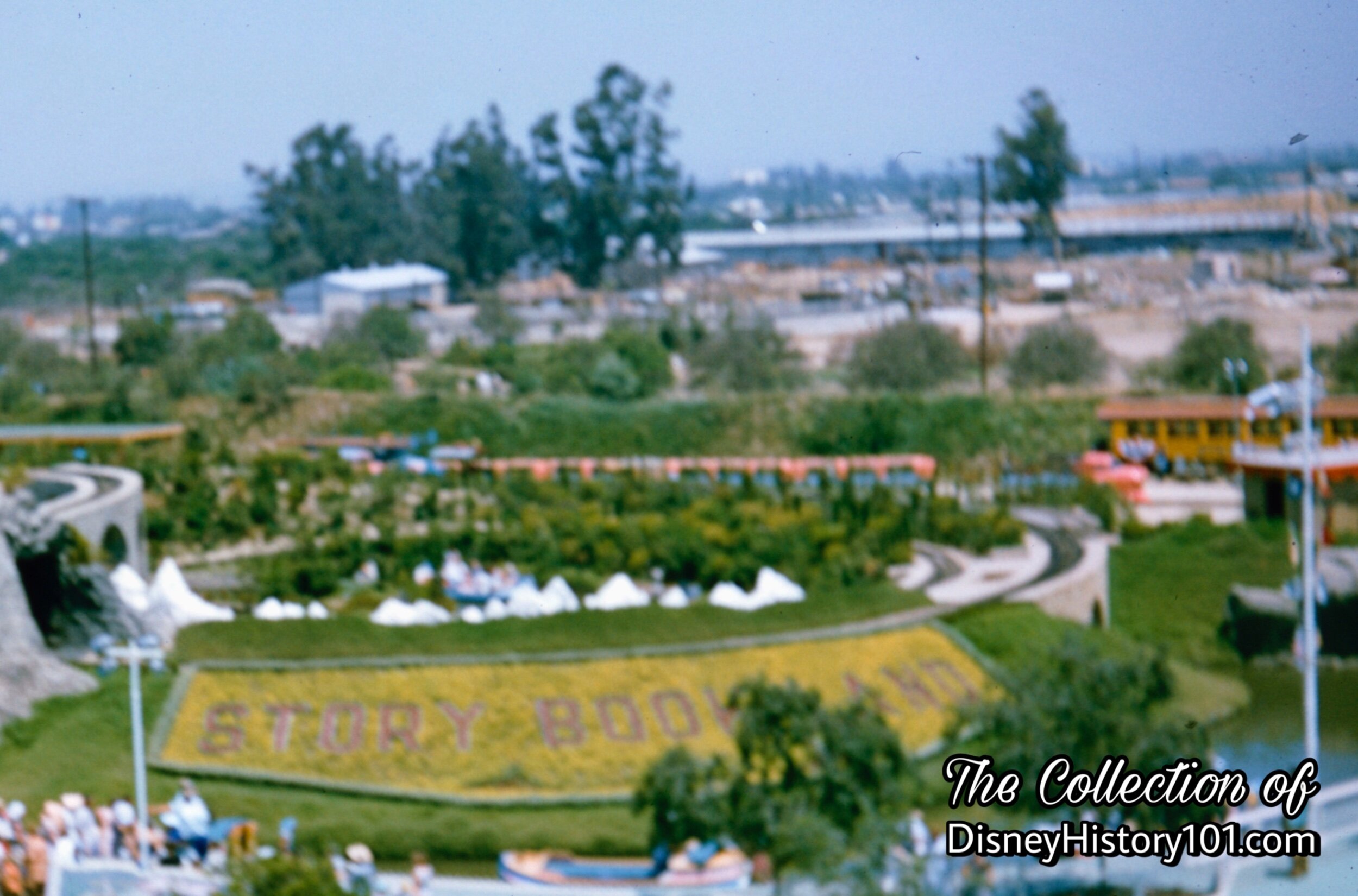
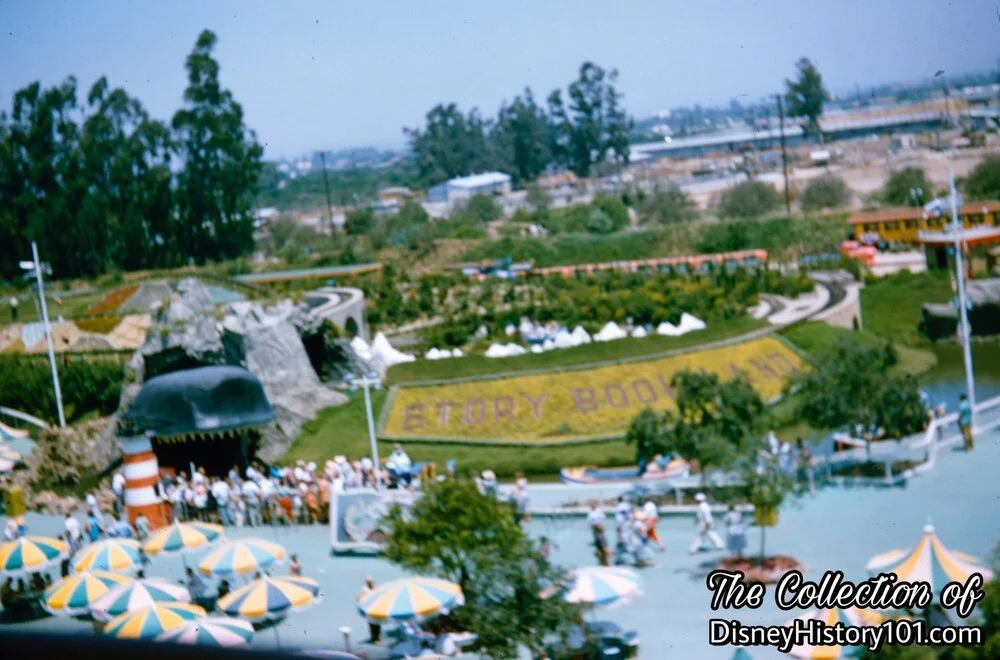
During the Viewliner’s operation, the Fred Gurley became the seventh train in the Park. There were four types of trains - and a total of seven additional trains are in use at Disneyland. Two Western mining trains carry visitors over Rainbow Desert and through the colorful Rainbow Caverns in Frontierland. In Tomorrowland and Fantasyland, two sleek, futuristic Viewliners speed passengers between the two lands. And in Fantasyland, the unique Casey Jr. trains huff and puff up hill and down adjacent to Storybook Land.
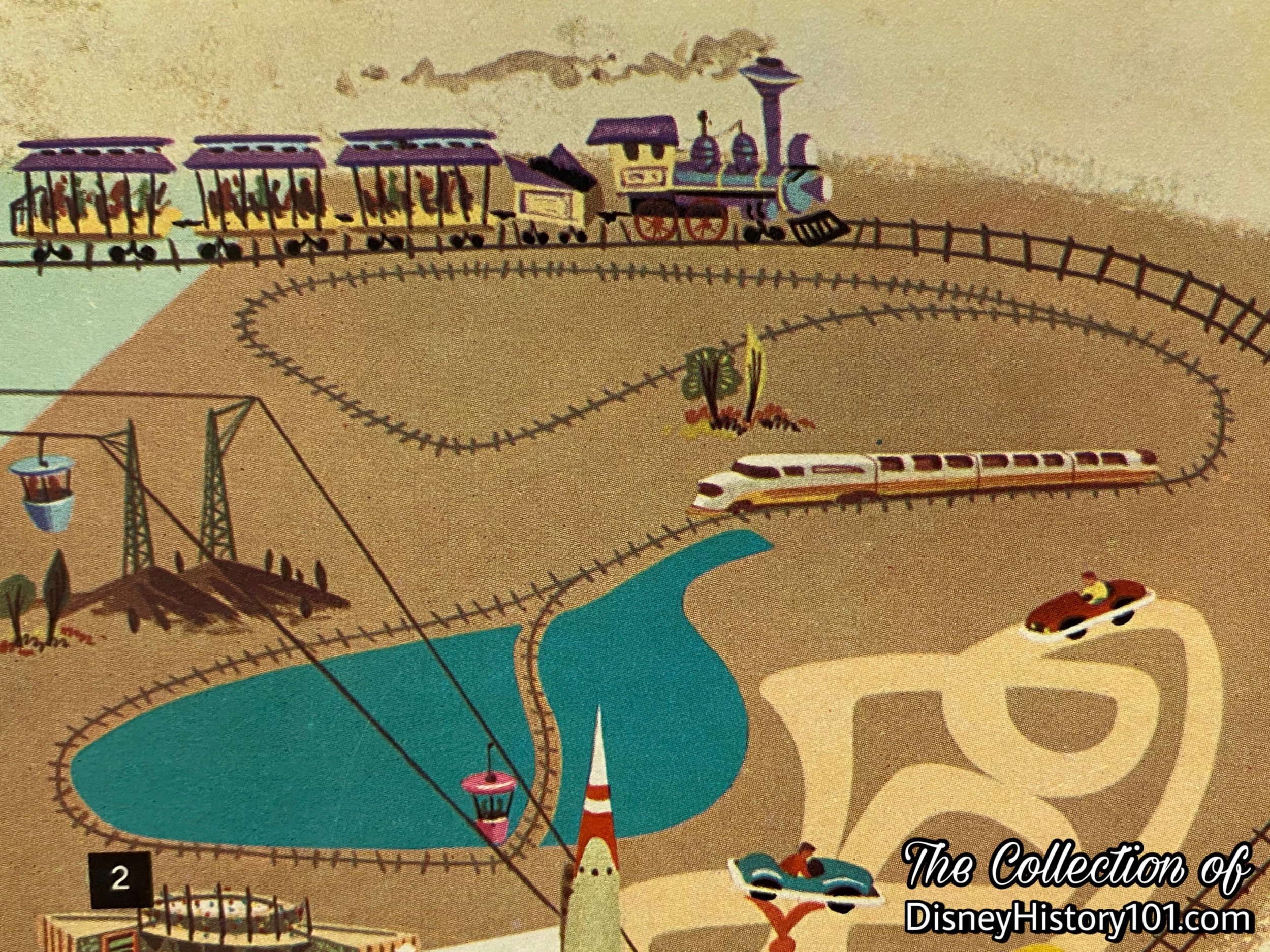
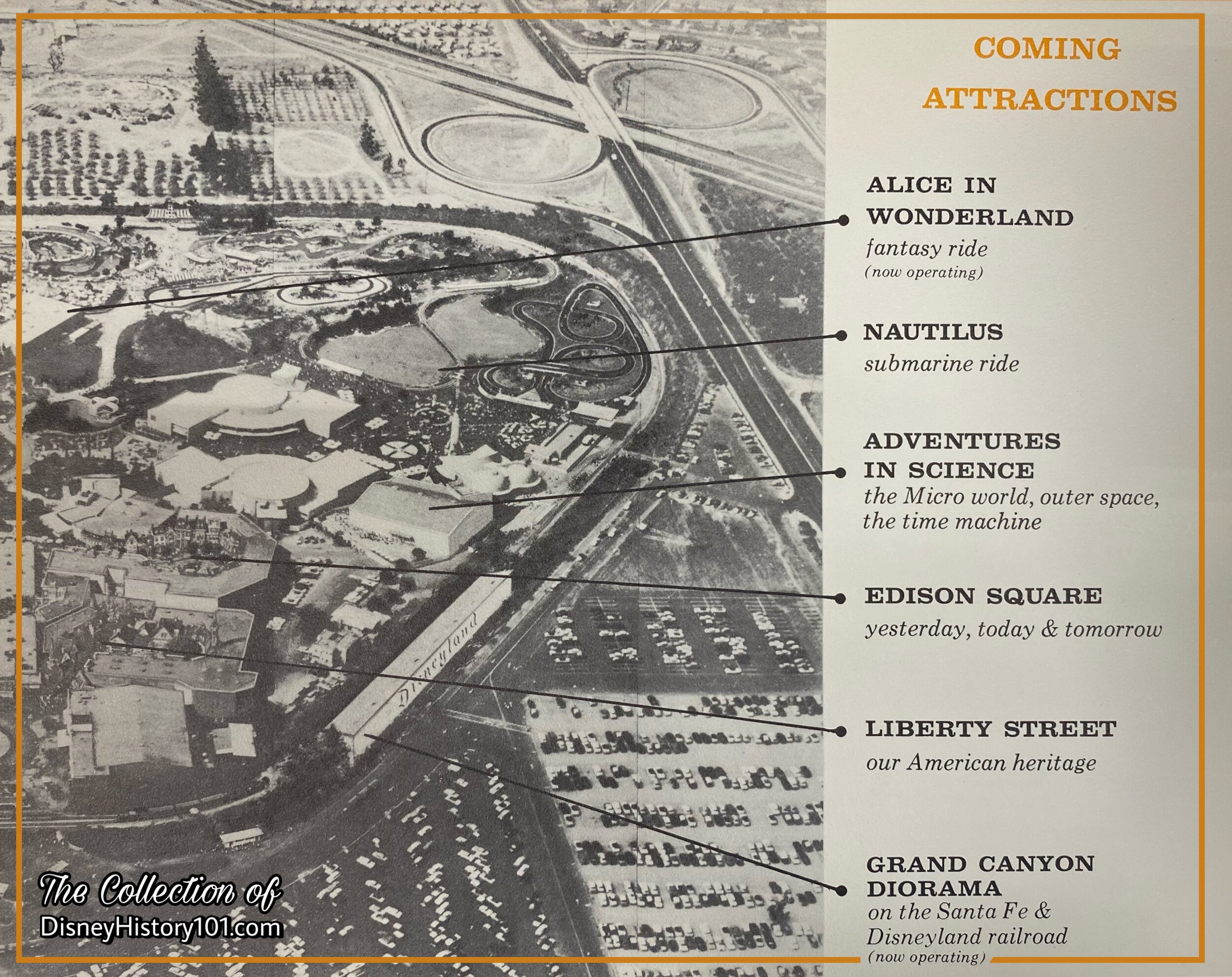
While the Viewliners were still in operation, this promotional “Disneyland U.S.A.” booklet distributed to potential National sponsors (or, “Participants”) in Disneyland. This map of “Coming Attractions” labels a coming “Nautilus submarine ride” to be installed in the area of the Tomorrowland Lake. By the time this publication was distributed, the final touches were likely being added to the ALWEG-Disneyland Monorail Trains - successor of the Viewliner Train of Tomorrow.
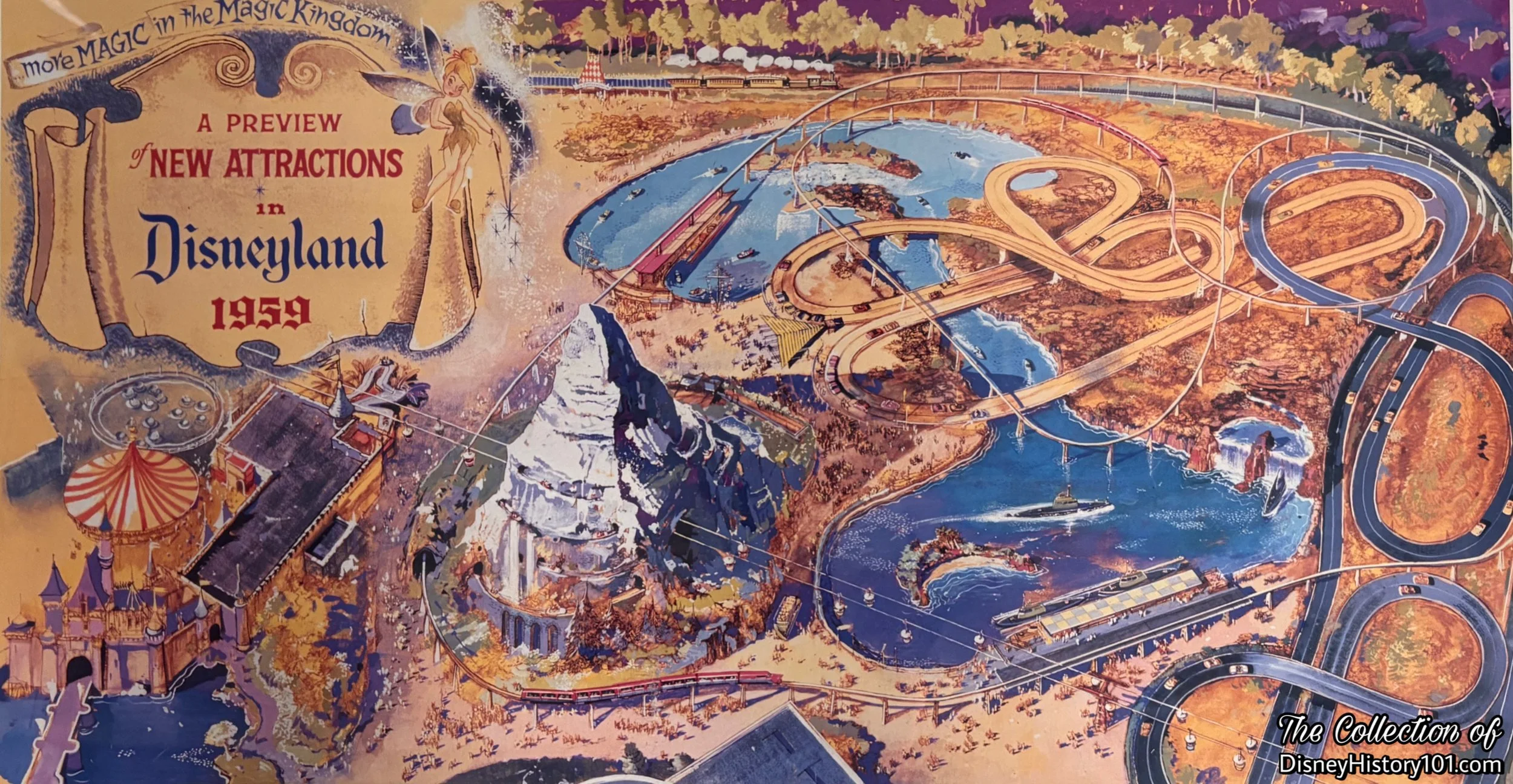
Herb Ryman’s concept artwork was dated “c.1955” on one print offered through The Disney Gallery.
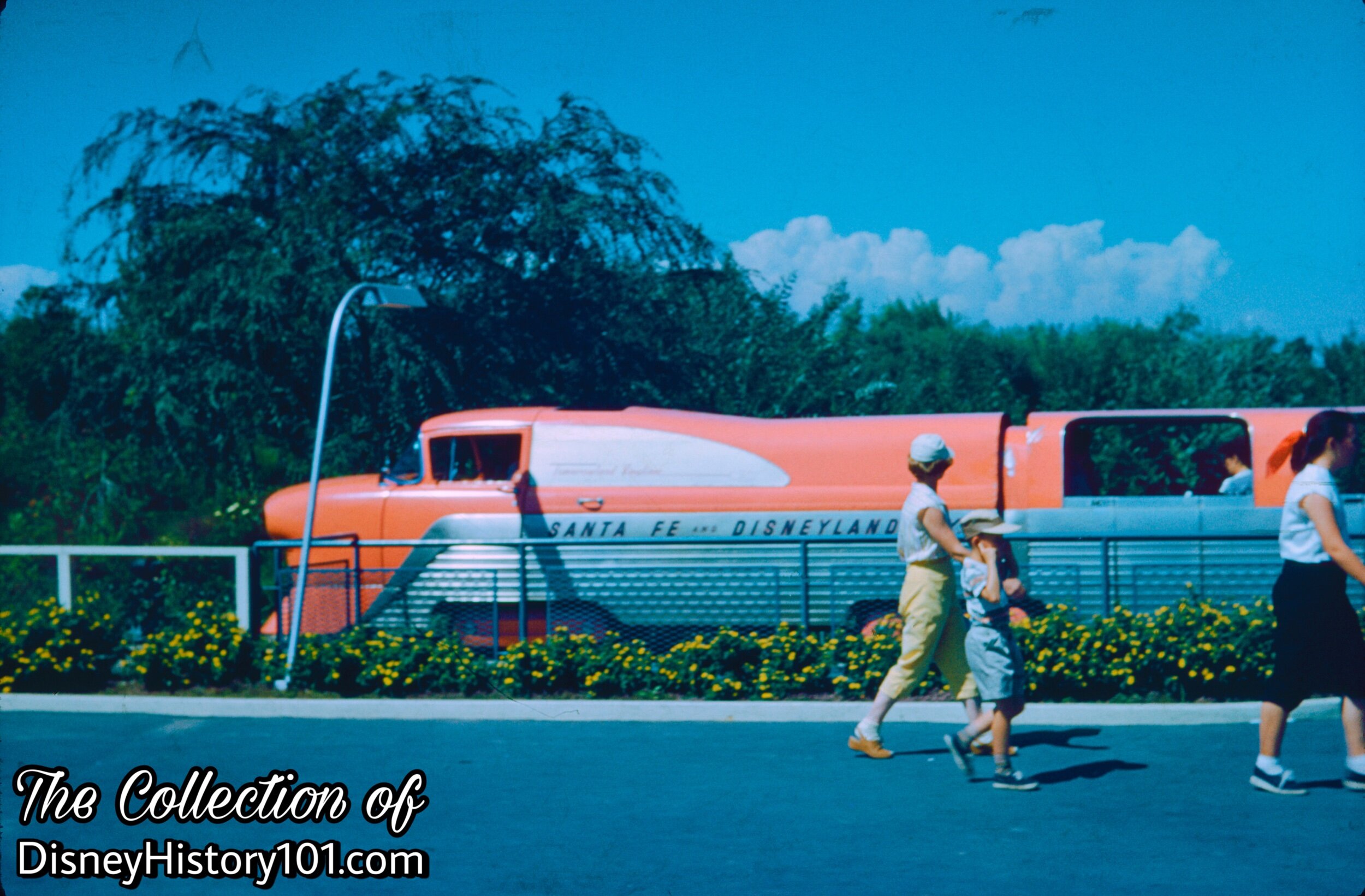
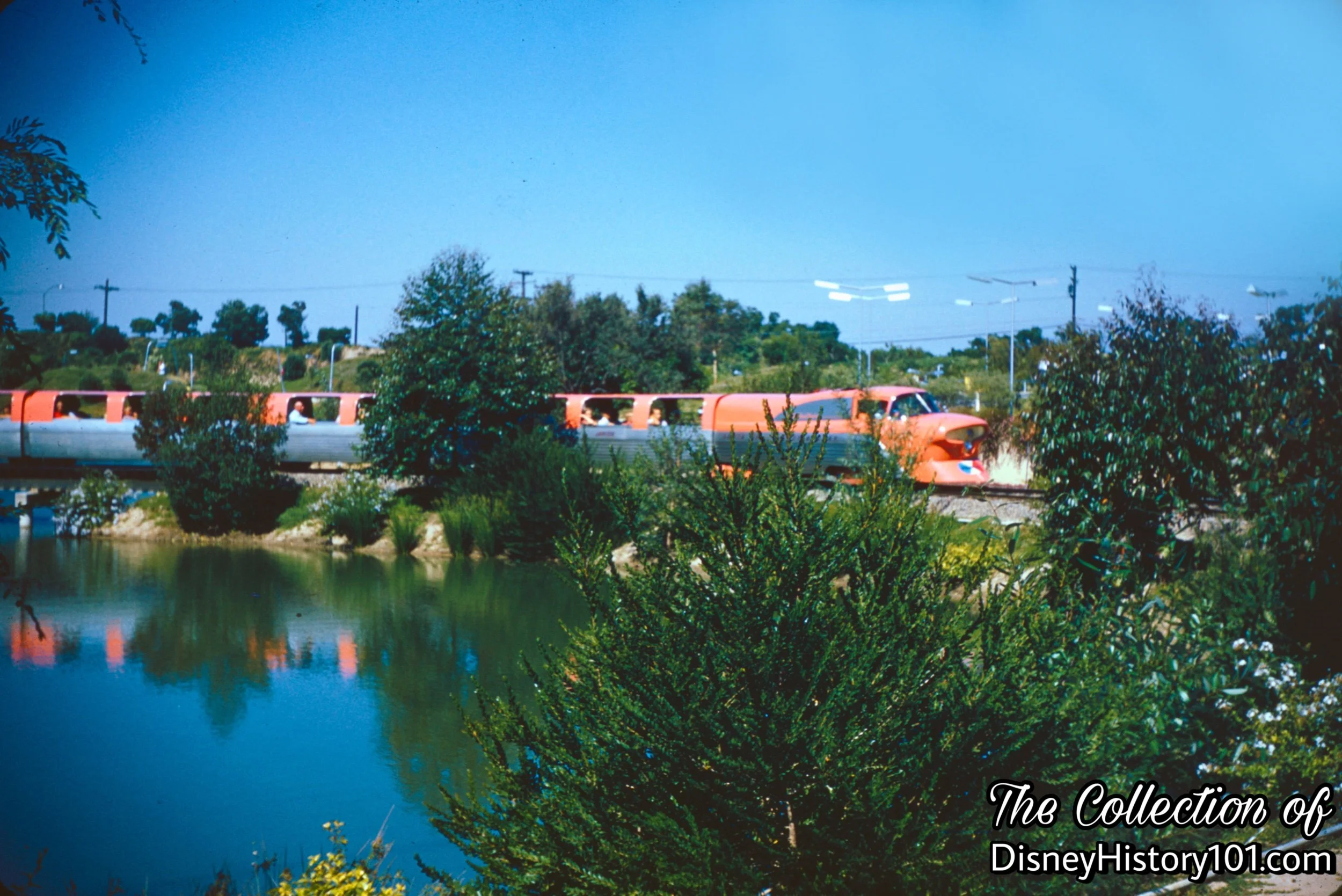
The Viewliner Train of Tomorrow was one of the fastest of Walt’s Disneyland trains, and sadly one of the shortest-lived Disneyland attractions! Here, we catch a glimpse of the Tomorrowland Viewliner Train of Tomorrow, during one of its final runs in August of 1958. When the Viewliner Trains of Tomorrow had ceased operation (on September 30, 1958) after 15 months of operation, a grand total of 1,452,870* guests had stepped “all aboard” for a grand figure eight tour (According to one Disneyland Attractions & Media Reports, prepared for 1971)!
*As a sidelight, Walt Disney’s Railroad Story (by Michael Broggie) gives a slightly different figure, stating : “During its operational life, the Viewliner attraction carried 1,430,683 ‘B’-ticketed passengers.”
By September 28, 1958, an appraisal of Disneyland “land improvement” assets valued the Viewliner Turnstile at $523. That same day, WED Enterprises, Inc. began to remove the Viewliner tracks and ties (job #4010-516) at a cost of $2,376 and remove Viewliner electrical equipment (job #4010-517) at a cost of $805. The entire removal cost $3,181.
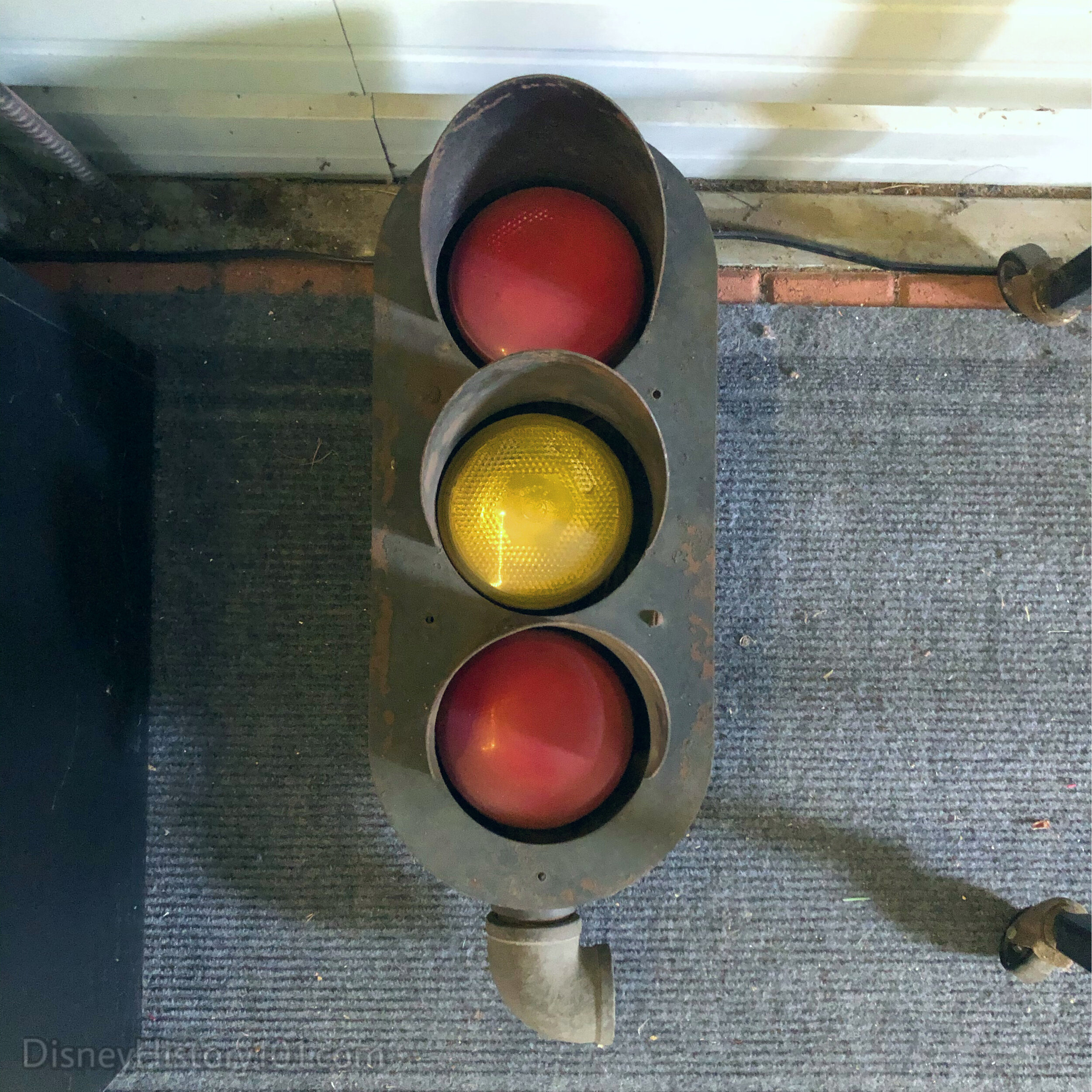
Aside from the occasional railroad spike, there are few extant remnants from this once popular (but short-lived) Disneyland attraction. This particular signal lamp was used near one of the Viewliner stations. There were also smaller ‘running lights’ utilized near the Viewliner junction points. The Viewliner’s railroad block signal system kept guests and engineers safe for the duration of their journey.
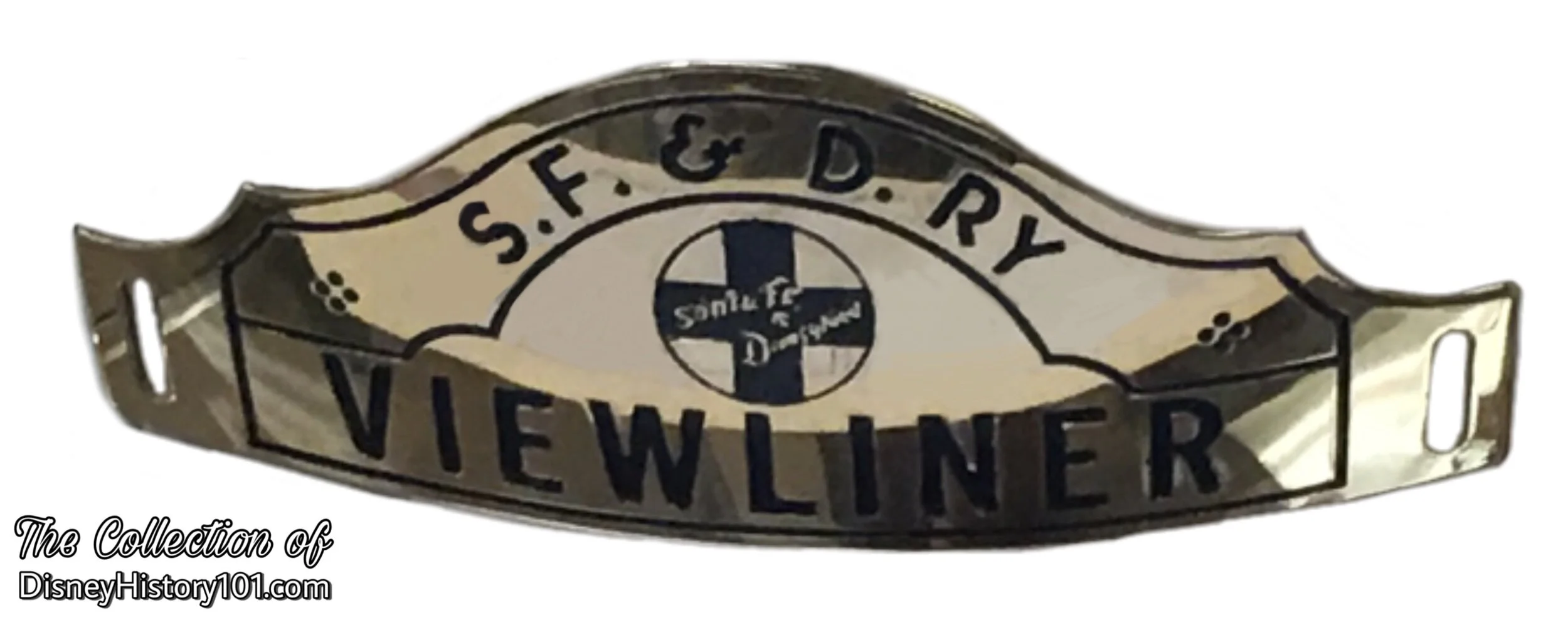
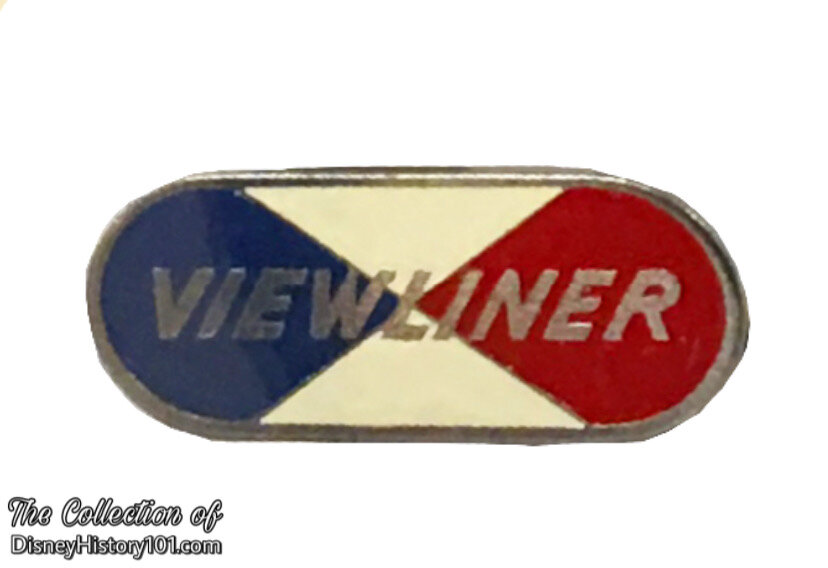
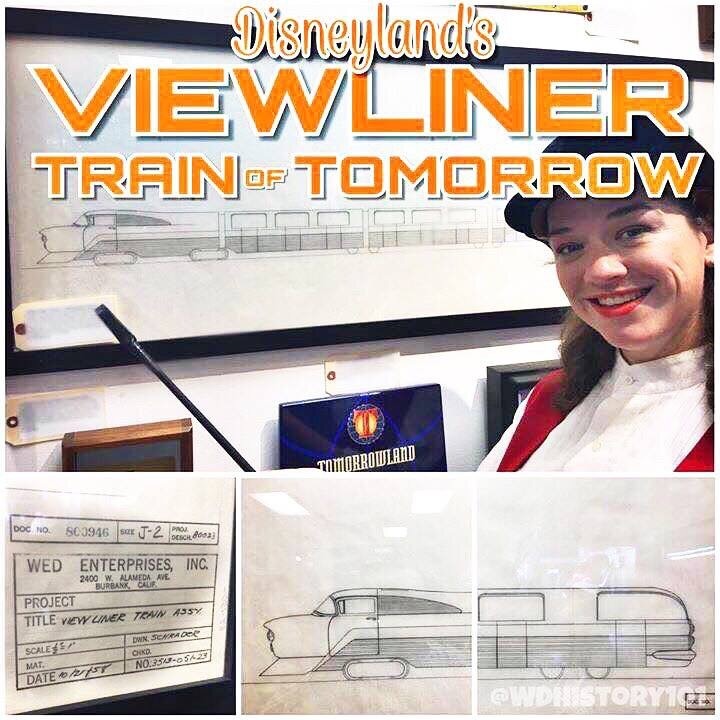
Sadly, no remnants from either train are known to exist. However, this 16.5” x 61” drawing was created after the Viewliner was closed, but it gives us an idea of the proportions of various parts of the engine and cars in relation to each other (at least from a profile). It was believed (by the previous owner), that these drawings were created for the removal of the attraction from the Park.
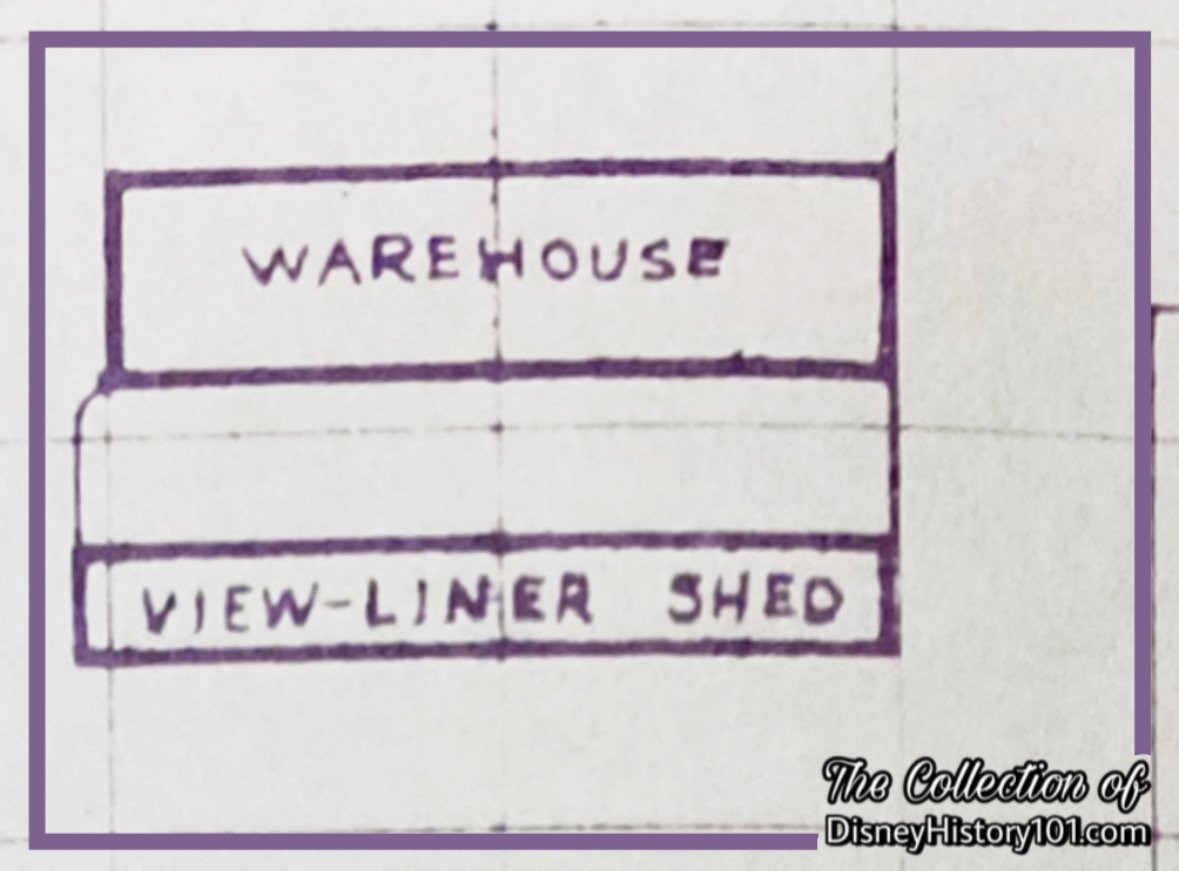
One of the last vestiges from the attraction appears to have been the “View-Liner Shed”, which was still featured on plot plans and located in the North-West backstage area, by 1960-1961.
WURLITZER MUSIC HALL
Step back in time to Wurlitzer Music Hall at Disneyland (1955-1968). Discover the history of this iconic Main Street, U.S.A. piano and organ showroom, its daily concerts and its lasting legacy.

In 1955, Main Street, U.S.A. didn’t just hum with the sound of the park’s attractions — it also hummed with the music of the Rudolph Wurlitzer Company. The Wurlitzer Music Hall, a piano and organ showroom on the corner of Main Street, was more than a shop: it was a living advertisement for the “name that means music” and a daily celebration of sound for Guests.
Before we explore the Wurlitzer Music Hall’s role in Disneyland history, watch this short video to get a visual introduction to the shop, its music, and its place in the Park’s past: “ECHOES OF WURLITZER at DISNEYLAND” - A Vintage View by Disney History 101 [WATCH THE SHORT FILM, HERE]

“Participant Sponsorship”
During 1954, Walt was searching for participants to lease shop and restaurant spaces at Disneyland, and help generate the necessary capital to fund construction of Disneyland. In a synergistic relationship, the companies (in turn) could sell their products and advertise their corporate names in the Park. By July 1, 1954, George Whitney of Disneyland, Inc. directed Amusements, with Ron Miller overseeing analysis, philosophy, capacities, planning, operator training, and amusement procurement. By July 1, 1954, Russel Tippett of Disneyland Inc. Advertising oversaw Exhibitor’s Space Sales and Lease Agreements. Disneyland Participant Corporate Sponsors were carefully selected. High quality, long term corporate sponsors would provide incremental income that enabled Disneyland to enhance its show and attractions, offset some operating expenses, and capitalize on marketing opportunities.
Many of these were turn-of-the-center business pioneers. Years later in 1958, Bank of America appraisers figured of the total income received from leases, 16.02% was derived from the selling of advertising rights and 40.12% from the leasing of space to concerns whose main reason for occupancy is for advertising purposes. The remaining 43.86% of the lease income was derived from stores that sell various products and food. Clearly, these lessees would provide the needed income.
Soon, the Rudolph Wurlitzer Company - “the name that means music to millions” became “the name that means music in Disneyland”, when it became a free exhibit on Main Street U.S.A. during Disneyland’s first decade and beyond! As a result, “shopping has been a part of the Disneyland scene since opening day, 1955, when just 45 employees worked in the Park’s five stores and stands,” according to Disney News (Fall, 1966). The same publication called Walt Disney’s “Magic Kingdom actually… like a huge specialty shopping center, with thirty Disney-operated stores catering to every taste and purse. In addition, some of America’s most famous ‘name brand’ merchandise is sold in the stores of Park lessees.”
“Design”
“Disneyland is unique in that some of the world's foremost creative artists and architects control all design at Disneyland.
“Architectural Designs by Lessees”
Disneyland, Inc. printed materials for Lessees detailing specifications for architectural designs of exhibit spaces. These were revised by March 16, 1955 and issued to Lessees.
All of the interior architectural drawings were done by competent registered architects or an approved display house of the lessee's choice. All of the designs submitted by the lessee's architect, whether for buildings or construction of interiors in DISNEYLAND, were approved as to the theme and general plan of DISNEYLAND as established by WED Enterprises, Inc.
Three sets of preliminary drawings were furnished DISNEYLAND, Inc. as soon as possible after signing of the lease. Two sets were retained by DISNEYLAND and one set was returned to the lessee’s architect with any revisions noted thereon and stamped “APPROVAL TO PROCEED TO FINAL DESIGN.” This stamp when properly signed and dated constituted the lessee’s authority to proceed with the final drawings.
The Lessees revised their final drawings to incorporate any revisions noted on the approved preliminary drawings, and submitted three sets of the revised drawings to DISNEYLAND. One set was returned to the lessee’s architect and any revisions noted thereon are to be incorporated on the original drawings. When the lessee had incorporated the final revisions on the drawings, two sets of transparent ozalids were forwarded to DISNEYLAND for approval. DISNEYLAND would stamp both sets “FINAL DESIGN APPROVED” and “LESSEE’S CONTRACT DRAWINGS”, and return one set to the lessee who could then release drawings for bid and/or construction.

[Wide World Photo B-34754 ; 6892-aje-6/9/55]
“Construction”
“When the giant earth-moving undertaking was completed, the building crews took over. Soon, the rat-tat-tat of riveters was shattering the air, and sparks were flying from welders’ torches as the steel frameworks, capable of withstanding the ravages of time and the elements rose above the newly formed ground. While carpenters hammered and masons laid row upon row of brick and stone and mortar, the permanent buildings began to take shape and form,” according to “The Disneyland Story” published 1955. One of the first buildings to be constructed was the Main Street Opera House, which was used as the Mill. Here, the woodwork of Disneyland was generated - from the functional to the aesthetic! Approximately three and one-half million board feet of lumber went into the Park’s construction. Much of the wood was processed here by McNeil Construction (which formerly constructed Walt Disney Studio sound stages in 1947 and 1953), and under the direction of George Mills Sr. (the Prime General Contractor and Mill Foreman). Then, under the direction of Joe Fowler (Construction Supervisor), as well as Charles Alexander and Ray Conway (Construction Field Supervisors), the lumber was soon fashioned into the framing belonging to the very first buildings constructed at Disneyland - primarily the Main Street Complexes (on each side of the street).
F.M. Franz, manager of operations for MeNeil Construction expressed: "We feel sure there has never been anything built like this in Southern California, or elsewhere in the United States. Many of the items were constructed from artist’s sketches.” In constructing each building, a concrete foundation and slab floors were prepared, followed by wood frame construction (while store units would have a combination wood and rigid steel frame). ”The first fabricated steel for the Main Street buildings arrived November 8 and was erected,” according to the narrator of “Disneyland - The Park,” a Disneyland anthology television series excerpt, first aired 1957 and Disneyland LINE (November 22, 1979).
Newbery Electric Corporation gave electricity to Disneyland. “The electrical installations were supervised by Roy J. Gruendler, manager of Newbery's Orange County district office located at 1335 Santiago Ave, Santa Ana.”
According to inserts published in area newspapers during July of 1955, Disney buildings were roofed by Pioneer Roof & Shingle Company (then located at 608 Mateo Street, Los Angeles, California; 7522 Westminster Avenue, Westminster, California). The roof covering was a variable, dependent on the architectural design.
As of June 2, 1955, C.V. Wood Jr. sent an Inter-Office Memorandum to Walt Disney regarding the best estimates that could be obtained at the time regarding the completion status of individual sections of the Park and Opening Day. C.V. wrote: “Building #611 - Wurlitzer: Estimated to be completed by the first of July. Electric Signs: All are in work - with the exception of the shoe store and the Bank of America, all will be completed.“
The building (as each on Main Street U.S.A.) possessed complete fire sprinkling systems. By June 30, 1955, related Disneyland Site Work Fire Protection Utilities Plot Plans were prepared for Disneyland Inc., by J.E. Thomasson of WED Enterprises Inc.
All fixtures were placed in their correct motif and many light fixtures of Disneyland were authentic antiques.

“Press Preview Day”
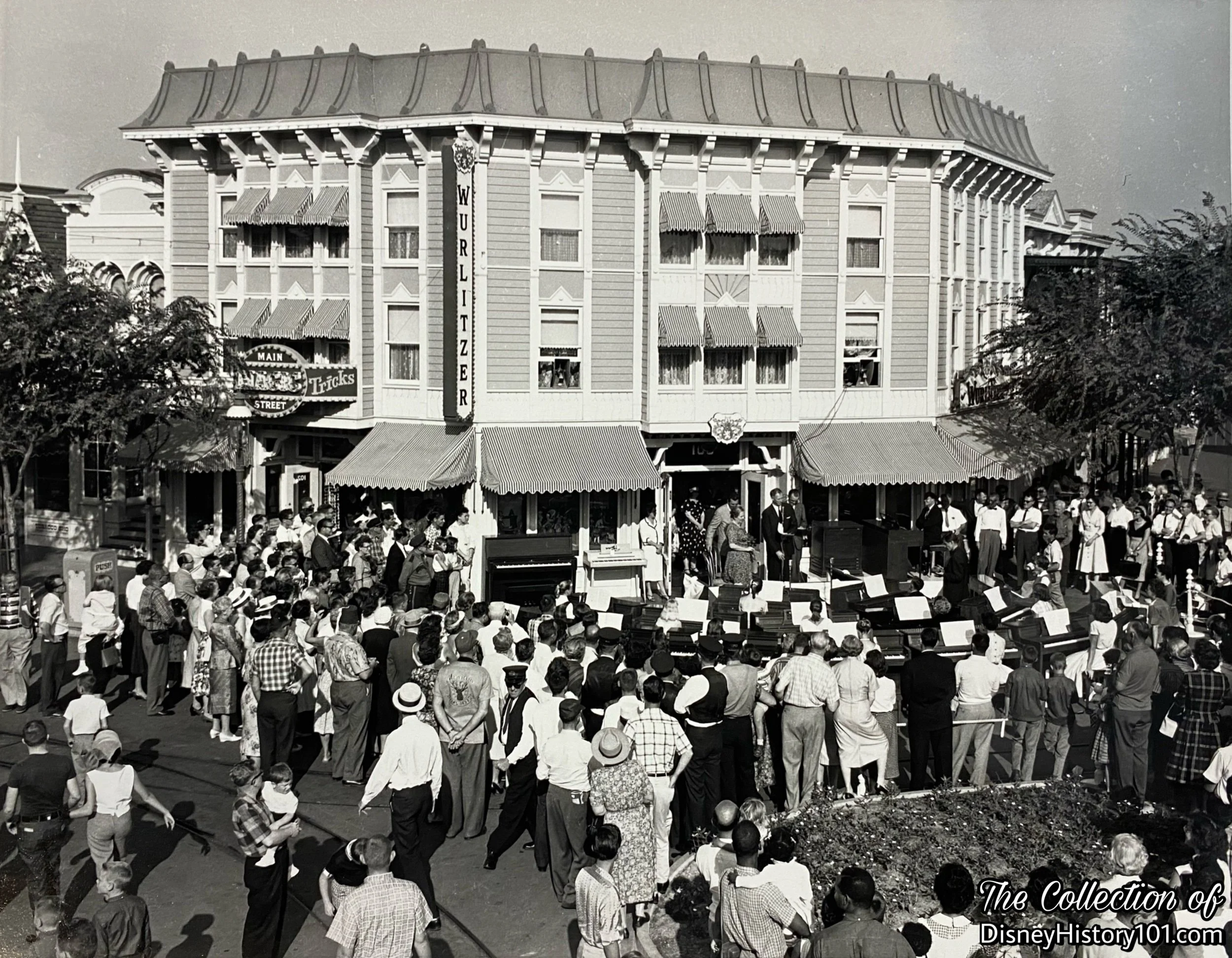
A contributing writer of The Daily Oklahoman (who visited on July 17, 1955) noted: “The guests walked into a city square of the 1900 era, bounded by an old time railroad station, city hall and fire station, opera house and other vintage merchant houses.” One such merchant house was the Wurlitzer Music Hall, which opened at 100 Main Street (on the East side of Main Street’s Town Square), on Disneyland’s opening day, July 17th, 1955. Above, Trooper Lights and Camera men were perched from the roof of Wurlitzer, as during the opening day parade in 1955.
“Dedication”
Walt described to Bob Thomas (of Associated Press), “some industries will have exhibits, but all of them must be in keeping with the era.”Wurlitzer was sponsored by one of the United States’ “old reliable firms, which have been in business fifty years or more. Here they can show how they started and reproduce their first place of business.” [Disneyland Prospectus, 1954]
The Wurlitzer free exhibit and shop was situated on two parcels measuring (915 square feet; 194 square feet) a total of 1,109 square feet. These two parcels were located between the Maxwell House Coffee Shop and the Wonderland Music Store for more than a decade, until September of 1968.


Now, “Disneyland is a place to have fun… and with the fun it is a place where you can learn,” according to “Disneyland, U.S.A.” (published 1958, for potential Participants). From 1955 to 1968, The Wurlitzer Company of Disneyland was home to a number of displays and exhibits. Once through the doors, guests could view “Wurlitzer’s Victorian and Modern Displays” (which were entirely separate features from “Wurlitzer’s Organs and Pianos” according to “Your Guide to Disneyland”, published 1955).

Window displays have always played an important role -communicating to guests the essence of a shop and were designed to invite guests into the store. These may be animated or still and would also include props used for display purposes. As early as 1955, (even from outside) guests could enjoy exhibits, like the Martin Band Instrument Company-sponsored window displays about “the role of band instruments in the good old days. One of the windows , all of which have dioramic type backgrounds, features…German Band figures…Other windows depict a musical professor and his pupil, a band concert, and a reproduction of band instruments being made in Martin’s original shop in 1904.”

This Martin Band Instrument Company advertisement (published during the winter of 1955) preserves one of the Wurlitzer Music Hall’s early diorama window displays. Though the Martin Band Instrument Company was not a Disneyland sponsor, their products were sold through Wurlitzer Music Hall at Disneyland.

“Wurlitzer’s Victorian and Modern Displays” (similar in style to the neighboring Upjohn Pharmaceutical Company’s “Victorian and Modern” Exhibits) showcased antiques! There was a 1838/1837 black walnut Harp lyre Piano (1 of 3 known to exist in the United States; pictured below), a Melodian built 1869, and a Piananino (the predecessor of the modern day jukebox dating from 1905).
There was even a rare Orchestral Theater Pipe Organ “Toy Counter” which had the capability to produce sound effects, and was used during the silent era of film but scrapped when “talkies” came into existence. “As Dee explains the ‘Toy Counter,’ the first-class silent movie houses used Wurlitzer Orchestral Pipe Organs to accompany their feature pictures. Attached to these organs and op erated by toe buttons or keys was the ‘Toy Counter,’ which supplied amazingly realistic sound effects to accompany the music. The organist had at his com mand such varitoned effects as the bass drum, snare drum, kettle drum, castanets, tambourine, galloping horses, sleighbells, bird whistle, fire gong, door bell, and, for particularly dramatic moments, the crash cymbal. Very few of these ‘Toy Counters’ are still in existence. When the ‘talkies’ replaced silent pic-tures, most theater pipe organs were sold to churches. The sound effect machines had no place and were scrapped.”

On the scientific side, there was a cutaway piano which allowed guests to “see as well as hear a piano note.” There was also an oscilloscope wired to a piano which distorted notes from the piano key into waving motions that looked similar to Fantasia’s “Meet the Soundtrack” Intermission segment. This was an interactive exhibit, which was so demonstrated for guests, that (according to Disneyland News, December 10, 1955), “Dee estimates that this key, a middle F note, has been struck some 3,500,000 times since opening day, July 18.” This is an impressive figure, considering that Disneyland attendance for that first six-month period was 1.9 million. All of these exhibits were valuable teaching tools for the teachers who would bring their students to Disneyland on field trips during the 1950s and 1960s. Considering all of these displays, it is easy to see why by the year 1958, the Wurlitzer Shop was considered one of 15 free educational shows and exhibits at Disneyland.
By 1969, these exhibits were among 15 old-time band organs and pianos at Disneyland, some of which dated back to 1890. There just weren’t any replacement parts for these rare antiques. So, ARCADE MAINTENANCE performed the necessary versatile, creative, and inventive mechanical repairs.
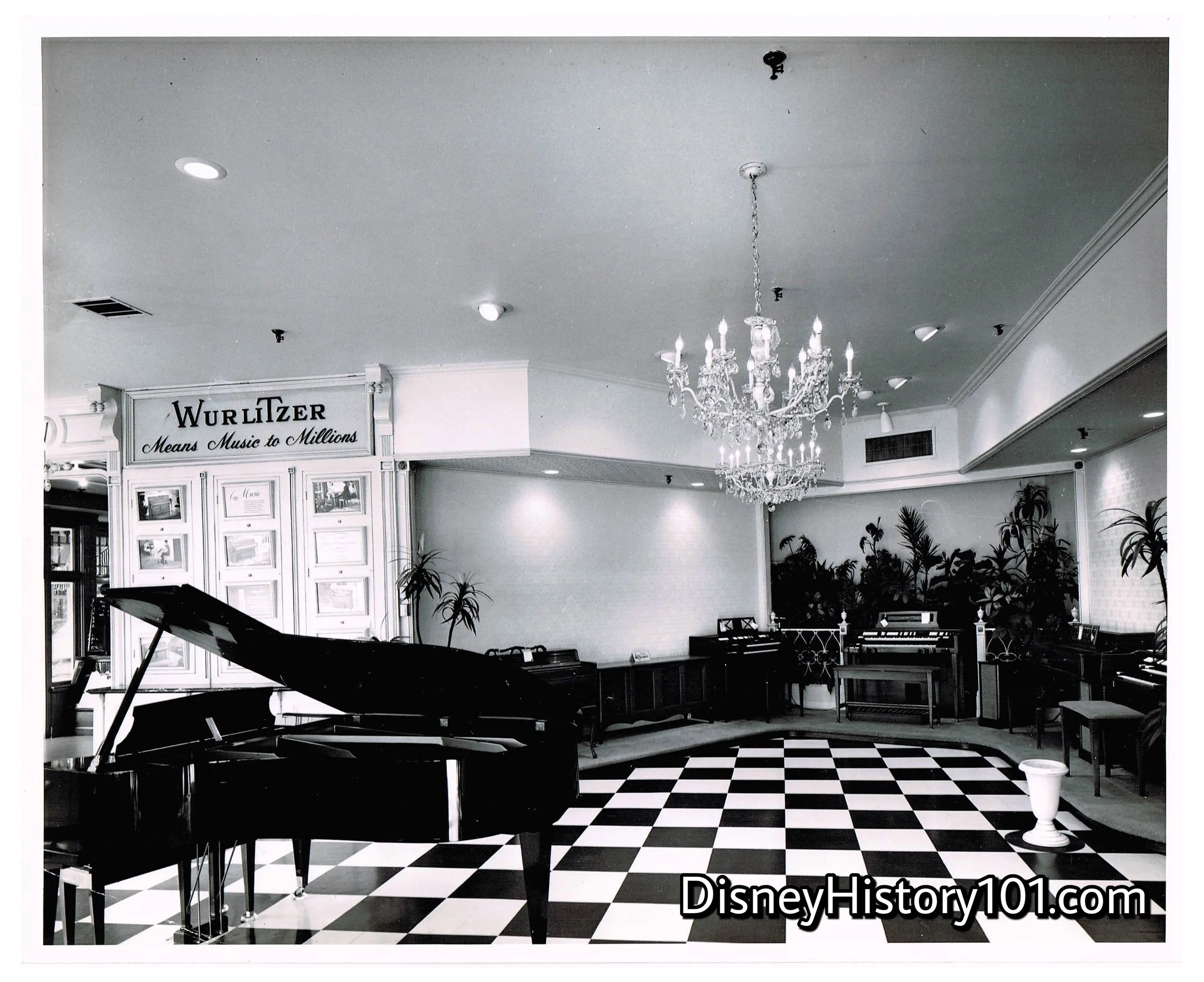
Wurlitzer created tangible memories for Guests through Merchandise and Show. Now, after perusing all these exhibits, Guests could test the grand piano, and peruse electric organs and pianos on display in the Wurlitzer Music Hall Showroom. Here, Guests could sample the merchandise - current Wurlitzer Co. Martin and Peddler brand pianos and organs. On display were also the newest 1955 Wurlitzer Electronic Portable Piano (a model that had its first west coast showing at Disneyland) and both new and traditional electronic organs. After looking over the models, Guests could acquire information about aforementioned sponsor (the Martin Band Instrument Company of Elkhart, Indiana). Finally, Guests could purchase pianos, organs, and jukeboxes from the Wurlitzer Music Hall.
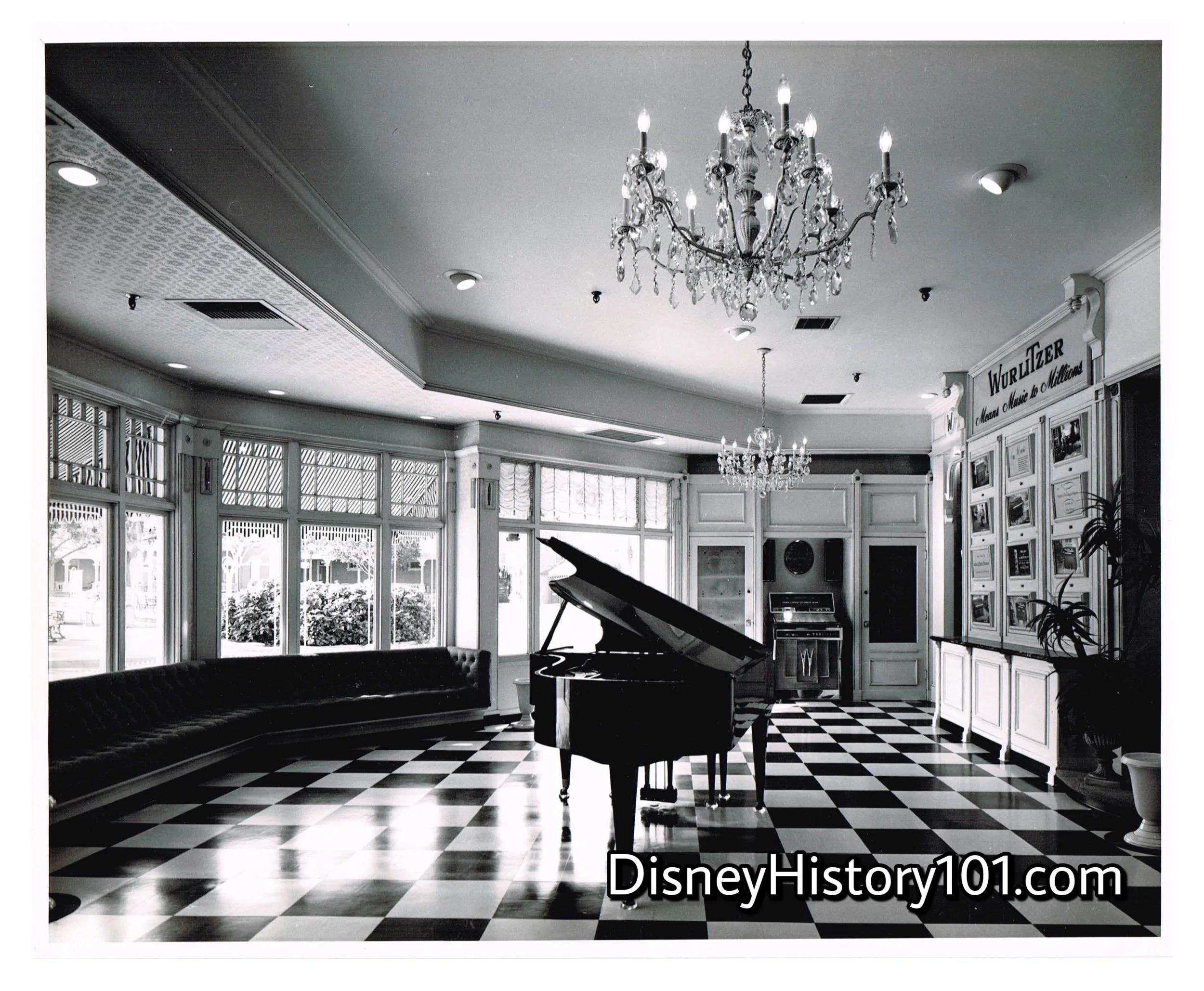
In the alcove of the wall, you’ll notice a 2800 series Wurlitzer Jukebox Arcade, carrying hi-fidelity and stereophonic sound. One of Wurlitzer’s popular models was a jukebox with a 200-song capability. If guests couldn’t take one home, the jukebox was licensed as a small coin-operated souvenir bank that was also sold in Wurlitzer Music Hall.
Wurlitzer was renowned for its jukeboxes and phonographs, and many other models appeared on the showroom floor - the Wurlitzer Centennial Model 1900 (1956), the remote controlled Model 5207 “Wall Box” with a 104-song selection (1956), to name a few. Wurlitzer also manufactured and sold a number of “Corner Speakers” and “Wall Speakers”in a variety of attractive colors, for high acoustical efficiency! With so much to offer it isn’t surprising that Wurlitzer would soon come to be billed as “the official music of Disneyland” during its era!

During the era of the Wurlitzer Music Hall at Disneyland, Wurlitzer publications (like the ones pictured above and below) were available for purchase through the Wonderland Music Company (next door to Wurlitzer Music Hall). Some sheet music was produced with the intent of being played on certain models (like the Spinette), while others were published for all Wurlitzer Organs. It’s likely that sheet music like this may have been available for demonstration to guests of Wurlitzer Music Hall at Disneyland!


Few other smaller souvenirs like lighters featuring the Wurlitzer name and slogan “The Name That Means Music to Millions” were also briefly sold in the shop!
The 1957 TWA brochure “Let’s Talk About… My Visit to Disneyland, Anaheim, California: A Note from Mary Gordon TWA Travel Advisor” mentioned: “We learned that to fully explore Disneyland takes two days, so early next morning we were at the gates of the park again. The second day we spent more time shopping in the 50 inviting shops, and the youngsters bought inexpensive souvenirs to take home to friends.”

What was the price range advertised for Guests and potential customers of Wurlitzer of Disneyland? The backs of souvenir postcards (pictured above) advertised the starting prices of Wurlitzer pianos. This is a prime example of “the possibilities for a sponsor to capitalize on this association” with Disneyland. The many ways of “merchandising, sales promotion, advertising, public relations and publicity programs are almost limitless. Regardless of the type of product, goods or services manufactured and marketed by sponsors, the Disneyland association can be effectively and importantly translated into the sponsor’s promotional activities,” according to “Disneyland, U.S.A.,” published 1958. The corporate synergy was good. Institutional lessee The Wurlitzer Company yielded some revenue for Disneyland Inc. - $16,253 for the fiscal year ending September 29, 1957 and $19,717 for the fiscal year ending September 28, 1958.
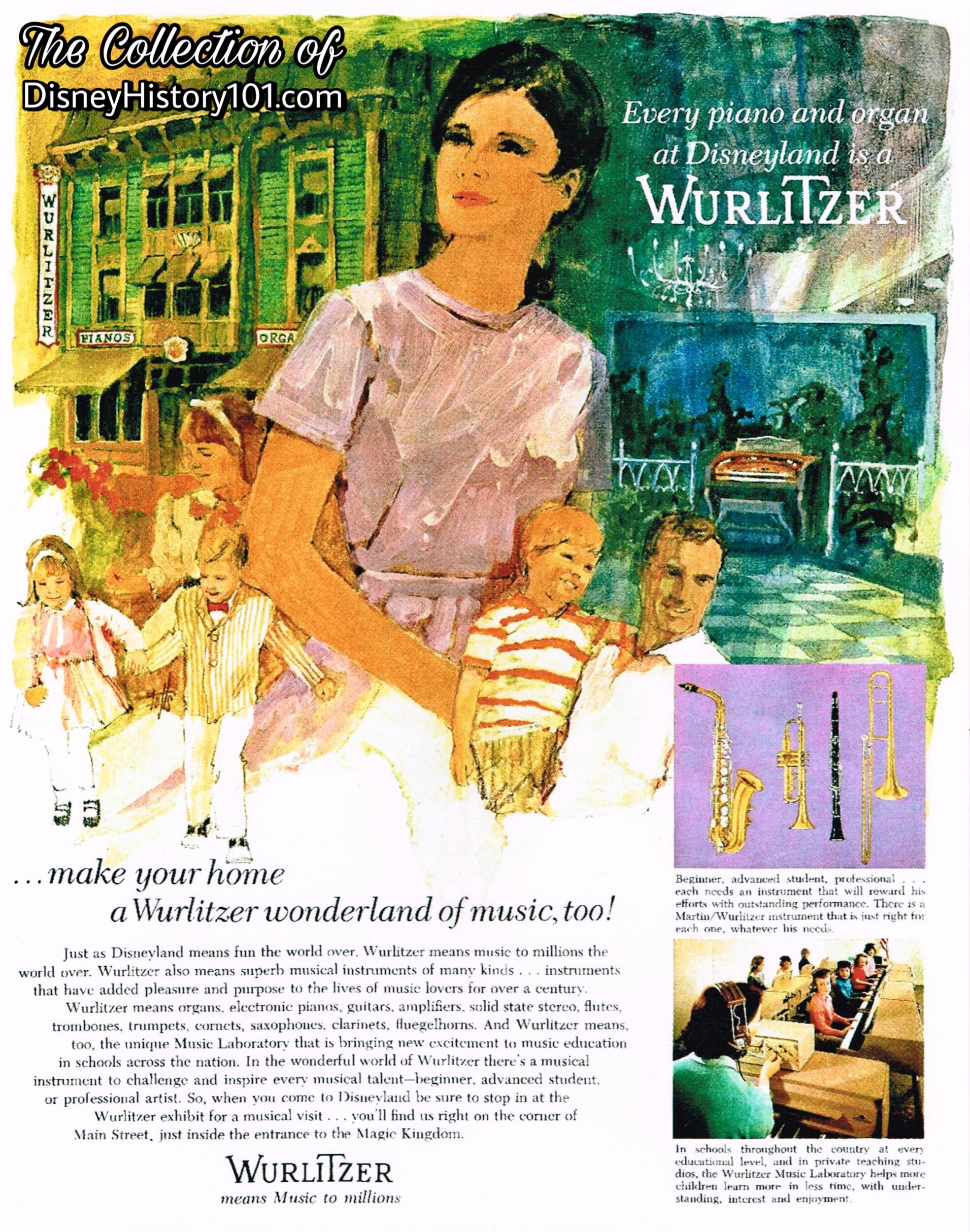
“…And Now A Word From Our Sponsor!”
Wurlitzer was more than a free exhibit at Disneyland. Wurlitzer was “a name that means music to millions” (as this advertisement attests). The company was (and is still) known for its organs and pianos “for church and home,” yet the Rudolph Wurlitzer Company of Tonawanda, New York also manufactured violins, flugelhorns, trumpets, saxophones, guitars, and more! Wurlitzer even manufactured the Music Laboratory Instructor Console (pictured above), which was utilized by high schools, colleges, universities, and other institutions of learning around the country. The Wurlitzer people were always happy to demonstrate one of their fine pianos, organs or stereo consoles - whether guests were just relaxing or furnishing a mansion.
In addition, Wurlitzer offered instructional publications (like the “Wurlitzer Hobby Lesson Course”) - accelerated pop and piano courses compatible with the Wurlitzer Music Library. Soundtracks of Walt Disney Productions were piped through the speakers (e.g. as during May of 1957 when guests could take a listen to the new Studio sound track releases of Bambi and Cinderella).
The Wurlitzer Music Hall at Disneyland even played a part in at least one National Piano Teachers Day event held in Disneyland on October 10, 1959.
With so much to offer it isn’t surprising that Wurlitzer would soon come to be billed as “the official music of Disneyland” during its era!


By October of 1959, the company was (1) of over sixty-eight other firms playing a vital part in the team effort to bring happiness to Disneyland’s Guests. Some were small, specialized individual operators; some were huge companies such as Swift & Co. - the Bank of America - United Paramount Theaters (which you hear as UPT) - Carnation - Richfield - General Dynamics - Crane - and many others. These companies used the park to publicize their wares, leased space in the Park to sell their wares, and Disneyland collected advertising fees from them.

Since the beginning, Disneyland was a miracle of showmanship in many ways! According to “THE DISNEY THEME SHOW - an introduction to the art of Disney outdoor entertainment”: “Important are the sounds which permeate the scene, for without them, the theme show is a silent movie . . . but with them it is a symphony of music, effects, and natural sounds that the finest stereo system in the world can't duplicate. These sights and sounds are provided not only by imagineered attractions and shows, but also through the multi-talented efforts of live entertainers . . . in special musical groups . . . in parades and pageants . . . providing an everchanging backdrop to virtually every area in the theme show.”
Atmosphere Entertainment complimenting the theme of areas was staged to entertain Disneyland Guests on an immediate and personal level. You may recollect hearing a concert emanating from inside the Wurlitzer Music Hall (or, even right outside it’s doors), as you strolled by during a peak season. As mentioned earlier, Wurlitzer was appropriately located “down the street” from Wonderland Music Company, where guests could purchase sheet music of popular songs featured in Walt Disney Studios feature length films and television programming. Much of this sheet music was demonstrated for guests by skilled “Hosts”and “Hostesses” (both managers and employees) of the neighboring Wurlitzer Music Hall.

“Dee Fisher Takes You to Disneyland”
What better way to sell a product than to demonstrate it for guests? That was exactly what Wurlitzer and Martin and Pedlar, representative Dee Fisher was well known for since 1955 - his recitals inside the Wurlitzer Music Hall (also referred to as the “Wurlitzer Exhibition”). It’s been said that “Disneyland is People,” and Dee was the Wurlitzer manager and certainly the “genial host,” often surrounded by the audiences of each new day whom he personally welcomed into the store. More than that, Dee was creating magical moments for Disneyland Guests. This is evidenced by a photograph, featuring Dee giving one of his concerts, that was featured on the cover of Wurlitzer Organ Review Magazine alongside Mickey Mouse and Minnie Mouse during the late 1950s.

Dee even performed at other locations at Disneyland. For instance, when the popular Mickey Mouse Club Circus headlining act, “Keller’s Jungle Killers” was held over from February 19, 1956 to September 9, 1956, Dee Fisher (of Wurlitzer) provided background music on a Wurlitzer Organ, according to “The Disneyland News” [Vol. 2, No.2 ; published for August, 1956] Dee flew to the Hawaiian Islands to play the mighty Wurlitzer for George Keller's Animal Act between Christmas of 1956 and New Year's Day of 1957. Dee Fisher’s first LP album was recorded on the electric organ in Disneyland, soon released after the first of the year.
Dee Fisher fulfilled the important role as the second president of the Disneyland Merchant's Association (following the term of Les Wagman of the Bank of America), announced at a meeting held on January 25, 1956. Like most other Disneylanders, Dee also enjoyed DRC activities during the free time of his tenure. For instance, Dee served as the Disneyland Toastmasters Club President from 1956 to 1957. Speaking of DRC activities, Disneylander area merchant Wurlitzer was a sponsor of the championship Disneyland baseball team of 1957.

During 1957, Wurlitzer Music Hall received a major redesign and refurnishing. One product of the redesign - Wurlitzer Music Hall’s small stage (surrounded by tables and chairs) - is rarely seen captured on film, however one picture (seen above) is preserved in Disneyland Holiday magazine, published June of 1957, on page 7. The article advertised the free attraction: “Like organ music? Latest free entertainment added on Main Street is the newly redesigned and refurnished Wurlitzer Music Hall. Dee Fisher, talented performer on the Wurlitzer organ, entertains several times daily with relaxing concerts. You can also hear Dee late in the afternoon when his concerts are broadcast over Disneyland's public address system.”
These performances were still popular by the winter of 1957, as evident by an article published in Vacationland magazine (Winter 1957-1958) mentioning “Wurlitzer organ music concerts by Dee Fisher” among the Park’s “lively musical shows presented free of charge.”

During the 1960s, Entertainment Guides continued to regularly advertise the “Organ Recital - popular-old favorites-classics” often performed by Wurlitzer Manager D. R. “Dee” Fisher, in the Wurlitzer Music Hall, several times daily at both 10:30 a.m. and 5:30 p.m. These tunes were still piped through the shop via Grado Lab “Jr.” wall mounted speakers, and were once even “broadcast over Disneyland’s public address system” during the late afternoon, according to one article published in Disneyland Holiday (Summer, 1957).

“Quiet Please, Broadcasting In Disneyland”
Thirteen of Mr. Dee Fisher’s electronic organ solos were even recorded and released on a “High Fidelity” album - “Echoes of Disneyland” published thru Disneyland Records, 1957. This practice of Disneyland’s featured artists (like the Strawhatters, the Yachtsmen, and others) recording albums was commonplace during the 1950s and 1960s. All of Dee’s recorded album tracks are renditions of popular songs once featured in Walt Disney Productions theatrical releases :
(1) Second Star to the Right (Peter Pan)
(2) Little April Shower (Bambi)
(3) A Dream is A Wish Your Heart Makes (Cinderella)
(4) Blue Shadow on the Trail (Melody Time)
(5) Bella Notte (Lady and the Tramp)
(6) La La Lu (Lady and the Tramp)
(7) Some Day My Prince Will Come (Snow White and the Seven Dwarfs)
(8) When You Wish Upon A Star (Pinocchio)
(9) Two Silhouettes (Make Mine Music)
(10) Lavender Blue (So Dear to My Heart)
(11) One Song (Snow White and the Seven Dwarfs)
(12) Alice in Wonderland
(13) Love is A Song (Bambi)
Guests who were interested in bringing the sound of “the happiest place on earth” home with them, could find Dee’s fine-quality and Hi-fidelity album for sell at the Wonderland Music Shop next door. Owning to Dee’s record album, his reputation as a “celebrated West Coast organist” preceded him, even outside Disneyland. The photograph of Dee (pictured above) was given as a personal gift (upon request) to the owner of Larry Bray’s Organ Loft of Salt Lake City, Utah in 1962.
In addition to Dee, other entertainers occasionally performed for Wurlitzer Music Hall guests, like the Dapper Dans. The Disneyland Christmas Carolers (under the direction of Dr. Charles C. Hirt and lead by Mr. Robert G. Hasty), were also known to perform at “Wurlitzer” during various times of the day, from December 16th, 1967 thru January 1st, 1968. [“Disneyland Holiday Talent Master Schedule,” prepared for the period of December 16, 1967 through January 1, 1968]

Dee wasn’t the only one to cut an album. Wurlitzer Music Hall Manager Mr. Don Beamsley (pictured earlier) recorded an album with Jud de Naut and June Rudell in 1962. This he did while working two jobs, one which was performing piano concerts for guests in a demonstration of popular organ models in the showroom. Wurlitzer Manager Don Beamsley was also known to be “the life of the party” and also occasionally performed at the Gourmet Restaurant with his group, as well as locations outside Disneyland. As far back as the Winter of 1962, he also performed at Hurrah’s of Lake Tahoe.

Many photos of Don Beamsley (and friends around a Wurlitzer piano) were published in coordination with the Disneyland Tencennial Celebration, for various newspaper inserts and publications like Vacationland magazine (Winter/Spring, 1965).

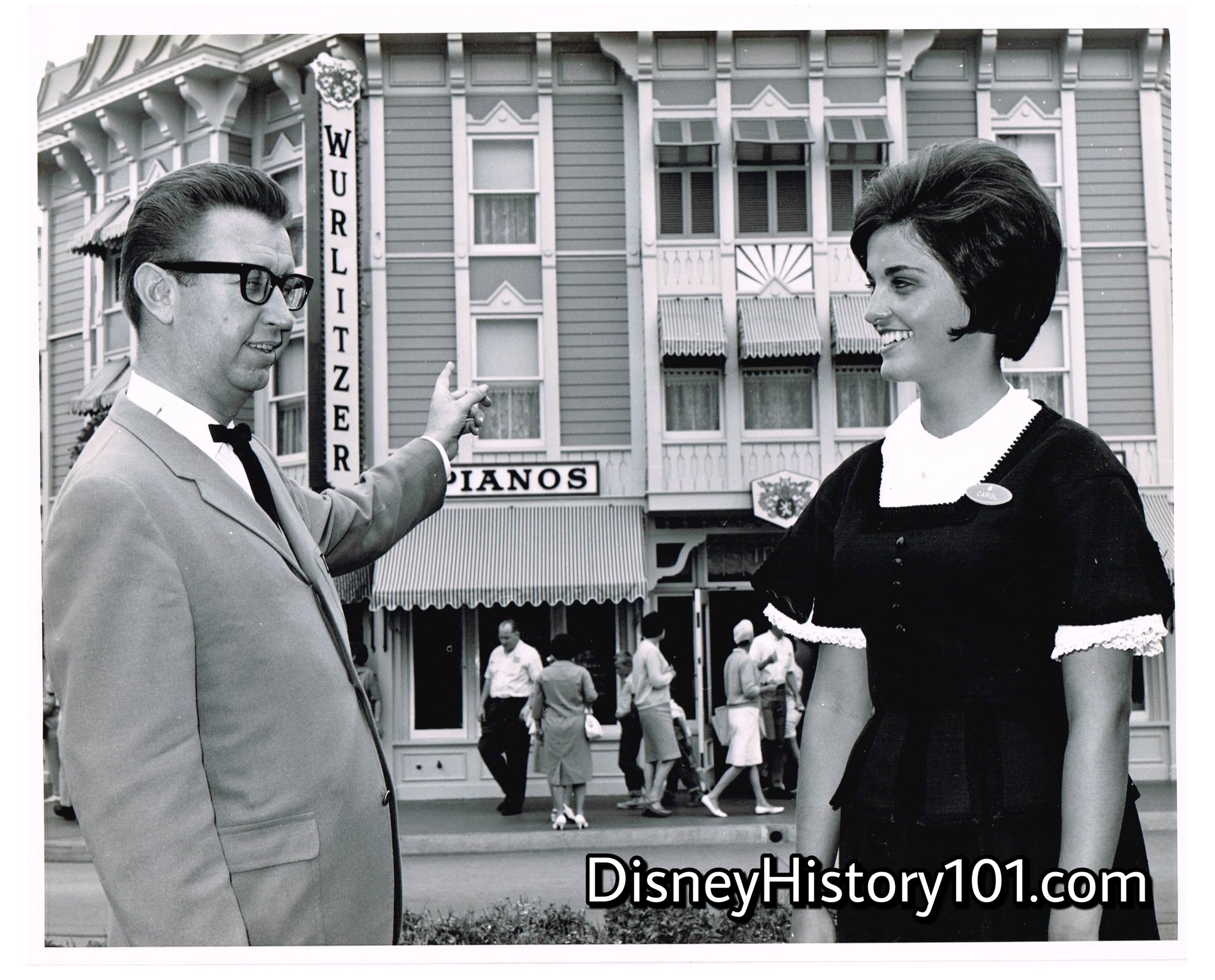
In another rare unpublished view of Wurlitzer Music Hall, Manager Mr. Don Beamsley and Hostesses Carol Williamson.
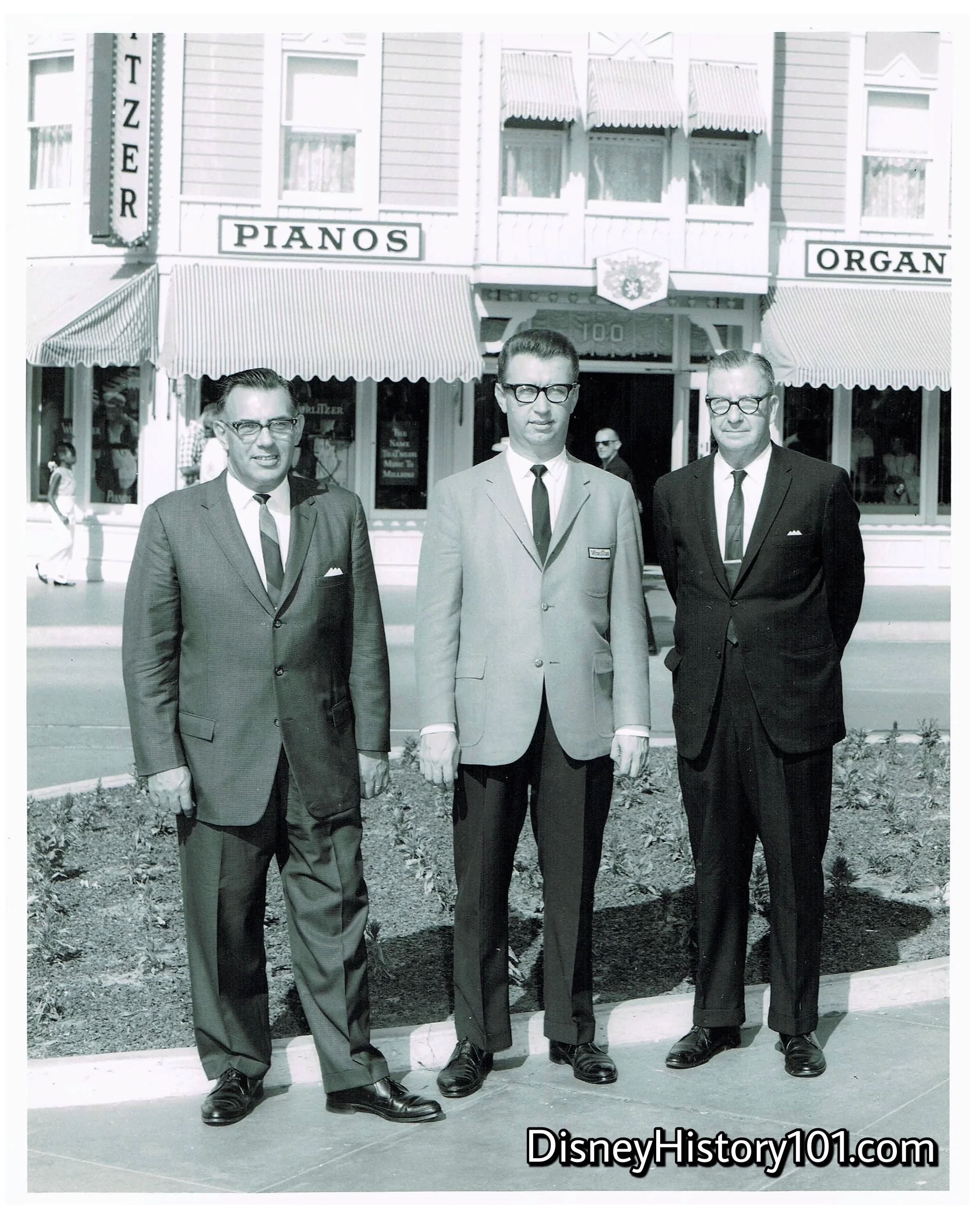
In a rare (unpublished press photograph) “Vintage View” of Disneyland, (left to right) we see Z.B. Ross, (Wurlitzer Music Hall Owner and Manager) Mr. Don Beamsley (Disneyland Wurlitzer Music Hall Owner and Manager), and Walt Peteet standing for the camera in Town Square!

Sometime after the previous photo was prepared for the Tencennial insert, Mr. Don Beamsley began his career playing the organ for Dodger Stadium, during August of 1966 (before the World Series was held).
While the Wurlitzer name was associated with Disneyland, Disneyland did not exclusively make use of Wurlitzer brand pianos for its Shows. For instance (on October 19th, 1966), a meeting was held with Brian Whitman (of Whitman Piano Company) over the “purchase of piano dollys, rehab of pianos and purchase of a Grand Piano and other accessory equipment for Disneyland,” according to the recollections of Ben Harris. Then there is the story of the German J.C. Neupert harpsichord (or “Fortepiano”), which was hand-picked by Lillian Disney from the Kasimoff Blüthner Piano Company of Los Angeles, for Club 33.

Walt’s 65th birthday fell on December 5, 1966. It was about this time, that the unexpected occurred, ten days later, on Thursday, December 15, 1966, at 9:35 a.m., when a brother, a friend, and a leader, Walt Disney passed. Many Disney personnel who were present, remember this tragedy. Soon after, Roy O. Disney, President and Chairman of the Board of Walt Disney Productions addressed the staff with an official statement, in which it was conveyed:
“Walt Disney spent his entire life and almost every waking hour in the creative planning of…Disneyland… and the other diversified activities that have carried his name through the years. Around him Was Disney gathered the kind of creative people who understood his ways were always unique and he built a unique organization. A team of creative people that he was justifiably proud of… Many have been with us for over thirty years. They take great pride in the organization which we helped to build. Only through the talent, labor and dedication of this staff could any Disney project get off the ground… Much of Walt Disney’s energies had been directed to preparing for this day. It was Walt’s wish that when the time came he would have built an organization with the creative talents to carry on as he established and directed it through the years. Today this organization has been built and we will carry out this wish. Walt Disney’s preparation for the future has a solid, creative foundation. All of the plans for the future that Walt had begun… the expansion of Disneyland… will continue to move ahead.” Even Walt was so confident in his people to “move ahead,” once stating in a Canadian broadcast interview: “I think they’re going to stay with that policy because it’s a good business policy… I think they’ll hang on… well after Disney.”
Despite the loss of Walt (and all the competition), the Wurlitzer show went on - their organs were still popular around Disneyland during the winter season of 1967. If you visited Disneyland at that time, you may recall the sound of festive holiday “Organ Concerts” emanating from Carnation Plaza for 3 shows daily (10:30am-12:00N), from December 16th, 1967 thru January 1st, 1968 (except December 24th, 25th, and 31st, 1967). “Guests dining at the Garden Plaza” would “be entertained by the beautiful sounds of the Wurlitzer organ featuring Ray Whitaker at the keyboard.” [“Disneyland Holiday Talent Master Schedule,” prepared for the period of December 16, 1967 through January 1, 1968]
Alas, during September of 1968 (some three years after this previous photograph was taken ; a little over 13 years after the Wurlitzer name was first associated with Disneyland), the opening day sponsor departed from Disneyland. There were no comparable sponsors to fill the void left by this unique shop and free exhibit, and thus no “echoes” to be heard of the Wurlitzer name in Disneyland.
Many of the remaining pianos and music boxes which were property of Disneyland went into “Disneyland Storage”.
It was about this time (1968), that a new exhibit was in the planning stages, “Walt Disney - A Legacy for the Future.”

Note the “Cal Arts Display” in this location c. 1970. Disneyland now utilized the vacant space to present special Park and company-related exhibits, beginning with “Walt Disney - A Legacy for The Future” (which opened January 15th, 1970). Walt Disney - A Legacy For the Future was an unstaffed “multi-screen show and display presenting Walt Disney’s endeavors in the fields of art and education. Included are plans for his cherished dream, California Institute for the Arts, and the first public display of all 29 Academy Awards received during his lifetime.” The exhibit would also display some “208 other awards,” according to Disneyland Line.

By the summer of 1972, Walt Disney - A Legacy for the Future was still reckoned as one of Disneyland’s Free Exhibits and Shows (meaning that no admission coupon was required for entry). The Walt Disney Legacy for The Future” exhibit included artifacts like Walt’s special Academy Award for Snow White and the Seven Dwarfs.

After "Walt Disney - A Legacy for the Future" closed, another exhibit opened - “Disneyland Presents a Preview of Coming Attractions” (also known as the “Disneyland Preview Center” and the “Disneyland Showcase”), for some 15 years, from October of 1973. The free exhibit featured “artists renderings and models of future attractions planned for Disneyland,” as well as “other Corporate projects such as Tokyo Disneyland or the Disney Channel,” according to Disneyland LINE Magazine, September 5, 1985 ; Vol. 17, No. 36. You may recall seeing models, renderings and videos of “coming attractions” like Captain EO, Discovery Bay, Splash Mountain, the Hall of Presidents (for Disneyland), America Sings, Space Mountain, and New Fantasyland on exhibition. Other exhibits showcased films, Disney television shows, and Disney Channel programs.

From the Wurlitzer Music Hall to a vacant exhibit hall, to “Walt Disney Legacy” exhibit - souvenir Disneyland Maps captured the eras of this prime piece of Main Street U.S.A. real estate!

In 1989, the Disney Showcase shop opened, offering merchandise tied to Walt Disney motion pictures, television shows, and Disney Channel programs including “Who Framed Roger Rabbit, Chip ‘n’ Dale’s Rescue Rangers, The Little Mermaid, and The Mickey Mouse Club,” according to Disneyland Line (September 4, 1992; Vol.24, No.36). You may remember discovering mugs, t-shirts, and other merchandise featuring “Walt Disney Pictures’ Beauty and the Beast” or Earl Sinclair and the Baby from “Jim Henson’s Dinosaurs” at the Disney Showcase about this time.


The location and design of the Wurlitzer building itself allowed it to be utilized for many different events. Trooper Lights and Camera men were often perched from the roof, as during the opening day parade in 1955, or Holiday Festivals of Disneyland’s “Fabulous First Decade.” During Disneyland’s American Bicentennial celebration of (1975 to 1976), Parade Coordinator Don Payne was stationed atop the former Wurlitzer building because it offered a great aerial view of the route and crowds. He recollects about this vantage : “The parade would step off and we would all have stop watches with lights, sound cues, and synchronized watches. I was on top of Wurlitzer when Hirohito visited and there was all kind of SWAT and security on the rooftops and in the crowds. The SWAT officer told me ‘If I say drop, you drop. If you don’t drop, I’ll have to shoot through you.’ They took guest security very seriously.” Long after the Wurlitzer name had departed from Main Street U.S.A., the rooftops of the former free exhibit became the site of free shows. During Circus Fantasy (1986), while the sounds of the circus calliope organ would pass through the street, High-Wire performance artists walked a tightrope which was connected to the former Wurlitzer building’s roof (pictured above).

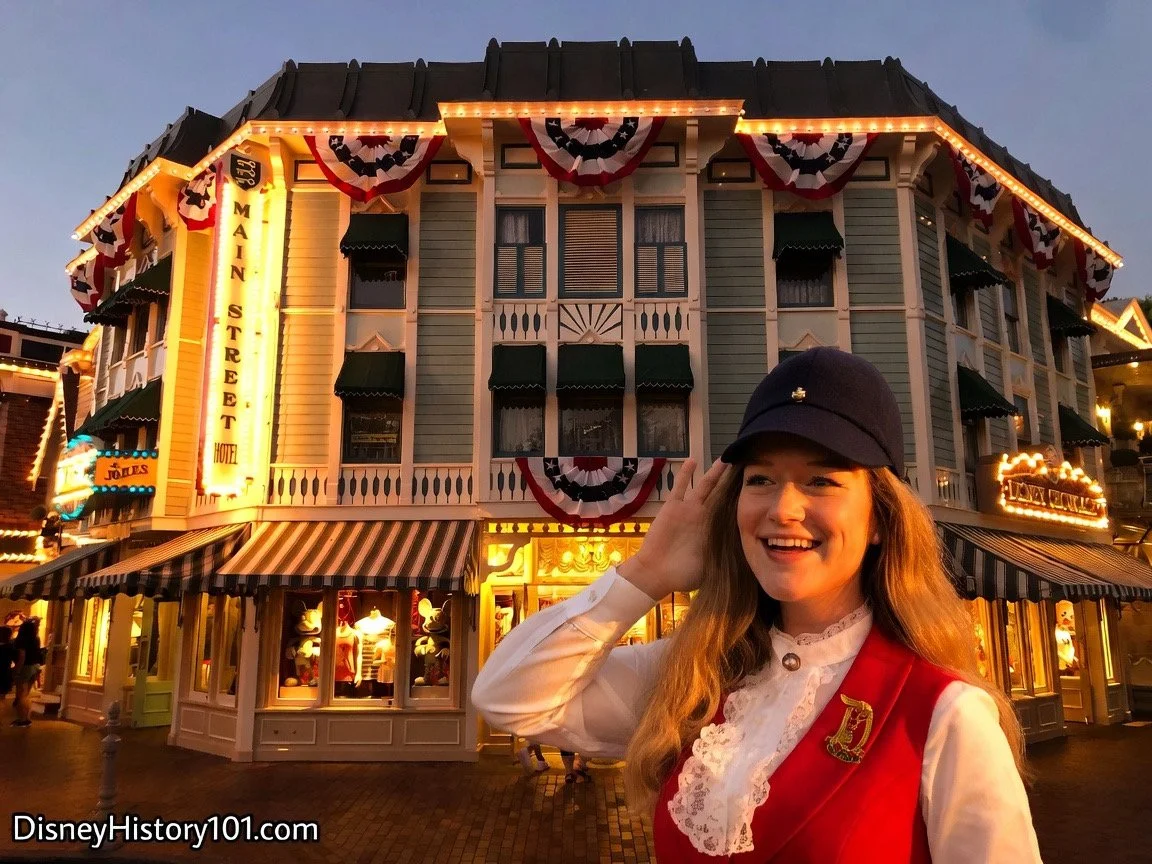
Well, it looks like we’ve come upon the old Wurlitzer corner store building as it stands today during the twilight hours - not a note of the previous exhibits or lessees. Currently, beneath the Main Street Hotel sits the Disney Showcase Shop - home of seasonal merchandise since 1989.
THE YACHT BAR (THE YACHT CLUB) & YACHTSMEN
Take a retro trip to Disneyland’s forgotten nautical snack stop – The Yacht Bar! Learn about the quirky, kitschy counter service restaurant that served up burgers, entertainment, and scenic Lagoon views from 1955 to 1966.

By July 1, 1954, George Whitney of Disneyland, Inc. directed Amusements, with Ron Miller overseeing analysis, philosophy, capacities, planning, operator training, and amusement procurement.
During 1954, Walt was searching for participants to lease shop and restaurant spaces at Disneyland, and help generate the necessary capital to fund construction of Disneyland. In a synergistic relationship, the companies (in turn) could sell their products and advertise their corporate names in the Park.
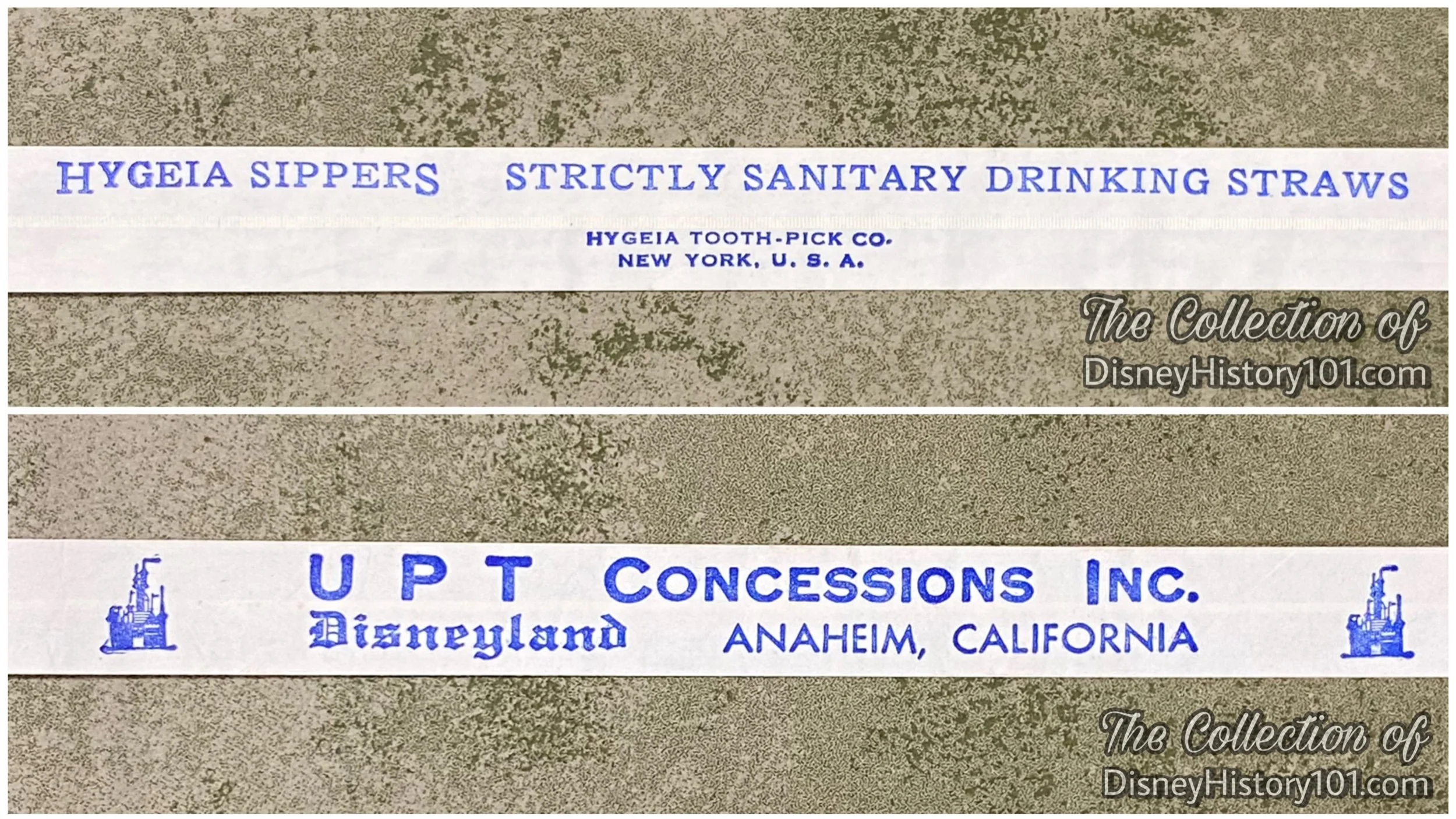
Soon, UPT Concessions would lease and operate all fast foods in Disneyland, including the Yacht Club quick service food location, offering snacks and drinks. “55er” Dean Penlick was a Chef Manager in a very successful Beverly Hills Restaurant when it was purchased by the American Broadcasting Company. UPT brought Dean to Disneyland as a food consultant.
“Lessee Designs”
By the spring of 1955, Disneyland, Inc. printed materials for Lessees detailing specifications for architectural designs of exhibit spaces. These were revised by March 16, 1955 and issued to Lessees like UPT.
All of the interior architectural drawings were done by competent registered architects or an approved display house of the lessee's choice. All of the designs submitted by the lessee's architect, whether for buildings or construction of interiors in DISNEYLAND, were approved as to the theme and general plan of DISNEYLAND as established by WED Enterprises, Inc.
Three sets of preliminary drawings were furnished DISNEYLAND, Inc. as soon as possible after signing of the lease. Two sets were retained by DISNEYLAND and one set was returned to the lessee’s architect with any revisions noted thereon and stamped “APPROVAL TO PROCEED TO FINAL DESIGN.” This stamp when properly signed and dated constituted the lessee’s authority to proceed with the final drawings.
The Lessees revised their final drawings to incorporate any revisions noted on the approved preliminary drawings, and submitted three sets of the revised drawings to DISNEYLAND. One set was returned to the lessee’s architect and any revisions noted thereon are to be incorporated on the original drawings. When the lessee had incorporated the final revisions on the drawings, two sets of transparent ozalids were forwarded to DISNEYLAND for approval. DISNEYLAND would stamp both sets “FINAL DESIGN APPROVED” and “LESSEE’S CONTRACT DRAWINGS”, and return one set to the lessee who could then release drawings for bid and/or construction.
“Construction and Launch”
The construction crews didn't begin work on any of Tomorrowland until six months into the project. F.M. Franz, manager of operations for MeNeil Construction expressed: "We feel sure there has never been anything built like this in Southern California, or elsewhere in the United States. Many of the items were constructed from artist’s sketches.”
The construction of the structure was of a frame-stucco basic construction, with plate glass wall on the front of the elevation.
According to inserts published in area newspapers during July of 1955, Disney buildings were roofed by Pioneer Roof & Shingle Company (then located at 608 Mateo Street, Los Angeles, California; 7522 Westminster Avenue, Westminster, California). The roof structure consisted of a very steep shed type roof, ranging from eight feet (at its low point) to a maximum height of fifteen feet tall.
The structure had plaster interior walls and ceilings, and 1,042 square feet overall. In addition, there were fourteen 7’x7’ steel frame and canvas canopies. There were also eight circular plastic canopies with a radius measuring approximately eight feet.
Newbery Electric Corporation gave electricity to Disneyland. “The electrical installations were supervised by Roy J. Gruendler, manager of Newbery's Orange County district office located at 1335 Santiago Ave, Santa Ana.”
As of June 2, 1955, C.V. Wood Jr. sent an Inter-Office Memorandum to Walt Disney regarding the best estimates that could be obtained at the time regarding the completion status of individual sections of the Park and Opening Day. C.V. wrote: “The [sic] Yacht Club: Exterior of the building should be completed. It is very doubtful if we can have the interior due the time required to fabricate fixtures.”
“Grand Opening”
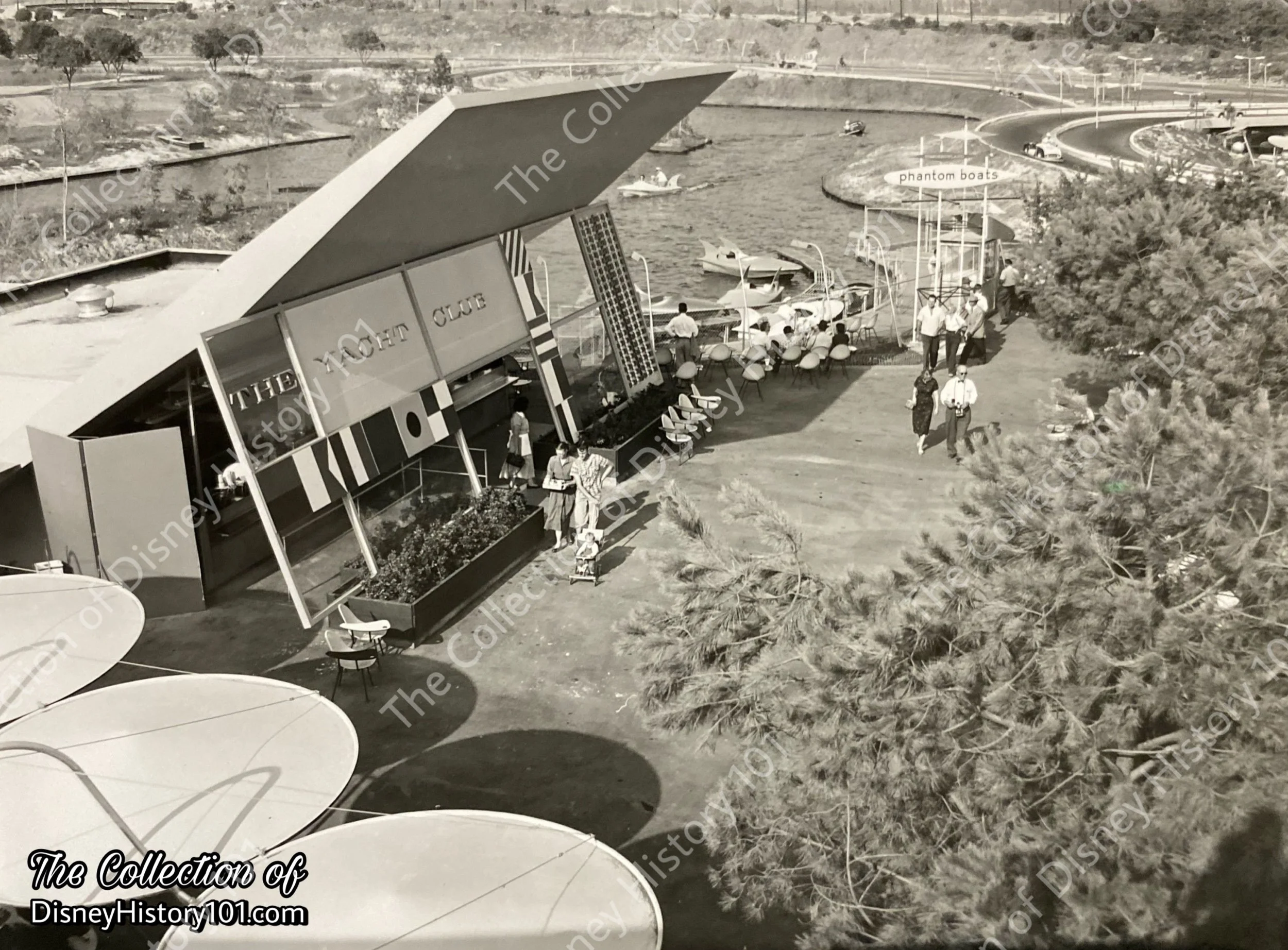
Soon, in 1955, Guests were introduced to the nautical-themed, Yacht Club. The quick-service restaurant offered breathtaking views of Phantom Boats gliding across the Tomorrowland Lagoon.
At The Yacht Club automat (a “self-service restaurant”), Disneyland guests could order “light food and snacks” - chili dogs, submarine sandwiches, shakes, and pizza all in one venue. Carnation Farms would also serve this UPT concession and 14 other wholesale customers who operated restaurants and snack bars in Disneyland.
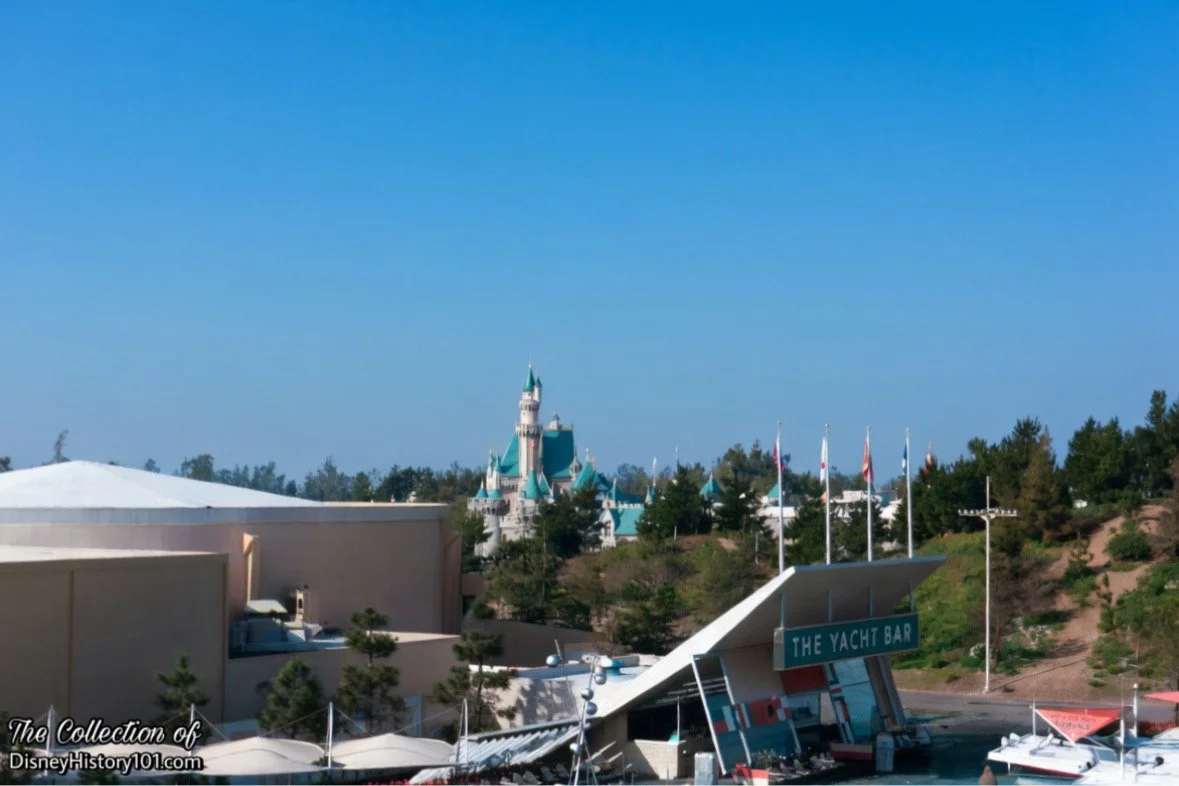
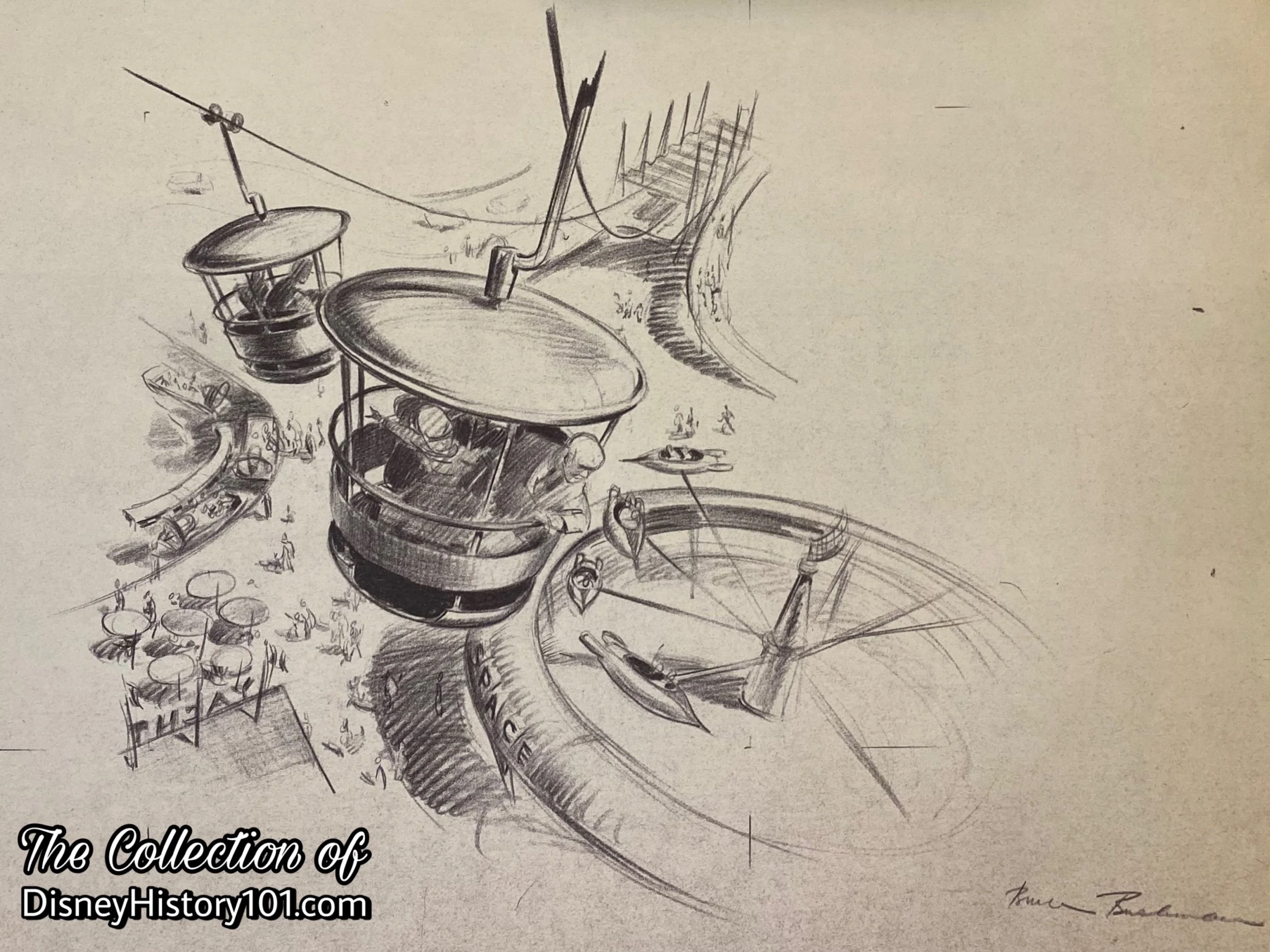
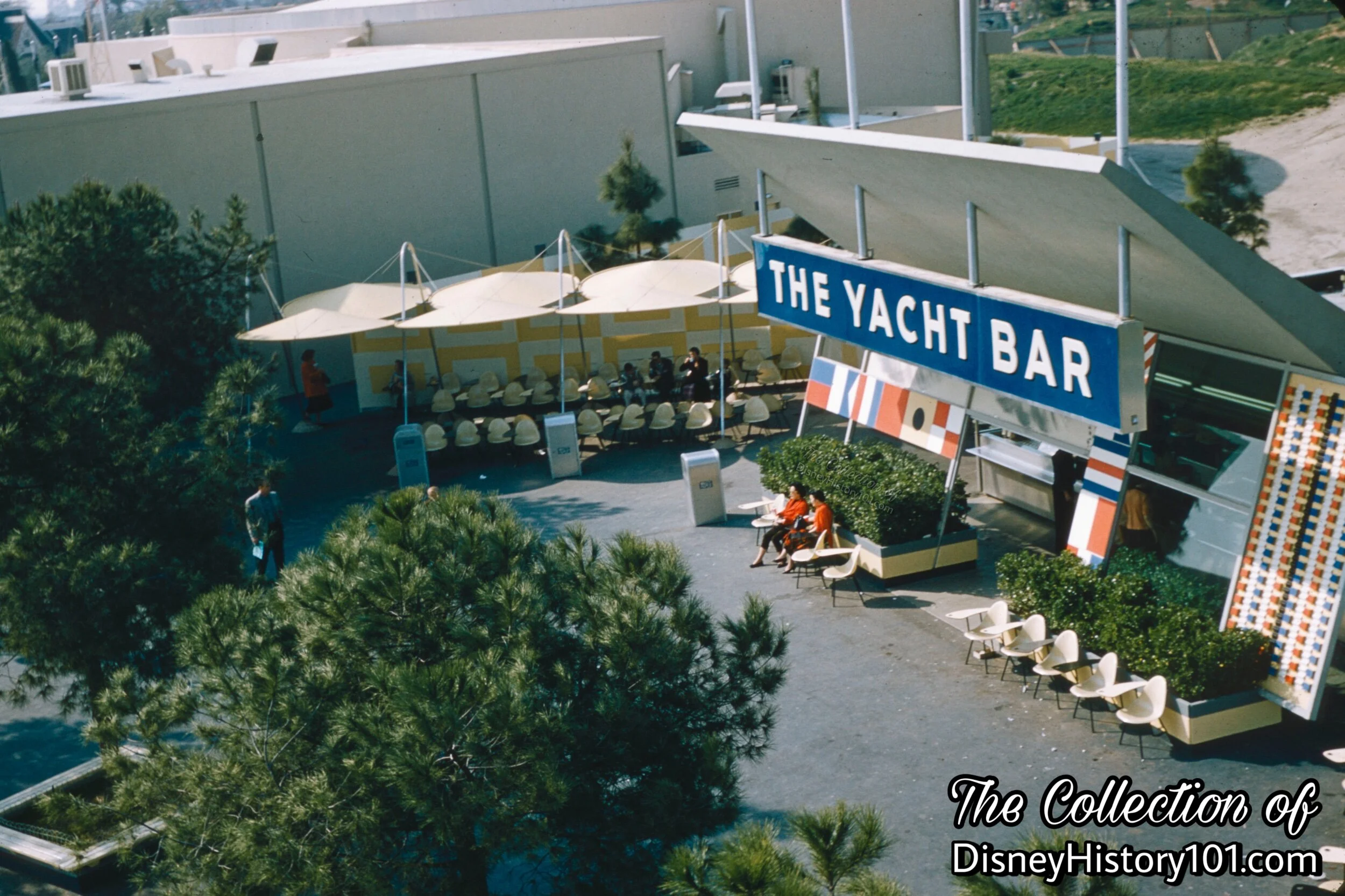
During 1957, with the imminent arrival of the Viewliner Train of Tomorrow, the concession stand was relocated behind one Tomorrowland Exhibit Hall (near the future site of the Art Corner). Within view of Tomorrowland Lake, the restaurant was appropriately renamed The Yacht Bar.
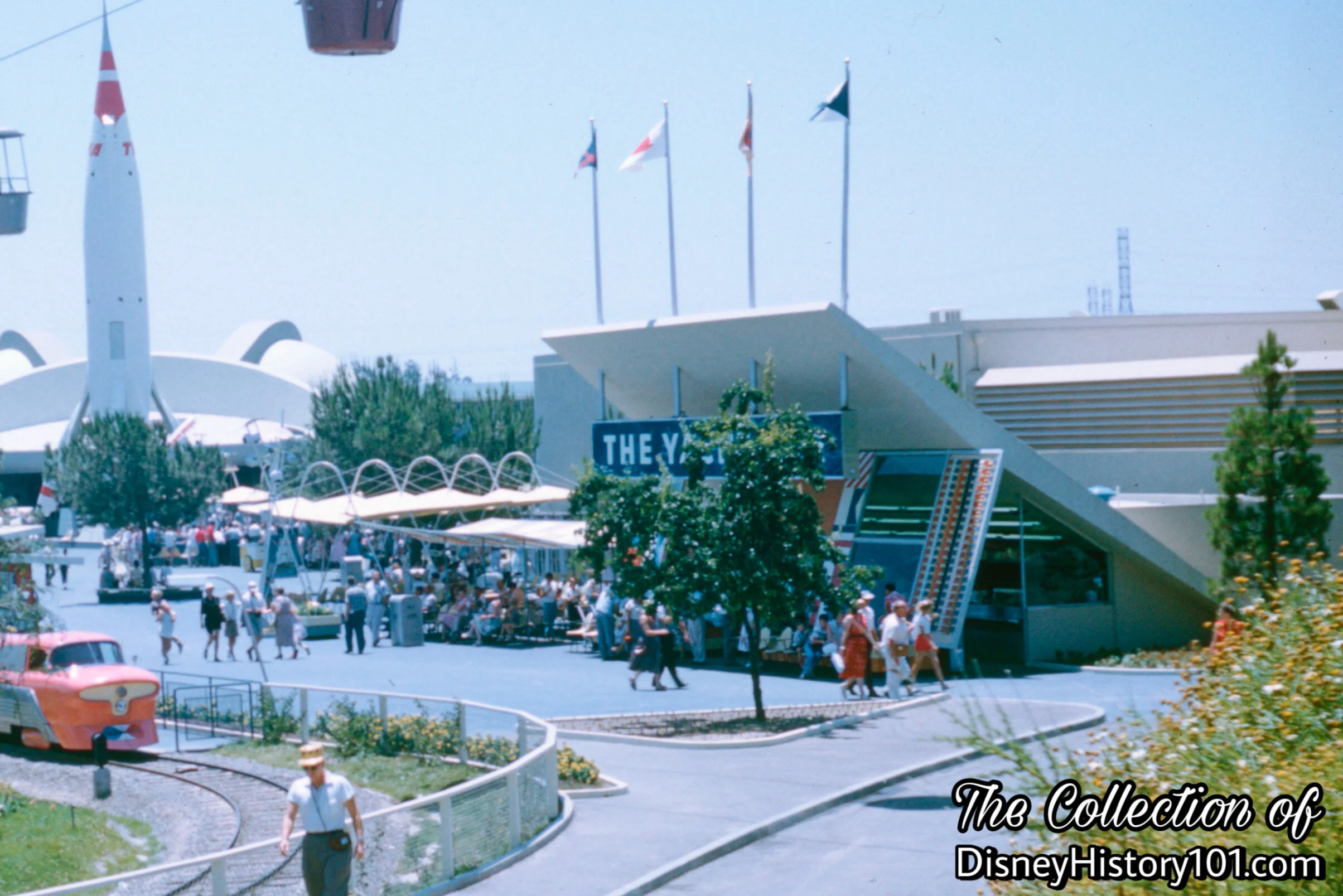
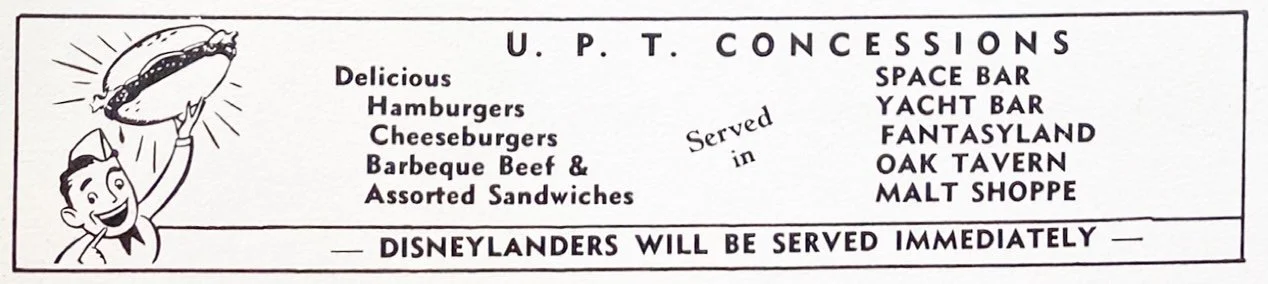
By September of 1958, an appraisal of Disneyland “land improvement” assets valued the Yacht Club at $49,199. This was enough to warrant the construction of a new concrete dance floor, which was installed during 1958, at the cost of $3,594.71 ($1.71 for blue prints; $3,593 for construction by subcontractor Barnes Construction Company). Joe Fowler (Disneyland Operations Committee) oversaw the Construction & Maintenance division including Engineering, New Construction, Maintenance, and Janitorial related to the installation of the attraction.
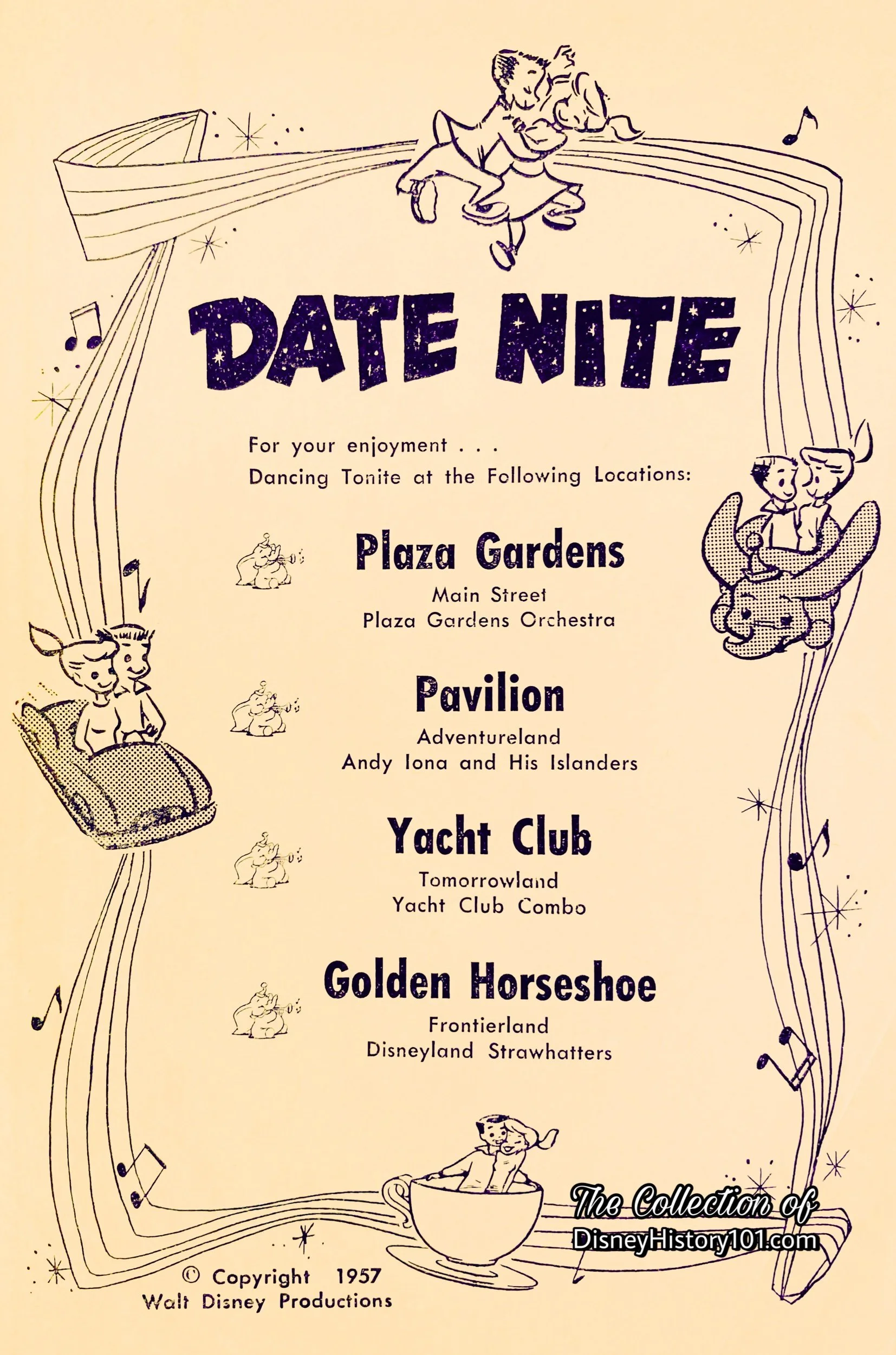
During Date Nite of 1957, The Yacht Club stage was one of four locations hosting live entertainment like the Yacht Club Combo.
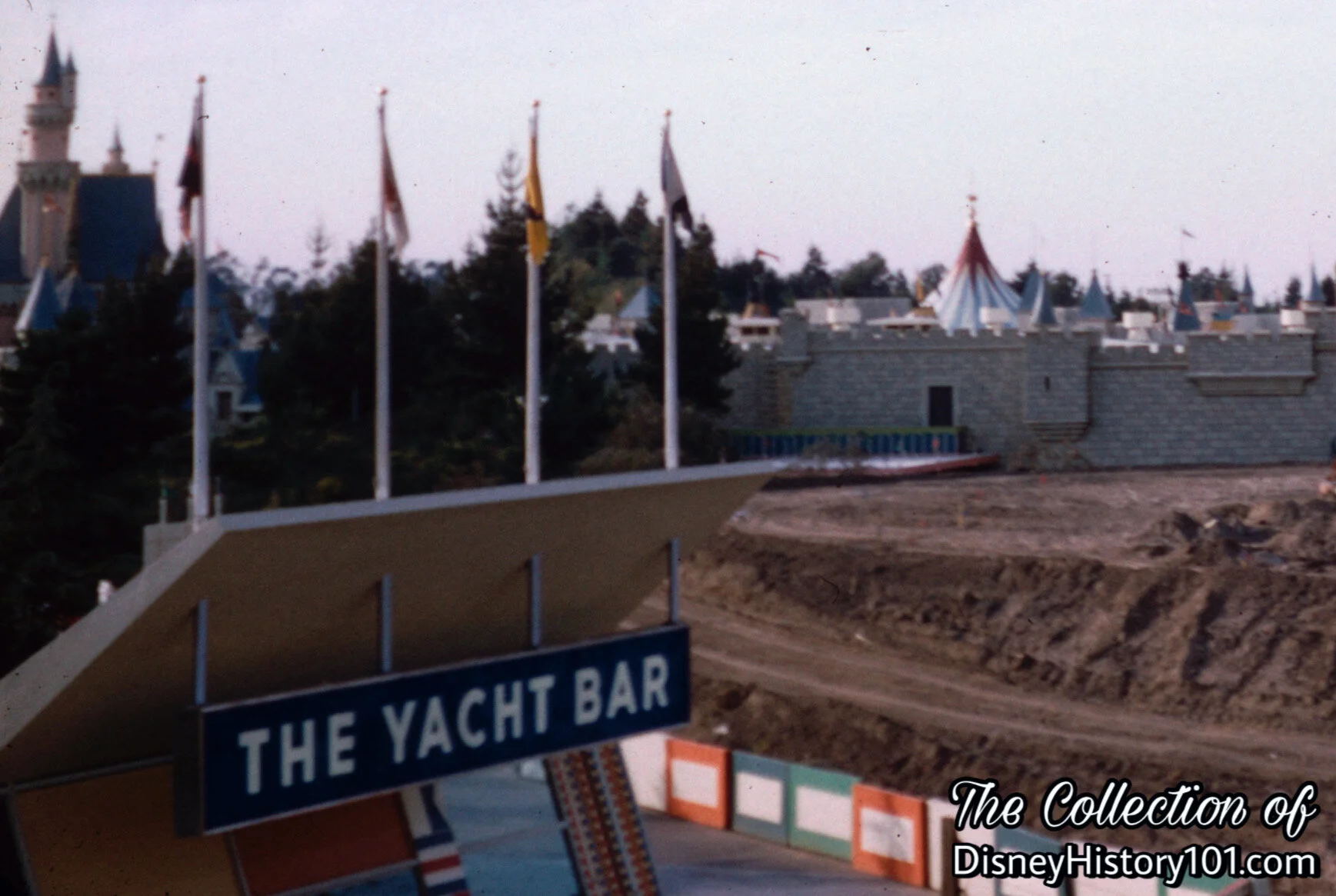
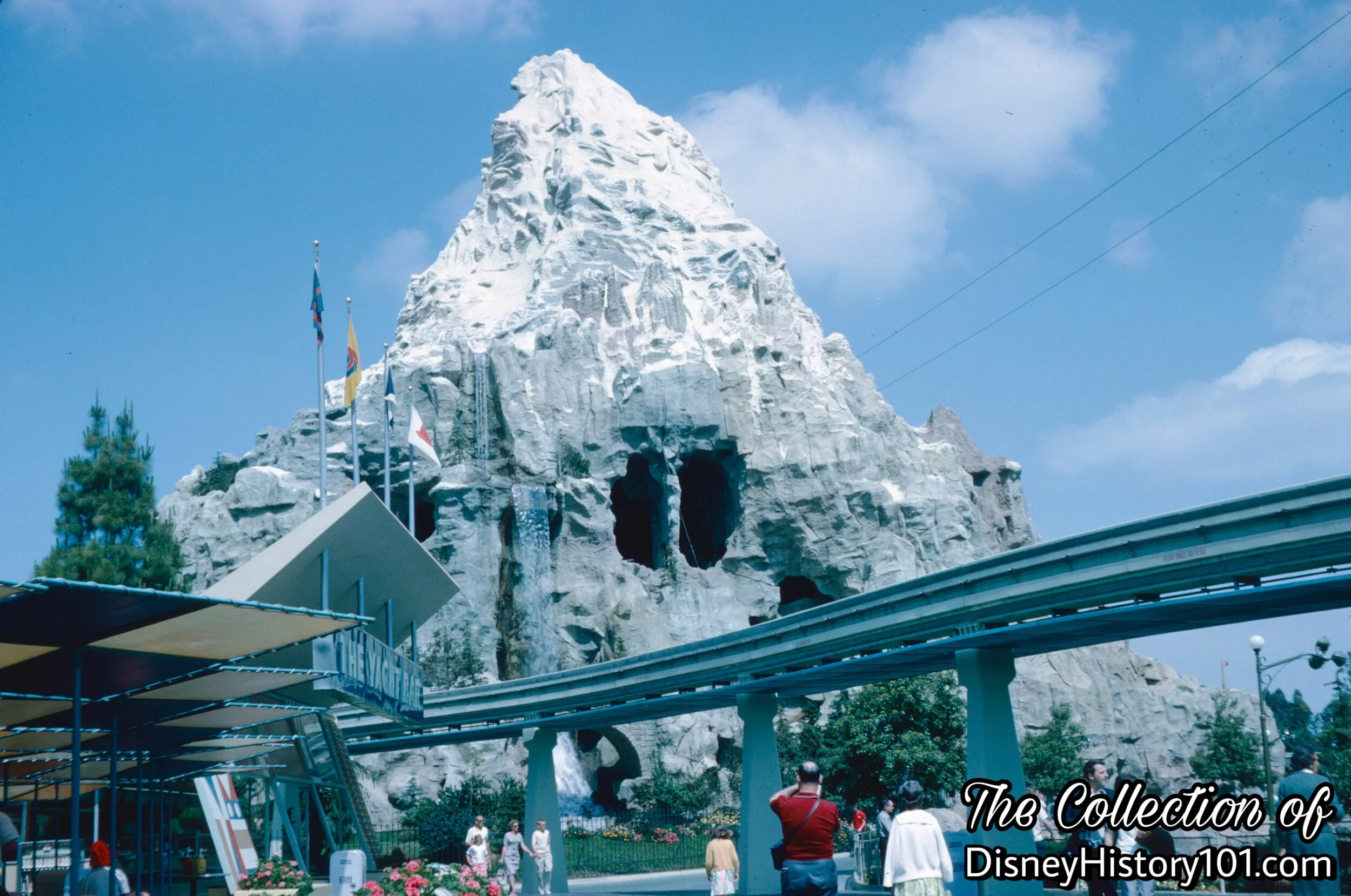
The Yacht Bar also offered a view of the greatest construction show on earth! The adjacent Holiday Hill area was leveled to make way for the Submarine Lagoon (over the former Tomorrowland Lake) and the Matterhorn. After all, The Yacht Bar would still fit in with the nautical attractions of 1959 - like the Motor Boat Cruise and the Submarine Voyage Thru Liquid Space.
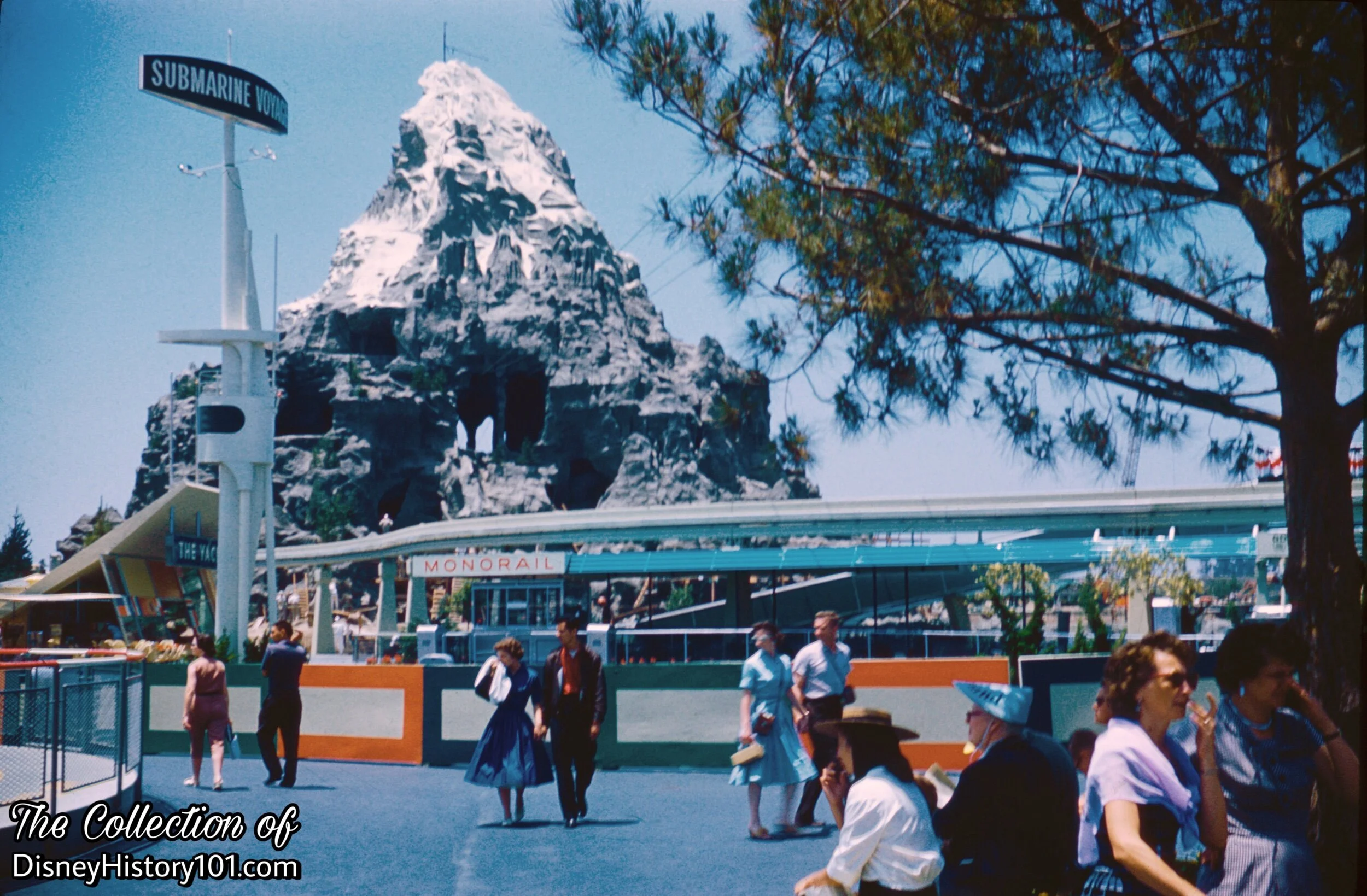
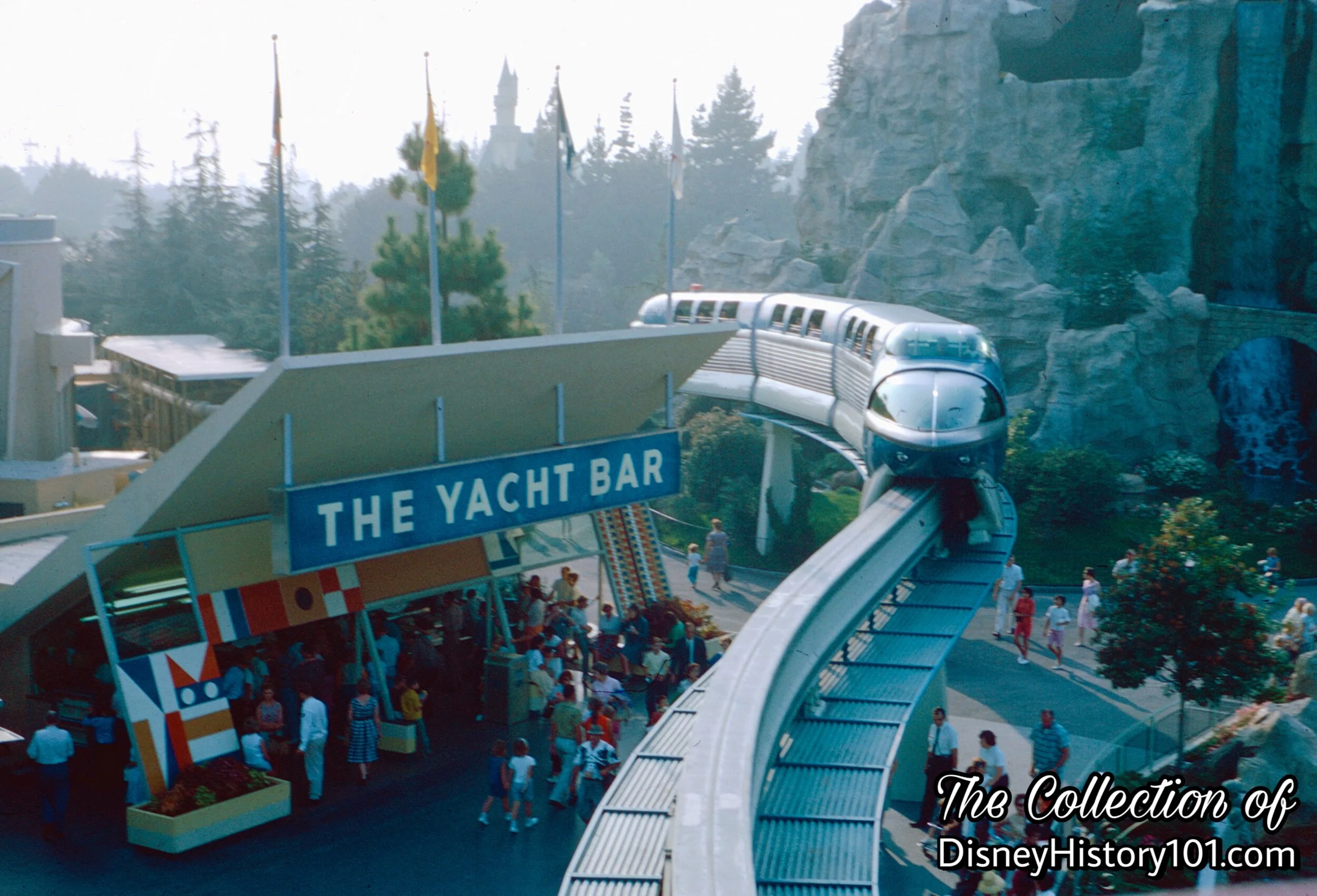
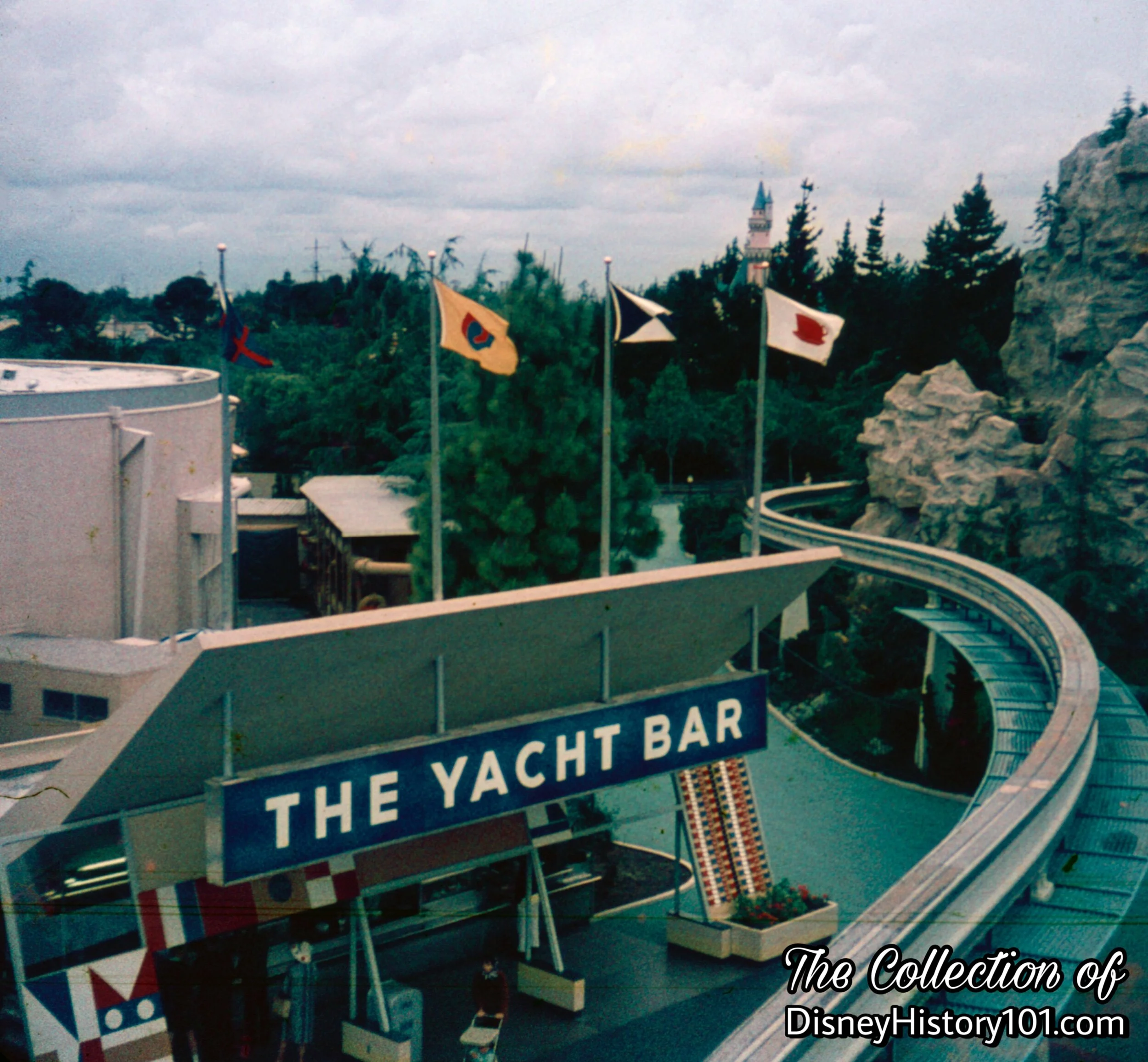
When the Viewliner Train of Tomorrow was replaced by the ALWEG-Disneyland Monorail, the Yacht Bar remained in this Submarine Lagoon-adjacent location (seen in the foreground). Those crowd control barricades around the Submarine Voyage thru Liquid Space entrance (and the adjacent Yacht Bar) were soon removed when “six spectacular attractions” opened during 1959!
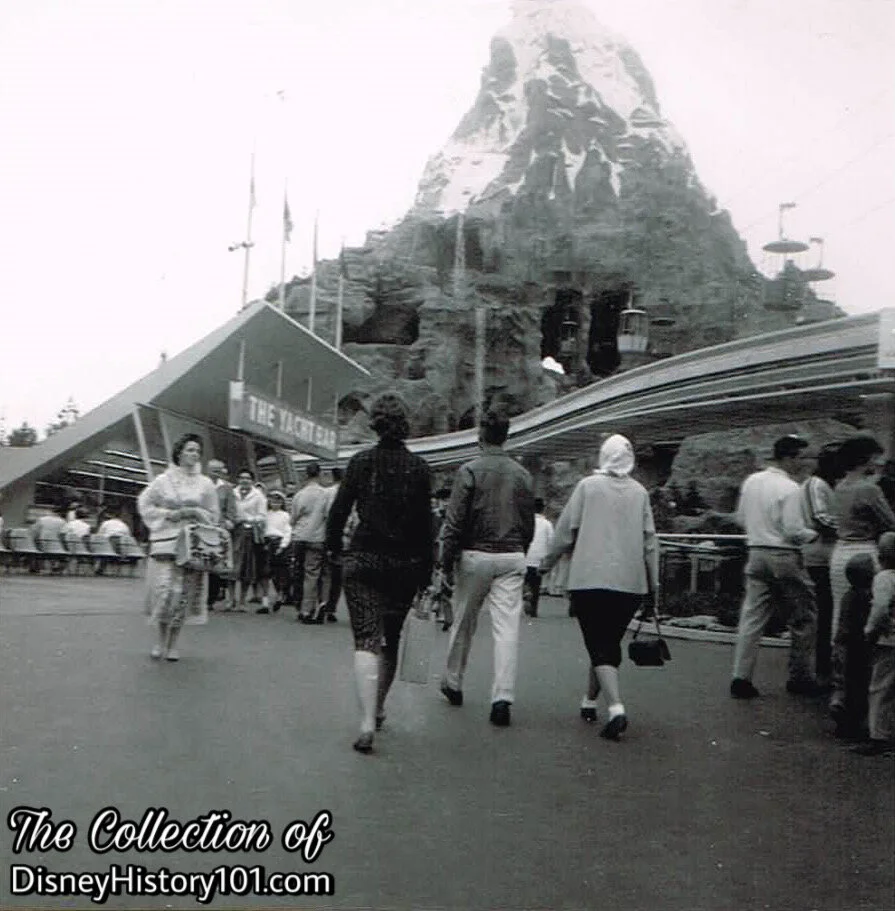
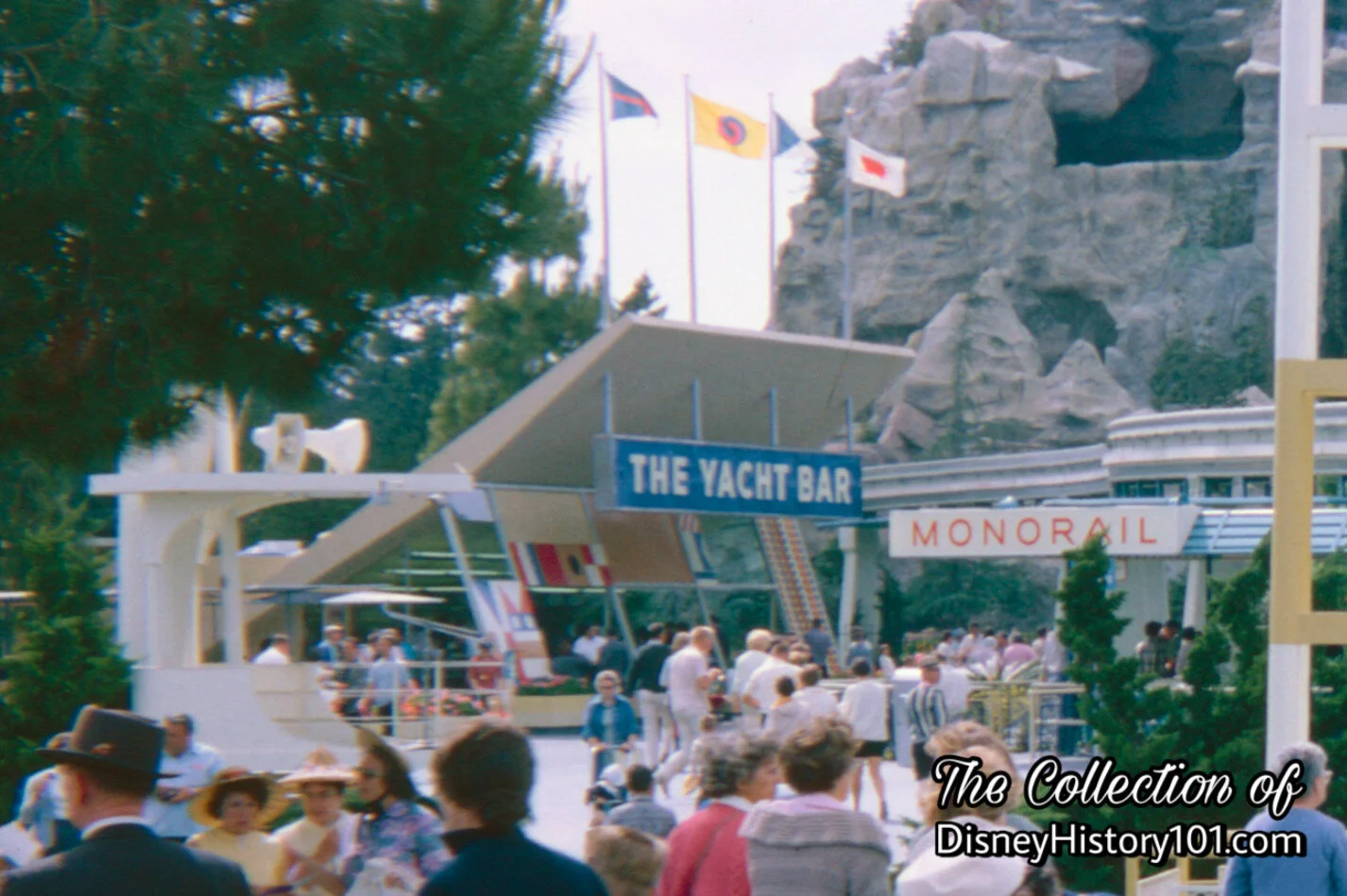
The Yacht Bar (pictured to the left), was situated near Tomorrowland’s Monorail Station.
“Banners In The Sky”
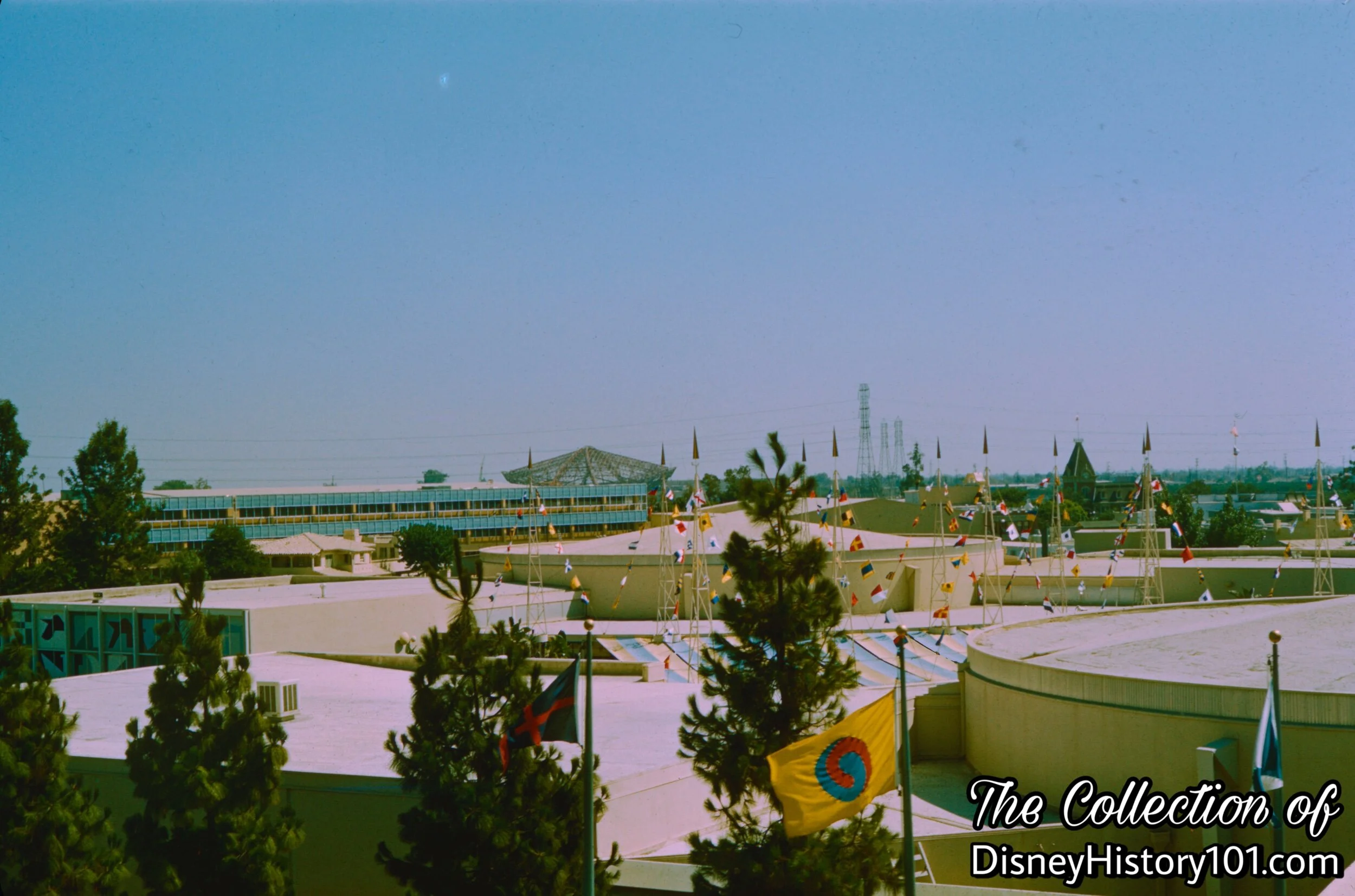
It seems that the tops of many Tomorrowland structures were decorated with flags - including the Hobbyland exhibition buildings. Those towers atop the exhibit halls (bearing nautical flags) to the right and left, are attributed to a rarely-mentioned Italian Art Director Gabe Scognamillo.
Gabe was first contracted by Walt Disney’s WED Enterprises Inc. to create many detailed concepts, elevation drawings, and other architectural artwork which ultimately became the final facade of the Upjohn Pharmacy on Main Street. But Gabe Scognamillo was most instrumental in developing what was perhaps the most challenging land of all to develop - Tomorrowland! His most notable contributions were toward the design of the Richfield Autopia neon sign and fuel pumps located near the Autopia Loading Zone. But (in line with our subject), Gabe also contributed designs of Tomorrowland exhibit halls (with towers and flags atop), a certain “Automat,” and many of the yellow-canopies over the benches and dining areas.
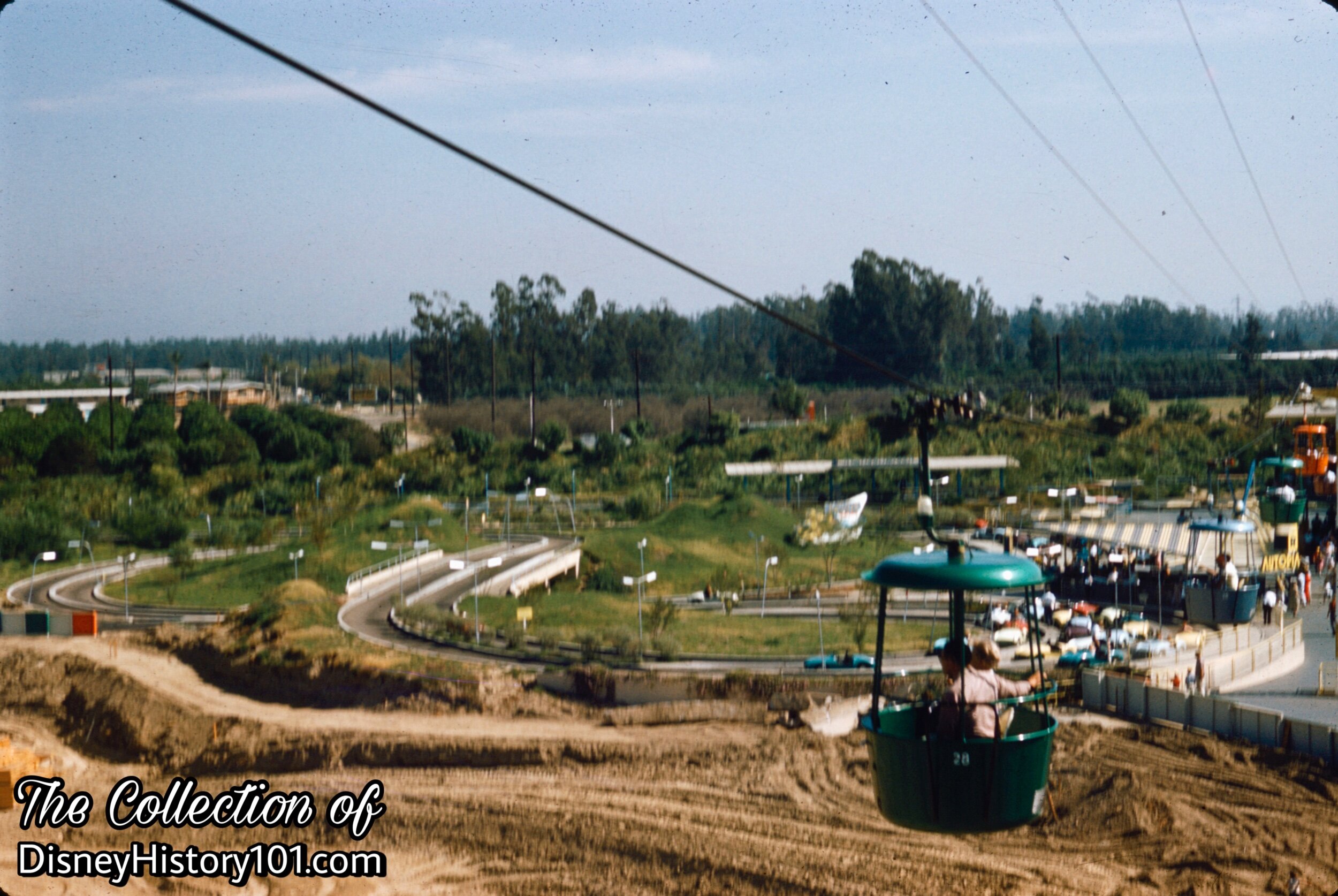
The exterior of the neighboring Yacht Bar was soon decorated with nautical flags representing various letters of the alphabet, though it’s unclear if the patterns spelled anything relevant. Whatever the case, the colorful flags dancing in the breeze likely made it easy for hungry Guests to spot the restaurant they desired from afar. Passing along in a Skyway Cabin, Guests may have shouted “Snacks Ahoy”!
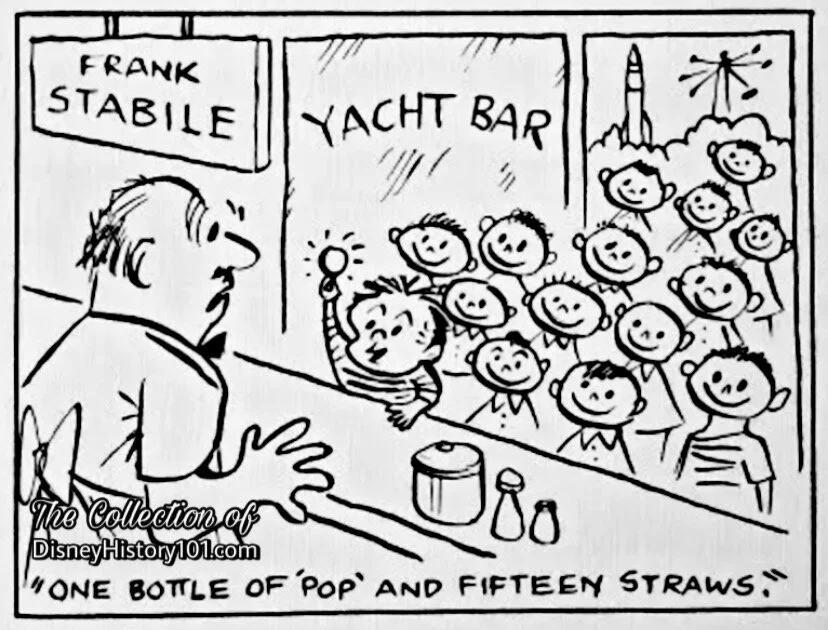
By 1959, The Yacht Bar was still operated by UPT Concessions with a scope of sales focused on snacks and soft drinks. The Yacht Bar was accounted among Disneyland’s twenty eating facilities which were predicted to contribute to accommodating “15,000 persons daily, hitting a peak of 60,000 o holidays and week-ends…” and one of “twenty restaurants and snack bars, capable of saving 8,000 hourly,” at least according to “Building A Dream” (prepared by the Disneyland, Inc. Public Relations Department).
Some of those patrons, were regular customers, one of whom was Walt Disney. “55er” Dean Penlick recalled: “Walt's appetite was very plain, American. He liked hot dogs, hamburgers, chill. Since I worked mostly in fast foods, I had an opportunity to see him and serve him many times, because he'd just walk up and order whatever. He had a very definite philosophy which we still use as our guidelines in serving our guests. That is to serve a good, whole some, good value meal. That principal policy exists today. Walt might build a $5 million food facility but it didn't bother him that good hamburgers and hot dogs would be served in it.”
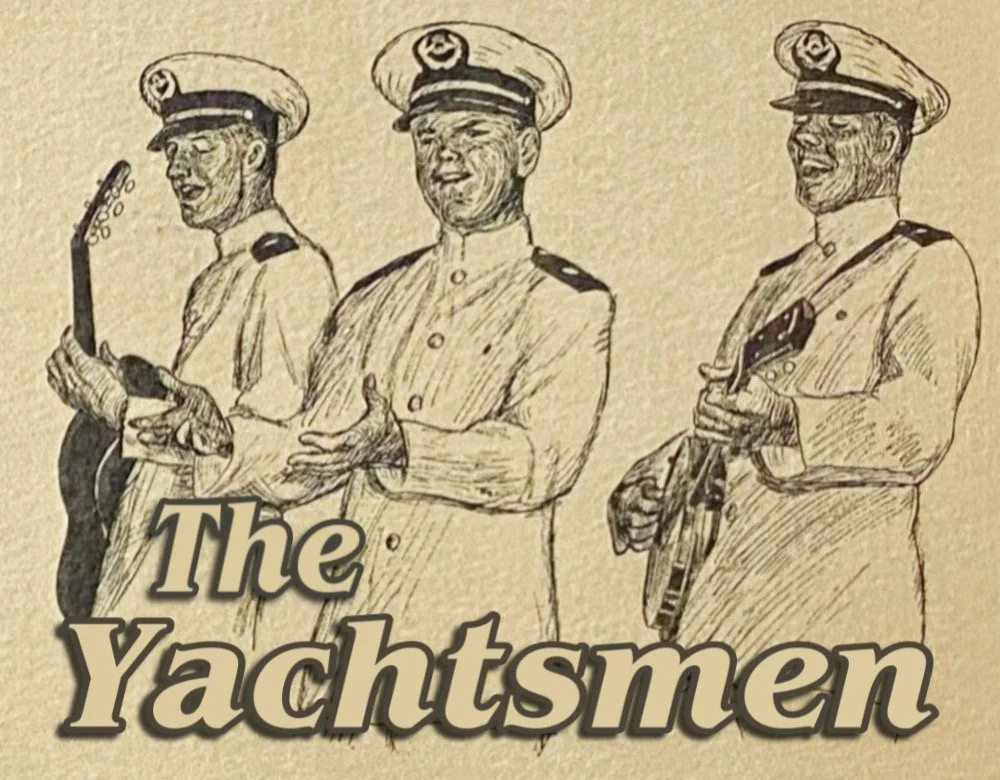
With the Submarine Voyage Thru Liquid Space soon-to-open, Walt was searching for ways to alleviate the boredom of waiting in lines (especially during the summers). Now, the “stage” attraction was already part of a concept which Walt helped pioneer - entertaining queue lines with live performances. So it was decided to shape the atmosphere of lands though themed shows. Such entertainment became a fundamental and traditional part of effecting the Disneyland show. In fact, “THE DISNEY THEME SHOW - an introduction to the art of Disney outdoor entertainment” said: “Important are the sounds which permeate the scene, for without them, the theme show is a silent movie . . . but with them it is a symphony of music, effects, and natural sounds that the finest stereo system in the world can't duplicate. These sights and sounds are provided not only by imagineered attractions and shows, but also through the multi-talented efforts of live entertainers . . . in special musical groups . . . in parades and pageants . . . providing an ever changing backdrop to virtually every area in the theme show.” This resulted in even non-Disney events like Expo ‘67, finding the “stage” show along to queues to be a success!
According to their record album : “Tommy Walker, Director of Music and Special Events at Disneyland Park, heard a group of four young men who called themselves The Yachtsmen and who were doing college shows and club dates in the Long Beach area. He was so taken with their unique manner of handling folk tune and popular material, that he booked them for the summer to entertain in Disneyland Park.” By 1959, Chuck Corson (who was a big fan of the Golden Horseshoe Revue) had become Disneyland Entertainment Director. He soon helped create many new acts for the “stages”, or lands of Disneyland. Fantasyland had its life-size characters, Frontierland had its gunfighters, while both Adventureland, Main Street USA and Tomorrowland would have live musical entertainment. Chuck would have a hand in bringing two memorable quartets into Disneyland – the Dapper Dans of Main Street, USA, and The Yachtsmen of Tomorrowland!
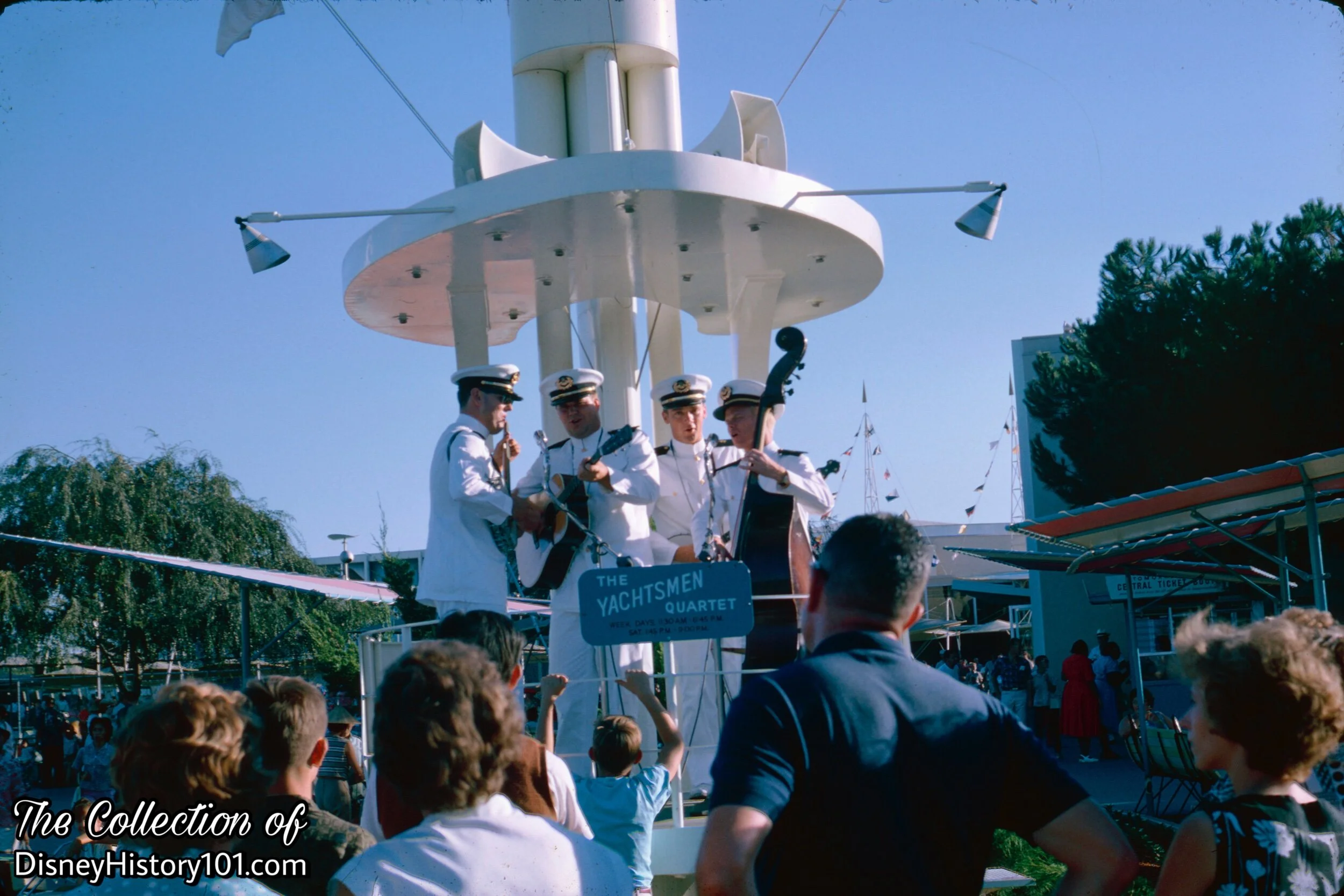
The Yachtsmen consisted of four members - Carl Berg, Ray Gordon, Jay Huling, and Bill Reed. “Carl Berg, leader of the group, is a Long Beach Boy who has been singing and playing guitar since his early childhood. Ray Gordon, whose instrument is banjo or string bass, lives in Garden Grove, California. Jay Huling of Downey, California sings and plays guitar and bongos. Bill Reed of Norwalk, California plays bass.”
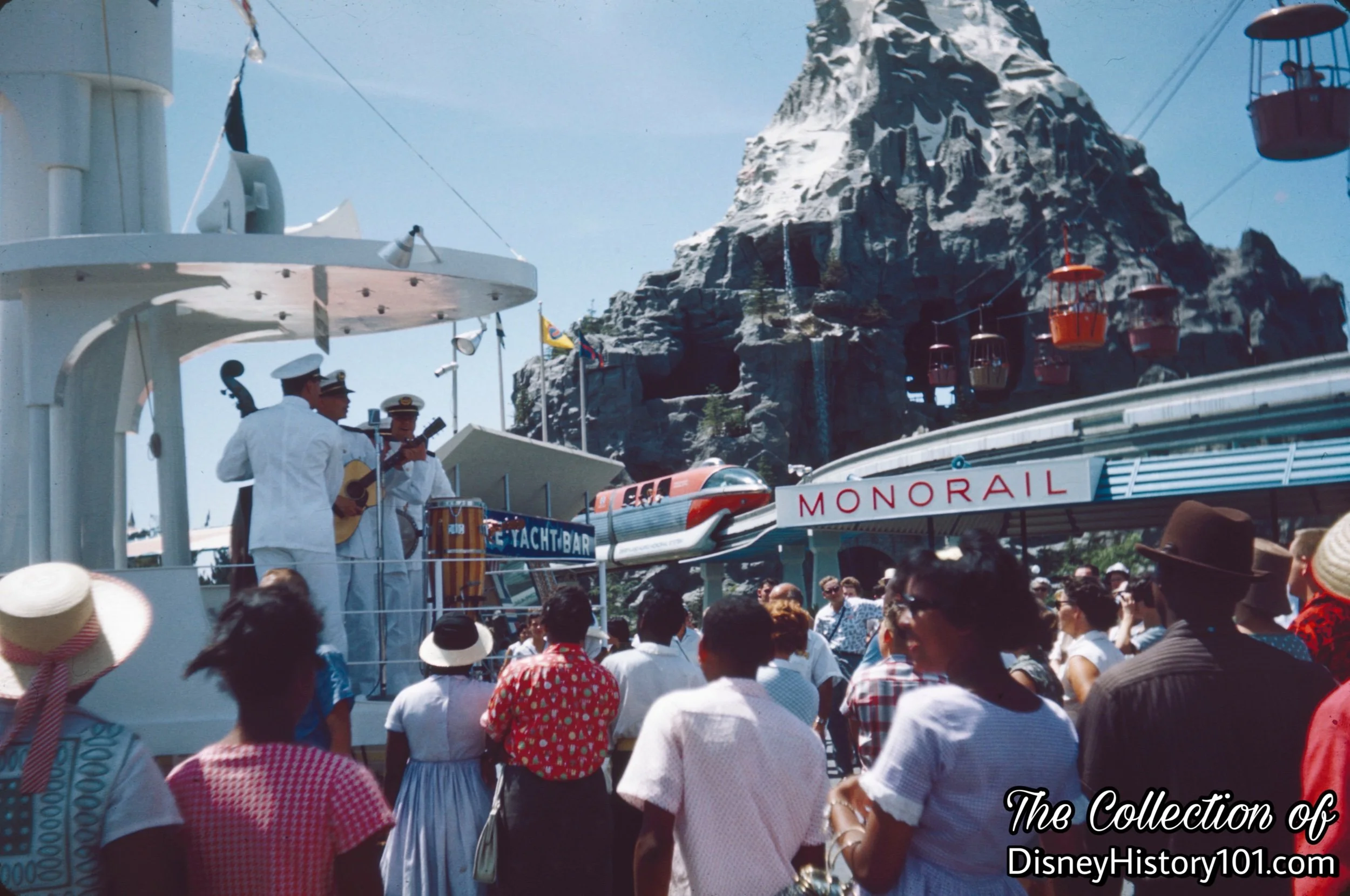
The “natty vocal-instrumental quartet” generally performed near the Submarine Voyage Thru Liquid Space Entrance and adjacent General Dynamics Stage near the Yacht Bar. From both stages, they entertained crowds, and performing six days a week – week days (from 11:30am to 6:45pm), and Saturdays (from 1:45pm to 9pm).
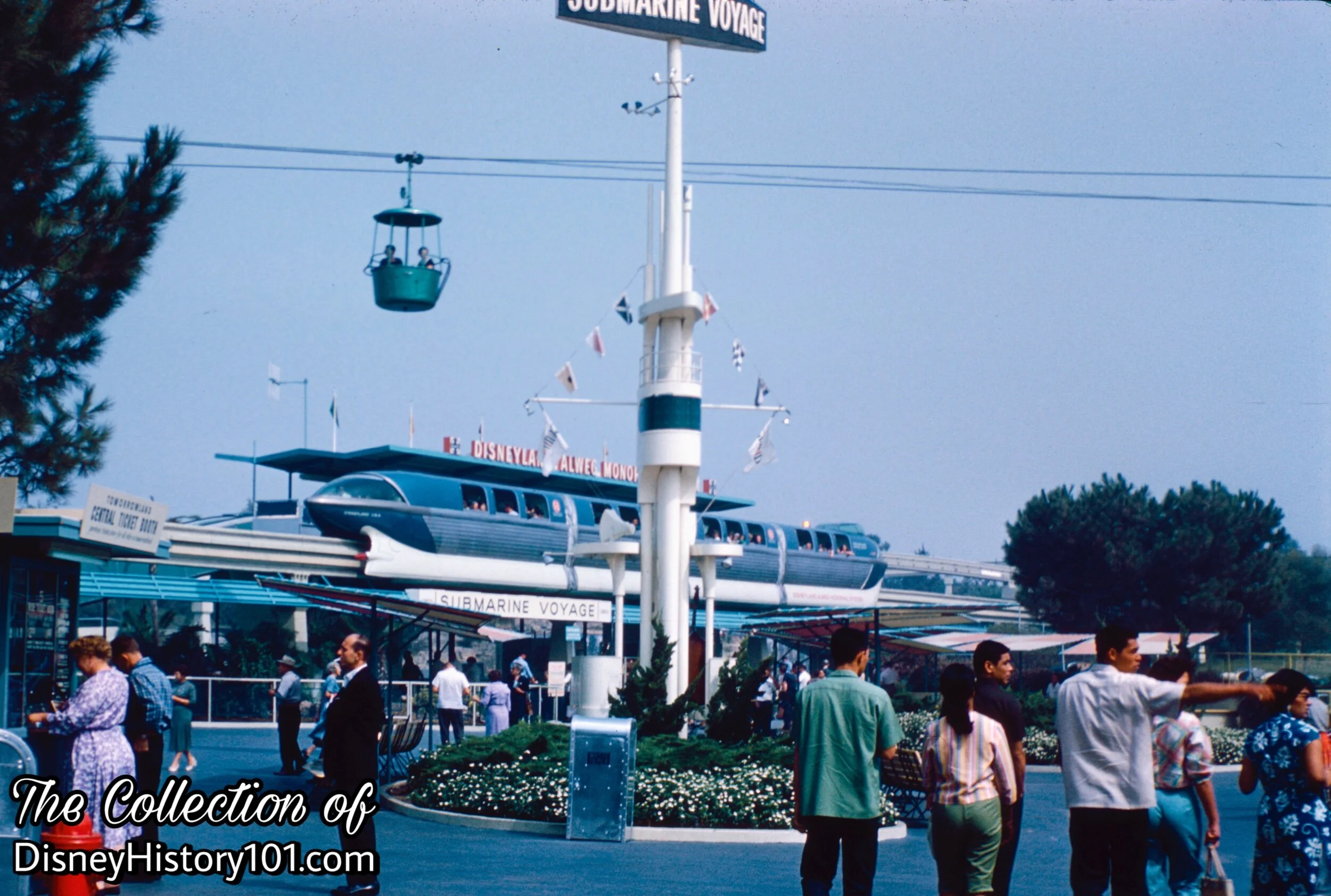
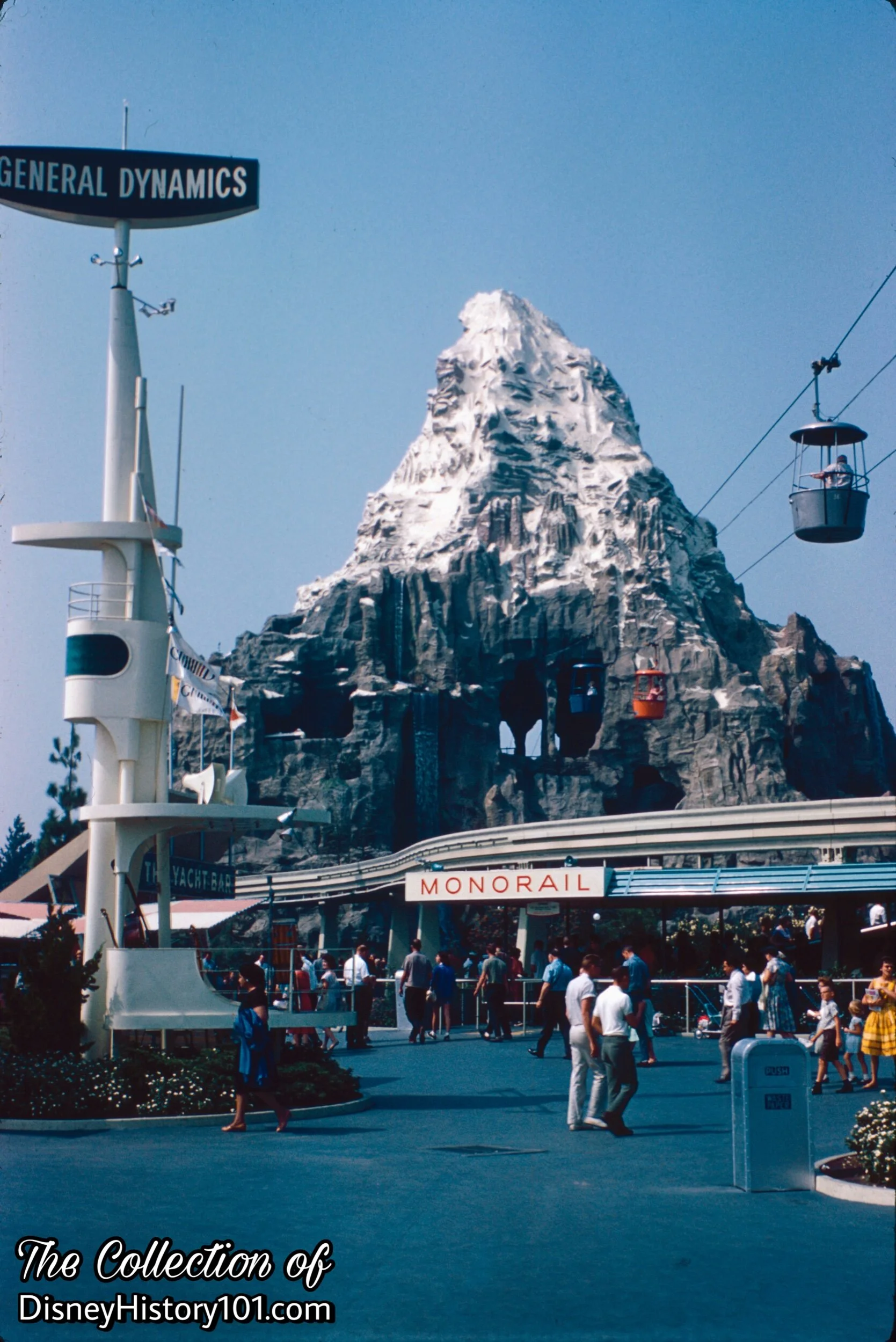
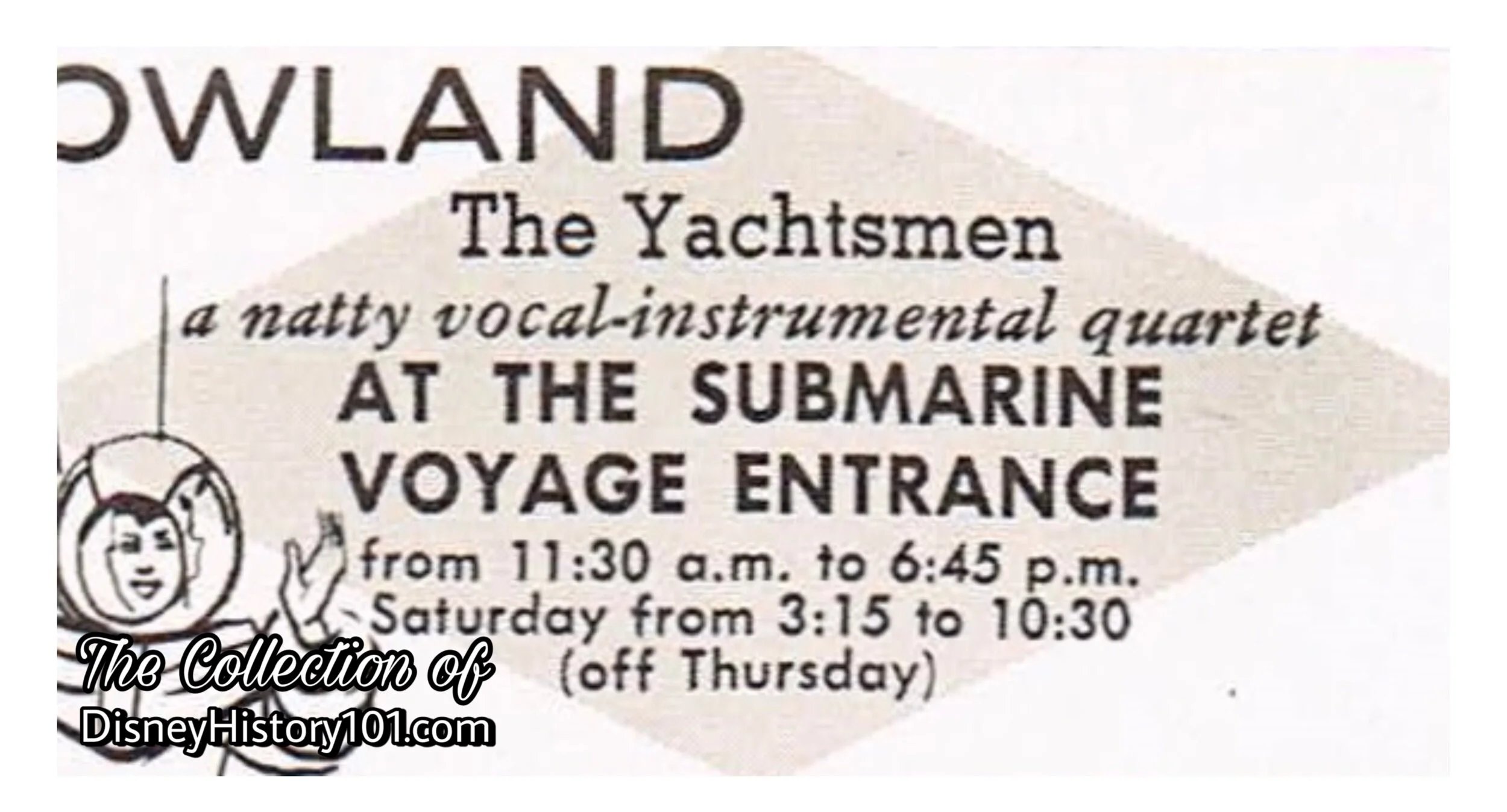
“In the summer of 1961, The Yachtsmen returned again to their singing duties at Disneyland. While shooting a television show in Walt Disney’s Magic Kingdom, Benny Goodman heard the Yachtsmen perform and was so impressed that he immediately asked them to appear with him on his television show. In his introduction, Benny mentioned many of the other famous musical talents which he had discovered through the years and predicted a bright future for the Yachtsmen. Walt Disney is featuring theme in a soon-to-be-released television program, ‘Disneyland After Dark’.”
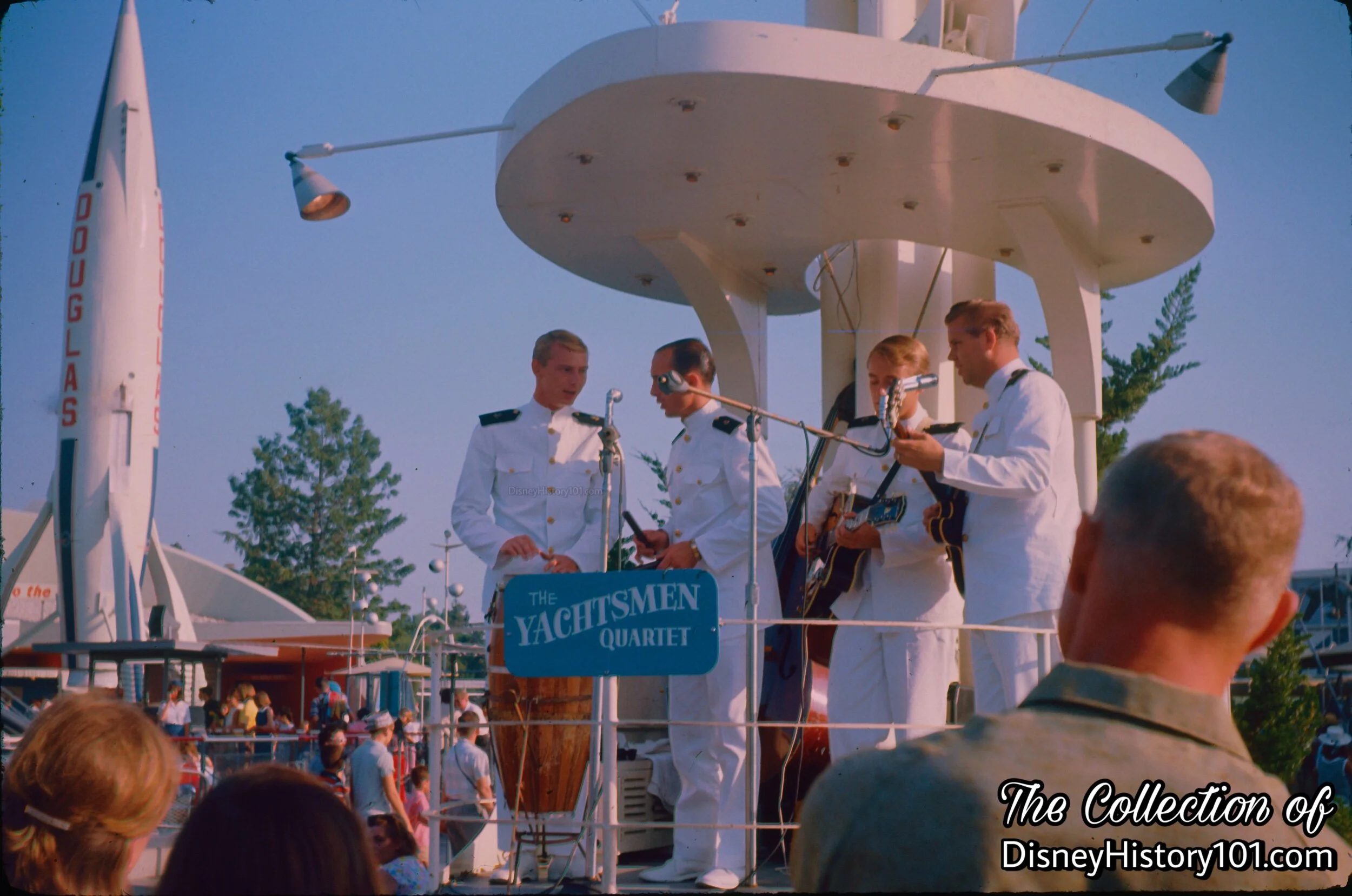
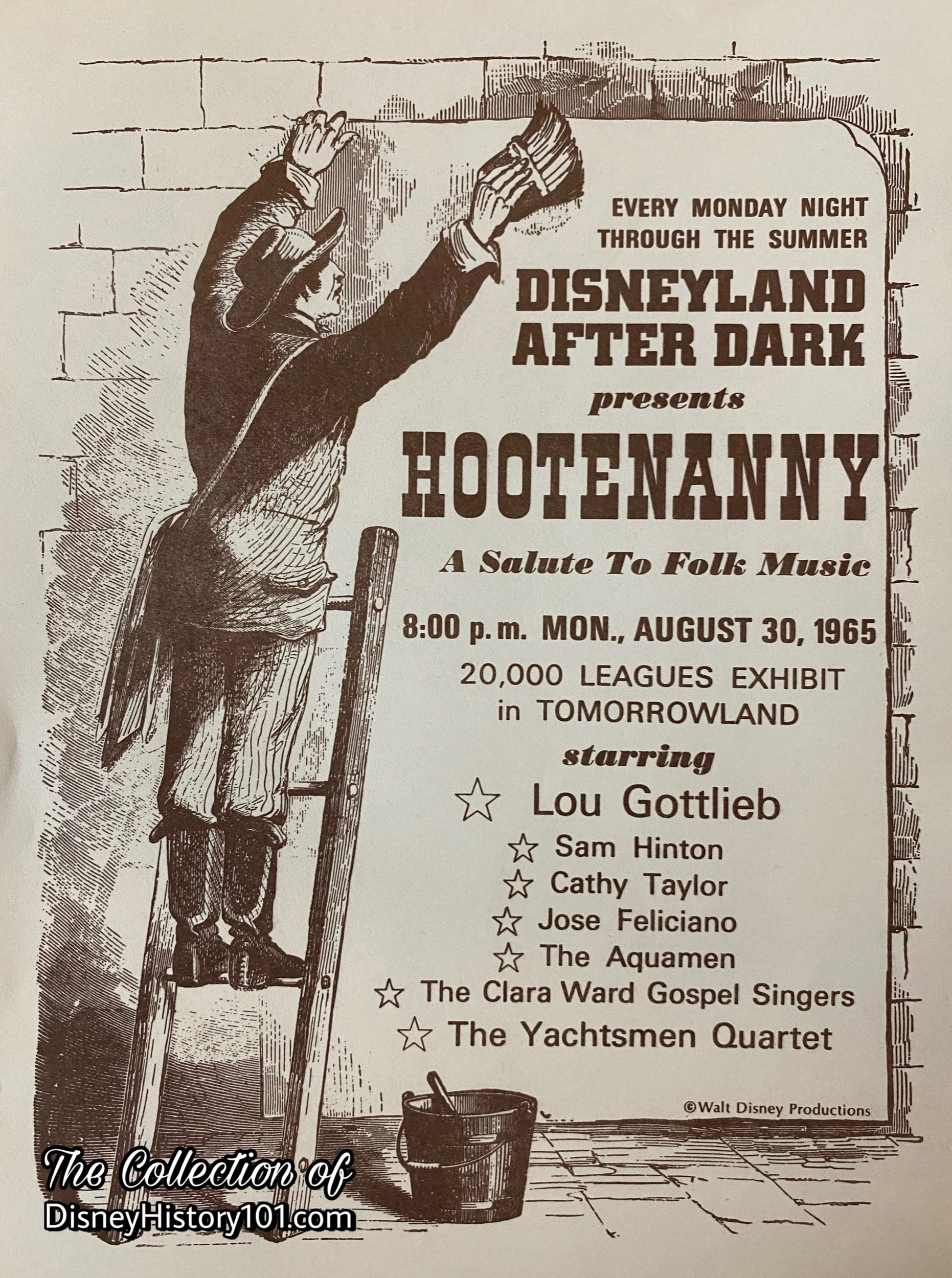
When the Yachtsmen weren’t performing from the stage, they also occasionally played Disneyland’s other venues. As mentioned, they would put on a show near the Submarine Voyage Entrance. But by 1960, there were two other bandstands in Disneyland - Magnolia Park and Plaza Gardens. So, The Yachtsmen were regularly scheduled to relieve the bands at Plaza Gardens and the 20,000 Leagues stage during the New Years Eve Party of 1962.
The Yachtsmen were also booked for the New Year’s Eve Party of January 1963, when they were assigned to play an area near the Disneyland Main Gate. Later that year, they participated in Disneyland’s big Summertime Spectacular of 1963 and Grad Nite 1963, when they performed (appropriately) from the upper deck of the Columbia! Owing to all these appearances, “The Yachtsmen were an immediate success with the Disneyland patrons, and since attendance at Disneyland Park during the summer is over 50% from outside the state of California, the Yachtsmen’s fame spread rapidly all over the United States.”
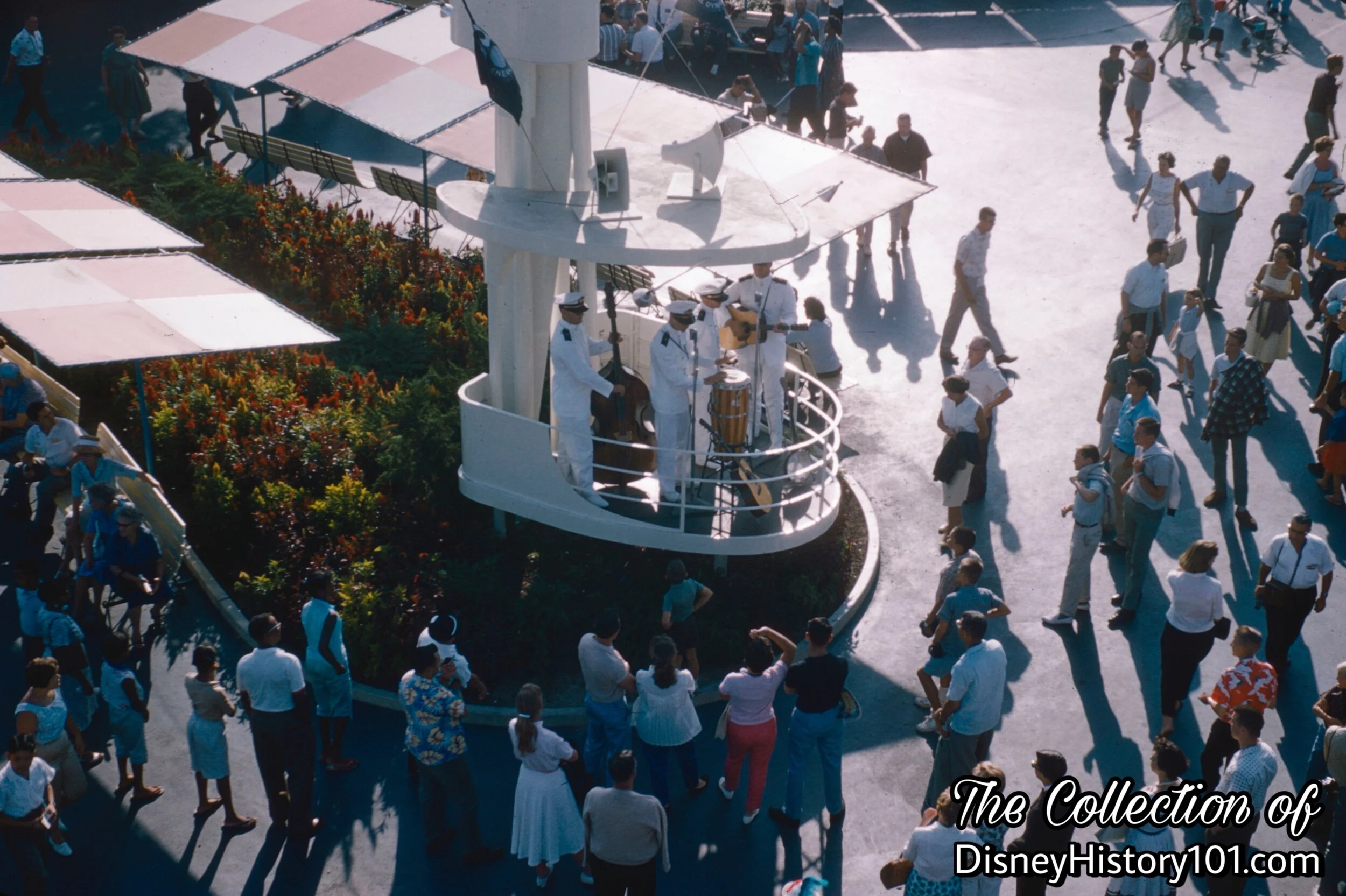
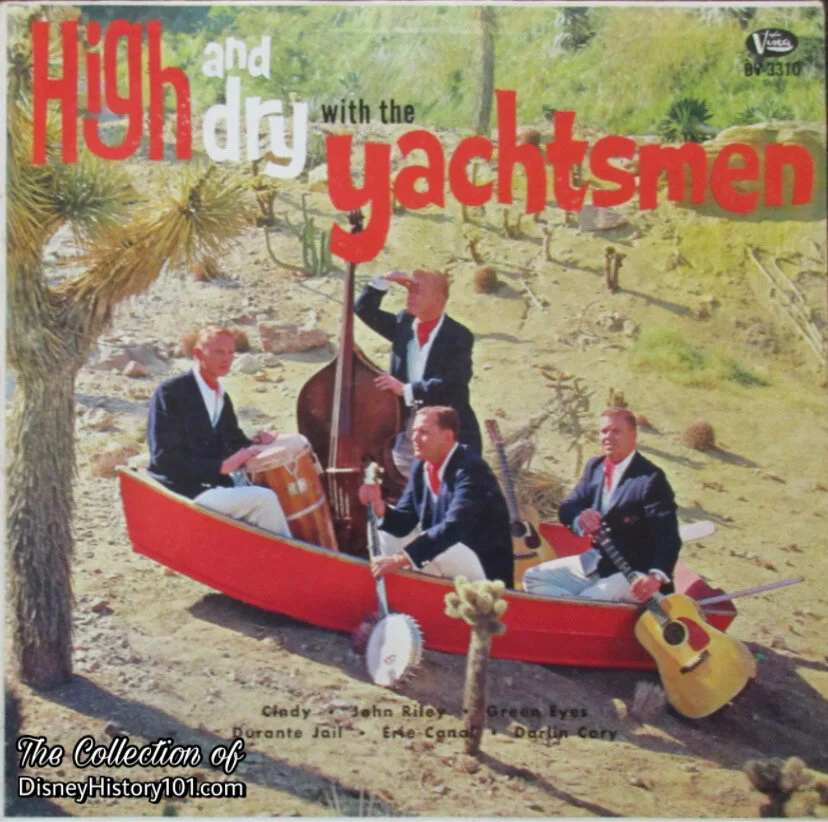
The Yachtsmen recorded twelve traditional and modern songs tracks released on one album (“High and dry with the Yachtsmen”), distributed through Buena Vista Records and Walt Disney Productions. Below is a transcript of the album’s track list of songs, some of which were occasionally performed inside Disneyland Park.
High and Dry (Berg-Huling) Seeing the Yachtsmen in full uniform and walking through the Disneyland desert one day on the way to work, Tommy Walker said “You boys look high and dry” and the Yachtsmen were so impressed with his anomaly that they composed the song which became the title song of this LP.
Cindy (Traditional) This is one of the most frequently performed banjo songs arising out of our American Folk Song Heritage.
MacPherson’s Lament (Traditional) Poor MacPherson is condemned to die from the Gallow’s Tree. We don’t know the reason for his death, but rather than let someone take his fiddle he breaks it through the middle.
Erie Canal (Tradional) This is the rocking song of the salt water sailors who wound up working on the famous inland canal.
John Riley (Traditional) This is the narrative song from England which tells the story of a young man who returns to a faithful wife after he has been away at sea for many years.
Those Green Eyes (Tom Campbell) This number in the folk song tradition tells the tender story of love for a beautiful woman.
Let Me Fly (Traditional) This is an old negro spiritual full of life, brilliance, and high spirits.
Sinner Man (Traditional) This is the age-old story of a man in search of some way to rid himself of sins.
East Virginia (Traditional) A love song from the southern mountains.
Fast Freight (Gilkyson) In this newer song done in the old tradition, Terry Gilkyson has written a haunting number telling how the low-wailing tone of the freight train’s whistle calls to many men.
Durante Jail (Berg-Campbell Huling) This original written by two of the Yachtsmen in collaboration with Tom Campbell tells how the outlaws of the Old West had a great dislike for the rather run down interior of the Durante Jail.
Darlin’ Cory (Traditional) A memorable song from the mountain country of the south, about a young maid whose investment in a liquor store still made her some fine money.
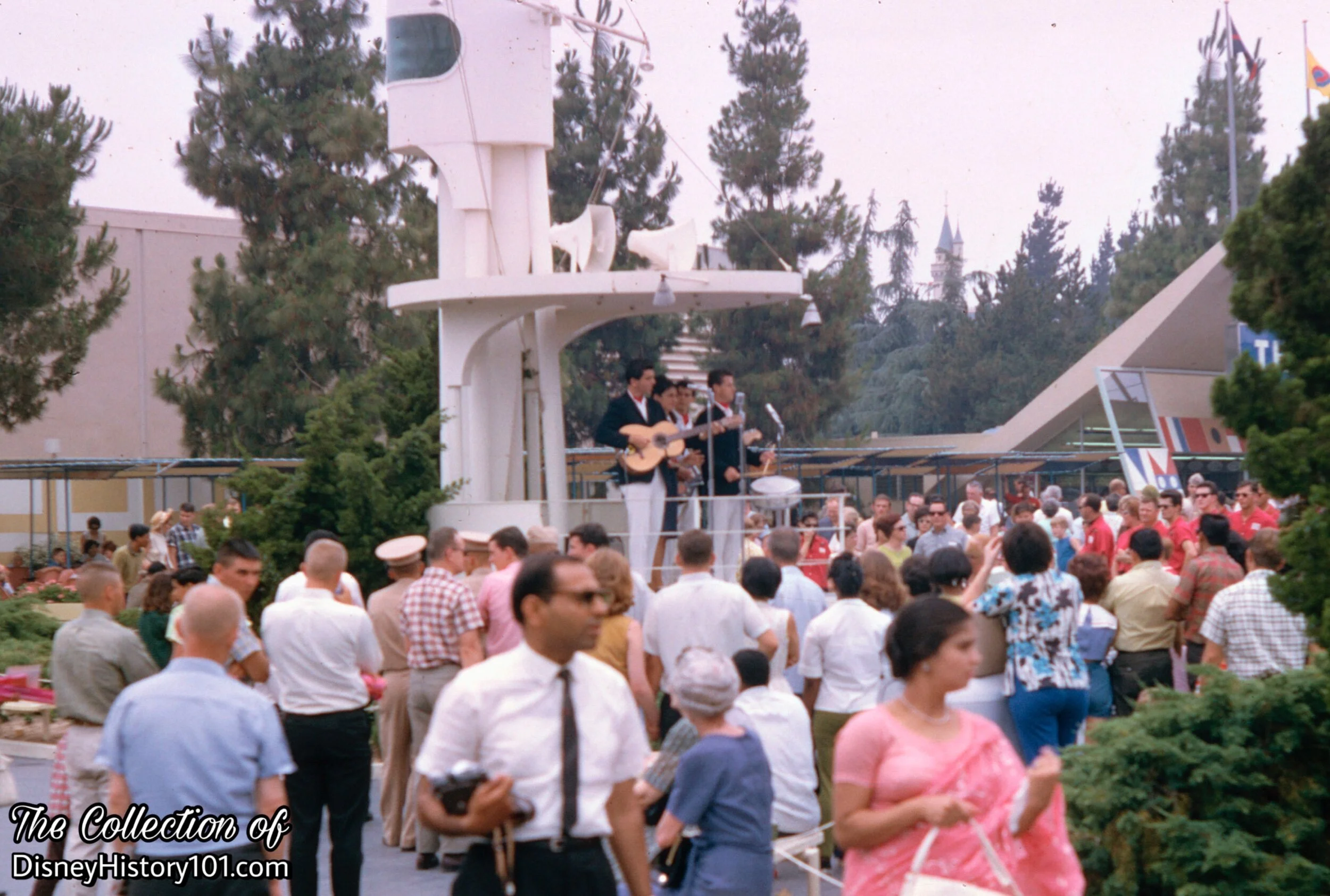
Despite The Yachtsmen’s rigorous schedule, other bands managed to perform on the General Dynamics Stage (including the unidentified band, pictured). This continued until the Yacht Bar (and its nearby stage) were both replaced by a larger venue.
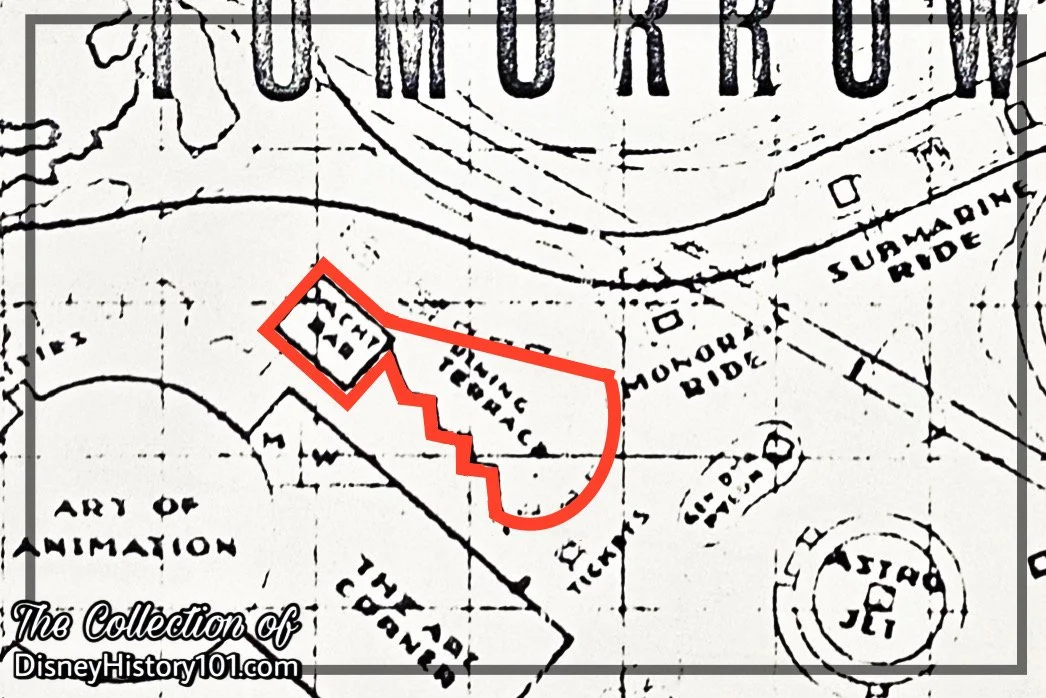
Ultimately when the New Tomorrowland opened in 1967, the Yacht Bar (and its adjacent stage) were swept away by “the wave of the future” - Tomorrowland Terrace!
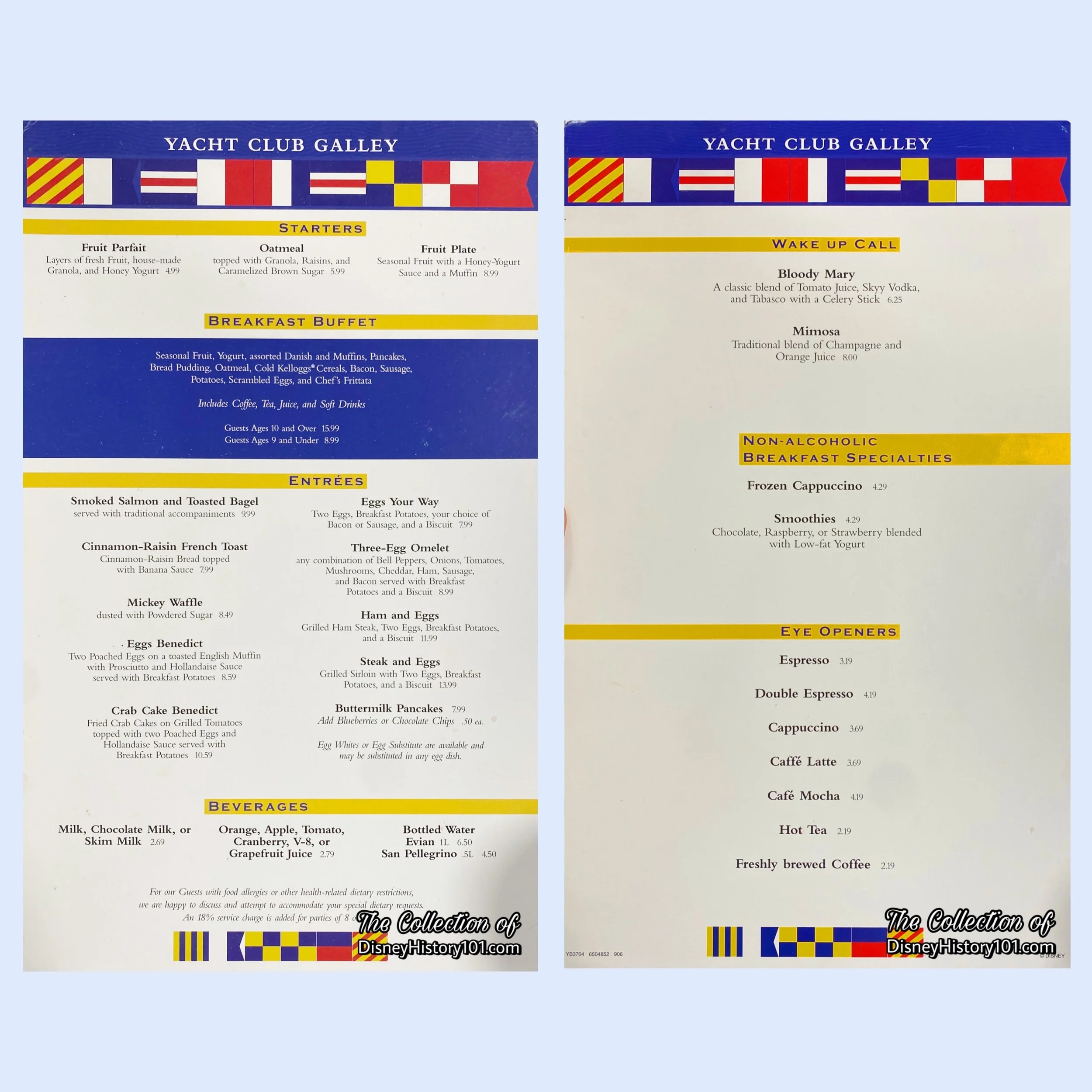
Though The Yacht Bar did not make the transition into New Tomorrowland, Its name indirectly lived on decades later, through Disney's Yacht Club Resort at Walt Disney World in Lake Buena Vista, Florida. But, the resort itself was inspired mostly by the late 19th-century yacht club culture of coastal towns like Martha's Vineyard, Nantucket, and Newport, Rhode Island. However, at Disney's Yacht Club Resort was a restaurant located just off the main lobby, called Disney's Yacht Club Galley. The menu motif looks strikingly familiar.
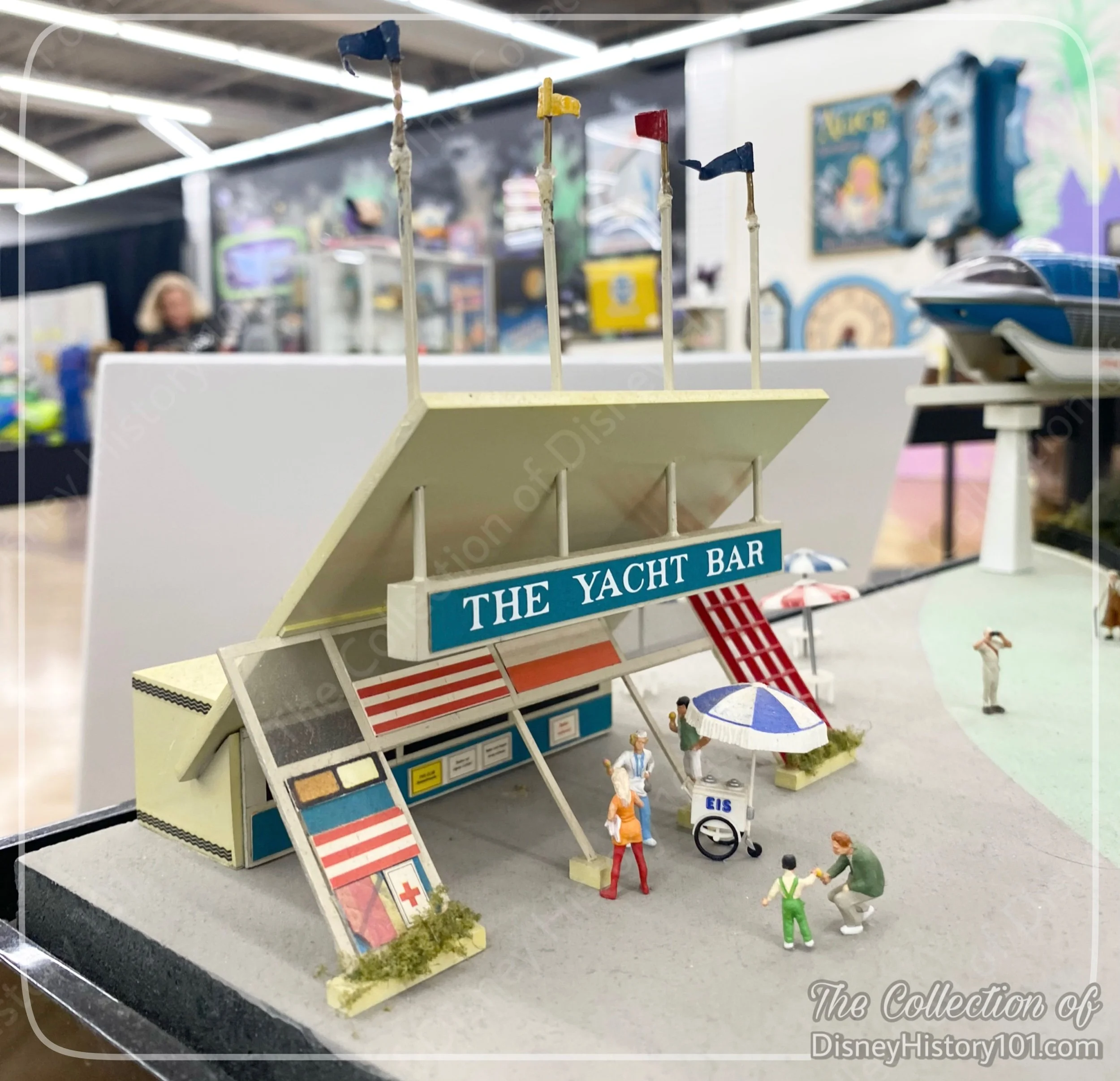
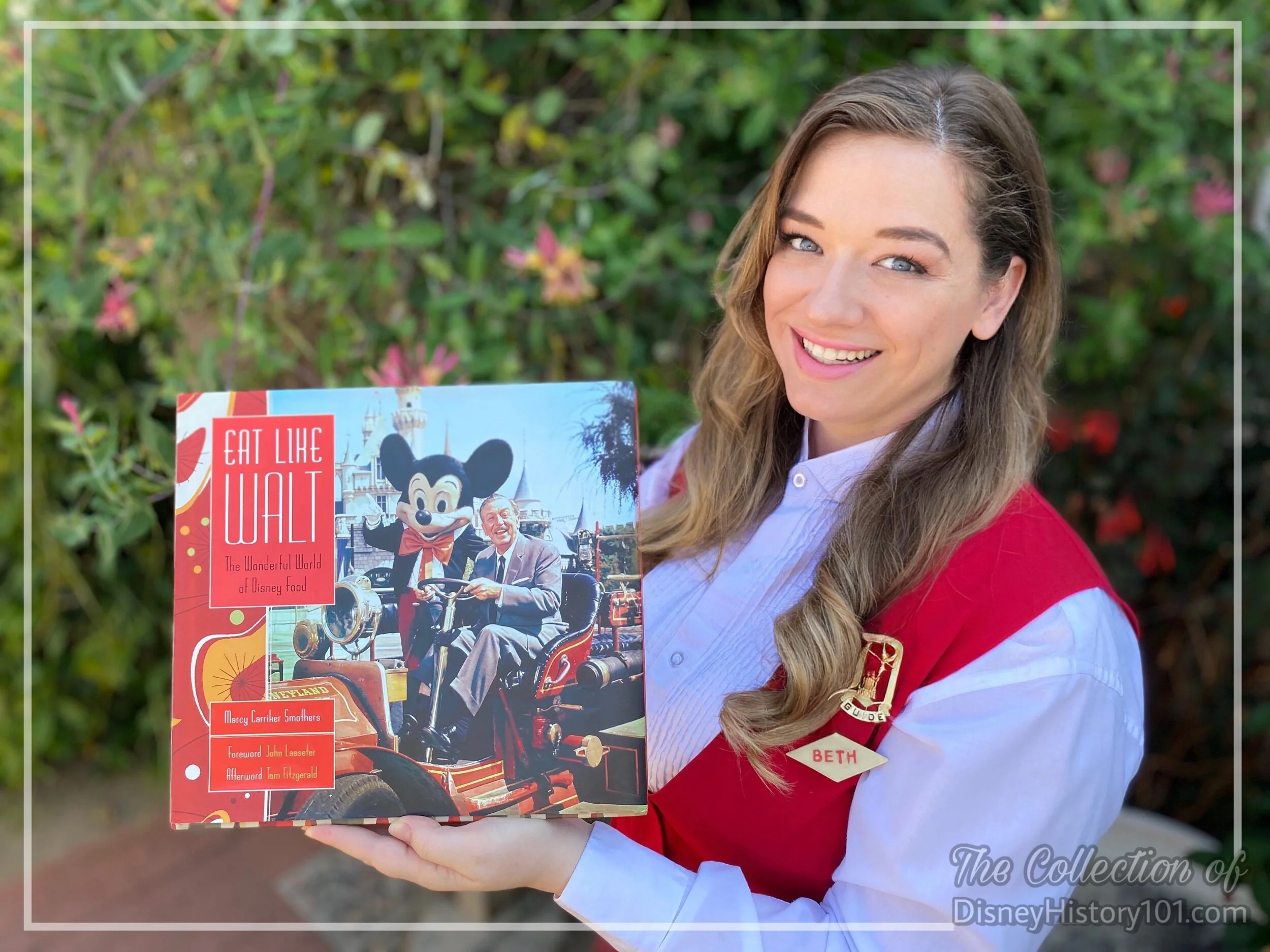
If you would like to read more about The Yacht Club, it’s my pleasure to recommend Marcy Smothers’ “Eat Like Walt - The Wonderful World of Disney Food” to your personal Disney Home Library! Therein, Marcy has extensively researched and finely crafted a small section of a chapter dedicated to “Walt Disney’s Disneyland - Tomorrowland.” If you would like to bring the magic of Disneyland restaurants and concessions to your dining room table, “please step this way” toward www.eatlikewalt.com where Marcy has shared a few recipes for memorable Disneyland menu options, so you too can “Eat Like Walt.”

Quisque iaculis facilisis lacinia. Mauris euismod pellentesque tellus sit amet mollis.