MARKET HOUSE
Swift Market House (July 18, 1955 - 1965)
C&H Sugar Market House (1965 - 1970)
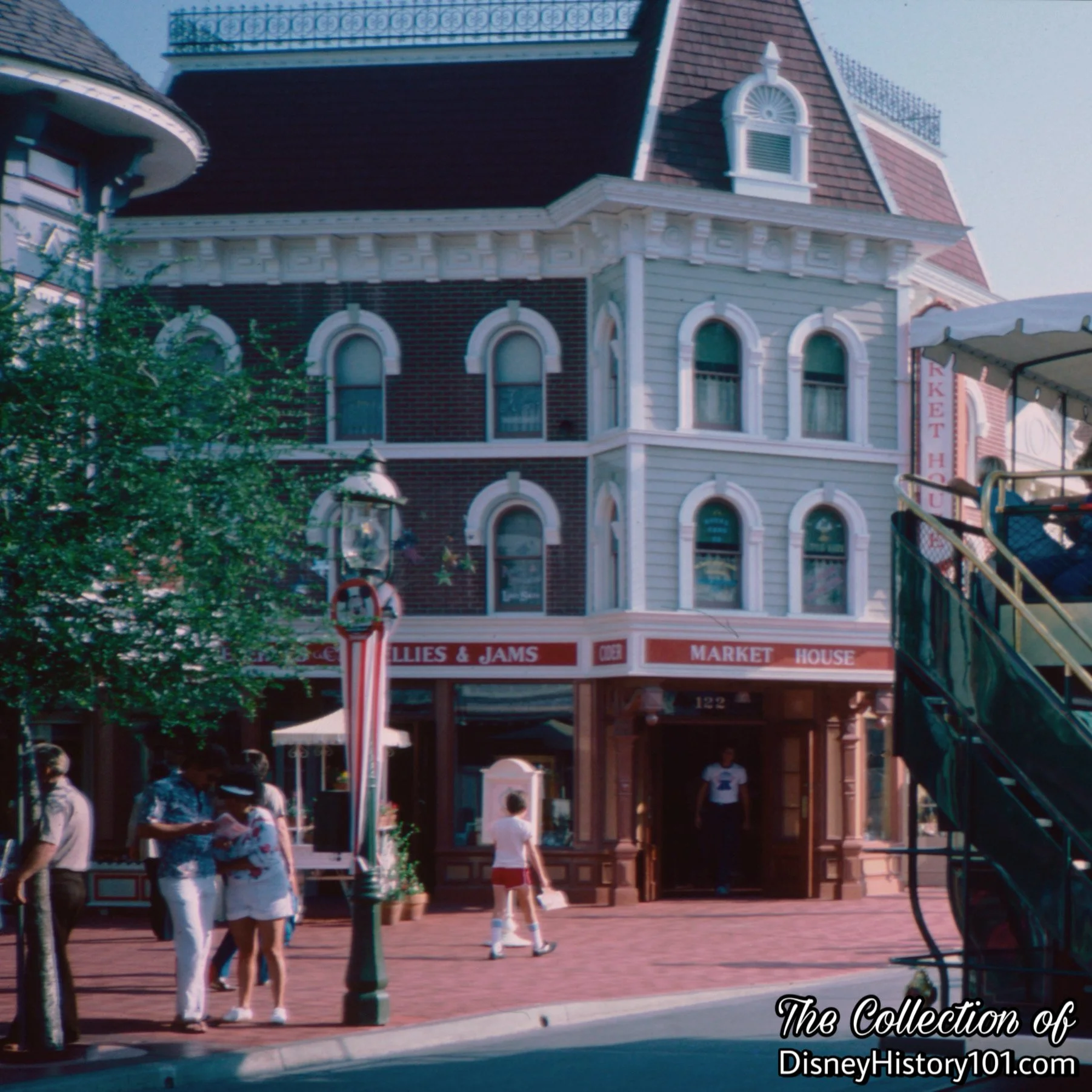
The Market House (1971 - present)
Starbucks (September, 2013-present)
“Swift’s and Company & Walt Disney”
Walt Disney and Gustavus F. Swift’s Swift’s and Company grocery business have been acquainted as far back as 1938. At the time, Walt Disney had several arrangements with other competitors of Swift’s, like a tie-in with Snow White and the Seven Dwarfs entitled “Ham What I Am” for Armor & Company. In a special arrangement between Walt Disney, Allsweet Oleomargarine, and Swift & Company seed assortments of “dwarf varieties of Calhopsis, Godetia, Marigold, Nasturtium, Dianthus, Aster, [and] Phlox” - were “christened by Walt Disney for one of the characters in his fascinating movie of ‘Snow White and the Seven Dwarfs’”! According to the “Mickey Mouse Merchandise” catalogue: “thousands of Oleomargarine box tops were received from amateur gardeners anxious to receive the ‘Snow White and the Seven Dwarfs’ flower seeds.” These were offered through Swift’s and Company grocery outlets.
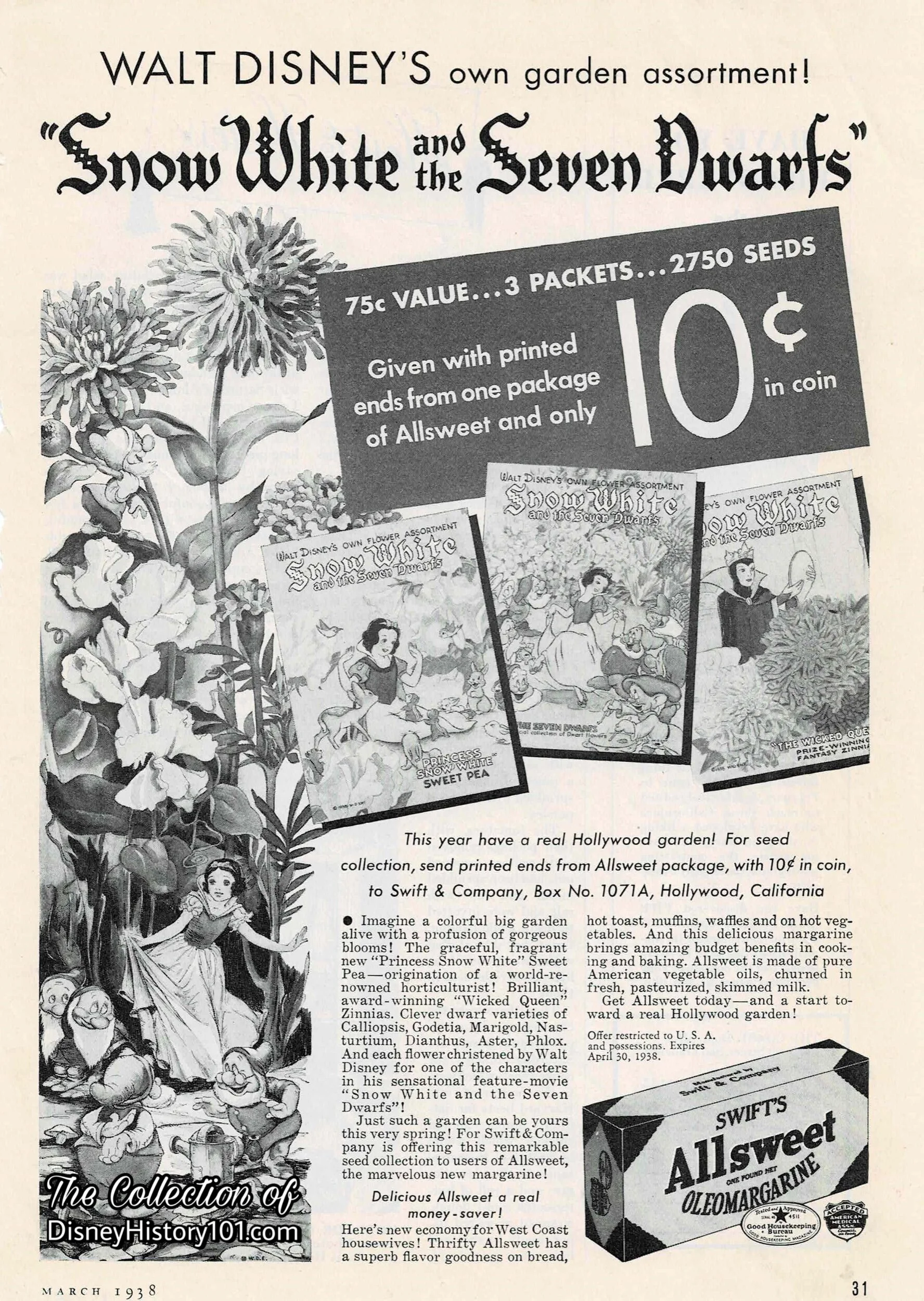
Swift's Allsweet Oleomargarine Advertisement
Two decades later, and in advance of the (June, 1955) release of Walt Disney’s “Lady and the Tramp”, Swift’s Pard Dog Food (manufactured by Swift’s) ran magazine advertisements featuring the popular dog stars from the feature film. In addition, 25¢ and two Pard labels (or, one Pard Meal Box Top) sent to Pard’s Chicago P.O. Box got the consumer one three-foot “Lady and the Tramp” mobile!
Now during 1954, Walt was searching for participants to lease shop and restaurant spaces at Disneyland, and help generate the necessary capital to fund construction of Disneyland. By July 1, 1954, Russel Tippett of Disneyland Inc. Advertising oversaw Exhibitor’s Space Sales and Lease Agreements. It was intended that Disneyland feature “the turn-of-the-century shops and stores - the photographer's shop, ice-cream parlor, penny arcade, bakery, drug store, music shop, butcher, grocer, many of which are sponsored by outstanding American companies whose names are familiar ‘household words.’” In a synergistic relationship, the companies (in turn) could sell their products and advertise their corporate names in the Park as they provided services and shows. Disneyland Participant Corporate Sponsors were carefully selected. High quality, long term corporate sponsors would provide incremental income that enabled Disneyland to enhance its show and attractions, offset some operating expenses, and capitalize on marketing opportunities.
Many free exhibits of Main Street U.S.A. were sponsored by one of the United States’ “old reliable firms, which have been in business fifty years or more. Here they can show how they started and reproduce their first place of business.” [Disneyland Prospectus, 1954] Several of these turn-of-the-century pioneers, “reliable old firms” sponsored the “abundance of restaurants devoted to pleasing all tastes and all budgets,” according to “The Story of Disneyland”, published 1955. As a result, “shopping has been a part of the Disneyland scene since opening day, 1955, when just 45 employees worked in the Park’s five stores and stands,” according to Disney News (Fall, 1966). The same publication called Walt Disney’s “Magic Kingdom actually… like a huge specialty shopping center, with thirty Disney-operated stores catering to every taste and purse. In addition, some of America’s most famous ‘name brand’ merchandise is sold in the stores of Park lessees.”
One of those lessees - Swift Meat Company (and its subsidiary, Derby Foods, manufacturer of Peter Pan Peanut Butter) - was an appropriate sponsor of “Disneyland” the television show. Swift Meat Company would sponsor the Market House at Disneyland and the synergy was perfect for the old corporation. Swift’s (founded in 1855) had been celebrating their centennial during the time Disneyland (and Swift’s Market House) first welcomed guests to “dine at Disneyland”! Yes, by the time Disneyland’s construction was moving forward (in 1955), Swift’s Premium brand boasted more than 100 table-ready meats, some of which were served exclusively at Disneyland. Swift’s even manufactured “Swift’s Meats for Babies,” which was assured to keep “a baby busy growing.” Some of Swift’s products (Swift’s Premium Bacon and Allsweet Margarine) were being advertised in television commercials (as those starring actress and vocalist Fran Allison), which were aired during 1954 - 1955.
A decisive day came one morning in May of 1955, when the Vice President of Bank of America met for a presentation at the West Street Training Office (which Van Arsdale France had decorated with fan cards and Disneyland renderings from the Walt Disney Studios). Walt was not present, but Roy, and some executives from Eastman Kodak and Swift & Company were. After introductions, Van France introduced the theme stating: “You are here NOT to make money. You are here because... ‘You’ll create happiness!’” Next, creative "pitch cards" by Ned Jacobi were placed on a flannel board and Dick Nunis operated a projector and described the slides. Van France and Dick Nunis were nervous, but when it was over, “Roy Disney, a financial genius, and the President of Walt Disney Productions gave his approval and blessing,” according to France’s account.
Eventually (by June of 1955), a definitive list of Disneyland lessees was prepared by the Public Relations Department of Disneyland, Inc., listing Swift’s & Company’s three Disneyland locations (including their “grocery & market” on the “600 block” of Main Street).
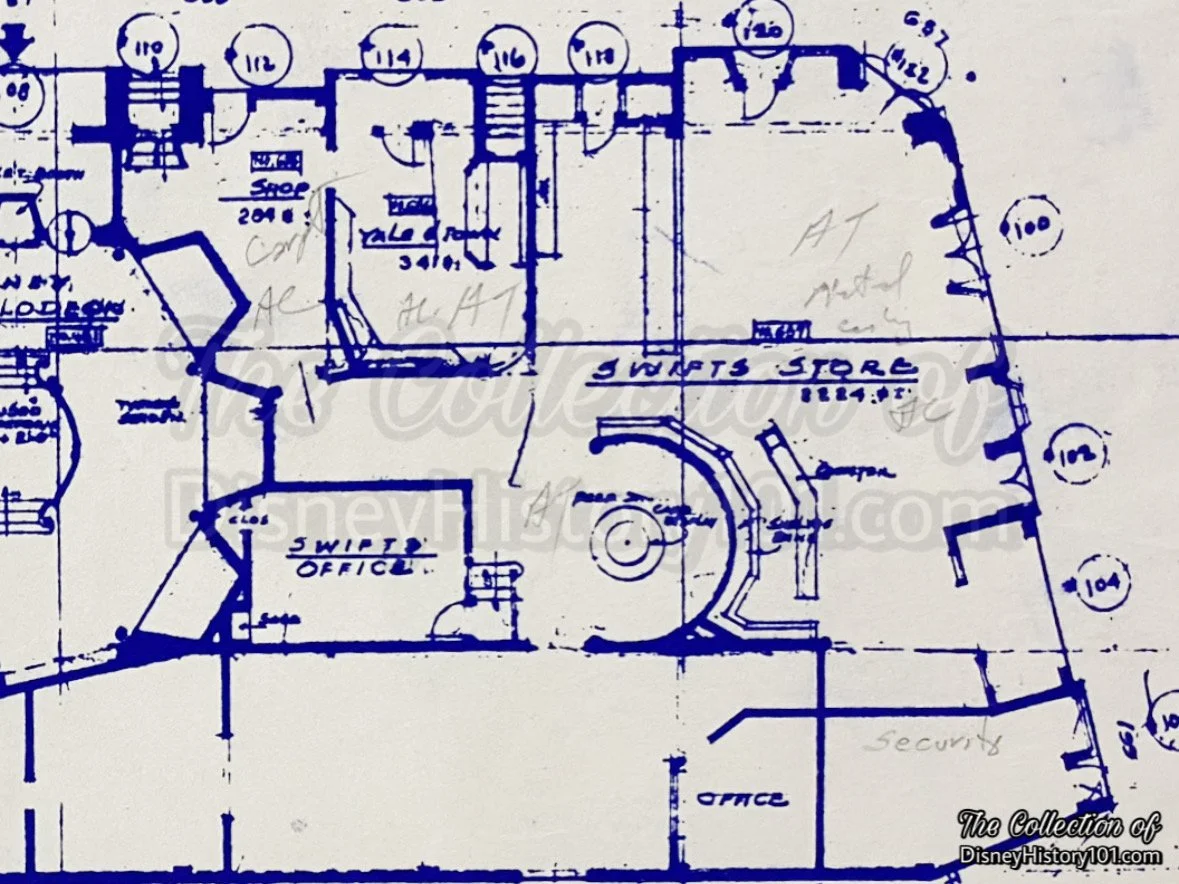
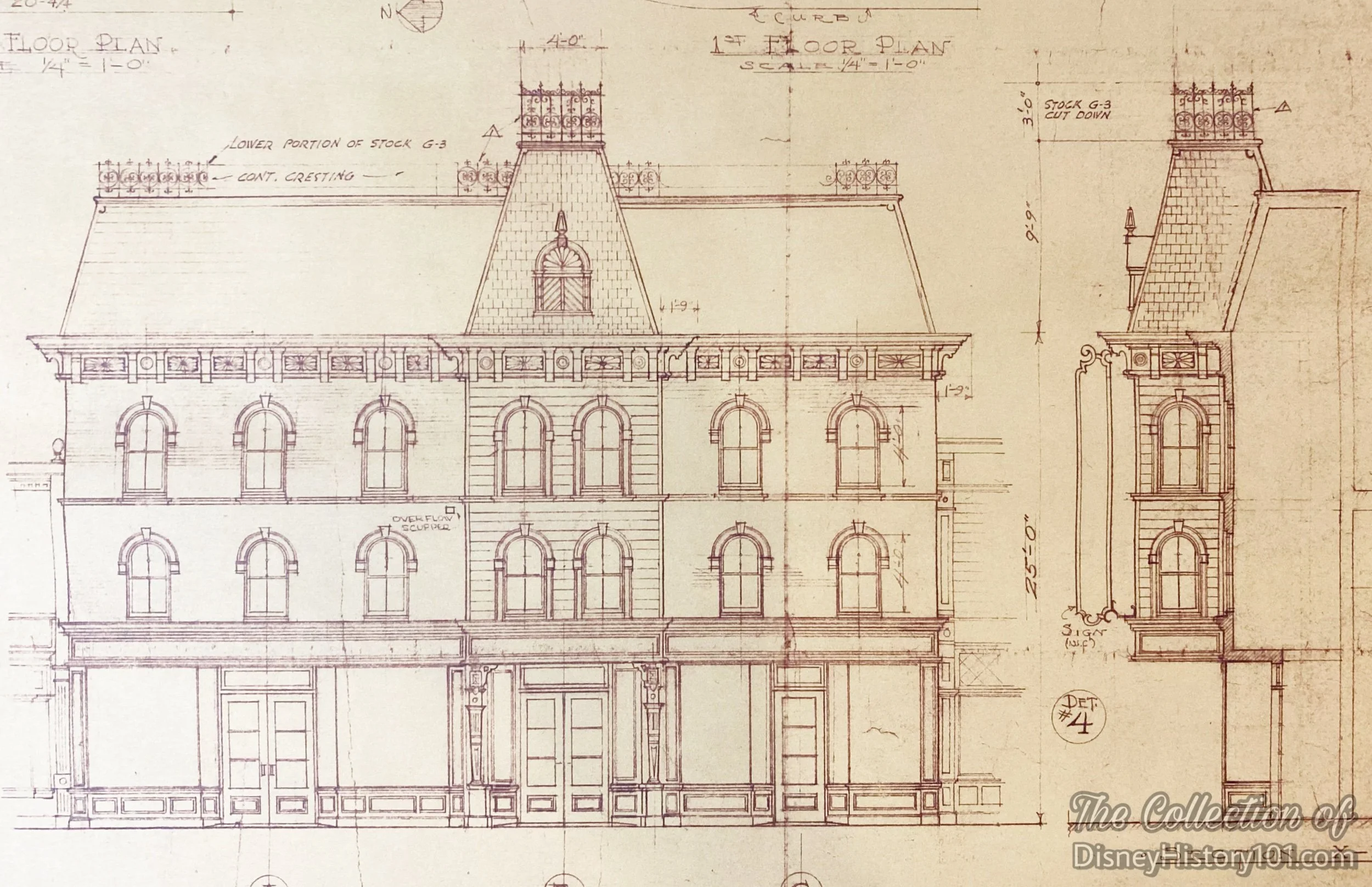
The Market House Architectural Facade depicted on the “Main Street 600 Block Scale Plans & Elevations” drawn by Ed Held, checked by GMB, by February 19, 1955; Disneyland, Inc.
“Design and Draw Concept”
Early thumbnail sketches and other concept artwork of Disneyland seemed to be unencumbered by restrictions of budget, schedule or the laws of nature and physics. Though guided by Walt, his artists appeared to engage in “free-thinking,” as if implementing the modern “Blue Sky” Imagineering process. In designing the Market House and the rest of Main Street, there was a lack of 20th-century architectural reference material at the time of the conception of Disneyland, so some Walt Disney Studio artist (Ward Kimball) made the contribution of rare books of drawings from his own collection.
“Disneyland is unique in that some of the world's foremost creative artists and architects control all design at Disneyland.“ As early as 1953, artists Harper Goff, Herb Ryman, Sam McKim, Dale Hennesy, Harry Johnson (who was good friends with Herb Ryman, and whose designs were most influential), and others created many conceptual pieces for Main Street and it’s shops. Herb Ryman (who was an Illinois native, the same as Walt), “had a lot in common while discussing and developing Main Street” for the midwest visitors, according to “A Brush with Disney” by Herbert Ryman, page 148. Herb Ryman would create the first “Schematic Aerial View” over Disneyland (including Main Street USA), originally produced September 26 & 27, 1953.
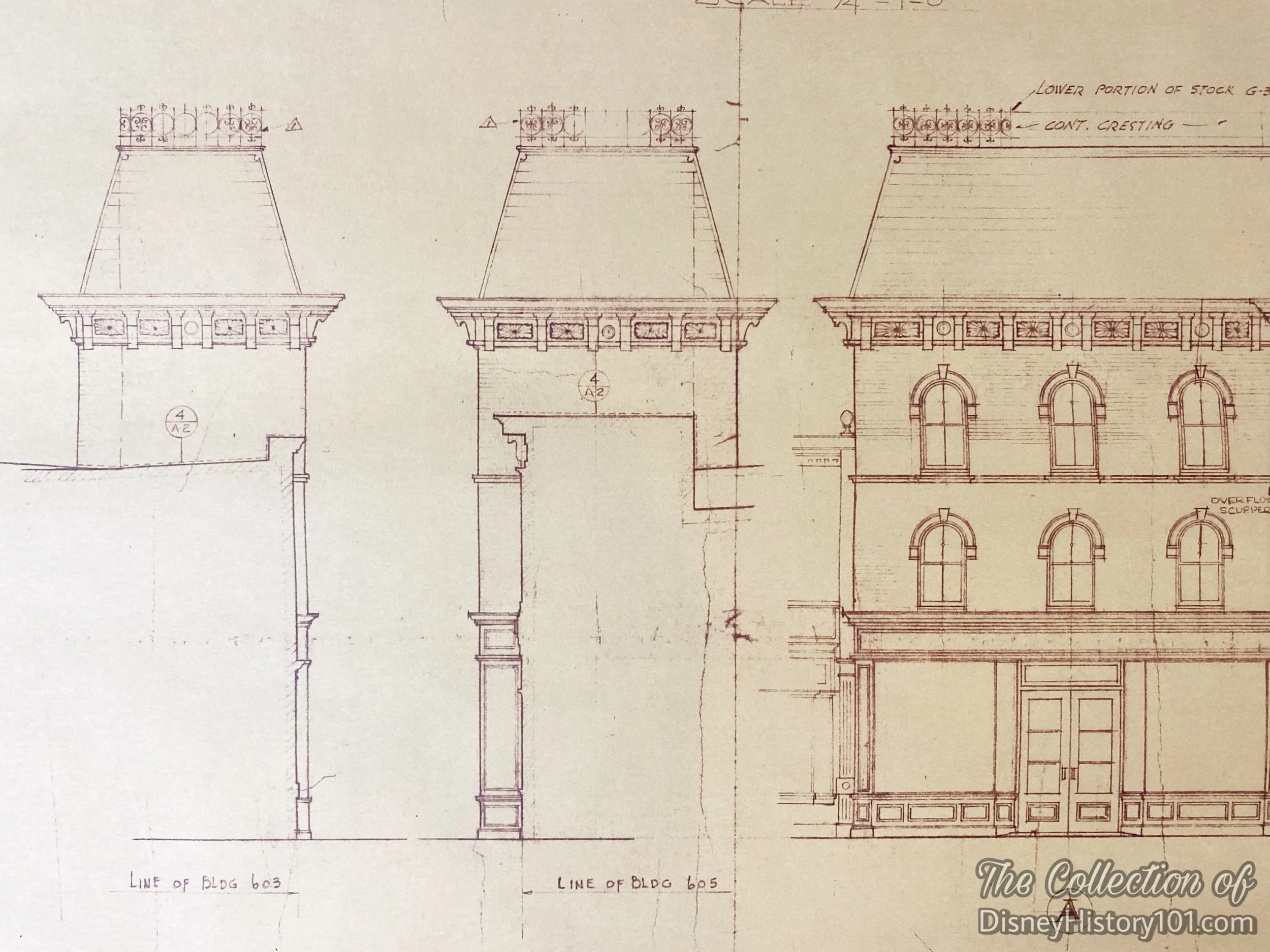
The Market House Architectural Facade depicted on the “Main Street 600 Block Scale Plans & Elevations” drawn by Ed Held, checked by GMB, by February 19, 1955; Disneyland, Inc.
Other contributing artists were model-maker Fred Joerger (who was hired c.1953 to craft the “Barber Shop Quartet” show for “Project Little Man” of “Walt Disney’s Disneyland”) and Wathel Rogers were instrumental in translating the two-dimensional artwork into detailed miniature models of Main Street. Such models explored the various dimensional relationships, site-lines, flow patterns, ergonomics, and visual appeal to convey the desired creative intent.
On a leave of absence in 1954, Chuck Myall joined WED to help create some of the Main Street facades.
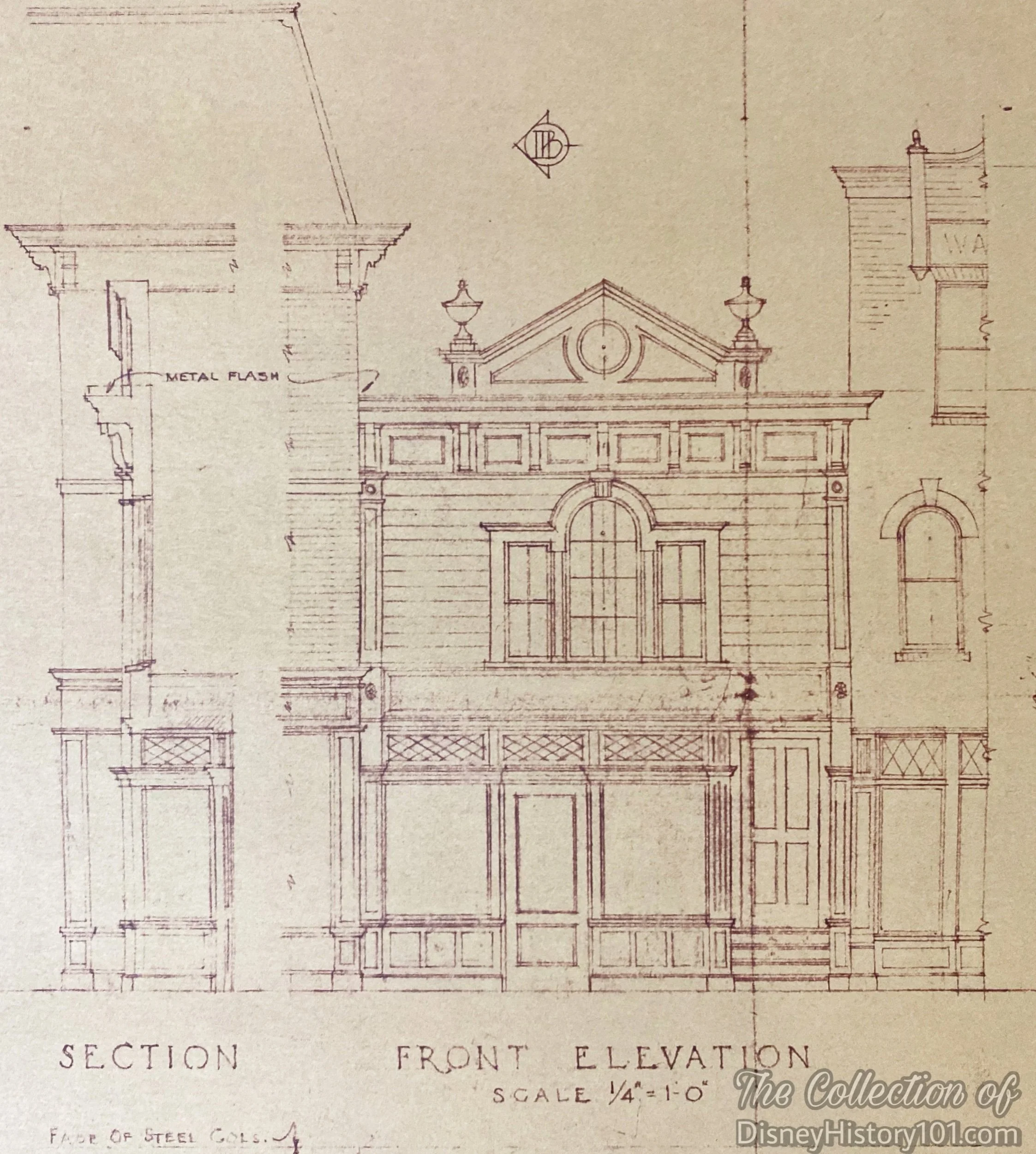
The Market House “Butcher Shop” Architectural Facade depicted on the “Main Street 600 Block Scale Plans & Elevations” drawn by “Frock,” checked by GMB, by February 19, 1955; Disneyland, Inc.
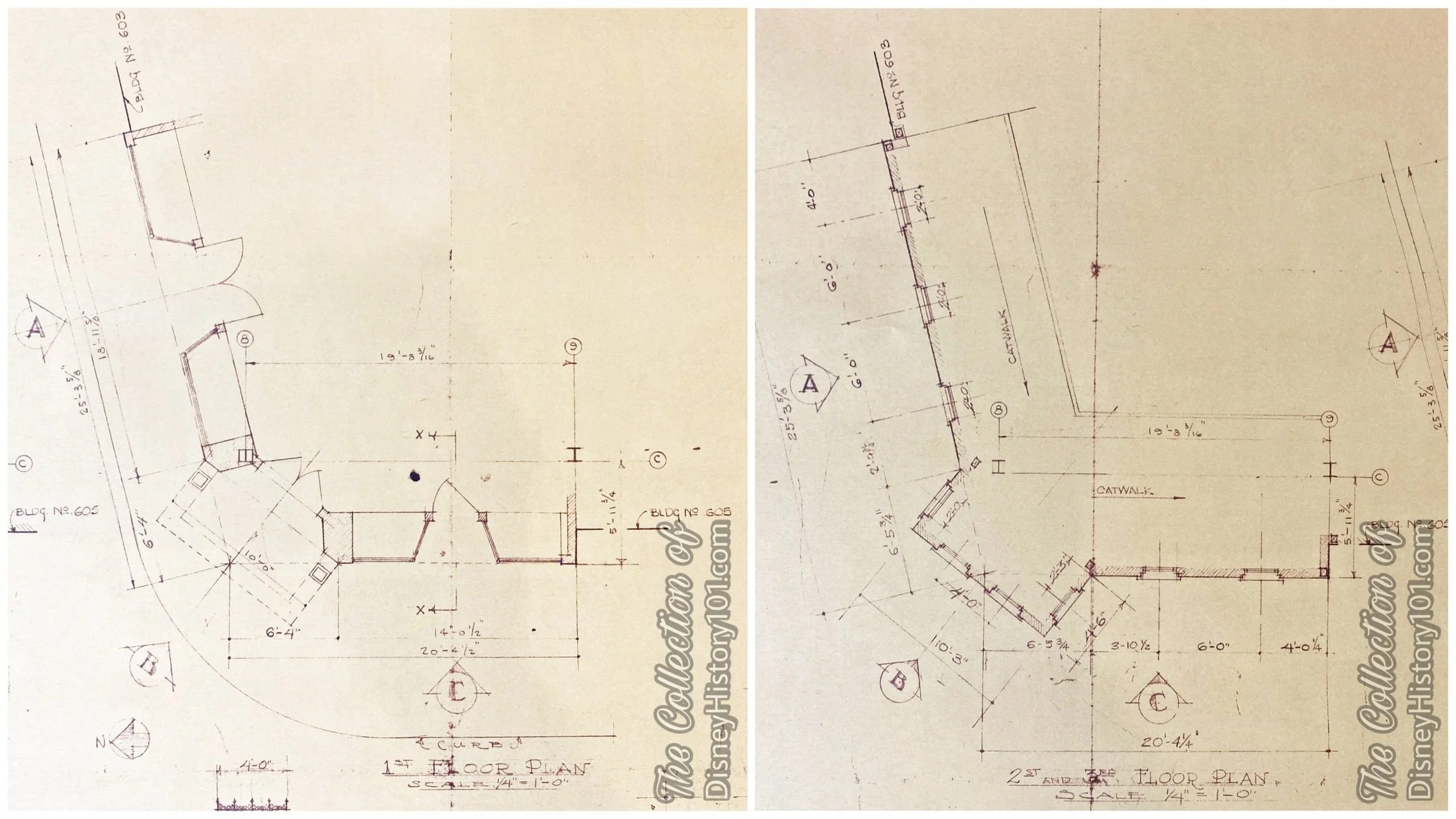
The Market House depicted on the “Main Street 600 Block Scale Plans & Elevations” drawn by Ed Held, checked by GMB, by February 19, 1955; Disneyland, Inc.
Lesser known artist Ed Held is of particular note, for preparing the architectural elevation facade and 2,152 square foot floor plan drawings for the Swift’s Market House by February 19, 1955. Fred’s architectural drawings helped define all designs, production and construction strategies, costs, schedule, and resource requirements. His drawings were soon checked (by a “GMB”), approved (by two individuals), and revised (by an “HGS”) by March 23, 1955.
“Construction”
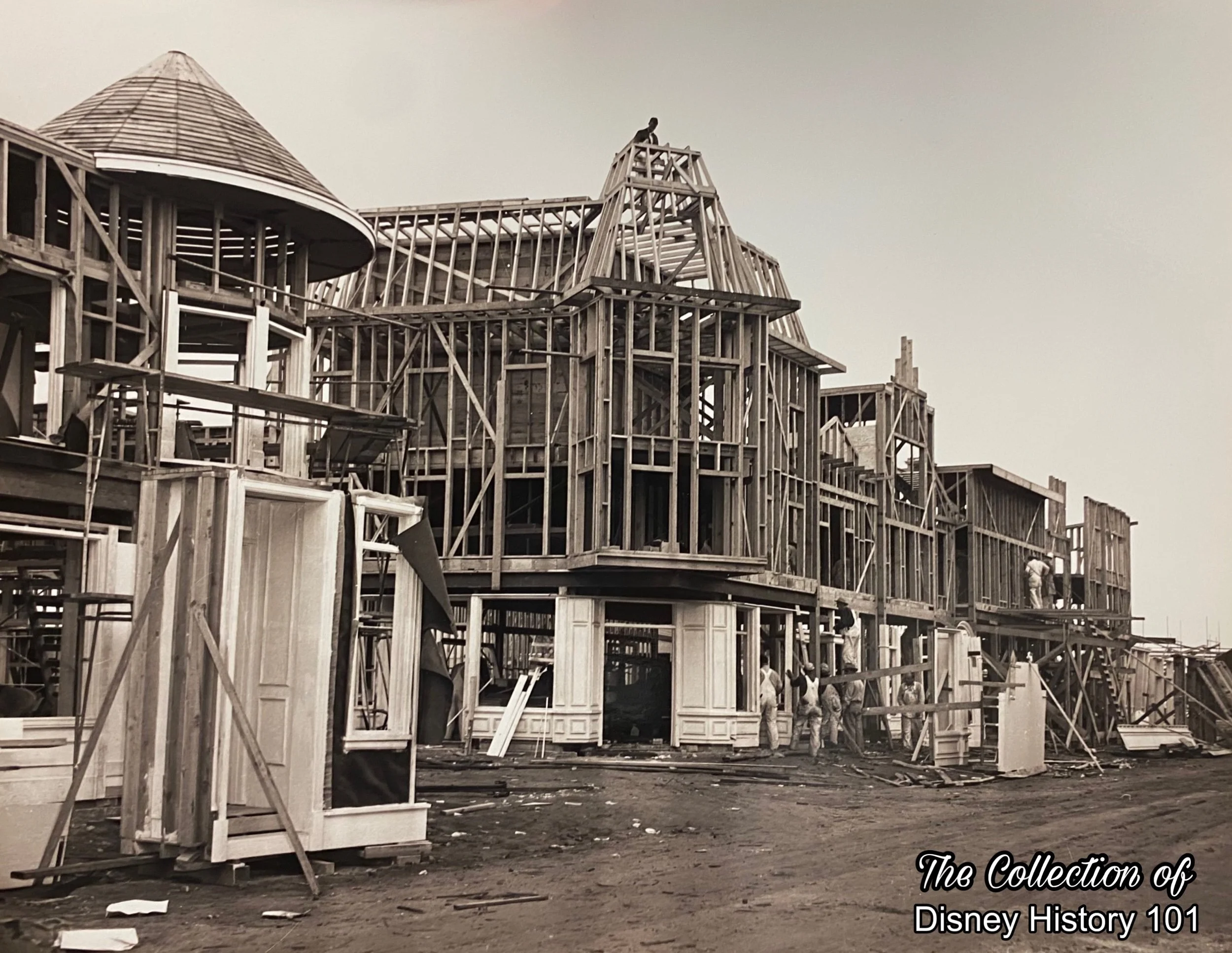
“When the giant earth-moving undertaking was completed, the building crews took over. Soon, the rat-tat-tat of riveters was shattering the air, and sparks were flying from welders’ torches as the steel frameworks, capable of withstanding the ravages of time and the elements rose above the newly formed ground. While carpenters hammered and masons laid row upon row of brick and stone and mortar, the permanent buildings began to take shape and form,” according to “The Disneyland Story” published 1955. One of the first buildings to be constructed was the Main Street Opera House, which was used as the Mill. Here, the woodwork of Disneyland was generated - from the functional to the aesthetic! Approximately three and one-half million board feet of lumber went into the Park’s construction. Much of the wood was processed here by McNeil Construction (which formerly constructed Walt Disney Studio sound stages in 1947 and 1953), and under the direction of George Mills Sr. (the Prime General Contractor and Mill Foreman). Then, under the direction of Joe Fowler (Construction Supervisor), as well as Charles Alexander and Ray Conway (Construction Field Supervisors), the lumber was soon fashioned into the framing belonging to the very first buildings constructed at Disneyland - primarily the Main Street Complexes (on each side of the street).
In constructing each building, a concrete foundation and slab floors were prepared, followed by wood frame construction (while store units would have a combination wood and rigid steel frame). ”The first fabricated steel for the Main Street buildings arrived November 8 and was erected,” according to the narrator of “Disneyland - The Park,” a Disneyland anthology television series excerpt, first aired 1957 and Disneyland LINE (November 22, 1979). The roof covering was a variable, dependent on the architectural design.
According to inserts published in area newspapers during July of 1955, Disney buildings were roofed by Pioneer Roof & Shingle Company (then located at 608 Mateo Street, Los Angeles, California; 7522 Westminster Avenue, Westminster, California).
The building (as each on Main Street U.S.A.) possessed complete fire sprinkling systems. By June 30, 1955, related Disneyland Site Work Fire Protection Utilities Plot Plans were prepared for Disneyland Inc., by J.E. Thomasson of WED Enterprises Inc.
Ray Van de Warker (who became Department Manager of Office Support Services) remembered the distinct look of Main Street when he first came to work. “Main Street was dirt. Some of the buildings didn’t even have facades on.” (to Disneyland LINE, Vol.25, No.28, published July 16th, 1993). But soon the storefronts were erected. According to Florabel Muir (of the New York Daily News) divulged after a pre-opening (July 9th) tour by Walt, “the buildings are not false fronts as are seen on every studio backlot in Hollywood… Walking down Main Street, I saw a photographer’s shop, ice cream parlor, penny arcade, bakery, drug store, grocery and a butcher shop. These stores will be operated as concessions by well known U.S. firms. Swift & Co., for instance, will run the butcher shop, though instead of real pork, beef and lamb, they’ll sell candy imitations of their products.”
As with all of Disneyland’s Opening-Day landmarks, rides, and attractions, small local businesses provided materials, labor, and skills. Steel was provided by Triangle Steel & Supply Company (of Los Angeles). Newbery Electric Corporation gave electricity to Disneyland. “The electrical installations were supervised by Roy J. Gruendler, manager of Newbery's Orange County district office located at 1335 Santiago Ave, Santa Ana.”
Southern Counties Gas Company provided economical and clean gas, buildings were roofed by Pioneer Roof and Shingle Company (of Westminster, California), Mc Neil Construction Company provided labor, Evans and Reeves Landscaping Inc. (of West Los Angeles) achieved“the perfect landscape for Disneyland,” and so forth.
Forced perspective makes the buildings on Main Street appear taller than actually are. On Main Street the buildings are not full scale. Ground floors are built about 9/10ths scale. Second floors measure up to 7/10ths scale. Scale on the uppermost floors is smaller still.
The buildings of Main Street (Market House included) were soon after described by an appraiser as “all very ornate, with variable embellishments. The basic construction, consists of concrete foundation and slab floors, wood frame construction, (store units also have a combination rigid steel frame) roof covering is variable, being dependant on architectural design. All buildings have complete fire sprinkling systems.” “Some of the cresting and railing to be seen in… Main Street came from old plantations in Nashville and Memphis, Tennessee. Other furnishings came from San Francisco, Oakland and Sacramento, dating back to the ‘49 gold rush days,” according to an article published in The Disneyland News (Vol.1 - No.1 ; July of 1955). [“Building A Dream”, Disneyland Public Relations Department]
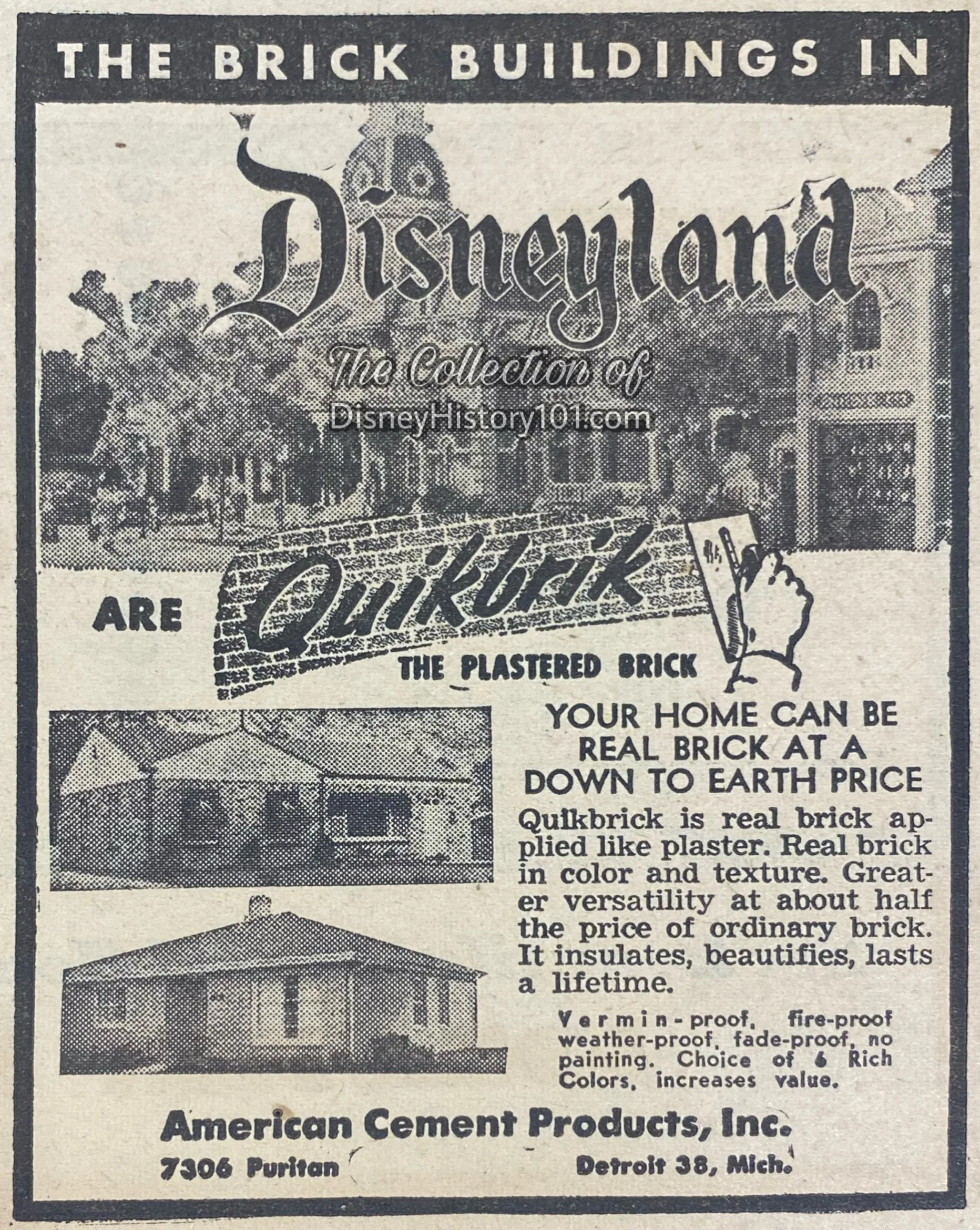
Larson Brothers Plastering Company of San Diego was a proud part of Disneyland. The company crafted the ornamental plastering and all brick used at Disneyland (including their amazing new plastered brick veneer). The versatile Quikbrick (real colorful and textural brick applied like plaster) was about half the price of ordinary brick. It insulated, beautified, and was meant to “last a lifetime.” It was used on the facade.
Lastly, a 45-star flag was flown atop the roof in keeping with the turn-of-the-century era.
As of June 2, 1955, C.V. Wood Jr. sent an Inter-Office Memorandum to Walt Disney regarding the best estimates that could be obtained at the time regarding the completion status of individual sections of the Park and Opening Day. C.V. wrote: “Building #602 - Swift: Will be completed. Electric Signs: All are in work - with the exception of the shoe store and the Bank of America, all will be completed.“
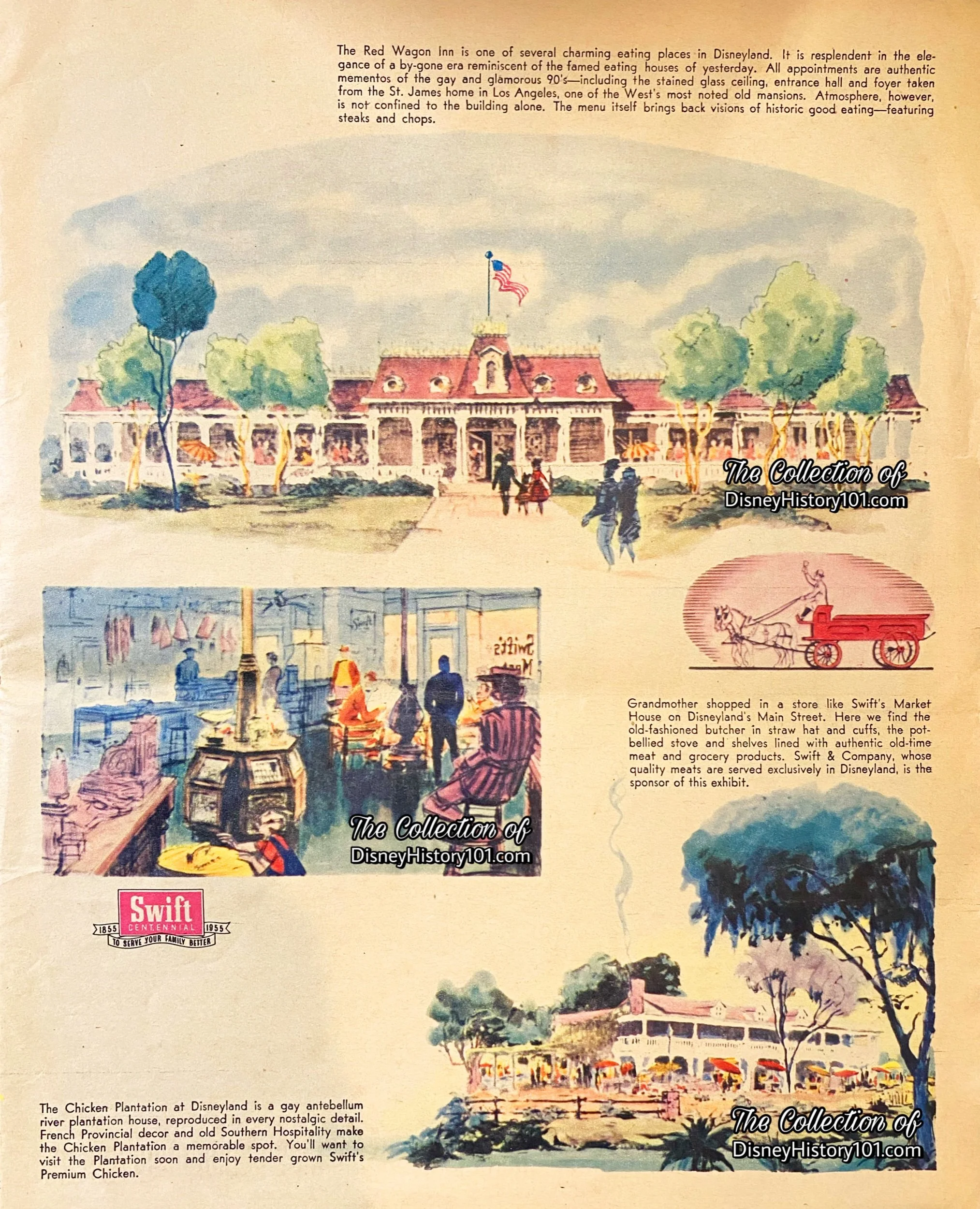
The Swift's & Company Brand as featured in an excerpt of the “Disneyland” Supplement, (published for July 15, 1955)
Some of these viable project Concepts (as above), were supported by a well-developed business case and built expectation. Readers of newspapers were treated to previews of Swift & Company’s Market House at Disneyland, by way of a supplement published July 15, 1955 (e.g. “Register” of Santa Ana, California).
© Walt Disney Company.
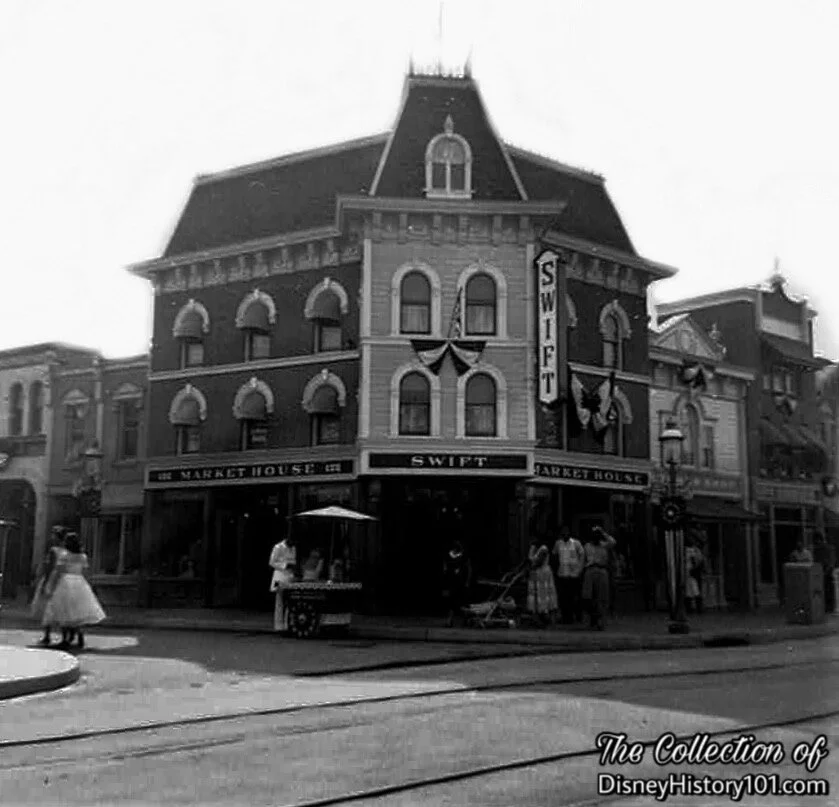
Swift & Company Market House Front of House, c. 1955
Then the big day arrived! A contributing writer of The Daily Oklahoman (who visited on July 17, 1955) noted: “The guests walked into a city square of the 1900 era, bounded by an old time railroad station, city hall and fire station, opera house and other vintage merchant houses.” Here on the 500 block of Main Street, we discover one such merchant house, the Market House, which was managed by the Red Wagon Company, which also operated the Red Wagon Inn, Plantation House, and the Snack Bar in Holidayland (once it opened). According to Bob Cummings (host of Dateline Disneyland, aired July 17, 1955), Swift’s Market House is “where all of us ‘ham actors’ will end up.”
In 1955, Swift’s Premium Meats were also served at Carnation Ice Cream Parlor at Disneyland.
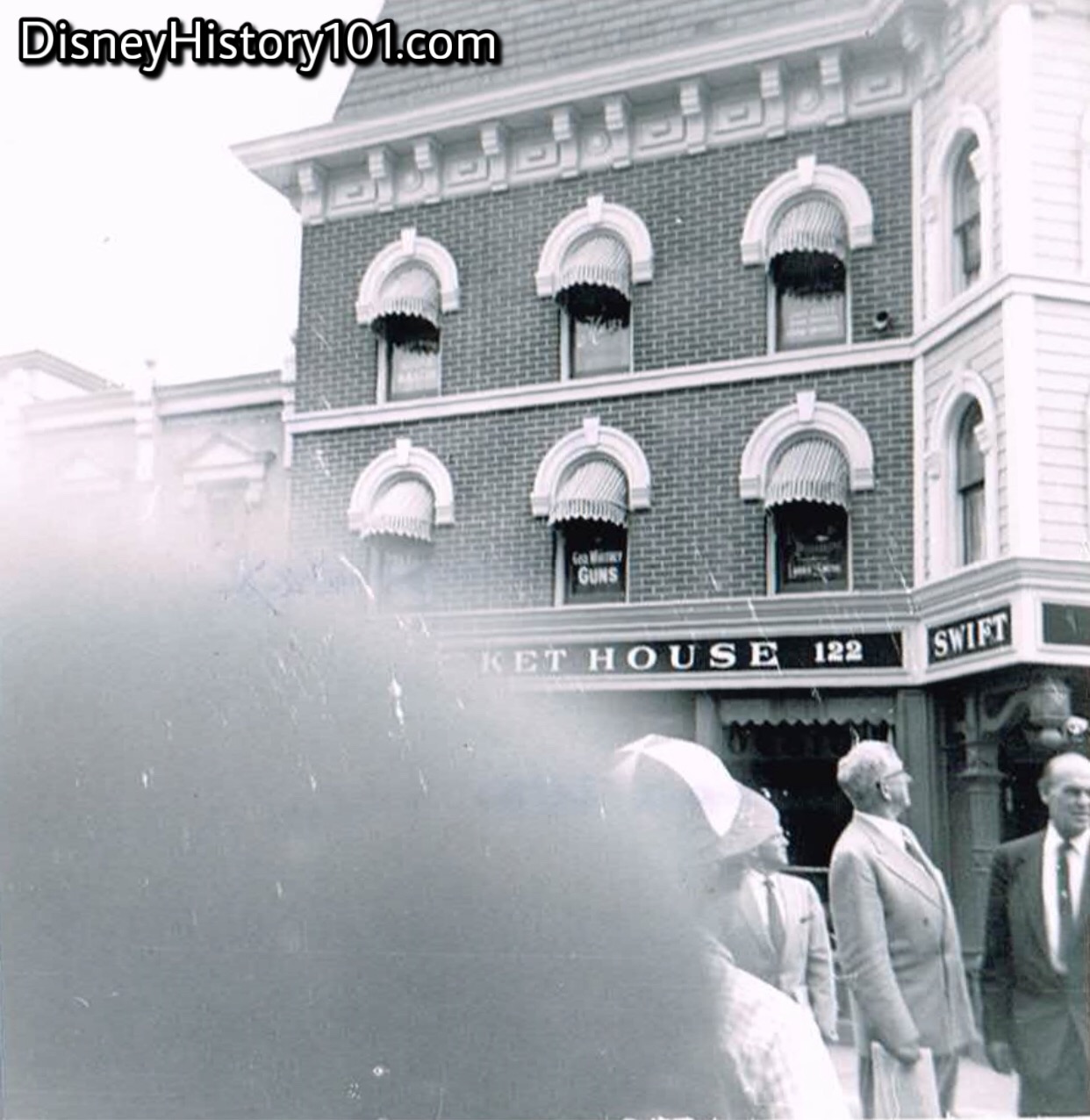
A blurry photo of the Swift’s Market House, August 4th, 1955.
The Market House was an old fashioned general store with jams and jellies, barrels of dill pickles, nuts, and goodies (like horehound and other hard “penny candies”), natural food snacks, cider, and a game of checkers just waiting for a couple of players. “Your grandmother shopped in a store like Swift’s Market House on Disneyland’s Main Street”, according to the Los Angeles Examiner, July 15, 1955. “Here we find the old-fashioned butcher in straw hat and cuffs, the pot-bellies stove, and shelves lined with authentic old-time meat and grocery products. Swift & Company, whose quality meats are served exclusively in Disneyland, is the sponsor of this exhibit.” According to Florabel Muir (of the New York Daily News) divulged after a pre-opening (July 9th) tour by Walt, “Swift & Co., for instance, will run the butcher shop, though instead of real pork, beef and lamb, they’ll sell candy imitations of their products.” You may recall the package of Swift’s Market House “candy meats” like the “Red Wagon Yummy Weenies Candy” which looked very much like a package of hot dog links. By the release of the “Disneyland 1st Anniversary Souvenir Pictorial” in 1956, the shop was reckoned among the “stores whose shelves bulge with worlds of distinctive merchandise.”
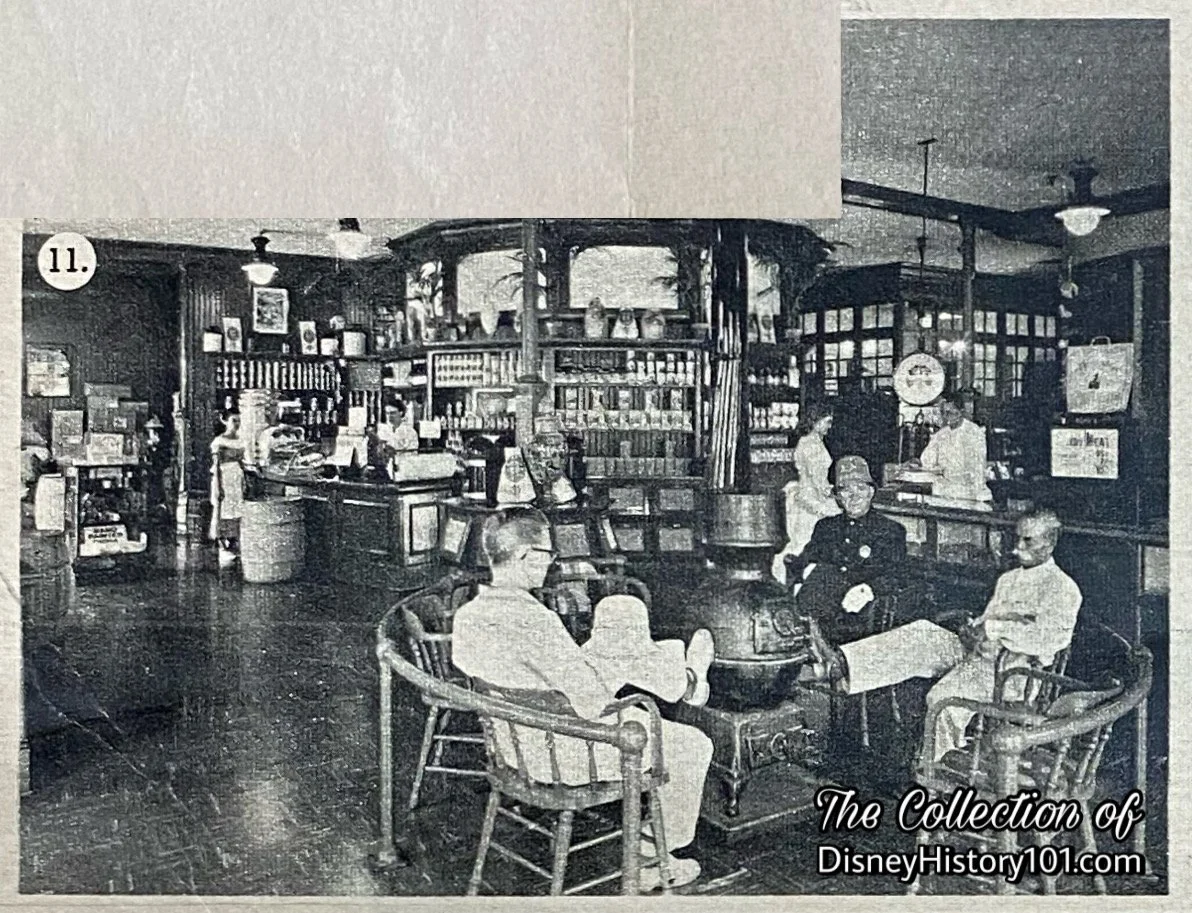
Swift’s Market House was notably mentioned in “Disneyland 1st Anniversary Souvenir Pictorial”
The pot-bellied stove was the center of conversation during the good old days.
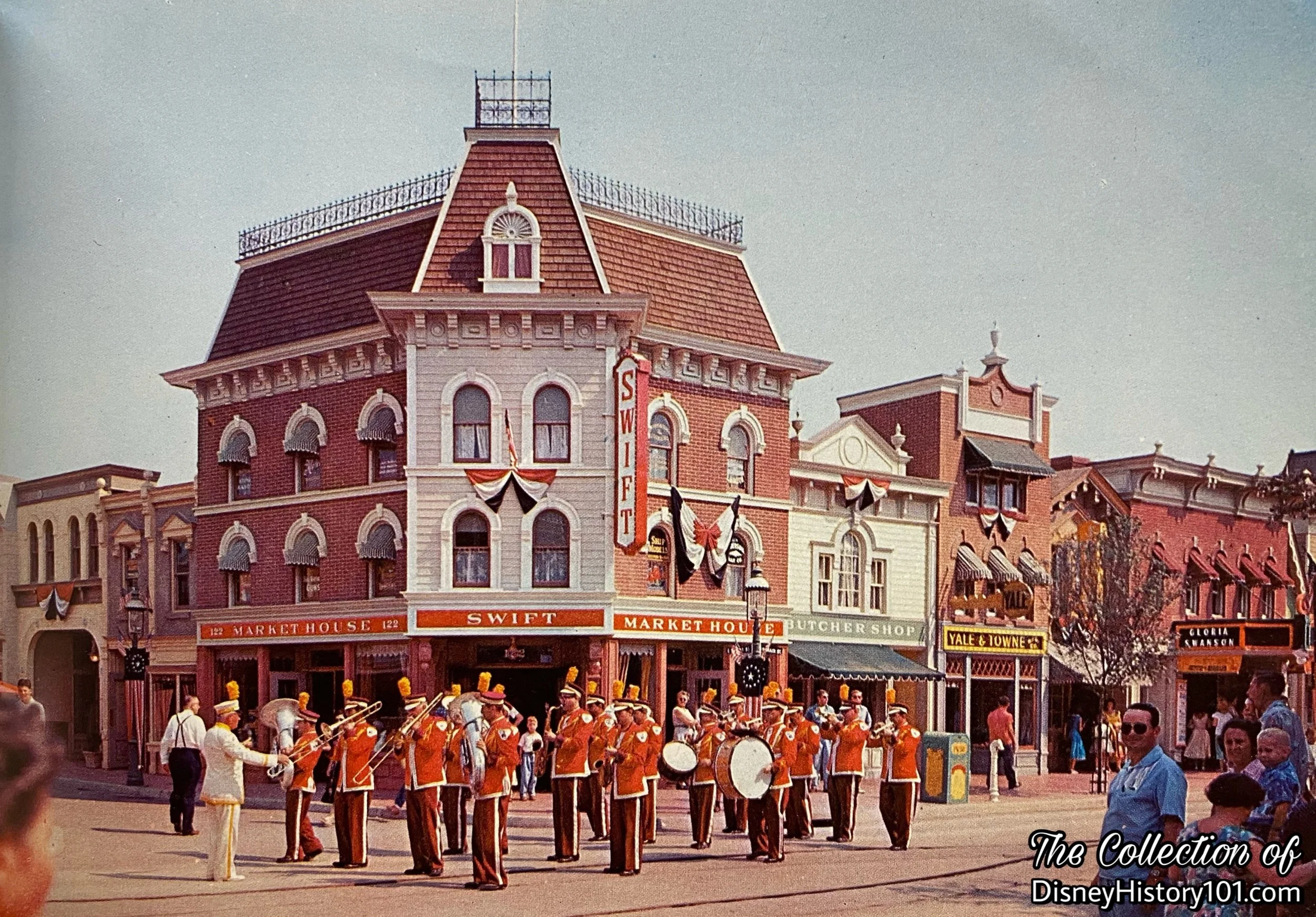
Disneyland Souvenir Book in Natural Color, c.1955.
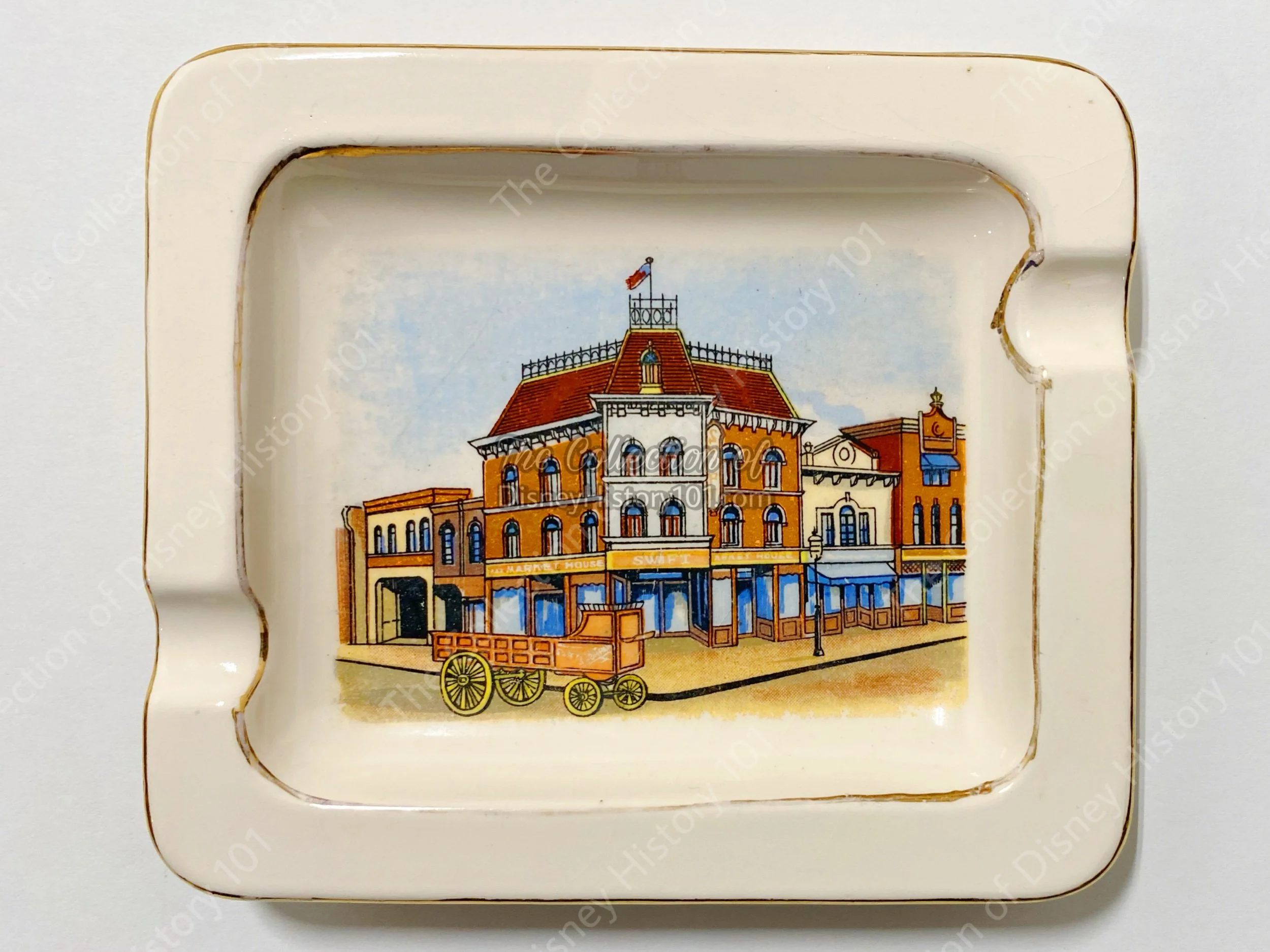
A Swift’s Market House ceramic ashtray.
The Market House created tangible memories for Guests through Merchandise and Show.
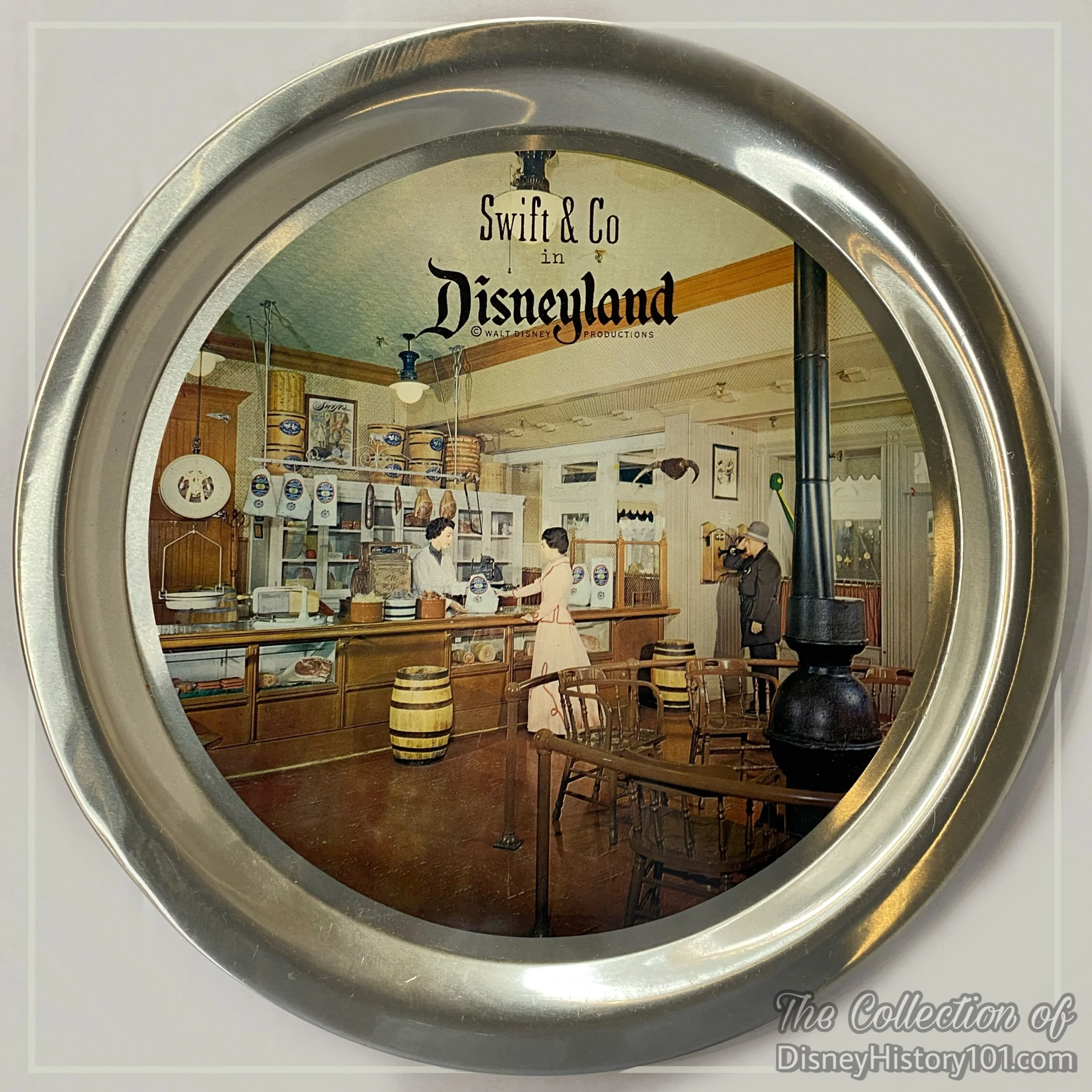
A Swift & Co. licensed beverage tray sold at Disneyland.
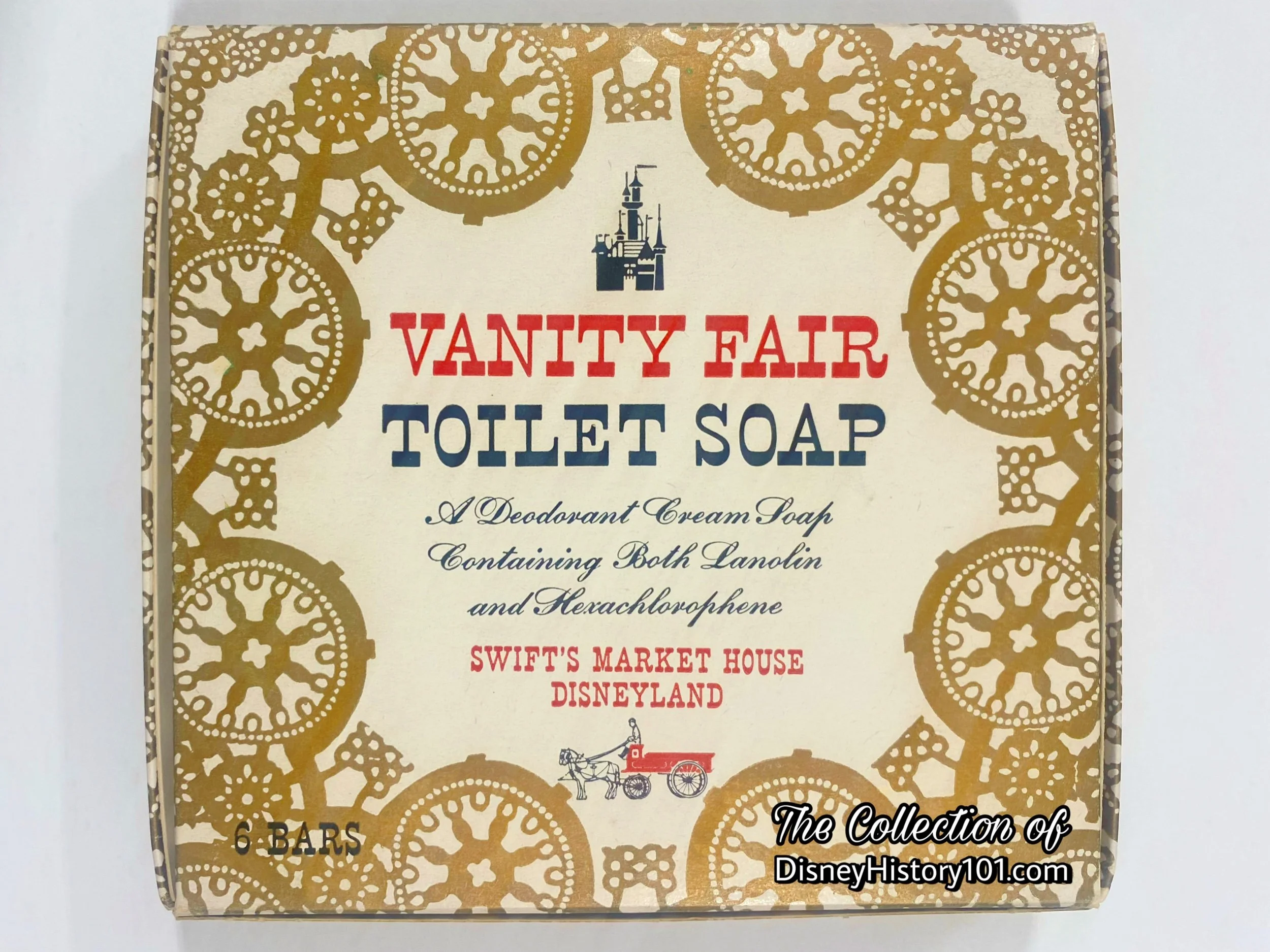
A Vanity Fair Toilet Soap box.
Merchandise licensing fed concessionaires into the Park, and Disneyland turned concessionaires into licensees. You May recall purchasing old time toilet soap. Products like Vanity Fair Toilet Soap (a lanolin and hexachlorophene creme bar) was sold by the box, and a popular seller.
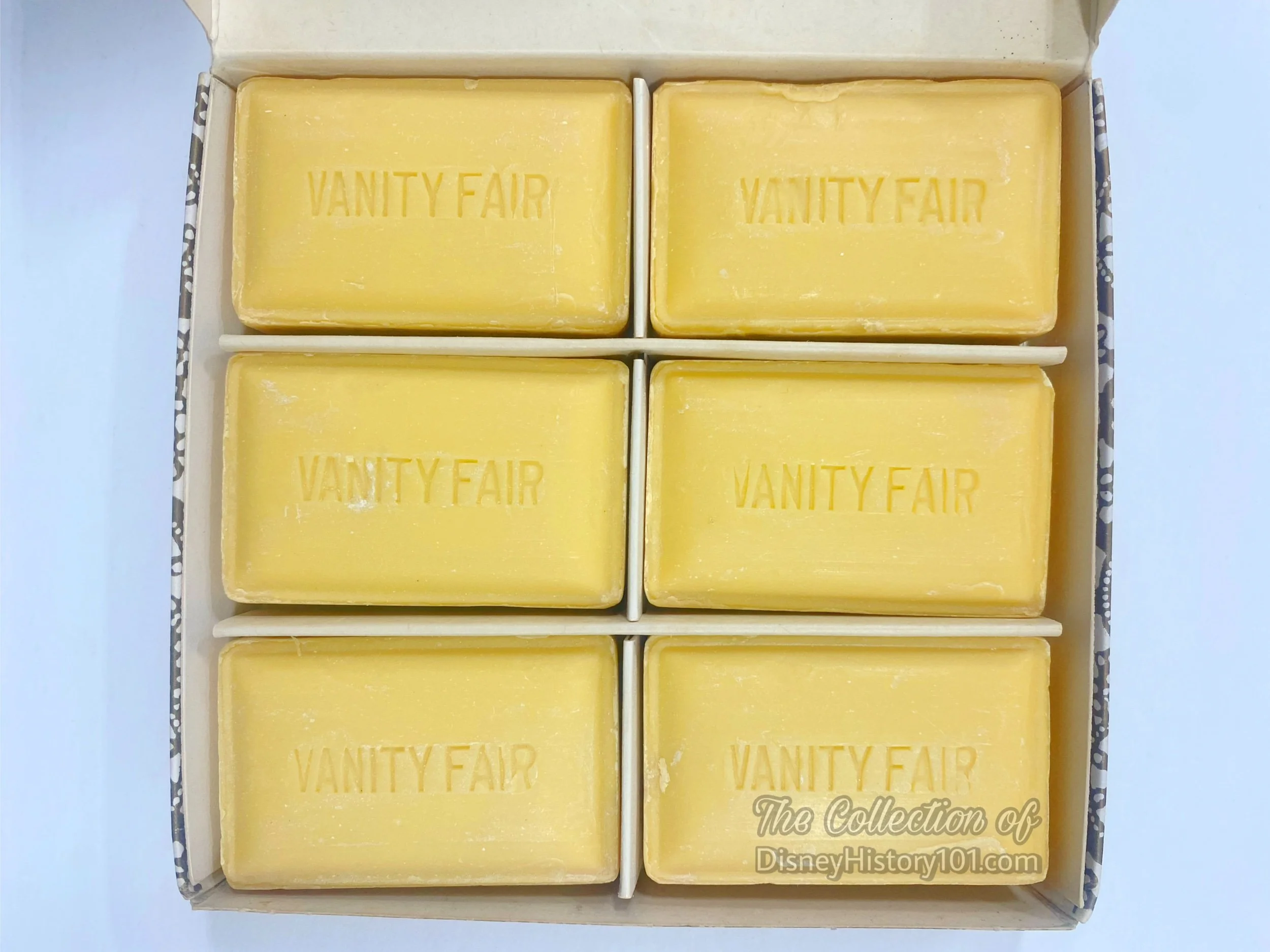
Vanity Fair Toilet Soap in box.
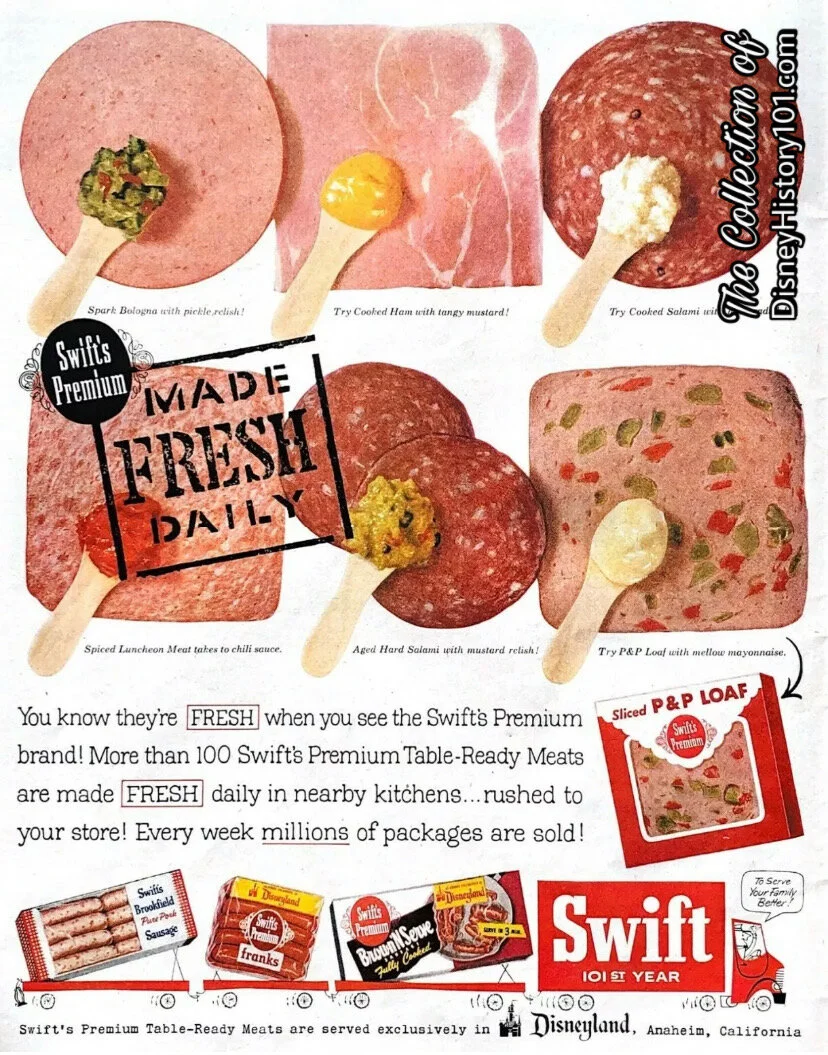
Swift Meats Advertisement During Era of Swift's Disneyland Participant
Guests of Disneyland were well familiar with Swift’s brand meat products - such as Swift’s Brookfield Pork Sausage, Swift’s Bologna, Swift’s Hard Salami, Swift’s Premium “Brown ‘N Serve” Fully Cooked Sausage, and Swift’s Premium Franks - as some of these products were “made fresh daily at local kitchens” and served at restaurants around Disneyland. Not only were Swift’s meat products found in the Swift’s Market House, but guests could once order a Swift’s Premium Cheeseburger or a Swift’s Premium Frankfurter at the Carnation Cafe in Disneyland. The aforementioned products could be purchased wholesale (with the help of a “Wholesale Price List” - complimentary Disneyland souvenirs courtesy of Swift’s)! By 1955, Disneyland visitors who were pet owners, were aware of Swift’s products, as the company even manufactured a line of dog food under the label Pard (which enjoyed a brief advertisements with “Lady”, star of “Walt Disney’s Lady and the Tramp”). Foreign guests were also soon familiar with the Swift’s brand, as (by 1958) the company was sponsoring some of Walt Disney Productions’ television programs represented in foreign markets.
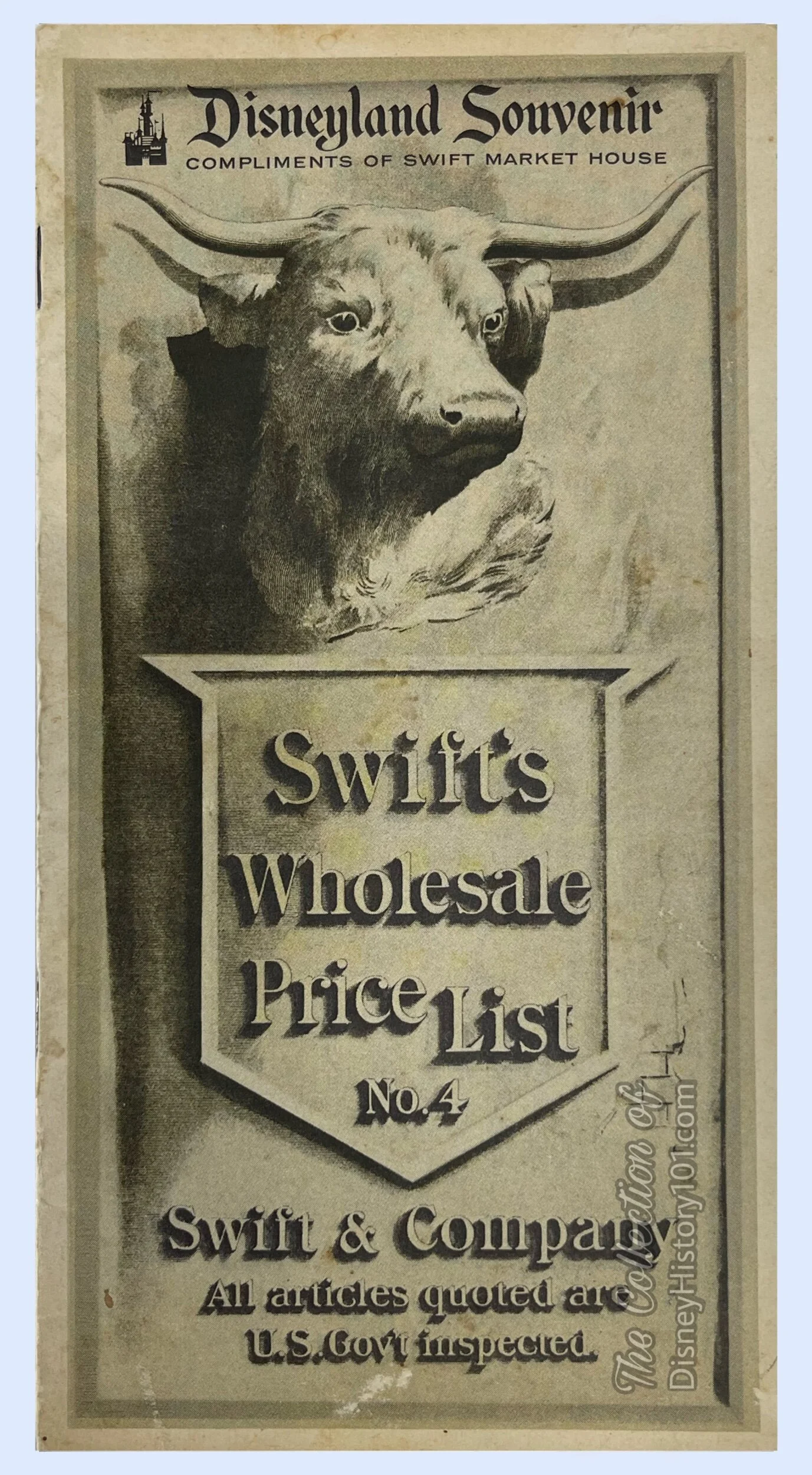
Disneyland Souvenir “Swift’s Wholesale Price List No. 4” Cover
In an age of free souvenir literature courtesy of Disneyland free exhibit sponsors, Swift’s Market House offered the 13-page “Swift’s Wholesale Price List No. 4” - a list of U.S. Government inspected quality meats for sale through Swift’s! Look for popular “delights” (as the Winchester Breakfast Bacon or Fancy Summer Sausage), or exotic articles (Swift’s Beef Fluid, Lamb Tongues, or Ox Lips).
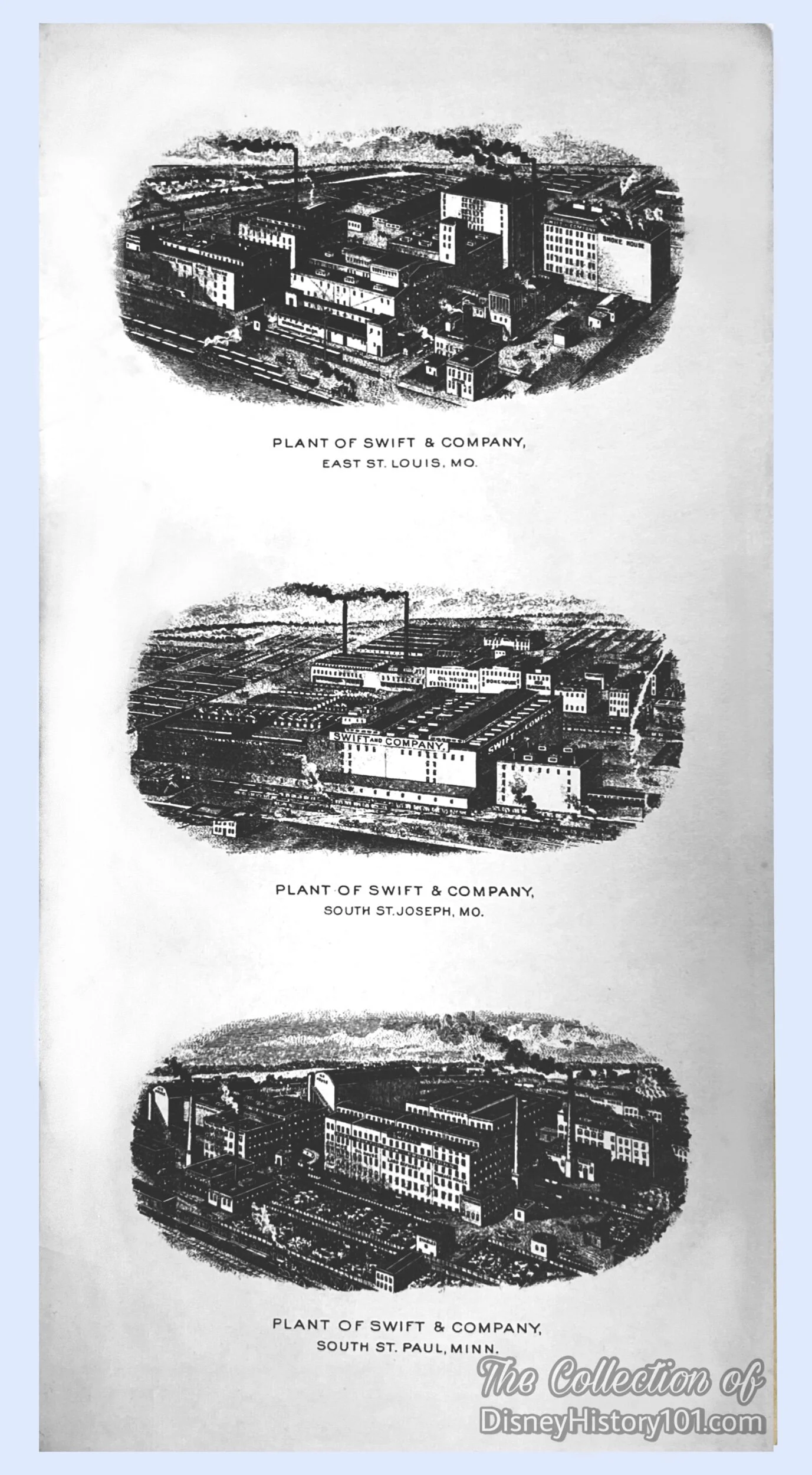
Disneyland Souvenir “Swift’s Wholesale Price List No. 4”
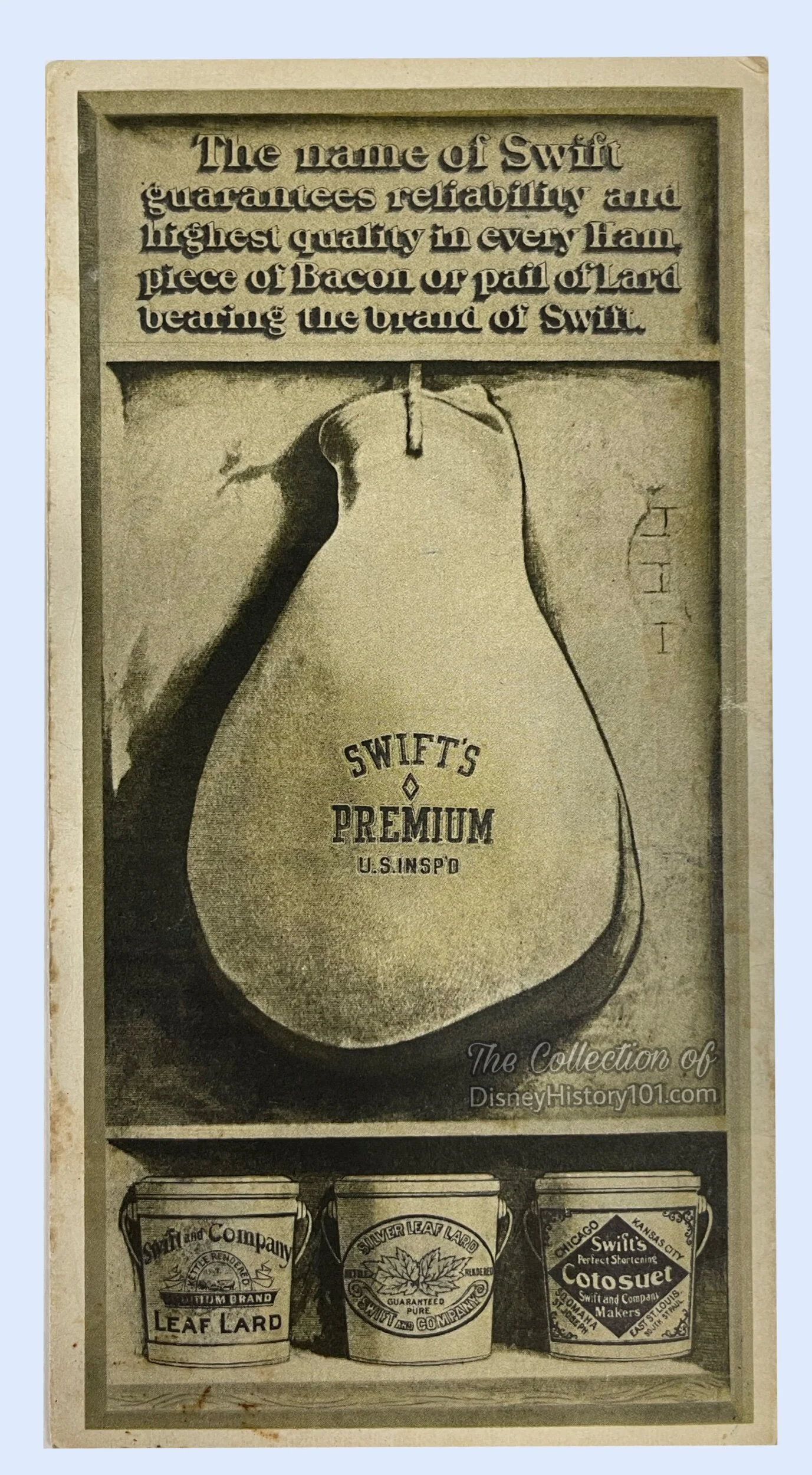
Disneyland Souvenir “Swift’s Wholesale Price List No. 4”
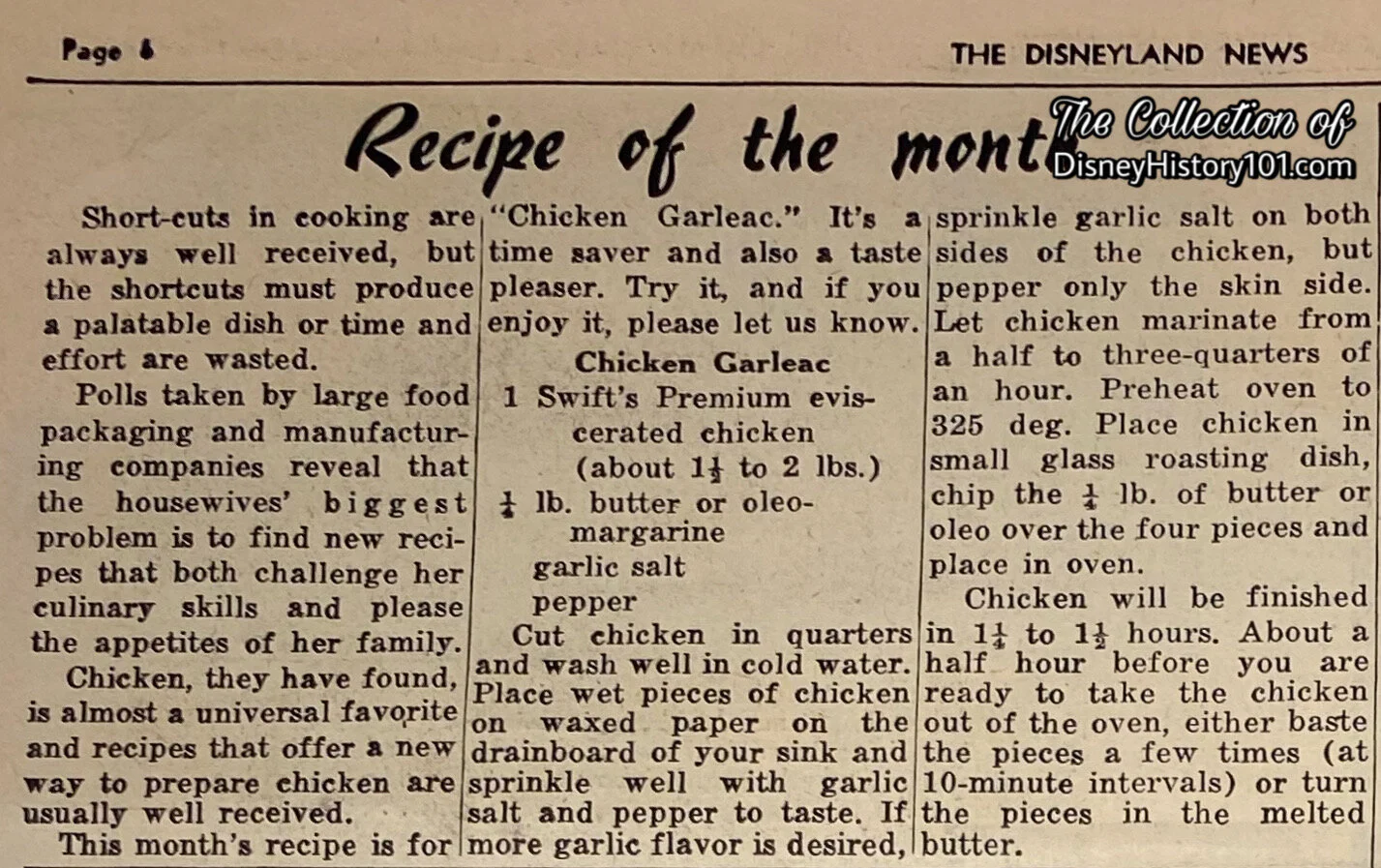
The Disneyland News Excerpt, June, 1956.
Occasional recipes containing Swift’s Premium products were published in editions of The Disneyland News.
On December 10, 1955 the Swift & Co. provided food for the First Annual Christmas Party.
The window displays of Swift Market were maintained with a “fresh look” according to Disneylander (October 1957).
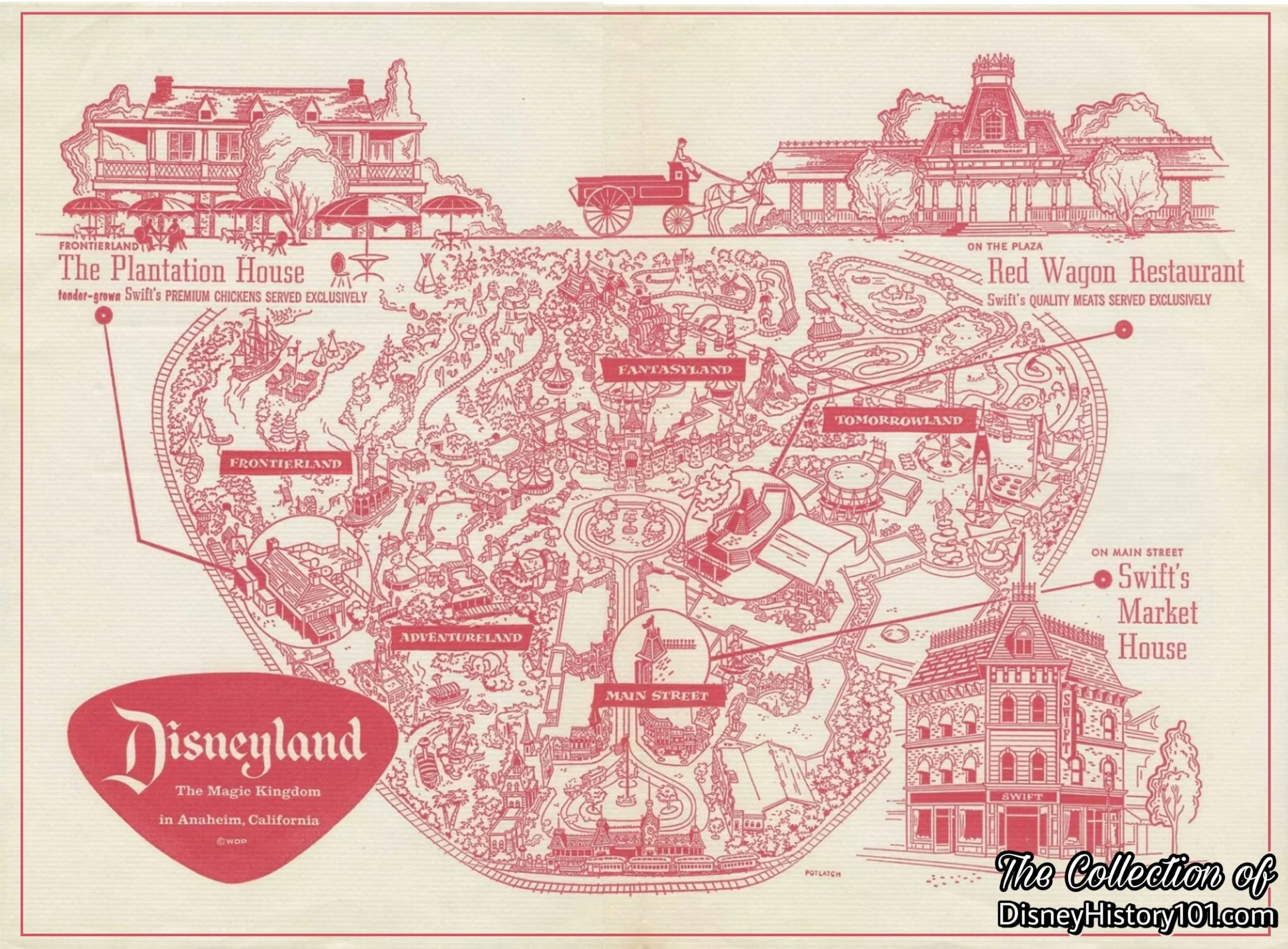
Swift's Placemat Featuring Swift's Market House
Placemats and other complimentary items like this are a prime example of “the possibilities for a sponsor to capitalize on this association” with Disneyland. The many ways of “merchandising, sales promotion, advertising, public relations and publicity programs are almost limitless. Regardless of the type of product, goods or services manufactured and marketed by sponsors, the Disneyland association can be effectively and importantly translated into the sponsor’s promotional activities,” according to “Disneyland, U.S.A.,” published 1958.
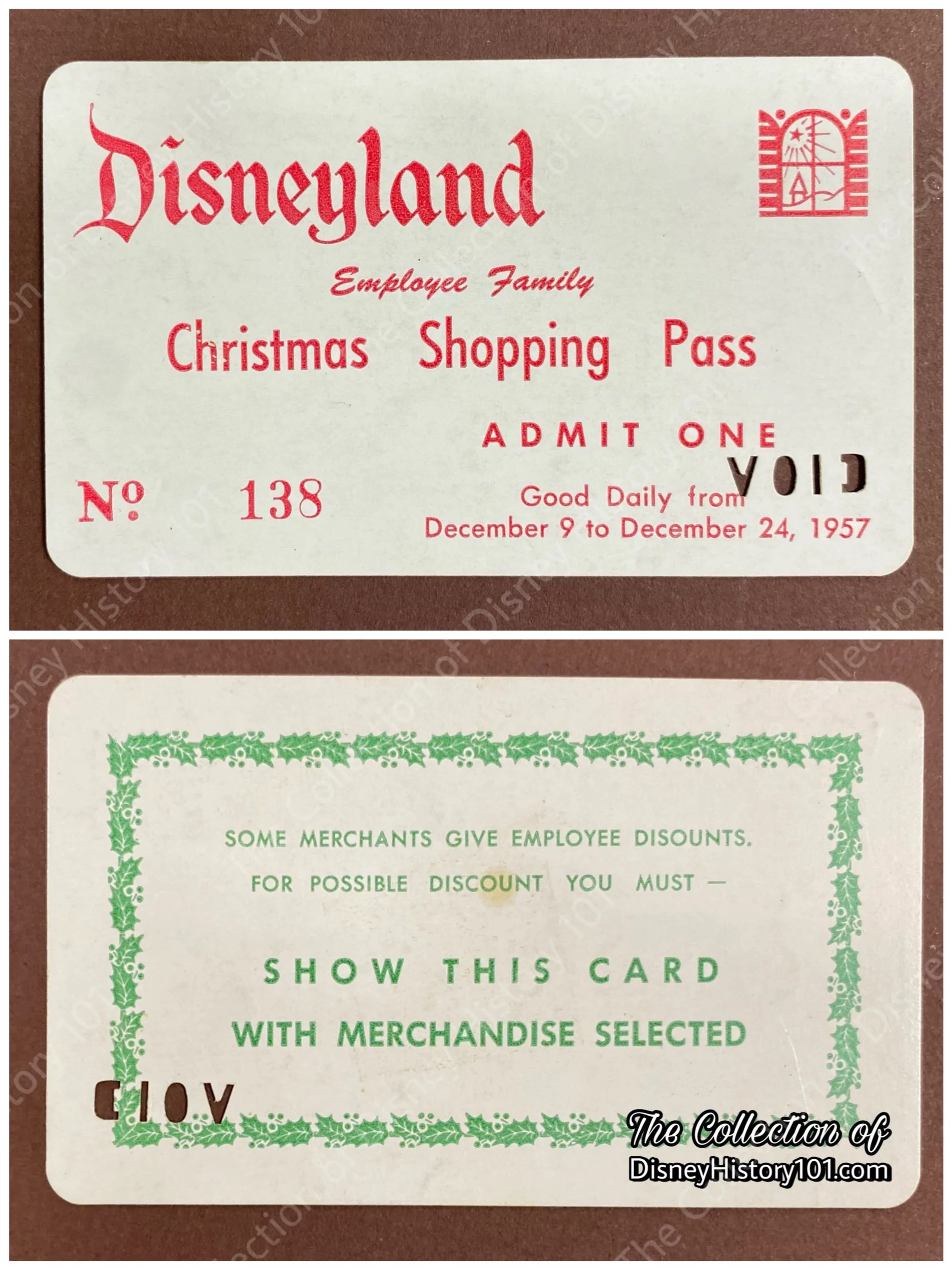
According to The Disneyland Shopper (published 1955): “Half the fun of buying Christmas Gifts is the atmosphere you shop in. You couldn't ask for more in the way of the spirit of Christmas than to shop in Disneyland. Especially along Main Street will you catch the air of the good old-fashioned Christmas with wreaths of holly, Christmas bells, carolers, snow-frosted windows gaily decorated with fairytale rhymes, and the scent of pine boughs in the air. Ringing through this Magic Kingdom are the Christmas Songs we all love to hear.”
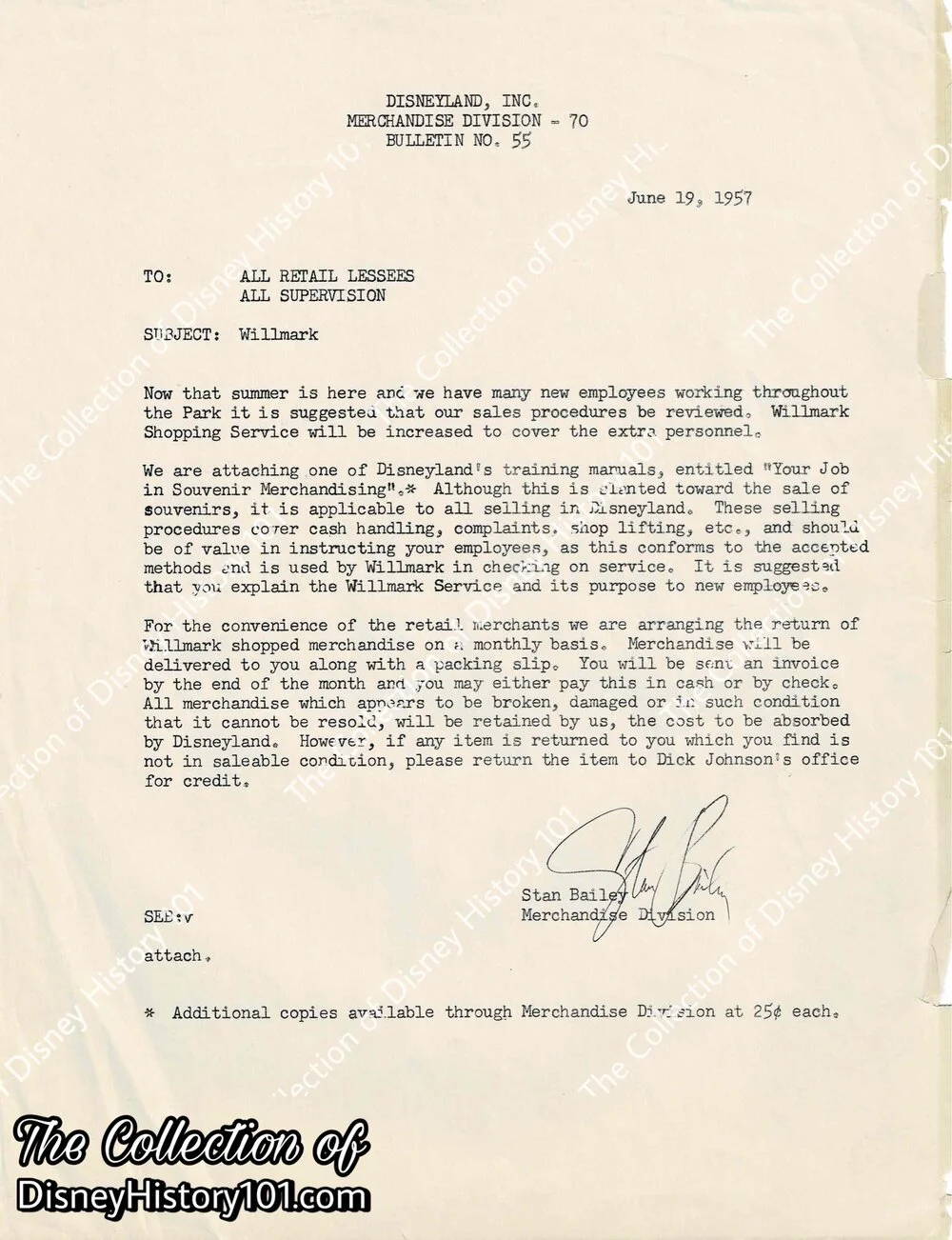
Disneyland, Inc. once utilized the Wilmark Shopping Service to assure higher levels of quality service in Souvenir Merchandising.
The 1957 TWA brochure “Let’s Talk About… My Visit to Disneyland, Anaheim, California: A Note from Mary Gordon TWA Travel Advisor” mentioned: “We learned that to fully explore Disneyland takes two days, so early next morning we were at the gates of the park again. The second day we spent more time shopping in the 50 inviting shops, and the youngsters bought inexpensive souvenirs to take home to friends.”
By January 1, 1958, the 2,152 square-foot Swift’s Market House was located in Main Street Building #600. The corporate synergy was good for a time. Some DISNEYLAND table service restaurants offered Swift‘s brand products in their recipes. For instance, Hills Bros. Coffee House offered Swift’s sliced baked ham on a sandwich.
As for DISNEYLAND, the institutional lessee Swift and Company yielded some revenue for Disneyland Inc. - $43,000 for the fiscal year ending September 29, 1957 and $43,000 for the fiscal year ending September 28, 1958.
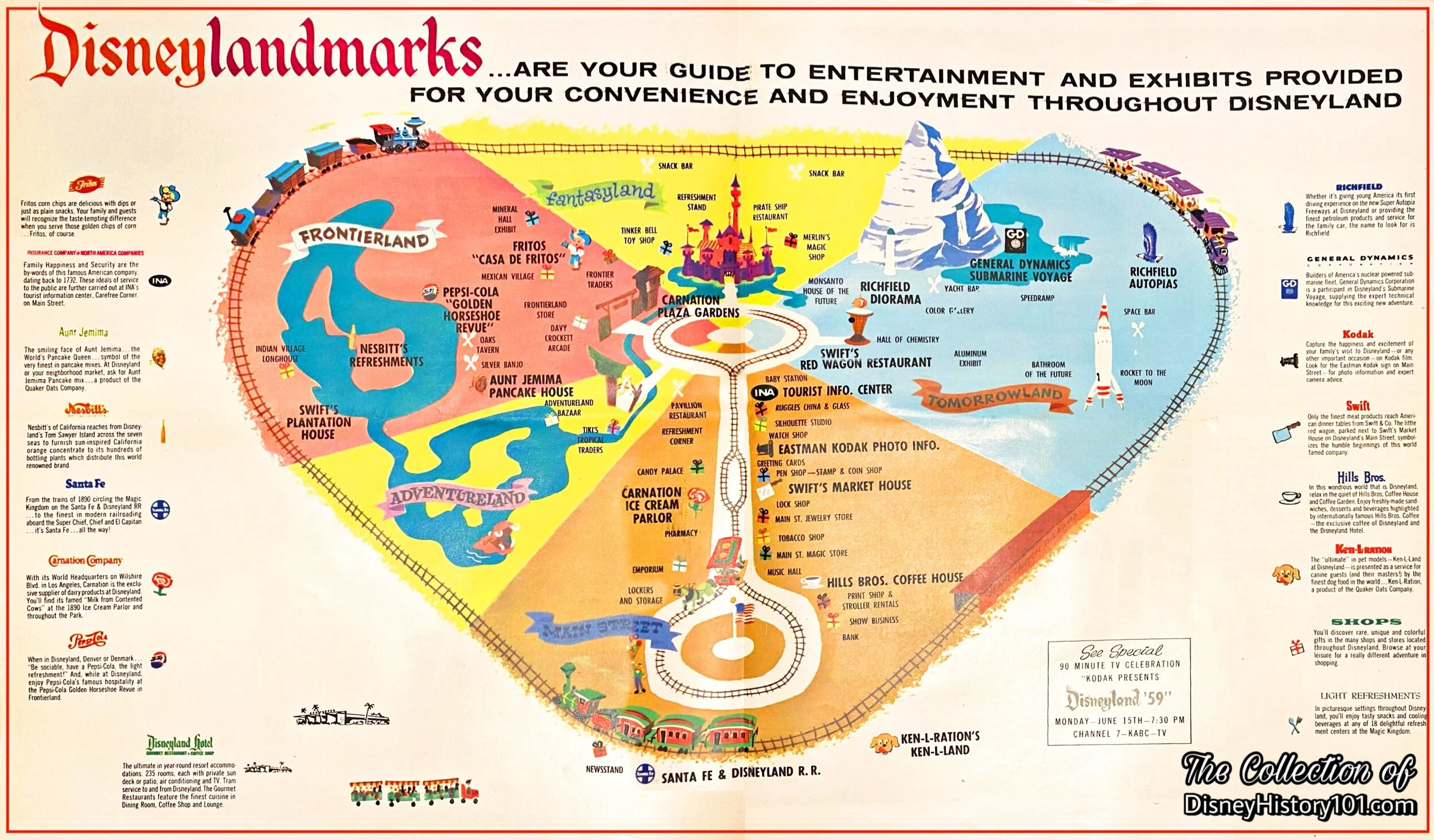
Owning to Jack Sayers (of Lessee Relations), Swift & Company was a contributing sponsor for Disneyland ‘59! By October of 1959, the company was (1) of over sixty-eight other firms playing a vital part in the team effort to bring happiness to Disneyland’s Guests. Some were small, specialized individual operators; some were huge companies such as Swift & Co. - the Bank of America - United Paramount Theaters (which you hear as UPT) - Carnation - Richfield - General Dynamics - Crane - and many others. These companies used the park to publicize their wares, leased space in the Park to sell their wares, and Disneyland collected advertising fees from them. By 1959, of the total income received by Disneyland, Inc. from leases, 16.02% was derived from the selling of advertising rights and 40.12% from the leasing of space to concerns whose main reason for occupancy is for advertising purposes. The remaining 43.86% of the lease income was derived from stores that sold various products and food.
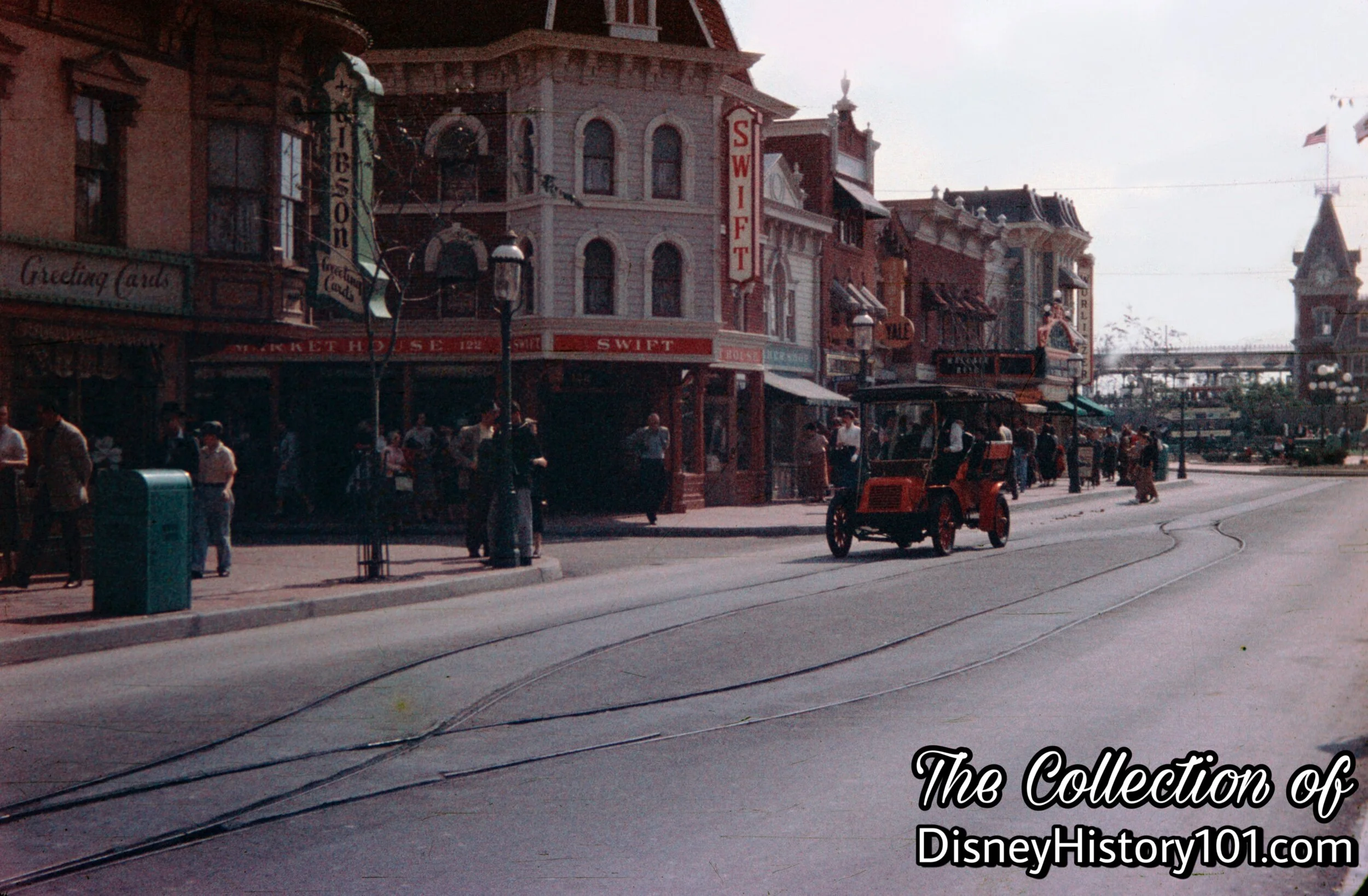
Swift & Company Market House
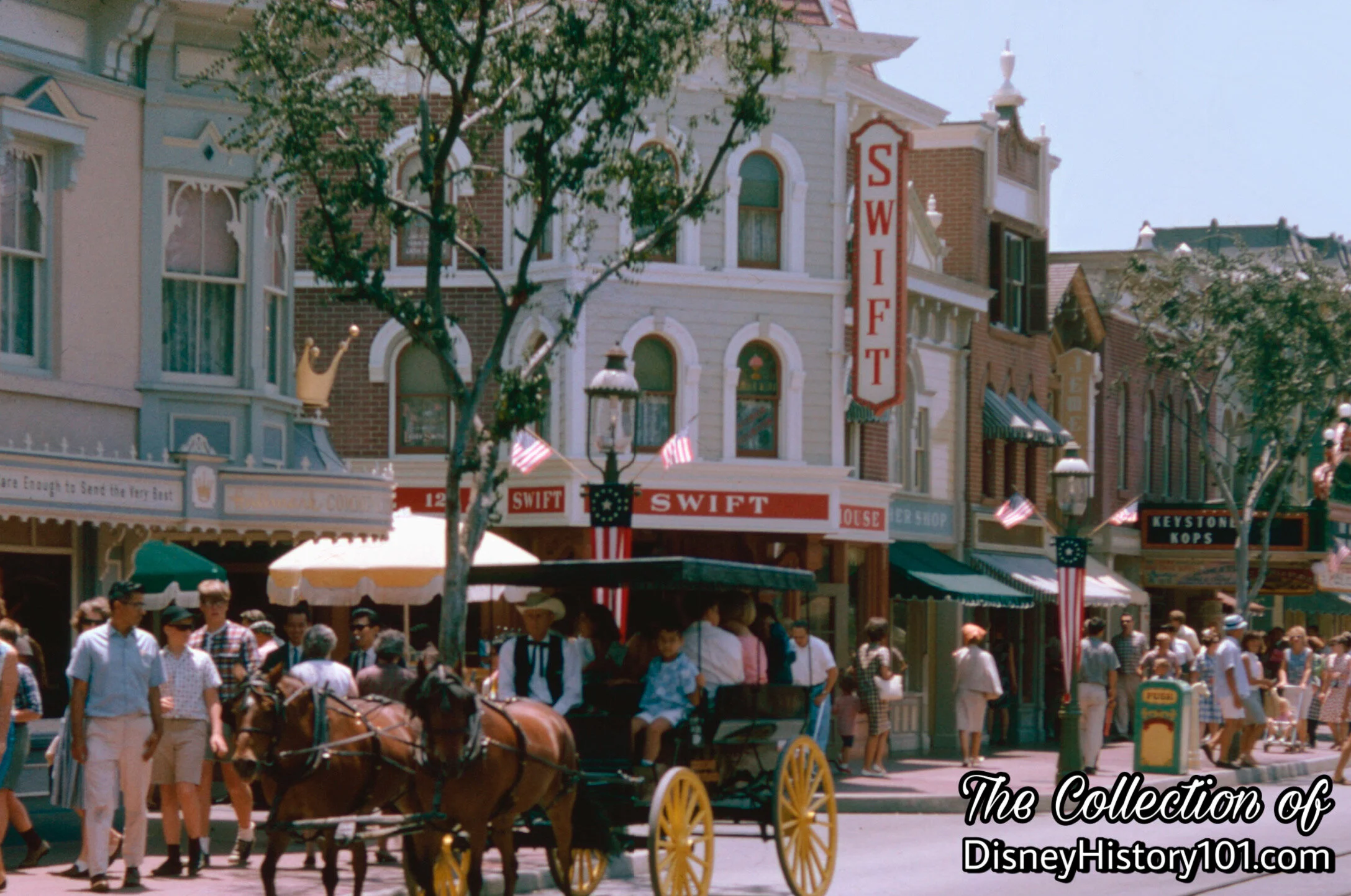
Swift & Company Market House
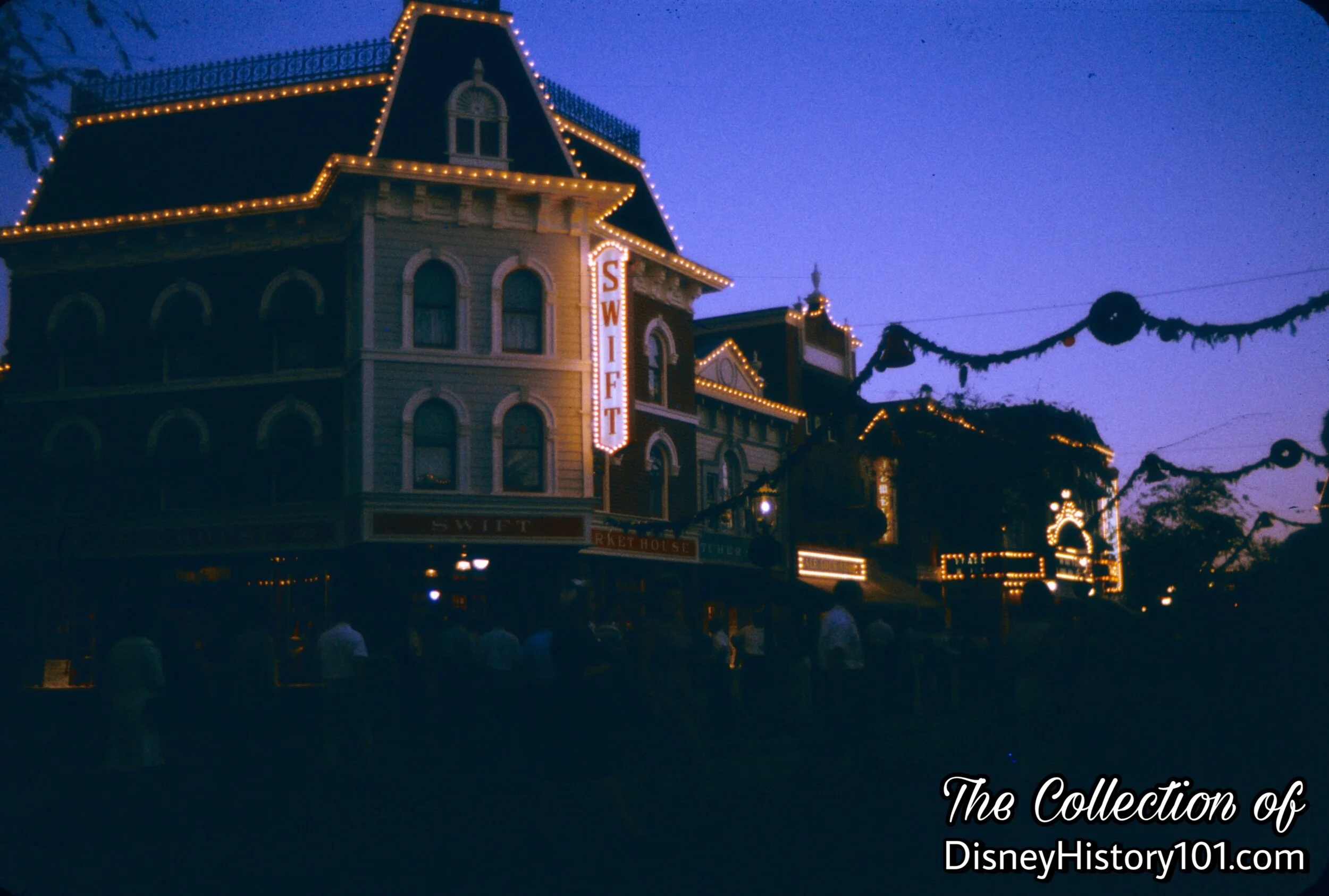
Swift’s Market House at Twilight, Winter
Outside, guests could step aboard the Swift & Company Wagon for a photo opportunity. This free exhibit was similar in fashion to the Carnation Farms Milk Truck, the Bekins Wagon, and the Global Van Lines Truck. The Swift Wagon was a “horse-drawn replica of the 1890’s that services all eating establishments in Disneyland with Swift fine foods.” When not parked near the Market House, the little “Red Wagon” could also be found stationed on East Plaza Street, near the Red Wagon Inn.
This exhibit helped Disneyland audiences understand the mode of transport (or, drayage) for the delivery of manufactured products (e.g. ice, milk, baked goods, meats, etc.) to small towns across the U.S.A.
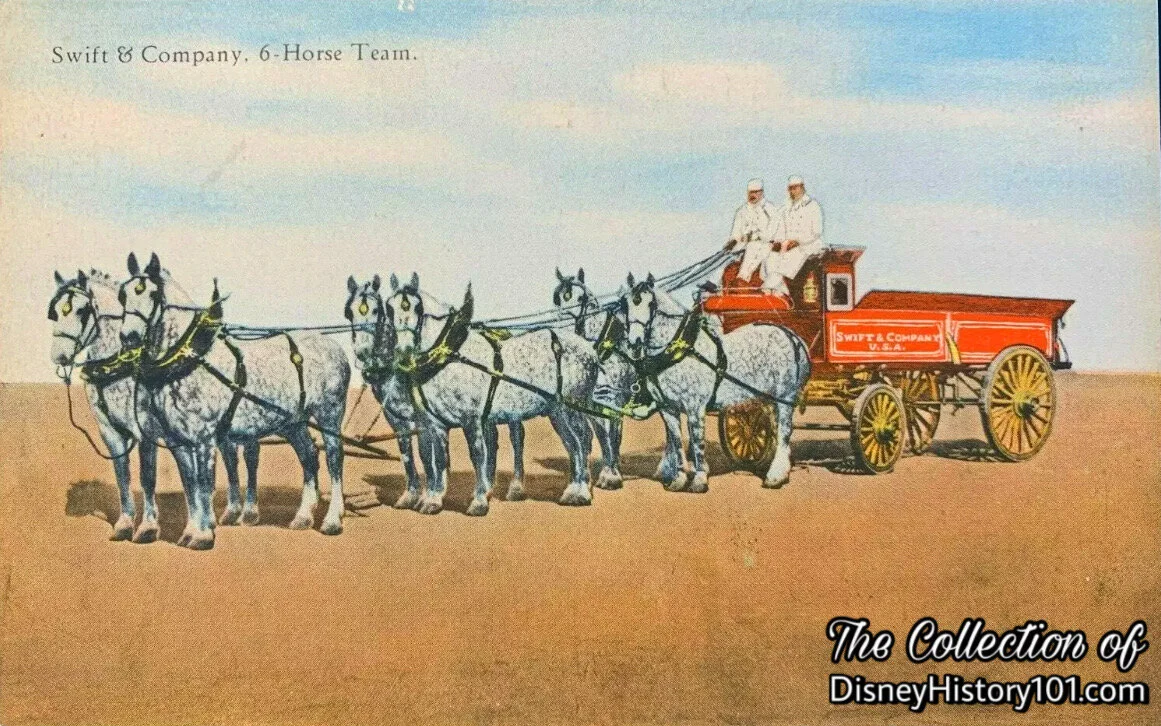
The Swift & Company Delivery Wagon Post Card Image, (c.1910)
It seems that Swift & Company’s c.1910 horse drawn wagons were pulled by a six horse hitch. One model of Swift’s red wagons may have still been in use for drayage of Swift’s products by the time the International livestock exposition was held in Chicago (from November 26th - December 3rd, 1927).
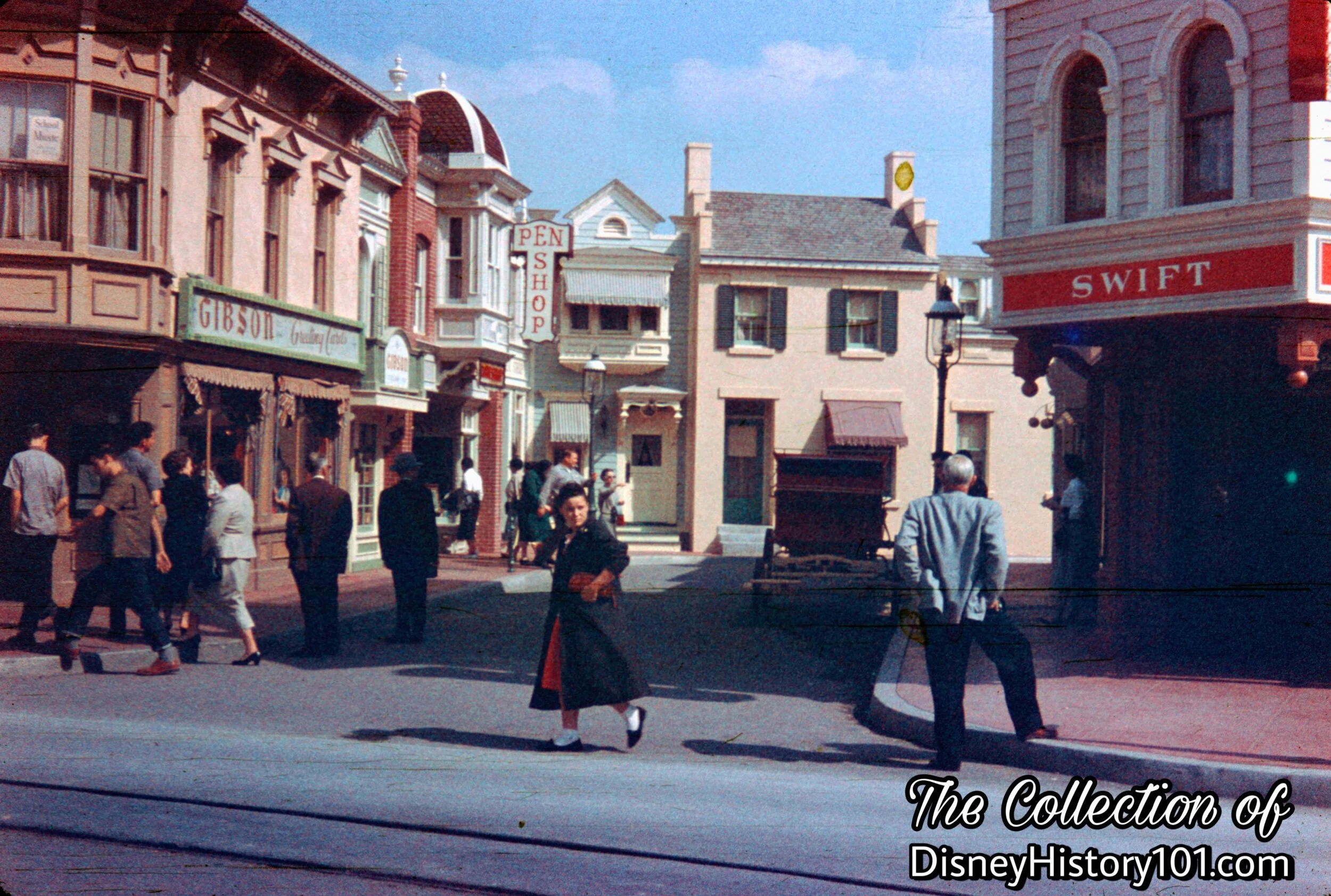
Swift Market House & Delivery Wagon
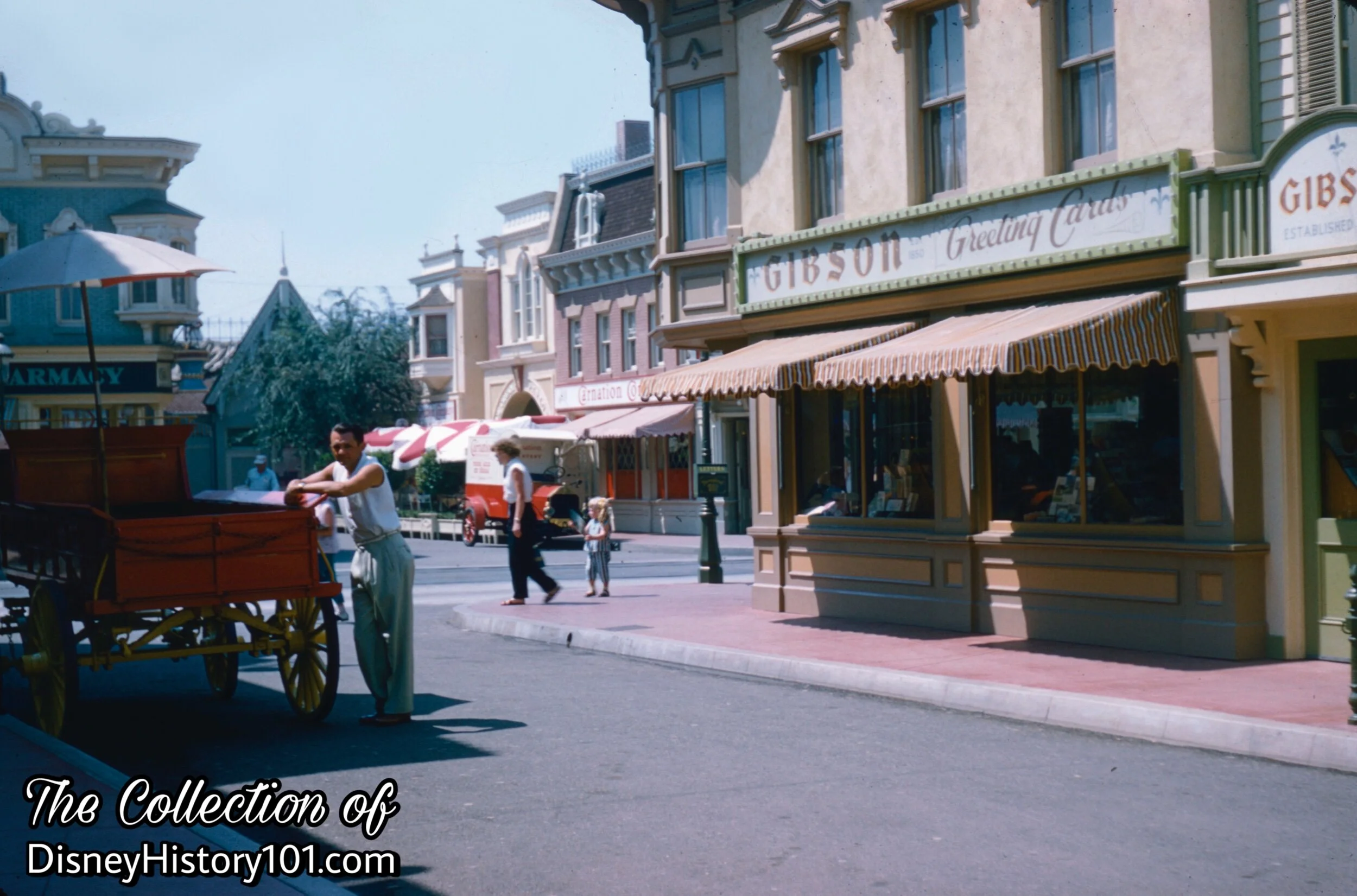
Swift & Company Wagon (Pictured Left)
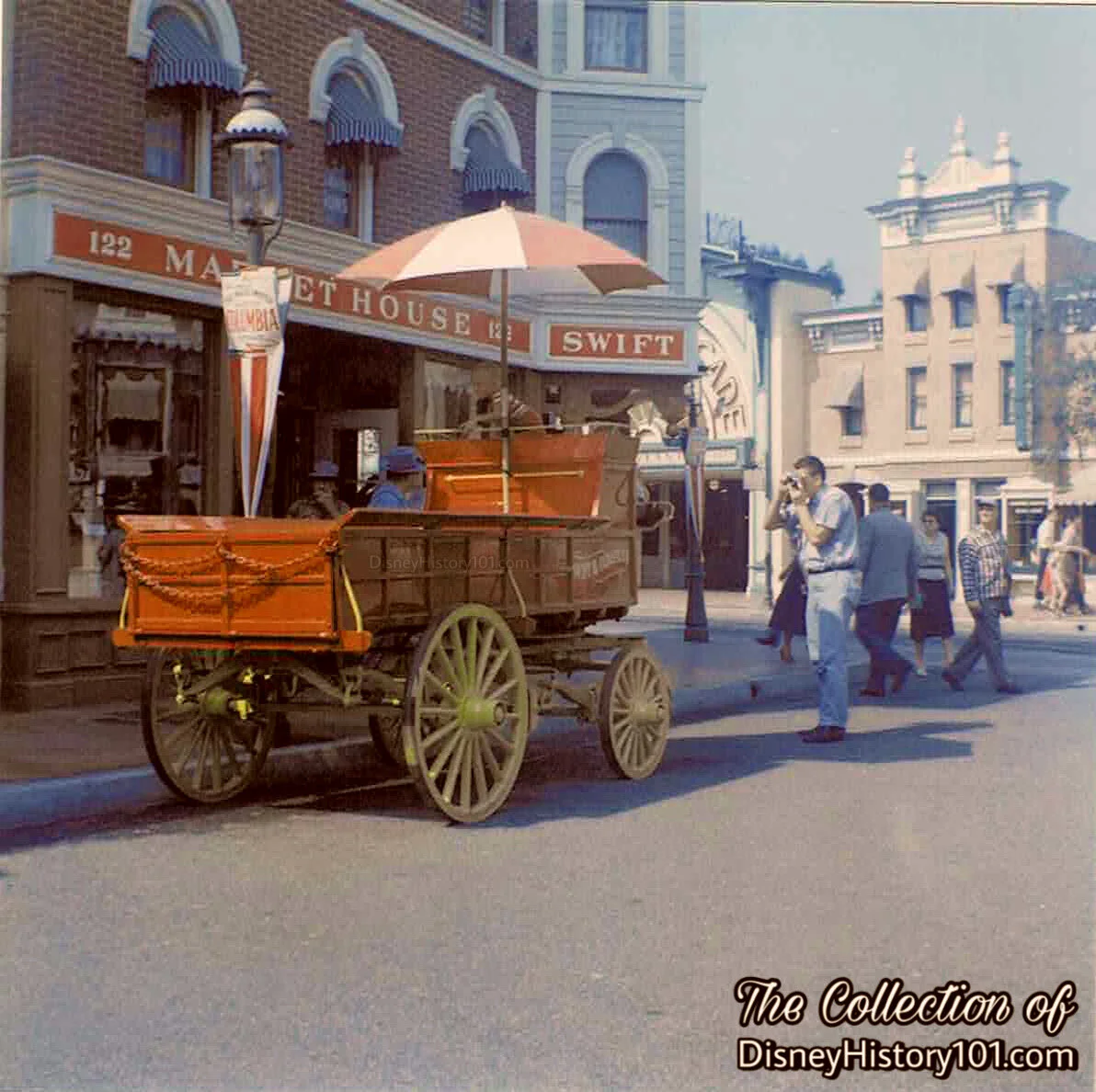
The Swift Wagon
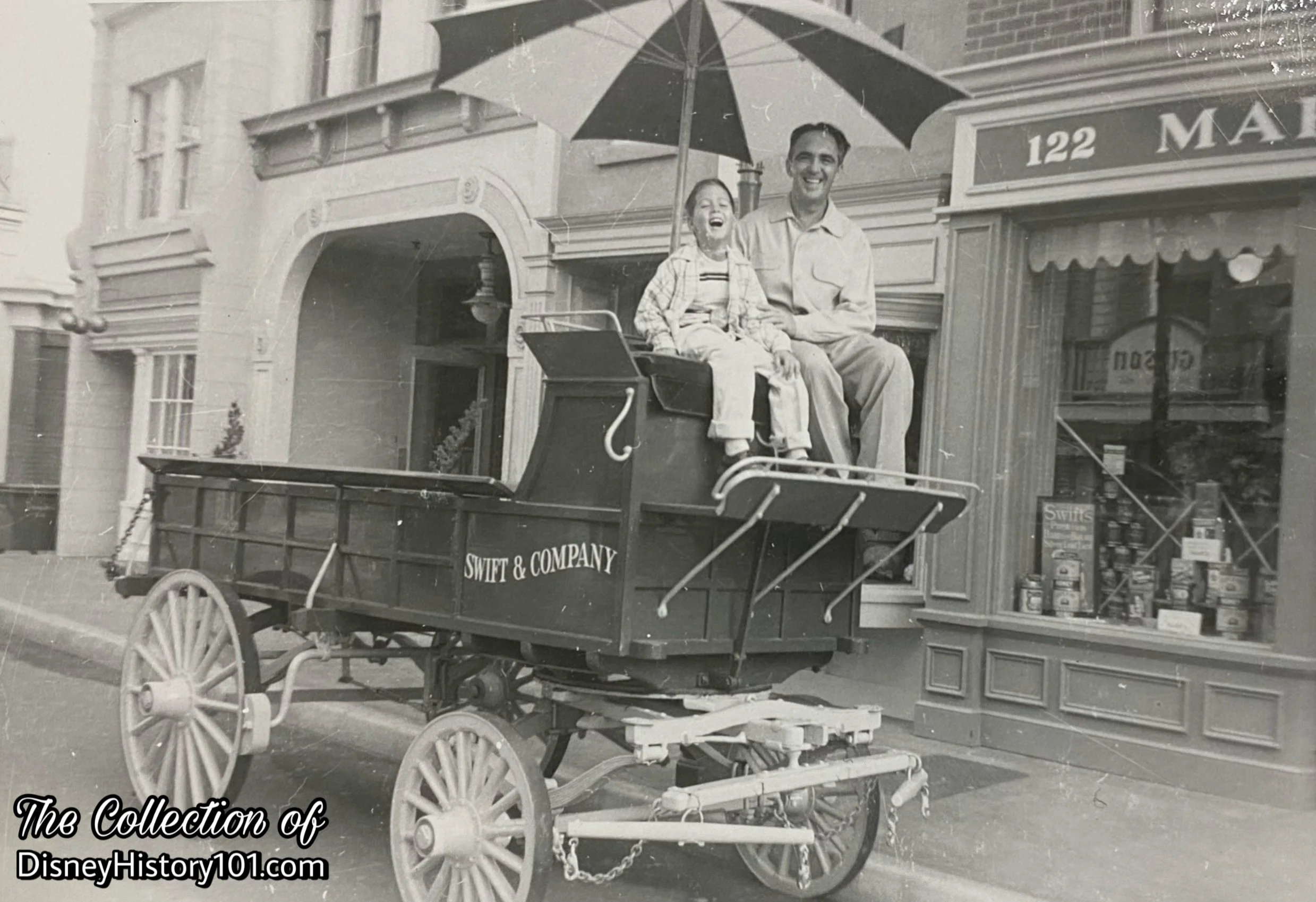
The Swift Wagon
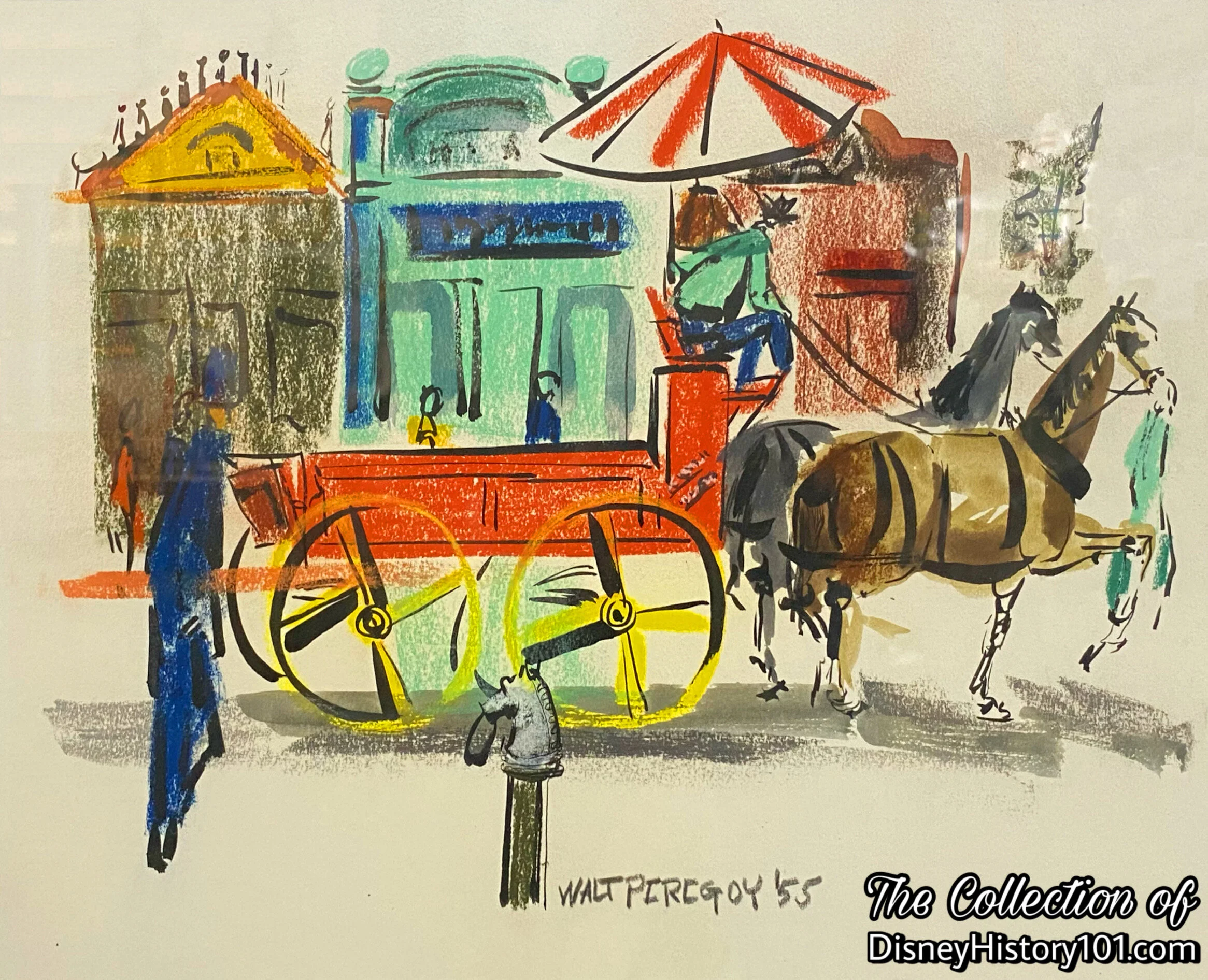
A Walt Peregoy pastel study of the Swift Wagon, likely created during the “Disney Artists” exhibit located between Red Wagon Inn and Plaza Apartments, c.1955.
When Walt Disney Productions Background Artist Walt Peregoy visited Disneyland, he spent his time creating colorful studies of the Park, and at least one of them featured the Swift Wagon.
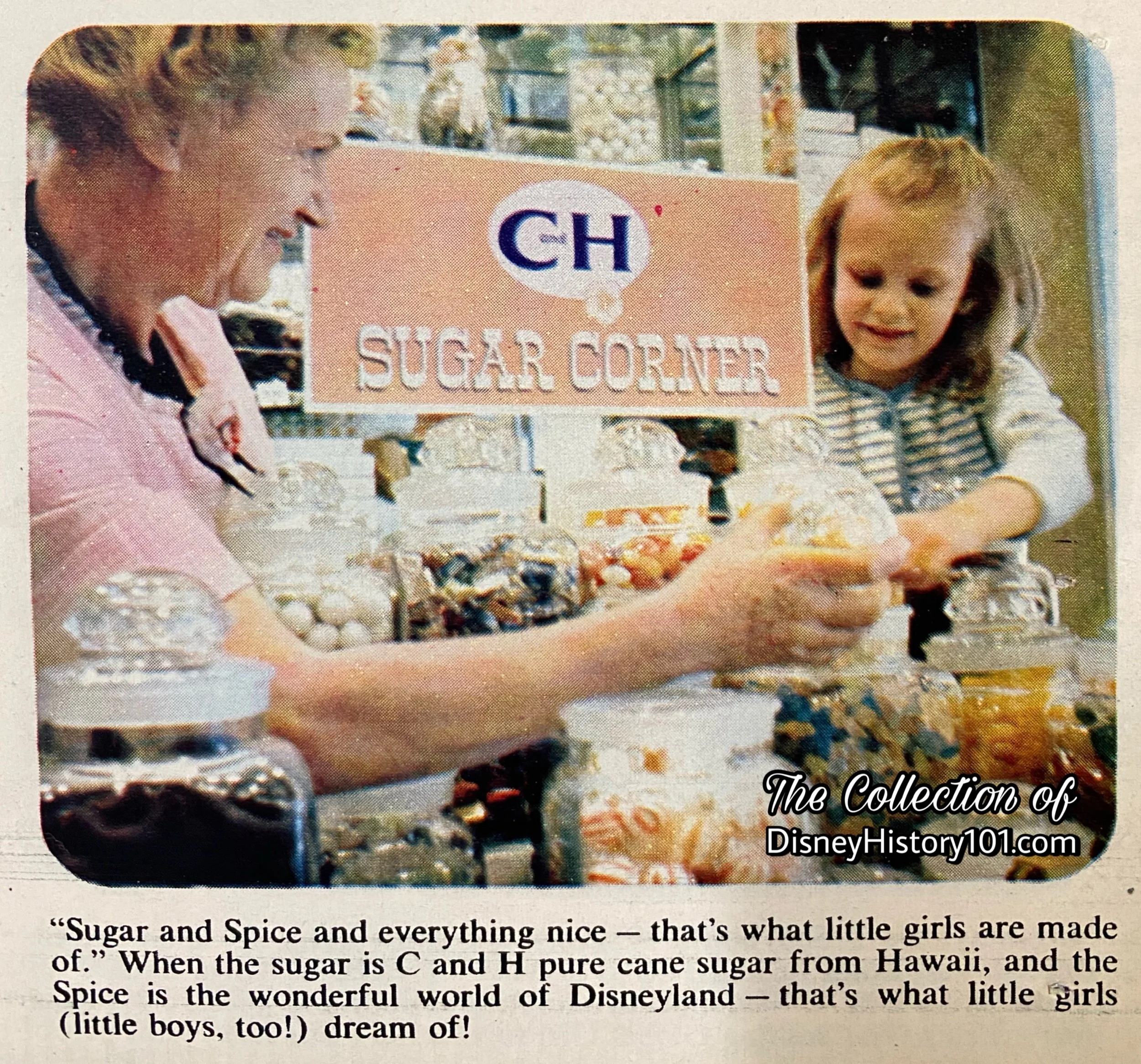
C&H Sugar Corner at “Disneyland ‘65 Tencennial Celebration” Supplement Excerpt.
During C&H’s sponsorship, the Market House was an “old-fashioned general store complete to cider and dill pickles,” cookies, candies, natural food snacks, coffee and cider. Next door (but, technically located in the Swift Market House), the C&H Sugar Corner (sponsored by the Californian and Hawaiian Sugar Refining Corporation), featured a variety of penny candies and unique colored decorator sugar crystals. Other specialty items included Vanity Fair Toilet Deodorant Cream Soaps containing lanolin and Hexachlorophene.
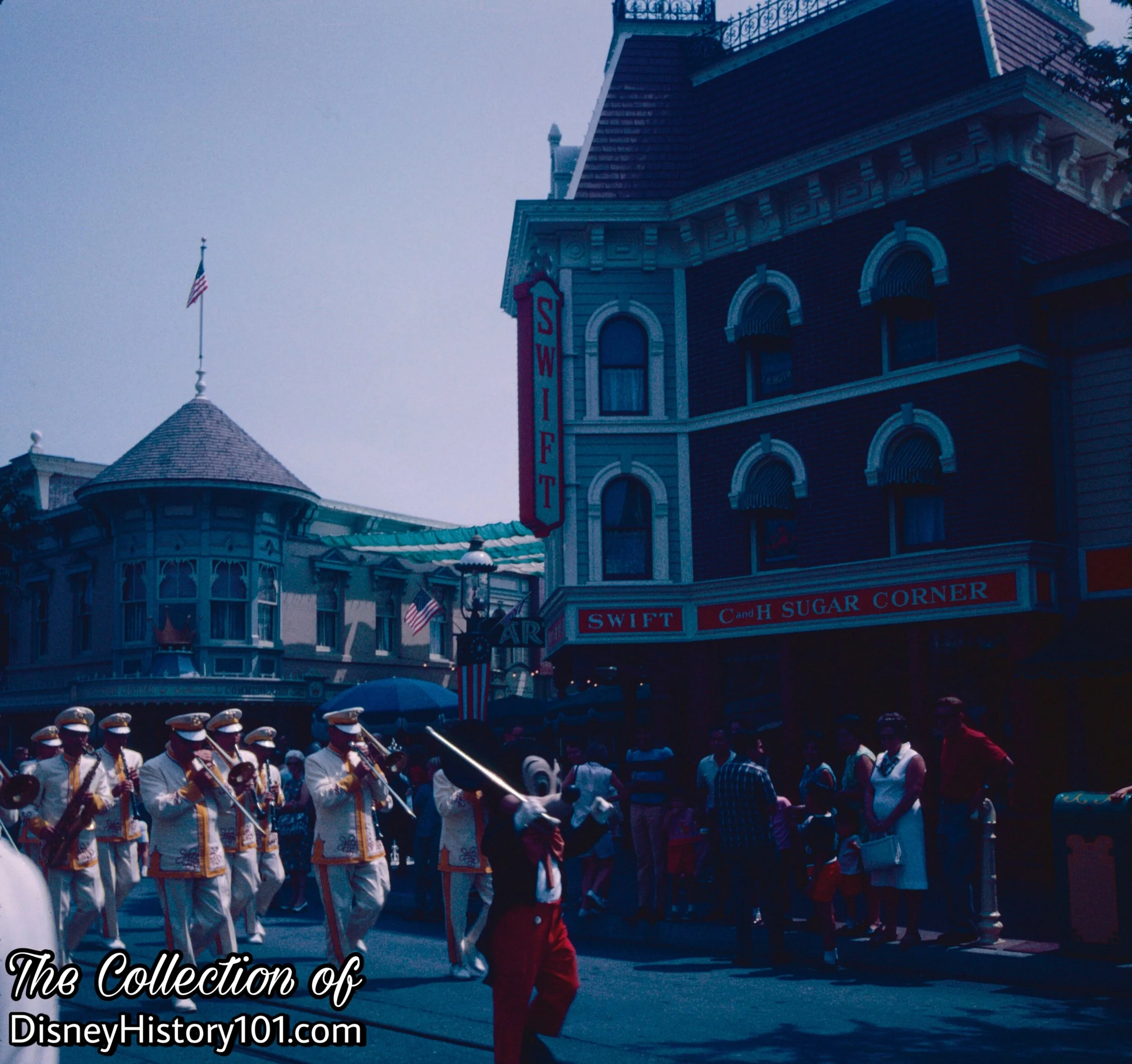
Swift Market House & C and H Sugar Corner, c. 1966
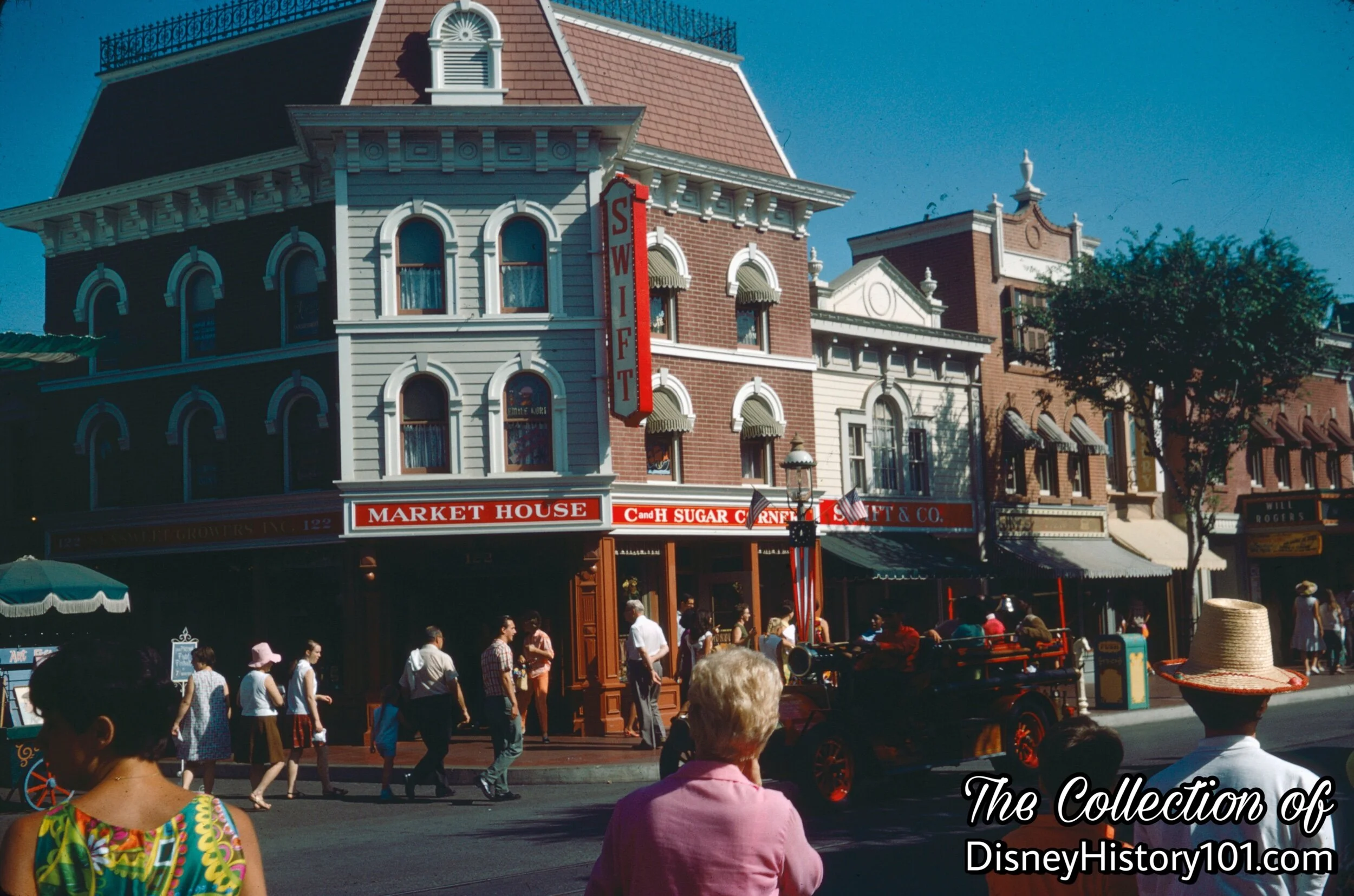
Swift's Market House & C and H Sugar Corner, 1966.
Swift’s contract was soon to lapse in 1966, so before that happened, Walt Disney Studio artist Dorothea Redmond began to create Market House concepts in 1964. The new shop and exhibit contained many original items and equipment collected from all over the world.
By 1970, the Market House (Main St. General Store) was sponsored by Swift & Co., C&H Sugar Corner and Sunsweet Growers.
![Among Dorothea ’s designs that were realized was “a pot-bellied stove and recorded party-line phones that [would] provide many chuckles for guests,” according to the “Disneyland Dictionary” (compiled by WED Enterprises, Inc. and WED Public Relati](https://images.squarespace-cdn.com/content/v1/5b3d7f804eddec6e826be0c9/1639720892240-I09G53FZ0XWRK81BNPDD/98B50E47-9A16-489E-8452-01A2582631A5.jpeg)
Among Dorothea’s designs that were realized was “a pot-bellied stove and recorded party-line phones that [would] provide many chuckles for guests,” according to the “Disneyland Dictionary” (compiled by WED Enterprises, Inc. and WED Public Relations Department, c. 1968).
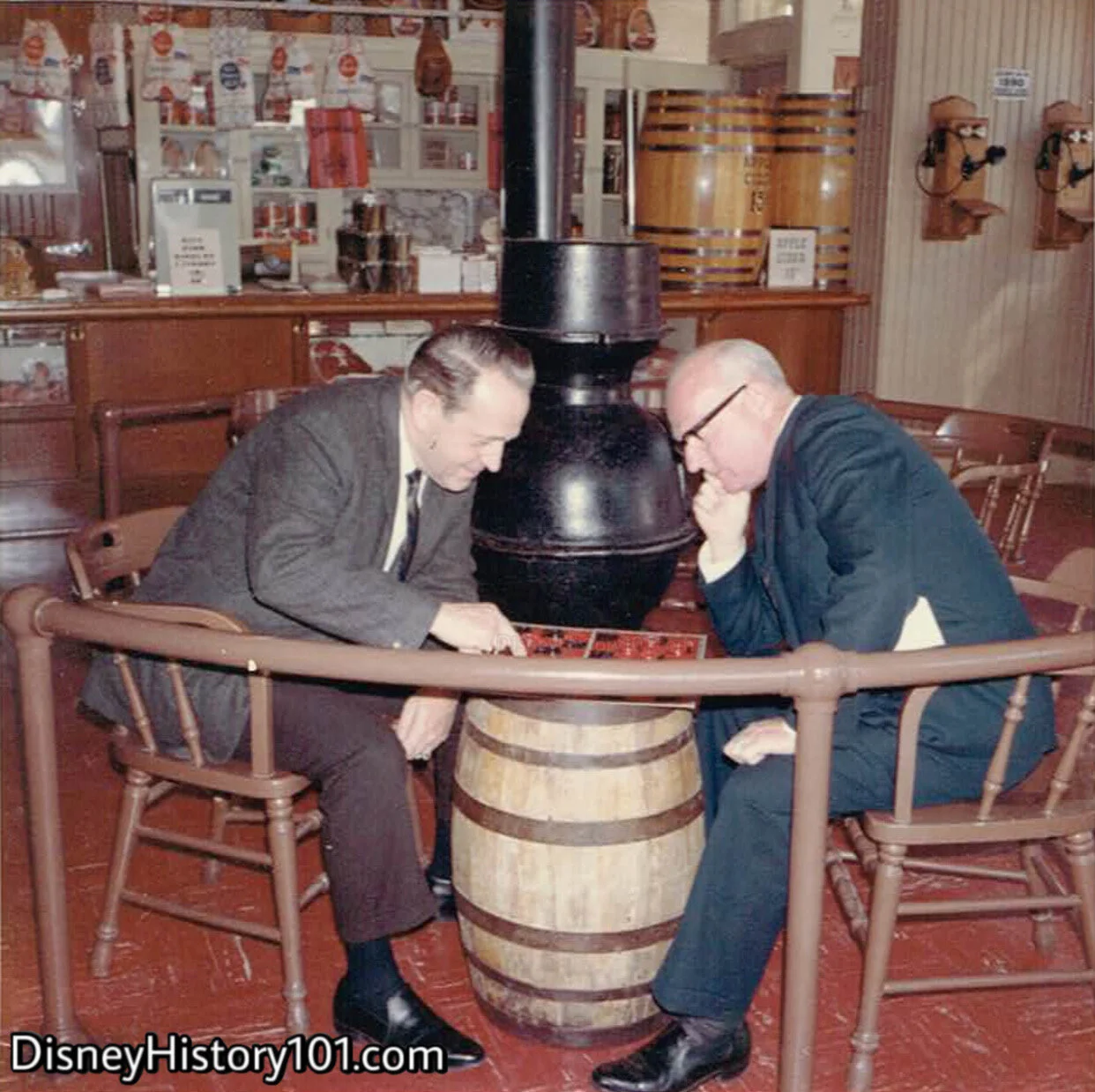
Swift's Market House Checker Board, (February, 1967)
By 1969, an inventory list was maintained by the Disneyland Decorating Department and was perhaps the most unique manifest of items existing anywhere. It contained about 35,000 items of various sizes, shapes, and values with 4,000 items on Main Street alone.
At the Market House, the potbellied stove is an original. In the rear of the store stood a distinguished looking Seeburg upright grand piano built in 1910. The coffee grinders were authentic antiques and really worked.
Amidst it all, a memorable prop was the checker board, which was still a constant feature by the 1990s. This game offered Guests the rare opportunity to become part of the Atmosphere Entertainment of the Market House, complimenting the theme of area, and staged to entertain other Guests.
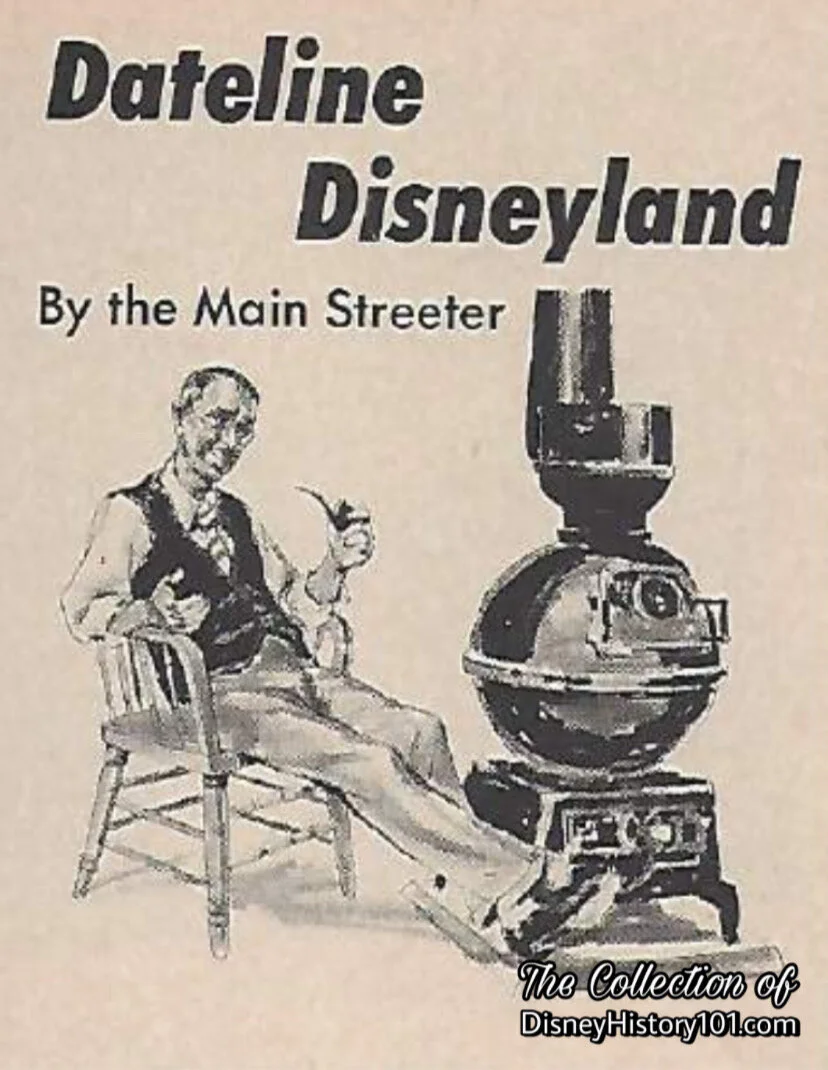
Vacationland “Main Streeter” Excerpt
The area near the old potbellied stove was a great place to enjoy an old-fashioned game of checkers, or (as the “Main Streeter” of Vacationland magazine preferred) to “sit and spin yarns about the Magic Kingdom with all my friends visiting the Park from all around the country.”
Of course, there were other ways which ones could “get an earful” while visiting the turn-of-the-century Market House…
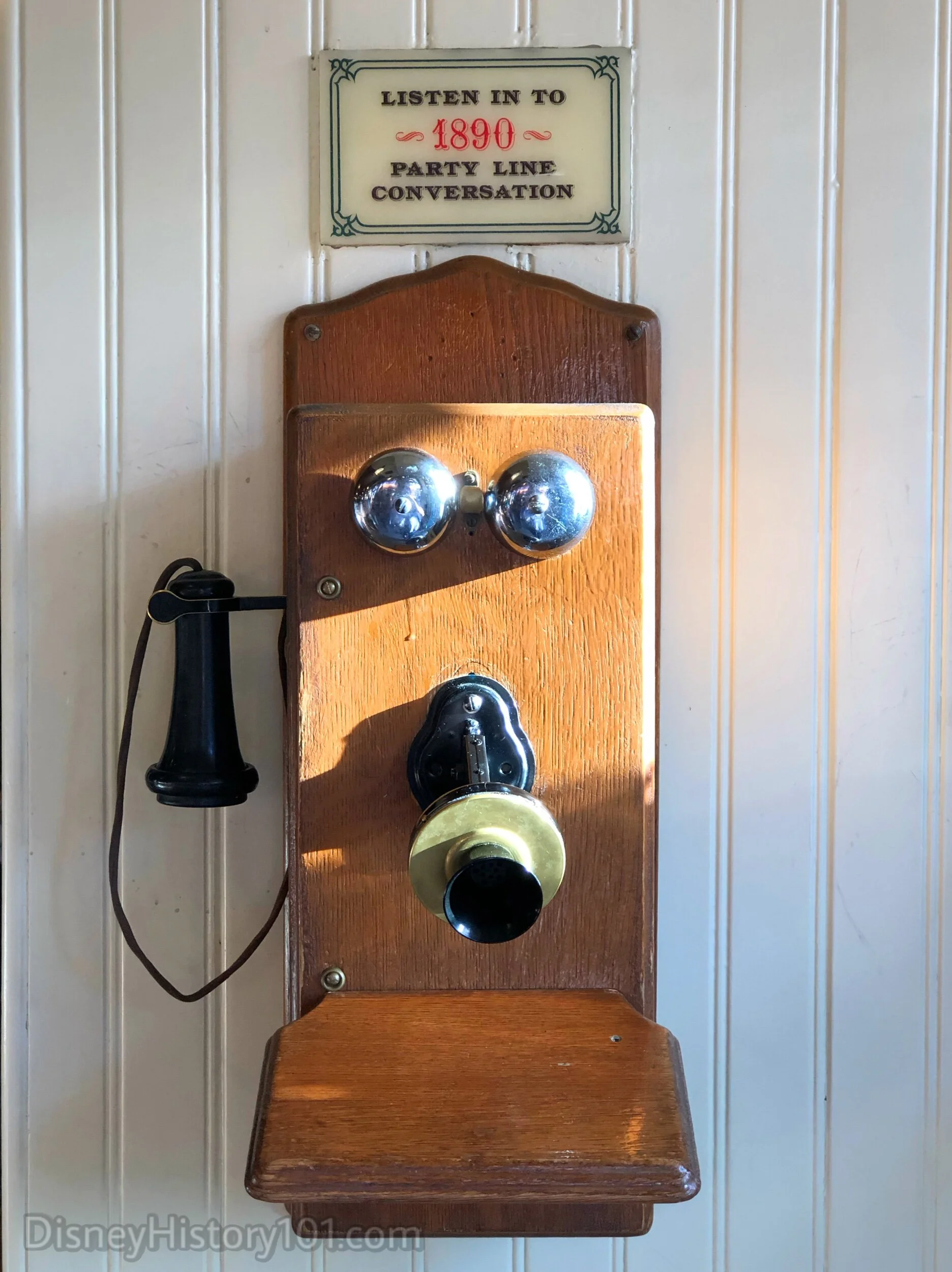
The Market House Party Lines free exhibit.
Among these was the installment of the half-a-dozen Party Lines, Swift’s Market House has been “the best place to listen in on the neighbor’s chatting,” according to Vacationland magazine (published for Winter/Spring of 1965). “Original bins that used to hold coffee beans and grains are placed around half a dozen old wall telephones where you can lift a receiver and hear conversations of years ago. All of these telephones had to be wired for conversation because they were authentic telephones of the turn-of-the-century era,” according to “Did You Know” (published by Disneyland in 1991).
These phones (and their party lines) may have inspired Wally Boag to “have an idea” which was submitted to Dick Irvine, on May 22, 1966. Wally’s idea was related to the Haunted Mansion which was still under construction, with a sign posted near the gate. Wally submitted :
“I hope you don’t mind if I make a suggestion. I notice that many people really remember too little about the Haunted House, even after reading the sign. I thought there might be a chance for a little pre-opening publicity. I’ve enclosed a script which might be used for a special gimmick out in front of the house. You could put an old-fashioned house phone by the gate. The first part of the script could be repeated over and over again until a guest pushes a button which starts the second tape. Once it had finished, the first tape comes back on, waiting for the next guests. With proper background, music, and effects, this could be a real gimmick for the Haunted House and would effectively publicize the attractions.”
The former Walt Disney Imagineering Principal Creative Executive Marty Sklar would probably agree that the small details like these Party Lines make the story appealing.
As a sidelight, if guests needed to make a true-life phone call, telephones were located on East Center Street between Swift's Market House and the Gibson Card Shop.
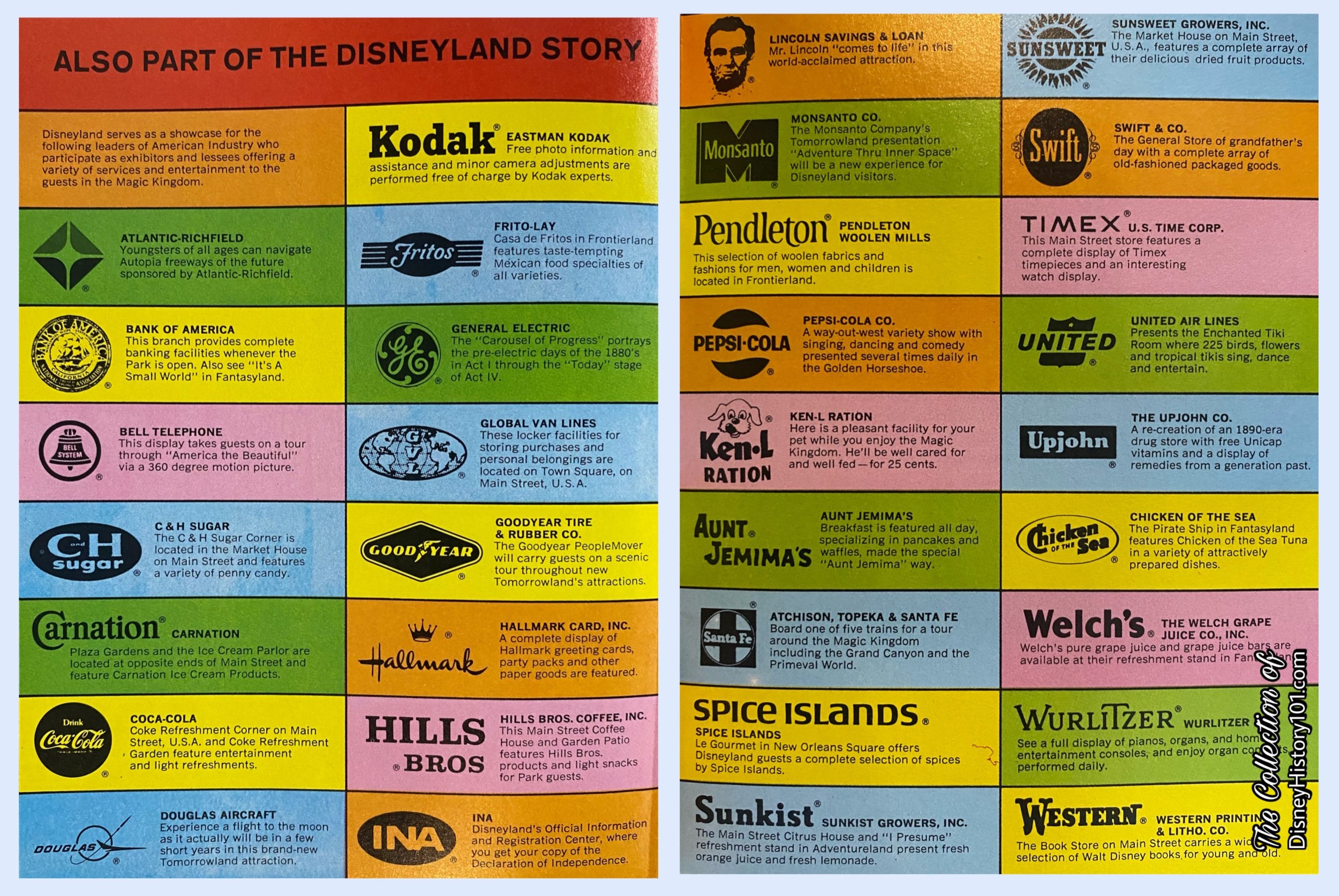
Swift & Co., C & H Sugar, and Sunsweet Growers, Inc. were Disneyland Participants and thus “part of the Disneyland story according to this “Disneyland ‘67” Excerpt.
Unbeknownst to most guests, functional offices were hidden (from guests) toward the back of the entire building, in a Backstage Area. As a final touch, one of five 45-star flags in Disneyland flew atop the door, to complete the picture of a typical turn-of-the-century American Market House building.
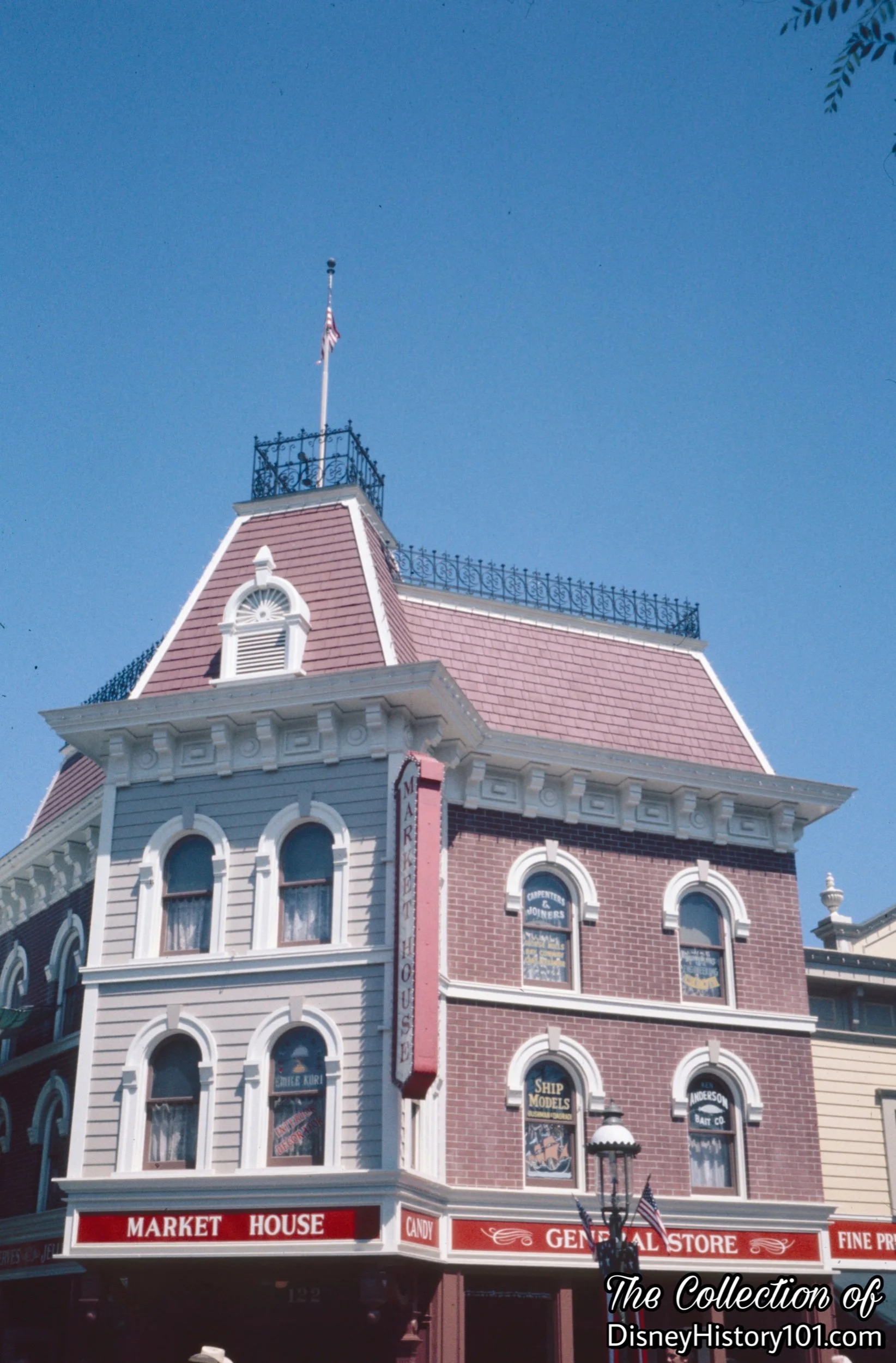
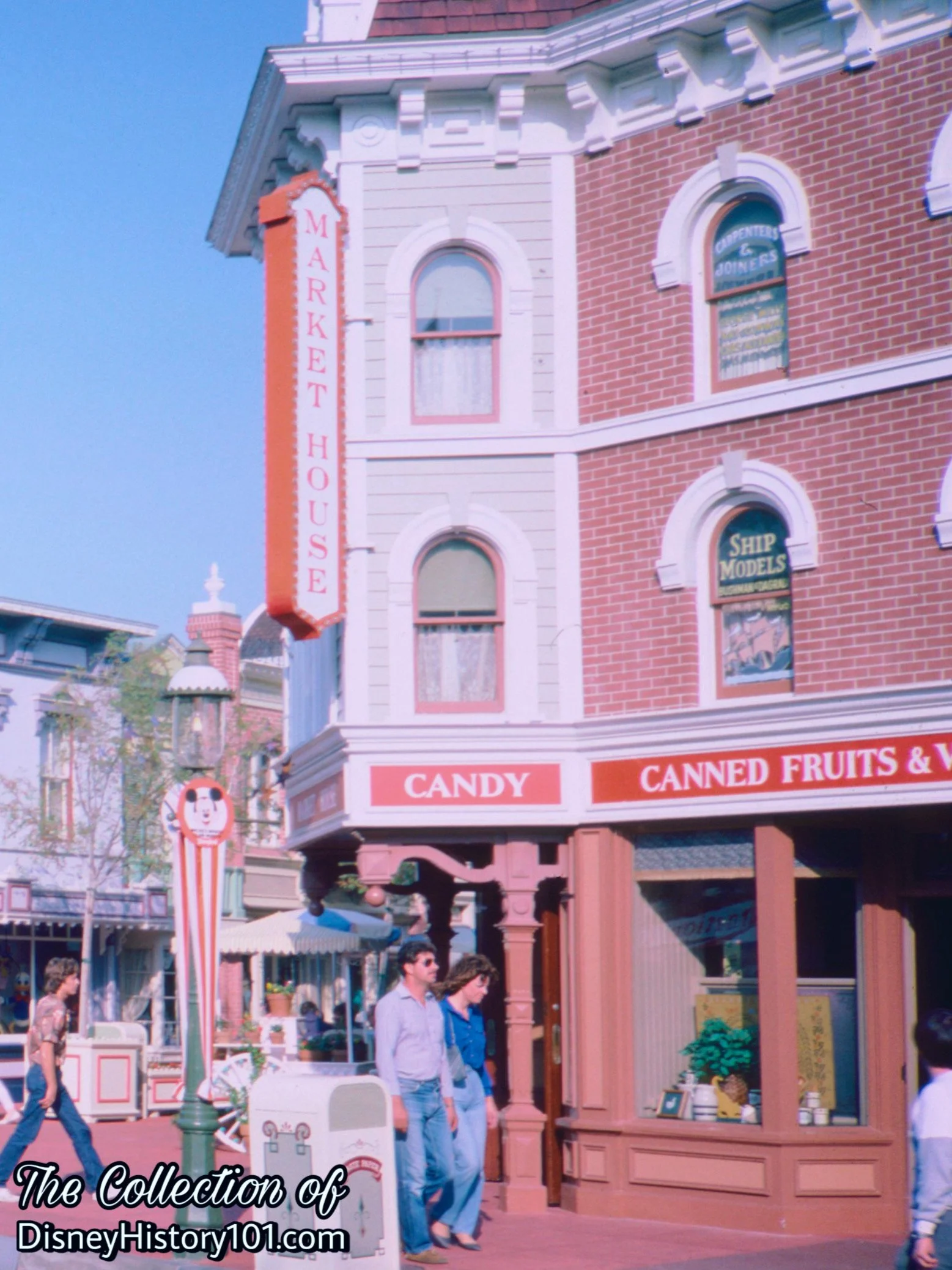
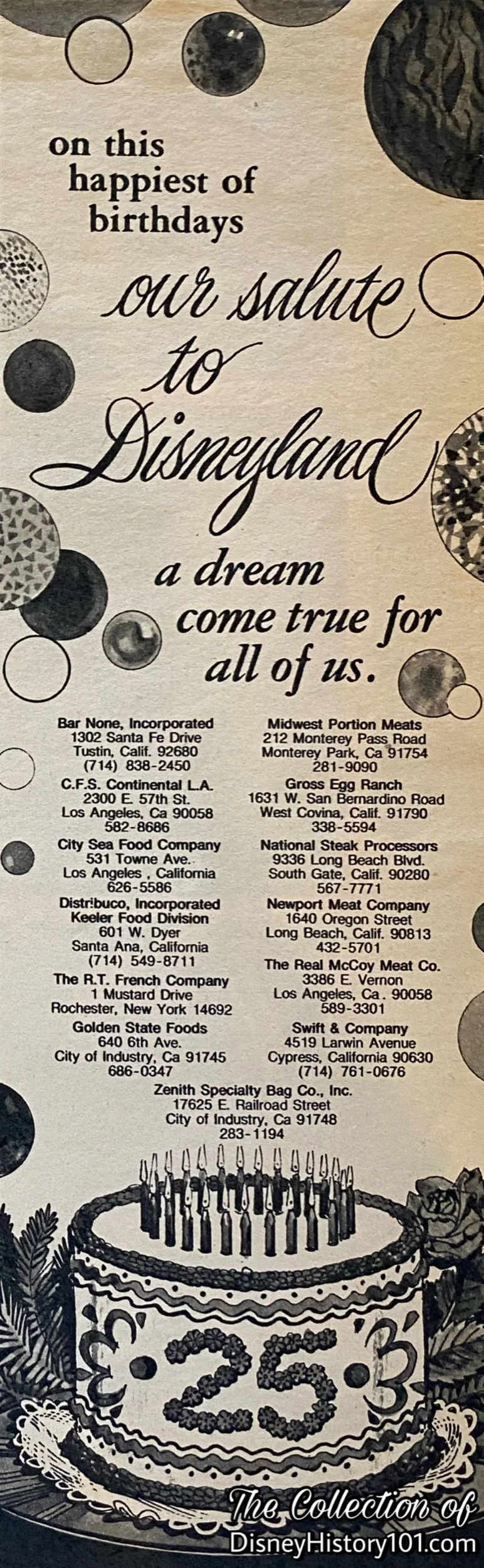
"Disneyland 25 - Happy Birthday to a Dream" supplement (published January of 1980).
By 1984, Market House hosted by Sun Giant--An old-fashioned general store featuring cider, coffee, pickles, cookies, natural food snacks, and stamps.
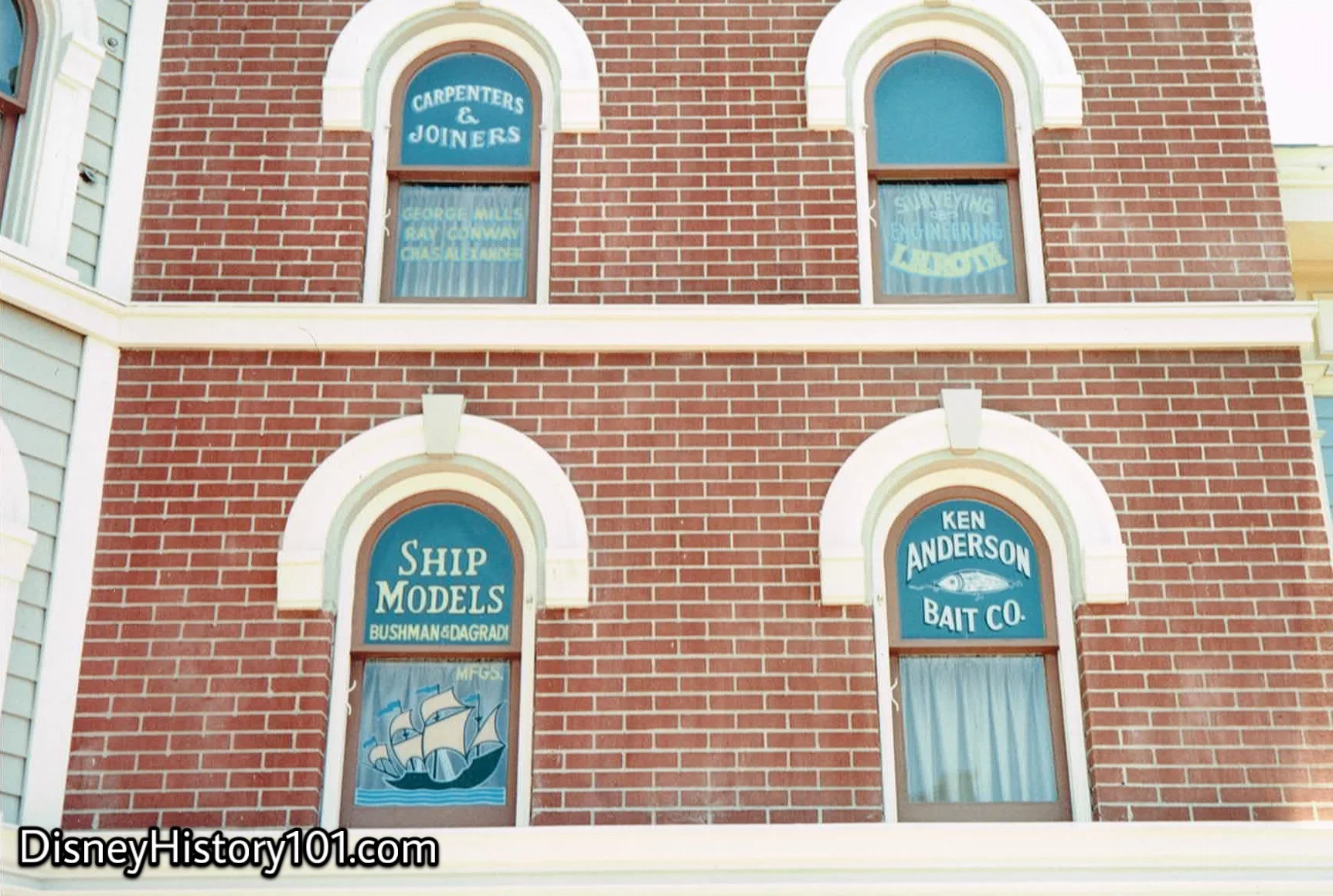
Market House Windows are among thousands of windows at Disneyland.
Martin Sklar once said “an individual's contribution can usually be found in the final product if one looks closely enough, but the Disney mind frame is to never point out ‘what I did’ to anyone… Marty professes that everybody who works as an Imagineer is a disciple of Walt… It's not our name on the front door, it's still ‘Walt Disney.’ He notes that even today, most people don't know ‘who we are individually’ at Imagineering and admits that there are some people who can't work that way. Some have big egos and want their name in lights, and they soon leave. Some pretty talented people have left Disney to do their own thing, and, you know, I appreciate that and am alright with it. I'm still close to a lot of them. Some of them even come back and do consulting work for us.”
However, a few outstanding individuals have been publicly recognized for their contributions and even ceremoniously honored by the Company.
According to Magic Kingdom Club (Fall of 1970) : “With the envied Disney penchant for artfully avoiding the direct or obvious in favor of the cleverly obscure, Walt had fun assigning to many of the Main Street window names ‘occupations’ or pursuits that often sidestepped reality. For instance, in his goldleaf salute to Ken Anderson, veneered to a glass pane above the Market House at 122 Main Street, Walt listed him as proprietor of a bait company. Anderson, still one of the Studio’s finest artists and, therefore, one of the best in the business, designed many Disneyland elements. He also happens to be a champion fly-caster and dedicated fisherman. Thus : ‘Ken Anderson Bait Co.’ By 1990, Ken Anderson was still serving as consultant for Walt Disney Imagineering.
‘Bushman and DaGradi, Ship Models’ is another tenant of the Market House.”
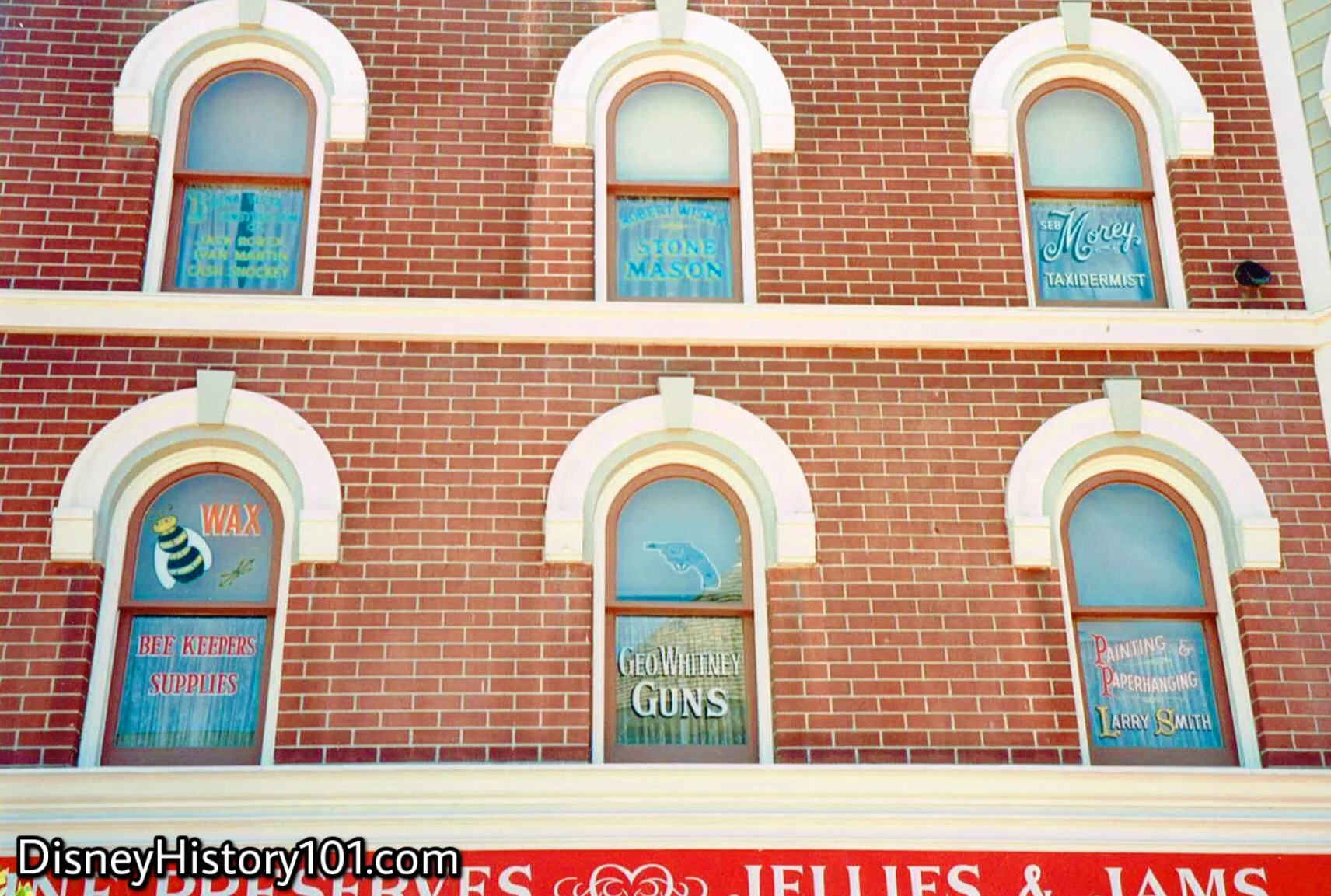
Market House Windows
“Robert Wisky, Stone Mason” was the result of an accidental change of the window’s wording to “Robert Whisky.” By 2016, his name had been restored at both Parks. Robert Jerome Washo aka Bud Washo (still known today as “Bud”) was Disneyland’s Buildings Manager. Bud headed the Staff Shop (which made the concrete, plaster, and plastic work for the Park). This, Bud did since Disneyland’s construction phase, until his retirement. According to Dave Smith (Chief Archivist Emeritus of The Walt Disney Archives), “Bud Washo (1923-1999) originally served in the staff (manufacture of interior and exterior ornamentation in fiberglass, etc.) and plaster shops at Fox, Columbia, Universal, and Paramount Studios. He joined Disneyland in 1954 as supervisor of the staff-and-plaster shop, and later moved to Walt Disney World to hold the same position.” [Disney Facts Revealed by Dave Smith, 2016].
“Seb.” (Sebastian) Morey (of the Disneyland Decorating Department, from 1956-c.1995). Originally, this window read “Bob Mattey - Taxidermist” from 1955-1969.
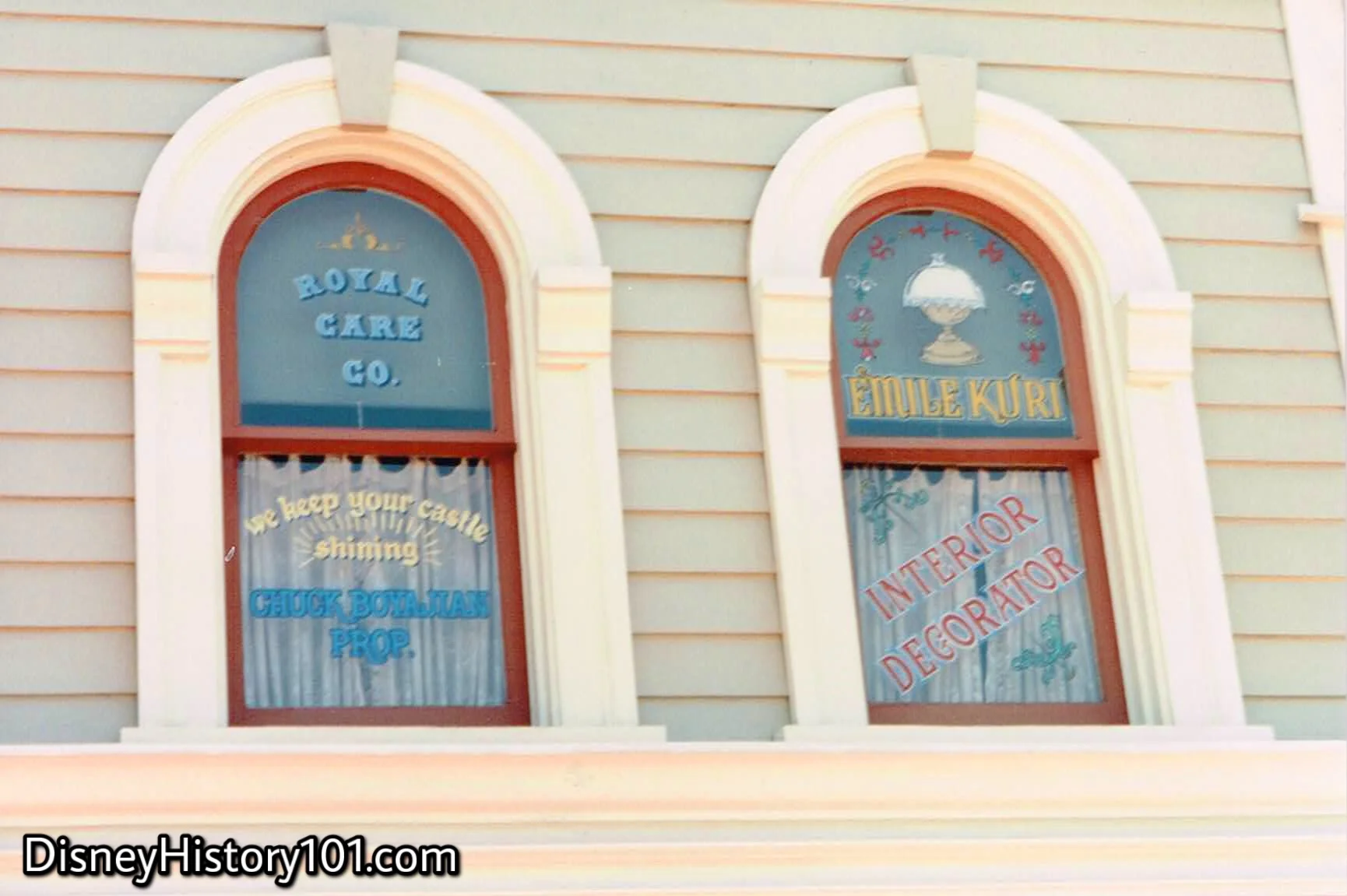
Chuck Byoajian and Emile Kuri Market House Windows
“From the Park’s earliest design stages to the time he retired, Emile Kuri contributed decorating talent to many of its settings. He supervised the Studio’s Set Decorating Department, and regularly assisted in creating Academy Award-winning stage settings. He is remembered with the window: ‘Emile Kuri, Interior Decorator,” according to “Disneyland - A Treasure Chest of Trivia,” prepared by Walt Disney Productions, 1990.
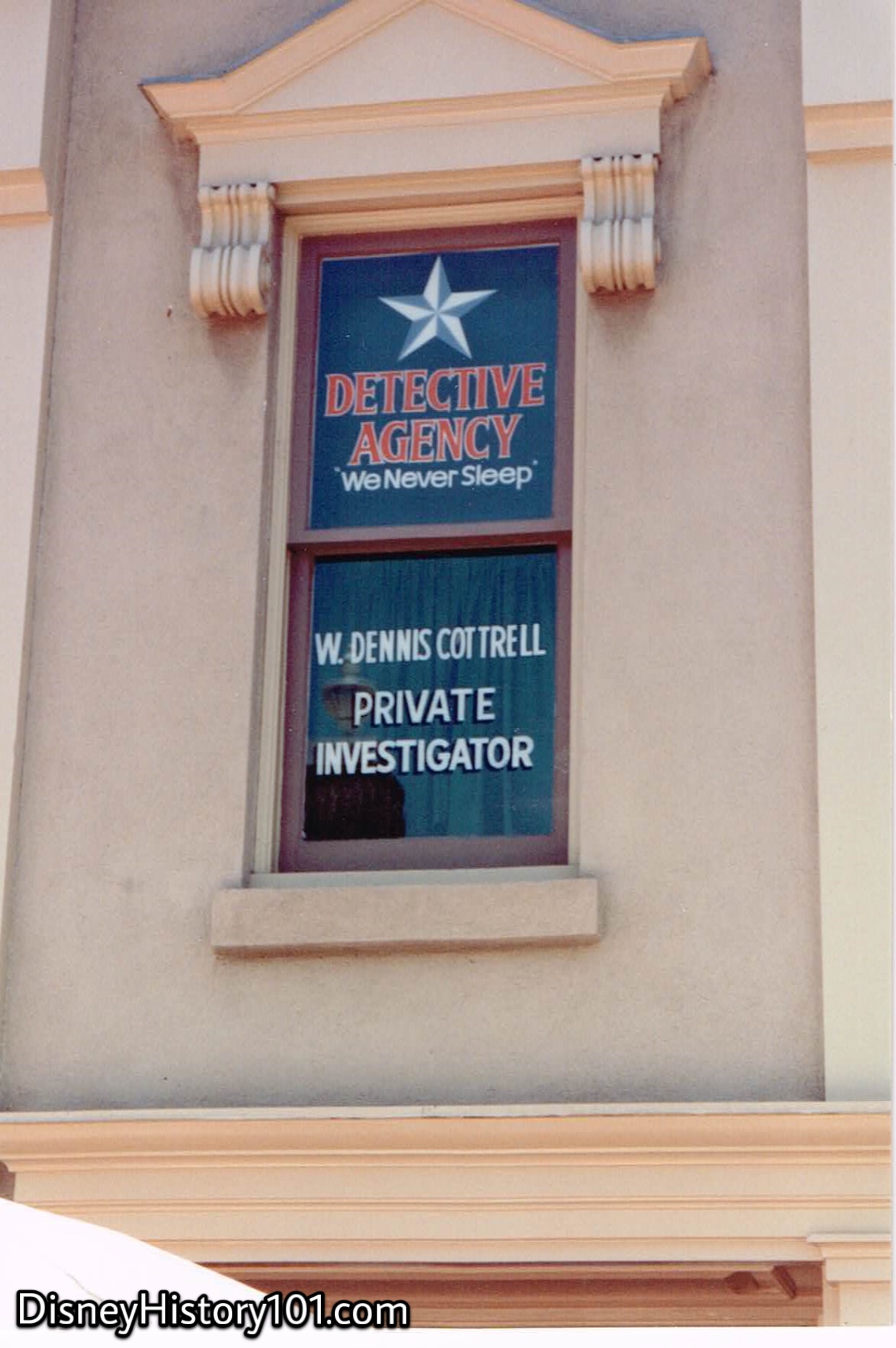
Market House William Harry Dennis Cottrell Window
“‘W.H. Dennis Cottrell, Detective Agency, Private Investigator. We never sleep.’ ‘Bill’ Cottrell is the retired President of Retlaw Enterprises, a private firm owned by Walt’s family. He was the President of the newly formed Walt Disney Imagineering when Disneyland opened. Mr. Cottrell was an ardent collector of items and information on Sherlock Holmes, which led Walt to ‘convert’ Bill into a detective for the window honor,” according to “Disneyland - A Treasure Chest of Trivia,” prepared by Walt Disney Productions, 1990.
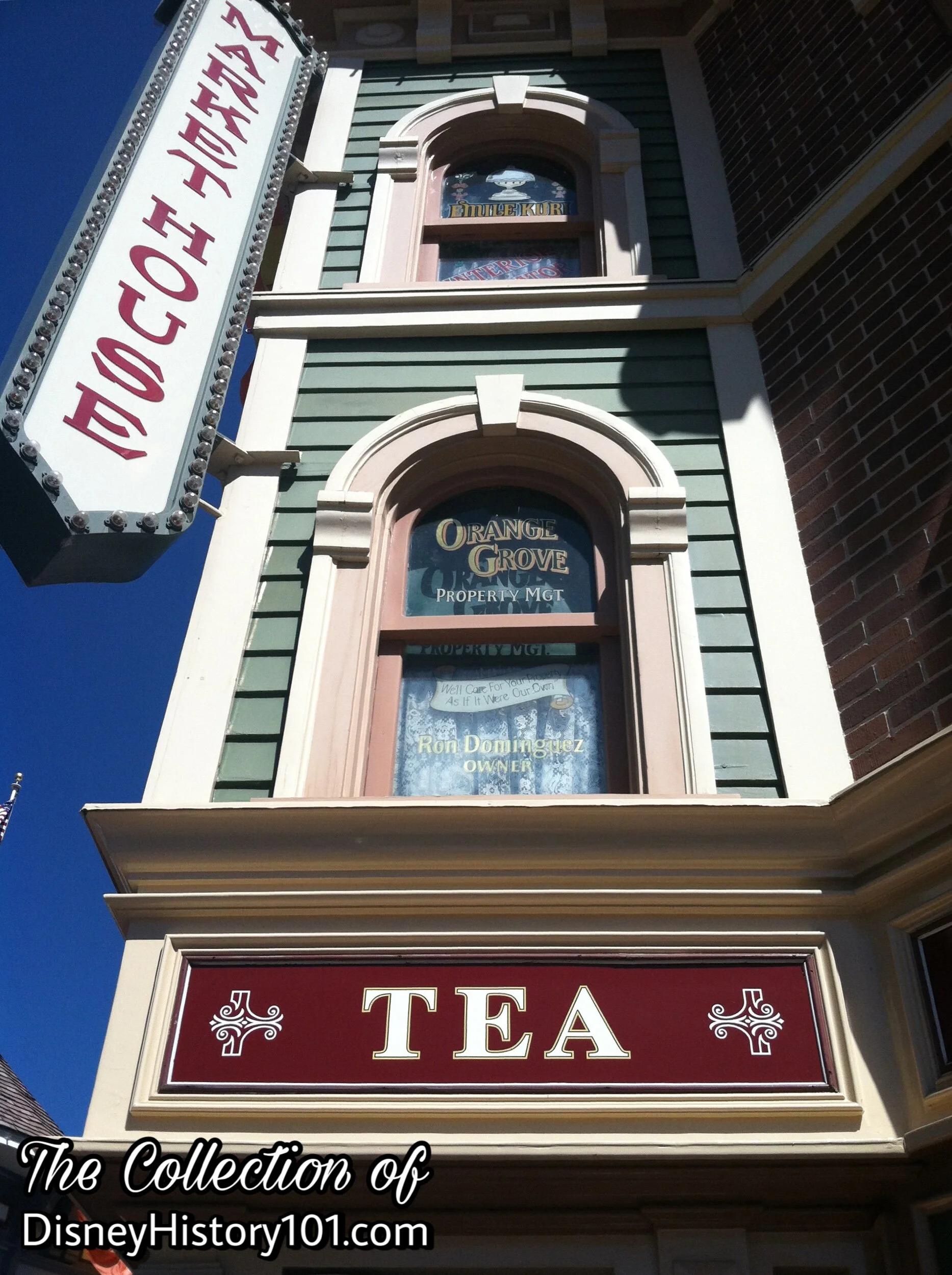
Market House Emile Kuri & Ron Dominguez Windows
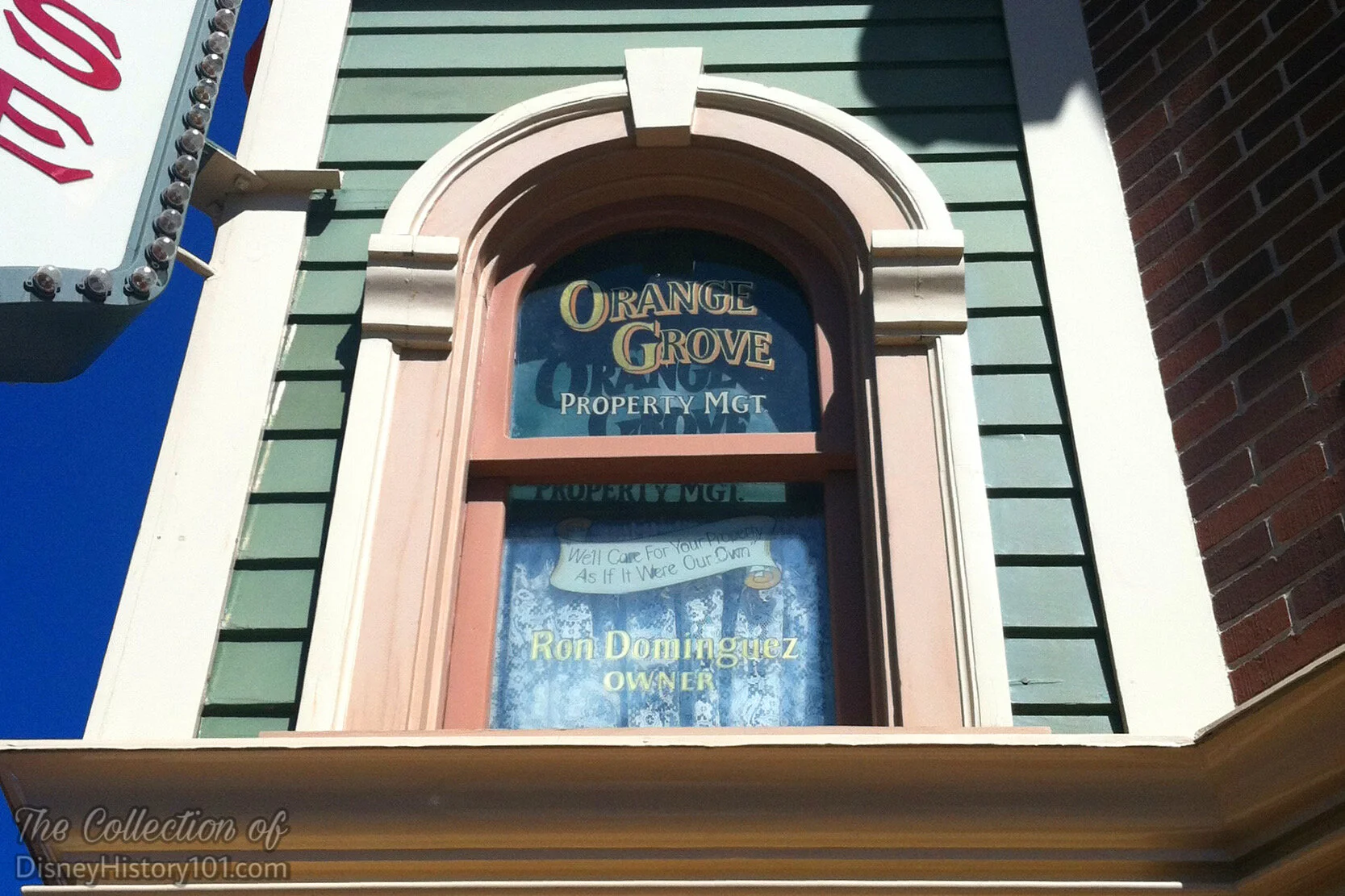
Market House Ron Dominguez Window
The Market House tradition lives on through other Disney Parks worldwide. For instance, the Market House Bakery at Hong Kong Disneyland (Hosted by Maxim's) features delicious pastries.
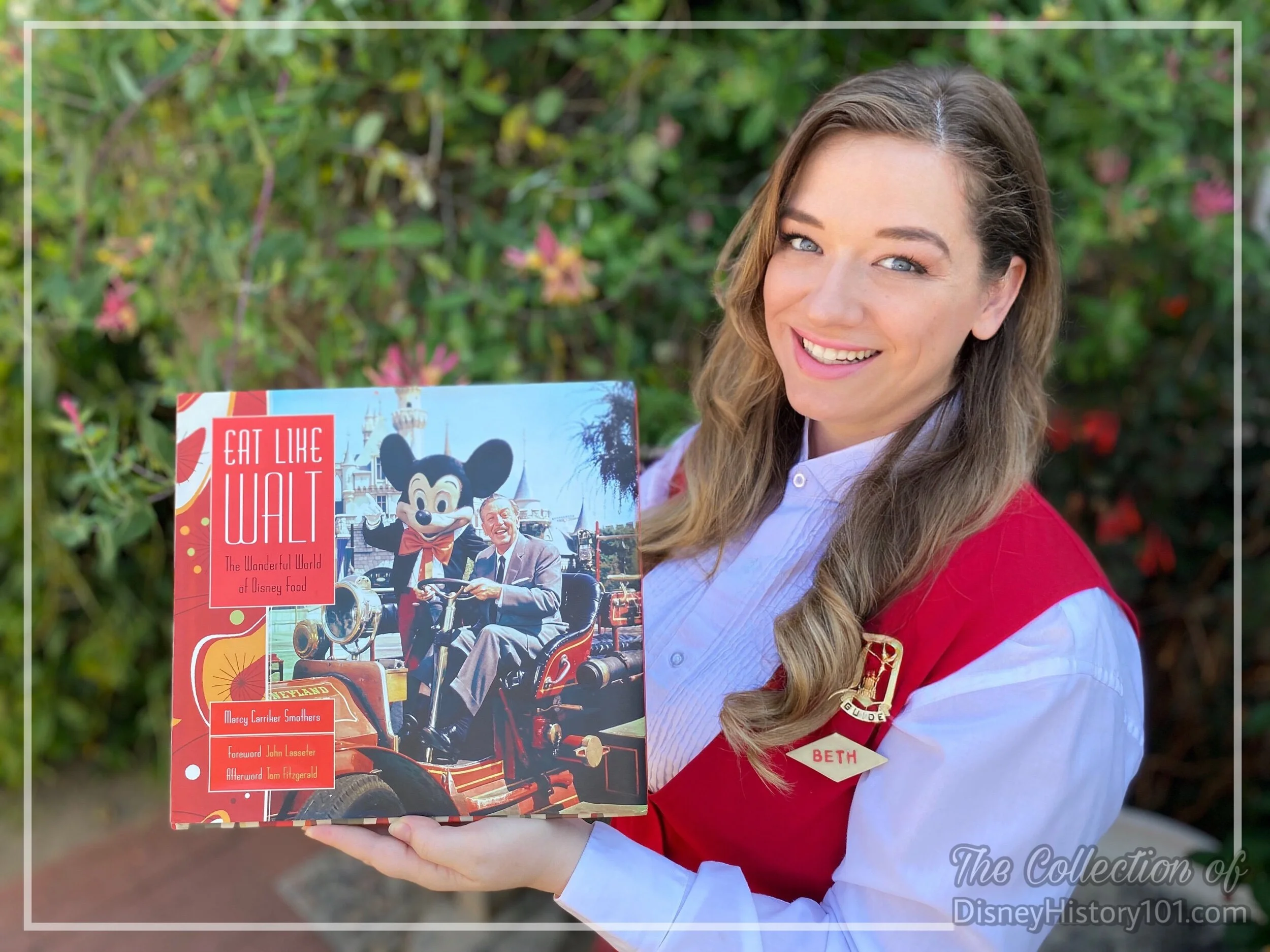
If you would like to read more about both the Swift Market House and the C&H Sugar Market House, it’s my pleasure to recommend adding Marcy Smothers’ “Eat Like Walt - The Wonderful World of Disney Food” to your personal Disney Home Library! Therein, Marcy has extensively researched and finely crafted a small section of a chapter dedicated to “Walt Disney’s Disneyland - Main Street U.S.A.” If you would like to bring the magic of Disneyland restaurants and concessions to your dining room table, “please step this way” toward www.eatlikewalt.com where Marcy has shared a few recipes for memorable Disneyland menu options, so you too can “Eat Like Walt.”
Quisque iaculis facilisis lacinia. Mauris euismod pellentesque tellus sit amet mollis.