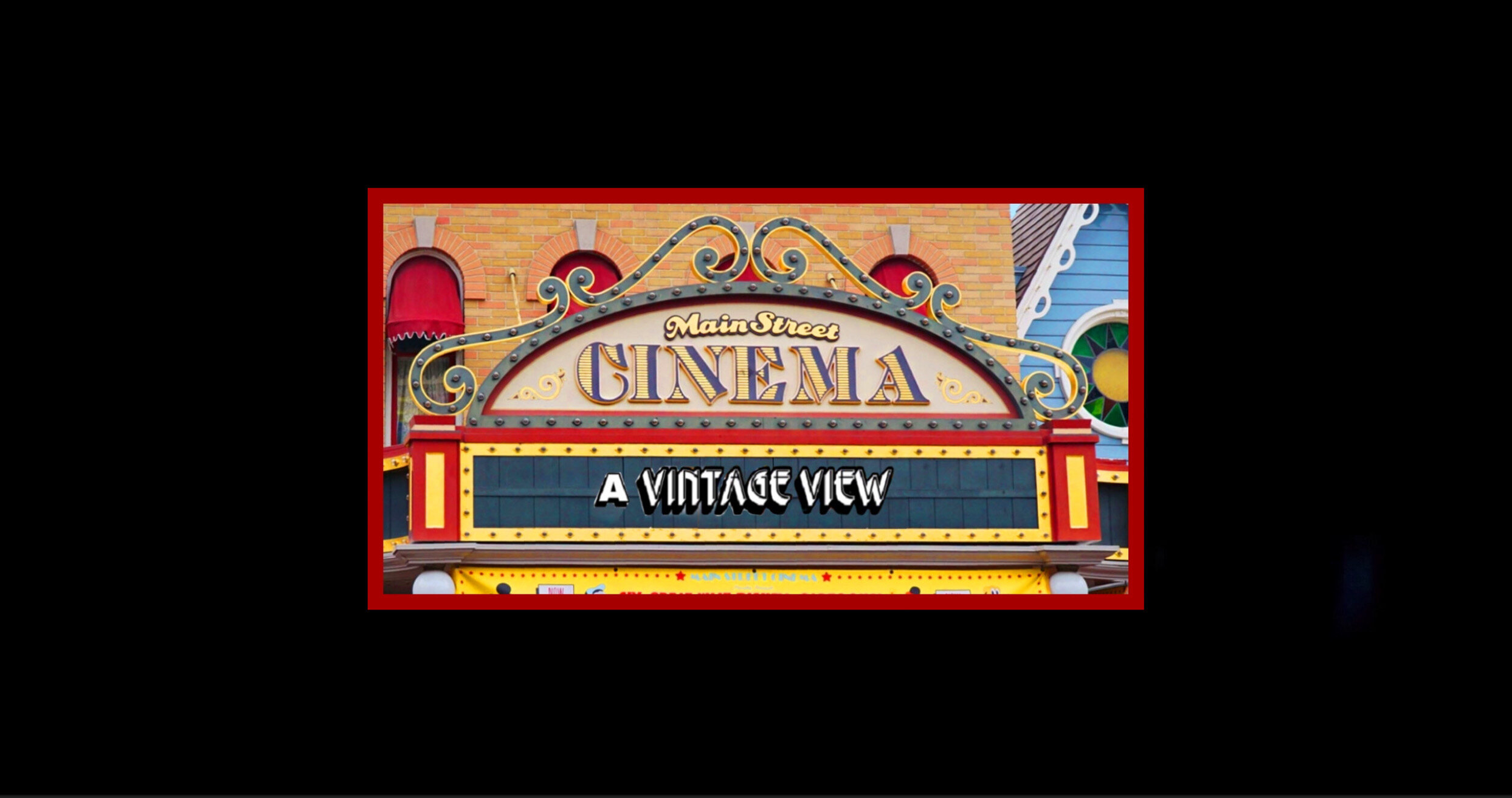
MAIN STREET CINEMA
(1955 – Present)
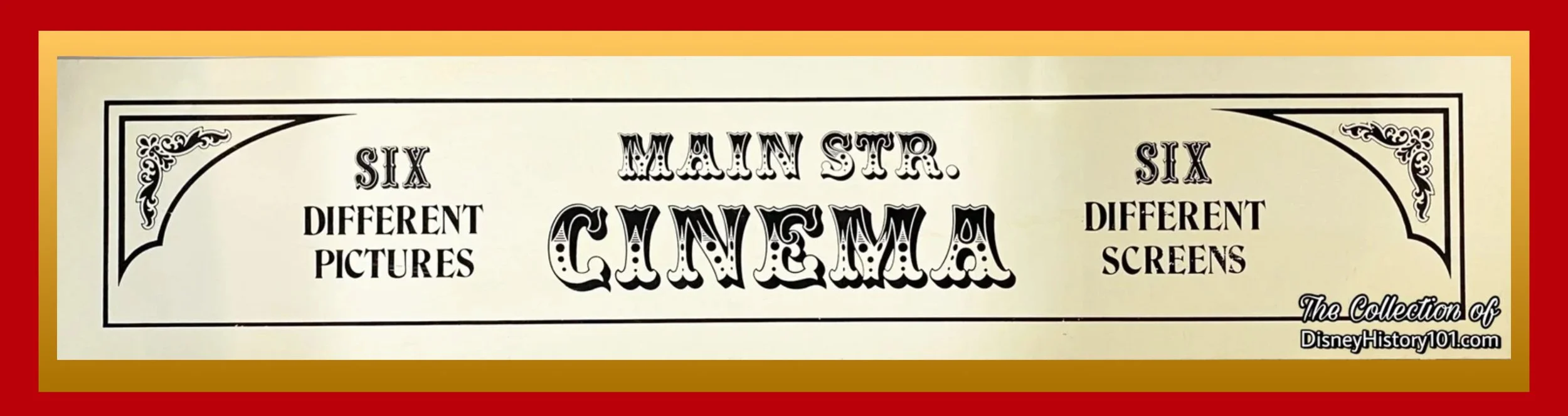
“Just down Main Street we even have a cinema where six different silent movies are shown continually.”
-Guided Tour Script, 1962.
“Blue Sky for the Disneyland Cinema”
Back in 1948, Walt was dreaming about a Park (to be located across the street from the Studio in Burbank). Some thoughts in the “Mickey Mouse Park” prospectus made mention of a “movie theater.” [“The Spirit of Disneyland”]
Early thumbnail sketches and other concept artwork seemed to be unencumbered by restrictions of budget, schedule or the laws of nature and physics. Though guided by Walt, his artists appeared to engage in “free-thinking,” as if implementing the modern “Blue Sky” Imagineering process.
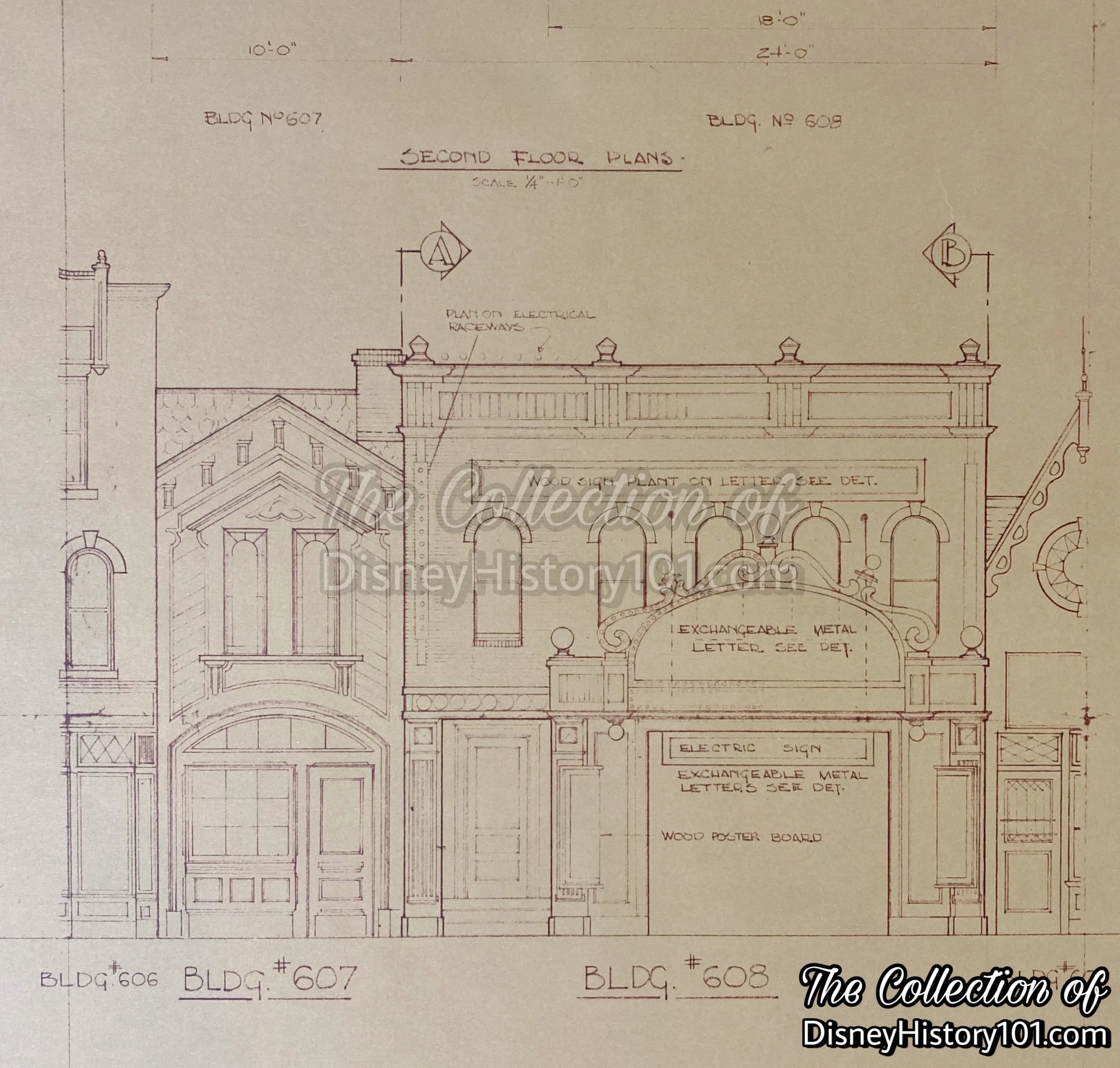
“Draw Concept” - The Main Street Cinema Architectural Facade
“Design”
Like some advanced “High Concept,” final designs were quickly generated and approved. By July 1, 1954, George Whitney of Disneyland, Inc. directed Amusements, with Ron Miller overseeing analysis, philosophy, capacities, planning, operator training, and amusement procurement.
Next, architectural drawings helped define all designs, production and construction strategies, costs, schedule, and resource requirements. “Disneyland is unique in that some of the world's foremost creative artists and architects control all design at Disneyland.“ Models also explored the various dimensional relationships, site-lines, flow patterns, ergonomics, and visual appeal to convey the desired creative intent.
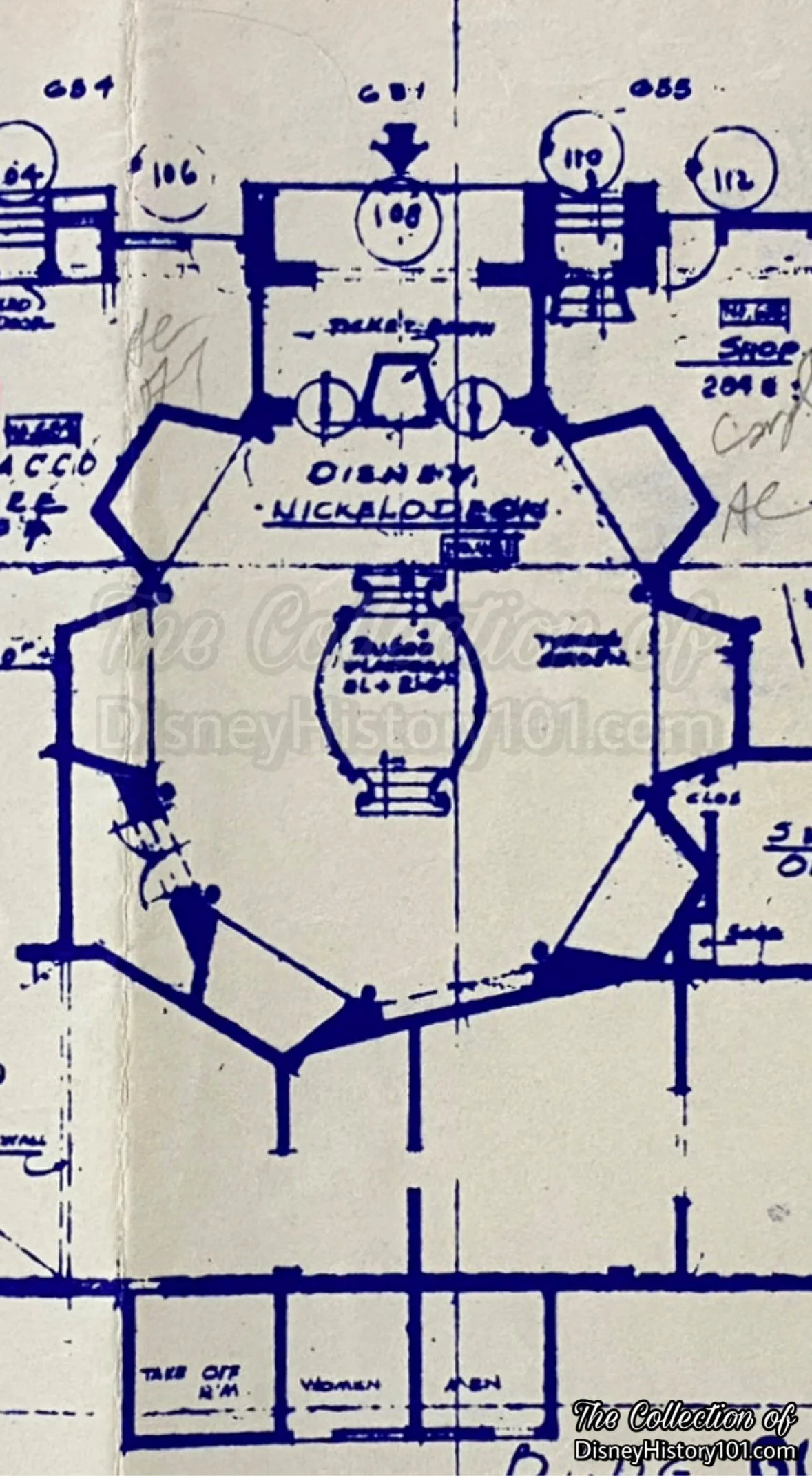
The Disney Nickelodeon in Building 600.
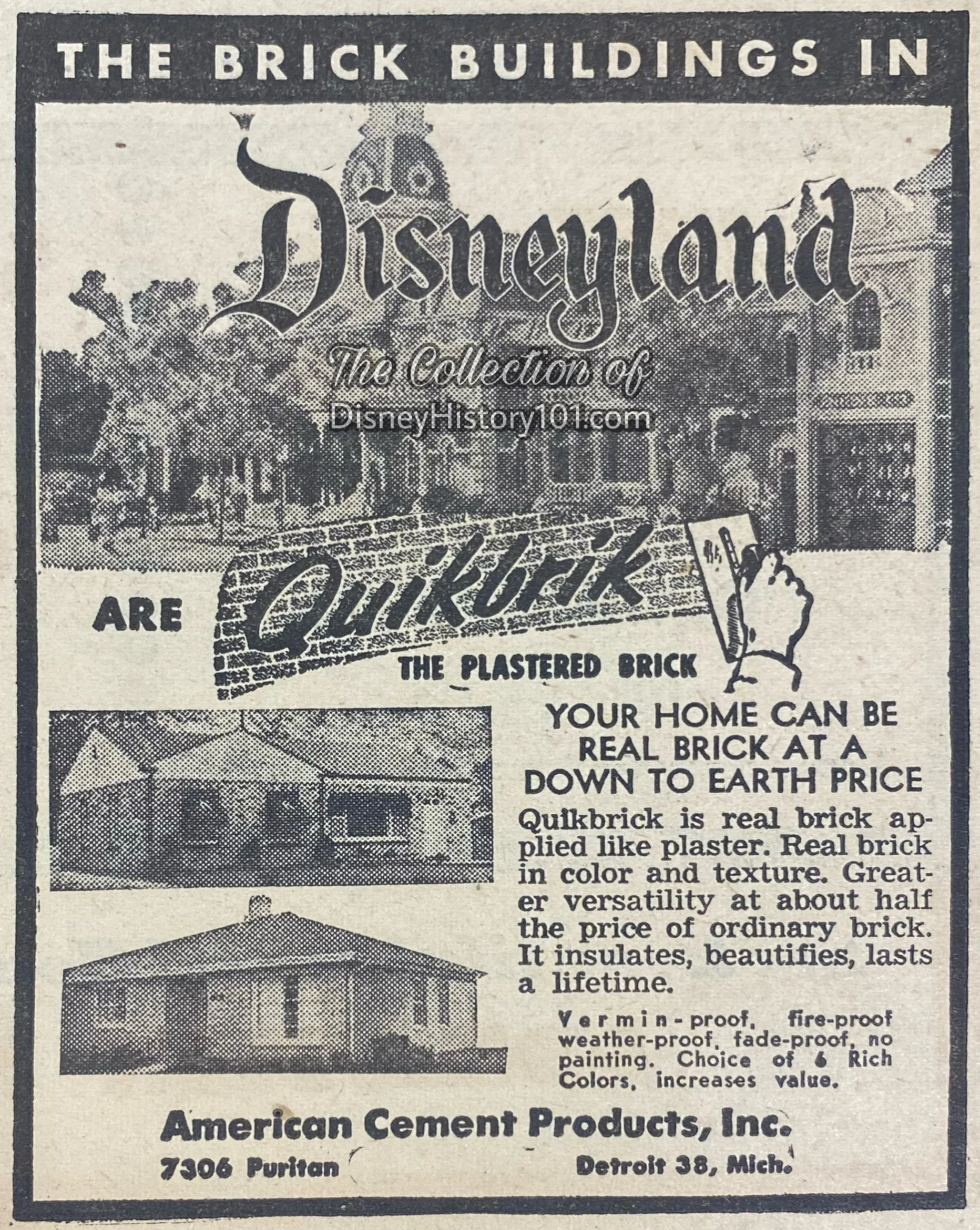
“Setting the Stage — Construction”
First, a concrete foundation and slab floors were prepared, followed by wood frame construction (while store units would have a combination wood and rigid steel frame).
According to inserts published in area newspapers during July of 1955, Disney buildings were roofed by Pioneer Roof & Shingle Company (then located at 608 Mateo Street, Los Angeles, California; 7522 Westminster Avenue, Westminster, California). The roof covering was a variable, dependent on the architectural design.
Larson Brothers Plastering Company of San Diego was a proud part of Disneyland. The company crafted the ornamental plastering and all brick used at Disneyland (including their amazing new plastered brick veneer). The versatile Quikbrick (real colorful and textural brick applied like plaster) was about half the price of ordinary brick. It insulated, beautified, and was meant to “last a lifetime.” It was used on the facade.
“Projection Systems”
Disneylander and “55er” John Gerlack recalled: “I was a projectionist and Disneyland was begging for projectionists. Everybody thought the Park would be a 'fly-by-night' affair, and we didn't want to leave good jobs and come to Disneyland, but as soon as I saw what was going on, I knew that it was going to be permanent. You could see that Walt meant business! Everything looked well organized and I was very impressed with the Castle… Dominic Conte and I had to install the projection equipment in the Main Street Cinema. The equipment was called Kodak Cine Sales. As we had never worked with equipment like that, we had to learn about it from the beginning.”
Air-conditioning was essential to control the dust, and a practical mechanical application of the technology was essential in the attraction where projection equipment and film was used.
As of June 2, 1955, C.V. Wood Jr. sent an Inter-Office Memorandum to Walt Disney regarding the best estimates that could be obtained at the time regarding the completion status of individual sections of the Park and Opening Day. C.V. wrote: “Building #608 - Main Street Cinema, - This will be completed for opening assuming that we are able to get the film in time. Electric Signs: All are in work - with the exception of the shoe store and the Bank of America, all will be completed.“
The 1,317 square foot space of the Main Street Building #600 (as each on Main Street U.S.A.) possessed complete fire sprinkling systems. By June 30, 1955, related Disneyland Site Work Fire Protection Utilities Plot Plans were prepared for Disneyland Inc., by J.E. Thomasson of WED Enterprises Inc.
“The Player Piano”
As opening day arrived, the fixtures were placed in their correct motif including any light fixtures of Disneyland, which were authentic antiques.
One of the foremost antiques provided musical accompaniment to the Main Street Cinema. The very first Disneyland Map Guide (revised for 1957) described the Main Street Cinema’s musical accompaniment in the following way: “Old silent movies with player piano accompaniment revived for the amusement of modern day audiences.” By 1969, this attraction contained 1 of 15 old-time band organs and pianos at Disneyland, some of which dated back to 1890. But eventually, replacement parts for these rare antiques grew hard to come by. So, Disneyland Arcade Maintenance performed the necessary versatile, creative, and inventive mechanical repairs.
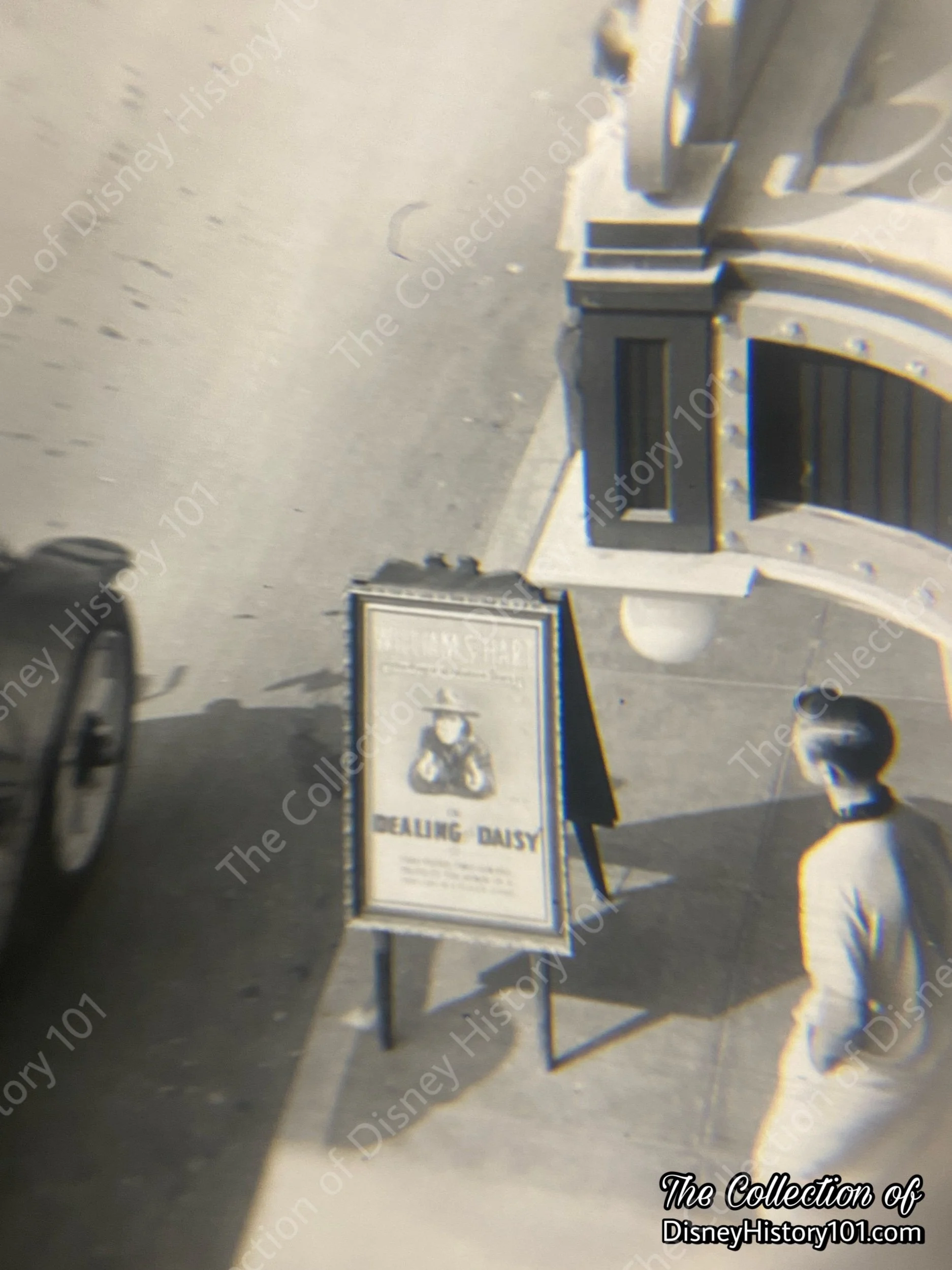
Through the loupe we can spy an A-frame “sandwich board” sidewalk sign promoting “A Dealing for Daisy” (1915) starring William S. Hart.
“July 17, 1955 —The First Visitors ‘See The Film Classics of Ages’”
Walt once shared: "I love the nostalgic myself. I hope we never lose some of the things of the past.” As Disneyland was two months from opening, one authorized “Disneyland Information & Nomenclature List” (prepared by Bill Cottrell by of Disneyland Inc., May 25, 1955) described the “Main Street Cinema (formerly Nickelodeon)” as an exhibit with “6 performances running continuously and simultaneously, of old silent movies with piano accompaniment.”
July 17, 1955 arrived and guests poured through the turnstile. While hosting Dateline Disneyland, Bob Cummings exited the antique car he was riding in, in order to get a better look at the theater on the 600 block of Main Street U.S.A.
Once inside, visitors found that there were no chairs, only a central standing area where six silent films could be viewed simultaneously. Background orchestration was supplied by a turn-of-the-century music box. In 1955, the assortment of silent short films (or, “film classics of the ages”) was far different than what runs in the present. Disneyland Main Street Cinema patrons could watch “Shifting Sands” (starring Gloria Swanson), “Dealing for Daisy” (starring William E. Hart), Winsor McCay’s “Gertie the Dinosaur” (considered the first animated cartoon ever created and was one of Walt's inspirations to become an animator), Mack Sennett’s “A Dash Through the Clouds” playing as a “double feature” on the same screen as “Fatima’s Dance” (yes, the once censored film of 1896), and “The Noise of Bombs” (starring the Keystone Kops). In addition, “glorious hand-tinted slides” (in color) were run in between films.
Reviews were honest, like that of a contributing writer of The Daily Oklahoman (who visited on July 17, 1955) and described Main Street Cinema as “a silent movie house advertising such stars as Mabel Normand and William S. Hart. The nickelodeon featured six different screens which could be seen from the center of the darkened arena amid the plunking of a ragtime piano.”
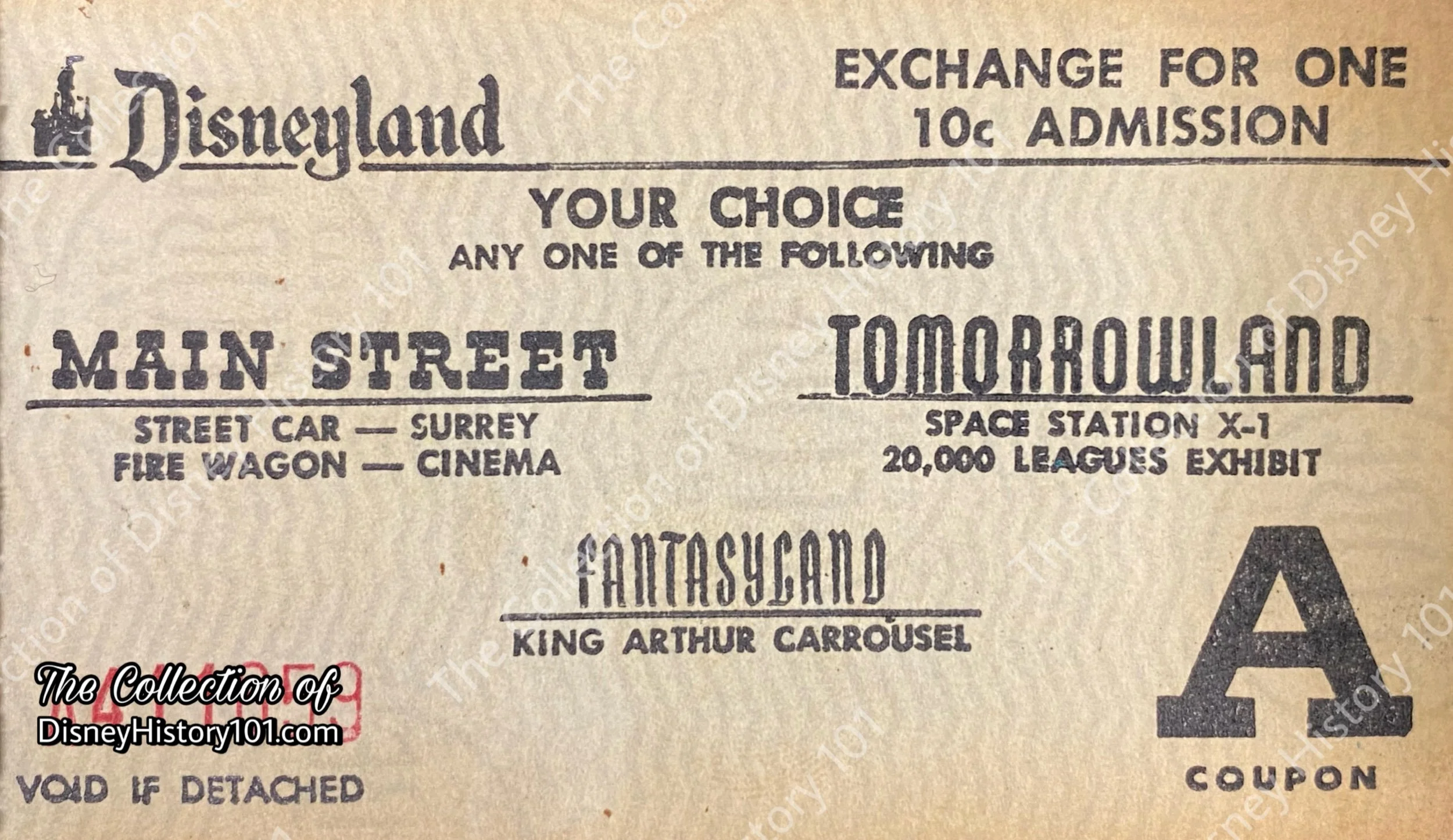
Main Street Cinema was an attraction (valued at 10¢) on the 1955 “A” Admission Ticket Coupon of ABC Ticket Books introduced October 1955.
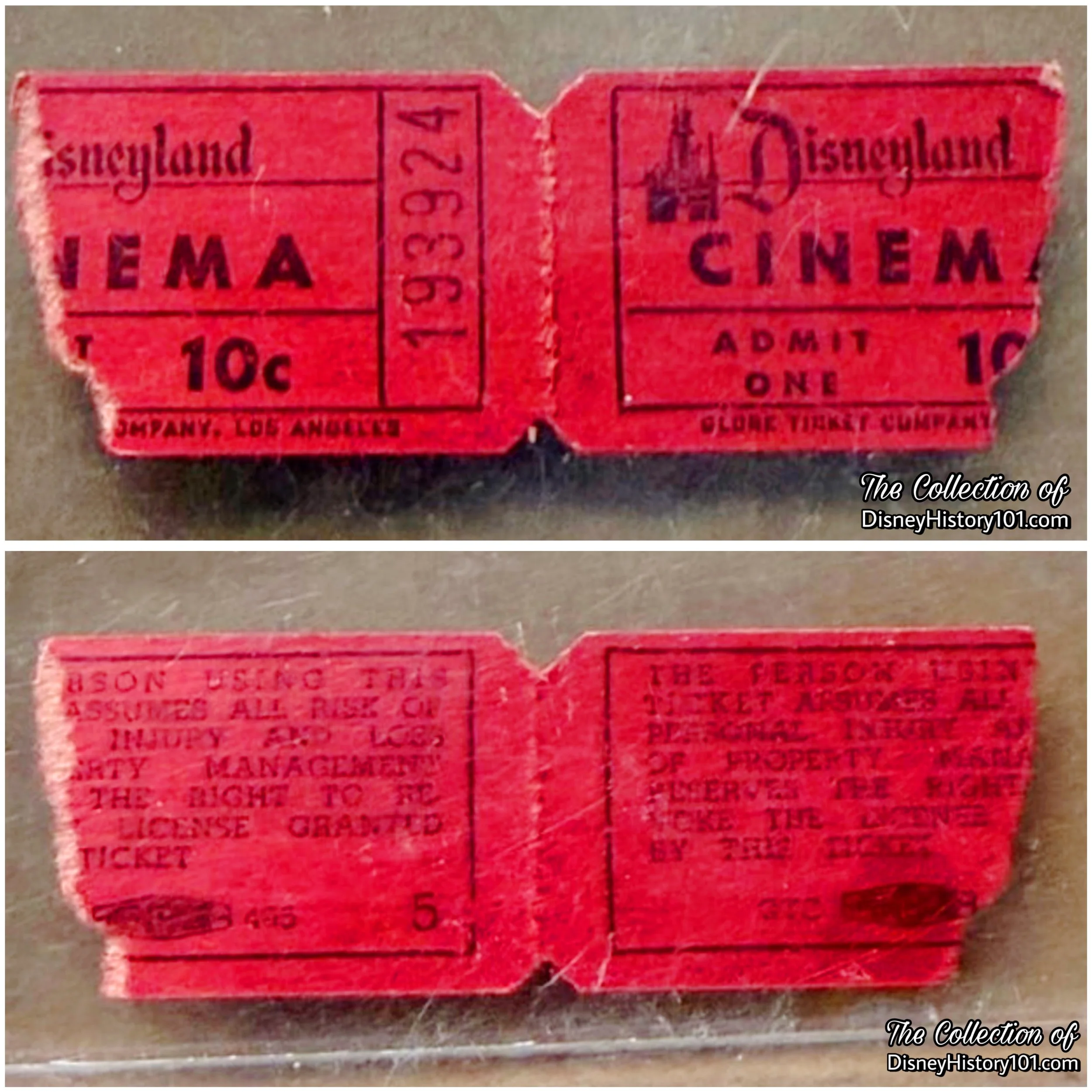
A pair of tickets for the Disneyland Cinema.
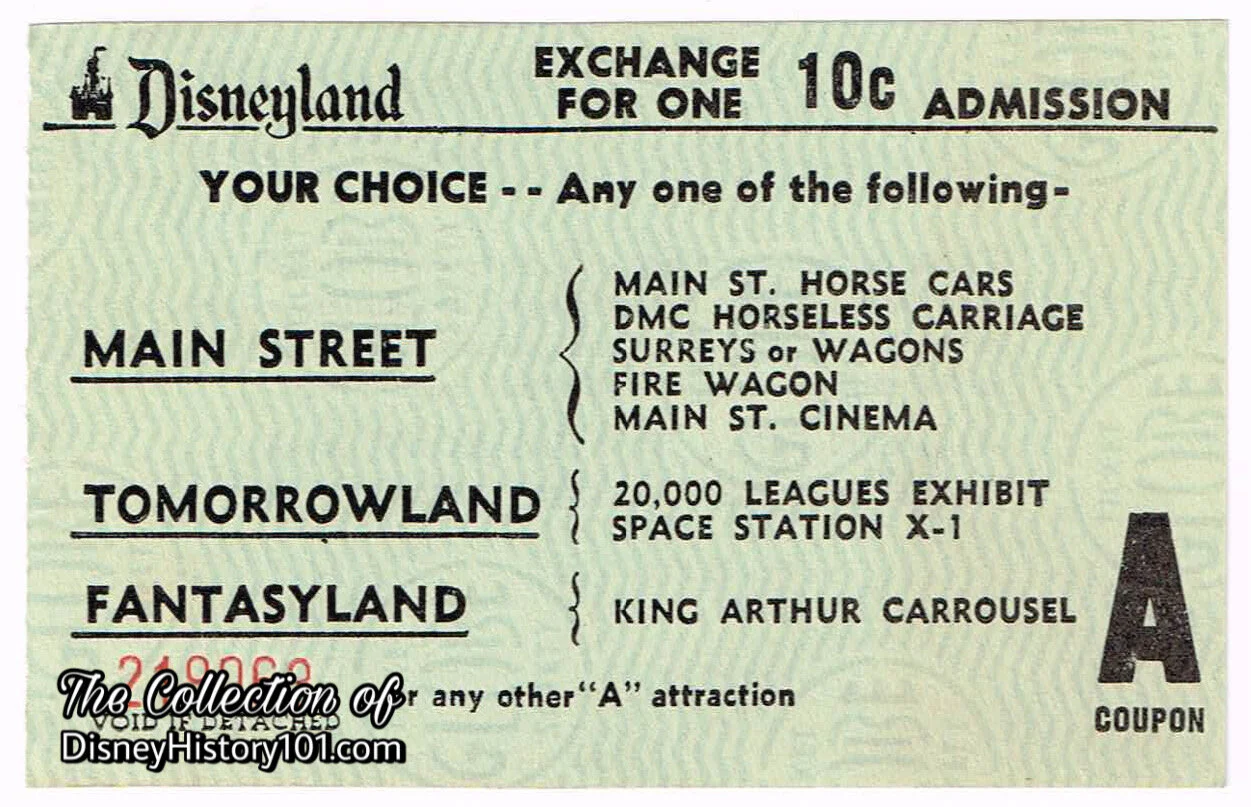
Main Street Cinema admission featured on the Disneyland “A” Coupon (valued at 10¢) of 1956 ABCD Ticket Books.
According to the souvenir book “A Complete Guide To Disneyland” (published 1956), Main Street Cinema was a place where guests could enjoy “unrivaled greats” of the silent screen era of cinema entertainment - “old time silent movies starring yesterday’s favorites.”
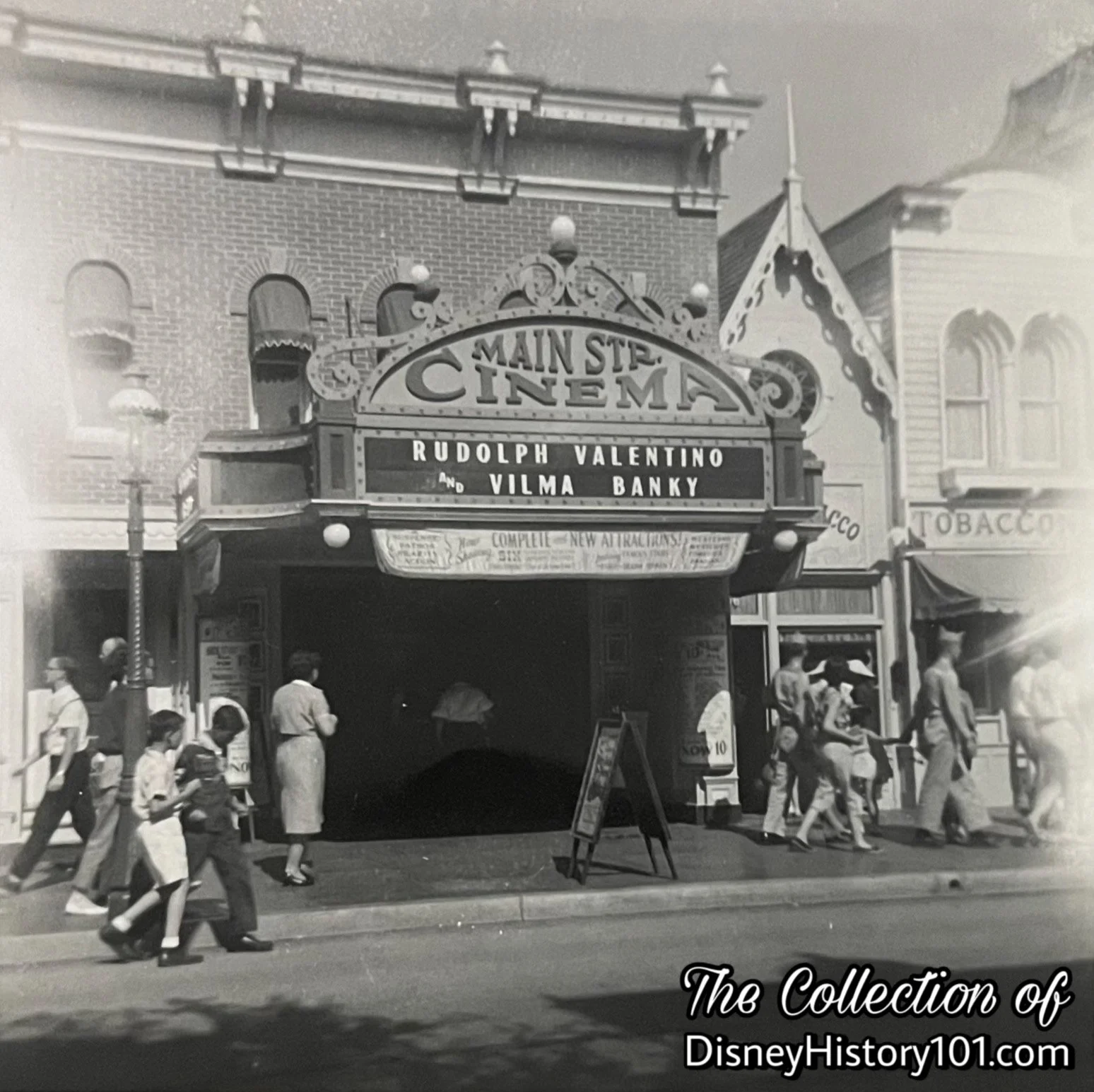
The Main Street Cinema marquee simply features the names of silent film, legends Rudolph Valentino (1895-1926) and Vilma Banky (1901-1991); July of 1957.
In 1957, admission to see all six films on six individual screens was originally just 10 cents. As Disneyland Holiday magazine c.1957 put it: “For one thin dime, you can enjoy more than an hour of motion picture entertainment by some of the top stars of yesterday.” By June of 1957, the Main Street Cinema was showing “The Great Train Robbery” starring “Bronco” Billy Anderson, “Dizzy Heights and Daring Hearts” starring Chester Conklin, “The Heart of a Waif” starring Claire Booth, and “The Speed Kings” a Keystone Kop thriller featuring Mabel Normand and Fatty Arbuckle.
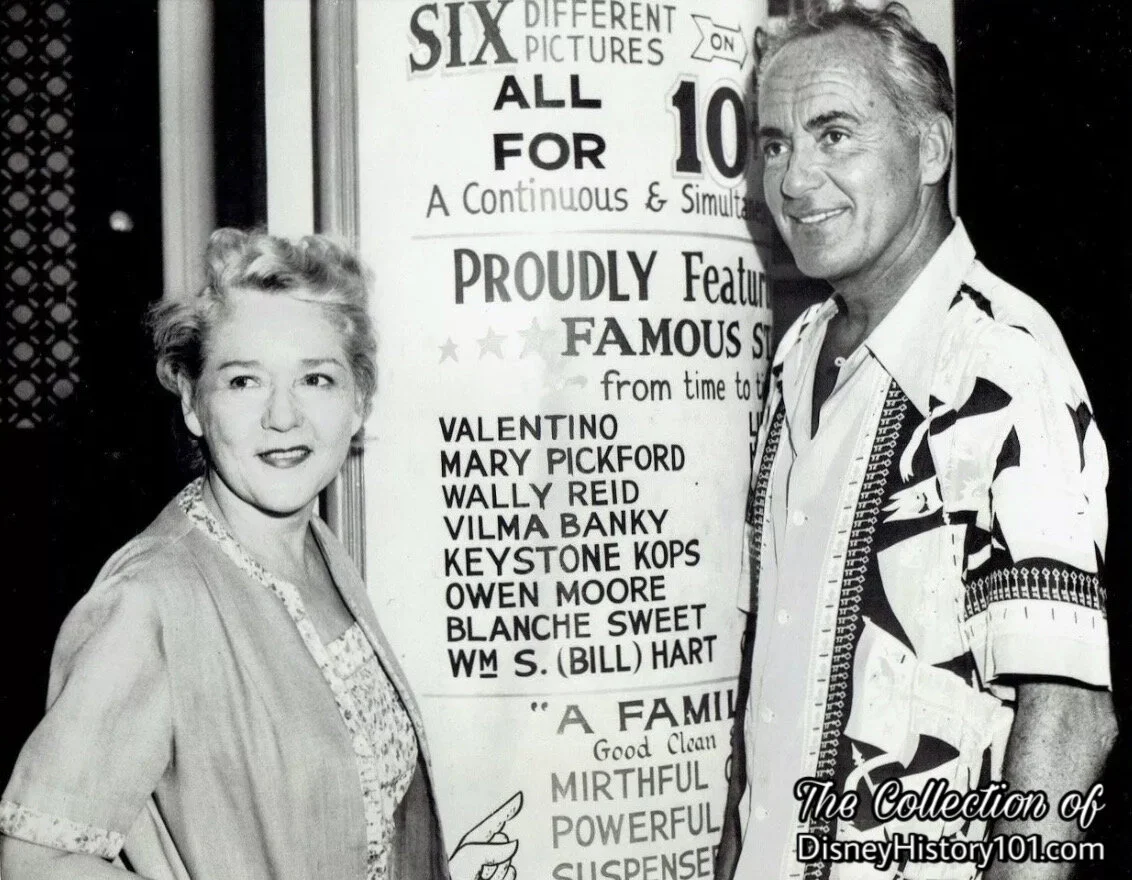
Mary Pickford and Buddy Rogers Visit Main Street Cinema; August 15, 1957.
Yes, silent-era film actress (and “America’s Sweetheart”) Mary Pickford and her husband Buddy Rogers visited the Main Street Cinema.
Back in 1932, Pickford co-founded United Artists, which became the distributor for Walt Disney’s animated short films. At the time, Mary was a huge fan of Walt Disney’s “Flowers and Trees” in which he pioneered the use of full three-strip Technicolor. In 1933, Mary approached Walt over a collaborative “Alice in Wonderland” film, featuring a blend of live action and animation. Though Mary completed a Technicolor screen test and posed for publicity photos dressed as Alice, alongside Mickey Mouse, the project was canceled. But that wasn’t the end of Mary and Walt’s partnership as the two were both were co-founders of the Society of Independent Motion Picture Producers in 1941.
More than a decade later, Mary visited Walt Disney’s Disneyland and was photographed next to her name on the marquee of Main Street Cinema (as published in Disneyland Holiday magazine). On this visit, the couple watched “New York Hat” which Miss Pickford had starred in more than 30 years prior.
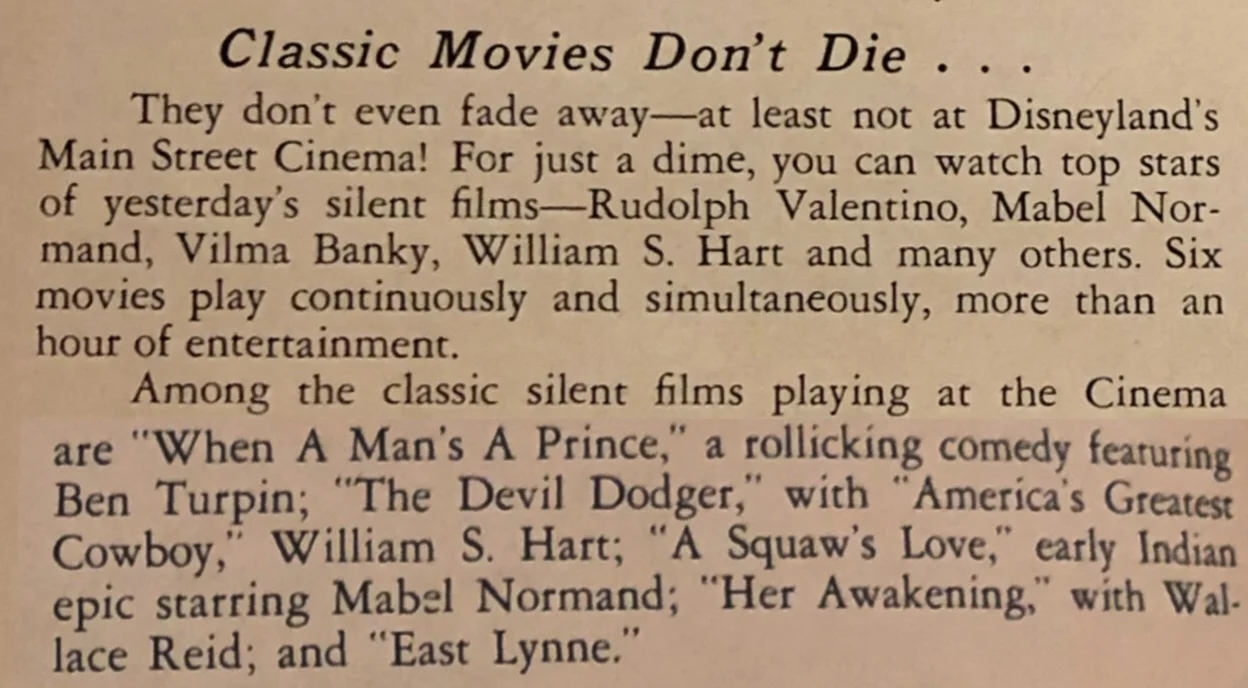
Excerpt from Disneyland Holiday, Winter, 1957-58.
The Main Street Cinema was one of few locations that carried on the silent-film legacy of such artists. Later films starred more of the greats of the Golden Age of Hollywood films - Charlie Chaplin, Douglas Fairbanks, Eddie Polo, Mabel Norman, Buster Keaton, Elmo Lincoln, Jackie Coogan, Pearl White, Will Rogers, Art Acord, Fatty Arbuckle, John Gilbert, Lillian Gish, Rudolph Valentino, and Lon Chaney - some films produced by Mack Sennett or Hal Roach! Among the classic silent films which played later were “When a Man’s a Prince,” a rollicking comedy featuring Ben Turpin; “The Devil Dodger” with “America’s Greatest Cowboy”, William S. Hart; “A Squaw’s Love”, an early Indian epic starring Mabel Normand; “Her Awakening”, with Wallace Reid, and “East Lynn.” An article featured in an early issue of Disneyland Holiday magazine described this locale as one of Disneyland’s “continuous shows”, where “classic movies don’t die”, in fact they don’t even fade away. “For just a dime you can watch top stars of yesterday’s silent films - Rudolph Valentino, Mabel Normand, Vilma Banky, William S. Hart, and many others. Six movies play continuously and simultaneously, more than an hour of entertainment.
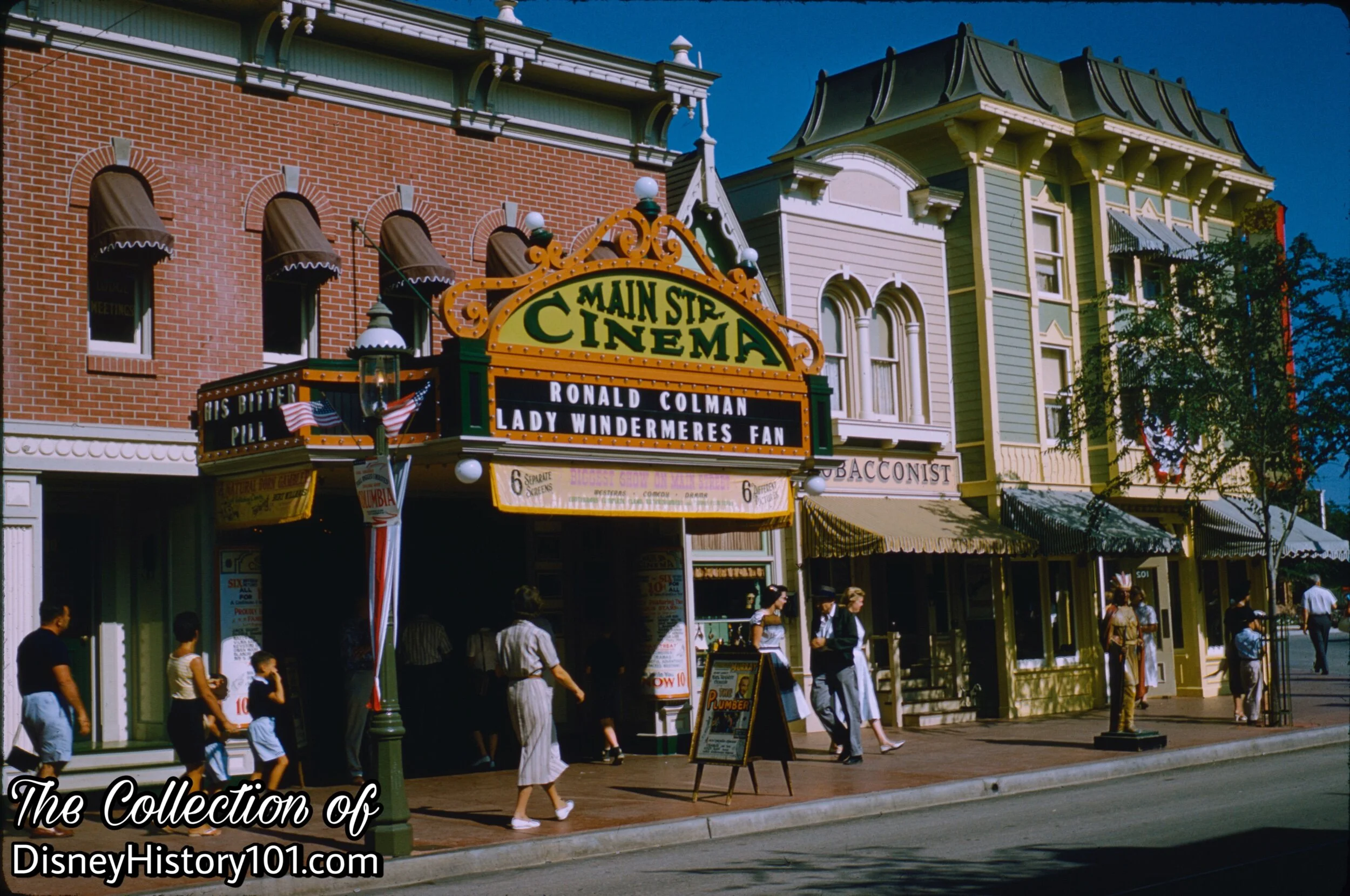
Main Street Cinema marquee billing “Lady Windermere's Fan” and “His Bitter Pill”; August, 1958.
By January 1, 1958, the 1,317 square-foot Main Street Cinema (located in Main Street Building #600) was still being leased. By September 28, 1958, Bank of America appraised the turnstile (considered a Park Asset) and valued it at $523. That same year, admission to view old time silent movies was one “jumbo” “A” coupon (the price of 10 cents, for one adult), the same as the 20,000 Leagues Under the Sea Exhibit, the Omnibus, or the King Arthur Carrousel. Guests could step inside and watch silent films like Ernst Lubitsch's Lady Windermere's Fan.
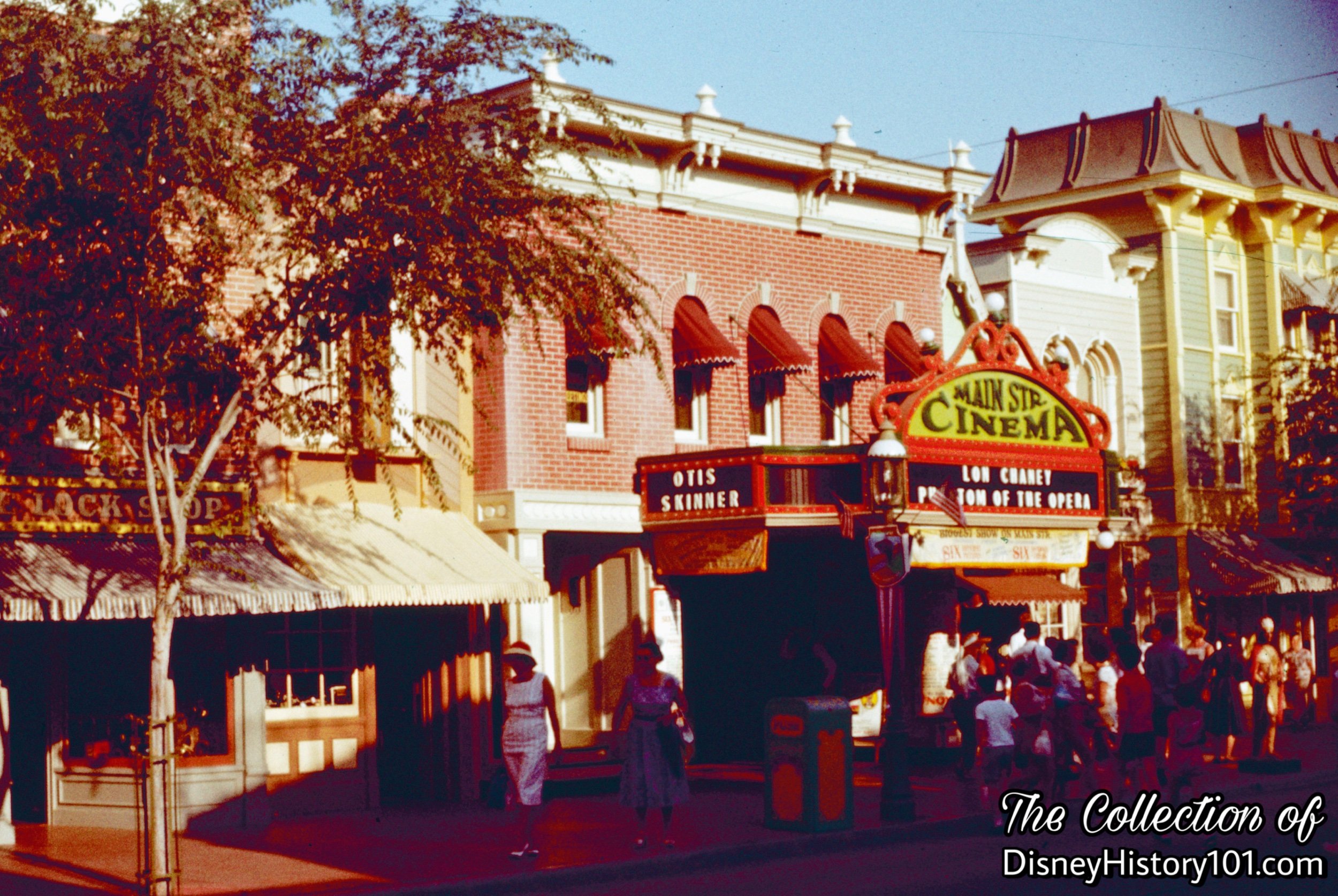
Main Street Cinema marquee billing “The Phantom of the Opera” and Stage Legend and Silent Film star Otis Skinner of “Kismet” (1920) fame.
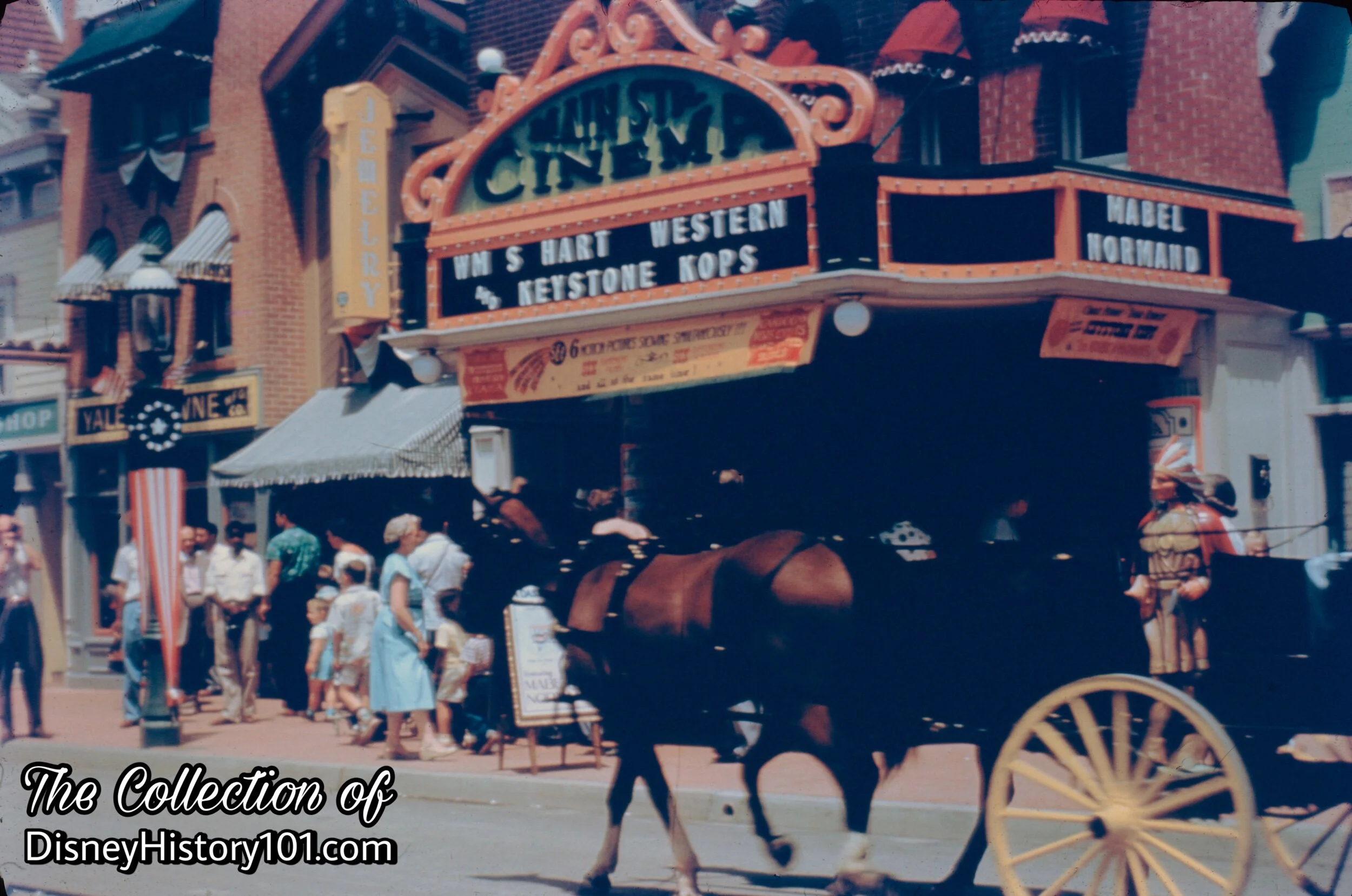
Main Street Cinema
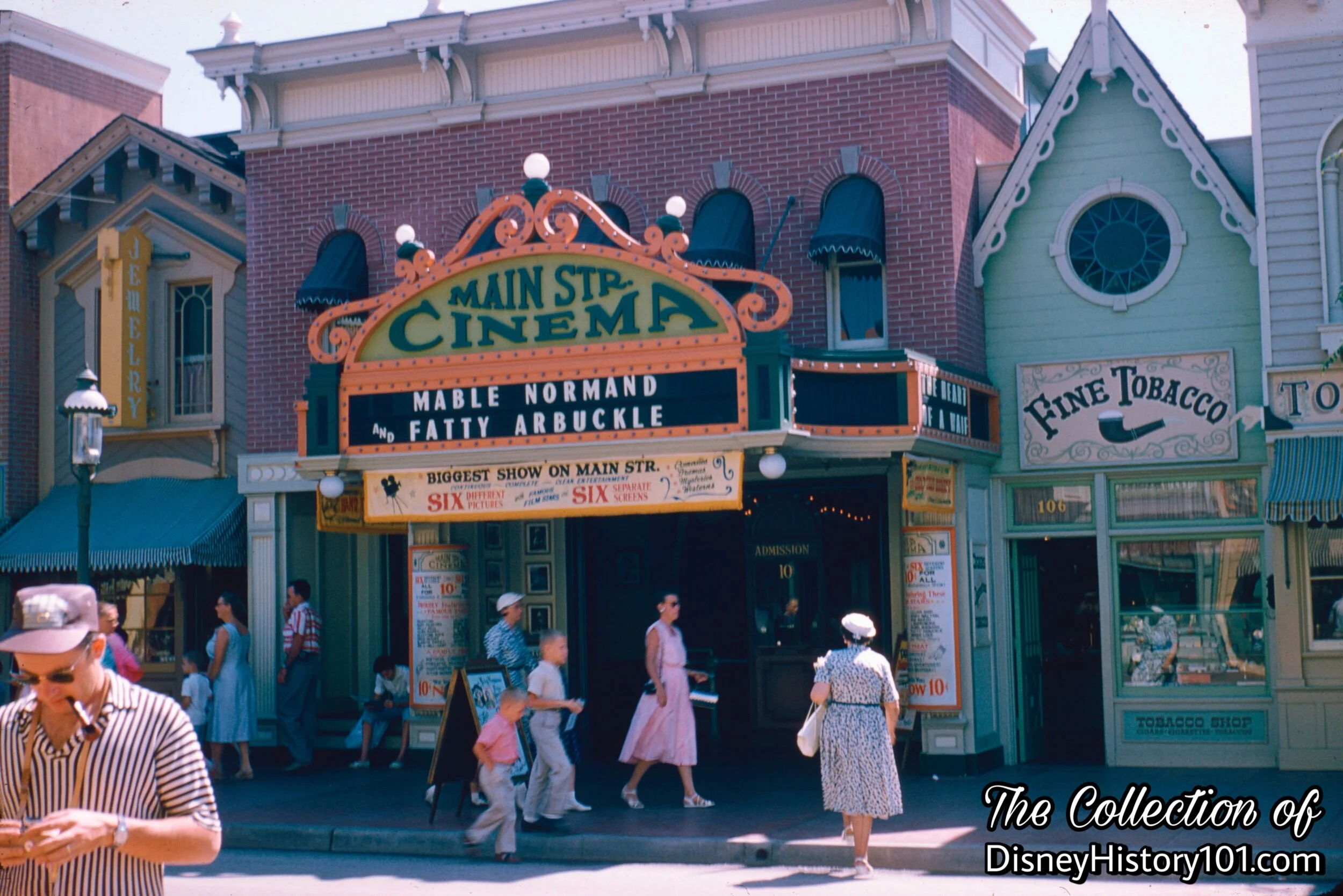
Main Street Cinema
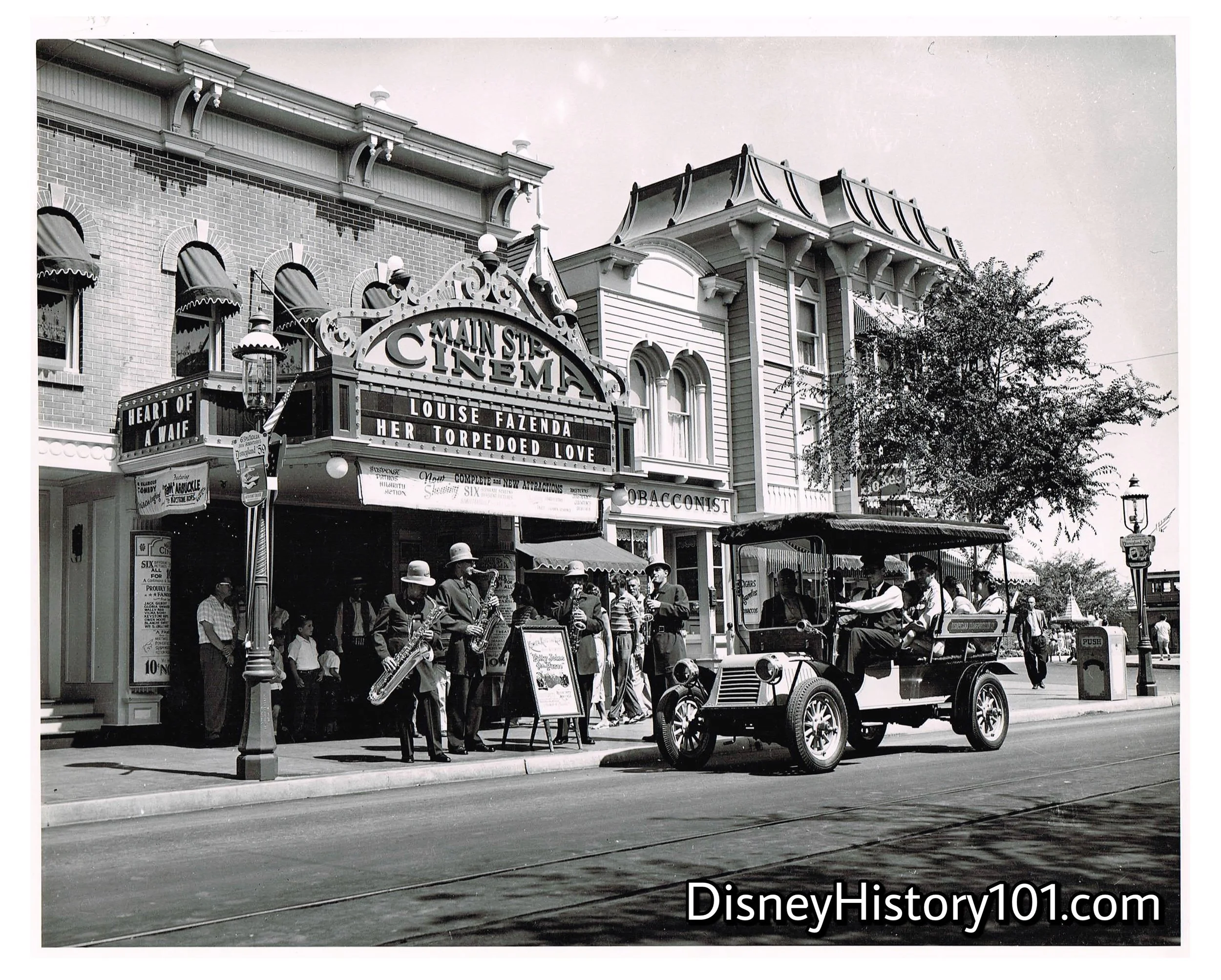
Main Street Cinema marquee heralds “Her Torpedoed Love” (1917) starring Louise Fazenda, and “Heart of a Waif” (1917); 1959.
Main Street Cinema was Main Street's theatre, featuring five silent film classics that played continuously and simultaneously. Many of the biggest names of the pre-talkie era were featured at the cinema. The “Disneyland Dictionary” published in 1959 described the attraction with a unique feature: “Inside Cinema are five (5) small Nickelodean Screens showing continuously and simultaneously, old silent movies with piano accompaniment, plus one (1) screen exhibiting old-time tinted slides.” Some of this was owing to Joe Fowler (Vice President of Disneyland Operations Committee) and Doc Lemmon (of Disneyland Operations) who by 1959 were overseeing Operators of Rides & Amusements (like the Main Street Cinema) among their other responsibilities of Livestock, Parking Lot, and Ticket Sellers.
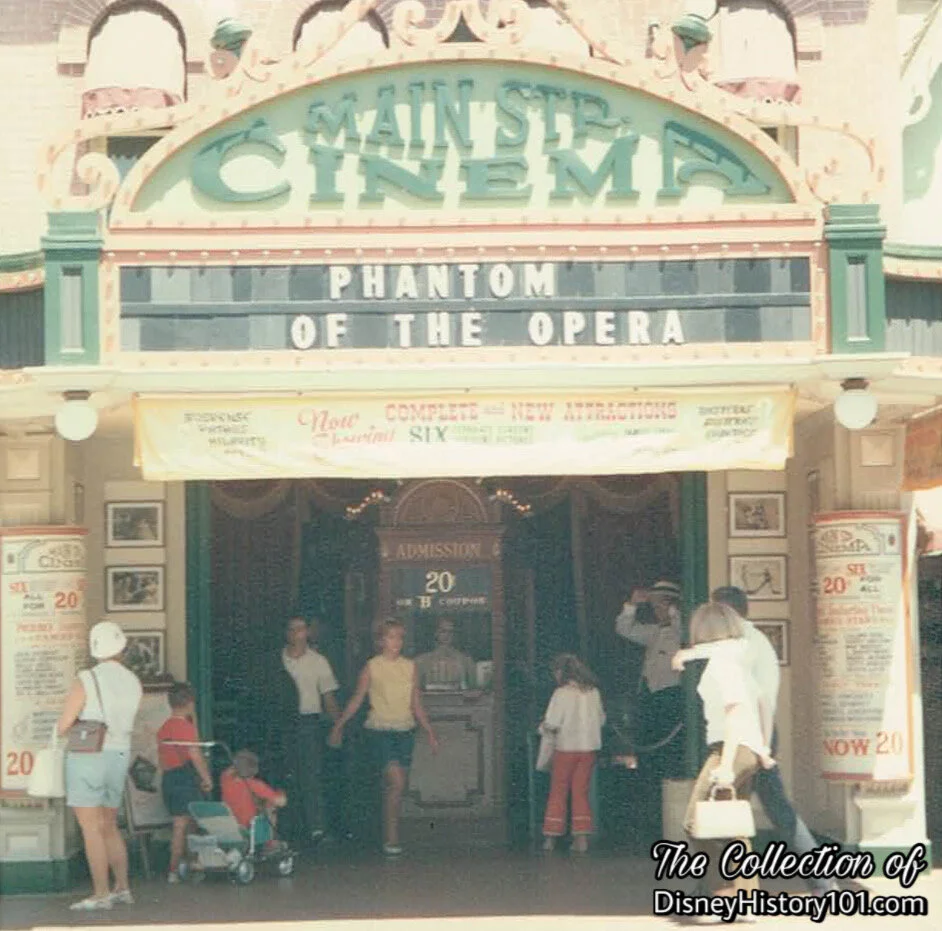
Main Street Cinema Front of House marquee promoting “The Phantom of the Opera” (without the names of its stars).
Near the entrance of Main Street Cinema, a Cast Member adjusts his hat as he prepares to greet Guests (above). Many Cast Members stepped into this role, including Disneylander John Catone who briefly greeted Guests at the entrance to Main Street Cinema.
During the 1960s, a Phantom of the Opera “come-to-life” character briefly made appearances at the entrance of the theater.
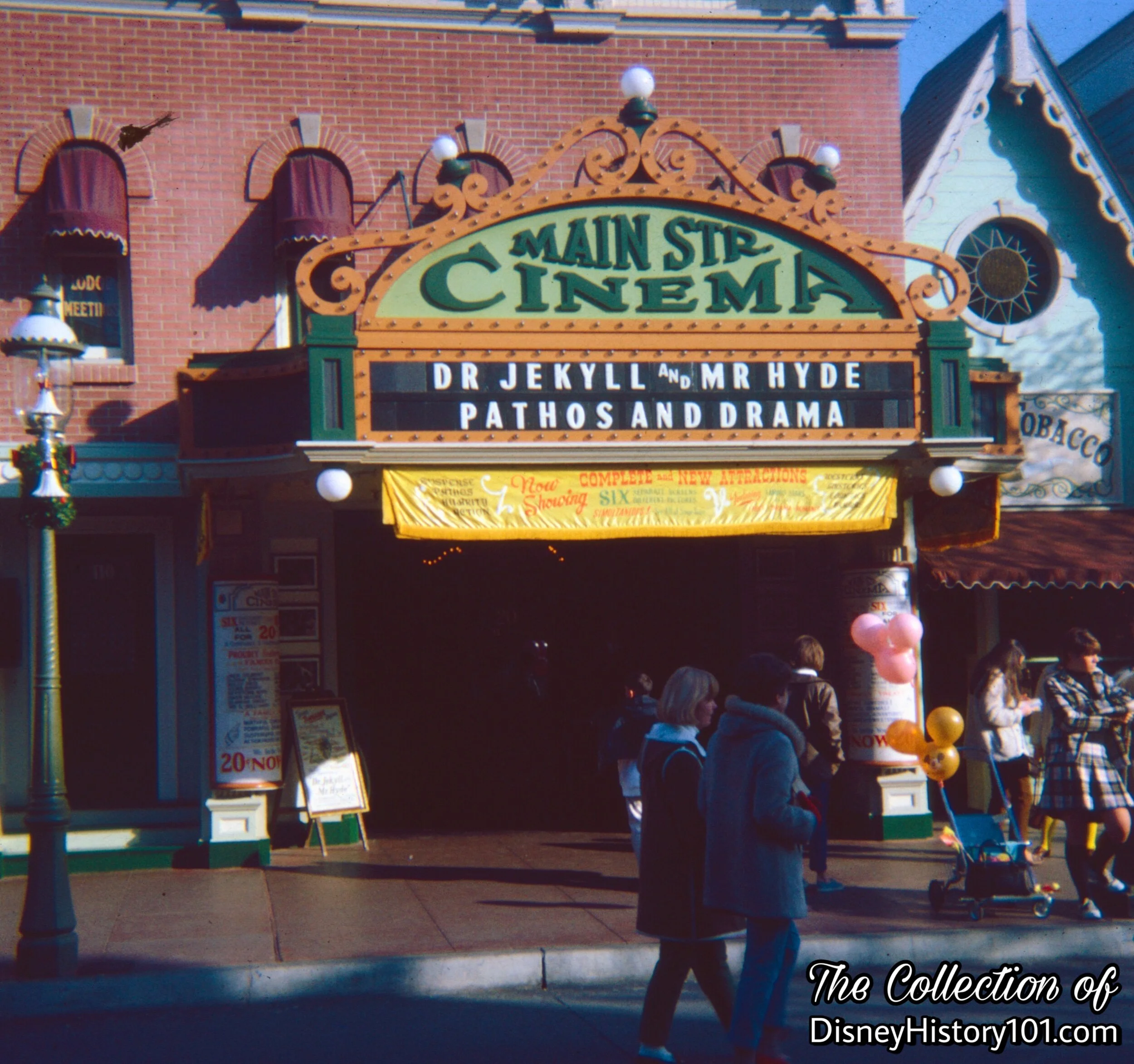
Main Street Cinema marquee advertising “Dr. Jekyll and Mr. Hyde” and the words “Pathos and Drama”.
Occasionally Disneyland Cinema marquees touted more than the title of the silent film. Above, the marquee heralded the words “Pathos and Drama”. Pathos in silent film is the power to make an audience feel deep sadness, pity, or sympathy. Drama is the intense conflict, high emotion, and strong action that drives the story forward. Pathos and drama in Dr. Jekyll and Mr. Hyde stem heavily from John Barrymore’s striking physical transformation and the tragic conflict of a good man consumed by his own suppressed desires.
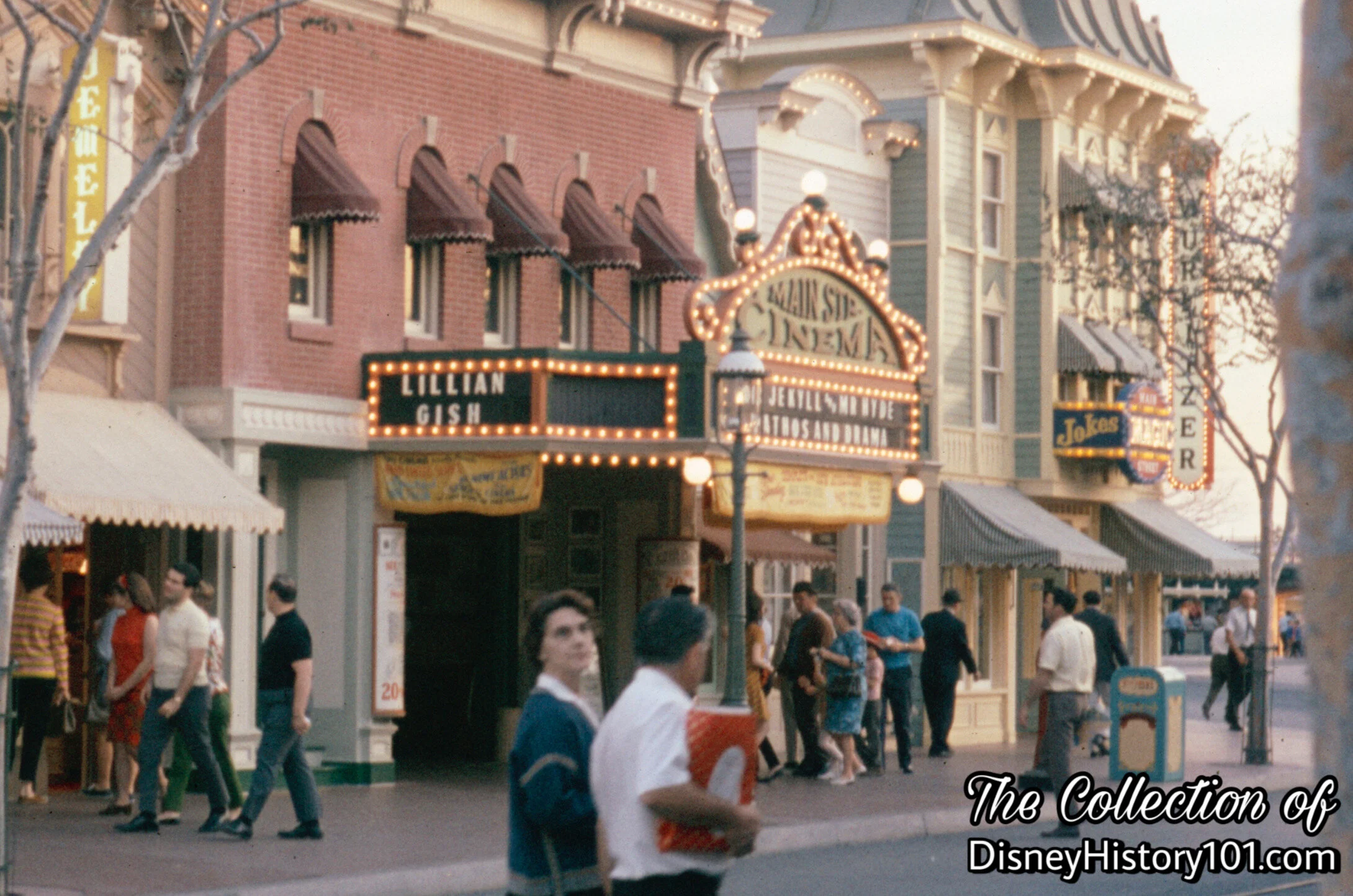
Main Street Cinema marquee advertising “Dr. Jekyll and Mr. Hyde”, the words “Pathos and Drama” and silent film actress Lillian Gish.
Walt Disney’s Guide to Disneyland (published 1961) invited guests to “go back to the pre talkie days” and “see silent stars in action at the Cinema on Main Street.”
By the winter of 1961-62, the Main Street Cinema was operating 7 hours each day. The “Ride Operating Schedule” effective October 3, 1962 described the attraction having one operational unit and a 528 Guest capacity during winter weekdays, winter week end days, and maximum days.
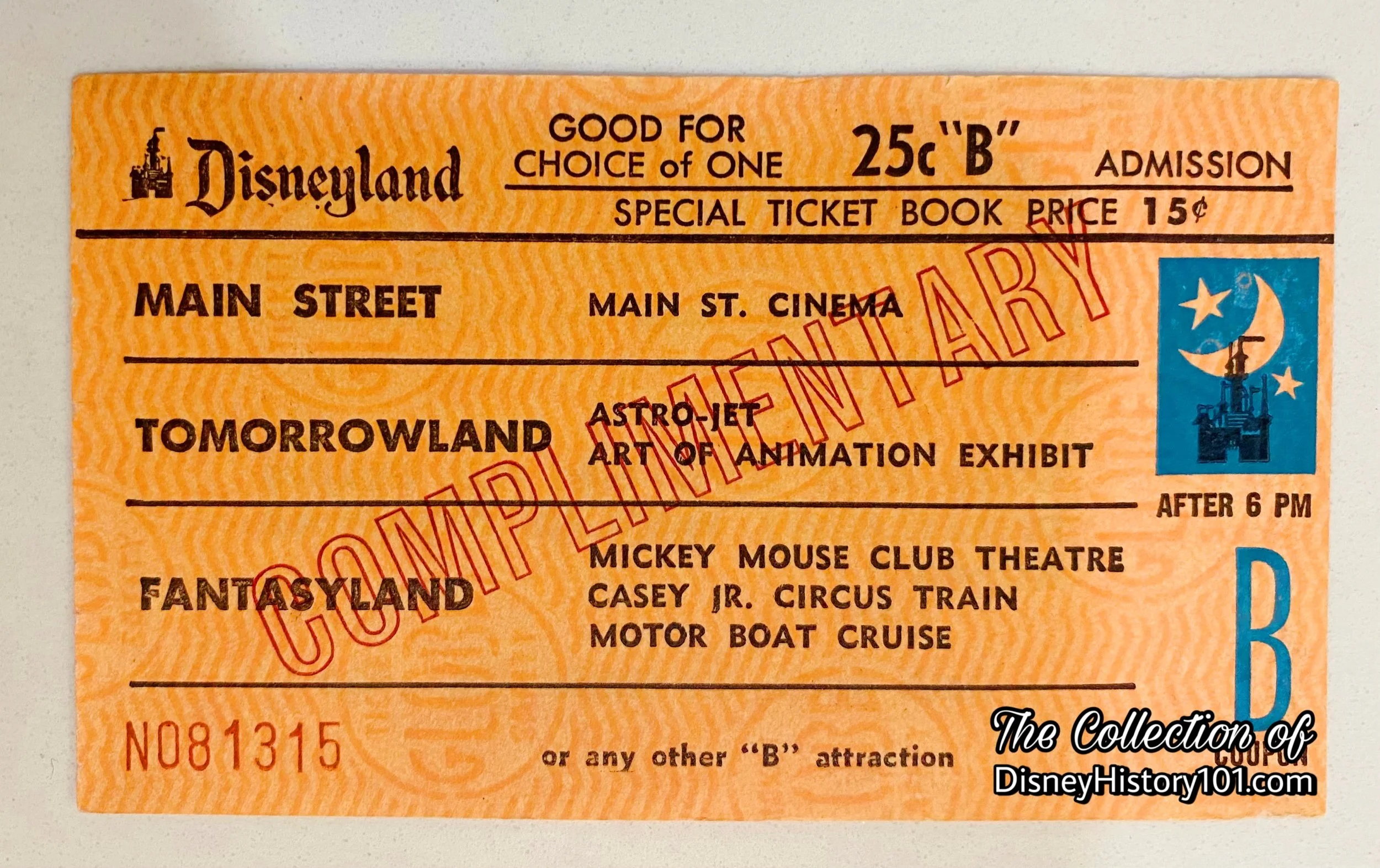
Main Street Cinema on the Complimentary Starlight Special Ticket Book “B” Admission Coupon; c. 1960-1964.
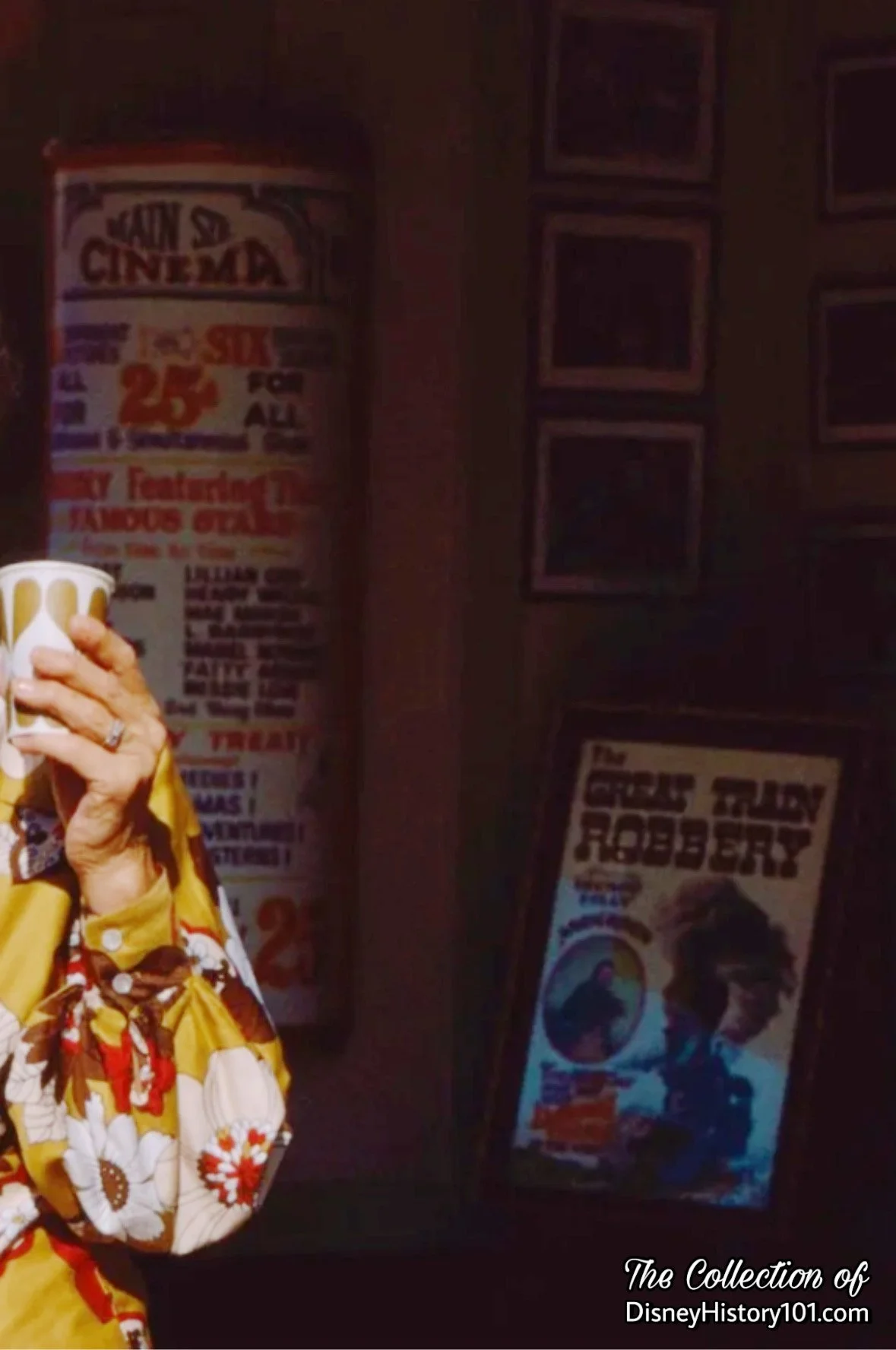
“The Great Train Robbery” A-Frame Sign near the Main Street Cinema, October 1971.
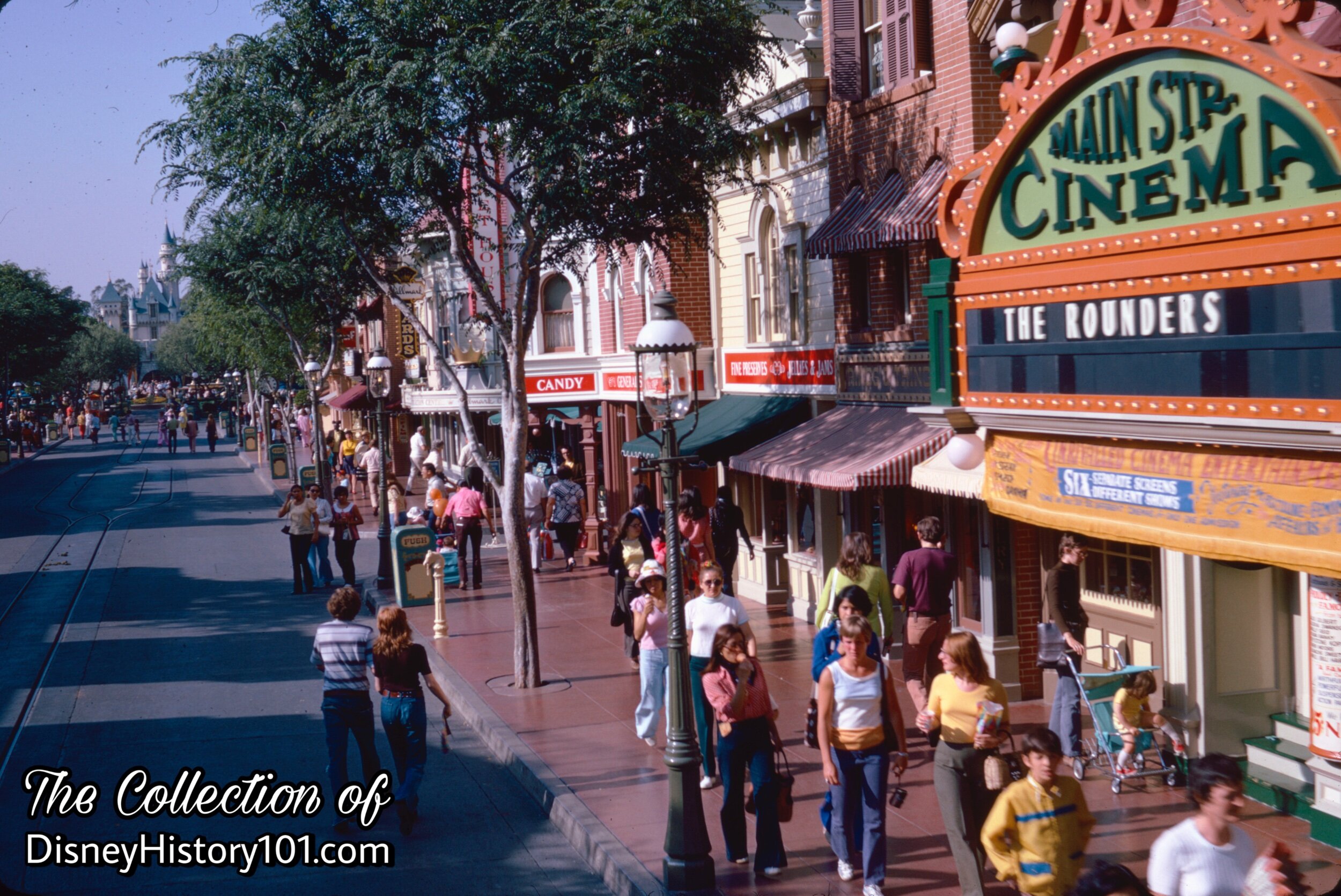
Main Street Cinema marquee promoting “The Rounders” (1914) without the names of its stars Charlie Chaplin or Roscoe “Fatty” Arbuckle; June of 1973.
By the summer of 1972, the days of the silent-art flicker pictures lived on at the Main Street Cinema where filmed classics and selected subjects were presented simultaneously and continuously, including: Main Street Cinema operated daily showing Steamboat Willie (As a tribute to the mouse that started it all), Dr. Jekyll and Mr. Hyde starring Sheldon Lewis, The Rounders starring Charlie Chaplin and Fatty Arbuckle, Crashing Through featuring the Keystone Kops, The Great Train Robbery, and Old Time Slides.
From March 26 to April 3, 1973 the Main Street Cinema was closed for a 1-week rehabilitation.
During September 15, 1987, the Main Street Cinema became the stage for five Disney Sunday Movie introductions which were filmed in succession during the day. During the session, Disney Chairman Michael Eisner played the Host to several Disney characters, and during breaks, even made the opportunity to sign a few autographs for fans!
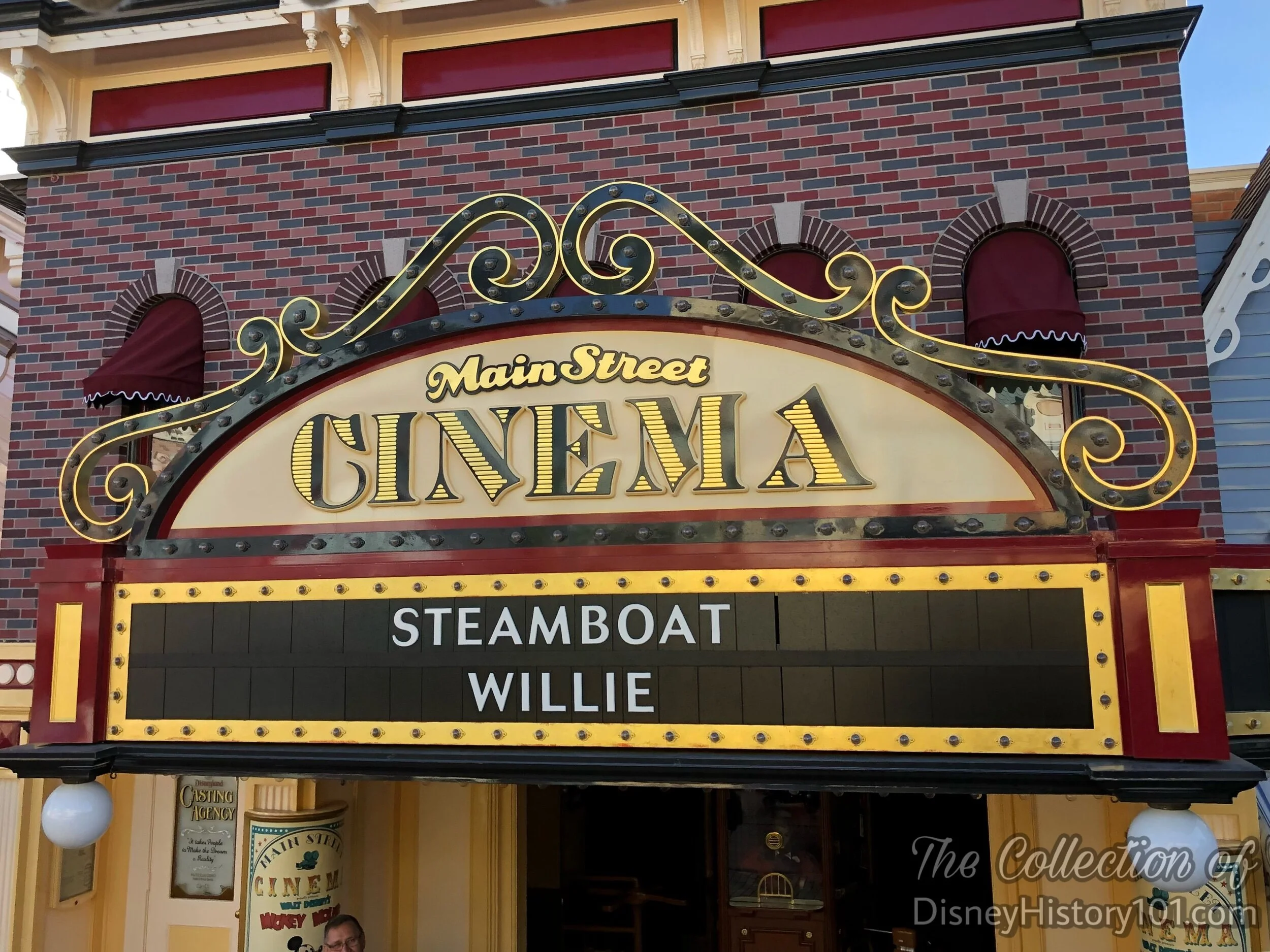
Main Street Cinema marquee heralding Steamboat Willie.
“Walt Disney’s Mickey Mouse on Six Screens”
Since the beginning, the Four Keys of the DISNEYLAND Show (operating priorities in presenting the DISNEYLAND Show) have been present - Courtesy, Safety, Show, and Efficiency. Guided by these Four Keys, are Walt Disney Imagineers, who are always seeking out new magical opportunities to increase the efficiency, safety, and showquality of Disneyland adventures.
Steamboat Willie first opened at the Colony Theater in New York, on November 18, 1928. Nearly 90 years later, by 1996, Mickey Mouse cartoon classics were being shown on six different screens at Main Street Cinema. As a tribute to the mouse that started it all, the Main Street Cinema continually played Steamboat Willie and one of the two cartoons that were finished before it, Plane Crazy (the other film was The Gallopin' Gaucho). In the present, Mickey Mouse cartoons are still part of the grand show at the Main Street Cinema in the original Disneyland.
In 2008, WDI master planners entertained the concept of an update - a synergy project with Blu Ray and BVHE.
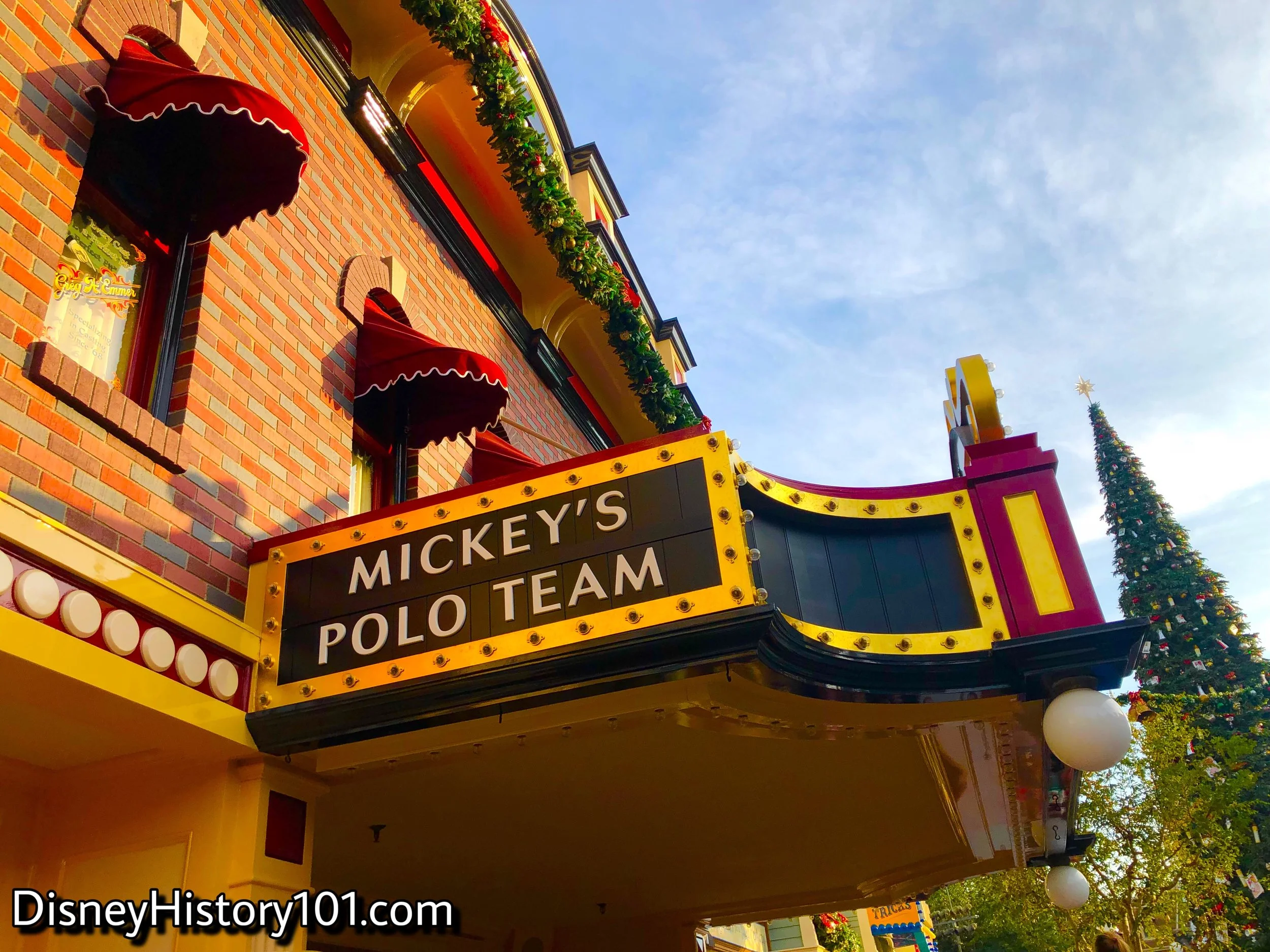
Main Street Cinema marquee heralding Mickey’s Polo Team.
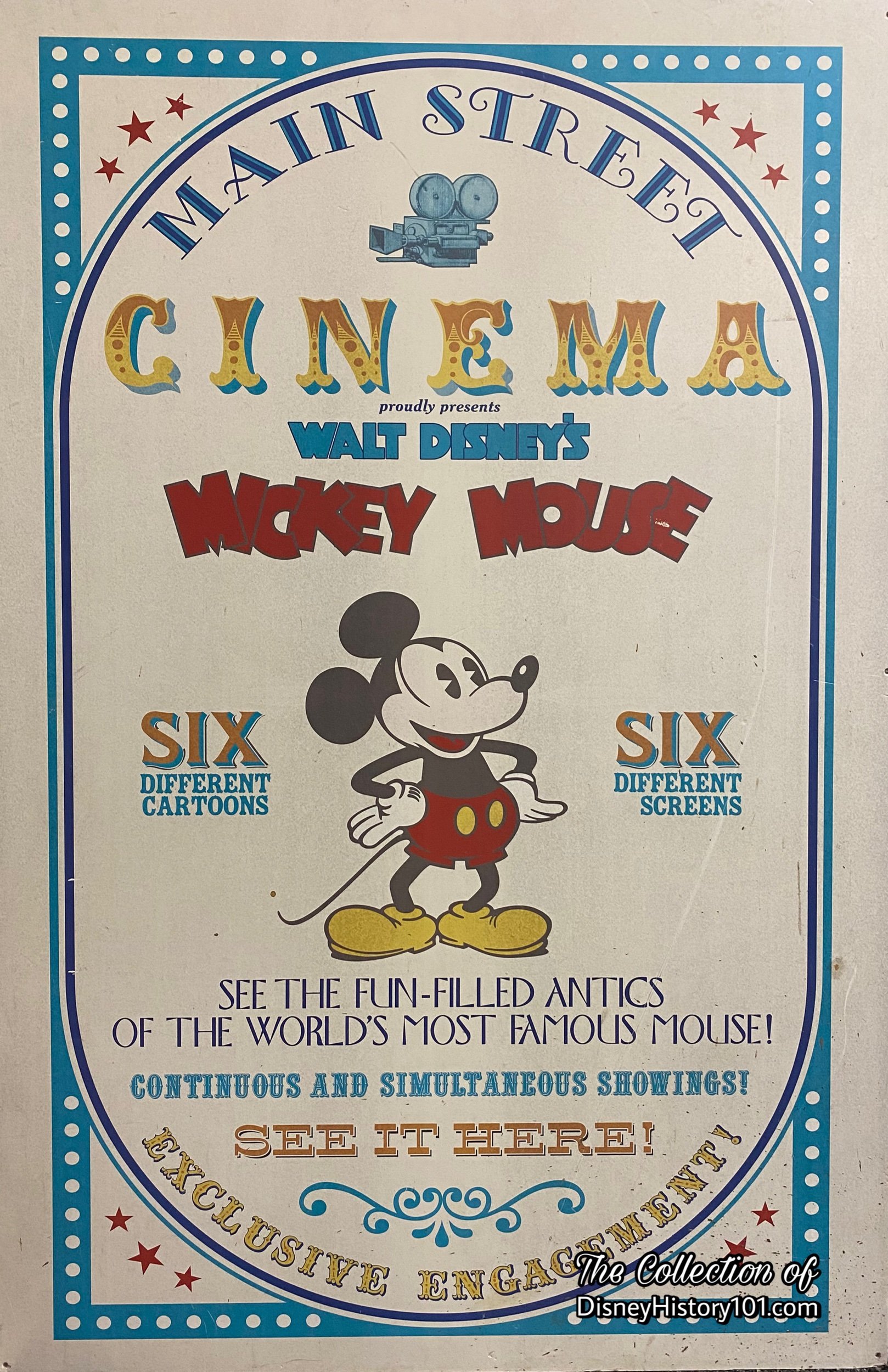
Main Street Cinema “Walt Disney’s Mickey Mouse” Poster.
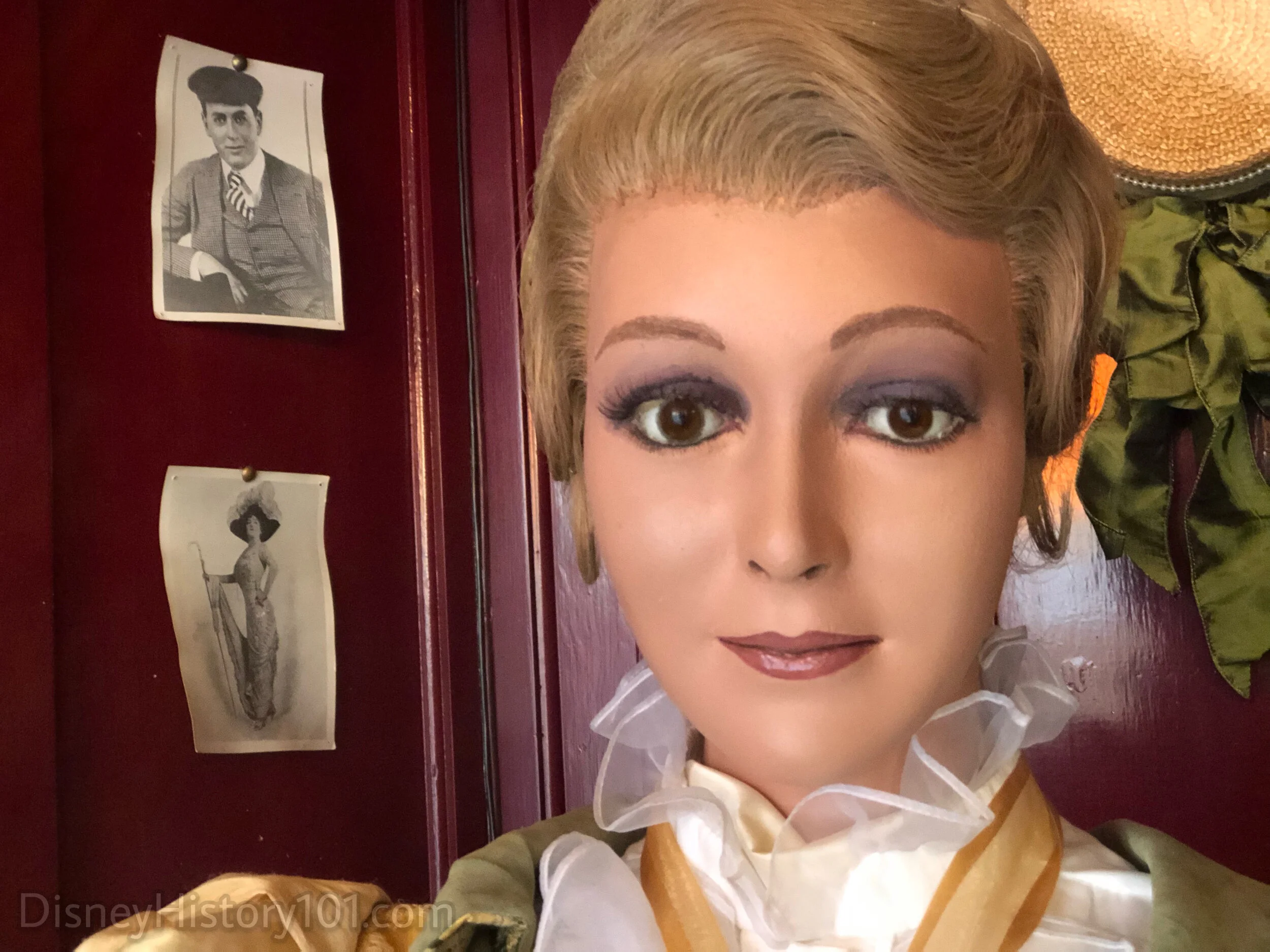
Main Street Cinema Hostess Tillie (variously spelled Tilly).
“Main Street Cinema Hostess Tilly”
Martin Sklar once said “an individual's contribution can usually be found in the final product if one looks closely enough, but the Disney mind frame is to never point out ‘what I did’ to anyone.” However, a few outstanding individuals have been publicly recognized for their contributions and even ceremoniously honored by the Company.
It’s our pleasure to introduce Main Street Cinema Hostess Tillie (of Marceline, Missouri).
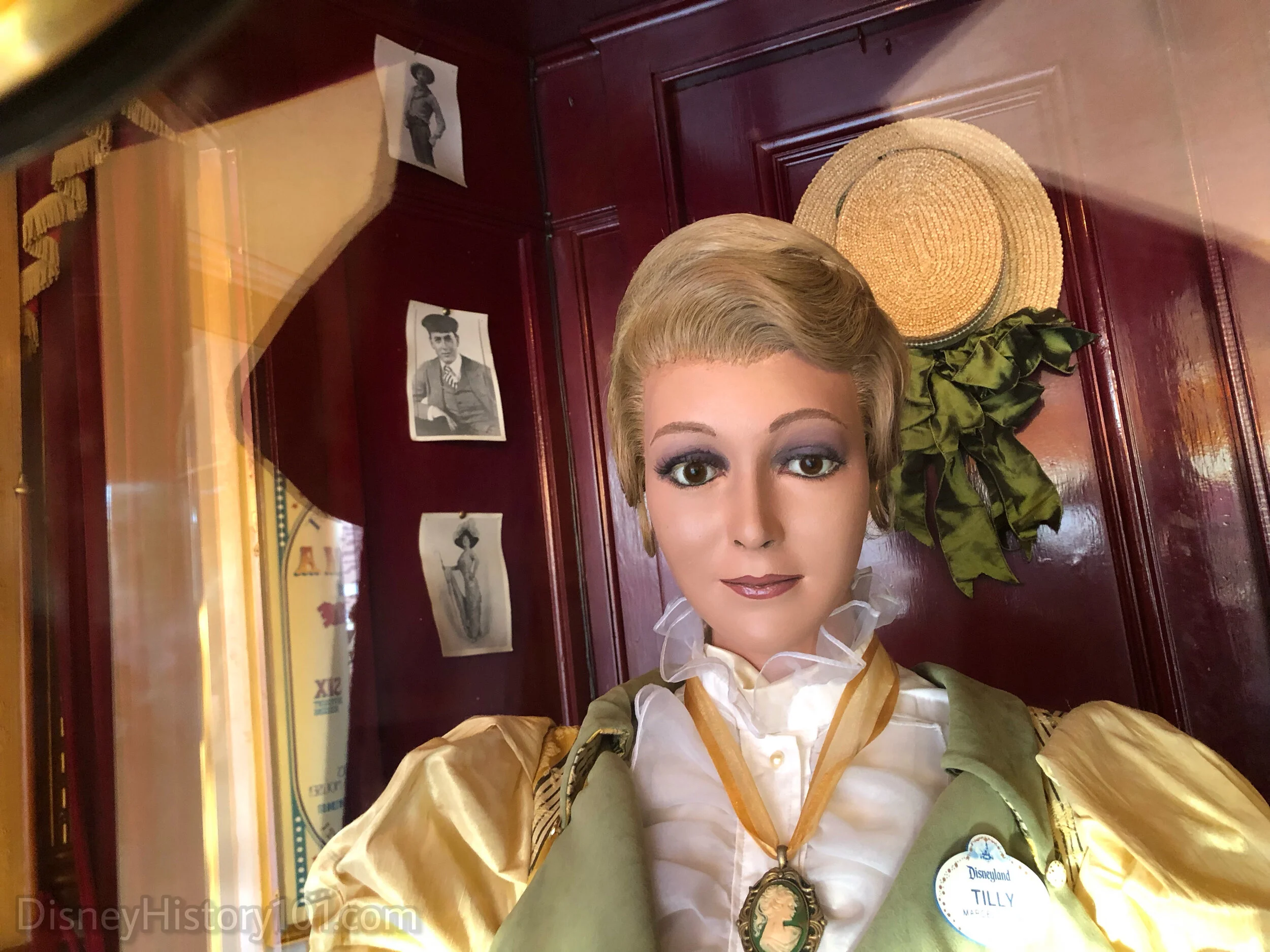
Main Street Cinema Hostess Tillie (variously spelled Tilly).
Tillie gives a lot of attention to reflecting the “Disneyland Look” to our guests. Her grooming is uniform with everyone and handled in such a way so as to add to the show and not detract from it.
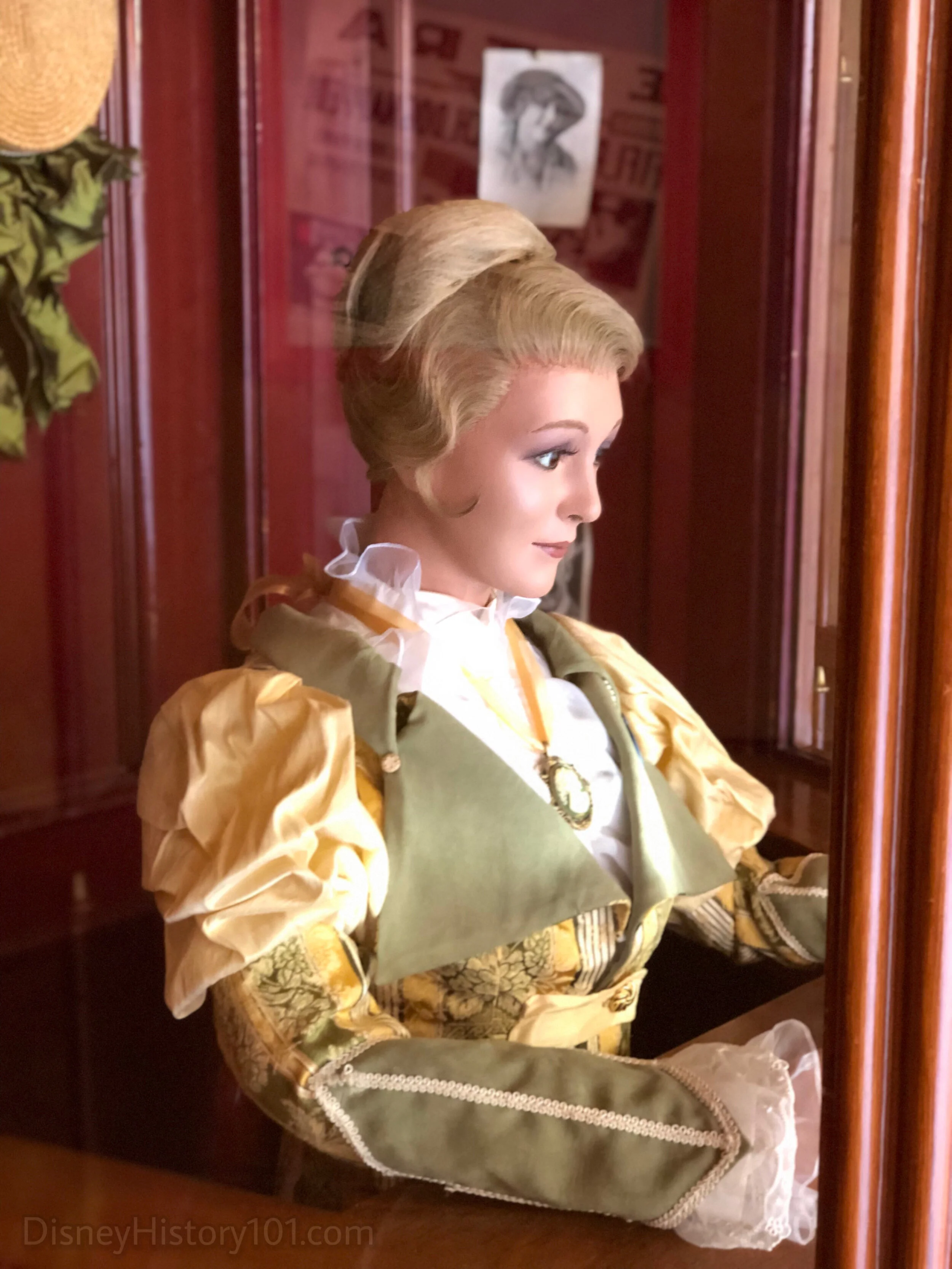
Main Street Cinema Hostess Tillie (variously spelled Tilly).
Hostesses Tillie’s hair is neatly combed and arranged in an attractive, easy-to-maintain style that is neatly packed and shaped. She uses no extreme colors, and minimal teasing.
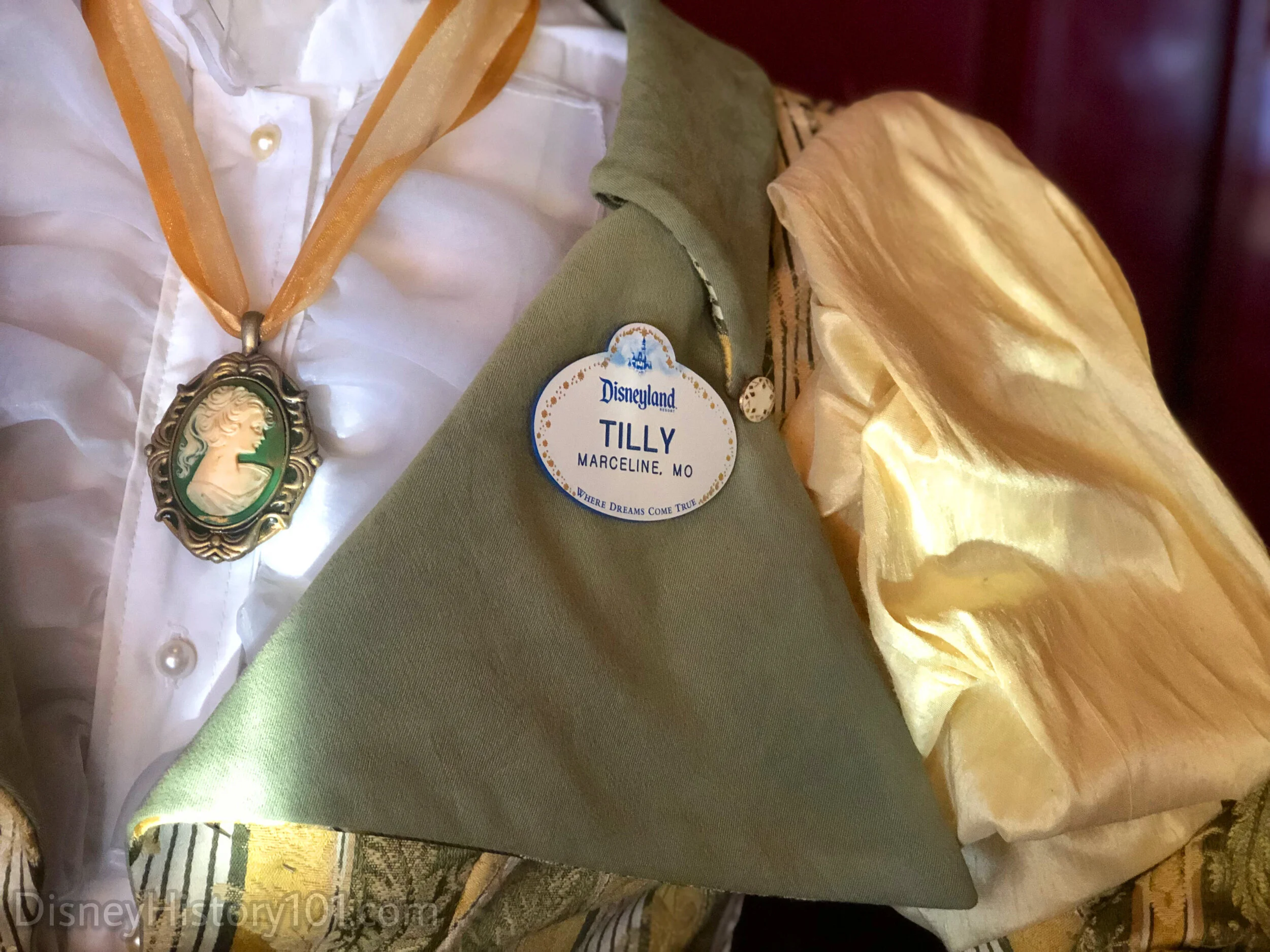
Main Street Cinema Hostess Tillie (variously spelled Tilly).
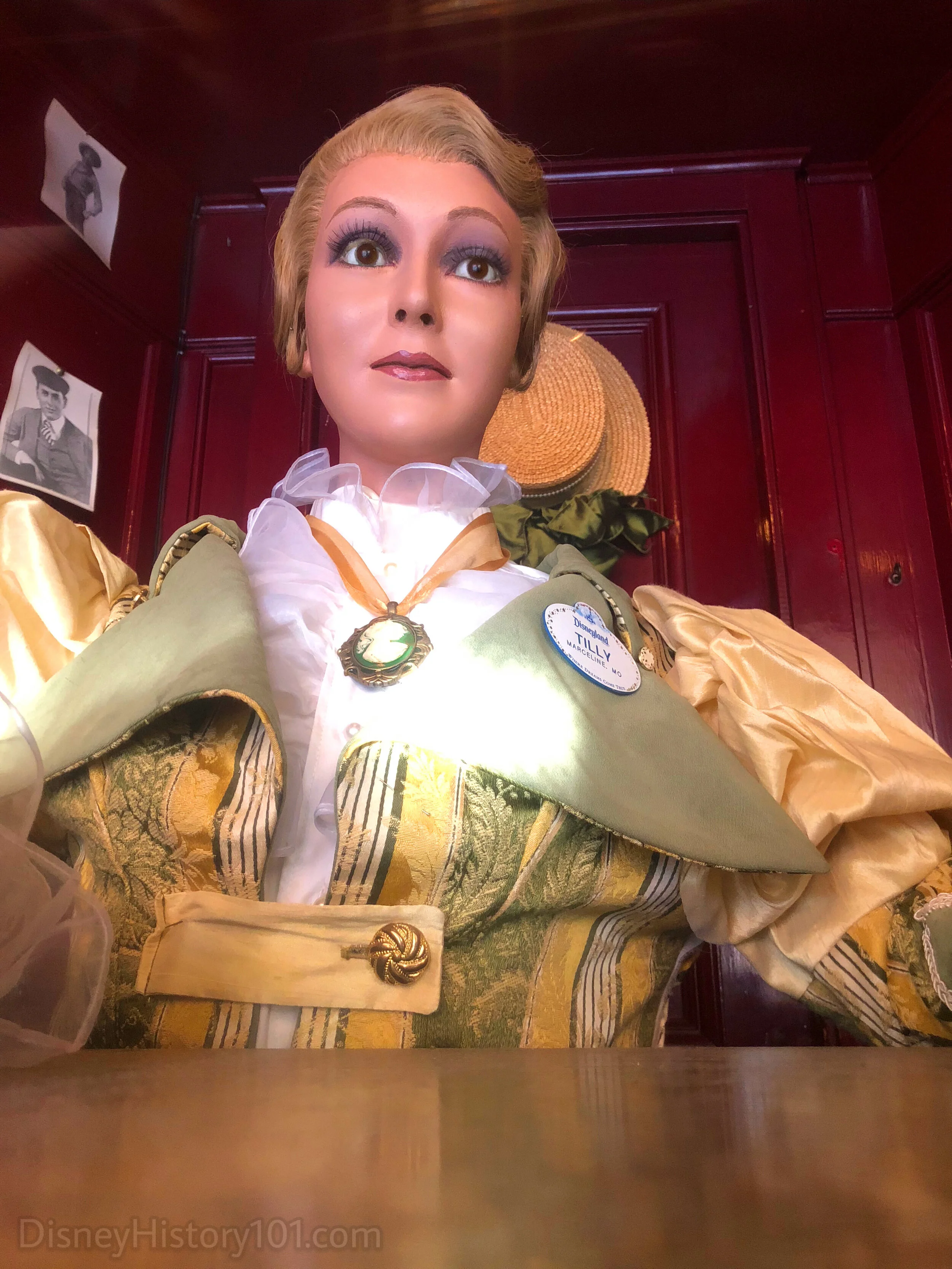
Main Street Cinema Hostess Tillie (variously spelled Tilly).
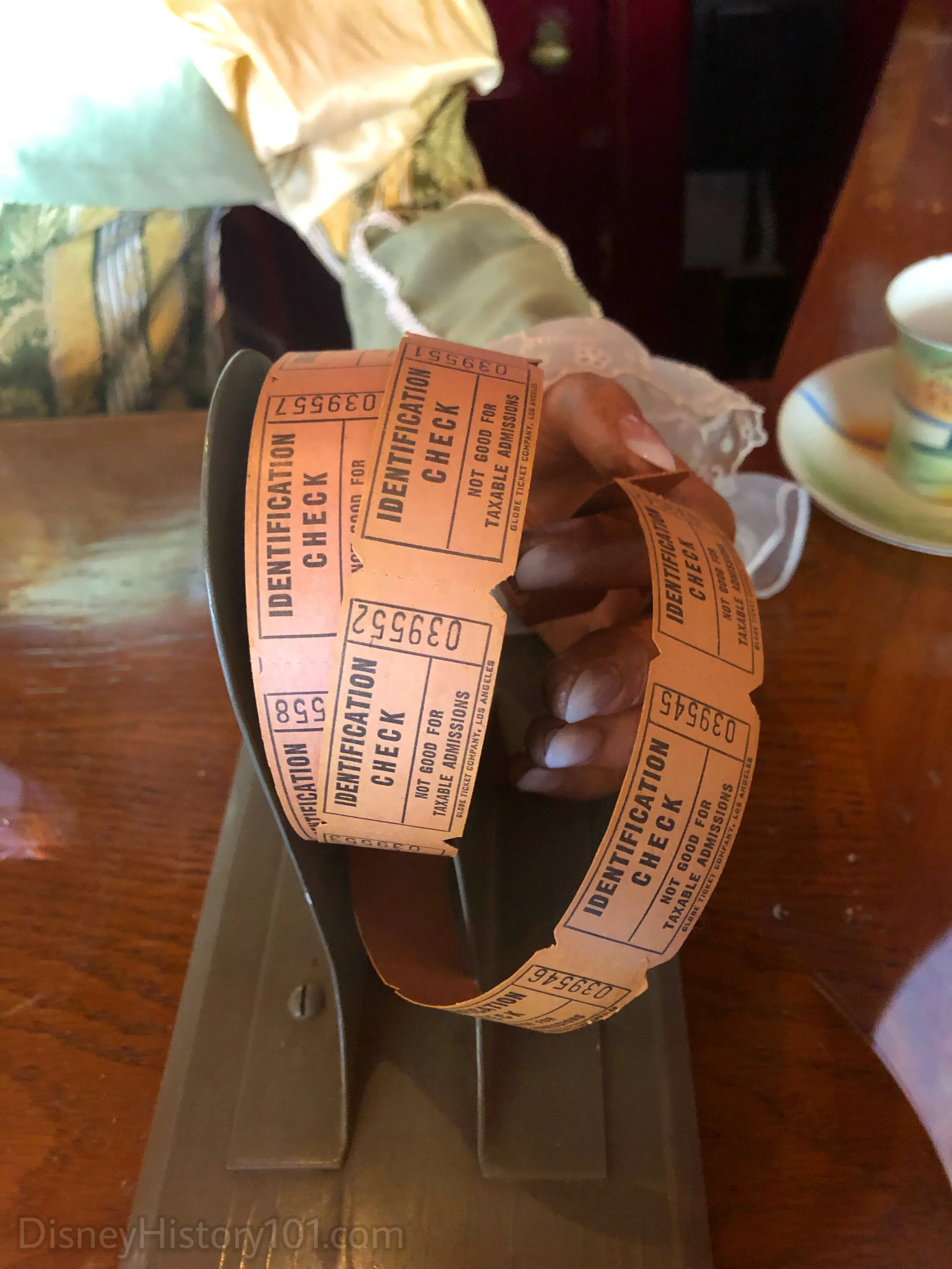
Main Street Cinema Hostess Tillie (variously spelled Tilly) attempts to issue admission tickets.
Main Street Cinema Hostess Tillie holds the world record for selling the least amount of tickets in a straight 24-hour-period.
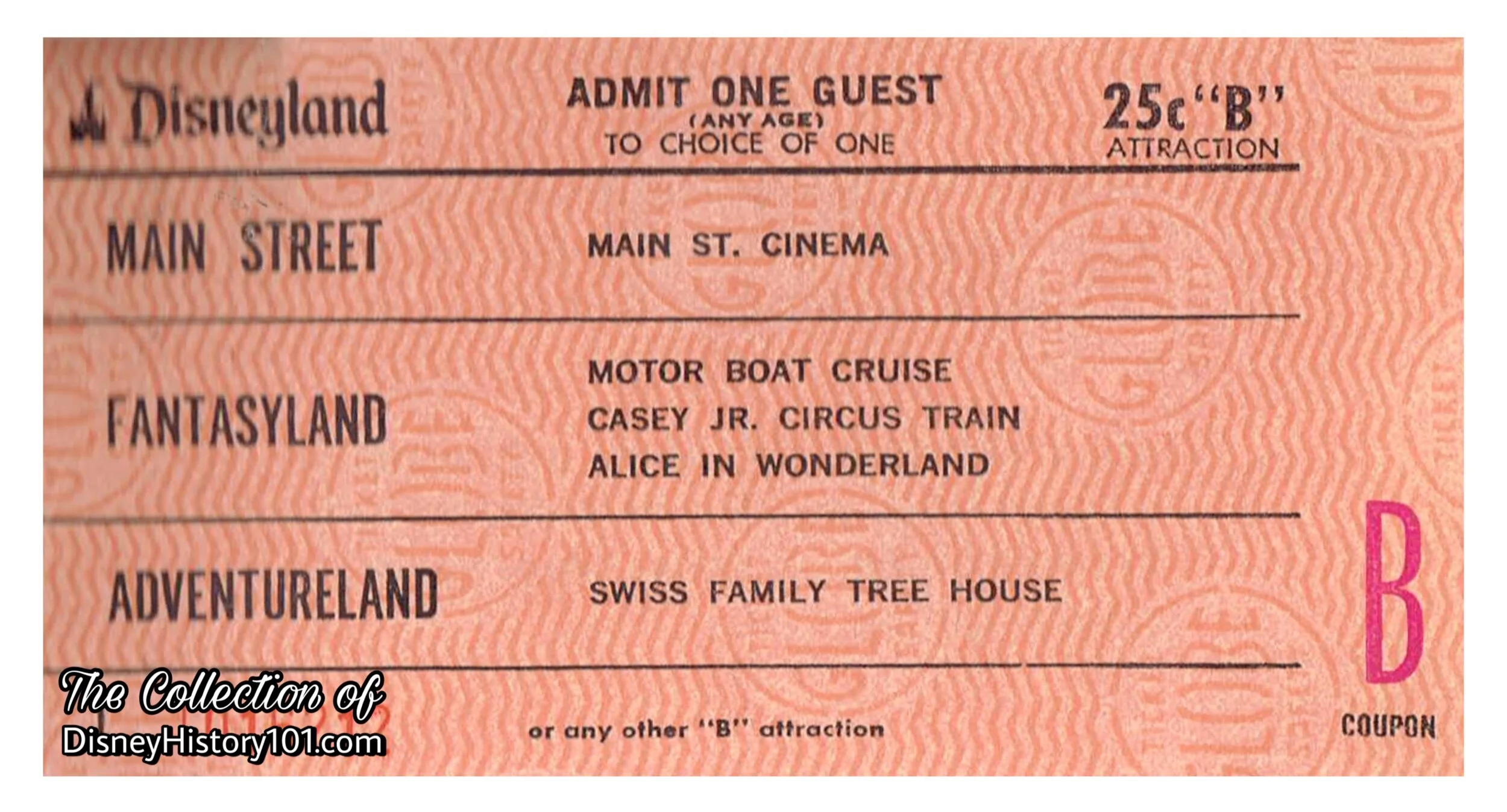
Main Street Cinema admission featured on the Disneyland “B” Coupon valued at 25¢; c.1962.
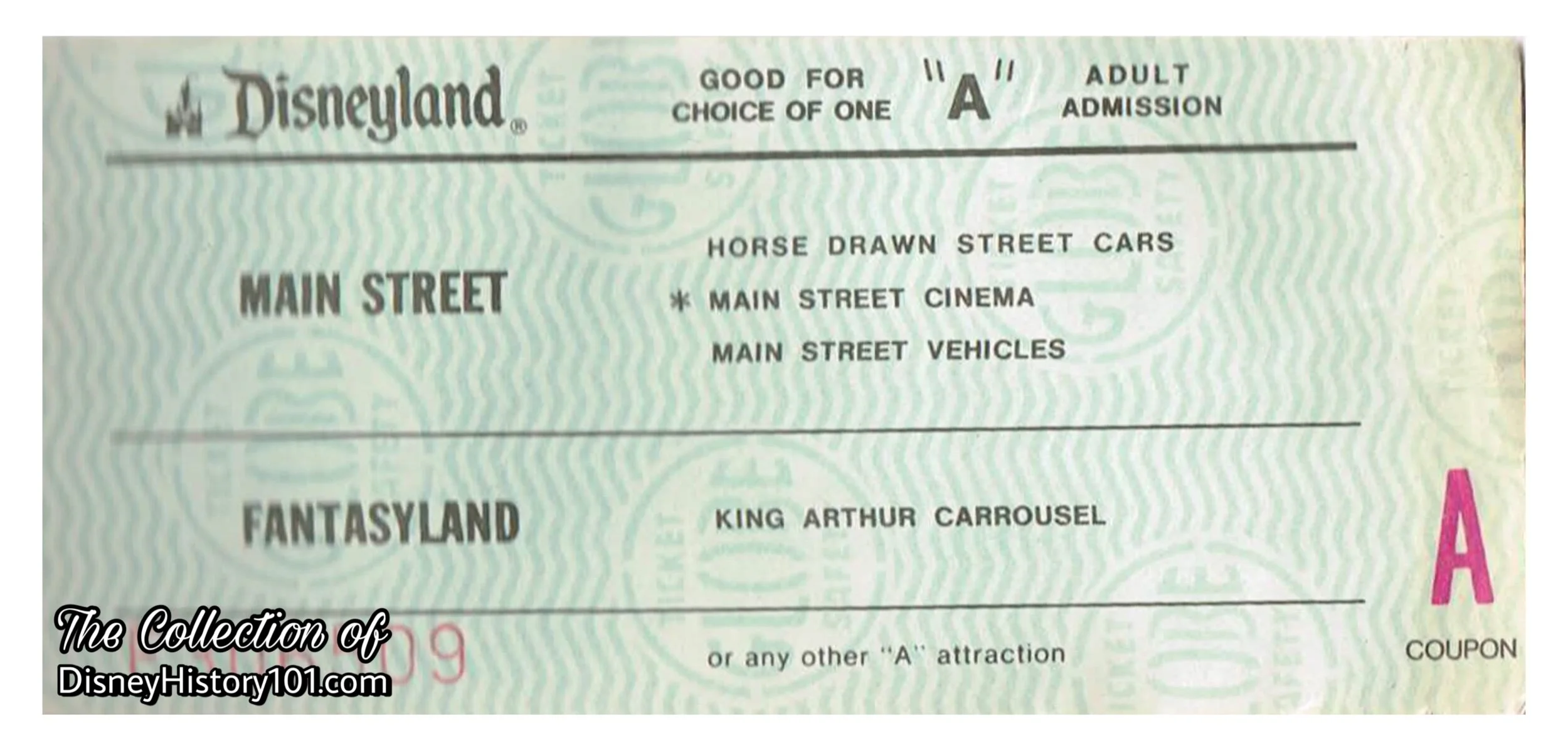
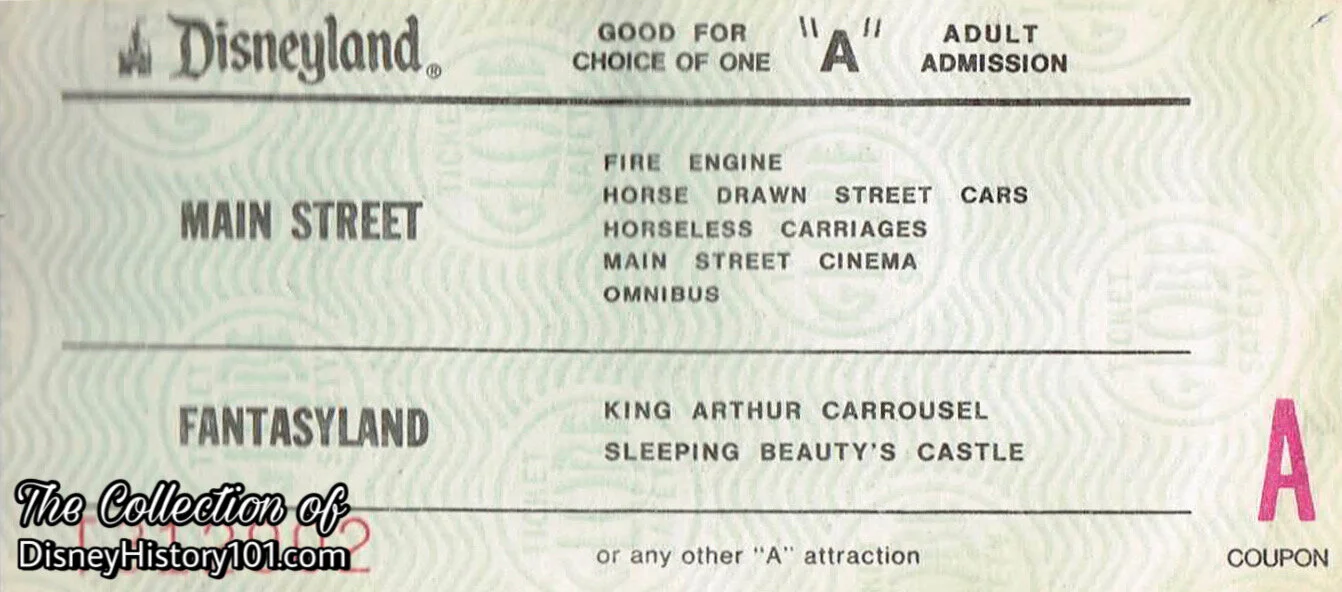
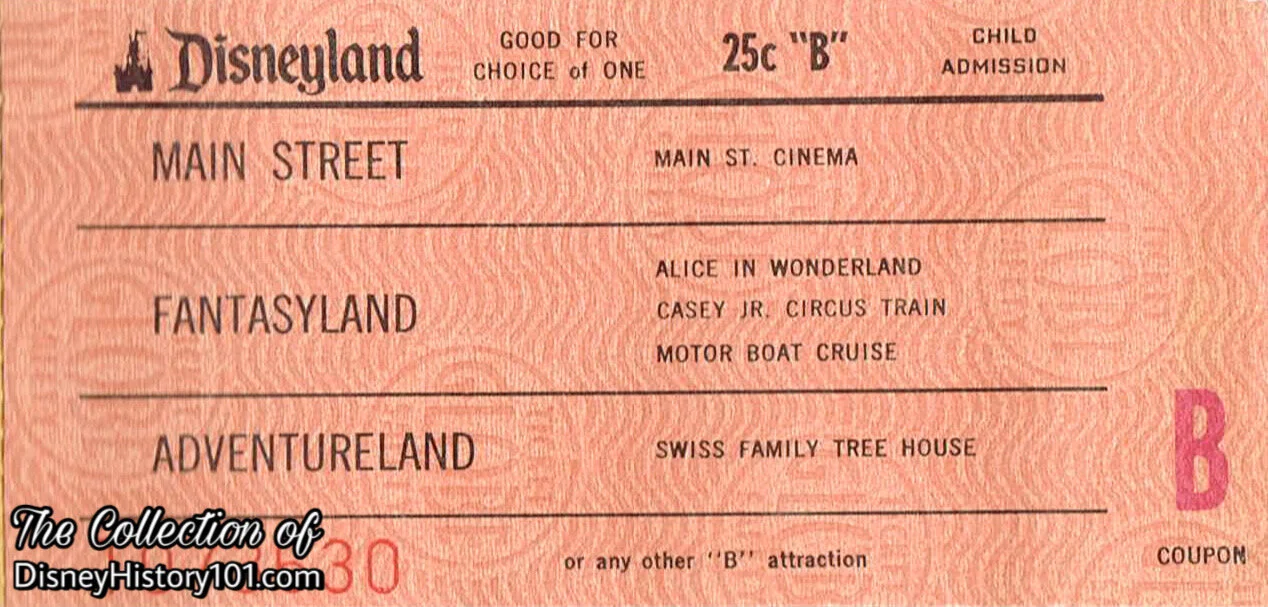
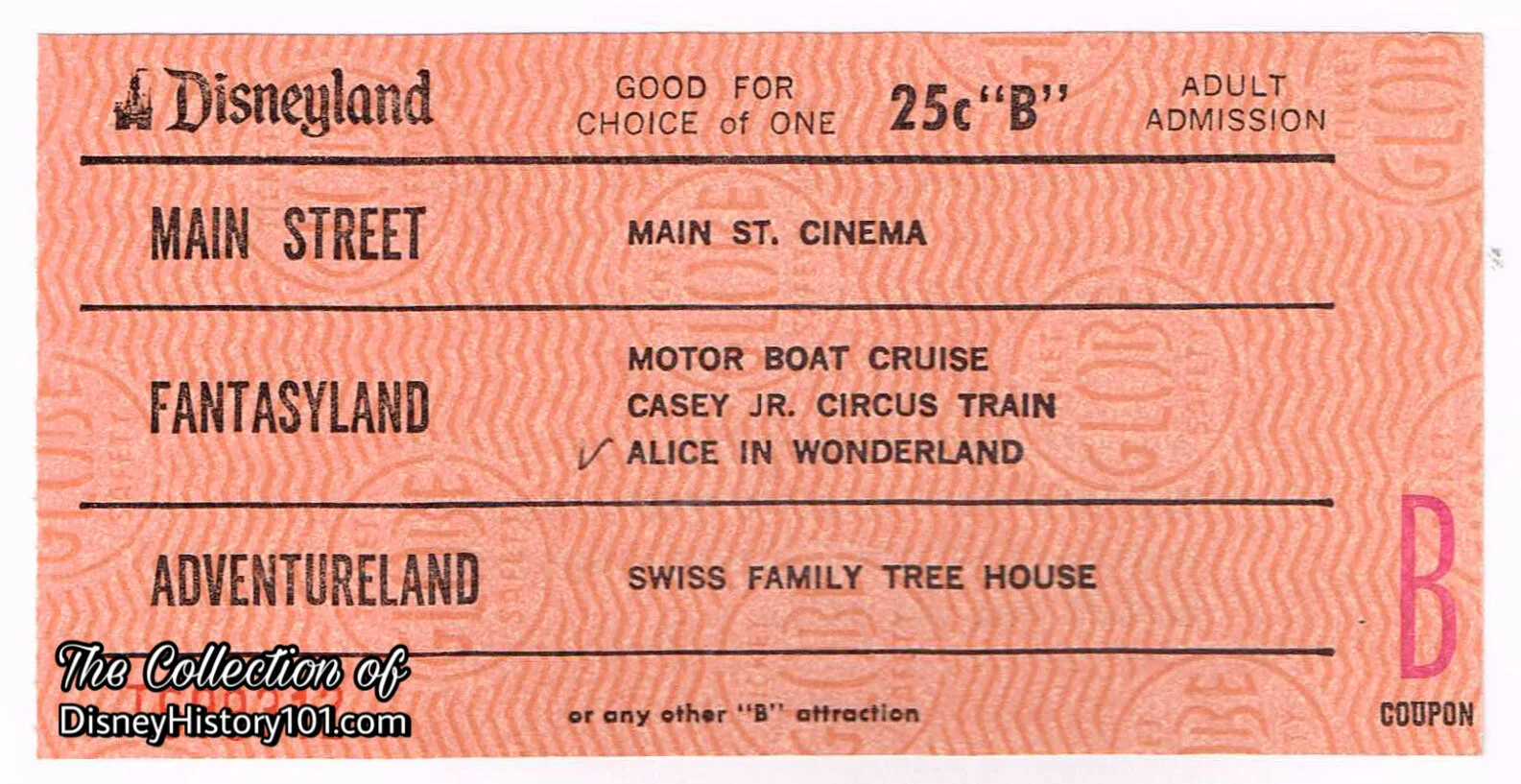
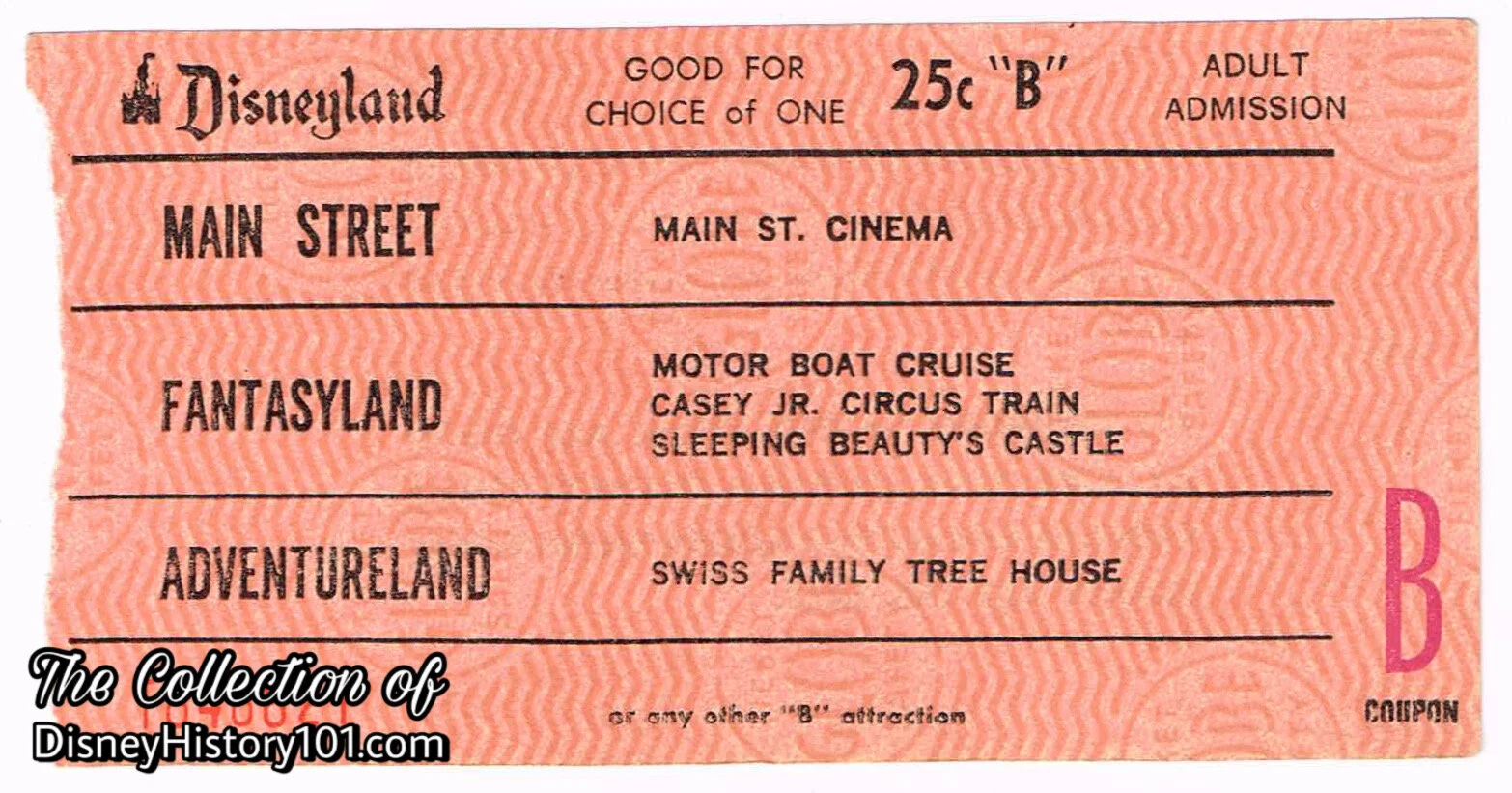
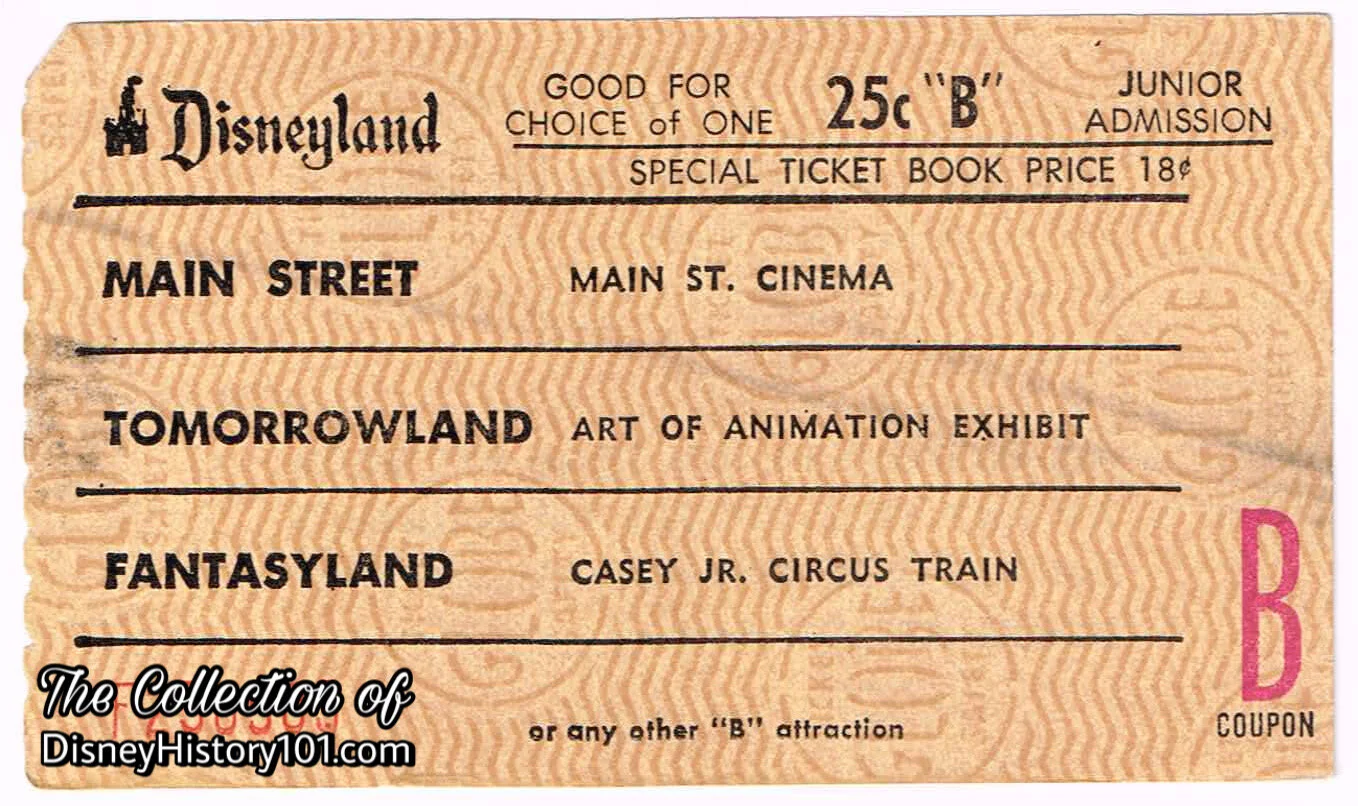
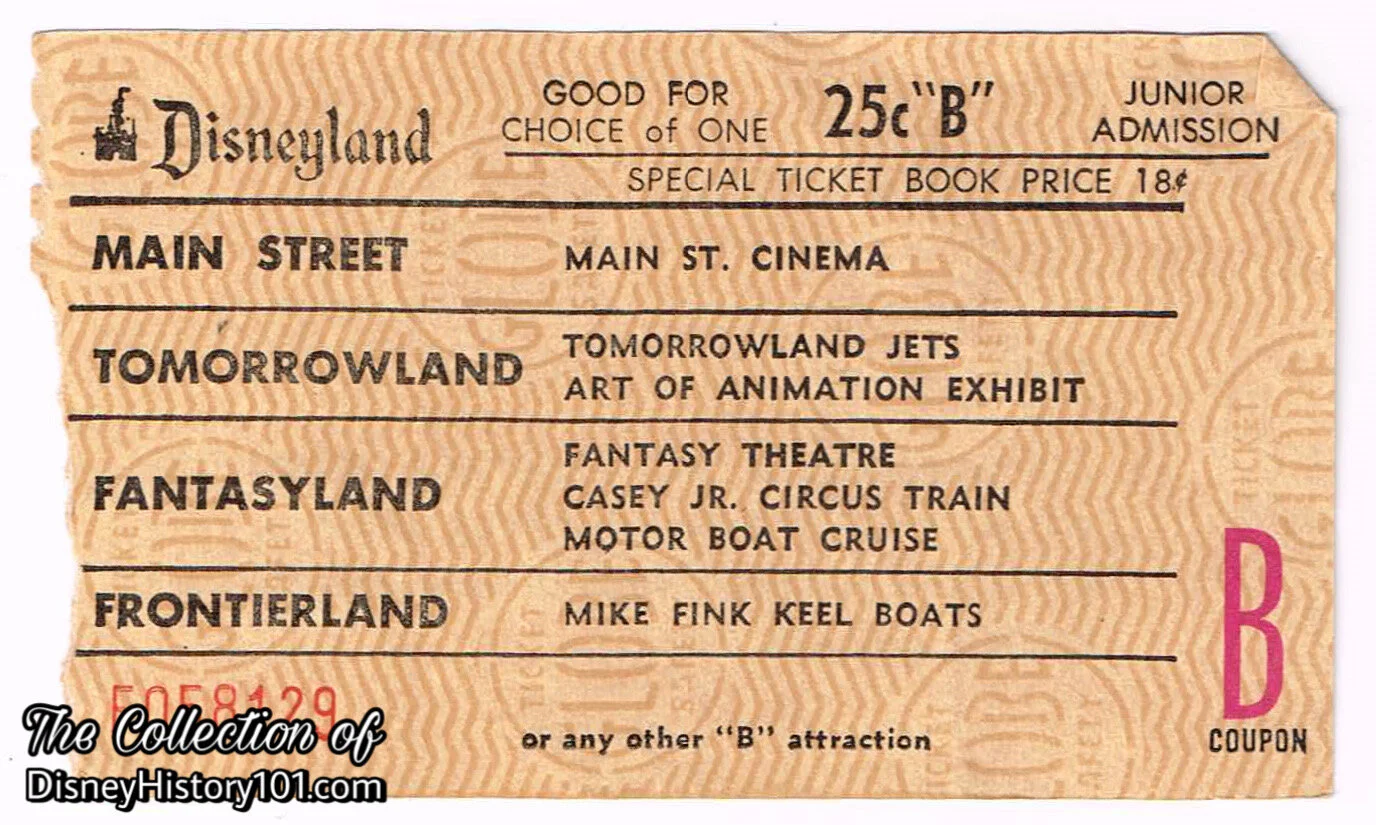
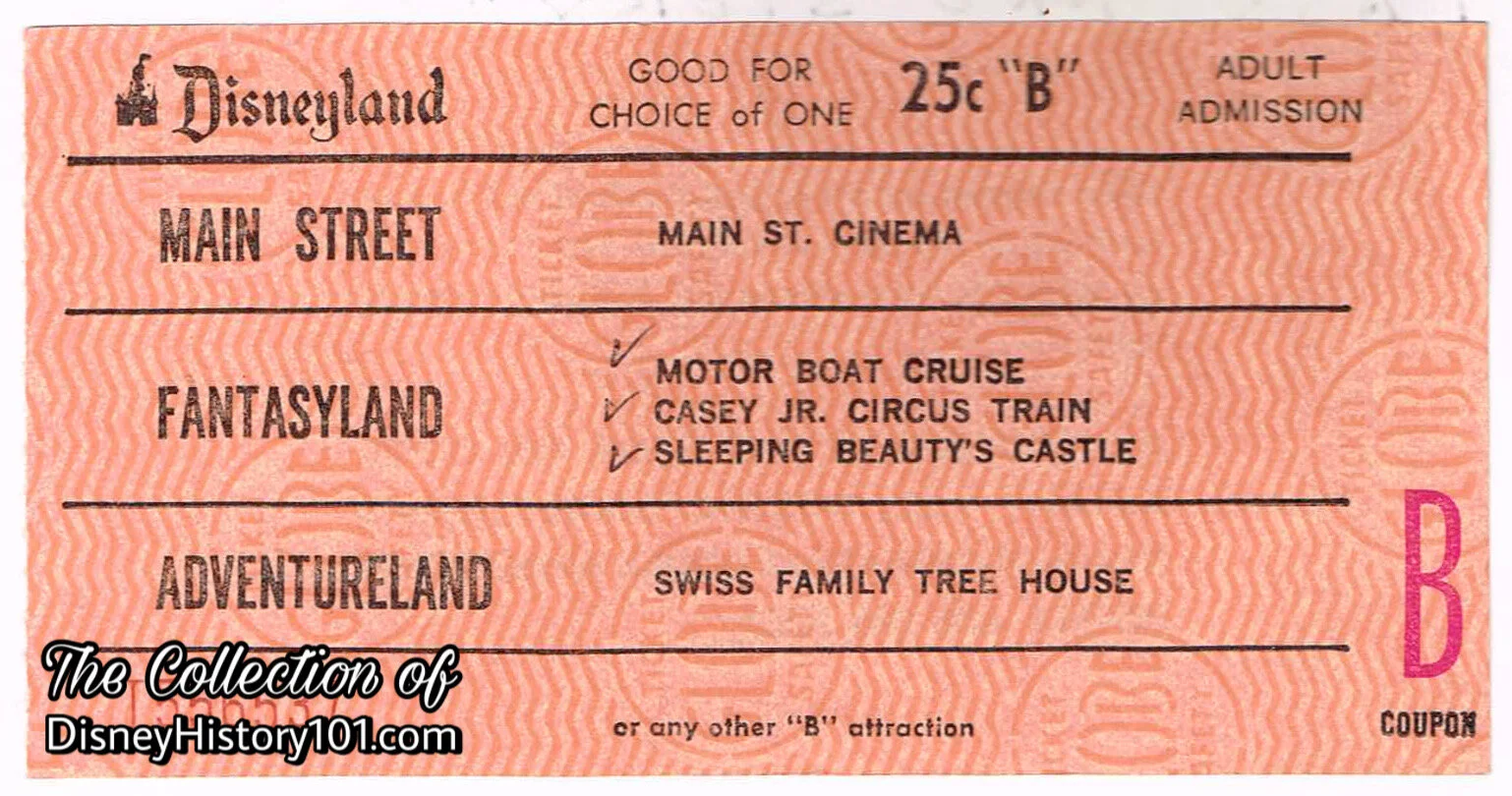
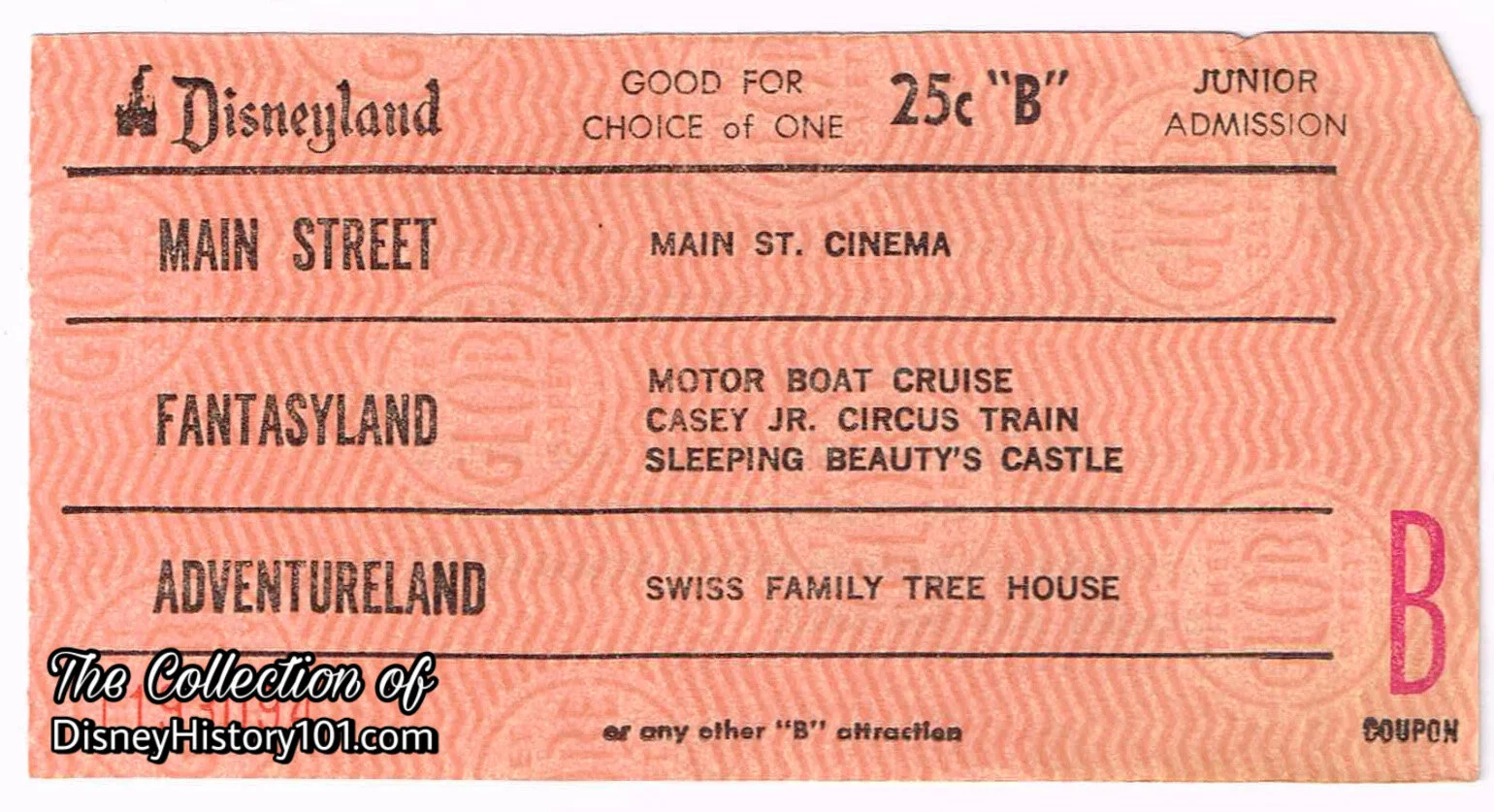
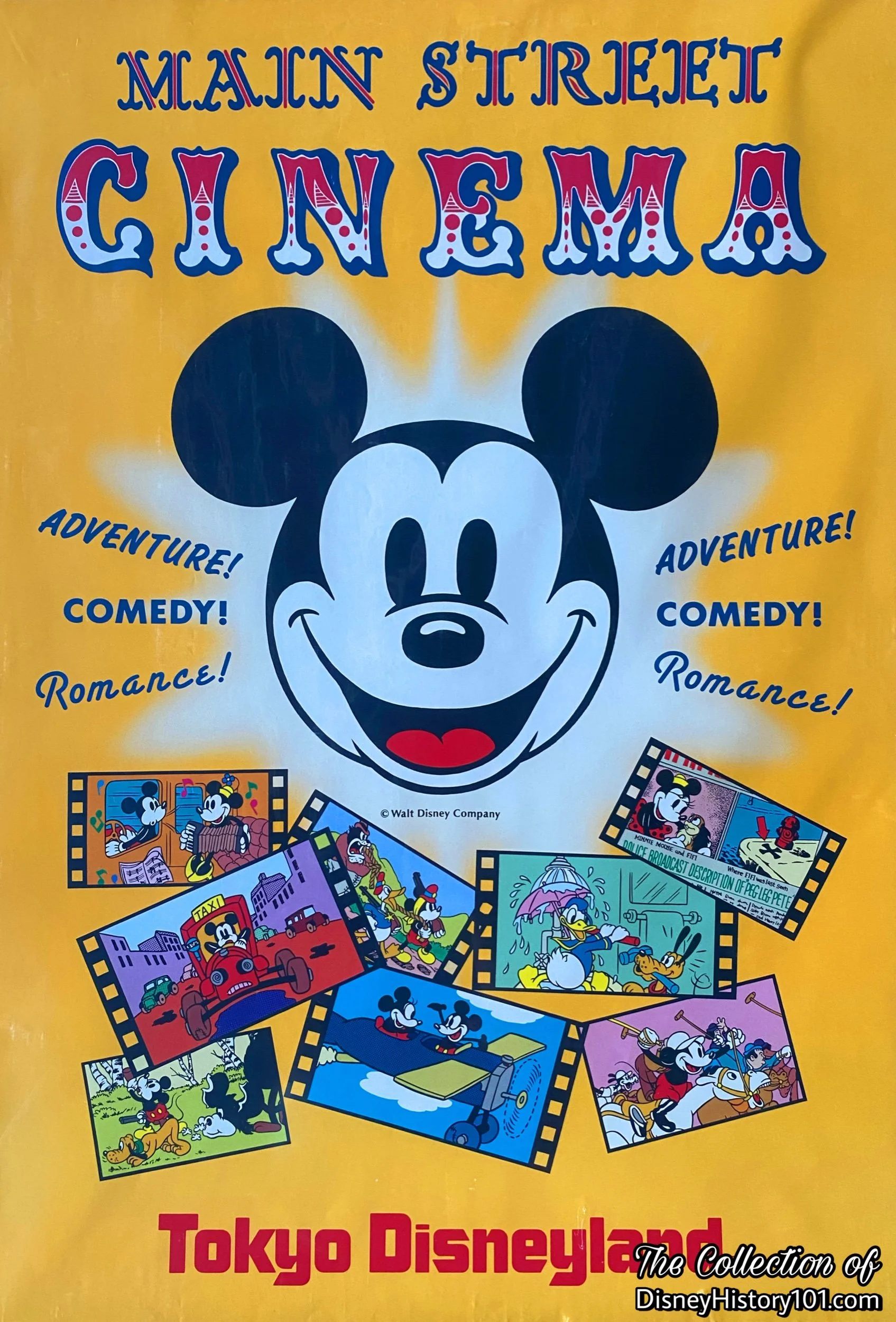
“Main Street Cinema Legacy”
The Main Street Cinema is one of several timeless Disneyland attractions! In one of his final publications, Dave Smith (previous Chief Archivist Emeritus of the Walt Disney Archives), included Main Street Cinema among “the only attractions still at Disneyland today that were there on opening day, July 17, 1955.” [Disney Facts Revealed by Dave Smith, 2016] Owing to this, Main Street Cinema had a legacy at the Magic Kingdom at Walt Disney World where guests could enjoy classic films of the silent screen era, shown continuously.
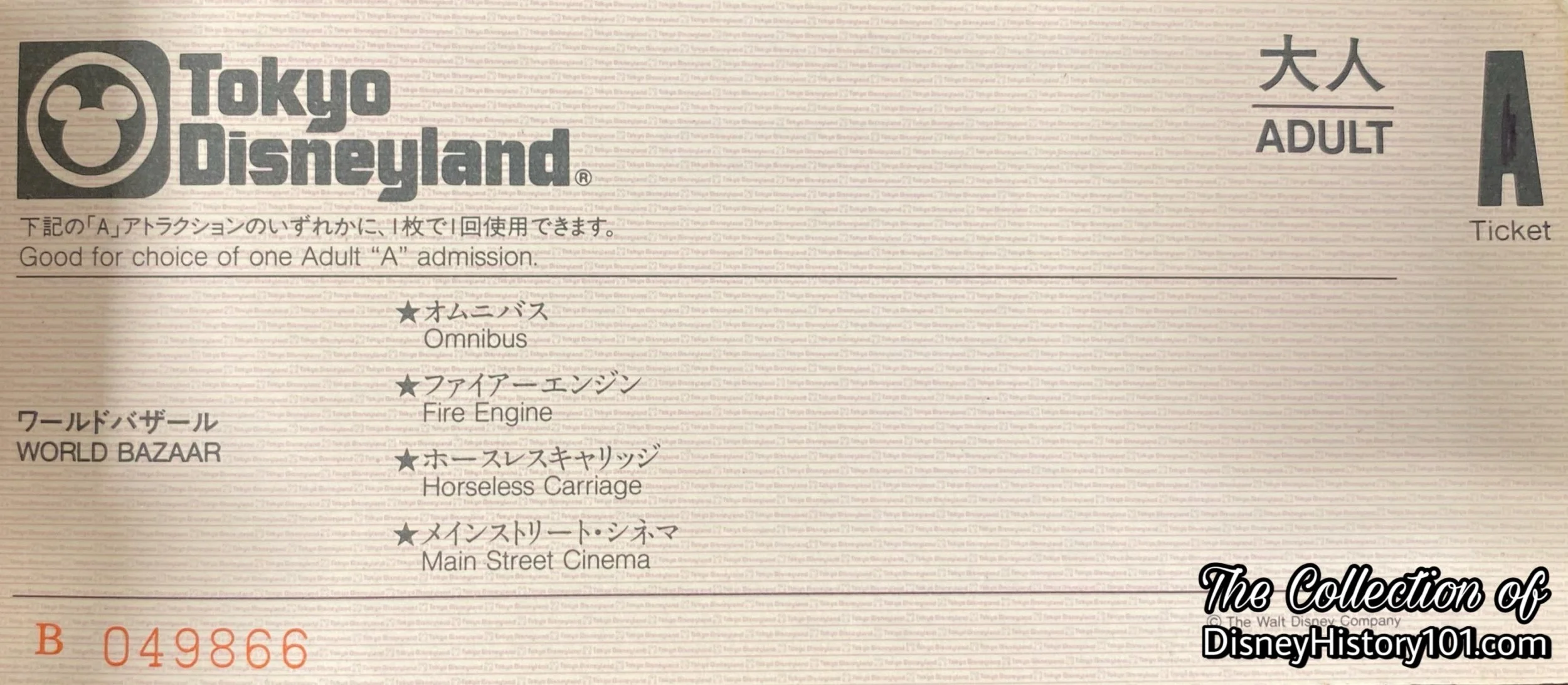
The World Bazaar Main Street Cinema on the Tokyo Disneyland Adult “A” Admission.
Main Street Cinema also has had a legacy through other Disney Parks, like Tokyo Disneyland. Main Street Cinema of Hong Kong Disneyland features the short “My Journeys with Duffy” which was screened beginning in 2017.
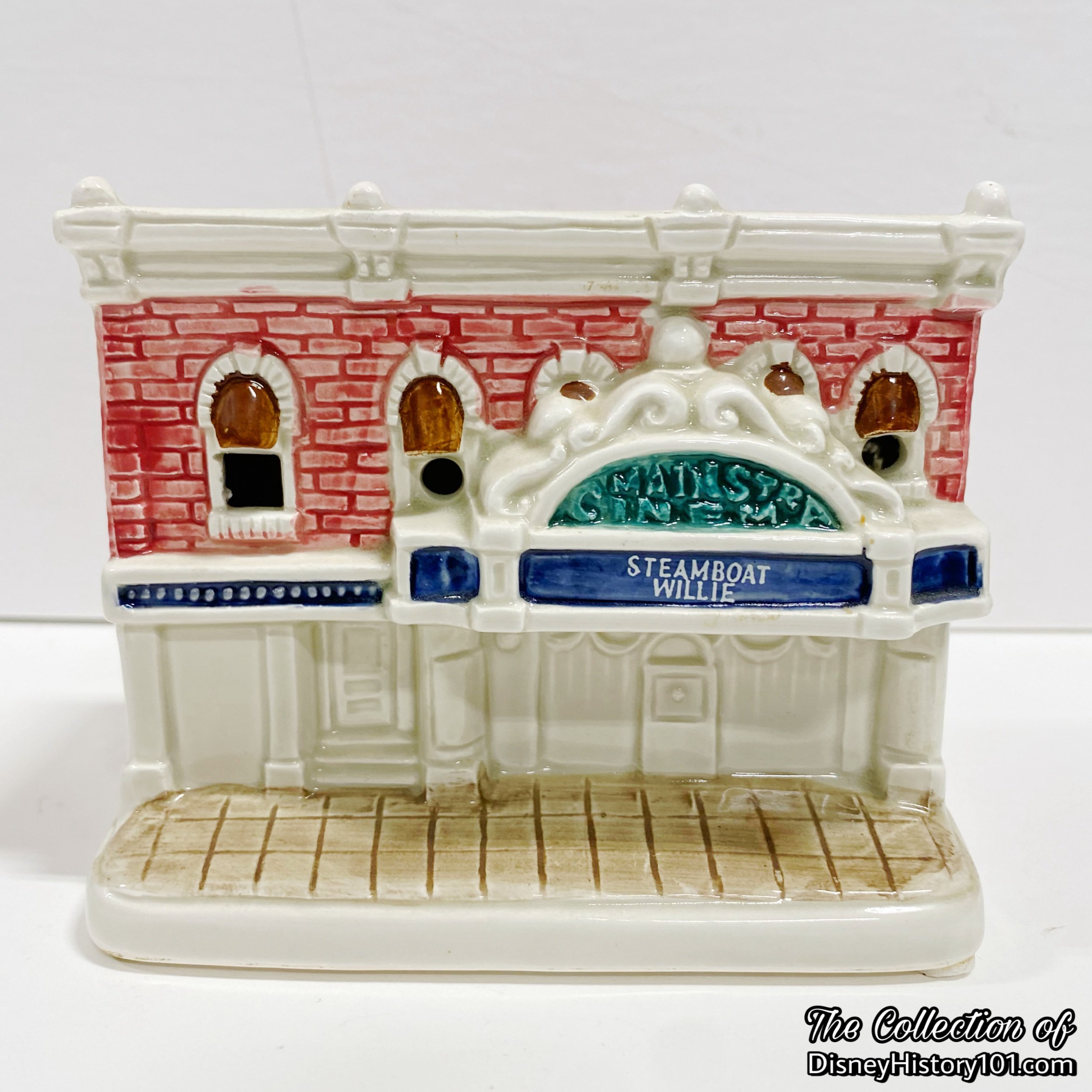
Sears-Disney Magic Kingdom Collection “Main Street Cinema”; 1988.
In 1988, the Main Street Cinema was memorialized as an illuminating collectible ceramic miniature sold through the retail giant department store chain.
Quisque iaculis facilisis lacinia. Mauris euismod pellentesque tellus sit amet mollis.