JUNGLE CRUISE (JUNGLE RIVER CRUISE)
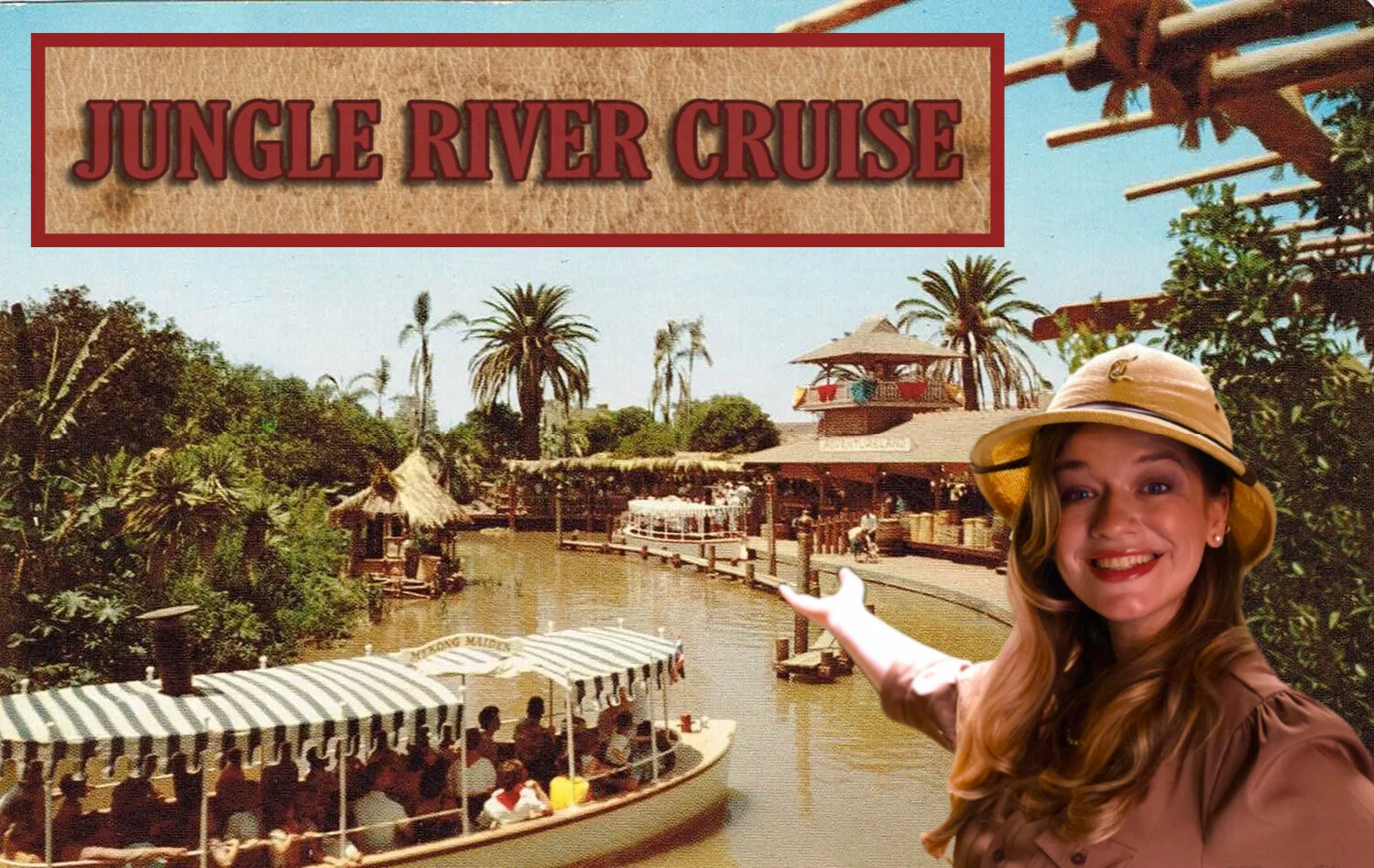
Welcome aboard our Vintage View of the world-famous Jungle Cruise, adventure lovers! Today, I’ll be your “Stand-By” Pilot. We begin our true-life adventure “in a little village clearing, far up some tropical river.” This is the last outpost of civilization. Here, we will board a tropical steamer with native guide, and head down the “River of Romance” (a five-acre waterway), to explore into the wilds of the jungle and its beauties. “Let’s climb on board and explore the farther reaches of these mysterious waters.” -Walt Disney (WALT DISNEY TAKES YOU TO DISNEYLAND, Disneyland Records). After leaving the explorer’s launch, thrilling adventures lurk around every bend, aboard this original Disneyland opening day attraction!
“Nature’s Own Design and Designing Nature”
Custom rides were created that would be subordinate to story and setting. Architectural and interior planner & illustrator Harper Goff (in a April 24, 1979 interview with Don Peri ; “Working With Walt - Interviews With Disney Artists”) recalled : “I had seen Bogart and Hepburn’s The African Queen [released 1951]. They had all these encounters with animals alongside the boat. So I got to thinking. We couldn’t make animals run, so I thought that aquatic animals - hippos and rhinos - if they are standing in the water or standing in the brush or elephants, if they just stood still and did something, or giraffes, if their heads could come over the top, or alligators in the water where you didn’t see the mechanism under the water - this was the ideal thing. Walt agreed. So we did that.”
In 1952, Walt Disney founded a company called WED Enterprises, Inc. in order to master-plan and design his his dreams of a Park. Walt once said: “Always, as you travel, assimilate the sounds and sights of the world.” Disneyland is such a fantastic example of this - from Main Street U.S.A. to the Rivers of the World, the Grand Canyon to New Orleans, and the Matterhorn. While initial plans for a Jungle River Cruise focused on American rivers like the Suwannee, the idea would swiftly evolve into something different when one particular artist was welcomed aboard.
While many Animators, Art Directors, Artists, Artisans, Architects, Set Designers, and Planners from the Studio contributed, the talented Herbert Ryman is of note. Herb had joined the Disney Studio in 1938, after Walt saw a public show of his work in New York. (Herb's paintings were being exhibited with those of another up and coming artist, Andrew Wyeth.) Herb Ryman acted as art director for such films as Fantasia and Dumbo, but had left Walt Disney Studios in 1946 and (by 1953) was employed by 20th Century Fox. However, Walt reached out to Herb and during one weekend (September 26 & 27, 1953) a historic “Aerial Schematic View” over Disneyland drawing was produced.
A short time later, one early description of the Jungle River Boat Ride described the experience this way : “You’ll pass ports of call in Mexico, Central America, South America, Asia, Australia, and the Florida Everglades.” Amendments to this same document added the territories of “Xochimilco” and “darkest Africa.” A Press Release document (“A Visit To Disneyland,” prepared c. June of 1955, by the Disneyland, Inc. Public Relations Department) included the regions of the “Nile or the Yangtse” to the list of cultures experienced. Another early description of the Jungle River Boat Ride read : “As you glide through the Everglades, past birds and animals living in their natural habitat…alligators lurk along the banks, and otters and turtles play in the water about you. Monkeys chatter on the orchid flowered trees.” It is clear that true-life places were the inspiration for the settings of the Jungle River Cruise show!
“The Inspirational True-Life Nature of Things”
Its a true-life fact, that much of Adventureland’s thematic story lay around the award winning True-Life Adventure series of theatrical features produced by Walt Disney Studios from the years 1948 to 1960. But while those films were “two-dimensional in scope, the Theme Park surrounds the guests with the story and impacts all of their senses,” according to “Disney By Design” Tour scripts. Now, its a true fact that the “original plans for the Jungle Cruise called for real wild animals, but zoologists warned Walt that the animals would always be asleep during operating hours,” according to “Disneyland - A Treasure Chest of Trivia,” prepared by Walt Disney Productions, 1990. Still, the story would depict scenes from various true-life adventure films.
And so, Walt and Company “would duplicate in Disneyland Park actual scenes and settings from this nature settings from this nature series,” stated Walt Disney, in “A Trip Though Adventureland”, aired through “Walt Disney’s Disneyland” television series. In fact, Walt Disney’s True-Life Adventure feature The African Lion (which was in production during the construction of Disneyland, and released on September 14th, 1955) came to directly inspire several vignettes to be featured along the banks of the river of what would become Adventureland’s main attraction. Walt knew that it would require the assembling of a coalition of talents to Imagineer his “Jungle River” attraction at Disneyland. Artists like Marc Davis and Herb Ryman went on to contribute numerous suggestions, including Herb’s suggestion of a “True-Life Adventureland Kiosk.”
Bob Matte (who later created the shark for the movie Jaws), was brought in to engineer the original animals, like alligators and hippos that operated with simple animation. Chris Mueller sculpted full-size animals in clay, like the African Bull Elephant (standing 8’6” at the shoulder, it was comprised of more than two tons of clay) completed January of 1955, nine-foot long black rhino, and the twelve-foot long hippopotamus.
Walt’s “A Trip Though Adventureland” narration continues, “Of course, we knew that our biggest job would be recreating the actors of the wildlife dramas - the ‘king of beasts’ from our motion picture ‘The African Lion’, the elephant, the giraffe, and all the others. So on paper, we began to sketch and design replicas that would be made of plaster and steel, but when in action, would be as life-like as their real counterparts… In studio workshops…artists and engineers were creating life-like life-size animals - the actors in the Adventureland drama!” According to “Walt Disney Disneyland,” first published 1964, “Disneyland craftsmen went to the movies before designing Adventureland’s life-size, like like alligators, giraffes, lions, elephants and other animals. The special effects men studied movement, size, shape, and other characteristics of jungle animals before designing their own finely detailed versions of these beasts: swimming alligators that snap at boat passengers and hippos spouting water from huge nostrils as they surface, baby rhinos scurrying to safety behind their mothers. In relative terms, it is a simple task to plan a mechanism for a special effect in a motion picture, one that will do a job once, twice or even three times. But to design and build a machine that will produce the same results and work reliably 12 or 14 hours a day, every day, is quite another story.” These animals would need to perform continuously, both day and night.
According to Light Magazine (July and August 1956), the boats would activate switches, located on the underwater guide rail for the boat, at the right point in the trip. “The JUNGLE beasts (of plastic, and complete with sound effects) were actuated by automatic mechanisms synchronized with the boat's passage.” At different points, tropical animals would “seem to appear out of nowhere, creating an everlasting impression as the boat progresses along the river channel.”
“Secrets of Life”
Clay sculptures would need to be made, molds taken, and latex skin produced. Artist Bob Mattey had previously helped bring some of the animals to life for Metro Goldwyn Mayor’s Tarzan film franchise and would later helped build the terrifying “40-ton” squid which James Mason battled in the Walt Disney Production of “20,000 Leagues Under The Sea.” Bob would now help bring these “mechanical marvels” (crocodiles, giraffe, hippos, and rhinos) of the jungle to life using similar methods (and new ones), as well as “tons of rubber, spring steel, flexible tubing, plastics, swivels, counter-balances, cloth and hair and pulp to behave like muscles and fibers and the will of a brain,” according to “The Disneyland News” (August 1955 ; Vol. 1, No. 2). Another (later) retrospective source described the animation as “a maze of flexible rubber and tubing, spring steel, plastics, gears, valves, swivels, and pumps. They were operated by accordion-pleated bellows, vacuum, pressure and water jets - all triggered into action automatically each time a boat loaded with jungle explorers reached a specified point on the river,” according to “Walt Disney Disneyland,” first published 1964.
“These earlier forms of animation were orchestrated using a cam-and-lever type system (sort of like string puppeteering) combined with an electronic-hydraulic-pneumatic approach, which proved to be as confusing and tedious as it sounds.”
The Staff Shop did more than maintain existing fantasy. They had made all the molds and skins for all animals in the Adventureland area.
The “tank soundstage” originally built (by McNeil Construction) for the submarine in 20,000 Leagues Under the Sea was used to test the underwater monorail system and the timed action of the Alligators and Hippos that would rise out of the water (as seen in the televised Disneyland episode “Pre-Opening Report From Disneyland”). Some of the figures were “tank tested” there, “first in a dry tank, and later in water to be sure they would operate smoothly,” according to “Building A Dream” (prepared by Disneyland, Inc. Public Relations Department, c. June of 1955). “Soon they began to make their entrances, one-by-one, along the dry river beds… To carry the electrical power that will animate the animals, it takes miles and miles of wire. The electrical wizards get their biggest shock when they find that everything works, according to the narration of Walt Disney in “A Trip Through Adventureland (an episode of “Walt Disney’s Disneyland”). Others (like Bob Gurr) helped with the mechanics of making these figures move. Among others, miniature character modeler Wathel Rogers’ animation and technical skills also “played a key role” in creating the Jungle Cruise.
Few (if, any) of the original land animal figures prepared for the Jungle River Cruise may have been actual true-life, preserved and mounted animals, but some were assuredly “fur and feathered” (that is, covered) with “natural skins” according to Backstage Disneyland (Fall of 1965)! Much of this work was overseen by Robert “Bud” Washo (a plastic modeler), taxidermist Seb Morey and employees of Art Bryant’s Taxidermy. The daughter of Raymond Jon Hokanson (former Art Bryant’s Taxidermy employee) recalled how the company was previously contracted to create some of the animals for the Jungle River Cruise. She shared her father’s story of working on one of the realistic lions (in a Disney History 101 Exclusive) this way: “They were contracted by Walt and Roy. They got some of their animals that had died from a zoo that was near there, [but] now gone (that was attached to a golf course). The zoo animals went for the jungle ride. Walt wanted a real zoo but Anaheim would not approve the plans so he wanted as many of his animals on the Jungle Cruise as authentic as he could. I know my dad stuffed the lions & said the skin was put on plastic frames [and] that the head & neck moved. My dad said that he was putting this plastic type spray on the fur to weatherize the fur (one day before the Park opened) & that someone decided to try the lion’s roar. My dad said he about jumped into the river & laughed so hard because it scared him as if the lion was coming alive… At least these are the stories he told me.” Bob Johnson (one of Bud Washo’s taxidermists, who transferred to the Taxidermy during 1960) recalled that “It was also extremely difficult to find a skin the right size to fit the ‘body’ sent down by the studio. Sometimes this meant cutting and blending two or more skins in order to cover the animal, which was both expensive and time consuming.”
All the while some Cheerios box backs featured promotional artwork (“Disneyland Park Light-Up No.9”) depicting “The ‘Congo Queen’ River Boat in Adventureland - Disneyland Park.”
Now, Walt (much like a bee) was known to “go from one area of the studio to another and gather pollen and sort of stimulate everybody.” This was his habit at Disneyland too.Another sanctioned source commented on Walt and Lillian’s early visits to Disneyland during the first few years, reporting that “Walt would attempt to merge with the audience, laughing at the right time and applauding the skippers’s performance.” [“The Spirit of Disneyland,” page 40; prepared 1984 by Walt Disney Productions] “In the early days, Disneyland was still in an experimental learning period, …. Walt…would come to the Park… Adventureland was the first thing he would check out. He allowed a certain freedom in the development of the Jungle Cruise narrations, but would make constant recommendations on things which should be eliminated or changed. As was his custom, Walt would attempt to merge with the audience, laughing at the right time and applauding the skipper’s performance,” according to “The Spirit of Disneyland” (published 1985 for Disneyland Cast Members). Two things that was critiqued, were the course and the speed of the boats, which had to be timed exactly. On this note, Dick Nunis recalled the importance of show operation time (in interview with Disneyland LINE, Vol. 25, No. 28) : “When I was Supervisor of Adventureland and Frontierland, Walt got off one of the Jungle Cruise boats and said, ‘What’s the trip time for this ride, Dick?’ I answered, ‘7 1/2 minutes.’ He said something like, ‘I just got a four-minute trip. How would you feel if you were watching a movie and they took out the middle of the film? We went through the Hippo Pool so fast I couldn’t tell if they were hippos or rhinos walking on water. We have to have the same consistent show and trip time regardless of how long the wait is.’ The Foreman and I worked very hard the next week training our Cast to do it the way Walt wanted. Three weeks later Walt returned for a ride. After he had ridden six boats, he turned to the Foreman and me and gave a thumbs up sign. Walt always wanted to give Guests the best show.”
Bob Johnson (one of Bud Washo’s taxidermists, who transferred to the position during 1960) recalled that the “[natural] covers [of the animals] created many problems. The skins, exposed to the sun, rain, and dew, day after day, soon turned into shoe leather, which burned out the electric motors that moved the animals. It was also extremely difficult to find a skin the right size to fit the ‘body’ sent down by the studio. The skins were also difficult to obtain because of protective game laws.” About that time (c. 1962), both the Studio and the Park began strict implementation of artificial synthetic “skins.” The materials “in an assortment of textures, thicknesses and colors” were then dyed “with water and acrylics colors, cloth and shoe dye, and black India ink,” according to Backstage Disneyland (Fall of 1965). By December of 1965, even the feathers were “laminated for protection from the elements and marauding birds,” according to Frank Slohn of Backstage Disneyland magazine (Vol.4, No.4).
Ben Harris was sent to the Jungle Cruise (when the steam train wasn’t open) during the summer of 1959. “Bill Hoelscher was the winter Foreman… I knew the ride’s narration. You would start on ‘Crowd Control,’ ‘Tickets,’ ‘Front End Loading,’ and then ‘Rear Exiting.’ Then when you had experience and got the approval, you got to take the boats out for three trips (with a cycle of fifteen minutes). Well, I did it two days because I knew the narration. Walt would tell all of us, ‘You ARE a skipper of a boat… you’re not at Disneyland. You’re going through the Jungle Rivers of the World.’ At the end of the third day, I was on a boat, following the narration correctly and people were giving me applause… I had success, and was welcomed to come back.
Bob Reilly (who was in charge of the Division) saw me doing the job there having fun and excitement on the Jungle Cruise… and later on I would be the person who would write and revise the scripts. I would be the assistant at first, but then when they saw it, Bob Matheison said, ‘You handle the Jungle Cruise.’ Especially when [in 1963] they made big changes with the Treehouse coming in and you were now no longer on the Mekong Delta, or the Irrawadi River, or the Nile River.”
Show Quality has always been a Disney trademark! Many developments would create a “smoother” cruise! During Disneyland’s early years, “electronic eyes” would help activate the animation. However, the sun would occasionally reflect off the water and cause the animation to start at the wrong times (natives would rise and fall unpredictably, causing “many a spiel change”). Eventually, proximity switches would be added on the rail and the animation was controlled by guides on the boat as they would cross over them, according to Backstage (published Summer, 1965). In addition, “Air pressure is now used instead of hydraulic”. In those same early years of Disneyland, Jungle River Cruise operators delivered their spiels through megaphones. These were soon replaced with microphones, which were put on the boats over time (the Congo Queen, the first to be outfitted with a microphone). Lee David of Disneyland LINE magazine (Summer, 1965) joked, “Can’t you see the boys dashing for the Congo Queen every morning?”
Walt Disney once said : “Disneyland will never be completed. It will continue to grow, always adding new things to provide its visitors with exceptional and entertaining attractions.” In Walt’s eyes, Disneyland was “like a piece of clay,” because if there was something he didn’t like, he wasn’t stuck with it. He could reshape and revamp it.After years of personally reshaping and revamping, Walt divulged: “I’m not the perfectionist anymore. It’s my staff - they’re the ones always insisting on doing something better and better.”
Ben Harris (Disneyland Entertainment Director) would work on the new spiels (narratives spoken) for the attraction Hosts of the updated attraction, beginning in 1962. Some of his changes to the script occurred during three test rides around the Rivers of the World, with passengers Marc and Alice Davis, Bill Evans, Dick Nunis, and Walt Disney aboard as you will see. Walt once said: “Whenever I go on a ride, I’m always thinking of what’s wrong with the thing and how it can be improved.”
Ben Harris relates (to Disney History 101 correspondent) :
“The Jungle Cruise had been down because they were doing changes on the Jungle Cruise, putting in the Enchanted Bathing Pool of Indian Elephants, and the Lost City of Ganesha and the area of the Rivers of the World going into the Africa Veldt. There were usually hippos, but now you were seeing this new area. I had been to the studio a couple of times, talking with the Art Directors, and submitted a recommendation on the narration with changes. It came back and it was approved by my father in law who had given it to Walt (and Walt approved the script).
I came back on a Monday (as the Park was closed), and I’m walking through the Park, from the Maintenance Area. They had filled the moat back up because they were going to open it in a couple of days. Dick Nunis yells at me. Dick is down in a boat, Walt is in there, the designers of the attraction (Bill Cottrell and Marc Davis and their wives) were there and Bill Evans (the guy in charge of all the vegetation). They’re all in the boat, and Nunis says, ‘Harris, go get the script and come back here, for Walt.’ I said, ‘I don’t need the script. I know it.’ I get over there, and Walt is sitting there with Bill Cottrell and Marc Davis. They got the gun up there, the narration, and I turned around and pretended to be the Skipper. I didn’t know that they had changed the Tropical Rainforest (with the Toucan Bird). They didn’t have the Touch Bird. ‘Bill [Evans] says to Walt, ‘That’s a Dragons Blood Tree. It will bleed red.’ Walt says, ‘Let’s talk about that.’ What liked that. That’s what Bill told me. Then you make a little turn and there’s a crocodile ‘Ol’ Smiley, the granddaddy of them all. Keep your hands inside, because he’s always looking for a handout.’ The way you deliver this, you need to be an actor. We made three trips around the ‘Enchanted Bathing Pool of Elephants and the Elephant god Ganesha, guarding the entrance to the sacred bathing pool of the elephants, a sight seldom seen by civilized man.’ I had known the narration… I talked about the giant treehouse, and somebody said ‘It’s a Disney species.’ And somebody said, that’s like species ‘Disneydendron-Gigantum.’ It was added to the script. After a couple of little changes made here and there, Walt said ‘That’s it, approved,’ and Nunis handed it to somebody to make copies of the brand new narration.”
“Area Developement”
During 1957, the shores were lined with brightly colored flowering plants. Among the additions were water buffalo, African gazelle and antelope, an army of cannibals, and huge hovering butterflies.
By September 28, 1958, Disneyland, Inc. made approximately $29,836 of props and dressings (to Adventureland), $2,913.00 of land improvements to the Adventureland Animation repair shed, and $916,233 to the Jungle Cruise ride.
By 1959, Joe Fowler was Vice President of Disneyland Operations Committee and Doc Lemmon of Disneyland Operations was overseeing Operators of Rides & Amusements (like the Thimble Drome Flying Circle), Livestock, Parking Lot, and Ticket Sellers.
After the Mine Train Through Nature’s Wonderland was shown to be a success, Walt divulged (to Bob Thomas of Associated Press) : “‘We’ve come a long way in making our animals move… Now, we have ways of recording impulses on tape and running the tape to move the animals electronically. I want to make over the jungle area. I found a place where I can have a tiger walk menacingly along the bank as the boats go by.’” In addition (by the early 1960’s), the Disneyland taxidermist (Bob Johnson) began covering the animal figures in newly employed artificial fibers and fabrics. During 1961, Eleanor Heldt (Magic Kingdom Club Administrator) commented that “During a major rehabilitation, it is sometimes necessary to close an attraction for several weeks. This, of course, is when the smallest details were checked, replaced or repaired as required for the maximum safety, convenience, and comfort for our guests.” On this subject of rehabilitation, Backstage Disneyland (Fall 1965) commented : “During nesting season… [Bob] has the additional problem of replacing, by hand, the hairs plucked by birds from the skin of the elephants and the ears, tails, and manes of there large animals.
This reminds me of a short anecdote published in the all-new Disneyland LINE (Vol.1, No. 2) : “Arnold Rubio, a well-known painted employed as a pictorial artist by Disneyland’s staff shop (where life-like finishing touches are put on all Disney animations before they are used in the Park) just about turned in his brushes recently. It seems that Rubio had just completed a masterful painting job on one of the elephants for the Jungle River Cruise in Adventureland. It was the shiniest, most sparkling elephant ever seen. Floyd Humeston, the taxidermist, approached the finished product and to Rubio’s amazement tossed a bucket of dirt all over the new paint job. . . because, as Humeston says : ‘Whoever heard of a shiny, sparkling elephant?’”
Gunter Otto recollected “The Jungle's on fire! somebody yelled, as Joe Delfin and I were lined up at the lunch wagon. We ran to the Jungle River, dived in, and swam over to the old Temple. There was Little Joe, our Mexican helper, sitting beside a nice bonfire he had built to warm his tacos!”
Rehabilitations would maintain the attraction’s superb Show Quality. Since it costs a fortune to drain the ride, Machinists (or highly skilled craftsmen) would learn scuba diving, and dive down to where the action is to check the equipment and the rails. Disneyland Machinists - show people in the truest use of the word - would make sure the lions eat, elephants squirt, and alligators snap.
Bob Milek recalled: “There was the time we had a man, named Henry, tie a skiff to a hippo tusk so that he could do some paint work on the critter. Unfortunately, a mechanic around the bend of the river didn't know what was going on, and he threw a switch that took the hippo down, pulling the skiff and Henry down too!”
Walt Disney’s Imagineers knew their audience. Major revisions would occur in 1962, 1964, and 1976.
During 1961, “Anaheim... Future Unlimited” published by the Anaheim Chamber of Commerce, foretold: “And true to Walt Disney's promise that ‘Disneyland will never be completed,’ $7 million in new adventures are now being added for unveiling in 1962 and 1963. A completely new Jungle Cruise, the ‘world’s largest’ Tree House, a unique new concept in restaurants, and ‘Safari Shooting Gallery’ open in Summer ‘62.”
The attraction began to employ numerous Audio-Animatronics® - the Disney-designed system that combines sound, mechanics and electronics for three-dimensional animation. The Disney-patented technique electronically synchronized voices, music and sound effects to animated figures and objects. According to Walt Disney (in a c. 1963 interview with Fletcher Markle), “Now, we’re making these… dimensional human figures move, we make animals move, we make anything move, through the use of electronics. It’s a tape mechanism. The tape, its like programming and sequencing when… they’re sending some missile to the moon. At different stages, at different times, things must happen. That’s all programmed - pre-determined. So our show’s put on that tape, programmed from this tape. And we run it off a little 1-inch tape that has 14 tracks. On each track, we can get up to 16 signals. Now, those little signals go and impulse this figure and make the figure move make the figure talk, and everything.”
“Well it’s another door that’s opened for us. You see our whole forty some odd years here have been in the world of making things move. Inanimate things move, from a drawing through all kinds of little props and things. Now we’re making these human figures move through the use of electronics… it’s juts another dimension in the animation we have been doing all our life. It’s a new door… and we hope we can really do some exciting things in the future.” [September 25, 1963]
The Disneyland welding department staff was capable of working on all types of metal and using all types of welding techniques. They had to be flexible, fast, and ingenious, with a specific skill in performing ten rush jobs at one time. The staff performed their surgical work on crabs, elephants, hippos, battling elks, drunken pirates, and dancing dolls in Small World.
Though the “Jungle Boat Ride” was an “E” Coupon adventure (by 1963), new scenes would continue to unfold along the river banks - the ‘lost safari’ was discovered (in 1964), a particular herd of mother elephants and their “little squirts” would settle near a portion of the river known simply as ‘the Elephant Bathing Pool’ (in 1966), and the African Veldt region (in 1964). By 1964, the misty tropical rainforest was referred to as in the “Amazon,” acceding to “Walt Disney Disneyland,” published 1964.
One publication commented how “The Jungle Cruise is almost brand-new today. The entire voyage has been enlarged and dozens of new animals added. Among the highlights are Indian elephants - ‘big shots’ and ‘little squirts’ - splashing, spraying water and ‘singing’ in a waterfall shower. There are lions, giraffes, jackals and other beasts of the African Veldt in a setting that recreates the vast grasslands of the Dark Continent, and a ‘trapped safari’ of hunters who have been chased up a tree by a snorting rhinoceros while laughing hyenas roar their approval,” according to the author of “Walt Disney Disneyland,” pages 51 & 52, printed by Officine Grafiche Arnoldo Mondadori - Verona; first published 1964.
Ray Van De Warker was serving as Foreman by 1965. By that time, Wally Boag (Backstage Disneyland Editor) noted the “lonely little duck, running up and down ten dry bed of the Jungle River (down for rehab), quacking his protest over the, to him, unreasonable drying up of his playground.” [Backstage Disneyland, Vol.4 No.4]
On December 18th, 1976, seven show scenes and 31 Audio-Animatronic figures were added in time for the holiday season, (including the Gorillas in the Camp, and a Bengal Tiger lurking in the Cambodian ruins). Owing to this, by 1979 - 1980, admission aboard “the world famous ‘Jungle Cruise’” was still one “E” coupon, the same as a flight through Space Mountain, passage through the Seven Seas of the Submarine Voyage, or passage aboard the Monorail (to Disneyland Hotel & return)!
Once in a while, the pole-climber in the Jungle Cruise safari would lose his hat or an Audio-Animatronics figure would topple over, requiring the immediate attention of both the Animation and Costuming staffs. When maintenance was performed on a figure or a group of figures, they were carefully repositioned as closely as possible to their “night mode” positions so that when a trial run was started, the movements of the functions were not violent.
The Jungle Cruise Boats were among 100 boats that were “reworked” annually (from 1955 to 1965), according to Disneyland Backstage (Summer, 1965). “Patch work is done throughout the summer and the permanent patch work in the fall of the year.” These 36-passenger boats would also receive updates like bow bumpers (credited to Gil Aguilar), and environmentally-friendly engines capable of being “powered by compressed natural gas.”
New microphones were added in 1966.
During the 1960s, the surface and shoreline of the Jungle Rivers of the World were tended to regularly to retrieve papers and wrappers that were accidentally dropped or sometimes thrown in. The water itself was constantly being filtered and replenished.
The “I Have an Idea” Program (est. 1978) would come to yield a great deal of ideas that would influence and shape the efficiency and safety of how things were run. For instance (the earliest of ideas submitted saw), Disneyland Cast Member Clarence Smith’s idea to “replace metal screws with quick-release screws on the engine compartments of Jungle Cruise Boats,” and Bennie Miller’s idea to “replace wood gunnel with molded rubber on Jungle Cruise Boats.” [Disneyland Line, March 1st, 1979]
The Jungle River Cruise attraction (including its naphtha launches and Skippers) made appearances in promotional media. For instance, in August of 1962, Lloyd Richardson, Larry Clemmons, Joe Marquette, and Jack Leppert (of the Walt Disney Studio) filmed and shot scenery “of the new attractions” for Walt Disney Studio Production #3185. On this occasion, at least one plate was “shot on the Jungle Cruise Dock looking toward the Tahitian Terrace.”
In 1964, the exciting Rivers of the World (at Disneyland) were the setting of an RCA Victor New Vista Television commercial (filmed starting April 1, 1963). Television sets were actually showcased in various locations along the banks of the Rivers of the World - in the tall grass, in the Watusi Village, and even on multiple ledges over the Elephant Bathing Pool’s falls!
The Jungle River Cruise (and Jungle Cruise Ride Operators Thom R. Baker and John Curtis McCoy) made an appearance in “Disneyland Show Time” starring the Osmond Brothers (a “Wonderful World of Disney” episode, filmed c. February 27, 1970, and first aired March 22, 1970).
The Jungle Cruise is one of several timeless Disneyland attractions! In one of his final publications, Dave Smith (previous Chief Archivist Emeritus of the Walt Disney Archives), included the Jungle Cruise among “the only attractions still at Disneyland today that were there on opening day, July 17, 1955.” [Disney Facts Revealed by Dave Smith, 2016] The Jungle Cruise had a legacy of sorts when Tokyo Disneyland opened on April 15, 1983, with a Jungle Cruise featuring scenes from both existing Parks (including the Ruins from the Magic Kingdom).
The adventure has a legacy at Hong Kong Disneyland in the Jungle River Cruise, where guests journey with an intrepid skipper along the mysterious Rivers of Adventure.
“HARPER GOFF - A ‘TRUE-LIFE’ TRAILBLAZER” Hu
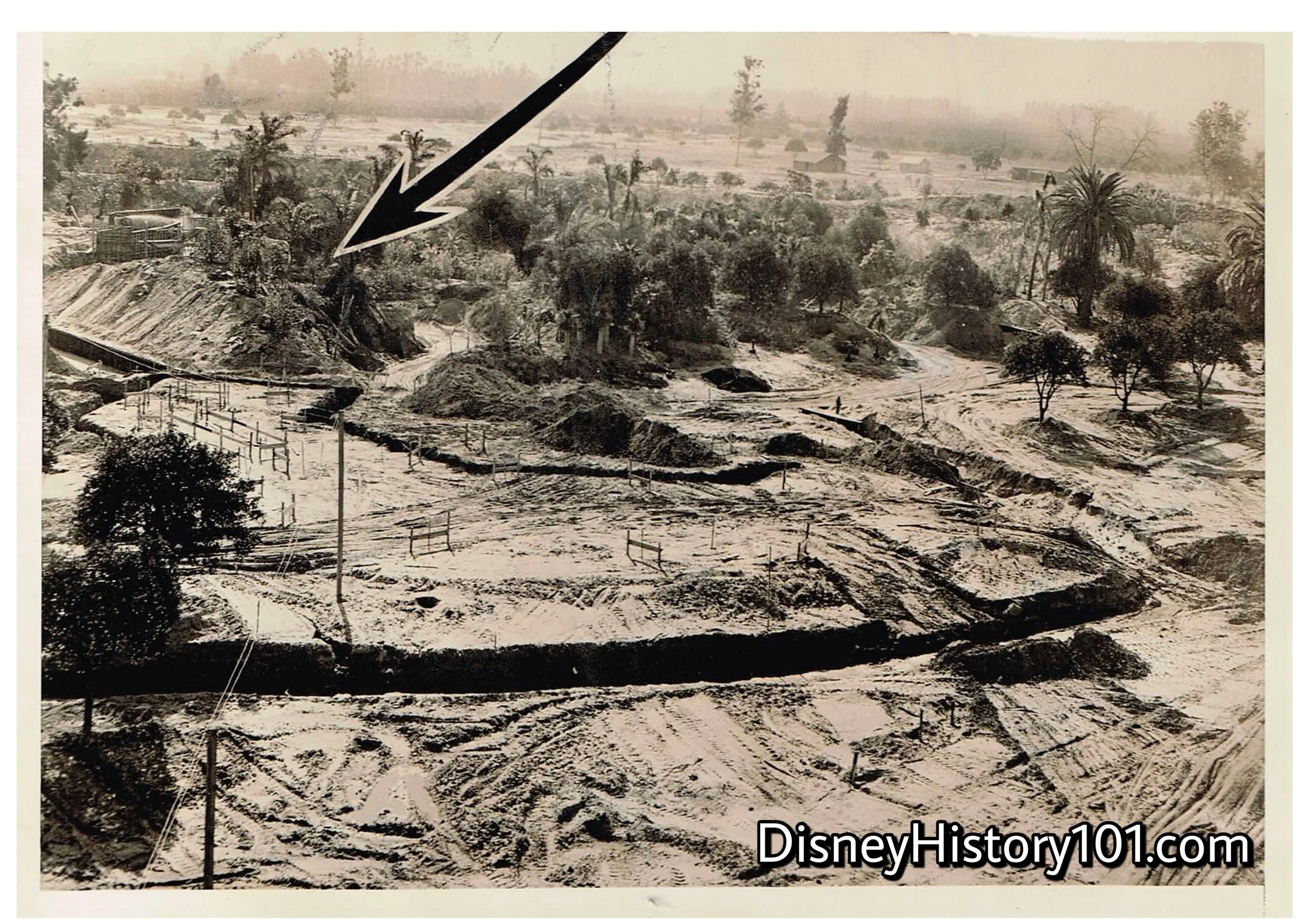
(Pictured above : This altered circa 1955 construction photo explains where the Explorer’s Launch will be erected.)
“Creating the River”
Walt Disney (narrating “A Trip Through Adventureland”) continues, “As a backdrop for the animals, we would have a dense jungle, and as a sort of flowing theme to tie the whole realm together, we would have a network of tropical river.” Harper Goff (who previously designed the Nautilus submarine for 20,000 Leagues Under the Sea) now served as the Art Director for The Jungle River Cruise). Harper didn’t draft blueprints, but formed the pattern of the river in a small sandbox, with a stick. Later, Harper took a stick, and with the bulldoze operator, the two drew what would be the full-scale left side outline of the Adventureland River. They then went about ten feet over, and drew what was to be the right side of the water. Then, Harper instructed the crew of McNeil Construction (who previously constructed sound stages for Walt Disney Studios) to take all the dirt in between, pile it up, and make the banks of the river on either side. They didn’t need to create any drawings or haul the dirt away. They just created the track layout on the spot. Soon, Harper would cruise the “dusty bed” of the future waterway, in a station wagon, developing locations for show scenes and rough attraction timing. During November of 1954, “an additional one-foot cut was taken from the bottom of the river bed in Adventureland to accommodate a waterproof clay lining,” according to Disneyland LINE magazine (November 22, 1979). So, the entire riverbed was waterproofed with a “clay and liquid cement mixture,” to assure that the river wouldn’t “run away”.
Late in 1954, Louis Berg (“This Week Magazine” author of “Walt Disney’s New Ten Million Dollar Toy”, published September 19, 1954) divulged what came next : “Out on the fair grounds, workmen were sinking the wells for the water rights and digging the lagoons, rivers, bays and oceans the small explorer is going to have to journey through. A five-acre voyage through the tropics of three continents.” There were three pumps located at the south Deck that were used to supply water for True Life Adventure.
While all this was taking place, structural engineers Bill Wheeler and John Wise began to construct the steel framing to hold the water, and civil and electrical engineer Jacob Samuel Hamel (who was referred by General Electric representatives to be a Disneyland lighting consultant) specified the type of electric pumps needed to keep the falls cascading.
Walt was initially furious over the amount of concrete being used around Disneyland, according to “Disneyland - Inside Story” by Randy Bright. “Steel bars began to form what appeared tone a large rock outcropping along the jungle river. (This later became one of the most popular features of the Jungle Cruise, the journey under Schweitzer Falls.) An incensed Disney was convinced that Fowler was using his park as the cement contractor’s full-employment act of 1955. And if this didn’t exasperate Walt enough, a nearby construction worker was ready to provide the coup de grace. ‘Tiny’ was a water-car operator who weighed more than three hundred pounds and had as large an appetite for pranks as he did for food. He took a devilish delight in catching some unwary victim in the jungle territory with his high-powered water hose. As fate would have it, Walt came around the corner, already steaming, only to be cooled down by the drenching full force of Tiny’s water stream. Tiny’s paycheck was soon smaller than his name.”
Model-maker Fred Joerger (who was hired c.1953 to craft the “Barber Shop Quartet” show for “Project Little Man” of “Walt Disney’s Disneyland”) would distinguish himself as Disneyland’s “resident rock expert” by crafting the RockWork from plaster, for the river banks.
Finally, “A Trip Through Disneyland” (an episode of “Walt Disney’s Disneyland”) actually captured and preserved the big moment when the master valve was opened, bringing water to the rivers of Adventureland! “Two million gallons and several days later, the water has risen to a respectable level,” according to the aforementioned film’s narrator (Walt Disney). Soon, the water was dyed brown, in order to obscure the mechanics of the ride (which sat from 3 to 8 feet at the bottom of the river). As a sidelight, all the water supporting the True Life Adventure show was provided by three original pumps and one original well left on the parcel of land that would become Disneyland.
“Landscaping, Hardscaping & Greenscaping”
A few years prior, Jack and Bill Evans owned a nursery catering to Hollywood clients. Gunter Otto came to the U.S. in 1952 and became an assistant grower with Bill Evans in his Brentwood nursery. In 1952, the duo helped landscape Walt’s Hollywood home on Carolwood drive with its elaborate model railroad system. In August of 1954, Walt remembered Bill when it was time to build Disneyland. In October of 1954, Jack and Bill made a ONE YEAR contract to provide total landscaping for the original Park, but it sort of kept going. In 1954, Gunter came with Bill to Disneyland.
Bill once remembered: “‘We started on Disneyland in 1954, just a year before it opened. We got a call from the Studio because Walt wanted to talk about a park that he had in mind. We went in and sat down with Fred Schumacher, who was Walt’s personal director among other things. Walt came in and joined us, and asked if we were interested in taking over the responsibility of supplying the landscape for his Disneyland Park. Walt actually said, ‘How about you fellows landscaping Disneyland for me?’ Needless to say we jumped at the challenge!… Later that same week, we went down to the property and hiked it with Walt. When we got there, it was wall-to-wall orange trees, with few avocados, and maybe a couple of dozen walnut trees. They were just starting to knock down some of the range trees for the parking lot area. The first thing we said was, ‘Wait a minute! Before you knock them all down, let’s see if we can’t use some of them.’ To replace all of the orange trees with some ornamental species would have cost us about 500 bucks a unit… these were big trees! We got an aerial photograph, and a transparency of the master plan, showing Main Street and the hub, and the Town Square and everything. We overlayed the aerial with the orange trees, with the master plan in the same scale… grades had to be materially altered to establish… the jungle area… We were able to keep an equal number of trees out in the jungle,” according to “Creating the Disney Landscape - An Interview with Bill Evans,” published in The “E” Ticket, Spring 1966.
By November of 1954, the first “greenscaping” began in the area of the Jungle River. Of all the lands, planting began the earliest in Adventureland (around the region of the Jungle Cruise). The reason for this was that “they needed to get a growth season in the Spring on all that foliage so that was done a good six months out,” according to Tony Baxter (of Walt Disney Imagineering). Now, according to Walt’s own words (in one Pre-Opening interview with Bob Thomas), “We need lots of big [trees], but its hard to find and transplant them, except for palms.” Alice Davis (Imagineer and Costume Designer ; 1963-1969) recalled, “They didn’t have money to buy the plants they needed for the ‘River ride.’ He [Bill Evans] would put ads in the newspapers down in Orange County and… anybody who had a big tree that they didn’t want in their yard anymore, they would gladly come and take it out. He would plant the trees in front and they would leave the rest of the orange trees in. And I thought it was very funny that they would have to send people in to get all the blossoms and all the oranges off the orange trees, because they didn’t grow in jungles.” You may recall hearing that when Disneyland was being built, some 12,500 orange trees, 700 Eucalyptus trees, and 500 Walnut trees (in addition to persimmon, avocado, and date palm trees) were removed. Some of these trees (especially the palms) would be spared demolition, and repurposed into tropical foliage that lined the Disneyland berm, as well as the riverbanks of the Rivers of the World! Two of these particular trees were relocated, and would eventually come to be known as the “Dominguez Palms.” However, soon many other big trees arrived from old gardens, estates, and freeway development (sometimes hundreds of miles away), and according to Morgan Evans, “their roots packaged in heavy boxes. Some weighed as much as 22 tons.”
The local climate was arid like that of a California high-desert, so creating a tropical jungle would pose a challenge. Yes, “to provide authentic settings and keep Disneyland perpetually green, thousands full-grown trees and foliage were brought here from all parts of the world. Each plant and tree had a reserved spot and was made to feel at home in specially treated soil,” according to the narrator of “Disneyland - The Park,” an episode of the Disneyland anthology series first aired 1957.
Joe Delphin was hired as a union as a laborer and started working, as a laborer, on the Golden Horseshoe. Ray Miller was the Landscaping Superintendent at the time and Joe went to him and told him that he loved plants and flowers. Ray hired Joe as a gardener right there on the spot. Joe recalled: “Ray put me in Adventureland and I started planting by the waterfall. I was planting like mad and it was very hot one day, when Bill Evans came by. He wanted to know where I had gotten the scaffolding, and where I had gotten the sphagnum moss? He was very pleased that I had gone and done these things on my own. Later, he put me in charge of the Jungle.”
Flora like Banana trees and palms were planted across from the dock. Gunter Otto recalled that "There were real live orchids in the Jungle, then...we put the stems of the orchids in glass tubes, stuck them in moss and tied them onto the trees. We changed the orchids every day or so for 6 months, and then went to artificial flowers."
“Now, a floating nursery crew operates all day long, soaking the river banks to prepare for the planting of new shrubs”, according to “A Trip Through Adventureland” narrator Walt Disney. Gunter Otto recalled: “I had worked many hours in the Jungle with Joe Delfin. The work skiffs had no motors, then, and were too heavy to paddle, so we put on tennis shoes, jumped into the River and pushed the boats, laden with their cargoes of plants and flowers… In the middle of the night, one time, we were working in the Jungle, when a voice called. Is was Walt, wondering what we were doing. We paddled him through the Jungle and showed him we were hanging the orchids, and he asked if we liked the place?”
By 1959, it was recorded that “all of Disneyland's plants were purchased in Los Angeles, Orange, San Bernadino and San Diego Counties.” This is partially attested to by Walt’s friend (and Hollywood columnist) Hedda Hopper divulged, “Had a sneak preview of Disneyland…It was the planting that awed me. Walt bought $400,000 worth of trees and shrubs ; he depleted our nurseries and is now importing trees from Santa Barbara and San Diego.” [“Disneyland Park Found as Fantastic as Its Creator,” Published in “Looking at Hollywood,” May 22, 1955].
Now, the “major nurseries were a prime source of plants, but there were nit enough fully-mature specimens in the area to fill the Park’s needs. so the landscapers turned to a new and surprising source, private gardens. Old ranches and estates were important digging grounds in the early days and, as it turns out, nearly al of the requirements for the jungle were met within a 200-mile radius of Anaheim. Among the unusual plants established in Adventureland in 1955… are the rare Bushman’s Poison, which provides venom for the arrow tips of African hunters; taro, still the staple diet of many people in tropical areas of the world; and timber bamboo, growing as high as 60 feet.” [“Walt Disney Disneyland,” first published 1964] Other plants included Egyptian papyrus grass, Malaysian tiger grass, and banana trees.
While Jack and Bill brought an encyclopedic knowledge of plants to the project, and contributed enormously to the park's success, much credit goes to landscape Architect Ruth Shellhorn. Ruth “helped identify key botanical elements for each area among the small forest of specimen trees they amassed on the site,” according to “Ruth Shellhorn” by Kelly Comras. Then, gardeners drove small trucks (and in some cases paddled gondolas) full of plants to their new locations along the Rivers of World, where they were (under the direction of Ruth Shellhorn and Jack Evans) planted in specific locations of the prepared soil (as seen in “A Trip Through Disneyland”). Harper Goff once recalled : “I was interested in the vegetation part of the jungle. I became the coordinator between the studio and Evans and Reeves, the landscape designers and architects. We worked together, and I was coordinator of the whole park,” according to an interview by Don Peri, [conducted April 24, 1979]. While Harper may have been coordinator of the whole Park (including Adventureland), not a tree or flowering plant was placed without Landscape Architect Ruth Shellhorn’s approval. Finally, the 15-20 person staff of Jack and Bill Evans placed the flora of Disneyland all within an impressive 11 month period. Gil Pimentel recalled that Walt “would come by and shake hands with the gardeners.“
“Nightly Illumination”
According to Light Magazine (July and August 1956): “The main attraction here is an explorer's trip down ‘tropical rivers of the world,’ and it provides startling and mysterious effects. The nighttime character is still more mysterious because of the way the animal creatures in natural settings are brought out. To develop these effects, ‘cut and try’ methods were employed. Here, black-light techniques were a principal part of the solution.
An interesting means of control was incorporated by the boat activating switches, located on the underwater guide rail for the boat, at the right point in the trip. At different points, tropical animals seem to appear out of nowhere, creating an everlasting impression as the boat progresses along the river channel.
Mercury vapor lighting, using PAR-38, 100-watt mercury lamps in a weather-proof, ventilated housing, produces subtle effects on the jungle foliage and lights the waterfalls with a moonlight characteristic…
The jungle river trip is most effective at night as the ship's 360-degree Fresnel unit illuminates the foliage, and the mercury-lighted jungle animals make their sudden appearance… Mercury vapor lighting, using PAR-38, 100-watt mercury lamps in a weather-proof, ventilated housing, produces subtle effects on the jungle foliage and lights the waterfalls with a moonlight characteristic.”
The animals were illuminated with “PAR and mercury lamps with color caps concealed on shore.”
By July 1, 1954, George Whitney of Disneyland, Inc. directed Amusements, with Ron Miller overseeing analysis, philosophy, capacities, planning, operator training, and amusement procurement.
“55er” John Stevensen remembered: “On July 4, 1955, before the Park opened, Walt had a party on the Mark Twain and people were trying to get into the unfinished Jungle. Walt told me to let NO ONE into the Jungle except himself and Joe Fowler. Along comes Roy Disney, and tell him he can't go in. soon walt comes up and said, ‘That's right, not even my brother!’”
“Unions”
As the deadline neared, some unions descended on Disneyland. Among these was the American Guild of Variety Artists (AGFA) wanted jurisdiction over the Jungle Cruise, according to the recollection of Van Arsdale France. After negotiations with the Orange County Central Labor Council there was there was (what Van France referred to as) a “shotgun marriage” and a resulting total of 29 unions at Disneyland. Still, the Jungle River along with its 121 square foot Boat Dock and it’s Boat Shelter Area was close to being completed.
“Finishing Touches”
As of June 2, 1955, C.V. Wood Jr. sent an Inter-Office Memorandum to Walt Disney regarding the best estimates that could be obtained at the time regarding the completion status of individual sections of the Park and Opening Day. C.V. wrote: “Animals: It appears that all will be complete. We are now installing the alligators and the hippo. We plan on flooding the waterways the 10th of this month. Boats: Okay. Rapids: It is going to be very close if we can get them working at all for opening. The Water Fall: Okay.”
As late as July 11, 1955, Walt Disney Productions records were cut featuring punches of “Disneyland Music” by musician Ed Plumb and a 27-piece orchestra. Among these was a track called “Drums for Adventureland Boat Ride.”
“One 900-pound mechanical elephant would be delivered the night before the Park opened, to be installed in the river in pitch darkness after a night watchman unwittingly turned off the work lights,” according to “Disneyland - Inside Story” by Randy Bright. “And now, at last, the job is done. The jungle is ready and waiting for the next phase in our Adventureland story - an actual boat trip through the hidden byways of this tropical water wilderness,” according to narrator Walt Disney (in “A Trip Through Adventureland”, an episode of “Walt Disney’s Disneyland). He continues, “Well, the hard work, and hectic days are behind us now, so let’s join the crowd and share with them in the fun of a ‘True-Life Adventure’ in Adventureland as it is today!”
“The Premier and the Grand Public Opening”
July 17th, 1955 arrived, and due to loss of time, Adventureland and the Jungle River Cruise were almost entirely cut from the live Press Preview broadcast on ABC, debuting during the final two minutes of airtime.
“55er” Bob Holland recalled “loading jungle boats and Bob Cummings microphone wire kept getting wrapped around my neck!” While on the Loading Dock, Bob Cummings announced “We are now at the beginning of a True Life Adventure into a still unconquered and untamed region of our own world. A Tahitian Village where you can experience the slice of life as it exists in the paradise of the Pacific, an African Trading Post (the spearhead of civilization) in those primitive lands.” This introduction was followed by a brief glimpse of the tropical waterway of the world, as further described by Bob Cummings. “You just can’t believe it folks! The colors are so unbelievable. The banks are lined with rare trees and exotic foliage flown here from the far corners of the earth.”
“Orientation and Training”
During Orientation, employees were taken on an Area Tour with an Explanation of the concept of Adventureland. The tour commenced at entrance of Adventureland and went through Adventureland giving information about each shop and stand, break areas, restrooms, and so forth. Then employees were taken on a tour of the Service Area, returned to the Jungle Cruise for a question and answer period, and if time permitted they would begin training on the dock and audience control.
A Backstage Area Tour of the Jungle included the Rain Forest, New Orleans Area, Sound Room, Elephant Pool, Elephant Mountain, African Veldt Area, Hippo Pool, Native Village, Electricians Shop, and the Maintenance Shop.
At the latter, a Maintenance and Service Area Briefing was given, followed by an introduction to the Filtering System, the Storage of boats (and a reminder to never run boats in the Service Area). Employees were taught how the Service Area is cleaned, taught about the hydraulic lift for the boats (including its purpose, use, and those authorized to operate it).
Pete Crimmings can be seen on the Opening Day television program guiding a boat through the Hippo Pool. Pete recalled “In those days, we didn't have microphones and used megaphones. Also, the narration was not canned, and we developed most of it by ourselves. Those were very busy days. I think one ay had a record of 97 trips withour a break.”
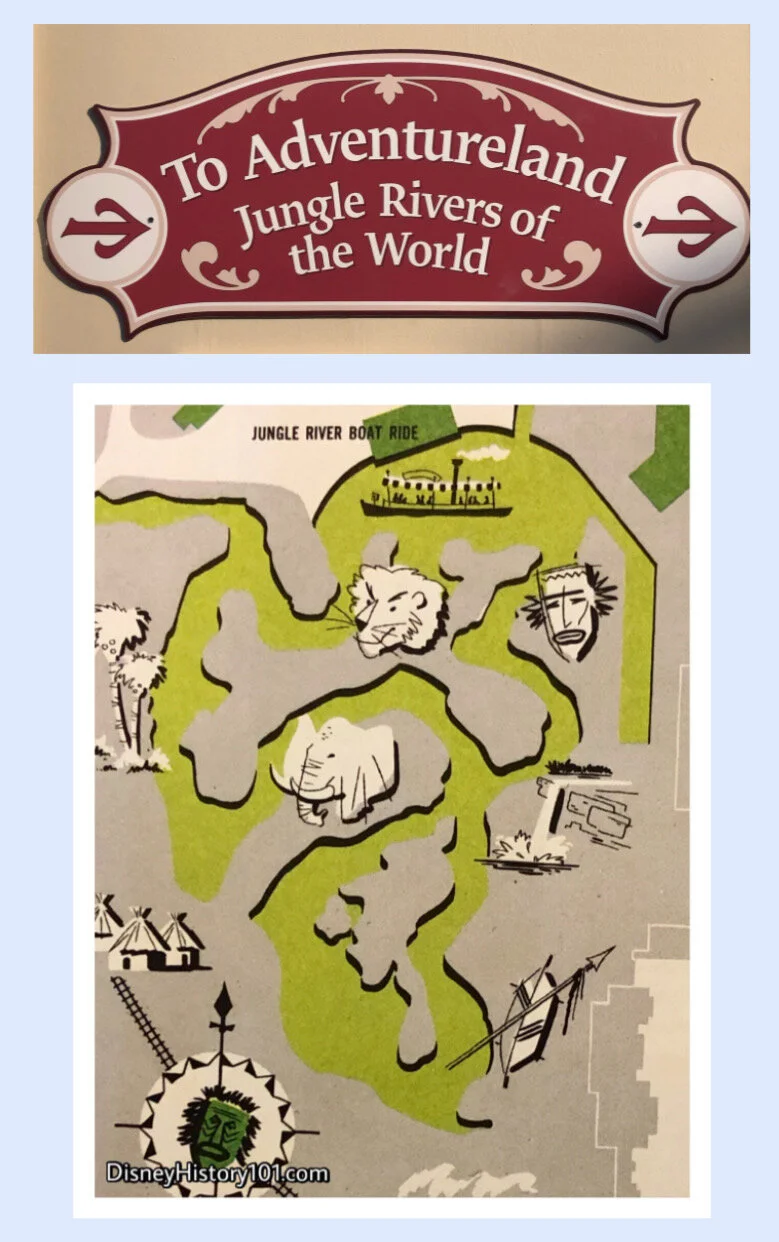
Jungle River Cruise Detail, Complete Guide to Disneyland 1956 Map Excerpt
“THE WORLD FAMOUS ‘JUNGLE RIVER BOAT RIDE’”
Okay, it doesn’t have the same ring as “Jungle Cruise.” However, this 2018 sign (Top) refers to the original name of the attraction that took passengers down the exotic Rivers of the World - the Amazon of South America, the Nile of Africa, the Irriwaddy of Southeast Asia, and the Ganges of India!
Pete Crimmings was the Foreman of the Jungle Cruise, over Jack Whittington, Bill Sullivan, and Jack Taylor, and Homer Holland. “In those days there were seven boats, and seven minute trips. Only one chute was used for loading the boats…The operators gave the spiel through megaphones and ten or twelve trips were a common thing. First Aid was really busy swabbing out sore throats. Homer Holland says he still has callouses on his vocal chords,” according to Lee David of Disneyland LINE magazine (Summer, 1965).
Your Guide to Disneyland (published 1955) described the “Explorer’s Boat Ride through the rivers of Mexico, Africa, Asia, Central and South America and Australia.” On the Complete Guide to Disneyland 1956 Map Excerpt, (pictured above), note the printed name of the attraction in this official 1956 guide book. In the early days, the attraction was variously referred to as the Rivers of the World Jungle Boat Cruise, “Jungle River Boat Ride” (according to The Complete Guide to Disneyland, published 1956). Walt Disney’s Guide to Disneyland (published 1961) variously referred to the attraction as the “Jungle River Boat Safari.” By Disneyland’s Tencennial Celebration, Disneyland Maps still identified this “ride” as the “Rivers of the World Jungle River Cruise.” It would be more than another decade before the name was shortened to “Jungle Cruise” over the queue entrance. However, as late as 1972, INA brochures still referred to the attraction as the “Jungle River Cruise.” During 1956, “as many as 18,000 people, a day take this boat trip” according to “Disneyland U.S.A.” (released by Buena Vista Film Distribution, December 20, 1956). According to one “Disneyland Admission Media Rides and Attractions Report” (published 1971) a total of 54,954,442 guests had been aboard a Jungle Cruise (from opening to October 2, 1971).
The jungles of both Catalina (South portion of the Jungle Cruise) and Manhattan (North portion of the Jungle Cruise) islands has grown into a perpetual forest. While many of the trees were initially planted as a screen, there came to be many African trees, native Brazilian trees, and giant fig trees (from China, Australia, and India) within the first 100 yards to simulate a rainforest. Many of these were salvaged from freeway-related demolition projects in Santa Monica, Pamona, and Santa Ana. Several Ficus trees were salvaged from Pershing Square in Los Angeles. All of this within Walt’s era.
The Jungle River Cruise and Rivers of Adventure would even have a legacy among Disney Parks worldwide. Why, by the spring of 2003, the enchanting realm of “exploration, discovery, and mystery” that is Adventureland was among the concepts for Hong Kong Disneyland. There, guests could explore the “remote jungles of Asia and Africa,” cruising “into a jungle along hidden waterways” of “fascinating sights, surprises and plenty of humor.”
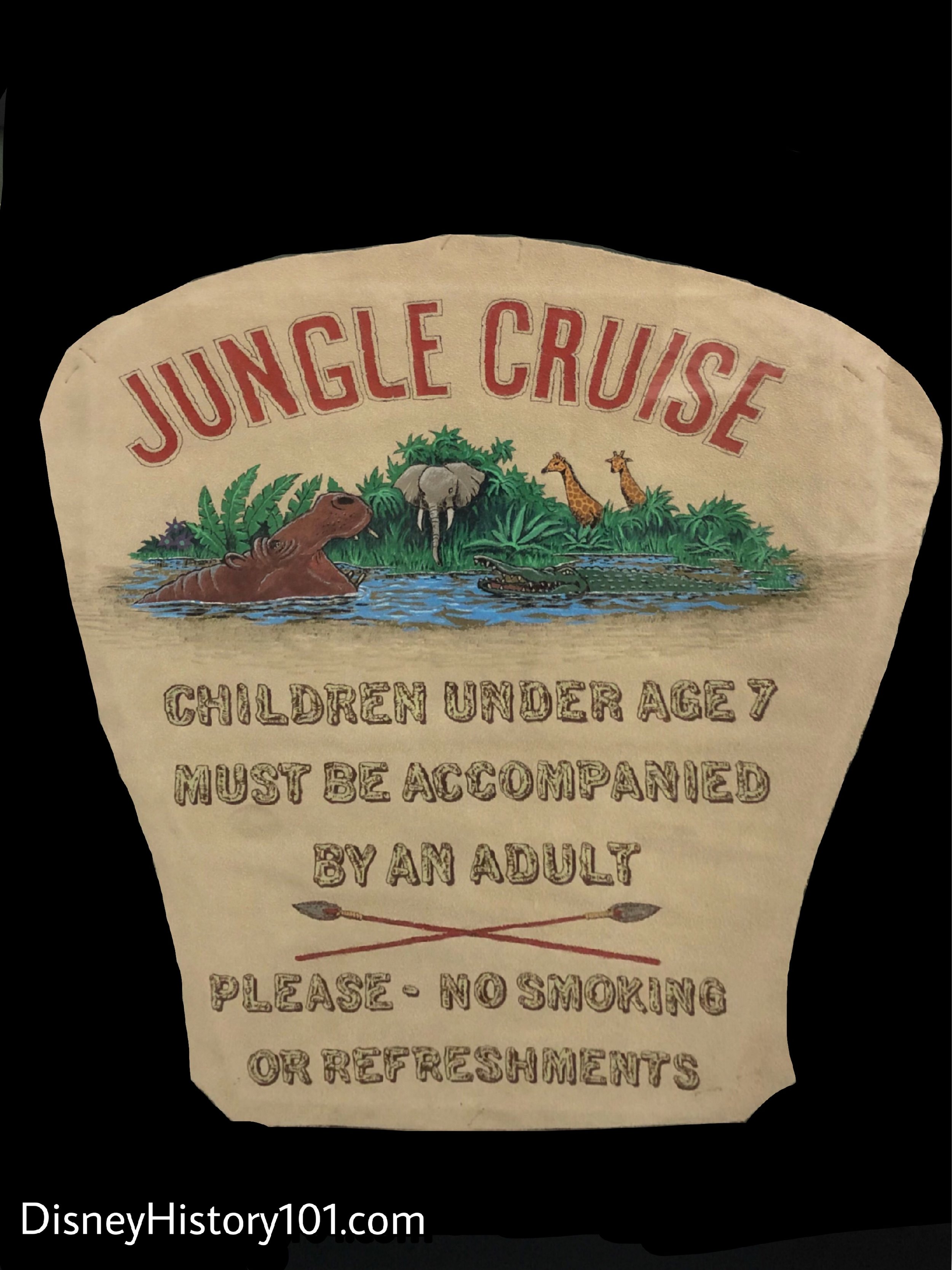
Pete Crimmings recalled: “Like just about everyone else... started out as a Ride Operator, at $1.60 per hour. I was working for Charley Thompson in Adventureland, and remember Dorothy Eno working with all of us. I guess because of my experience with the boats, I became the first working foreman in that area.”
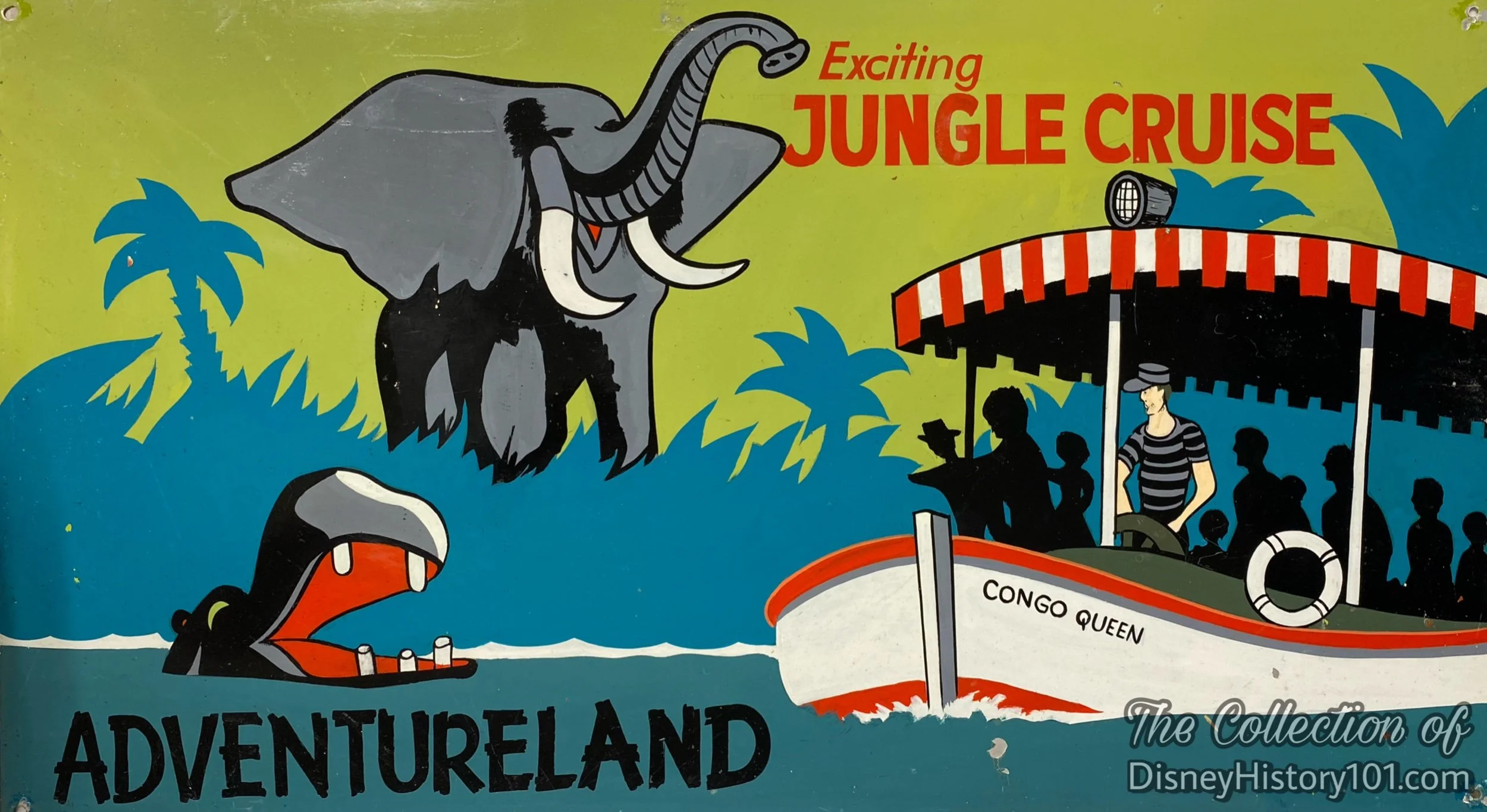
By 1960 and 1961, the exciting, two-hour Guided Tour of Disneyland Tour included a world-famous trip through Adventureland and an exciting voyage along the Jungle Rivers of the World.
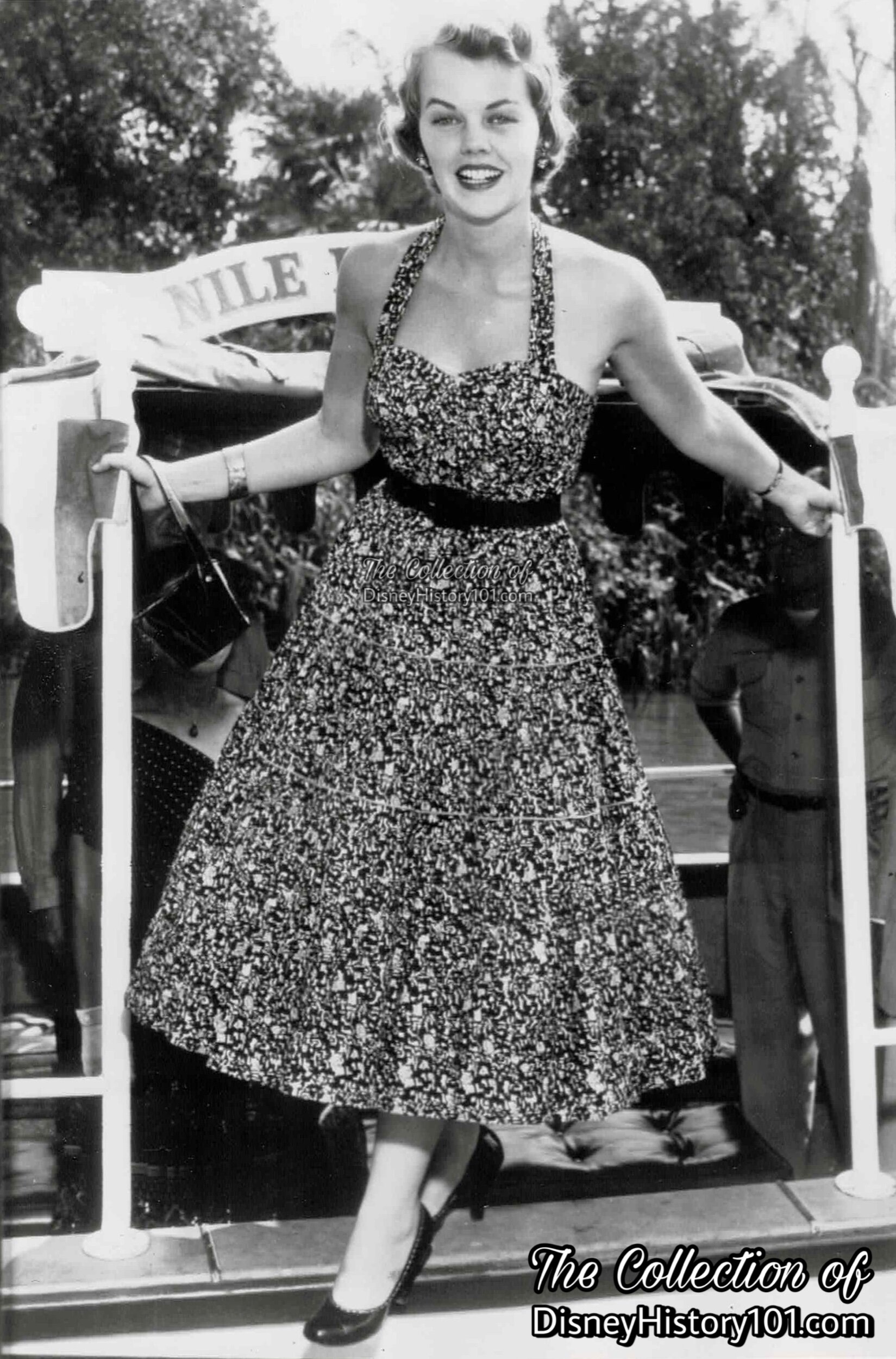
Miss U.S.A. (Carlene King Johnson of Vermont) steps out of a "tropical river boat," August 2nd, 1955 ; Photo Credit : International News Photo SoundPhoto
“Back in Home Port, Miss United States, Carlene King Johnson, steps out of the tropical river boat at Disneyland. Miss Johnson, whose home is in Vermont, found the Adventureland Ride and the tropical ‘rain forest’ an unexpected thrill,” according to headlines.
The Collection of Bob Penfield ; The Walt Disney Hometown Museum
“A Walk in Walt's Footsteps”
When asked about his role, Walt answered: “My role? Well, you know I was stumped one day when a little boy asked, ‘Do you draw Mickey Mouse?’ I had to admit I do not draw anymore. ‘Then you think up all the jokes and ideas?’ No, ‘I said, ‘I don't do that.’ Finally, he looked at me and said, ‘Mr Disney, just what do you do?’ ‘Well,’ I said, ‘sometimes I think of myself as a little bee. I go from one area of the Studio to another and gather pollen and sort of stimulate everybody. I guess that's the job I do’.”
“Performance Excellence”
“A good showman watches details like a hawk. Walt is a busy man, but he has an eagle eye for a worn out light bulb, or a spilled bag of popcorn.”Walt Disney encouraged a process called “Performance Excellence” - encouraging Cast Members to strive to excel each day in the fulfillment of their individual roles and responsibilities in an environment consistent with defined Disney behaviors. The Jungle Cruise Leads and Skippers were continually challenging themselves and each other to try new methods of working more effectively and efficiently. Teamwork was regarded as essential in accomplishing these efforts.
The timing of the boat, narration spiel, and animation needed to coincide and required much practice. As to the timing, Dick Nunis (President of Walt Disney Outdoor Recreation) once remembered: “The thing that has made Disneyland successful from the very beginning is that Walt Disney believed in giving the guests a good value and a good show all the time. We established standard operating procedures for our attractions… which are always there to give our guests a good show.
If there is no line or a long line, the guest always gets the same consistent show - unlike amusement parks, where if there is a pretty girl on the carousel and no line, you run it for a long time, and if there is a long line, you run it a short time.
In the early days of Disneyland, I grew up in Frontierland and Adventureland. Those were the first two areas I was responsible for. I had just been transferred and was responsible for Adventureland. Walt came down and got a boat and took a trip. He got off the boat with eyebrows raised. It was a bad sign if he had one eyebrows raised, you knew you were in deep trouble.
I was standing on the dock. He got me over in the corner and said, ‘Dick, what is the trip time for this attraction?’ Of course, he knew. ‘Well, sir it is seven minutes,’ I replied. he responded with ‘Well, I Just had a 4 1/2 minute trip and went through the hippo pool so fast I couldn’t tell if they were hippos or rhinos. How would you feel if you paid to go to the movies and they cut the center reel out of the picture?’
Needless to say, he chewed me out rather well. So when he got through, I said, ‘Walt do you have a minute, sir?’ He said, ‘Sure Dick, why?’ ‘Well I would like to go around on a boat with you and you tell me how you want it, and that’s the way it is gouda to be.’
So we spent about an hour, and he explained how he wanted it and he talked the show, and how you’ve got to play the show because it is show business. And it is a true-life adventure.
So, next week the foreman and I got seasick training on those boats. But, we were ready the next weekend when Walt walked by, and didn’t get on the boat.
Next week, back on the boat, more training. This went on for three weeks. The third weekend, Walt walked out and got on the first boat, took a trip, got on the second boat, took a trip, got on the third boat, took a trip, fourth boat, fifth boat.
We only had seven boats and he was on the fifth boat, and I said, ‘My God, he’s going to ride all seven of them.’ The reason he did that was so I couldn’t stack the deck and get my spieler on the first boat. I had that planned too! But he got off the boat and gave me the ‘thumbs up’ sign, smiled, and I knew we were OK.
Walt Disney was concerned about giving our guests a good show. He was fair and gave me enough time to correct the situation.’”
[“The Spirit of Disneyland,” prepared 1984 by Walt Disney Productions]
“55er” Homer Holland remembered: “I went to the jungle for a year. There were no microphones on the boats then and you shouted yourself hoarse with a megaphone. I didn't like to give the spiel, so they sent me to the shooting galleries for TEN YEARS!”
Disneylander and “55er” Jack Taylor recalled: “In 1956 I went to the Jungle as foreman. One time on the Jungle we rigged a boat with fluorescent lights and we took Walt around for a trip. He was really impressed and said,
'I like it! Let's go with it on all the boats!'
'Walt was always the last to get into a Jungle Boat and he would sit at the very back. He was concerned about the guys keeping their speed down to give the people the best trip for their money. Also, sometimes an overly fast boat would jump the track and go right under the falls.”
In the early days, machinists hid behind bushes to hand operate crocodiles when Walt took the Jungle Cruise. Walt was very sensitive about this attraction and was known to have commented: “If the animation doesn't work, it's like cutting a reel out of a movie” or... ‘I know damn well these crocodiles snap; I saw it on my own television show.’”
There are many things to learn here. Walt showed as much consideration for the individual employees of his organization as he did for the “machine” of the attraction.
The following four statistics are based on the results of Disneyland Attractions Time Studies gathered in 1968:
Theoretical Hourly Capacity (What the attraction should yield under ideal conditions) : 2278
Capacity Per Trip : 34
Instantaneous Capacity : 420
Audience Control Capacity : 616
Cycle Time (From the time a unit passes a given point and returns to the same point) : 10:48
Unload Time : :30
Jog Time : :27
Load Time : :40
Ready Time : :11
Trip Time : 9:00
Dispatch Interval : :54
Trips Per Hour : 67
Distance Travelled : 1,820 feet
Speed in Miles Per Hour : 2.2
Length of Load-Unload Track : 100 feet
Oren Gallegley worked as a diver and animation mechanic on the Jungle Cruise. Oren recalled about Walt: “He used to show me and other animation mechanics animated figures that he'd bring back from Europe. Some of the figures had been given to Walt by dignitaries in foreign countries.”
Rehabs were planned to follow the Disneyland waterway flow: (1) Storybook Land Canal, (2) Motor Boat Cruise, (3) Sleeping Beauty Castle Moat, (4) Rivers of America, and (5) Jungle Cruise.
“55er” Dave Bartchard recalled: “One morning, I was gassing up the Jungle Boats with a large new gas truck which was much heavier than the old one. Well I had the truck backed up on the unloading dock and the boats were nearly filled, when the heavy truck broke right through the dock and into the river. I thought that I'd really get blasted for that one, but my supervisor didn't say a thing.”
During each day Park Operations M-44 Machinists would, at least once, circulate to each Adv/Front area attraction and discuss with each attraction lead any problems, defects, or other feedback regarding the attraction. They would then notify the Mechanical Dept. of anything regarding this department and notify the M-1 of anything regarding other crafts. The Park Operations Machinists would check all the fluid levels on all the Jungle Boats, then start and run all the Jungle Boats. They would check the forward and reverse gears, make them ready for operation, and check their overall appearance. They would check for any discrepancies, notify the M-1 and proper department supervisor.
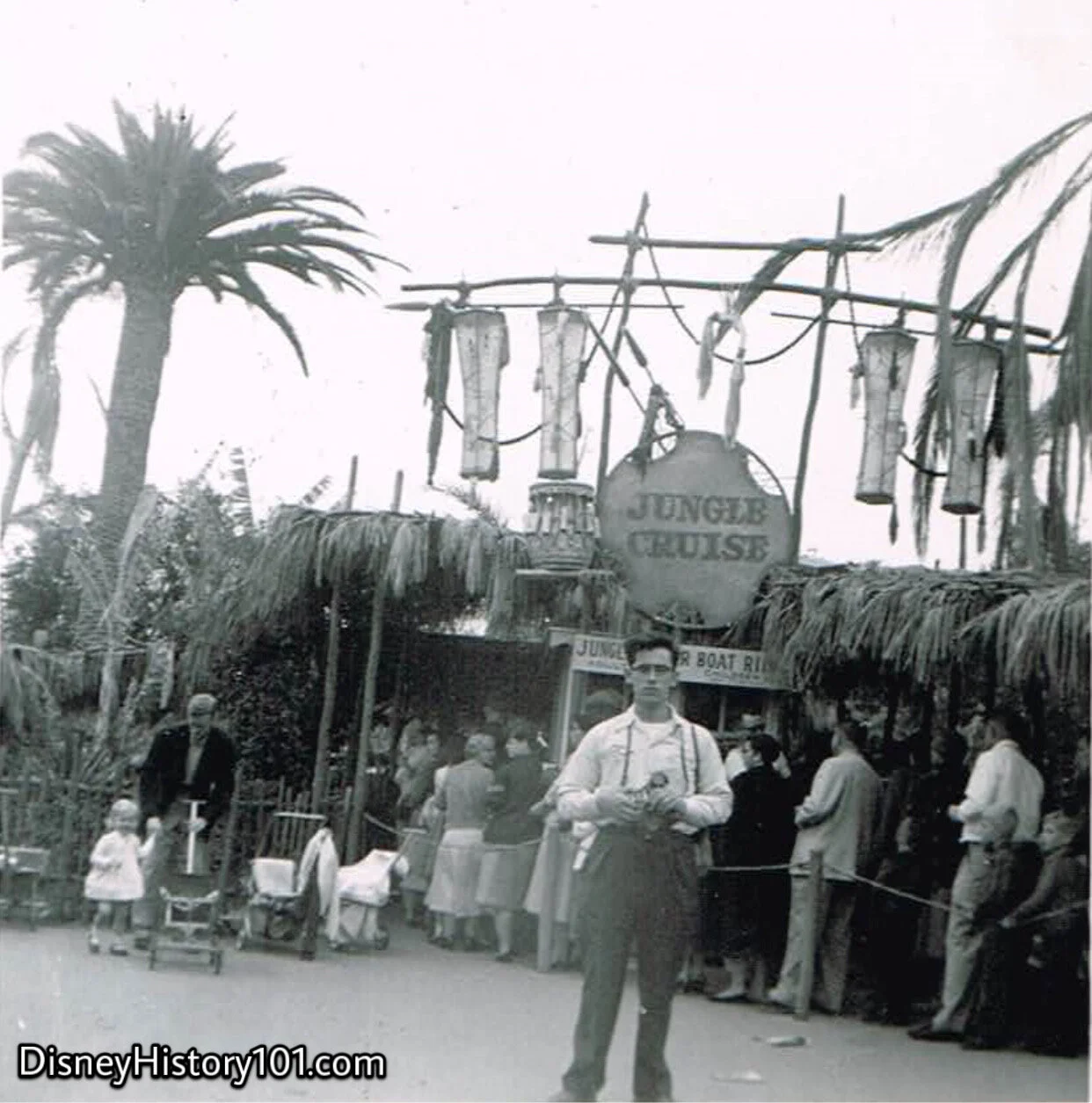
Jungle Cruise Boat Ride Ticket Kiosk & Entrance looking much like Herb Ryman’s conceptual artwork, (1955)
“Audience Waiting Areas” are especially designed as part of the attraction to make the guest's time waiting in line as comfortable as possible.
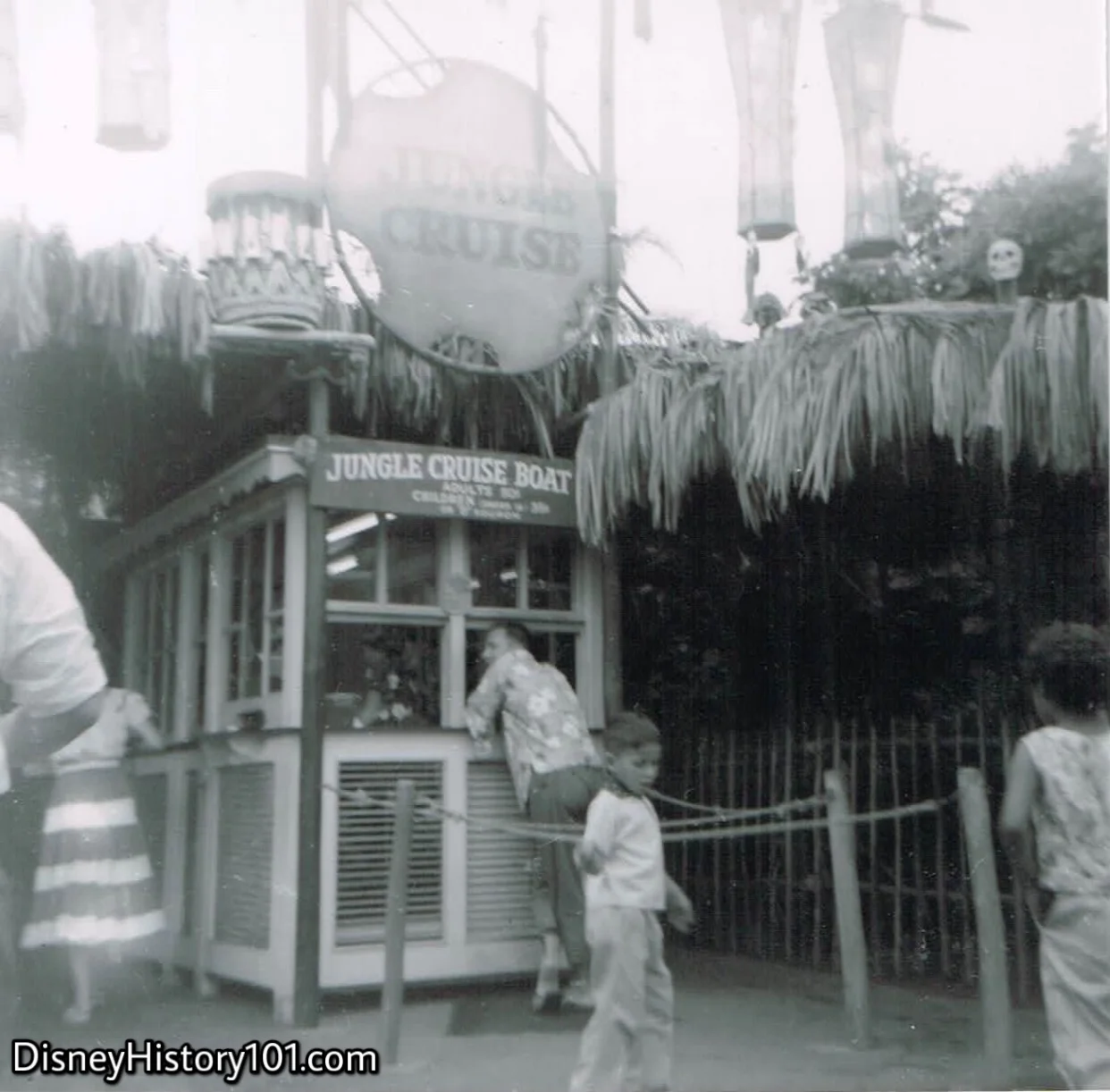
Jungle Cruise Boat Ride Ticket Booth, (1955)
Bill Sullivan recalled “I started out as a Ticket Taker on the Jungle Cruise ten days after opening.”
In 1965, the cast of admission for traveling through the tropical jungles of exotic areas of the world aboard a Jungle River Cruise was exactly one “D” coupon, or 75¢ for adults and 65¢ for children.
By the early 1960s (c. 1963), the fare had changed to one Disneyland Attraction “E” Coupon. After purchasing their ticket, guests followed one of two “jungle paths” (on either side of the Ticket Booth) to the boat at the dock. Once there, tickets were presented to the Jungle Guide.
A number of notable Disneylanders began their career with the Jungle Cruise, including a young Bill Sullivan (who watched the televised opening and then applied the following Saturday).
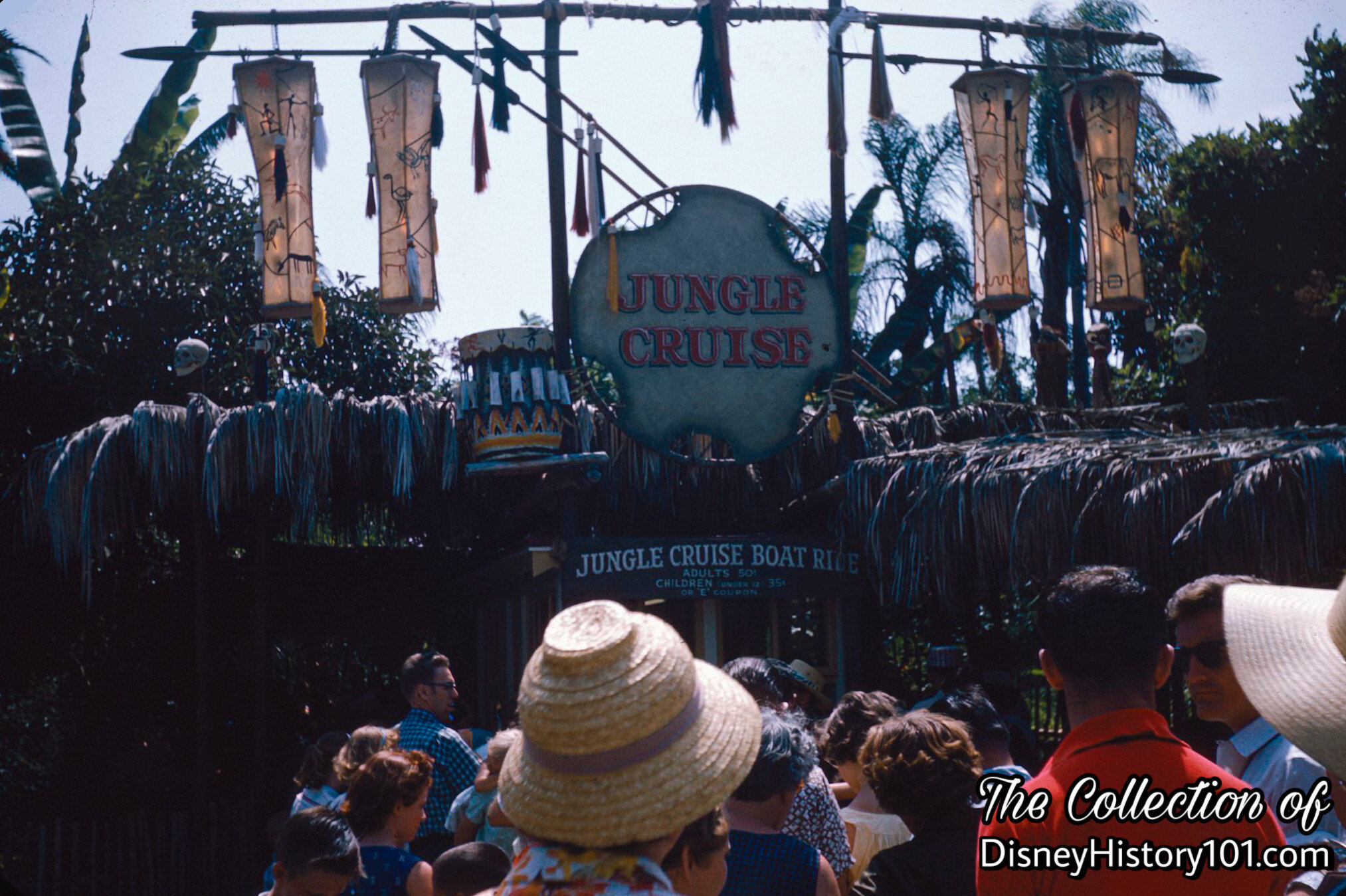
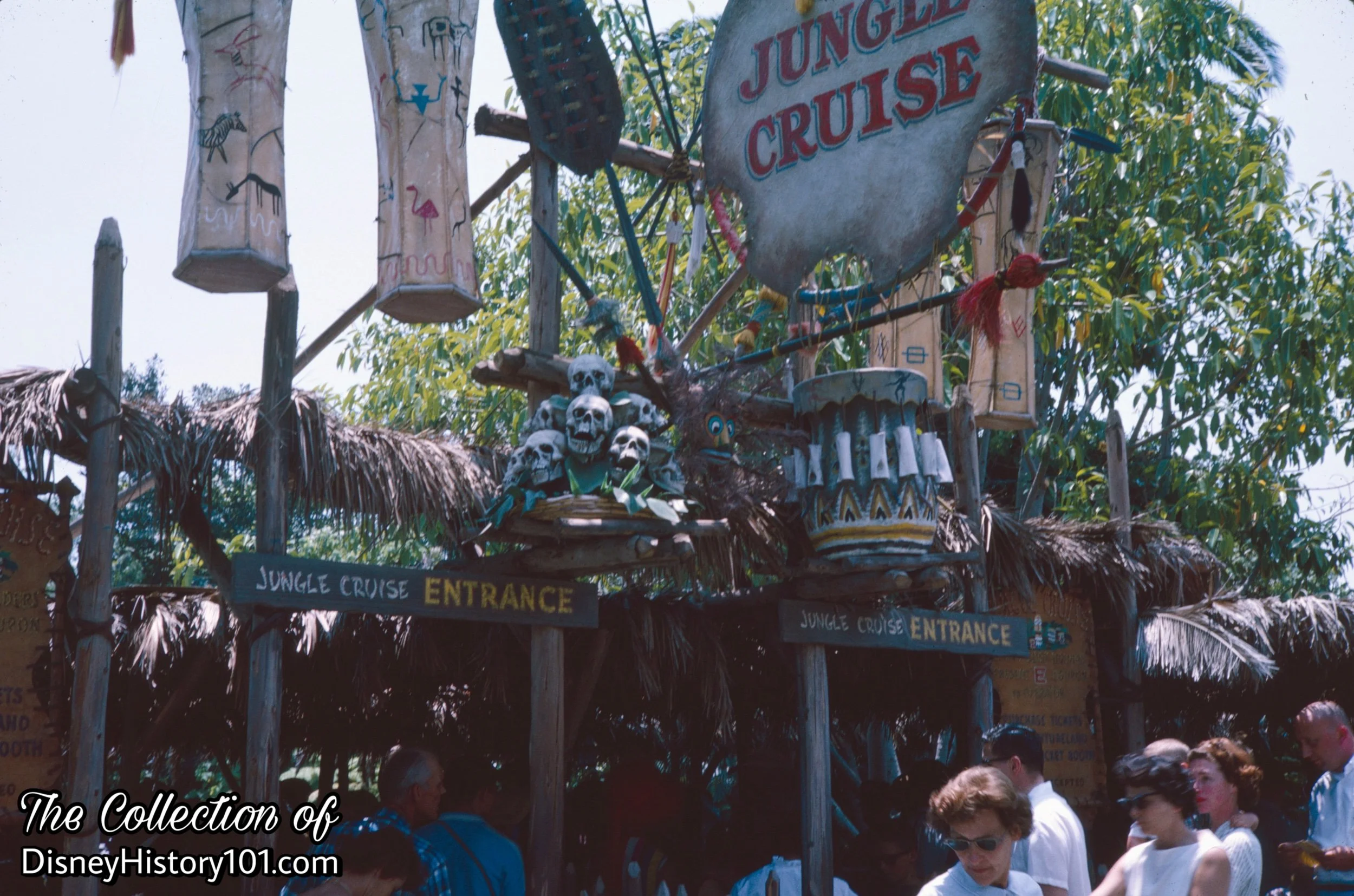
Jungle Cruise Boat Ride Ticket Booth & Entrance, (August, 1960)
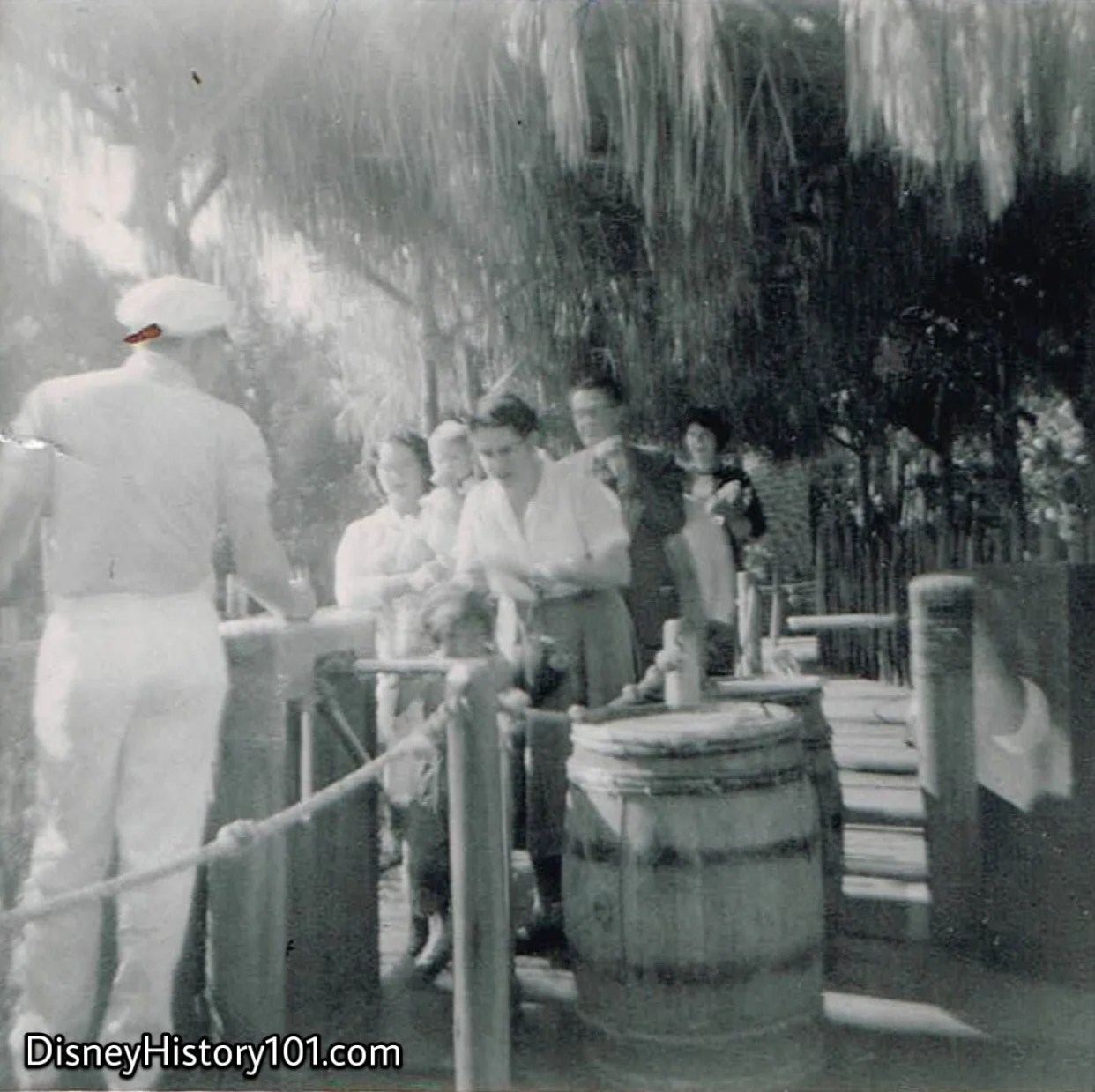
The Jungle Guide greets Guests and takes tickets at the Jungle Cruise Boat Ride Guest Control queue area & Loading Dock
Among the rotation (the set order of operating positions established by the attraction's Working Lead), was the Jungle Guide. Tickets are presented to the Jungle Guide (wearing the white shirt and yacht cap) near the dock. The custom wardrobe was likely provided by Warren Ackerman’s House of Uniforms (yes, “uniforms”), then located in Beverly Hills, California.
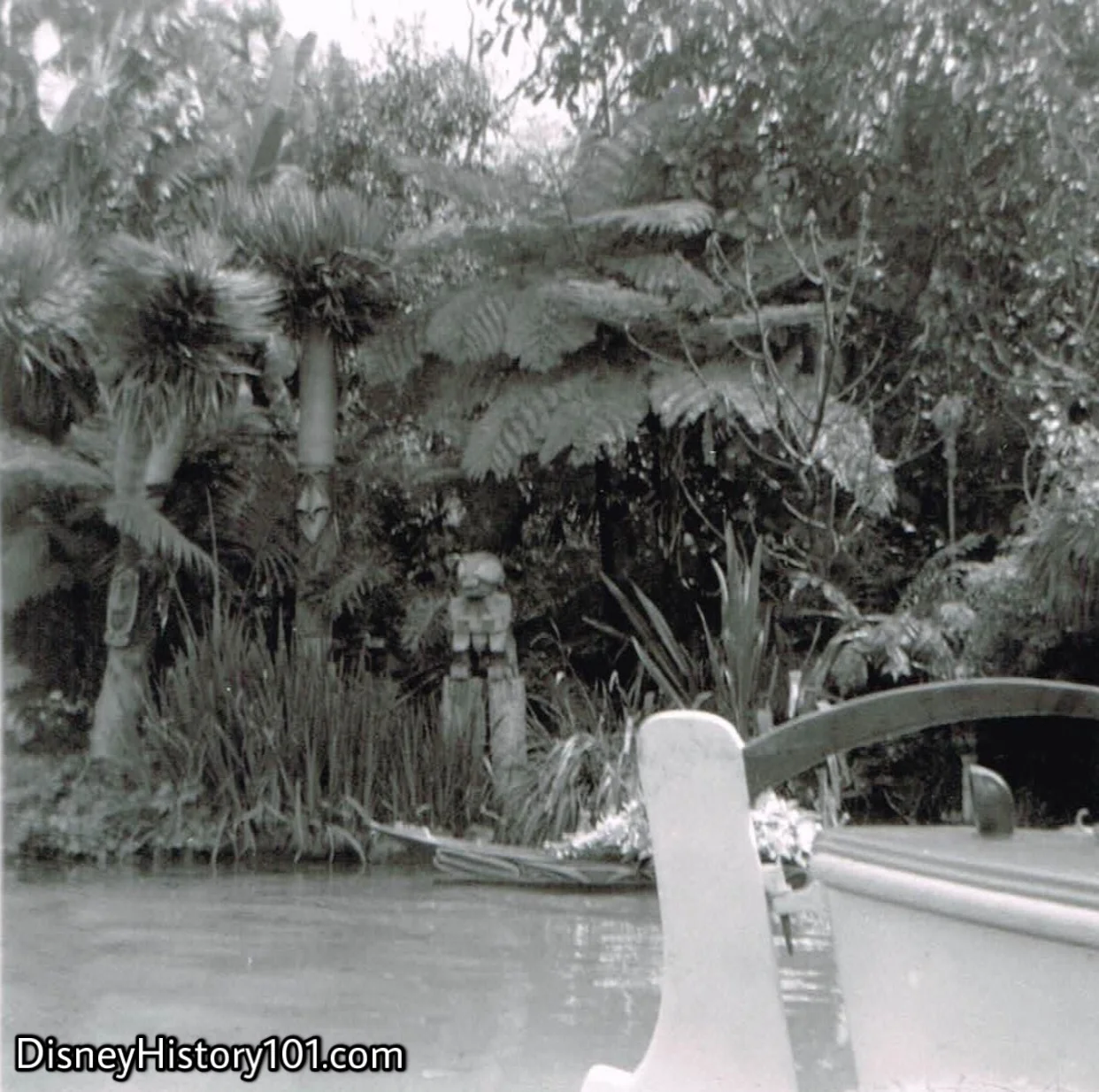
Get ready to experience the “sounds, savagery, the strange peace of the jungle” as described by the Pasadena Star-News (Friday, December 14, 1955).
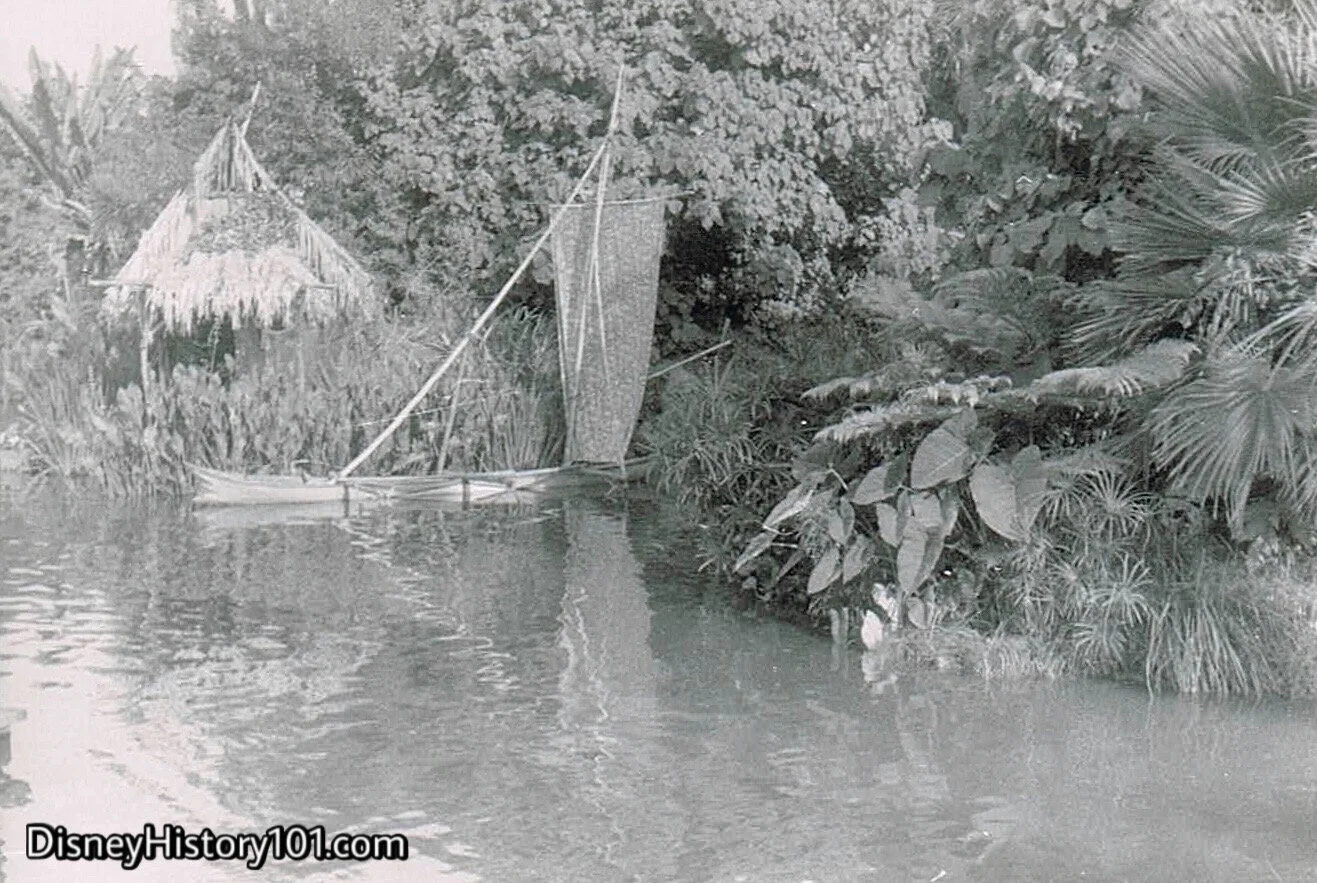
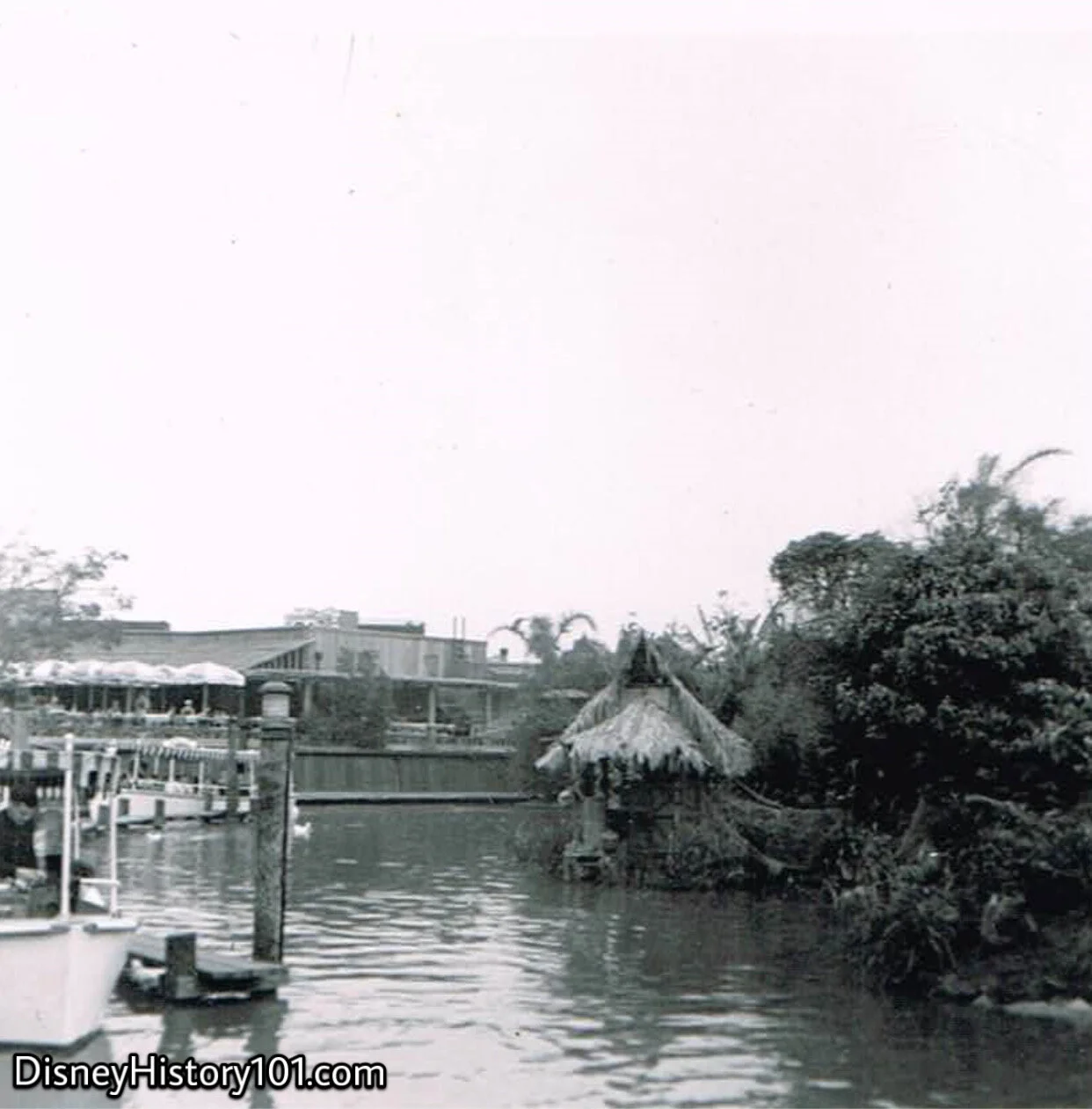
Beachcomber’s Hut and boat.
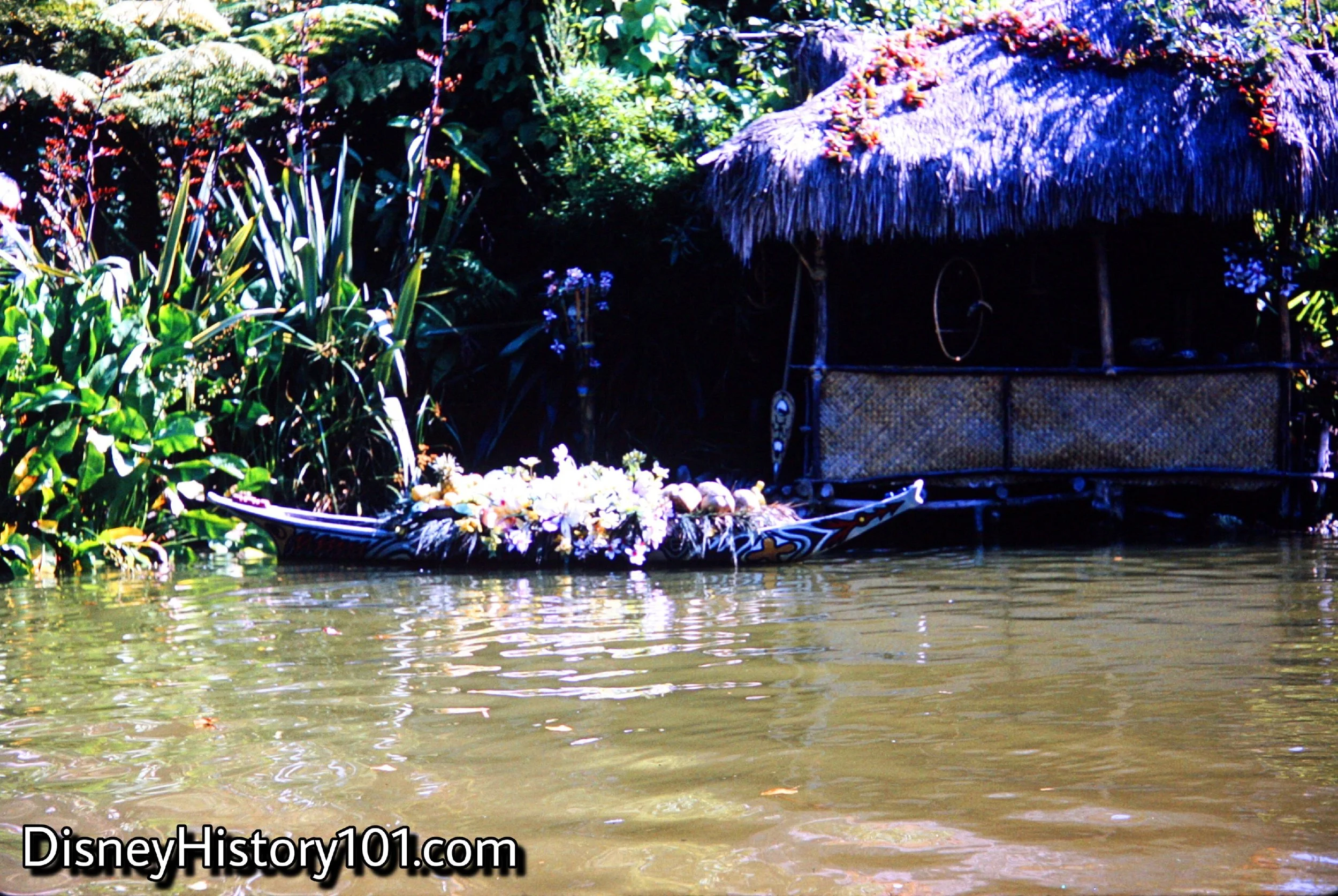
Beachcomber’s Hut and boat; August, 1965
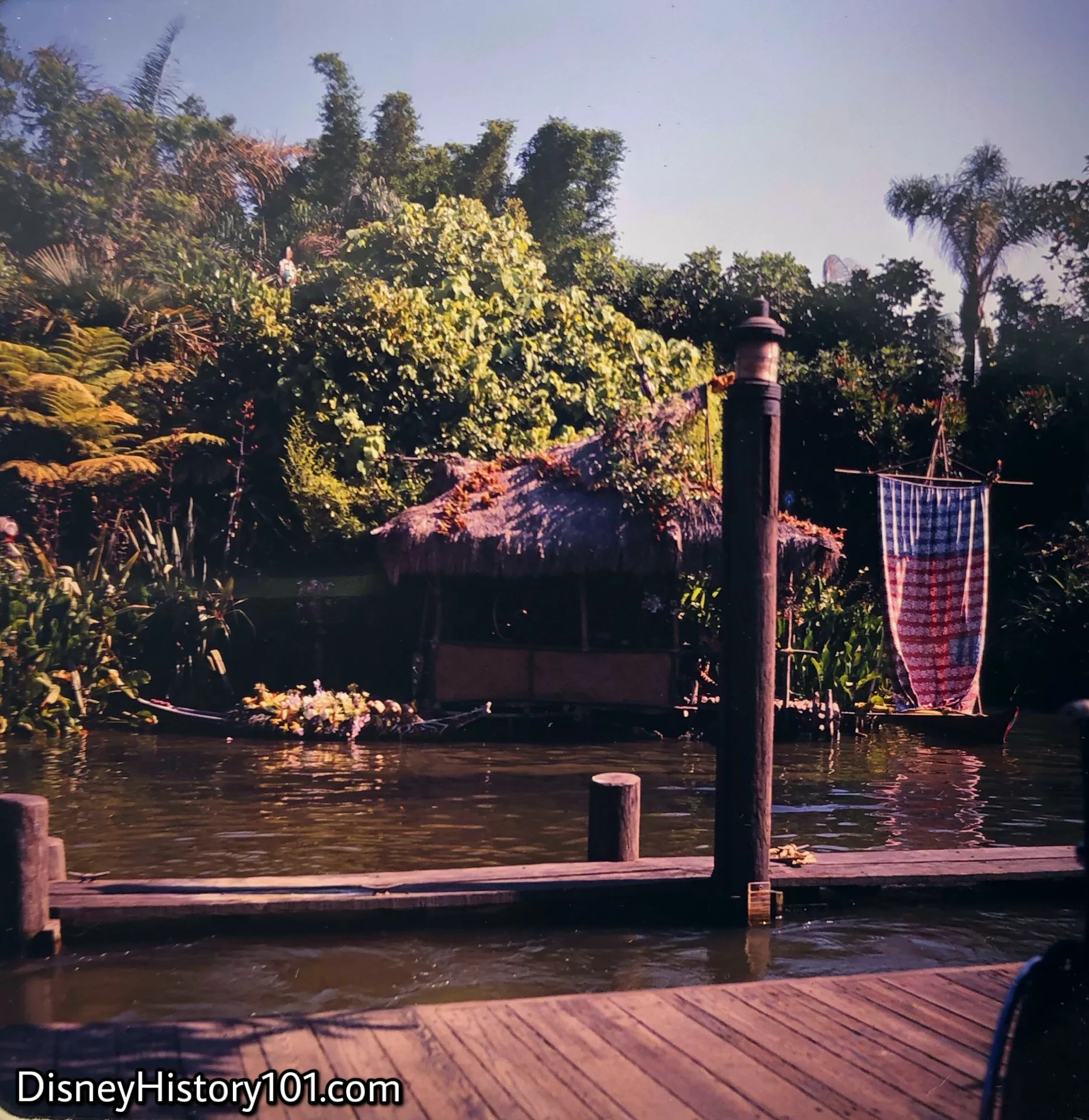
Beachcomber’s Hut and boat.
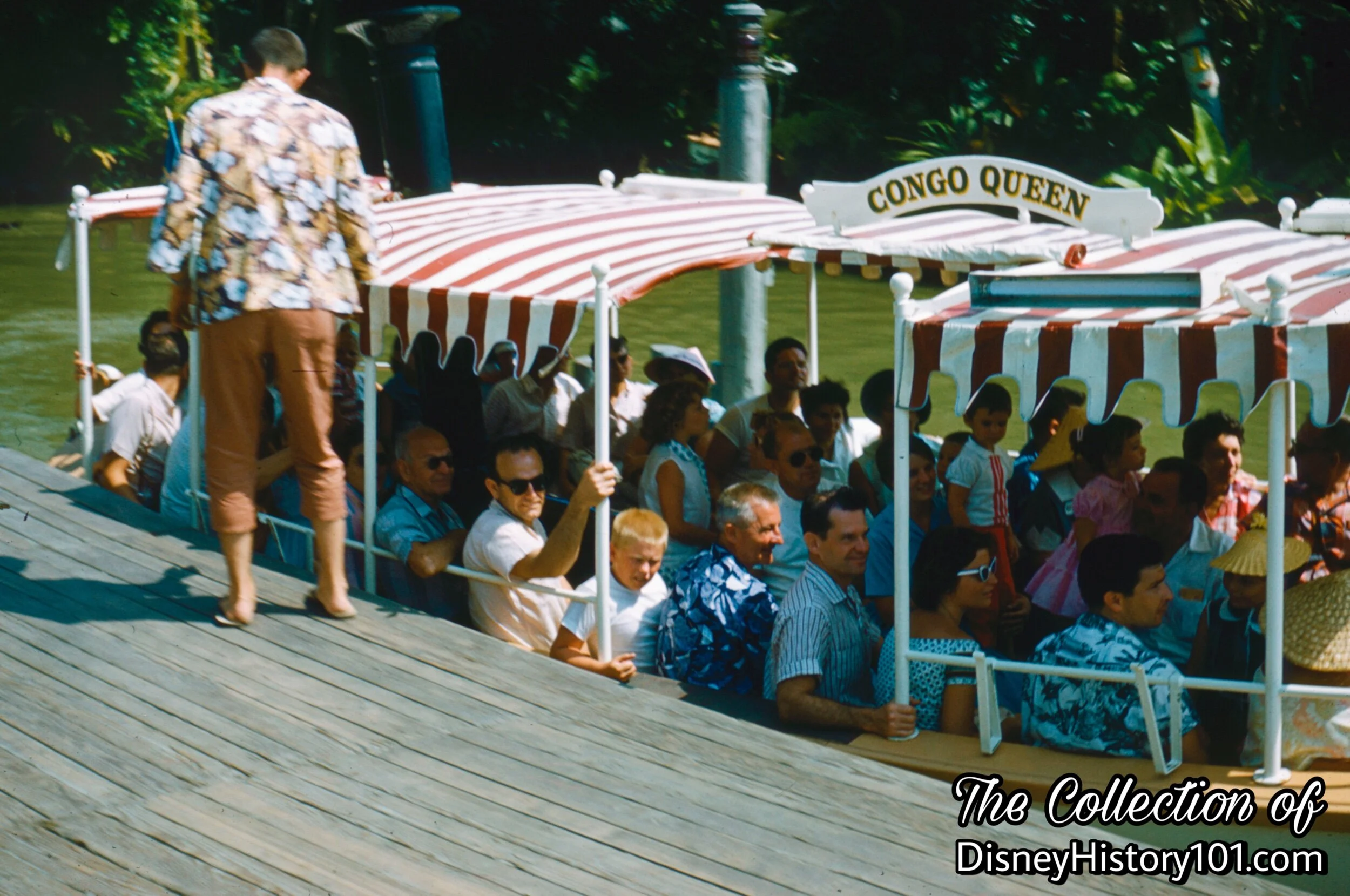
While the 32-passenger naphtha launch approaches the dock, Jungle Guides remind their guests : “Please keep your arms and hands inside the boat.” Once the boat arrives, the Skipper announces : “These…smiling native boys will assist you from the boat. Those of you on the water side, exit to the rear…and those of you on the dock side just exit to the front. Please step lively though…our boat is rapidly sinking.”
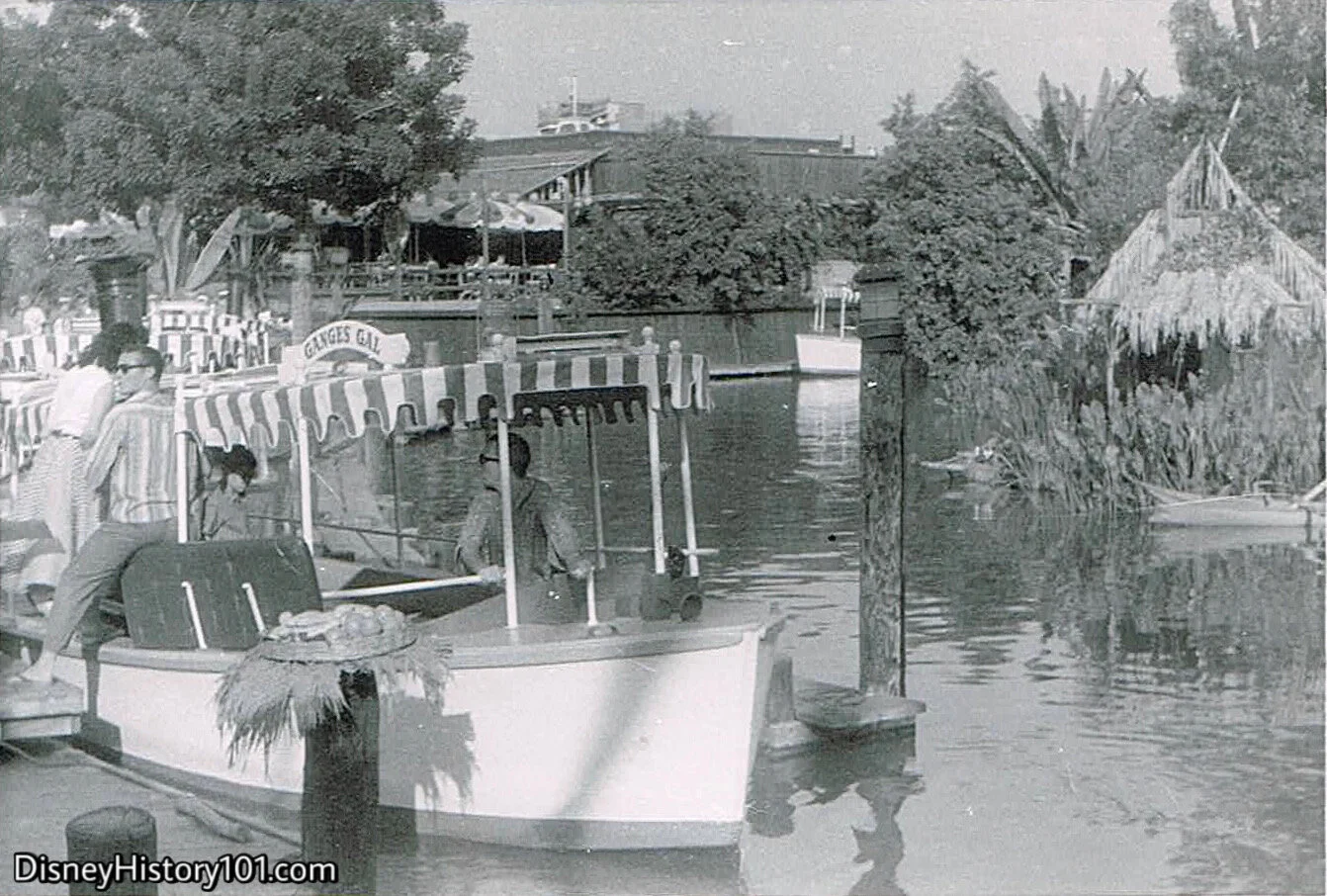
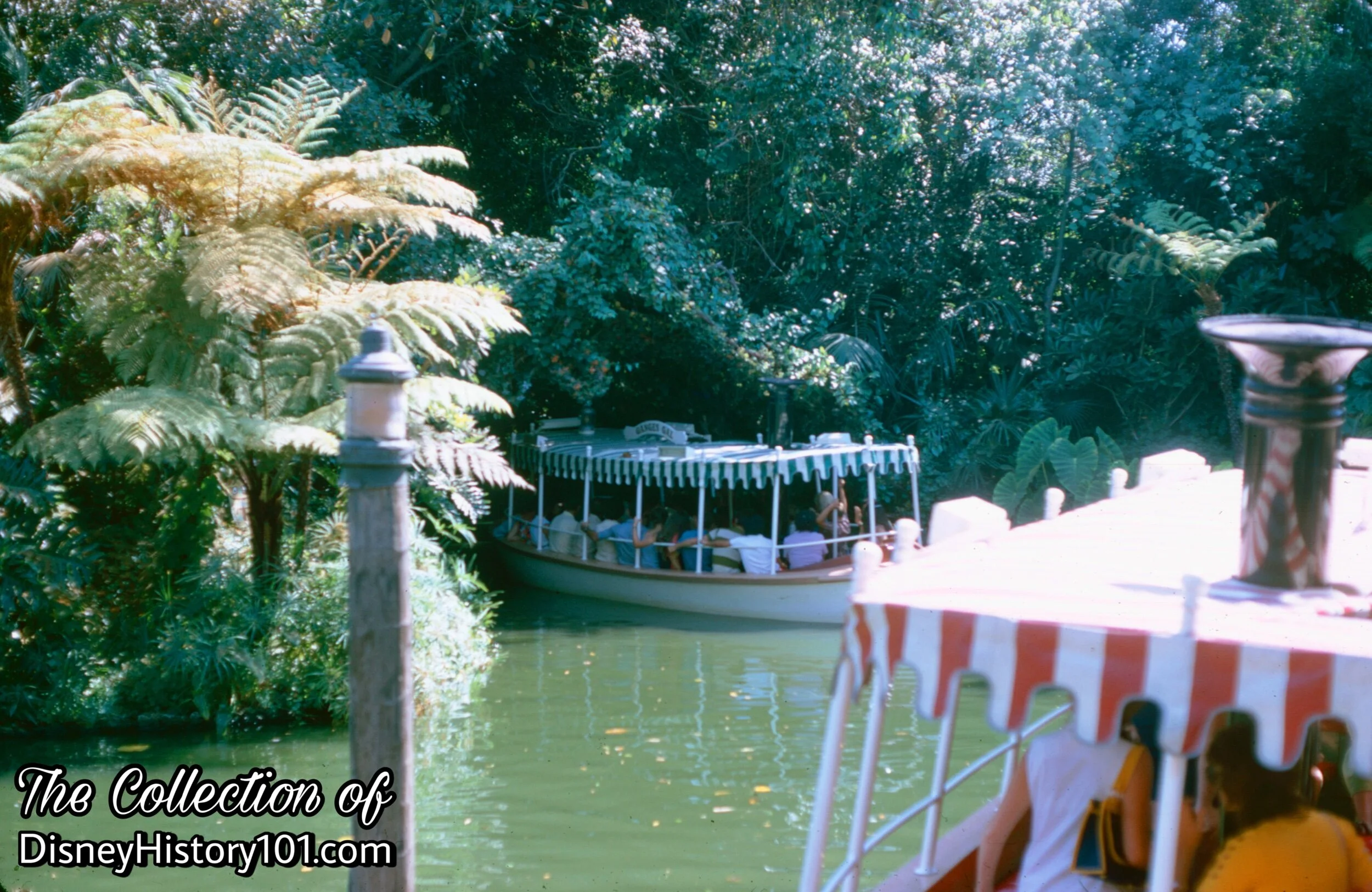
Ganges Gal
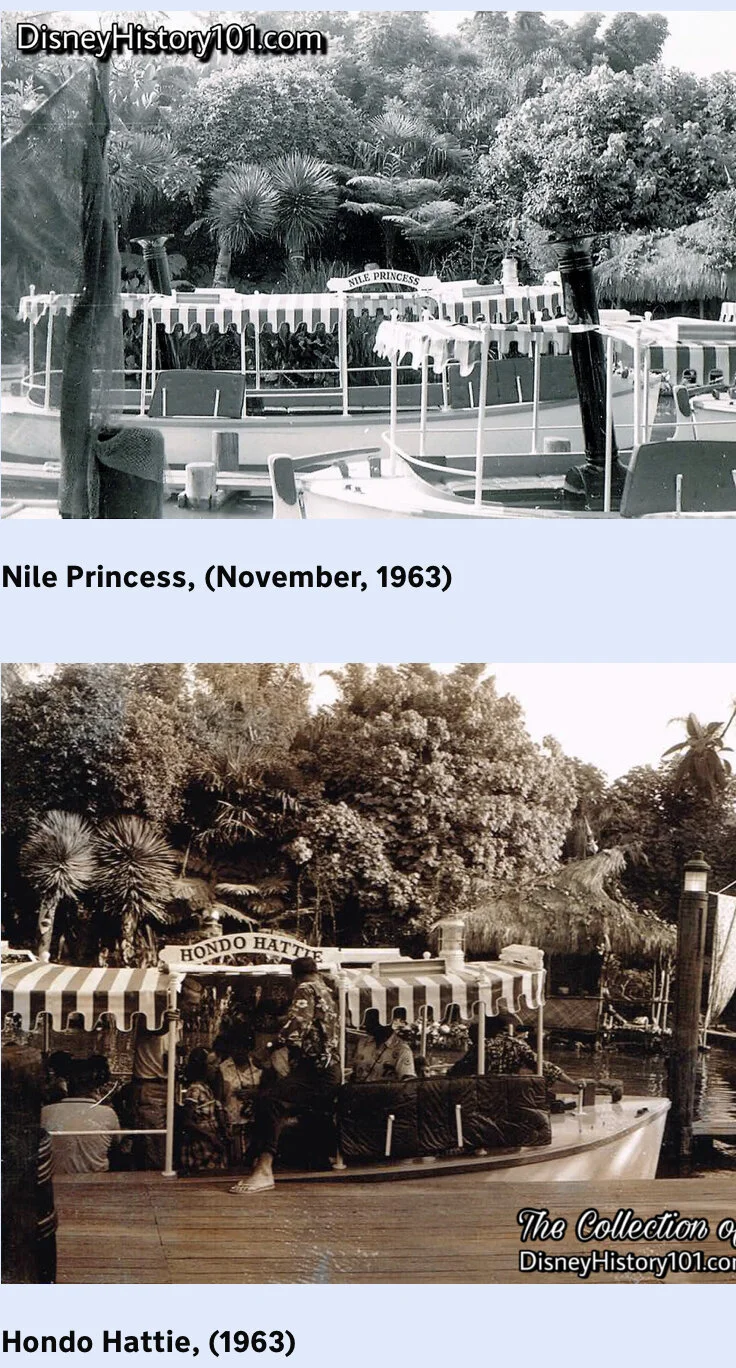
Ganges Gal was one of two boats operating on opening day! The other was the Congo Queen. Other opening year were the Swanee Lady, the Amazon Belle, Nile Princess, Mekong Maiden, and the Irrawaddi Woman according to an Orange County Register insert published 1955. The Zambezi Miss is briefly portrayed as a “point-of-view” ride-through, in “A Trip Through Adventureland”, an episode of “Walt Disney’s Disneyland”. Actress Spring Byington (of “December Bride) and child actor Bobby Diamond (of “Fury”) were photographed aboard the “Congo Queen” for their 1956 “TV Radio Mirror” photoshoot at Disneyland!
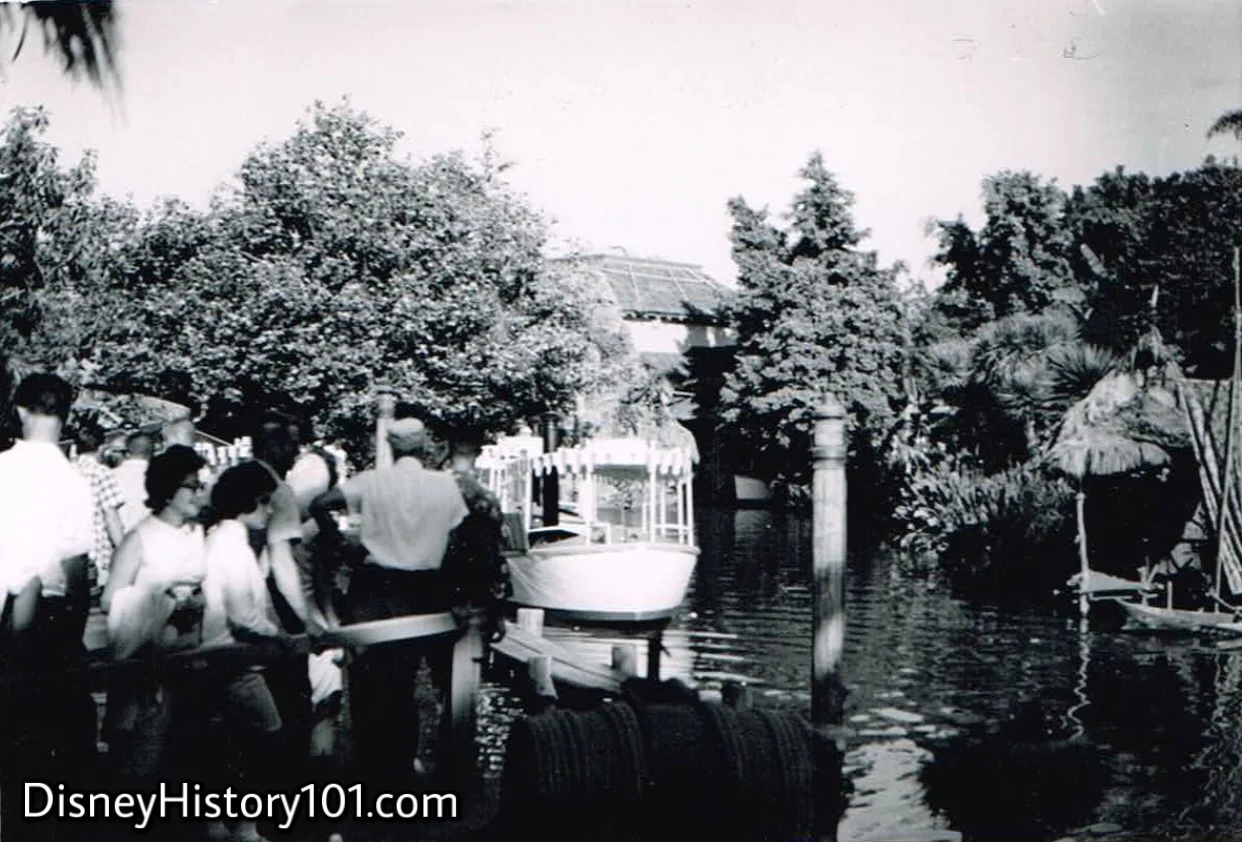
1962
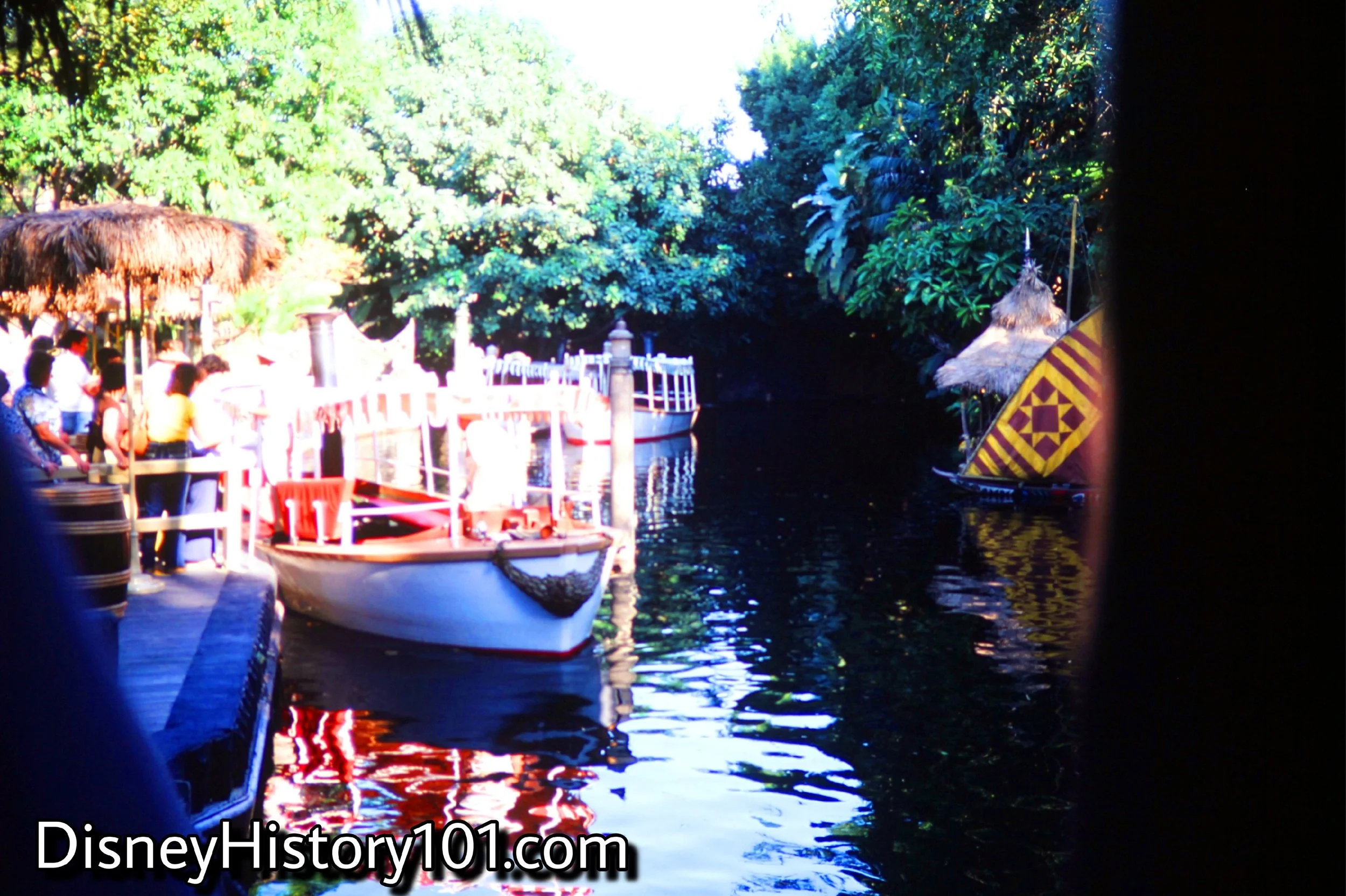
1980, November
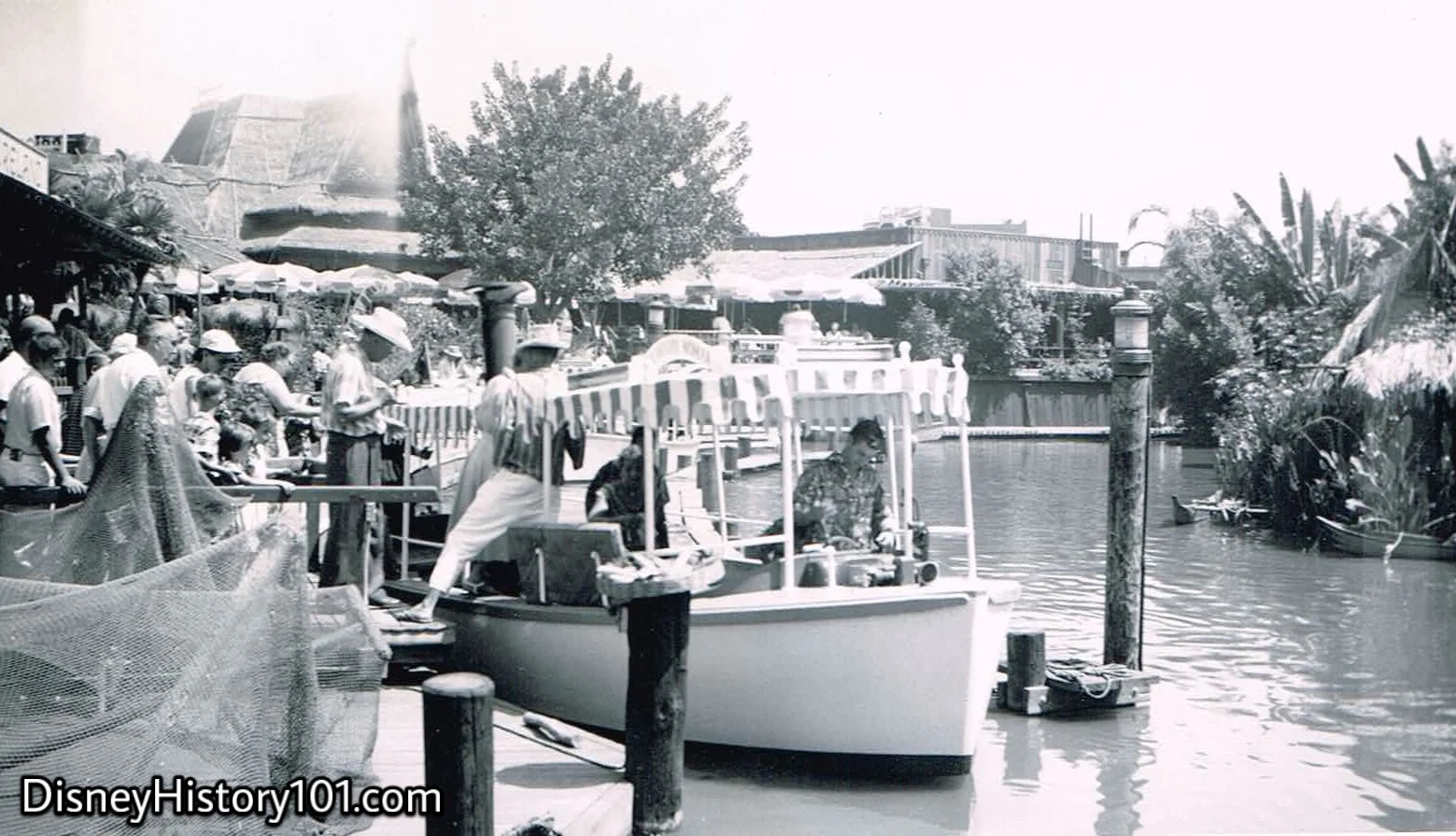
(1963)
While loading, Jungle Guides remind their guests : “When boarding the boat, please look down and watch your step. Take small children by the hand.”
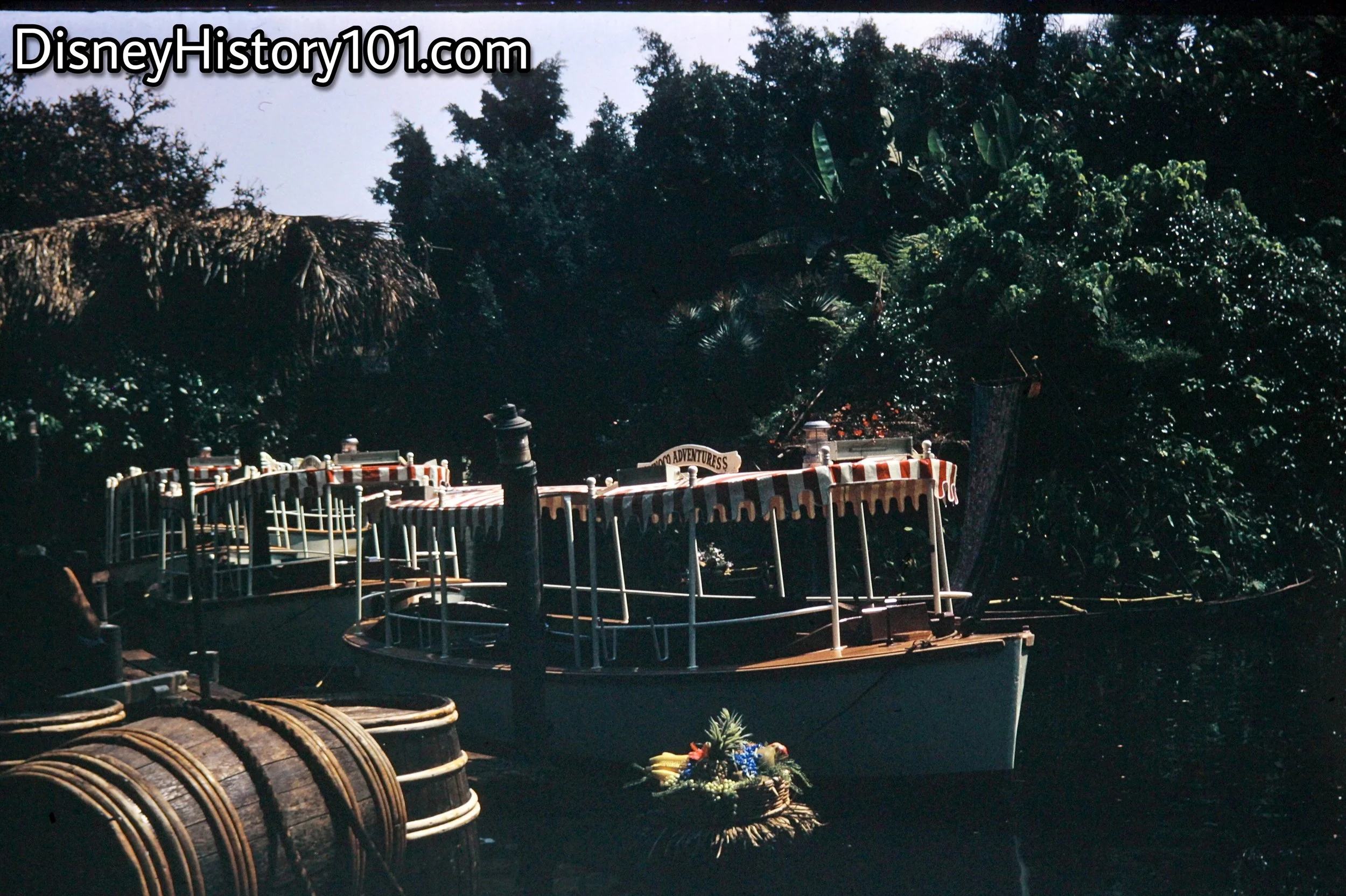
1967, October
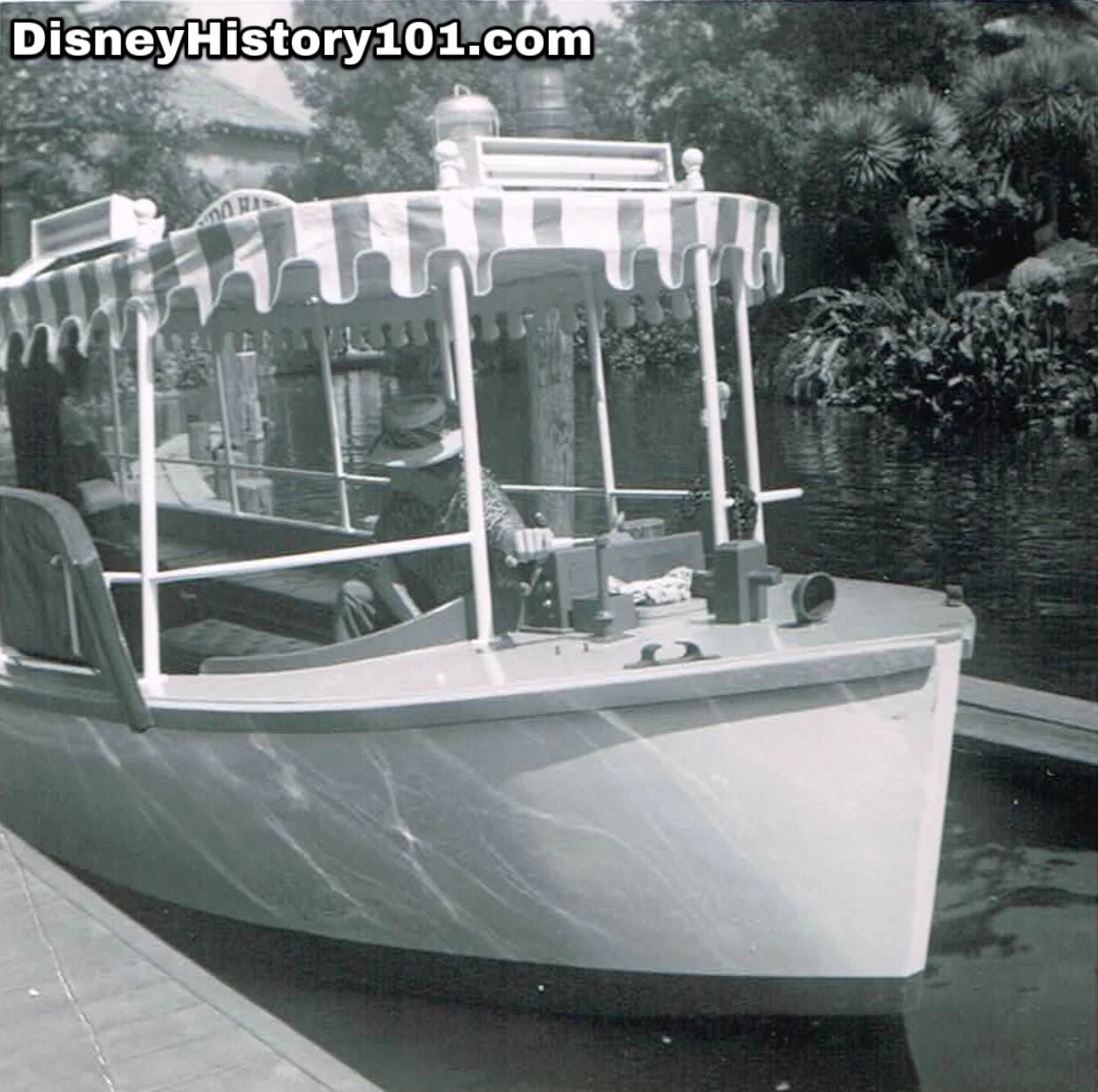
Hondo Hattie, (June 12th, 1964)
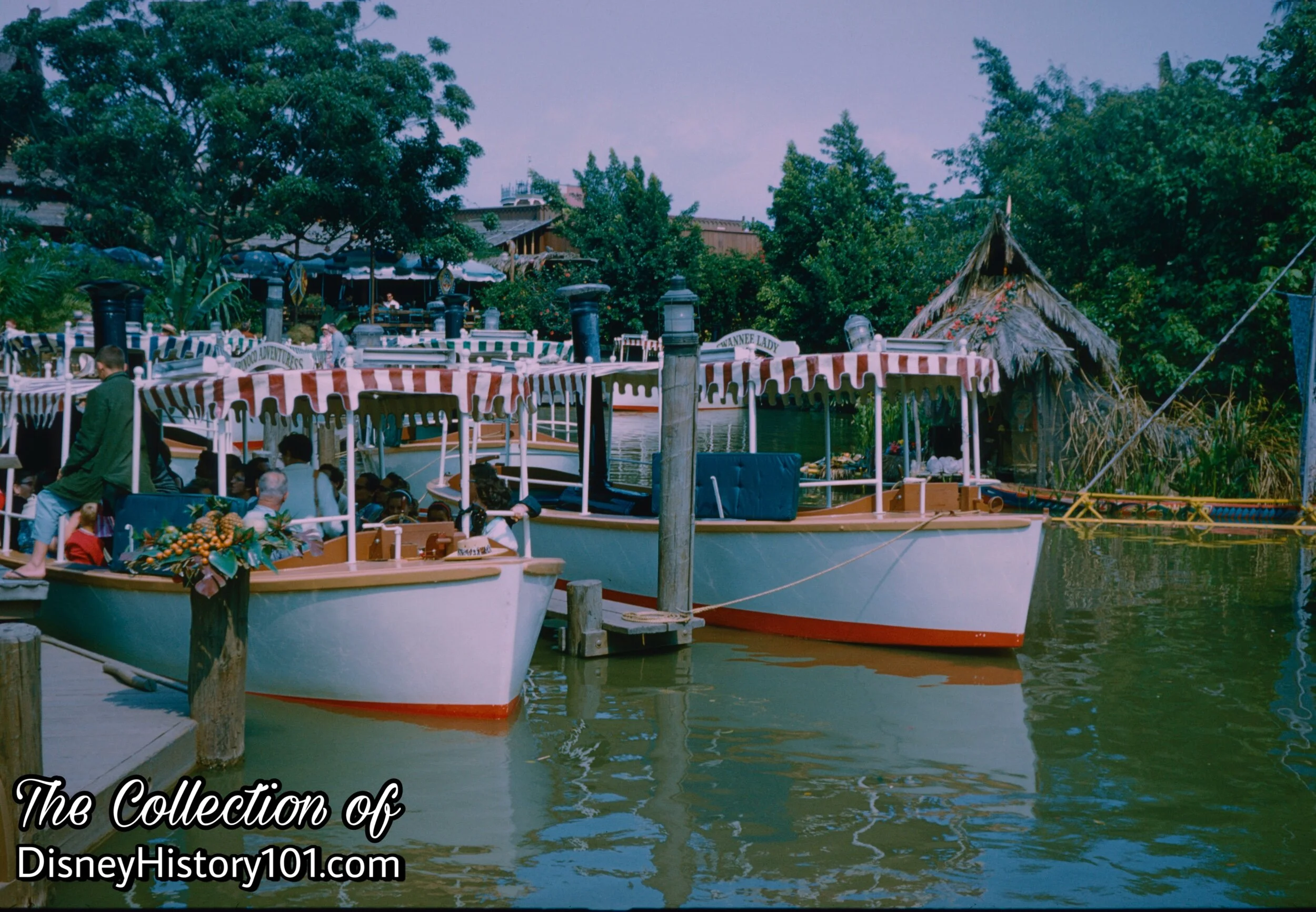
(May, 1960)
“Welcome aboard The Jungle Cruise!”
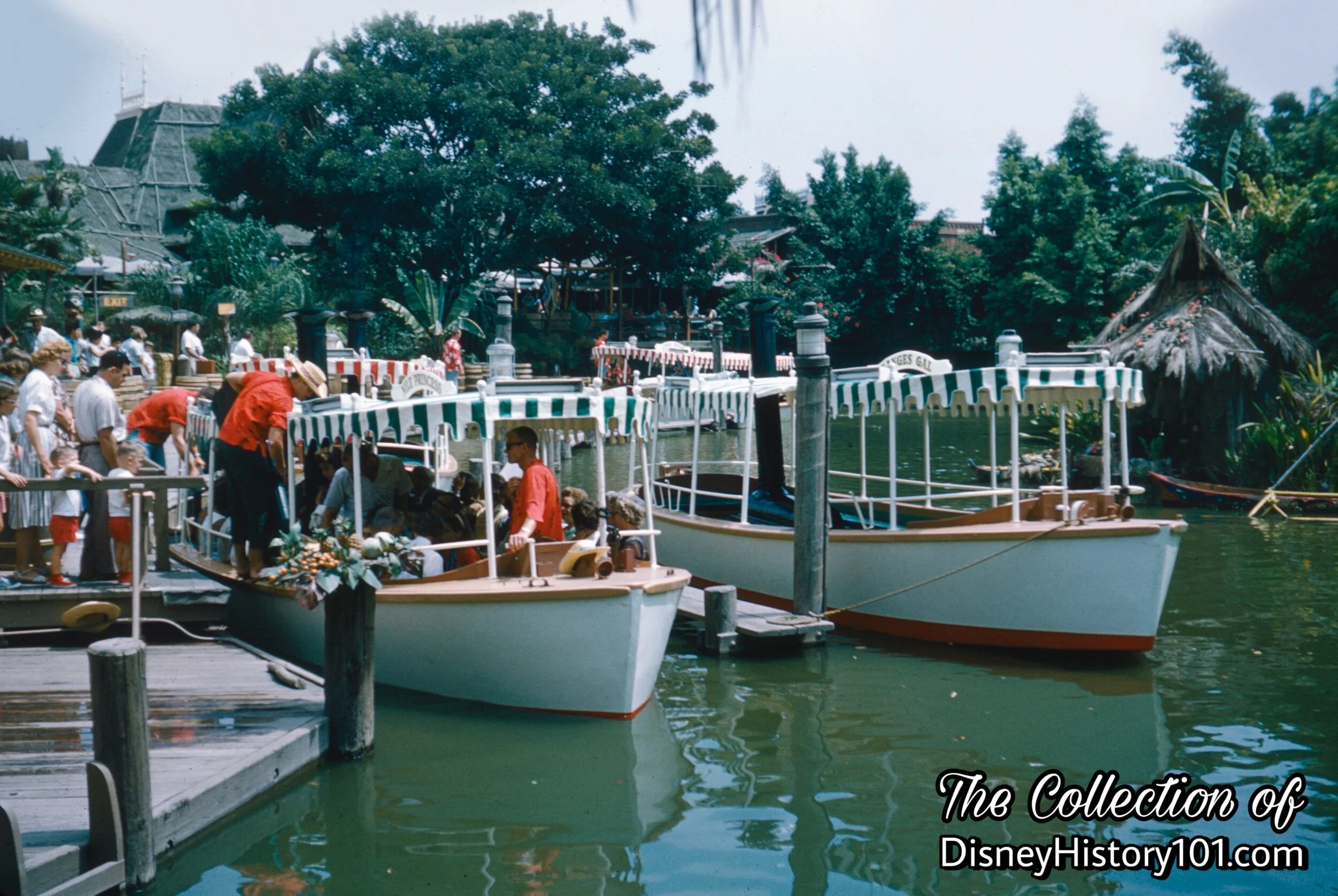
(August, 1960)
“The Jungle River explorer’s boats await boarding passengers for a thrilling trip down the tropical rivers of Adventureland.”
-A Complete Guide to Disneyland, 1956
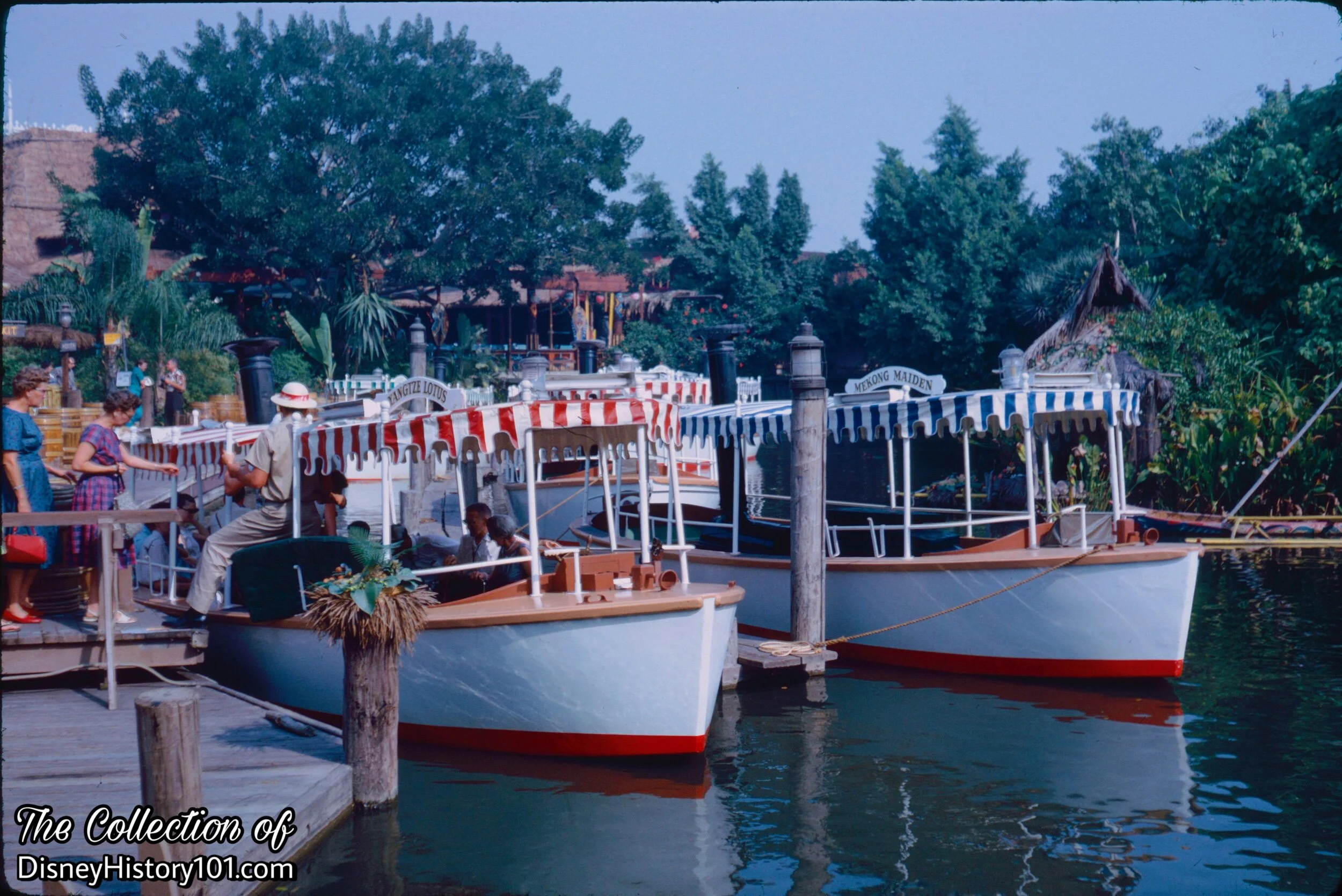
(October, 1961)
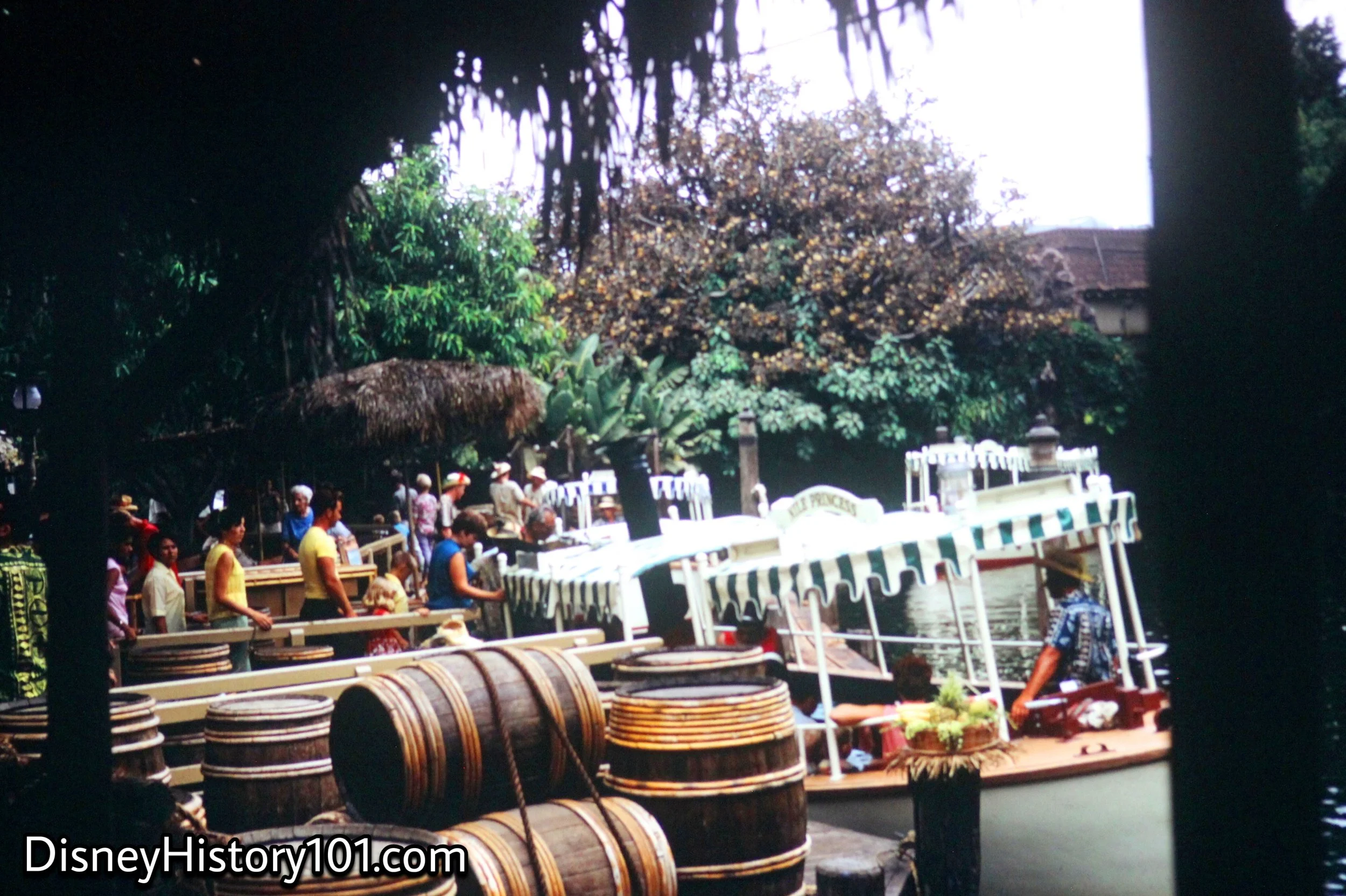
1967, August
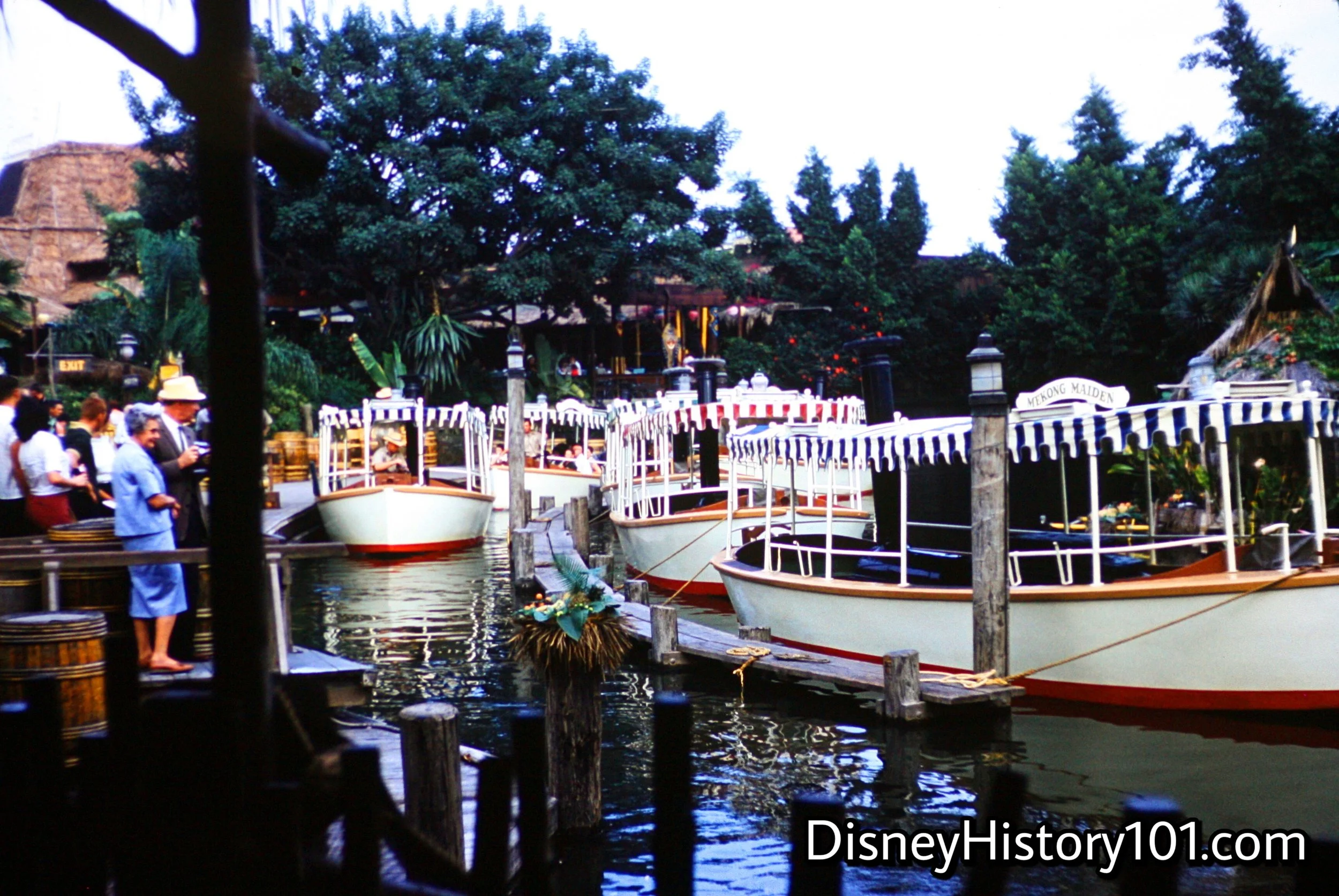
1961
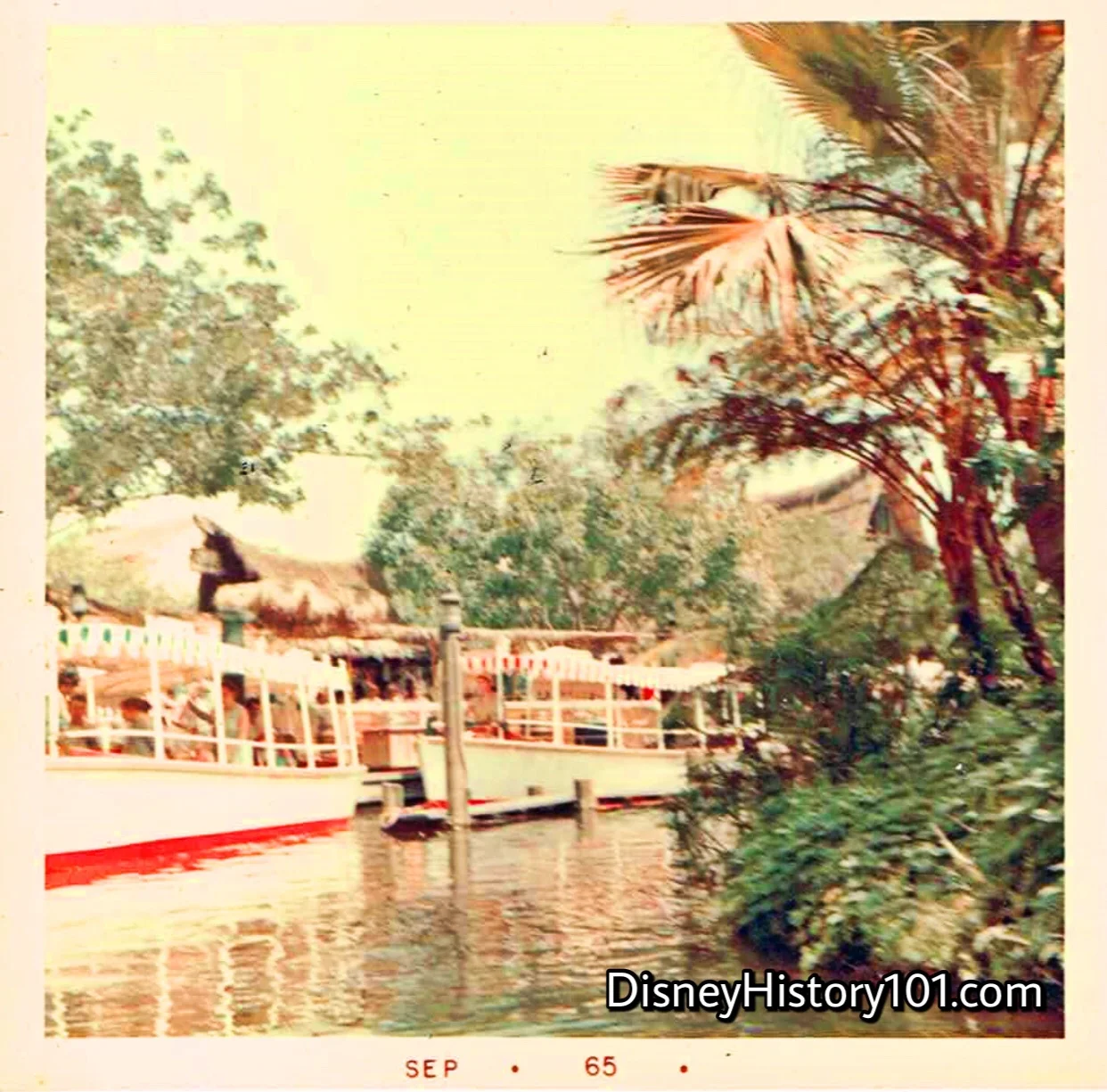
1965
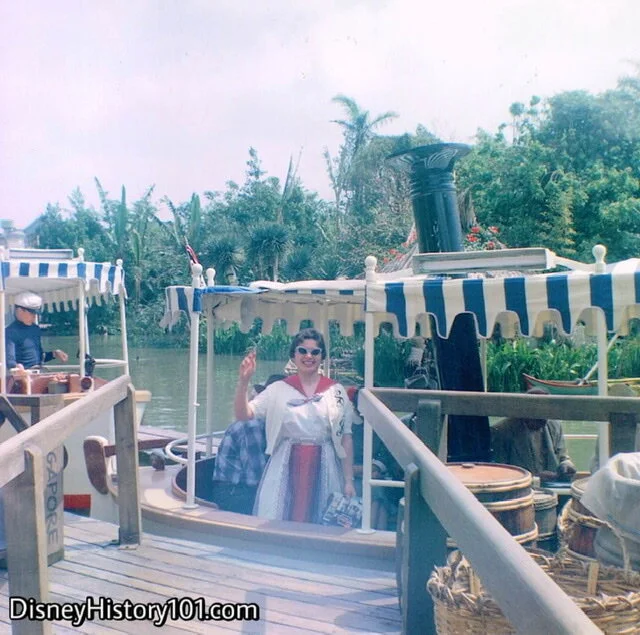
A guest turns around and waves goodbye to civilization, April 5, 1958.
Ladies may want to remove their earrings, as they tend to attract the headhunters.
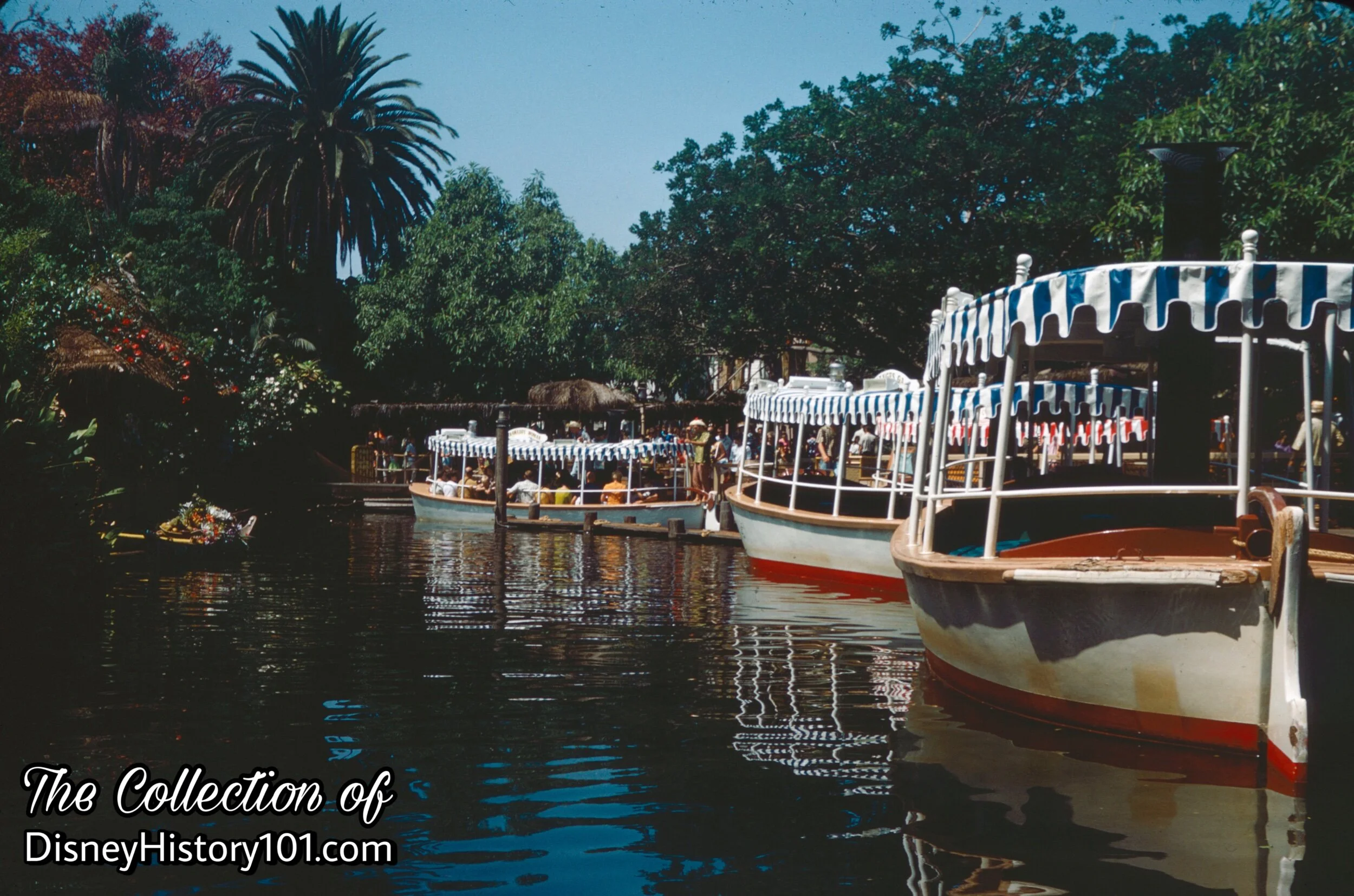
(1967)
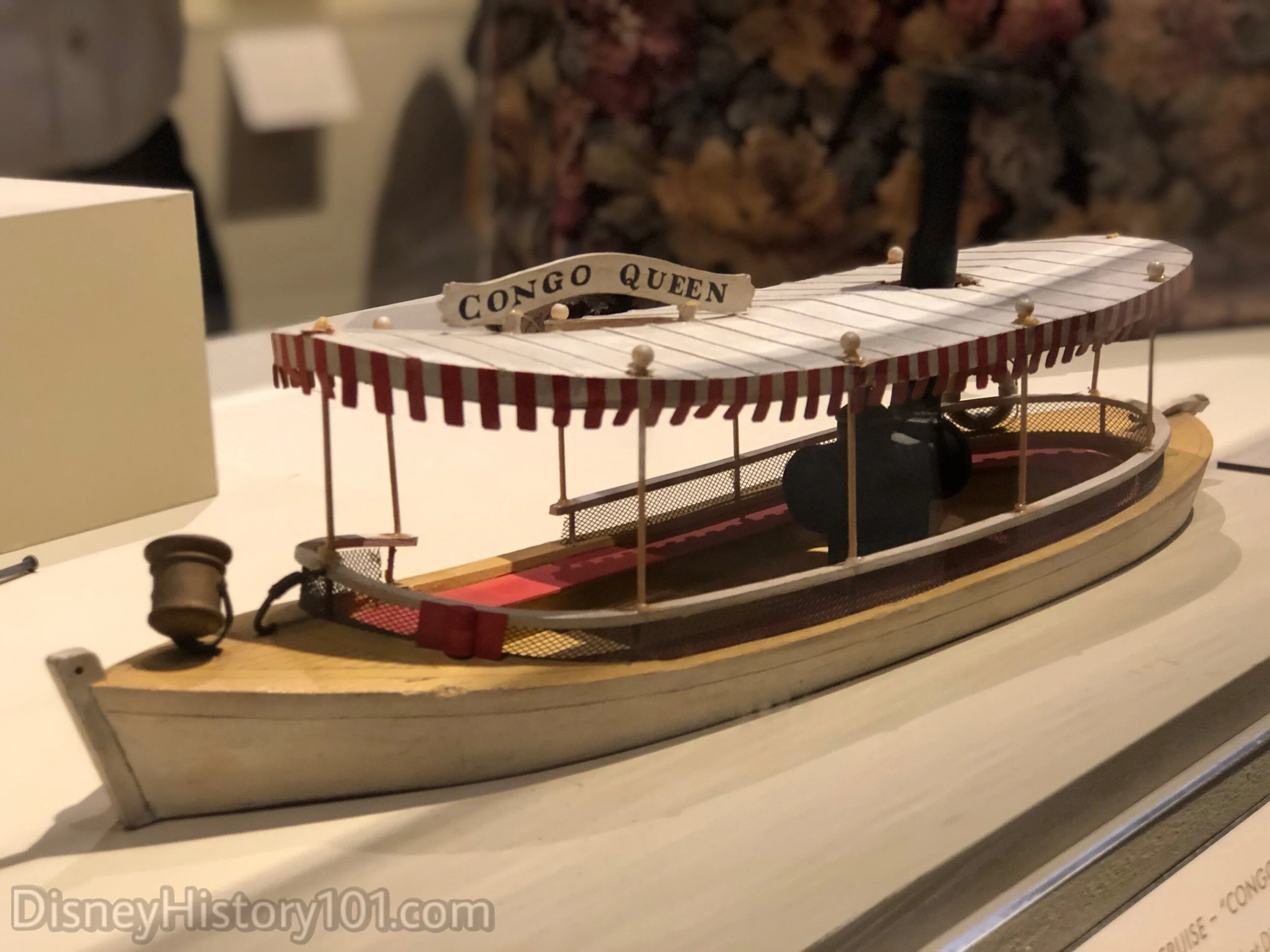
“Congo Queen” Attraction Vehicle Architectural Model (Not to be confused with the “Safari Adventure Boats” of the Disneyland hotel), Walt Disney Archives.
The true-life boats (based on Naphtha Launches) were of Harper Goff’s initial design, partially modeled after the steamer featured in “The African Queen” (1951) starring Humphrey Bogart. It’s been said that the “modeling process will take many forms and many scales, often ranging from tiny paper cutouts, all the way up to full scale mock-ups. Whichever way the process goes, however, the WED designers think big by first building very small.” [THE DISNEY THEME SHOW: an introduction to the art of Disney outdoor entertainment]
To fabricate these, John Stoos (also of WED Enterprises, Inc.) created technical elevations drawings. Architectural drawings helped define all designs, production and construction strategies, costs, schedule, and resource requirements. Models explored the various dimensional relationships, site-lines, flow patterns, ergonomics, and visual appeal to convey the desired creative intent. All of this was utilized for the latest boat building techniques.
In the present, facsimiles of Harper’s Naphtha Launch designs can be seen in the attraction queue.
The 12 full-size Jungle River Cruise Naphtha Launch Boat hulls were manufactured by the Glasspar Co. (of Costa Mesa, California), the same company that was responsible for manufacturing the Mad Tea Party’s Fiberglas Tea Cup vehicles, and the bodies of the first fleet of Autopia Mark Is. Official documents also mention the involvement of Bob Dorris. The 12 hulls were built using modern techniques and conventional materials (like wood and FiberGlas), to make them both sturdier and safer. This construction can be briefly seen in “A Pre opening Report From Disneyland” (a Disneyland anthology episode aired in 1955). The internal-combustion engines of the early days were Red Wing engines, (though by c.1959 Gray Marine brand engines). Early documents describe these to be powered by a “Model 69 Gray Marine Engine, with self-contained cooling system.”
Finally, “before the upper deck…[was] furnished with seats, awnings, and other trappings, the hull undergoes a final check [by divers],” according to narrator Walt Disney (in “A Trip Through Adventureland”, an episode of “Walt Disney’s Disneyland”). All together, each of the 12 “True Life Boats” measured 27 feet long, with a beam of 8 feet 10 inches, and weighed 2 tons. These would have the capability to accommodate a maximum of 30 to 35 passengers.
“55er” Maynard Swenson “went to the Jungle, trying to keep the boats operating.” He recalled “They had Red Wing engines then and different kinds of guides. Dick Nunis, Ron Dominguez and Billy Sullivan were boat operators. They drove a little fast though, and they used to run a lot of boats off the rail.” Maynard remembered that “Billy Sullivan was a supervisor of the Jungle Cruise and he was cracking down on the Jungle Bunnies for horseplay and falling into the river. Well, this time I picked Billy up in my arms and walked right off with him into the river. He went right under, but came up laughing!” Walt “used to come into our shop behind the Emporium and have coffee with us. He would ask a lot of questions and he'd ride around the Jungle with us. He liked to watch his favorite revolving alligators. The trouble was, whenever Walt came to see them, they would break down. I always wanted to get a picture of Walt, but never got one.”
One authorized “Disneyland Information & Nomenclature List” (prepared by Bill Cottrell of Disneyland Inc., on May 25, 1955) listed the name of the attraction as “Adventureland,” describing its “an explorer’s boat ride through the tropical rivers of the world with a native guide.” The same document list of “official and authorized nomenclature” of Disneyland, elucidated upon the experience as “Adventures with crocodiles, hippo’s, head-hunters, lions, etc.” and added the names of the boats for reference : “1. Congo Queen, 2. Swanee Lady, 3. Amazon Belle, 4. Ganges Gal, 5. Nile Princess, 6. Mekong Maiden, 7. Irrawadi Woman.”
Promotion for the Jungle River Cruise continued even after opening day. This JUNGLE CRUISE model of the Congo Queen was personally handled by Walt Disney during production of “A Trip Through Adventureland/Water Birds” (Disneyland, season 2, episode 1, original air date February 29, 1956). Walt held this very prop while impressing the fact that “as many as 10,000 guests daily have taken this boat trip safely and comfortably” through Disneyland’s own man-made jungle!
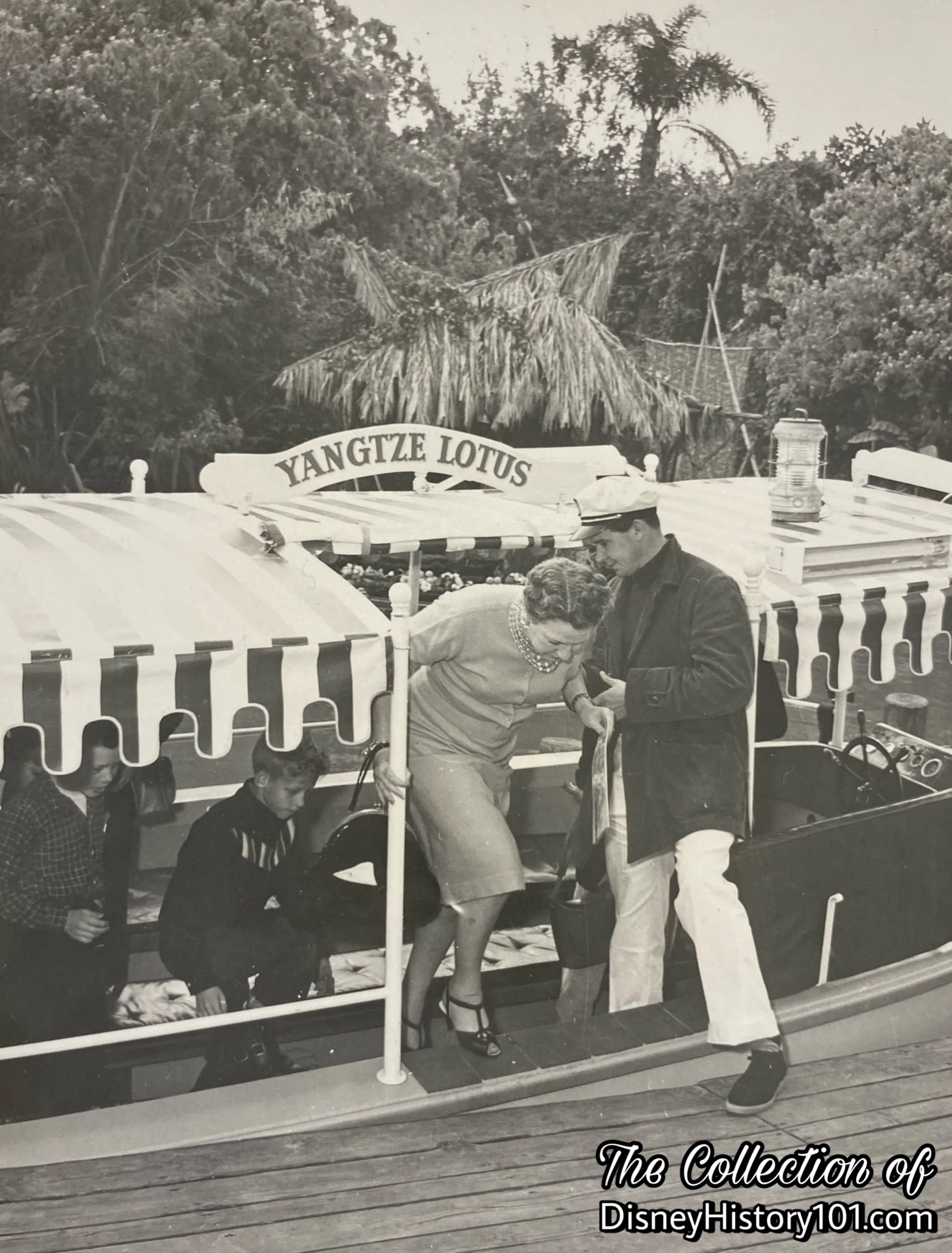
By October of 1959, there were 10 boats in operation carrying the following flags: Congo Queen (representing the Congo Free State), Swannee Lady (of the First Confederate), Amazon Belle (of Brazil), Ganges Gal (of India), Nile Princess (of Egypt), Mekong Maiden (of Siam), Irrawaddi Woman (Burma), Orinoco Adventuress (of Venezuela), Zambesi Miss (North Rhodesia), and the Yantgze Lotus (of Free China).
“55er” Dave Bartchard recalled: "I was very impressed when we transferred the vehicles to natural gas. They asked for my opinion about it and I said that I favored the change because I like clean air. The Omnibus was the first to go over to natural gas, then the Jungle boats, and the Motor Boats, Rafts and the Keel Boats followed along. We couldn't do it for the Submarines because there was no place to put the tanks.”
According to “Walt Disney Disneyland” first published 1964, these were “bright-canopied tropical launches, each carrying 32 passengers and an ‘armed’ guide.” Owing to such a capacity, as of October 2, 1971, boats like this one had carried 54,954,442 guests down the Rivers of the World in Disneyland (all thanks to the Naphtha Launches). This prototype model (above) is occasionally part of traveling exhibition, for example, it was part of “Walt Disney Archives - 50 Years of Preserving the Magic” exhibit at Bowers Museum (during 2020 and 2021).
A 1984 report revealed that the Jungle Boat weighed 4,700 lbs.
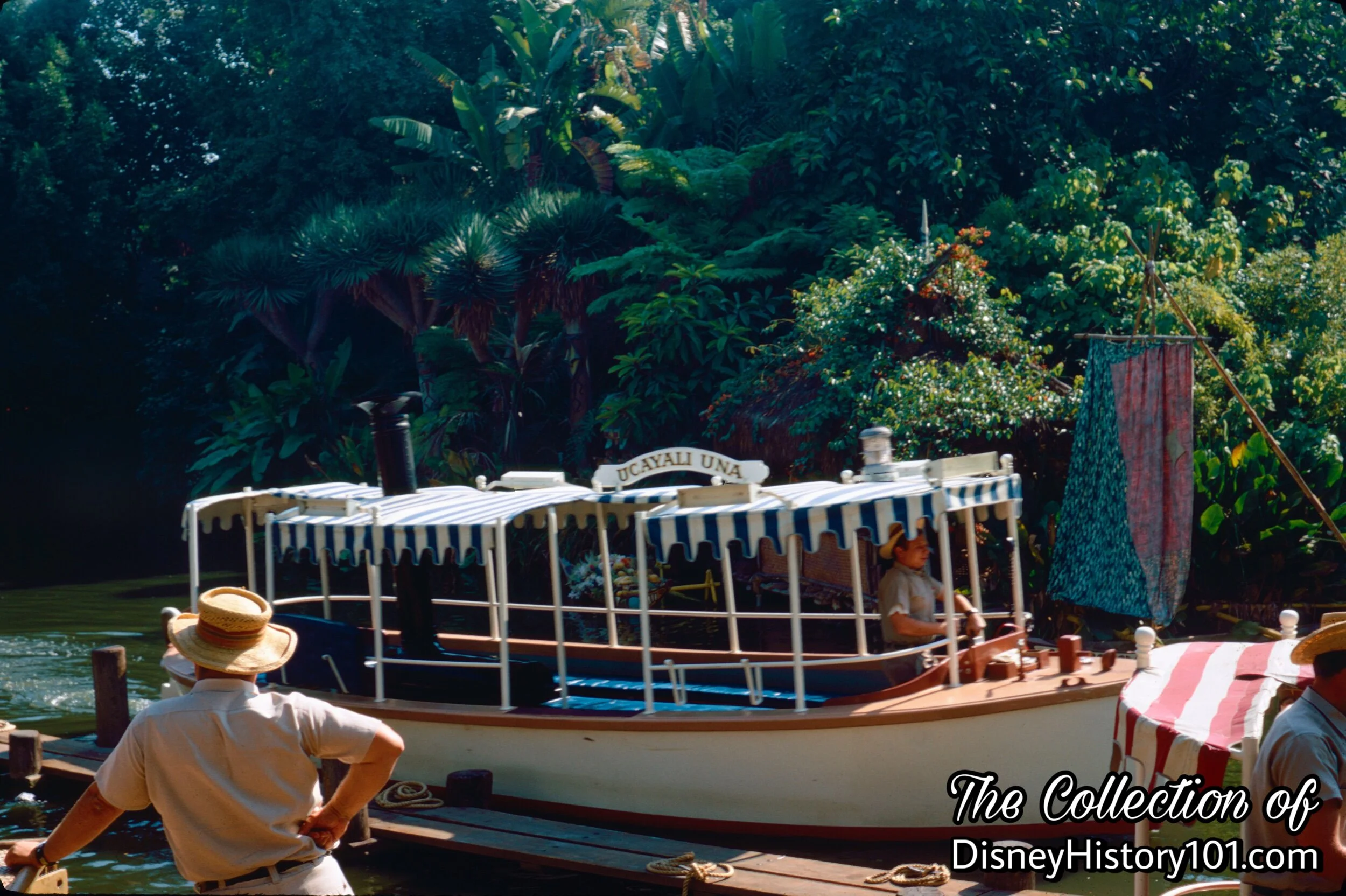
Ucayali Una
In the early days of Disneyland (and the Jungle River Cruise) there were just seven boats, which loaded from one “chute”, or dock. New boats were added every year, and by the Summer of 1965, there were a total of 12 boats. The Ucayali Una (named after the Ucayali headstream of the Amazon River) is one (of twelve) of the Jungle Cruise “steamers” in use in the present. It wasn’t around in 1955, but it bears the distinction of being one (of two) wheelchair accessible Jungle Cruise Boats!
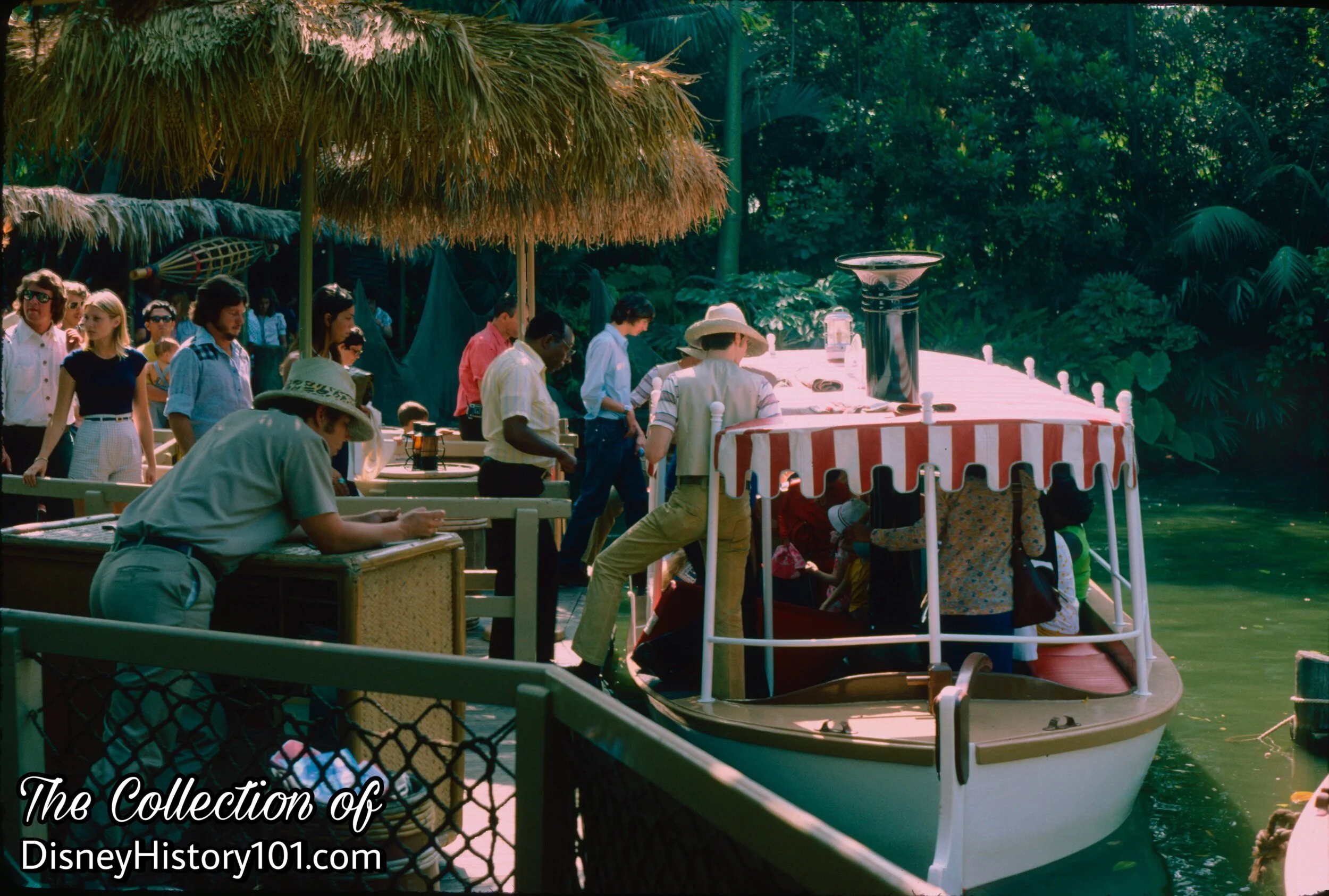
The Jungle Cruise Loading Dock, where Guests step aboard at two entrances along the port side, c. August, 1975.
“When boarding the boat, please look down and watch your step. Take small children by the hand. Look down and watch your step…no swimming allowed…please look down…do not fall in the water…watch your step…the crocodiles are out. Look down and watch your step…Step lively…the boat is sinking…Watch your step and my toes.”
“You folks coming in the rear, please move all the way around the engine and up to the front. Those of you coming in the front, please move to the rear and sit next to the engine. Fill in all the spaces…sit close together…and don’t leave any room for hungry crocodiles, snakes, spiders, etc.”
WED Enterprises Inc. Live Narration Script, February 18th, 1970
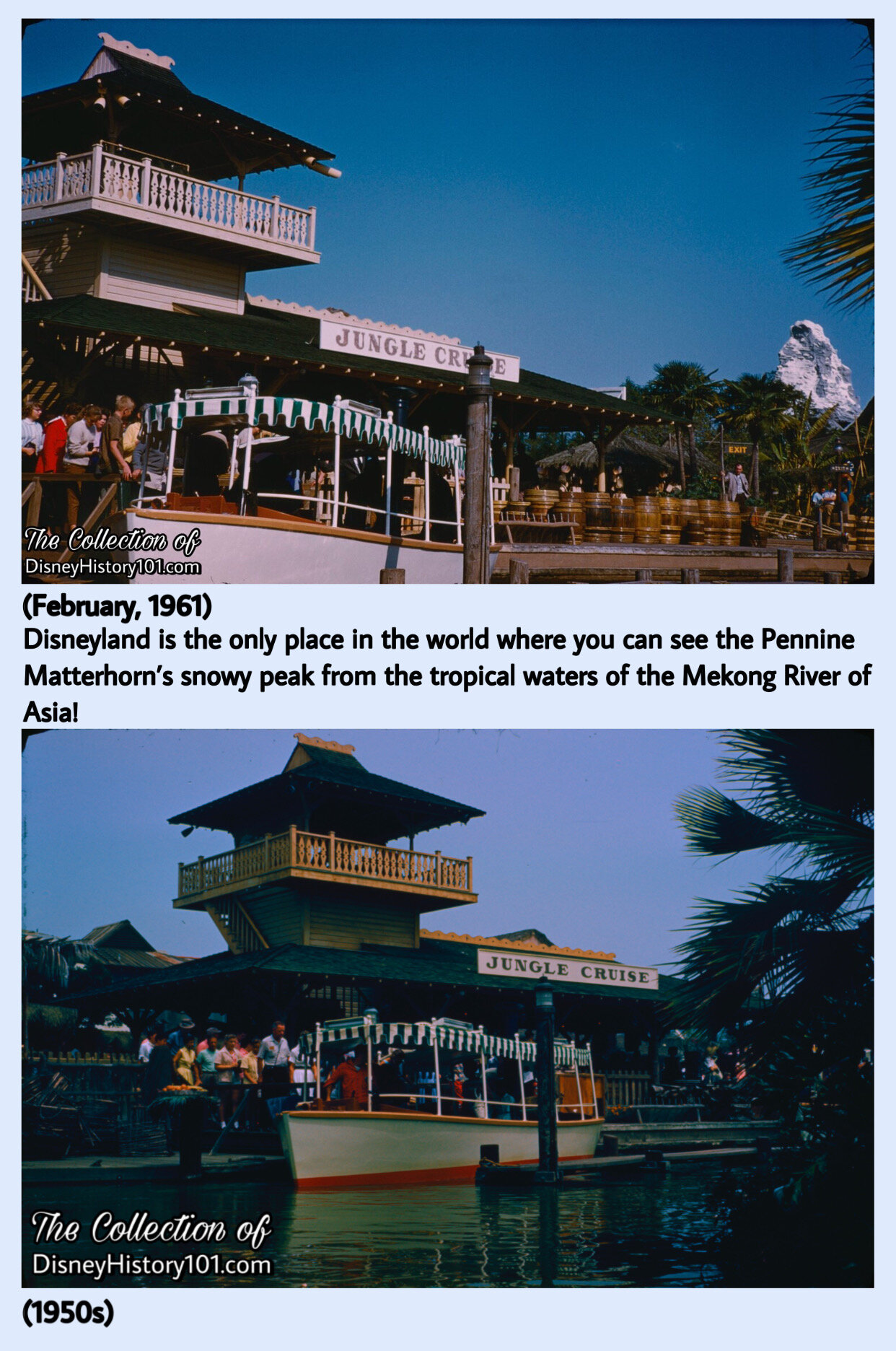
This original two-story Victorian Boathouse was a constant feature along the Rivers of the World from 1955 to 1961. It was replaced with a one-story entrance during the installation of the Swiss Family Robinson Treehouse and refitting of the Jungle Cruise Rivers of the World. Also, the visible water channel from Adventureland's Jungle Rivers of the World into Frontierland's "Big River" (which once flowed beneath the footbridge by Magnolia Park) was rerouted via underground plumbing.
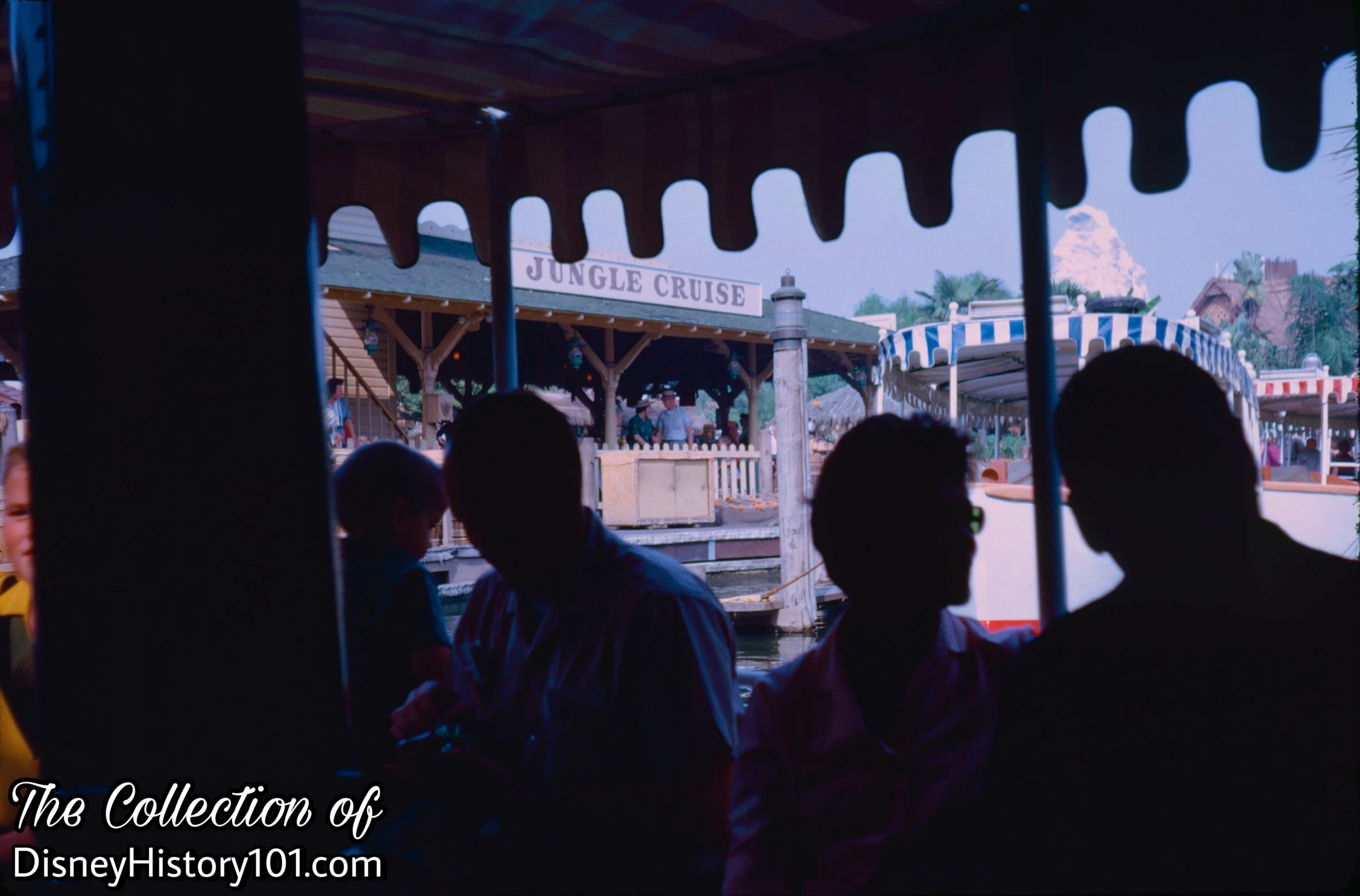
(October, 1961)
“…I’ll be your Skipper and Guide down the Rivers of Adventure. Before we journey too far, let’s all turn around and take a last good look at the dock. Wave goodbye to everyone…We may never see them again!”
“Disneyland/Adventureland Jungle Cruise Live Narration Load Adlibs - 5/30/85”
If you could just sit in the doorway… It keeps the wild animals out and the wild humans in.
Folks, can I get you all to lie down for now? We’re going to start the second layer. Well… It was worth a try.
No holding onto the bar please. The bar is closed.
I get paid for the number of people I take out… Not for the number I bring back!
Don’t worry if it’s crowded now… There will be lots of room on the way back.
How many of you were on the Jungle Cruise for the first time? Good! So am I. How many are on for the last time?
Let’s get one thing straight… If the boat goes down, the captain will be going down with it. I’d like you to meet our new Captain. (looking at nearby guest) What did you say your name was?
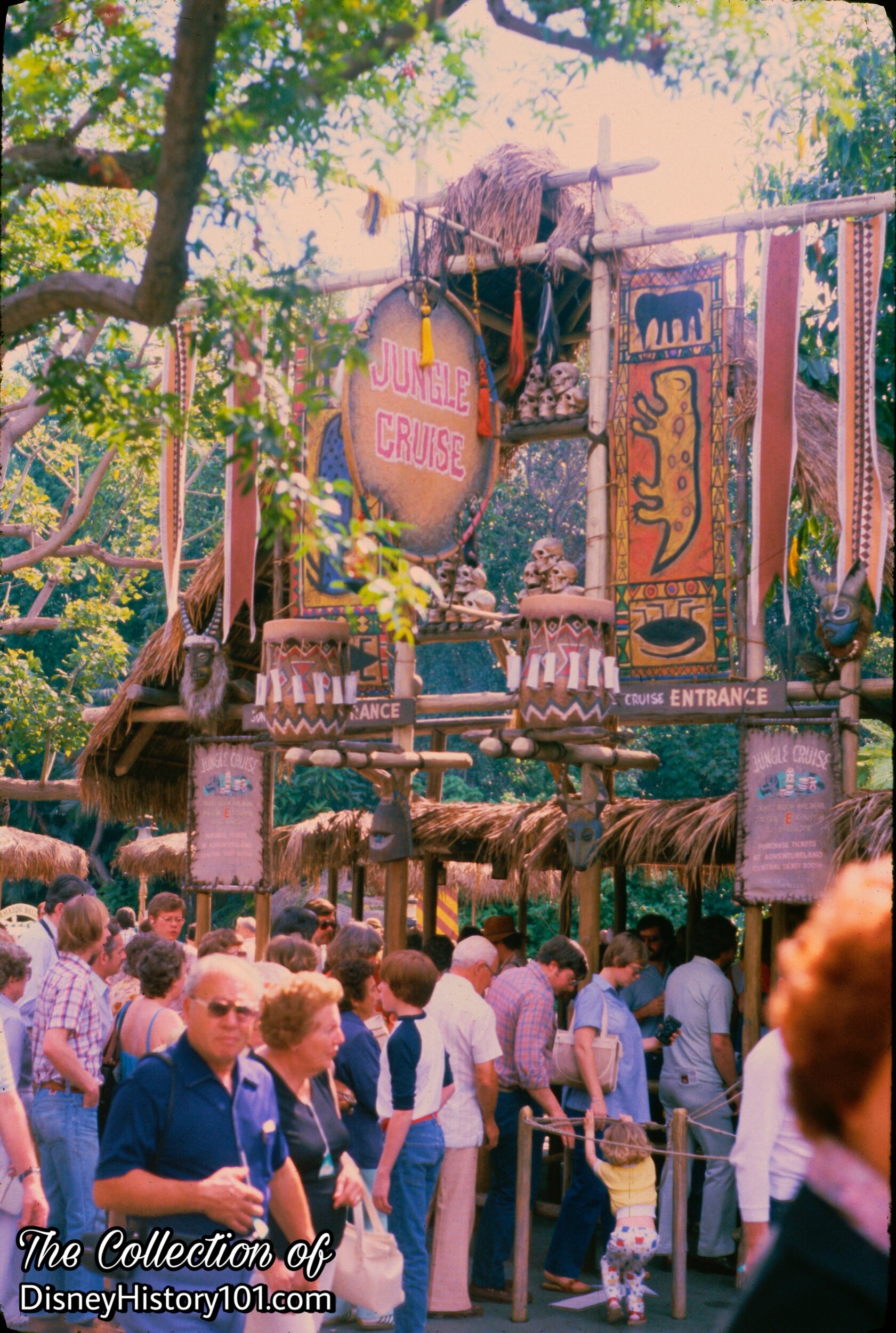
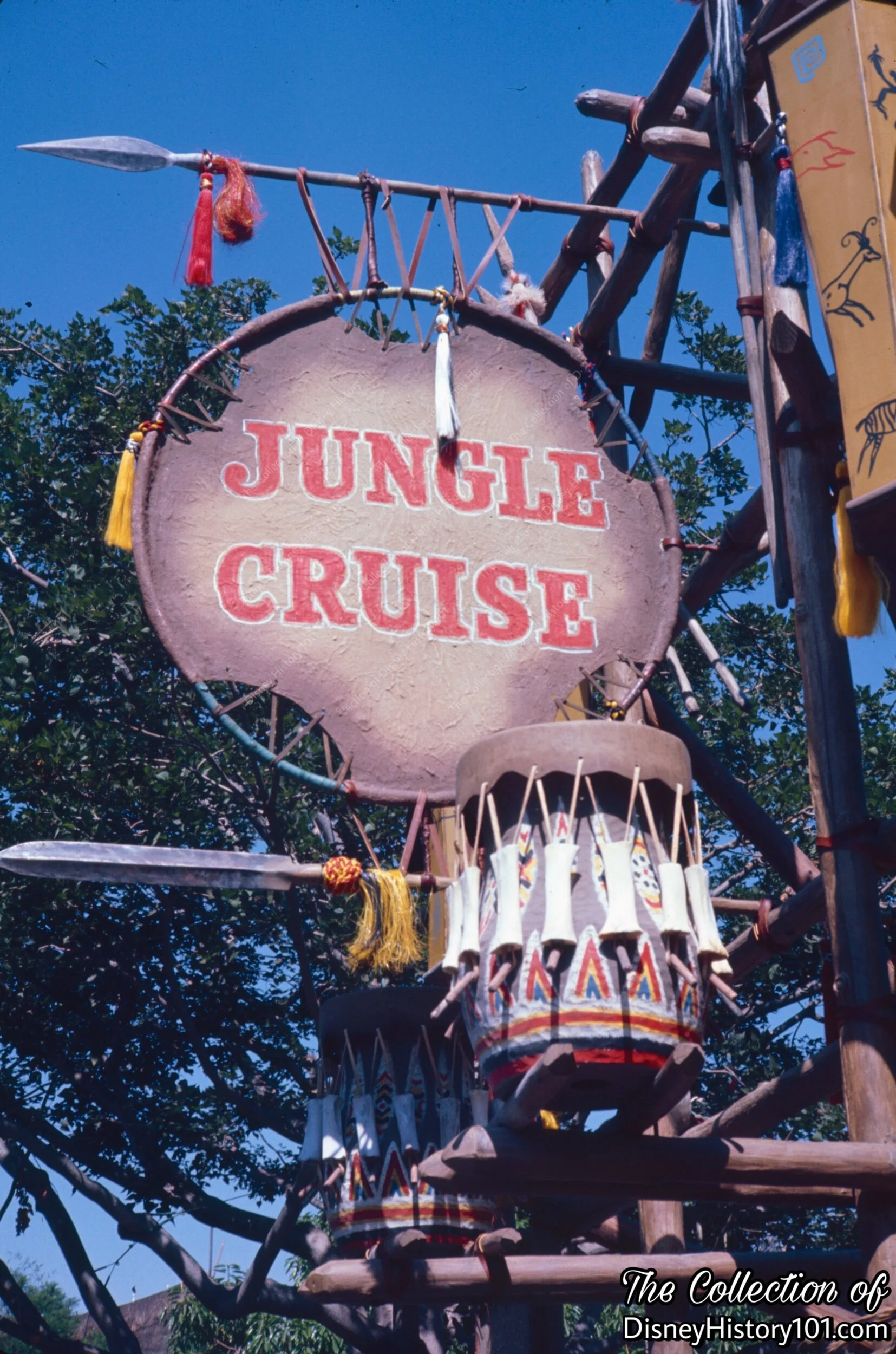
Paint is important. The “Master Color Book” is the Bible for color selection at Disneyland, maintaining a catalogue of 4,000 shades of color. The book contains color specifications for every land, building, exhibit, and prop which requires paint maintenance. It insures that Disneyland will always have the same bright colors selected by the art directors who designed the attraction. In addition to the Master Color Book, there is a standby supply of ready-mixed paint available for touch up work. Thousands of cans of paint are stored in a special room which sounds like a walk through of Disneyland. Each can is labeled with names. Disneyland painters repainted every prop in the Park every two years. By 1969, this sign was one of 20,000 signs of various sizes and shapes and colors that needed to be maintained in their original condition.
It would be several decades before the Boathouse would return (constructed January 3 through June 29, 1994). The new Boathouse was built 15 feet toward the Jungle to increase walkway area in Adventureland. The two-story interactive queue would have six propped show areas and house 30 minutes of queue before extending into the area.
Tropical Imports and an entertainment stage for the Steel Drum Band has been included into the Boathouse.
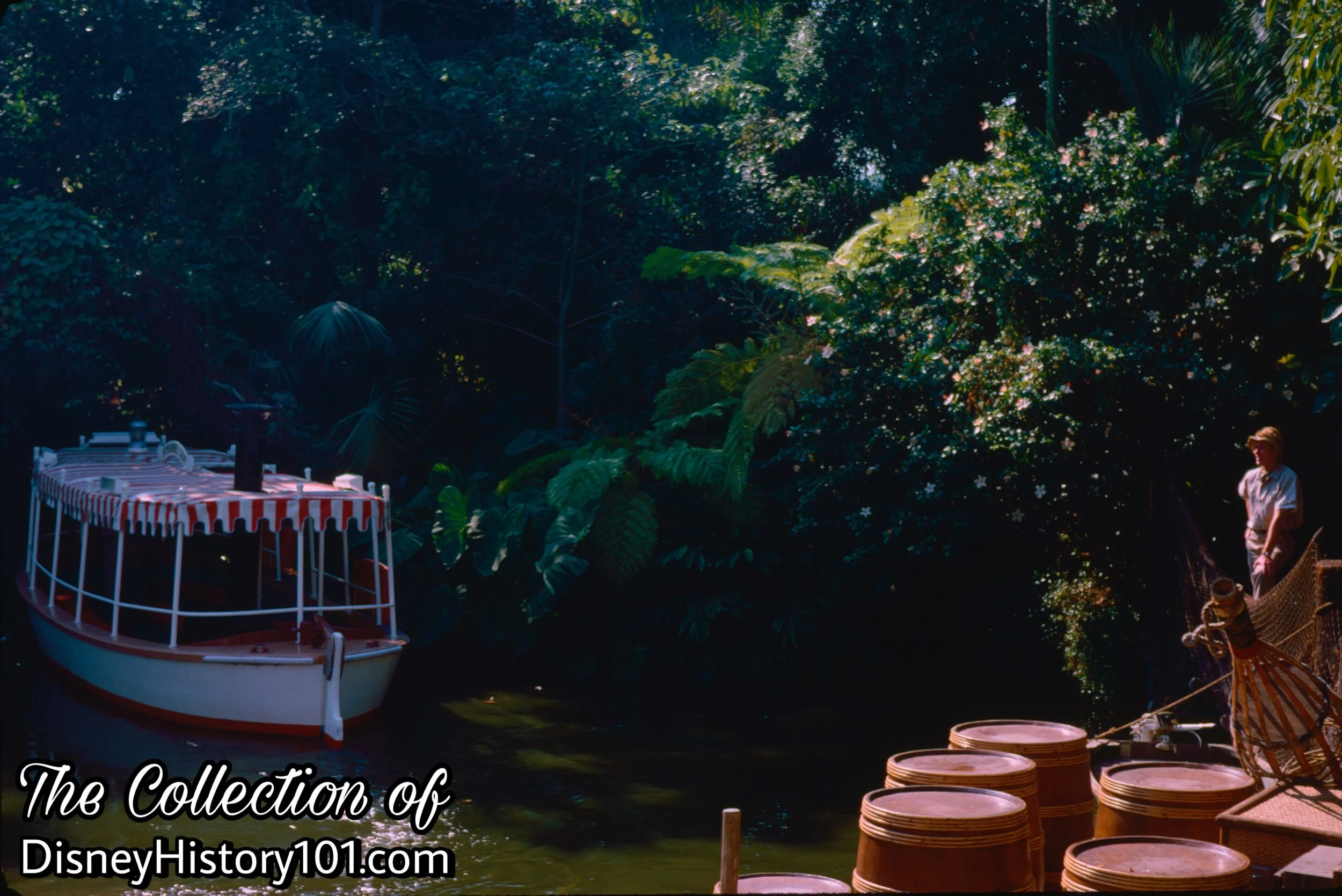
(November 2, 1969)
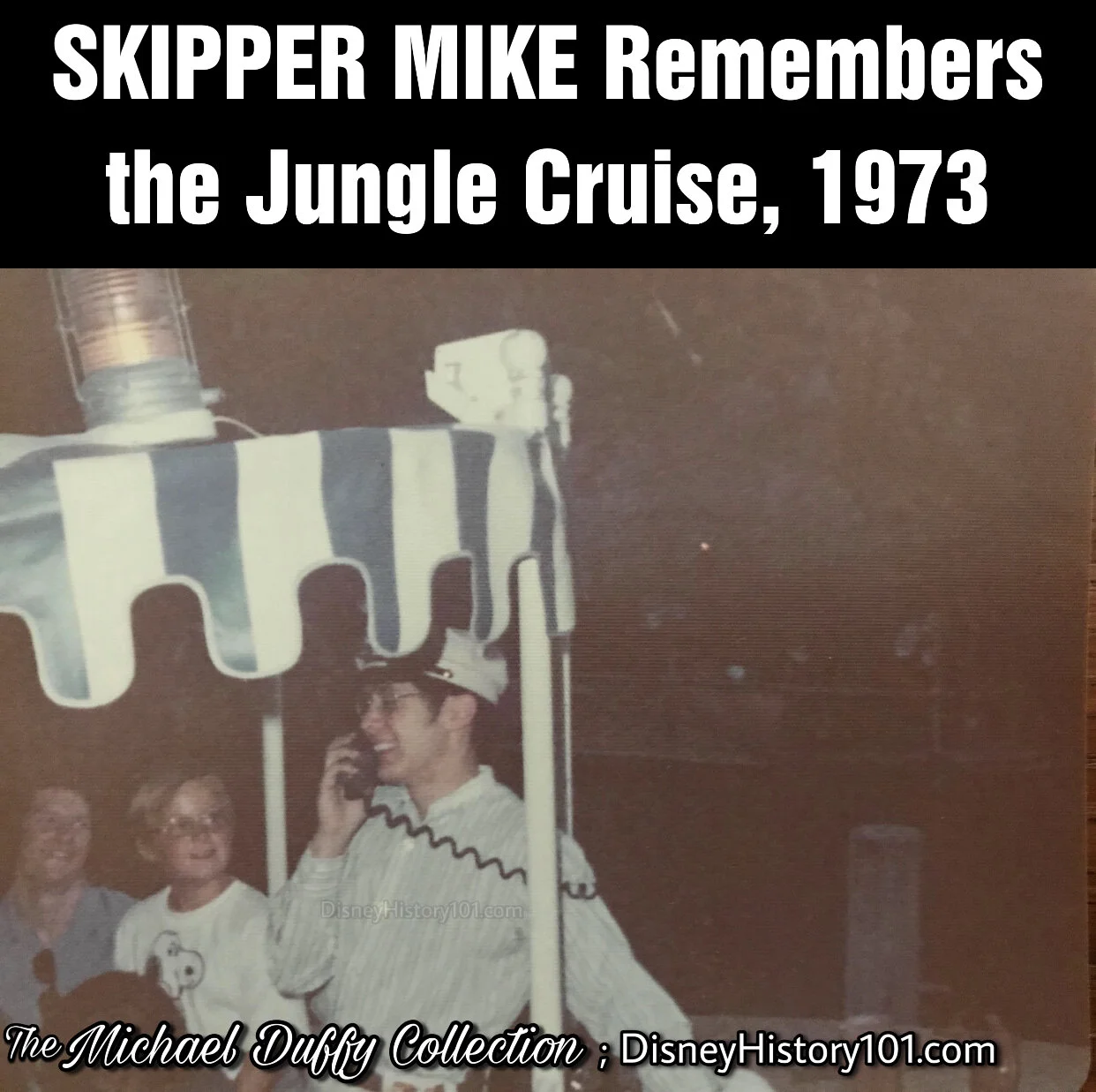
“‘Welcome on board the Jungle Cruise! My name's Mike, and I'll be your skipper and guide for the next 8-10 weeks.’ That was the era of the ‘African Queen’ style outfits (as well as the traditional khaki brown outfits). Since I'd never seen The African Queen with Bogart, I didn't have an appreciation for them.
I was given the script from the Jungle Cruise to memorize. It was pretty straightforward, and I was experienced with memorizing parts…’Often spoken of, rarely seen: the back side of water! (Schweitzer Falls)’…’Two of his heads, for one of yours’…’And, of course, the Queen of the Elephant Bathing Pool, Elephant's Gerald. (Ella FitzGerald).’
You start out with the standard spiel, and then you watch other guys (and gals, like Bev Carter) do their versions . Eventually, you make it your own. When people had a good time, and were clearly enjoying the ‘patter’ - that was the high point! The hardest cruises were those with a boat full of guests from a foreign country, where the spiel didn't matter.
Of course, there were all the other parts of the job to learn - loading & unloading passengers, taking tickets, and crowd control.”
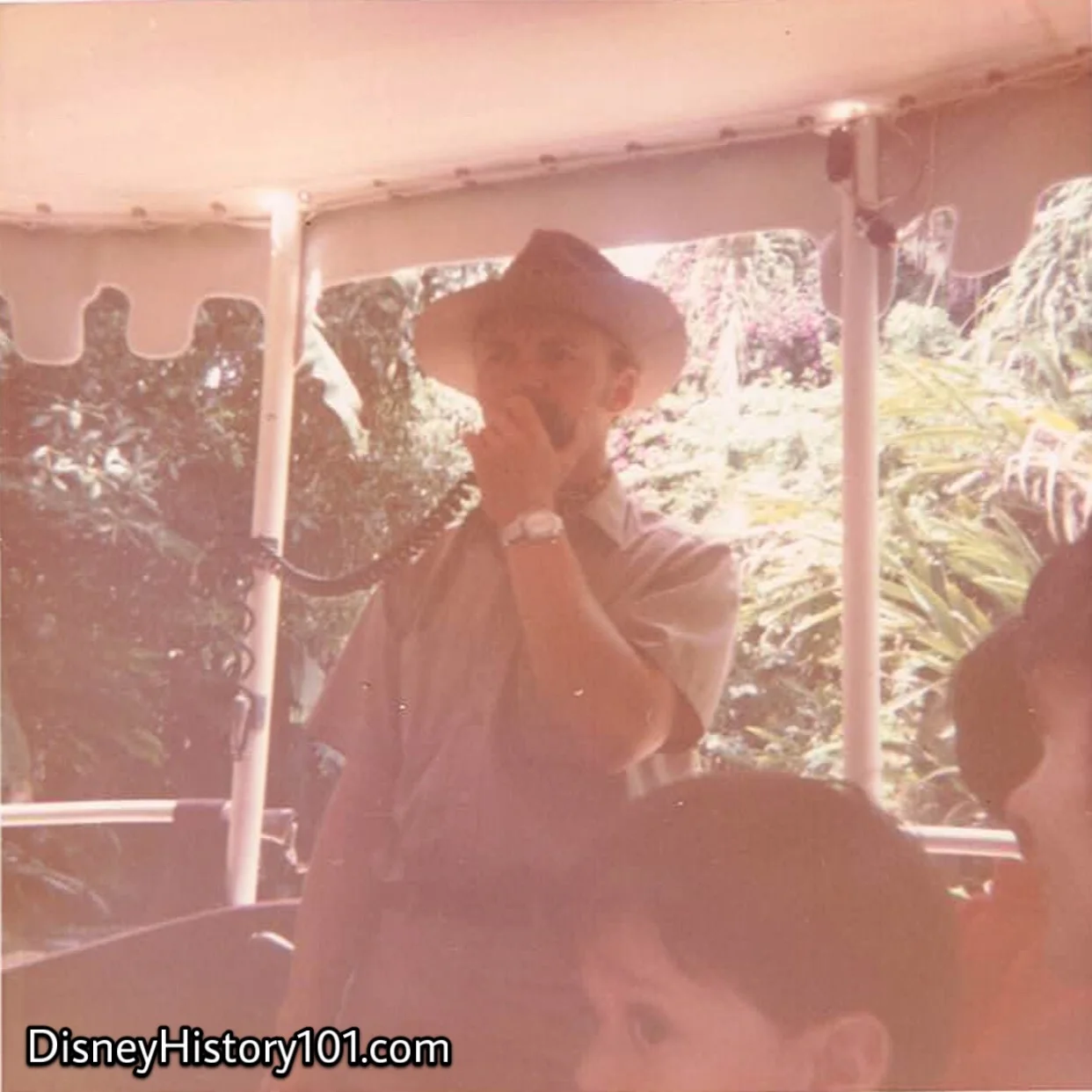
Your skipper and guide down ‘The Rivers of Adventure. He’ll introduce us to a “welcoming committee just around every bend” of our journey! How far we have come, for the earliest Jungle River Cruise skippers used non-electronic megaphones to amplify their voices (as seen in “A Trip Through Disneyland”, an episode of “Walt Disney’s Disneyland”).
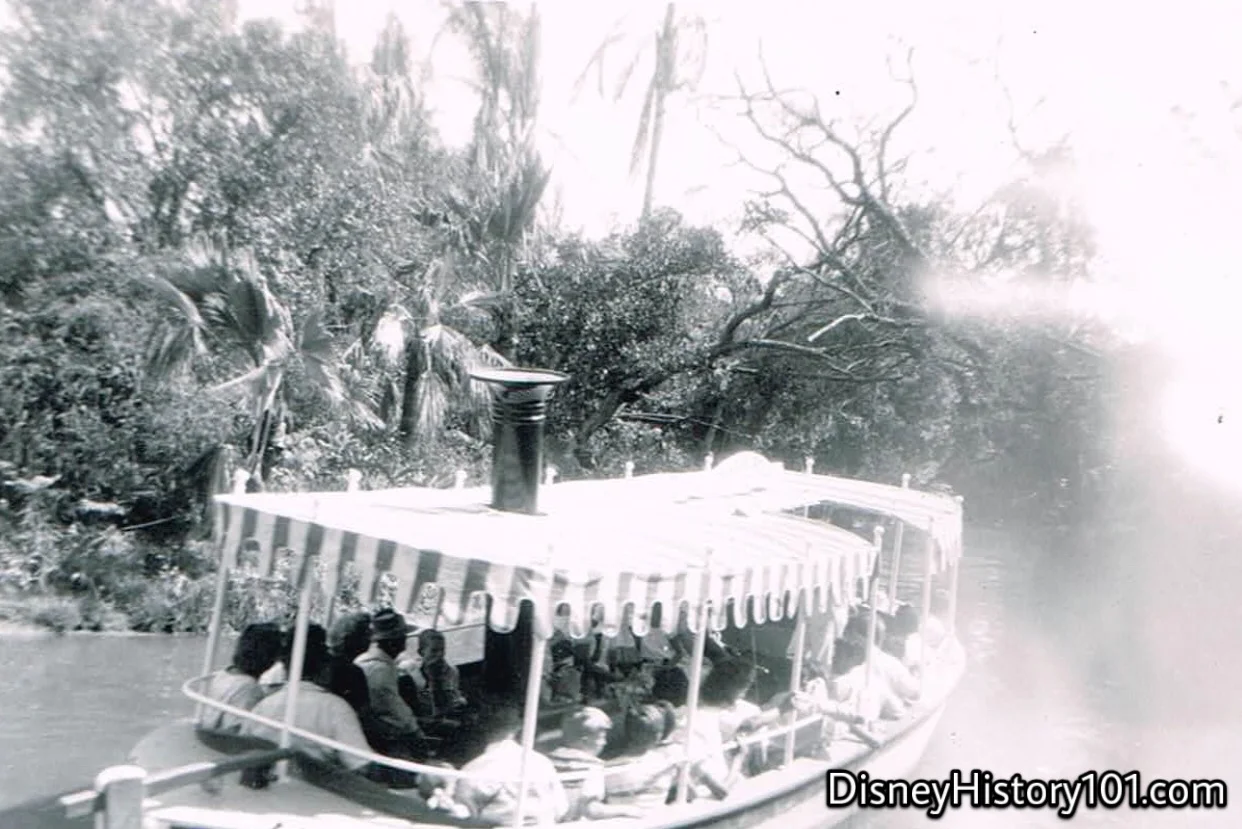
“IRRIWADDY RIVER OF BURMA”, 1955, August

On December 24, 1954, we only recently explored the People and Places of this region through the magic of CinemaScope, in the Walt Disney Production theatrical release “Siam.”Now, we live the true-life adventure, “as we leave the last outpost of civilization, we enter the mouth of the Irriwaddy River of Burma, where rare plants and lush vegetation grow in abundance. The Dragon Blood trees of the area actually bleed red when cut…And speaking of moisture, we’re passing through a tropical rainforest. We often see exotic birds and huge colorful butterflies…” opening and closing their wings.
The misty tropical Rainforest region first “cropped up” around the summer of 1957, attracting huge hovering butterflies. Since then, a number of animals have come to call this region of the jungle ‘home’. Passing through this region, you may feel the mist on your face, kind of cool, kind of nice. Most of the plants were real and typical of those found in the tropical areas of the world. The Orchids of this region were both plastic and real.
The region was rehabilitated and re-themed to become the “misty tropical rainforest of the Amazon,” by 1964, according to “Walt Disney Disneyland” (published 1964). It’s interesting to note that the most carries a vast array of tropical bacteria. Live Narration Scripts of the 1970s added : “We’re passing through a tropical rain forest, where it rains 365 days a year. The rest of the time, its quite sunny though.” Some time later, flocks of Hornbills descended on the region starting in 1976. This migration has begun to disturb the Crocodiles in the waters.
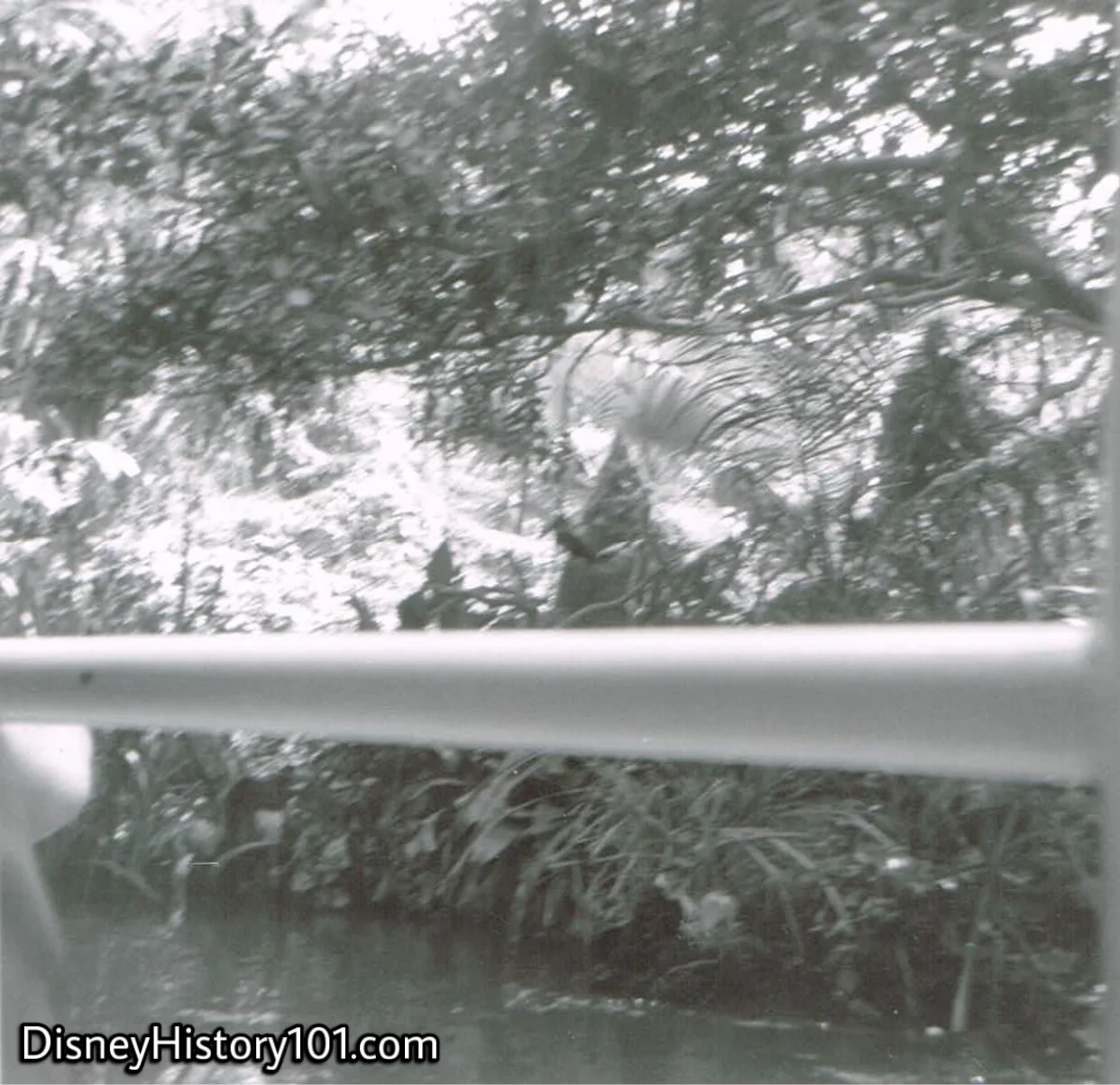
“IRRIWADDY RIVER OF BURMA”
“The voices of a hundred birds criss-cross the tropical rivers of the world,” according to the Pasadena Star-News (Friday, December 14, 1955).
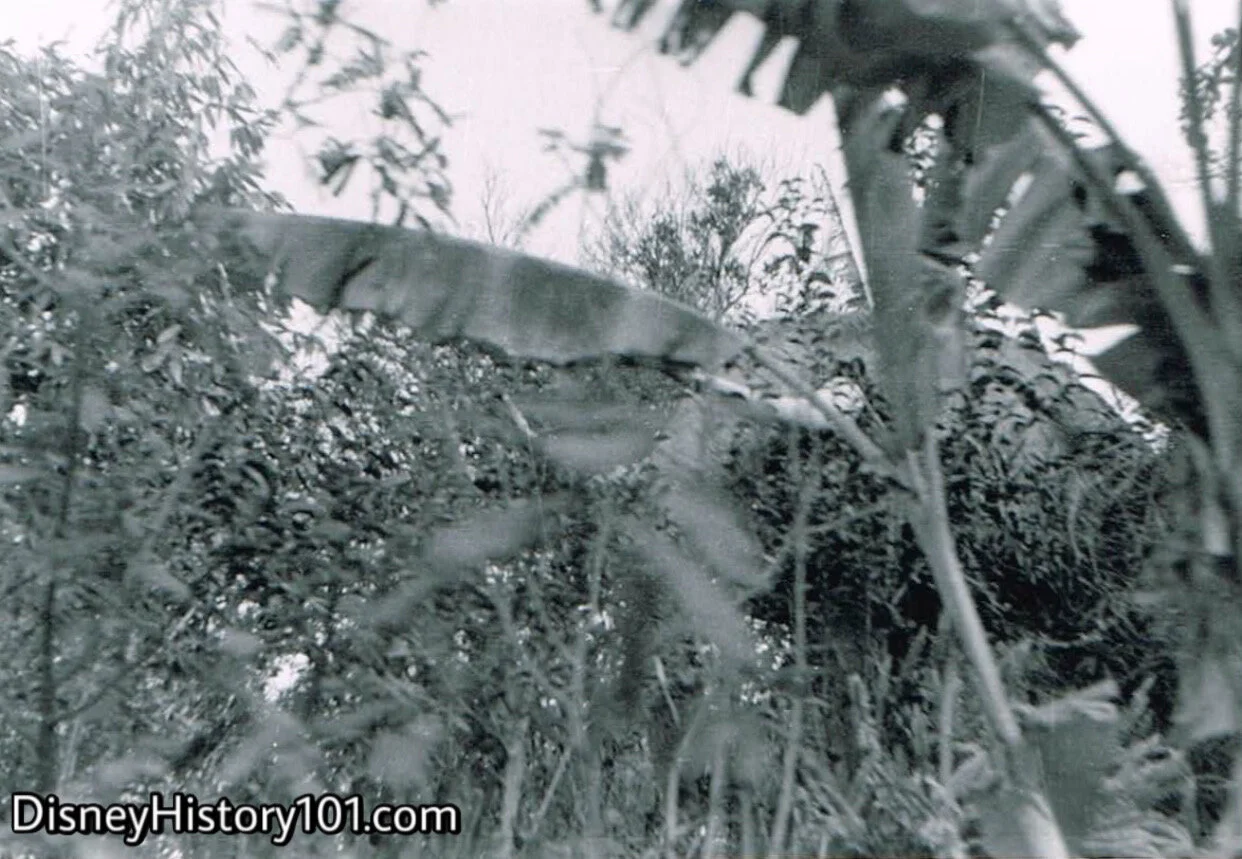
Indian and African banana trees (foreground) line the “IRRIWADDY RIVER OF BURMA”
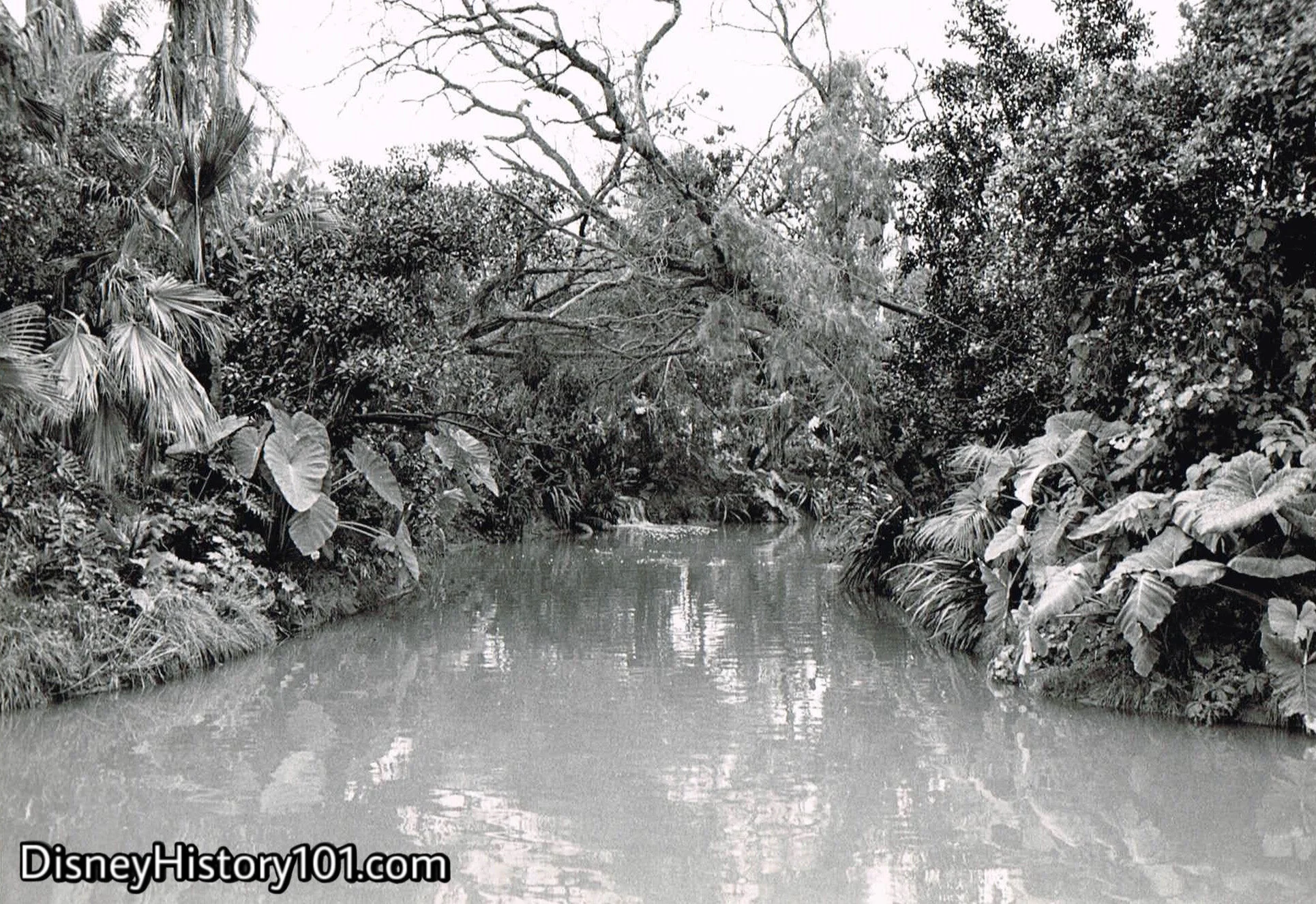
“IRRIWADDY RIVER OF BURMA”, c. 1955
According to Vacationland (Summer, 1979, page 9) : “Disneyland’s stage covers a broad spectrum of nature's own designs…from a simulated Congo rainforest in Adventureland…Exotic tropical flora adds to the realism and excitement of the Jungle Cruise.”
You may recall hearing that when Disneyland was being built, some 12,500 orange trees, 700 Eucalyptus trees, and 500 Walnut trees were removed. Some of those tall, gnarled trees are actually ones left over in the orange groves (now repurposed into tropical foliage that lined the riverbank of the Rivers of the World). “Sometimes nature can even be improved upon with an occasional splash of man-made color” (according to narrator Walt Disney in “A Trip Through Adventureland”), and so artists applied brush splashes and strokes to some of the “repurposed” trees. Last of all, Sphagnum moss and bromeliads were placed on them to make these original grove trees look exotic.
Later, luxuriant growth crowded the water's edge including giant bamboo from India, Japanese golden bamboo, a senecio tree (with scalloped leaves) from Mexico, palms, ginger, giant bird of paradise, Kaffir plum, white-flowering yucca, and papyrus (bullrush).
By 1959, Defroster fans are set up on rafts each night during winter months. Yes, during the night hours of the winter months, the Nursery personnel set up rafts on the Jungles Rivers with frost machines to protect the tender tropical plants used in that area.
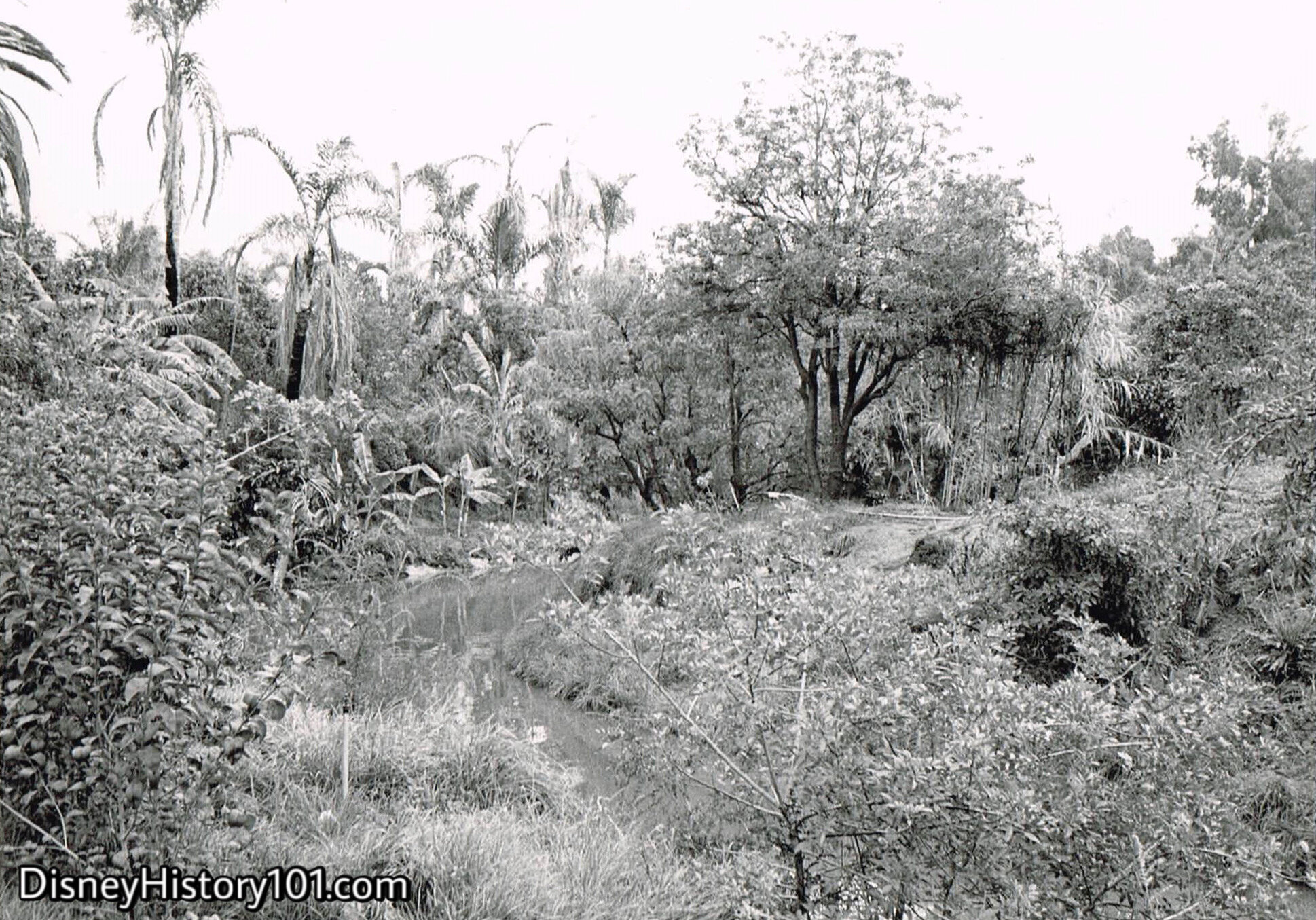
“IRRIWADDY RIVER OF BURMA”, c. 1955
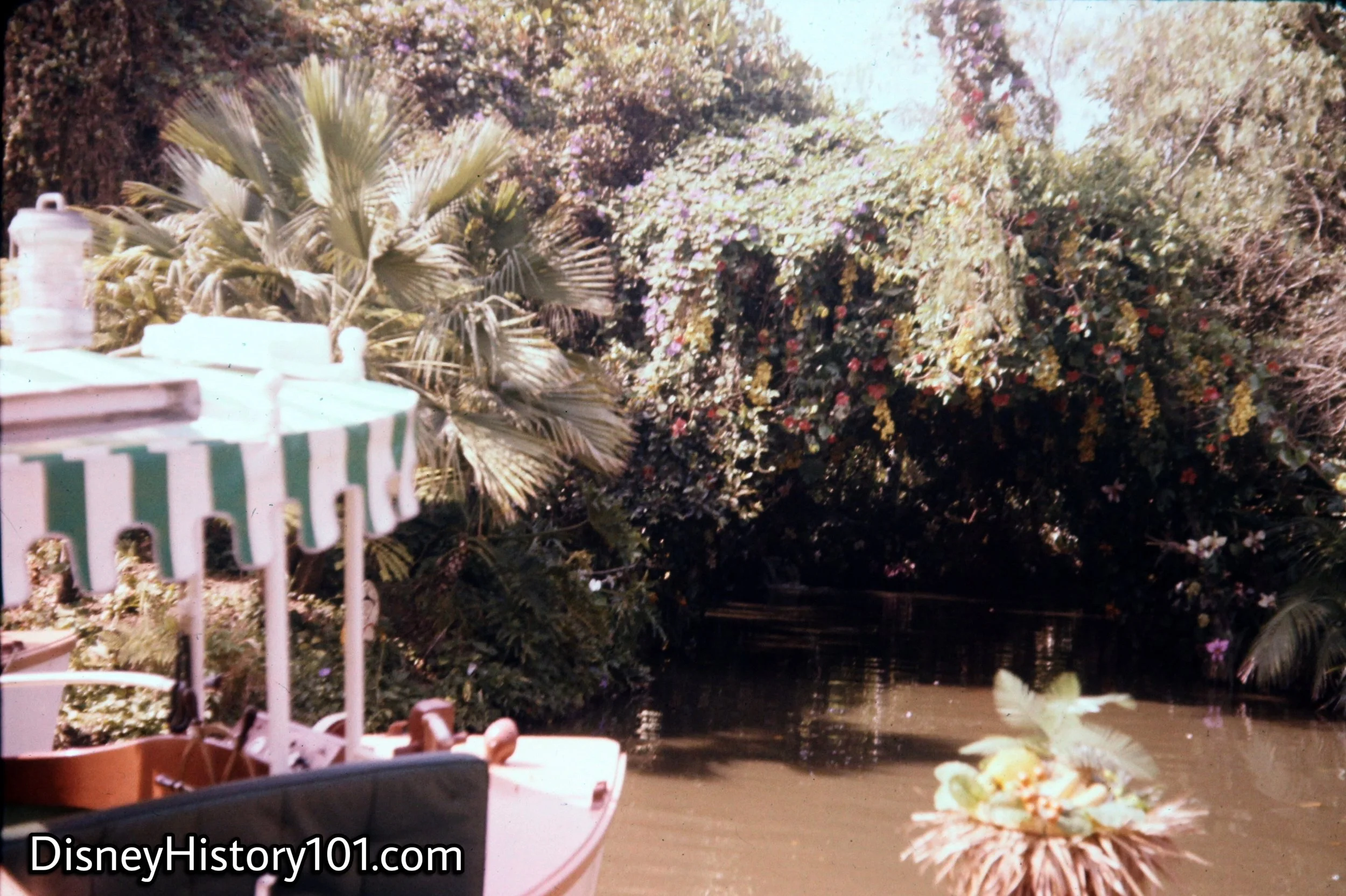
“IRRIWADDY RIVER OF BURMA”, 1961
Upon arriving at the upper reaches of the Amazon, we see a “perennial paradise - a tropical rainforest filled with rare plants and exotic flowers”, according to “Disneyland U.S.A.” (published December 20, 1956, by Buena Vista Film Distribution). At this point along the tropical river ride, Adventure Boat skippers would usually point out the wild and beautiful orchid country!
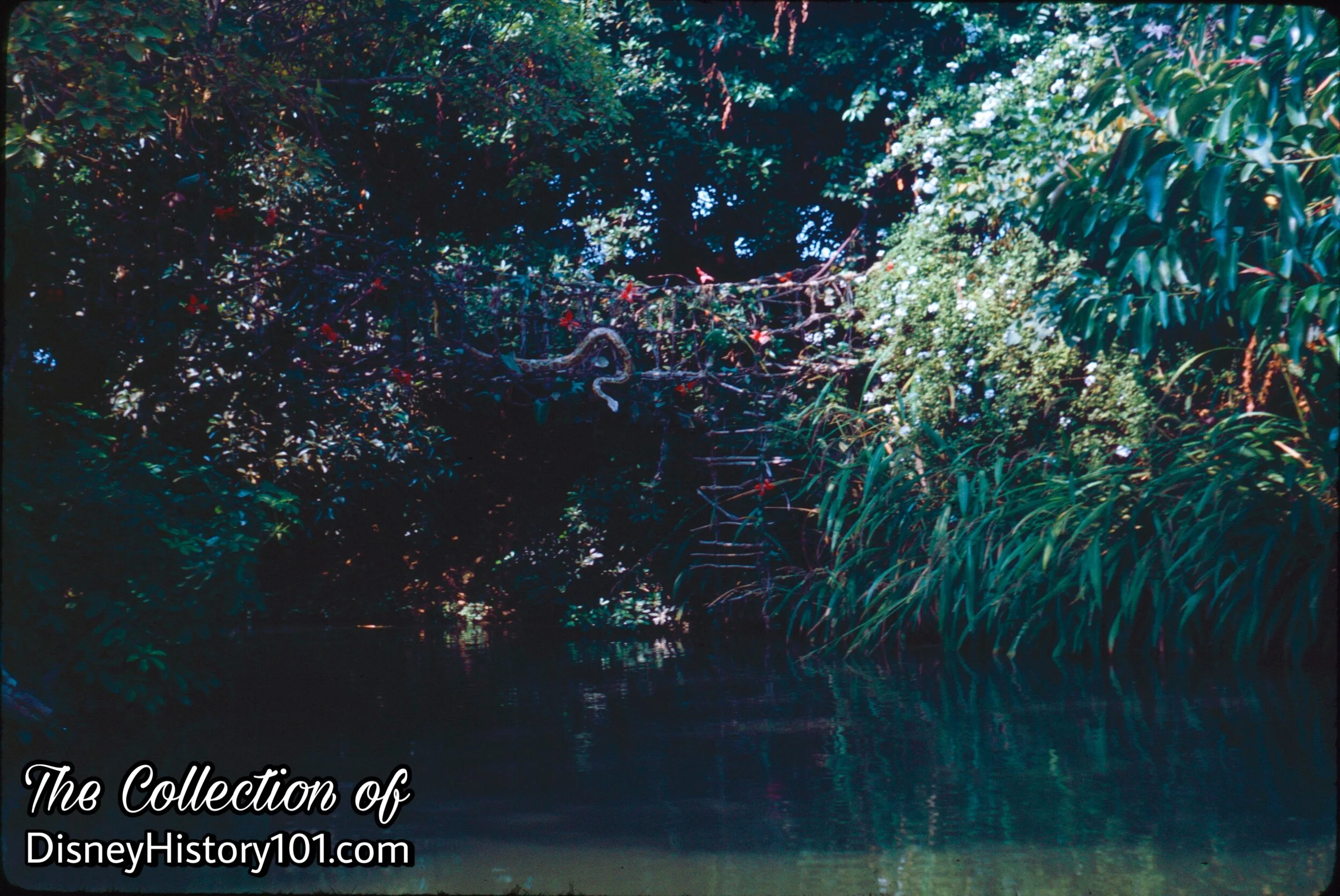
“IRRIWADDY RIVER OF BURMA” (1961)
It looks as if the jungle has claimed one of the last vestiges of civilization - a rope suspension bridge, left over by some jungle safari. “The ever-fresh orchids [attached to it] need no soil. They get their nourishment from the moisture in the air!”
Pythons have been known to hang around this region for decades. They’ve also been seen threatening animals many times their size. Why as far back as 1976, Pythons have been known to challenge Indian Water Buffalo for rites of passage along the Rivers of the World.
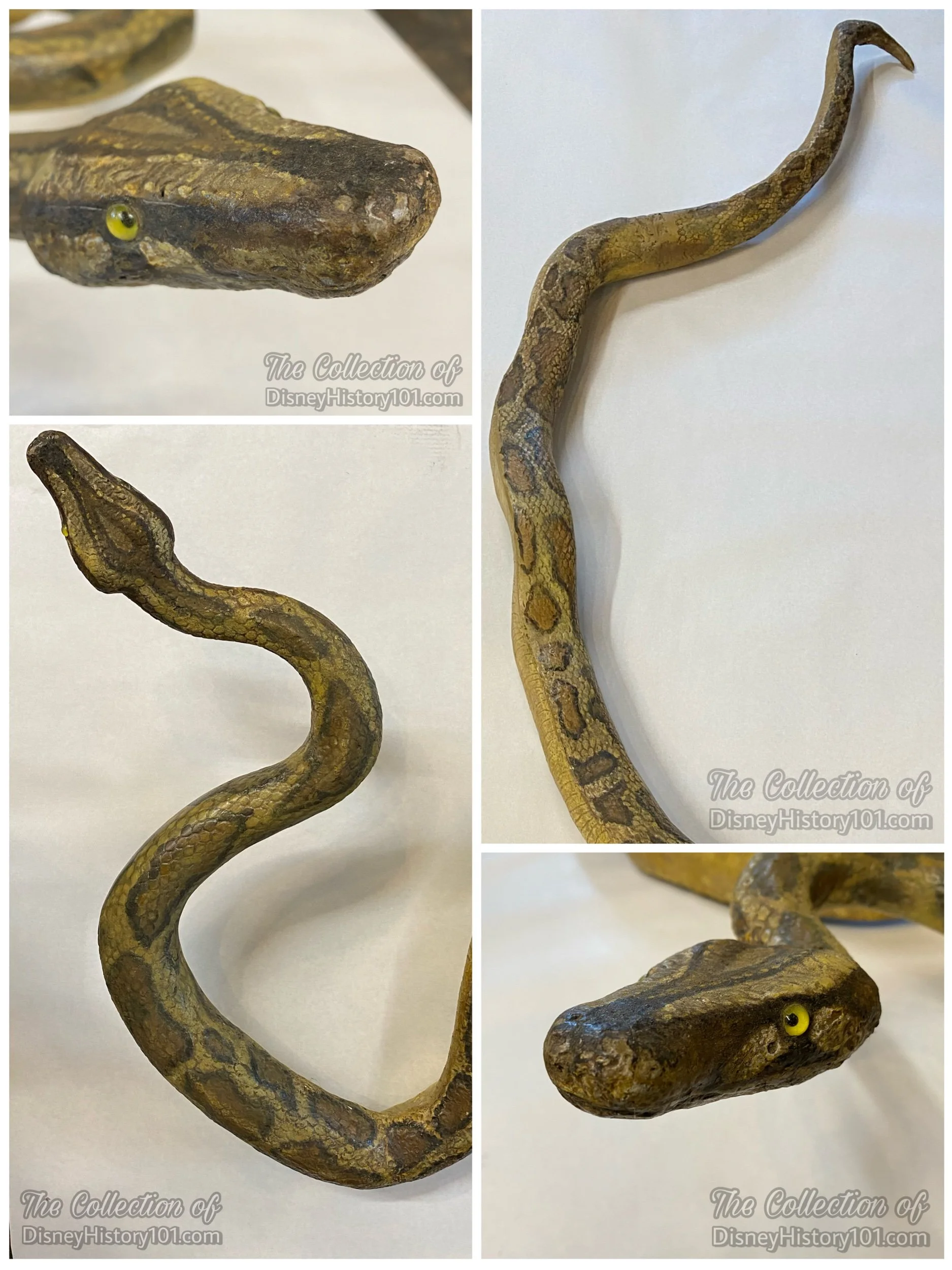
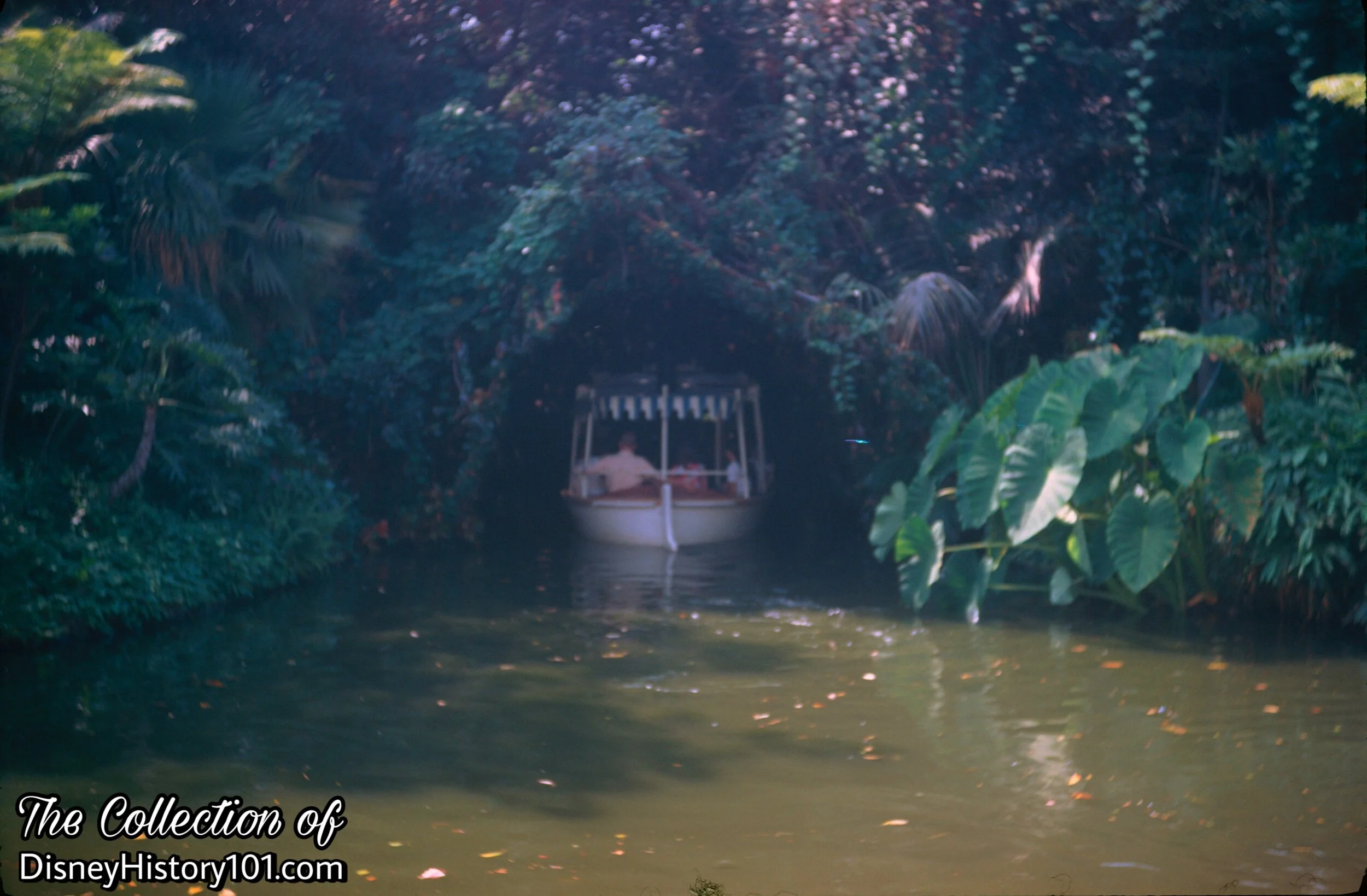
Rain Forest, (c. September, 1970)
In 1994, the Hornbill turn was eliminated due to the appearance of the Indiana Jones queue.
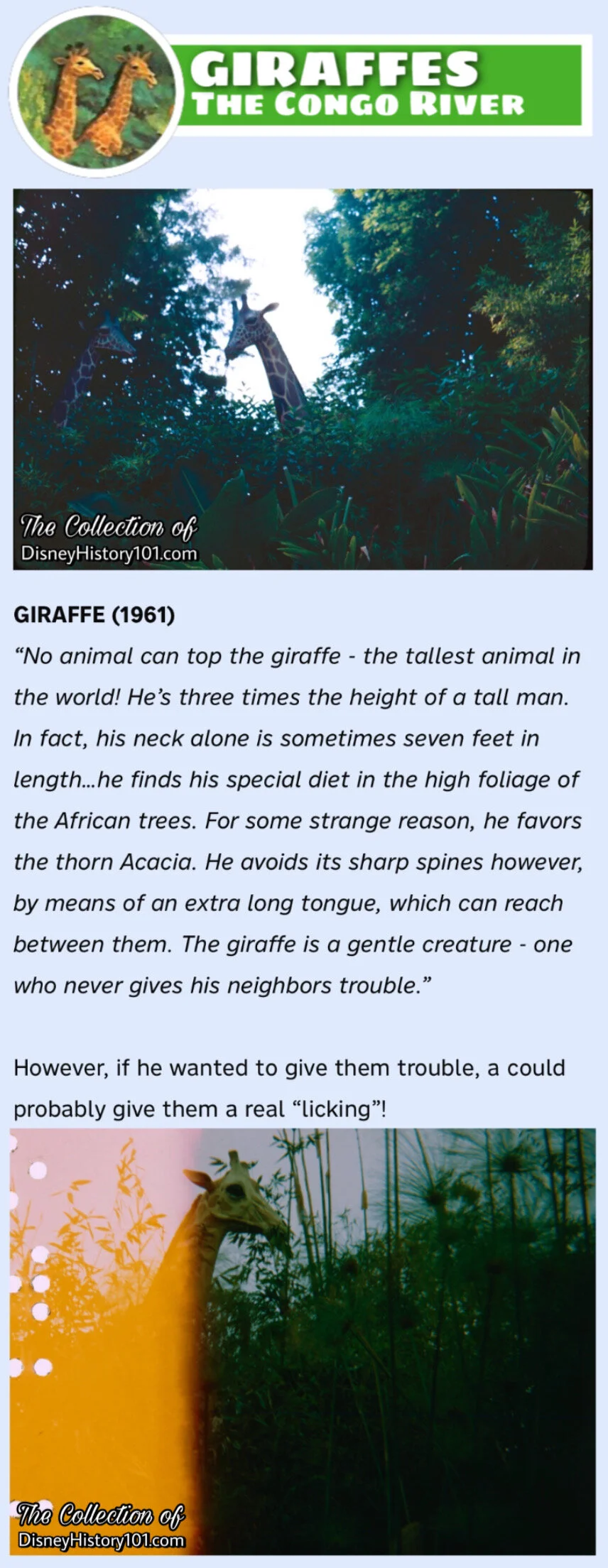
GIRAFFE, (c. January, 1969)
If you keep watching them in the tall trees, you can say that you’ve had a “nodding acquaintance” with the Giraffe. That reminds me of a seldom-mentioned “sidelight” about their origin, one of Bruce Bushman’s concepts for a “Gyrating Giraffes Food Stand” designed for a “Circus Eating Area” to be situated near the “Dumbo Flying Elephants” attraction in Fantasyland.
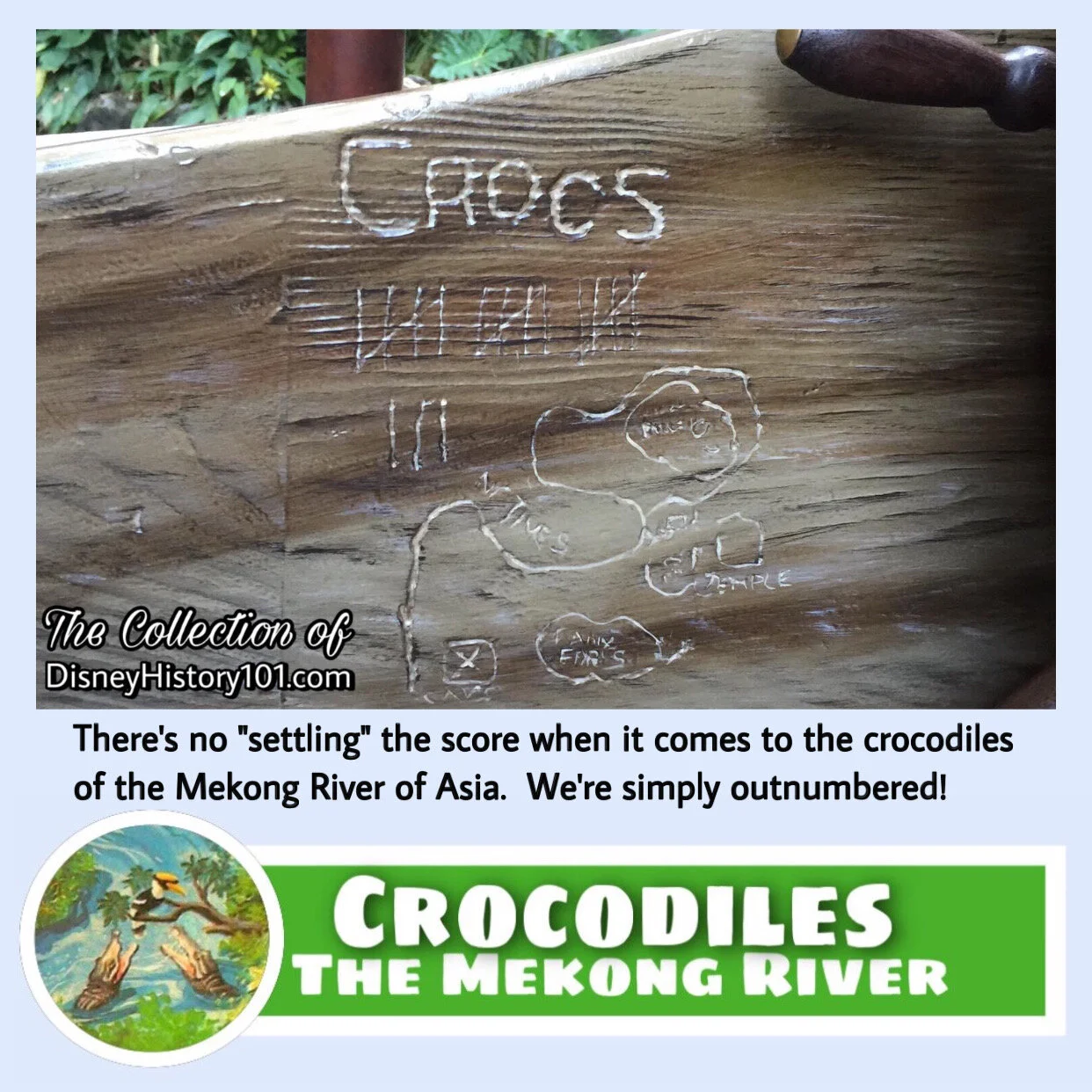
“…And now, we’re on a broader stream - the Mekong River of Cochin, China”, according to c.1955 Jungle River Cruise narration. The true-life Mekong River flows thru the countries of Laos, Thailand, and Cambodia. Those waters and shores are home to a variety of flora and fauna including the Siamese Crocodile. This murky portion of Adventureland’s “Rivers of the World” (dedicated to the Mekong River of Indo-China) is no different. In fact, “right on track,” (quite literally) we “often see a couple of mean looking crocodiles. In fact, we’re now turning into the crocodile-infested Mekong River of Asia!” According to the Pasadena Star-News (Friday, December 14, 1955), these “alligators slip menacingly thru dark waters.”
Continuing down the river, the Skipper points out two crocodiles sunning themselves on the bank. He informs guests that "Ole Smiley" in particular is always looking for a hand out.
Now it looks like some of the jungle's oldest residents are out enjoying a little sunbath, so please remember to keep your hands inside the boat. Just last week, I had a scientist on board who was so fascinated by those crocodiles that he wouldn't listen to me. Now he takes all his notes in short hand!
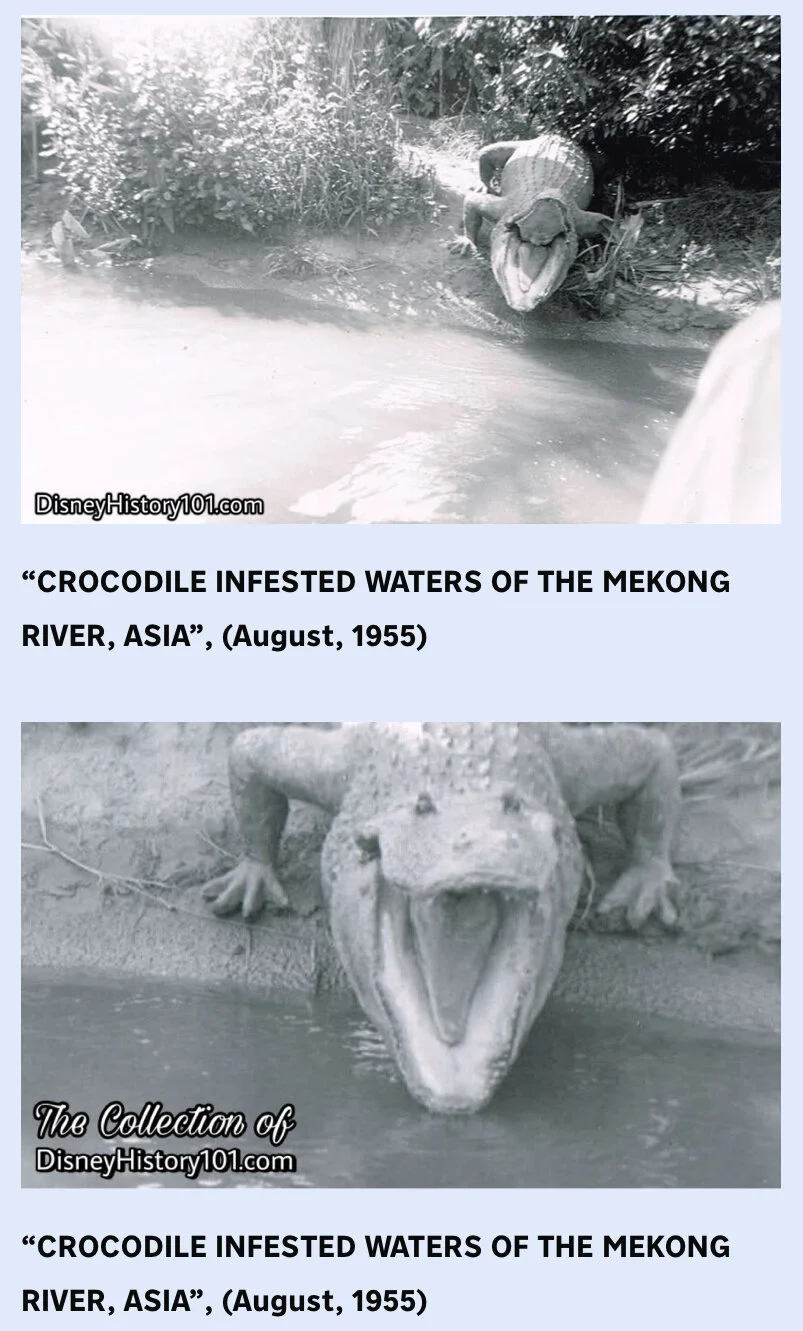
Bob Penfield recalled “one time when there was a breakdown on the Jungle's old crocodiles. The mechanics wore white coveralls at that time. They had just lifted the crocs up with an A-frame when Bill Sullivan came around the bend with a jungle boat full of guests. Sully, the ad-lib master, pointed to the mechanics, saying, ‘See the jungle bunnies playing around with the crocodiles.’”
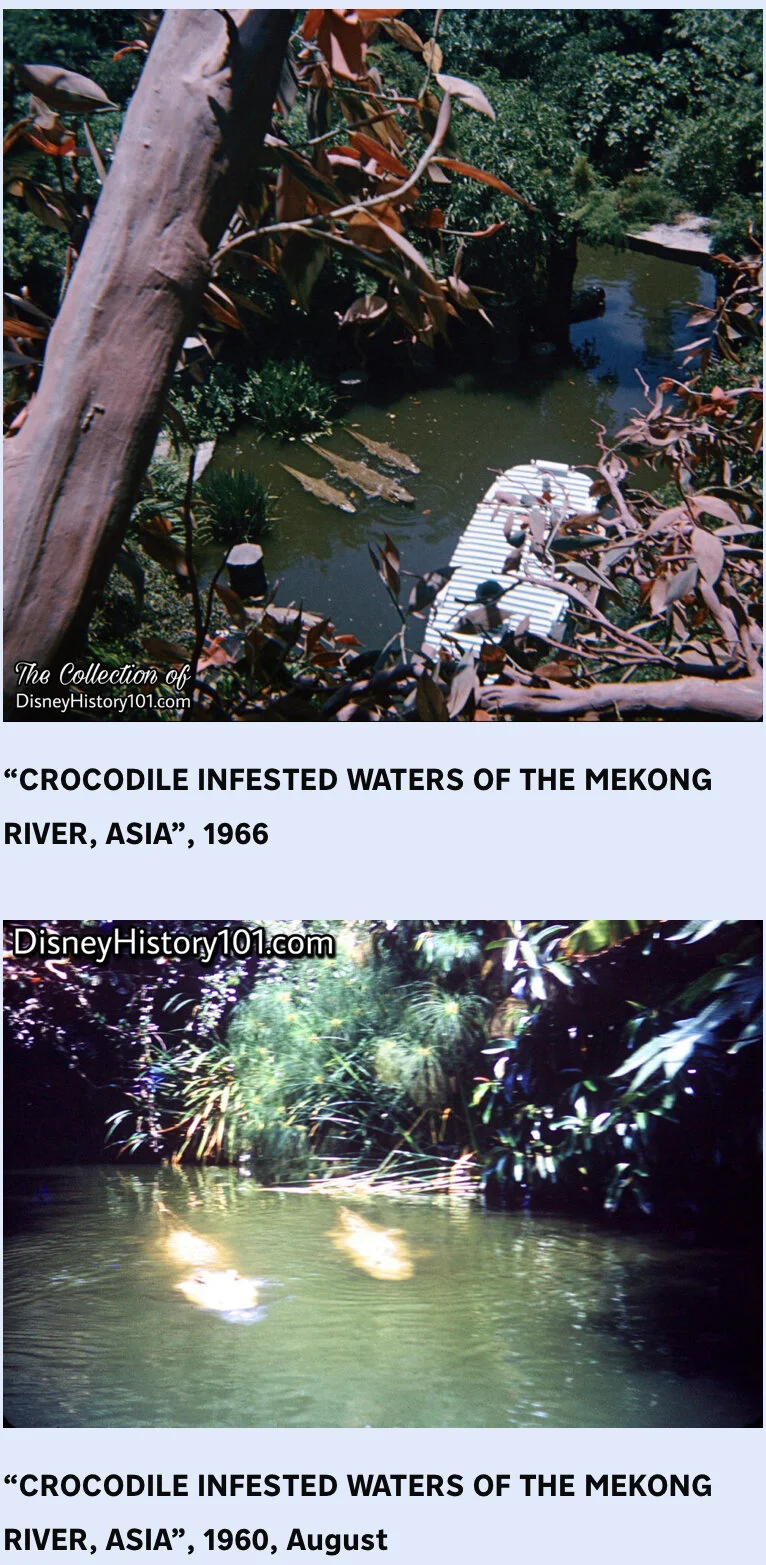
Just don’t tell them they’re on a framework of steel tubing, and tethered to a 20-foot driving chain of a reduction gearbox, powered by a five horse power motor! Still, “last week, two of them broke their leashes… gouged a terrific hole in the side of one boat”, according to c.1955 Jungle River Cruise narration.
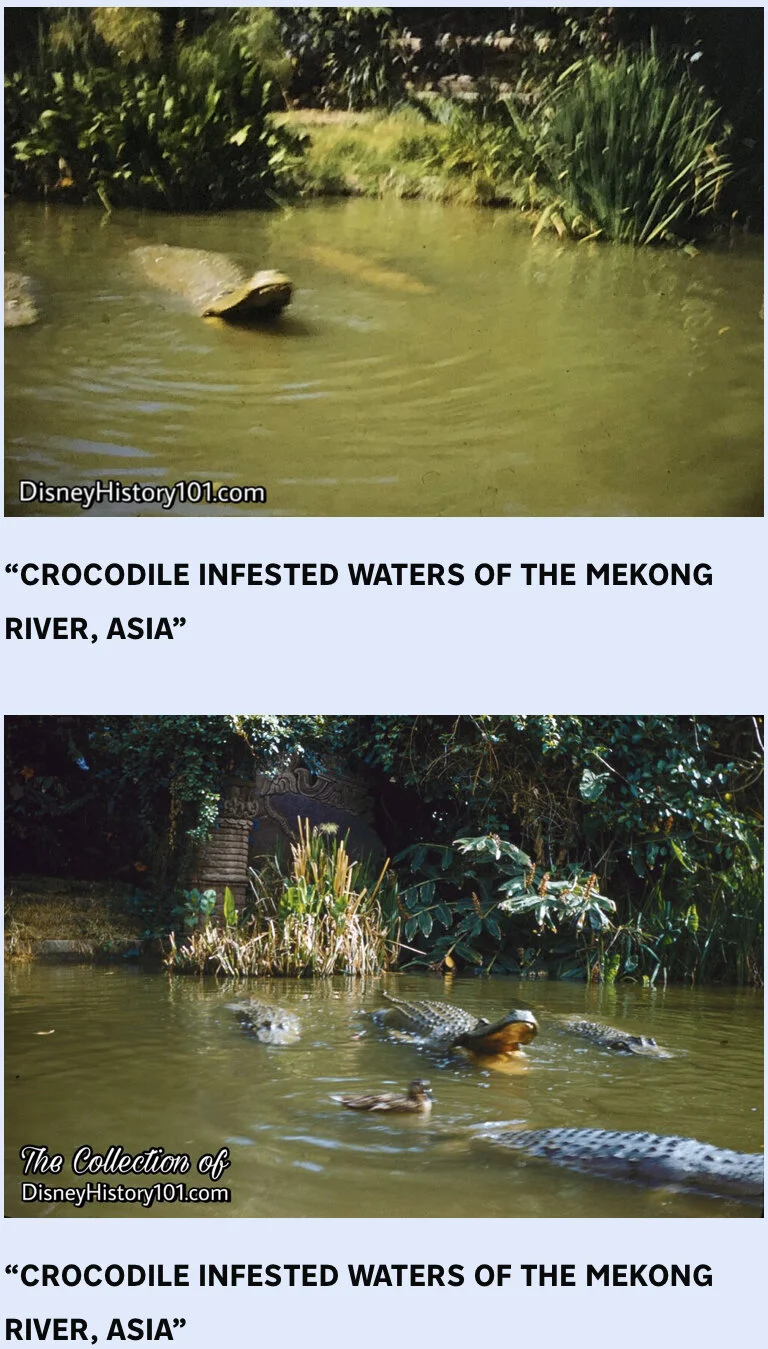
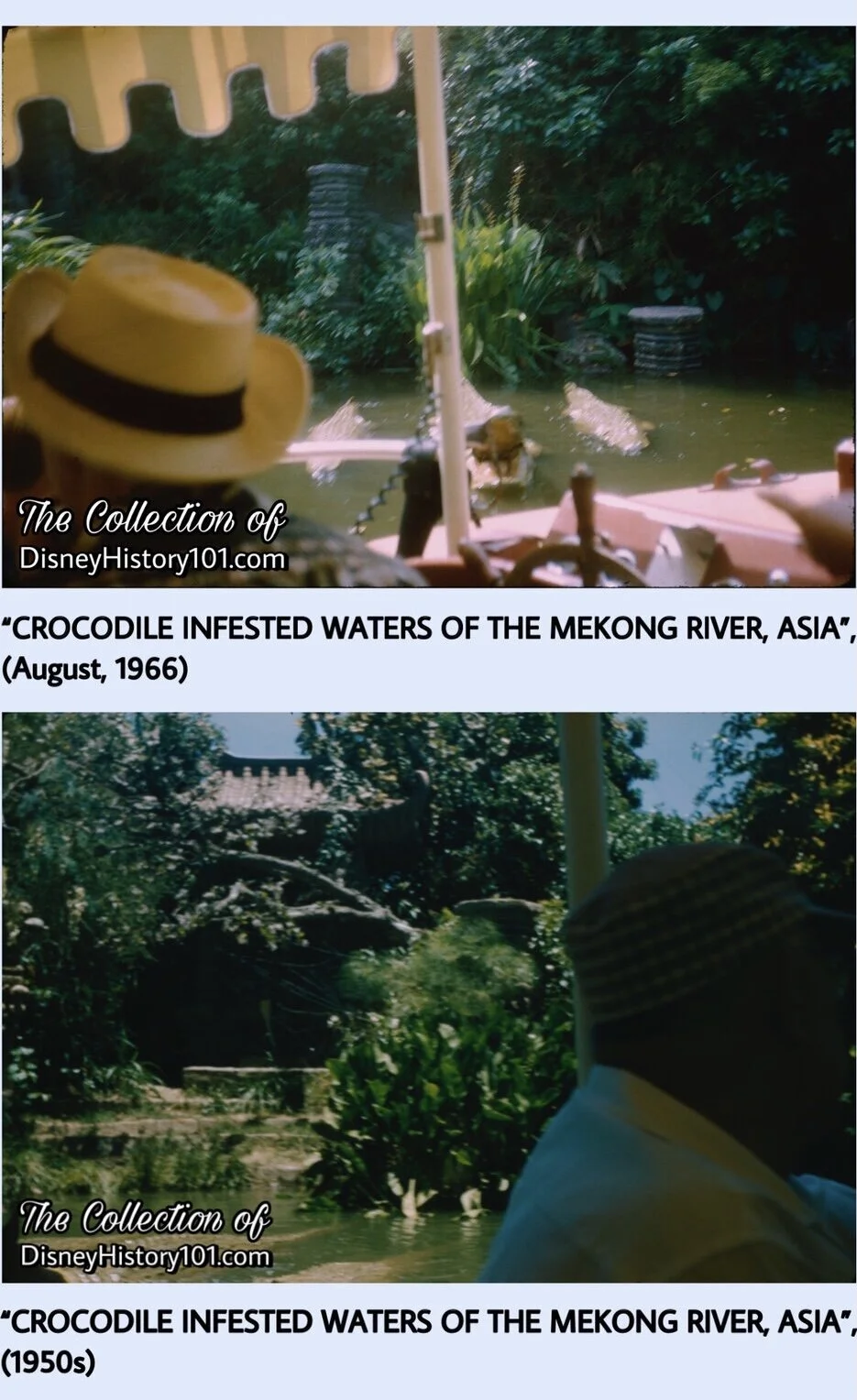
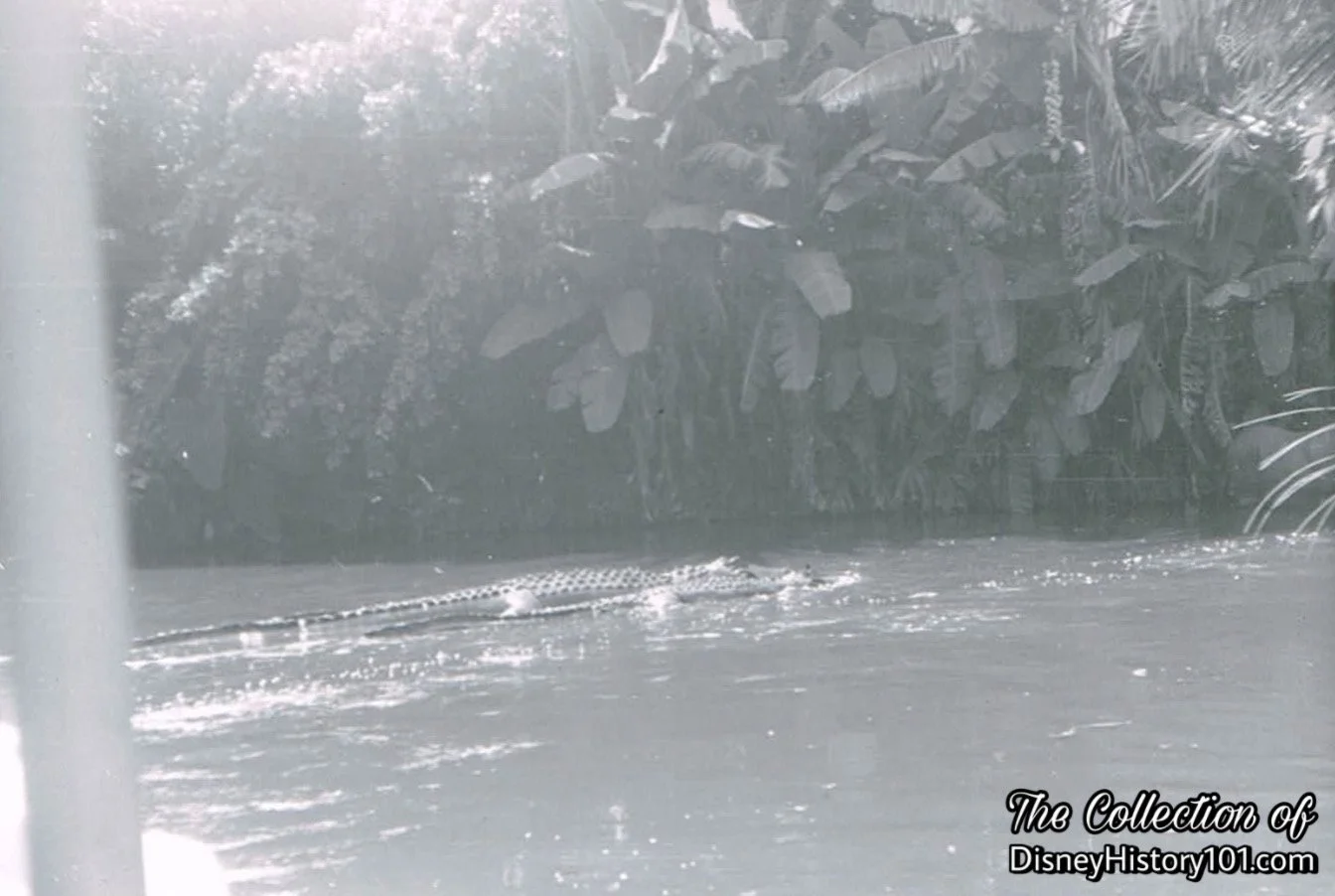
“CROCODILE INFESTED WATERS OF THE MEKONG RIVER, ASIA”
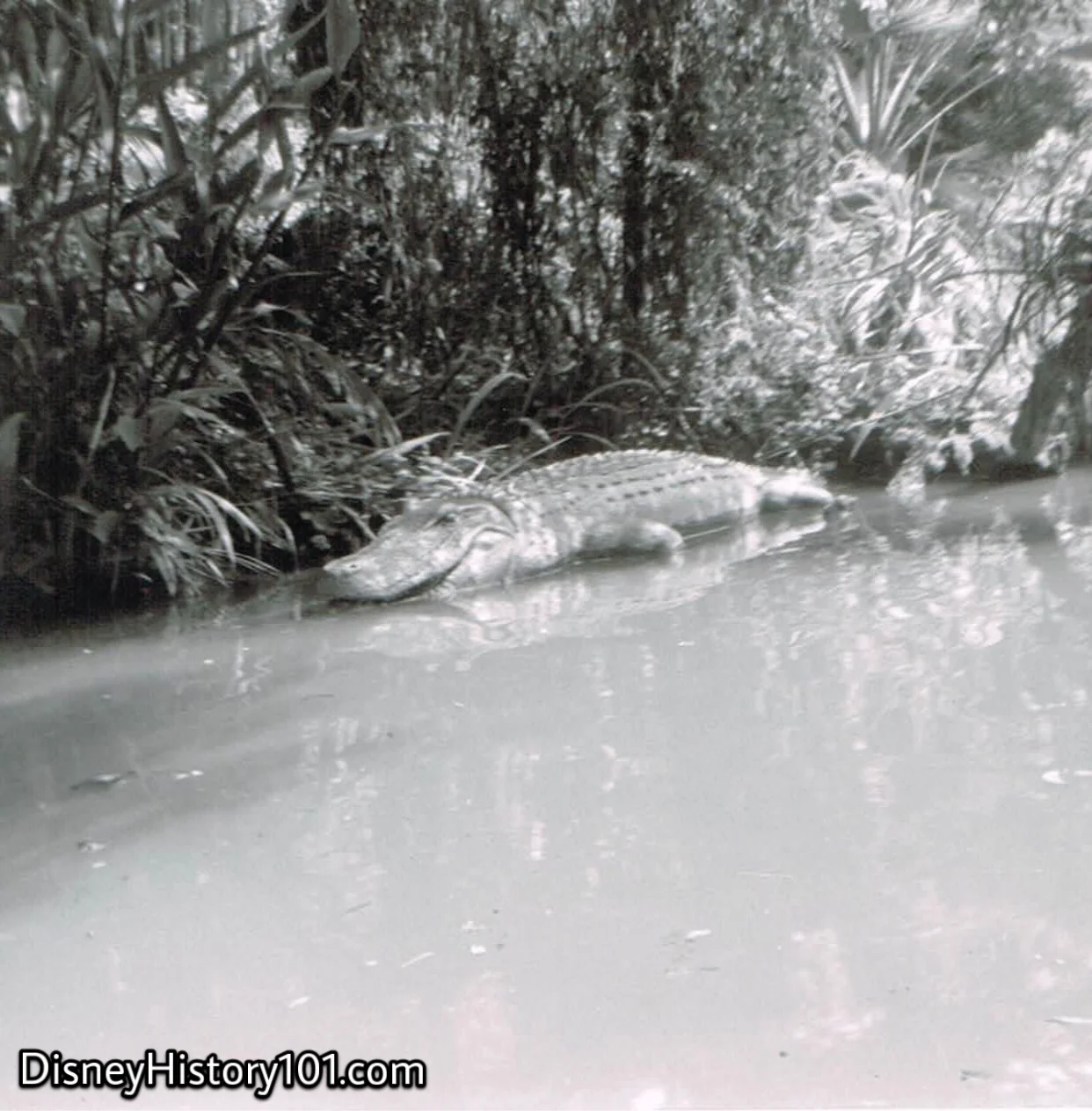
“CROCODILE INFESTED WATERS OF THE MEKONG RIVER, ASIA”
“Well, there’s old ‘Smiley’ (on the left) - the granddaddy of ‘em all!…Over a hundred years old…You’ll have to keep your hands inside the boat. You see, he’s always looking for a ‘hand-out’.”
After passing the crocodiles, guests suddenly find themselves confronted with Schweitzer Falls directly in their path. Luckily, at the last moment the boat pulls away.
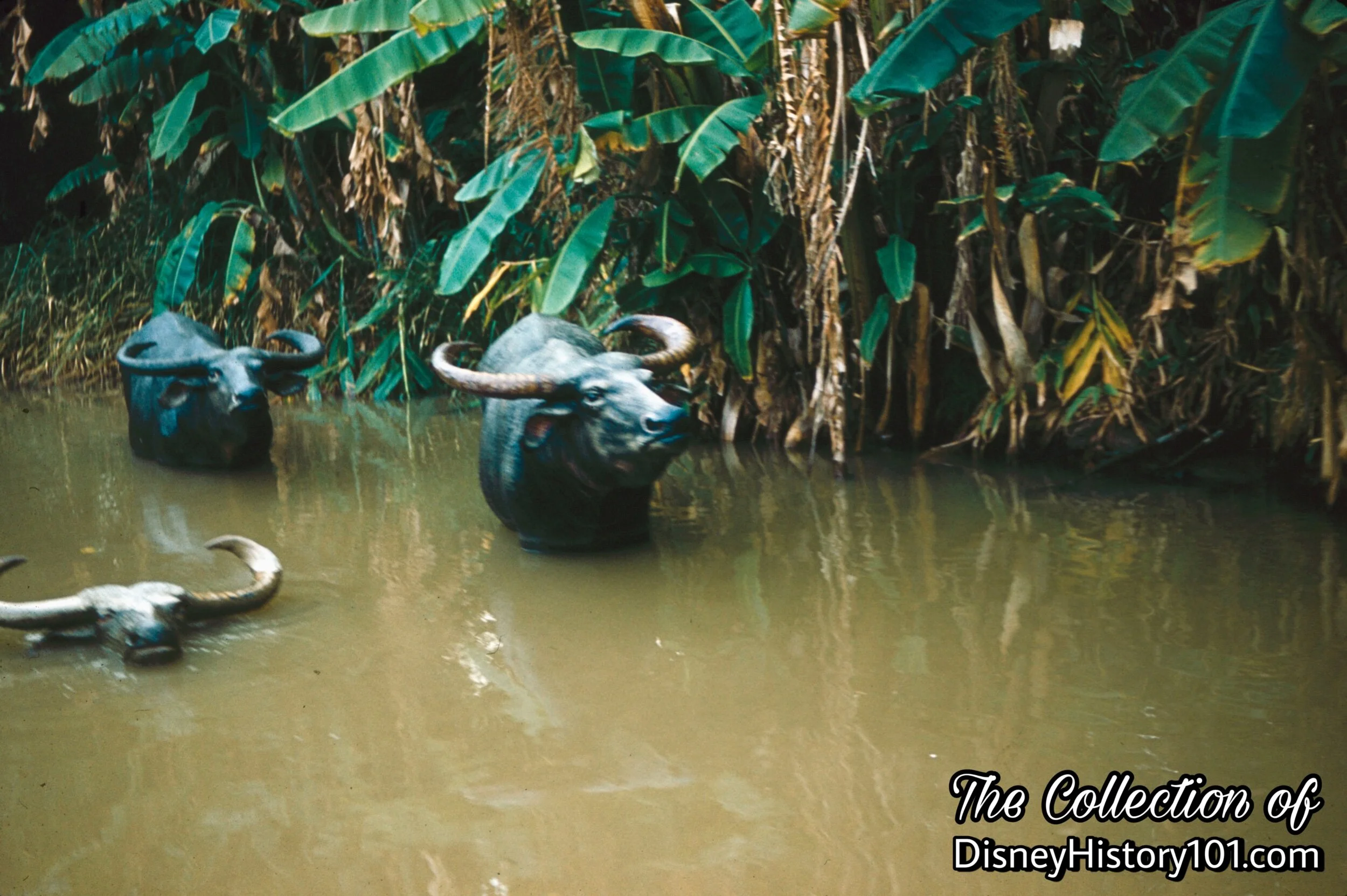
Indian Water Buffalo, (1959)
Since 1957, a family of Indian Water Buffalo has challenged the passage rights of jungle river boats on their trips up the “Tropical Rivers of the World” in Adventureland.
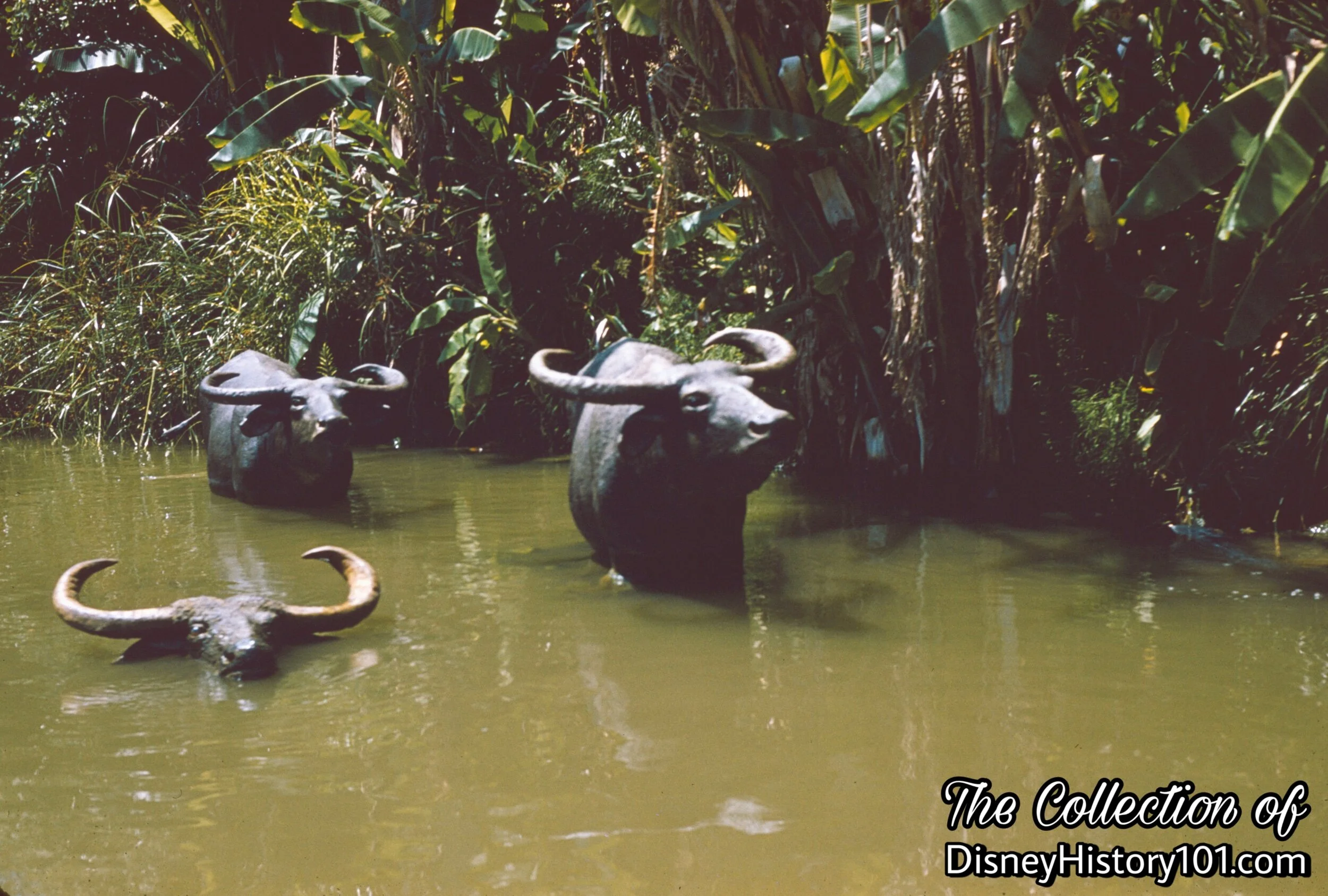
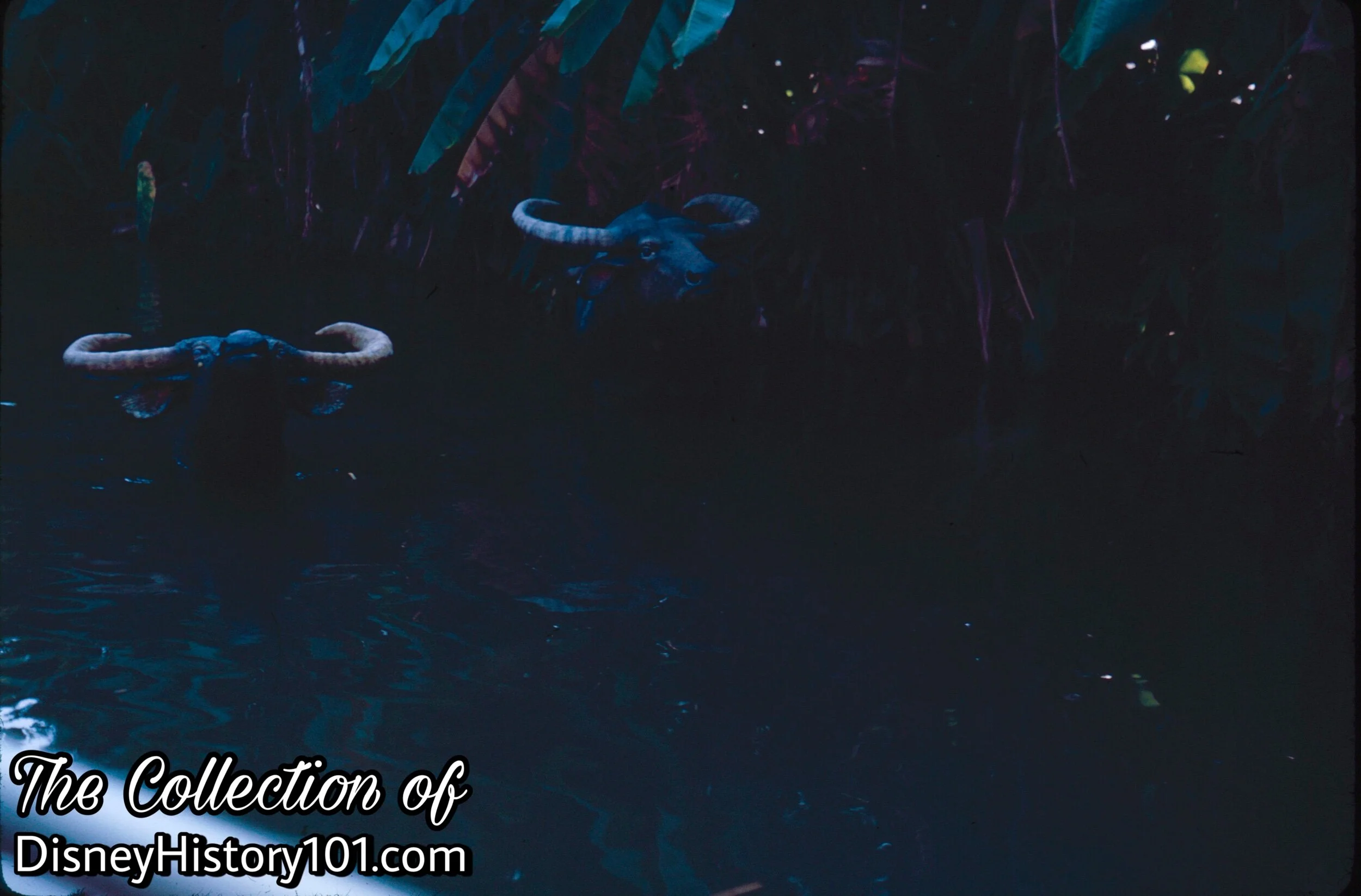
Indian Water Buffalo, (1961)
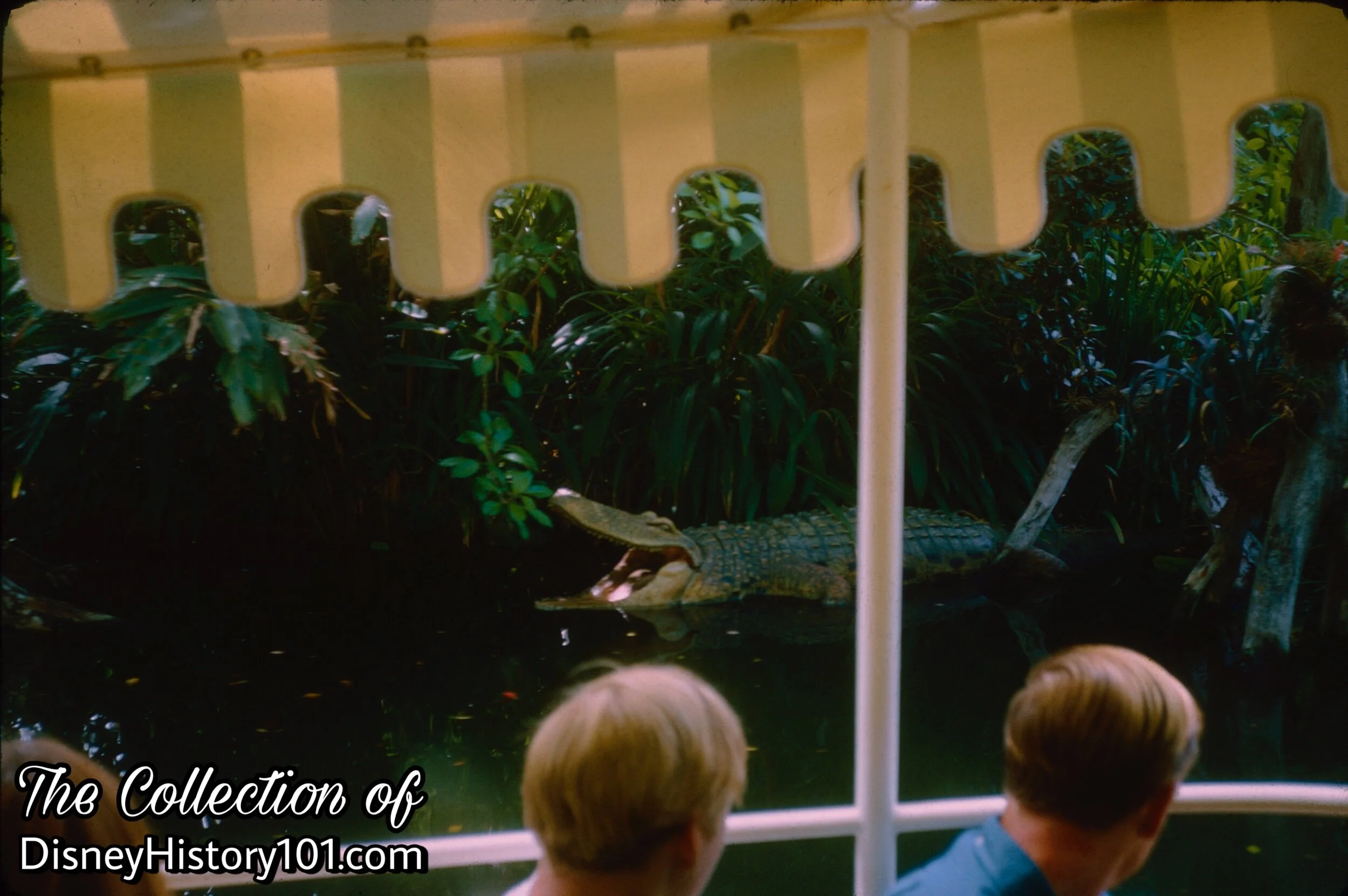
“CROCODILE INFESTED WATERS OF THE MEKONG RIVER, ASIA”, (c. August, 1966)
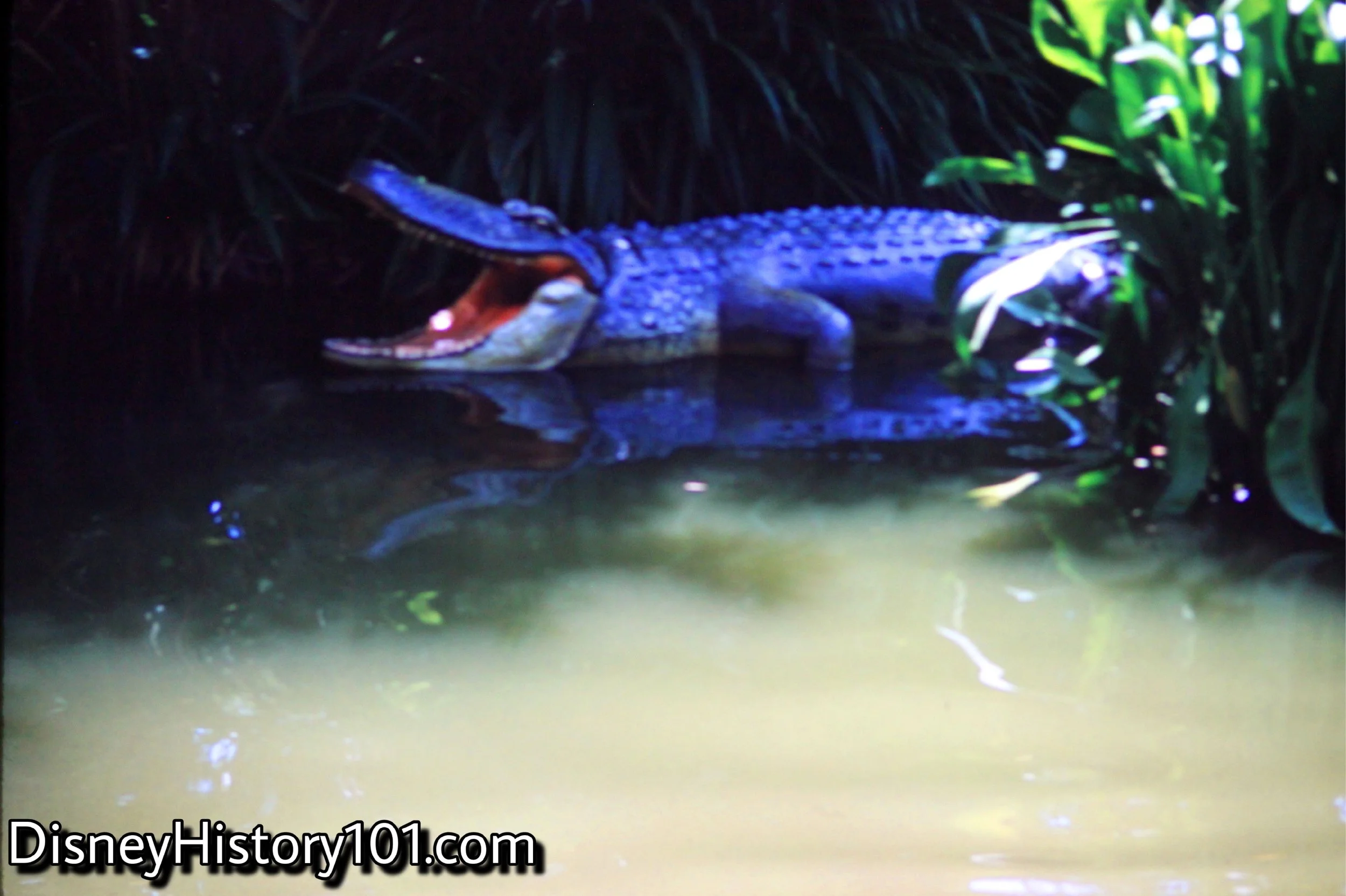
“CROCODILE INFESTED WATERS OF THE MEKONG RIVER, ASIA”
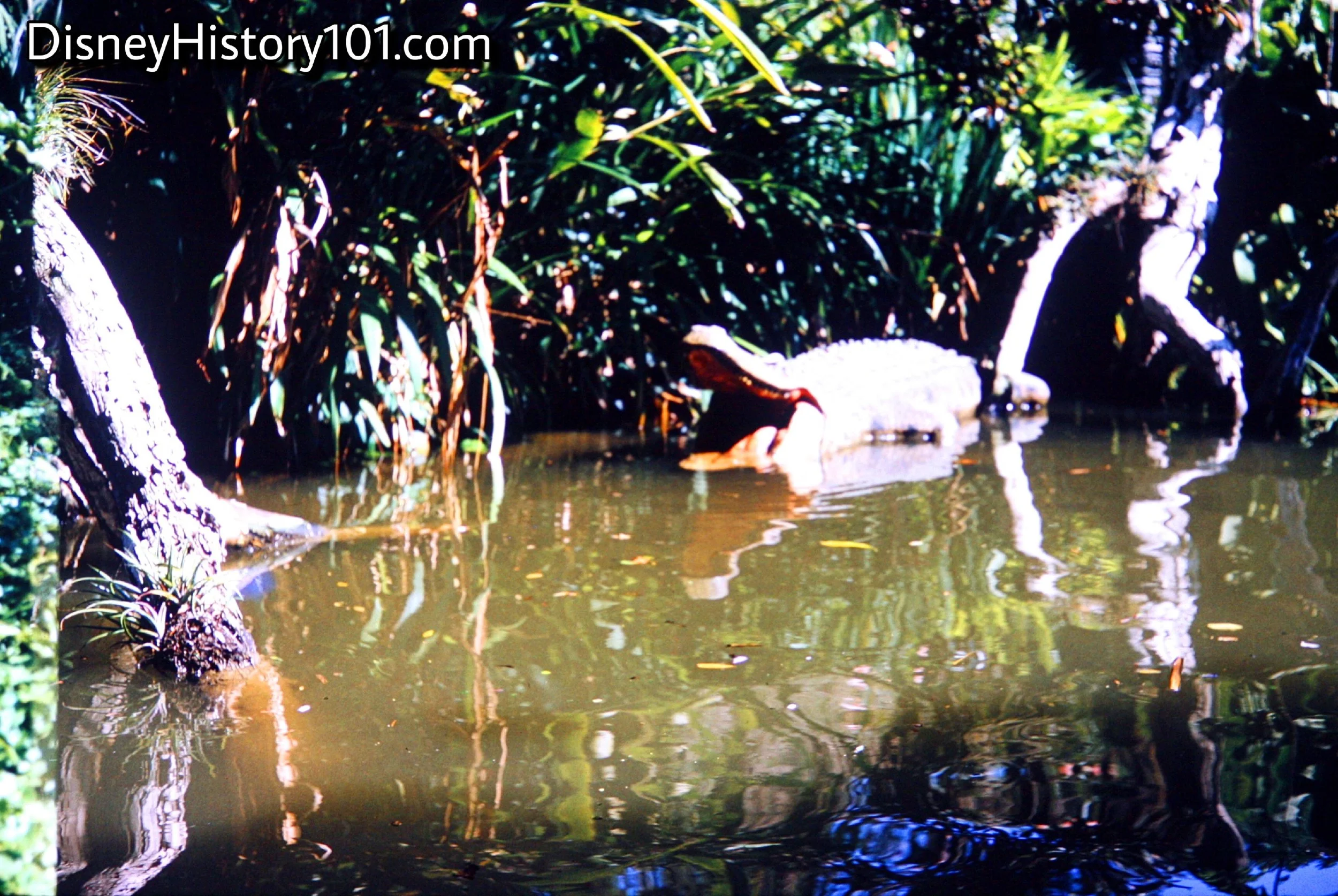
“CROCODILE INFESTED WATERS OF THE MEKONG RIVER, ASIA”, (August, 1965)
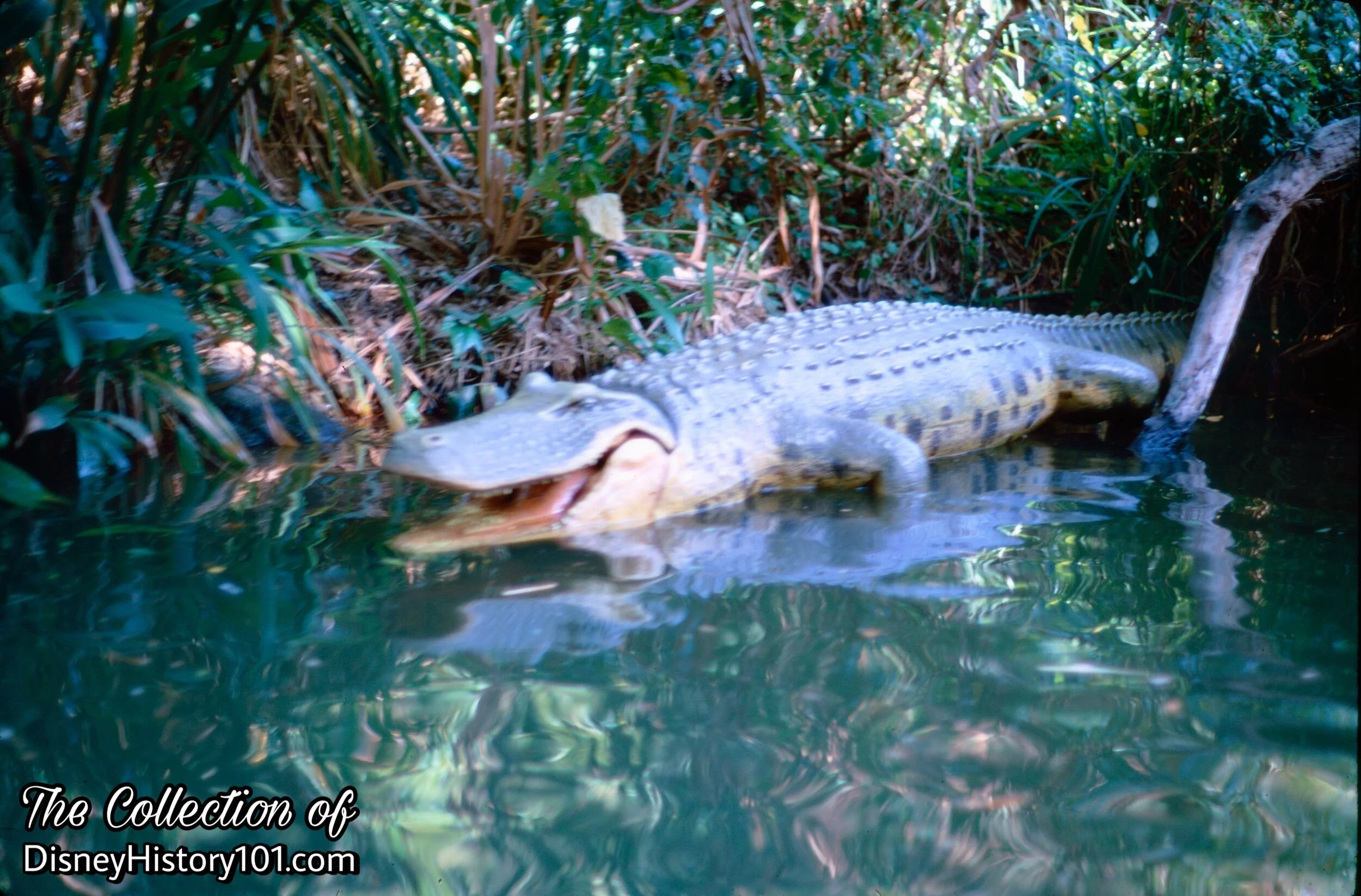
“CROCODILE INFESTED WATERS OF THE MEKONG RIVER, ASIA”, 1968, April
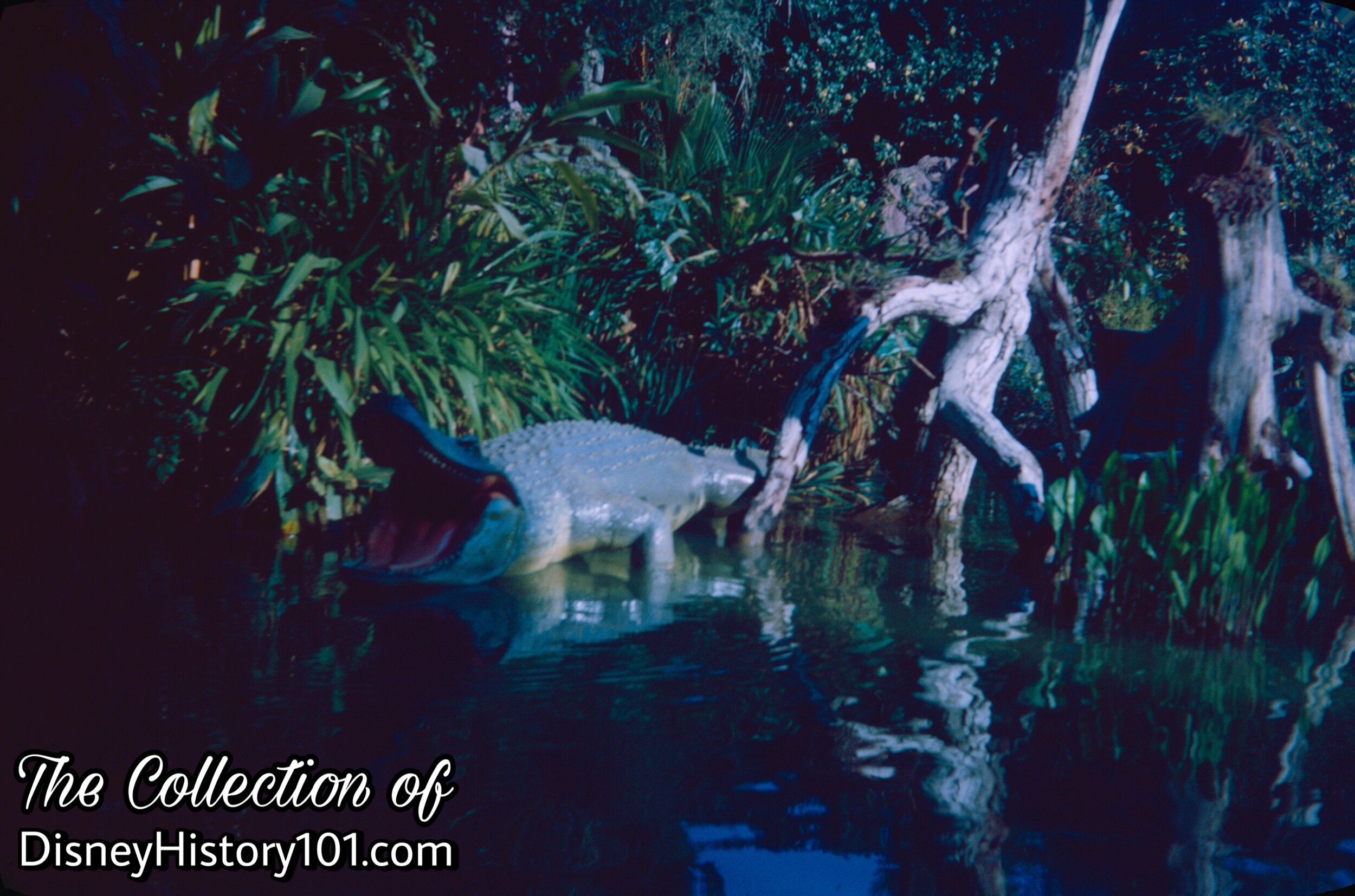
“CROCODILE INFESTED WATERS OF THE MEKONG RIVER, ASIA”, (c. August, 1962)
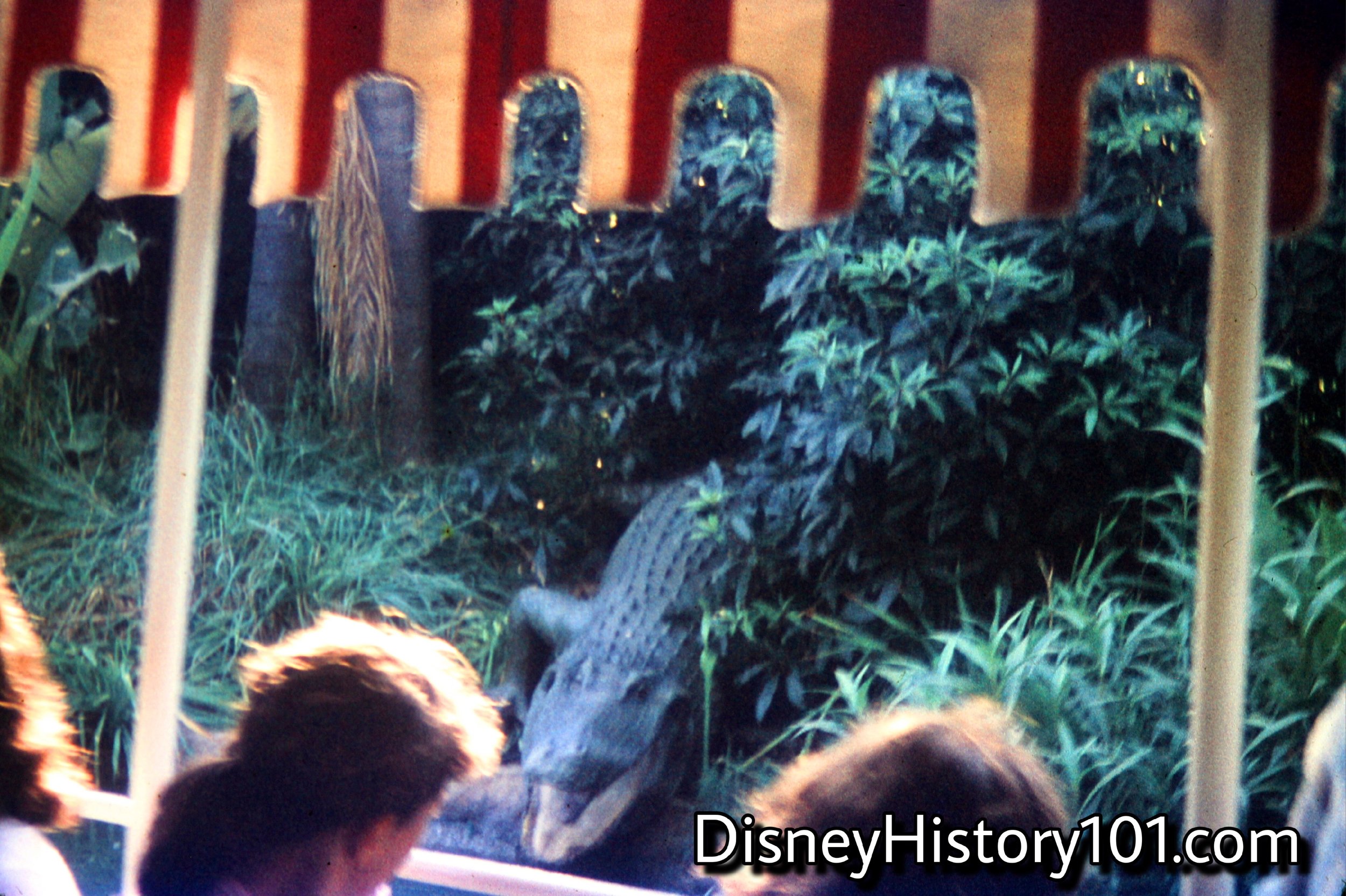
“CROCODILE INFESTED WATERS OF THE MEKONG RIVER, ASIA”
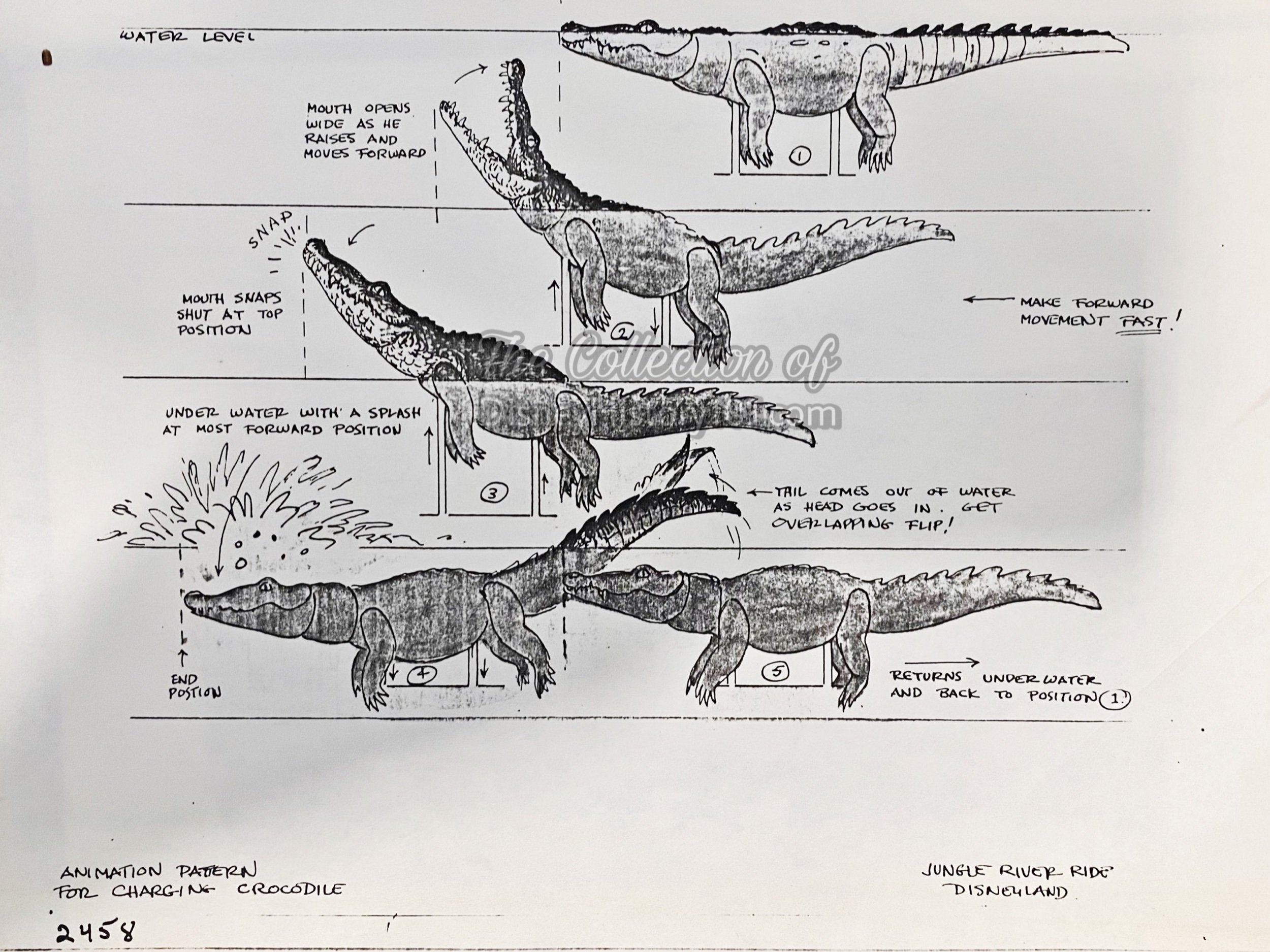
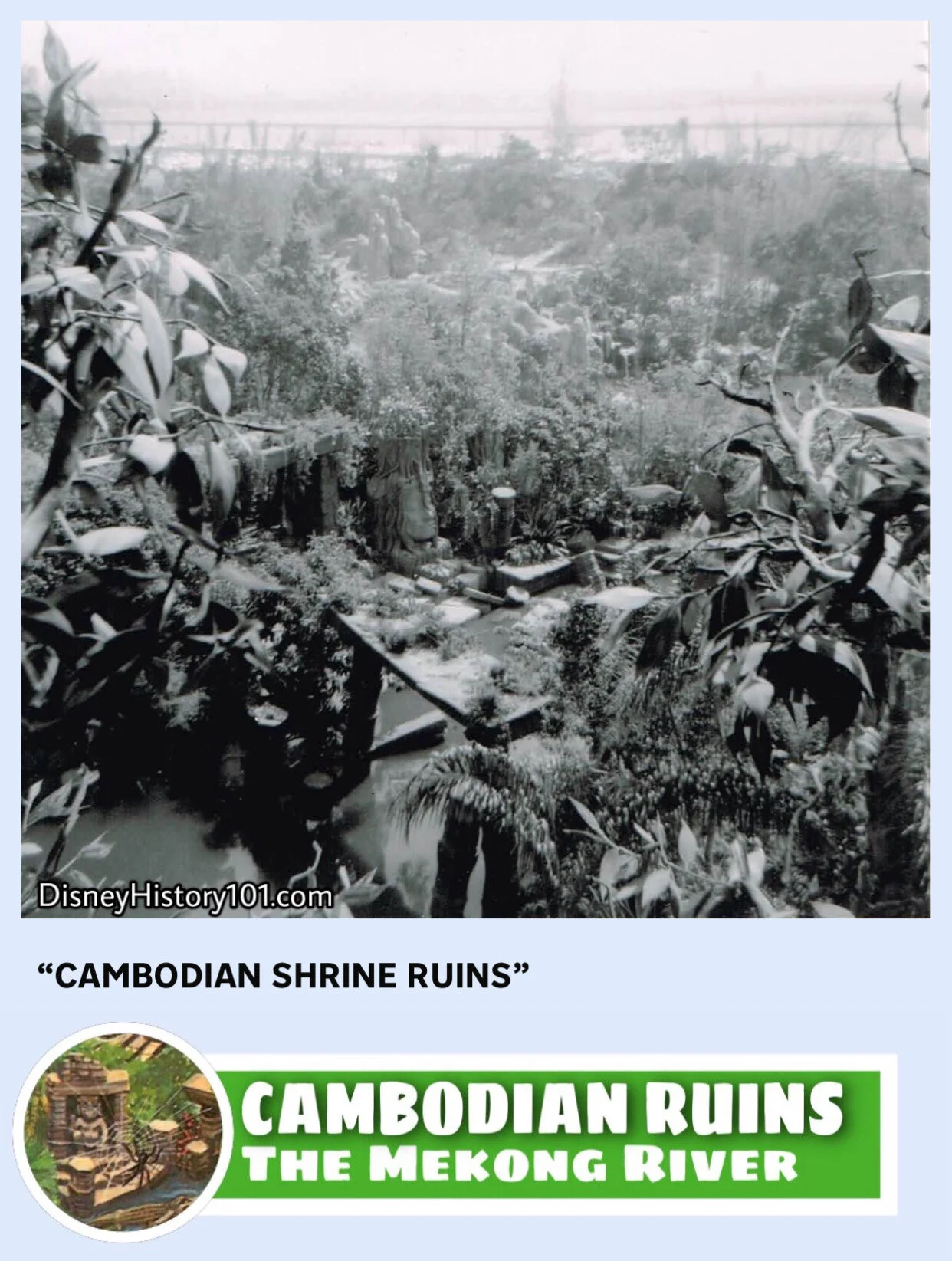
As we continue to make our way down the murky Mekong River of (what was once referred to as) “Indochina,”“Through an old archway, we enter the sunken ruins of an ancient, lost city.” According to the Naphtha Launch captain featured in “A Trip Through Adventureland” (a c.1955 episode of “Walt Disney’s Disneyland”), “Half-hidden by the foliage, we get our first glimpse of a man-made structure - the ruins of an ancient Cambodian Shrine, abandoned many centuries ago”. “Silent and mysterious on the river bank of Adventureland is this Indo-Chinese Pagoda, glimpsed from your explorer’s boat during your exciting journey”, (Los Angeles Examiner excerpt, July 15, 1955). Of course, the construction of the original “ruins” can be seen in “A Trip Through Adventureland” (an episode of “Walt Disney’s Disneyland”) as narrator Walt Disney states, “Along the Mekong River (in another part of the jungle) the ruins of an ancient Siamese temple take on a few more centuries of antiquity under the deft strokes of an artist’s brush.”
Later, around the Summer of 1963, work began on authentic Cambodian ruins. Foreman Bud Washo contacted sculptor Harold Wilson (an expert on Asian artifacts) as a consultant on the project.
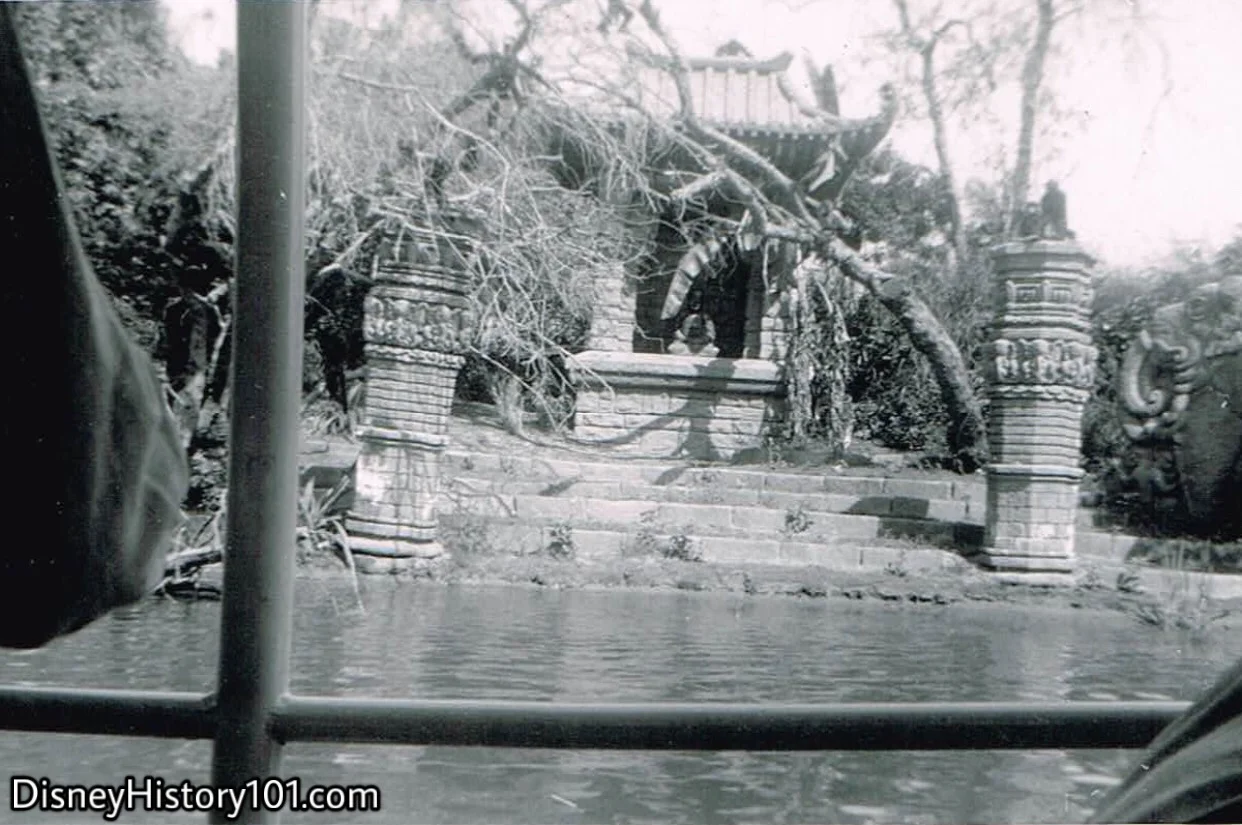
“CAMBODIAN SHRINE RUINS,” (September, 1955)
Louis Berg (“This Week Magazine” reporter) quoted Walt’s description of the attraction (for an article published September 19, 1954) this way : “‘In True-Life Adventureland, you’ll get into a explorer’s boat - like the ones that chug up the Amazon - and visit the Fiji Islands, the West Coast of Mexico or New Guinea. Everywhere you go… the woods will be filled with chattering monkeys… It’ll be something.’” “If anyone happened to look into the windows of our staff shop [at Walt Disney Studios, c. 1955]…they might wonder what kind of business we were really in”, (according to the televised Disneyland episode “Pre-Opening Report From Disneyland”). This is because the mechanical monkeys (and other animals) were being given form there by the same sculptors and technicians that worked on frightening giant squid of 20,000 leagues Under the Sea. As one of the monkeys is being assembled, narrator Walt Disney states, “The smaller creatures [like monkeys] of Adventureland must be carefully groomed and prepared for the busy days that are soon to come”, (“A Trip Through Adventureland” (an episode of “Walt Disney’s Disneyland”). Soon, Guests would “watch chattering monkeys destroy the tranquility of a dying Indo-Chinese pagoda”, according to the Pasadena Star News (Friday, December 14, 1955). The same aforementioned “A Trip Through Disneyland” Naphtha Launch Captain described this portion of the tour this way : “…But there’s life in the old place yet, for a tribe of monkeys are busy trying to remodel the wreckage, or maybe they’re tying to ‘ruin the ruins’…you never can tell about ‘monkey business’, you know.” If you’ll look toward the columns (in the Vintage View above), you can barely spot one of those monkeys sitting atop one of them. If you would like to see these monkeys in motion, I recommend that you watch “A Trip Through Adventureland” (an episode of “Walt Disney’s Disneyland”), where some of their motion on the pagoda roof, on a column, and in the trees, has been preserved on film.
By 1956, “irresponsible monkeys” kept up “their chatter of conversation,” according to the “Disneyland 1st Anniversary Souvenir Pictorial,” published 1956. However, the elements were unkind to the chattering monkeys (that once disturbed the tranquility of a dying Indo-Chinese pagoda). Owning to this, the monkeys would soon disappear before the Jungle River Cruise’s first year.
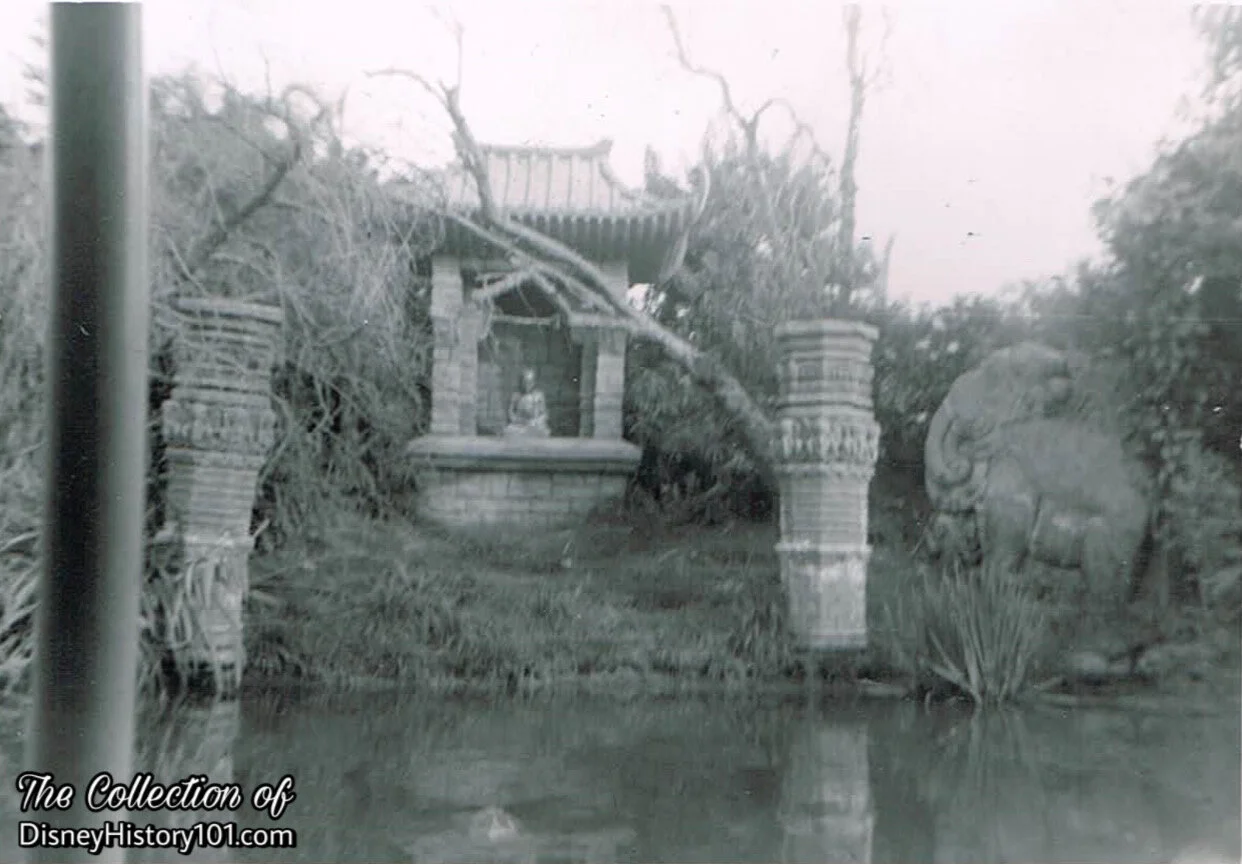
“CAMBODIAN SHRINE RUINS”
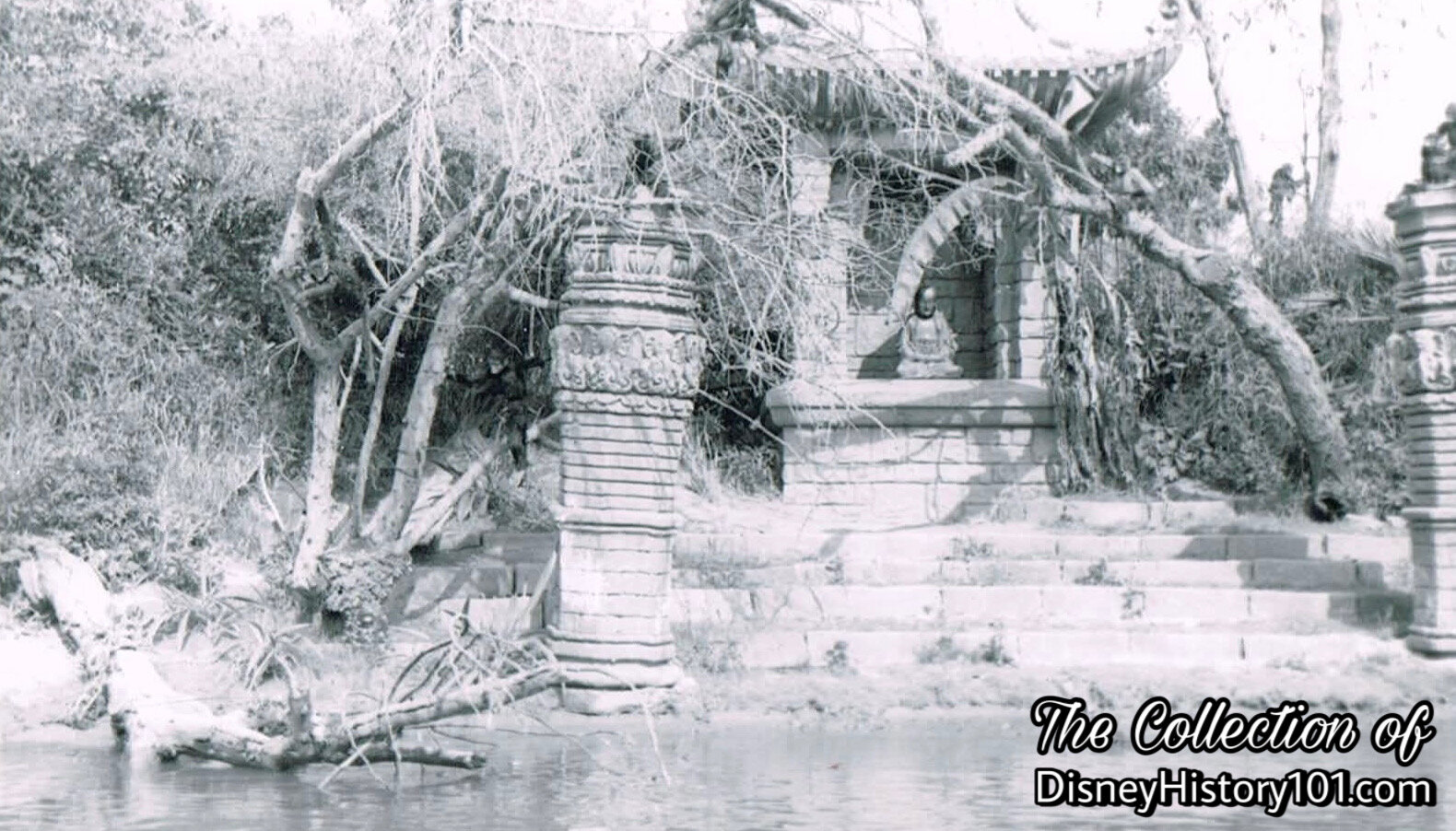
The three-dimensional, carved plaster RockWork and horizontal themed textured Hardscape of concrete.
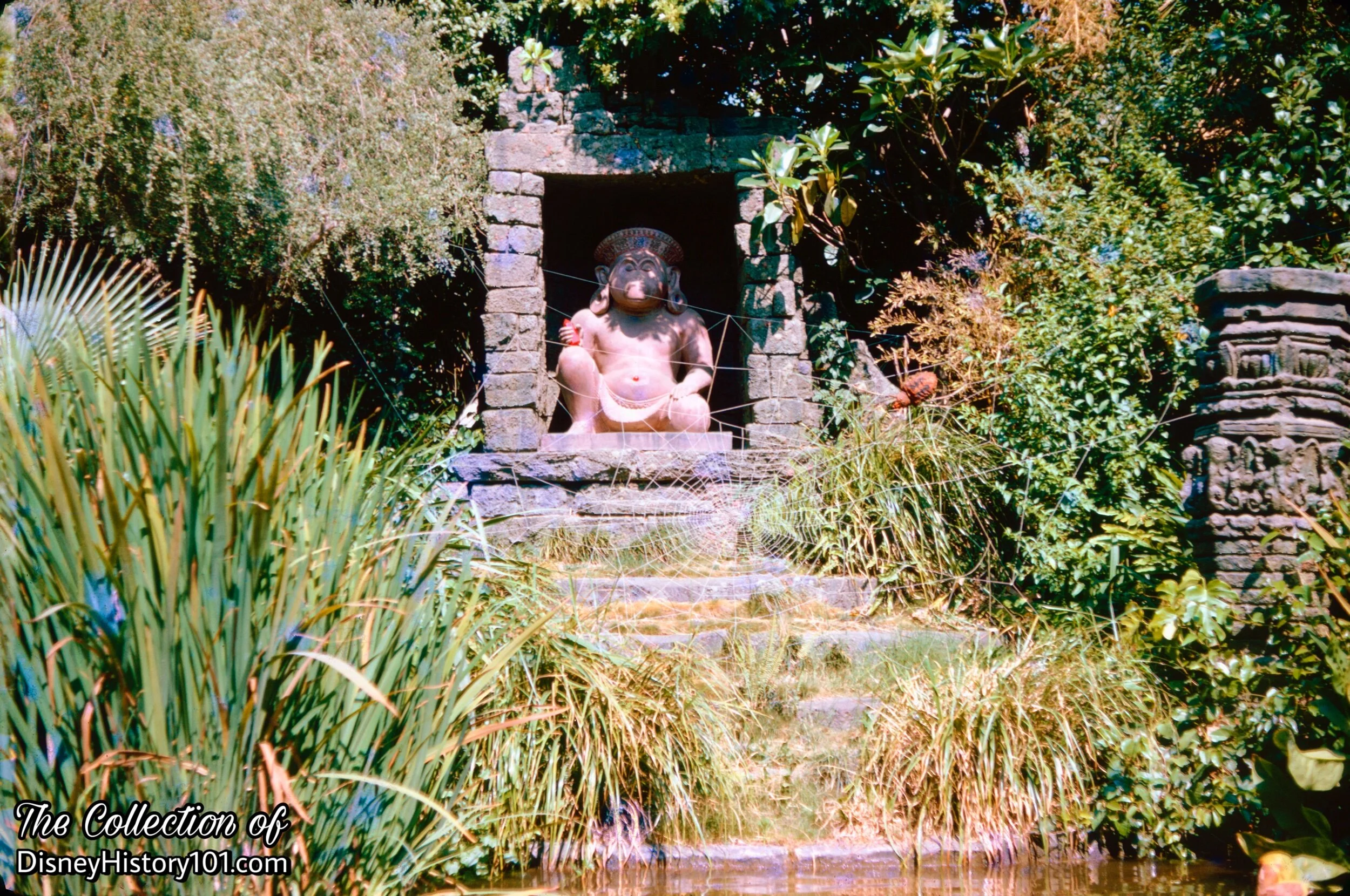
“CAMBODIAN SHRINE RUINS”, (August, 1965)
“Up ahead are the ruins of a centuries-old Cambodian Shrine. It was almost totally destroyed by a devastating earthquake hundreds of years ago.”
THESE ARE THE RUINS OF AN ANCIENT SHRINE, ALMOST TOTALLY DESTROYED CENTURIES AGO BY AN EARTHQUAKE.
MANY EXPLORERS
HAVE TRIED TO STEAL THAT PRICELESS RUBY - BUT NO ONE'S EVER GOTTEN PAST THAT POISONOUS SPIDER.
alternate
NOW HERE WE HAVE THE REMAINS OF AN ANCIENT CAMBODIAN SHRINE.
IT WAS BUILT MANY CENTURIES AGO BY SOME
ANCIENT CAMBODIAN SHRINERS.
alternate
THESE ARE THE RUINS OF AN ANCIENT SHRINE, ALMOST TOTALLY DESTROYED CENTURIES AGO BY AN EARTHQUAKE.
HOW MANY OF YOU THINK THAT'S A BIG SPIDER? (show of hands) HOW MANY OF YOU THINK HE'S BIGGER THAN THE ONE CRAWLING UP THIS MAN'S/WOMAN'S LEG? (Point quickly to guest's leg)
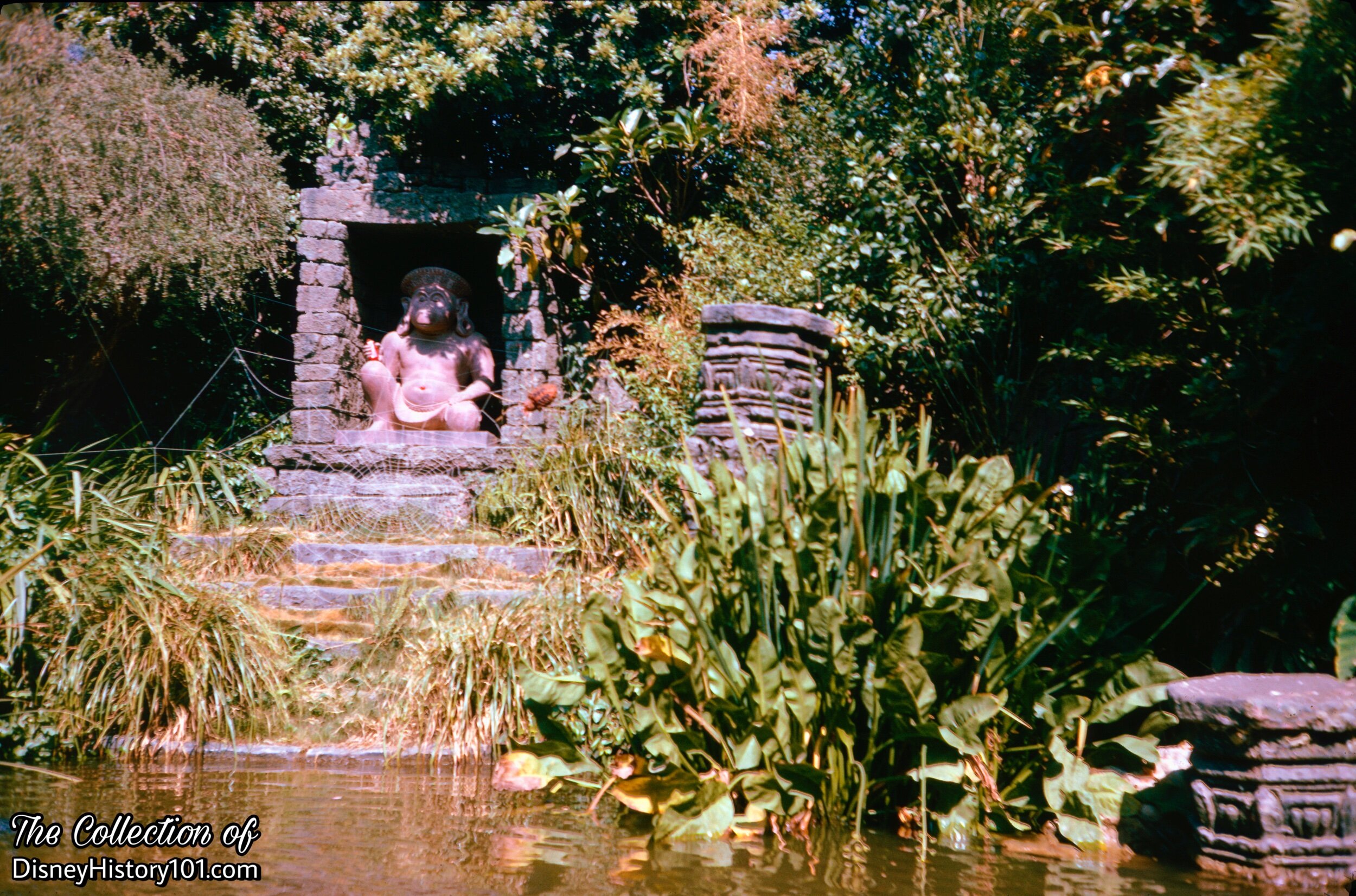
“CAMBODIAN SHRINE RUINS”, (August, 1965)
“Only the monkey god remains, guarded by those beady-eyed crocodiles, and that giant jungle spider.”
“Over the years, the vegetation throughout the Jungle Cruise has thickened into a real jungle, attracting an assortment of creepy, crawling insects. To make the brush safe for operators and maintenance men who have to go behind the scenes, pistol-packing Jungle Cruise drivers used to go on Spider Patrol. "The guns we used were Smith & Wesson 48's loaded with Styrofoam-wadded plastic shells," recounted one hunter. "We'd triple and quadruple-load BB pellets from the Adventureland Shooting Gallery and pack 'em in the shells. When the crowds were low, we'd take out the maintenance skiff and go pick off garden spiders. They must have been at least four inches in diameter and we'd blow them out of their nests.” [“Mouse Tales: A BEHIND-THE-EARS LOOK AT DISNEYLAND“ by David Koenig]
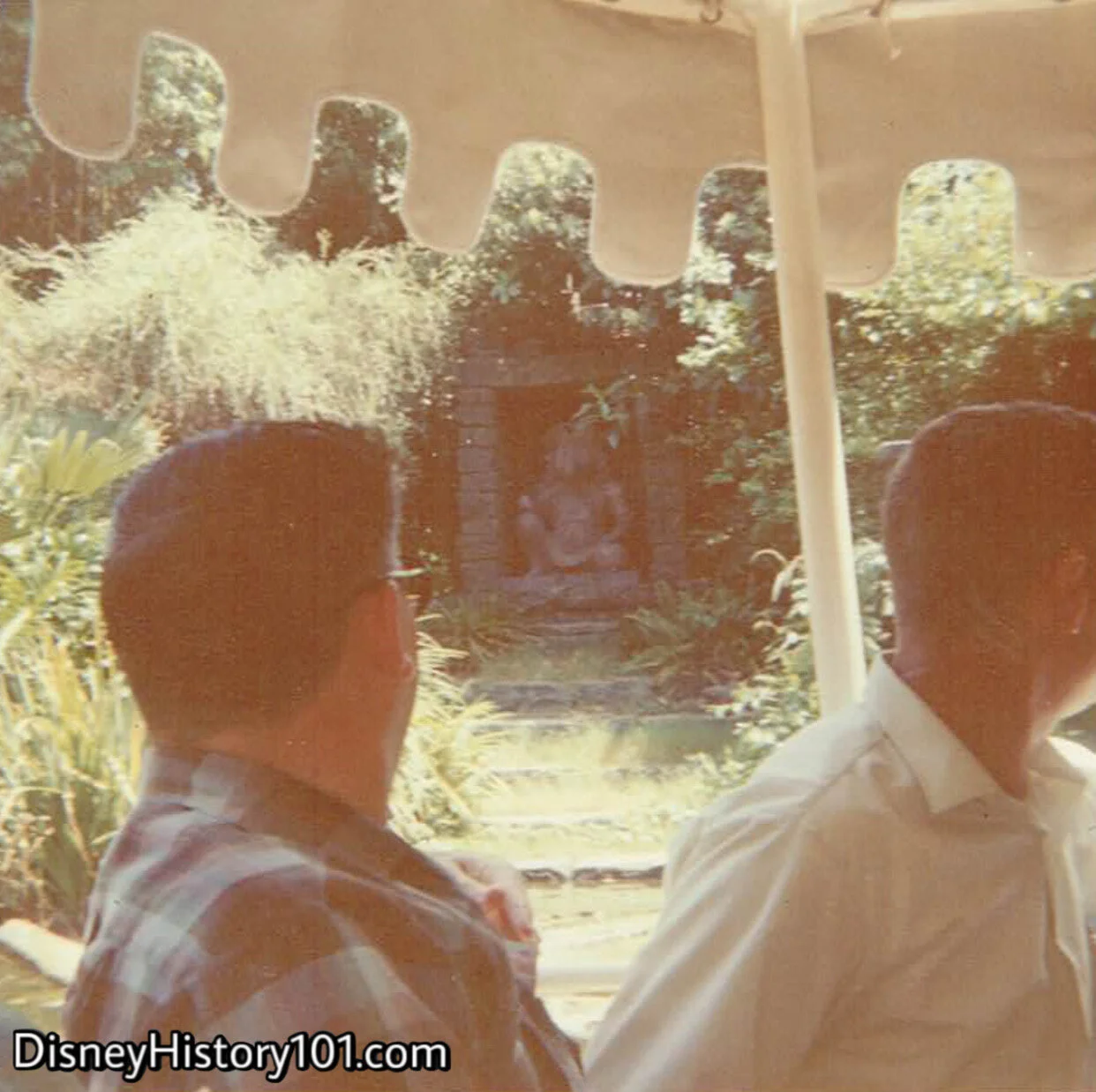
“CAMBODIAN SHRINE RUINS”
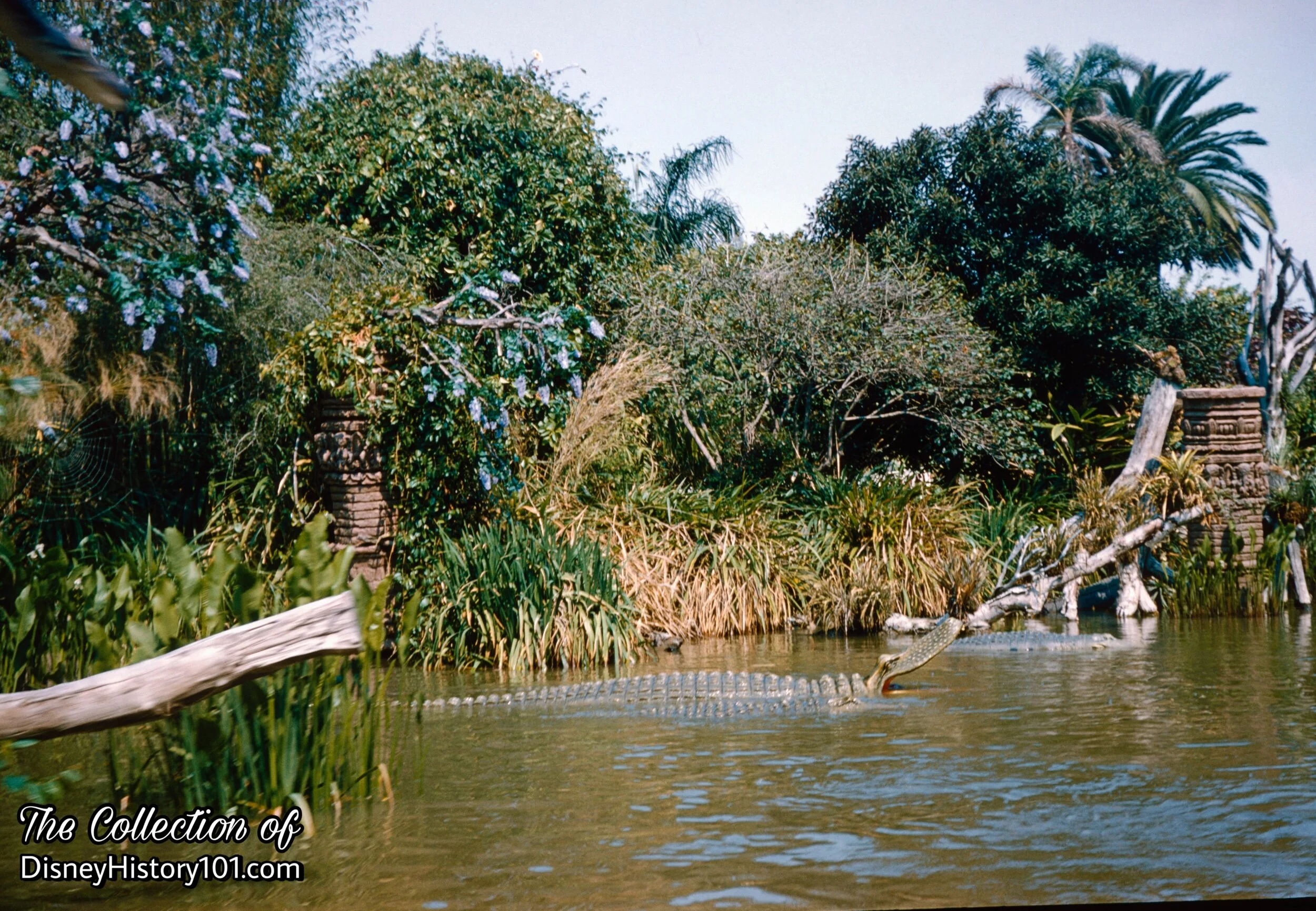
“CAMBODIAN SHRINE RUINS”, 1960
The gnarled “Banyan” tree on the right side of the photo, is actually an upside-down walnut tree that was left over from the orange groves.
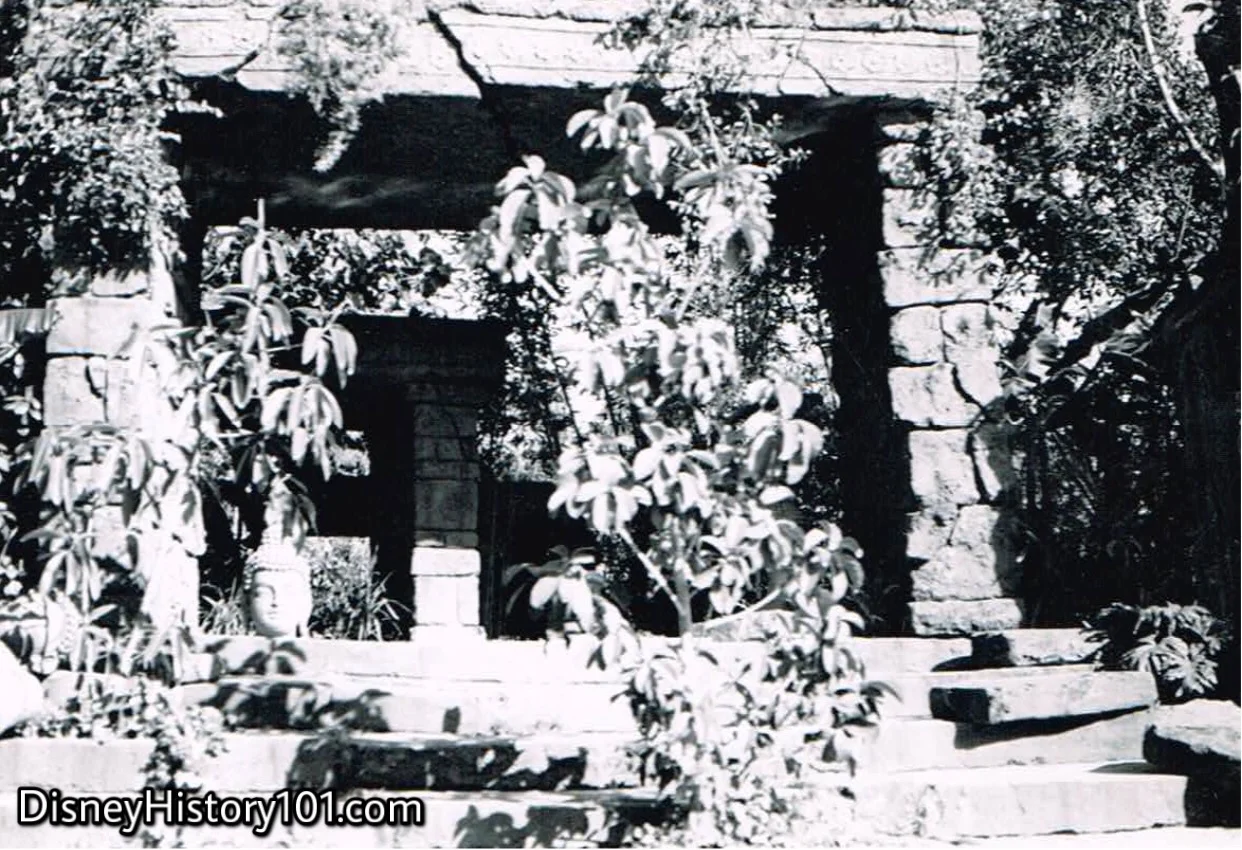
“CAMBODIAN SHRINE RUINS”, 1962
“After the Tiki Room, we added lots of new scenes to the Jungle River Ride in Adventureland, including the Cambodian Ruins.” - Bob Sewell.
The labor was performed by studio artists, weathering the stone pillars to make them appear ancient.
THROUGH THIS ARCHWAY, WE ENTER THE REMAINS OF SUNKeN CITY, NOW ALMOST TOTALLY RECLAIMED BY THE JUNGLE.
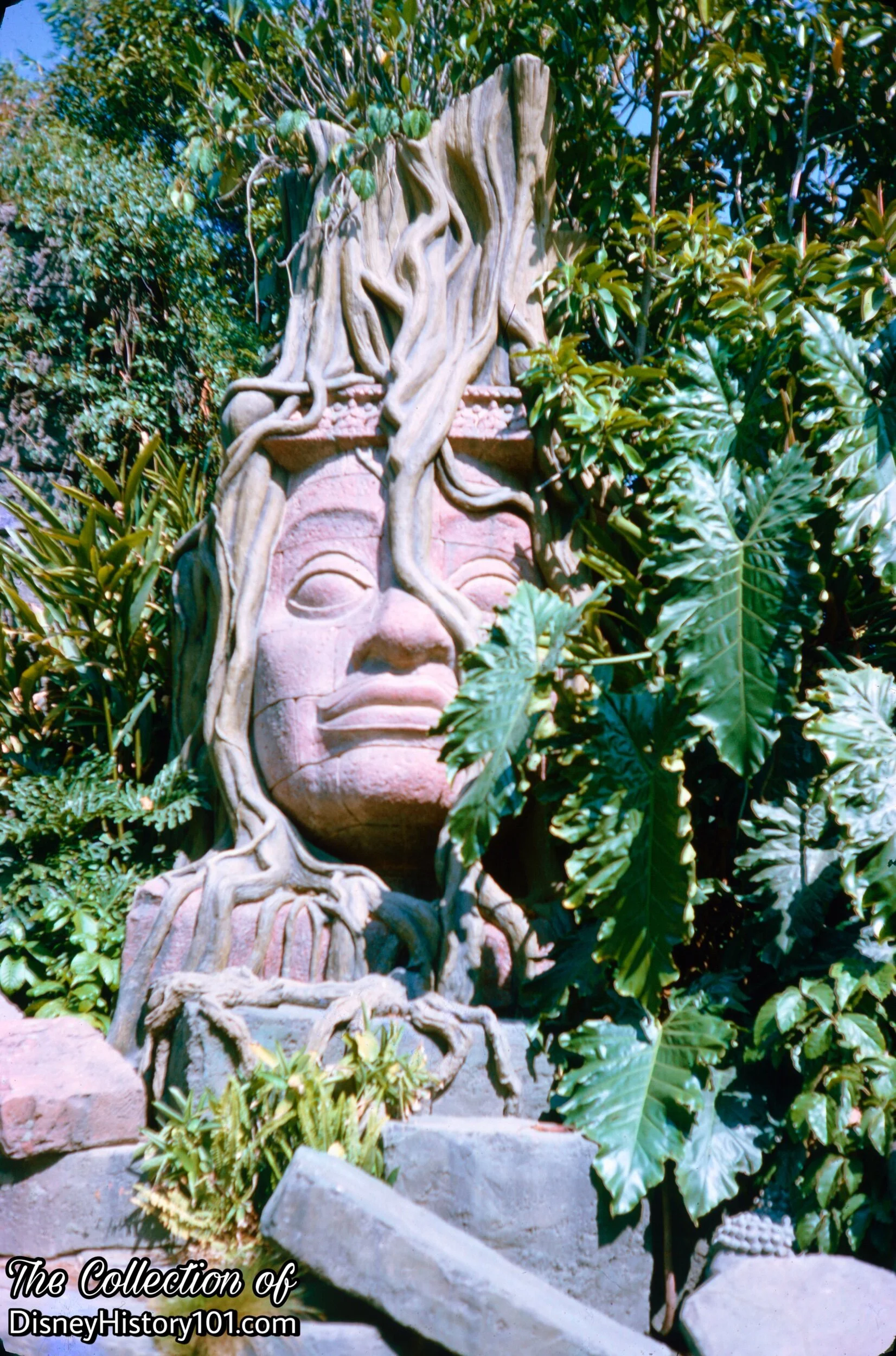
(August, 1965)
“Through an old archway we enter the sunken ruins of an ancient lost city. Now, python-like banyans grip this great stone face in a living vice.”
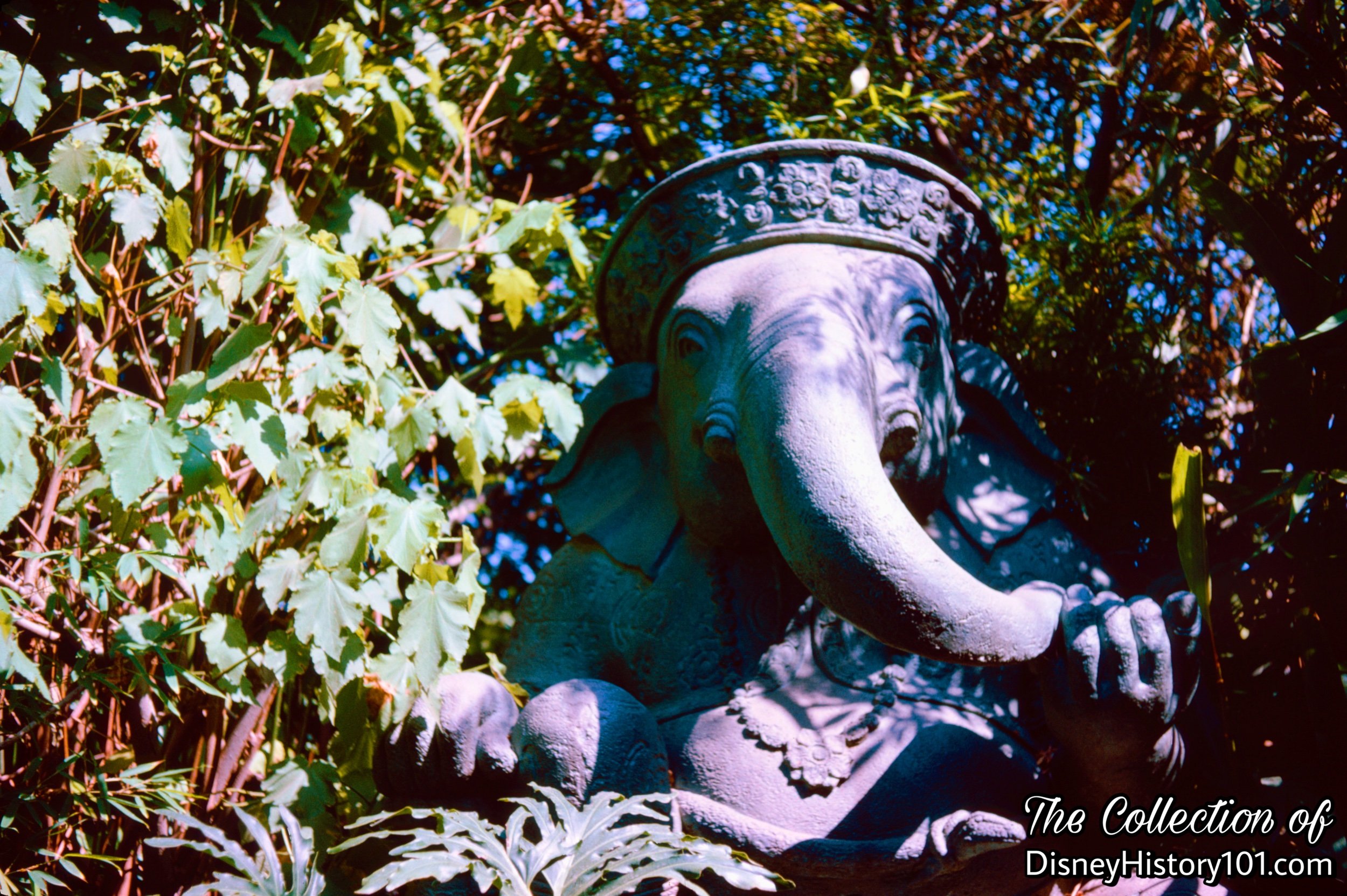
August, 1965.
“The elephant god Genesha guards the entrance to the enchanted bathing pool of elephants. The natives of the jungle say that whole herds of playful Indian Elephants migrate here to bathe. Watch out for some wet surprises from those ‘big shots’ (and the little ones too, they’re playful ‘little squirts’). You know, these sacred bathing rites are seldom seen by ‘civilized man’.”
These ancient ruins to Genesha were first ‘discovered’ along this portion of the Rivers of the World in 1962.
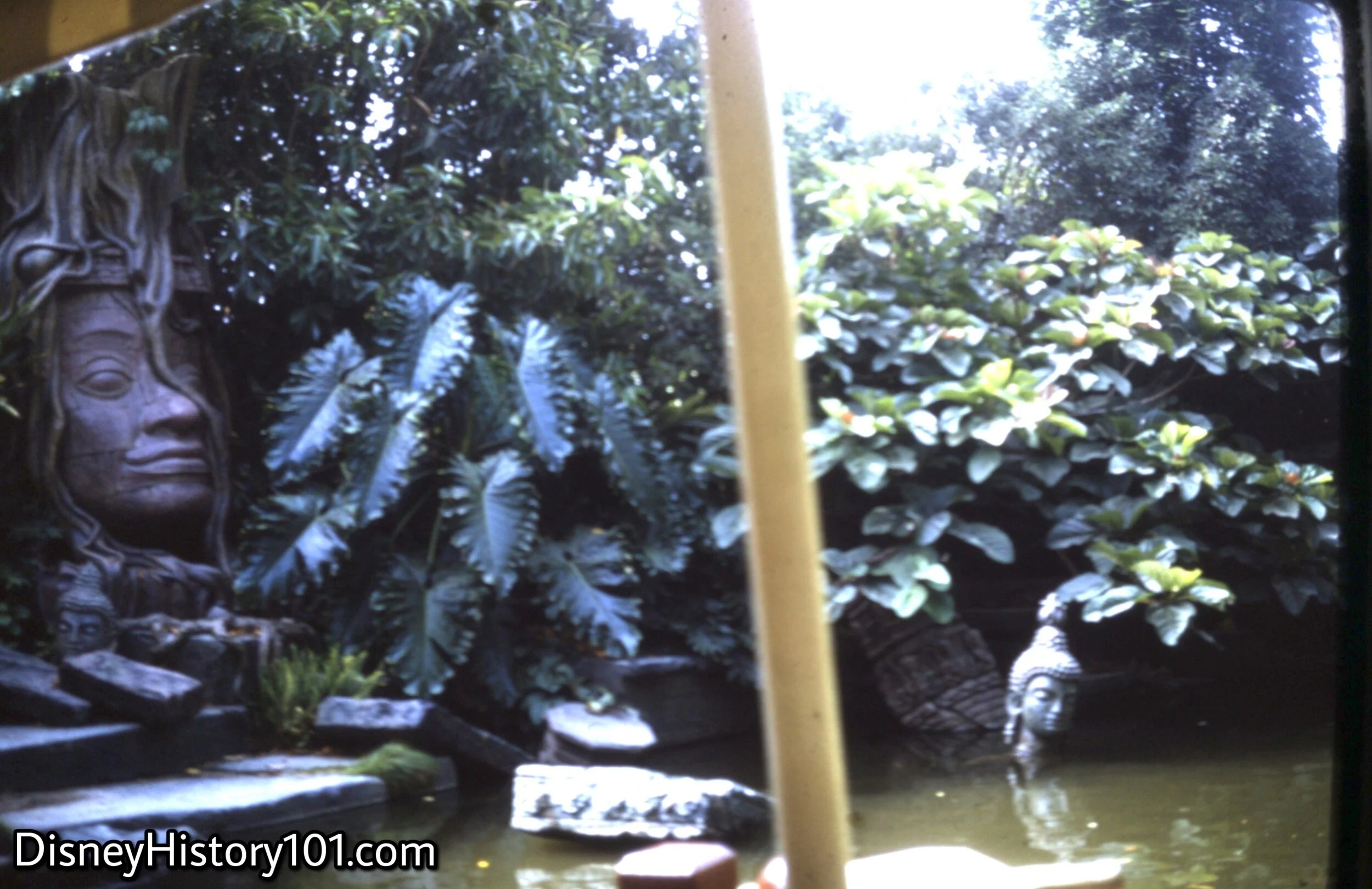
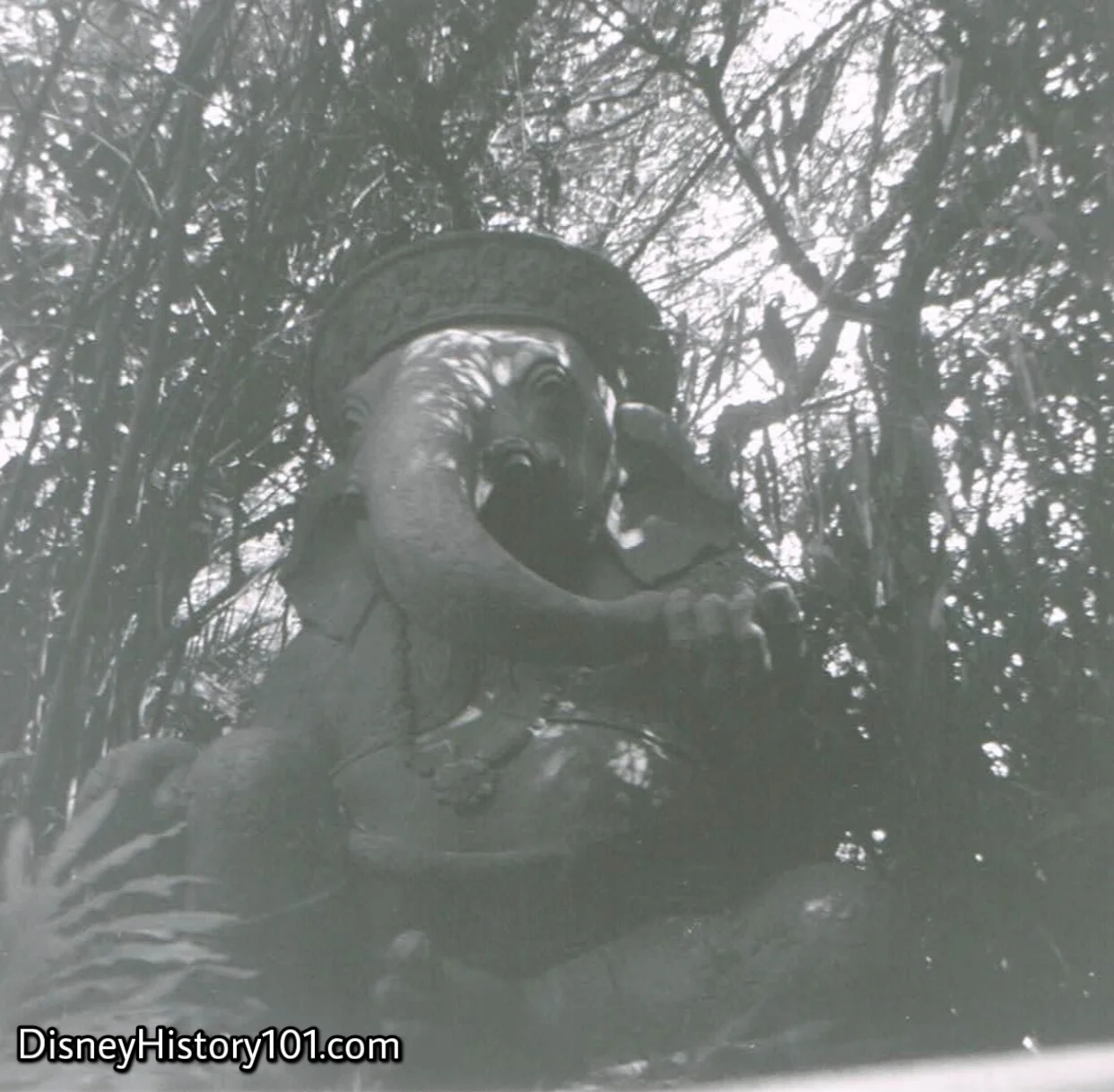
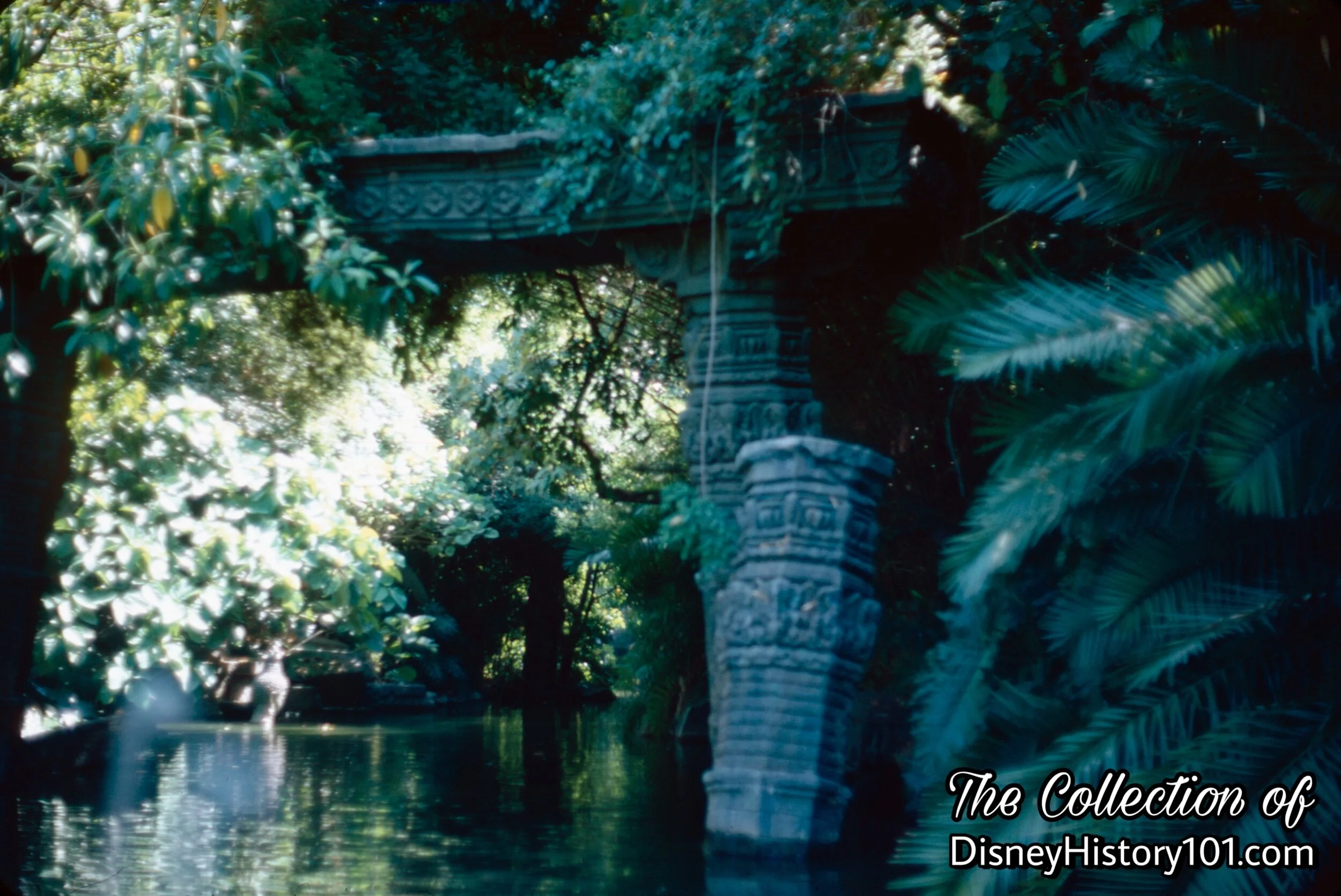
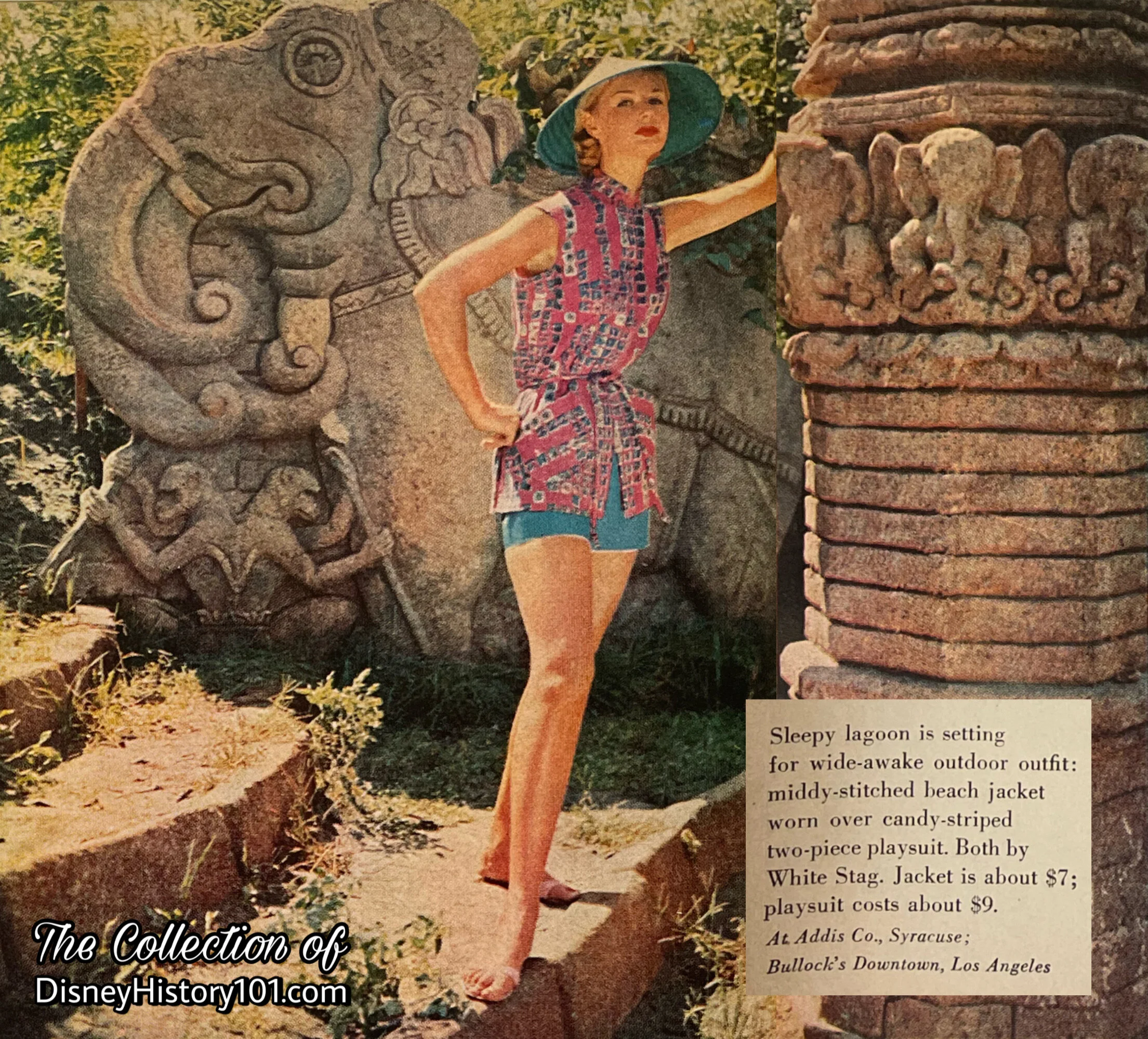
A model stands near an Architectural Facade in McCall’s Magazine, February of 1956.
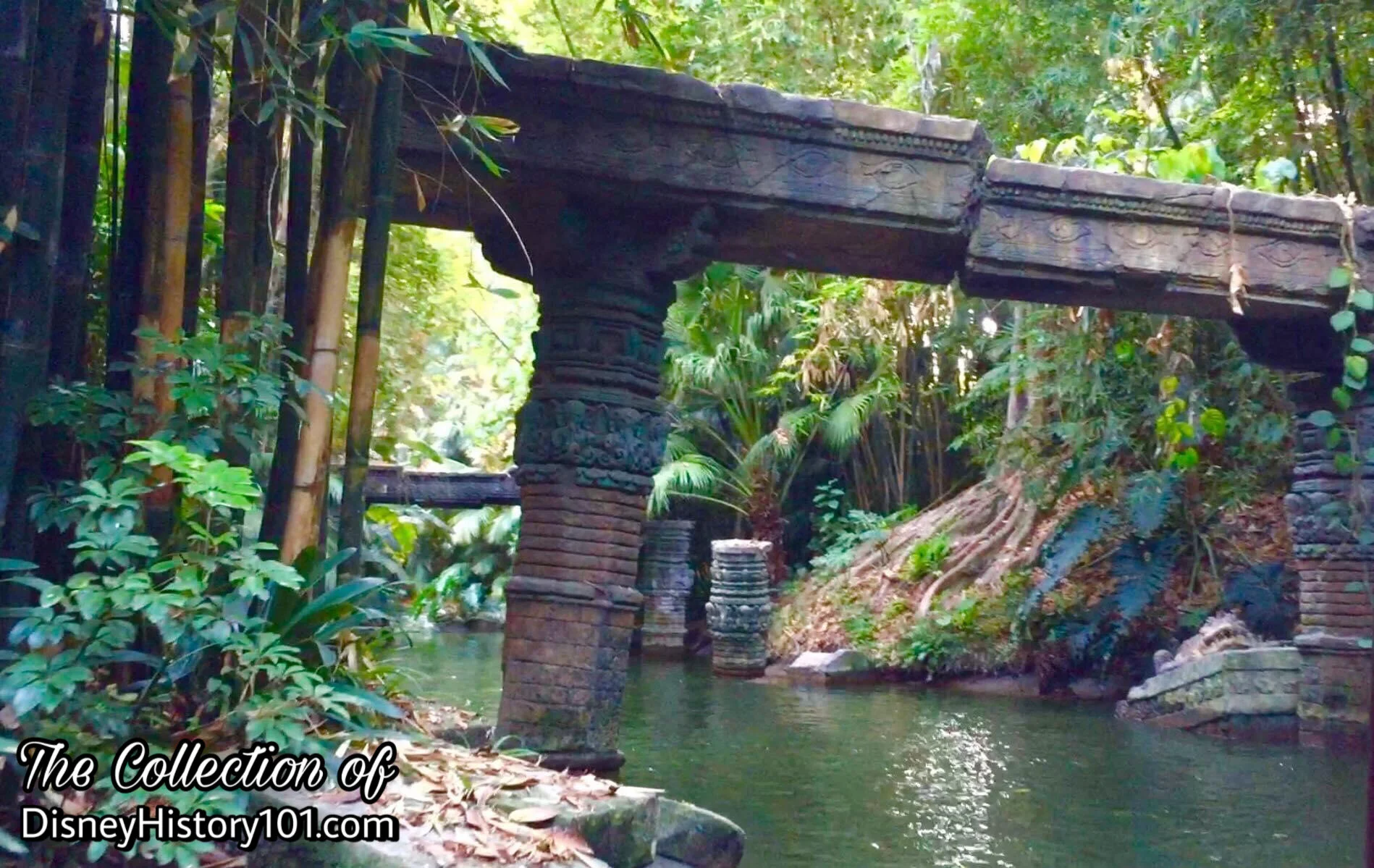
The “CAMBODIAN SHRINE RUINS”, present.
To the left are the outskirts of the temple, destroyed centuries ago by an earthquake. Legend has it that priceless jewels are still hidden there. Many adventurers have tried their luck… but no one yet has made it past the hungry crocodiles.
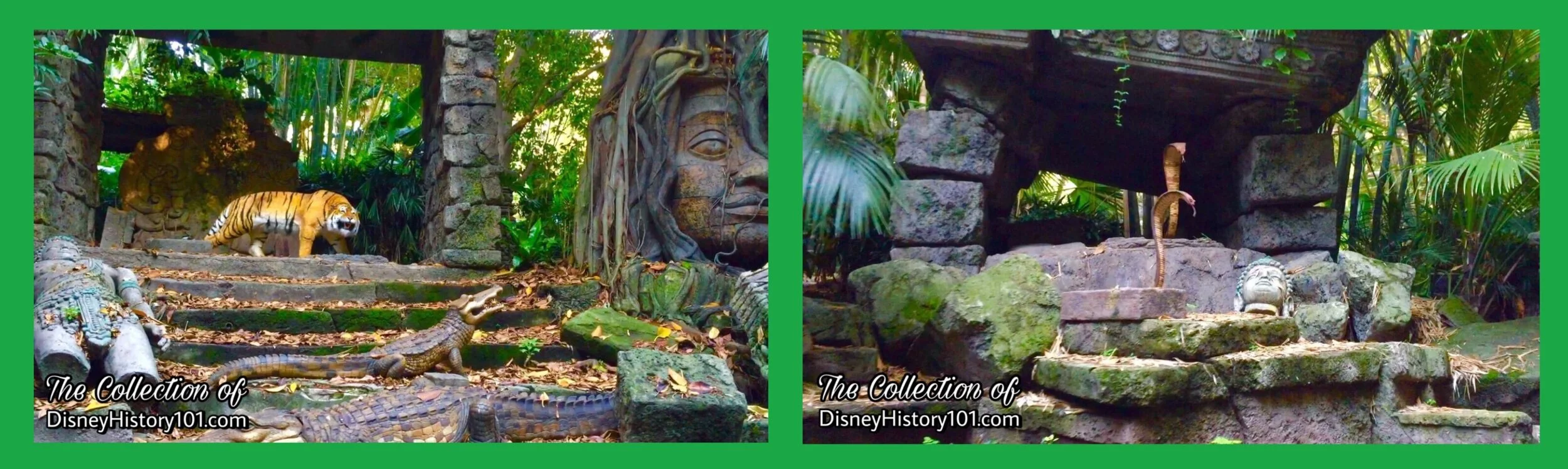
"A tiger walks"... through the Cambodian Shrine Ruins, 2010s (left).
“A Tiger Walks”
Louis Berg (“This Week Magazine” reporter) quoted Walt’s description of the attraction (for an article published September 19, 1954) this way : “‘In True-Life Adventureland… tigers will lurk in the jungle. It’ll be something.’” Thirty years later (and ever since 1976), two “hypnotically swaying” INDIAN (ASIAN) COBRAS have lurked among the ruins, and appear to have chased that GIANT JUNGLE SPIDER away! Since 1976, some eagle-eyed scouts here at the world famous Jungle Cruise claim to have spotted BENGAL TIGERS in the area. But we know that’s ridiculous. After all, BENGAL TIGERS are striped, not spotted.
The ominous king cobras are some of the world's deadliest snakes. Don't make any sudden moves as they will attack at the slightest motion. There used to be three of them… I wonder where the other one is?
(in low whisper) DON'T MAKE ANY SUDDEN MOVES!
THOSE KING
COBRAS ARE THE WORLD'S LARGEST POISONOUS SNAKES SHHH!
alternate
UP ON THE STEPS -- THREE KING COBRAS
HMMM. . . THERE USED TO BE FOUR of them
I WONDER WHERE THE OTHER ONE IS?
look around the boat
interior)
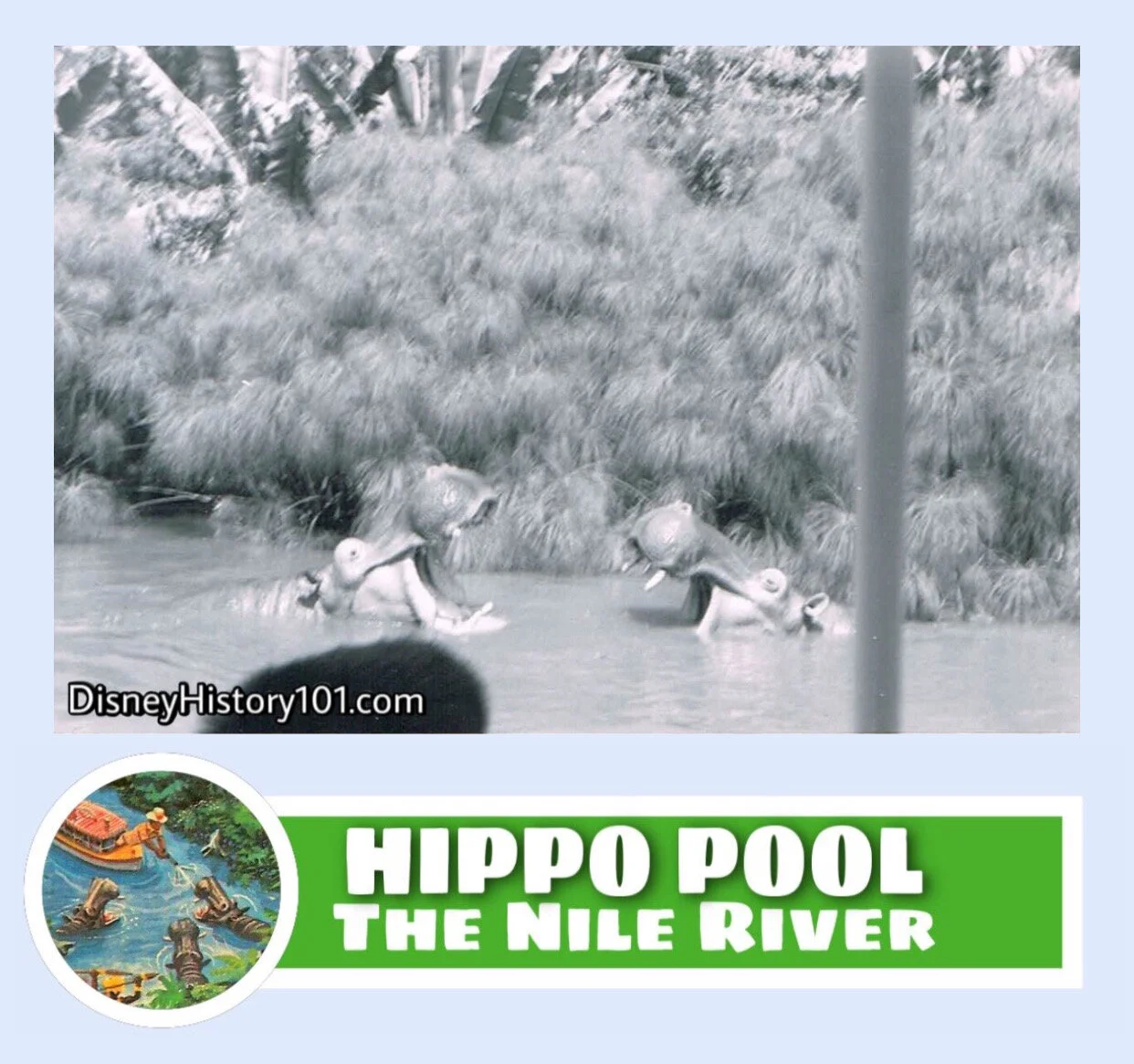
Now, we head around a bend, and into the waters of the Belgian Congo. By August of 1955, “Lillies of the nile and papyrus grasses represented the Congo region, as do the Bushman’s Poison Plant whose juices are used to make the the poison darts of Africans.” Beyond this flora…
As the river widens, the passengers are warned not to rock the boat for fear of upsetting a number of hippos floating nearby. But two of the beasts charge, and the Skipper takes a pistol and fires shots in their direction.
“We’re entering a pool of Hippopotami. They’re big, and curious, and could easily upset the boat.” “If you don’t believe me, then you’re in ‘de-nile’!”
“One of these boys could upset our boat.”
“I’ll try to get us through safely. Don’t worry, I understand they’re not dangerous until they wiggle their ears….They’re ALL wiggling their ears…easy now…easy…(sighs) I think we made it…Hang on! A big hippo’s charging broadside.” Bubbles rise to the surface of the water as a pair of wiggling ears emerge. A bull hippo charges the naphtha launch.
According to one account, this was when the Guide draws his .45 revolver, firing one round in order to scare the beast into submerging.
“That’ll hold ‘em.”
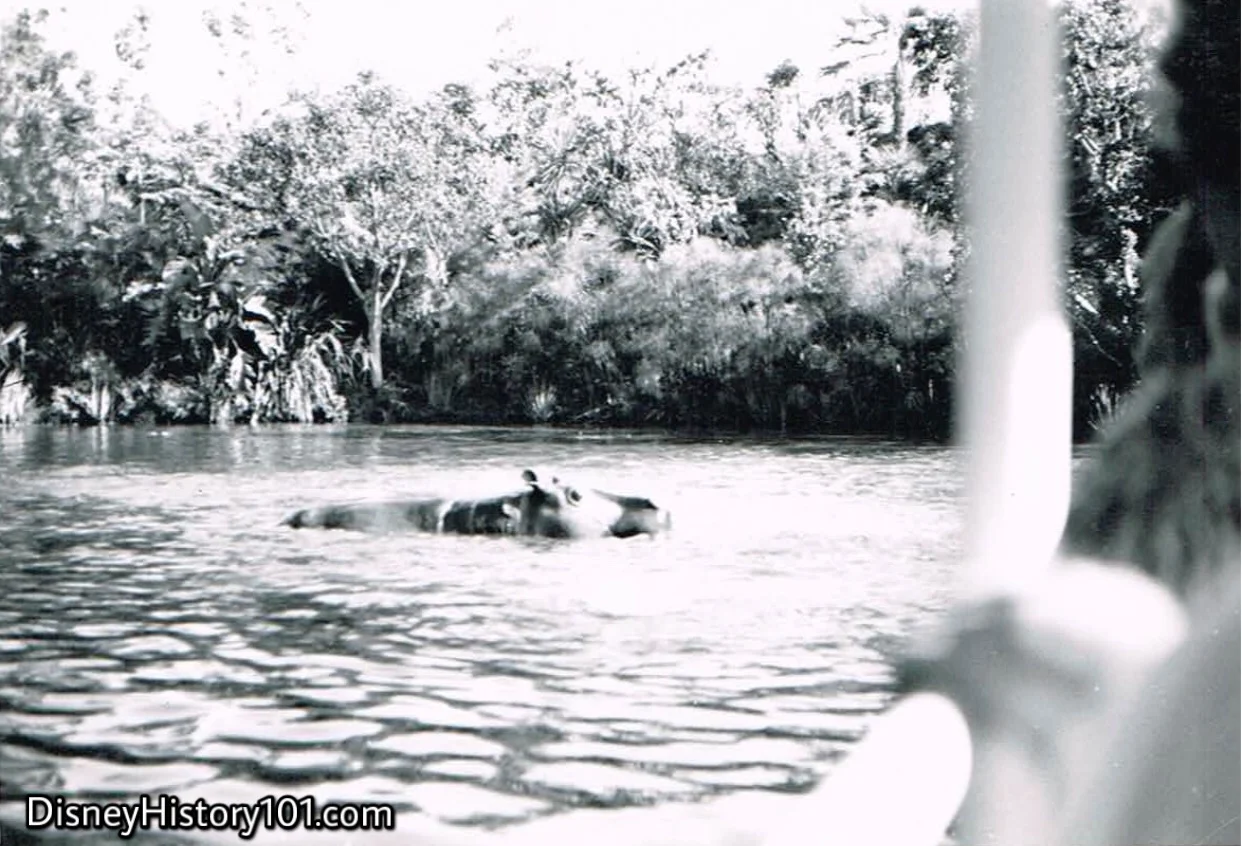
“HIPPO POOL”, 1962
“Please be careful now, and don’t rock the boat.” We’re entering one of the “true-life” deepest depths of the Rivers of the World. That’s because the ground was “hollowed-out” and made deeper where these animated figures were placed in the Hippo Pool.
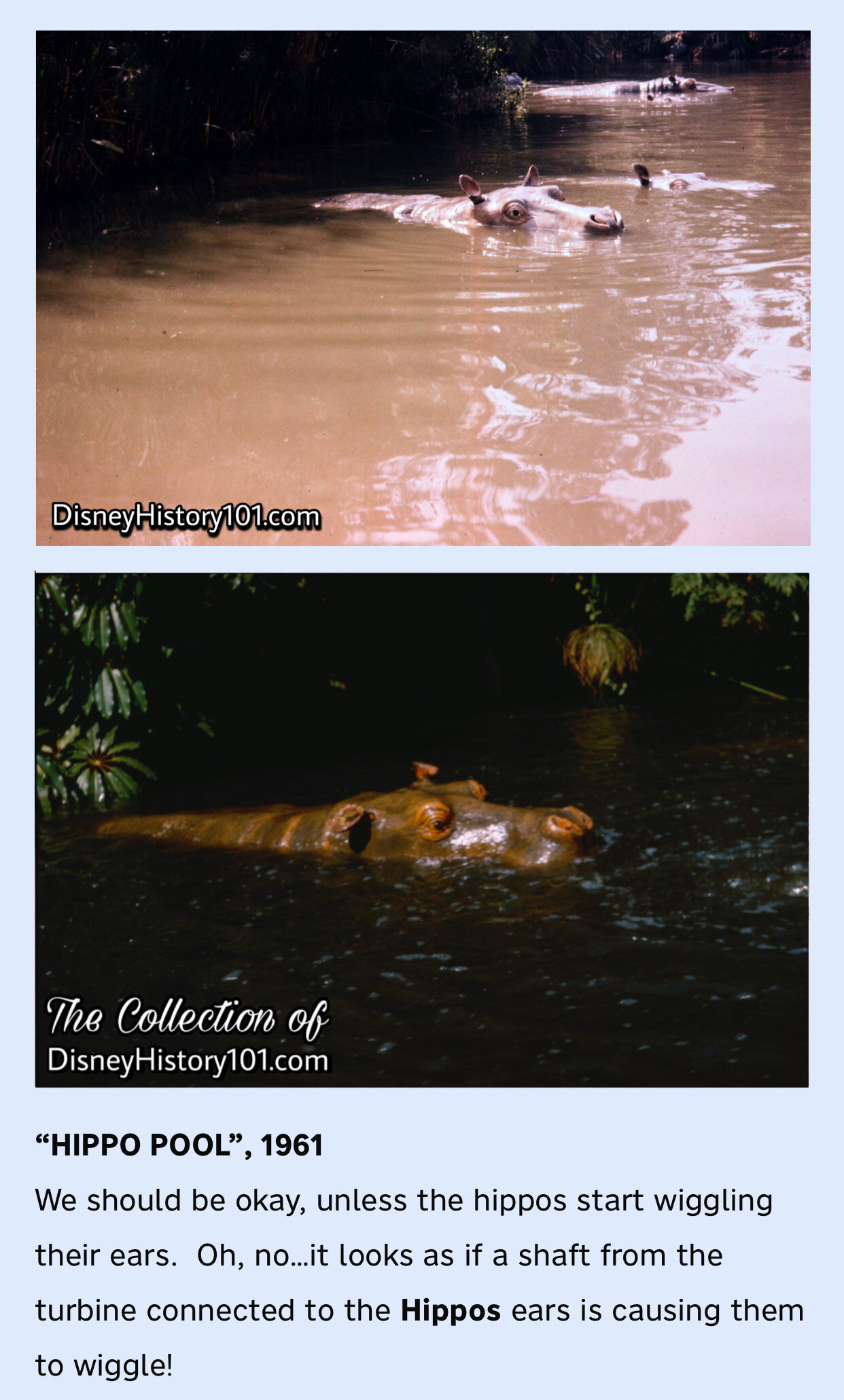
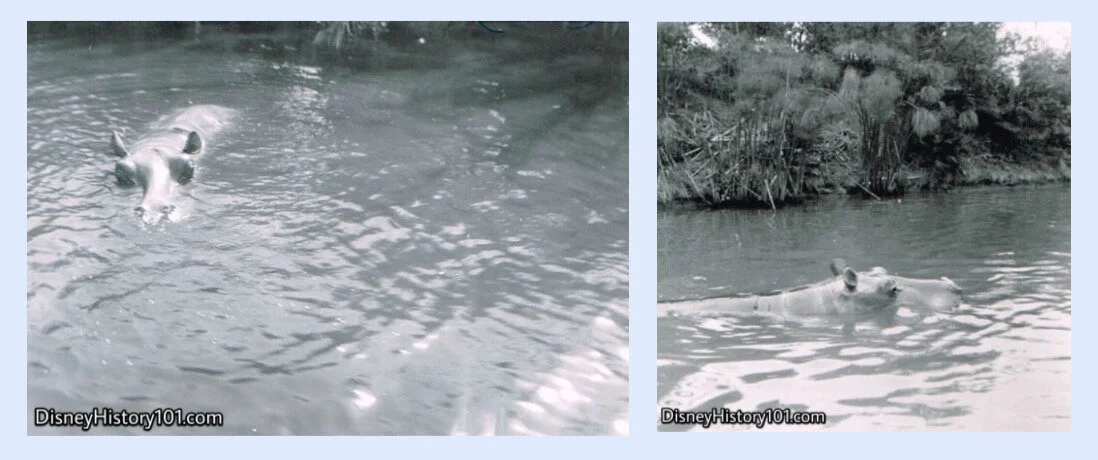
Still, more thrills and excitement await guests as a hippo “charges” a river boat in Adventureland. As the Pasadena Star-News (Friday, December 14, 1955) reported, “a monstrous hippopotamus rears suddenly from the Nile”.
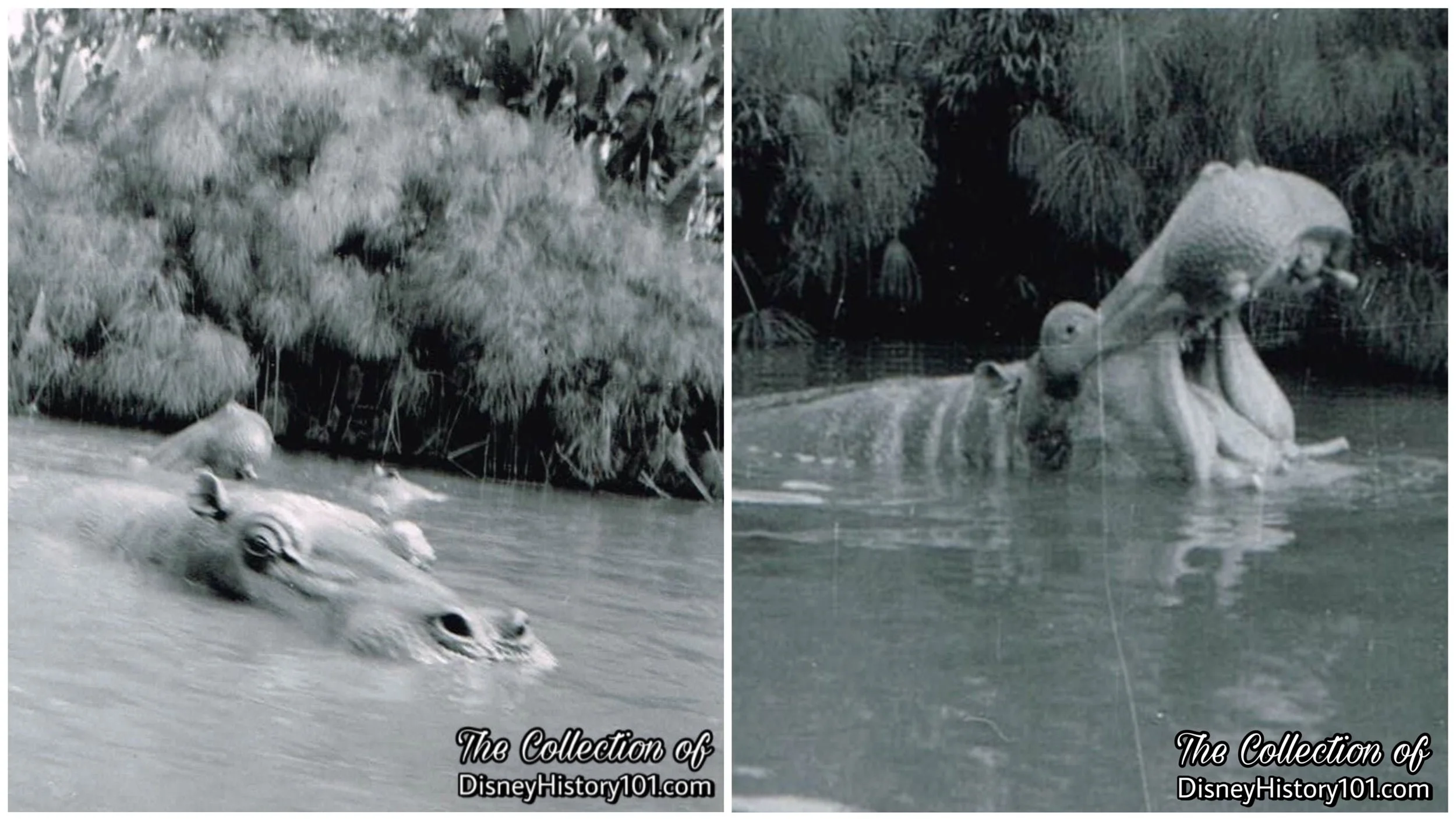
Late 1956 - Early 1957.
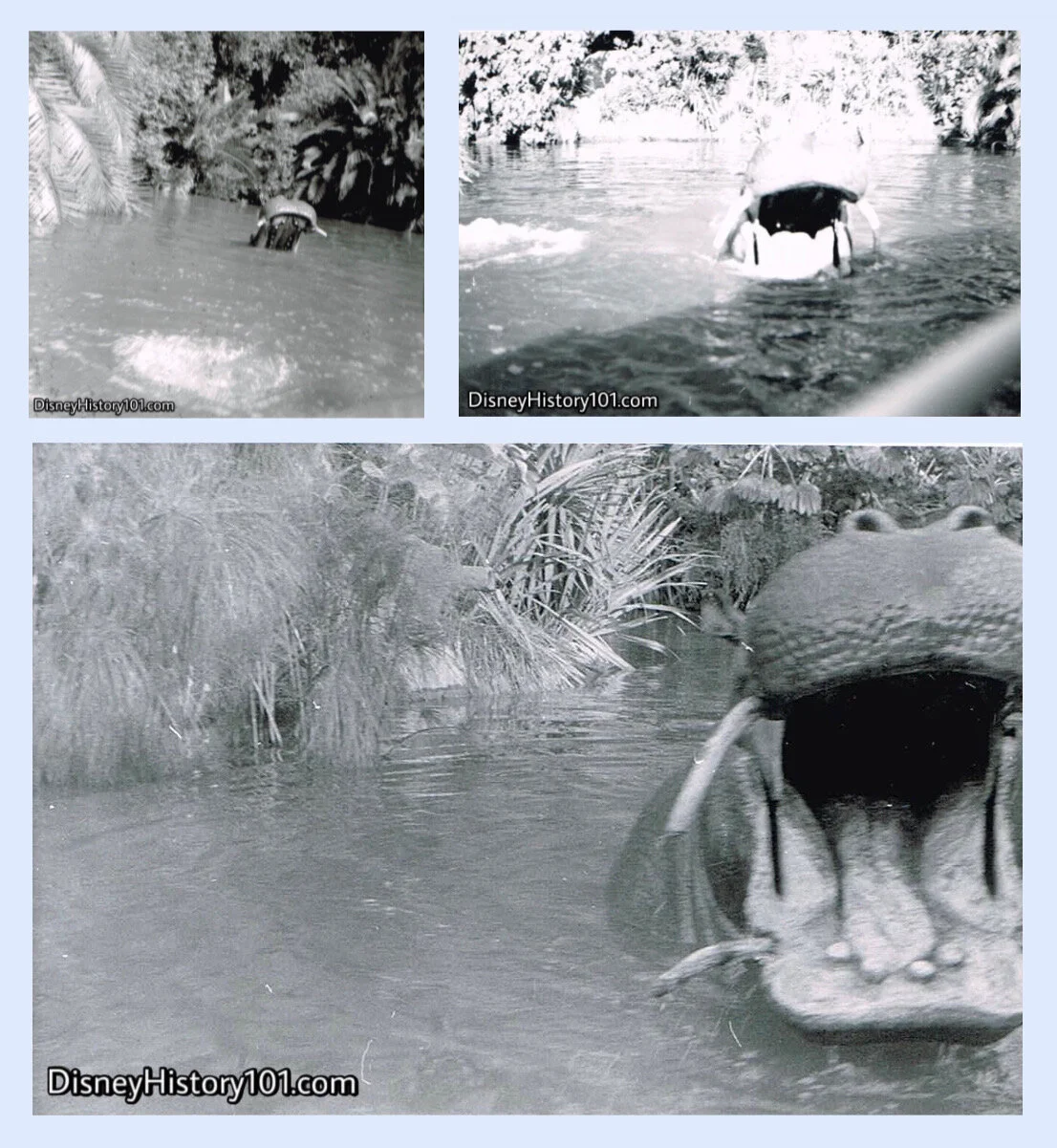
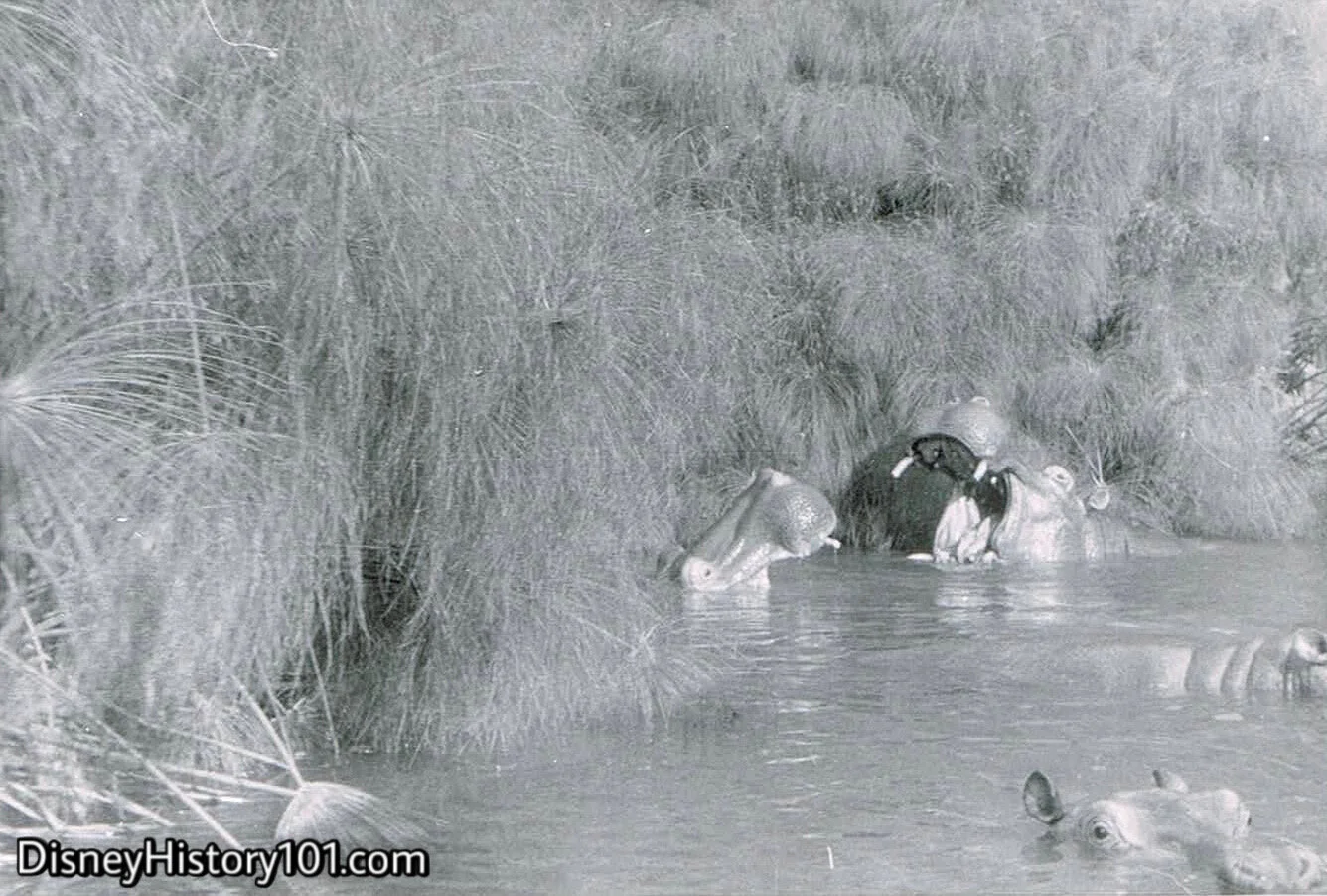
“HIPPO POOL”
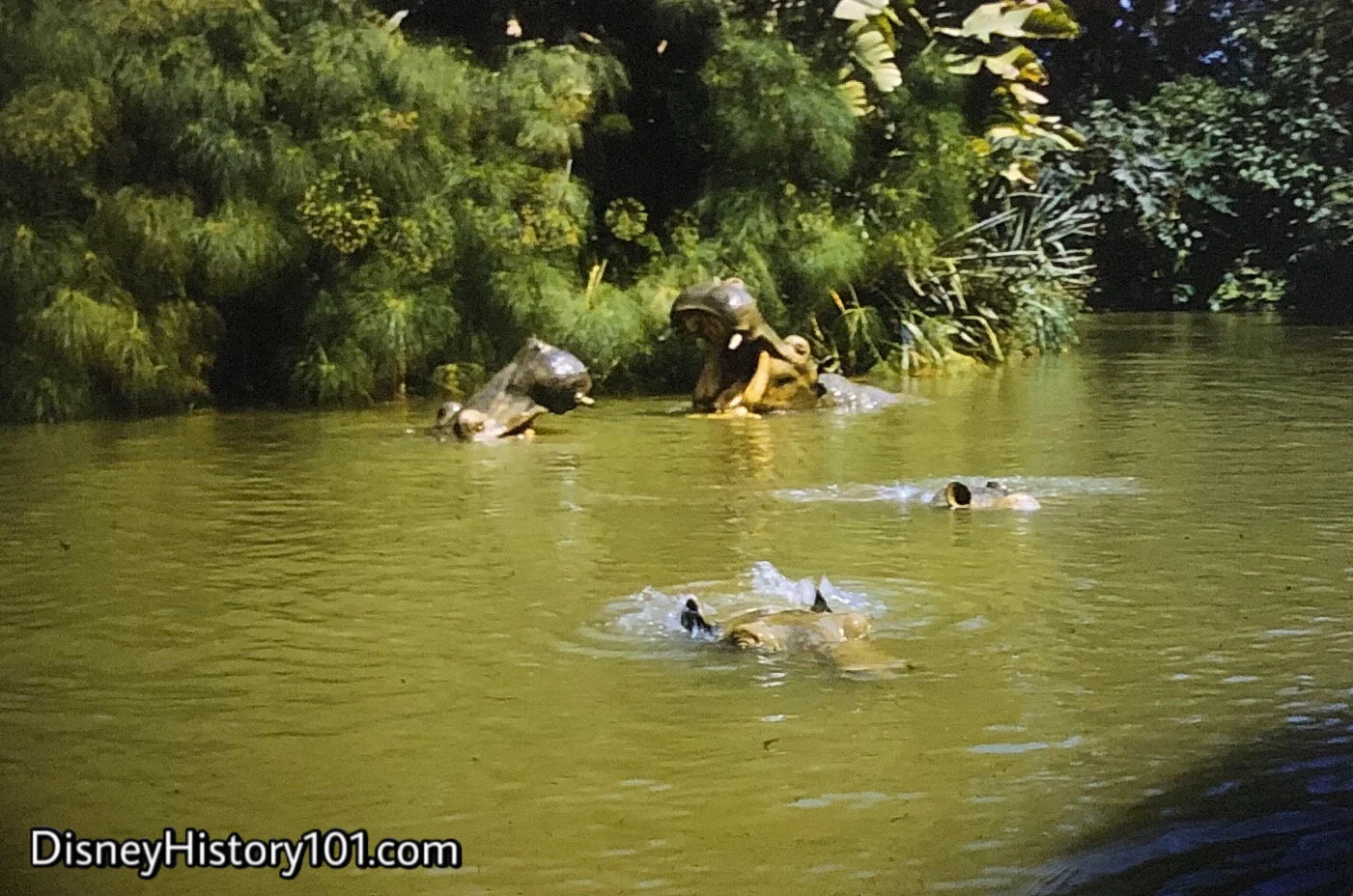
“HIPPO POOL”
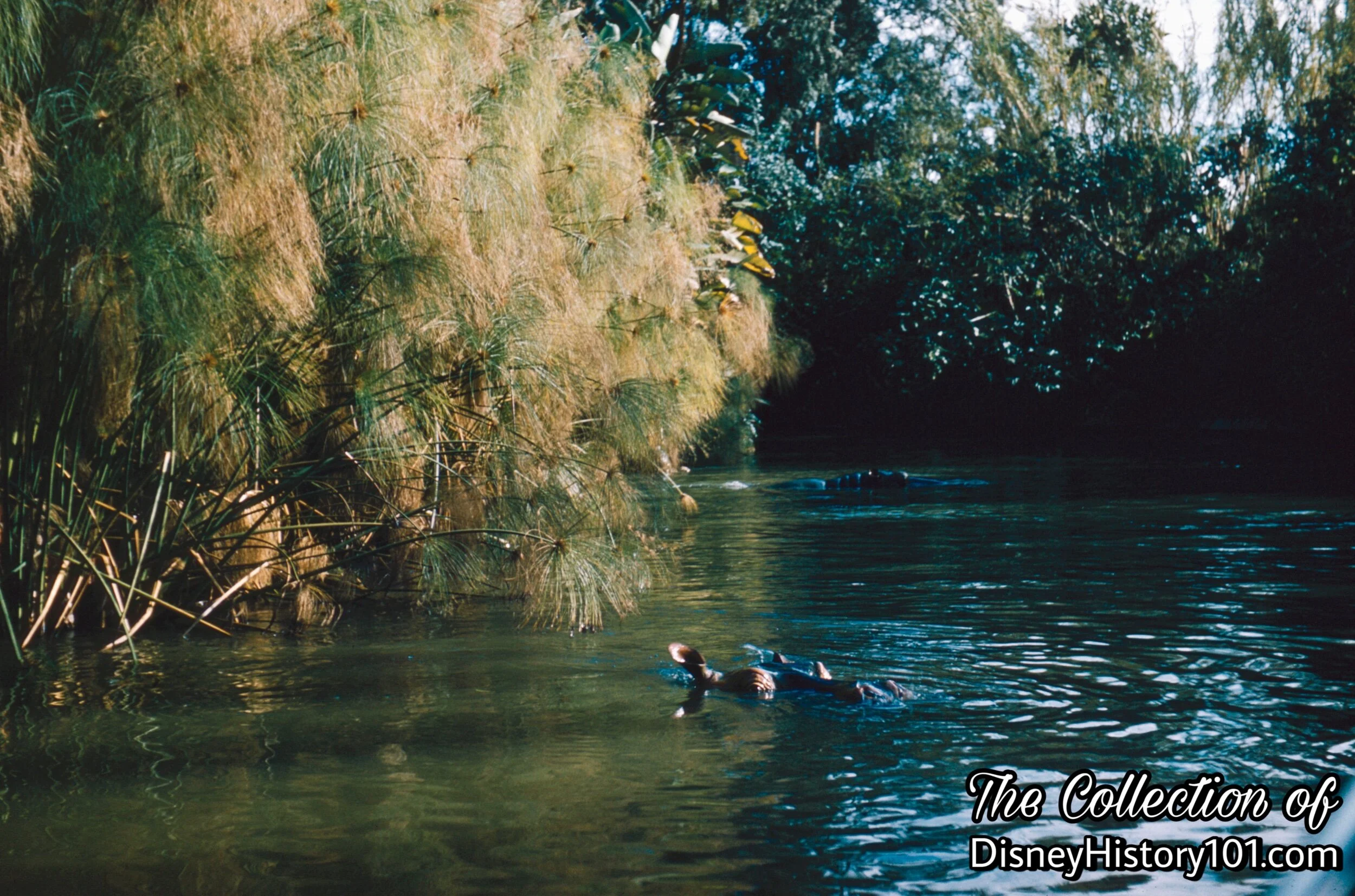
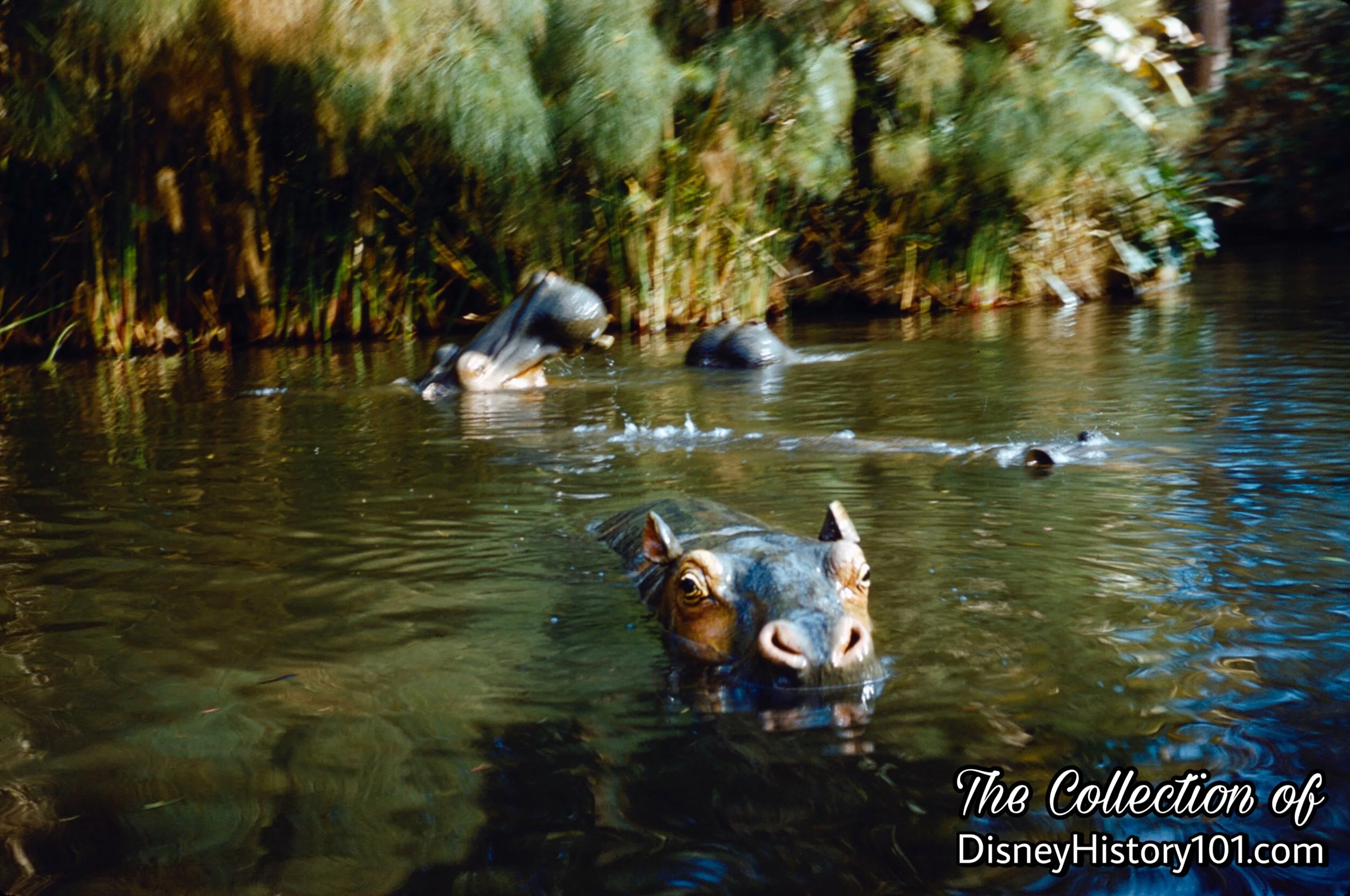
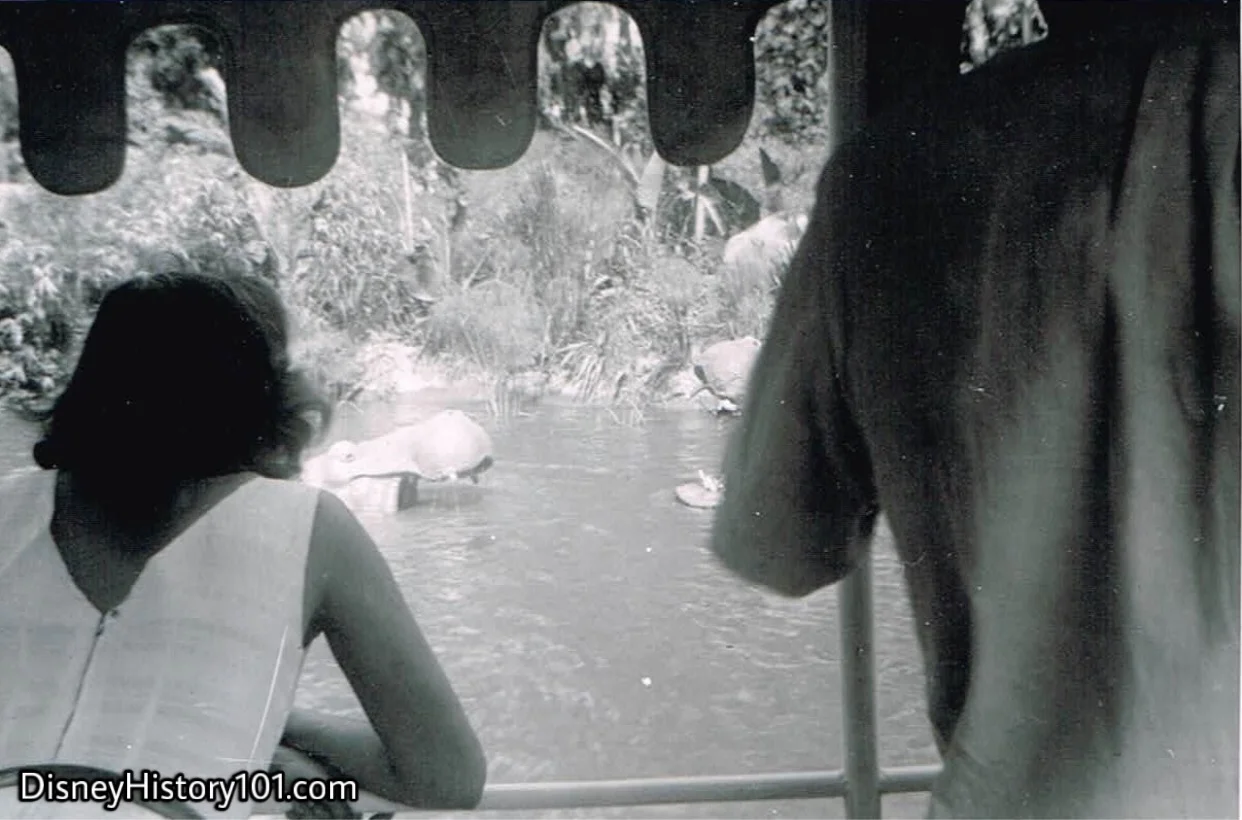
“HIPPO POOL”, (September, 1955)
“Hippos startle and thrill passengers aboard Adventureland’s river boat.”
-A Complete Guide to Disneyland, 1956
1965, August
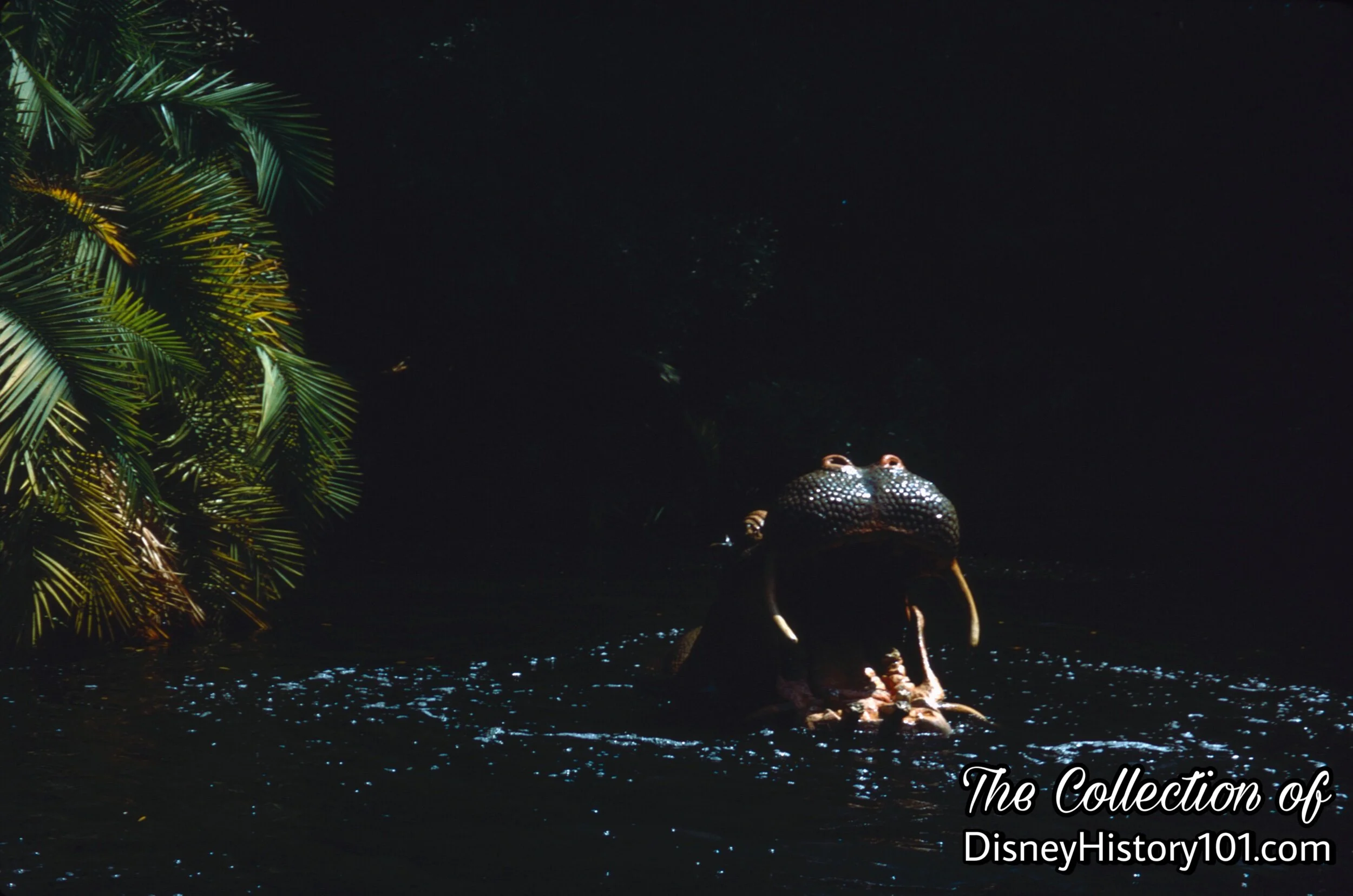
(1967)
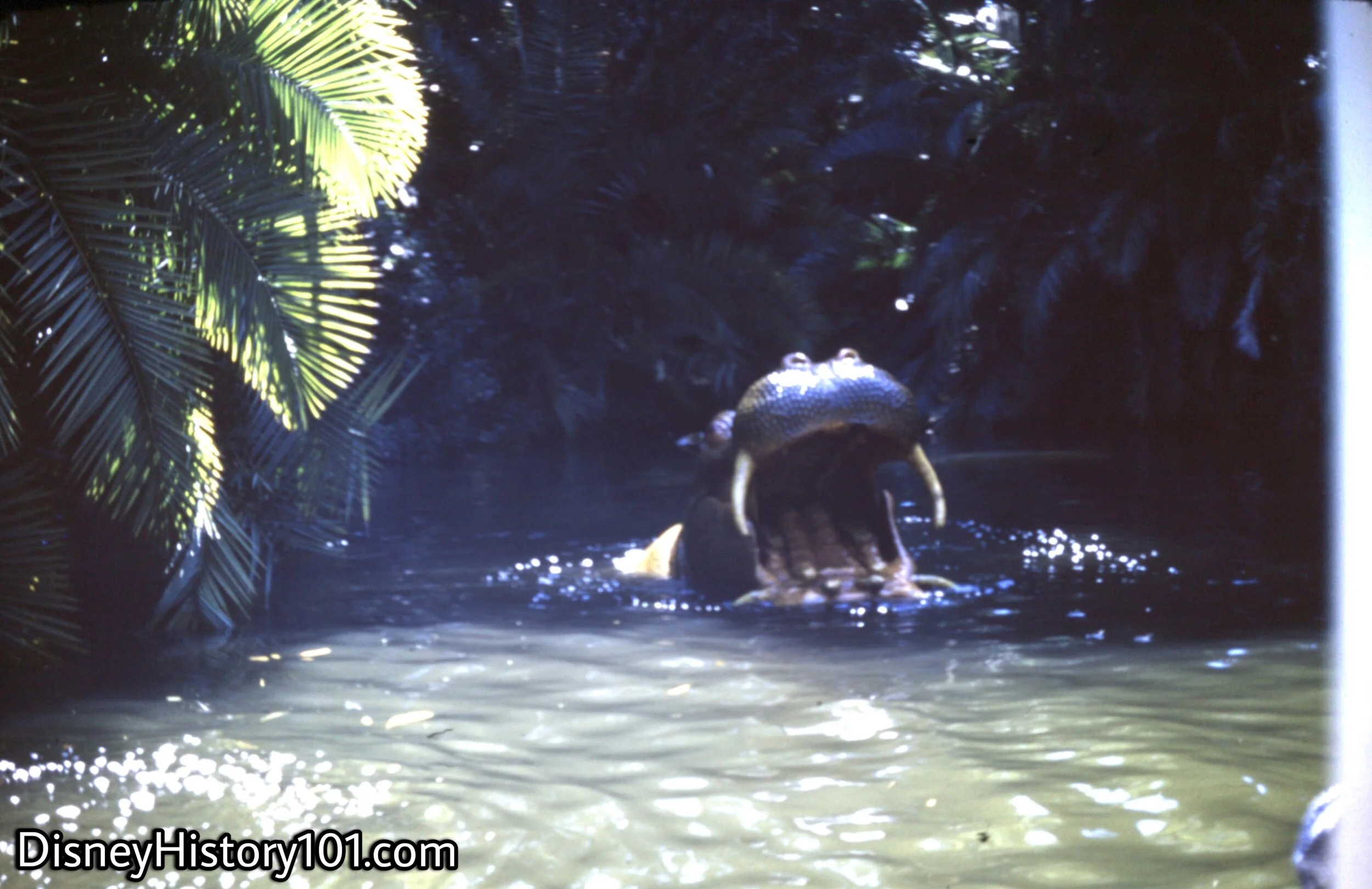
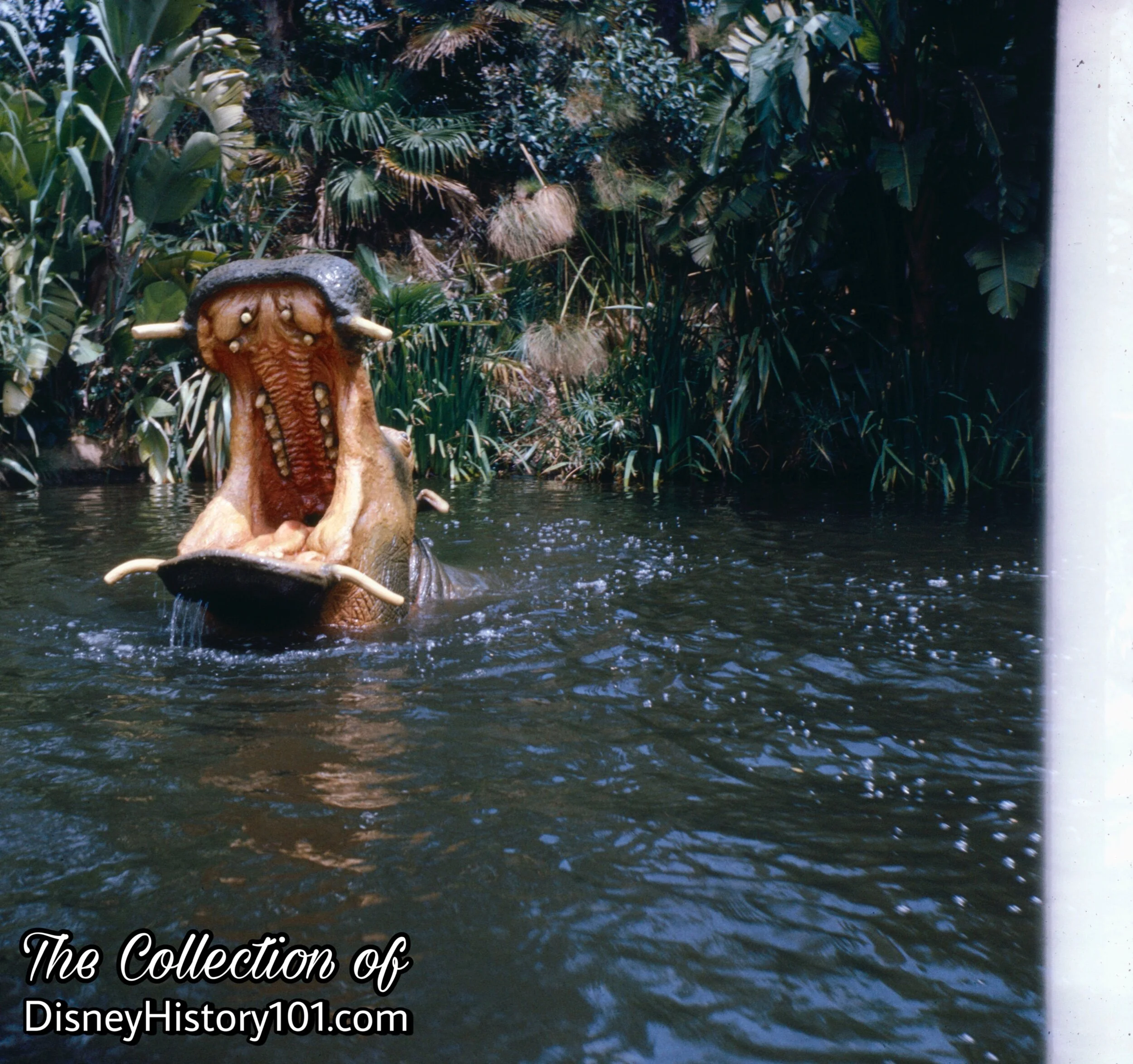
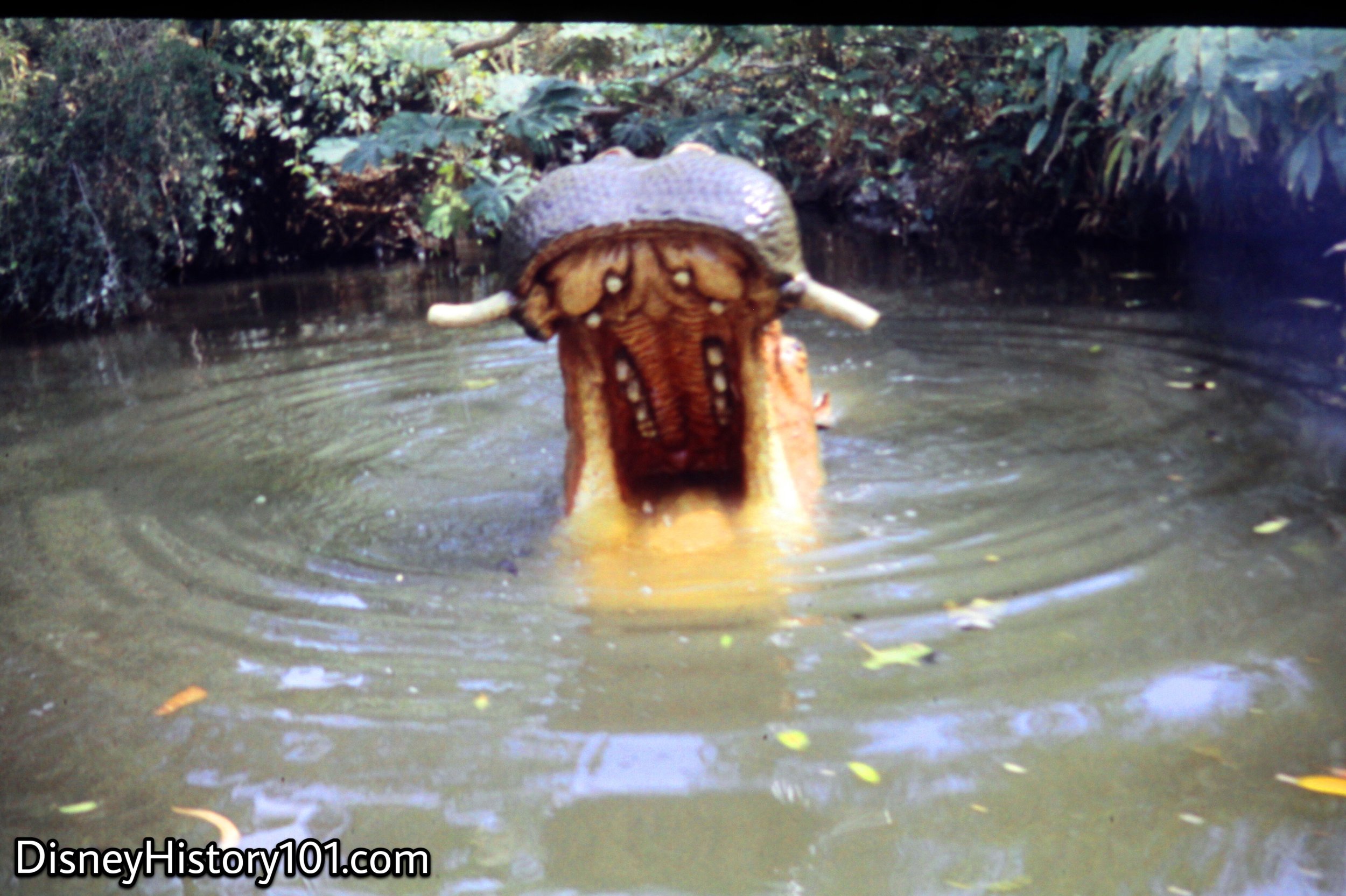
“Look out, …another hippo!”
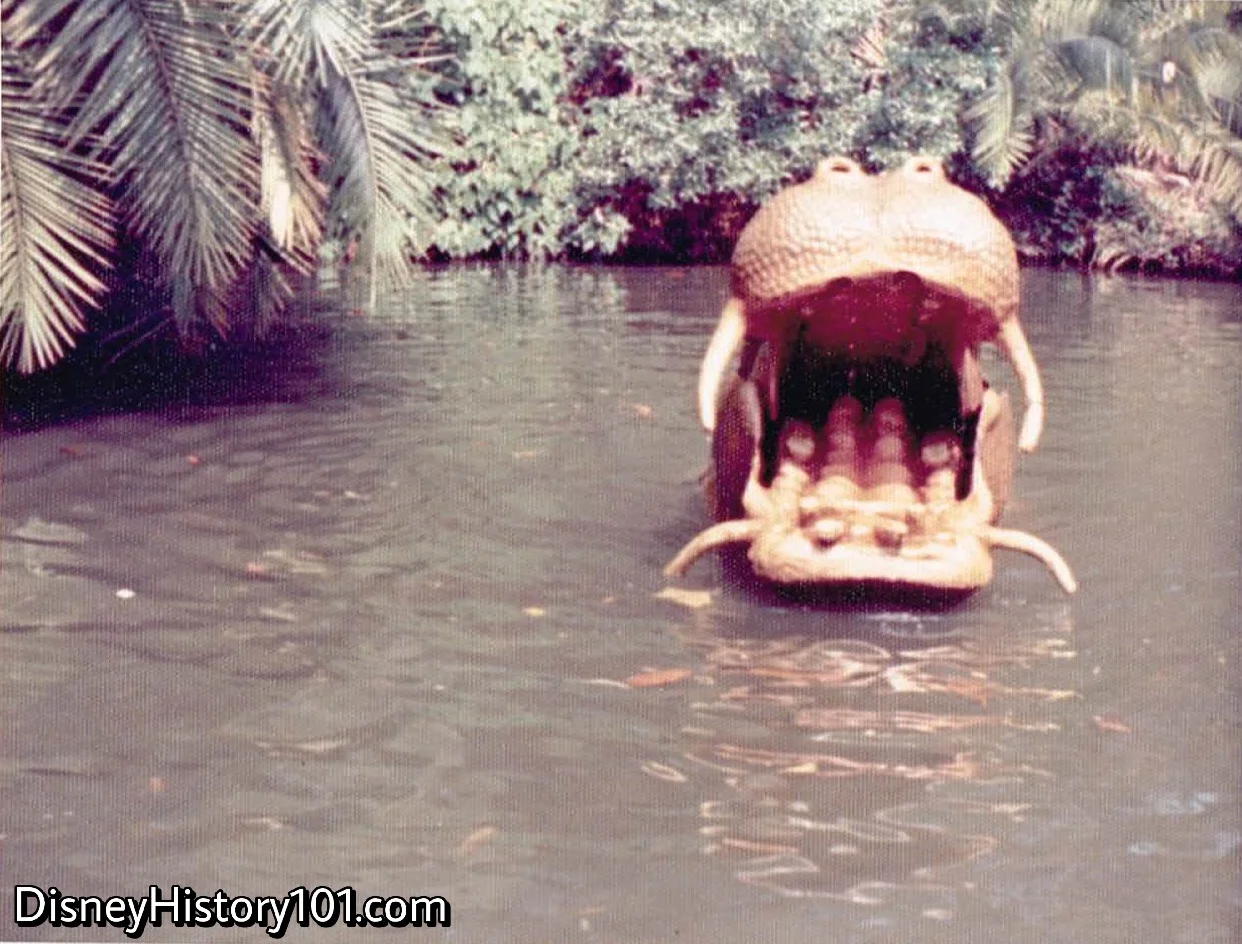
1960s.
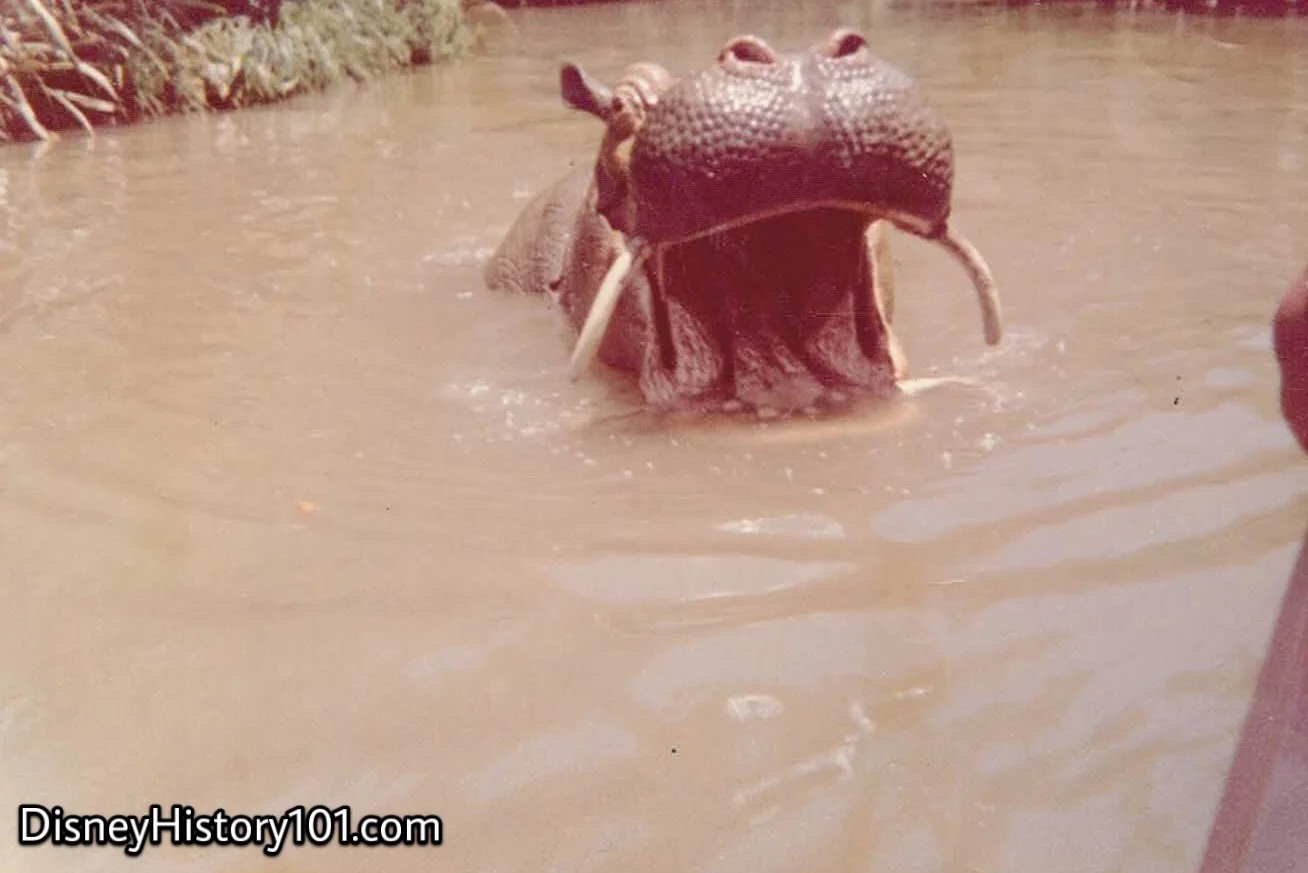
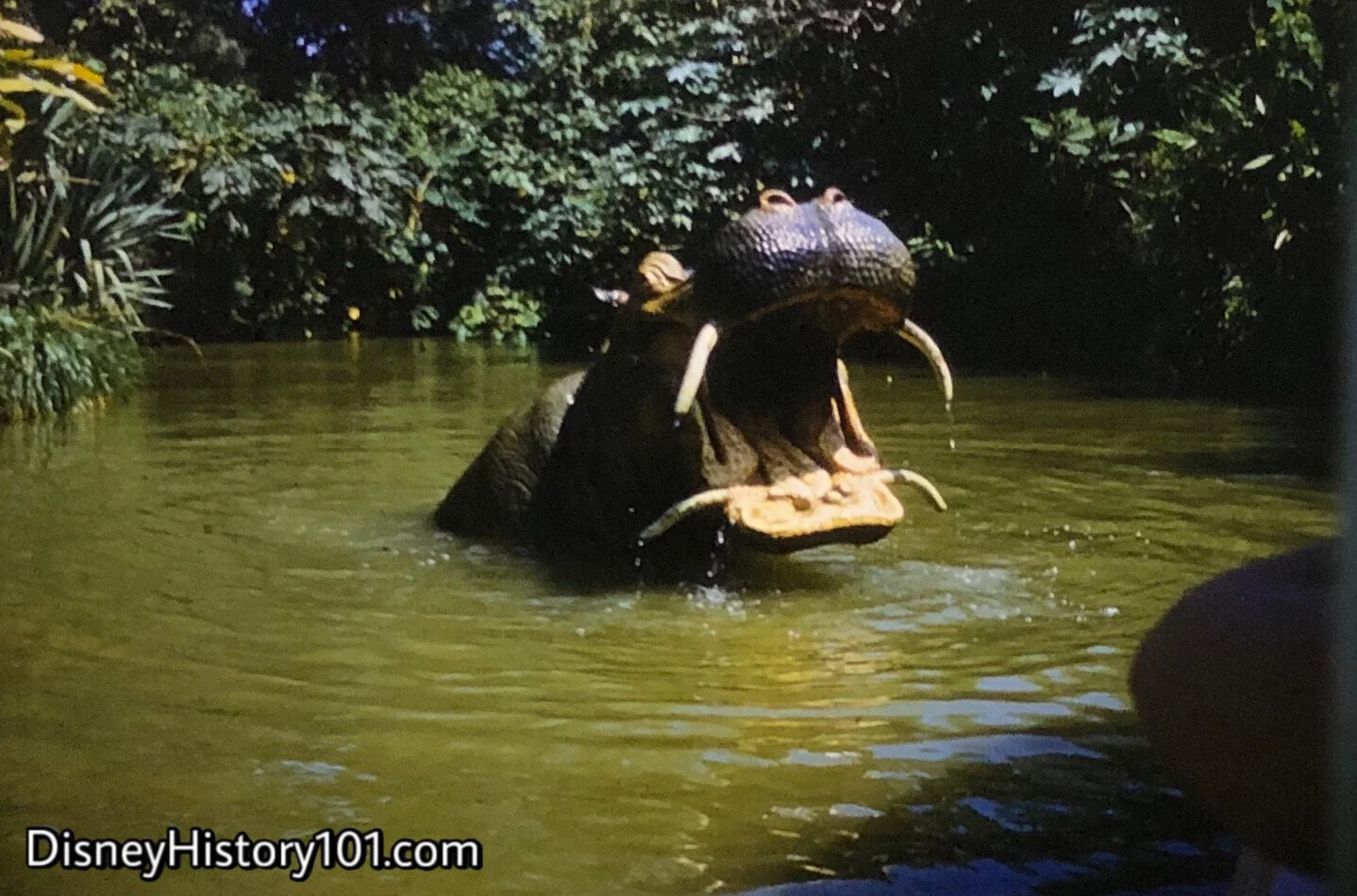
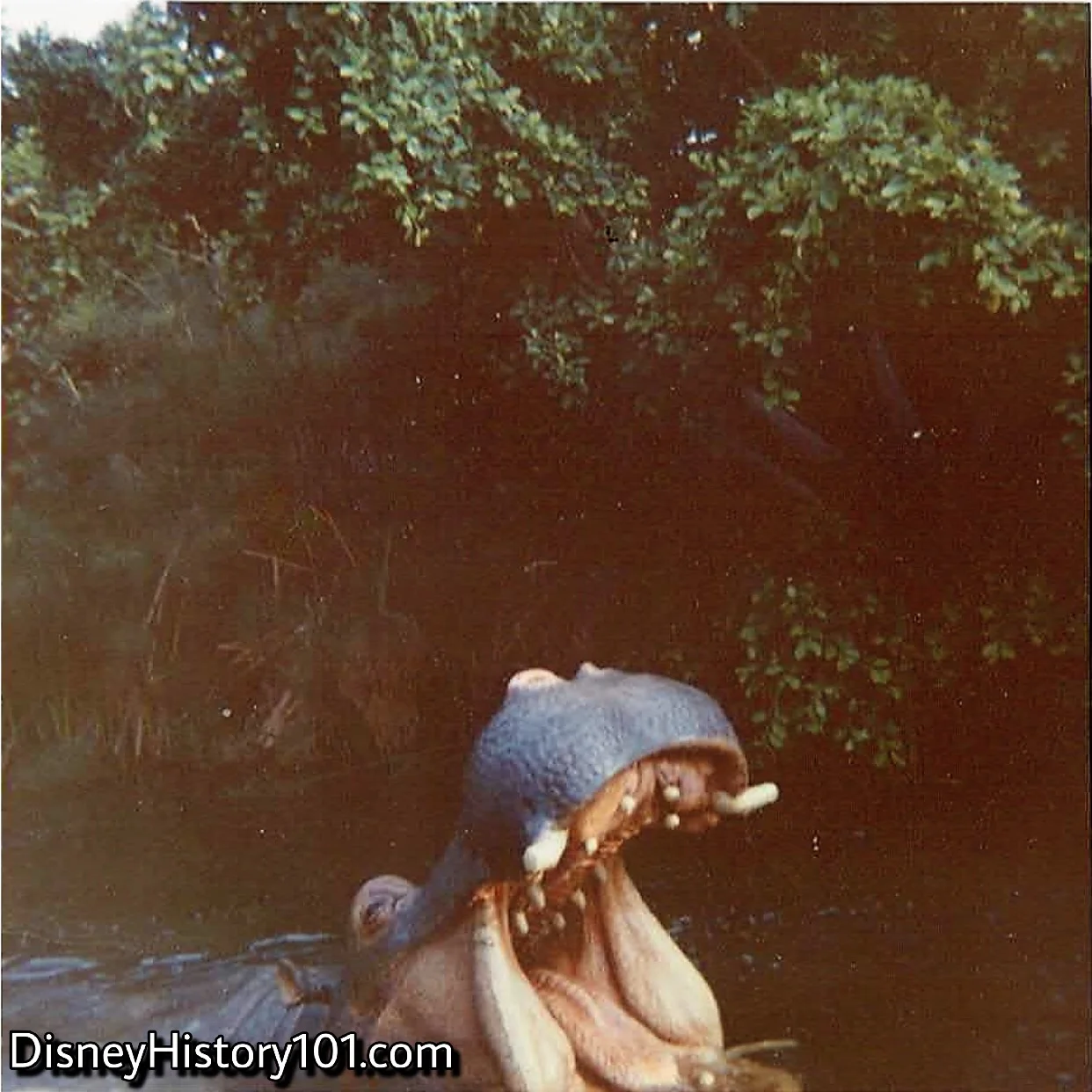
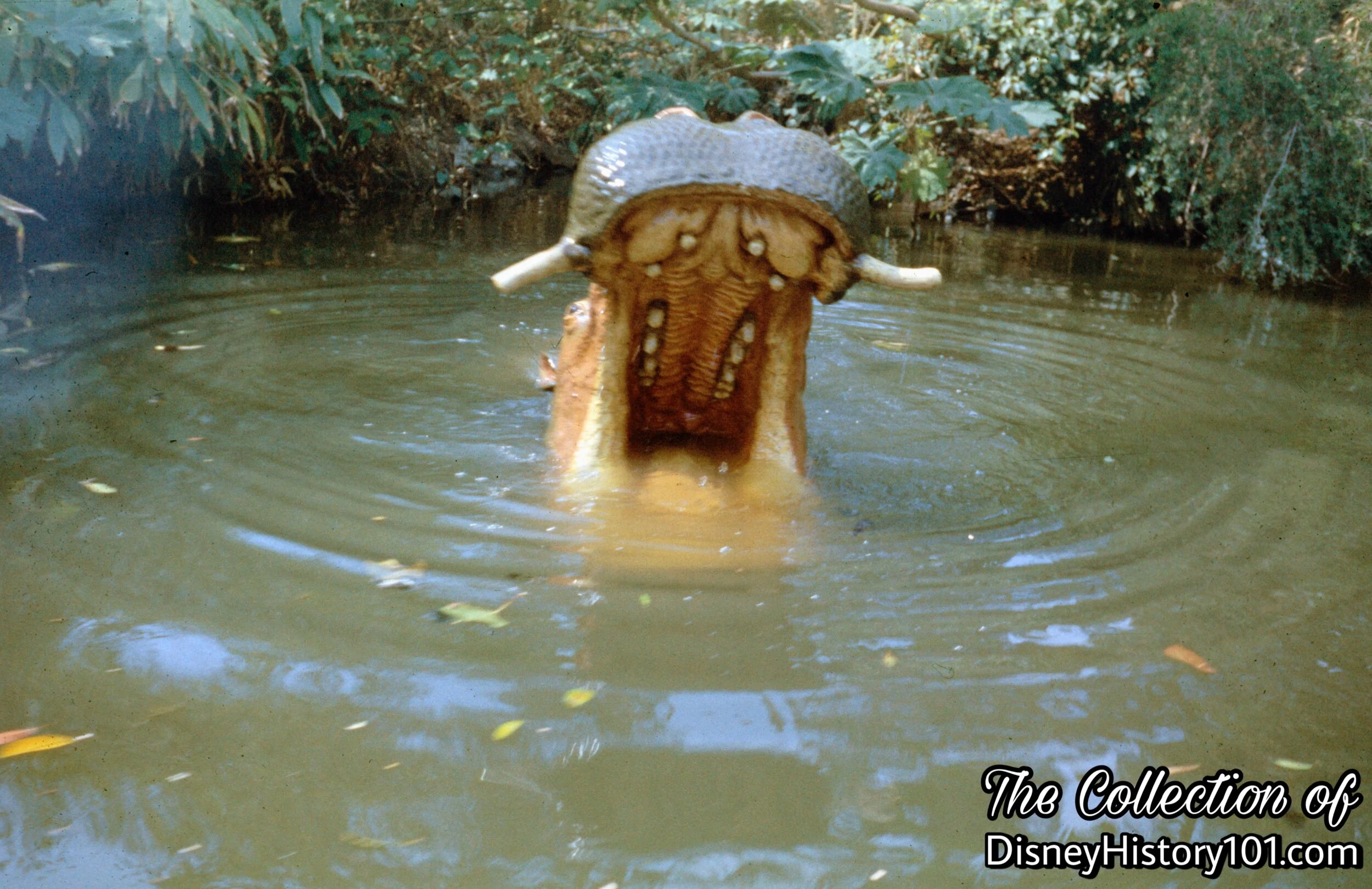
1969
1965, August
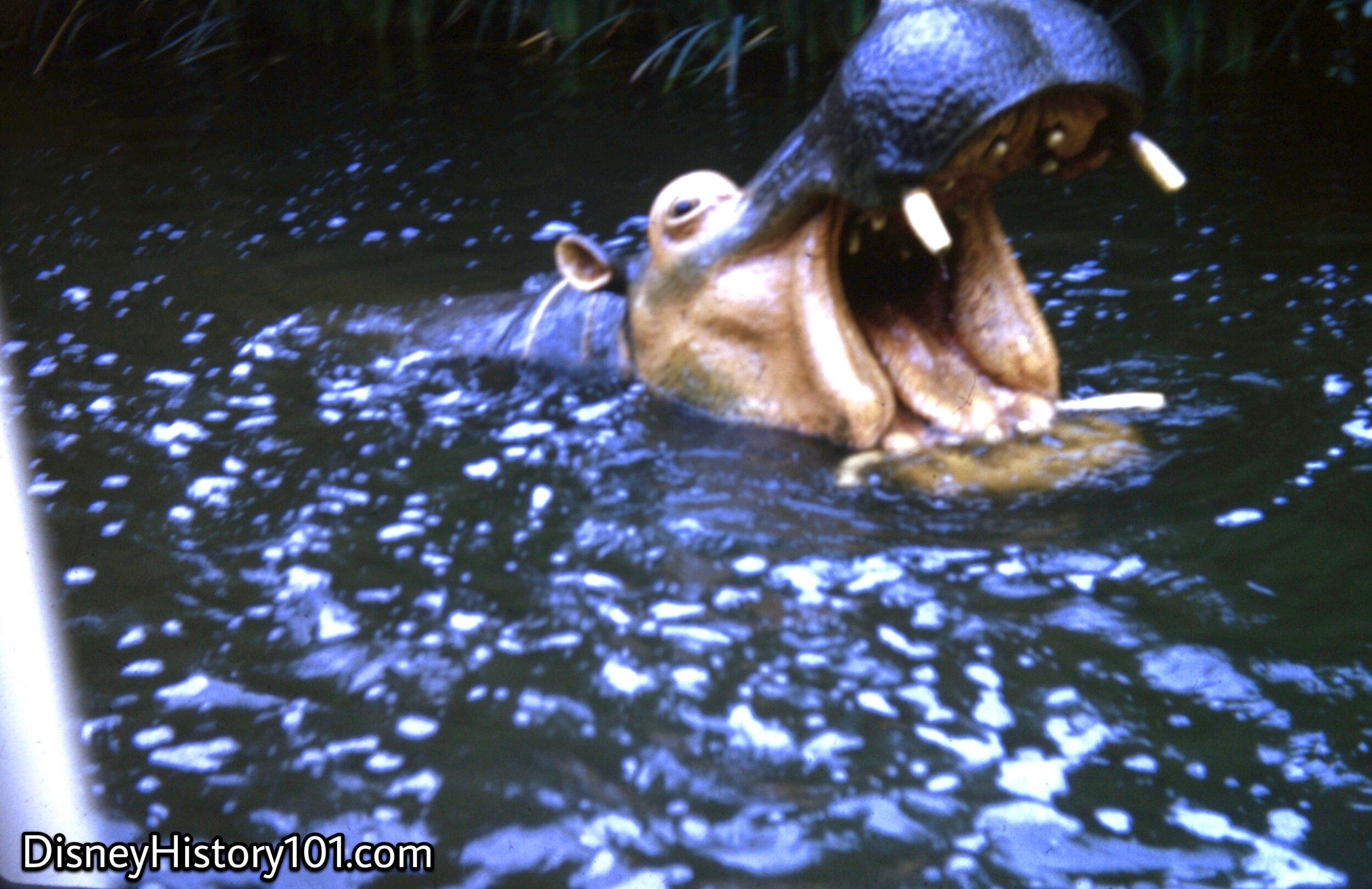
1964
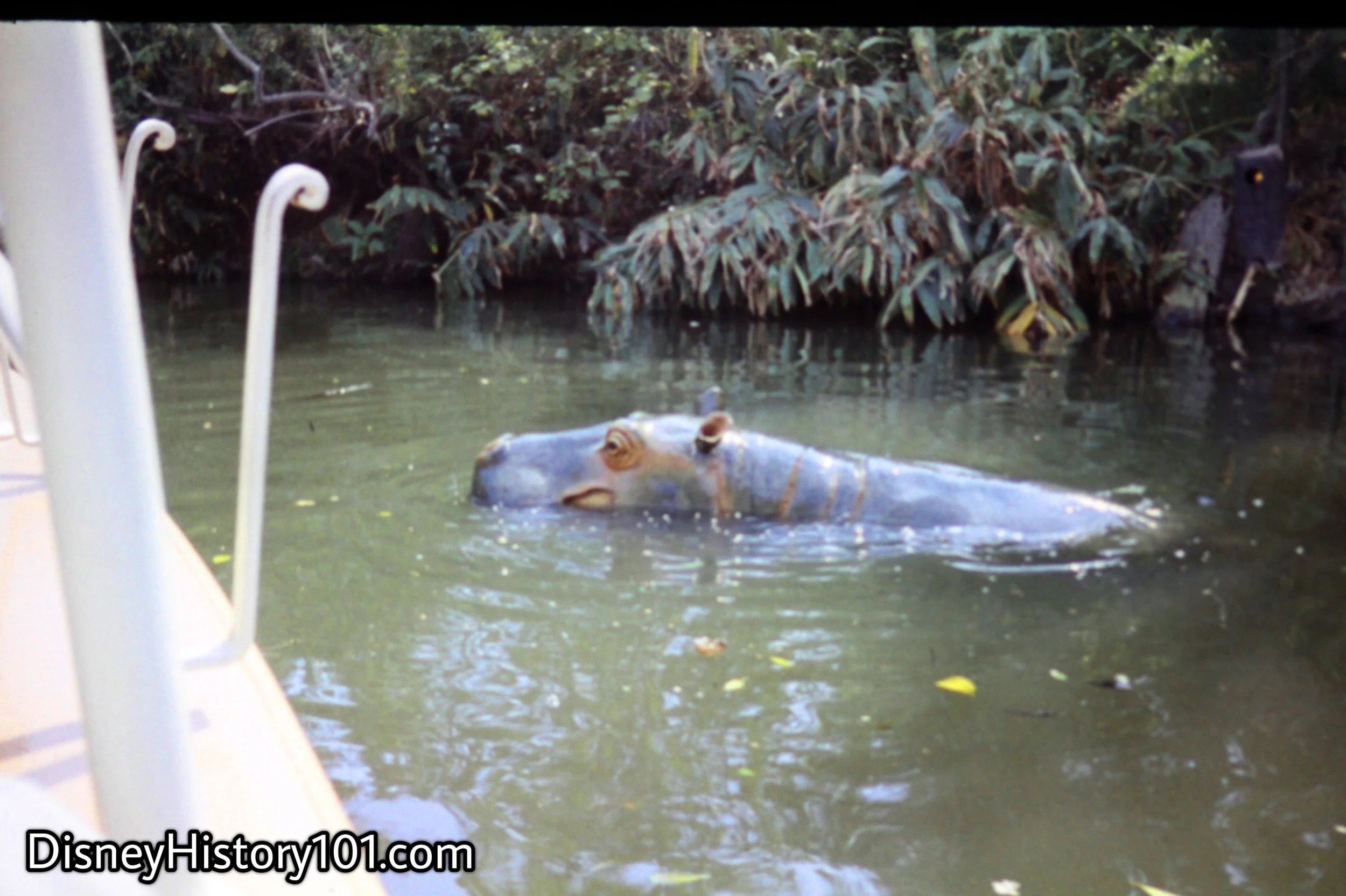
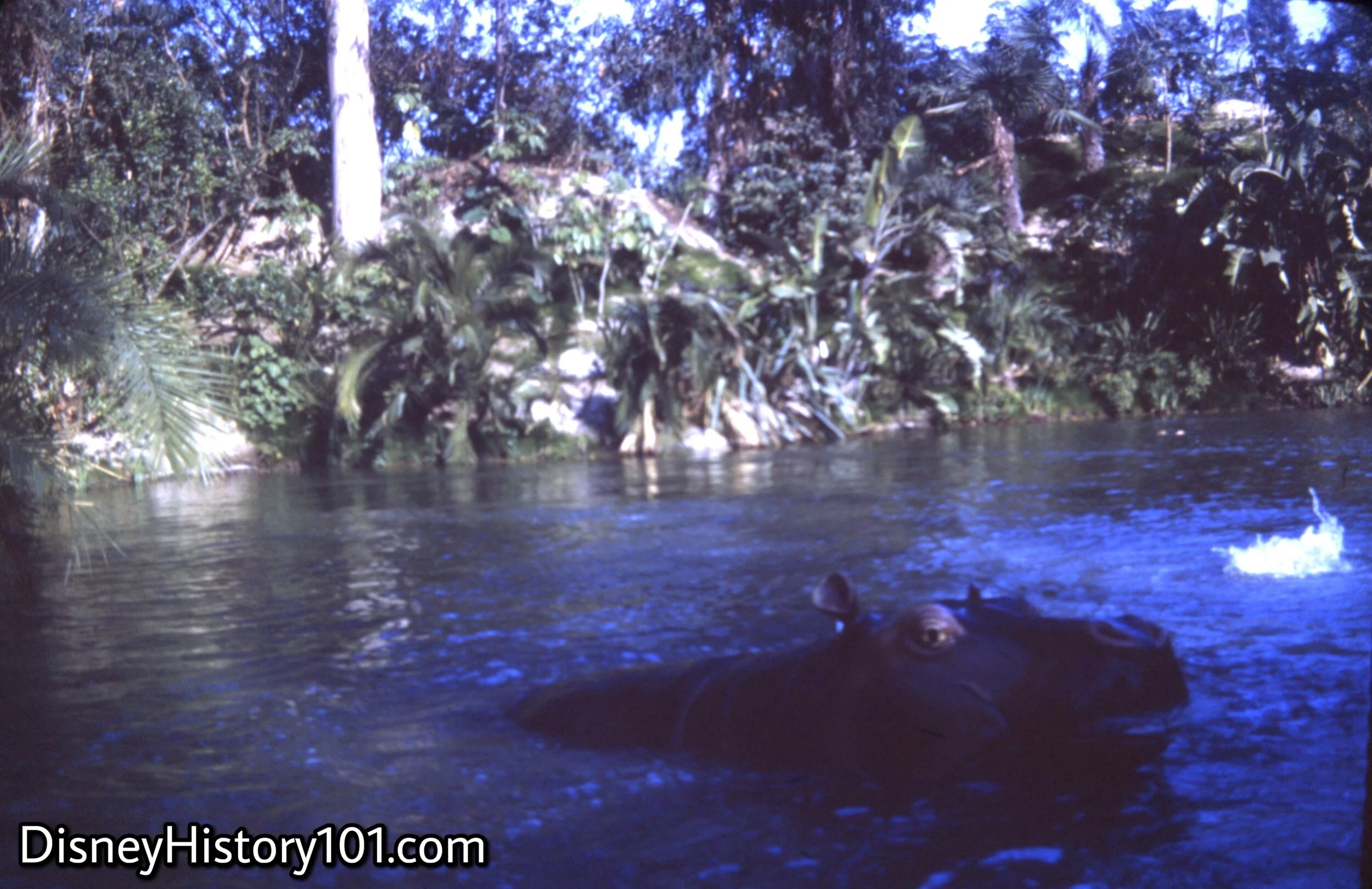
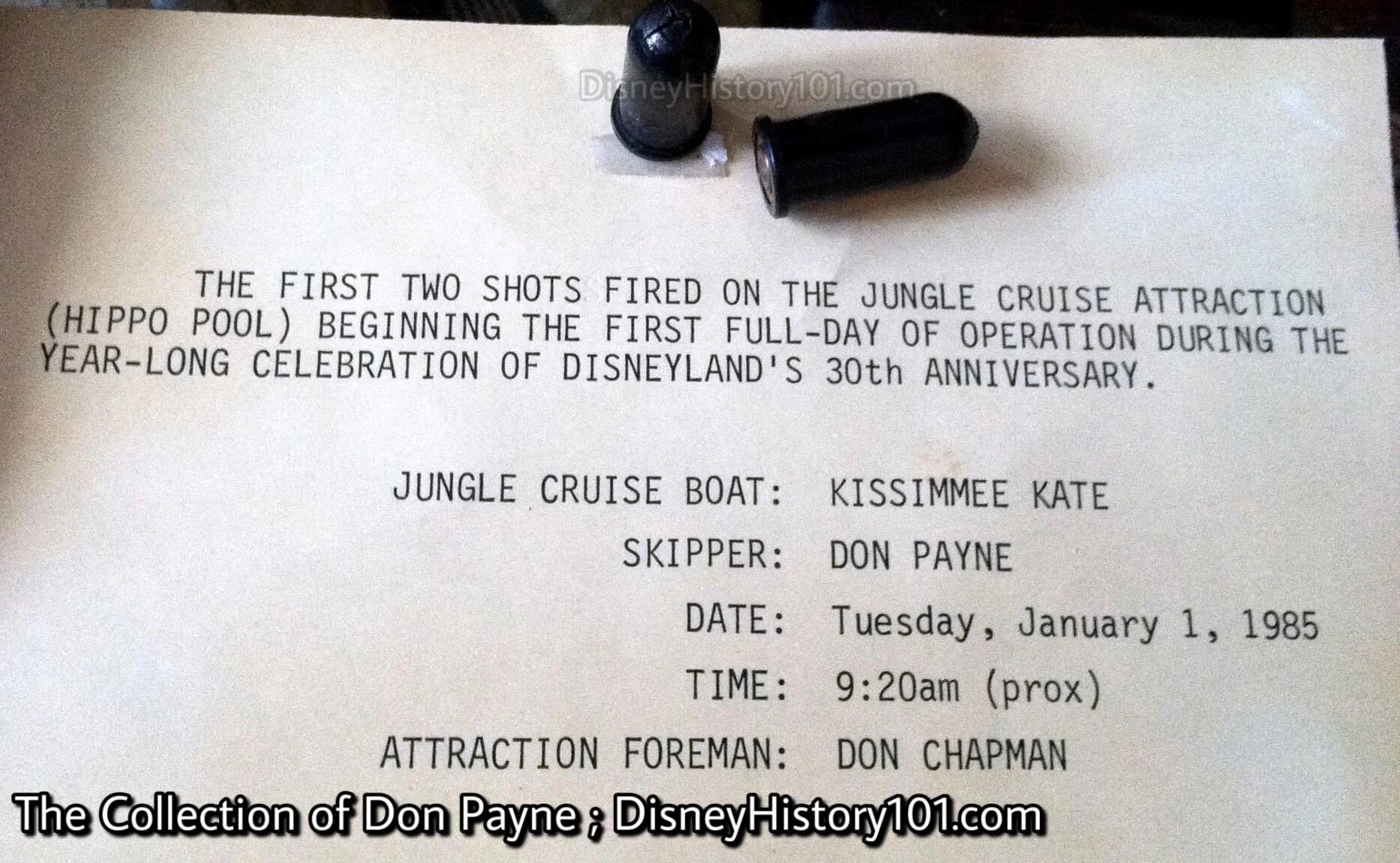
“The First Shots of the Year Fired by Don Payne,” January 1st, 1985
There was much protocol as to how to handle the guns. It was important to store them properly, clean them, carry them in a safe manner, unload them when not in the boat, never leave them in a boat unattended, attach them to a lanyard when on the boat, unload and load them properly, check the chamber before reloading them, firing them properly at the appropriate time and place, and not misuse them.
In the early days of the Jungle River Cruise, the operators used to “save the shells and sell them to salvage,” according to Lee David of Backstage magazine (published Summer, 1965). The publication also shares a tale which occurred one night back then, when night foreman Jack Whittington (who initiated the “six shot, off the rail” and “three shot, motor trouble” code) was working. Jack “tells of an incident about Jack Krause who took a load of guests out and suddenly six shots were heard, then six more shots were fired. The divers panicked, what had happened? He had accidentally knocked the ignition switch off with his light and thus the name Machine-Gun-Krause stuck from then on.”
Later, two types of ammo were utilized - “show ammo” (to ward off the hippos) and “breakdown ammo” (fired in case of emergency “101” situations). Other codes included “three shots” for mechanical problems, and “four shots” for medical or security emergencies. With so many rounds fired, what became of all the shells?
In the early days, “the boys used to save the empty shells and sell them to salvage,” according to Lee David of Disneyland Backstage (Summer, 1965). In later years, it became an honor and tradition to fire (and save) the first shots of the daily Jungle River Cruise voyages. Don Payne was temporarily issued a .38 Smith & Wesson, and was “assigned to do the first, empty-boat test run, on the morning of January 1, 1985.” The Captain of the Kissimmee Kate remembers, “The two-shots, ‘all clear’ signal, I fired, were the first shots of that day... and for that year... fired on the Jungle Cruise. It’s really no big deal. The empty-boat test run was done daily. It’s just a “golden memory” thing for me. I still have those fired cartridges on display in my home.”
”101”
By 1983, if a problem occurred when a boat is away from the dock, the boat operator was to use their pistol to fire shots as outlined by the following signal system:
•Six (6) consecutive shots--boat out of trough or trough is blocked.
•Five (5) consecutive shots--fire (code 904).
•Four (4) consecutive shots--medical emergency.
•Three (3) consecutive shots--mechanical breakdown.
•Two (2) consecutive shots--all clear during normal operation.
•One (1) shot--all clear during a "101" situation.
•If three (3) or six (6) consecutive shots are heard, proceed slowly (with caution) toward the dock. NEVER stop less than a boat length away from another boat in the jungle.
•If four (4) or five (5) consecutive shots are heard, proceed at rapid but safe speed to the dock in order to clear the river.
At no time are gunshots to be fired while a boat is located in the Shrine. If a boat breaks down inside the Shrine, turn on the boat spotlights and wait until the boat behind enters the Shrine. The skipper on the boat behind will back the boat outside the Shrine and fire three (3) breakdown shots.
A breakdown has occurred any time one of the following situations exists:
•Fire.
•Animation failure of one entire scene (at supervision's discretion).
•A boat storage switchgate on the main line is jammed in the storage position, preventing boats from entering the dock area from the jungle.
•A boat is disabled on the river (away from the dock).
•Loss of power to the dock lighting during a nighttime operation.
•Low or high water level (more than two [2] inches above or below normal)
•Inclement weather resulting in:
•A complete blockage of the unload area with guests refusing to leave.
•The guests refusing to board at the load dock.
•A supervisor determines the ride must be closed.

“Next is the famous Nile - the longest river in the world. Uh, oh. Up on that bank - a big, Bull Elephant. The enormous ears and that sloping forehead mark the African Bull Elephant - one of the most feared animals of the jungle! Don’t get excited now, big boy. We’re just passing through.”
Coming into view suddenly are the enormous ears and large sloping forehead of the famed African bull elephant, one of the most feared animals of the jungle. His mate stands on the opposite side of the bank. According to c.1955 narration (heard in “A Trip Through Adventureland”, an episode of “Walt Disney’s Disneyland”) we are to possibly understand the reason for where they stand (on opposing sides of the river), “That’s a lonesome lady elephant calling to her mate… and from across the river, her ‘lord’ and ‘master’…look at the size of those ears! That’s the hallmark of the African Elephant.”
African Bull Elephants have always been a threatening presence along the shores, since 1955. According to the account of Mrs. Ray Campbell (a resident of 900 S. Walnut, in 1956), their calls could be heard for some distance. Owing to this, “their trumpet… [was] shut off every night at 10, when Disneyland’s master switch… [was] thrown.” [Long Beach Independent, September 21st, 1956].
However, around 1963, the African Bull Elephants began approaching passing ships in different locations in the region.
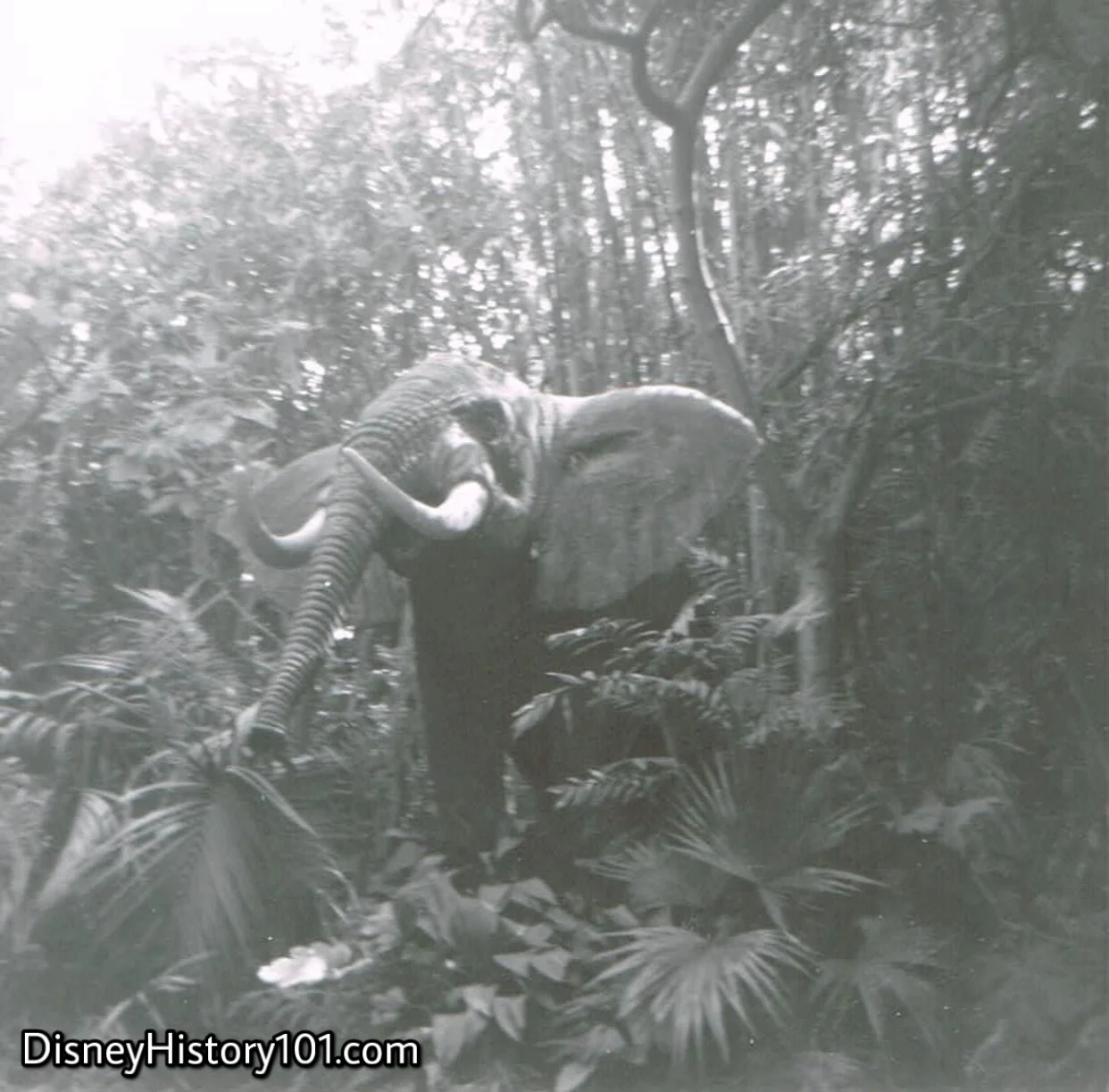
African Bull Elephant
“Jumbo, the elephant, trumpets a welcome to passengers aboard Adventureland’s river boats.”
-A Complete Guide to Disneyland, 1956
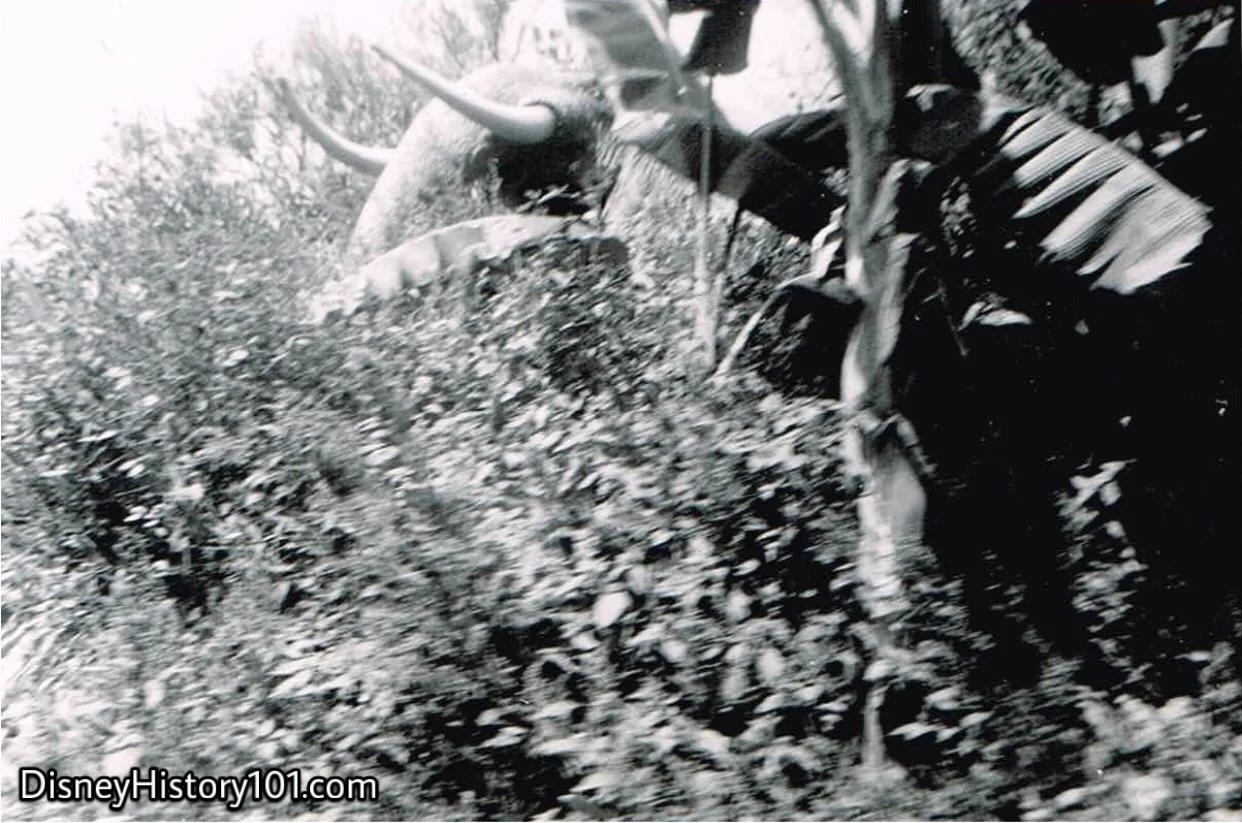
African Bull Elephant, (September, 1955)
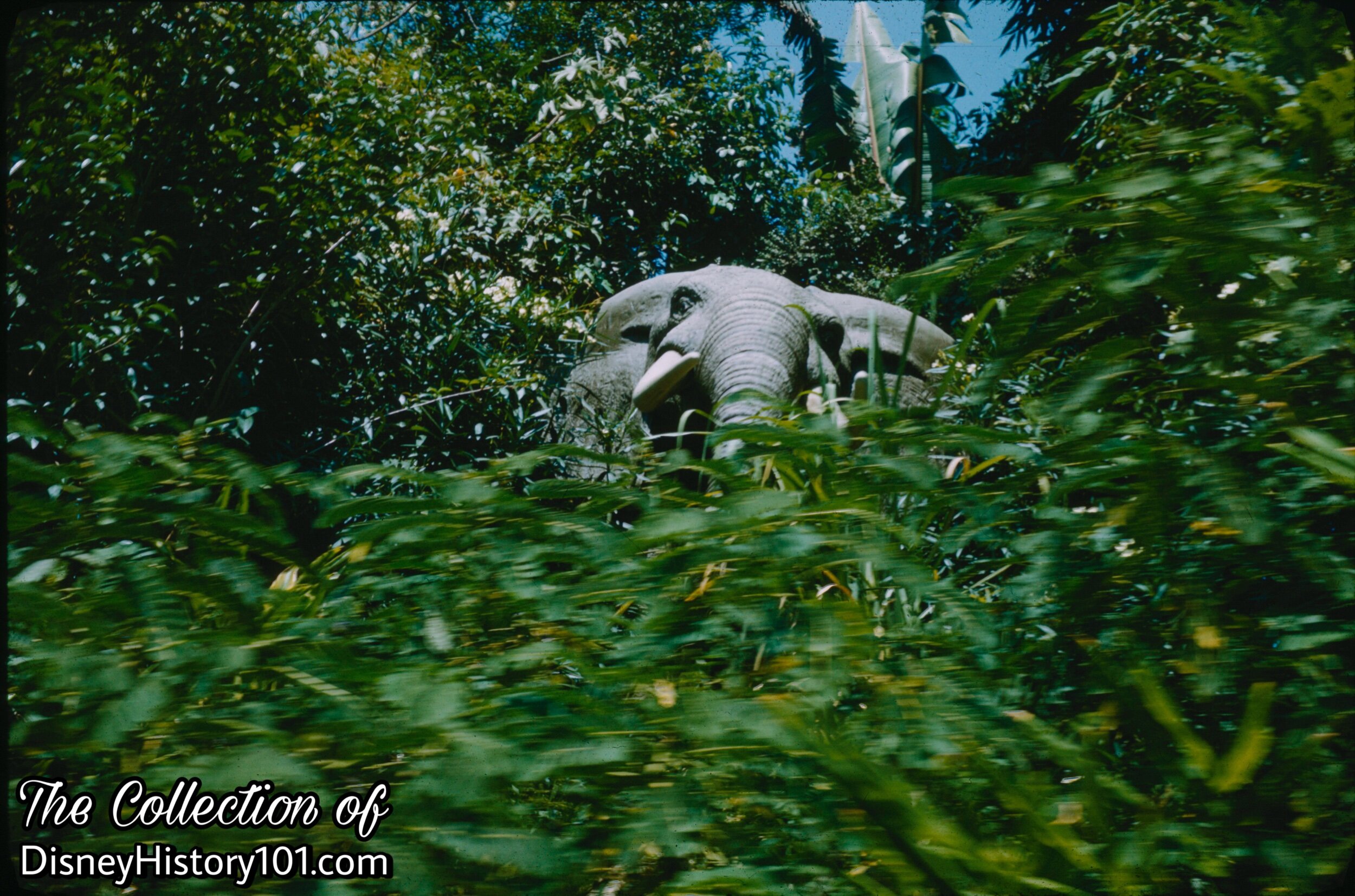
African Bull Elephant
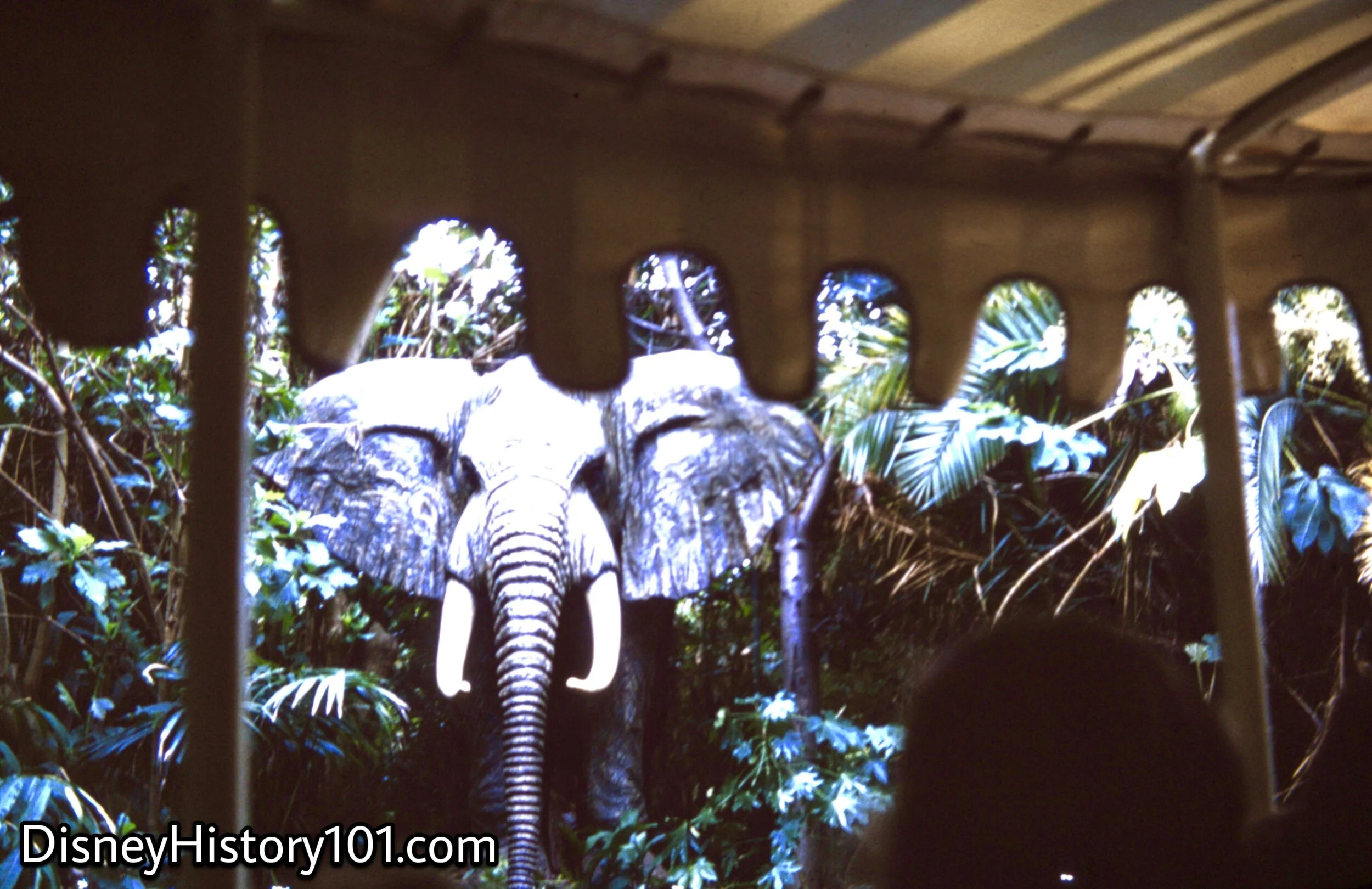
African Bull Elephant, (1964)
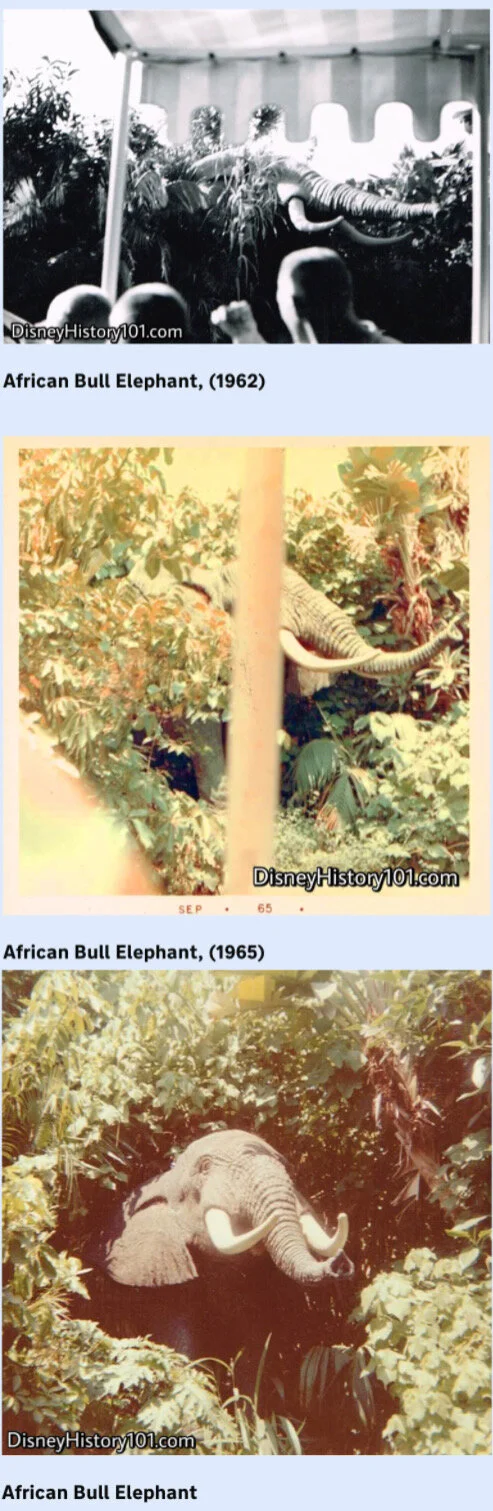
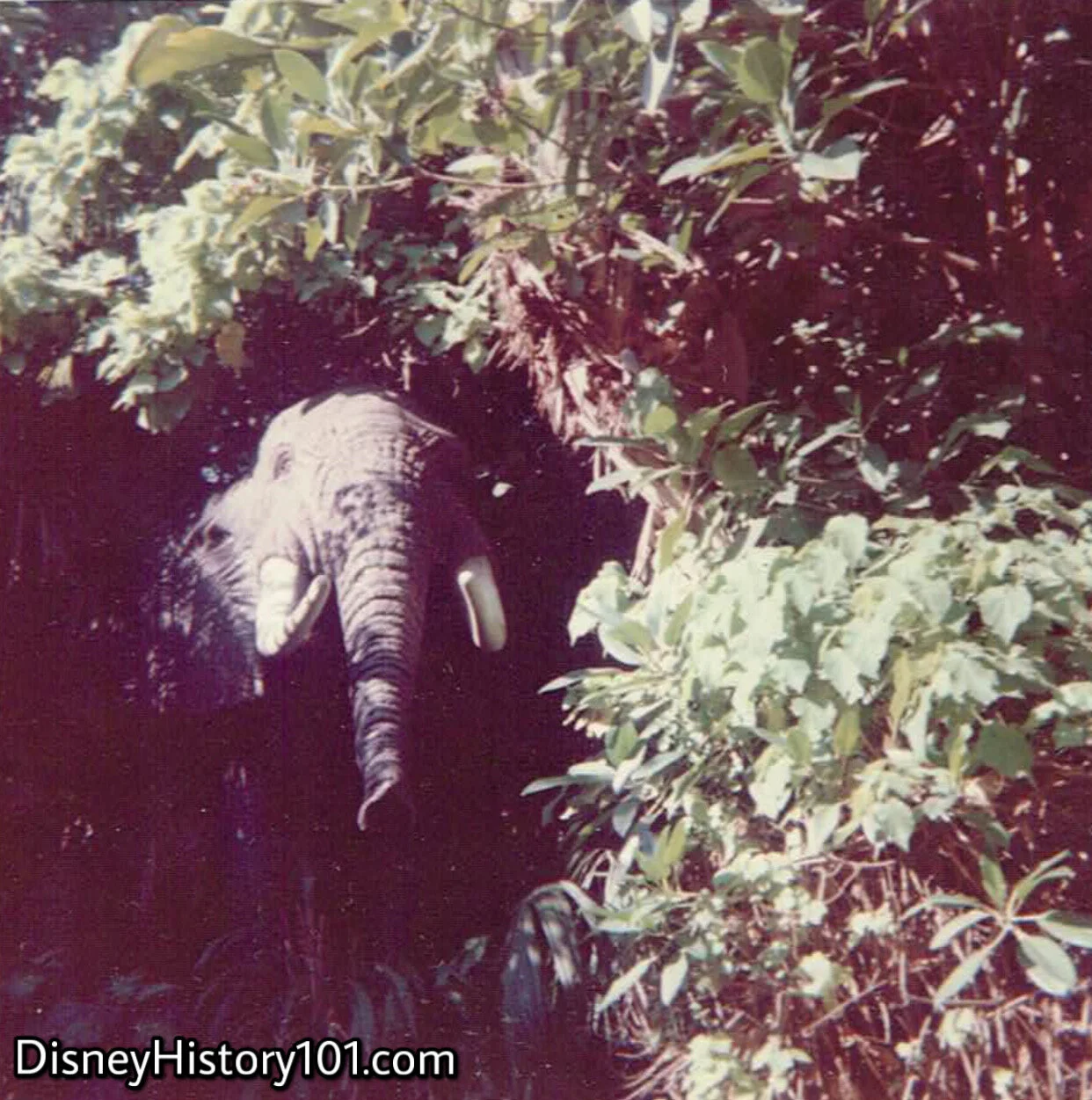
African Bull Elephant, (1969)
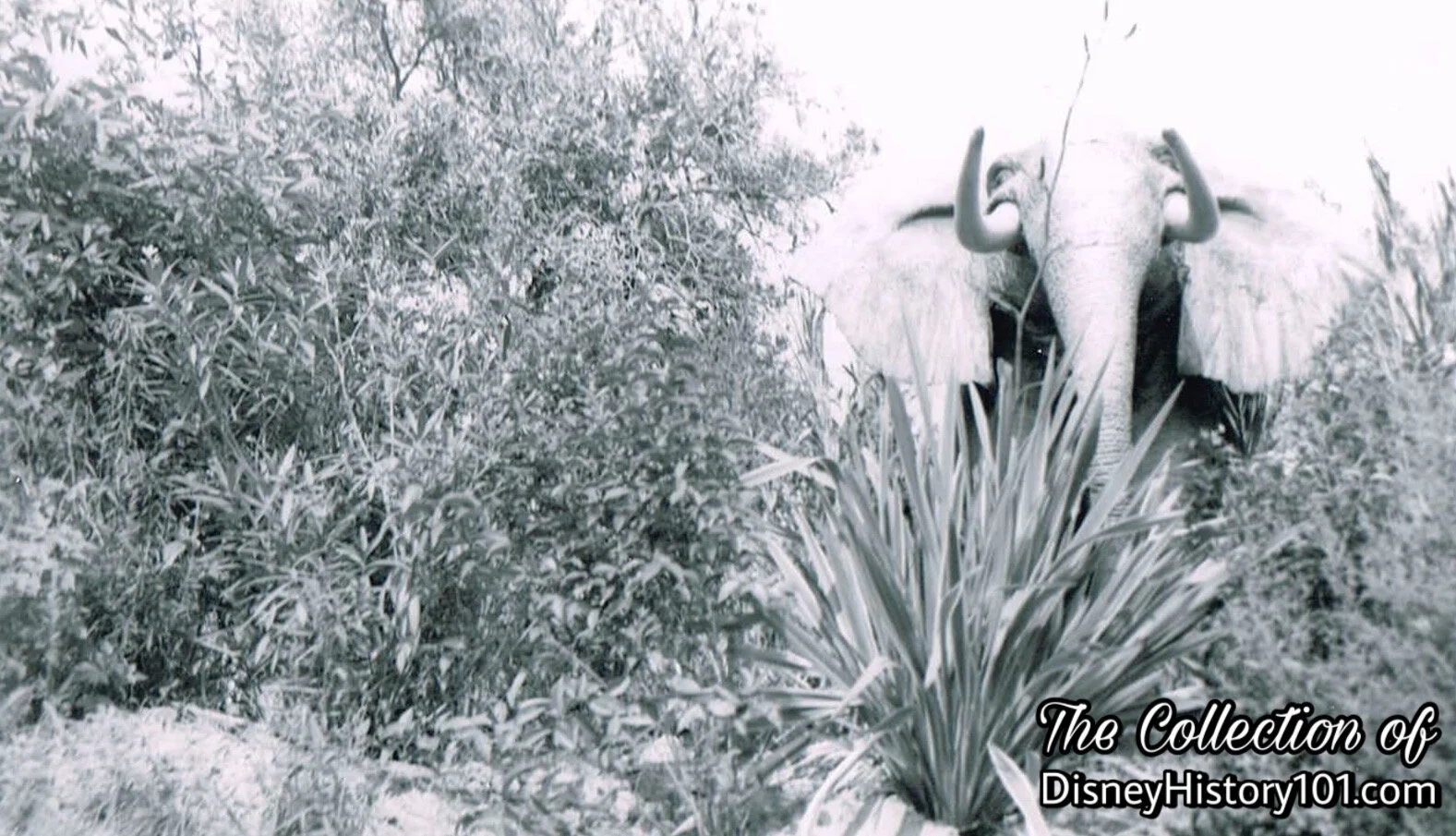
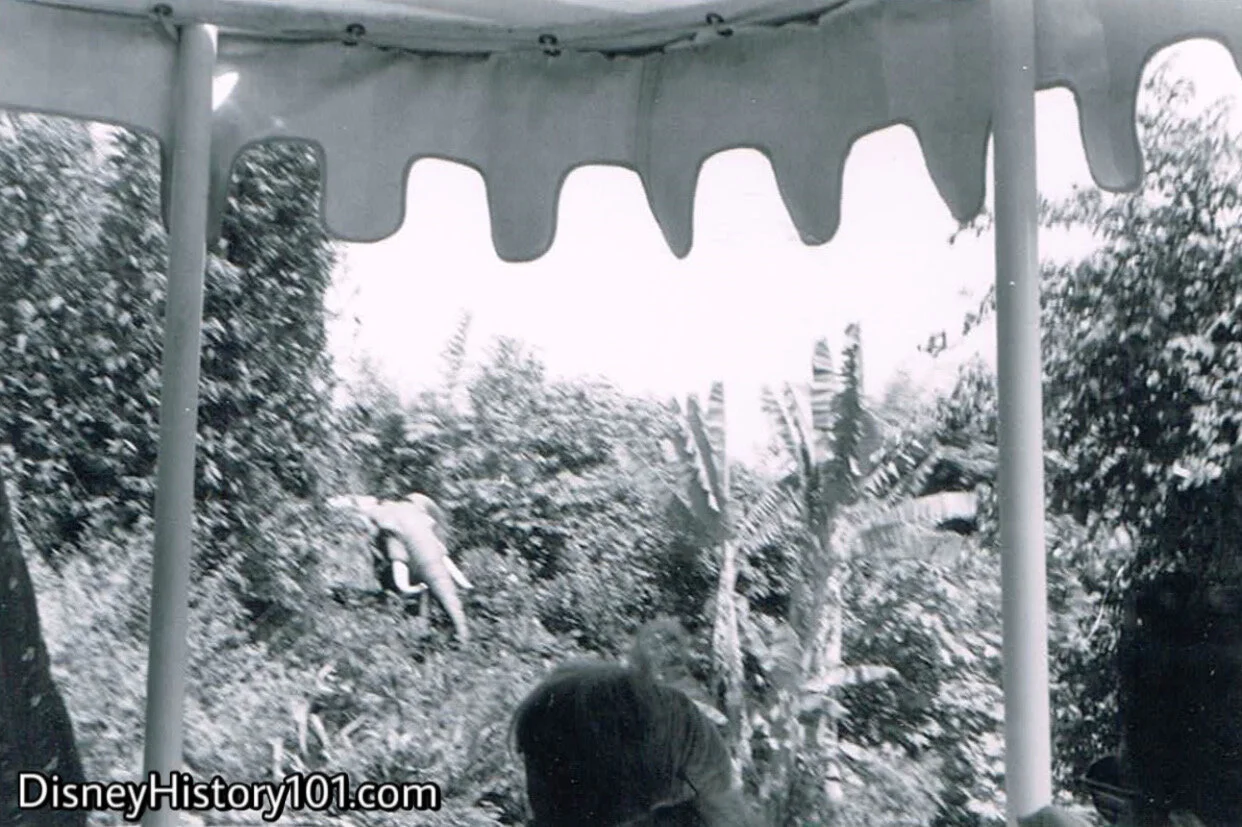
Rhinoceros Family, (September, 1955)
“This tall grass means ‘Big Game’ country. We must be on the ‘look out’!” The wild animals come down to the river to drink. There’s a family of Rhinos - a ‘mama’ rhino, and two babies…
Not ‘mama’. She’s not afraid - she must weigh over two tons, and believe me, she knows how to throw her weight around.”
From 1955 to 1963, this family of Rhinos have threatened to charge in defense of their young. They disappeared from ‘Big Game Country’ in 1963, never to be seen in the wild of Adventureland again!
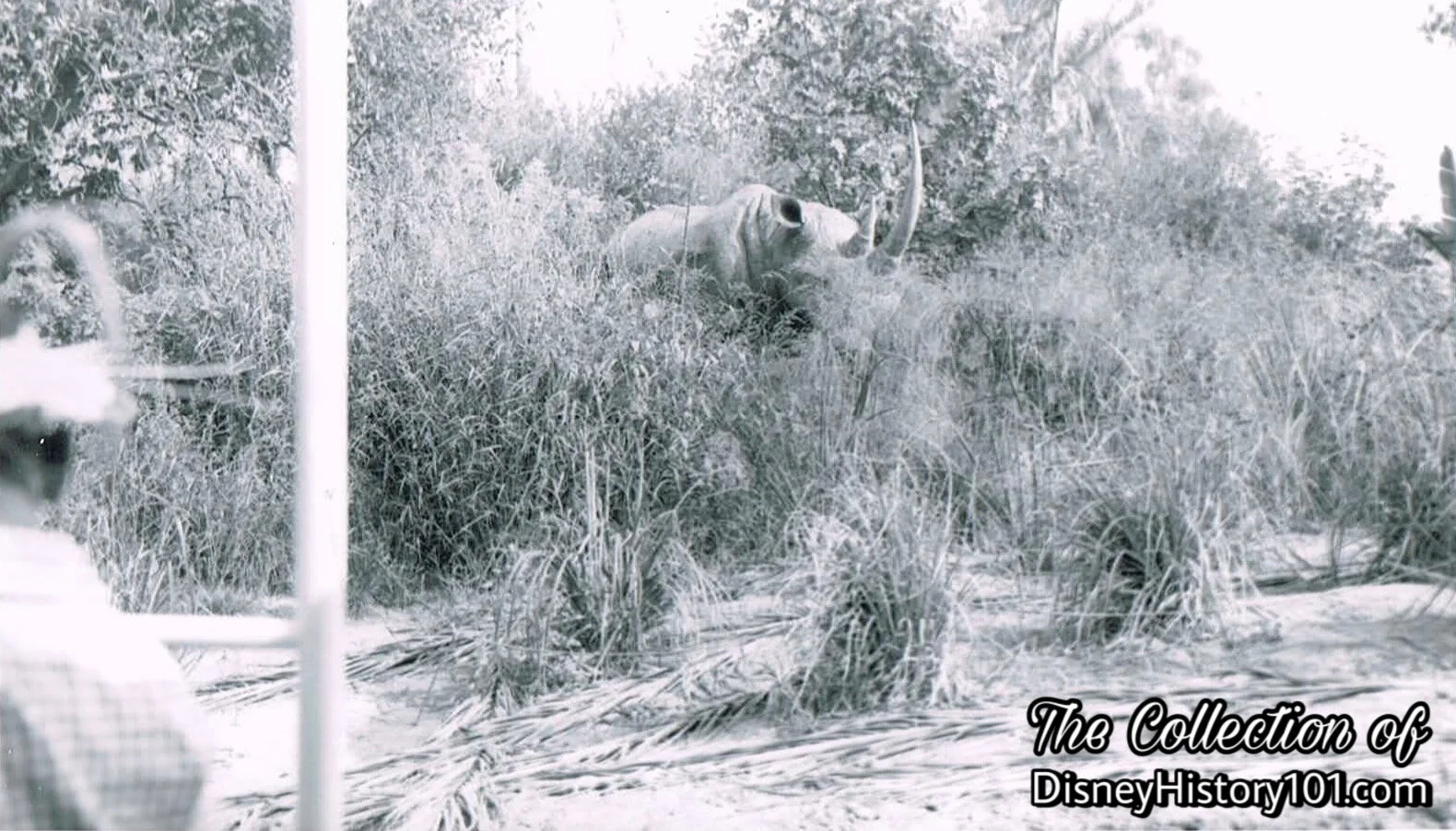
A true-life, full-grown rhinoceros weights 1-2 tons. Here, a rhinoceros charges the jungle Explorer’s boat.
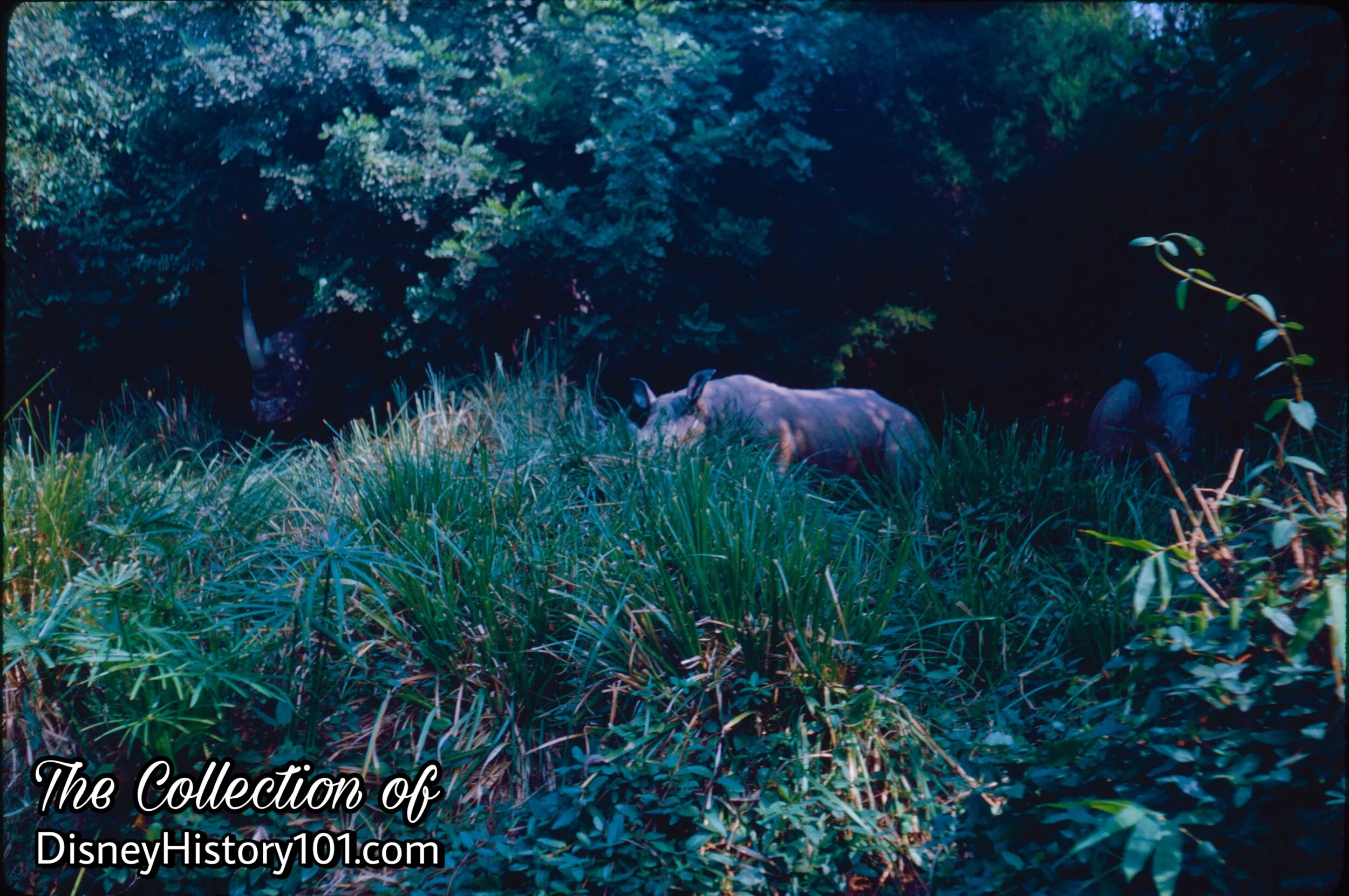
Rhinoceros Family, (1961)
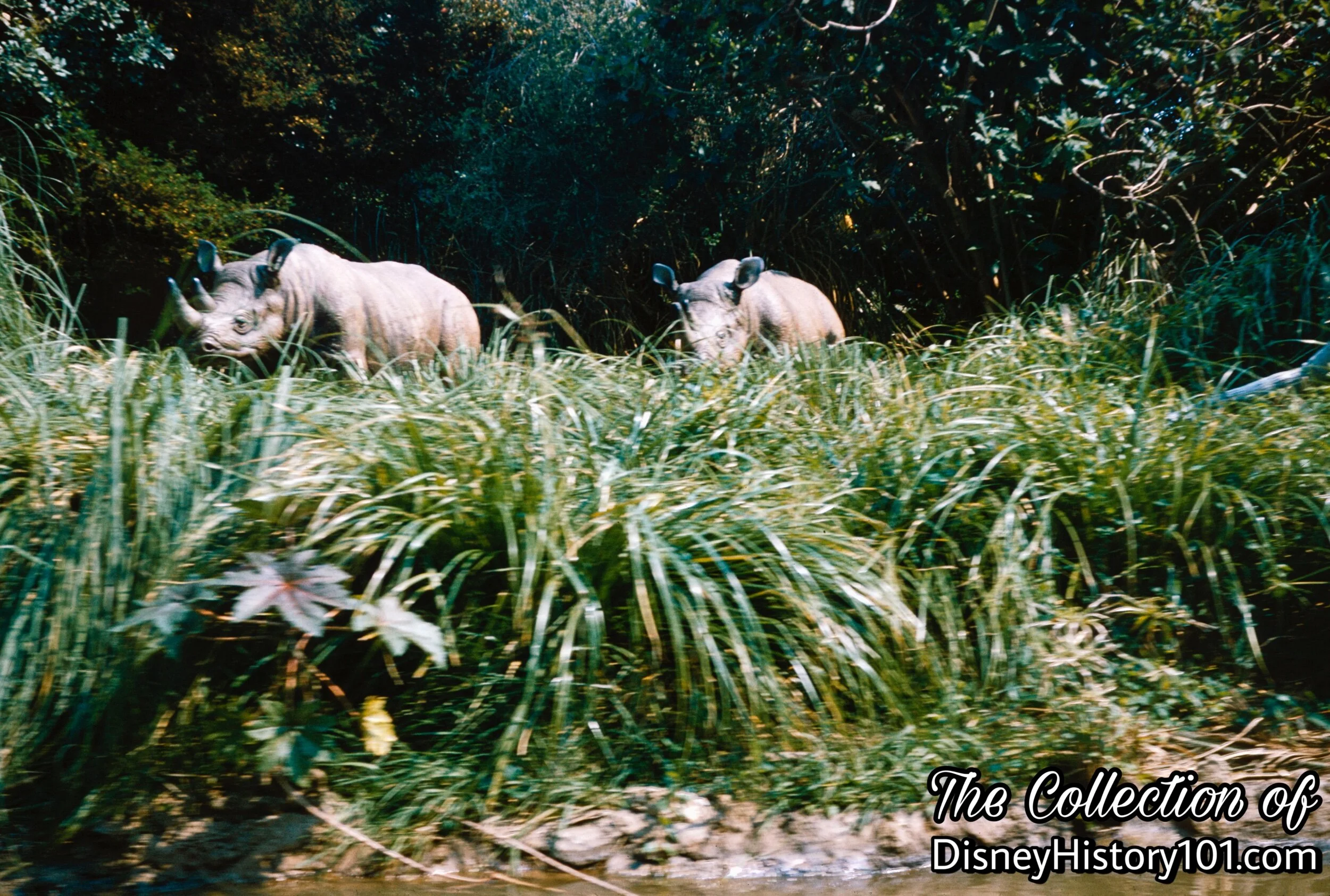
Rhinoceros Family, (1960)
This tall grass means ‘Big Game Country’. We must be on the lookout! The wild animals come down to the river to drink. There’s a family of Rhinos. A mama rhino and two babies. I think we frightened the young one, but not mama. She’s not afraid. She must weigh over two tons, and (believe me) she knows how to throw her weight around.
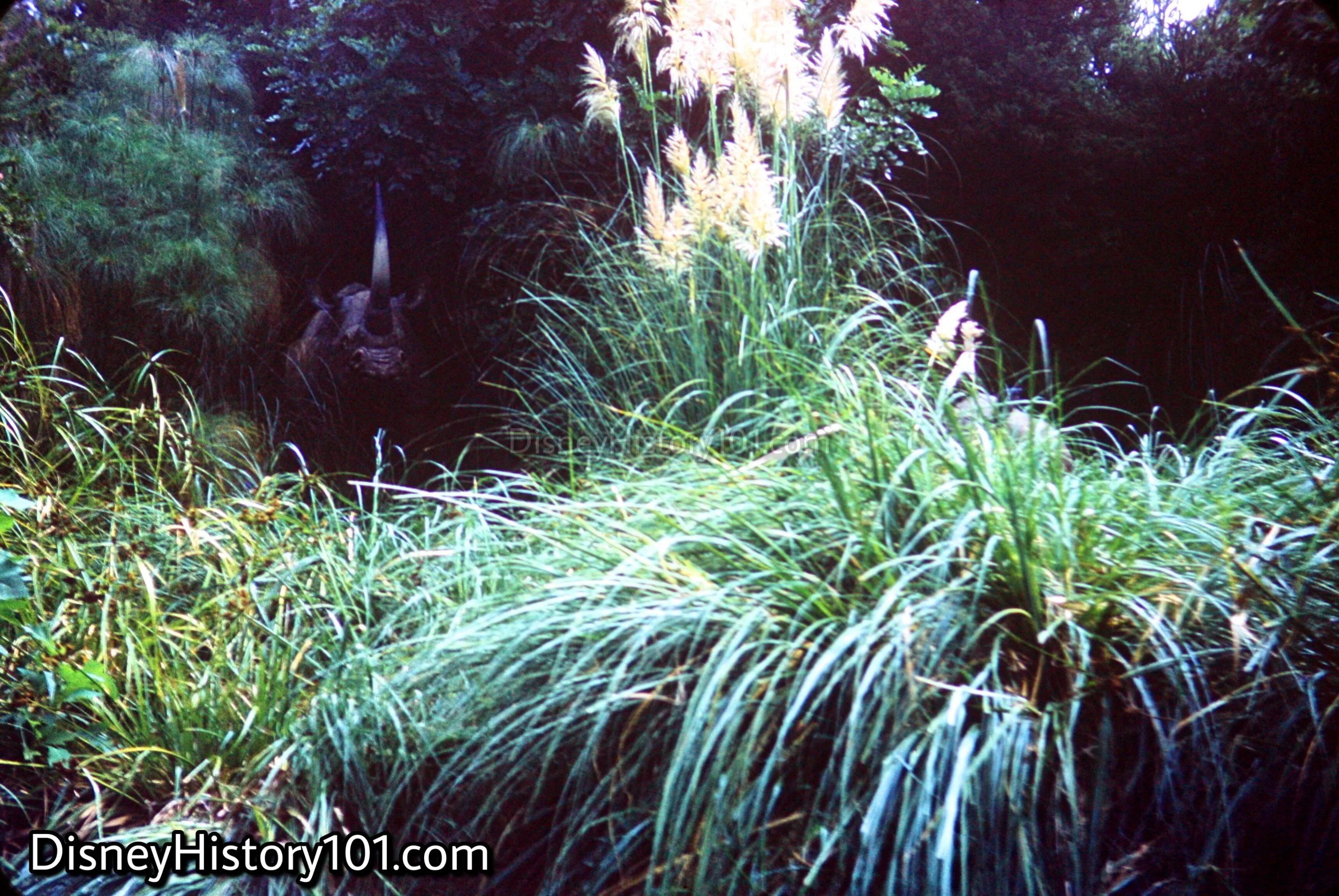
Rhinoceros Family, (August, 1960)
Rhinoceros Family
Rhinoceros Family, (1969)
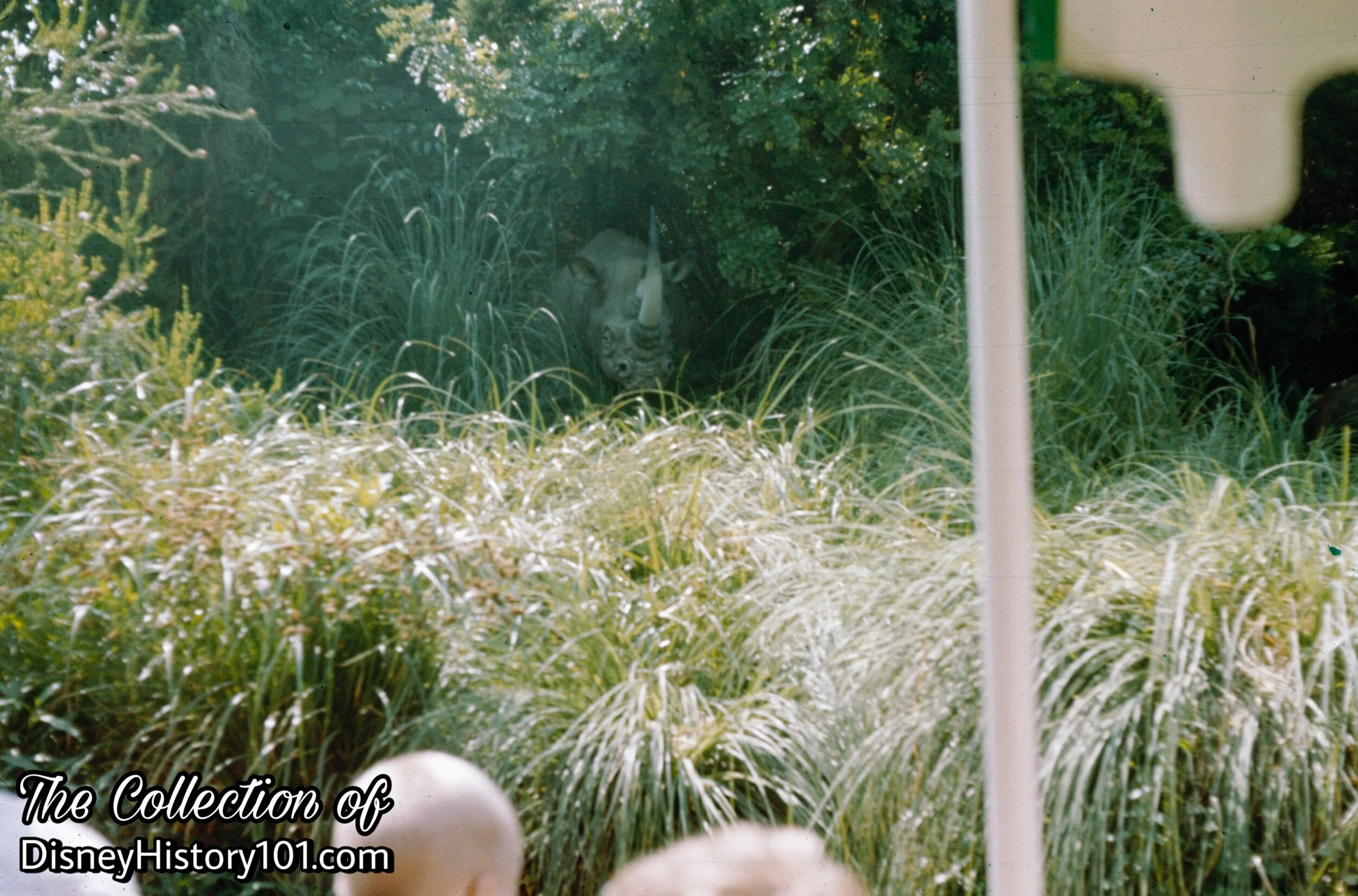
Rhinoceros Family, (1961)
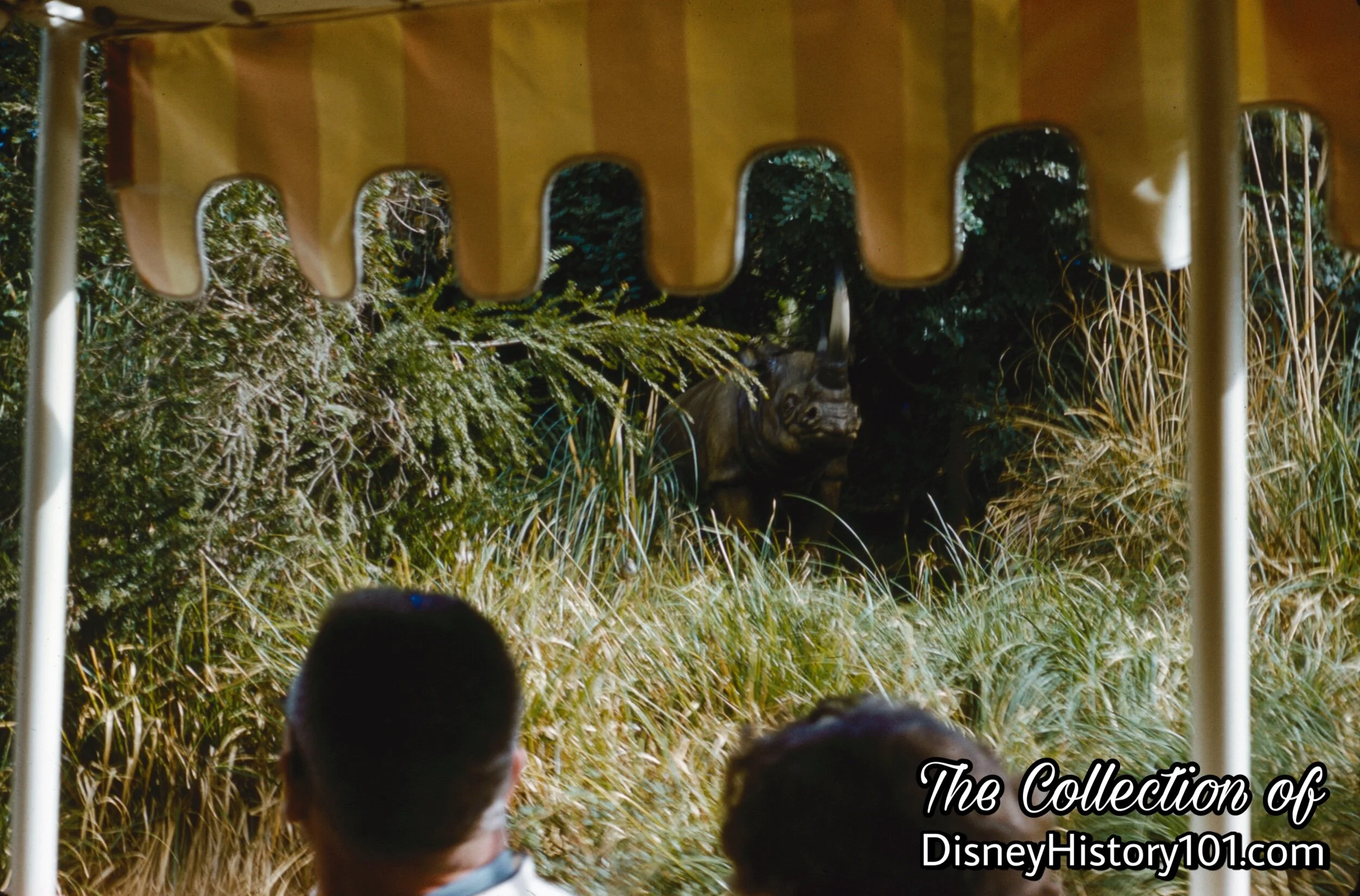
Rhinoceros Family

Since 1962, this playful herd of more than a dozen Indian Elephants - “big ones and little squirts” - have used this Elephant Bathing Pool to cool themselves. The natives of the jungle say that whole herds of playful elephants.
“Arnold Rubio, a well-known painter employed as a pictorial artist by Disneyland’s staff shop (where life-like finishing touches are put on all Disney animations before they are used in the Park) just about turned in his brushes recently. It seems that Rubio had just completed a masterful painting job on one of the elephants for the Jungle Cruise in Adventureland. It was the shiniest, most sparkling elephant ever seen. Floyd Humeston, the taxidermist, approached the finished product and top Rubio’s amazement tossed a bucket of dirt all over the new paint job … because as Humeston says : ‘Who ever heard of a shiny, sparkling elephant”, according to Vacationland (Summer, 1960).
“SACRED BATHING POOL OF THE ELEPHANTS”
During June of 1962, “The Enchanted Bathing Pool of Elephants” appeared along the Rivers of the World.
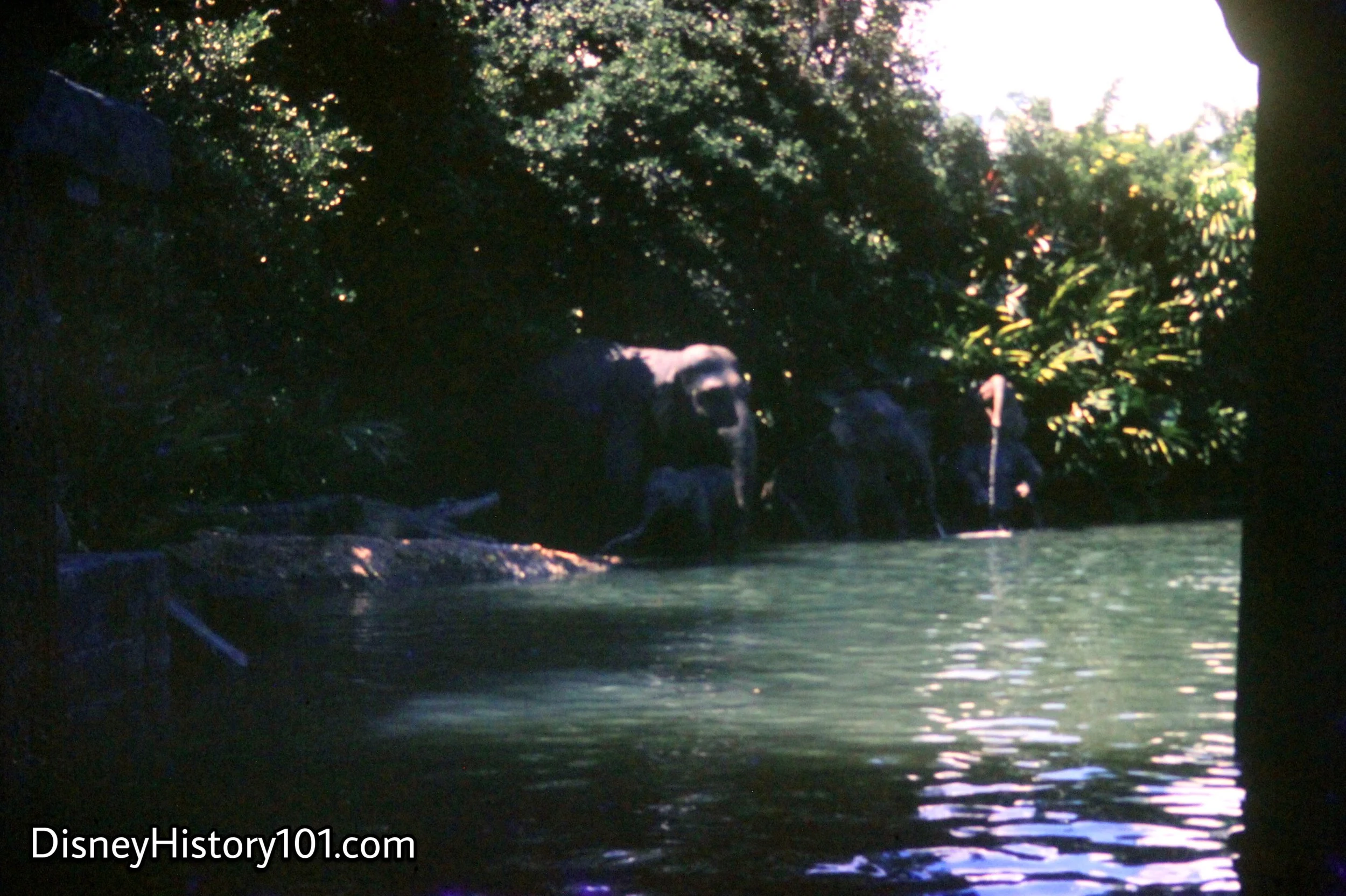
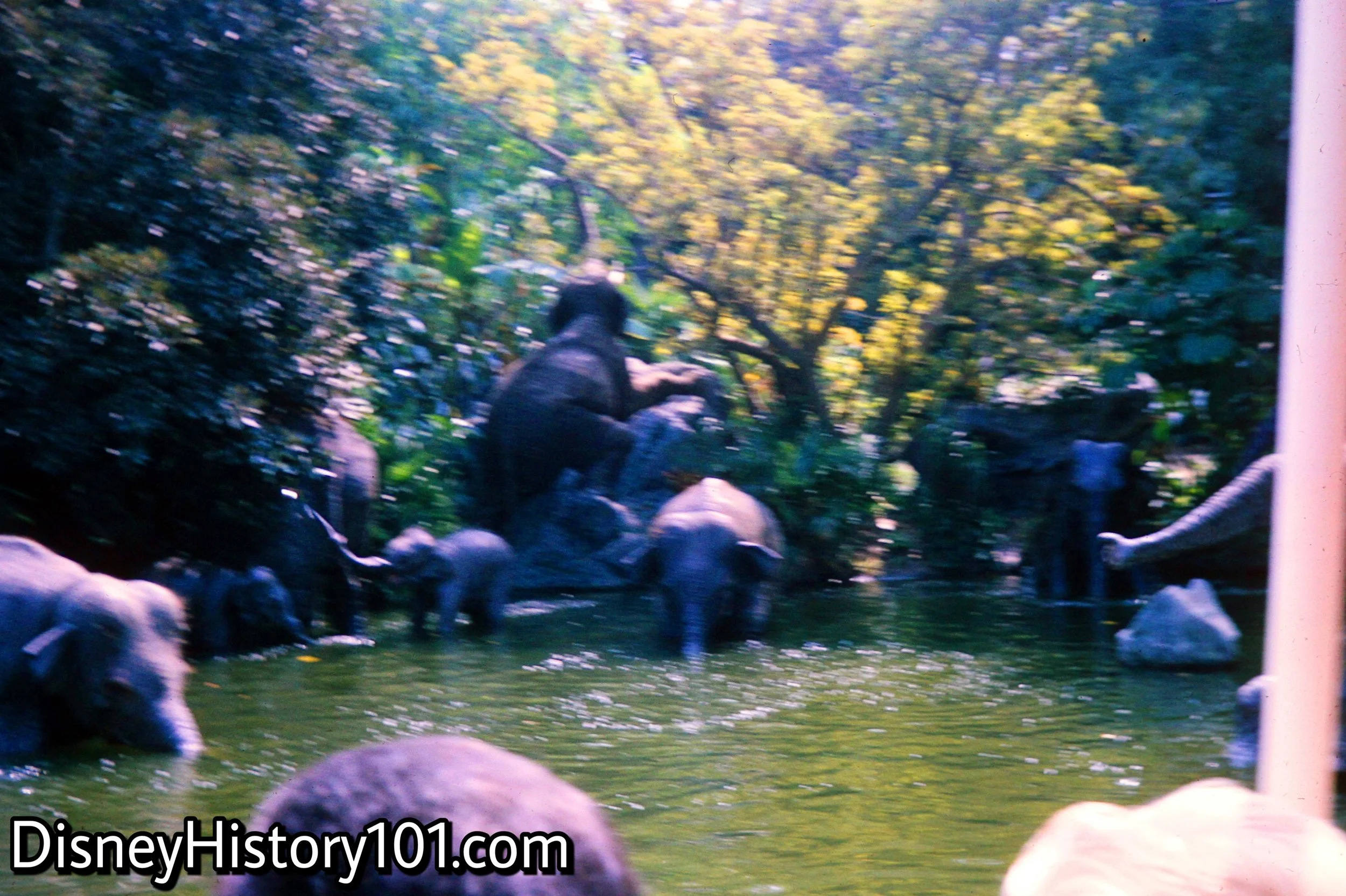
1964
The natives say that whole herds of Indian elephants migrate here to bathe.
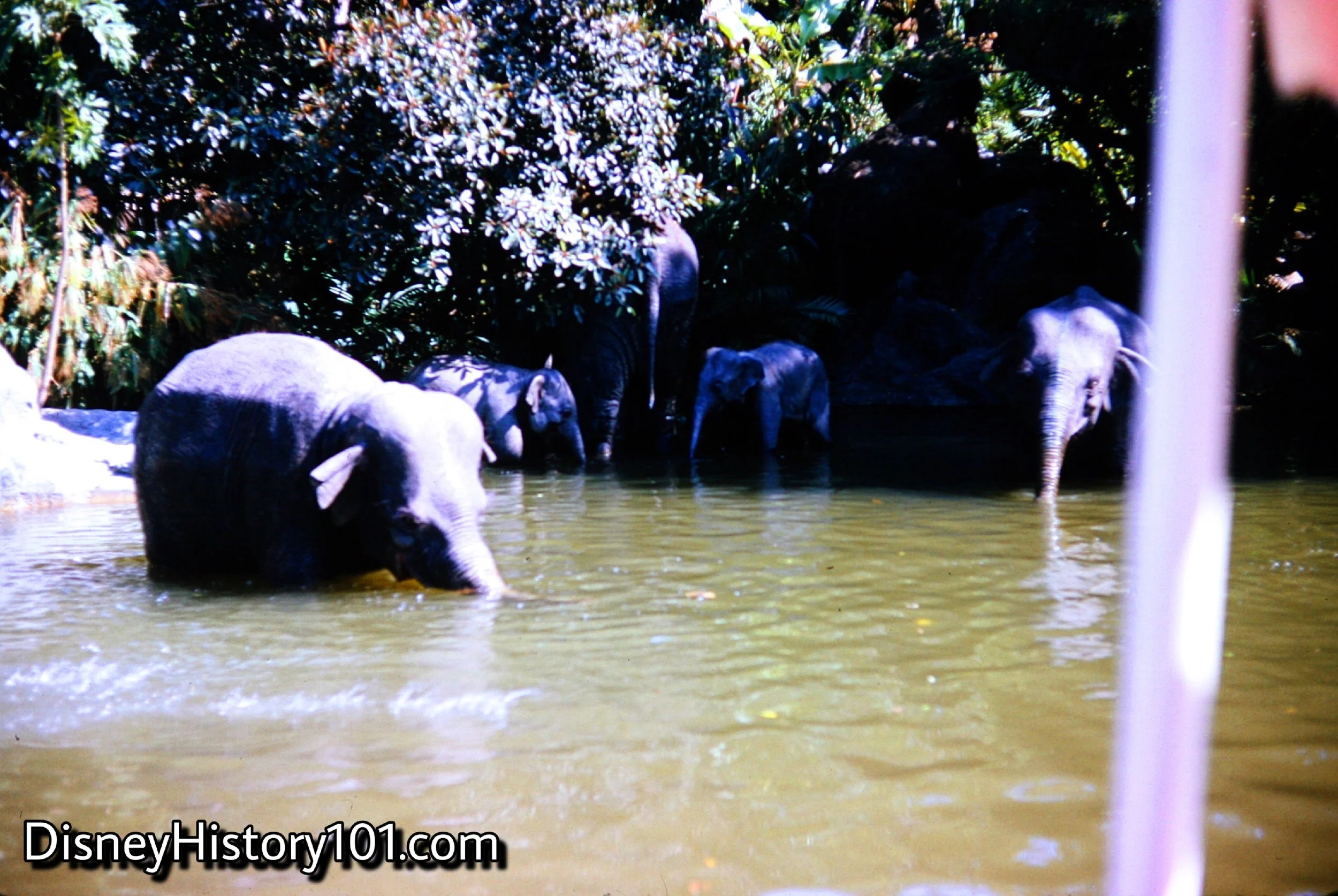
1965, August
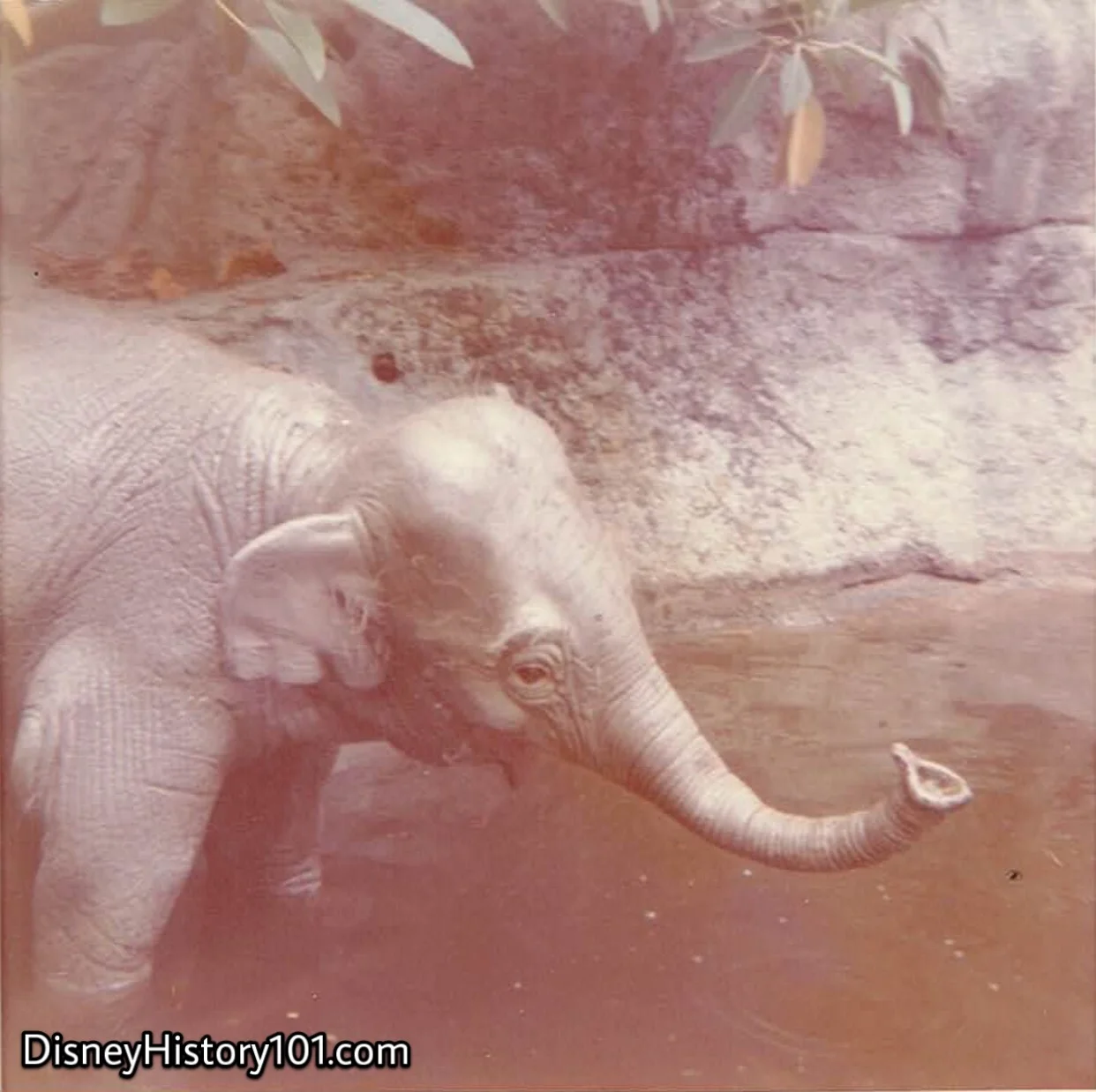
1972
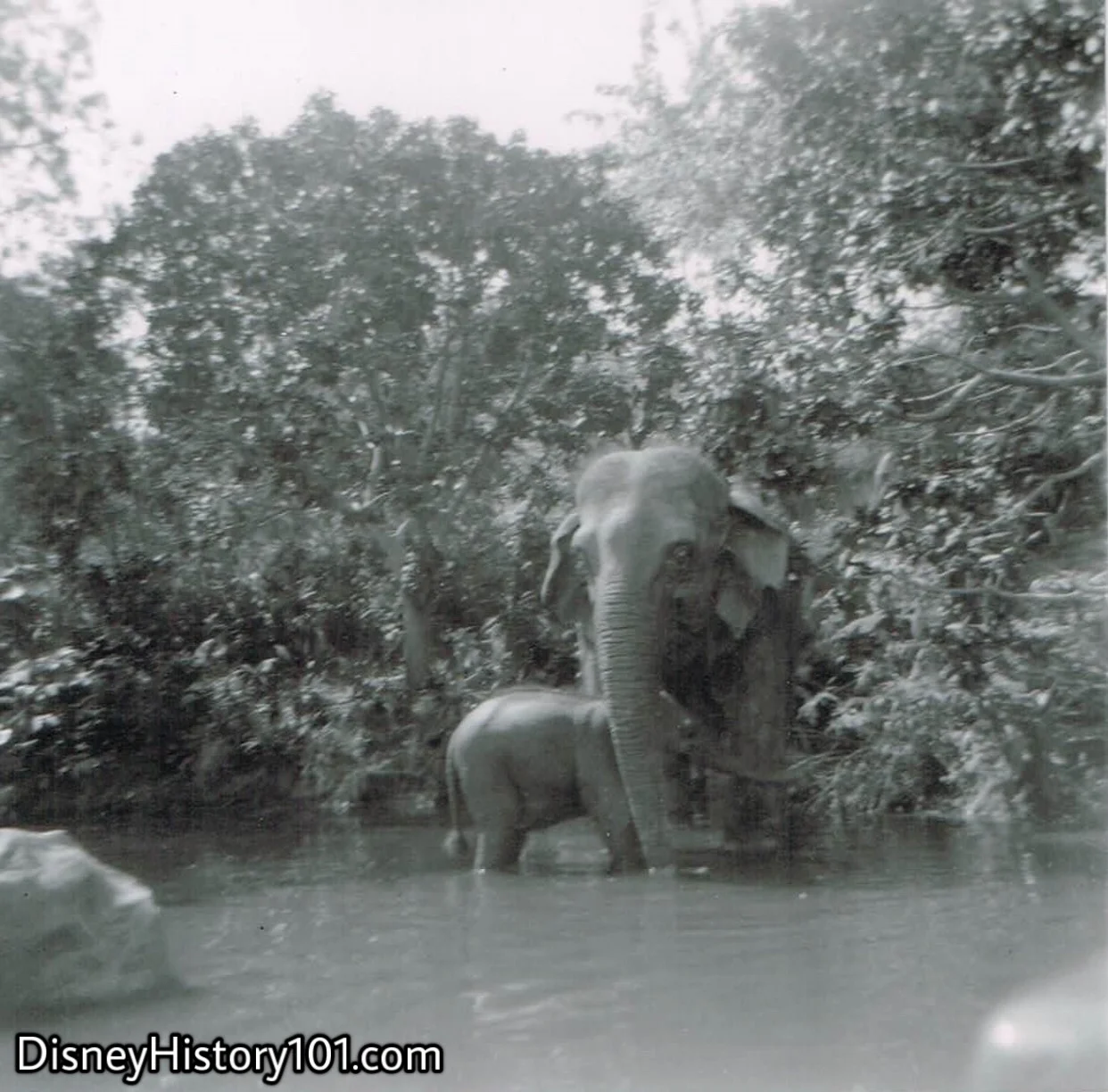
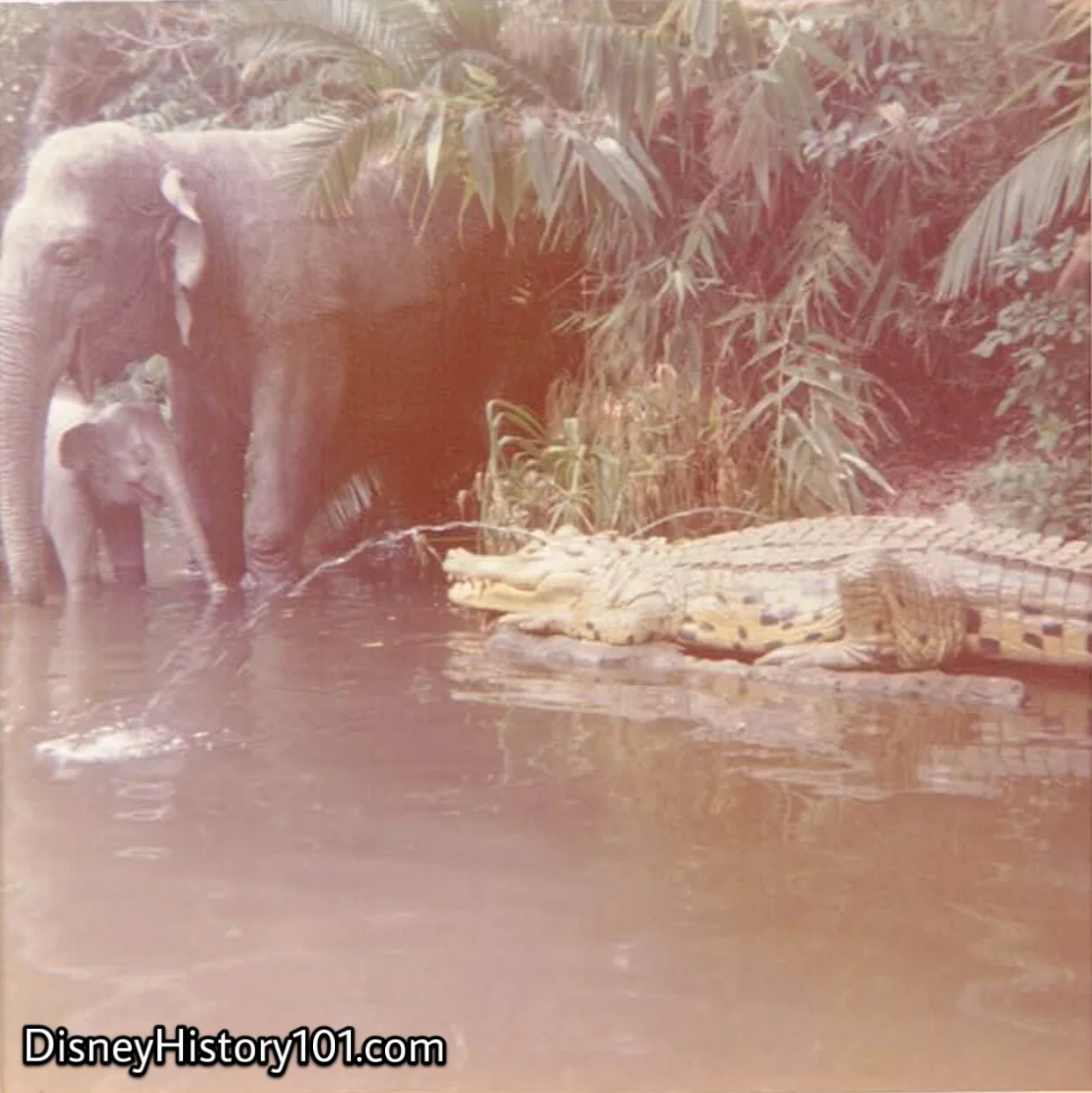
1972
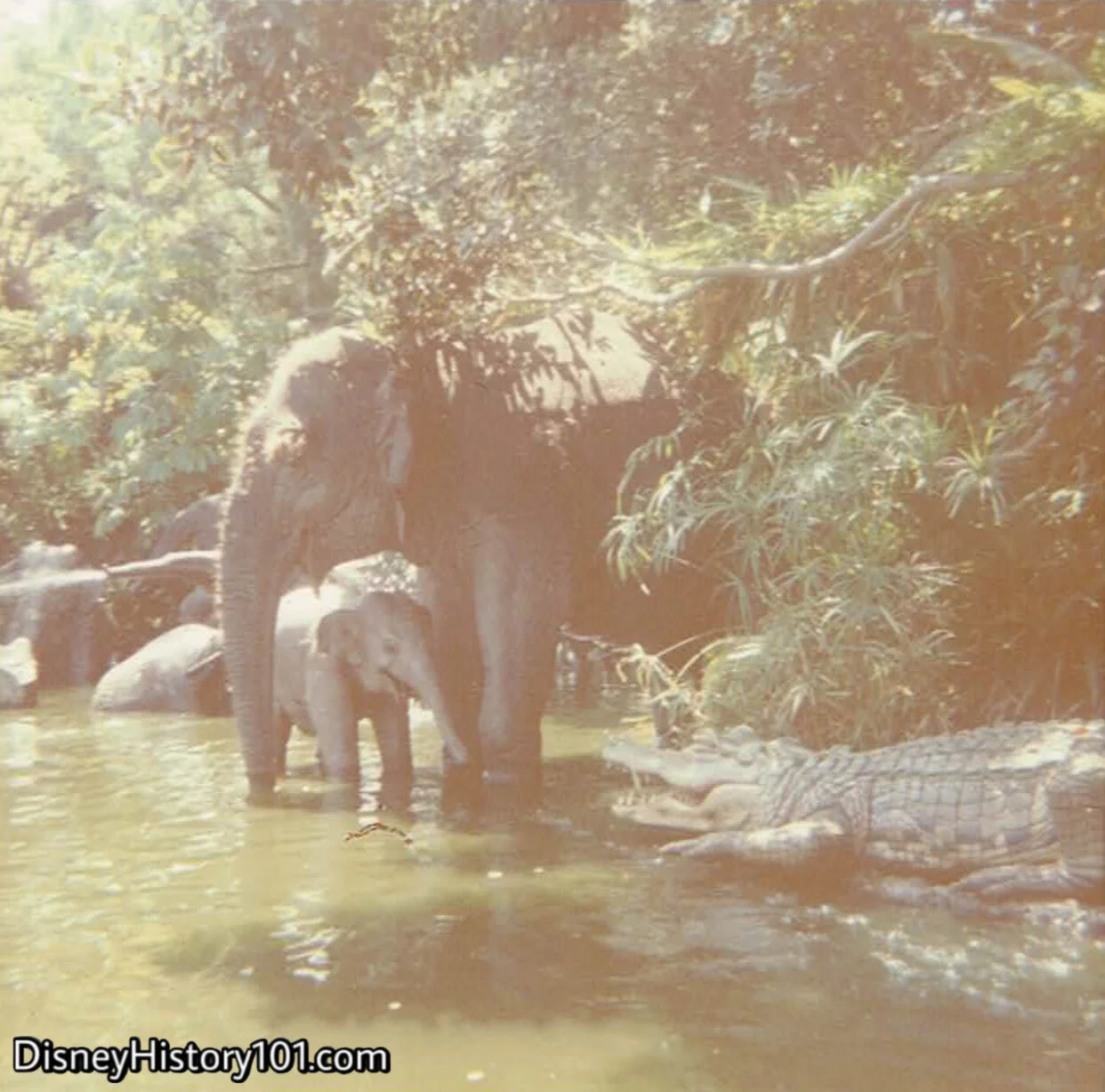
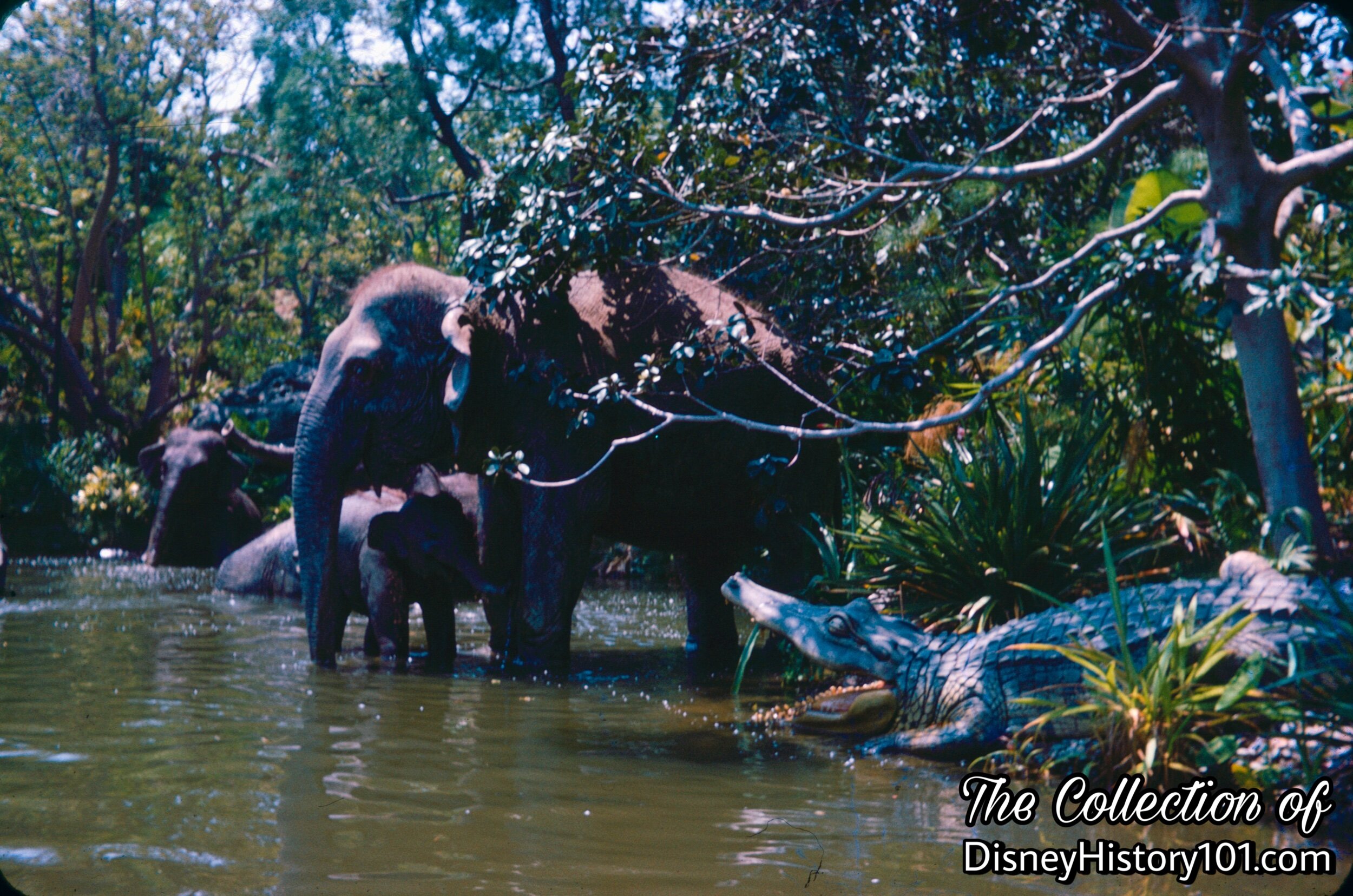
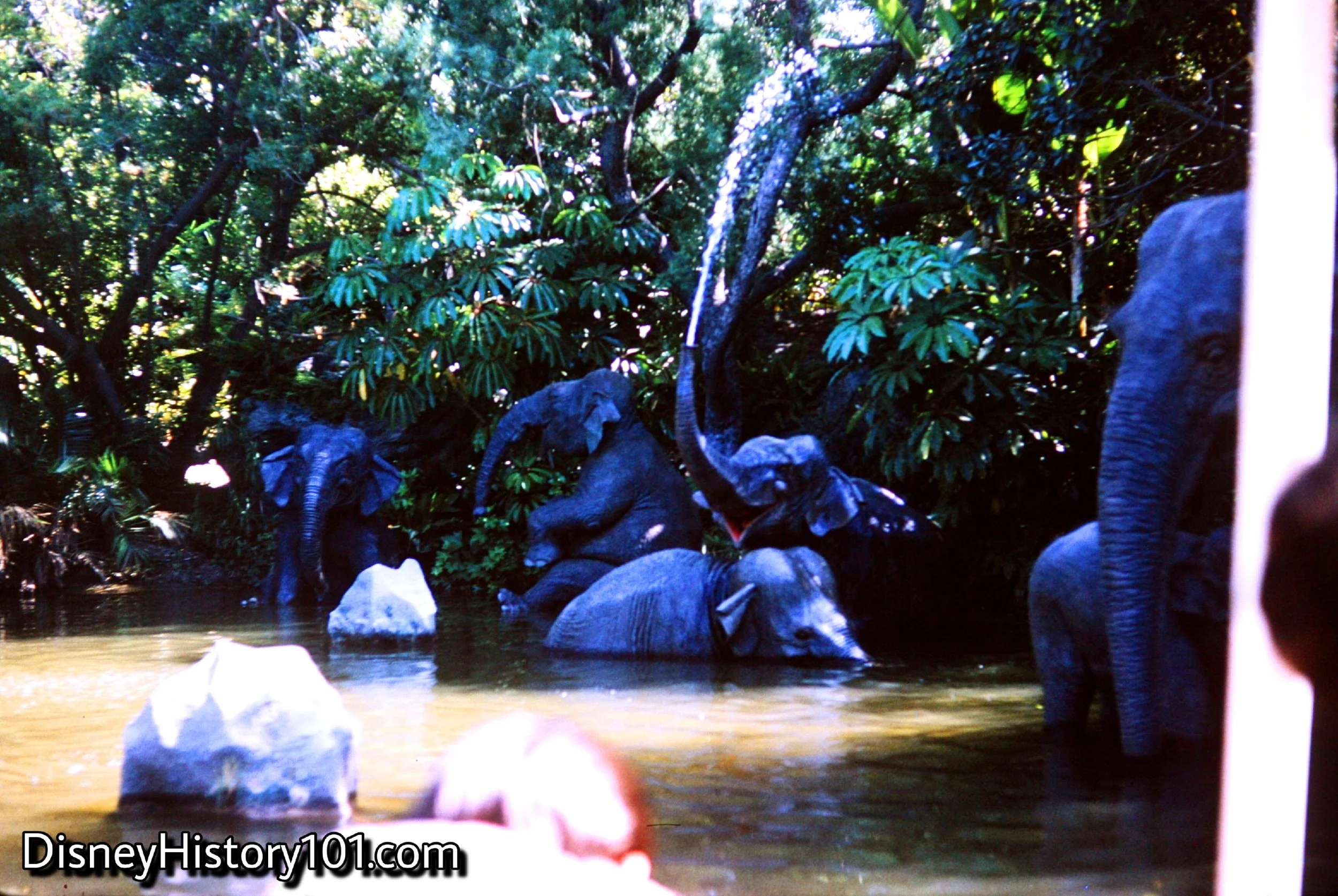
1965, August
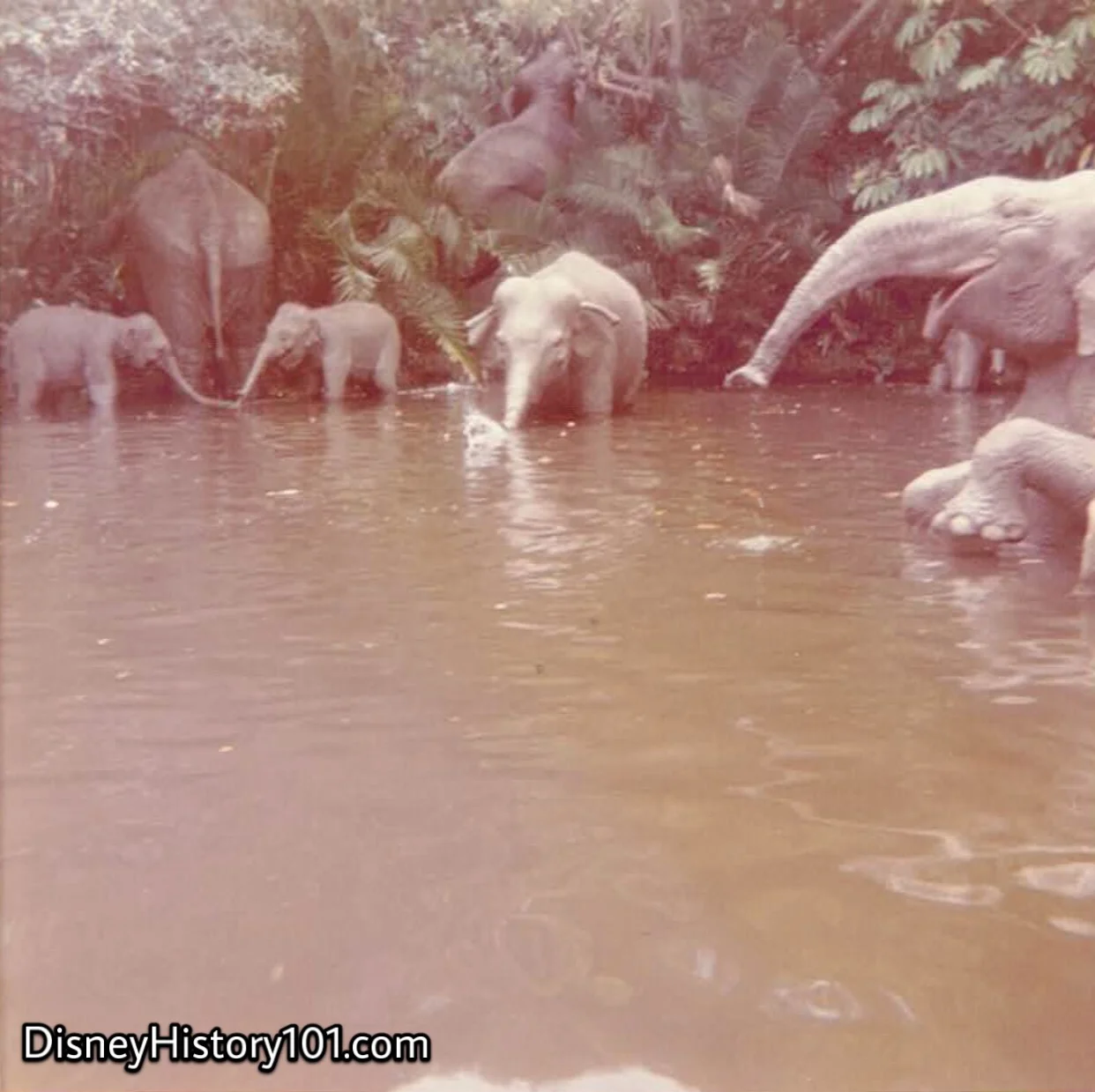
1972
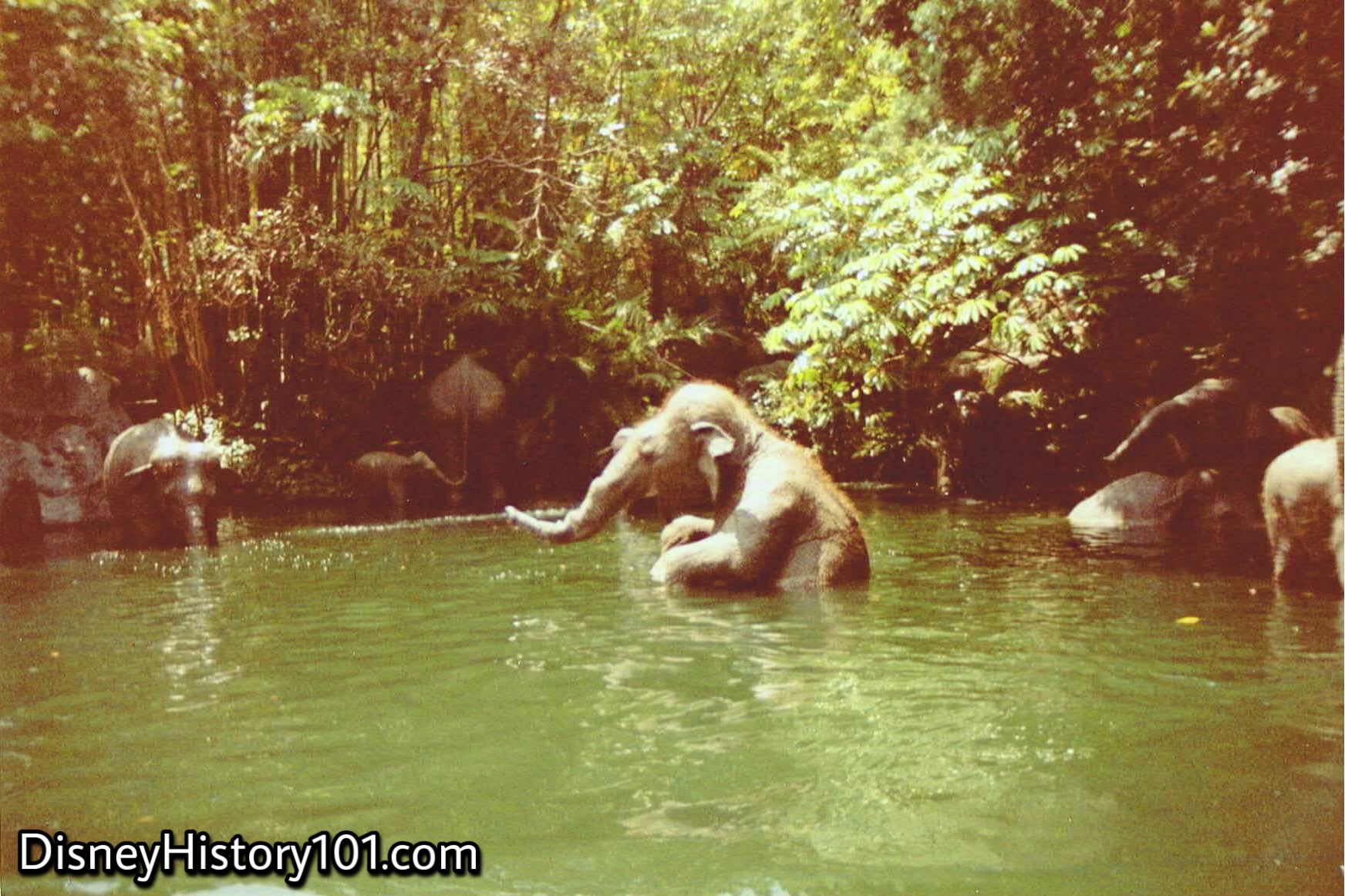
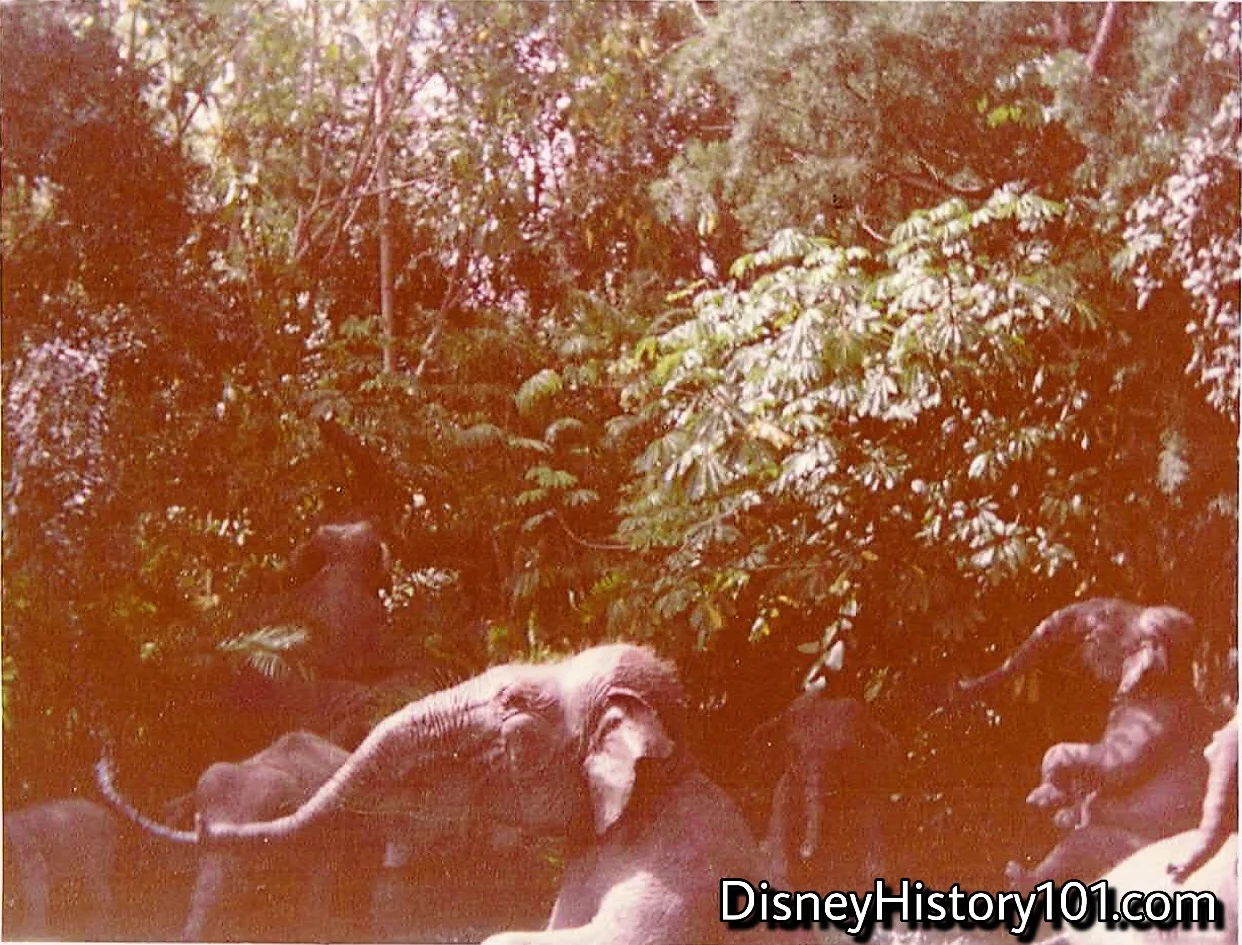
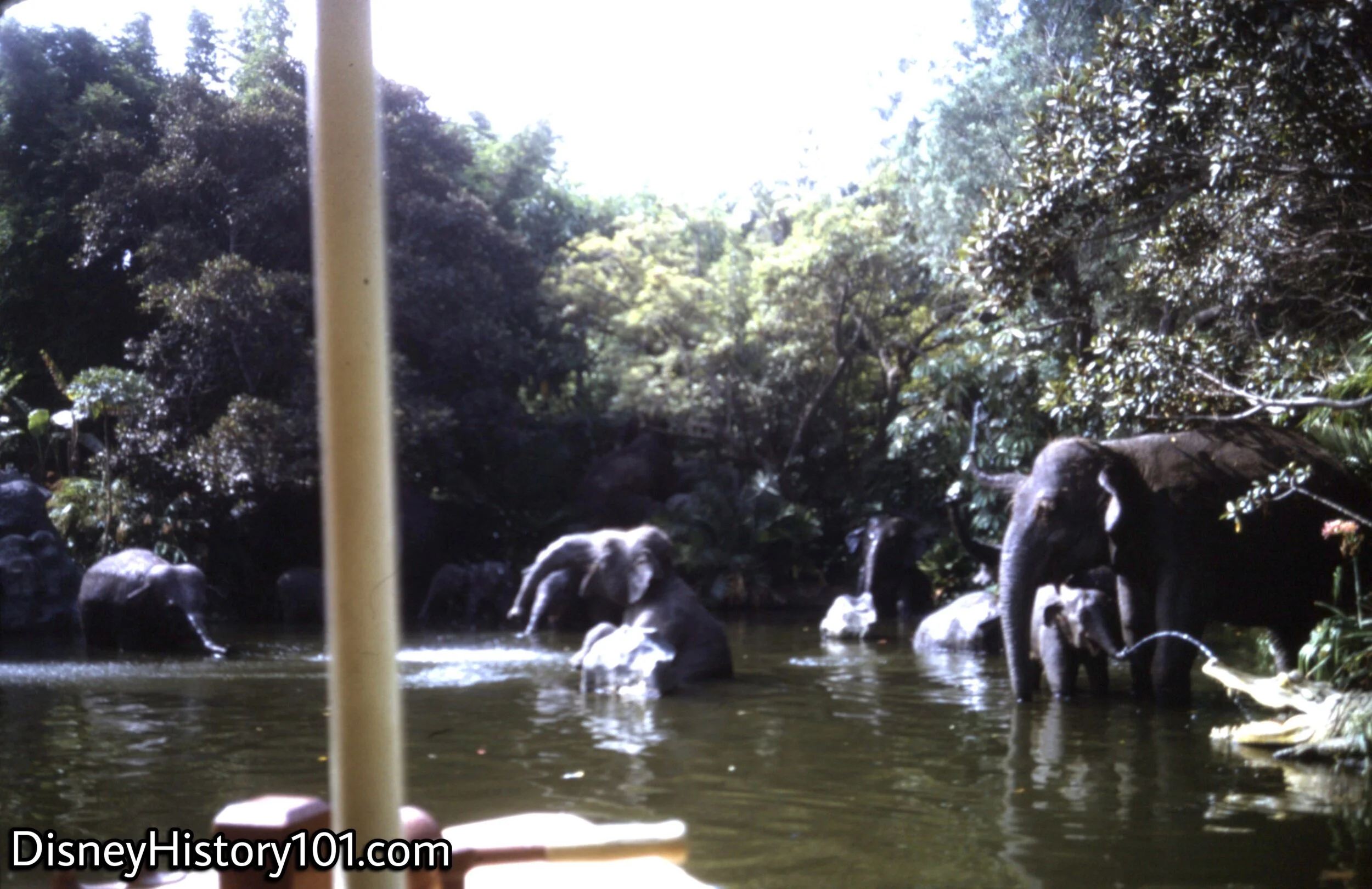
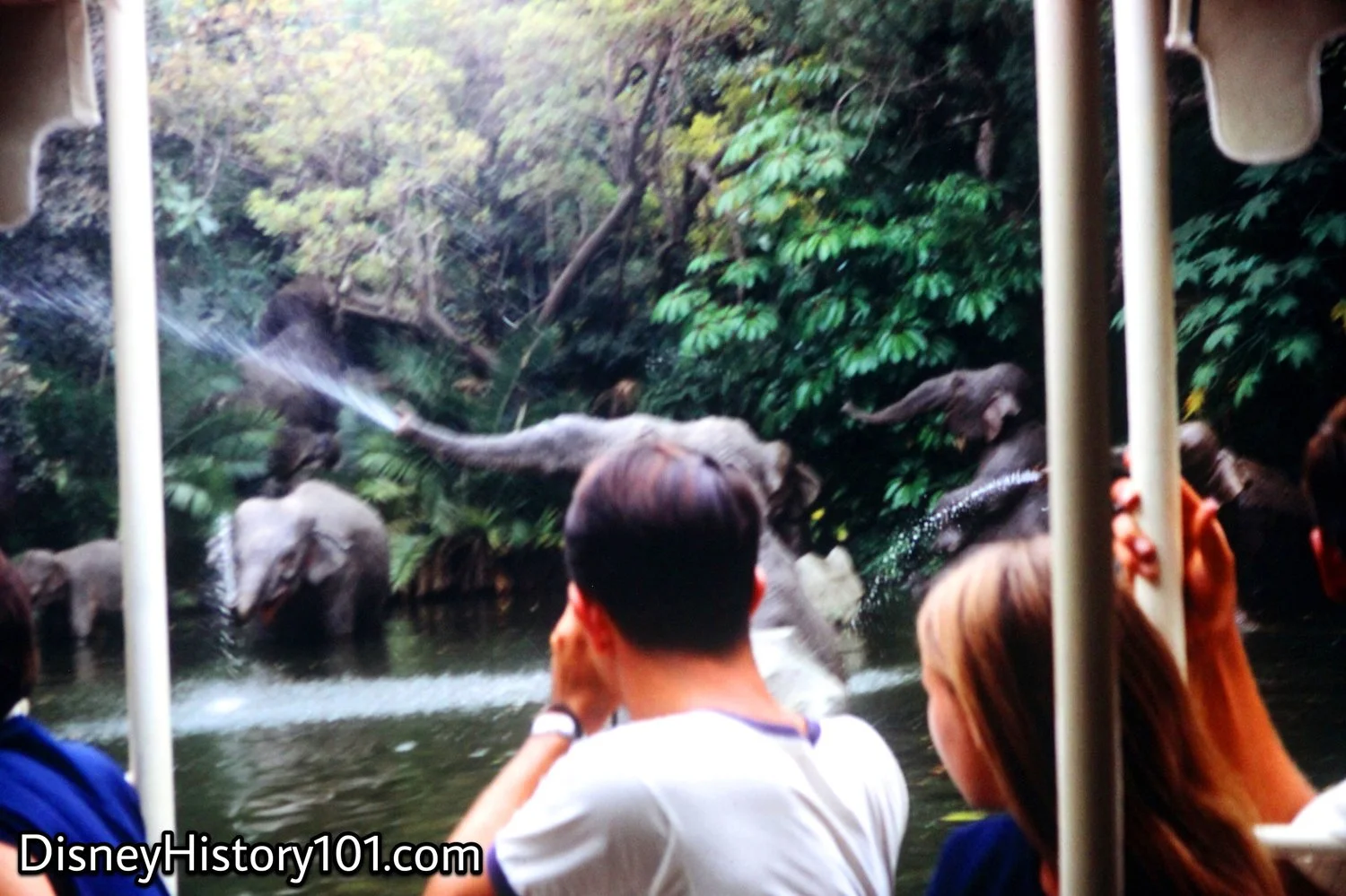
1967, August
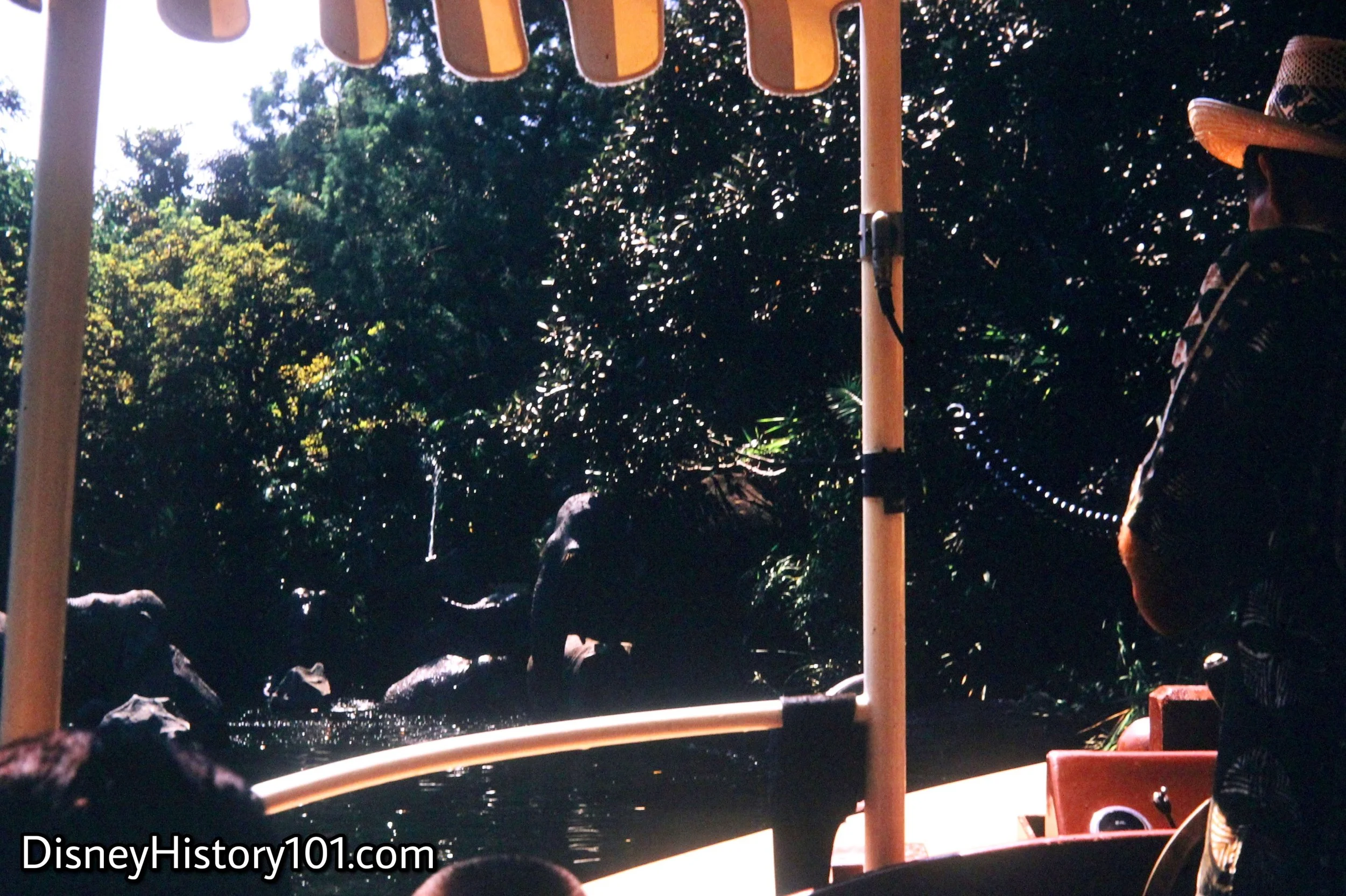
1967
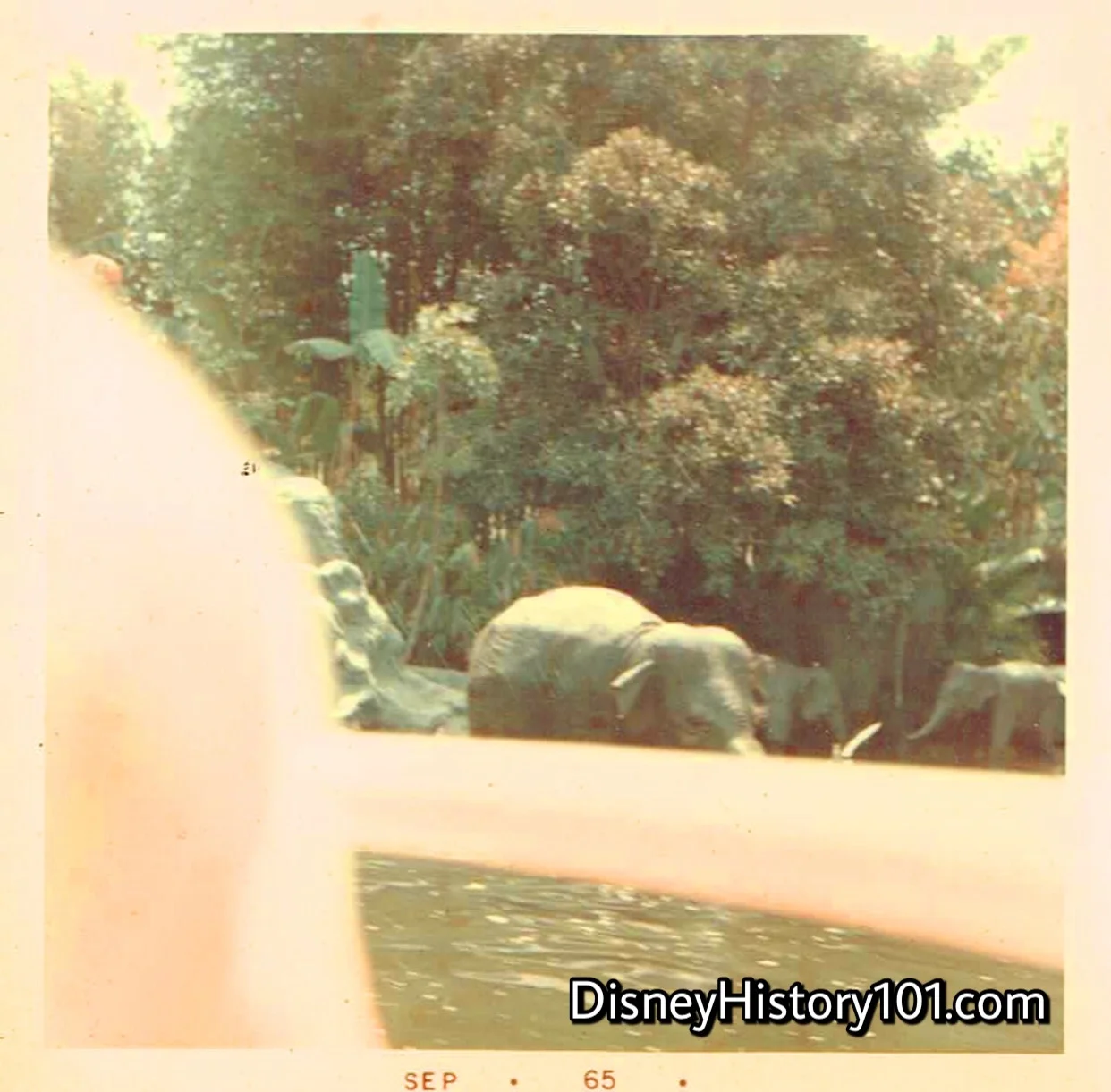
1965
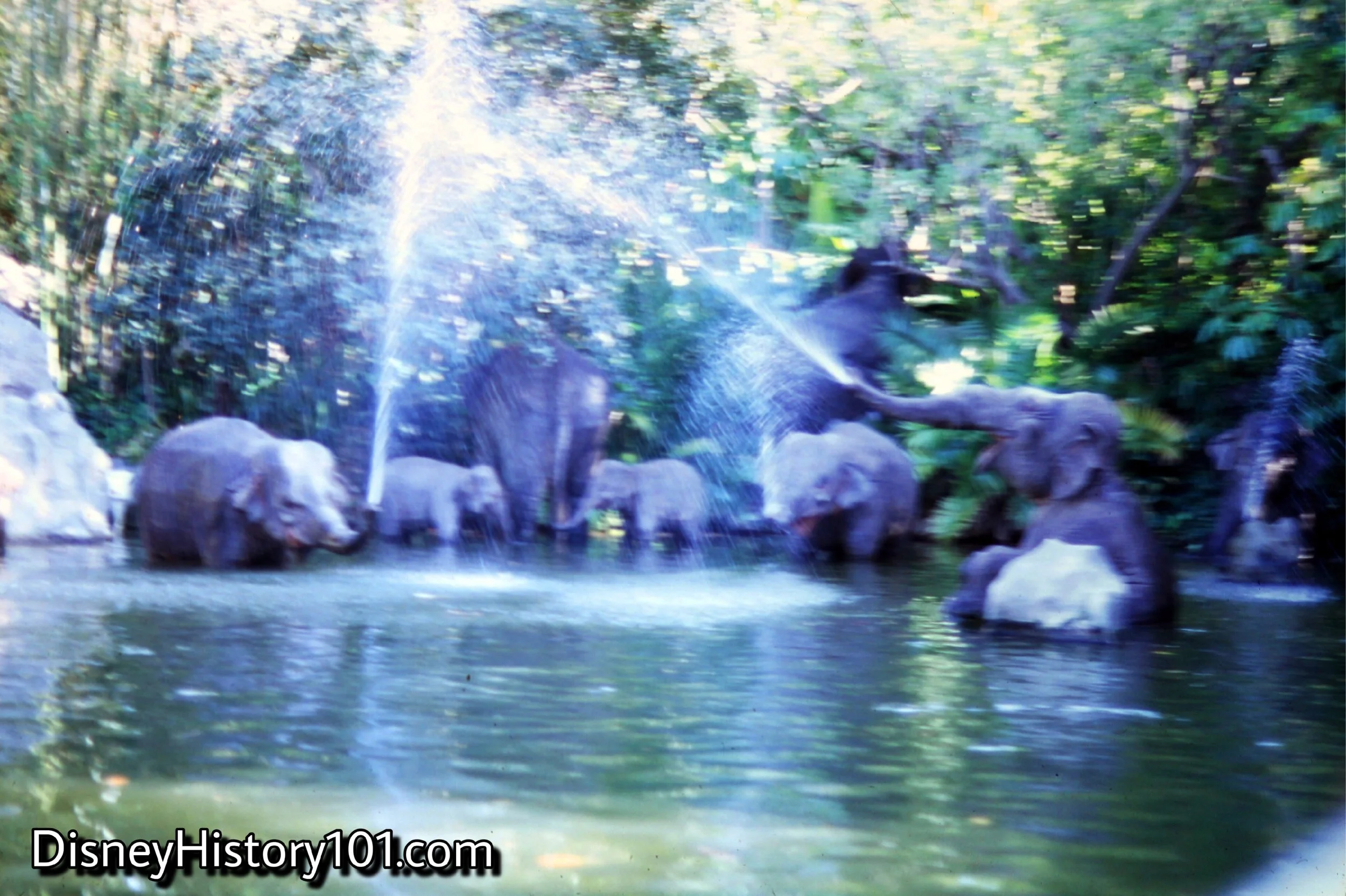
1968, April
Watch out for some wet surprises from those ‘big shots’!
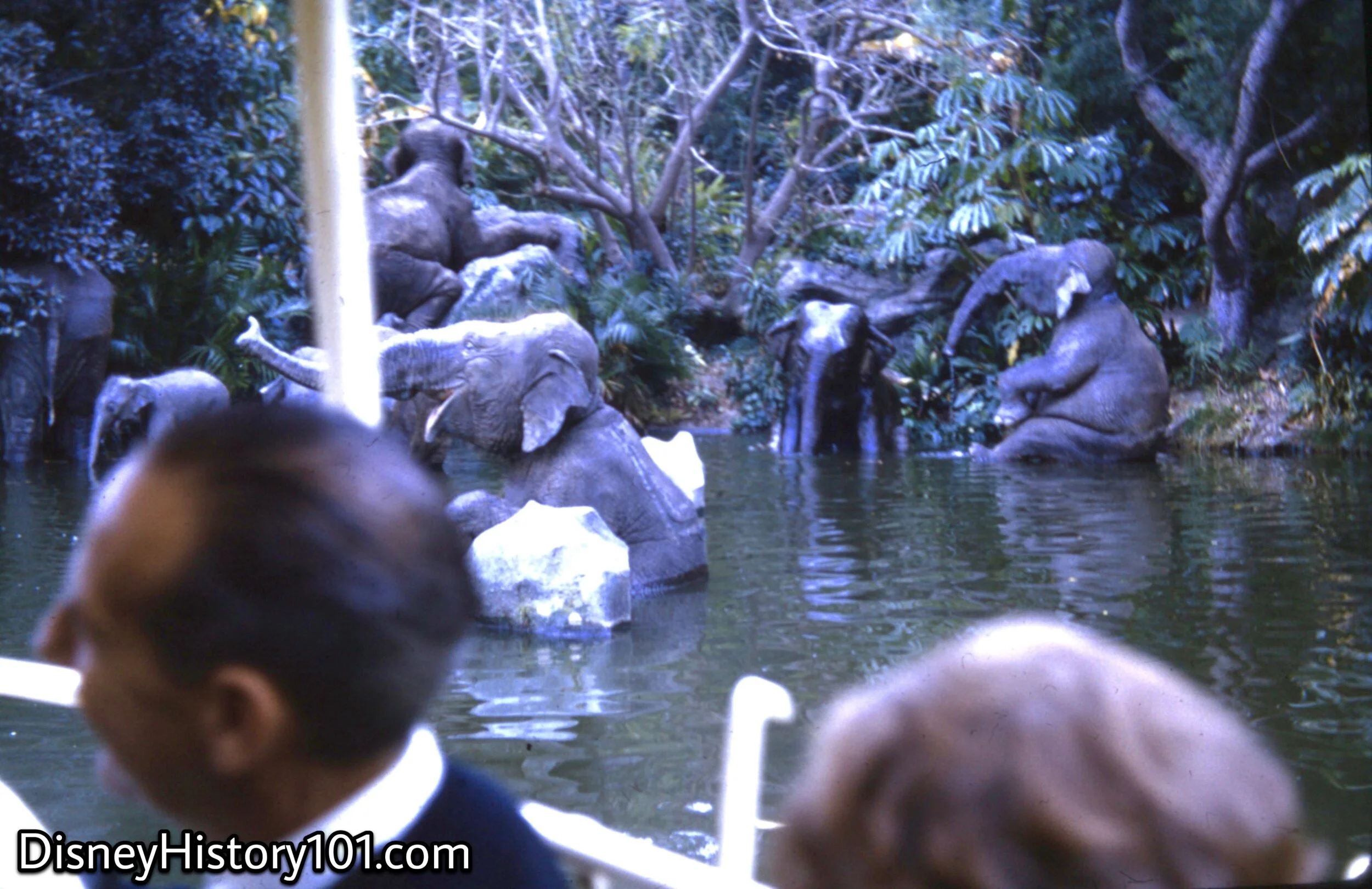
1964
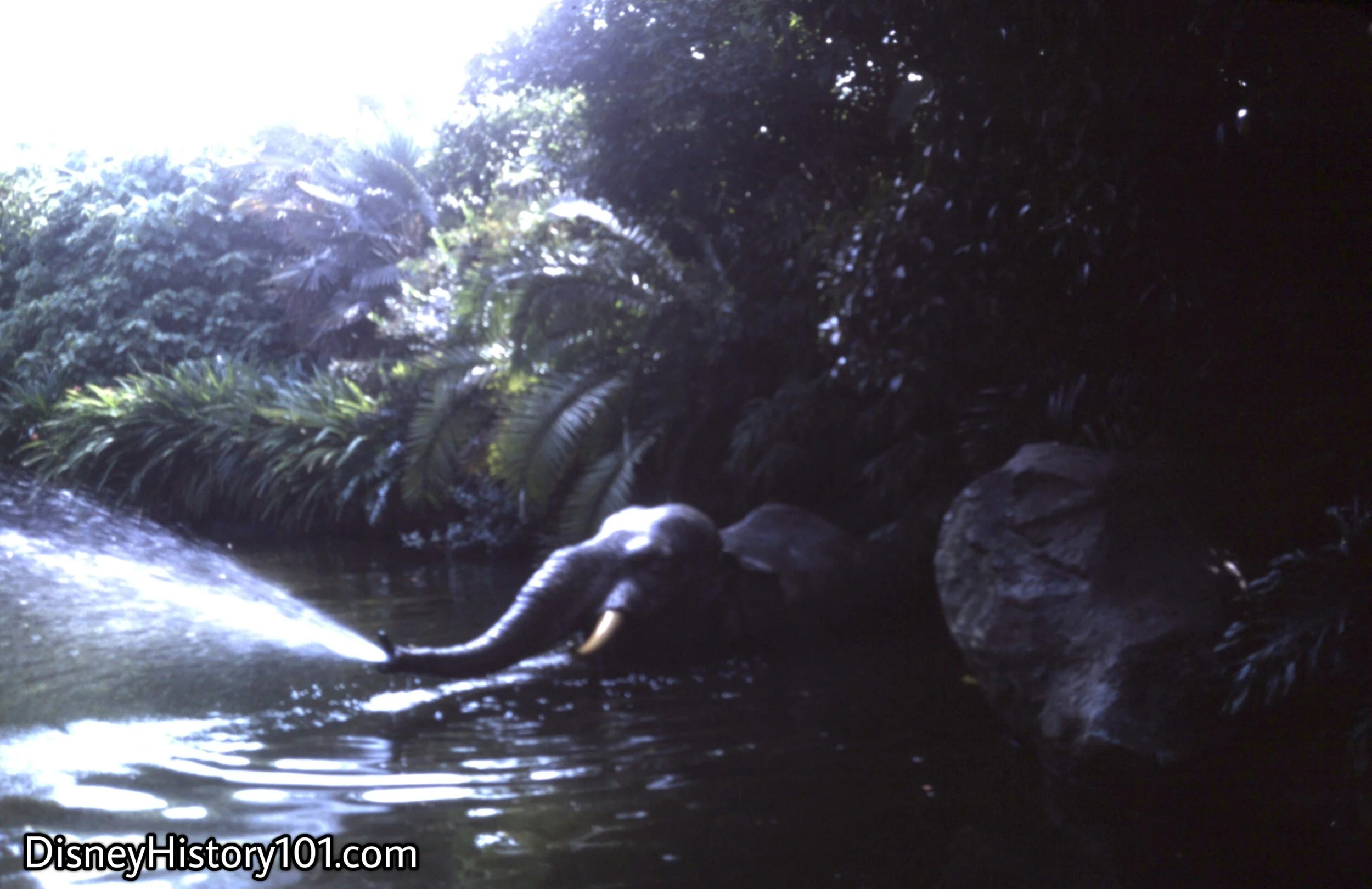
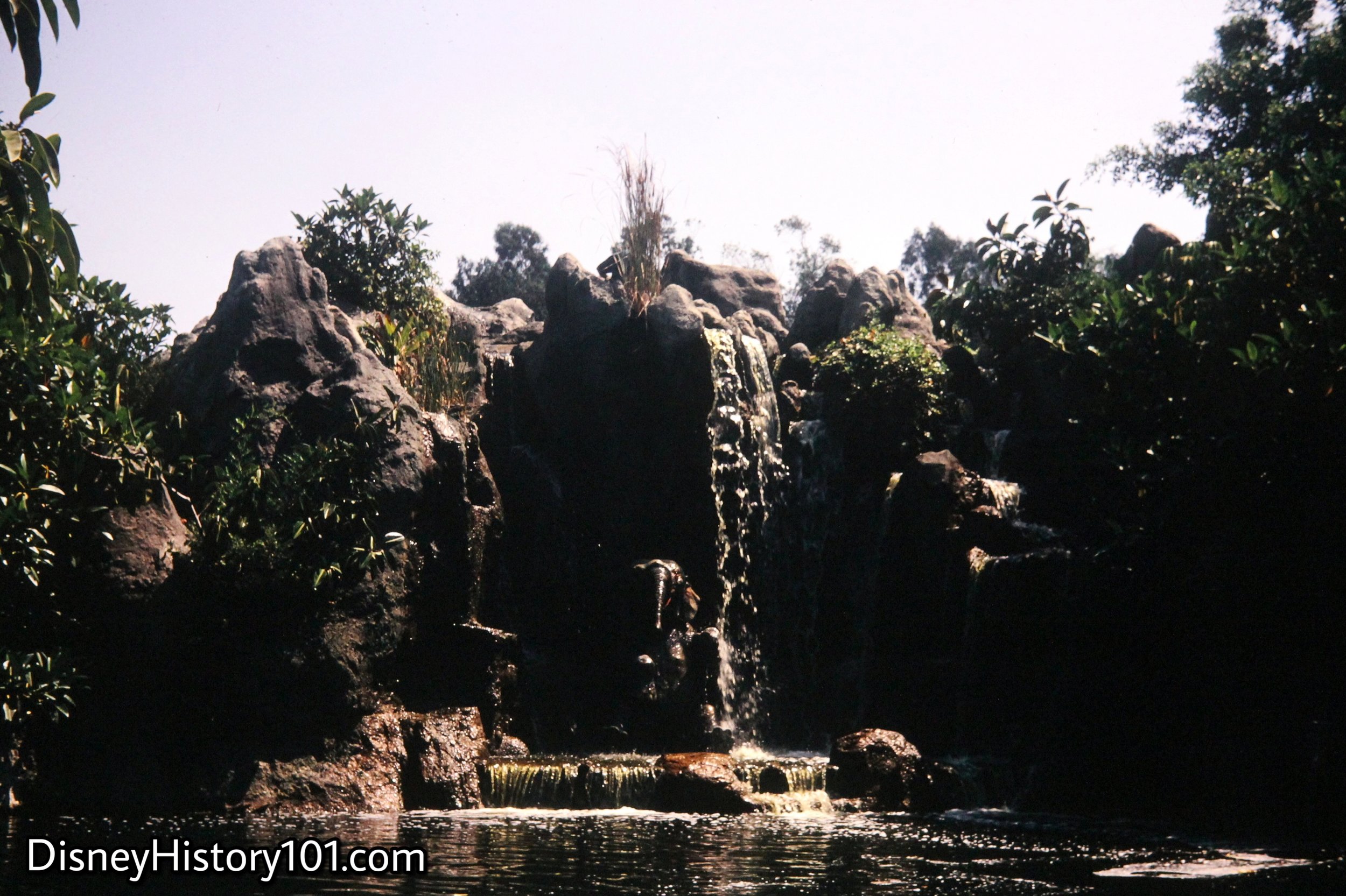
1967
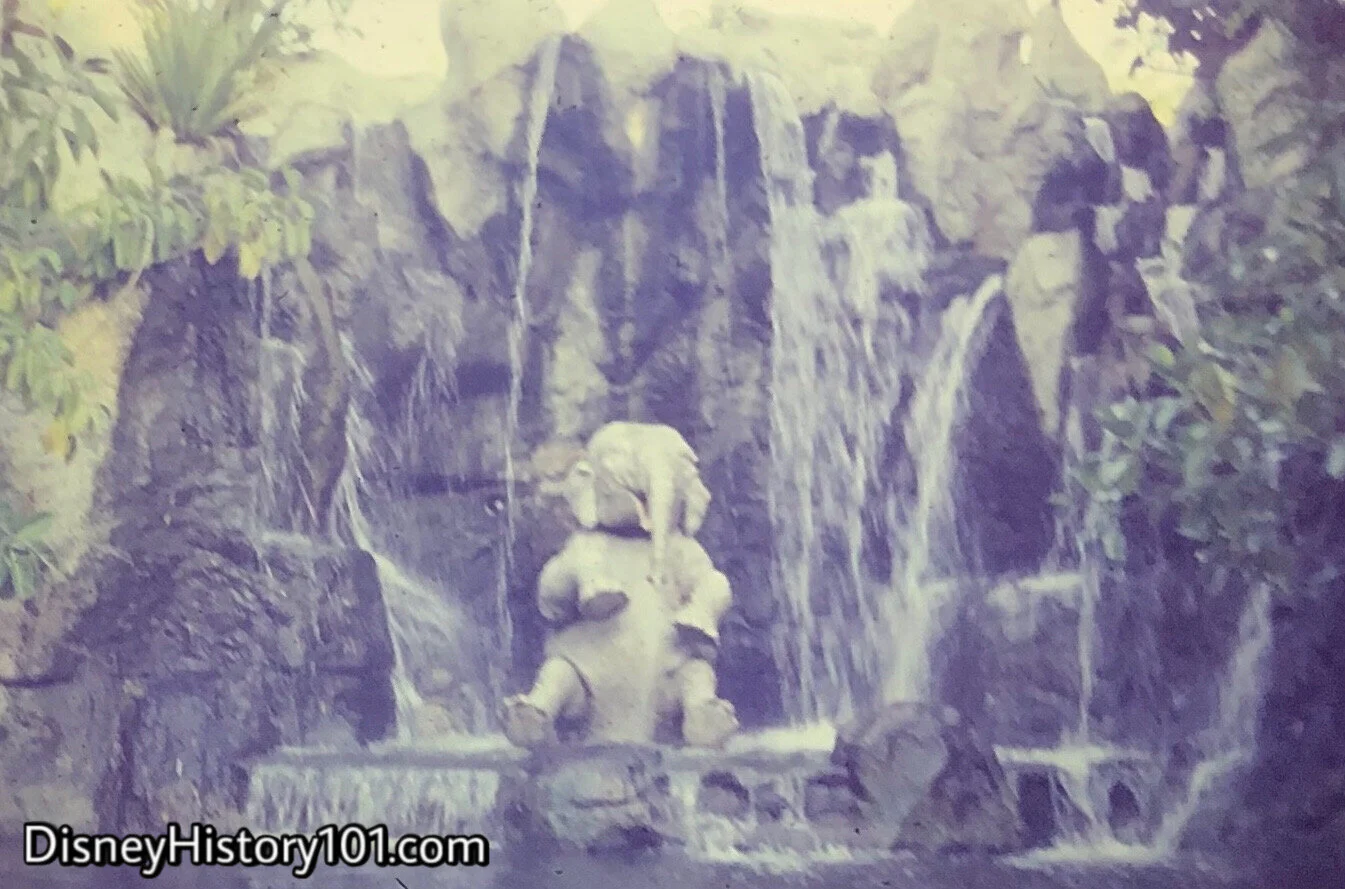
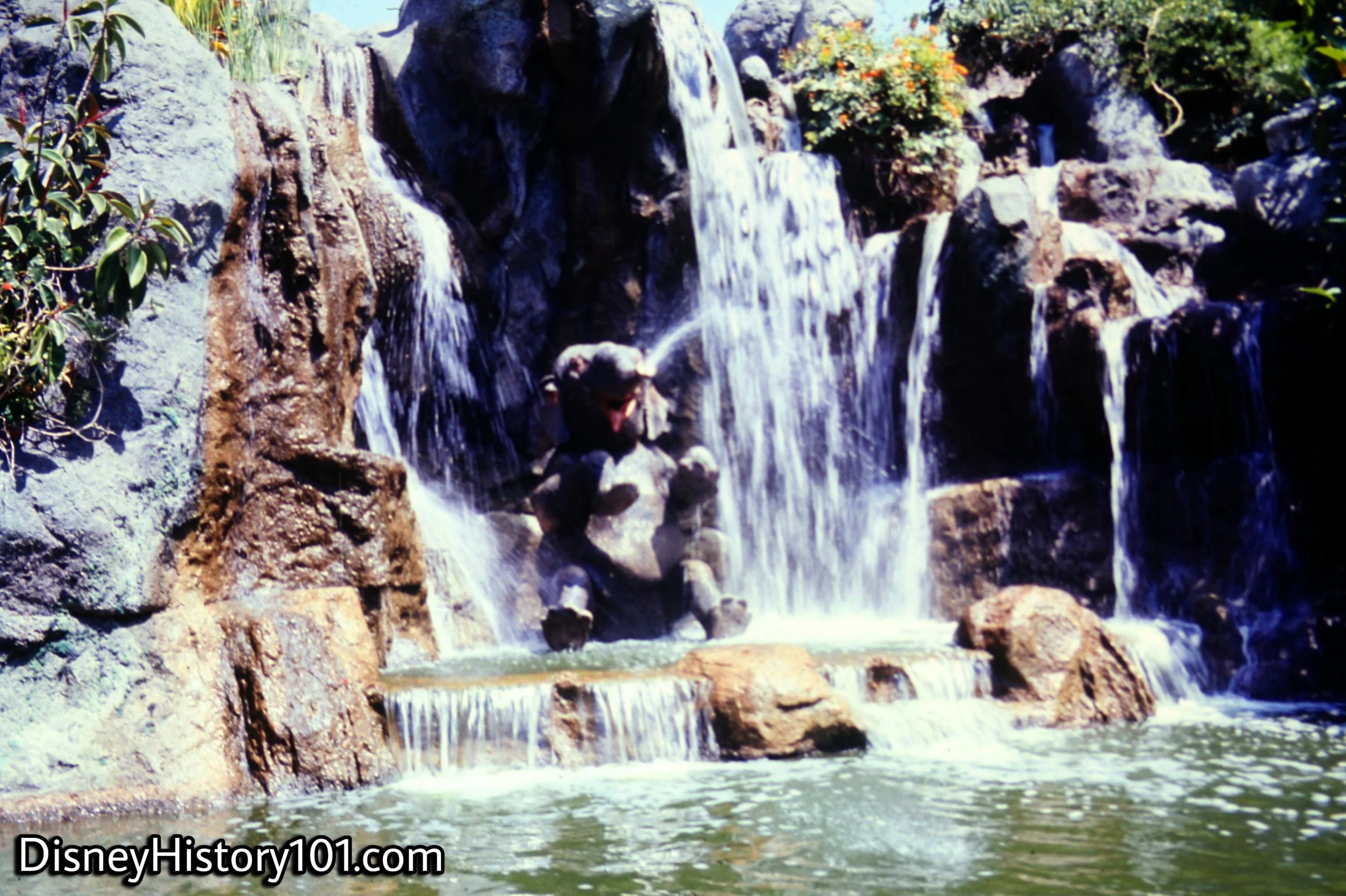
1967, August
1969
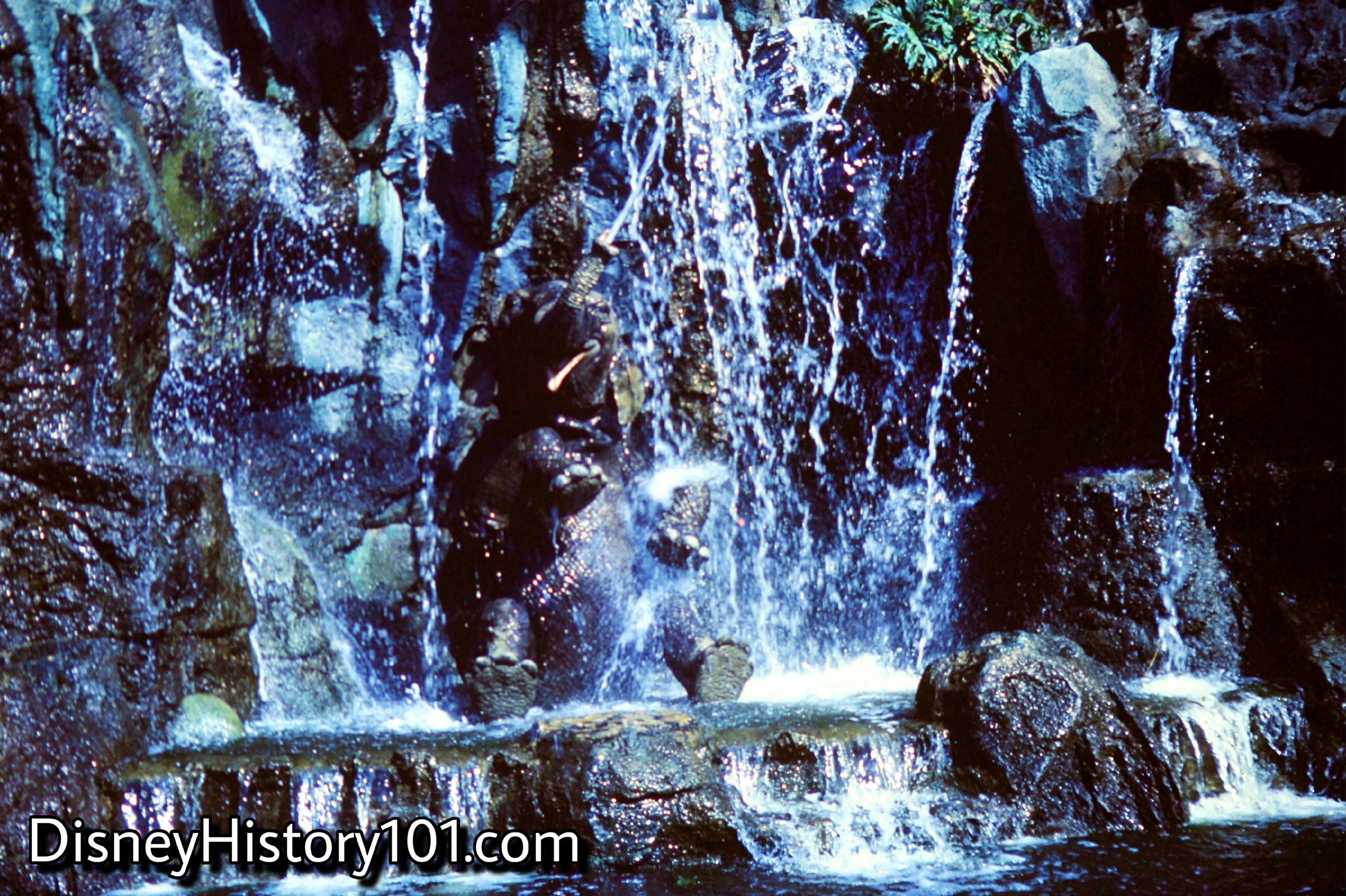
1963
“It looks like one of the larger elephants wanted to bathe all by himself. He doesn’t like being disturbed. Hey, he’s trying to give us a bath….that was close! If you’re on the rail, you better look out. He might do it again!”
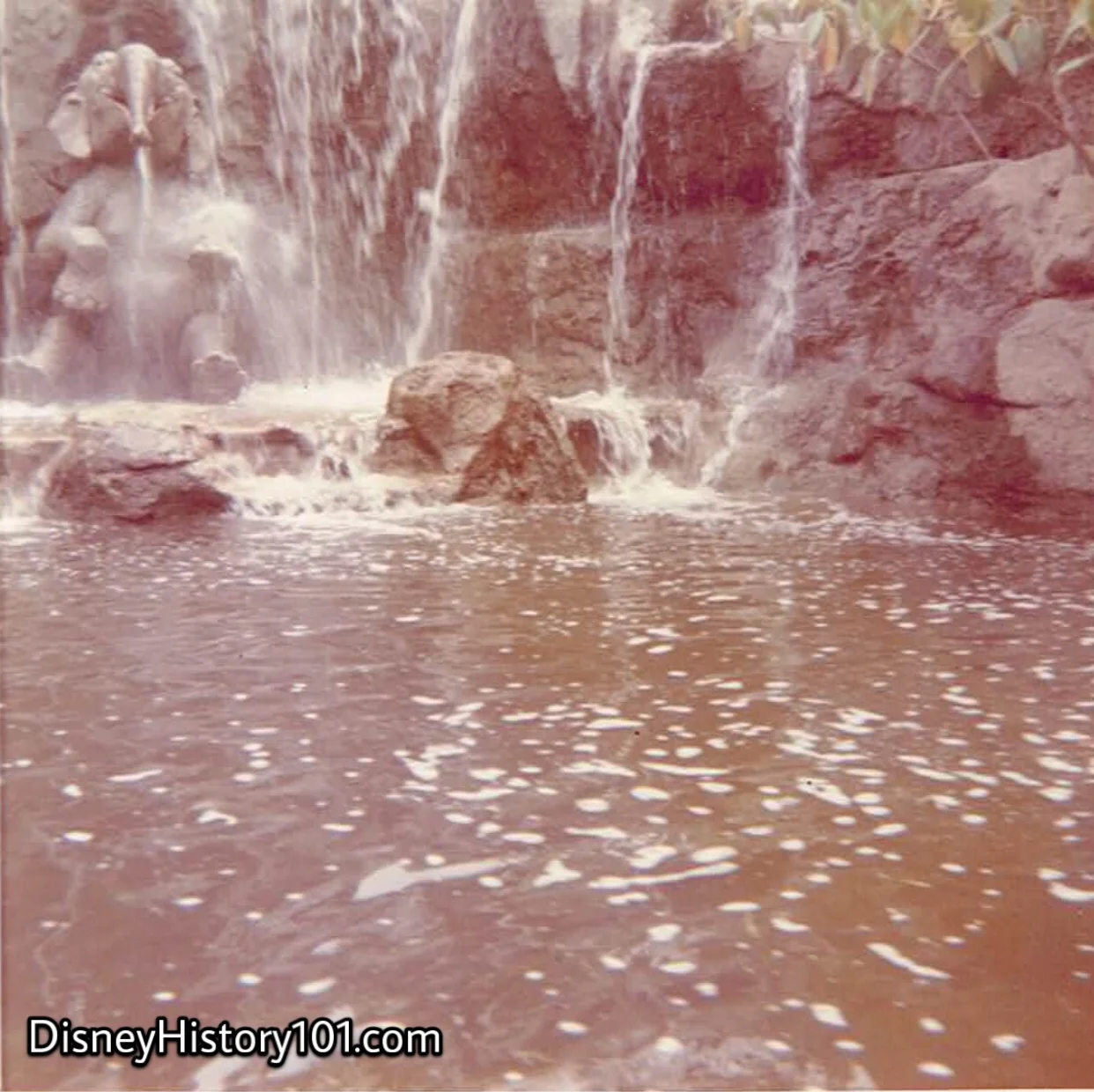
1972
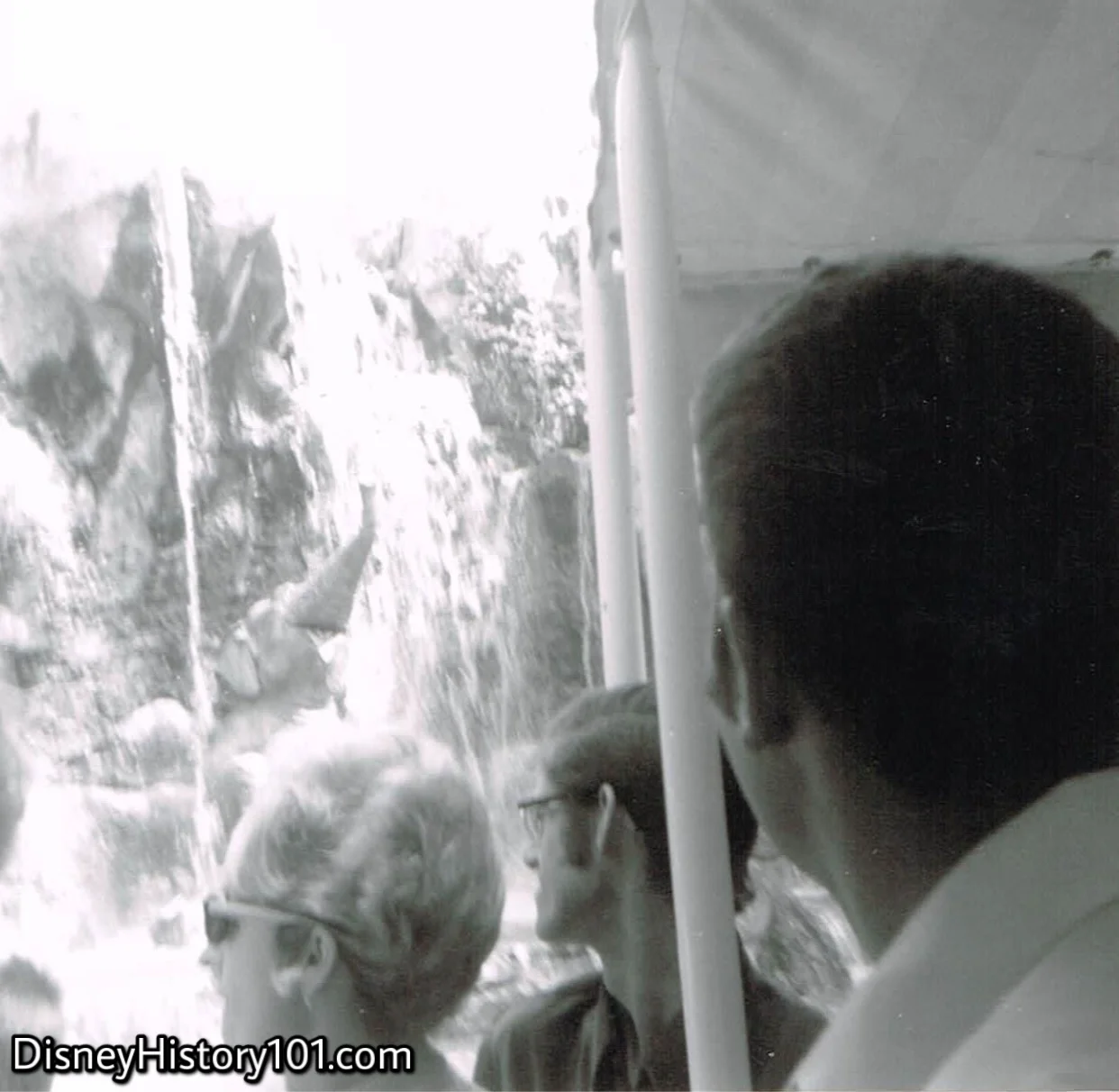
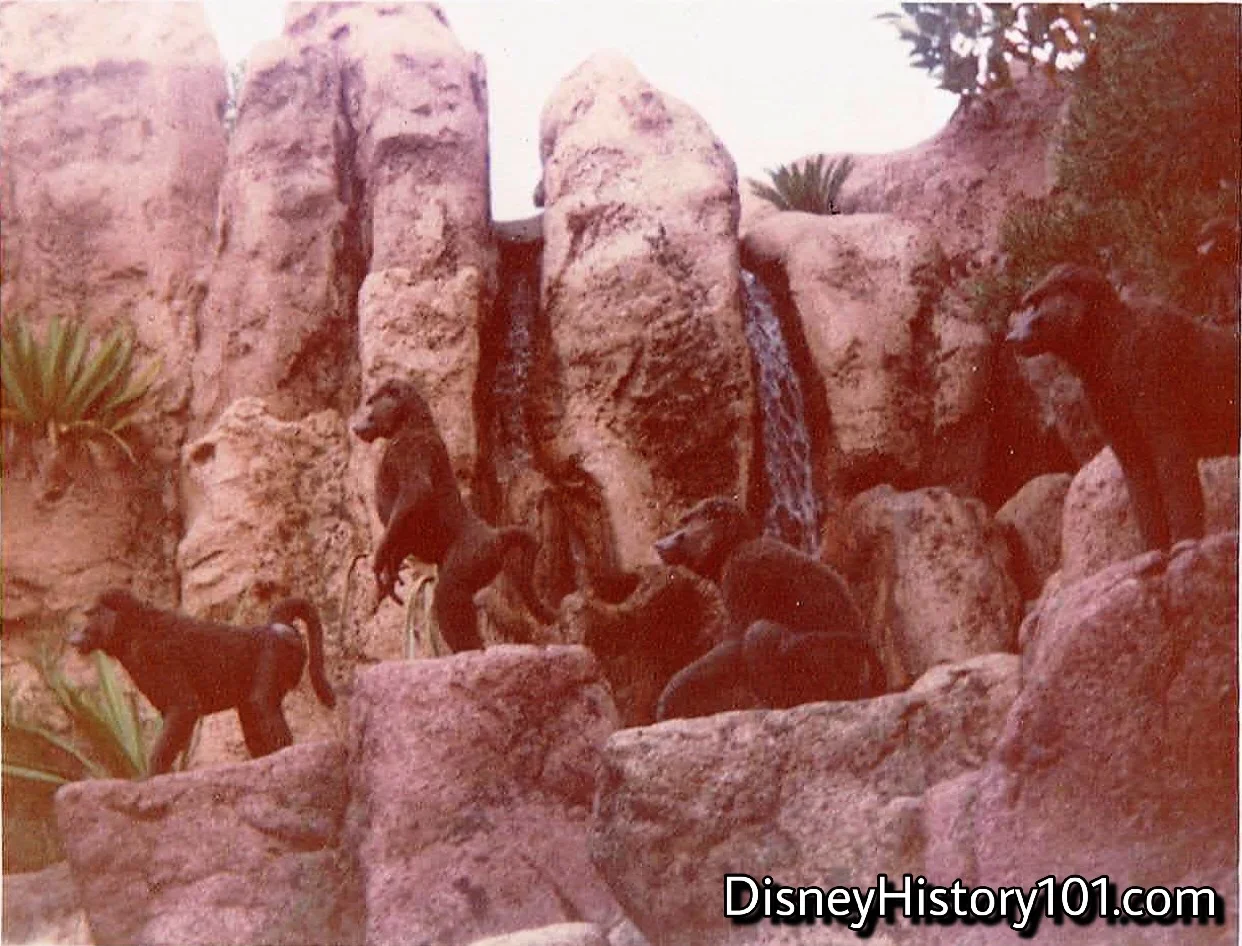
“Waterfalls marks the entrance to the expansive grassland region of the African Veldt. Because of the migratory habits of the beasts in the jungle, this area is often inhabited with gazelles, gnus, zebras, giraffes, and (look in that tree) vultures waiting for their share. Here, dens of laughing hyenas, jackals, and packs of hungry lions feasting on one of their unsuspecting prey. This region tells the story and points at the law of the African Veldt - ’the survival of the fittest’! I understand that there’s a lost safari somewhere in this area. Oh, there they are. Say, they look trapped. That big rhino has them up a tree. The native on the bottom is (sort of) ‘low man on the totem pole. He hasn’t gotten the point yet, but he will.”
The true-life Disneyland Staff Shop craftspeople (like c. 1977 Shop Foremen Wilbur Wise and Gil Aguilar) helped create realistic wooden logs, rocks, and other RockWork (as the Lion’s Den and others seen here). Rock specialist Bob Gottfried was particularly instrumental in this regard, going on to produce various masonry effects around the rest of the Park!
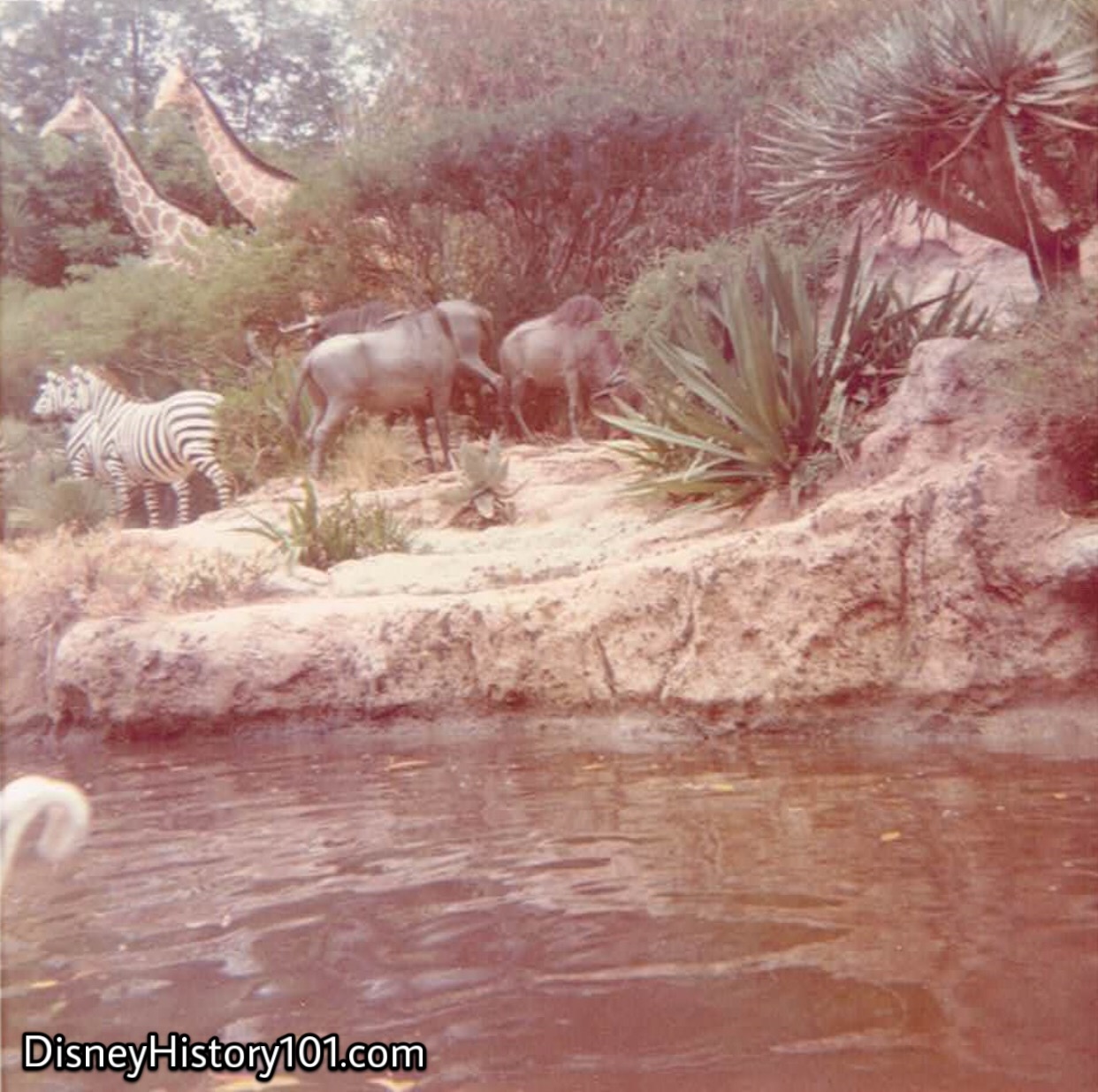
1972
Something else has captured the quizzical gaze of our two giraffes…
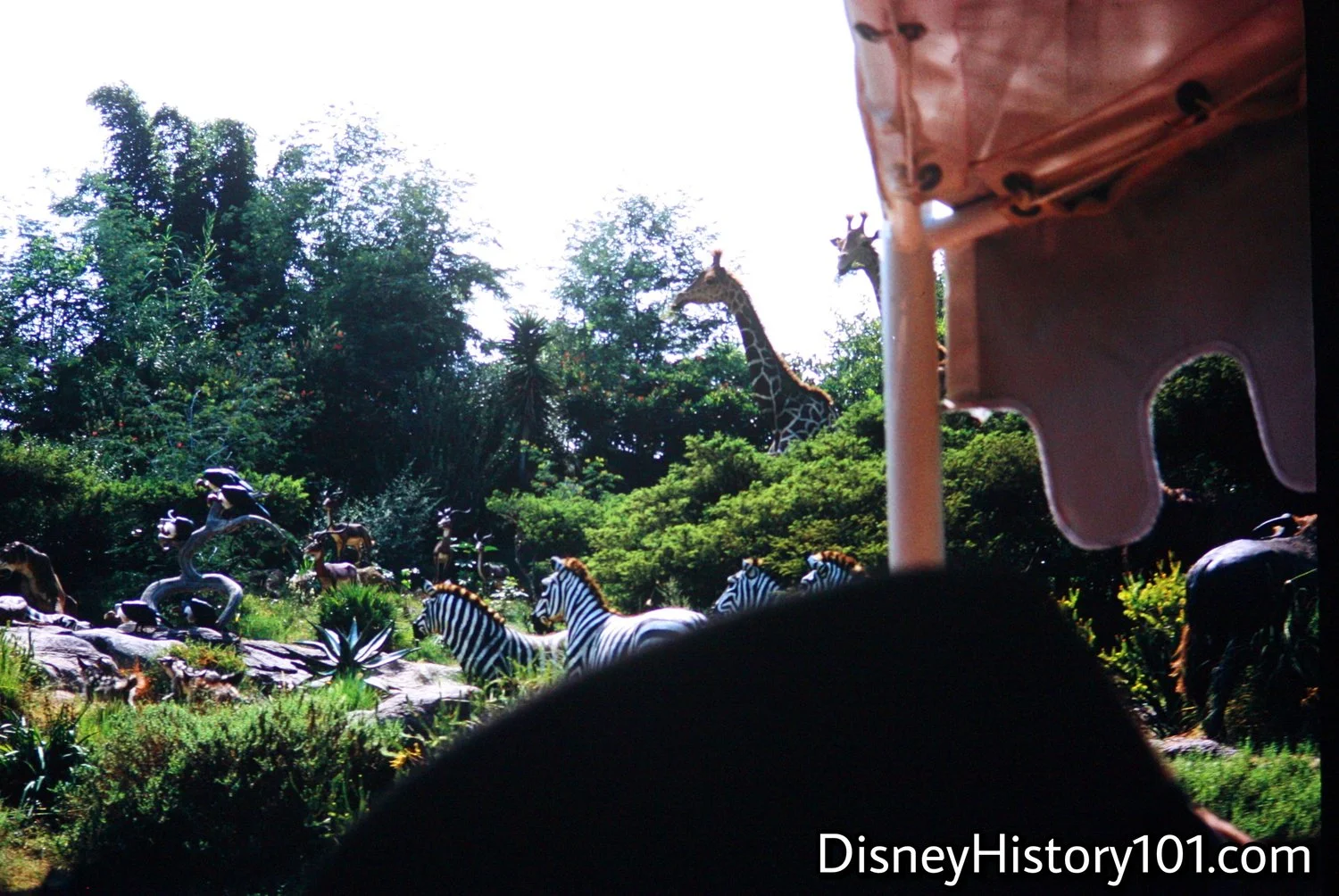
1967
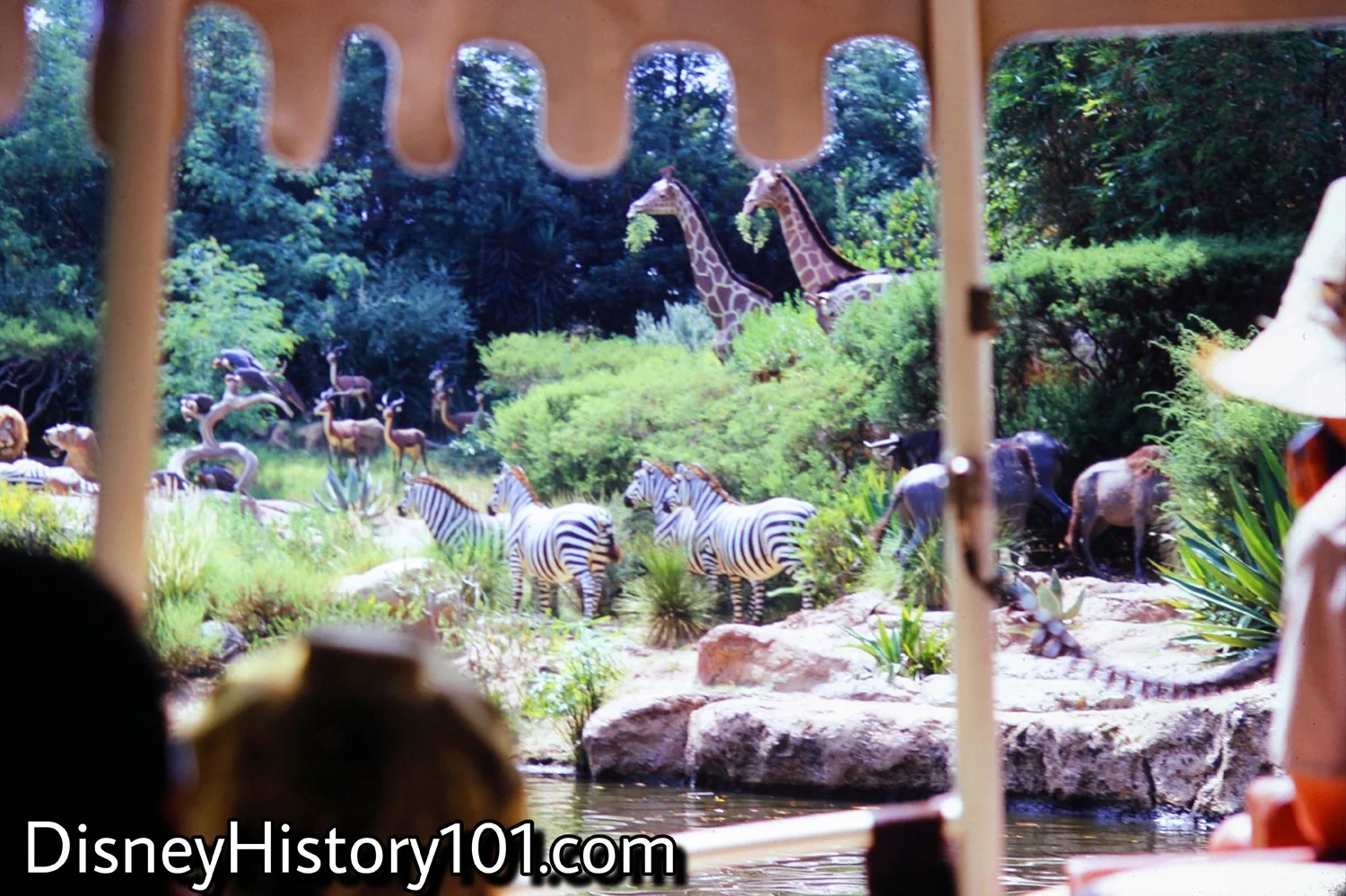
1972, September
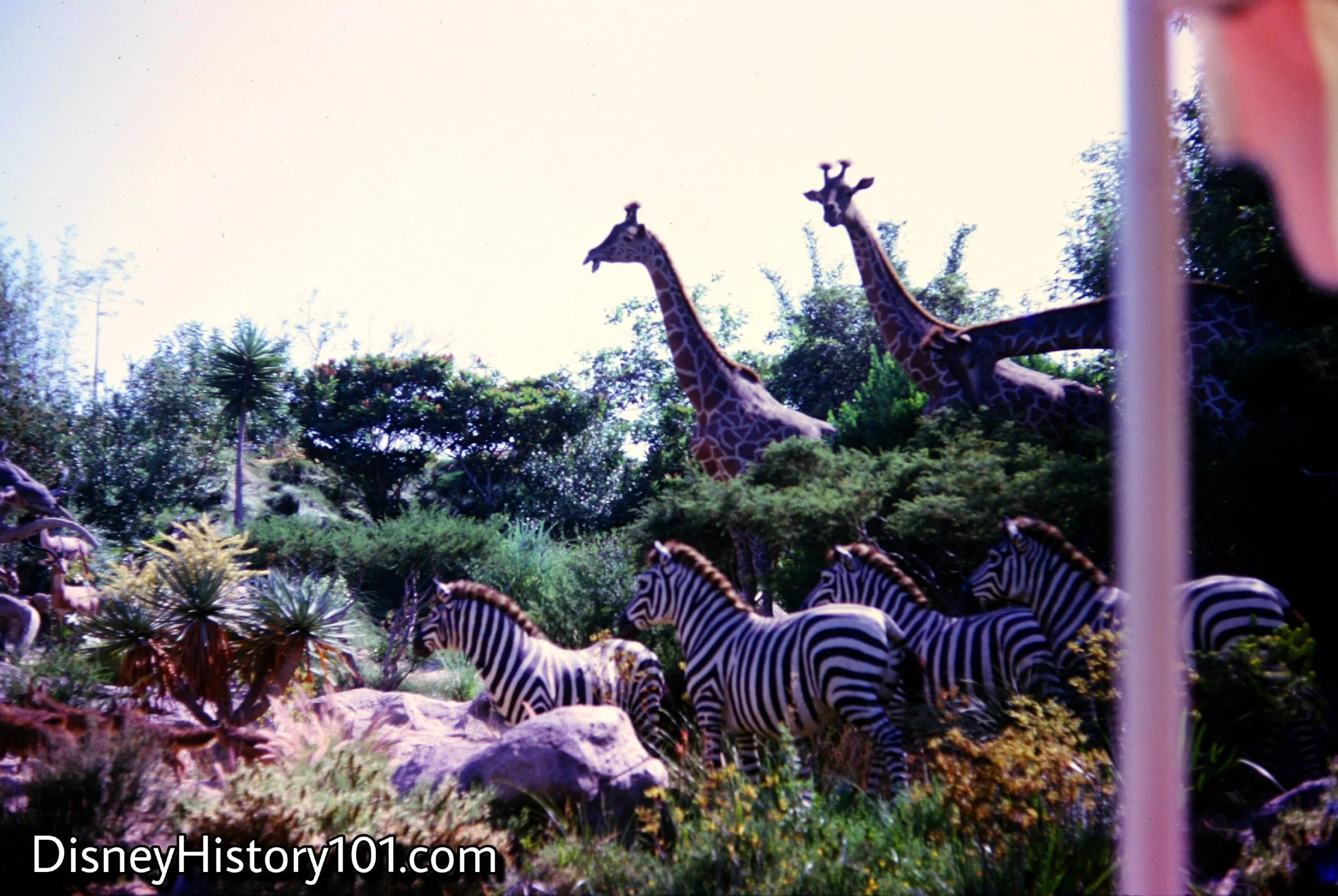
1965, August
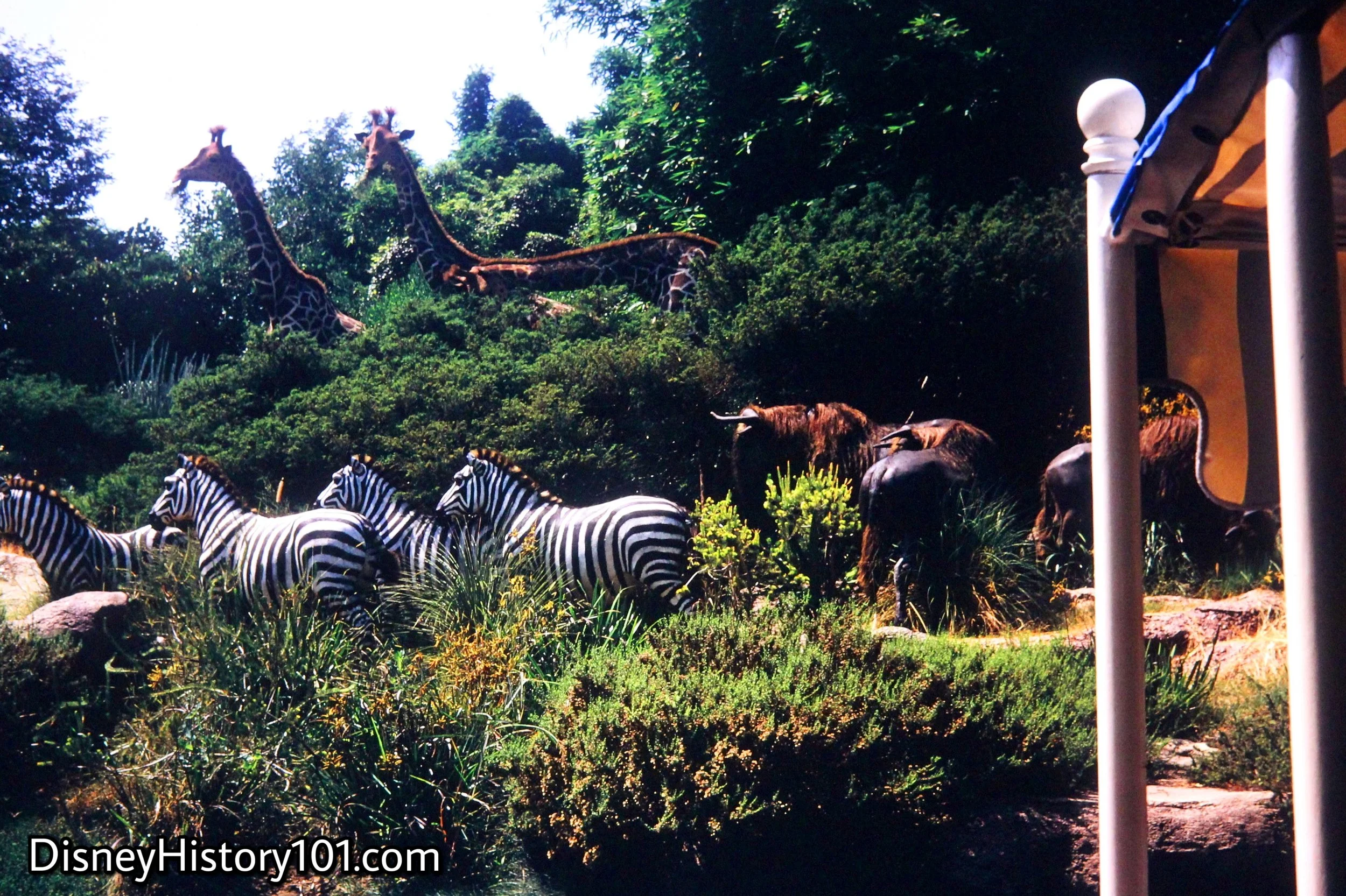
1967
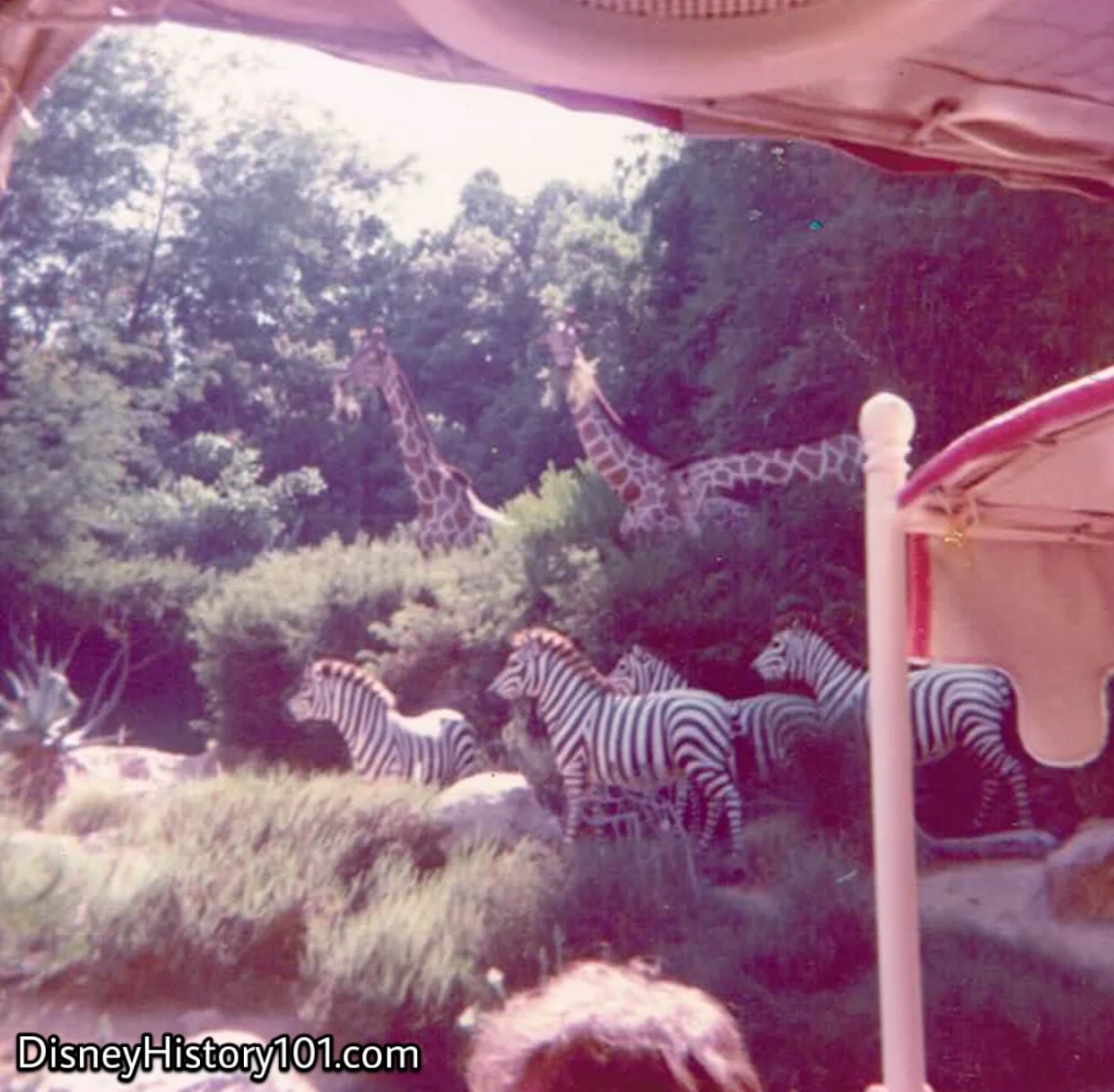
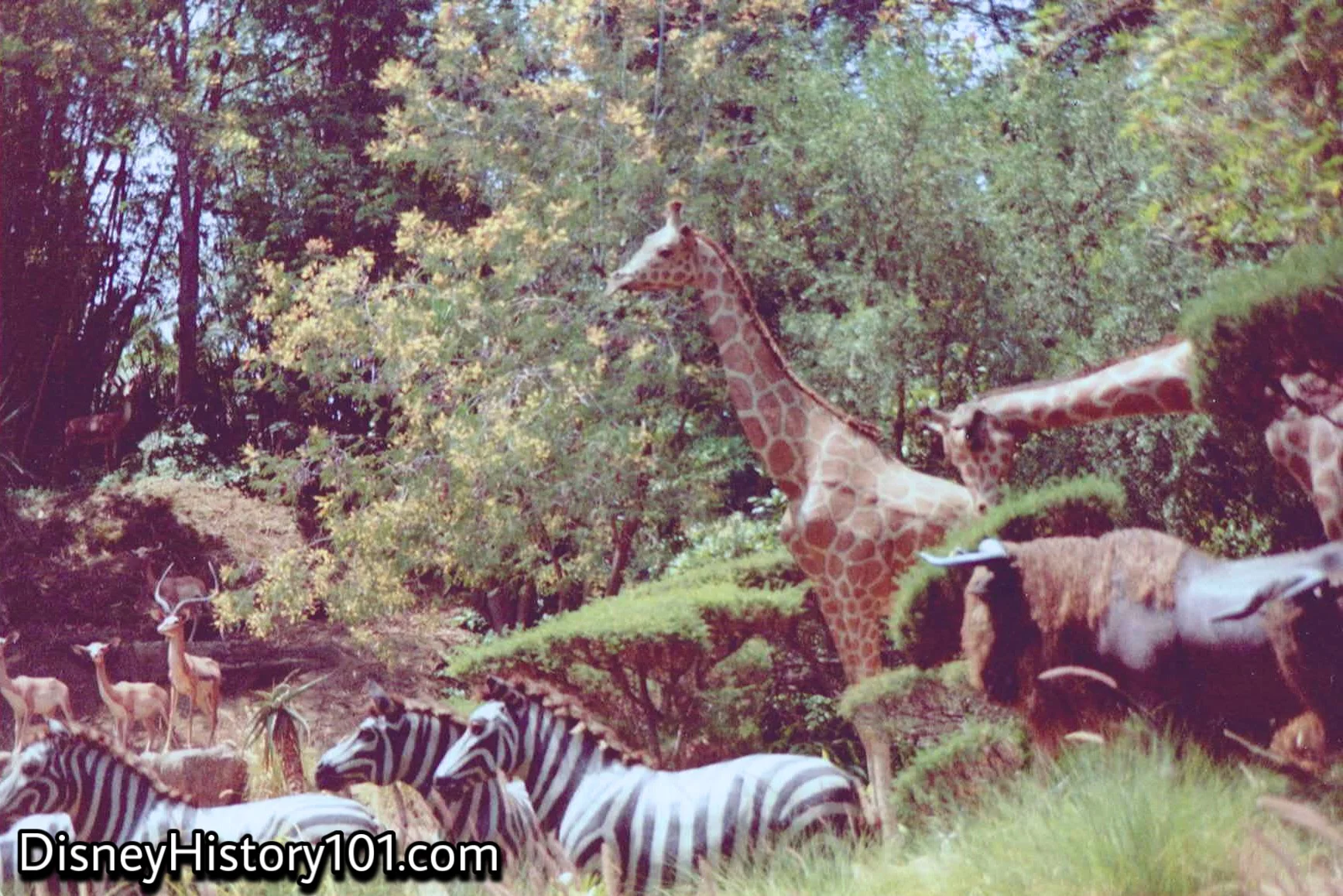
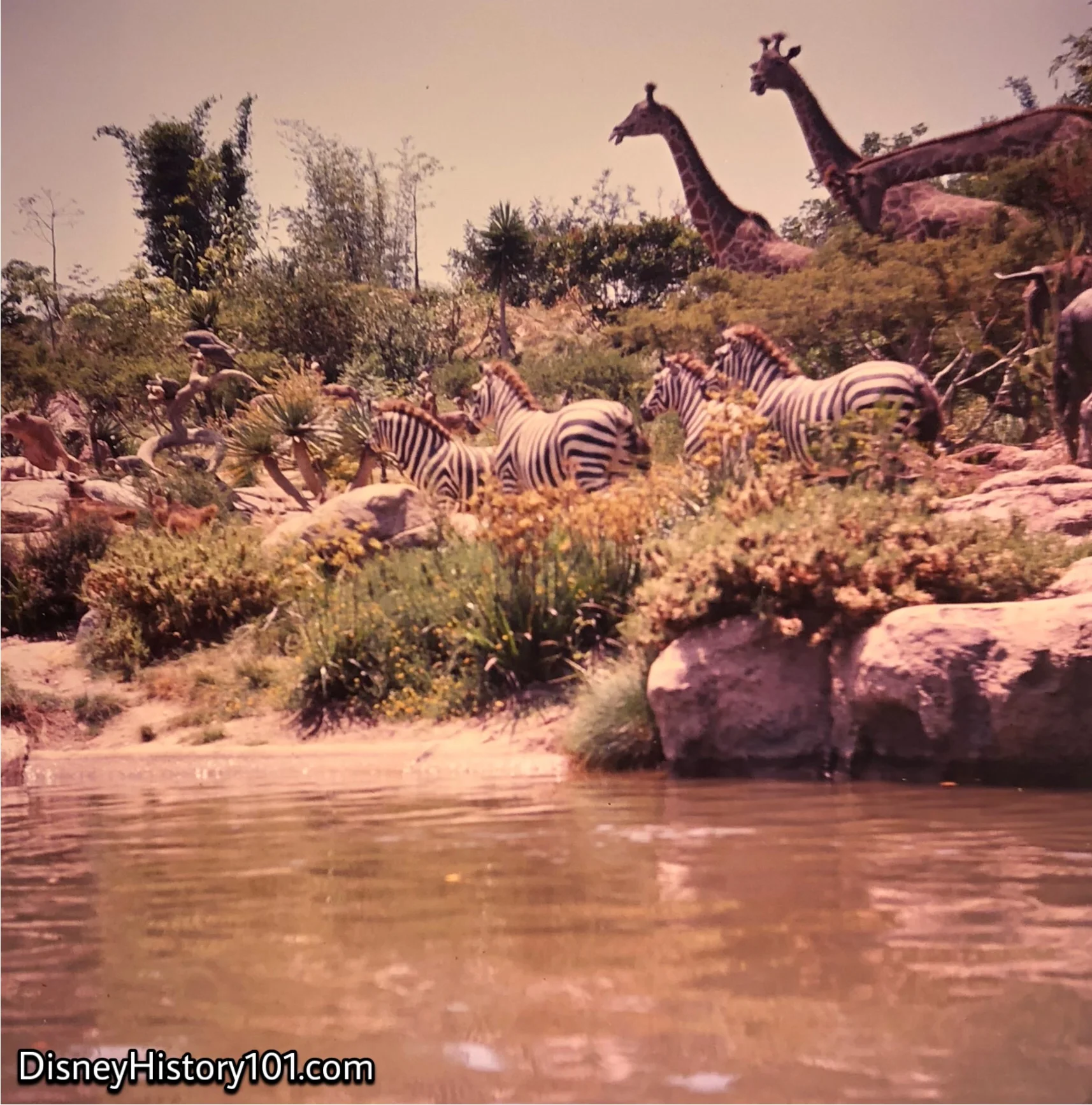
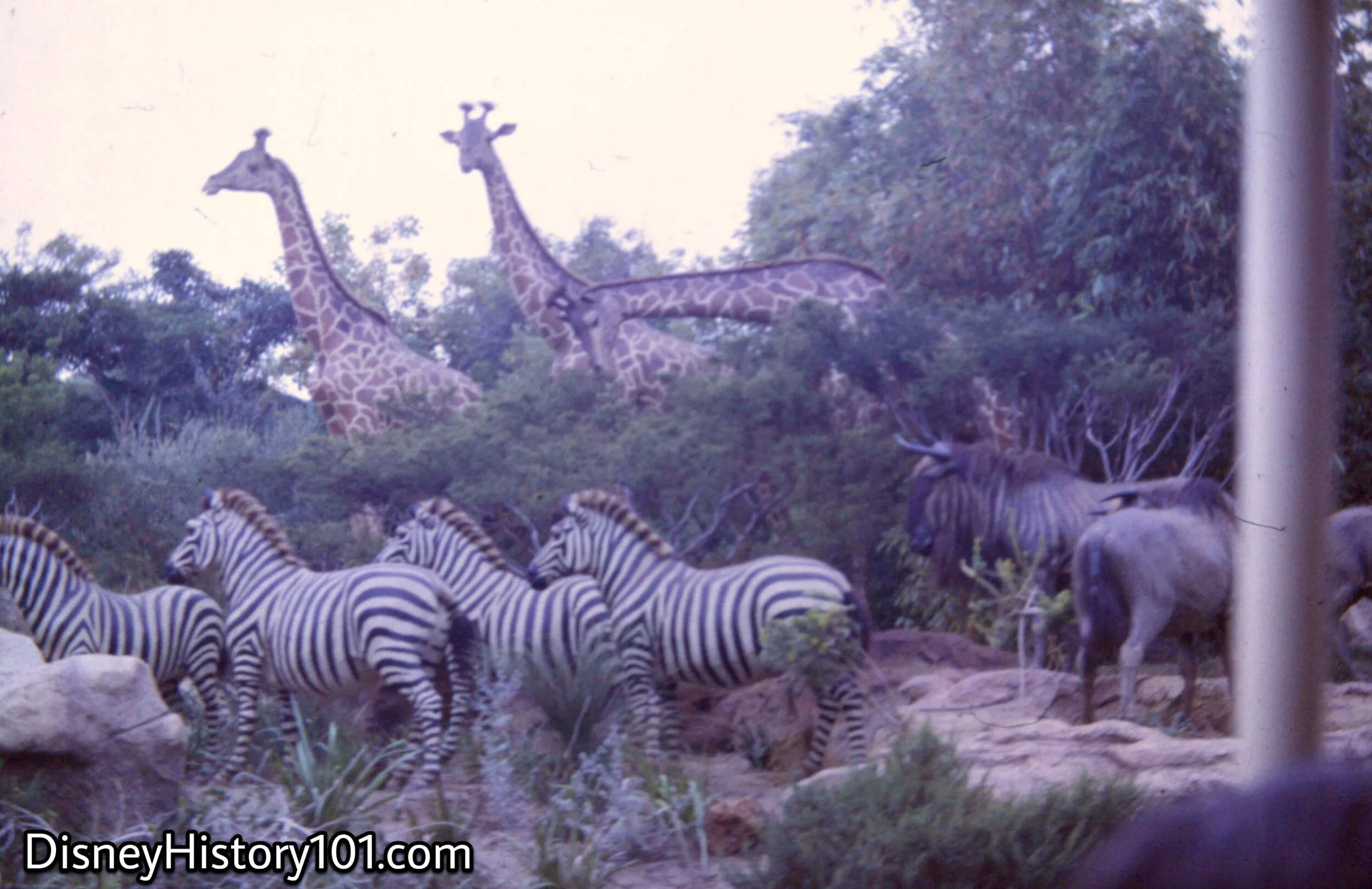
1964
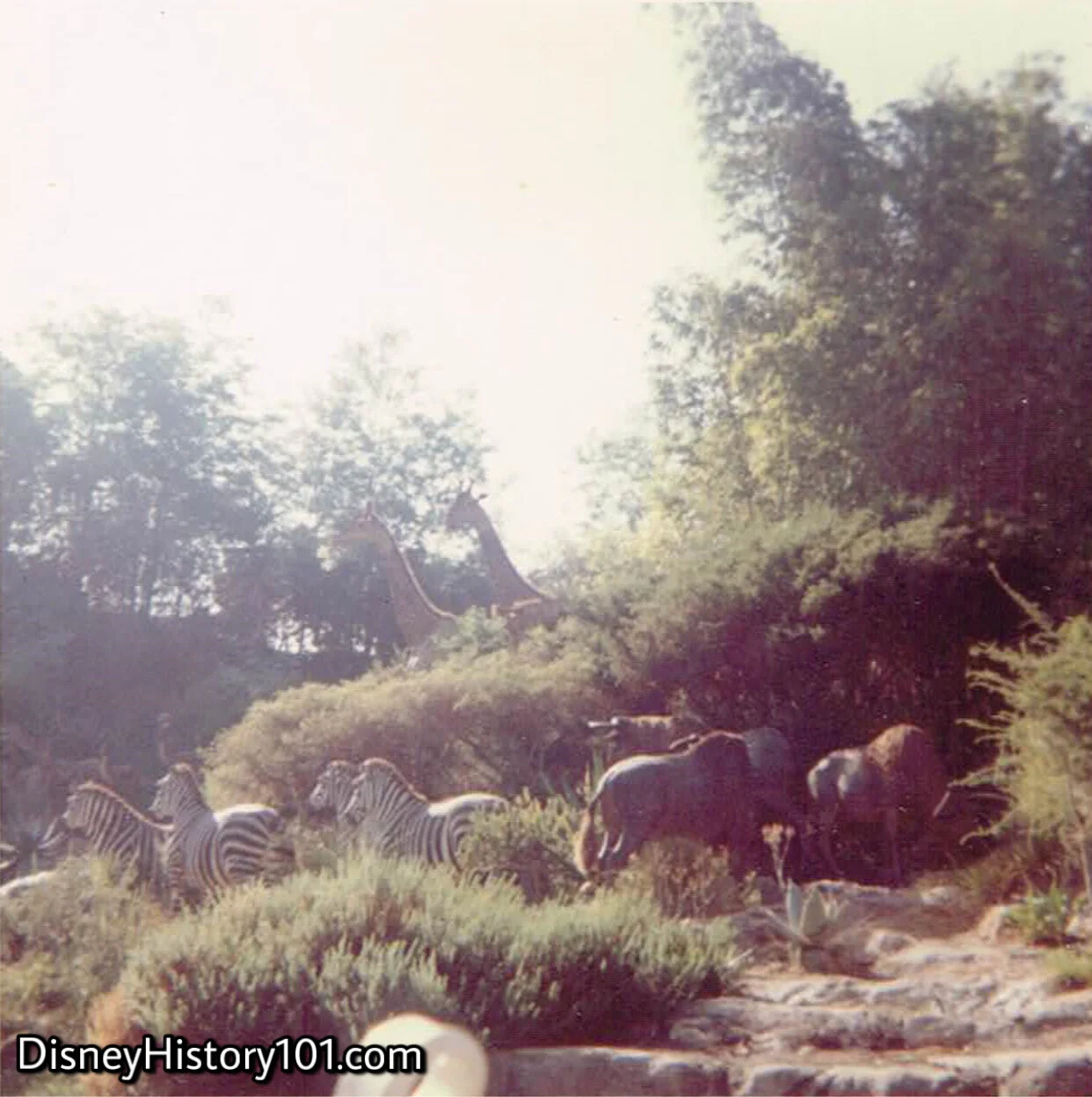
1969
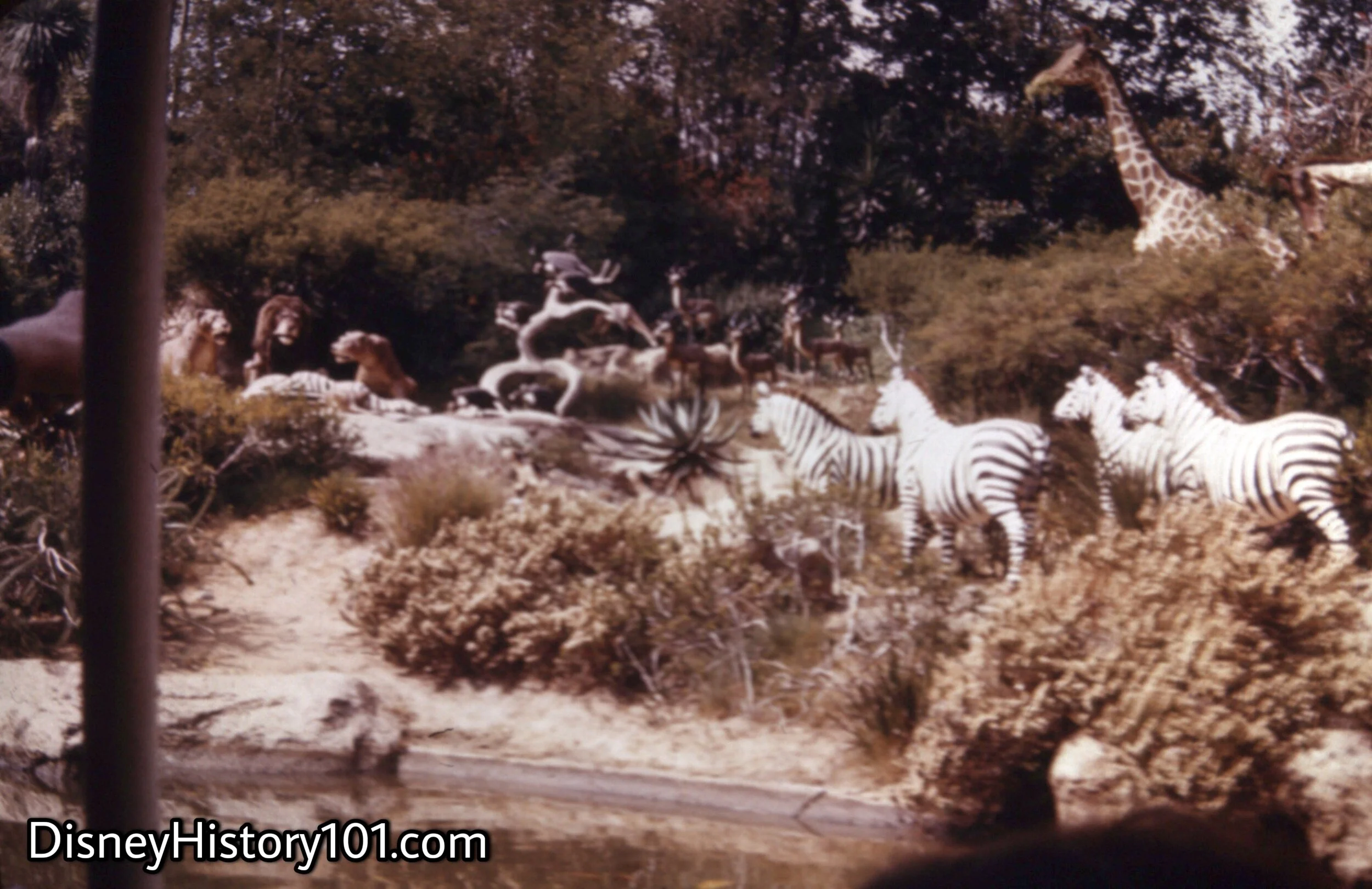
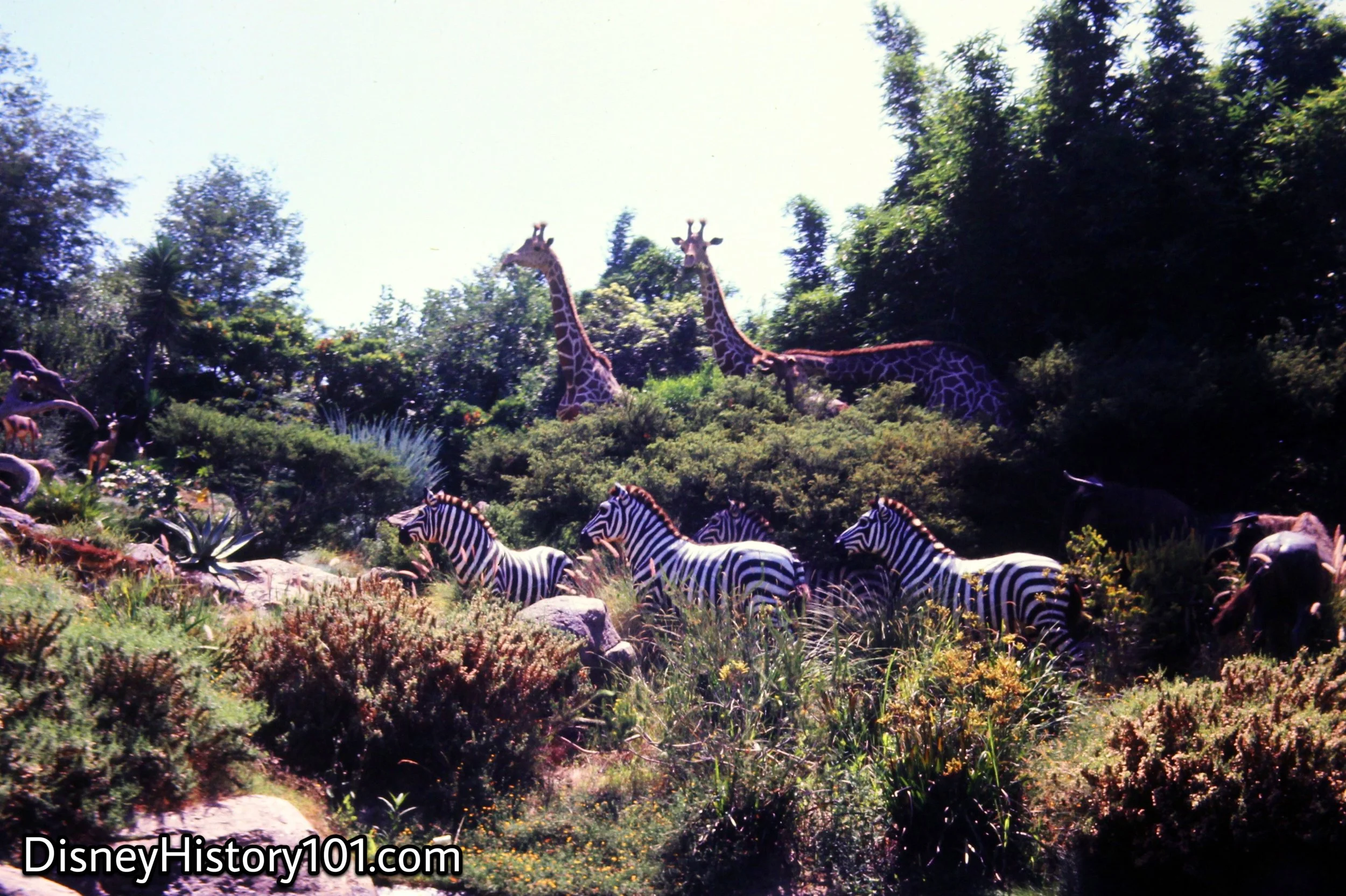
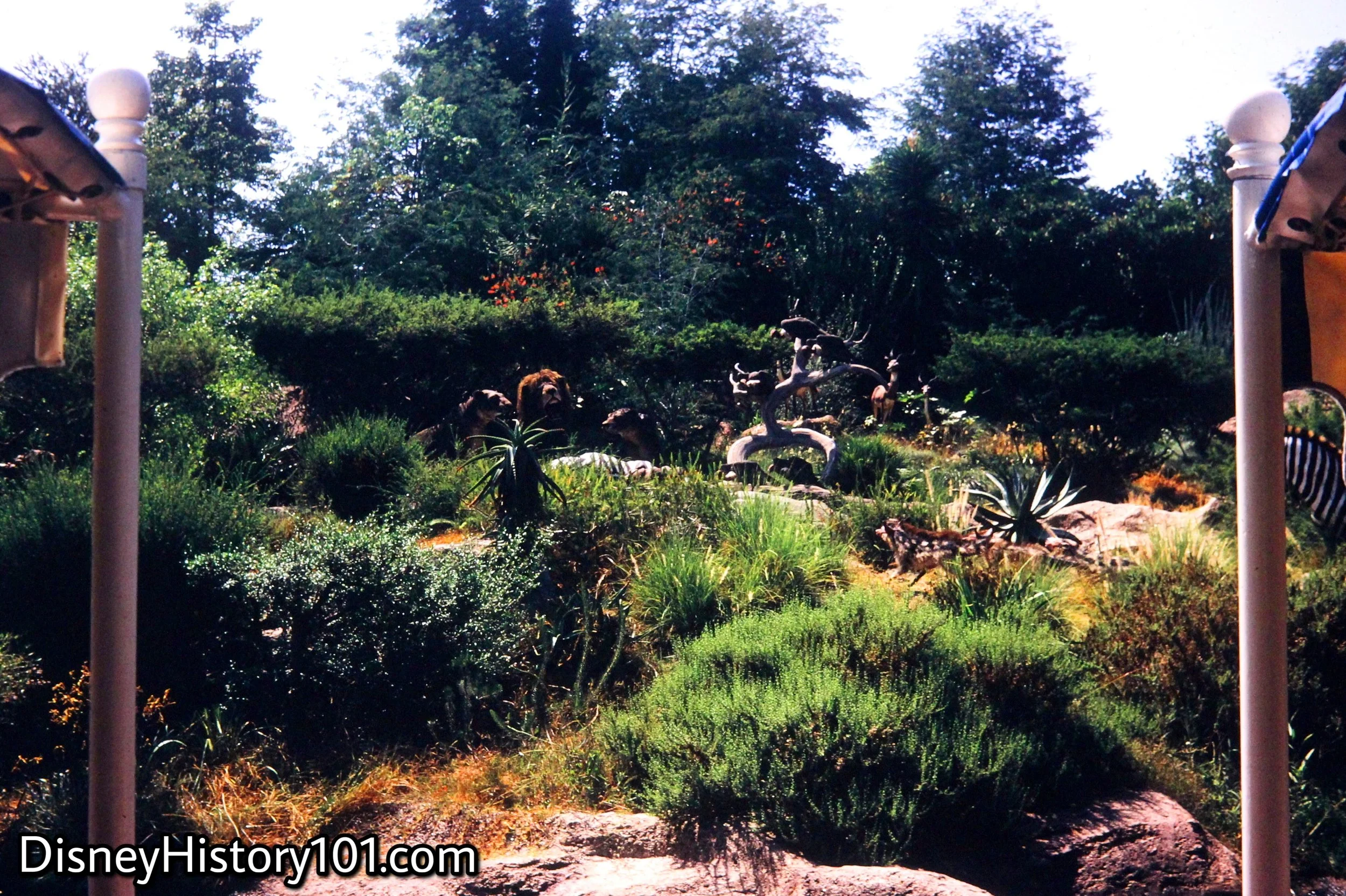
1967
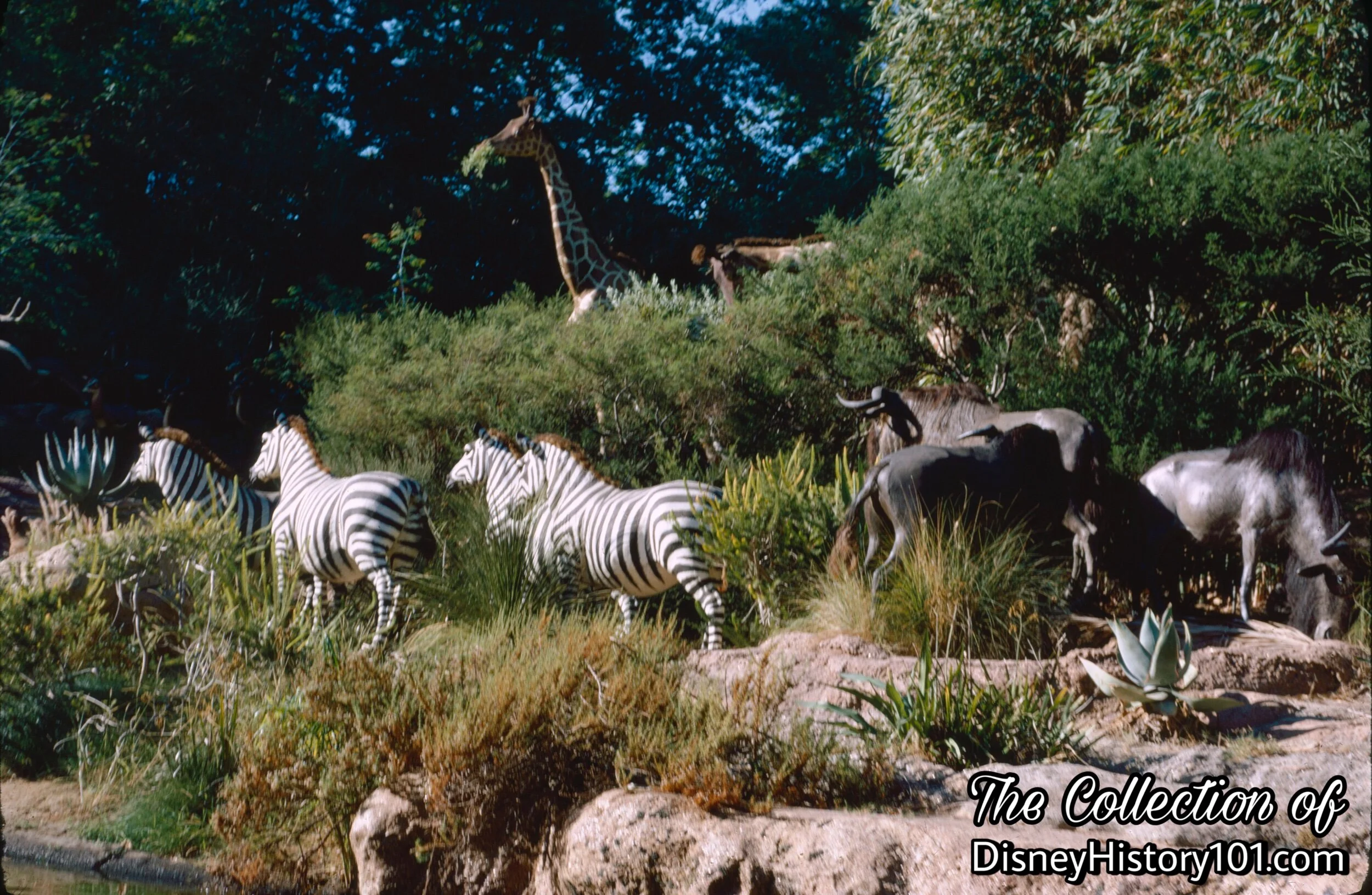
(October 30, 1971)

The True-Life Adventure feature The African Lion (released on September 14th, 1955) was viewed as a “candidate for another Oscar”, according to “News From Disneyland” (a c.1956 press release document). The film came to directly inspire several vignettes to be featured along the banks of the river.
As guests turn a bend in the river, they see that a zebra who came to find water has fallen prey to a pride of lions. Nearby, other animals view the scene.
It looks like “a snarling lioness guards her kill on shore”, according to the Pasadena Star-News (Friday, December 14, 1955). From 1955 to 1963, a lion and two lionesses tearing at their prey (a zebra), could be spotted along the shores of the Rivers of the World.
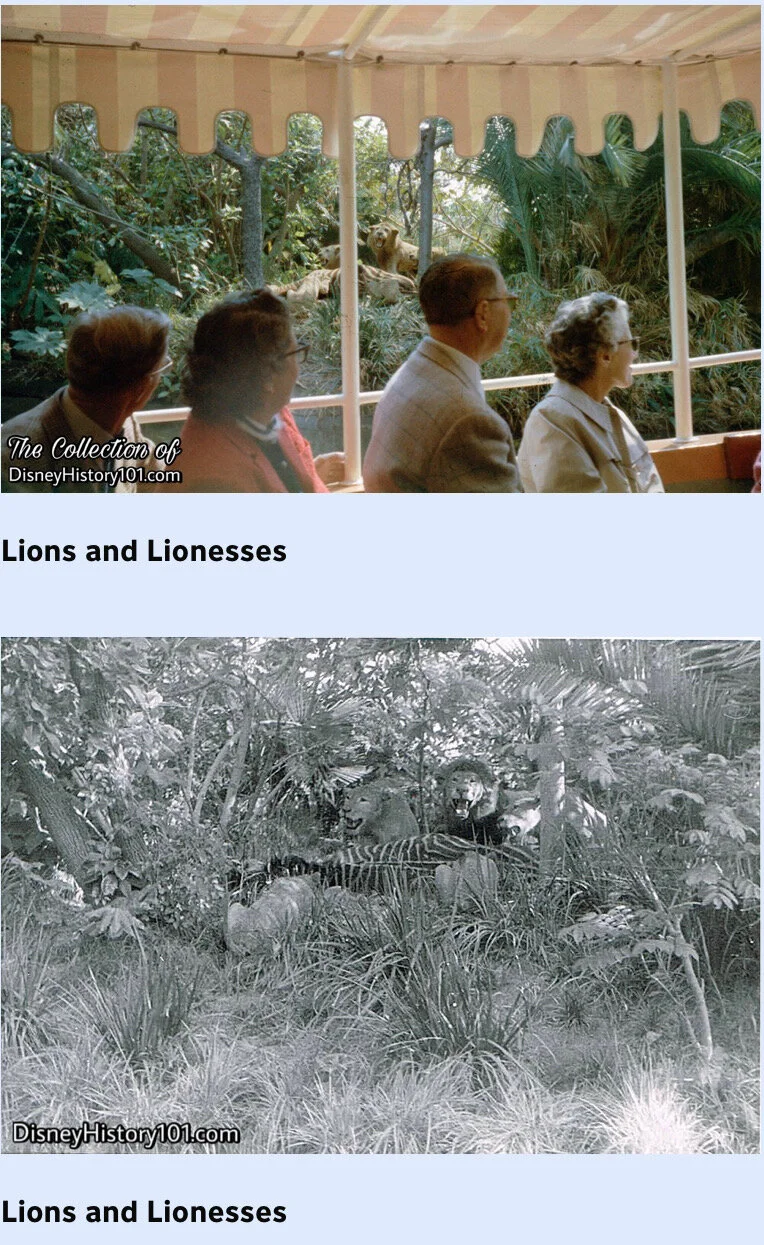
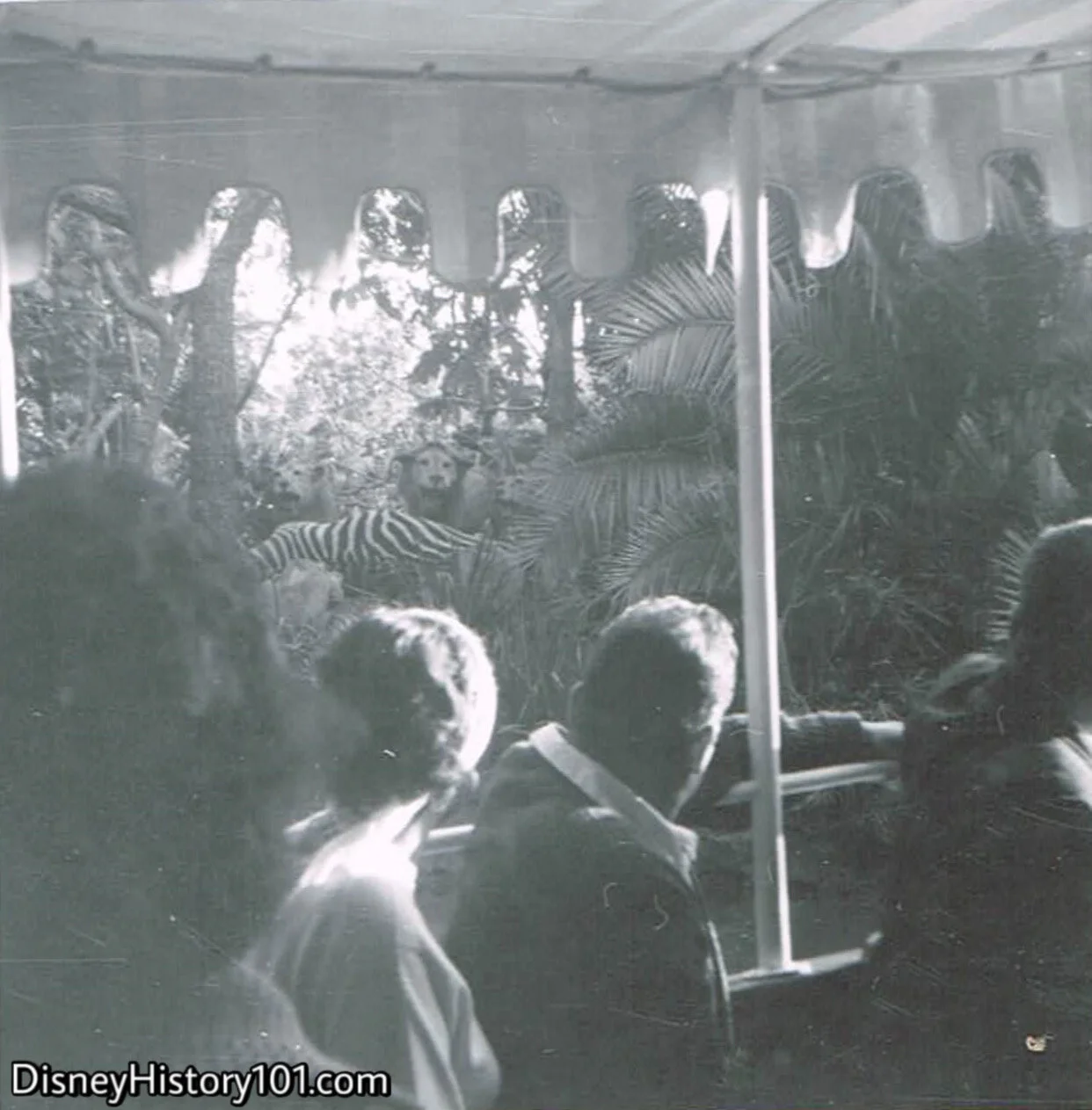
Lions and Lionesses
Lions and Lionesses
There are other wild animals too, and beautiful vegetation.
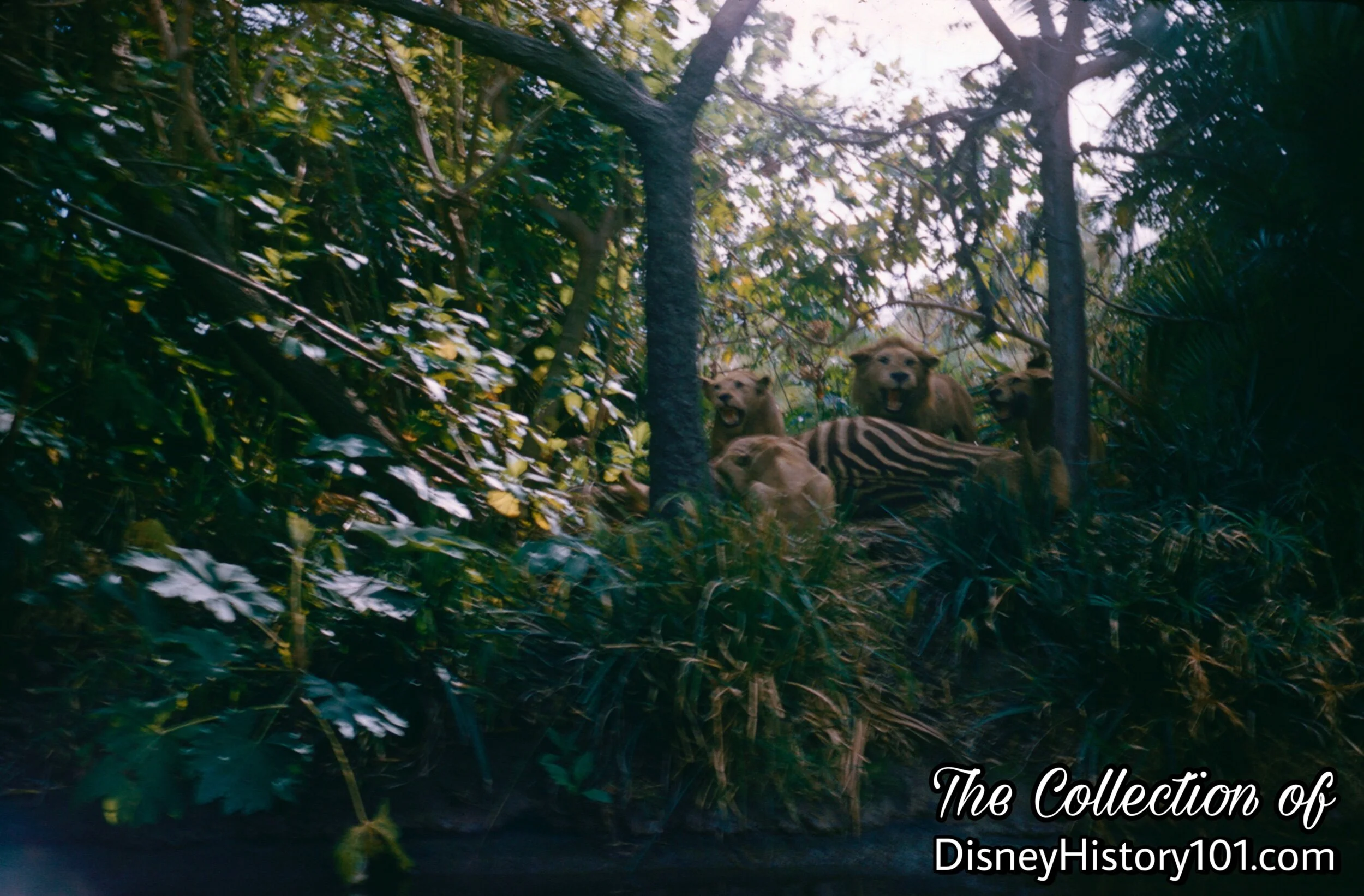
Lions and Lionesses
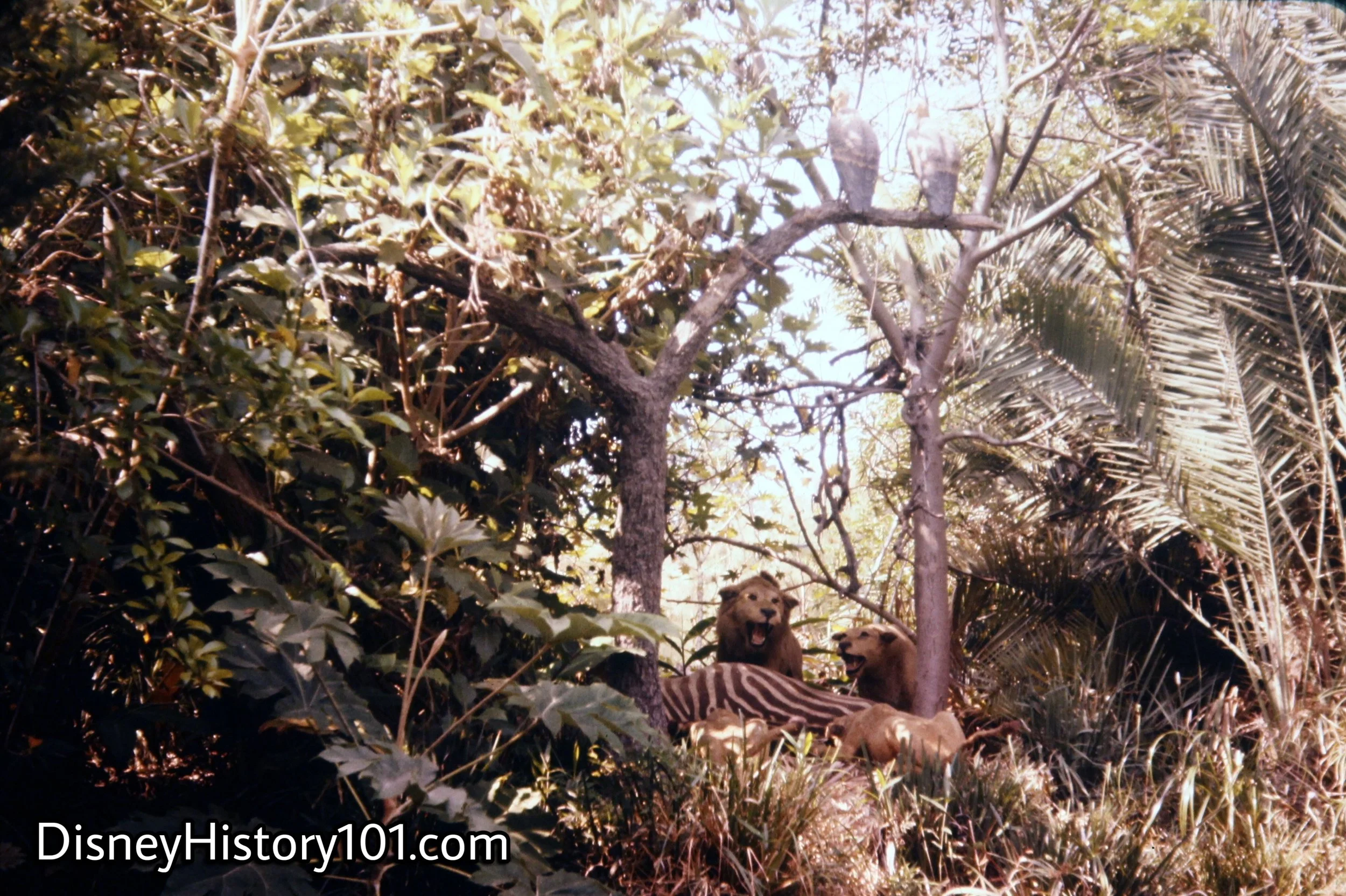
Lions and Lionesses, (1961)
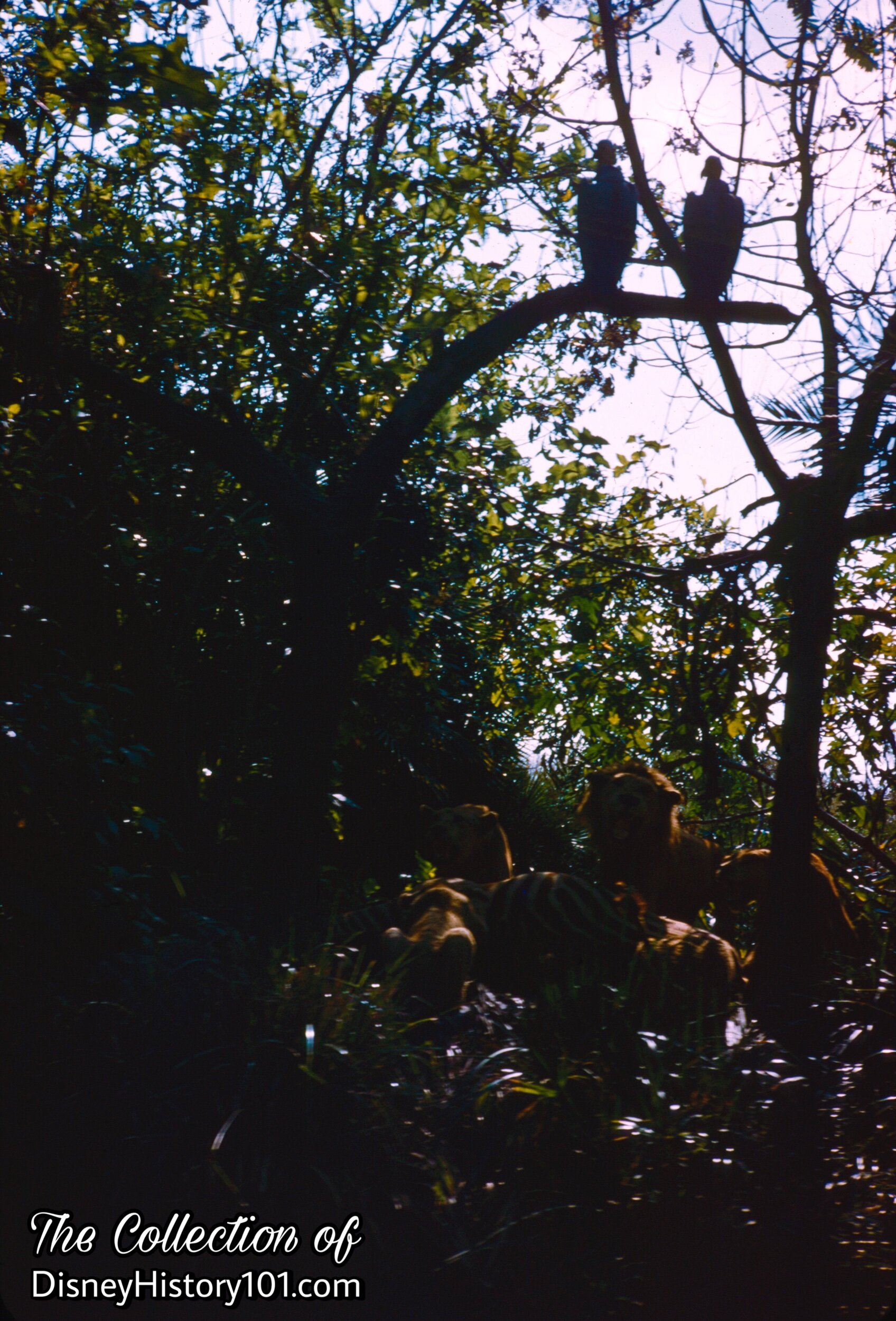
Lions and Lionesses, (1961)
Look…in those trees…a pair of African Vultures! Wherever these birds appear, it’s a sign of disaster. As nature’s scavengers, the vultures lead a precarious existence. Someone else is always on the lookout for the carrion that they’ve found.
A decade later, there appeared even more scavengers - a “den of lions, tigers, jackals, laughing hyenas, and wild game”, according to one Disneyland advertisement of coming attractions published 1962. Even “Big Game Hunters” would eventually fall into the pitfalls of jungle exploration!
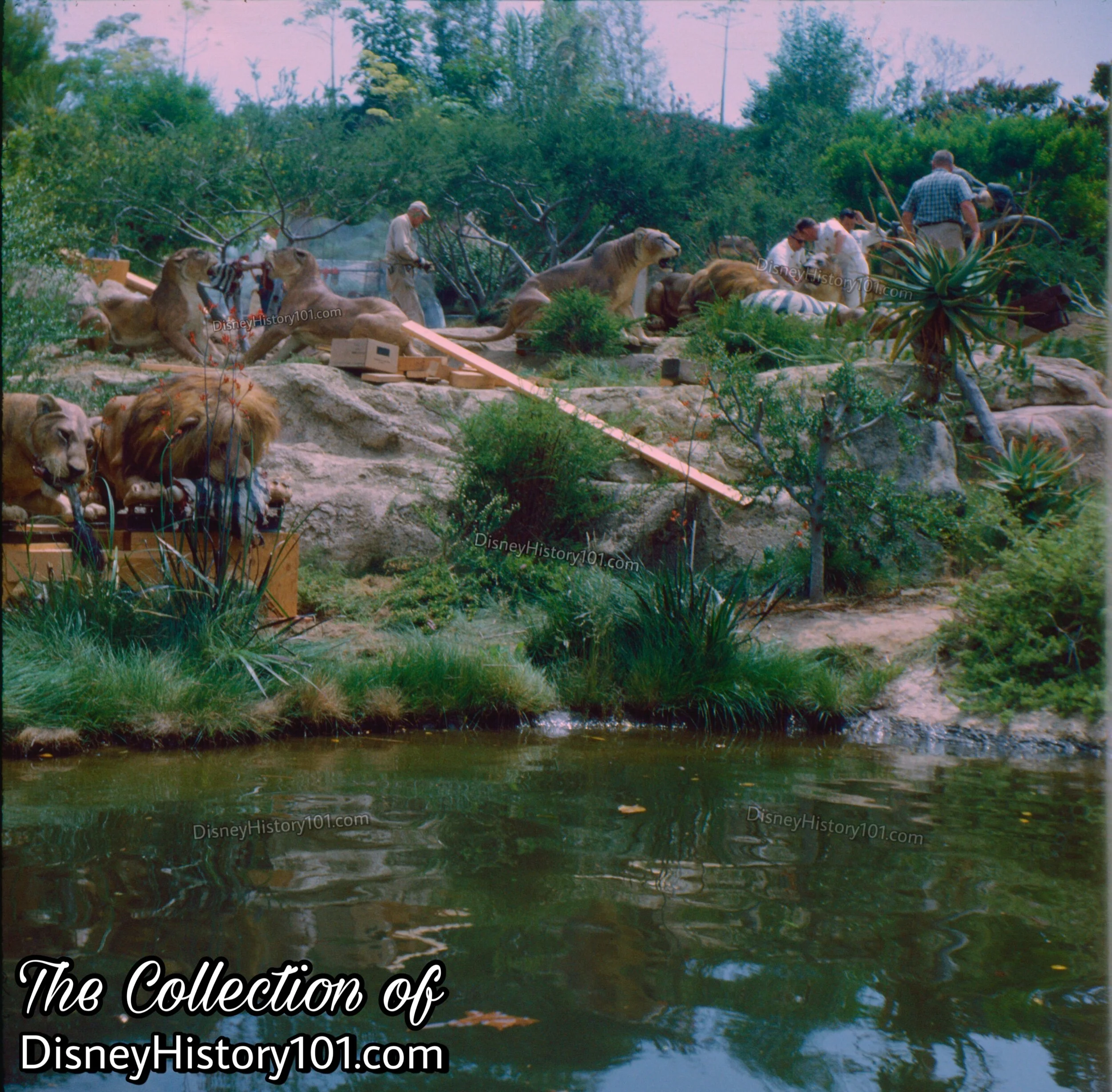
AFRICAN VELDT installation; c. July, 1964.
The Jungle Cruise is based on some of the true-life Rivers of the World (the Irrawaddy, the Mekong, the Nile, and the Congo). When an African Veldt region suddenly appeared alongside the lush, tropical Rivers of the World (and no one questioned this scientific anomaly), other lions also appeared along the shore.
Eventually, other new scenes would unfold along the river banks - the ‘lost safari’ was discovered (in 1964), a particular herd of mother elephants and their “little squirts” would settle near a portion of the river known simply as ‘the Elephant Bathing Pool’ (in 1966), and the African Veldt region (in 1964). Here’s a fun fact, Disneyland is the only place in the world where any of those major rivers actually flow through (or touch) a “Veld” or “Veldt” (grassland or bush) region.
The original two lions were retired from the Rivers of the World, and (in their place) newer lion animatronics were added to this riverside vignette.
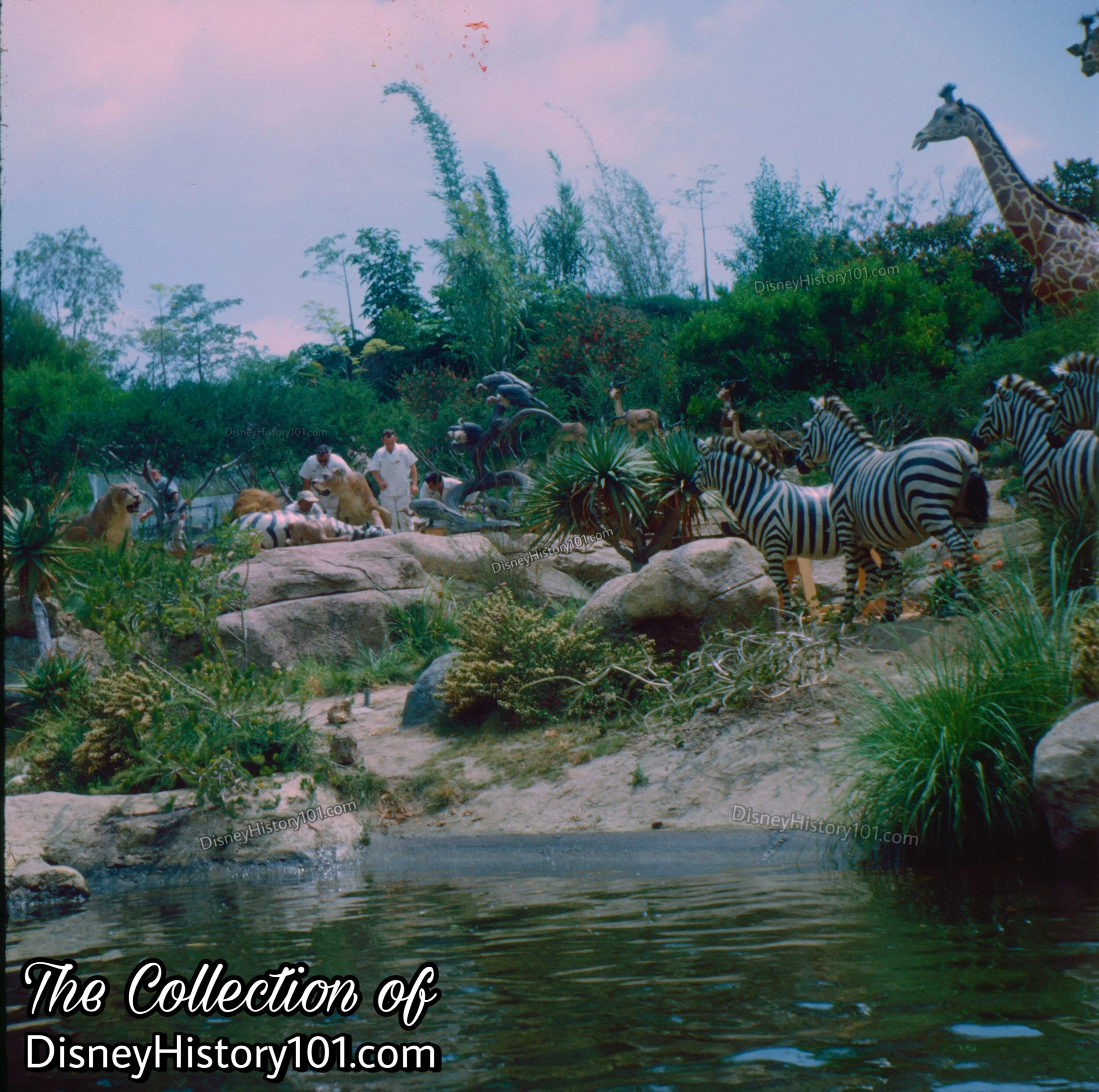
AFRICAN VELDT CONSTRUCTION, (c. July, 1964)
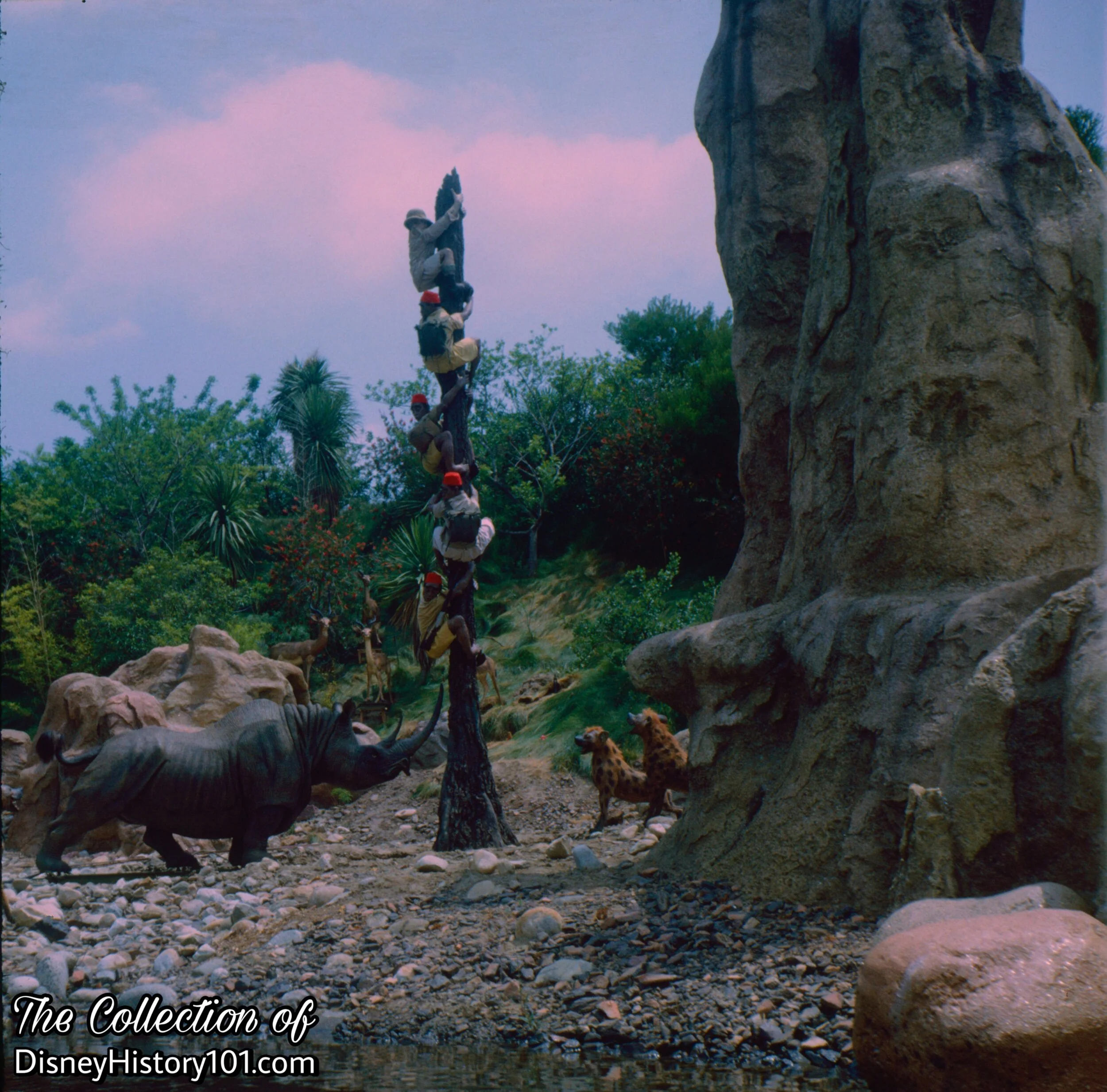
(c. July, 1964)
The ‘Lost Safari’ was suddenly discovered, though no one ever mentioned they were lost before 1964!
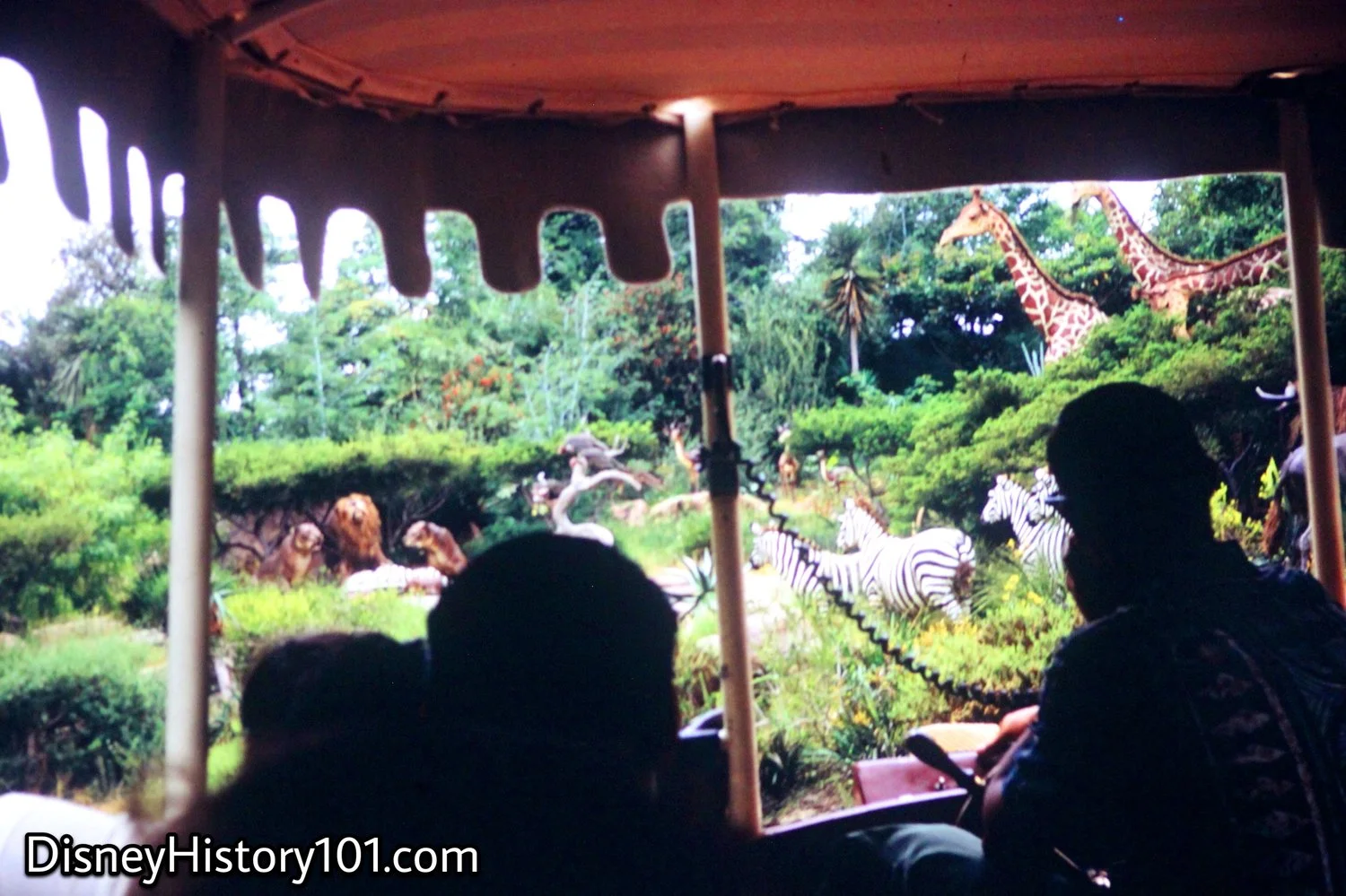
Looks like we’re entering ‘Lion Country’.
1964
The addition of the African Veldt (during 1964) attracted all sorts of animals.
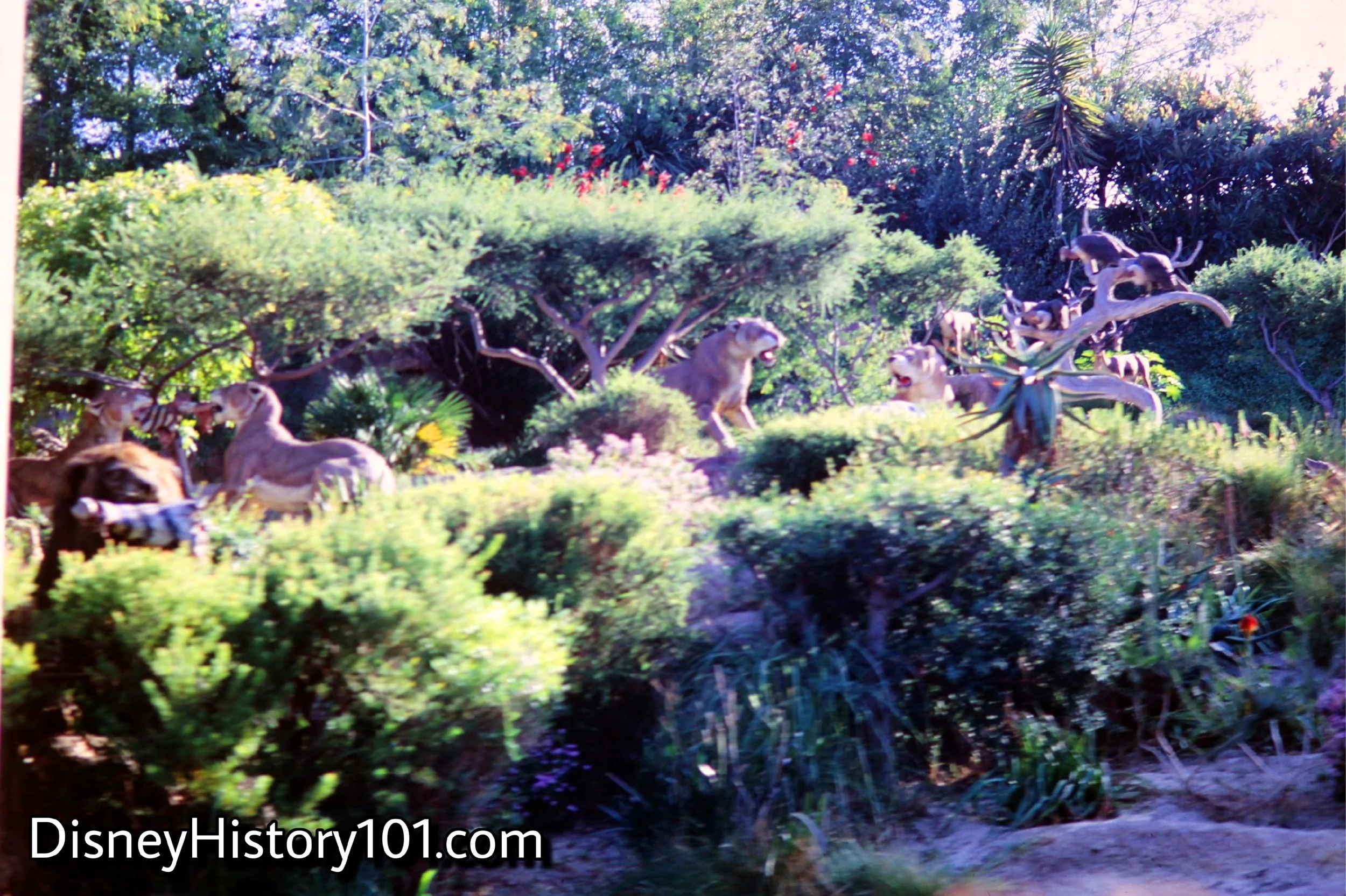
1968, April
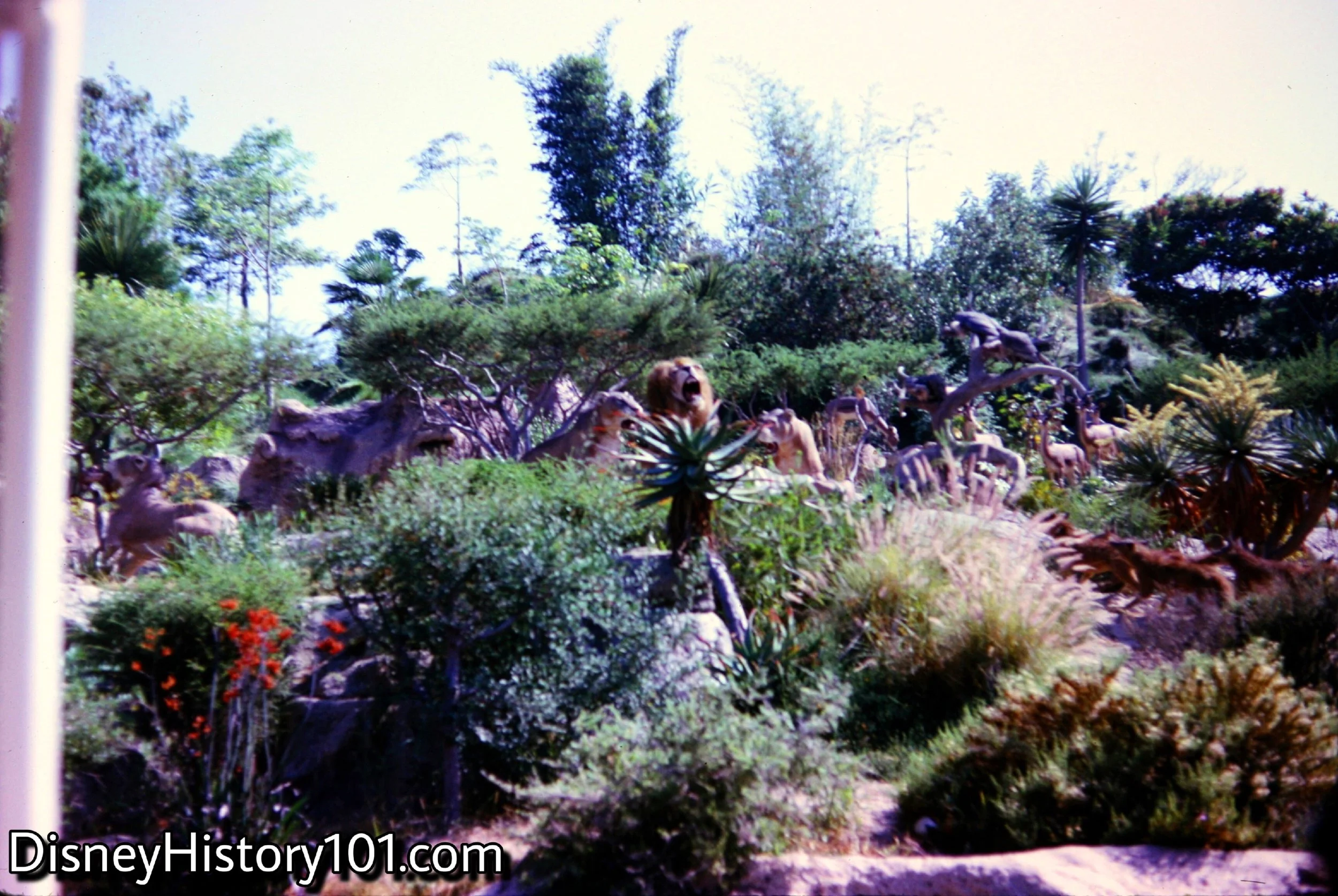
1965, August
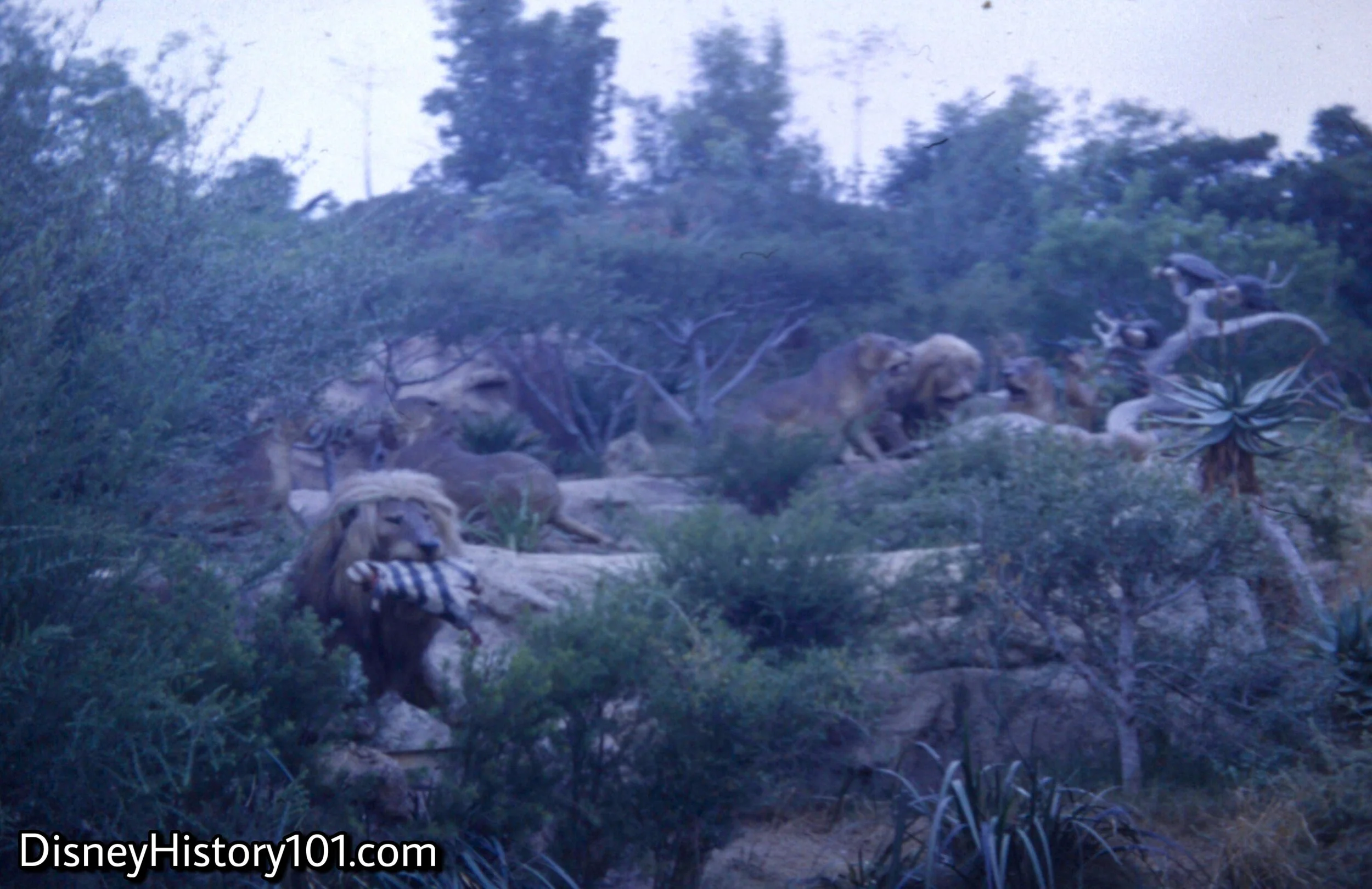
1964
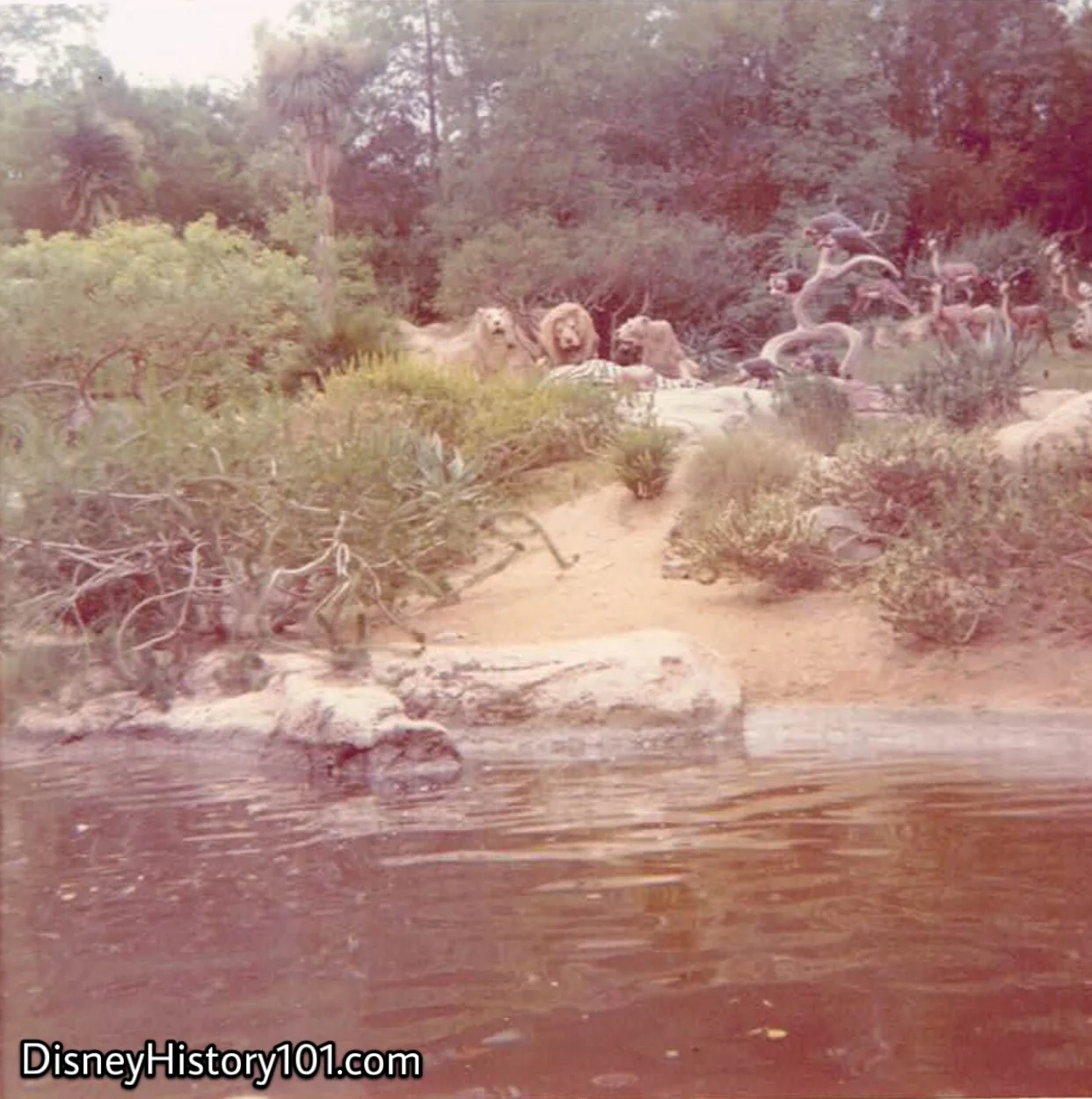
1972

The story of survival is the story of the jungle. To demonstrate this, the next scene has a charging rhino attempting to bring the fine point of survival to bear on the treed elements of a safari.
“Walt…talked about the scene with the rhinoceros chasing hunters up a pole. Walt put a riotous verbal description of what the action would be, with the bottom hunter getting ‘goosed’. Walt was referring to Marc’s art work there and describing how the hyenas were all laughing. One of us had a high, funny laugh. Walt heard it and said, ‘That’s it, let’s have all the hyenas laugh like that!’” -Bob Sewell
The “Trapped Safari” was first discovered during 1964, part of an expansion that brought total Park investment to $50.1 million.
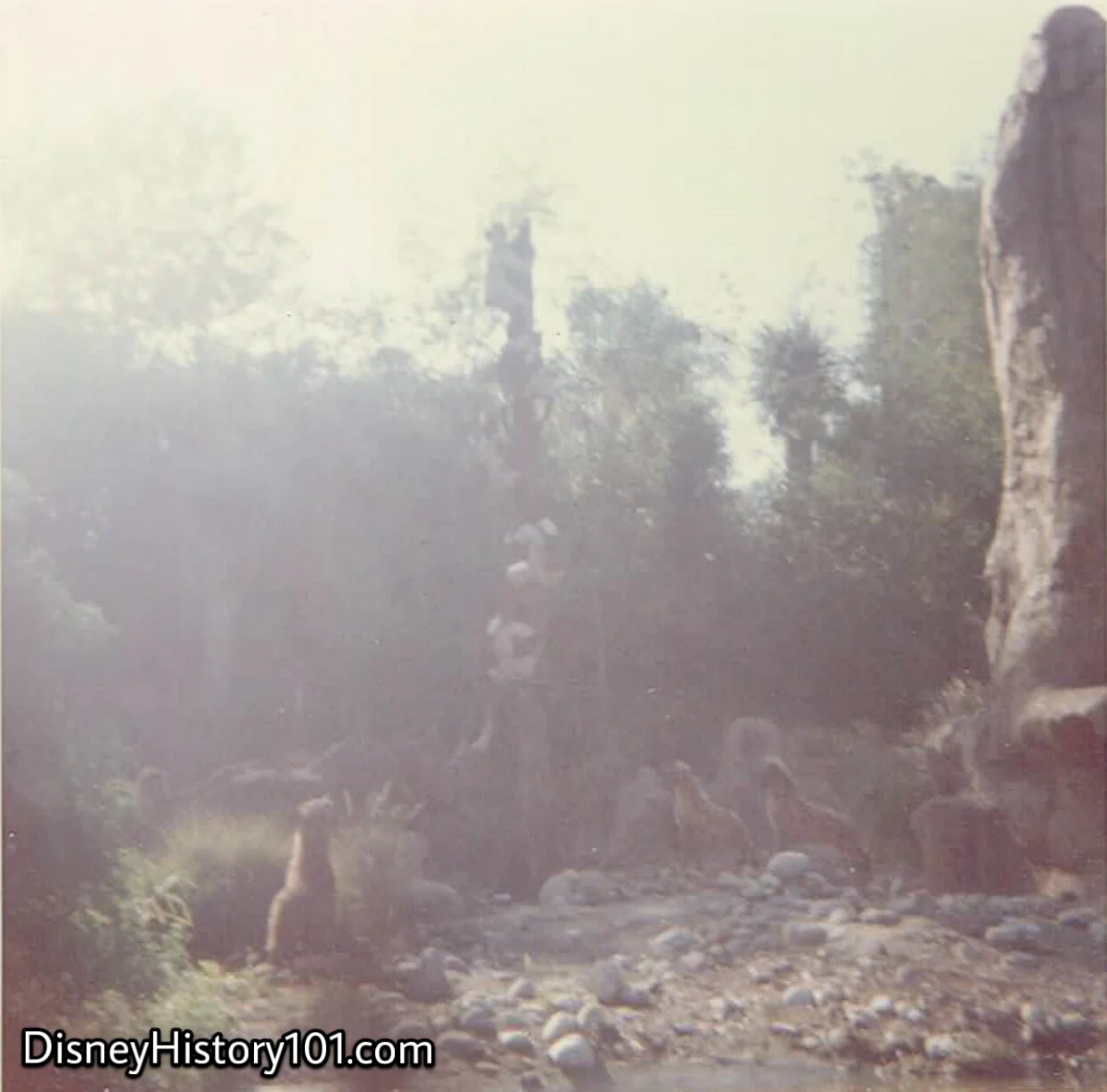
1969
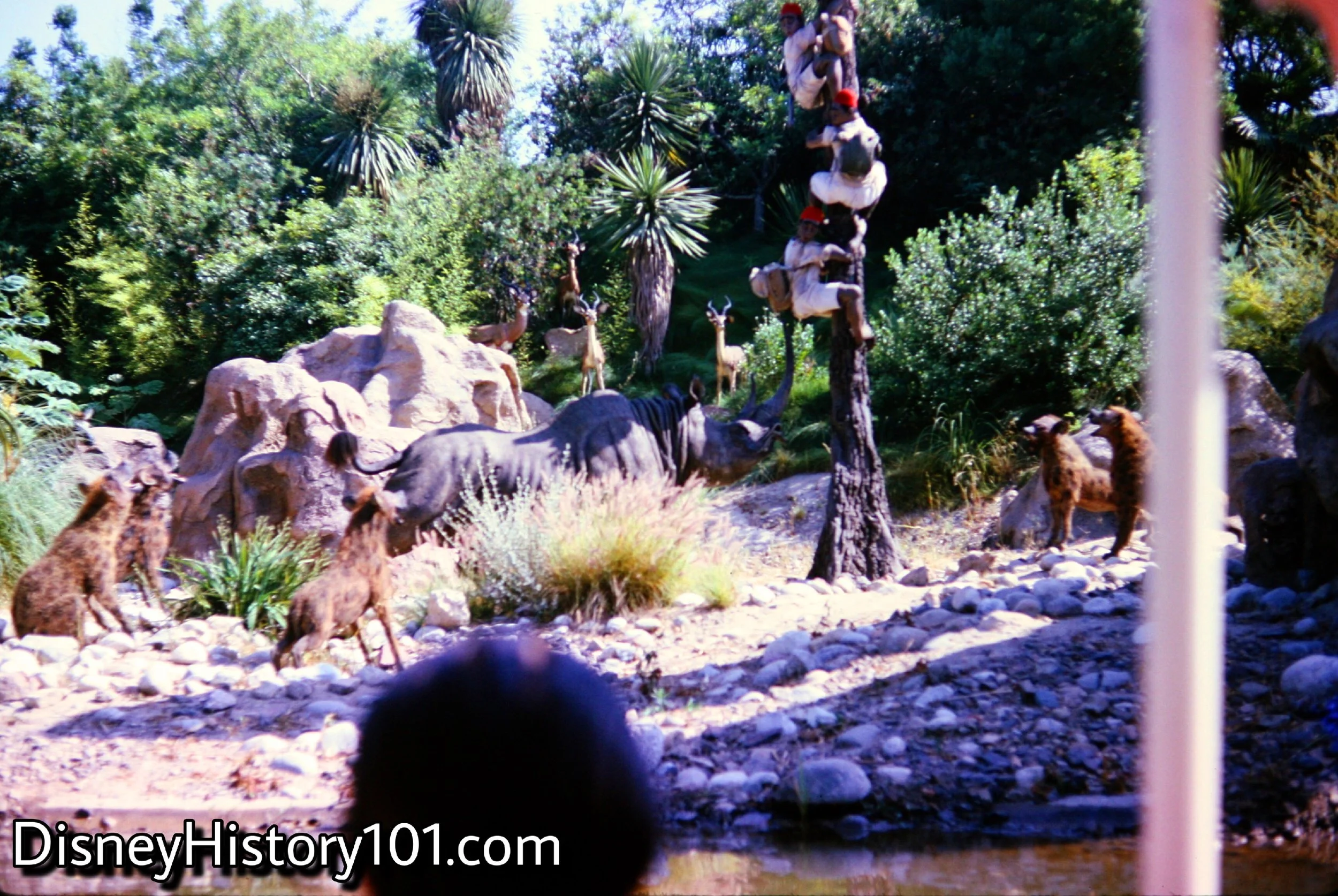
1965, August
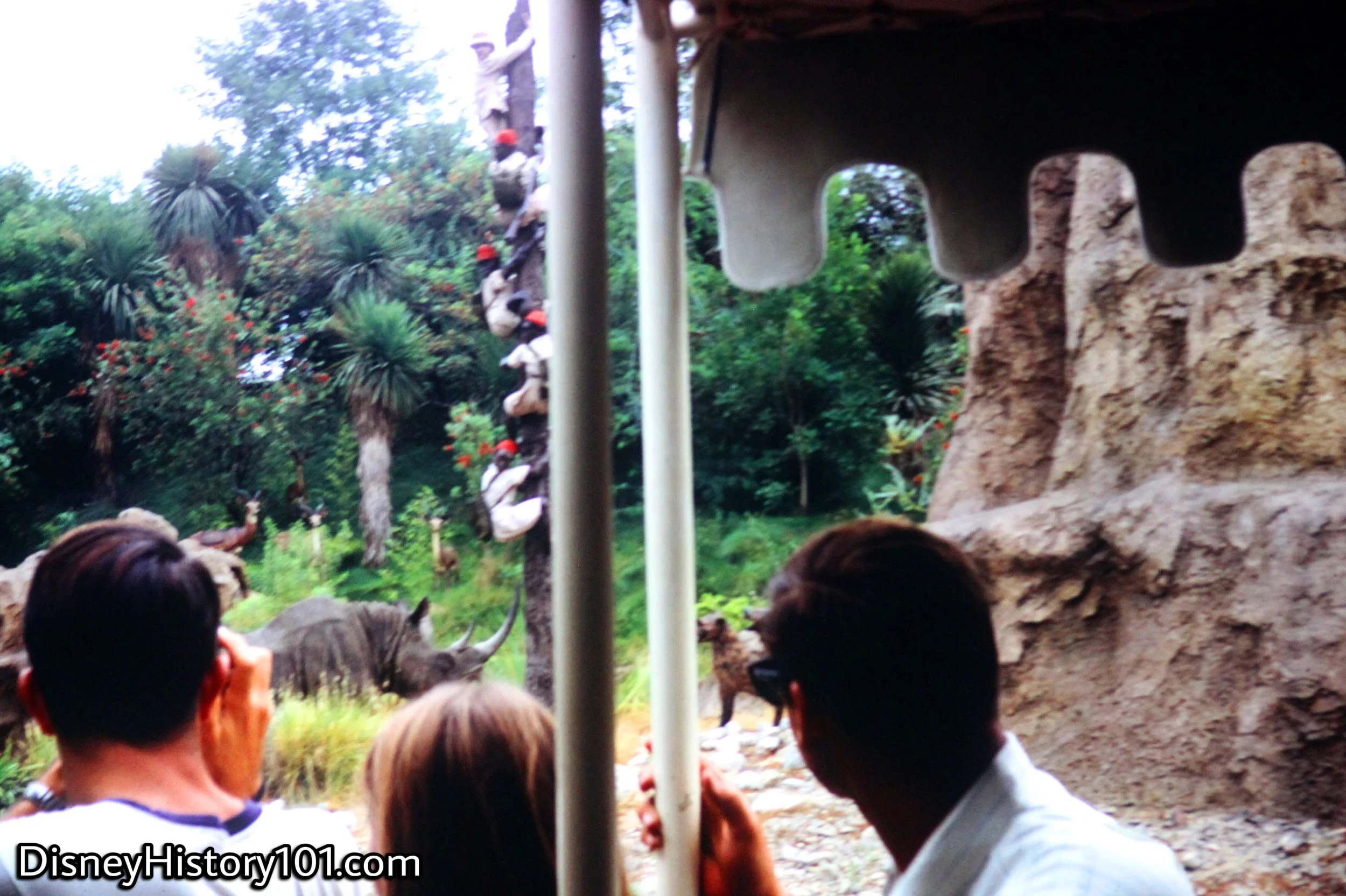
1967, August
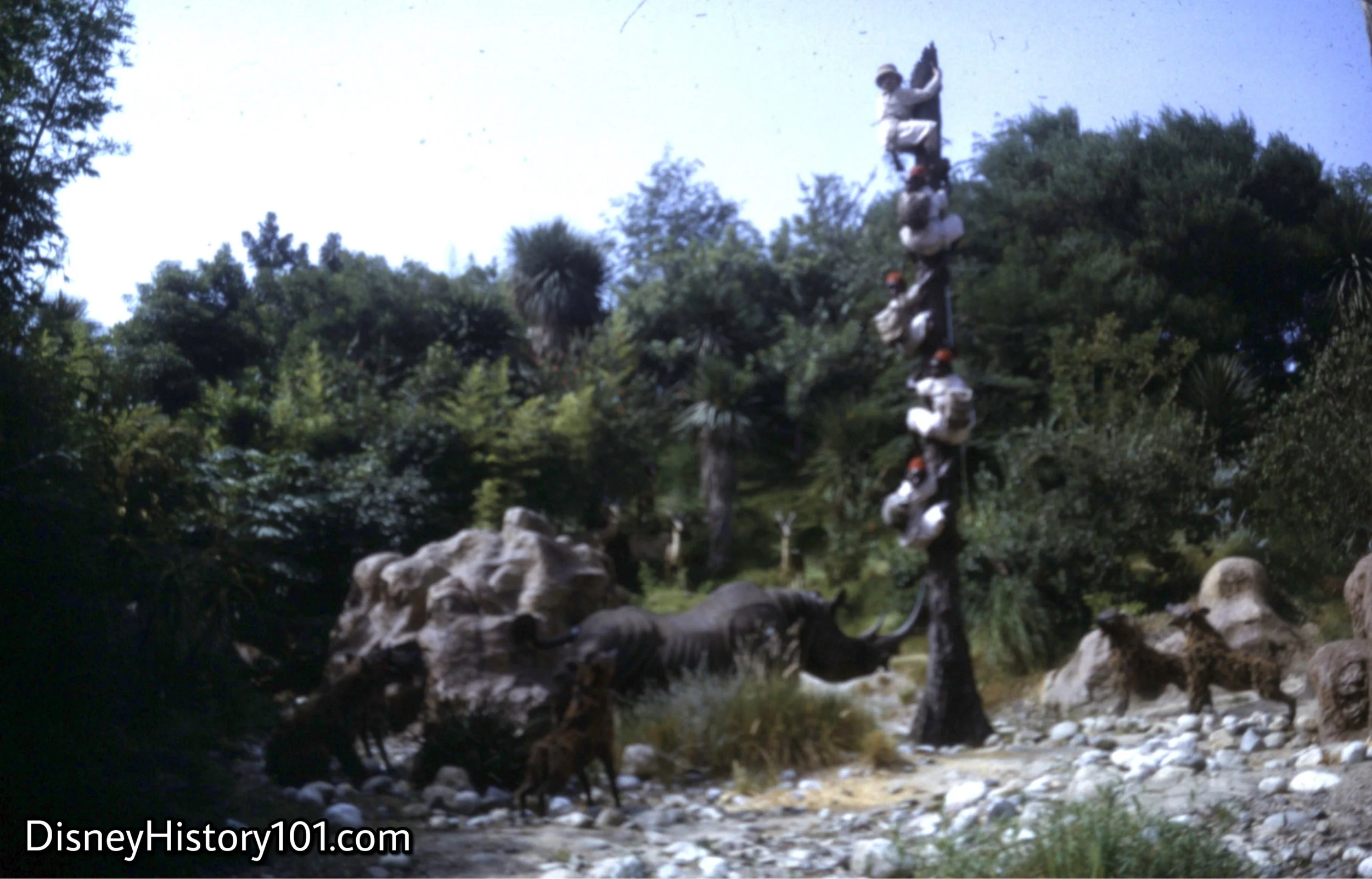
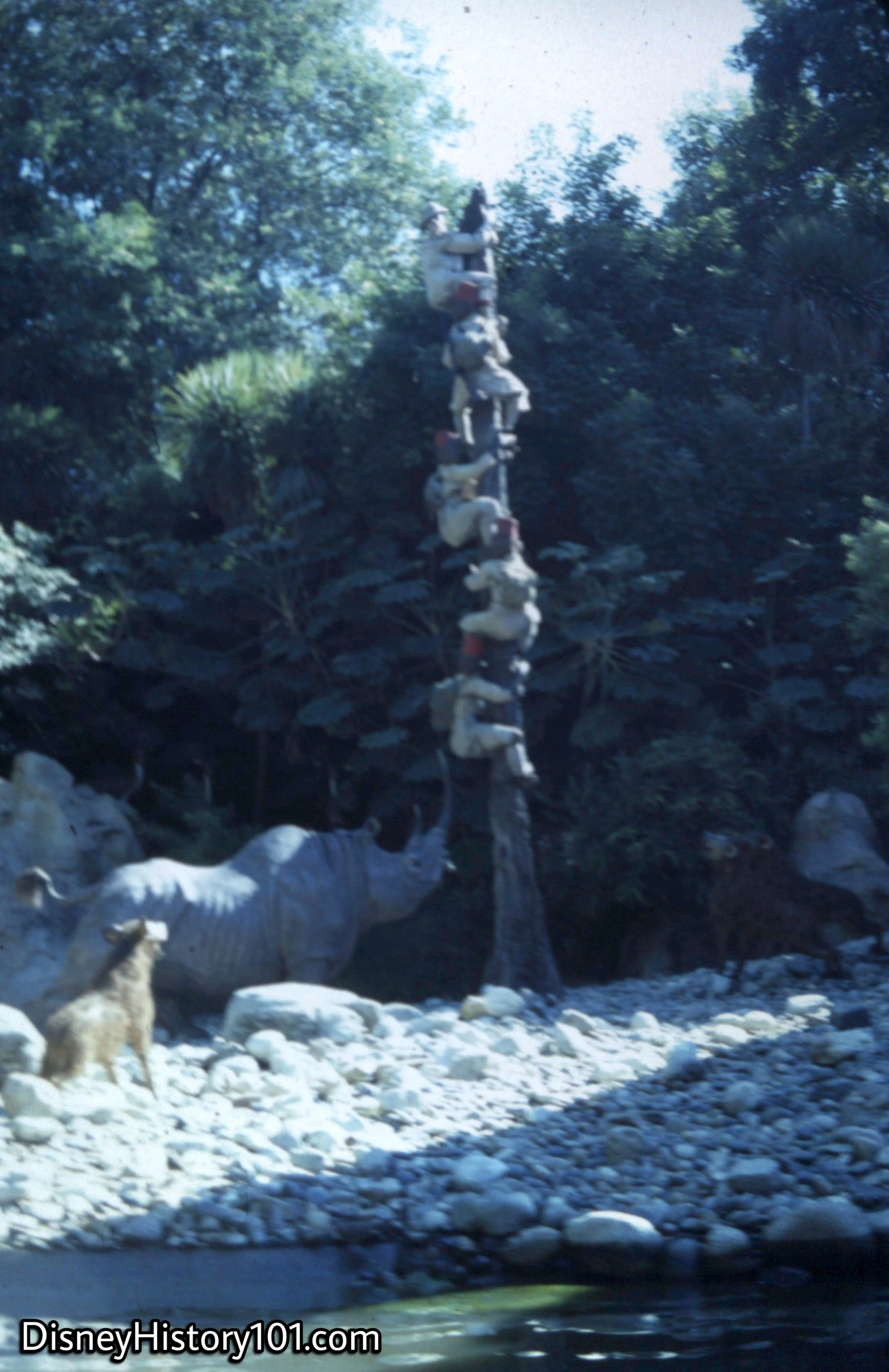
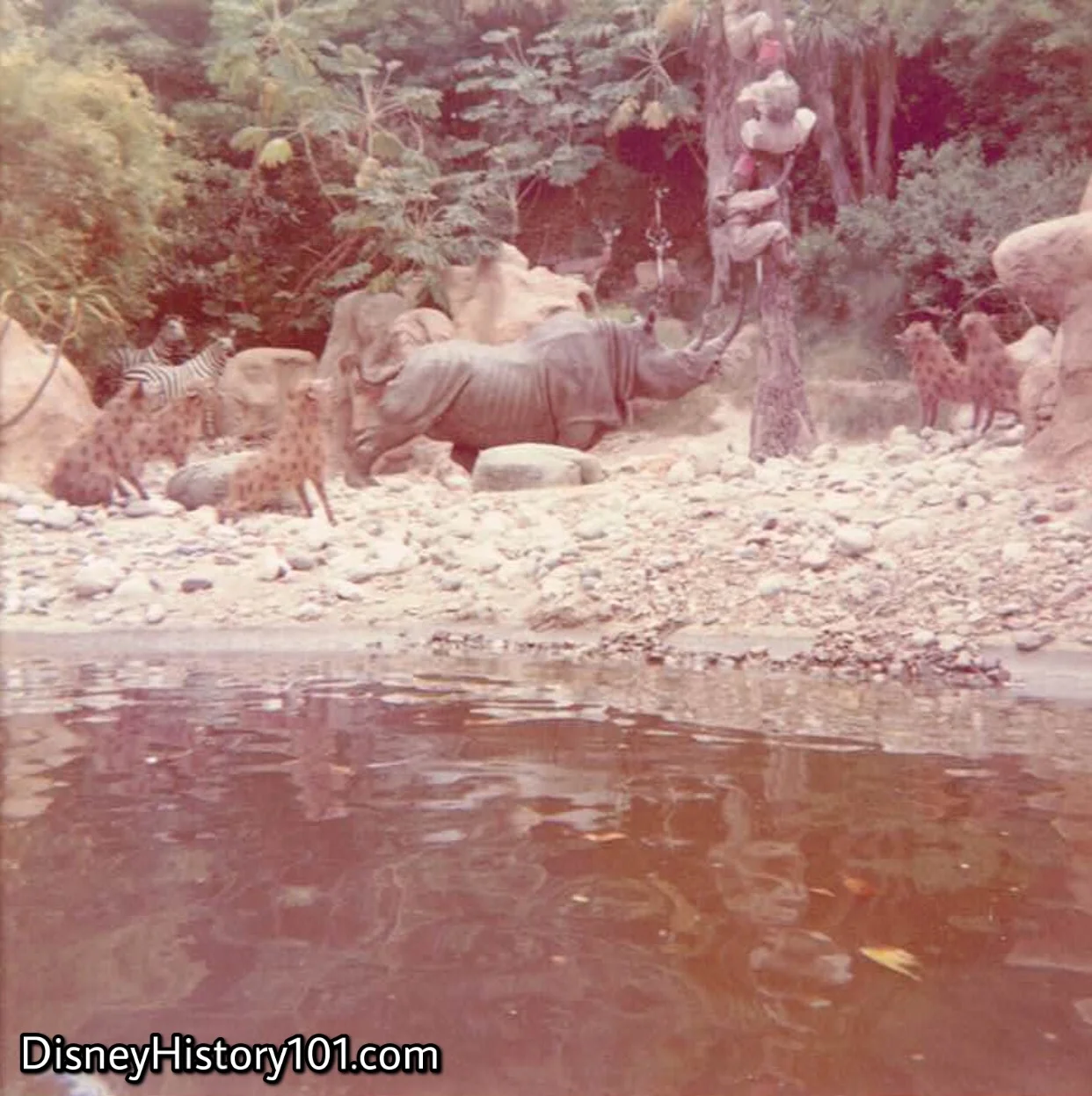
1972
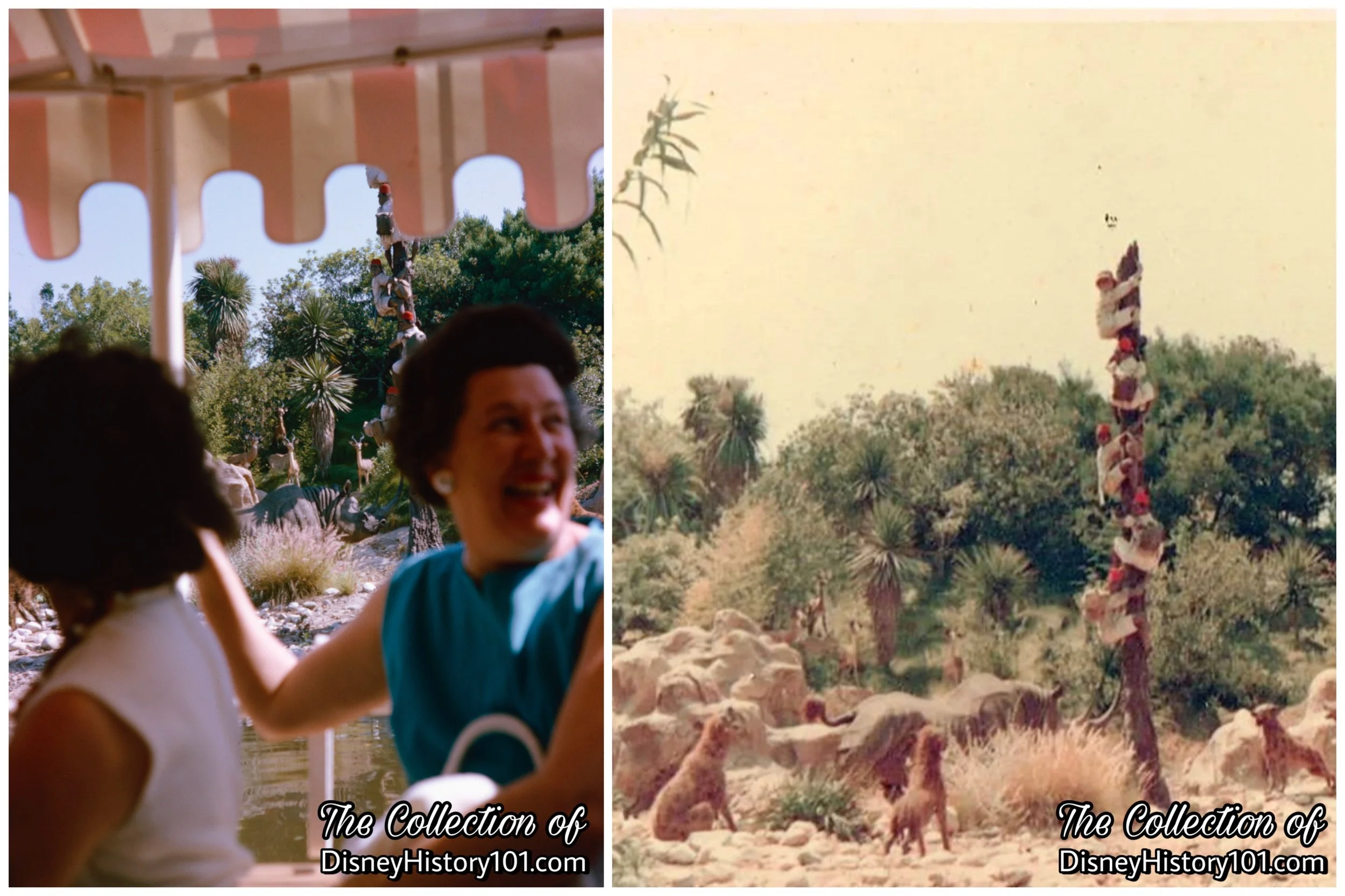
1965.
The lost safari first vanished sometime during 1964, but has continued to turn “up” ever since.
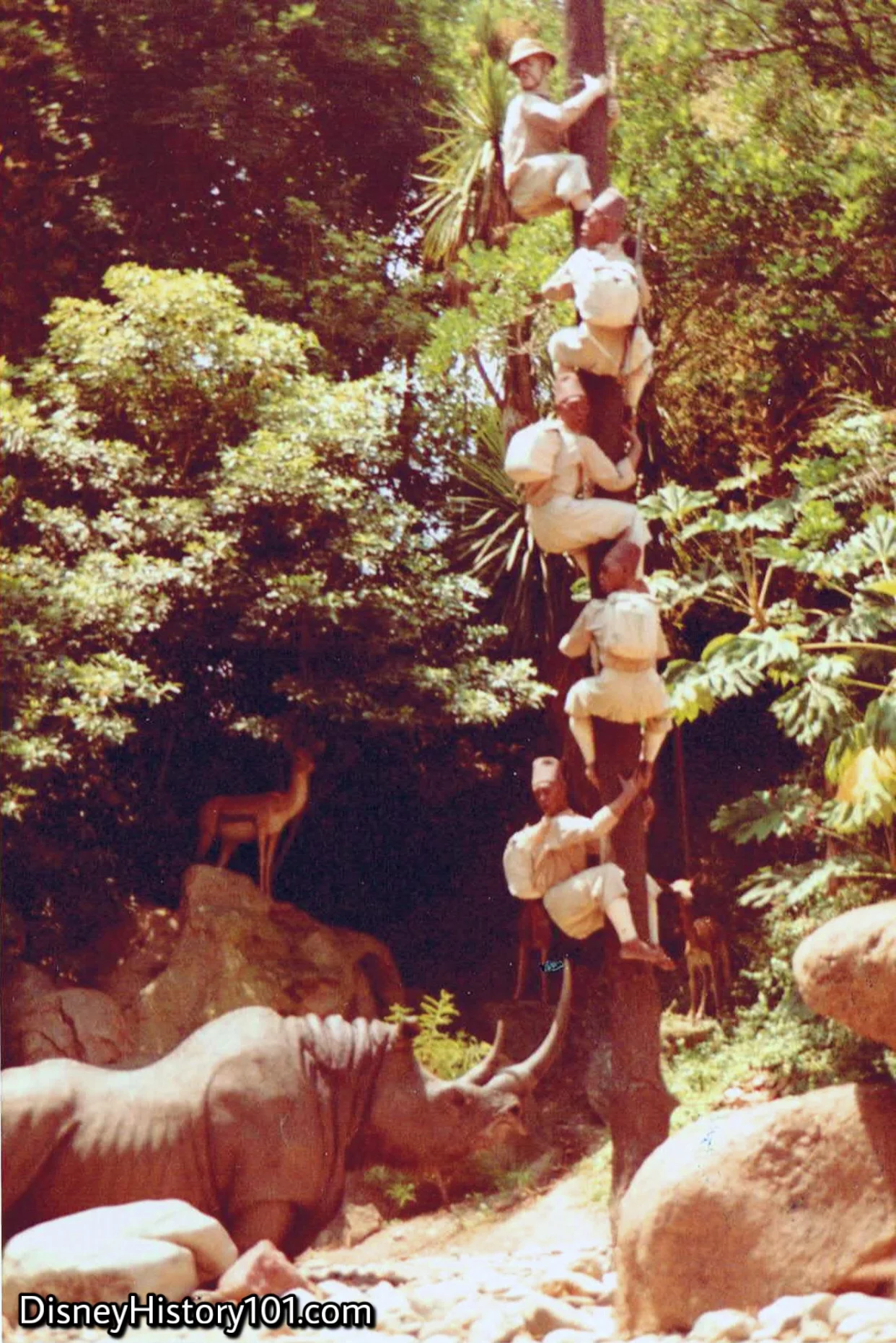
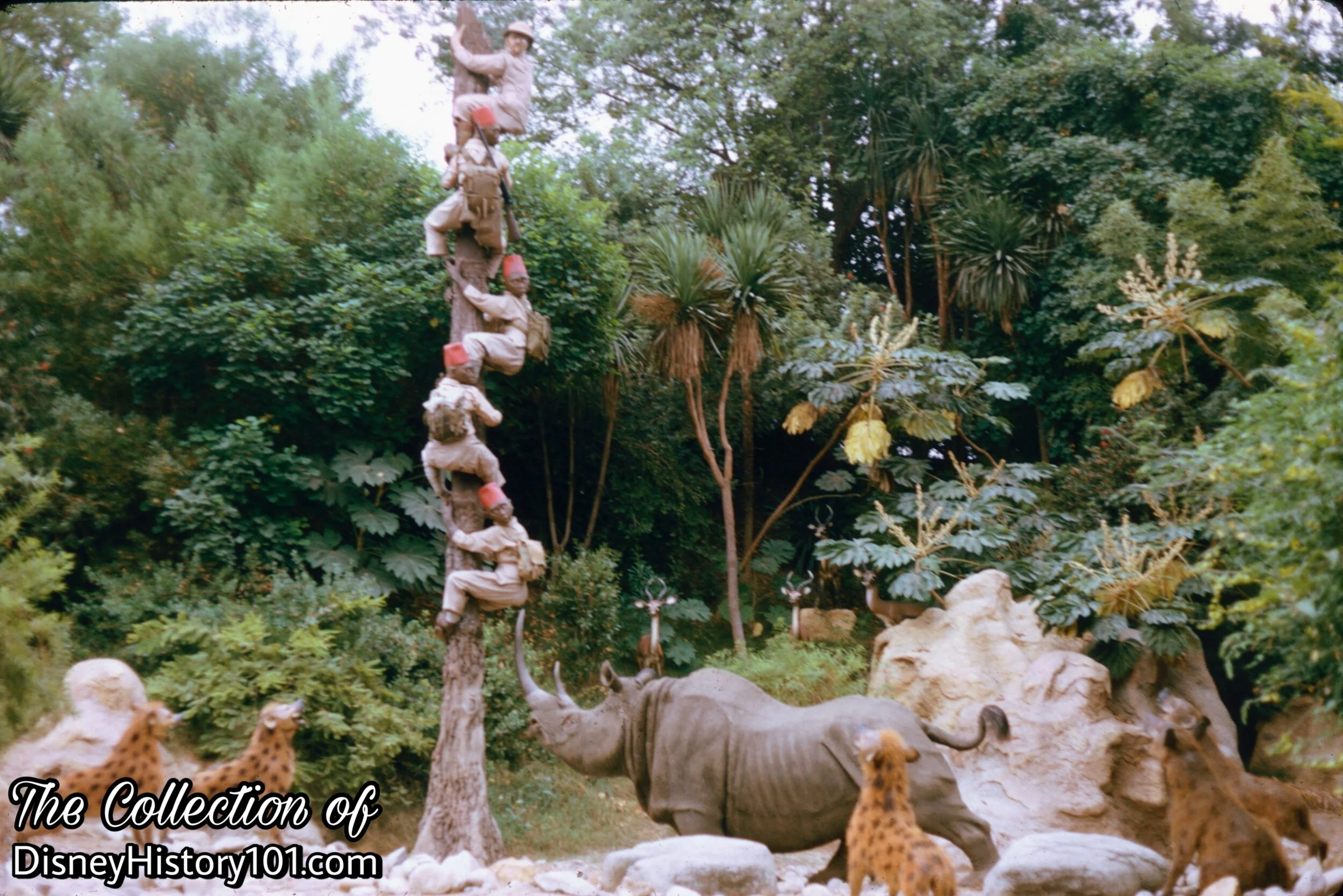
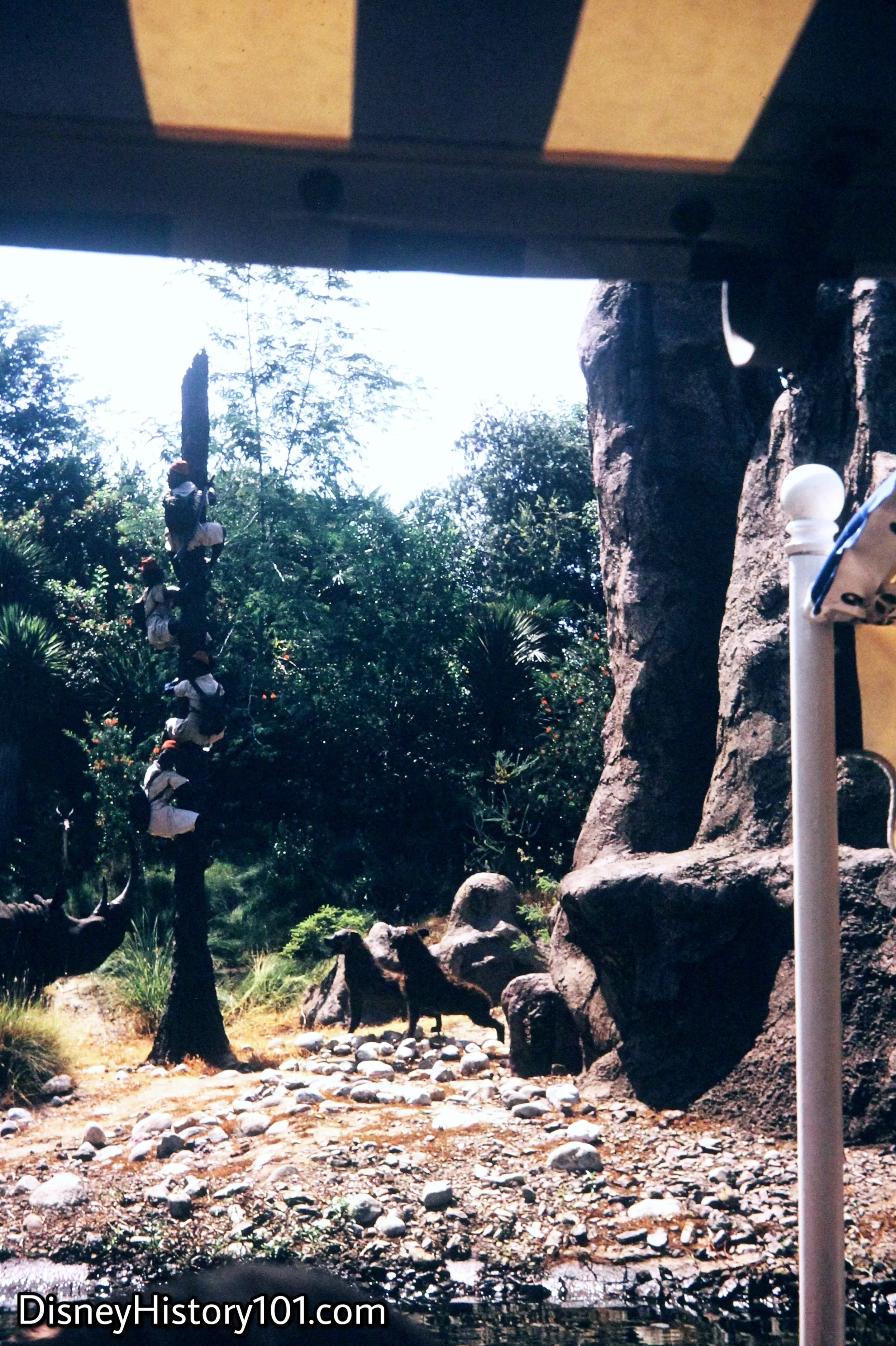
1967
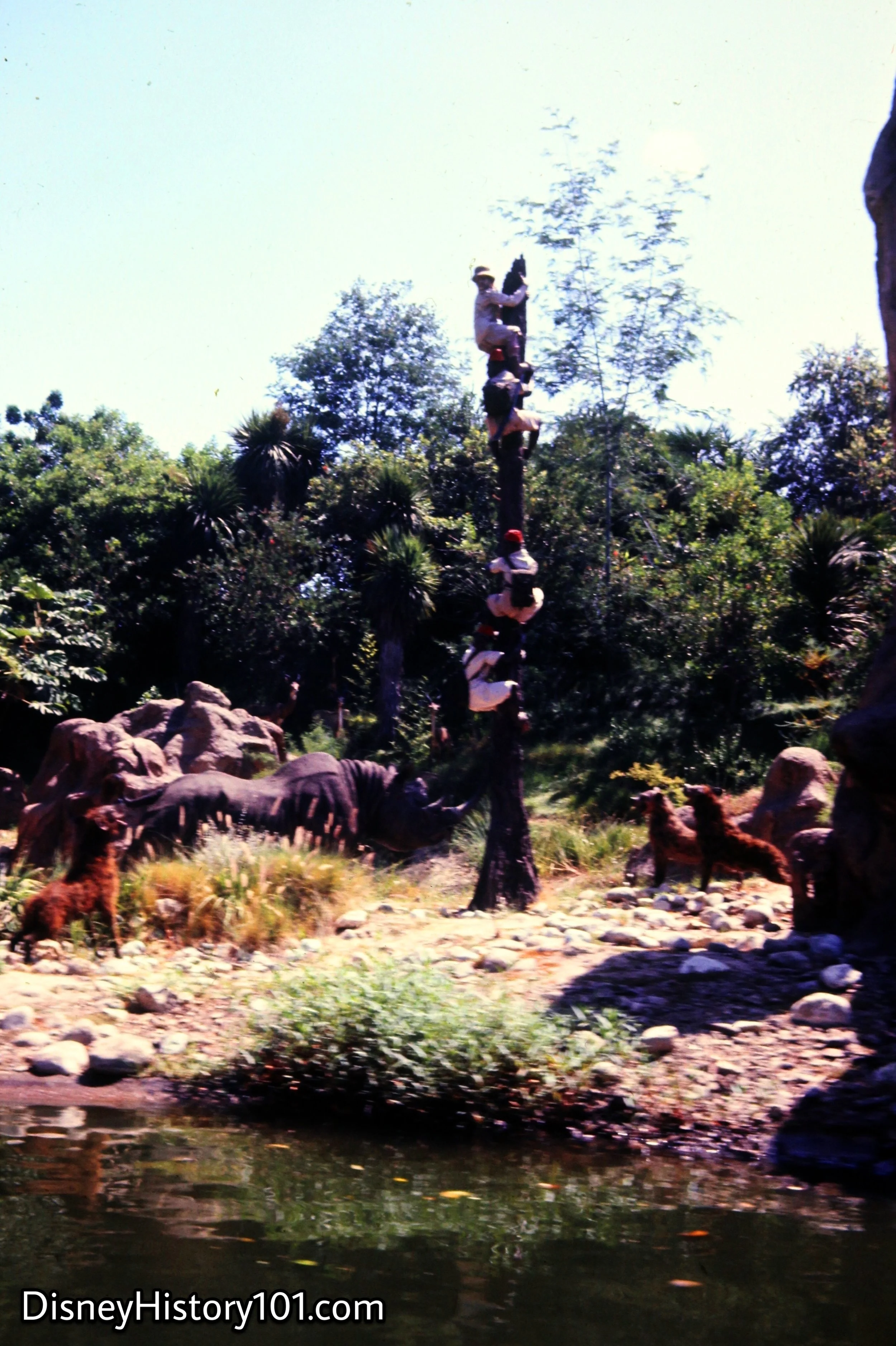
1967
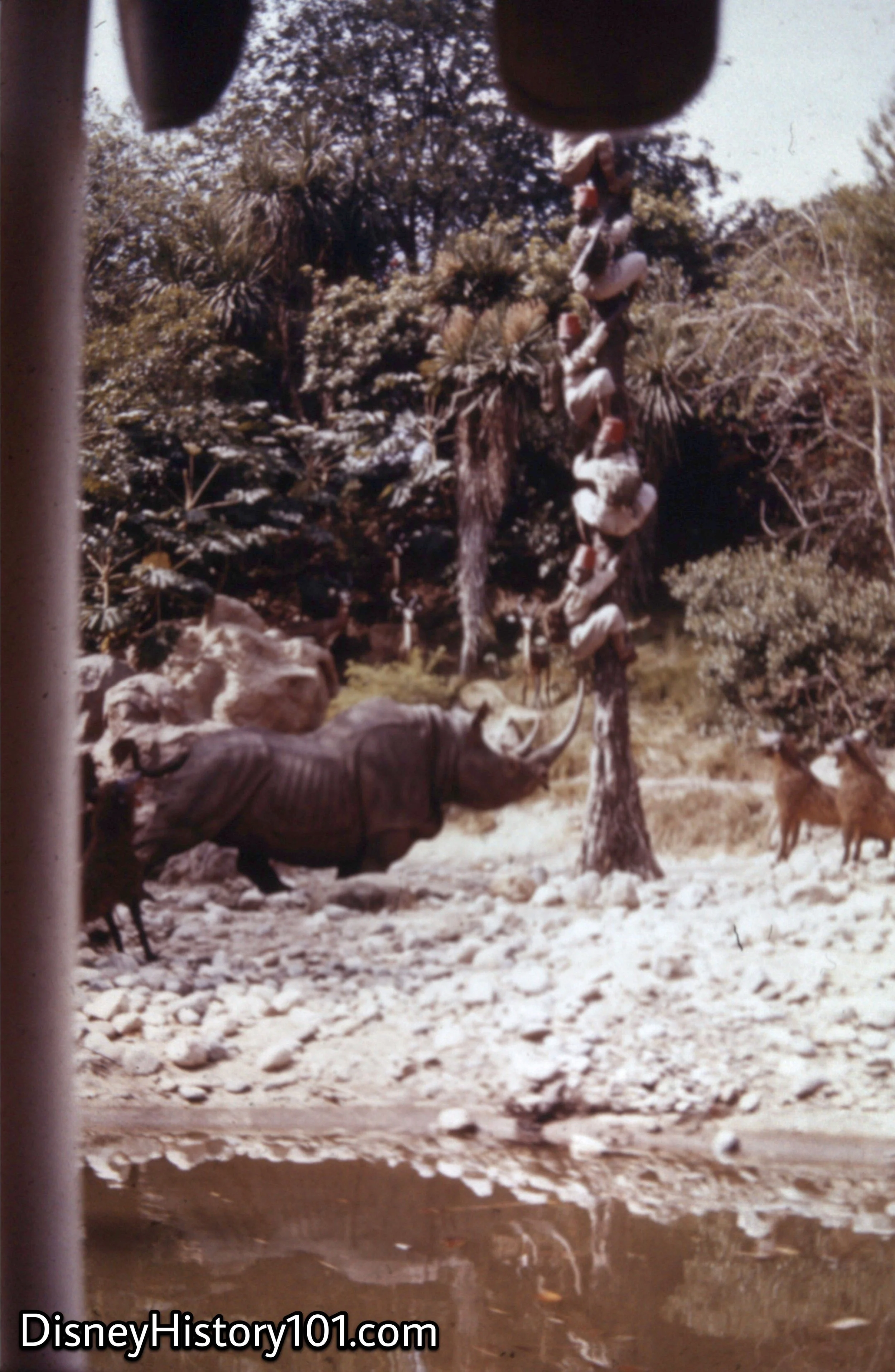
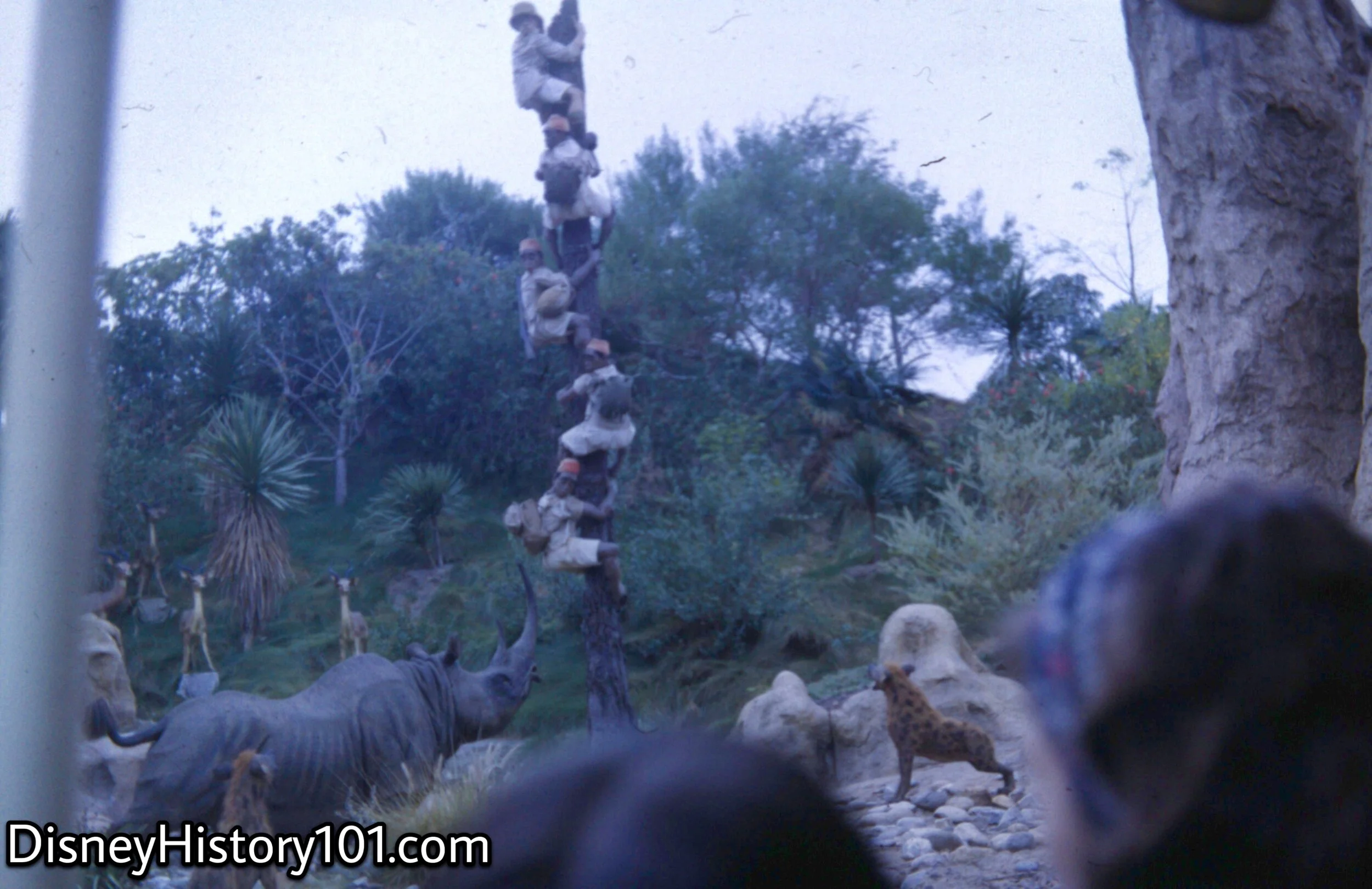
1964
1956
1956
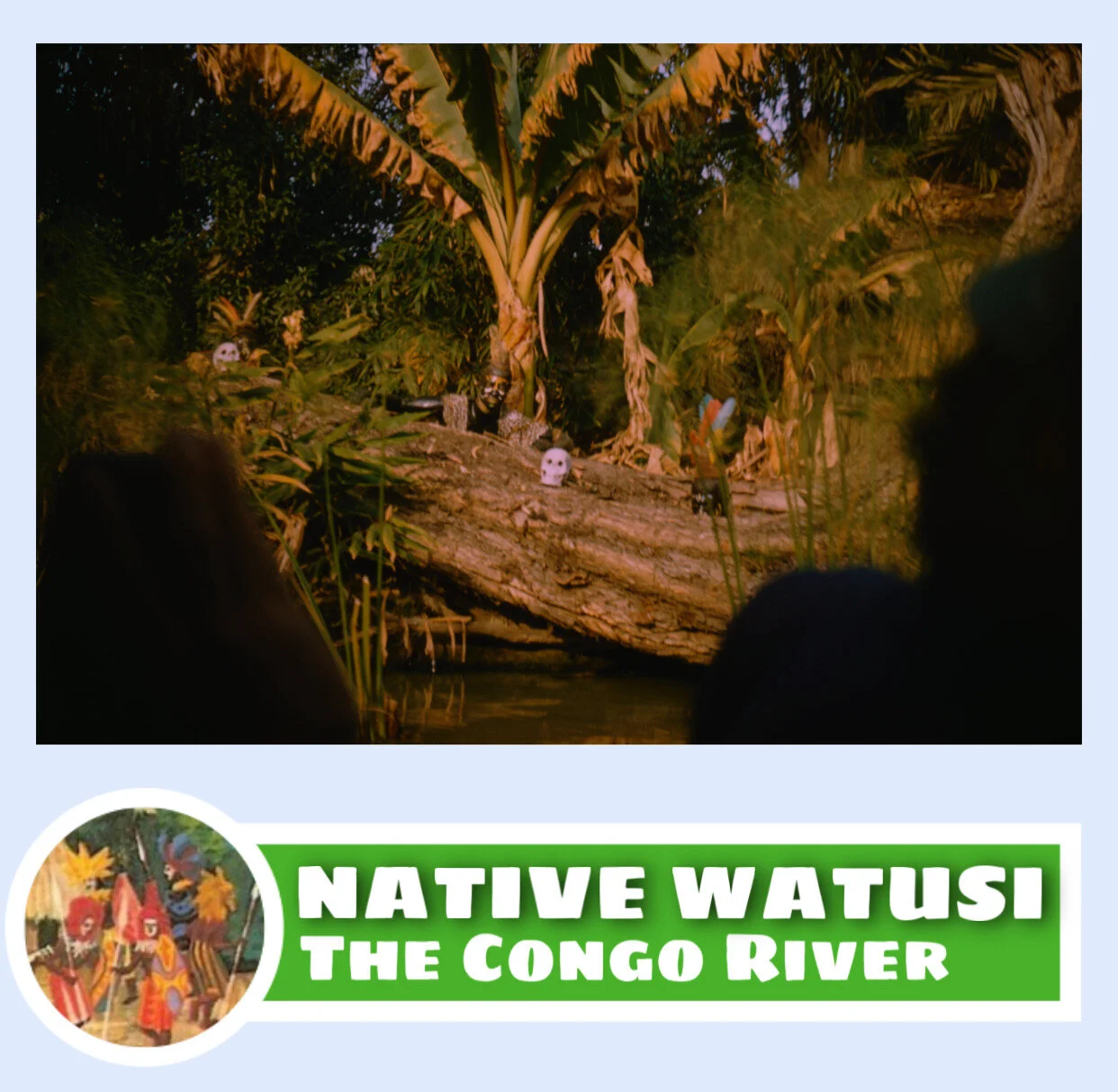
(Pictured Above : “It looks like we’ve been spotted”, December 30, 1956)
The true-life Watusi people (as they have been so-called) are a beautiful people, that have inhabited regions in the modern-day Democratic Republic of Congo, Burundi, and Uganda. At one time, they lived within what was viewed (by some) as a mysterious uncharted civilization of the world. Today, they are better known in the present, as the “Tutsi.”
The following section of the Rivers of the World give us an idea of what it may have been like to travel through the region they called home, circa 1950. Our boat is passing right along a branch of the Congo river, and directly through a village of native Watusi, first seen in these particular regions of Disneyland, during the summer of 1957! Disneyland Holiday magazine (Summer, 1958) further describes this people as a “tall tribe of Watusi headhunters.” As we near the camp, we hear the voices of the locals. The boats enter headhunter country now, and the Skipper warns the travelers to keep their voices low as they pass by and observe the native celebration. “The natives are celebrating the kill of a lion, probably caught raiding the village. Let’s see if we can sneak by them, very quietly, without attracting attention. Watch those bushes on the right. They sometimes ambush us there.”
Walt Disney (in Wisdom magazine published December 1959) reminds us that the reason the locals ambush “and display their hostility” is “your invasion of their privacy.” We have trespassed. A few years after Jungle River Cruises first departed, “nearly twice the number of ‘headhunters’” have ‘sprang up’ behind logs along this stretch of the Rivers of the World, and “they have been celebrating ever since!”
“WOODY STRODE’S IMPRESSIONABLE FEATURES”
Some publications (like Nash Airflyte Magazine, July 1955) published inaccurate details of this region of the Rivers of the World, mentioning “Amazonian headhunters.” Soon, “A Trip Through Disneyland” (an episode of “Walt Disney’s Disneyland”), depicted one of these figures carried along the Jungle River. The narrator (Walt Disney) describes it as “a jungle resident guaranteed to furnish chills even in the warmest weather.” As terrifying as some of the tall figures may have been, all of the “native figures” along the Rivers of the World, were modeled after Woody Strode (a famous American athlete and actor of the era). He was an American “of Cherokee and Creek descent,” most known for his role as the King of Ethiopia in Cecil B. DeMille’s The Ten Commandments. Harper Goff convinced him to come down to the studio, and Woody was soon immortalized in Disneyland history!
You can briefly see the casting and molding of the human figure in the televised Disneyland episode “Pre-Opening Report From Disneyland.” Years later, their wardrobe, spears and shields continued to be furnished by the Decorating Department (according to Backstage Disneyland Magazine, Vol.4, No.4).
Magic making MAINTENANCE MACHINISTS were challenged by unique new problems each day. A typical maintenance request representing part of a day's work may sound like: “Dancing natives are down.”
Paint is important. The “Master Color Book” is the Bible for color selection at Disneyland, maintaining a catalogue of 4,000 shades of color. The book contains color specifications for every land, building, exhibit, and prop which requires paint maintenance. It insures that Disneyland will always have the same bright colors selected by the art directors who designed the attraction. In addition to the Master Color Book, there is a standby supply of ready-mixed paint available for touch up work. Thousands of cans of paint are stored in a special room which sounds like a walk through of Disneyland. Each can is labeled with names like “Jungle Natives.”
In recent decades, one shield (resting against a hut) would come to feature the Lion King Musical logo.
By 1991, the Walt Disney Imagineering Creative Division was developing concepts centered around the addition of the adventures of Indiana Jones at Disneyland. Some concepts involved an “African Watering Hole” vignette to potentially replace the “Native Village and Native Attack” scenes.
By 2005, maps have detailed the area as the “remote village.” [Disneyland 50th Anniversary Map by Nina Rae Vaughn]
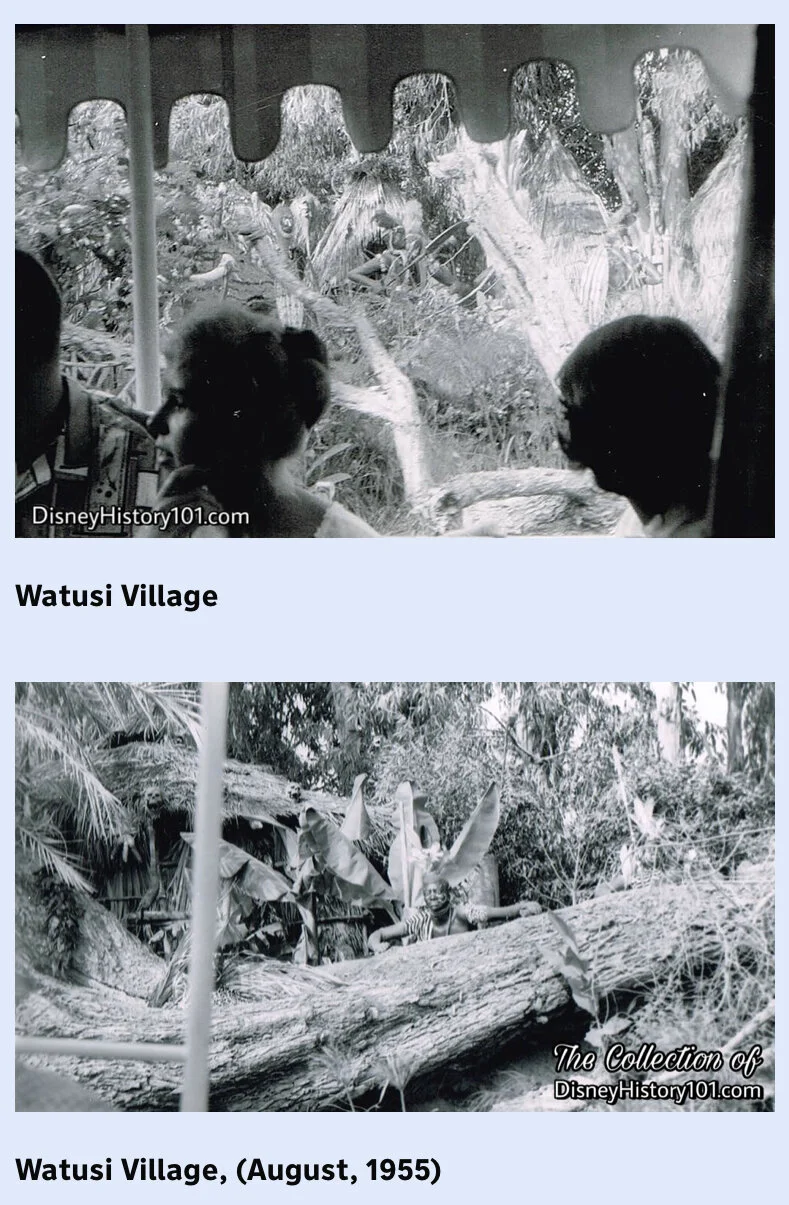
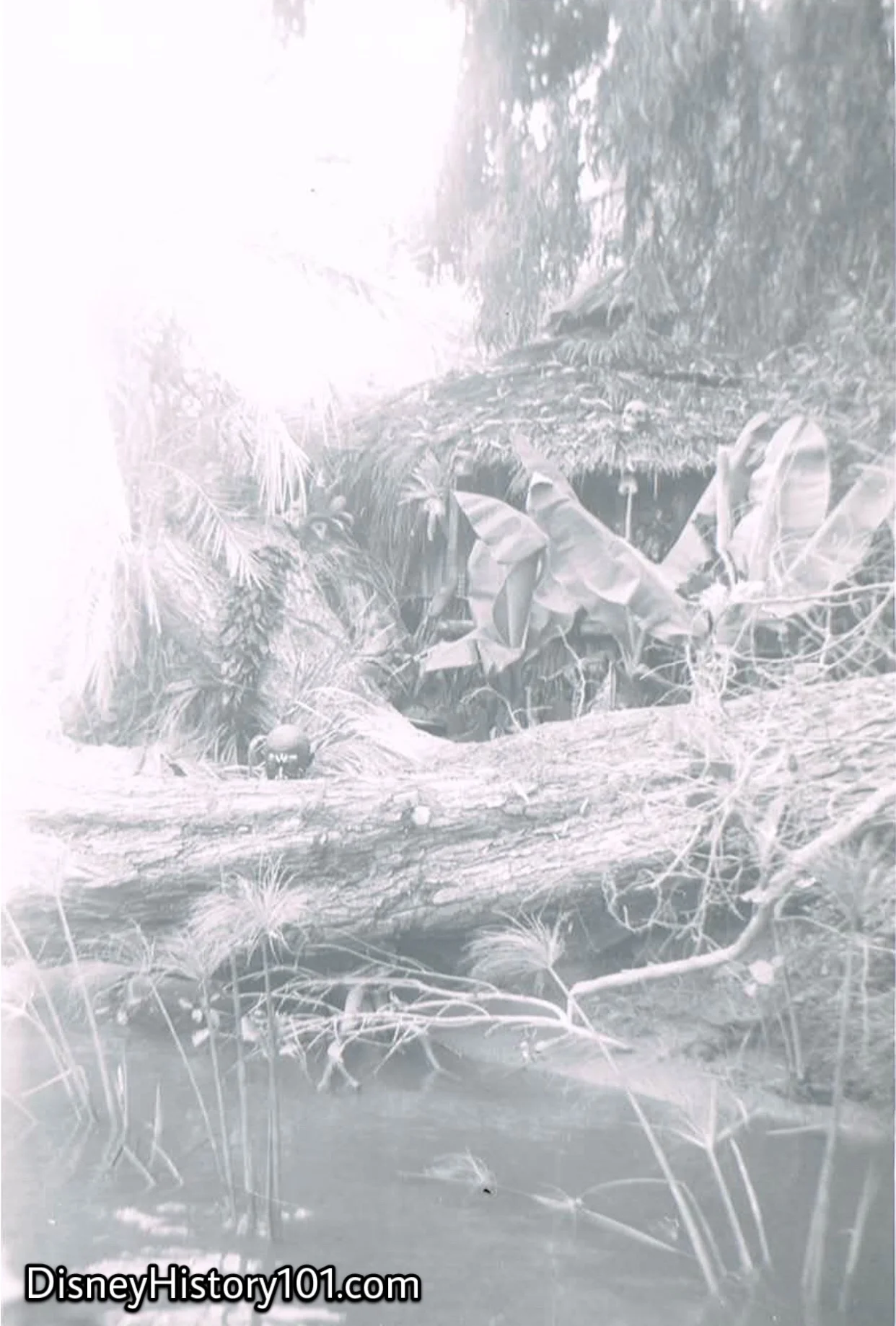
Watusi Village, (1955)
According to the Pasadena Star-News (Friday, December 14, 1955), from behind the fallen logs,“the white war paint of head hunting natives appears now and again amid tropical vegetation that has come from over the world.”
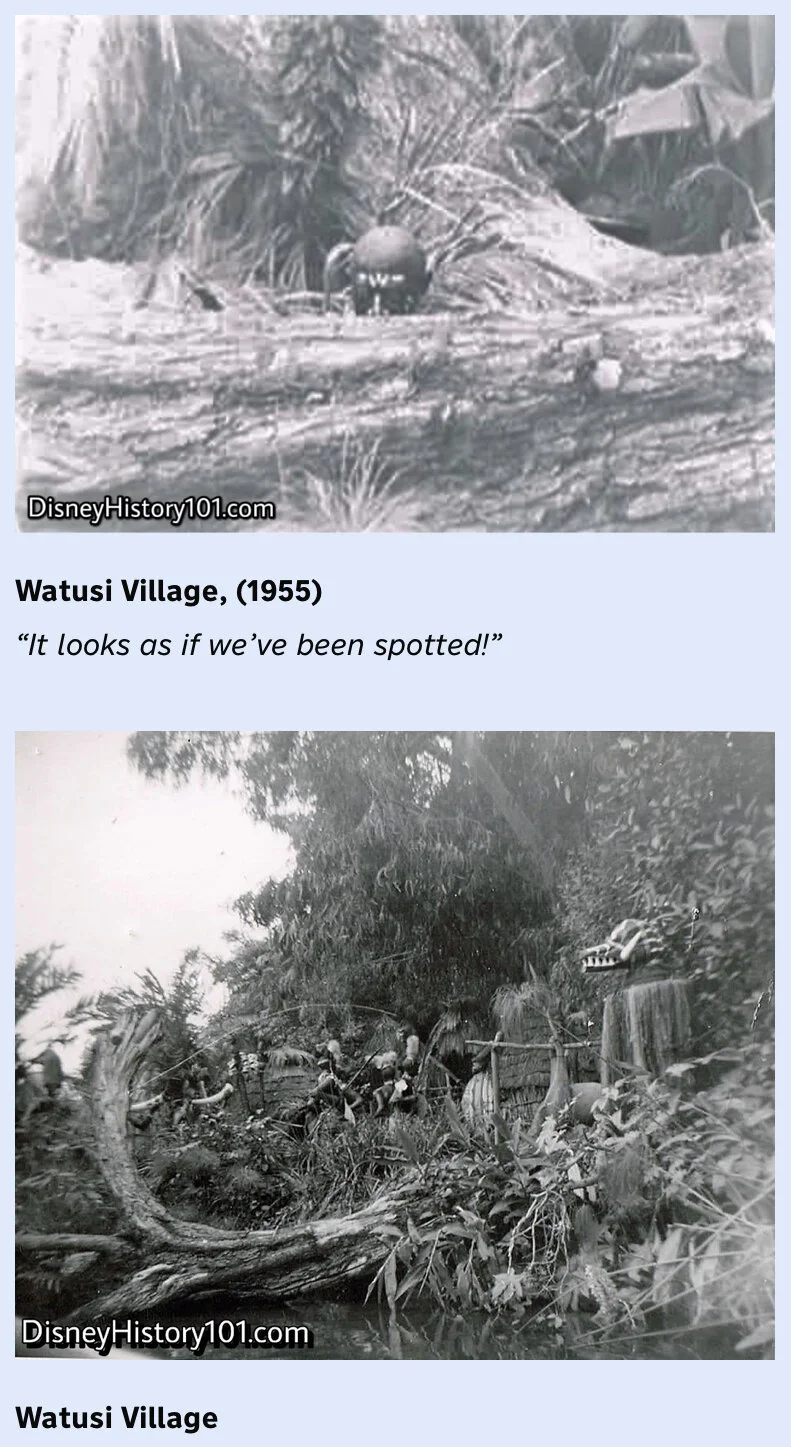
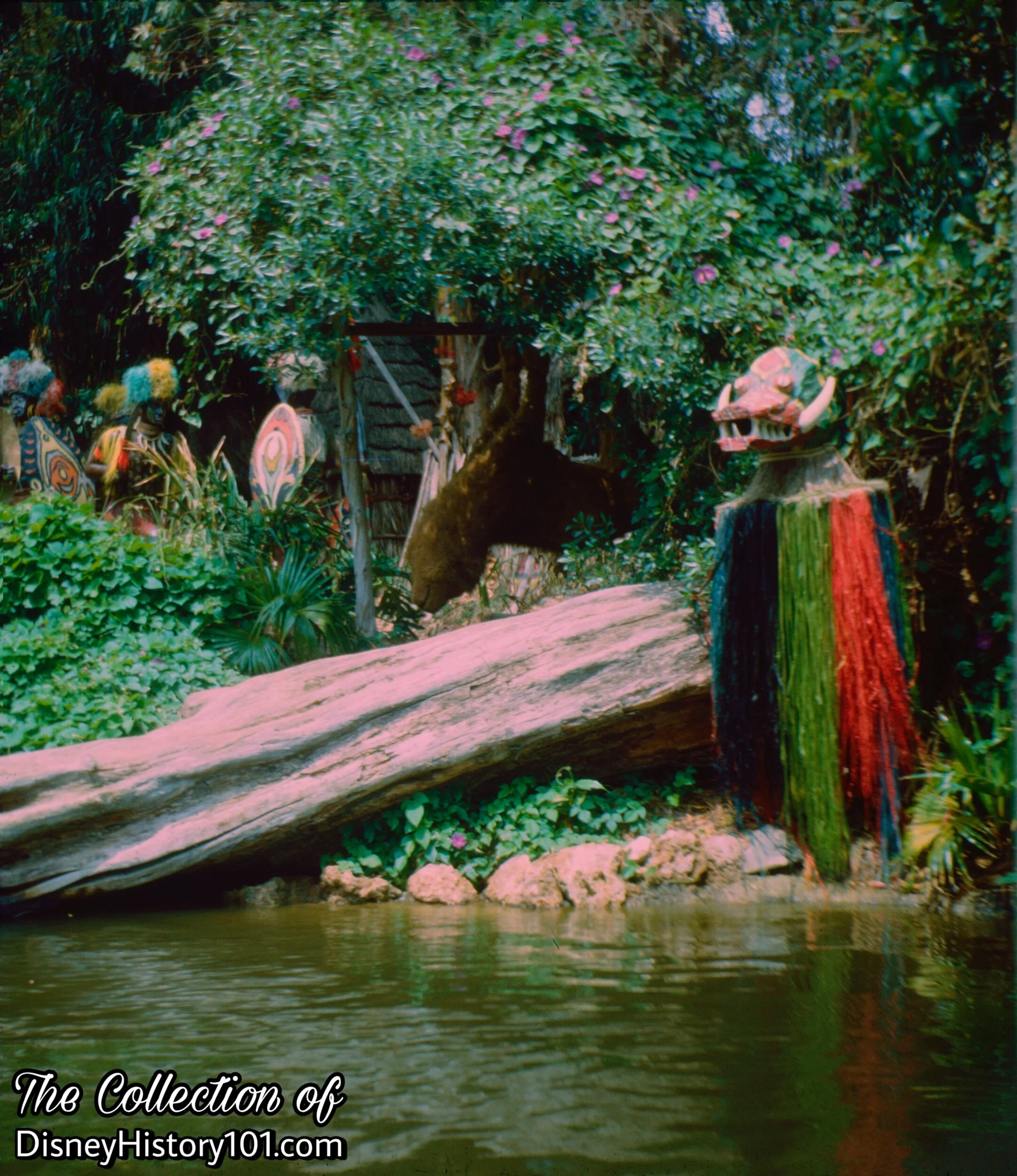
(July, 1964)
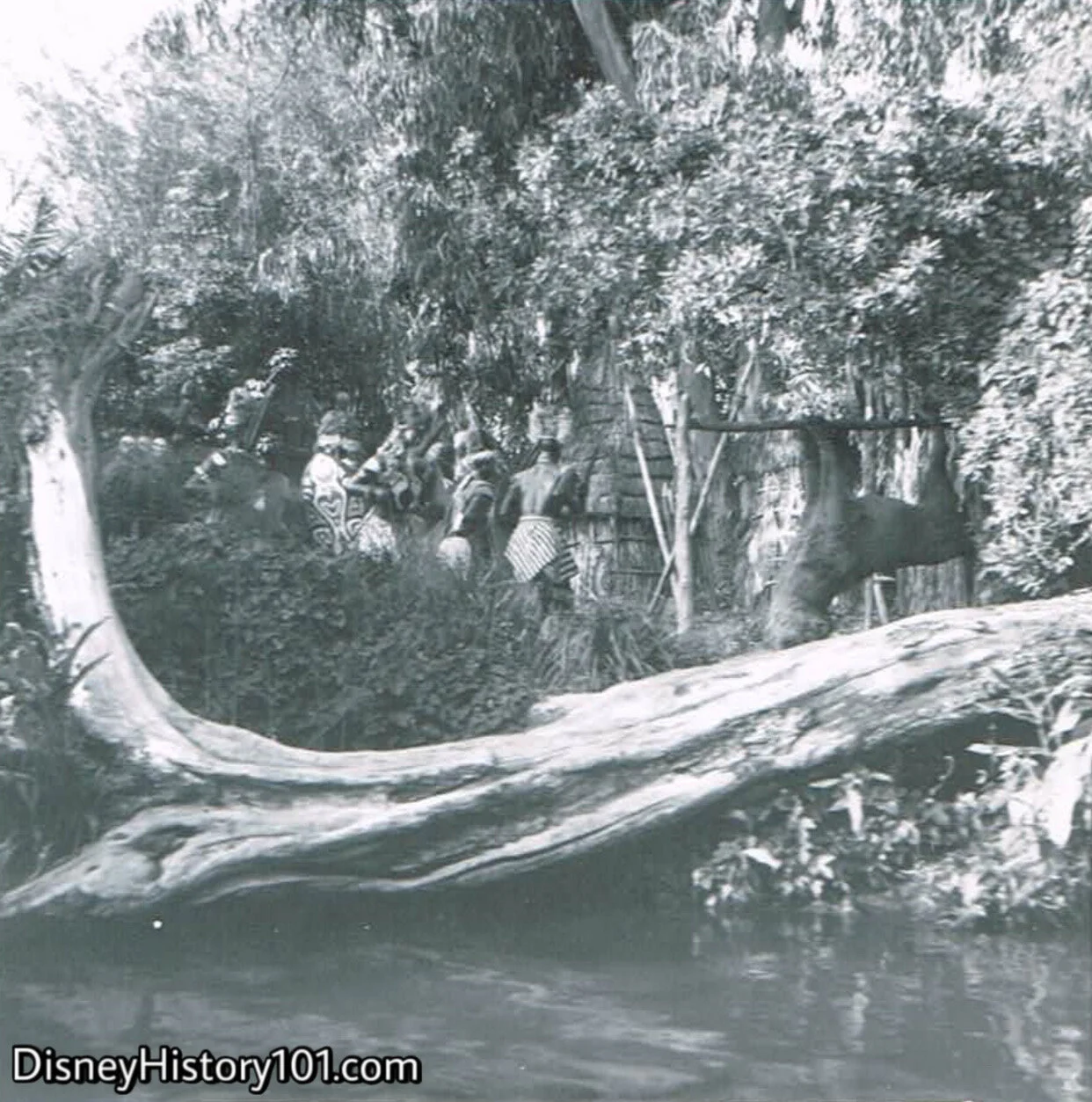
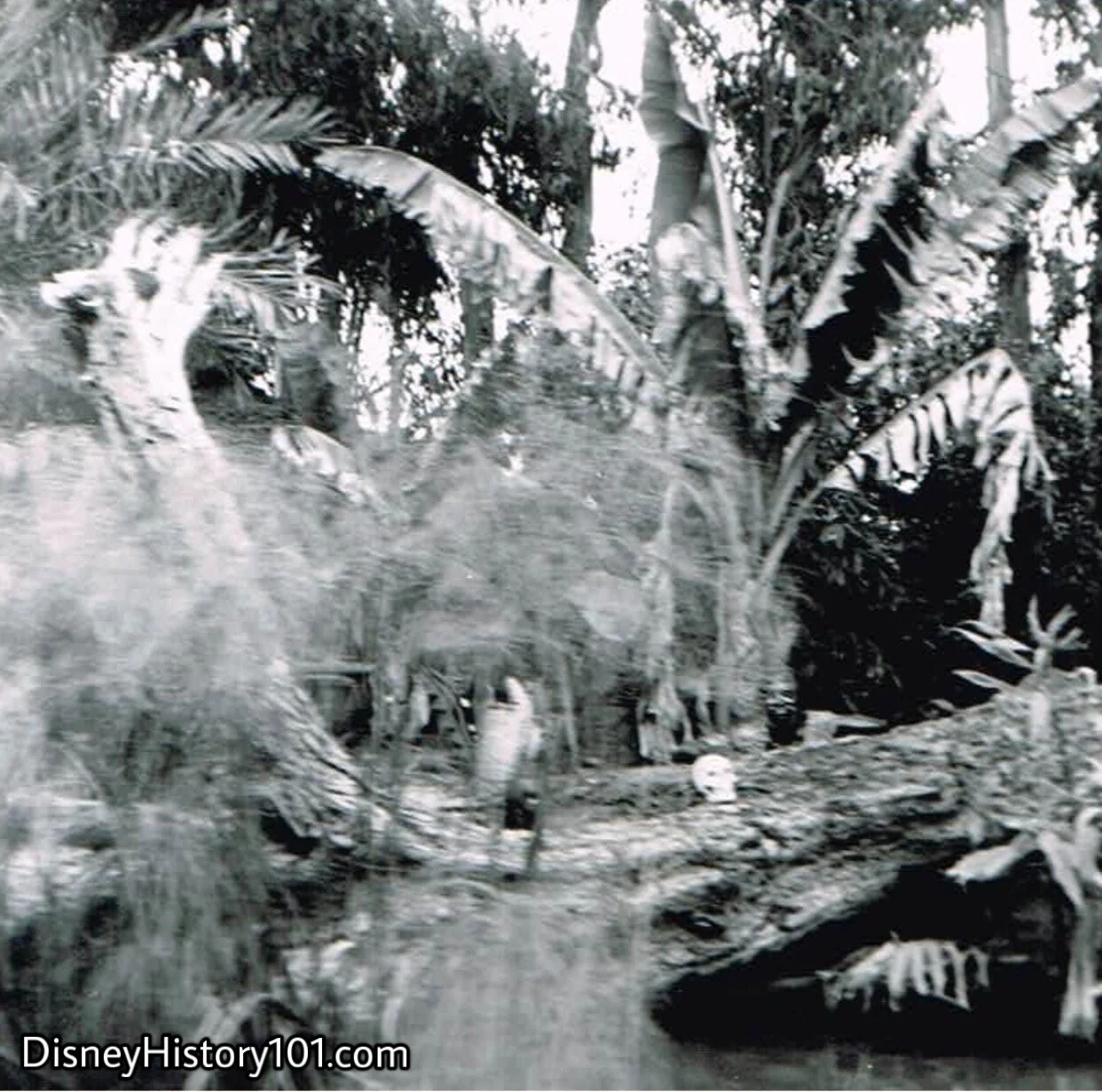
1955, September
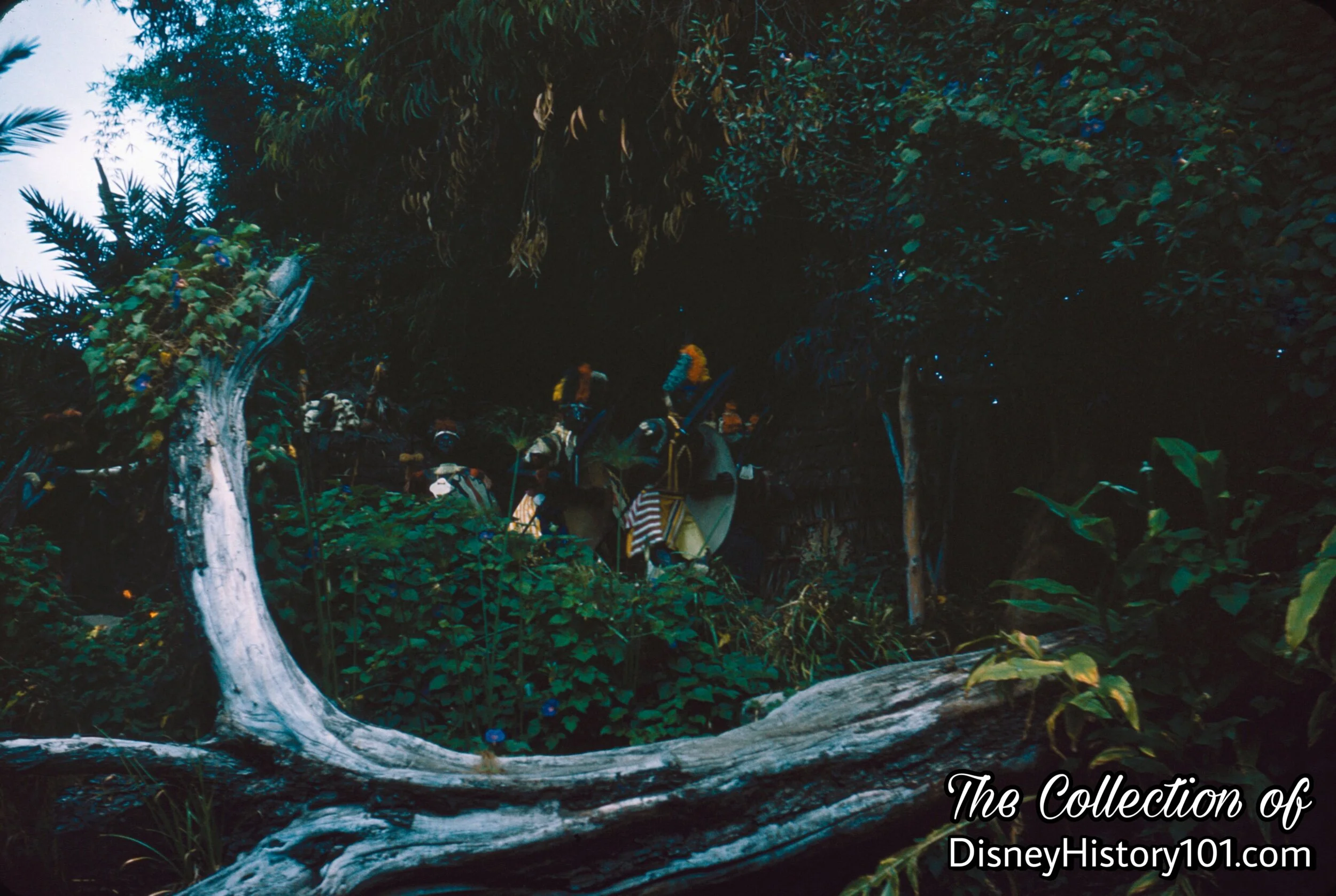
(August, 1960)
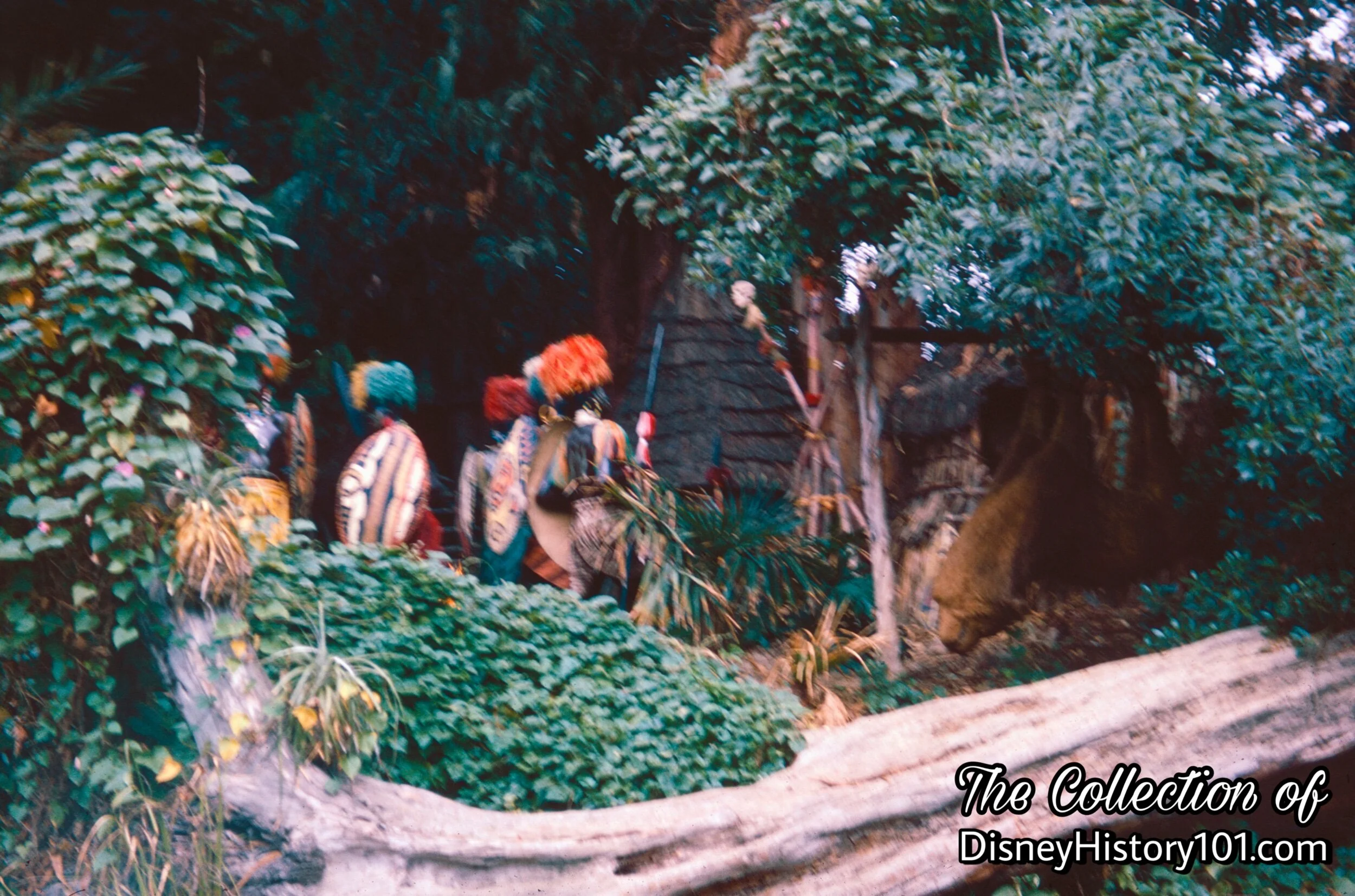
(1964)
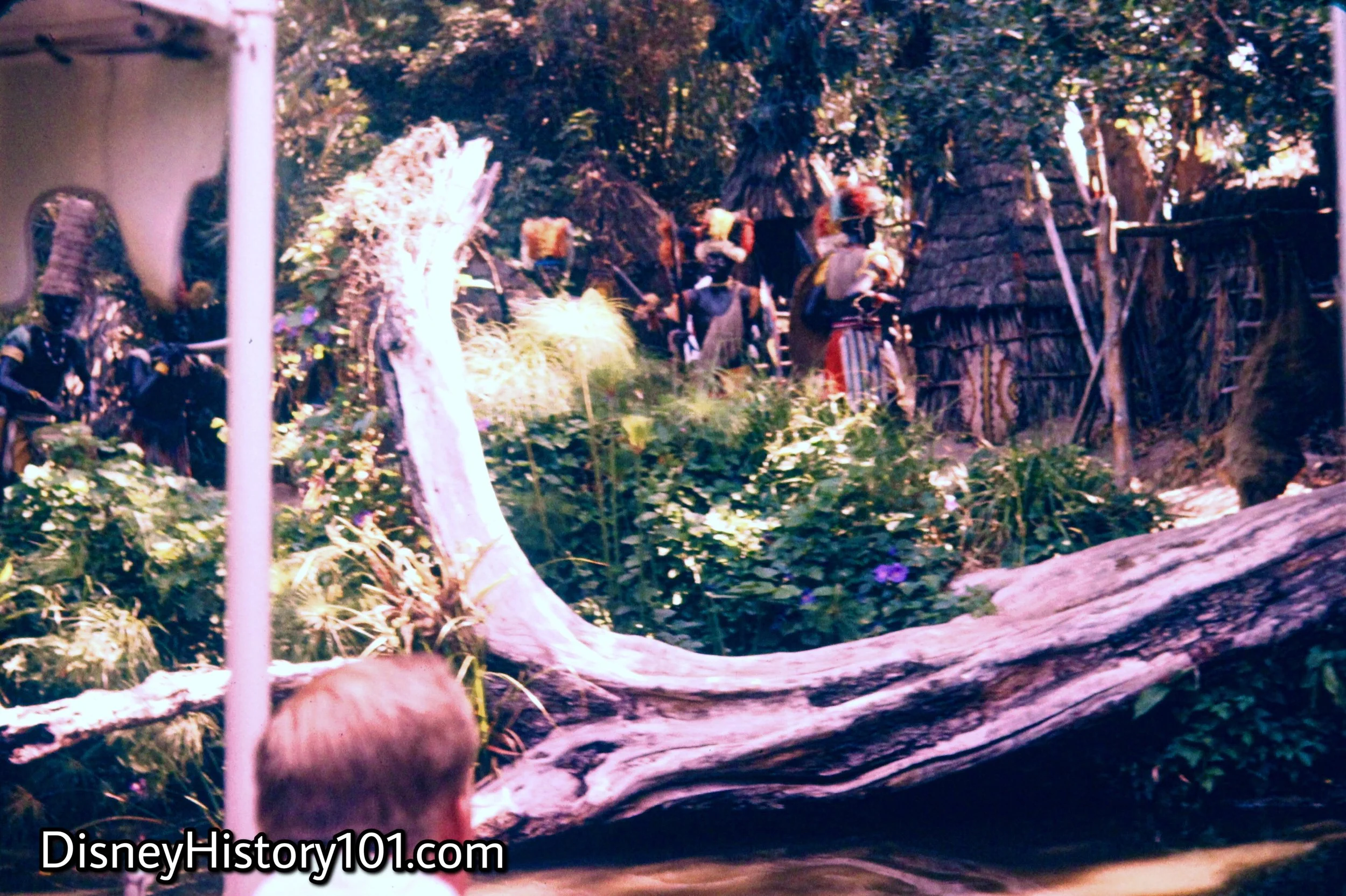
1961
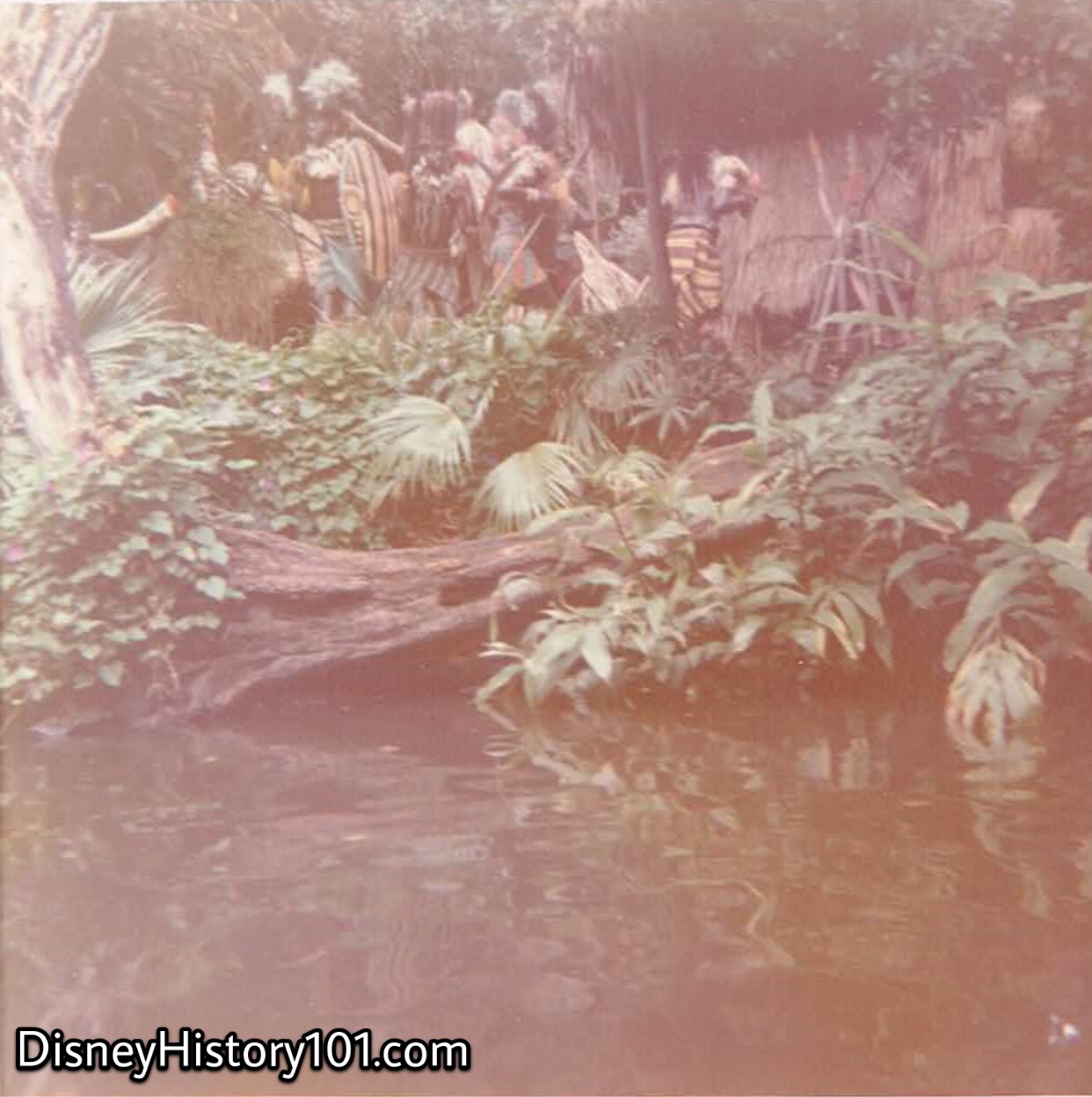
1972
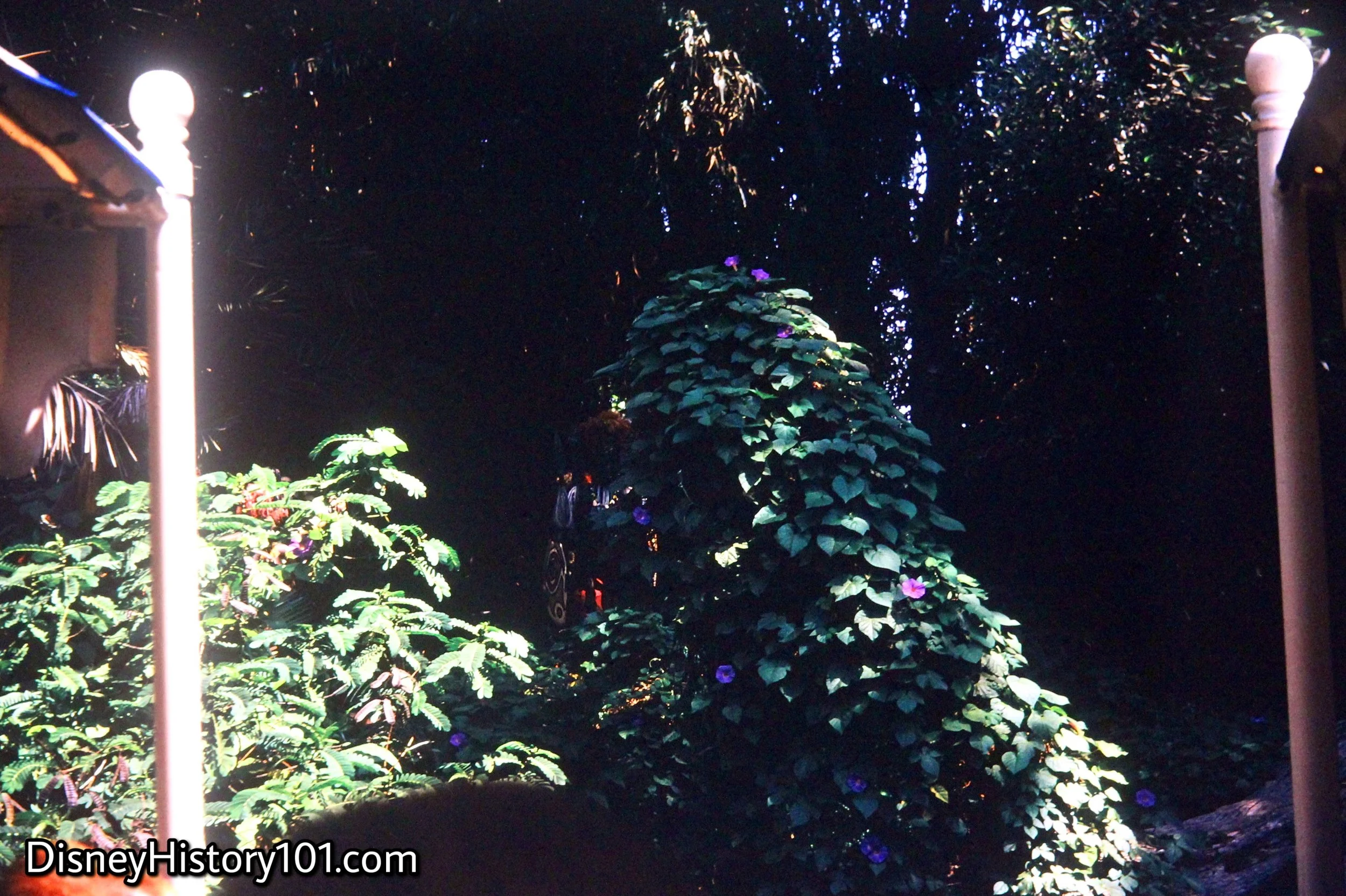
1967
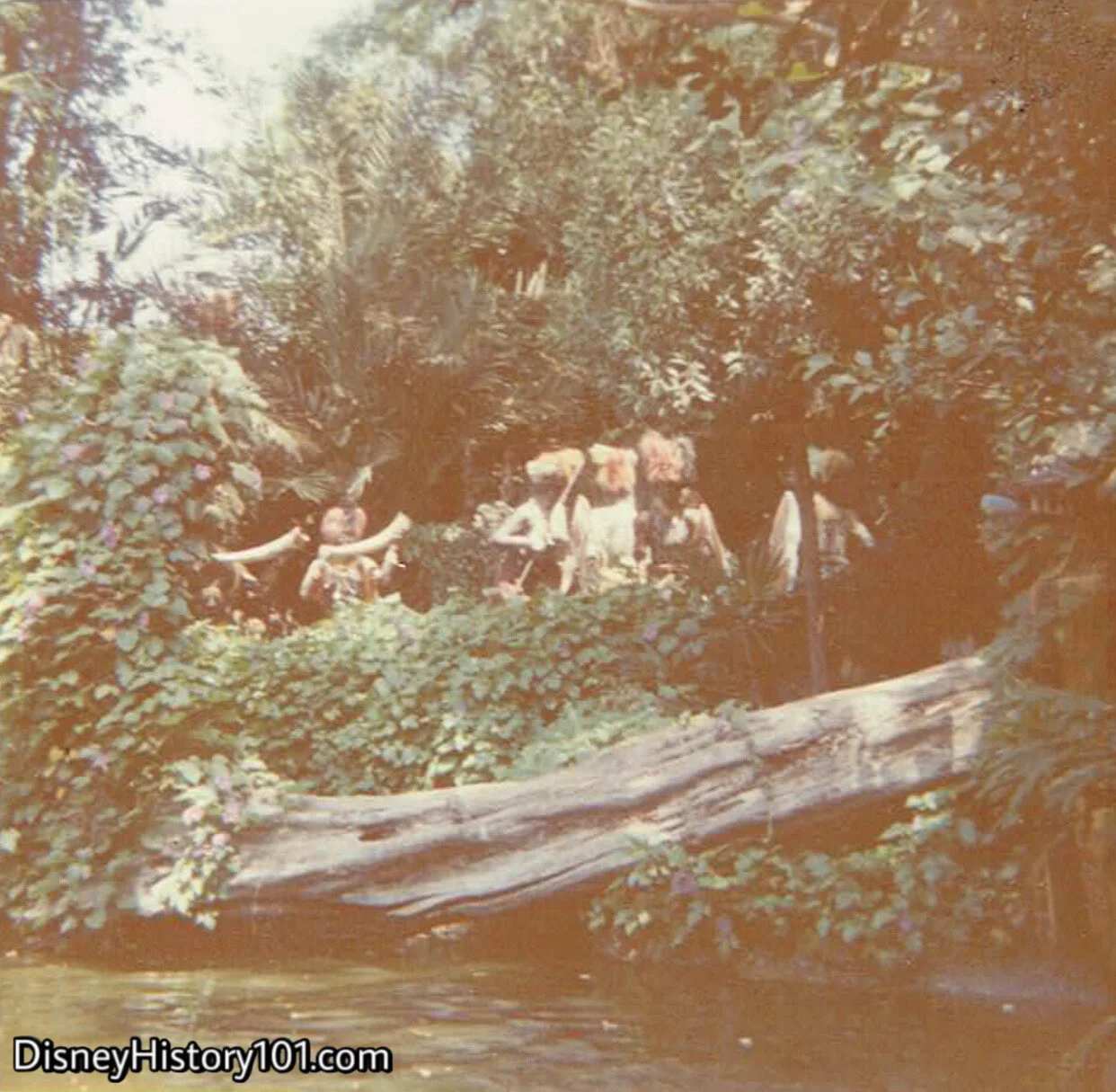
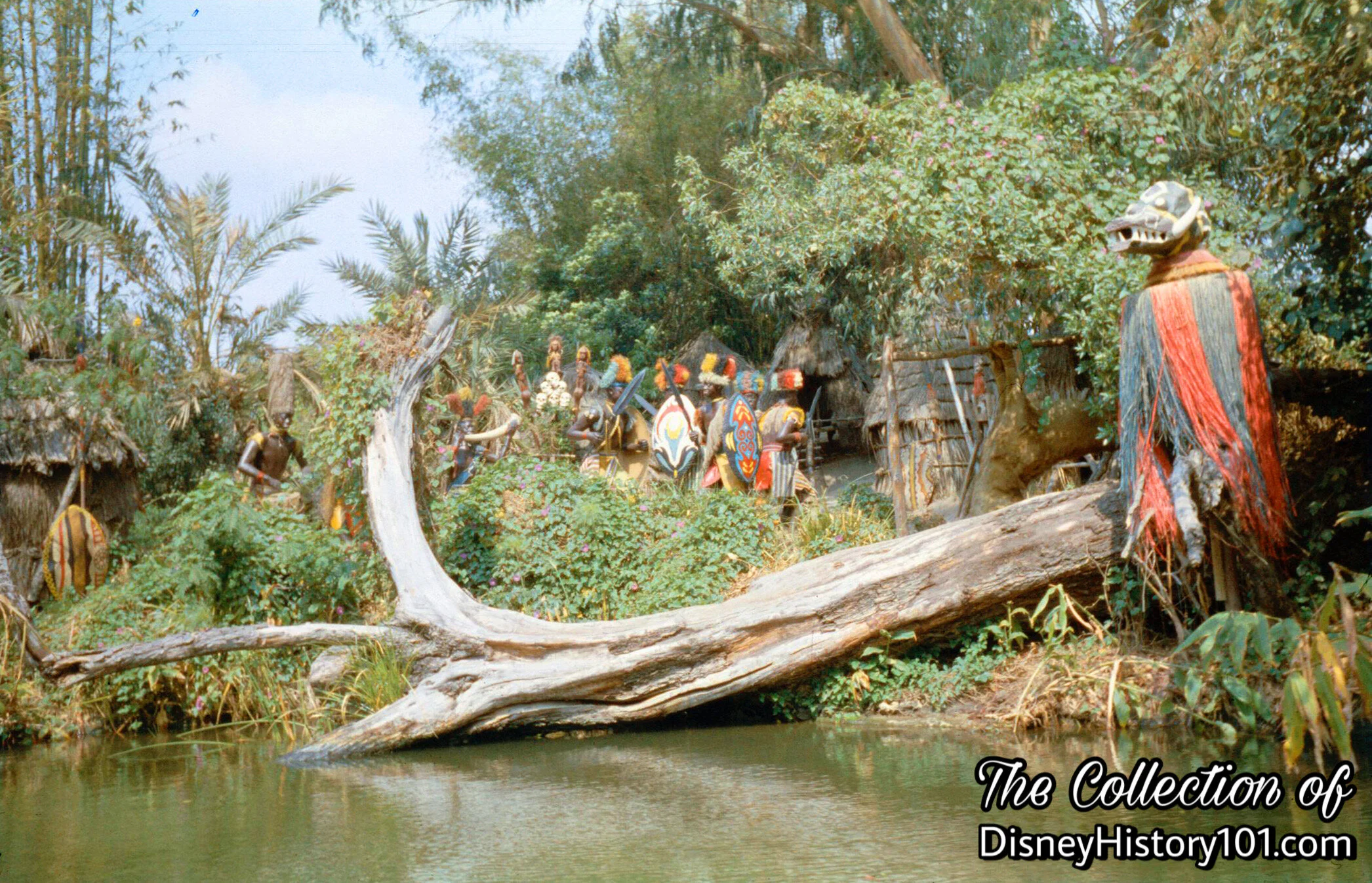
“Giant bamboo trees that grow 60 feet high. Some of the bushes in this area grow the berries from which the natives extract the deadly bushman’s poison.”
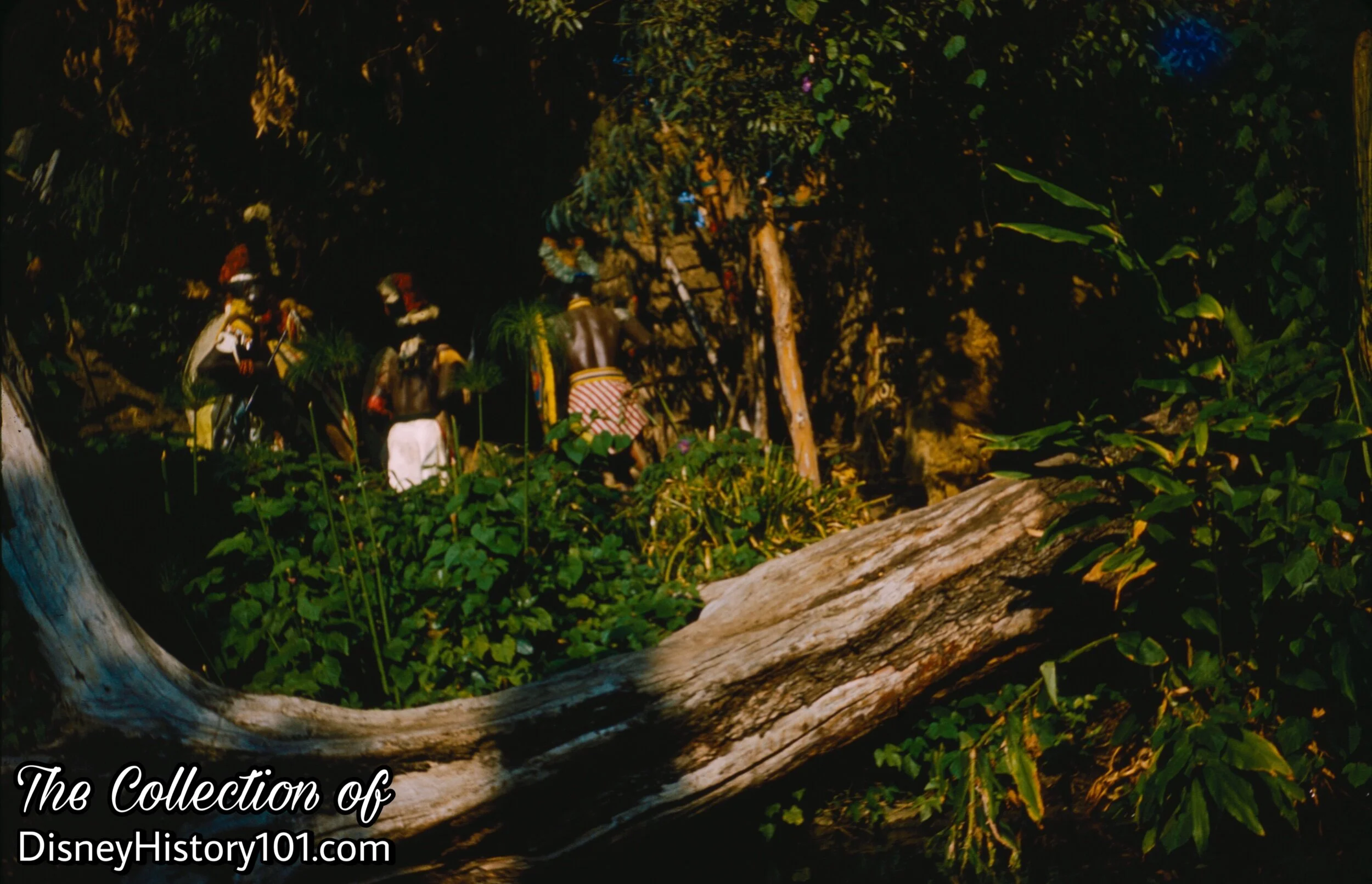
(October, 1960)
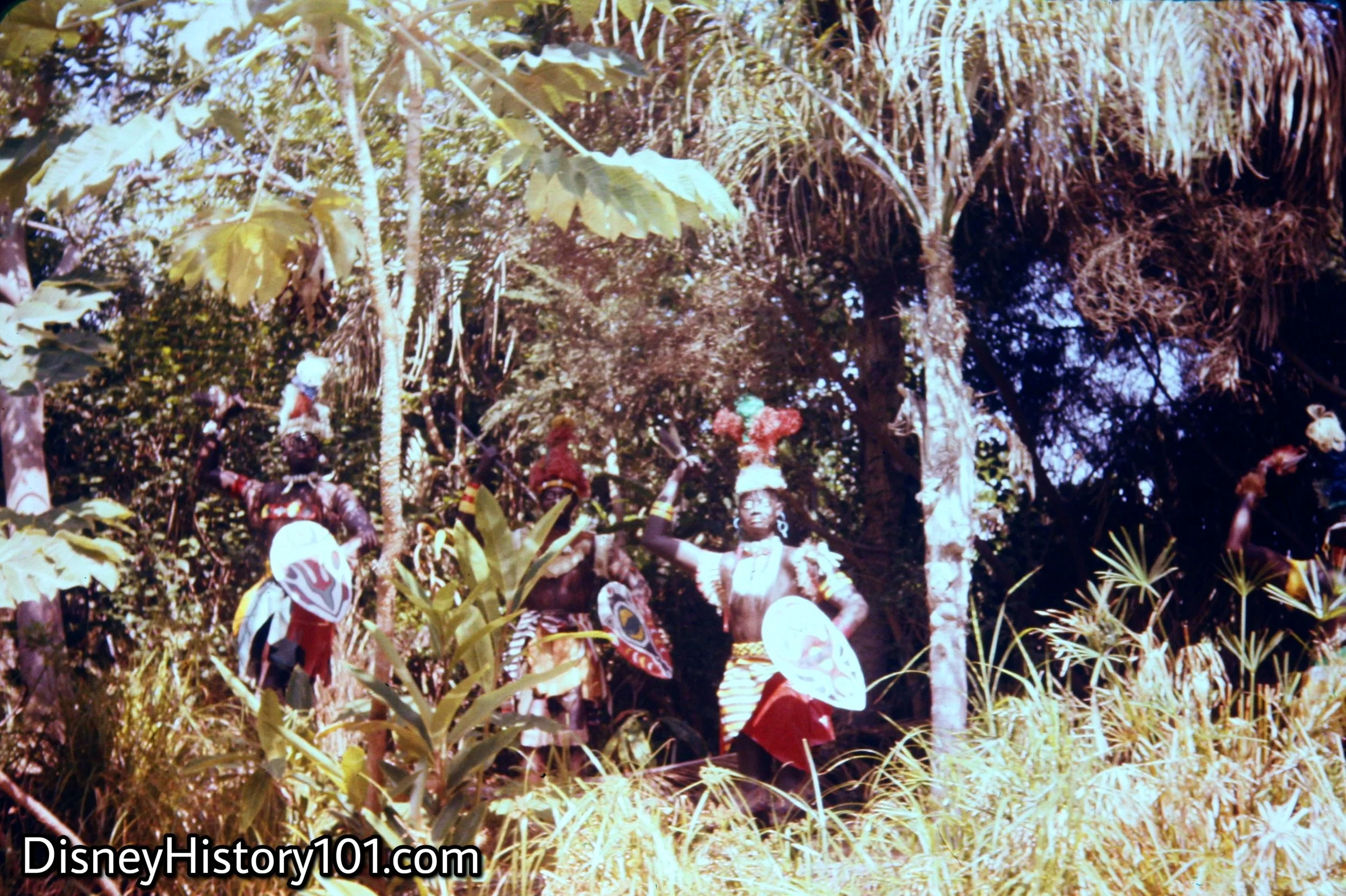
1961
Suddenly, off the starboard side, a number of natives are seen in an attacking stance, but the passengers are able to escape without harm.
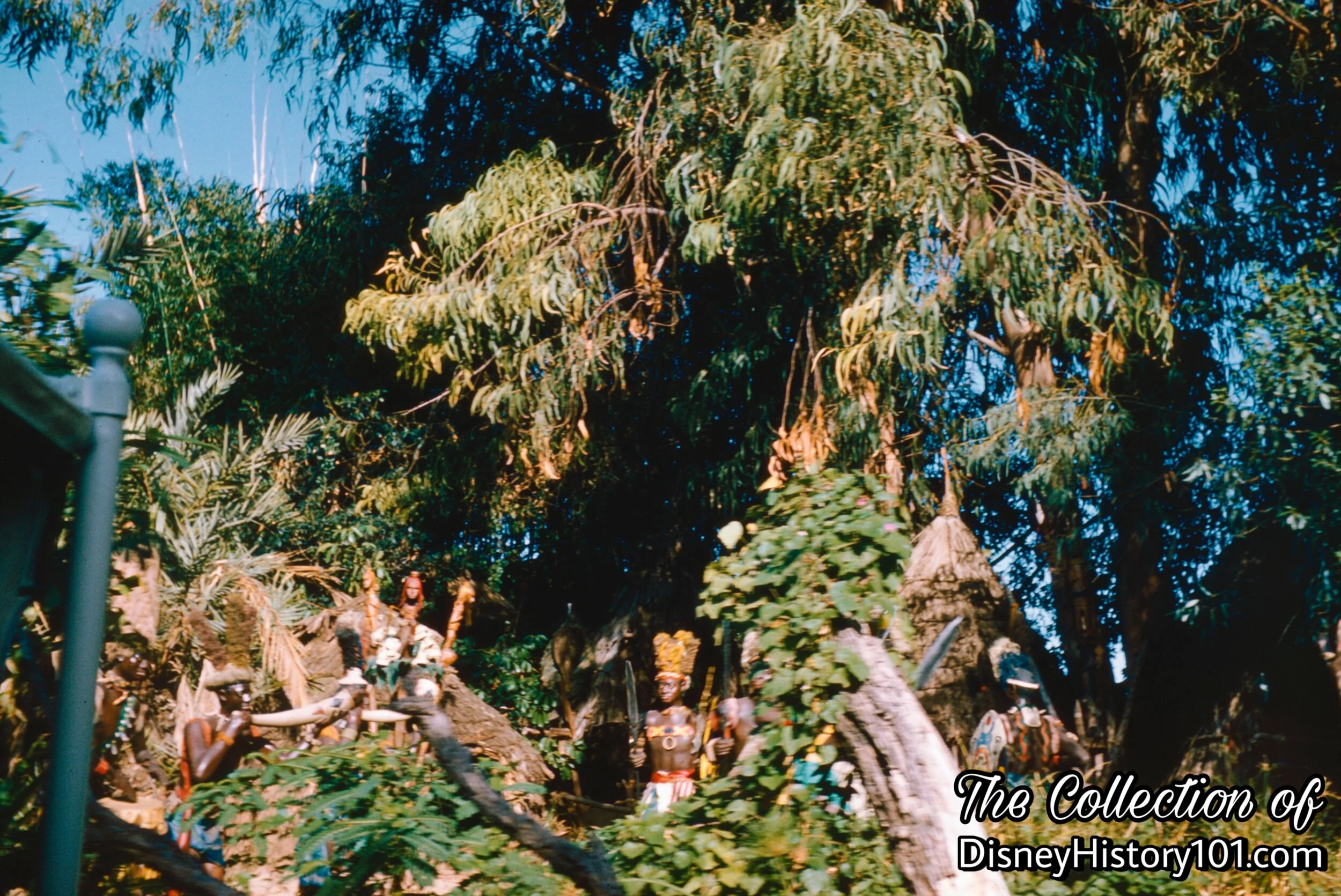
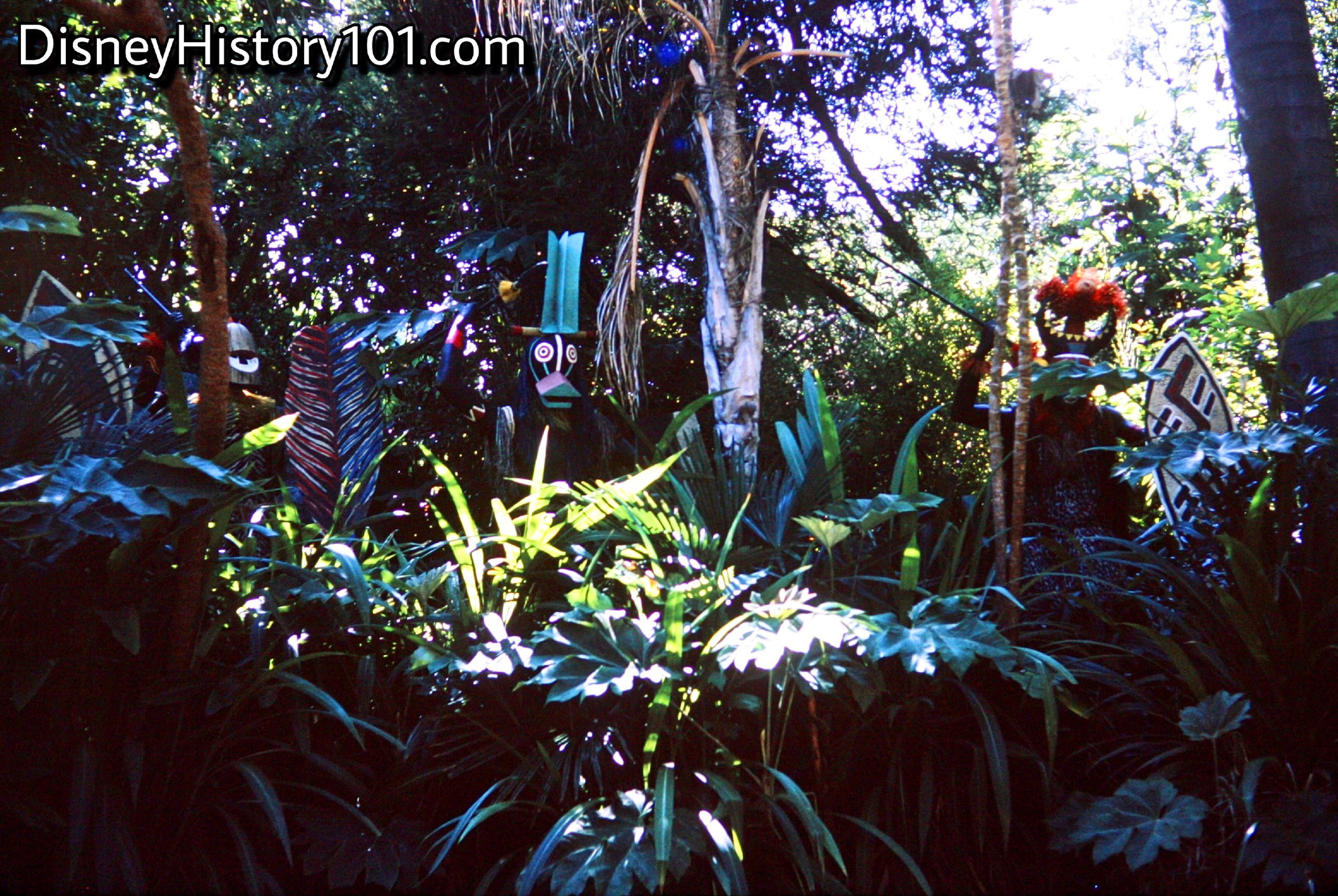
1965, August
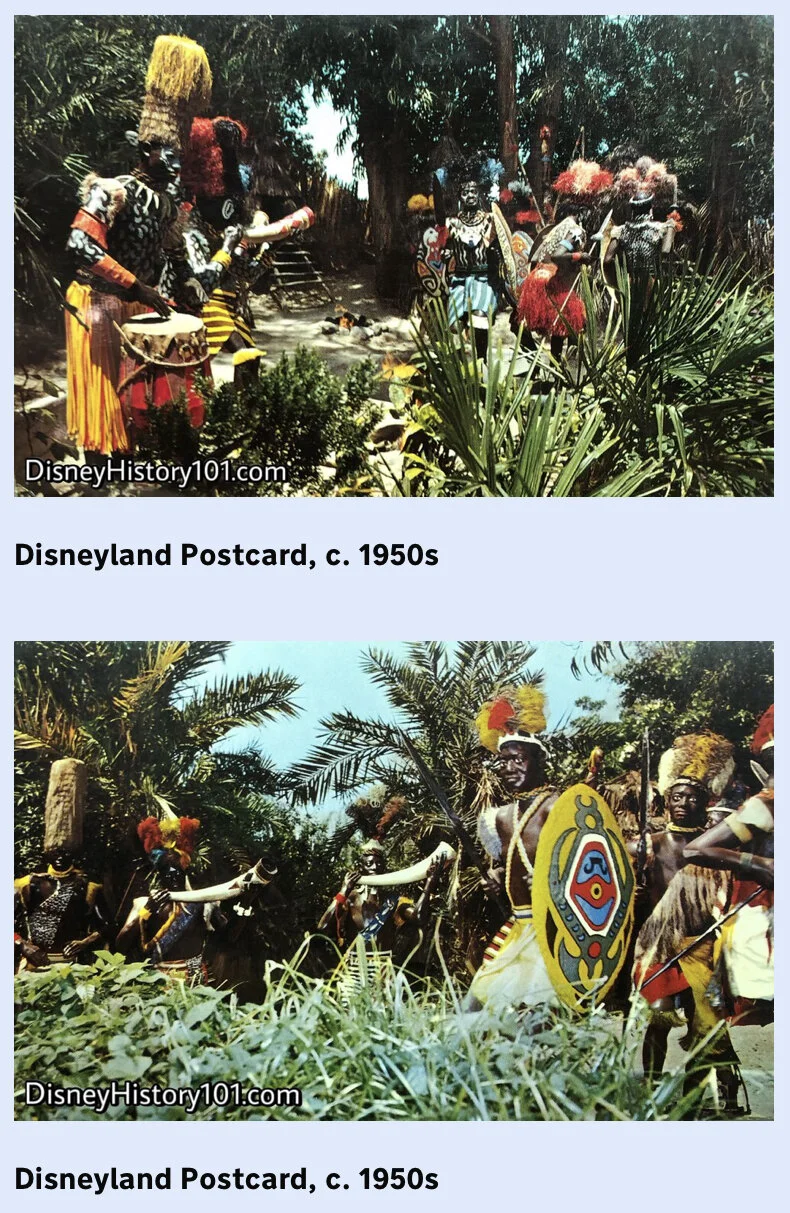
“WOODY STRODE’S IMPRESSIONABLE FEATURES”
All of the “native figures” along the Rivers of the World, were modeled after Woody Strode (a famous American athlete and actor of the era). He was an American of Cherokee and Creek descent, most known for his role as the King of Ethiopia in Cecil B. DeMille’s The Ten Commandments. Harper Goff convinced him to come down to the studio, and Woody was soon immortalized in Disneyland history!
You can briefly see the casting and molding of the human figure in the televised Disneyland episode “Pre-Opening Report From Disneyland”.
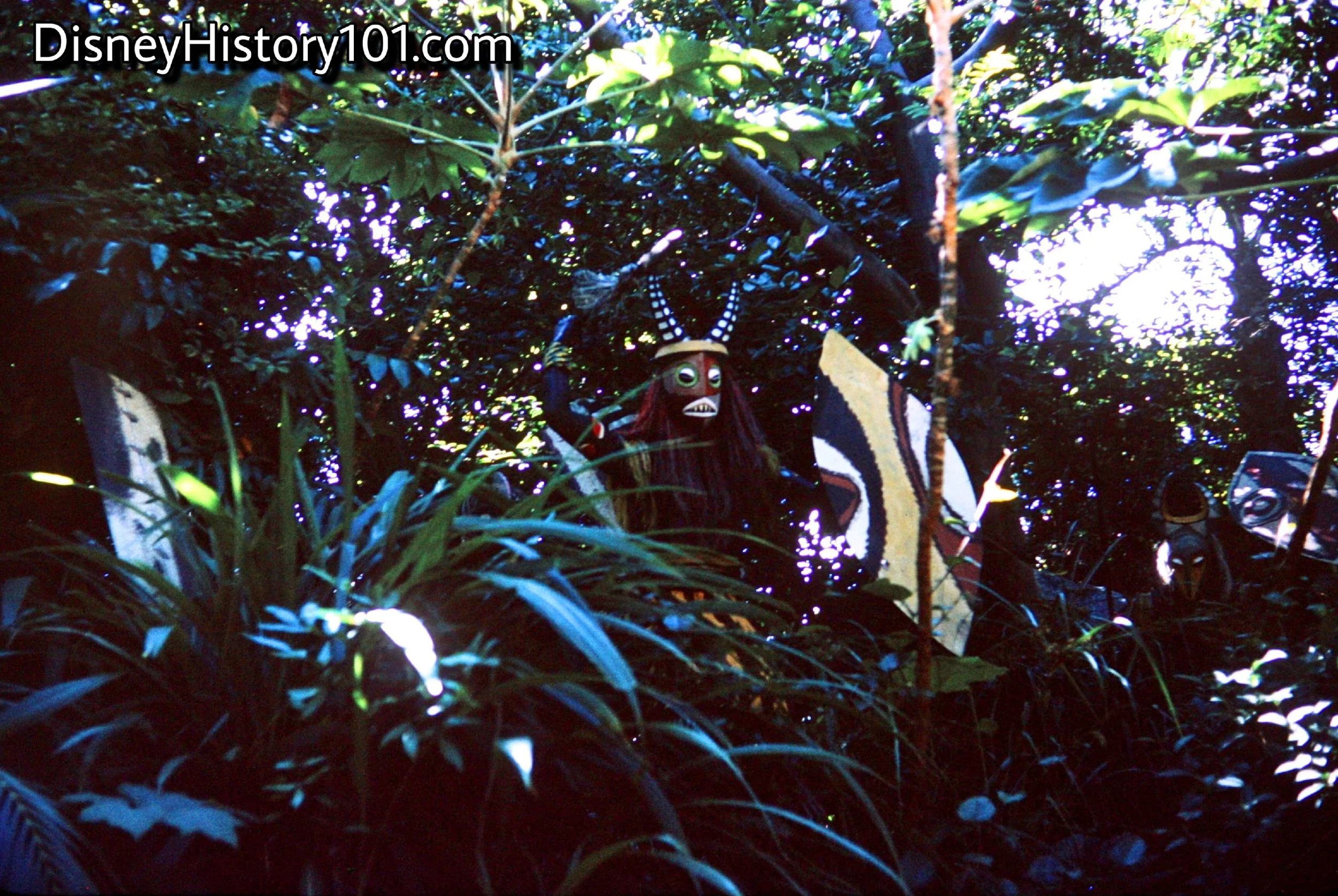
1965, August
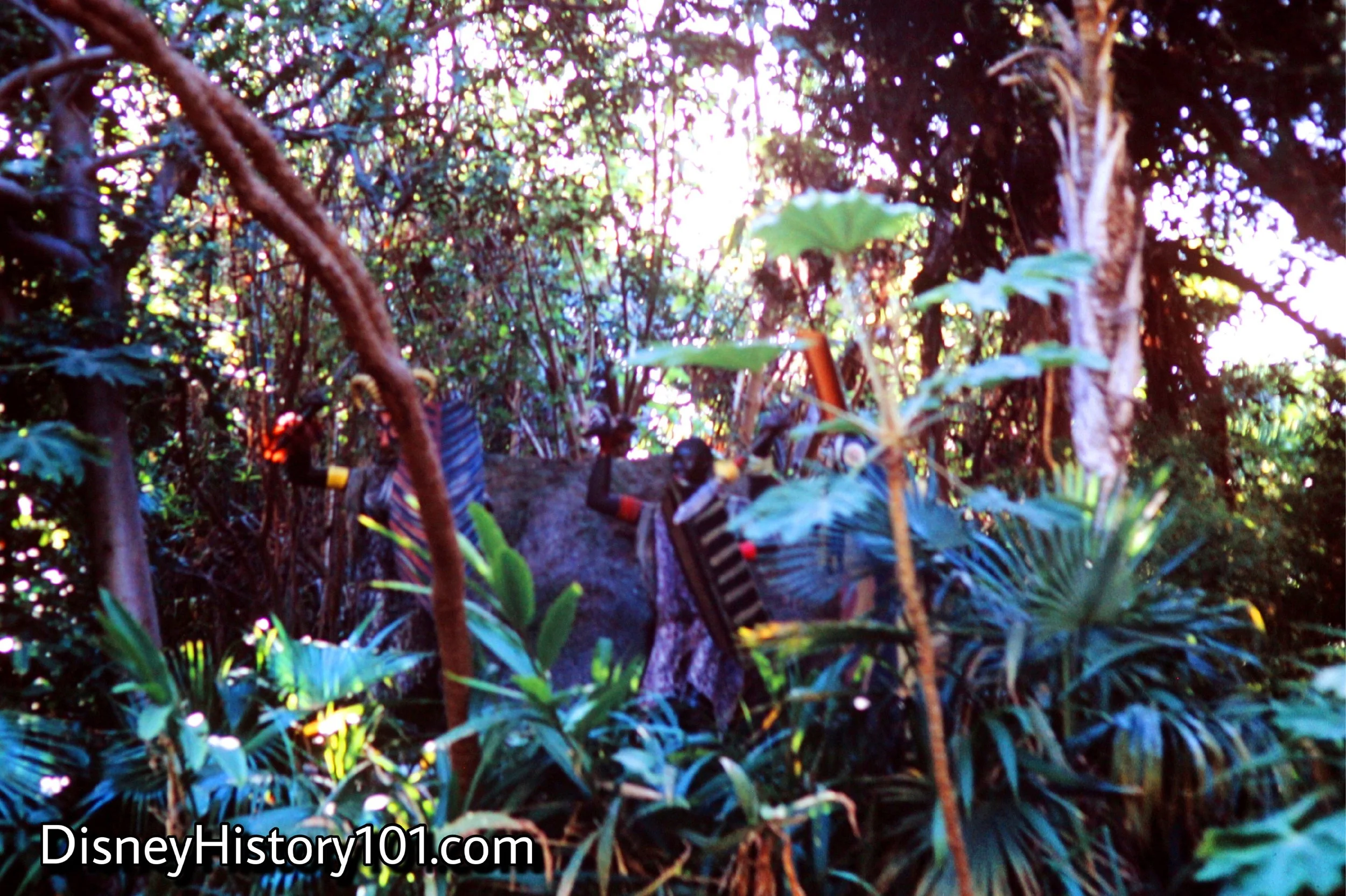
1968, April
(1955 - present)
“We’re approaching beautiful Schweitzer Falls, named after the famous Doctor Albert Schweitzer, who’s done so much for the people of Africa.“
Here, is where all the Rivers of the World meet, and the expert captain’s skillful hands are proven, deftly steering the explorer’s launch away from falling water and certain disaster!
You may heard it said, “Again we approach beautiful Schweitzer Falls, with a unique rock formation carved by the falls over the years.“ The falls (modeled after Victoria Falls in Africa, according to an article appearing in “The Disneyland News”, vol. 1; no.1) may appear to have been formed naturally, but they were actually blueprinted, built with structural steel and cement, and detailed by the hands of many talented artists working for Walt Disney Studios. Bob Sewell (who was involved in the creation of Disneyland’s water features) recollected, “We added many more of Marc Davis’ scenes. I worked with him and supervised the shaping and painting of some of the rock work. Fred Joerger was there too, and I should say that he was the true master of all of Disney’s waterfalls from the start.”
The beautiful Schweitzer Falls was created by applying a metal lath over a paper base. Gunite was then fired at the lath until it was completely covered. The gunite was finally carved to create the intricate life-like rock formations. The latter portion of this process is similar to the process of making swimming pools, and was also applied in the fabrication of the Matterhorn. “Each hour, 120,000 gallons pour over this miniature Niagra”, according to the Naphtha Launch Captain featured in “A Trip Through Adventureland” (an episode of “Walt Disney’s Adventureland”).
The next encounter with Schweitzer falls is a bit more serene, as the guests pass behind its cascading waters. “It’s a different view this time, from behind.”
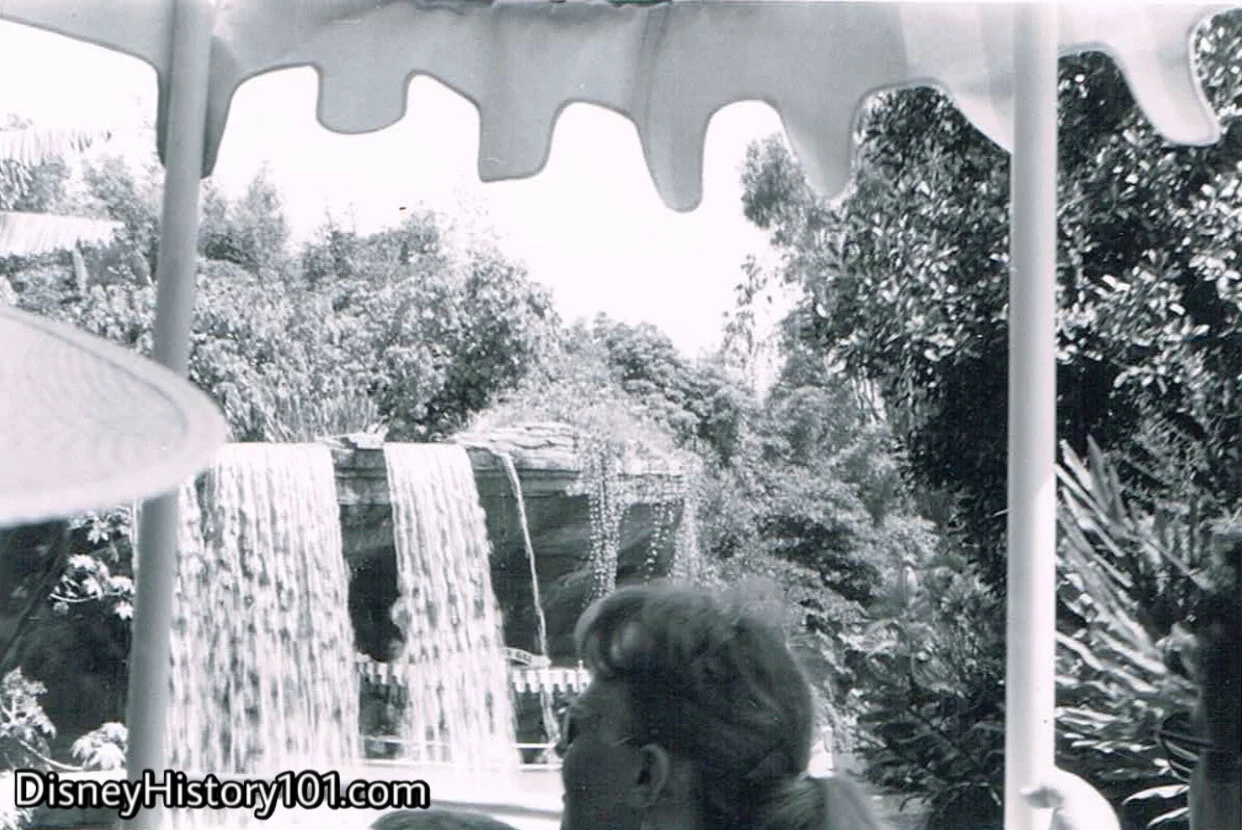
1960s.
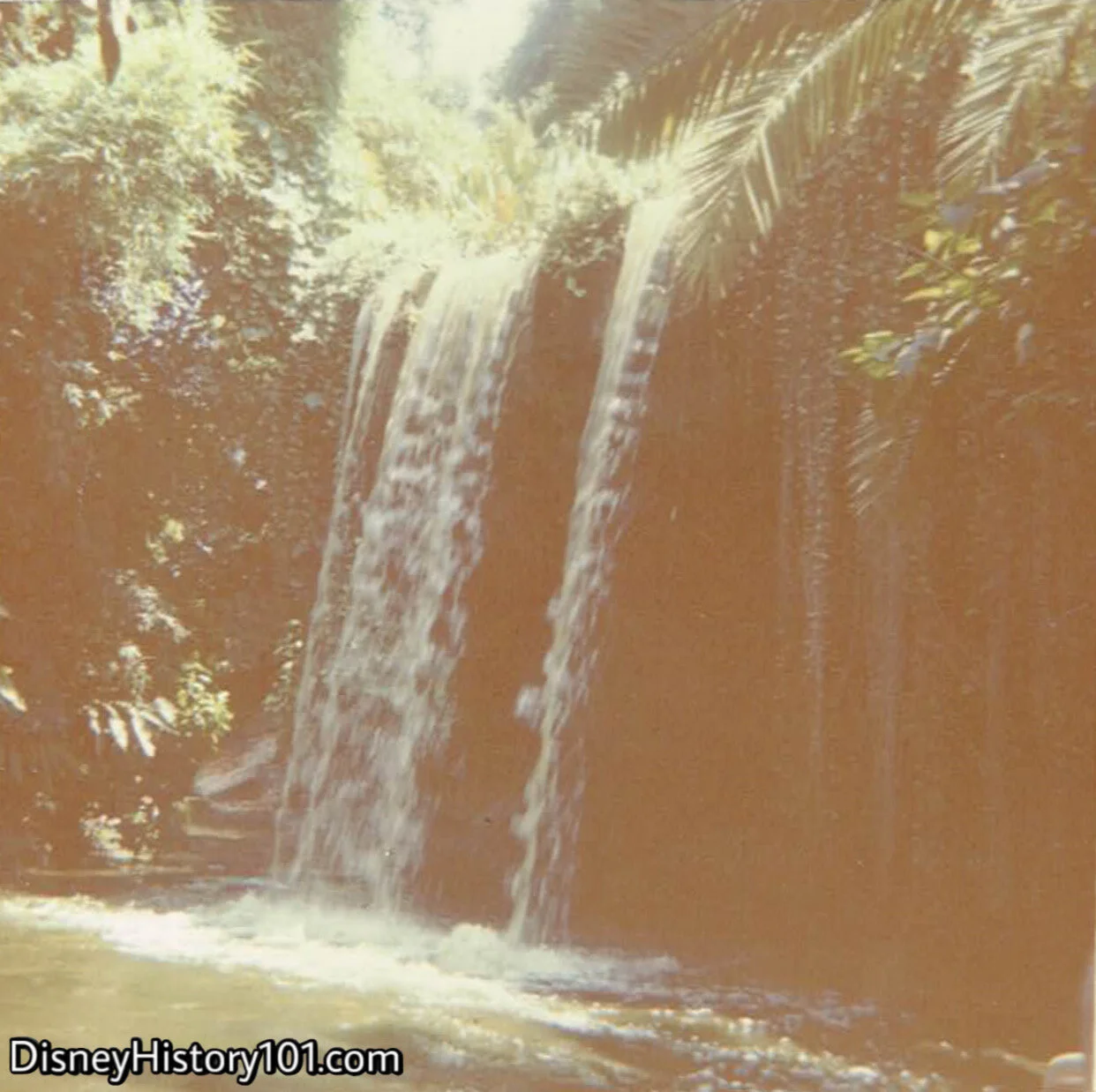
“I’ll try to get in just as close as I can…I didn’t think I was going to make it. That was almost too close.”
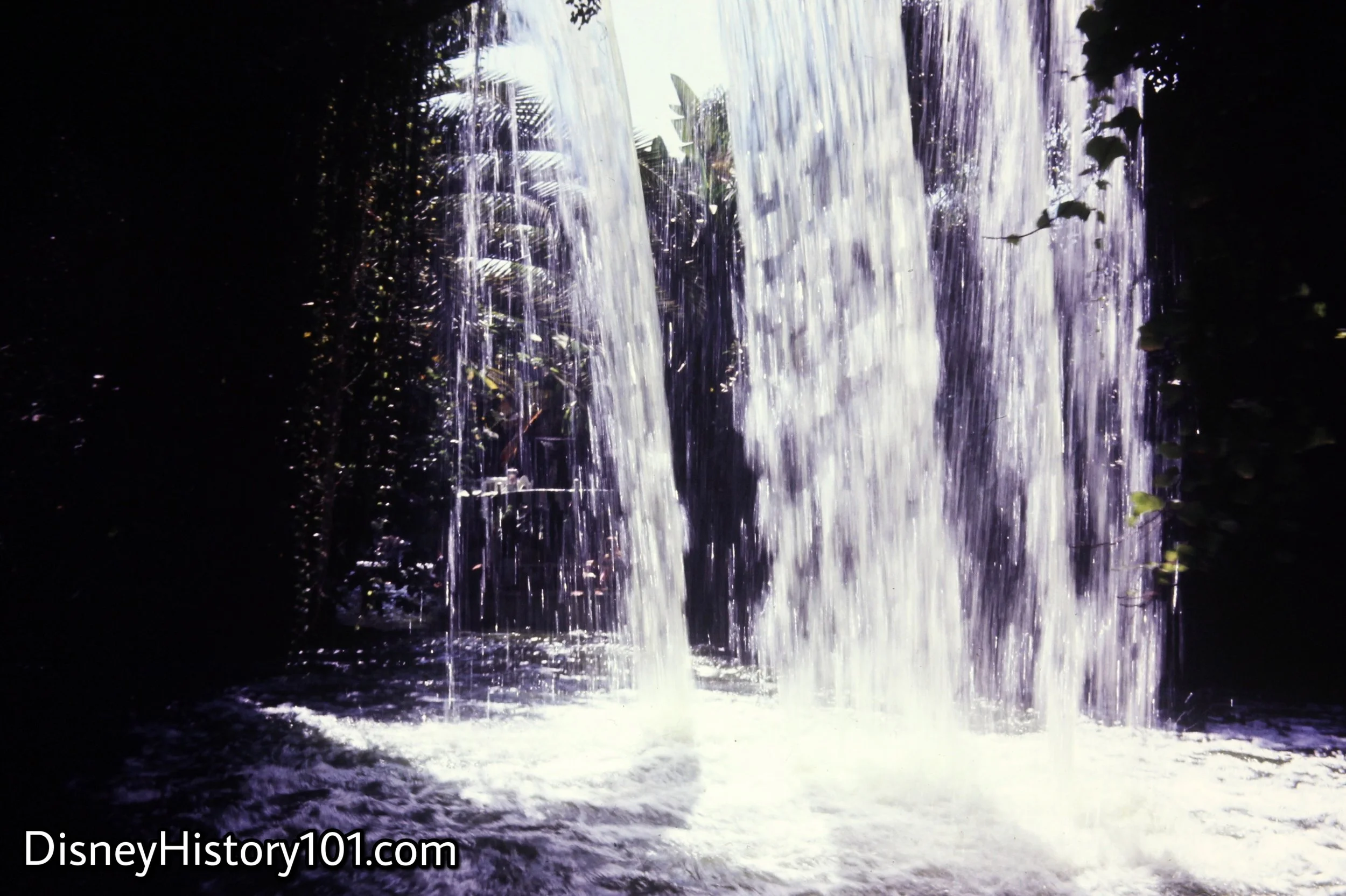
1967
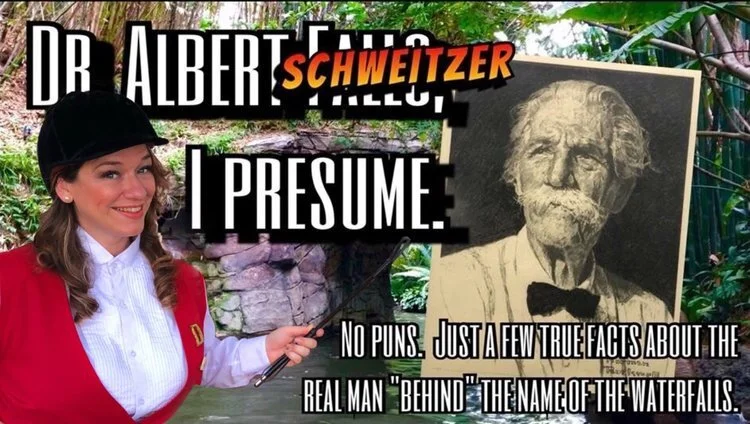
“SCHWEITZER - THE NAME BEHIND THE FALLS”
While some Jungle River Cruise story elements brought to life the earlier era of both Henry Morton Stanley and Doctor David Livingstone, this particular wonder made reference to a contemporaneous jungle doctor - Albert Schweitzer. PLEASE STEP THIS WAY as we visit Chapman University in Orange County, and learn about the man “behind the [name of the] falls”! We’re not talking about the fictitious Doctor Albert Falls, but the true-life philanthropist and humanitarian - Doctor Albert Schweitzer!
1957
These massive Gorillas first appeared in the region around 1957. Since then, they have threatened River Boat passengers with their fiery stare, and their lengthy reach!
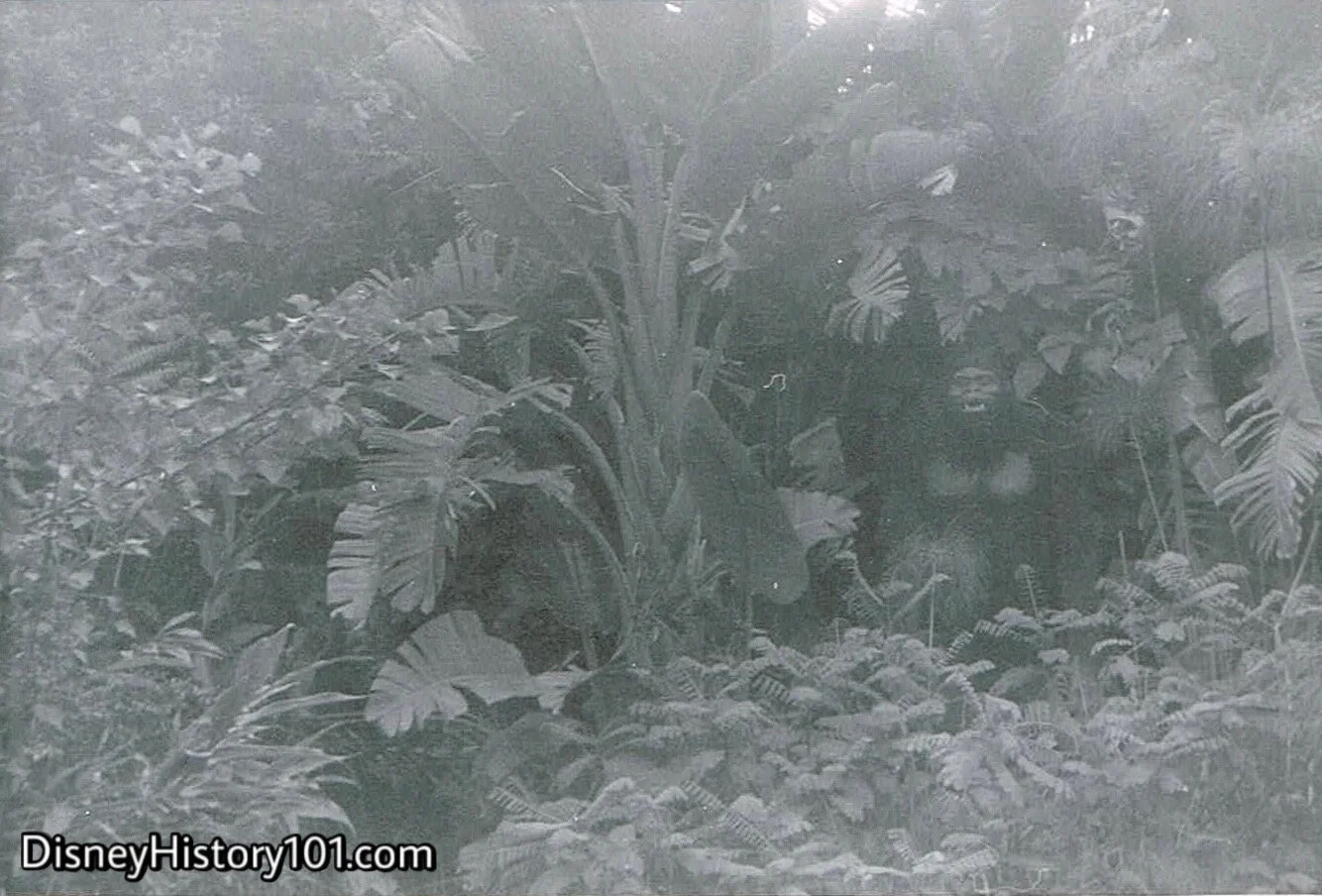
Later, as the Skipper mentions that a number of safaris have been known to camp in the area, the boat rounds a bend and comes upon one such expedition that has been overrun by a family of very curious gorillas.