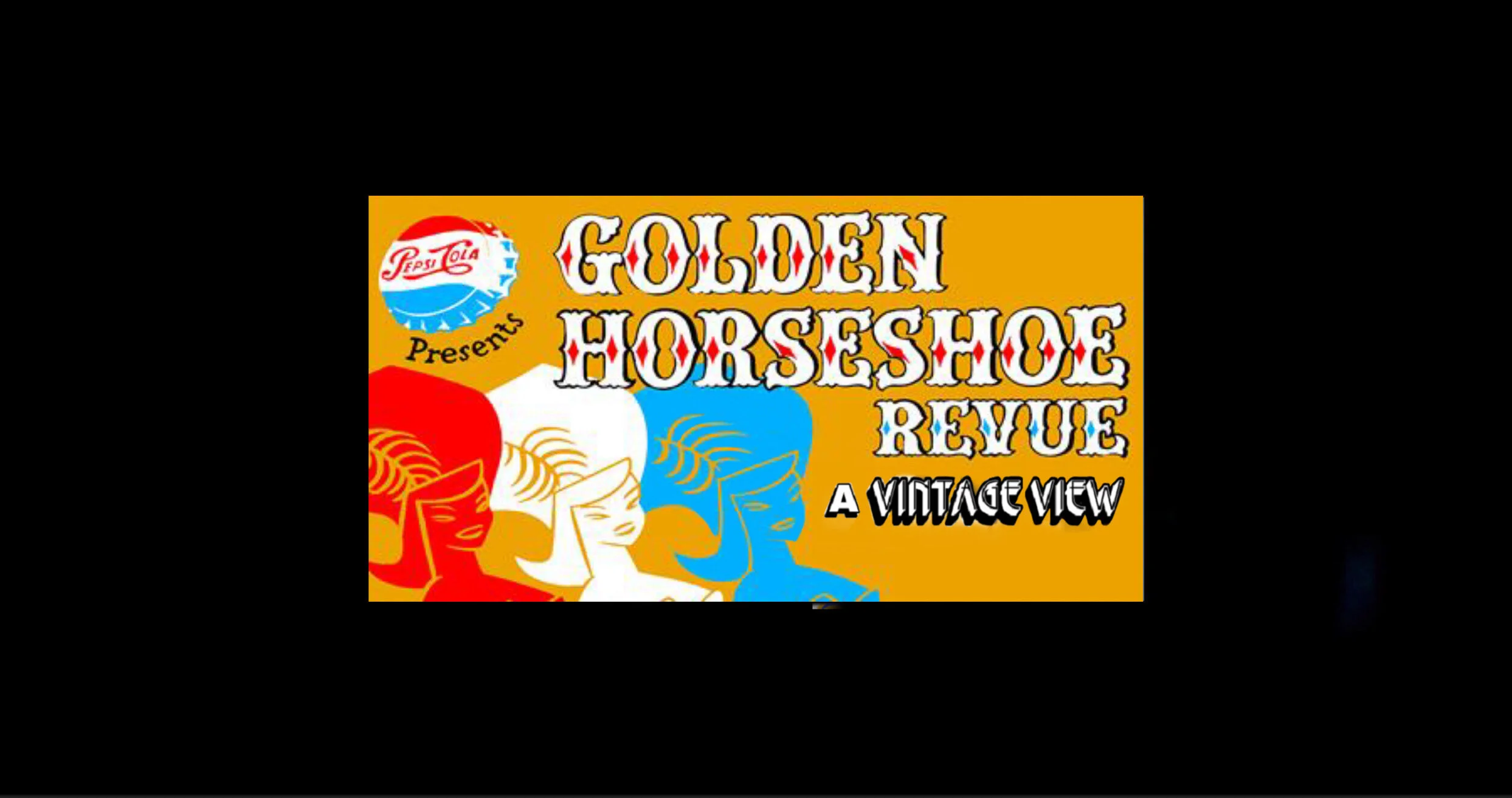
(SLUE FOOT SUE’S) GOLDEN HORSESHOE
Disneyland was a miracle of showmanship in many ways! The presentation of the Slue Foot Sue’s Golden Horseshoe show on the vast DISNEYLAND “stage” was to be a distinct part of the Disneyland theater concept. The pride of Frontierland - Slue Foot Sue’s Golden Horseshoe - was a revue such as was shown in an old-time western saloon. On July 16th, 1955, a private event for Participant corporate sponsors of Disneyland was held at Slue Foot Sue’s Golden Horseshoe. The following day (on July 17th, 1955), guests of all ages were finally invited to “come on in” and dine in Disneyland’s own elegant & authentic 1867-era saloon (1 of 22 initial major attractions at Disneyland - and a free one at that)! The only catch - reservations were taken on a first come, first serve basis. The attraction was especially popular on hot summer days, as the show building was one of three air conditioned attractions in the Park (including Fantasyland Theater and TWA Rocket to the Moon). It was predicted that Slue Foot Sue’s Golden Horseshoe would be capable of serving a capacity of 800 guests per hour. The same report also accounted Slue Foot Sue’s Golden Horseshoe as one of Disneyland’s eating facilities which was predicted to contribute to accommodating “15,000 persons daily, hitting a peak of 60,000 o holidays and week-ends…” and one of “twenty restaurants and snack bars, capable of saving 8,000 hourly,” at least according to “Building A Dream” (prepared by the Disneyland, Inc. Public Relations Department).
As with all Disneyland Hosts and Hostesses hired during 1955, each employee of Slue Foot Sue’s Golden Horseshoe was “hand-picked by Disneyland officials with qualifications including disposition, general attitude and appearance. Each new Disneyland employee was required to attend ‘orientation classes,’ part of a training course in Disneyland policies, to become acquainted with the Disneyland way of life,” according to “Building A Dream,” prepared by Disneyland, Inc. Public Relations Department, c. June of 1955. Five months before the premier opening of Disneyland, the Disney University Orientation program was held to instruct each Disneylander (including those fulfilling roles at Slue Foot Sue’s Golden Horseshoe) in some of Walt’s personal philosophies, as well as the policies which would “create happiness” for visitors!
Many of these employees served refreshments and light snacks to guests, while they enjoyed a “community sing” once led by those “pastel-clad singing waitresses” (the costumes which were designed by the legendary Hollywood costume designer Jack Muhs). Food service equipment was provided by Coast Distributing Company of Los Angeles (who ran a “Congratulations” message to Walt Disney and Staff in “The Disneyland News”, Vol. 1, No.2 ; August 10, 1955). During the mid-1960s pre-show, guests joined the singing waitresses in rousing renditions of such favorites as “‘Down By The Old Mill’, ‘My Blue Heaven’, and many more well remembered memories.” During this same era, Bartender Joe Wong usually sang a song he claimed “was learned at his mother’s knee - ‘When Irish Eyes Are Smiling’”, according to Vacationland magazine [Fall, 1964].
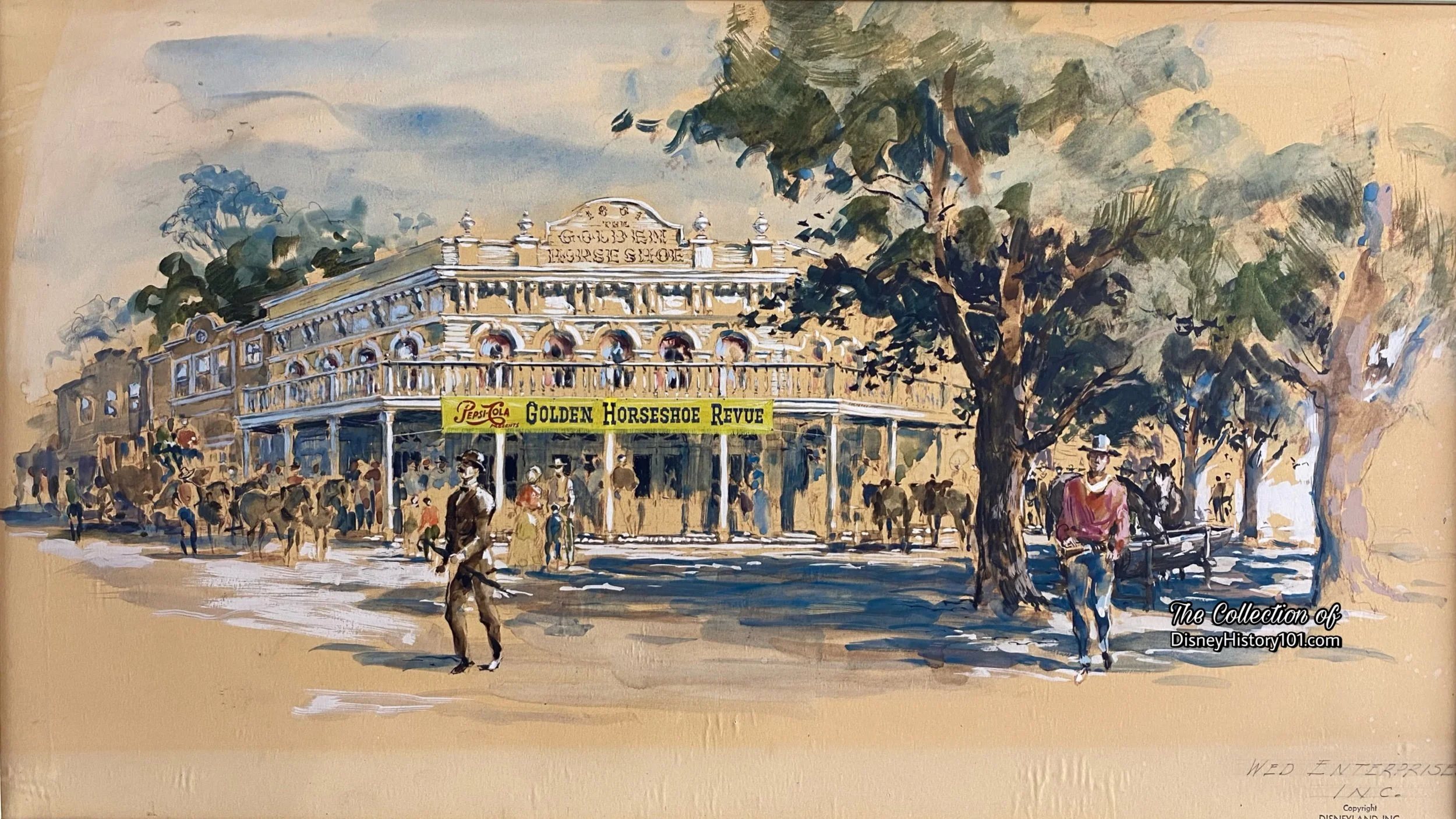
“Draw Concept” - Slue Foot Sue’s Golden Horseshoe Concept Sam McKim, 1954; ©️Disneyland Inc.; Gifted to Pepsi-Cola Vice President Don Kendall by Walt Disney.
(Courtesy of Barnebys)
“Setting the Stage”
According to “THE DISNEY THEME SHOW - an introduction to the art of Disney outdoor entertainment: Volume II”: Of all the guests’ senses that come into play at Disneyland, the most difficult response to predict was taste. If 70,000 guests were to arrive on a single day, there would probably be 70,000 different ideas about food. Generally speaking, Disneyland food locations fall into three categories - sit-down restaurant service, “buffeteria,” and fast-food categories. The most extensive theming has always been found in the sit-down restaurant locations but all locations were housed in authentically motified facilities.
Early thumbnail sketches and other concept artwork seemed to be unencumbered by restrictions of budget, schedule or the laws of nature and physics. Though guided by Walt, his artists appeared to engage in “free-thinking,” as if implementing the modern “Blue Sky” Imagineering process.
While many artists contributed, the talented Herbert Ryman is of note. Herb had joined the Disney Studio in 1938, after Walt saw a public show of his work in New York. (Herb's paintings were being exhibited with those of another up and coming artist, Andrew Wyeth.) Herb Ryman acted as art director for such films as Fantasia and Dumbo, but had left Walt Disney Studios in 1946 and (by 1953) was employed by 20th Century Fox. However, Walt reached out to Herb and during one weekend (September 26 & 27, 1953) a historic drawing of the Park was produced.
The very concept of a western-era-themed floor show was not new to the Anaheim area. In fact, before Disneyland was even annexed to the City of Anaheim, Knott’s Berry Farm’s Birdcage Theater (a recreation of the namesake theater of Tombstone, Arizona) provided visitors with an hour-long musical and comedic “old fashioned melodrama.” So, Walt would need some particularly distinct elements, if his own Frontierland theater was to be set apart. In 1954, conceptual artwork began to be produced for what would be billed “the pride of Frontierland” - an old-west style saloon! “Disneyland is unique in that some of the world's foremost creative artists and architects control all design at Disneyland.“
Sam Mc Kim began working for Walt Disney's W.E.D. Enterprises (now Walt Disney Imagineering) in 1954, as an imagineer, doing the original sketches for Frontierland and the Golden Horseshoe Revue. As we approach, we notice a few things about Sam McKim’s circa 1954 drawing, that compare with the fully realized version.
•The Name : At some point during the conception and construction, the saloon was simply called The Golden Horseshoe (though it was later changed to Pecos Bill’s Golden Horseshoe, and finally Slue Foot Sue’s Golden Horseshoe). One authorized “Disneyland Information & Nomenclature List” (prepared by Bill Cottrell of Disneyland Inc., by May 25, 1955) listed “official and authorized nomenclature” of Disneyland, confirming “the name of Pepsi Cola’s bar is Slue Foot Sue’s Golden Horseshoe.” This name that stuck (for years to come), and was emblazoned over the entrance of the establishment!
•The Date : Though some Disneyland guide books will “date” the thematic setting as situated during the year 1867, the realized sign above the door would read 1871.
•The Sponsor : The last thing that we gather from details in the drawing, is that Pepsi-Cola had no doubt firmly agreed to sponsor the attraction by this point.
•The Direct Inspiration : “Walt had big plans for his saloon and he enlisted Imagineer Harper Goff to create a saloon ‘Calamity Jane herself would walk into.’ Little did Walt realize he was talking to the set designer for the saloon of the 1953 musical, Calamity Jane, starring Doris Day. Walt got exactly what he asked for—a replica of the saloon Calamity Jane did step into! One minor detail was added and that was Walt's private box, which is lower level, stage left.“ Sam McKim based the design of Slue Foot Sue’s Golden Horseshoe directly on the Deadwood City Golden Garter Saloon!
Like some advanced “High Concept,” final designs were quickly generated and approved.
Next, architectural drawings helped define all designs, production and construction strategies, costs, schedule, and resource requirements. Models explored the various dimensional relationships, site-lines, flow patterns, ergonomics, and visual appeal to convey the desired creative intent.
The Golden Horseshoe Building was a one and two story wood and steel frame building containing several store rooms, the Golden Horseshoe Restaurant and a food stand. Various front treatments Include log, board and batten wood siding and stucco. The rear portion of structure was comprised of stucco. The structure had a concrete foundation and nearly flat graveled built-up composition roof. Floors of the stores are concrete and oak plank. Wall treatments include wood paneling and sheetrock. The Golden Horseshoe has an elaborate orate interior with a two-story ceiling height and a horseshoe shaped balcony. Floors are oak and linoleum and the walls and cellings are sheetrock with expensive paper on the walls. There is a stage at one end. There are four terrazzo floored restrooms with a total of 46 fixtures, 13,436 square feet, Balcony: Pendleton Store, 1,059 square feet, Golden Horseshoe 2,320 square feet and second floor comprised of 2,320 square feet. In 1958, the entire structure was appraised and valued at $277,000.
“Newbery Electric Corp. took the rapid electrical con-structión of Disneyland in stride. The electrical installations were supervised by Roy J. Gruendler, manager of Newbery's Orange County district office located at 1335 Santiago Ave, Santa Ana.”
Interior and fixtures were to have the authentic flavor of a saloon of the 1840 era. Even these interior props were scrutinized by Walt and those designers responsible for the Show Quality. Herb Ryman recalled how “Walt joined us… and we went into the Golden Horseshoe. I don’t know whether anyone has ever told you or not about the furnishings of the Golden Horseshoe. Just before the Golden Horseshoe was ready, Walt asked about the whiskey bottles on the back bar. I said, ‘They are the bottles of the turn of the century. I think it has a very good feeling of authenticity. Walt said, ‘We’ve got to change the labels on those bottles.’ When I protested, he said, ‘Herb, there are going to be a lot of people coming here. I would like it if they didn’t see anything that anyone could disapprove of.’ So we changed the bottles.”[“Working With Walt - Interviews With Disney Artists” by Don Peri]
The olio is a large, descending canvas curtain made popular in vaudeville theater. It’s usually adorned with a mural or local advertising also known as an "Olio Drop." The Pecos Bill-themed stage olio was designed by Marc Davis. One of arc’s conceptualizations in pencil is featured on page 8 of “Marc Davis: In His Own Words.”
The custom (and authentic) wardrobe of Hosts and Hostesses was likely provided by Warren Ackerman’s House of Uniforms (yes, “uniforms”), then located in Beverly Hills, California.
While all of these details were being completed, television crews were preparing to utilize the roof of the Golden Horseshoe for at least one camera location of the live telecast.
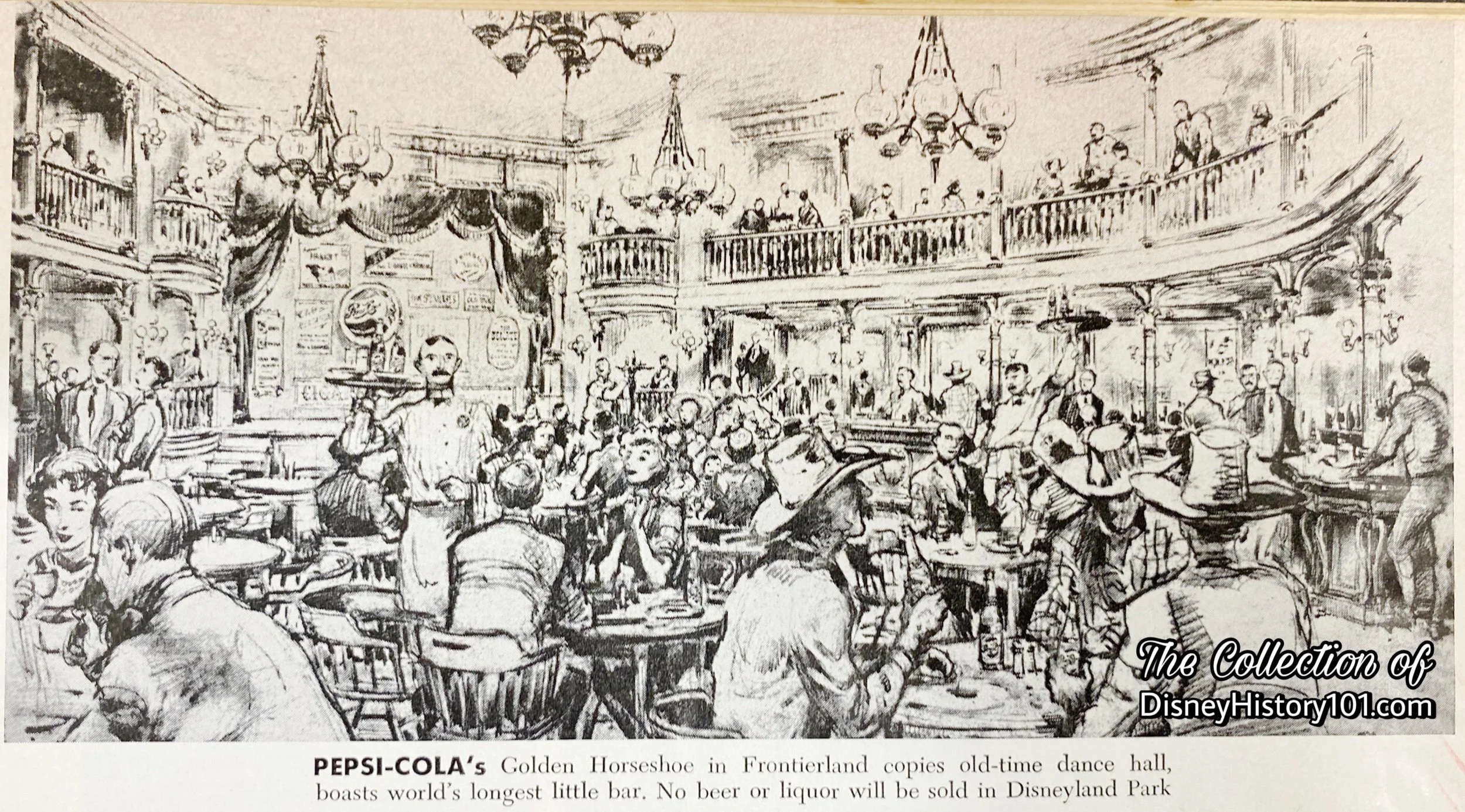
Printer’s Ink, July 15, 1955; © Walt Disney Company.
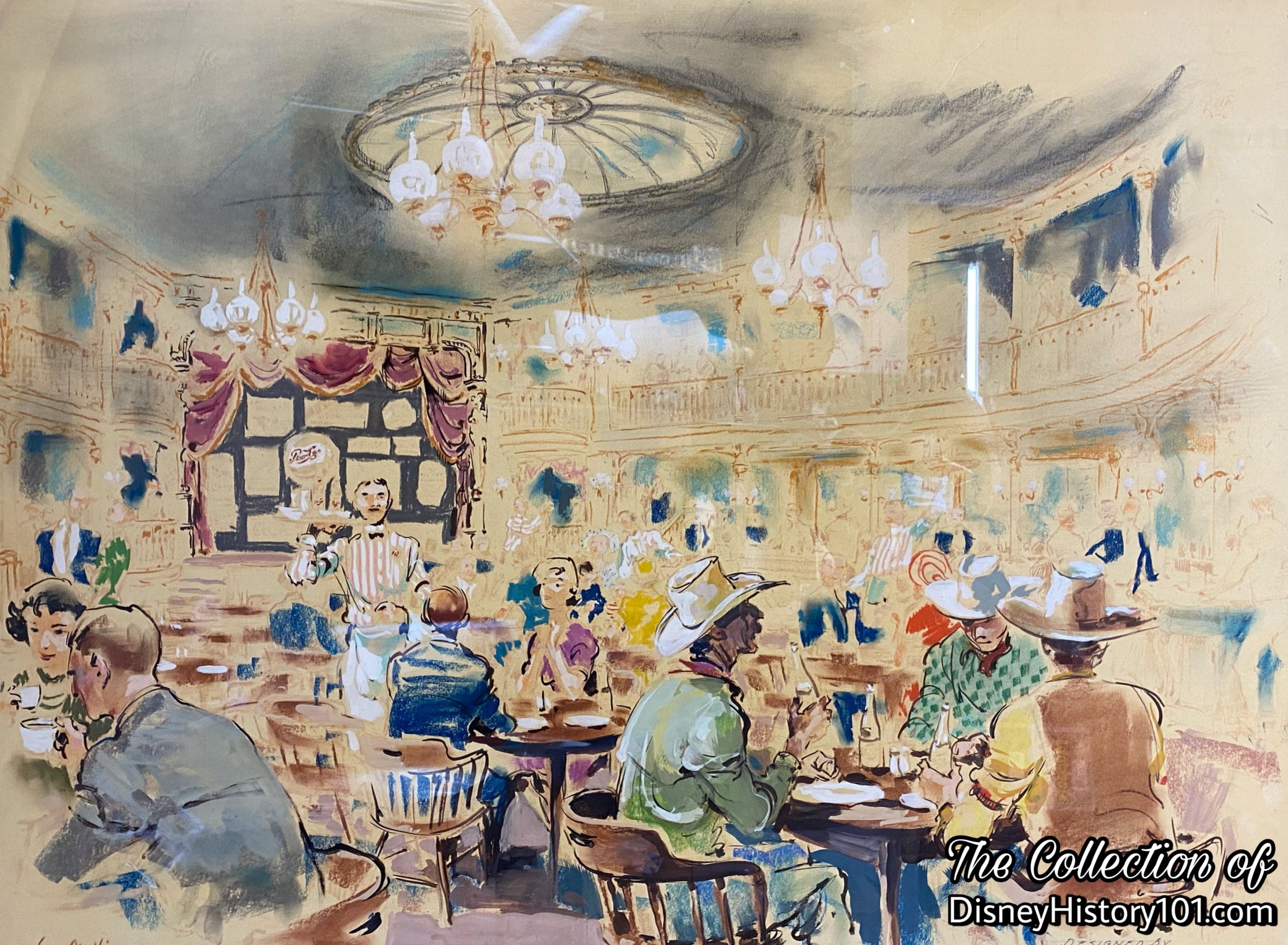
Slue Foot Sue’s Golden Horseshoe Interior Concept, Sam McKim, 1954; © Walt Disney Company.
This original Art Data Sheet of Slue Foot Sue’s Golden Horseshoe by Sam McKim was sold by Walt Disney Imagineering.
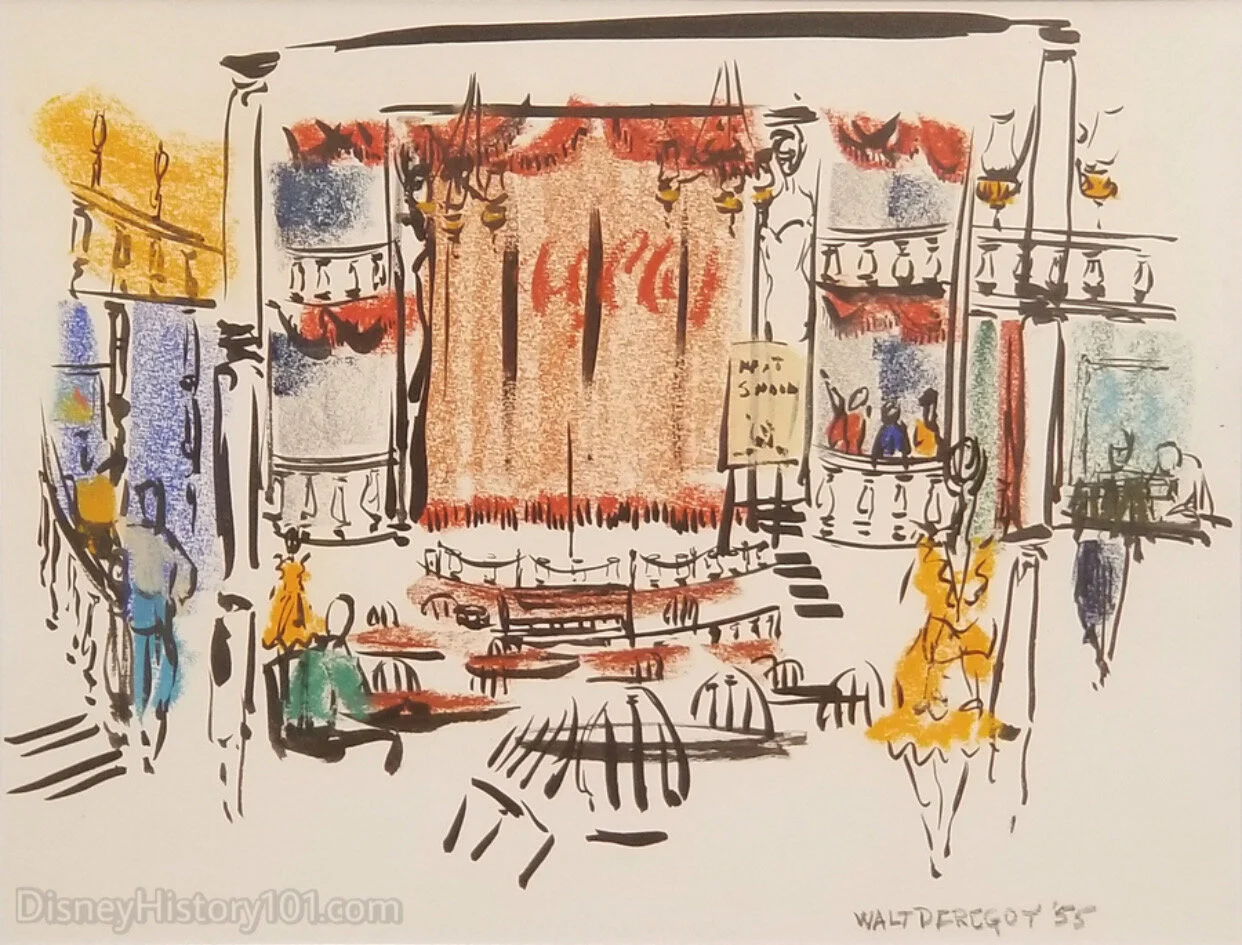
Golden Horseshoe Study, Walt Peregoy, 1955; © Walt Disney Company.
(Courtesy of Van Eaton Galleries)
Walt Peregoy (most known for his later radical backgrounds of Walt Disney’s 101 Dalmatians) created this thumbnail and color study of the Golden Horseshoe stage, c. 1955! The curtains (and even exterior bunting) was manufactured by the craftsmen and craftswomen of Walt Disney Studios’ Drapery Department.
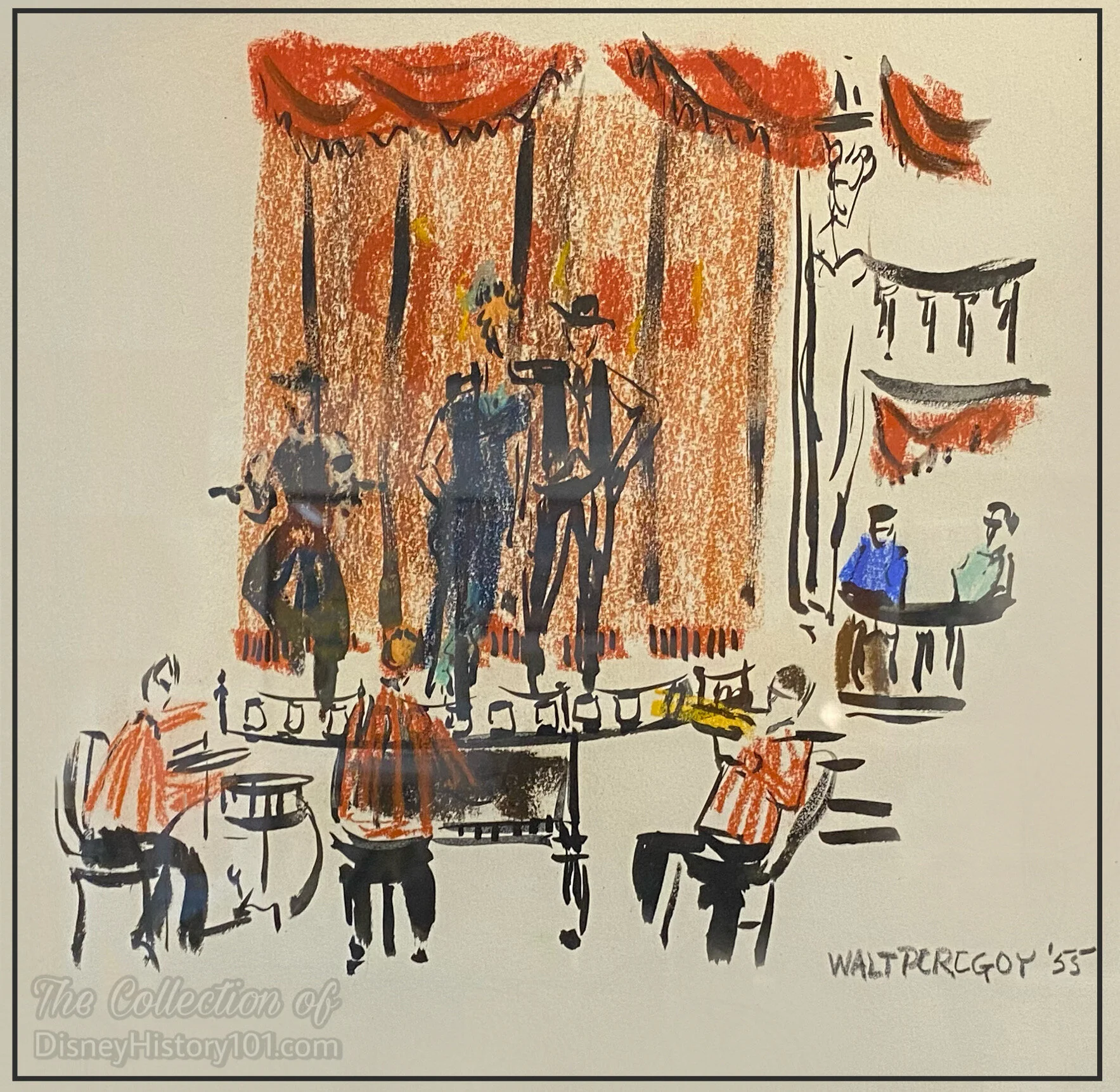
Golden Horseshoe Study, Walt Peregoy, 1955; © Walt Disney Company.
Walt Peregoy seems to have made a number of these drawings, sometimes featuring the cast of Slue Foot Sue’s Golden Horseshoe Revue as well as the remarkable Golden Horseshoe Orchestra!
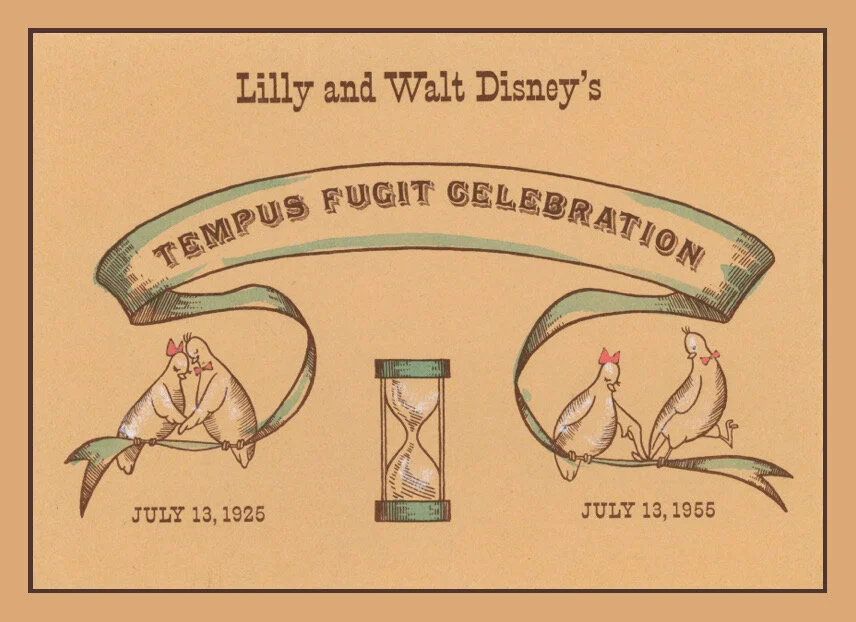
“THE TEMPUS FUGIT CELEBRATION Invitation, JUNE 13th, 1955”
The Golden Horseshoe was prepared to host a celebration for the first Engineer and 14 operators of the Mark Twain at 11:30 PM, on July 4, 1955. On July 13th, 1955, (four days before Disneyland’s big opening gala), Walt and Lillian shared their personal 30-year milestone with their family and friends - and it was commemorated from the stage of Slue Foot Sue’s Golden Horseshoe! A very special performance was given on the stage - the first-ever Golden Horseshoe Revue. After the show, anniversary cake was distributed.
(Pictured : Walt and Lillian Disney’s 30th Wedding Anniversary Invitation ; Courtesy of The Walt Disney Family Museum)
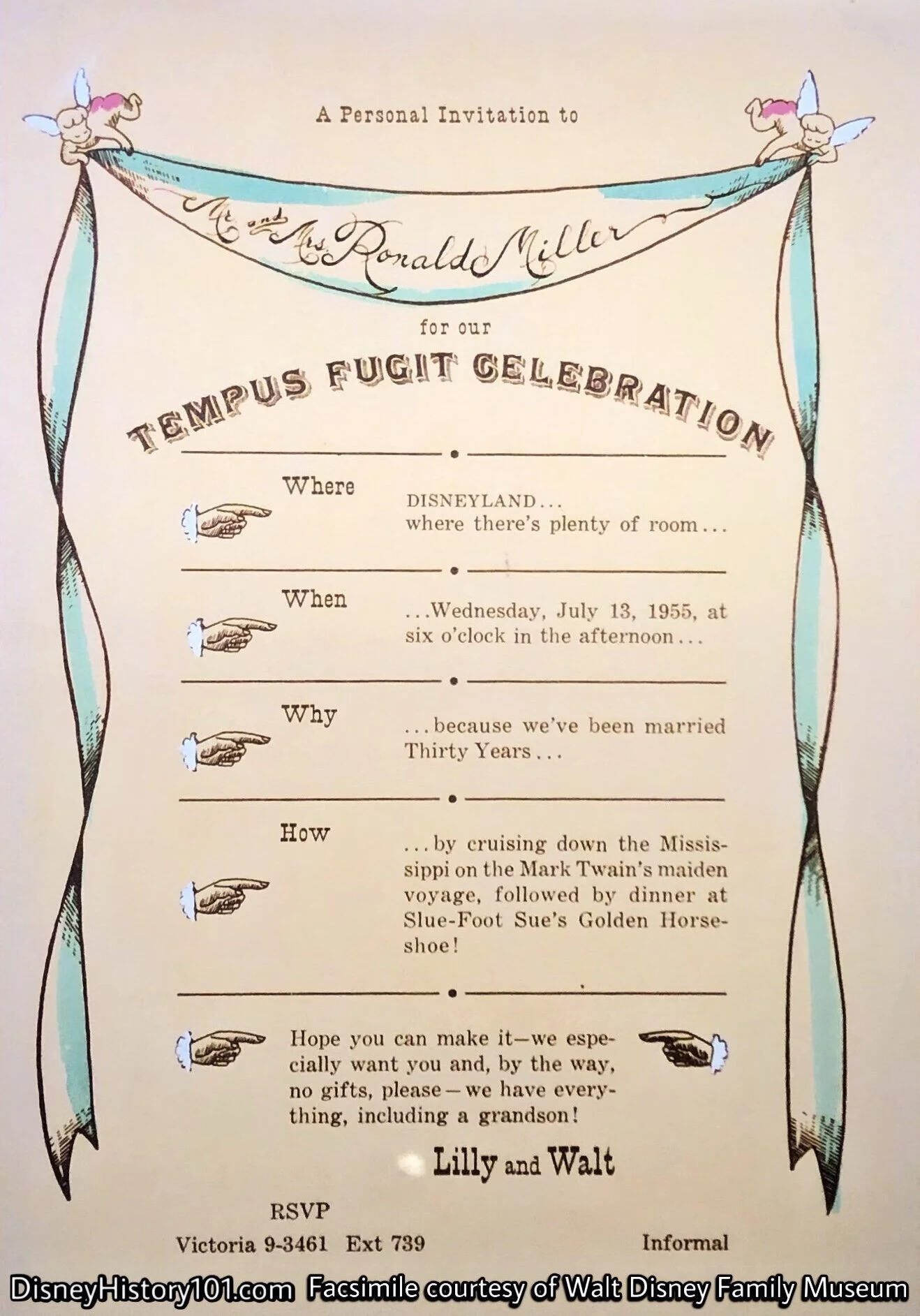
“THE TEMPUS FUGIT CELEBRATION Invitation, JUNE 13th, 1955”
Pictured (above), is the invitation sent to Ron and Diane (Disney) Miller, in honor of Walt and Lillian Disney’s 30th Wedding Anniversary. Pictured (below) are a few famous photographs of the happy celebrants!
(Courtesy of The Walt Disney Family Museum)
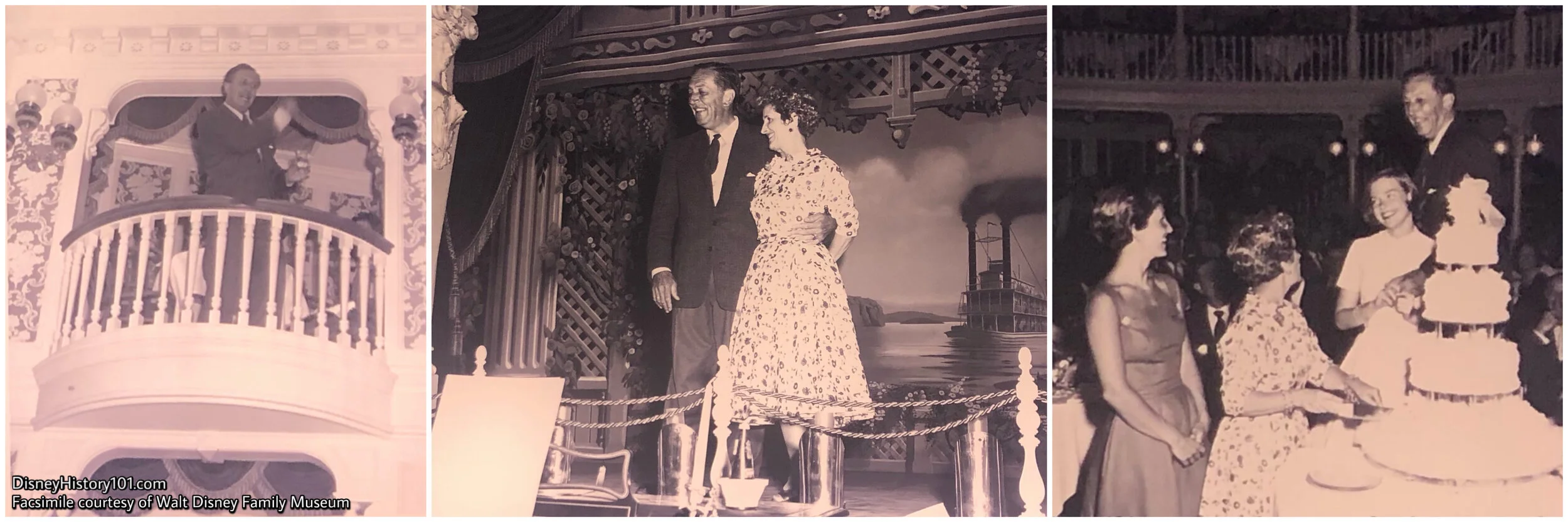
(Credit : Walt Disney Family Company)
These images (captured July 13, 1955) show Walt & Lilly (as well as their daughter Sharon) at their anniversary party.
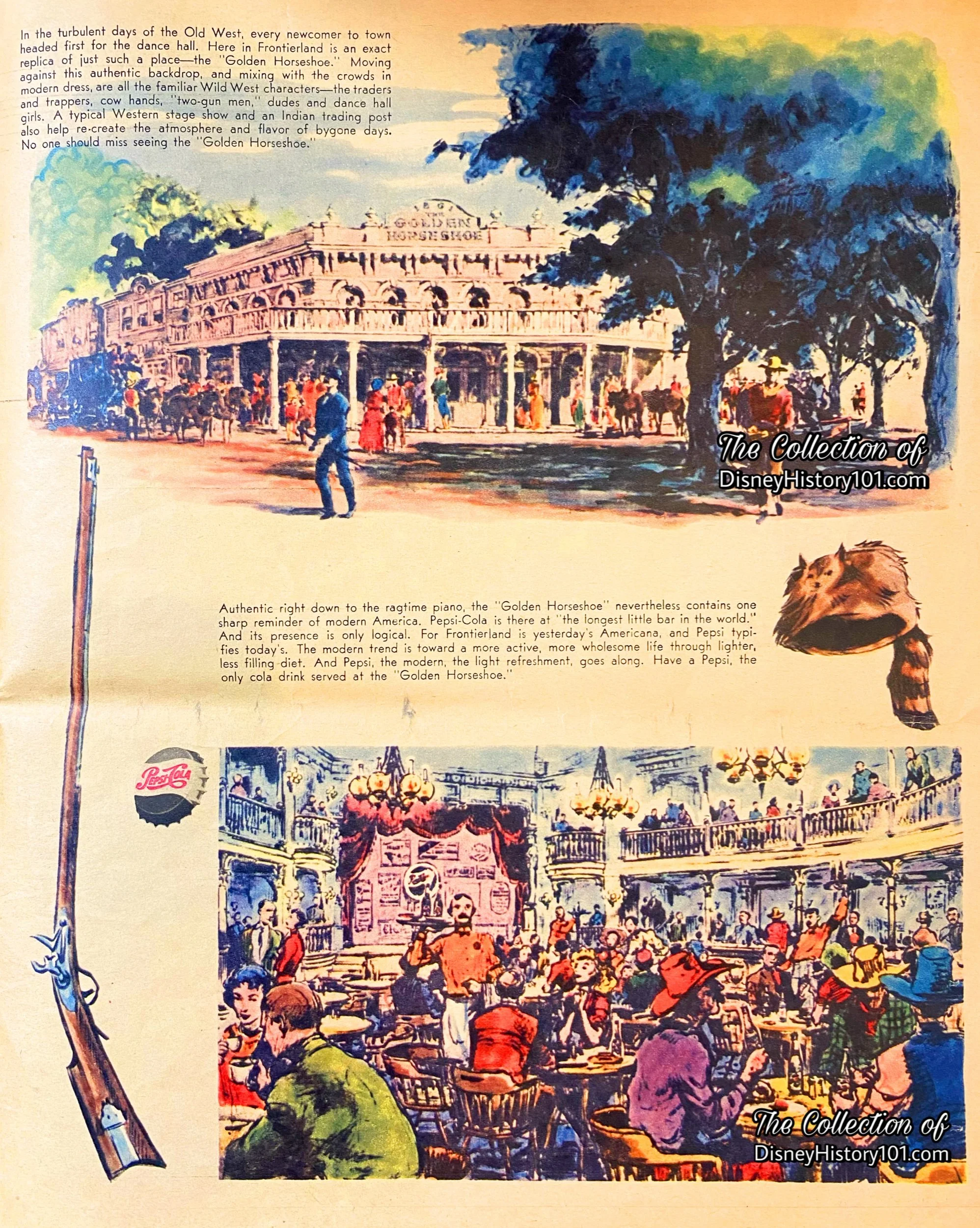
Some of these viable project Concepts (as this), were supported by a well-developed business case and built expectation.
A person coming to Disneyland would soon be able to enjoy world renowned free shows, such as Monsanto's Hali of Chemistry and home of the future, Bell Telephone's Exhibit, “America the Beautiful,” and Pepsi-Cola's Golden Horseshoe Revue.
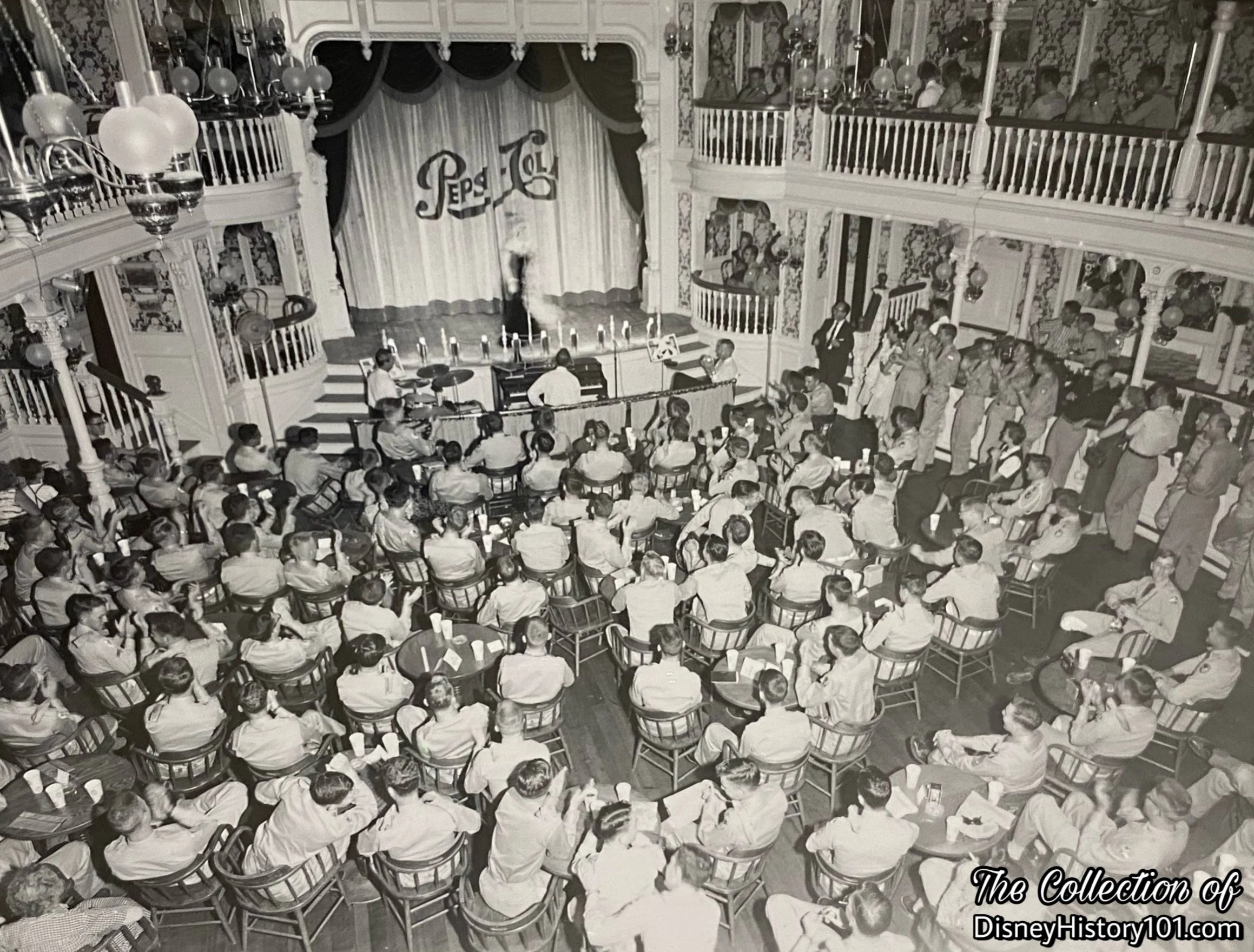
955-DL-386
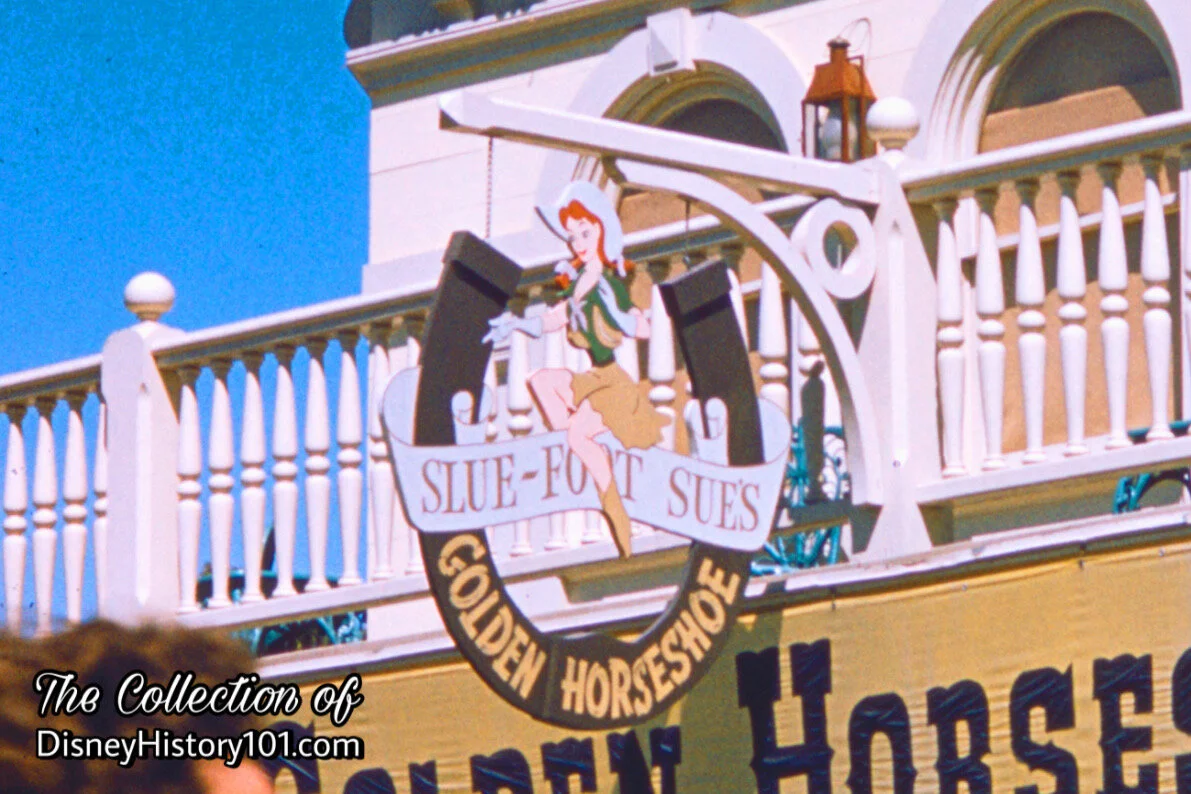
The sign in Front of House
Paint is important. The “Master Color Book” is the Bible for color selection at Disneyland, maintaining a catalogue of 4,000 shades of color. The book contains color specifications for every land, building, exhibit, and prop which requires paint maintenance. It insures that Disneyland will always have the same bright colors selected by the art directors who designed the attraction. In addition to the Master Color Book, there is a standby supply of ready-mixed paint available for touch up work. Thousands of cans of paint are stored in a special room which sounds like a walk through of Disneyland. Each can is labeled with names. Disneyland painters repainted every prop in the Park every two years. By 1969, the sign was one of 20,000 signs of various sizes and shapes and colors that needed to be maintained in their original condition.
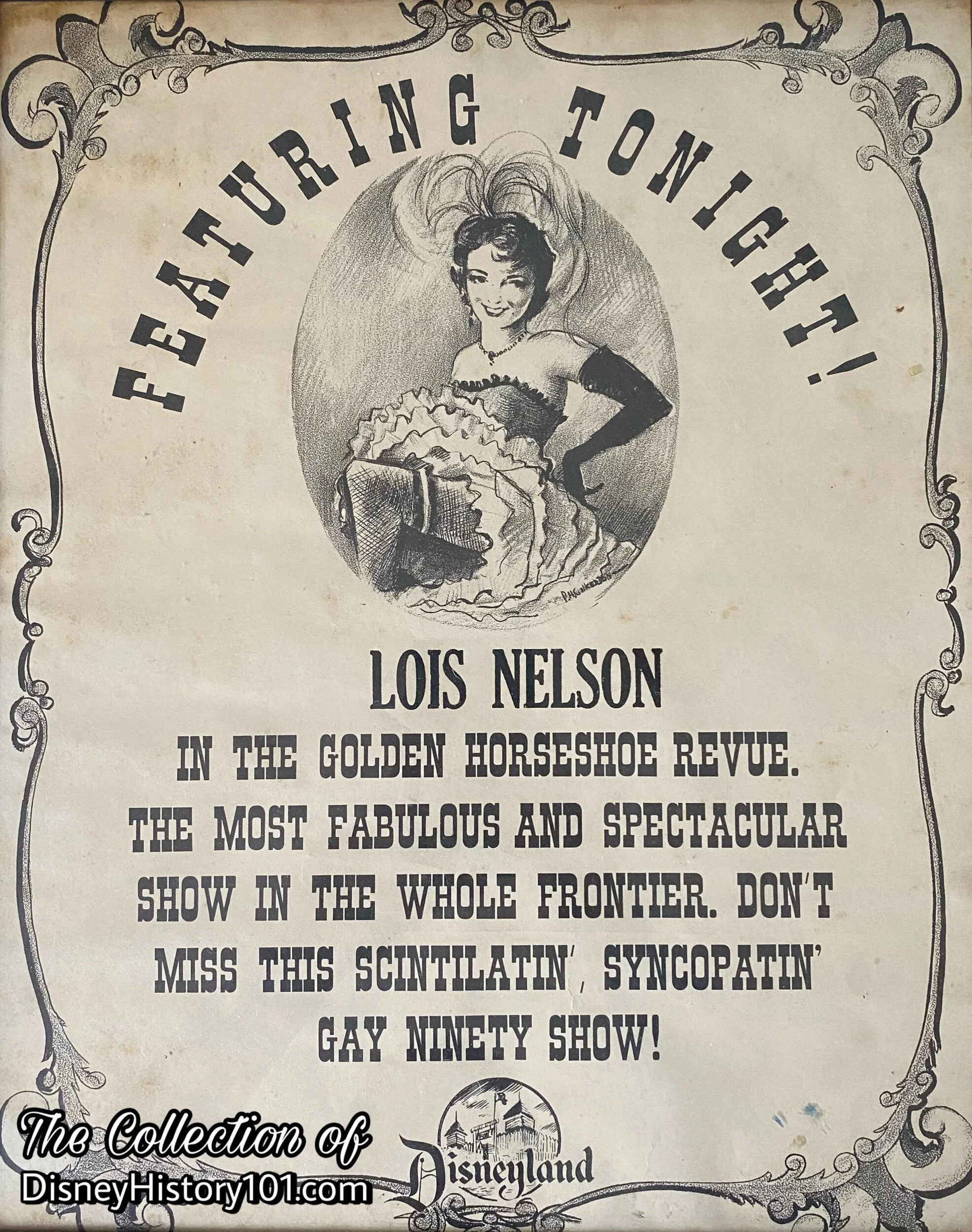
"The Unchoregraphed Career of Choreographer Miriam Lois Nelson"
(Pictured Above : Lois Nelson’s Golden Horseshoe Poster, from the Collection of Lois Nelson. As a side note, these poster designs were later used as souvenirs by the Frontierland Print Shop and Old Time Print Shop.)
Like Walt Disney, Miriam Lois Nelson (Sept. 21, 1919 - August 12, 2018) was born in Chicago. She began tap dancing at an early age, and at 14 years of age, moved to New York with her family. Miriam never believed that she would go on to dance in six Broadway musicals, before marrying, and receiving a seven-year contract with Paramount Studios. From there, she assisted and co-choreographed many dance numbers for feature films and television broadcasts.
But Miriam’s biggest break (for which she would be most remembered), was when she was hired to choreograph the dancers involved in the live televised opening of Disneyland in July 1955. Choreographing the 90-minute extravaganza was no easy task. Cameras would cut to locations throughout the different lands, where a cast of hundreds performed complex numbers in smaller groups. For example, Disney Parks historians mention that her contributions to that event included orchestrating an appearance by “Davy Crockett” starring both Fess Parker and Buddy Ebsen.
Even more, Miriam’s work included choreography of the original Golden Horseshoe Revue show in Frontierland which debuted on July 13th, 1955! According to Miriam Nelson (former Disneyland Choreographer), “one group did three or four shows during the day, and another group did them during the night, and then I was asked to put the two groups together, like they were one big group.” Miriam’s Golden Horseshoe Revue was so popular, that it was later performed outside Disneyland for a special occasion. Miriam recollected, “I took them all to Washington, and it was the Foreign Correspondence Dinner for President Nixon at the time.”
Slue Foot Sue’s Golden Horseshoe Revue often cast a variety of performers in the script’s diverse roles. This souvenir Golden Horseshoe Poster suggests that even Disneyland opening day & parade choreographer Lois Nelson, even performed as one of the Golden Horseshoe Dancers during a special engagement.
Miriam would go on to choreograph other iconic shows like Fantasy On Parade, and even the original Main Street Electrical Parade.
The Orange County Register published a fantastic interview with Miriam, which can be viewed by clicking HERE .
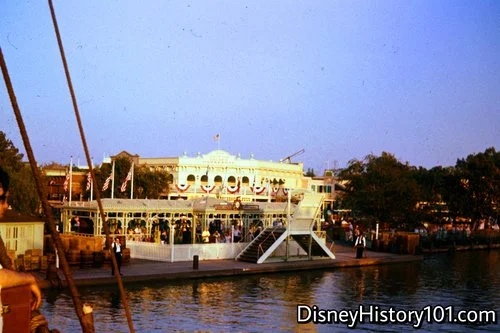
Along the banks of the Rivers of America…in the heart of Frontierland…sits Slue Foot Sue’s Golden Horseshoe! Let’s take a closer look!
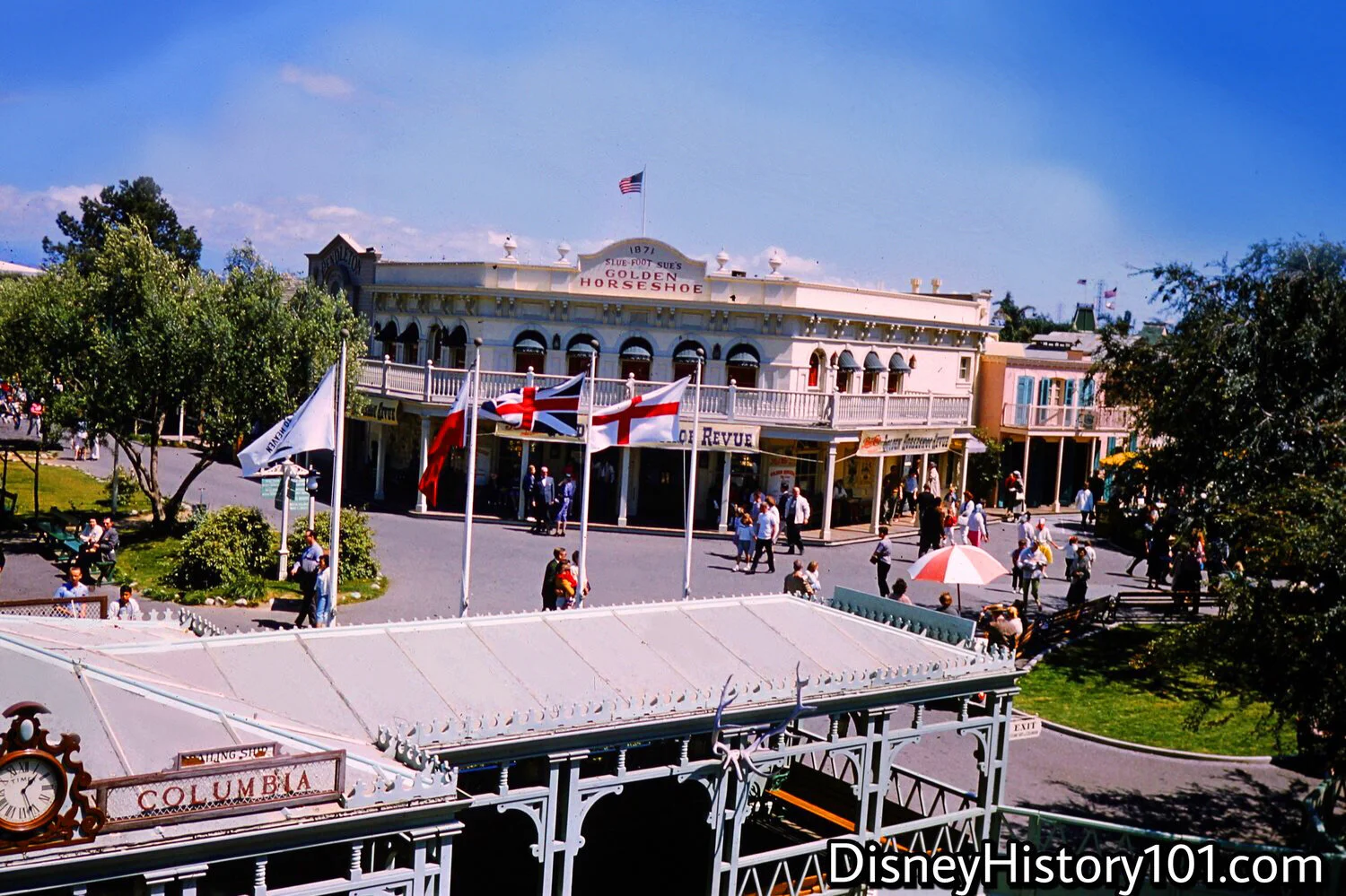
1961
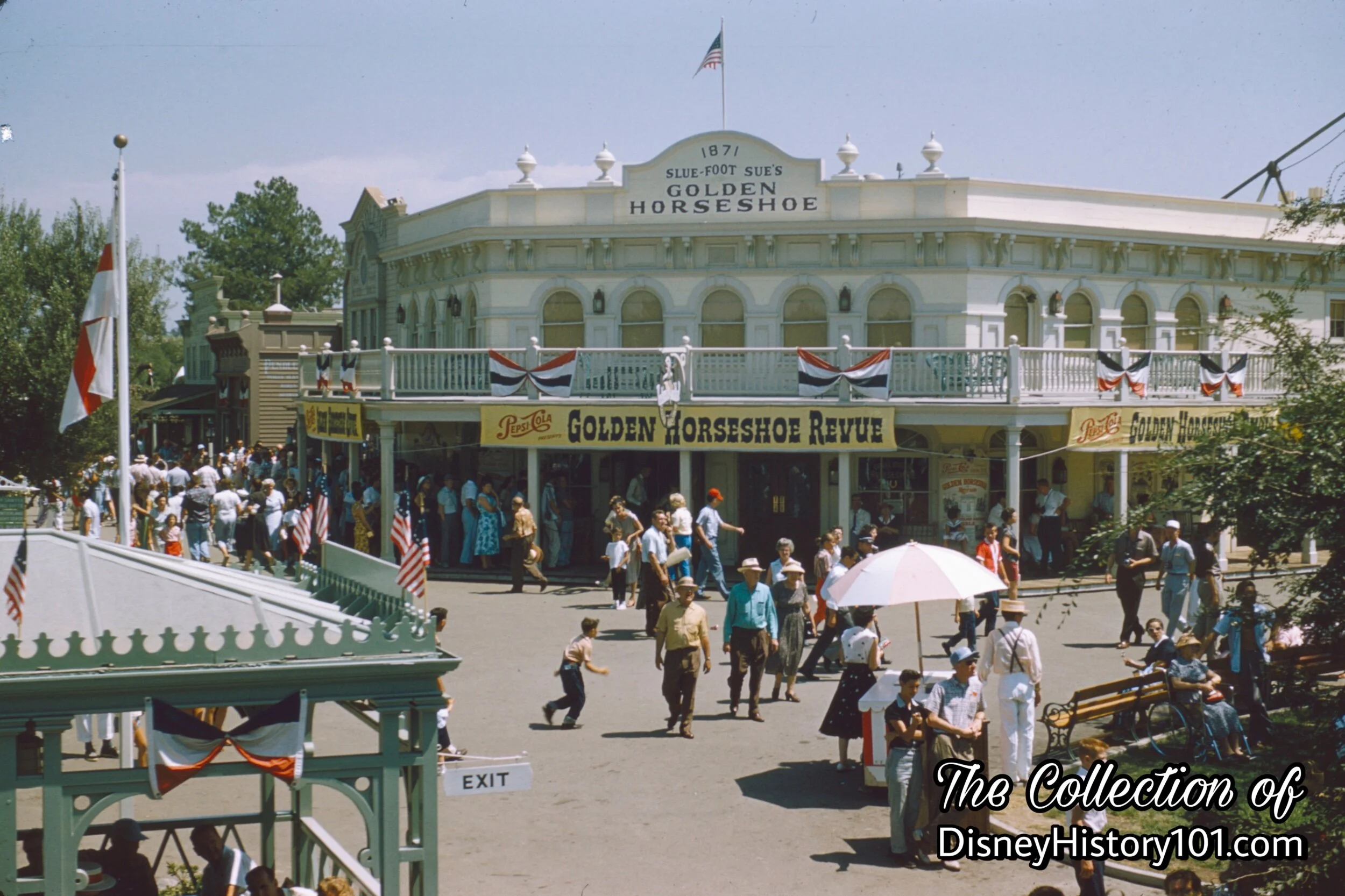
We’re coming in close to Frontierland, “where Frontier Street meets the river. Here travelers from near and afar gather to enjoy the entertainment and refreshments of this famed establishment”.
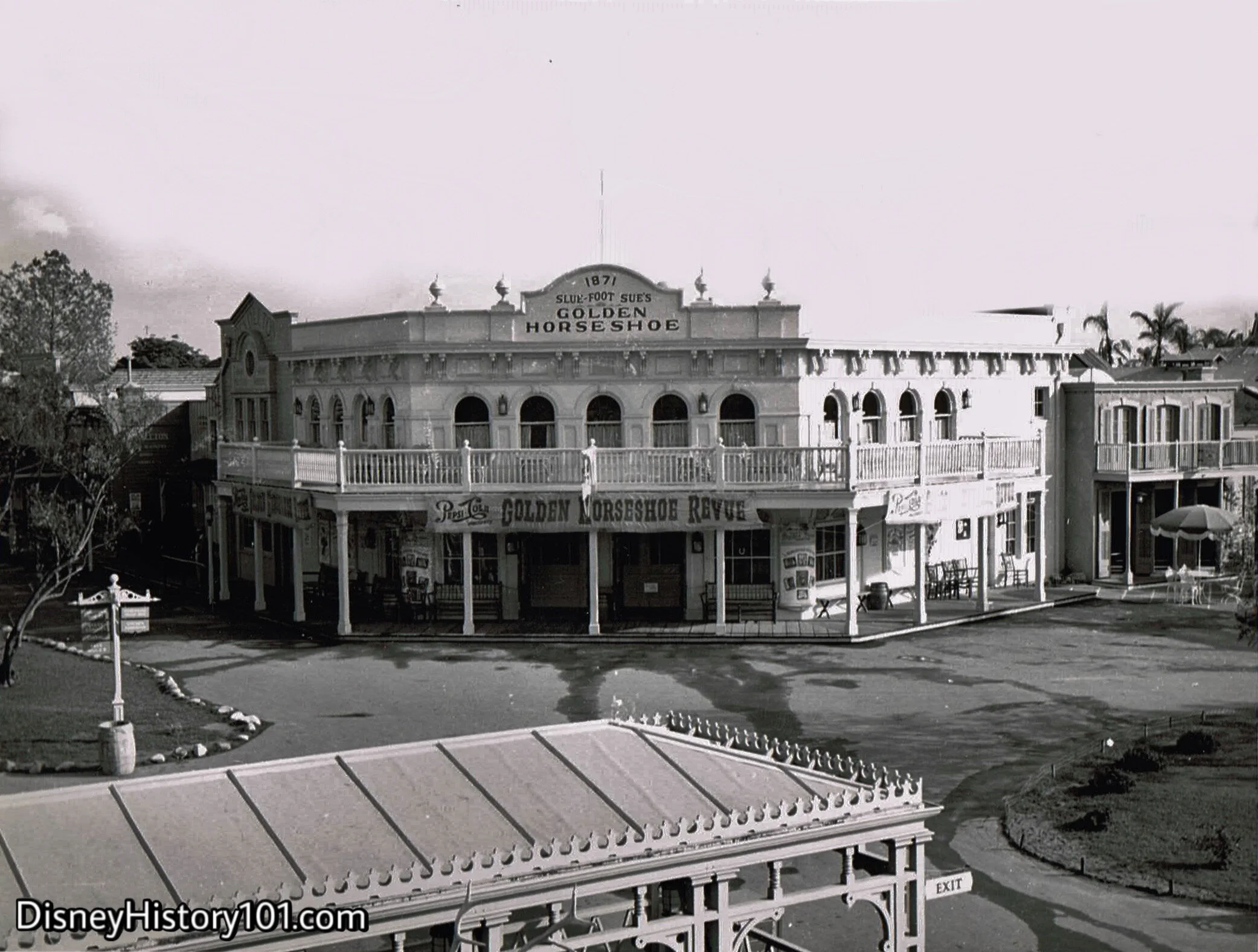
Slue Foot Sue's Golden Horseshoe, c. late 1955 - early 1956
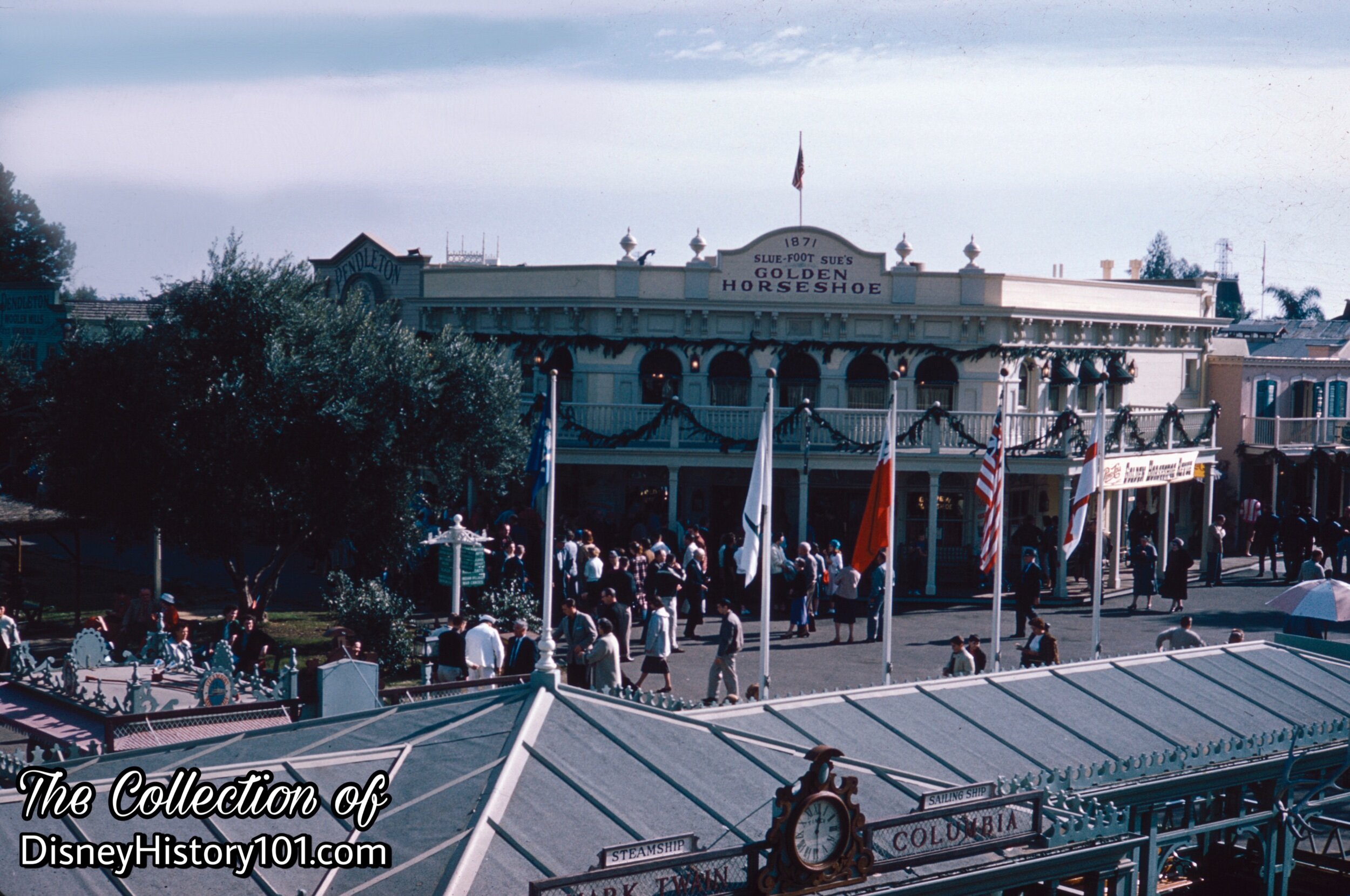
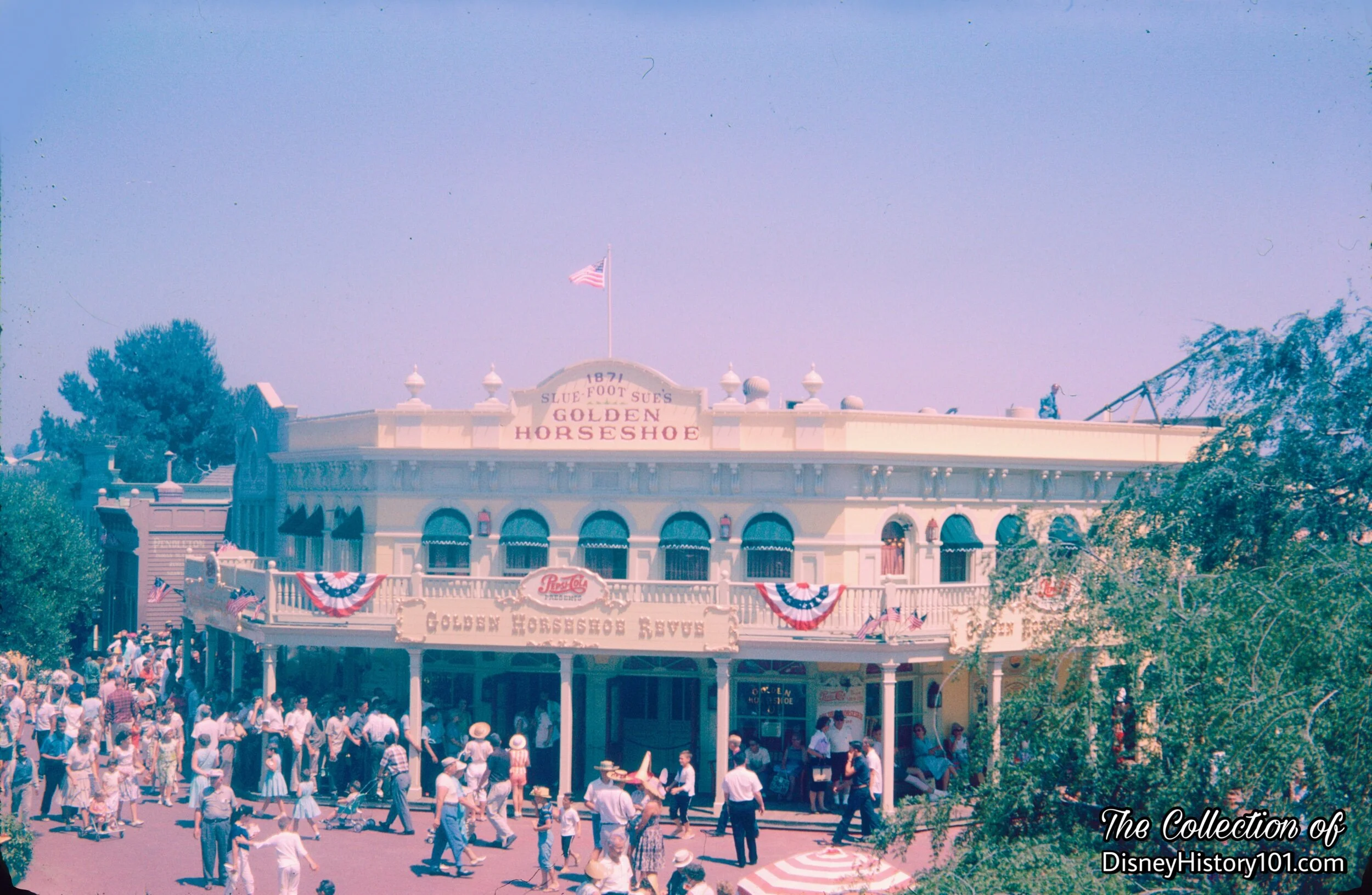
(August, 1962)
While guests make their way through Frontierland’s major junction, there’s plenty of entertainment afoot inside the Golden Horseshoe and even overhead. Do you see that fellow in the roof? He just may be planning to rescue the Golden Horseshoe’s receipts from the dastardly “Villain”.
Meanwhile, guests line up around the corner, to secure their reservation for a meal and a show!
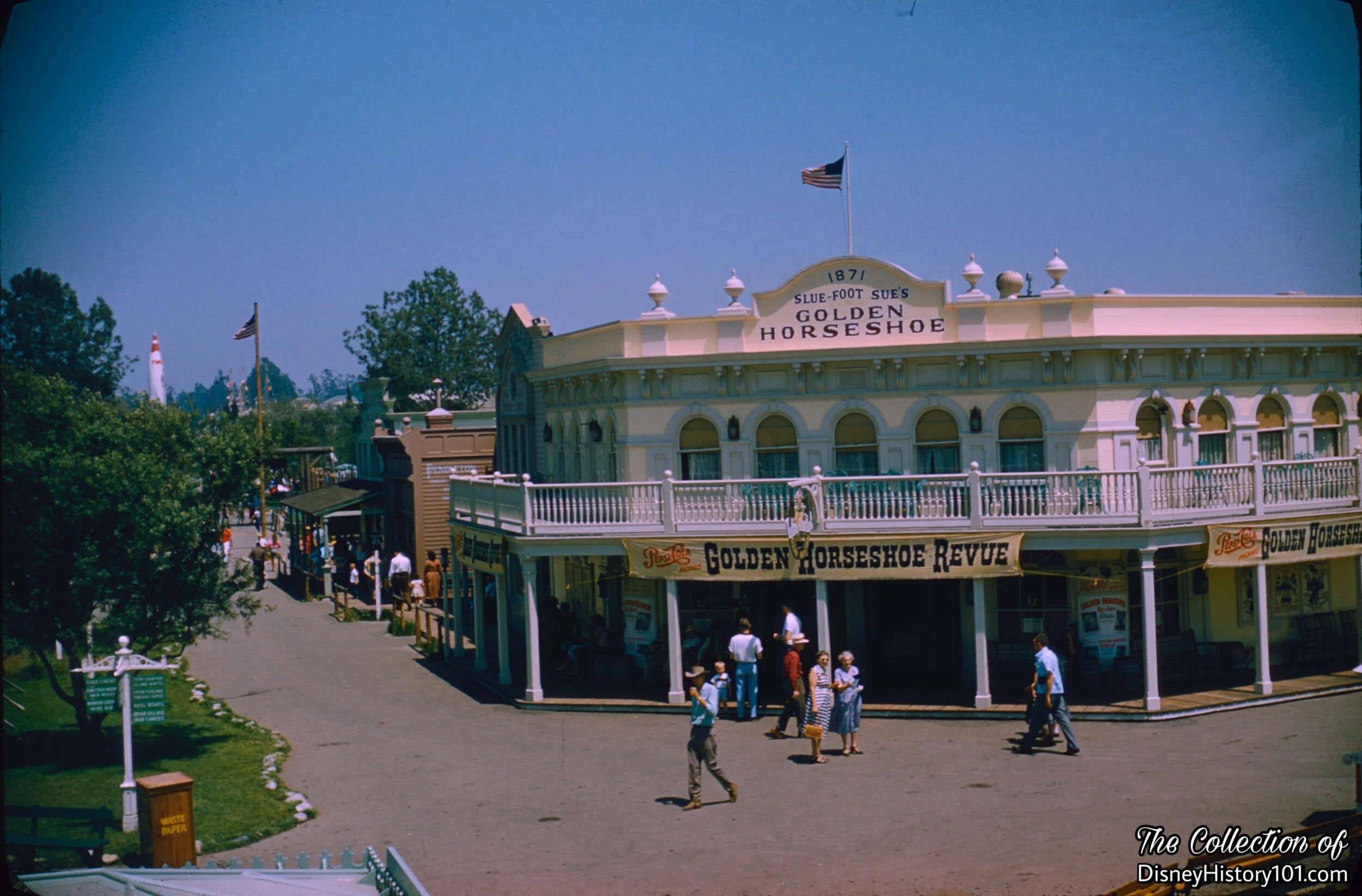
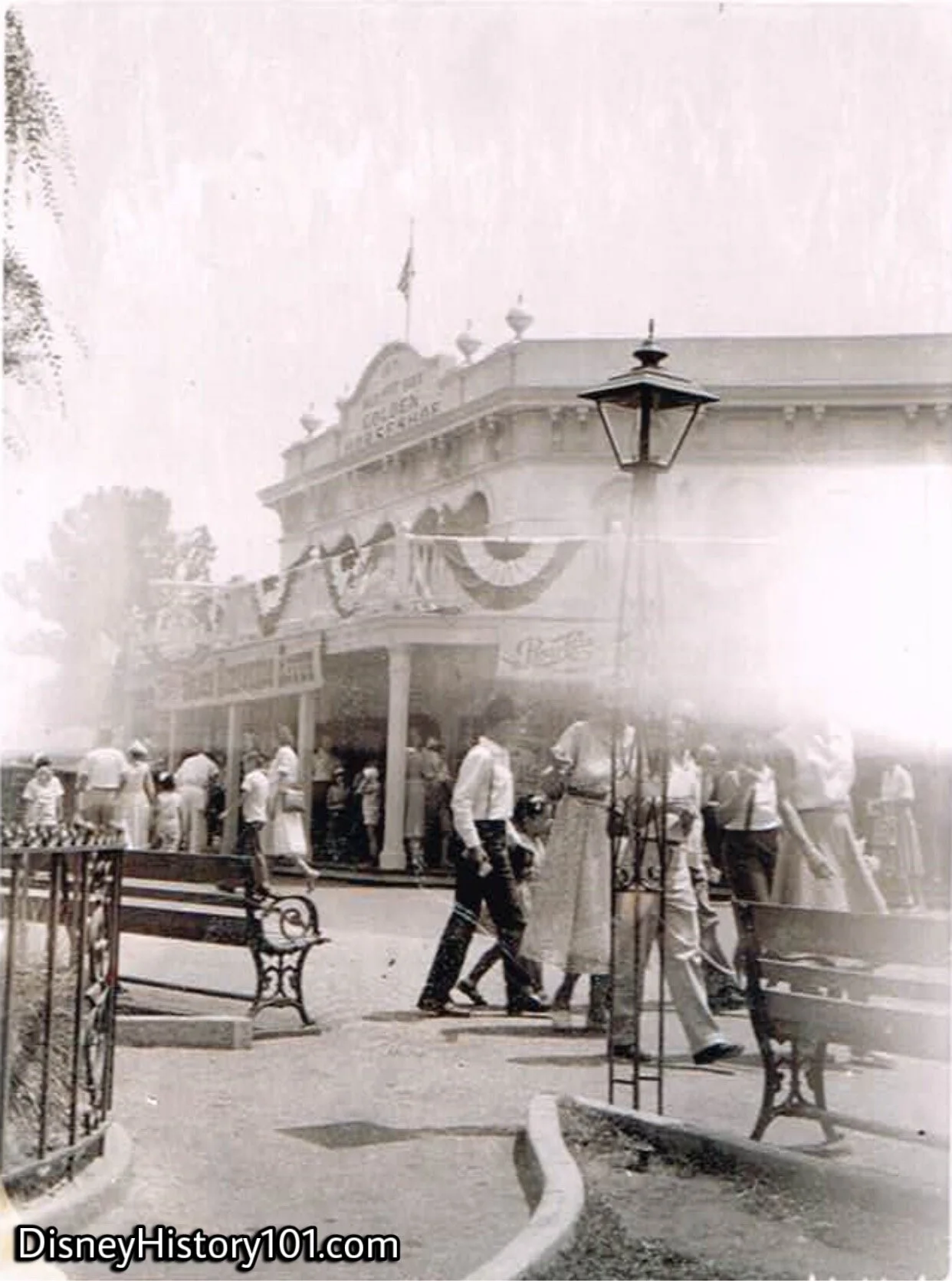
1950s
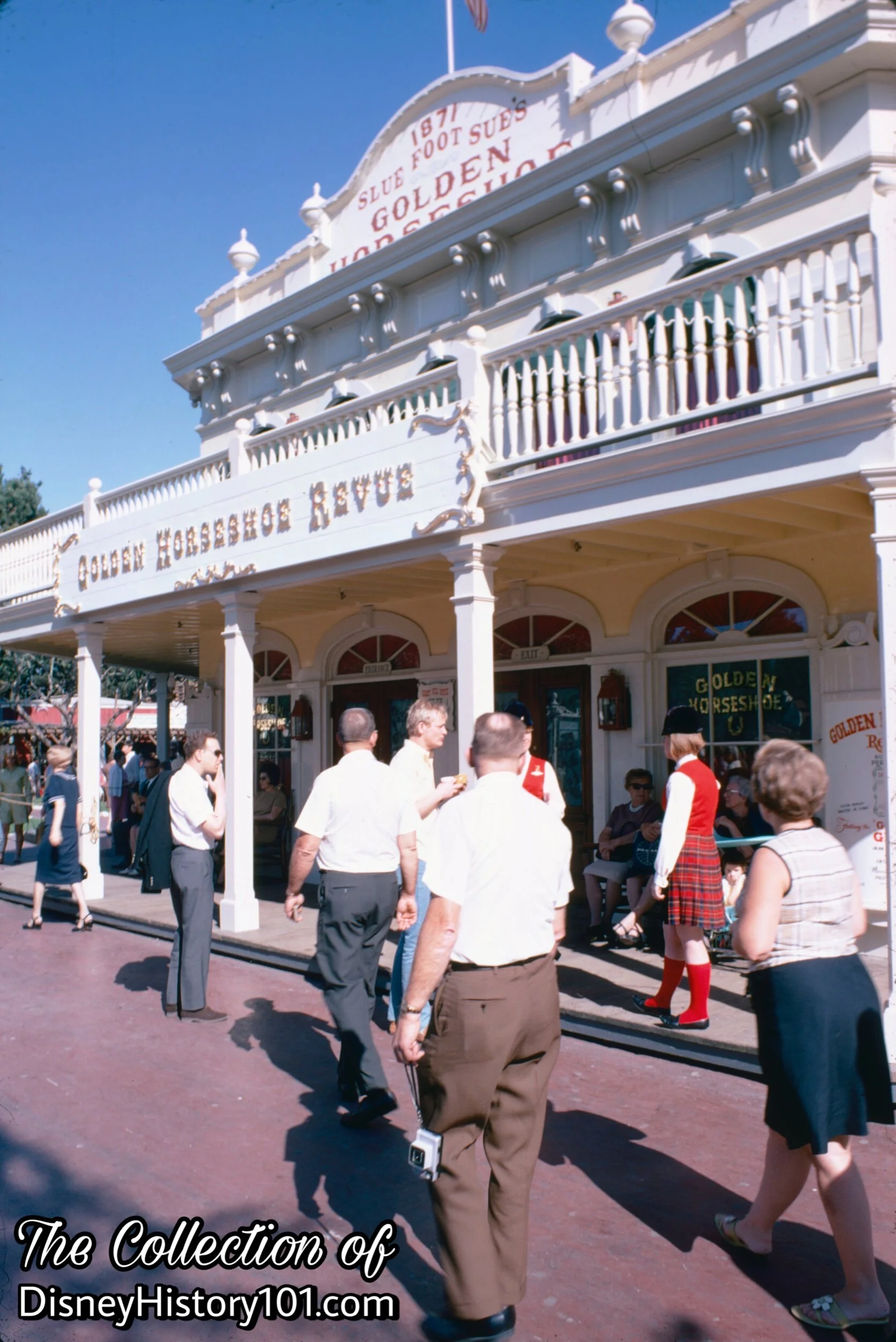
1968
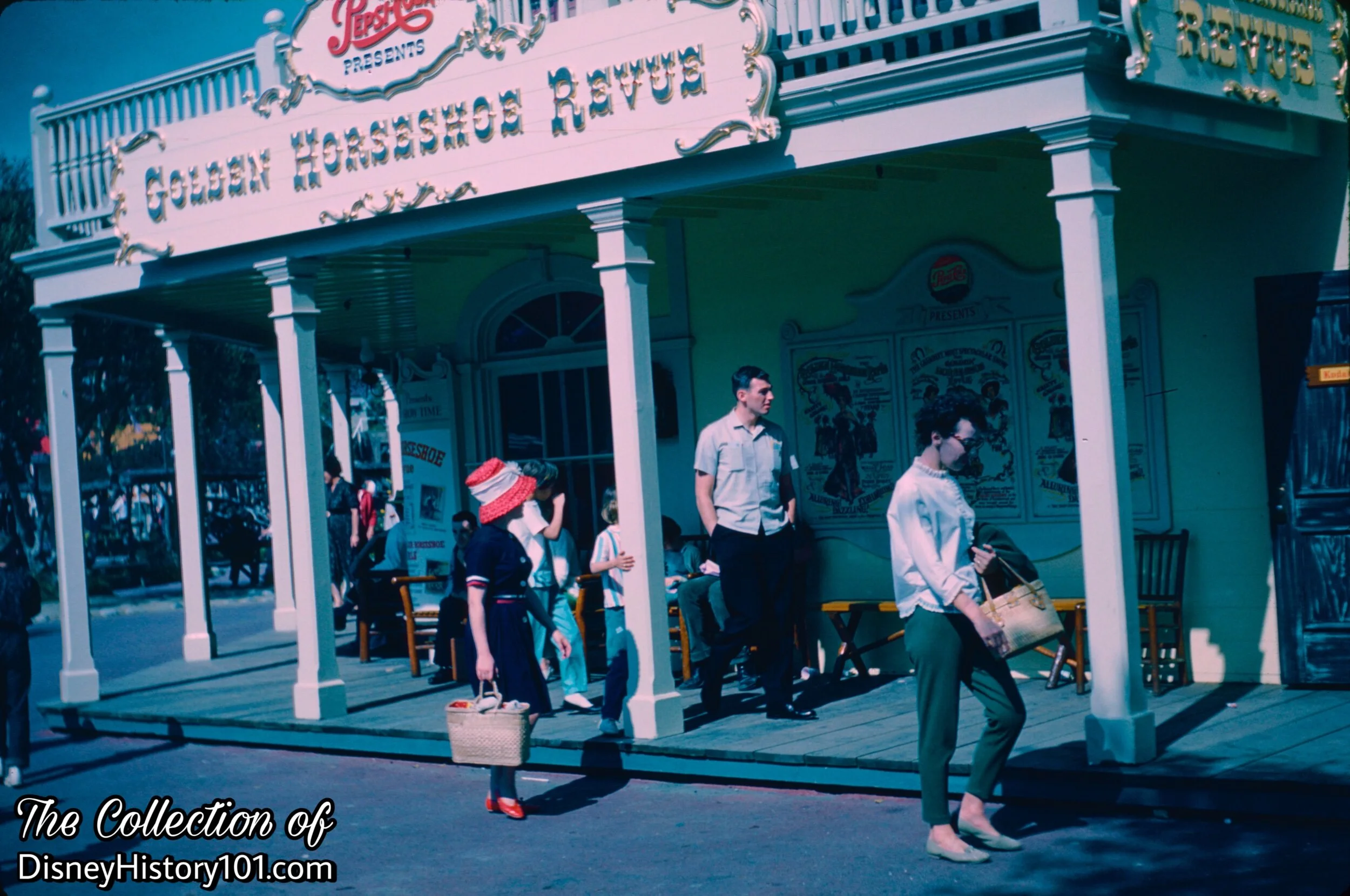
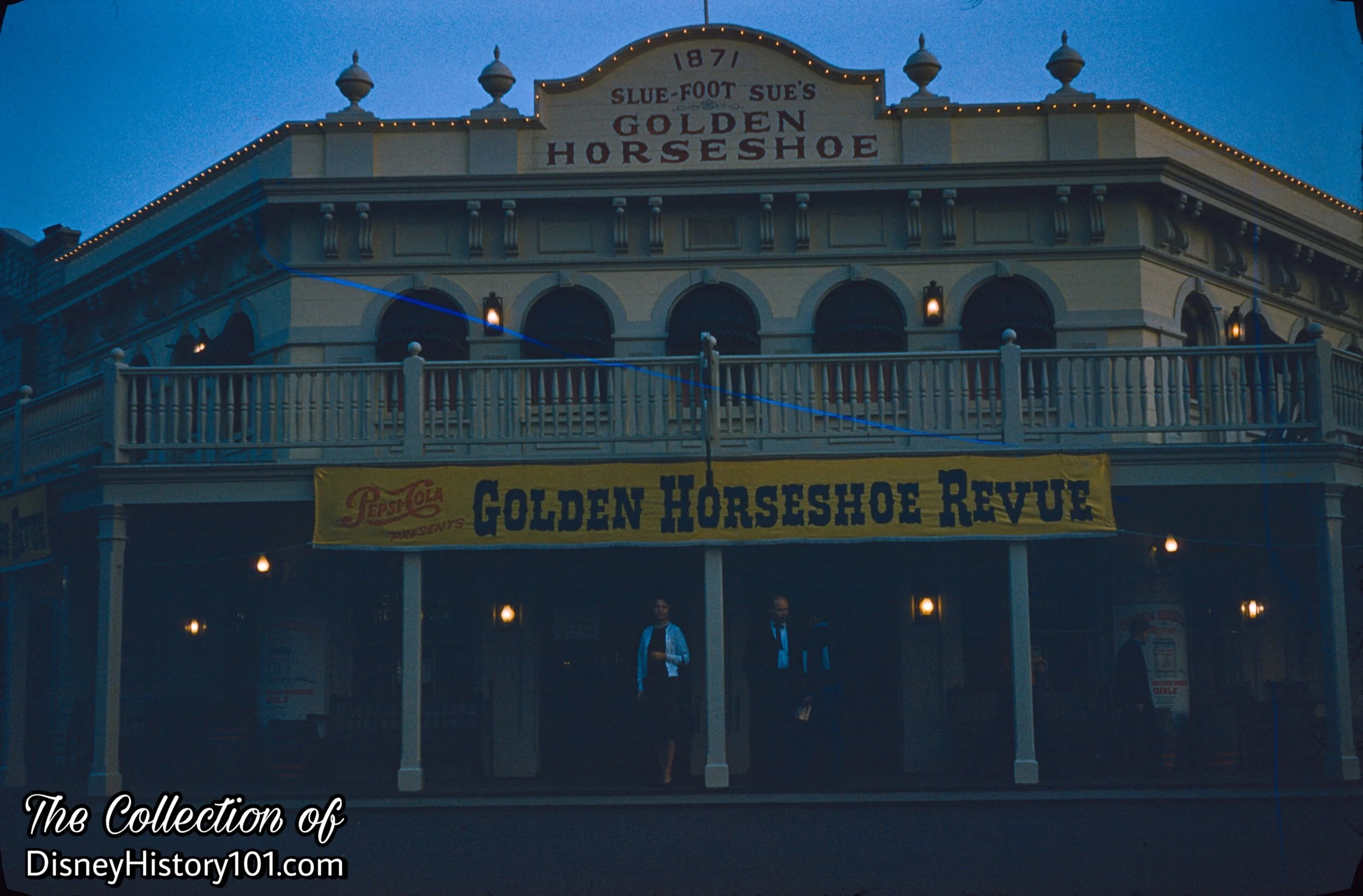
(December 11, 1960)
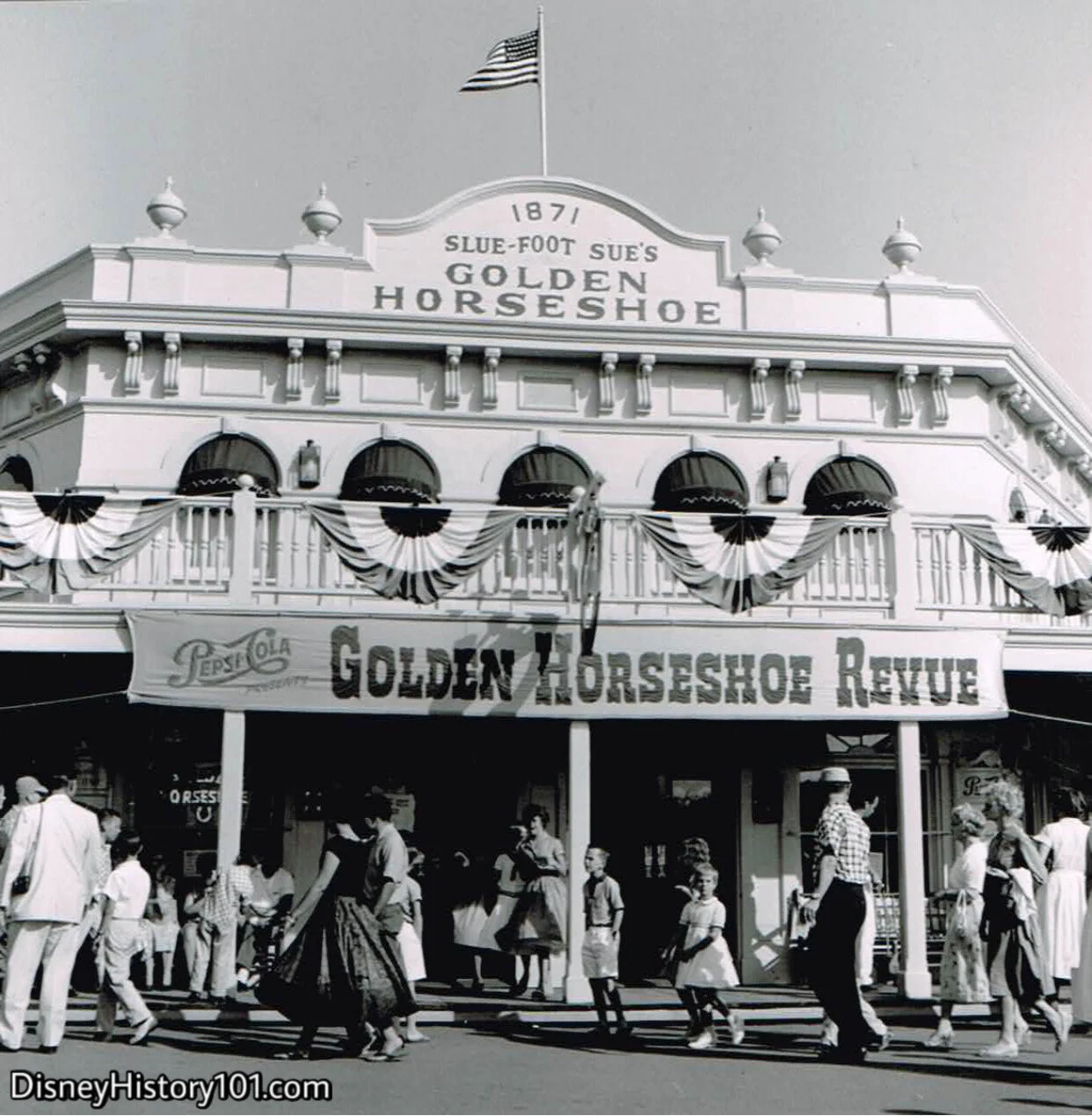
1950s
No 1871-era saloon is complete without a c.1867 37-star United States flag on its roof!
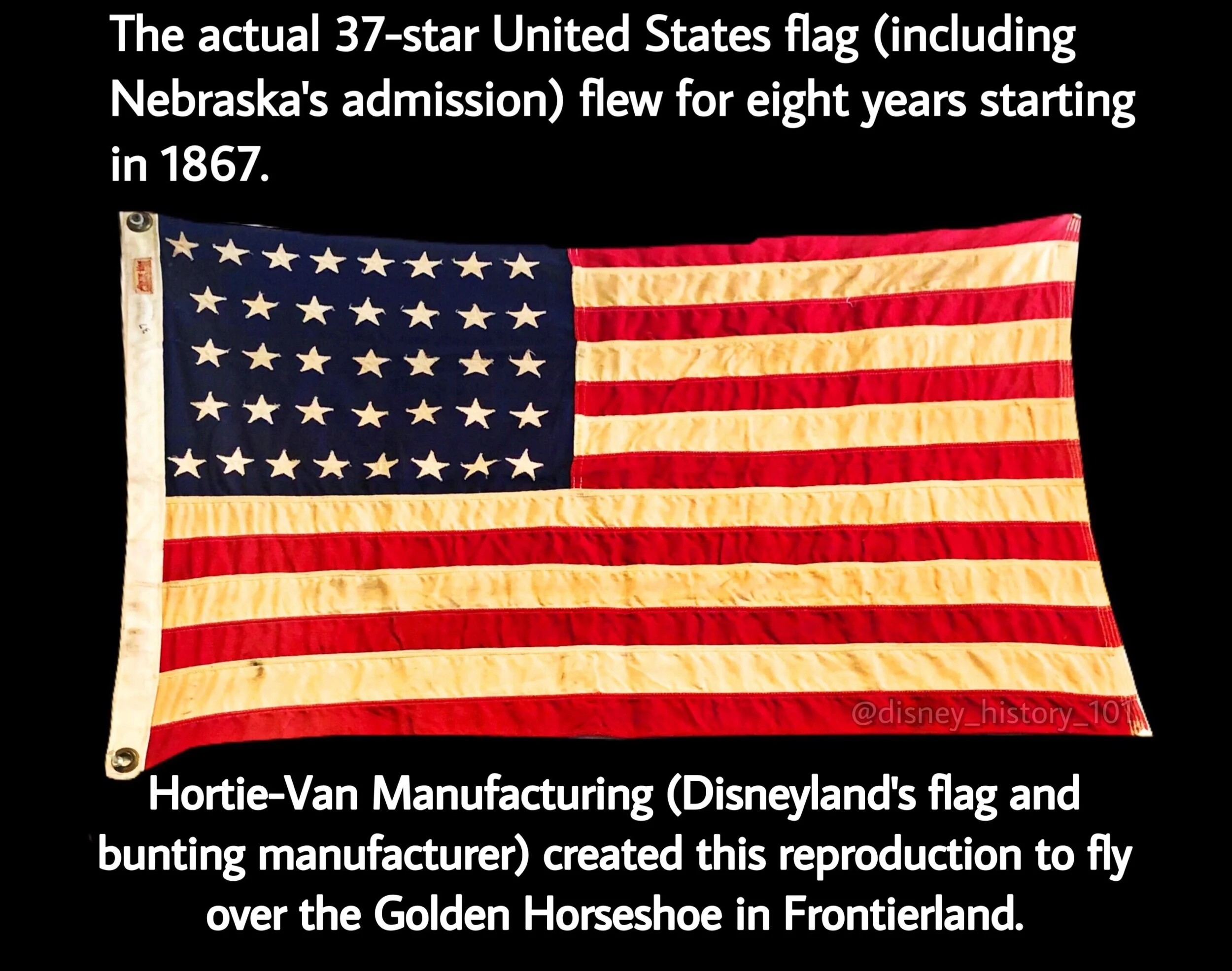
“THE GOLDEN HORSESHOE’S 1867 STAR-SPANGLED BANNER”
This post-United States Civil-War era flag recreation, included the state of Nebraska beginning in March of 1967. Since Colorado was added next, (in 1876), we can date the Golden Horseshoe’s old west setting between 1867 and 1876! As a “sidelight”, Hortie-Van also provided numerous flags, banners, and other types of decoration to Disneyland over the years. If you recall banners flying over Main Street U.S.A. (heralding some event) chances are, that Hortie-Van helped provide it!
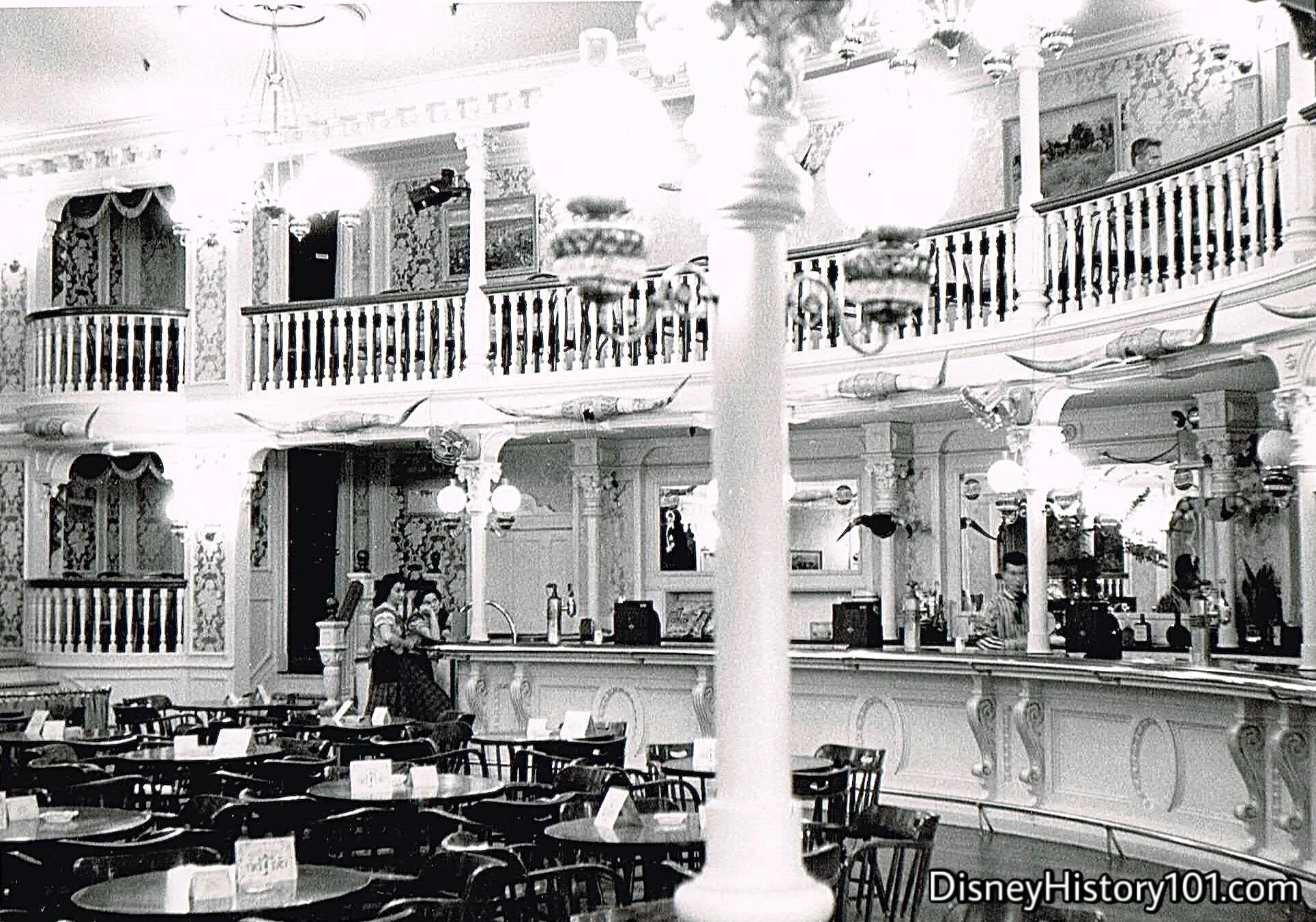
“Let’s dine in Disneyland” at “the biggest little bar in the world”, c. 1955.
The interior was sure authentic-looking - down to details like “gilded wall paper”, and the “carved wooden accents.” Long before Frontierland had its “Mile Long Bar”, the Golden Horseshoe Saloon was known for its “biggest little bar in the world.” Harper Goff, Sam McKim, and many other artists and craftspeople were responsible for the interior design and final elegant decor of Frontierland’s 1896-era iconic saloon down to its ornate tables and brass-ringed bar.

(July 17, 1955 - September 30, 1982)
THE ORIGINAL CAST : Since the beginning, Atmosphere Entertainment complimenting the theme of areas is staged to entertain Disneyland Guests on an immediate and personal level. A variety of live shows entertained Guests throughout the day. The main attraction of Slue Foot Sue’s Golden Horseshoe was “Slue Foot Sue’s Golden Horseshoe Musical Revue,” which was reckoned as a Free Show, presented by Pepsi-Cola, “all the way from St. Louis.” While Walt “loved corn,” the show featured multiple Western-style performances (from the crimson-curtained stage)! The Golden Horseshoe Revue had “something for everyone.” You were sure to enjoy plenty of good music, plenty of laughs, Can Can girls, Slue Foot Sue, that famous character Pecos Bill, and (of course) Pepsi-Cola - the original featured drink!
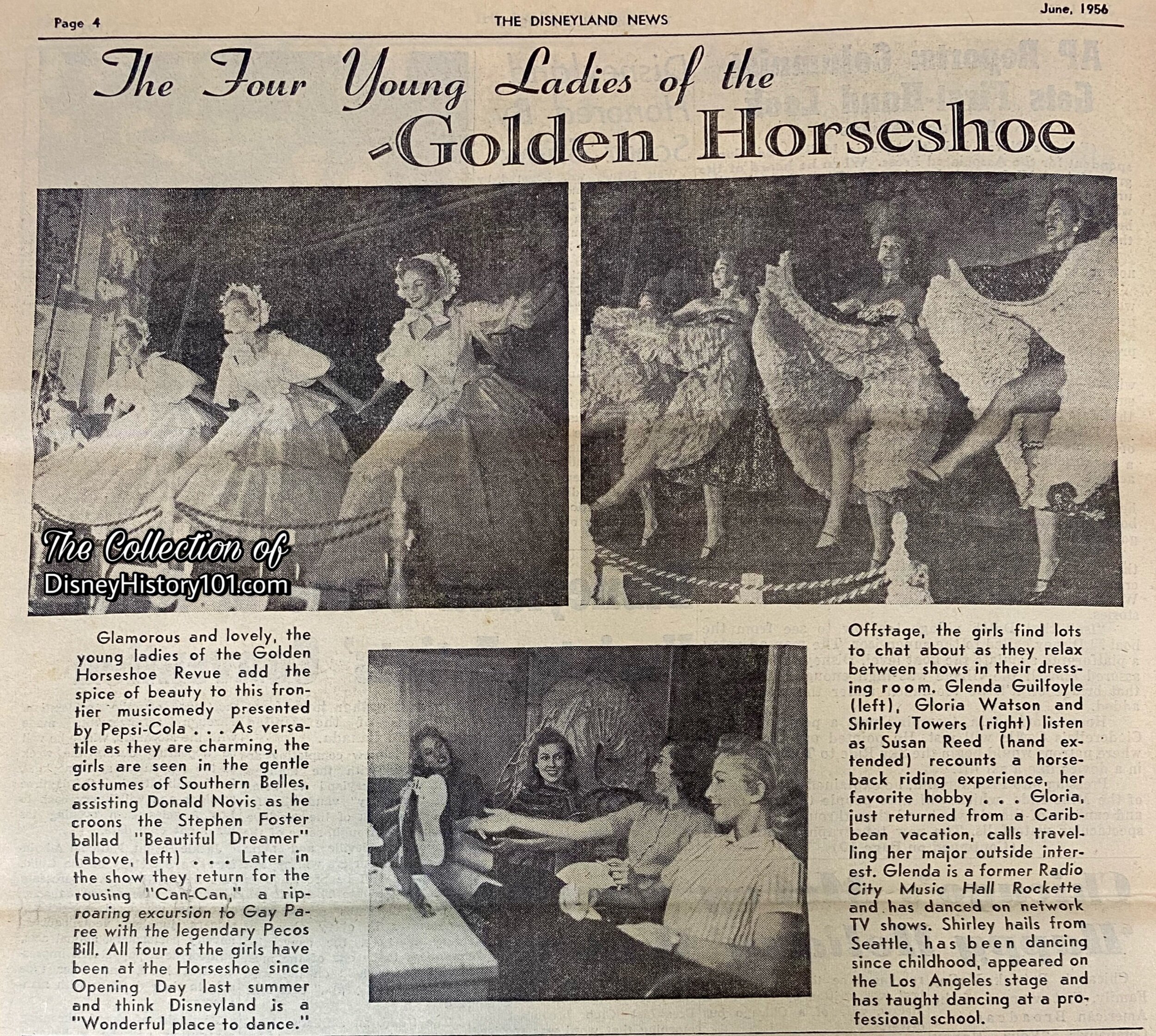
According to Dave Smith (previous Chief Archivist Emeritus of the Walt Disney Archives), “In its early years, Disneyland did not have the atmosphere bands that are used today. In fact, in 1955 there was only the Disneyland Band and the small band in the Golden Horseshoe.” [Disney Facts Revealed by Dave Smith, 2016] In 1955, the original old west Vaudeville show began with Jack Watson’s pre-show & audience warm up - a banjo sing-a-long! Pastel-clad waitresses and the Golden Horseshoe Orchestra would lead in renditions of favorites like “Down by the Old Mill Stream” and “My Blue Heaven.” Then the main show would start - an astounding 45-minutes long, and performed five times daily, beginning just fifteen minutes after the park’s opening! “A troupe of artistes” and “a grand constellation of stars” was headlined by Miss Judy Marsh (As Slue Foot Sue, Sweetheart of the Frontier), Mr. Donald Novis (radio star of “Fibber McGee and Molly” fame, as the Silver Toned Tenor), and Mr. Wallace Vincent Boag (as the Traveling Salesman and versatile comedian). Not to be outshined, are those talented Golden Horseshoe Girls - Shirley Towers (Seattle native and former professional dance instructor), Glenda Guilfoyle (a former Radio City Music Hall Rockette & network television dancer), Gloria Watson, and Susan Reed (a horseback rider by nature)! Glenda was soon replaced by Julie Browder. These five glamorous and lovely young ladies added the spice of beauty, while livening up the audience for the opening and big finale! “An efficient orchestra under the capable direction of Professor LaVere,” with dances and Terpsichore by Miss Theresa Allen, original lyrics by Mr. Tom Adair, and versions and renditions of songs by Mr. Charles LaVere enhanced the show! Cards placed on the tabletops contained the program, and came to ultimately include the lyrics to every main song on the program, so that the audience could sing along!
After the overture played, a rousing opening of “Hello Everybody” was performed by the entire cast of the show. Following this, a “repertoire of renditions” started off with“Bill Bailey” - a solo by Miss Judy Marsh. Next, that “silver-toned tenor” Mr. Donald Novis performed “Dear Old Donegal” (an “Irish Ditty”), “Leprechaun Lullaby” (a Refrain), and the Stephen Foster tune “Beautiful Dreamer” (assisted by a Chorus of four familiar Southern Belles during the latter). Next, Wally Boag offered a change in “tone” with a comical song - “What Have We Here.” Then, Judy Marsh was back on the stage for two more songs - “Riverboat Blues” and “A Lady Has to Mind Her Ps & Qs”. Lastly, “Pecos Bill” entered the stage to a tune that led into the rip-roaring closing number performed alongside high-stepping Can-Can dancers to the tune of Offenbach’s Can Can (sung by the entire cast of the show)!
ADDITIONS : According to “The Spirit of Disneyland” (prepared by Walt Disney Productions in 1984), many activities were on a “week-to-week contract… outstanding ones” that “indicate the tentative nature of the times: The Golden Horseshoe Revue. Retained on a two-week contact.” The entire Golden Horseshoe was a raging success with audiences, proven by long lines, full reservations, and packed houses most every day! Big changes were soon in store that would define the “musicomedy” show that everyone would come to love!
Though the four chorus girls (Shirley Towers, Glenda Guilfoyle, Gloria Watson, and Susan Reed) continued to Can-Can for the first year of the Golden Horseshoe Revue, a defining moment came (in 1956), when the role of Slue Foot Sue was filled by Betty Taylor. Supported by Martha Lewis (during the evening performances), Betty would continue to refine the character for a grand total of 45,000 performances. New “high falutin’ gals” of the Golden Horseshoe were added through the years. By 1963, April Tatro, Tina Olson, and Judy Michaels were among the line.
By September 28, 1958, the Golden Horseshoe Revue was accounted as a DISNEYLAND, INC. Park Asset valued at $423,496.
Disneyland Entertainment Director Chuck Corson recalled that the Golden Horseshoe Revue was the No. 1 attraction, when he came to Disneyland in 1959. The Revue was so popular, that (in 1964) the cast was shipped to the Bahamas, in order to perform the Show there. By 1964, Joe Wong had joined the pre-show, portraying the Bartender. According to Vacationland (Fall of 1964), “He usually sings a song he claims was learned at his mother’s knee - ‘When Irish Eyes Are Smiling’.”
During this time (from July 17, 1955 - September 30, 1982), the five-a-day show had made 15,000 performances by the Fall of 1964 (despite the New York World’s Fair drawing some Disneyland family members to the East Coast, including Jerry Rosen Golden Horseshoe Supervisor), a record breaking attendance of 17,000 performances for approximately sixteen million guests by 1966, and more than 41,000 performances over 23 years. The previous figures only account for appearances at Disneyland, as the Golden Horseshoe Revue would make a few rare performances “Off Stage” (e.g. their appearance at the Cal Arts Ball held at Walt Disney Studios, on May 7 & 8, 1966). During this time, Wally Boag was supported by understudies Dick Hardwick and Bert Henry.
The Frontierland Cast Members certainly epitomized a process that Walt called “Performance Excellence” - encouraging Cast Members to strive to excel each day in the fulfillment of their individual roles and responsibilities in an environment consistent with defined Disney behaviors. The Cast Members were continually challenging themselves and each other to try new methods of working more effectively and efficiently.
Teamwork was regarded as essential in accomplishing these efforts. Unseen, Disneyland Sound Mechanics and Projectionists are perhaps the best hidden of the craftsmen in Maintenance. They are truly “backstage” and you'll find them behind curtains (as at the Golden Horseshoe).
Proof of this was observed by Disneyland’s 15th Anniversary Birthday, when the (now 30-minute) show had seen a whopping 21,000 performances. Some songs (like Slue Foot Sue’s “I Don’t Care”) would be omitted, while others (like “Won’t You Come Home, Bill Bailey”) became mainstays. By 1971, Fulton Burley had developed the “Horseshoe Owner” character into a principal member of the cast. Pepsi-Cola would sponsor occasional pre-shows (like Doc Adams and Claude Dog, c. 1978), and variations of the show (like Pecos Bill’s Wild West Revue, c. 1981), which ran on the stage.
Wally Boag made his final appearance on Disneyland’s Golden Horseshoe Saloon stage, January 28th, 1982. Soon after, Pepsi-Cola ended their sponsorship on September 30, 1982. In 1995, Wally Boag was named a Disney Legend for his legendary performances and Disneyland contributions (from 1955 to 1982). Fulton Burley (a Golden Horseshoe tenor since 1962), Thurl Ravenscroft, and Betty Taylor (who played Slue Foot Slue from 1956 to 1987) were also named Disney Legends during the ceremony.
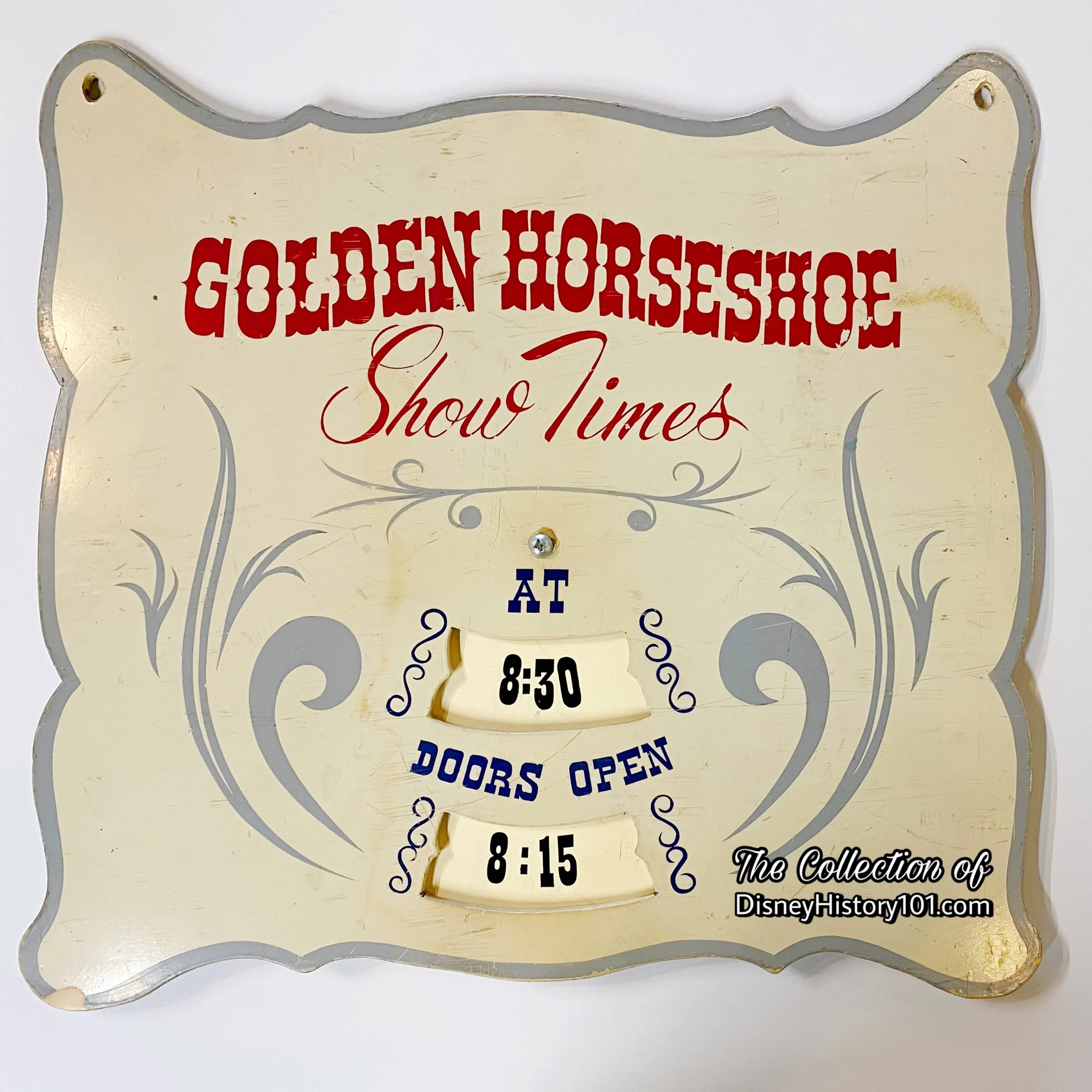
Signage that is looking pretty worn and stressed is replaced or rehabilitated.
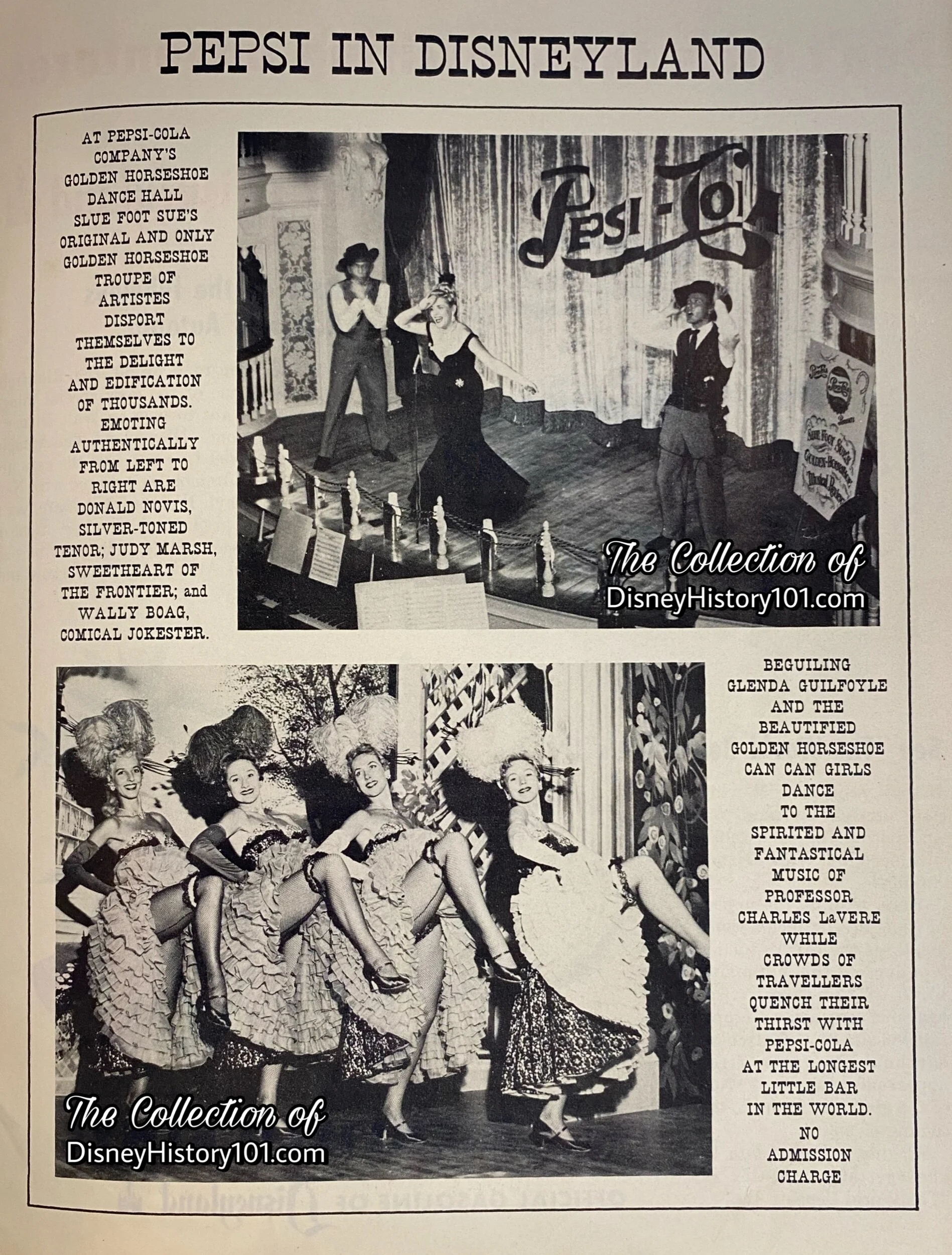
“Souvenir of Mickey Mouse Club” Excerpt, (December of 1955)
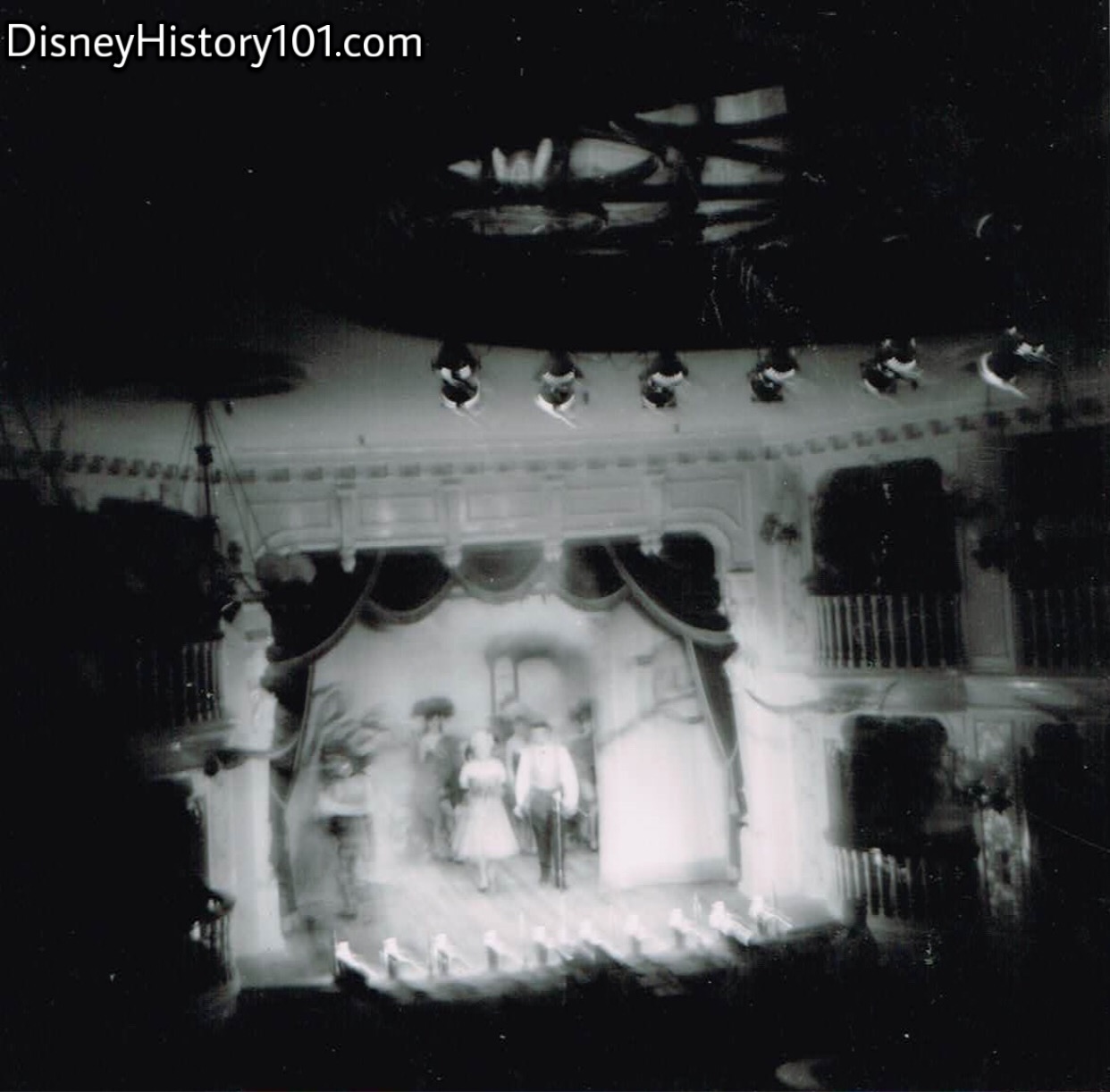
We say this “tongue in cheek”, but the upper floor generally offered a “clear” view of the Golden Horseshoe Stage!
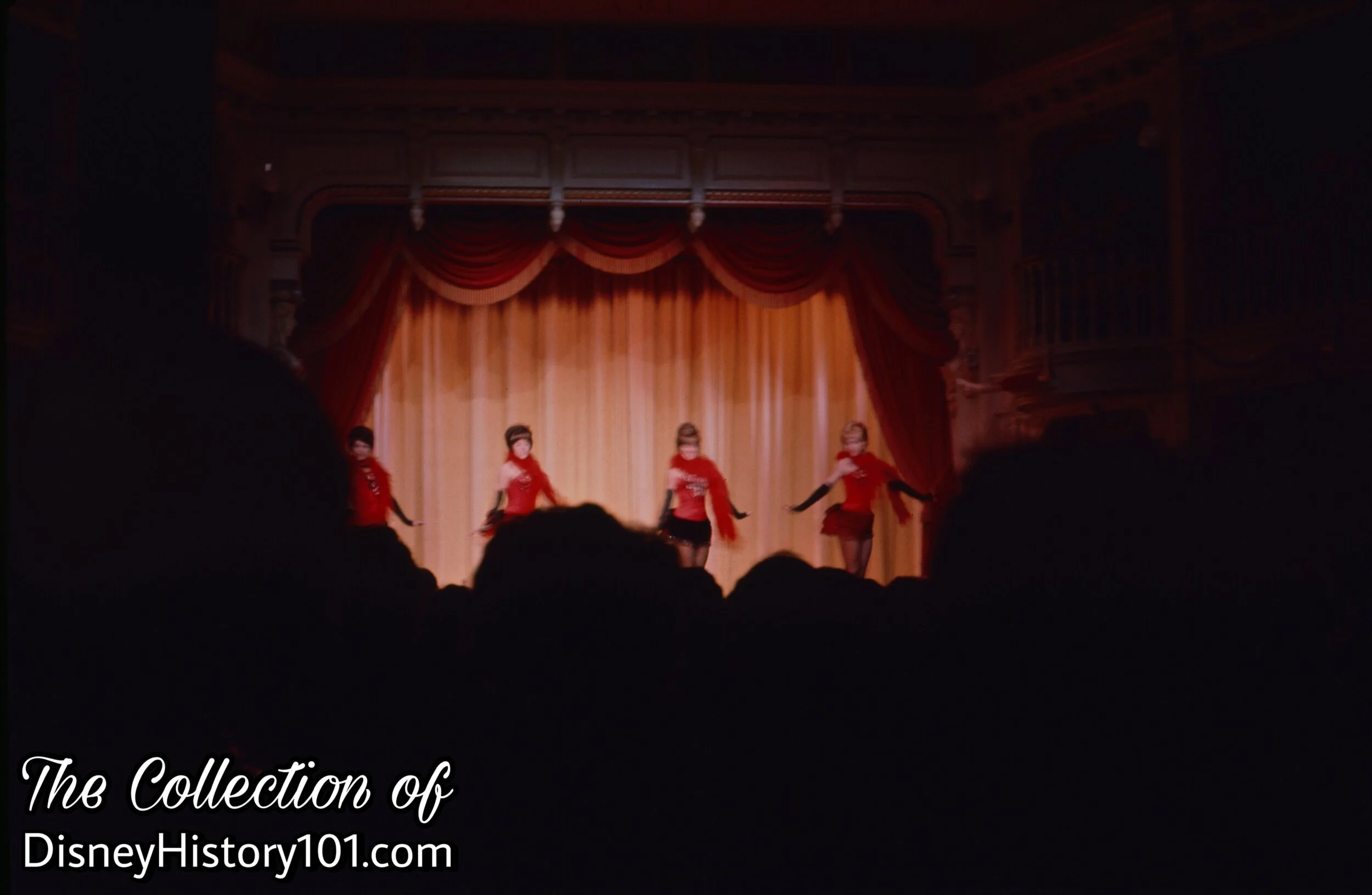
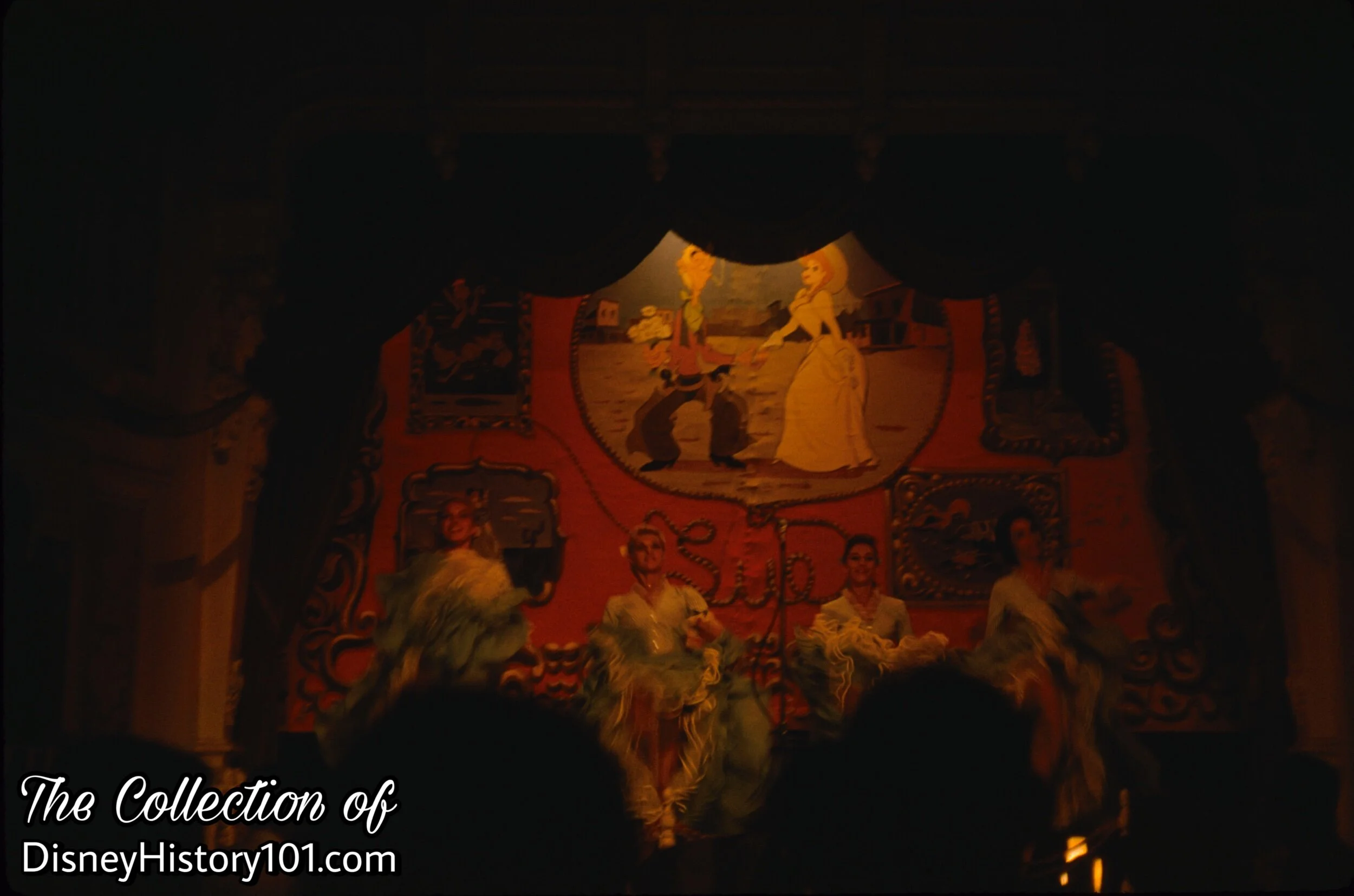
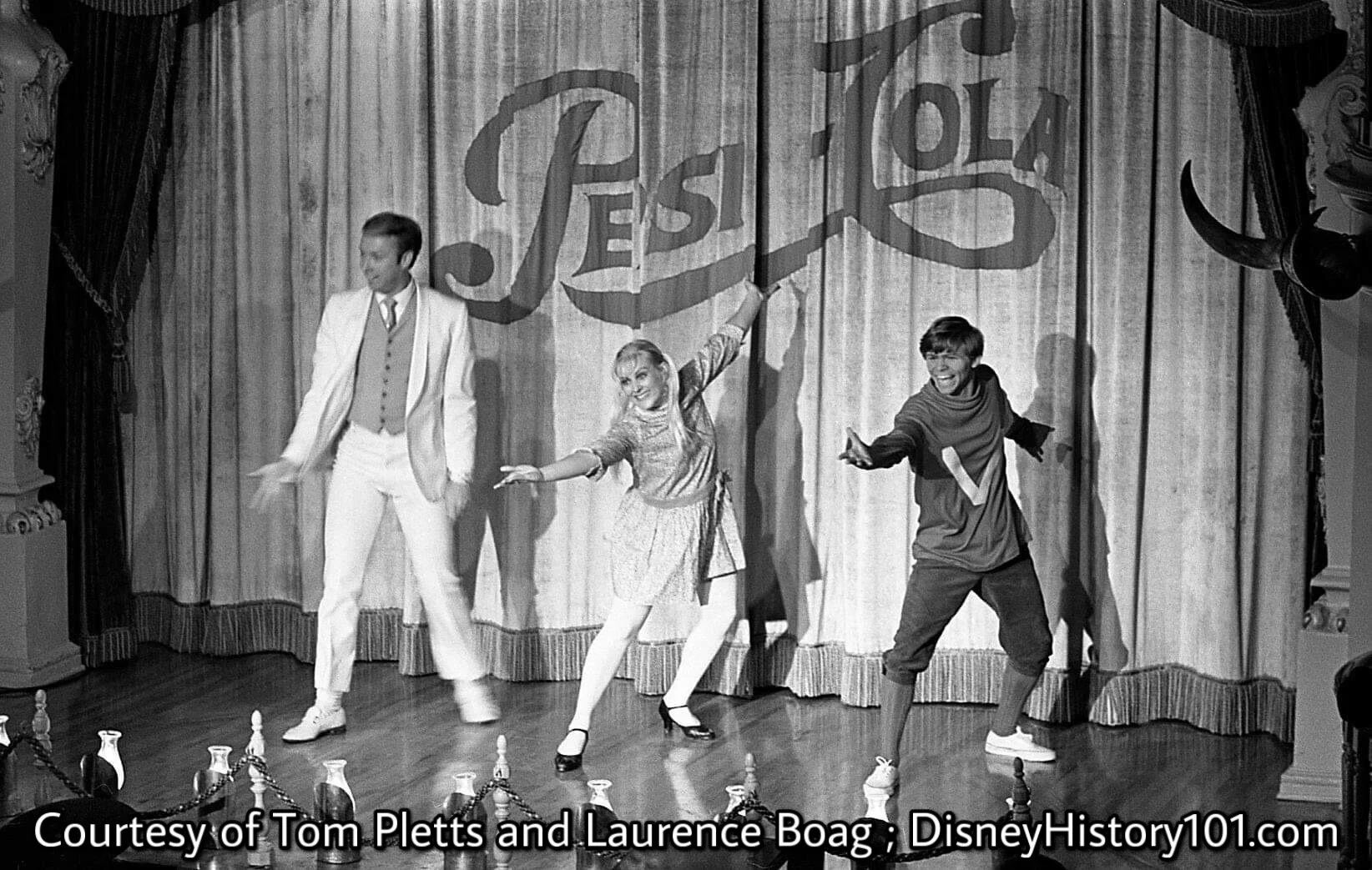
Dancers in front of the Marc Davis-designed backdrop, 1950s.
The Golden Horseshoe Dancers welcome you : “Hello everybody, we’re mighty glad to greet you - here at the Golden Horseshoe!”
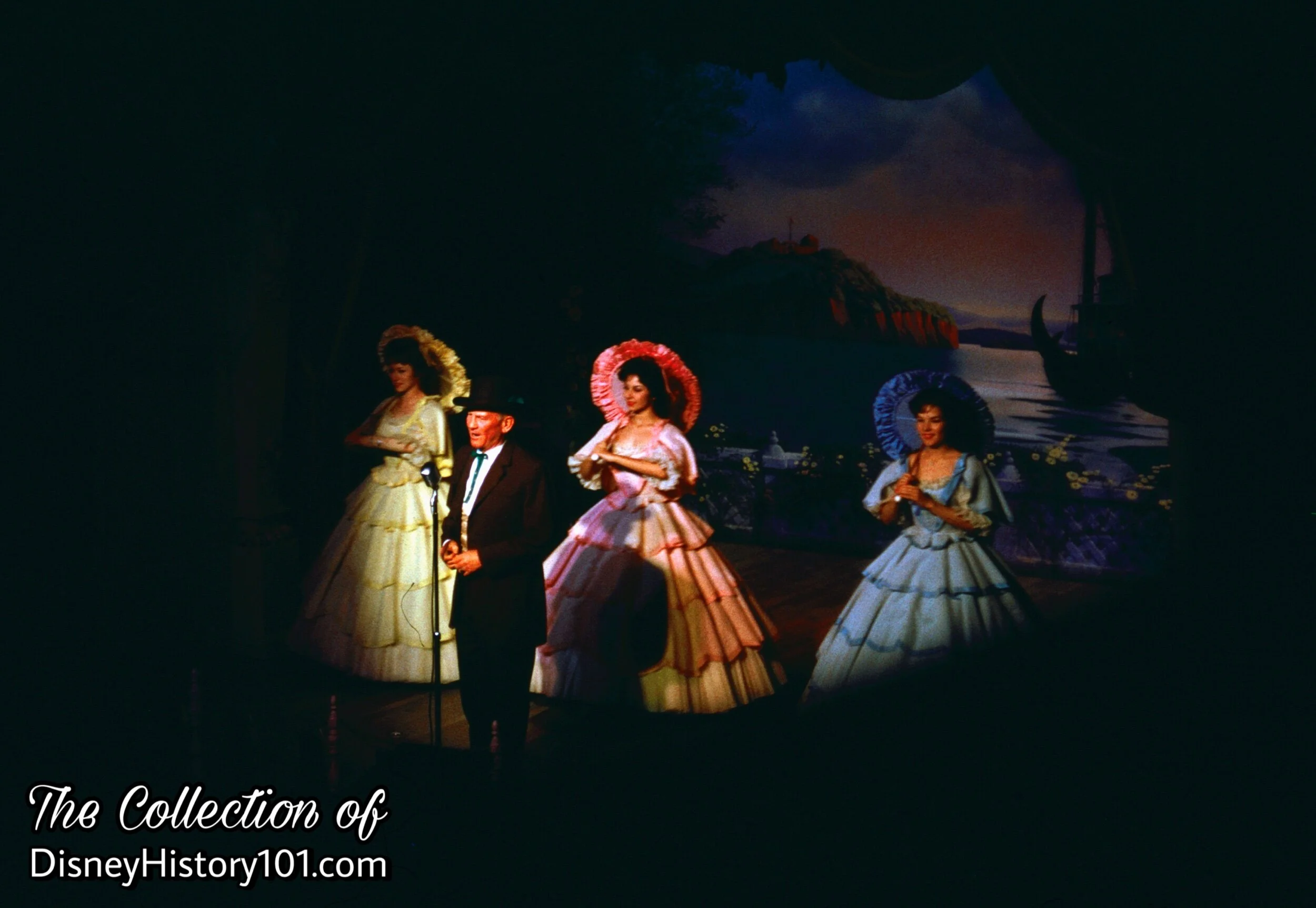
“Gaiety Galore!”, c. 1961
That “silver-toned tenor” - Donald Novis, and those “gorgeous Golden Horseshoe Girls” perform a routine, with a melody written by “Professor” Charles LaVere and lyrics by Tom Adair!

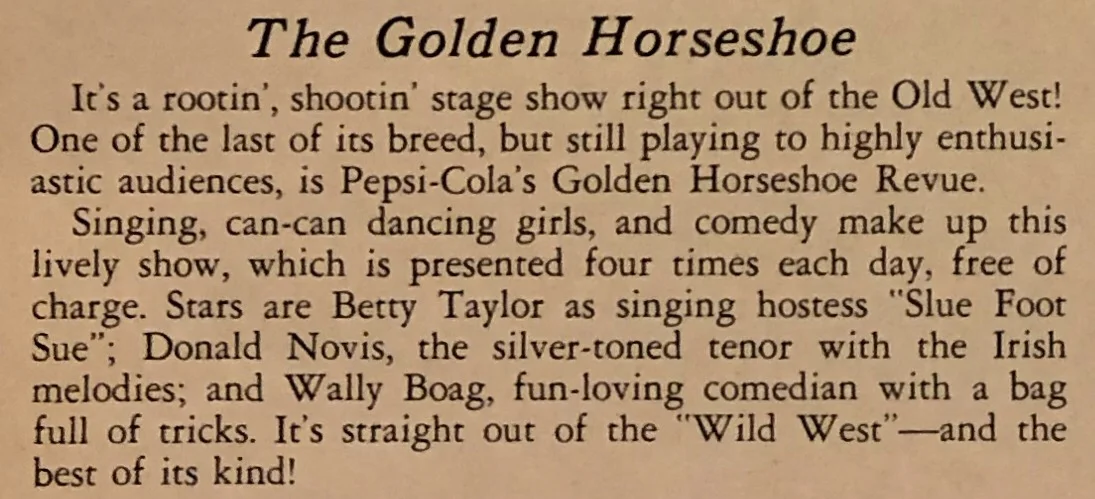
“The Grandest, Most Spectacular Show On The Entire Frontier”
(Excerpt from Disneyland Holiday, Winter, 1957-1958)
By this time, Pepsi - Cola’s Golden Horseshoe Revue performed five times daily (2:00 pm, 3:30 pm, 5:00 pm, 6:30 pm, and 8:00 pm). The 40-minute old west-style show starred that “silver tongued tenor” Donald Novice, Betty Tailor, and the “Clown Prince” Wally Boag!
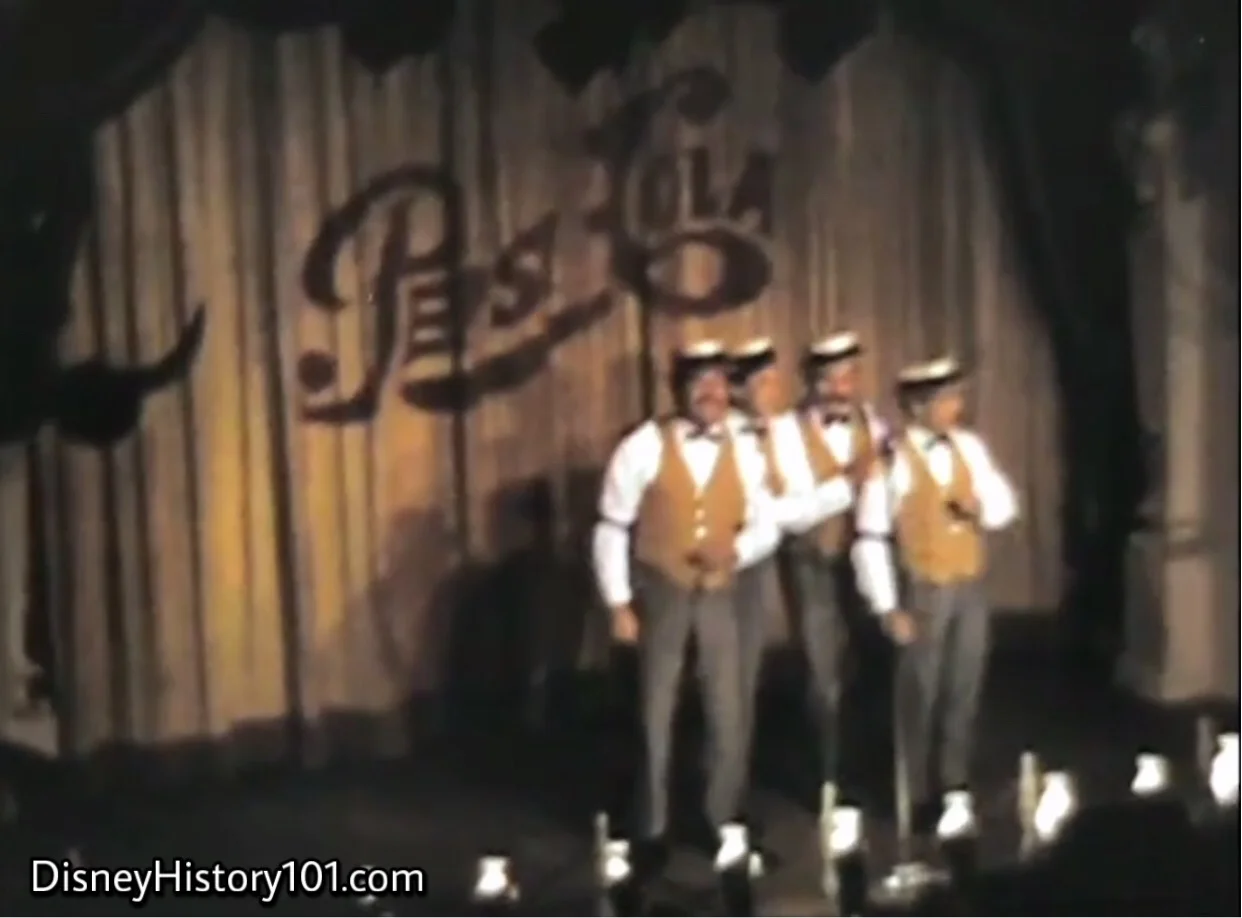
1950s
Though you could periodically meet “that famous barber shop quartet” - the Main Street Mellodiers (Mellomen) down on Main Street, they were known to make a few appearances at the Golden Horseshoe. Another vocalist quartet that made Golden Horseshoe appearances (beginning in 1959) was the Dapper Dans (pictured).
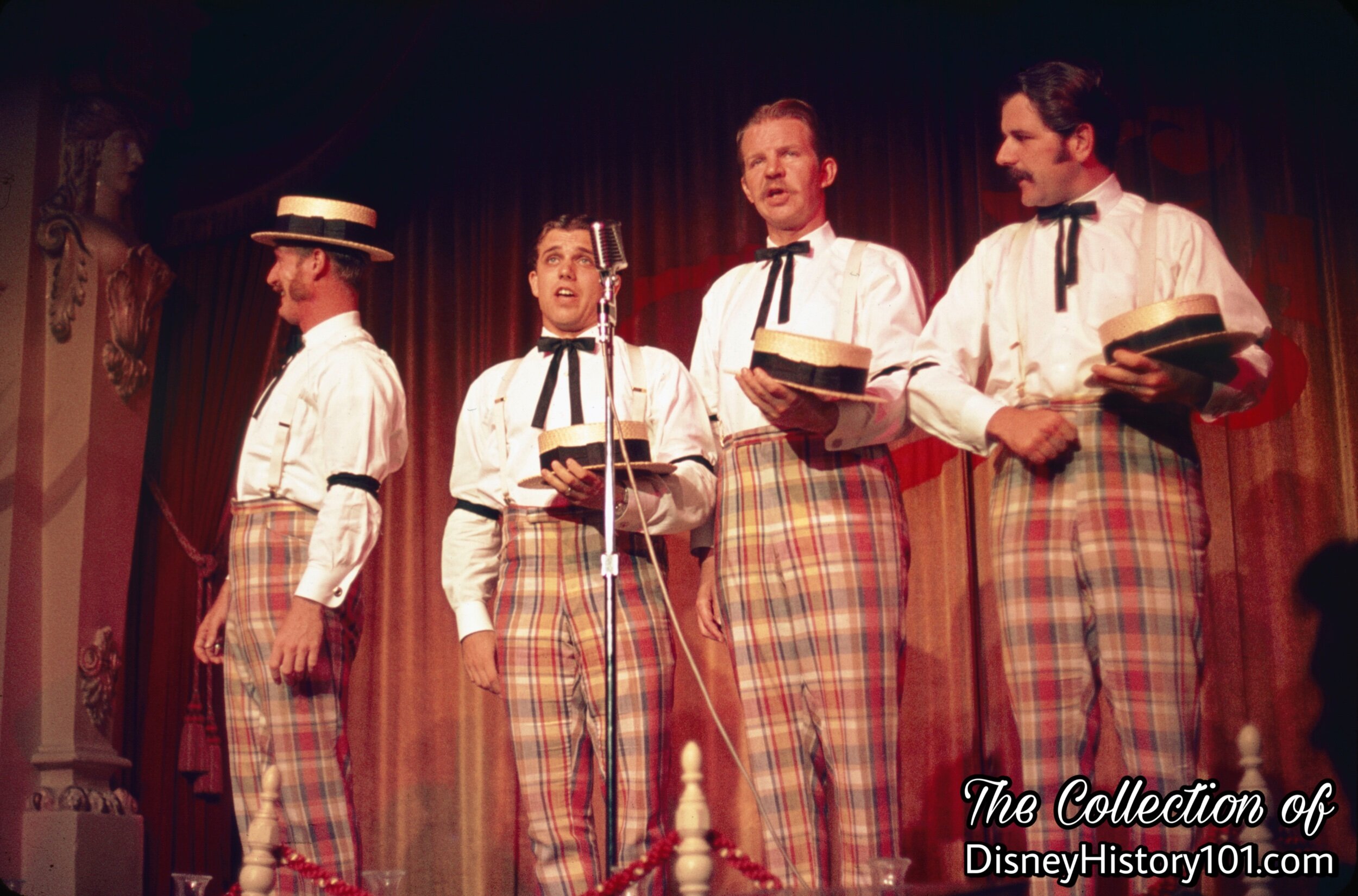
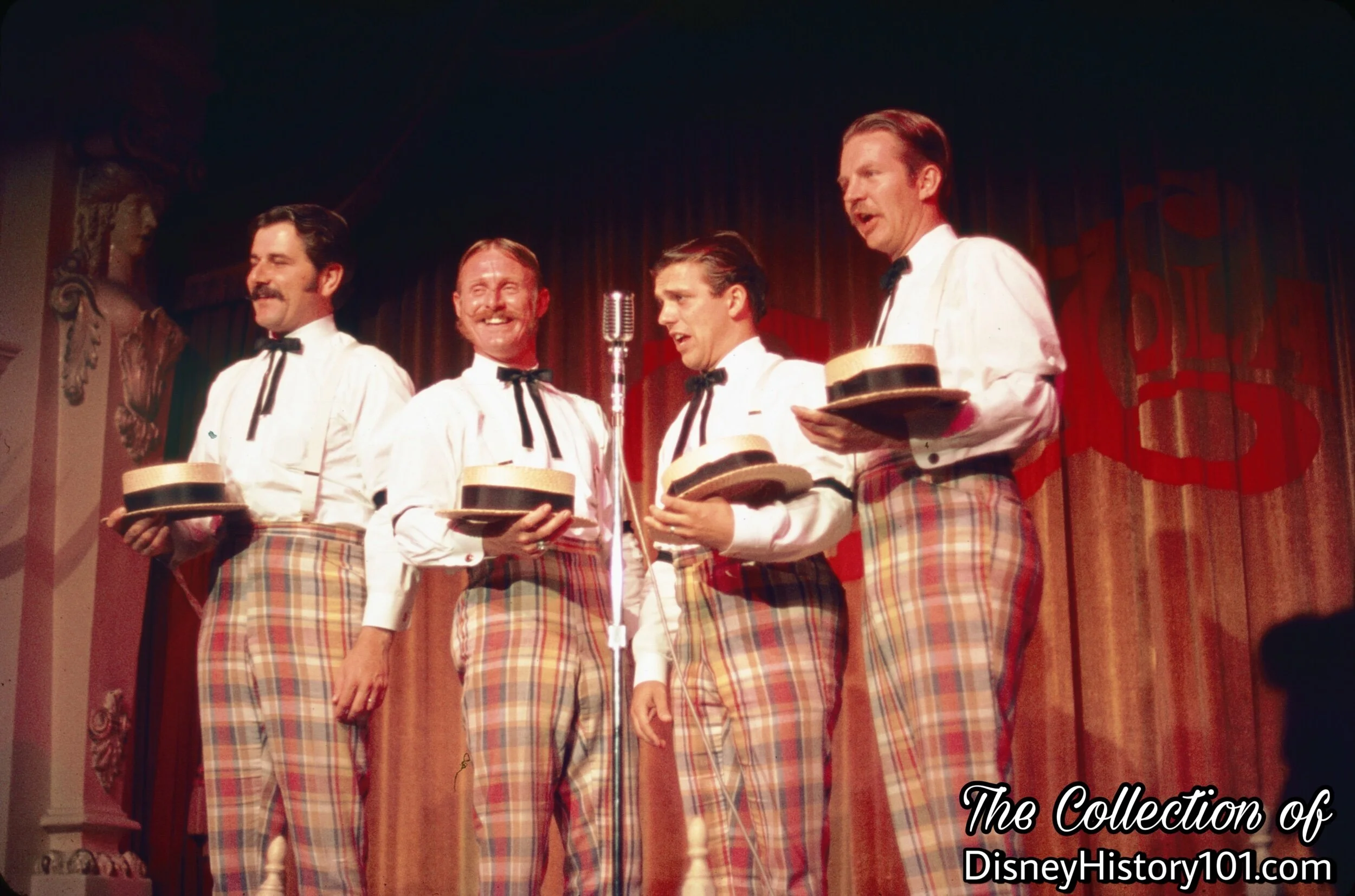
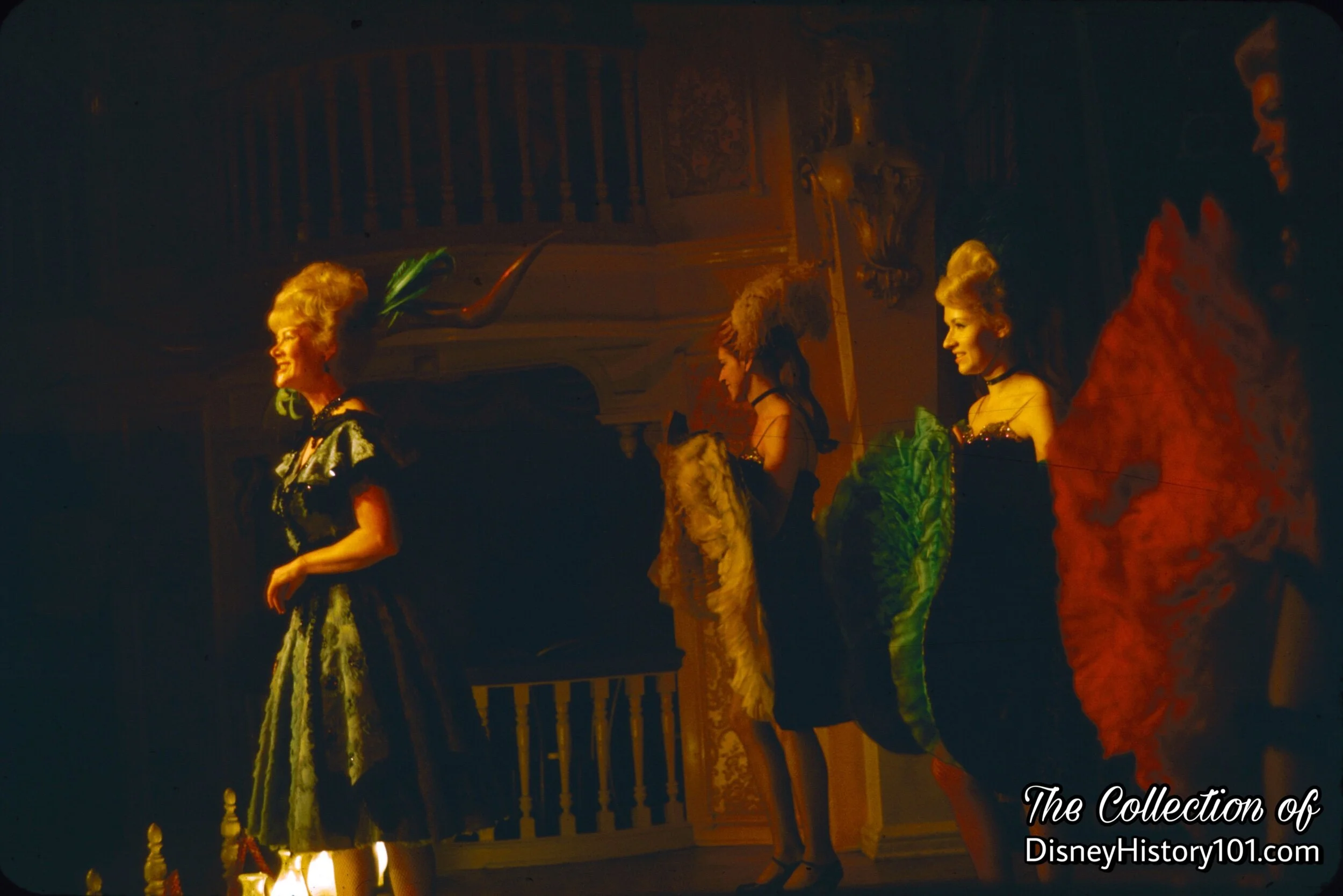
“Hello Everybody...We’re Mighty Glad to Meet You”, (July, 1966)
“Welcome to the Golden Horseshoe. Let the fun begin!” A light and gay free stage show with singers and comedy stars is featured at Pepsi-Cola’s Golden Horseshoe Revue! Colorfully costumed Can Can Girls provide lively numbers (including the finale) for the old western variety show!
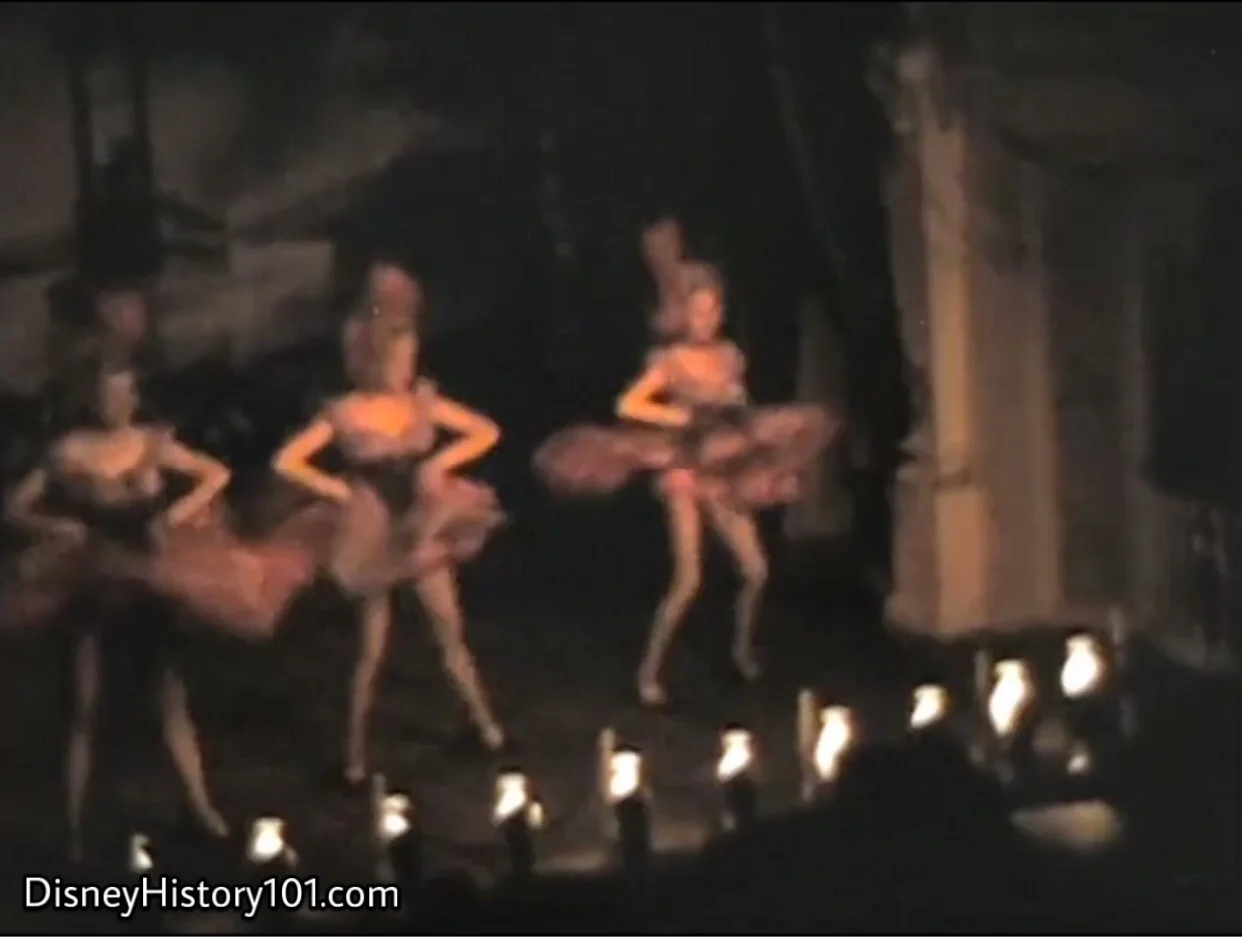
1950s
No show would be complete without those talented Can Can Dancers that Pecos Bill “had roped up in Paris”, and brought “back to dance for you and me”!
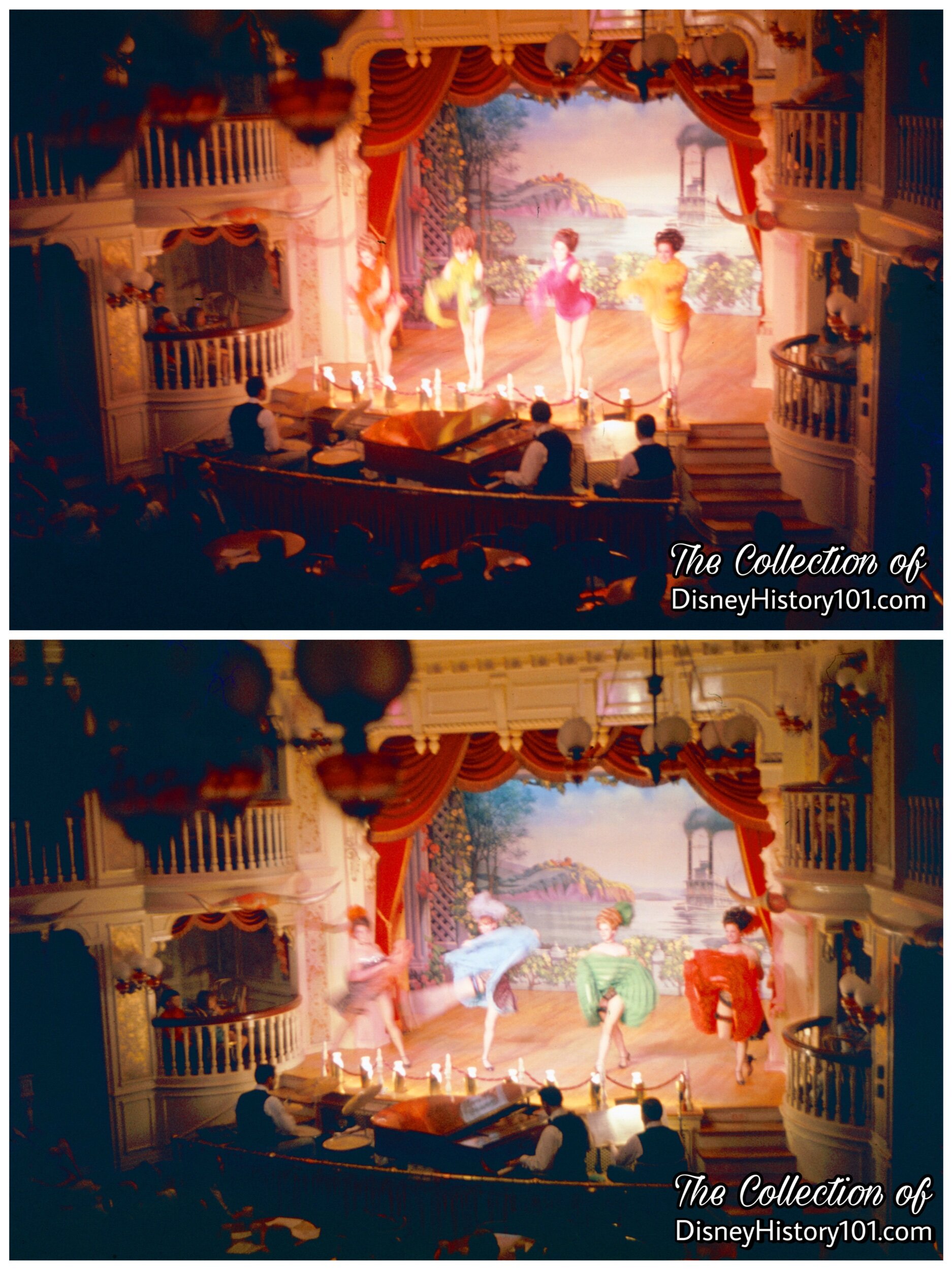
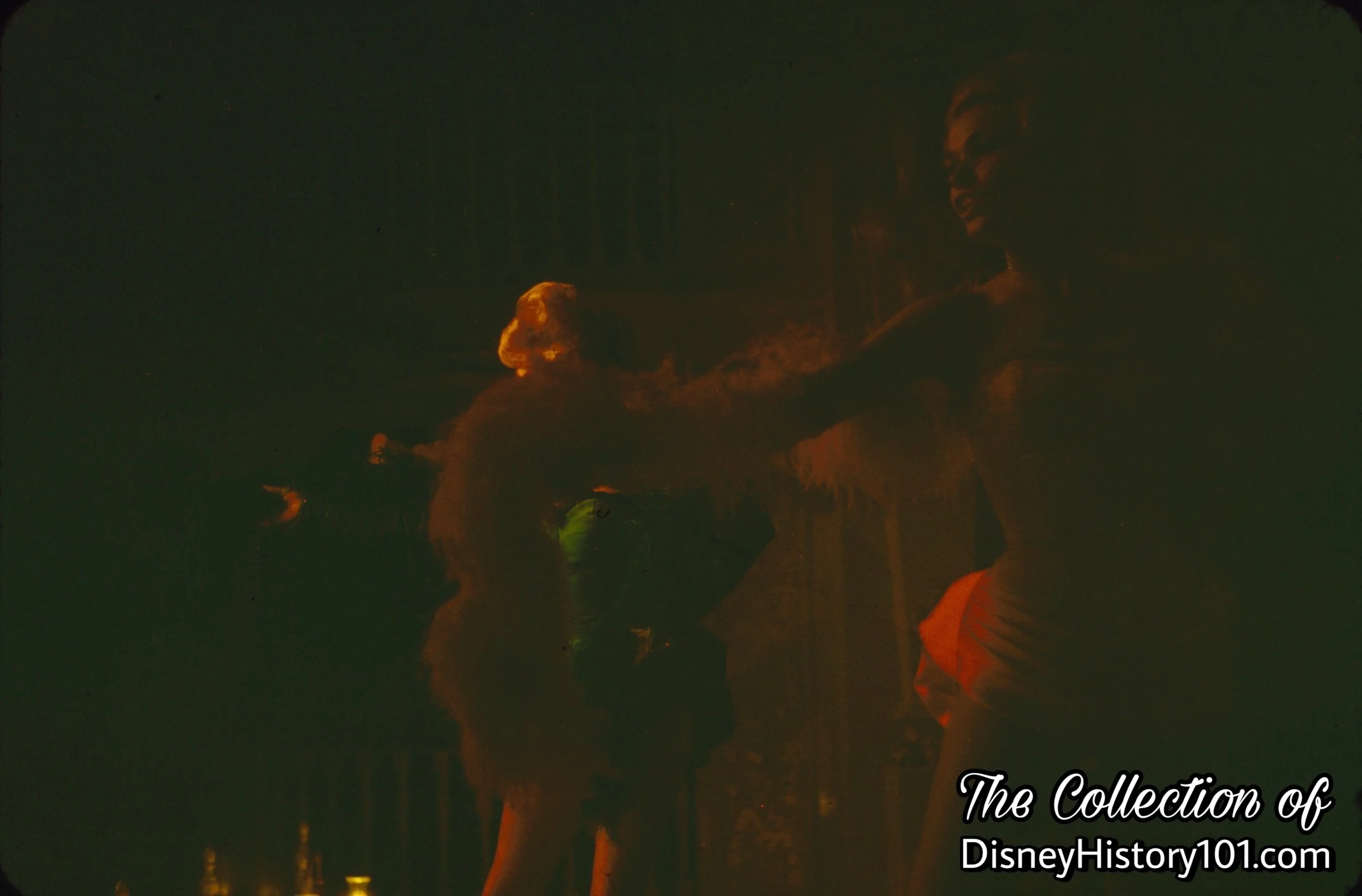
(July, 1966)
“The show is mighty spicy, we thought we ought to warn ya’…each chorus girl is a raving beauty.”
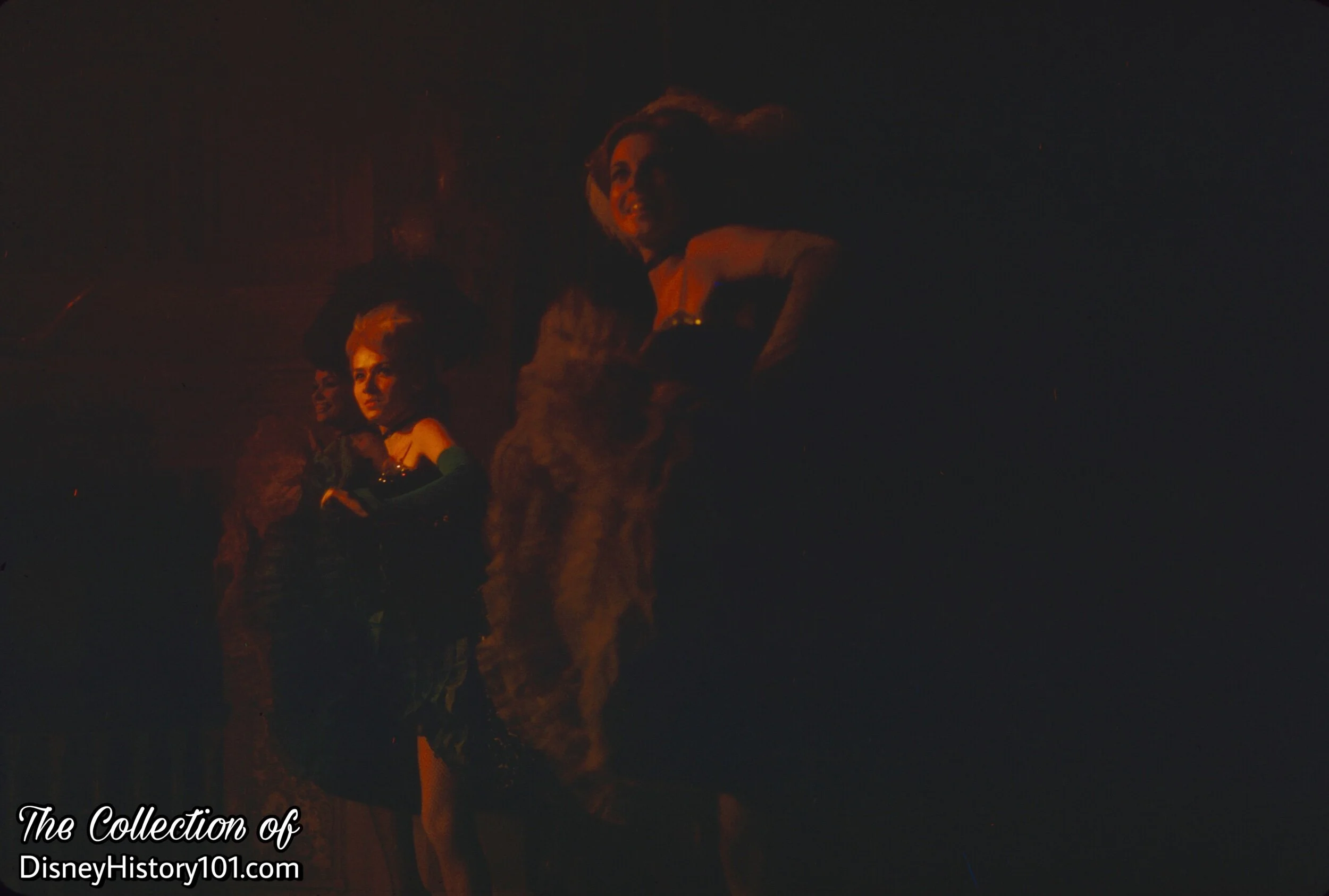
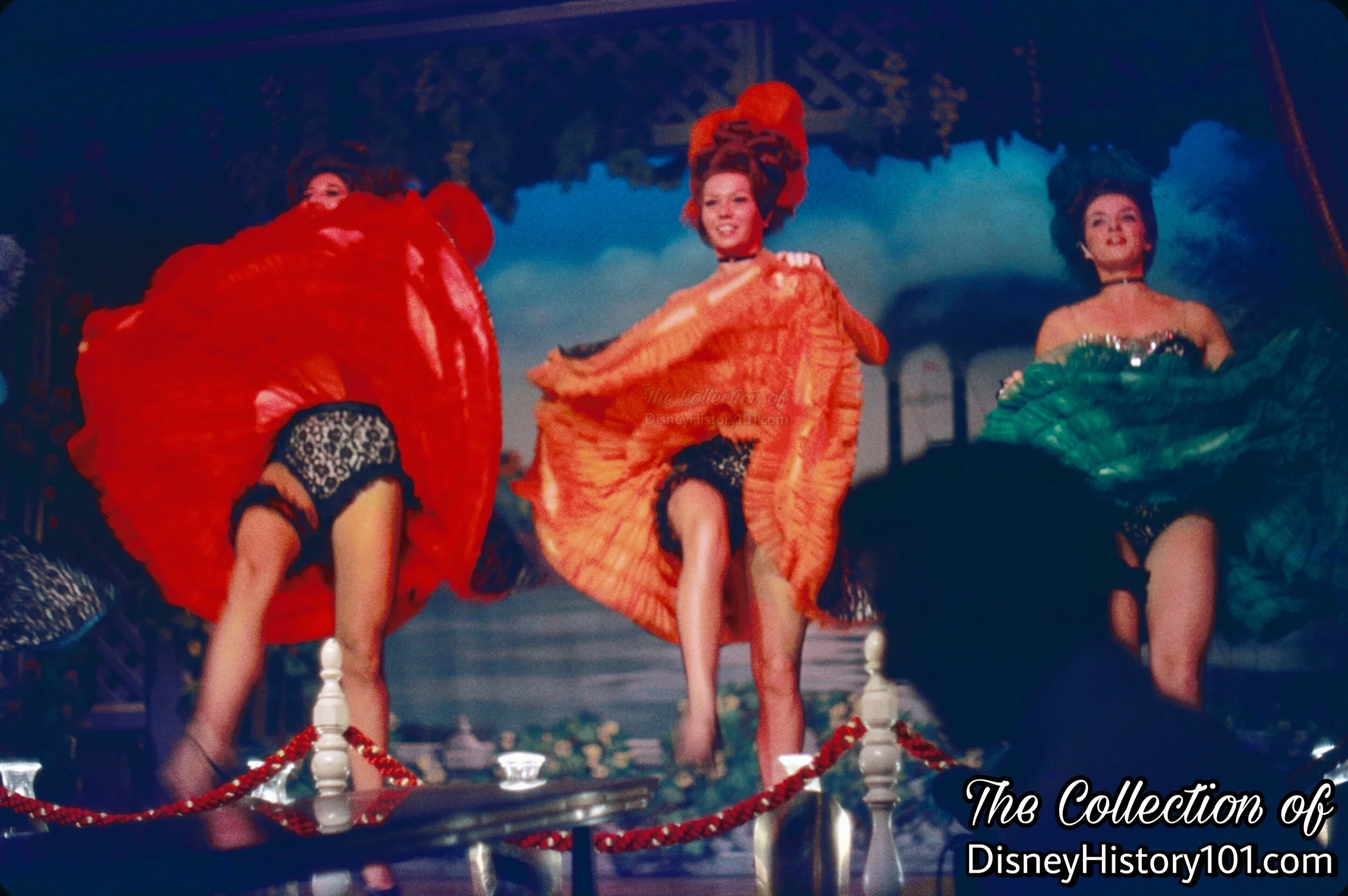
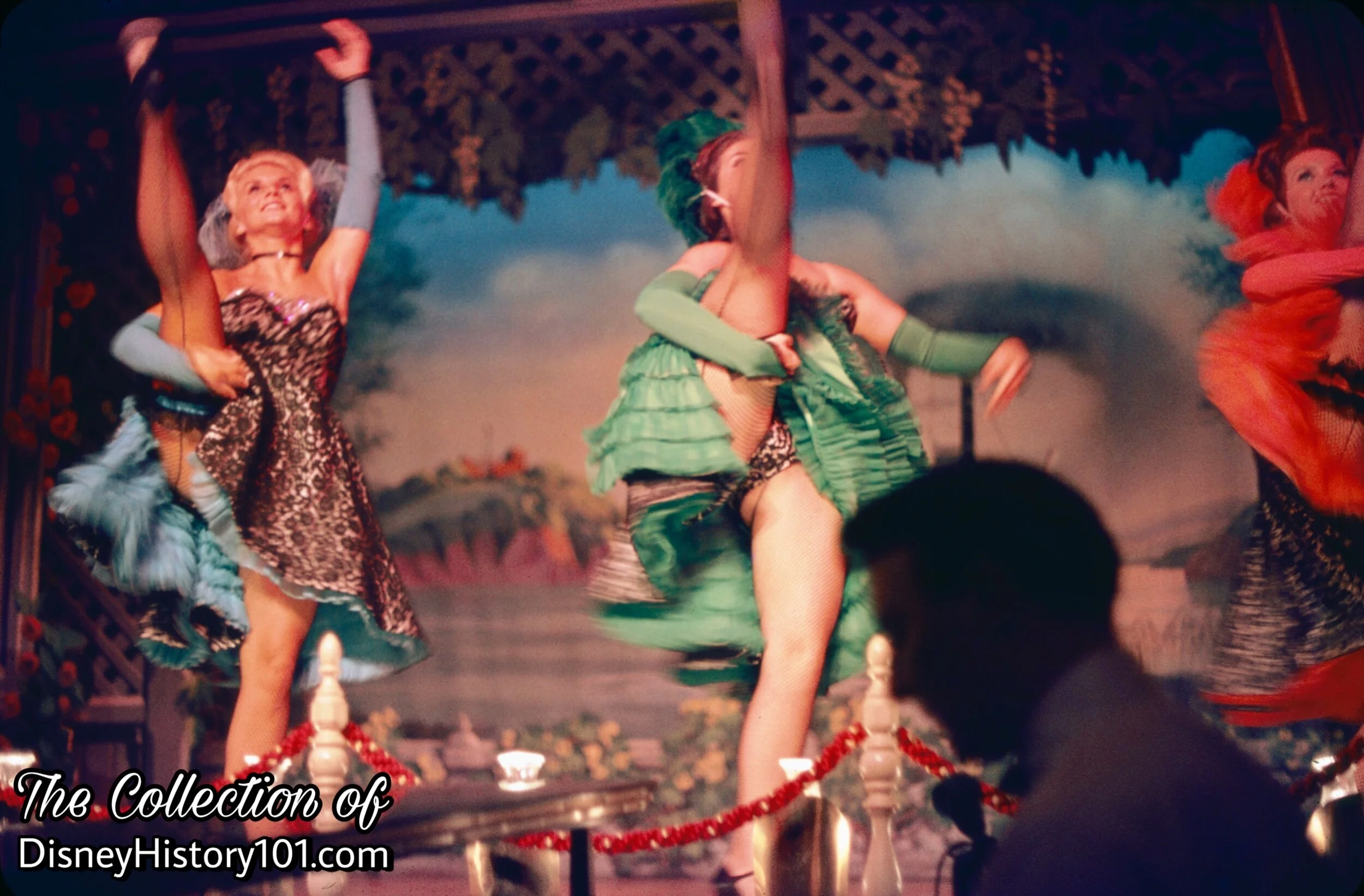
The role of the capricious Can Can Dancer involve a lot of practice and training, as it was one of the most physically exerting Entertainment roles. A testament to this fact is the famous “jump-split” (pictured), which was performed in the chorus line! Other dances included a Waltz performed at three-quarter time.
(July, 1966)
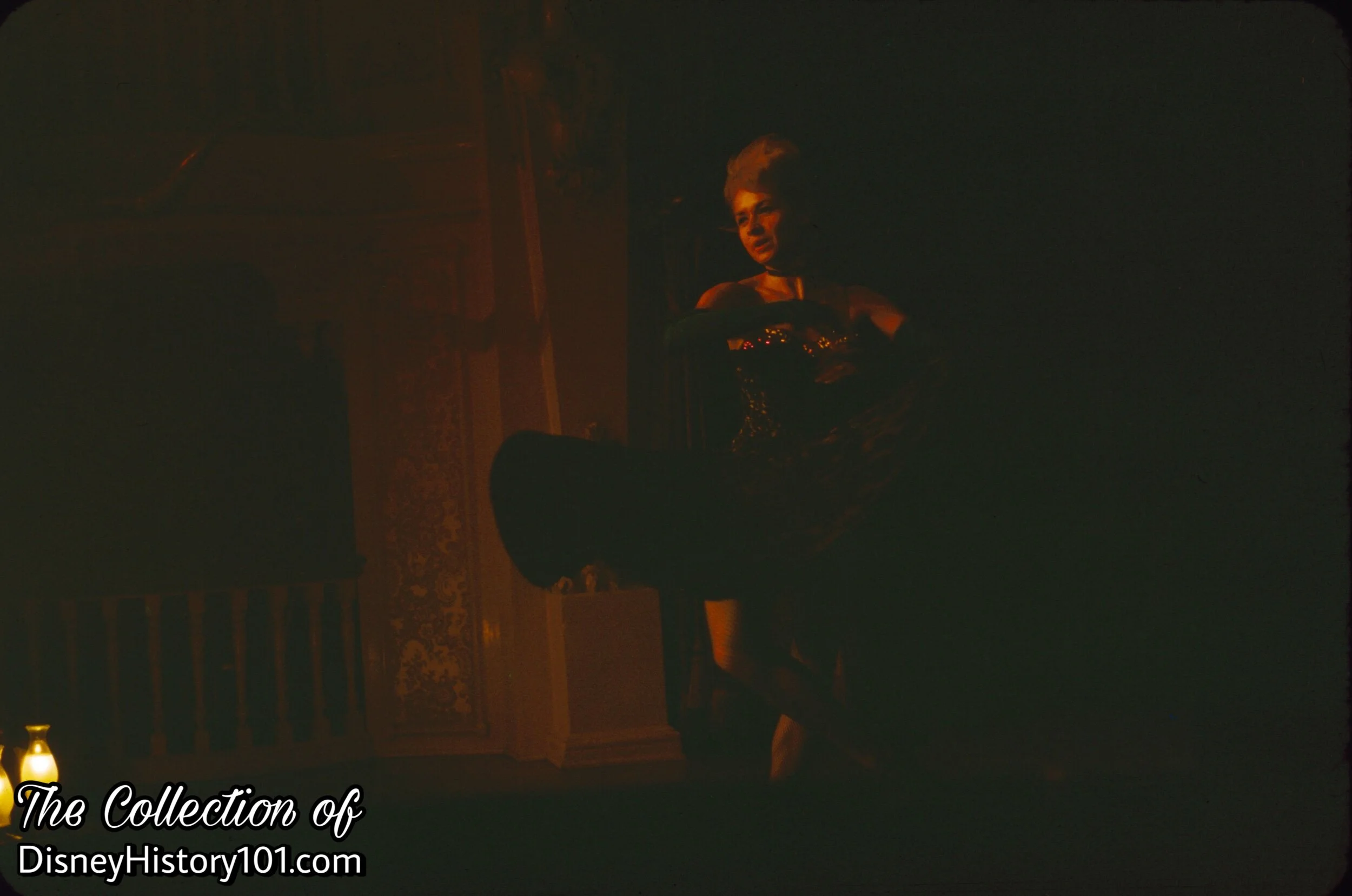
(July, 1966)
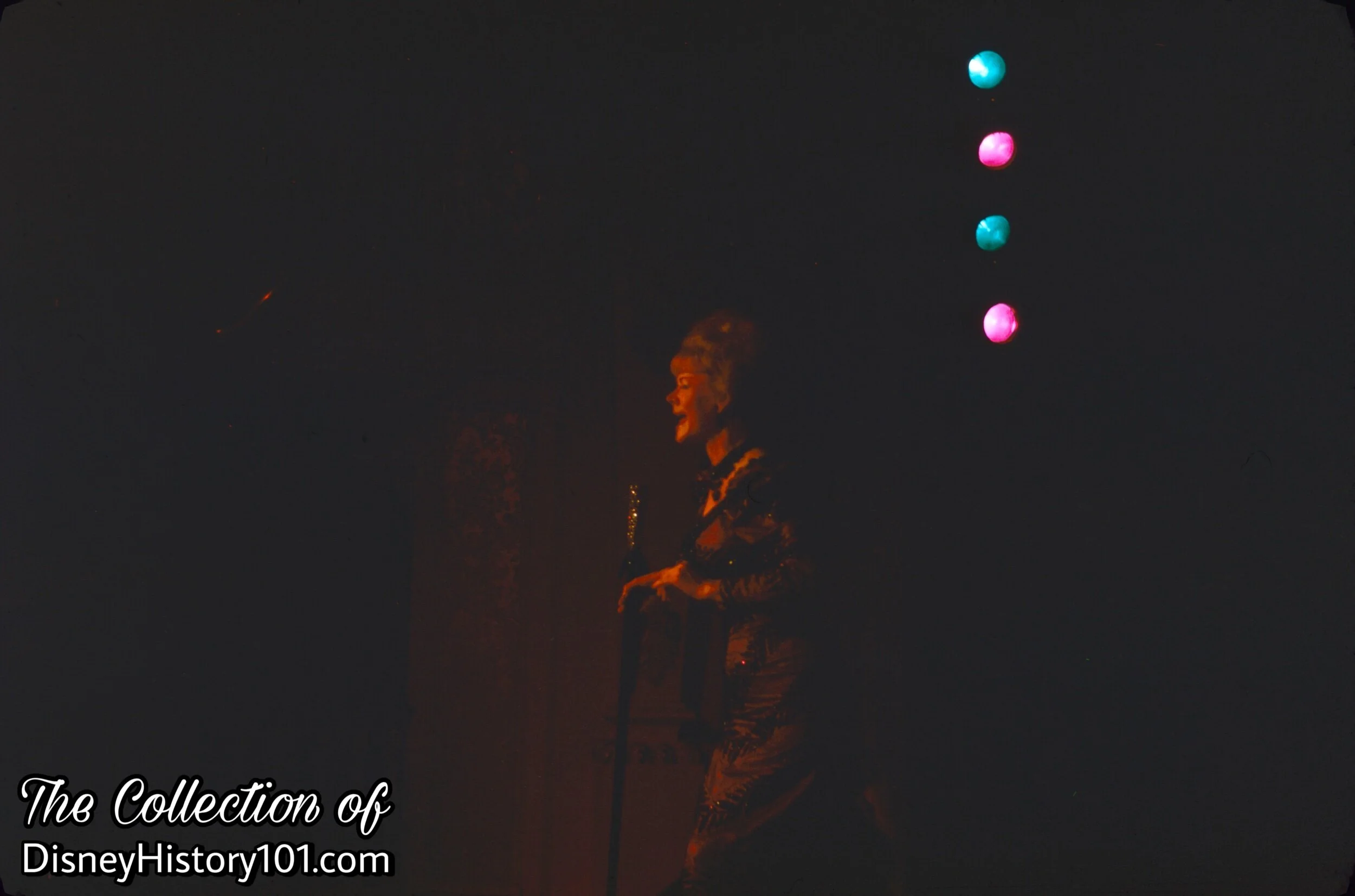
(July, 1966)
Slue Foot Sue sings the final lyrics of her song - “‘Bill Bailey, won’t you please come home?”
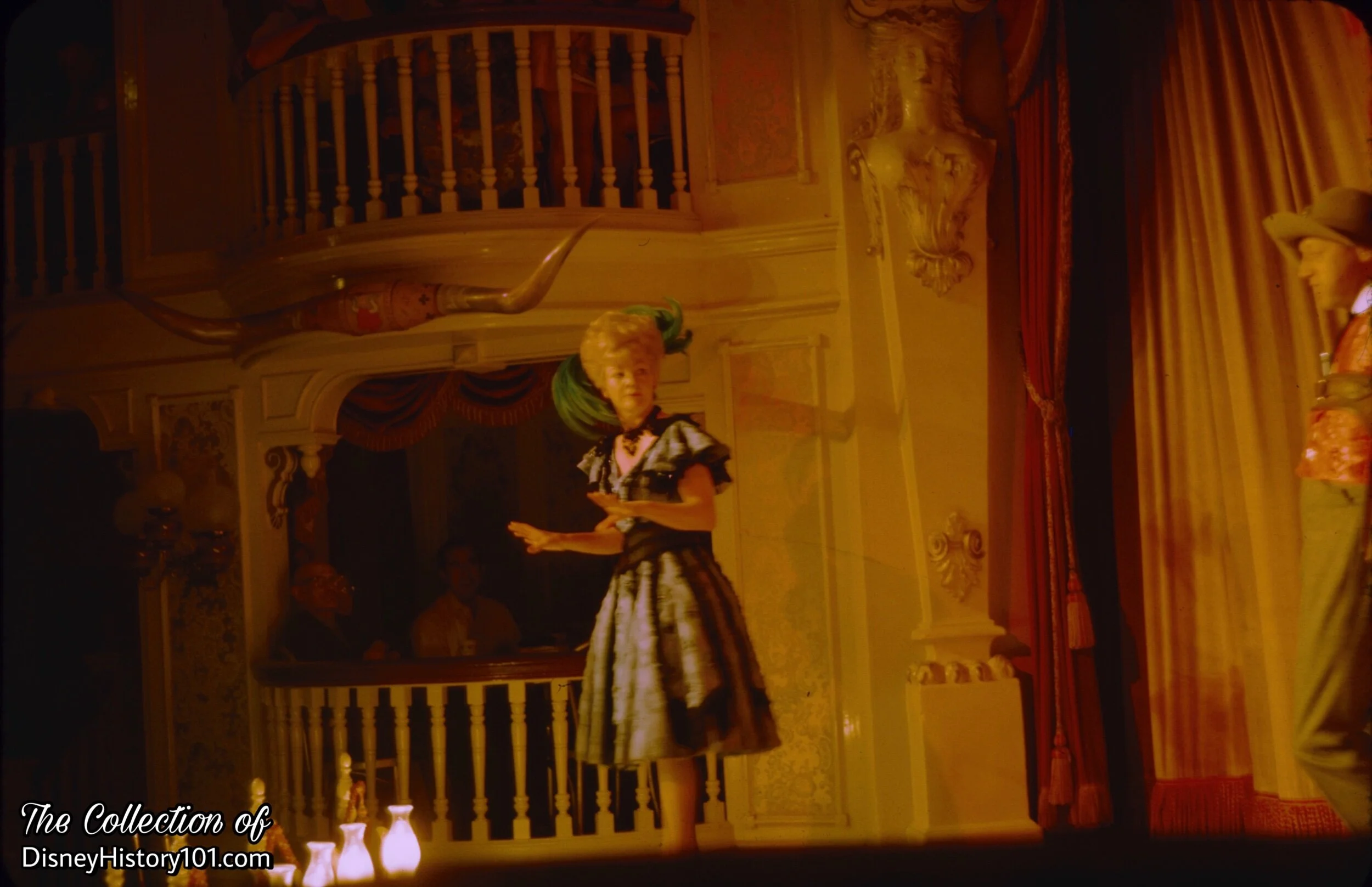
(July, 1966)
“I’m Bill Bailey. I’ve come home.” The “roughest, toughest, root’n, toot’n, shoot’nist cowboy in the whole wide world” has just made his entrance on Slue Foot Sue’s Golden Horseshoe stage!
During 1955, Donald Novis (“the silver-toned tenor”) was personally responsible for persuading Walt Disney to personally interview Wally Boag co-write and perform in the Golden Horseshoe Revue. He was originally hired for a two-week stint, but was hired as lead performer. Wally’s Pecos Bill and Traveling Salesman characters would be influential to injecting humor into more than 39,522 performances of Slue Foot Sue’s Golden Horseshoe Revue. During 1955, Donald and Wally were also co-emcees featured on a new mid-day half-hour “Magic Kingdom” radio show, broadcast (from 11 to 11:25, from Monday through Friday), originating from within Disneyland. “Starting at the Golden Horseshoe, they tour all of the Park’s lands, meeting and chatting with interesting visitors from all over the country who enjoy the Magic Kingdom’s many attractions”, according to The Disneyland News (Vol.1-No.6 ; published December 10, 1955). During the “Golden Key to Disneyland” segment, families are selected at random to win the “Golden Key to Disneyland” (which entitled the family to free admission).
During this time, “Bert” (Albert) Henry Renner was hired as a loyal substitute for Wally Boag, from 1955 to 1976. Wally trusted Bert so, that he sent him to the Magic Kingdom in Florida, in order to support and train the cast of the Diamond Horseshoe Revue at Walt Disney World.
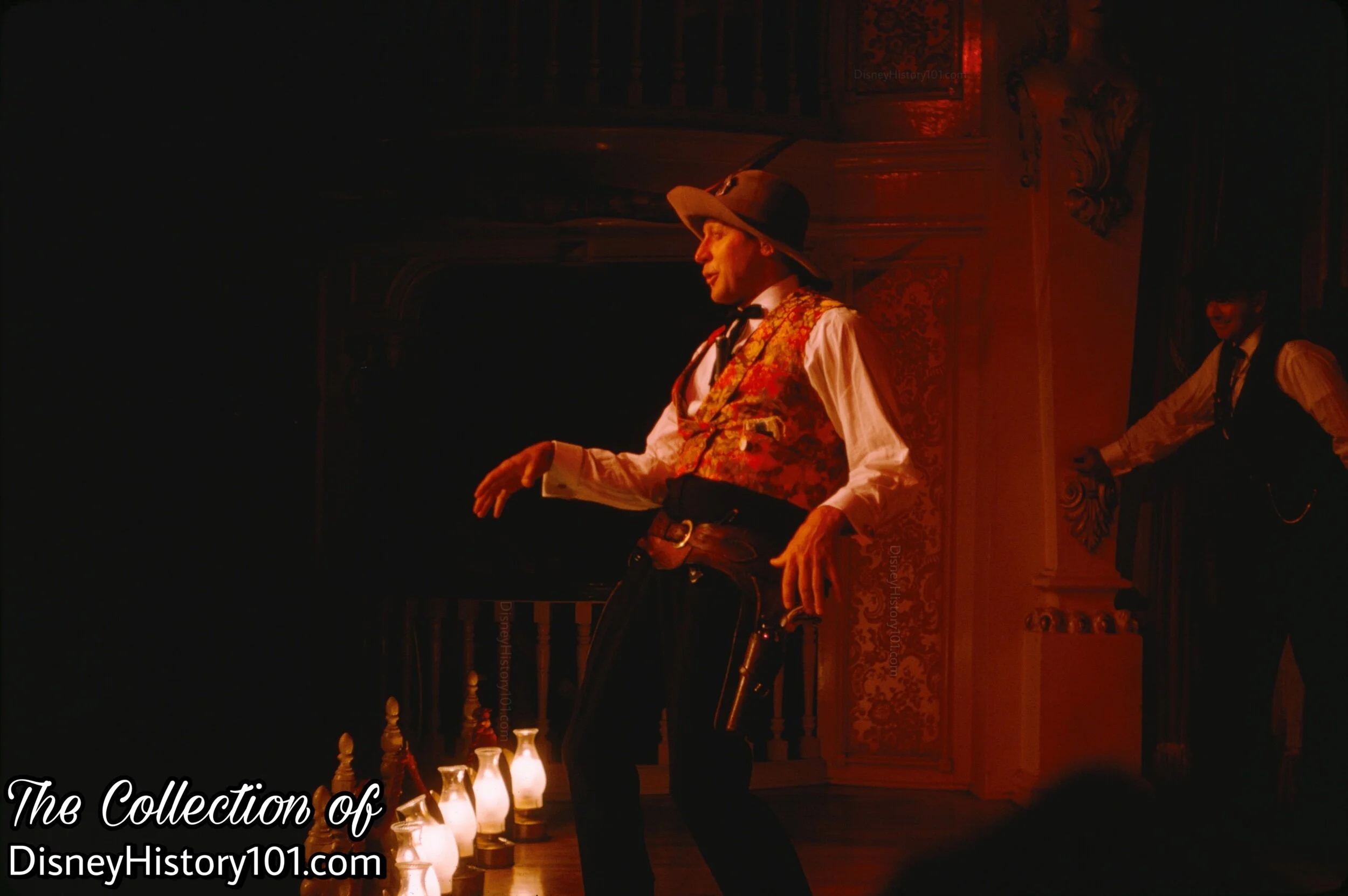
(October, 1966)
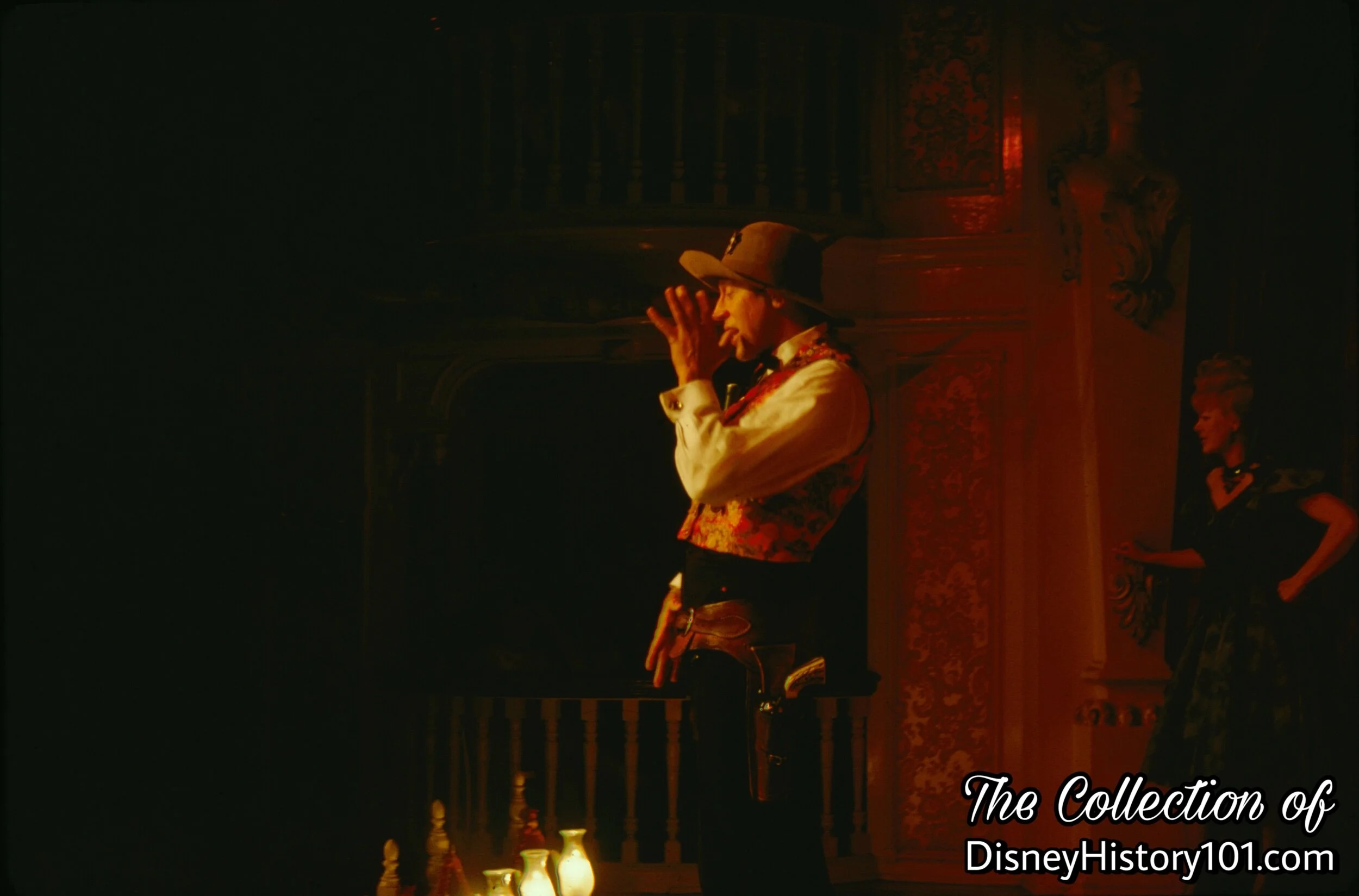
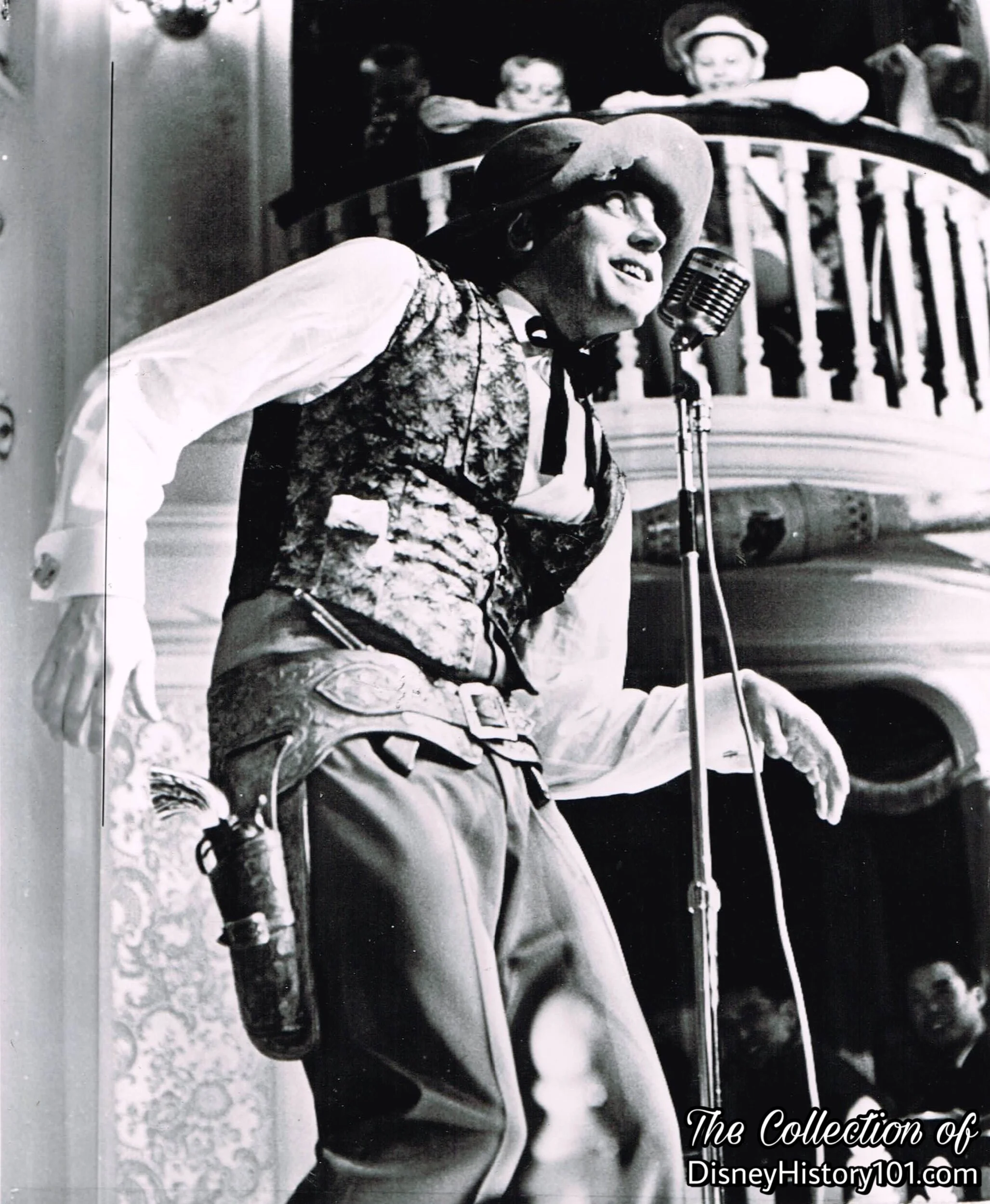
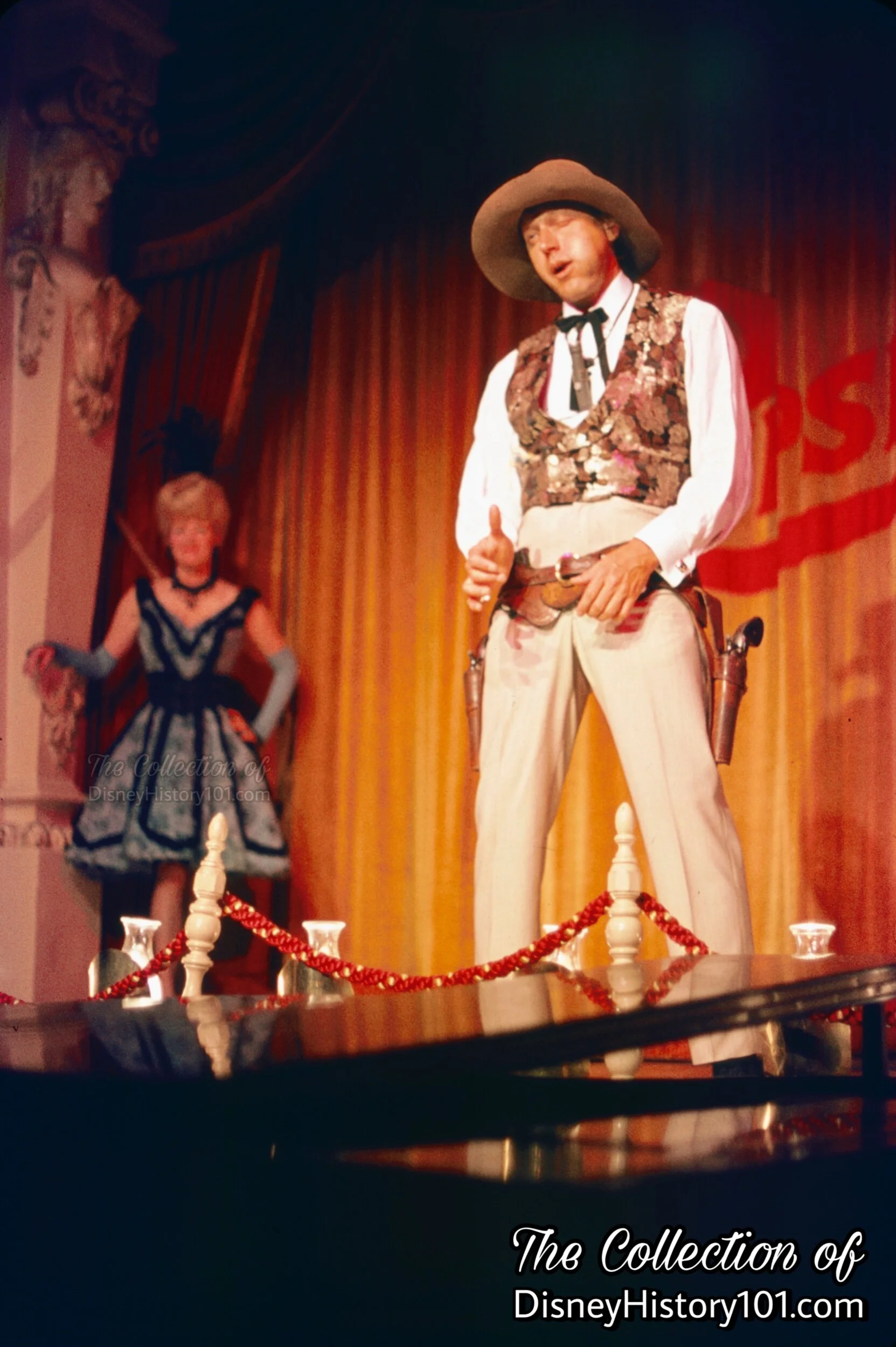
Guests enjoy plenty of good music, plenty of laughs, Can Can girls, and that famous character Pecos Bill! Old Bill’s the roughest, toughest critter west of the Alamo! He’s also the fastest draw in the West. Pecos asks the audience, “Wanna see it?” After freezing, he asks…
(October, 1966)
“Wanna see it again?”
© Walt Disney Company.
By 1961, Wally had recently made more than 20 guest appearances on local and national TV including the Ed Sullivan Show. Sometimes the stars of film, television and stage came to Wally. For instance, Eddie Sherman (of the Honolulu Advisor) published the following account (for Monday, November 4, 1963) : “At the Golden Horseshoe Revue, the newsmen were treated to a special surprise. Julie Andrews (of B’way’s ‘My Fair Lady’) was called out of the audience to duet with comedian Wally Boag. Julie has recently competed her first film - for Walt Disney - titled ‘Mary Poppins’.”
According to Dave Smith (previous Chief Archivist Emeritus of the Walt Disney Archives), “Wally Boag, the comedian at the Golden Horseshoe, wrote the script for the Enchanted Tiki Room and he happened to be bald. One of the funniest parts of the show was when Wally removed his toupee.” [Disney Facts Revealed by Dave Smith, 2016] This may be the reason why it is said, that “Herr Schmidt… has no hair.”
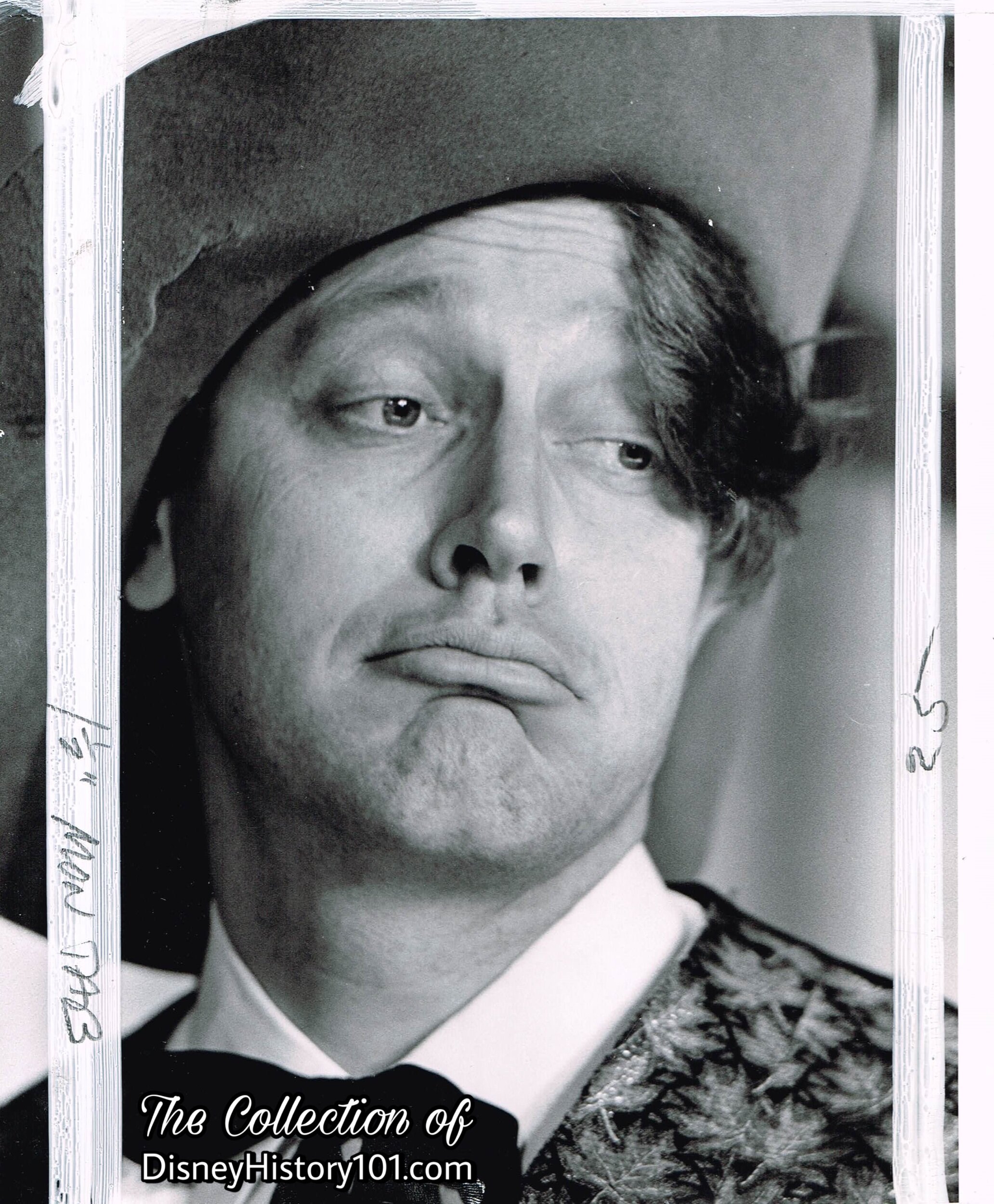
© Walt Disney Company.
DID YOU KNOW : Wally Boag used almost 250,000 balloons during the first 11 years of the show.
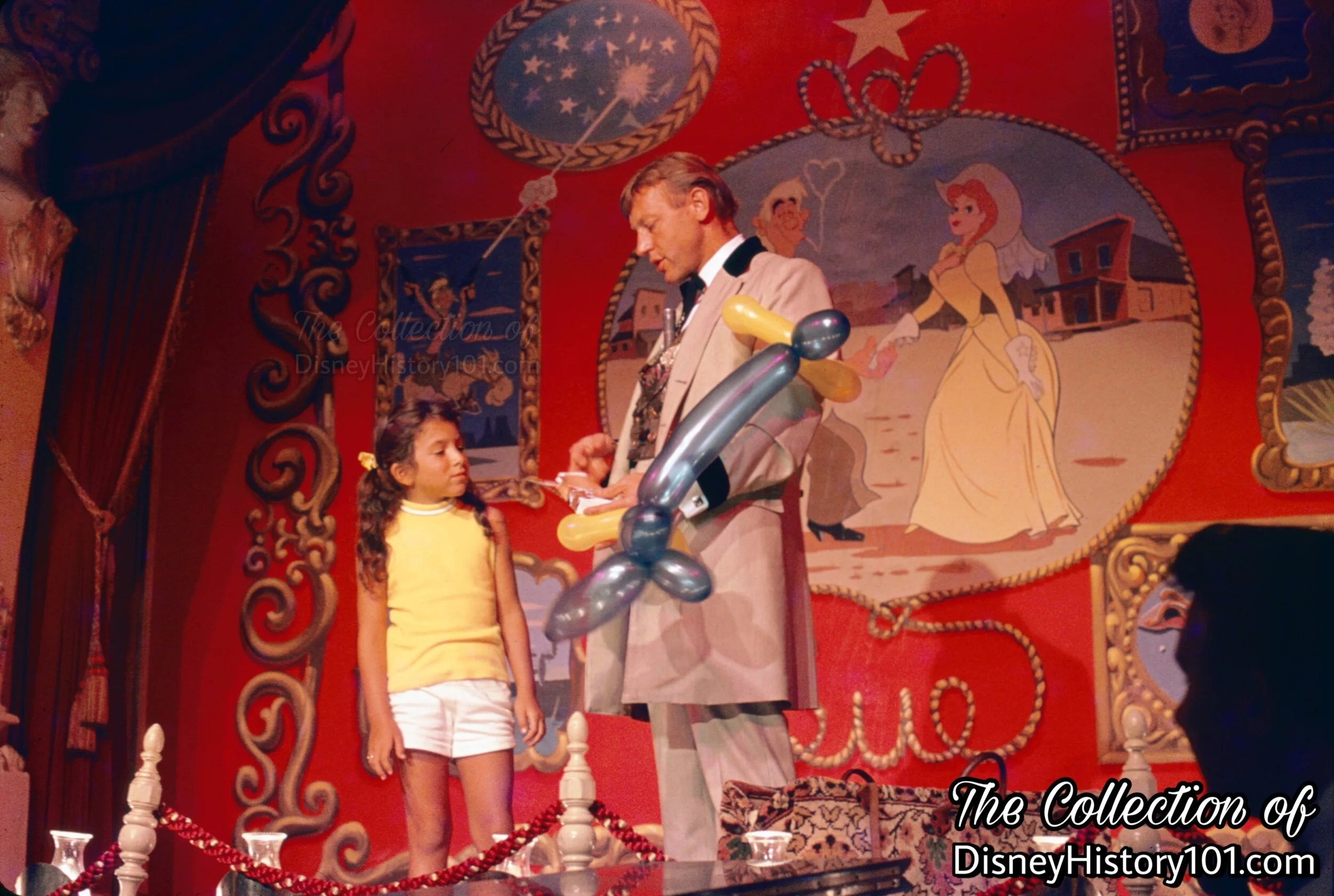
The Traveling Salesman who “just got off the stagecoach from Chicago” and his bag of tricks.
According to the account of Wally Boag in “Homecoming- Destination Disneyland” by Carlene Thie: “After the park had been open for a few months, Walt signed a contract with ABC radio to produce a daily program called ‘Your Happy Holiday.’ We would find a family on its way into the park in the morning and ask them to be guests on the show. After they'd been in Disneyland for a couple of hours, we'd have them come over to the Horseshoe so I could ask them questions about what they'd seen (I was the emcee). It also gave us an opportunity to feature various celebrities who were in the park that day. We had plenty of them. President Eisenhower was in the audience one day and I called his grandson up on the stage and gave him the balloon animal. As he was going back to his seat, I handed him a bunch of balloons and said, ‘Here, give these to your grandfather and show him how to make an animal. It'll make him a big man in the neighborhood.’ I guess Ike liked the gag he laughed.”
Wally Boag was well-known for his “fun and ‘hi jinks’” as Pecos Bill or the Traveling Salesman! According to Vacationland (Fall of 1964), “In his balloon blowing antics, Boag creates animals and shapes beyond description. He has used almost 225,000 balloons in the nine year old show. On the day after Christmas in 1961, Wally had little girl on stage with him, showing her his balloon tricks. ‘Now,’ quipped Wally, ‘go back and show it to your grandfather. It’ll make him a big man in the neighborhood.’ The little girl’s grandfather, sitting front row center in a spasm of laughter, was President Dwight D. Eisenhower.” Only three years later, Wally (or, the “Traveling Salesman”) had “used almost 250,000 balloons in the 11-year show,” according to Disney News magazine (published for the Fall of 1967). In interview with Carlene Thie, Wally once recalled that Walt “knew my act better than I did and he often had suggestions about how I could improve it. On day he said to me, ‘Why don’t you package those balloons and sell them at the bar after each show.’ So, I did and I sold a ton of them.” [“Homecoming - Destination Disneyland” by Carlene Thie] Wally’s balloons continued to create tangible memories for Guests through Merchandise and Show.
Clearly guests were well familiar with the Traveling Salesman, but Wally occasionally filled other roles at Disneyland. He portrayed “The White Hunter” while riding atop an elephant, but was surprisingly absent from the “Golden Horsehoe” Float, in the “Disneyland ‘59” parade and pageant. Former Disneyland Cast Member Steve Vosburg especially recollects one of Wally’s amazing feats performed while portraying another iconic character : “One of my Fondest Memories was the 4th of July night when Wally Boag played Uncle Sam on the Tomorrowland Stage. He sang and danced to Yankee Doodle Dandy and at 47 years of age still managed to throw a back handspring in the middle of the routine wearing that Uncle Sam suit!!!... I was a young 18 year old gymnast back then and could throw back handsprings in my sleep, basically a simple move, however, I would never had attempted one while wearing a suit coat.”
Another guest (Sue from Atascadero, California) once recalled : “Back on Memorial Day weekend either in 1965 or 1966, as a teenager, a girlfriend and I saw ‘The Golden Horseshoe Revue.’ We went back after equipping ourselves and had a squirt gun fight with the man portraying Pecos Bill. He and the woman playing Sluefoot Sue were perplexed but played along. The piano player that day said that it was the funniest thing he ever saw. I have wondered for years if those actors and piano player remembered that.” [Disney Facts Revealed by Dave Smith, 2016]
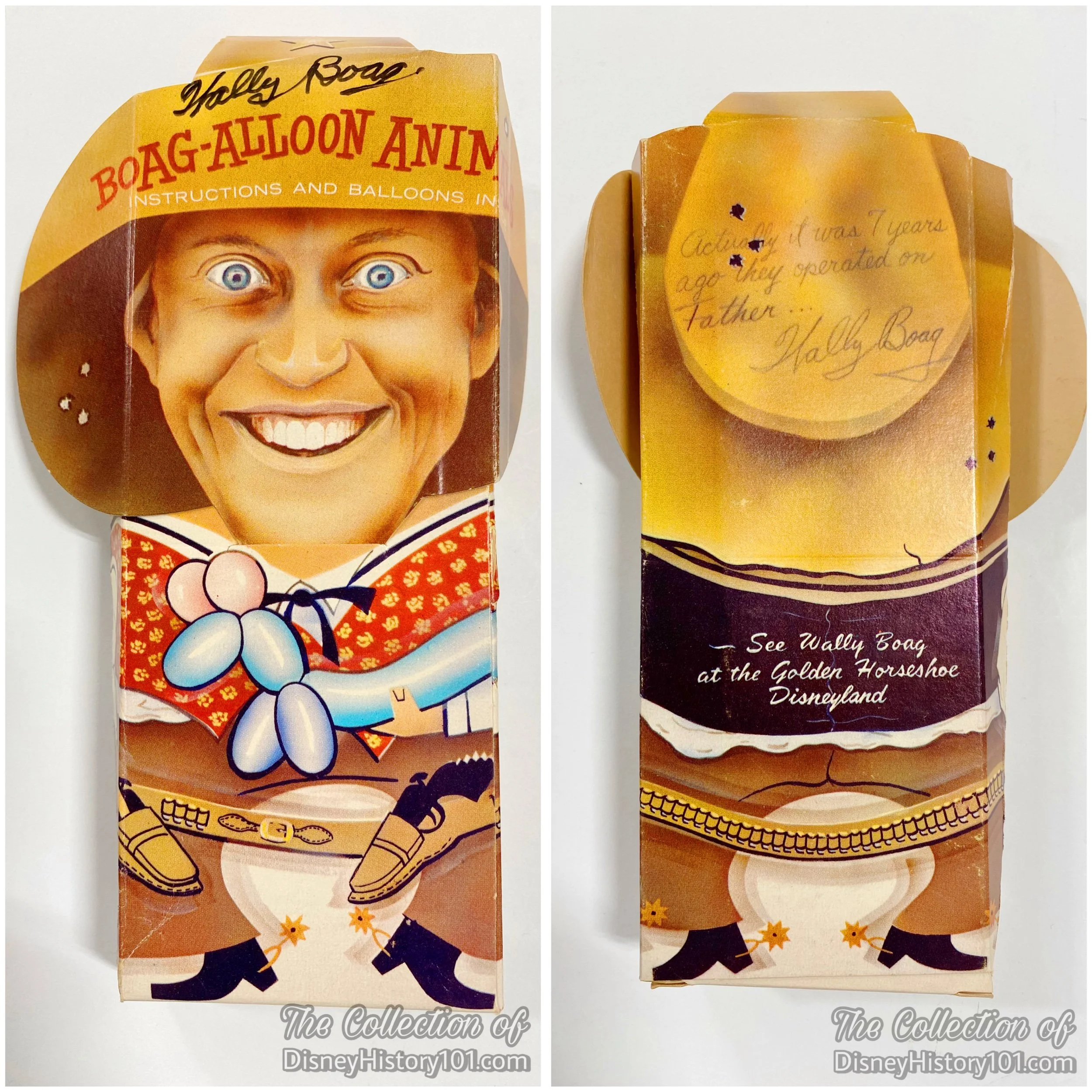
Boag-alloon Animals; designed by RICHARD L. PARMENTER of by create-a-pak co. of Los Angeles
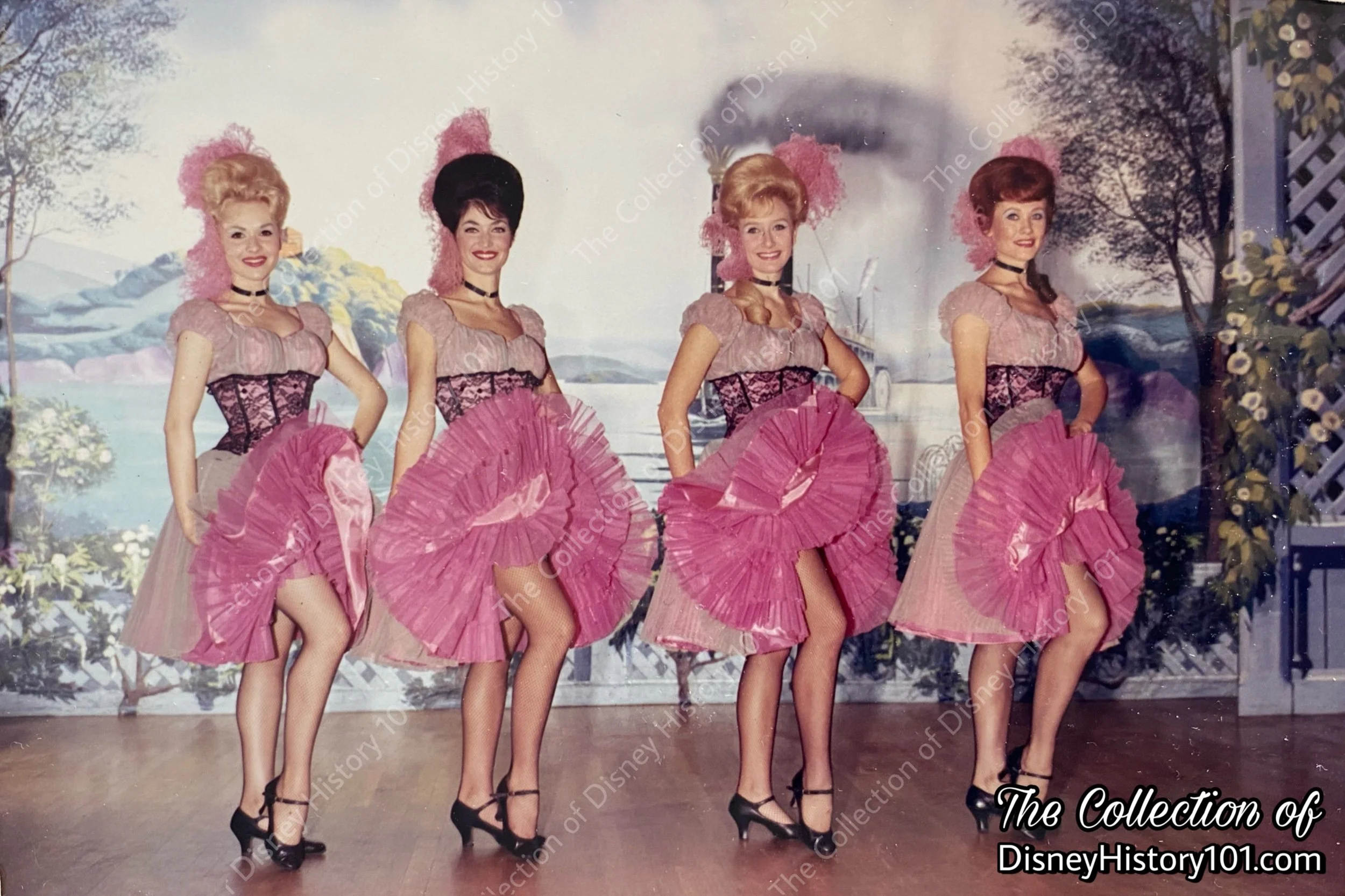
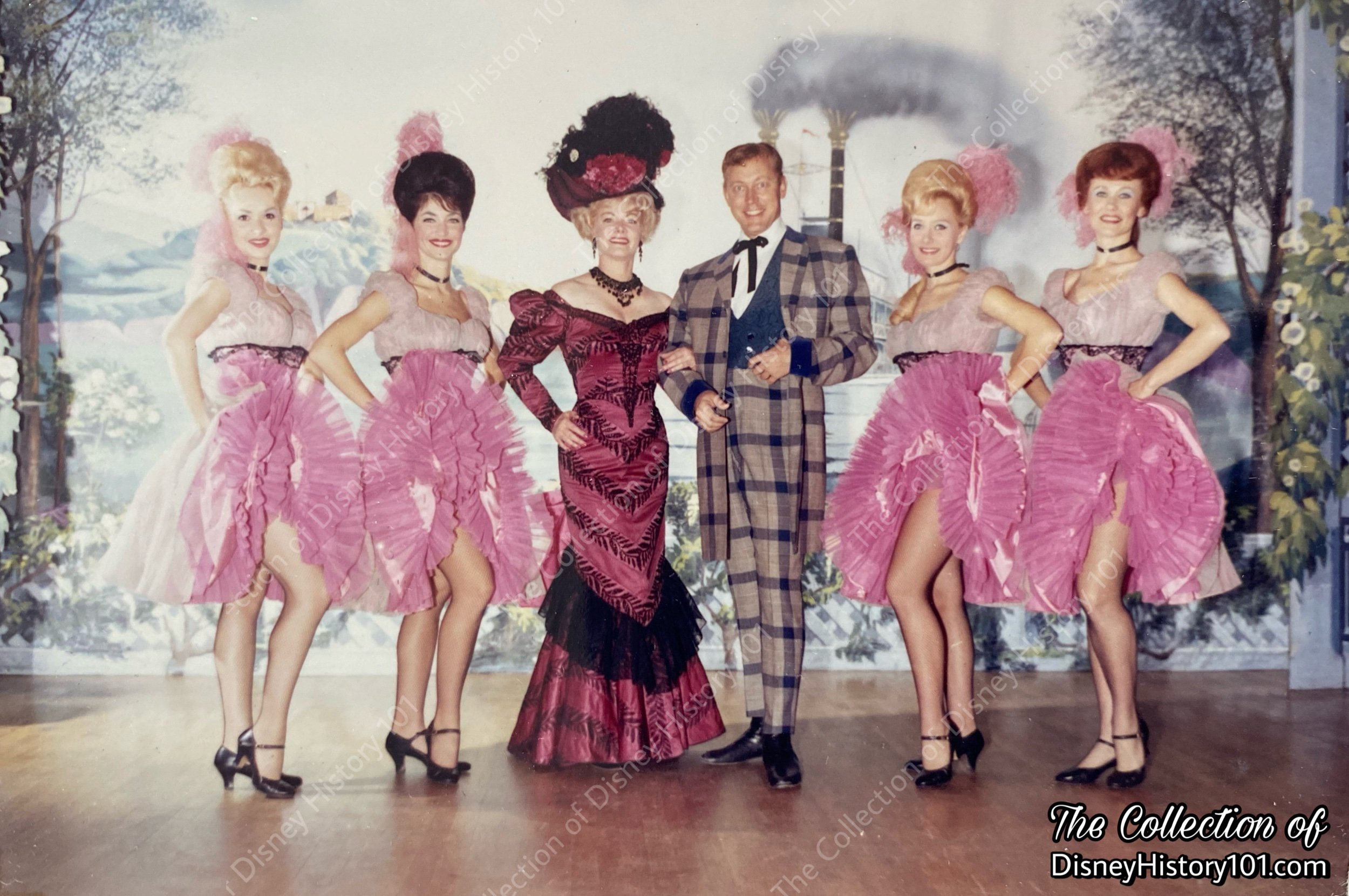
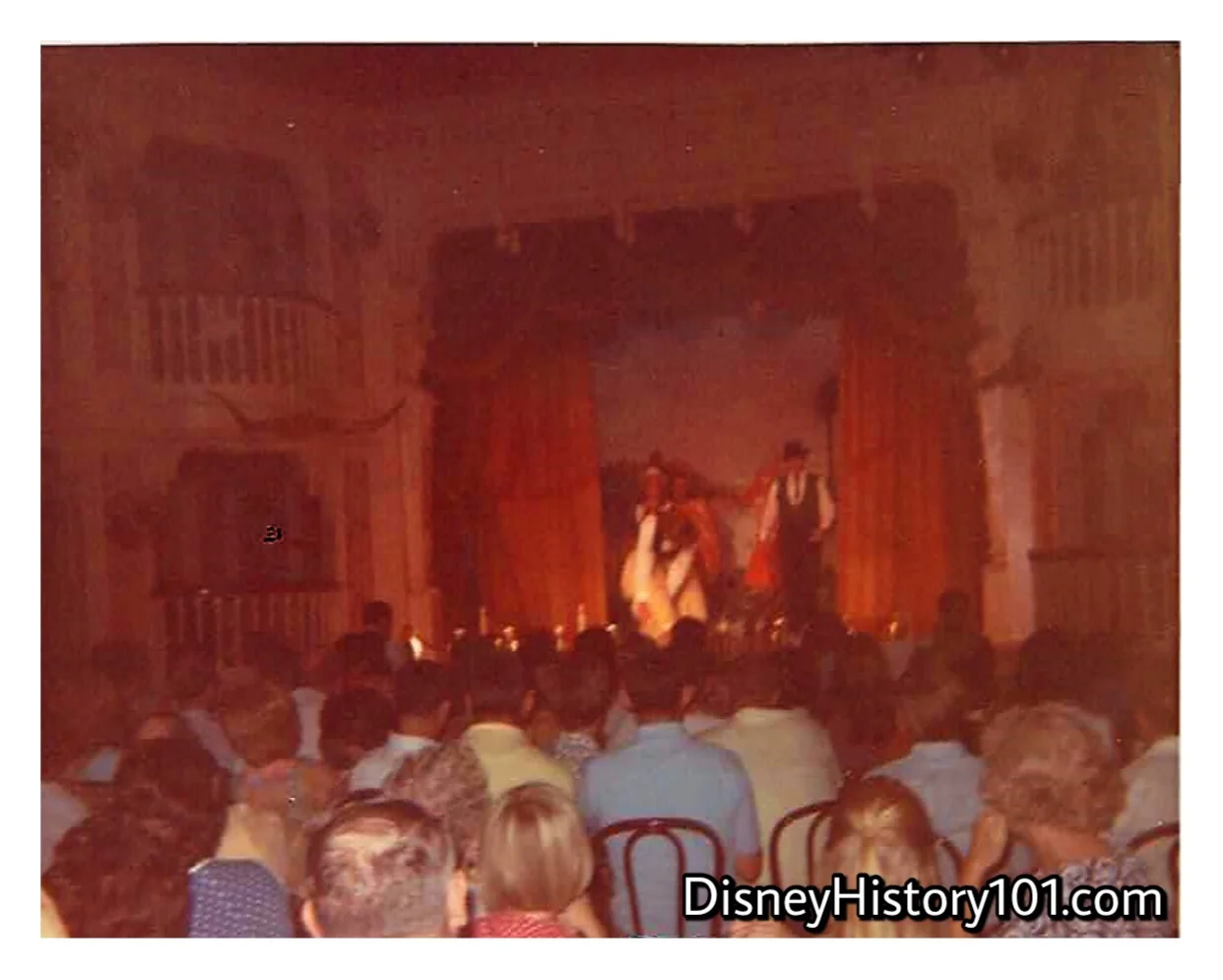
1969
Refresh yourself with food, beverages, and entertain yourself with multiple daily Western-style performances from the crimson-curtained stage!
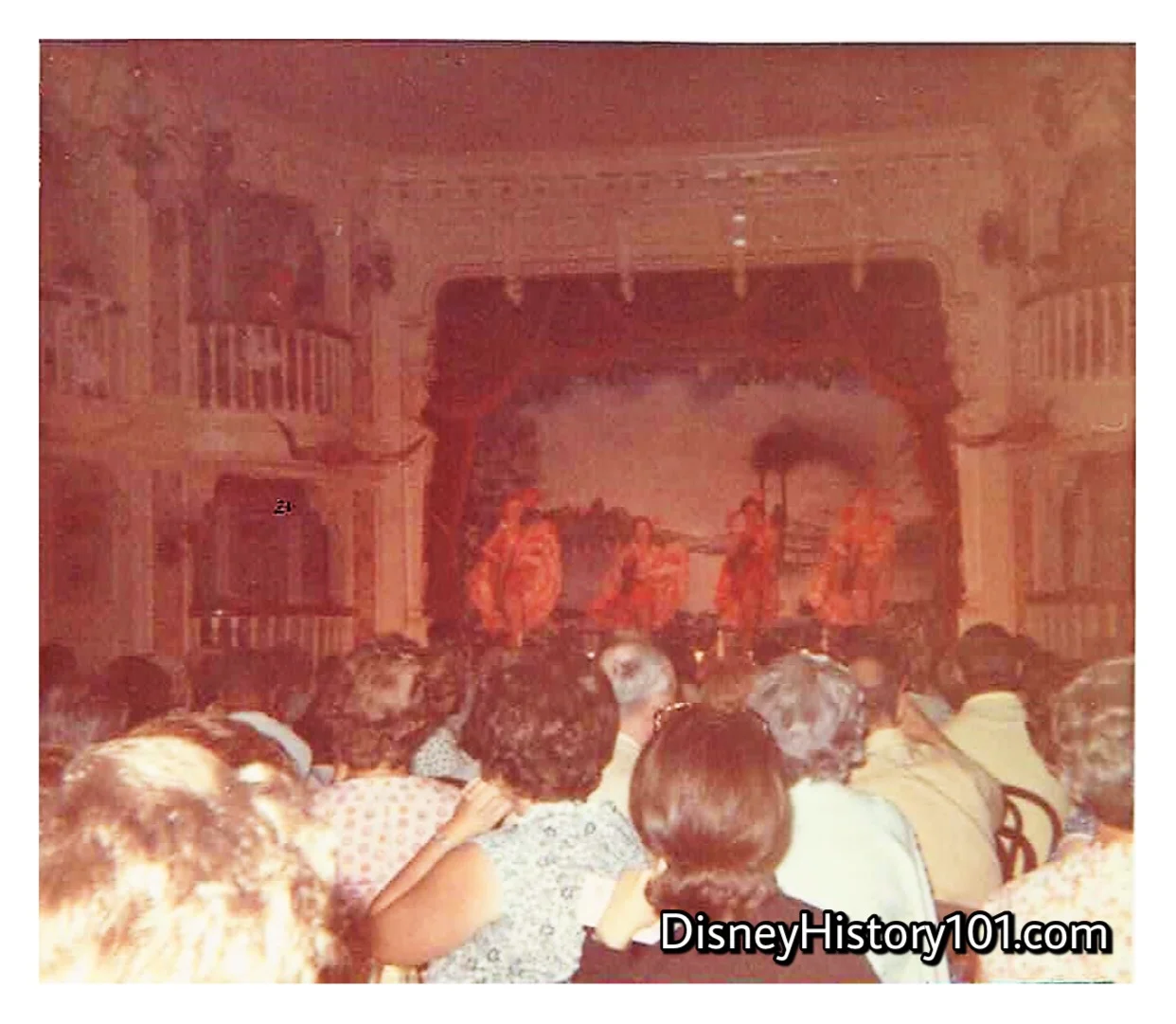
1969
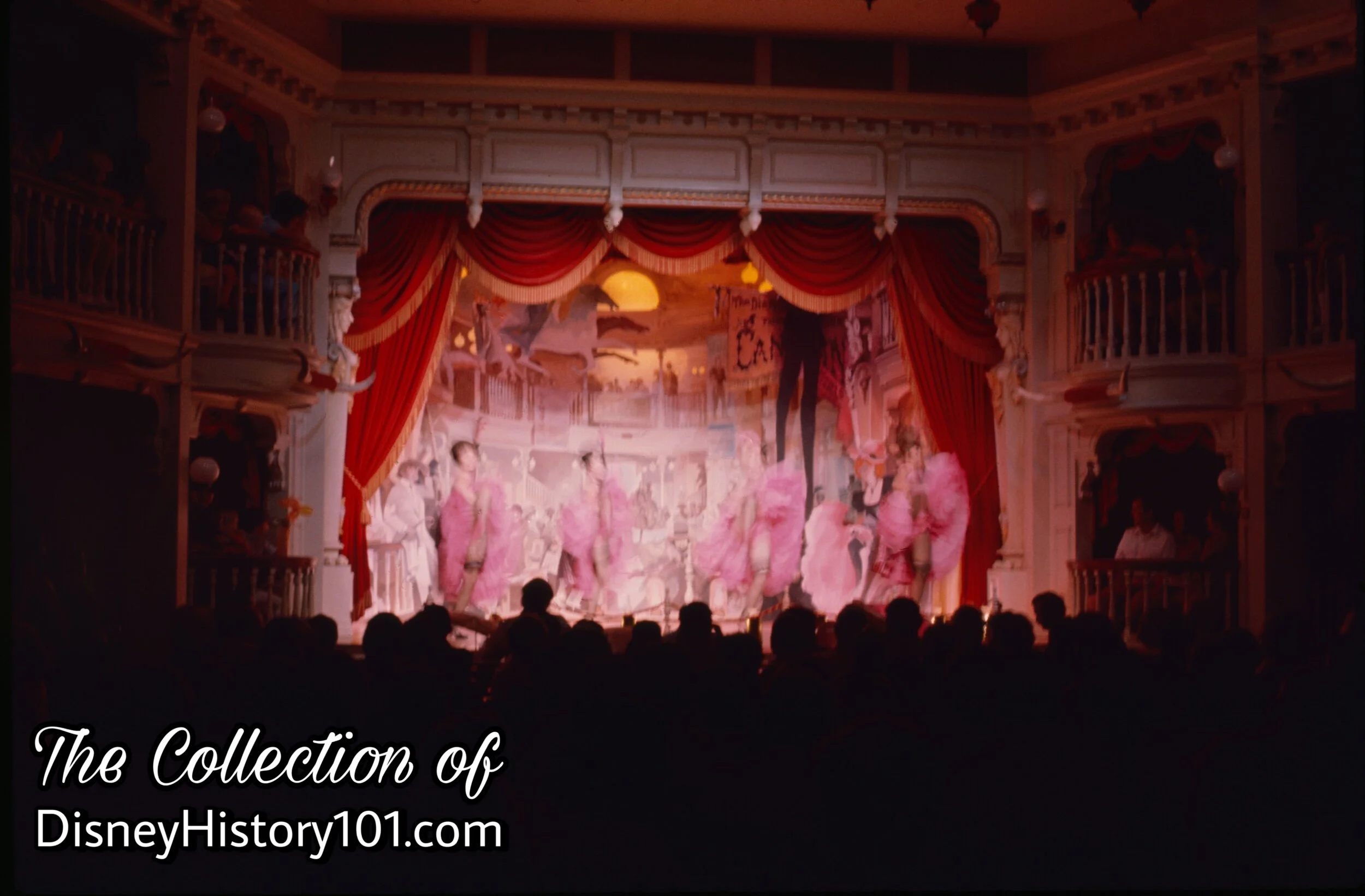
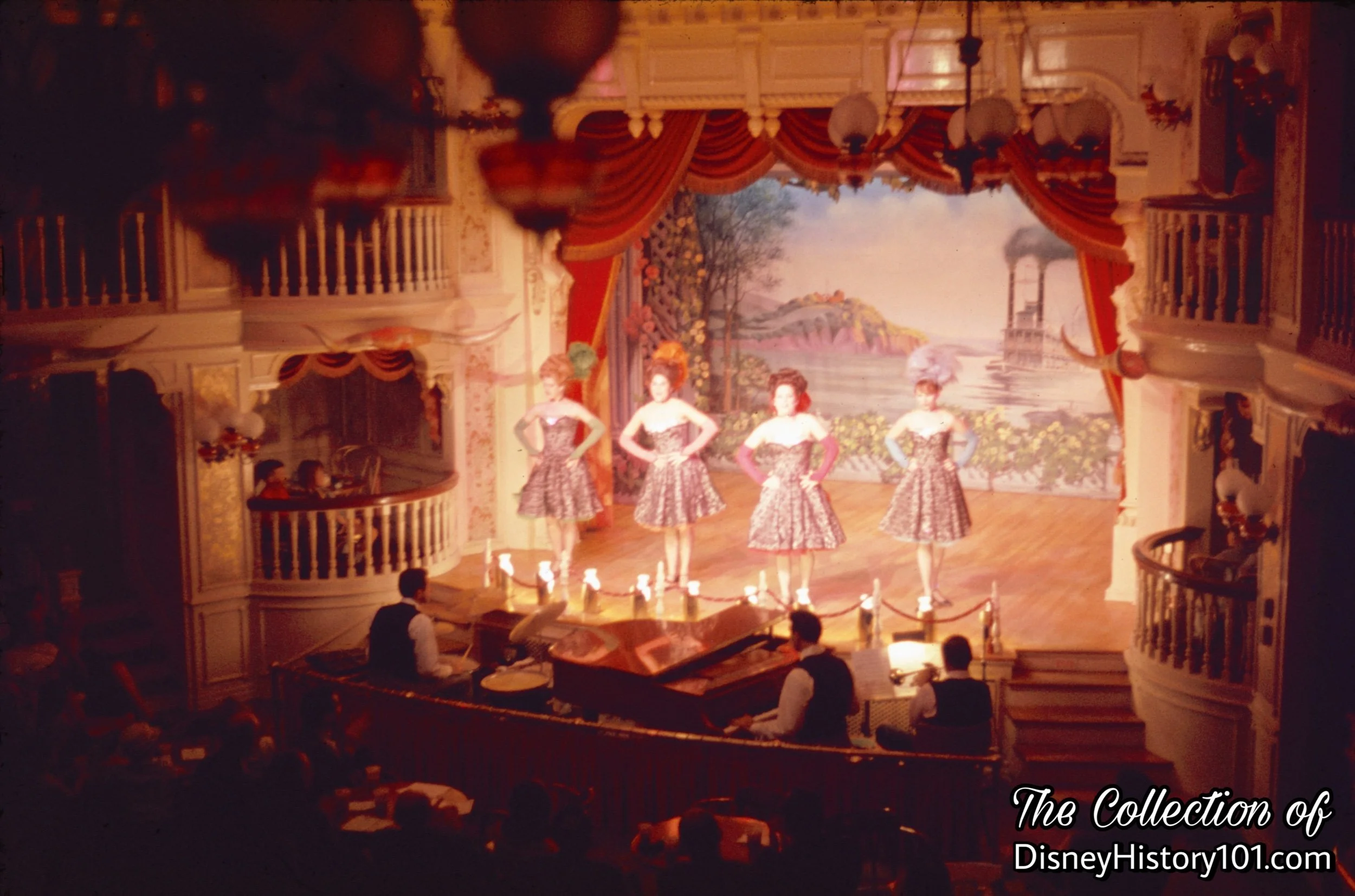
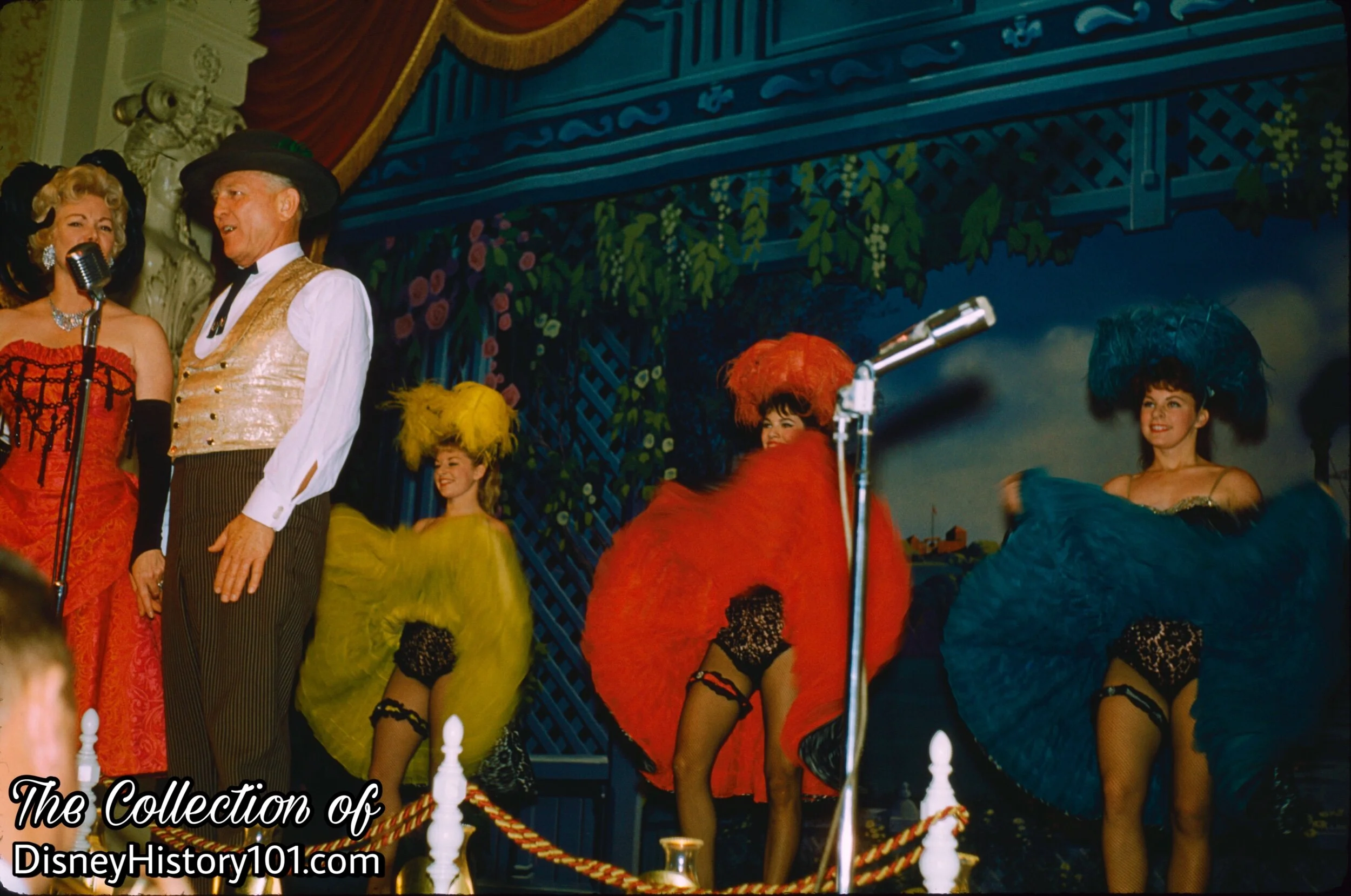
Donald Novis Leads Betty Taylor and the Golden Horseshoe Dancers, (October, 1961)
Donald Novis was “one of America's most versatile entertainers as co-emcee of the American Broadcasting Company radio program ‘Walt Disney's Magic Kingdom,’” according to the Disneyland News, published December 10, 1955.
“Donald, a veteran of more than two decades on the boards and behind the mike, might to day be employing his talents on a college athletic field if it hadn't been for a chance contest he entered while in college.
Donald orginally planned to be an athletic instructor but a radio singer competition sponsored by Atwater Kent caught his atten-tion.
The competition, which took a full year to decide, offered a $6,000 first prize and Don, who had been singing his way since high school days in his home-town of Pasadena, saw an excellent opportunity to cash in on his talent.
Some 63,000 entrants tried out with him but when the music had cleared Donald was the win-ner. Contract offers poured in so fast he "forced" says he was almost to become an entertainer.
The prestige that winning the Kent Contest gave won a contract at Los Angeles Coconut Grove where he stayed some 18 months, still a record for a single act.
During the middle 1930's Novis appeared on the New York stage - in such productions as "Jumbo, with Jimmy Durante, and later on network radio with Morton a Downey in a program that be came known as the "Battle of the Tenors."
Later Novis was a regular on the "Fibber Magee" radio program and in recent years has toured Australia with a musical comedy show.
Donald met Walt Disney more than 20 years ago. Both are members of the Legion of Honor of the De Molay, a distinction shared by only a dozen other show business people.
When the call came from his old friend to star in the first Golden Horseshoe show at Dis-neyland, Don was more than glad to accept. He now says his Disneyland association is one of the happiest of his career.
Donald is married and the father of two girls, Carol Jean, 16, and Leslie Katherine, 12.
His wife, the former Dorothy Brad-shaw, he met in the cast of ‘Jumbo.’
The British-born, Pasadena-“
Betty Taylor, Donald Novis, and the gorgeous Golden Horseshoe Can-Can Dancers perform the introductory (and welcoming) acts as well as the reprisal lyrics of the Golden Horseshoe Revue’s theme! Though Donald Novis’ “vocal stylings set the standards for cabaret singers and he is credited with introducing such lasting hits as ‘Little Girl Blue’, ‘Charmaine’, ‘Sweet and Lovely’ and ‘My Romance’”, around these frontier parts he is well-known for co-writing the Golden Horseshoe Revue script, and performing in the show from 1955 to 1964.
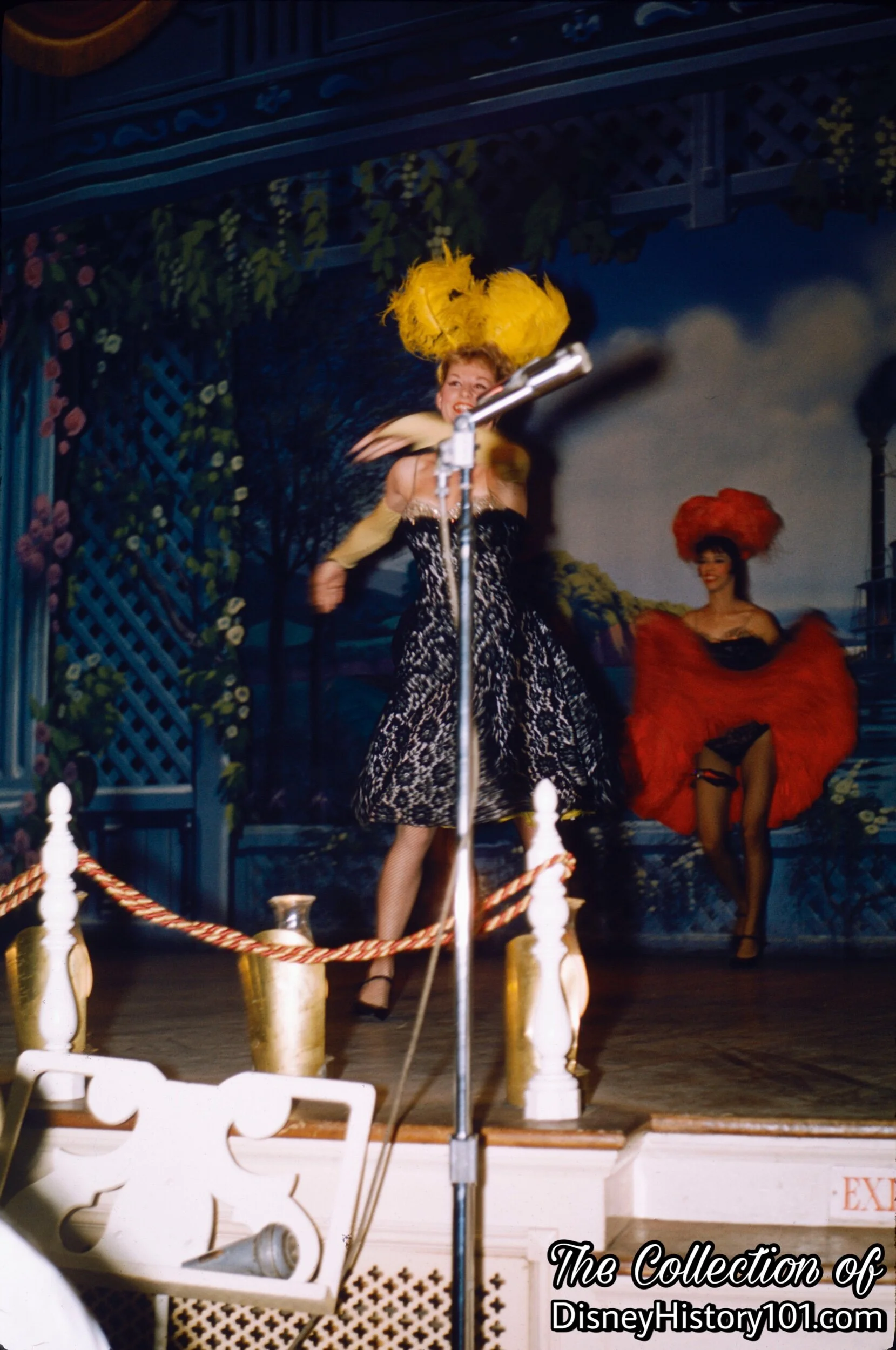
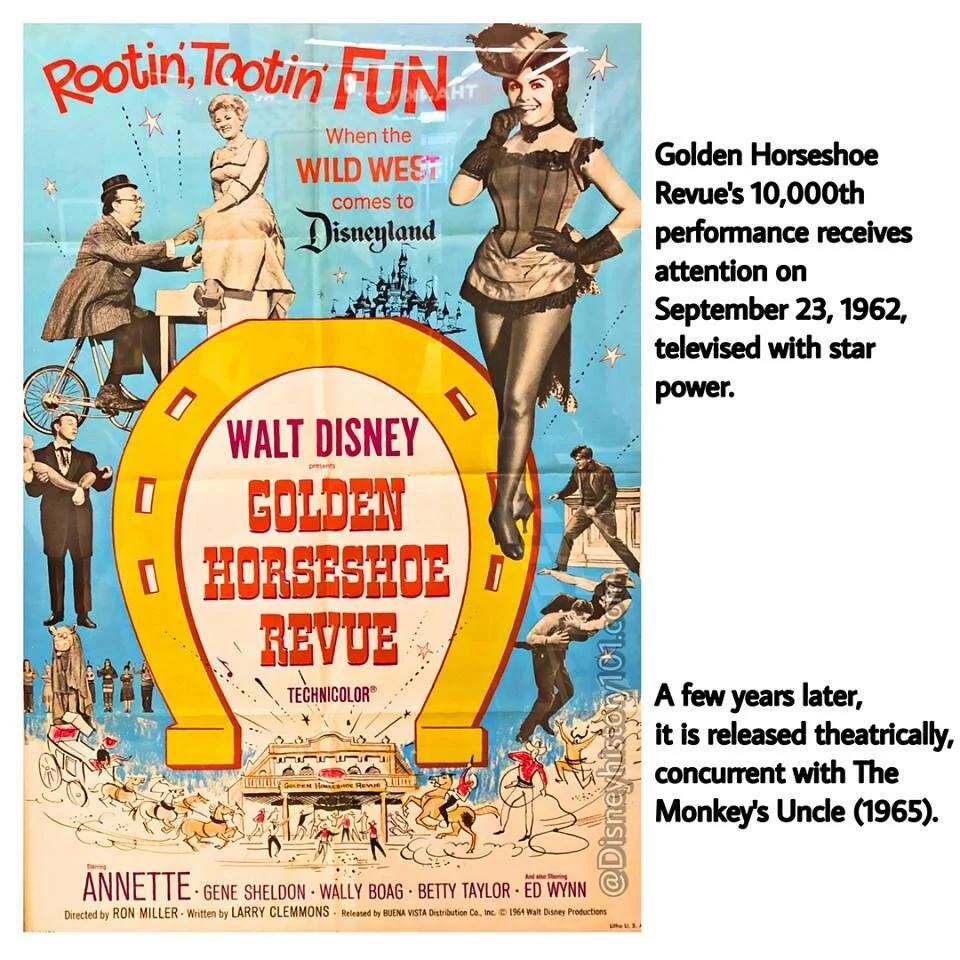
“The Golden Horseshoe Revue”, The Wonderful World of Color, September 23, 1962
The 10,000th performance of the Golden Horseshoe Revue was commemorated with a Wonderful World of Color episode, that was also released theatrically! You may be amazed to find that this special was not recorded inside Slue Foot Sue’s Golden Horseshoe at Disneyland! There wasn’t room for the big bar room brawl, and the Indian Number, so a set was built at the Walt Disney Studios.
“Walt had grown up in the days of vaudeville, the inspiration for many of television's early stars, such as Milton Berle, Sid Caesar and the many performers on ‘The Ed Sullivan Show.’ Walt combined vaudeville, TV, and his beloved Disneyland in a 1962 ‘Walt Disney's Wonderful World of Color’ episode called ‘The Golden Horseshoe Revue.’ The show was a celebration of their 10,000th performance, and starred Annette, Ed Wynn, and the cast of the Golden Horseshoe Revue at Disneyland Park - Wally Boag, Fulton Burley and Betty Taylor. Annette was growing up and wanted to sing a ‘sexy’ number, so we wrote her an old-fashioned tune called ‘Hang A Lantern In Your Window.’ When the boys in the Golden Horseshoe started booing, she ripped off her prim-and-proper skirt and went into a razz-ma-tazz song-and-dance routine called ‘Mister Piano Man.’ It was quite a new look for everyone's favorite Mouseketeer - the ‘girl next door’ Annette. The film was released theatrically as a featurette in Europe in 1963, and in the United States in 1964.”
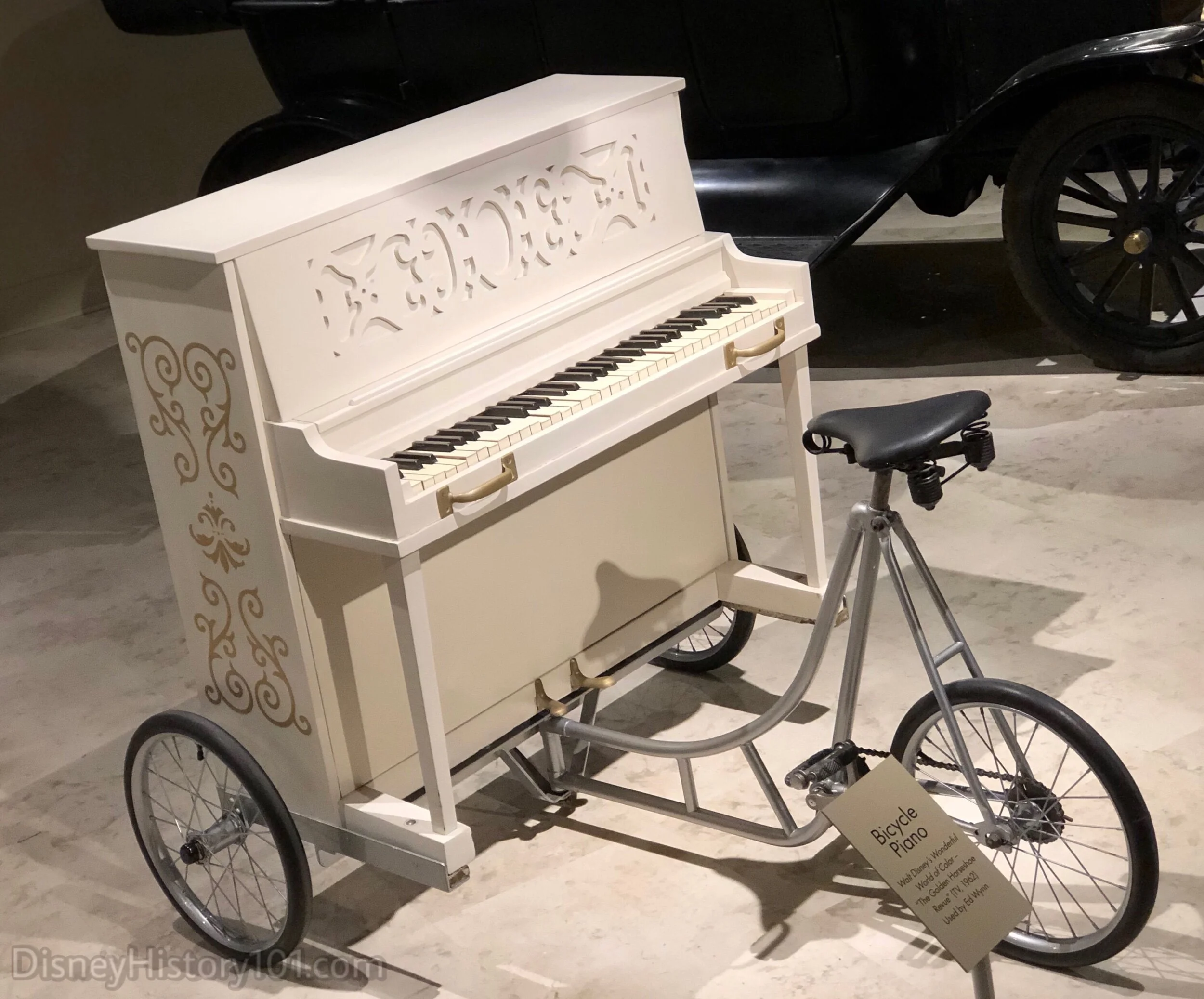
Ed Wynn’s Piano Bicycle as seen in “The Golden Horseshoe Revue”, The Wonderful World of Color, September 23, 1962
Al Jolson, Jimmy Durante, Eddie Cantor, Édith Piaf, and others sang duets atop Ed Wynn’s Piano Bicycle. Ed Wynn even rode his piano bicycle on “The Ed Wynn Show”, and performed his vaudeville routine with Dinah Shore (in 1949). More than a decade later, Wynn would again tune up his mobile instrument for a television special. Ed would accompany Betty Taylor in a rendition of “Tea for Two”, in “The Golden Horseshoe Revue” (a 1962 episode of Disneyland).
Ed Wynn’s Piano Bicycle also inspired a vehicle driven (and played) by Rod Miller for the Disneyland 35th Anniversary Party Gras Parade. A similar bicycle-propelled player piano also made an appearance at Walt Disney World Magic Kingdom.
Years later, (thanks to the granddaughter of Ed Wynn), Ed Wynn’s Piano Bicycle came to be part of “The Walt Disney Archives - 50 Years of Preserving the Magic” exhibit at the Bowers Museum (pictured).
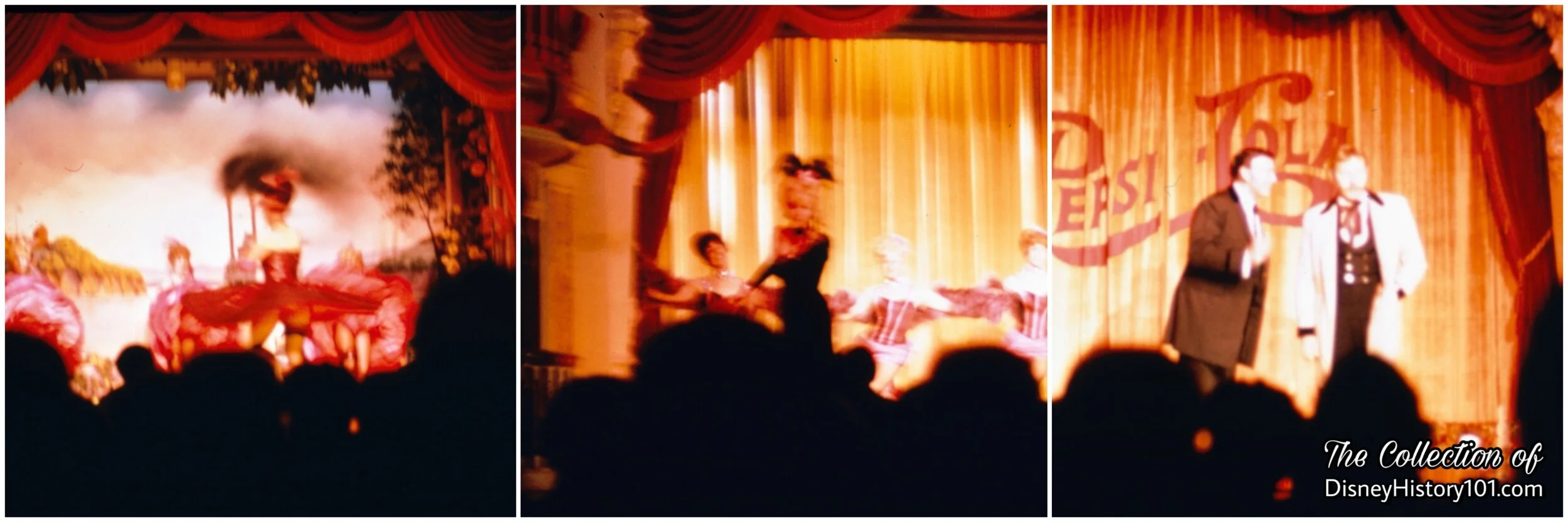
(November, 1973)
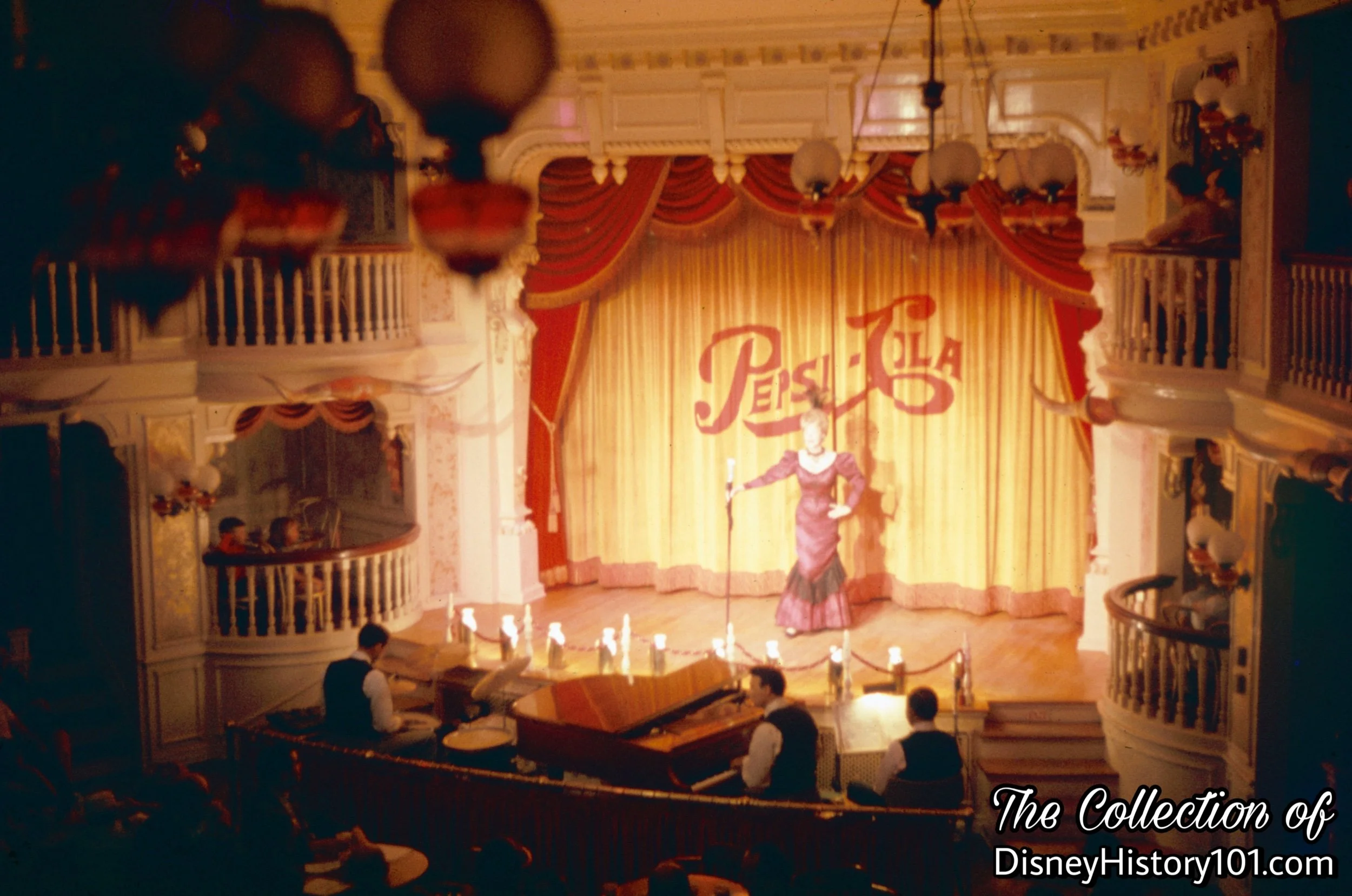
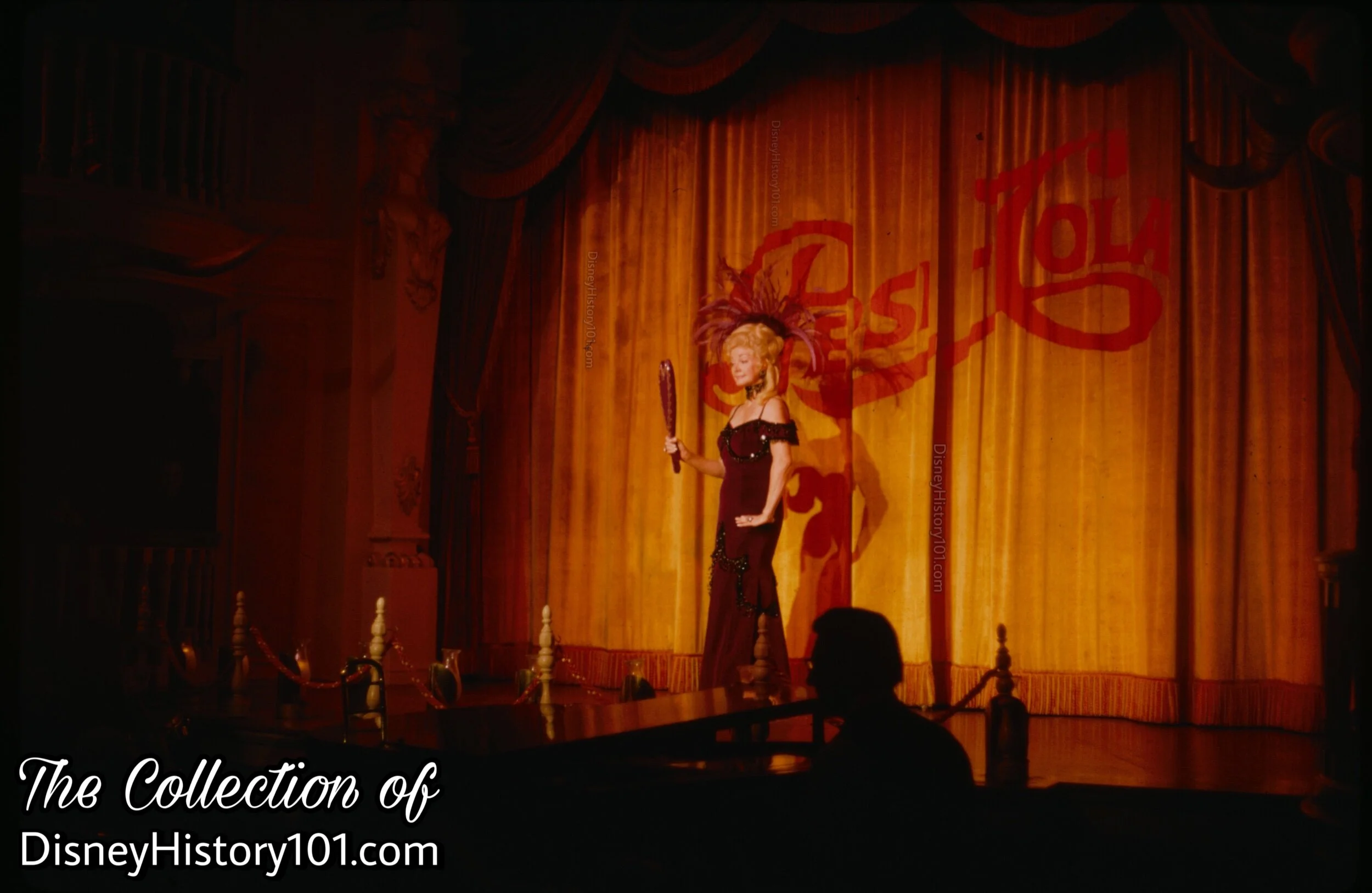
Slue Foot Sue (Betty Taylor) sings solo.
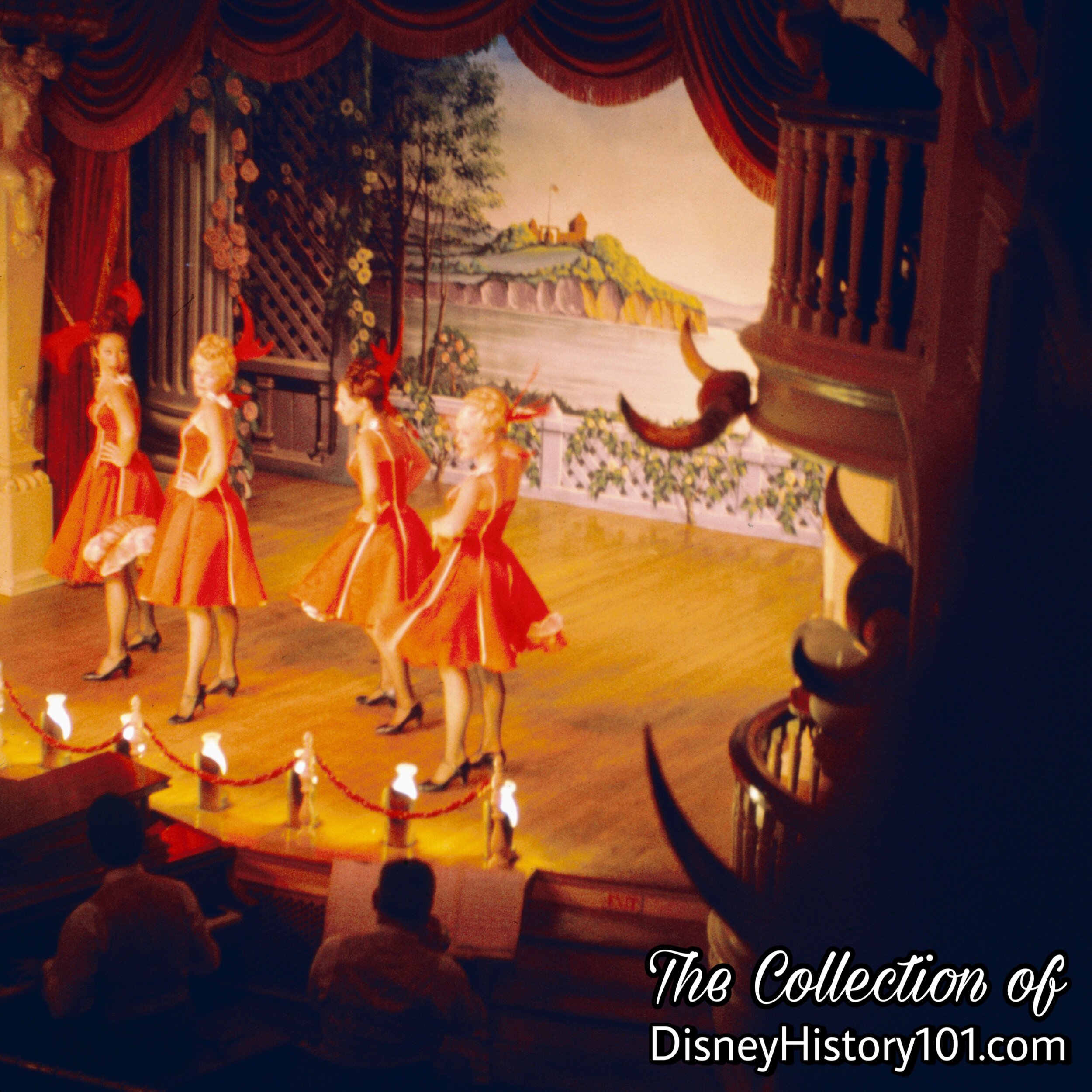
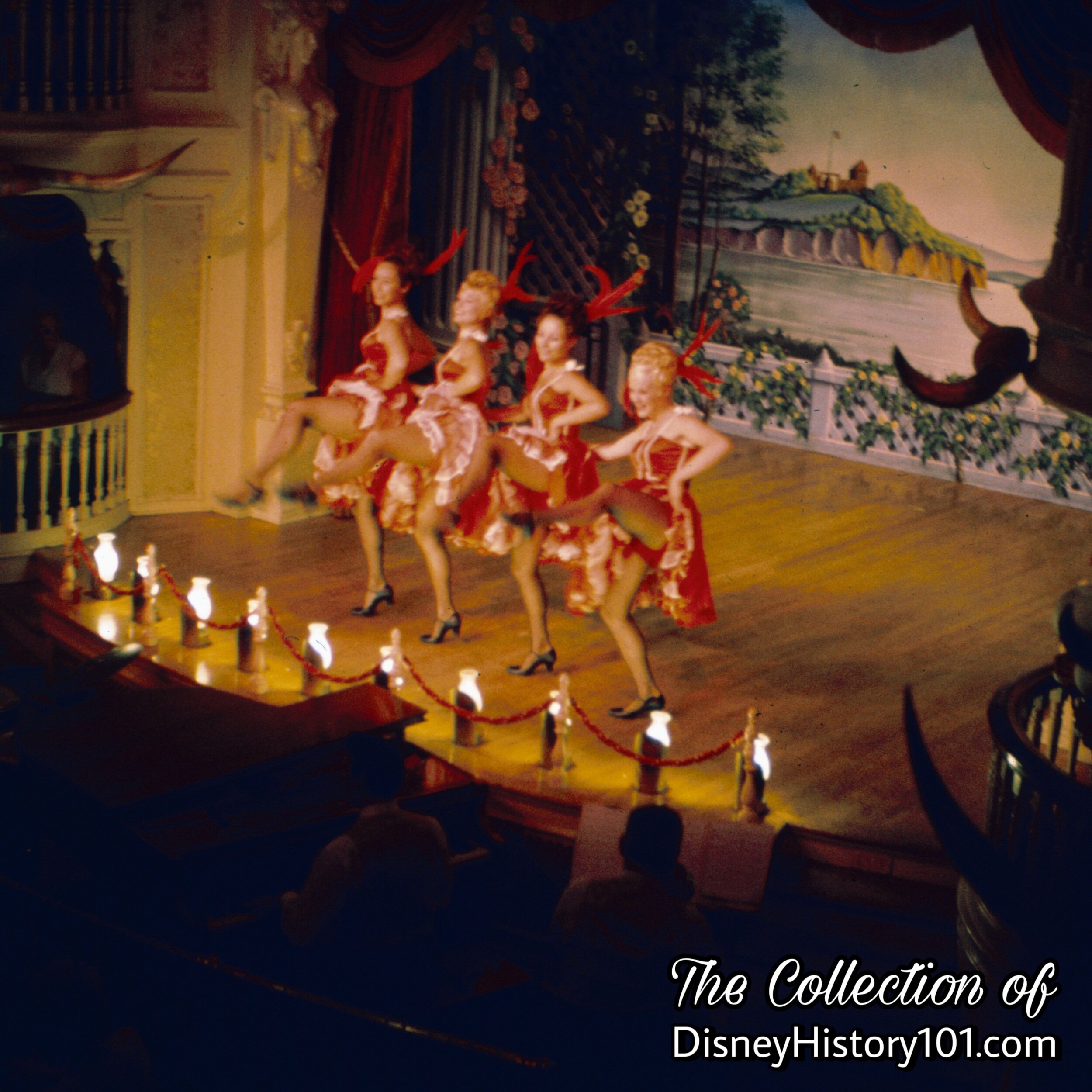
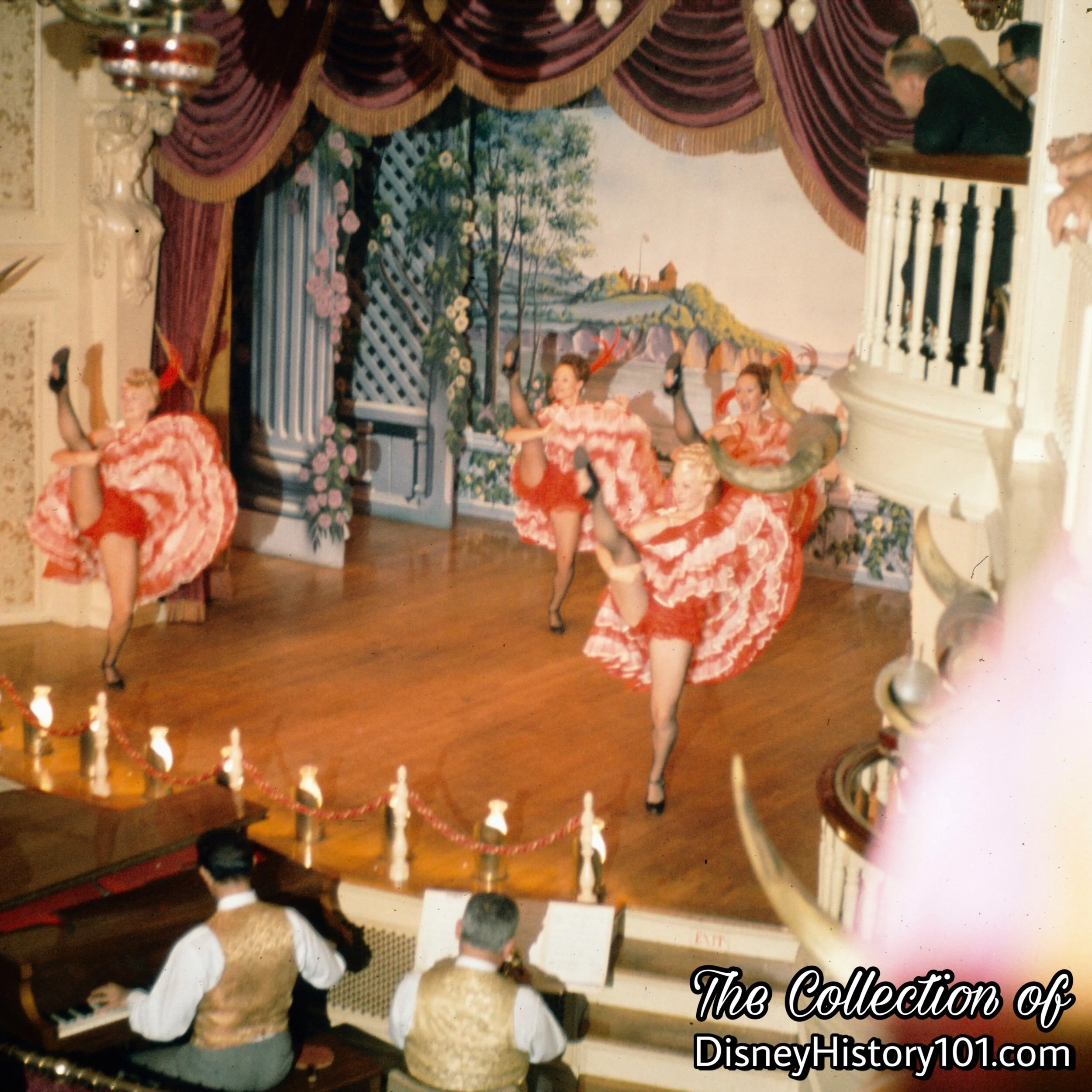
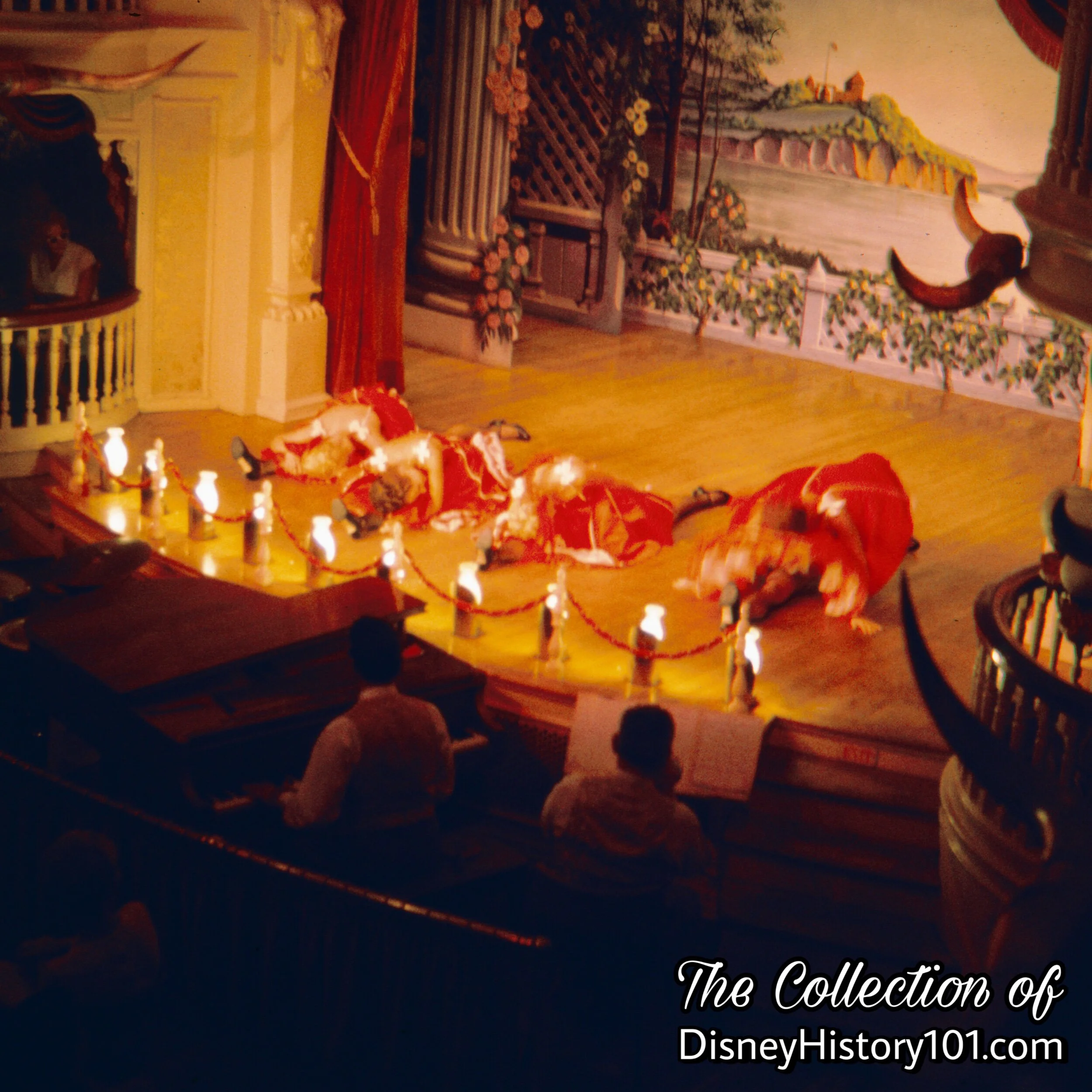
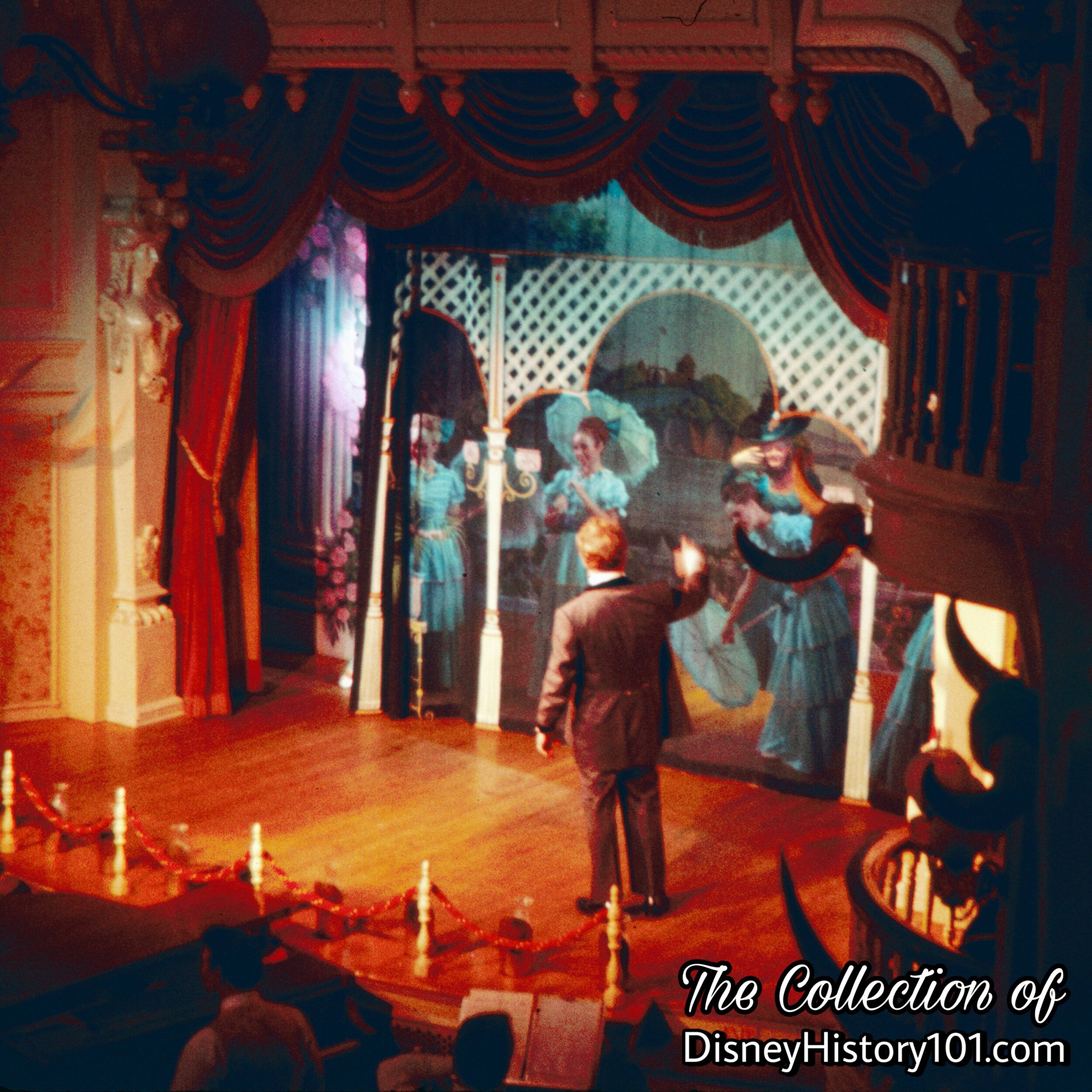
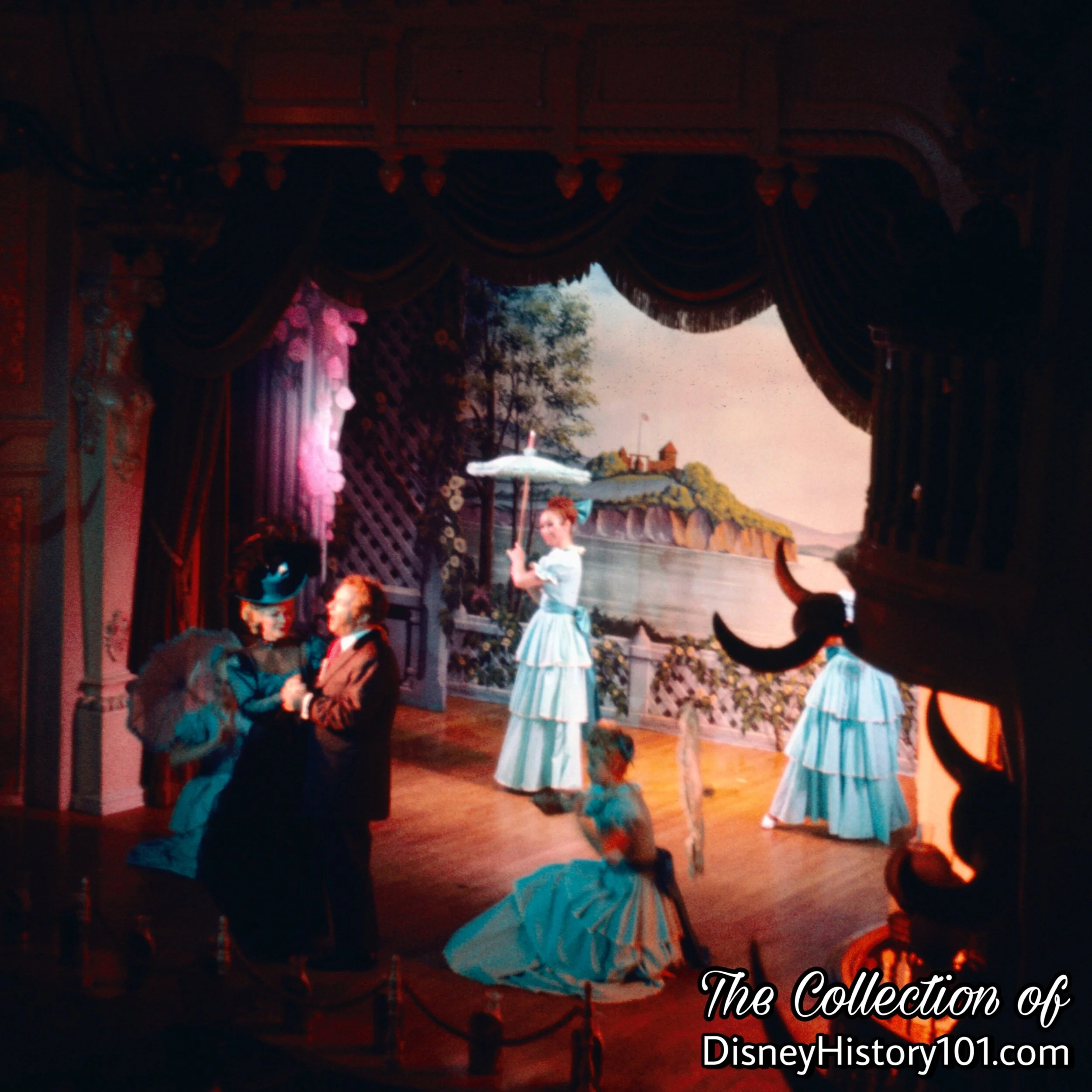
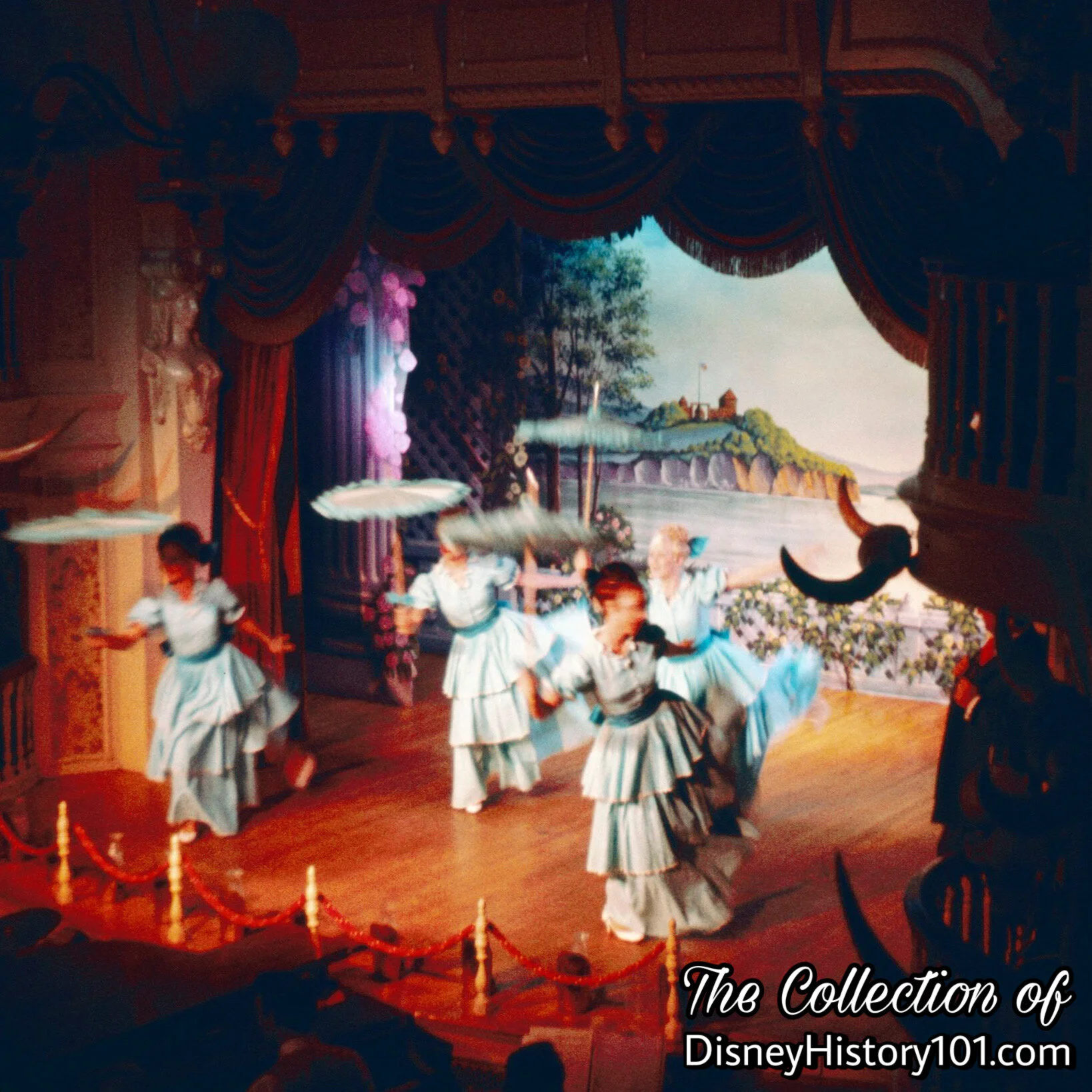
The Golden Horseshoe Girls perform a waltz is performed in three-quarter time.
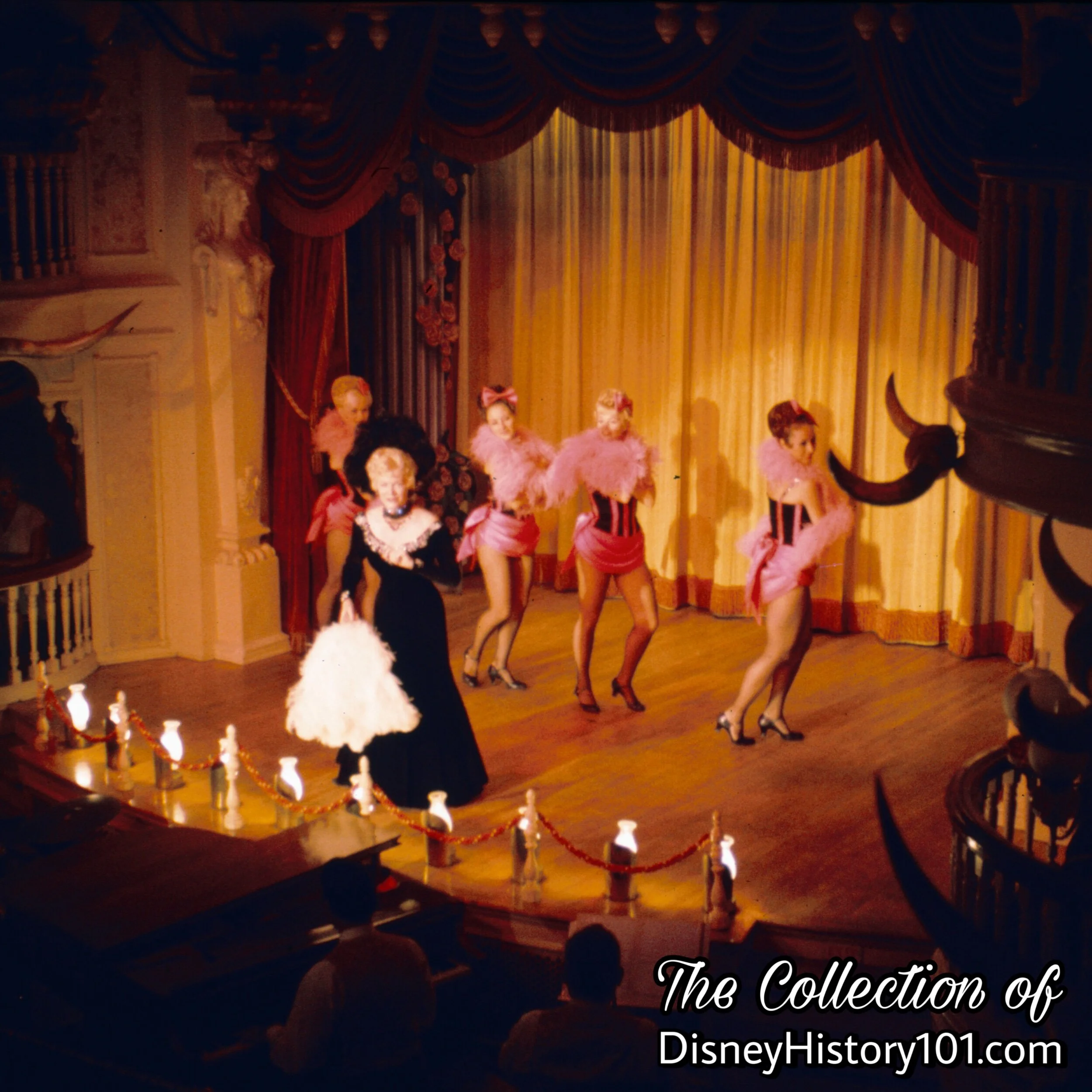
This is followed by a “capricious Can-Can.”
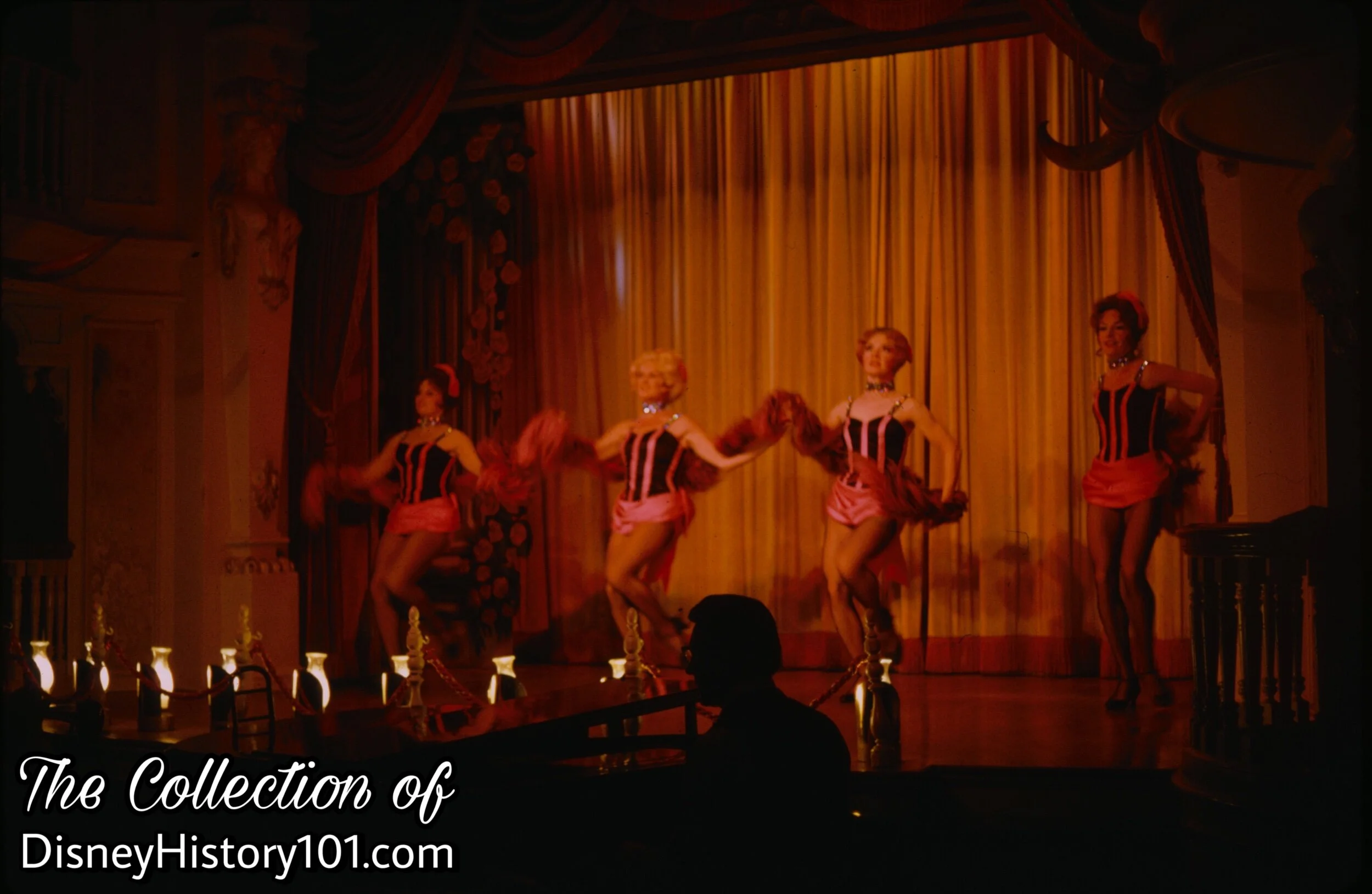
(November, 1973)
Those gorgeous Golden Horseshoe Dancers perform a rousing chorus line for their number! This promises to be one “scintillatin, syncopatin, gay ninety show”!
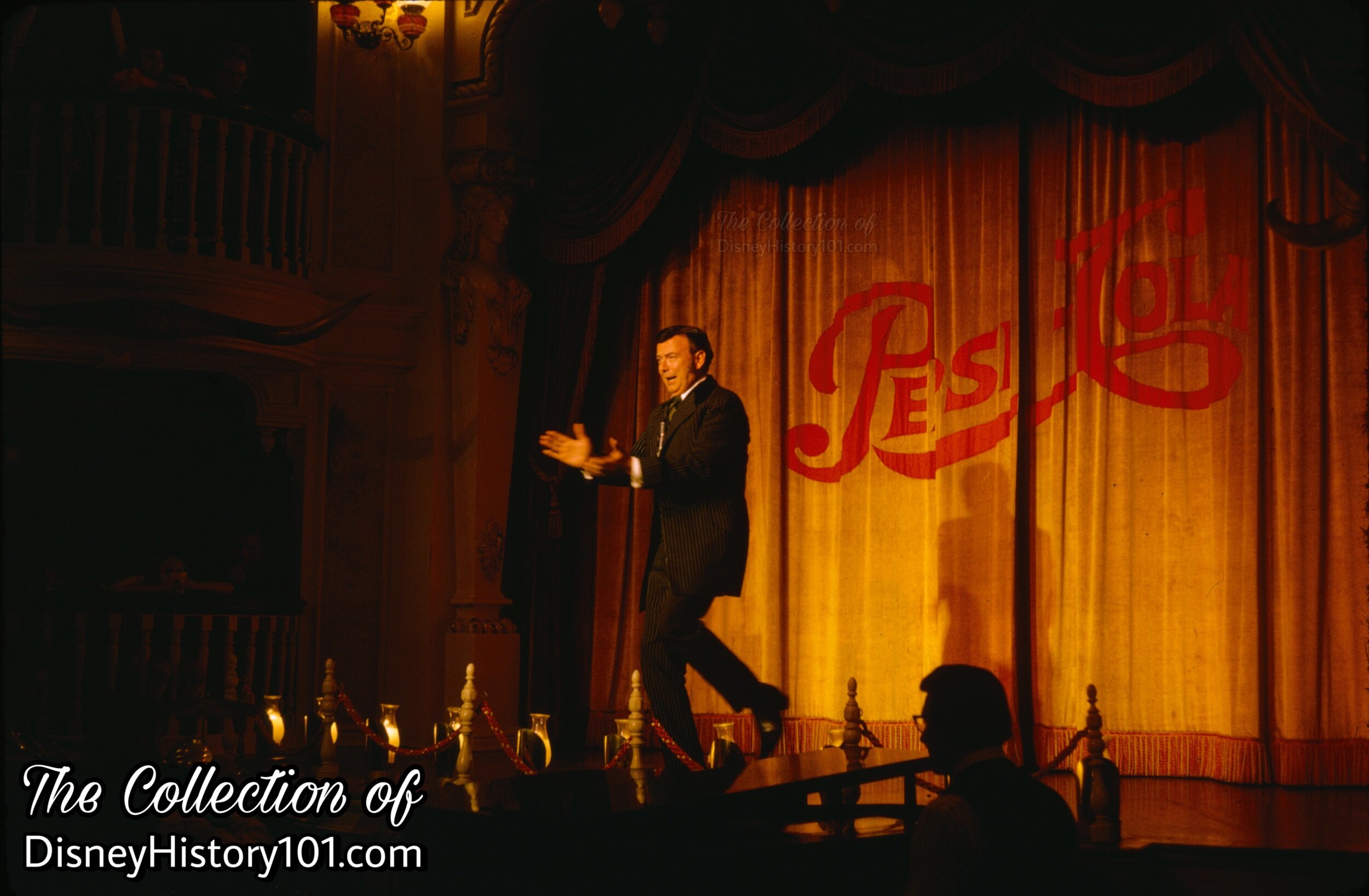
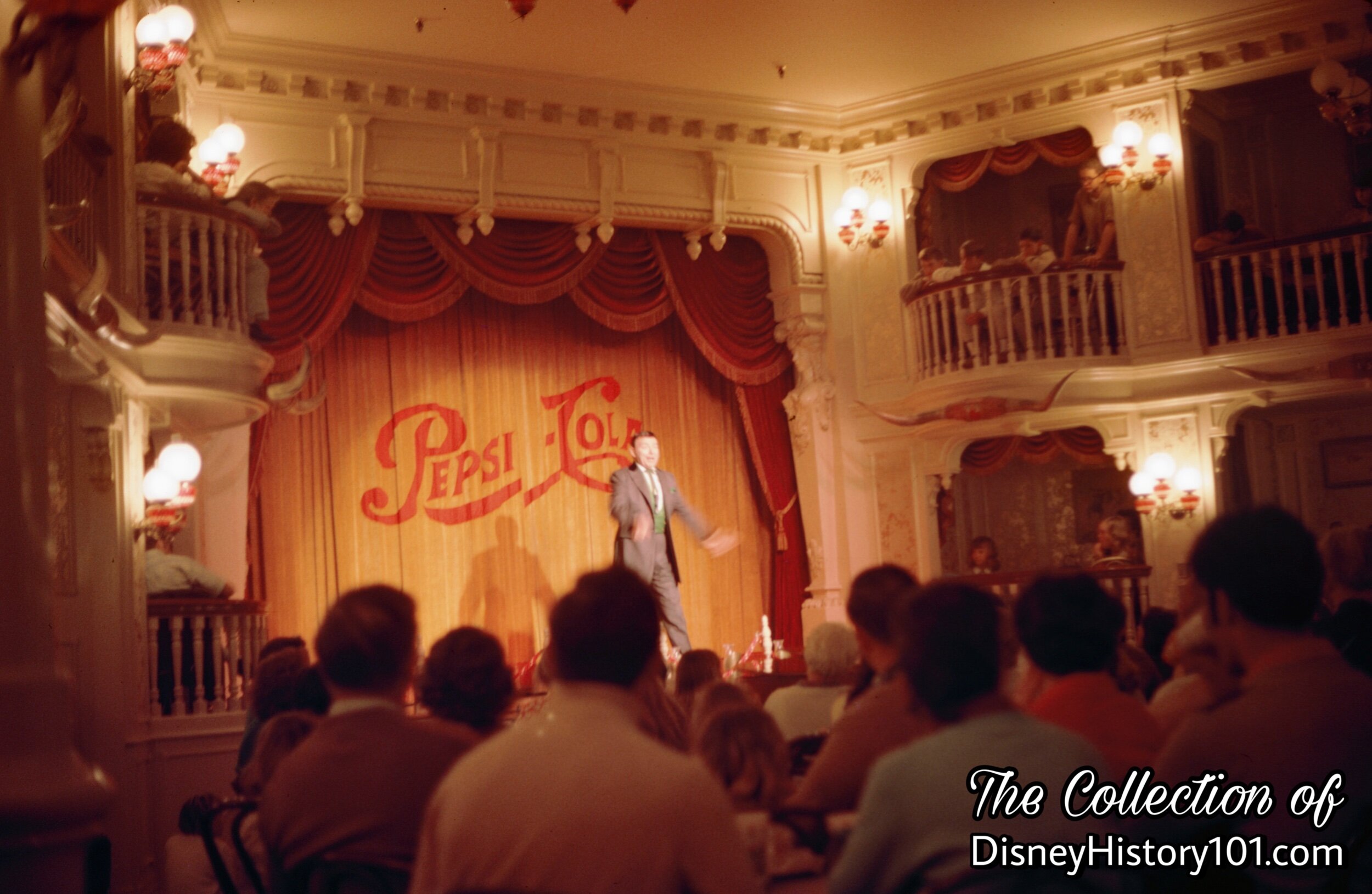
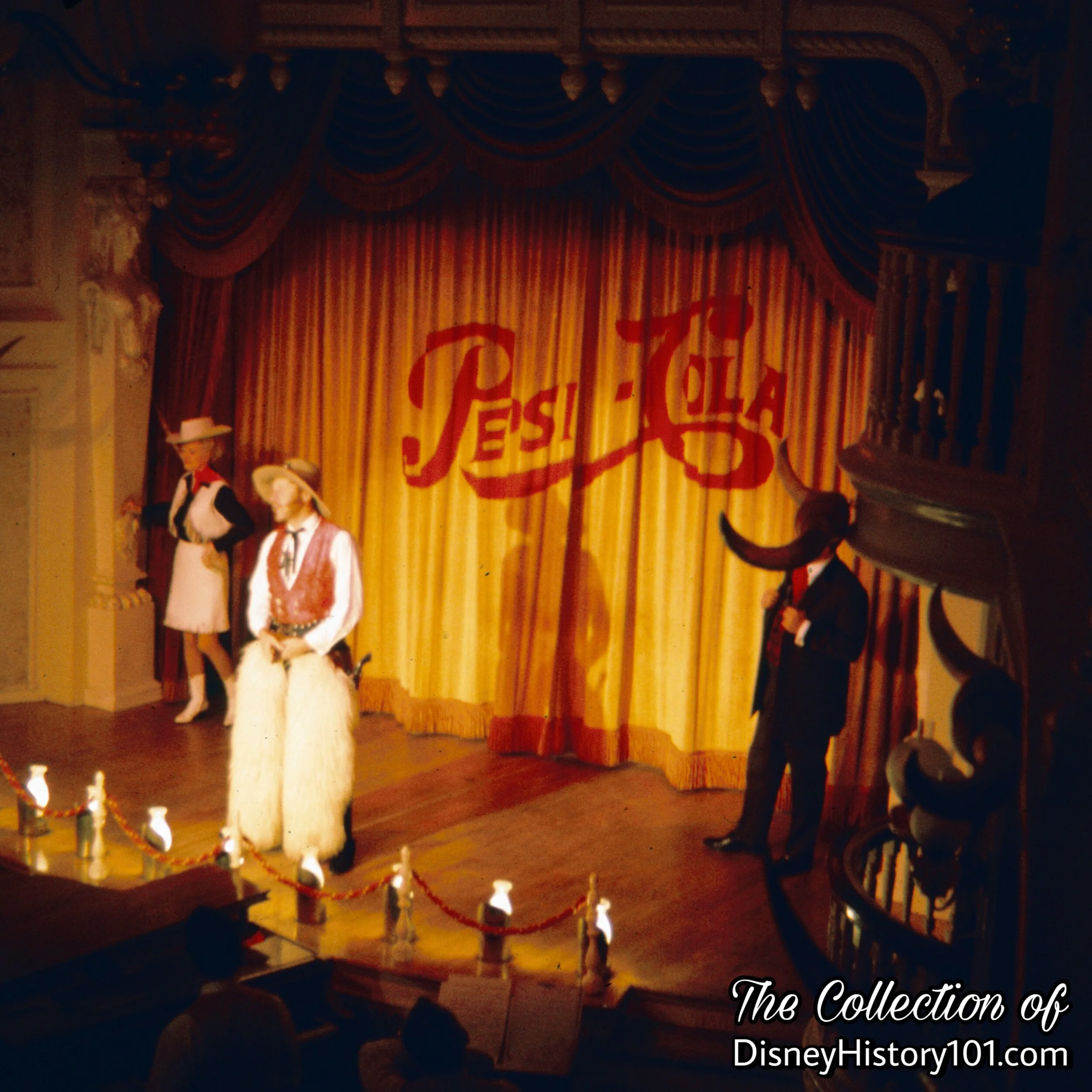
(November, 1973)
Dear Old Francis Fulton Burley (of Disneyland Entertainment and Talent) welcomes the audience to the Golden Horseshoe!
Fulton Burley was a native of Kincardine, Ontario, Canada. He is most remembered as the co-host of the Golden Horseshoe Revue, and his rendition of “Clancy Lowered the Boom” was an audience favorite! His talent for captivating an audience would allow Fulton to take part in special events outside of Disneyland. Don Payne (a contemporary Golden Horseshoe Revue Cast Member) remembers just a few of Fulton’s Disney-related contributions :
“He came into the show in 1962, when Donald Novis had to retire for health issues. Wally brought him in. They had previously known each other when they were under contract with MGM.”
According to Vacationland (Fall of 1964), “His rousing renditions of ‘Clancy lowered the Boom’ is a special fan favorite of many. His by-play with Wally Boag usually sees Burley come out on the short end.”
Don Payne continues : “Fulton stayed with the Revue until the show’s run ended…[Fulton] also, did three national, promotional tours together for Buena Vista’s re-release of Dumbo, Pinocchio and 101 Dalmatians.”
You can still hear Fulton’s voice inside Disneyland today as Michael, the parrot - one of the emcees of Walt Disney’s Enchanted Tiki Room.
“Golden Horseshoe Tribute During Disneyland’s 25th Anniversary”
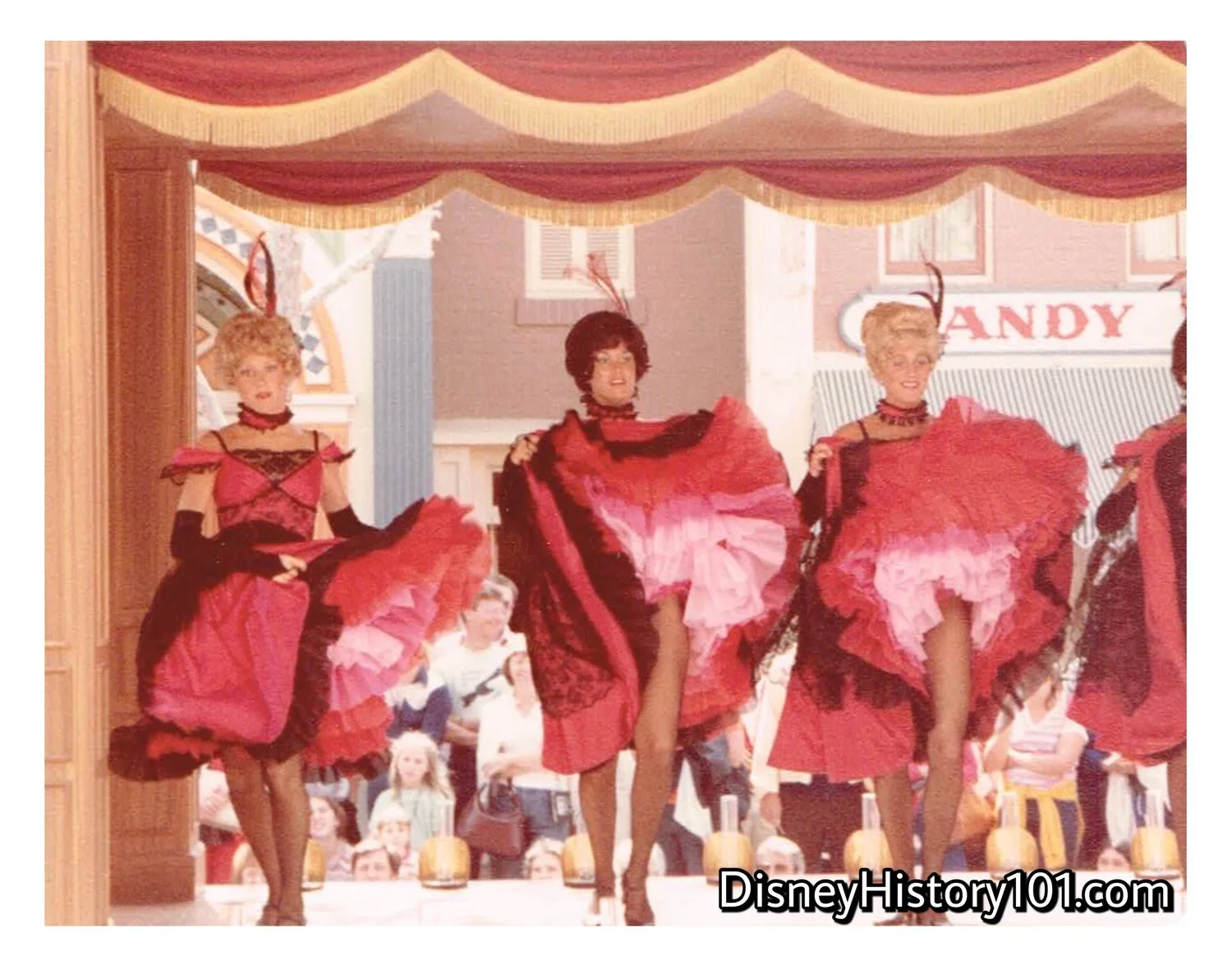
Yes, those are Can-Can girls performing on Main Street U.S.A.! The iconic and record-breaking show was commemorated with this parade float and unit during the Disneyland 25th Anniversary parade in 1980!
Disneyland Drama Workshop put on stage show productions for employees and their families. Former Disneyland Drama Workshop alumn Tom Pletts recalls, “From the few rehearsal schedules I've kept, and my recollections, each production took about a month or so to put together. Rehearsals were planned around the Park's hours, the availability of the stage, and the cast members' (literally) work schedules. We'd squeeze in an average of 15 rehearsals.“
Many of these were performed from the Fantasyland Theater stage (which is why you’ll find a compendium rarely-seen photos of the Disneyland Drama Workshop’s 16 total productions inside our Fantasyland “Vintage View” Gallery)!
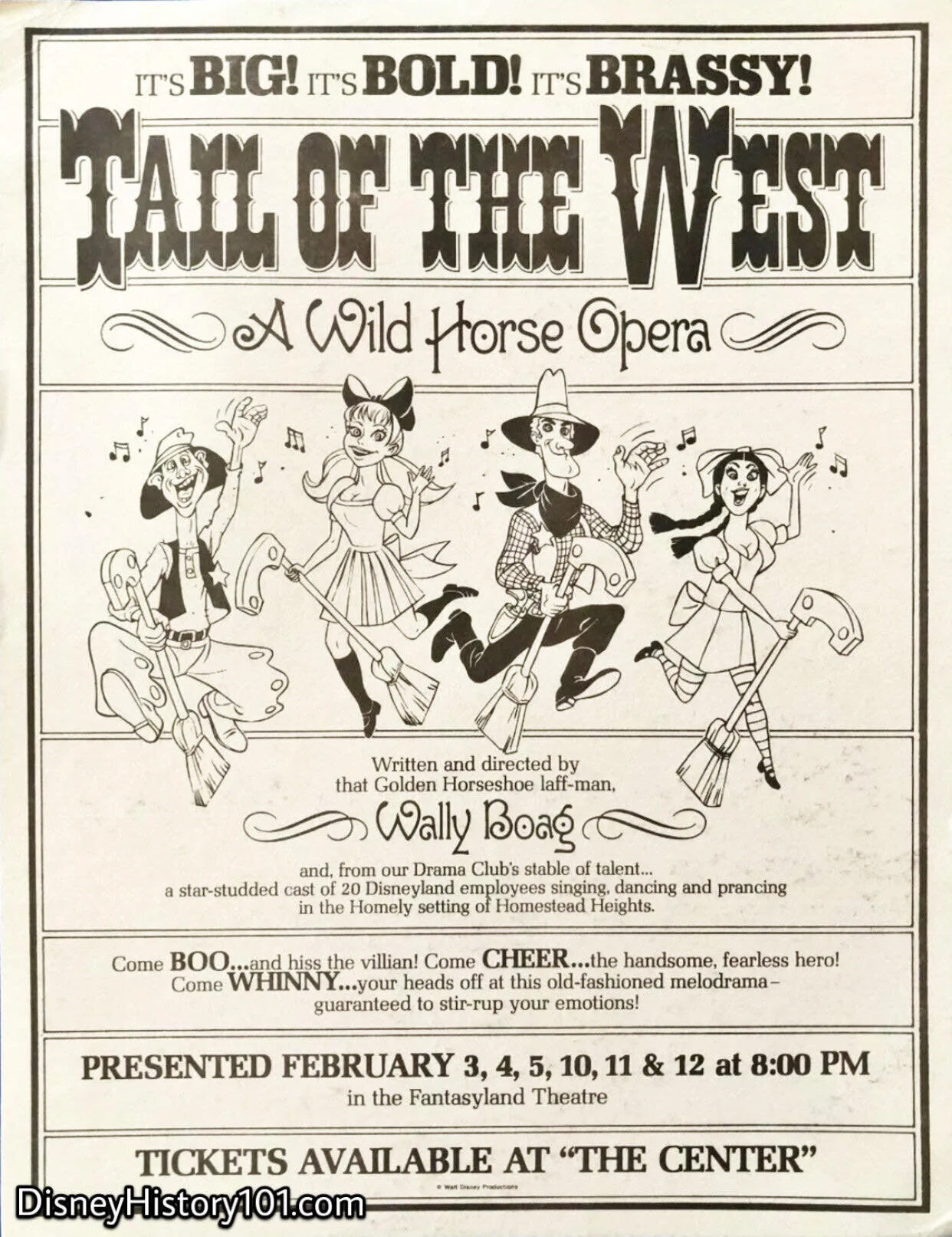
Wally Boag’s “Tail of the West” Poster, c. 1976
Former Disneyland Cast Member Tom Pletts gives us the following rare description of Wally Boag’s “Tail of the West" :
[The Tail of the West]…”is/was a vaudeville-styled melodrama, with a chorus and production numbers.
The story: after the townsfolk extoll the virtues of Homestead Heights, their new Marshall and his deputy find a name for their horse by doing a Lone Ranger sketch and dance (it's hard to explain). The heroine's grandfather loses the deed to his ranch (and the town's water rights) PLUS the hand of his granddaughter in a silly poker game with the villain (me). The deputy is talked into a shootout with Blackberry, but neither wins; so the heroine steals back the deed from the villain's pocket. After a strobe-light chase scene involving nearly everyone, she finally hides it! So he attempts to get it back by torturing her, poking swords through a trick box with her inside. The hero arrives in the nick of time, of course, and he engages the villain in a slow-motion sword fight (really). The town then rejoices, all of the romances are resolved and the audience applauds. This was performed in the Fantasyland Theater to give us more room for the dance numbers. My assigned mate was the deplorable Sludge, which was played by the actually delightful Pat Keener.”
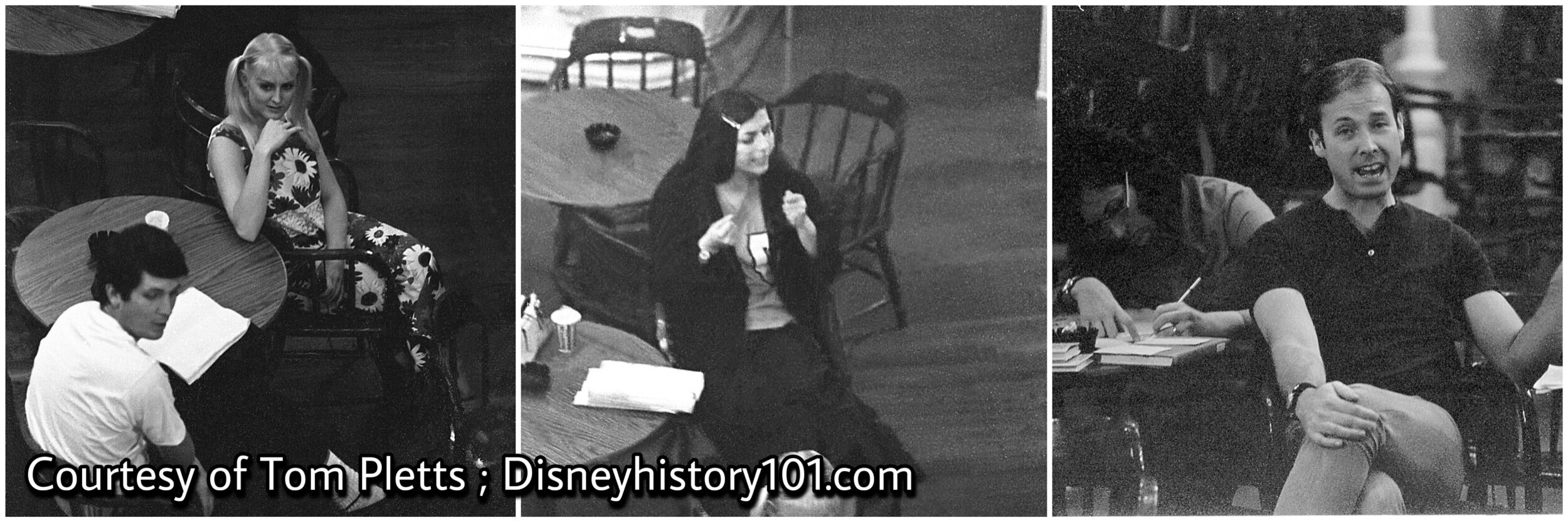
1971, Chicken Ranching For Fun & Profit Rehearsal at Slue Foot Sue’s Golden Horseshoe
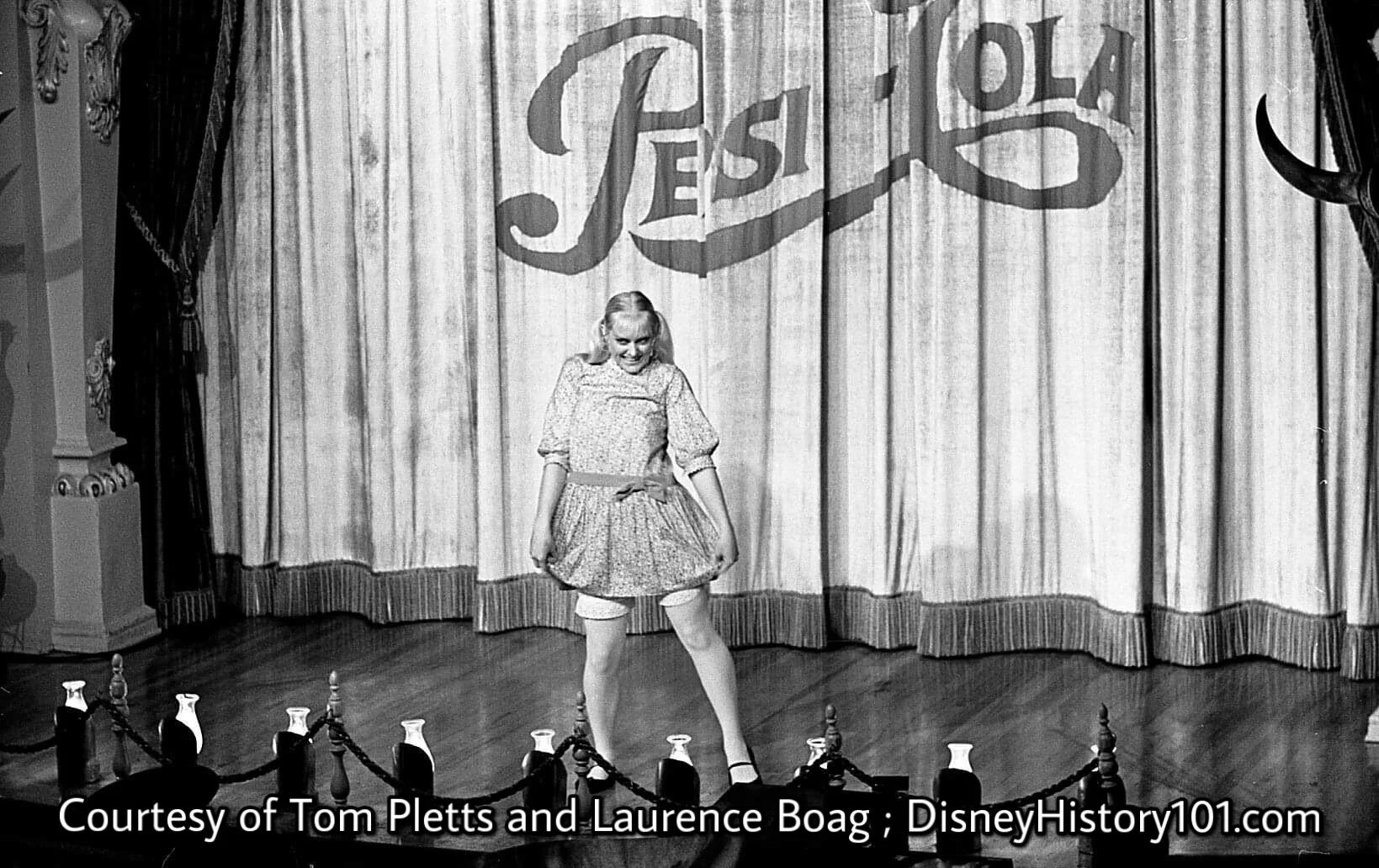
Former Disneylander Tom Pletts shares a few exclusive memories from the Disneyland Drama Workshop’s production of Chicken Ranching for Fun and Profit. You’re looking Disneyland Cast Members just sitting around in the Golden Horseshoe during an early read-through rehearsal (and perhaps a final rehearsal approval). From left to right : Ben Sherman and Bonnie (Sugar) ; Pat (Widow Blues) and Bonnie; Johnny Buckner (Victor Virtue) and an unidentified book worm. These shots were unseen by anyone else until now. As he looks over his photos, Tom expresses, “They're still a little raw, but they evoke very fond memories.”
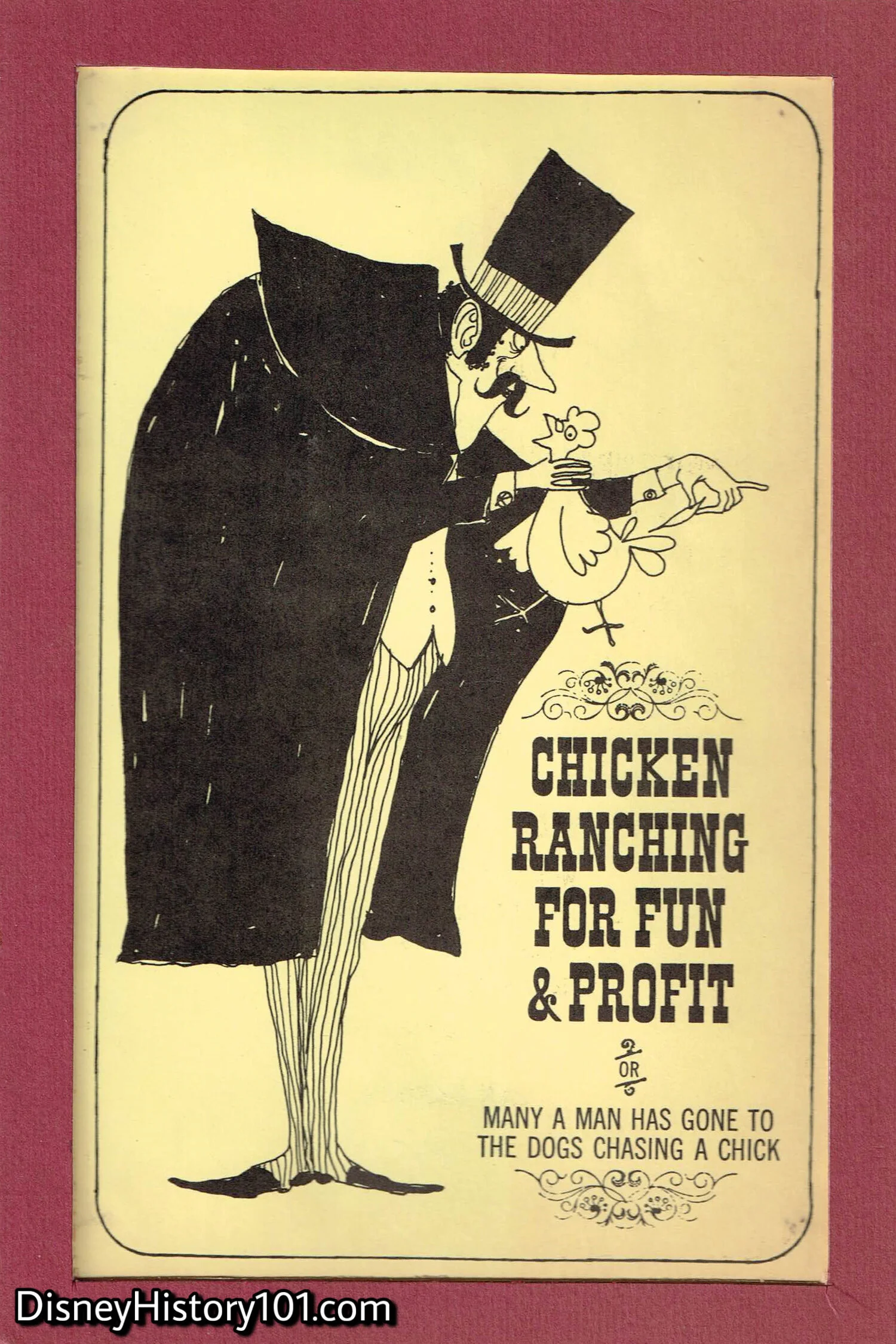
1971, Chicken Ranching For Fun & Profit - Artwork by Chuck Boyer.
Tom Pletts adds, "He [Chuck Boyer] was very kind to our little drama group.” Of course, Tom is referring to Chuck’s contribution of the program’s cover art. I wasn’t involved with that show, and can’t remember any specifics about it. As for posters or marquees, there wouldn’t be any for regular guests to see, and the FL Theater didn’t have a marquee. ‘Chicken Ranching’ might have had a poster in front of the Golden Horseshoe, since it had some public performances.”
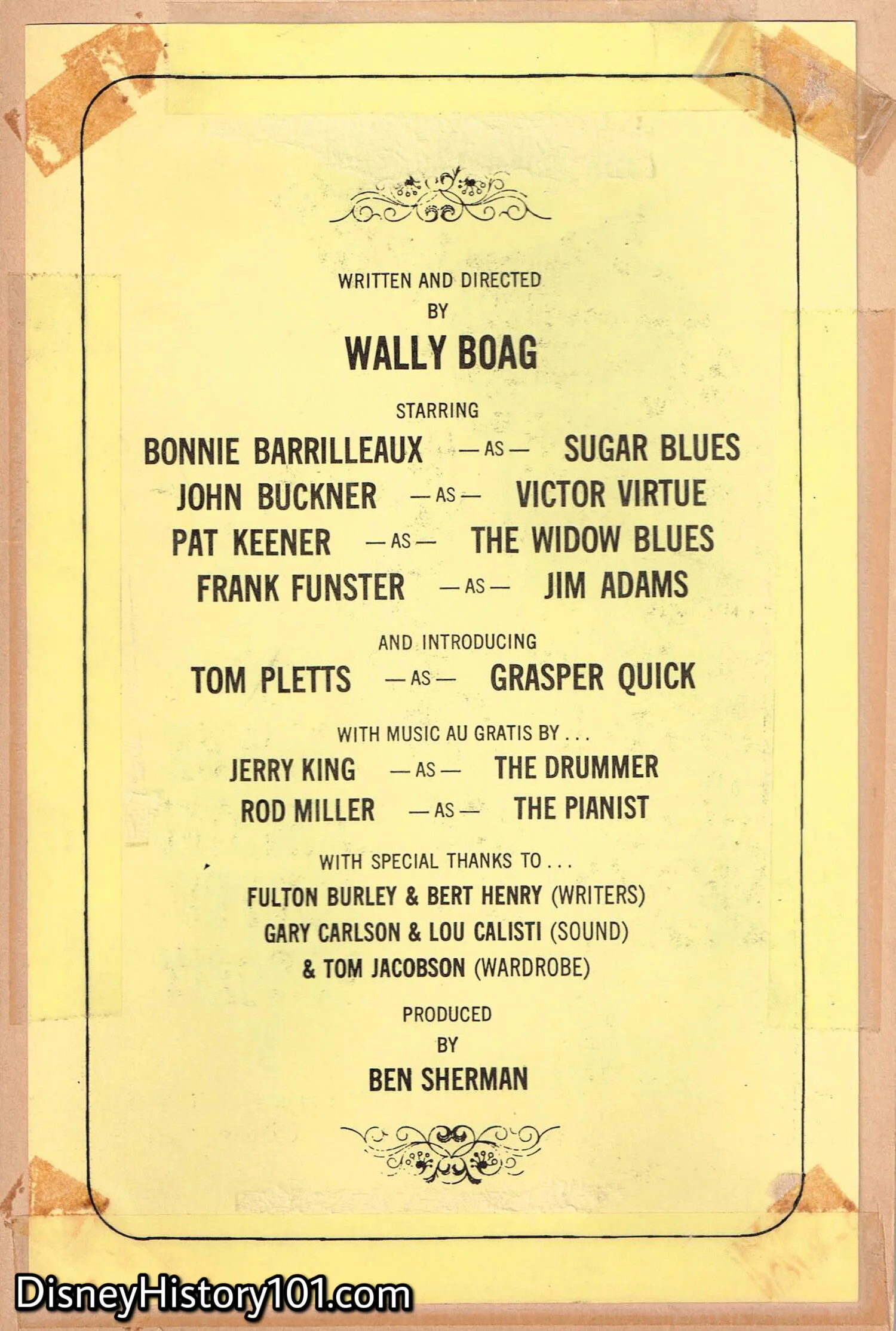
Chicken Ranching For Fun & Profit Program, c. 1971
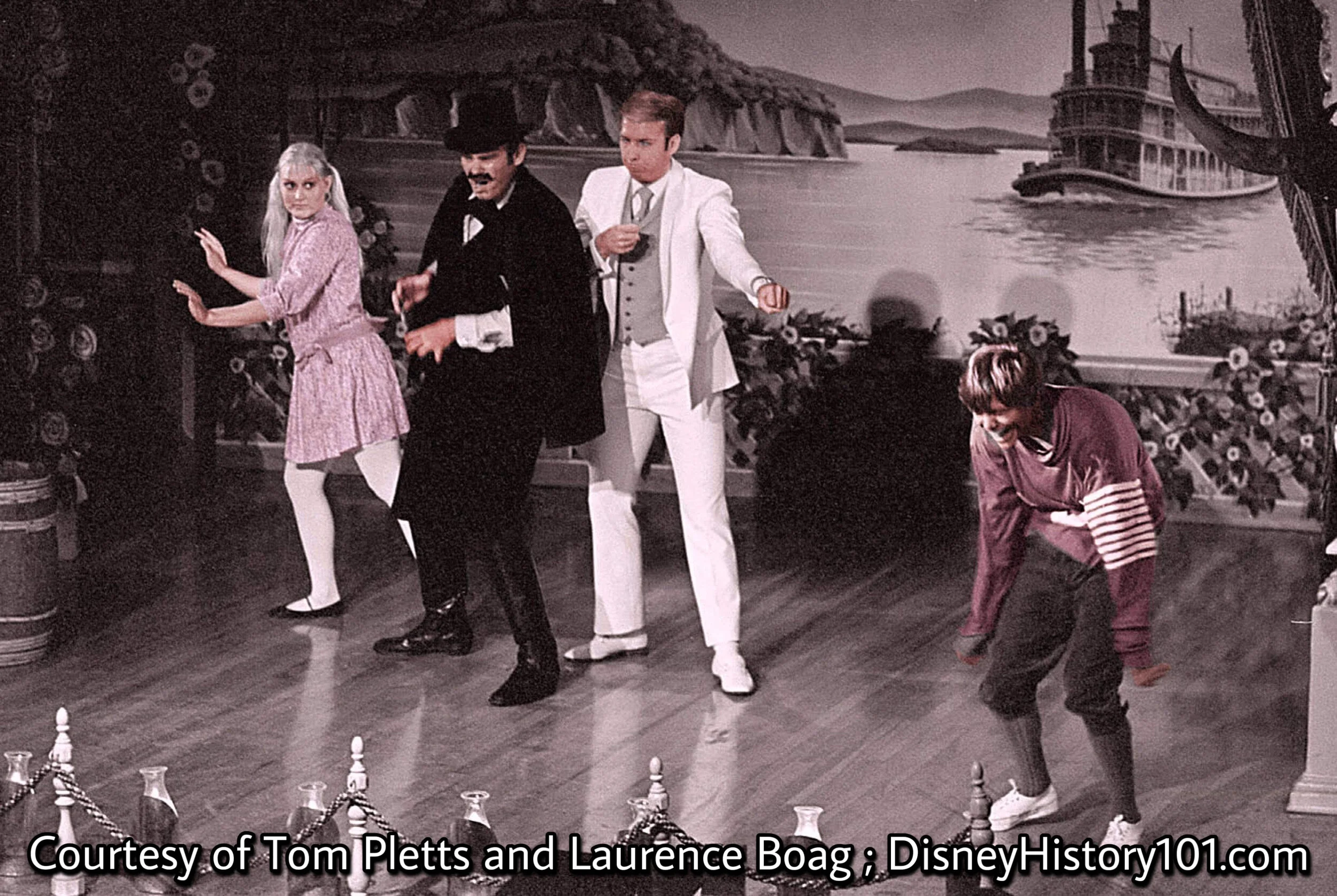
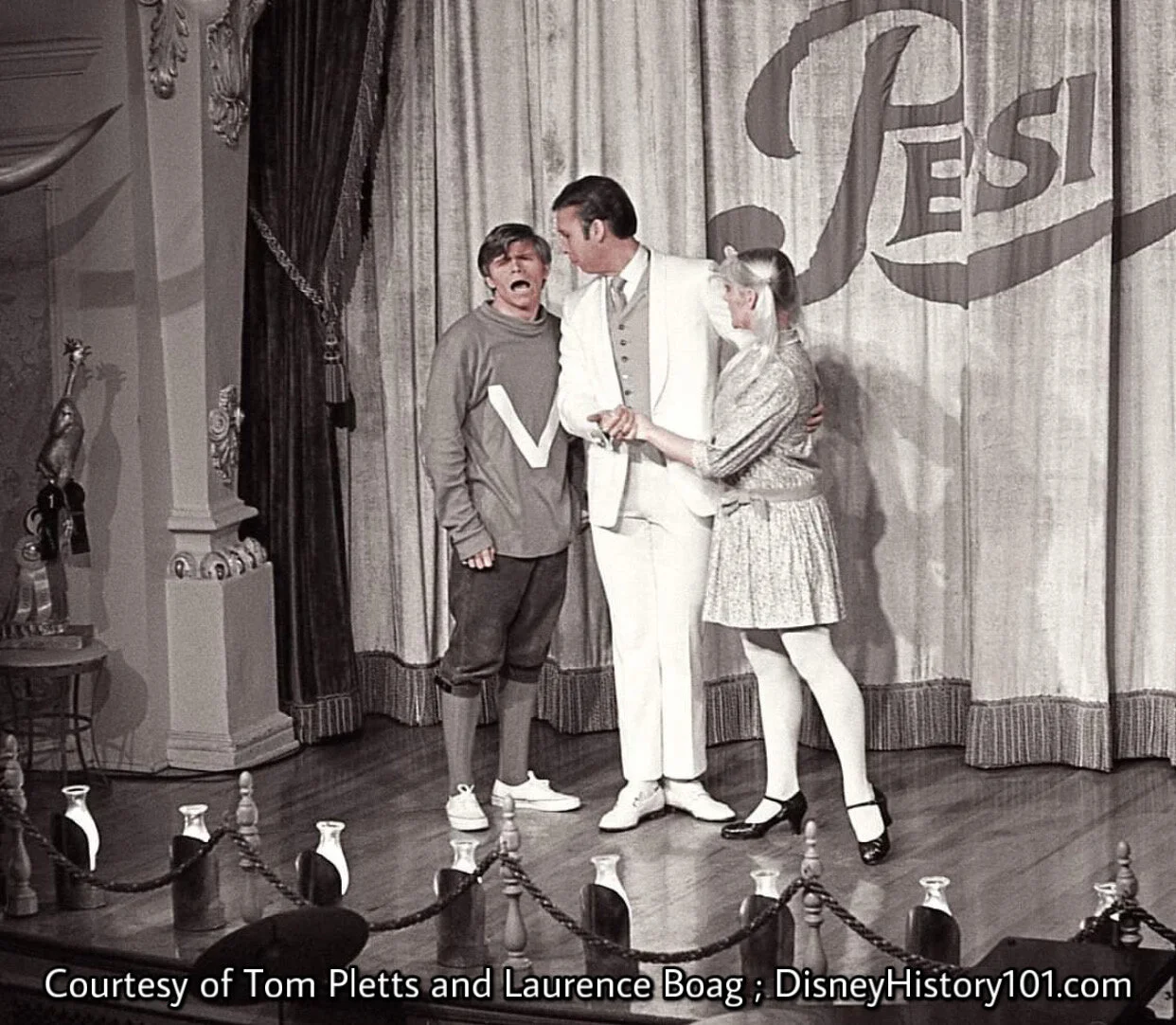
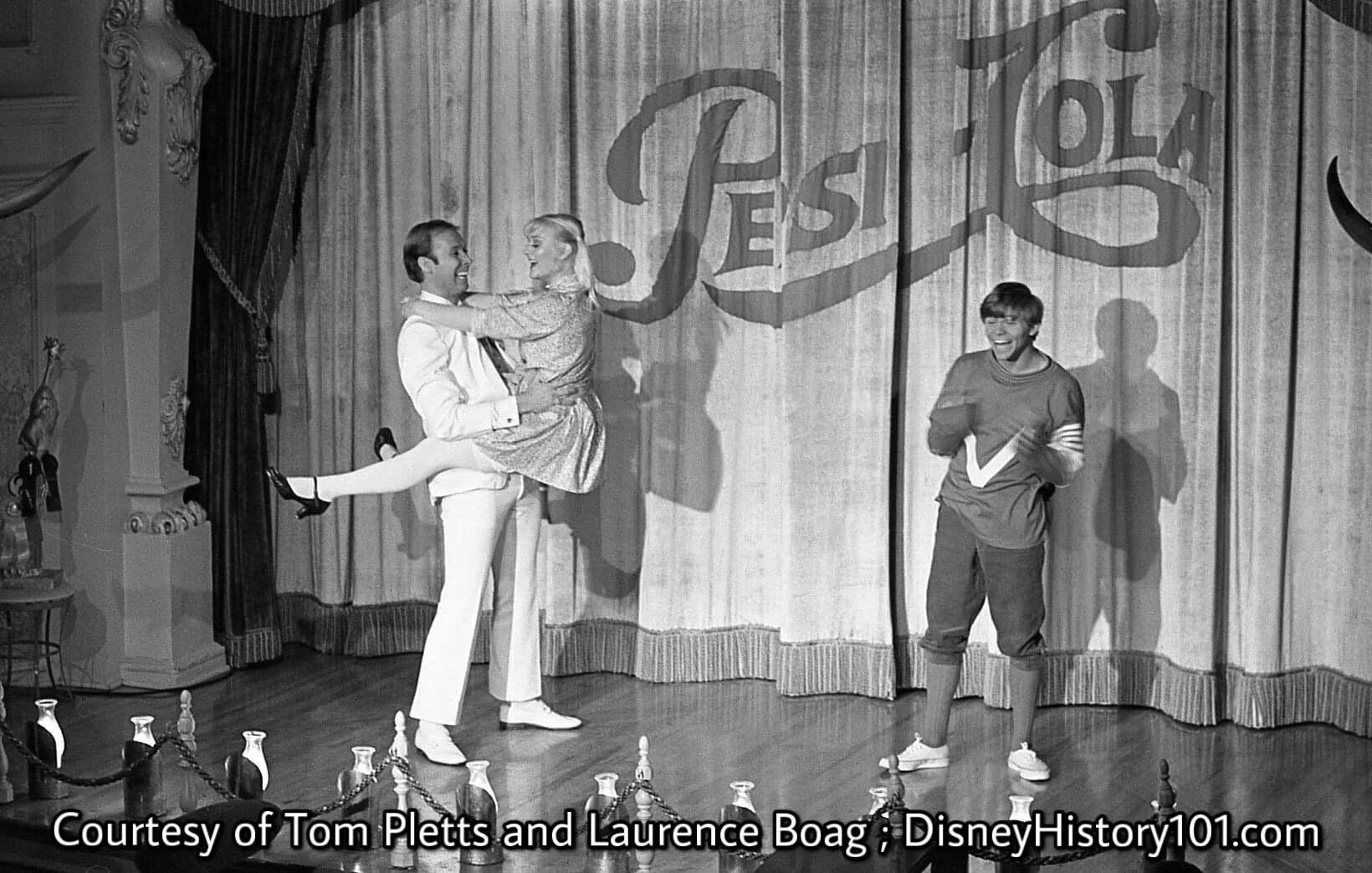
“The Plot : The villain Grasper Quick was going to foreclose on Widow Blues’ chicken ranch unless her daughter, Sugar Blues, married him. Sugar’s boyfriend and hero, Victor Virtue, and his friend, cheerleader Frank Funster vainly try to help. Sugar attempts to bribe Grasper by sending him all the eggs ; but, since he’s been secretly feeding her chickens gunpowder (don’t ask), they blow up his mansion (off stage, of course). It’s all sprinkled with running gags and a catchy tune or to. Fun stuff.”
“It’s kind of a “Vaudevillain" comic melodrama, and is only 30 minutes long (for audience turnover). Its title is “Chicken Ranching for Fun and Profit”…or, “Many A Man Has Gone to the Dogs Chasing a Chick”. Authorship is credited to Wally Boag, Fulton Burley, and Bert Henry. Jerry King, the regular Horseshoe drummer provided the rim-shots for us ; Rod Miller, the Coke Corner pianist, played excellent ragtime to keep the mood. I still get pumped for a show start when I hear ‘Maple Leaf Rag’!”
-Tom Pletts, (Grasper Quick)
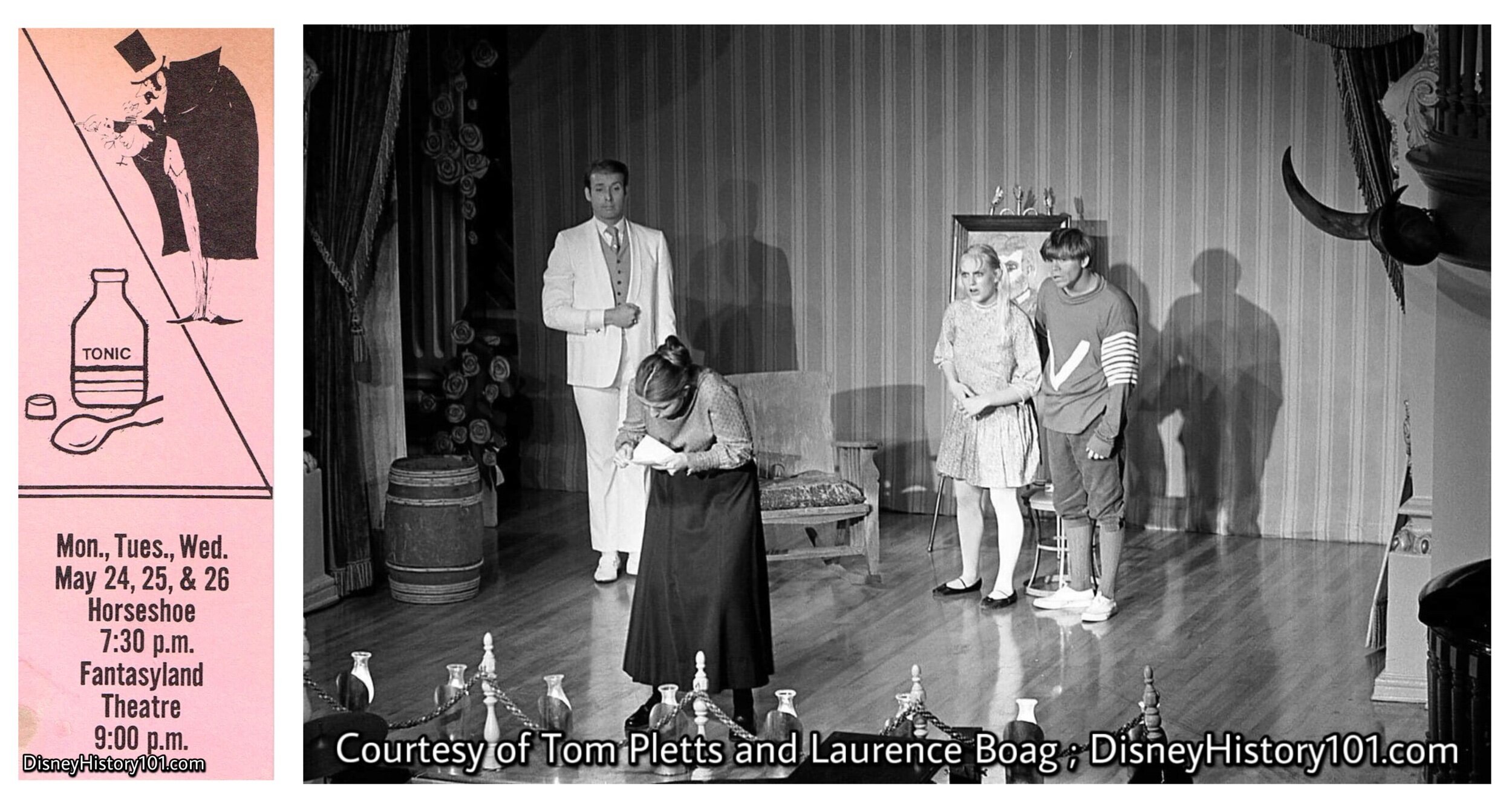
Chicken Ranching For Fun & Profit, 1971.
LEFT : Chicken Ranching For Fun & Profit Ticket Concept Art, c. 1971
RIGHT : In the foreground, you’ll notice Pat Keener, the Widow Blues, reading a mort-gage (as Wally preferred).
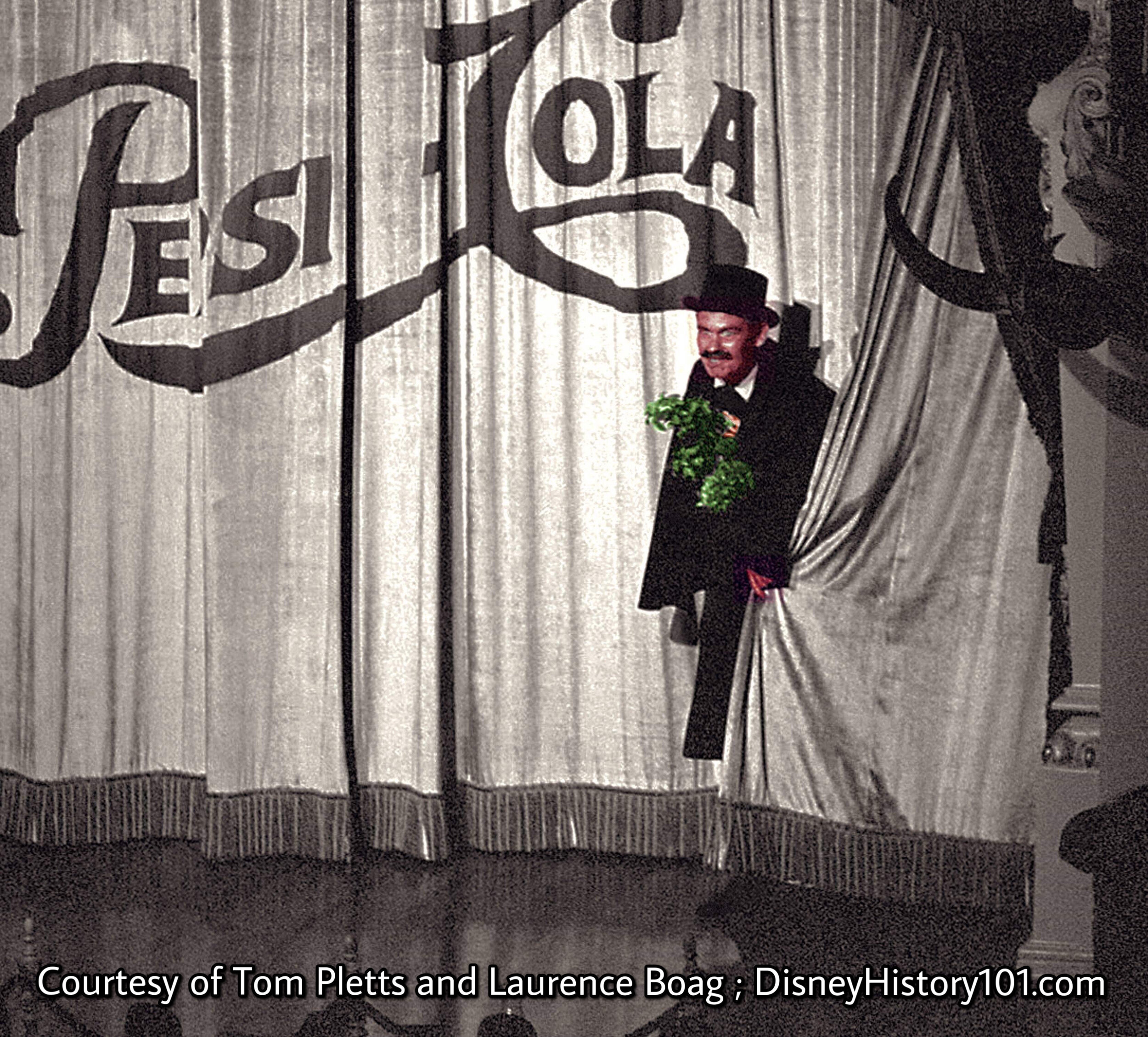
1971, Chicken Ranching For Fun & Profit
“I’m hiding behind a ‘bush’…”
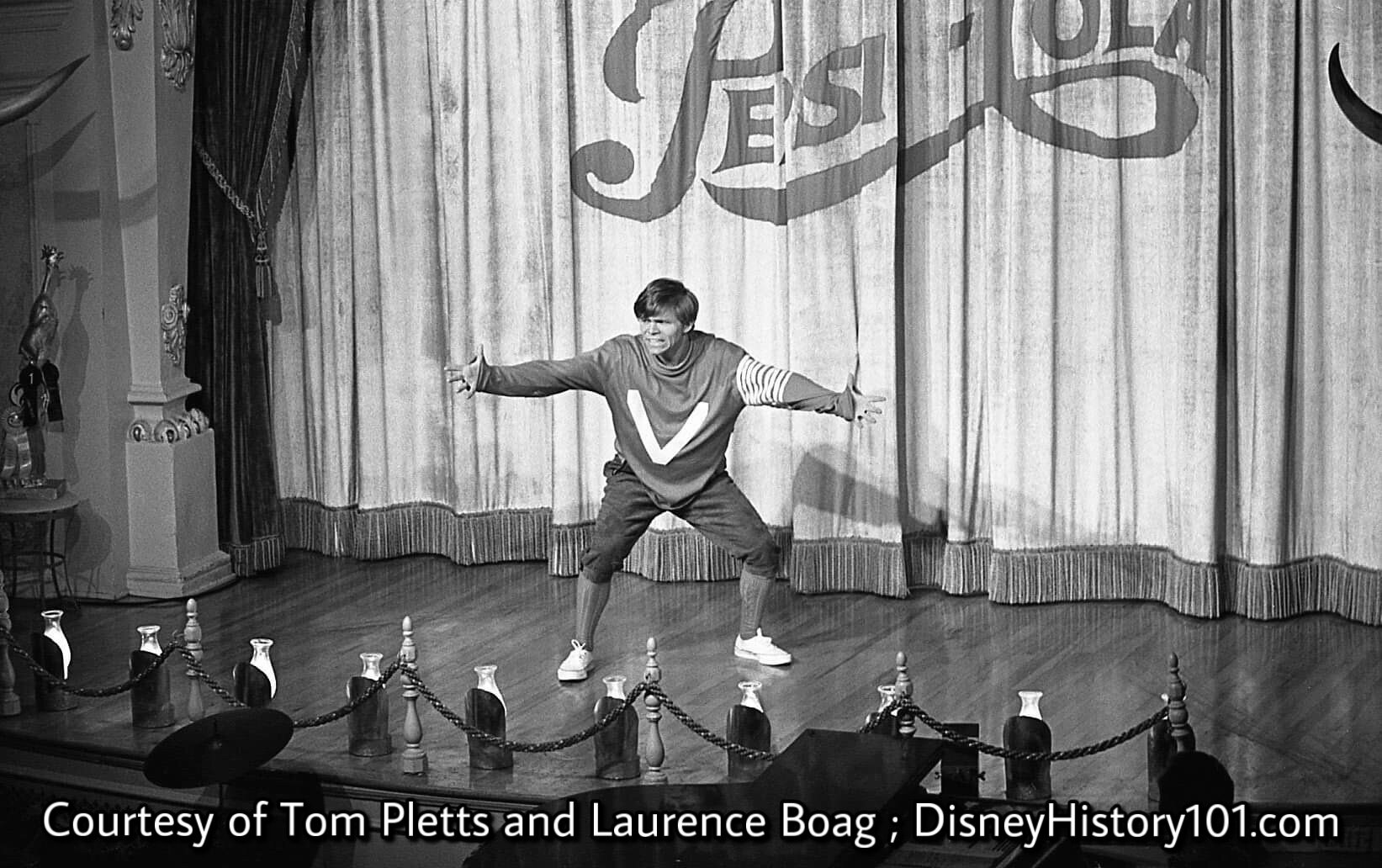
1971, Chicken Ranching For Fun & Profit
Jim was well acquainted with playing eccentric characters on the Golden Horseshoe stage. Alongside Bev Bergeron (who had trained under Wally Boag’s original understudy Bert Henry), Jim had begun to substitute for Wally Boag. He continued to do sub for Wally from 1970 to 1982.
1971, Chicken Ranching For Fun & Profit
Bonnie Barrileaux was familiar with the Golden Horseshoe stage, as she was also a Golden Horseshoe Revue Can-Can dancer. Additionally, she was an assistant, park choreographer, working as Barnett’s Ricci’s assistant.
1971, Chicken Ranching For Fun & Profit
“…and in the midst of a chase scene, Funster makes us play a game. Too much fun.”
-Tom Pletts.
(From Left To Right) : Bonnie as Sugar Blues, Tom Pletts as Grasper Quick, Johnny Buckner as Victor Virtue, and Jim Adams as Frank Funster the “Yell Leader”.
1971, Chicken Ranching For Fun & Profit
1971, Chicken Ranching For Fun & Profit
The animated Cast of Chicken Ranching For Fun & Profit, c.1971.
1971, Chicken Ranching For Fun & Profit
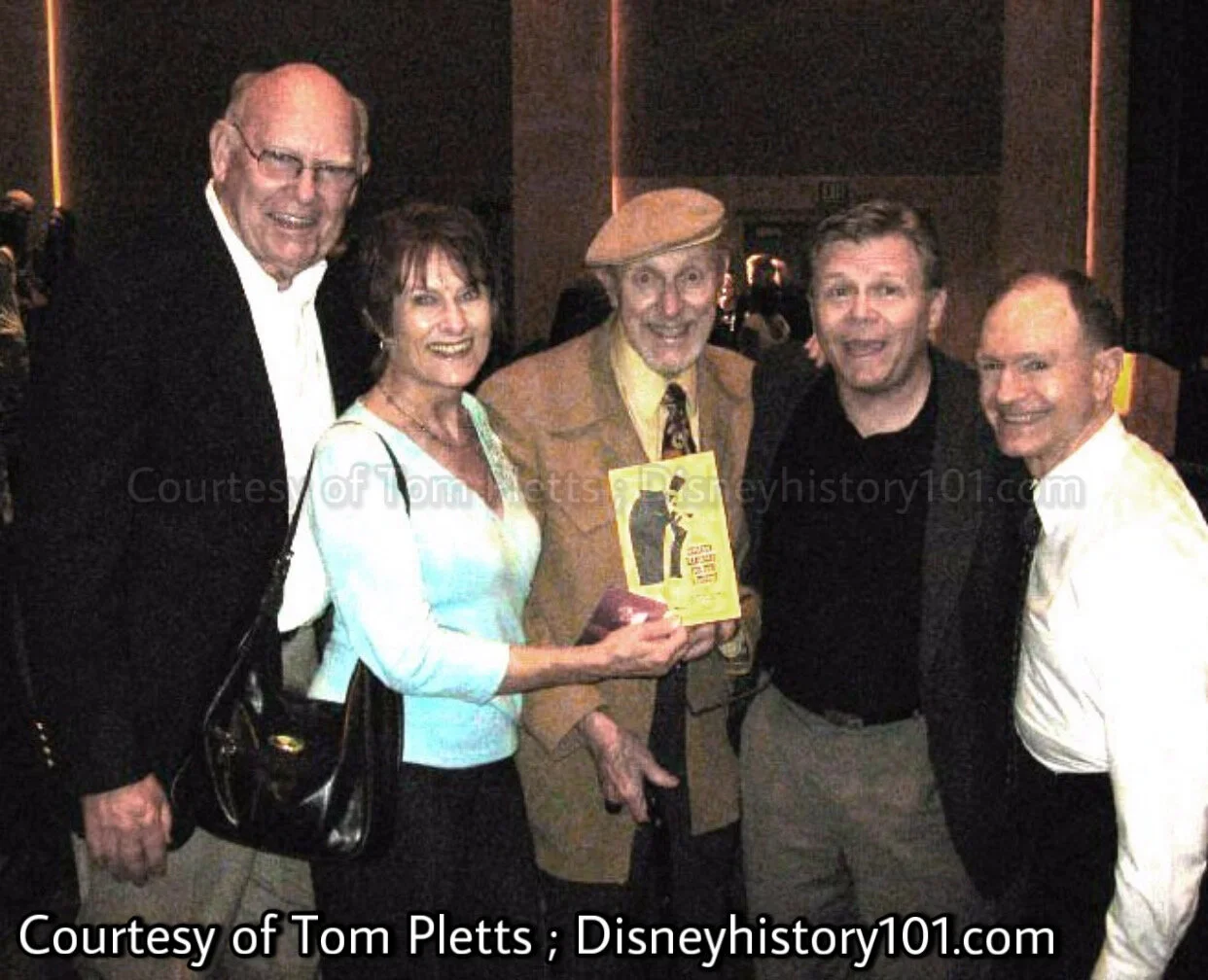
“A Chicken Ranching for Profit Reuninon” (May, 2007)
Tom Pletts shared “a Chicken Ranching mini-reunion, during the gathering for Fulton Burley's memorial at the studio. L to R: Grasper (me), Sugar (Bonnie), an aging Wally (the great one), Frank Funster (Jim), and our ragtime pianist Rod Miller.”
(July 1955 - September 30, 1982)
During 1954, Walt was searching for participants to lease shop and both quick service and table service restaurant spaces at Disneyland, in order to help generate the necessary capital to fund construction of Disneyland. In a synergistic relationship, the companies (in turn) could sell their products and advertise their corporate names in the Park. Disneyland Participant Corporate Sponsors were carefully selected. High quality, long term corporate sponsors would provide incremental income that enabled Disneyland to enhance its show and attractions, offset some operating expenses, and capitalize on marketing opportunities.
To iterate, Pepsi was one of five major concerns to hold a lease with Disneyland for strictly advertising purposes. Among these concerns were the Santa Fe Railroad, Bekins Van and Storage, TWA, Richfield Oil Company and Pepsi Cola. These did not occupy space but have their name displayed at certain places that were advantageous for the advertising of the product or service they sold.
Several of these “reliable old firms” sponsored the “abundance of restaurants devoted to pleasing all tastes and all budgets,” according to “The Story of Disneyland,” published 1955. Jim Powell, president of Pepsi-Cola Bottling Company of Los Angeles, was an enthusiastic supporter of Disneyland.
So while the main goal was to create happiness, income was provided to Disneyland Inc. to support the construction and growth of Disneyland. For example, in 1958, Bank of America appraisers figured of the total income received from leases, 16.02% was derived from the selling of advertising rights and 40.12% from the leasing of space to concerns whose main reason for occupancy is for advertising purposes. The remaining 43.86% of the lease income was derived from stores that sell various products and food.
Slue Foot Sue’s Golden Horseshoe was operated by Disneyland, Inc. and sponsored by Pepsi Cola Co. You may recall that the original attraction was occasionally billed as The Pepsi-Cola Playhouse featuring the Golden Horseshoe Revue. Later shows were billed: The Golden Horseshoe Revue and the Pecos Bill Wild West Show, c. 1991, sponsored by Pepsi-Cola from 1955 to September 30, 1982! “Welcome to Disneyland” maps (published as early as June of 1955) invited guests to enjoy the “longest little bar with the tallest glassful of pop.” When opening day finally arrived, cola sales at the Park were at a high due to a recent plumbers strike and resultant non-operational drinking fountains.
An article in the Disneyland News (August, 1955) mentioned that Jim Powell (then president of Pepsi-Cola Bottling Company) was “an enthusiastic supporter of Disneyland.” For instance, the Pepsi Cola Co. contributed food to the First Annual Disneyland Christmas Party on December 10, 1956. Don Kendall (Pepsi-Cola Vice President) was also a regular supporter of the show, and Walt was so appreciative that he gifted to him one of Sam McKim’s original designs of the Golden Horseshoe.
From 1955 to 1982, Pepsi-Cola’s name was emblazoned on theater posters, signs and banners hanging over the entrance, and even across the stage curtains. In addition “the tallest glass of pop” - Pepsi-Cola was a constant feature on the menu. The Golden Horseshoe’s official beverage complimented the “wrapped sandwiches and chips.” Pepsi’s corporate logo was featured on Golden Horseshoe souvenirs, but most important, Pepsi was kept on tap at the bar!
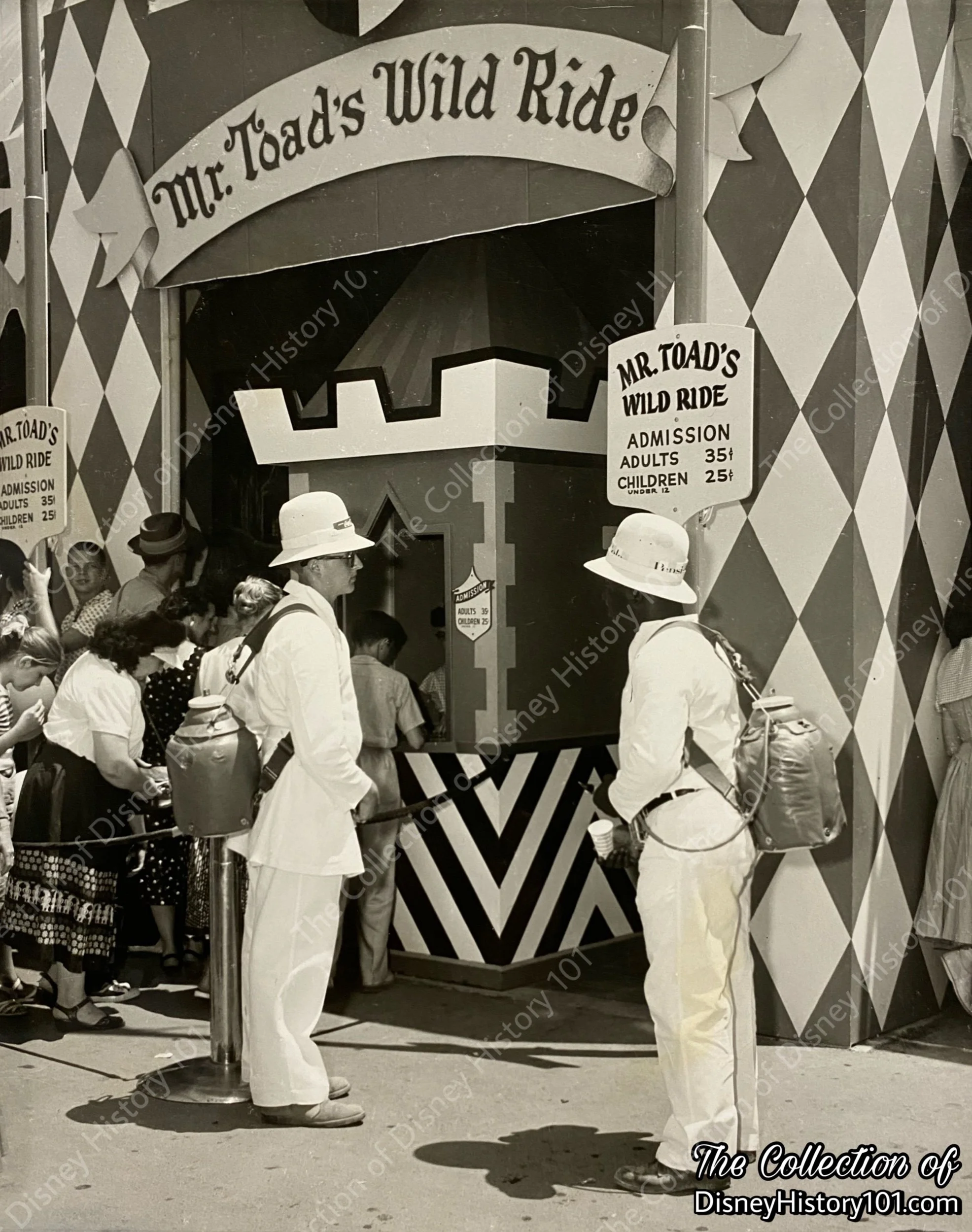
A Coca-Cola Vendor (left) & Pepsi-Cola Vendor (right) support the Disneyland show in Fantasyland.
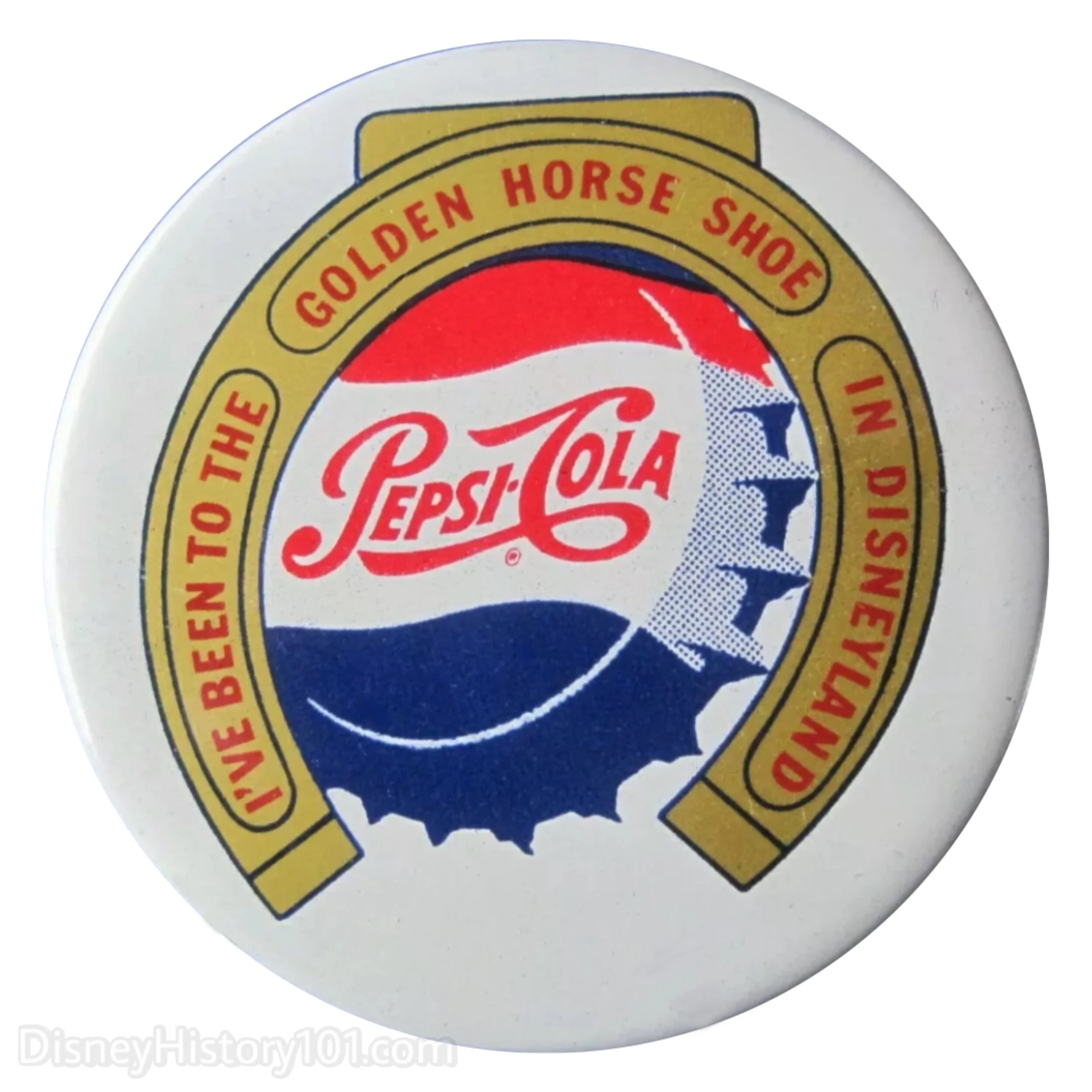
Souvenir Golden Horseshoe Button, 1950s
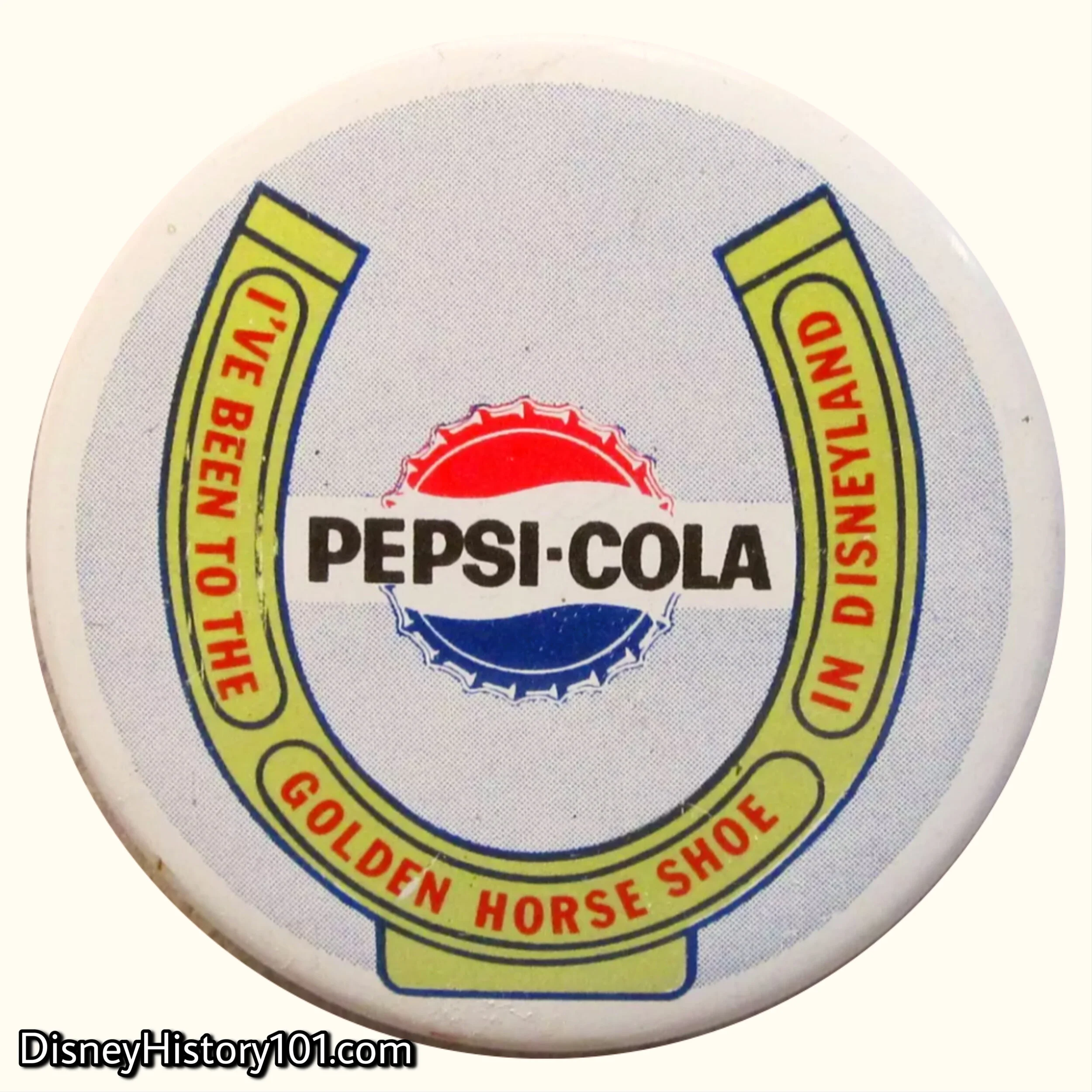
Souvenir Golden Horseshoe Button with the Pepsi-Cola logo introduced in 1962.
Visitors (during the 1950s) were periodically given tin lithograph buttons like this one, to commemorate their experience at the Golden Horseshoe Revue presented by Pepsi-Cola! These 2-inch buttons (emblazoned along the edge with “Casa El Salvador ‘Farabundo Marti’”) were manufactured in San Francisco, California, but that’s another non-Disney-related history lesson for another time.
The synergistic relationship between the institutional lessee and Disneyland was beneficial. The Pepsi-Cola Company yielded some revenue for Disneyland Inc. - $39,000 for the fiscal year ending September 29, 1957 and $39,000 for the fiscal year ending September 28, 1958.
By October of 1959, the company was (1) of over sixty-eight other firms playing a vital part in the team effort to bring happiness to Disneyland’s Guests. Some were small, specialized individual operators; some were huge companies such as Swift & Co. - the Bank of America - United Paramount Theaters (which you hear as UPT) - Carnation - Richfield - General Dynamics - Crane - and many others. These companies used the park to publicize their wares, leased space in the Park to sell their wares, and Disneyland collected advertising fees from them.
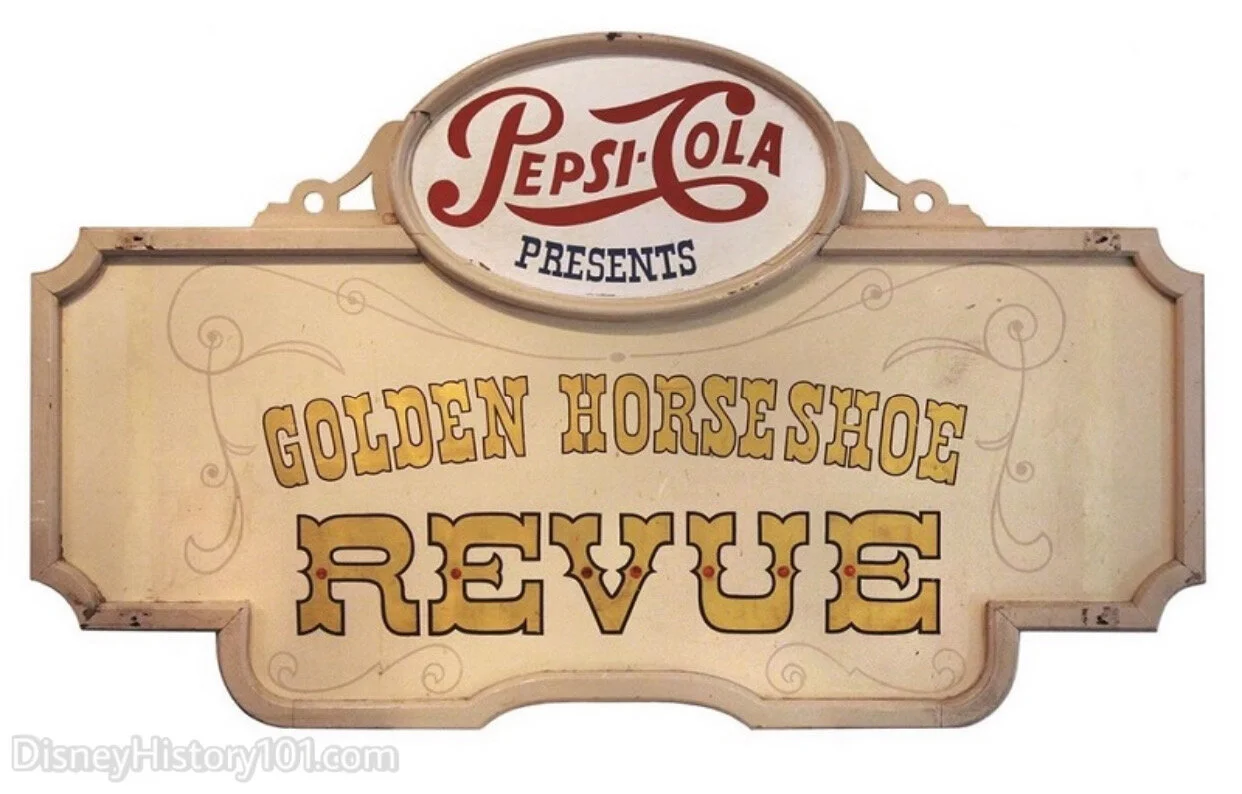
Golden Horseshoe Revue Sign, c. 1960s - 1970s
At Disneyland, signs were themed to support the stories with respectful graphics, colors, fonts, terminology, the overall design of sign, materials (wood, metal, banners, etc.), and verbiage used on the signage. Sure, Slue Foot Sue owned the establishment, but Pepsi-Cola was really running the show! Pepsi-Cola also sponsored the UNICEF Pavilion and It’s a Small World at the New York World’s Fair of 1964 and 1965. (Image Courtesy of Van Eaton Galleries).
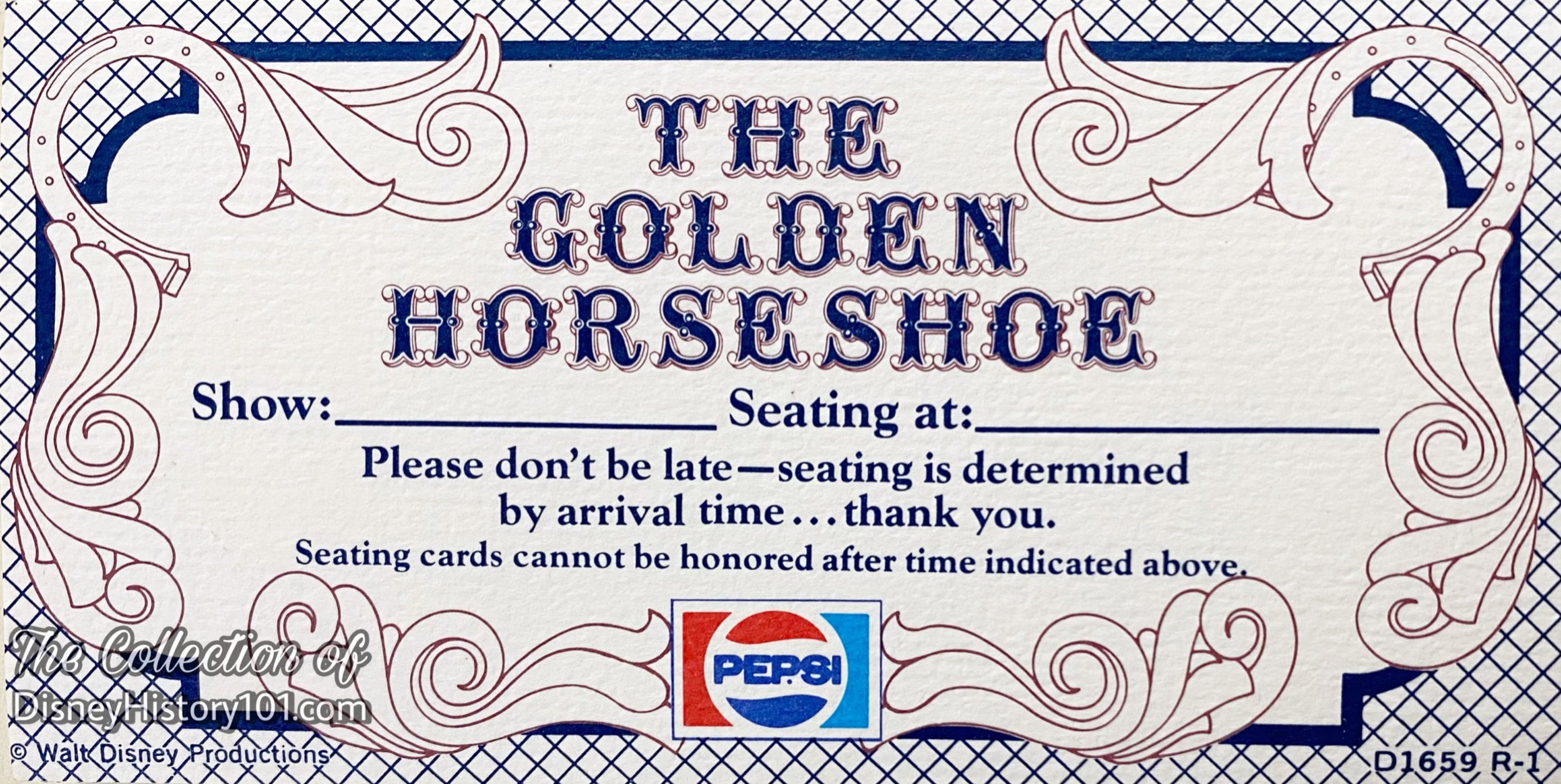
Golden Horseshoe Revue Reservation Card, c. 1975
Two decades later, reservations (on a first-come, first-serve basis) are still required for the popular Frontierland attraction!
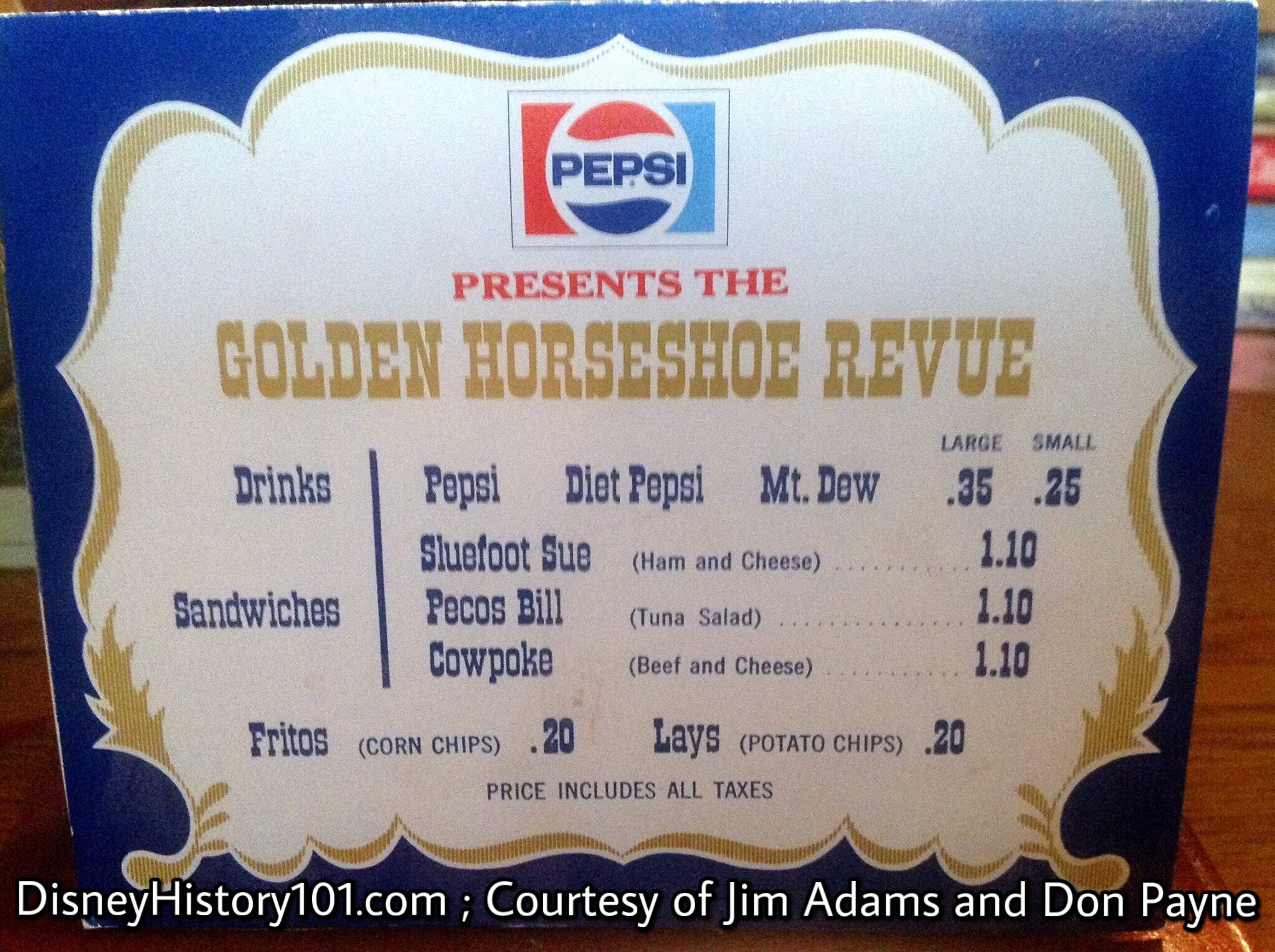
Golden Horseshoe Revue Table Menu, c. 1975
“You’ve got a lot to live, and Pepsi’s got a lot to give!” How about a refreshing foamy mug of Pepsi, Diet Pepsi, or Mountain Dew? When Pepsi-Cola began sponsorship of Slue Foot Sue’s Golden Horseshoe, Pepsi-Cola (and Pepsi products Diet Pepsi and Mountain Dew) cost 15 cents (small) and 25 cents (for a large). Lays and Fritos originally cost 10 cents per serving. Prices changed little in the next fifteen years according to the menu (pictured above).
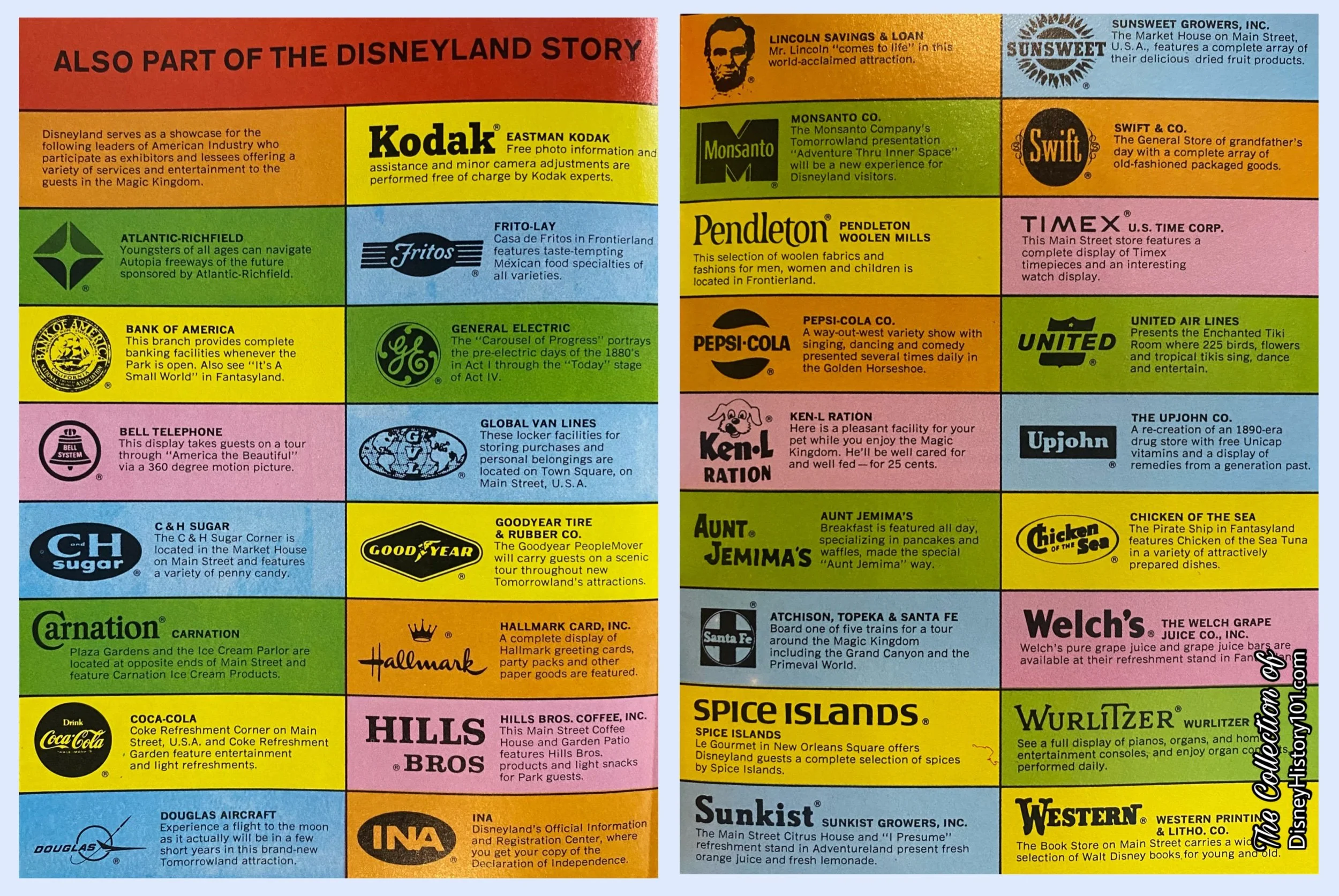
Pepsi-Cola was a Disneyland Participant and thus “part of the Disneyland story according to this “Disneyland ‘67” Excerpt.
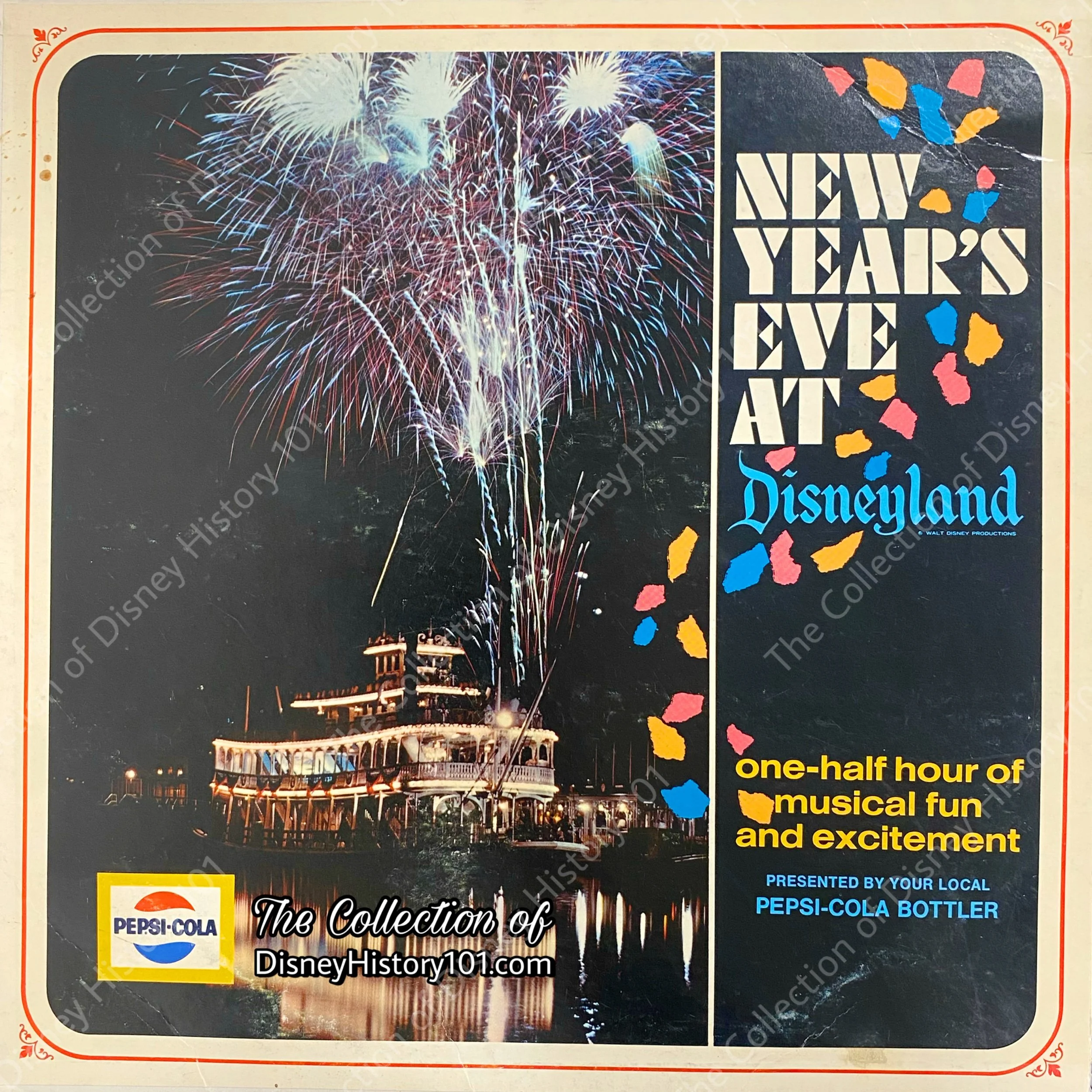
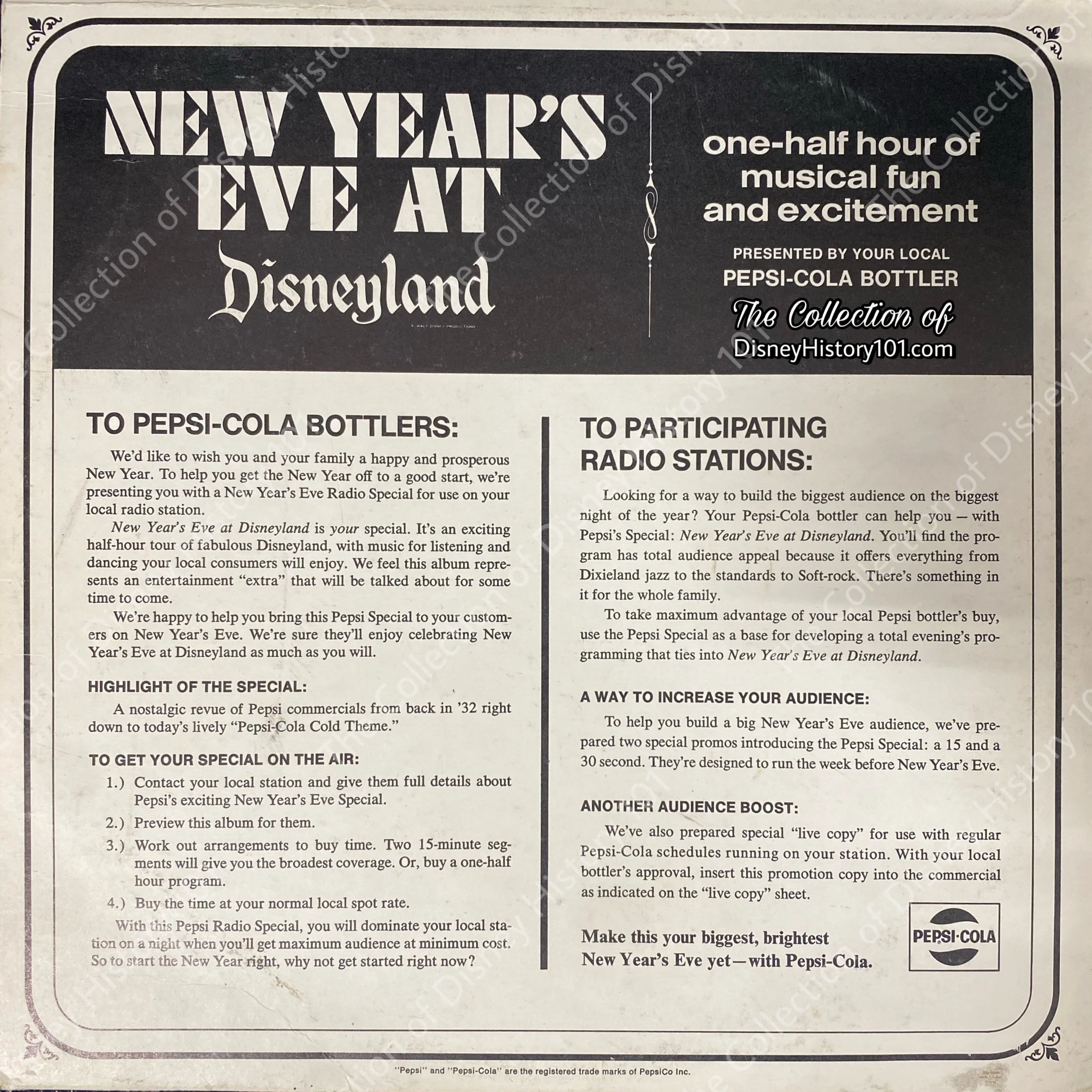
The New Year’s Eve at Disneyland, one – half hour musical radio program.
In addition to sponsoring the Golden Horseshoe, the Pepsi-Cola Company sponsored “New Year’s Eve at Disneyland.” The radio program was pre-recorded and cut to a record containing a special broadcast. The records were intended to be aired from December 26, 1967 to December 31st, 1967. The program was “one-half hour of musical fun and excitement, presented by your local Pepsi-Cola Bottler.” Highlights included sounds of Disneyland entertainers (like Betty Taylor as Slue Foot Sue and the Saxophone Quartet) in addition to “a nostalgic revue of Pepsi commercials from back in ‘32 right down to today’s lively ‘Pepsi-Cola Cold Theme.’” The record also featured the debut of the newest “Pepsi Pours it On” jingle.
Each of these records was never intended for sale, but distributed through Pepsi-Cola Bottling Company Western Divisions and their local area radio stations.
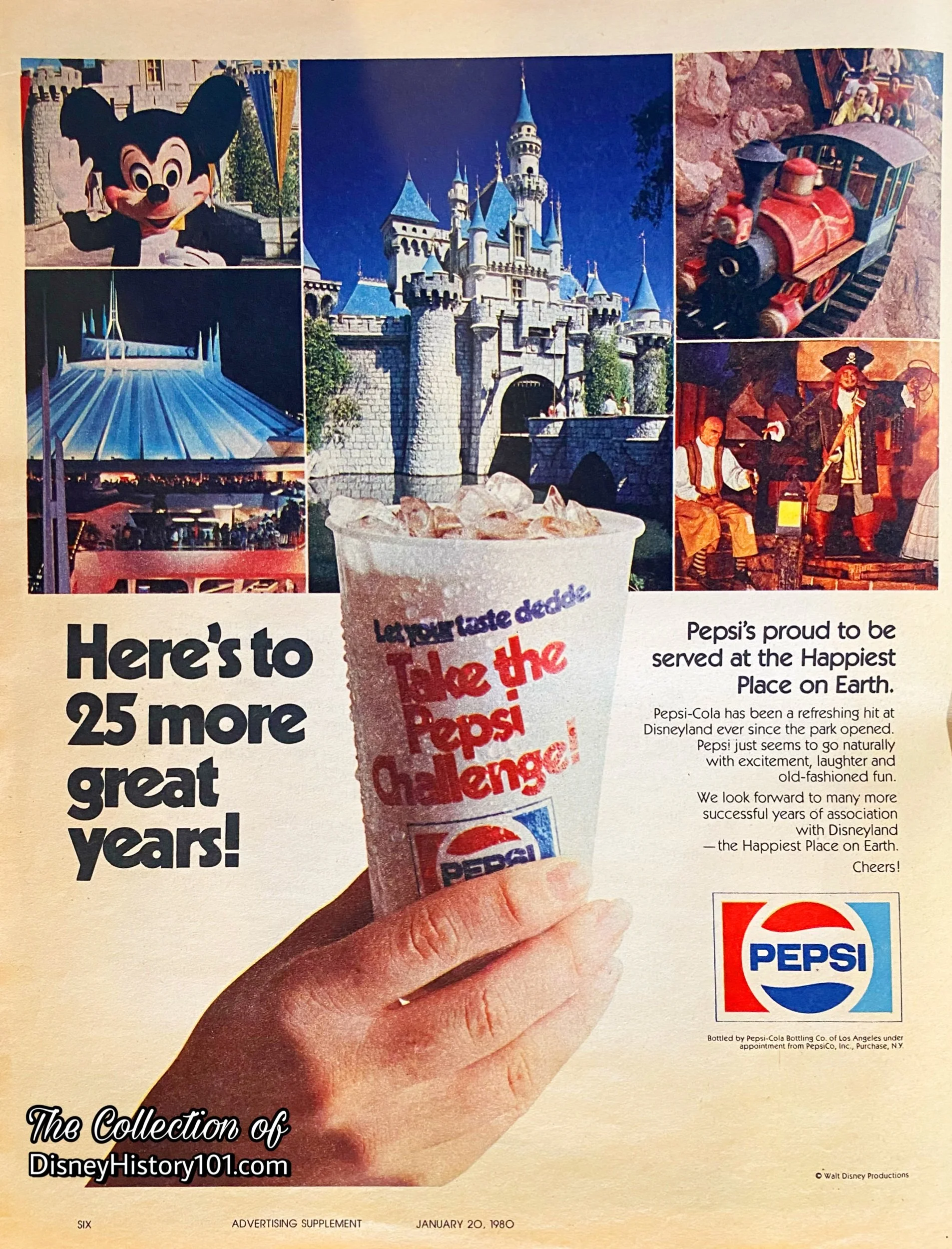
Pepsi was still “proud to be served at the happiest place on Earth,” during the 25th anniversary year, even looking “forward to many more successful years of association with Disneyland.” [Disneyland 25 “Happy Birthday to a Dream” Advertising Supplement; published January 20, 1980] But ultimately, Disneyland Participant Affairs and Disneyland Participant Pepsi-Cola could not negotiate a new cooperative agreement to maintain their ongoing relationship at this Location, and another “old reliable firm” would step in to sponsor the Show.
Space Place Pepsi Patch; 1976.
1970s.
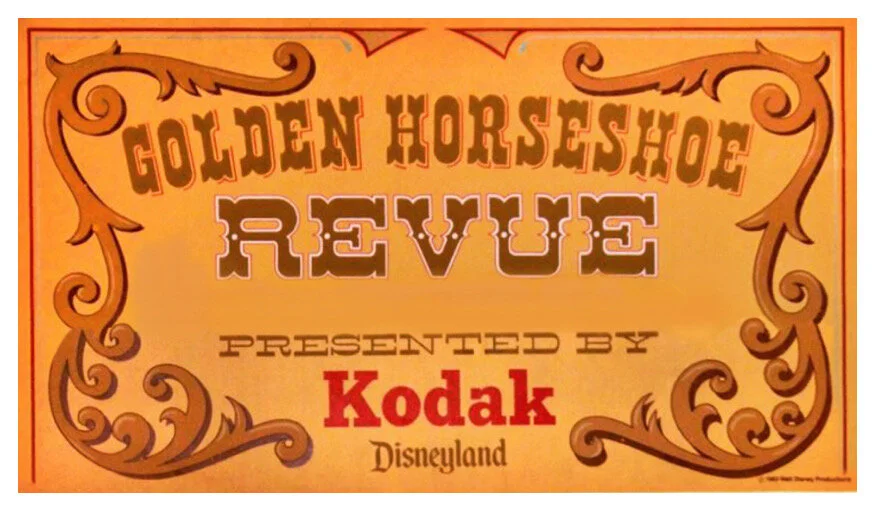
(October 1, 1982 - April 30, 1984)
Soon after Pepsi-Cola ended their sponsorship of Slue Foot Sue’s Golden Horseshoe Revue (on September 30, 1982), Eastman - Kodak would briefly sponsor The Golden Horseshoe Revue from October 1, 1982, until April 30, 1984. The pre-show warmup, included Kodak instant picture-taking demonstrations for selected guests as souvenirs. “Kodak is excited with this opportunity for identification in the world's first outdoor recreation theme park,” said William K. Pedersen, a Kodak assistant vice-president and director of marketing communications services.
By this time, a second show (Pecos Bill Wild West Revue) had begun running c. March of 1981, concurrent with the Golden Horseshoe Revue. Perhaps owing to this, Dick Hardwick was hired as an understudy for Pecos Bill, and would take over the roles of Traveling Salesman/Pecos Bill upon Wally’s retirement. Dick would even move to Florida in 1983, so that Bev Bergeron could train him to be a replacement for Wally Boag (who was soon to retire). During this time, Dana Daniels was brought in to sub for Dick Hardwick’s roles of Pecos Bill and the Traveling Salesman.
Two years after Eastman - Kodak’s sponsorship concluded, the original Golden Horseshoe Revue would finally end its record breaking run (July 1955 - October 1986), on Sunday, October 12th, 1986. It was the longest running show in history at 42,921 performances (according to the Guiness Book of Records). By 1981, the show had already become the longest running production (at 39,000 performances in 27 years; seen by nine million guests) and this statistic was announced in Kodak press releases distributed before November of 1981. Now by 1986, with five performances daily, the show came close to 50,000 performances. Dick Hardwick would return to the Golden Horseshoe stage to perform in the last show of the Golden Horseshoe Revue with Betty Taylor, Fulton Burley, and Jay Meyers. Former Lead Don Payne sentimentally laments, “The Revue was co-created by Boag, Walt, and a few others. Walt LOVED that show and was a frequent audience member. A lot of hearts were broken when management closed the show after 30+ years of success. Folks still remember, and ask about, the Golden Horseshoe Revue.”
For a moment, (with the help of our friend Don), let’s transport ourselves through the doors of Slue Foot Sue’s Golden Horseshoe, for one final show! Your reservation is waiting for you!
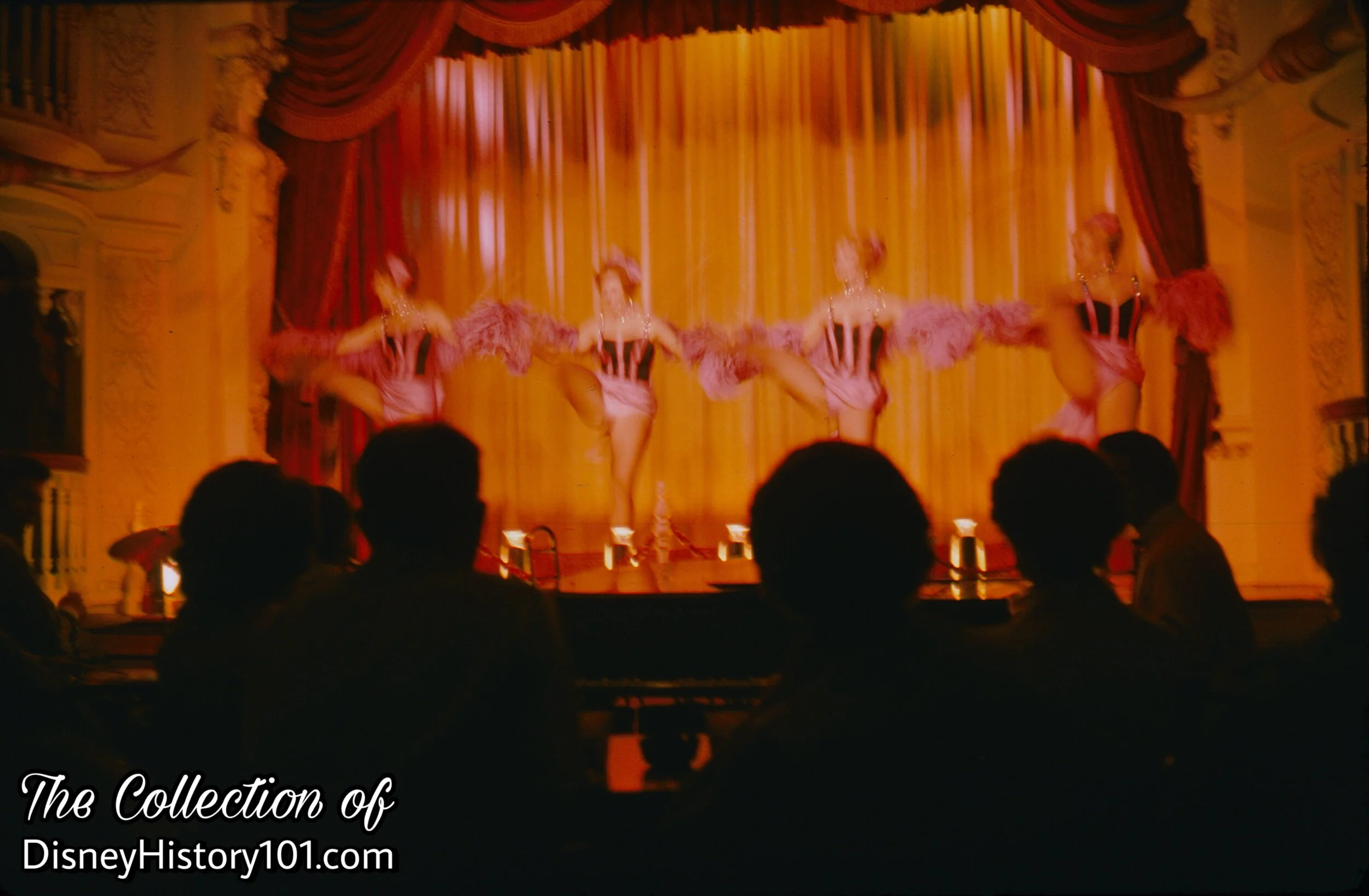
(c. 1970)
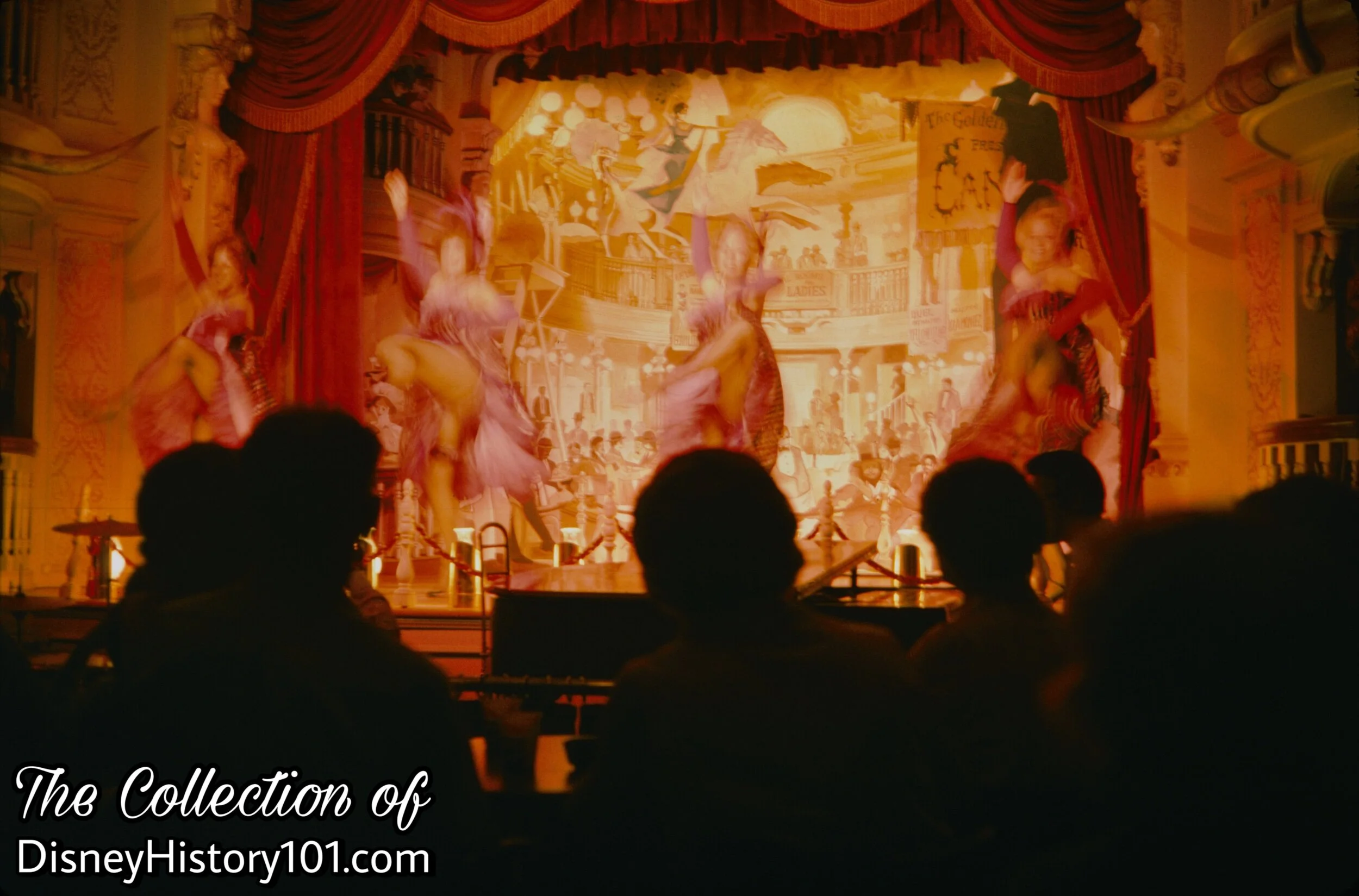
(1970s)
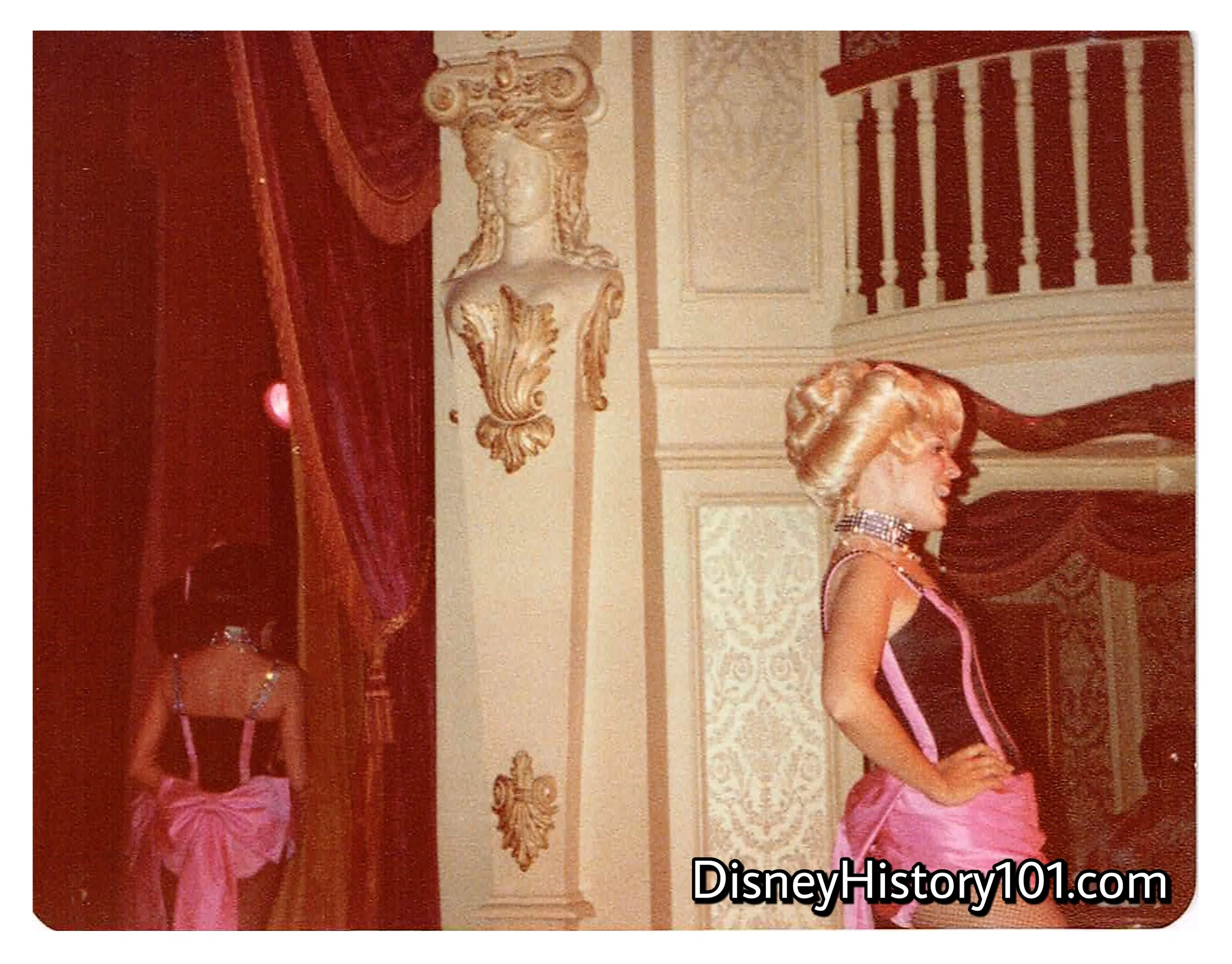
1970s
“Hello everybody (from Maine to California), this is the Golden Horseshoe!”
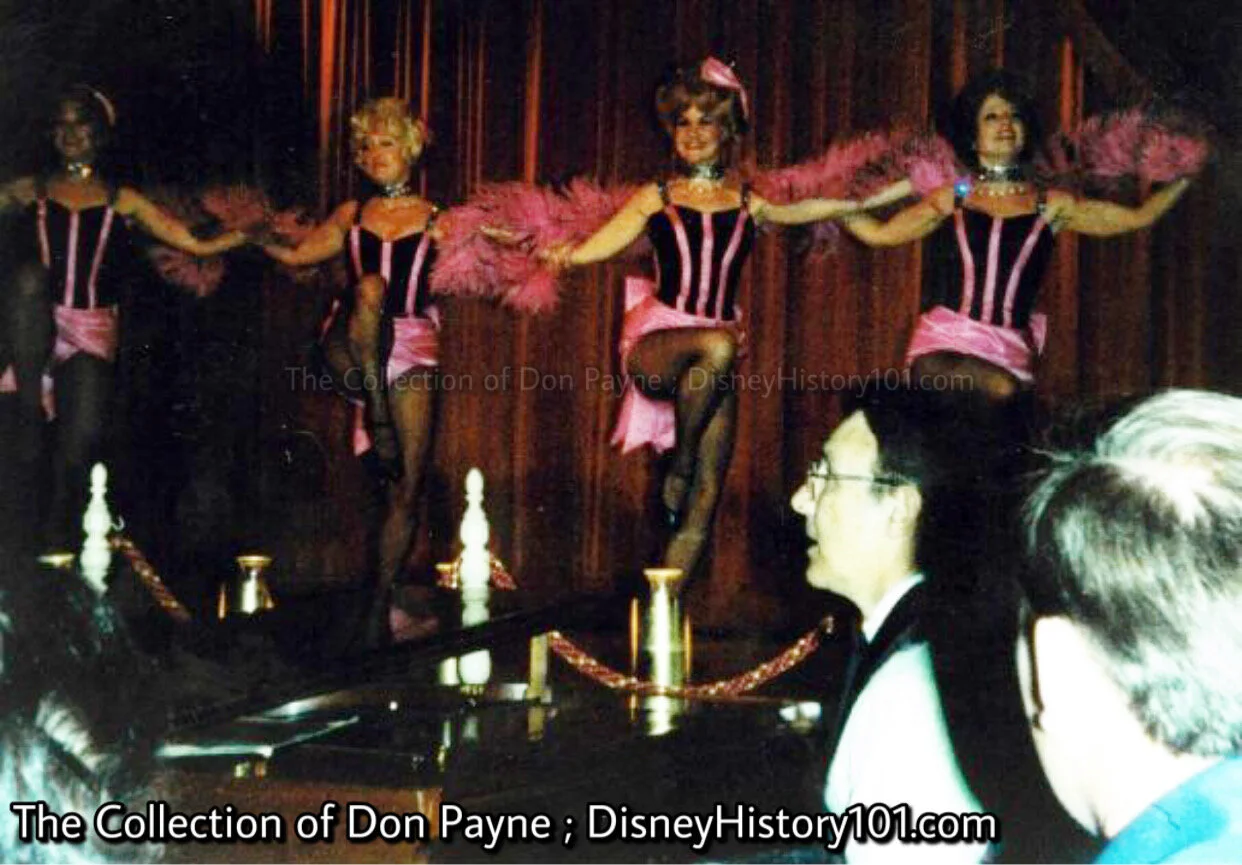
The liveliest line of CanCan dancers in these parts.
“As the Golden Horseshoe Band plays an overture (led by Vince Rossi on piano), the Golden Horseshoe Dancers perform a rousing musical greeting!”
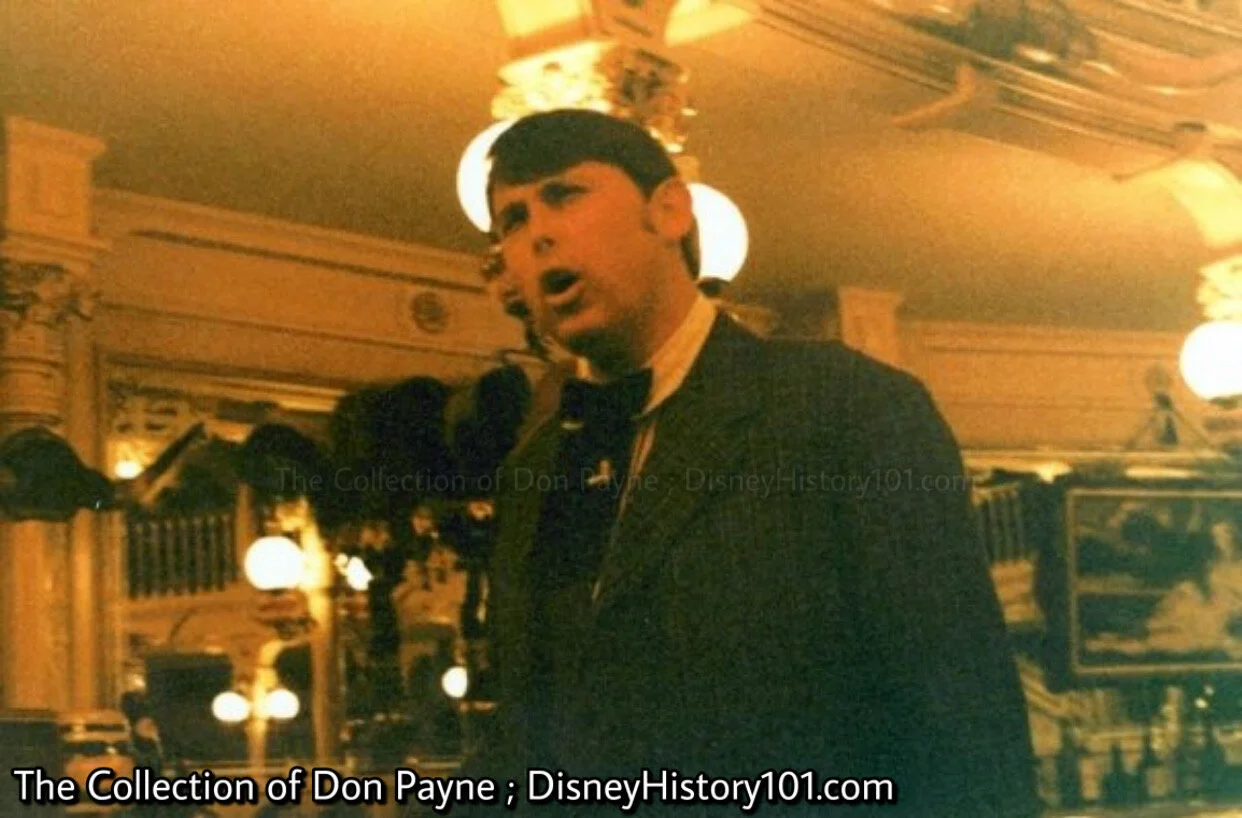
After Slue Foot Sue and The Boss perform a duet, the Golden Horseshoe Dancers begin to perform, when they’re interrupted from the audience! The Traveling Salesman says, “You look like a million dollars up there!” The Boss responds, “You’ve never seen a million dollars!” The Traveling Salesman retorts, “That’s what I mean. You look like something I’ve never seen before.”
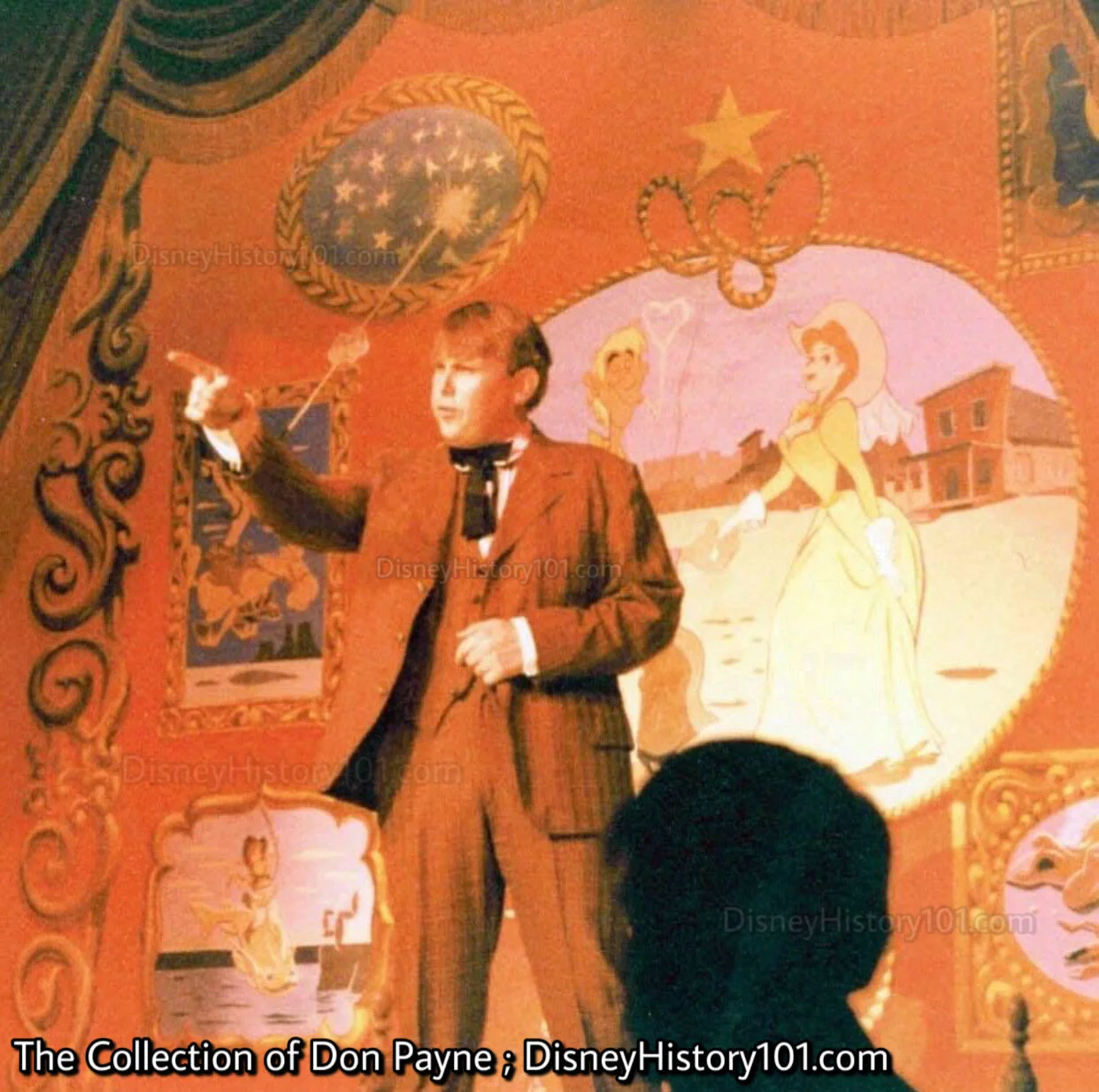
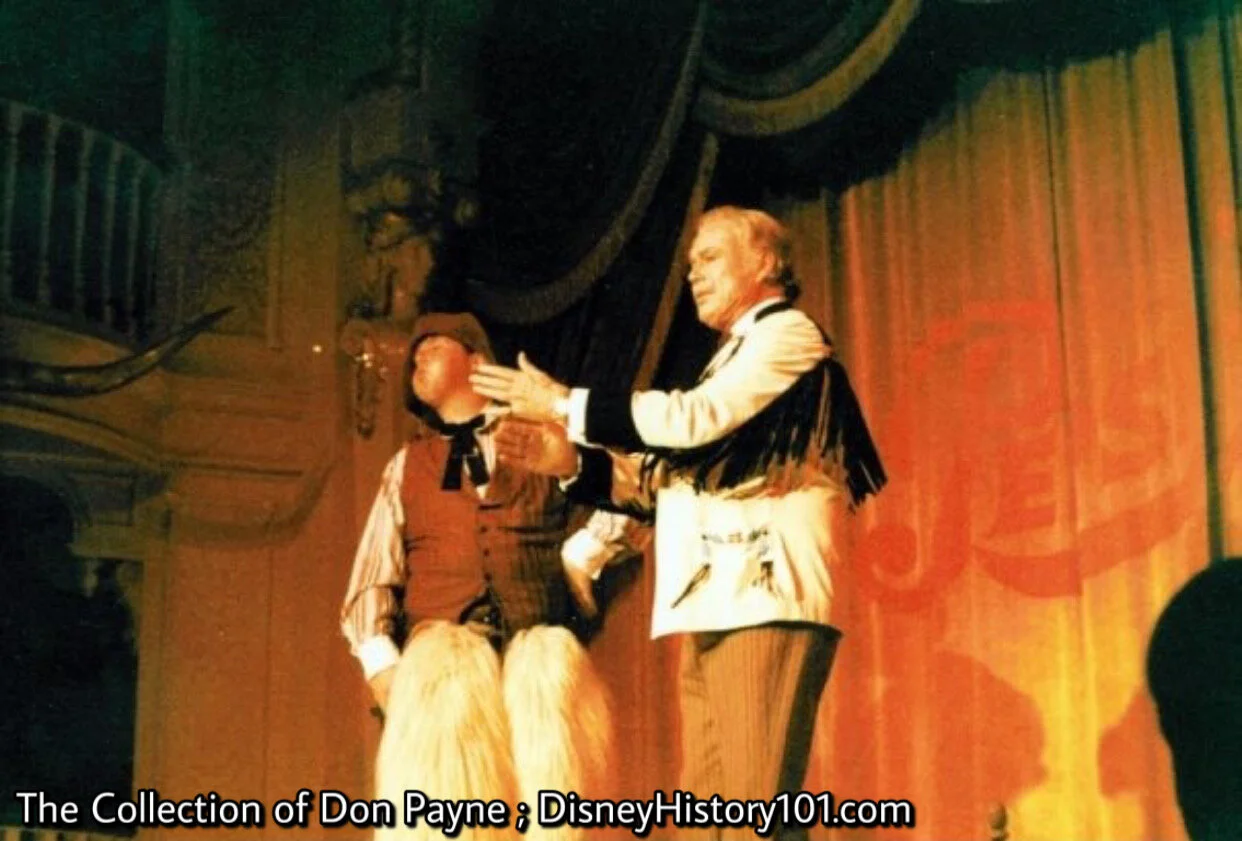
Don Payne performing in the Golden Horseshoe as a sub for the great Wally Boag and the incredible Jim Adams, April 4, 1980.
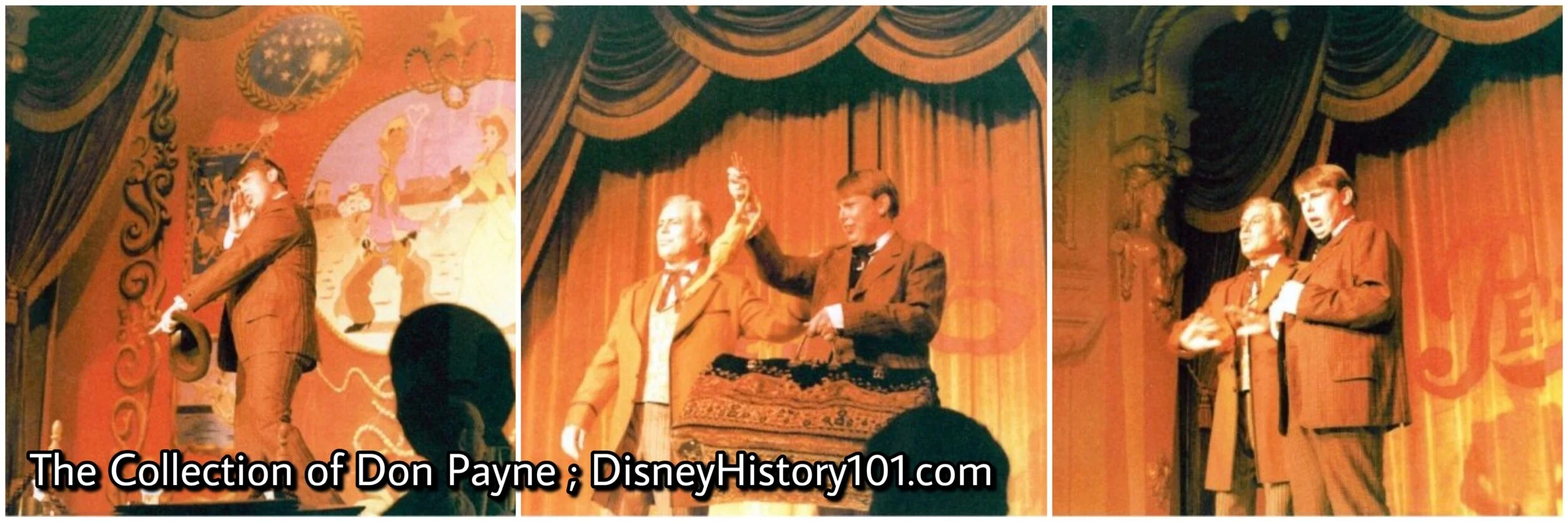
The Salesman joins The Boss on stage and they perform a few bits together. After brief banter, the Salesman begins to hawk his wares. “Got a sick friend here…he just flew in from Knotts Berry Farm.” (He holds up a rubber chicken.)
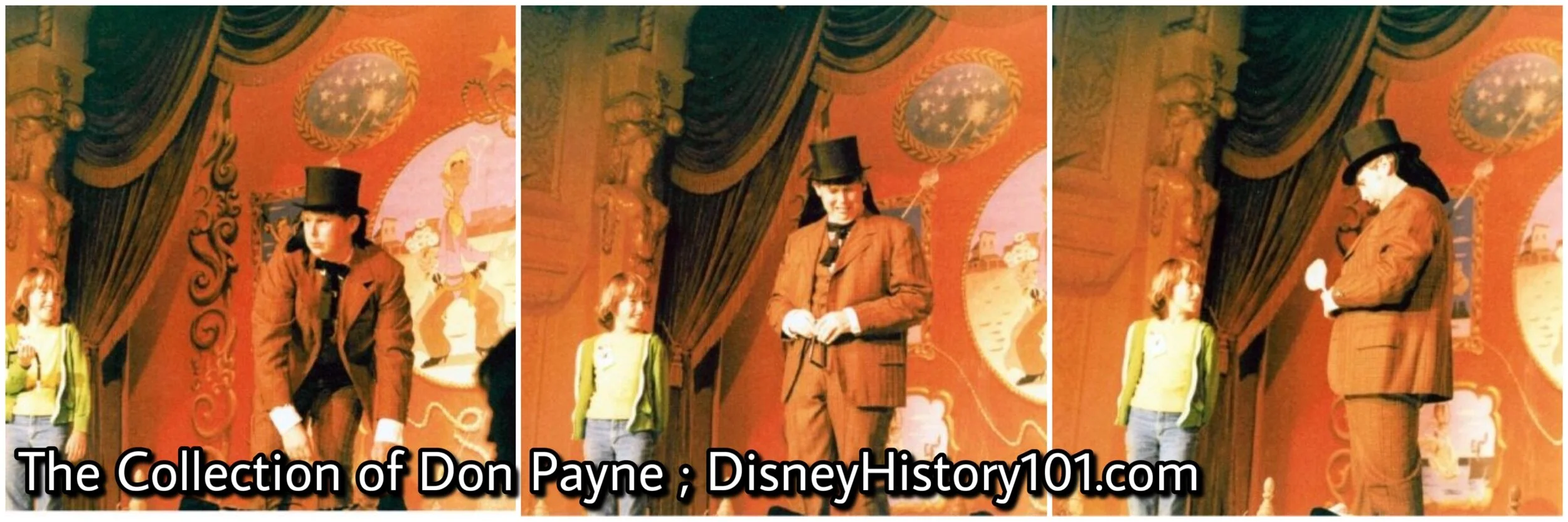
The Boss leaves the stage and the Salesman launches into a magic act. A volunteer from the audience was selected. The Salesman asks the child to hold his wand, which goes completely limp, as the Salesman turns away. The salesman begins to register the laughter from the audience, and states to wonder what is causing such a commotion.
Turning, the Salesman sees the broken wand hanging limply in the child’s hand, and sobs, “She broke my wand!”
After things simmer down, the Salesman thanks the child for helping out, and hands the child an “all-day” sucker.
”I’d like to present you with a little gift to say ‘thank you’ for helping me with my magic. Your dentist asked me to give this to you.”
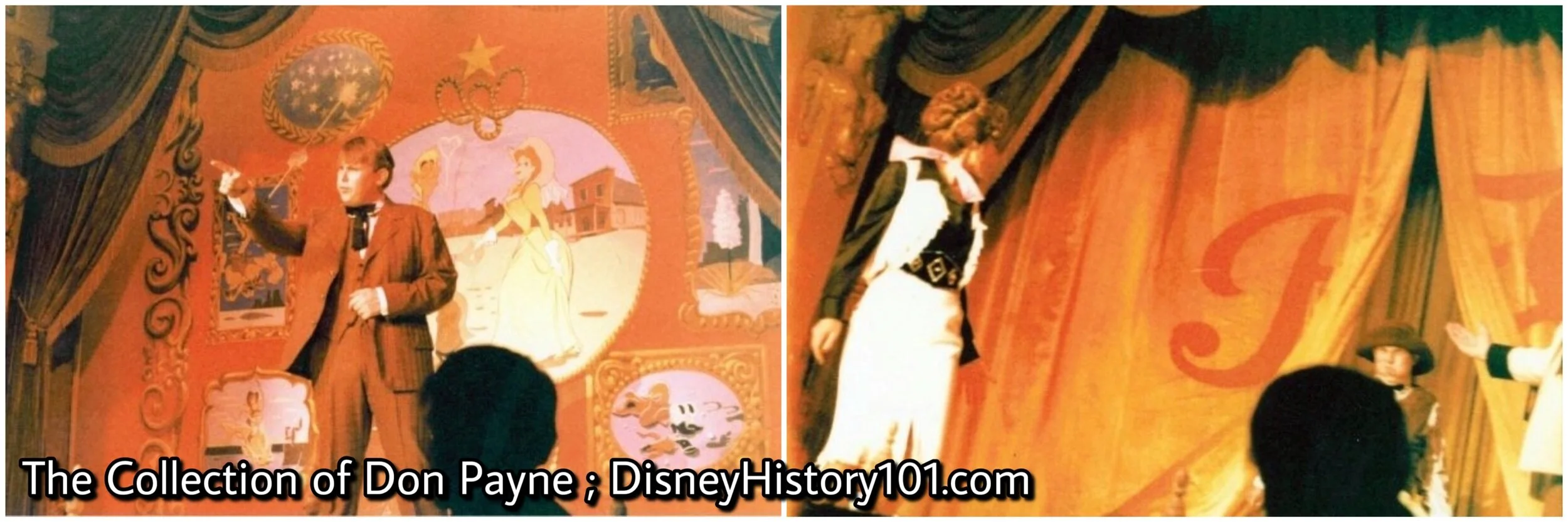
After the child leaves, the Salesman slides his carpet bag off stage. Lastly, the Salesman turns to the audience and sternly says, “I want you folks to always remember one thing…”. Just then, the band abruptly takes over, while the salesman begins to mouth unheard words. The band suddenly stops playing, and it’s evident that the Salesman isn’t saying anything at all.
The Salesman leaves the stage and the Boss comes out, encouraging the audience to applaud. Slue Foot Sue enters and the comedic musical sequence “Pecos Bill” begins.
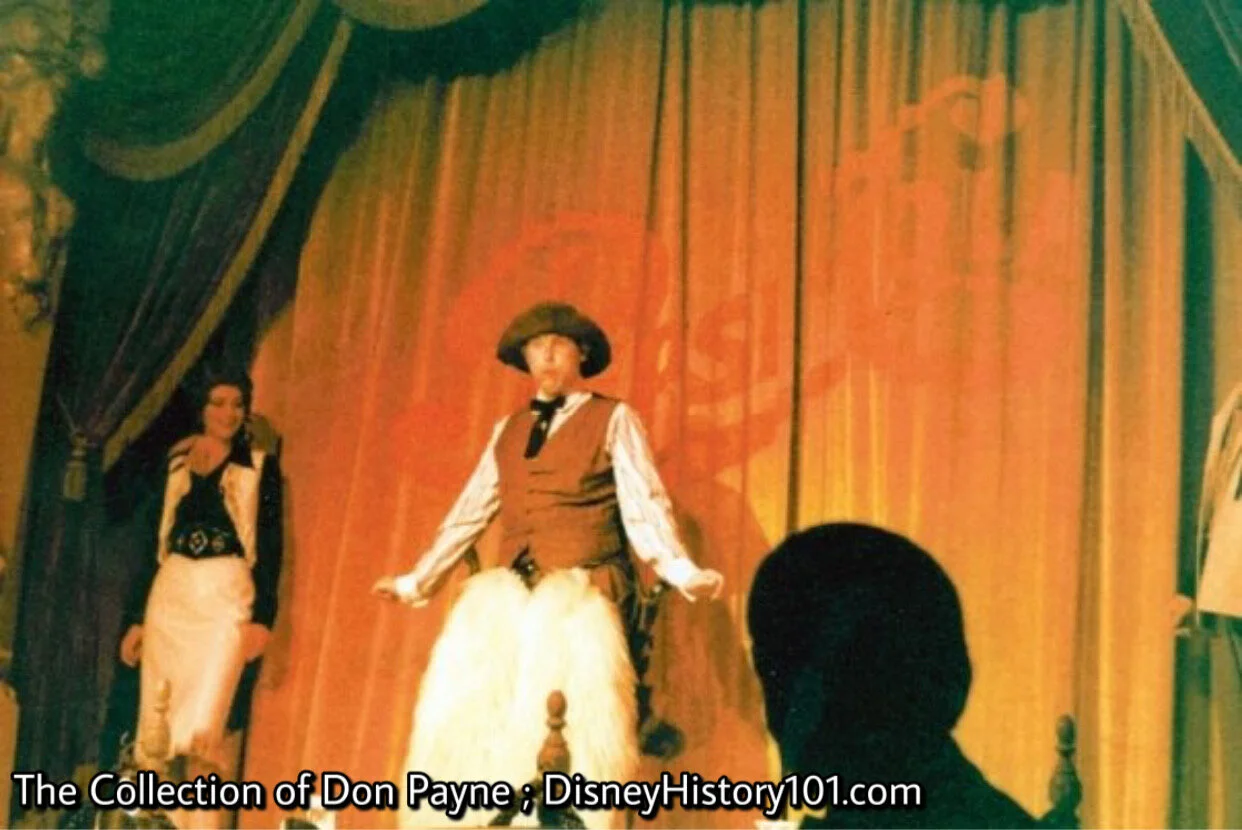
The Pecos Bill tune continues, telling the story of “the roughest, toughest critter” in the whole wild west.
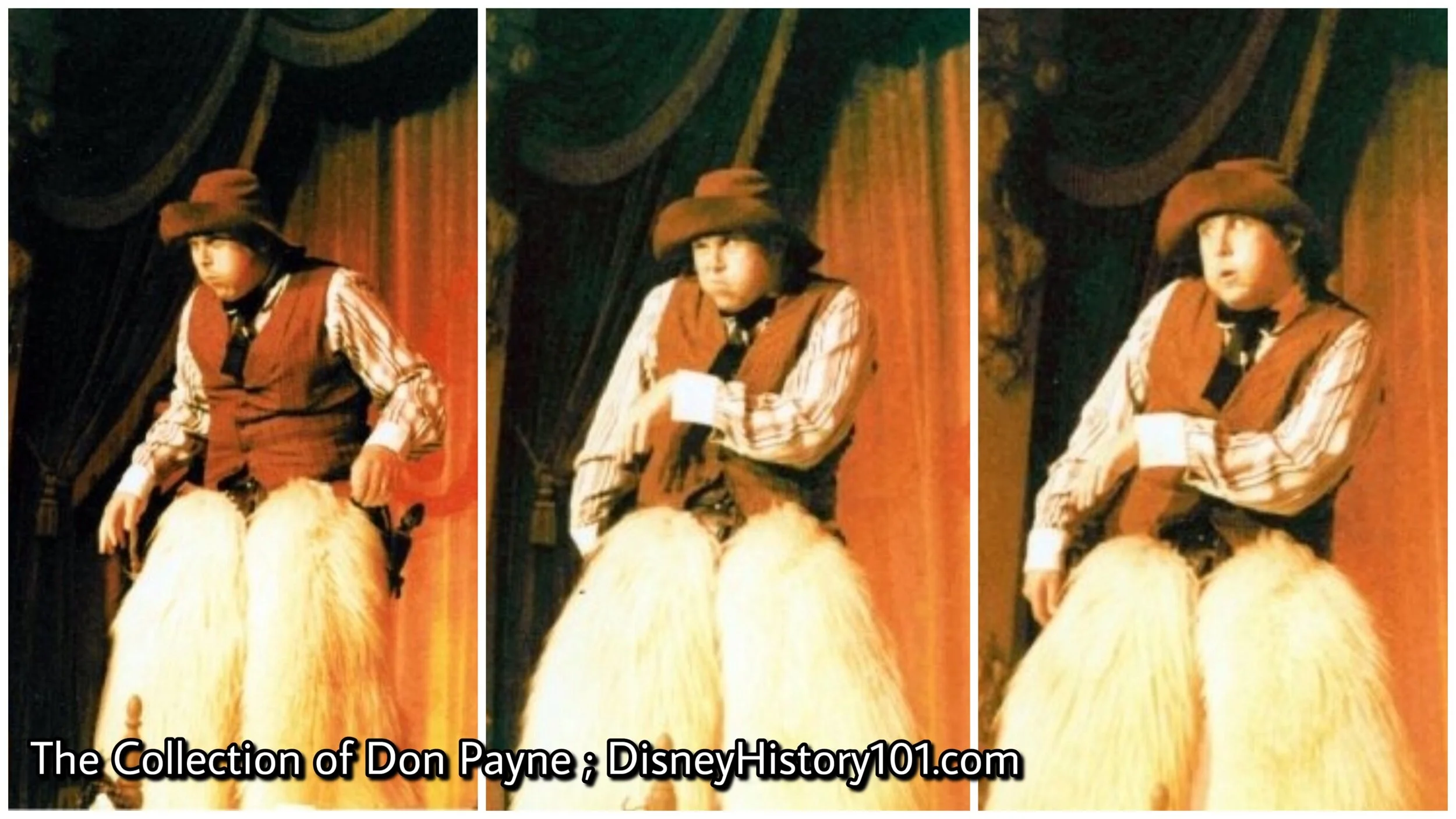
Pecos takes to the stage and says, “I have the fastest draw in the West. Wanna see it?” A gunshot is heard, and Pecos hasn’t moved a muscle. “Wanna see it again?”
The song tells of how “the toughest critter west of the Alamo” roughed up some bad guys. “Once a band of rustlers stole a herd of cattle, but they didn’t know the herd they stole was Bill’s! When he caught them crooked villains, he knocked out all their ‘fillins’, and that is why there’s gold in them there hills!” In acting out that last line of the song, The Boss gives Pecos a slap, and several “teeth” fly out of Pecos’ mouth.
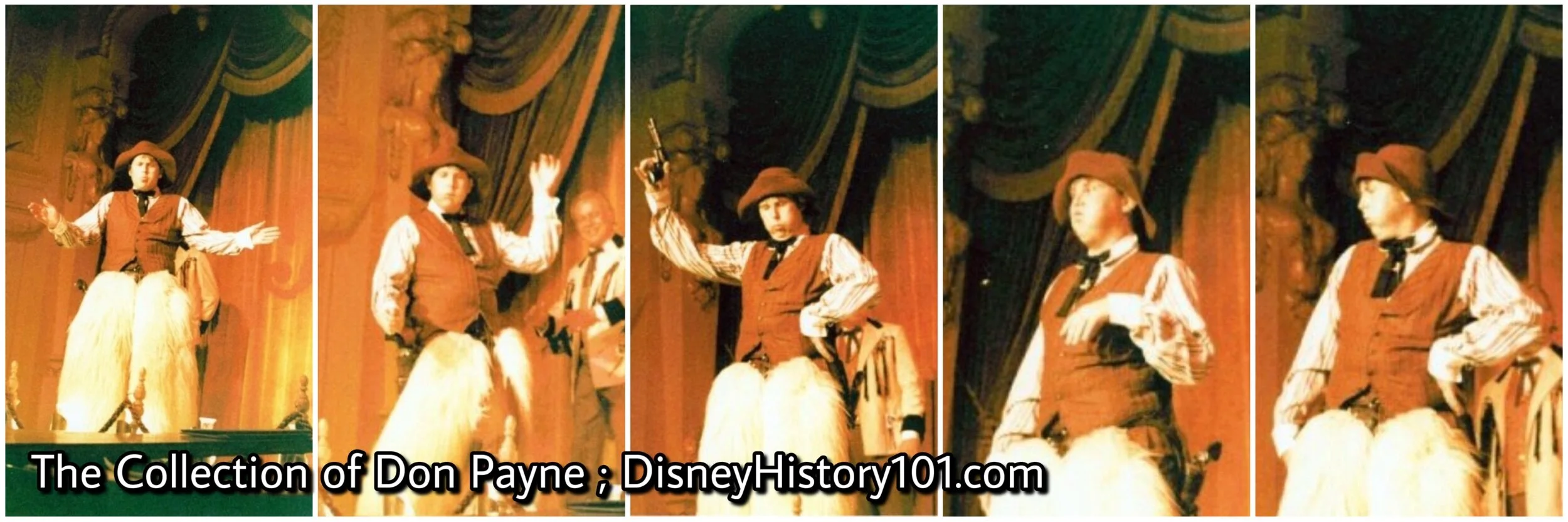
The teeth-spitting (in reality, Lima beans) ensues, …and continues!
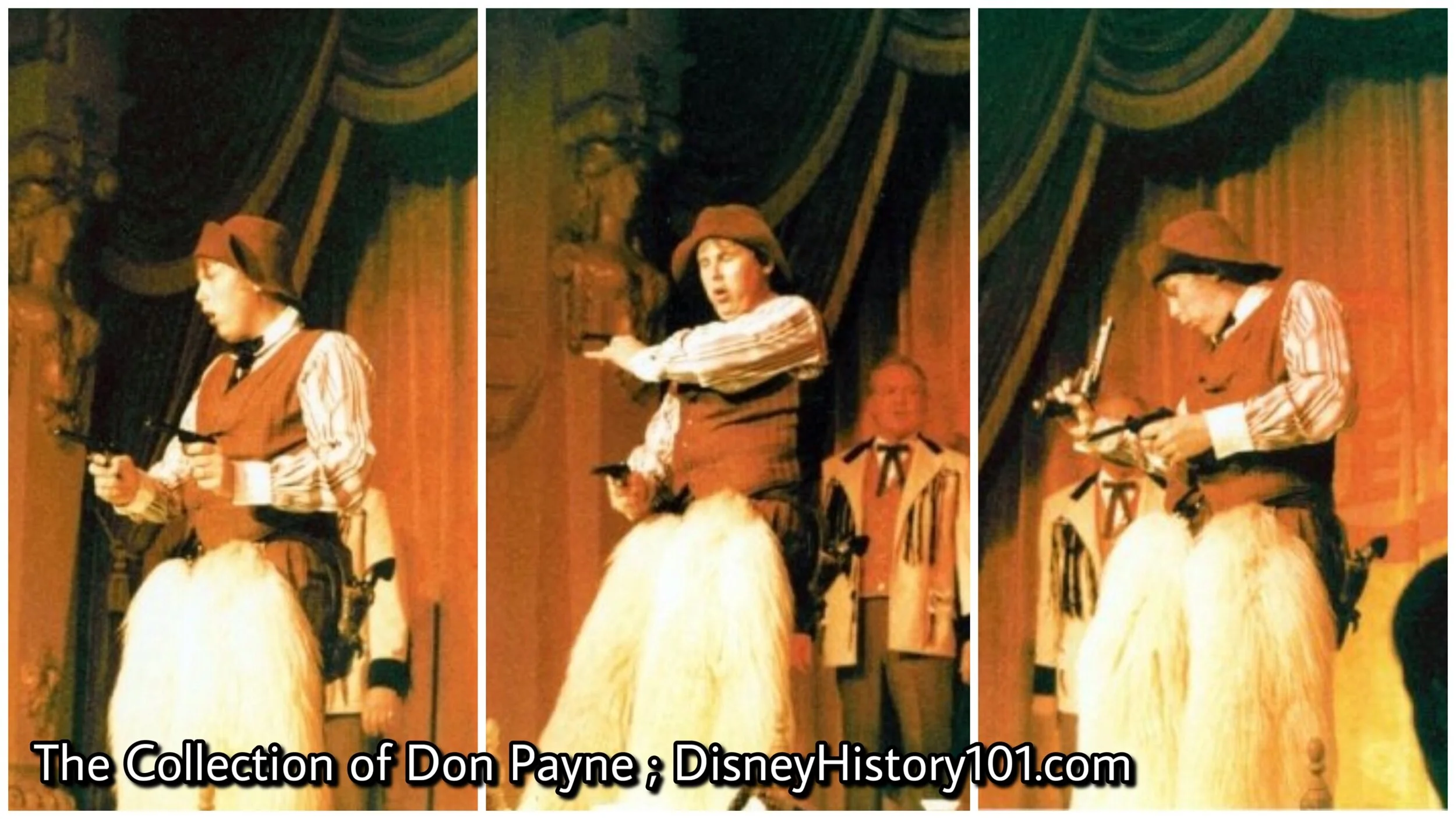
The Golden Horseshoe Band launches into a rendition of Stormy Weather, and the point Stormy Weather reaches that lyric, Pecos pulls two squirt guns and lets the audience have it!
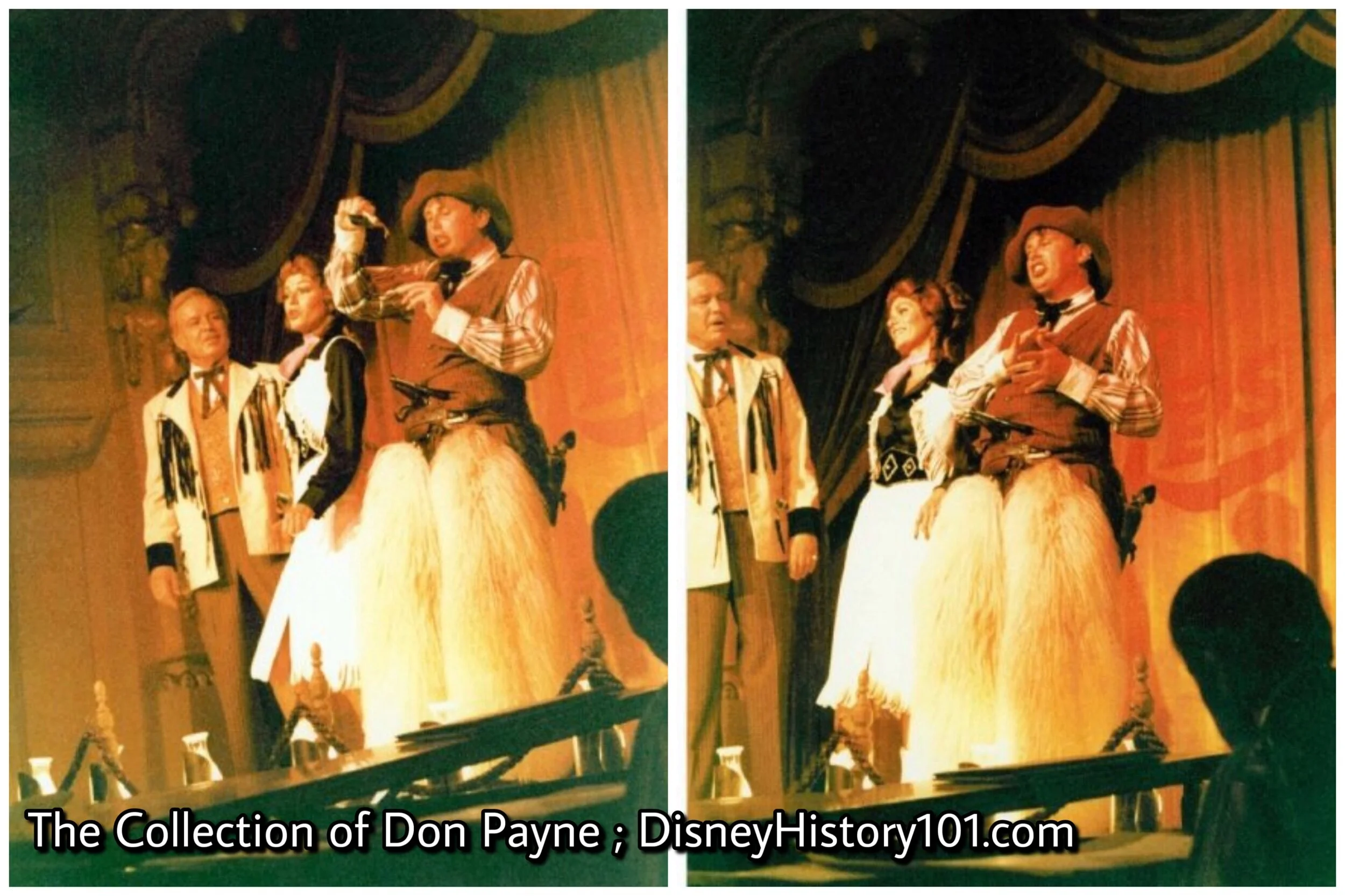
Pecos holsters his guns and decides to roll a cigarette. He pulls out a tobacco pouch and a cigarette paper, and begins to make quite a show of pouring the tobacco onto the paper! As Pecos moves to lick the paper with his tongue, Slue Foot Sue (singing the lyrics), does a sweep with her arms, and Pecos licks her finger instead of the cigarette paper.
Perplexed, Pecos looks around, shrugs, promptly pops the cigarette paper into his mouth, and chews!
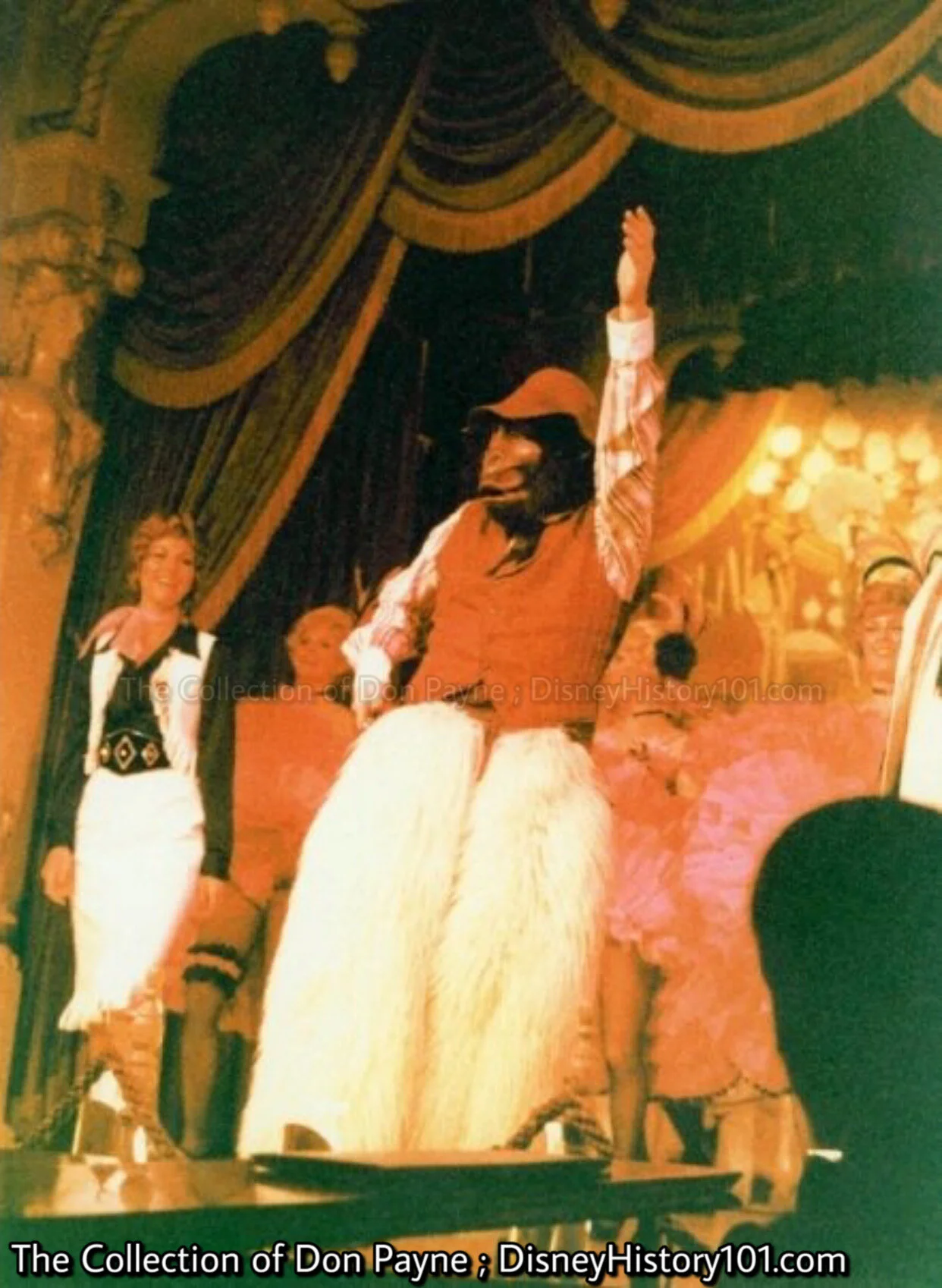
Pecos briefly exits the stage while the Pecos Bill number finishes up. By this time, the audience was usually in hysterics. This was a fast-paced, multi-leveled comedy routine set to music - the comedy bits leading into (and building upon) one another.
Slue Foot Sue launches into “thanks” and “goodbyes” to the audience, after which she brings The Boss out for his curtain call. She then brings out Pecos, who is wearing an extremely ugly gorilla mask. The audience cracks up.
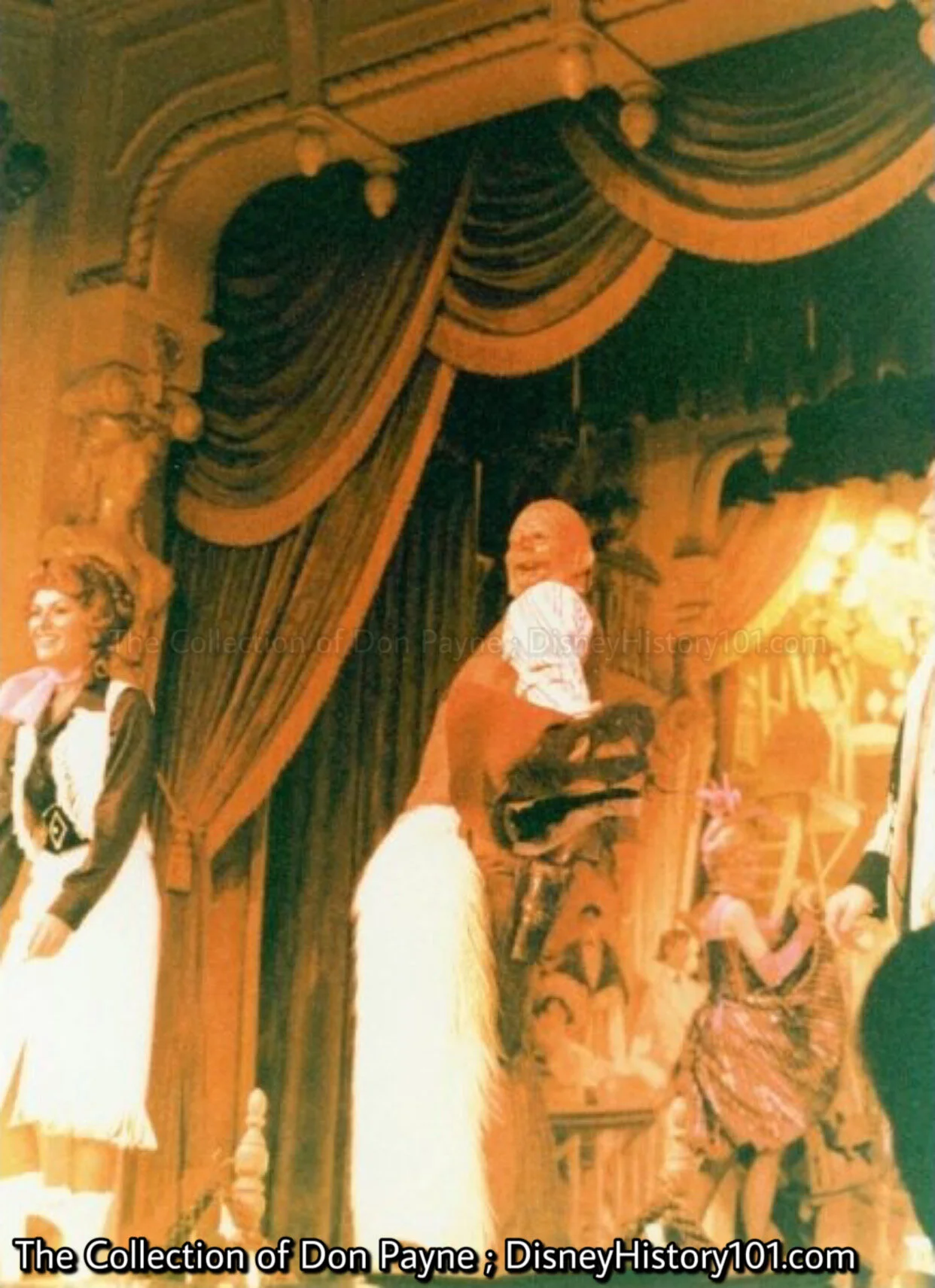
Slue Foot Sue has no reaction to the mask, so Pecos takes it off, only to reveal a silly-looking “goon” mask! When Slue Foot Sue has no reaction to the “goon” mask, he removes it, revealing a smiling face! At that, Slue Foot Sue lets out a scream, and the curtain falls!
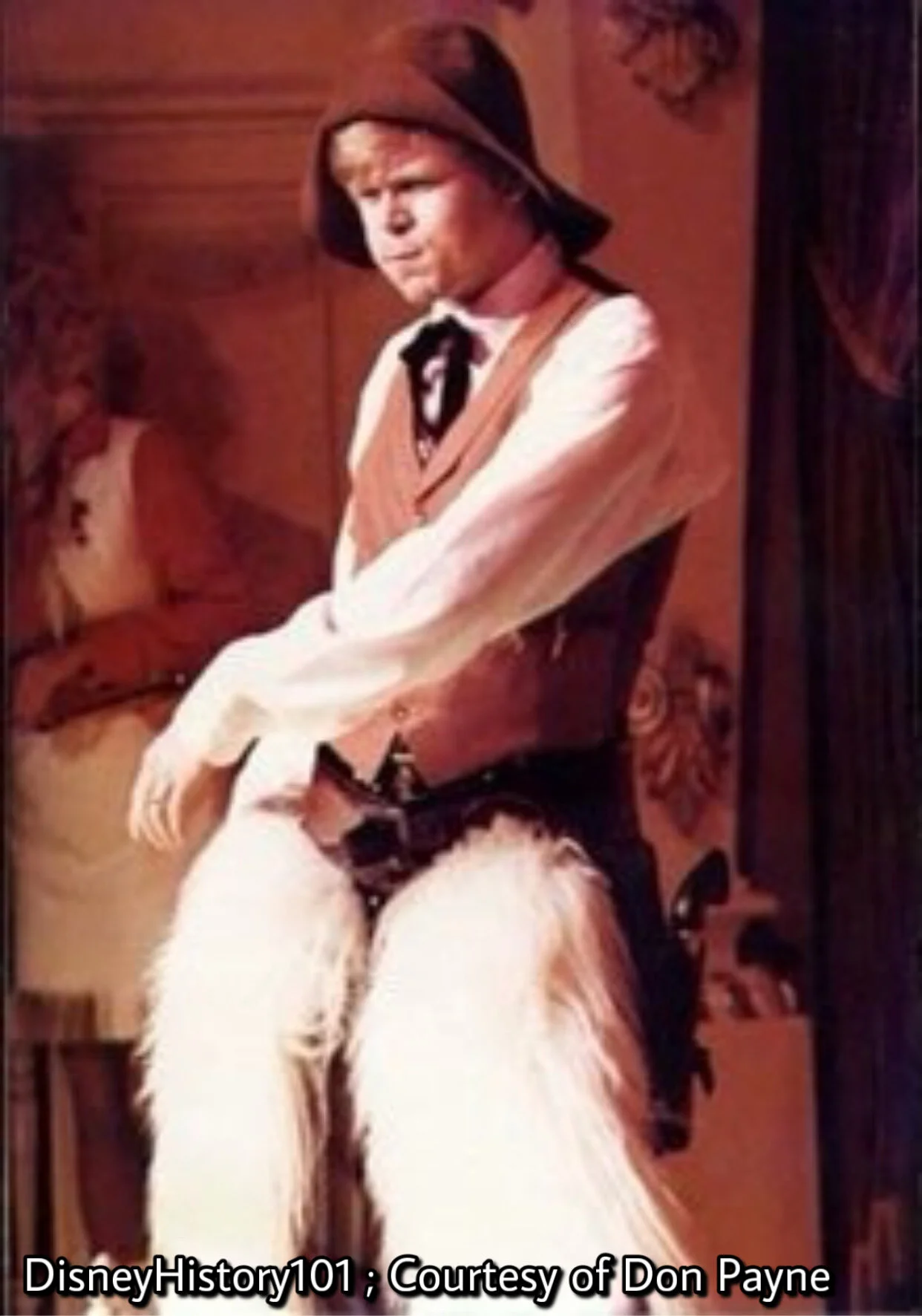
“SO, WHO WAS THE BEST ‘PECOS BILL’?”
From 1955 to1986, a total of seven individuals portrayed Pecos Bill (including Wally Boag, Jim Adams, Dick “Handpicked” Hardwick, Dana Daniels*, Kirk Wall, Don Payne, and Ron Schneider. When Wally Boag and Ron Schneider** went to Florida to help establish the Diamond Horseshoe, there was a need to fill his seasoned and iconic roles of Pecos Bill and the Traveling Salesman. So, who was the best in the role? We caught up with Don Payne (former Golden Horseshoe Jamboree Cast Member) who shared the surprising answer :
“Jim [Adams] had been a gymnast in High School and could do amazing flips and moves. We worked together in the Character Department... and later... in The Golden Horseshoe Revue…Jim, and I, had similar career paths at Disneyland: Character Department; Special Events Staff; National Promotional Tours for Buena Vista; Actors; Writers; Producers; Shows; Parade Staff and as subs for Wally Boag…In my opinion... Jim is the greatest Pecos Bill... standing just behind the great, founding Pecos... Mr. Wally Boag... the greatest Pecos of them all!”
*Dana Daniels’ performance of Pecos Bill and the Traveling Salesman may be viewed HERE.
**Ron Schneider’s final Golden Horseshoe performance can be viewed HERE. He subsequently went on to portray a more memorable role of the Dreamfinder in EPCOT Center!
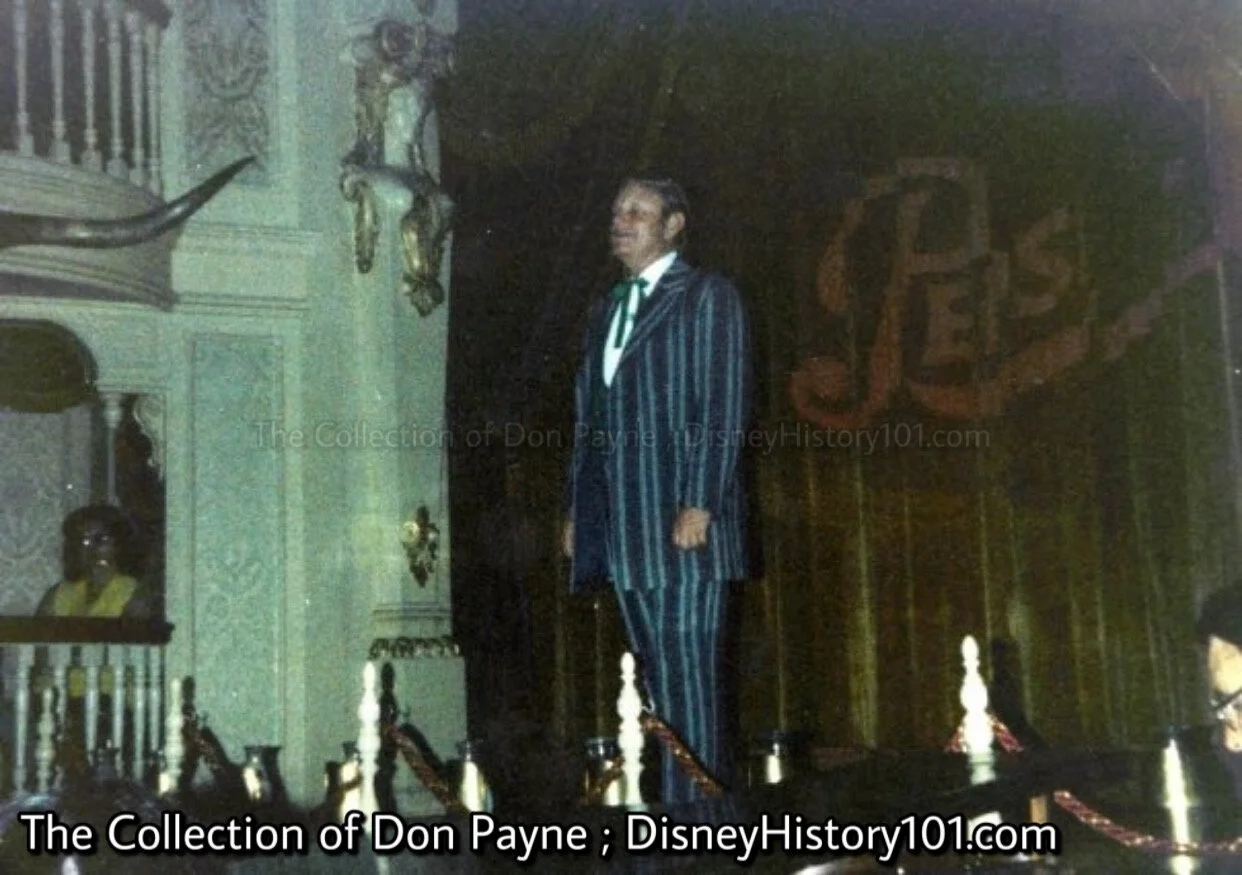
“Don Payne Remembers Mr. Jay Meyer”
Jay Meyer was hired as a substitute for Fulton Burley’s Emcee and Irish Tenor, performing from 1972 to Sunday, October 12th, 1986.
Former co-star Don Payne remembers : “Jay Meyer was a permanent substitute for Fulton Burley. Jay had a long, successful career. He sang on the old Milton Burle Show as one of the ‘Texaco Men’, and you can see him performing as one of the singing busts over the headstones in The Haunted Mansion attraction. He was always a great gentleman, and generous performer. It was a pleasure to work with him. Jay passed away on January 18th, 2008. He is missed.”
Jay Meyer was immortalized as the voice of one of the singing busts in the Haunted Mansion.
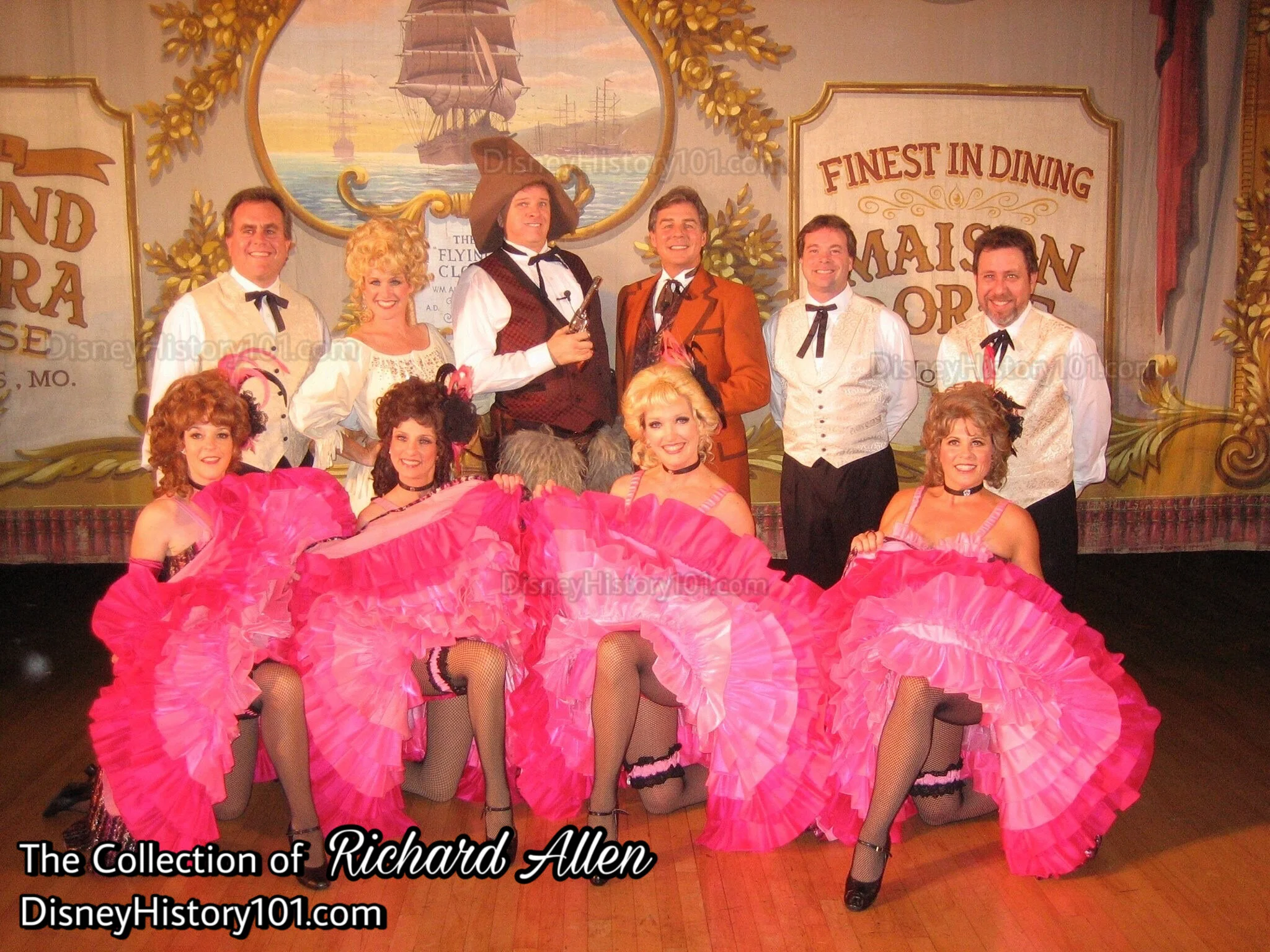
“The Golden Horseshoe Reunion”, Novembe 6th, 2014
Former Golden Horseshoe Revue Pianist Richard Allen fondly remembers this reunion and tribute :
“We had a reunion show - in this picture is: Georgeen Whitney, Chris Stevens, Shelly Nichols, Deedee Bozikis, Shelby Grimm, Arlene Dragonn, Lana Devore and Richard Allen (me). I had a beard at this show. Nobody cared.
What was amazing about the reunion show is everyone remembered all the music and dance moves. It was pretty amazing. I don't recall if the can-can girls did their cartwheel. I think maybe Deedee did. Dana spit beans, of course. I remember the show we did after it closed, I was still finding beans on the stage months later.”
More than just a pretty face, and a fast set of legs, these effervescent Can Can chorus dancers had true talents that empowered them for greater things! Can Can Dancer DeeDee Bozikis had her start as a Golden Horseshoe Can Can dancer back in 1978. She eventually went on to work in Assistant Stage Management. Shelly Nichols (who was both a can can dancer and lead singer for the Golden Horseshoe, as well as Calamity Jane in the Pecos Bill Wild West Revue) became the choreographer/show director for “The All American College Band” at Disneyland.

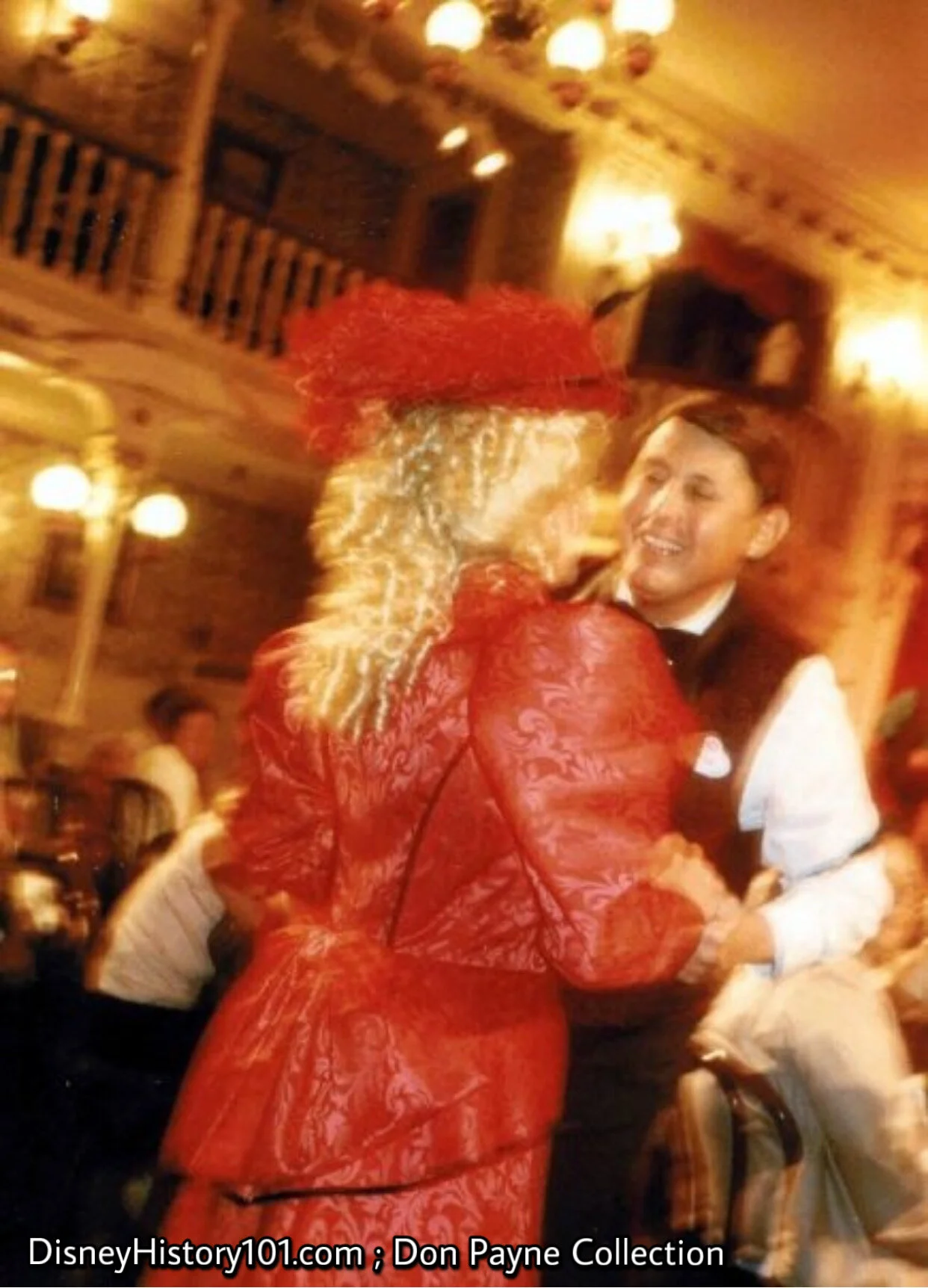
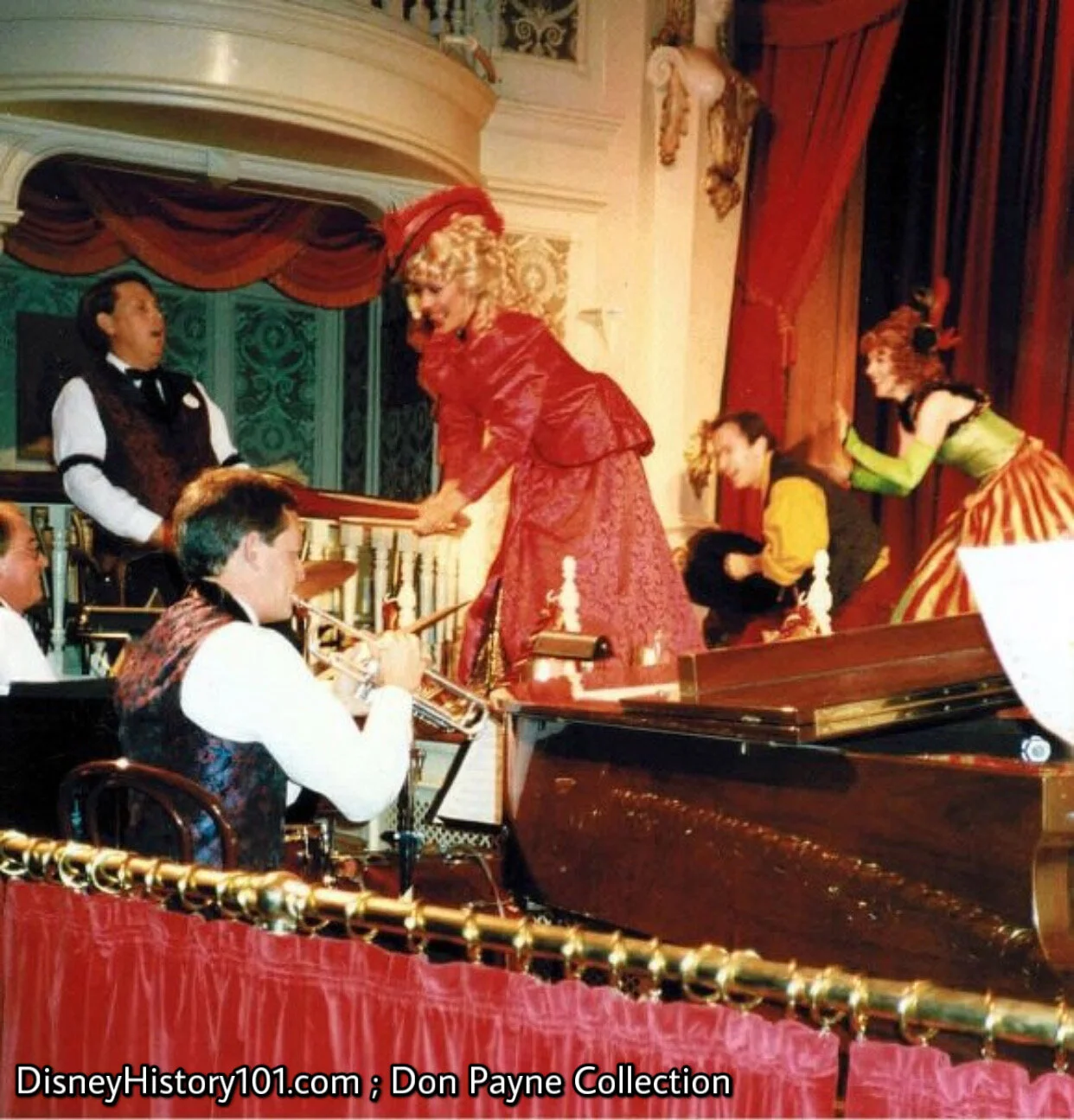
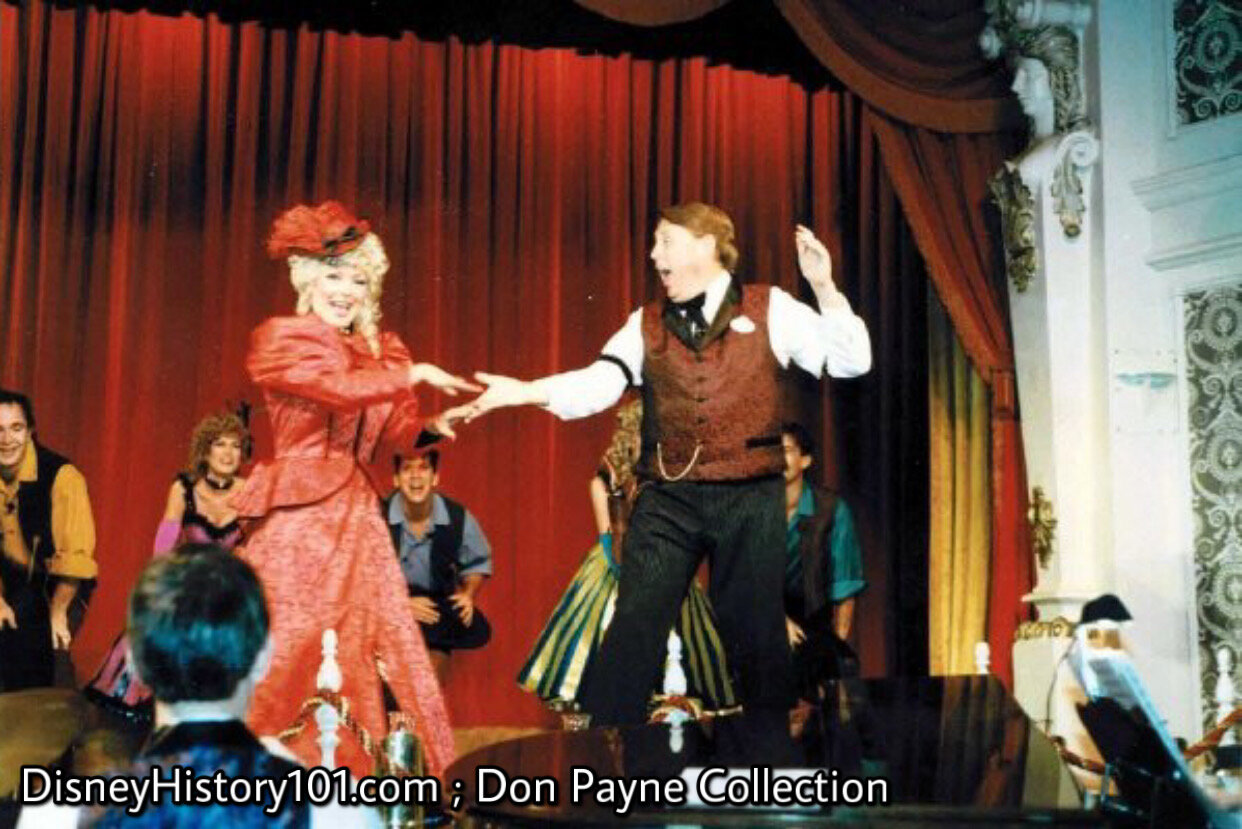
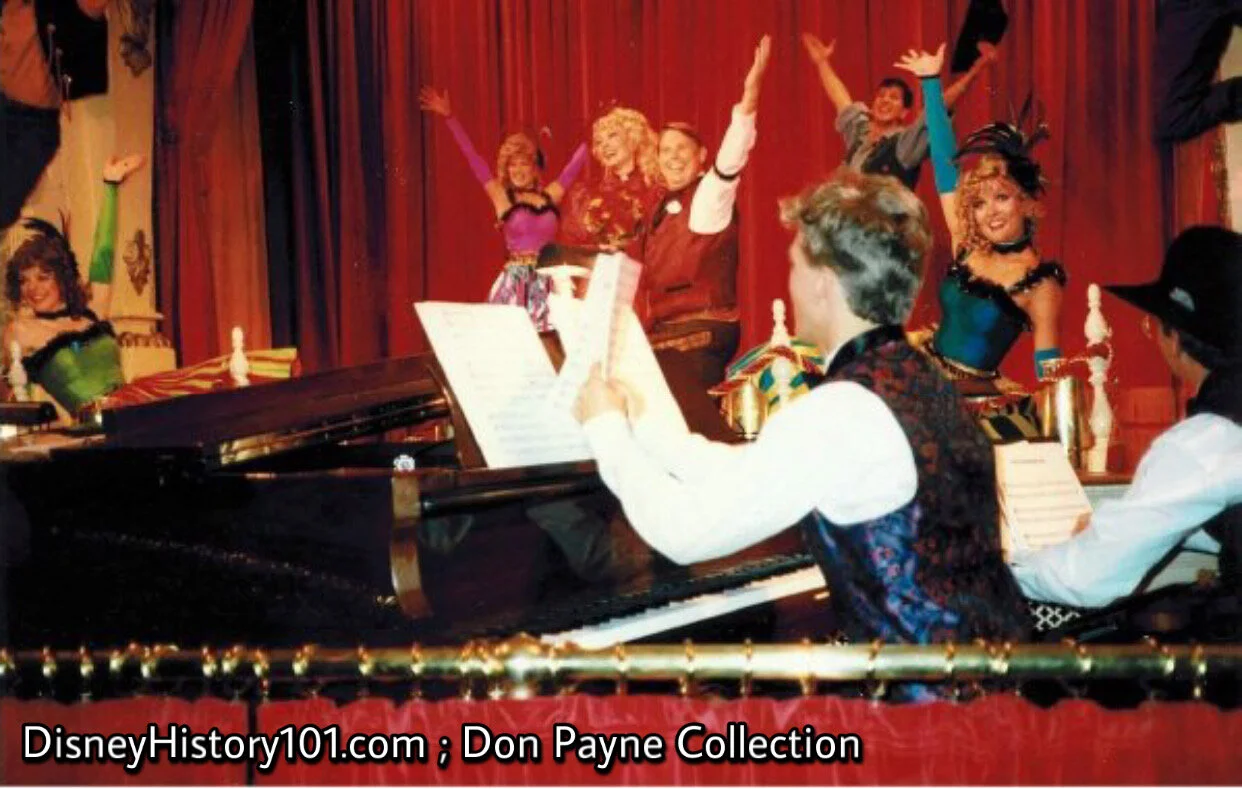
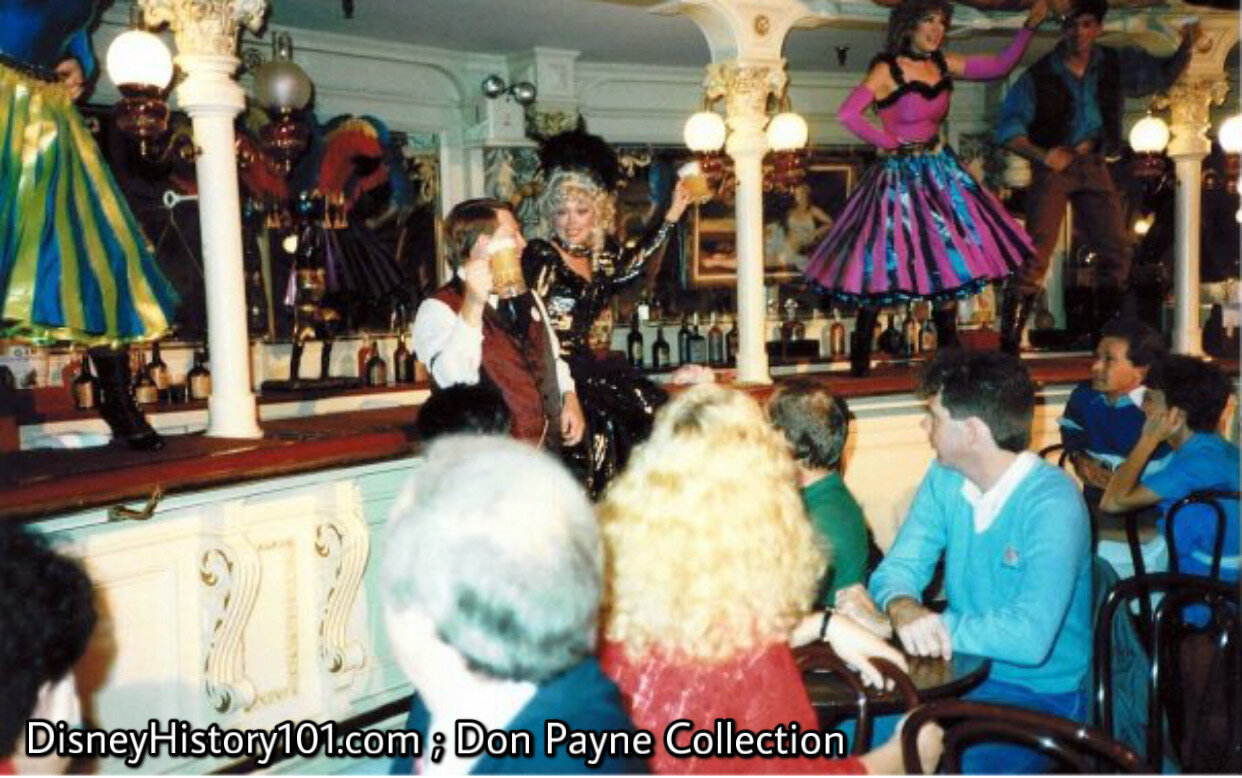
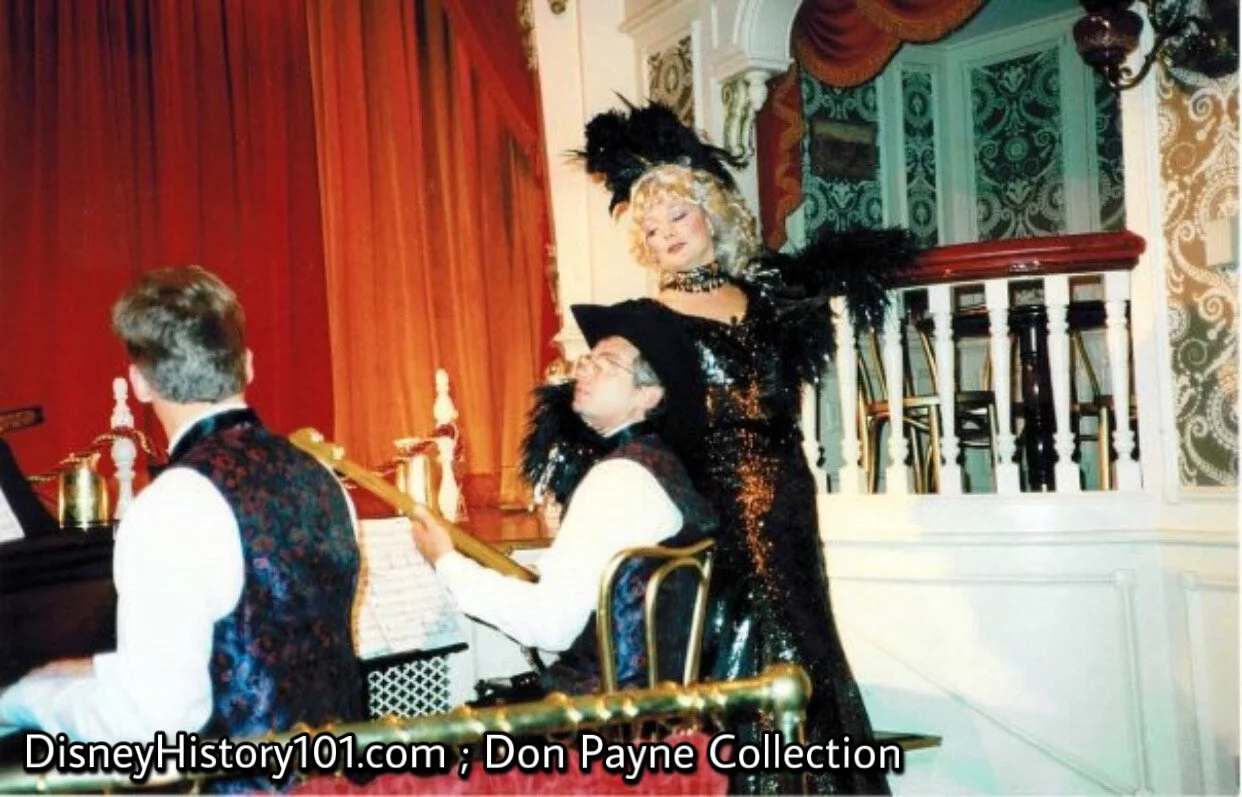
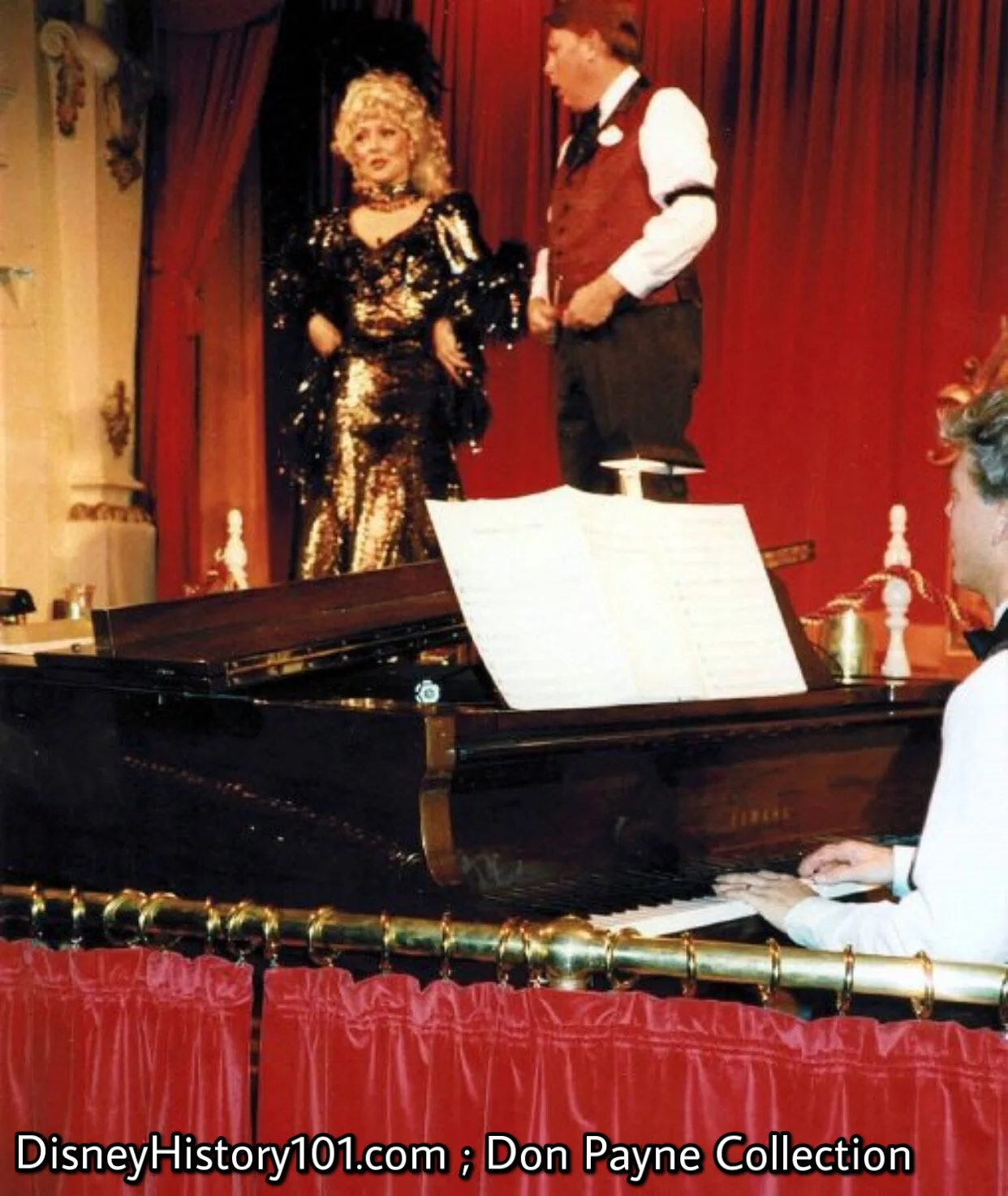
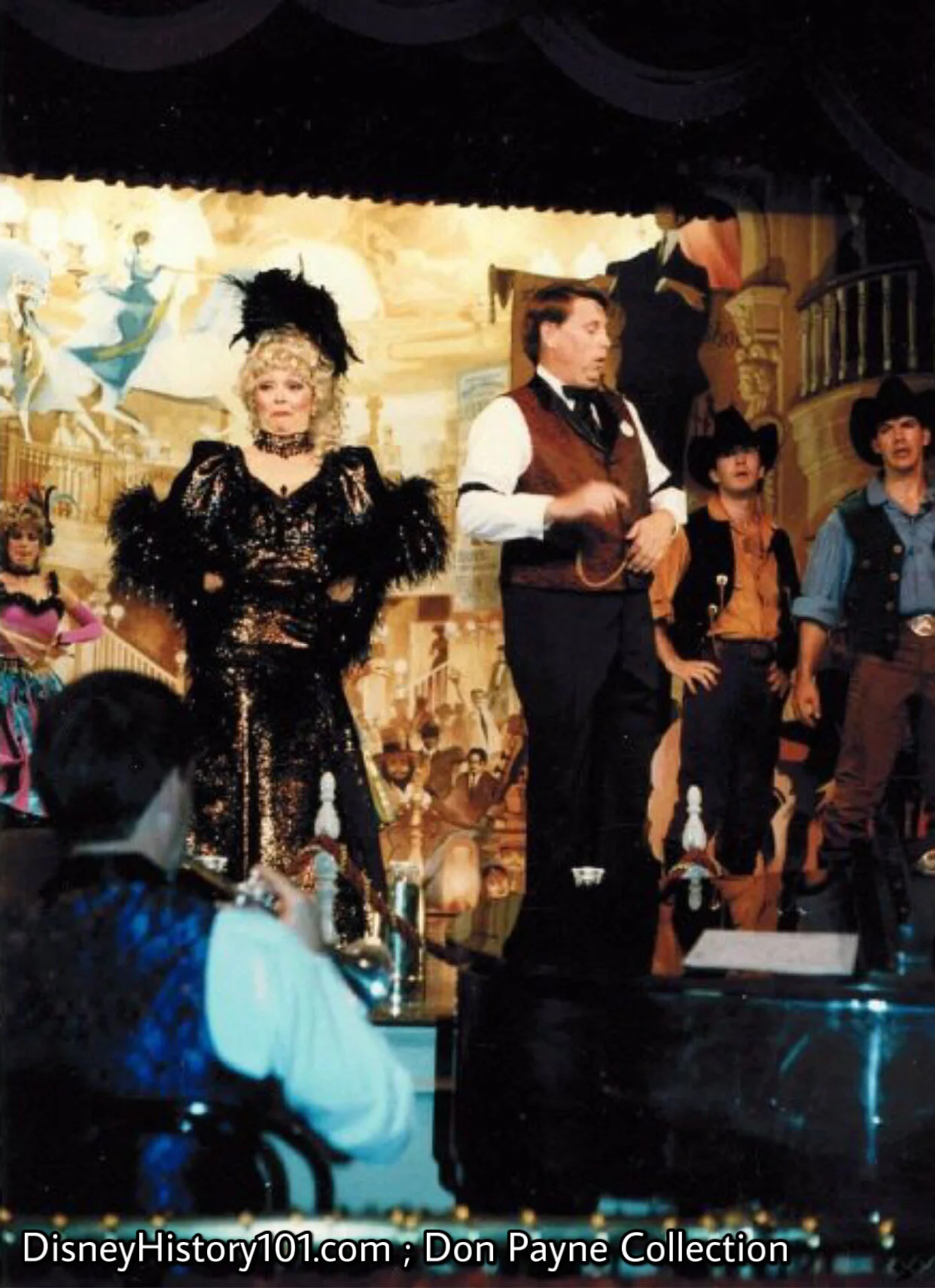
After the Golden Horseshoe revue closed on Sunday, October 12th, 1986, the Golden Horseshoe was temporarily closed and put under rehab, with an estimated premier on November 1st, 1986. A new proprietor (Miss Lilly Langtree) was in charge of the establishment portrayed by the multi-talented Miss Judi Wallace (who was previously cast in the Golden Horseshoe Revue)! Miss Lily Langtree was supported by Sam the bartender, for comic relief. It was at this time, a new show was created - the Golden Horseshoe Jamboree which ran more than eight years - from November 1, 1986 to December 18, 1994. There were many other talented individuals involved in this production. For instance, dancer Tobi Longo (daughter of original Golden Horseshoe Can Can Dancer, Rikki Lugo) carried on her mother’s legacy, performing amazing “jump splits” in the chorus line.
Don Payne recollects : “As one of the few Cast Members who performed in both the [Golden Horseshoe] Revue and the [Golden Horseshoe] Jamboree, it has always been my opinion, based on audience responses, the Revue was the better, more popular show. The Revue was a loosely formatted, Vaudeville-style show that allowed for ad lobbing and more spontaneous comedy. The Jamboree was more of a scripted, structured, off-Broadway-musical approach. It was staged very tightly, in comparison with the Revue. For the audiences…and the performers…lighter…more fun. Just one man’s observation.” WATCH Don Payne’s Golden Horseshoe Jamboree performance HERE, and after the show, return for more behind-the-scenes Golden Horseshoe fun!
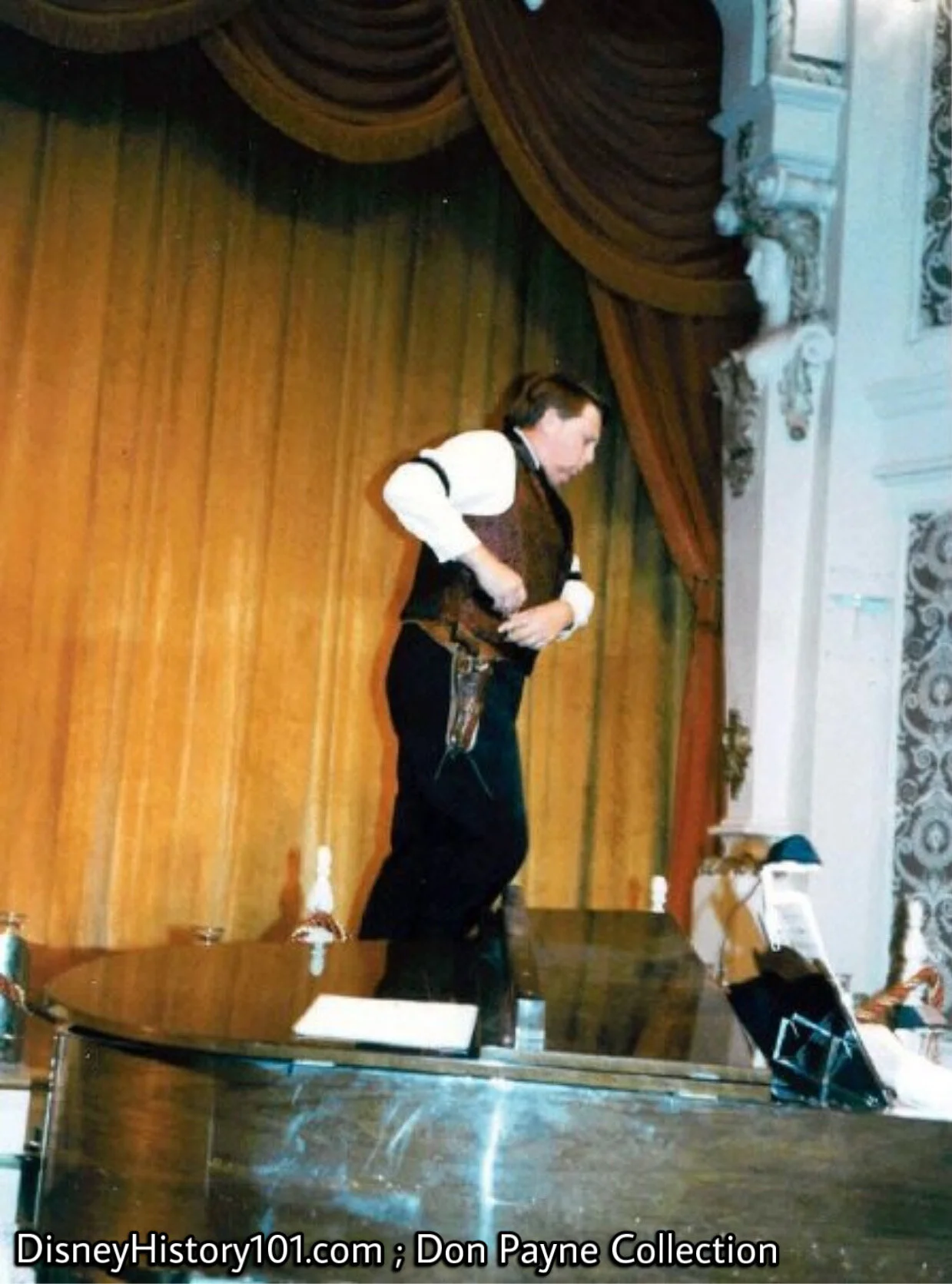
c. 1986 - 1987
Don Payne as Sam the Bartender in Disneyland’s Golden Horseshoe Revue
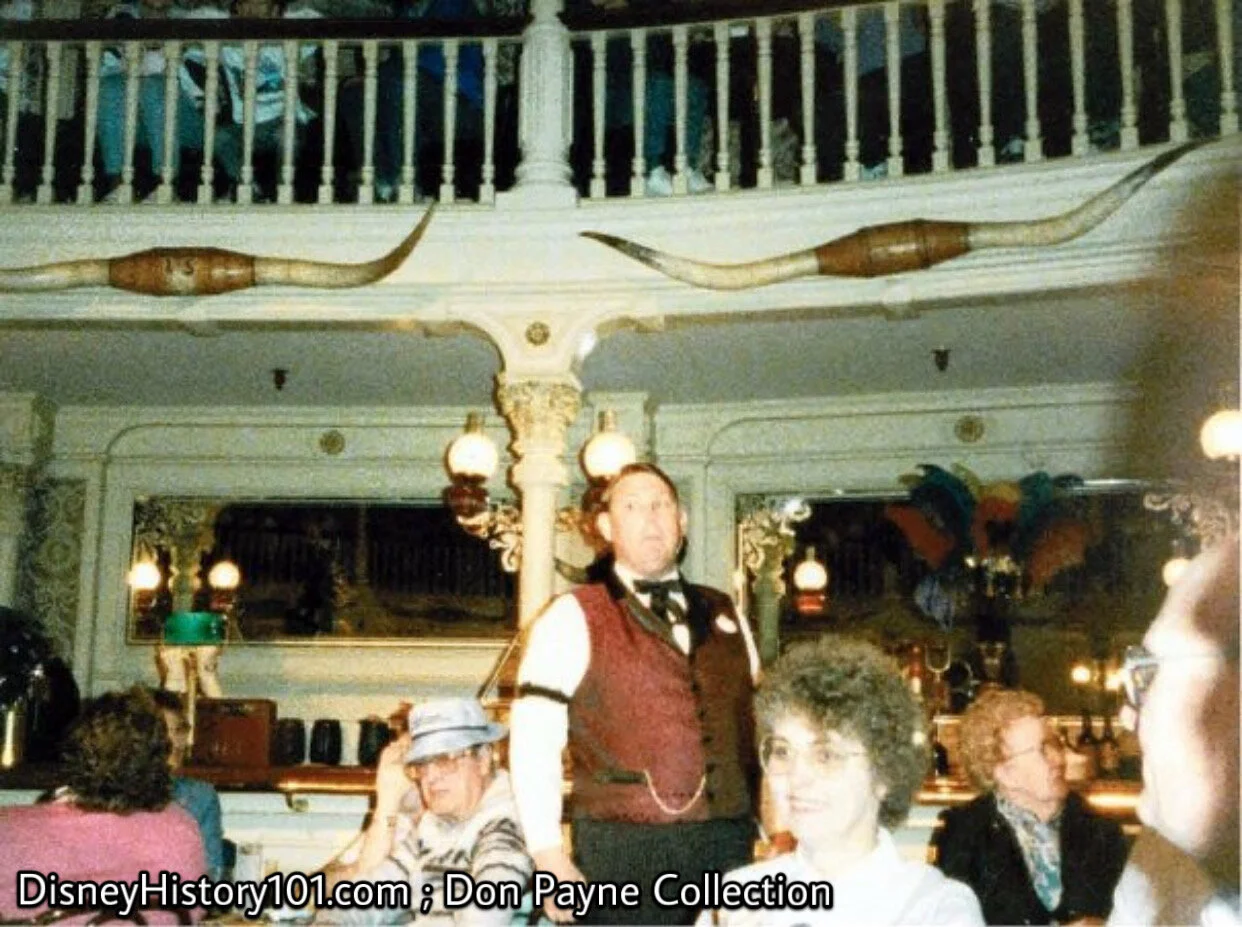
Sam works the audience.
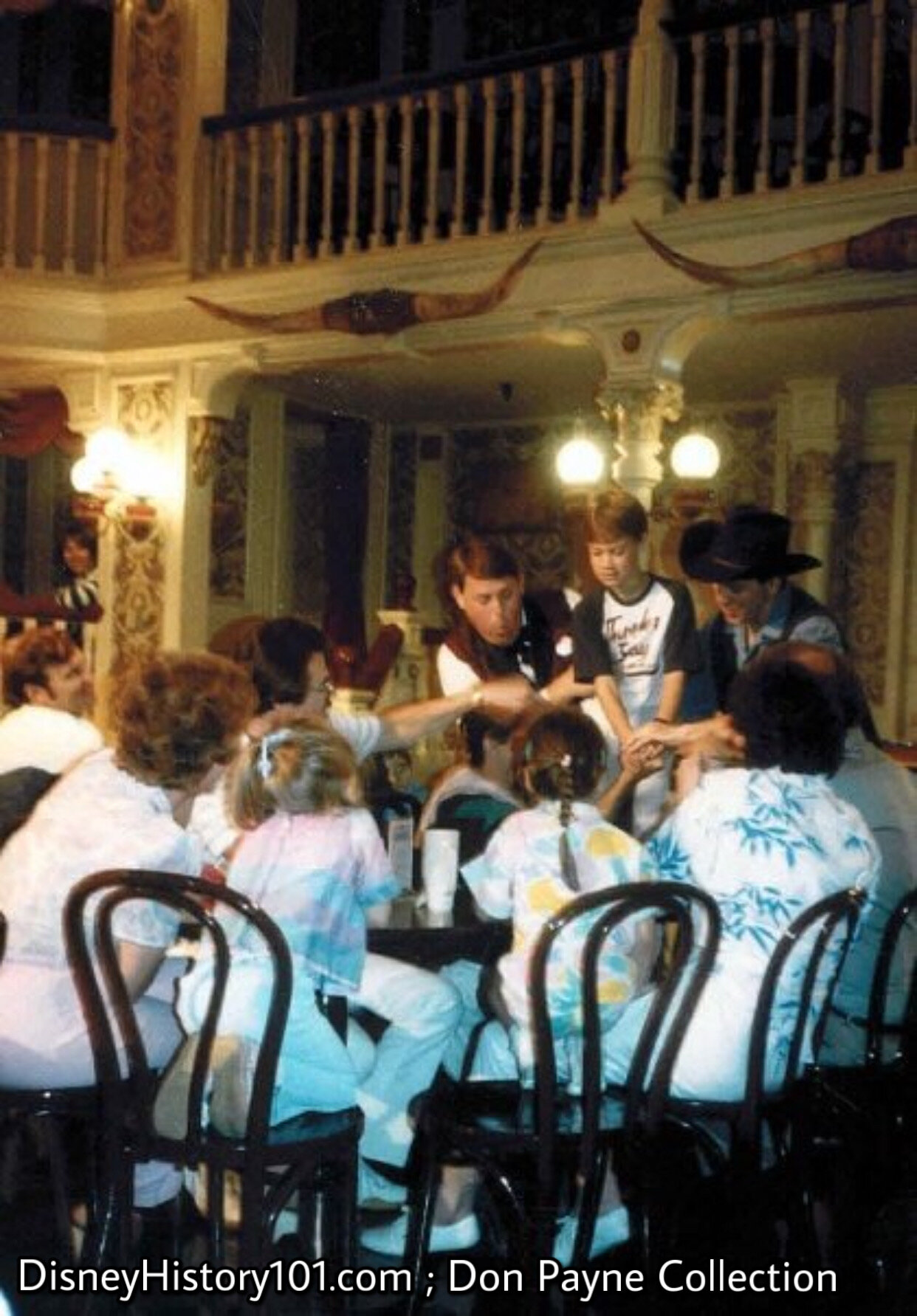
One of Sam’s Cowboys adds to the fun!
c. 1986 - 1987
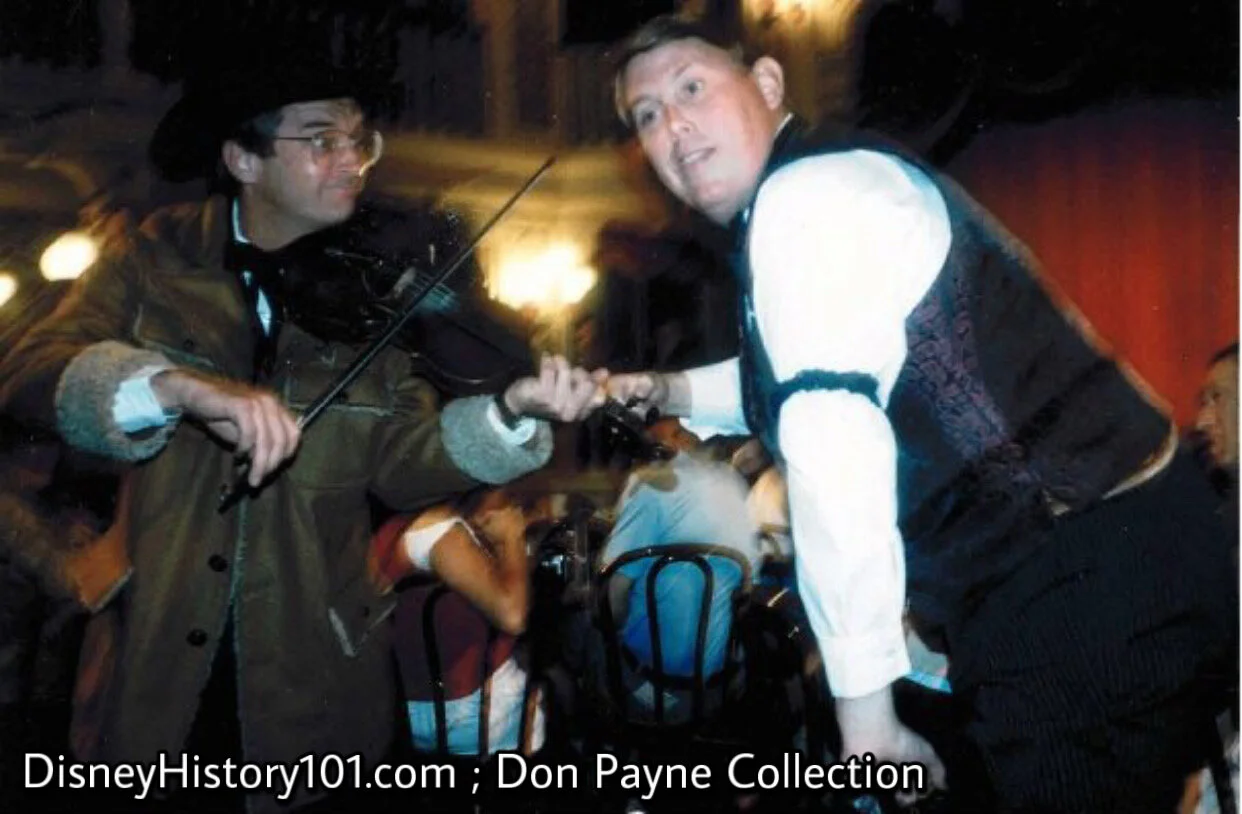
Sam meets a Fiddle Player (Dennis Fetchet) who wants to join the House Band.
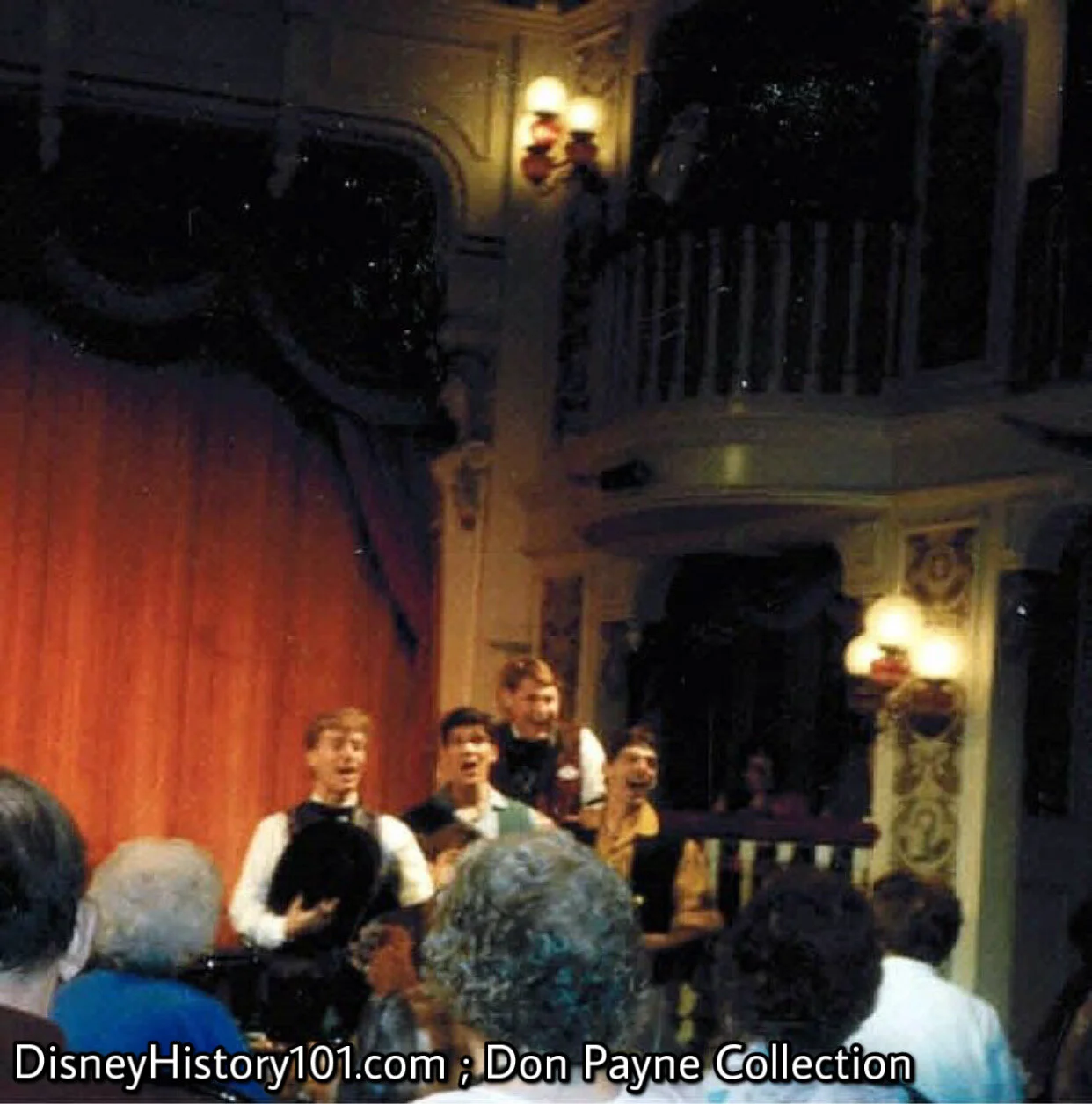
The Cowboy Barbershop Quartet
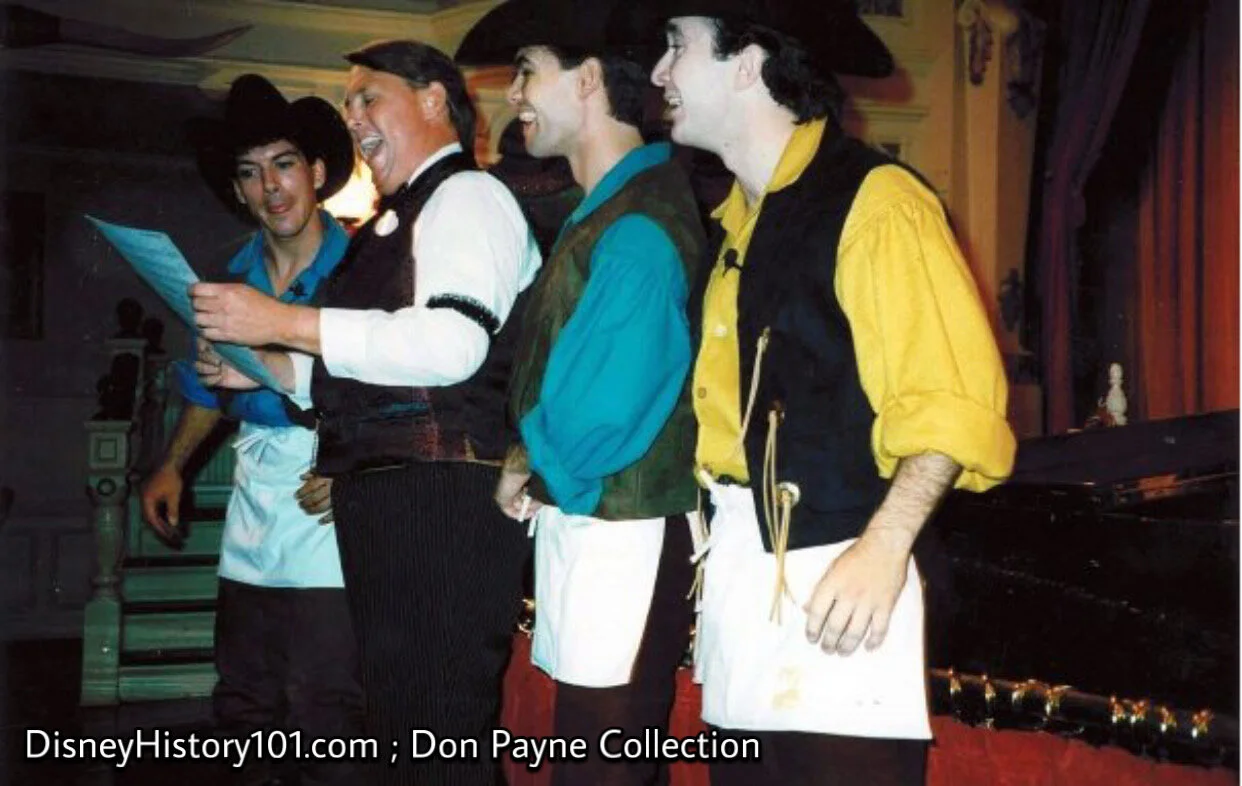
The Cowboy Barbershop Quartet Singing 4-part harmony for “Home on the Range”
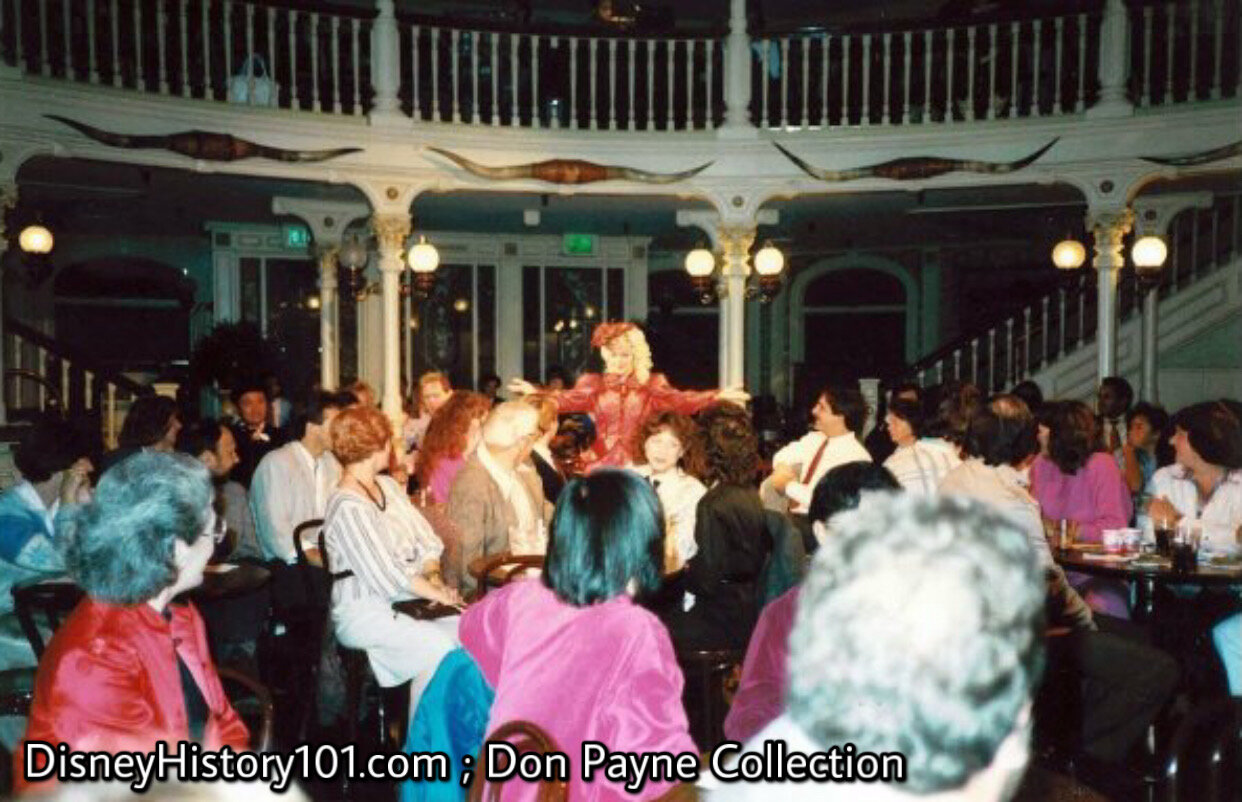
Miss Lilly arrives at the Golden Horseshoe Revue.
Lilly and Sam meet in the center of the audience.
Lilly does a drum solo from the stage.
Lilly and Sam (Don Payne) on stage for the Opening Dance Number.
Dance Number Finale.
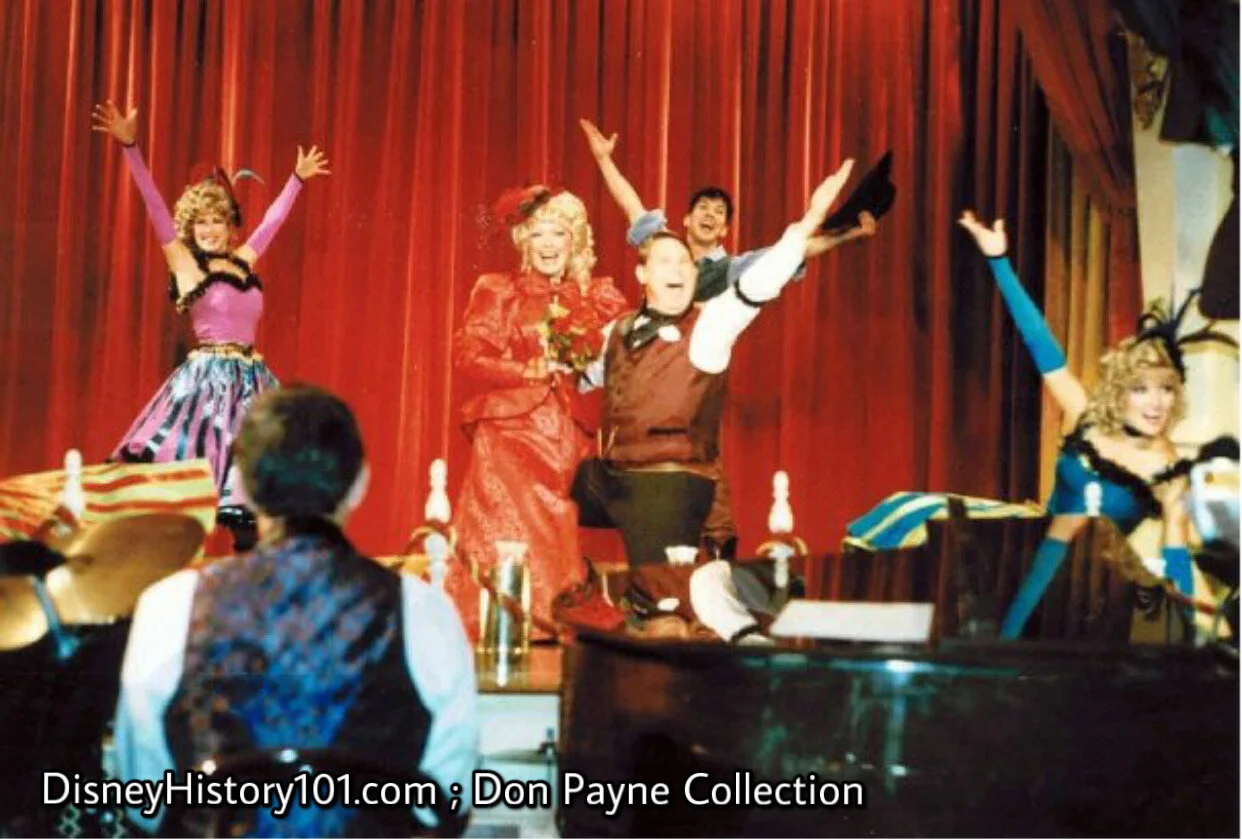
The animated Cast.
Dance Number Finale
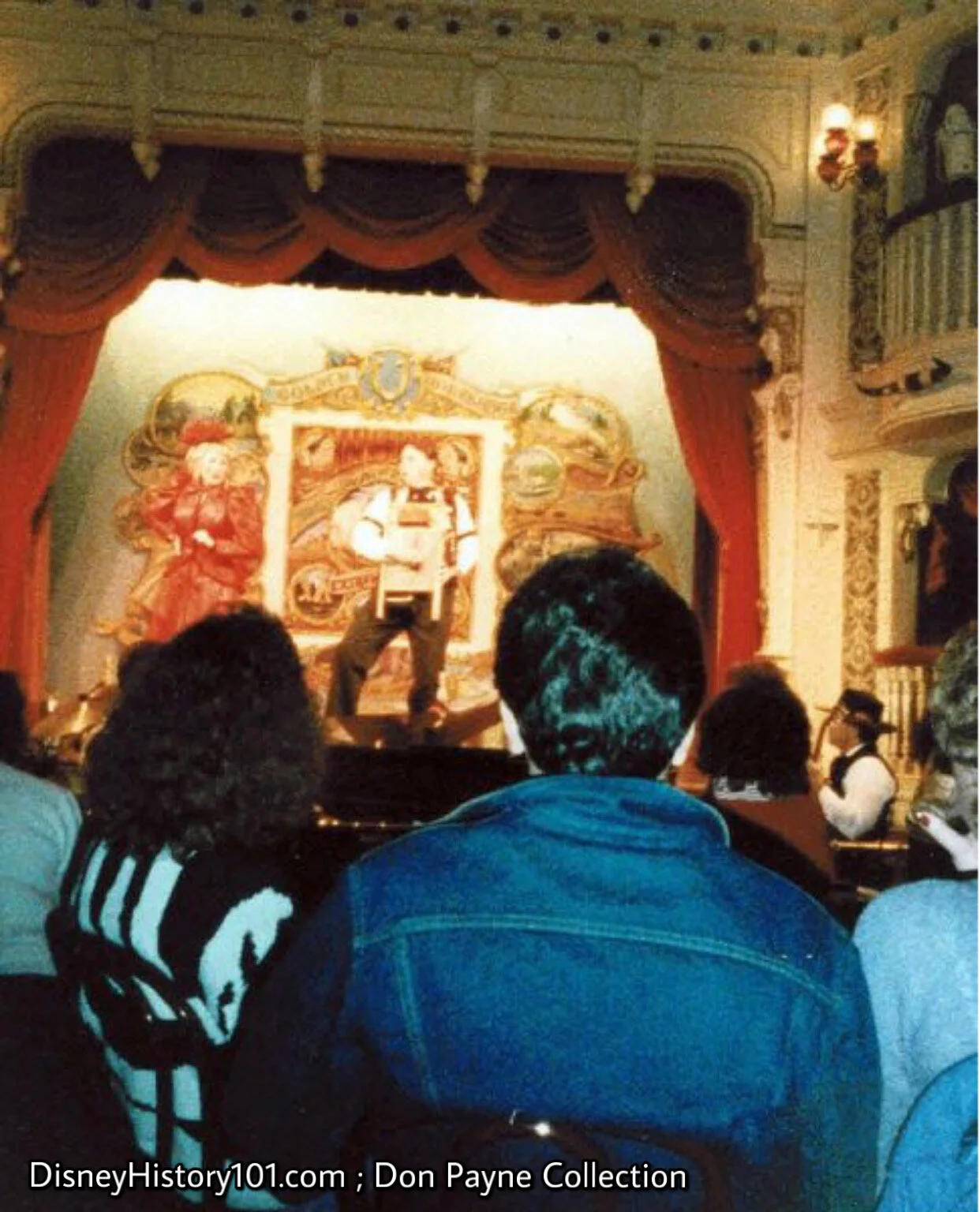
Sam’s all “washed up”, but he wants to be part of Lily’s Traveling Show Troupe. So, he auditions with a washboard act.
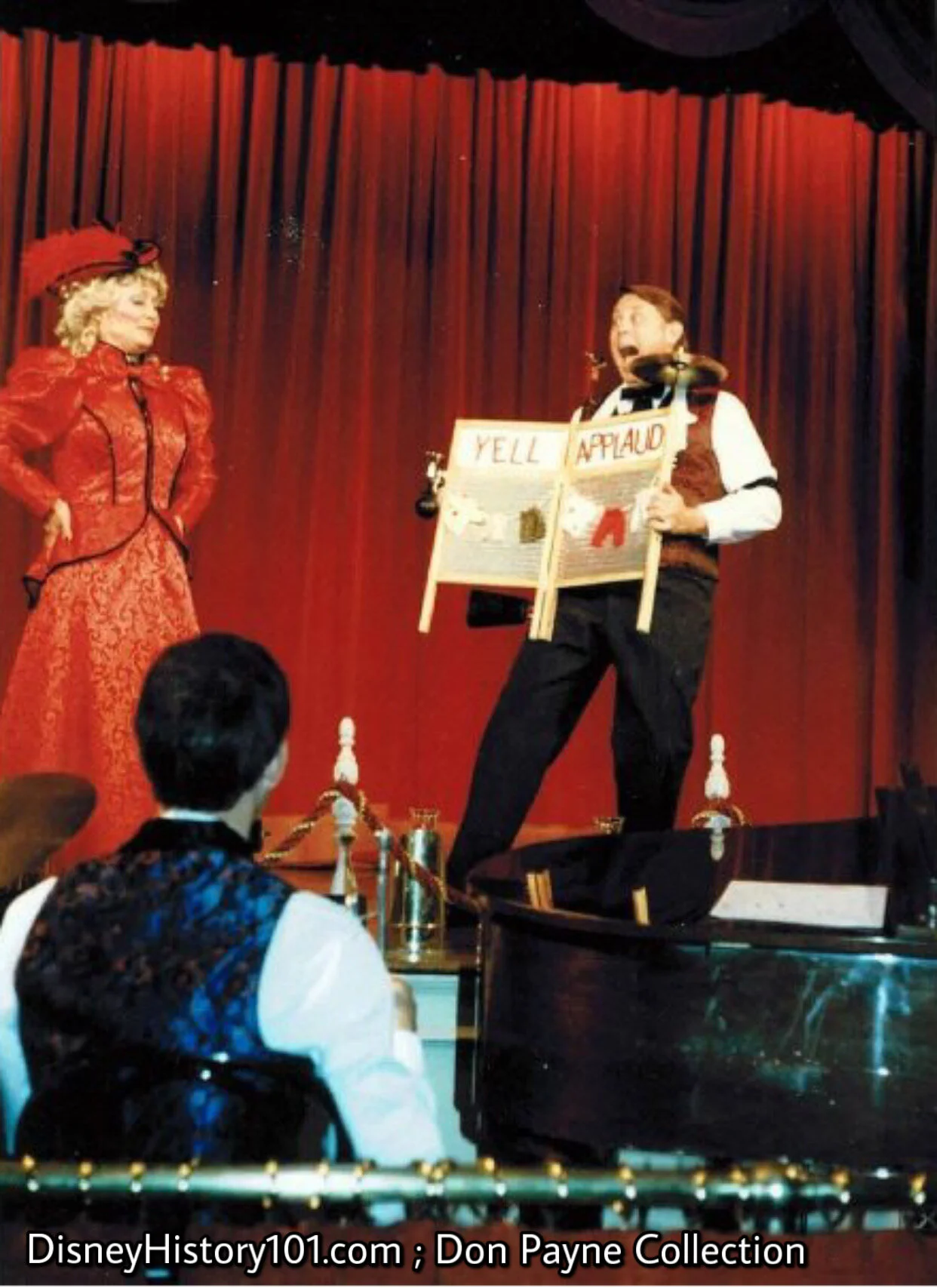
Washboard act finale
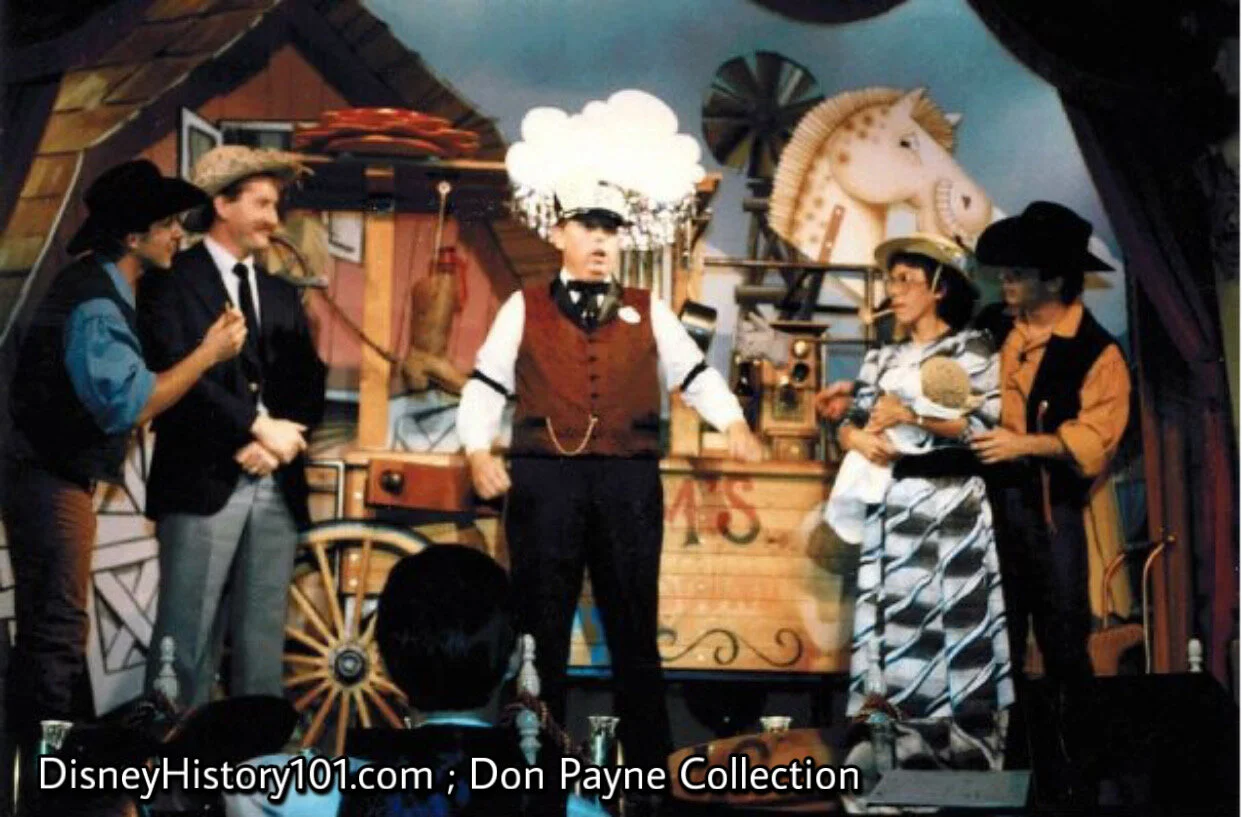
In another attempt to join Lily’s show, Sam introduces his new act - a sound effects version of Old Mac Donald’s Farm (with audience participation on stage)!
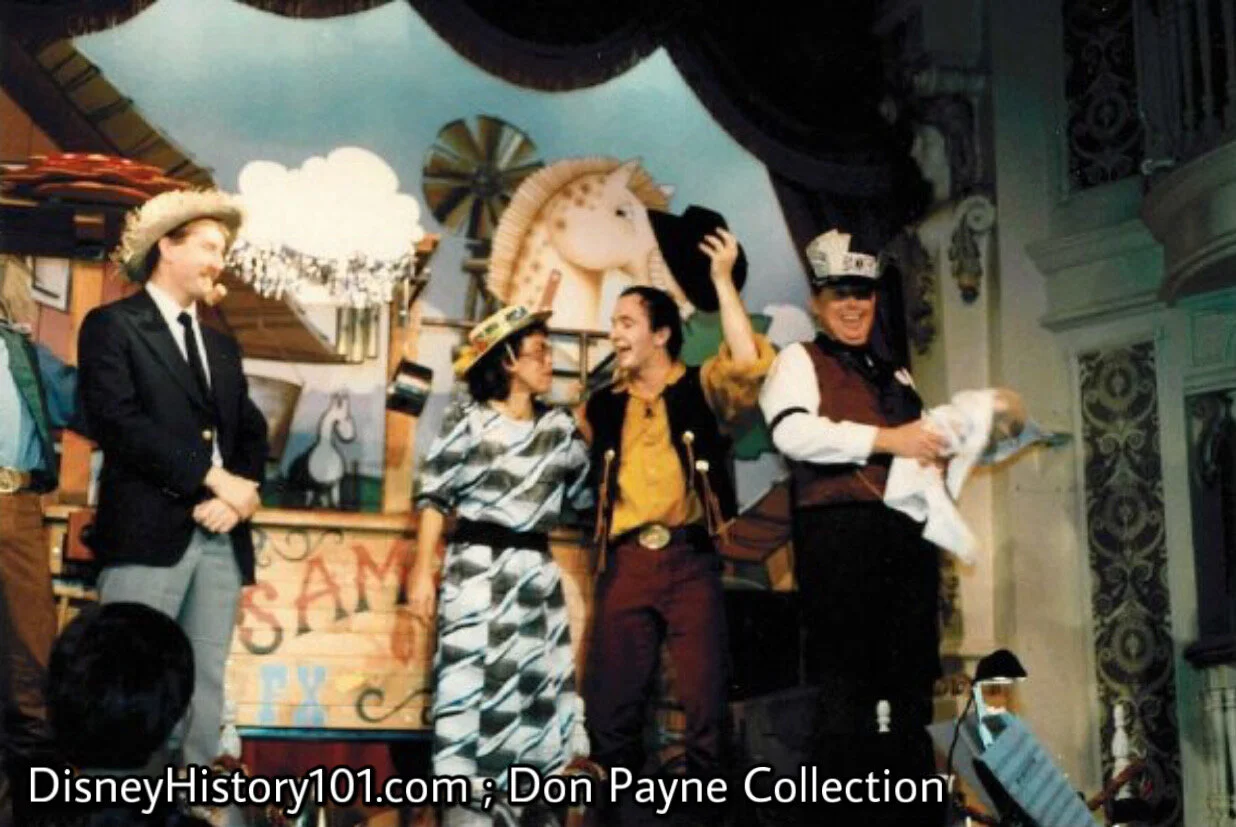
The Sound FX wagon acts up.
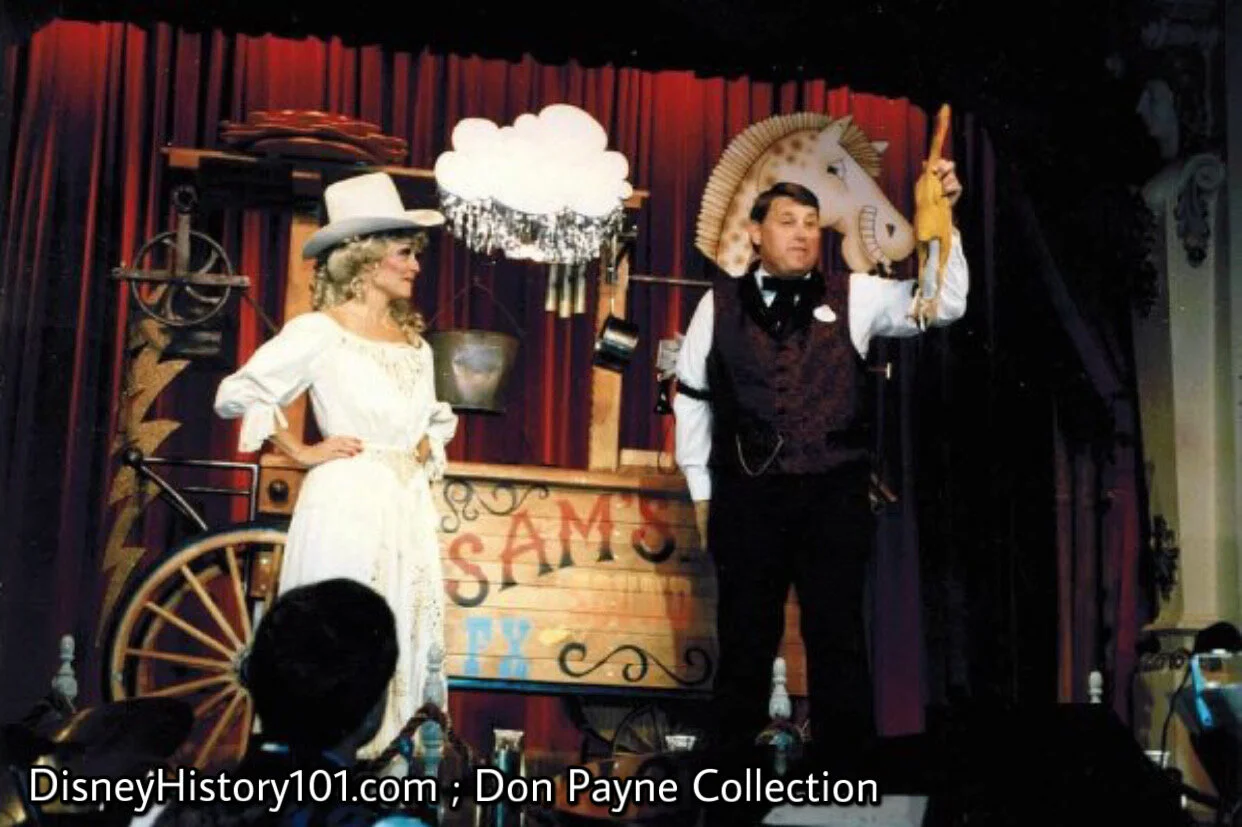
Lily bets Sam that she can make more money than he can by auctioning off Sam’s junk from the Sound FX wagon…starting with his rubber chicken.
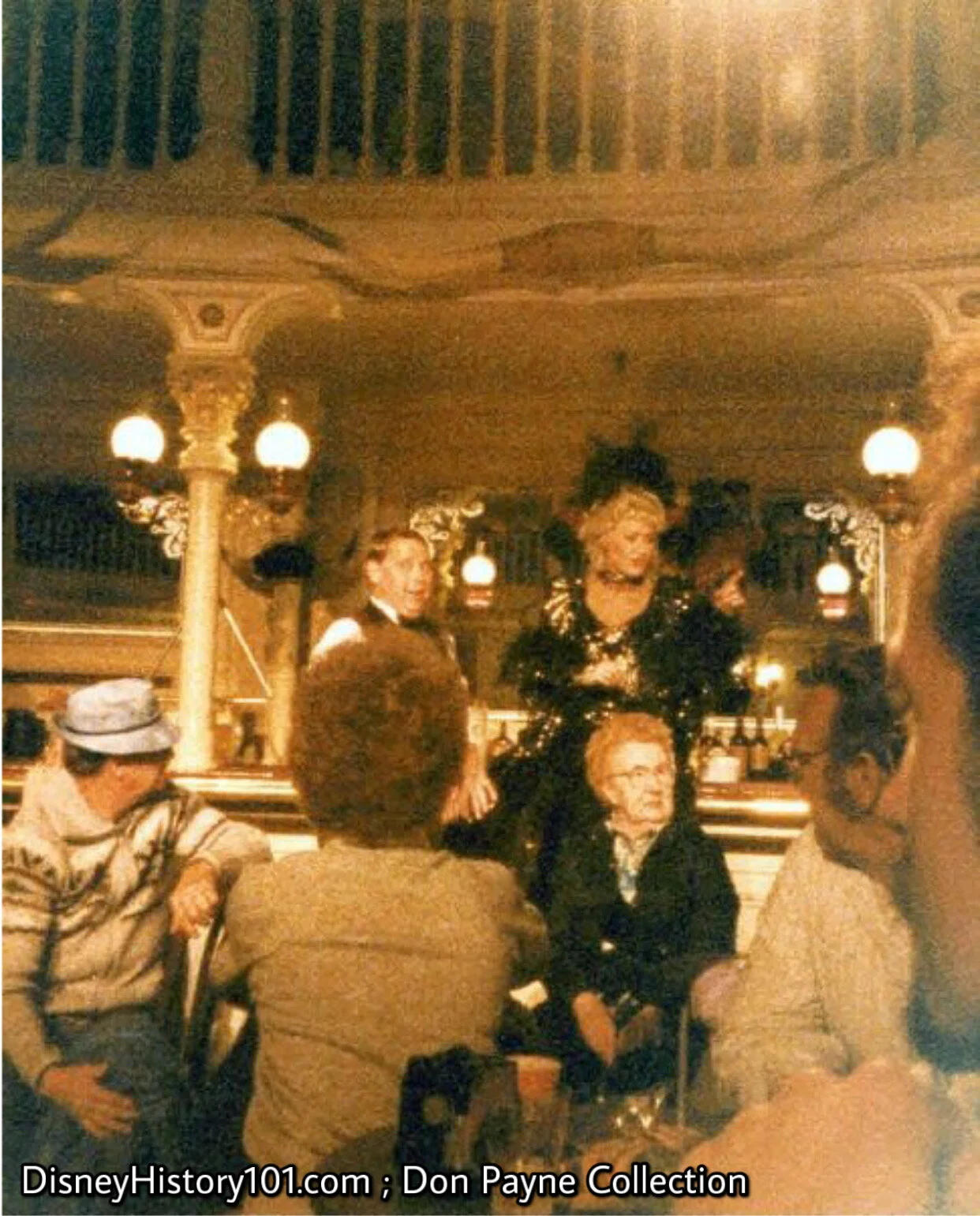
Sam and Lily perform “The Belly Up To The Bar” Number.
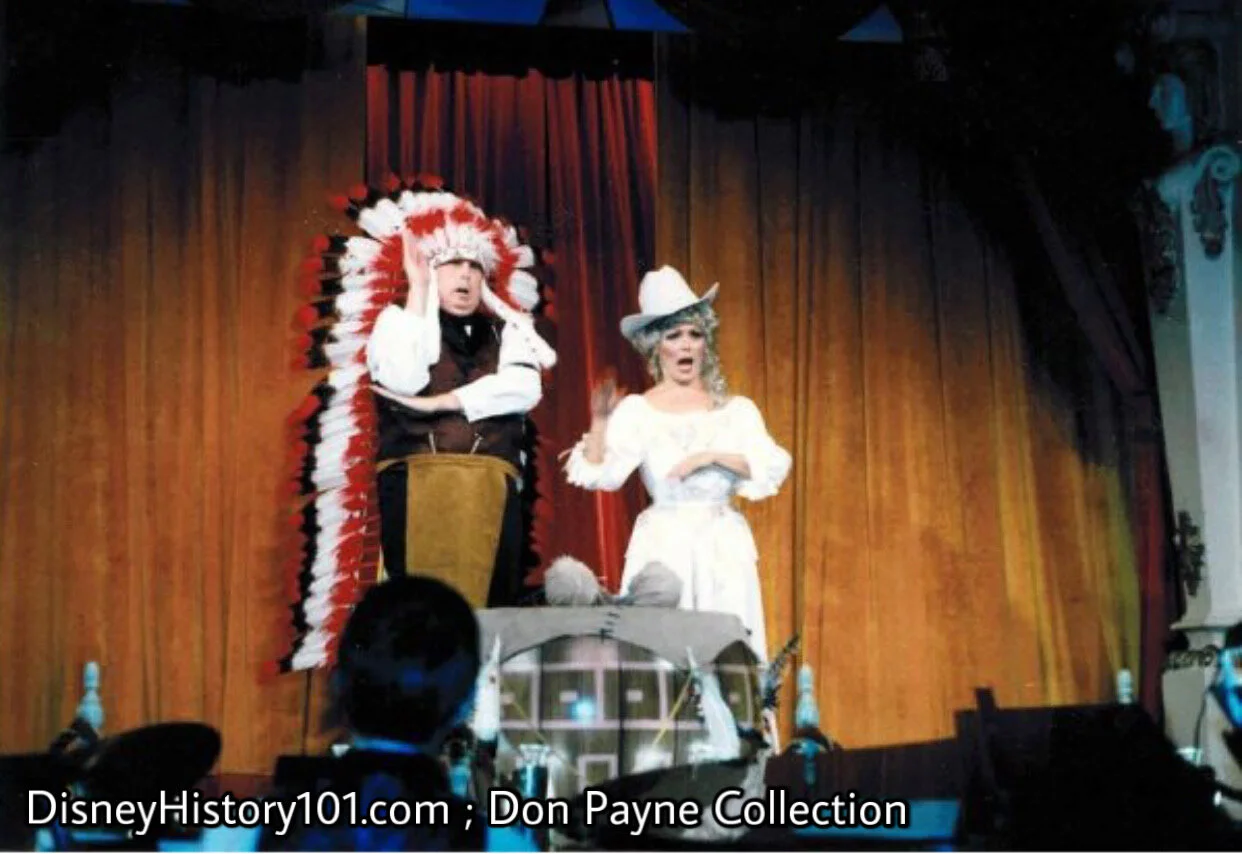
In yet another attempt to impress Miss Lily, Sam rolls out a large Indian Drum and launches into another act.
Sam : “Chance.”
Lily : “What?”
Sam : “Chance.”
Lily : “You mean ‘How’.”
Sam : “Me know How. Me want Chance.”
This leads the audience into participating in a chant that turns out to be “It Don’t Mean A Thing If It Ain’t Got That Swing”.
Belly Up To The Bar Boys Number
Lily’s solo act
Lily and Sam on stage.
Lily challenges Sam into proving Sam’s Cowboys can dance better than her Dancing Girls.
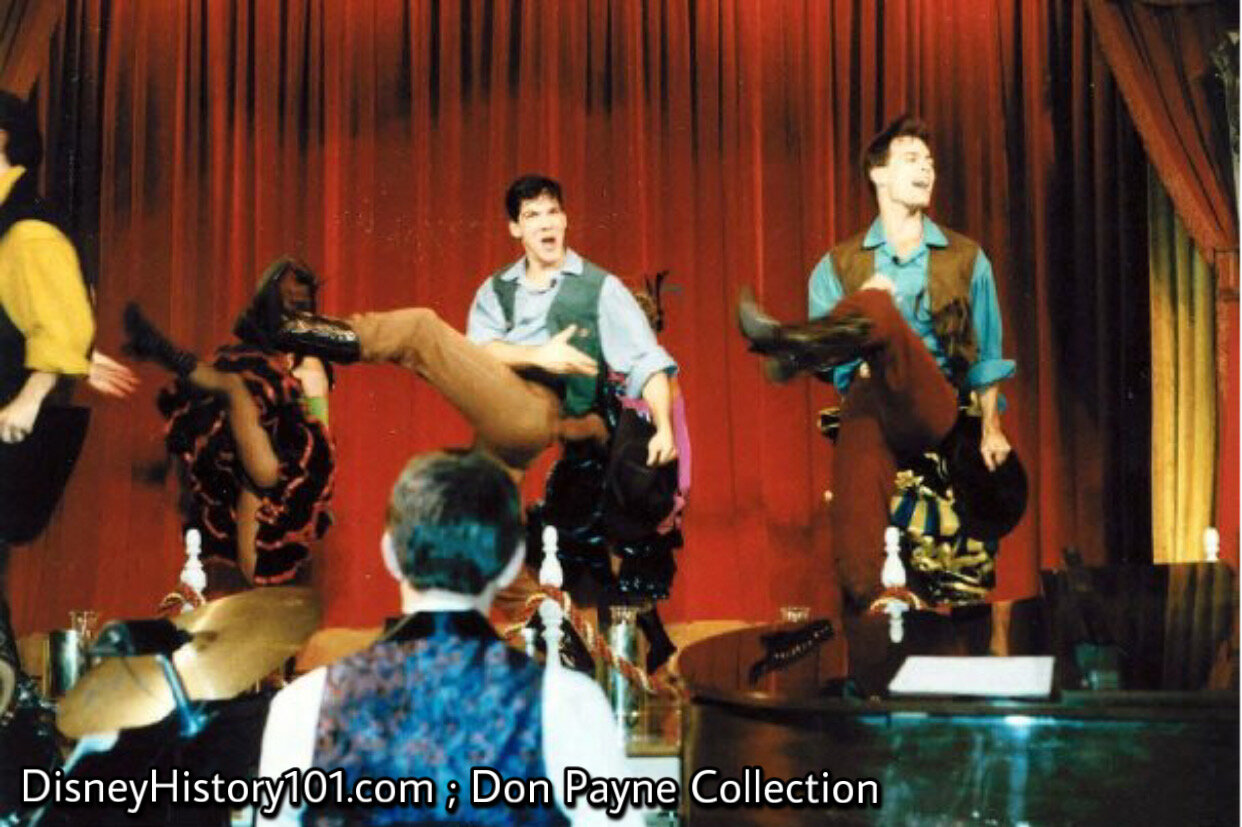
Sam’s Cowboy Dancers - Billy, Ned, and Joe.
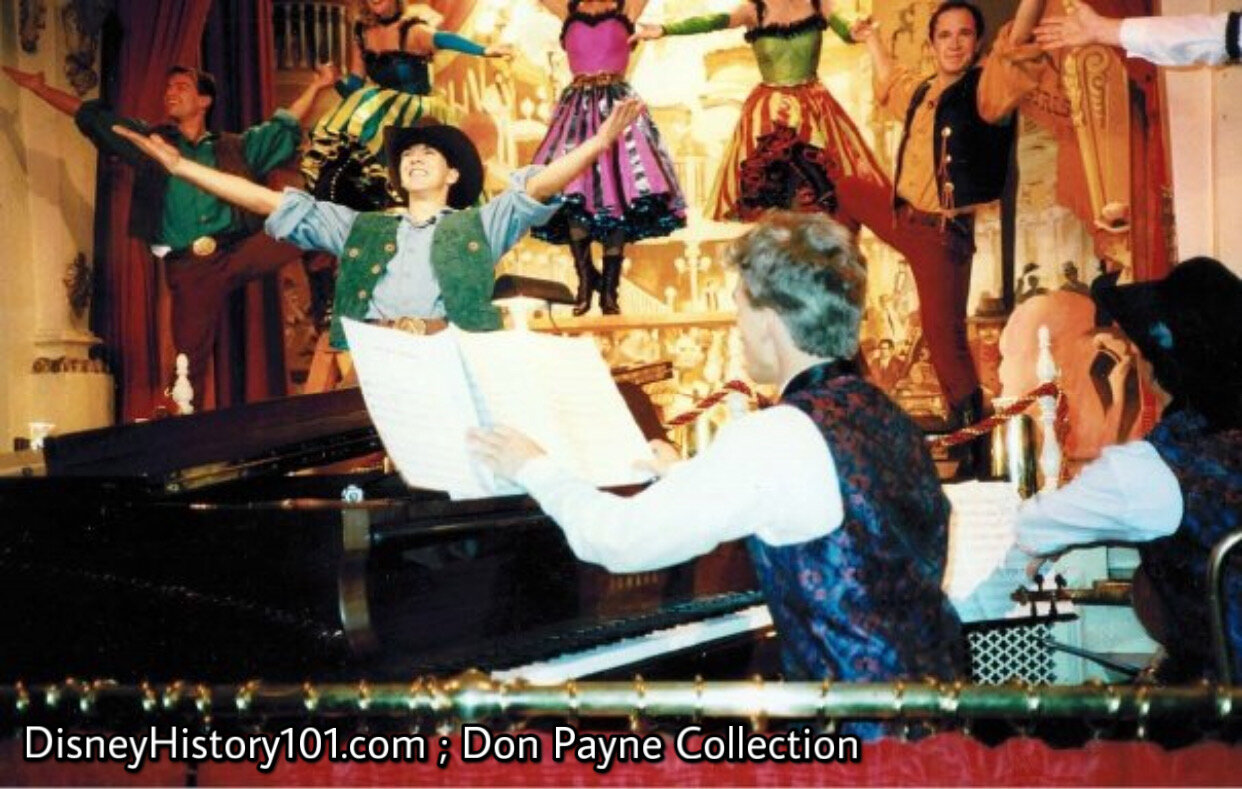
Sam’s Cowboy Dancers.
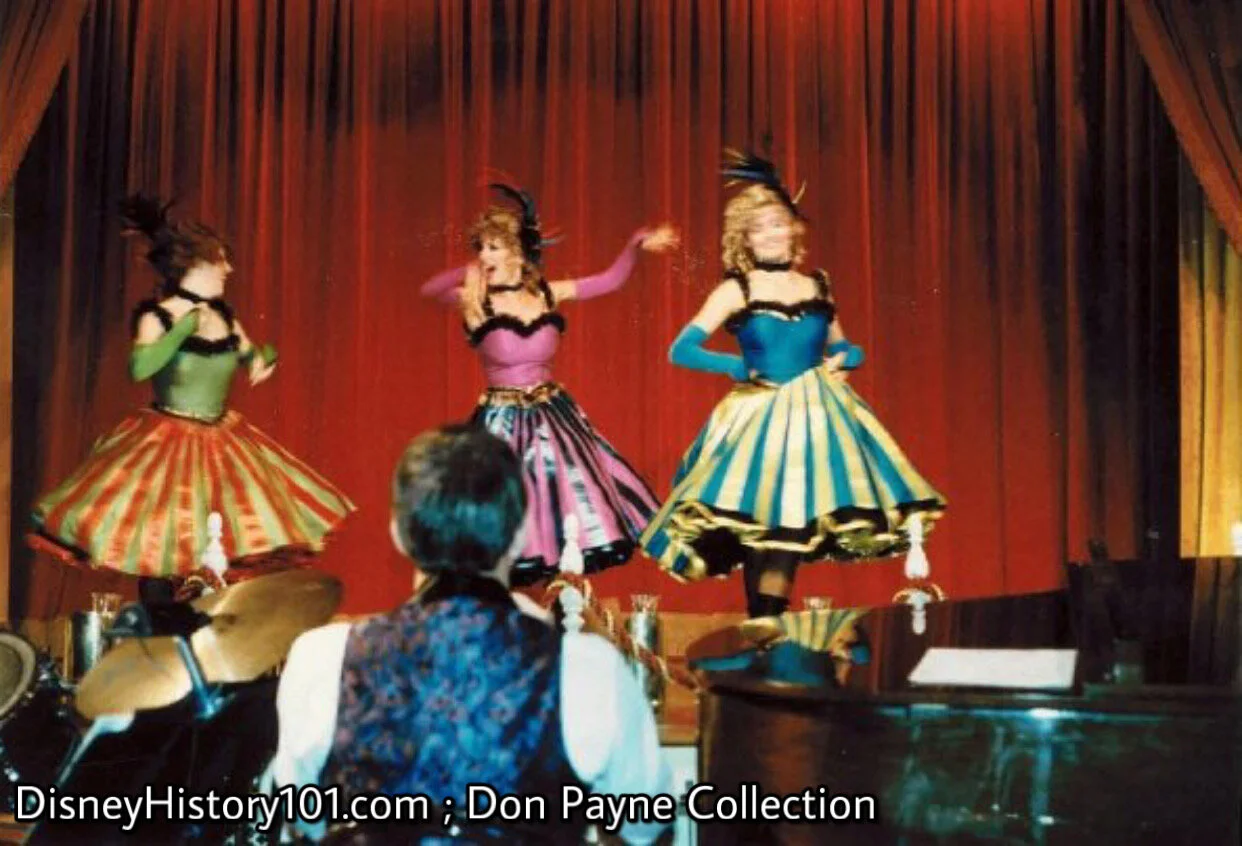
Lily’s Dancing Girls - Fiona, Wanda, and Roxy!
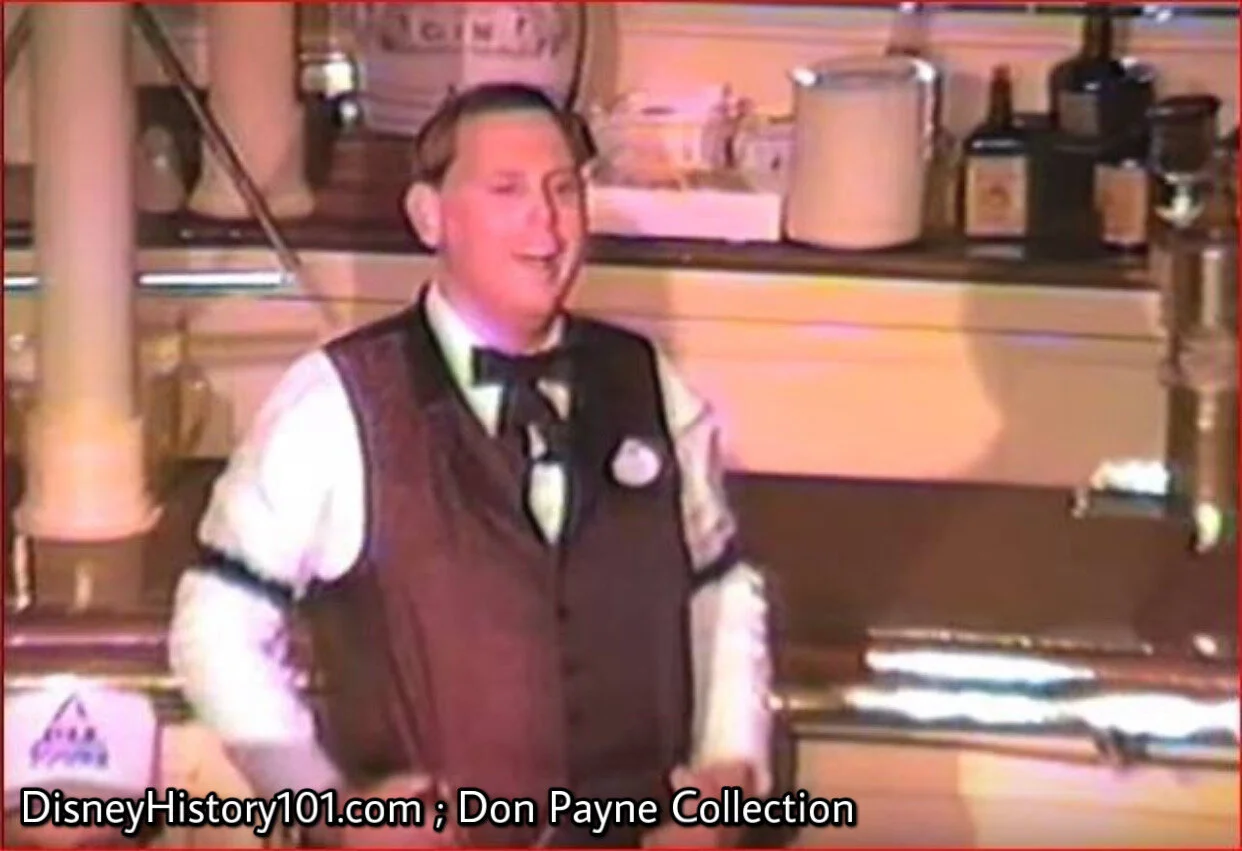
1986
Sam watches Lily’s Golden Horseshoe Jamboree act from the floor of the Golden Horseshoe Saloon.
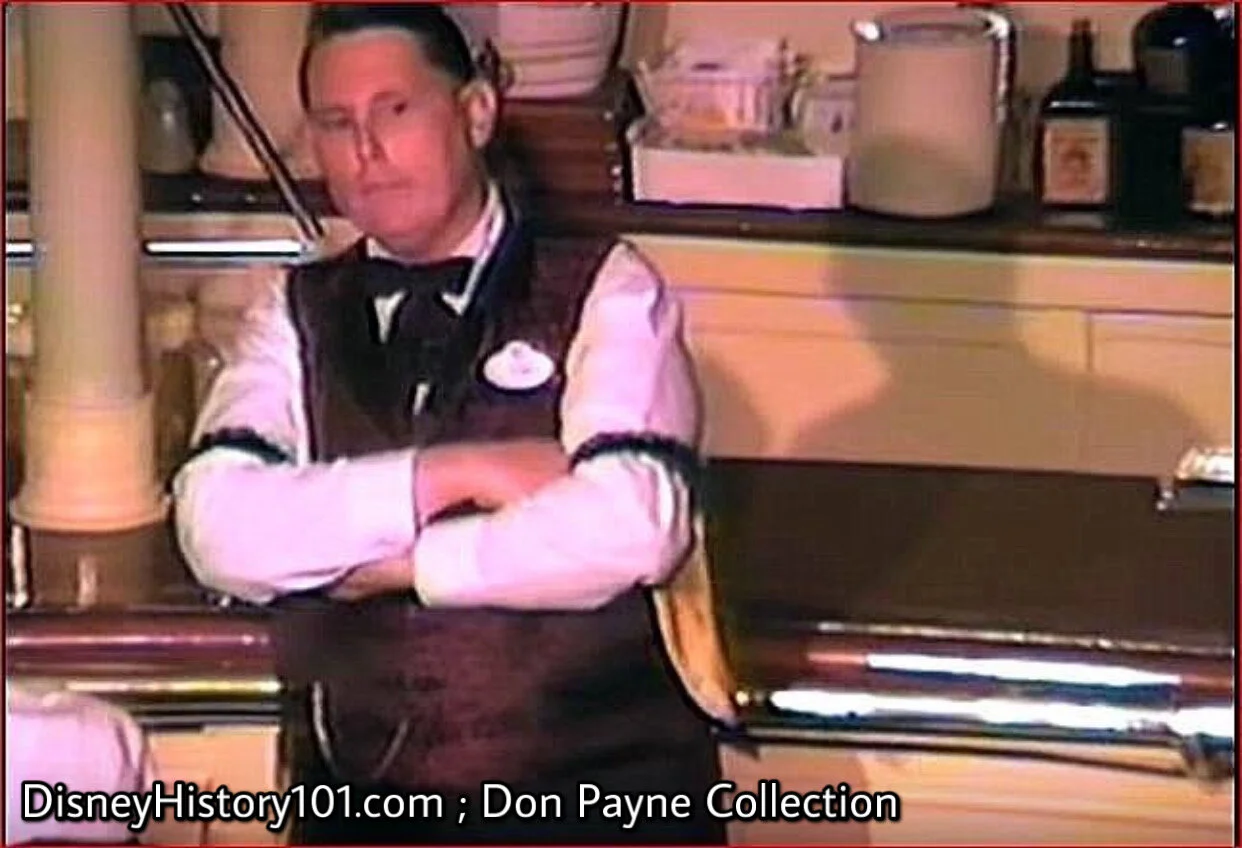
1986
Sam gets jealous as Miss Lily flirts with gentlemen in the audience.
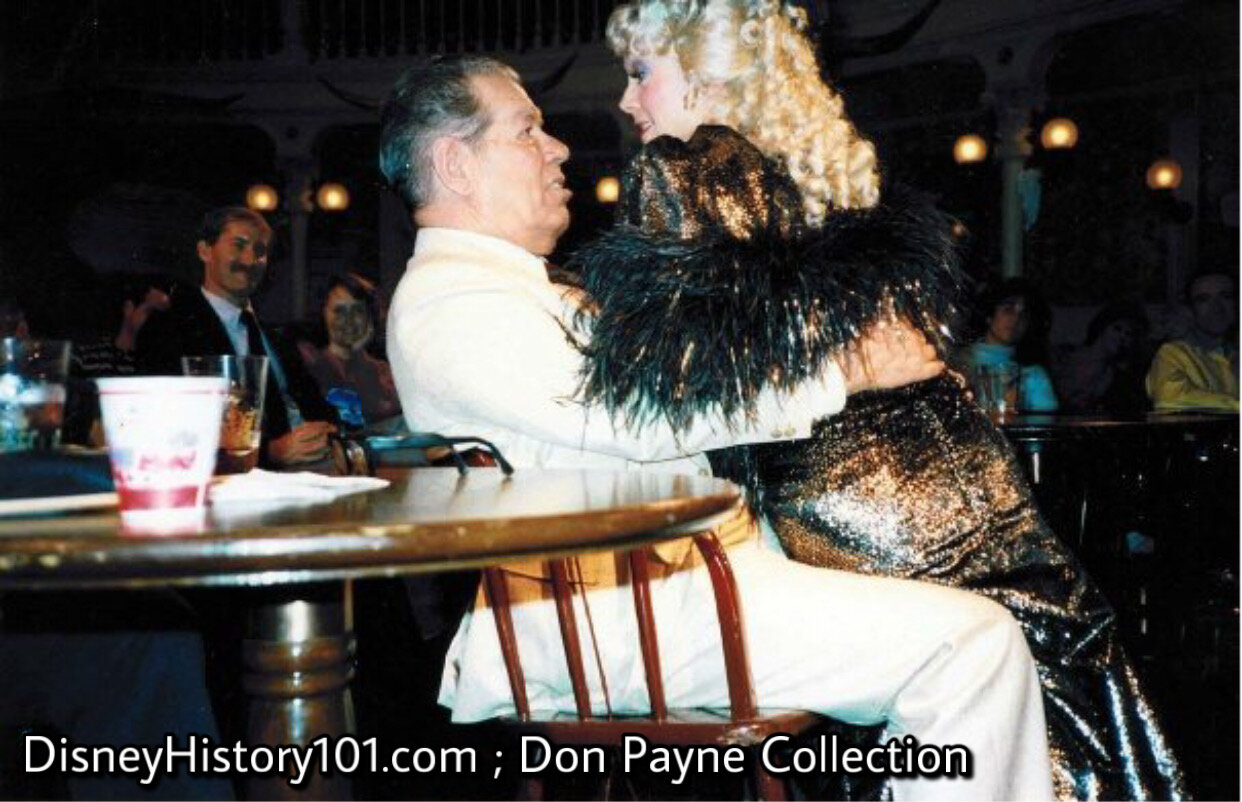
Special Guest Tex Beneke
During the show, Lily entertains Tex Beneke. Tex was part of the Glenn Miller Orchestra and was the featured vocalist on such hits as “The Chattanooga Choo-Choo”. In 1946, after Glenn Miller died in World War II, Beneke took over the Miller Band and helped it rise to increasing popularity. He was a personal friend of our ‘Lily’. Tex’ band would also perform in Disneyland during the 1980s.
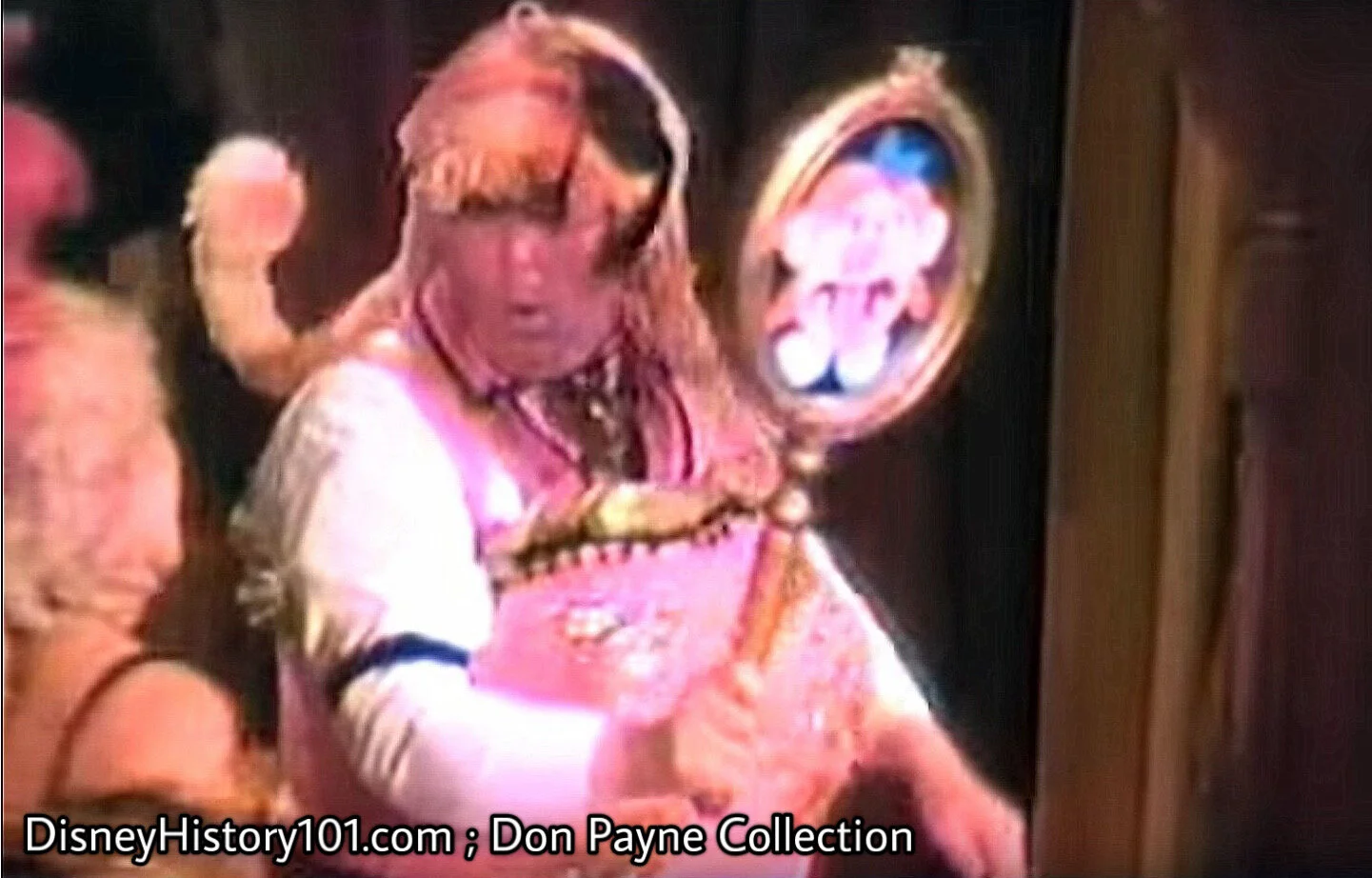
Sam’s surprise “take”; 1987a
Sam tries to disguise himself as a Can-Can Dancer to sneak into Miss Lily’s Golden Horseshoe Jamboree act. Now, he just needs to prove that he “can” dance!
In one final attempt at joining Lily’s Dancing Troupe, Sam sneaks into the Can-Can Dancer’s Line in a badly designed disguise.
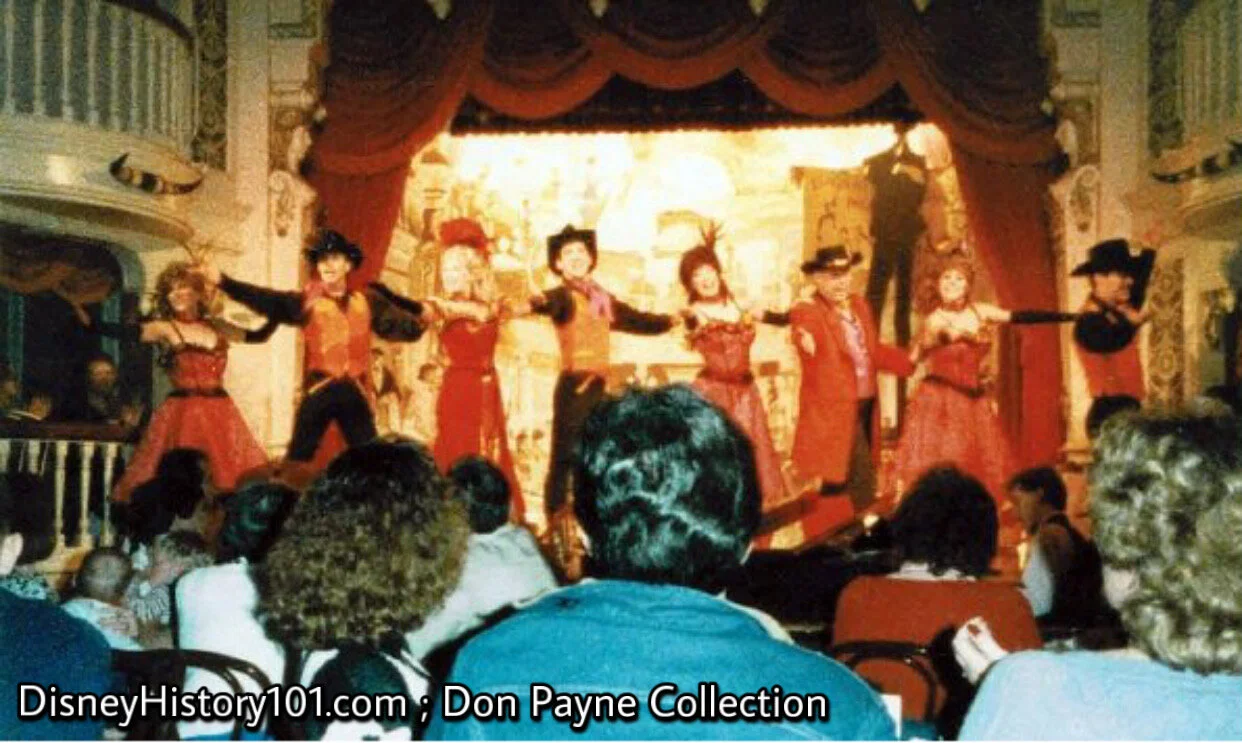
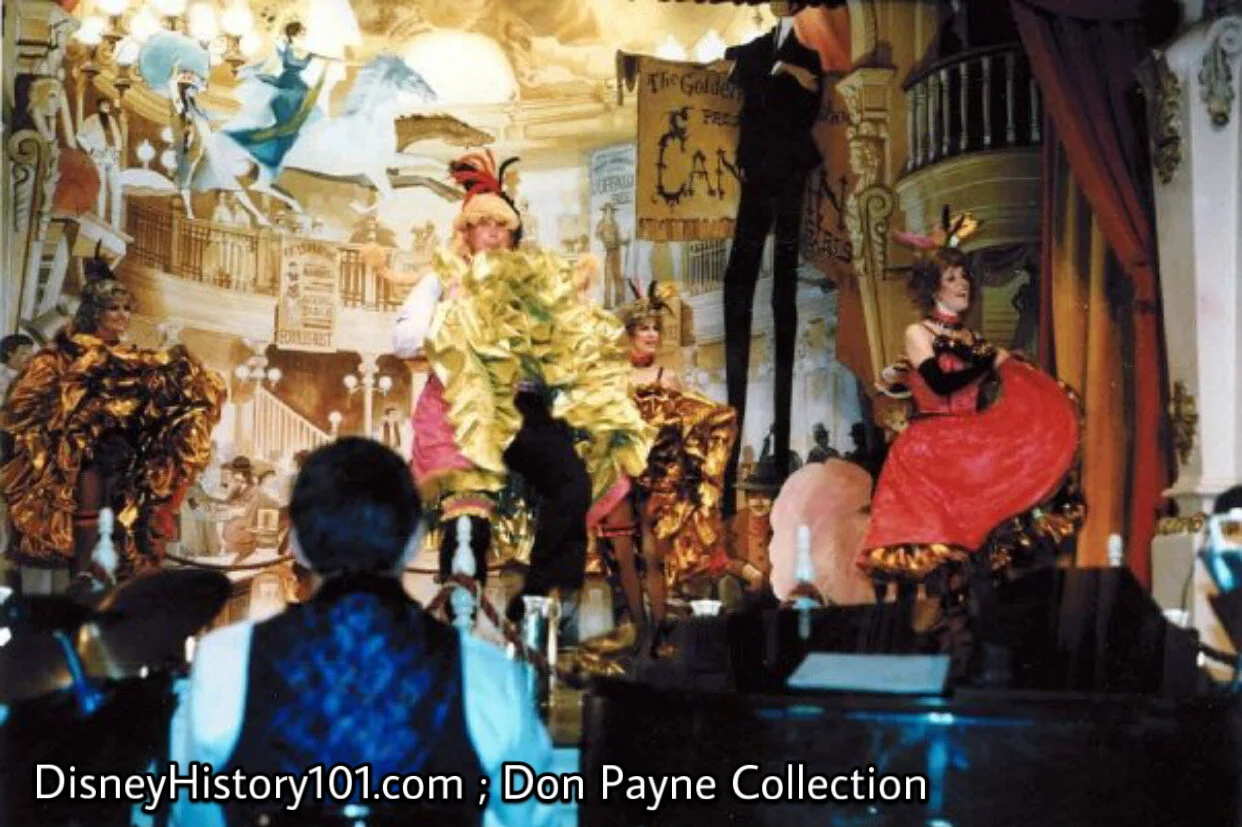
Closing Number
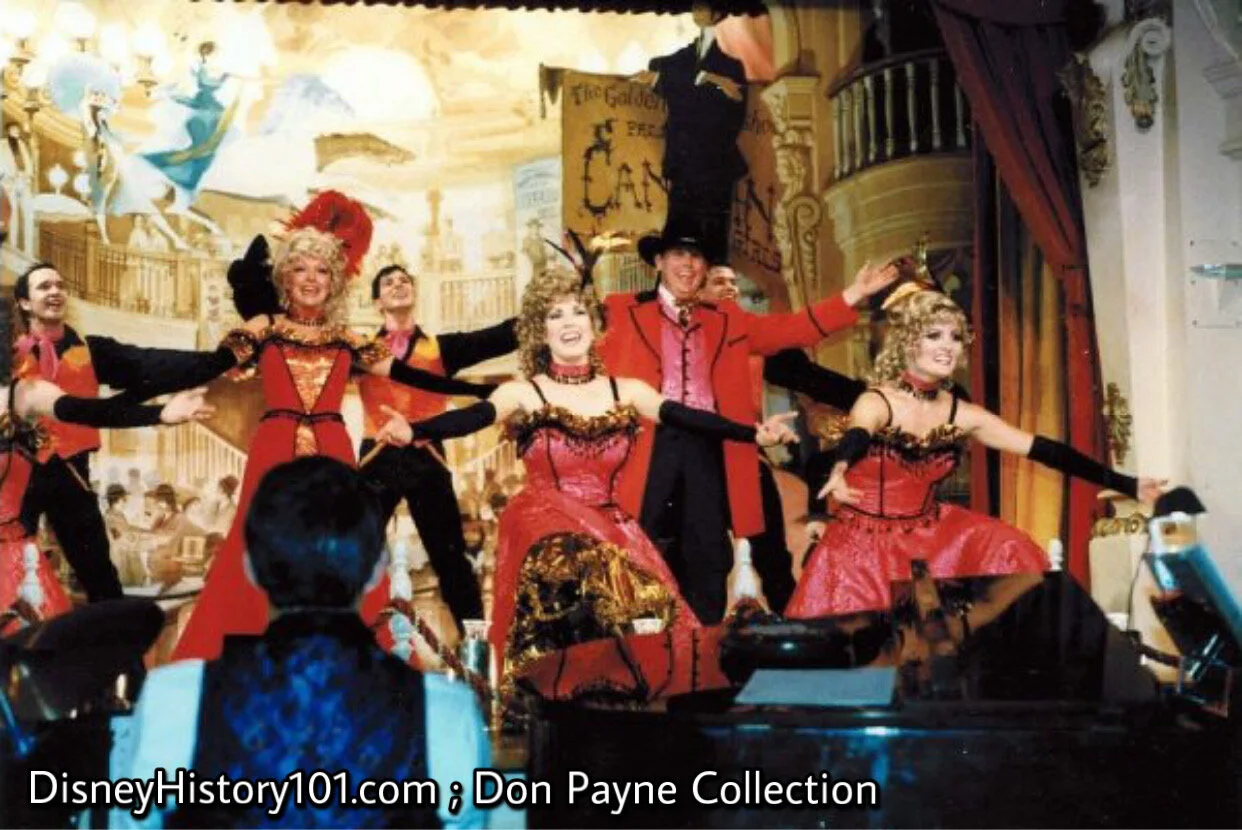
Closing Number
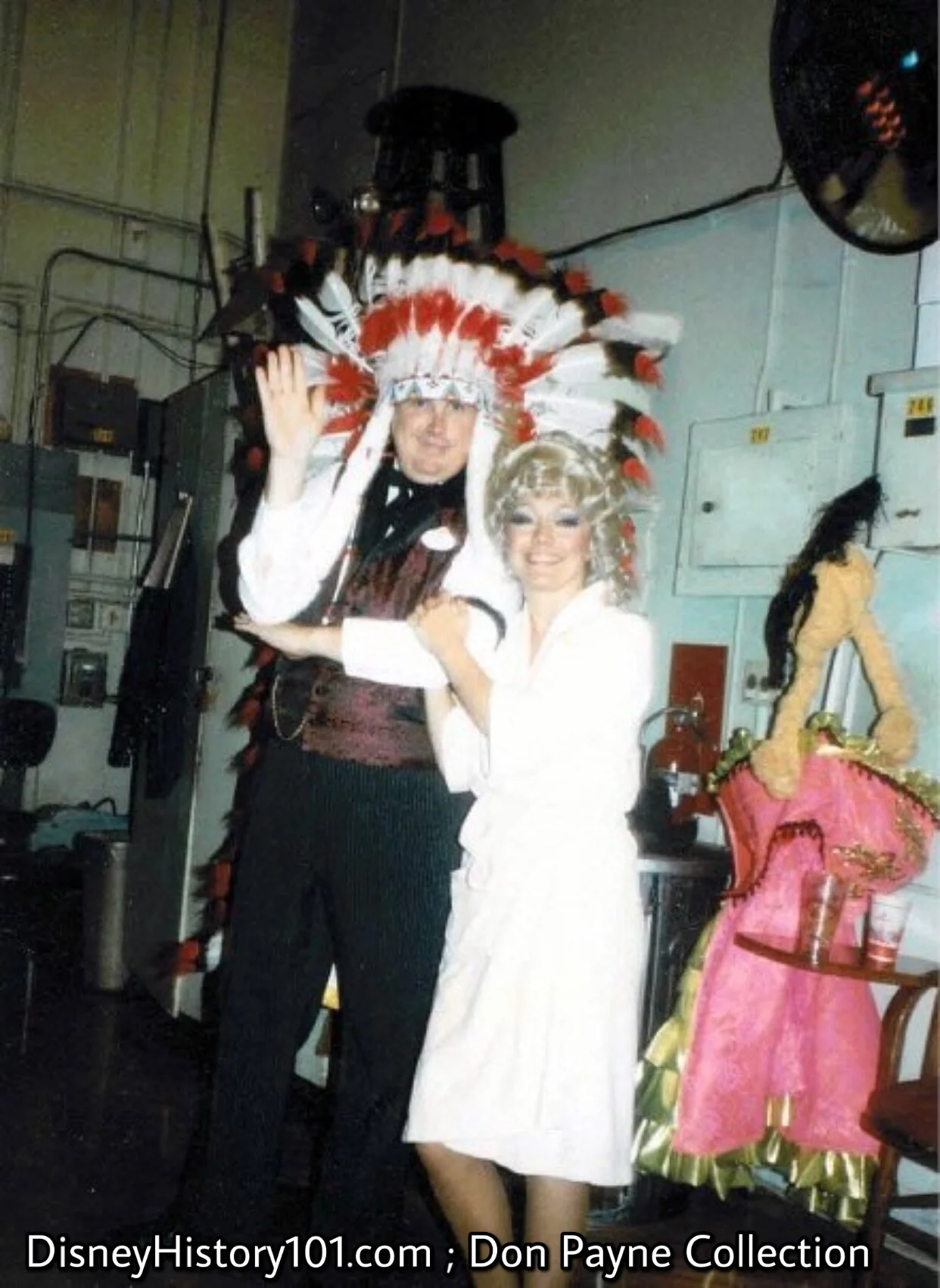
“Backstage at The Golden Horseshoe”
Backstage (or “Back of House”) at the Jamboree…”Sam” and “Lily”, act silly with stage props!
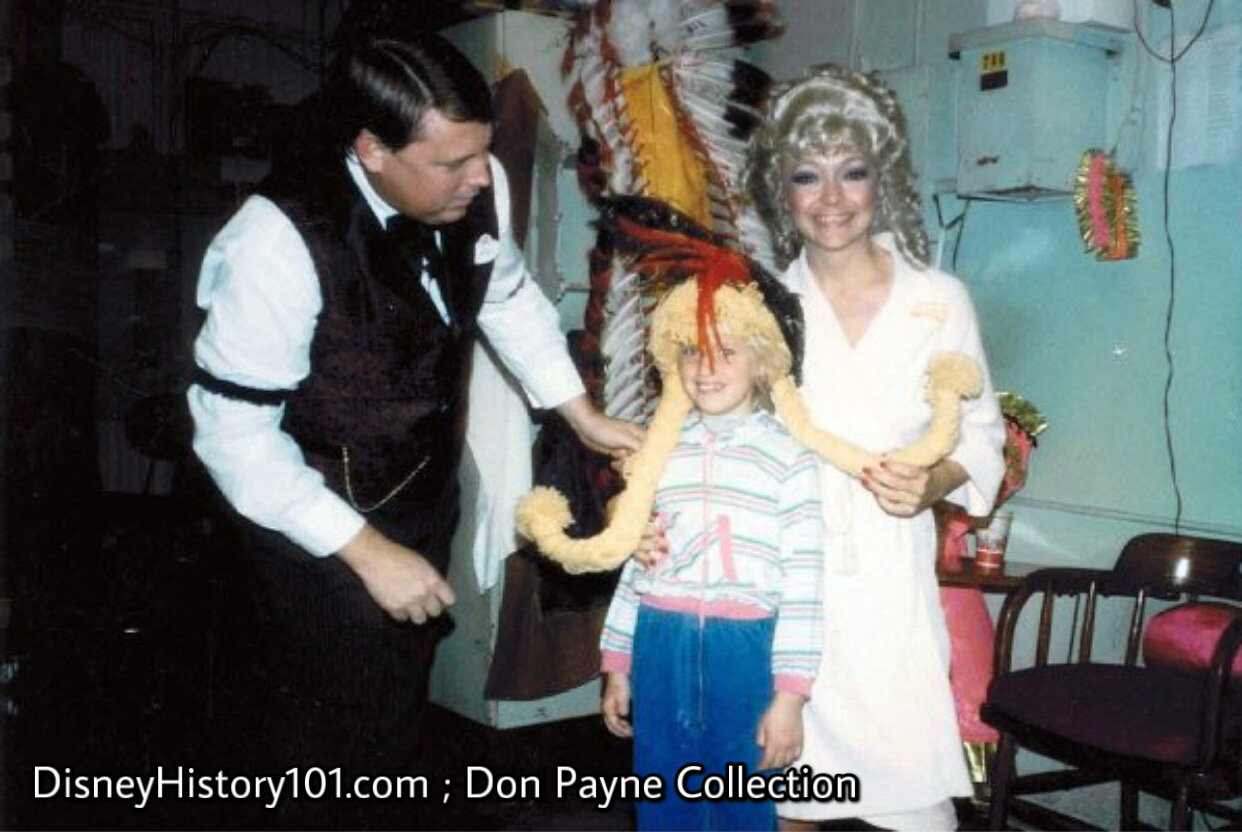
“Backstage at The Golden Horseshoe”
Backstage at Disneyland’s Golden Horseshoe Jamboree show, Don’s daughter Amy tries on the wig that Don wears when Sam tries to sneak into the Can-Can Dancer’s Line.
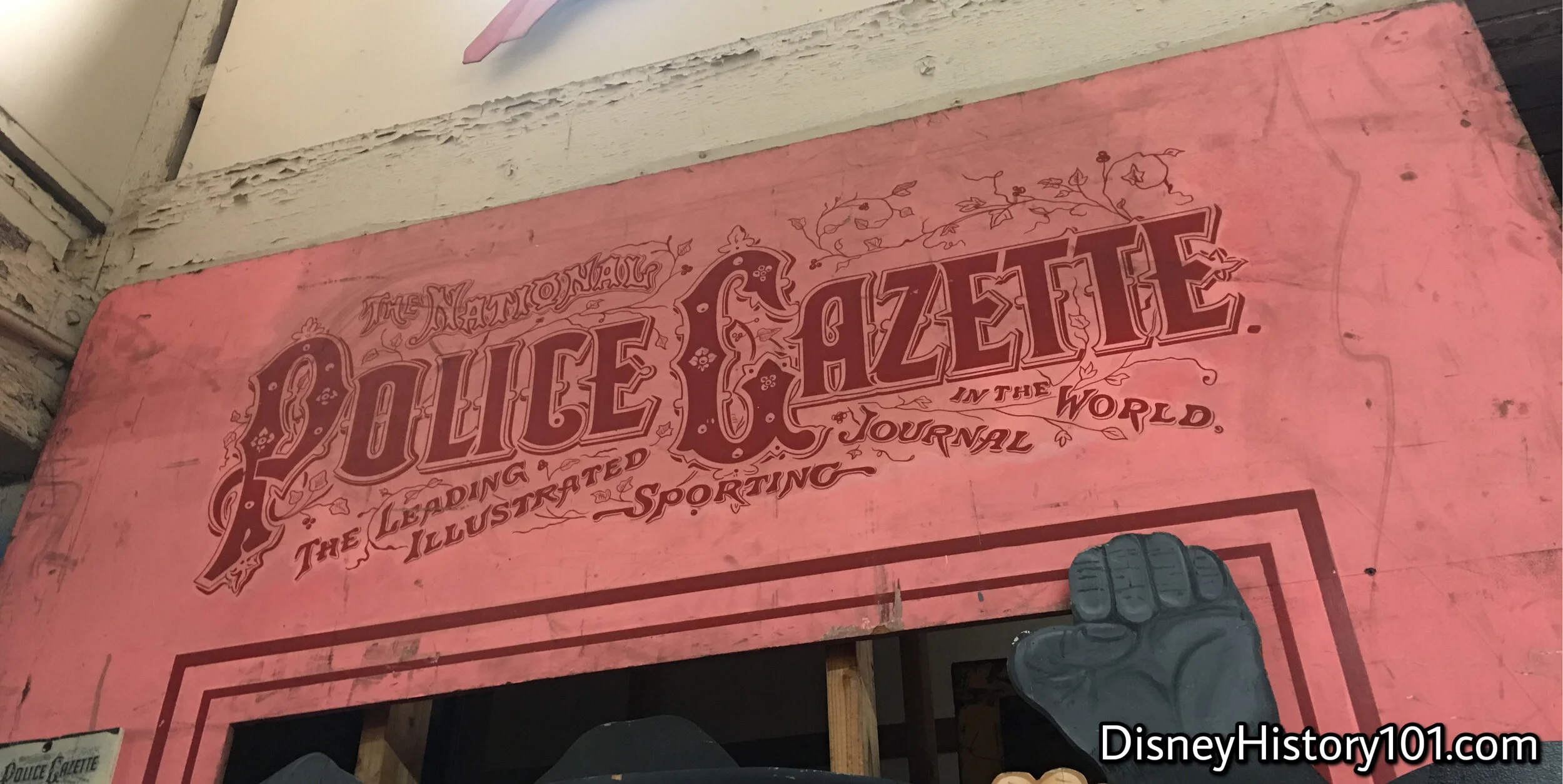
“The Girl on the Pink Police Gazette” Prop
We recently had the privilege to peruse Bobby Babcock’s personal collection at RWB Props. You may recollect seeing innumerable Disneyland props. Among these, we found one of the oversized Pink Police Gazette props that was used in the original Disneyland Golden Horseshoe incarnation of “The Girl on the Pink Police Gazette” number. This piece was so popular that it was soon included in the Magic Kingdom’s Diamond Horseshoe Revue!
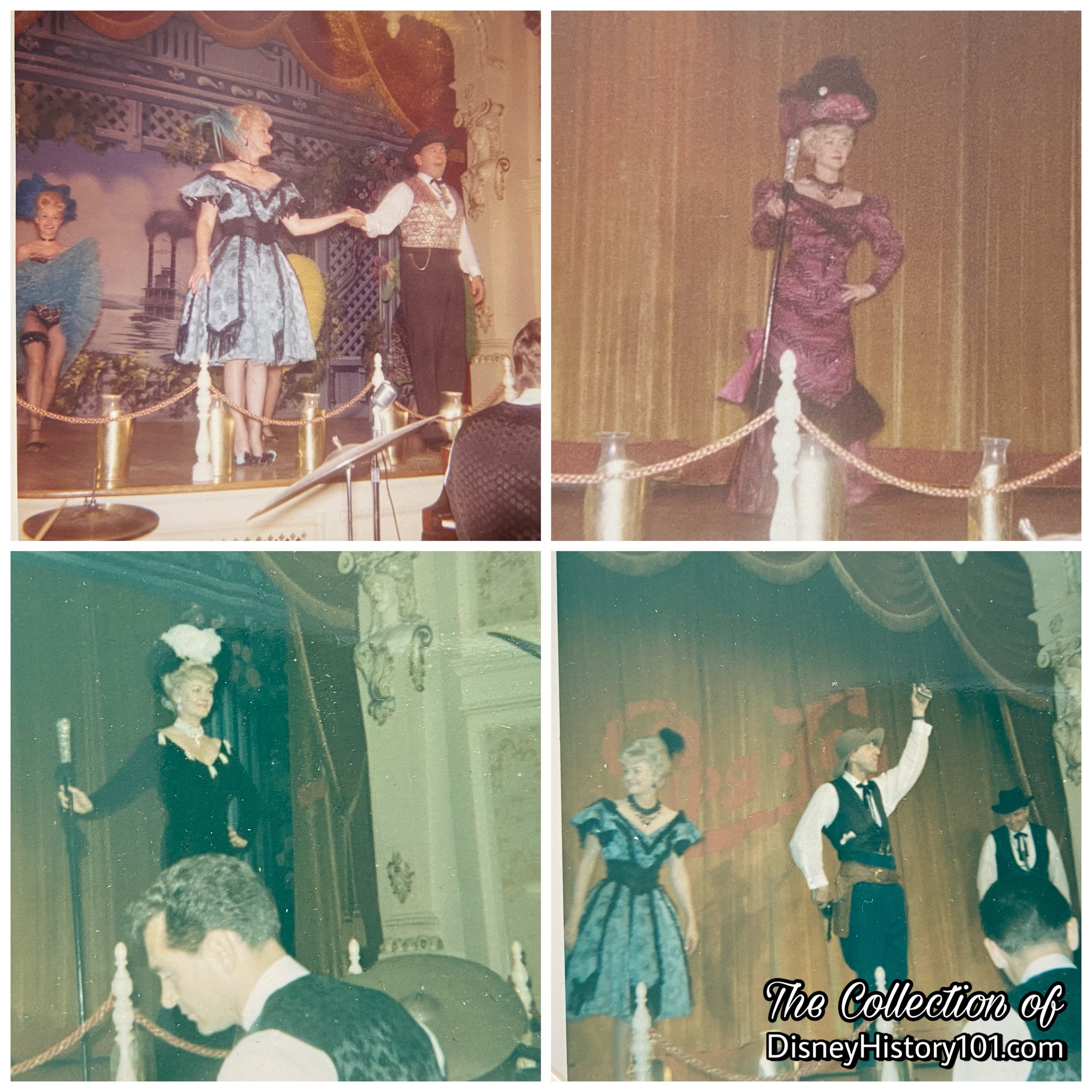
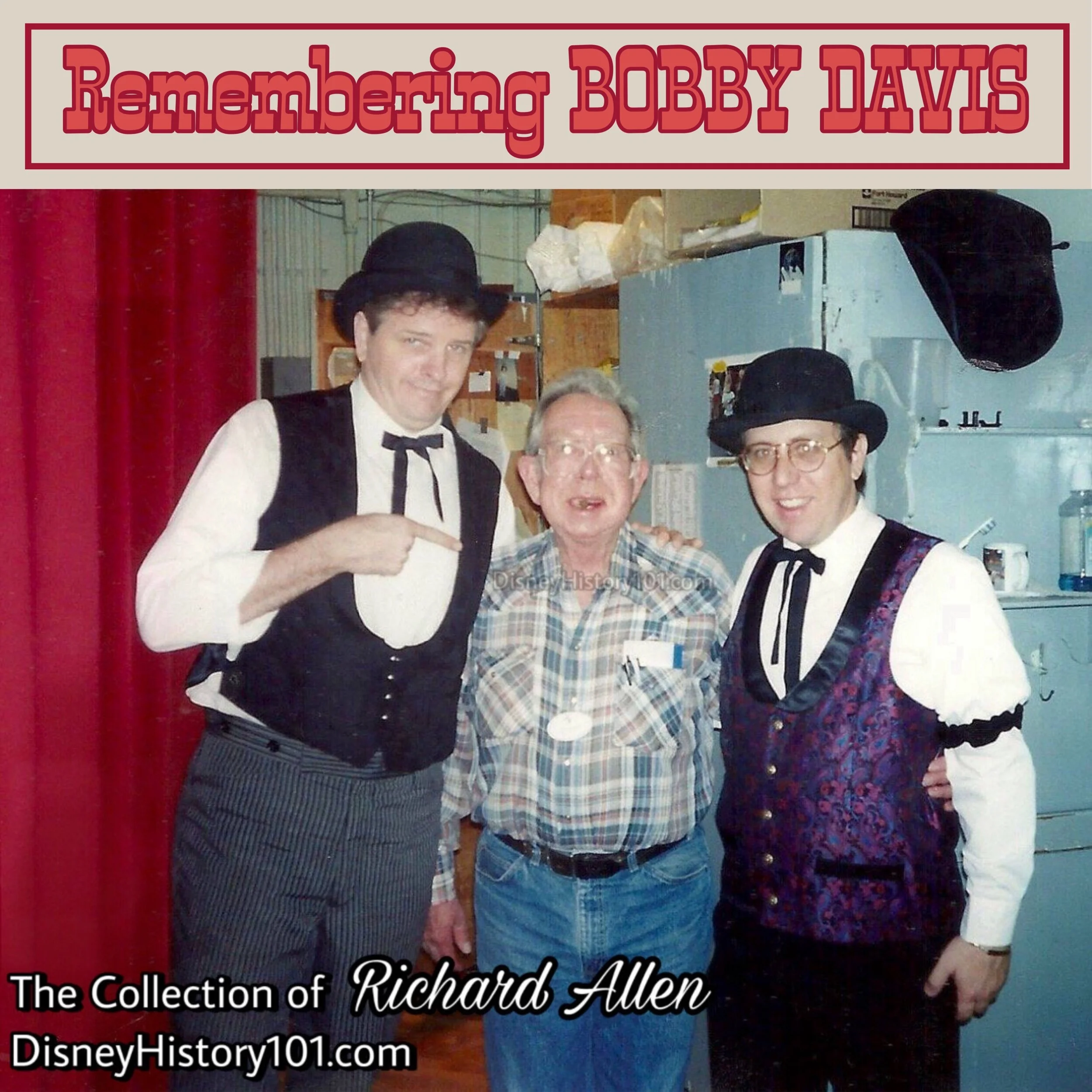
Before his Disneyland days, he worked on the crew of feature films (one fellow Disneyland employee remembers him mentioning “Five Easy Pieces” (1970) starring Jack Nicholson). Now, Bobby was running one of Disneyland’s most popular entertainment venues! After Ralph Adams (the first Backstage Manager for the original "Golden Horseshoe Revue") retired, Bobby Davis became the second Backstage Manager.
Bobby Davis may not be a household name (like Wally Boag, Betty Taylor, or Fulton Burley), but his behind-the-scenes contributions were crucial to the comedic timing of jokes and success of the overall show! Former Golden Horseshoe Cast Member Don Payne recalled Bobby’s responsibilities this way :
“He kept the stage cleaned up (from Pecos’ teeth, loose tobacco & squirt gun water) and the the occasional, broken shade from a kicked footlight. He ran the board for sound and lighting, helped The Traveling Salesman don the Pecos chaps, hat and gun. Handed us the squirt guns during the show. Kept the props in good order... and supplies on hand. Kept the gun loaded and ready to fire. He had his hands full during each performance.”
PICTURED (Above) : Former Golden Horseshoe Jamboree pianist Richard Allen (right) and Dana Daniels (left) take a moment with Backstage Manager Bobby Davis. Richard Allen remembers : “This is me several years ago - backstage - that's Bobby Davis, stage manager for years. He drove a motorcycle to Disneyland every day until he died.”
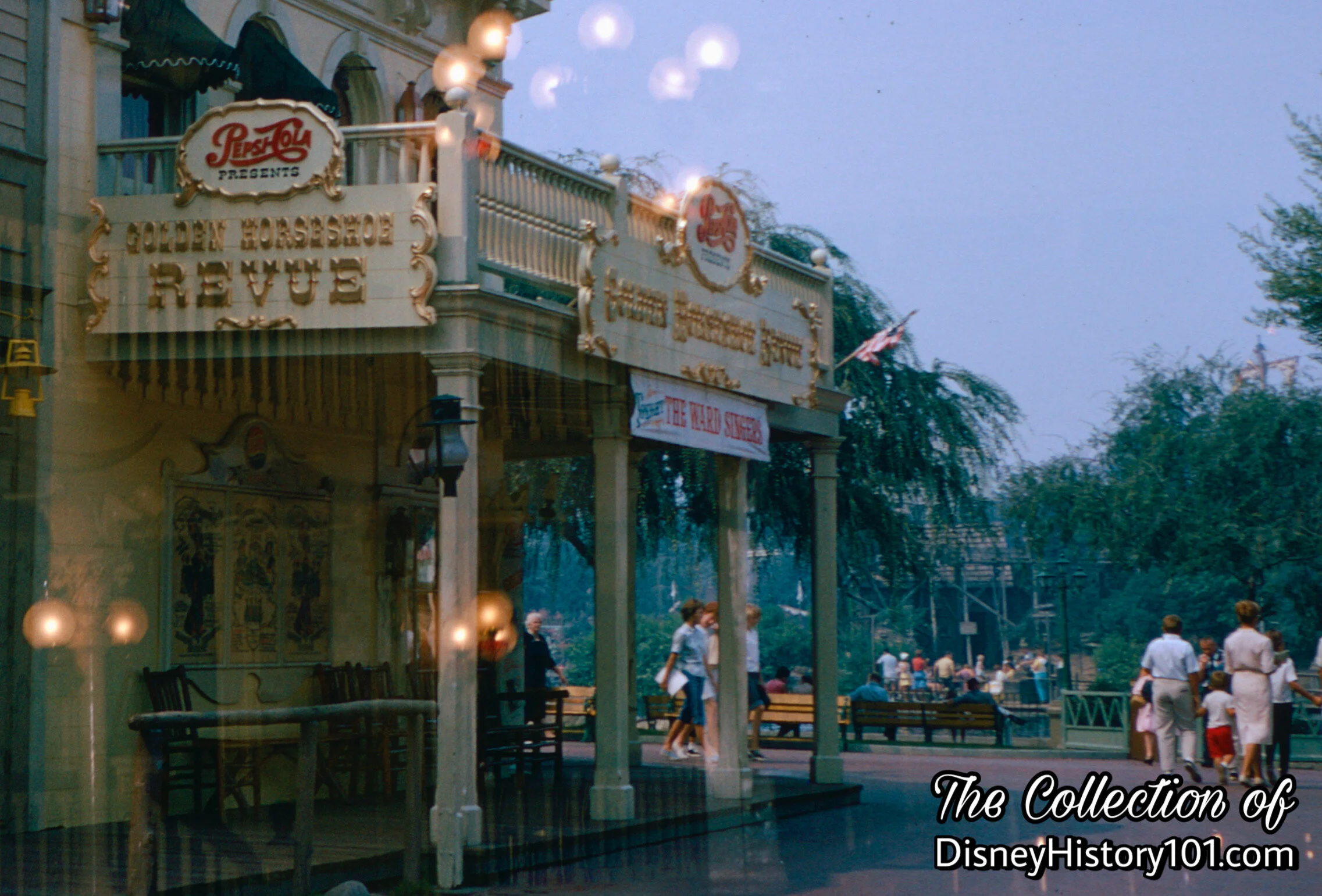
Golden Horseshoe (with Clara Ward Singers Banner Over Entrance)
Many entertainers performed from the Golden Horseshoe stage. In 1958, sound engineers (like Chuck Britz) preferred the closed Golden Horseshoe hall to the open air of the Plaza Gardens when recording “Let’s Dance at Disneyland” by the Elliot Brothers and the Disneyland Date Niters.
The internationally famous Clara Ward Singers performed here during the summer of 1962, then at Dixieland at Disneyland. They were met with “such enthusiasm” that they were brought back for the summer of 1963 (where they performed for a live recording at Fantasyland Theater). The Ward Gospel singers came back to delight young and old audiences at the Golden Horseshoe, performing from December 16th thru 30th, 1967 (with December 24th & 25th off). [“Disneyland Holiday Talent Master Schedule,” December 16, 1967 to January 1, 1968]
“THE GOLDEN HORSESHOE’S OTHER BIG ACTS”
The Show didn’t end with the Golden Horseshoe Revue! The Golden Horseshoe was billed as a “Western theater featuring a variety of live shows.”
The “Your Happy Holiday” radio show was broadcast live from The Golden Horseshoe from 1955 - 1956. During Date Nite of 1957, the Golden Horseshoe was one of four locations hosting live entertainment and the stage for the Frontierland Strawhatters.
On select “Frontier Nites,” (every Tuesday in Frontierland), visitors enjoyed square dancing on the Golden Horseshoe dance floor. The Milliner’s Guild Fashion Show was held on the Golden Horseshoe Stage (December 6th, 1959). The First Frontier Nite at Disneyland offered square dancing at the Golden Horseshoe Cafe, on Tuesday nights through the summer season of 1961.
Performers like the Ward Singers entertained guests from the stage during Disneyland Date Nites during the 1950s and 1960s. Arvon Dale and His Orchestra performed here during Disneyland’s 2nd Annual Grad Nite (in 1962). The 5th Annual New Years Eve Party (held Monday, December 31st, 1962 thru Tuesday, January 1st, 1963) brought the Clara Ward Singers to the Golden Horseshoe Stage. The Ward Singers (while principally performing at places like the Thunderbird in Las Vegas) subsequently returned to Disneyland and made many appearances on the very same Golden Horseshoe Stage, during Grad Nite 1964 and 1967, and “Spring Fling” of April 6th, 1968.
During 1965, Walt Disney sent his personal jet to New Orleans in order to transport pianist Sweet Emma and her bandsmen to the Golden Horseshoe in Disneyland. The famous Firehouse Five Plus Two (Ward Kimball on trombone, Danny Alguire on trumpet, George Bruns on tuba, Eddie Forest on drums, Don Kinch on trumpet, Billy Newman on banjo, George Probert on soprano sax, and Frank Thomas on piano) performed from the Golden Horseshoe Revue Stage during for the 6th Edition of Dixieland at Disneyland, on October 1st, 1966! They returned to the Golden Horseshoe Stage the following year for the seventh edition of Dixieland at Disneyland, with K.O. Eckland on piano.
September of 1972, brought Country-Folk Jamboree (on Sundays) and All That Roaring Twenties Jazz. November 26, 1972 through May 26, 1973, “Class of ‘27” presented a “Roaring 20’s revue at the Golden Horseshoe.” The Revue was performed four times nightly, featured comedy film, the Banjo Band, and starred Sonny Helmer and The 23-Skidoo Girls.
During the Disneyland Bicentennial Celebration (of 1975-1976), “Class of ‘27” returned, presenting the “roaring twenties entertainment” highlighting a unique American sound. This show was performed evenings (at 7:30, 8:30, 9:30, and 10:30 p.m.), and was so popular that it was brought to the stage of The Magic Kingdom’s Diamond Horseshoe Revue!
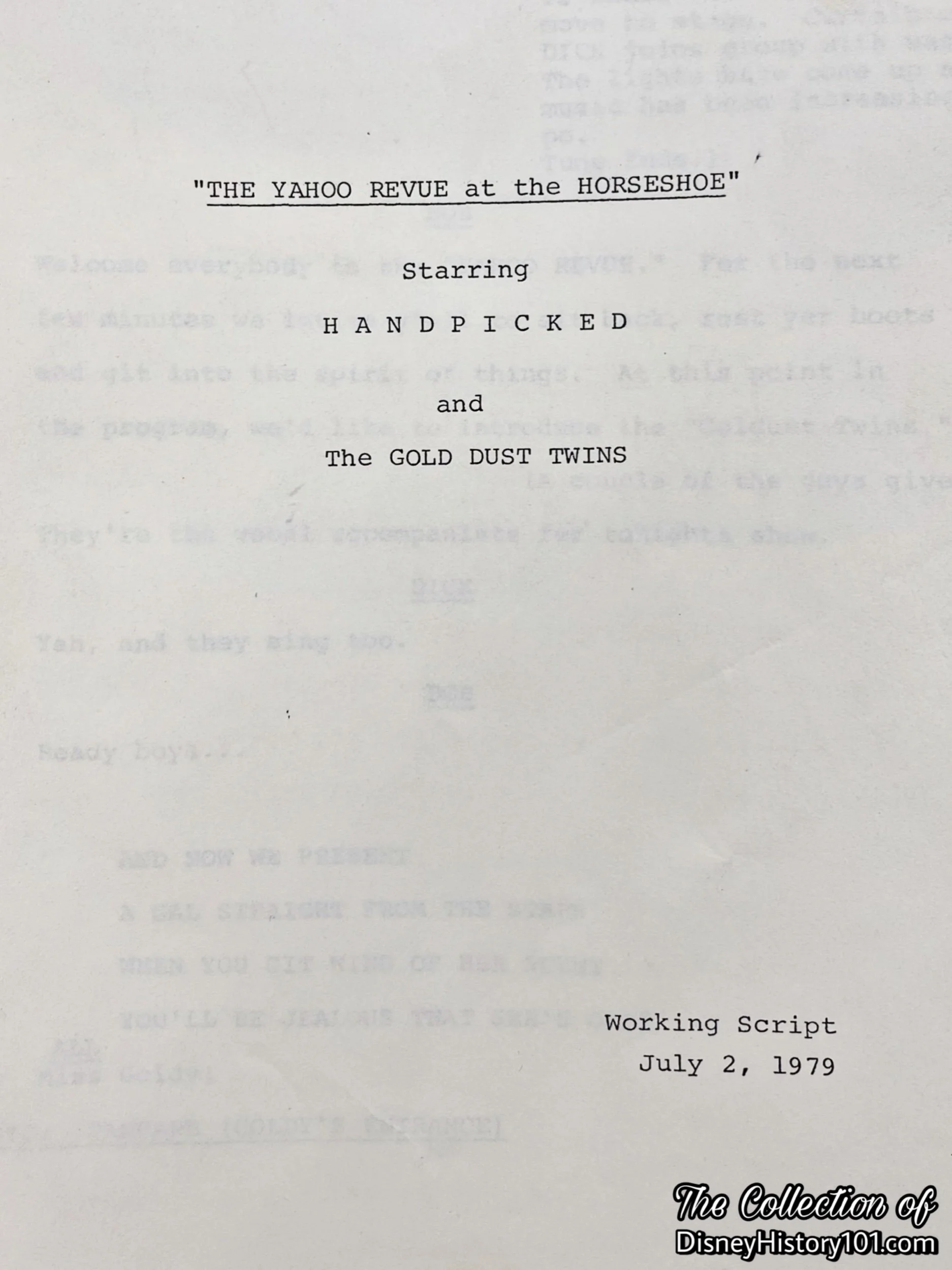
"THE YAHOO REVUE at the HORSESHOE" ; Working Script July 2, 1979.
The 1970s and 1980s brought many acts and characters to the stage (usually during weekend evenings) - like The Front Page (during Disneyland After Dark; December of 1970).
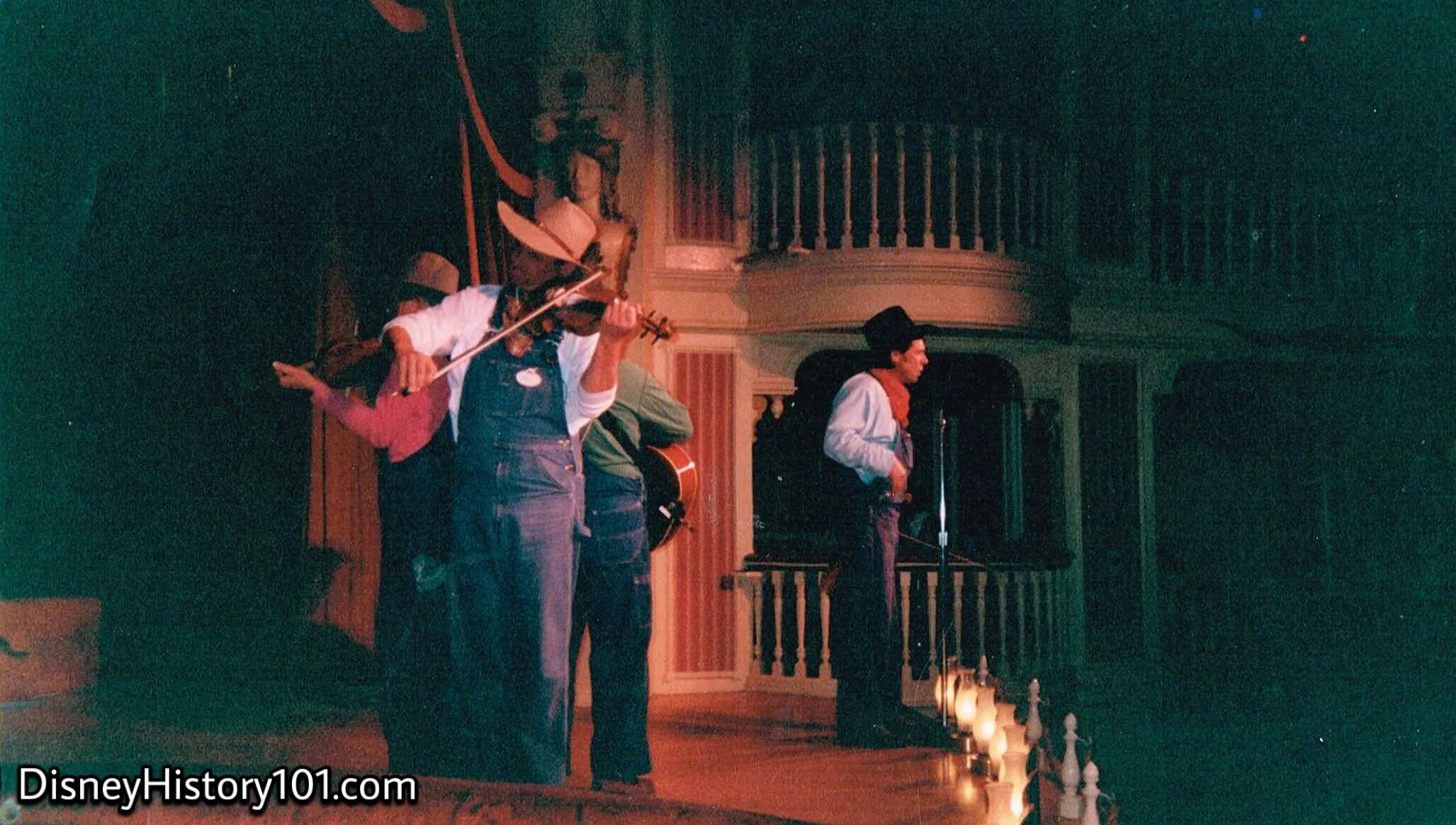
The Yahoo Revue (December 26 - 30, 1978) starred Miss Goldy, Handpicked, Bob, Dick, Li’l Nugget, and the Gold Dust Twins, and introduced Audiences to “the word for tonight” - “Orange blossom special.”
Then there was The New Seekers (in 1978), The Rhythm Brothers with Terry Robinson (a 1930s-era jazz show) during January of 1986, Country/Folk Jamboree, Teddy Buckner and His Band, The Big Thunder Mountain Boys, the Pinewood Pickers, Mariachi Guadalajara, All That Roaring 20’s Jazz, Silvia the Singing Spinster, New Dixie Rebellion, Jeff Ruff on Banjo, Farley the Fiddler, the Thunder Ranch Juggler, and even Santa Claus appeared on the Golden Horseshoe Revue Stage. It was all part of Disneyland’s “Big Night Time Show”!
One of the most memorable of later acts has been Billy Hill and the Hillbillys (pictured in 2002, above)! Billy Hill and the Hillbillies generally performed from the Golden Horseshoe Stage (with the exception of the occasional rainy day). During the late 1990s, they would perform nine shows weekly (divided between two days). Later, they could be found on the Big Thunder Ranch Stage during select times. Pictured above, are Mario Hildago (banjo), Kirk Wall (lead guitarist and emcee), Evan Marshall (who played mandolin with the band full time from 1993 to 2004), and John Marshall(bass) - the founder of Billy Hill and the Hillbillies, circa 1990!
The Golden Horseshoe also hosted events for Disneyland Cast Members. Former Disneyland Cast Members (of the late 1970’s and early 1980’s) may recall attending one of the Annual Historical Perspectives presentations (starring guest speakers like Former Disneyland President Jack Lindquist or Walt Disney Imagineering President Marty Sklar) recalling memories of the Park’s early days.
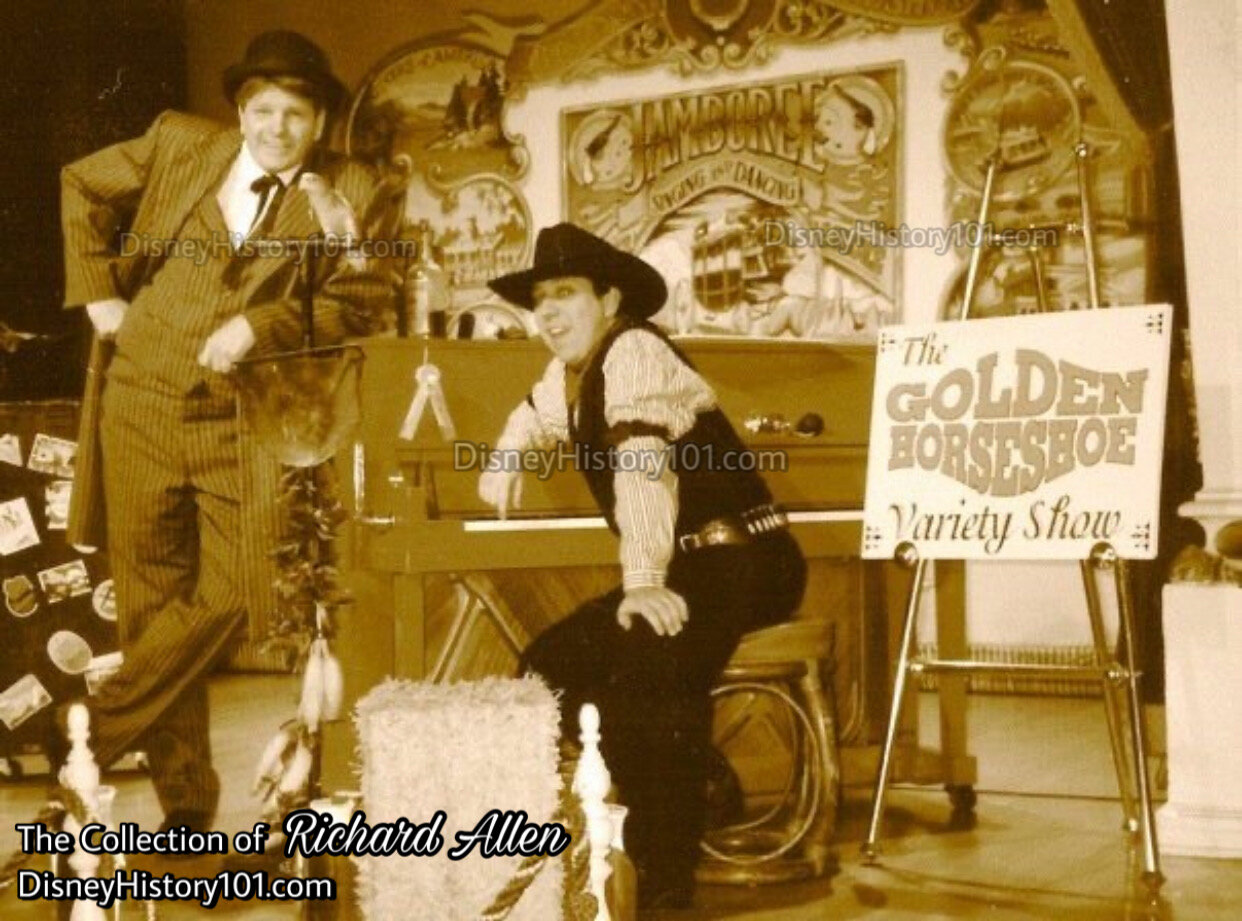
Dana Daniels (left) and Richard Allen (right) of The Golden Horseshoe Variety Show”
Former Golden Horseshoe Jamboree Pianist Richard Allen remembers : “After the Jamboree. This show played twice a week when the Billy’s were off. It ran over 5 years. This is the show I did after the horseshoe closed. I ended up working several years in the park after that last performance.“
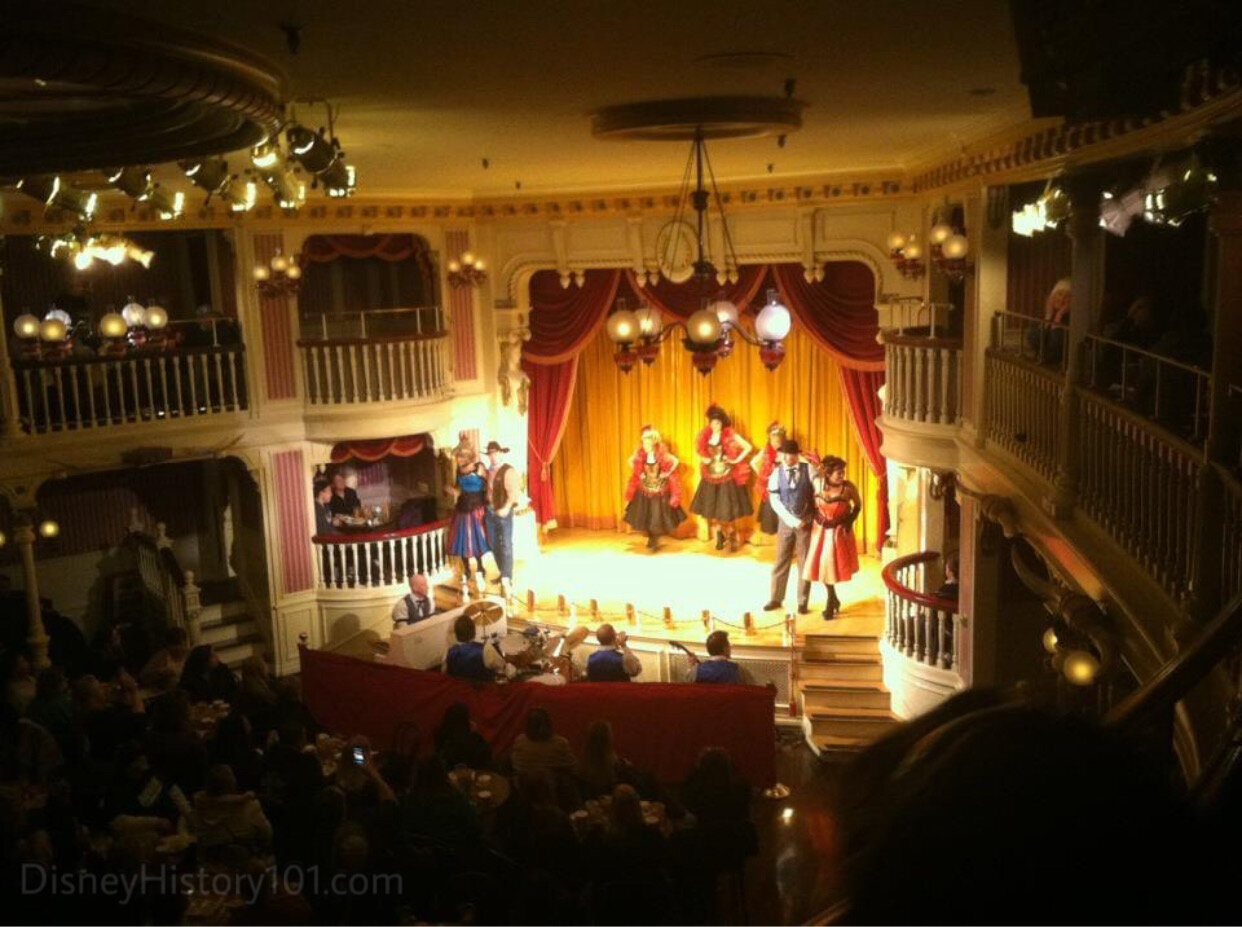
“A Salute to the Golden Horseshoe Revue”, January 10th to February 4th, 2013
The 25-minute Golden Horseshoe Revue Tribute was included a couple of Golden Horseshoe Jamboree acts, but it had little to do with the previous Golden Horseshoe Revue show. Miss Lily (rather than Slue Foot Sue) hosted the show and worked the audience. The catchy opening number “Hello Everybody” was a variation of the Golden Horseshoe Revue’s. However, it was followed by “A Good Man Is Hard to Find”, “Belly Up to the Bar”, a “Can-Can” dance, and a variation of the Golden Horseshoe Revue’s closing number, that were more similar to Golden Horseshoe Jamboree numbers. A few brief lines made reference to Walt Disney’s feelings about the Golden Horseshoe Saloon, and where he preferred to sit. But, the non-musical, comedic numbers (like the traveling salesman and Pecos Bill) were non-existent. In fact, none of Wally Boag’s performances were attempted during this salute (perhaps out of respect for “the clown prince of Disneyland”). Still, the limited time magic offering of The Golden Horseshoe Revue showcased live musicians, phenomenal Can-Can Dancers, and live singers, under the direction of Randy Rojcik (Sr. Show Director)! WATCH the short, official Disney Parks advertisement HERE.
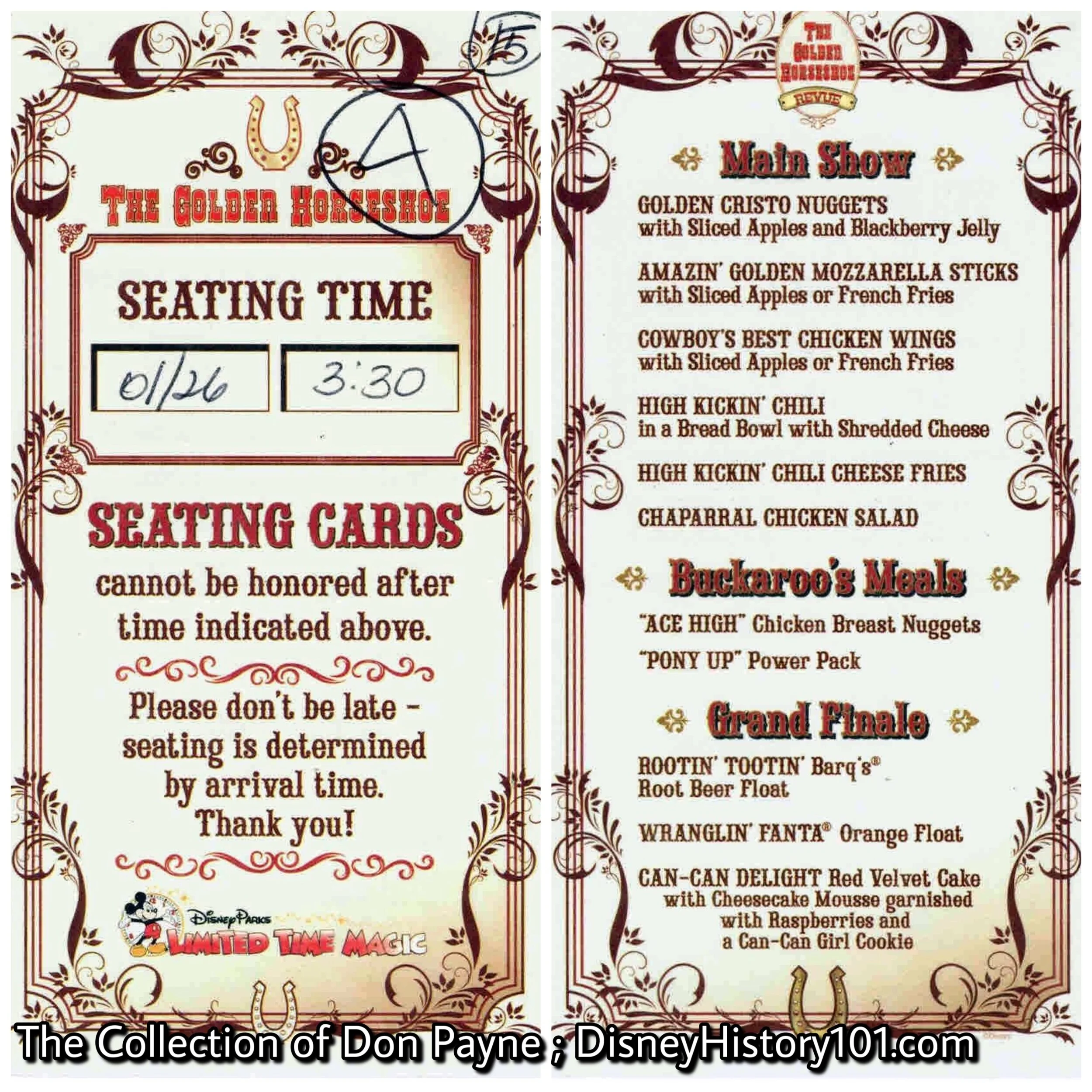
The Golden Horseshoe Reservation Card, c. 2000s
The Golden Horseshoe menu has changed much over the years. By 1981, Slue Food Sue's Fancy Fixin's included the Tenor's Topper (sliced corned beef served on rye bread), Comic's Cambo (sliced roast beef with barbeque sauce served on a roll), and the Dancer's Delight (sliced picnic-style ham served on a roll). Pecos Bill's Rib Ticklers and Thirst Quenchers included the brownie, chips (Doritos, Cheetos, Fritos, Potato Chips), and sodas (Pepsi-Cola, Diet Pepsi-Cola, Mountain Dew).
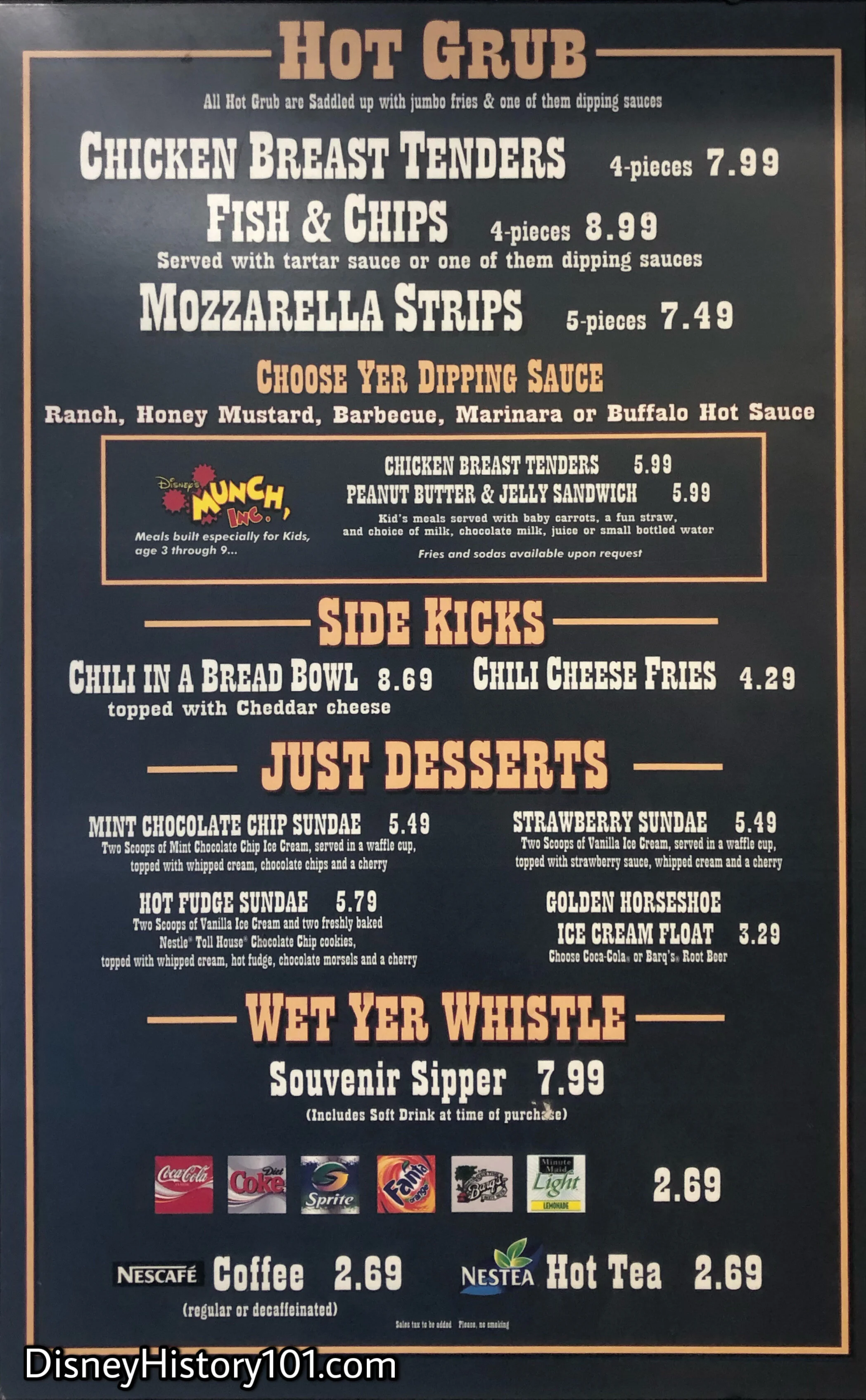
The Golden Horseshoe Menu, c. 2000s
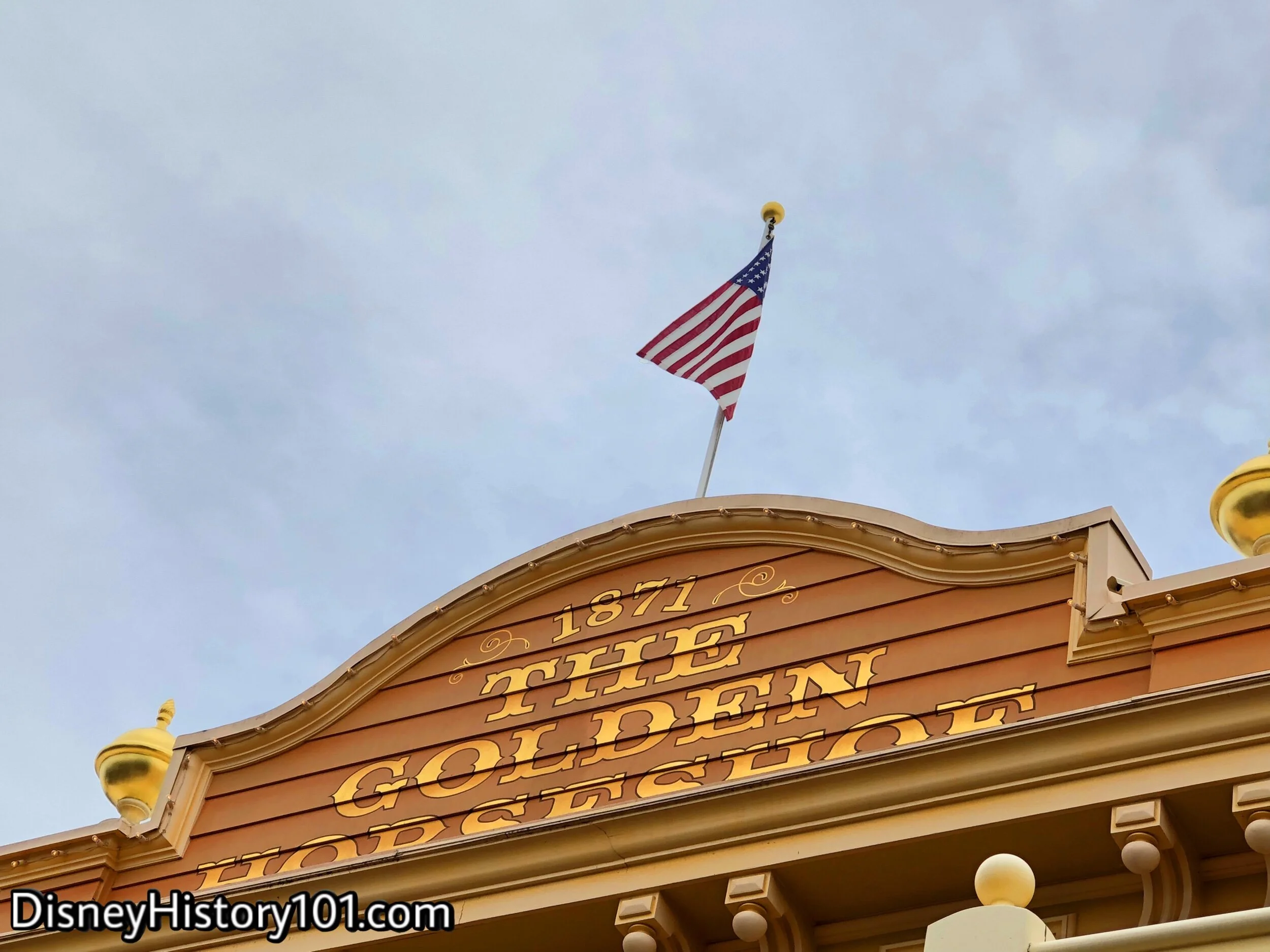
Since the beginning, the Four Keys of the DISNEYLAND Show (operating priorities in presenting the DISNEYLAND Show) have been present - Courtesy, Safety, Show, and Efficiency. Guided by these Four Keys, are Walt Disney Imagineers, who are always seeking out new magical opportunities to increase the efficiency, safety, and show quality of Disneyland adventures.
During January 2 to 21, 1973 the Golden Horseshoe was closed for a 3-week rehabilitation.
In this modern age, there’s still a 37-star flag over the roof of the 1870s-era saloon, and the Golden Horseshoe has a slick new coat of paint, to boot! In 2008 (under the “Frontier Legends Diversity Initiative”), WDI master plans entertained the concept of an efficient, safe, courteous, new show “reconcept” and new menu.
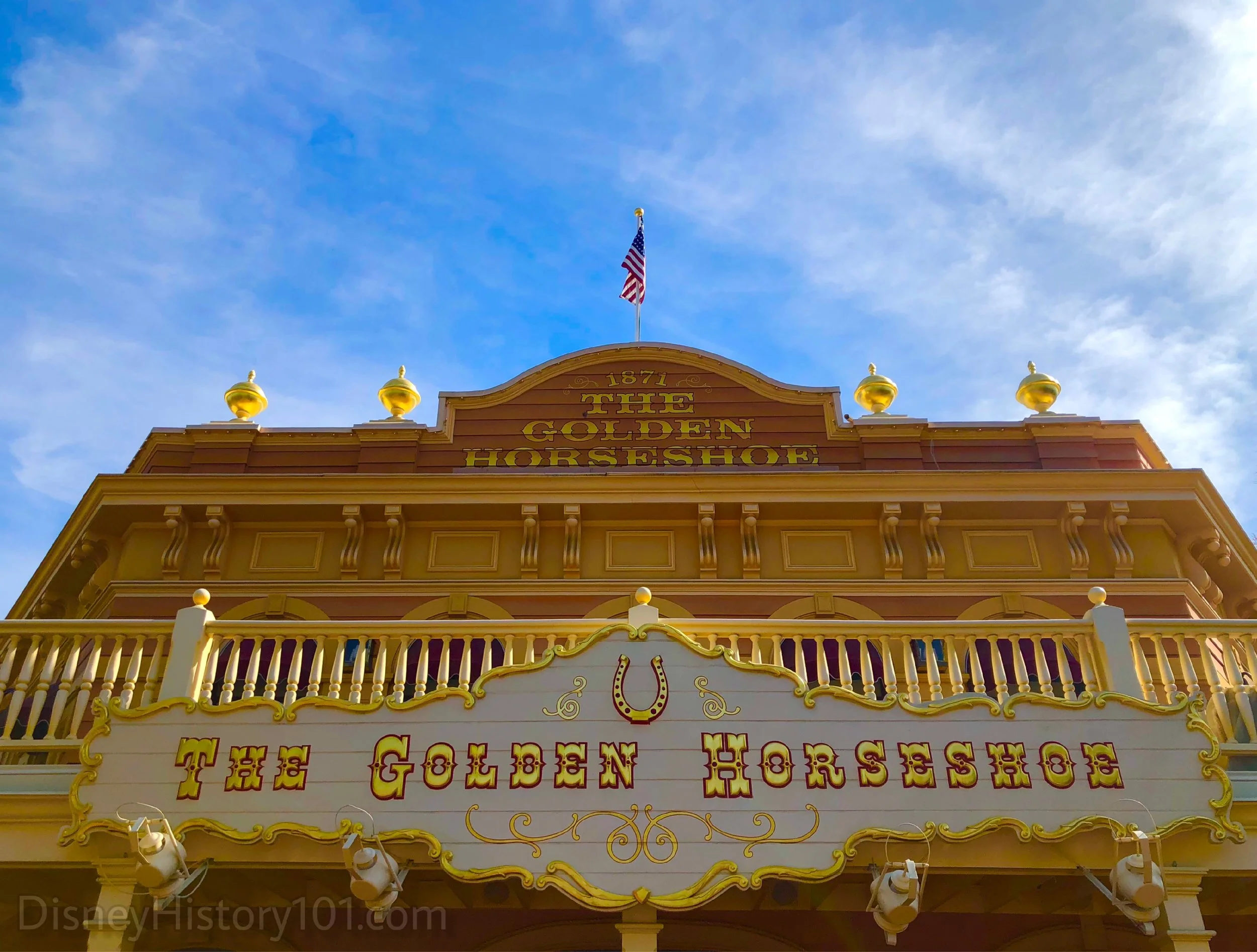
Sadly, the name Slue Foot Sue may be forgotten by most guests who enter the Golden Horseshoe, but her spirit lives on through the new proprietor of the saloon!
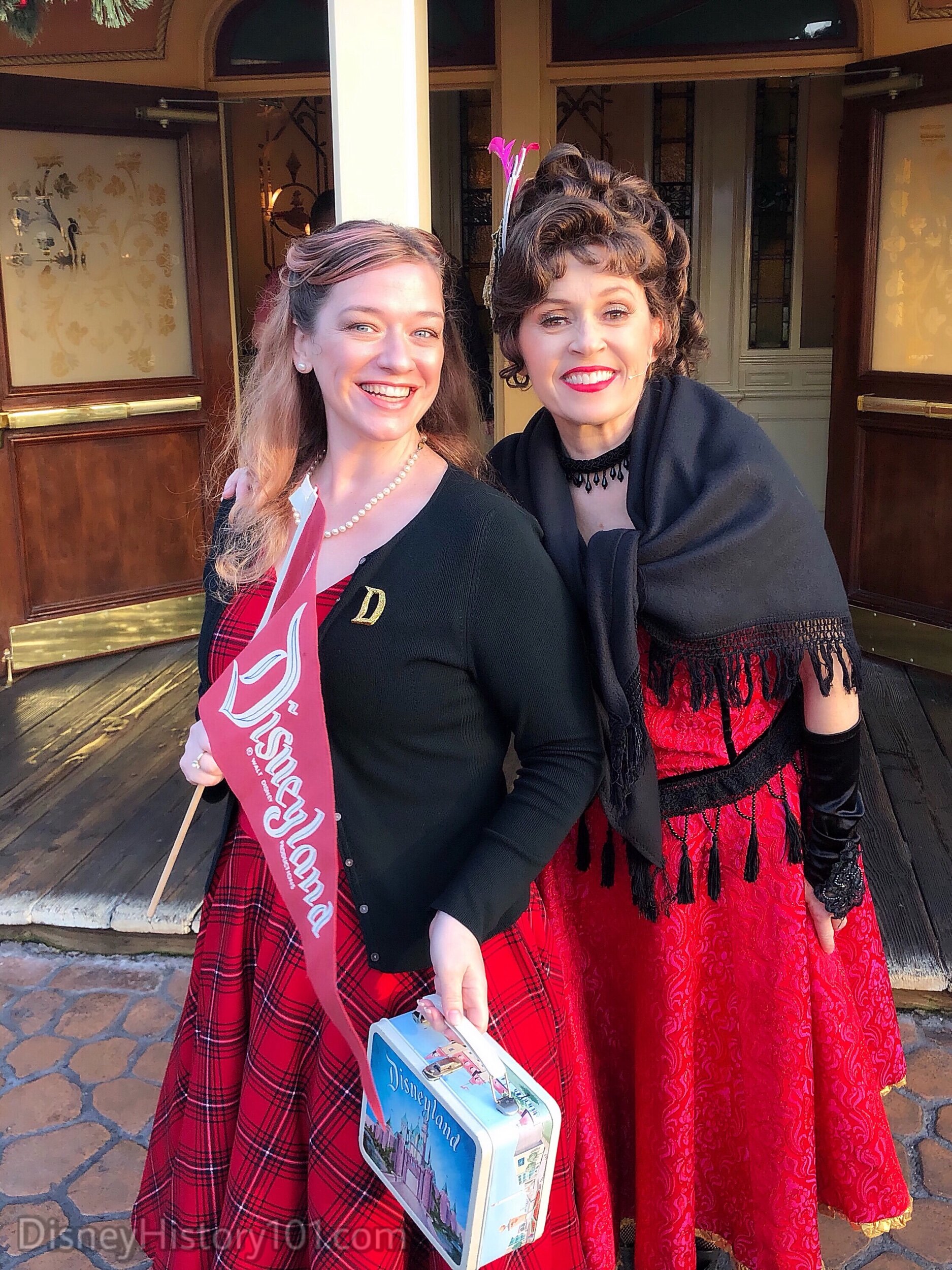
Every Guest is a V.I.P. Here, Miss Lily displays a little Disney Courtesy (through a friendly smile and a gesture) toward each Very Important Person in the Audience.
Since “Slue Foot” Sue’s retirement, there’s a new owner and operator of the Golden Horseshoe. Meet MISS LILY - the new proprietor of the Golden Horseshoe!
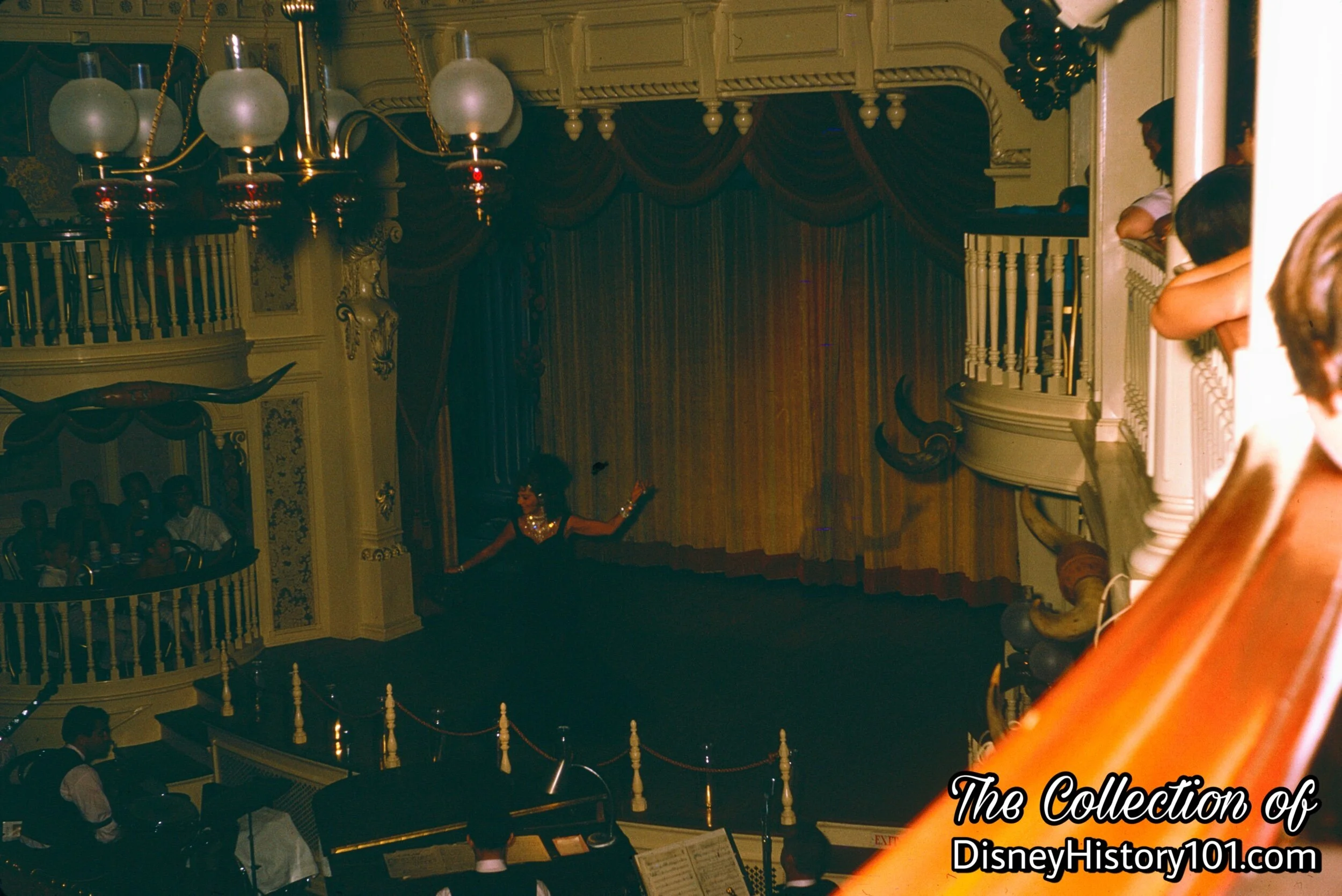
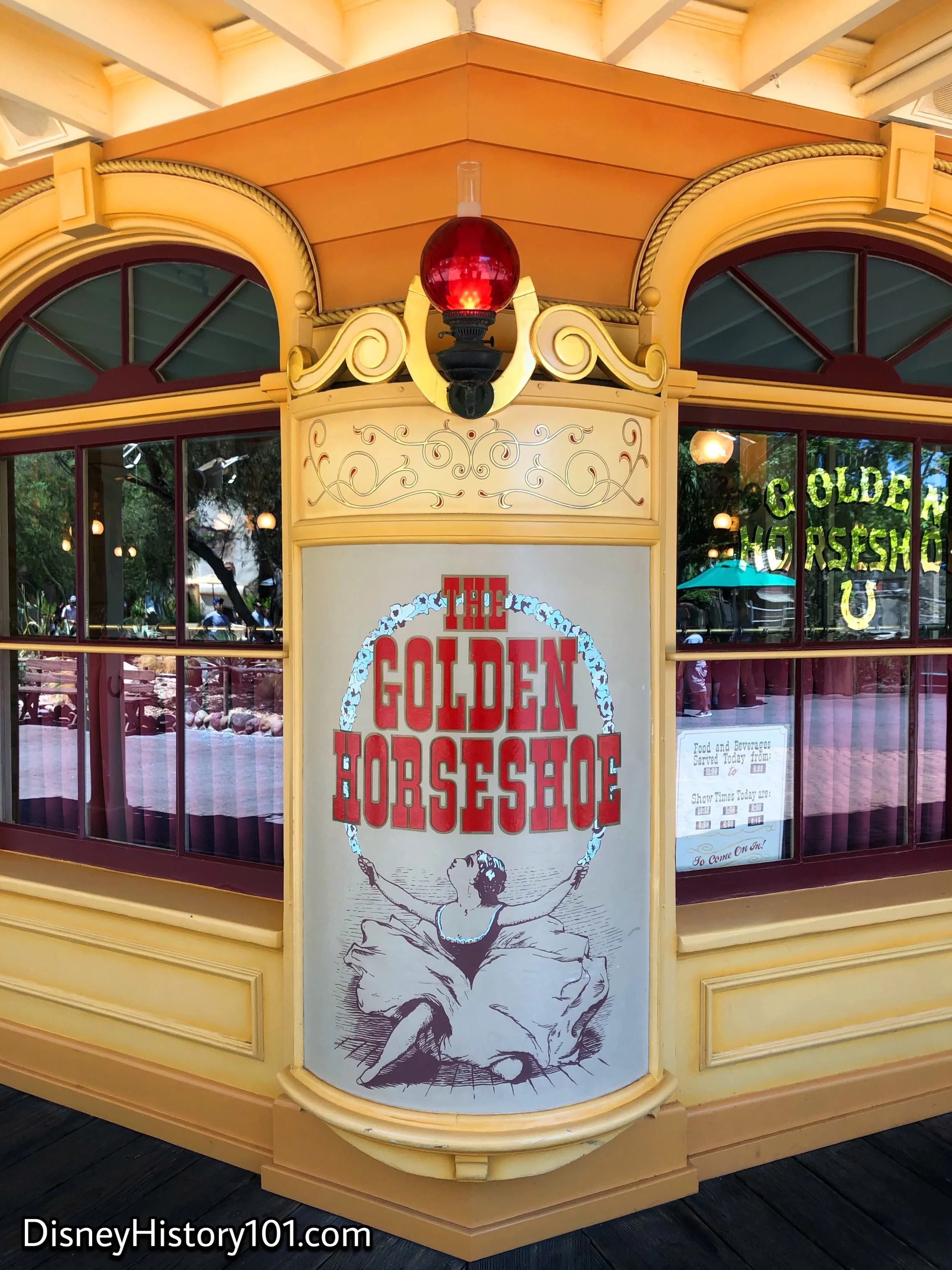
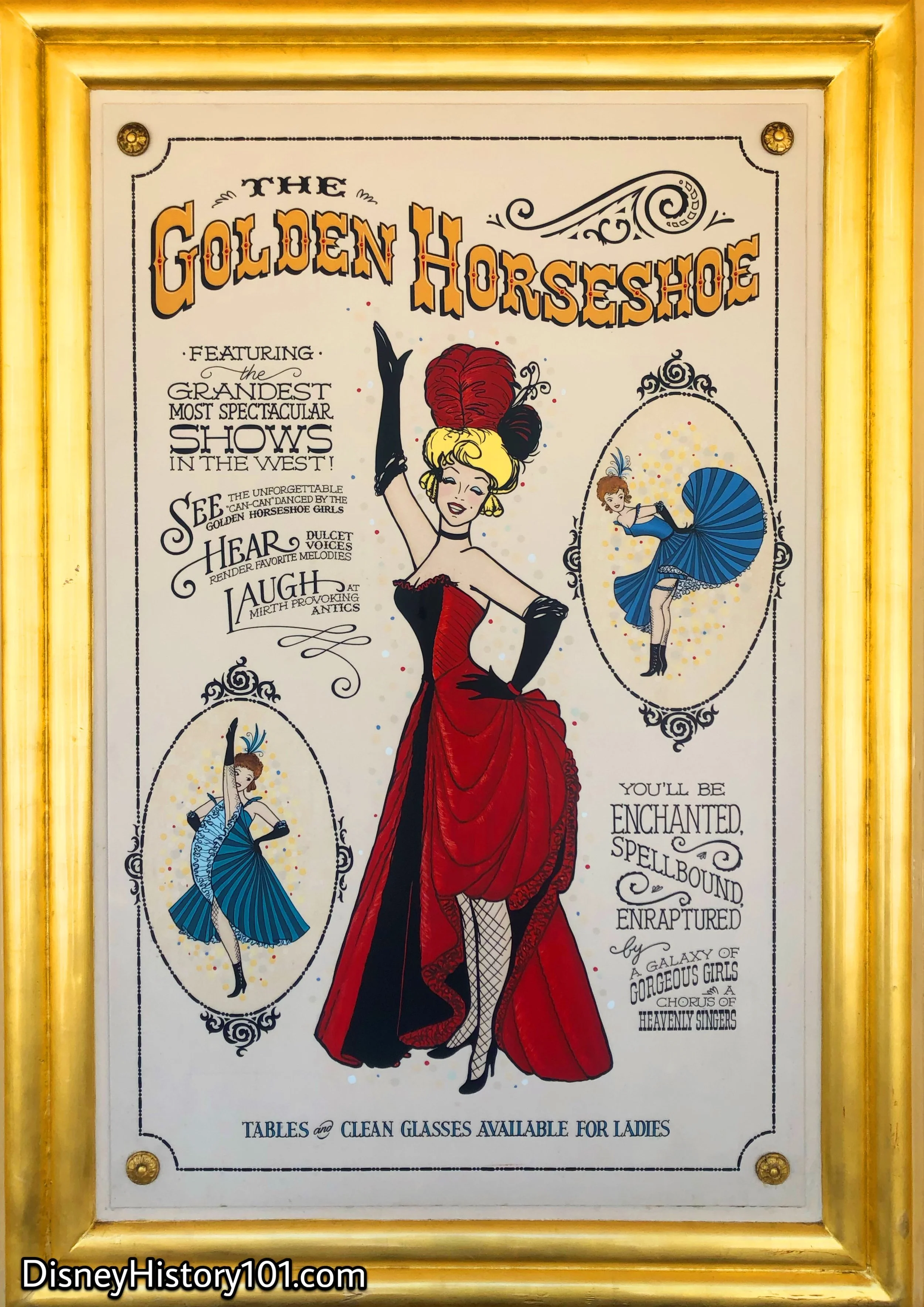
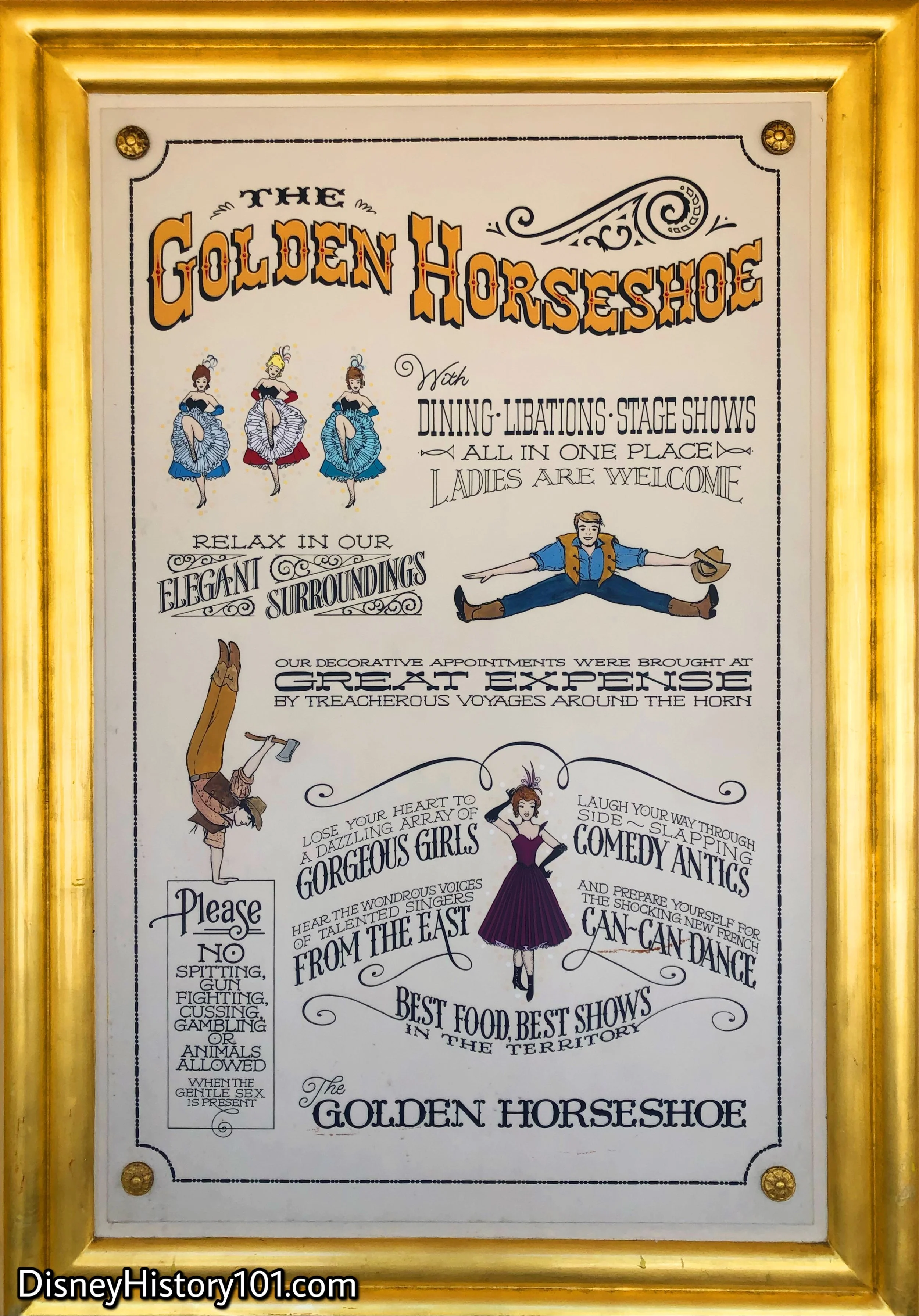
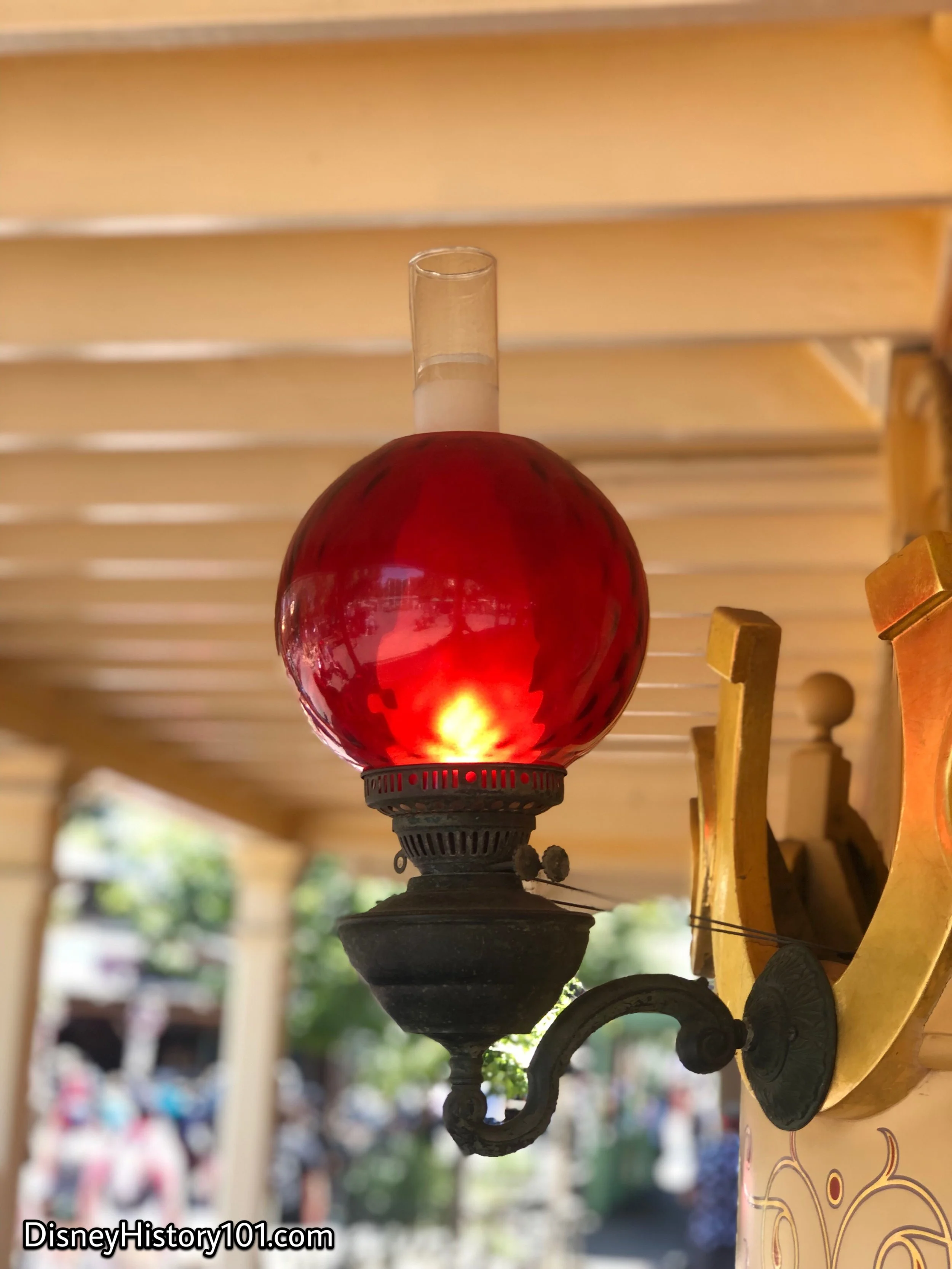
All fixtures were placed in their correct motif and many light fixtures of Disneyland were authentic antiques. Character lighting was themed to the area to enhance the overall appearance and complement the interior, such as a chandelier or kerosene lamp. These added to the show, but didn’t necessarily create enough illumination for operation.
LIGHT magazine (July and August 1956; published by the Large Lamp Department of General Electric, 1956) “shed some light” on the illumination. “The Golden Horseshoe, replica of a famous saloon and gambling hall, but now dispensing nothing stronger than a popular soft drink, is wired and lighted in an authentic manner throughout. A stage, in decor of the late '80s, with golden cans on the stage for foot-lights, but supplemented by a complete system of modern stage lighting provides for a show four times daily... featuring ‘Slue Foot Sue’, with songs and dances of yesterday.” This replica of a “frontier saloon, has exposed lamps and wiring characteristic of early days. 60-watt lamps in enclosing globes around sides, 100-watt in chandeliers. 3 rows of 10 R-40's, with color caps, over stage.”
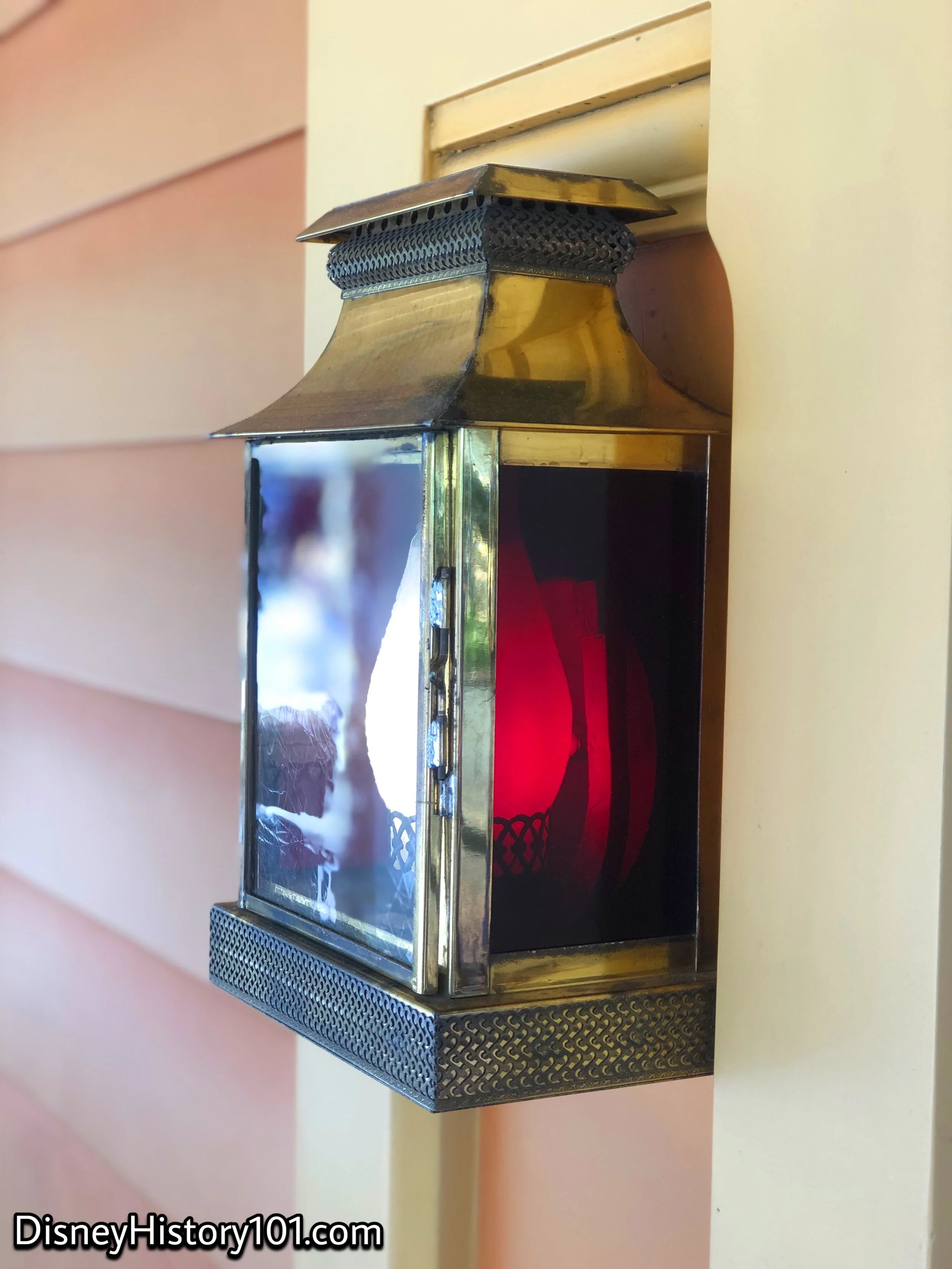
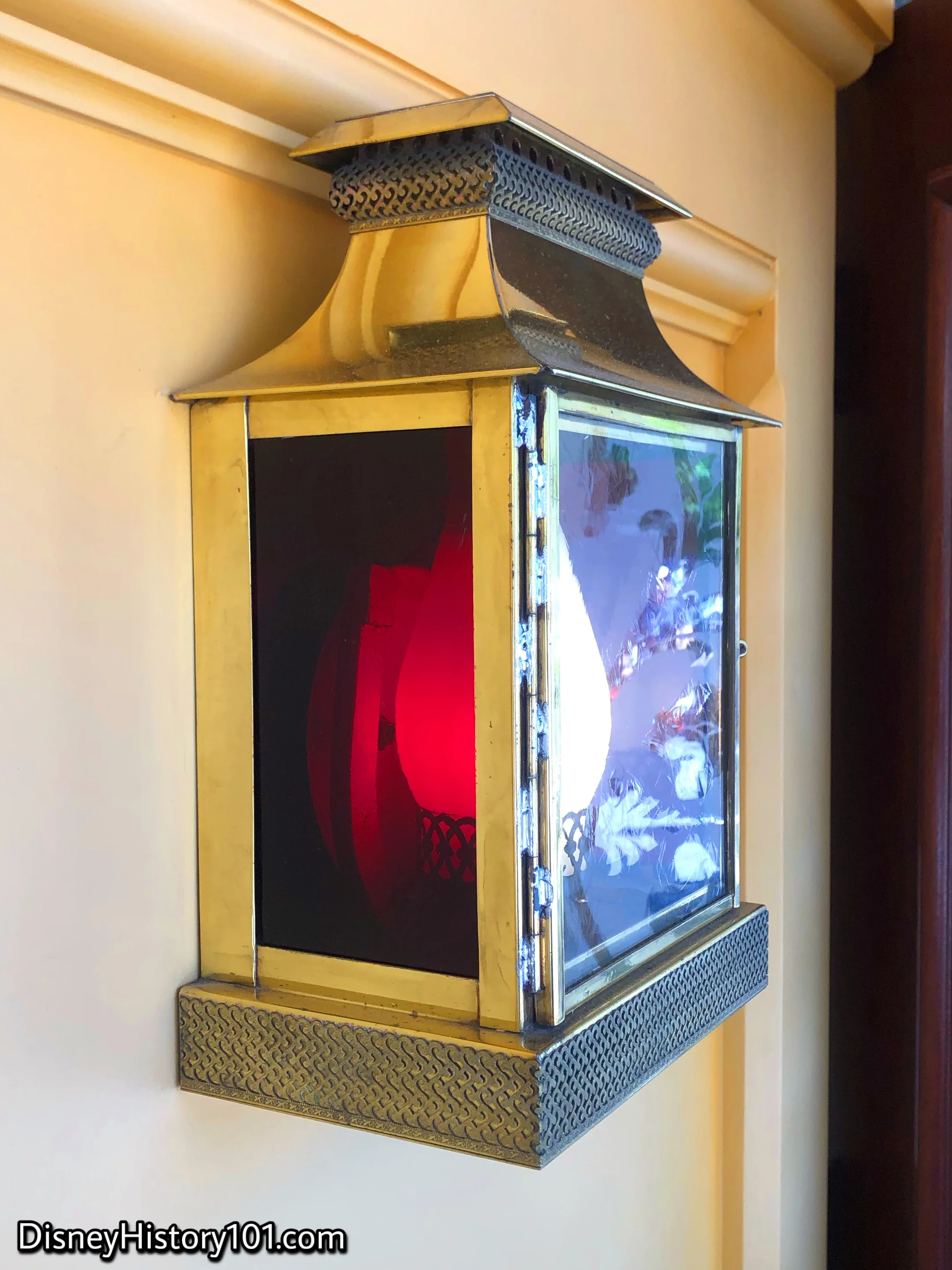
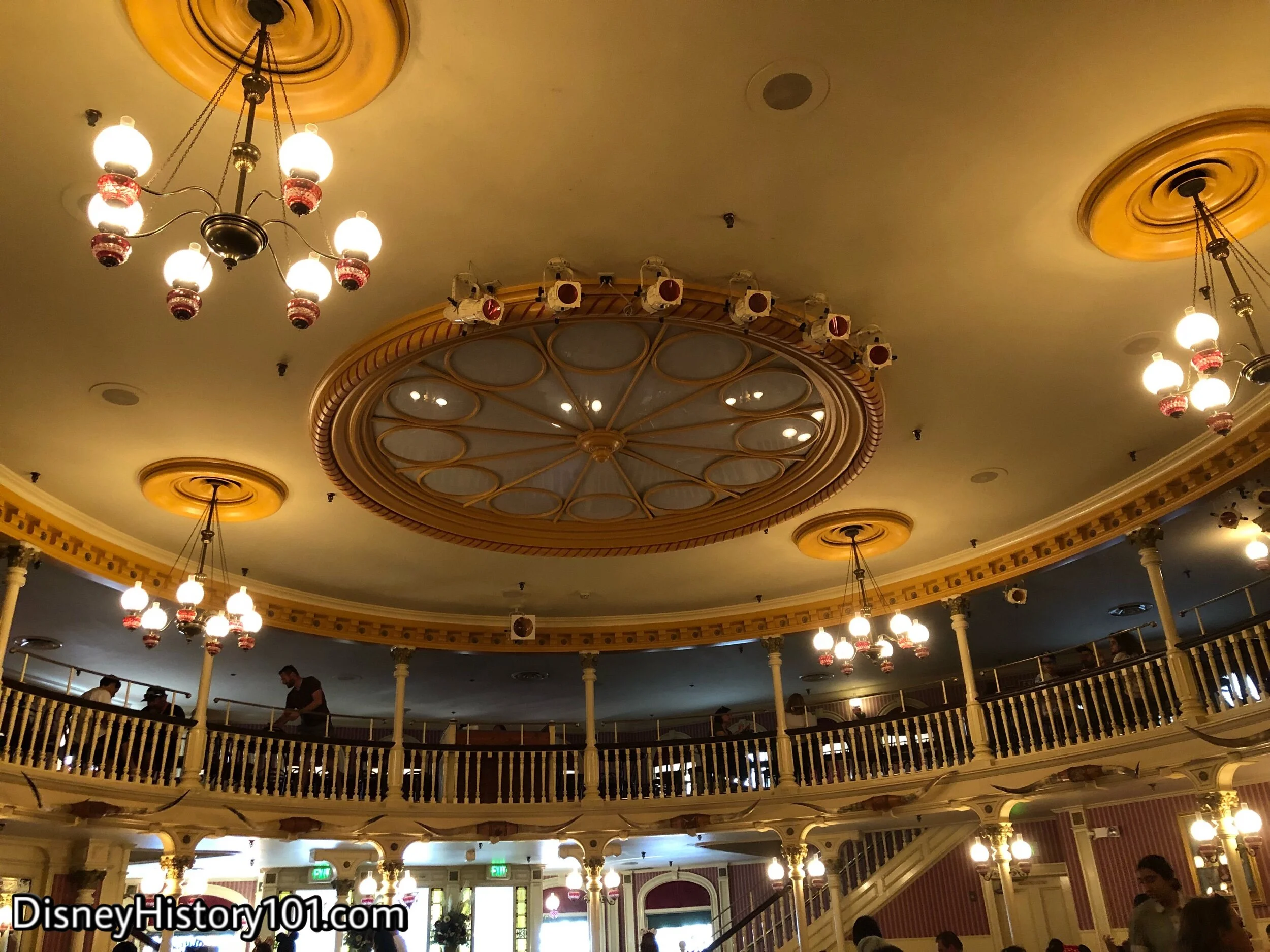
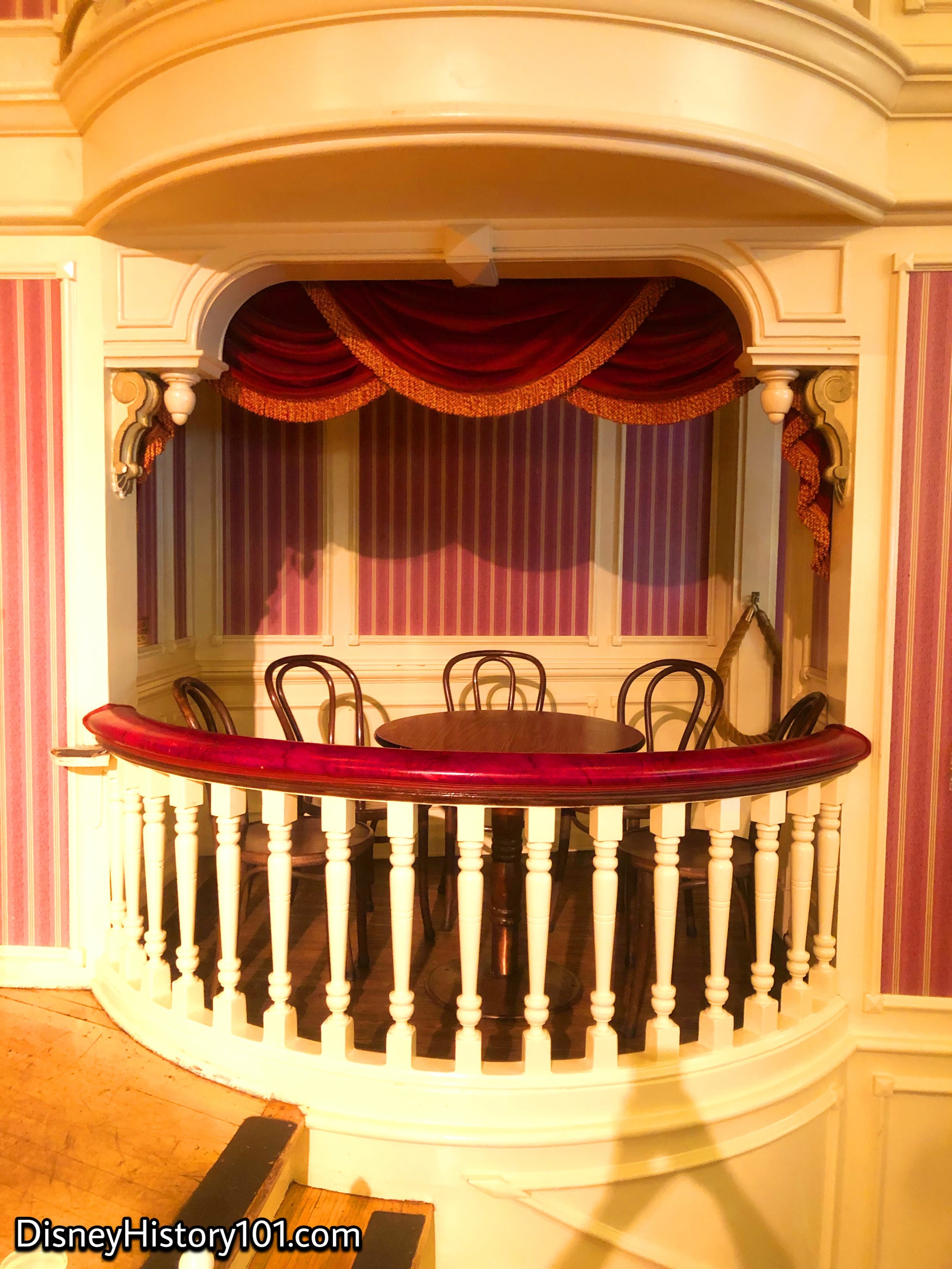
“Golden Horseshoe Private Boxes”
The Private Boxes on the upper level are usually closed to the public, but guests may sit in the Private Boxes on the lower level.
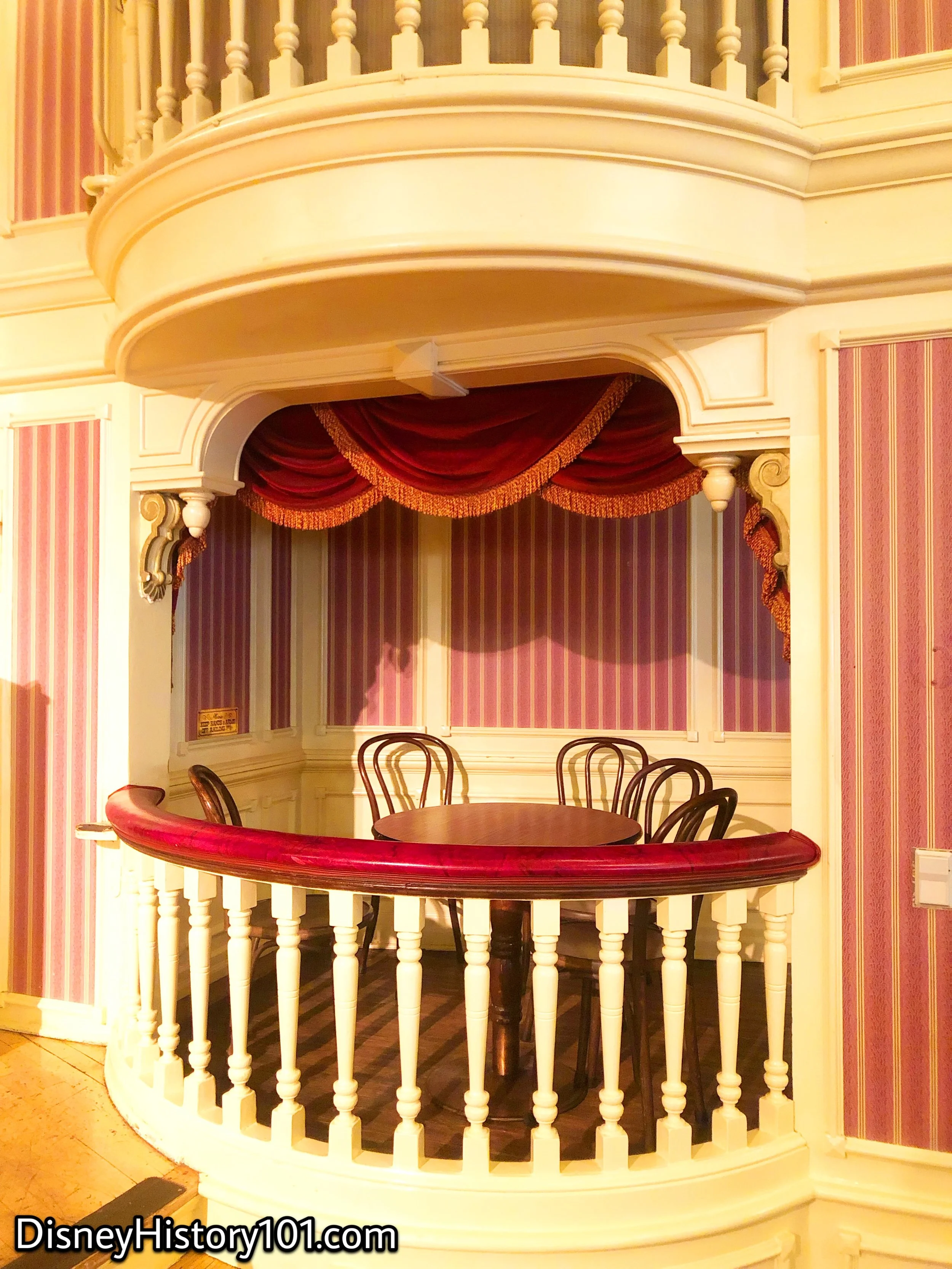
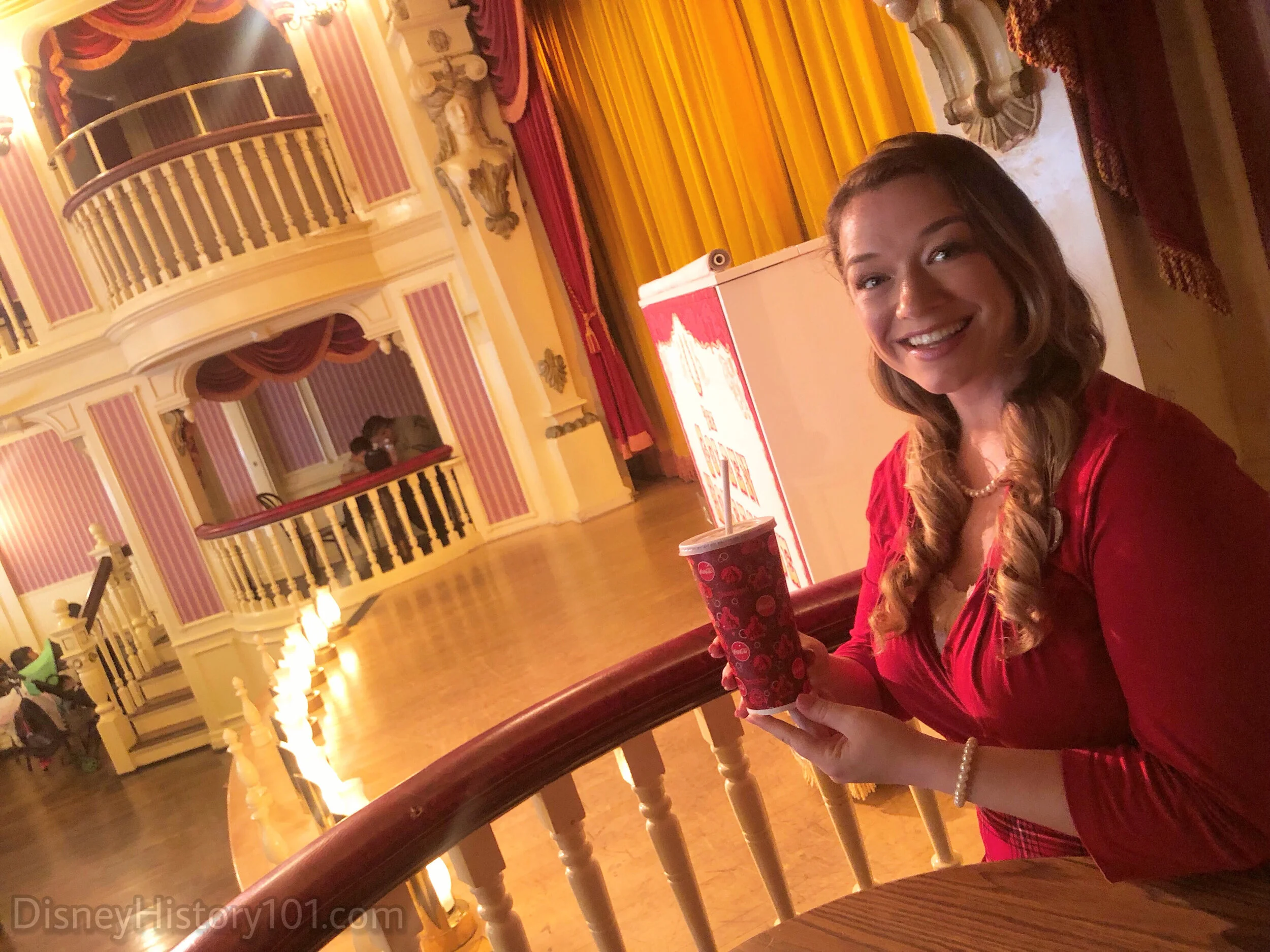
If you’re like Walt’s brother Roy, perhaps you enjoy a front-row table. But these Private “Box” Seats afford an up-close vantage of the show unlike any other. According to Wally Boag’s recollections, “the lower box, stage left,” was likely Walt’s favorite place to enjoy the show [seen on the other side of the stage, above]. In interview with Carlene Thie, Wally once recalled: “Whenever he arrived at the Park and parked his car behind City Hall, we’d get a call letting us know that he was on property and to reserve his box for him because he would stop by sometime during the day to see the show. And he was a great audience.” [“Homecoming - Destination Disneyland” by Carlene Thie] Reservations are no longer required for the Private Box Seats, but it’s best to arrive early if you would like to sit here!
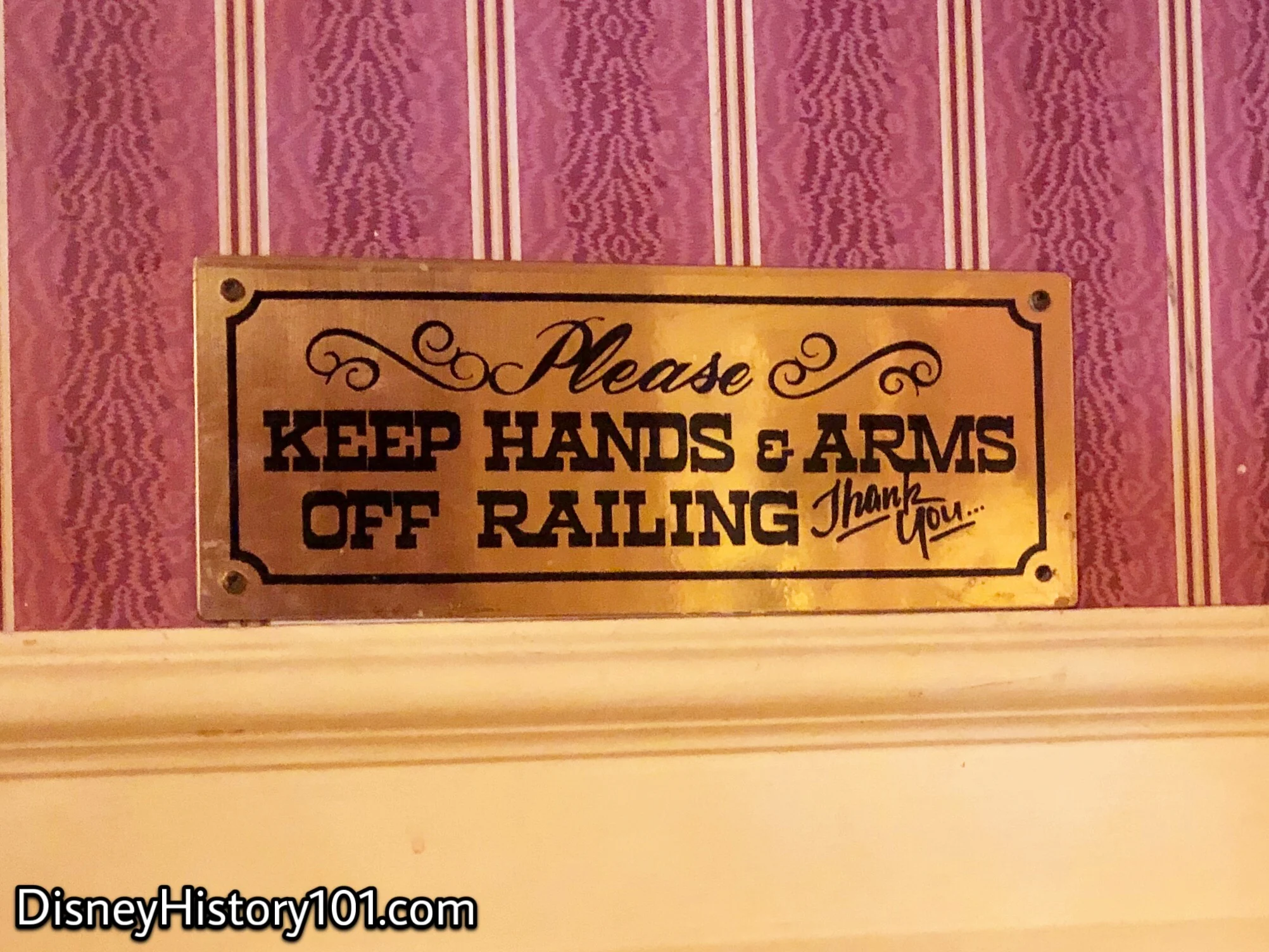
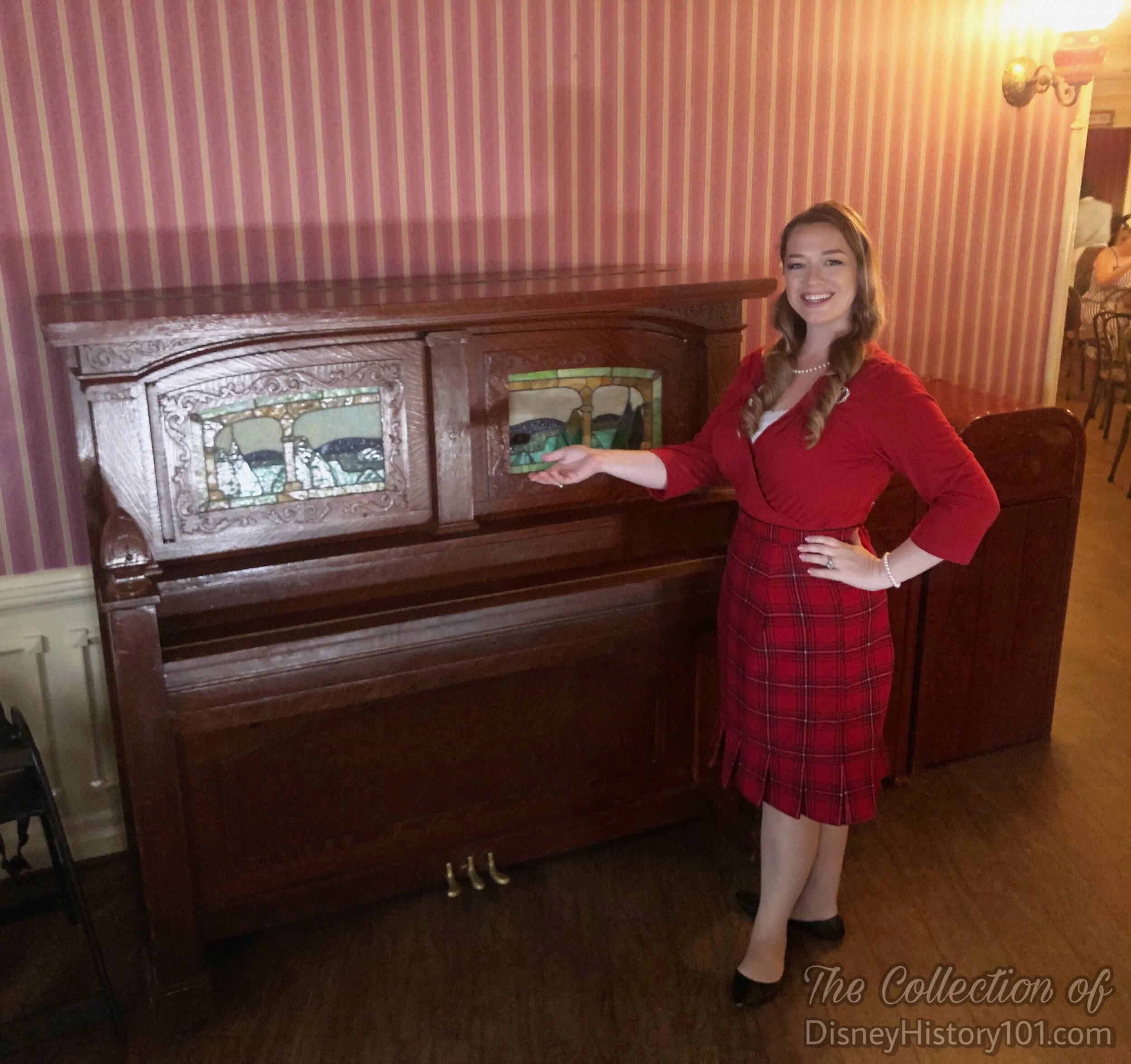
Over the decades, Disneyland has come into the possession of various automatic and manual music reproducing instruments including music boxes, player pianos, organs, nickelodeons, calliopes, and orchestrions. Upstairs at the Golden Horseshoe you may find an antique Seeburg “upright piano built 1910,” according to “Did You Know” (published by Disneyland in 1991). You may recall also seeing this Seeburg Upright Grand Piano at the Market House during the 1990s.
By 1969, these were 2 of 15 old-time band organs and pianos at Disneyland, some of which dated back to 1890. There just weren’t any replacement parts for these rare antiques. So, ARCADE MAINTENANCE performed the necessary versatile, creative, and inventive mechanical repairs.
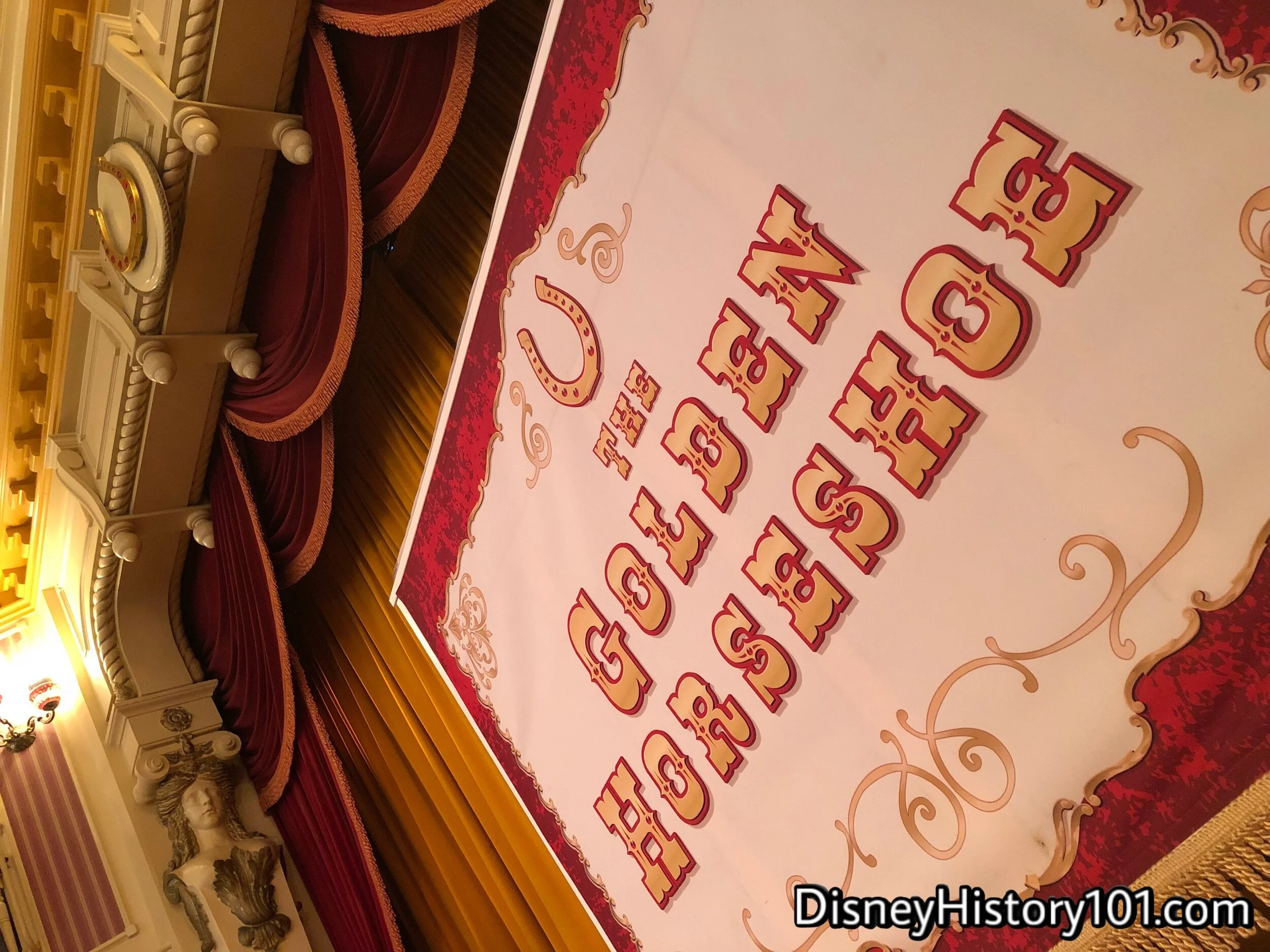
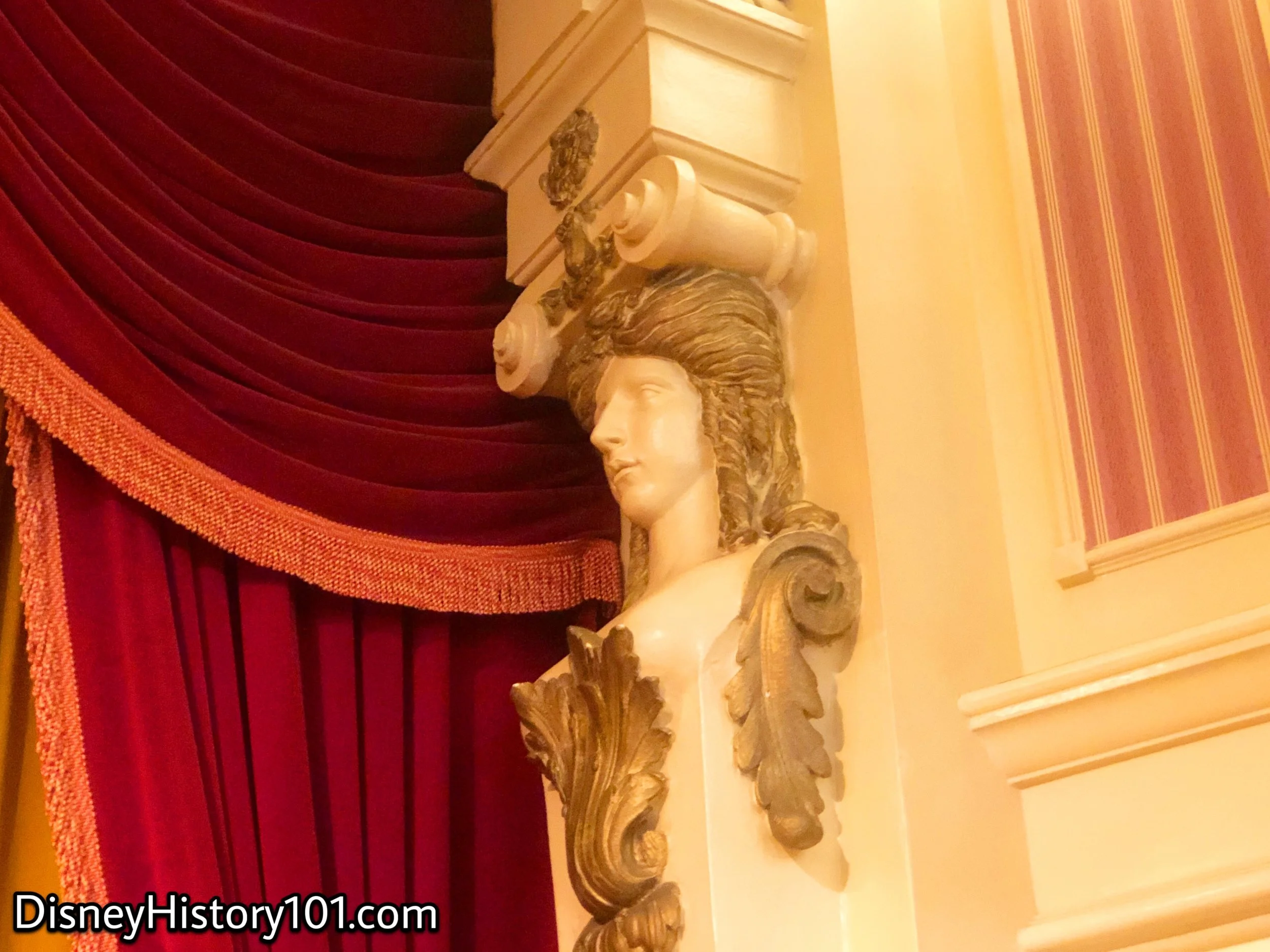
Many of those same 19th century-style details fill Frontierland’s opera house, though the interior color scheme has been altered a bit.
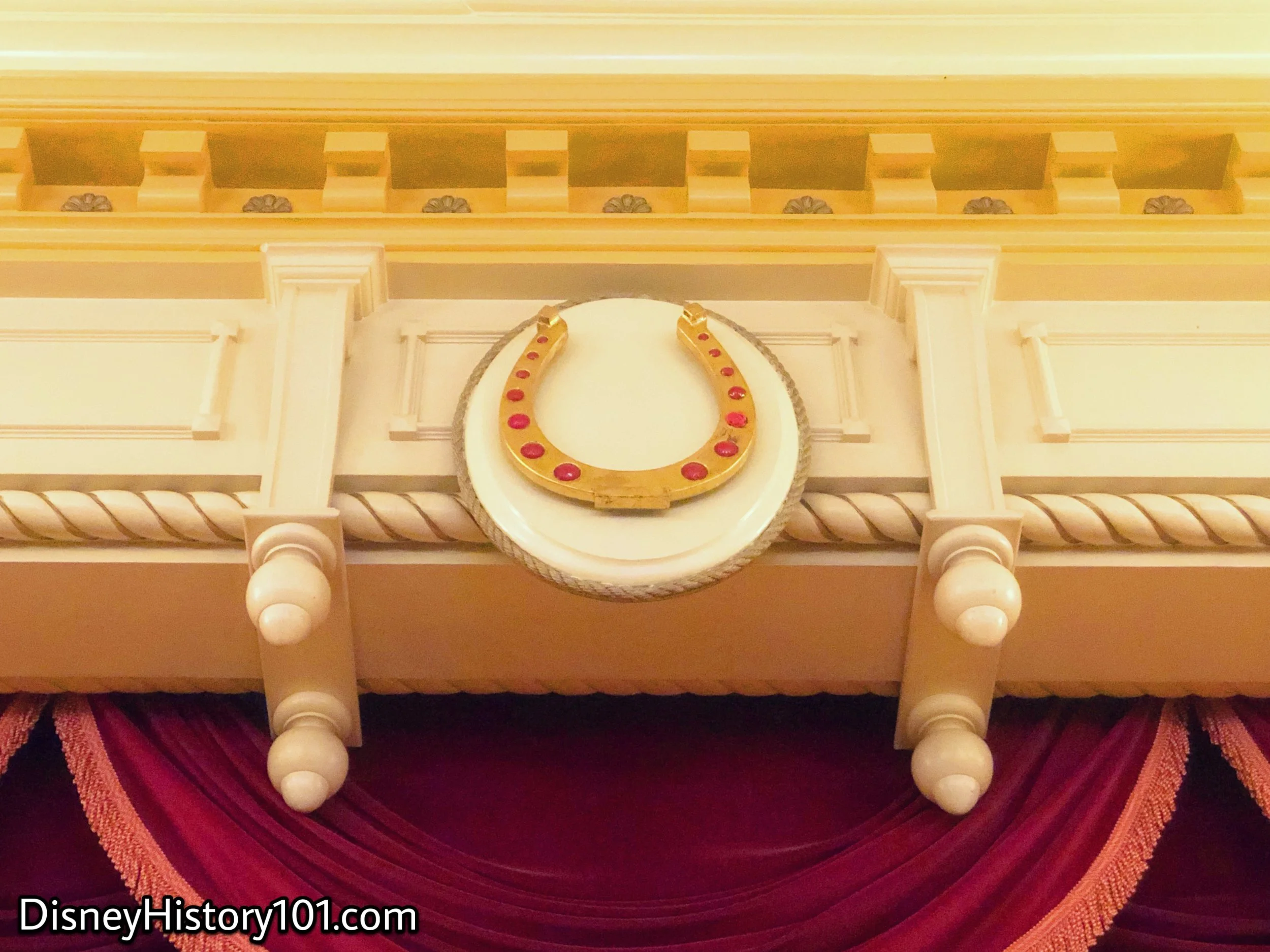
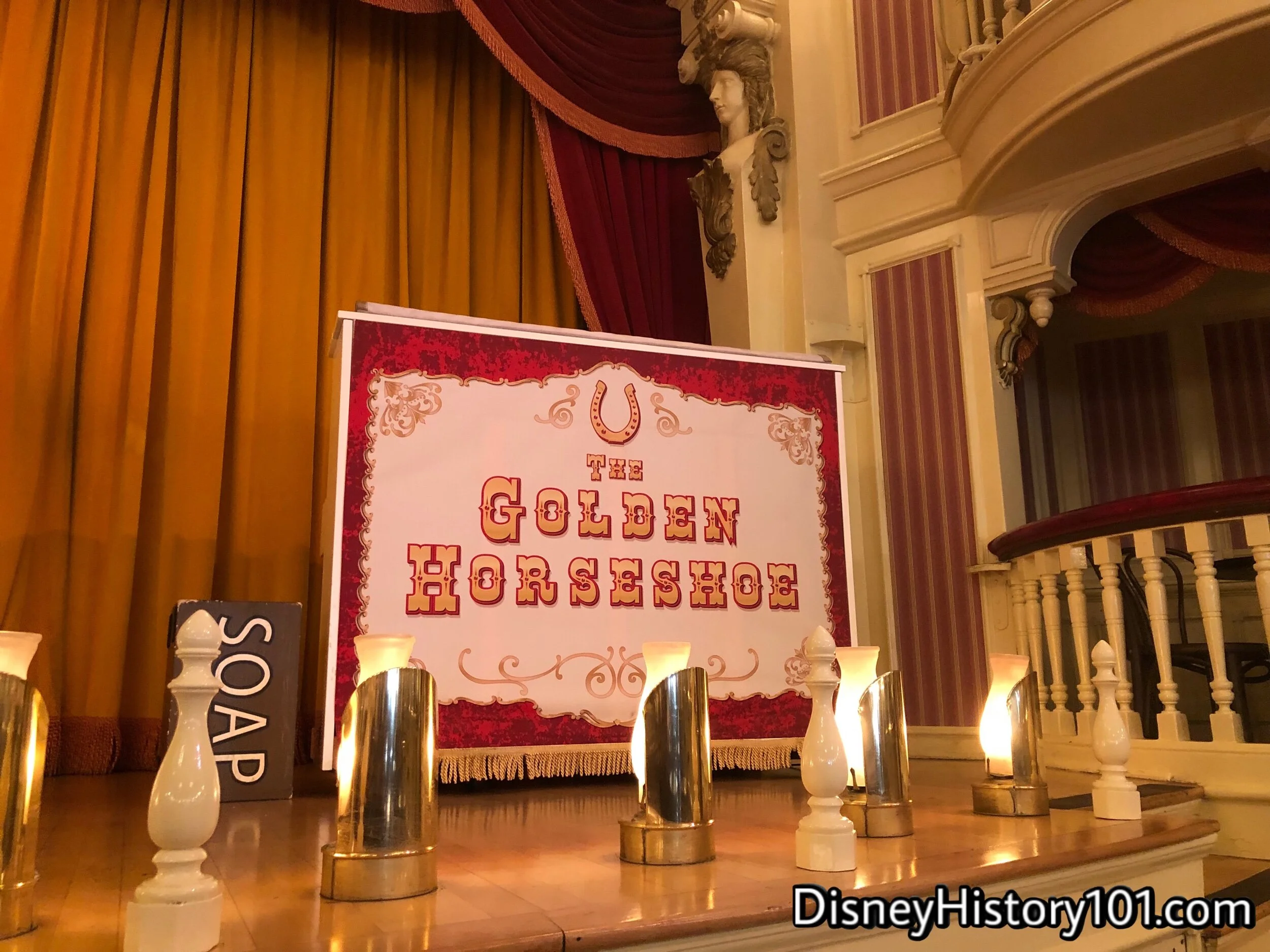
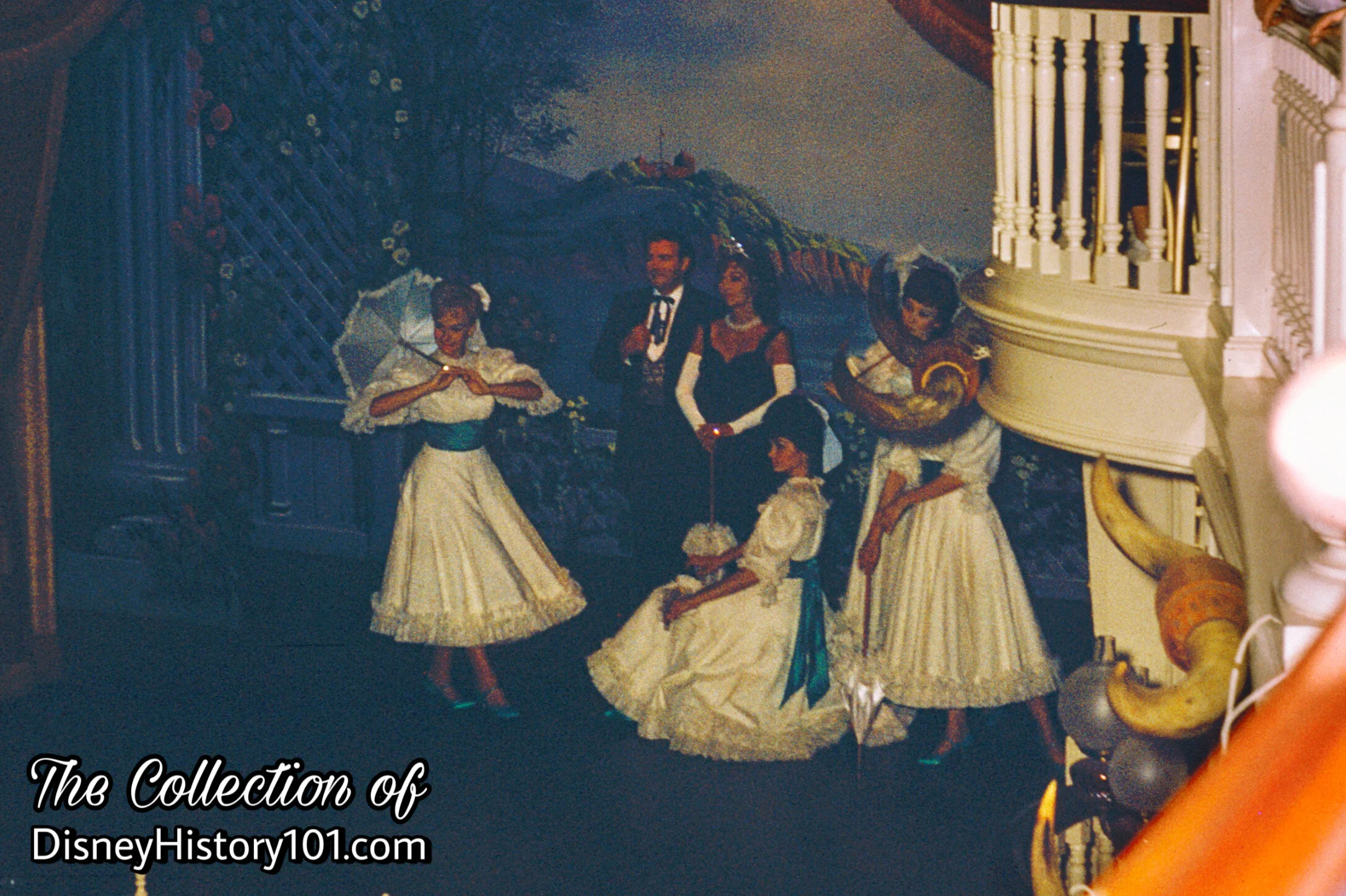
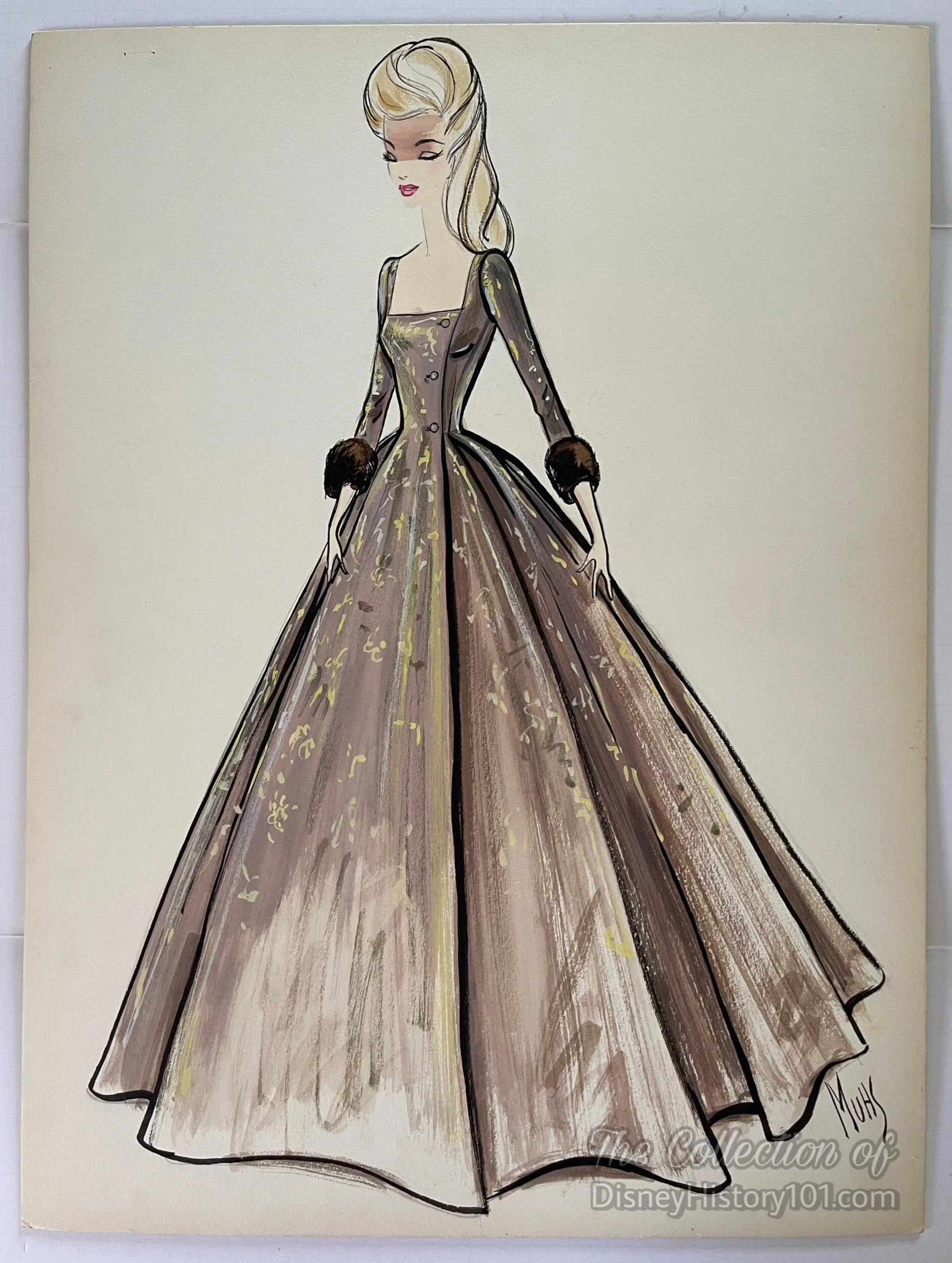
Golden Horseshoe Concept by Jack Muhs
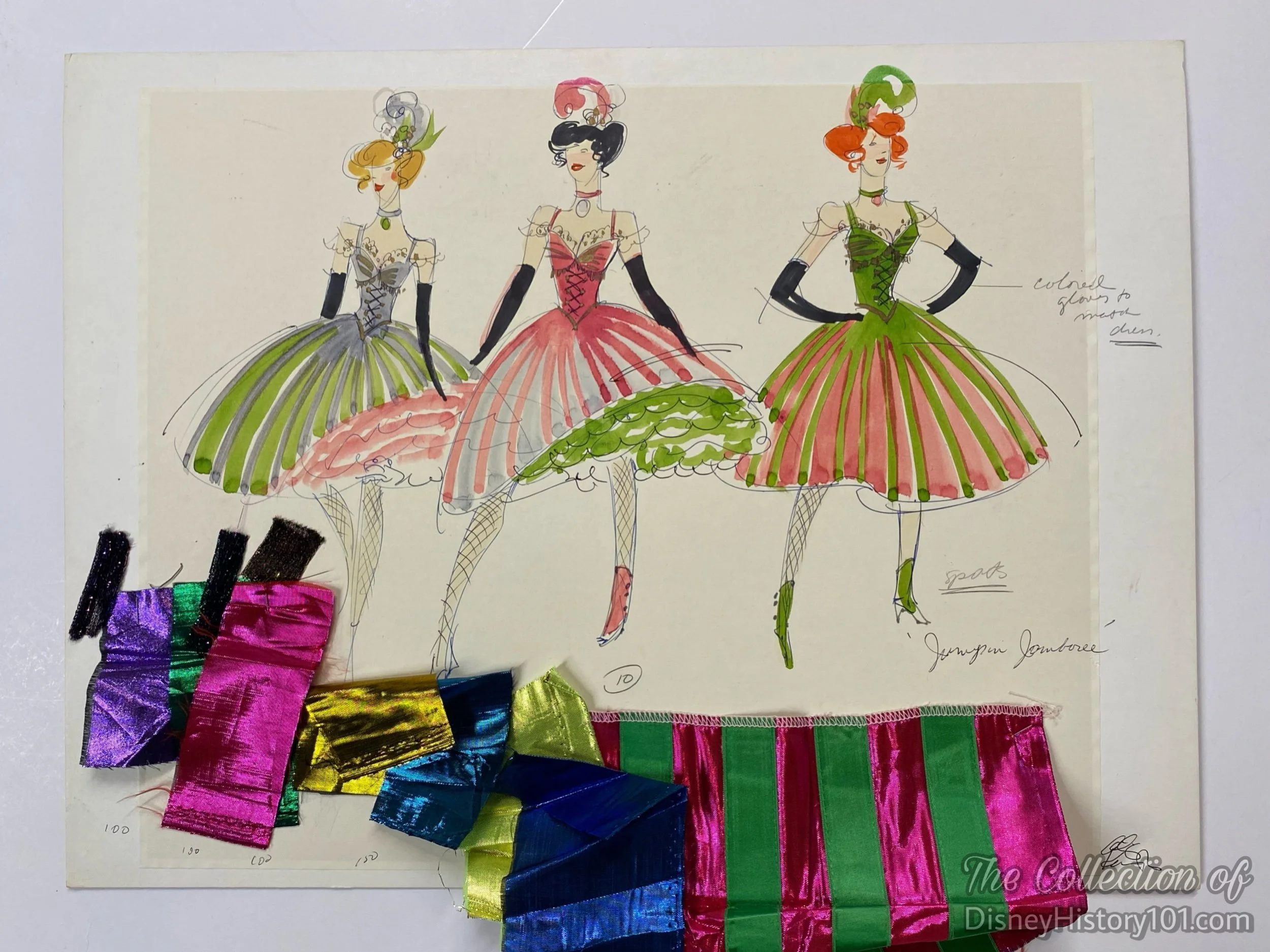
Golden Horseshoe Cancan costumes (by Alyja Kalinich) to replace Jack Muhs’ designs.
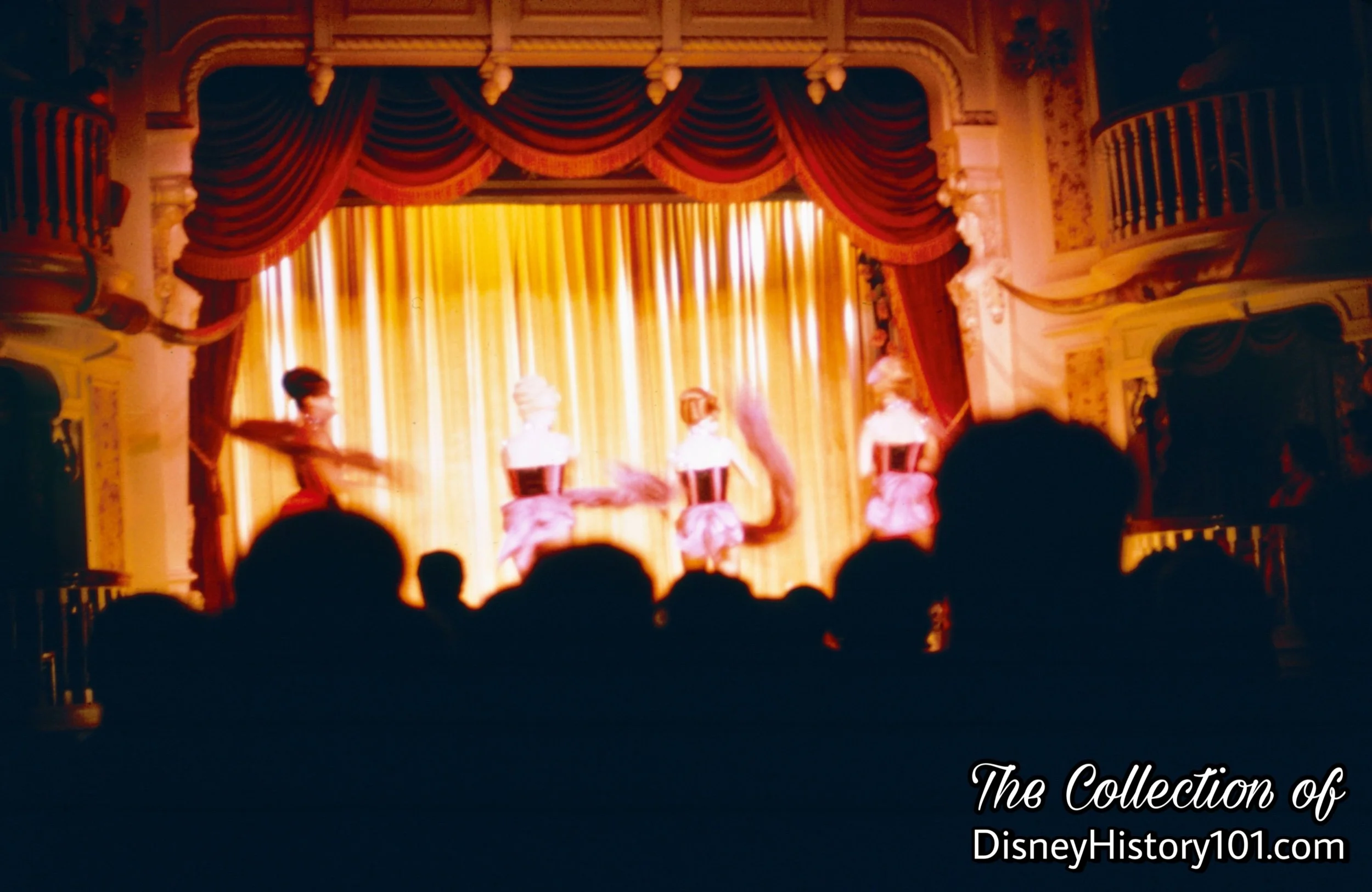
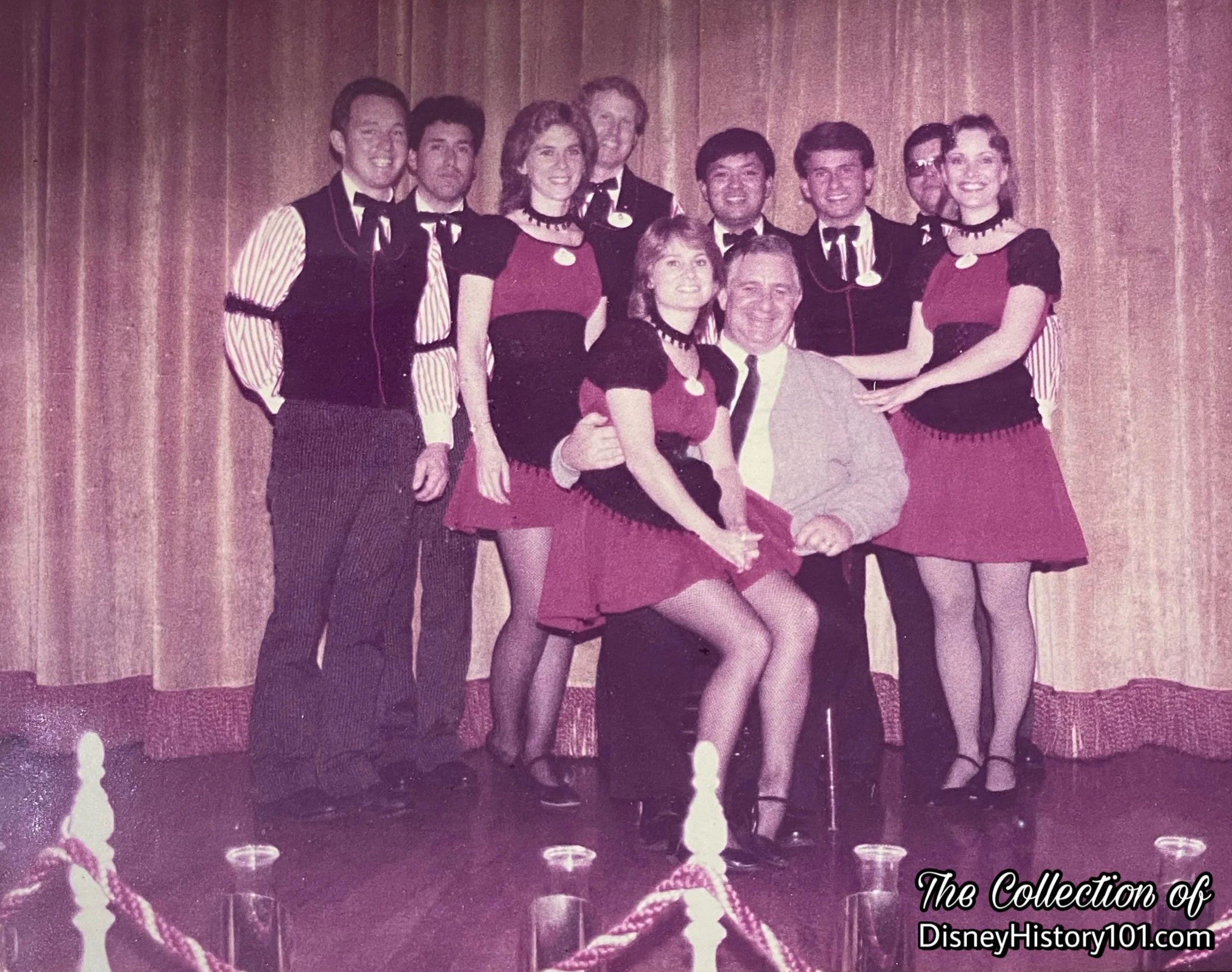
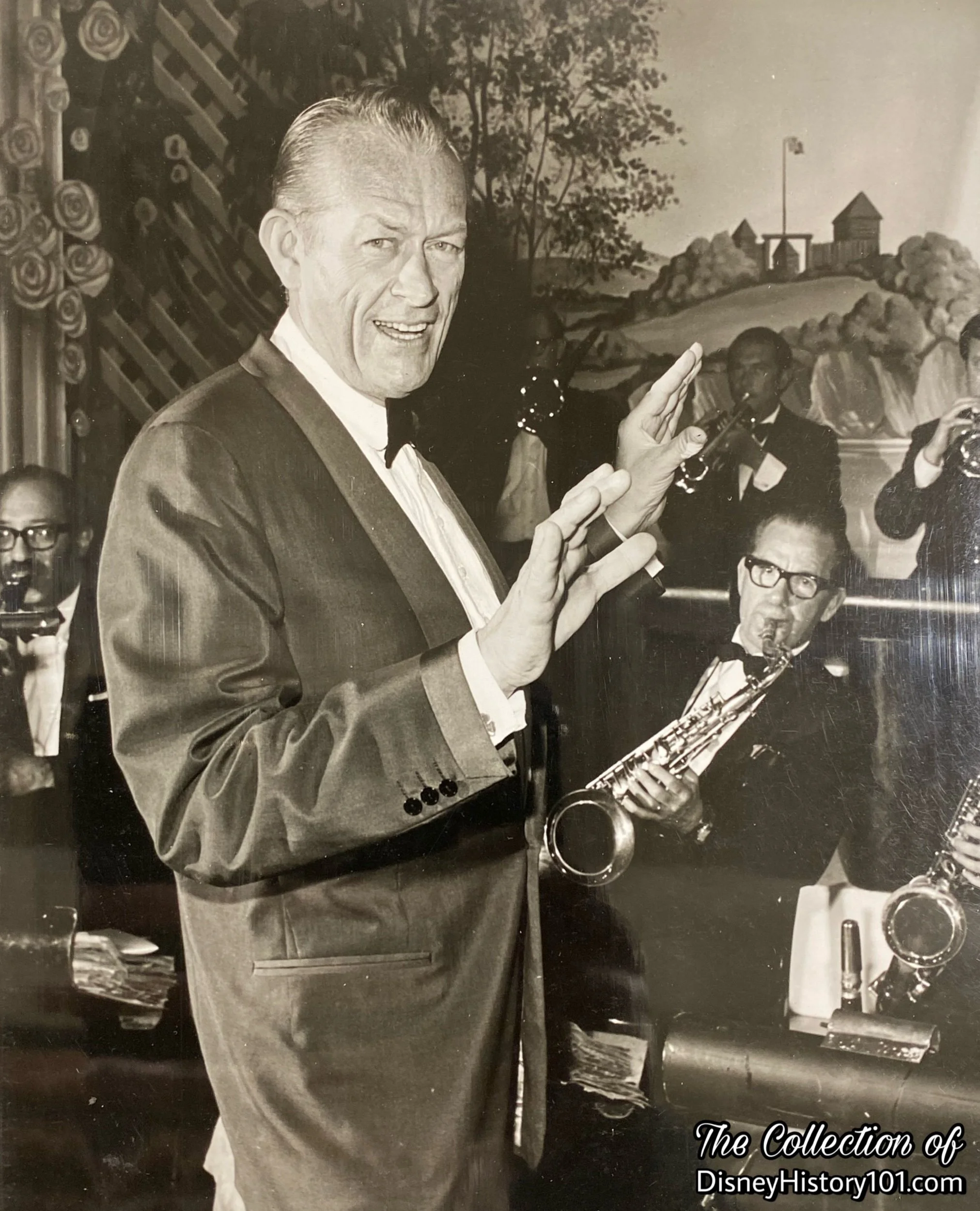
© Walt Disney Company.
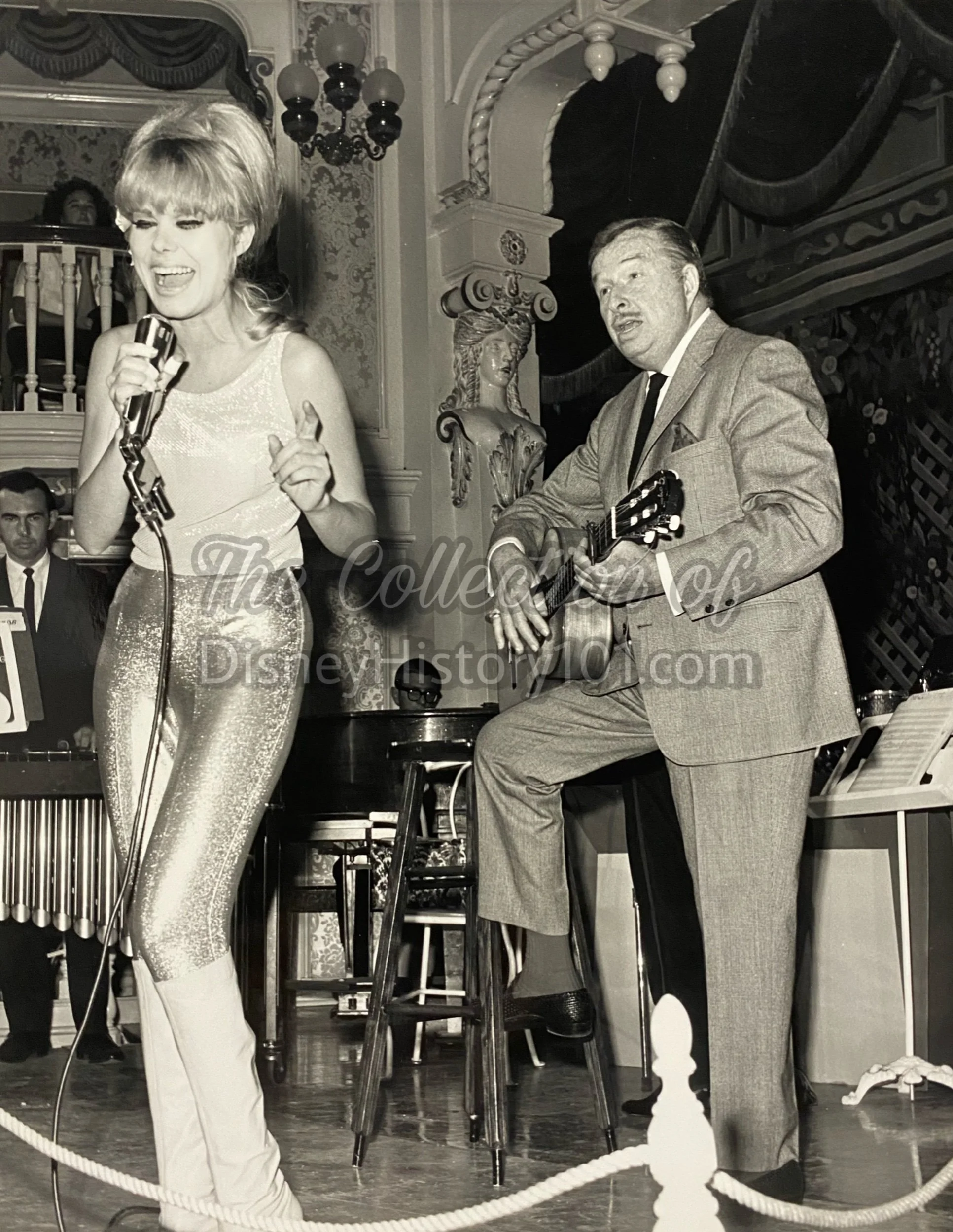
Xavier Cougat and Ciaro perform from the Golden Horseshoe stage; © Walt Disney Company.
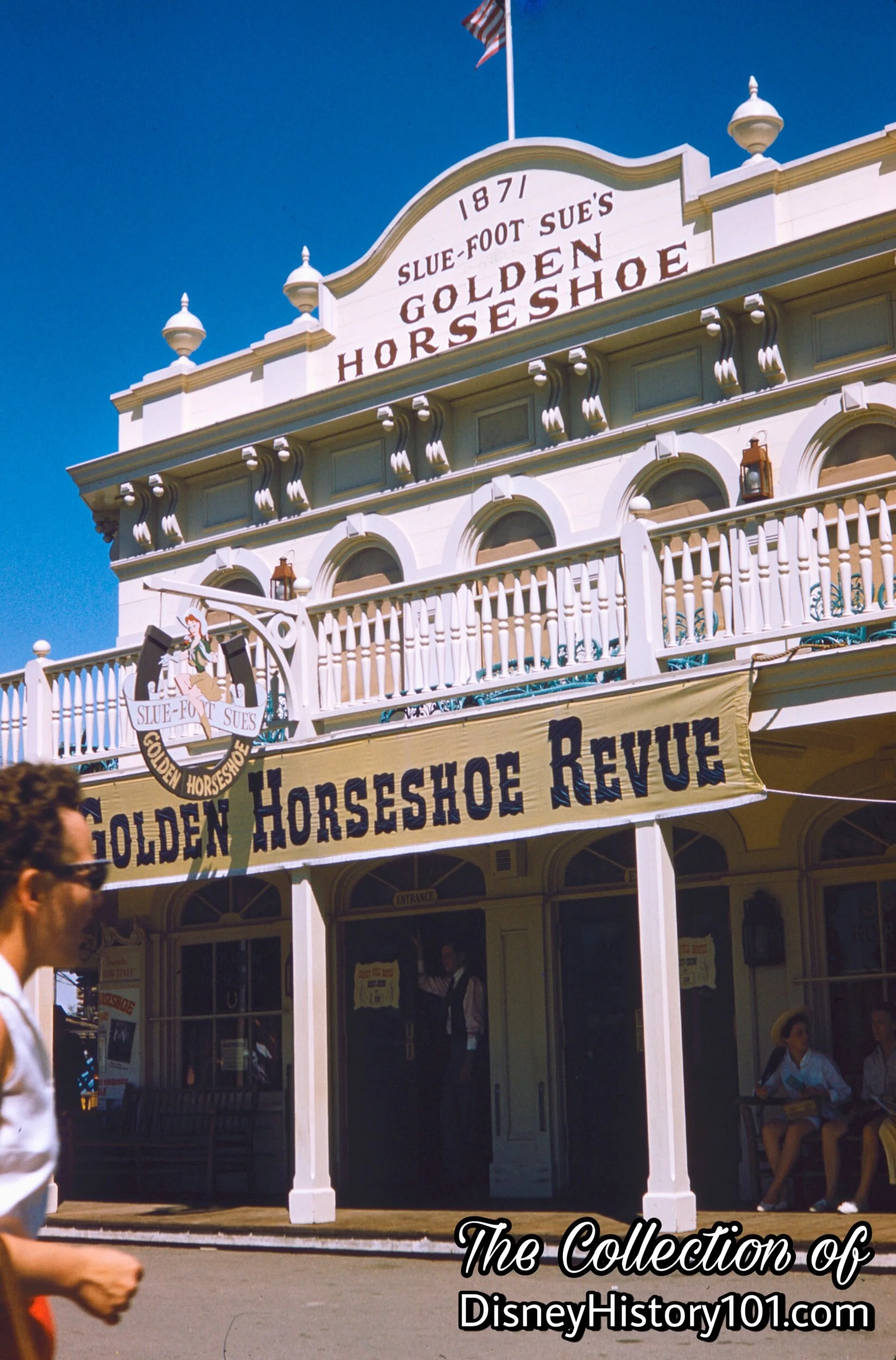
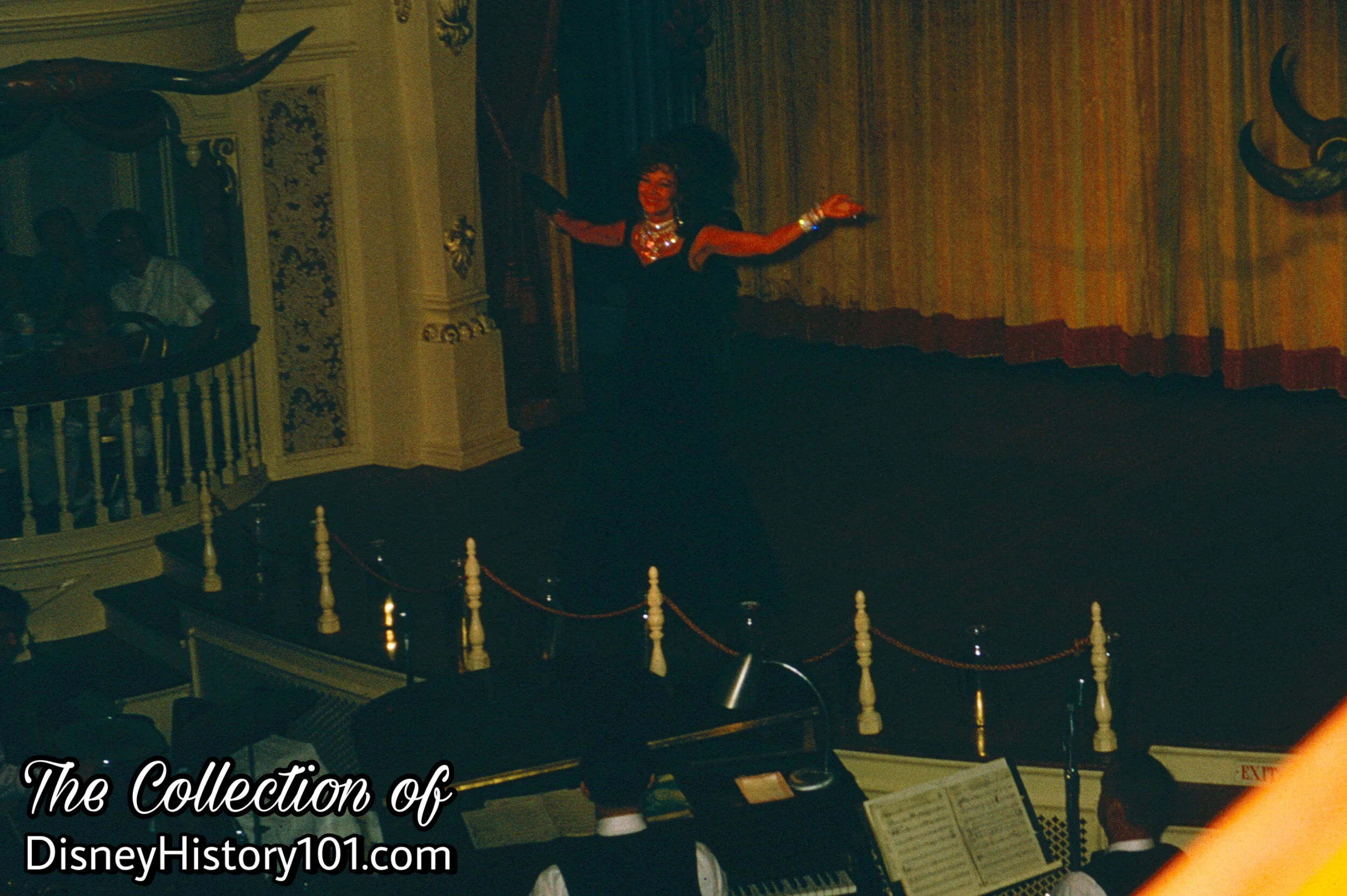
If you would like to read more about the Golden Horseshoe, it’s my pleasure to recommend adding Marcy Smothers’ “Eat Like Walt - The Wonderful World of Disney Food” to your personal Disney Home Library! Therein, Marcy has extensively researched and finely crafted a small section of a chapter dedicated to “Walt Disney’s Disneyland - Frontierland” If you would like to bring the magic of Disneyland restaurants and concessions to your dining room table, “please step this way” toward www.eatlikewalt.com where Marcy has shared a few recipes for memorable Disneyland menu options, so you too can “Eat Like Walt.”
Coca-Cola is the new sponsor of the fabulous Golden Horseshoe! To accommodate your thirst, you’ll find plenty of Coca-Cola brand beverages on tap while you enjoy the new show. Speaking of shows, I’ve always wondered what it would be like to perform from the Golden Horseshoe’s stage…
"THE NEW GOLDEN HORSESHOE REVUE with Field Guide Beth" presented by Disney History 101
A VERY brief retrospective before Field Guide Beth gets handpicked and wrangled into a performance on the rootinest, tootinest, stage show that ever was!
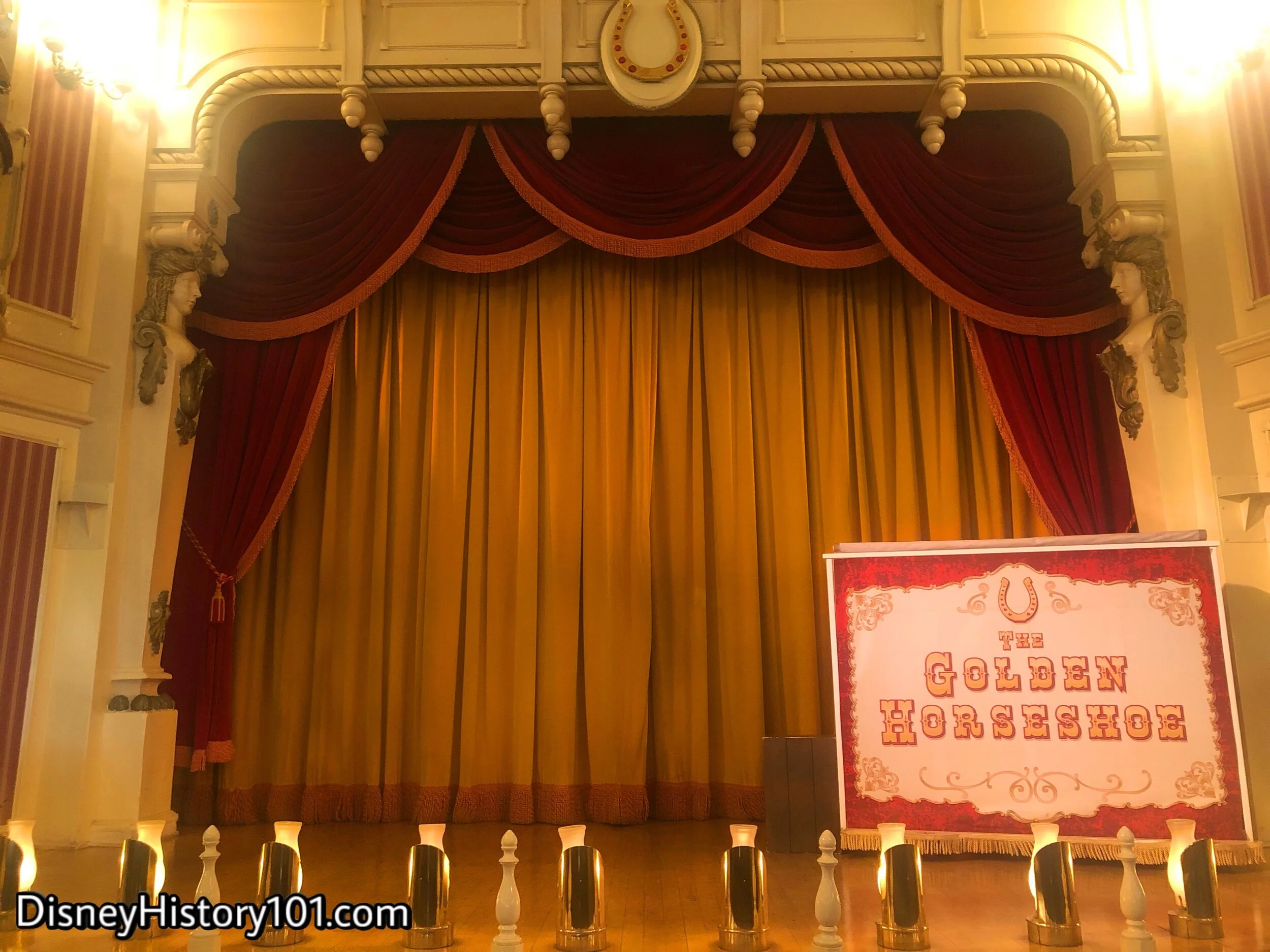
A Disneyland Food Operations Award, c.2000s.
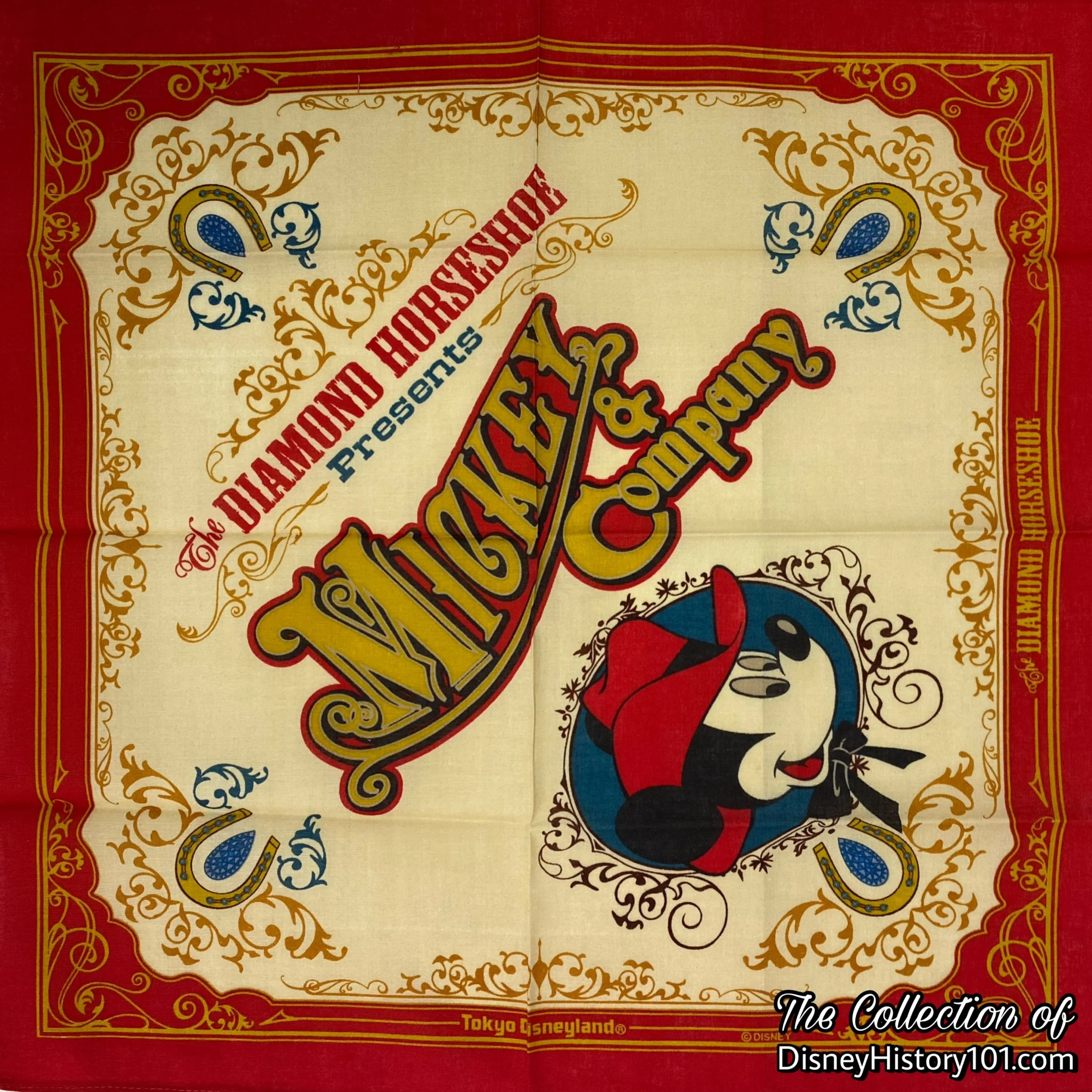
The Golden Horseshoe Saloon tradition lives on through the Lucky Nugget Saloon at Hong Kong Disneyland where Guests can dine on Fish & Chips, Chicken Nuggets & Chips, Salads, and Desserts.