CASEY JR. CIRCUS TRAIN
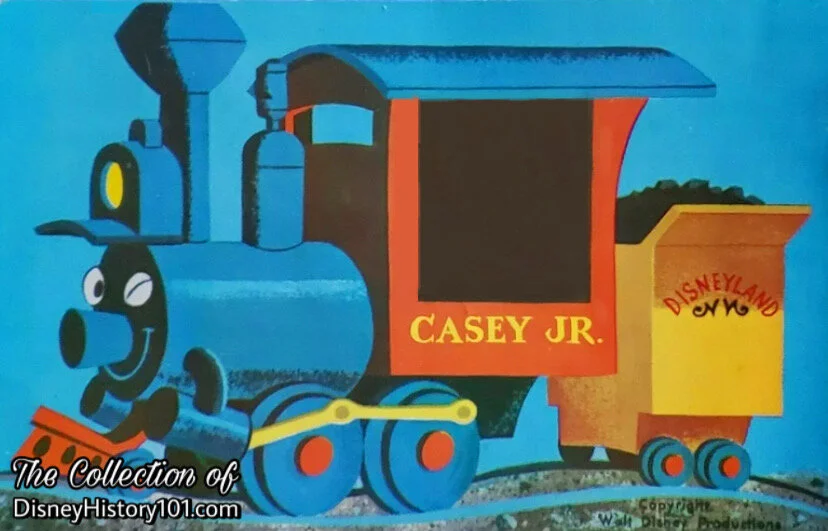
Casey Junior Souvenir Art Corner Postcard Exclusively Designed for Disneyland by Art Corner Artists

(July 31, 1955 - present)
At Disneyland® Park there is a "story behind the story" of every attraction, every attraction is a living experience for the guest. Disneyland ride-through attractions or adventures have officially been defined as an “individual show, ride, or exhibit designed to produce an entertaining Guest experience. Disney attractions stir the imagination, enliven the senses, and provide the participants with positive, innovative entertainment, which is the essence of the DISNEYLAND Show.” It is important to review the story of the attraction, tell the story, explain it, and create interest. This is the story of Casey Junior Circus Train in Walt Disney’s original Magic Kingdom - Disneyland!
“Inspiration”
Walt once admitted: “I suppose I have always loved trains,” in interview with Railroad Magazine (October 1965). Even long before the "little train who thought he could" took Guests on a tour of Storybook Land, several forms of anthropomorphic locomotives graced Walt Disney Productions. These included trains featured in “Mickey’s Choo Choo” (released 1929), “The Brave Engineer” (released 1950), and “Dumbo” (released 1941). Then there was Walt Disney’s home (on Carolwood Drive) which was also circumvented by railroad tracks. So naturally, Walt’s earliest visions for his amusement center would include a train.
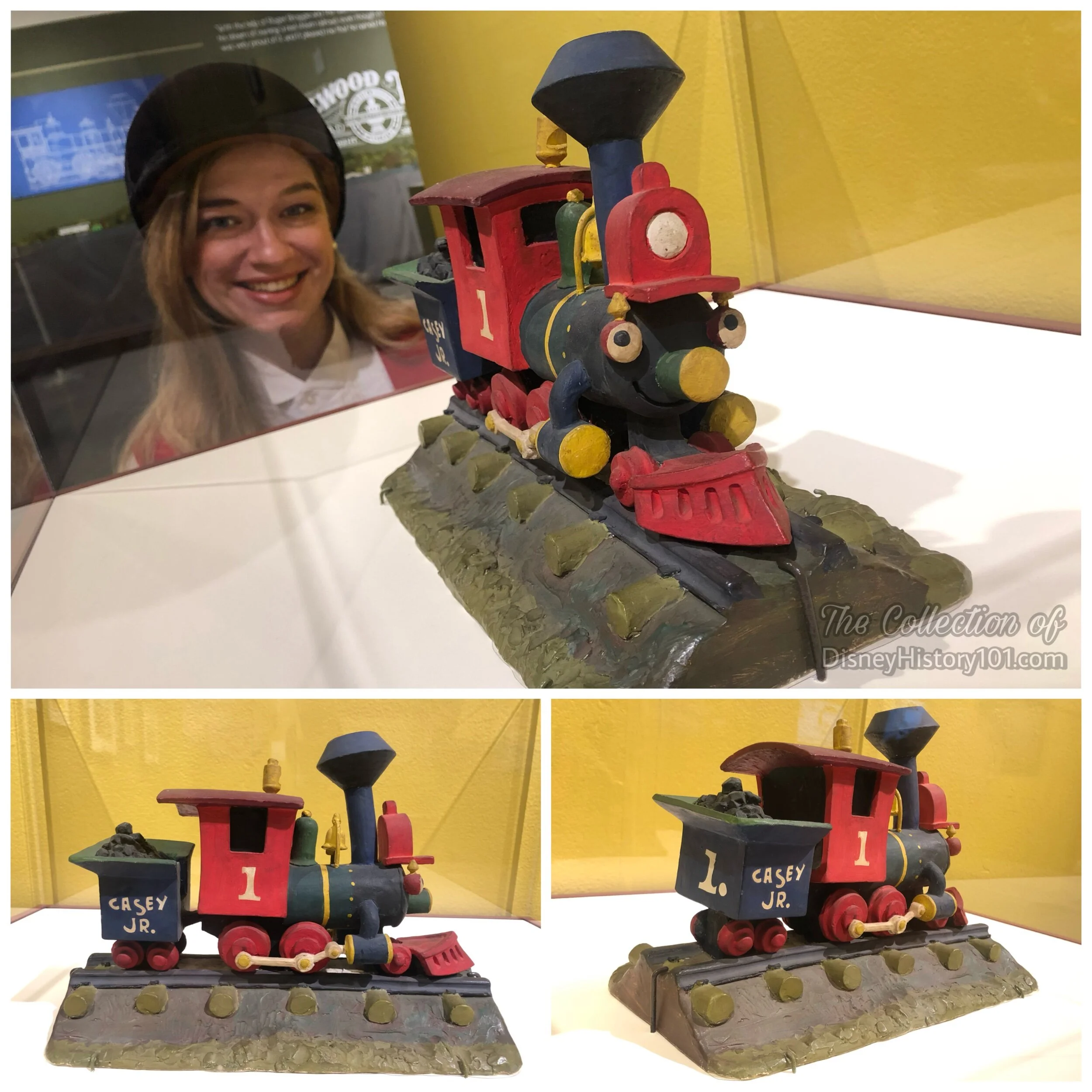
Casey Junior Maquette similar to the one used by Ward Kimball and designers at WED Enterprises, Inc.
“Blue Sky for the Casey Jones Junior Coaster”
In December of 1952, Walt Disney founded a little company called WED Enterprises, Inc. (the architectural and engineering design division of Walt Disney Productions) in order to master-plan and design his his dreams of a Park. According to “Disneyland: Then, Now, and Forever” by Bruce Gordon and Tim O’Day:“The seemingly benign Casey Jr. Circus Train… began its life not as a charming and delightful railroad journey through Storybook land but as a rollicking and thrilling roller coaster - the first one ever designed for Disneyland. Initial plans called for the little train to race through the barren hills of Fantasyland."
At least one detailed rough plot plan depicts the Casey Jones Junior Coaster's Station and Loading Area, and its track through tunnels with dips and curves, climbs, "looped track" and "dummy track" with submerged engine, "stalled engine", broken trestle, and "man in trestle". The entire ride through 1,135 feet of track to the final brake block and loading area would have taken 2 minutes at 6.5 miles per hour. It seems that a total of 8 engines were planned for the Casey Jones Junior Coaster at that phase of development.
"However, after test runs were conducted, concerns were raised about effectiveness as a roller coaster and the accompanying maintenance issues that would be involved, so Casey Junior quickly lost its status as Disneyland’s first thrill ride,” according to “Disneyland: Then, Now, and Forever” by Bruce Gordon and Tim O’Day.
The Casey Jr. Circus Train was back on the Disneyland “drawing board” and in development from 1953 to 1954, and holds the place as being one of Disneyland’s earliest conceived attractions, to become fully realized! Walt knew that it would require the assembling of a coalition of talents to Imagineer his“Casey Junior” attraction at Disneyland. Soon, Art Directors, Artists, Artisans, Architects, and Planners from the Studio were involved.
By July 1, 1954, George Whitney of Disneyland, Inc. directed Amusements, with Ron Miller overseeing analysis, philosophy, capacities, planning, operator training, and amusement procurement. According to the “Proposed Diagramatic Layout of Disneyland” (Marvin A. Davis’ plot plan, produced for WED Enterprises, by September 12, 1953), trains were still assuredly “a-comin’” to Disneyland! Details on the plot plan described a “1/2 Scale Train Ride” as part of a “Lilliputian Land” on the Northeast side of Disneyland. In 1954 Herb Ryman’s “Schematic Aerial View” of Disneyland was produced over a weekend, with a miniature train ride depicted in Fantasyland. Soon, (still in 1954), many WED Enterprises Inc. employees began to draw more detailed concepts for these potential Disneyland attractions. Some of these were included in a portfolio of colored sketches by Herb Ryman, Harper Goff, Bruce Bushman and others was prepared for Dick Irvine and Nat Winecoff to take back East to sell the Disneyland concept to prospective licensees.
Thumbnail sketches and other concept artwork of Disneyland seemed to be unencumbered by restrictions of budget, schedule or the laws of nature and physics. Though guided by Walt, his artists appeared to engage in “free-thinking,” as if implementing the modern “Blue Sky” Imagineering process.
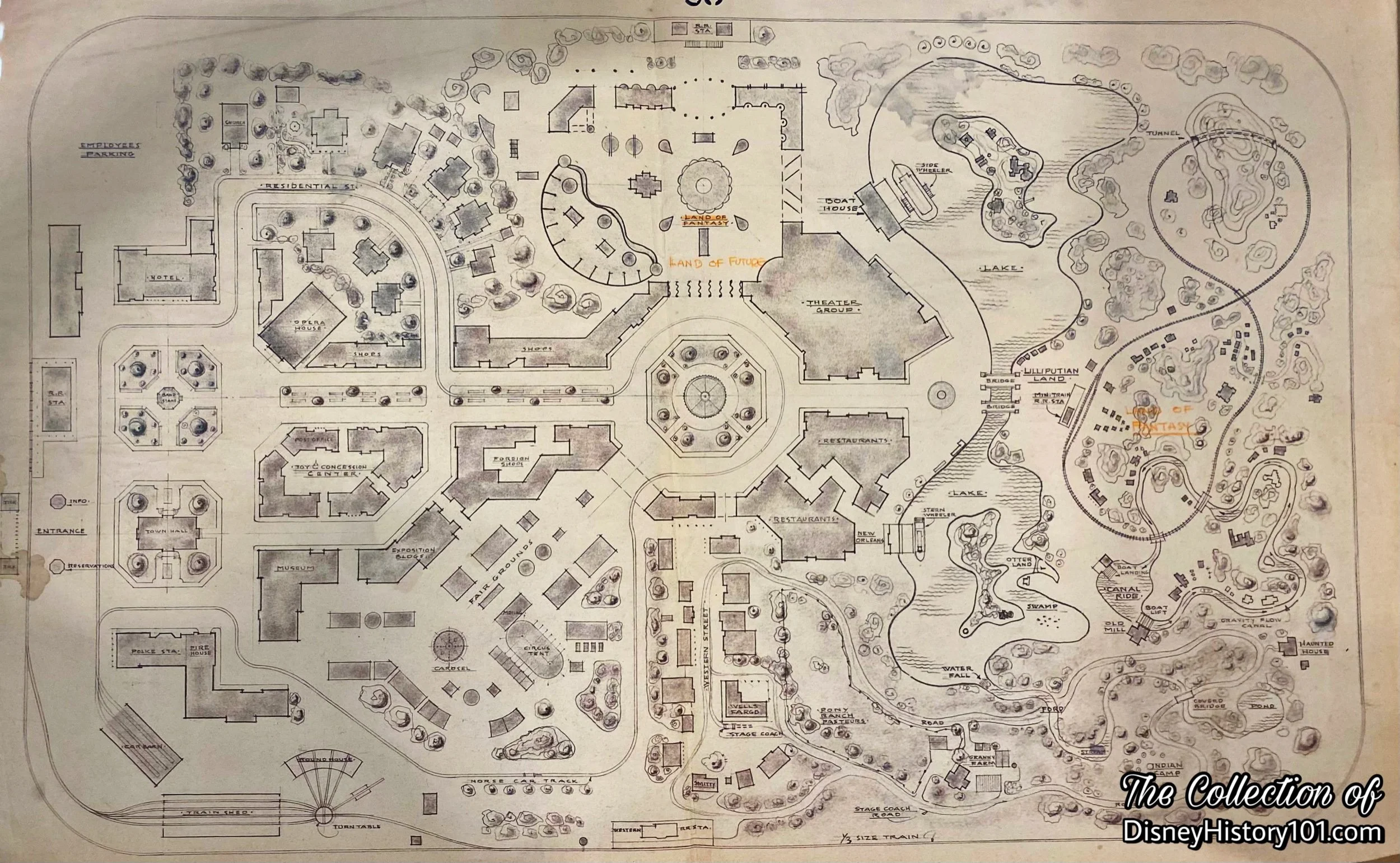
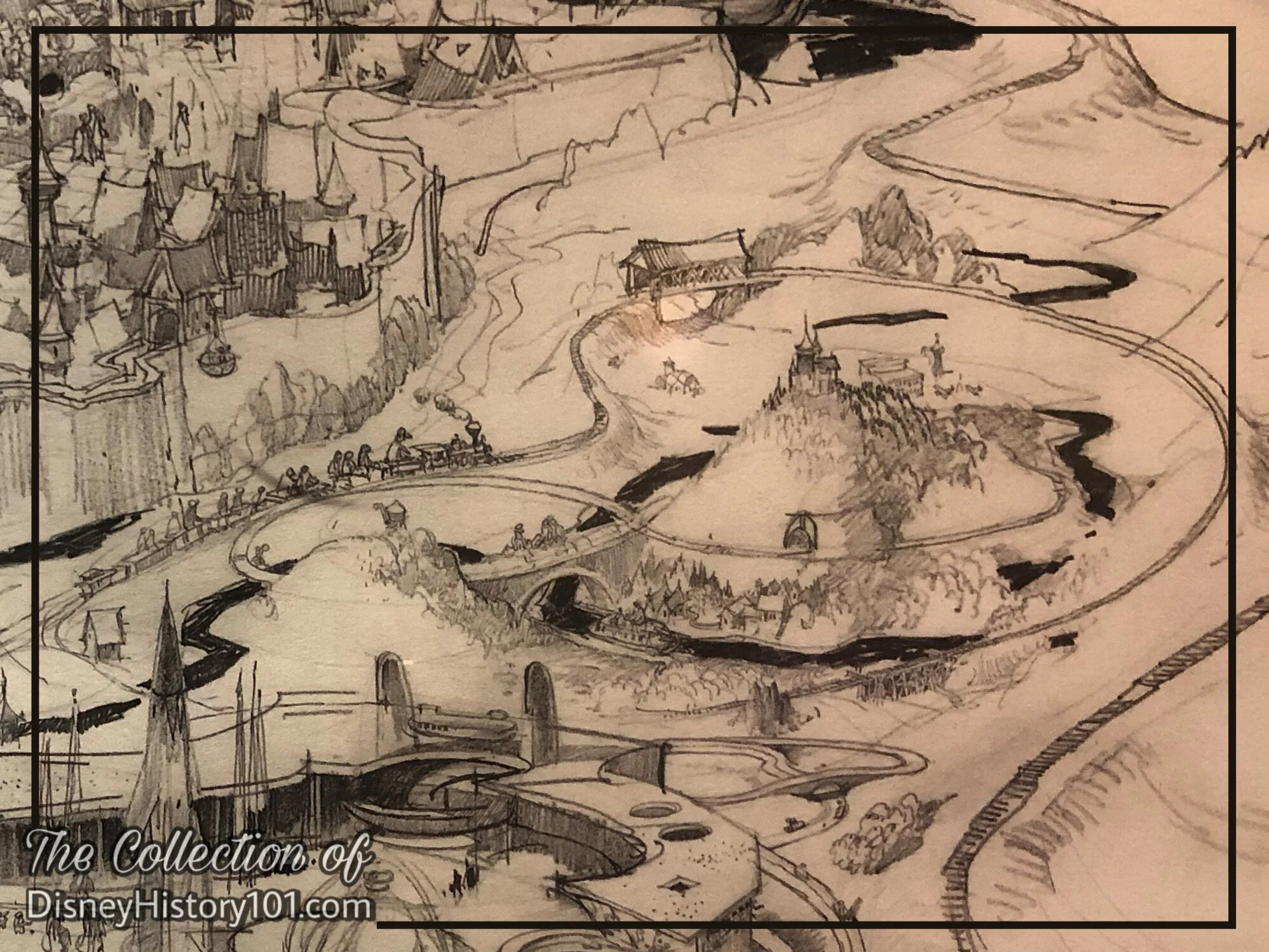
Herb Ryman's "Aerial View Over Disneyland" Excerpt depicts an efficient use of space; a little train and what appears to be Storybook Land, originally produced September 26 & 27, 1953.
“Concept Development”
While a team of artists would make contributions, it was Bruce Bushman (of Bradley & Kaye; Walt Disney Studios artist; Mickey Mouse Club Art Director) who has often been credited with some of the first cleaned-up drawings of a narrow gauge train engine and cars based on character model sheets of Casey Jr. (featured in Walt Disney’s Dumbo, released 1941). Some may find it odd that an entire Disneyland attraction would be themed around one of Walt Disney Studio’s shortest and least (monetarily) successful films to be released more than a decade prior. However, it is important to note that when Bruce Bushman was creating these designs, he (as many other contemporaneous concept artists) based many of them on the depths of the Walt Disney Studio’s full catalogue of characters from both feature-length and short films (like Walt Disney’s Silly Symphonies). For example, Bruce Bushman created attraction designs featuring thematic elements and characters from such Walt Disney Productions as “The Reluctant Dragon,” “Little Toot,” and “The Old Mill.” So it seems, that it wasn’t so far-fetched to utilize the character of Casey Junior from Walt Disney’s Dumbo! During 1954, received one of the earliest previews of the attraction when a Casey Junior Circus Train float appeared in the Anaheim Halloween Parade.
Disneyland queue lines are designed as part of the attraction to make the guests' time in line as comfortable as possible.
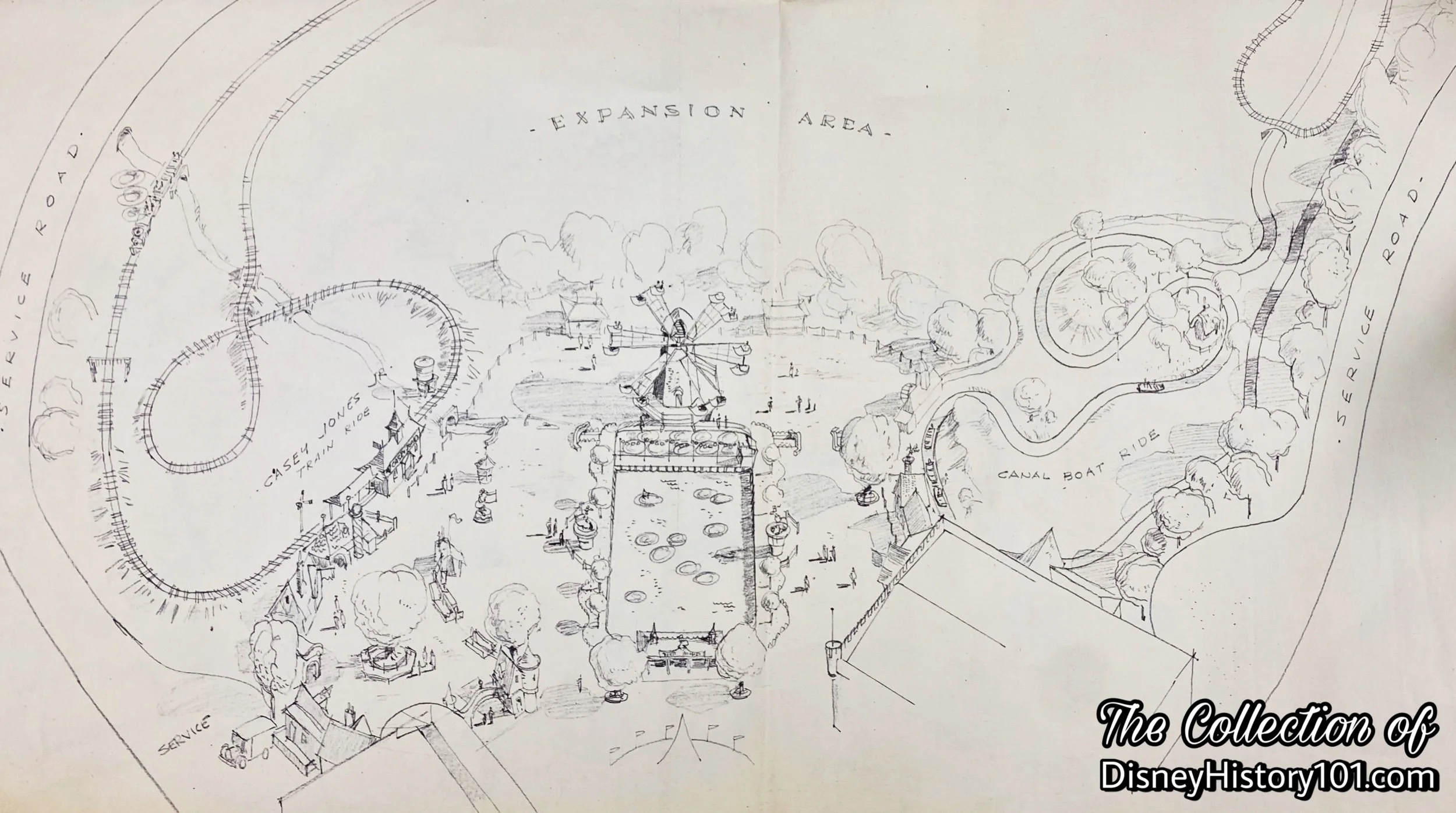
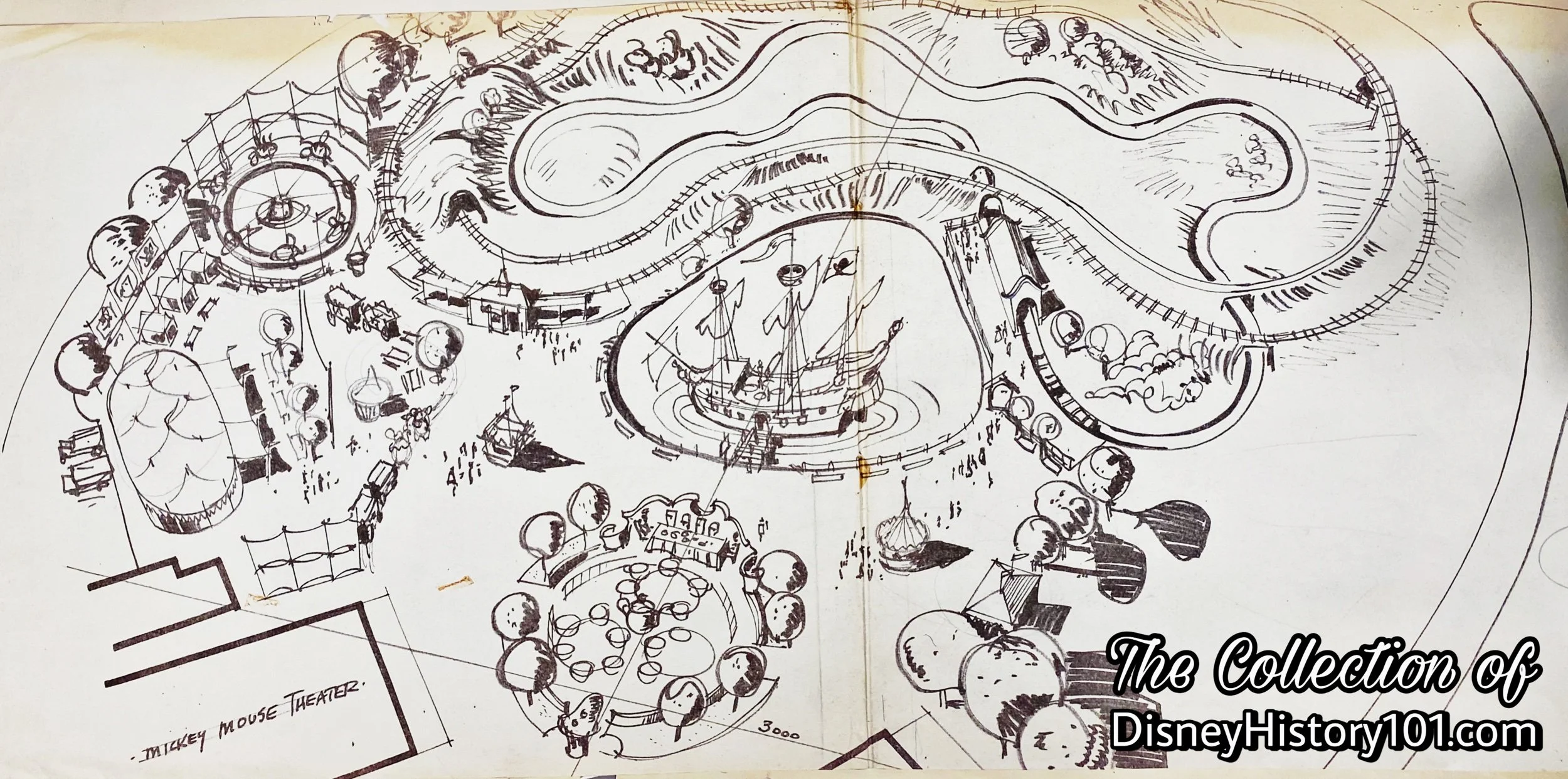
Note the placement of the attraction in this early rough layout concept.
Custom rides were created that would be subordinate to story and setting. This concept was prepared by Bradley & Kaye Amusement Company of 8506 Beverly Blvd. Los Angeles 48, Calif; Oleander 5-8029.
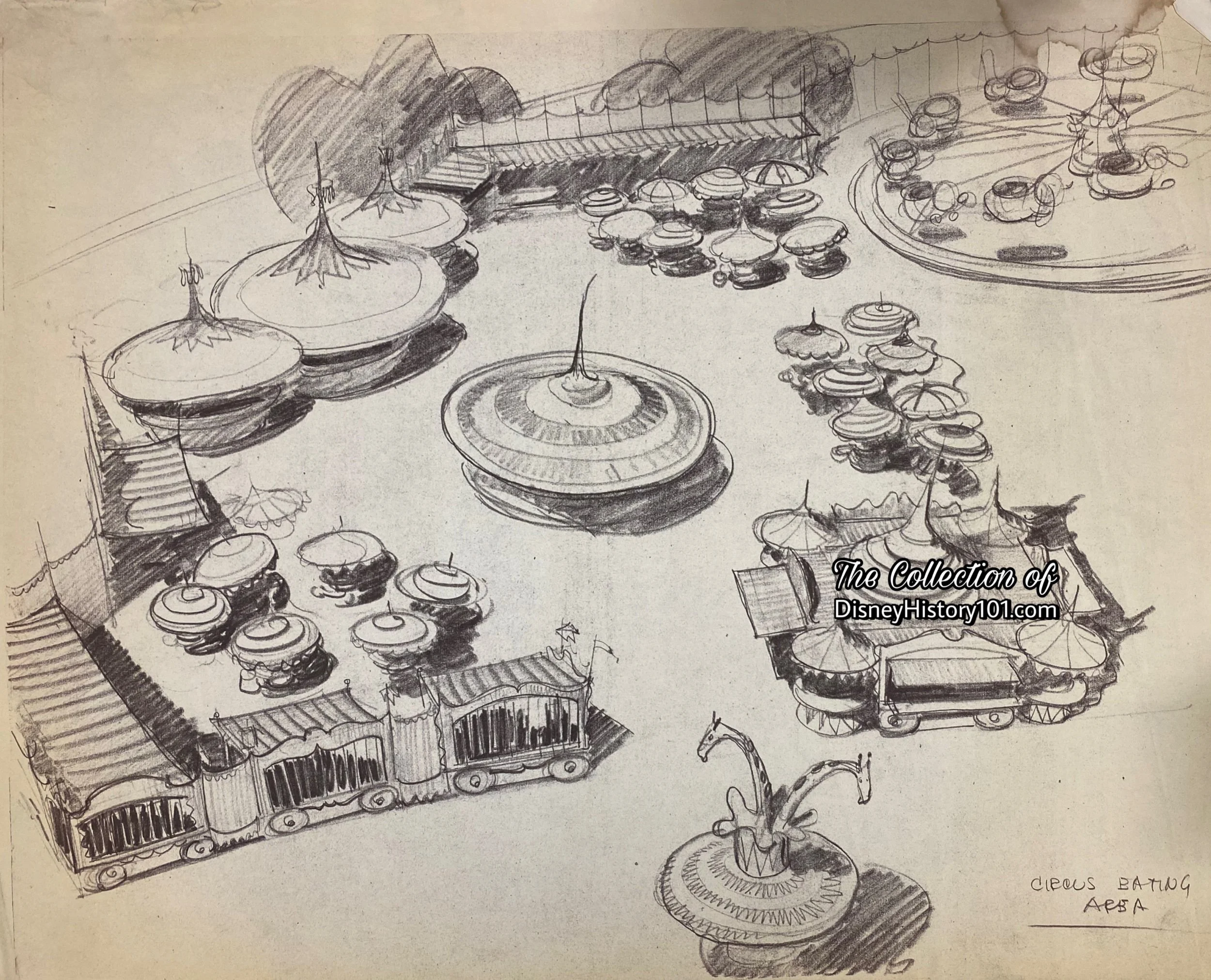
Circus designs by Bradley & Kaye.
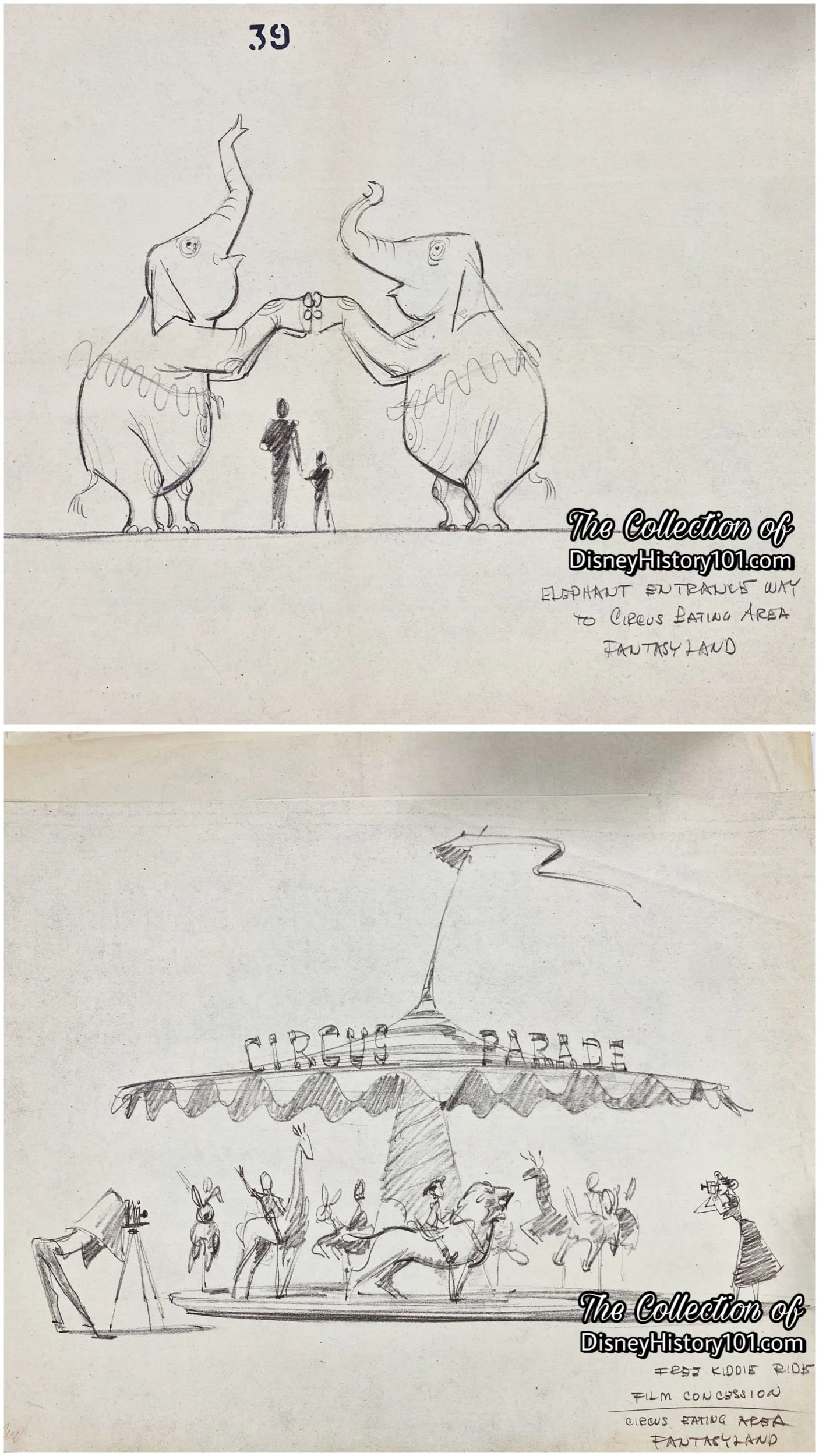
Circus designs by Bradley & Kaye.
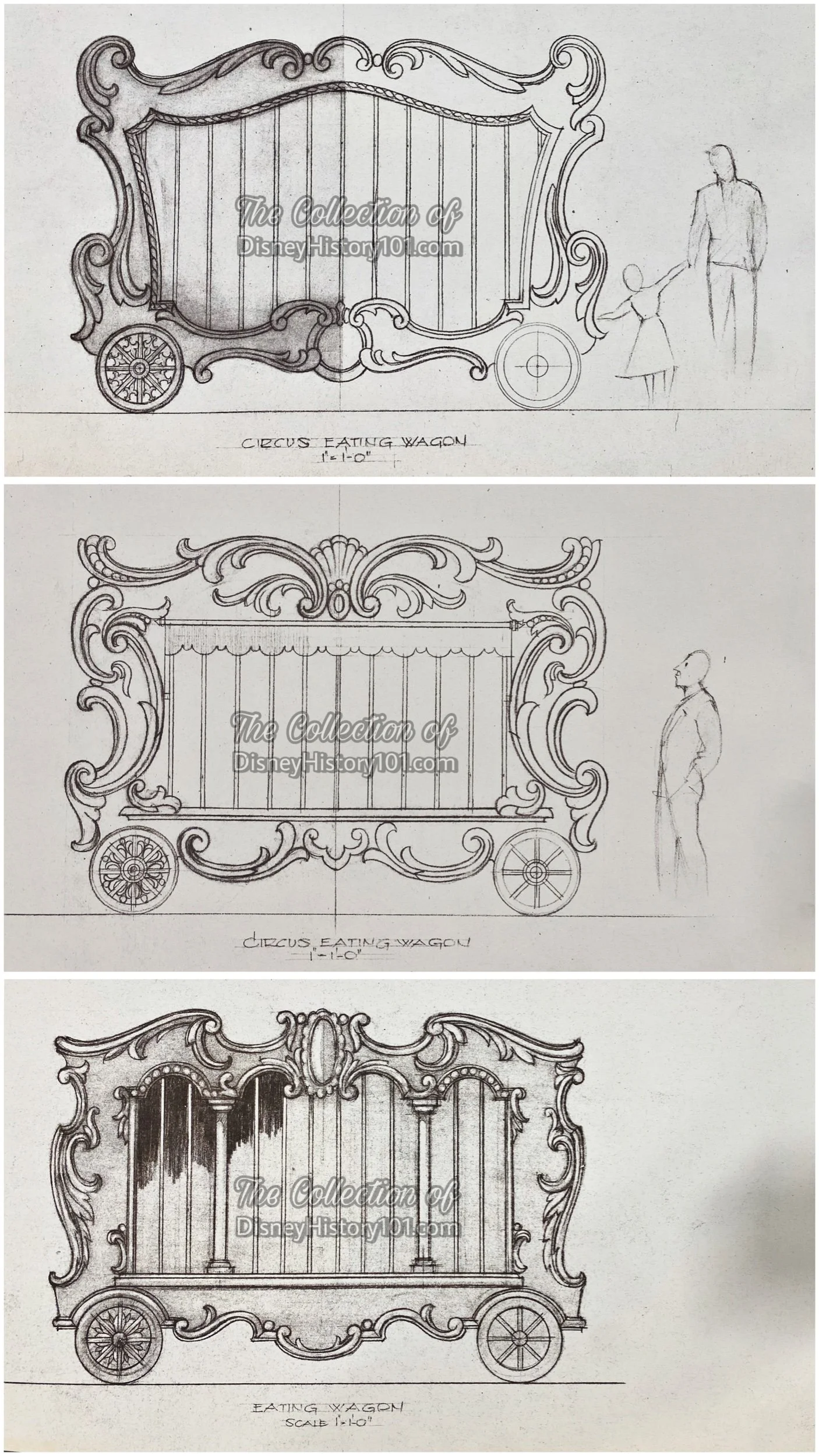
“Circus Eating Wagon”, Circus designs by Bradley & Kaye.
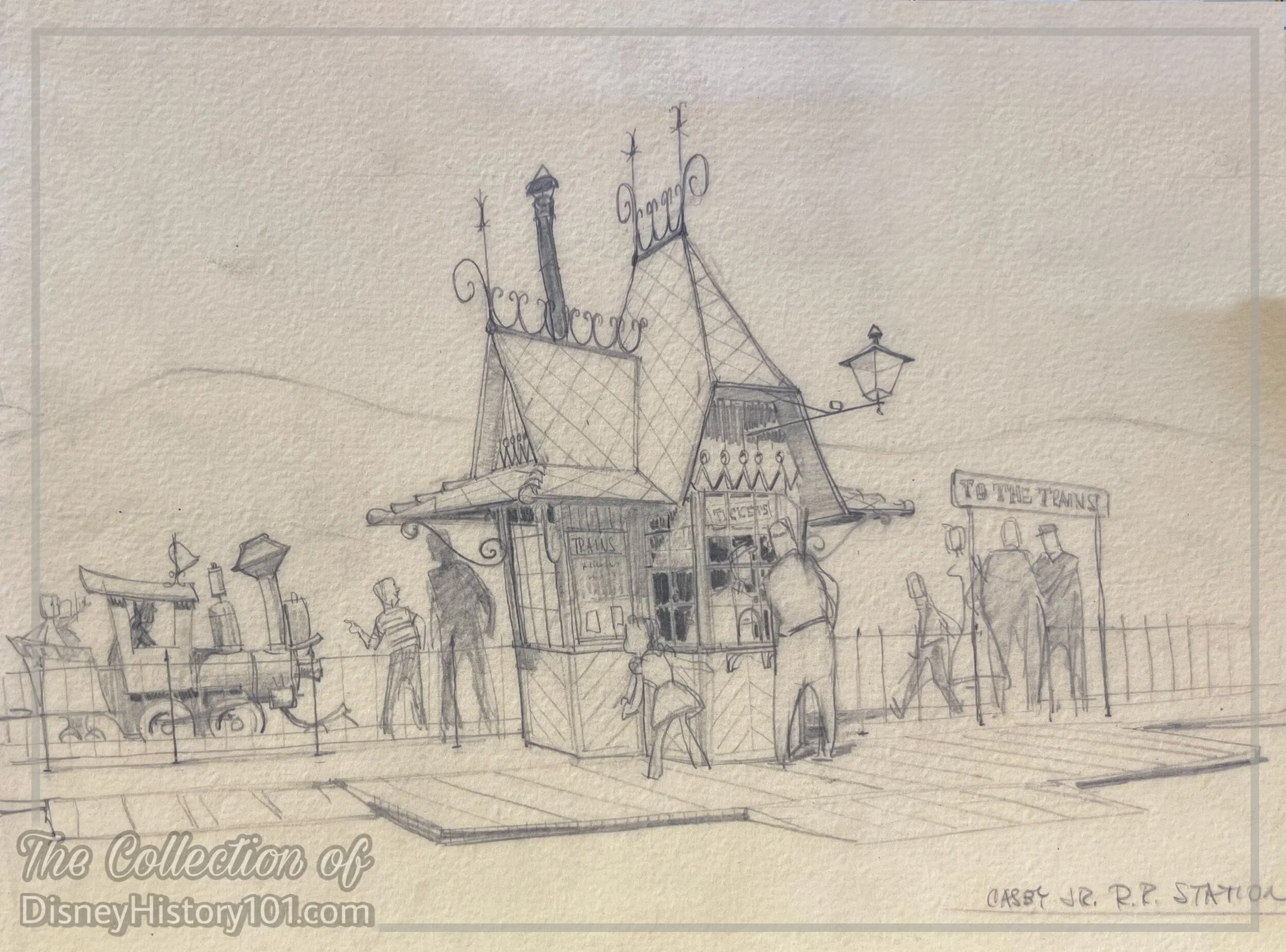
“Draw Concept” - Bruce Bushman Fantasyland Ticket Booth (Casey Junior Depot) Facsimile at Walt’s Carolwood Barn Museum, 1954; Walt Disney Imagineering Collection ©️Disney.
The two trains were designed by Bruce Bushman of Walt Disney Studios. As a sidelight, “Bushman whom Disney assigned to develop many of the… rides for Fantasyland, was a bug husky man. Walt took one look at him and decided that his proportions would guide the pattern for all etc seats at the Park. ‘If it fits you, Bruce, it’ll fit anybody,’ said Walt, eyeing the broad Bushman beam,” according to “Disneyland - Inside Story” by Randy Bright. Like some advanced “High Concept,” Bruce’s final designs were quickly generated and approved. Some of these viable project Concepts (as depicted above), were supported by a well-developed business case and built expectation.
Bushman previously contributed layout to Pigs is Pigs (1954), where he may have drawn ideas for the Westcot Rail Station that inspired his new designs for the little Casey Jr. Depot.
“Schematic & Design Development”
Next, architectural drawings helped define all designs, production and construction strategies, costs, schedule, and resource requirements. Models explored the various dimensional relationships, site-lines, flow patterns, ergonomics, and visual appeal to convey the desired creative intent. John Stoos (also of WED Enterprises, Inc.) created technical elevations and other drawings (c. January of 1955), in order for Amusement Park ride designers and manufacturers Arrow Development to create the train that would run atop the 30” (762 cm) gauge, 1,840-foot-long railway.
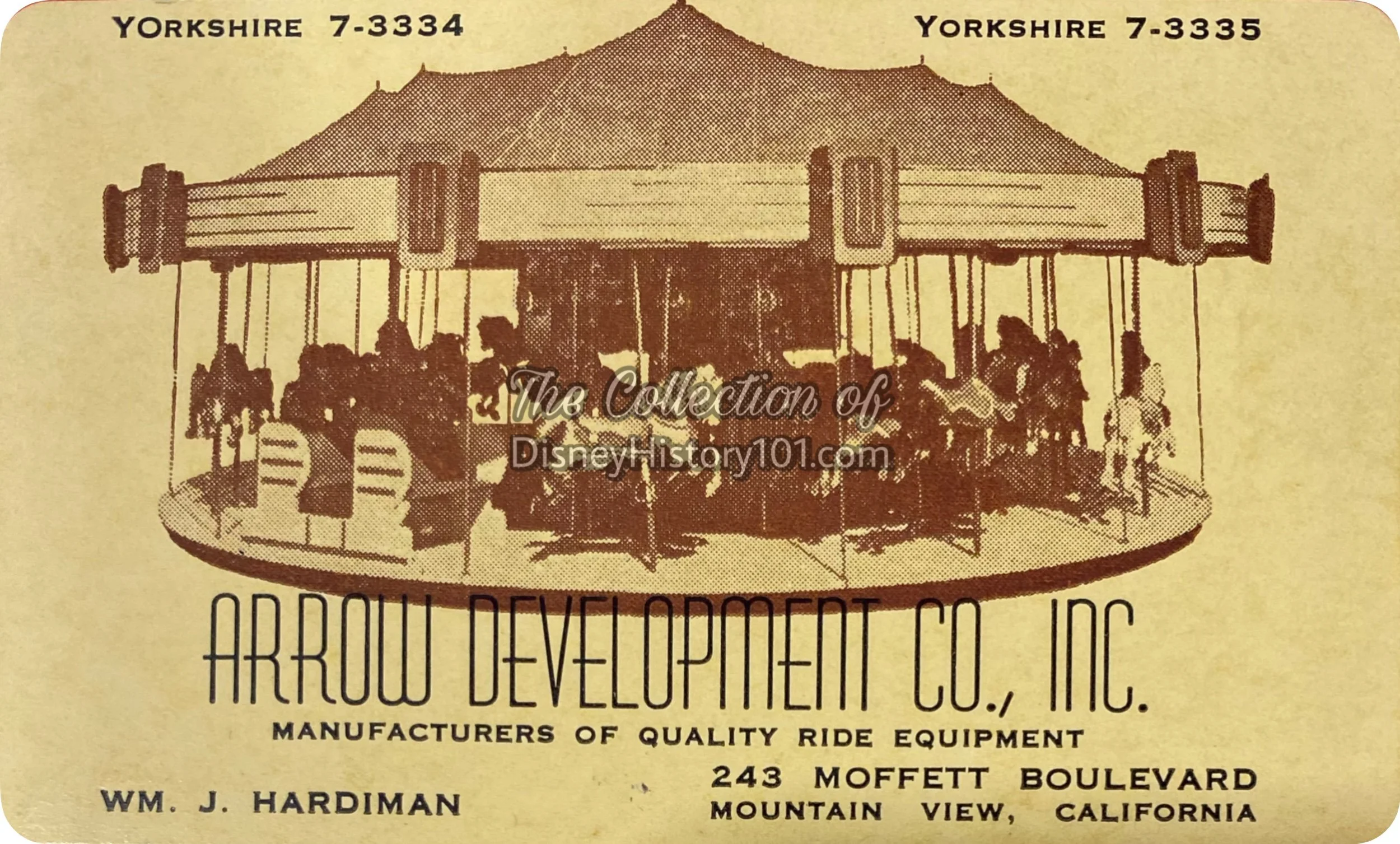
An Arrow Developement business card.
Meanwhile, engineers ofthe Arrow Developement plant (of Mountain View) wereconstructing six rides for Disneyland - Mad Tea Cup Ride, Snow White’s Adventures Dark Cars, and Mr. Toad’s Wild Ride Hot Rods, Dumbo The Flying Elephant, King Arthur Carousel, and Casey Jr. Trains (despite the first Disneyland Dictionary stating the trains were “designed and built at Walt Disney Studios.” Arrow fabricated and constructed two gasoline driven engines and train cars for the line. Each Casey Jr. engine was powered by a different type of engine - one a Plymouth and the other a Chrysler industrial engine (engine I.D. #37173).
This construction was accomplished at Arrow Development Co., 243 Moffett Blvd., in Mountain View, California. Scenes of this can be seen briefly in A Pre-Opening Report from Disneyland.
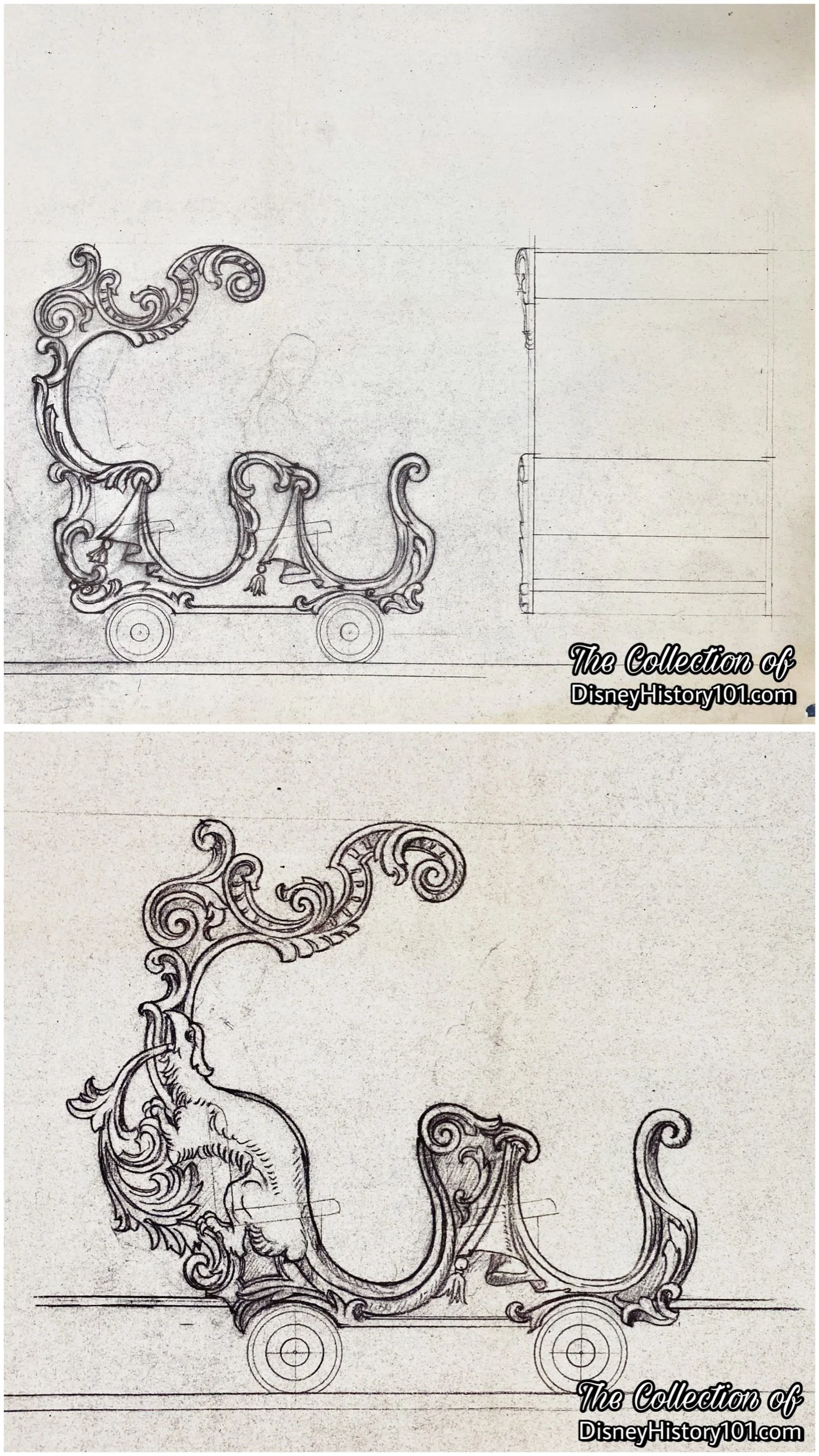
Arrow also manufactured four chariots (constructed from the carriages belonging to the same 1875 Sunnyside Park Dentzel merry-go-round that was utilized for King Arthur’s Carrousel), four animal cars, two Calliopes, and two cabooses. This is verified by one authorized “Disneyland Information & Nomenclature List” (prepared by Bill Cottrell of Disneyland Inc., May 25, 1955) which announced the working title as the “Casey, Jr.,” describing“the little circus train from Dumbo that takes you over rivers on trestles and bridges and climbs mountains.” The same document adds that the “two trains. Each train consists of : 1 engine, 1 calliope, 2 animal cars, 2 chariots, 1 caboose.”
Once completed, the construction cost of the cars totaled $15,965 (or, $1,550 per car, plus an additional 3% tax). The unpainted cars were brought to the Walt Disney Studios backlot as seen briefly in A Pre-Opening Report from Disneyland.
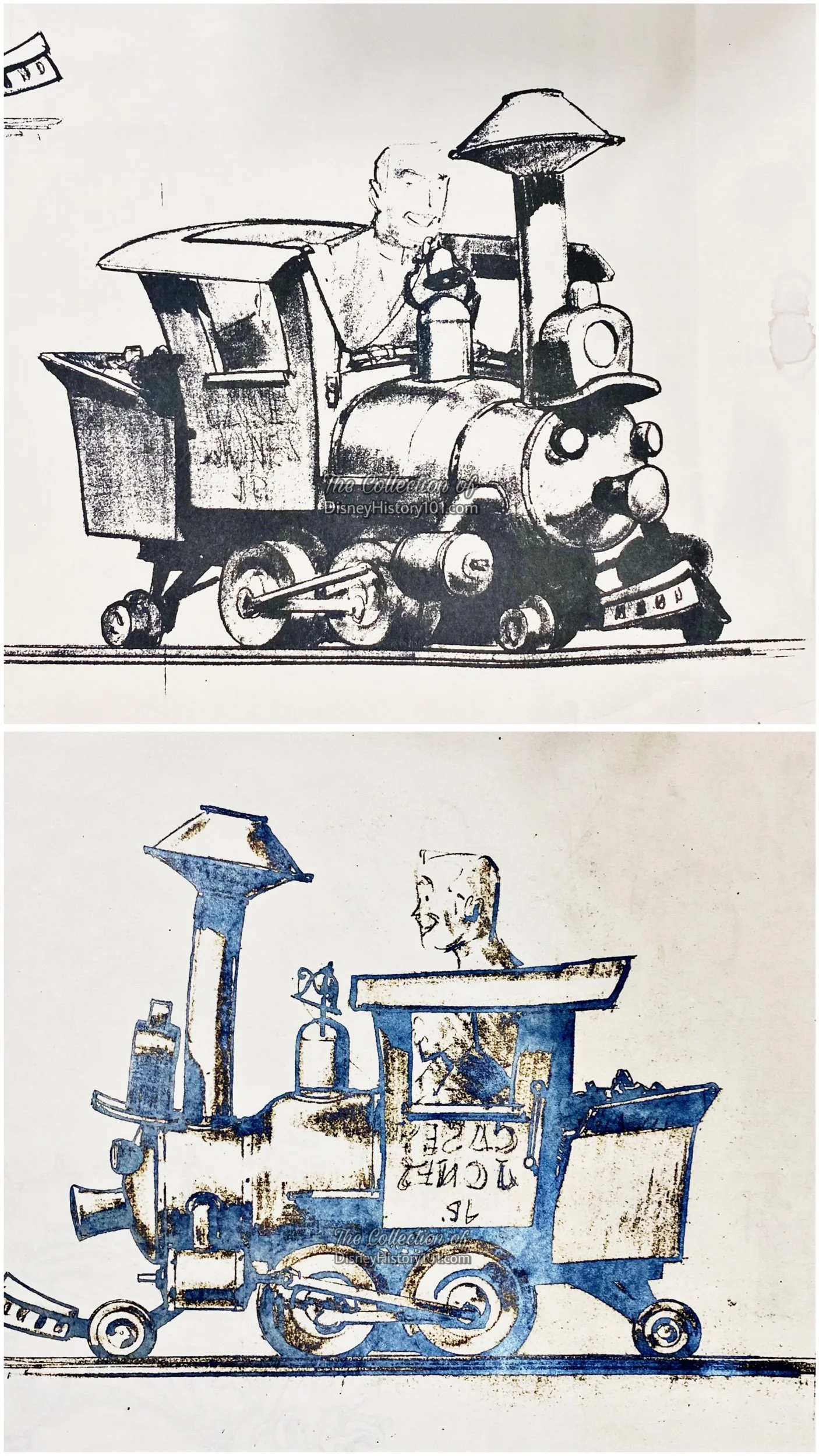
Casey Jones Junior Circus Engine
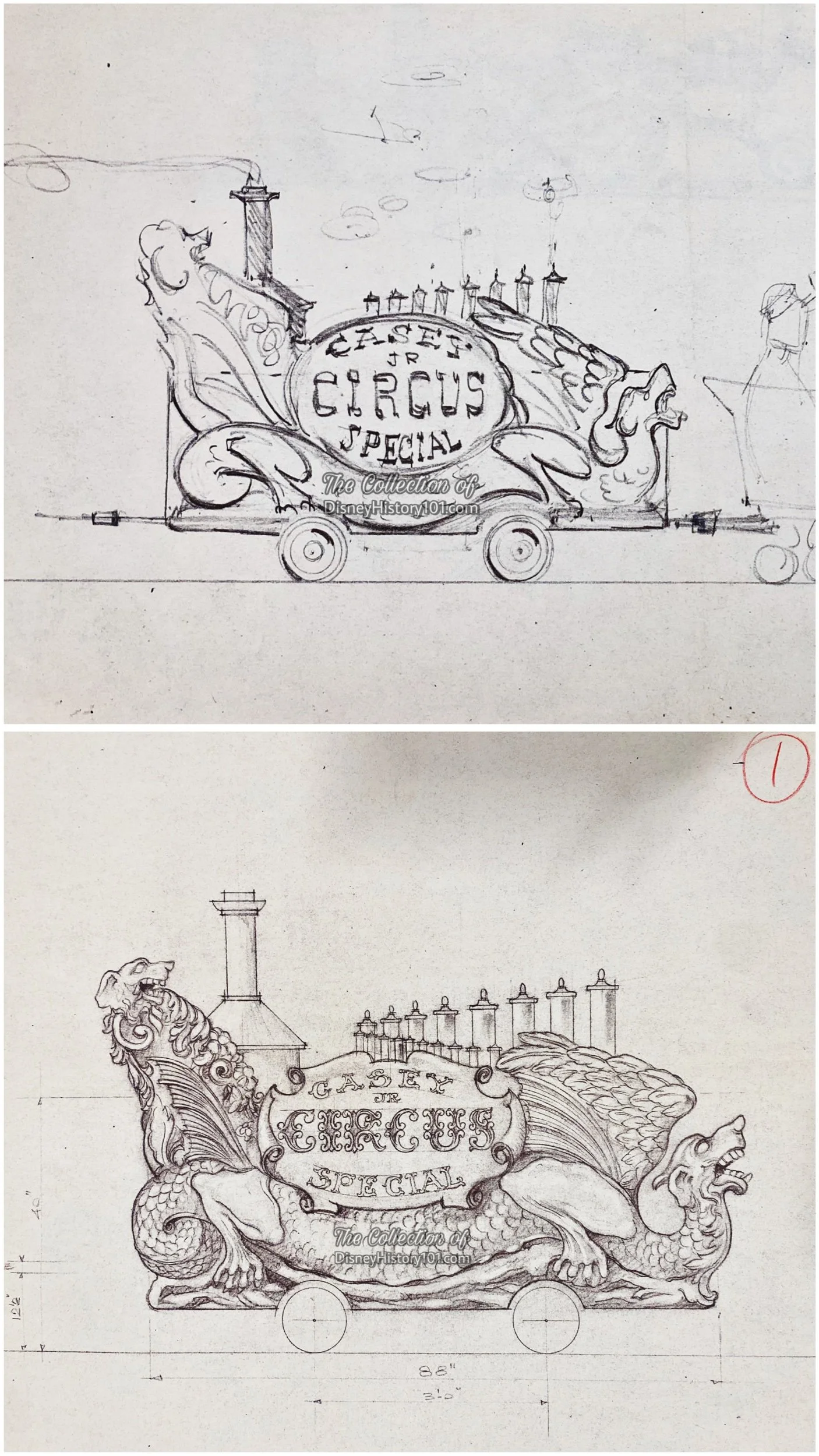
“Calliope Car”
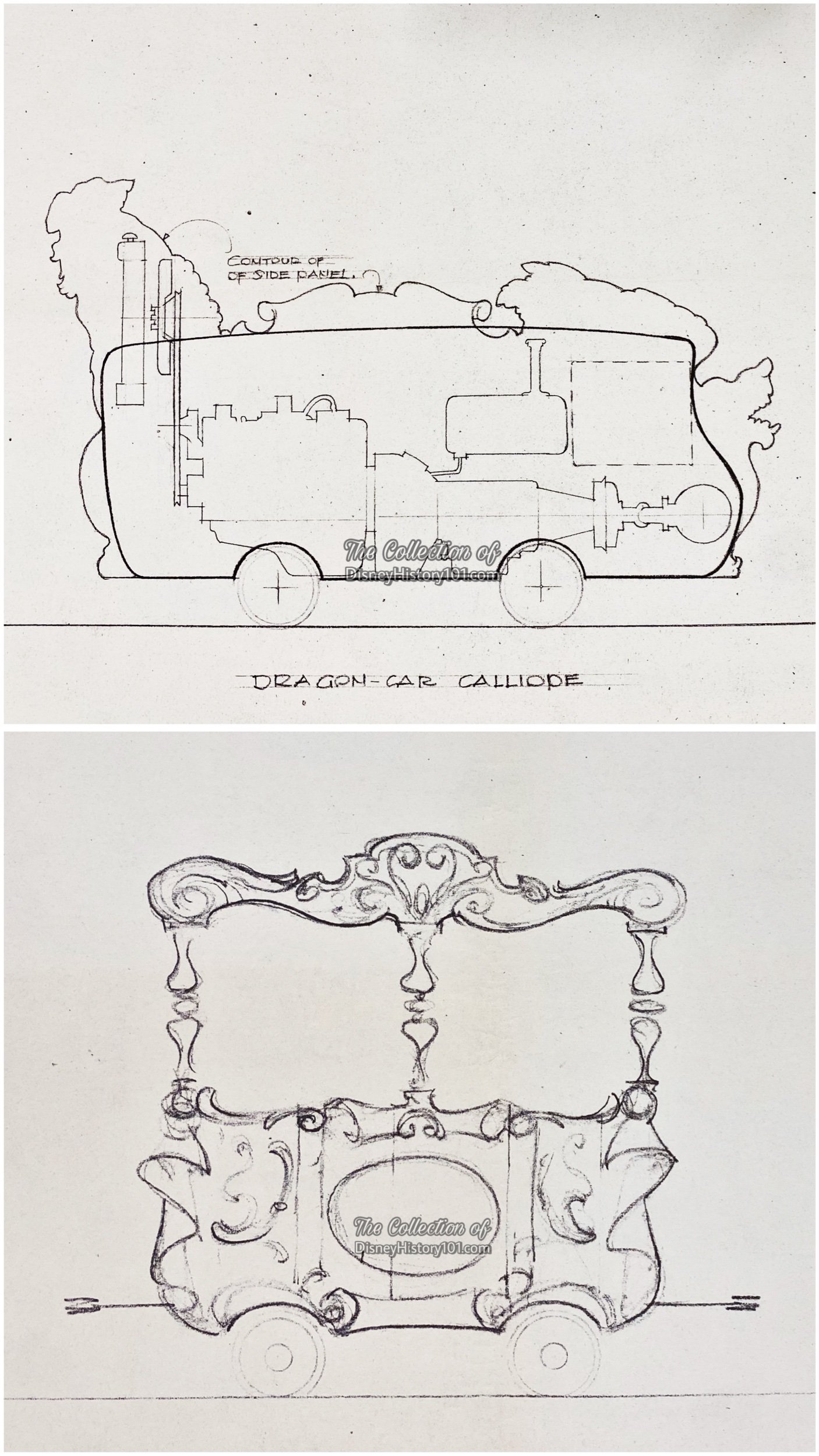
Dragon Calliope Car (top) ; Ornamental Car (bottom)
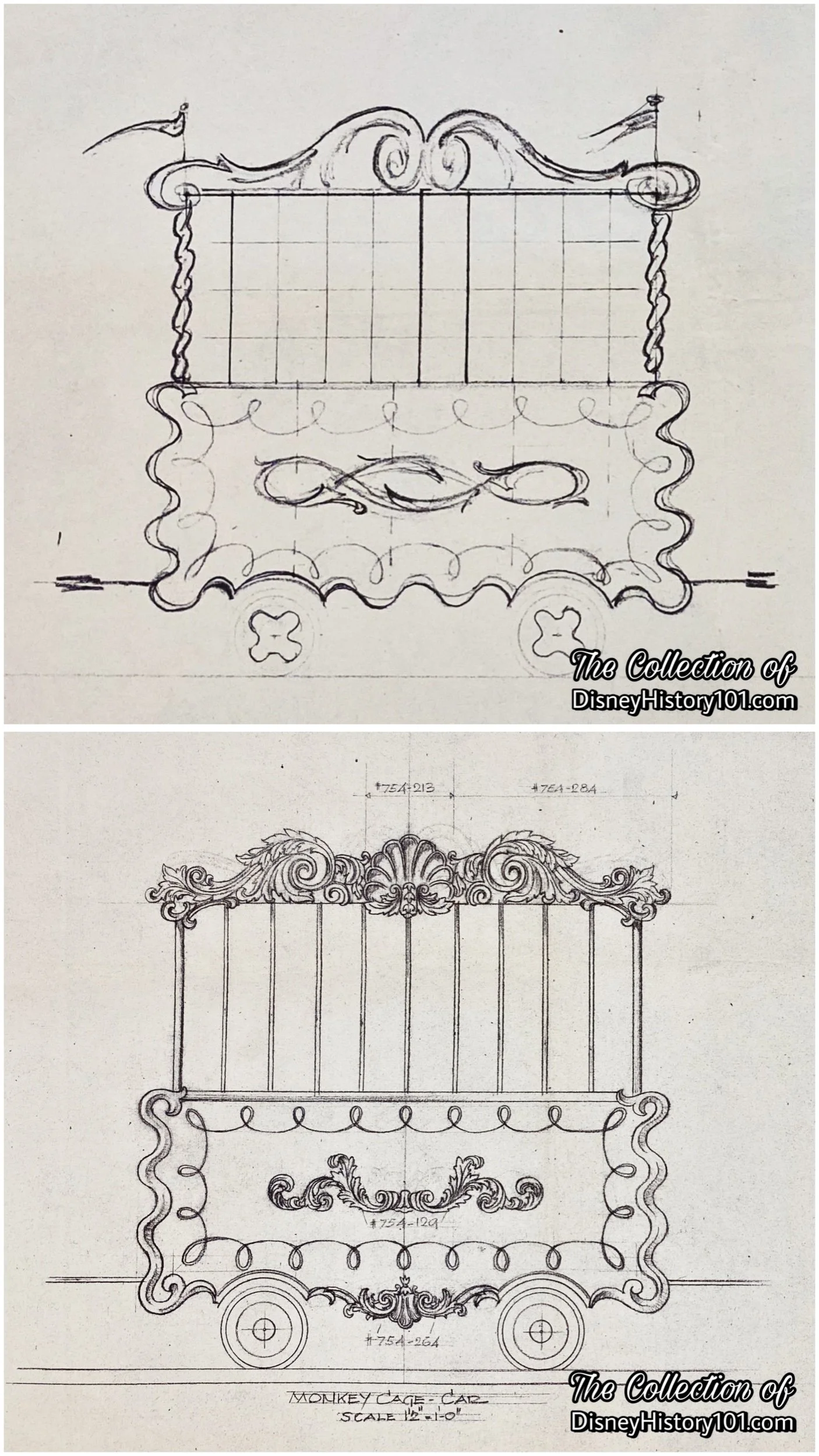
“Monkey Wagon” (top) and “Monkey Cage Car” (bottom)
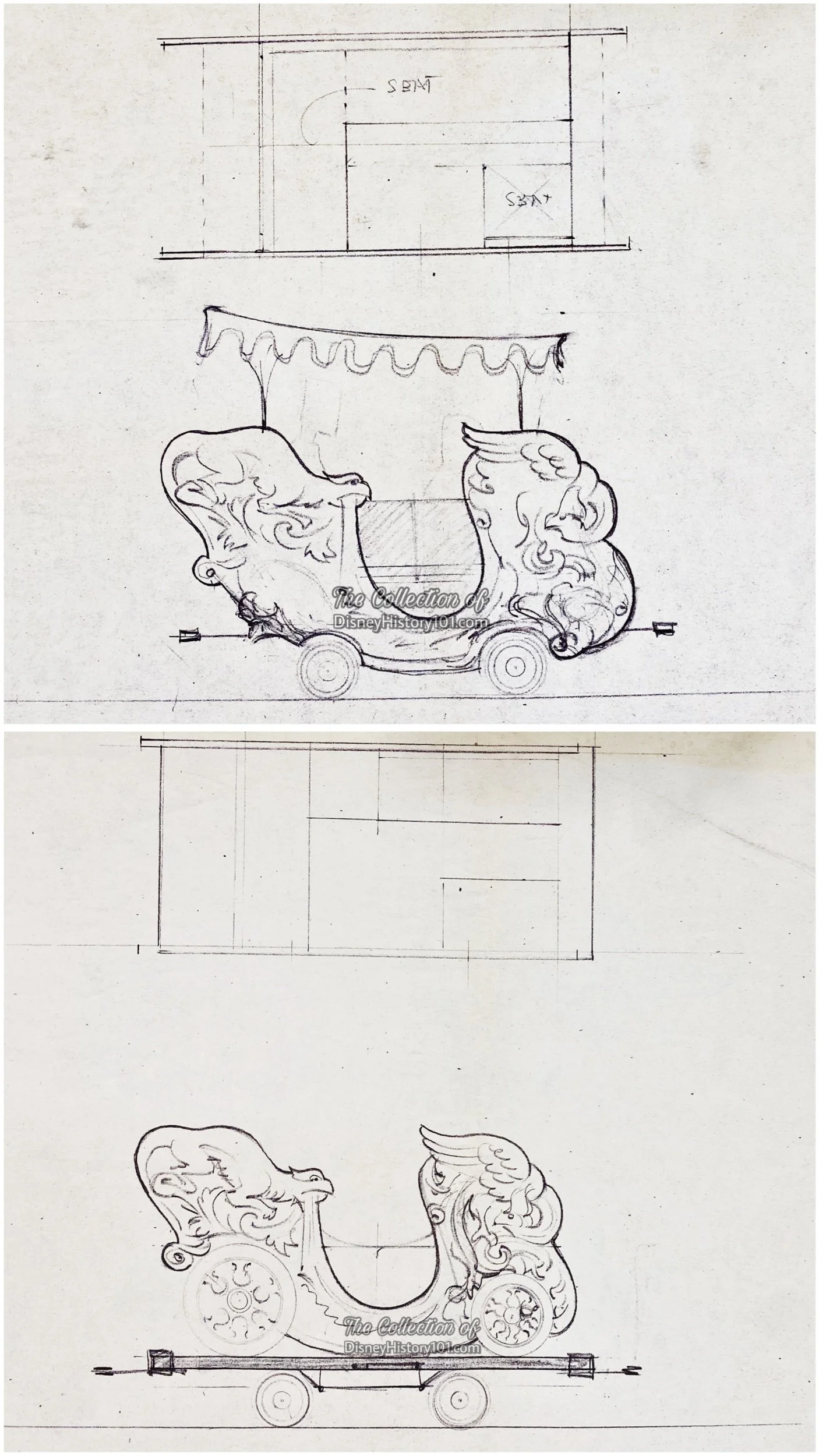
Chariot Car (top) ; Flat Car (bottom)
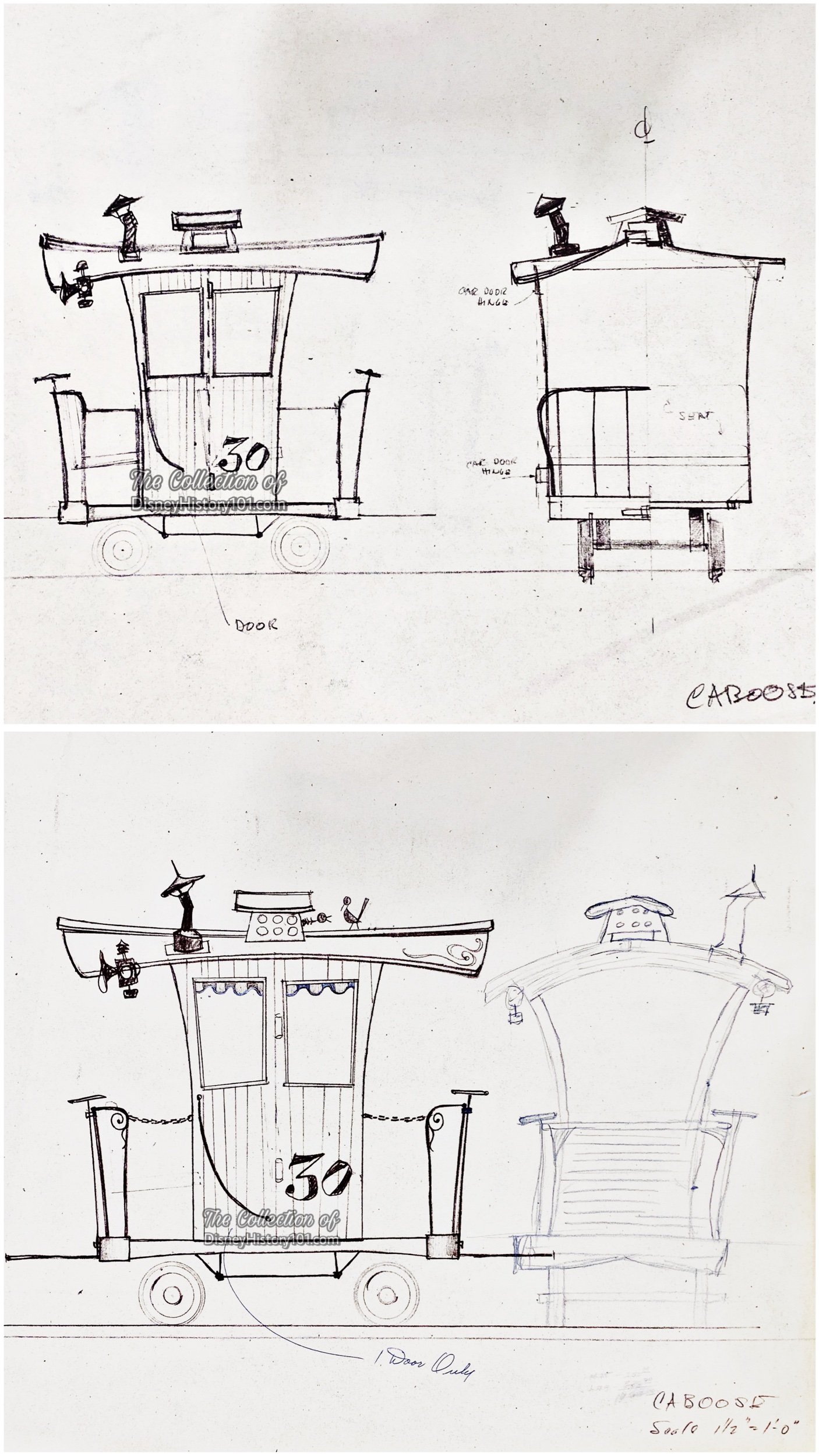
Caboose

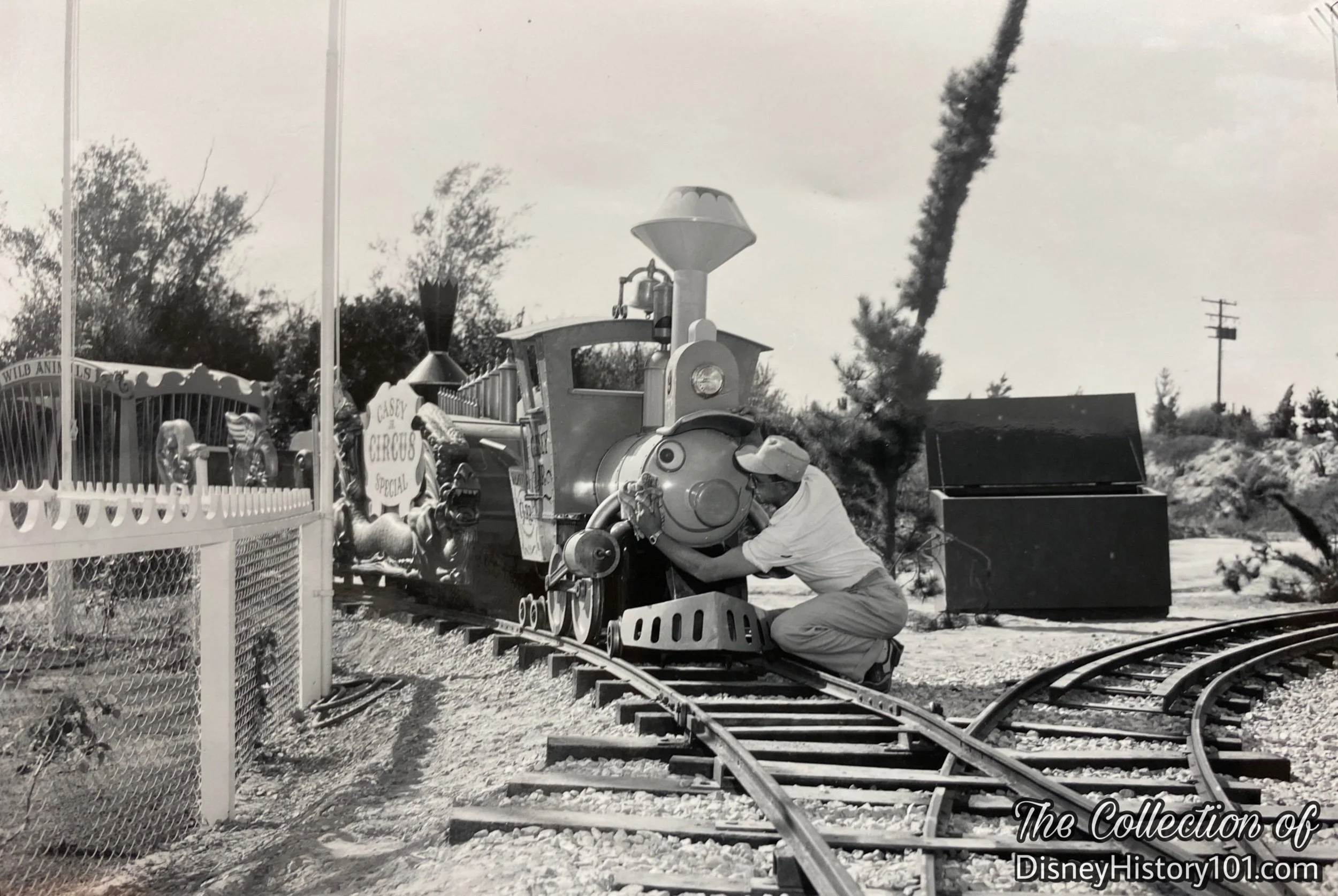
Casey Jr. and Two Paint Crew Members, (1955)
Casey’s pilot and “Practical” headlight cover haven’t even been attached, for this memorable Vintage View captured during the attraction’s construction phase. This pair of painters behaved extra-careful while capturing this memory, which is probably why we never saw any “polka-dot railroad ties” under Disneyland’s smiling Casey Jr. Circus Train!
Show Documentation captures the creative intent.
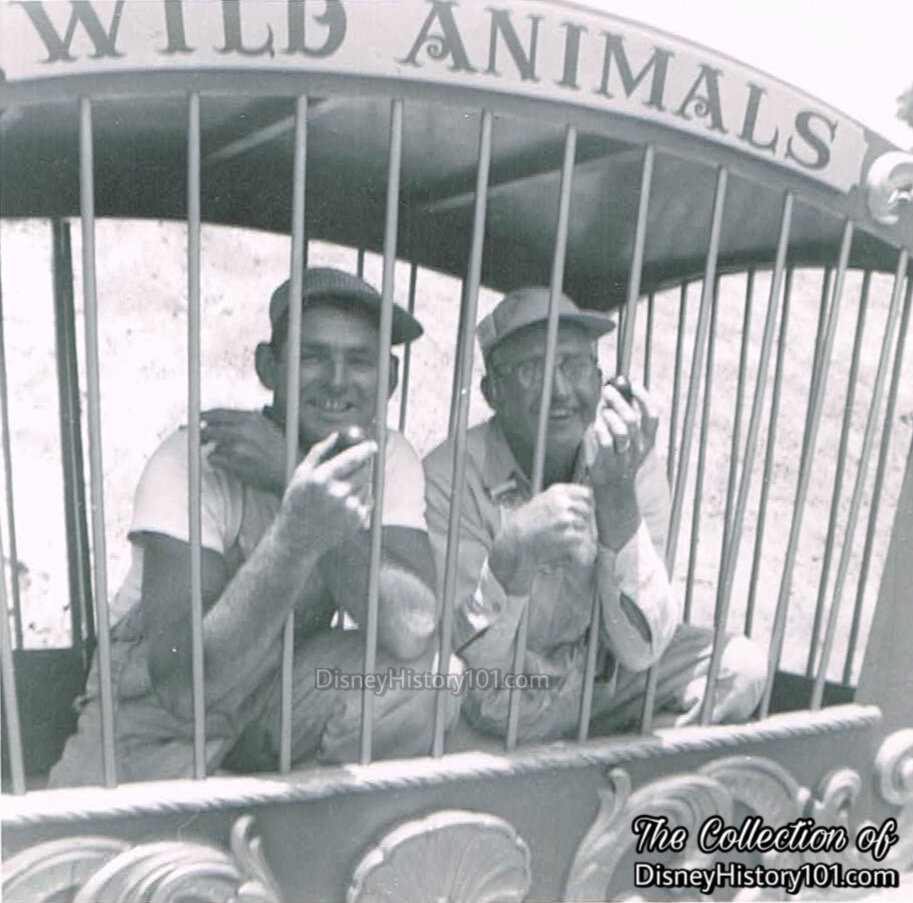
A Couple of “Wild Animals” prove that the Disneyland product has always been happiness, 1955.
It looks like its “time for lemonade and Cracker Jack,” as our same two painters sit in one of Casey Jr. Circus Train wild animal wagons on their lunch break. Now we’ve “seen ‘bout ev'rything”!
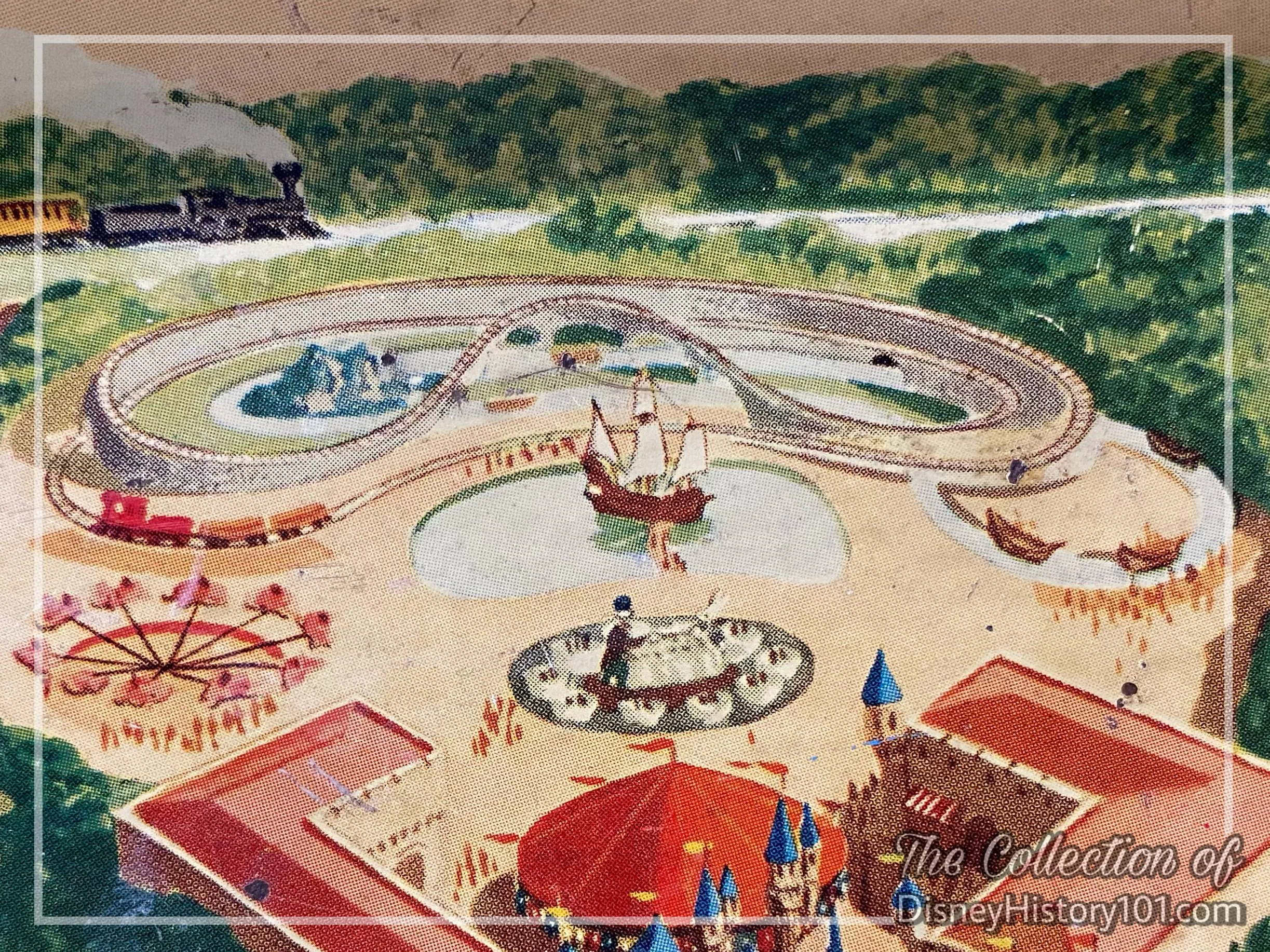
The Casey Junior Circus Train as depicted on an early licensed merchandise - a c.1955 TV Tray.
Some licensed Disneyland merchandise was released before July of 1955, giving a preview of the Casey Junior Circus Train.
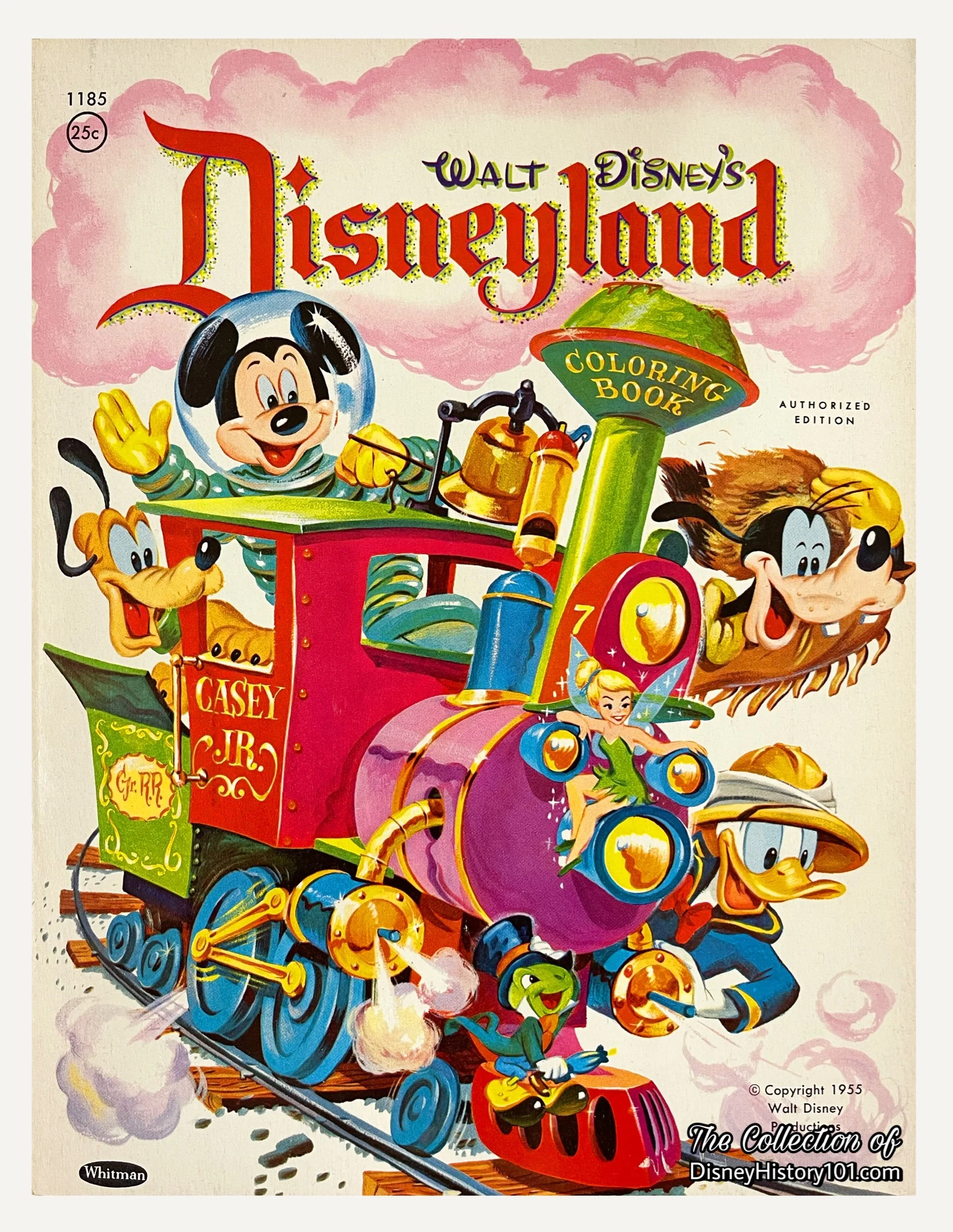
“Walt Disney’s Disneyland Coloring Book” by Whitman depicted the Casey Junior Circus Train on the cover, c.1955.
A number of other licensed products were specifically inspired by the Casey Jr. Circus Train and were both suggested and designed. These included coloring books (pictured above) and even a “Casey Jones, Jr. Train” locomotive and train model assembly kit by the Strombeck-Becker Mfg. Co.
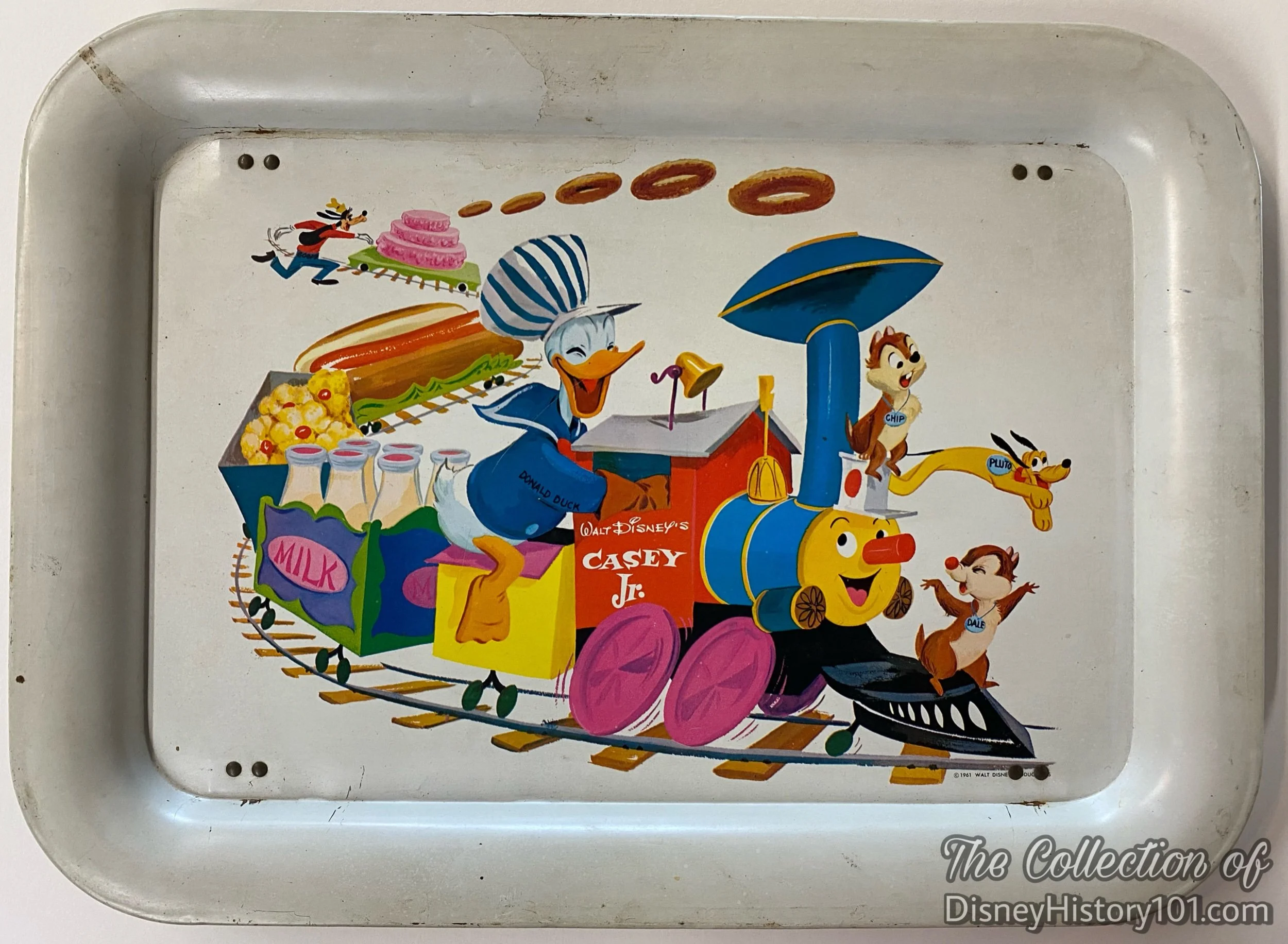
A Walt Disney’s Casey Junior lithographic tin tray.
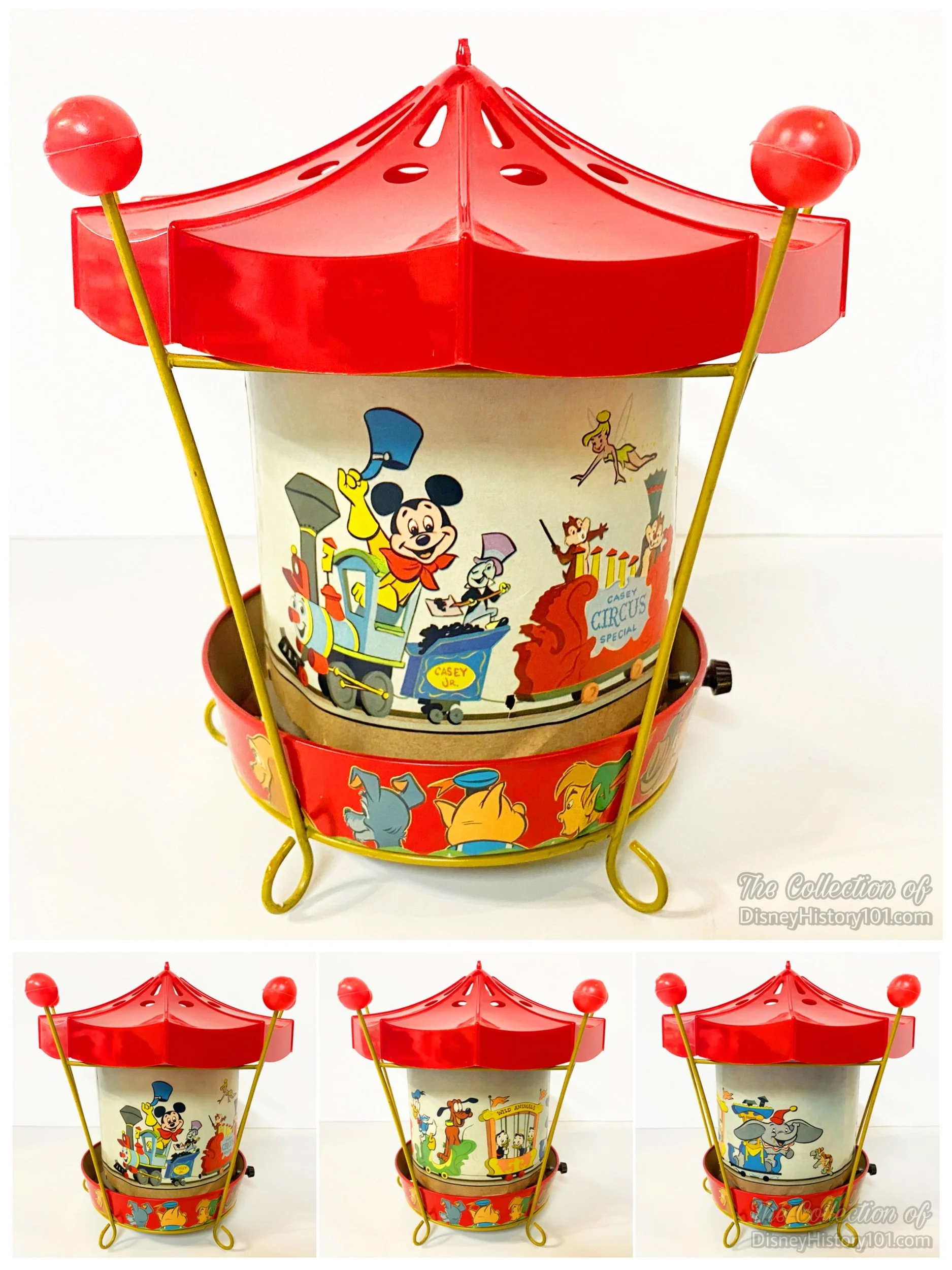
A Mickey Mouse Revolving Motion Lamp by Econolight Corp. featured the Casey Junior Special complete with Wild Animals car; released c.1955.
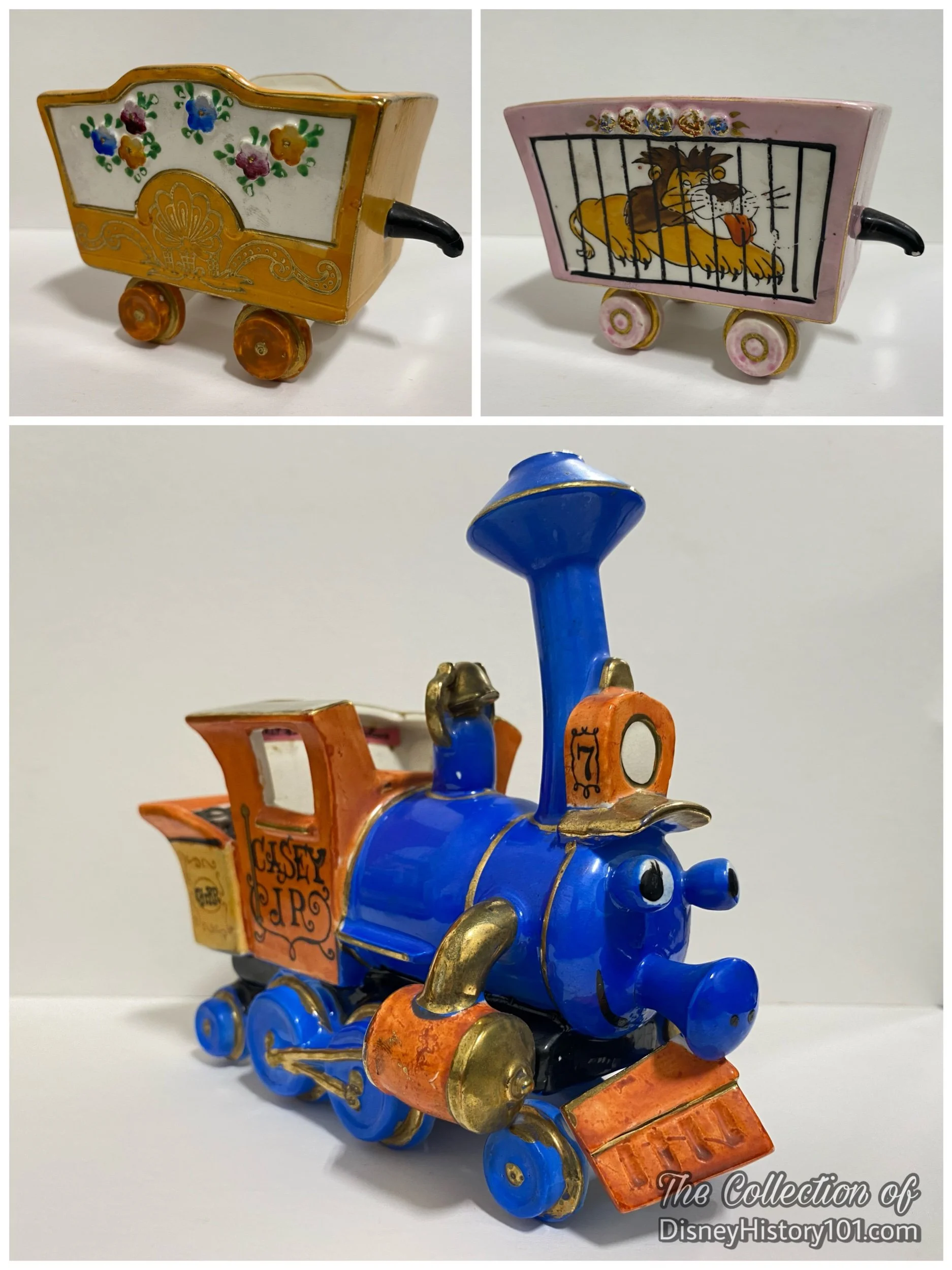
Casey Junior Circus Train planter set; 1950s.
This design was also manufactured as a coin bank, and sold as Disneyland-licensed merchandise through through Disneyland Park.
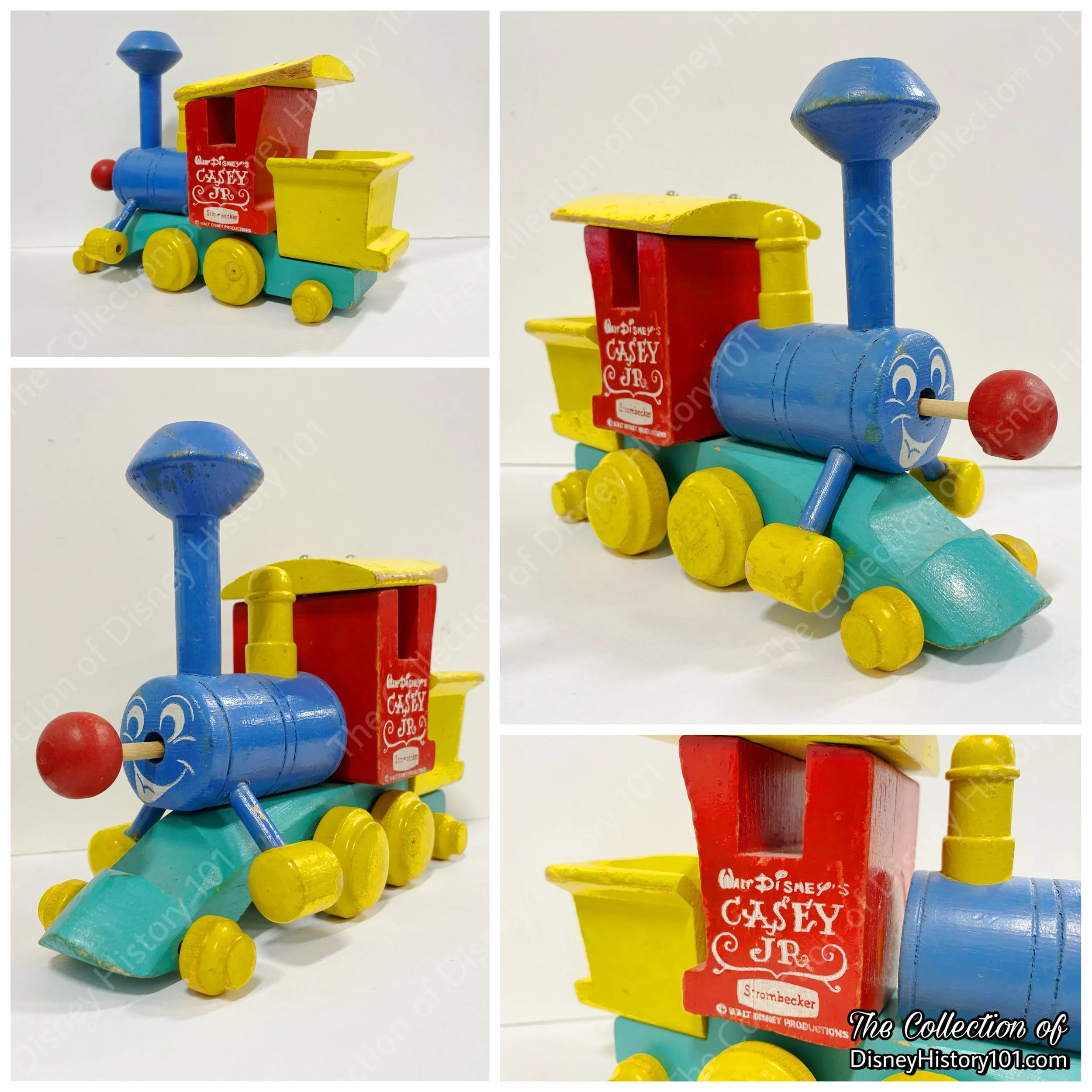
Casey Junior Circus Train wooden pull-toy by Strombecker; 1960s.
Walt Disney’s Casey Junior Locomotive by Strombecker was in production by May 1955 before being advertised, and promoted for its “sturdy wood construction” and “harmless lacquer finish”. The design of this cute little toy was overseen by Walt Disney Productions Character Merchandise Division Art Director Louis Lispi and C.S. Olsen of Strombeck-Becker Mfg. Company.
Louis MARX and Co. manufactured their own Casey Junior The Disneyland Express, a tin-lithographic toy.
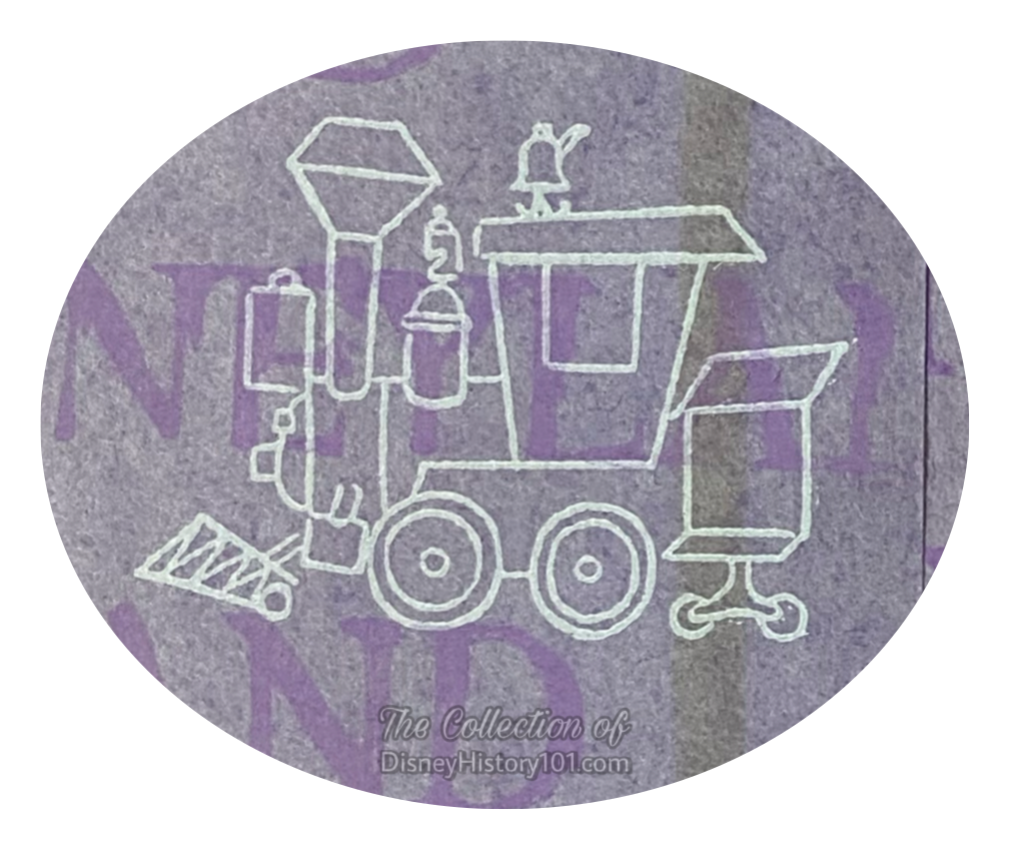
A Casey Jr. cameo on a souvenir bag.
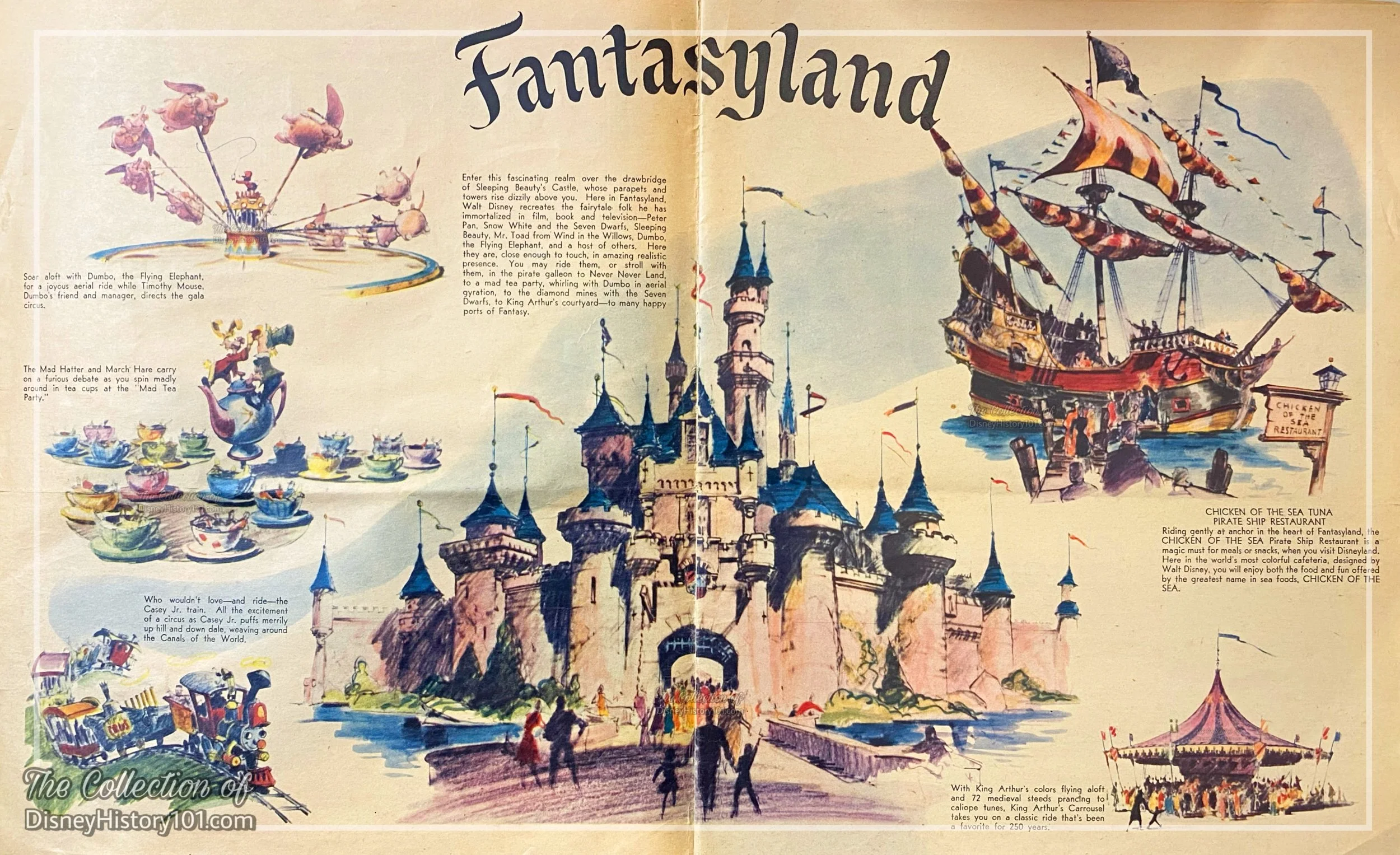
Fantasyland and the Casey Junior Circus Train were previewed in the “Disneyland” Excerpt, (published July 15, 1955)
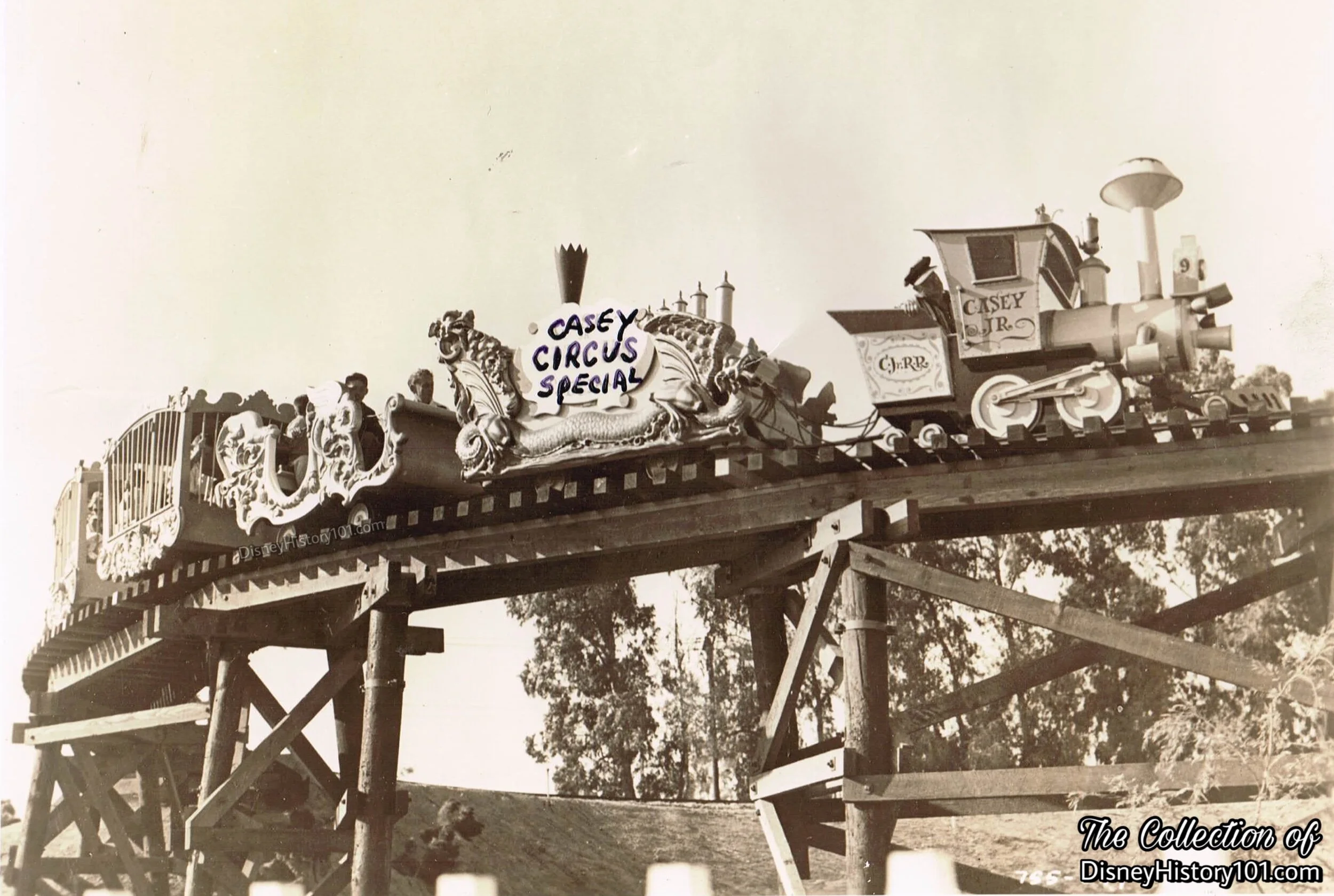
The "Casey Junior Circus Special" Heads Across the Wooden Trestle Bridge structure, 1955.
Walt loved trestle bridges. Back in September of 1950, local Los Angeles structural engineer James E. Lill had engineered a redwood timber trestle with trussed beam and two-story bents for Walt’s own Carolwood Pacific Railroad. Naturally, one notable feature of the Casey Jr. Circus Train’s route was the elevated all-wooden trestle bridge (Pictured above). The bridge was constructed of regularly placed bents, which carried the rollicking engine and its cars over the Canals of the World. The wood of the bridge was soaked in creosote (in order to preserve it and make it sturdier). After all, the bridge was such an important part of the attraction, that it was featured on those c. 1955 “Acres of Fun” souvenir paper fans!
By the time this press photograph (pictured above) was shot, the words “Casey Junior Circus Special” had not been added to the Calliope Car, so someone added the letters for publication.
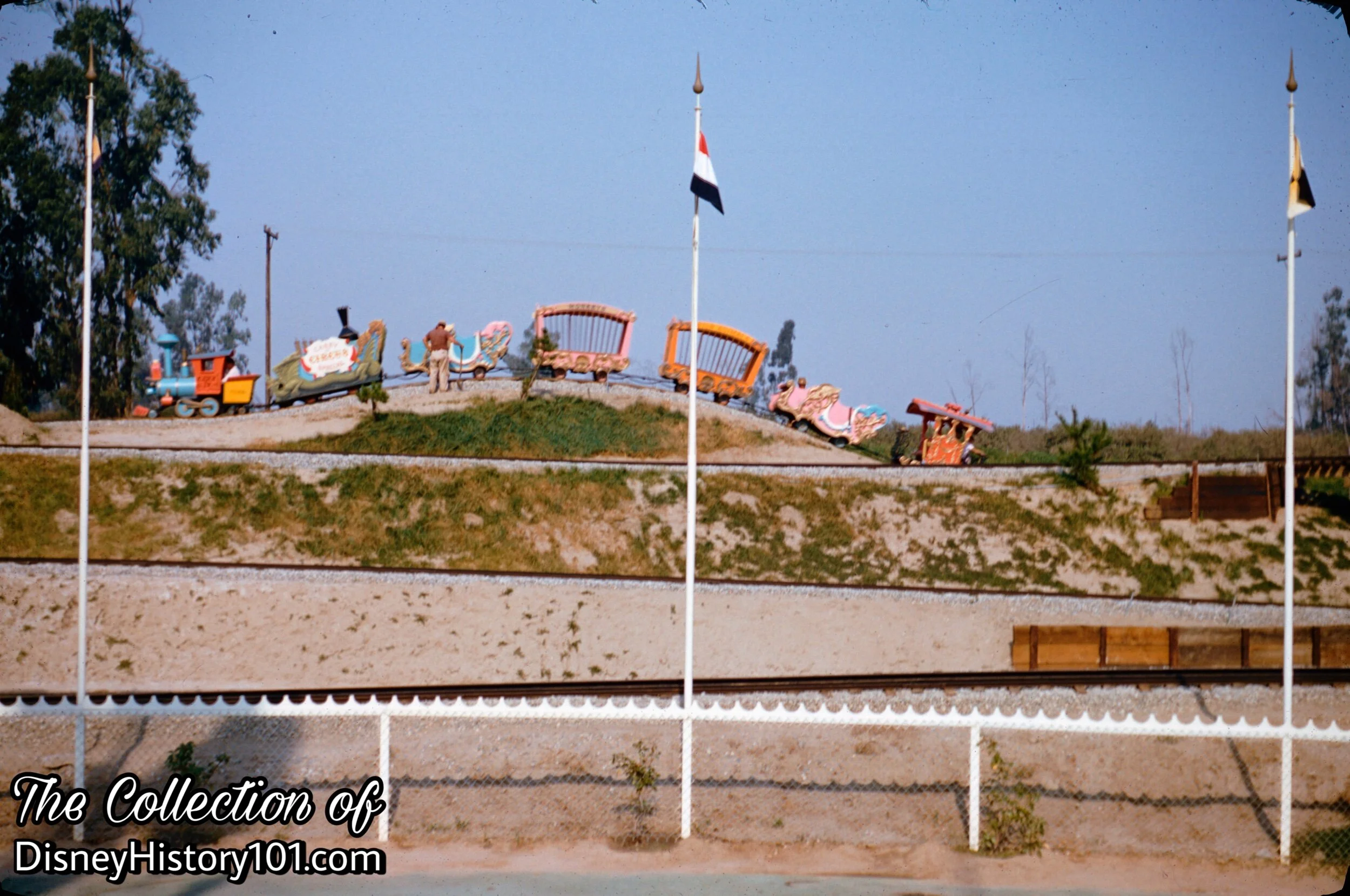
Casey Junior Attempts the 40% Grade and goes “101,” July, 1955.
“‘I Thought I Could’ - Casey Jr. Circus Train Makes the Grade!”
Things sounded optimistic as of June 2, 1955 when C.V. Wood Jr. sent an Inter-Office Memorandum to Walt Disney regarding the best estimates that could be obtained at the time regarding the completion status of individual sections of the Park and Opening Day. C.V. wrote: “Casey, Jr. - We will have one train running and a good chance for both of them. We will push the landscaping as also plan on having this whole section green for opening.”
Casey Jr. had difficulty moving up a 45 percent grade and had tipped backwards. Later, Casey Jr. had difficulty making a 40% grade hill, even considering his six cylinder, gasoline-driven engine (hidden within each Casey calliope car). The solution was simple - cogs underneath the train would grip a teeth of a chain between the tracks, allowing Casey Jr. (and his colorful circus gondolas) to climb the hill with ease! Also, the grade wild be reduced to 25 percent.
Still, the Los Angeles Examiner excerpt (published July 15, 1955) advertised, “Who wouldn’t love - and ride - the Casey Jr. train? All the excitement of a circus as Casey Jr. puffs merrily up hill and down dale, weaving around the Canals of the World.” The train was predominantly built for younger guests, and “built to take steep hills like a roller coaster...It’s one of the few trains that will take a 40% grade in complete safety,” according to the narrator of the televised Disneyland episode “Pre-Opening Report From Disneyland”). While the Casey Junior was “built for younger guests,” this attraction was reckoned among “Disneyland rides and amusements” that “will delight the very young, the teen-ager, young married couples, the middle-aged, and grandparents alike,” as some of the Vintage Views testify [Anaheim Bulletin “Premier Souvenir Edition - Walt Disney’s Magic Kingdom - Disneyland” Insert ; Friday, July 15th, 1955]. This (variety of weight loads) being a factor, engineers tested the Casey Jr. Circus Train’s tracks numerous times, from July 14th (pictured), to the morning of the 17th, 1955.
As the televised opening ceremony date neared, actor Jerry Colonna was scheduled to operate the engine during the live television broadcast. When Arrow Development employees explained the situation (of the engine’s difficulty gaining the traction to climb the 40% grade), Colonna bailed at the last moment, and Arrow Development employee Karl Bacon stood in for Jerry Colonna. Despite Colonna’s decision, during the very same broadcast, the Don DeFore family, Margaret Whiting, and Marjorie Main (or, Mary Tomlinson) were among some of the first notable passengers. Disneyland's opening was a zoo. Ed had his hands full with Show White's Adventures. “I was with Casey Jr,” says Karl. "Everything went to hell that day.” Ed abd Karl recalled “a nervous Walt Disney running around with his celebrity guests, trying to schmooze away the technical delays and long lines.”
However, the attraction was closed sometime thereafter (according to “The Disneyland Diary”). One contributing writer for The Daily Oklahoman (who was present on July 17, 1955) noted: “There was a flying circle of Dumbo elephants, Mr. Toad's motor car ride, Casey Jr.'s ride, etc. Some were not yet functioning for the premier but workmen were feverishly getting them ready for the public opening Monday.” Some of these things are preserved through Opening Day documentation.
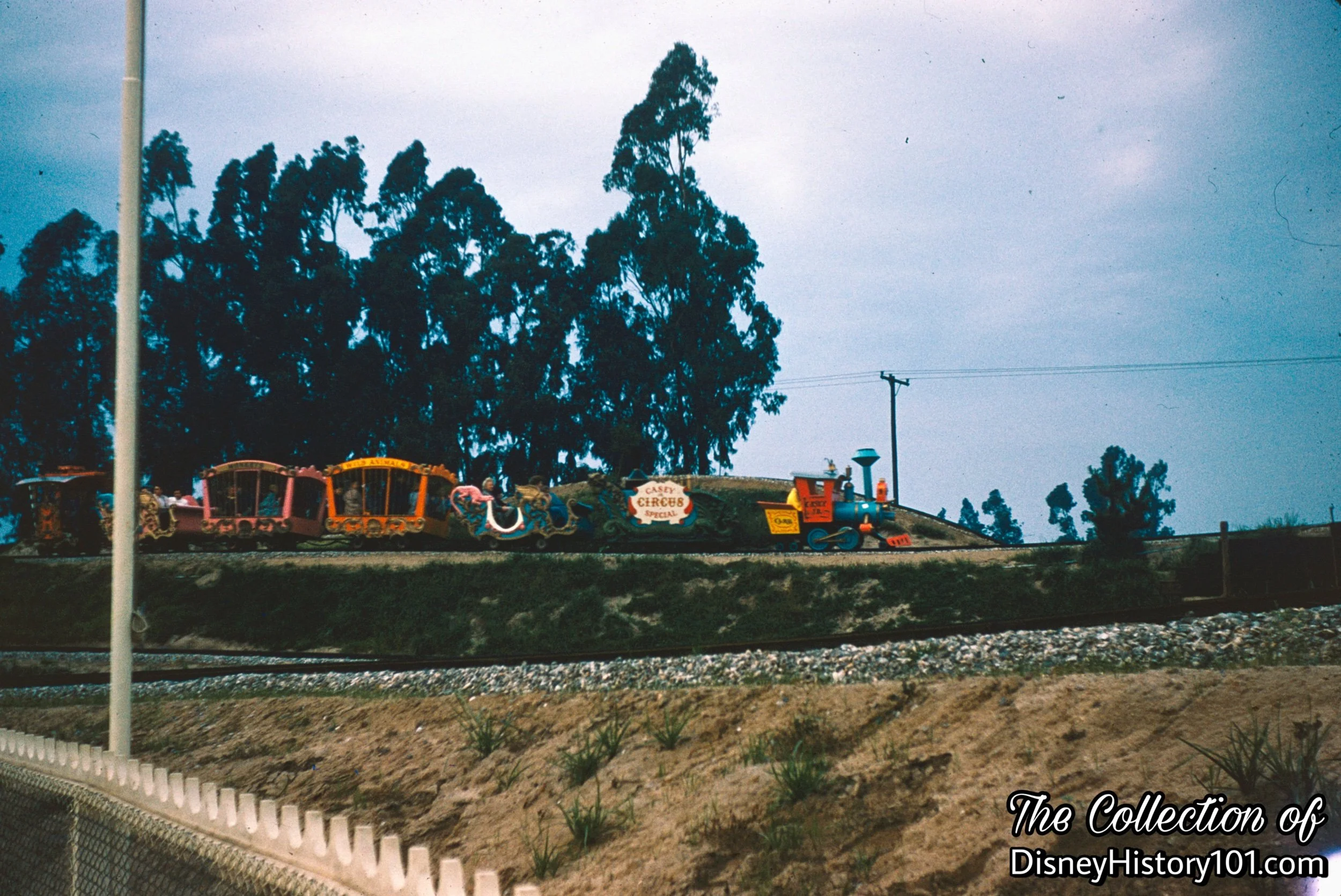
Casey Jr. Circus Train
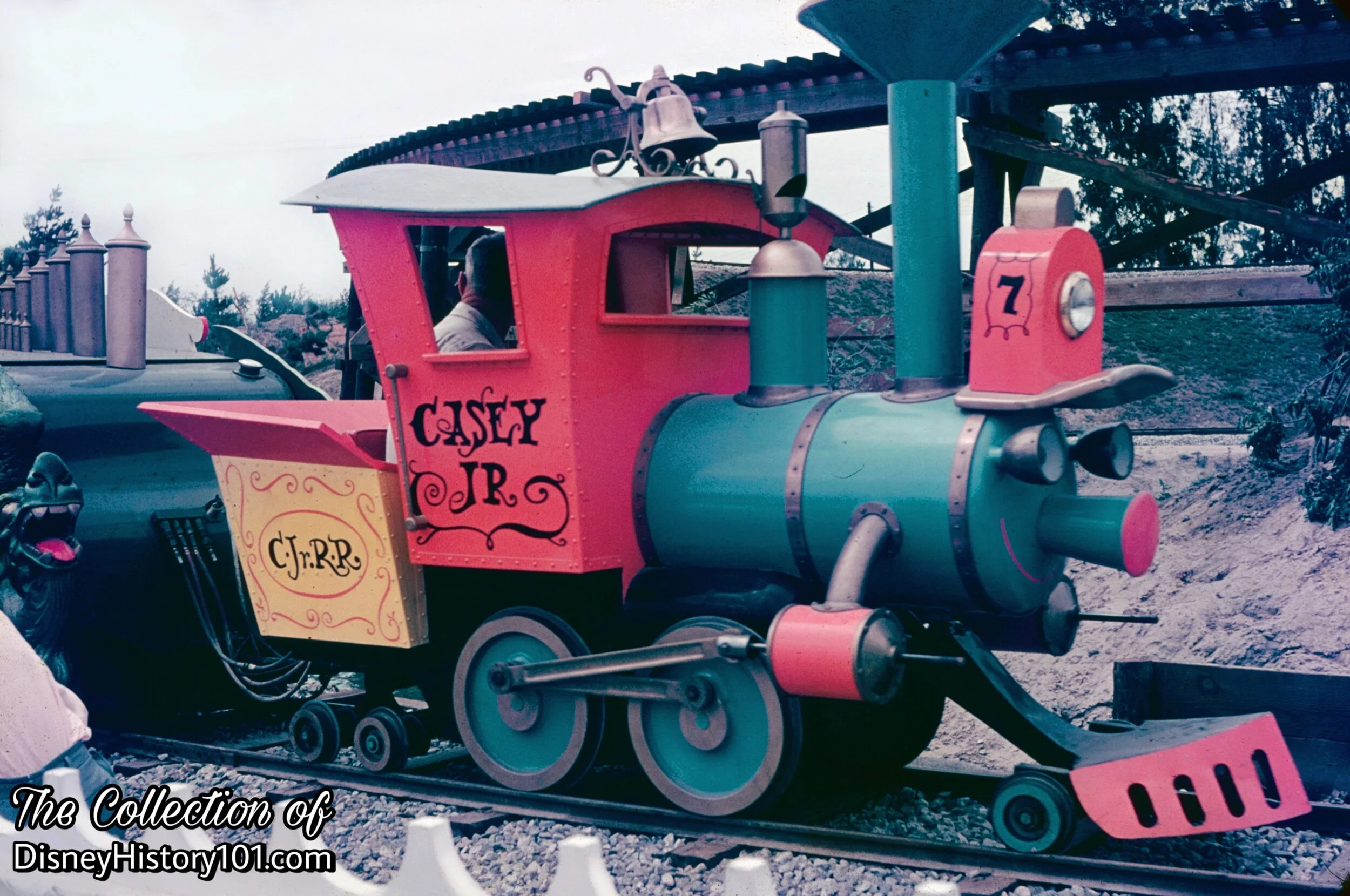
An Attractions Host aboard Casey Junior, (c. 1955)
“Ever Faithful, Ever True, Nothing Stops Him, He’ll Get Through”
However, due to some further safety-related concerns, Casey Jr. was still closed on the following day, which was the Grand Public Opening and First Day of Operation - July 18th, 1955. This closure was due to safety inspections. According to Dave Smith (previous Chief Archivist Emeritus of the Walt Disney Archives), “There were 20 attractions open on July 17. A few others that were not quite ready (such as Casey Junior Circus Train)…opened within the next few weeks.” [Disney Facts Revealed by Dave Smith, 2016] A little more than a week after Disneyland Press Preview Day and the Public Opening, guests could finally (safely) step “all aboard” the bright gay circus train who “knew he could” when the “Casey Jr. Ride” (1 of 22 initial major attractions at Disneyland) reopened, on July 31, 1955. Tickets (during this time) were purchased at a booth next to each ride, and the Casey Junior Circus Train was no exception.
Disneyland employee Immogene Brinkmeyer was the very first ticket seller at this particular location, while Disneyland Tour Guide Anne Daniel would be the last employee to work this ticket booth!
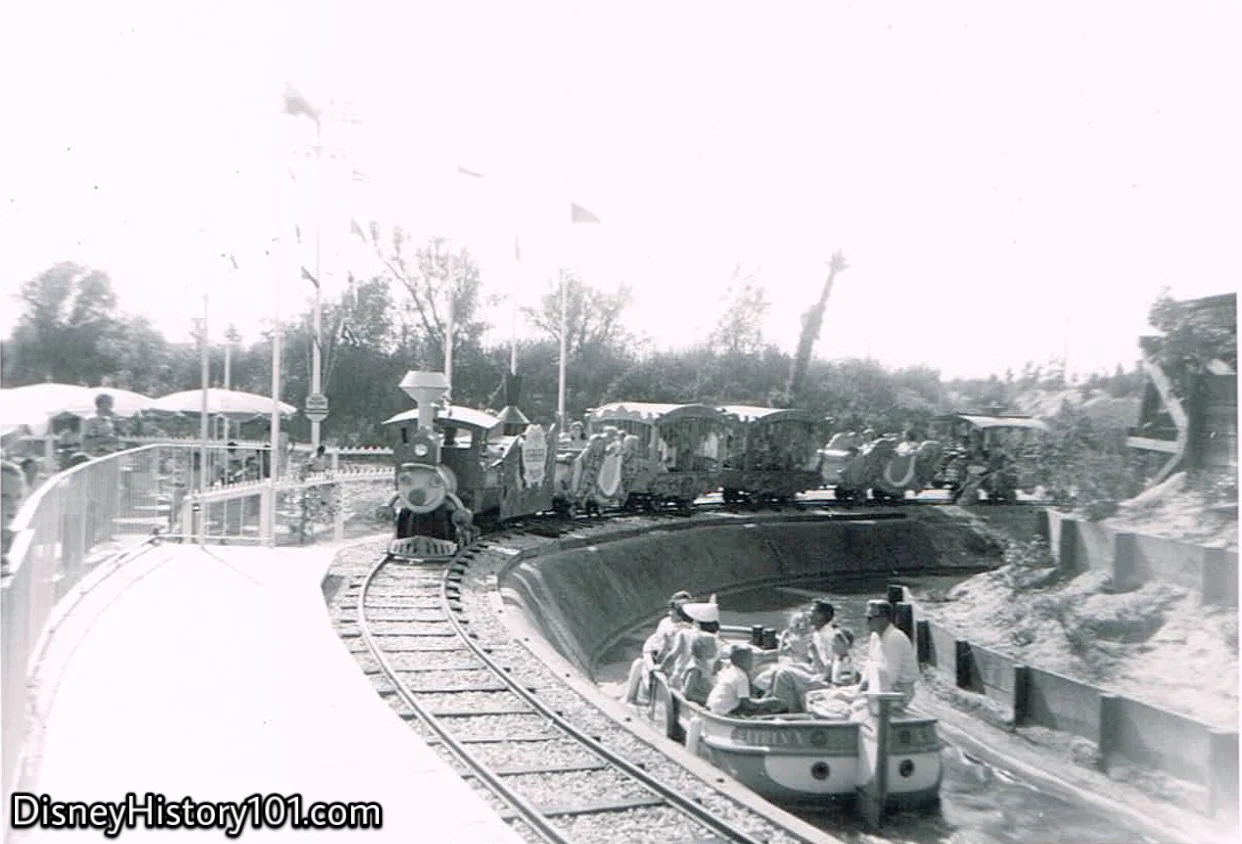
Casey Jr. “coming down the track” and returning to the station, (August, 1955)
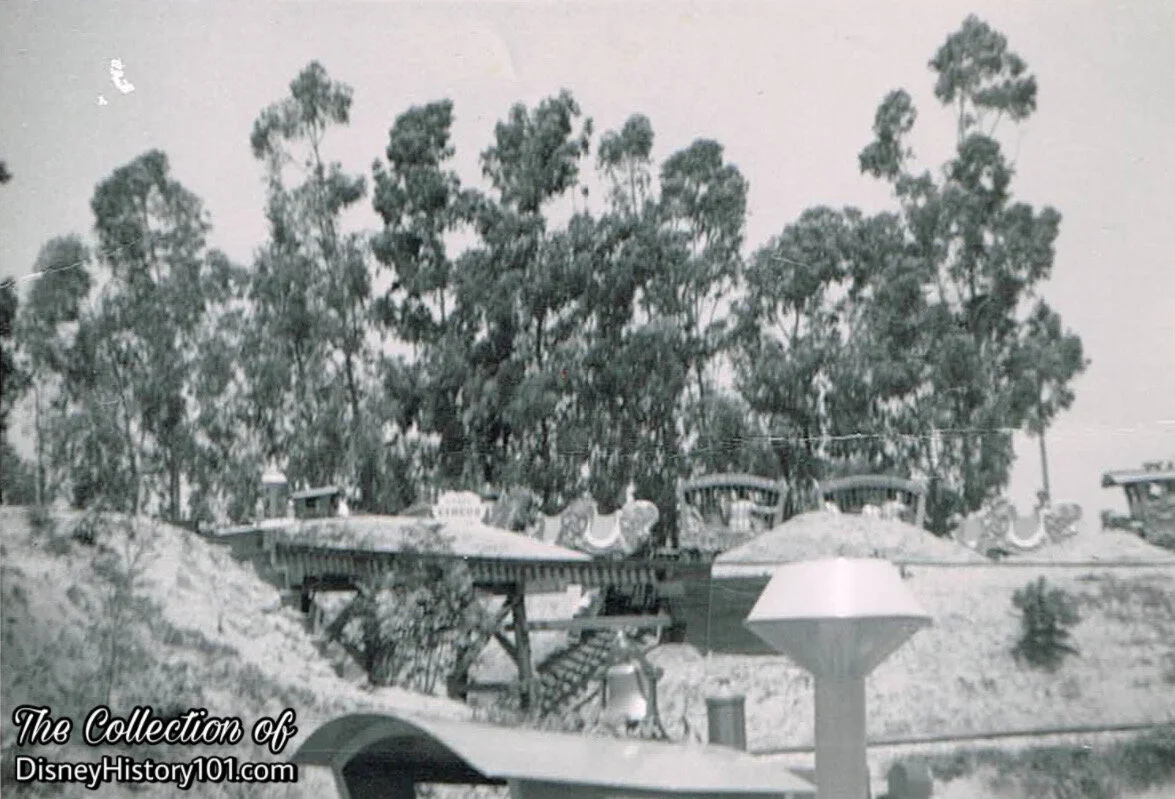
Two Casey Junior Circus Trains pass near the out-of-scale eucalyptus tree “wind break,” August, 1955.
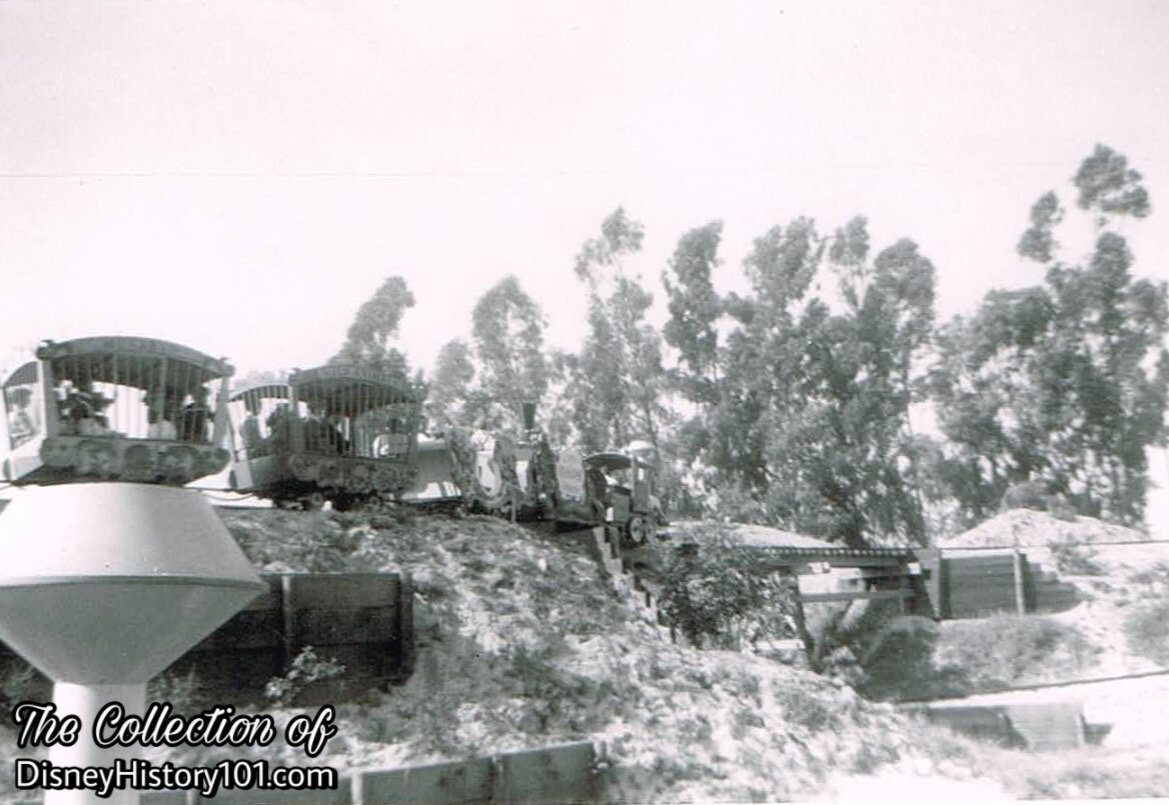
A Casey Junior Circus Train prepares to pass over a trestle bridge, near the out-of-scale eucalyptus tree "wind break," (August, 1955)
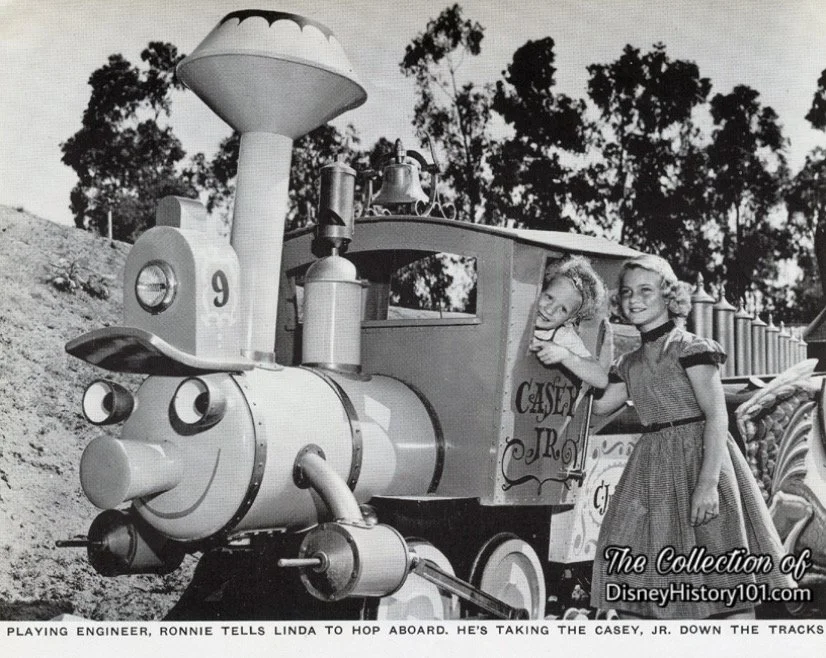
Casey Jr. extends a courteous smile in an excerpt from The Refresher, (September, 1955)
Soon, “high state, local and national government officials” as well as “luminaries from motion pictures, television and the theater” turned out to “pay tribute to this happy land” including the Casey Junior Circus Engine. [“Disneyland 1st Anniversary Souvenir Pictorial”, 1956, page 9] Among the first four million visitors to step though the Main Entrance Gate turnstiles and step aboard were Esther Williams with Ben Gage, and June Allyson with Dick Powell.
Among the earliest notable guests were also actress Margaret O’Brien (who played the part of the wild animal in one of the wagons). Ride Operator Boyd Diaz vividly recalled: “I was working on the loading dock of the Casey Jones Jr. R.R., when in came the train with Marjorie Main riding in the Wild Animal cage. She was wearing one of her great big fancy hats and as she got out of the cage, she knocked her hat off onto the dock. As I bent over to pick up her hat my Casey Jr. overalls split from top to bottom. I had to stand with my back to the wall until quitting time!”
Whether (or not) he paid the price of admission, comedian Red Skelton had the pleasure to “take over” as engineer for a photo published in “The Disneyland News” (March 10th, 1956).
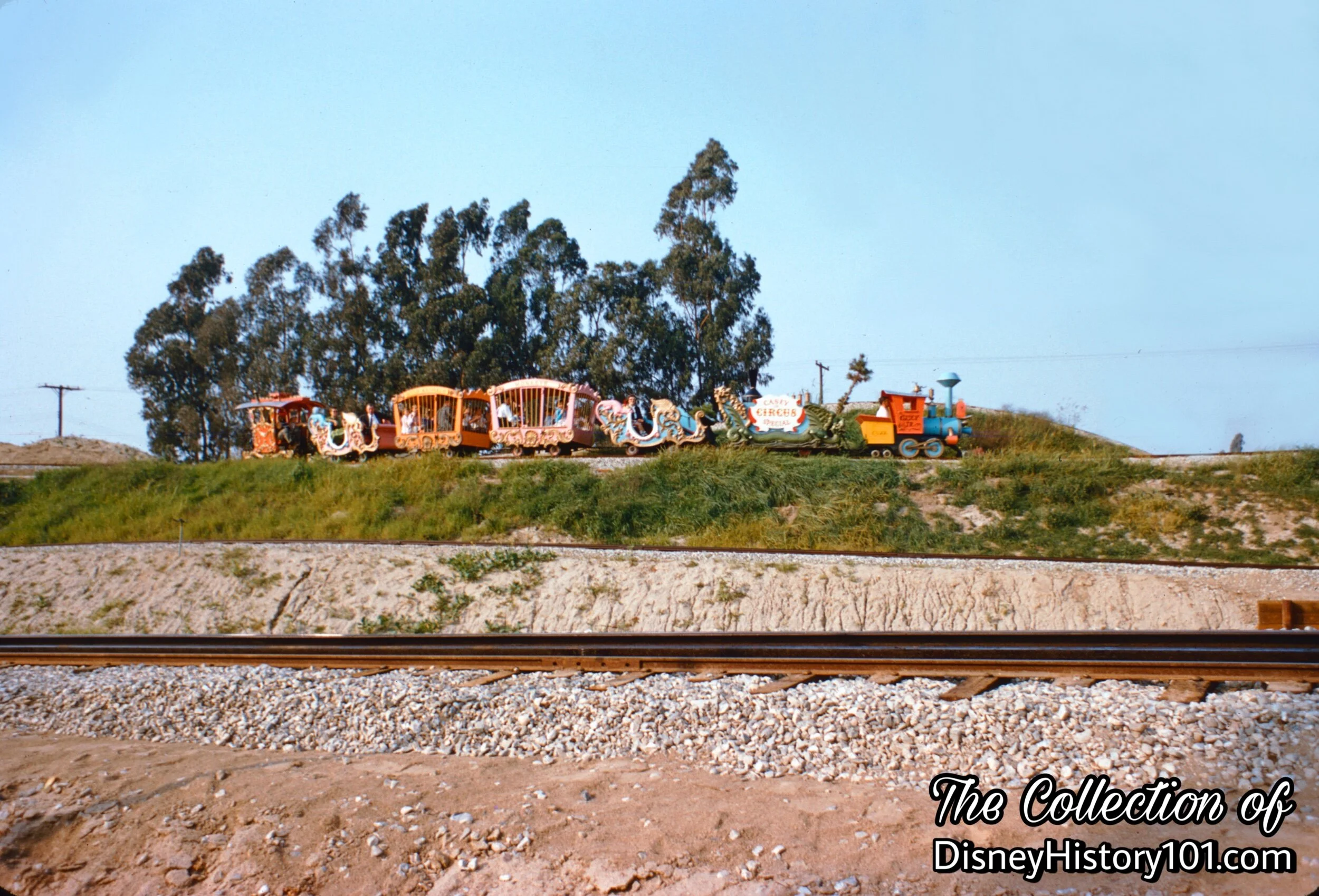
Casey Jr. Circus Train
“All Aboard - Let’s Go!” - The $50,000 Casey Jr. Circus Train attraction finally opened July 31, 1955! In advance, the Los Angeles Examiner (published July 15, 1955) advertised, “Who wouldn’t love - and ride - the Casey Jr. Train. All the excitement of a circus as Casey Jr. puffs merrily up hill and down dale, weaving around the Canals of the World.” Though many of the “hills” and “dales” were un-landscaped, it was projected that the attraction could theoretically attract a maximum guest capacity of 720 guests per hour. The attraction was still well worth the original 1955 price of admission (one “B” Coupon or 25 cents) - the same admission price as a spin in the Mad Tea Party or a show at the Mickey Mouse Theater! The Casey Junior Circus Train maintained the “B” Coupon fare as long as Ticket Books were employed at Disneyland.
Soon, one contributing writer to the Los Angeles Examiner (published Sunday, August 21, 1955) briefly mentioned how “Casey Junior, the happy circus train, rollicks about its bumpy track.”
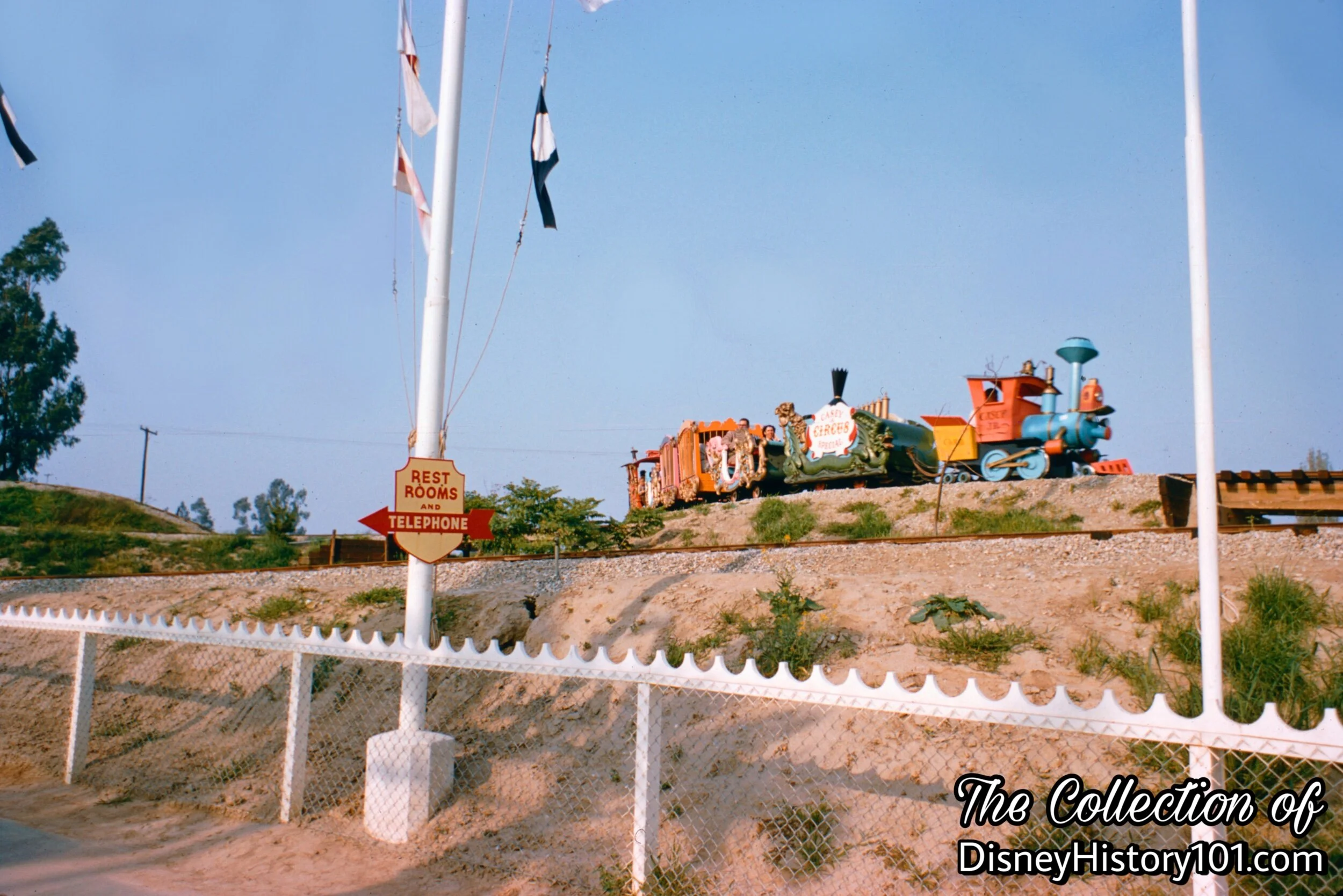
Casey Jr. Circus Train “rollicks about its bumpy track.”
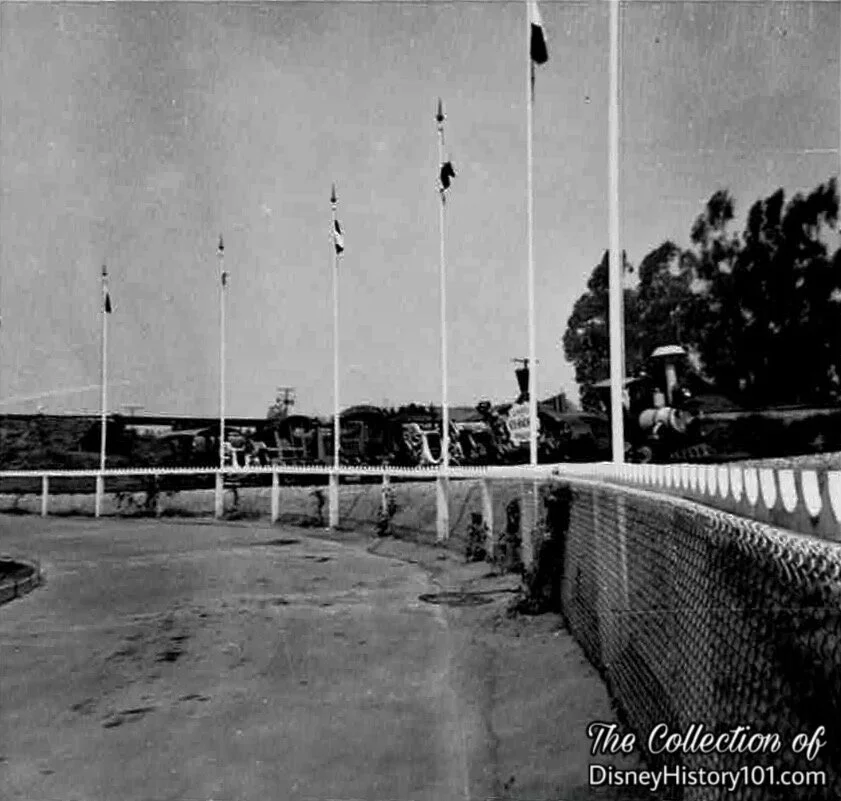
Casey Jr. Circus Train
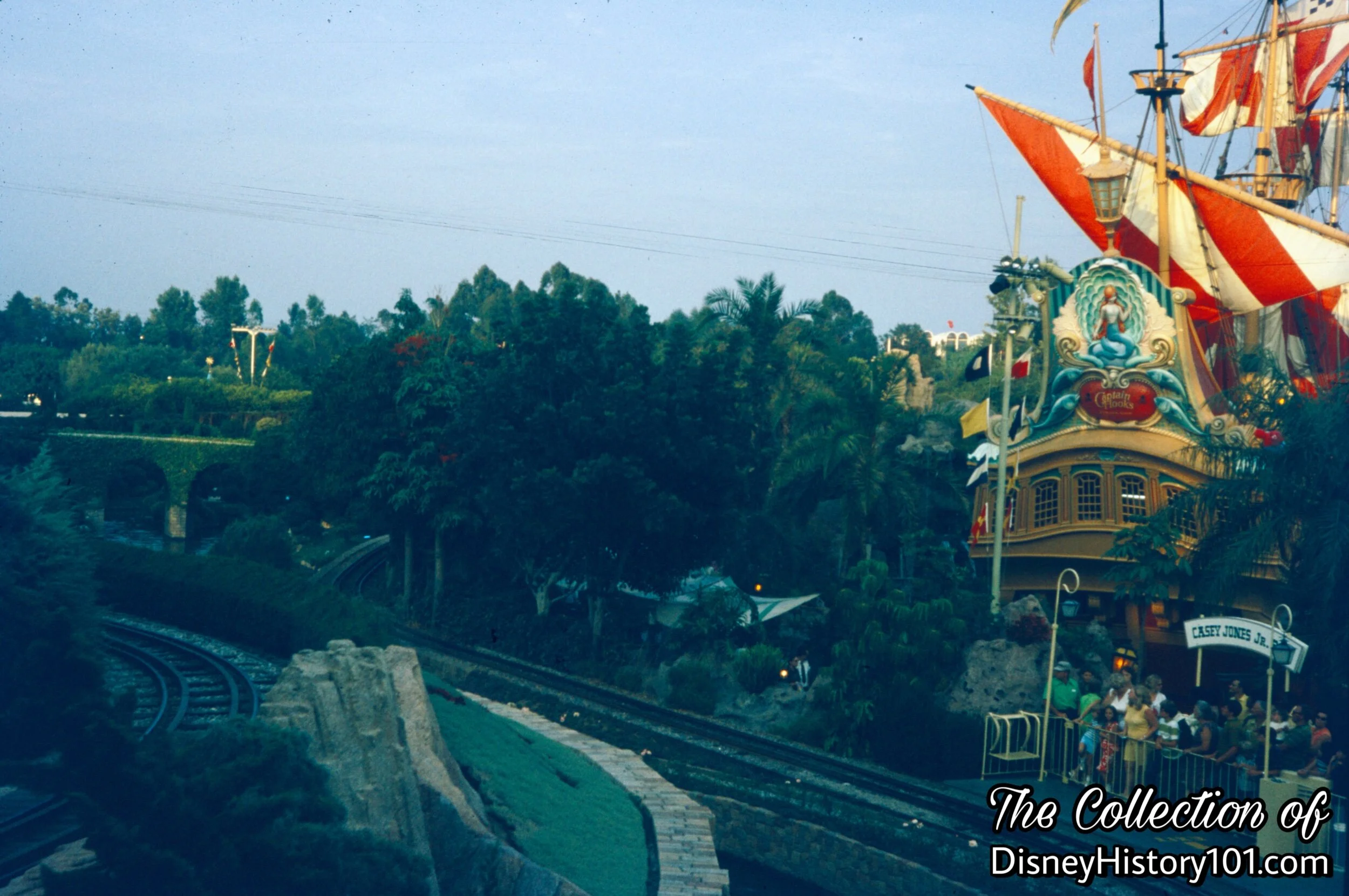
In the early days, Guests could catch views of a passing Casey Jr. Circus engine and its stock, from the path behind the Chicken of the Sea Pirate Ship.
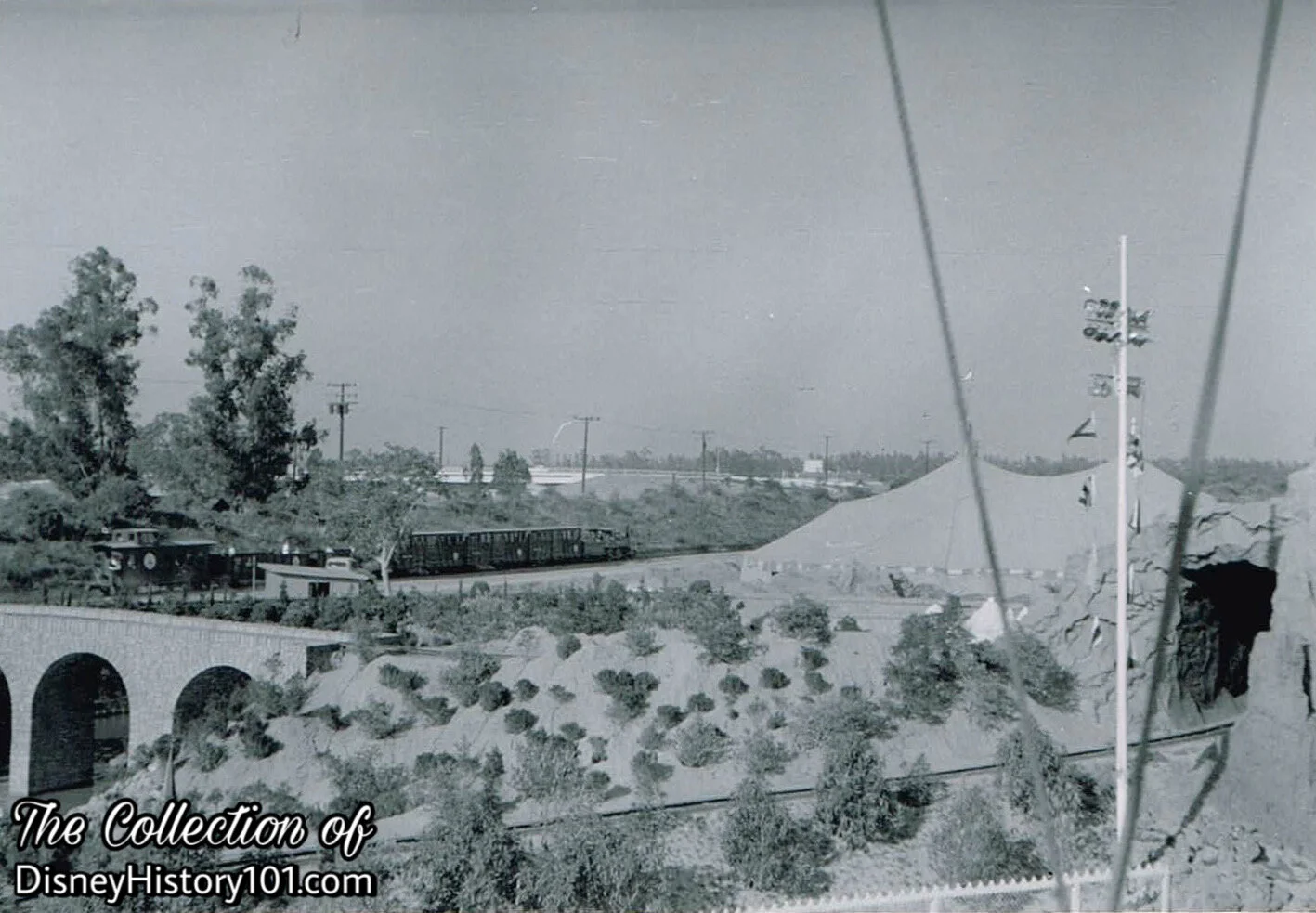
Casey Jr. Circus Train Tracks and Santa Fe & Disneyland Railroad Tracks, May, 1957.
In the early days of Disneyland, Jim Quigley (who would later serve as Supervisor of Disneyland Accounting Control) recollected that Keller’s Wild Animal Act tent was originally housed nearby Health Services on Main Street. By the time this Vintage View was captured, the tent seems to have been moved to yet another location. Beyond the realm of Casey Junior Circus Train, stands a true-life circus tent (previously utilized for the Mickey Mouse Club Circus) which now solely featured “Keller’s Jungle Killers” - the big exotic cats of Professor George Keller!
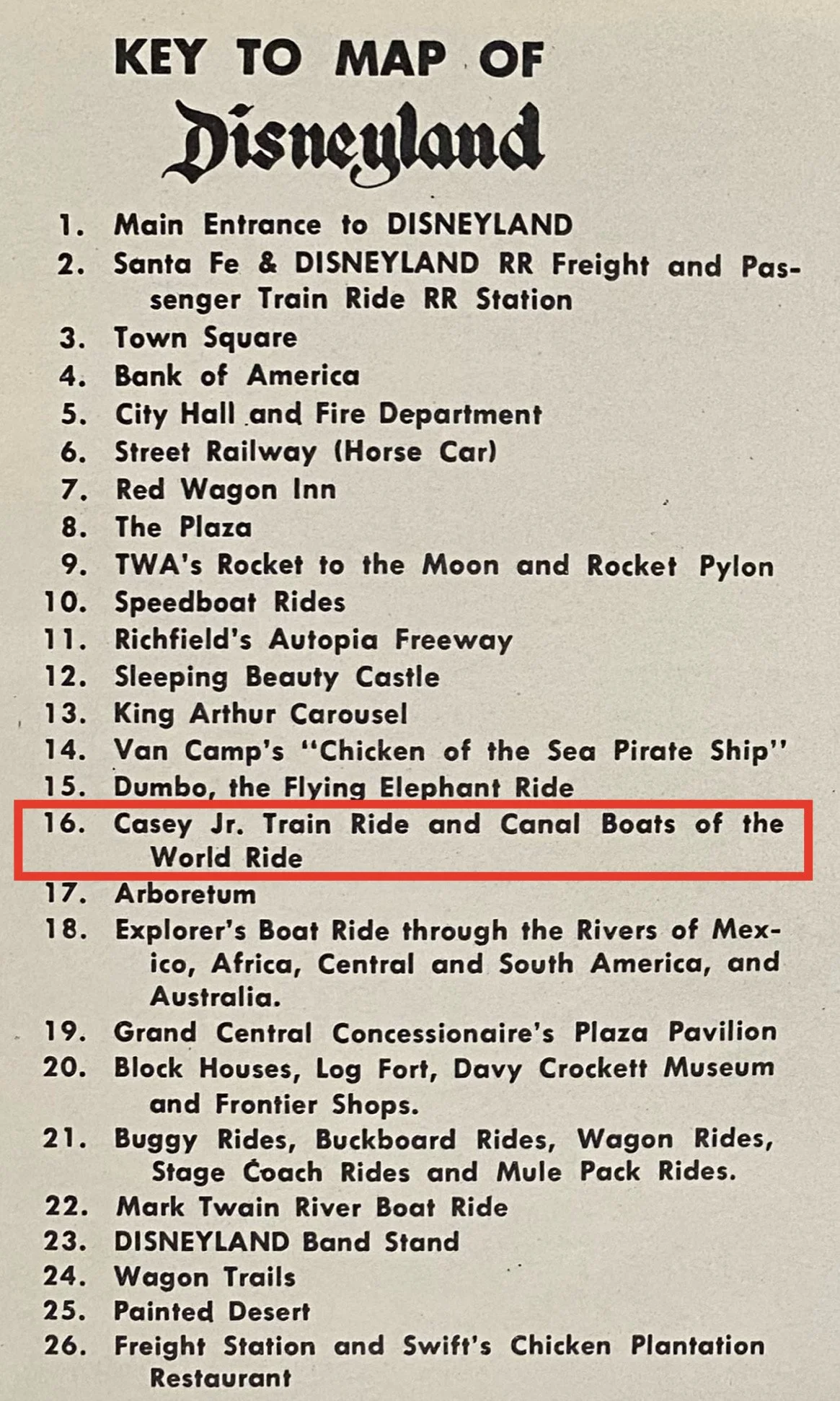
Disneyland Souvenir Book in Natural Color, c.1955.
At a meeting of the Disneyland Merchant's Association (held January 25, 1956), the momentous announcement was made regarding Fantasyland developement: “We are making several new developments on this ride at a cost of approximately $125,000.00. This ride will be exciting and portray a ‘story book’ land, with villages at about 1/2 scale and crazy quilt landscape idea. This should be completed by April.”
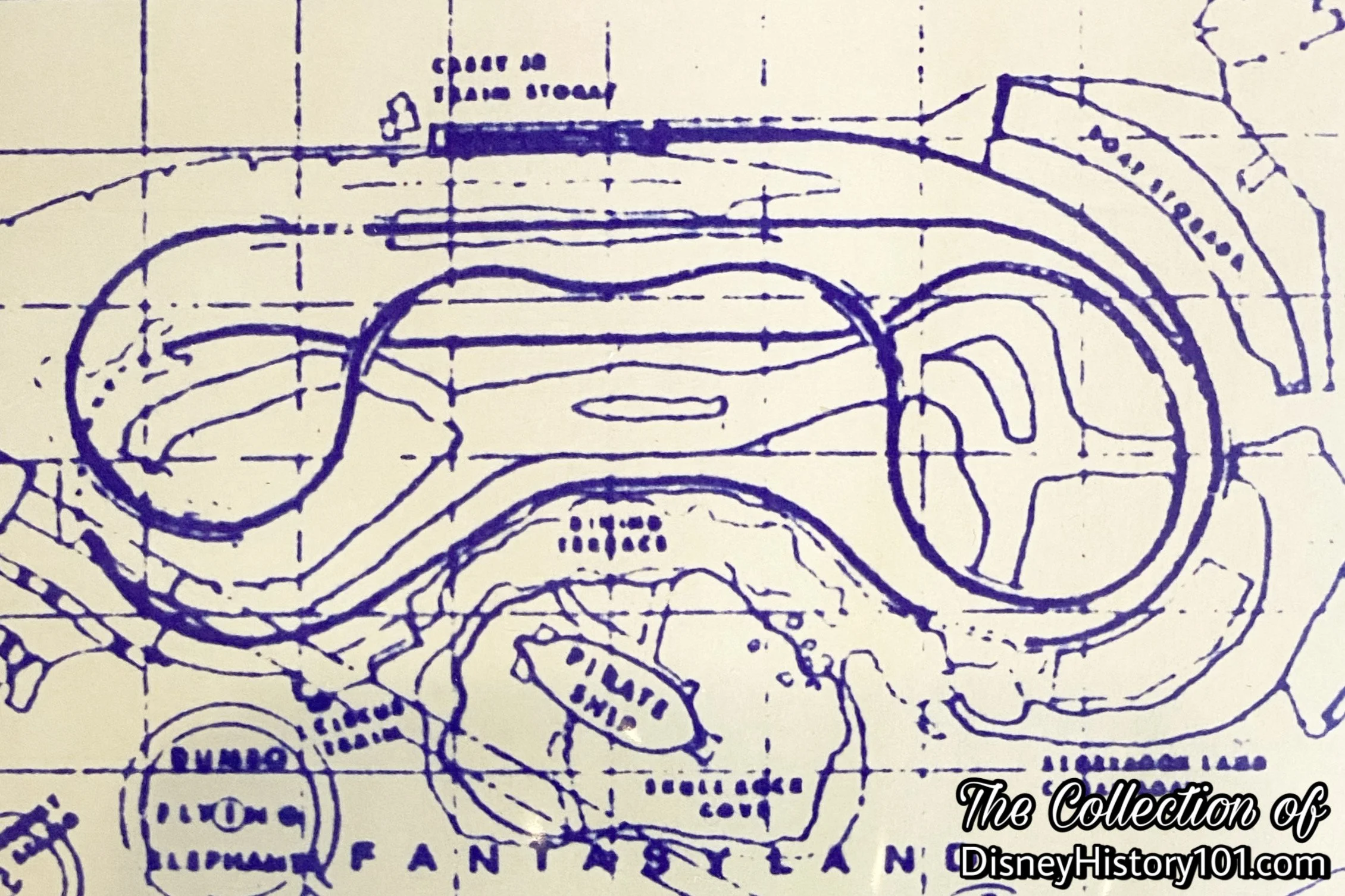
Note the Casey Junior Backstage Train Storage in this c.1968s WED Imagineering Plot Plan Excerpt
Soon, the bright gay circus train who “knew he could,” would travel a new scenic route above Storybook Land!
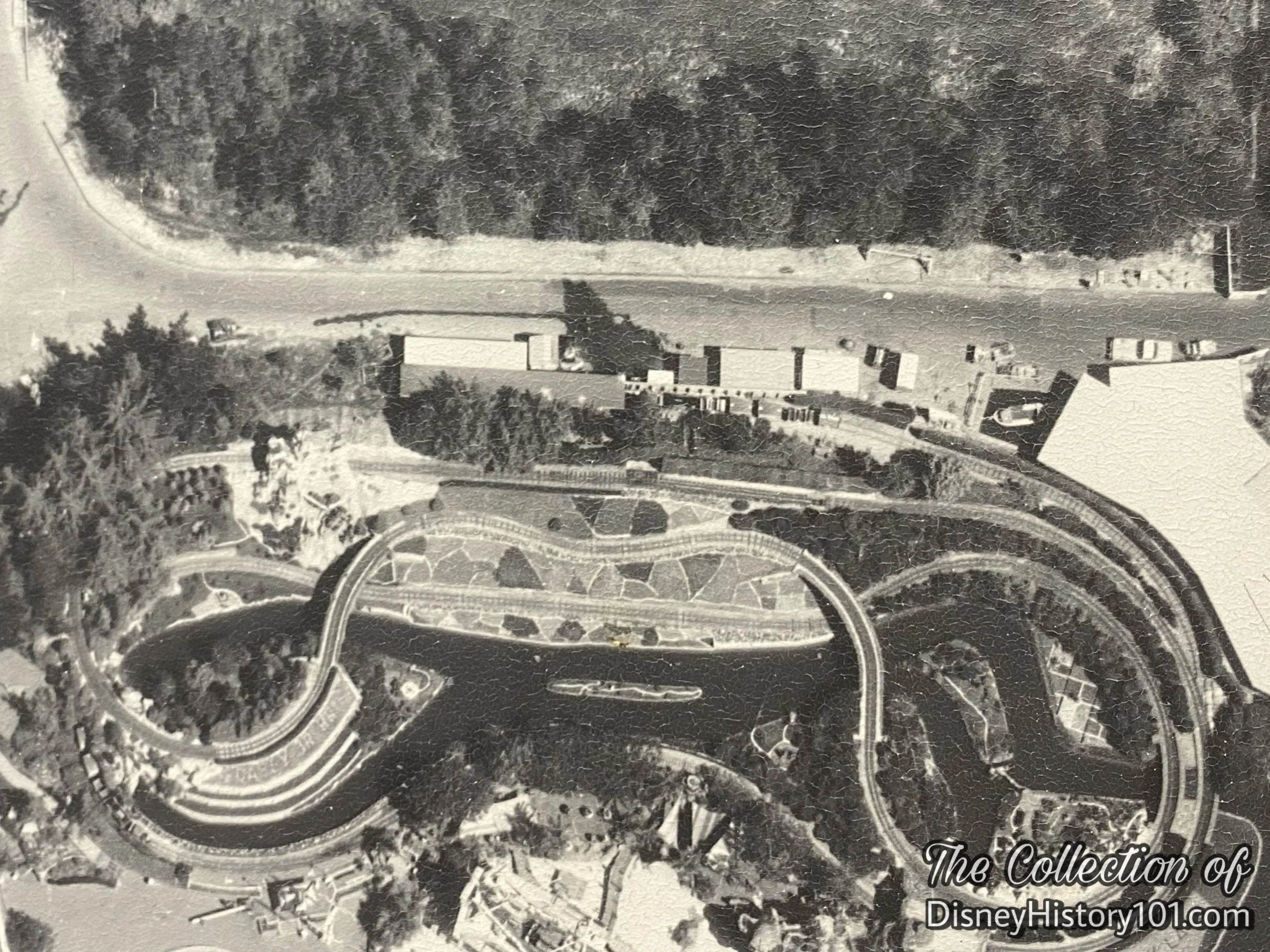
On the technical side, the narrow-gauge 30” tracks lead the Casey Jr. Circus Train on a four-minute journey, around a 1,840-foot layout. In addition, a spur line leads to a Train Storage Area, located behind the attraction, which houses both of the five-car trains (valued near $16,000 each). Later (c.1989), the two Casey Junior Circus Trains were serviced by the nine mechanics (including Shop Foreman Bib Carbines, Jeff Stephenson, and Bill Pearson) of the Disneyland Service Garage (also called the Autopia Garage). There, the vehicles received daily maintenance and cyclical rehabilitation. Meanwhile, the Cycle Shop would refurbish the body with a new coat of paint.
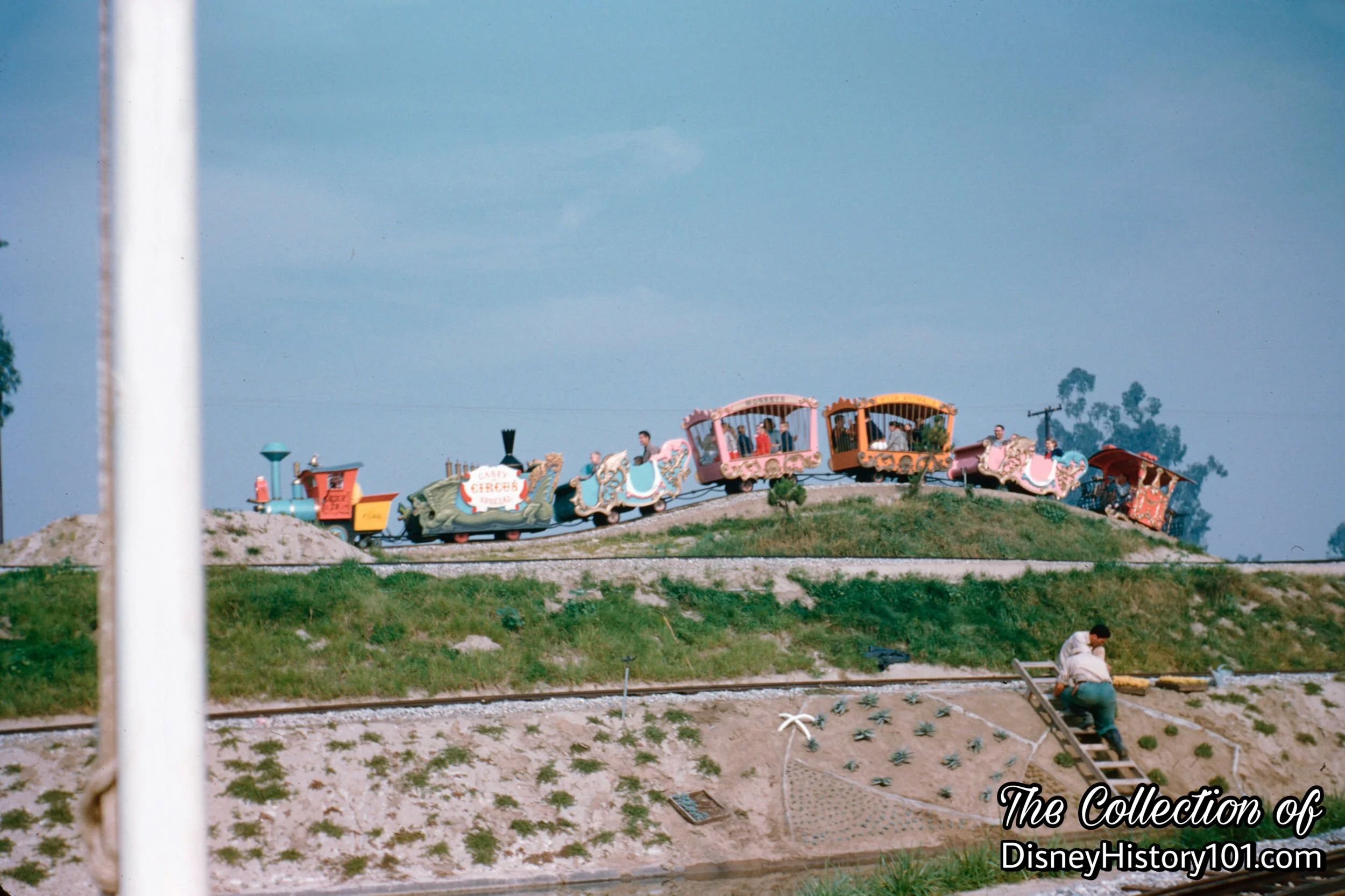
Casey Jr. Circus Train, Spring, 1956.
While work on the floral Lullabyland Patchwork Quilt (on the hillside of the former Canals of the World) begins to take place in the foreground, Casey Junior looks more confident after performing that old 40% grade many times each day!
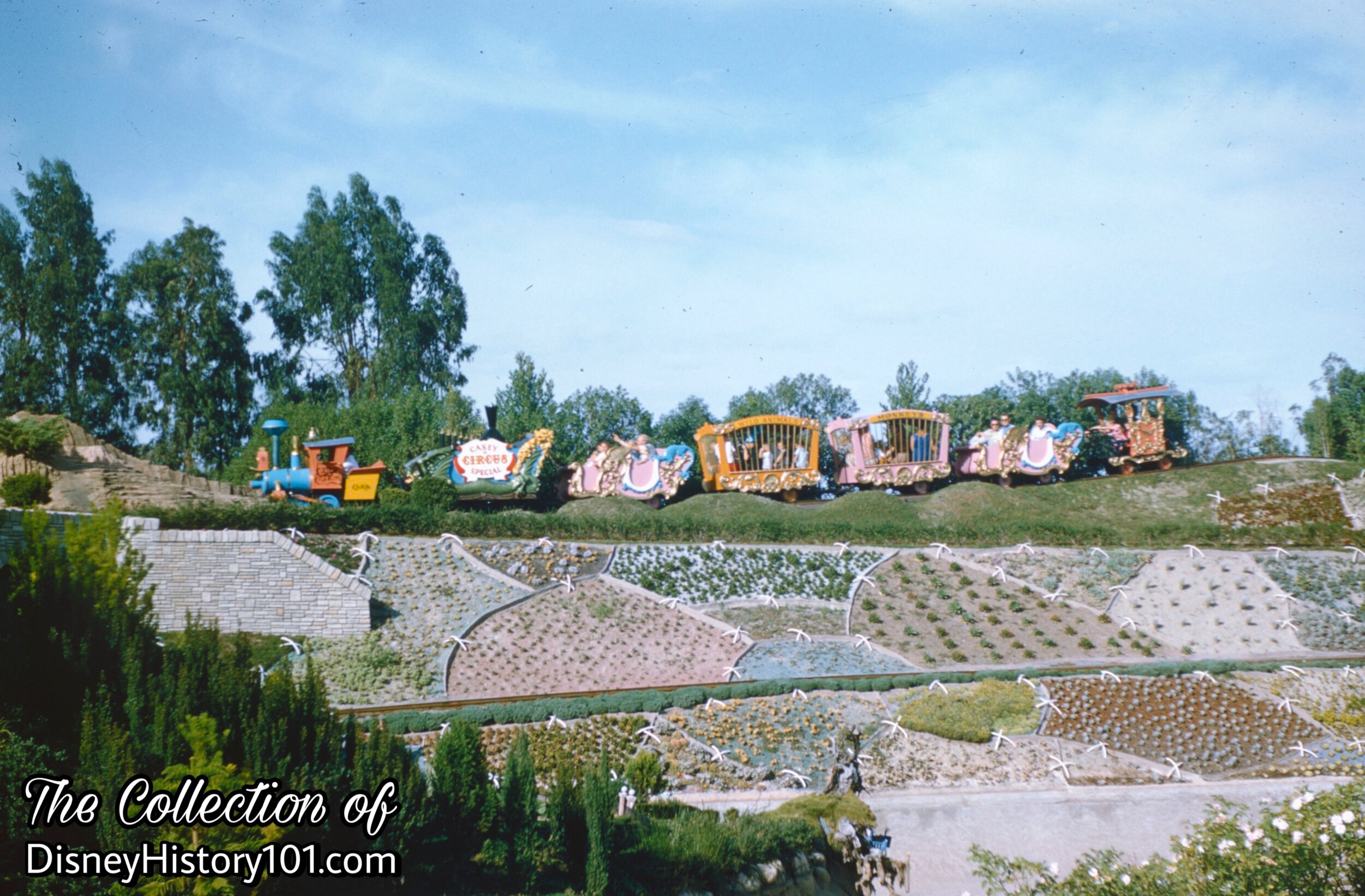
Soon the little train would takes Guests over rivers, trestles and bridges and climbs mountains in Storybook Land.
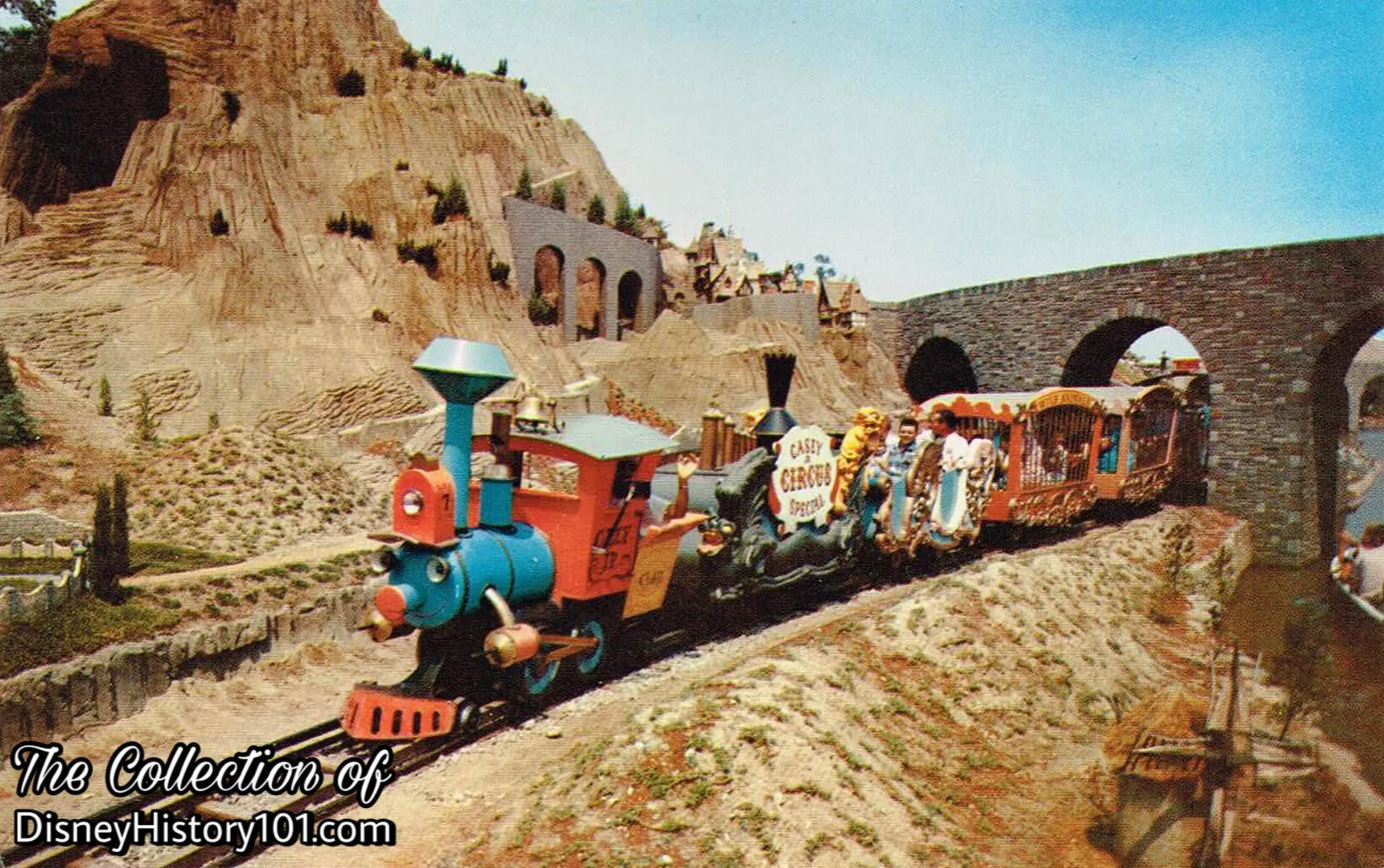
Casey Junior Train Postcard Image
Casey Jr. looks to be the busiest character in Storybook Land in this early Casey Junior Train Postcard Image!
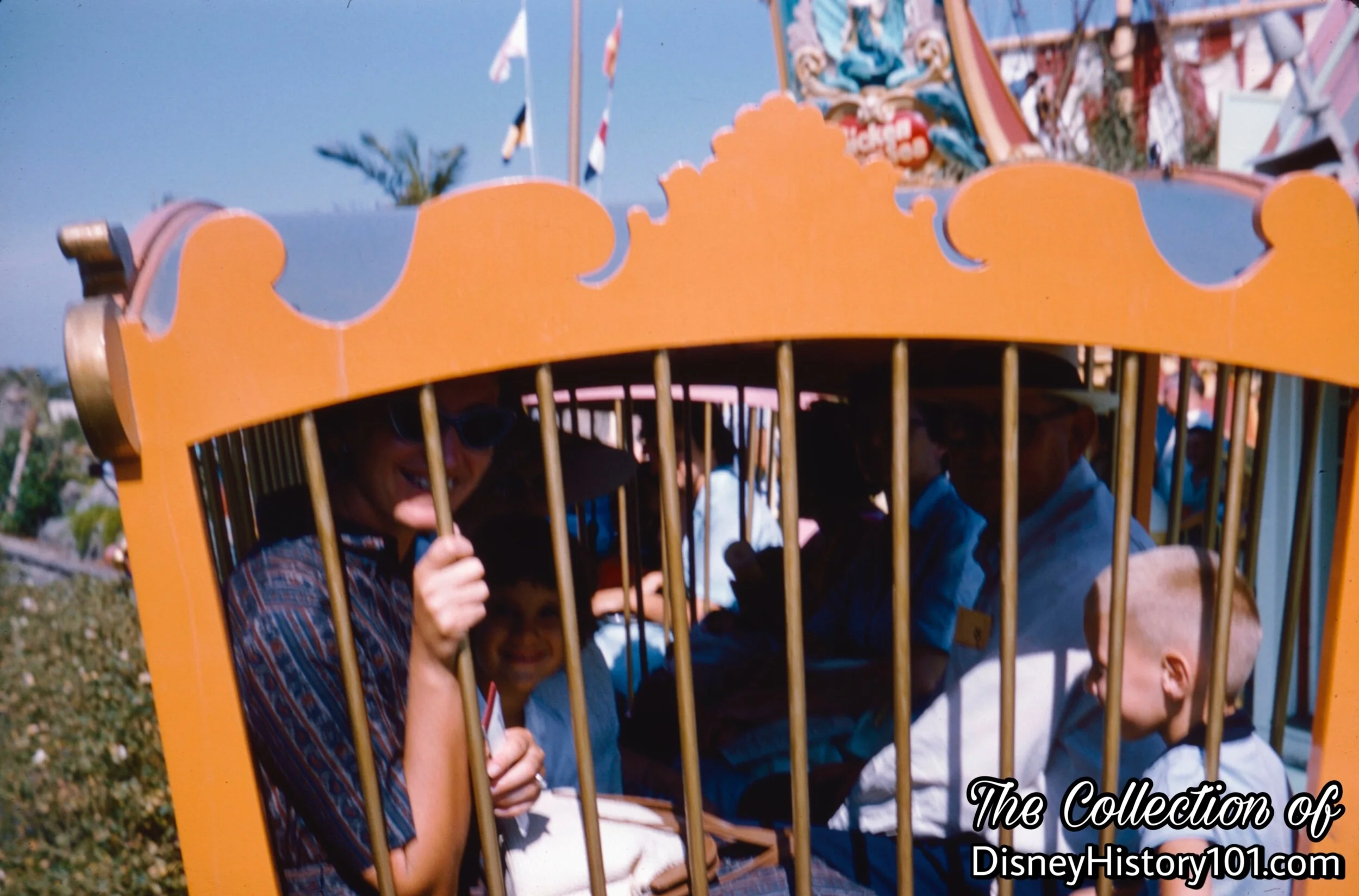
Casey Jr. Circus Train, (1956)
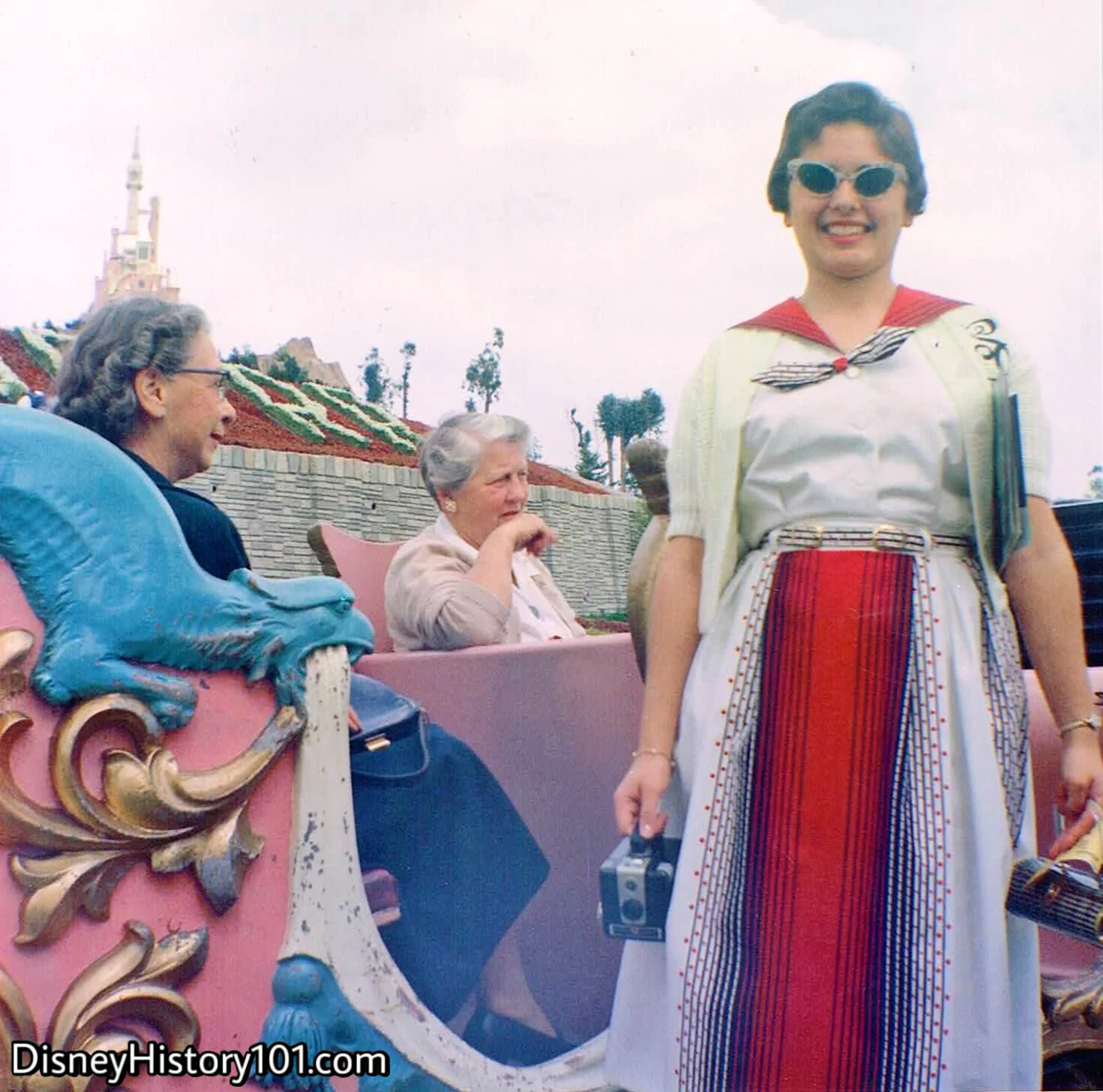
Disneyland Guest & Casey Jr. Circus Train and Chariot, at “the Happiest Place on Earth,” April 5, 1958.
Three years later, Casey Junior was still thrilling “every Jack and Jill,” as guests of all ages payed fare to board the diminutive stock bound for a grand circle tour of Storybook Land!
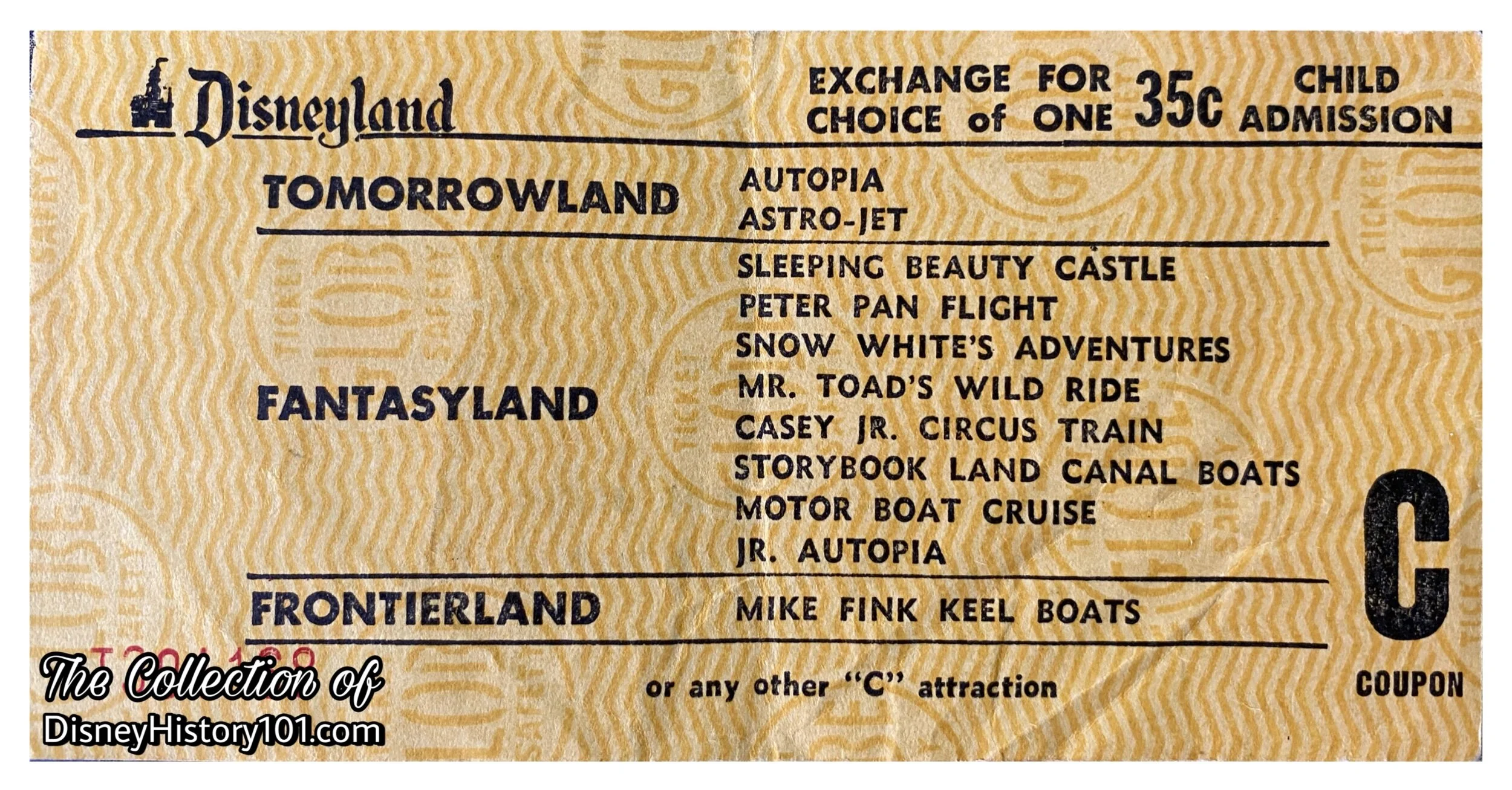
Disneyland Child's "C" Coupon, June, 1957 - September, 1958.
The admission for Casey Jr. Circus Train was one “C” Coupon (35 cents) - the same admission to sit behind the wheel of a Junior Autopia car or to explore Sleeping Beauty Castle’s walkthrough attraction!
By 1959, Joe Fowler was Vice President of Disneyland Operations Committee and Doc Lemmon of Disneyland Operations was overseeing Operators of Rides & Amusements, Livestock, Parking Lot, and Ticket Sellers.
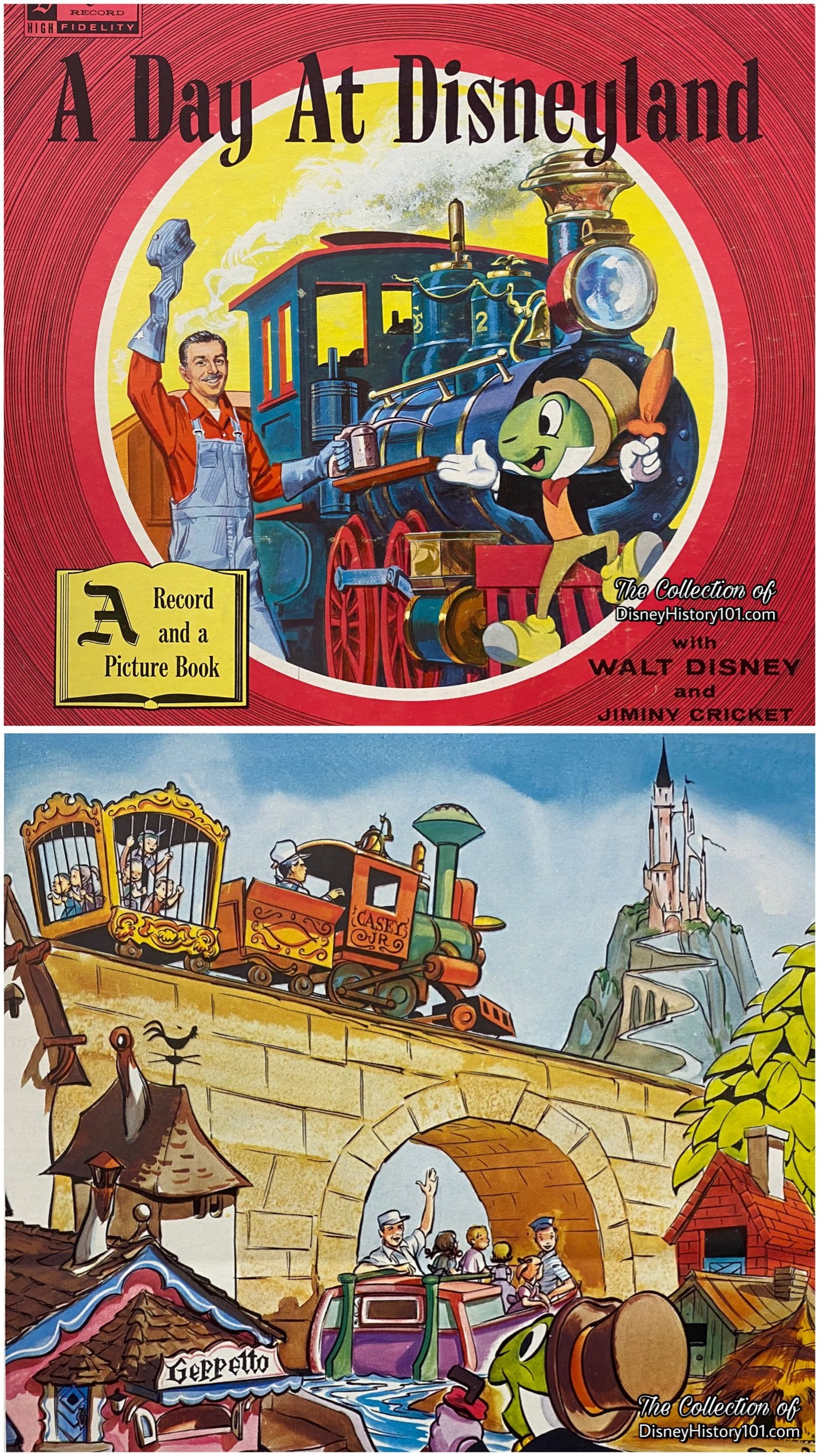
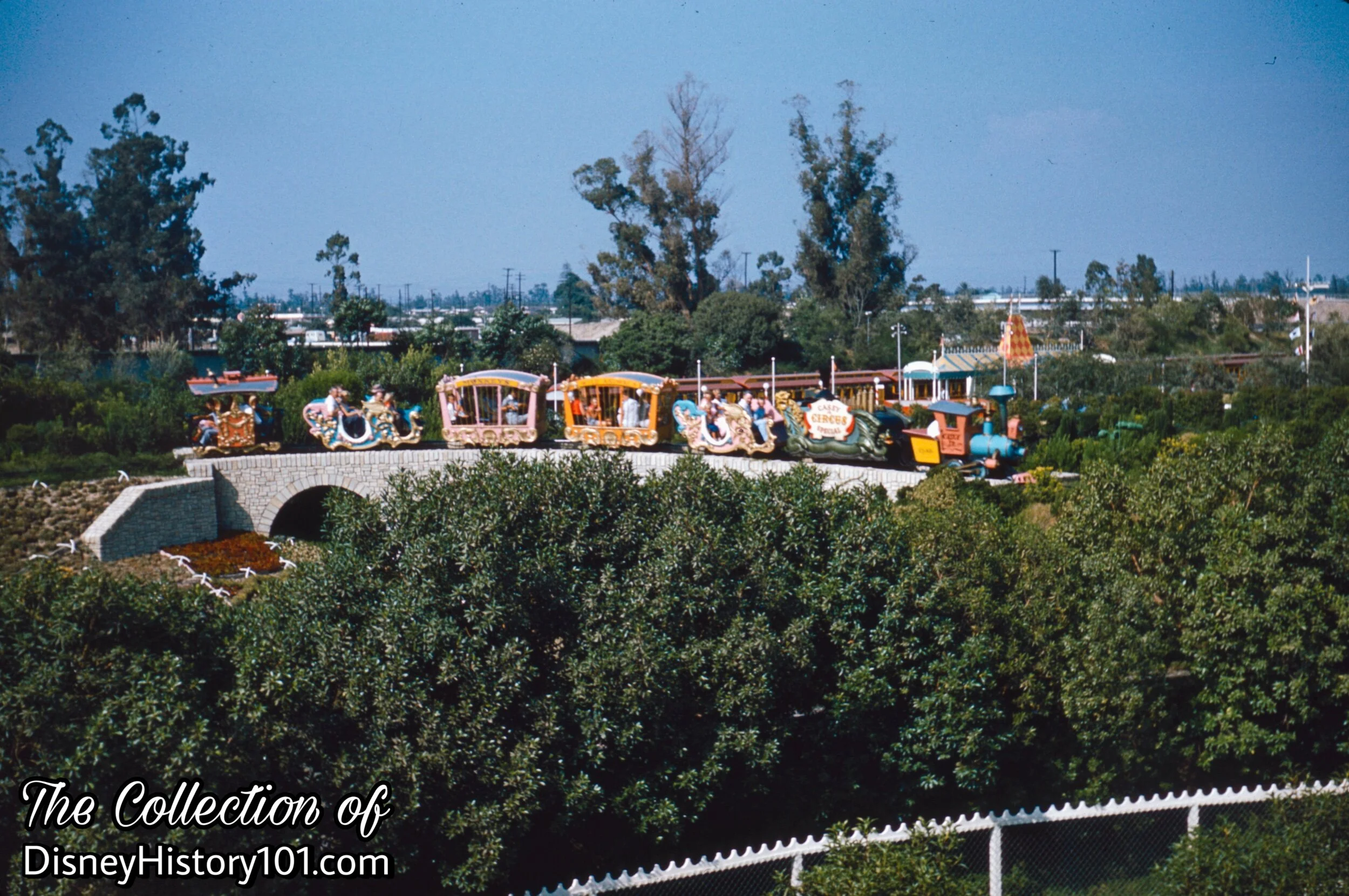
Casey Jr. Circus Train, (1959)
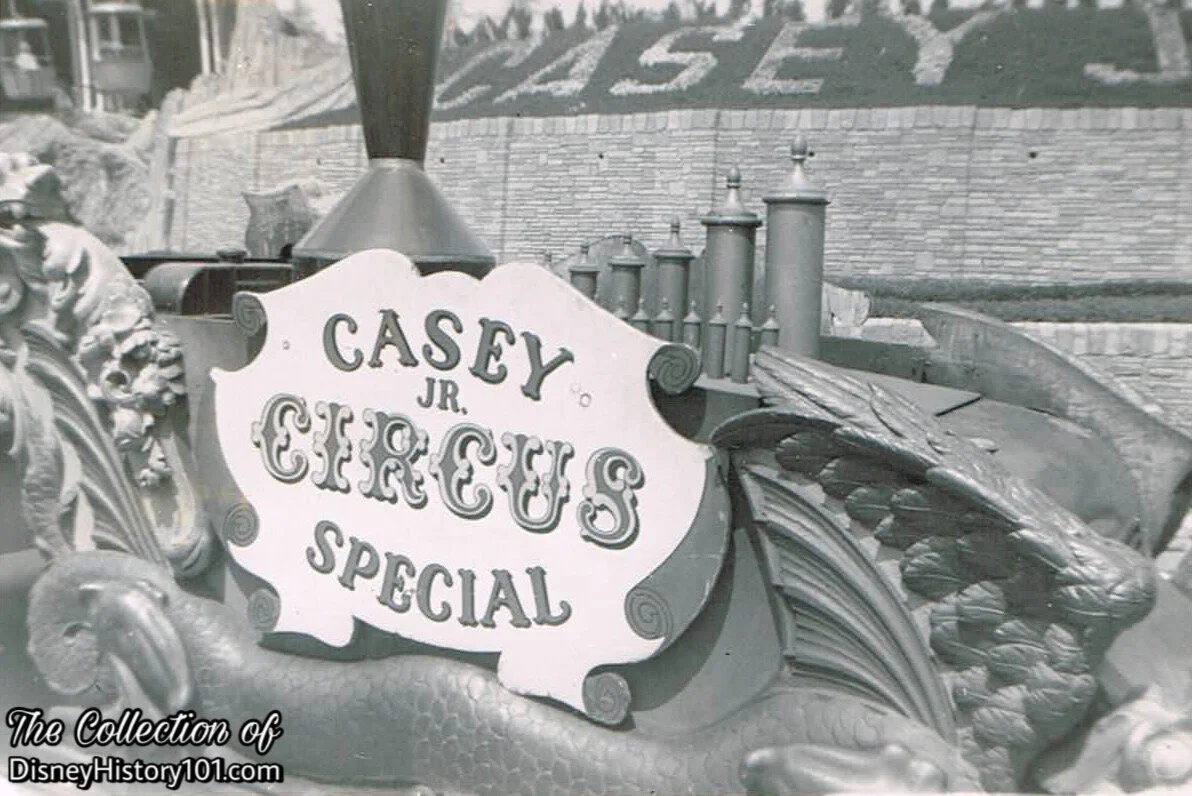
Casey Junior Circus Special Calliope Car, (November, 1959)
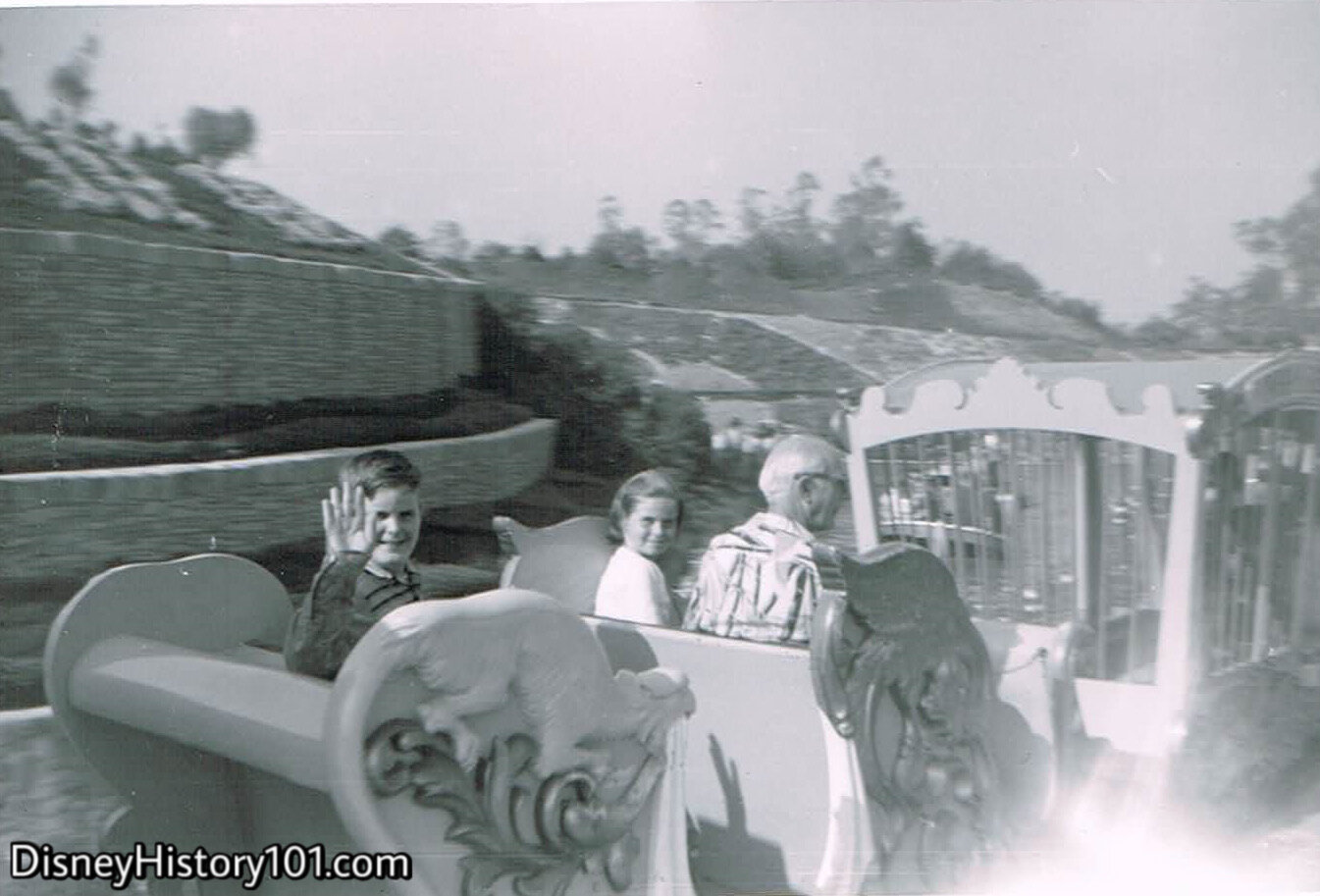
Disneyland Guests & Casey Jr. Circus Train Chariot
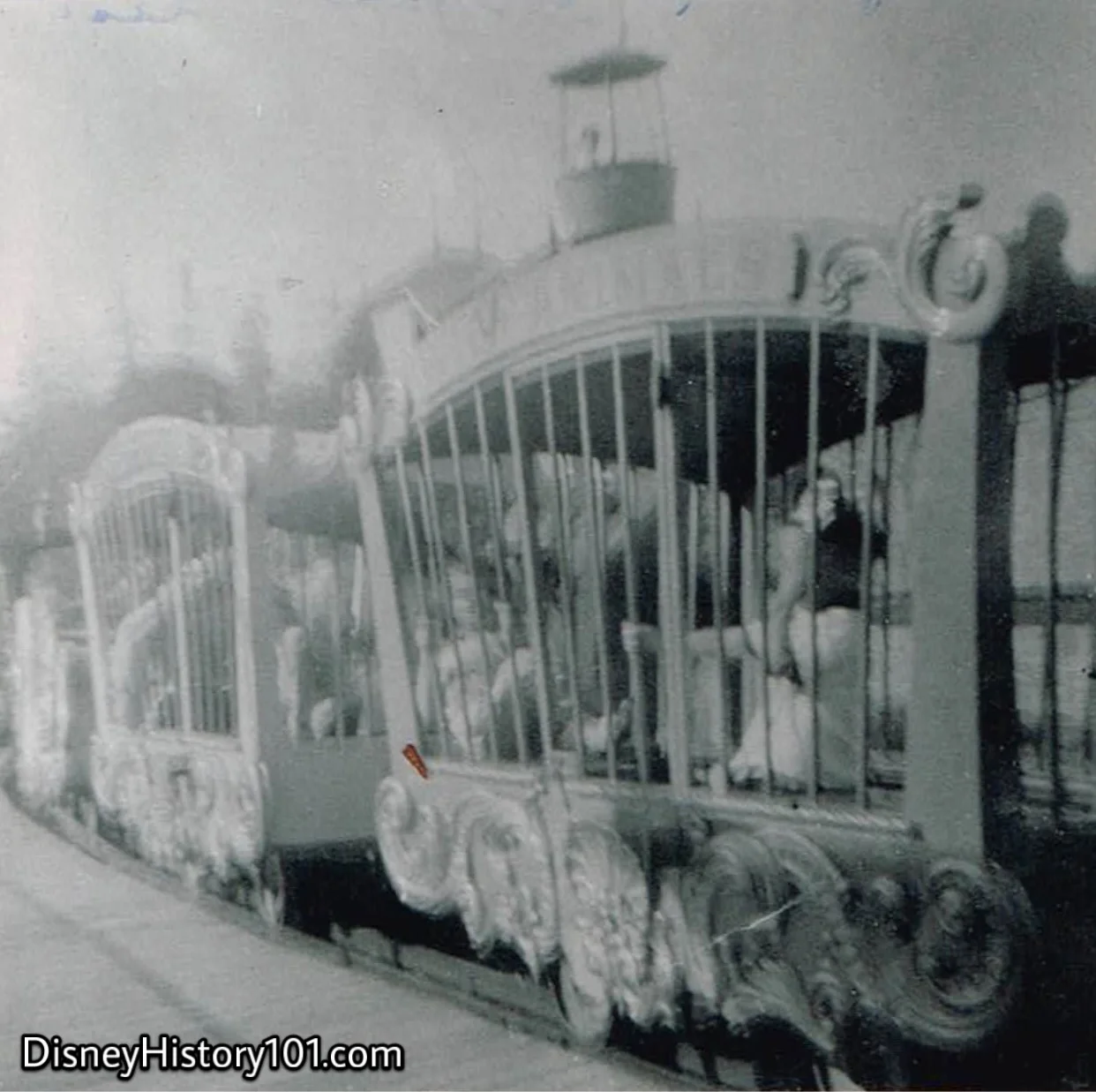
Disneyland Guests & Casey Jr. Circus Train Wild Animal Wagons
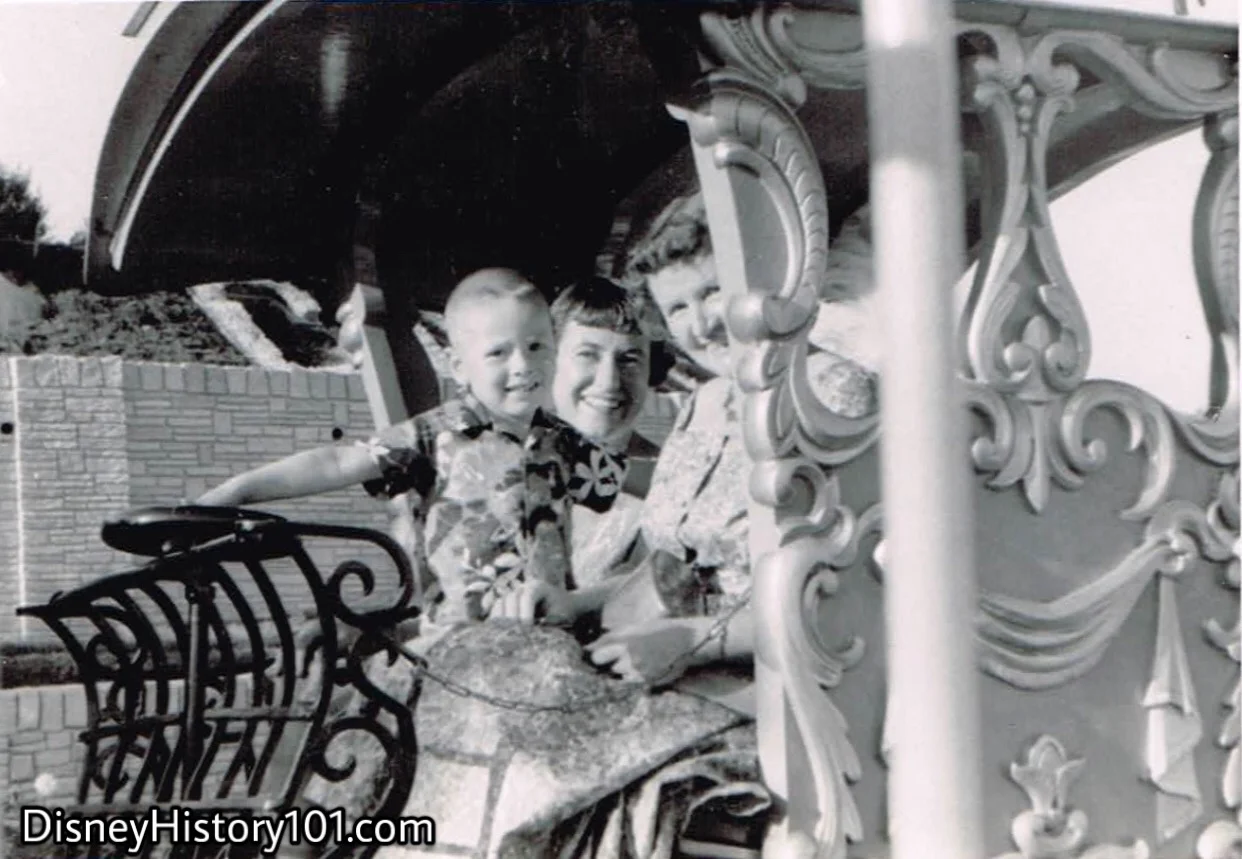
Disneyland Guests & Casey Jr. Circus Train Caboose, (November, 1959)
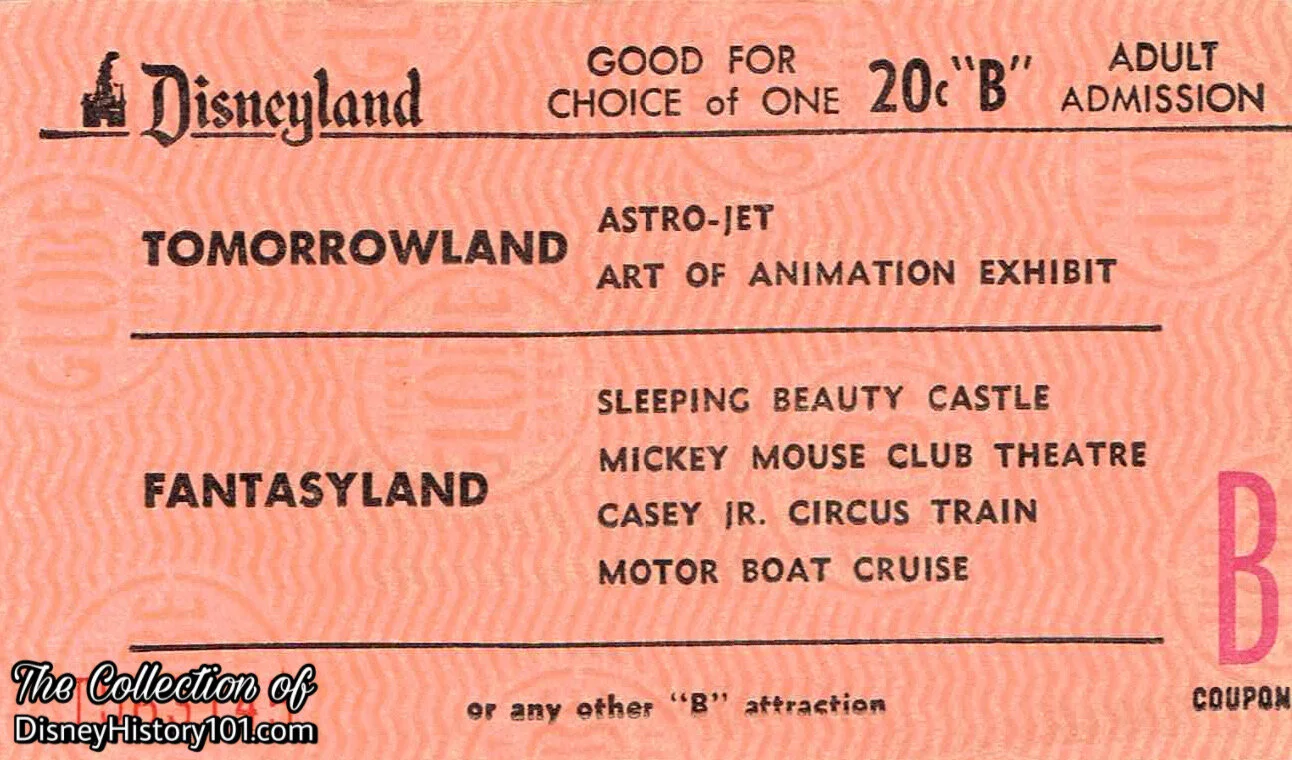
Disneyland "B" Attraction Adult Coupon (20¢ Value), Summer, 1960.
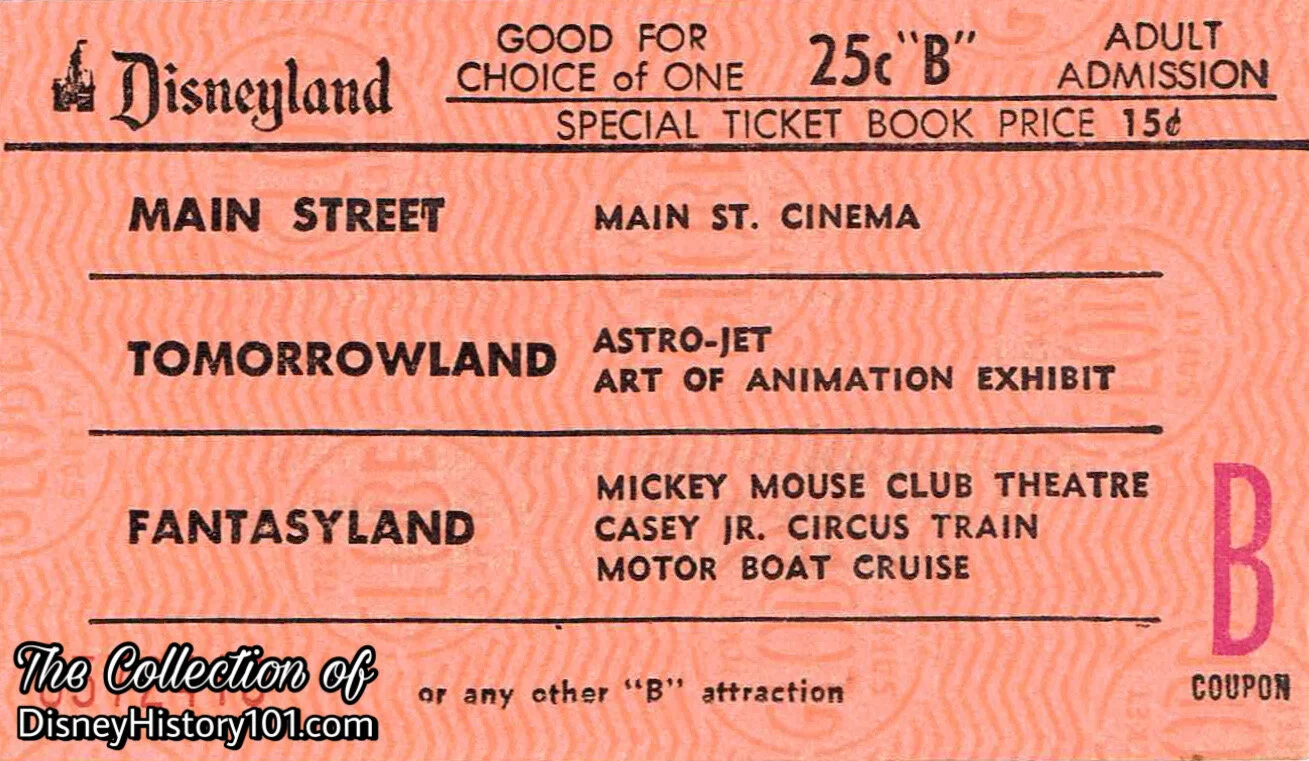
Disneyland “B” Attraction Adult Coupon (25¢ Value), (May 28, 1960 - August, 1964)
The “B” Coupon (cost of admission) increased by 5¢ during this era.
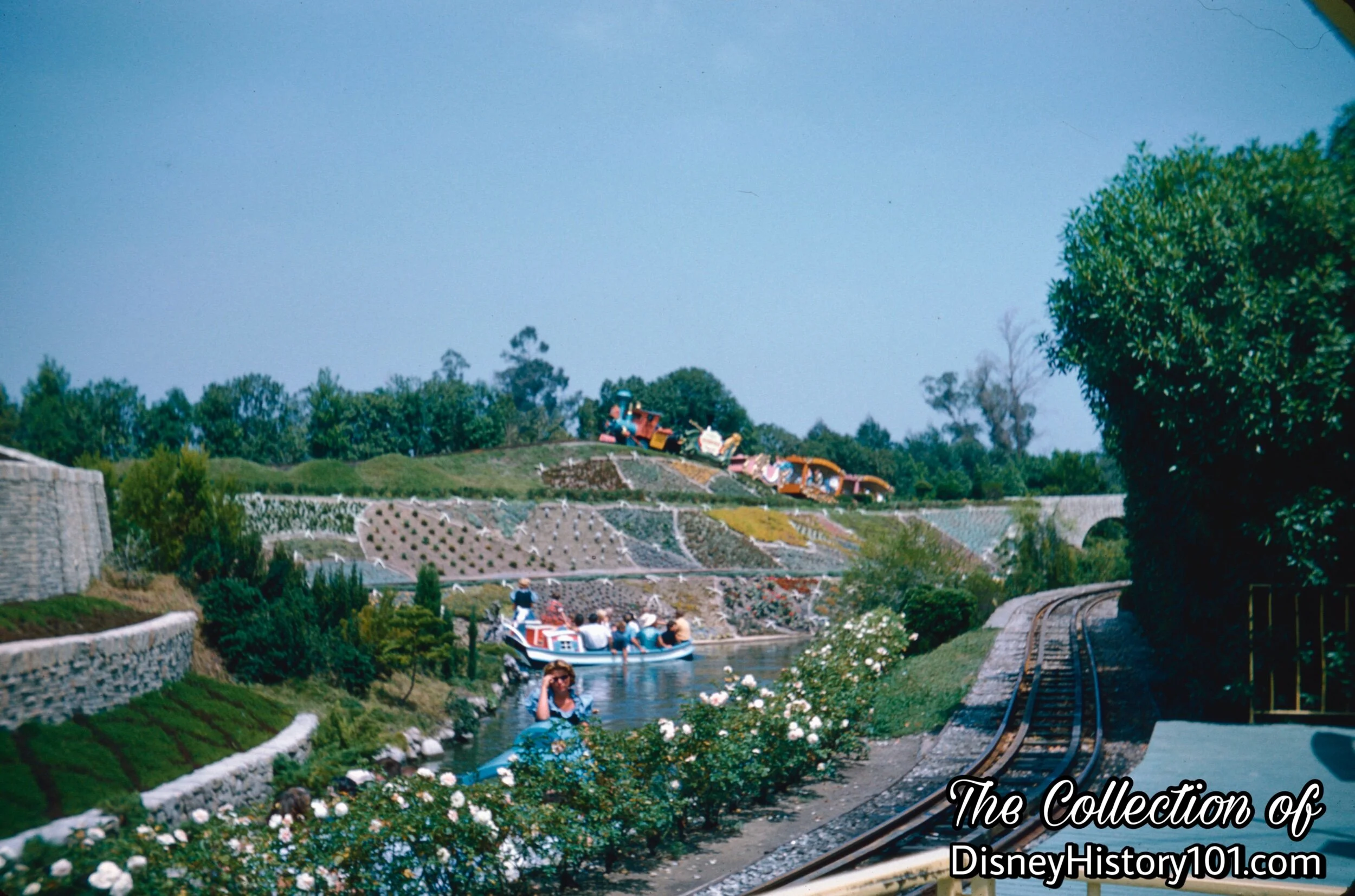
Casey Jr. Circus Train, (August, 1960)
Casey Jr. makes his way over “hill and dale”!
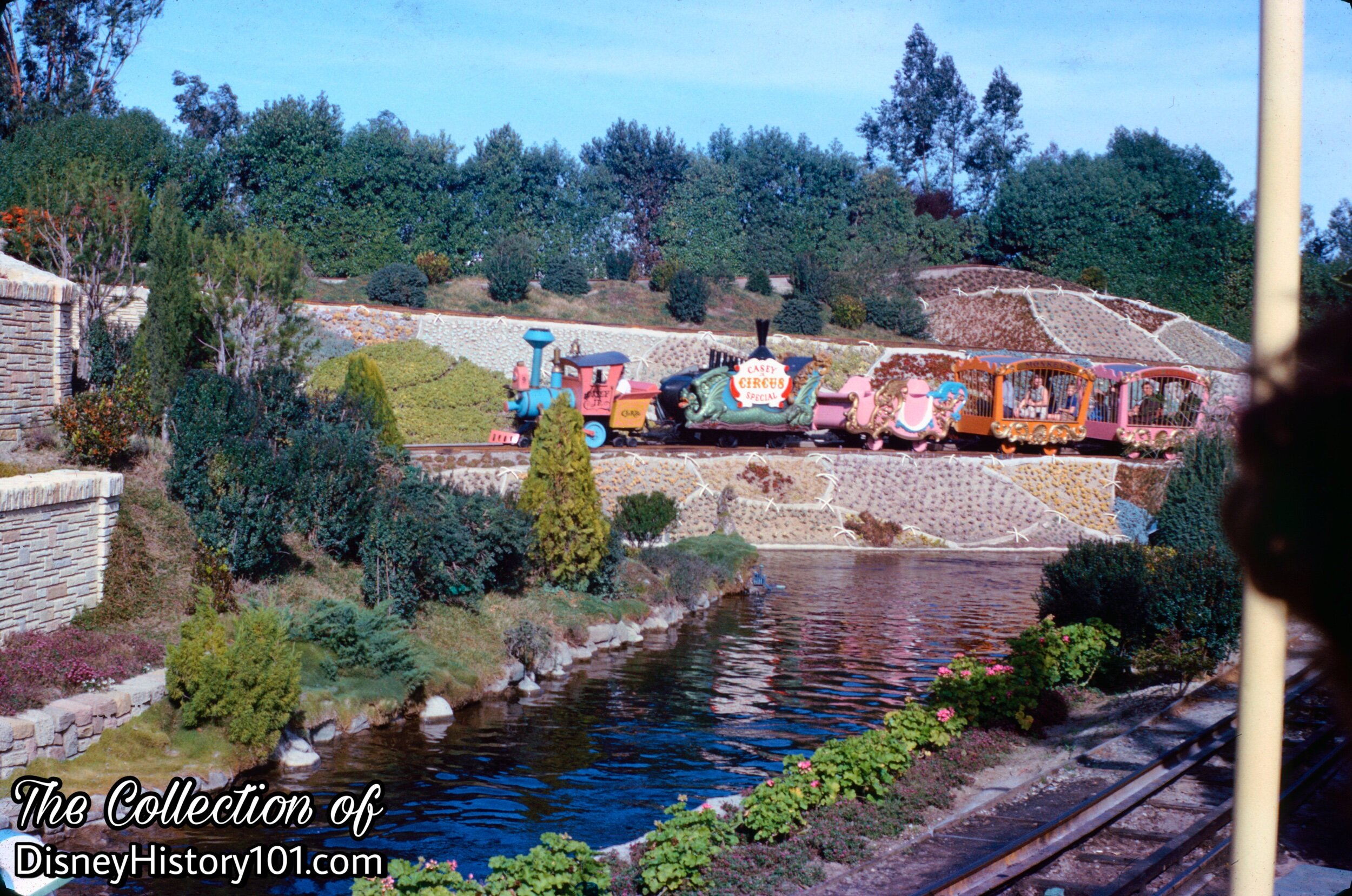
Casey Jr. Circus Train
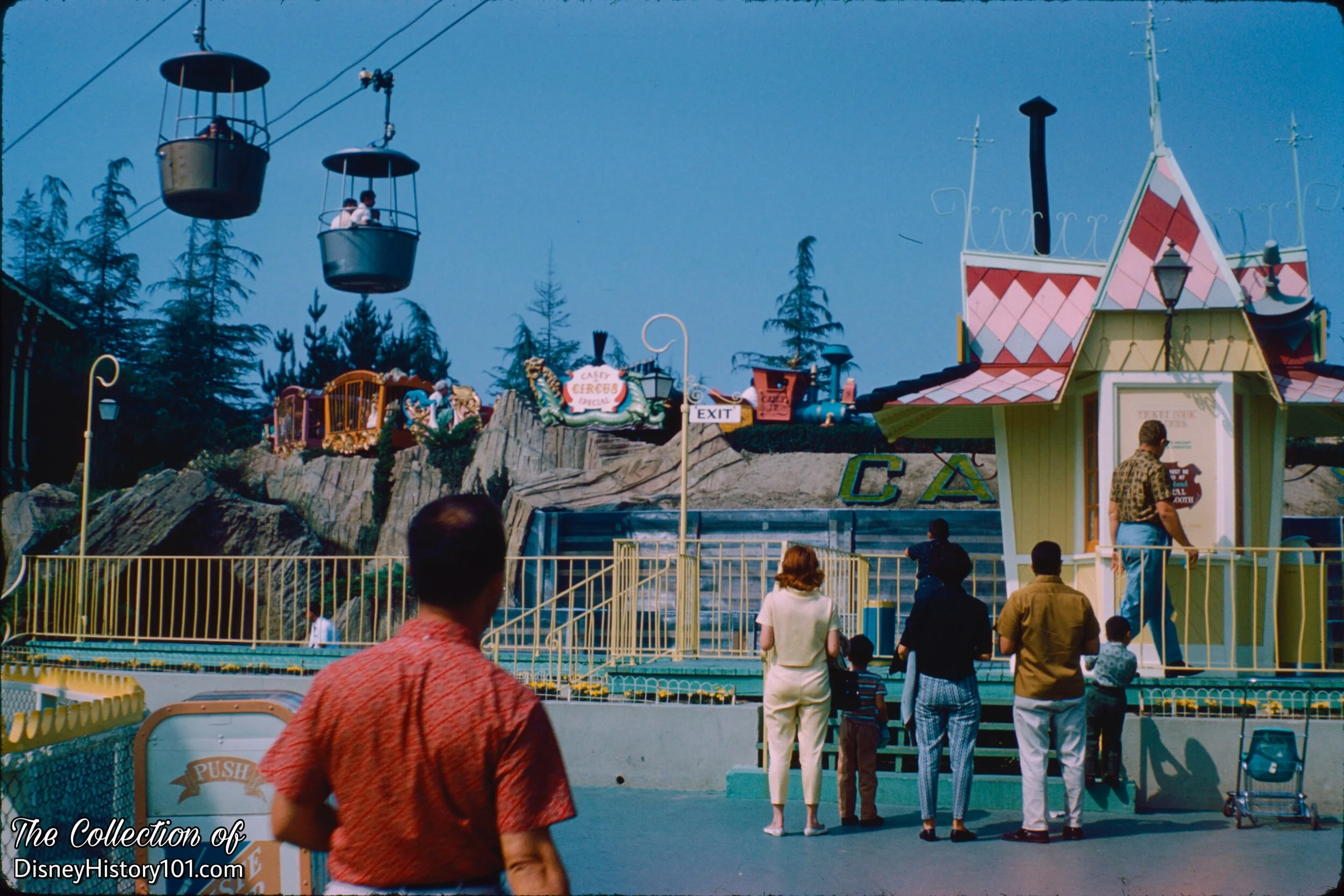
Casey Jr. Circus Train Ticket Booth, (October, 1961)
As mentioned earlier, Disneyland employee Immogene Brinkmeyer was the very first ticket seller at this particular location, while Disneyland Tour Guide Anne Daniel would be the last employee to work this ticket booth!
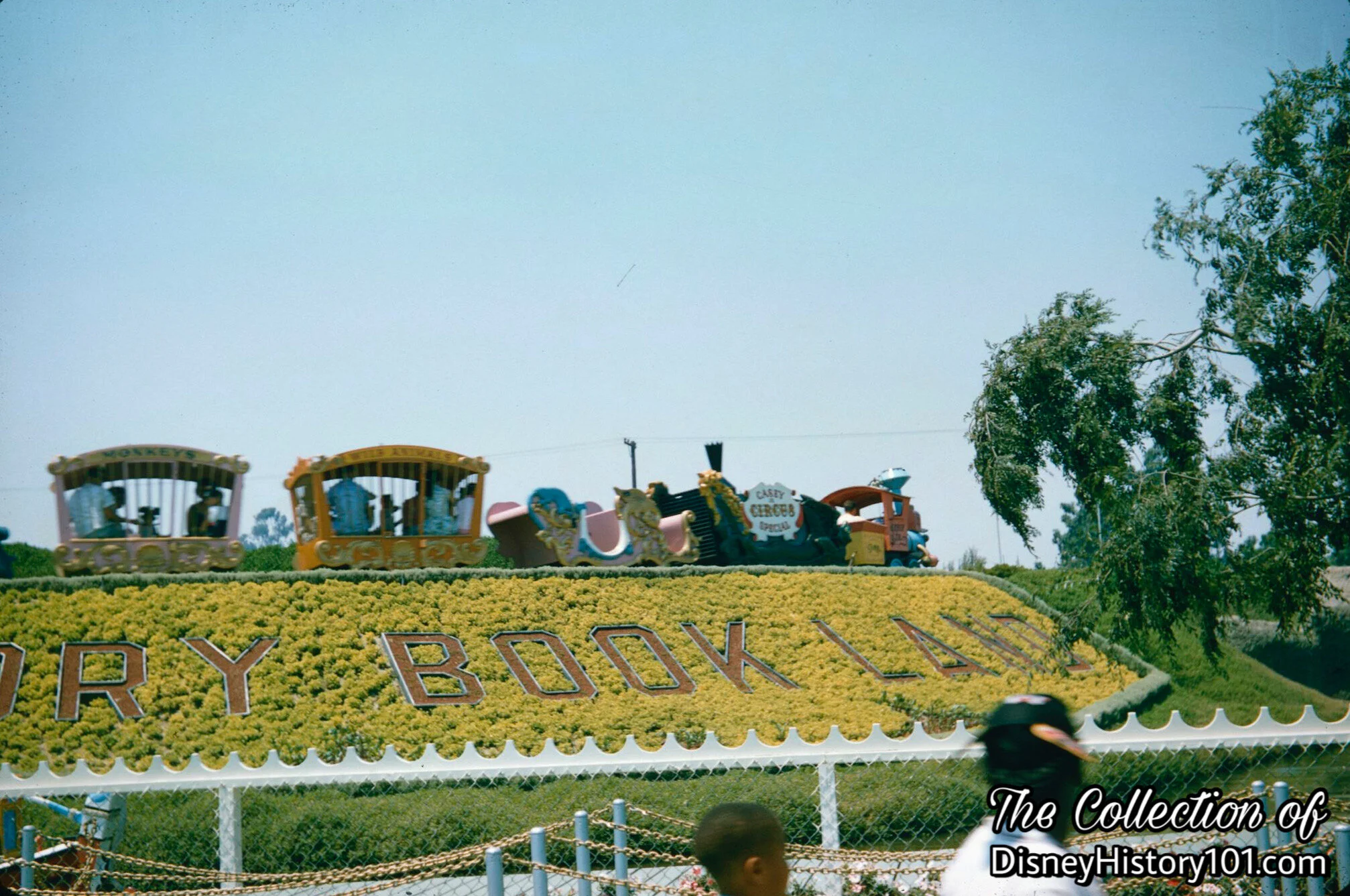
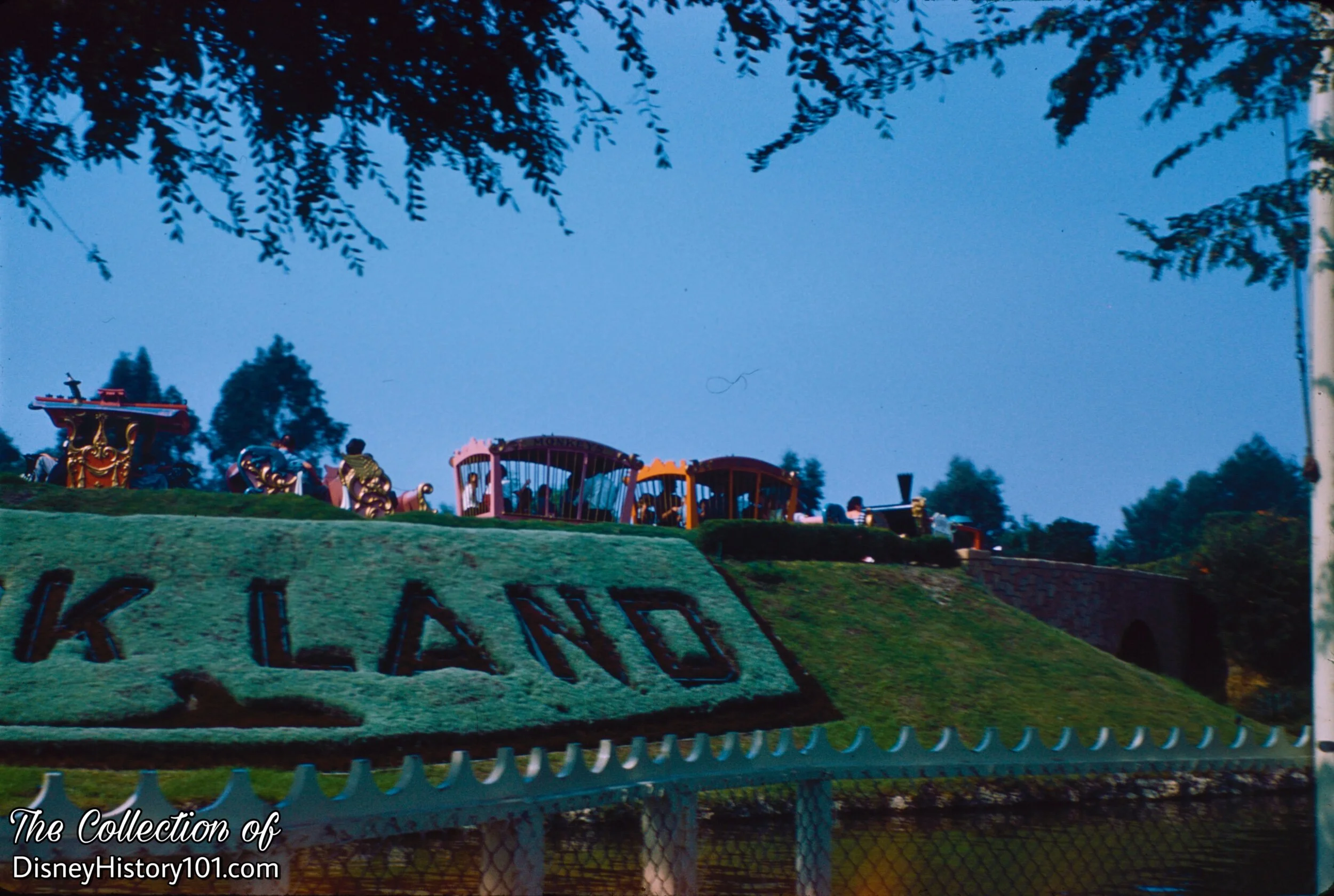
Casey Jr. Circus Train, (October, 1961)
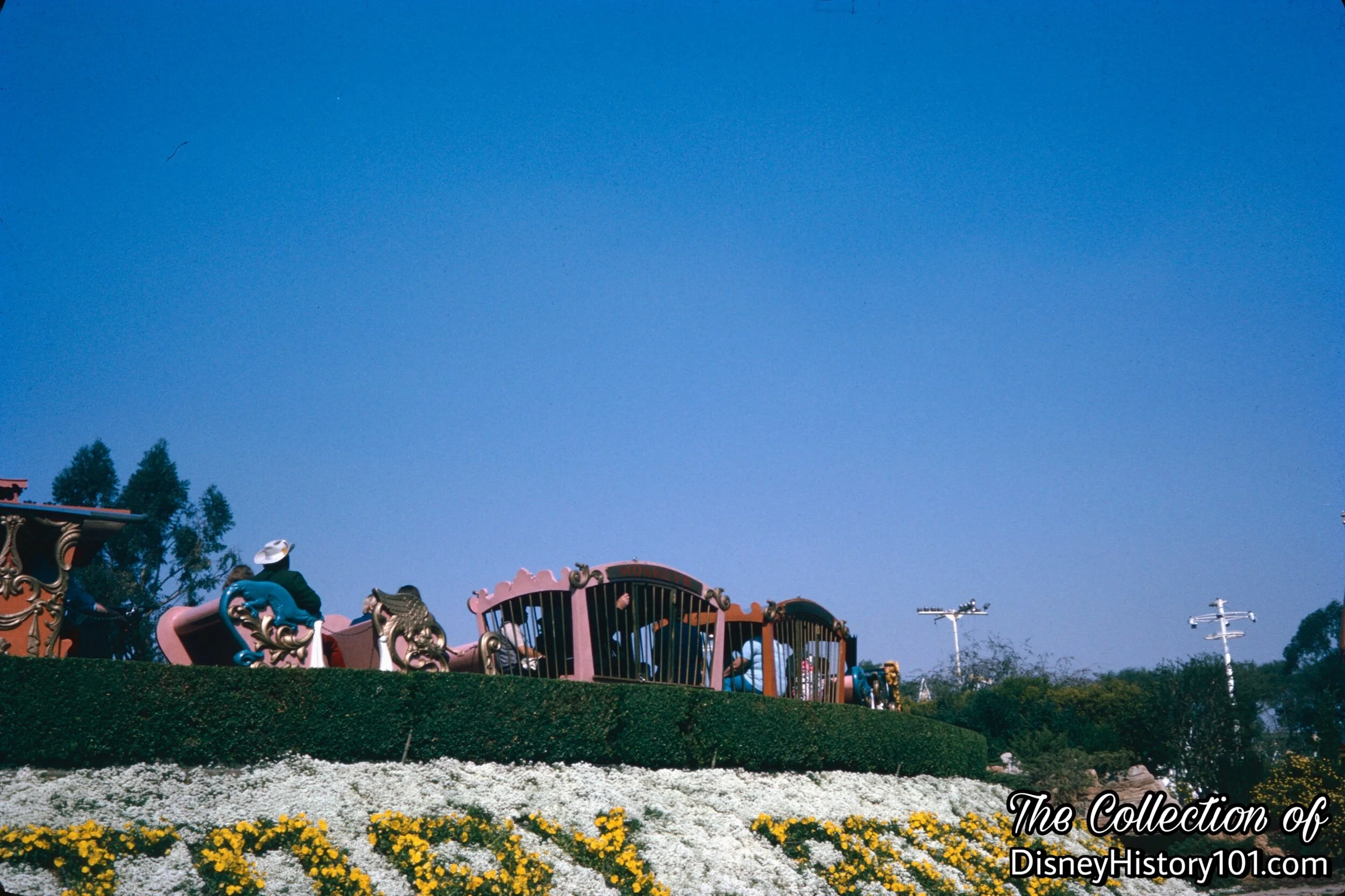
Casey Jr. Circus Train
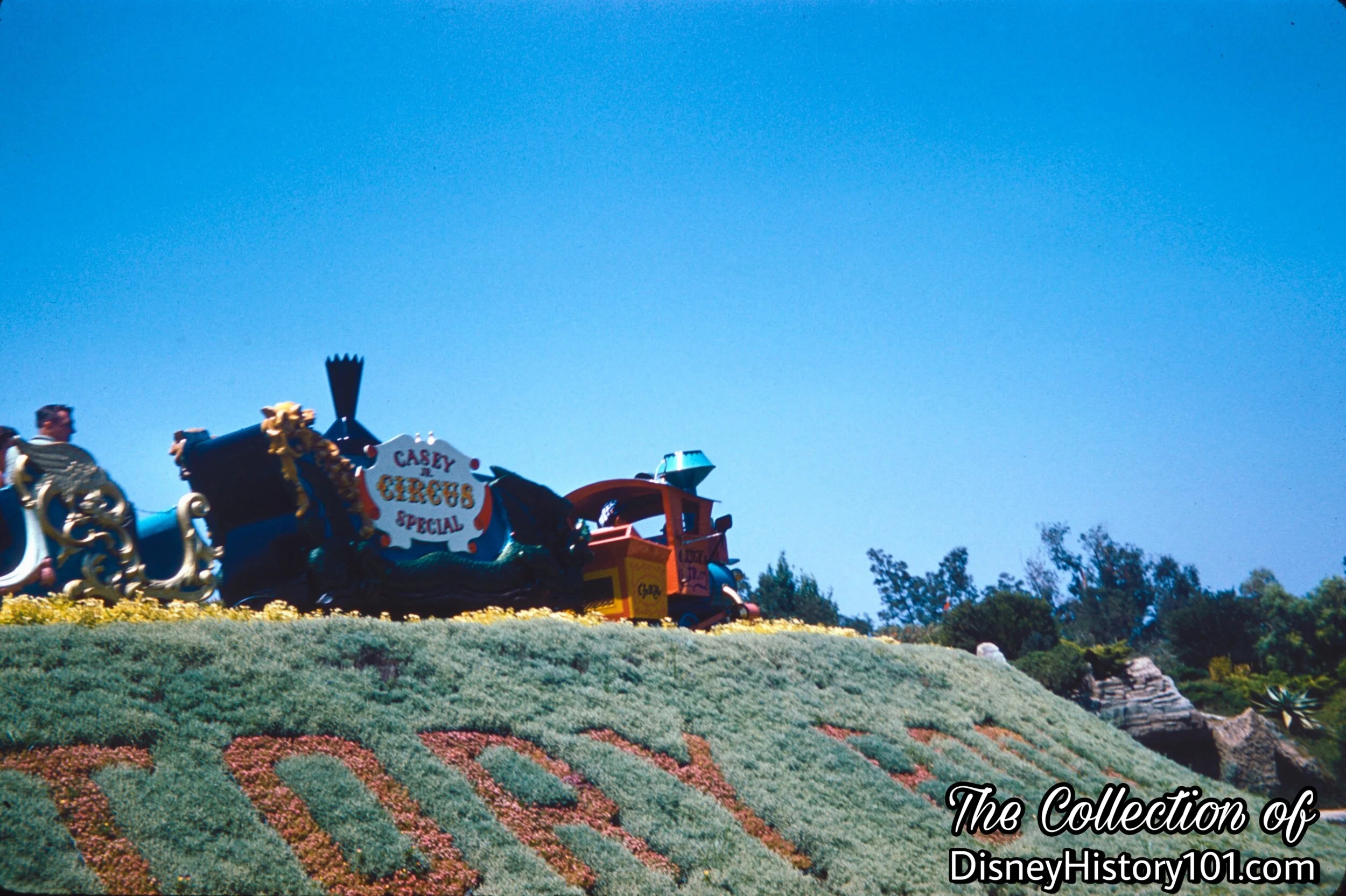
Casey Jr. Circus Train
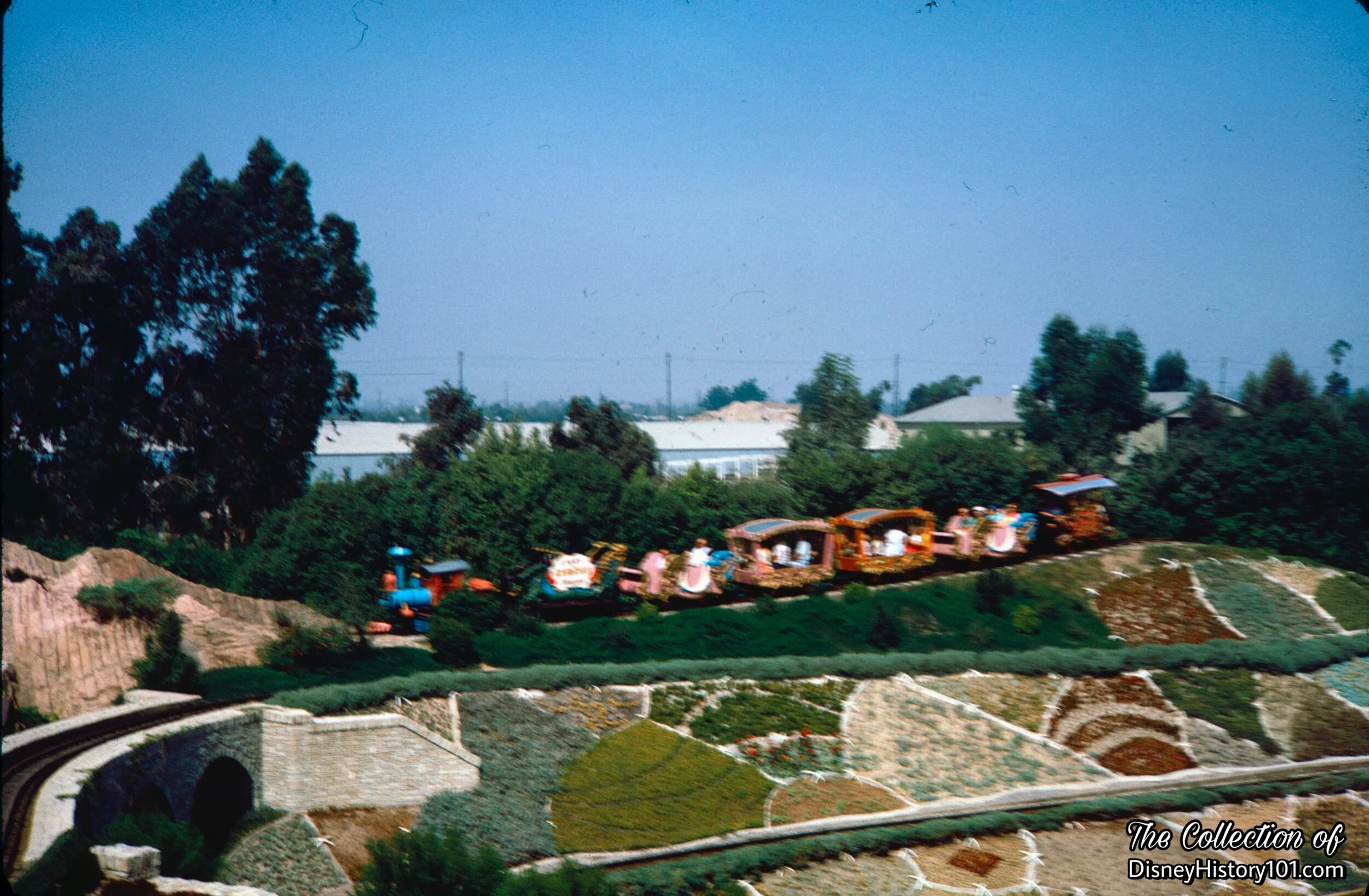
Casey Jr. Circus Train, (September, 1962)
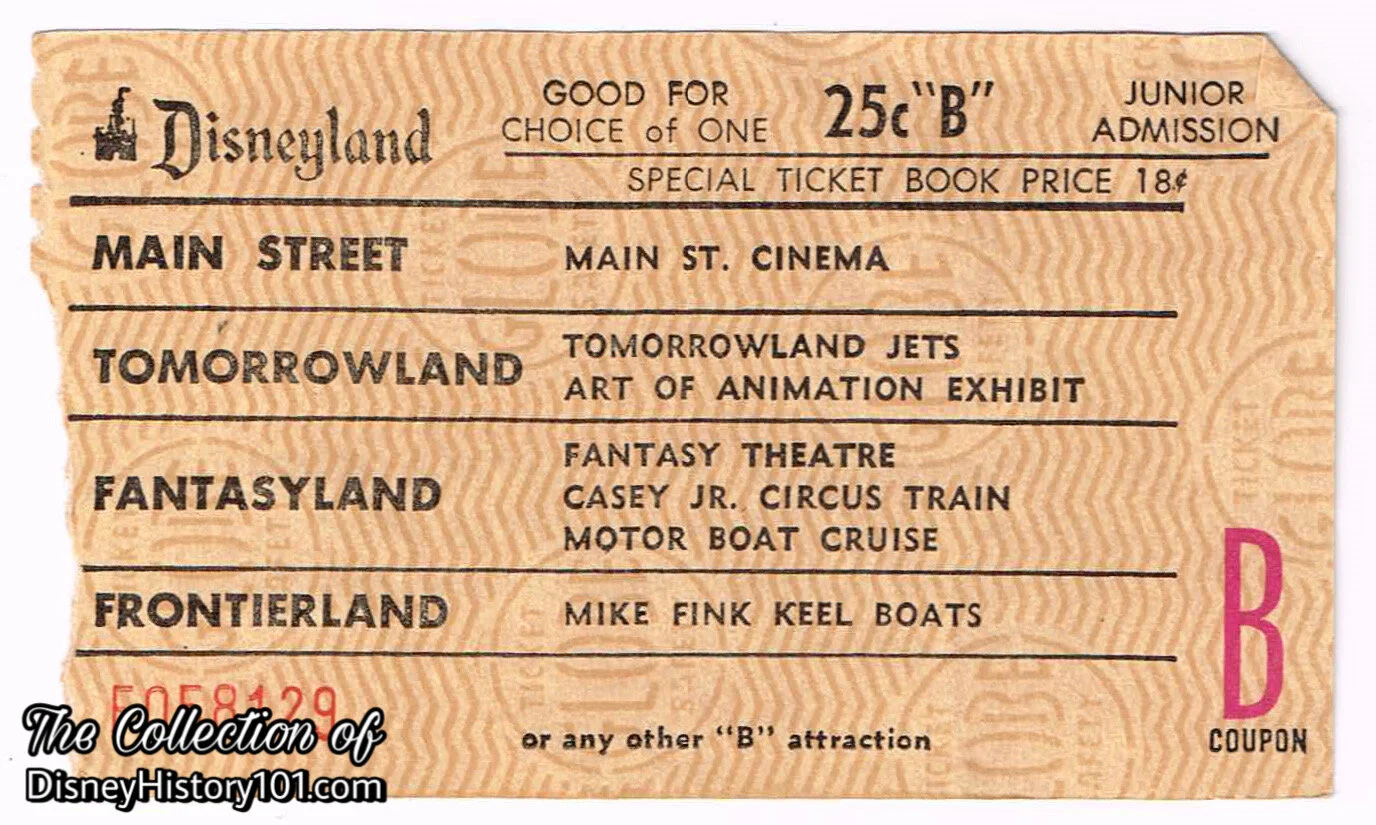
Disneyland "B" Junior Admission Coupon (25¢ Value), (August 7, 1964 - September 5th, 1966)
Yes, a ride aboard Casey Jr.’s Circus Train is equated with a show at the newly renamed Fantasyland Theater and a flight inside the newly renamed Tomorrowland Jets!
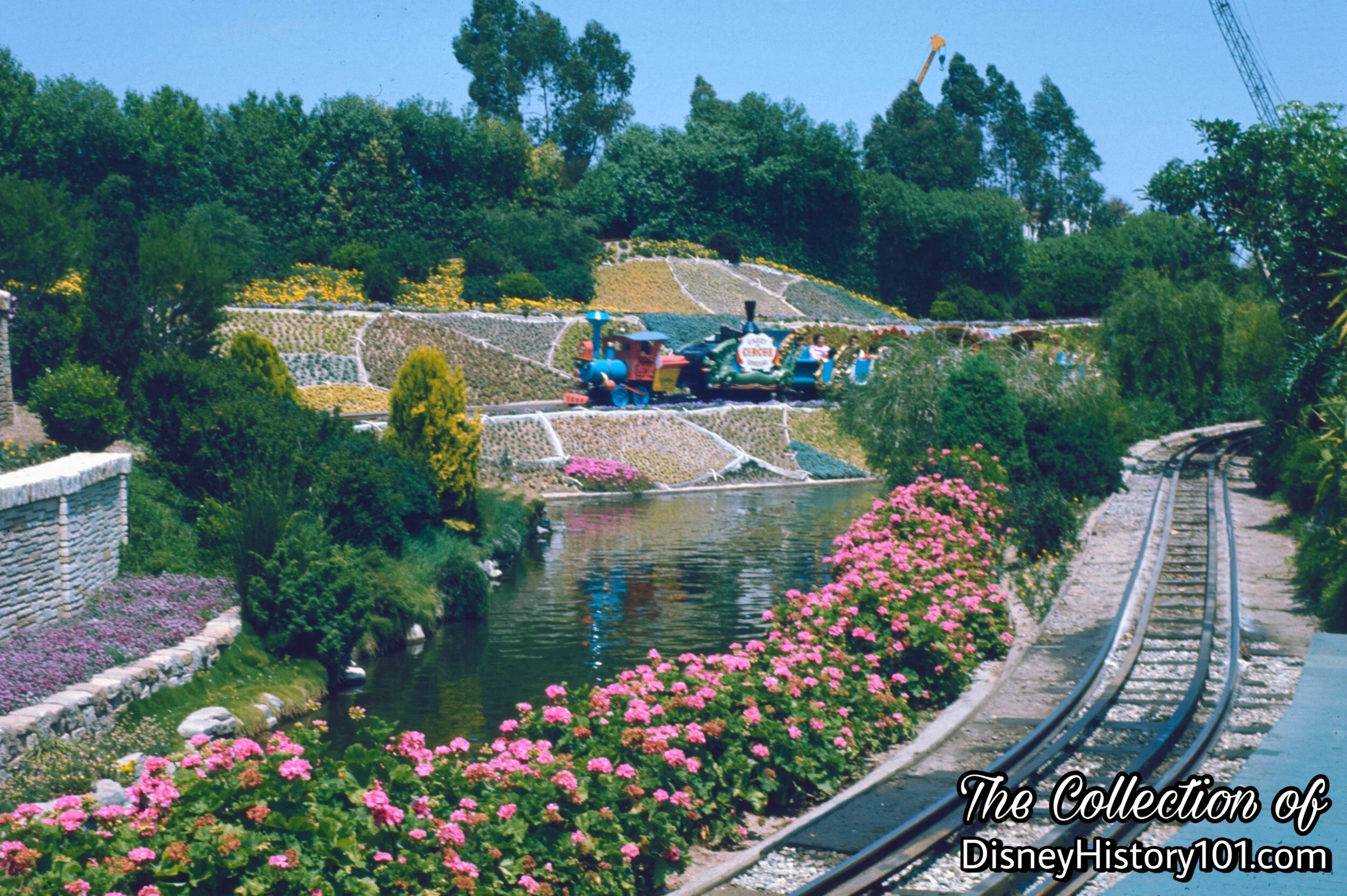
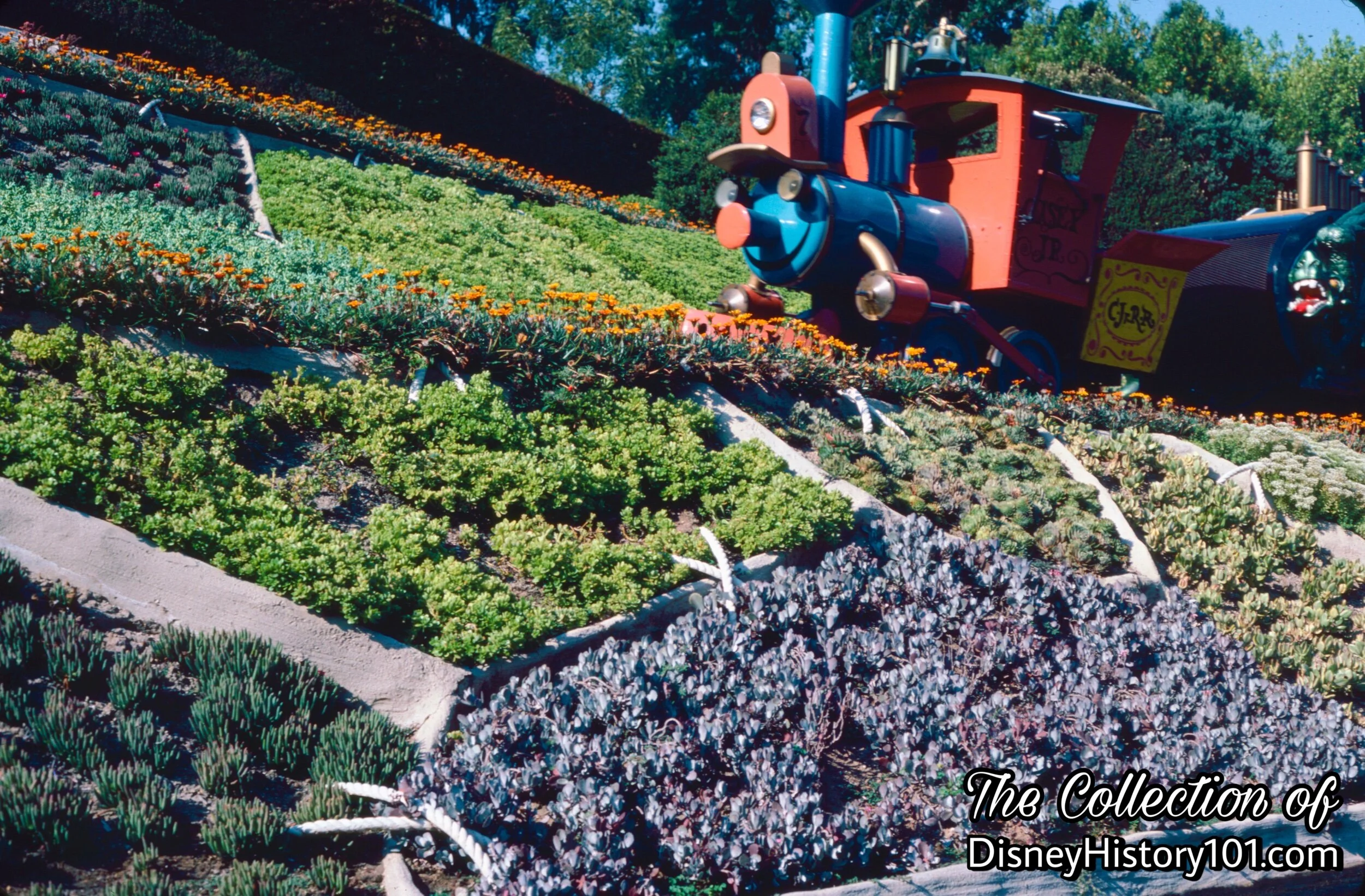
Casey Jr. Circus Train
Though the track was completely replaced during 1989, the Casey Jr. Circus Train’s layout has remained relatively the same since its opening in 1955! The attraction’s soundtrack includes the original c. 1942 Academy Award winning song (with composition by Frank Churchill, and Oliver Wallace) and lyrics (by Ned Washington, with some consultation with Joe Grant and Dick Huemer). Finally, new Circus Ringmaster spiels were added (voiced by Ray Temple, performing a variation of Herman Bing’s original character voice).
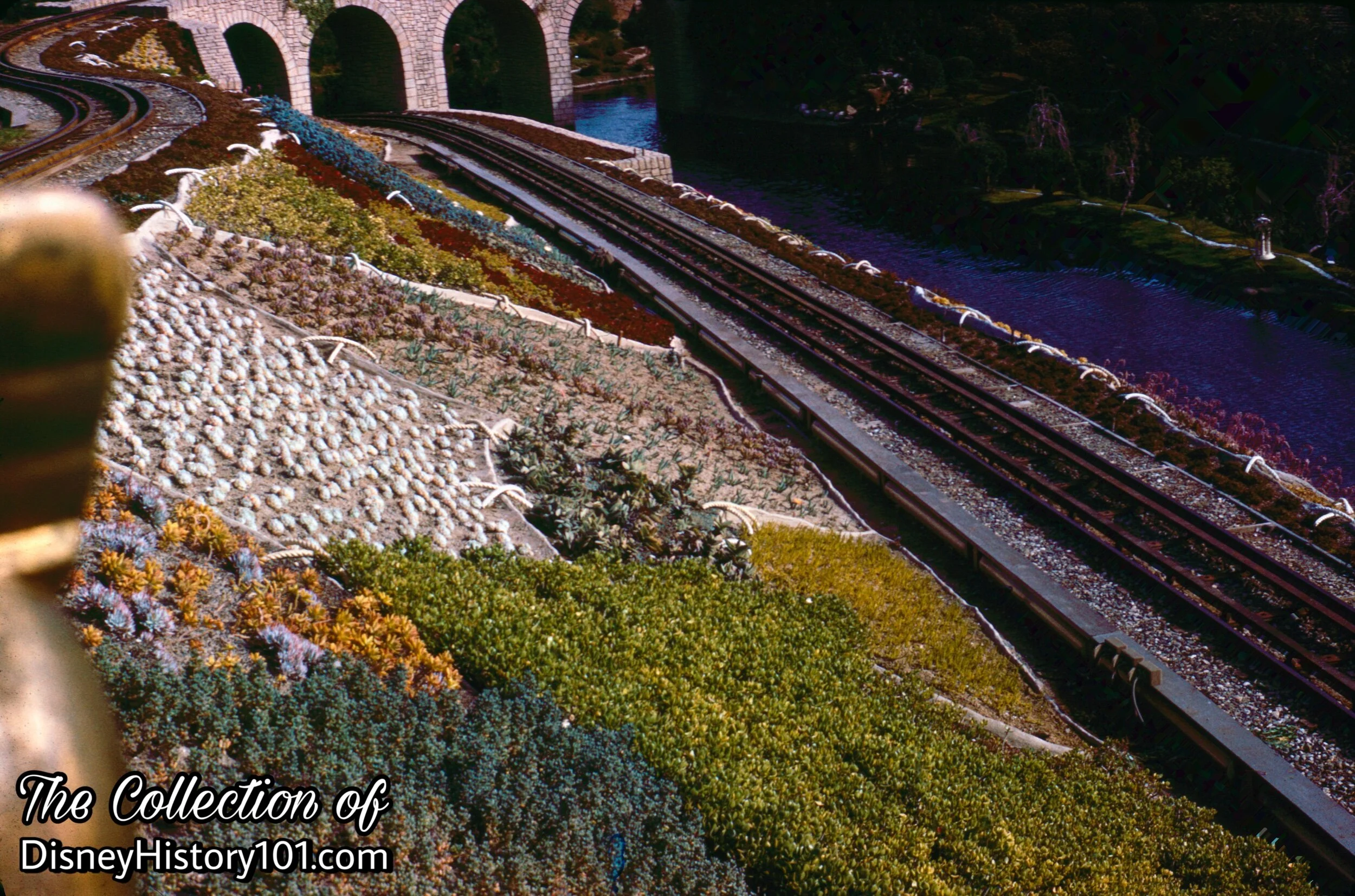
Casey Jr. Circus Train, (January, 1965)
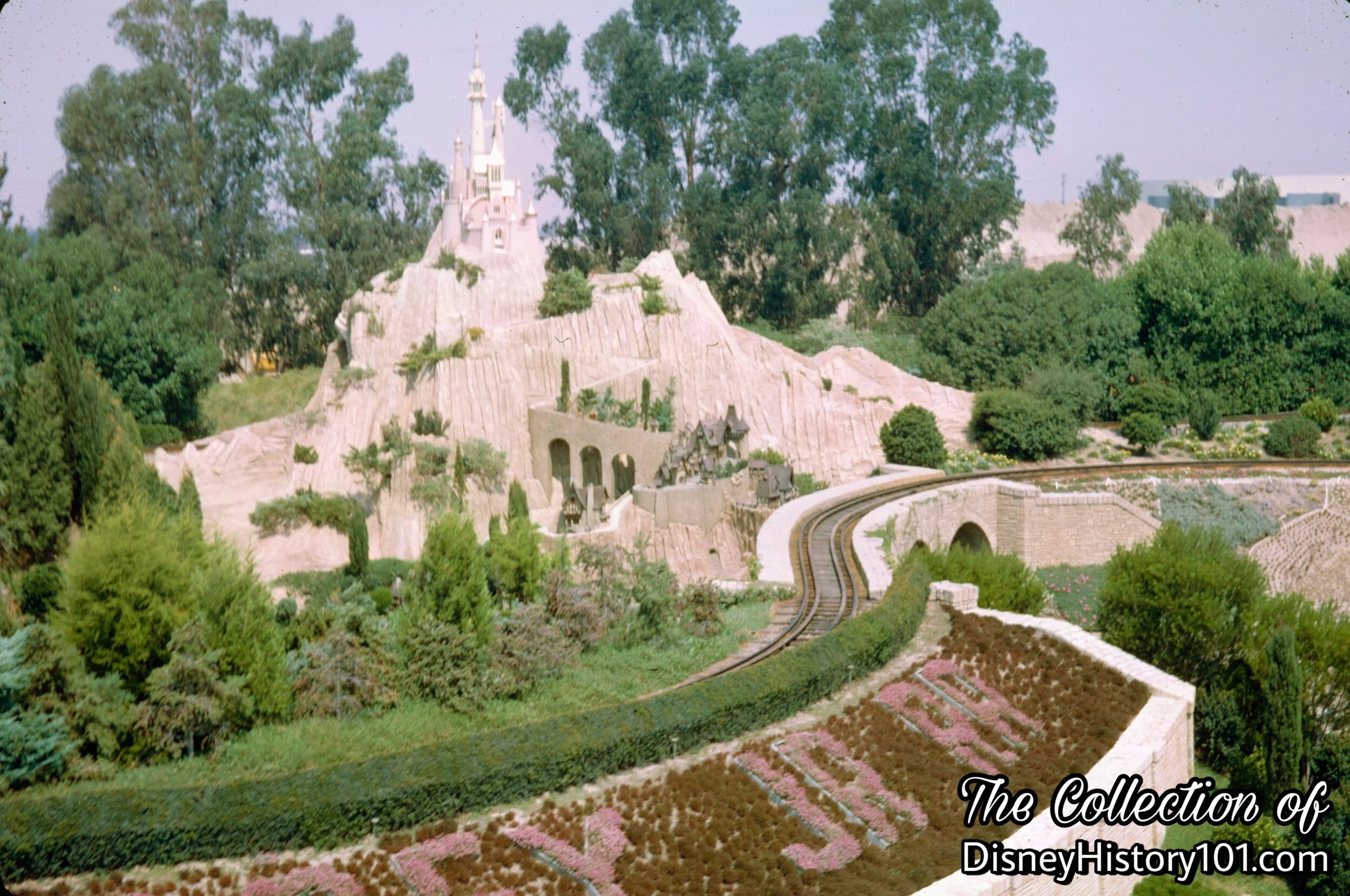
Casey Jr. Circus Train Track and Rails, (September, 1965)
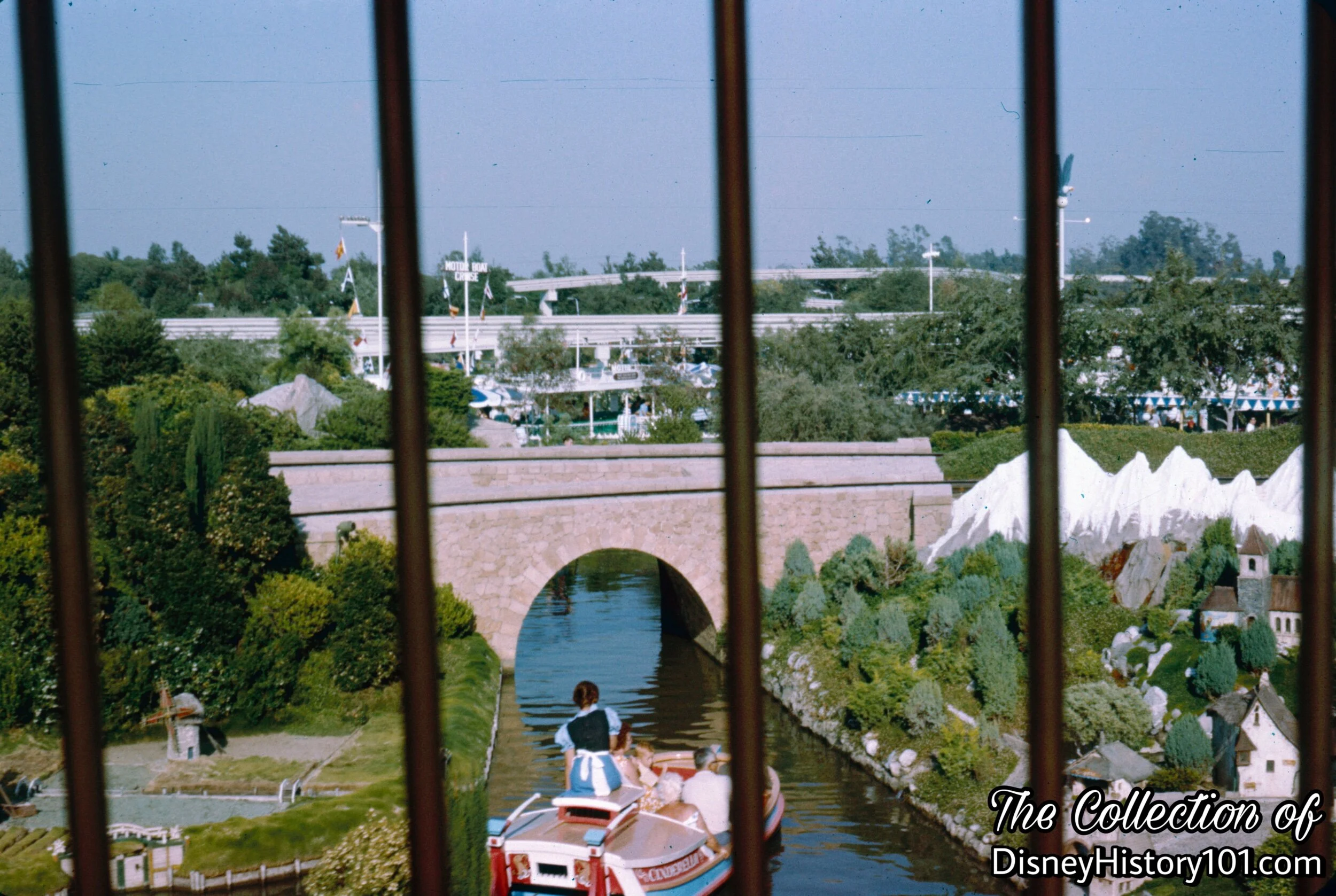
Casey Jr. Circus Train
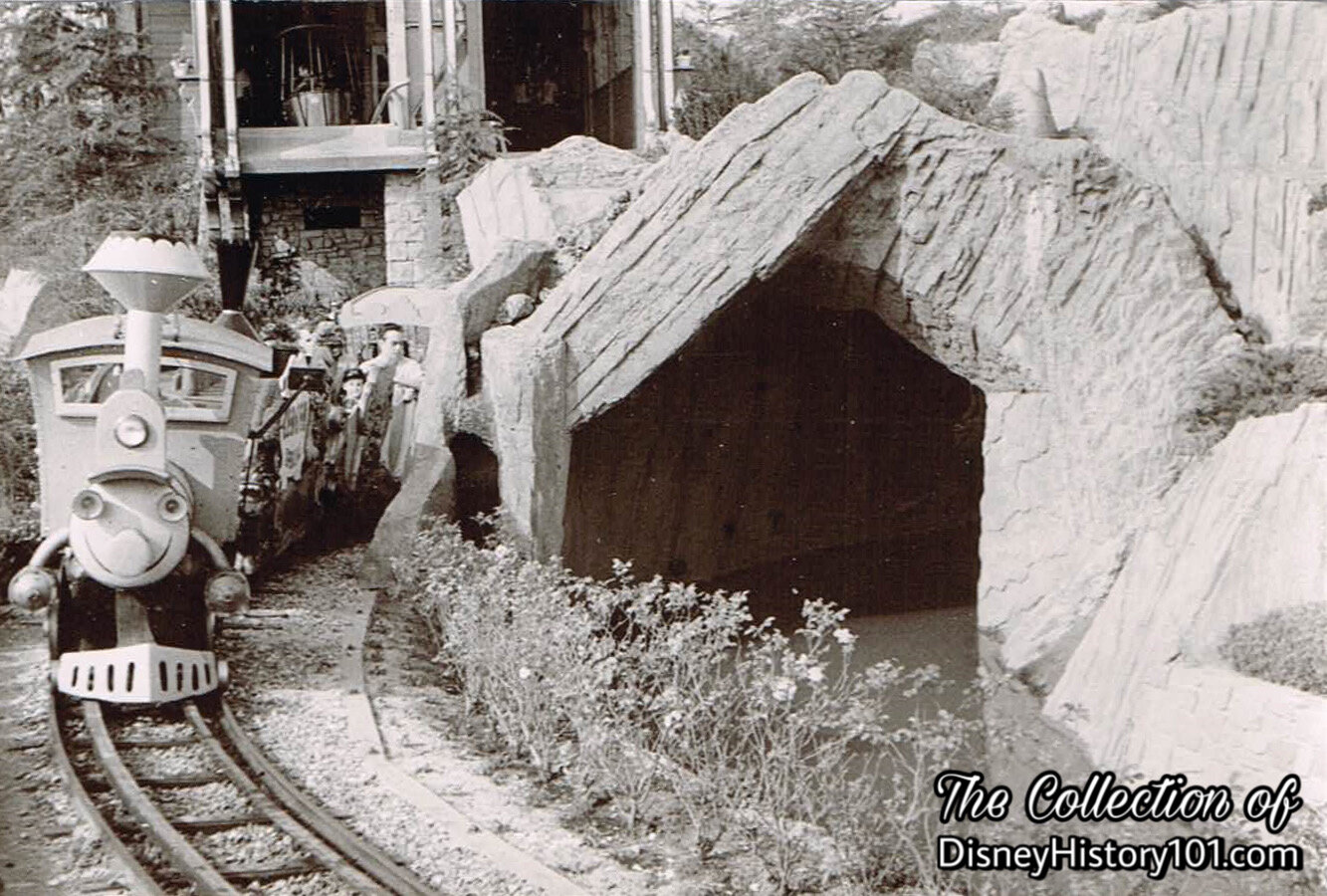
Casey Jr. Circus Train
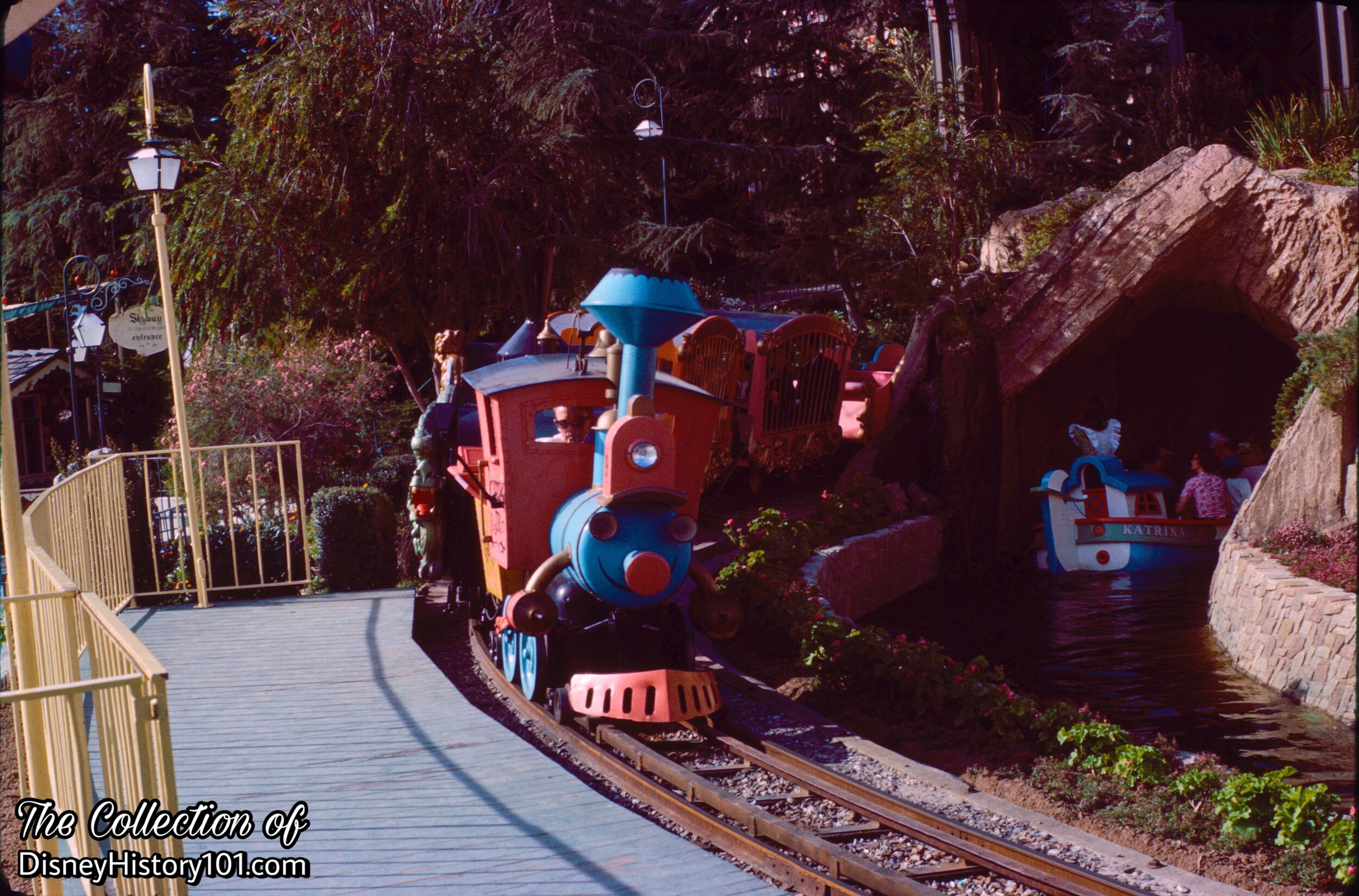
Casey Jr. Circus Train, (1965)
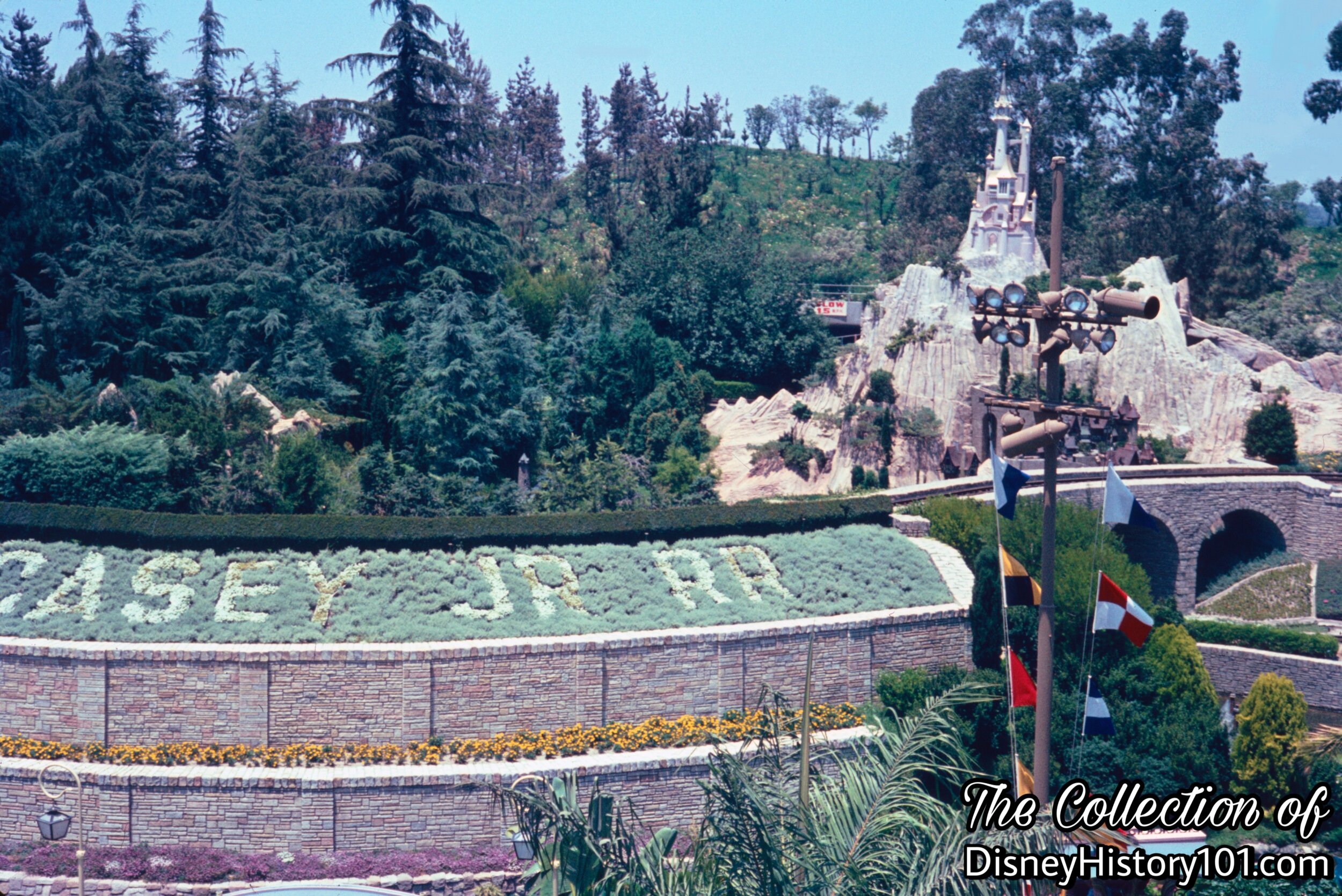
Casey Jr. Railroad Floral & Stone Bridge, (c. July, 1966)
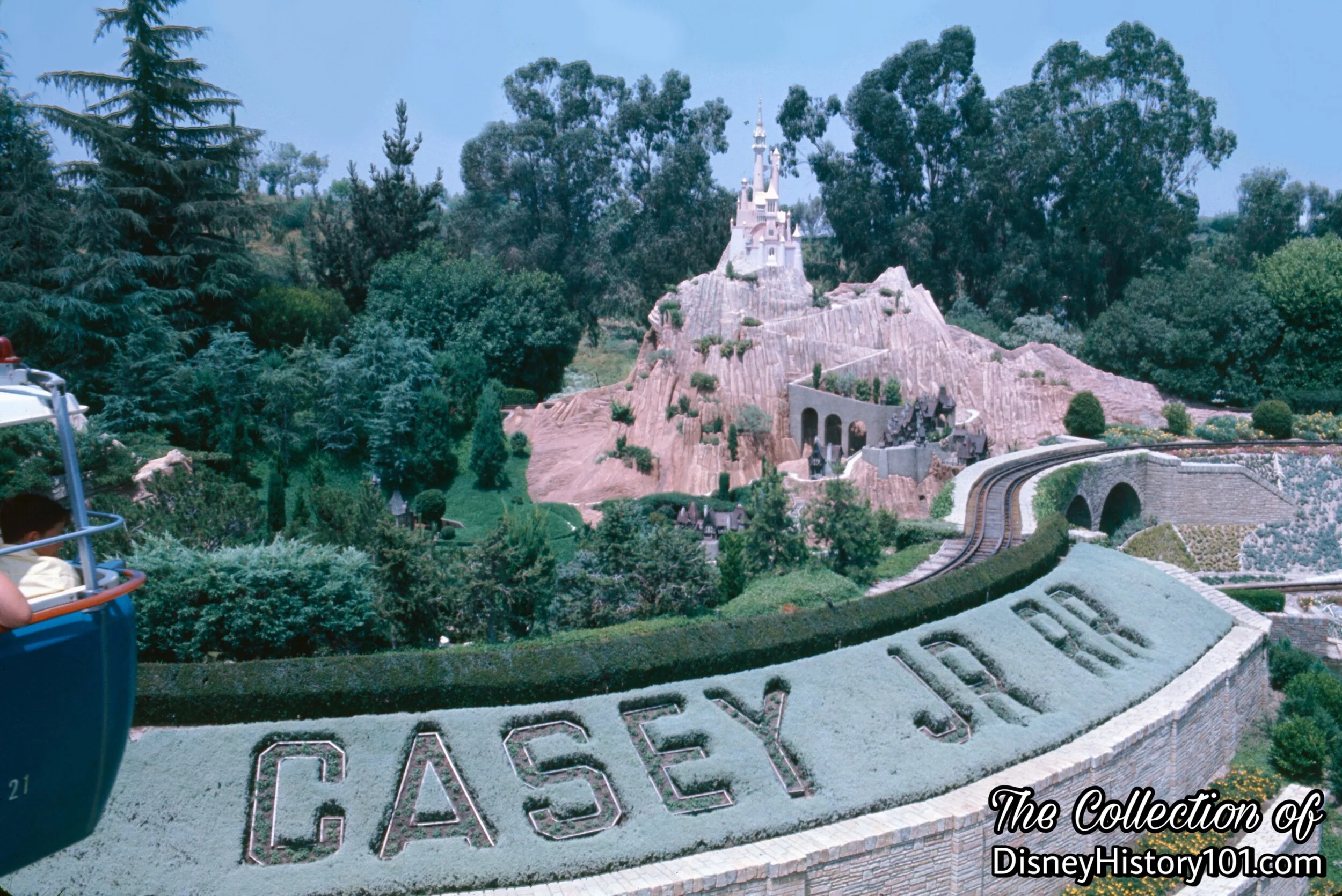
Casey Jr. Circus Train, (August, 1967)
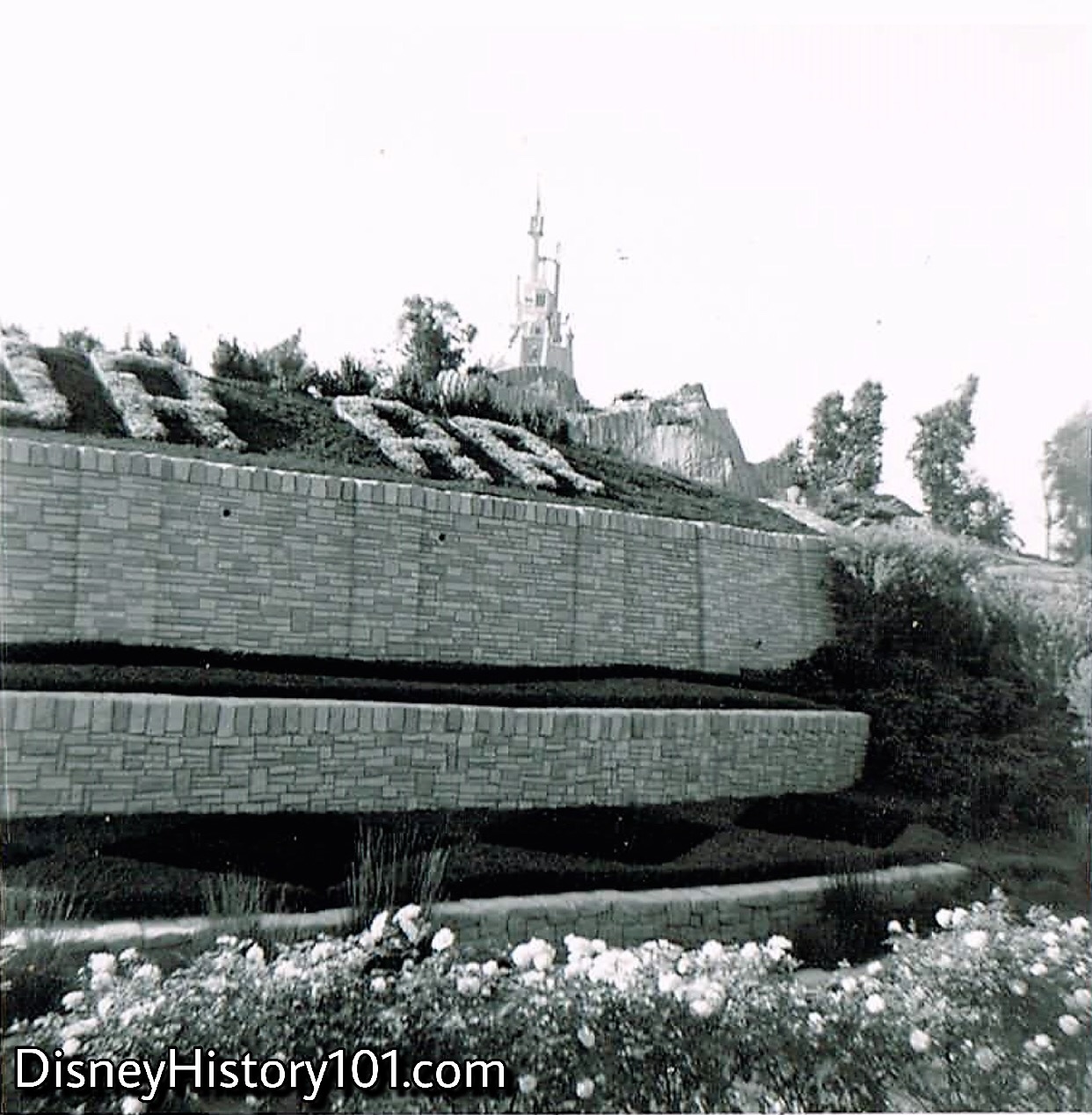
Casey Jr. Circus Train Topiary
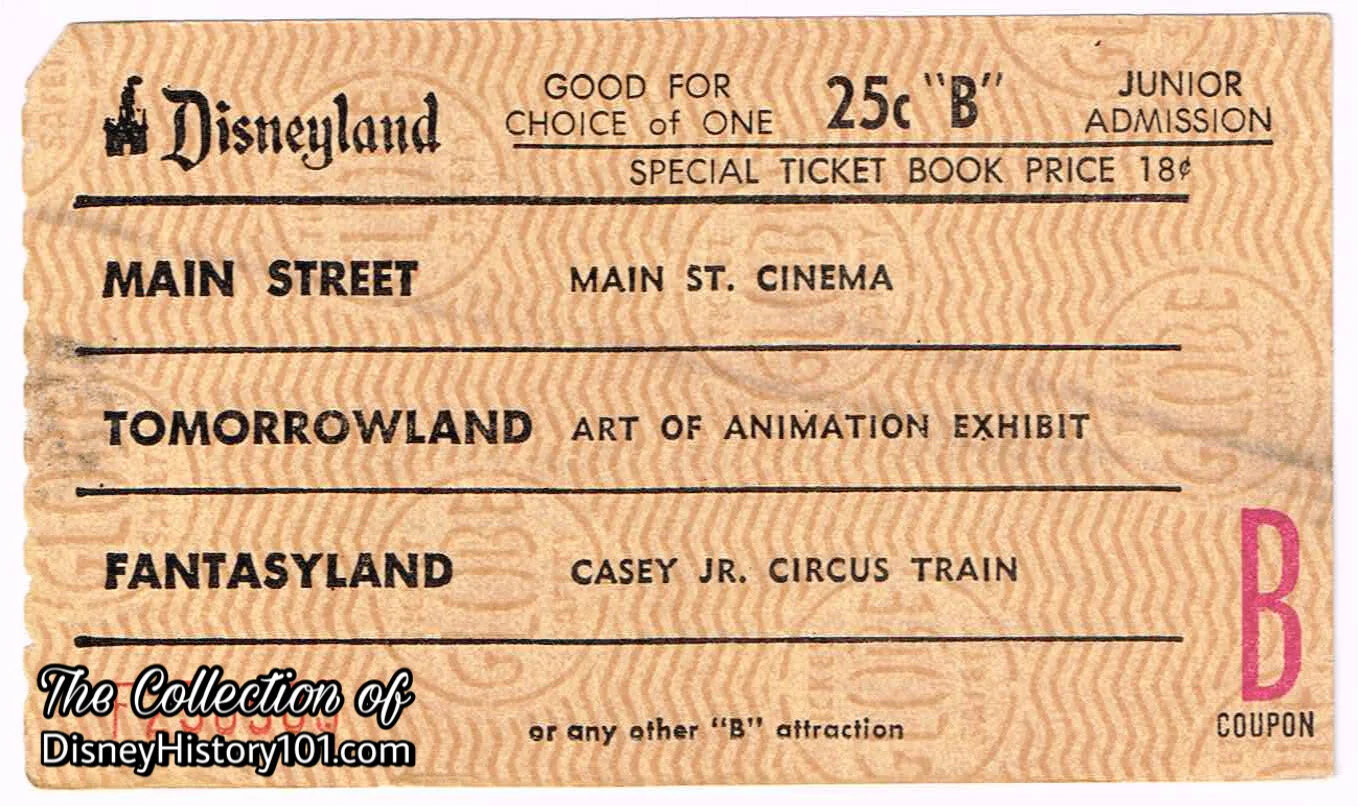
Disneyland "B" Junior Admission Coupon (25¢ Value)
The following four statistics are based on the results of Disneyland Attractions Time Studies gathered in 1968 (for 1 Unit & 2 Units) :
Theoretical Hourly Capacity (What the attraction should yield under ideal conditions) : 375/750
Instantaneous Capacity : 30/60
Audience Control Capacity : 101
Capacity Per Unit : 30
Cycle Time (From the time a unit passes a given point and returns to the same point) : 4:45
Unload Time : :45
Load Time : 1:00
Trip Time : 3:00
Dispatch Interval : 4:45/2:23
Trips Per Hour : 12.5
Distance Travelled : 1760 feet
Speed in Miles Per Hour : 6.4
Length of Load-Unload Track : 61 feet, 10 inches
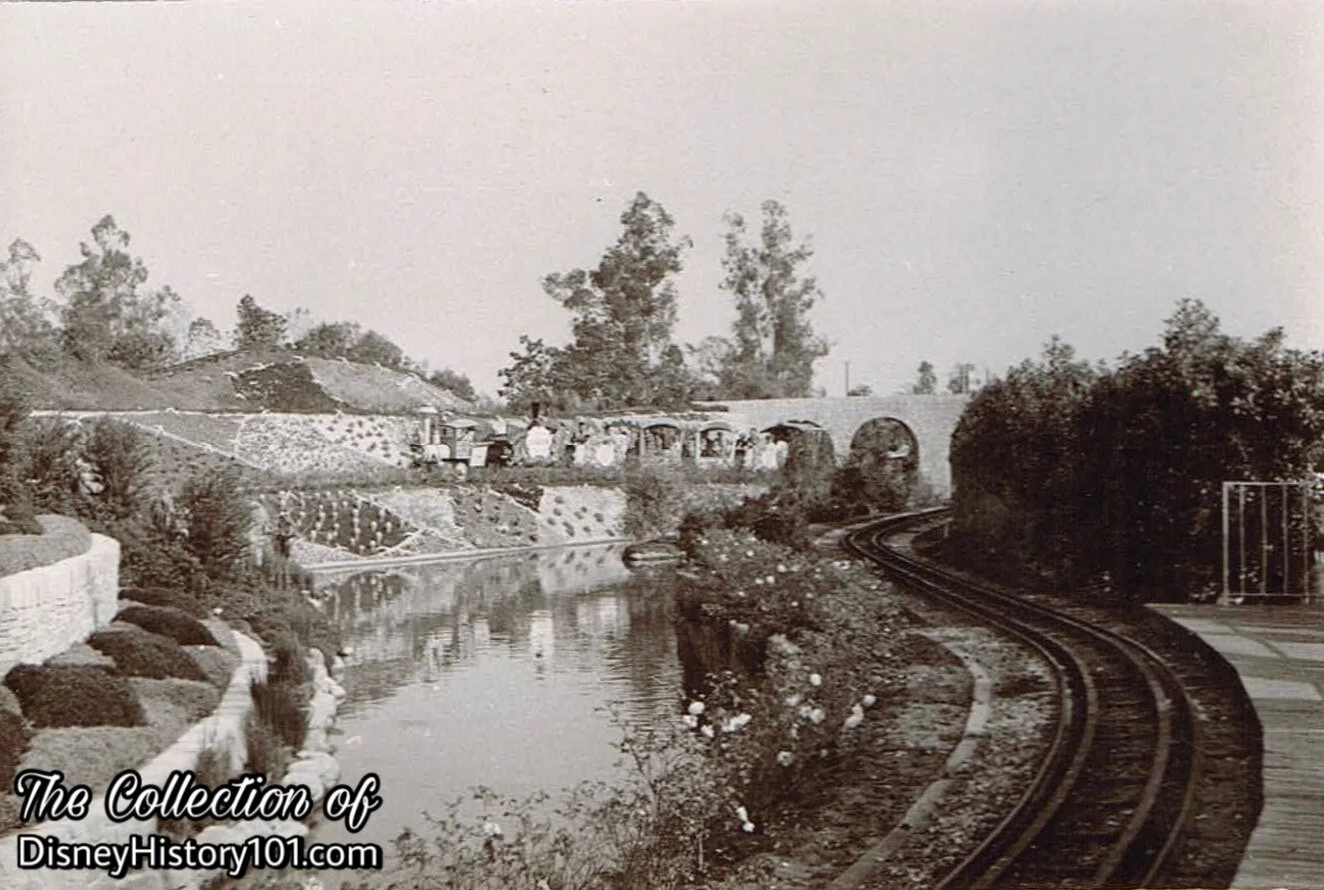
Casey Jr. Circus Train
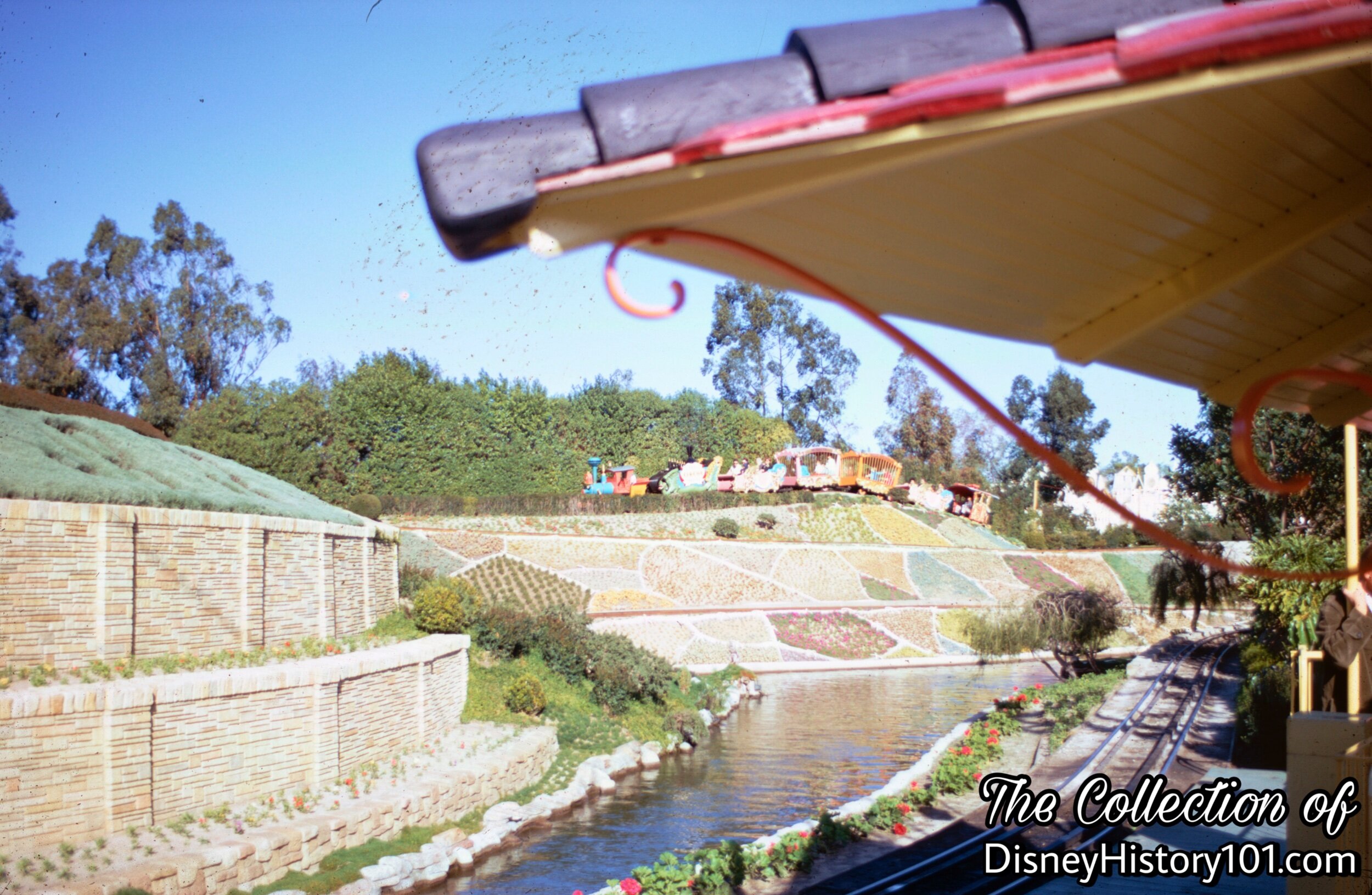
Casey Jr. Circus Train, (c. February, 1968)
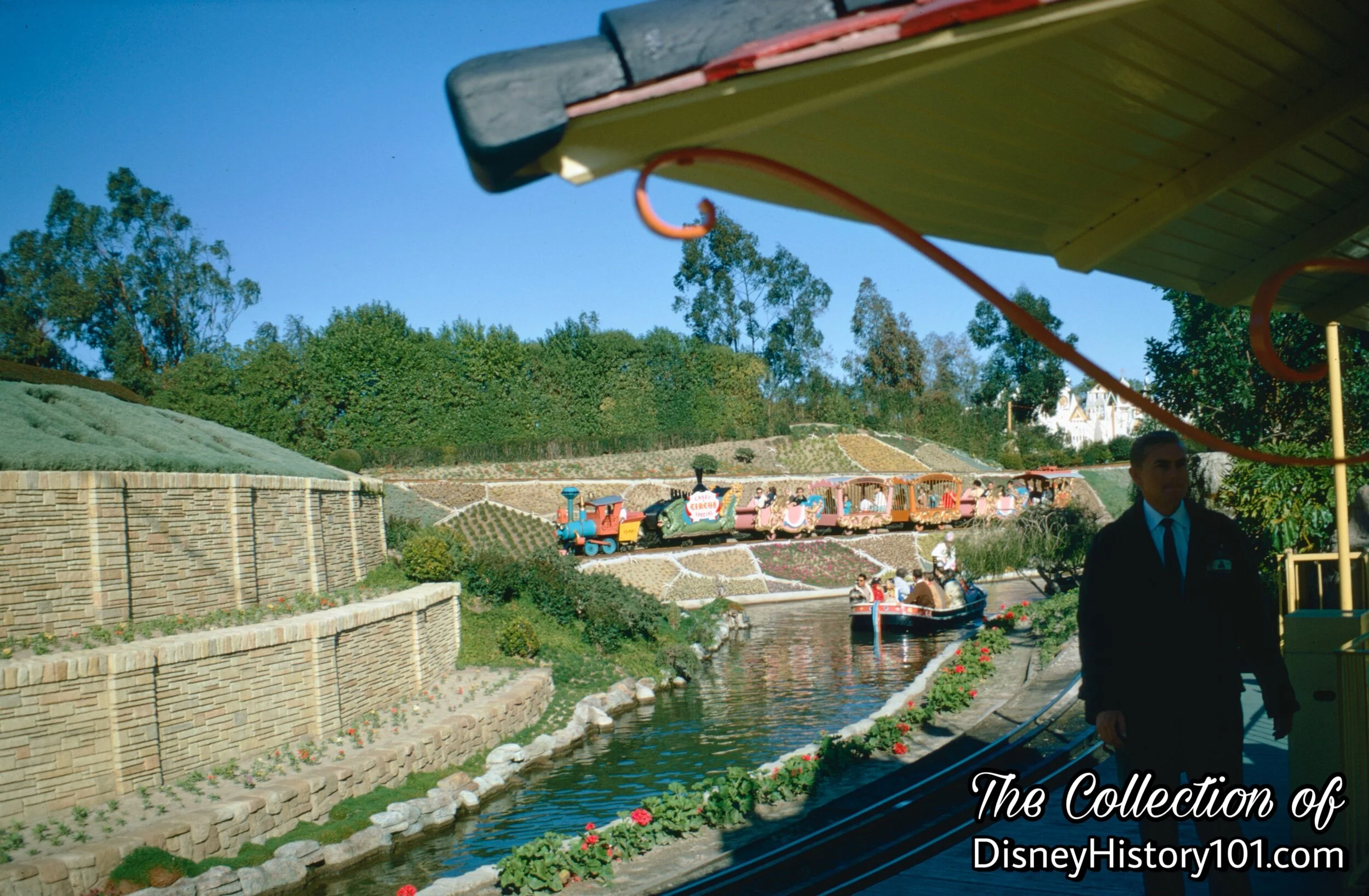
(Casey Jr. Circus Train, c. February, 1968)
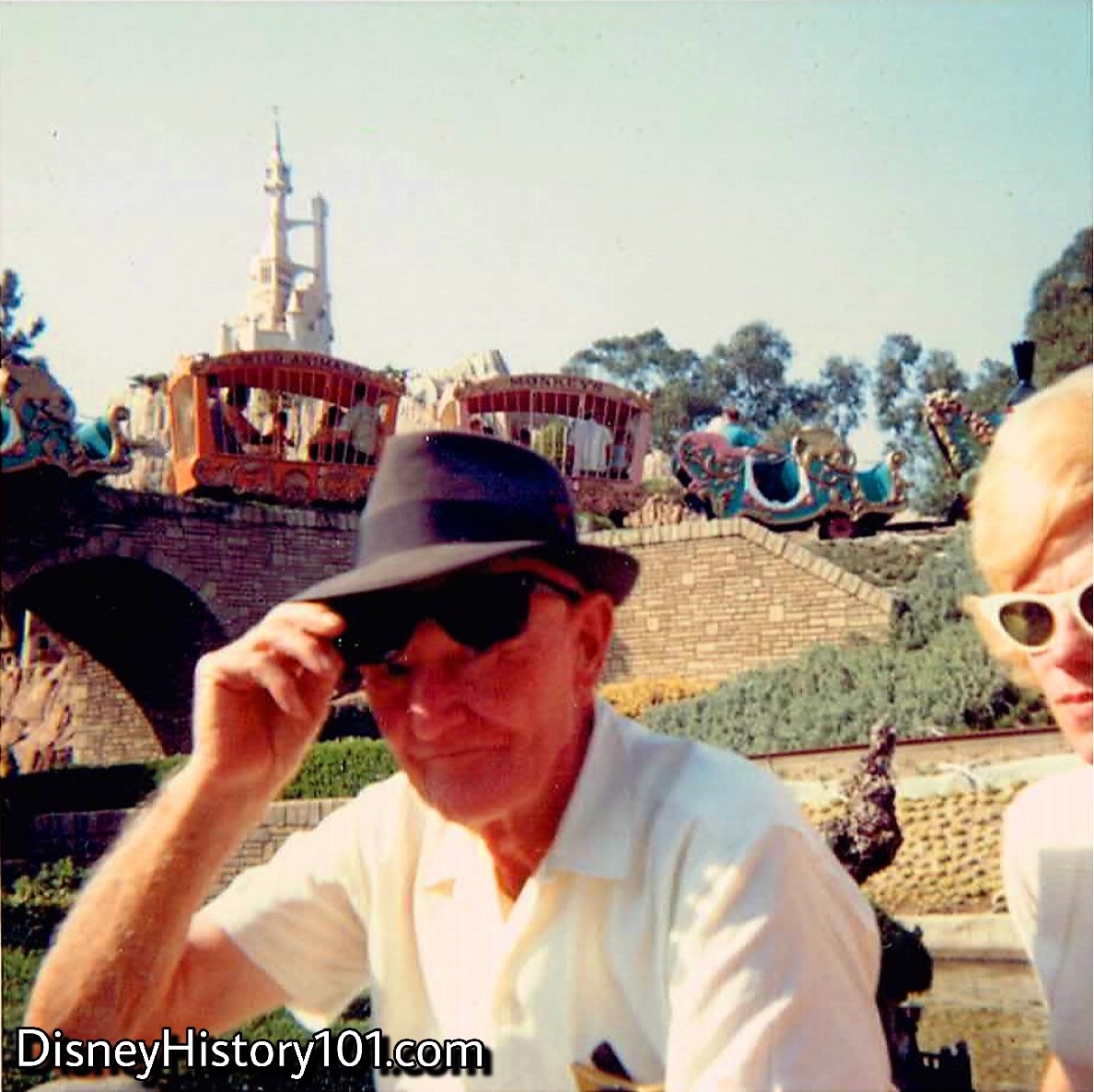
Casey Jr. Circus Train From Storybook Land Canal Boat, (September, 1968)
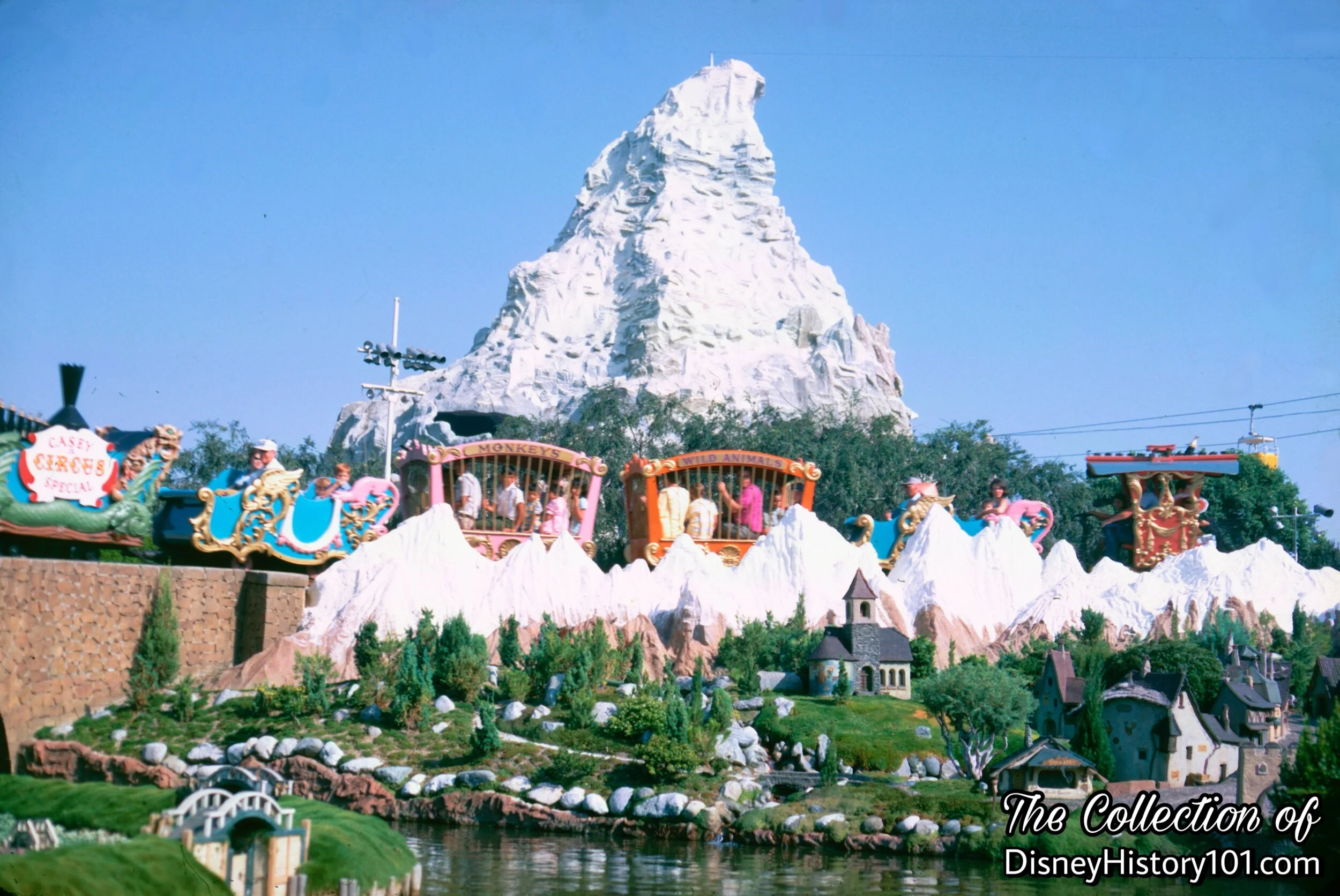
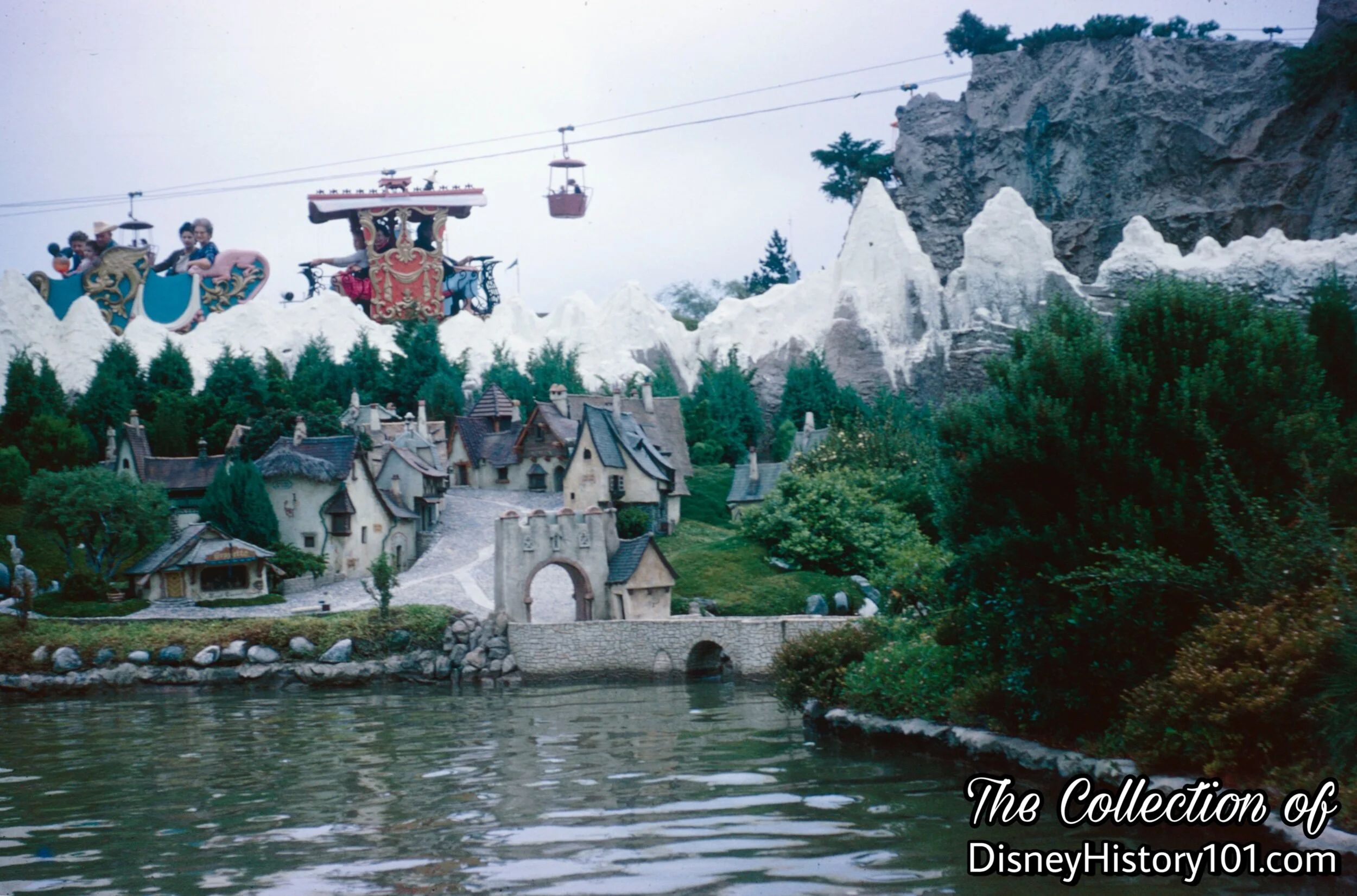
Casey Junior Circus Train Passes Between the Swiss Alps & Matterhorn, (July, 1969)
“I bet ya thought a train could never travel over the Swiss Alps!” The Casey Junior Circus Train makes its way through the mountain pass over the little Italian Village that Gepetto and Pinocchio call home (since they got away from Monster the Whale). Behind the mountain range stands the majestic Matterhorn mountain in the distance!
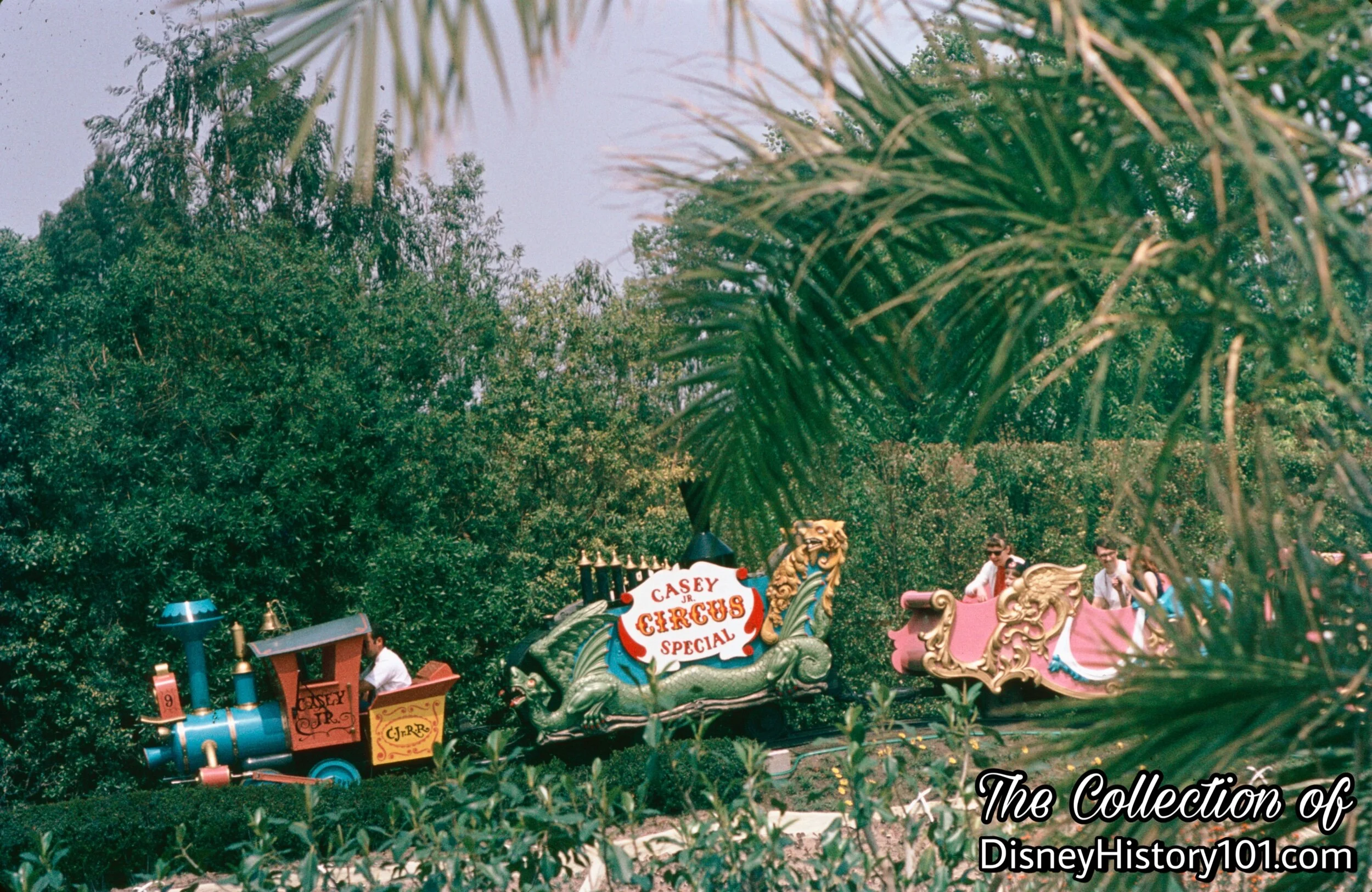
Casey Jr. Circus Train, (April, 1969)
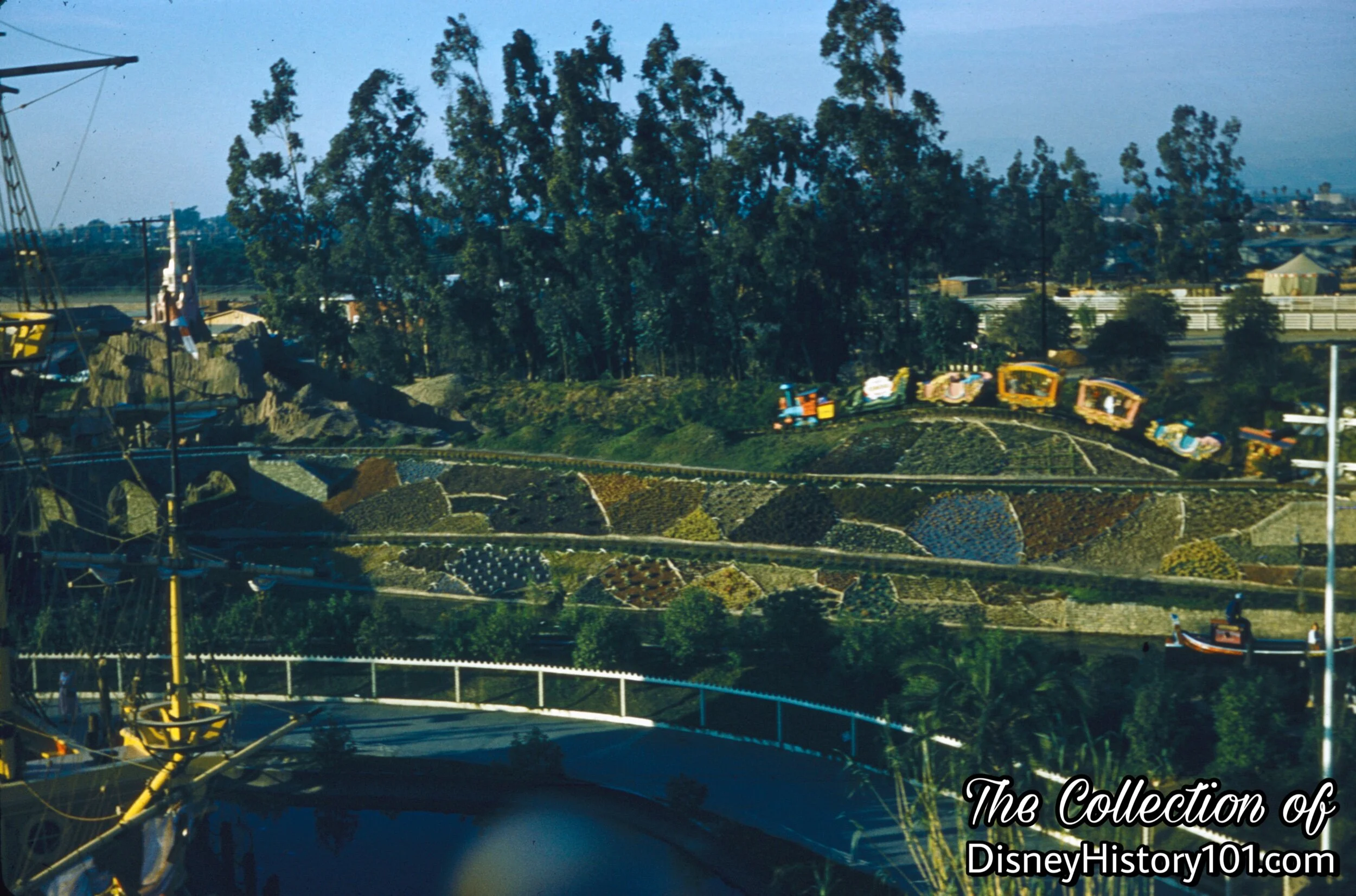
Casey Jr. Circus Train
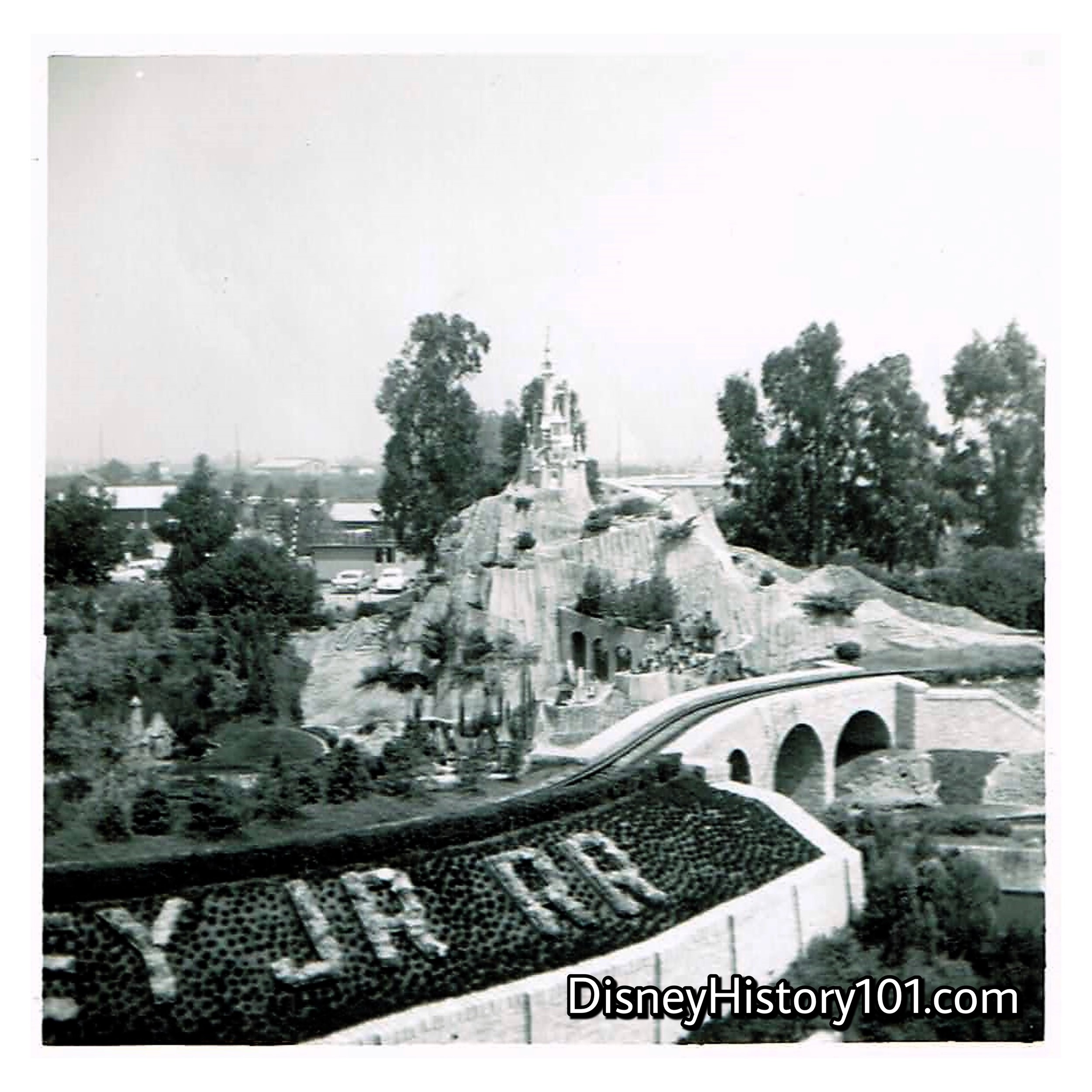
Casey Jr. Circus Train Tracks Through Fantasyland
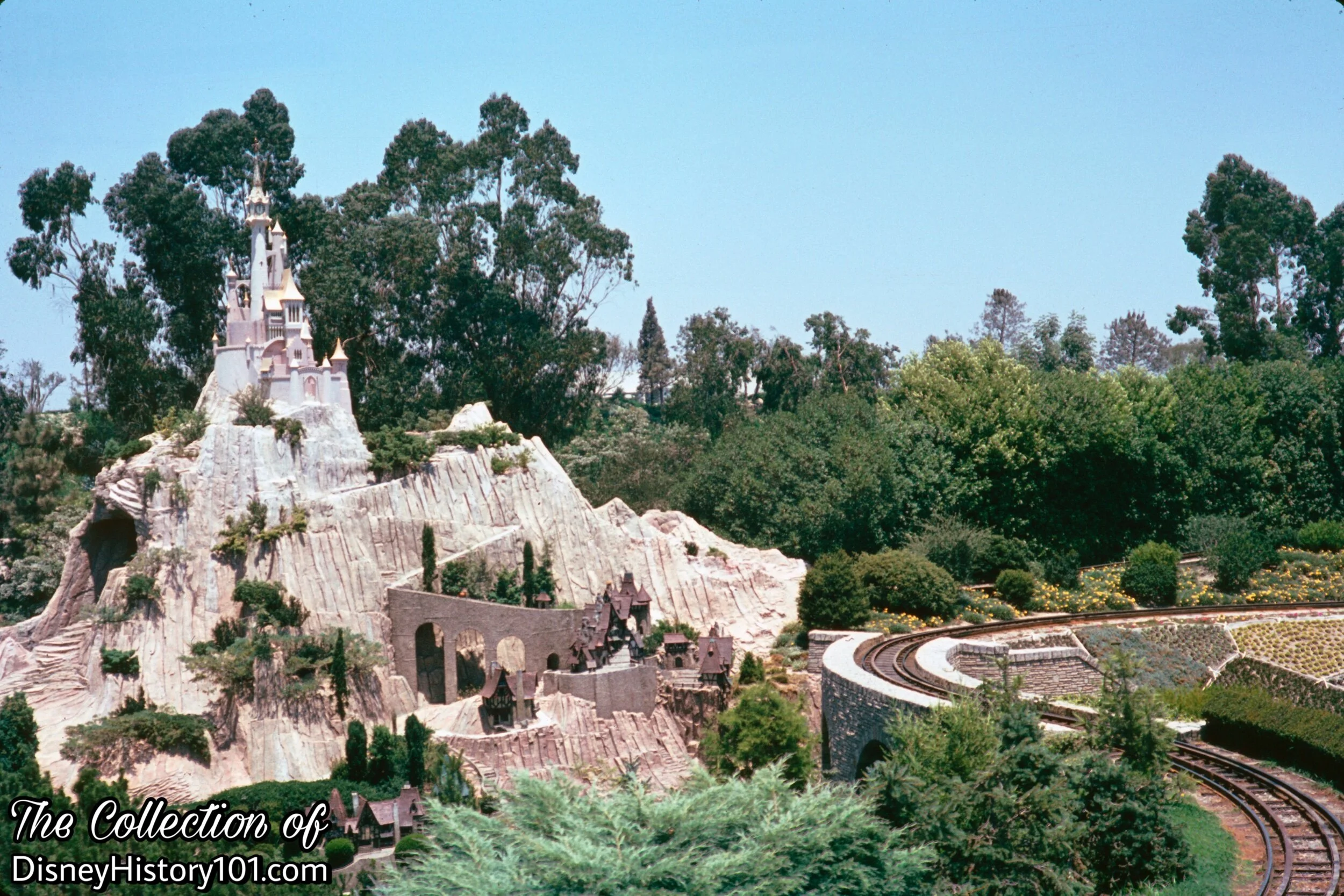
Casey Jr. Circus Train Tracks Through Storybook Land
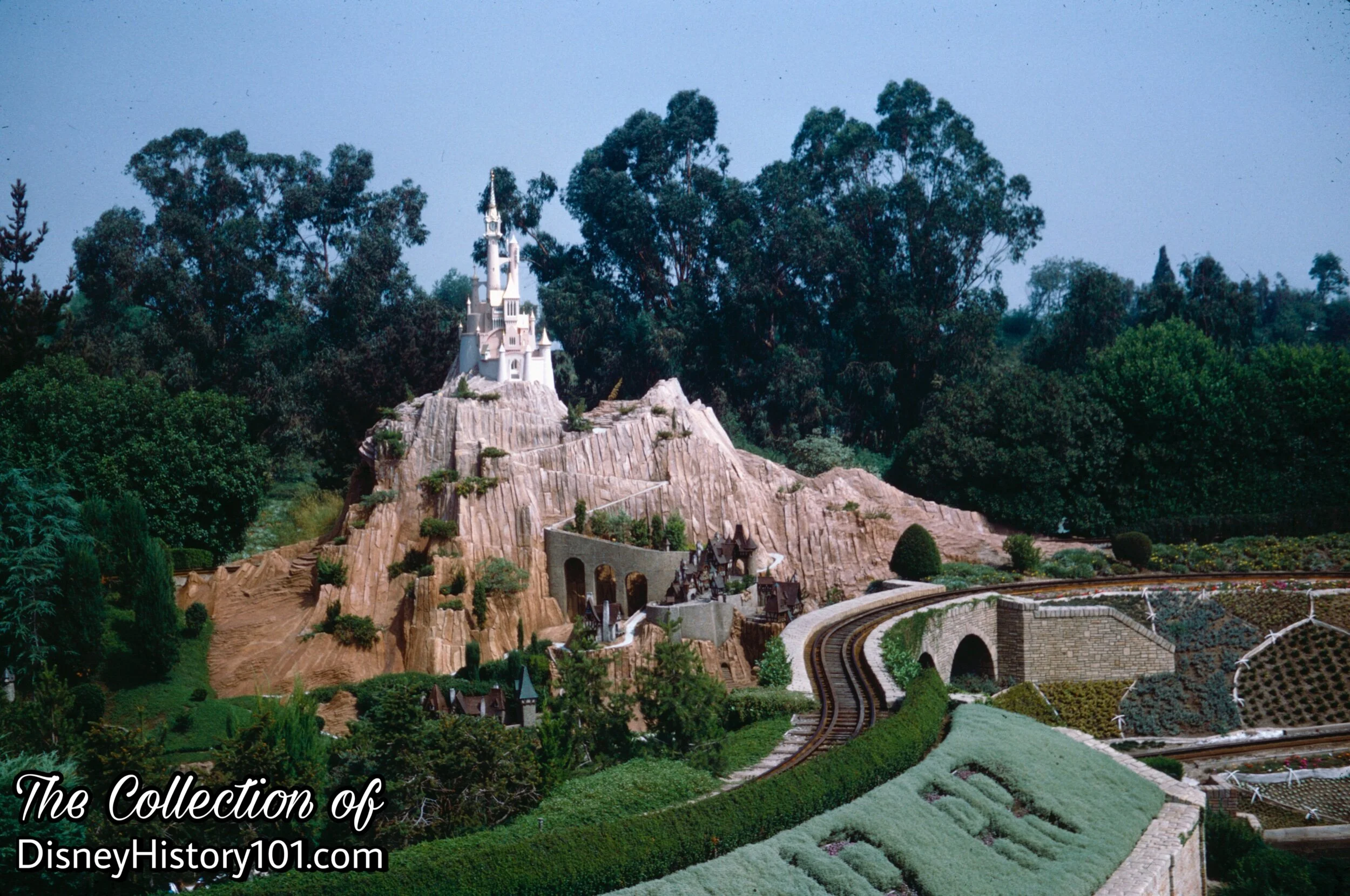
Casey Jr. Circus Train Tracks Through Fantasyland, (September, 1972)
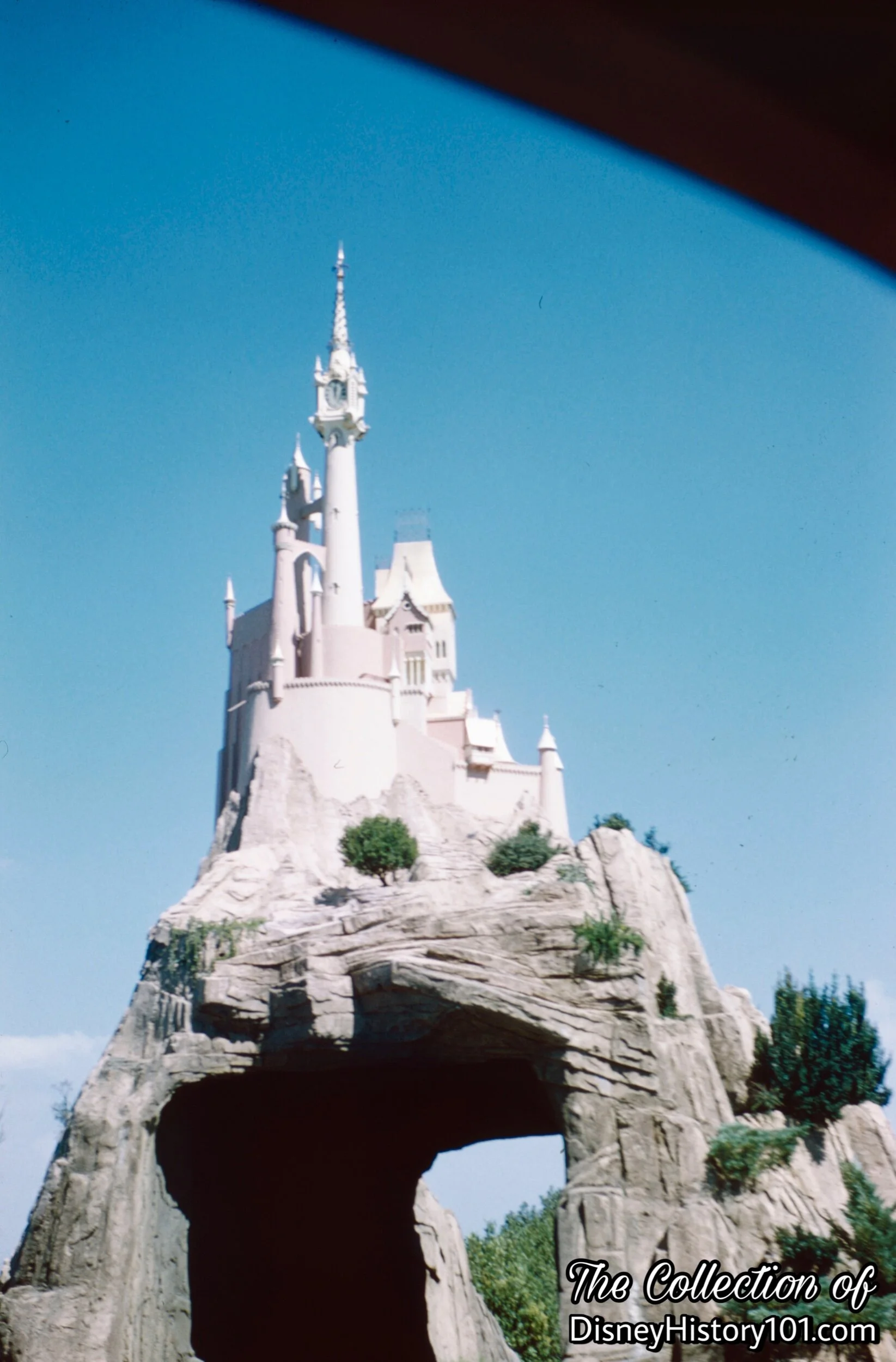
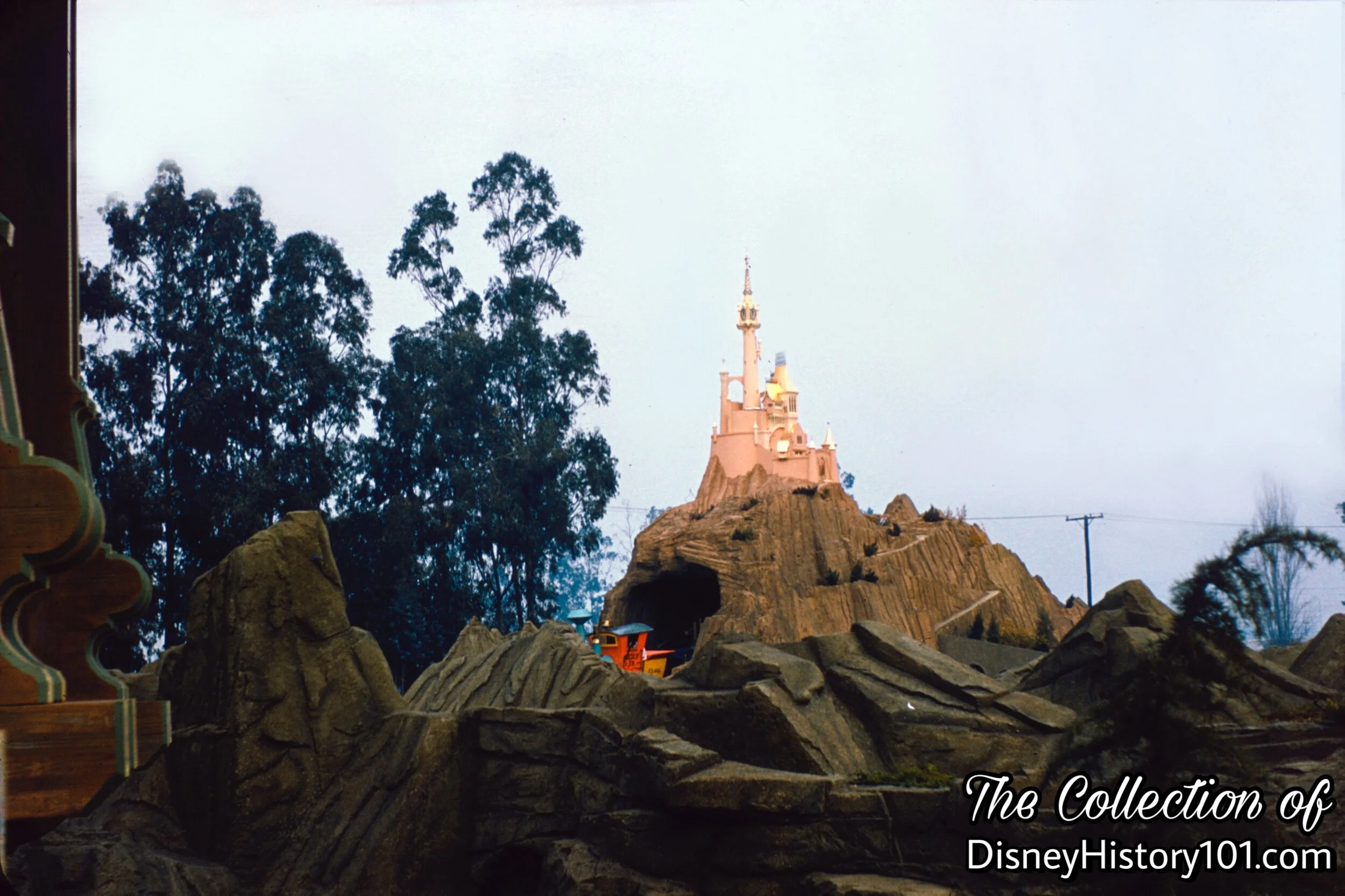
Tunnel through the RockWork under Cinderella's Castle
It once seemed that Walt Disney’s Rainbow Road to Oz was still going to end in Storybook Land, converging with the Casey Junior Circus Train rails. Despite the status of Walt Disney’s Oz film project, by April of 1960, Bob Thomas (of Associated Press) divulged Walt’s Disneyland plans : “Next year he plans to add a Wizard of Oz section full of dancing figures and a mountain top of trees shaped lie animals.” Alas, “Rock candy Mountain was originally planned for Fantasyland until the model, made of real candy, began to melt and was pecked to pieces by the local birds - and by the model makers,” according to “Disneyland: Then, Now, and Forever” by Bruce Gordon & Tim O’Day.
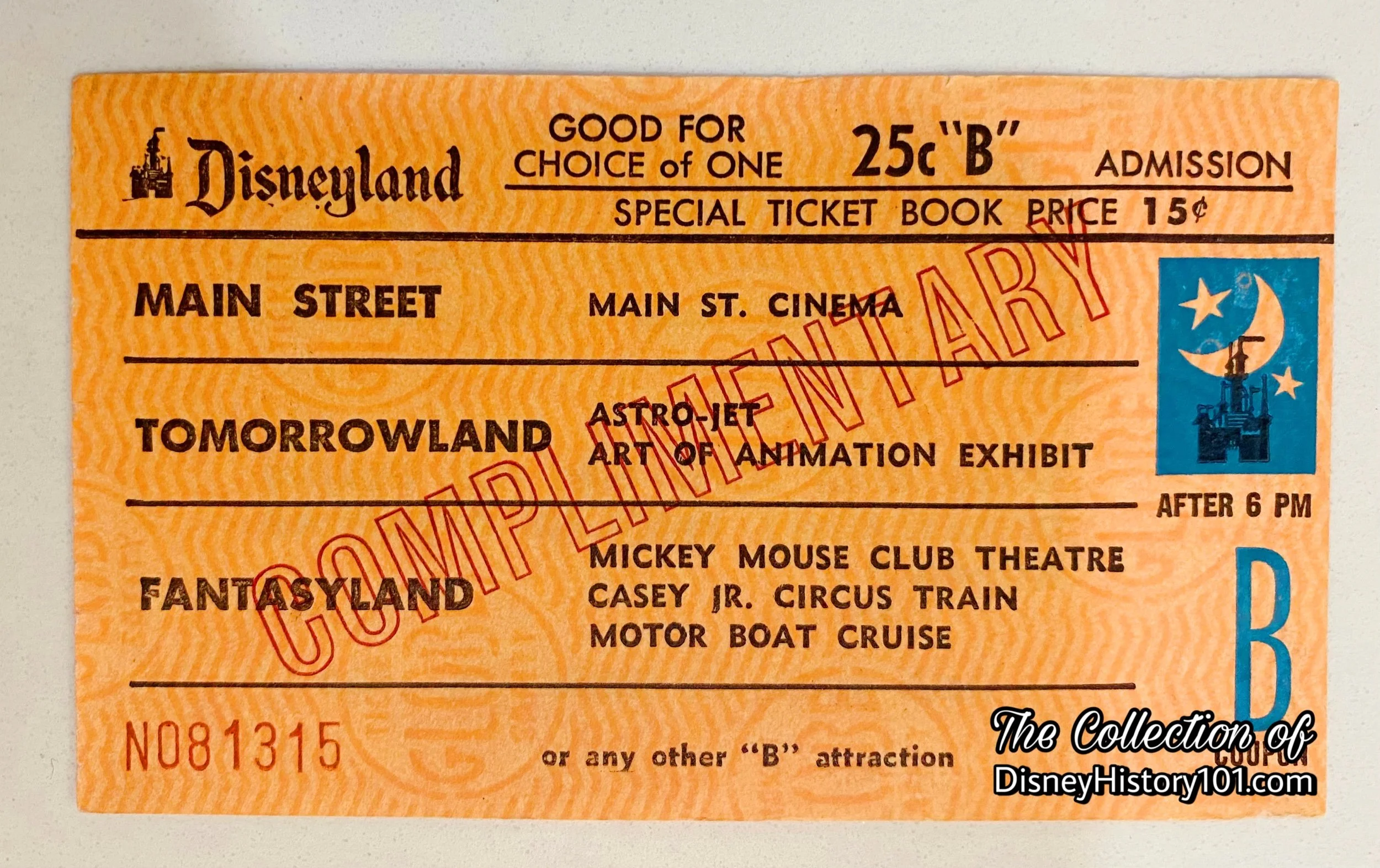
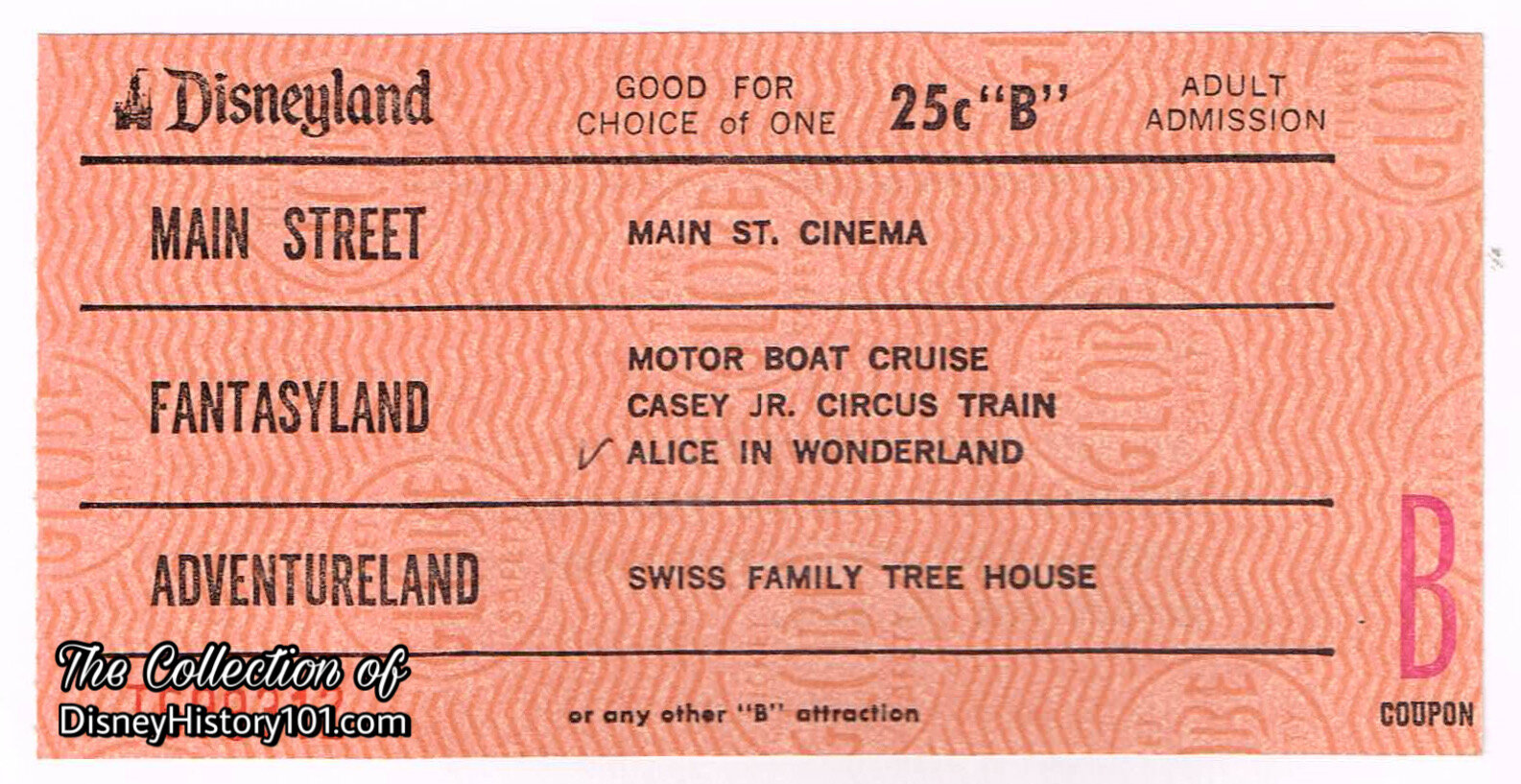
Disneyland 25 Cent "B" Adult Admission Coupon, (c. Summer, 1972)
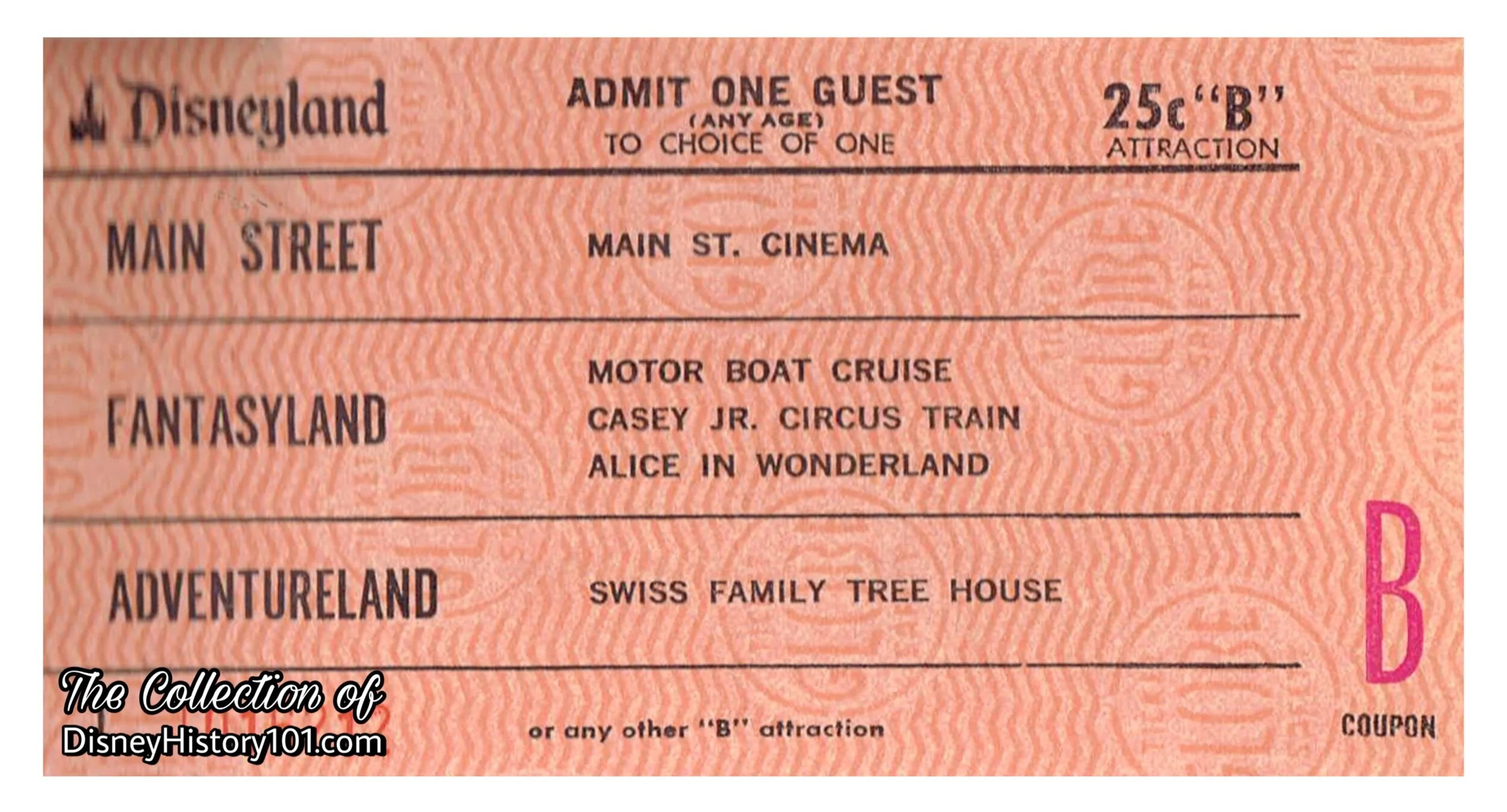
Disneyland 25 Cent "B" General Guest Admission Coupon, (c. Summer, 1972)
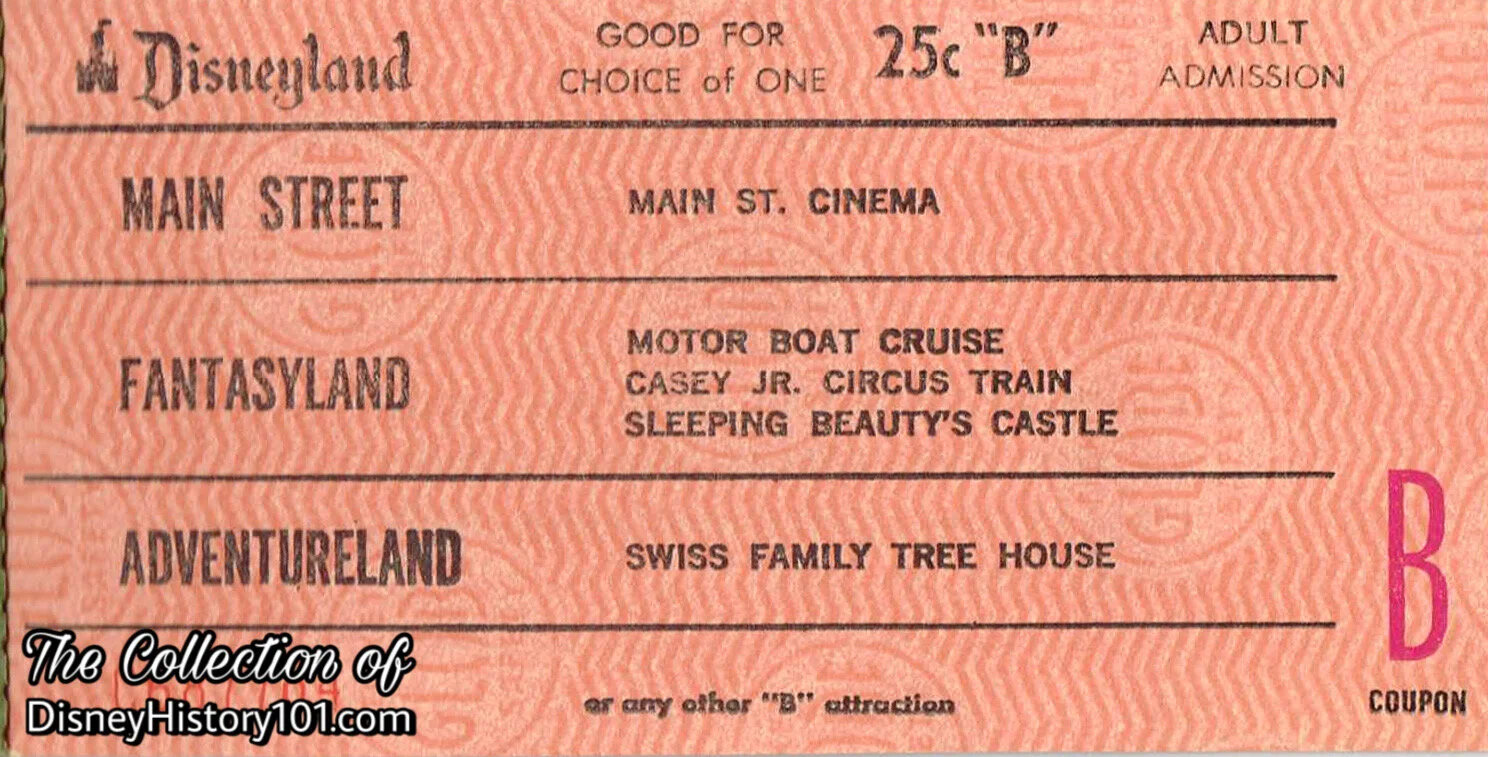
Disneyland 25 Cent "B" Adult Admission Coupon, (c. Summer, 1972)
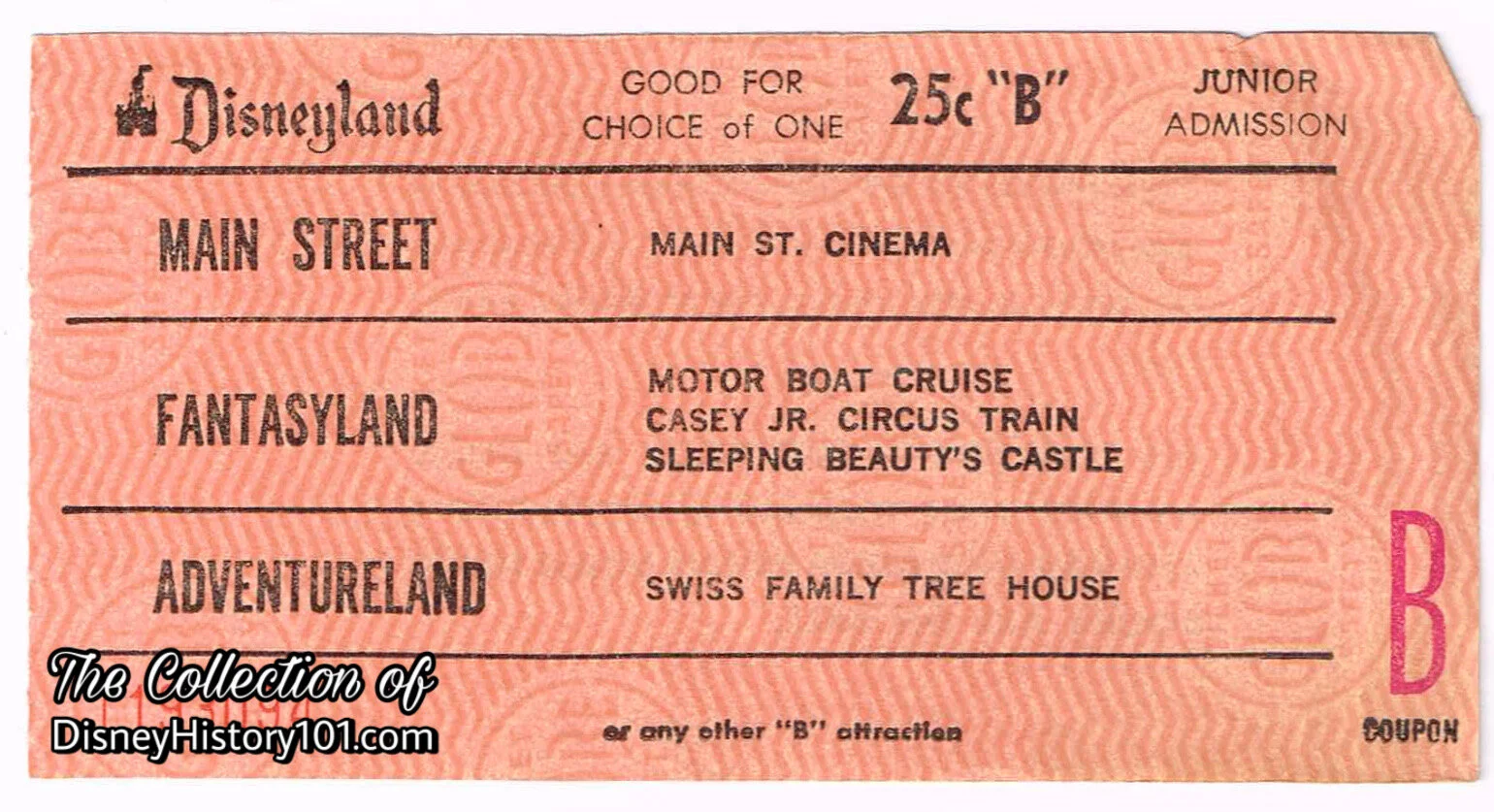
Disneyland 25 Cent "B" Junior Admission Coupon, (c. Summer, 1972)
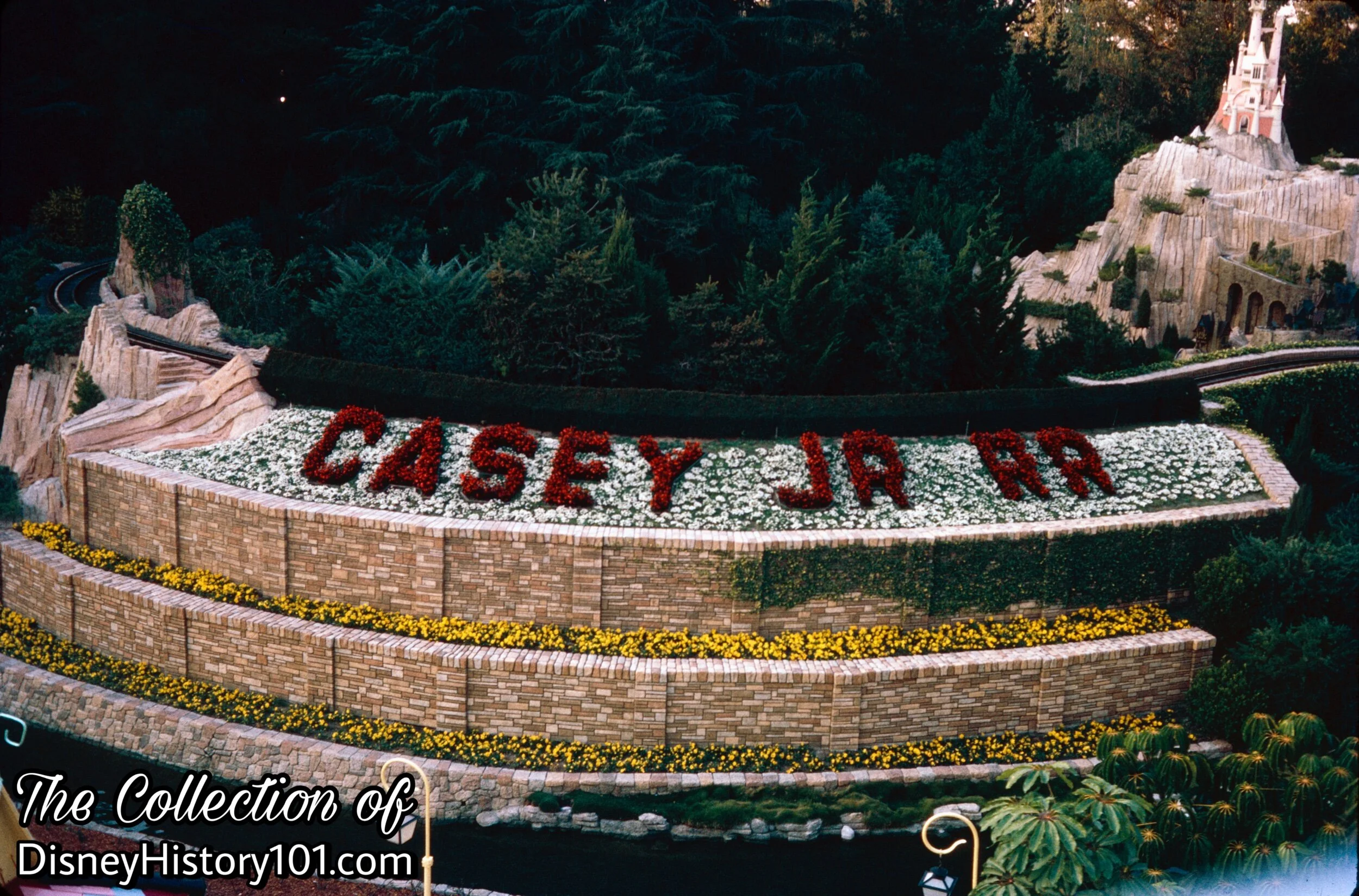
Casey Jr. Circus Train Floral, (c. April, 1974)
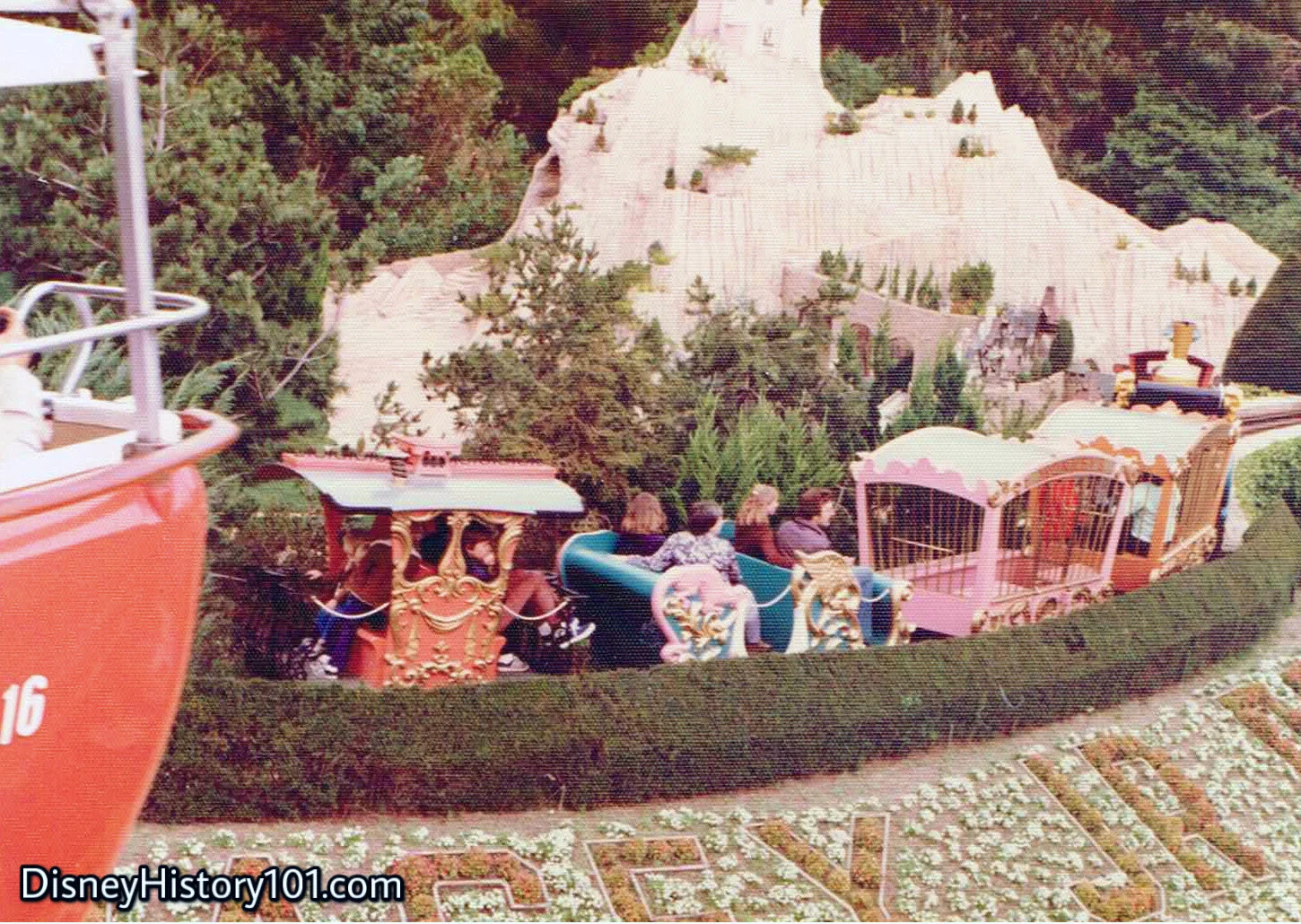
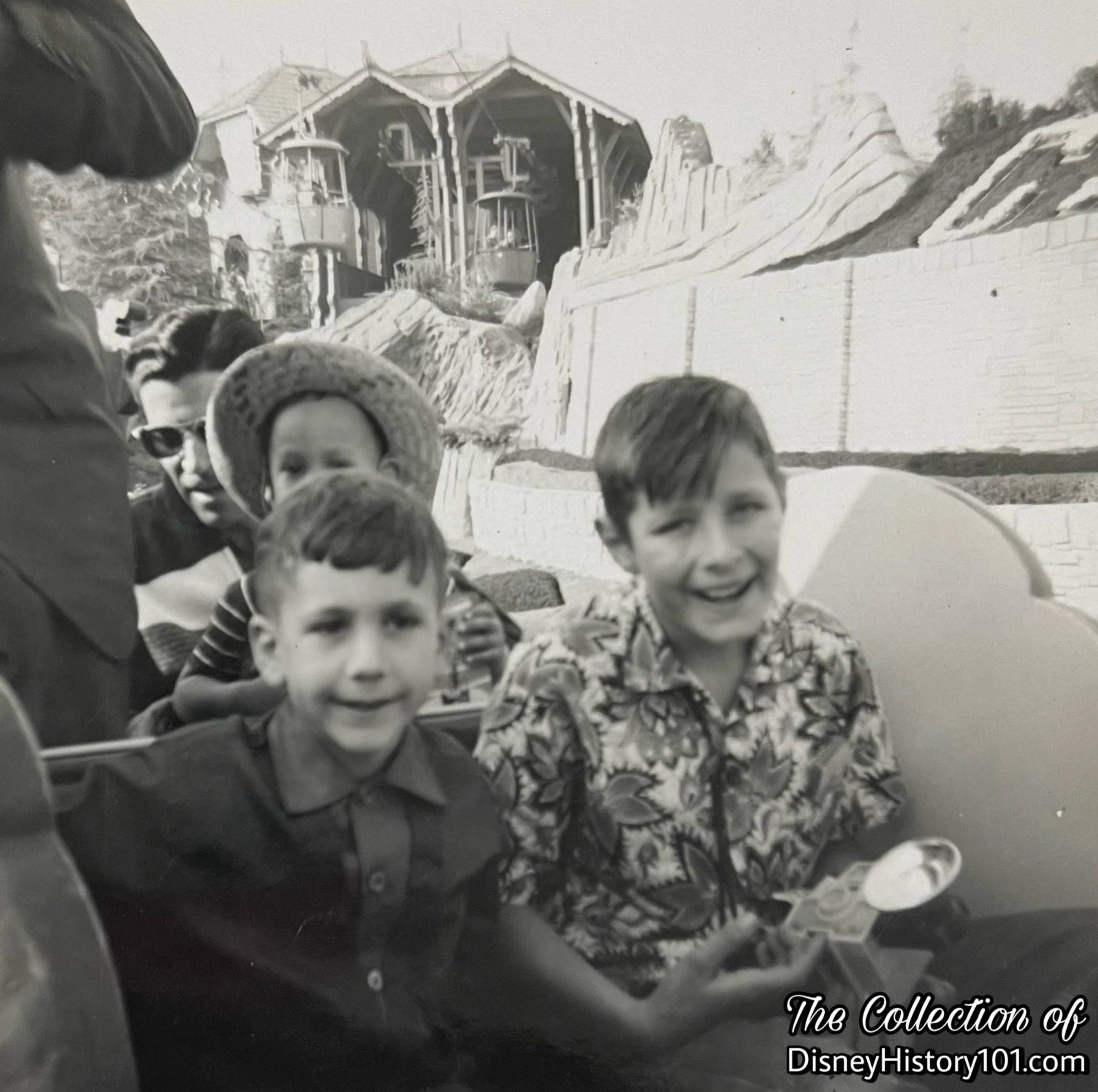
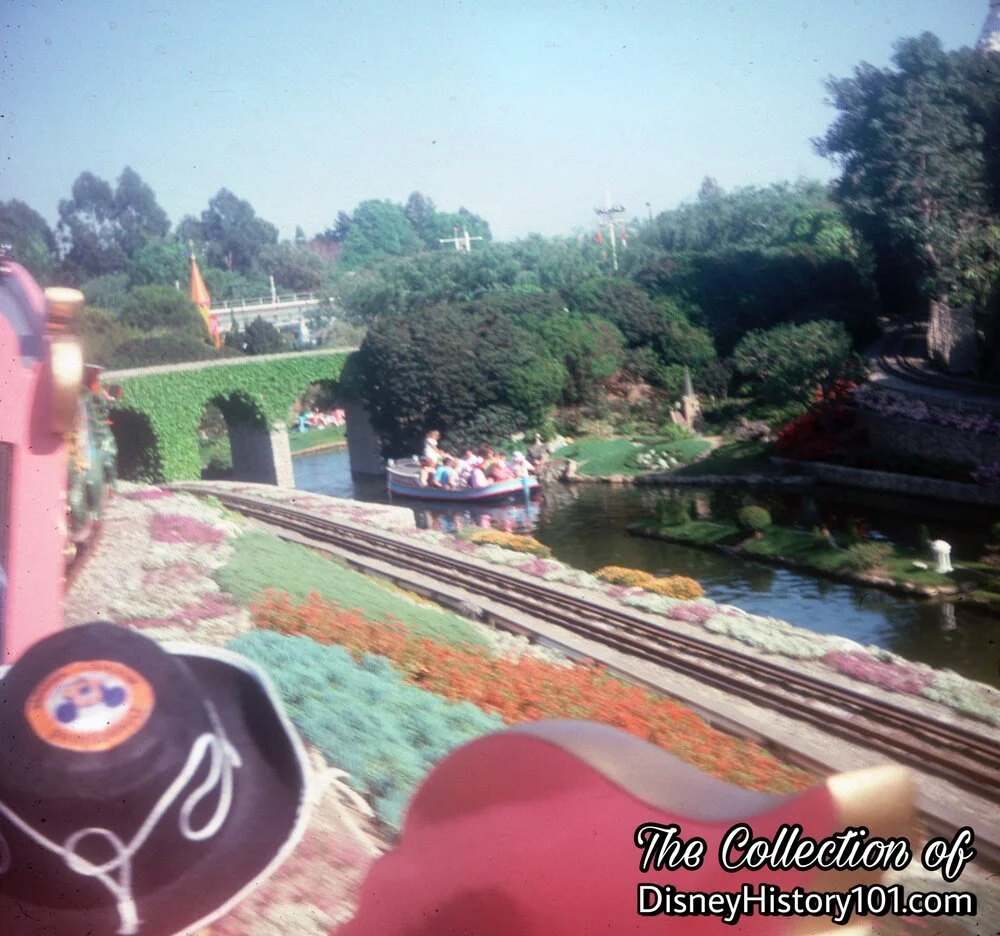
Casey Jr. Circus Train From Skyway, (c. 1975 - 1976)
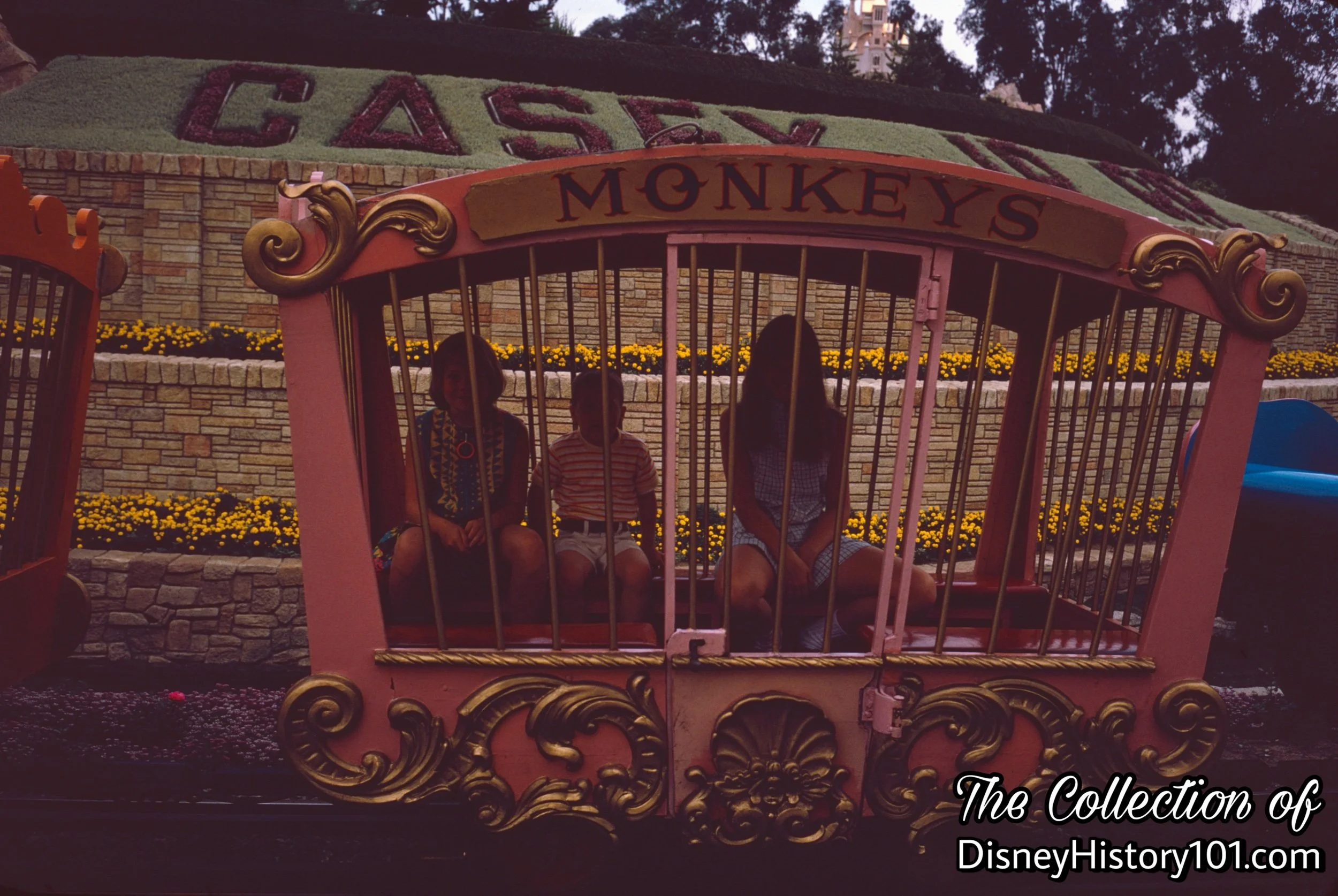
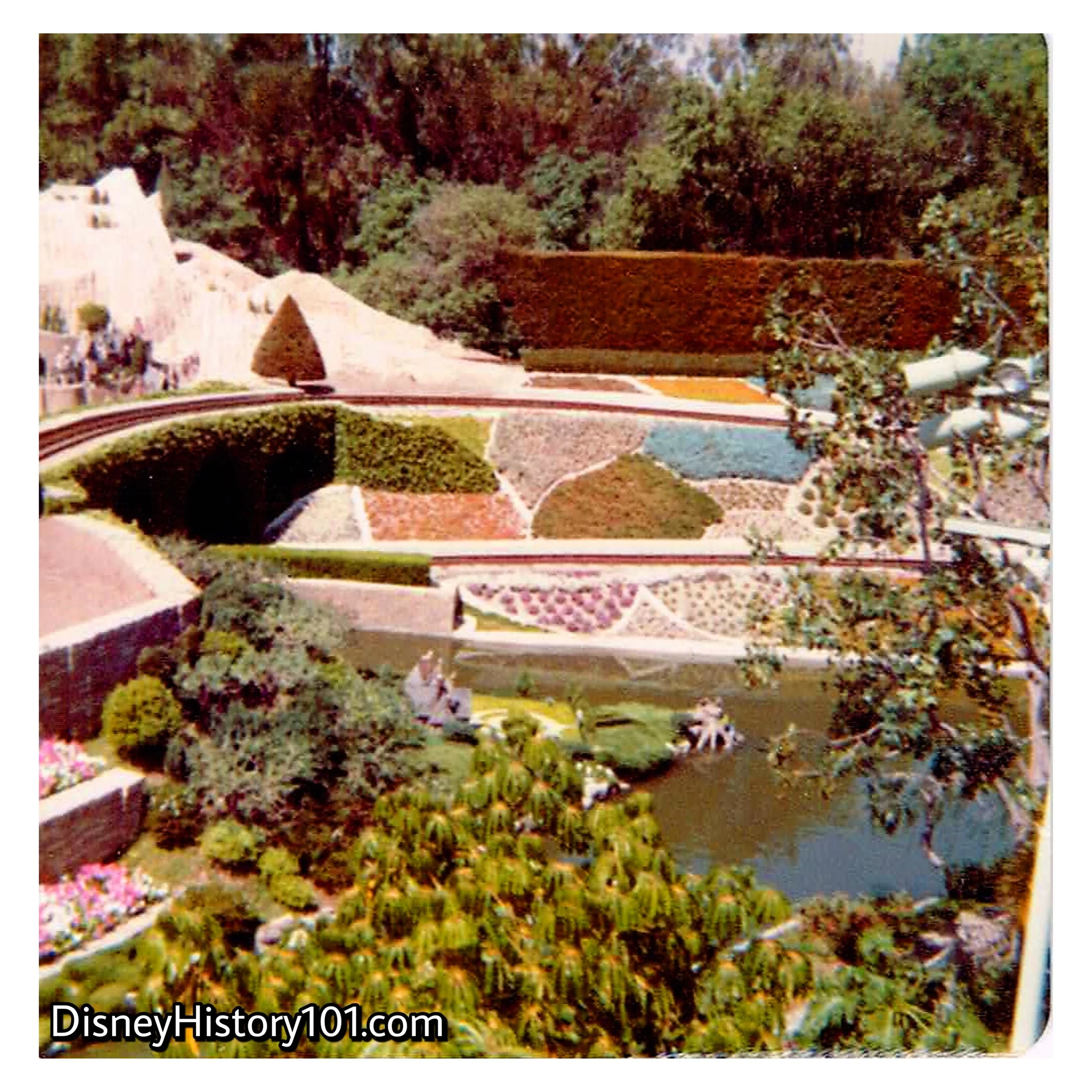
Casey Jr. Circus Train Tracks Through Storybook Land, (1978)
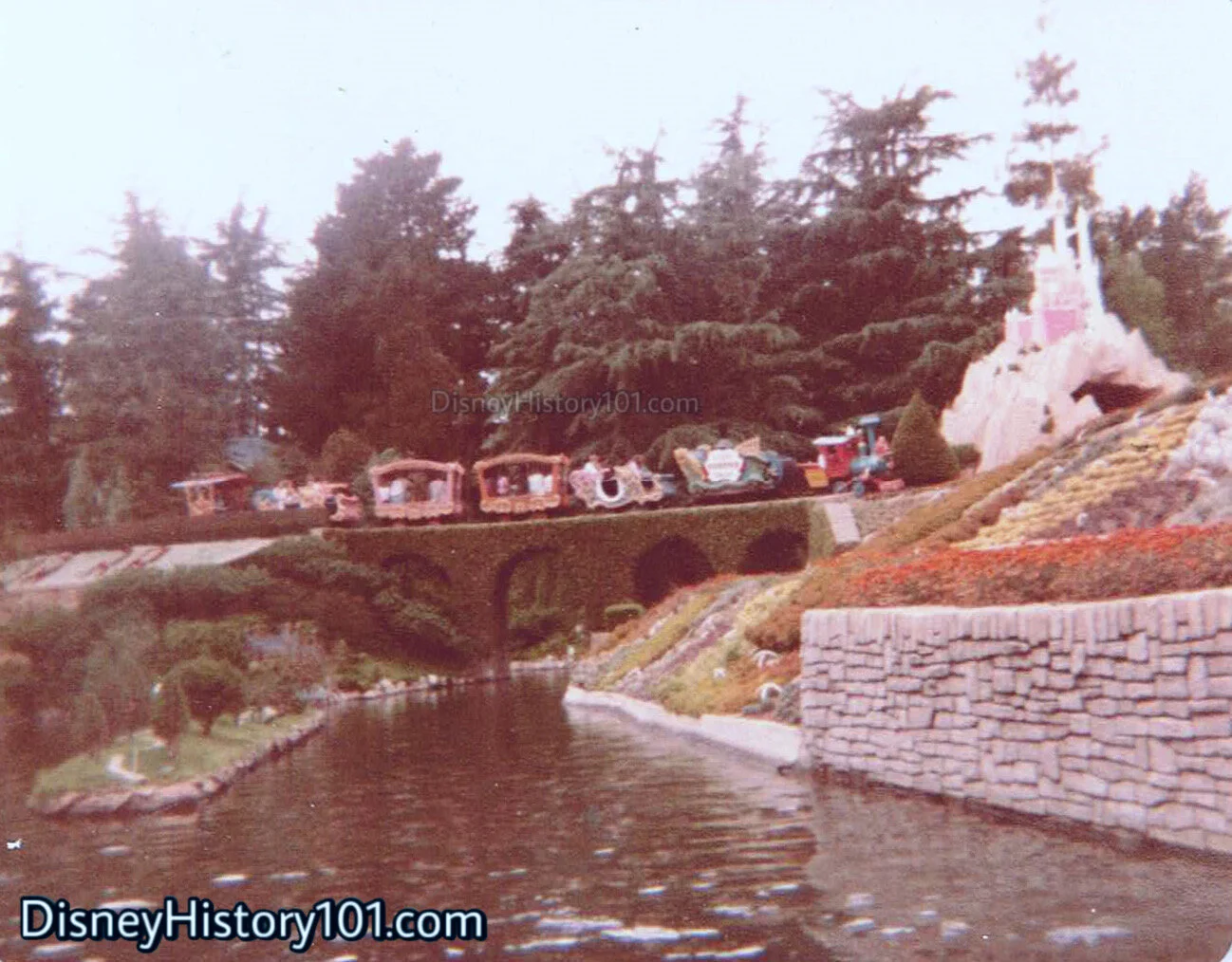
Casey Jr. Circus Train Through Storybook Land, (c. 1981-1982)
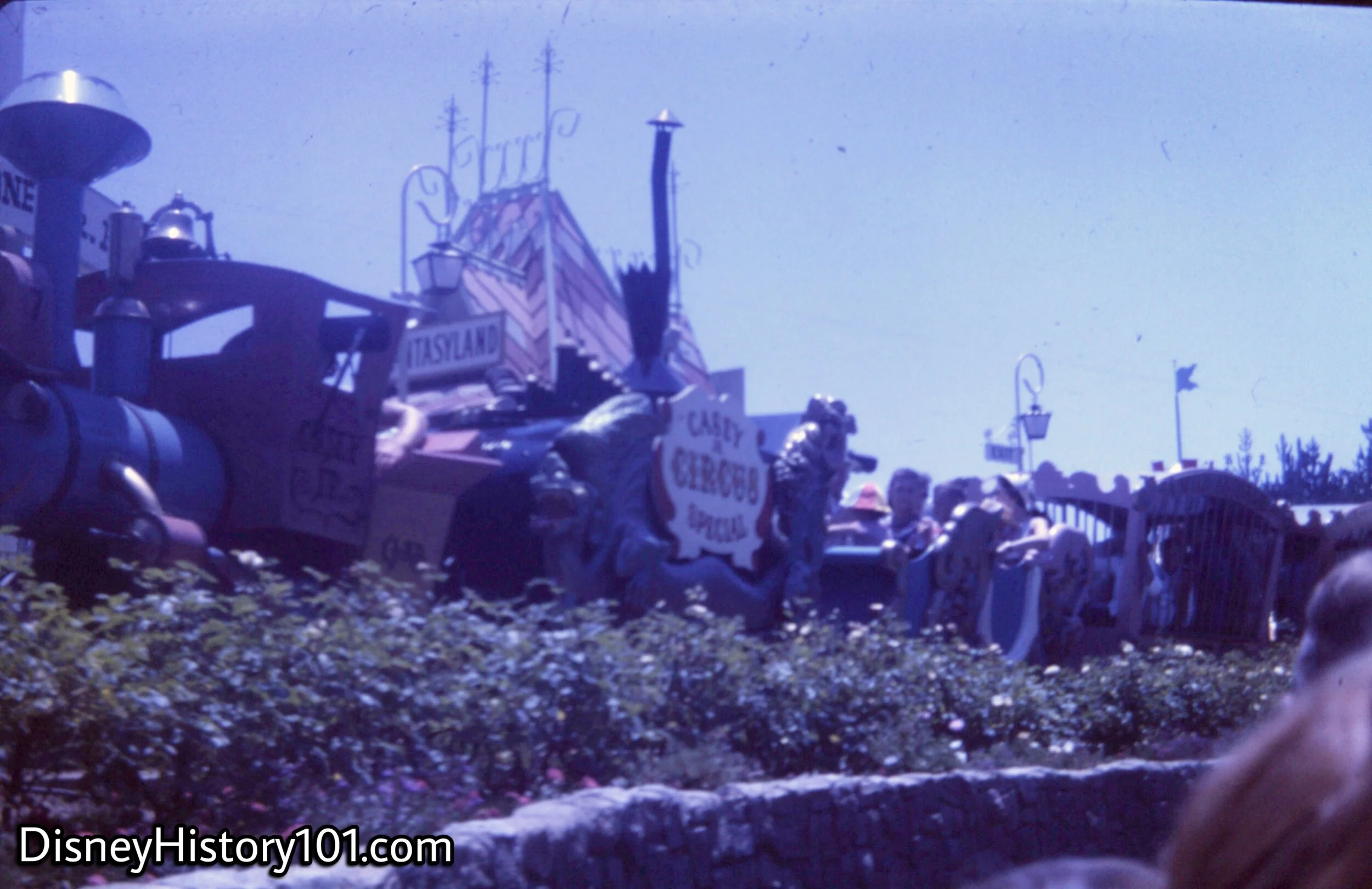
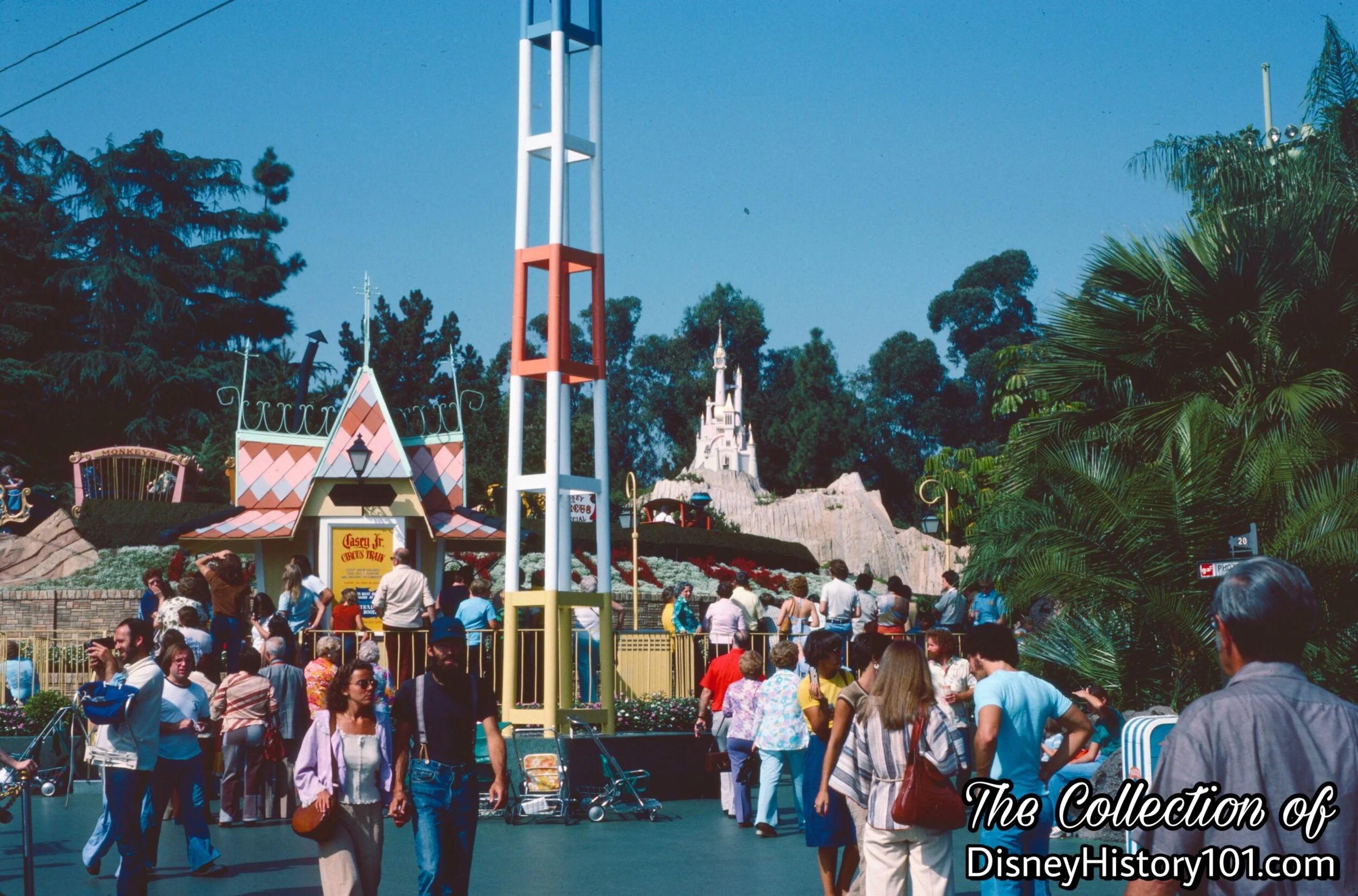
Casey Jr. Circus Train at Station and Loading Platform
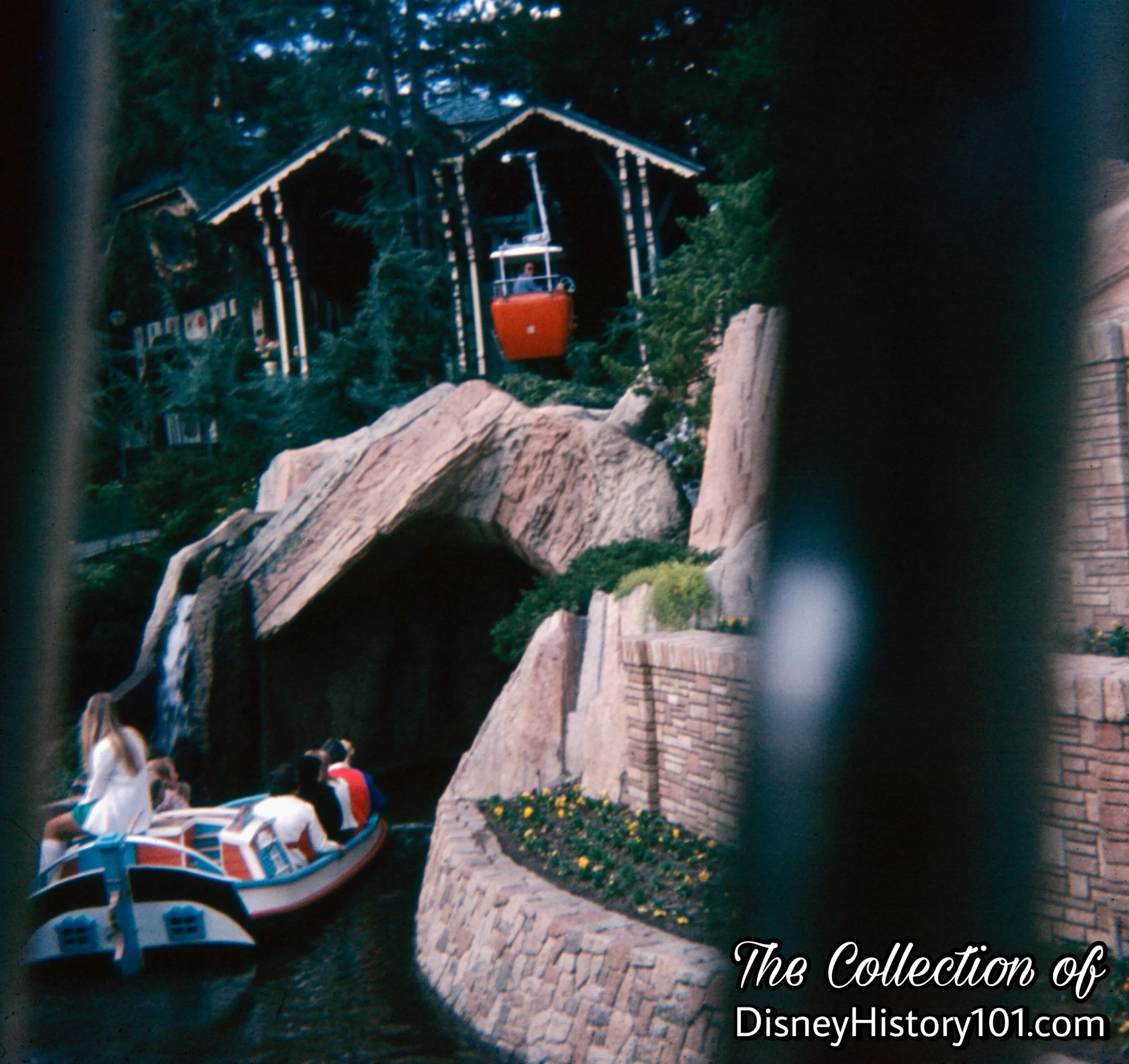
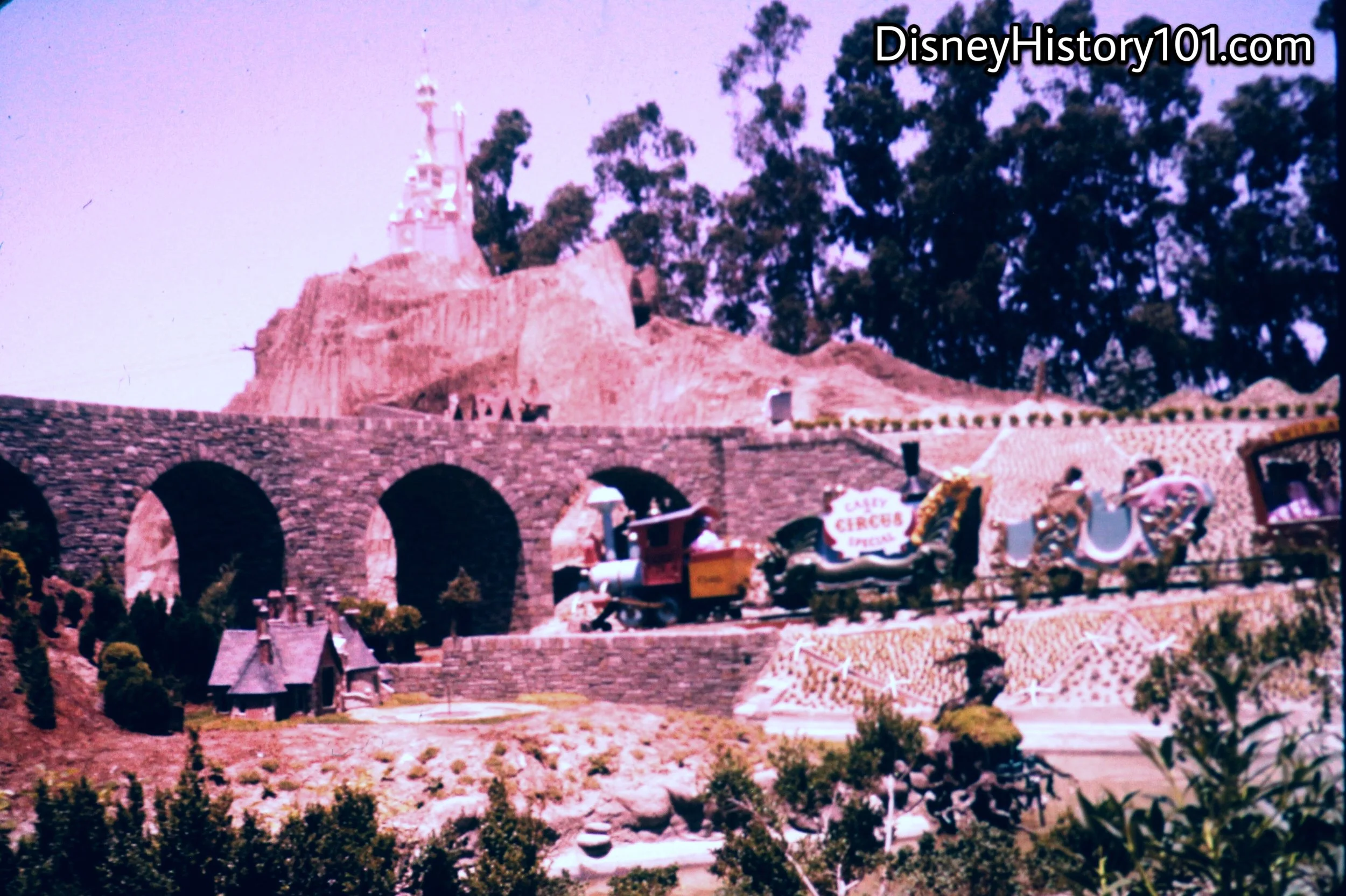
Casey Jr. Circus Train Through Storybook Land
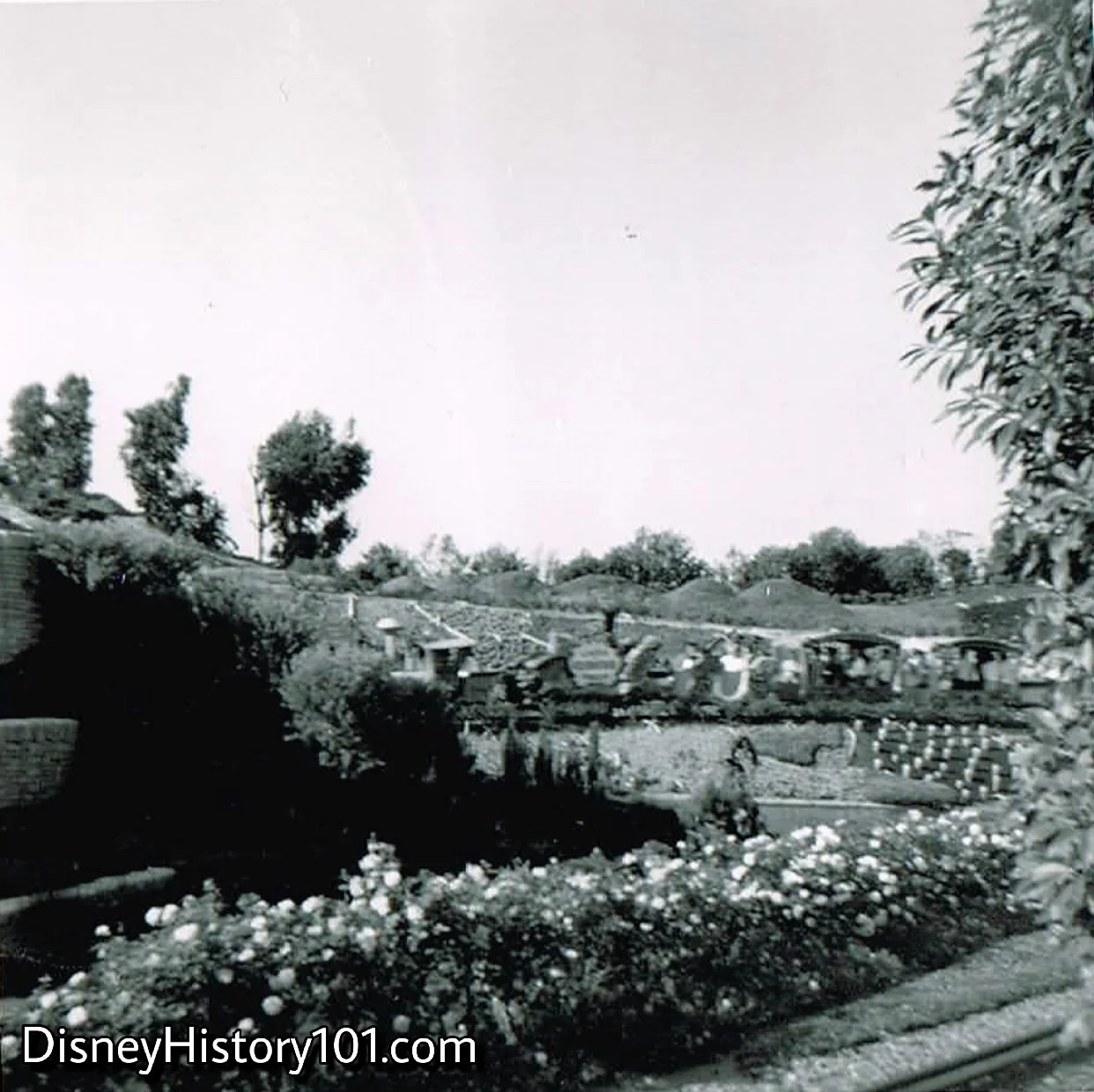
Casey Jr. Circus Train Through Storybook Land
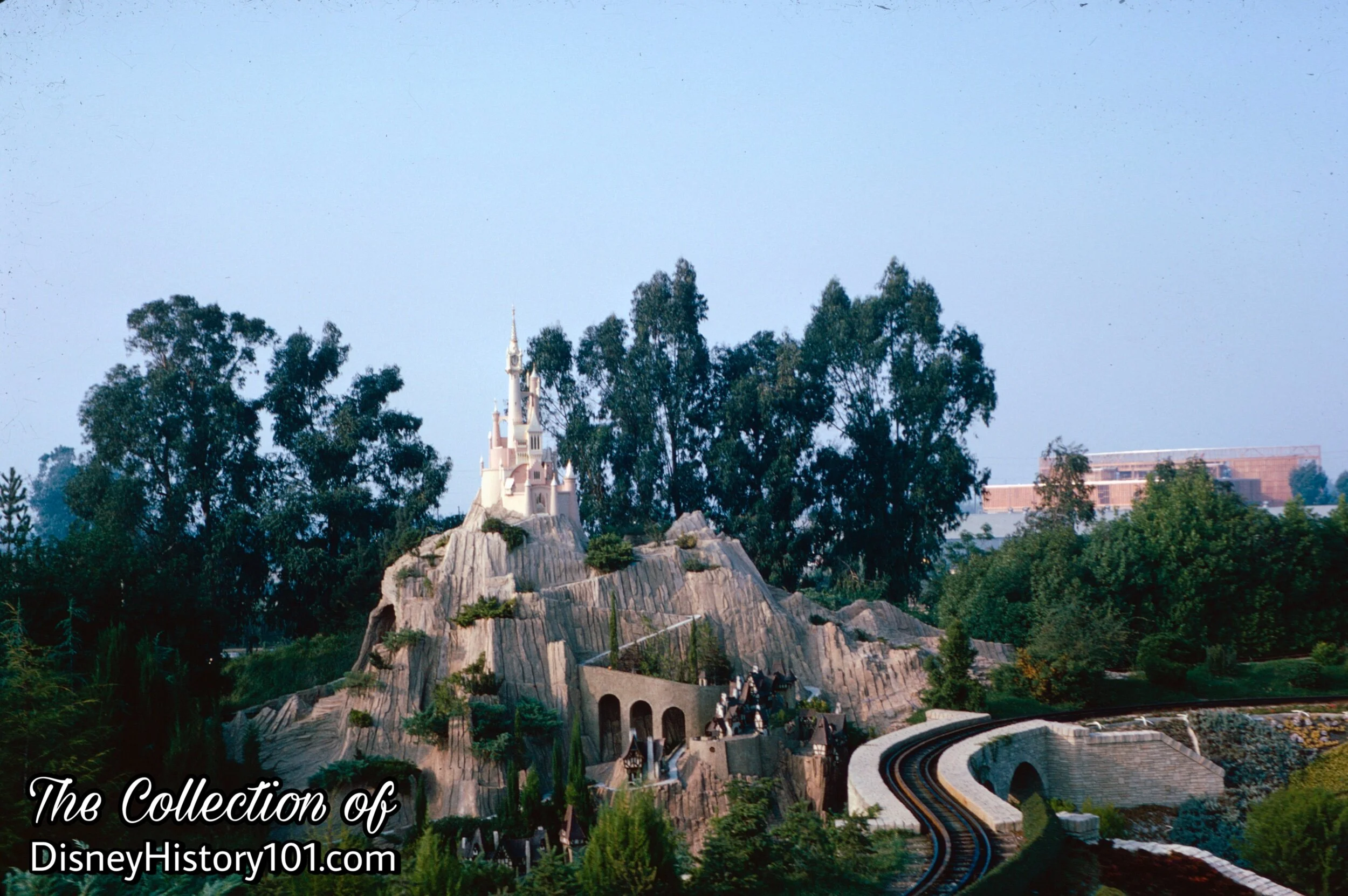
Casey Jr. Circus Train Tracks Through Storybook Land
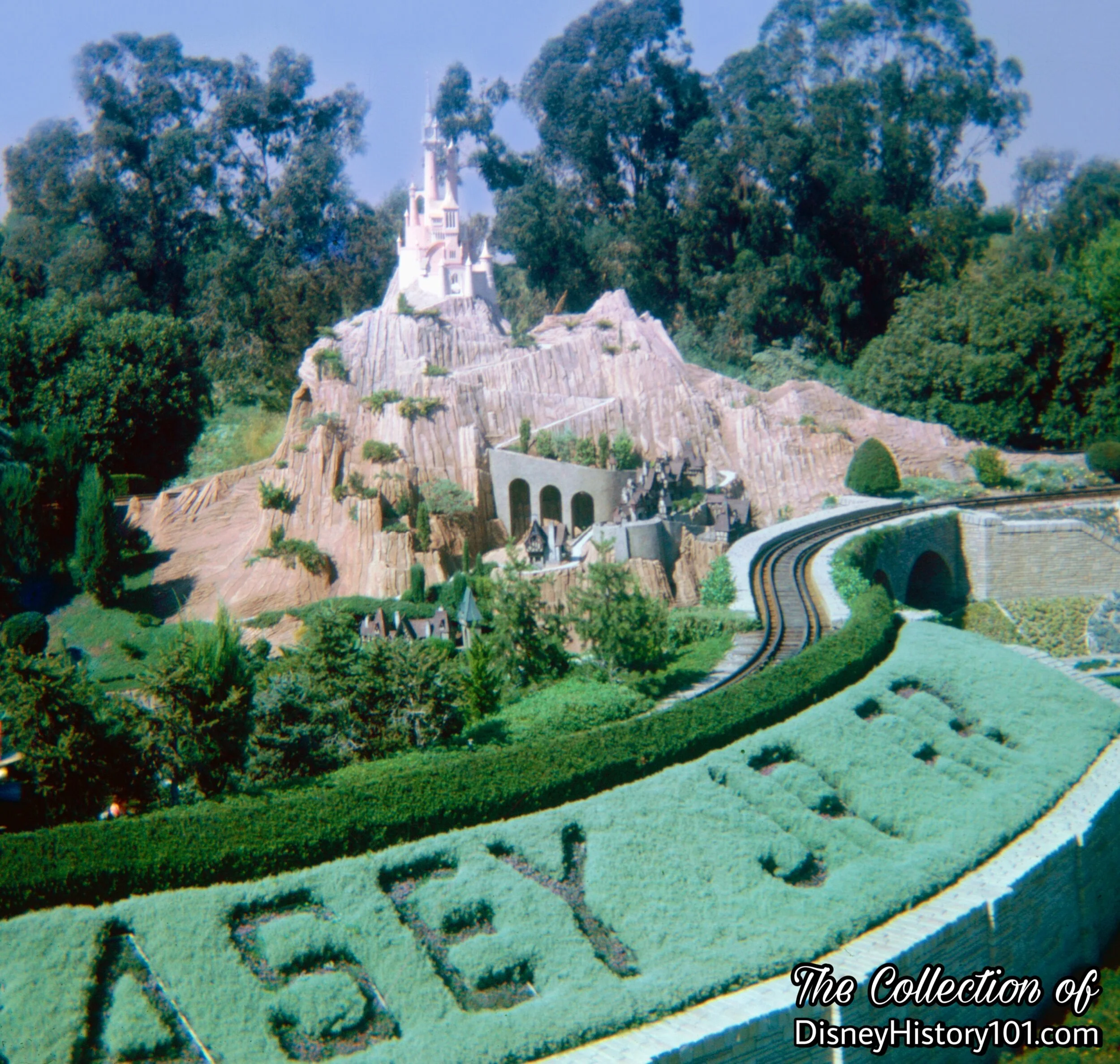
Casey Jr. Circus Train Tracks Through Storybook Land
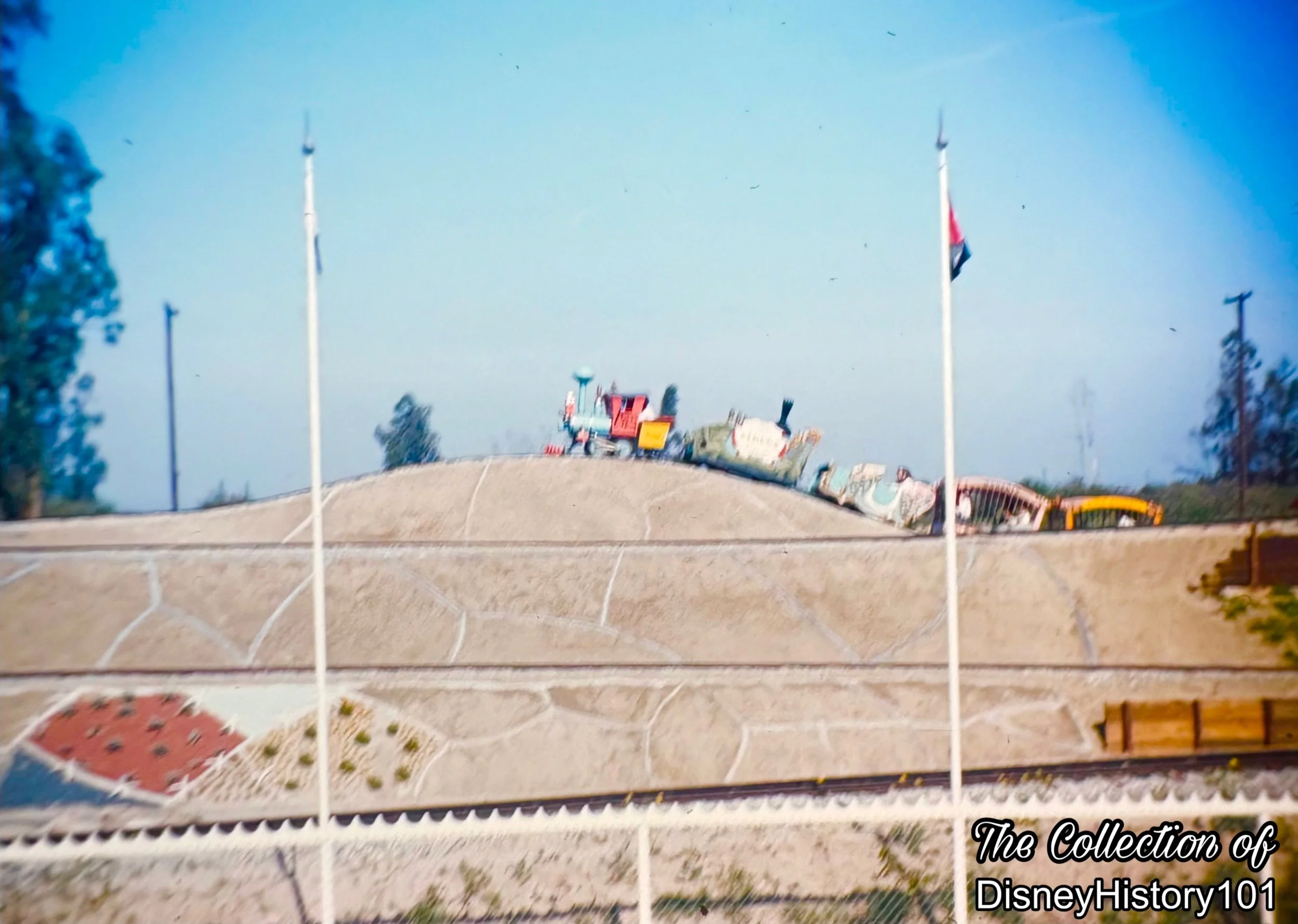
Casey Junior Circus Train, Flags of the World and the beginnings of the Patchwork Quilt, 1956.
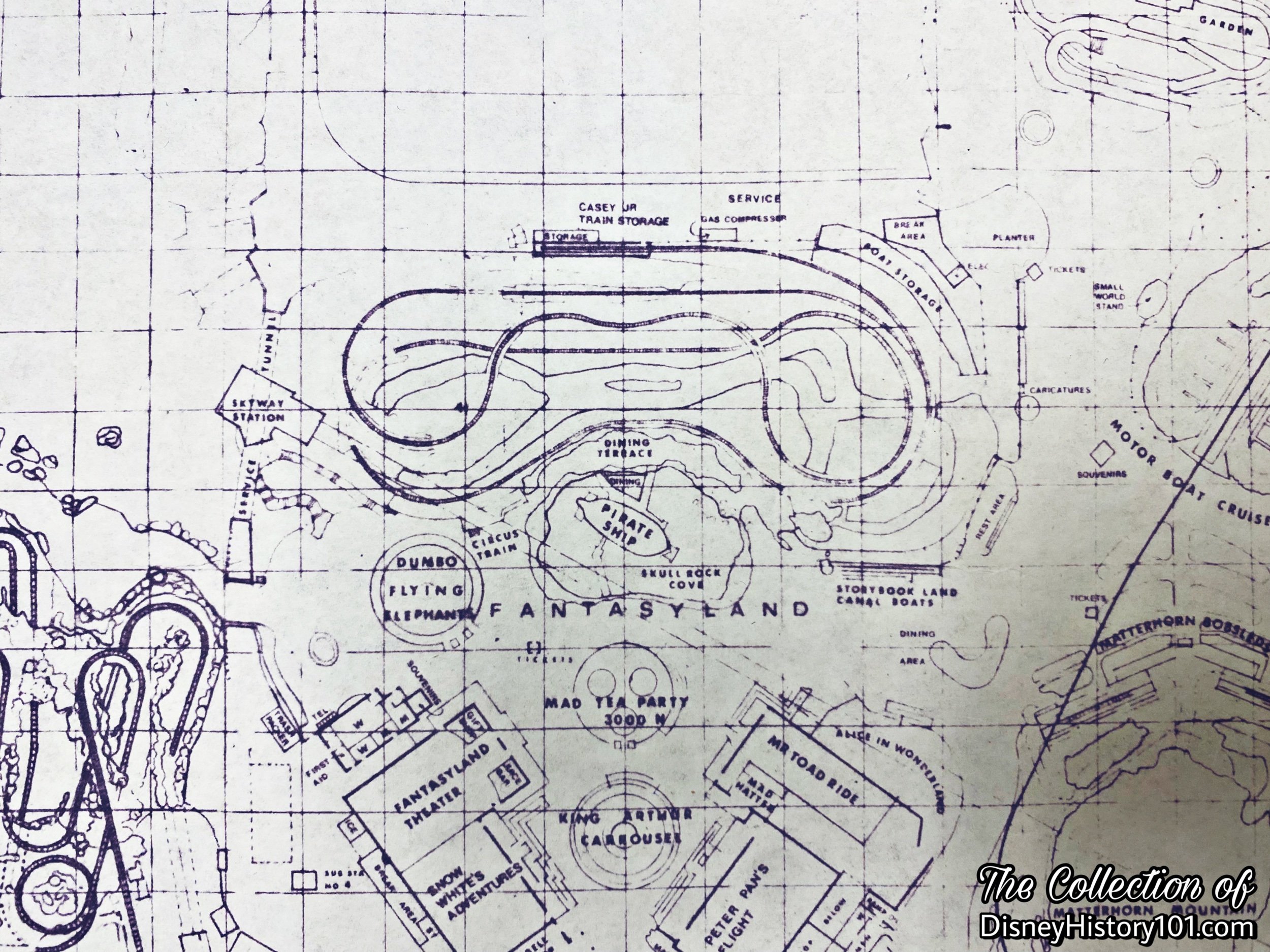
Disneyland Site Plan; September 1977.
The attraction was down for rehabilitation from Apr. 22-May 3, 1963.
During each day, Disneyland Park Operations M-42 Machinists would, at least once, check all attractions in Fantasyland and discuss with each Attraction Lead and problems, defects, or any other feedback regarding the department. M-42 Machinists would also respond to all downs and delayed openings in the Fantasyland area whether or not it was mechanical. Upon arriving at an attraction, they would determine whether what the failure was. M-42 would determine which crafts were needed, determine an estimated time of repair, notify M-1 and assist with crafts when necessary.
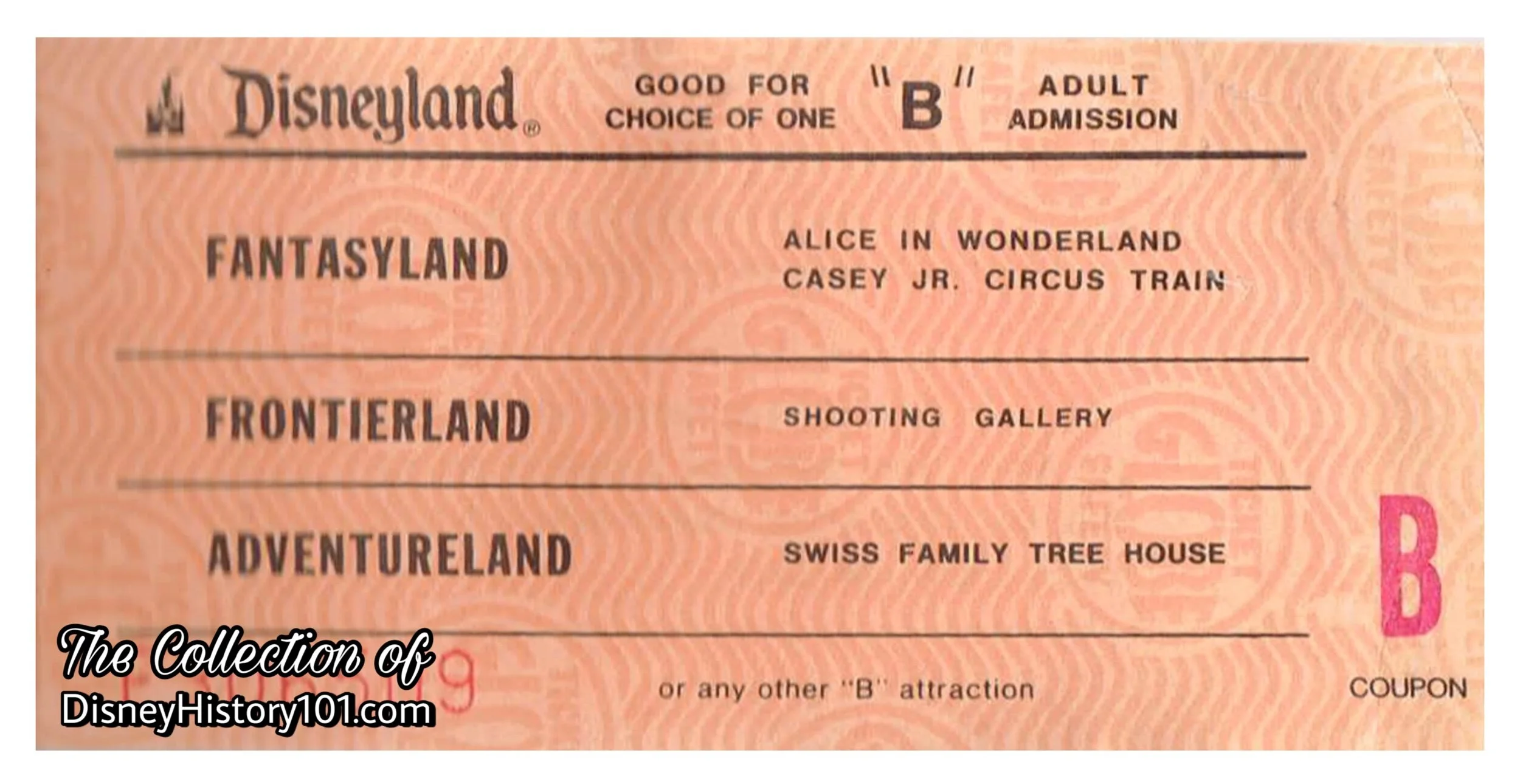
Disneyland "B" Adult Admission Coupon (No Cash Value)
“55er” Jim Cashen recalled: “we poured a cement dock on Casey Jr. to eliminate a lot of work there every year.”
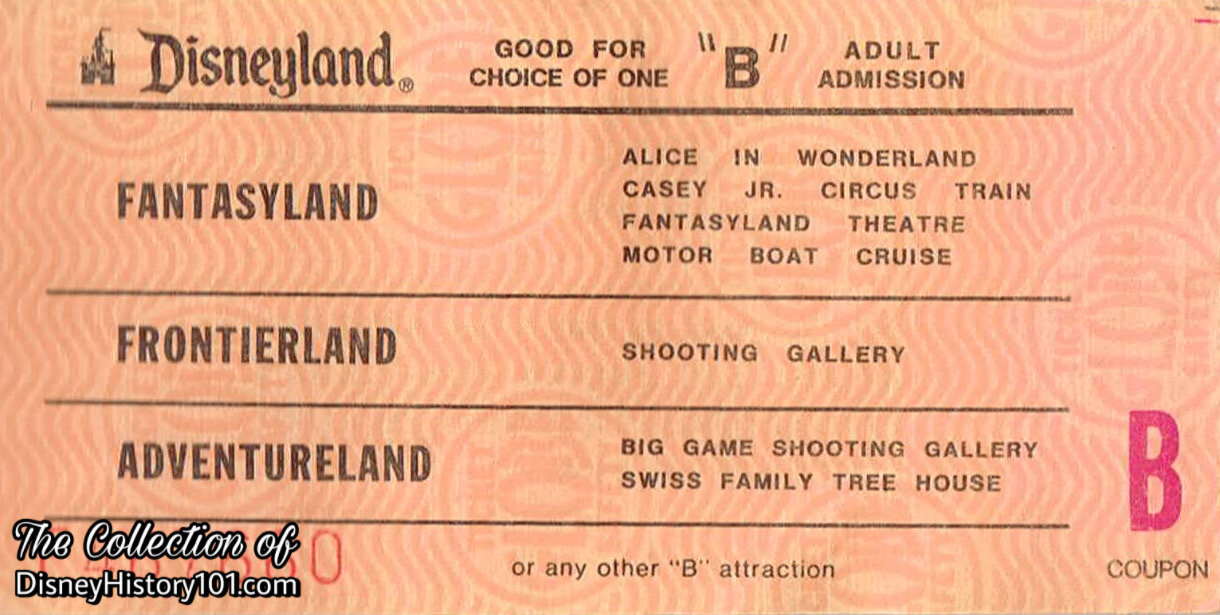
Disneyland "B" Adult Admission Coupon (No Cash Value)
During 1984, a report showed that the Casey Jr. power unit weighed 3,950 lbs.
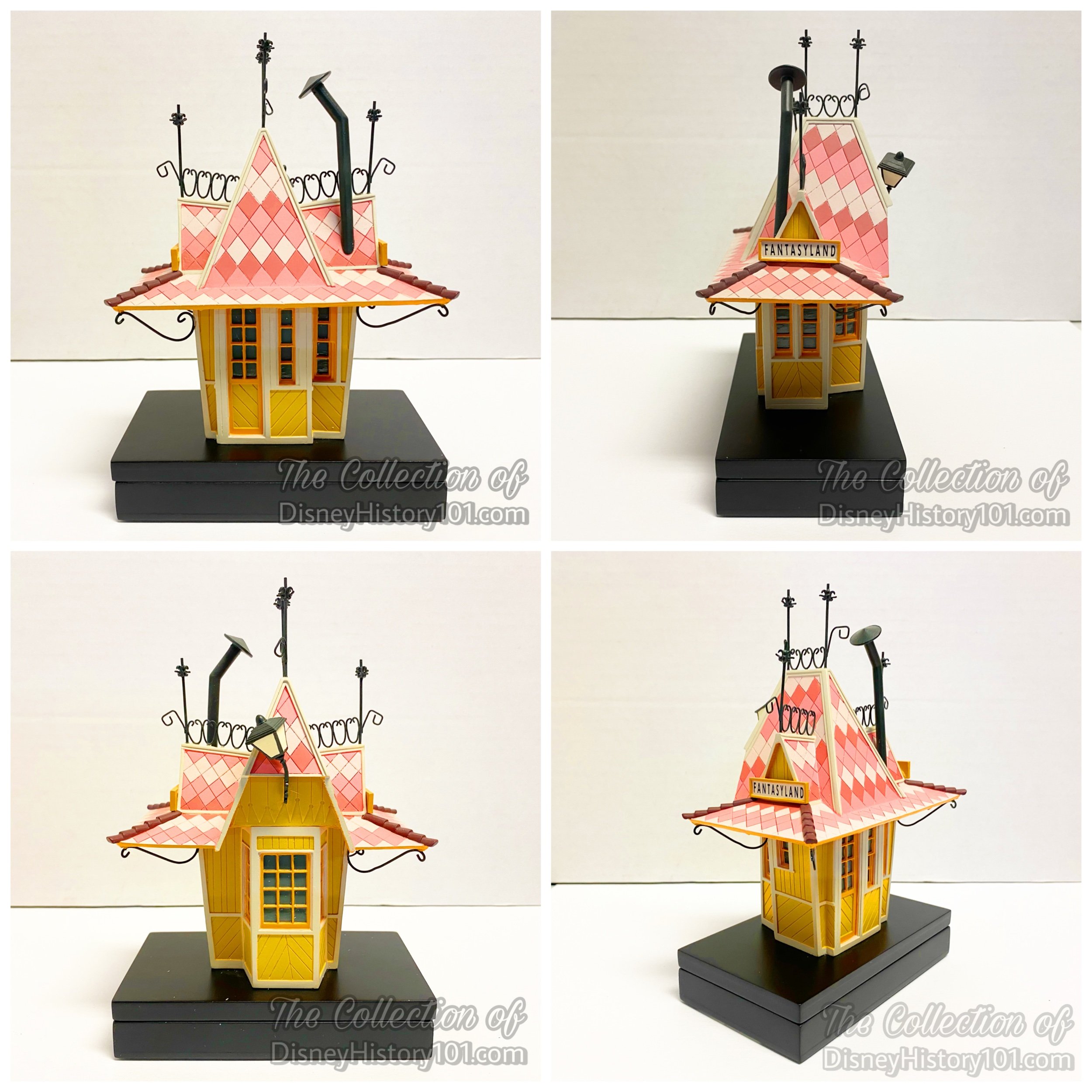
The Casey Junior Ticket Kiosk at Disneyland was fashioned after the Depot setting of Walt Disney’s “Pigs is Pigs,” released 1954.
Speaking of coupon tickets, Disneyland celebrated the opening day "Disneylandmark" with the Fantasyland Ticket Booth Limited Edition Trinket Box released through Disneyland Resort in a limited to an edition of 1,500. The team of Jody Daily, Kevin Kidney, and William Babington crafted this amazing miniature homage for the “The Happiest Homecoming on Earth” - the 50th anniversary of Disneyland!
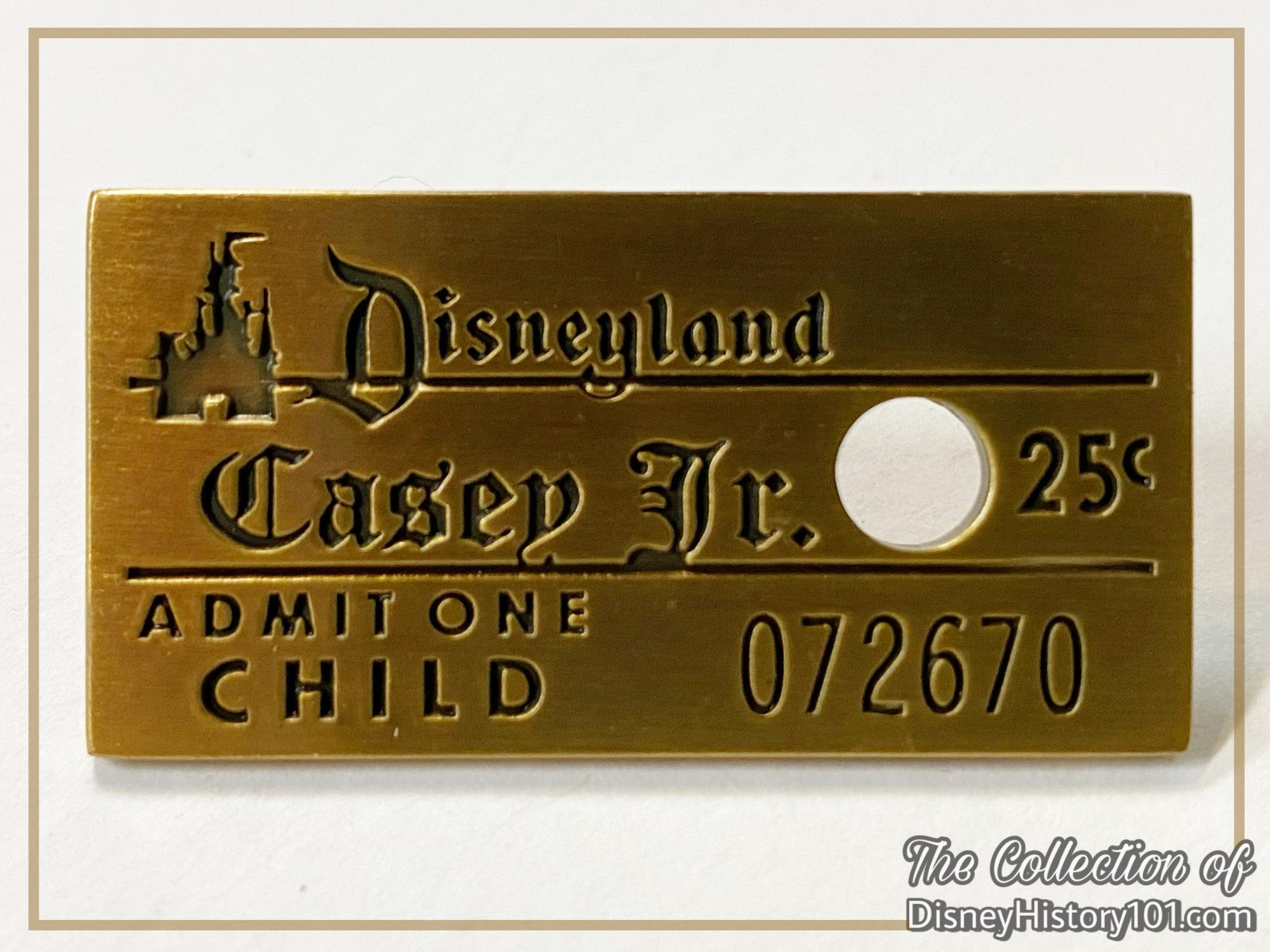
An LE 1,500 Disneyland Casey Jr. Admissions Media pin.
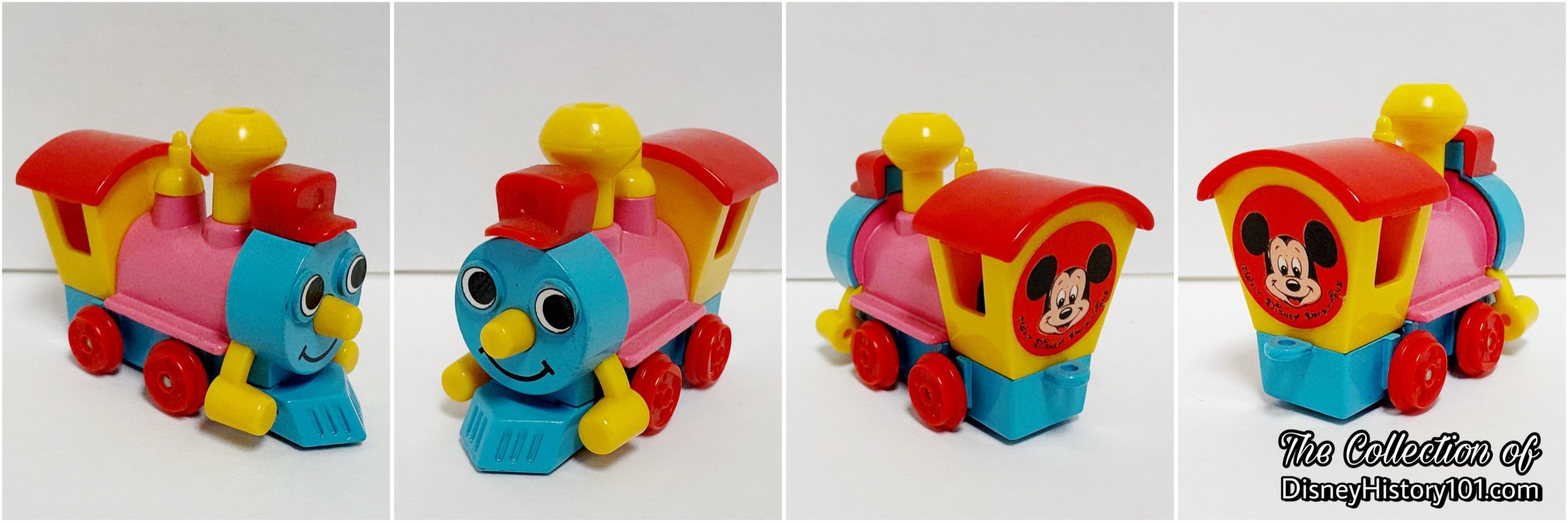
Tomy (Tomica) Casey Junior; 1970s.
Walt Disney’s Casey Junior has occassionally been the subjct of licensed products through the years. Tomy (Tomica) released the Casey Junior die-cast toy during the 1970s and Politoys Polistil of Milan, Italy released Treno Di Dumbo, a Casey Junior train featuring Dumbo and Timothy riding aboard the tender.
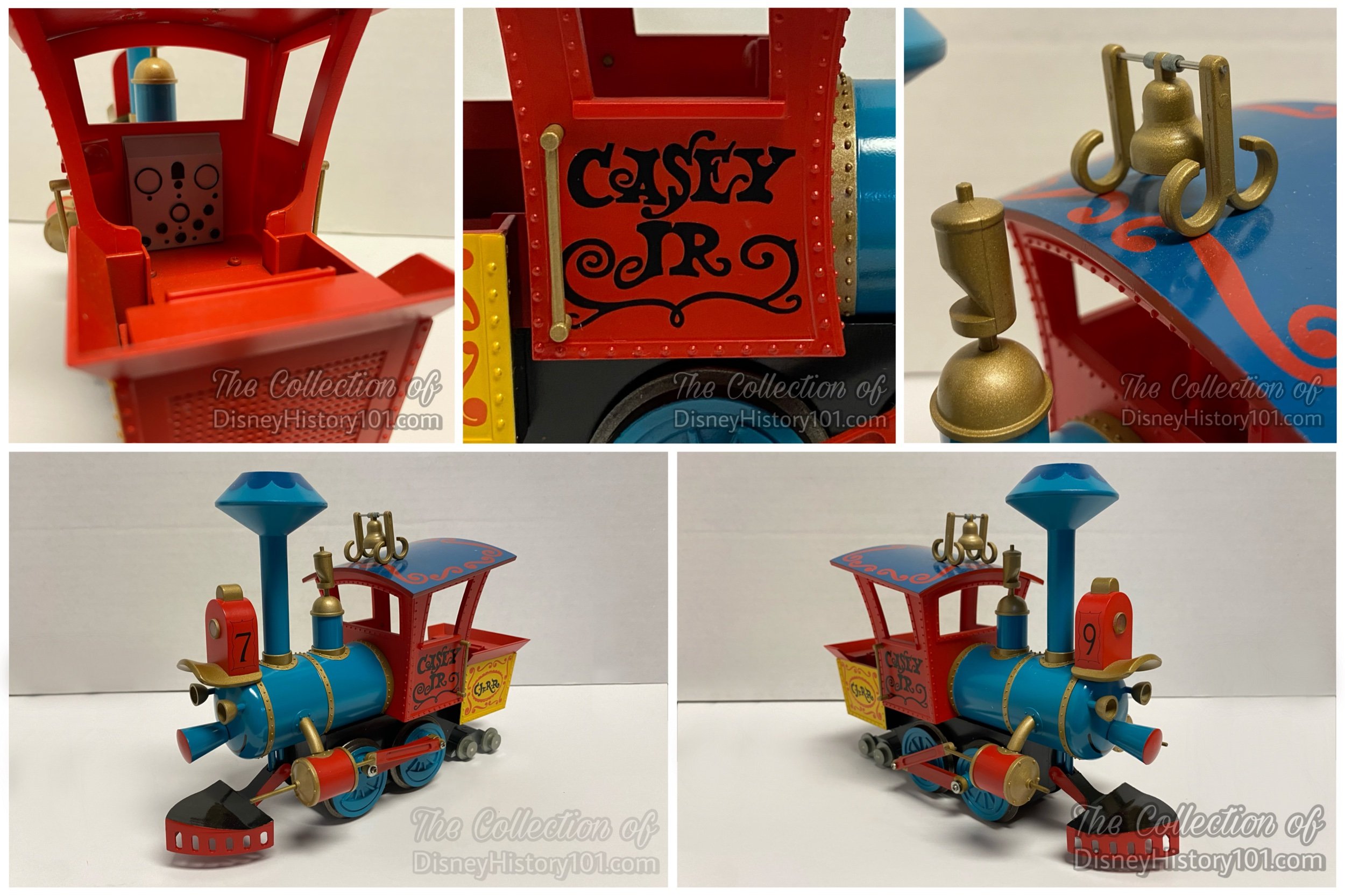
The Casey Junior “G” Scale Train by AMC Co., Ltd. was offered as a (LE 500) collectible in 2005 to coincide with the 50th anniversary of Disneyland.
The Casey Jr. Circus Train is one of many “senior” Fantasyland attractions that continues to delight generations of guests - old and young!
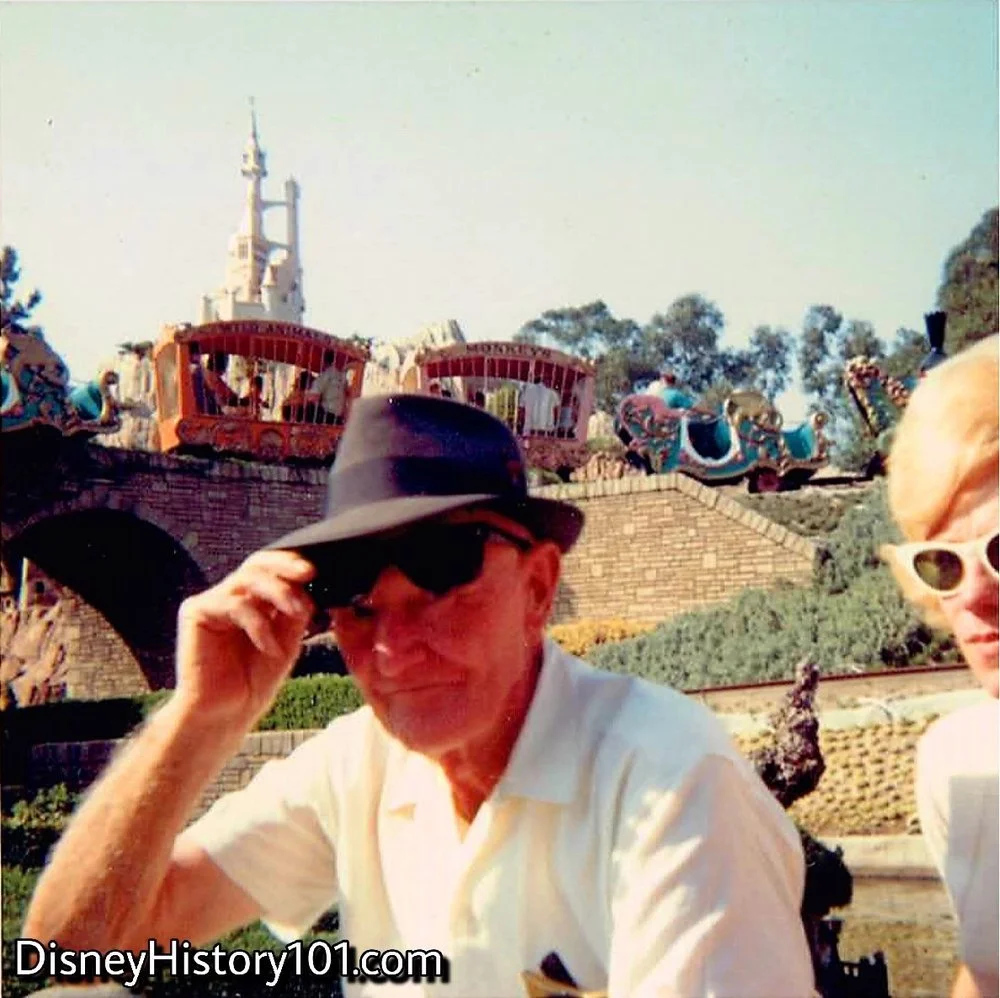
1968.
Quisque iaculis facilisis lacinia. Mauris euismod pellentesque tellus sit amet mollis.