BIG THUNDER MOUNTAIN RAILROAD
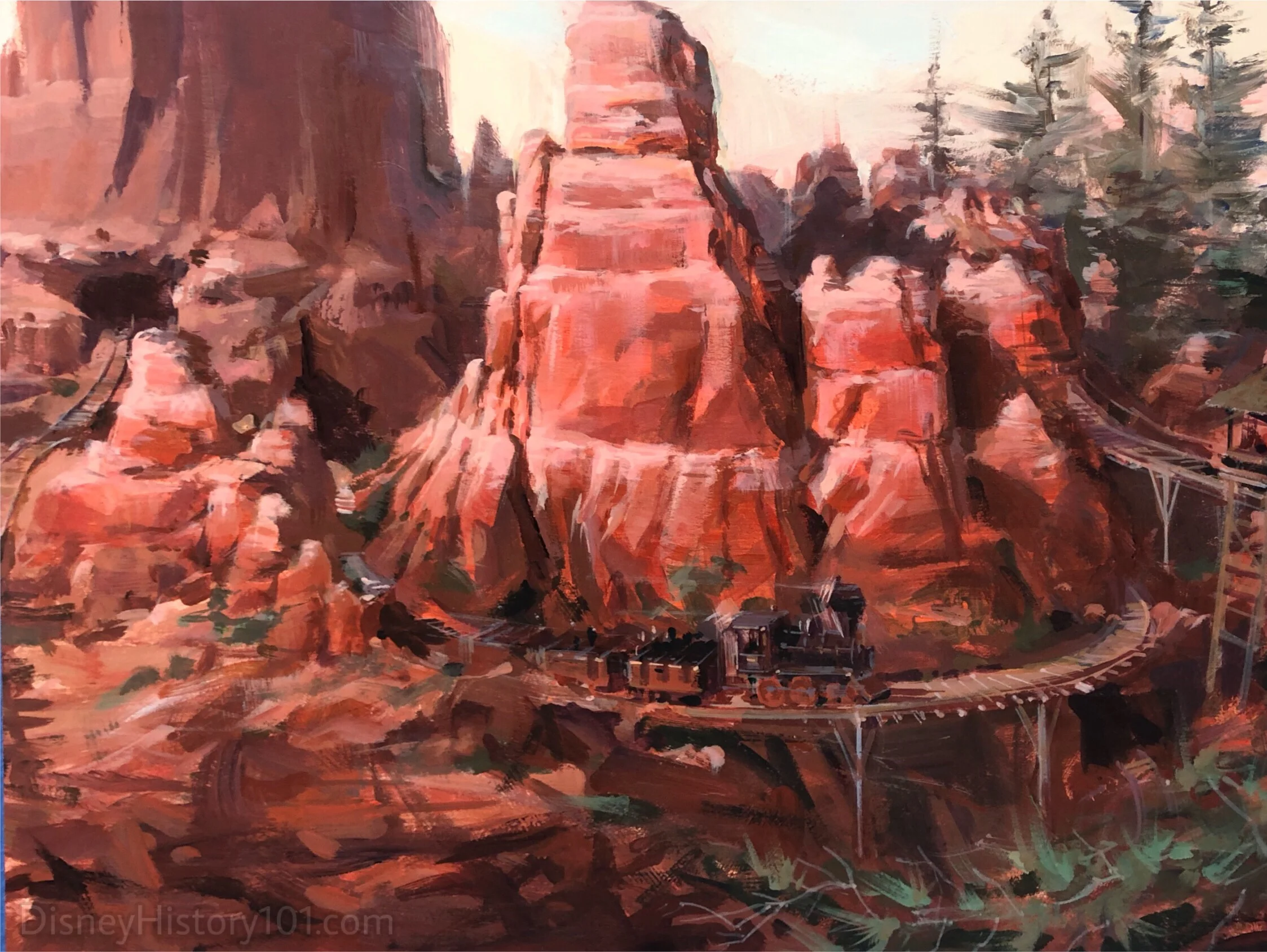
“The legend is about to come to life” - the 104-foot-tall Big Thunder Mountain towering above a forest of aspens and pines!
Soon, Guests would board a mine train at Big Thunder Mountain for the wildest ride in the west!
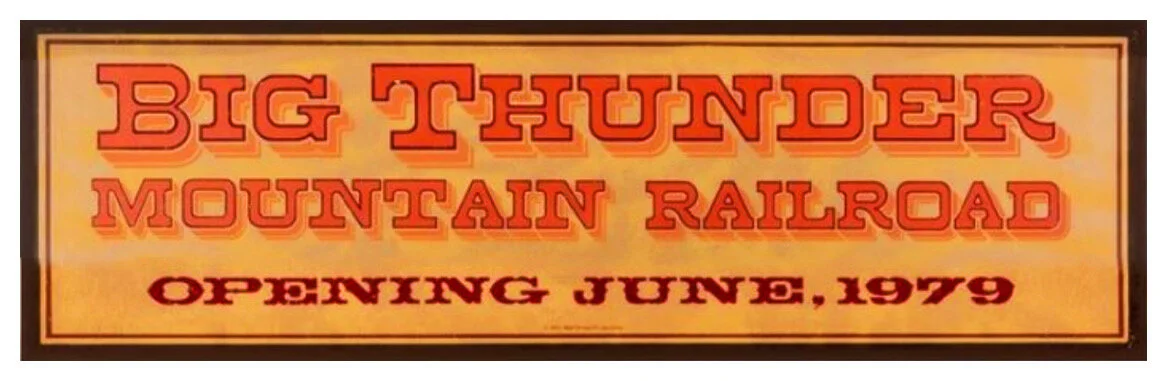
(September 15, 1979 - present)
“Prologue”
One can easily slip into the jargon of “ride,” but at Disneyland® Park there are adventures and attractions, with every attraction, a living experience for the guest. Disneyland ride-through attractions or adventures have officially been defined as an “individual show, ride, or exhibit designed to produce an entertaining Guest experience. Disney attractions stir the imagination, enliven the senses, and provide the participants with positive, innovative entertainment, which is the essence of the DISNEYLAND Show.”
There is a “story behind the story” of every attraction and it is important to review the story of the attraction, tell the story, explain it, and create interest. This is the story of Big Thunder Mountain Railroad.
When Disneyland was being conceived, Walt intended that his Park have no roller coasters. During the development of Disneyland, the Casey Junior Train attraction was tamed to its present timeless incarnation. However, Walt Disney said : “Disneyland will never be completed. It will continue to grow, always adding new things to provide its visitors with exceptional and entertaining attractions.” In Walt’s eyes, Disneyland was “like a piece of clay,” because if there was something he didn’t like, he wasn’t stuck with it. He could reshape and revamp it. This is partially because they were much like Walt Disney. Walt also said: “Since my outlook and attitudes are ingrained throughout our organization, all our people have this curiosity; it keeps us moving forward, exploring, experimenting, and opening new doors.”
After years of personally reshaping and revamping, Walt was ready to pass the torch, divulging: “I’m not the perfectionist anymore. It’s my staff - they’re the ones always insisting on doing something better and better.” Today, one WED philosophy is that there is no bad idea. “We say that because if you get in a meeting and somebody comes up with something and someone turns to him and says, ‘That's a stupid idea!’ you'll probably never get another idea from that person. So, we try to create an open environment where people can say anything. Quite often, something that sounds dumb at the time will turn out to be just the little spark that sets everything off Somebody will come in later and say, You know, I thought what so and so said was dumb, but I’ve been thinking about it and I think there's a little gem here.’ Its amazing how many times that happens…‘ Marty said that he's been around so long and has discussed so many ideas that he has seen many resurface after many years. ‘When that happens, I know from experience that a lot of them won't work, but I don't say, 'Well, you know what? We tried that 20 years ago and it won't work; because so much changes. If we went back through our archives, we'd probably find a lot of things that we could do today that we couldn't do at the time because the technology wasn't there.’“ [“Ripley’s Legends - pioneers of the Amusement Park Industry” by Tim O’Brien, Volume One]
“Blue Sky for a Big Mountain”
A fantastic example of this is the very idea of Big Thunder Mountain Railroad, which owes itself to the minds of numerous talented WED Creative Development Division staff members, like the Legendary Marc Davis. Back during the era of the Magic Kingdom’s development in Florida, it was believed that Florida residents and Magic Kingdom visitors would be bored with a pirate themed attraction, so an alternative adventure to Pirates of the Caribbean, was developed by Marc Davis.
“Eastern Airlines Introduces Walt Disney World - The Family Vacation Kingdom” published by “the official airline,” before October 1971 described how the “completely new, family-oriented total resort destination will have something to make the wishes of every member of the family come true.” One page briefly elucidated the show in greater detail: “A major attraction to be added during Walt Disney World's ‘Phase One’ is Thunder Mesa, which will tower high above dense pine forests, offering a spectacular panoramic view of Frontierland. Resembling a ‘table-top' mountain, typical of those found on Southwestern deserts, it will include a pueblo-style village and a series of exciting adventures. Inside Thunder Mesa, guests will ‘sign aboard’ the Western River expedition - a musical parody of the wild old West. On their cruise, they'll come face to face with cowboys and Indians in a frontier fantasy on the grand scale of Disneyland's famous Pirates of the Caribbean.”
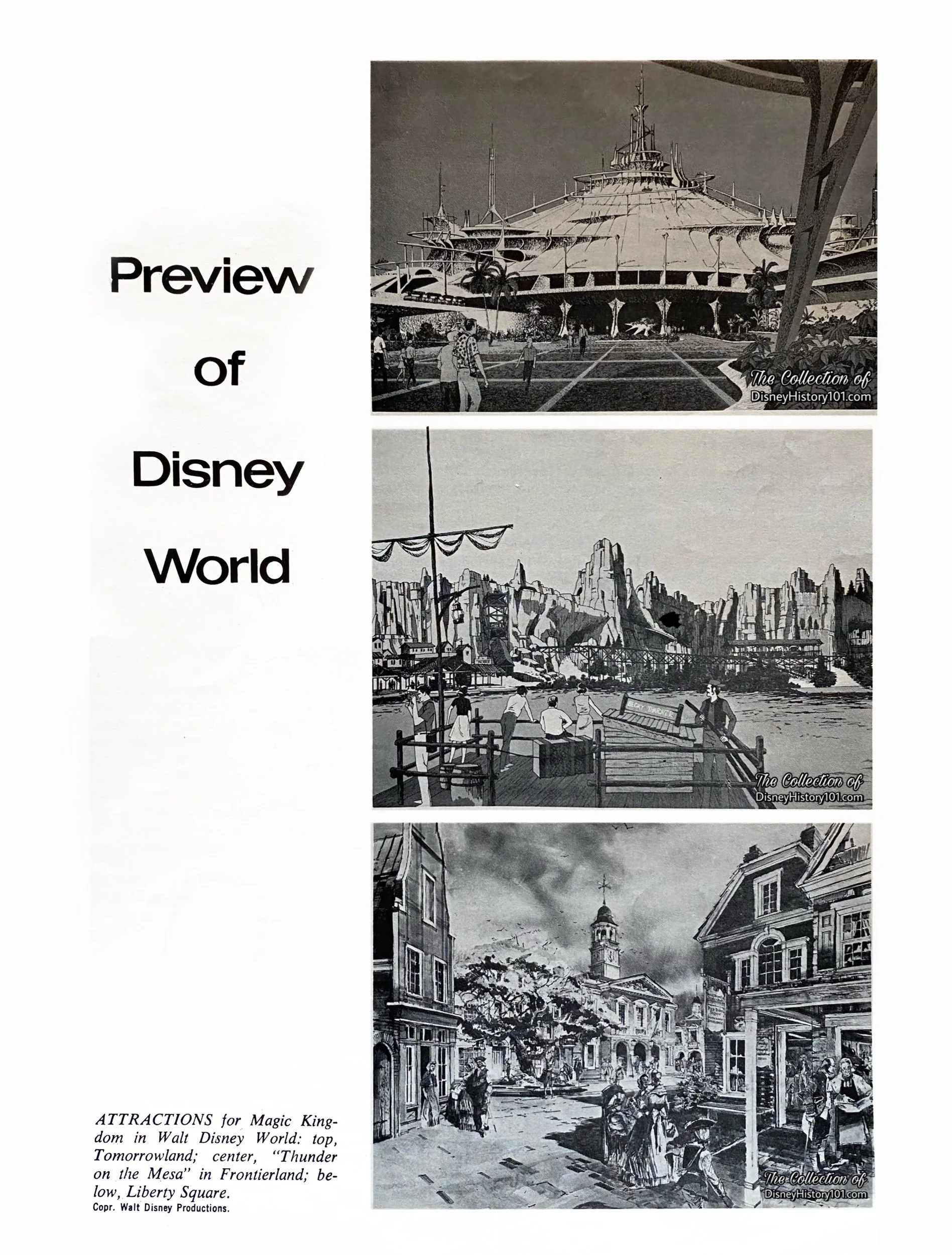
"Thunder on the Mesa" Preview of Disney World prospectus, published July of 1969 - before Big Thunder Mountain Railroad opened at Disneyland; © Walt Disney Productions.
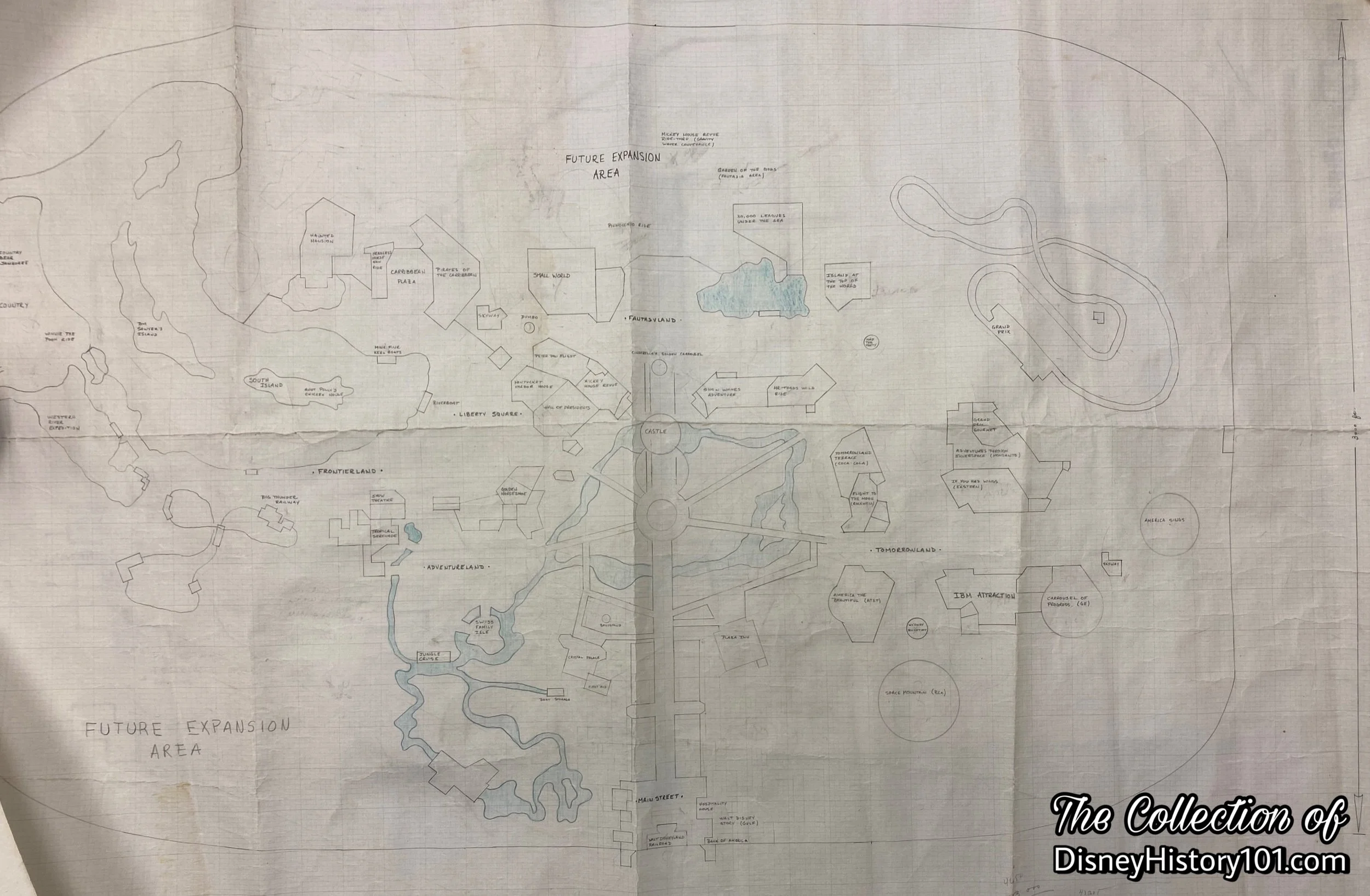
Western River Expedition is among future expansions for Walt Disney World.
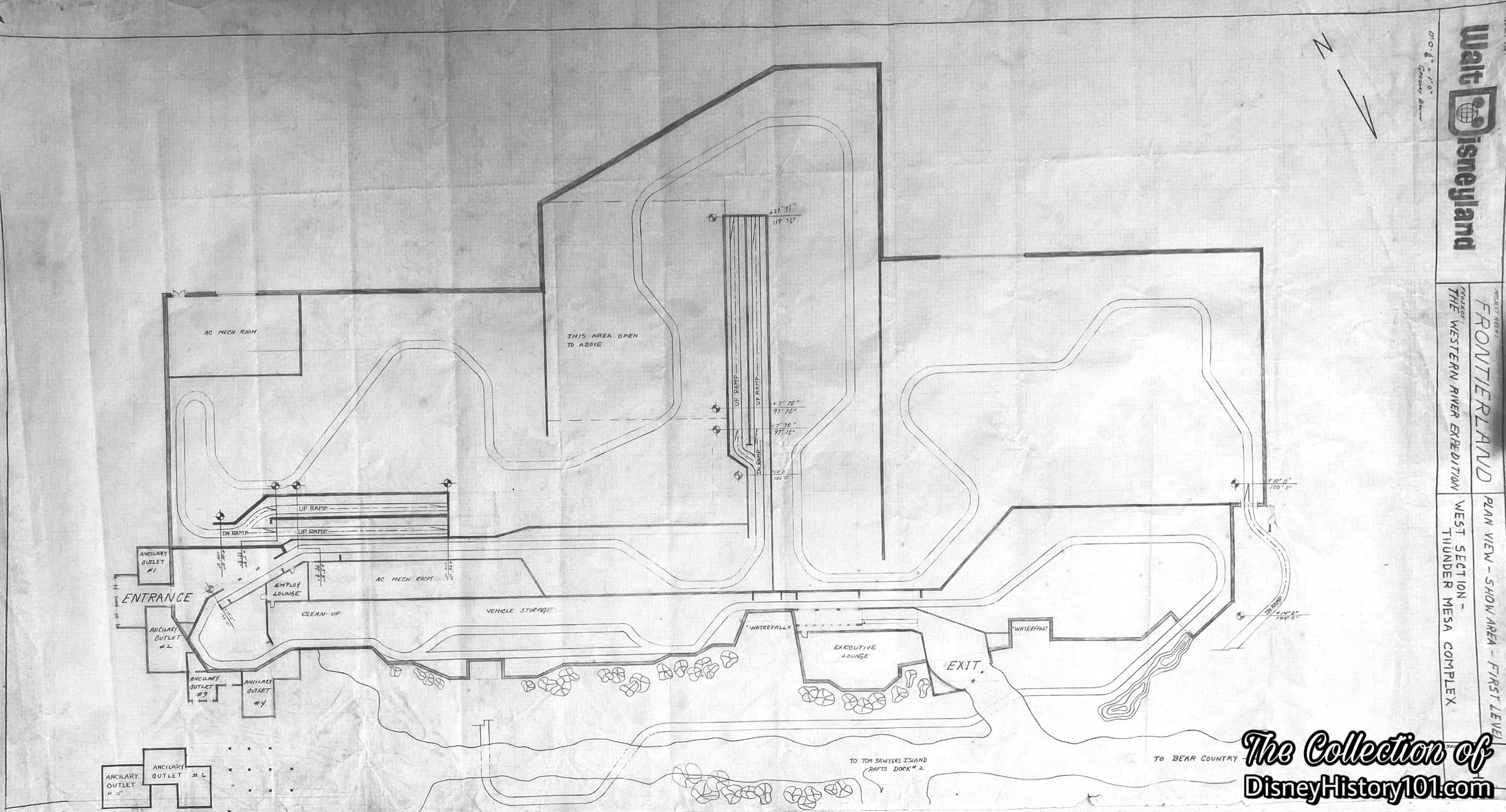
Western River Expedition Schematic Design
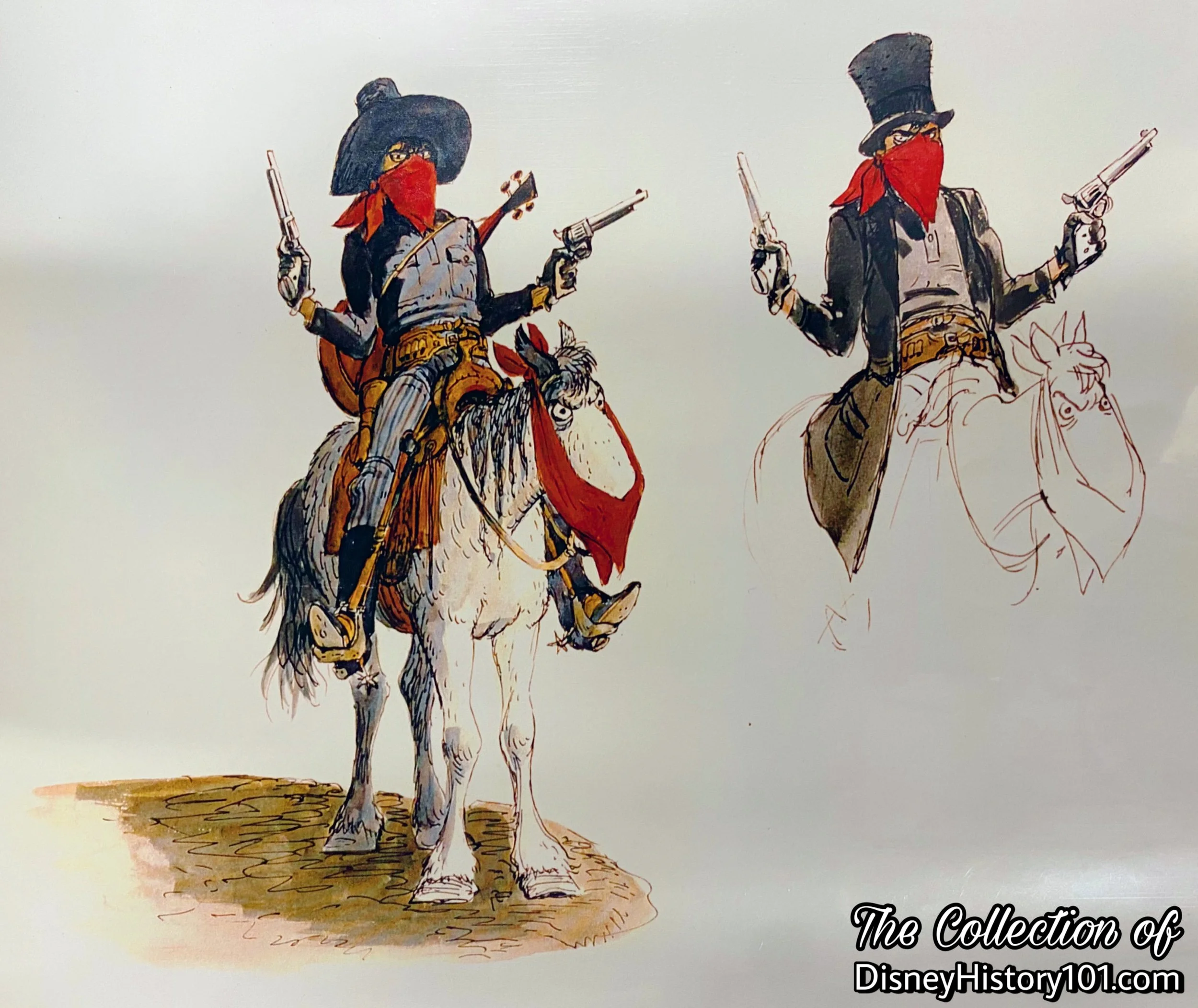
Western River Expedition concepts by Marc Davis.
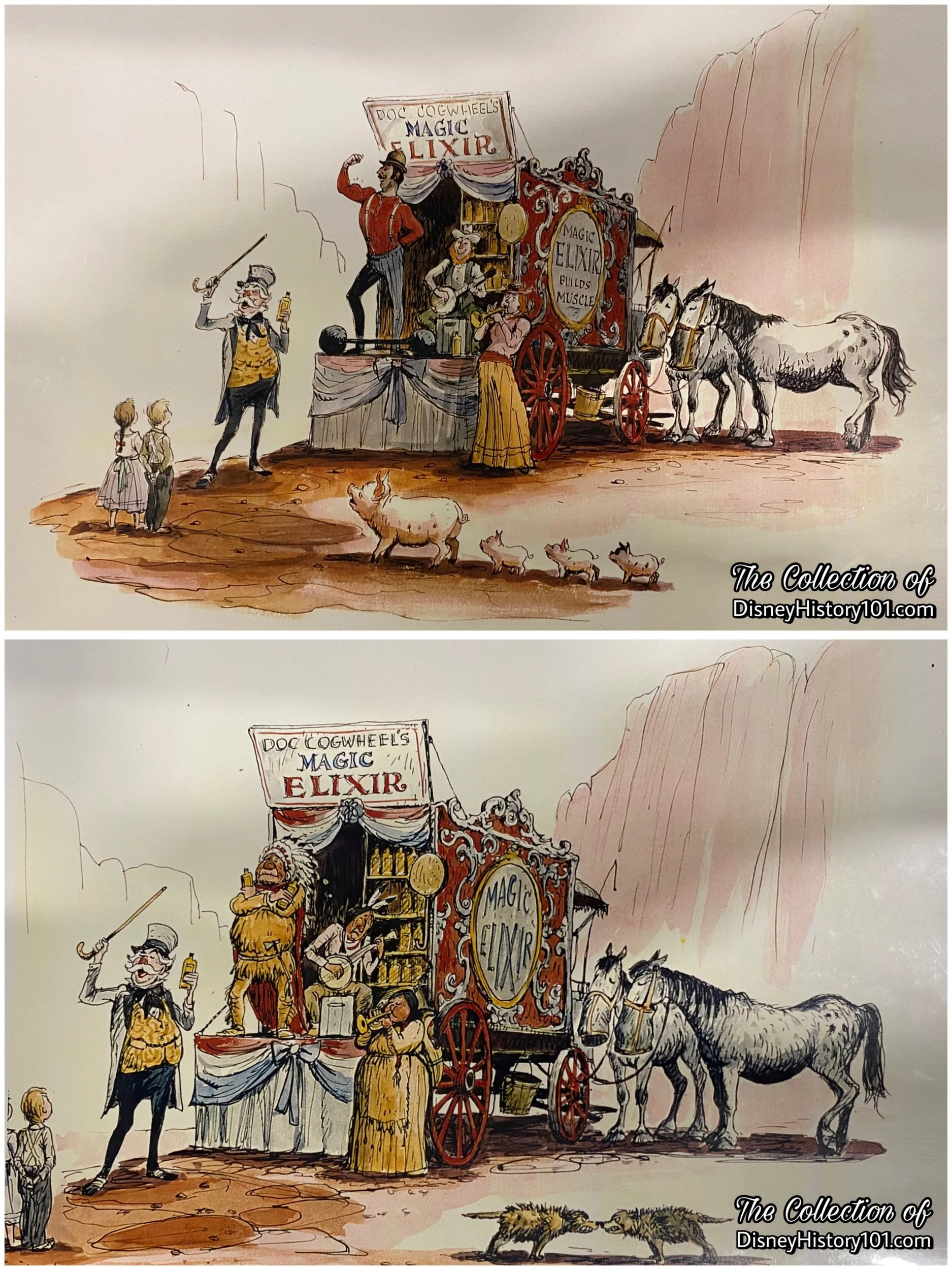
Western River Expedition “Magic Elixir” Wagon concepts by Marc Davis.
This show would contain a lot of gags - comic bit of action or dialog that makes one laugh.
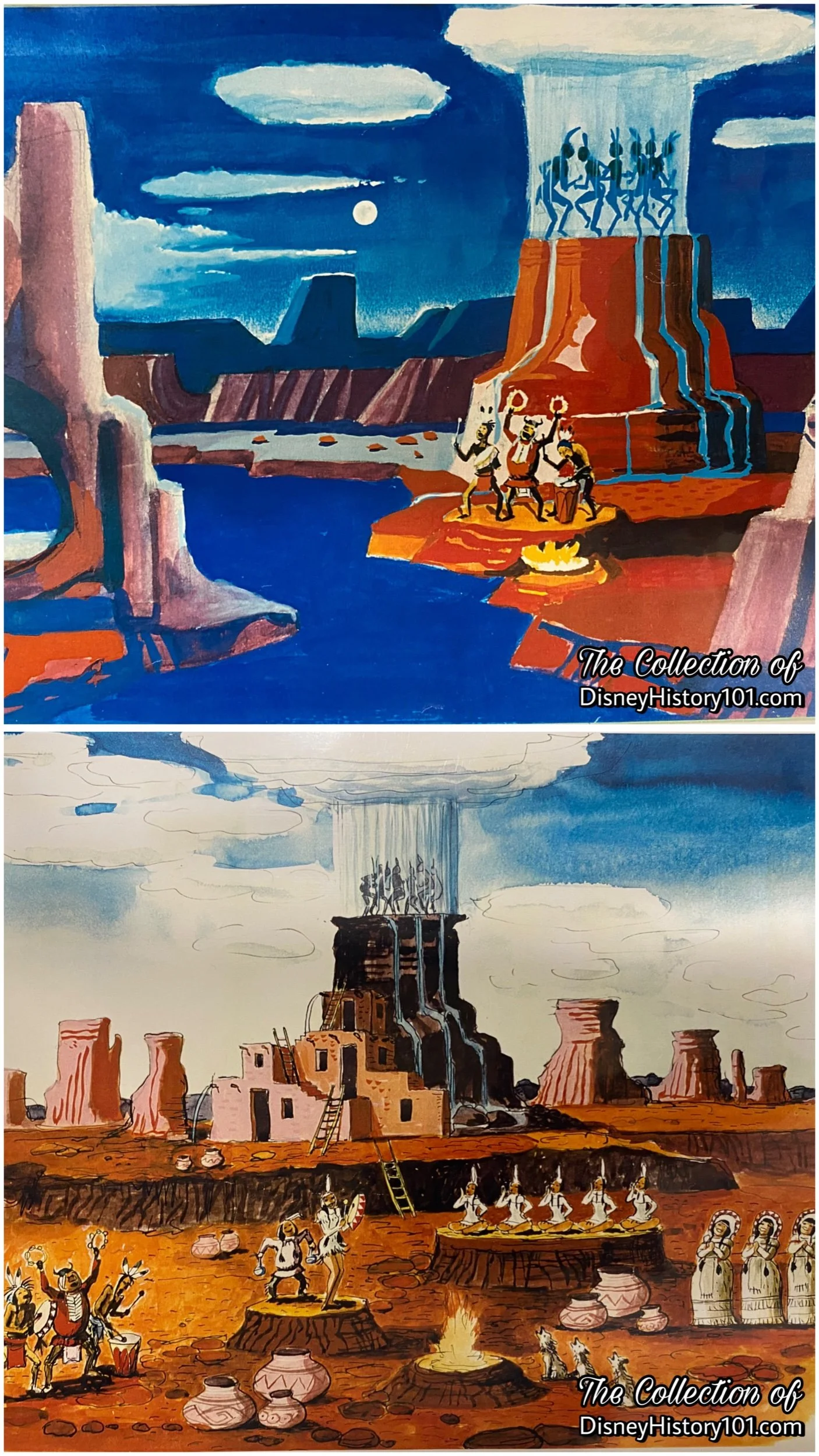
Western River Expedition concepts by Marc Davis.
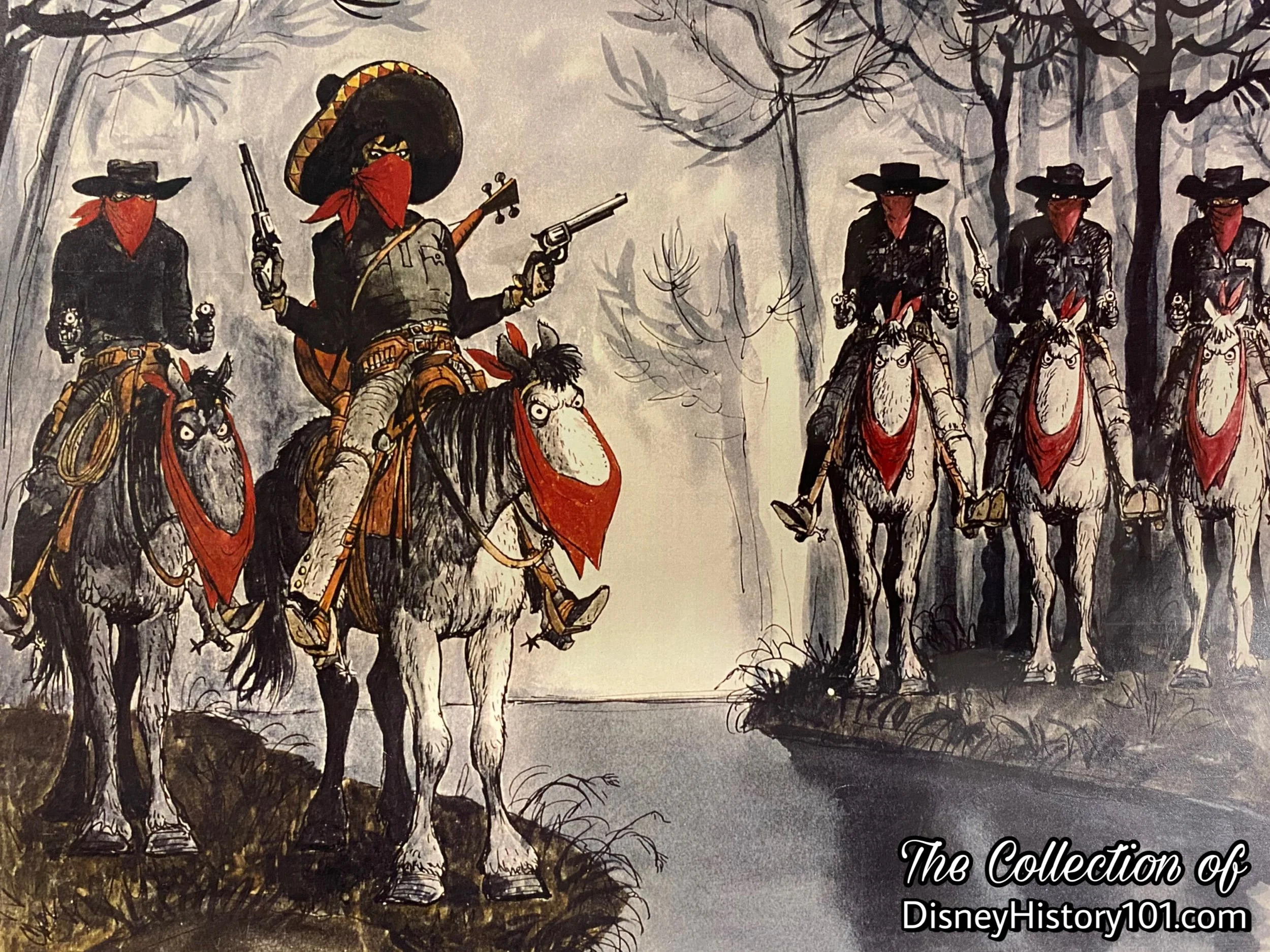
Western River Expedition Bandits by Marc Davis, ©WED Enterprises, Inc., 1968.
Thunder Mesa was staged, presenting the scenes, or actions. The concepts for the “toothy” Thunder Mesa would “tower high above dense pine forests, offering a spectacular panoramic view of Frontierland. Resembling a ‘table-top’ typical of those found in Southwestern deserts” it would “include a pueblo-style village and a series of exciting adventures,” according to the Preview Edition Walt Disney World - the Vacation Kingdom of the World. Once inside, guests could board the Western River Expedition (another gravity-flow canal boat attraction) “a musical parody of the Wild old west” which would be one feature of a potentially new kind of Frontierland. However, the massive show building was figured to be too expensive, and the plans were “shelved” in 1973 (without even a “rumbling” being heard about mine trains during the construction of Space Mountain).
Well, perhaps there was a little movement in this area. That very year (of 1973), Tony Baxter (of WED Creative Development’s Project Show Design Division) had previously been assigned to the on-site team at Walt Disney World (an assignment that lasted nine months), and was now assigned to what was known as the “train ride” project. That year, Tony (with his knowhow of balsa wood marble maze construction) and a team of model makers, “went to work designing a physical layout while at the same time adding ‘show elements’ which sprang from their own imaginations,” according to one Press Release. “A quarter-inch scale ‘show’ model of the attraction was constructed.” [“Creation of ‘Big Thunder Mountain Railroad’ Typifies Disney History of Creative Teamwork”]
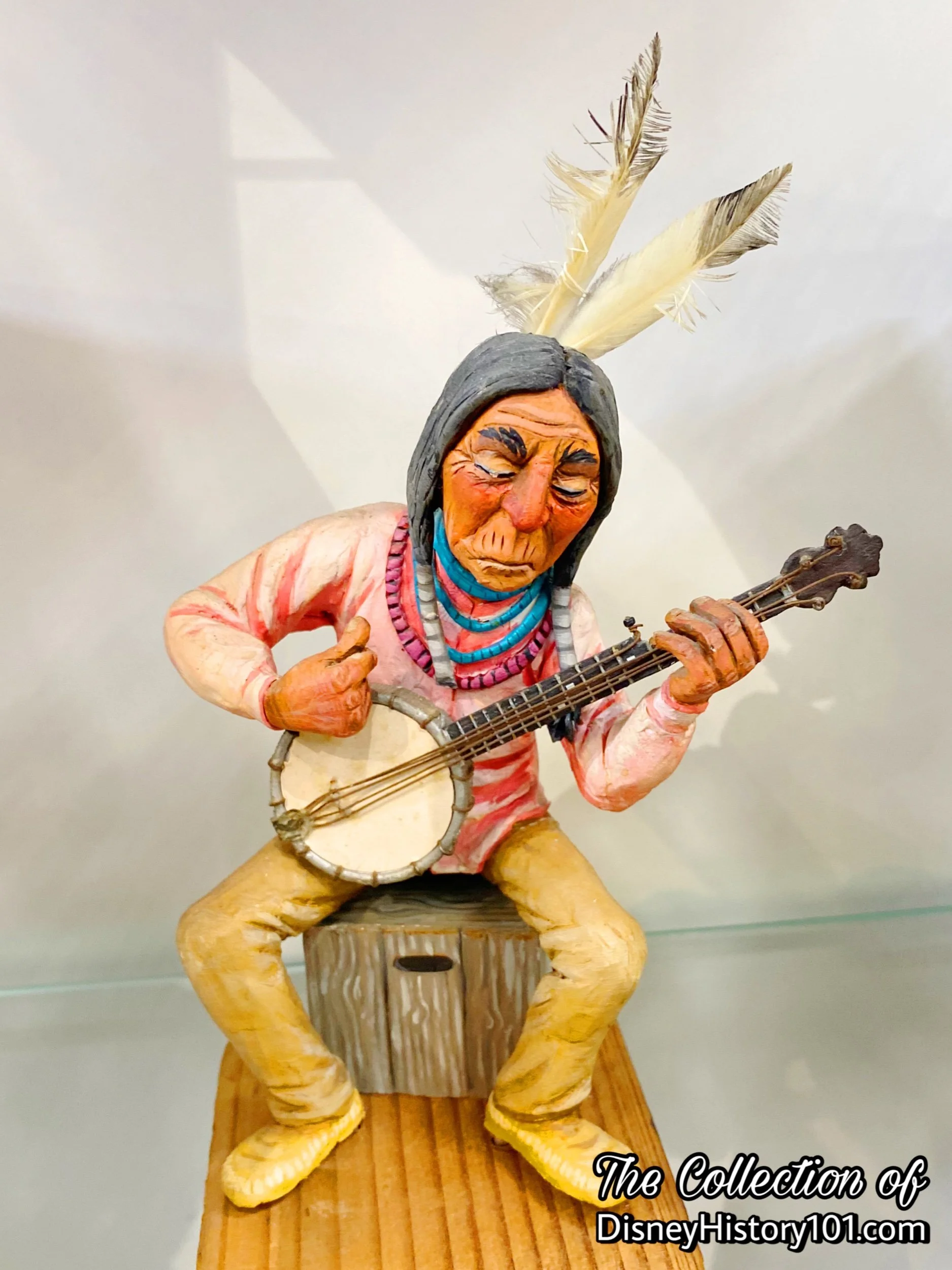
The Sculpting Department develops two-dimensional sketches into three-dimensional maquette for Western River Expedition.
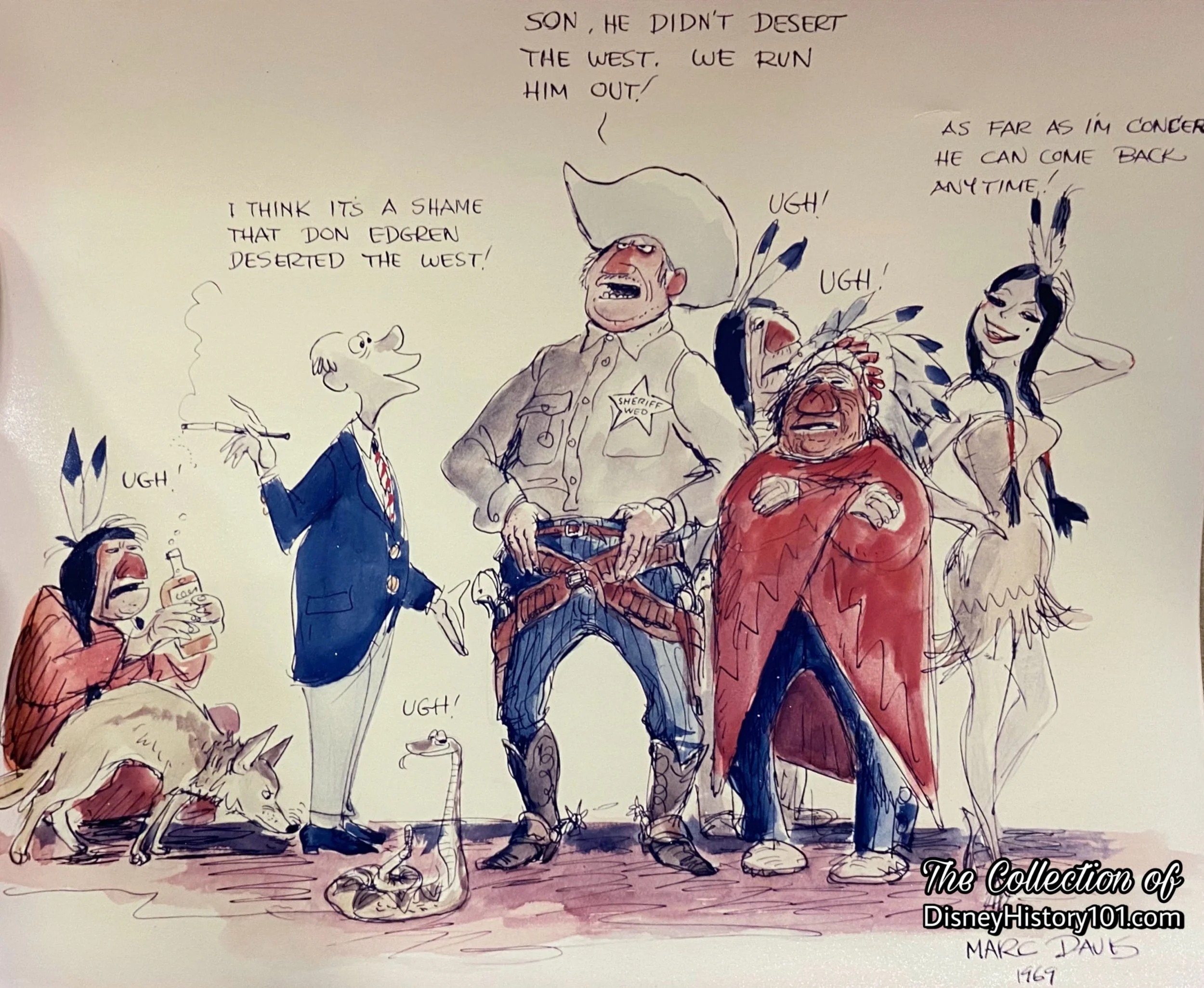
Western River Expedition gag drawing by Marc Davis.
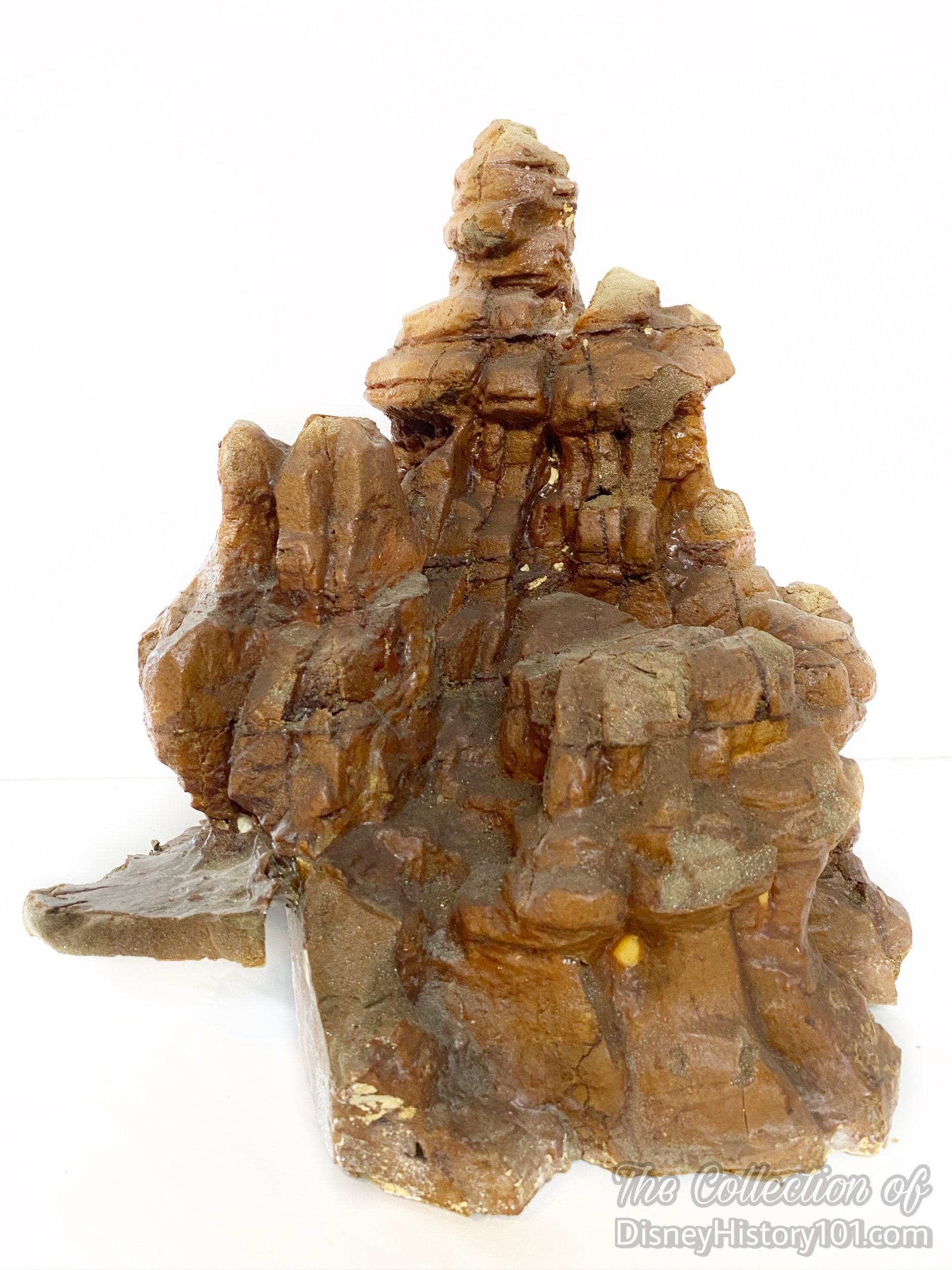
A “toothy” fragment of the Big Thunder Mountain three-dimensional RockWork study mock-up Show Model prepared for The Magic Kingdom at Walt Disney World.
Walt Disney Imagineers knew their audience. After Space Mountain successfully opened at Walt Disney World Magic Kingdom, the evident advancements in computer controlled “Block Systems” led to consideration of a new Frontierland attraction at Disneyland. Marc Davis’ western-themed ideas (and comedic vignettes) were dusted off by Walt Disney Imagineers and presented as a “train ride” concept. However, some Show aspects of his attraction designs were deemed a little archaic and thus not approved.
“Dimensional Design”
Dimensional Design and models have always played an important role in development. It’s much easier for people to visualize a concept in three dimensions. A model maker is probably the first to take a concept and make it real. Models are also used in presentations, to sell the idea of the attraction.
While elaborate show models can take several months to build, a model is a time-saver because construction problems can be worked out ahead of time. A finished model is also a useful reference at the construction site.
It’s been said that the “modeling process will take many forms and many scales, often ranging from tiny paper cutouts, all the way up to full scale mock-ups. Whichever way the process goes, however, the WED designers think big by first building very small.” [THE DISNEY THEME SHOW: an introduction to the art of Disney outdoor entertainment] Show models were prepared, depicting the attraction's show elements, such as it’s figures and stages.
When Walt Disney Imagineering Model Shop completes a model, not all can be saved. Many are thrown out. Only those models judged to have some significance are crated up and stored away; by 1984, an approximate total of 1,500 to 1,700 models had been stored. Above, note a salvaged fragment of the historic Big Thunder Mountain model.
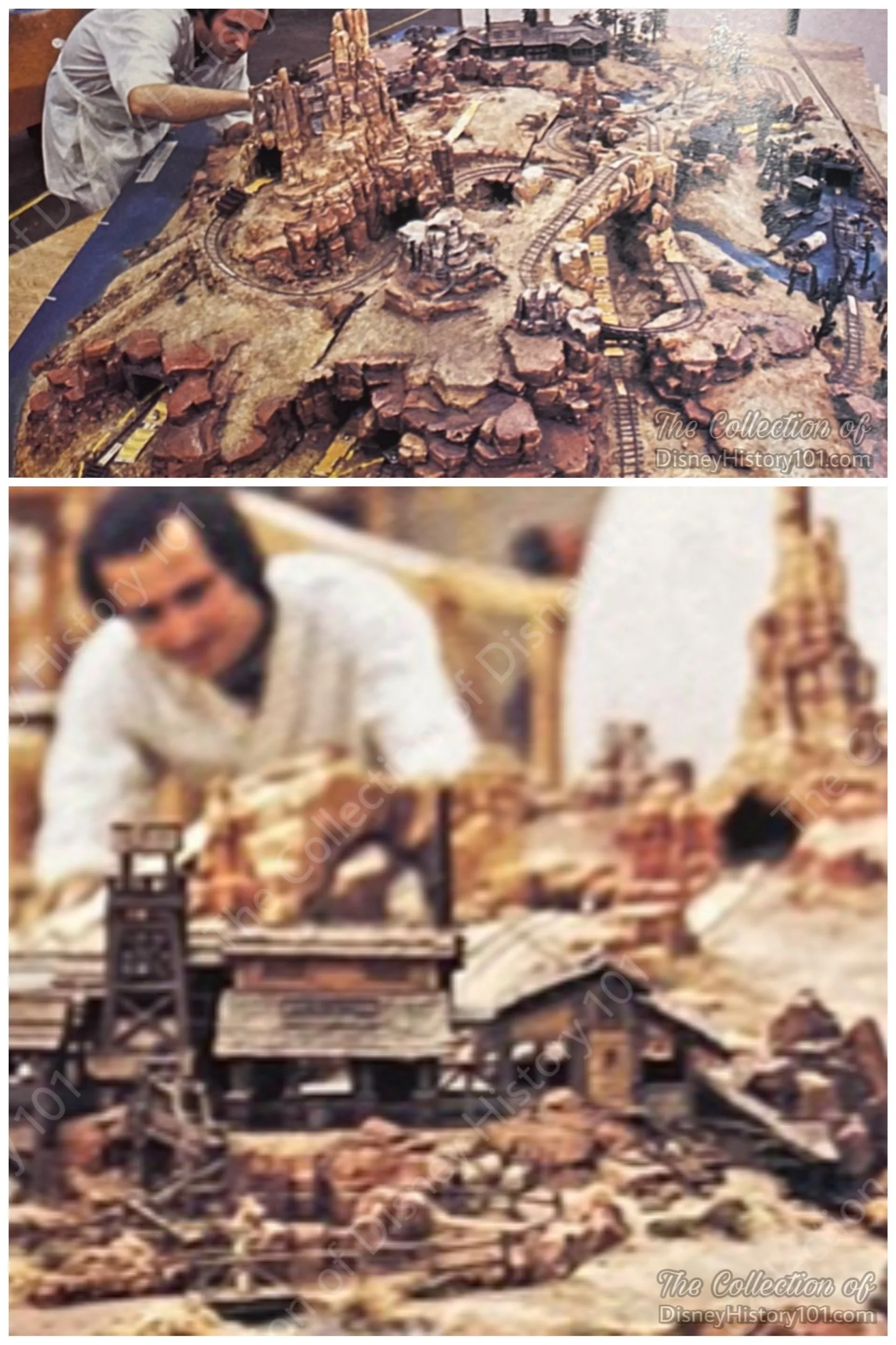
Show Documentation captures the creative intent of Show Designers in the “Annual Report 1976 Walt Disney Productions,” Page 14.
By Winter 1972, the 25-year-old full-time WED Imagineer Tony Baxter was immersed in a scale model railroad track, plotting its course through an assemblage of miniature southwest mesas, buttes, and western towns, all part of a major new attraction he is designing for Walt Disney World: Big Thunder Railway.
Once Tony’s model was approved for show design concepts, “a larger 1/2”-to-1” scale model of the attraction was constructed for field work. A grid work of 1/2” squares was then drawn over the model and it was cut into 1” slices. The grid was enlarged to full scale at Disneyland, providing exact dimensions for each section of rock work.” [“Unique Growth Process Helps Create Big Thunder Mountain” Press Release] The larger model featured much of the exact tooth (texture and rough surface) that would be replicated full-scale.
According to Dave Melanson (WED Project Coordinator) “Big Thunder Mine Railway” was first approved on February 11, 1977. It was decided to retain both the idea of a mine train vehicle, and the name “Big Thunder” in honor of Cascade Peak’s “Big Thunder Falls,” (which once spilled their waters into the River’s of America, from 1960 to 1977). Maintenance salvage and tree boxing began around March of 1977, to “determine those elements of scenery and animation which can be saved from Nature’s Wonderland and put to future use.” Anything that could be salvaged needed to be cleared out by May, when major demolition was scheduled to begin. [Disneyland LINE, February 24, 1977] Two Show elements that were allowed to remain were the “Twin Peaks and waterfall.”
Tony Baxter has said, that “‘Big Thunder Mountain Railroad is a collection of individual embellishments’ orchestrated into a cohesive show.” This is evident by what happened next. Under the artistic and engineering direction and expertise of both Tony Baxter and Bill Watkins, a team of Imagineers was assembled! Walt Disney Imagineers Skip Lange (a University of California Bachelor with a knack for sculpting rock work) and Patrick Burke (a Mojave native) both worked on one of the first extensive models of “Big Thunder Mine Railway.” Quite a few meetings of WED and MAPO artists and engineers took place (appropriately) at the nearby Golden Horseshoe in Frontierland.
Then, the old Mine Trains (which once transported guests through Nature’s Wonderland) pulled into the Loading Station for the last time, on January 2nd, 1977. According to Disneyland LINE Magazine [October 28, 1994 ; Vol. 26, No. 42] : “With the turnstile locked and the train backed into the tunnel, the clamor of picks and shovels and chugging trains were heard no more…. Gone were the geysers, gophers and phosphoric pools in the caverns, past precipices and waterfalls.” But this is just the beginning of our story! During the very same month of January 1977, the two-acre Nature’s Wonderland began to be re-“landscaped” into Big Thunder Mountain, under the oversight of Mike Marx (contemporaneous Frontierland Area Stage Supervisor) and Tony Baxter (contemporaneous Walt Disney Imagineer ; Art Director)! Just over a month later, it’s replacement “Big Thunder Mountain Railroad” was approved as a project, on February 11, 1977. A few days later Disneyland LINE (February 24, 1977) ran the headline “Goodbye, Mine Train. . . Hello, Thunder Railroad.” The article announced briefly : “After a successful 17-year run, the Mine Train has been put out to pasture. Yet this retirement will not be in vain, as an all new attraction is planned for that area of Frontierland - - Big Thunder Railroad is coming!”
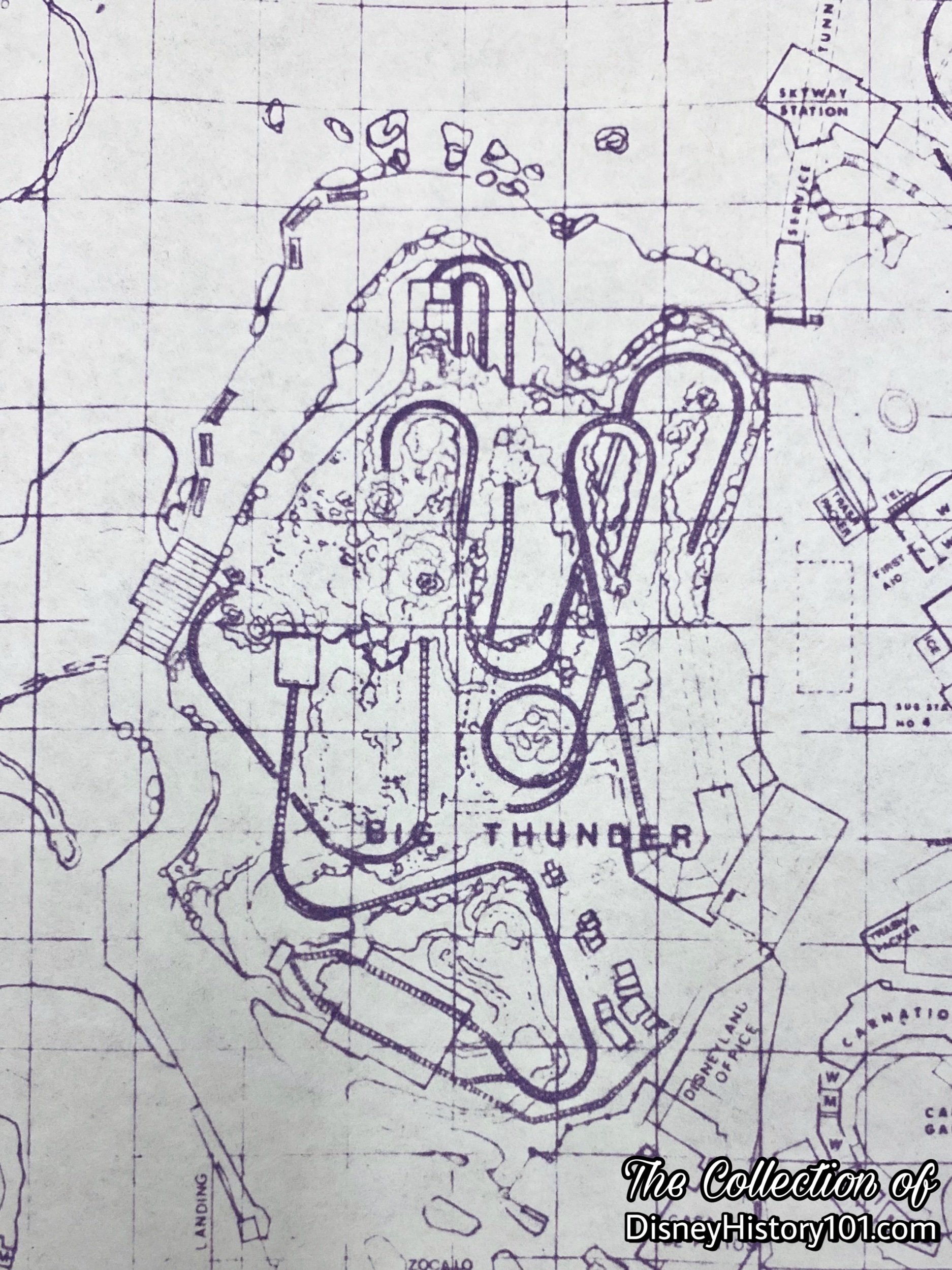
Architectural Concept Design created this "Big Thunder" site plan.
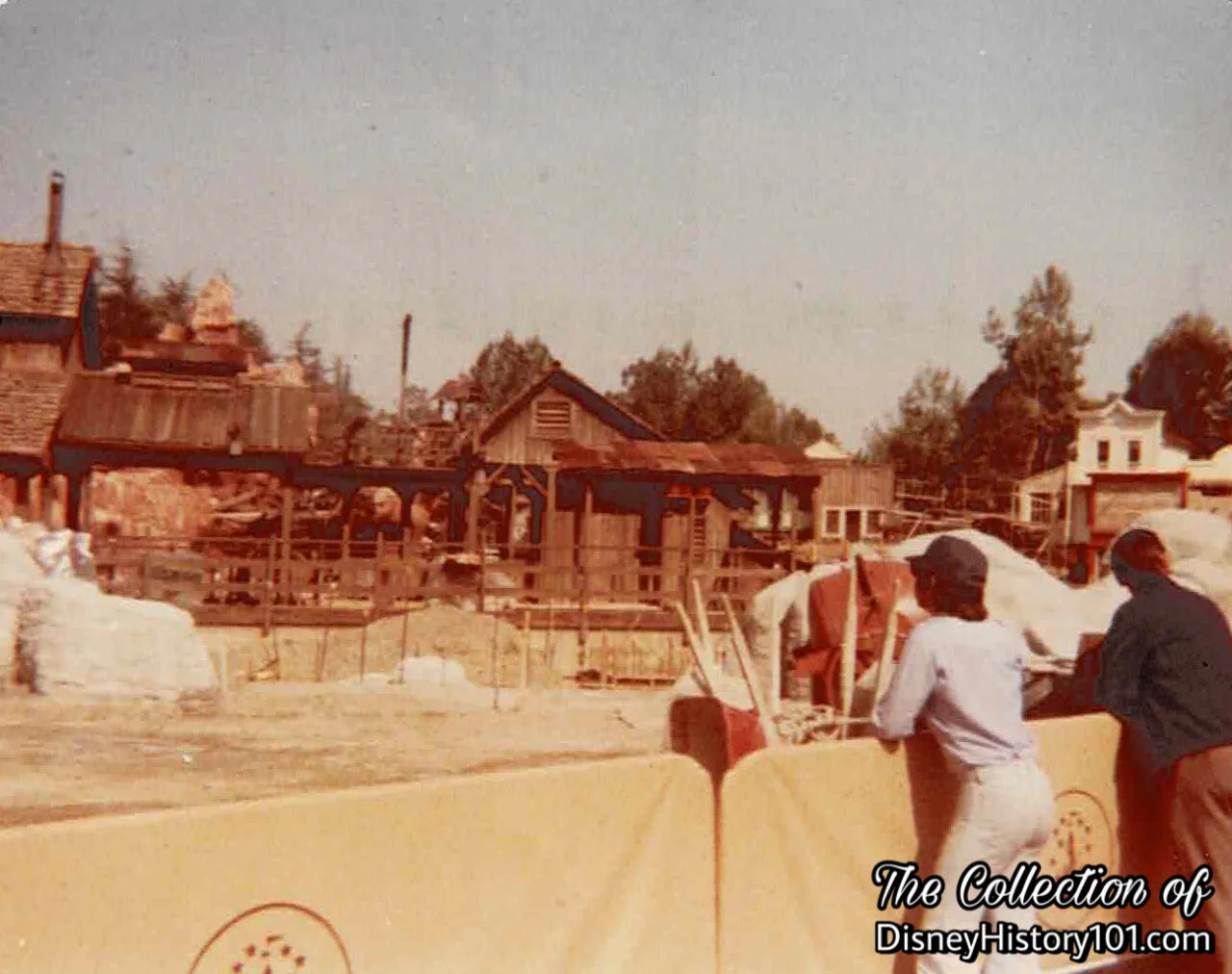
A couple of “sidewalk inspectors” pause to take in the Big Thunder Mountain Construction from the Guest Control barricade near the perimeter.
The town of Rainbow Ridge disappeared from the hills overlooking Frontierland some time in 1977 (and then construction began, on the soon-to-be-iconic Big Thunder Mountain in July of 1977). A Press Event was held thereafter, on Saturday, September 15th, 1977. By that time, most of the buildings of Rainbow Ridge were temporarily moved Backstage, in order to be rehabilitated, refreshed, and redeveloped for their relocation to Thunder Ridge. Some original structures (like the Big Thunder Epitaph, General Mercantile, Golden Nugget Dance Hall, El Dorado Hotel, and Panhandle Hotel buildings) were present in 1956, and would go on to exist for several decades.
Next, some 130,680 square feet (3 acres) of land was prepared. The designers were intent on preserving as much of the aspen and pine trees as possible, knowing this would only enhance the character and Show Quality of the new Frontierland attraction. Still, the presentation of the Big Thunder Mountain Railroad show on the vast DISNEYLAND “stage” was a distinct part of the Disneyland theater concept.
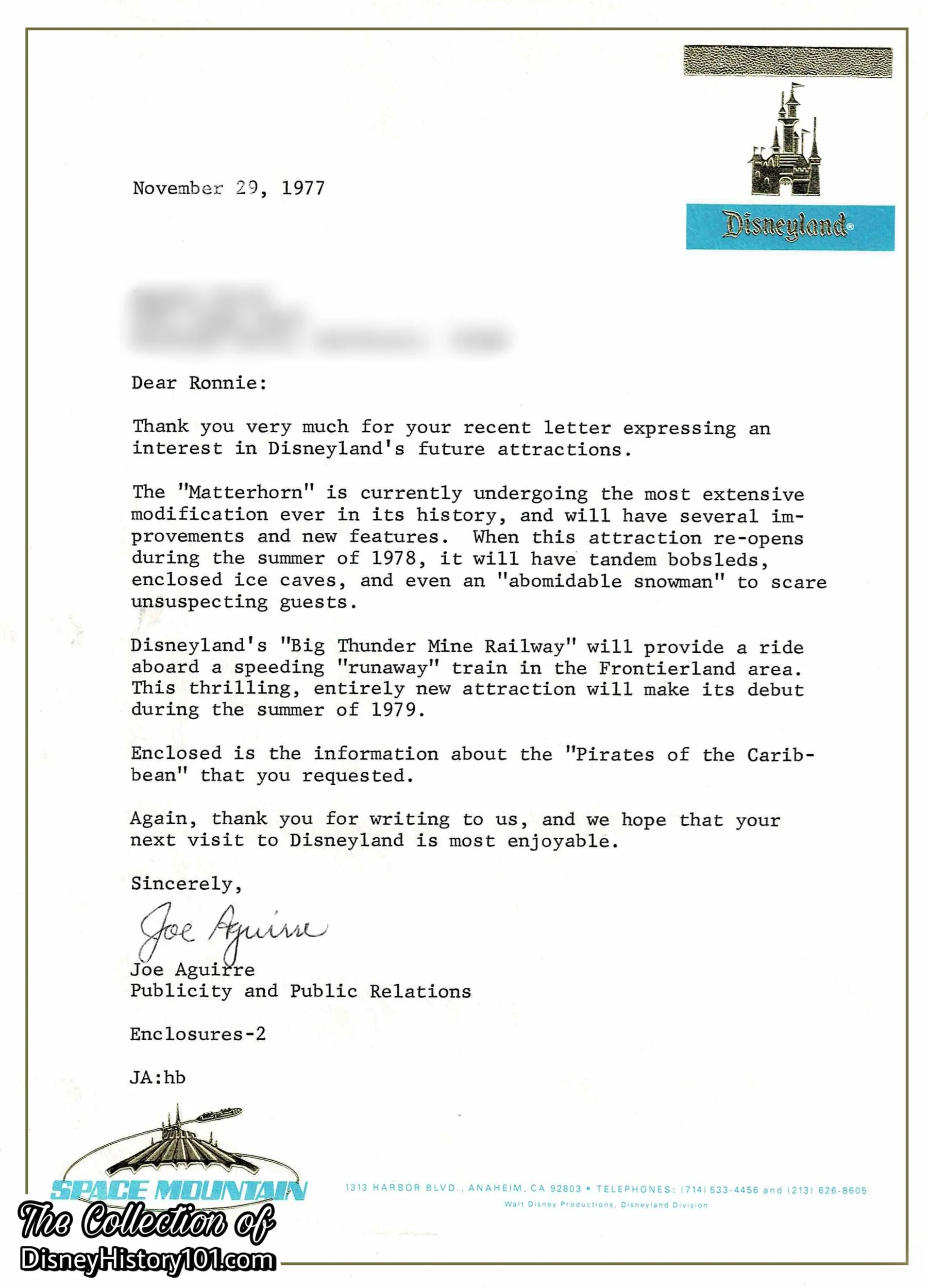
Disneyland Public and Guest Relations Letter Discussing "Big Thunder Mine Railway," (1977)
WED designed and MAPO fabricated, assembled and tested the trains and ore cars. A total of 6 trains (comprised of one engine, with 5 cars) were constructed. Each one would have a 30-guest capacity (at 6 guests per car).
“Rock Work”
The 1/2-inch to 1-inch scale model of the rock work (which was divided into a grid and dissected into “1” slices”) guided Skip Lange in oversight of the production of the rock work - re-creations of natural rock formations in steel and cement. Most of the rocks and the mountains in Disneyland were products of the Staff Shop. Model-maker Fred Joerger (who was hired c.1953 to craft the “Barber Shop Quartet” show for “Project Little Man” of “Walt Disney’s Disneyland”) had become known for his skill at carving three-dimensional RockWork from plaster, and made notable contributions.
The first pieces attached were the upper “sandstone” buttes (one of which was constructed during August of 1978 and weighed an impressive 28 tons). These were “hoisted and secured atop the massive mountain’s steel frame,” as described by Disneyland LINE (October 26, 1994), and depicted in a photograph appearing in the aforementioned “Disneyland 25 - Happy Birthday to a Dream” supplement.
Then work began on the lower RockWork. “‘Imagineering’ Disneyland’s Newest Attraction - Big Thunder Mountain Railroad,” by WED Communications writer Tom Fitzgerald (prepared for the “Disneyland 25 - Happy Birthday to a Dream” supplement, for publication on January 20, 1980) divulged the rarely-seen process of these magnificent rock formations, stating: “A full scale grid, painted on an area paved backstage at Disneyland, provided the exact dimensions for the model-to-mountain enlarging process.
Iron rebar was then bent into proper contours, and assembled in formation. Next, the frames were filled in and covered with a wire mesh, called lath. Finally, a concrete substance was poured over the lath and textured to give the rock its rough exterior. The resulting rock is believed to be the most elaborate texture and shape formation of its scope and size ever attempted.”
“Add to that the finishing touches of the skillful painters and you have Big Thunder Mountain, believed to be the most elaborate rock work texture and shape formation ever attempted anywhere.” [“Unique Growth Process Helps Create Big Thunder Mountain” Press Release]
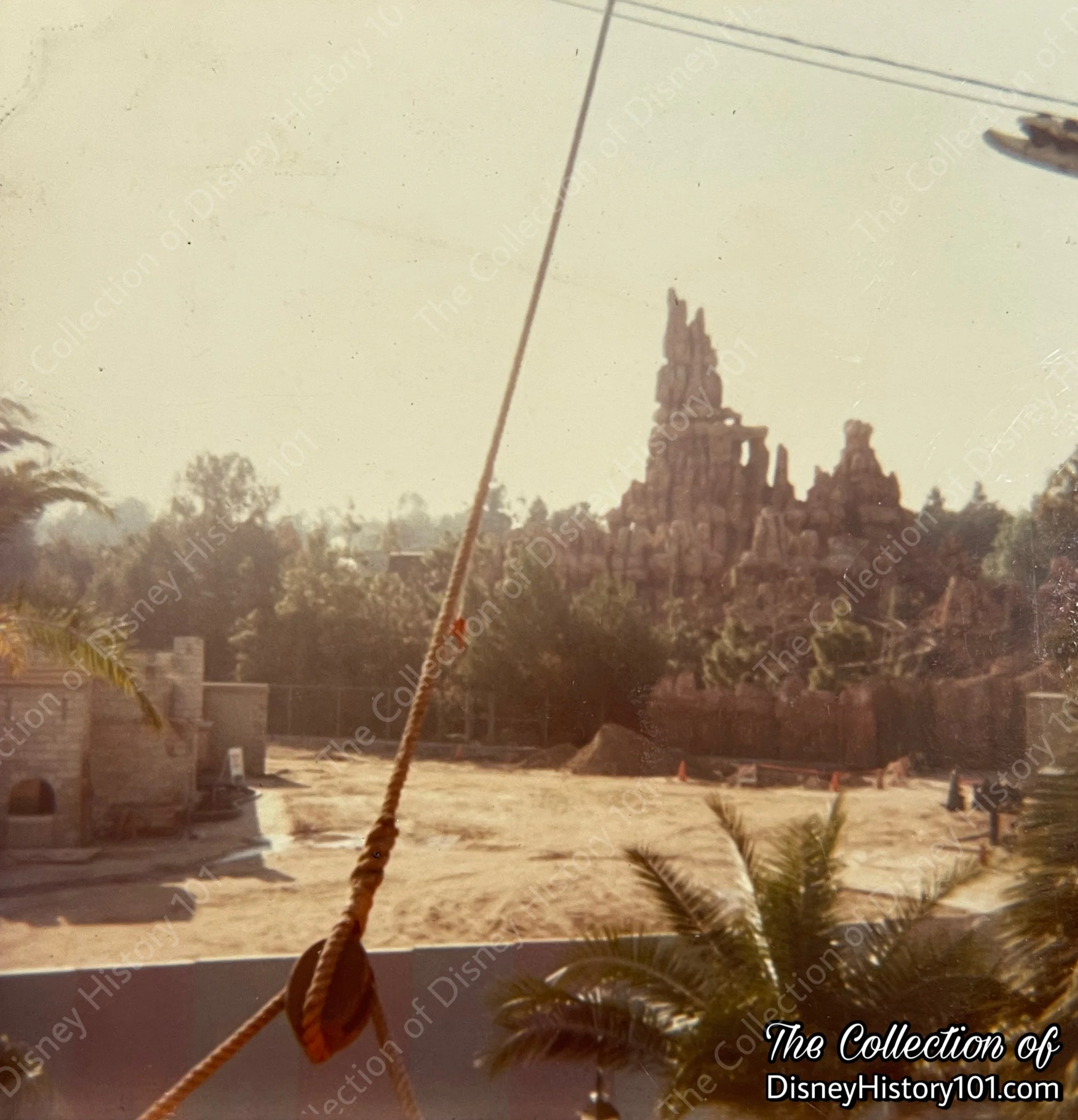
Looking toward the site of the future "Big Thunder Trail."
Construction began on 5-car trains (weighing 8,000 lbs. each).
Meanwhile, many show effects were being prepared to tell the Big Thunder Story - rock avalanches, glowing phosphorescent pools, screeching and fluttering bats in addition to all sorts of Audio-Animatronics® critters.
Walt Disney Productions microgroove acetate audio recordings (e.g. the quartet heard in the barbershop) were produced for the town of Big Thunder as late as May of 1979 (according to Daily Acetate Reports compiled by Otto Laing).
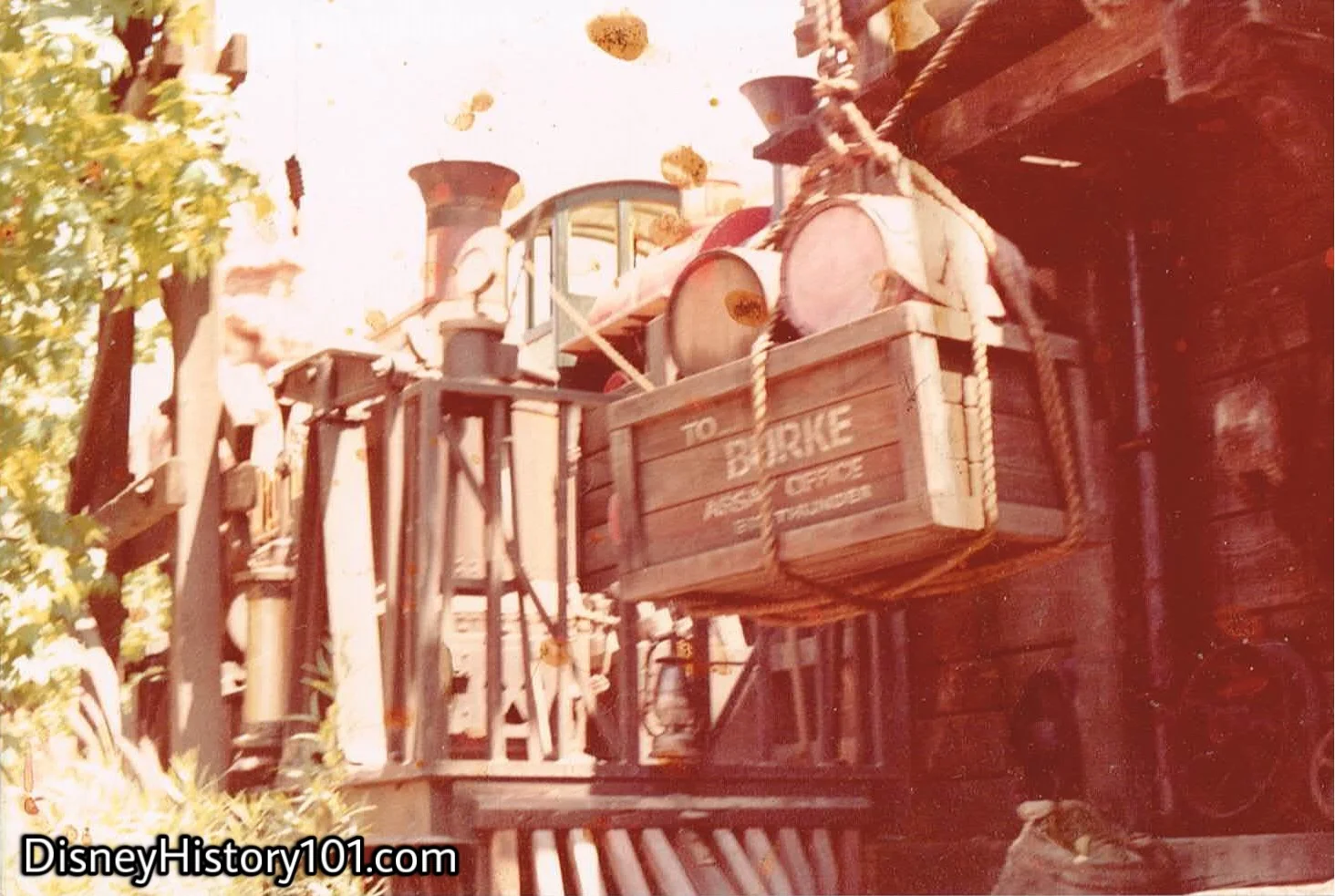
Patrick Burke Reference on an aged Big Thunder Mountain Prop Crate.
John Patrick Burke (Walt Disney Imagineer Show and Set Designer) joined the WED Model Shop in 1972. By the time construction began on Big Thunder Mountain at Disneyland, John had developed quite a résumé - including The Walt Disney Story tribute exhibit, America Sings, and Space Mountain at Disneyland! John had also developed quite a collection of Wild West era artifacts. And so, John would be tasked with researching, collecting, and providing the props for the Big Thunder Stage! Both Patrick Burke (WED Models) and Lee Congiardo (WED Interiors) combed abandoned ghost towns and mines in search of treasures to decorate the Frontierland-scape with authentic old West artifacts from their personal collections. The “persistent relic seekers [also] acquired the Big Thunder decor from abandoned mines in… Nevada, Colorado, Minnesota, and Wyoming, as well as museums, swap meets and private donations.” [Disneyland LINE, October 28, 1994] It’s a fact that John’s home property was full of such relics, even decades later.
The duo found a (c. 1880) 100-year-old Stamp Mill, which once crushed ore for chemical extraction at Silver Queen Mine in the Mojave Desert. Other relics included a “hand-driven drill press, gears, picks, shovels and an array of other artifacts.” [Disneyland 25 “Happy Birthday o a Dream” Advertising Supplement; published January 20, 1980] They also found naturally aged black iron metal roofing, salvaged from abandoned Mojave desert mines, which was subsequently used on the tower. They also found quite a few little details, like a bell once used as a means of communication for miners, and a pair of authentic high-buttoned shoes which were placed in the window of one of the shops. The most amazing detail is probably the more than 230 tons of true-life gold ore, which was trucked to Disneyland, in order to decorate the queue area. It was purchased in “Rosamond, California, at $80 a ton,” according to Disneyland LINE (published for October 28, 1994).
These props and Show Quality enhancing details would be added right of to the final stages of construction. “Agers and Grainers” would bestow a “timeworn,” distressed and aged appearance upon the props through painting techniques.
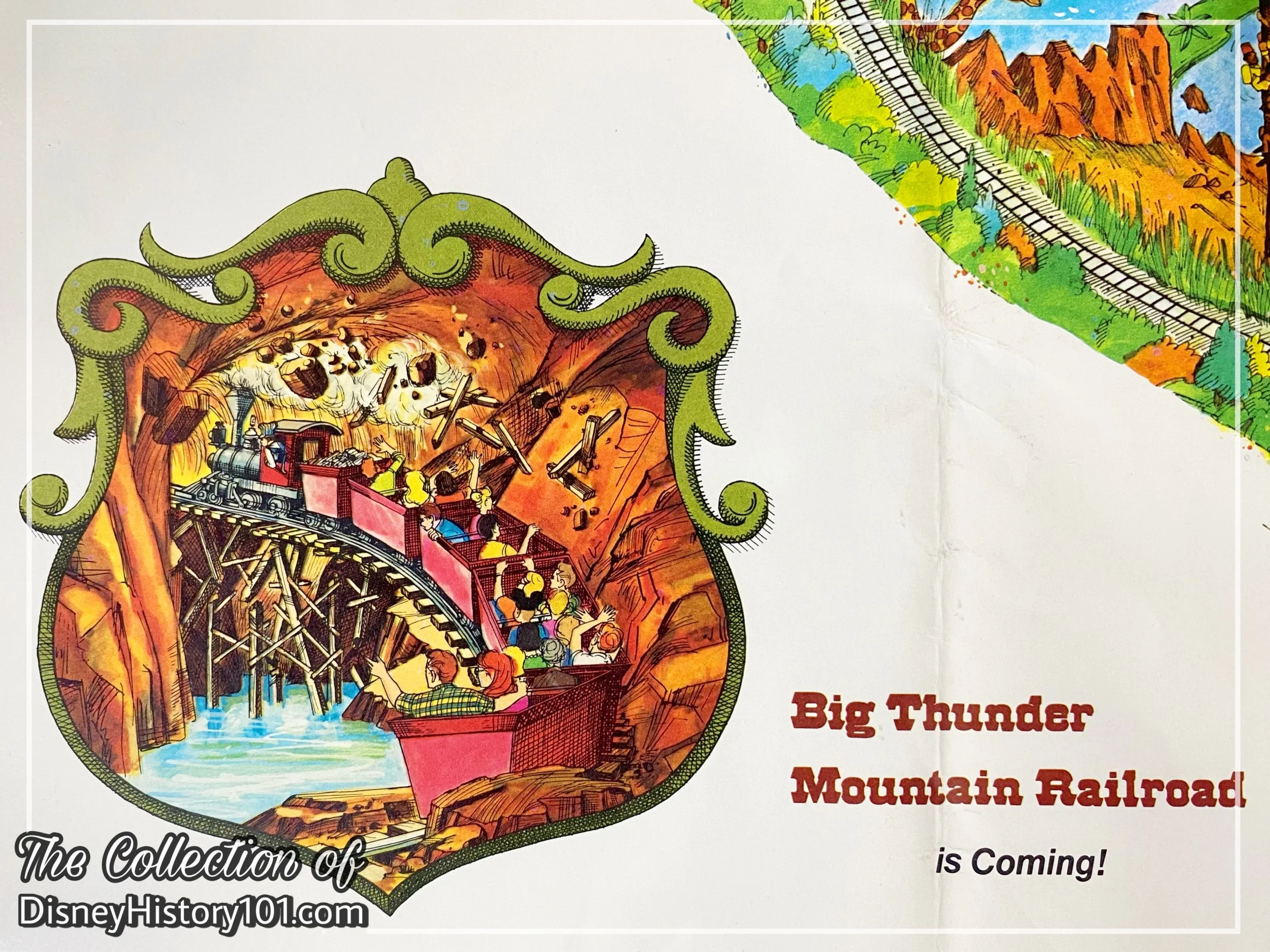
Big Thunder Mountain Railroad on a souvenir map of Walt Disney’s Disneyland, c.1978.
Disneyland LINE Excerpt, (published June 21, 1979) ; This publication was renown for publishing regular rehabilitation and construction updates
The period of September (and October) of 1978, saw the mining town, shafts, pump and winch houses, trestles and Load Building erected. The rest of the rock work (including waterfalls, streams and pools running through) was completed during December of 1978.
Big Thunder Mountain Railroad (originally “discovered in 1880”) was scheduled for Opening during the Spring of 1979, but much work needed to be done. During June, final tests were still being performed on the “C” Lifts (which carried the trains through the avalanche effect), the waterfall effect was being installed, but the “A” Lift was being adjusted. After all the heavy construction was completed (by July 1st, 1979), the finishing touches (landscaping, painting, and other facets) were completed before July 13th.
Last of all, two Program Logic Controller (PLC) systems (a computerized controller of mechanical and electronic equipment) and one Nova system (“for message generation” and alerting operators and engineers to any conditions of units) were installed by the staff of the four-person Disneyland Computer System Engineer Department (like Steve Gold). These advanced ride control systems were similar to those first installed in Space Mountain at Disneyland and Walt Disney’s Magic Kingdom in Florida. While Space Mountain at Disneyland had one PLC, Big Thunder Mountain Railroad would has two, enabling the computers to monitor functions and conditions of units, and then alternate based on calculations, increasing safety. Liner Induction Booster motors help the trains to “boost… out of the station, and then slow them down at the end of the ride,” according to Disneyland LINE magazine.
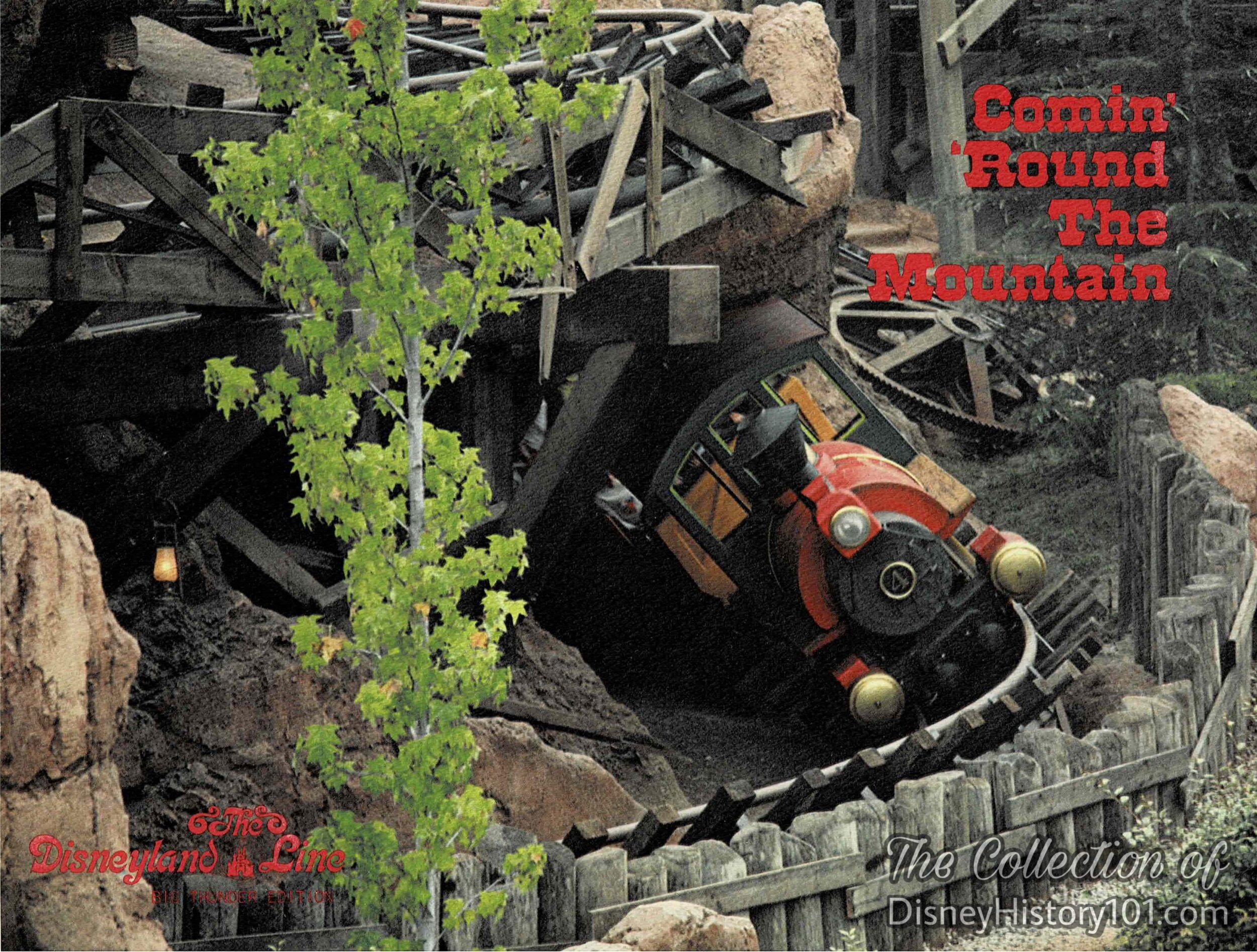
The Disneyland LINE Special "Big Thunder Edition" Cover
“She’ll Be Comin’ ‘Round the Mountain…”
Two bells rang, and with argonauts “all aboard,” the trains departed the station during the inaugural run of the Gold Rush-era “wildest ride in the wilderness” first took place (two years later) during June of 1979! The whirlwind half-mile (2,671-foot) trip ”highballed” passengers by stunning rock formations (like Spiral Butte), roaring waterfalls, breathtaking grottos, and thru chasms (like Coyote Canyon), caverns, gulches (like Dinosaur Gulch), and mines of Big Thunder Mountain! Unlike the old wilderness route, passengers (of the U.B. Bold, I.B. Hearty, I.M. Brave, U.R. Daring, and I.M. Fearless) would now experience the feel of tumbling avalanches, and an underground earthquake. As aforementioned, authentic mining supplies and other props were “a result of Disney Imagineers surveying swap meets, auctions, ghost towns and abandoned mines throughout the country.”
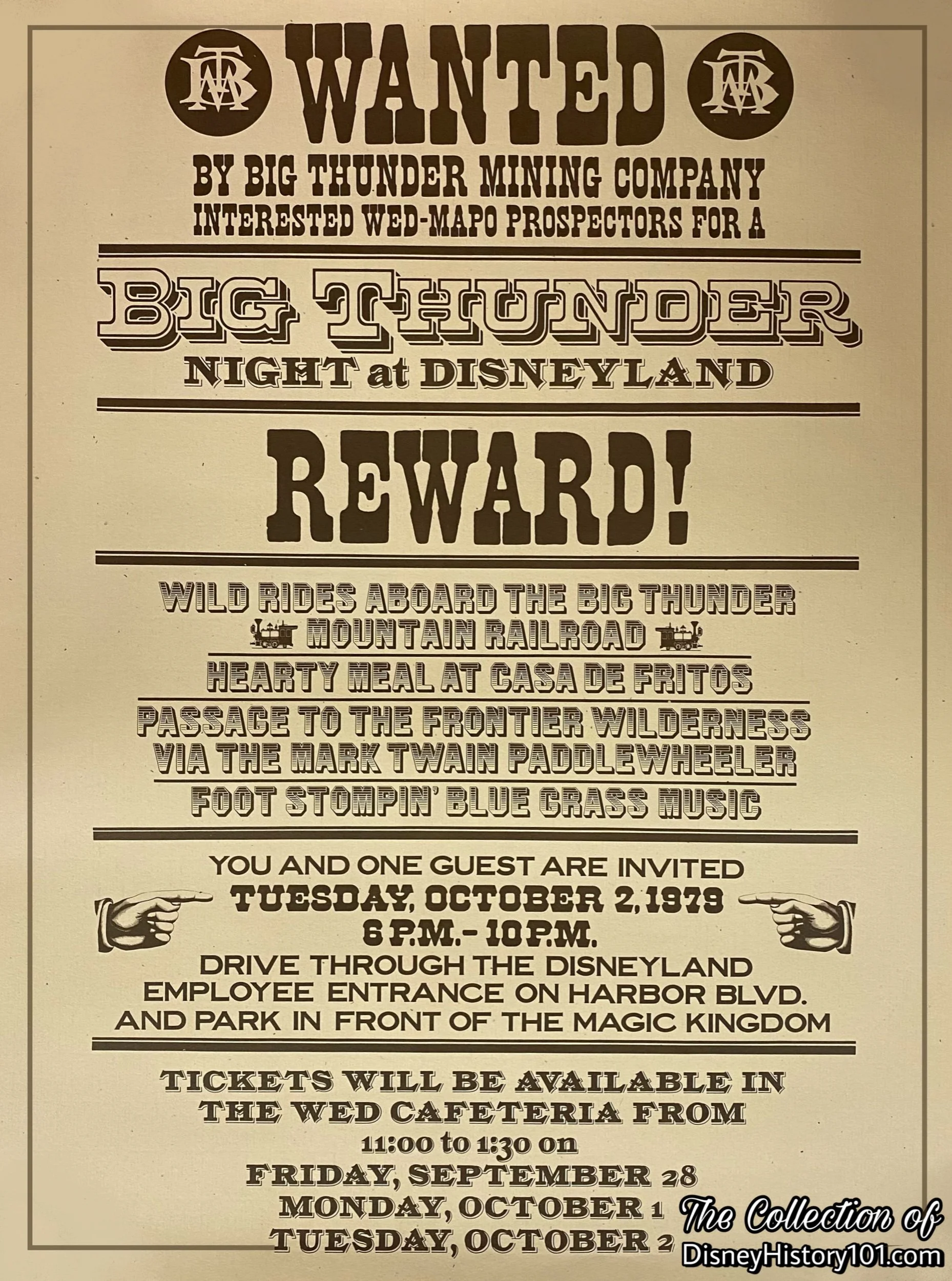
Finally (after some 11 years “in the making,” three years of preparation, and more than two years of construction), the $15.8 million Big Thunder Mountain Railroad (Disneyland’s 59th attraction) opened to members of the press on September 2nd, 1979! A few days later, Big Thunder Mountain Railroad opened on September 15, 1979. Big Thunder Mountain Railroad would have the capability of transporting 2,400 guests per hour.
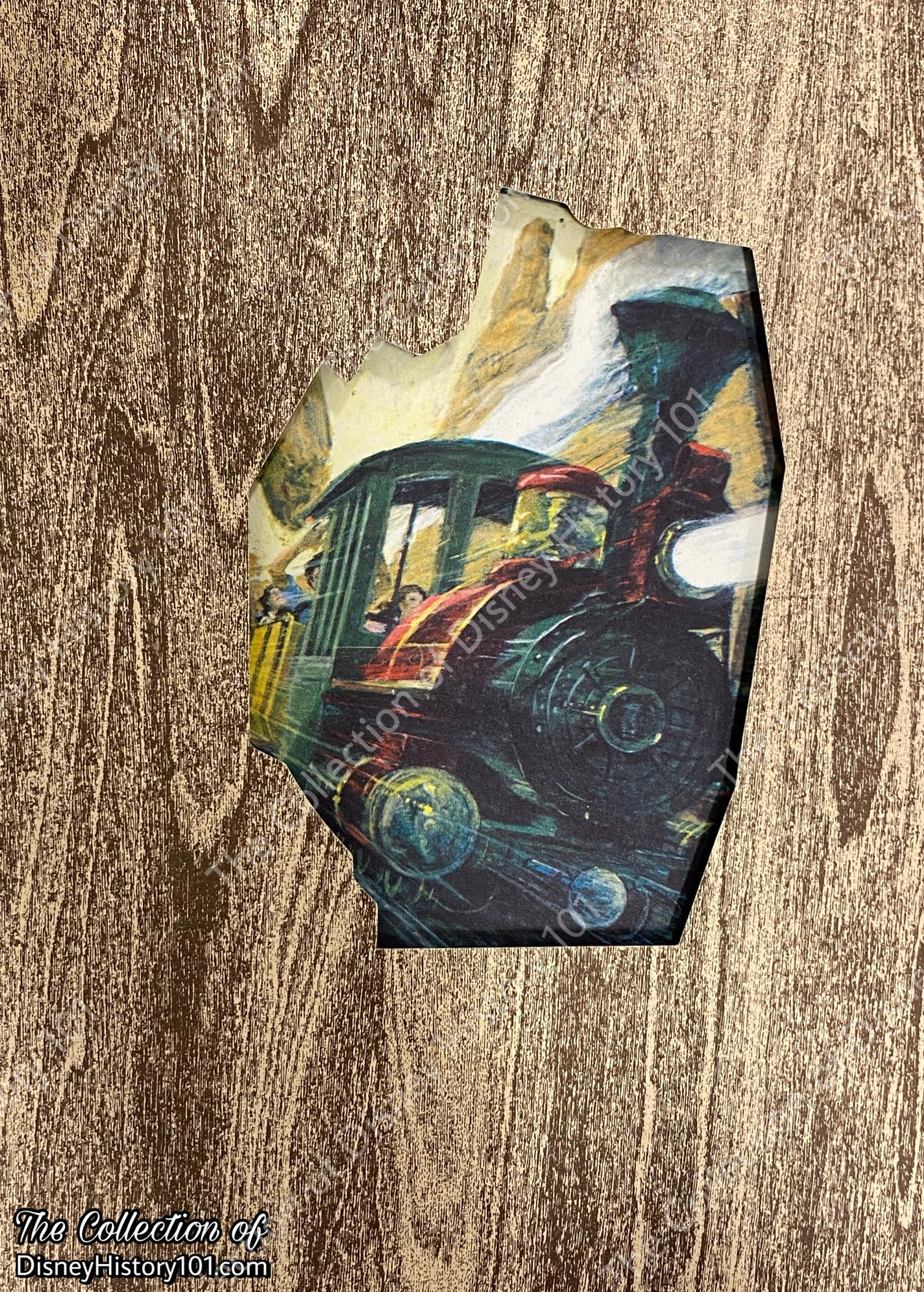
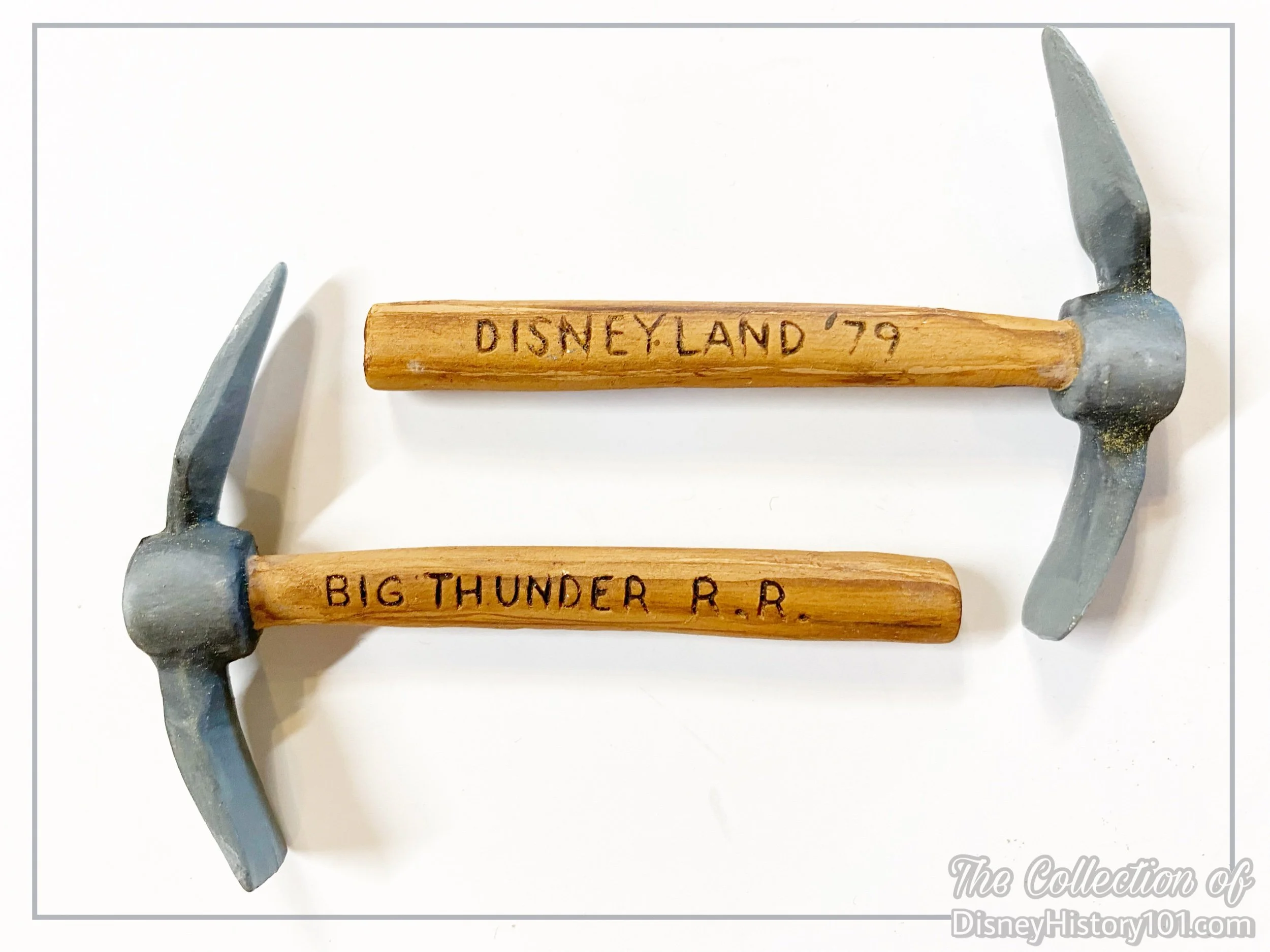
Commemorative gifts for Attractions Hosts & Hostesses and other Cast Members.
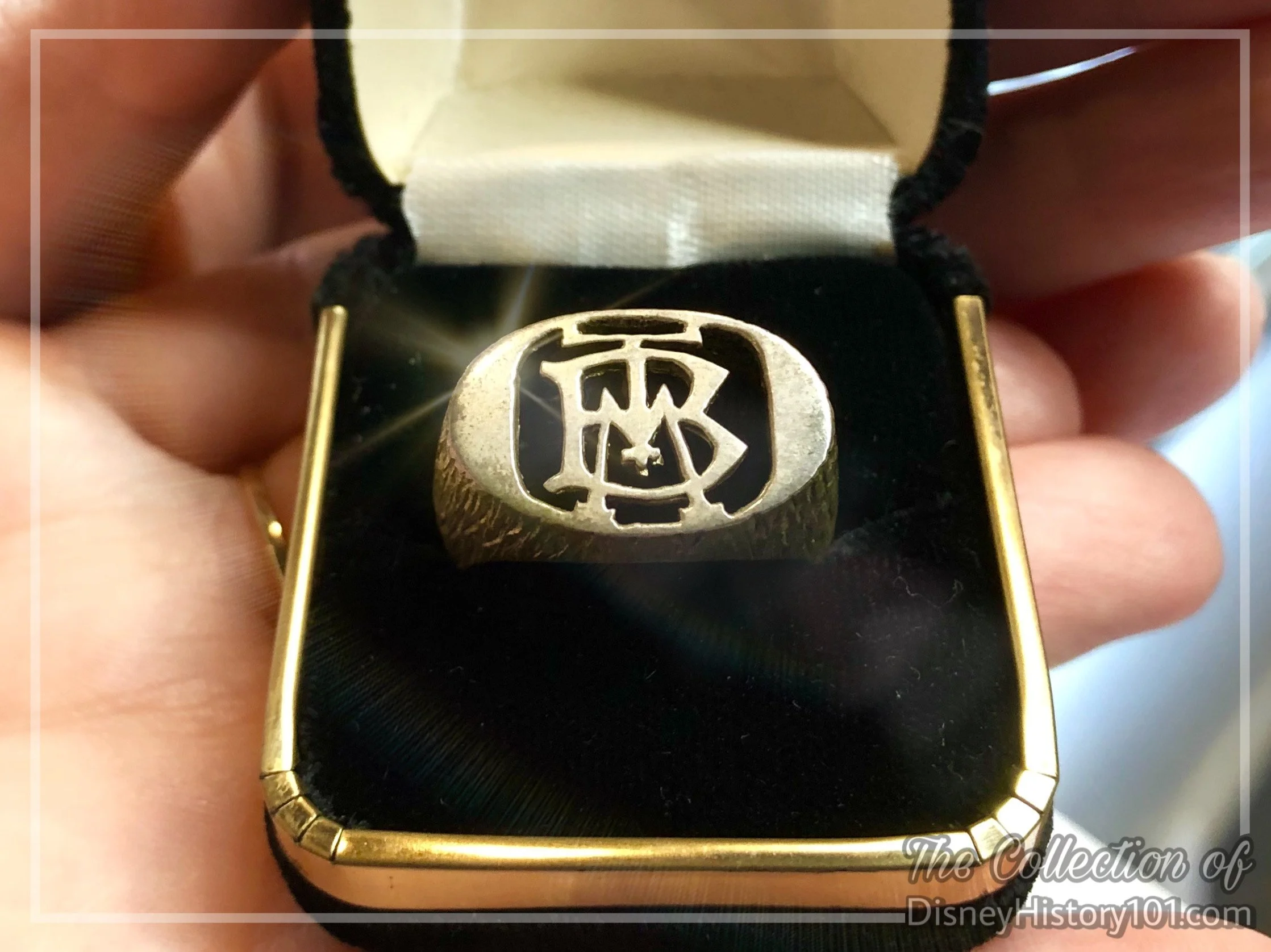
A commemorative ring for Cast Members.
Many VIPs contributed to the show on the Big Thunder Mountain Railroad stage. Maggie Irvine Elliott (future Walt Disney Imagineering Senior Vice President) recalled: “Big Thunder Mountain Railroad was down (a ‘101’) in the middle of the day. I was up on the ride track (at the top of the first lift, by the bats and the waterfall) on the intercom system waiting for my location's turn to reset the ride system. The cast member in the main control tower was having difficulties with the start-up procedure. I talked the tower person through each of the procedures and confirmed that they were ready for the next step. A supervisor happened to be on the intercom system and overheard me. I was recommended for a lead training position, and that provided a path for me to become an attraction lead and trainer on several attractions throughout Disneyland.”
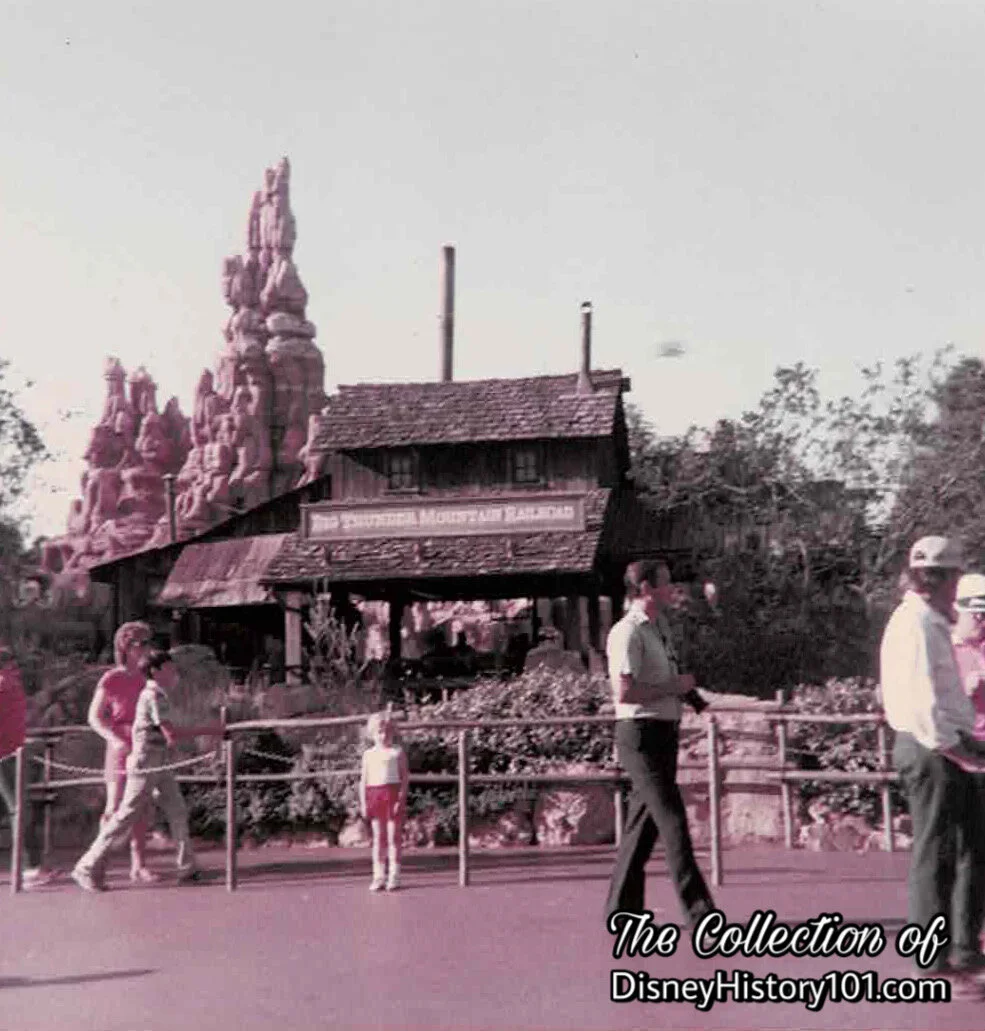
Guests enter the queue for Big Thunder Mountain Railroad
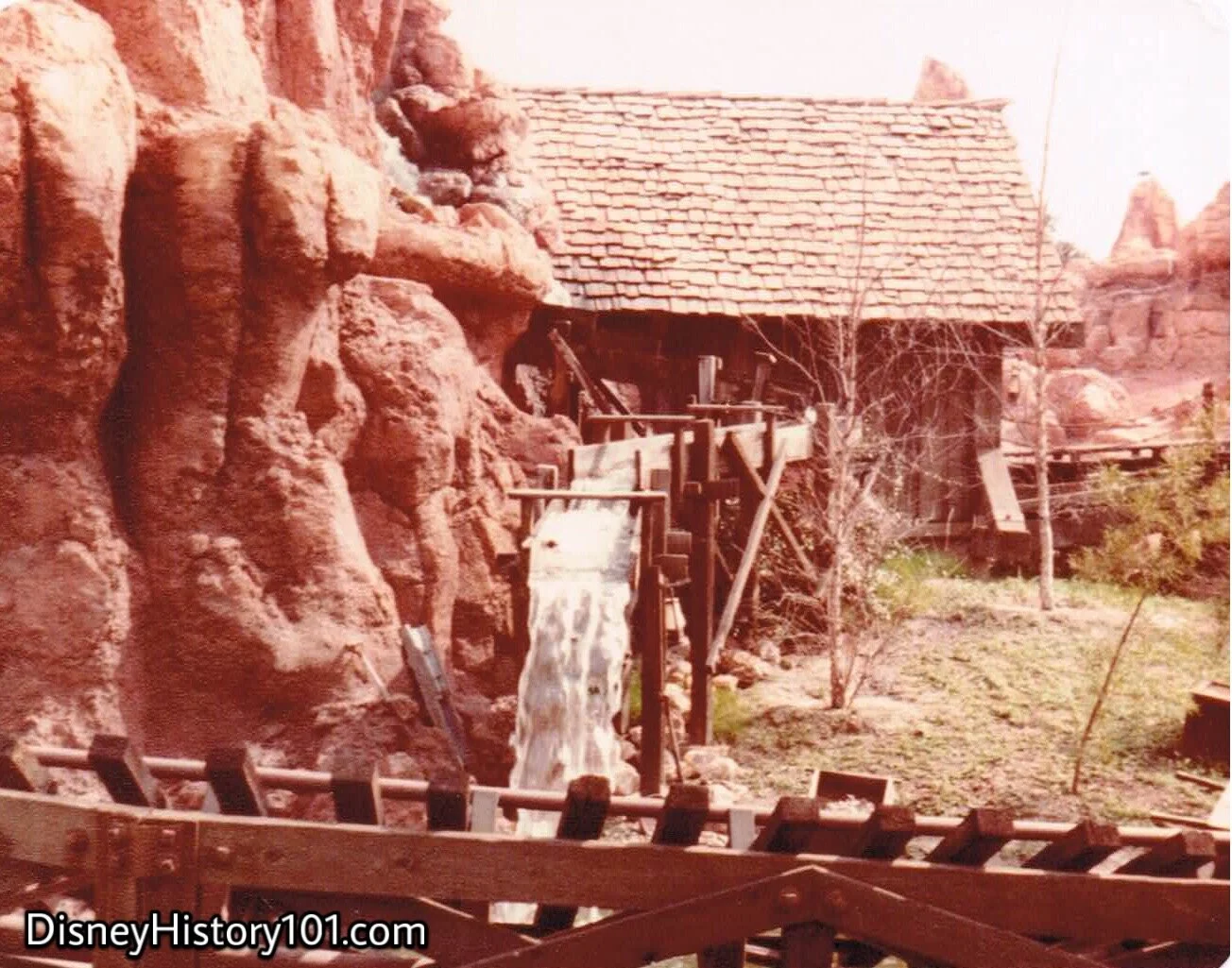
Big Thunder Mountain Railroad, (1980)
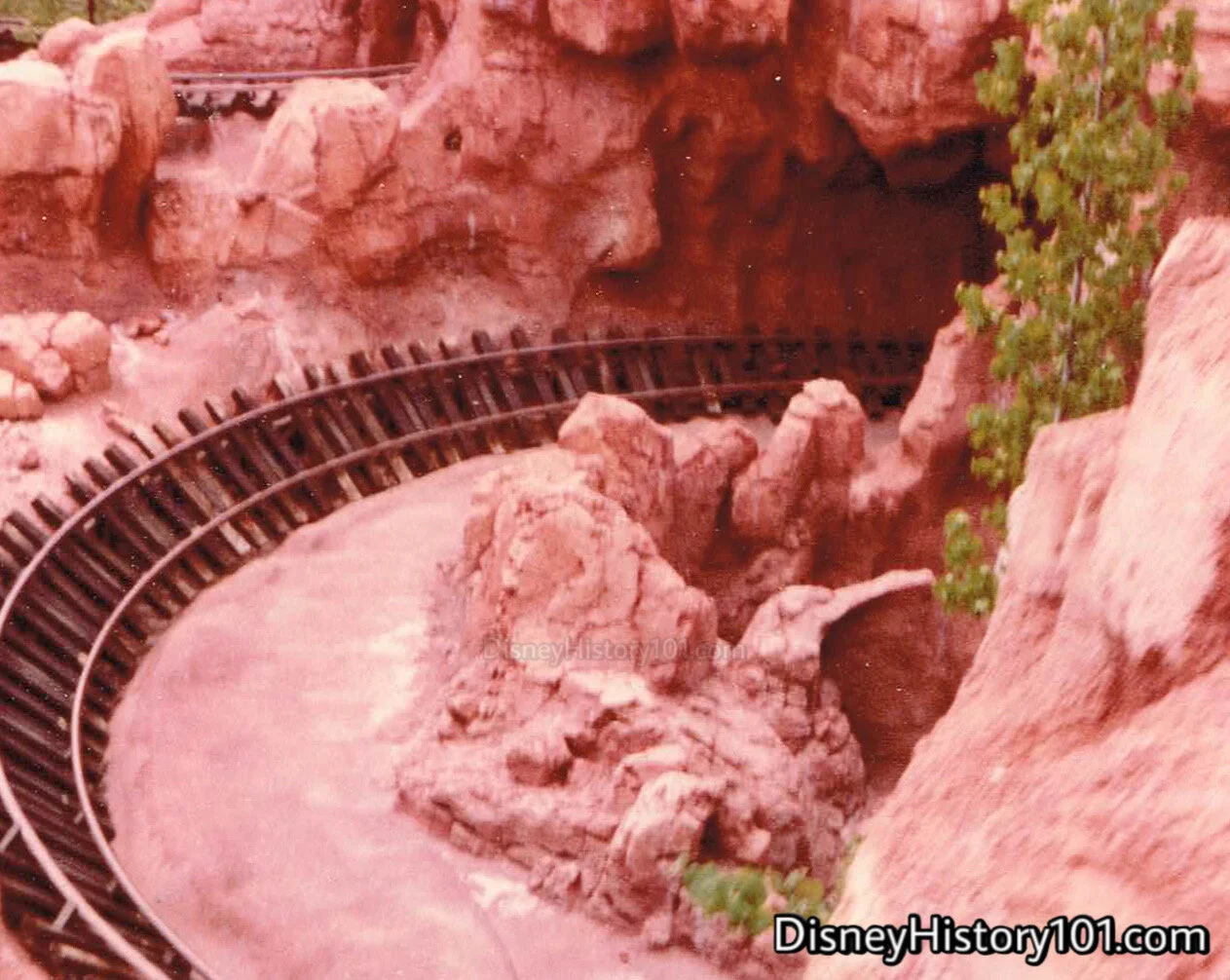
Big Thunder Mountain Railroad RockWork, (c. 1982)
Guest would be whisked through dark abandoned caverns.
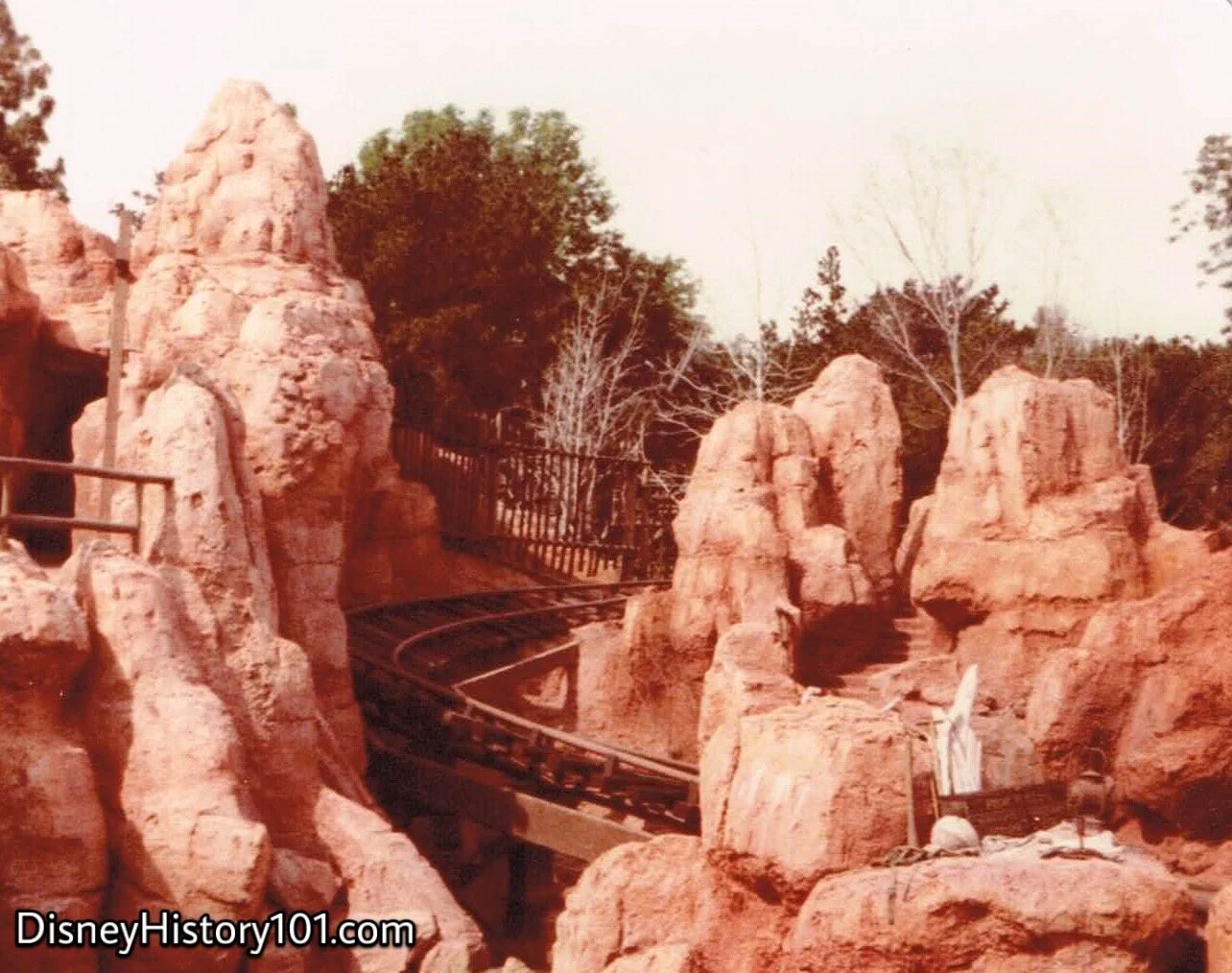
Big Thunder Mountain Railroad RockWork, (1980)
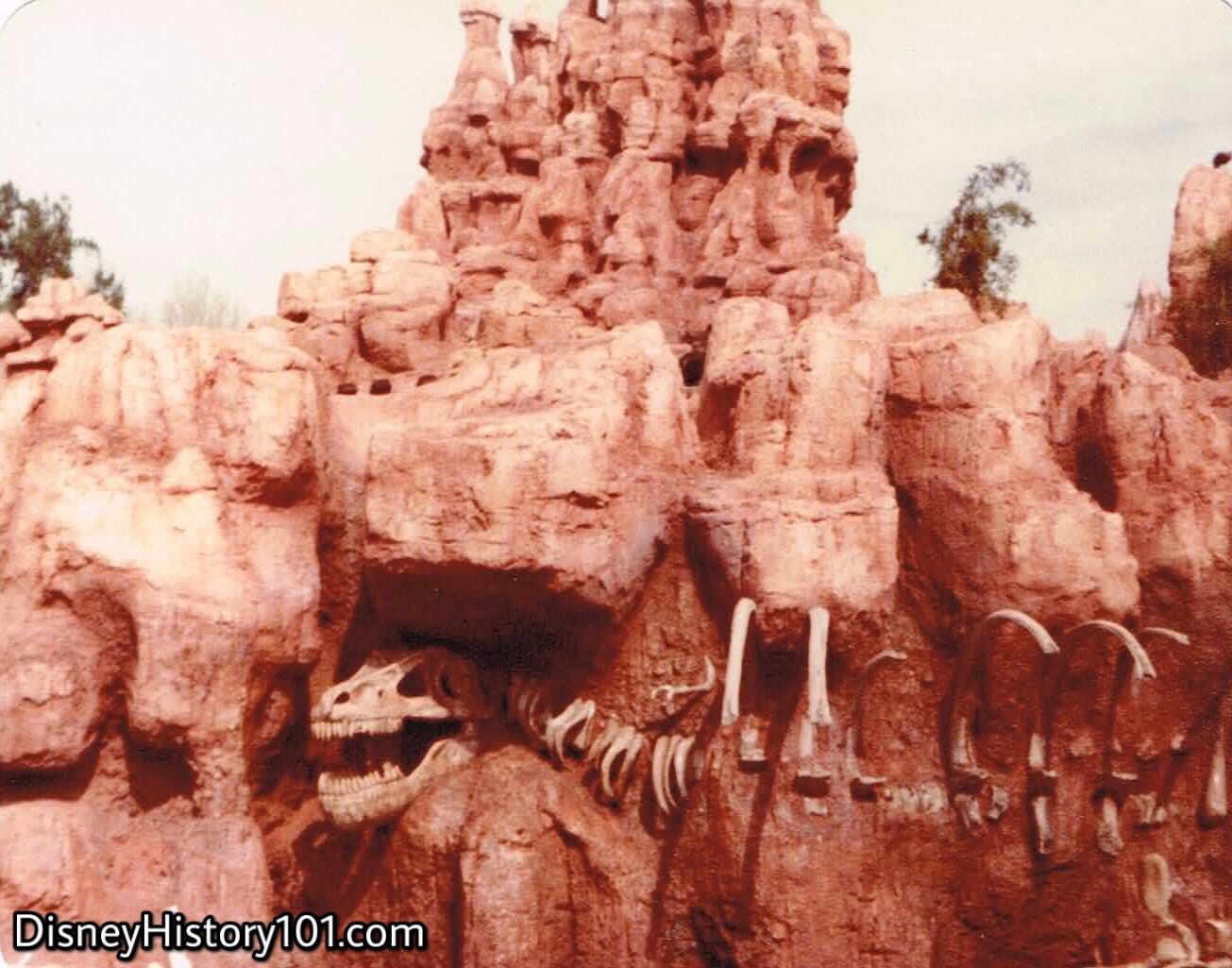
Big Thunder Mountain Railroad Dinosaur Gap, (1980)
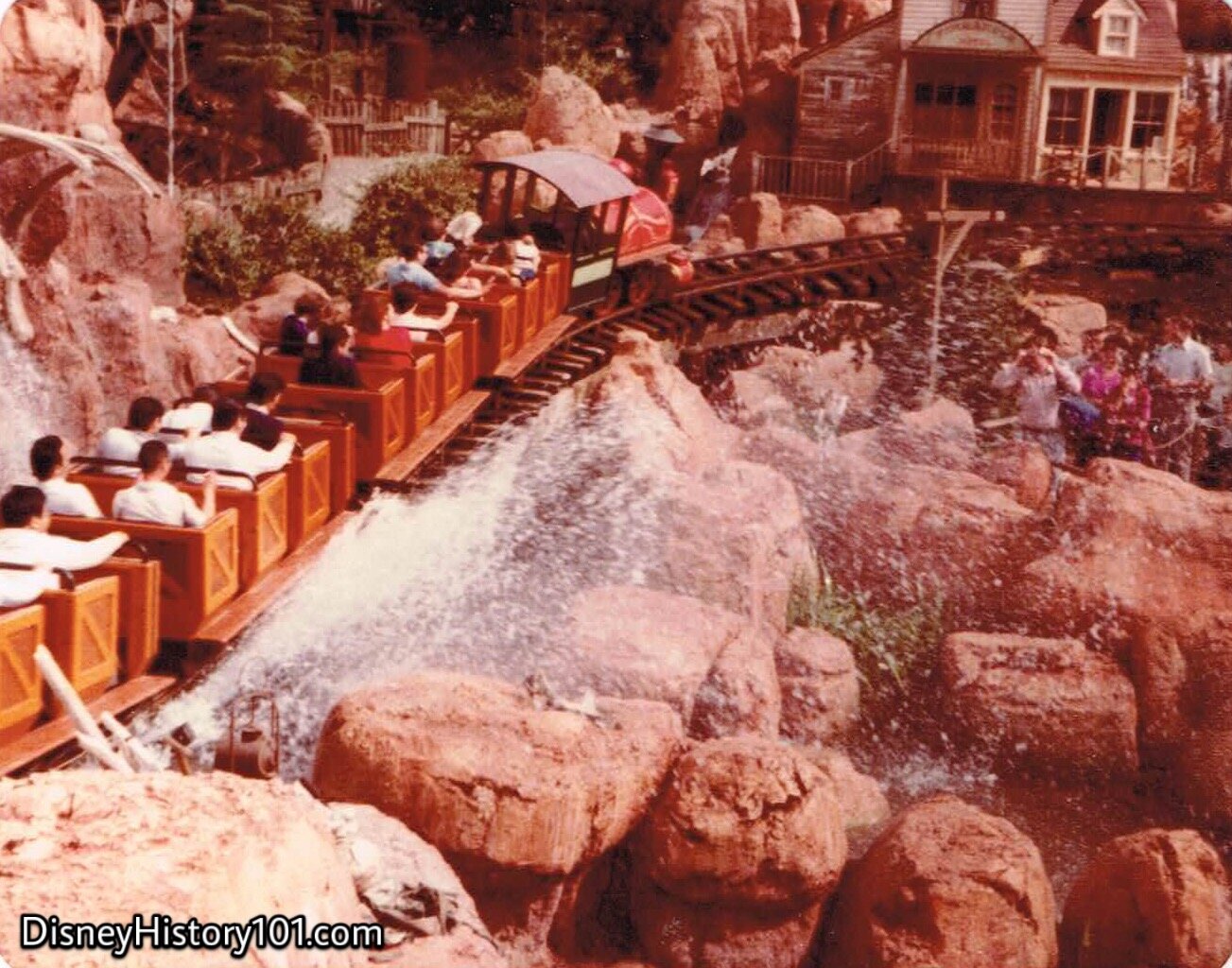
Big Thunder Mountain Railroad, (1980)
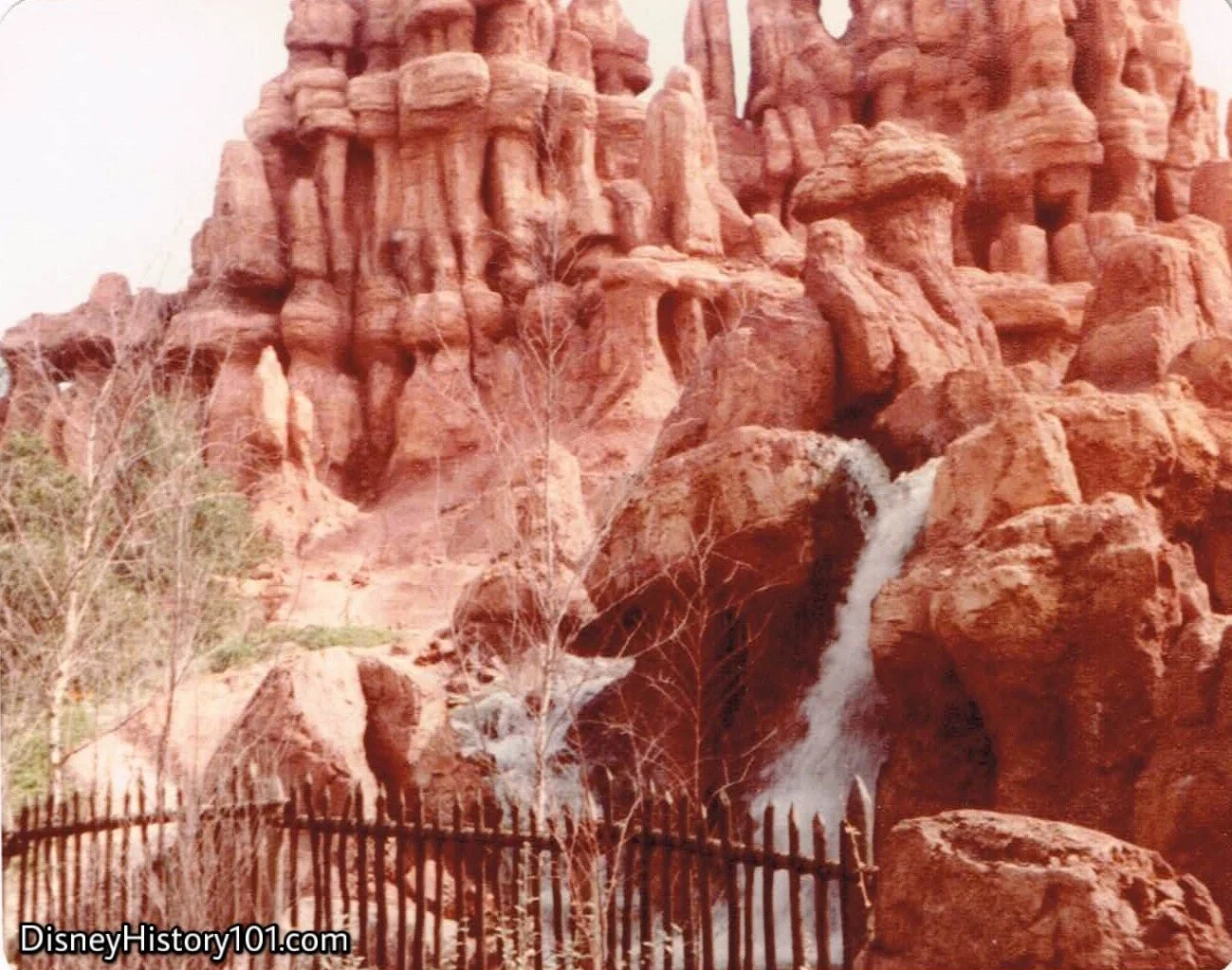
Big Thunder Mountain Railroad RockWork, (1980)
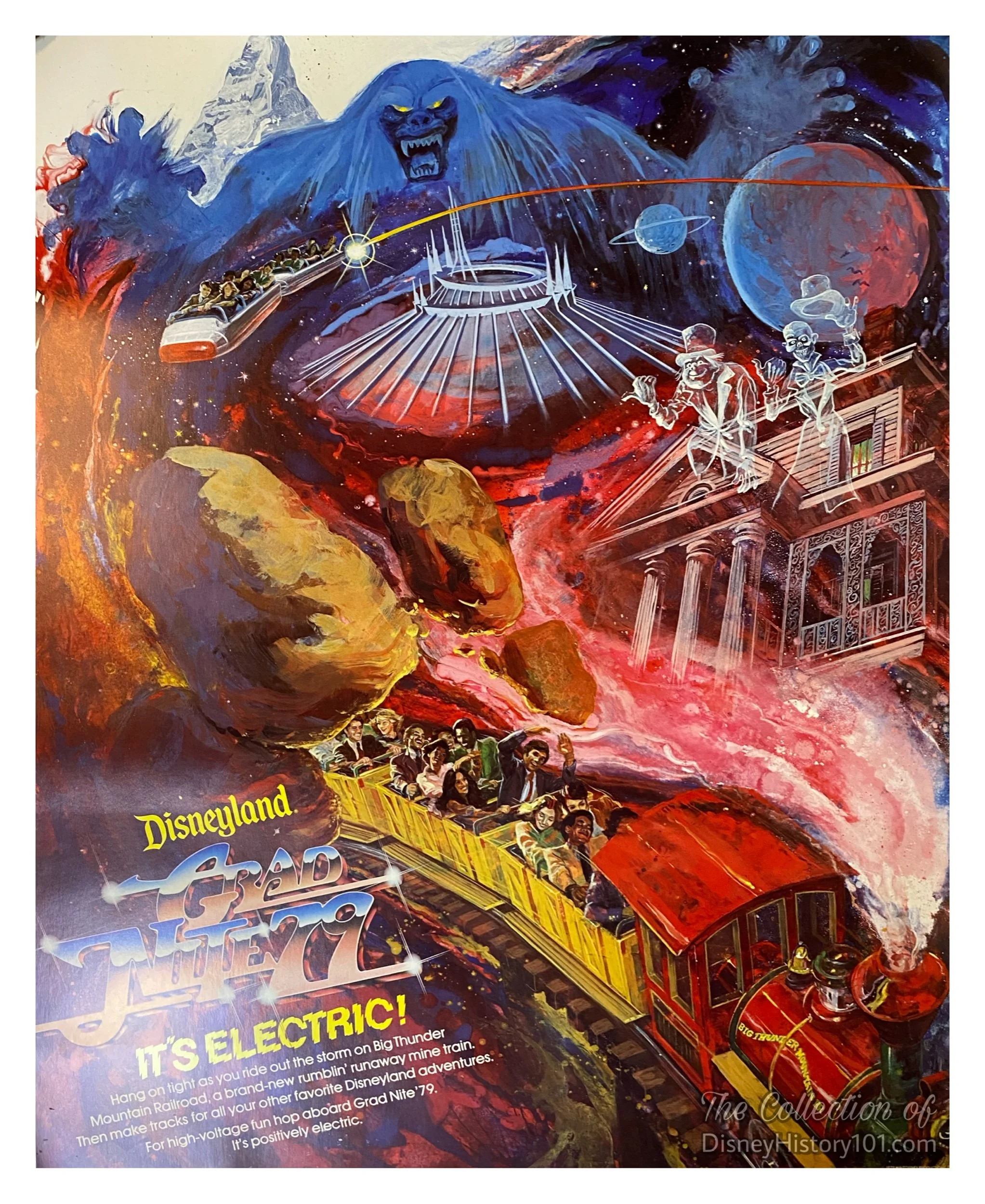
The “wildest ride in the wilderness” was the main attraction for graduates attending Grad Nite ‘79 at Disneyland.
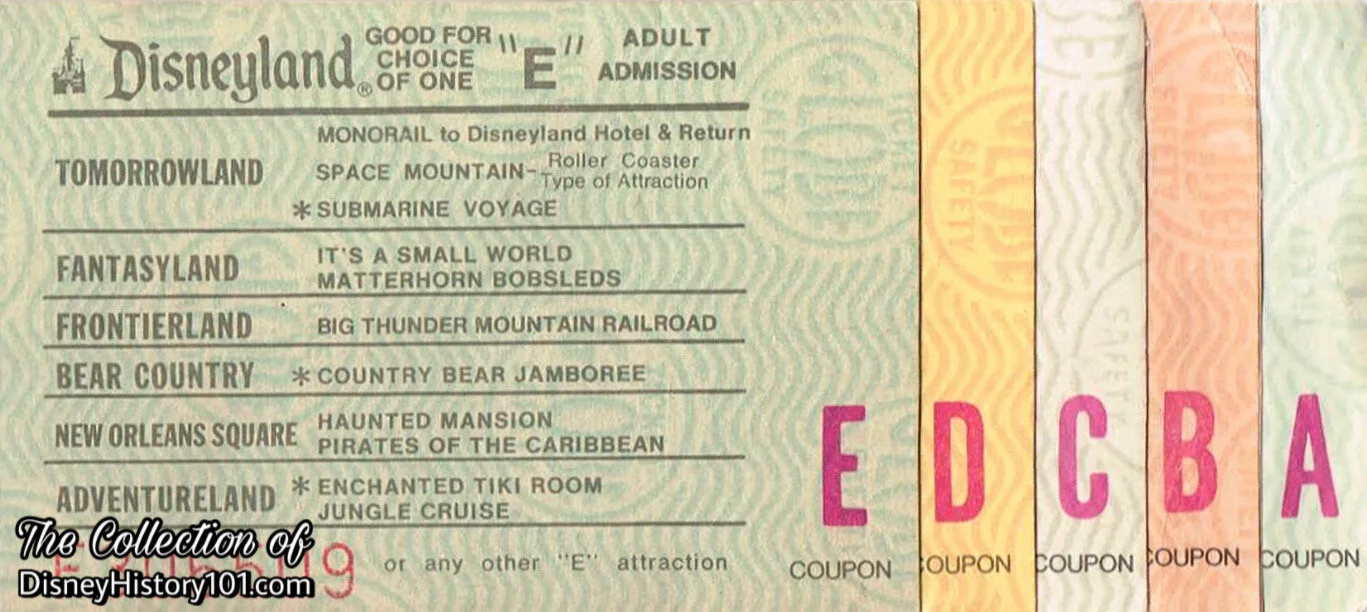
Disneyland Attraction Coupons
From 1979 - 1980, admission aboard Big Thunder Mountain Railroad was one “E” coupon, the same as a flight through Space Mountain, passage through the Seven Seas of the Submarine Voyage, or admission to the Country Bear Jamboree!
The Disneyland Planning Department prevented having too many attractions of the same ticket value down at the same time.
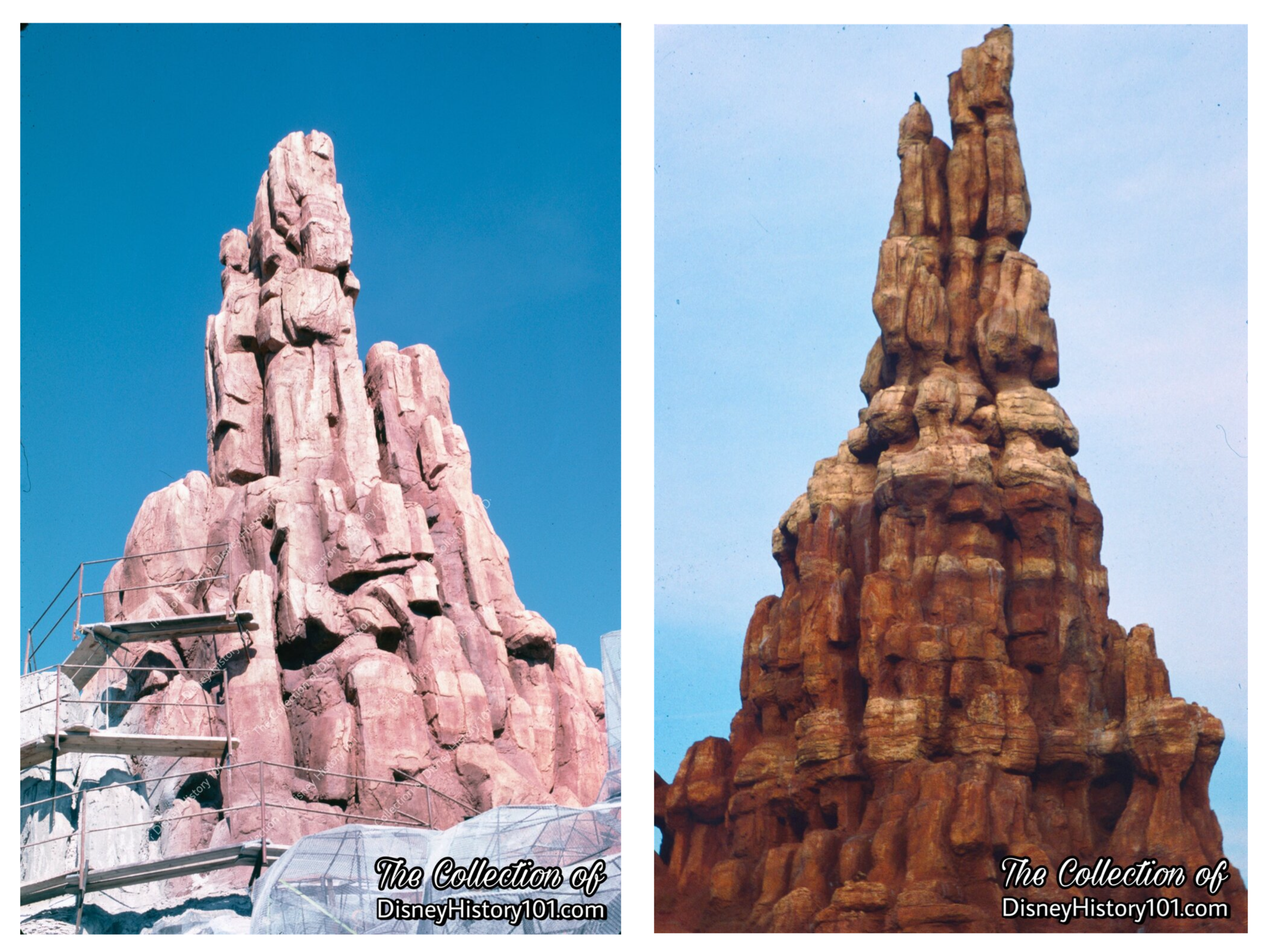
Skip Lange’s Monuments - While Disneyland’s Big Thunder Spiral Butte (right) was based on Bryce Canyon, Walt Disney World Magic Kingdom’s Big Thunder scenery (left) was inspired by “Monument Valley.”
Big Thunder Mountain was such a success at Disneyland, that it would immediately go on to inspire another Mine Train at Walt Disney’s Magic Kingdom in Florida! Many of the same artists and engineers would assemble to Imagineer the new attraction. Big Thunder Mountain Railroad opened at Walt Disney World in 1980.
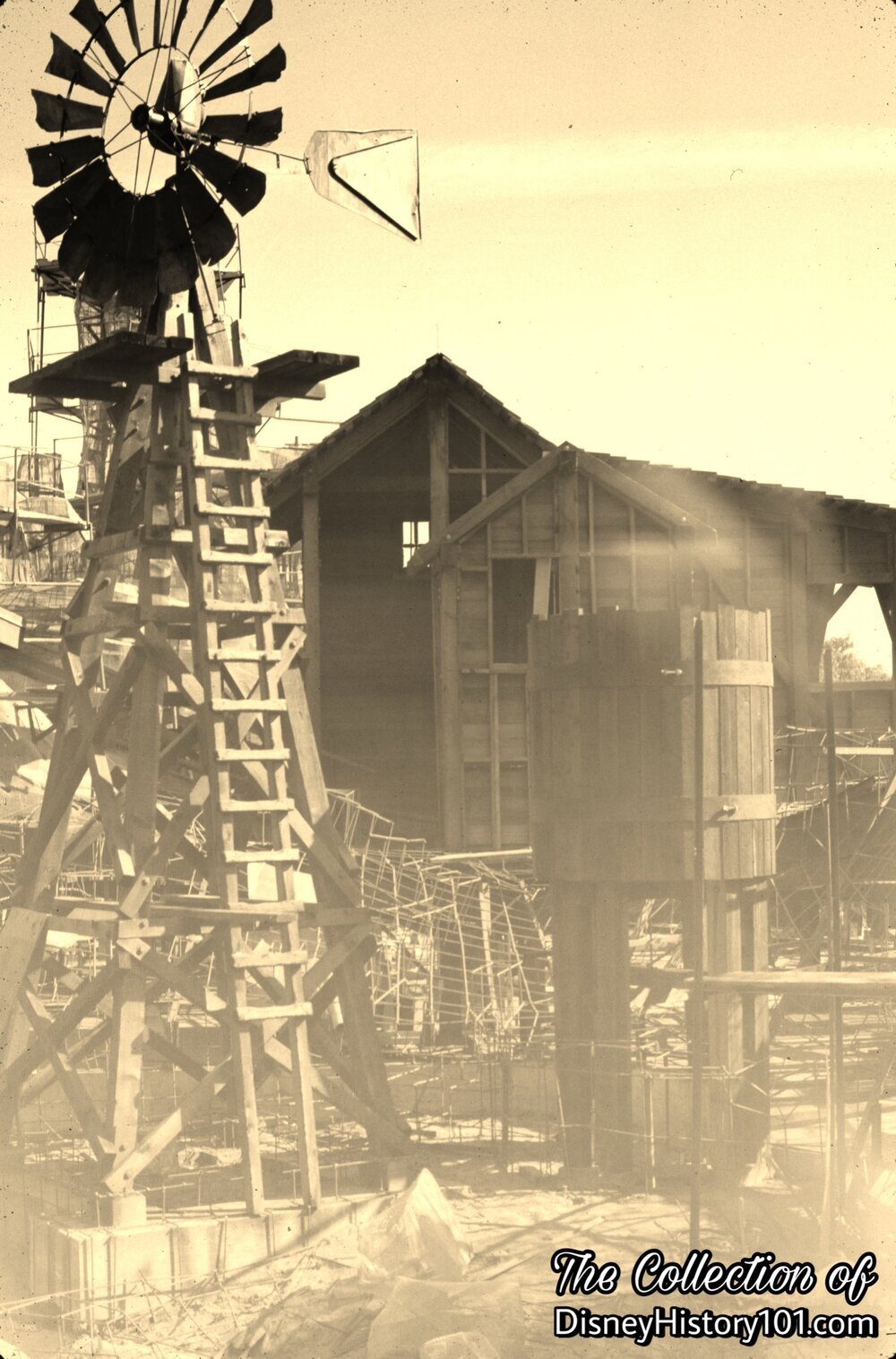
Tumbleweed Construction
Walt Disney World Magic Kingdom’s Big Thunder Mountain story begins in the small mining town of Tumbleweed (similar to Disneyland’s little mining town of Rainbow Ridge).
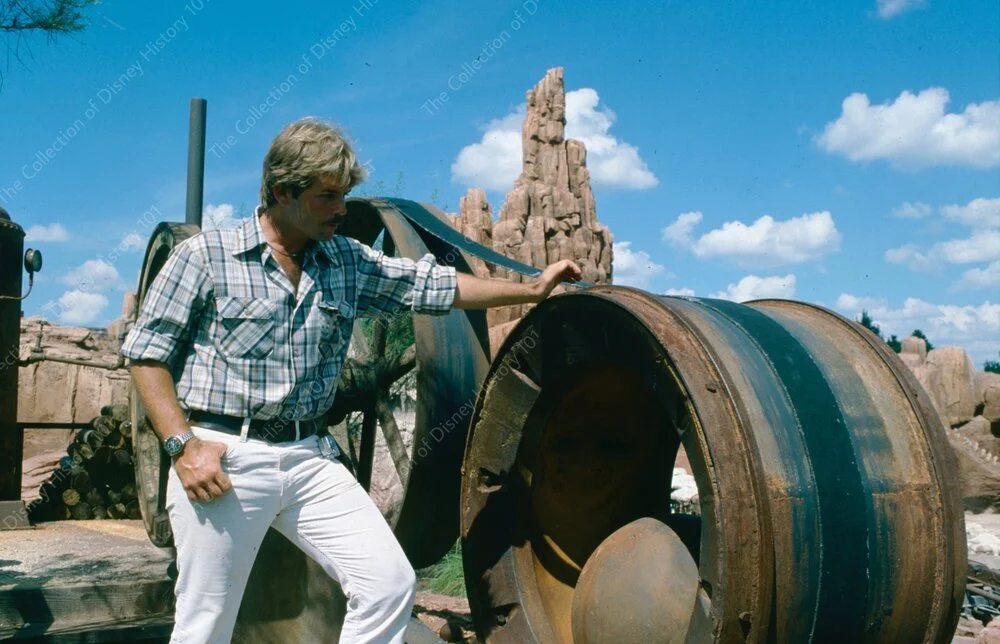
John Patrick Burke and Antique Ball Mill at the town of Tumbleweed
Many years after his unique contributions to Big Thunder Mountain and Thunder Mesa back East, John Patrick Burke (participating in the experience above) would go on to make Disney magic and create drawings for another iconic Disney Parks attraction - Splash Mountain!
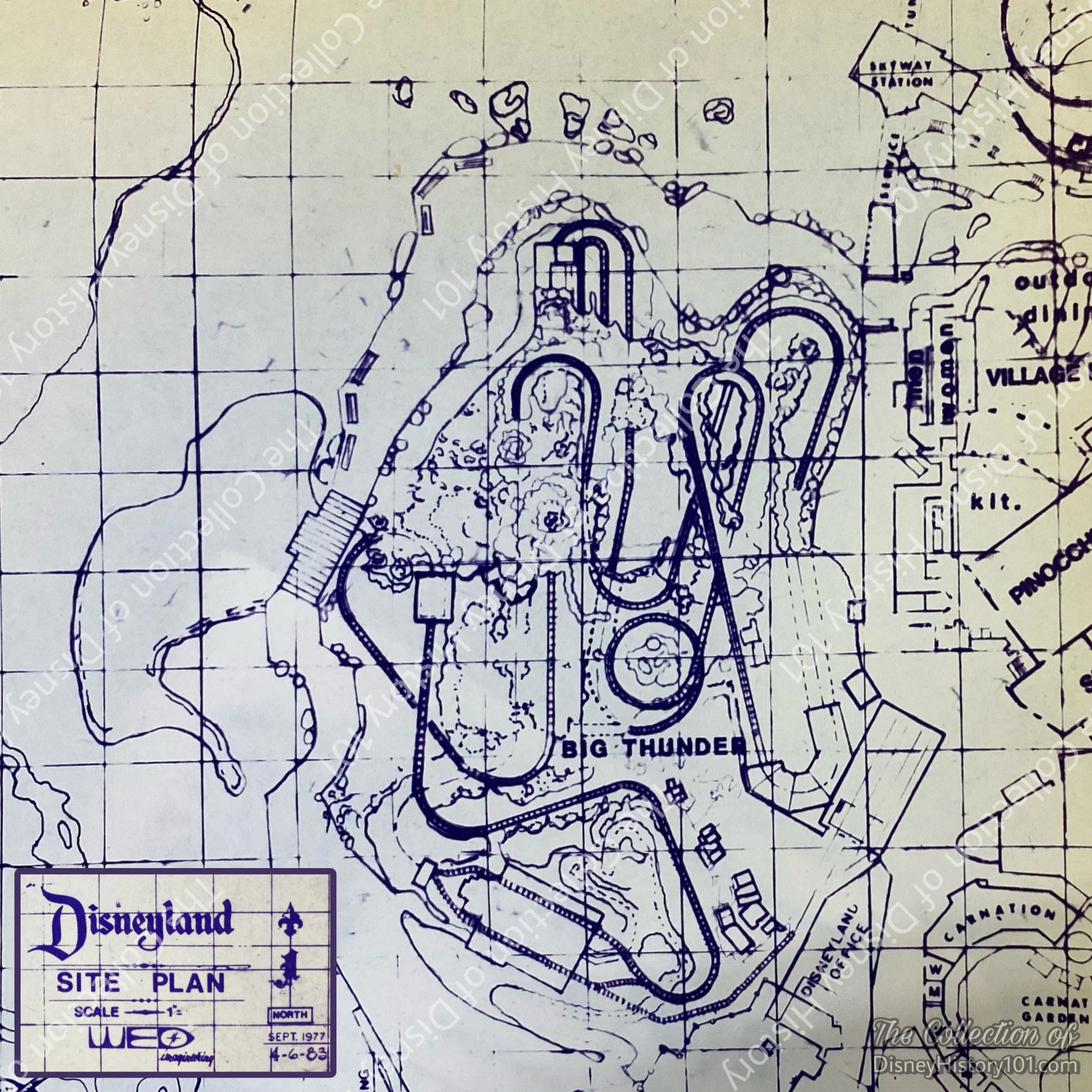
Big Thunder Mountain Railroad on a Disneyland Site Plan.
All the while, by September 30, 1982, construction was in progress, and WED & MAPO opened a job numbered DRPT-XXX (at a cost of $8,513.39) for a “Big Thunder Vehicles Design” at Disneyland.
Big Thunder Mountain also endured a strike of Disneyland Cast Members during 1983 and the possible resultant difficulties and periods of Breakdown “101” (when all of the attraction was malfunctioning enough to decrease capacity) which included a 2-hour station back-up and the attraction was shut down (before going “102”).
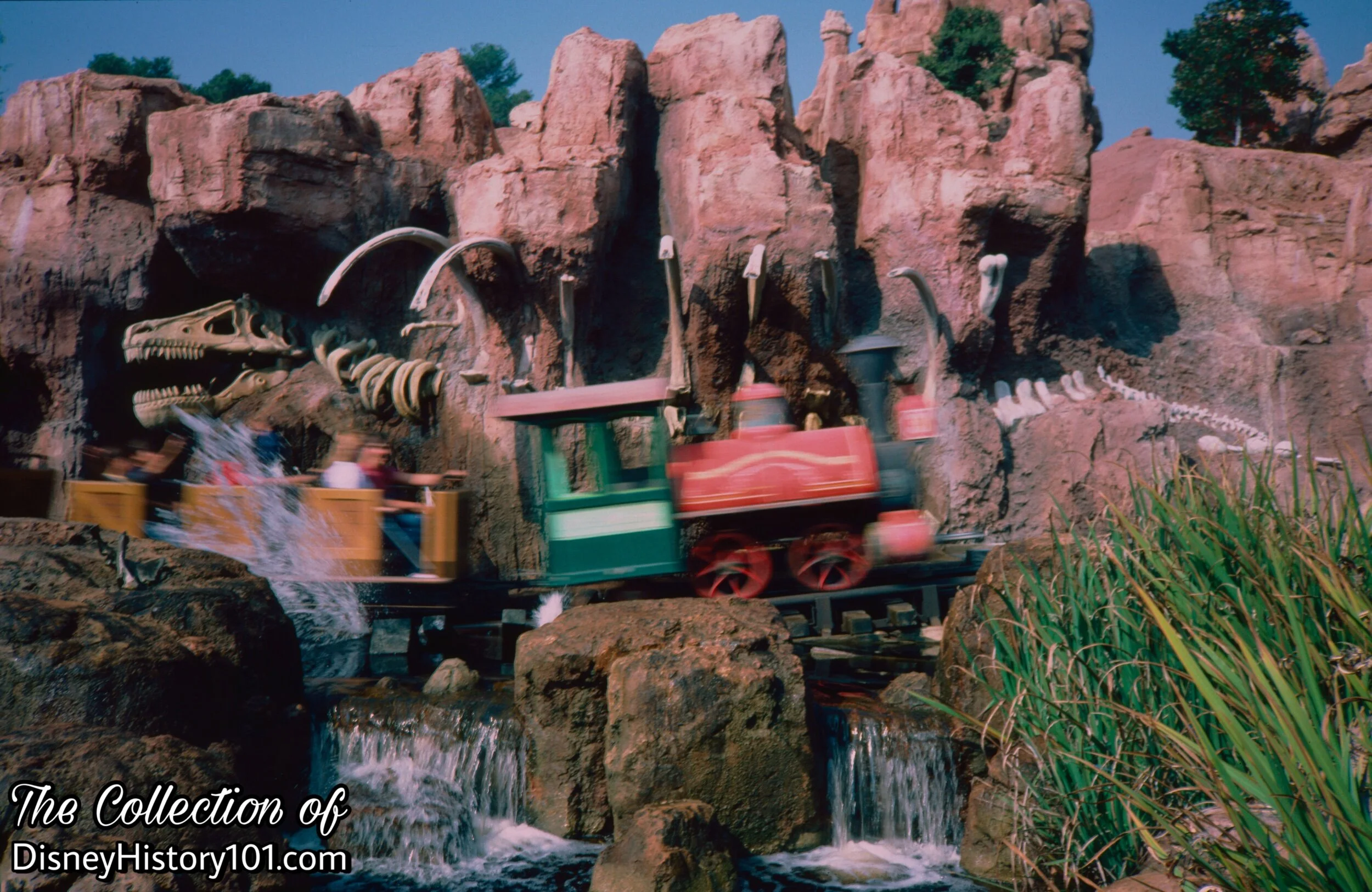
Big Thunder Mountain Railroad Dinosaur Gap, (November, 1980)
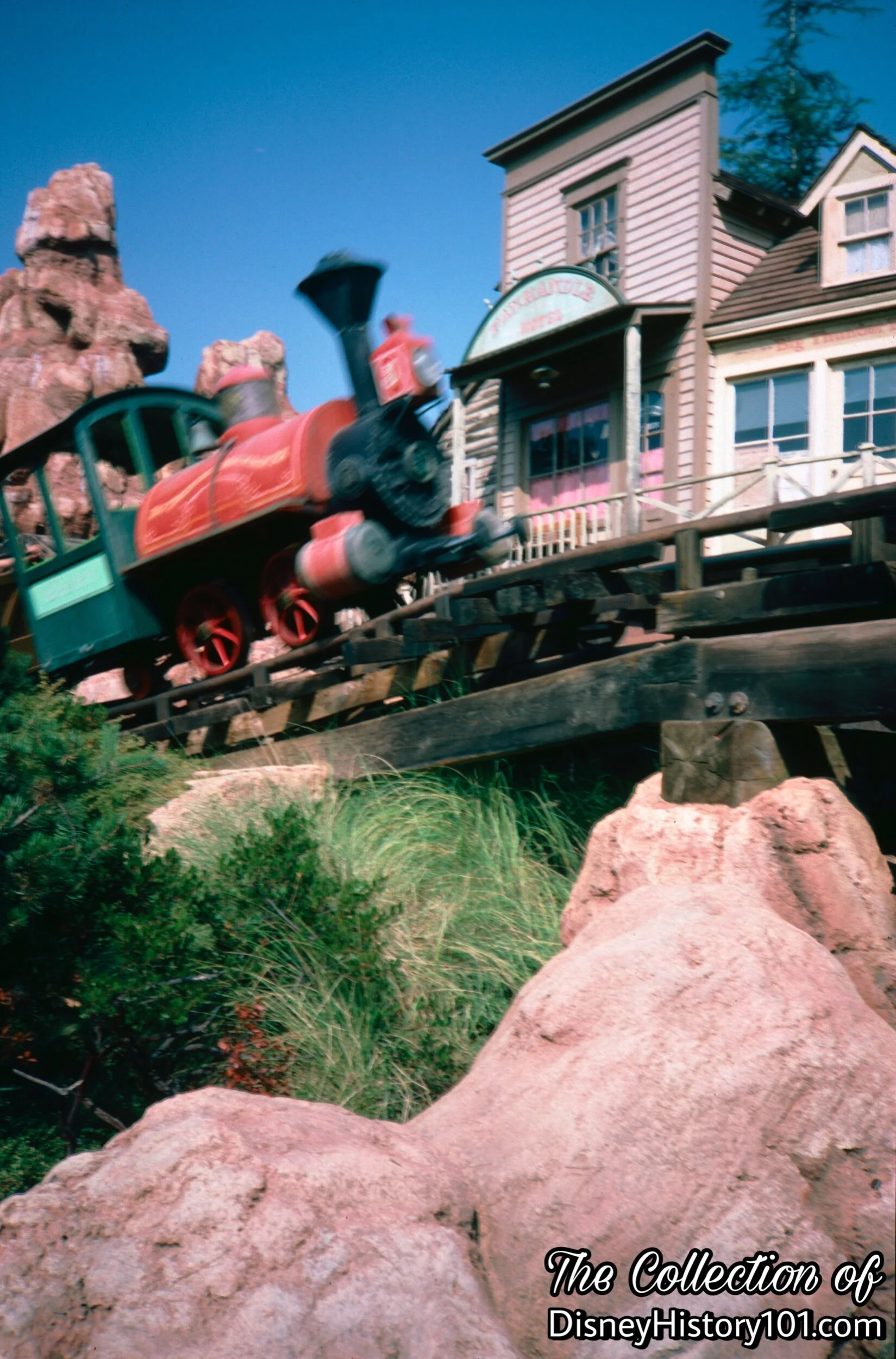
Look out for that “wildcat” - Big Thunder Mountain Railroad; November, 1980.
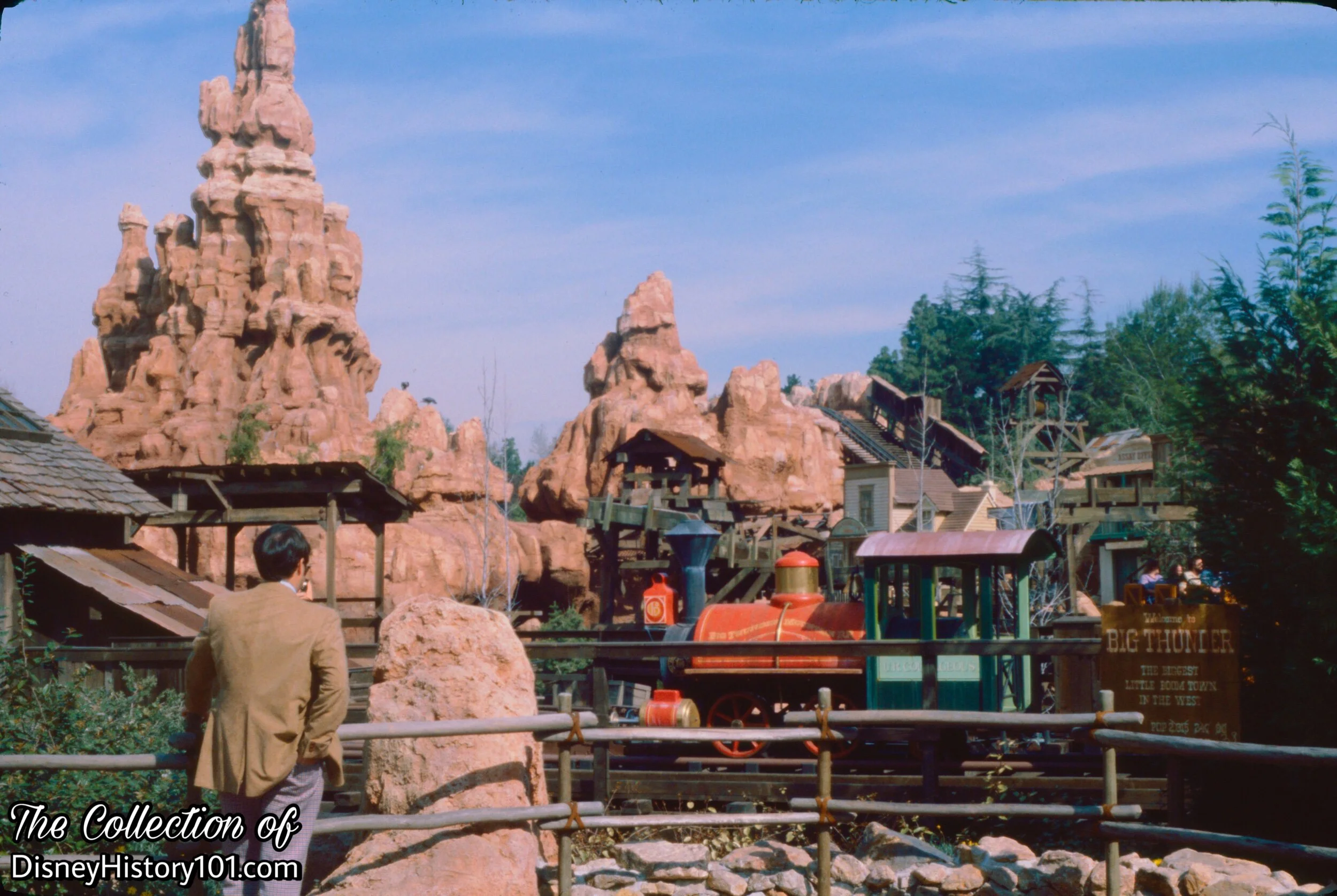
Big Thunder Mountain Railroad, (November, 1980)
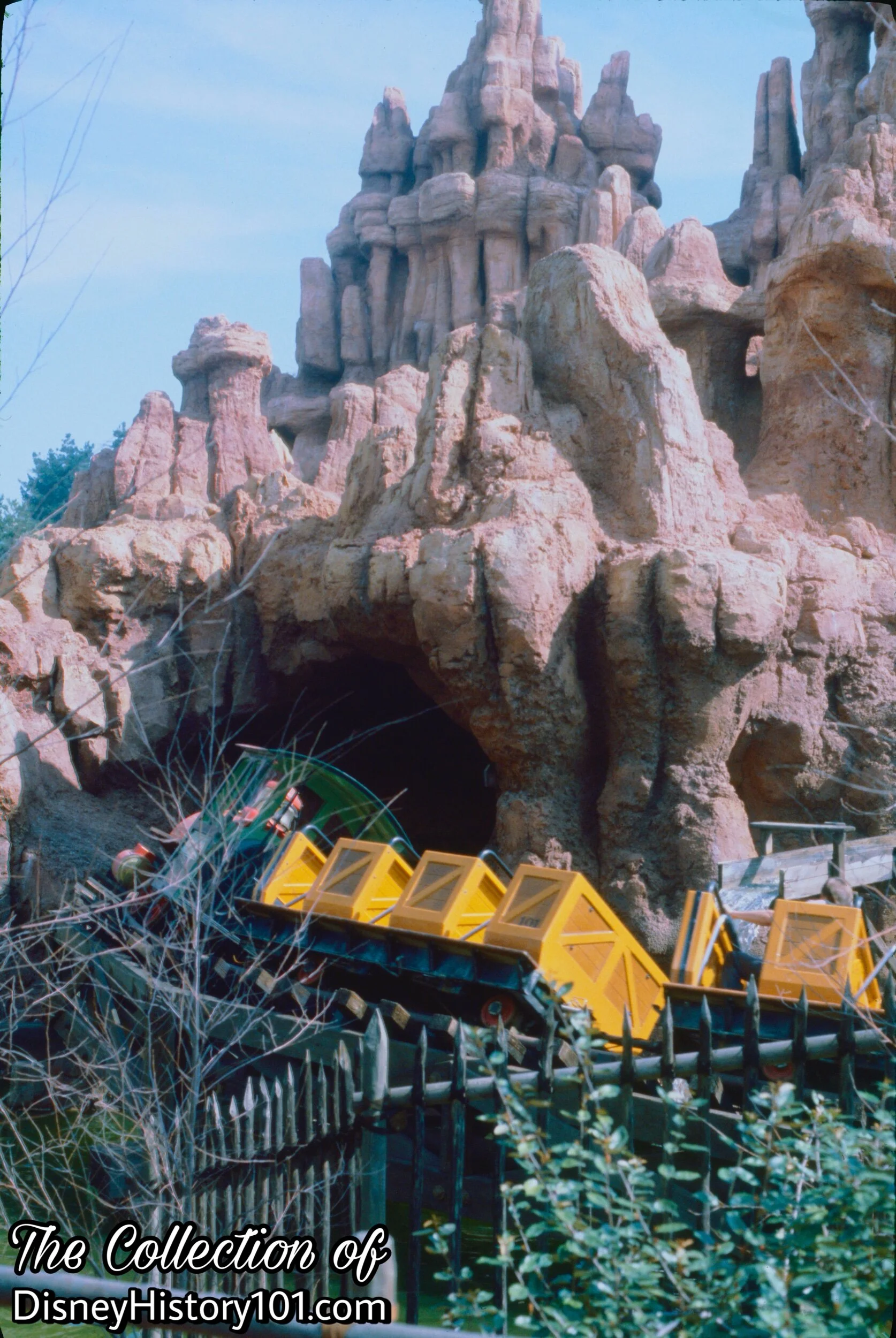
A runaway train of Big Thunder Mountain Railroad; November, 1980.
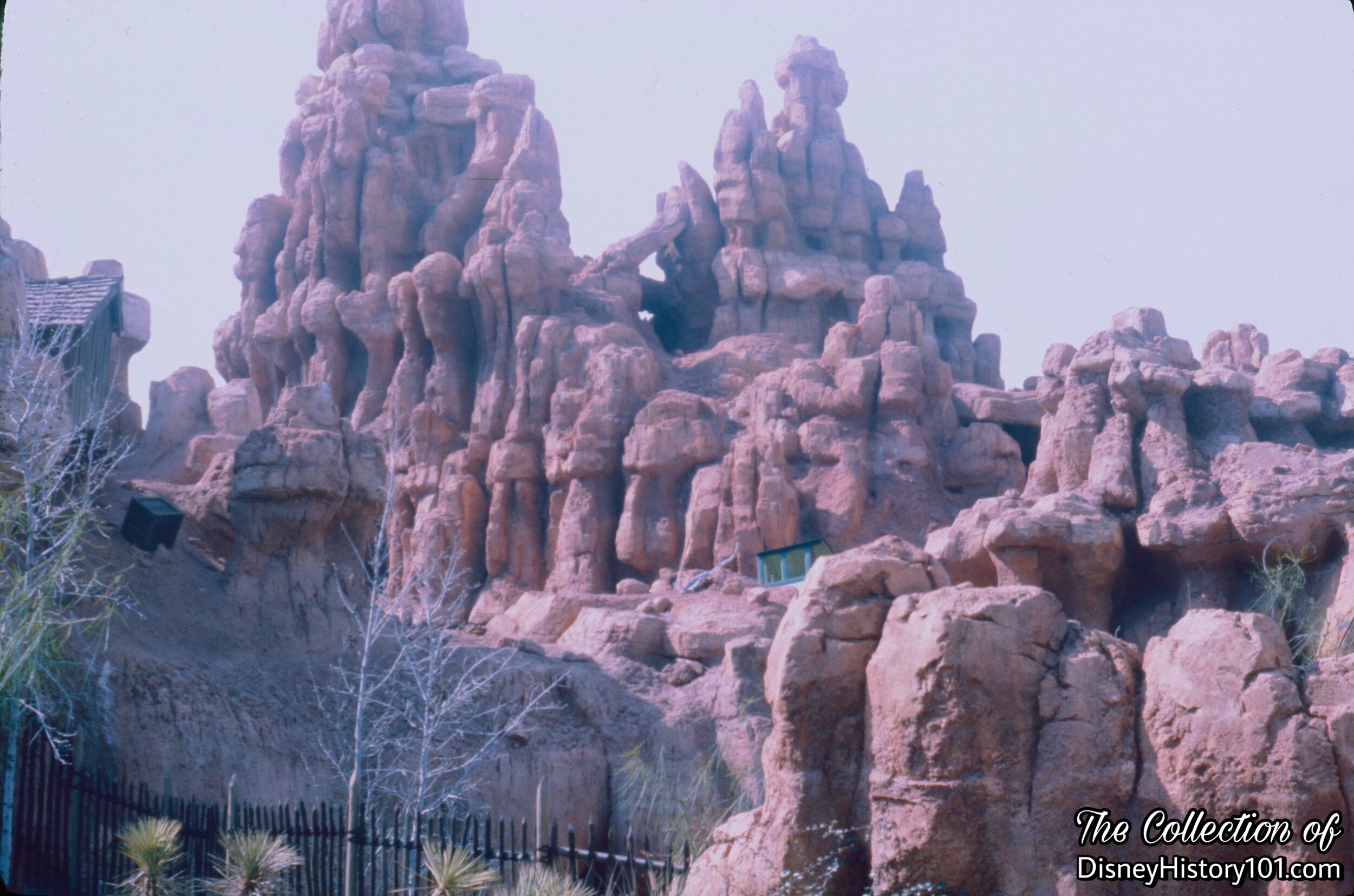
Big Thunder Mountain Railroad, (November, 1980)
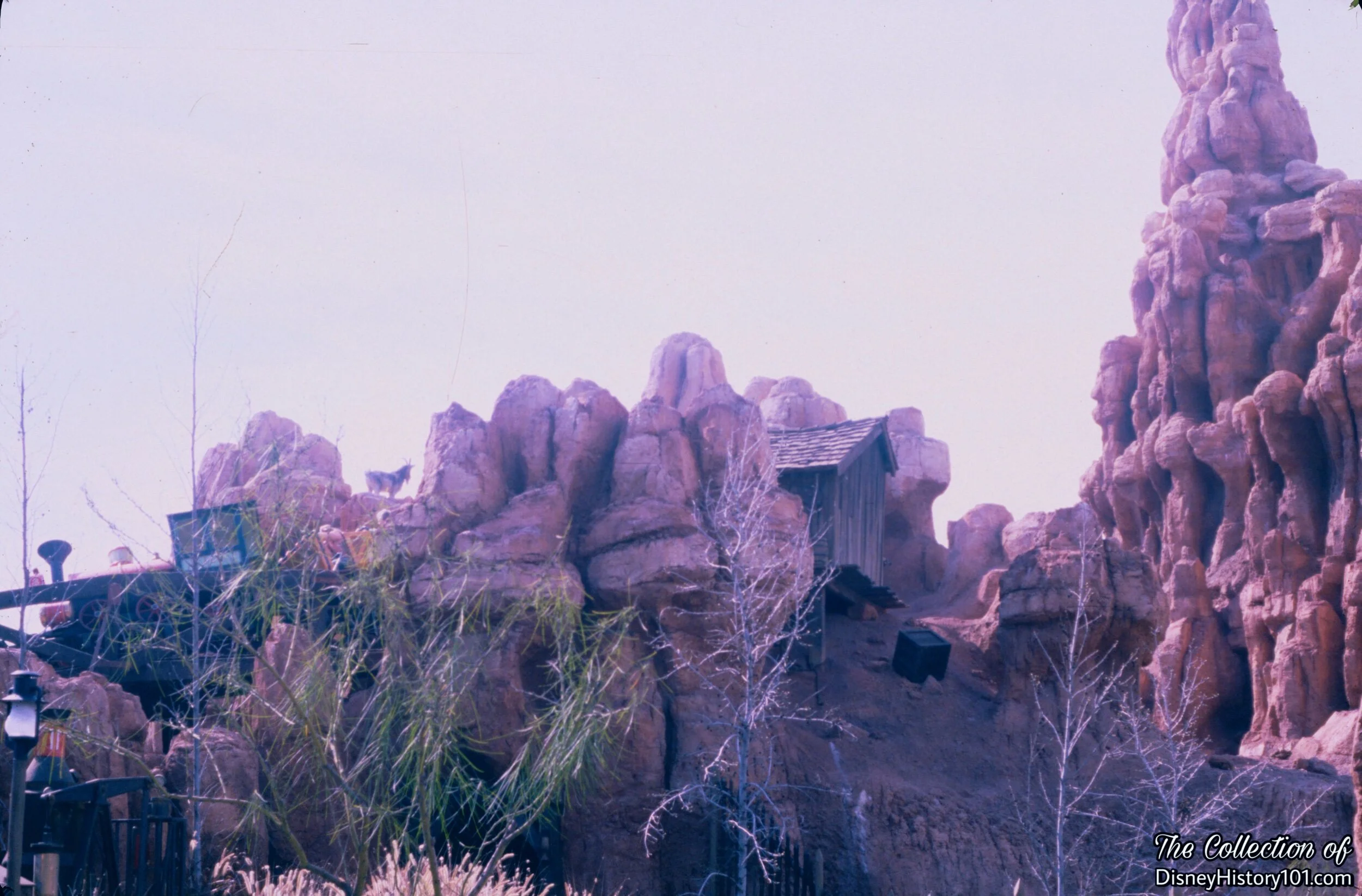
Big Thunder Mountain Railroad, (November, 1980)
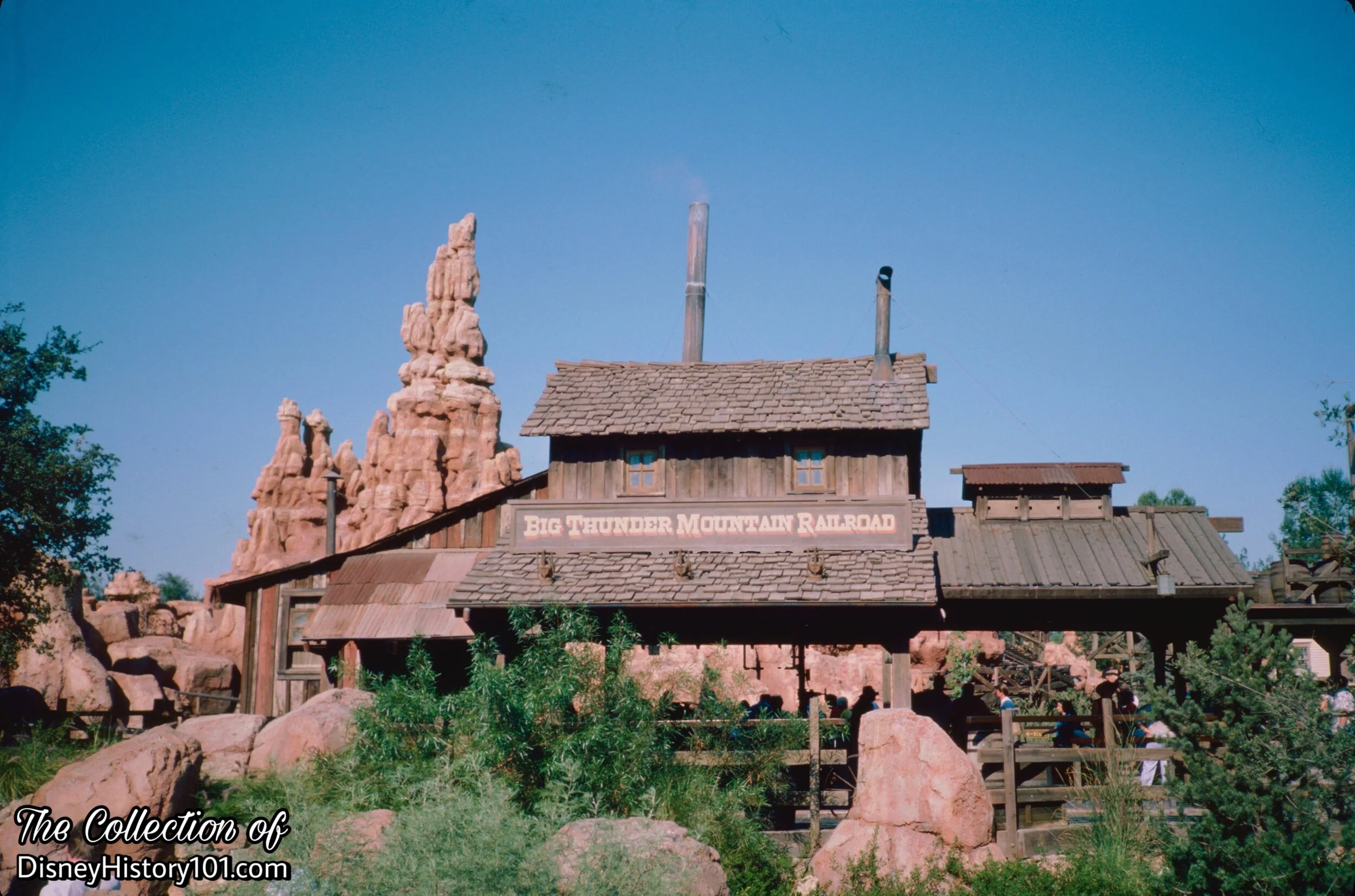
Big Thunder Mountain Railroad, (November, 1980)
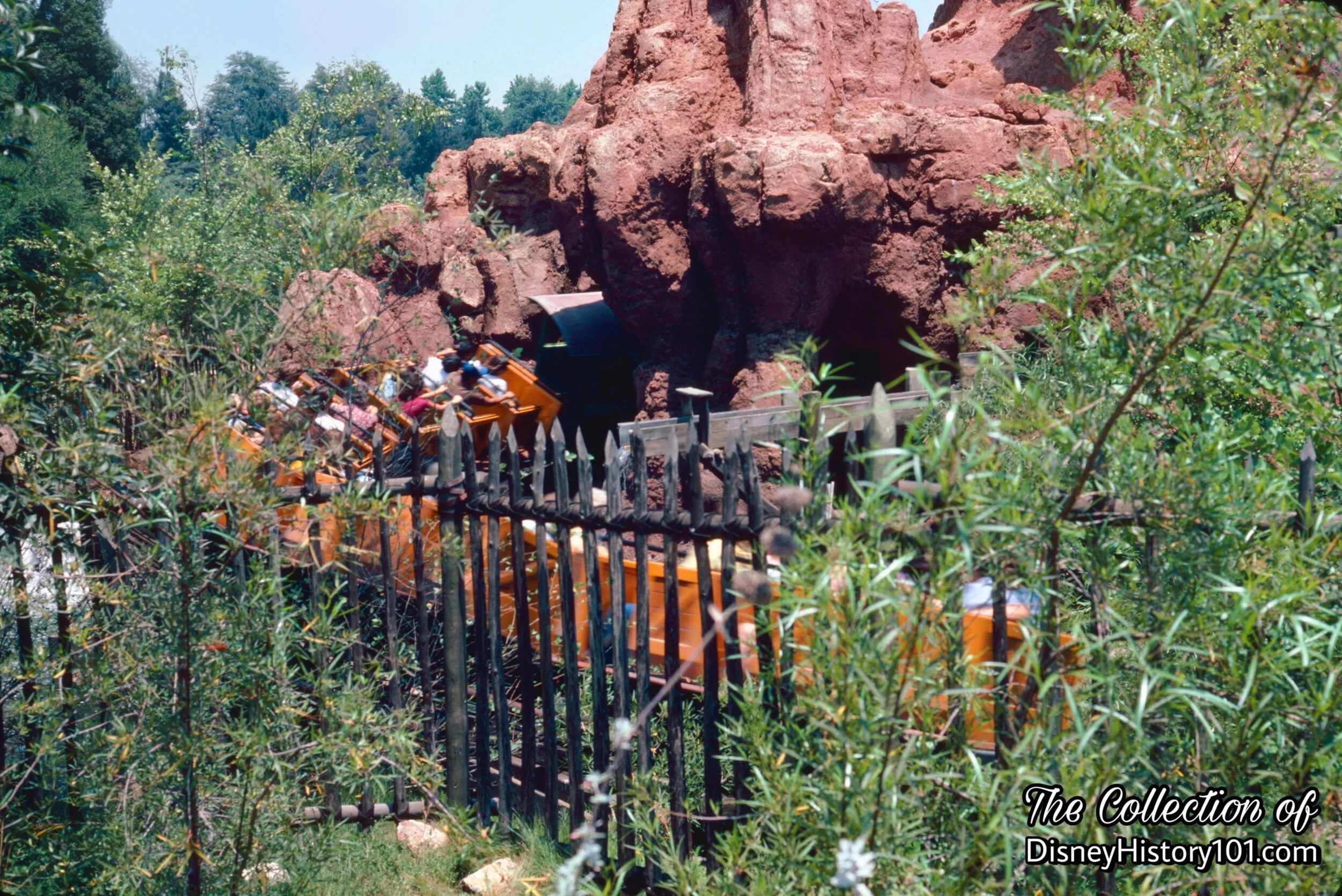
Big Thunder Mountain Railroad
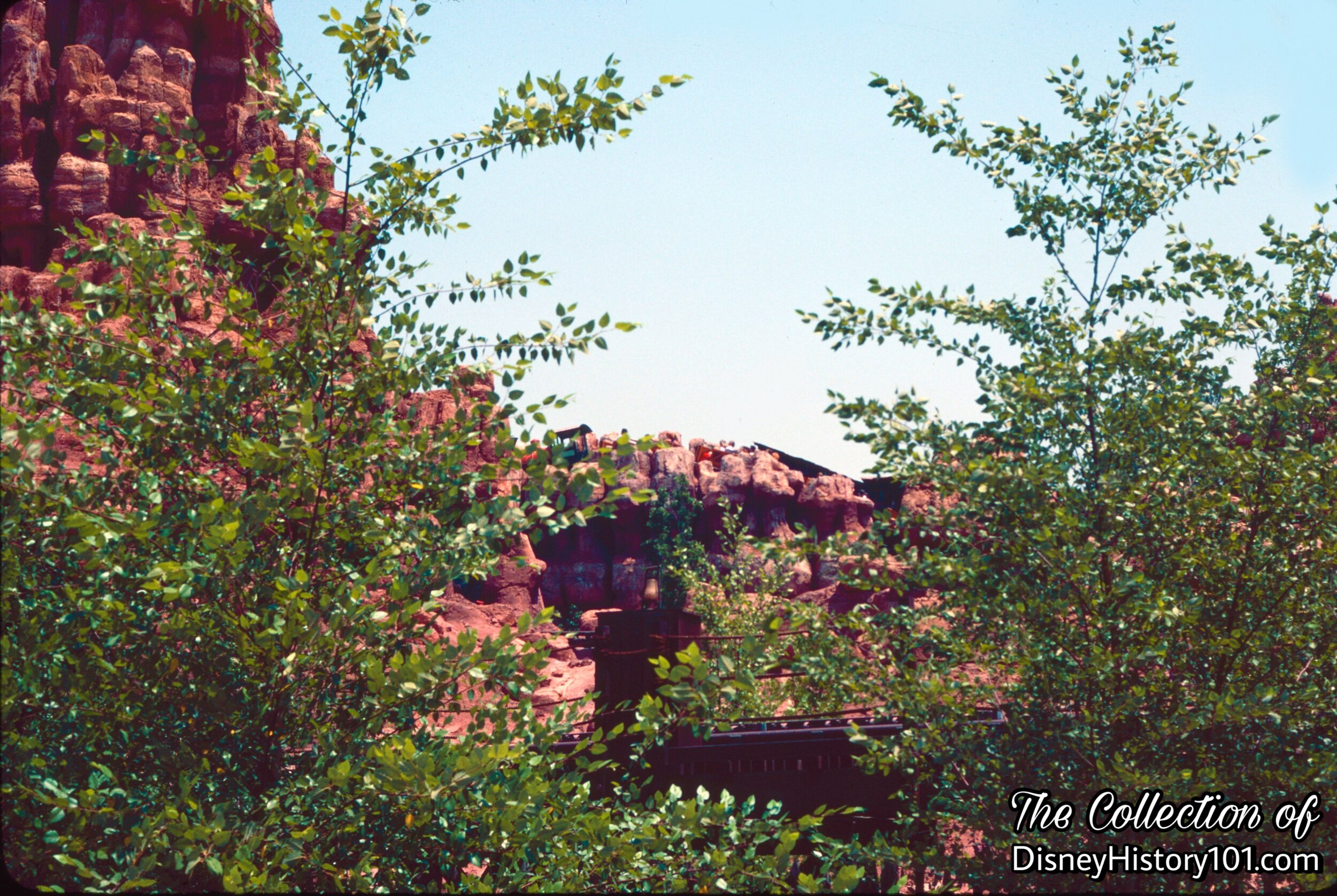
Big Thunder Mountain Railroad
The Big Thunder Mountain backdrop provided new Stages for Disneyland entertainers and exhibits. For example, during “Festival Japan” (October 12 & 13, 1985), the nearby Big Thunder Trail was utilized to hold a free exhibit -Southern California Sumie Club (Ink Painting), Ryoka Kai (flower arranging), Sangetsu-Ryu (flower arrangements).
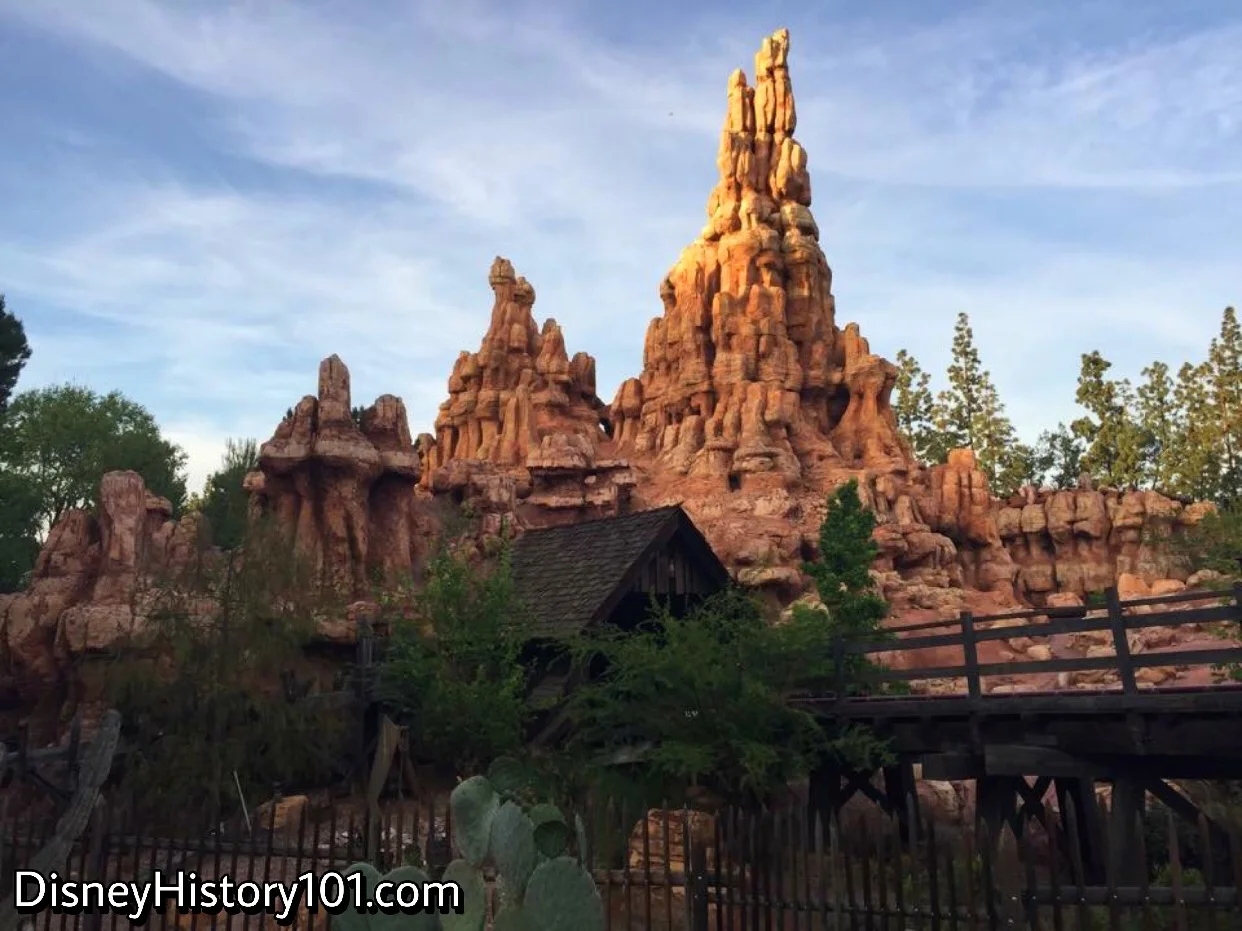
Big Thunder Mountain Railroad, (The Present)
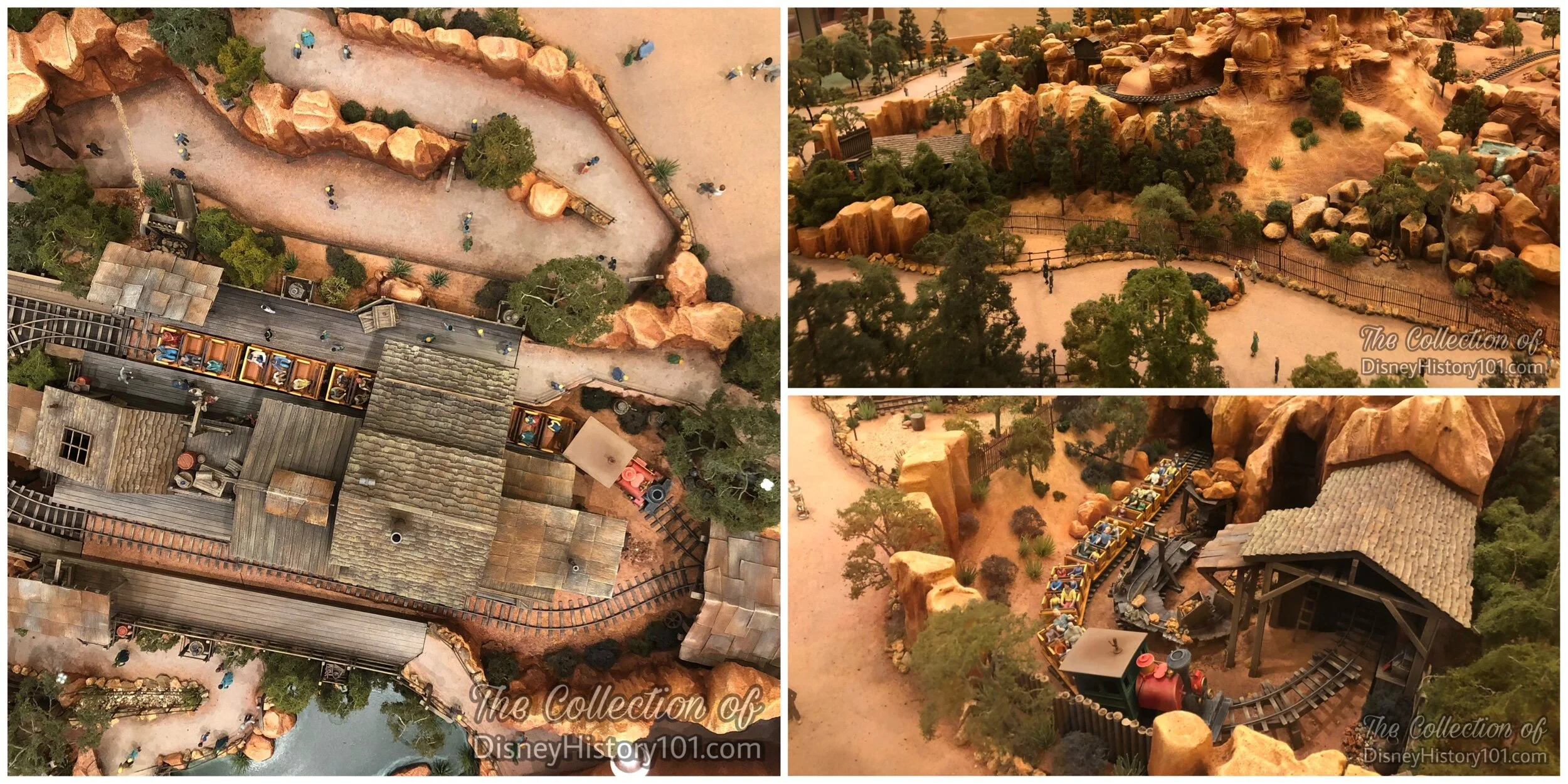
Big Thunder Mountain Railroad (1/4" = 1') Architectural Model, at the Disneyland Hotel Frontier Tower
If you happen to be enjoying a stay at the Disneyland Hotel, you may want to visit the exhibit in the Frontier Tower - a “re-creation” of the original Big Thunder Mountain Railroad Concept Model. According to the museum plaque : “Imagineers use a scale model such as this as a tool as they define and refine designs for projects.” You may recollect once seeing the original model (on which this one is based), displayed at the Main Street Opera House while construction of Big Thunder Mountain Railroad was being completed.
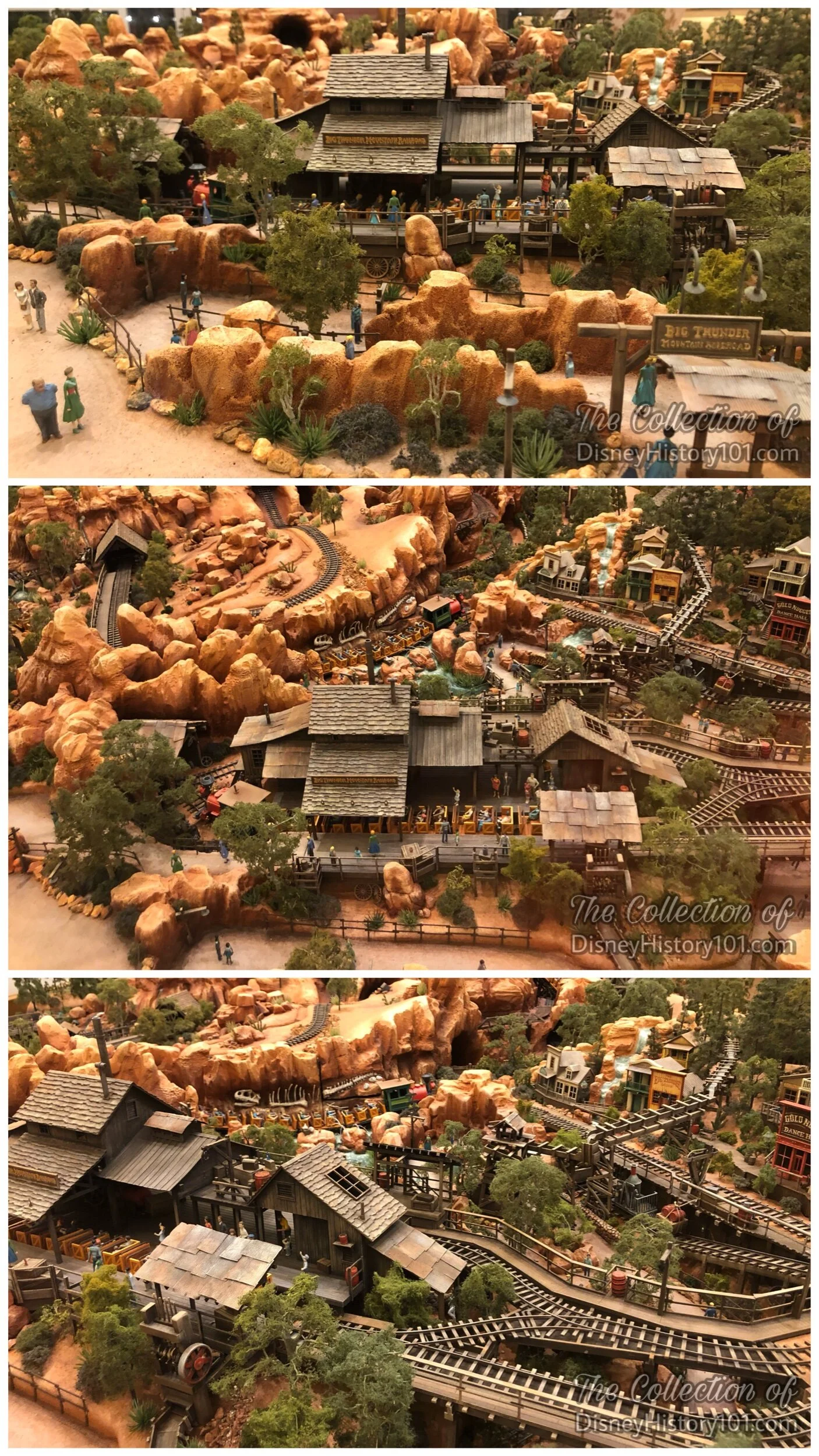
Big Thunder Mountain Depot (1/4" = 1') Architectural Model, at the Disneyland Hotel Frontier Tower
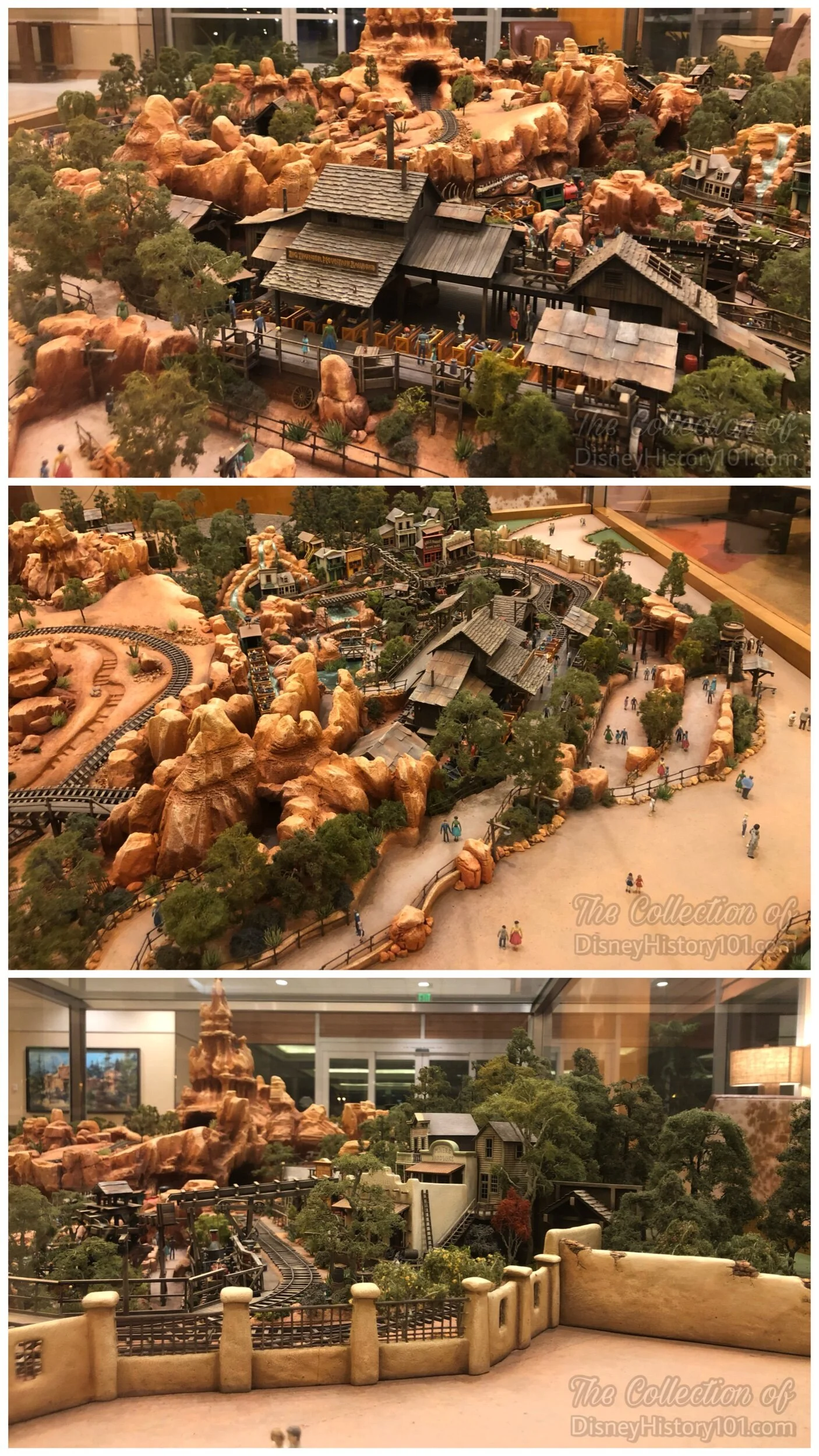
Big Thunder Mountain Railroad (1/4" = 1') Architectural Model, at the Disneyland Hotel Frontier Tower
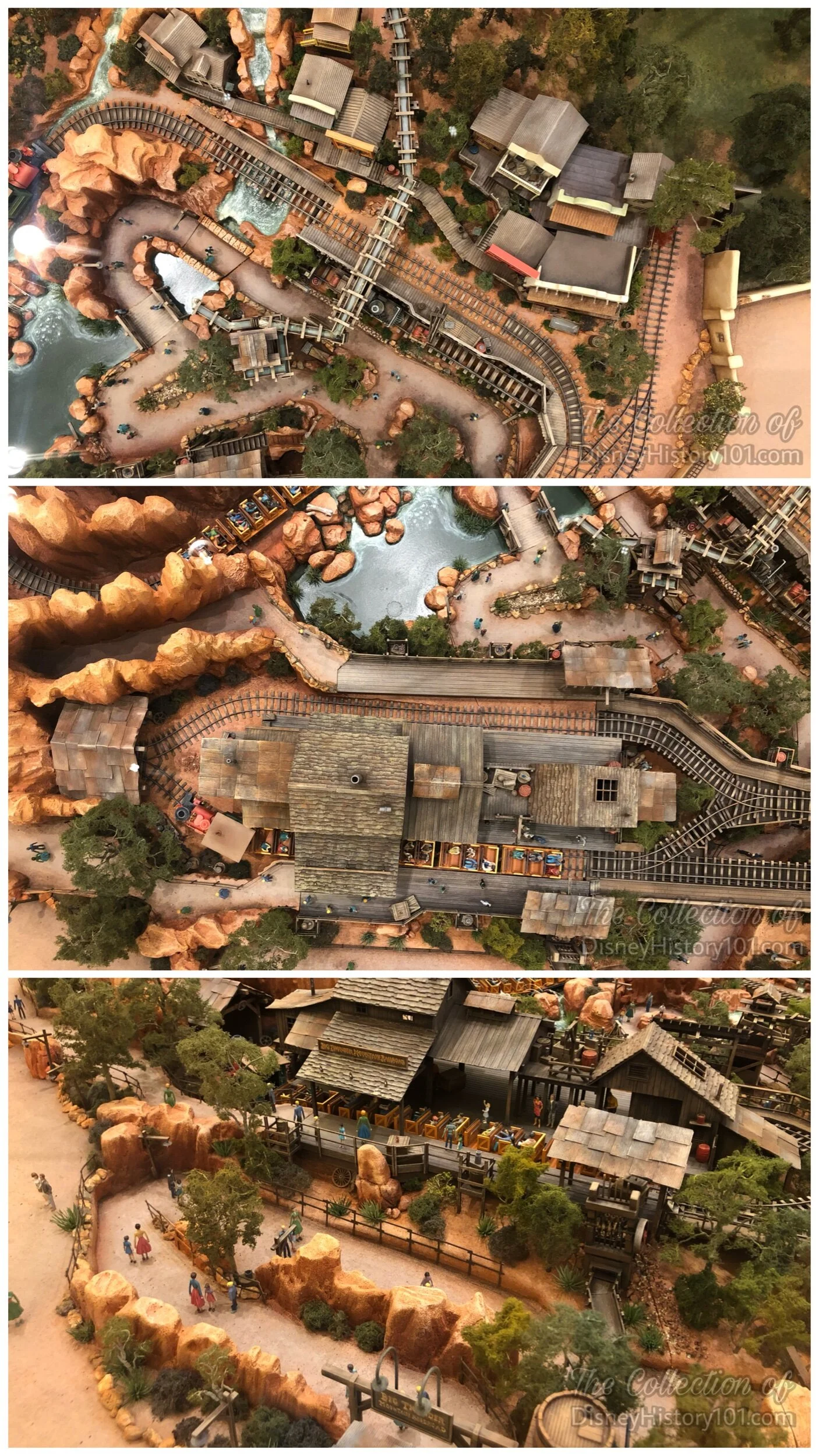
Big Thunder Mountain Railroad (1/4" = 1') Architectural Model, at the Disneyland Hotel Frontier Tower
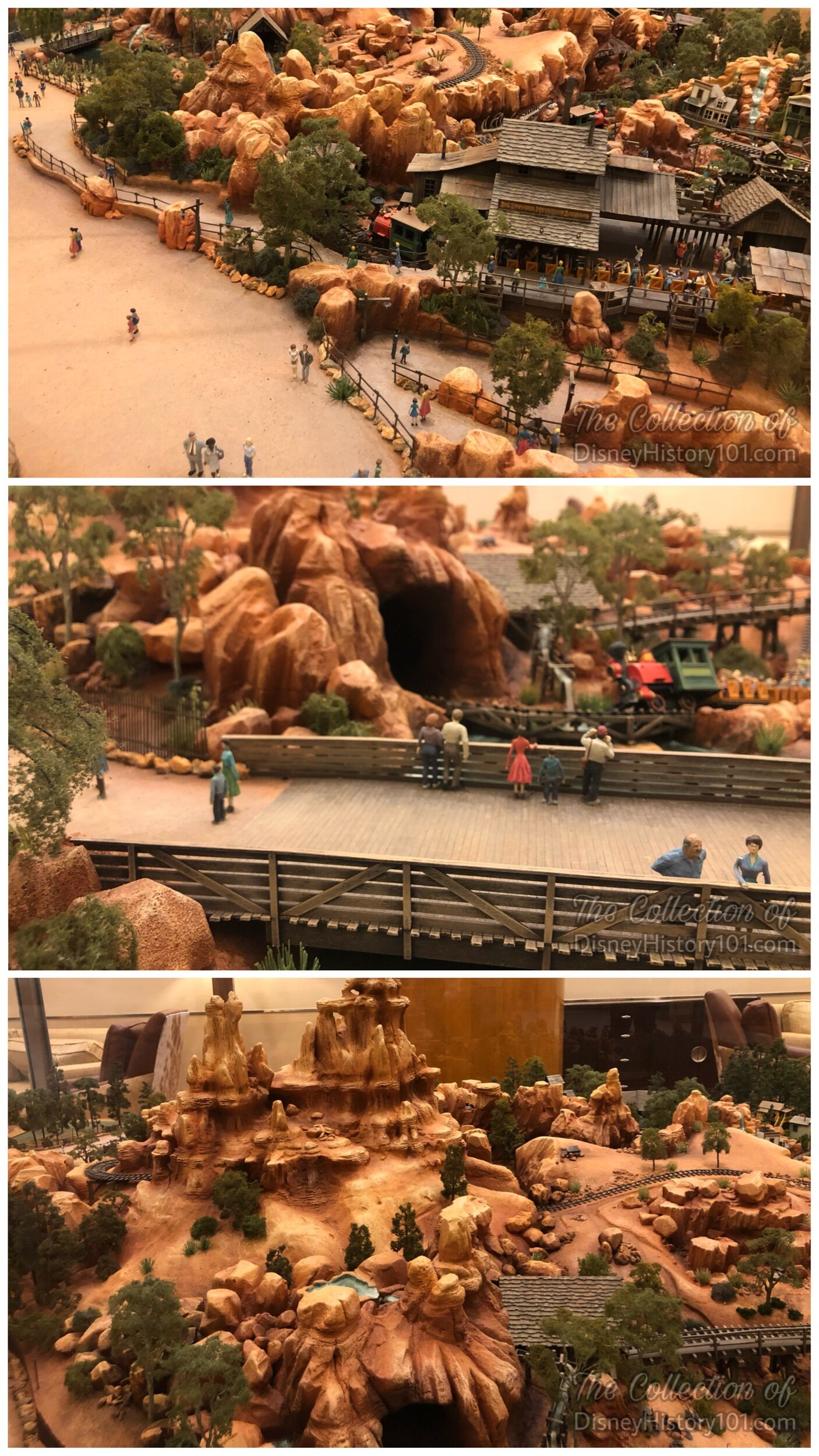
Big Thunder Mountain Railroad (1/4" = 1') Architectural Model, at the Disneyland Hotel Frontier Tower
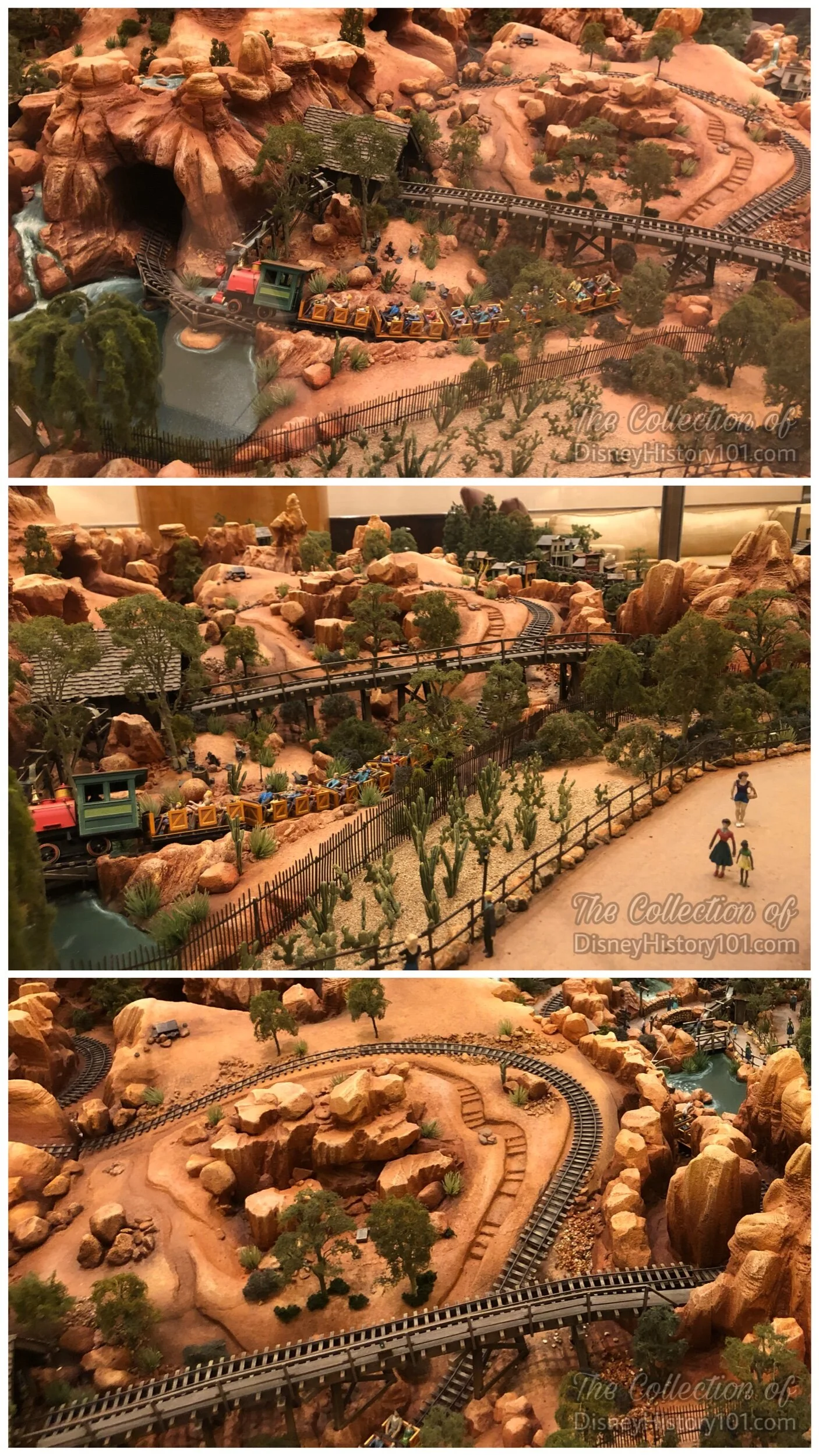
Big Thunder Mountain Railroad (1/4" = 1') Architectural Model, at the Disneyland Hotel Frontier Tower
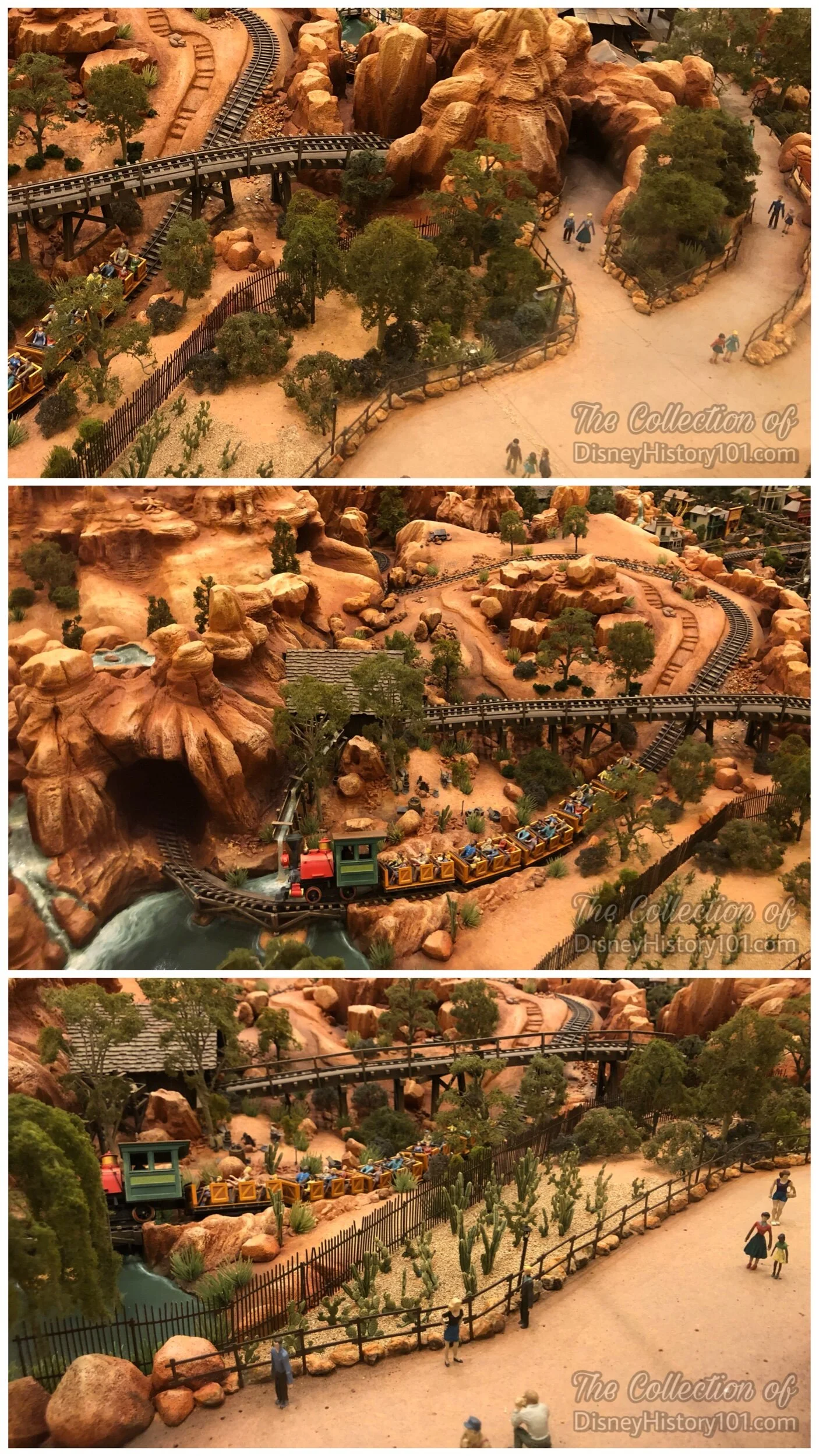
Big Thunder Mountain Railroad (1/4" = 1') Architectural Model, at the Disneyland Hotel Frontier Tower
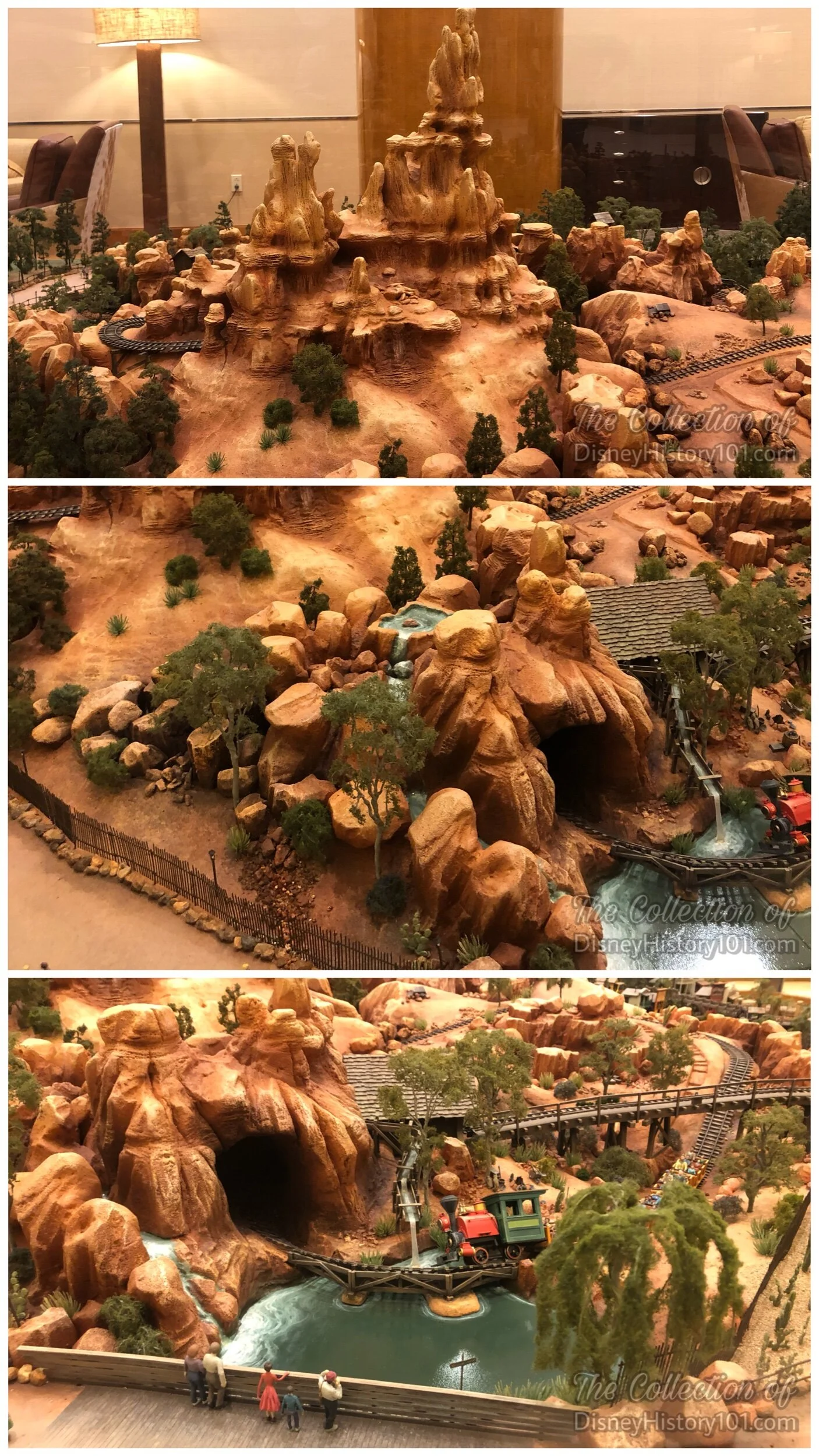
Big Thunder Mountain Railroad (1/4" = 1') Architectural Model, at the Disneyland Hotel Frontier Tower
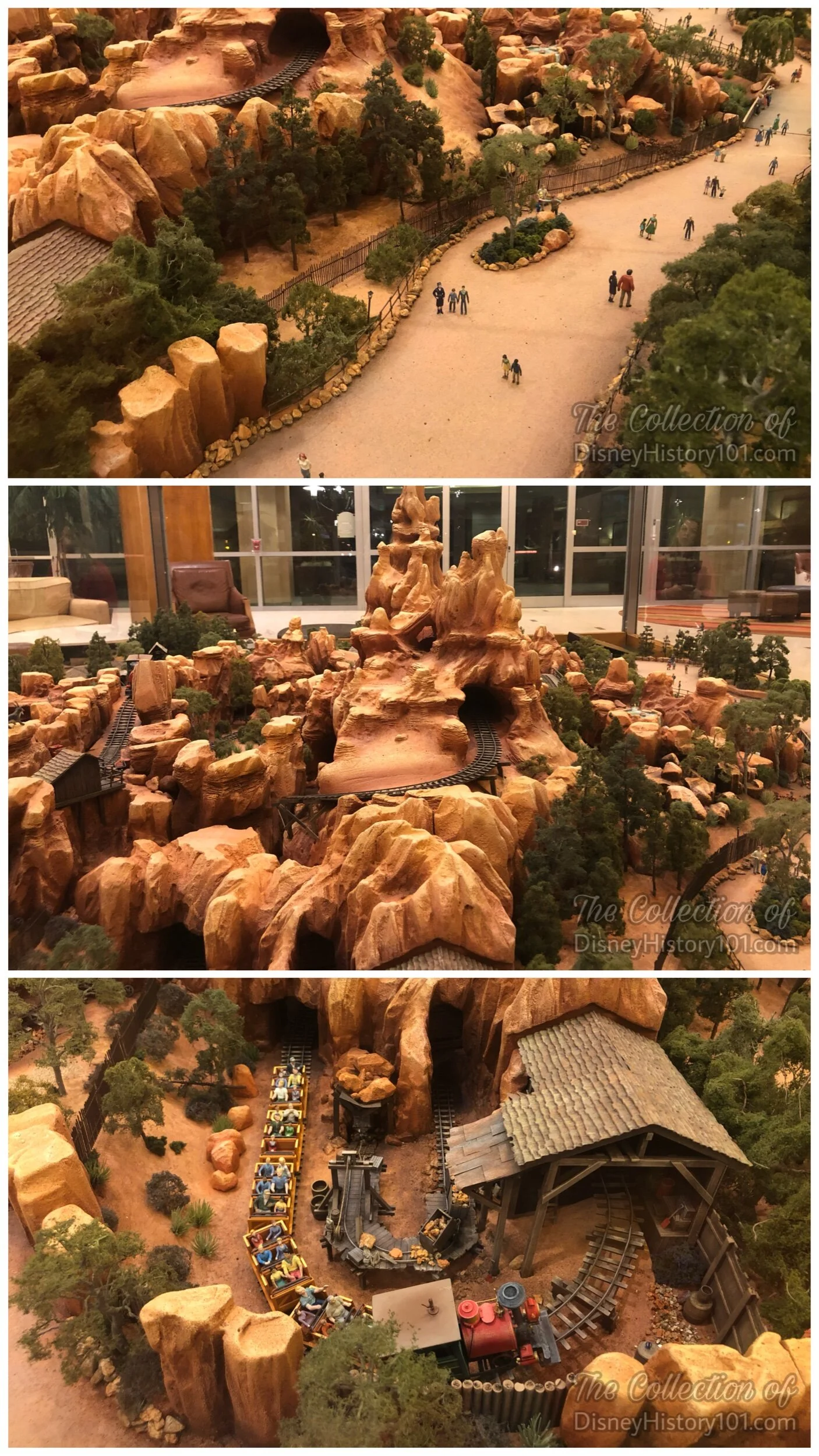
Big Thunder Mountain Railroad (1/4" = 1') Architectural Model, at the Disneyland Hotel Frontier Tower
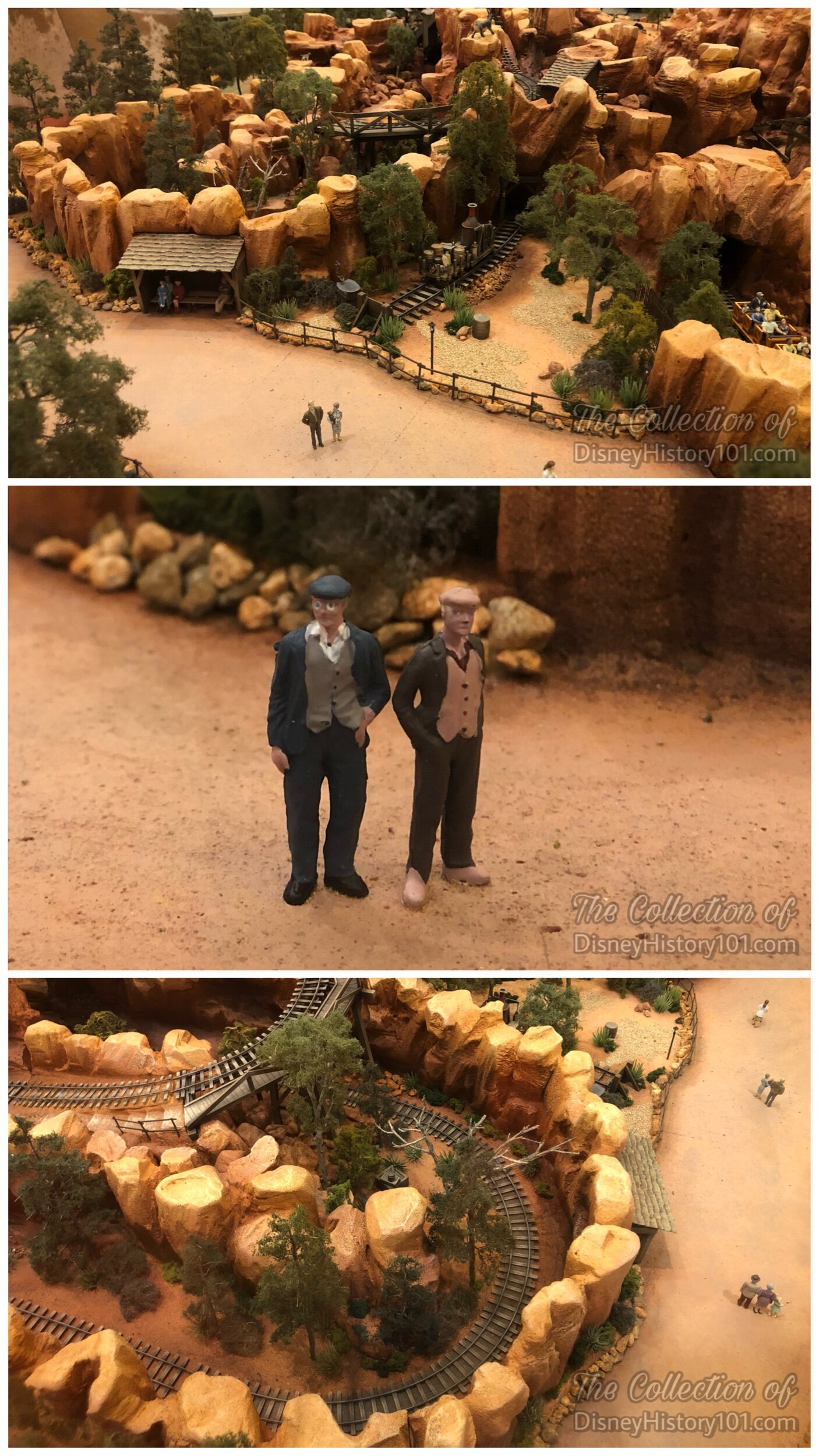
Big Thunder Mountain Railroad & Big Thunder Trail (1/4" = 1') Architectural Model, at the Disneyland Hotel Frontier Tower
You may have wandered the full-scale Big Thunder Trail which meanders along the northwest side of Big Thunder Mountain.
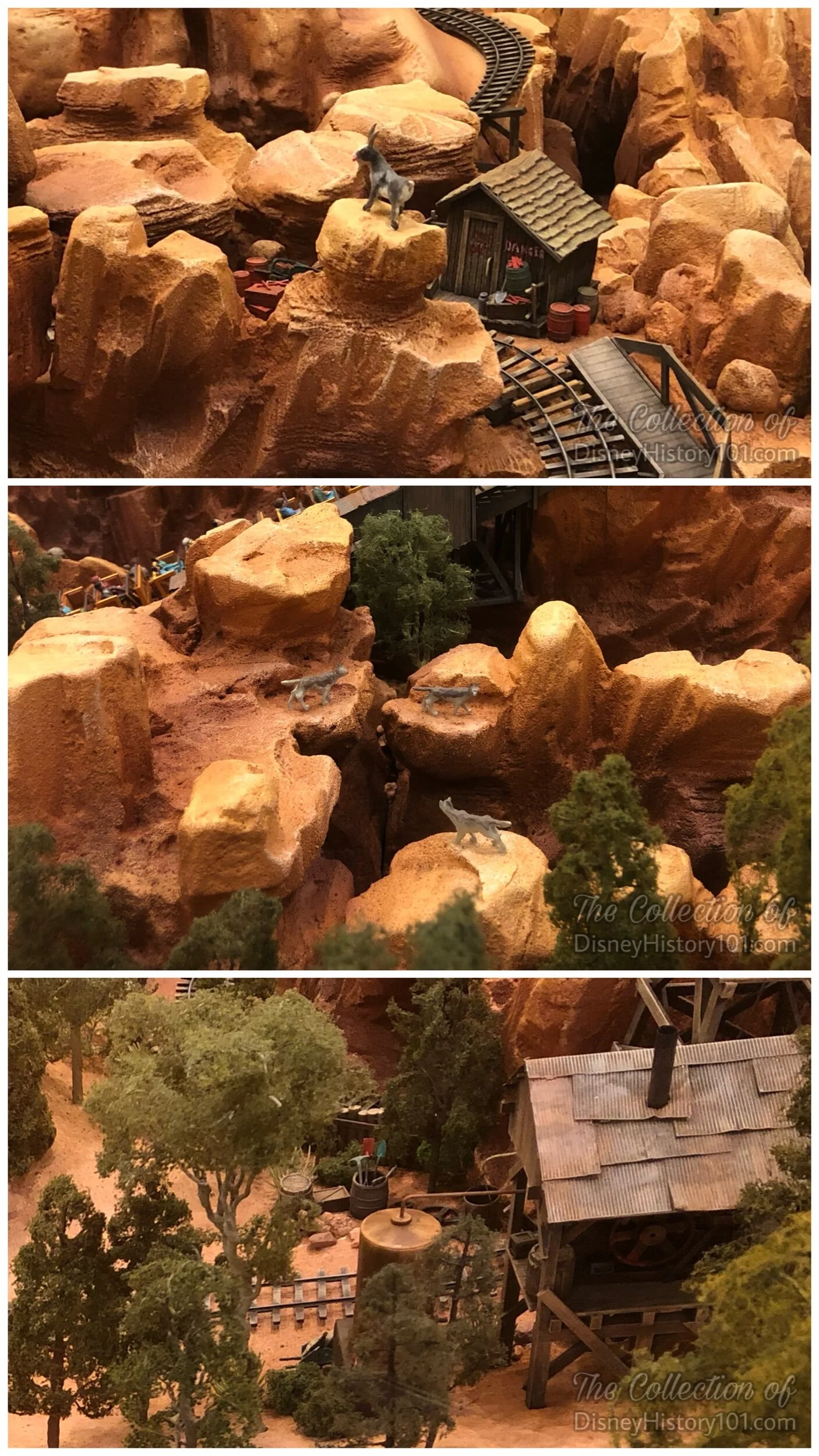
Big Thunder Mountain Railroad (1/4" = 1') Architectural Model, at the Disneyland Hotel Frontier Tower
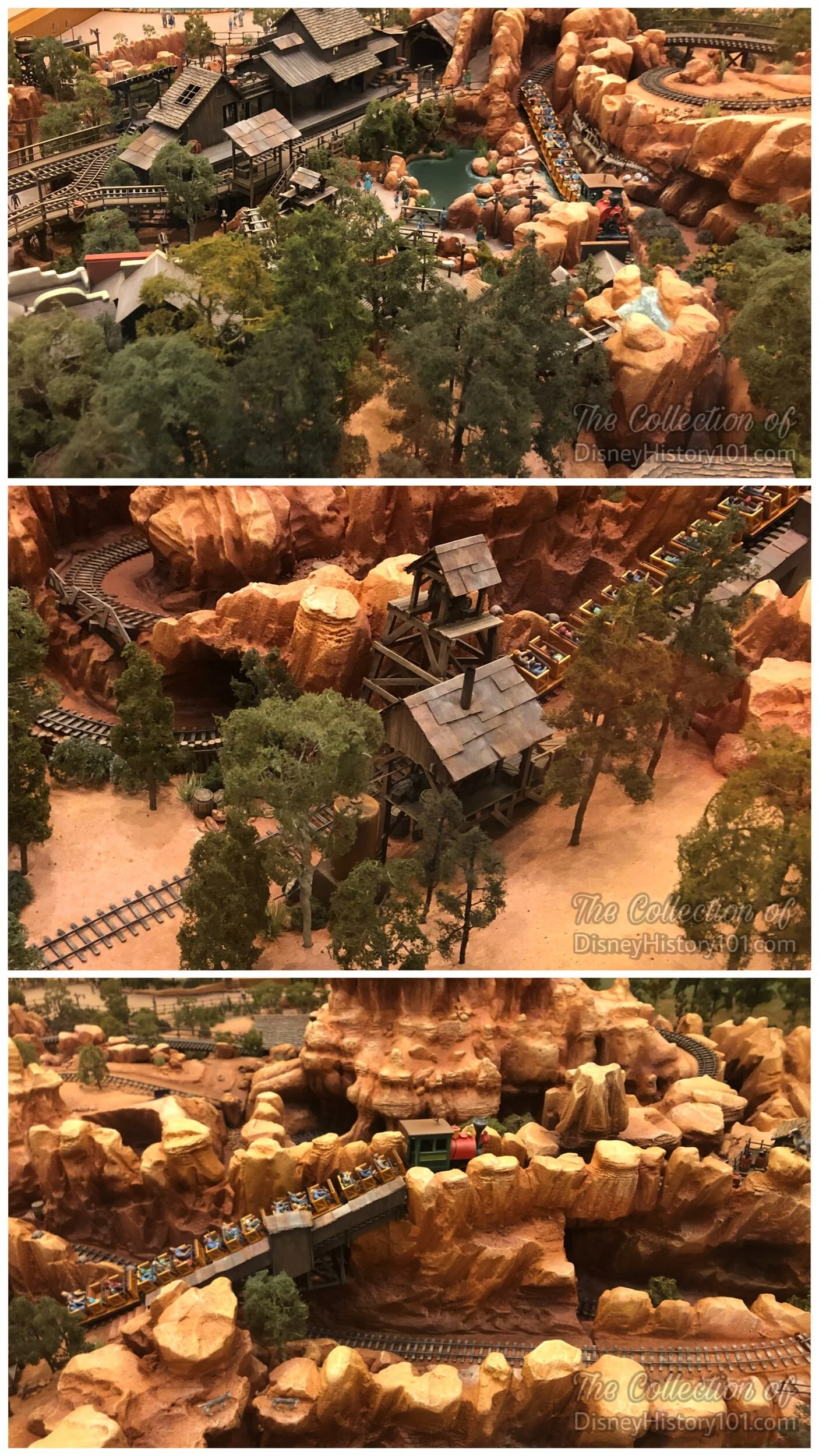
Big Thunder Mountain Railroad (1/4" = 1') Architectural Model, at the Disneyland Hotel Frontier Tower
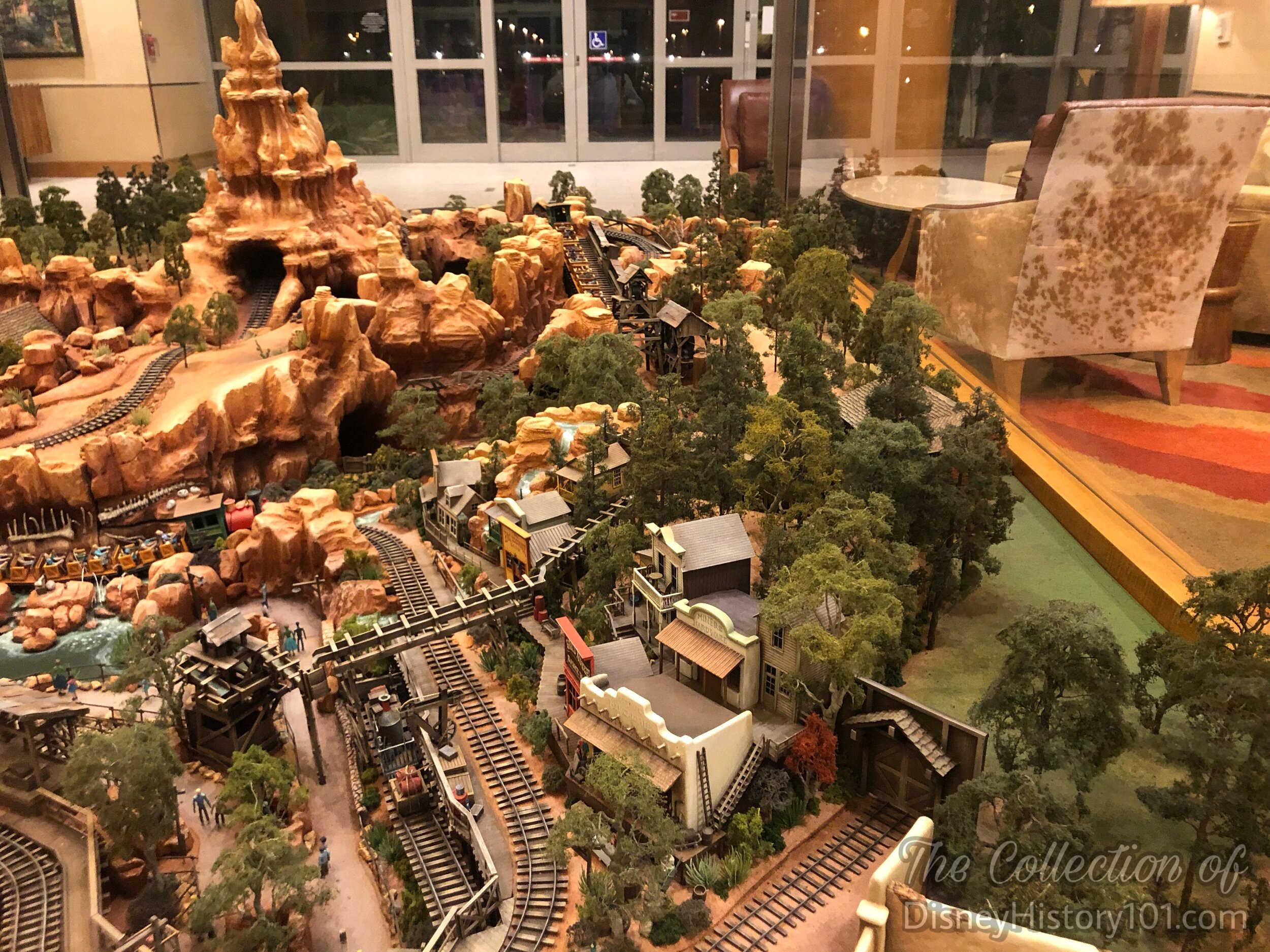
Big Thunder Mountain Railroad (1/4" = 1') Architectural Model, at the Disneyland Hotel Frontier Tower
“Legacy”
Next, Guests could Board a runaway mine train in the rugged American Westernland at Tokyo Disneyland in 1987. In the present, the tradition lives on with Big Grizzly Mountain Runaway Mine Cars at Hong Kong Disneyland - The wildest ride in the West! There, grizzly bears send the mine cars racing out of the mountain, backward and forward, through the entire town of Grizzly Gulch.
Even the distinct sounds of Big Thunder Mountain Railroad (engine sounds that were pre-recorded by Walt Disney Imagineers) have proven to be inspirational. Foley experts foley technicians and sound engineers recorded these very sounds of the original attraction, and have used them again during the production of some iconic scenes featured in Indiana Jones and the Temple of Doom.
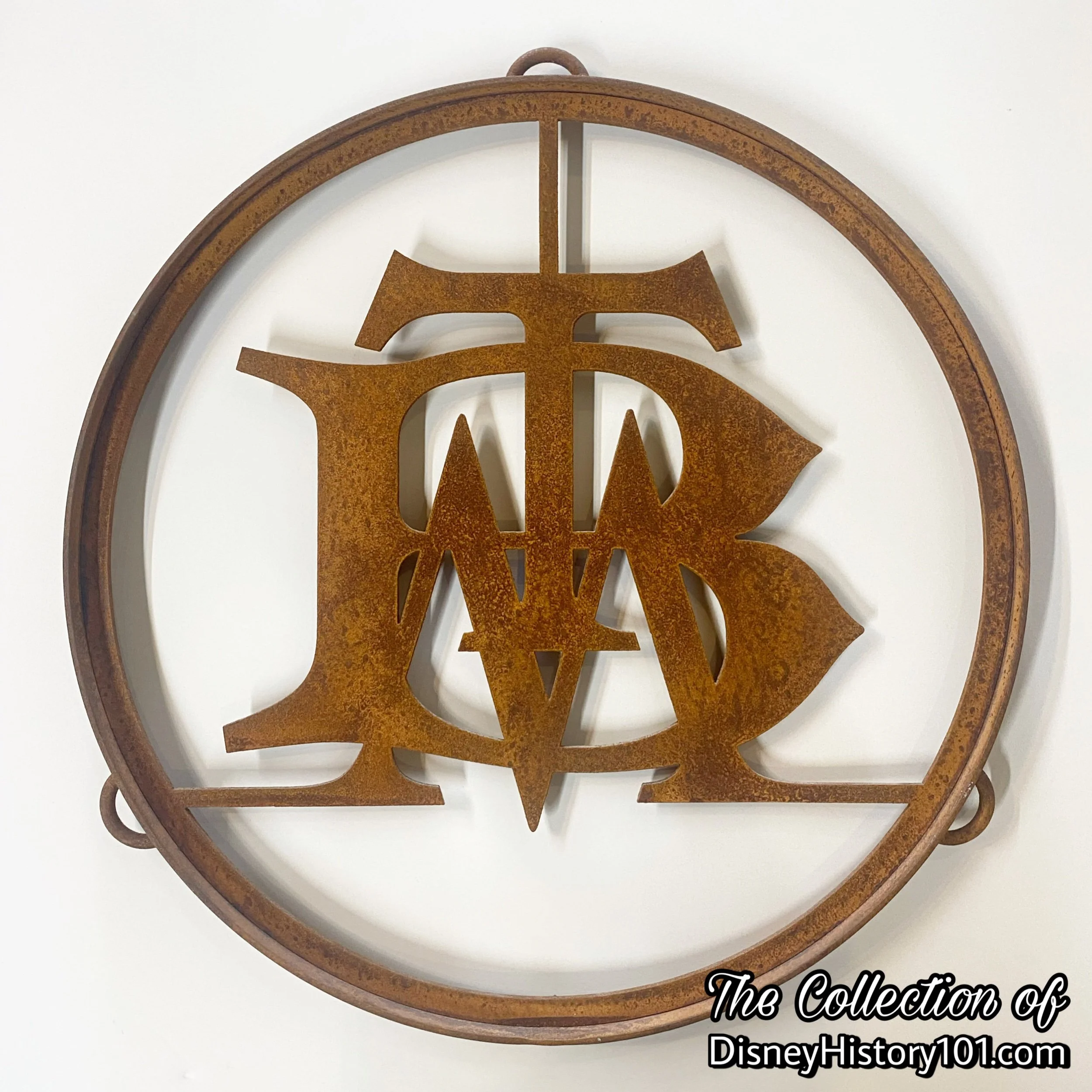
At Disneyland, signs were themed to support the stories with respectful graphics, colors, fonts, terminology, the overall design of sign, materials (wood, metal, banners, etc.), and verbiage used on the signage.
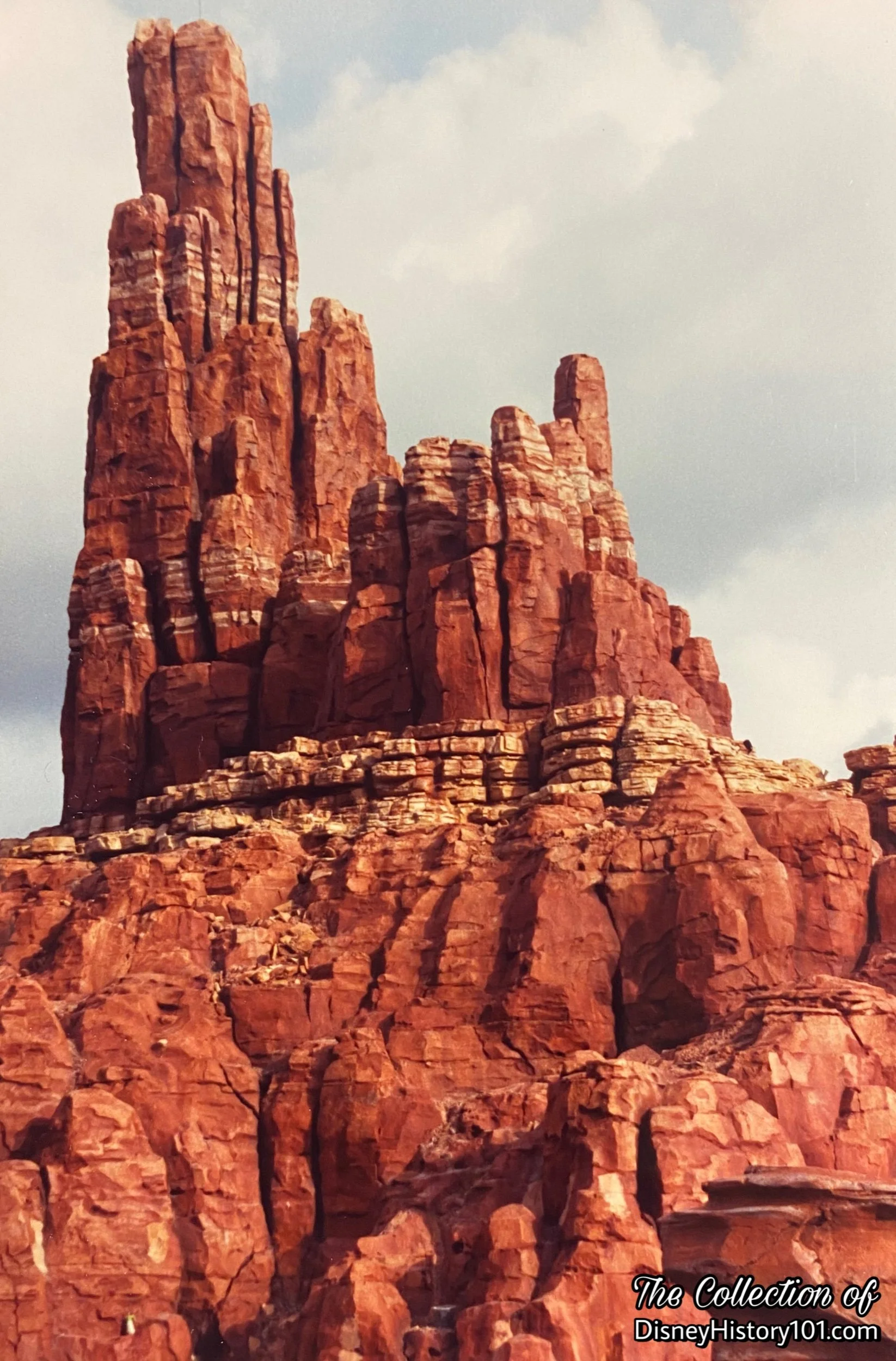
Euro Disneyland
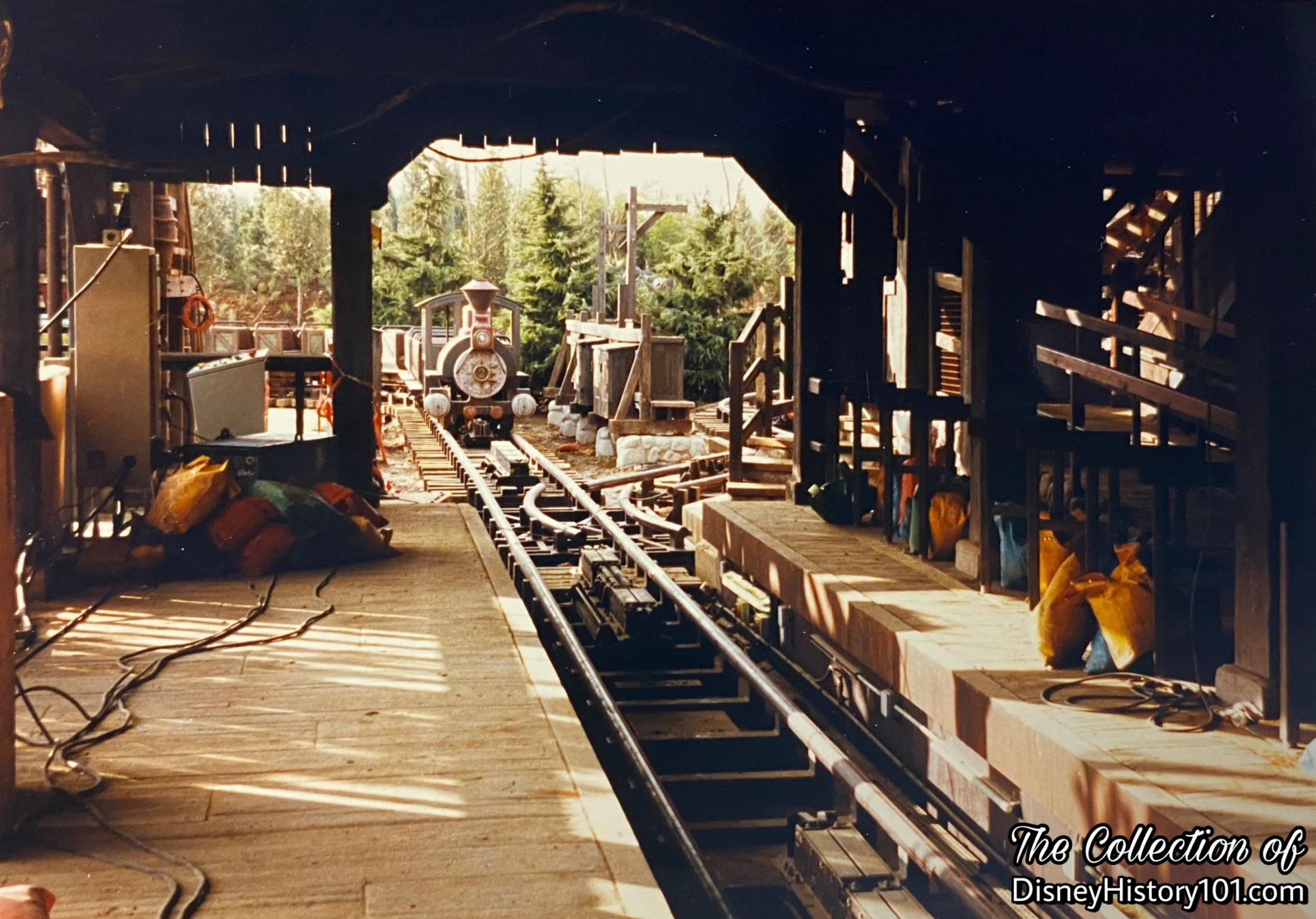
Euro Disneyland
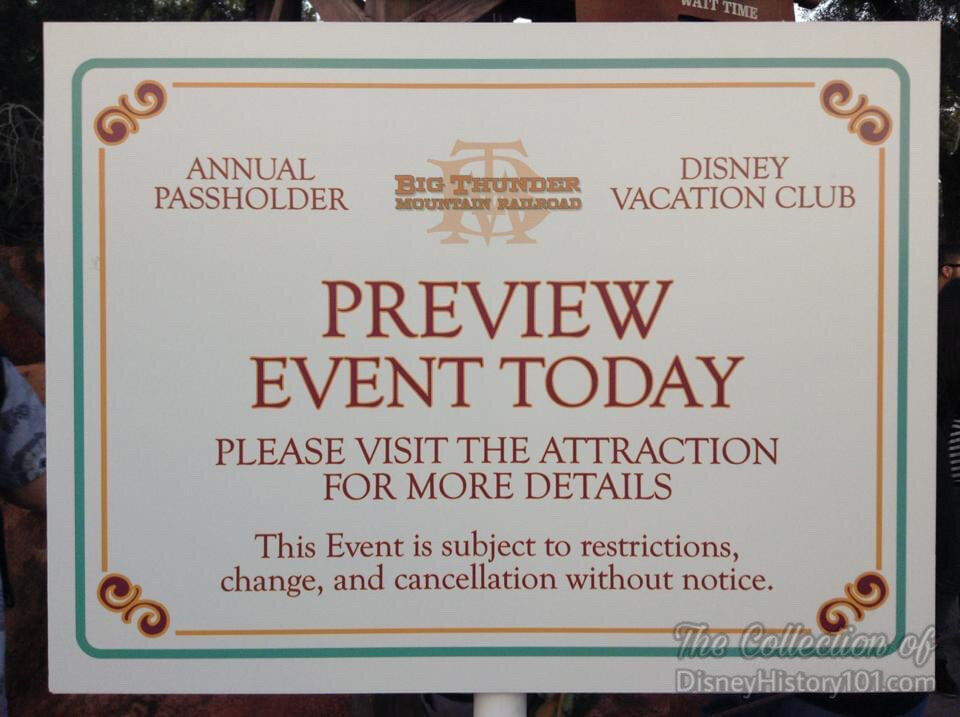
Big Thunder Mountain Railroad Preview
“Maintaining the Show”
Since the beginning, the Four Keys of the DISNEYLAND Show (operating priorities in presenting the DISNEYLAND Show) have been present - Courtesy, Safety, Show, and Efficiency. Guided by these Four Keys, are Walt Disney Imagineers, who are always seeking out new magical opportunities to increase the efficiency, safety, and showquality of Disneyland adventures.
Routinely the Park Operations Crew Big Thunder Machinist would read the daily “Third Shift Report” and Defect Sheet. The Machinist would then go to the Big Thunder storage workshop and read the log book, noting all entries from previous shifts and visually inspect during ride check-out. The Machinist would notify the M-41 machinist of any further work to be done or parts needed prior to opening. Before beginning routine track inspection, each person would tag out at board located in Ride Foreman's office. At the completion of track inspection, they would return tag to board in Lead Office. The machinist would make ready for operation, all track switches, and check the overall appearance. In the case of any discrepancies the machinist would notify the M-1 and proper department supervisor. The machinist would then make ready for operation all chain lift systems, checking the overall appearance. If there were any discrepancies, they would notify M-1 and proper department supervisor. They would make ready for operation, all brakes, checking the overall appearance. In the case of any discrepancies, they would notify the M-1 and proper department supervisor. The machinist would make ready for operation, all linear motors, checking the overall appearance. Any discrepancies, notify M-1 and proper department supervisor. The machinist would check each track crack detection system and notify M-1 and proper department supervisor.
During routine track inspection, the machinist would check the overall appearance. If there were any discrepancies, he would notify M-1 and proper department supervisor. The machinist would discuss it with the Attraction Lead, any information pertaining to work needed to be done prior to opening or if in doubt about a particular "write-up." The machinist would contact M-41 and discuss workload, if any, for possible use in other areas of Park or to assist M-42 or M-44. The machinist would coordinate with Maintenance Services for the hauling of parts to and from Main Shop. The machinist would work closely with Main Shop on rebuild and rehab of axle parts, train refurbishing, etc. The machinist would make sure to remove transportation vehicle from in-Park area to behind berm prior to Park opening. The machinist would assist on all Big Thunder Downs and delayed openings. At completion of track inspection, the machinist would return the tag to the board in the Lead Office.
As time allows, the Park Operations Crew Big Thunder Mountain Machinist would assist other crafts with the repair of trains in storage area. The Big Thunder machinist would maintain the parts supply for the Big Thunder attraction, remove sand bags from the test train and rotate the trains for inspection when needed. All Downtime Reports, any discrepancies, and Big Thunder special reports were turned in to the Foreman daily and all work done on Big Thunder was entered in the log book daily.
Soon, Show Quality Standards/SQS based at each Disney Resort around the world, were teams of Imagineers responsible for maintaining the integrity of the story in existing Guest areas such as attractions, shops, restaurants, hotels, Downtown Disneys, recreation, etc. as well as improving the Guest experience through the integration of new technology and the addition of new show elements.
Safety is a major concern of Engineering. Every year they would make a complete test and inspection of all structural parts of Disneyland. And since Guests would look to Disneyland for their safety the department team was continuously designing new guest and personnel safety devices.
“Rehabilitations”
There have been numerous rehabilitations for this senior attraction over the years. These were often performed by the staff of Disneyland Shops (The Maintenance Division at Disneyland). The related Big Thunder Photo Trail closed in July 1981. A full rehabilitation of the trains began that year as well (see Job Sheets below).
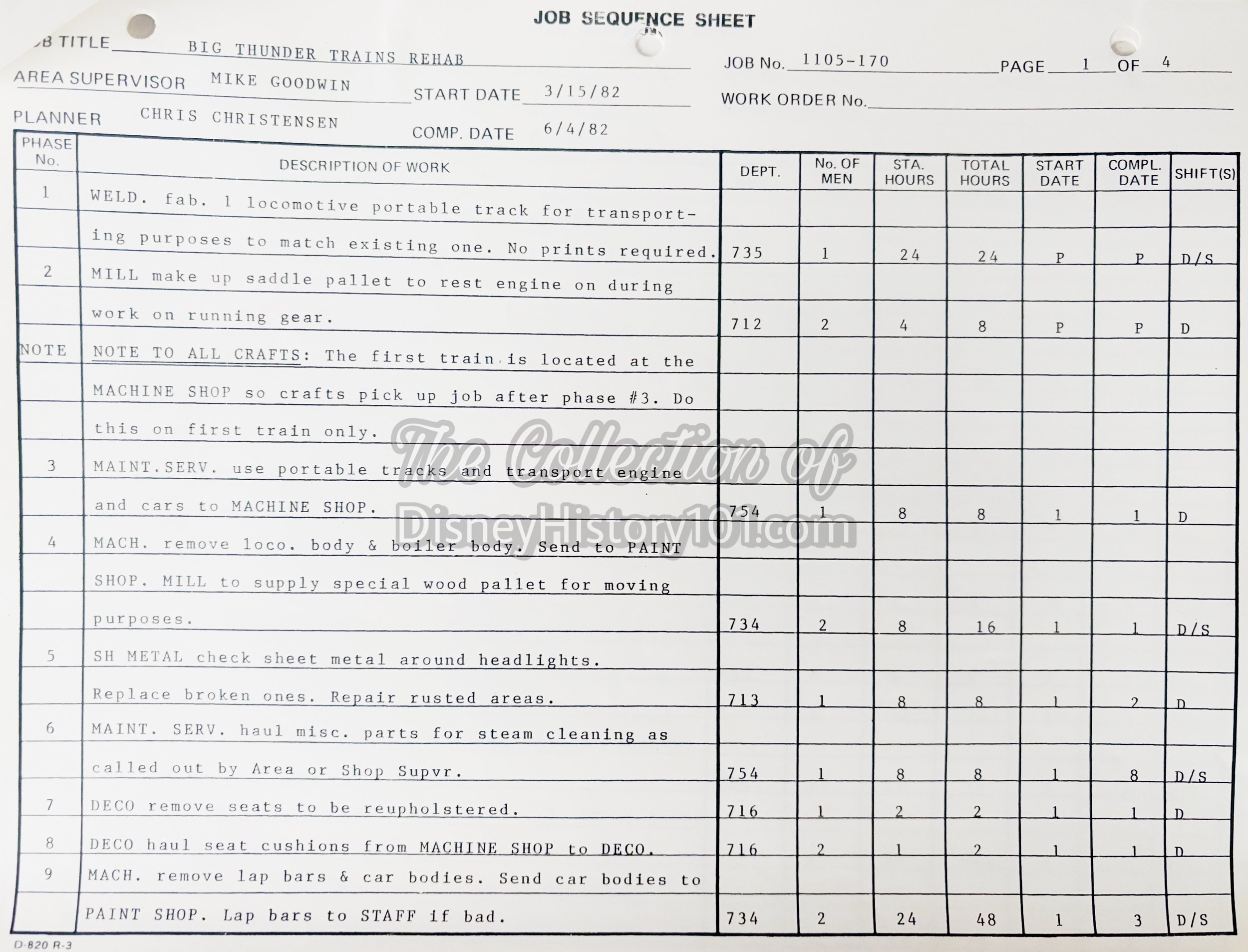
Big Thunder Trains Rehab Job Sequence Sheet, Page 1; 1982.
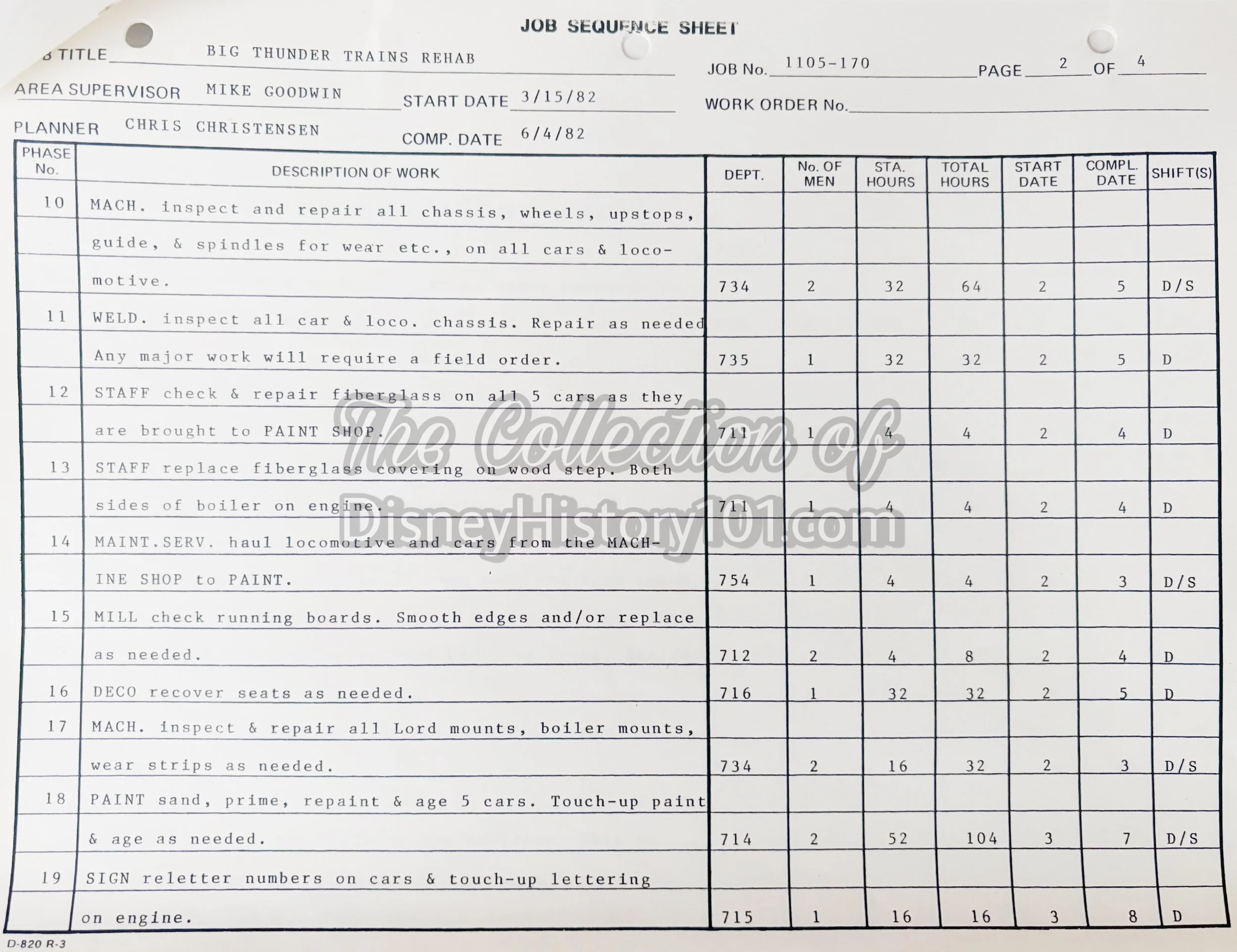
Big Thunder Trains Rehab Job Sequence Sheet, Page 2; 1982.
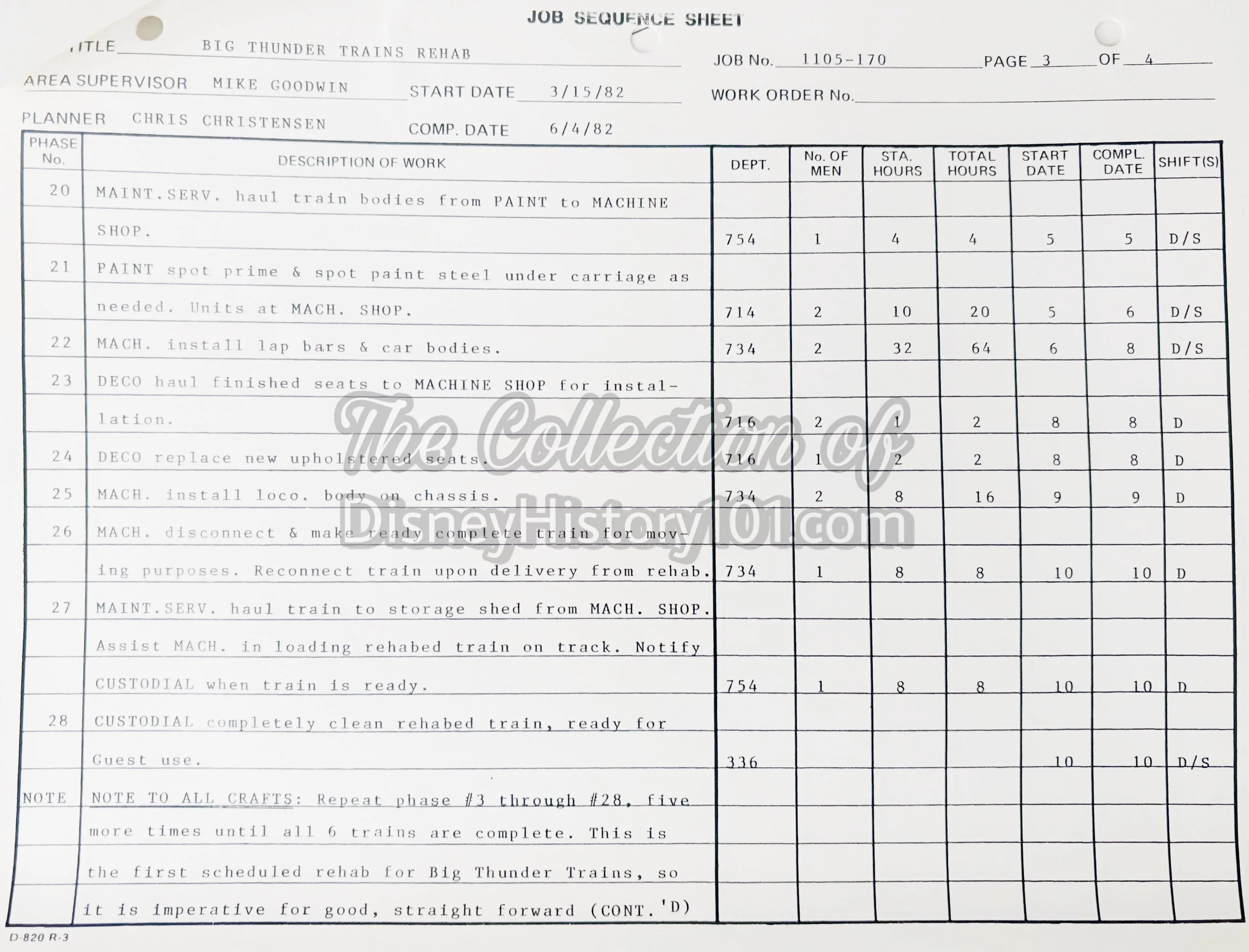
Big Thunder Trains Rehab Job Sequence Sheet, Page 3; 1982.
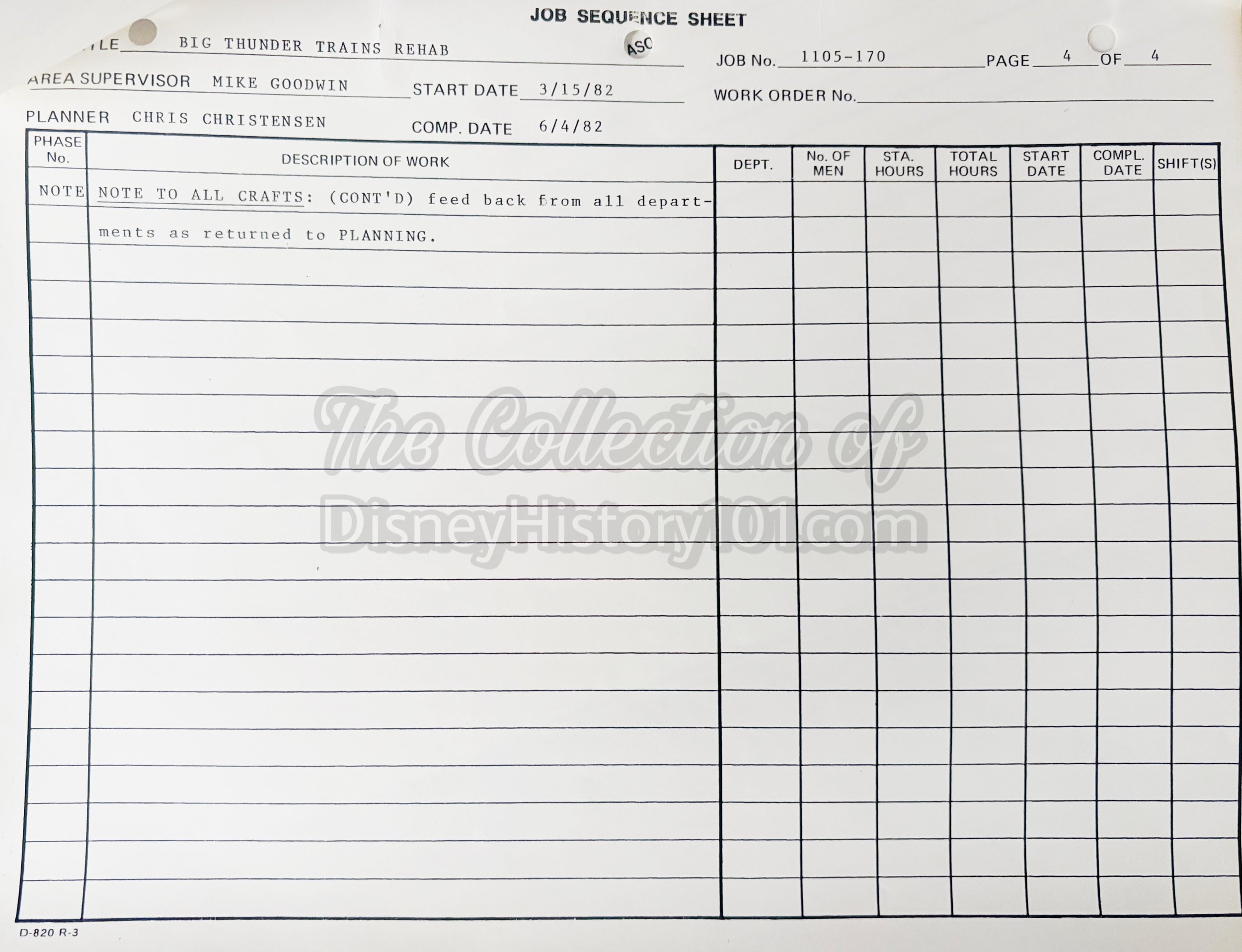
Big Thunder Trains Rehab Job Sequence Sheet, Page 4; 1982.
“Major Rehabilitations”
The 15th Anniversary Rehab – One of the first major rehabilitations was an eight-week rehab, which occurred in 1994, in honor of the 15th anniversary of Big Thunder Mountain Railroad! Electricians and machinists of Disney Design Services (under the Artistic Direction of Bob Baranick) and Facilities West (under the Supervision of Bob Klostriech and the Artistic Direction of Dan Otrambo) collaborated in order to accomplish the task. Machinists like Moe Prieto, Hubie Marical, Eileen Schneider, Orin Hagen, and Paul Henderson were just a few of the many Facilities Cast Members who lended their skills to the rehabilitation.
Some 400 feet of track was replaced, as part of the preventive maintenance program.
The three lifts were given “heavier motors” and new sprockets, in addition to a new chain for the A-Lift.
More Linear Induction Motors (LIMs) used to boost the trains out of the station, and slow them down at the end were added. This would help reduce downtime. New LIMs were also added to the track's spur rail, installed by Electricians like Jeff McShea, Carl Sanchez, and Jim Nelson.
The trains themselves were redesigned to meet increased capacity. The new train cars would be “heavier, sturdier vehicles to complement the focus on increased efficiency.”
“A new Program Logic Controller (PLC) that … [had] four times the memory capacity of the old system. Because more safety elements can be programmed into the system, the five trains … [could] be run more efficiently and because the computer … [would] be able to read six track pressure zones (instead of just three),” the attraction experienced fewer and shorter downtimes. [Disneyland LINE October 24, 1994].
As for the Stage’s Show Props and Facades, the “General Store” and “Miner’s Hardware” shops featured more new inventory, while the old tooth-shaped sign of the dentist’s office returned.
Many of the “animations” (critters of Big Thunder) like coyotes and skunks were replaced.
Special Effects like the earthquake and splash-down scenes were refined.
Many of the artifacts were also replaced. The miner's hardware placed throughout the attraction were replaced or enhanced by artifacts bought throughout Southern California.
“Bob Baranick, Art Director for Disney Design Services, says that many Show elements are receiving attention for the first time in fifteen years. ‘Prior to Big Thunder,’ Bob says, ‘attractions at Disneyland were painted in bright, shiny enamel. Well, at Big Thunder, it was a ‘rust and dust’ theme; and unfortunately over the last 12 years or so, we've developed rust and dust where we don't want it. We're now trying to put it back where it belongs.” [Disneyland Line, October 28, 1994]
“At Big Thunder, as with most of the Park's water attractions” steps were taken “to protect the steel from corrosion…” and employees “would sandblast the steel to look brand-new and then apply a primer and rust-resistant paint to equal a thickness of 5 millimeters.” After that, an inspector was hired to ensure the quality of the work.
By 1996, the U.R. Courageous Runaway mine train had been added to the rolling stock.
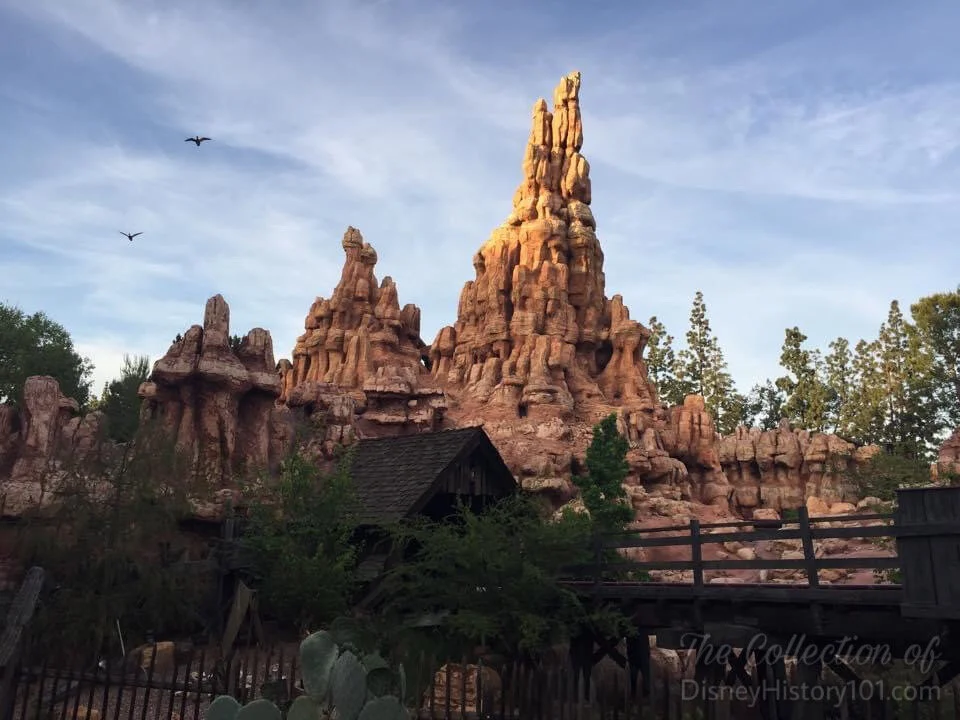
The steep summit of Big Thunder Mountain.
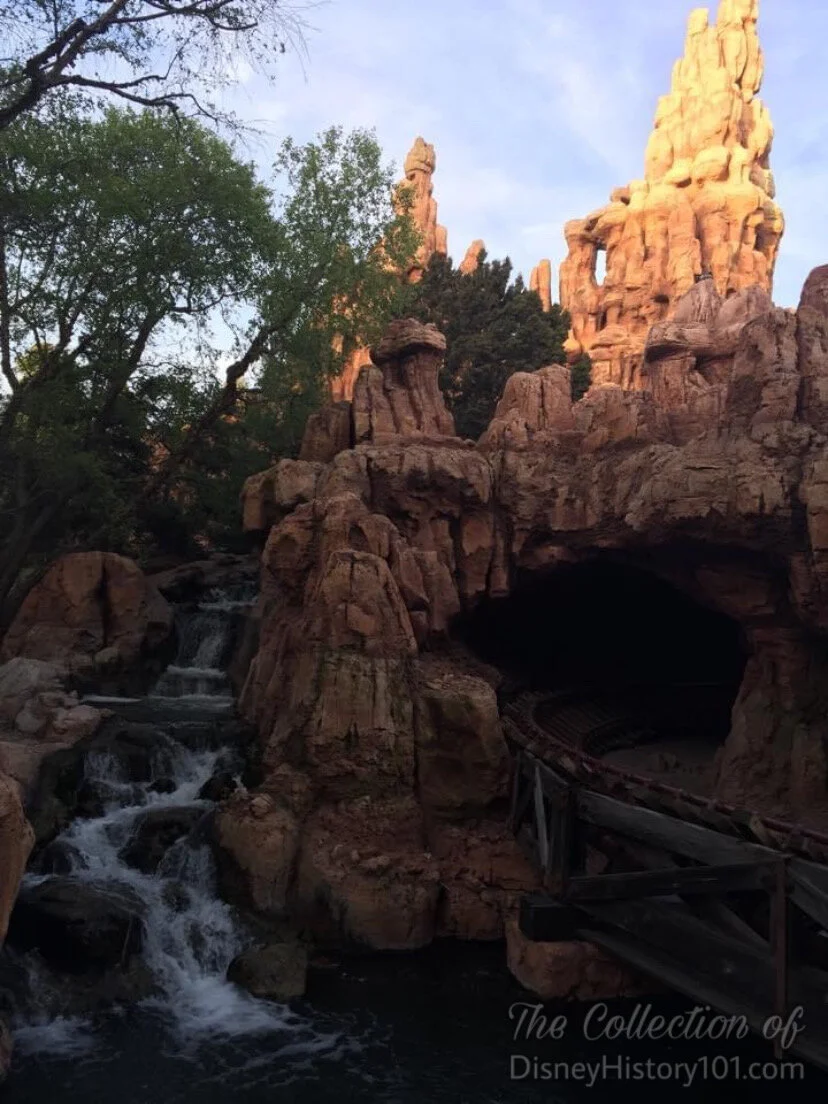
Big Thunder Mountain Railroad
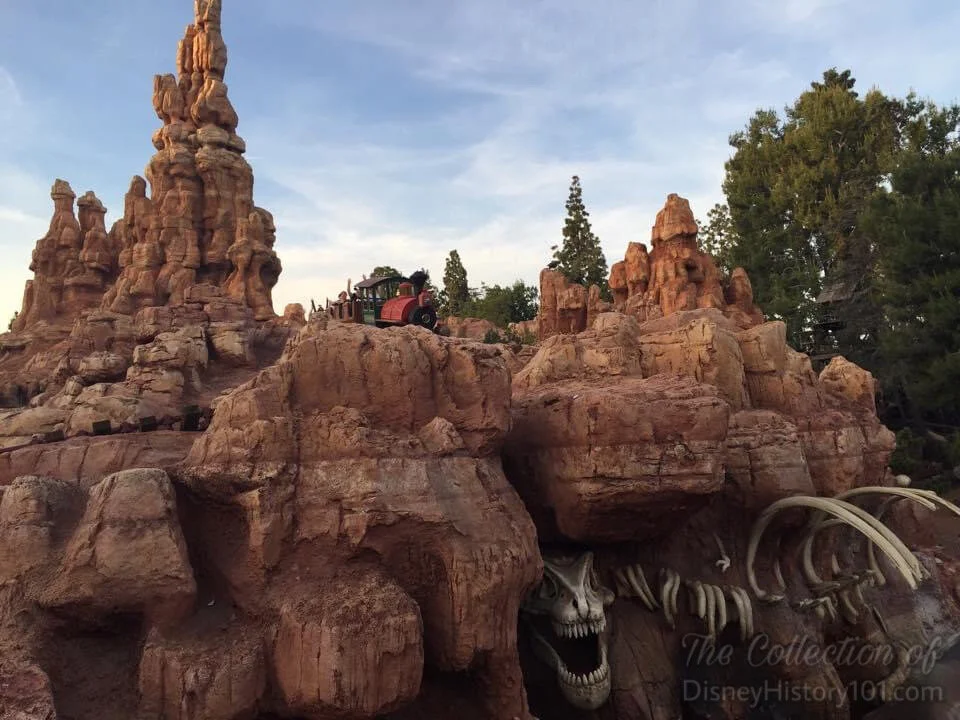
Big Thunder Mountain Railroad Dinosaur Gap
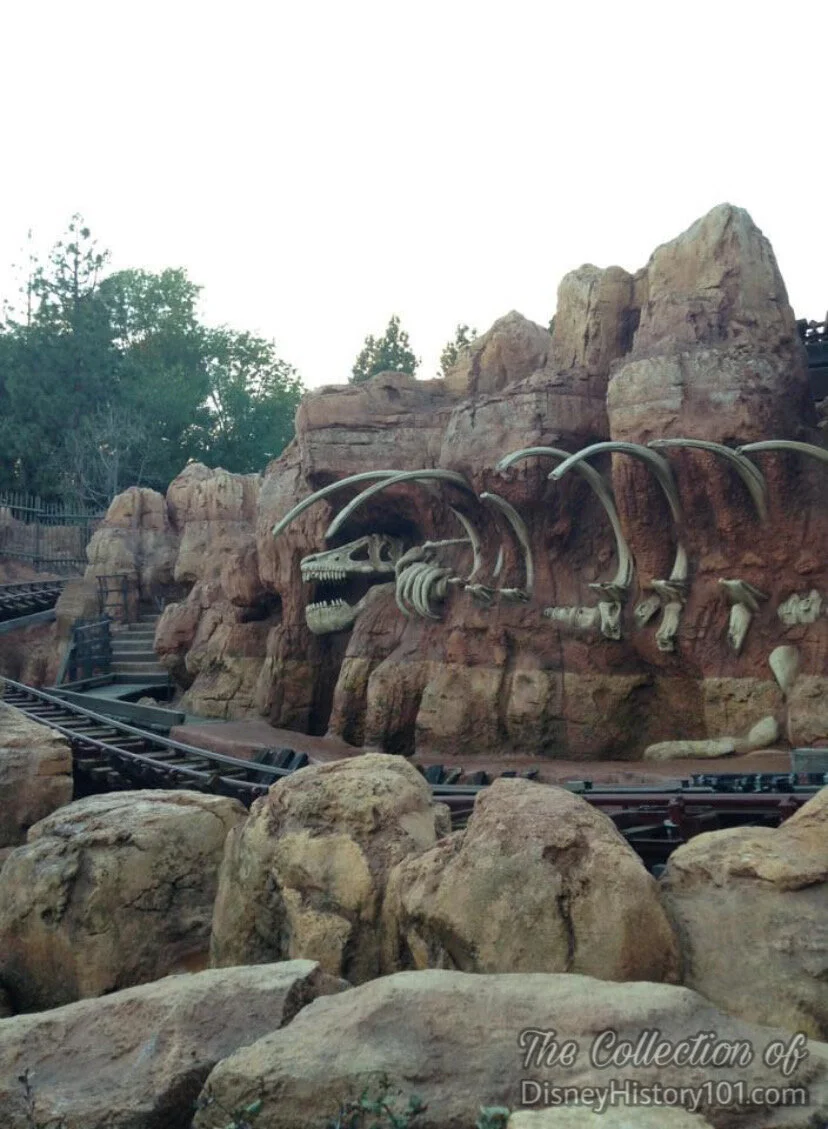
Big Thunder Mountain Railroad Dinosaur Gap
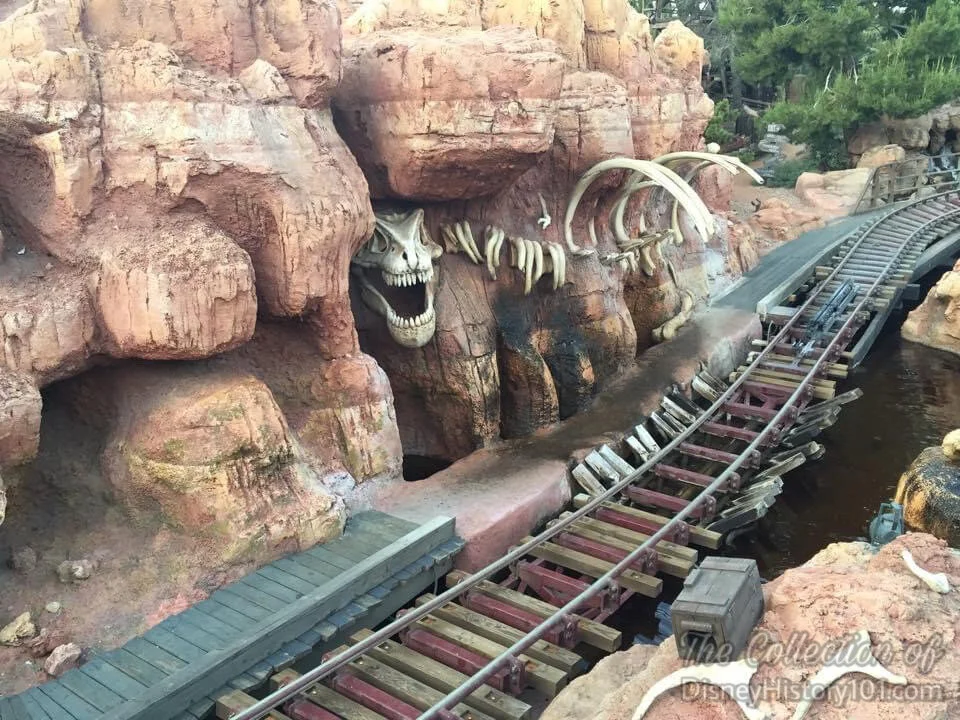
Big Thunder Mountain Railroad Dinosaur Gap
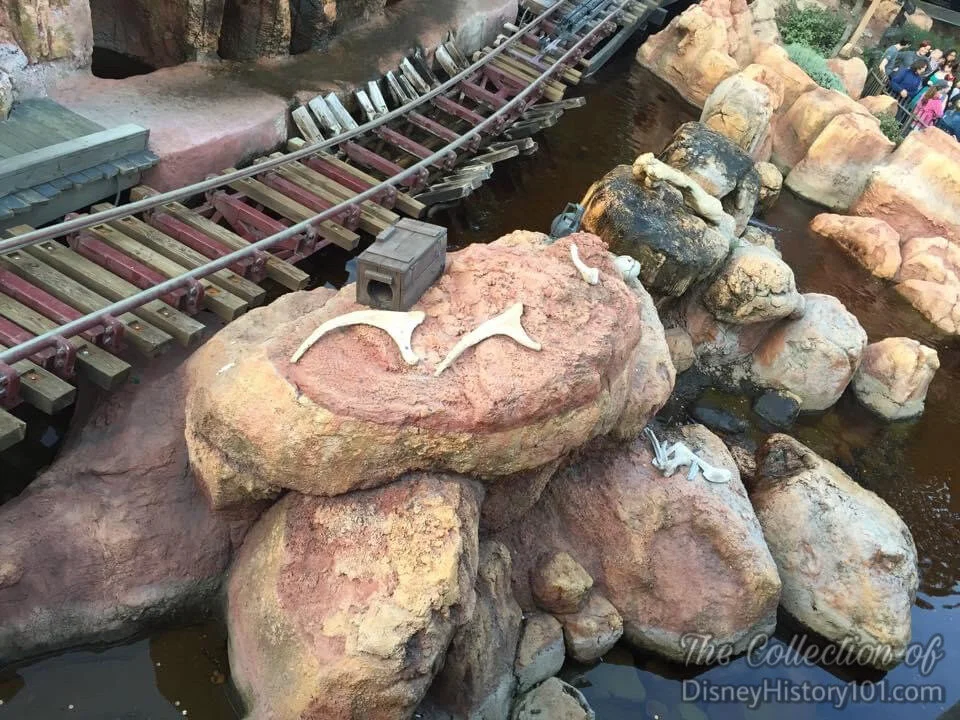
Big Thunder Mountain Railroad Dinosaur Gap
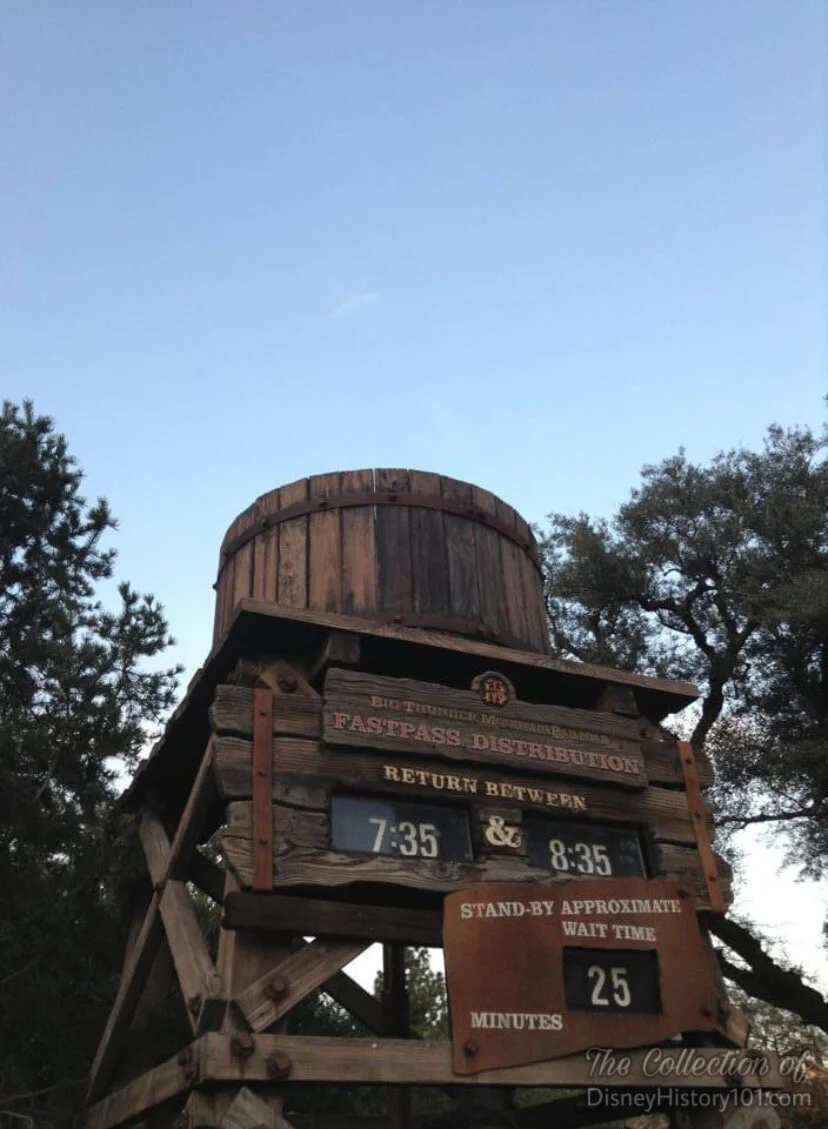
Big Thunder Mountain Railroad Fastpass Distribution
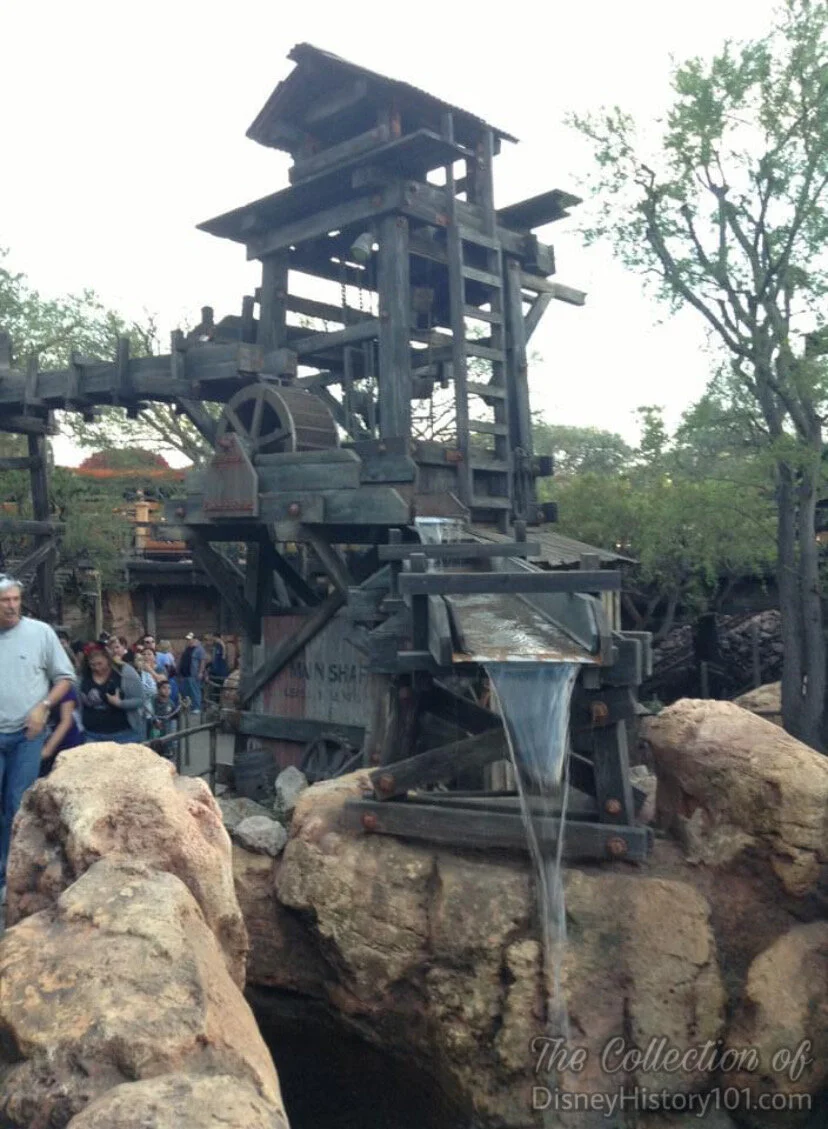
Big Thunder Mountain Railroad
Disneyland queue lines are designed as part of the attraction to make the guests' time in line as comfortable as possible.
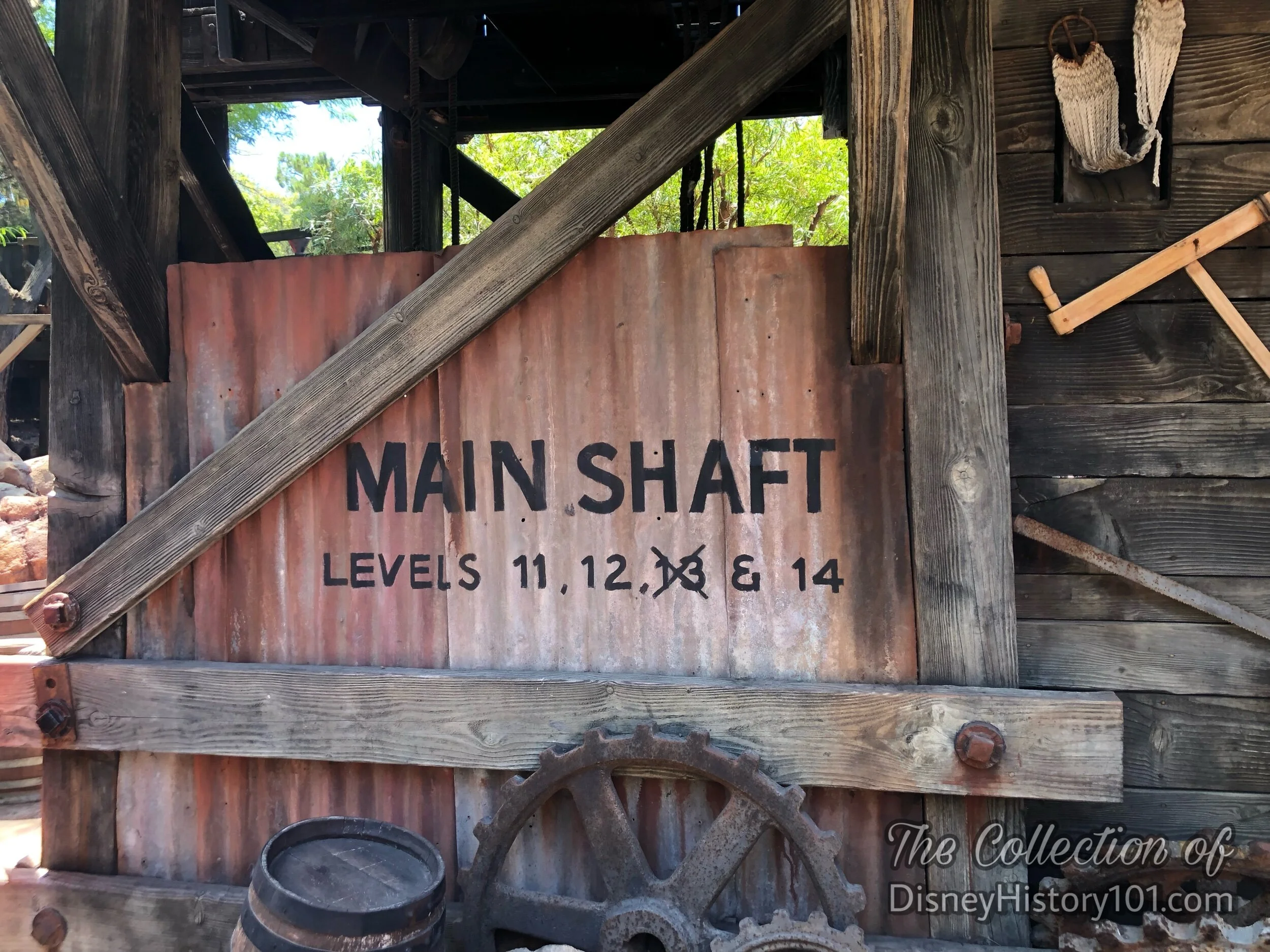
Big Thunder Mountain Main Shaft viewed from the Audience Waiting Area (or Guest Control queue area).
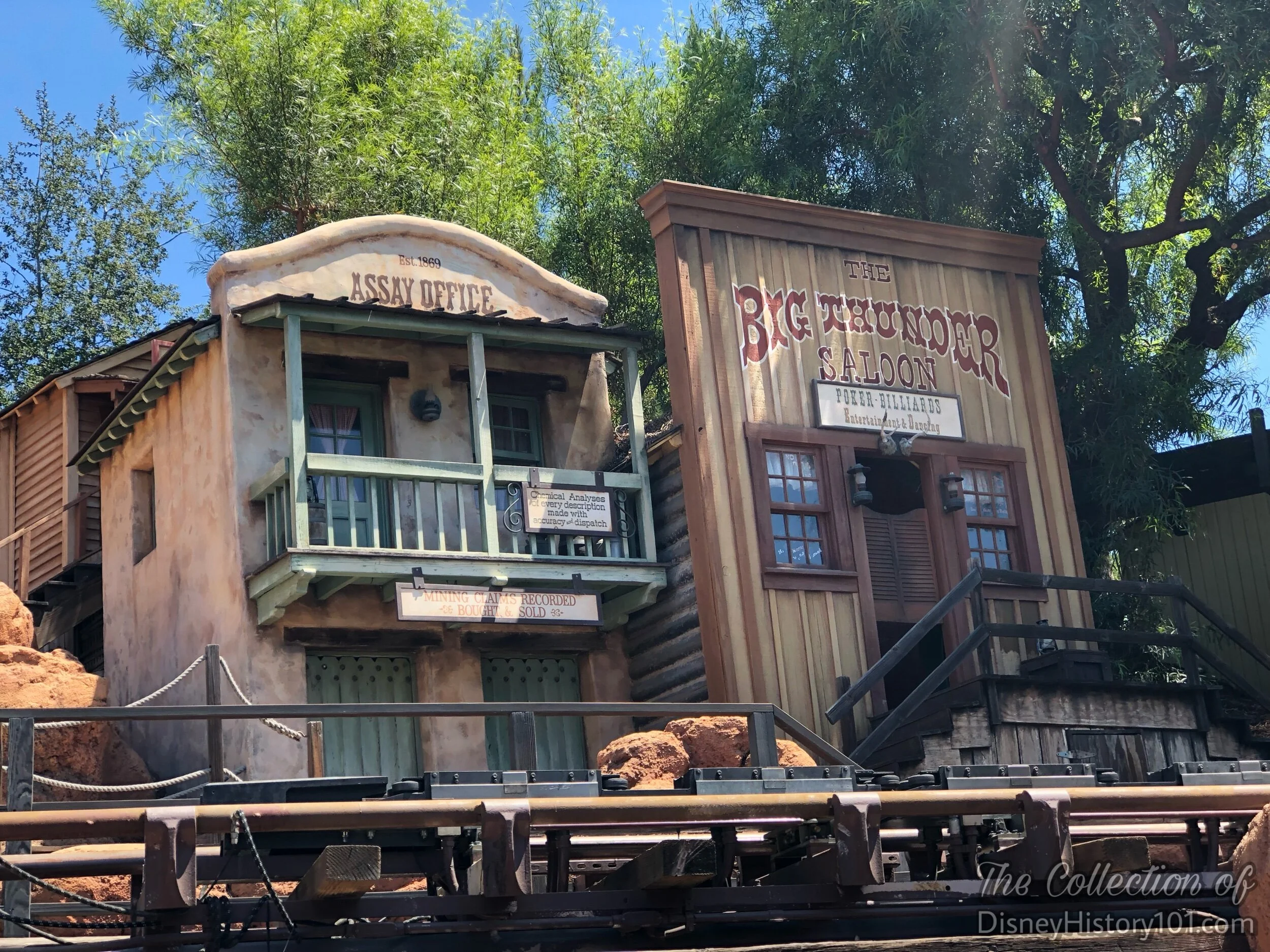
The Town of Big Thunder
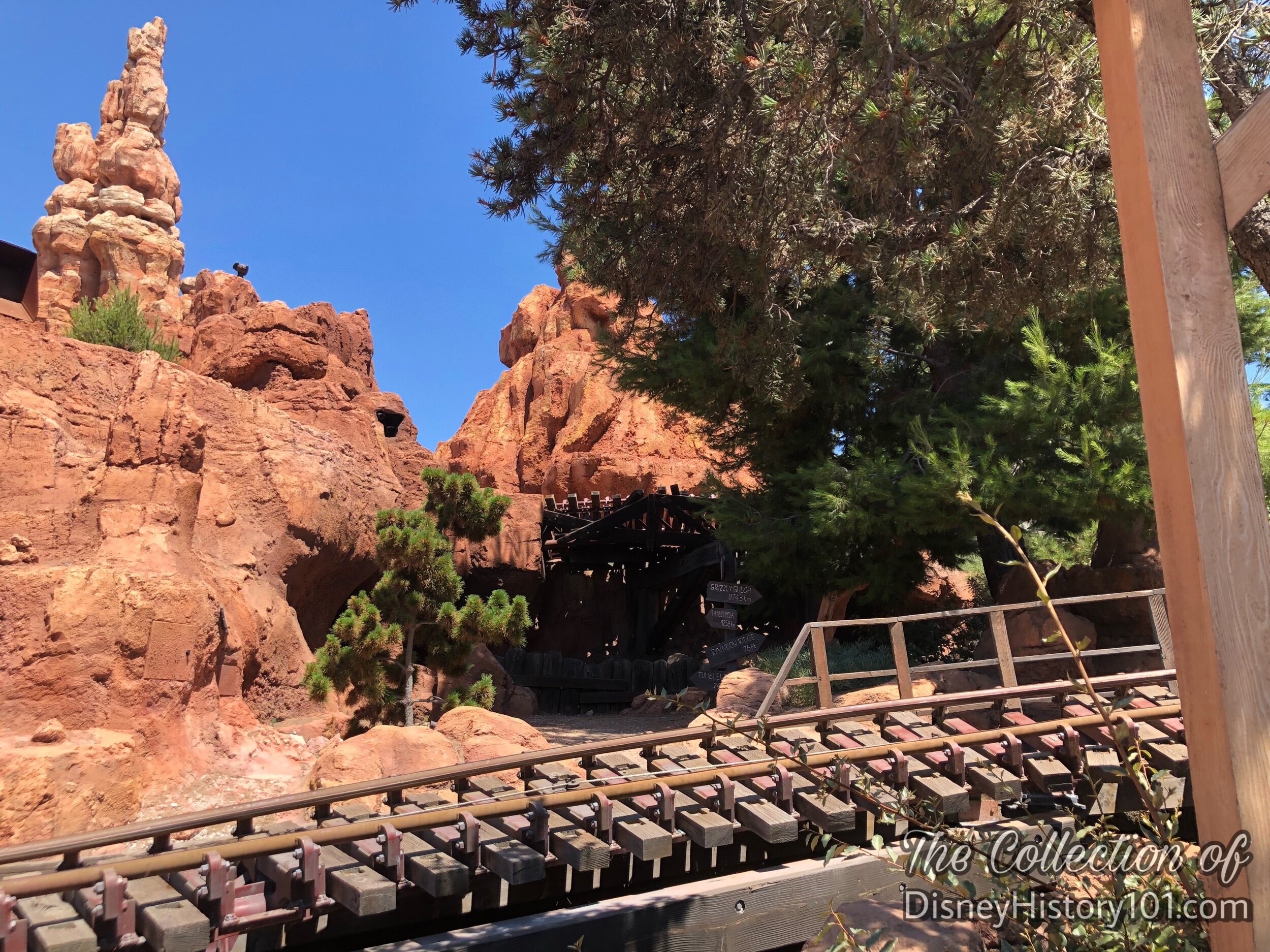
Big Thunder Mountain Railroad, (The Present)
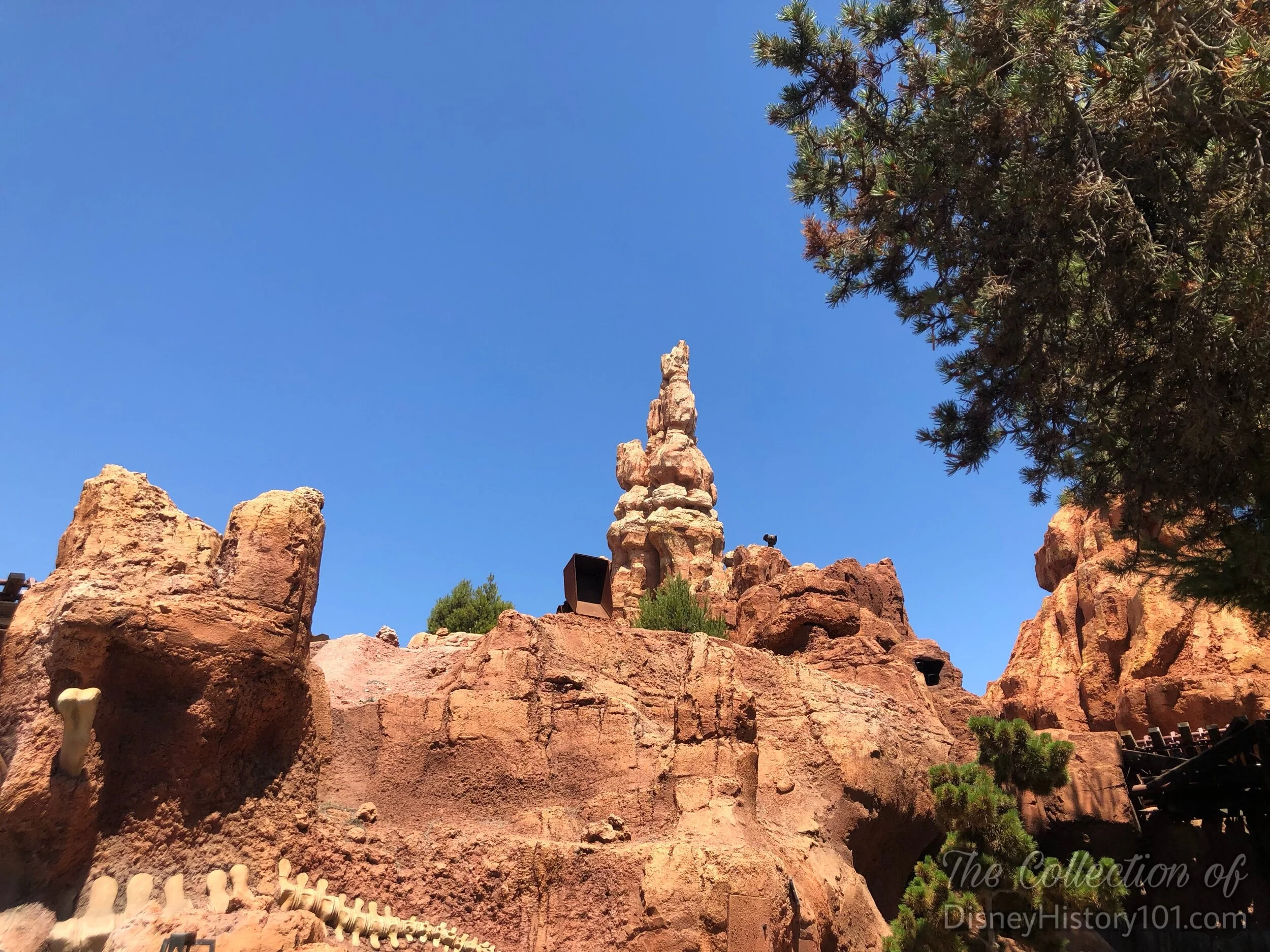
Big Thunder Mountain Railroad, under Dinosaur Gap; The Present.
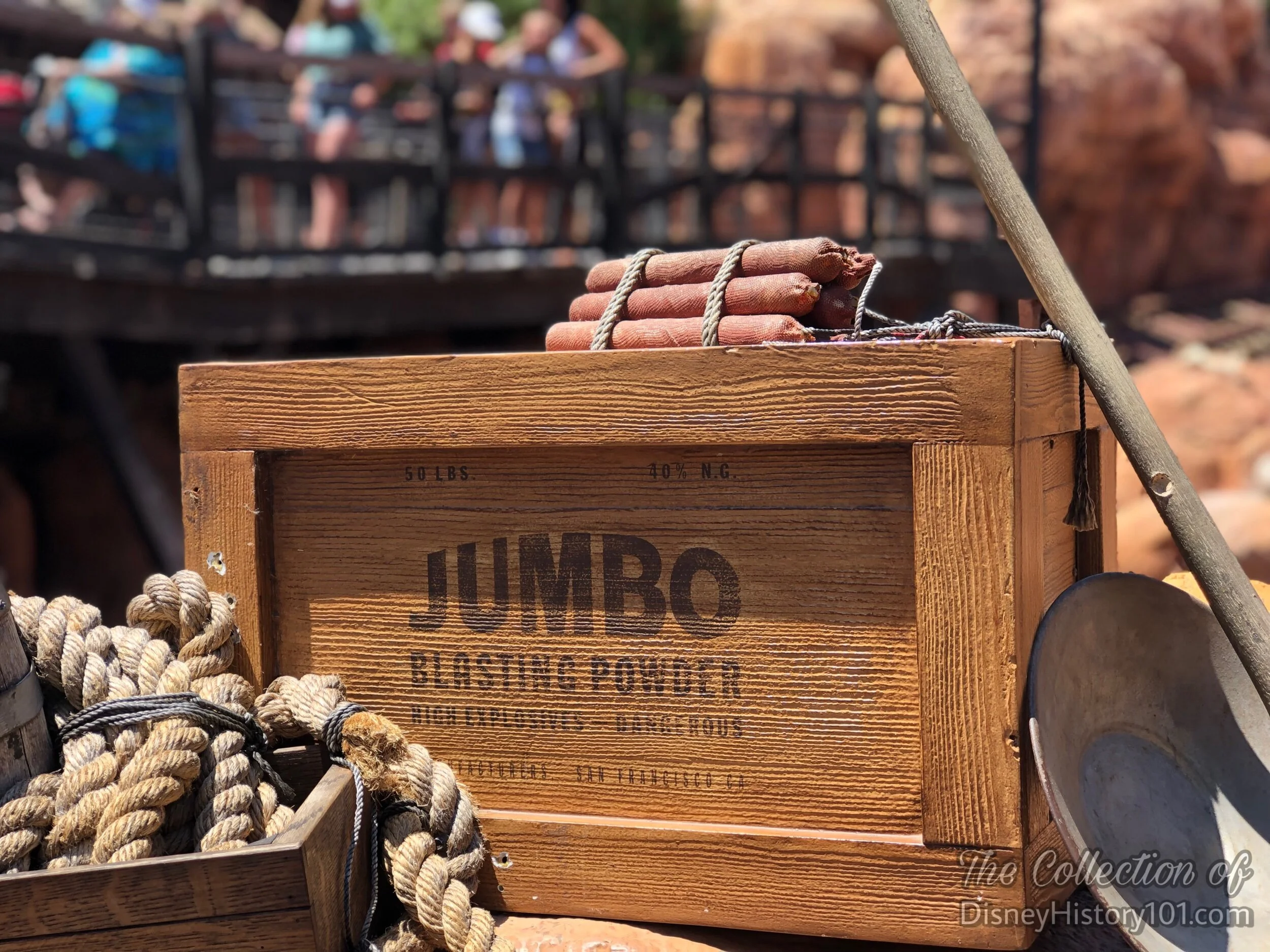
Big Thunder Mountain Railroad queue area, The Present.
The former Walt Disney Imagineering Principal Creative Executive Marty Sklar would probably agree that the small details like these make the story appealing. Today, “Audience Waiting Areas” are especially designed as part of the attraction to make the guest's time waiting in line as comfortable as possible.
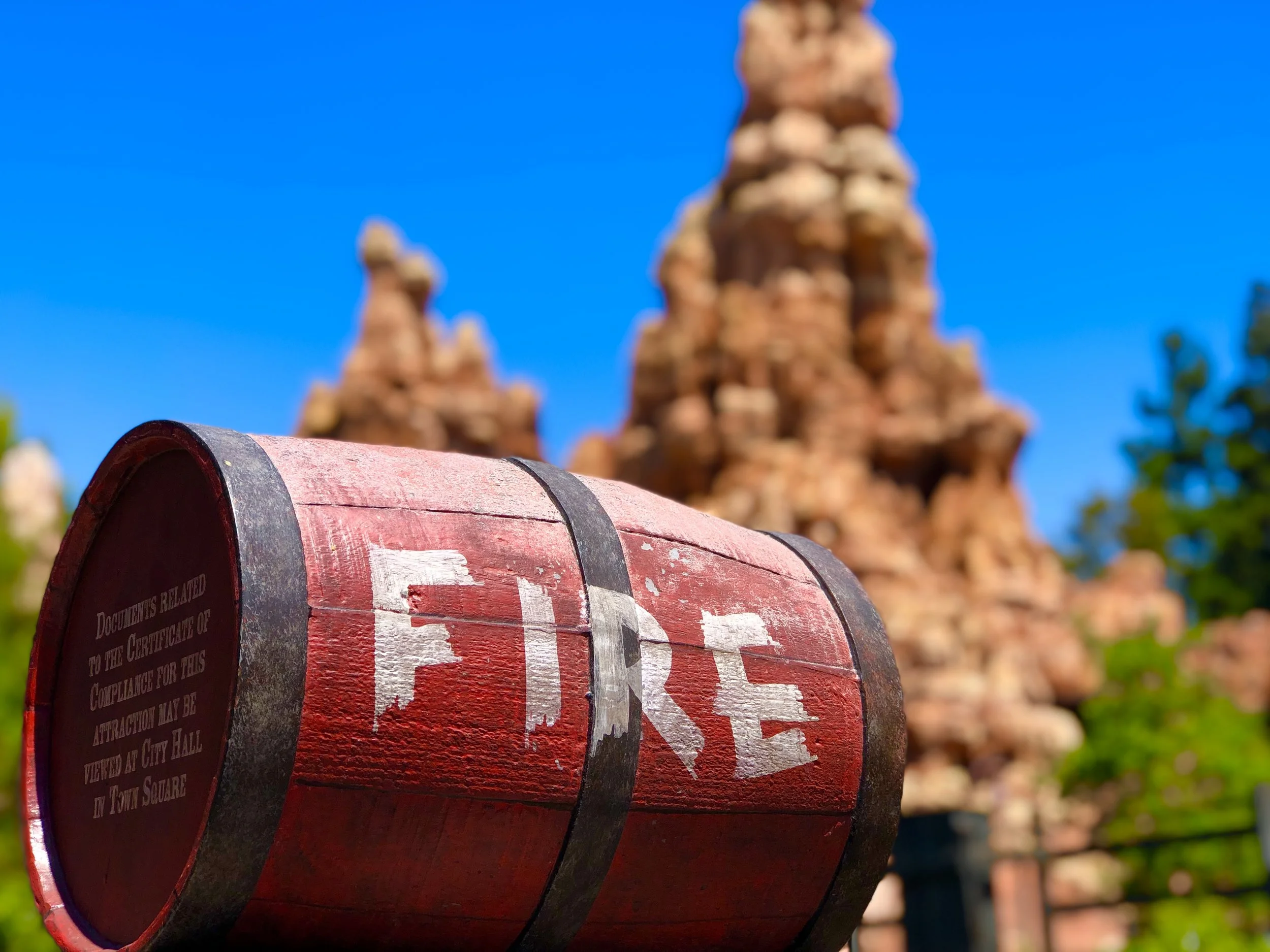
Big Thunder Mountain Railroad, (The Present)
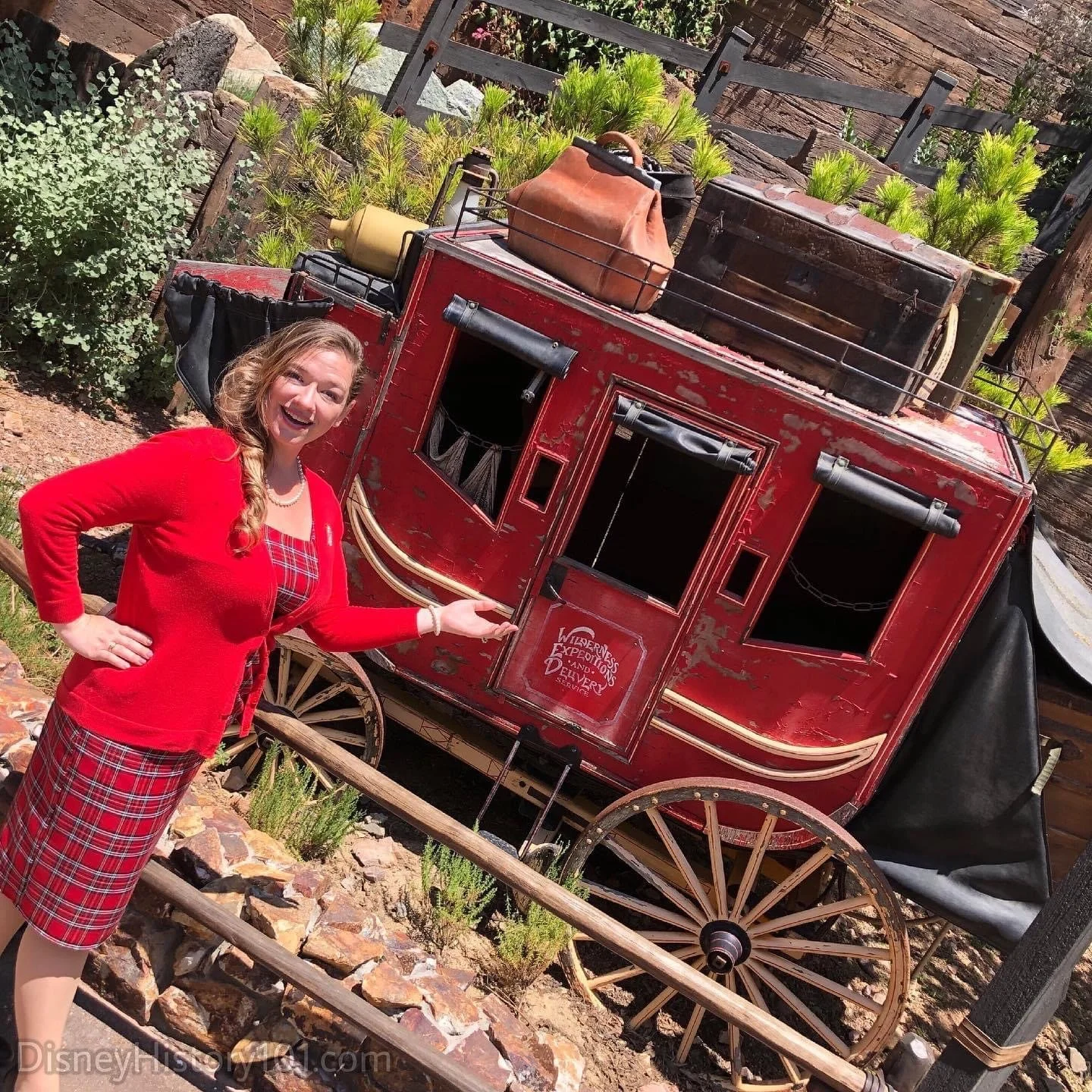
Big Thunder Mountain area
Maybe you’ve noticed TONY BAXTER’S original BIG THUNDER MOUNTAIN RAILROAD main character Jason Chandler, referenced on a luggage tag on the back of the Wilderness Expeditions and Delivery Service Coach near the entrance to Galaxy’s Edge!
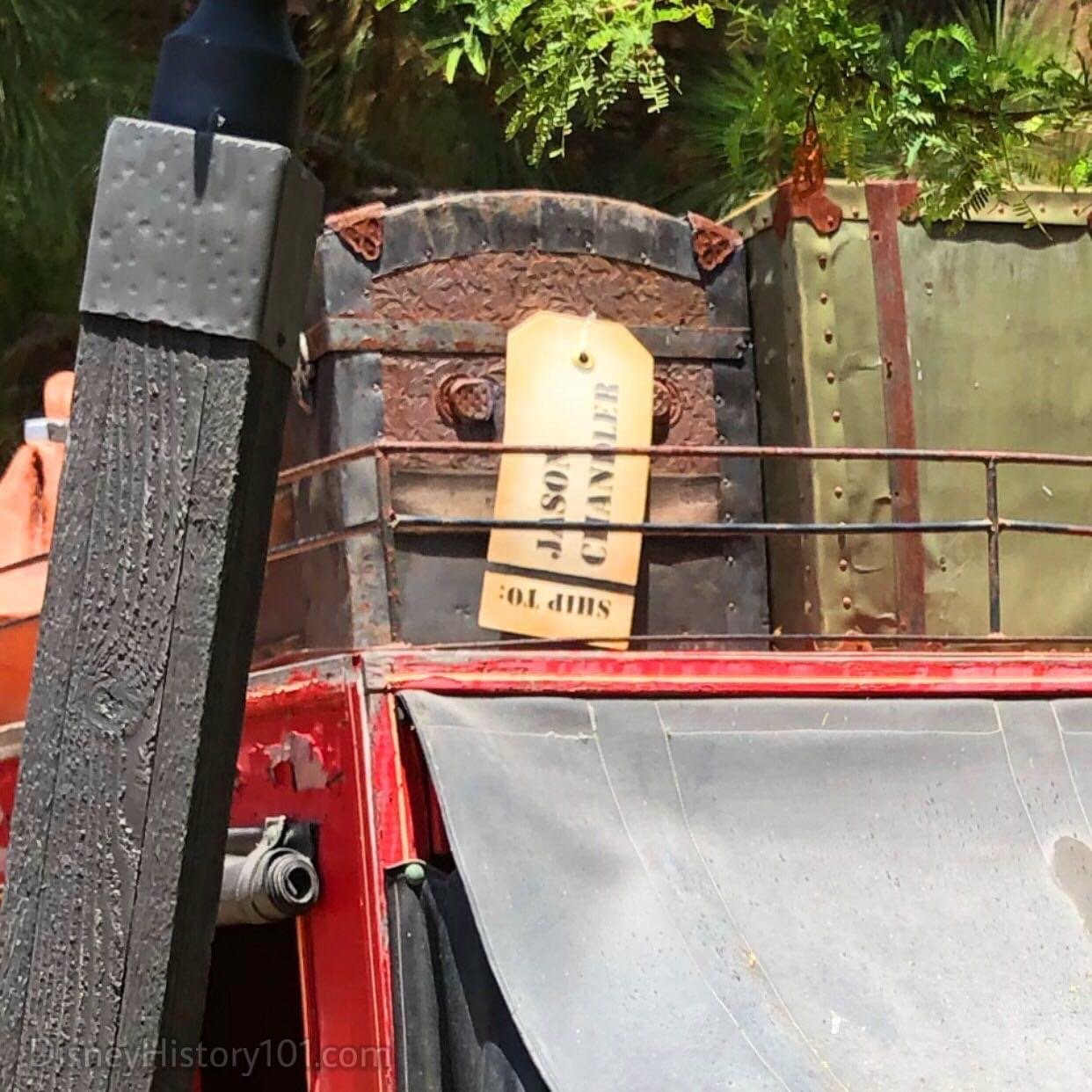
Big Thunder Mountain area
Quisque iaculis facilisis lacinia. Mauris euismod pellentesque tellus sit amet mollis.